Cambridge A Level Biology 9700 — 2014 Oct/Nov Paper 2 · Variant 1
9700/21/O/N/14 · 60 marks · ≈68 min
The question paper and its mark scheme, free to read here and free to download. This is Cambridge’s own paper, exactly as it was sat.
Question paper16 pages


Mark scheme7 pages
Answers below. Sit the paper first if you are practising.
Paper as text
Question paper, page 1
This document consists of 14 printed pages and 2 blank pages. DC (LK/SW) 79829/4 © UCLES 2014 [Turn over Cambridge International Examinations Cambridge International Advanced Subsidiary and Advanced Level * 6 2 0 5 8 6 7 9 2 1 * BIOLOGY 9700/21 Paper 2 Structured Questions AS October/November 2014 1 hour 15 minutes Candidates answer on the Question Paper. No Additional Materials are required. READ THESE INSTRUCTIONS FIRST Write your Centre number, candidate number and name in the spaces provided at the top of this page. Write in dark blue or black pen. You may use an HB pencil for any diagrams or graphs. Do not use staples, paper clips, glue or correction fluid. DO NOT WRITE IN ANY BARCODES. Answer all questions. Electronic calculators may be used. At the end of the examination, fasten all your work securely together. The number of marks is given in brackets [ ] at the end of each question or part question.
Question paper, page 2
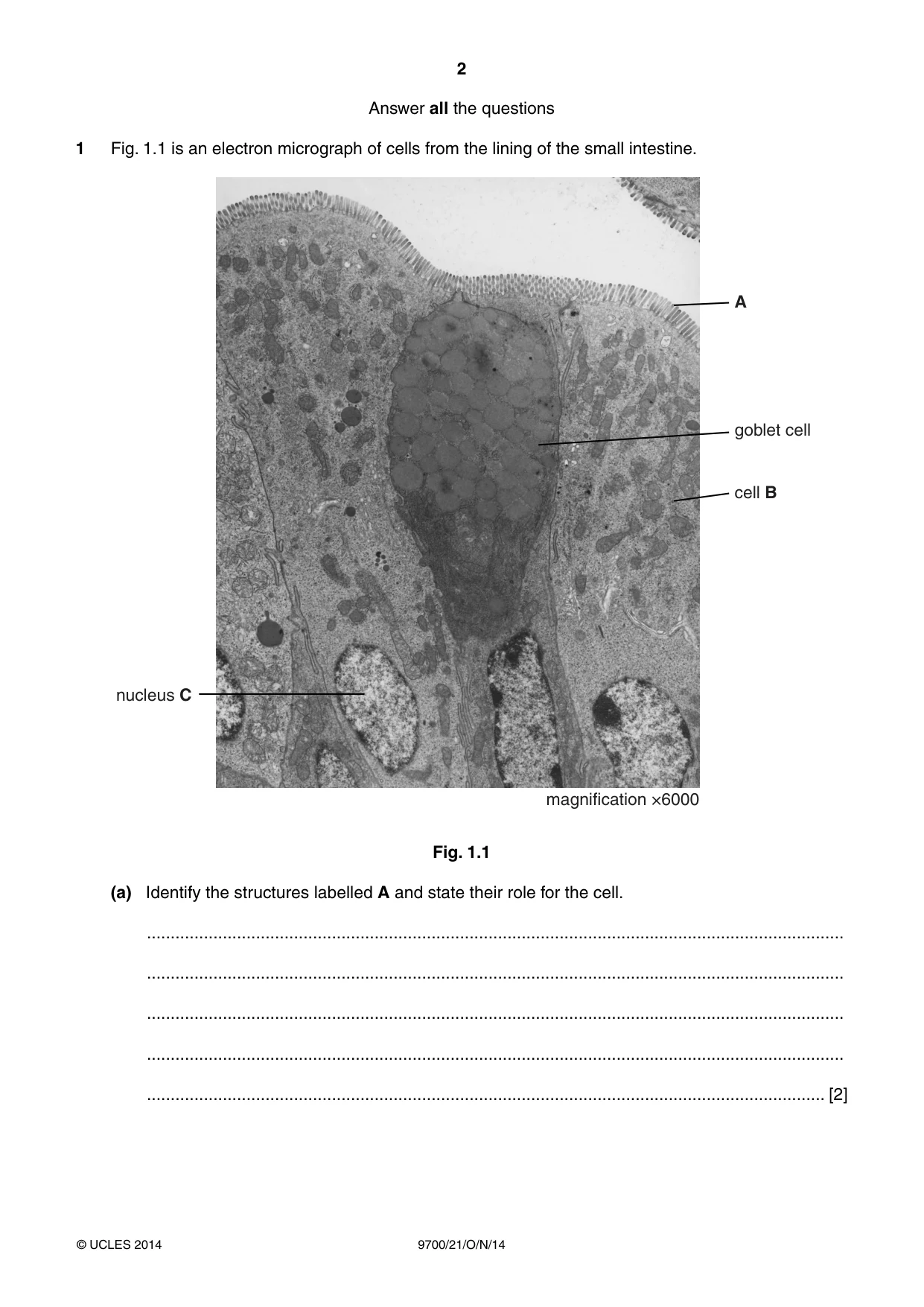
2 9700/21/O/N/14 © UCLES 2014 Answer all the questions 1 Fig. 1.1 is an electron micrograph of cells from the lining of the small intestine. nucleus C cell B magnification ×6000 goblet cell A Fig. 1.1 (a) Identify the structures labelled A and state their role for the cell. … … … … … [2]
Question paper, page 3
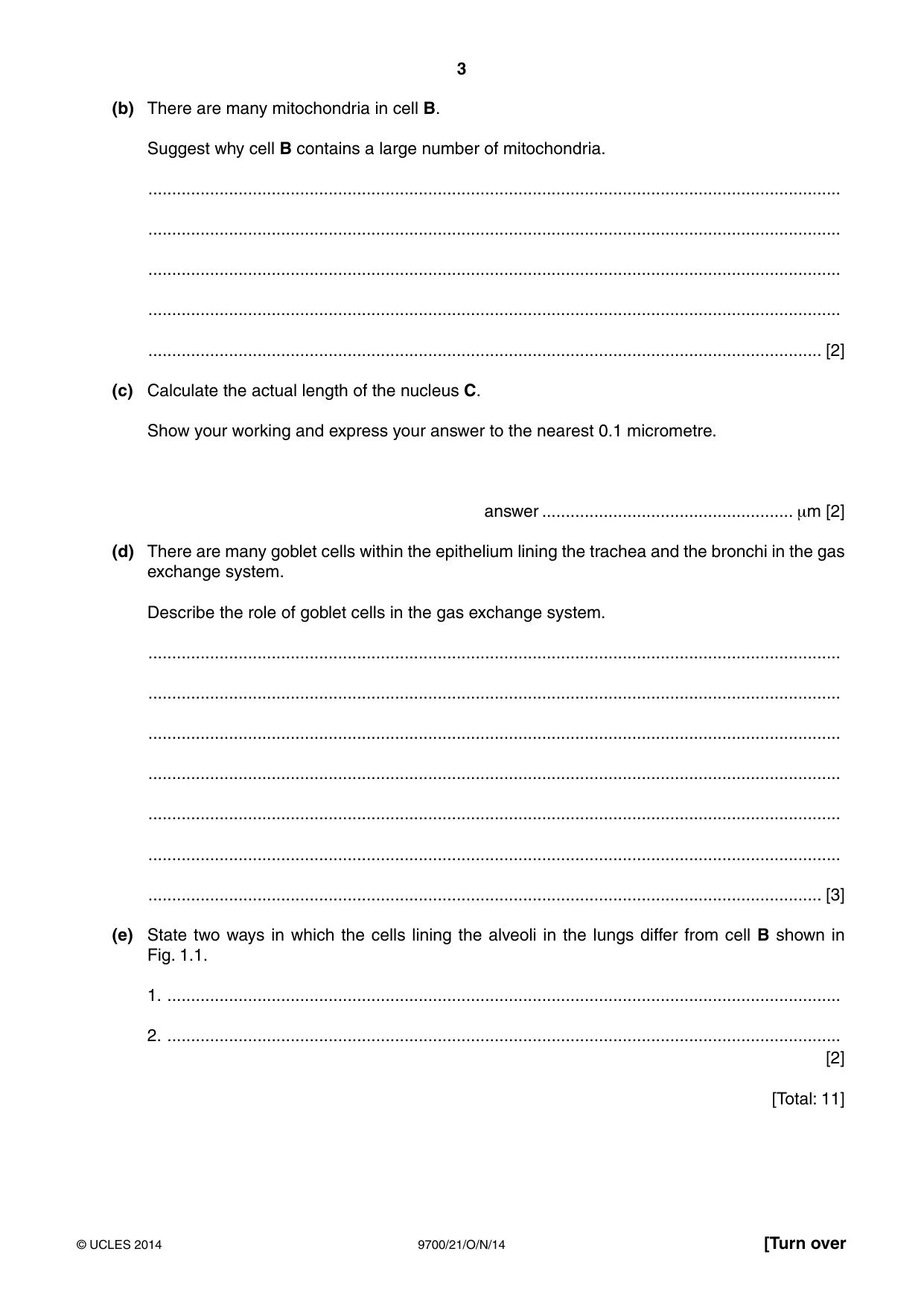
3 9700/21/O/N/14 © UCLES 2014 [Turn over (b) There are many mitochondria in cell B. Suggest why cell B contains a large number of mitochondria. … … … … … [2] (c) Calculate the actual length of the nucleus C. Show your working and express your answer to the nearest 0.1 micrometre. answer … μm [2] (d) There are many goblet cells within the epithelium lining the trachea and the bronchi in the gas exchange system. Describe the role of goblet cells in the gas exchange system. … … … … … … … [3] (e) State two ways in which the cells lining the alveoli in the lungs differ from cell B shown in Fig. 1.1. 1. … 2. … [2] [Total: 11]
Question paper, page 4
4 9700/21/O/N/14 © UCLES 2014 BLANK PAGE
Question paper, page 5
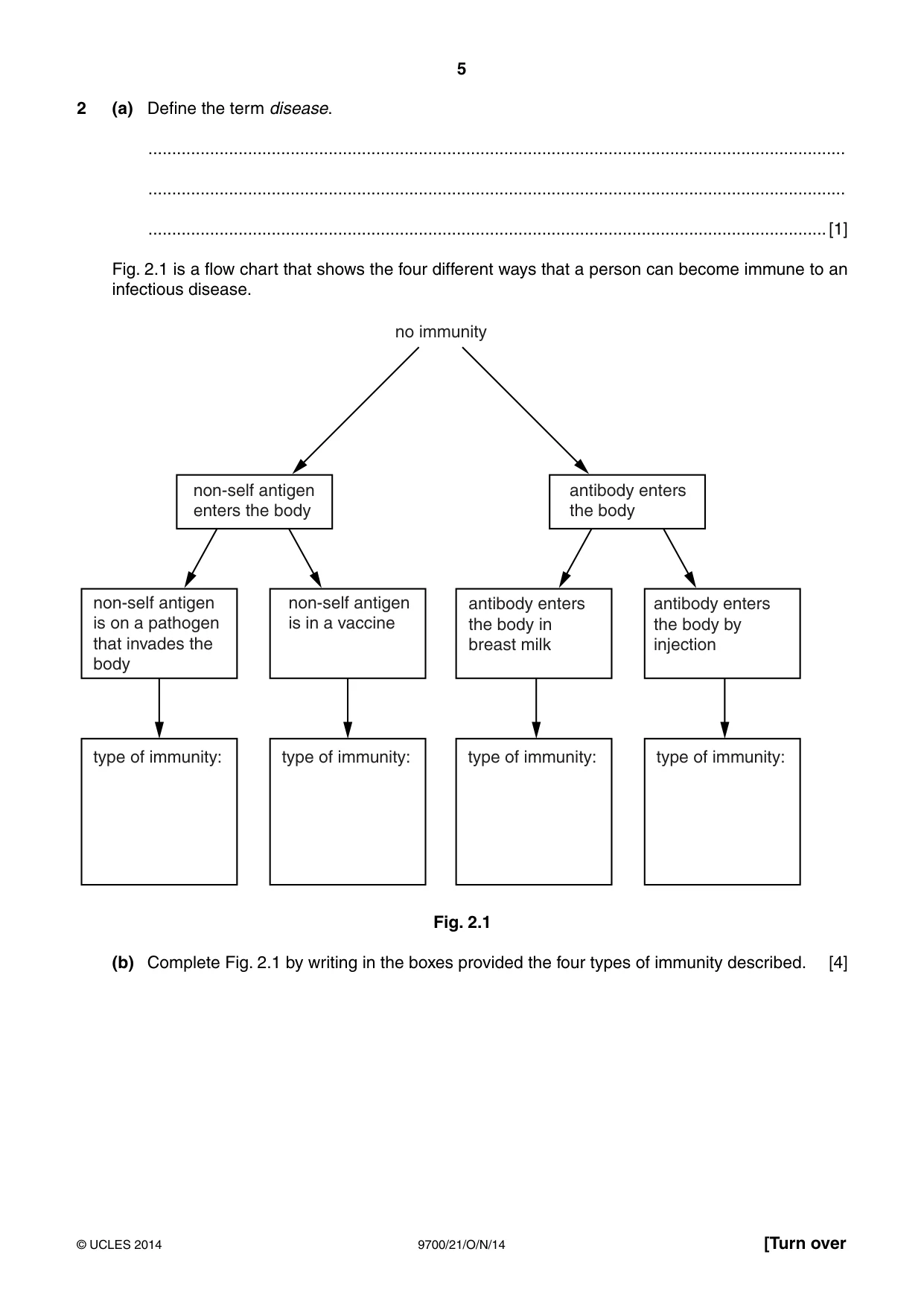
5 9700/21/O/N/14 © UCLES 2014 [Turn over 2 (a) Define the term disease. … … …[1] Fig. 2.1 is a flow chart that shows the four different ways that a person can become immune to an infectious disease. no immunity non-self antigen enters the body non-self antigen is on a pathogen that invades the body type of immunity: non-self antigen is in a vaccine antibody enters the body in breast milk antibody enters the body by injection antibody enters the body type of immunity: type of immunity: type of immunity: Fig. 2.1 (b) Complete Fig. 2.1 by writing in the boxes provided the four types of immunity described. [4]
Question paper, page 6
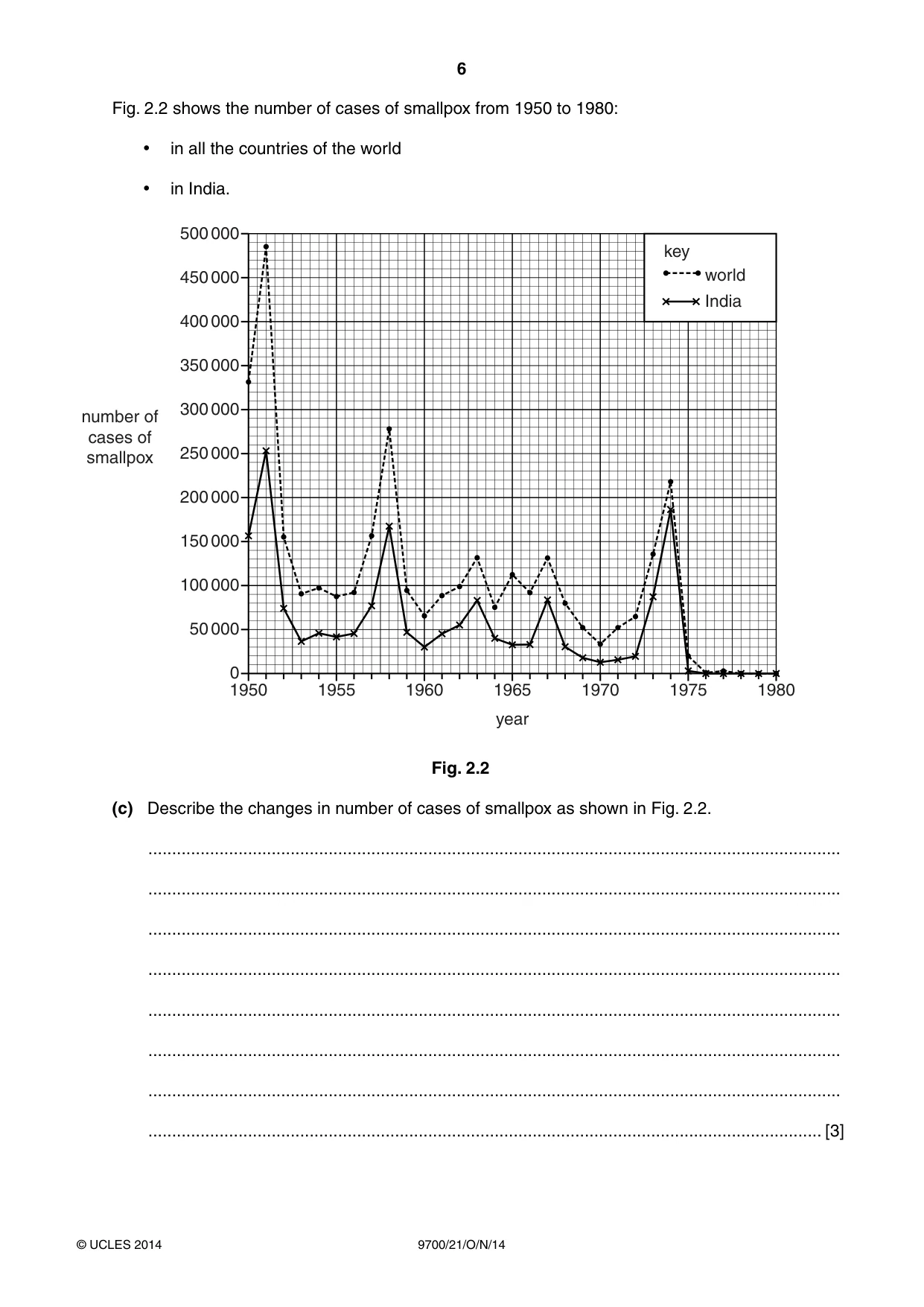
6 9700/21/O/N/14 © UCLES 2014 Fig. 2.2 shows the number of cases of smallpox from 1950 to 1980: • in all the countries of the world • in India. 1950 0 50 000 100 000 150 000 200 000 250 000 300 000 350 000 400 000 450 000 500 000 1955 1960 1965 year number of cases of smallpox 1970 1975 1980 key world India Fig. 2.2 (c) Describe the changes in number of cases of smallpox as shown in Fig. 2.2. … … … … … … … … [3]
Question paper, page 7
7 9700/21/O/N/14 © UCLES 2014 [Turn over The World Health Organization (WHO) declared the world to be free of smallpox in 1980. (d) Outline some of the factors that led to the successful eradication of smallpox from the world population. … … … … … … … … … … [4] [Total: 12]
Question paper, page 8
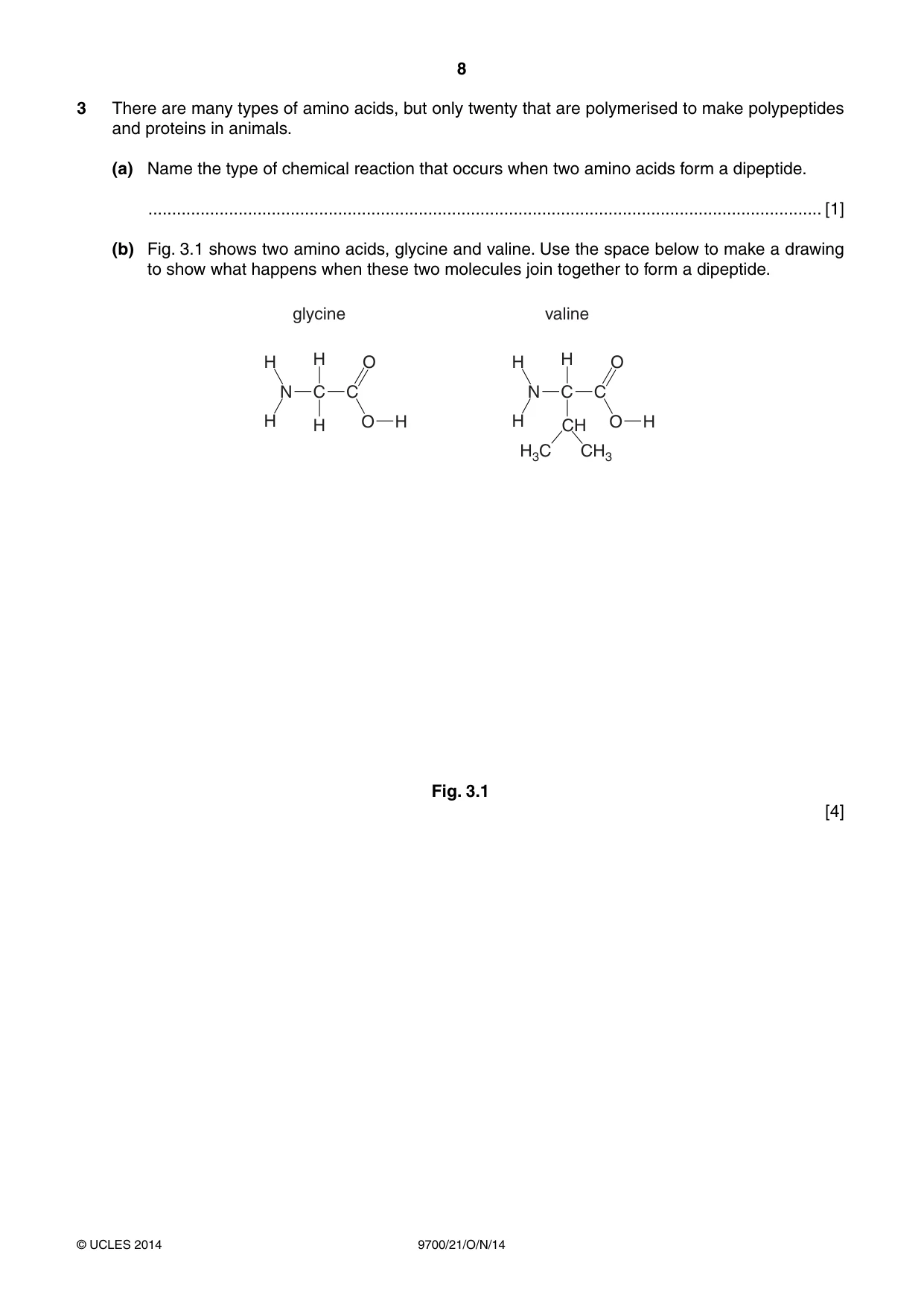
8 9700/21/O/N/14 © UCLES 2014 3 There are many types of amino acids, but only twenty that are polymerised to make polypeptides and proteins in animals. (a) Name the type of chemical reaction that occurs when two amino acids form a dipeptide. … [1] (b) Fig. 3.1 shows two amino acids, glycine and valine. Use the space below to make a drawing to show what happens when these two molecules join together to form a dipeptide. C H H H H H glycine N C O O C CH H H H H valine N C O O H3C CH3 Fig. 3.1 [4]
Question paper, page 9
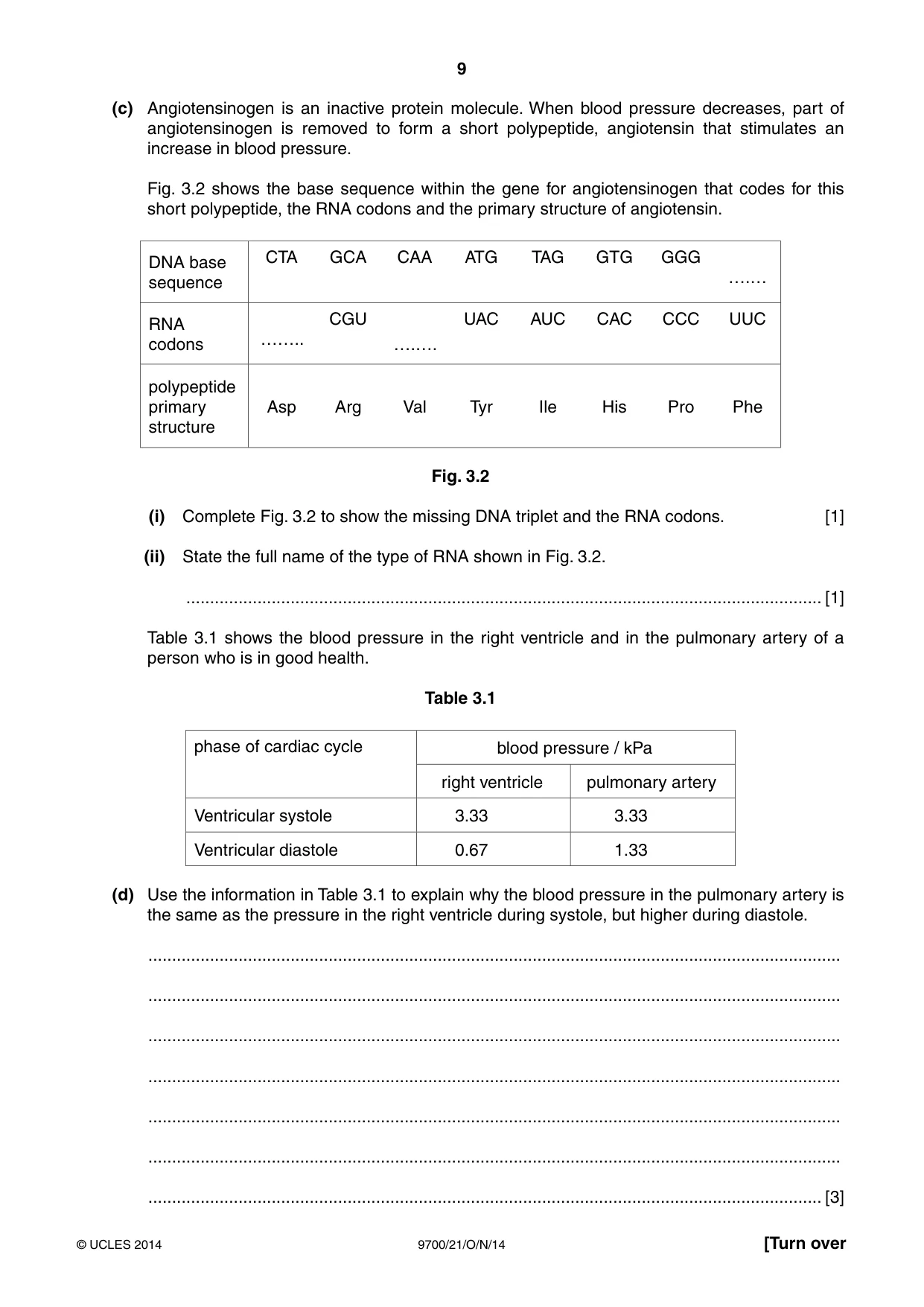
9 9700/21/O/N/14 © UCLES 2014 [Turn over (c) Angiotensinogen is an inactive protein molecule. When blood pressure decreases, part of angiotensinogen is removed to form a short polypeptide, angiotensin that stimulates an increase in blood pressure. Fig. 3.2 shows the base sequence within the gene for angiotensinogen that codes for this short polypeptide, the RNA codons and the primary structure of angiotensin. DNA base sequence CTA GCA CAA ATG TAG GTG GGG ….… RNA codons …….. CGU ….…. UAC AUC CAC CCC UUC polypeptide primary structure Asp Arg Val Tyr Ile His Pro Phe Fig. 3.2 (i) Complete Fig. 3.2 to show the missing DNA triplet and the RNA codons. [1] (ii) State the full name of the type of RNA shown in Fig. 3.2. … [1] Table 3.1 shows the blood pressure in the right ventricle and in the pulmonary artery of a person who is in good health. Table 3.1 phase of cardiac cycle blood pressure / kPa right ventricle pulmonary artery Ventricular systole 3.33 3.33 Ventricular diastole 0.67 1.33 (d) Use the information in Table 3.1 to explain why the blood pressure in the pulmonary artery is the same as the pressure in the right ventricle during systole, but higher during diastole. … … … … … … … [3]
Question paper, page 10
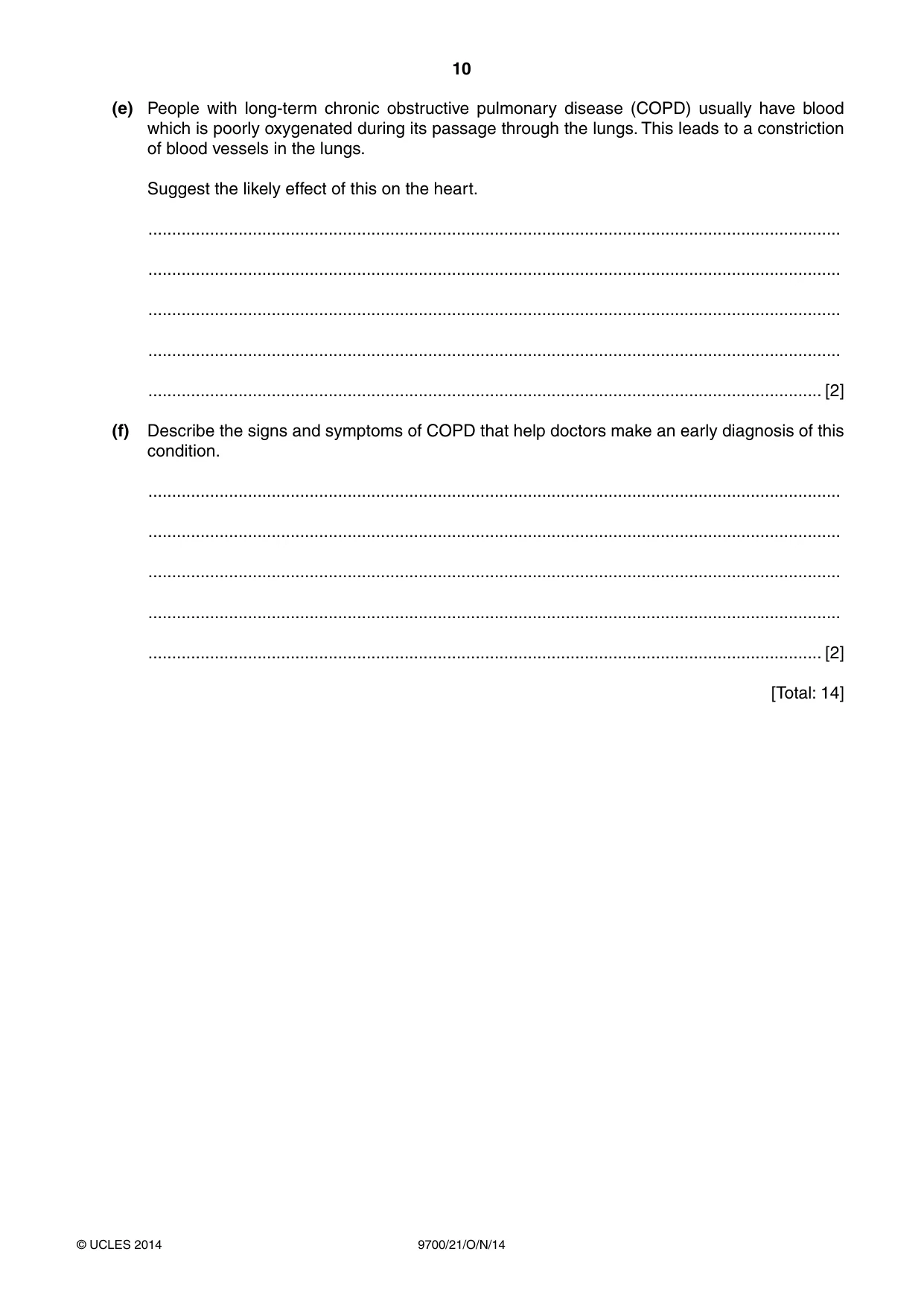
10 9700/21/O/N/14 © UCLES 2014 (e) People with long-term chronic obstructive pulmonary disease (COPD) usually have blood which is poorly oxygenated during its passage through the lungs. This leads to a constriction of blood vessels in the lungs. Suggest the likely effect of this on the heart. … … … … … [2] (f) Describe the signs and symptoms of COPD that help doctors make an early diagnosis of this condition. … … … … … [2] [Total: 14]
Question paper, page 11
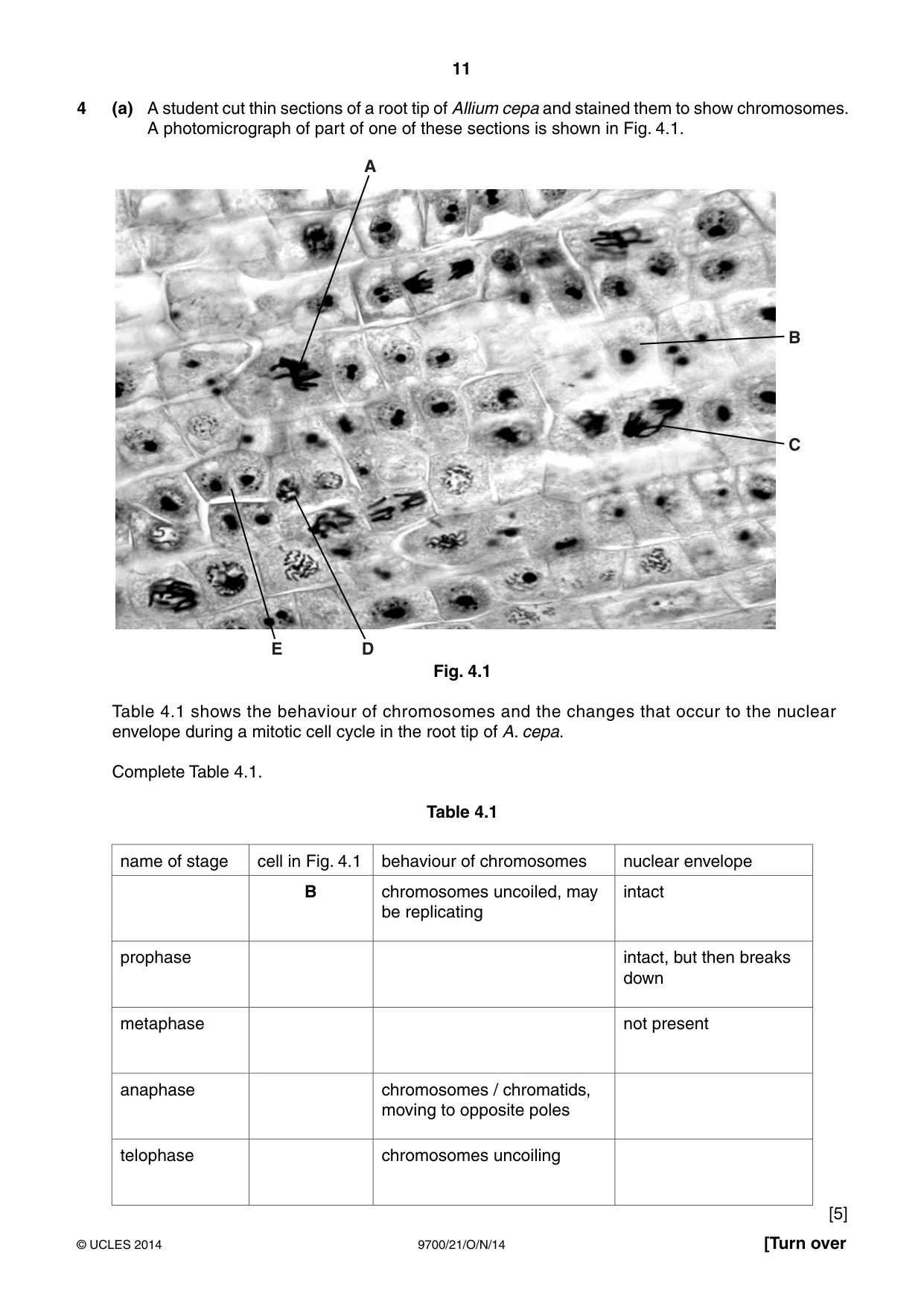
11 9700/21/O/N/14 © UCLES 2014 [Turn over 4 (a) A student cut thin sections of a root tip of Allium cepa and stained them to show chromosomes. A photomicrograph of part of one of these sections is shown in Fig. 4.1. A C D E B Fig. 4.1 Table 4.1 shows the behaviour of chromosomes and the changes that occur to the nuclear envelope during a mitotic cell cycle in the root tip of A. cepa. Complete Table 4.1. Table 4.1 name of stage cell in Fig. 4.1 behaviour of chromosomes nuclear envelope B chromosomes uncoiled, may be replicating intact prophase intact, but then breaks down metaphase not present anaphase chromosomes / chromatids, moving to opposite poles telophase chromosomes uncoiling [5]
Question paper, page 12
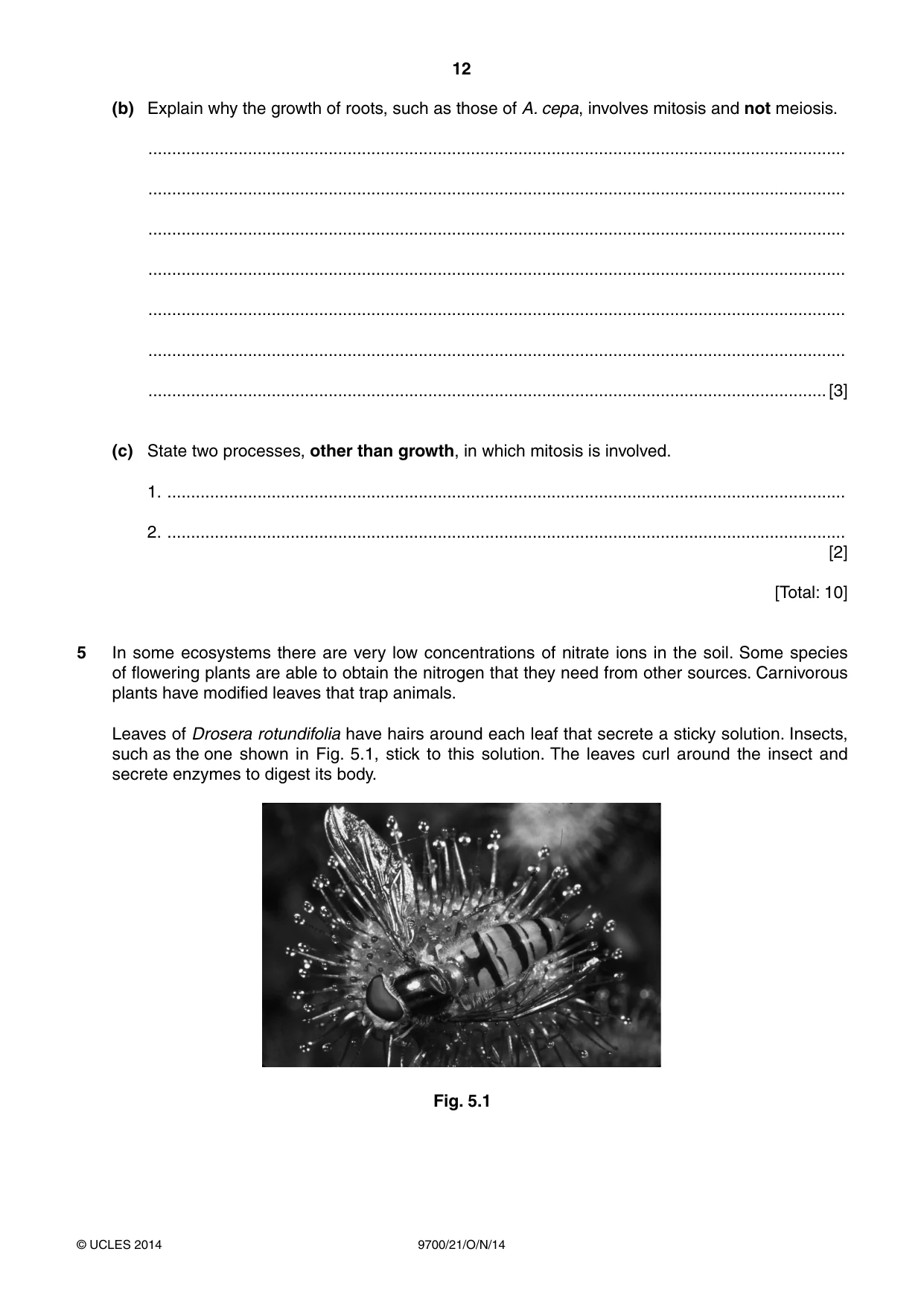
12 9700/21/O/N/14 © UCLES 2014 (b) Explain why the growth of roots, such as those of A. cepa, involves mitosis and not meiosis. … … … … … … …[3] (c) State two processes, other than growth, in which mitosis is involved. 1. … 2. … [2] [Total: 10] 5 In some ecosystems there are very low concentrations of nitrate ions in the soil. Some species of flowering plants are able to obtain the nitrogen that they need from other sources. Carnivorous plants have modified leaves that trap animals. Leaves of Drosera rotundifolia have hairs around each leaf that secrete a sticky solution. Insects, such as the one shown in Fig. 5.1, stick to this solution. The leaves curl around the insect and secrete enzymes to digest its body. Fig. 5.1
Question paper, page 13
13 9700/21/O/N/14 © UCLES 2014 [Turn over (a) Explain why D. rotundifolia can be considered to be both an autotroph and a heterotroph. … … … … … … … … … [4] (b) In 1999, Dutch scientists discovered a new reaction, the anammox reaction, to add to the nitrogen cycle. They discovered the bacterium Brocadia anammoxidans that converts ammonia, nitrite ions and nitrate ions to nitrogen gas (N2) in anaerobic environments. The reaction carried out by these bacteria is thought to be responsible for the loss of a large quantity of nitrogen-containing compounds from marine ecosystems, such as the oceans. Suggest and explain the effect that this reaction has on marine ecosystems. … … … … … … … [3] [Total: 7]
Question paper, page 14
14 9700/21/O/N/14 © UCLES 2014 6 Fig. 6.1 shows the pathway taken by water as it enters the root of a flowering plant. X Y L K M Fig. 6.1 (a) Explain how water passes from X to Y. … … … … … … … [3]
Question paper, page 15
15 9700/21/O/N/14 © UCLES 2014 (b) Name: (i) the structures K and L K … L … [2] (ii) the pathway indicated by M. …[1] [Total: 6]
Question paper, page 16
16 9700/21/O/N/14 © UCLES 2014 Copyright Acknowledgements: Fig 1.1 © STEVE GSCHMEISSNER/SCIENCE PHOTO LIBRARY. Fig 5.1 © CLAUDE NURIDSANY & MARIE PERENNOU/SCIENCE PHOTO LIBRARY. Permission to reproduce items where third-party owned material protected by copyright is included has been sought and cleared where possible. Every reasonable effort has been made by the publisher (UCLES) to trace copyright holders, but if any items requiring clearance have unwittingly been included, the publisher will be pleased to make amends at the earliest possible opportunity. Cambridge International Examinations is part of the Cambridge Assessment Group. Cambridge Assessment is the brand name of University of Cambridge Local Examinations Syndicate (UCLES), which is itself a department of the University of Cambridge. BLANK PAGE
Mark scheme, page 1
® IGCSE is the registered trademark of Cambridge International Examinations. CAMBRIDGE INTERNATIONAL EXAMINATIONS Cambridge International Advanced Subsidiary and Advanced Level MARK SCHEME for the October/November 2014 series 9700 BIOLOGY 9700/21 Paper 2 (AS Structured Questions), maximum raw mark 60 This mark scheme is published as an aid to teachers and candidates, to indicate the requirements of the examination. It shows the basis on which Examiners were instructed to award marks. It does not indicate the details of the discussions that took place at an Examiners’ meeting before marking began, which would have considered the acceptability of alternative answers. Mark schemes should be read in conjunction with the question paper and the Principal Examiner Report for Teachers. Cambridge will not enter into discussions about these mark schemes. Cambridge is publishing the mark schemes for the October/November 2014 series for most Cambridge IGCSE®, Cambridge International A and AS Level components and some Cambridge O Level components.
Mark scheme, page 2
Page 2 Mark Scheme Syllabus Paper Cambridge International AS/A Level – October/November 2014 9700 21 © Cambridge International Examinations 2014 Mark scheme abbreviations: ; separates marking points / alternative answers for the same point R reject A accept (for answers correctly cued by the question, or by extra guidance) AW alternative wording (where responses vary more than usual) underline actual word given must be used by candidate (grammatical variants accepted) max indicates the maximum number of marks that can be given ora or reverse argument mp marking point (with relevant number) ecf error carried forward I ignore AVP alternative valid point (examples given)
Mark scheme, page 3
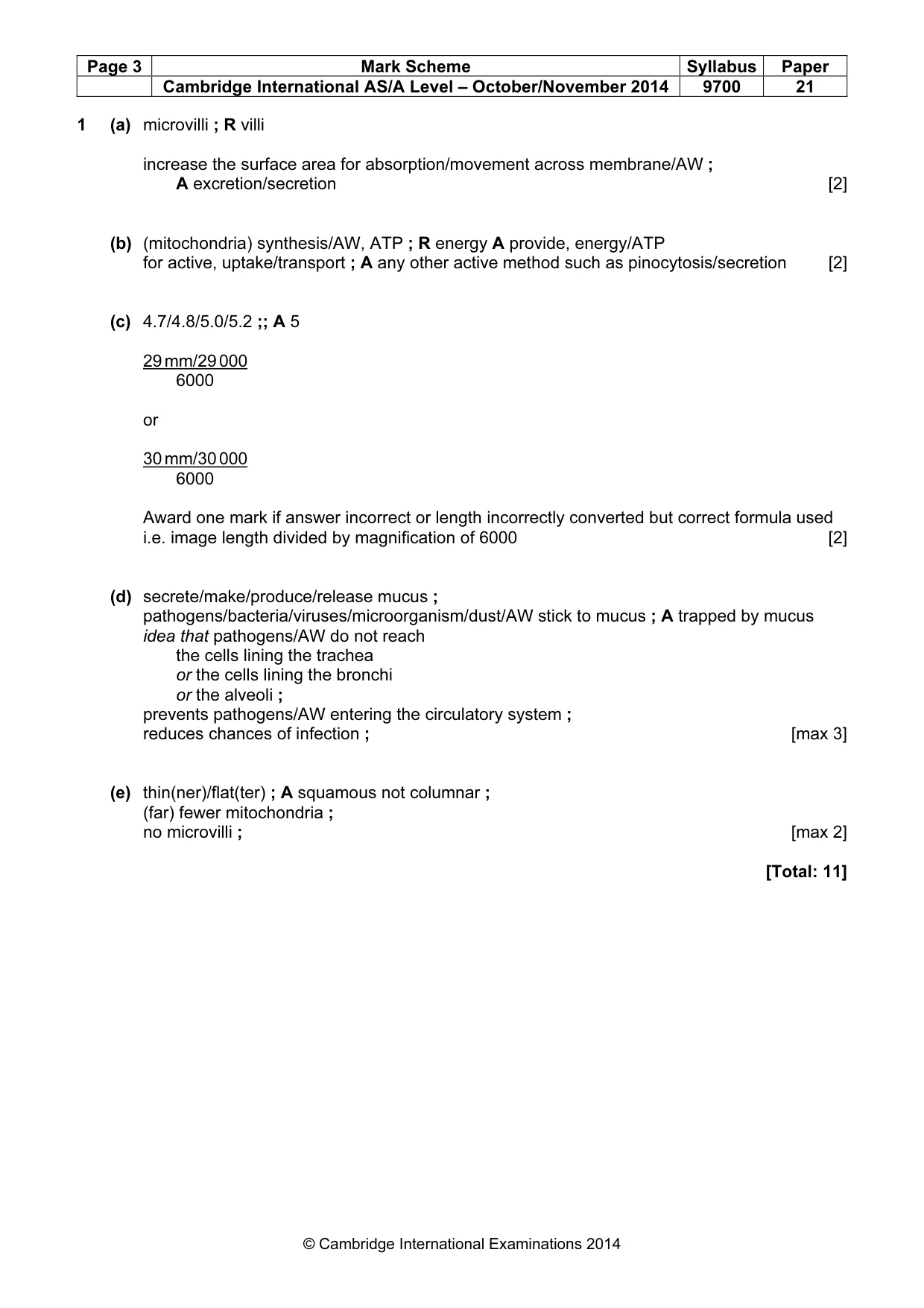
Page 3 Mark Scheme Syllabus Paper Cambridge International AS/A Level – October/November 2014 9700 21 © Cambridge International Examinations 2014 1 (a) microvilli ; R villi increase the surface area for absorption/movement across membrane/AW ; A excretion/secretion [2] (b) (mitochondria) synthesis/AW, ATP ; R energy A provide, energy/ATP for active, uptake/transport ; A any other active method such as pinocytosis/secretion [2] (c) 4.7/4.8/5.0/5.2 ;; A 5 29 mm/29 000 6000 or 30 mm/30 000 6000 Award one mark if answer incorrect or length incorrectly converted but correct formula used i.e. image length divided by magnification of 6000 [2] (d) secrete/make/produce/release mucus ; pathogens/bacteria/viruses/microorganism/dust/AW stick to mucus ; A trapped by mucus idea that pathogens/AW do not reach the cells lining the trachea or the cells lining the bronchi or the alveoli ; prevents pathogens/AW entering the circulatory system ; reduces chances of infection ; [max 3] (e) thin(ner)/flat(ter) ; A squamous not columnar ; (far) fewer mitochondria ; no microvilli ; [max 2] [Total: 11]
Mark scheme, page 4
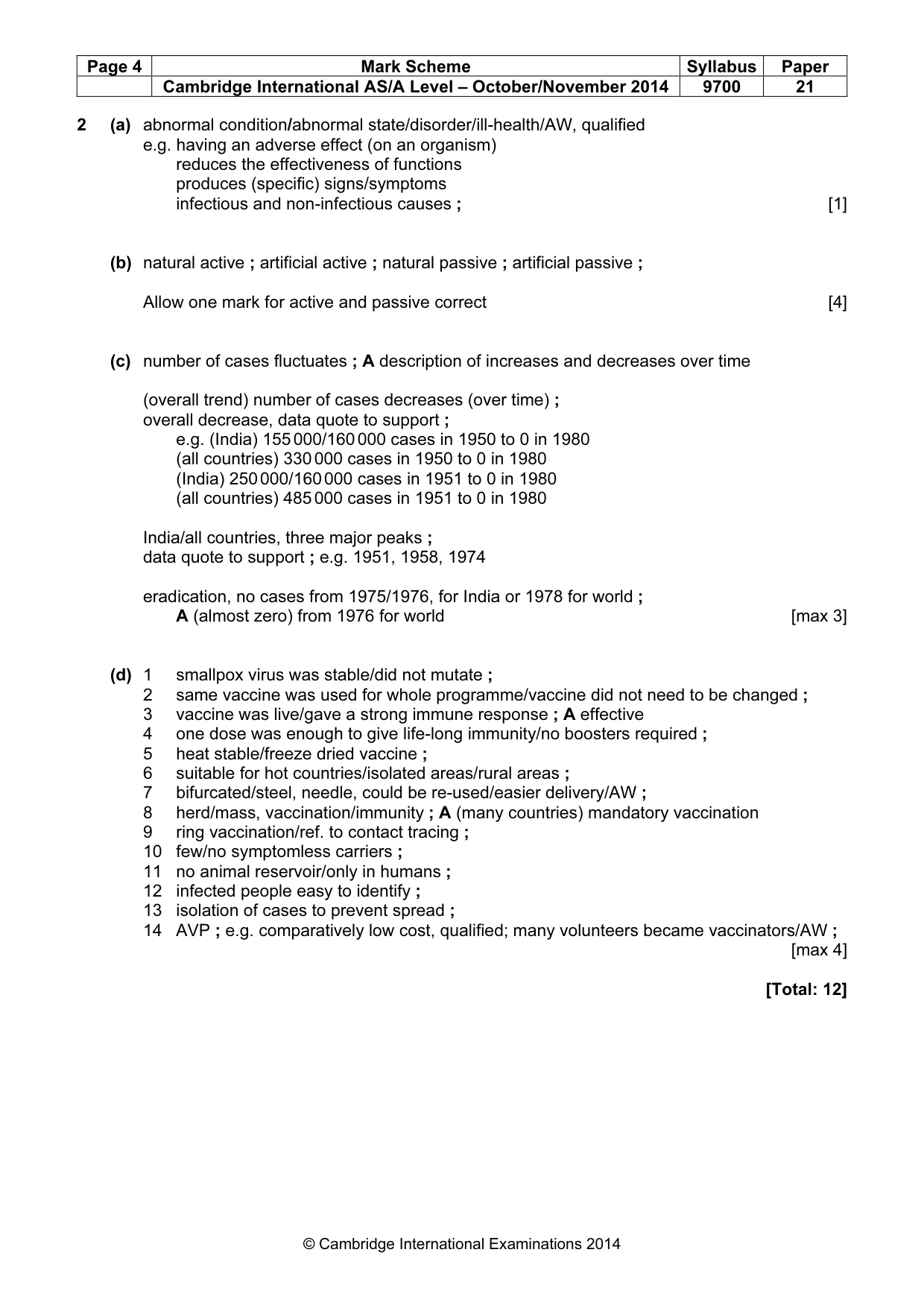
Page 4 Mark Scheme Syllabus Paper Cambridge International AS/A Level – October/November 2014 9700 21 © Cambridge International Examinations 2014 2 (a) abnormal condition/abnormal state/disorder/ill-health/AW, qualified e.g. having an adverse effect (on an organism) reduces the effectiveness of functions produces (specific) signs/symptoms infectious and non-infectious causes ; [1] (b) natural active ; artificial active ; natural passive ; artificial passive ; Allow one mark for active and passive correct [4] (c) number of cases fluctuates ; A description of increases and decreases over time (overall trend) number of cases decreases (over time) ; overall decrease, data quote to support ; e.g. (India) 155 000/160 000 cases in 1950 to 0 in 1980 (all countries) 330 000 cases in 1950 to 0 in 1980 (India) 250 000/160 000 cases in 1951 to 0 in 1980 (all countries) 485 000 cases in 1951 to 0 in 1980 India/all countries, three major peaks ; data quote to support ; e.g. 1951, 1958, 1974 eradication, no cases from 1975/1976, for India or 1978 for world ; A (almost zero) from 1976 for world [max 3] (d) 1 smallpox virus was stable/did not mutate ; 2 same vaccine was used for whole programme/vaccine did not need to be changed ; 3 vaccine was live/gave a strong immune response ; A effective 4 one dose was enough to give life-long immunity/no boosters required ; 5 heat stable/freeze dried vaccine ; 6 suitable for hot countries/isolated areas/rural areas ; 7 bifurcated/steel, needle, could be re-used/easier delivery/AW ; 8 herd/mass, vaccination/immunity ; A (many countries) mandatory vaccination 9 ring vaccination/ref. to contact tracing ; 10 few/no symptomless carriers ; 11 no animal reservoir/only in humans ; 12 infected people easy to identify ; 13 isolation of cases to prevent spread ; 14 AVP ; e.g. comparatively low cost, qualified; many volunteers became vaccinators/AW ; [max 4] [Total: 12]
Mark scheme, page 5
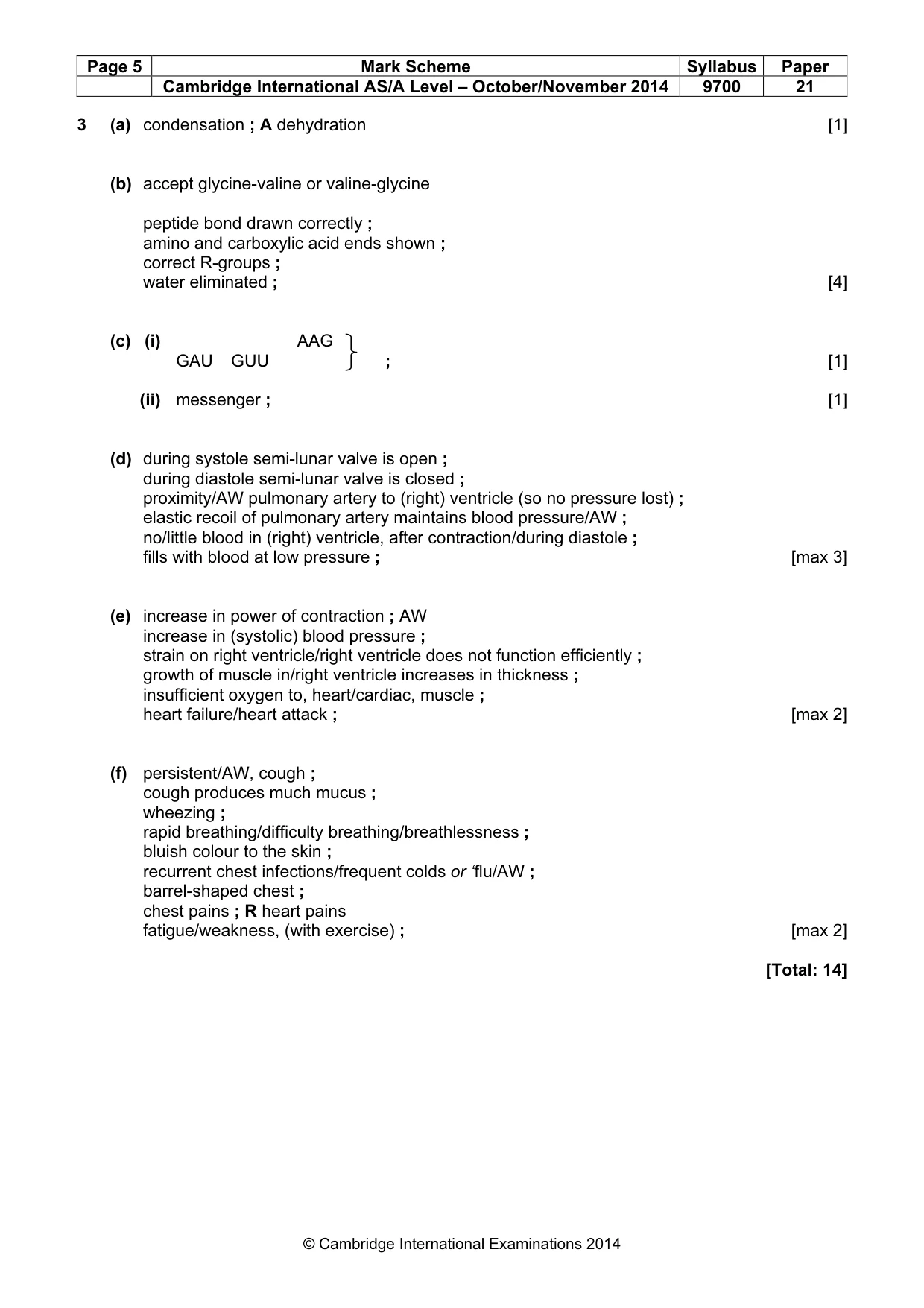
Page 5 Mark Scheme Syllabus Paper Cambridge International AS/A Level – October/November 2014 9700 21 © Cambridge International Examinations 2014 3 (a) condensation ; A dehydration [1] (b) accept glycine-valine or valine-glycine peptide bond drawn correctly ; amino and carboxylic acid ends shown ; correct R-groups ; water eliminated ; [4] (c) (i) AAG GAU GUU ; [1] (ii) messenger ; [1] (d) during systole semi-lunar valve is open ; during diastole semi-lunar valve is closed ; proximity/AW pulmonary artery to (right) ventricle (so no pressure lost) ; elastic recoil of pulmonary artery maintains blood pressure/AW ; no/little blood in (right) ventricle, after contraction/during diastole ; fills with blood at low pressure ; [max 3] (e) increase in power of contraction ; AW increase in (systolic) blood pressure ; strain on right ventricle/right ventricle does not function efficiently ; growth of muscle in/right ventricle increases in thickness ; insufficient oxygen to, heart/cardiac, muscle ; heart failure/heart attack ; [max 2] (f) persistent/AW, cough ; cough produces much mucus ; wheezing ; rapid breathing/difficulty breathing/breathlessness ; bluish colour to the skin ; recurrent chest infections/frequent colds or ‘flu/AW ; barrel-shaped chest ; chest pains ; R heart pains fatigue/weakness, (with exercise) ; [max 2] [Total: 14]
Mark scheme, page 6
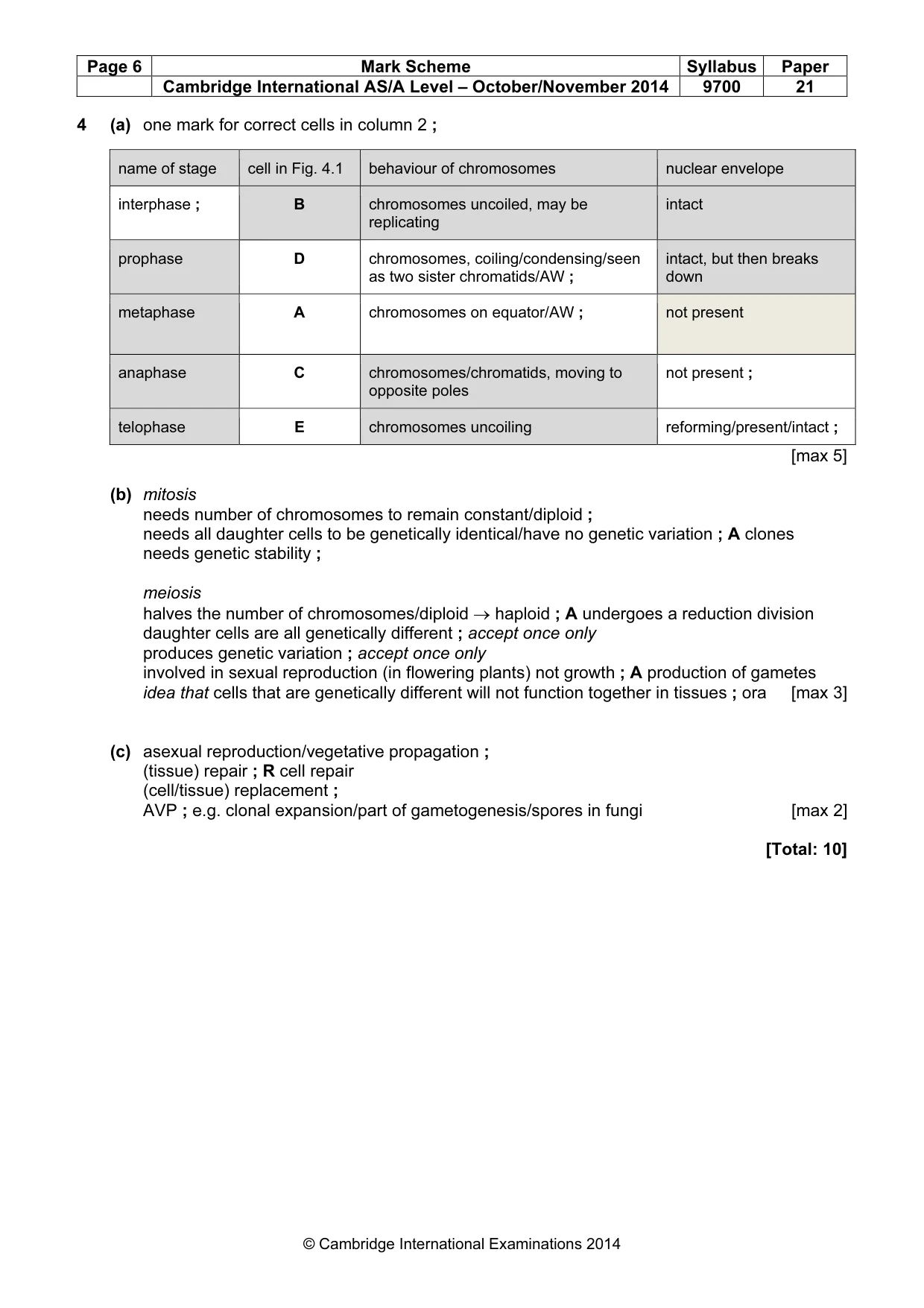
Page 6 Mark Scheme Syllabus Paper Cambridge International AS/A Level – October/November 2014 9700 21 © Cambridge International Examinations 2014 4 (a) one mark for correct cells in column 2 ; [max 5] (b) mitosis needs number of chromosomes to remain constant/diploid ; needs all daughter cells to be genetically identical/have no genetic variation ; A clones needs genetic stability ; meiosis halves the number of chromosomes/diploid → haploid ; A undergoes a reduction division daughter cells are all genetically different ; accept once only produces genetic variation ; accept once only involved in sexual reproduction (in flowering plants) not growth ; A production of gametes idea that cells that are genetically different will not function together in tissues ; ora [max 3] (c) asexual reproduction/vegetative propagation ; (tissue) repair ; R cell repair (cell/tissue) replacement ; AVP ; e.g. clonal expansion/part of gametogenesis/spores in fungi [max 2] [Total: 10] name of stage cell in Fig. 4.1 behaviour of chromosomes nuclear envelope interphase ; B chromosomes uncoiled, may be replicating intact prophase D chromosomes, coiling/condensing/seen as two sister chromatids/AW ; intact, but then breaks down metaphase A chromosomes on equator/AW ; not present anaphase C chromosomes/chromatids, moving to opposite poles not present ; telophase E chromosomes uncoiling reforming/present/intact ;
Mark scheme, page 7
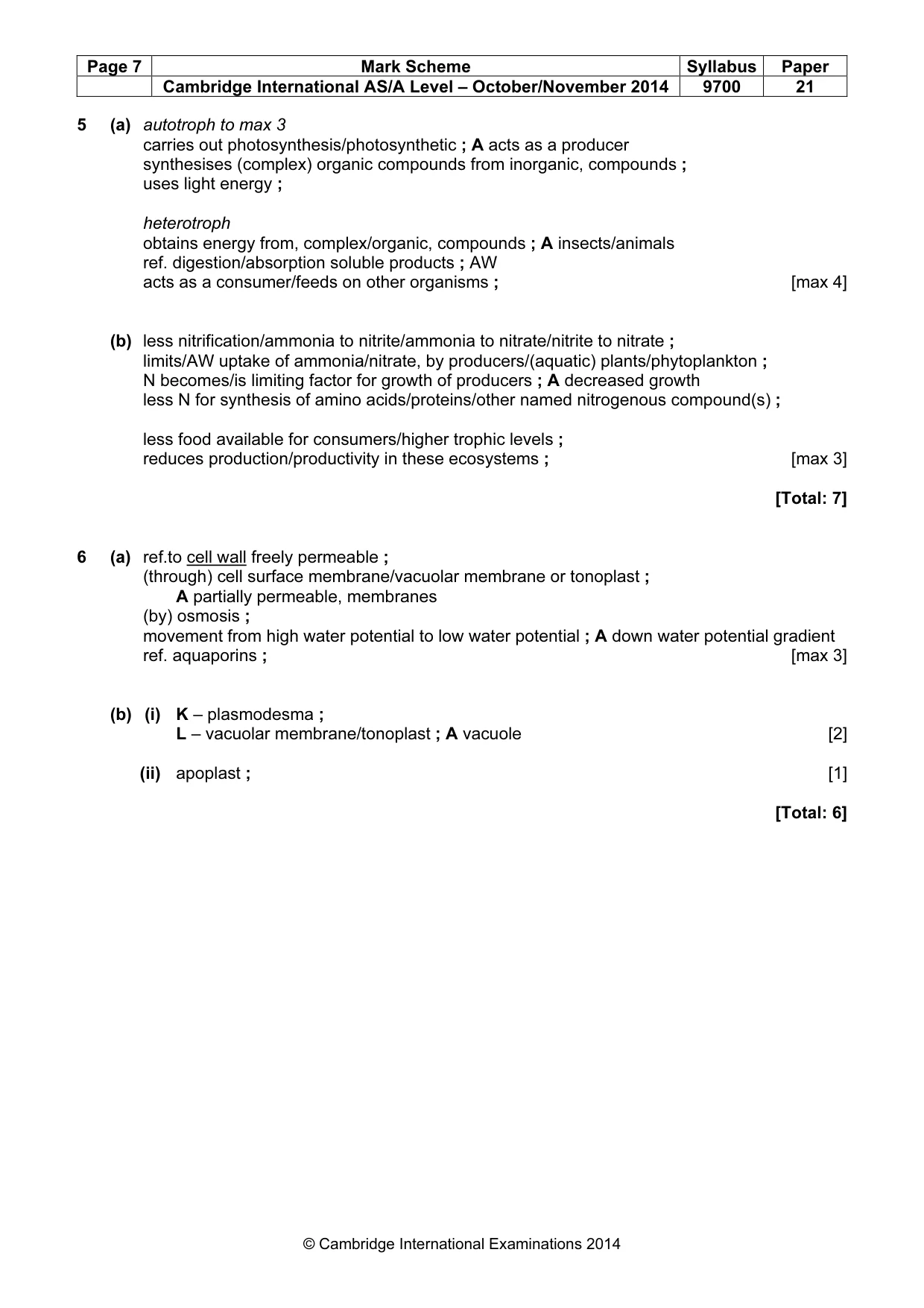
Page 7 Mark Scheme Syllabus Paper Cambridge International AS/A Level – October/November 2014 9700 21 © Cambridge International Examinations 2014 5 (a) autotroph to max 3 carries out photosynthesis/photosynthetic ; A acts as a producer synthesises (complex) organic compounds from inorganic, compounds ; uses light energy ; heterotroph obtains energy from, complex/organic, compounds ; A insects/animals ref. digestion/absorption soluble products ; AW acts as a consumer/feeds on other organisms ; [max 4] (b) less nitrification/ammonia to nitrite/ammonia to nitrate/nitrite to nitrate ; limits/AW uptake of ammonia/nitrate, by producers/(aquatic) plants/phytoplankton ; N becomes/is limiting factor for growth of producers ; A decreased growth less N for synthesis of amino acids/proteins/other named nitrogenous compound(s) ; less food available for consumers/higher trophic levels ; reduces production/productivity in these ecosystems ; [max 3] [Total: 7] 6 (a) ref.to cell wall freely permeable ; (through) cell surface membrane/vacuolar membrane or tonoplast ; A partially permeable, membranes (by) osmosis ; movement from high water potential to low water potential ; A down water potential gradient ref. aquaporins ; [max 3] (b) (i) K – plasmodesma ; L – vacuolar membrane/tonoplast ; A vacuole [2] (ii) apoplast ; [1] [Total: 6]
What you needed in this session
Cambridge’s own grade thresholds for 2014 Oct/Nov, Paper 2 · Variant 1. A higher threshold means an easier paper — the bar moves with how the cohort did.