Cambridge A Level Biology 9700 — 2013 May/June Paper 2 · Variant 1
9700/21/M/J/13 · 60 marks · ≈68 min
The question paper and its mark scheme, free to read here and free to download. This is Cambridge’s own paper, exactly as it was sat.
Question paper12 pages
Mark scheme8 pages
Answers below. Sit the paper first if you are practising.

Paper as text
Question paper, page 1
This document consists of 12 printed pages. DC (NF/CGW) 62568/5 © UCLES 2013 [Turn over UNIVERSITY OF CAMBRIDGE INTERNATIONAL EXAMINATIONS General Certificate of Education Advanced Subsidiary Level and Advanced Level * 0 7 8 4 8 0 6 9 1 5 * BIOLOGY 9700/21 Paper 2 Structured Questions AS May/June 2013 1 hour 15 minutes Candidates answer on the Question Paper. No Additional Materials are required. READ THESE INSTRUCTIONS FIRST Write your Centre number, candidate number and name in the spaces provided at the top of this page. Write in dark blue or black ink. You may use a soft pencil for any diagrams, graphs, or rough working. Do not use red ink, staples, paper clips, highlighters, glue or correction fluid. DO NOT WRITE IN ANY BARCODES. Answer all questions. Electronic calculators may be used. At the end of the examination, fasten all your work securely together. The number of marks is given in brackets [ ] at the end of each question or part question.
Question paper, page 2
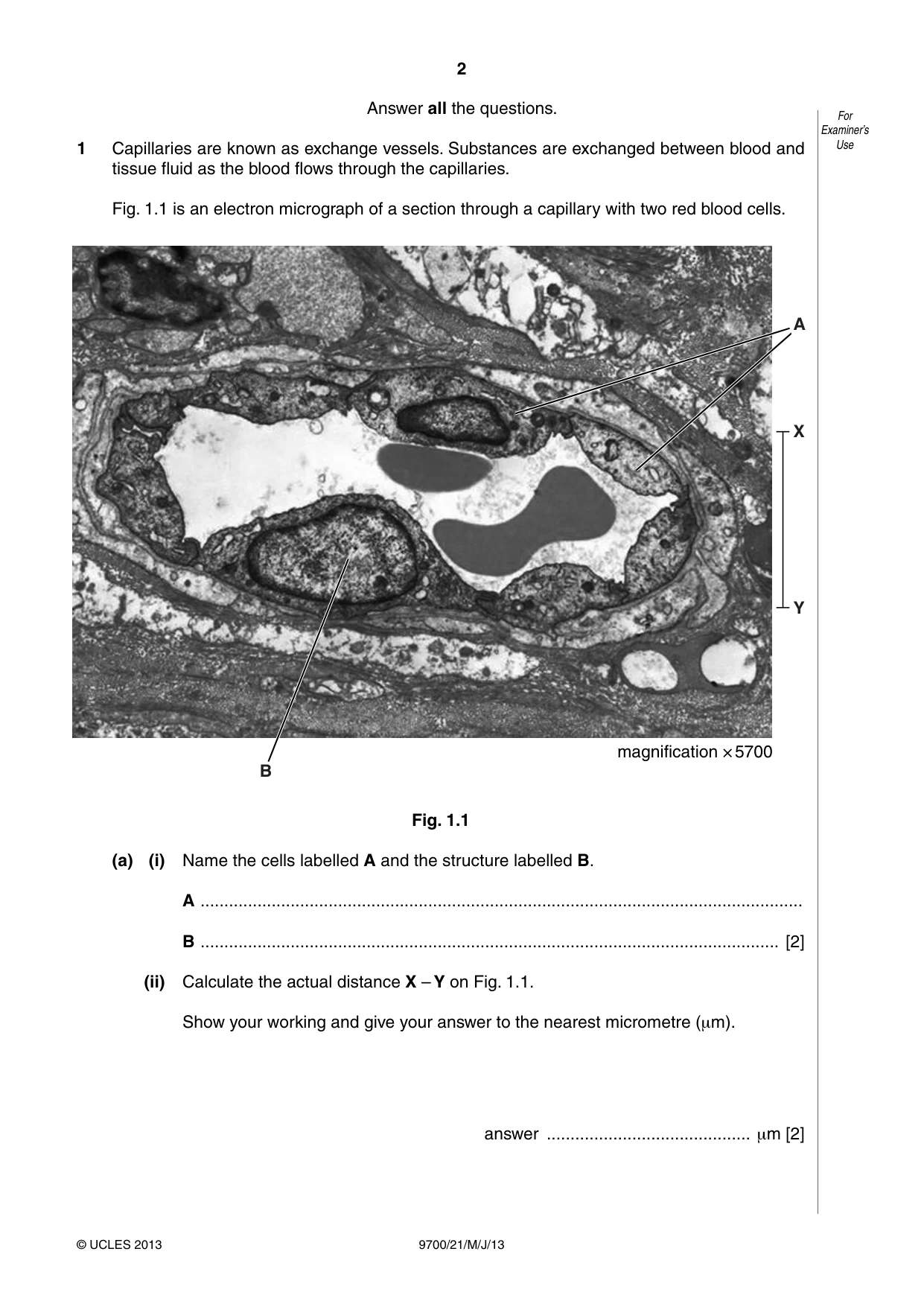
2 9700/21/M/J/13 © UCLES 2013 For Examiner’s Use Answer all the questions. 1 Capillaries are known as exchange vessels. Substances are exchanged between blood and tissue fluid as the blood flows through the capillaries. Fig. 1.1 is an electron micrograph of a section through a capillary with two red blood cells. B Y X A magnification × 5700 Fig. 1.1 (a) (i) Name the cells labelled A and the structure labelled B. A … B … [2] (ii) Calculate the actual distance X – Y on Fig. 1.1. Show your working and give your answer to the nearest micrometre (μm). answer … μm [2]
Question paper, page 3
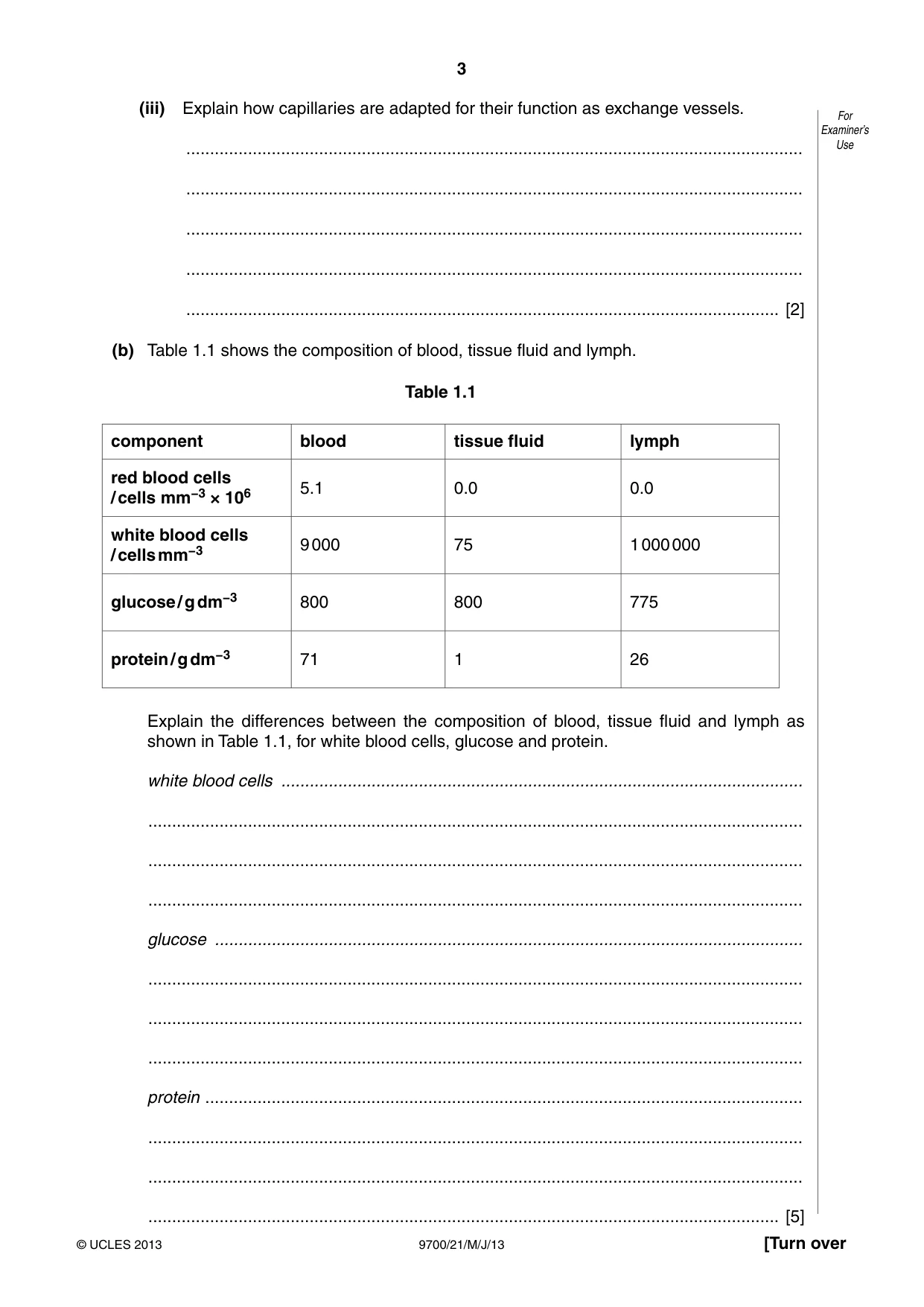
3 9700/21/M/J/13 © UCLES 2013 [Turn over For Examiner’s Use (iii) Explain how capillaries are adapted for their function as exchange vessels. … … … … … [2] (b) Table 1.1 shows the composition of blood, tissue fluid and lymph. Table 1.1 component blood tissue fluid lymph red blood cells / cells mm−3 × 10⁶ 5.1 0.0 0.0 white blood cells / cells mm−3 9 000 75 1 000 000 glucose / g dm−3 800 800 775 protein / g dm−3 71 1 26 Explain the differences between the composition of blood, tissue fluid and lymph as shown in Table 1.1, for white blood cells, glucose and protein. white blood cells … … … … glucose … … … … protein … … … … [5]
Question paper, page 4
4 9700/21/M/J/13 © UCLES 2013 For Examiner’s Use (c) Outline how red blood cells are involved in the transport of carbon dioxide. … … … … … … … [3] [Total: 14]
Question paper, page 5
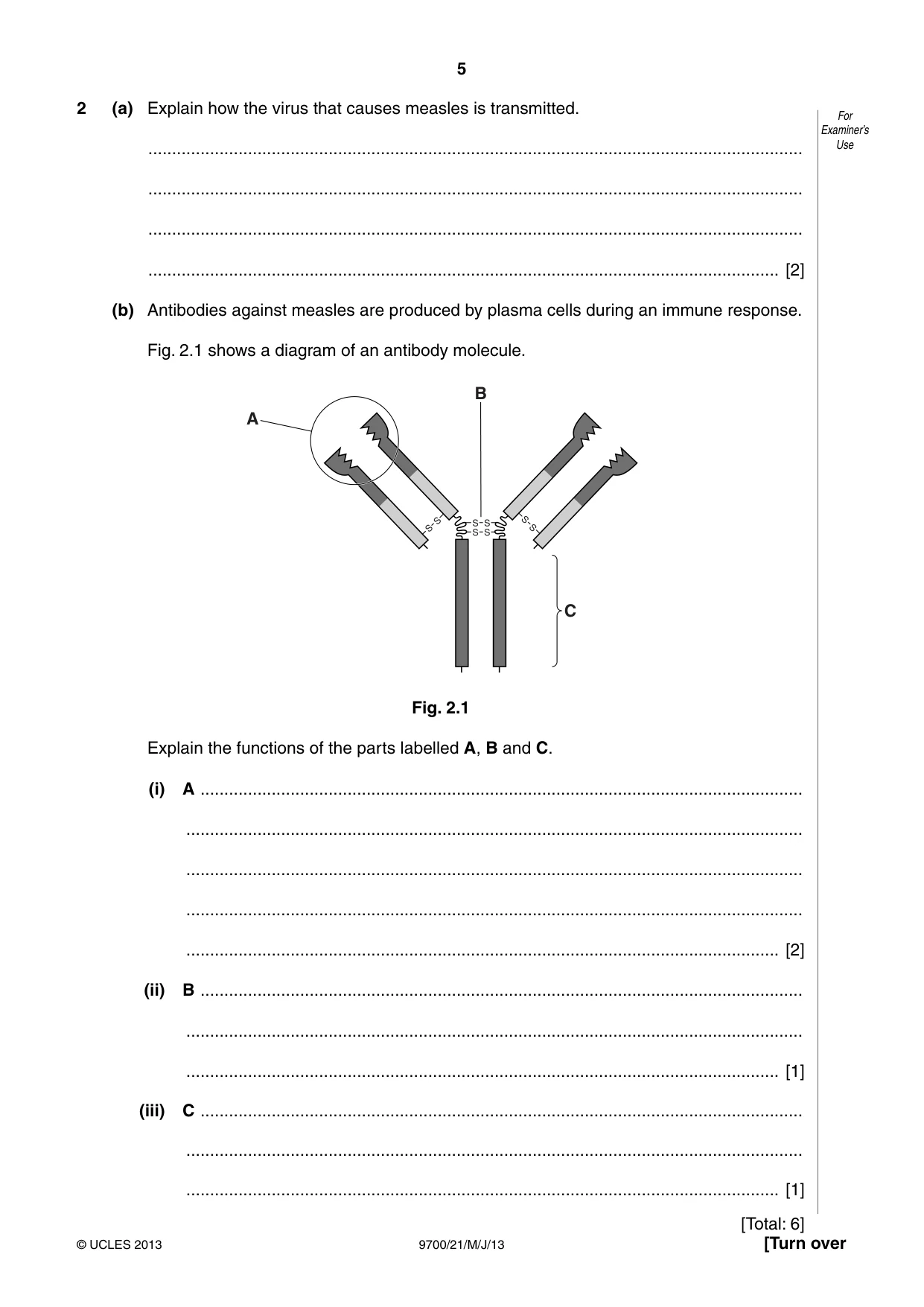
5 9700/21/M/J/13 © UCLES 2013 [Turn over For Examiner’s Use 2 (a) Explain how the virus that causes measles is transmitted. … … … … [2] (b) Antibodies against measles are produced by plasma cells during an immune response. Fig. 2.1 shows a diagram of an antibody molecule. S S S S S S S S A C B Fig. 2.1 Explain the functions of the parts labelled A, B and C. (i) A … … … … … [2] (ii) B … … … [1] (iii) C … … … [1] [Total: 6]
Question paper, page 6
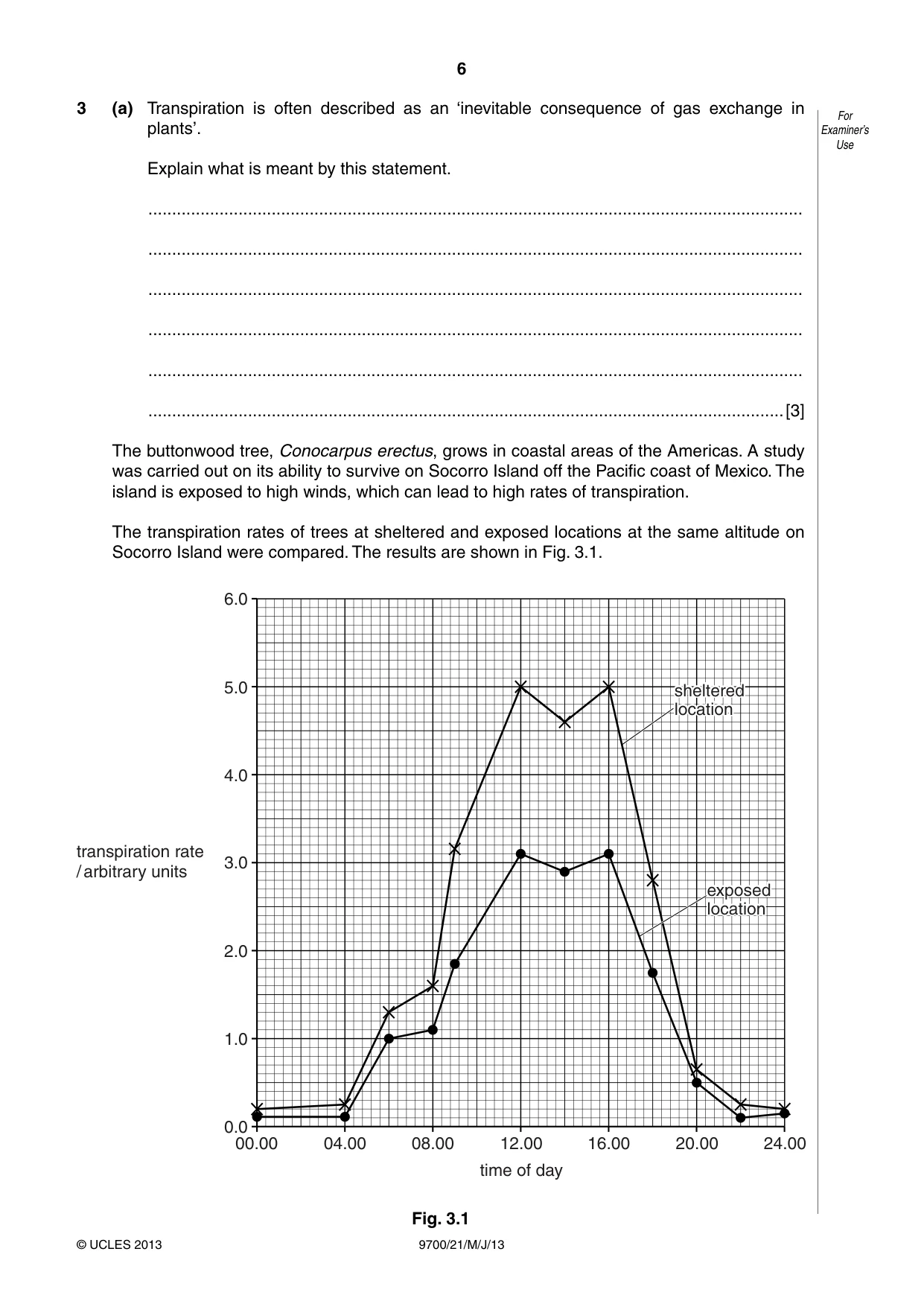
6 9700/21/M/J/13 © UCLES 2013 For Examiner’s Use 3 (a) Transpiration is often described as an ‘inevitable consequence of gas exchange in plants’. Explain what is meant by this statement. … … … … … …[3] The buttonwood tree, Conocarpus erectus, grows in coastal areas of the Americas. A study was carried out on its ability to survive on Socorro Island off the Pacific coast of Mexico. The island is exposed to high winds, which can lead to high rates of transpiration. The transpiration rates of trees at sheltered and exposed locations at the same altitude on Socorro Island were compared. The results are shown in Fig. 3.1. 00.00 1.0 2.0 3.0 transpiration rate / arbitrary units sheltered location 4.0 5.0 6.0 0.0 04.00 08.00 12.00 time of day 16.00 20.00 24.00 sheltered location exposed location exposed location Fig. 3.1
Question paper, page 7
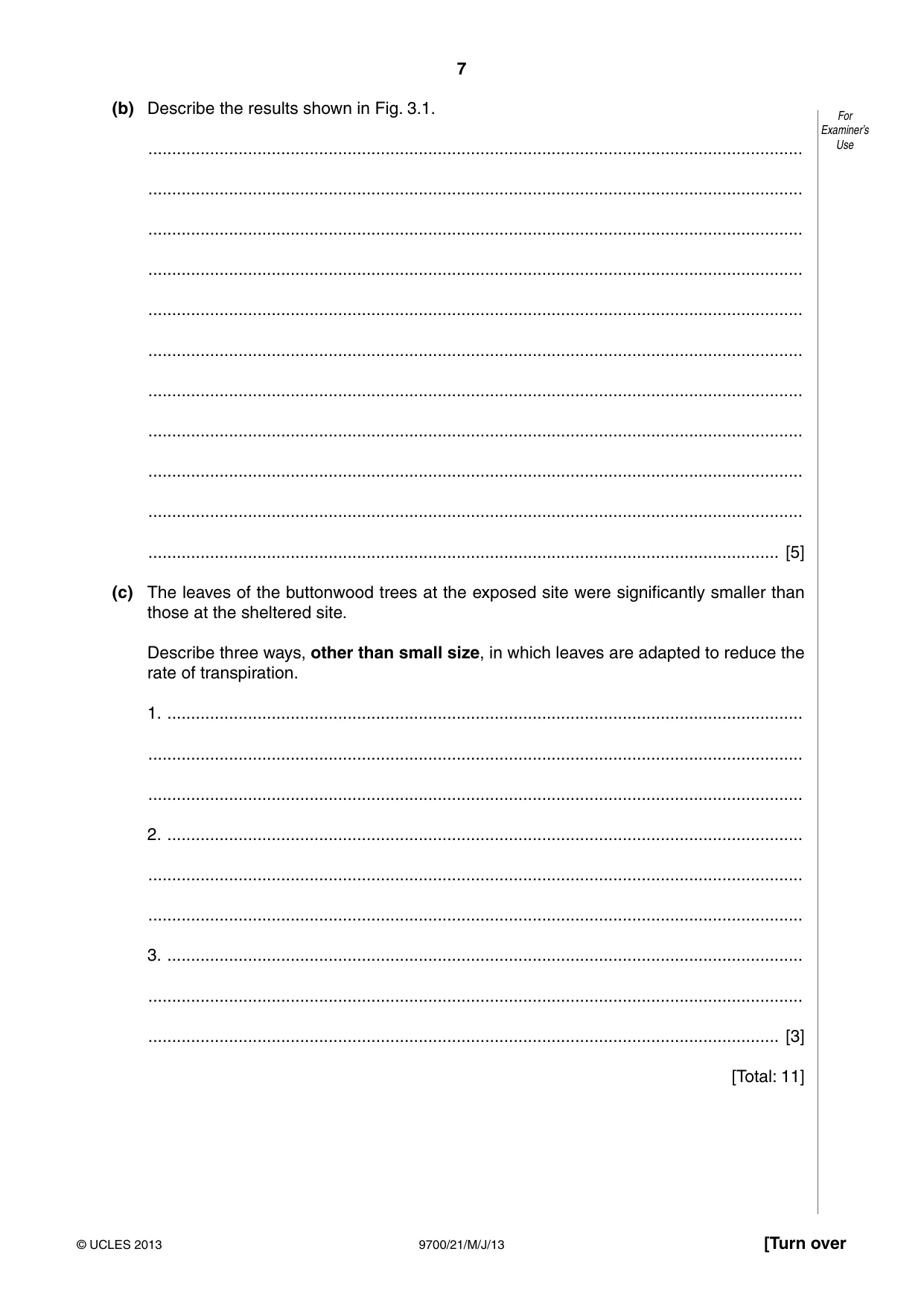
7 9700/21/M/J/13 © UCLES 2013 [Turn over For Examiner’s Use (b) Describe the results shown in Fig. 3.1. … … … … … … … … … … … [5] (c) The leaves of the buttonwood trees at the exposed site were significantly smaller than those at the sheltered site. Describe three ways, other than small size, in which leaves are adapted to reduce the rate of transpiration. 1. … … … 2. … … … 3. … … … [3] [Total: 11]
Question paper, page 8
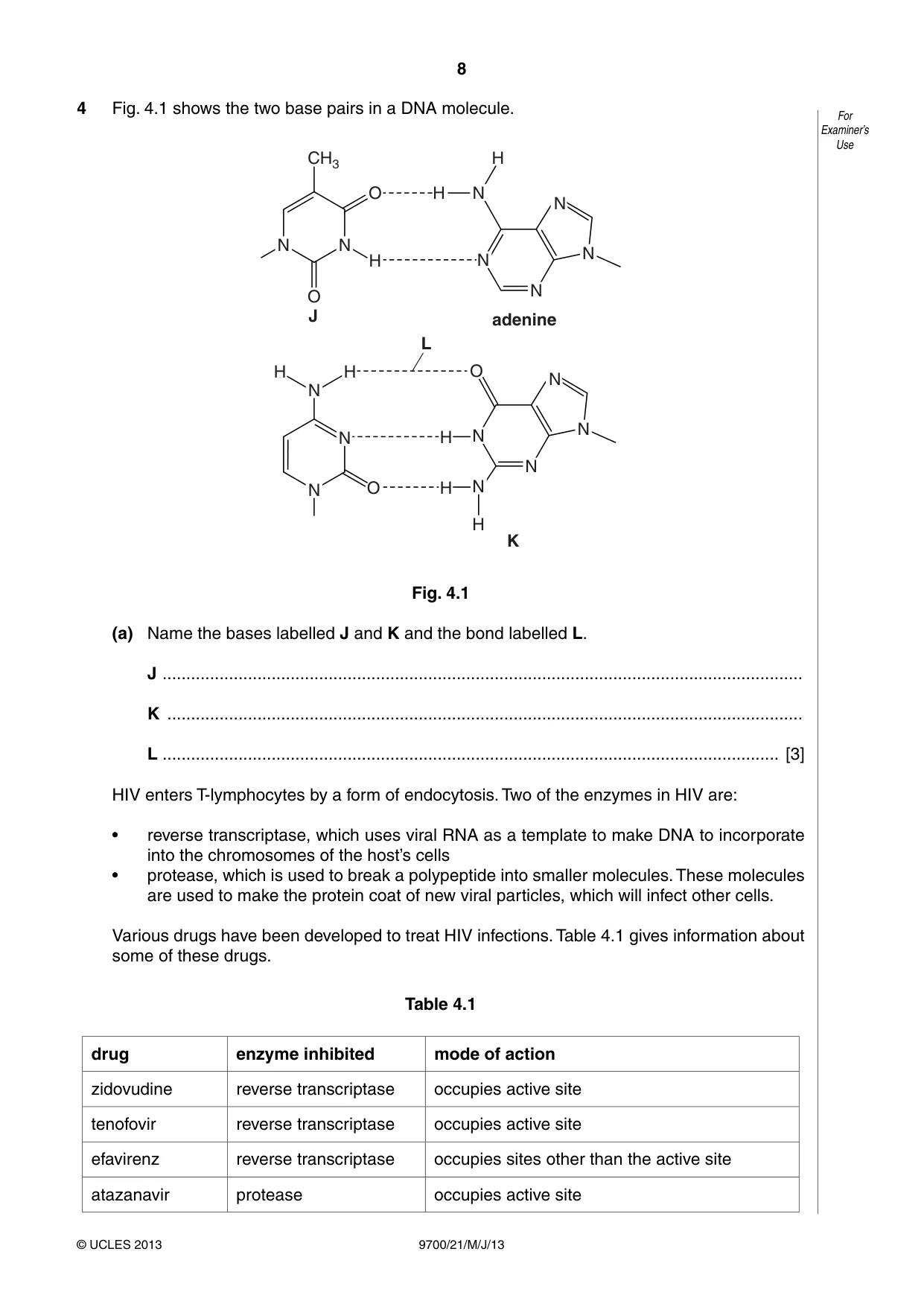
8 9700/21/M/J/13 © UCLES 2013 For Examiner’s Use 4 Fig. 4.1 shows the two base pairs in a DNA molecule. N J K L N N N N N H N CH3 H H O O adenine N N N N N N O N H N H H H H O Fig. 4.1 (a) Name the bases labelled J and K and the bond labelled L. J … K … L … [3] HIV enters T-lymphocytes by a form of endocytosis. Two of the enzymes in HIV are: • reverse transcriptase, which uses viral RNA as a template to make DNA to incorporate into the chromosomes of the host’s cells • protease, which is used to break a polypeptide into smaller molecules. These molecules are used to make the protein coat of new viral particles, which will infect other cells. Various drugs have been developed to treat HIV infections. Table 4.1 gives information about some of these drugs. Table 4.1 drug enzyme inhibited mode of action zidovudine reverse transcriptase occupies active site tenofovir reverse transcriptase occupies active site efavirenz reverse transcriptase occupies sites other than the active site atazanavir protease occupies active site
Question paper, page 9
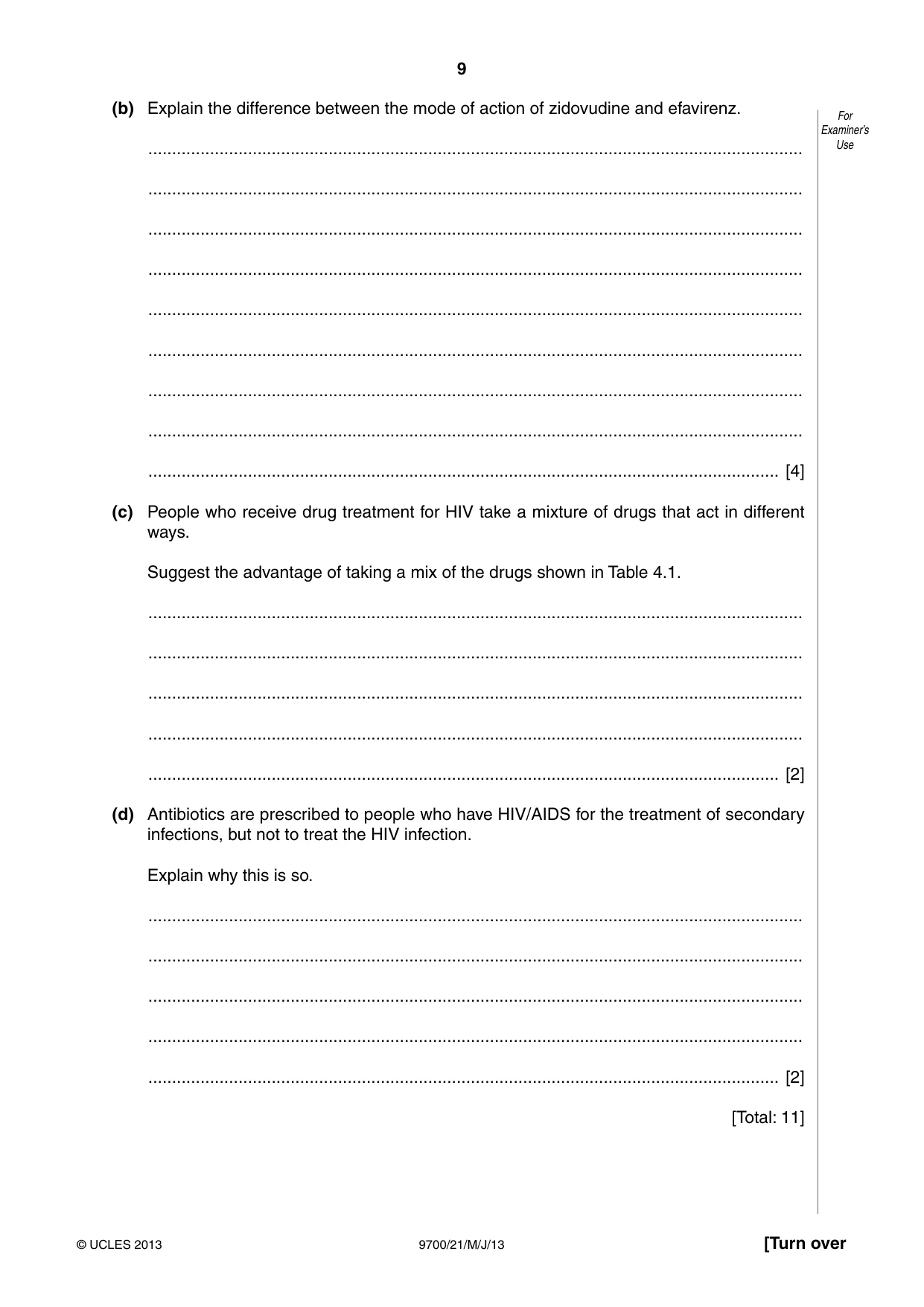
9 9700/21/M/J/13 © UCLES 2013 [Turn over For Examiner’s Use (b) Explain the difference between the mode of action of zidovudine and efavirenz. … … … … … … … … … [4] (c) People who receive drug treatment for HIV take a mixture of drugs that act in different ways. Suggest the advantage of taking a mix of the drugs shown in Table 4.1. … … … … … [2] (d) Antibiotics are prescribed to people who have HIV/AIDS for the treatment of secondary infections, but not to treat the HIV infection. Explain why this is so. … … … … … [2] [Total: 11]
Question paper, page 10
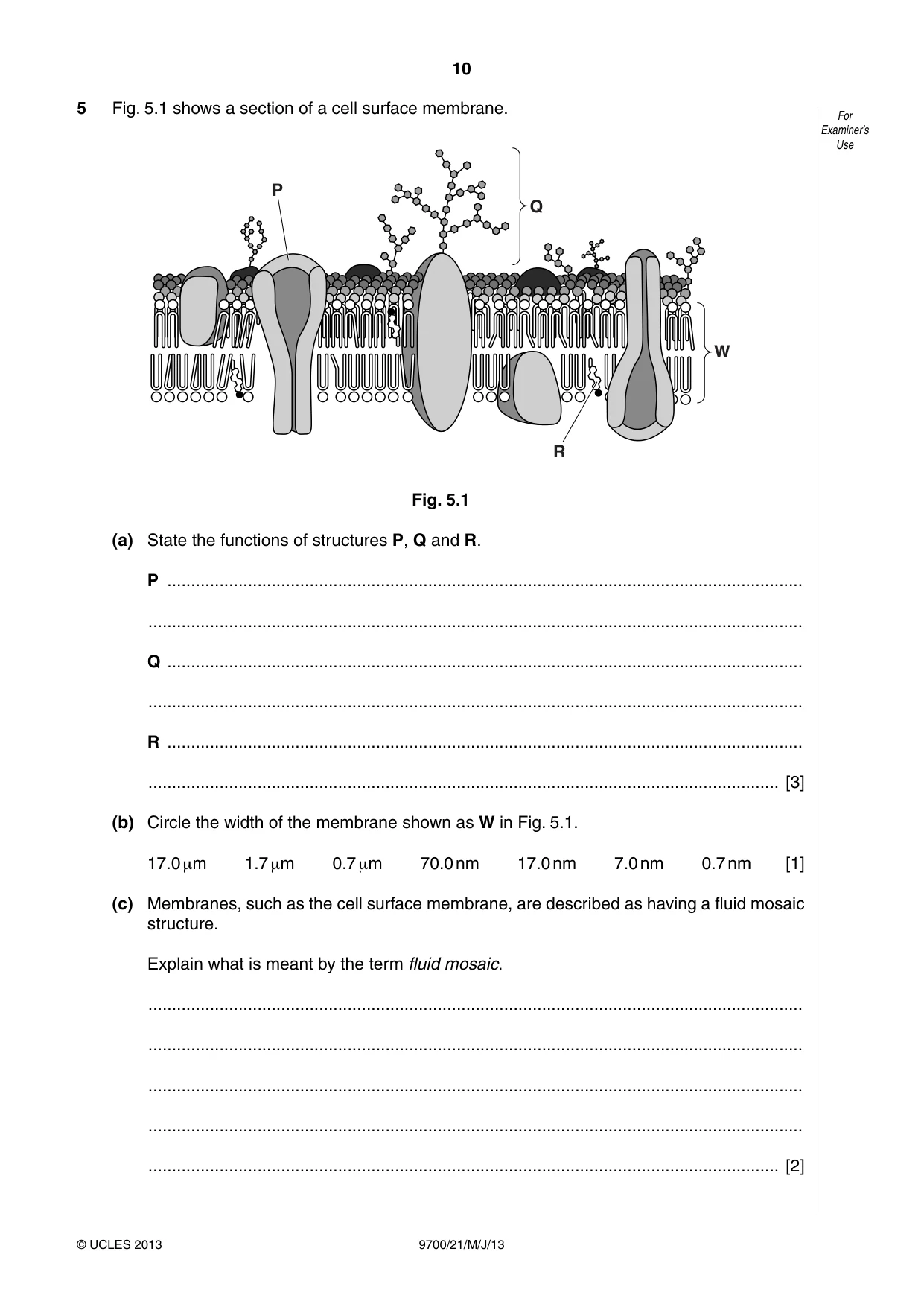
10 9700/21/M/J/13 © UCLES 2013 For Examiner’s Use 5 Fig. 5.1 shows a section of a cell surface membrane. P Q W R Fig. 5.1 (a) State the functions of structures P, Q and R. P … … Q … … R … … [3] (b) Circle the width of the membrane shown as W in Fig. 5.1. 17.0 μm 1.7 μm 0.7 μm 70.0 nm 17.0 nm 7.0 nm 0.7 nm [1] (c) Membranes, such as the cell surface membrane, are described as having a fluid mosaic structure. Explain what is meant by the term fluid mosaic. … … … … … [2]
Question paper, page 11
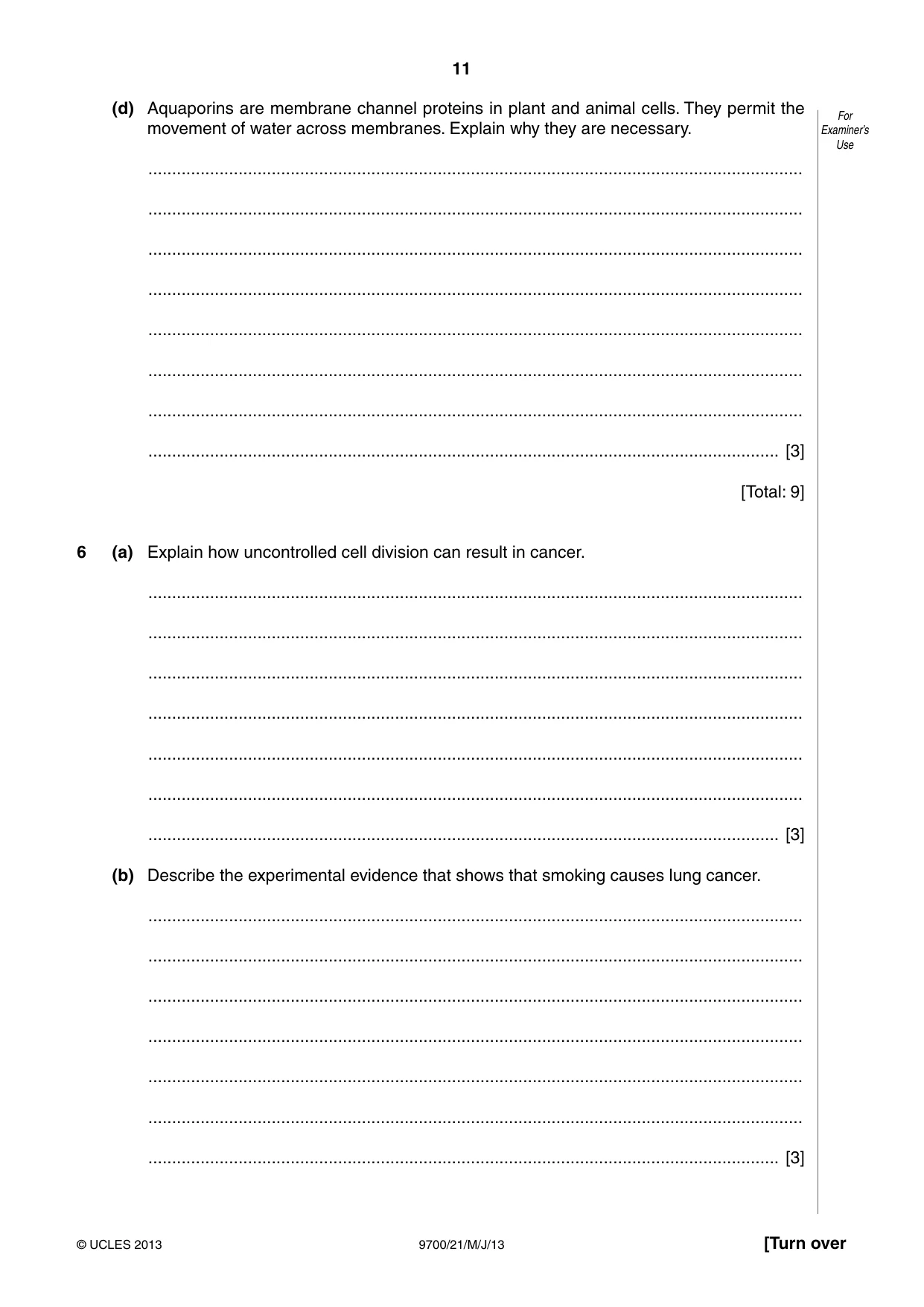
11 9700/21/M/J/13 © UCLES 2013 [Turn over For Examiner’s Use (d) Aquaporins are membrane channel proteins in plant and animal cells. They permit the movement of water across membranes. Explain why they are necessary. … … … … … … … … [3] [Total: 9] 6 (a) Explain how uncontrolled cell division can result in cancer. … … … … … … … [3] (b) Describe the experimental evidence that shows that smoking causes lung cancer. … … … … … … … [3]
Question paper, page 12
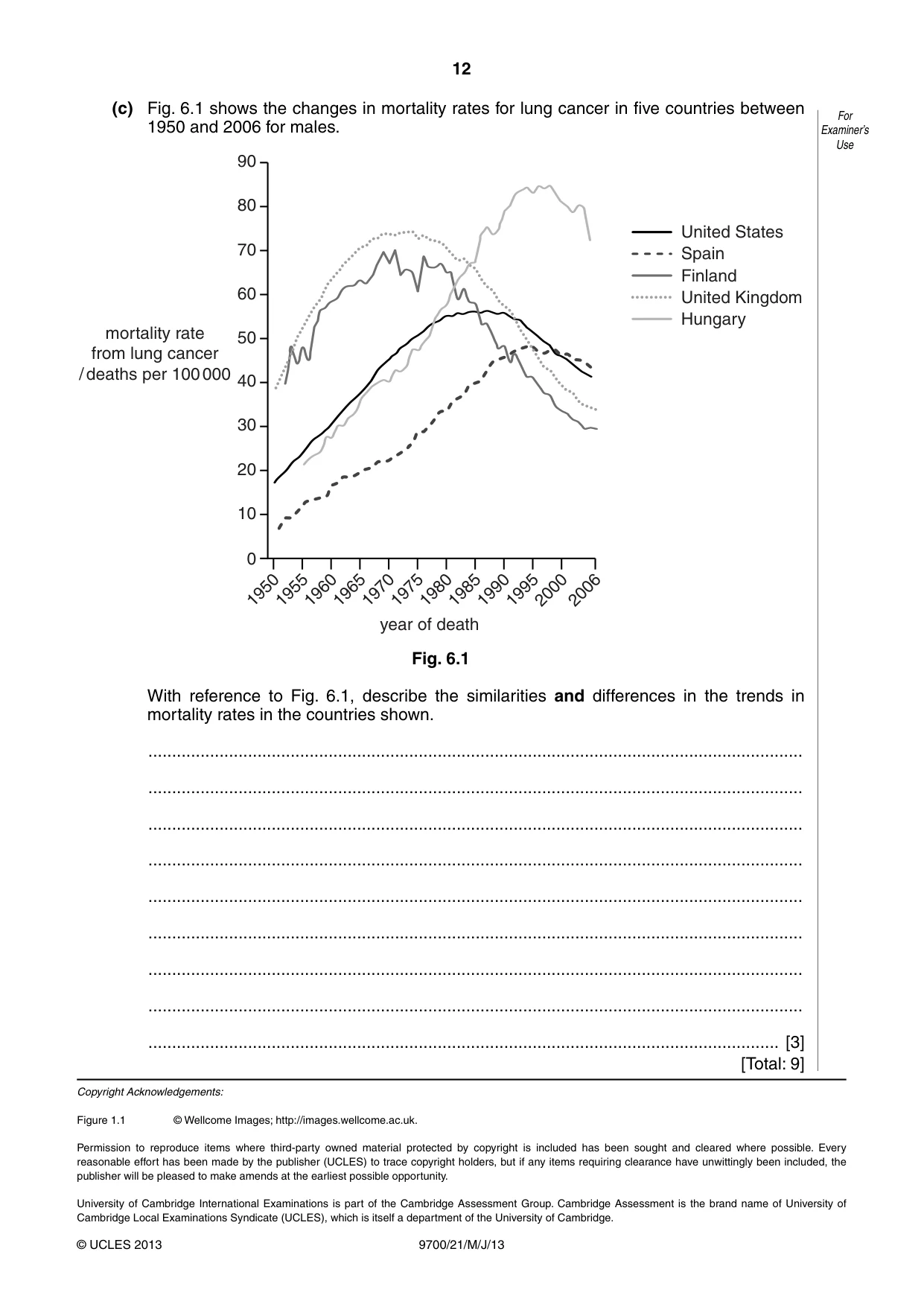
12 9700/21/M/J/13 © UCLES 2013 For Examiner’s Use (c) Fig. 6.1 shows the changes in mortality rates for lung cancer in five countries between 1950 and 2006 for males. 90 80 70 60 50 10 year of death United States Spain Finland United Kingdom Hungary mortality rate from lung cancer / deaths per 100 000 1950 1955 1960 1965 1970 1975 1980 1985 1990 1995 2000 2006 0 40 30 20 Fig. 6.1 With reference to Fig. 6.1, describe the similarities and differences in the trends in mortality rates in the countries shown. … … … … … … … … … [3] [Total: 9] Copyright Acknowledgements: Figure 1.1 © Wellcome Images; http://images.wellcome.ac.uk. Permission to reproduce items where third-party owned material protected by copyright is included has been sought and cleared where possible. Every reasonable effort has been made by the publisher (UCLES) to trace copyright holders, but if any items requiring clearance have unwittingly been included, the publisher will be pleased to make amends at the earliest possible opportunity. University of Cambridge International Examinations is part of the Cambridge Assessment Group. Cambridge Assessment is the brand name of University of Cambridge Local Examinations Syndicate (UCLES), which is itself a department of the University of Cambridge.
Mark scheme, page 1
CAMBRIDGE INTERNATIONAL EXAMINATIONS GCE Advanced Subsidiary Level and GCE Advanced Level MARK SCHEME for the May/June 2013 series 9700 BIOLOGY 9700/21 Paper 2 (AS Structured Questions), maximum raw mark 60 This mark scheme is published as an aid to teachers and candidates, to indicate the requirements of the examination. It shows the basis on which Examiners were instructed to award marks. It does not indicate the details of the discussions that took place at an Examiners’ meeting before marking began, which would have considered the acceptability of alternative answers. Mark schemes should be read in conjunction with the question paper and the Principal Examiner Report for Teachers. Cambridge will not enter into discussions about these mark schemes. Cambridge is publishing the mark schemes for the May/June 2013 series for most IGCSE, GCE Advanced Level and Advanced Subsidiary Level components and some Ordinary Level components.
Mark scheme, page 2
Page 2 Mark Scheme Syllabus Paper GCE AS/A LEVEL – May/June 2013 9700 21 © Cambridge International Examinations 2013 Mark scheme abbreviations: ; separates marking points / alternative answers for the same point R reject A accept (for answers correctly cued by the question, or by extra guidance) AW alternative wording (where responses vary more than usual) underline actual word given must be used by candidate (grammatical variants excepted) max indicates the maximum number of marks that can be given ora or reverse argument mp marking point (with relevant number) ecf error carried forward I ignore
Mark scheme, page 3
Page 3 Mark Scheme Syllabus Paper GCE AS/A LEVEL – May/June 2013 9700 21 © Cambridge International Examinations 2013 1 (a) (i) A – endothelial / squamous / epithelial (cell) ; B – nucleus ; [2] (ii) 7 (µm) ;; award two marks if correct answer given award one mark if not rounded to nearest whole number award one mark if given incorrect unit if no answer given, award one mark if correct measurement (38–41 / 3.8–4.1 / 38000–41000) is divided by 5700 [2] (iii) for two marks - one structure and one function only two functions = 1 mark only two structures = 1 mark 1 (capillary) wall is, thin / single layer of cells / one cell thick ; A endothelium / epithelium for wall 2 short diffusion, pathway / distance / AW ; R ‘easy’ diffusion 3 (many have) endothelial pores / fenestrations / gaps / spaces / openings ; 4 to allow named, substance / cell, to leave the blood ; A idea of separation / selection, of named substance(s) by size 5 small diameter / small lumen / diameter of red blood cells ; 6 slows down flow of red blood cells / (capillary / blood) close to cells ; 7 (capillaries have) large, surface area / surface area to volume ratio ; 8 idea that allows more exchange ; Ignore faster exchange [max 2] (b) white blood cells 1 (named) white blood cells can, leave capillaries / enter tissue fluid ; A diapedesis / (suggestion that some) too large to leave the, blood / capillaries 2 high number in, lymph nodes / thymus / bone marrow / spleen ; A stored / produced glucose 3 small (molecule) ; 4 filtered / diffuses / leaves / leaks, from blood / from capillaries / into tissue fluid ; 5 taken up / used, by cells in respiration ; Ignore supply protein 6 too large to, leave capillaries / enter lymph / enter tissue fluid ; 7 (in lymph / tissue fluid) antibodies / proteins, from / secreted by, lymphocytes / other cells ; [max 5]
Mark scheme, page 4
Page 4 Mark Scheme Syllabus Paper GCE AS/A LEVEL – May/June 2013 9700 21 © Cambridge International Examinations 2013 (c) accept hydrogen carbonate (ions) / bicarbonate (ions) / HCO3 – penalise HCO3 once only 1 carbon dioxide, reacts / combines, with (terminal amine / N terminal, of) haemoglobin ; R carried by / reacts with, haem 2 to form carbaminohaemoglobin ; 3 carbonic anhydrase catalyses, formation of carbonic acid (H2CO3) / reverse reaction described (in the lungs) ; 4 (carbonic acid dissociates to) HCO3 – / CHO3 – / hydrogen carbonate (and H+) ; 5 hydrogen carbonate / HCO3 –, diffuses / moves / AW, out (into plasma) ; [max 3] [Total: 14] 2 (a) (infected) person, sneezes / coughs / talks / breathes out, (airborne) droplets / aerosol / moist air ; ignore contact inhaled / inspire / breathed in, by uninfected, person ; ignore transplacental transmission [2] (b) (i) variable region binds / attaches / combines, to antigen ; R receptor site R ‘fit’ ref. to specificity ; ignore complementary shape (to antigen) R same / similar shape [max 2] (ii) disulphide bond ignore ref. to hinge holds, polypeptides / heavy chains / long chains, together ; ignore constant as description of chains maintains, tertiary / quaternary / 3D, structure / shape ; R shape unqualified [max 1] (iii) constant region binds to, receptors / cell (surface) membrane, on, phagocytes / macrophages ; antigen, marking / tagging, for, phagocytosis / macrophage action ; AW A ref. to opsonisation R agglutination [max 1] [Total: 6]
Mark scheme, page 5
Page 5 Mark Scheme Syllabus Paper GCE AS/A LEVEL – May/June 2013 9700 21 © Cambridge International Examinations 2013 3 (a) R CO2 diffusion is a consequence of transpiration stomata open(ings) to allow carbon dioxide in ; carbon dioxide required for photosynthesis ; ignore ref. to oxygen water vapour diffuses out through stomata ; A water if evaporation (from mesophyll walls) described A water as a gas [3] (b) 1 both show, little / low / lowest, transpiration, at night / 22.00 to 24.00 / 00.00 to 04.00 ; 2 both, increase to / peak, at mid day / 12.00 ; 3 ref. to second peak at 16.00 ; 4 both, dip / decrease, at 14.00 ; 5 transpiration (always) lower for trees at exposed site / ora ; 6 both decrease from 16.00 ; for mps 1–4 and mp 6, allow a description at one site only R if contradictory description given for the other site 7 comparative data quote to support above marking points ; ; 8 to compare the transpiration rate at two locations at the same time or transpiration rate at one location at different times to award data marks arbitrary units (au) must be used at least once [max 5] (c) identification of the following features 1 stomata close (for longer), during the day / when hot / when dry ; 2 stomata in pits / sunken stomata ; 3 stomata only on lower surface of the leaf ; 4 hairs / trichomes ; 5 low number of / few(er) / less, stomata (per unit area) ; ignore ‘less open stomata’ 6 thick(er) cuticle; 7 reflective cuticle (on upper epidermis) ; 8 thick(er) epidermis / more than one layer of epidermal cells ; 9 curled / rolled / AW, leaves ; [max 3] [Total: 11]
Mark scheme, page 6
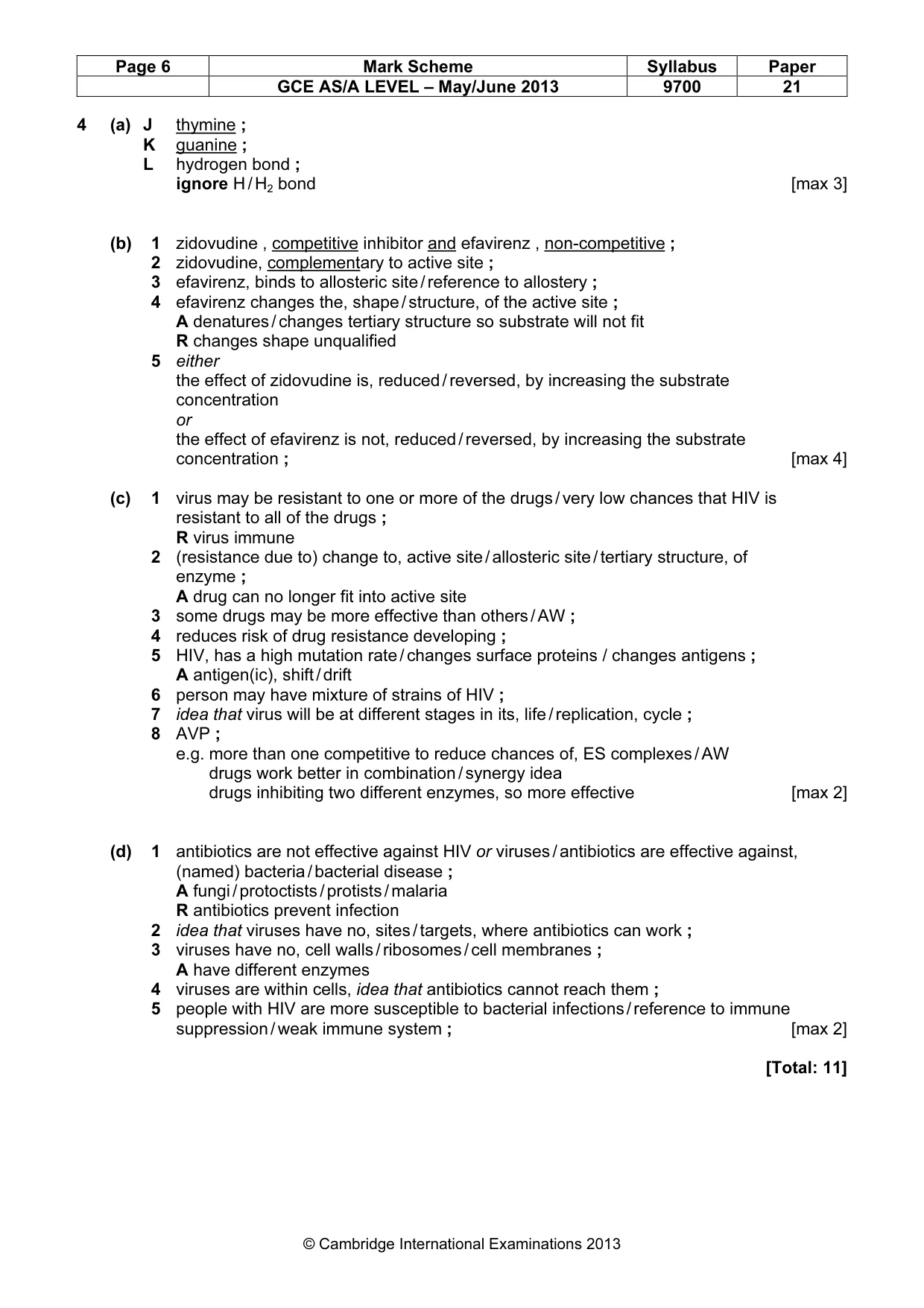
Page 6 Mark Scheme Syllabus Paper GCE AS/A LEVEL – May/June 2013 9700 21 © Cambridge International Examinations 2013 4 (a) J thymine ; K guanine ; L hydrogen bond ; ignore H / H2 bond [max 3] (b) 1 zidovudine , competitive inhibitor and efavirenz , non-competitive ; 2 zidovudine, complementary to active site ; 3 efavirenz, binds to allosteric site / reference to allostery ; 4 efavirenz changes the, shape / structure, of the active site ; A denatures / changes tertiary structure so substrate will not fit R changes shape unqualified 5 either the effect of zidovudine is, reduced / reversed, by increasing the substrate concentration or the effect of efavirenz is not, reduced / reversed, by increasing the substrate concentration ; [max 4] (c) 1 virus may be resistant to one or more of the drugs / very low chances that HIV is resistant to all of the drugs ; R virus immune 2 (resistance due to) change to, active site / allosteric site / tertiary structure, of enzyme ; A drug can no longer fit into active site 3 some drugs may be more effective than others / AW ; 4 reduces risk of drug resistance developing ; 5 HIV, has a high mutation rate / changes surface proteins / changes antigens ; A antigen(ic), shift / drift 6 person may have mixture of strains of HIV ; 7 idea that virus will be at different stages in its, life / replication, cycle ; 8 AVP ; e.g. more than one competitive to reduce chances of, ES complexes / AW drugs work better in combination / synergy idea drugs inhibiting two different enzymes, so more effective [max 2] (d) 1 antibiotics are not effective against HIV or viruses / antibiotics are effective against, (named) bacteria / bacterial disease ; A fungi / protoctists / protists / malaria R antibiotics prevent infection 2 idea that viruses have no, sites / targets, where antibiotics can work ; 3 viruses have no, cell walls / ribosomes / cell membranes ; A have different enzymes 4 viruses are within cells, idea that antibiotics cannot reach them ; 5 people with HIV are more susceptible to bacterial infections / reference to immune suppression / weak immune system ; [max 2] [Total: 11]
Mark scheme, page 7
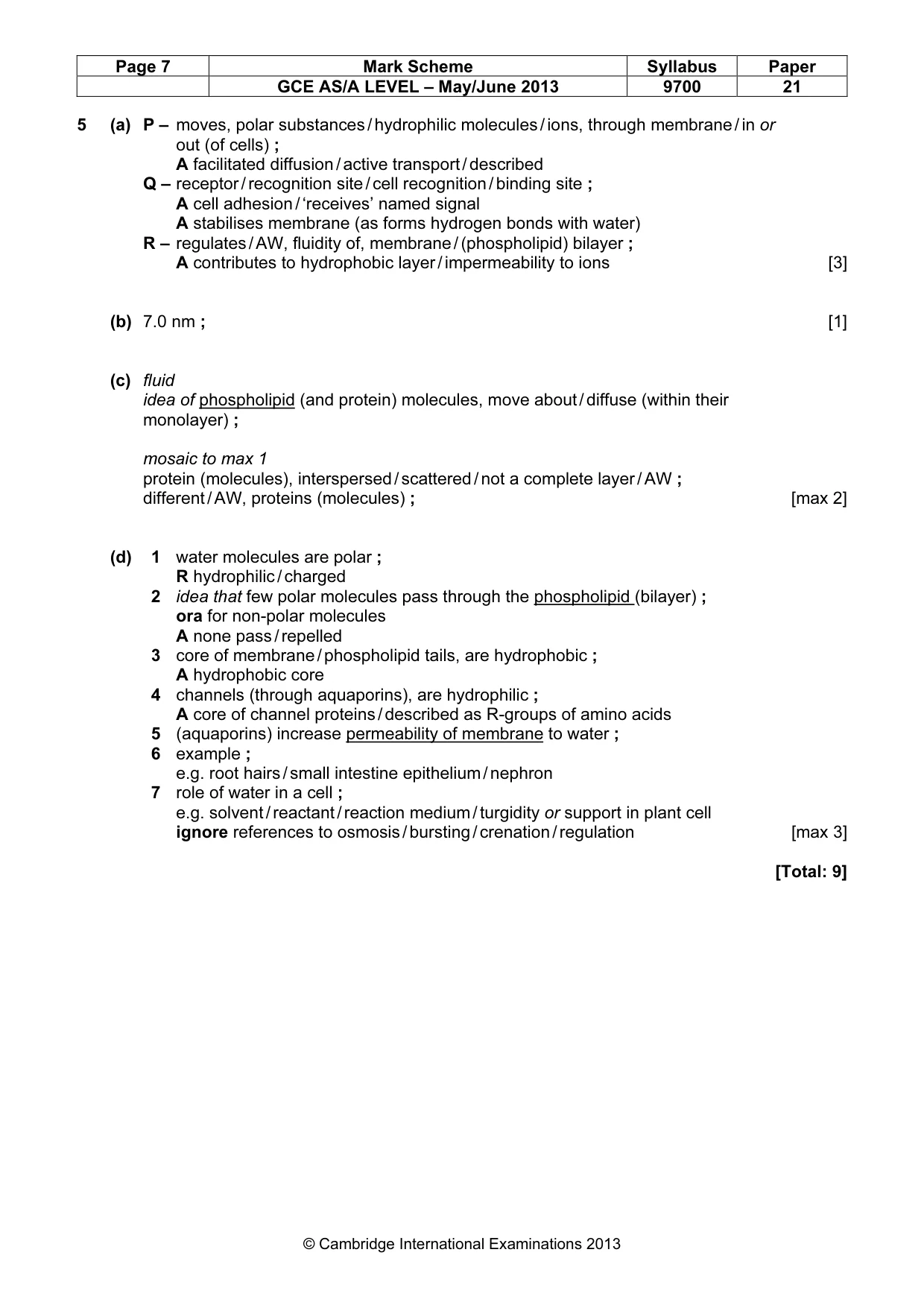
Page 7 Mark Scheme Syllabus Paper GCE AS/A LEVEL – May/June 2013 9700 21 © Cambridge International Examinations 2013 5 (a) P – moves, polar substances / hydrophilic molecules / ions, through membrane / in or out (of cells) ; A facilitated diffusion / active transport / described Q – receptor / recognition site / cell recognition / binding site ; A cell adhesion / ‘receives’ named signal A stabilises membrane (as forms hydrogen bonds with water) R – regulates / AW, fluidity of, membrane / (phospholipid) bilayer ; A contributes to hydrophobic layer / impermeability to ions [3] (b) 7.0 nm ; [1] (c) fluid idea of phospholipid (and protein) molecules, move about / diffuse (within their monolayer) ; mosaic to max 1 protein (molecules), interspersed / scattered / not a complete layer / AW ; different / AW, proteins (molecules) ; [max 2] (d) 1 water molecules are polar ; R hydrophilic / charged 2 idea that few polar molecules pass through the phospholipid (bilayer) ; ora for non-polar molecules A none pass / repelled 3 core of membrane / phospholipid tails, are hydrophobic ; A hydrophobic core 4 channels (through aquaporins), are hydrophilic ; A core of channel proteins / described as R-groups of amino acids 5 (aquaporins) increase permeability of membrane to water ; 6 example ; e.g. root hairs / small intestine epithelium / nephron 7 role of water in a cell ; e.g. solvent / reactant / reaction medium / turgidity or support in plant cell ignore references to osmosis / bursting / crenation / regulation [max 3] [Total: 9]
Mark scheme, page 8
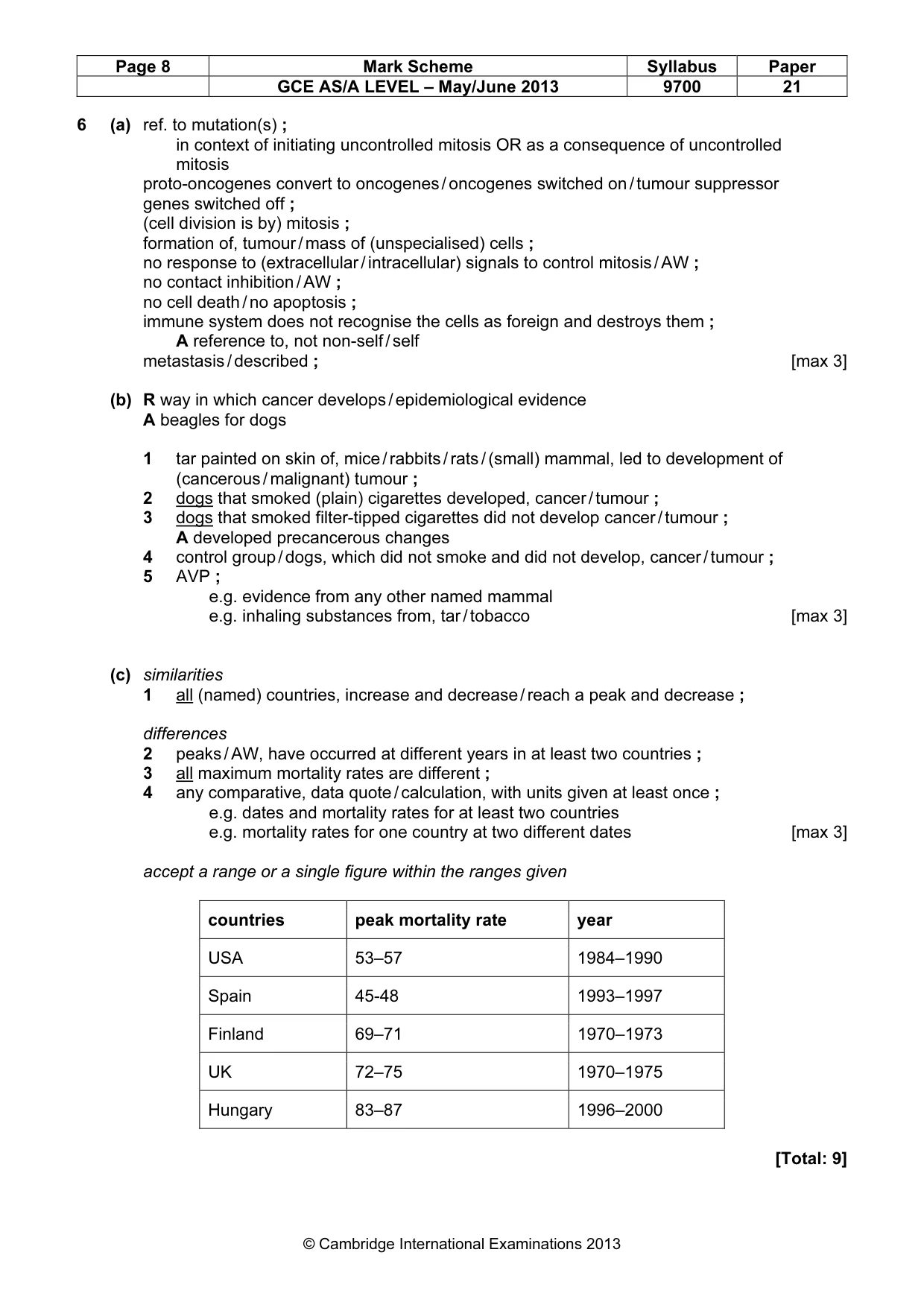
Page 8 Mark Scheme Syllabus Paper GCE AS/A LEVEL – May/June 2013 9700 21 © Cambridge International Examinations 2013 6 (a) ref. to mutation(s) ; in context of initiating uncontrolled mitosis OR as a consequence of uncontrolled mitosis proto-oncogenes convert to oncogenes / oncogenes switched on / tumour suppressor genes switched off ; (cell division is by) mitosis ; formation of, tumour / mass of (unspecialised) cells ; no response to (extracellular / intracellular) signals to control mitosis / AW ; no contact inhibition / AW ; no cell death / no apoptosis ; immune system does not recognise the cells as foreign and destroys them ; A reference to, not non-self / self metastasis / described ; [max 3] (b) R way in which cancer develops / epidemiological evidence A beagles for dogs 1 tar painted on skin of, mice / rabbits / rats / (small) mammal, led to development of (cancerous / malignant) tumour ; 2 dogs that smoked (plain) cigarettes developed, cancer / tumour ; 3 dogs that smoked filter-tipped cigarettes did not develop cancer / tumour ; A developed precancerous changes 4 control group / dogs, which did not smoke and did not develop, cancer / tumour ; 5 AVP ; e.g. evidence from any other named mammal e.g. inhaling substances from, tar / tobacco [max 3] (c) similarities 1 all (named) countries, increase and decrease / reach a peak and decrease ; differences 2 peaks / AW, have occurred at different years in at least two countries ; 3 all maximum mortality rates are different ; 4 any comparative, data quote / calculation, with units given at least once ; e.g. dates and mortality rates for at least two countries e.g. mortality rates for one country at two different dates [max 3] accept a range or a single figure within the ranges given countries peak mortality rate year USA 53–57 1984–1990 Spain 45-48 1993–1997 Finland 69–71 1970–1973 UK 72–75 1970–1975 Hungary 83–87 1996–2000 [Total: 9]
What you needed in this session
Cambridge’s own grade thresholds for 2013 May/June, Paper 2 · Variant 1. A higher threshold means an easier paper — the bar moves with how the cohort did.