Cambridge A Level Biology 9700 — 2012 Oct/Nov Paper 2 · Variant 3
9700/23/O/N/12 · 60 marks · ≈68 min
The question paper and its mark scheme, free to read here and free to download. This is Cambridge’s own paper, exactly as it was sat.
Question paper16 pages
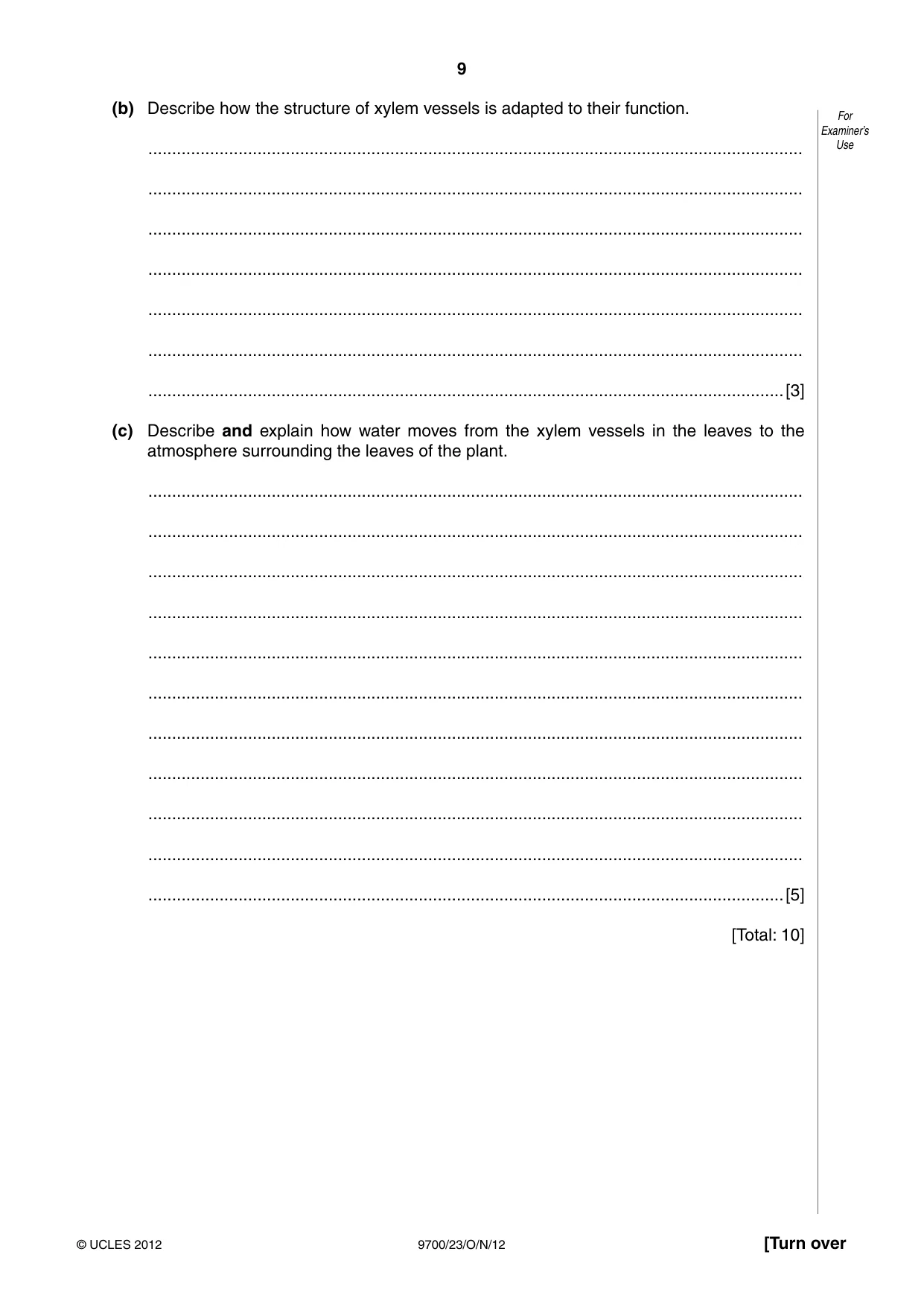


Mark scheme8 pages
Answers below. Sit the paper first if you are practising.
Paper as text
Question paper, page 1
This document consists of 13 printed pages and 3 blank pages. DC (LEO/SW) 49038/2 © UCLES 2012 [Turn over UNIVERSITY OF CAMBRIDGE INTERNATIONAL EXAMINATIONS General Certificate of Education Advanced Subsidiary Level and Advanced Level * 2 4 2 8 4 7 9 0 2 0 * BIOLOGY 9700/23 Paper 2 Structured Question AS October/November 2012 1 hour 15 minutes Candidates answer on the Question Paper. No Additional Materials are required. READ THESE INSTRUCTIONS FIRST Write your Centre number, candidate number and name in the spaces provided at the top of this page. Write in dark blue or black ink. You may use a soft pencil for any diagrams, graphs or rough working. Do not use staples, paper clips, highlighters, glue or correction fluid. DO NOT WRITE IN ANY BARCODES. Answer all questions. At the end of the examination, fasten all your work securely together. The number of marks is given in brackets [ ] at the end of each question or part question. For Examiner’s Use 1 2 3 4 5 6 Total
Question paper, page 2
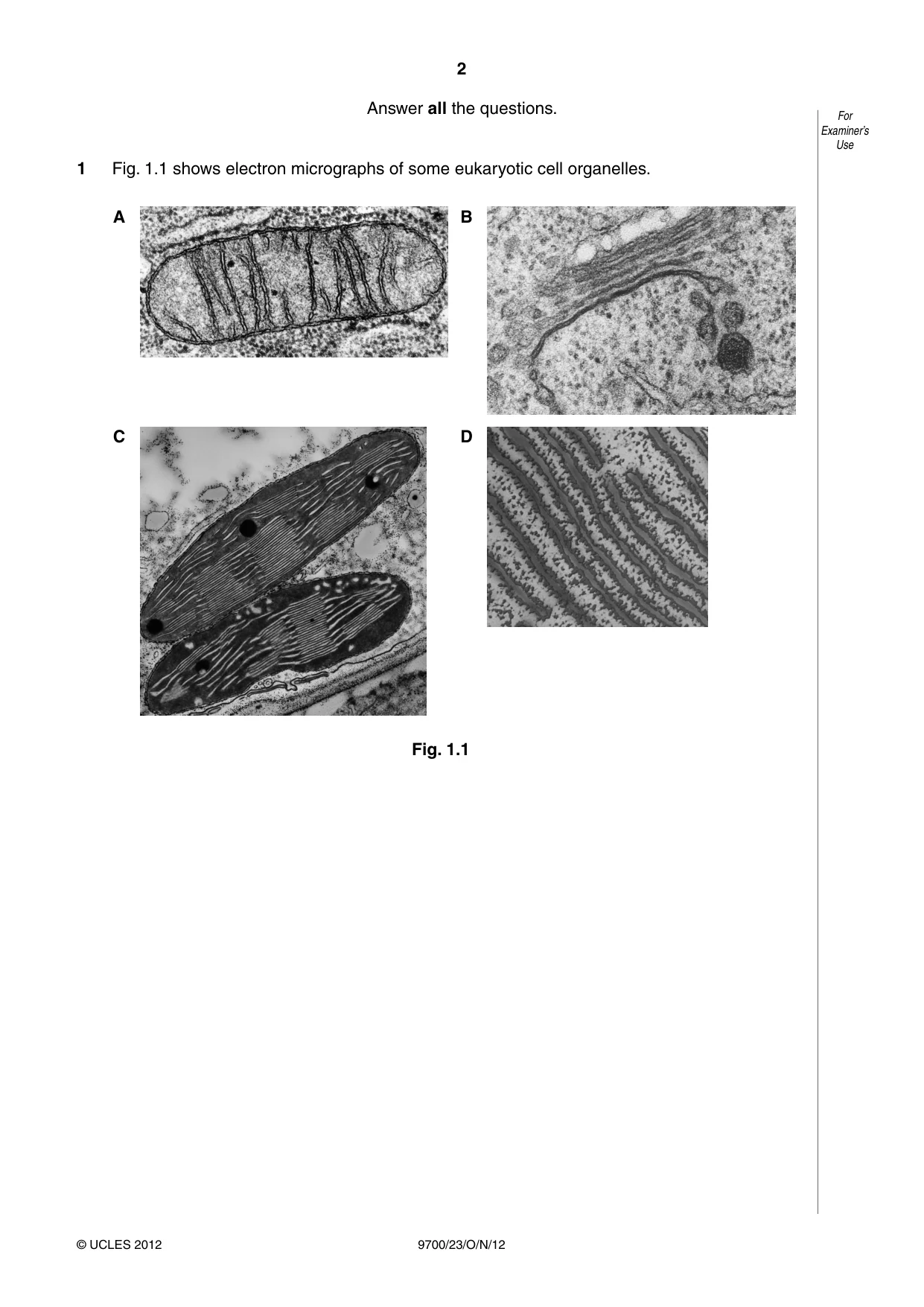
2 9700/23/O/N/12 © UCLES 2012 For Examiner’s Use Answer all the questions. 1 Fig. 1.1 shows electron micrographs of some eukaryotic cell organelles. A B C D Fig. 1.1
Question paper, page 3
3 9700/23/O/N/12 © UCLES 2012 [Turn over For Examiner’s Use For each of the organelles A, B, C and D, shown in Fig. 1.1, state the name and function of each. A name … function … B name … function … C name … function … D name … function …[8] [Total: 8]
Question paper, page 4
4 9700/23/O/N/12 © UCLES 2012 For Examiner’s Use 2 Antibiotics are drugs which are very important in the treatment and cure of some diseases. (a) Underline the disease or diseases in the list below which are treatable with antibiotics. cholera malaria HIV/AIDS tuberculosis (TB) [1] (b) When patients are prescribed a course of antibiotics, they must not stop taking the antibiotics as soon as they start to feel better, or when they feel that the disease symptoms have gone. Explain the importance of taking a complete course of antibiotics. … … … … … …[3] (c) Some antibiotics act as competitive inhibitors of enzymes in pathogens. (i) Describe what is meant by the term competitive inhibitor. … … … … … …[3]
Question paper, page 5
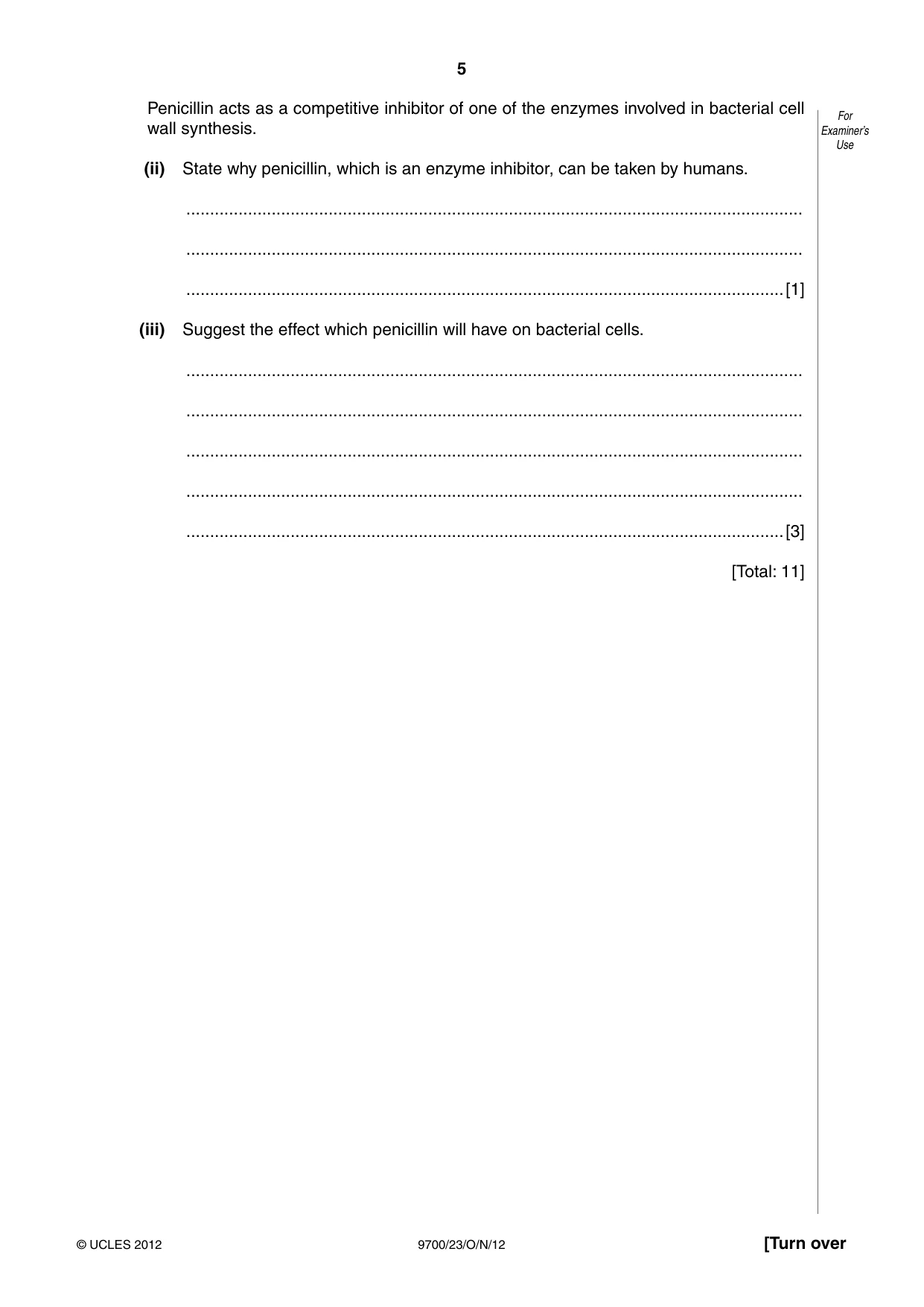
5 9700/23/O/N/12 © UCLES 2012 [Turn over For Examiner’s Use Penicillin acts as a competitive inhibitor of one of the enzymes involved in bacterial cell wall synthesis. (ii) State why penicillin, which is an enzyme inhibitor, can be taken by humans. … … …[1] (iii) Suggest the effect which penicillin will have on bacterial cells. … … … … …[3] [Total: 11]
Question paper, page 6
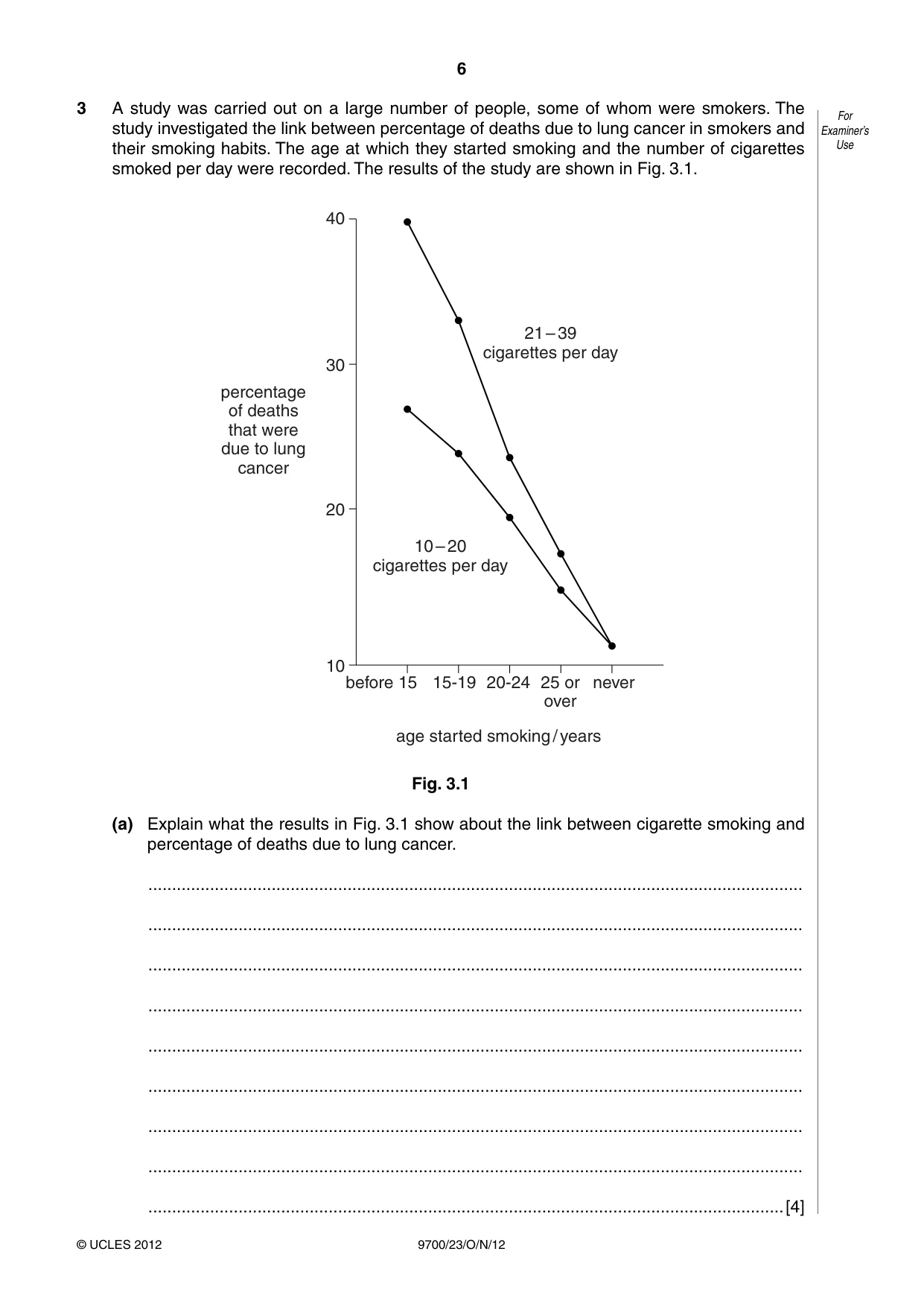
6 9700/23/O/N/12 © UCLES 2012 For Examiner’s Use 3 A study was carried out on a large number of people, some of whom were smokers. The study investigated the link between percentage of deaths due to lung cancer in smokers and their smoking habits. The age at which they started smoking and the number of cigarettes smoked per day were recorded. The results of the study are shown in Fig. 3.1. 10 15-19 before 15 20-24 25 or over age started smoking / years percentage of deaths that were due to lung cancer 10 – 20 cigarettes per day 21 – 39 cigarettes per day never 20 30 40 Fig. 3.1 (a) Explain what the results in Fig. 3.1 show about the link between cigarette smoking and percentage of deaths due to lung cancer. … … … … … … … … …[4]
Question paper, page 7
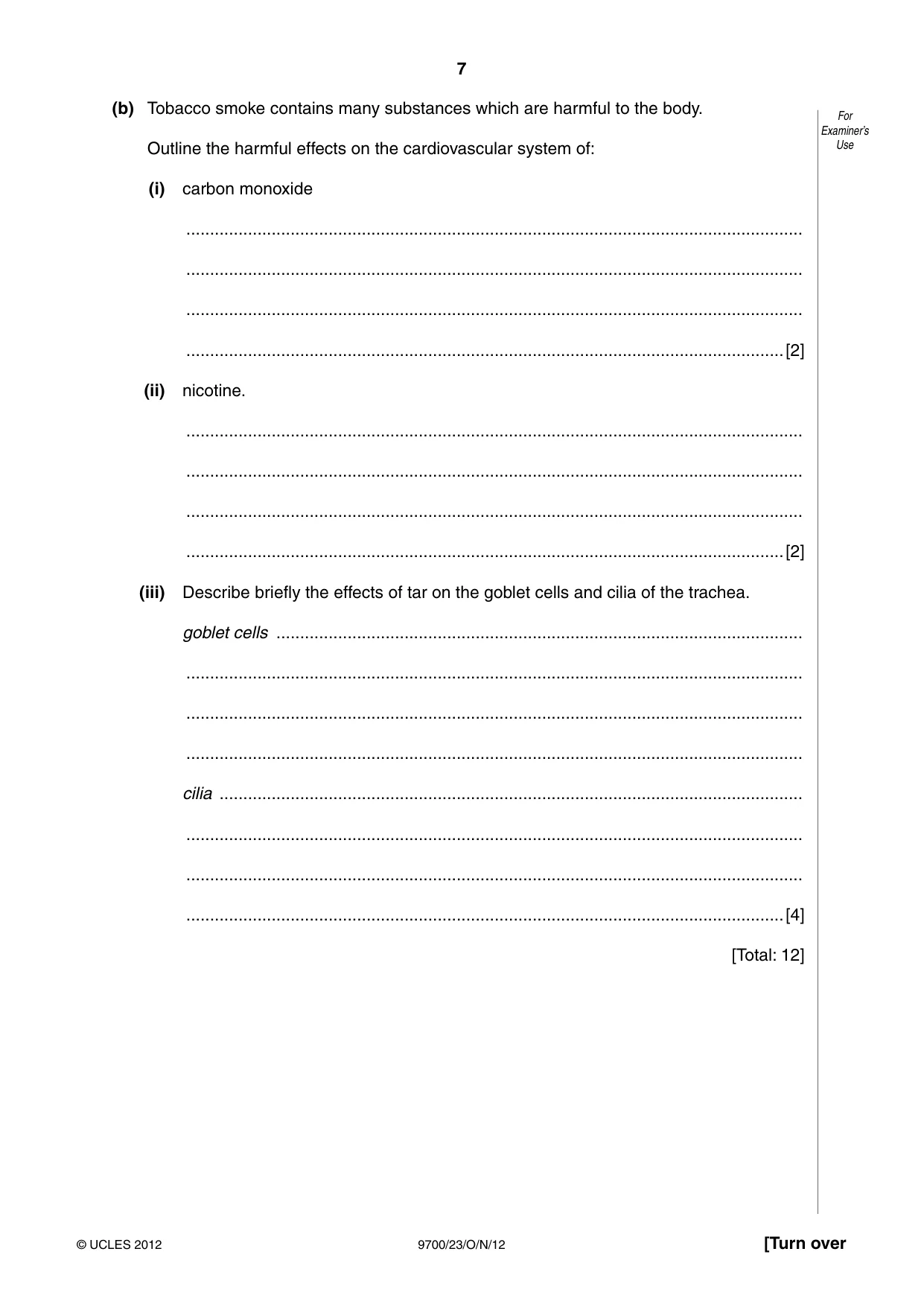
7 9700/23/O/N/12 © UCLES 2012 [Turn over For Examiner’s Use (b) Tobacco smoke contains many substances which are harmful to the body. Outline the harmful effects on the cardiovascular system of: (i) carbon monoxide … … … …[2] (ii) nicotine. … … … …[2] (iii) Describe briefly the effects of tar on the goblet cells and cilia of the trachea. goblet cells … … … … cilia … … … …[4] [Total: 12]
Question paper, page 8
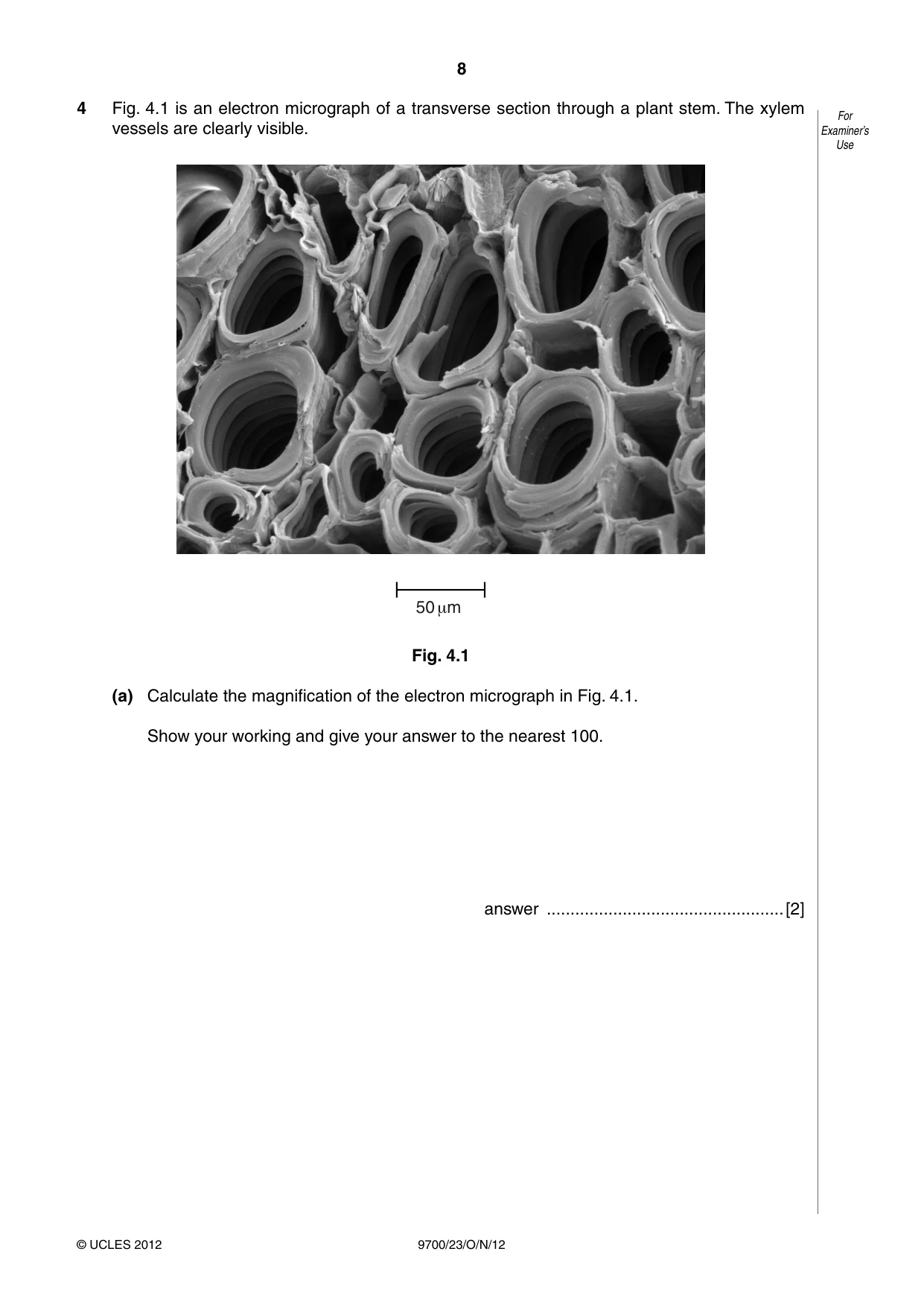
8 9700/23/O/N/12 © UCLES 2012 For Examiner’s Use 4 Fig. 4.1 is an electron micrograph of a transverse section through a plant stem. The xylem vessels are clearly visible. 50 +m Fig. 4.1 (a) Calculate the magnification of the electron micrograph in Fig. 4.1. Show your working and give your answer to the nearest 100. answer …[2]
Question paper, page 9
9 9700/23/O/N/12 © UCLES 2012 [Turn over For Examiner’s Use (b) Describe how the structure of xylem vessels is adapted to their function. … … … … … … …[3] (c) Describe and explain how water moves from the xylem vessels in the leaves to the atmosphere surrounding the leaves of the plant. … … … … … … … … … … …[5] [Total: 10]
Question paper, page 10
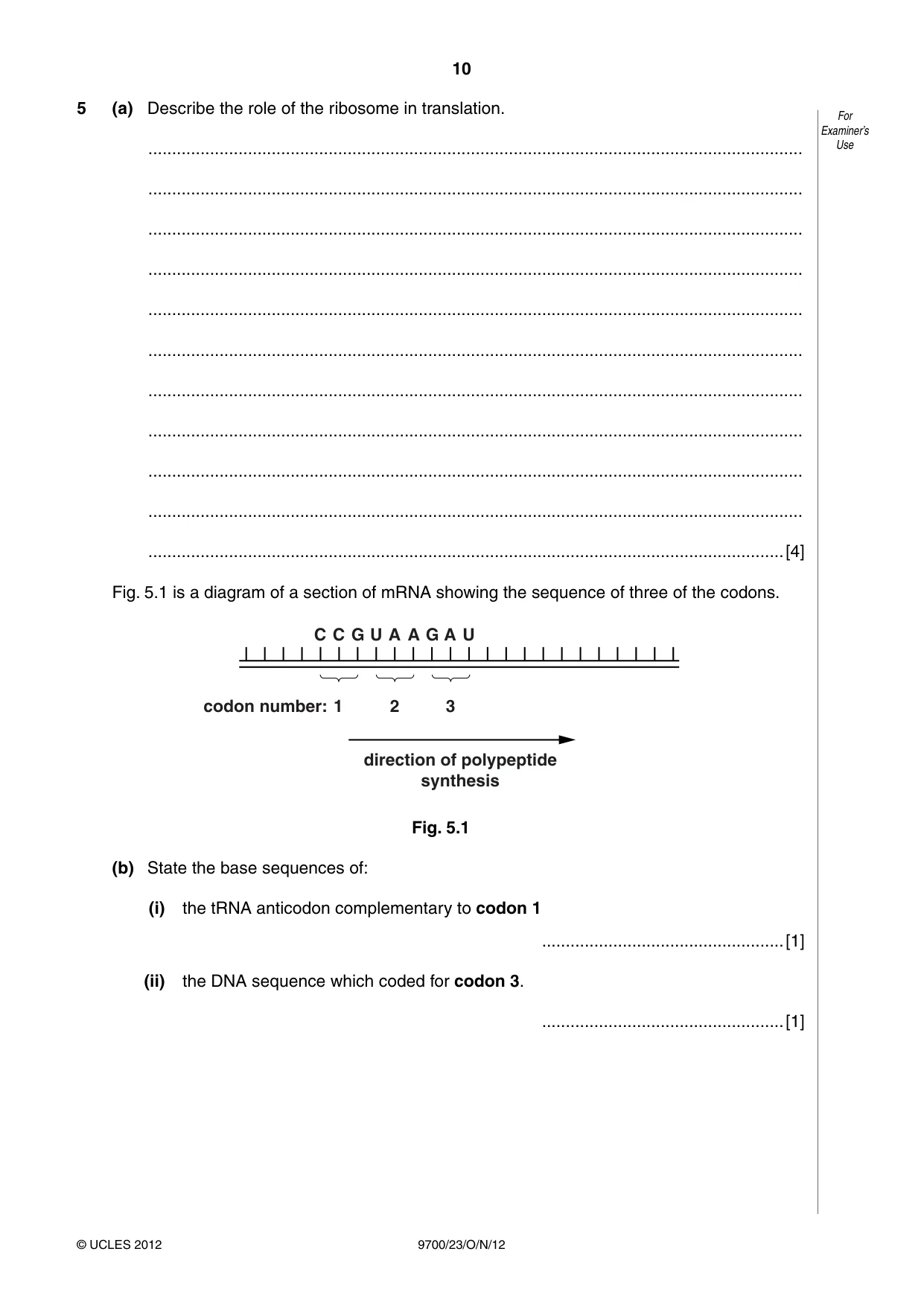
10 9700/23/O/N/12 © UCLES 2012 For Examiner’s Use 5 (a) Describe the role of the ribosome in translation. … … … … … … … … … … …[4] Fig. 5.1 is a diagram of a section of mRNA showing the sequence of three of the codons. 1 codon number: direction of polypeptide synthesis C C G U A A G A U 2 3 Fig. 5.1 (b) State the base sequences of: (i) the tRNA anticodon complementary to codon 1 …[1] (ii) the DNA sequence which coded for codon 3. …[1]
Question paper, page 11
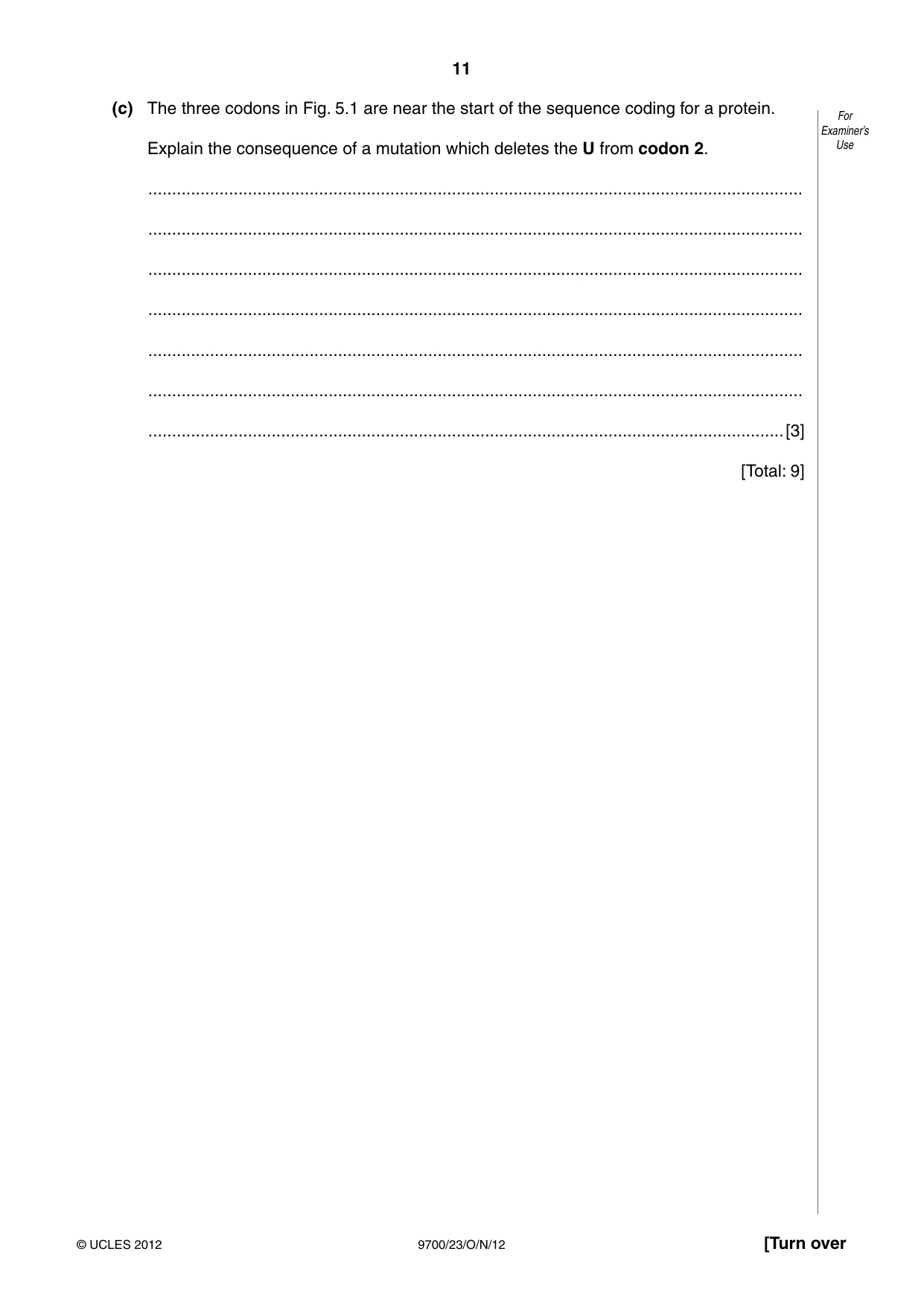
11 9700/23/O/N/12 © UCLES 2012 [Turn over For Examiner’s Use (c) The three codons in Fig. 5.1 are near the start of the sequence coding for a protein. Explain the consequence of a mutation which deletes the U from codon 2. … … … … … … …[3] [Total: 9]
Question paper, page 12
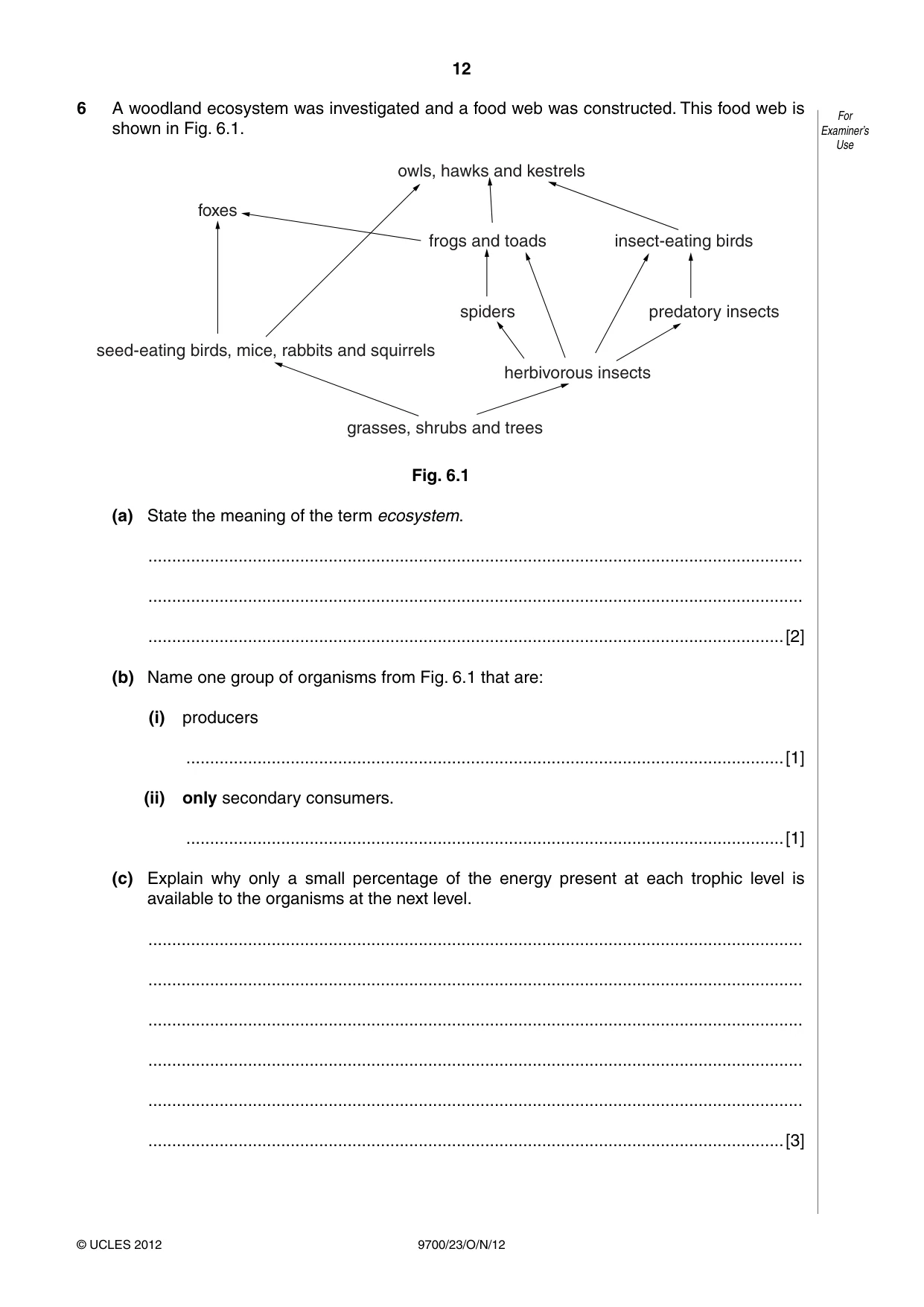
12 9700/23/O/N/12 © UCLES 2012 For Examiner’s Use 6 A woodland ecosystem was investigated and a food web was constructed. This food web is shown in Fig. 6.1. foxes owls, hawks and kestrels frogs and toads insect-eating birds spiders predatory insects herbivorous insects grasses, shrubs and trees seed-eating birds, mice, rabbits and squirrels Fig. 6.1 (a) State the meaning of the term ecosystem. … … …[2] (b) Name one group of organisms from Fig. 6.1 that are: (i) producers …[1] (ii) only secondary consumers. …[1] (c) Explain why only a small percentage of the energy present at each trophic level is available to the organisms at the next level. … … … … … …[3]
Question paper, page 13
13 9700/23/O/N/12 © UCLES 2012 For Examiner’s Use (d) Fig. 6.1 shows the flow of energy but not the cycling of nutrients in the ecosystem. Outline what happens to the nitrogen-containing compounds in the organisms at the top of the food web. … … … … … … … … …[3] [Total: 10]
Question paper, page 14
14 9700/23/O/N/12 © UCLES 2012 BLANK PAGE
Question paper, page 15
15 9700/23/O/N/12 © UCLES 2012 BLANK PAGE
Question paper, page 16
16 9700/23/O/N/12 © UCLES 2012 Copyright Acknowledgements: Question 1 Fig. 1.1A © CNRI/SCIENCE PHOTO LIBRARY Question 1 Fig. 1.1B © BIOLOGY MEDIA/SCIENCE PHOTO LIBRARY Question 1 Fig. 1.1C © DR. KARI LOUNATMAA/SCIENCE PHOTO LIBRARY Question 1 Fig. 1.1D © K.R. PORTER/SCIENCE PHOTO LIBRARY Question 4 Fig. 4.1 © STEVE GSCHMEISSNER/SCIENCE PHOTO LIBRARY Permission to reproduce items where third-party owned material protected by copyright is included has been sought and cleared where possible. Every reasonable effort has been made by the publisher (UCLES) to trace copyright holders, but if any items requiring clearance have unwittingly been included, the publisher will be pleased to make amends at the earliest possible opportunity. University of Cambridge International Examinations is part of the Cambridge Assessment Group. Cambridge Assessment is the brand name of University of Cambridge Local Examinations Syndicate (UCLES), which is itself a department of the University of Cambridge. BLANK PAGE
Mark scheme, page 1
CAMBRIDGE INTERNATIONAL EXAMINATIONS GCE Advanced Subsidiary Level and GCE Advanced Level MARK SCHEME for the October/November 2012 series 9700 BIOLOGY 9700/23 Paper 2 (AS Structured Questions), maximum raw mark 60 This mark scheme is published as an aid to teachers and candidates, to indicate the requirements of the examination. It shows the basis on which Examiners were instructed to award marks. It does not indicate the details of the discussions that took place at an Examiners’ meeting before marking began, which would have considered the acceptability of alternative answers. Mark schemes should be read in conjunction with the question paper and the Principal Examiner Report for Teachers. Cambridge will not enter into discussions about these mark schemes. Cambridge is publishing the mark schemes for the October/November 2012 series for most IGCSE, GCE Advanced Level and Advanced Subsidiary Level components and some Ordinary Level components.
Mark scheme, page 2
Page 2 Mark Scheme Syllabus Paper GCE AS/A LEVEL – October/November 2012 9700 23 © Cambridge International Examinations 2012 Mark scheme abbreviations: ; separates marking points / alternative answers for the same point R reject A accept (for answers correctly cued by the question, or by extra guidance) AW alternative wording (where responses vary more than usual) underline actual word given must be used by candidate (grammatical variants excepted) max indicates the maximum number of marks that can be given ora or reverse argument mp marking point (with relevant number) ecf error carried forward I ignore AVP alternative valid point (examples given)
Mark scheme, page 3
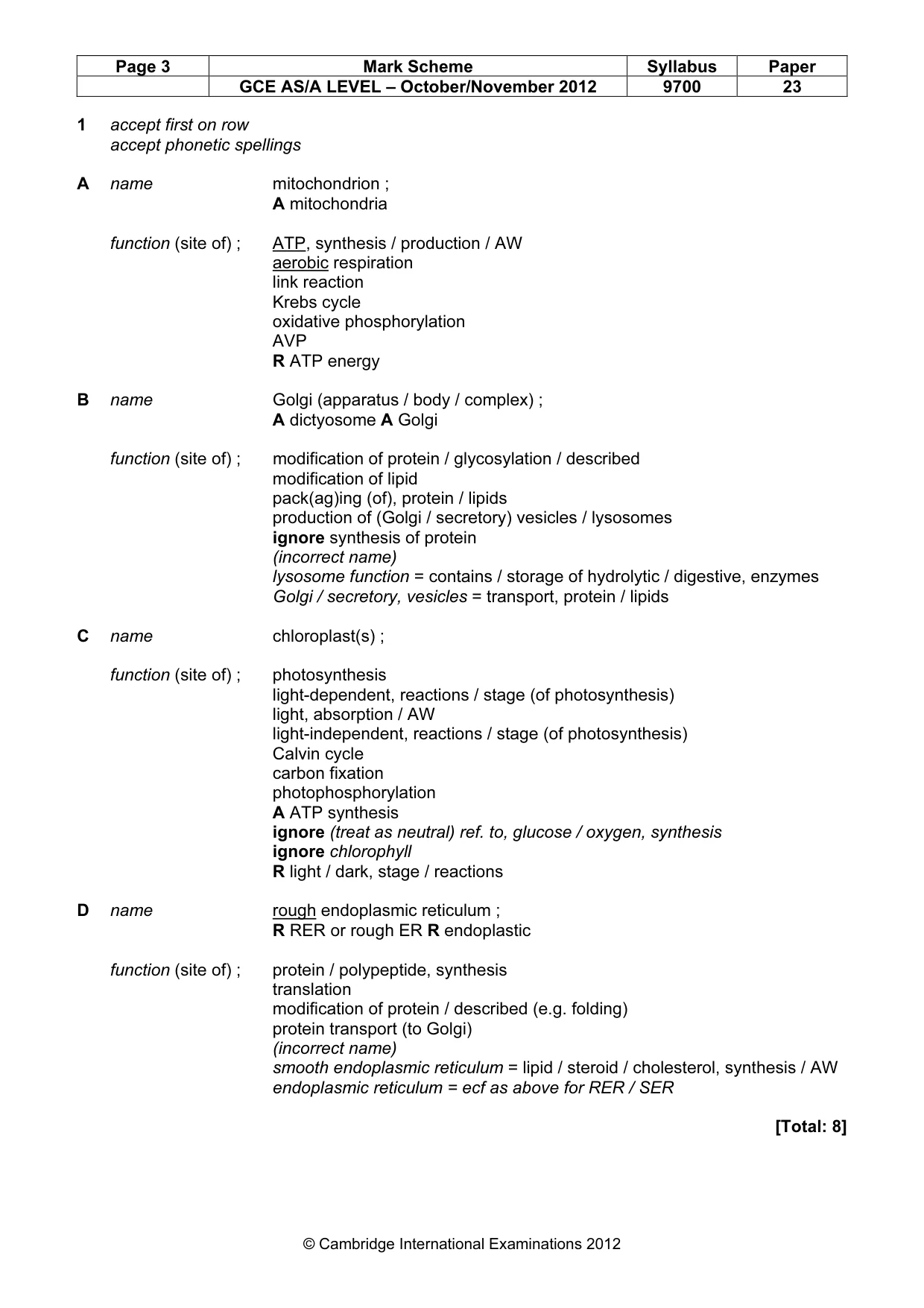
Page 3 Mark Scheme Syllabus Paper GCE AS/A LEVEL – October/November 2012 9700 23 © Cambridge International Examinations 2012 1 accept first on row accept phonetic spellings A name mitochondrion ; A mitochondria function (site of) ; ATP, synthesis / production / AW aerobic respiration link reaction Krebs cycle oxidative phosphorylation AVP R ATP energy B name Golgi (apparatus / body / complex) ; A dictyosome A Golgi function (site of) ; modification of protein / glycosylation / described modification of lipid pack(ag)ing (of), protein / lipids production of (Golgi / secretory) vesicles / lysosomes ignore synthesis of protein (incorrect name) lysosome function = contains / storage of hydrolytic / digestive, enzymes Golgi / secretory, vesicles = transport, protein / lipids C name chloroplast(s) ; function (site of) ; photosynthesis light-dependent, reactions / stage (of photosynthesis) light, absorption / AW light-independent, reactions / stage (of photosynthesis) Calvin cycle carbon fixation photophosphorylation A ATP synthesis ignore (treat as neutral) ref. to, glucose / oxygen, synthesis ignore chlorophyll R light / dark, stage / reactions D name rough endoplasmic reticulum ; R RER or rough ER R endoplastic function (site of) ; protein / polypeptide, synthesis translation modification of protein / described (e.g. folding) protein transport (to Golgi) (incorrect name) smooth endoplasmic reticulum = lipid / steroid / cholesterol, synthesis / AW endoplasmic reticulum = ecf as above for RER / SER [Total: 8]
Mark scheme, page 4
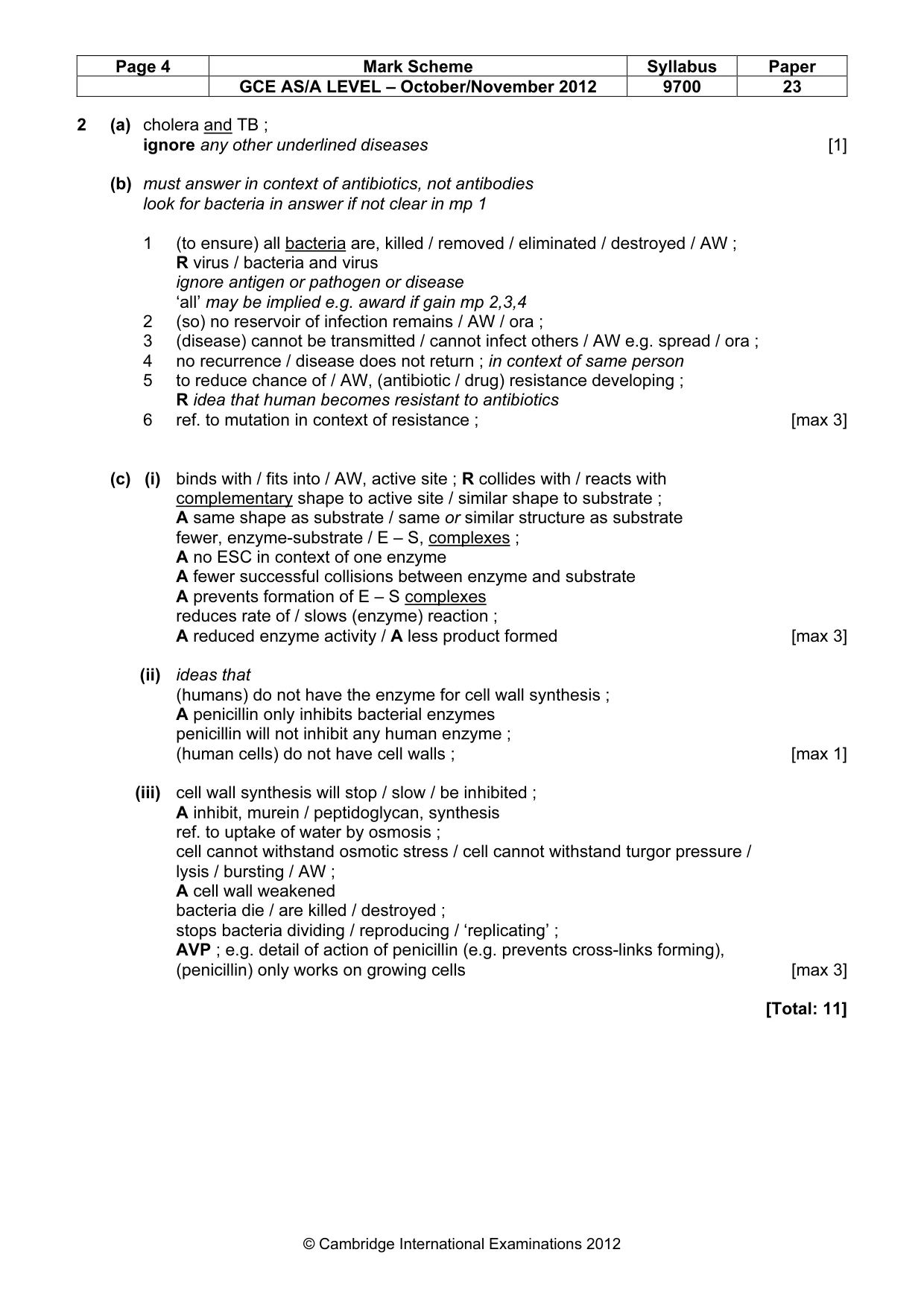
Page 4 Mark Scheme Syllabus Paper GCE AS/A LEVEL – October/November 2012 9700 23 © Cambridge International Examinations 2012 2 (a) cholera and TB ; ignore any other underlined diseases [1] (b) must answer in context of antibiotics, not antibodies look for bacteria in answer if not clear in mp 1 1 (to ensure) all bacteria are, killed / removed / eliminated / destroyed / AW ; R virus / bacteria and virus ignore antigen or pathogen or disease ‘all’ may be implied e.g. award if gain mp 2,3,4 2 (so) no reservoir of infection remains / AW / ora ; 3 (disease) cannot be transmitted / cannot infect others / AW e.g. spread / ora ; 4 no recurrence / disease does not return ; in context of same person 5 to reduce chance of / AW, (antibiotic / drug) resistance developing ; R idea that human becomes resistant to antibiotics 6 ref. to mutation in context of resistance ; [max 3] (c) (i) binds with / fits into / AW, active site ; R collides with / reacts with complementary shape to active site / similar shape to substrate ; A same shape as substrate / same or similar structure as substrate fewer, enzyme-substrate / E – S, complexes ; A no ESC in context of one enzyme A fewer successful collisions between enzyme and substrate A prevents formation of E – S complexes reduces rate of / slows (enzyme) reaction ; A reduced enzyme activity / A less product formed [max 3] (ii) ideas that (humans) do not have the enzyme for cell wall synthesis ; A penicillin only inhibits bacterial enzymes penicillin will not inhibit any human enzyme ; (human cells) do not have cell walls ; [max 1] (iii) cell wall synthesis will stop / slow / be inhibited ; A inhibit, murein / peptidoglycan, synthesis ref. to uptake of water by osmosis ; cell cannot withstand osmotic stress / cell cannot withstand turgor pressure / lysis / bursting / AW ; A cell wall weakened bacteria die / are killed / destroyed ; stops bacteria dividing / reproducing / ‘replicating’ ; AVP ; e.g. detail of action of penicillin (e.g. prevents cross-links forming), (penicillin) only works on growing cells [max 3] [Total: 11]
Mark scheme, page 5
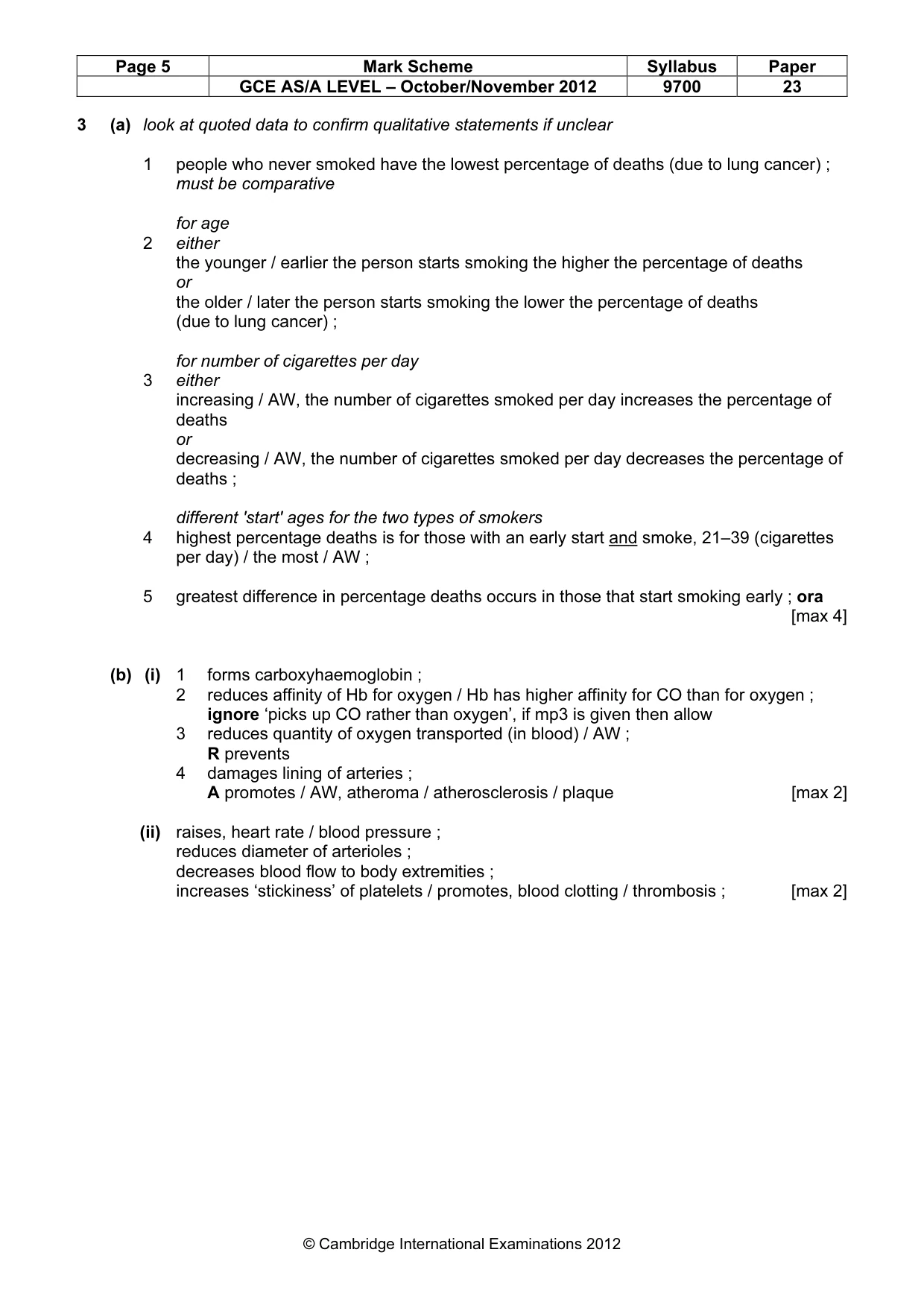
Page 5 Mark Scheme Syllabus Paper GCE AS/A LEVEL – October/November 2012 9700 23 © Cambridge International Examinations 2012 3 (a) look at quoted data to confirm qualitative statements if unclear 1 people who never smoked have the lowest percentage of deaths (due to lung cancer) ; must be comparative for age 2 either the younger / earlier the person starts smoking the higher the percentage of deaths or the older / later the person starts smoking the lower the percentage of deaths (due to lung cancer) ; for number of cigarettes per day 3 either increasing / AW, the number of cigarettes smoked per day increases the percentage of deaths or decreasing / AW, the number of cigarettes smoked per day decreases the percentage of deaths ; different 'start' ages for the two types of smokers 4 highest percentage deaths is for those with an early start and smoke, 21–39 (cigarettes per day) / the most / AW ; 5 greatest difference in percentage deaths occurs in those that start smoking early ; ora [max 4] (b) (i) 1 forms carboxyhaemoglobin ; 2 reduces affinity of Hb for oxygen / Hb has higher affinity for CO than for oxygen ; ignore ‘picks up CO rather than oxygen’, if mp3 is given then allow 3 reduces quantity of oxygen transported (in blood) / AW ; R prevents 4 damages lining of arteries ; A promotes / AW, atheroma / atherosclerosis / plaque [max 2] (ii) raises, heart rate / blood pressure ; reduces diameter of arterioles ; decreases blood flow to body extremities ; increases ‘stickiness’ of platelets / promotes, blood clotting / thrombosis ; [max 2]
Mark scheme, page 6
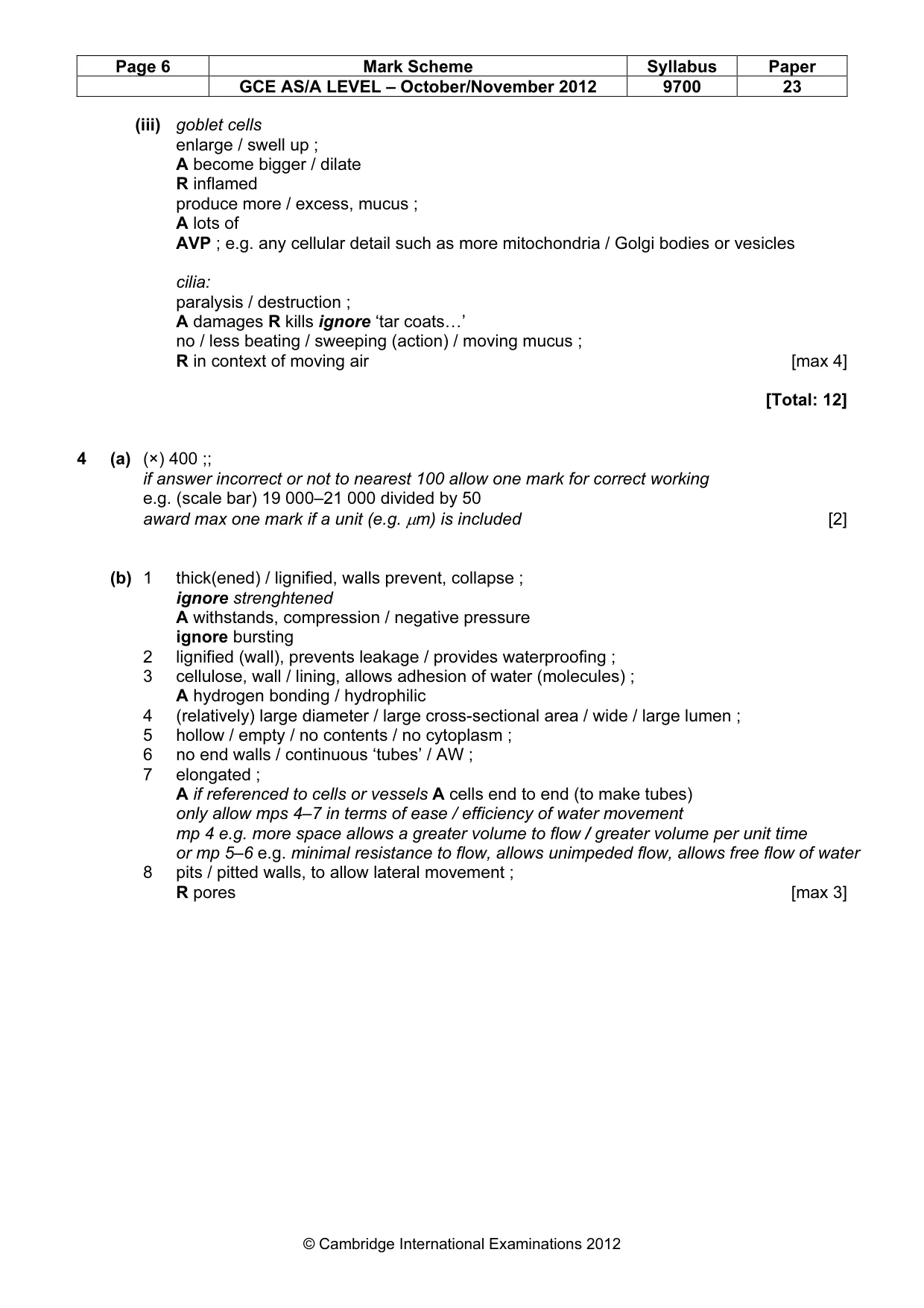
Page 6 Mark Scheme Syllabus Paper GCE AS/A LEVEL – October/November 2012 9700 23 © Cambridge International Examinations 2012 (iii) goblet cells enlarge / swell up ; A become bigger / dilate R inflamed produce more / excess, mucus ; A lots of AVP ; e.g. any cellular detail such as more mitochondria / Golgi bodies or vesicles cilia: paralysis / destruction ; A damages R kills ignore ‘tar coats…’ no / less beating / sweeping (action) / moving mucus ; R in context of moving air [max 4] [Total: 12] 4 (a) (×) 400 ;; if answer incorrect or not to nearest 100 allow one mark for correct working e.g. (scale bar) 19 000–21 000 divided by 50 award max one mark if a unit (e.g. µm) is included [2] (b) 1 thick(ened) / lignified, walls prevent, collapse ; ignore strenghtened A withstands, compression / negative pressure ignore bursting 2 lignified (wall), prevents leakage / provides waterproofing ; 3 cellulose, wall / lining, allows adhesion of water (molecules) ; A hydrogen bonding / hydrophilic 4 (relatively) large diameter / large cross-sectional area / wide / large lumen ; 5 hollow / empty / no contents / no cytoplasm ; 6 no end walls / continuous ‘tubes’ / AW ; 7 elongated ; A if referenced to cells or vessels A cells end to end (to make tubes) only allow mps 4–7 in terms of ease / efficiency of water movement mp 4 e.g. more space allows a greater volume to flow / greater volume per unit time or mp 5–6 e.g. minimal resistance to flow, allows unimpeded flow, allows free flow of water 8 pits / pitted walls, to allow lateral movement ; R pores [max 3]
Mark scheme, page 7
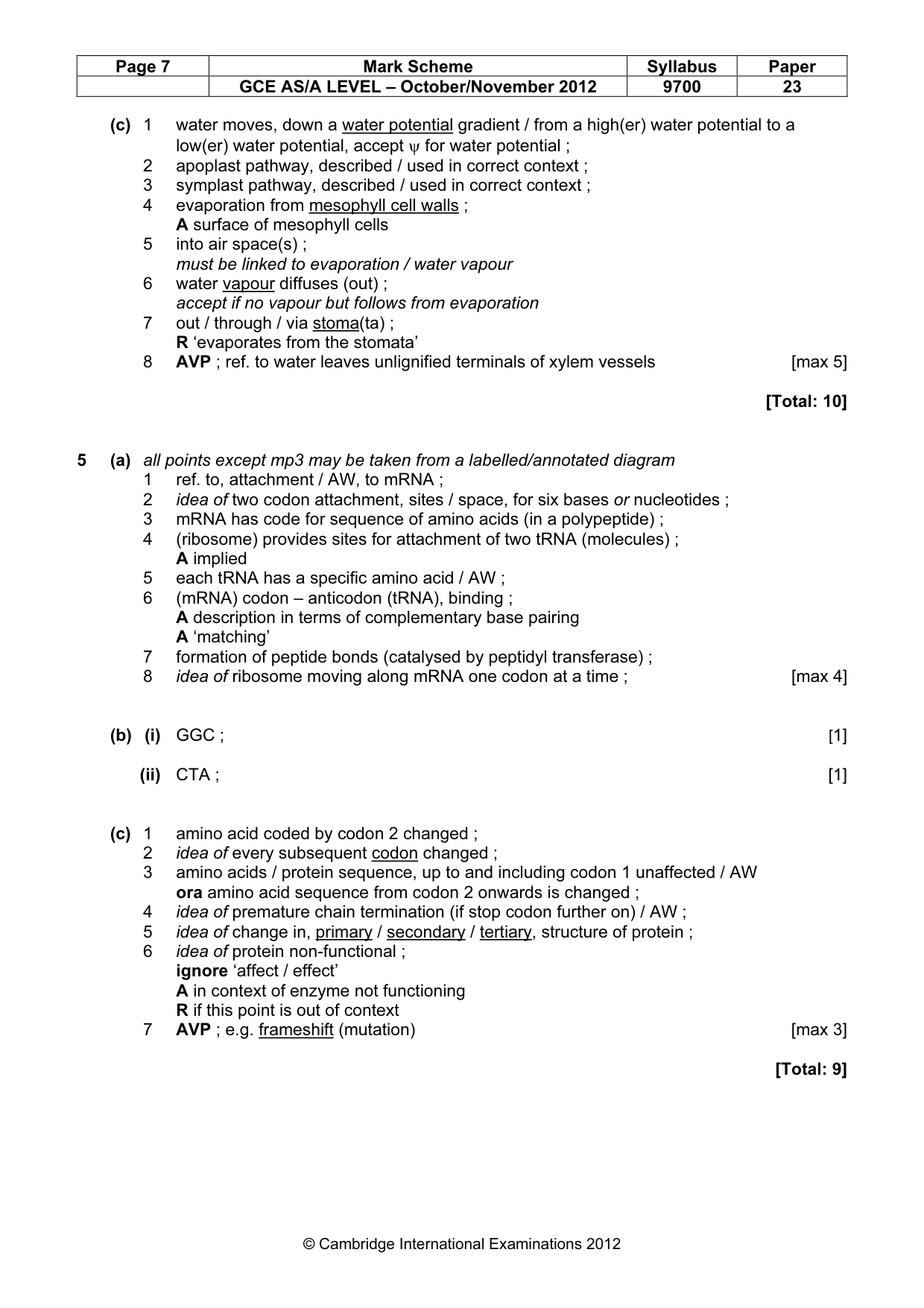
Page 7 Mark Scheme Syllabus Paper GCE AS/A LEVEL – October/November 2012 9700 23 © Cambridge International Examinations 2012 (c) 1 water moves, down a water potential gradient / from a high(er) water potential to a low(er) water potential, accept ψ for water potential ; 2 apoplast pathway, described / used in correct context ; 3 symplast pathway, described / used in correct context ; 4 evaporation from mesophyll cell walls ; A surface of mesophyll cells 5 into air space(s) ; must be linked to evaporation / water vapour 6 water vapour diffuses (out) ; accept if no vapour but follows from evaporation 7 out / through / via stoma(ta) ; R ‘evaporates from the stomata’ 8 AVP ; ref. to water leaves unlignified terminals of xylem vessels [max 5] [Total: 10] 5 (a) all points except mp3 may be taken from a labelled/annotated diagram 1 ref. to, attachment / AW, to mRNA ; 2 idea of two codon attachment, sites / space, for six bases or nucleotides ; 3 mRNA has code for sequence of amino acids (in a polypeptide) ; 4 (ribosome) provides sites for attachment of two tRNA (molecules) ; A implied 5 each tRNA has a specific amino acid / AW ; 6 (mRNA) codon – anticodon (tRNA), binding ; A description in terms of complementary base pairing A ‘matching’ 7 formation of peptide bonds (catalysed by peptidyl transferase) ; 8 idea of ribosome moving along mRNA one codon at a time ; [max 4] (b) (i) GGC ; [1] (ii) CTA ; [1] (c) 1 amino acid coded by codon 2 changed ; 2 idea of every subsequent codon changed ; 3 amino acids / protein sequence, up to and including codon 1 unaffected / AW ora amino acid sequence from codon 2 onwards is changed ; 4 idea of premature chain termination (if stop codon further on) / AW ; 5 idea of change in, primary / secondary / tertiary, structure of protein ; 6 idea of protein non-functional ; ignore ‘affect / effect’ A in context of enzyme not functioning R if this point is out of context 7 AVP ; e.g. frameshift (mutation) [max 3] [Total: 9]
Mark scheme, page 8
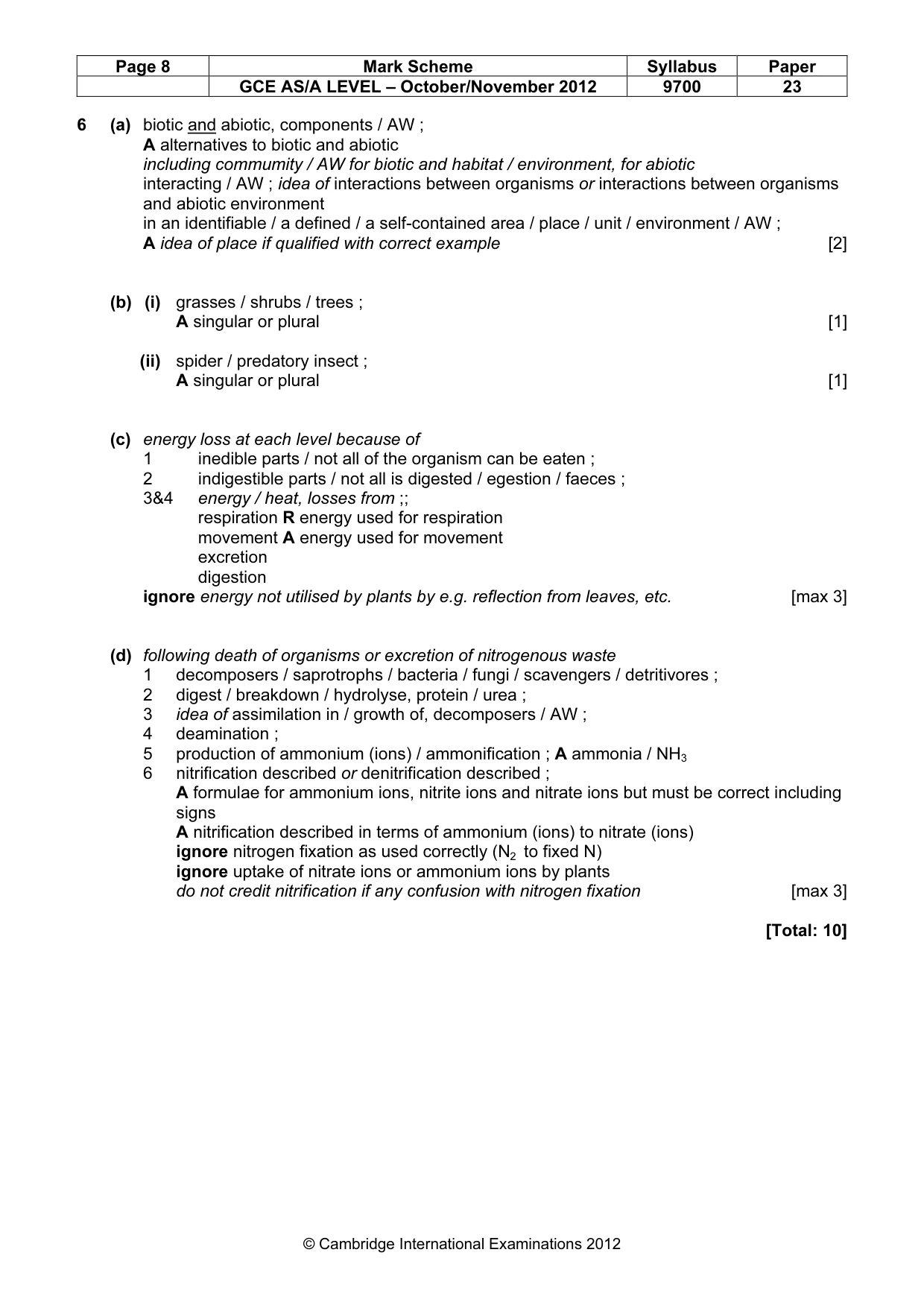
Page 8 Mark Scheme Syllabus Paper GCE AS/A LEVEL – October/November 2012 9700 23 © Cambridge International Examinations 2012 6 (a) biotic and abiotic, components / AW ; A alternatives to biotic and abiotic including commumity / AW for biotic and habitat / environment, for abiotic interacting / AW ; idea of interactions between organisms or interactions between organisms and abiotic environment in an identifiable / a defined / a self-contained area / place / unit / environment / AW ; A idea of place if qualified with correct example [2] (b) (i) grasses / shrubs / trees ; A singular or plural [1] (ii) spider / predatory insect ; A singular or plural [1] (c) energy loss at each level because of 1 inedible parts / not all of the organism can be eaten ; 2 indigestible parts / not all is digested / egestion / faeces ; 3&4 energy / heat, losses from ;; respiration R energy used for respiration movement A energy used for movement excretion digestion ignore energy not utilised by plants by e.g. reflection from leaves, etc. [max 3] (d) following death of organisms or excretion of nitrogenous waste 1 decomposers / saprotrophs / bacteria / fungi / scavengers / detritivores ; 2 digest / breakdown / hydrolyse, protein / urea ; 3 idea of assimilation in / growth of, decomposers / AW ; 4 deamination ; 5 production of ammonium (ions) / ammonification ; A ammonia / NH3 6 nitrification described or denitrification described ; A formulae for ammonium ions, nitrite ions and nitrate ions but must be correct including signs A nitrification described in terms of ammonium (ions) to nitrate (ions) ignore nitrogen fixation as used correctly (N2 to fixed N) ignore uptake of nitrate ions or ammonium ions by plants do not credit nitrification if any confusion with nitrogen fixation [max 3] [Total: 10]
What you needed in this session
Cambridge’s own grade thresholds for 2012 Oct/Nov, Paper 2 · Variant 3. A higher threshold means an easier paper — the bar moves with how the cohort did.