Cambridge A Level Biology 9700 — 2012 Oct/Nov Paper 2 · Variant 1
9700/21/O/N/12 · 60 marks · ≈68 min
The question paper and its mark scheme, free to read here and free to download. This is Cambridge’s own paper, exactly as it was sat.
Question paper16 pages

Mark scheme7 pages
Answers below. Sit the paper first if you are practising.
Paper as text
Question paper, page 1
This document consists of 14 printed pages and 2 blank pages. DC (SM/SW) 49036/4 © UCLES 2012 [Turn over UNIVERSITY OF CAMBRIDGE INTERNATIONAL EXAMINATIONS General Certificate of Education Advanced Subsidiary Level and Advanced Level * 4 2 6 8 1 4 9 3 7 9 * BIOLOGY 9700/21 Paper 2 Structured Questions AS October/November 2012 1 hour 15 minutes Candidates answer on the Question Paper. No Additional Materials are required. READ THESE INSTRUCTIONS FIRST Write your Centre number, candidate number and name in the spaces provided at the top of this page. Write in dark blue or black ink. You may use a soft pencil for any diagrams, graphs or rough working. Do not use staples, paper clips, highlighters, glue or correction fluid. DO NOT WRITE IN ANY BARCODES. Answer all questions. At the end of the examination, fasten all your work securely together. The number of marks is given in brackets [ ] at the end of each question or part question. For Examiner’s Use 1 2 3 4 5 Total
Question paper, page 2
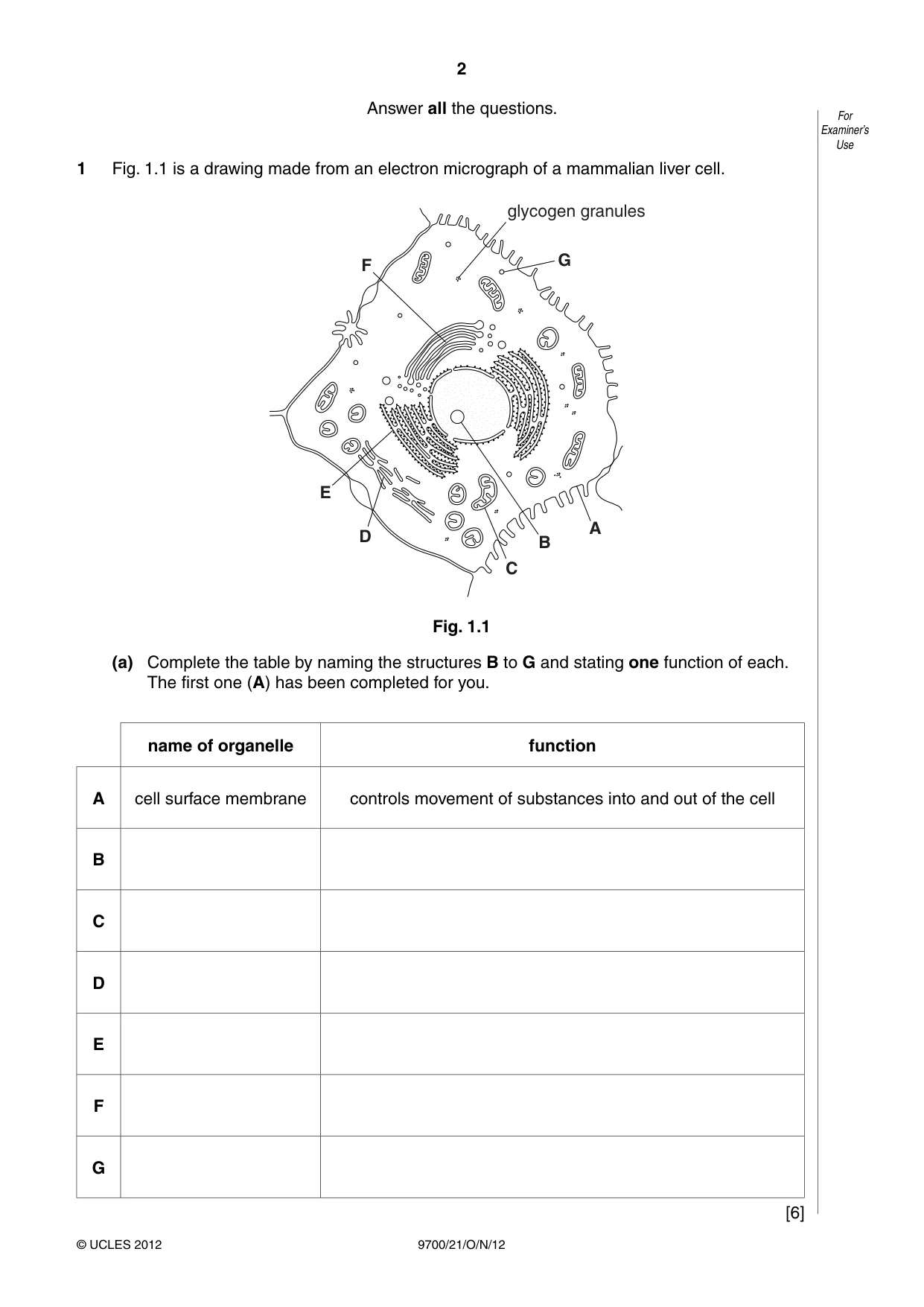
2 9700/21/O/N/12 © UCLES 2012 For Examiner’s Use Answer all the questions. 1 Fig. 1.1 is a drawing made from an electron micrograph of a mammalian liver cell. F E D C B G glycogen granules A Fig. 1.1 (a) Complete the table by naming the structures B to G and stating one function of each. The first one (A) has been completed for you. name of organelle function A cell surface membrane controls movement of substances into and out of the cell B C D E F G [6]
Question paper, page 3
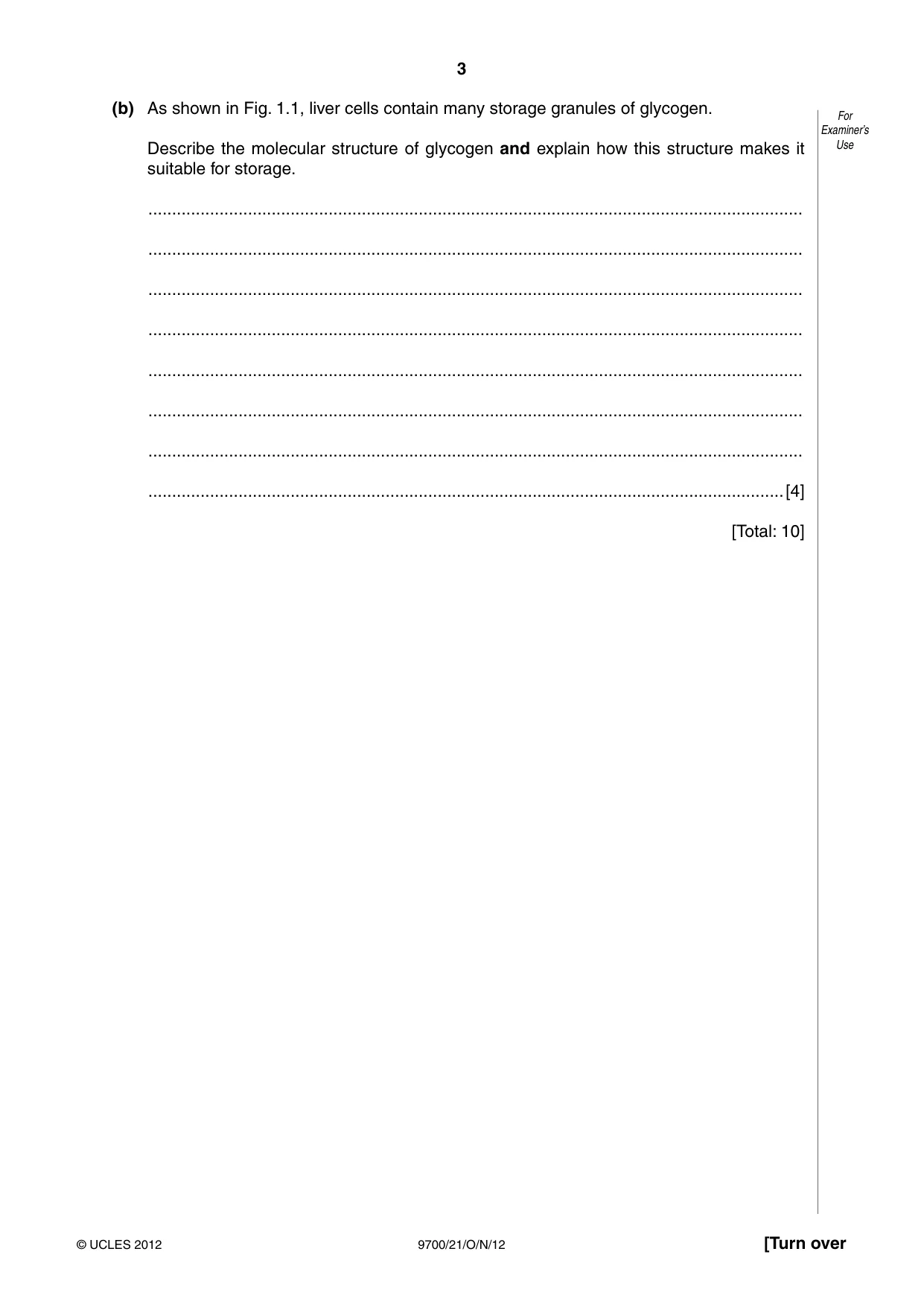
3 9700/21/O/N/12 © UCLES 2012 [Turn over For Examiner’s Use (b) As shown in Fig. 1.1, liver cells contain many storage granules of glycogen. Describe the molecular structure of glycogen and explain how this structure makes it suitable for storage. … … … … … … … …[4] [Total: 10]
Question paper, page 4
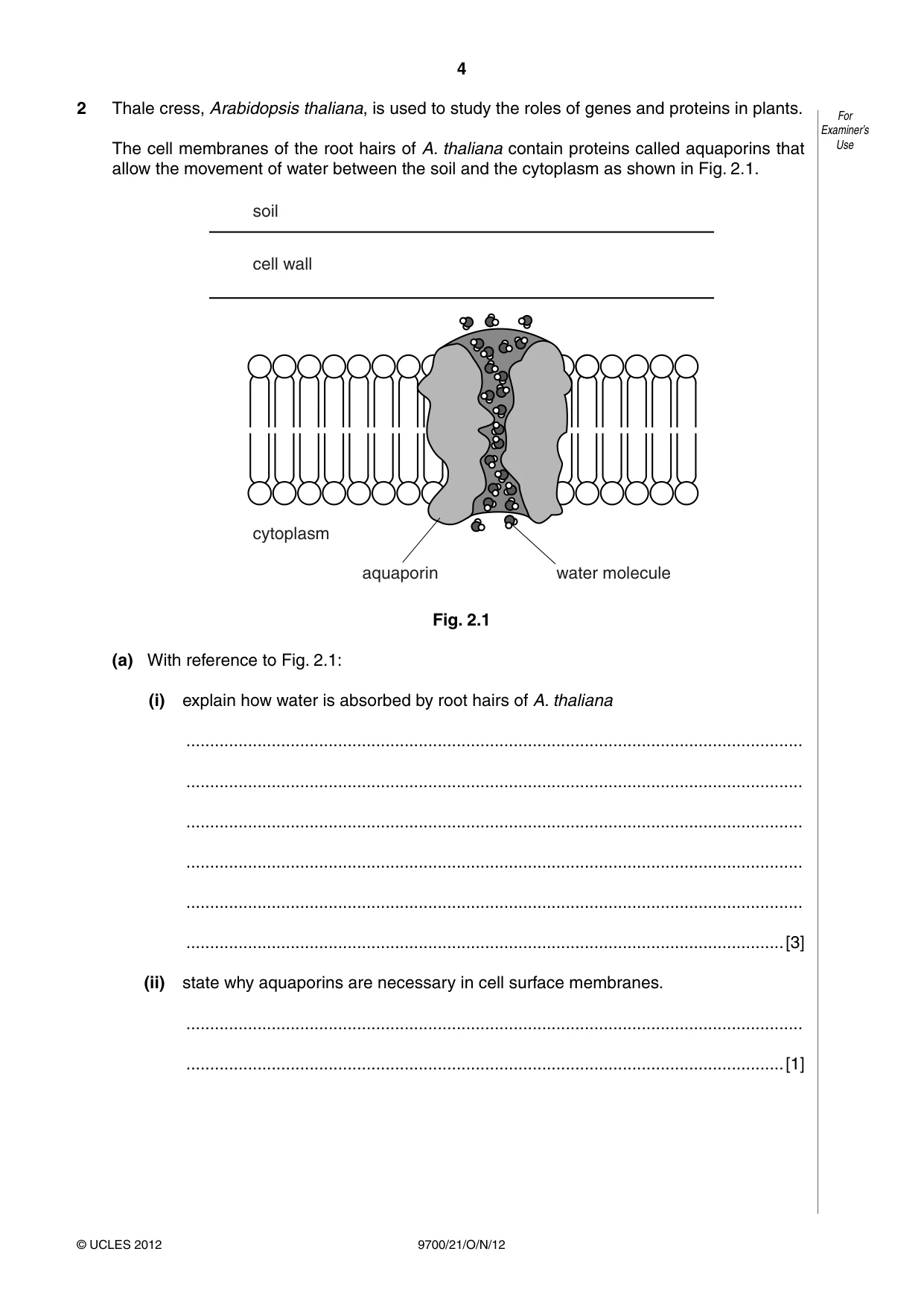
4 9700/21/O/N/12 © UCLES 2012 For Examiner’s Use 2 Thale cress, Arabidopsis thaliana, is used to study the roles of genes and proteins in plants. The cell membranes of the root hairs of A. thaliana contain proteins called aquaporins that allow the movement of water between the soil and the cytoplasm as shown in Fig. 2.1. cell wall soil cytoplasm aquaporin water molecule Fig. 2.1 (a) With reference to Fig. 2.1: (i) explain how water is absorbed by root hairs of A. thaliana … … … … … …[3] (ii) state why aquaporins are necessary in cell surface membranes. … …[1]
Question paper, page 5
5 9700/21/O/N/12 © UCLES 2012 [Turn over For Examiner’s Use (b) Describe the pathway taken by water from the cytoplasm of the root hair cell to a xylem vessel in the centre of the root. … … … … … …[3]
Question paper, page 6
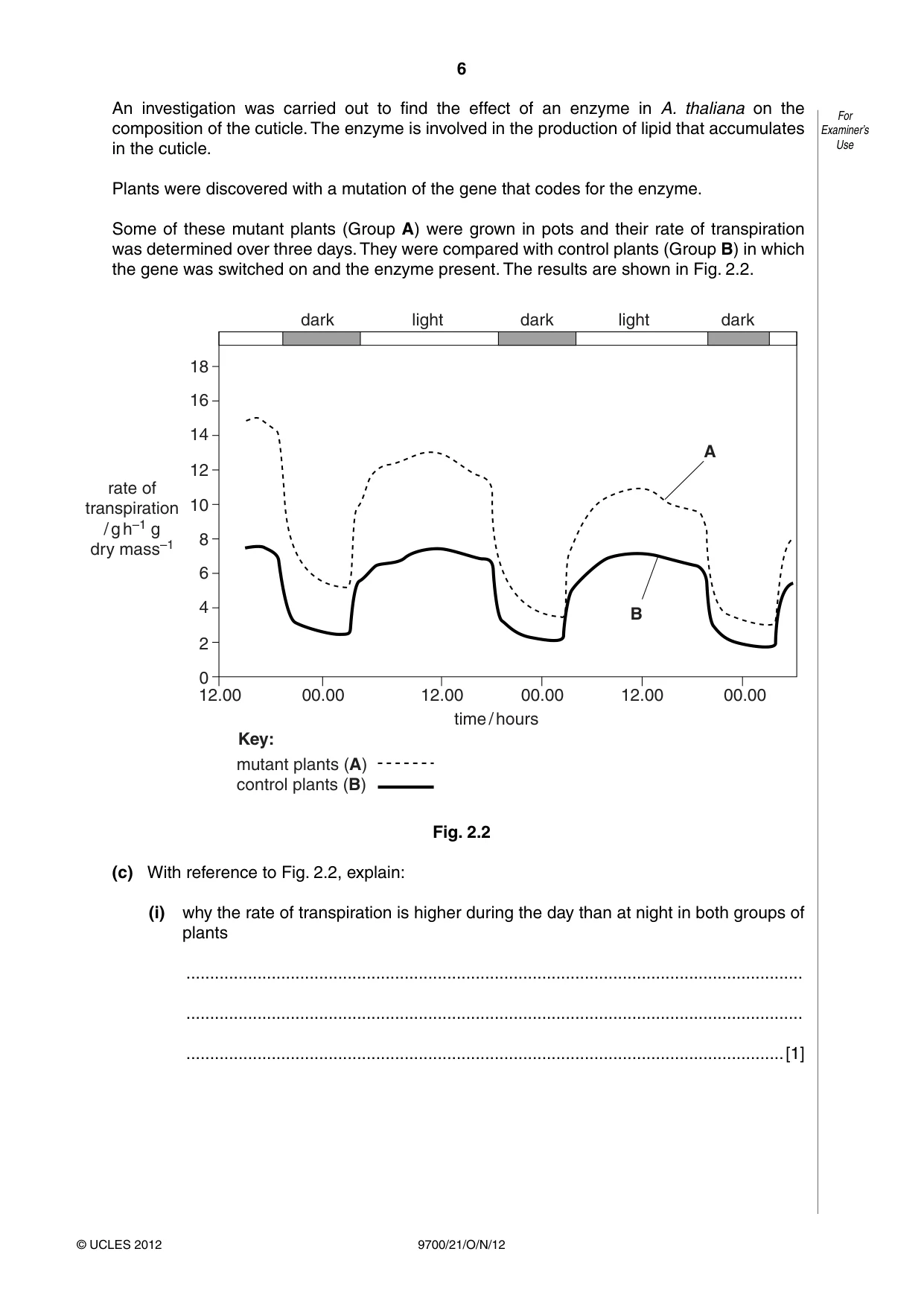
6 9700/21/O/N/12 © UCLES 2012 For Examiner’s Use An investigation was carried out to find the effect of an enzyme in A. thaliana on the composition of the cuticle. The enzyme is involved in the production of lipid that accumulates in the cuticle. Plants were discovered with a mutation of the gene that codes for the enzyme. Some of these mutant plants (Group A) were grown in pots and their rate of transpiration was determined over three days. They were compared with control plants (Group B) in which the gene was switched on and the enzyme present. The results are shown in Fig. 2.2. 18 16 14 12 10 8 6 4 2 0 12.00 00.00 rate of transpiration / g h–1 g dry mass–1 12.00 00.00 time / hours 12.00 00.00 dark dark dark light light A B Key: mutant plants (A) control plants (B) Fig. 2.2 (c) With reference to Fig. 2.2, explain: (i) why the rate of transpiration is higher during the day than at night in both groups of plants … … …[1]
Question paper, page 7
7 9700/21/O/N/12 © UCLES 2012 [Turn over For Examiner’s Use (ii) how the results show that the cuticle is less effective in the mutant plants. … … … … … …[3] [Total: 11]
Question paper, page 8
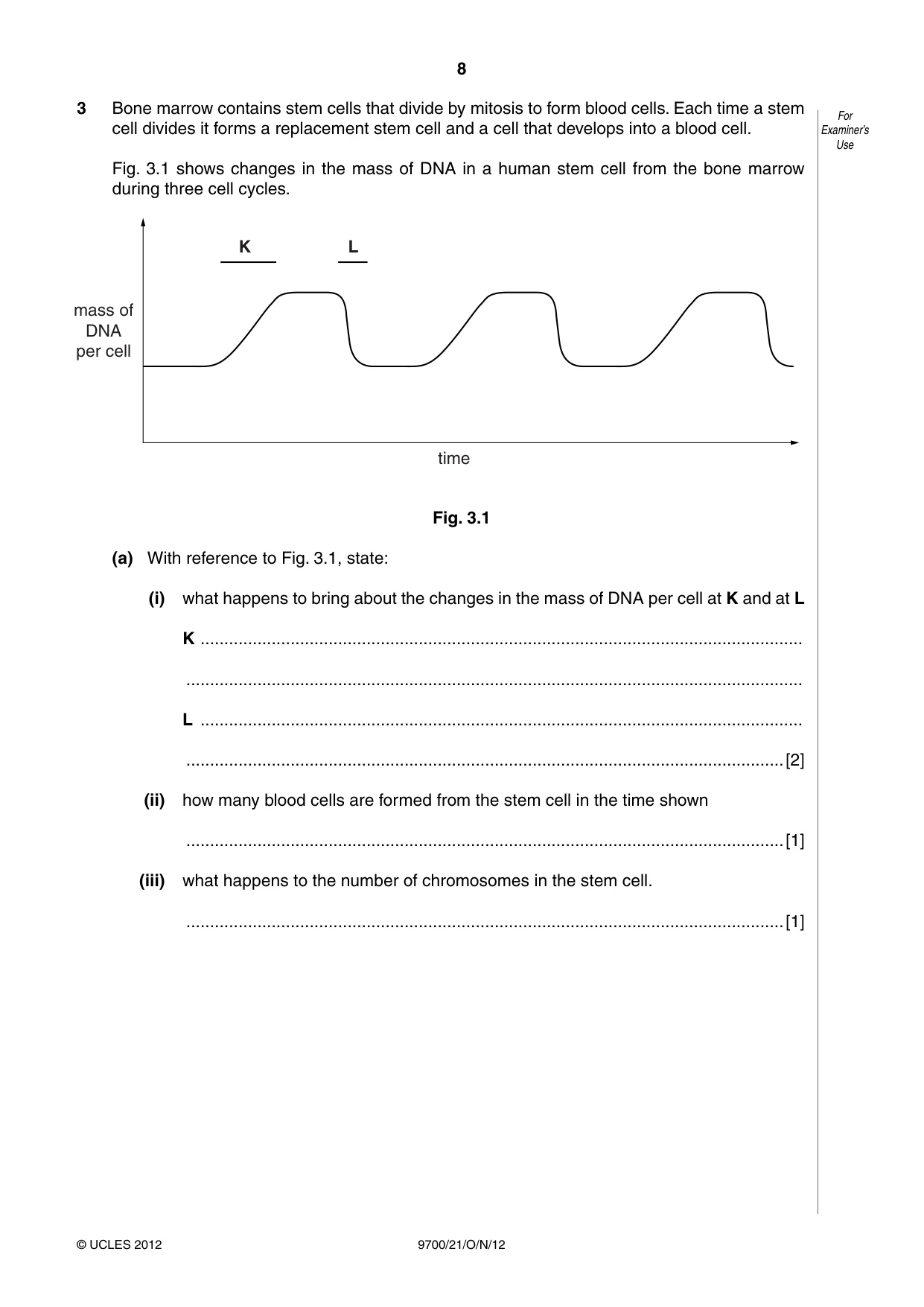
8 9700/21/O/N/12 © UCLES 2012 For Examiner’s Use 3 Bone marrow contains stem cells that divide by mitosis to form blood cells. Each time a stem cell divides it forms a replacement stem cell and a cell that develops into a blood cell. Fig. 3.1 shows changes in the mass of DNA in a human stem cell from the bone marrow during three cell cycles. K mass of DNA per cell time L Fig. 3.1 (a) With reference to Fig. 3.1, state: (i) what happens to bring about the changes in the mass of DNA per cell at K and at L K … … L … …[2] (ii) how many blood cells are formed from the stem cell in the time shown …[1] (iii) what happens to the number of chromosomes in the stem cell. …[1]
Question paper, page 9
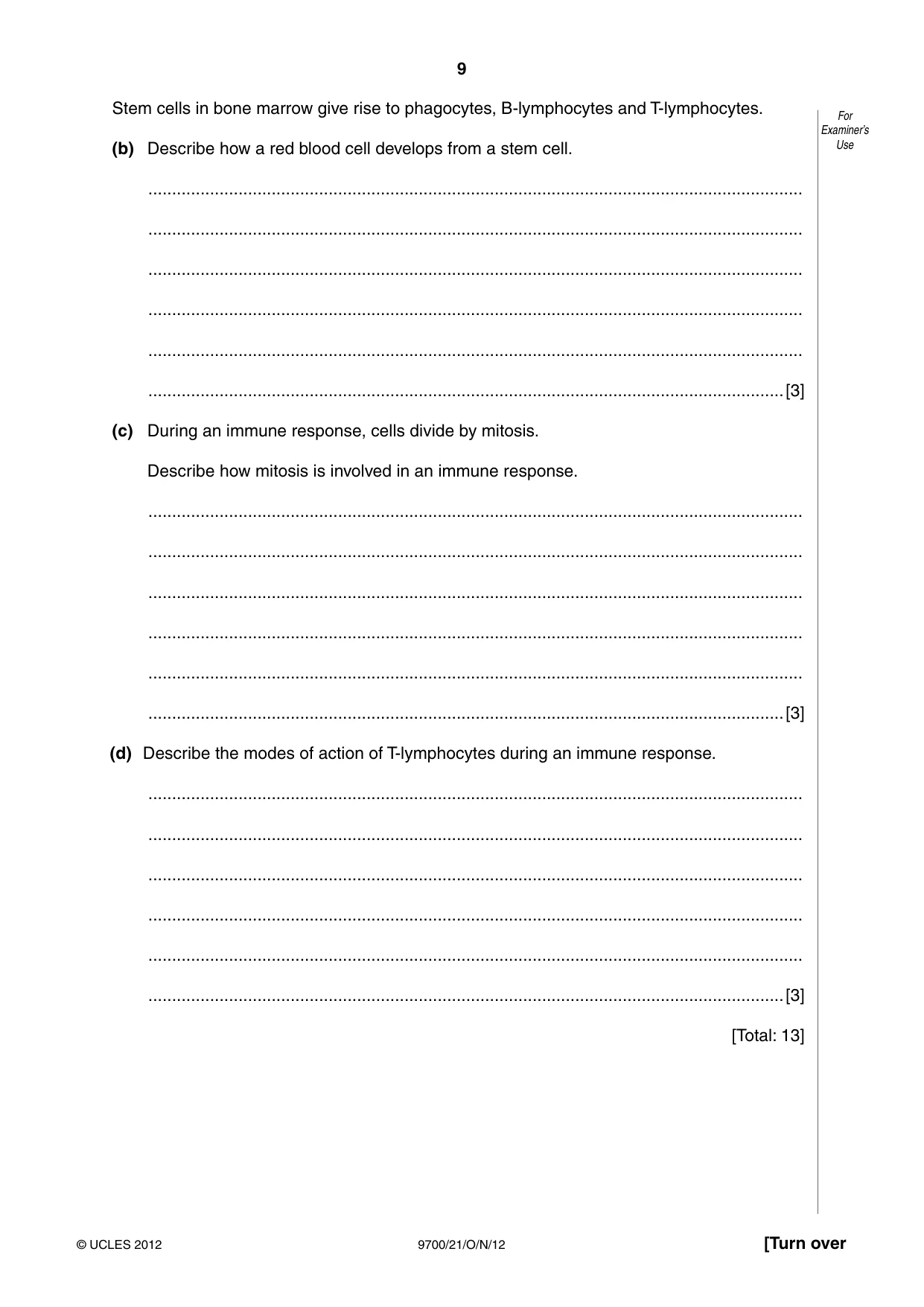
9 9700/21/O/N/12 © UCLES 2012 [Turn over For Examiner’s Use Stem cells in bone marrow give rise to phagocytes, B-lymphocytes and T-lymphocytes. (b) Describe how a red blood cell develops from a stem cell. … … … … … …[3] (c) During an immune response, cells divide by mitosis. Describe how mitosis is involved in an immune response. … … … … … …[3] (d) Describe the modes of action of T-lymphocytes during an immune response. … … … … … …[3] [Total: 13]
Question paper, page 10
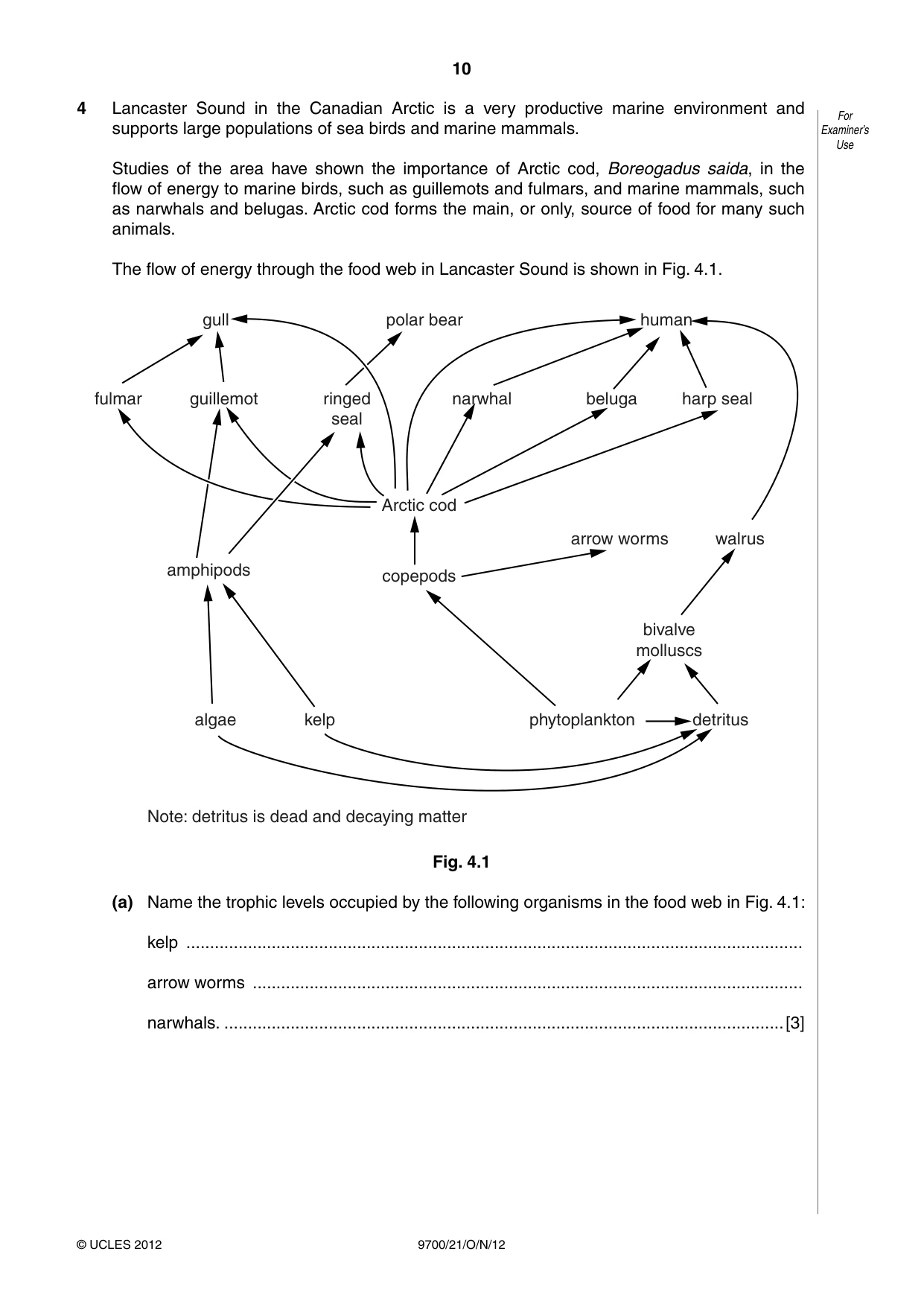
10 9700/21/O/N/12 © UCLES 2012 For Examiner’s Use 4 Lancaster Sound in the Canadian Arctic is a very productive marine environment and supports large populations of sea birds and marine mammals. Studies of the area have shown the importance of Arctic cod, Boreogadus saida, in the flow of energy to marine birds, such as guillemots and fulmars, and marine mammals, such as narwhals and belugas. Arctic cod forms the main, or only, source of food for many such animals. The flow of energy through the food web in Lancaster Sound is shown in Fig. 4.1. gull polar bear human guillemot narwhal Arctic cod copepods amphipods arrow worms walrus bivalve molluscs algae kelp phytoplankton detritus harp seal fulmar Note: detritus is dead and decaying matter ringed seal beluga Fig. 4.1 (a) Name the trophic levels occupied by the following organisms in the food web in Fig. 4.1: kelp … arrow worms … narwhals. …[3]
Question paper, page 11
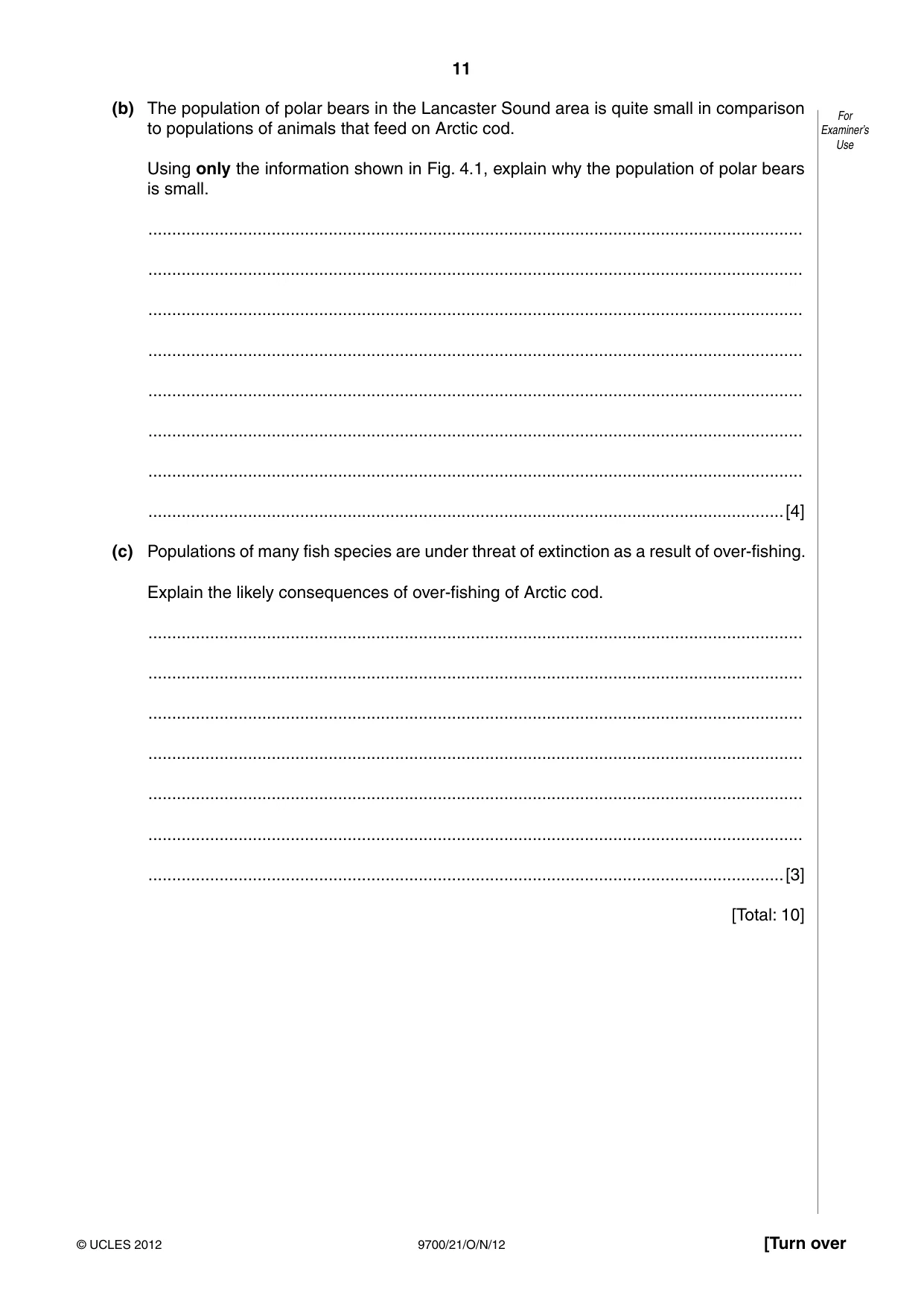
11 9700/21/O/N/12 © UCLES 2012 [Turn over For Examiner’s Use (b) The population of polar bears in the Lancaster Sound area is quite small in comparison to populations of animals that feed on Arctic cod. Using only the information shown in Fig. 4.1, explain why the population of polar bears is small. … … … … … … … …[4] (c) Populations of many fish species are under threat of extinction as a result of over-fishing. Explain the likely consequences of over-fishing of Arctic cod. … … … … … … …[3] [Total: 10]
Question paper, page 12
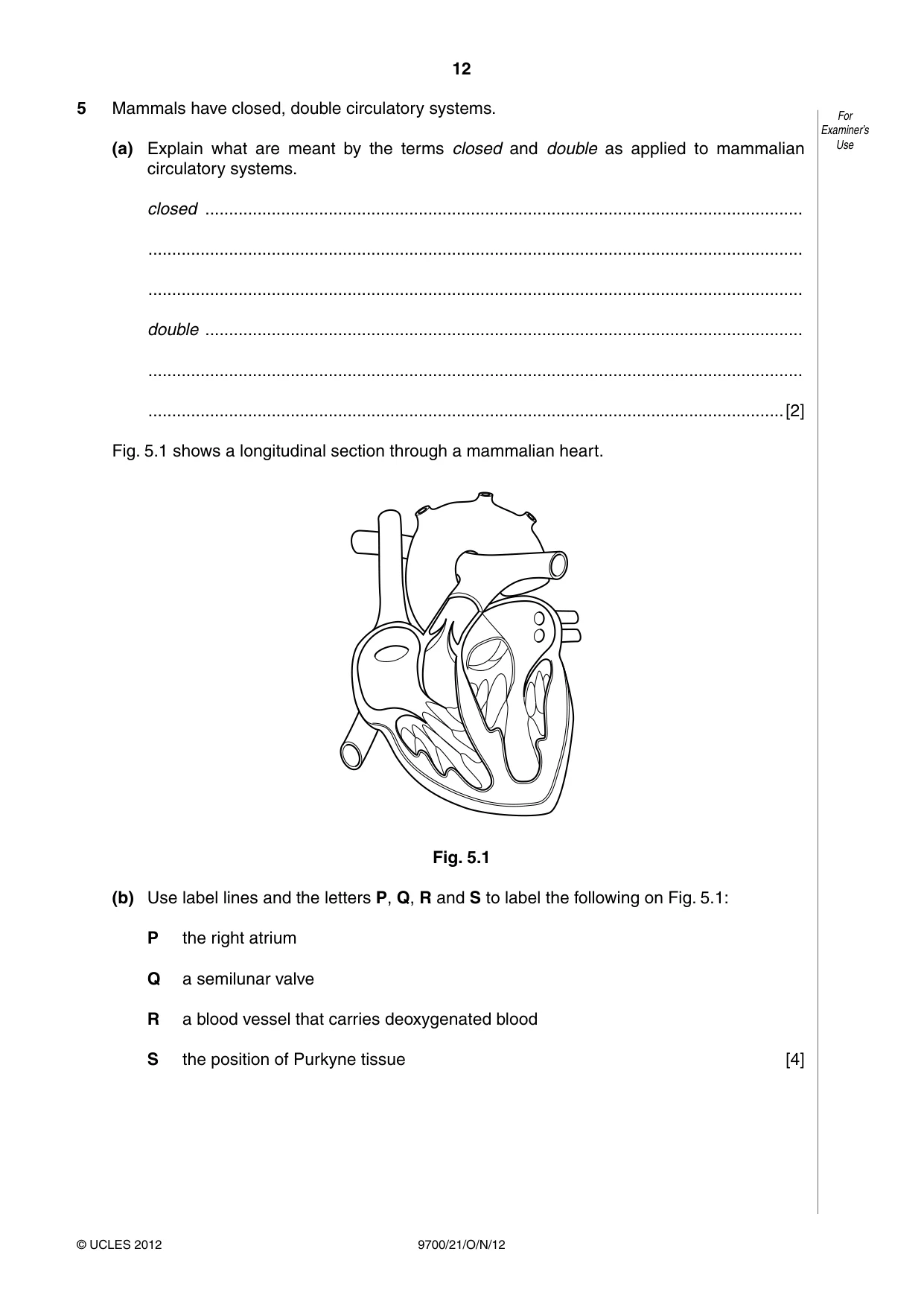
12 9700/21/O/N/12 © UCLES 2012 For Examiner’s Use 5 Mammals have closed, double circulatory systems. (a) Explain what are meant by the terms closed and double as applied to mammalian circulatory systems. closed … … … double … … …[2] Fig. 5.1 shows a longitudinal section through a mammalian heart. Fig. 5.1 (b) Use label lines and the letters P, Q, R and S to label the following on Fig. 5.1: P the right atrium Q a semilunar valve R a blood vessel that carries deoxygenated blood S the position of Purkyne tissue [4]
Question paper, page 13
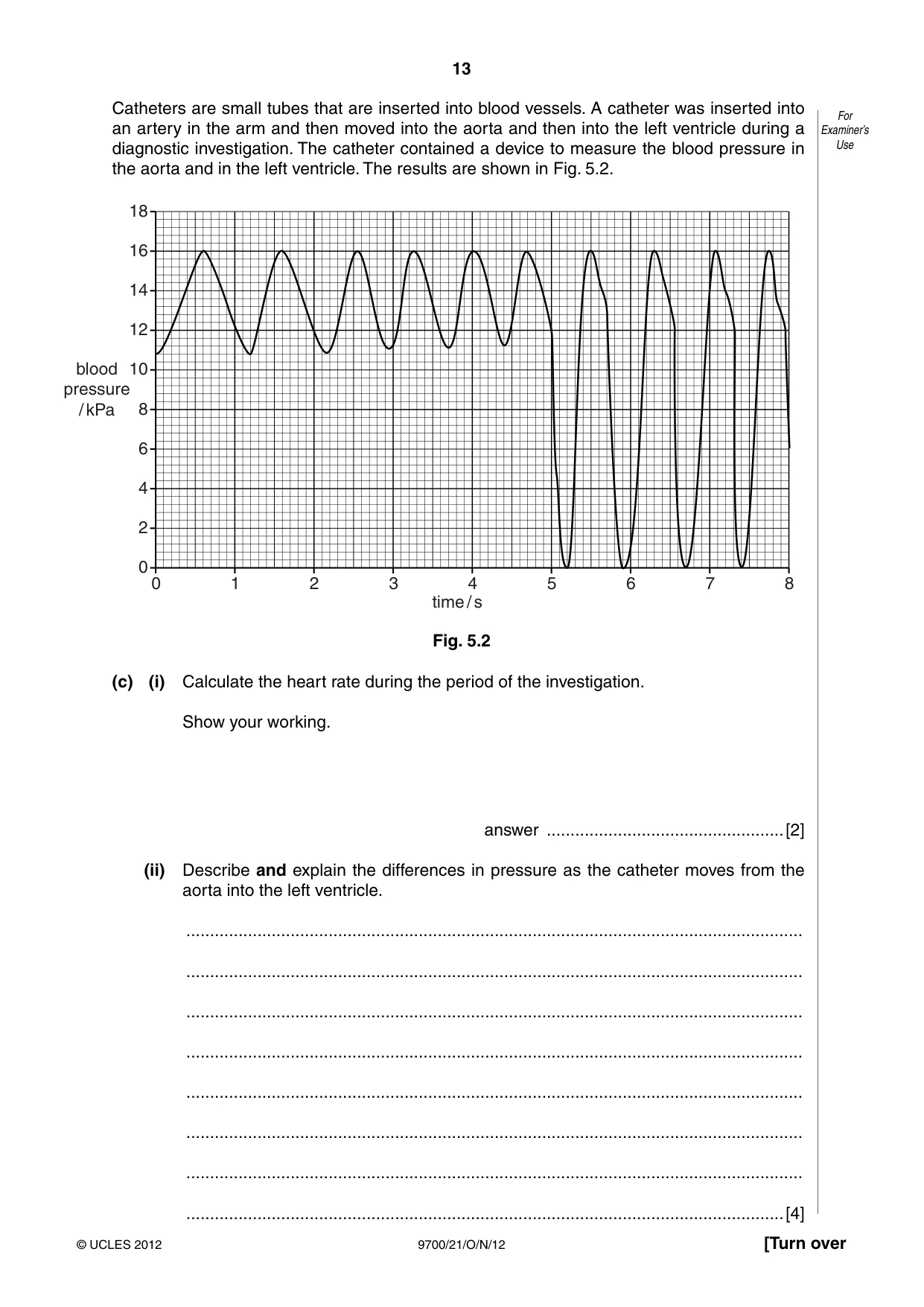
13 9700/21/O/N/12 © UCLES 2012 [Turn over For Examiner’s Use Catheters are small tubes that are inserted into blood vessels. A catheter was inserted into an artery in the arm and then moved into the aorta and then into the left ventricle during a diagnostic investigation. The catheter contained a device to measure the blood pressure in the aorta and in the left ventricle. The results are shown in Fig. 5.2. 0 0 1 2 3 4 time / s 5 6 7 8 2 4 6 8 10 12 14 16 blood pressure / kPa 18 Fig. 5.2 (c) (i) Calculate the heart rate during the period of the investigation. Show your working. answer …[2] (ii) Describe and explain the differences in pressure as the catheter moves from the aorta into the left ventricle. … … … … … … … …[4]
Question paper, page 14
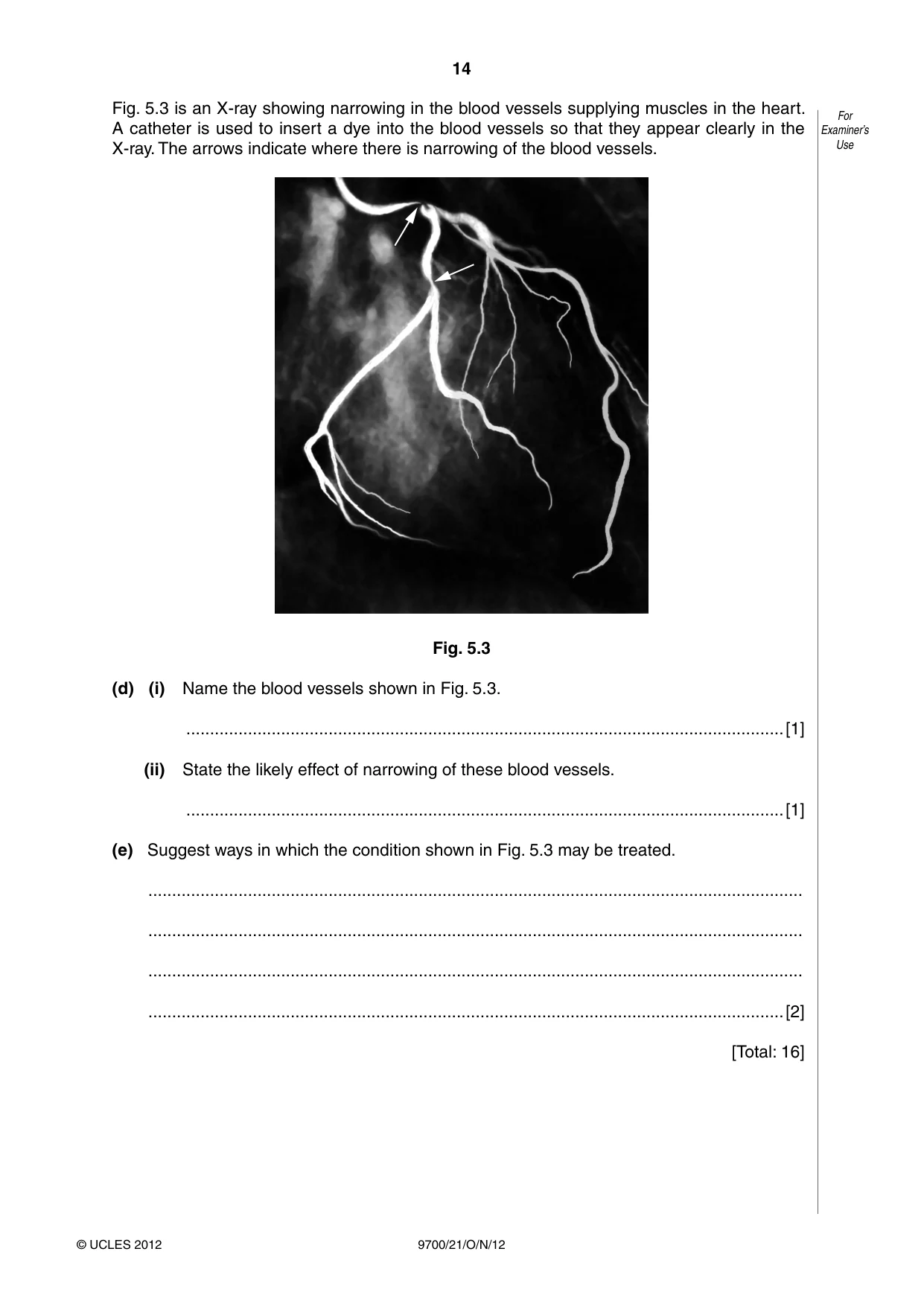
14 9700/21/O/N/12 © UCLES 2012 For Examiner’s Use Fig. 5.3 is an X-ray showing narrowing in the blood vessels supplying muscles in the heart. A catheter is used to insert a dye into the blood vessels so that they appear clearly in the X-ray. The arrows indicate where there is narrowing of the blood vessels. Fig. 5.3 (d) (i) Name the blood vessels shown in Fig. 5.3. …[1] (ii) State the likely effect of narrowing of these blood vessels. …[1] (e) Suggest ways in which the condition shown in Fig. 5.3 may be treated. … … … …[2] [Total: 16]
Question paper, page 15
15 9700/21/O/N/12 © UCLES 2012 BLANK PAGE
Question paper, page 16
16 9700/21/O/N/12 © UCLES 2012 Copyright Acknowledgements: Question 5, Fig. 5.3 ZEPHYR / SCIENCE PHOTO LIBRARY Permission to reproduce items where third-party owned material protected by copyright is included has been sought and cleared where possible. Every reasonable effort has been made by the publisher (UCLES) to trace copyright holders, but if any items requiring clearance have unwittingly been included, the publisher will be pleased to make amends at the earliest possible opportunity. University of Cambridge International Examinations is part of the Cambridge Assessment Group. Cambridge Assessment is the brand name of University of Cambridge Local Examinations Syndicate (UCLES), which is itself a department of the University of Cambridge. BLANK PAGE
Mark scheme, page 1
CAMBRIDGE INTERNATIONAL EXAMINATIONS GCE Advanced Subsidiary Level and GCE Advanced Level MARK SCHEME for the October/November 2012 series 9700 BIOLOGY 9700/21 Paper 2 (AS Structured Questions), maximum raw mark 60 This mark scheme is published as an aid to teachers and candidates, to indicate the requirements of the examination. It shows the basis on which Examiners were instructed to award marks. It does not indicate the details of the discussions that took place at an Examiners’ meeting before marking began, which would have considered the acceptability of alternative answers. Mark schemes should be read in conjunction with the question paper and the Principal Examiner Report for Teachers. Cambridge will not enter into discussions about these mark schemes. Cambridge is publishing the mark schemes for the October/November 2012 series for most IGCSE, GCE Advanced Level and Advanced Subsidiary Level components and some Ordinary Level components.
Mark scheme, page 2
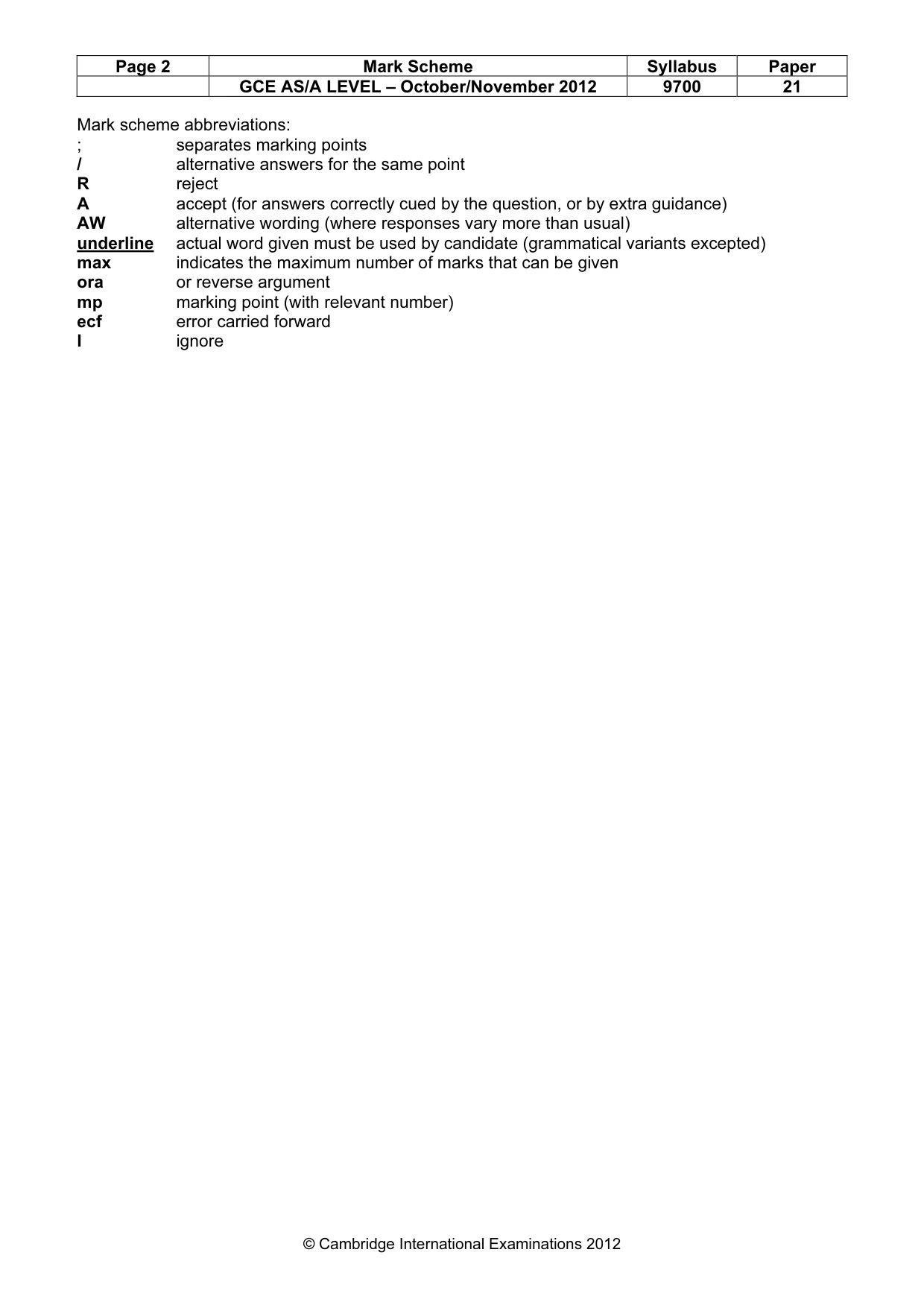
Page 2 Mark Scheme Syllabus Paper GCE AS/A LEVEL – October/November 2012 9700 21 © Cambridge International Examinations 2012 Mark scheme abbreviations: ; separates marking points / alternative answers for the same point R reject A accept (for answers correctly cued by the question, or by extra guidance) AW alternative wording (where responses vary more than usual) underline actual word given must be used by candidate (grammatical variants excepted) max indicates the maximum number of marks that can be given ora or reverse argument mp marking point (with relevant number) ecf error carried forward I ignore
Mark scheme, page 3
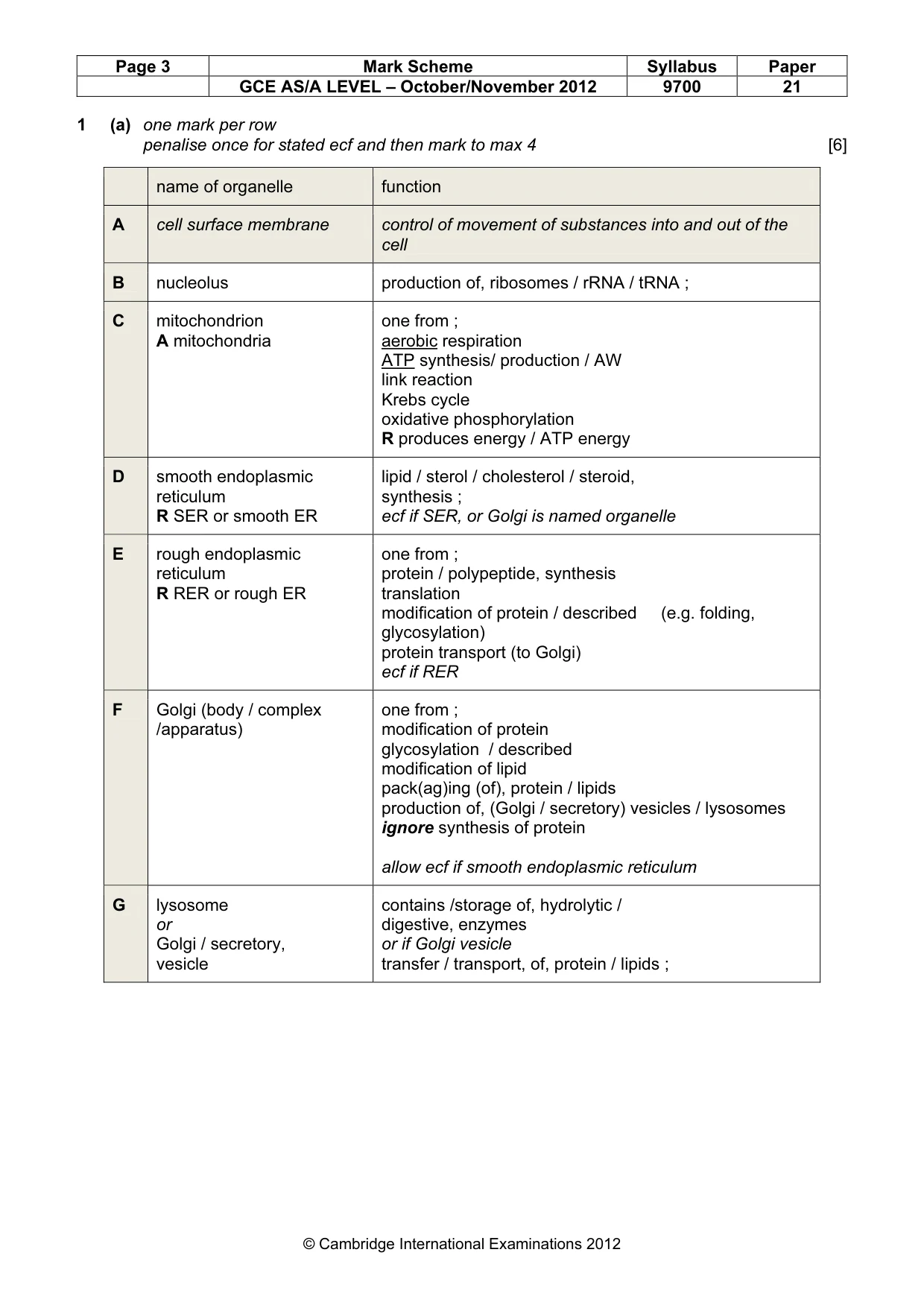
Page 3 Mark Scheme Syllabus Paper GCE AS/A LEVEL – October/November 2012 9700 21 © Cambridge International Examinations 2012 1 (a) one mark per row penalise once for stated ecf and then mark to max 4 [6] name of organelle function A cell surface membrane control of movement of substances into and out of the cell B nucleolus production of, ribosomes / rRNA / tRNA ; C mitochondrion A mitochondria one from ; aerobic respiration ATP synthesis/ production / AW link reaction Krebs cycle oxidative phosphorylation R produces energy / ATP energy D smooth endoplasmic reticulum R SER or smooth ER lipid / sterol / cholesterol / steroid, synthesis ; ecf if SER, or Golgi is named organelle E rough endoplasmic reticulum R RER or rough ER one from ; protein / polypeptide, synthesis translation modification of protein / described (e.g. folding, glycosylation) protein transport (to Golgi) ecf if RER F Golgi (body / complex /apparatus) one from ; modification of protein glycosylation / described modification of lipid pack(ag)ing (of), protein / lipids production of, (Golgi / secretory) vesicles / lysosomes ignore synthesis of protein allow ecf if smooth endoplasmic reticulum G lysosome or Golgi / secretory, vesicle contains /storage of, hydrolytic / digestive, enzymes or if Golgi vesicle transfer / transport, of, protein / lipids ;
Mark scheme, page 4
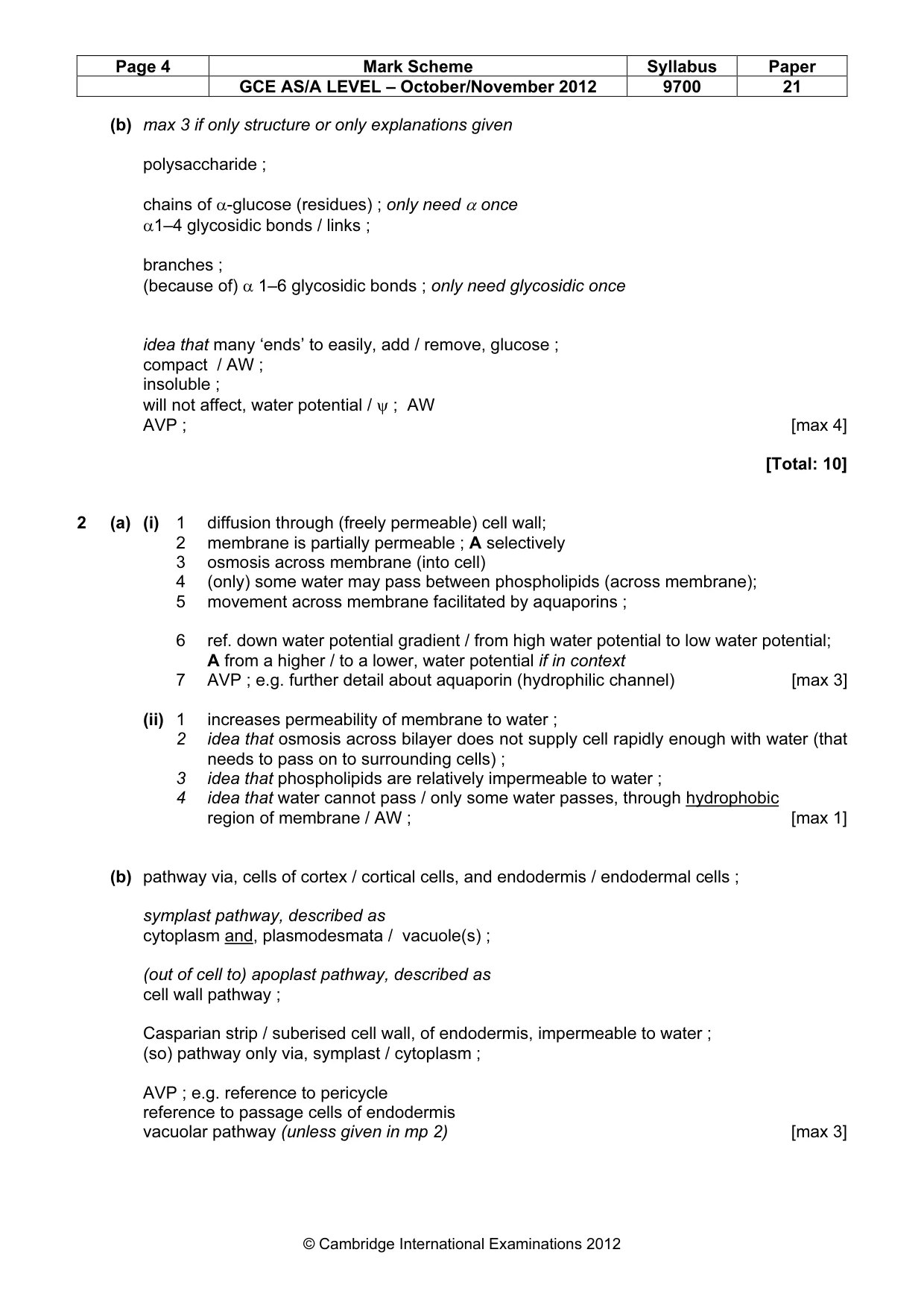
Page 4 Mark Scheme Syllabus Paper GCE AS/A LEVEL – October/November 2012 9700 21 © Cambridge International Examinations 2012 (b) max 3 if only structure or only explanations given polysaccharide ; chains of α-glucose (residues) ; only need α once α1–4 glycosidic bonds / links ; branches ; (because of) α 1–6 glycosidic bonds ; only need glycosidic once idea that many ‘ends’ to easily, add / remove, glucose ; compact / AW ; insoluble ; will not affect, water potential / ψ ; AW AVP ; [max 4] [Total: 10] 2 (a) (i) 1 diffusion through (freely permeable) cell wall; 2 membrane is partially permeable ; A selectively 3 osmosis across membrane (into cell) 4 (only) some water may pass between phospholipids (across membrane); 5 movement across membrane facilitated by aquaporins ; 6 ref. down water potential gradient / from high water potential to low water potential; A from a higher / to a lower, water potential if in context 7 AVP ; e.g. further detail about aquaporin (hydrophilic channel) [max 3] (ii) 1 increases permeability of membrane to water ; 2 idea that osmosis across bilayer does not supply cell rapidly enough with water (that needs to pass on to surrounding cells) ; 3 idea that phospholipids are relatively impermeable to water ; 4 idea that water cannot pass / only some water passes, through hydrophobic region of membrane / AW ; [max 1] (b) pathway via, cells of cortex / cortical cells, and endodermis / endodermal cells ; symplast pathway, described as cytoplasm and, plasmodesmata / vacuole(s) ; (out of cell to) apoplast pathway, described as cell wall pathway ; Casparian strip / suberised cell wall, of endodermis, impermeable to water ; (so) pathway only via, symplast / cytoplasm ; AVP ; e.g. reference to pericycle reference to passage cells of endodermis vacuolar pathway (unless given in mp 2) [max 3]
Mark scheme, page 5
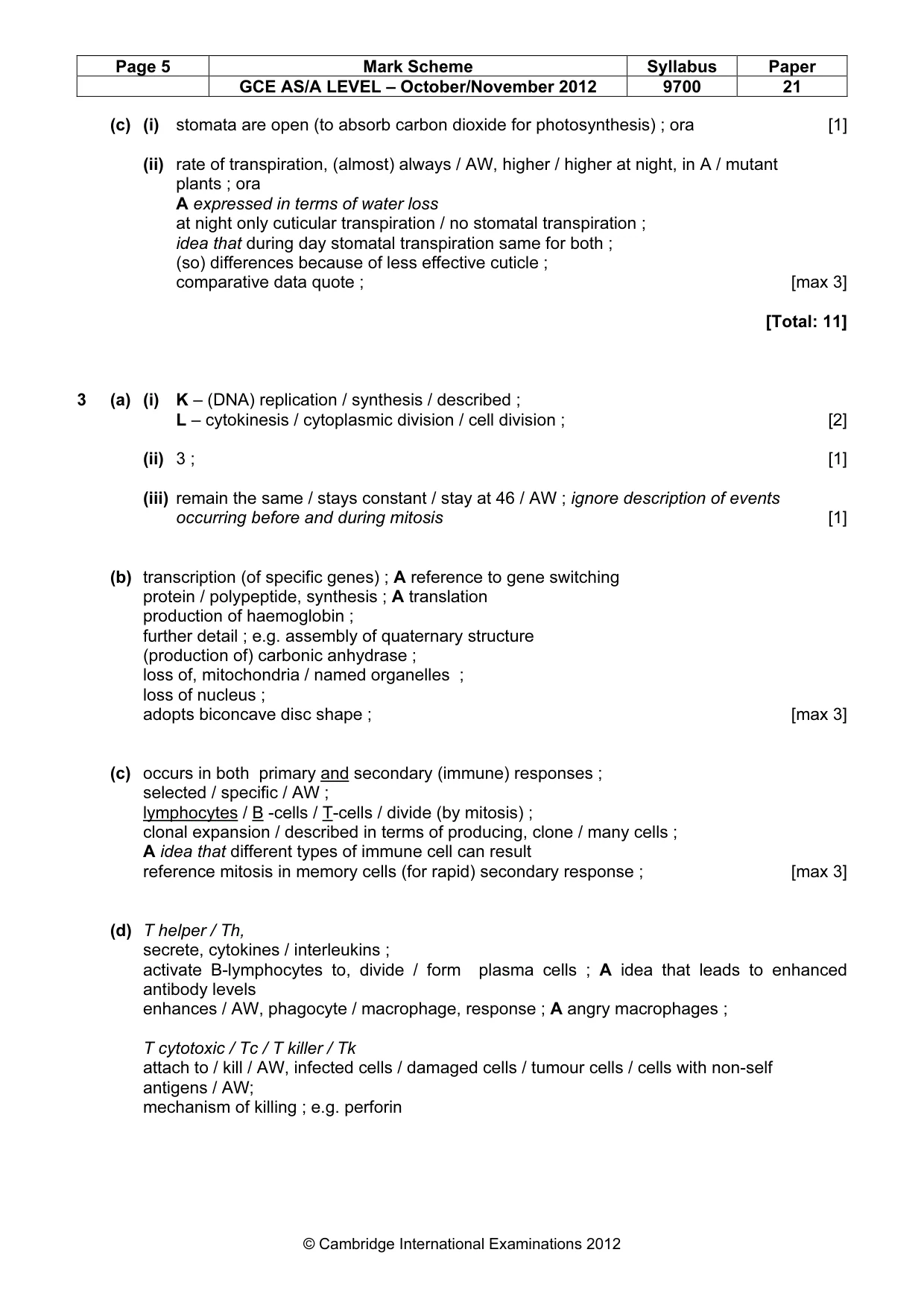
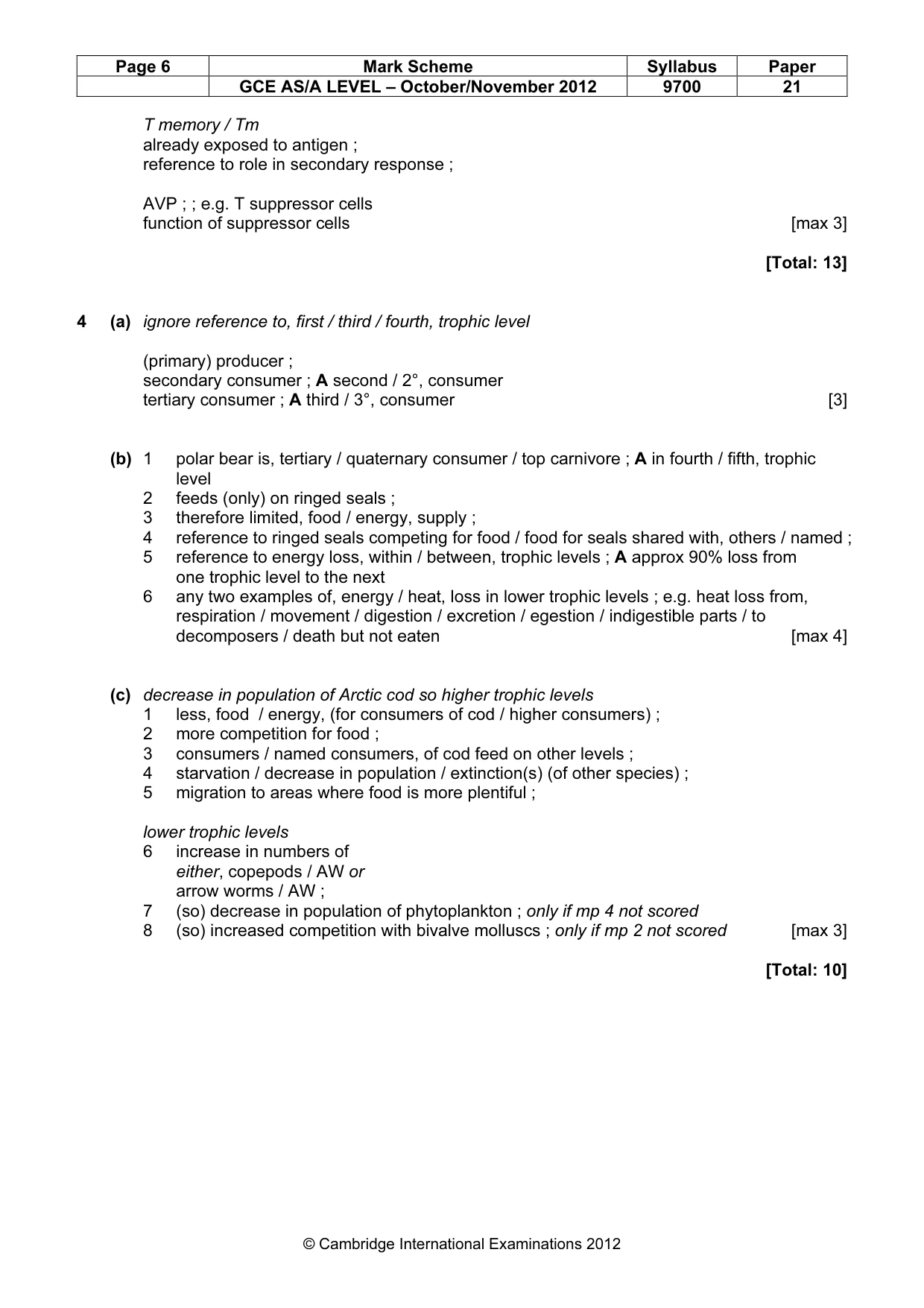
Page 5 Mark Scheme Syllabus Paper GCE AS/A LEVEL – October/November 2012 9700 21 © Cambridge International Examinations 2012 (c) (i) stomata are open (to absorb carbon dioxide for photosynthesis) ; ora [1] (ii) rate of transpiration, (almost) always / AW, higher / higher at night, in A / mutant plants ; ora A expressed in terms of water loss at night only cuticular transpiration / no stomatal transpiration ; idea that during day stomatal transpiration same for both ; (so) differences because of less effective cuticle ; comparative data quote ; [max 3] [Total: 11] 3 (a) (i) K – (DNA) replication / synthesis / described ; L – cytokinesis / cytoplasmic division / cell division ; [2] (ii) 3 ; [1] (iii) remain the same / stays constant / stay at 46 / AW ; ignore description of events occurring before and during mitosis [1] (b) transcription (of specific genes) ; A reference to gene switching protein / polypeptide, synthesis ; A translation production of haemoglobin ; further detail ; e.g. assembly of quaternary structure (production of) carbonic anhydrase ; loss of, mitochondria / named organelles ; loss of nucleus ; adopts biconcave disc shape ; [max 3] (c) occurs in both primary and secondary (immune) responses ; selected / specific / AW ; lymphocytes / B -cells / T-cells / divide (by mitosis) ; clonal expansion / described in terms of producing, clone / many cells ; A idea that different types of immune cell can result reference mitosis in memory cells (for rapid) secondary response ; [max 3] (d) T helper / Th, secrete, cytokines / interleukins ; activate B-lymphocytes to, divide / form plasma cells ; A idea that leads to enhanced antibody levels enhances / AW, phagocyte / macrophage, response ; A angry macrophages ; T cytotoxic / Tc / T killer / Tk attach to / kill / AW, infected cells / damaged cells / tumour cells / cells with non-self antigens / AW; mechanism of killing ; e.g. perforin
Mark scheme, page 6
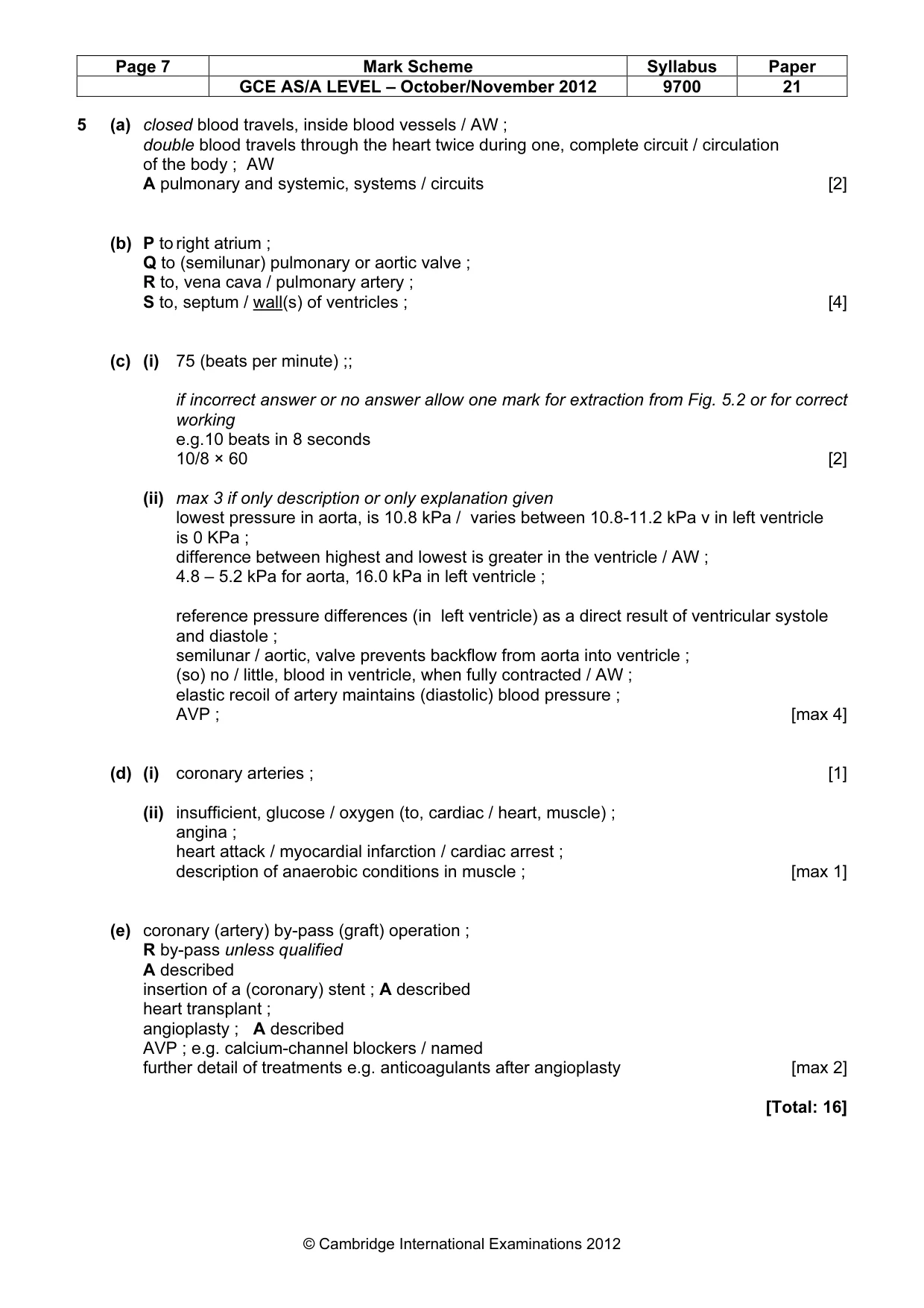
Page 6 Mark Scheme Syllabus Paper GCE AS/A LEVEL – October/November 2012 9700 21 © Cambridge International Examinations 2012 T memory / Tm already exposed to antigen ; reference to role in secondary response ; AVP ; ; e.g. T suppressor cells function of suppressor cells [max 3] [Total: 13] 4 (a) ignore reference to, first / third / fourth, trophic level (primary) producer ; secondary consumer ; A second / 2°, consumer tertiary consumer ; A third / 3°, consumer [3] (b) 1 polar bear is, tertiary / quaternary consumer / top carnivore ; A in fourth / fifth, trophic level 2 feeds (only) on ringed seals ; 3 therefore limited, food / energy, supply ; 4 reference to ringed seals competing for food / food for seals shared with, others / named ; 5 reference to energy loss, within / between, trophic levels ; A approx 90% loss from one trophic level to the next 6 any two examples of, energy / heat, loss in lower trophic levels ; e.g. heat loss from, respiration / movement / digestion / excretion / egestion / indigestible parts / to decomposers / death but not eaten [max 4] (c) decrease in population of Arctic cod so higher trophic levels 1 less, food / energy, (for consumers of cod / higher consumers) ; 2 more competition for food ; 3 consumers / named consumers, of cod feed on other levels ; 4 starvation / decrease in population / extinction(s) (of other species) ; 5 migration to areas where food is more plentiful ; lower trophic levels 6 increase in numbers of either, copepods / AW or arrow worms / AW ; 7 (so) decrease in population of phytoplankton ; only if mp 4 not scored 8 (so) increased competition with bivalve molluscs ; only if mp 2 not scored [max 3] [Total: 10]
Mark scheme, page 7
Page 7 Mark Scheme Syllabus Paper GCE AS/A LEVEL – October/November 2012 9700 21 © Cambridge International Examinations 2012 5 (a) closed blood travels, inside blood vessels / AW ; double blood travels through the heart twice during one, complete circuit / circulation of the body ; AW A pulmonary and systemic, systems / circuits [2] (b) P to right atrium ; Q to (semilunar) pulmonary or aortic valve ; R to, vena cava / pulmonary artery ; S to, septum / wall(s) of ventricles ; [4] (c) (i) 75 (beats per minute) ;; if incorrect answer or no answer allow one mark for extraction from Fig. 5.2 or for correct working e.g.10 beats in 8 seconds 10/8 × 60 [2] (ii) max 3 if only description or only explanation given lowest pressure in aorta, is 10.8 kPa / varies between 10.8-11.2 kPa v in left ventricle is 0 KPa ; difference between highest and lowest is greater in the ventricle / AW ; 4.8 – 5.2 kPa for aorta, 16.0 kPa in left ventricle ; reference pressure differences (in left ventricle) as a direct result of ventricular systole and diastole ; semilunar / aortic, valve prevents backflow from aorta into ventricle ; (so) no / little, blood in ventricle, when fully contracted / AW ; elastic recoil of artery maintains (diastolic) blood pressure ; AVP ; [max 4] (d) (i) coronary arteries ; [1] (ii) insufficient, glucose / oxygen (to, cardiac / heart, muscle) ; angina ; heart attack / myocardial infarction / cardiac arrest ; description of anaerobic conditions in muscle ; [max 1] (e) coronary (artery) by-pass (graft) operation ; R by-pass unless qualified A described insertion of a (coronary) stent ; A described heart transplant ; angioplasty ; A described AVP ; e.g. calcium-channel blockers / named further detail of treatments e.g. anticoagulants after angioplasty [max 2] [Total: 16]
What you needed in this session
Cambridge’s own grade thresholds for 2012 Oct/Nov, Paper 2 · Variant 1. A higher threshold means an easier paper — the bar moves with how the cohort did.