Cambridge A Level Biology 9700 — 2011 Oct/Nov Paper 2 · Variant 3
9700/23/O/N/11 · 60 marks · ≈68 min
The question paper and its mark scheme, free to read here and free to download. This is Cambridge’s own paper, exactly as it was sat.
Question paper16 pages


Mark scheme8 pages
Answers below. Sit the paper first if you are practising.
Paper as text
Question paper, page 1
This document consists of 13 printed pages and 3 blank pages. DC (NF/CGW) 34116/5 © UCLES 2011 [Turn over UNIVERSITY OF CAMBRIDGE INTERNATIONAL EXAMINATIONS General Certificate of Education Advanced Subsidiary Level and Advanced Level * 4 5 7 0 7 5 9 3 2 4 * BIOLOGY 9700/23 Paper 2 Structured Question AS October/November 2011 1 hour 15 minutes Candidates answer on the Question Paper. No Additional Materials are required. READ THESE INSTRUCTIONS FIRST Write your Centre number, candidate number and name in the spaces provided at the top of this page. Write in dark blue or black ink. You may use a soft pencil for any diagrams, graphs or rough working. Do not use staples, paper clips, highlighters, glue or correction fluid. DO NOT WRITE IN ANY BARCODES. Answer all questions. At the end of the examination, fasten all your work securely together. The number of marks is given in brackets [ ] at the end of each question or part question. For Examiner’s Use 1 2 3 4 5 6 Total
Question paper, page 2
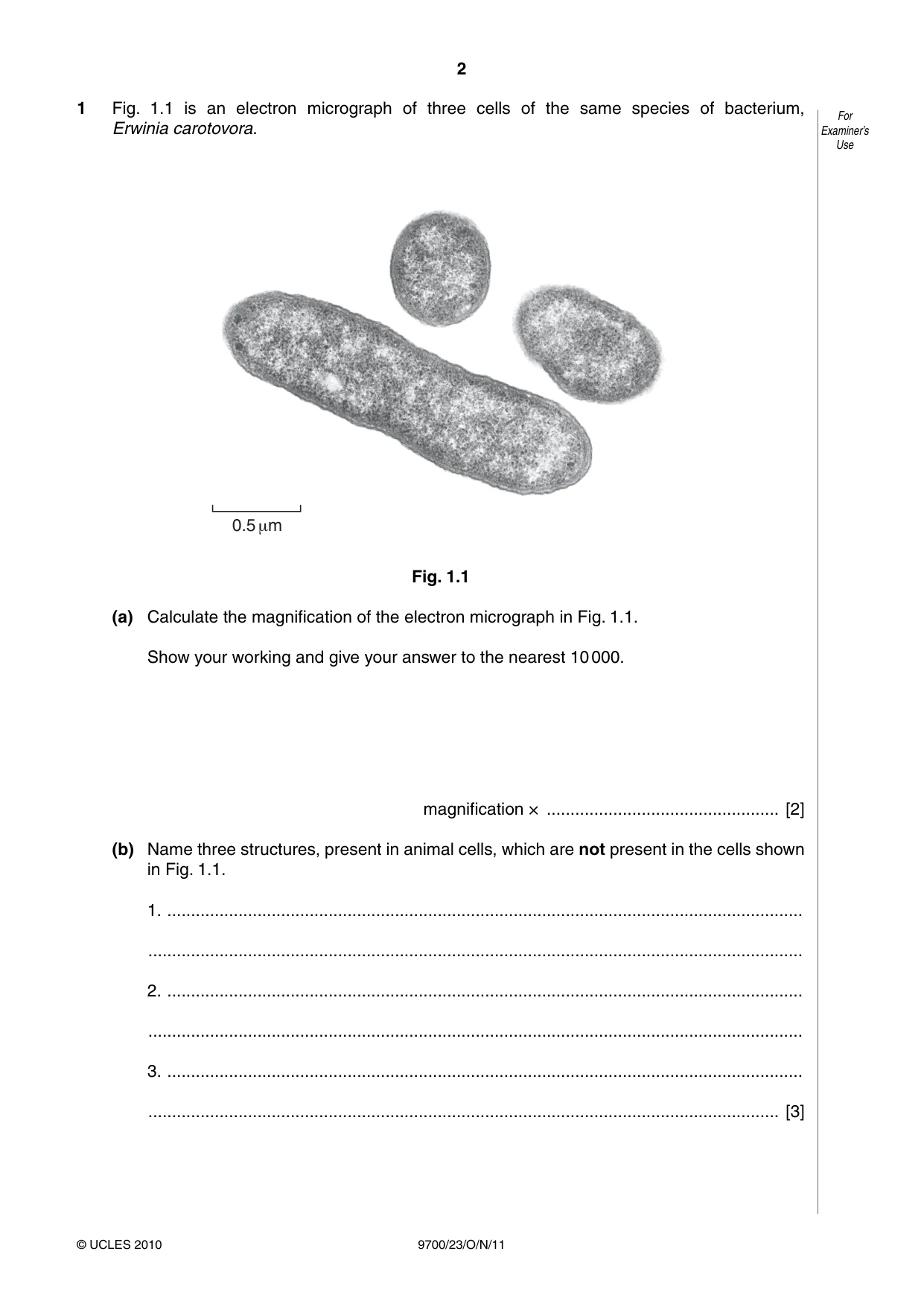
2 9700/23/O/N/11 © UCLES 2010 For Examiner’s Use 1 Fig. 1.1 is an electron micrograph of three cells of the same species of bacterium, Erwinia carotovora. 0.5 μm Fig. 1.1 (a) Calculate the magnification of the electron micrograph in Fig. 1.1. Show your working and give your answer to the nearest 10 000. magnification × … [2] (b) Name three structures, present in animal cells, which are not present in the cells shown in Fig. 1.1. 1. … … 2. … … 3. … … [3]
Question paper, page 3
3 9700/23/O/N/11 © UCLES 2011 [Turn over For Examiner’s Use (c) E. carotovora is a rod-shaped bacterium. Explain why two of the bacterial cells in Fig. 1.1 do not appear rod-shaped. … … … … [1] (d) E. carotovora causes a disease in carrot and potato plants. The bacteria release an enzyme called pectinase which hydrolyses the polysaccharide pectin. Pectin helps plant cells to attach to each other. (i) Name the type of chemical bond which will be hydrolysed by pectinase. … [1] (ii) Suggest what effect this disease will have on vegetables, such as carrots and potatoes. … … … … [2] [Total: 9]
Question paper, page 4
4 9700/23/O/N/11 © UCLES 2010 For Examiner’s Use 2 (a) Describe the function of each of the following structures in the human heart: (i) sinoatrial node (SAN) … … … [2] (ii) atrioventricular node (AVN) … … … [2] (iii) left atrioventricular (bicuspid) valve. … … … … [2]
Question paper, page 5
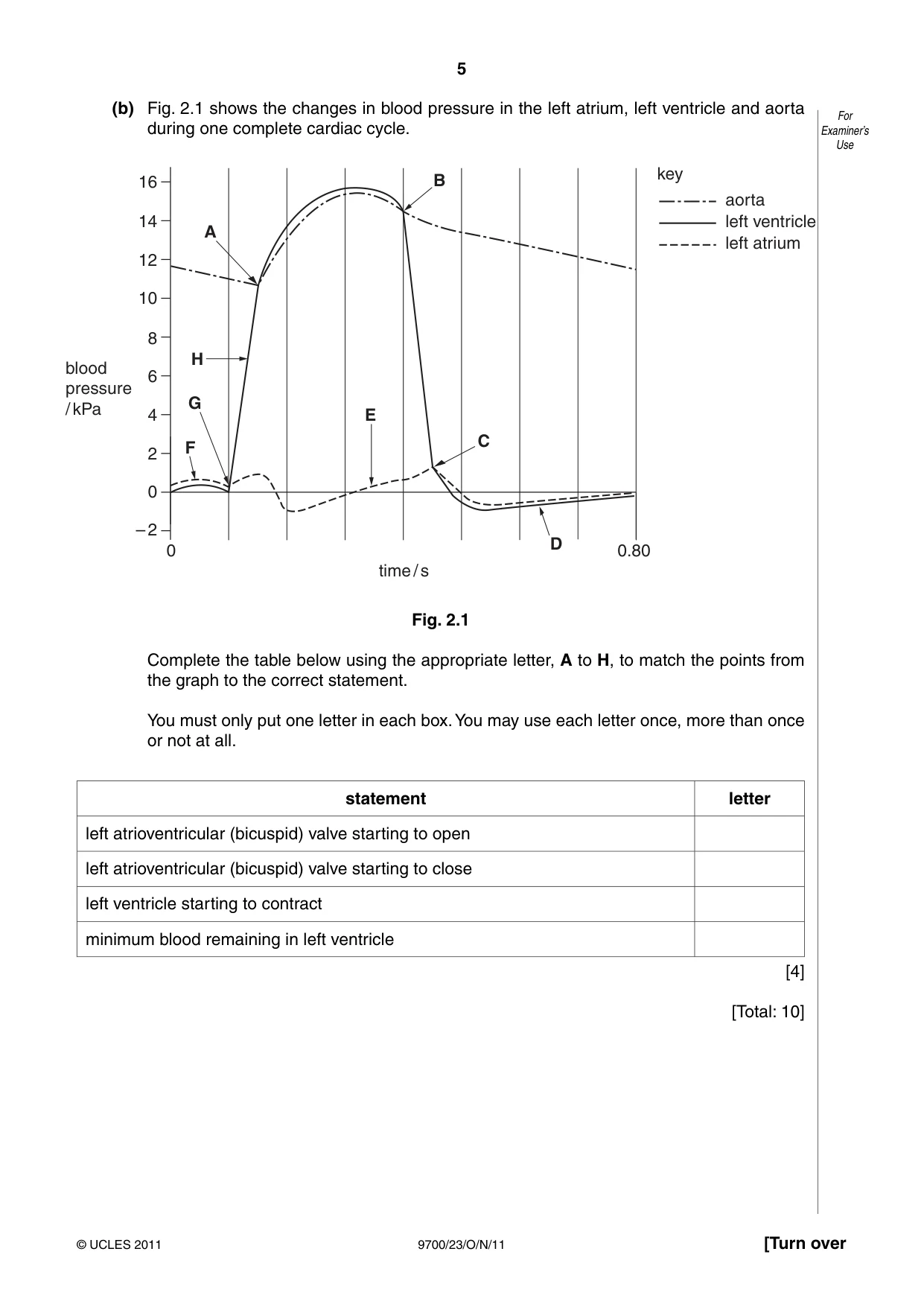
5 9700/23/O/N/11 © UCLES 2011 [Turn over For Examiner’s Use (b) Fig. 2.1 shows the changes in blood pressure in the left atrium, left ventricle and aorta during one complete cardiac cycle. 16 14 12 10 8 6 4 2 0 – 2 0 0.80 time / s blood pressure / kPa A B C key aorta left ventricle left atrium D E F G H Fig. 2.1 Complete the table below using the appropriate letter, A to H, to match the points from the graph to the correct statement. You must only put one letter in each box. You may use each letter once, more than once or not at all. statement letter left atrioventricular (bicuspid) valve starting to open left atrioventricular (bicuspid) valve starting to close left ventricle starting to contract minimum blood remaining in left ventricle [4] [Total: 10]
Question paper, page 6
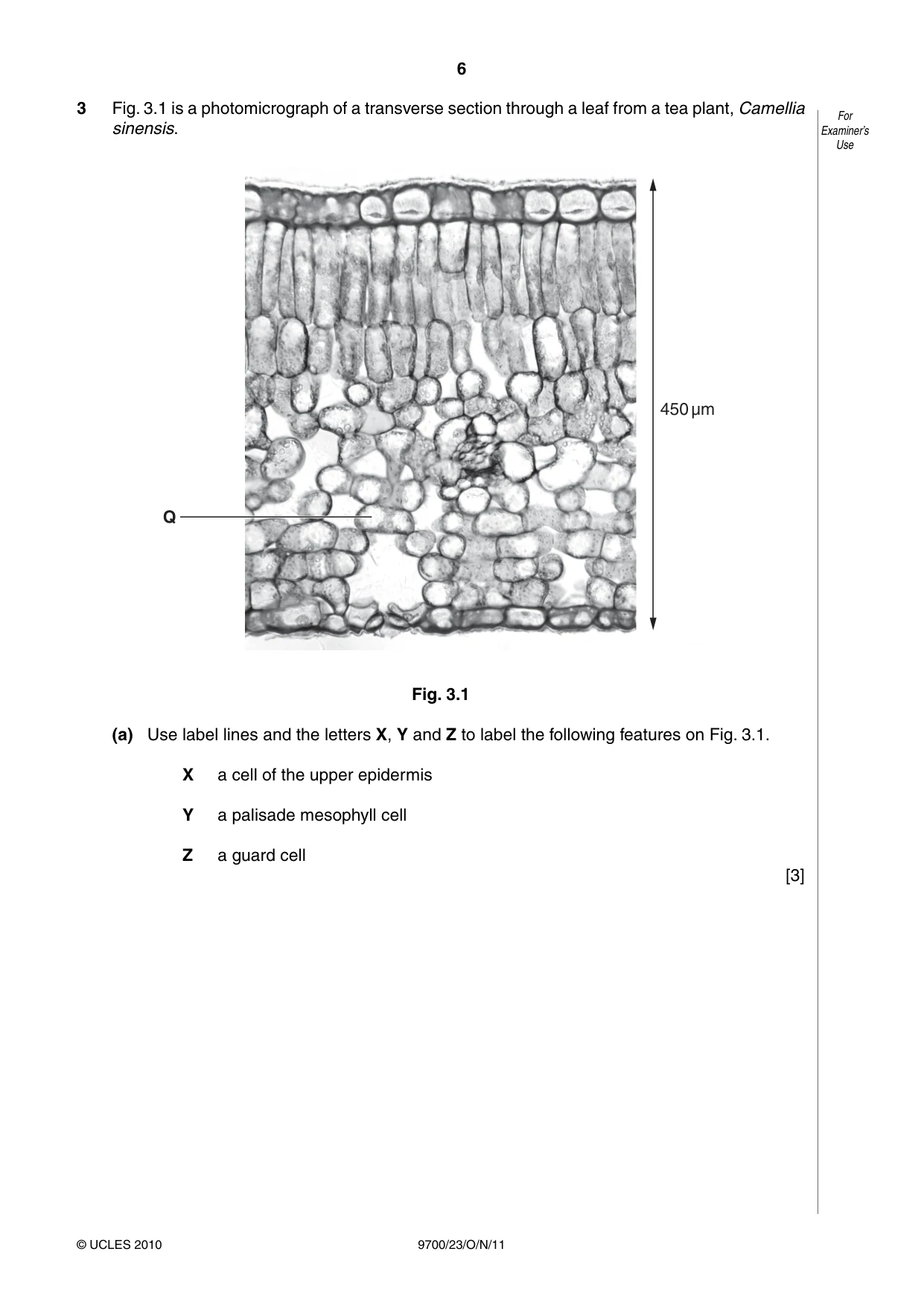
6 9700/23/O/N/11 © UCLES 2010 For Examiner’s Use 3 Fig. 3.1 is a photomicrograph of a transverse section through a leaf from a tea plant, Camellia sinensis. 450 µm Q Fig. 3.1 (a) Use label lines and the letters X, Y and Z to label the following features on Fig. 3.1. X a cell of the upper epidermis Y a palisade mesophyll cell Z a guard cell [3]
Question paper, page 7
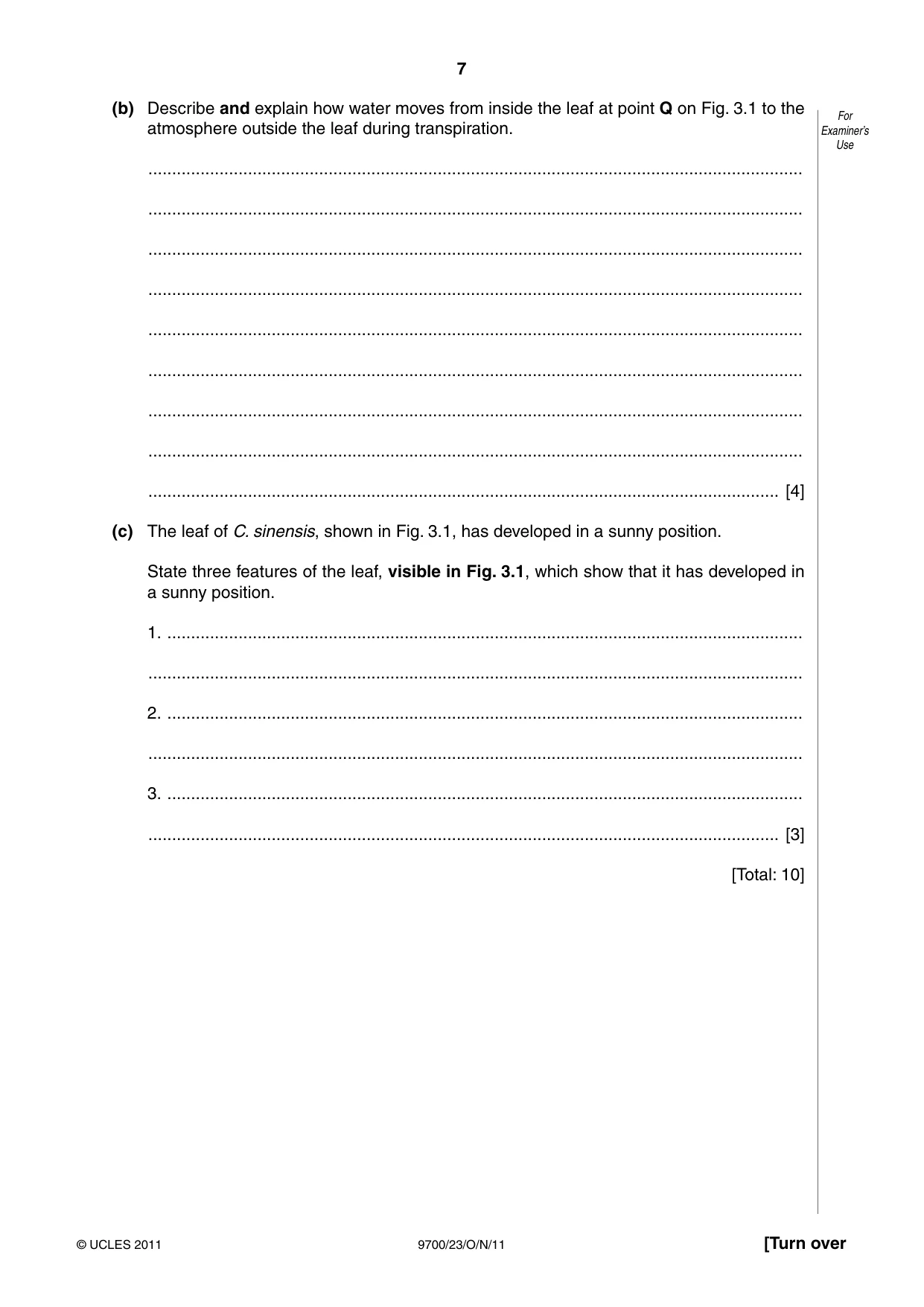
7 9700/23/O/N/11 © UCLES 2011 [Turn over For Examiner’s Use (b) Describe and explain how water moves from inside the leaf at point Q on Fig. 3.1 to the atmosphere outside the leaf during transpiration. … … … … … … … … … [4] (c) The leaf of C. sinensis, shown in Fig. 3.1, has developed in a sunny position. State three features of the leaf, visible in Fig. 3.1, which show that it has developed in a sunny position. 1. … … 2. … … 3. … … [3] [Total: 10]
Question paper, page 8
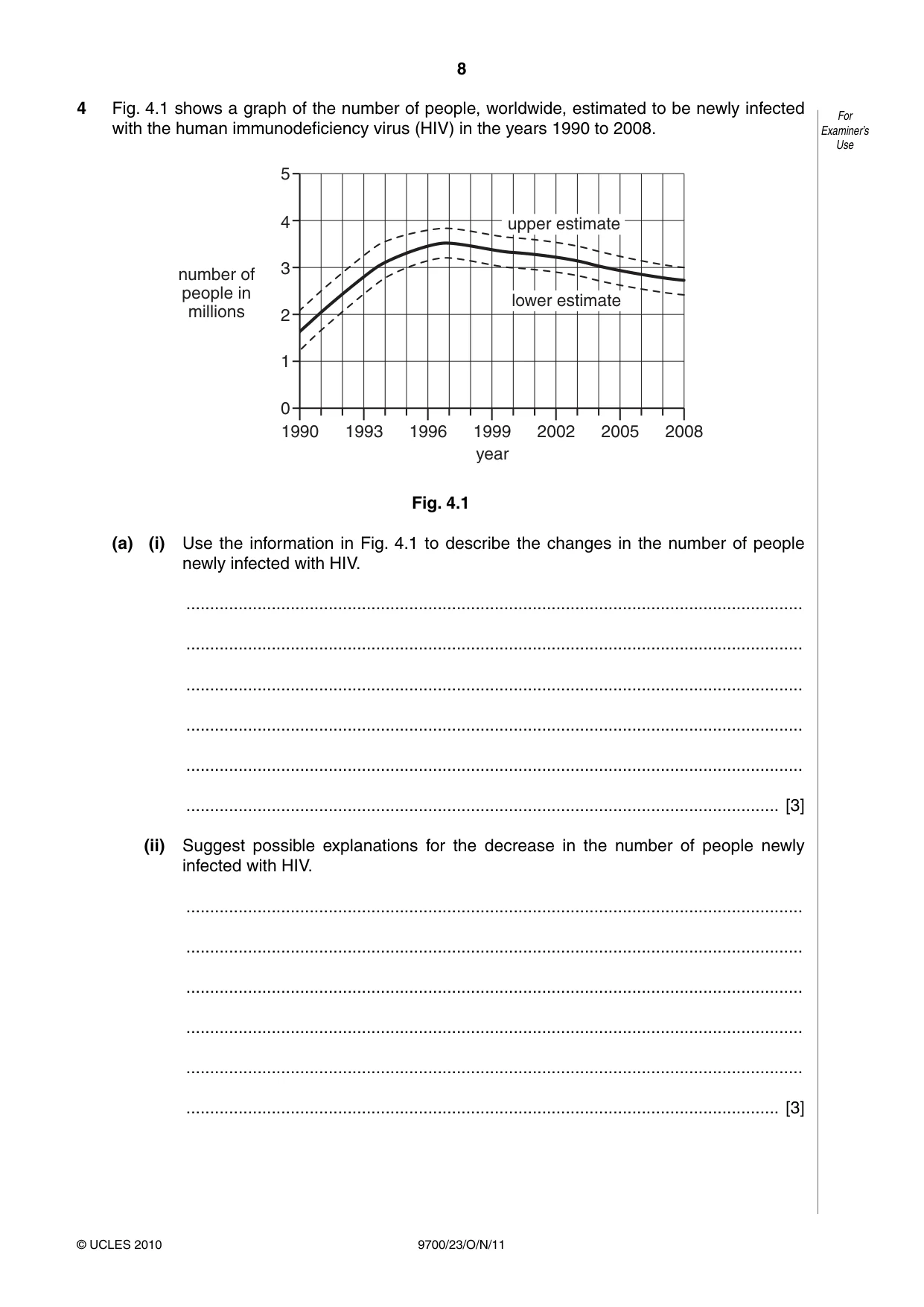
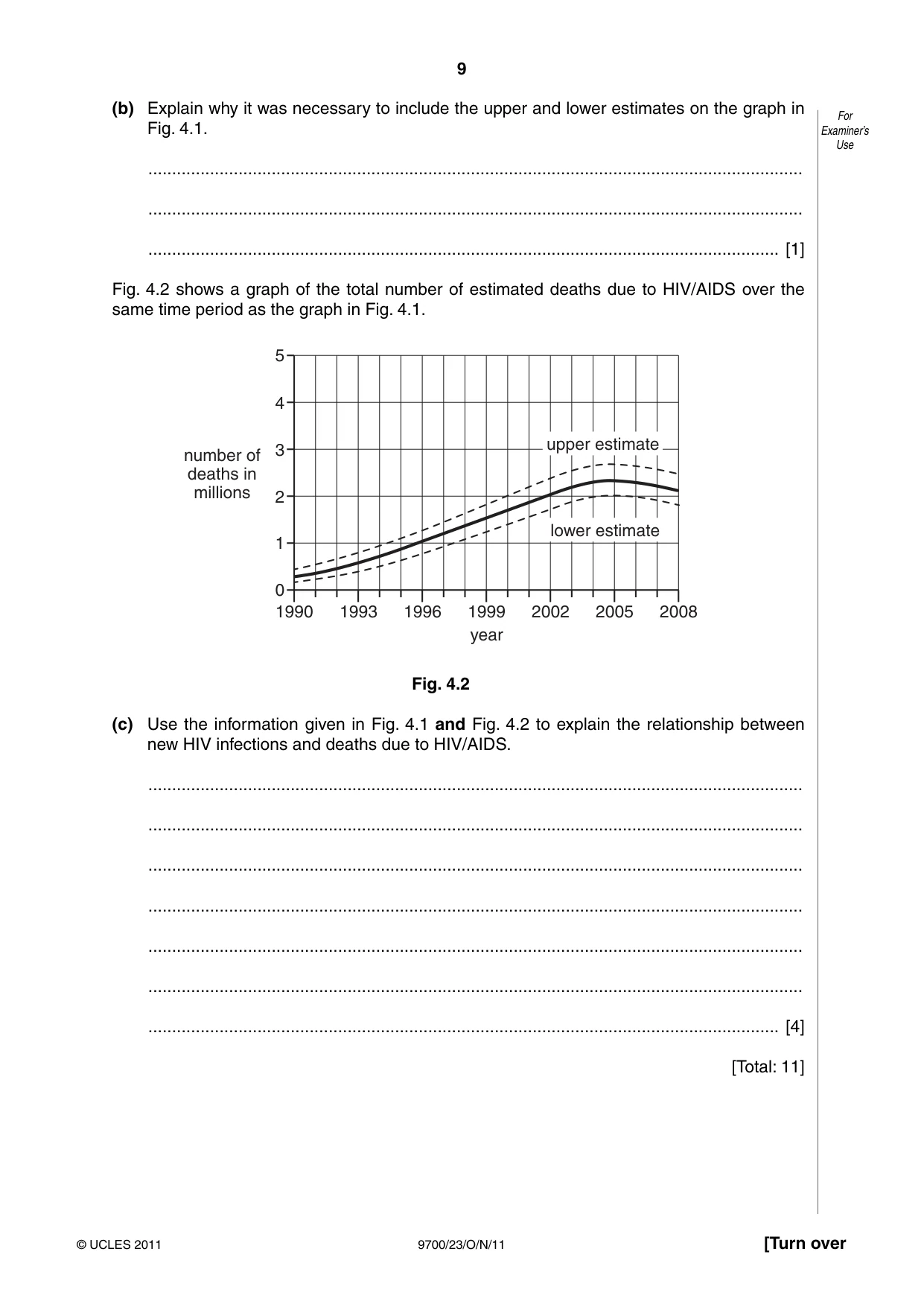
8 9700/23/O/N/11 © UCLES 2010 For Examiner’s Use 4 Fig. 4.1 shows a graph of the number of people, worldwide, estimated to be newly infected with the human immunodeficiency virus (HIV) in the years 1990 to 2008. 5 4 3 2 number of people in millions 1 0 1990 1993 1996 1999 year 2002 2005 2008 upper estimate lower estimate Fig. 4.1 (a) (i) Use the information in Fig. 4.1 to describe the changes in the number of people newly infected with HIV. … … … … … … [3] (ii) Suggest possible explanations for the decrease in the number of people newly infected with HIV. … … … … … … [3]
Question paper, page 9
9 9700/23/O/N/11 © UCLES 2011 [Turn over For Examiner’s Use (b) Explain why it was necessary to include the upper and lower estimates on the graph in Fig. 4.1. … … … [1] Fig. 4.2 shows a graph of the total number of estimated deaths due to HIV/AIDS over the same time period as the graph in Fig. 4.1. 5 4 3 2 number of deaths in millions 1 0 1990 1993 1996 1999 year 2002 2005 2008 upper estimate lower estimate Fig. 4.2 (c) Use the information given in Fig. 4.1 and Fig. 4.2 to explain the relationship between new HIV infections and deaths due to HIV/AIDS. … … … … … … … [4] [Total: 11]
Question paper, page 10
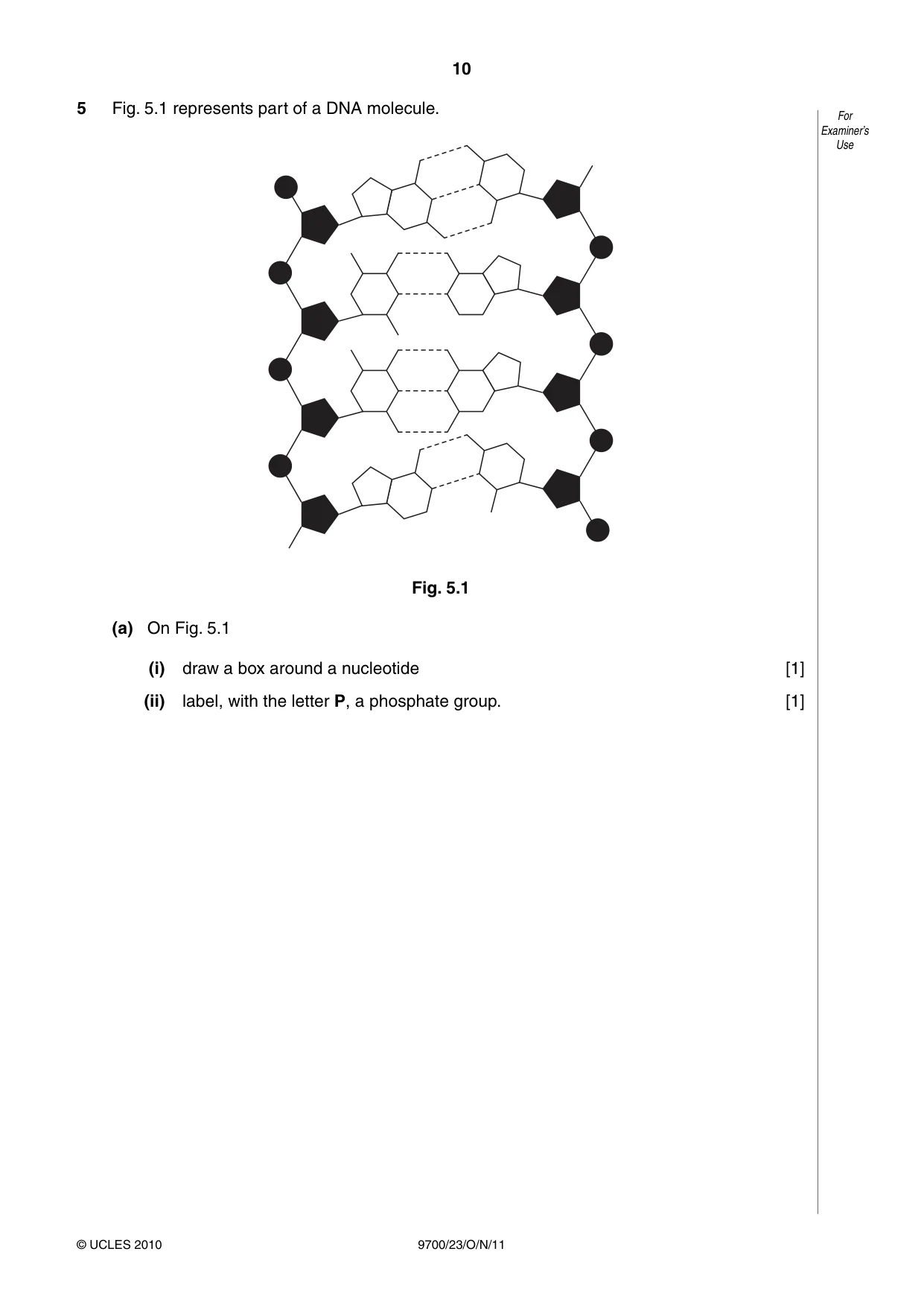
10 9700/23/O/N/11 © UCLES 2010 For Examiner’s Use 5 Fig. 5.1 represents part of a DNA molecule. Fig. 5.1 (a) On Fig. 5.1 (i) draw a box around a nucleotide [1] (ii) label, with the letter P, a phosphate group. [1]
Question paper, page 11
11 9700/23/O/N/11 © UCLES 2011 [Turn over For Examiner’s Use (b) Describe how a DNA molecule replicates. … … … … … … … … … … … [5] (c) DNA codes for polypeptides in cells. Transfer RNA (tRNA) is involved in this process. Describe the role of tRNA in the production of polypeptides in cells. … … … … … … … [3] [Total: 10]
Question paper, page 12
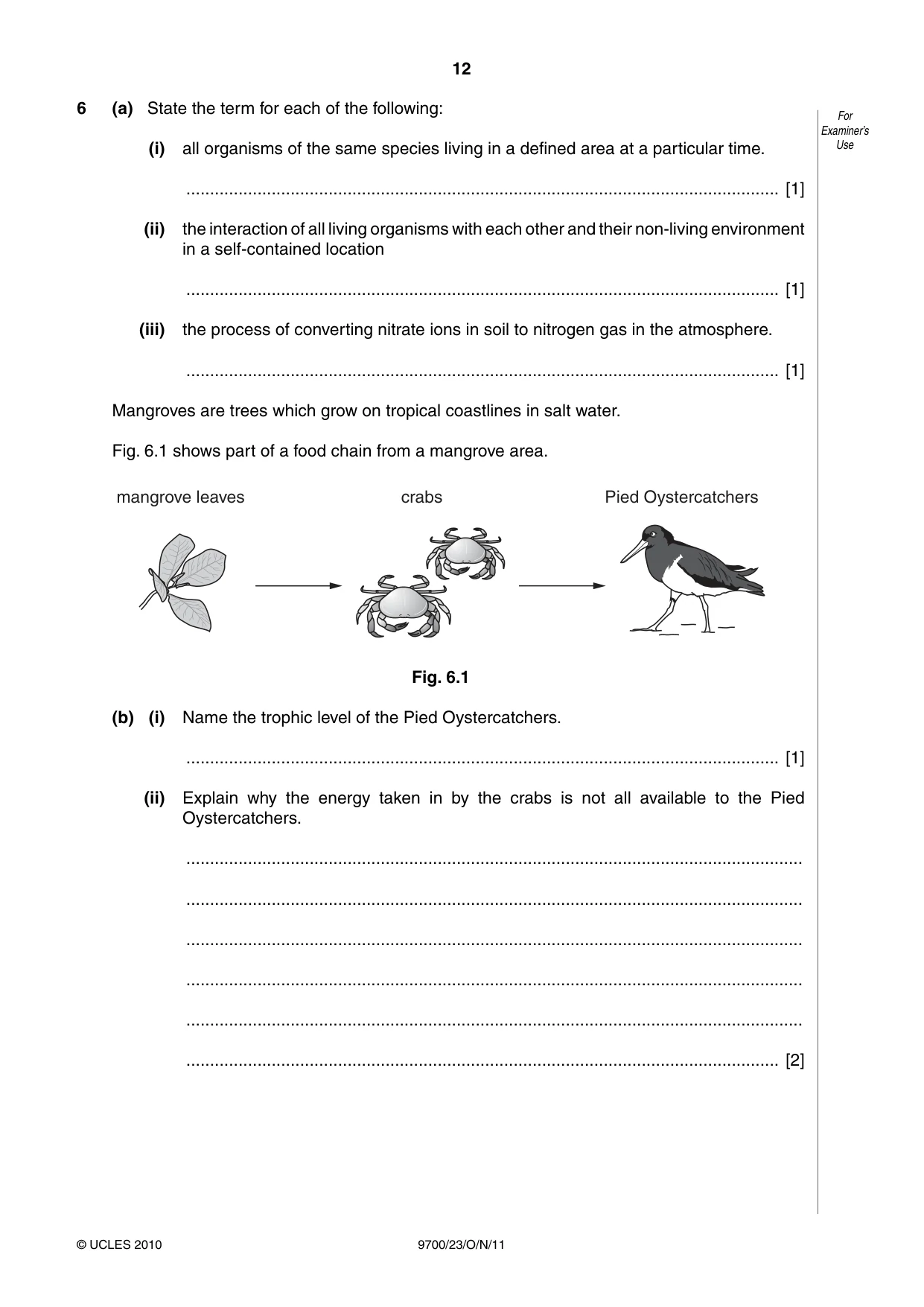
12 9700/23/O/N/11 © UCLES 2010 For Examiner’s Use 6 (a) State the term for each of the following: (i) all organisms of the same species living in a defined area at a particular time. … [1] (ii) the interaction of all living organisms with each other and their non-living environment in a self-contained location … [1] (iii) the process of converting nitrate ions in soil to nitrogen gas in the atmosphere. … [1] Mangroves are trees which grow on tropical coastlines in salt water. Fig. 6.1 shows part of a food chain from a mangrove area. mangrove leaves crabs Pied Oystercatchers Fig. 6.1 (b) (i) Name the trophic level of the Pied Oystercatchers. … [1] (ii) Explain why the energy taken in by the crabs is not all available to the Pied Oystercatchers. … … … … … … [2]
Question paper, page 13
13 9700/23/O/N/11 © UCLES 2011 For Examiner’s Use (c) The crabs in Fig. 6.1 also feed on mangrove leaves that have fallen to the ground. The leaves which are not eaten supply a source of nitrogen for the mangrove trees. Explain how nitrogen from compounds in the dead leaves is made available to the growing plants. … … … … … … … … … [4] [Total: 10]
Question paper, page 14
14 9700/23/O/N/11 © UCLES 2010 BLANK PAGE
Question paper, page 15
15 9700/23/O/N/11 © UCLES 2011 BLANK PAGE
Question paper, page 16
16 9700/23/O/N/11 © UCLES 2010 BLANK PAGE Copyright Acknowledgements: Question 1, Fig. 1.1 © DR. KARL LOUNATMAA/SCIENCE PHOTO LIBRARY Question 3, Fig. 3.1 © DR. KEITH WHEELER/SCIENCE PHOTO LIBRARY Permission to reproduce items where third-party owned material protected by copyright is included has been sought and cleared where possible. Every reasonable effort has been made by the publisher (UCLES) to trace copyright holders, but if any items requiring clearance have unwittingly been included, the publisher will be pleased to make amends at the earliest possible opportunity. University of Cambridge International Examinations is part of the Cambridge Assessment Group. Cambridge Assessment is the brand name of University of Cambridge Local Examinations Syndicate (UCLES), which is itself a department of the University of Cambridge.
Mark scheme, page 1
UNIVERSITY OF CAMBRIDGE INTERNATIONAL EXAMINATIONS GCE Advanced Subsidiary Level and GCE Advanced Level MARK SCHEME for the October/November 2011 question paper for the guidance of teachers 9700 BIOLOGY 9700/23 Paper 2 (AS Structured Questions), maximum raw mark 60 This mark scheme is published as an aid to teachers and candidates, to indicate the requirements of the examination. It shows the basis on which Examiners were instructed to award marks. It does not indicate the details of the discussions that took place at an Examiners’ meeting before marking began, which would have considered the acceptability of alternative answers. Mark schemes must be read in conjunction with the question papers and the report on the examination. • Cambridge will not enter into discussions or correspondence in connection with these mark schemes. Cambridge is publishing the mark schemes for the October/November 2011 question papers for most IGCSE, GCE Advanced Level and Advanced Subsidiary Level syllabuses and some Ordinary Level syllabuses.
Mark scheme, page 2
Page 2 Mark Scheme: Teachers’ version Syllabus Paper GCE AS/A LEVEL – October/November 2011 9700 23 © University of Cambridge International Examinations 2011 Mark scheme abbreviations: ; separates marking points / alternative answers for the same point R reject A accept (for answers correctly cued by the question, or by extra guidance) AW alternative wording (where responses vary more than usual) underline actual word given must be used by candidate (grammatical variants excepted) max indicates the maximum number of marks that can be given ora or reverse argument mp marking point (with relevant number) ecf error carried forward I ignore
Mark scheme, page 3
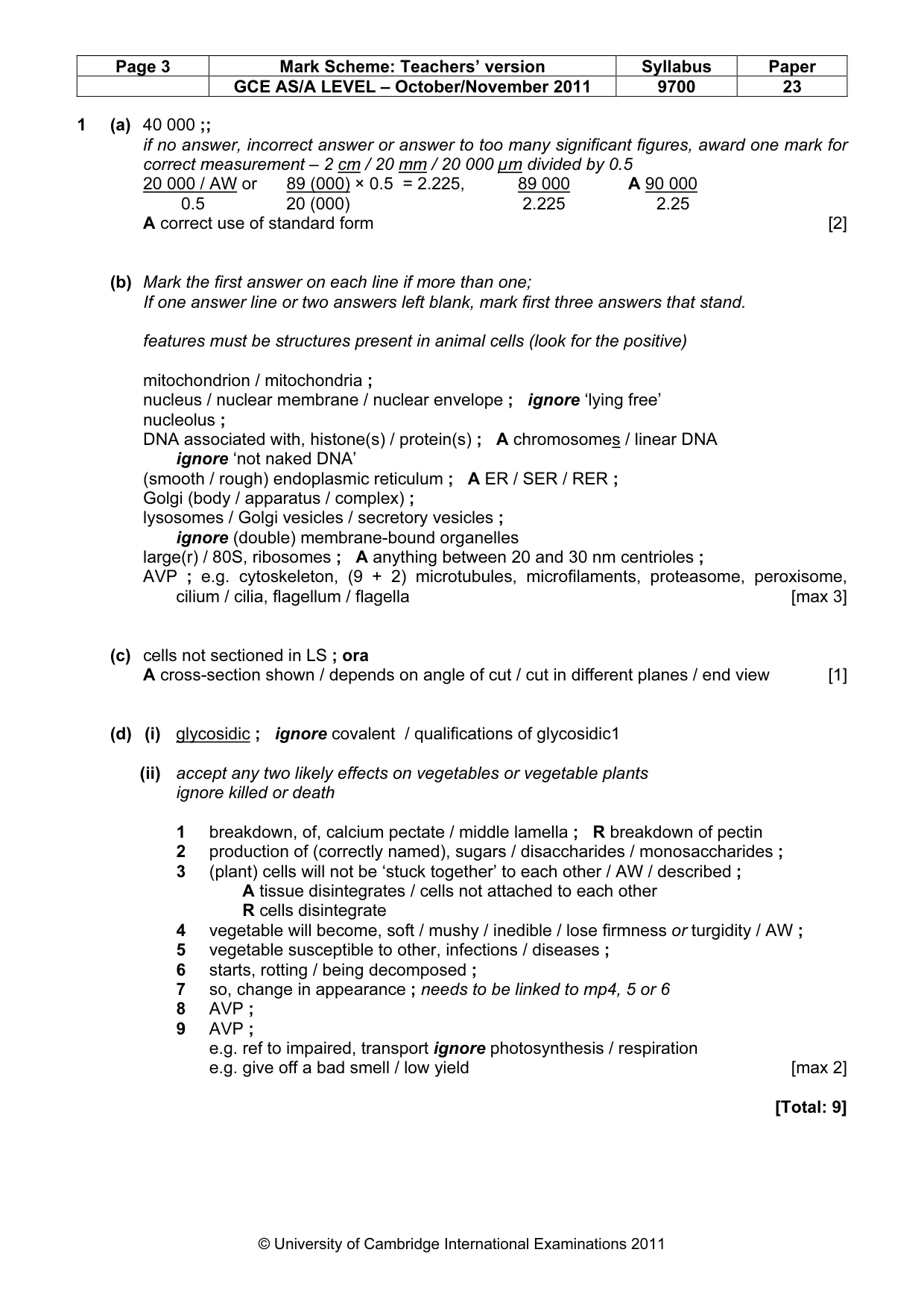
Page 3 Mark Scheme: Teachers’ version Syllabus Paper GCE AS/A LEVEL – October/November 2011 9700 23 © University of Cambridge International Examinations 2011 1 (a) 40 000 ;; if no answer, incorrect answer or answer to too many significant figures, award one mark for correct measurement – 2 cm / 20 mm / 20 000 µm divided by 0.5 20 000 / AW or 89 (000) × 0.5 = 2.225, 89 000 A 90 000 0.5 20 (000) 2.225 2.25 A correct use of standard form [2] (b) Mark the first answer on each line if more than one; If one answer line or two answers left blank, mark first three answers that stand. features must be structures present in animal cells (look for the positive) mitochondrion / mitochondria ; nucleus / nuclear membrane / nuclear envelope ; ignore ‘lying free’ nucleolus ; DNA associated with, histone(s) / protein(s) ; A chromosomes / linear DNA ignore ‘not naked DNA’ (smooth / rough) endoplasmic reticulum ; A ER / SER / RER ; Golgi (body / apparatus / complex) ; lysosomes / Golgi vesicles / secretory vesicles ; ignore (double) membrane-bound organelles large(r) / 80S, ribosomes ; A anything between 20 and 30 nm centrioles ; AVP ; e.g. cytoskeleton, (9 + 2) microtubules, microfilaments, proteasome, peroxisome, cilium / cilia, flagellum / flagella [max 3] (c) cells not sectioned in LS ; ora A cross-section shown / depends on angle of cut / cut in different planes / end view [1] (d) (i) glycosidic ; ignore covalent / qualifications of glycosidic1 (ii) accept any two likely effects on vegetables or vegetable plants ignore killed or death 1 breakdown, of, calcium pectate / middle lamella ; R breakdown of pectin 2 production of (correctly named), sugars / disaccharides / monosaccharides ; 3 (plant) cells will not be ‘stuck together’ to each other / AW / described ; A tissue disintegrates / cells not attached to each other R cells disintegrate 4 vegetable will become, soft / mushy / inedible / lose firmness or turgidity / AW ; 5 vegetable susceptible to other, infections / diseases ; 6 starts, rotting / being decomposed ; 7 so, change in appearance ; needs to be linked to mp4, 5 or 6 8 AVP ; 9 AVP ; e.g. ref to impaired, transport ignore photosynthesis / respiration e.g. give off a bad smell / low yield [max 2] [Total: 9]
Mark scheme, page 4
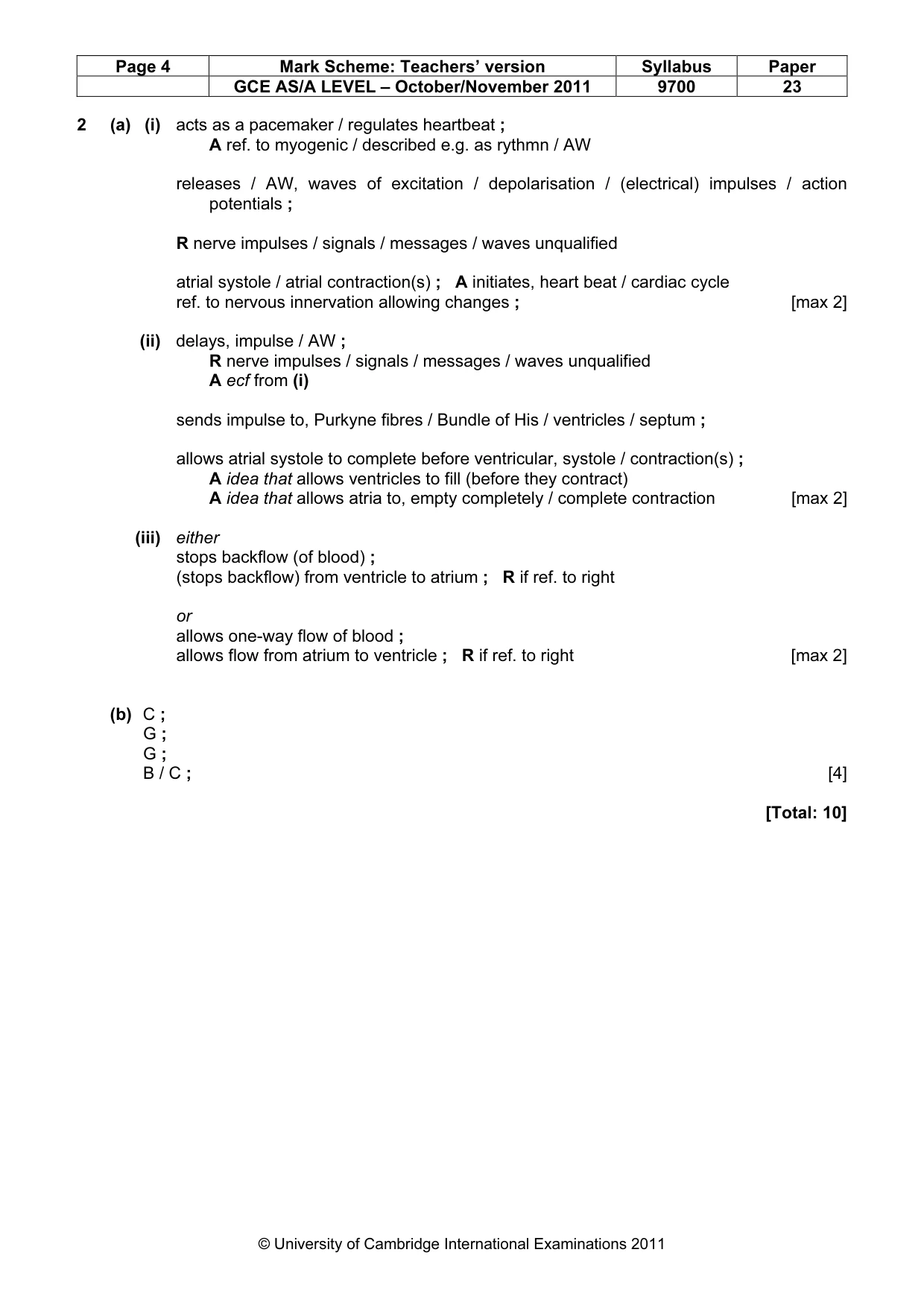
Page 4 Mark Scheme: Teachers’ version Syllabus Paper GCE AS/A LEVEL – October/November 2011 9700 23 © University of Cambridge International Examinations 2011 2 (a) (i) acts as a pacemaker / regulates heartbeat ; A ref. to myogenic / described e.g. as rythmn / AW releases / AW, waves of excitation / depolarisation / (electrical) impulses / action potentials ; R nerve impulses / signals / messages / waves unqualified atrial systole / atrial contraction(s) ; A initiates, heart beat / cardiac cycle ref. to nervous innervation allowing changes ; [max 2] (ii) delays, impulse / AW ; R nerve impulses / signals / messages / waves unqualified A ecf from (i) sends impulse to, Purkyne fibres / Bundle of His / ventricles / septum ; allows atrial systole to complete before ventricular, systole / contraction(s) ; A idea that allows ventricles to fill (before they contract) A idea that allows atria to, empty completely / complete contraction [max 2] (iii) either stops backflow (of blood) ; (stops backflow) from ventricle to atrium ; R if ref. to right or allows one-way flow of blood ; allows flow from atrium to ventricle ; R if ref. to right [max 2] (b) C ; G ; G ; B / C ; [4] [Total: 10]
Mark scheme, page 5
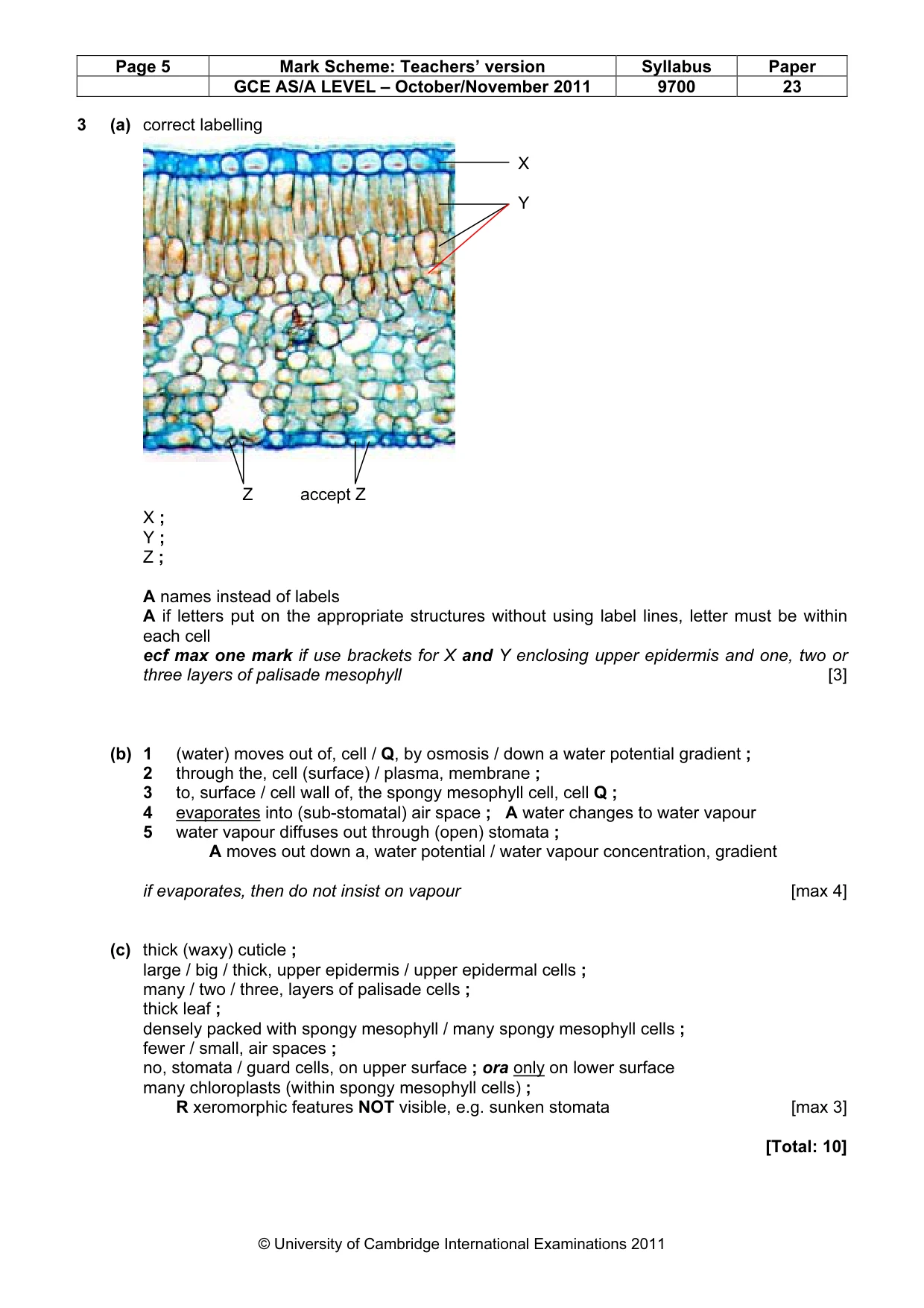
Page 5 Mark Scheme: Teachers’ version Syllabus Paper GCE AS/A LEVEL – October/November 2011 9700 23 © University of Cambridge International Examinations 2011 3 (a) correct labelling X ; Y ; Z ; A names instead of labels A if letters put on the appropriate structures without using label lines, letter must be within each cell ecf max one mark if use brackets for X and Y enclosing upper epidermis and one, two or three layers of palisade mesophyll [3] (b) 1 (water) moves out of, cell / Q, by osmosis / down a water potential gradient ; 2 through the, cell (surface) / plasma, membrane ; 3 to, surface / cell wall of, the spongy mesophyll cell, cell Q ; 4 evaporates into (sub-stomatal) air space ; A water changes to water vapour 5 water vapour diffuses out through (open) stomata ; A moves out down a, water potential / water vapour concentration, gradient if evaporates, then do not insist on vapour [max 4] (c) thick (waxy) cuticle ; large / big / thick, upper epidermis / upper epidermal cells ; many / two / three, layers of palisade cells ; thick leaf ; densely packed with spongy mesophyll / many spongy mesophyll cells ; fewer / small, air spaces ; no, stomata / guard cells, on upper surface ; ora only on lower surface many chloroplasts (within spongy mesophyll cells) ; R xeromorphic features NOT visible, e.g. sunken stomata [max 3] [Total: 10] X Y Z accept Z
Mark scheme, page 6
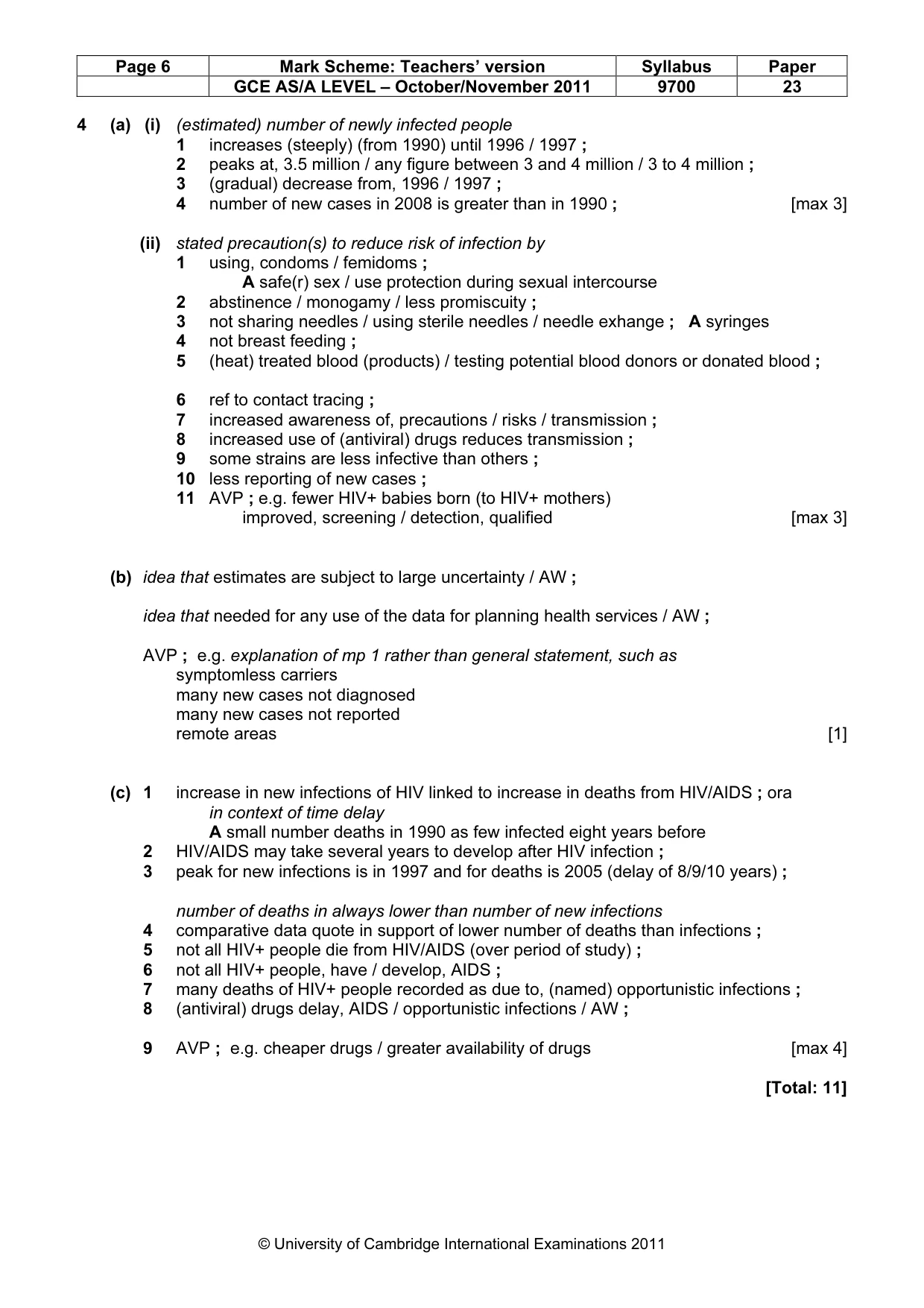
Page 6 Mark Scheme: Teachers’ version Syllabus Paper GCE AS/A LEVEL – October/November 2011 9700 23 © University of Cambridge International Examinations 2011 4 (a) (i) (estimated) number of newly infected people 1 increases (steeply) (from 1990) until 1996 / 1997 ; 2 peaks at, 3.5 million / any figure between 3 and 4 million / 3 to 4 million ; 3 (gradual) decrease from, 1996 / 1997 ; 4 number of new cases in 2008 is greater than in 1990 ; [max 3] (ii) stated precaution(s) to reduce risk of infection by 1 using, condoms / femidoms ; A safe(r) sex / use protection during sexual intercourse 2 abstinence / monogamy / less promiscuity ; 3 not sharing needles / using sterile needles / needle exhange ; A syringes 4 not breast feeding ; 5 (heat) treated blood (products) / testing potential blood donors or donated blood ; 6 ref to contact tracing ; 7 increased awareness of, precautions / risks / transmission ; 8 increased use of (antiviral) drugs reduces transmission ; 9 some strains are less infective than others ; 10 less reporting of new cases ; 11 AVP ; e.g. fewer HIV+ babies born (to HIV+ mothers) improved, screening / detection, qualified [max 3] (b) idea that estimates are subject to large uncertainty / AW ; idea that needed for any use of the data for planning health services / AW ; AVP ; e.g. explanation of mp 1 rather than general statement, such as symptomless carriers many new cases not diagnosed many new cases not reported remote areas [1] (c) 1 increase in new infections of HIV linked to increase in deaths from HIV/AIDS ; ora in context of time delay A small number deaths in 1990 as few infected eight years before 2 HIV/AIDS may take several years to develop after HIV infection ; 3 peak for new infections is in 1997 and for deaths is 2005 (delay of 8/9/10 years) ; number of deaths in always lower than number of new infections 4 comparative data quote in support of lower number of deaths than infections ; 5 not all HIV+ people die from HIV/AIDS (over period of study) ; 6 not all HIV+ people, have / develop, AIDS ; 7 many deaths of HIV+ people recorded as due to, (named) opportunistic infections ; 8 (antiviral) drugs delay, AIDS / opportunistic infections / AW ; 9 AVP ; e.g. cheaper drugs / greater availability of drugs [max 4] [Total: 11]
Mark scheme, page 7
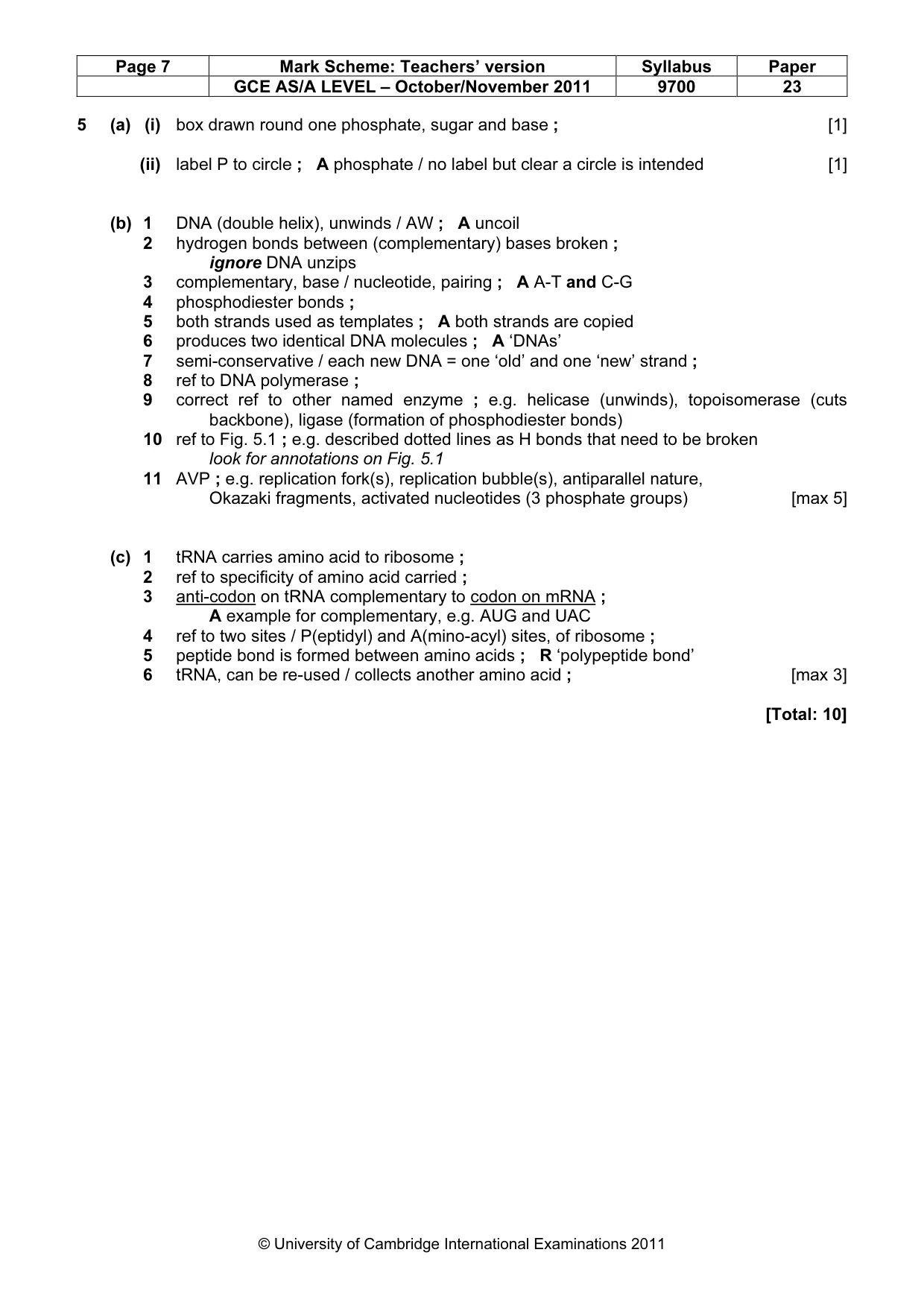
Page 7 Mark Scheme: Teachers’ version Syllabus Paper GCE AS/A LEVEL – October/November 2011 9700 23 © University of Cambridge International Examinations 2011 5 (a) (i) box drawn round one phosphate, sugar and base ; [1] (ii) label P to circle ; A phosphate / no label but clear a circle is intended [1] (b) 1 DNA (double helix), unwinds / AW ; A uncoil 2 hydrogen bonds between (complementary) bases broken ; ignore DNA unzips 3 complementary, base / nucleotide, pairing ; A A-T and C-G 4 phosphodiester bonds ; 5 both strands used as templates ; A both strands are copied 6 produces two identical DNA molecules ; A ‘DNAs’ 7 semi-conservative / each new DNA = one ‘old’ and one ‘new’ strand ; 8 ref to DNA polymerase ; 9 correct ref to other named enzyme ; e.g. helicase (unwinds), topoisomerase (cuts backbone), ligase (formation of phosphodiester bonds) 10 ref to Fig. 5.1 ; e.g. described dotted lines as H bonds that need to be broken look for annotations on Fig. 5.1 11 AVP ; e.g. replication fork(s), replication bubble(s), antiparallel nature, Okazaki fragments, activated nucleotides (3 phosphate groups) [max 5] (c) 1 tRNA carries amino acid to ribosome ; 2 ref to specificity of amino acid carried ; 3 anti-codon on tRNA complementary to codon on mRNA ; A example for complementary, e.g. AUG and UAC 4 ref to two sites / P(eptidyl) and A(mino-acyl) sites, of ribosome ; 5 peptide bond is formed between amino acids ; R ‘polypeptide bond’ 6 tRNA, can be re-used / collects another amino acid ; [max 3] [Total: 10]
Mark scheme, page 8
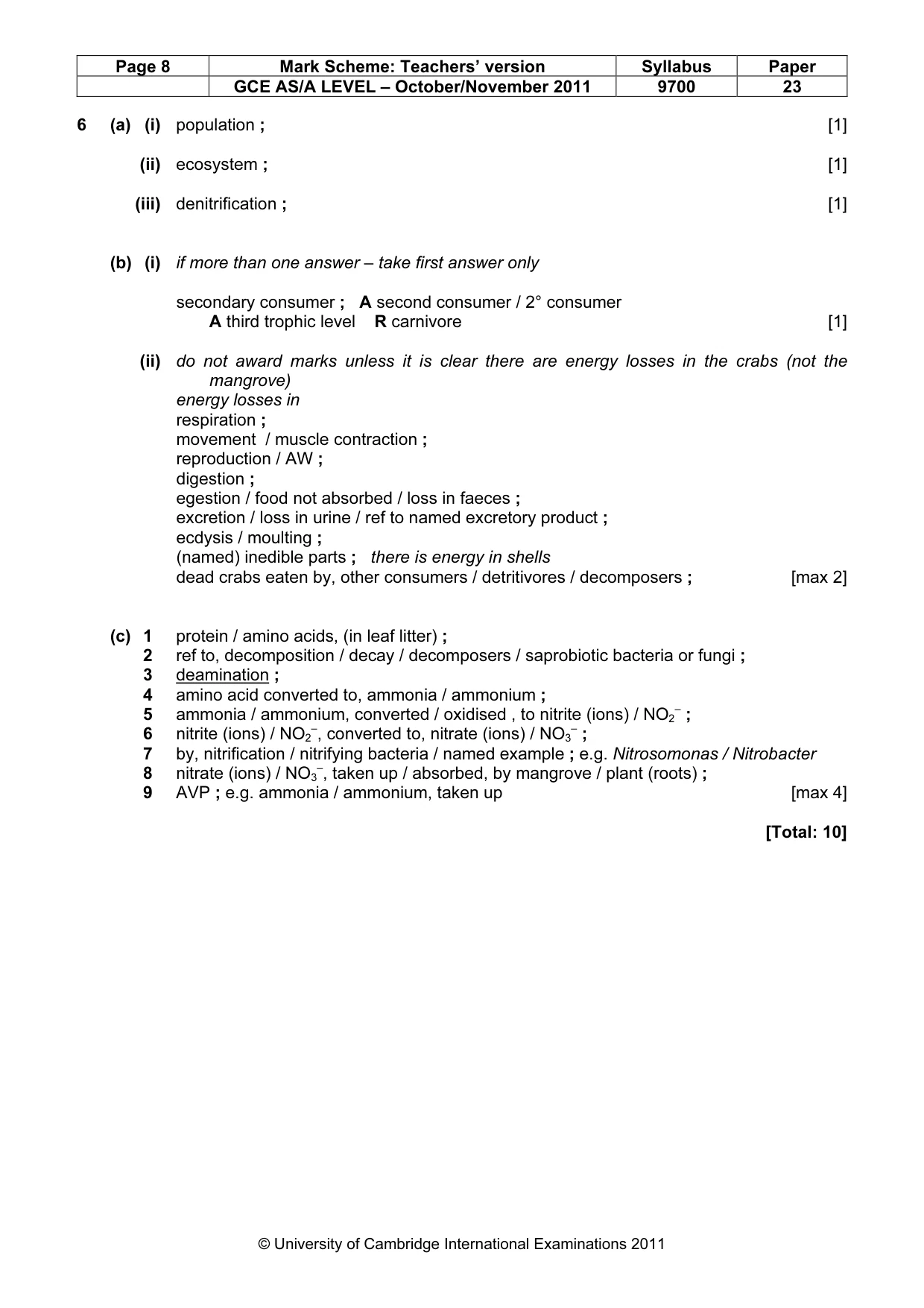
Page 8 Mark Scheme: Teachers’ version Syllabus Paper GCE AS/A LEVEL – October/November 2011 9700 23 © University of Cambridge International Examinations 2011 6 (a) (i) population ; [1] (ii) ecosystem ; [1] (iii) denitrification ; [1] (b) (i) if more than one answer – take first answer only secondary consumer ; A second consumer / 2° consumer A third trophic level R carnivore [1] (ii) do not award marks unless it is clear there are energy losses in the crabs (not the mangrove) energy losses in respiration ; movement / muscle contraction ; reproduction / AW ; digestion ; egestion / food not absorbed / loss in faeces ; excretion / loss in urine / ref to named excretory product ; ecdysis / moulting ; (named) inedible parts ; there is energy in shells dead crabs eaten by, other consumers / detritivores / decomposers ; [max 2] (c) 1 protein / amino acids, (in leaf litter) ; 2 ref to, decomposition / decay / decomposers / saprobiotic bacteria or fungi ; 3 deamination ; 4 amino acid converted to, ammonia / ammonium ; 5 ammonia / ammonium, converted / oxidised , to nitrite (ions) / NO2 – ; 6 nitrite (ions) / NO2 –, converted to, nitrate (ions) / NO3 – ; 7 by, nitrification / nitrifying bacteria / named example ; e.g. Nitrosomonas / Nitrobacter 8 nitrate (ions) / NO3 –, taken up / absorbed, by mangrove / plant (roots) ; 9 AVP ; e.g. ammonia / ammonium, taken up [max 4] [Total: 10]
What you needed in this session
Cambridge’s own grade thresholds for 2011 Oct/Nov, Paper 2 · Variant 3. A higher threshold means an easier paper — the bar moves with how the cohort did.