Cambridge A Level Biology 9700 — 2011 Oct/Nov Paper 2 · Variant 1
9700/21/O/N/11 · 60 marks · ≈68 min
The question paper and its mark scheme, free to read here and free to download. This is Cambridge’s own paper, exactly as it was sat.
Question paper16 pages
Mark scheme8 pages
Answers below. Sit the paper first if you are practising.
Paper as text
Question paper, page 1
This document consists of 15 printed pages and 1 blank page. DC (KN/DJ) 34115/5 © UCLES 2011 [Turn over UNIVERSITY OF CAMBRIDGE INTERNATIONAL EXAMINATIONS General Certificate of Education Advanced Subsidiary Level and Advanced Level READ THESE INSTRUCTIONS FIRST Write your Centre number, candidate number and name in the spaces provided at the top of this page. Write in dark blue or black ink. You may use a soft pencil for any diagrams, graphs or rough working. Do not use staples, paper clips, highlighters, glue or correction fluid. DO NOT WRITE IN ANY BARCODES. Answer all questions. At the end of the examination, fasten all your work securely together. The number of marks is given in brackets [ ] at the end of each question or part question. * 9 6 2 2 9 4 9 8 9 5 * BIOLOGY 9700/21 Paper 2 Structured Questions AS October/November 2011 1 hour 15 minutes Candidates answer on the Question Paper. No Additional Materials are required. For Examiner’s Use 1 2 3 4 5 6 Total
Question paper, page 2
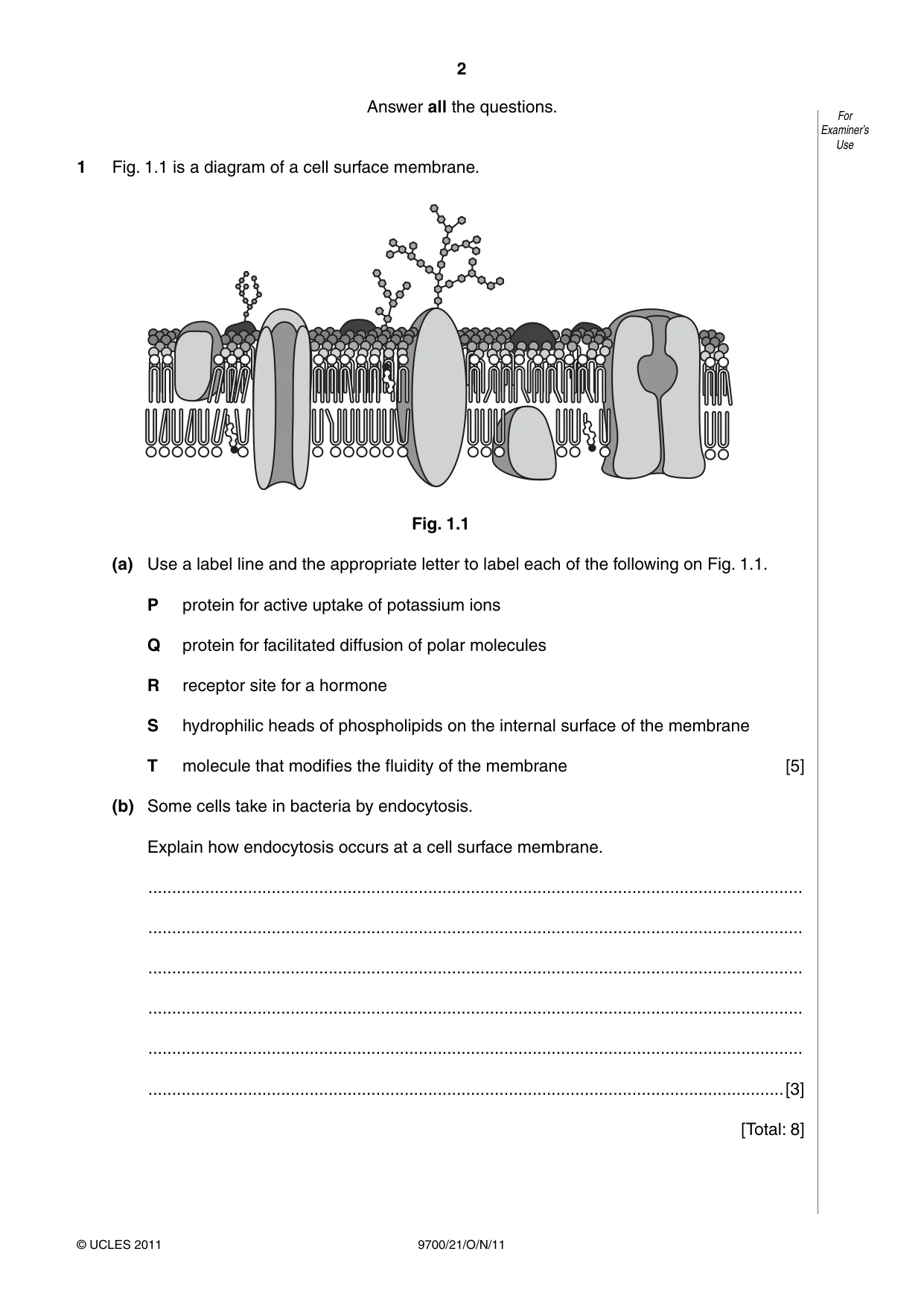
2 9700/21/O/N/11 © UCLES 2011 For Examiner’s Use Answer all the questions. 1 Fig. 1.1 is a diagram of a cell surface membrane. Fig. 1.1 (a) Use a label line and the appropriate letter to label each of the following on Fig. 1.1. P protein for active uptake of potassium ions Q protein for facilitated diffusion of polar molecules R receptor site for a hormone S hydrophilic heads of phospholipids on the internal surface of the membrane T molecule that modifies the fluidity of the membrane [5] (b) Some cells take in bacteria by endocytosis. Explain how endocytosis occurs at a cell surface membrane. … … … … … …[3] [Total: 8]
Question paper, page 3
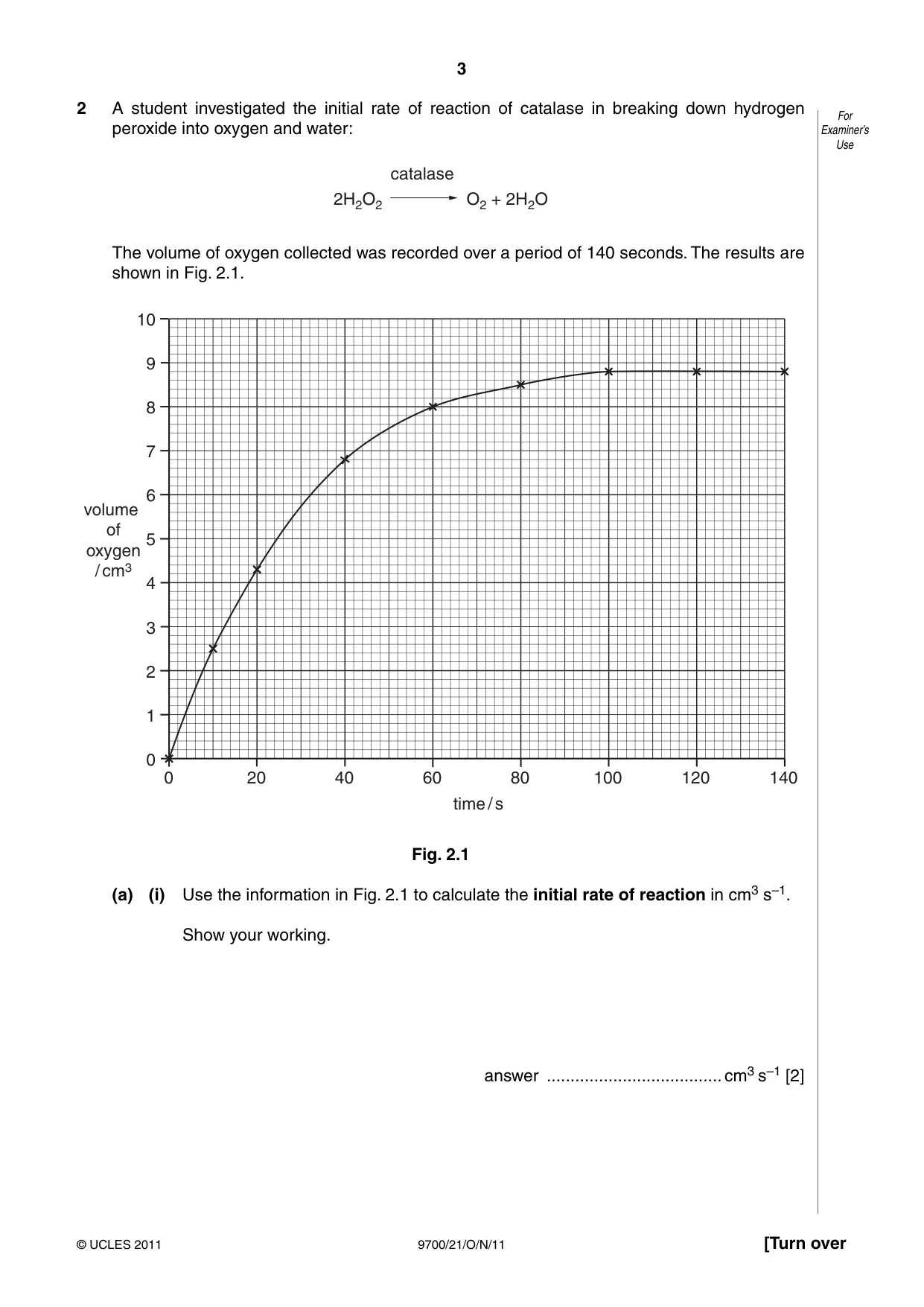
3 [Turn over 9700/21/O/N/11 © UCLES 2011 For Examiner’s Use 2 A student investigated the initial rate of reaction of catalase in breaking down hydrogen peroxide into oxygen and water: 2H2O2 O2 + 2H2O catalase The volume of oxygen collected was recorded over a period of 140 seconds. The results are shown in Fig. 2.1. 0 0 20 40 60 time / s 80 100 120 140 1 2 3 4 5 6 7 8 9 10 volume of oxygen / cm3 Fig. 2.1 (a) (i) Use the information in Fig. 2.1 to calculate the initial rate of reaction in cm3 s–1. Show your working. answer …cm3 s–1 [2]
Question paper, page 4
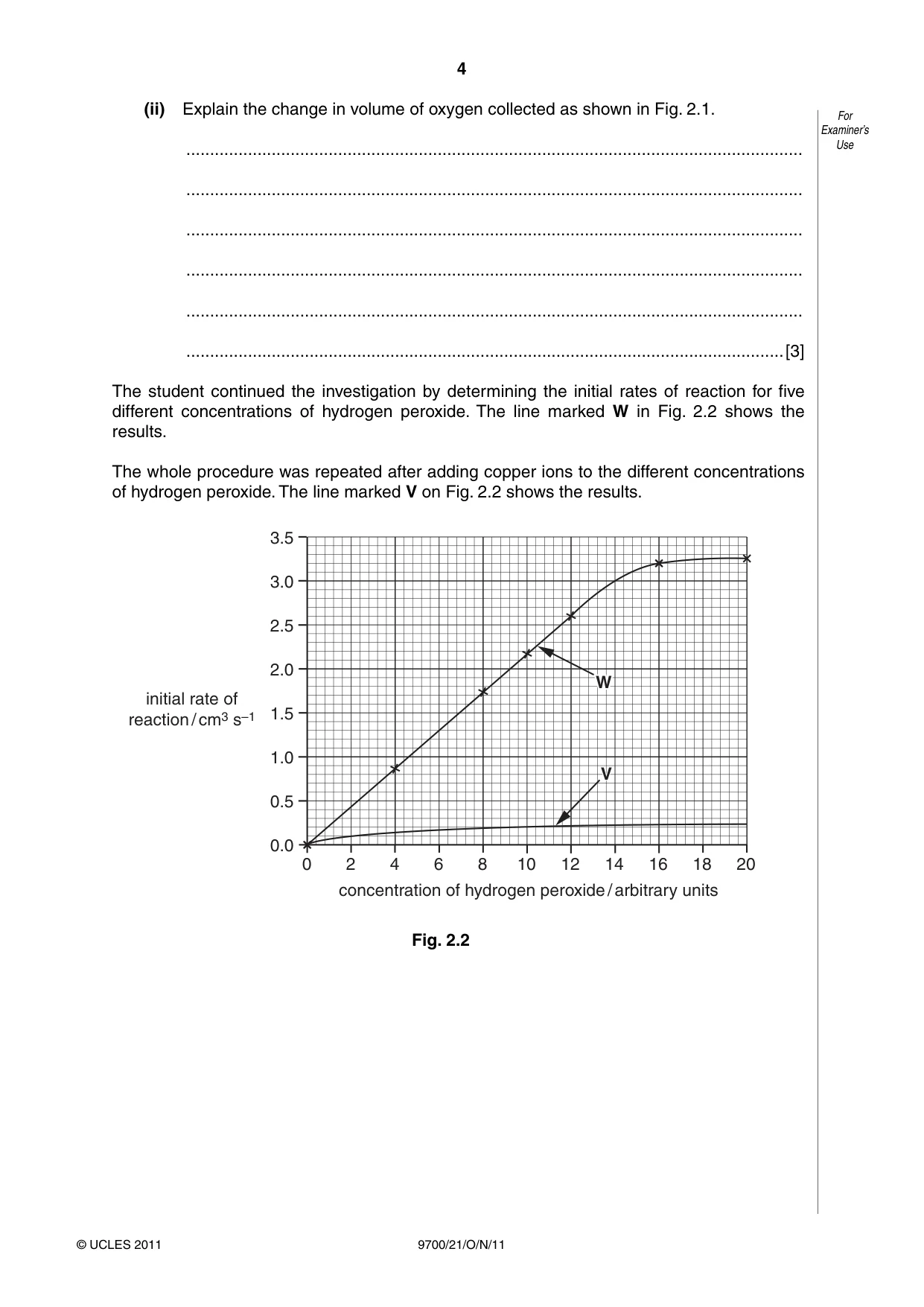
4 9700/21/O/N/11 © UCLES 2011 For Examiner’s Use (ii) Explain the change in volume of oxygen collected as shown in Fig. 2.1. … … … … … …[3] The student continued the investigation by determining the initial rates of reaction for five different concentrations of hydrogen peroxide. The line marked W in Fig. 2.2 shows the results. The whole procedure was repeated after adding copper ions to the different concentrations of hydrogen peroxide. The line marked V on Fig. 2.2 shows the results. 0.0 0 4 8 12 concentration of hydrogen peroxide / arbitrary units 16 20 2 6 10 14 18 0.5 1.0 1.5 2.0 2.5 3.0 3.5 initial rate of reaction / cm3 s–1 W V W V Fig. 2.2
Question paper, page 5
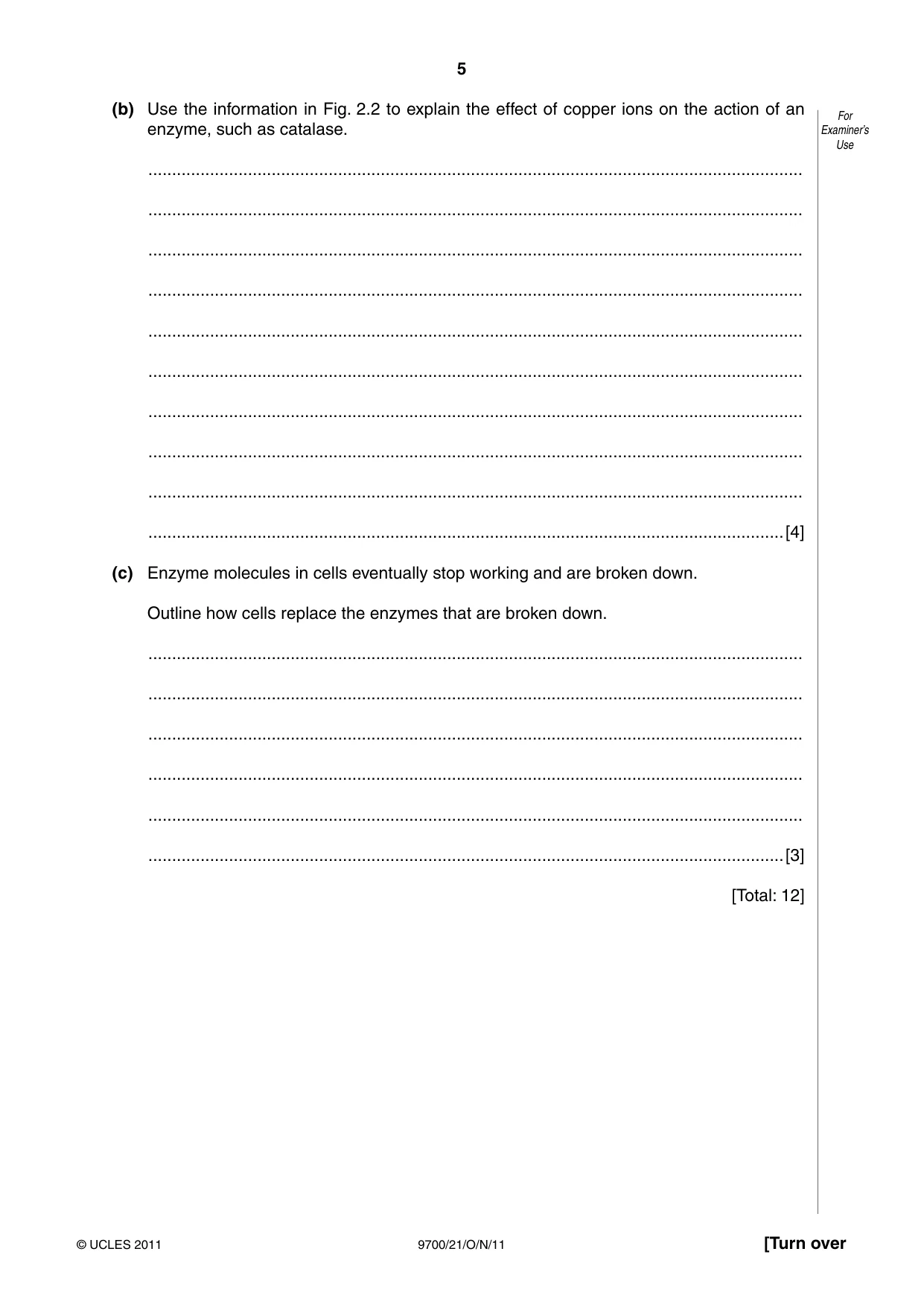
5 [Turn over 9700/21/O/N/11 © UCLES 2011 For Examiner’s Use (b) Use the information in Fig. 2.2 to explain the effect of copper ions on the action of an enzyme, such as catalase. … … … … … … … … … …[4] (c) Enzyme molecules in cells eventually stop working and are broken down. Outline how cells replace the enzymes that are broken down. … … … … … …[3] [Total: 12]
Question paper, page 6
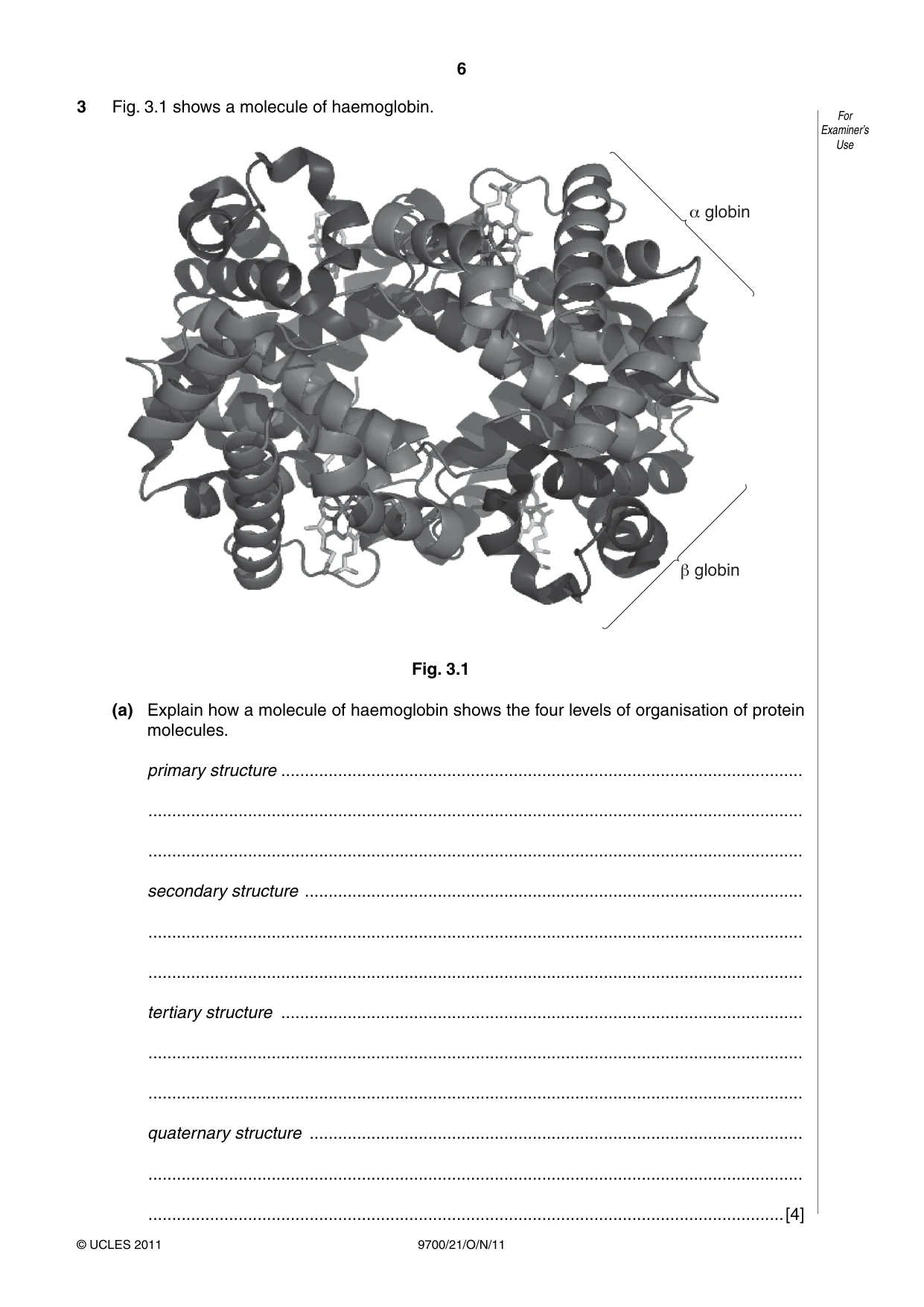
6 9700/21/O/N/11 © UCLES 2011 For Examiner’s Use 3 Fig. 3.1 shows a molecule of haemoglobin. β globin α globin Fig. 3.1 (a) Explain how a molecule of haemoglobin shows the four levels of organisation of protein molecules. primary structure … … … secondary structure … … … tertiary structure … … … quaternary structure … … …[4]
Question paper, page 7
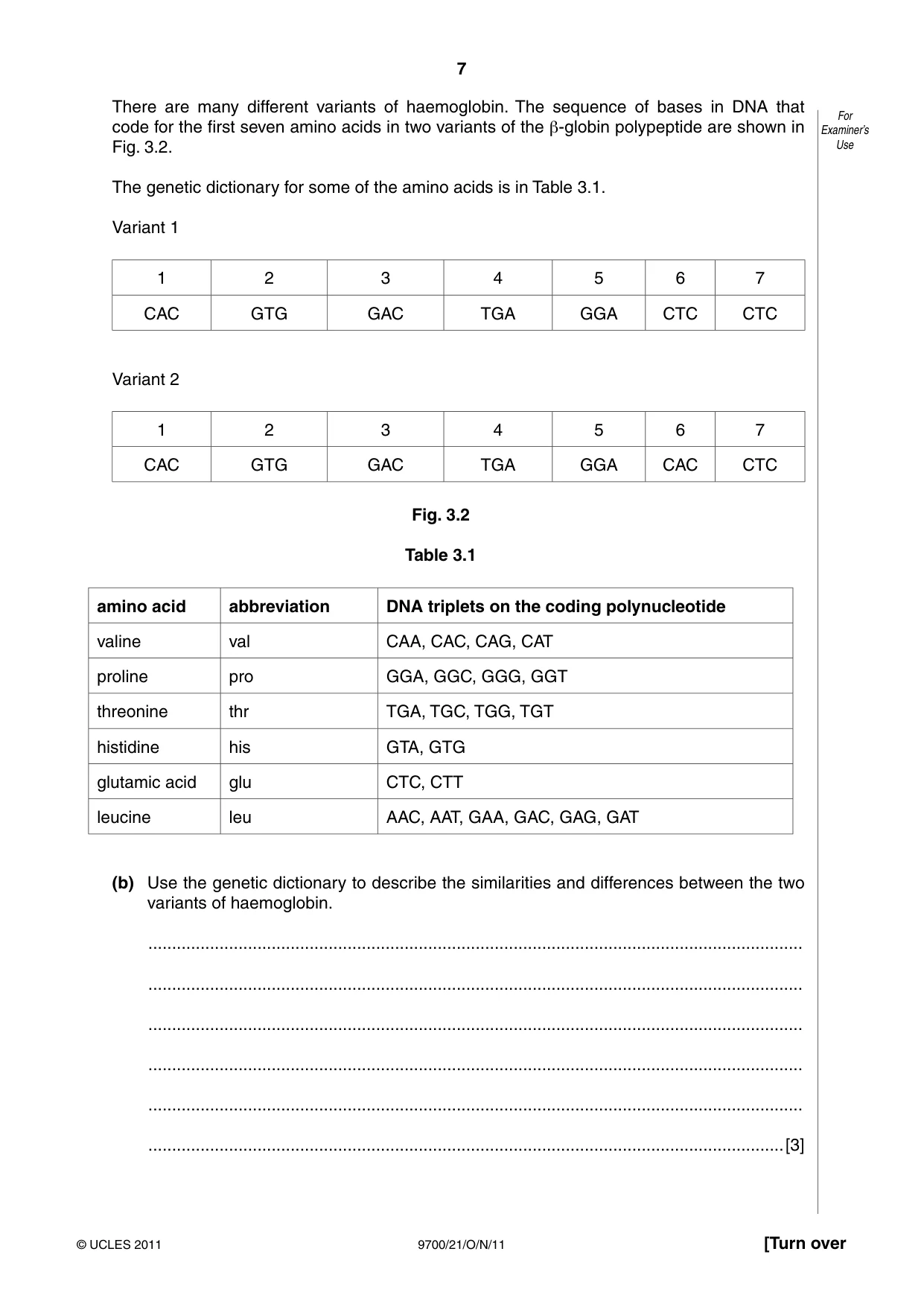
7 [Turn over 9700/21/O/N/11 © UCLES 2011 For Examiner’s Use There are many different variants of haemoglobin. The sequence of bases in DNA that code for the first seven amino acids in two variants of the β-globin polypeptide are shown in Fig. 3.2. The genetic dictionary for some of the amino acids is in Table 3.1. Variant 1 1 2 3 4 5 6 7 CAC GTG GAC TGA GGA CTC CTC Variant 2 1 2 3 4 5 6 7 CAC GTG GAC TGA GGA CAC CTC Fig. 3.2 Table 3.1 amino acid abbreviation DNA triplets on the coding polynucleotide valine val CAA, CAC, CAG, CAT proline pro GGA, GGC, GGG, GGT threonine thr TGA, TGC, TGG, TGT histidine his GTA, GTG glutamic acid glu CTC, CTT leucine leu AAC, AAT, GAA, GAC, GAG, GAT (b) Use the genetic dictionary to describe the similarities and differences between the two variants of haemoglobin. … … … … … …[3]
Question paper, page 8
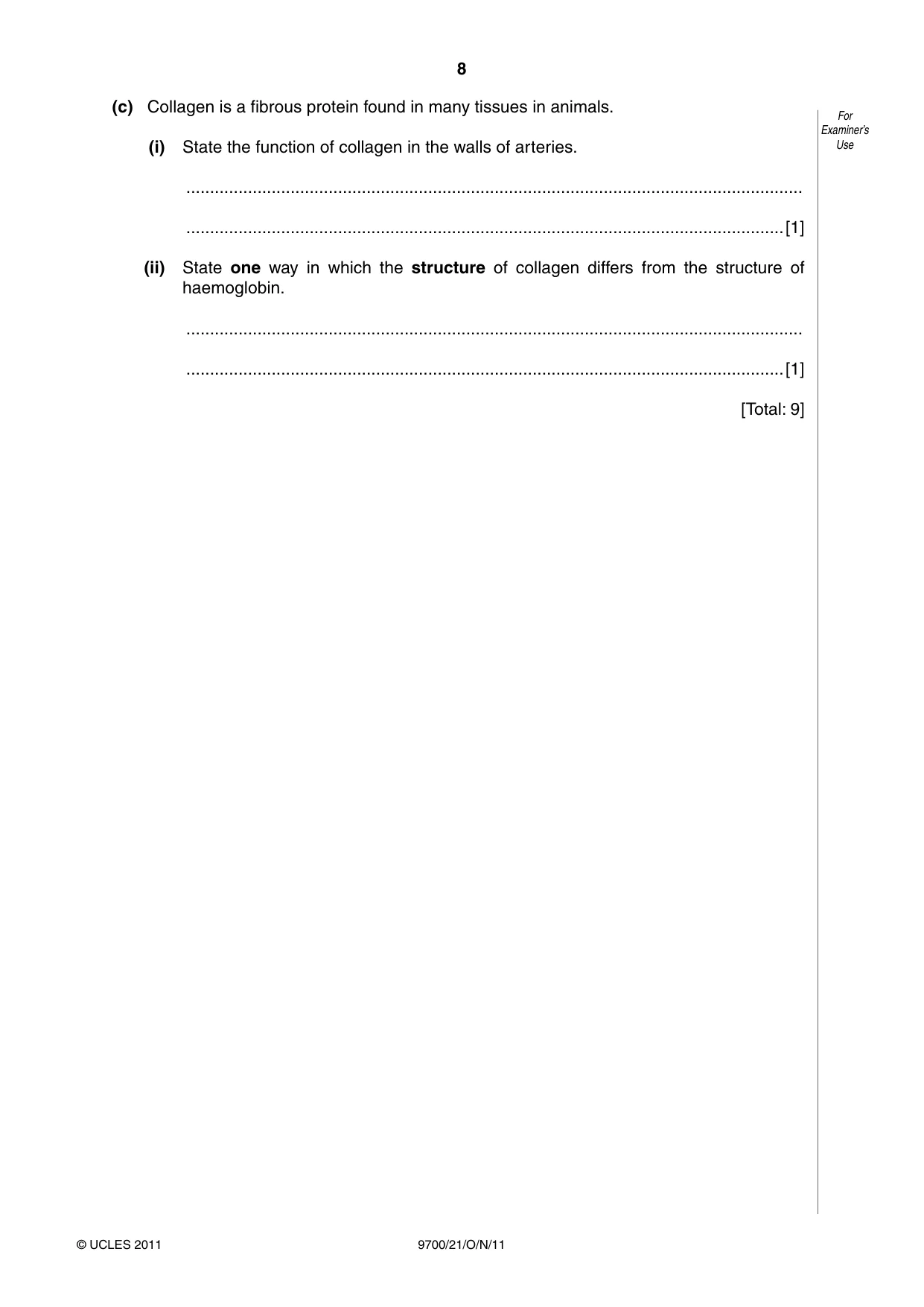
8 9700/21/O/N/11 © UCLES 2011 For Examiner’s Use (c) Collagen is a fibrous protein found in many tissues in animals. (i) State the function of collagen in the walls of arteries. … …[1] (ii) State one way in which the structure of collagen differs from the structure of haemoglobin. … …[1] [Total: 9]
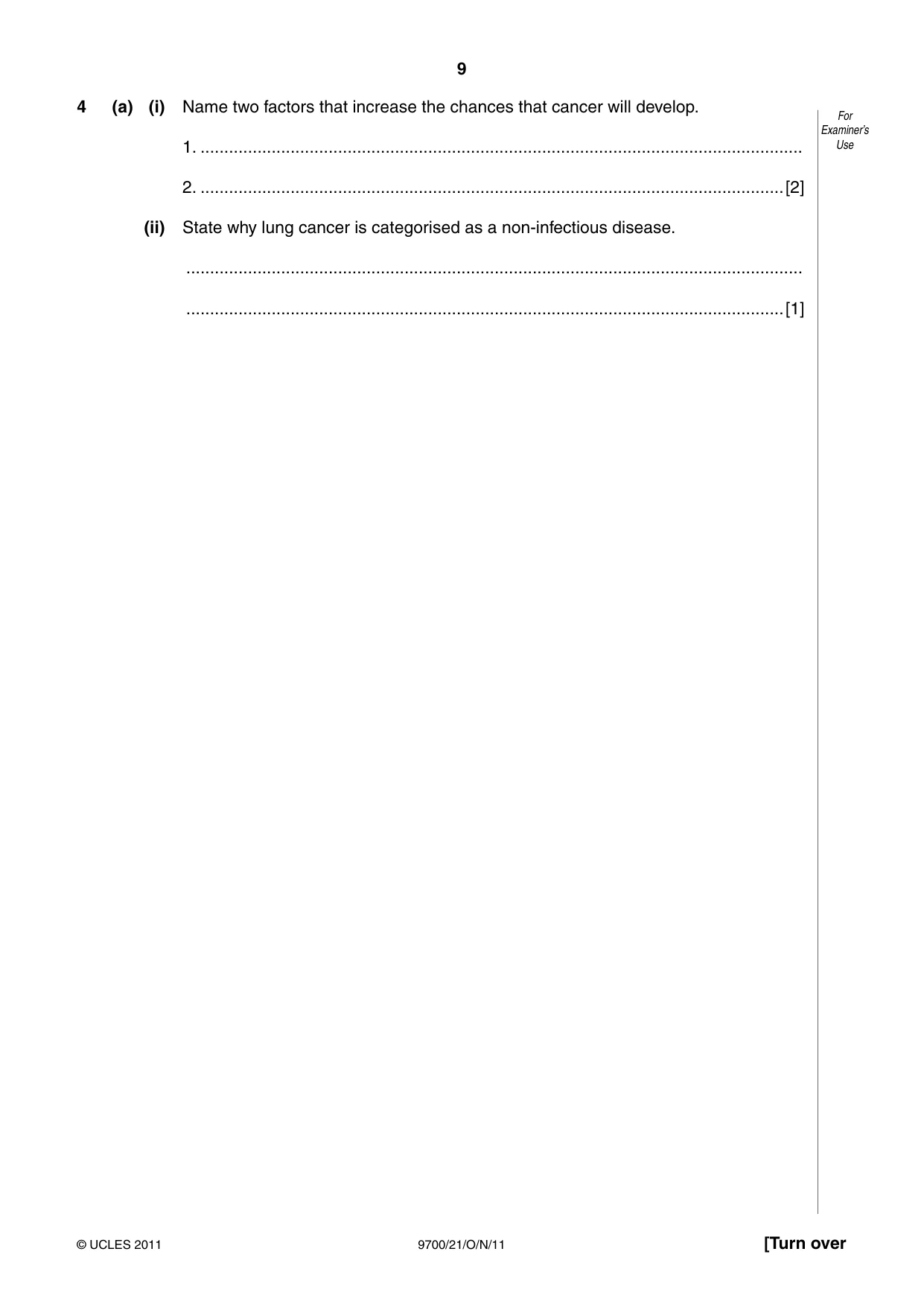
Question paper, page 9
9 [Turn over 9700/21/O/N/11 © UCLES 2011 For Examiner’s Use 4 (a) (i) Name two factors that increase the chances that cancer will develop. 1. … 2. …[2] (ii) State why lung cancer is categorised as a non-infectious disease. … …[1]
Question paper, page 10
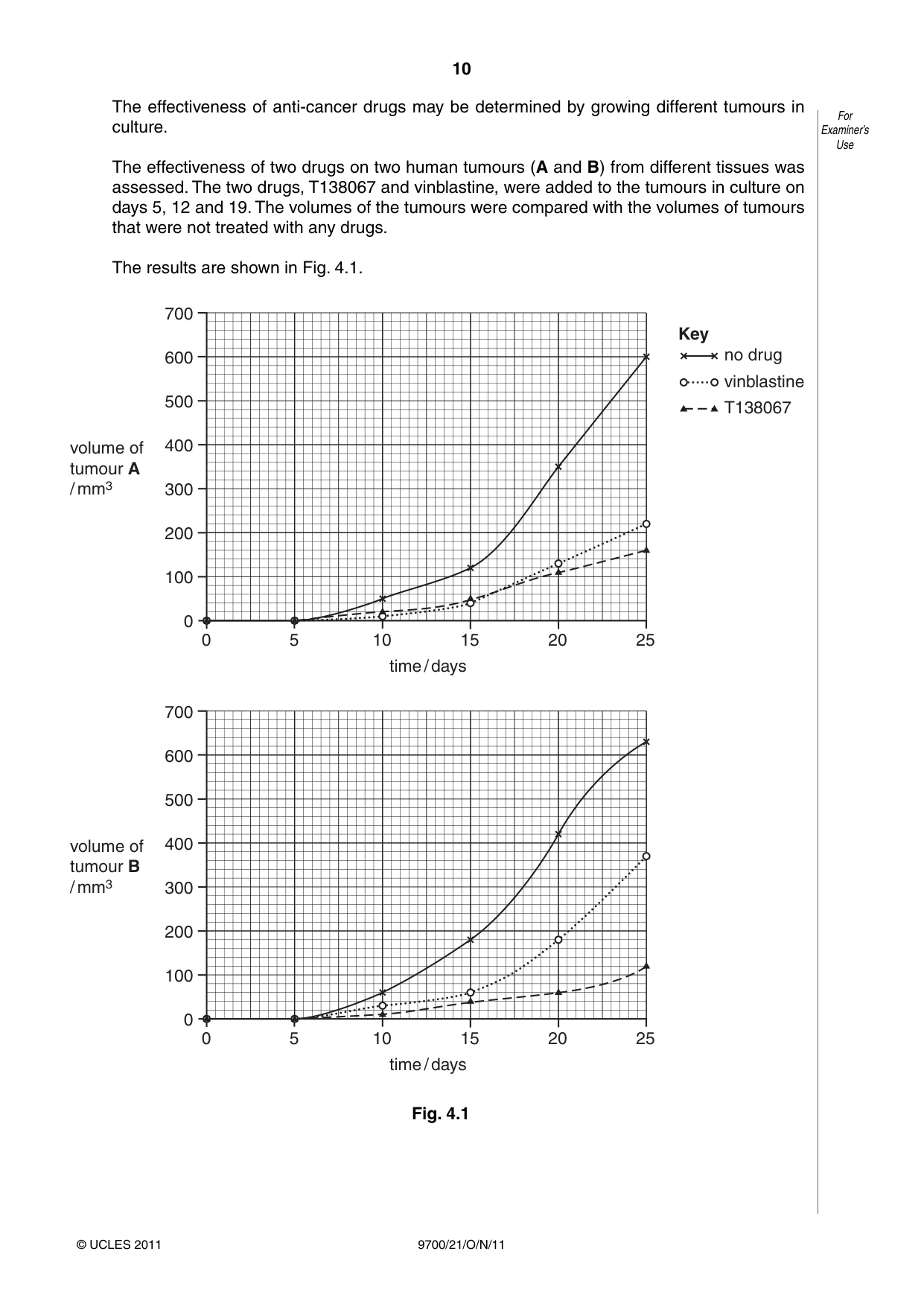
10 9700/21/O/N/11 © UCLES 2011 For Examiner’s Use The effectiveness of anti-cancer drugs may be determined by growing different tumours in culture. The effectiveness of two drugs on two human tumours (A and B) from different tissues was assessed. The two drugs, T138067 and vinblastine, were added to the tumours in culture on days 5, 12 and 19. The volumes of the tumours were compared with the volumes of tumours that were not treated with any drugs. The results are shown in Fig. 4.1. 0 0 5 10 15 time / days 20 25 100 200 300 400 500 600 700 Key volume of tumour A / mm3 no drug vinblastine T138067 0 0 5 10 15 time / days 20 25 100 200 300 400 500 600 700 volume of tumour B / mm3 Fig. 4.1
Question paper, page 11
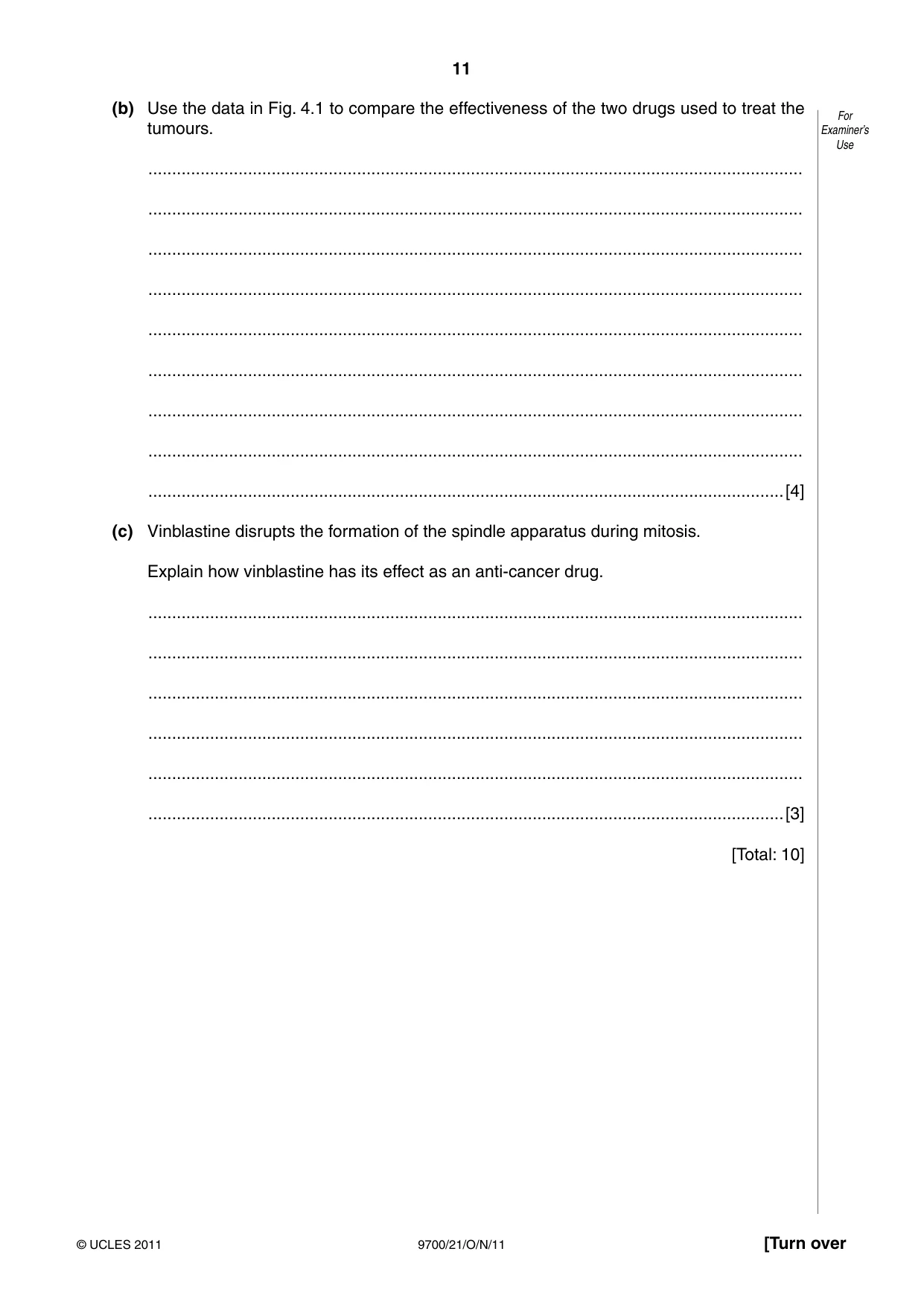
11 [Turn over 9700/21/O/N/11 © UCLES 2011 For Examiner’s Use (b) Use the data in Fig. 4.1 to compare the effectiveness of the two drugs used to treat the tumours. … … … … … … … … …[4] (c) Vinblastine disrupts the formation of the spindle apparatus during mitosis. Explain how vinblastine has its effect as an anti-cancer drug. … … … … … …[3] [Total: 10]
Question paper, page 12
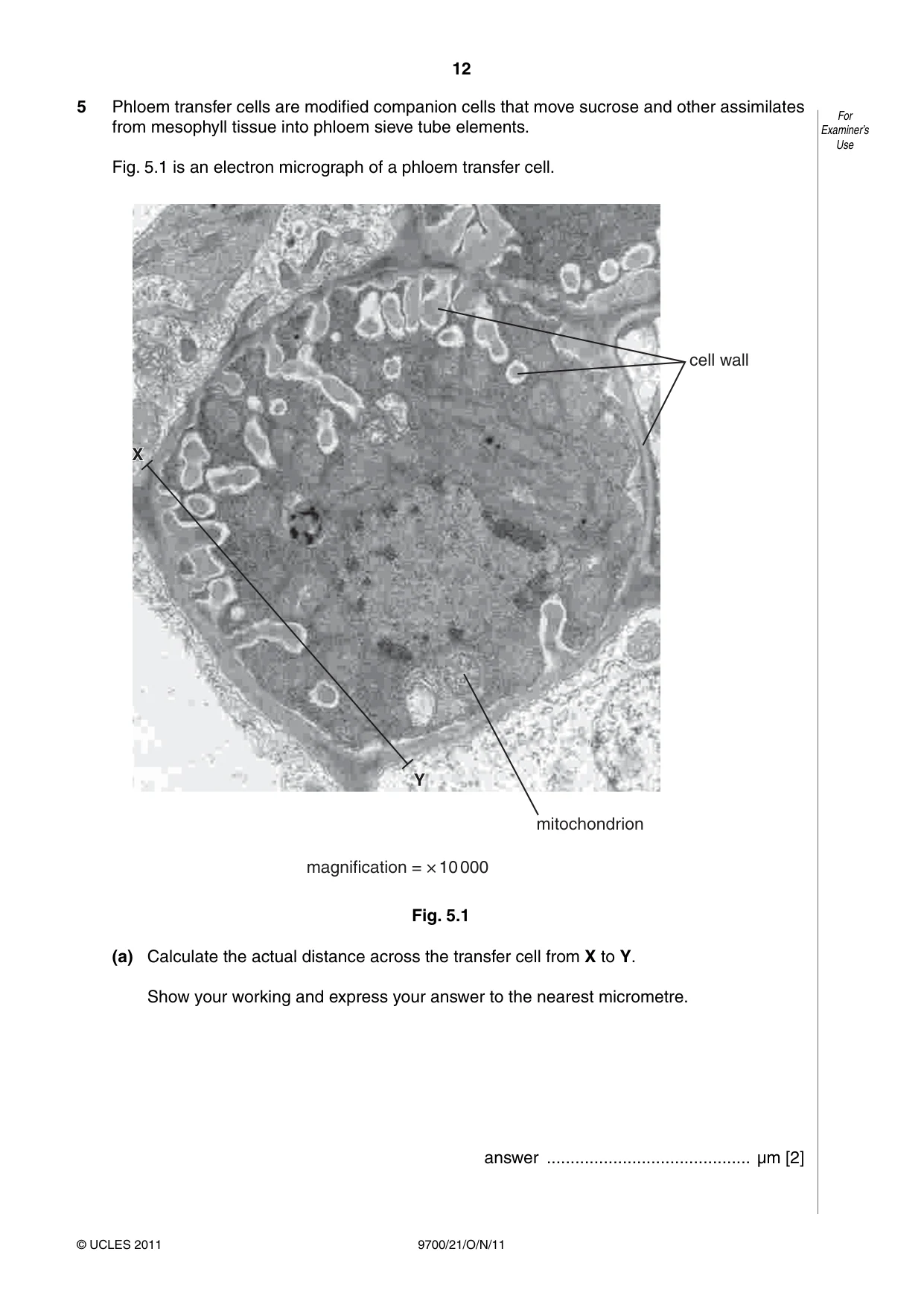
12 9700/21/O/N/11 © UCLES 2011 For Examiner’s Use 5 Phloem transfer cells are modified companion cells that move sucrose and other assimilates from mesophyll tissue into phloem sieve tube elements. Fig. 5.1 is an electron micrograph of a phloem transfer cell. X Y X Y cell wall mitochondrion magnification = × 10 000 Fig. 5.1 (a) Calculate the actual distance across the transfer cell from X to Y. Show your working and express your answer to the nearest micrometre. answer … µm [2]
Question paper, page 13
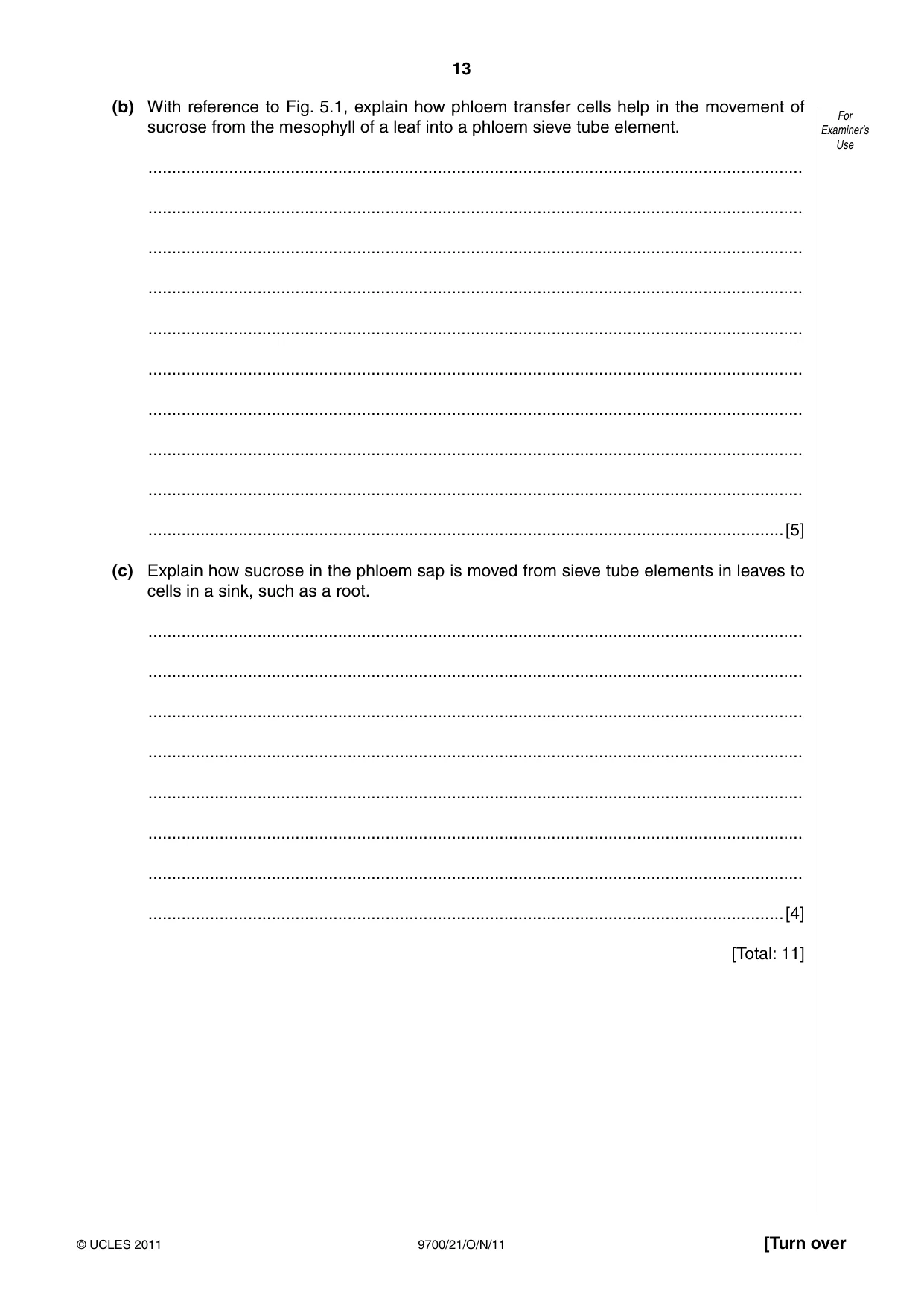
13 [Turn over 9700/21/O/N/11 © UCLES 2011 For Examiner’s Use (b) With reference to Fig. 5.1, explain how phloem transfer cells help in the movement of sucrose from the mesophyll of a leaf into a phloem sieve tube element. … … … … … … … … … …[5] (c) Explain how sucrose in the phloem sap is moved from sieve tube elements in leaves to cells in a sink, such as a root. … … … … … … … …[4] [Total: 11]
Question paper, page 14
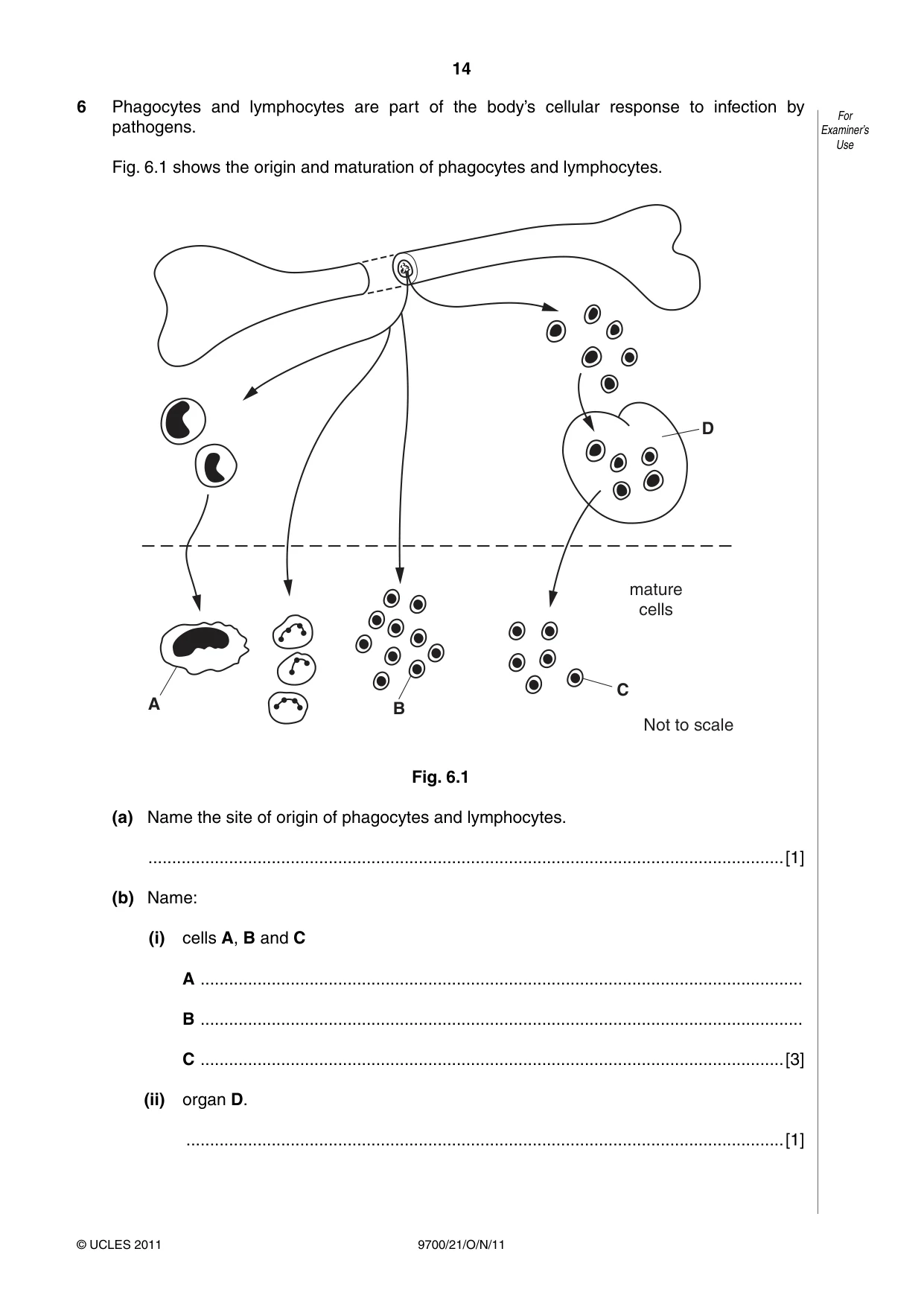
14 9700/21/O/N/11 © UCLES 2011 For Examiner’s Use 6 Phagocytes and lymphocytes are part of the body’s cellular response to infection by pathogens. Fig. 6.1 shows the origin and maturation of phagocytes and lymphocytes. D C B A mature cells Not to scale Fig. 6.1 (a) Name the site of origin of phagocytes and lymphocytes. …[1] (b) Name: (i) cells A, B and C A … B … C …[3] (ii) organ D. …[1]
Question paper, page 15
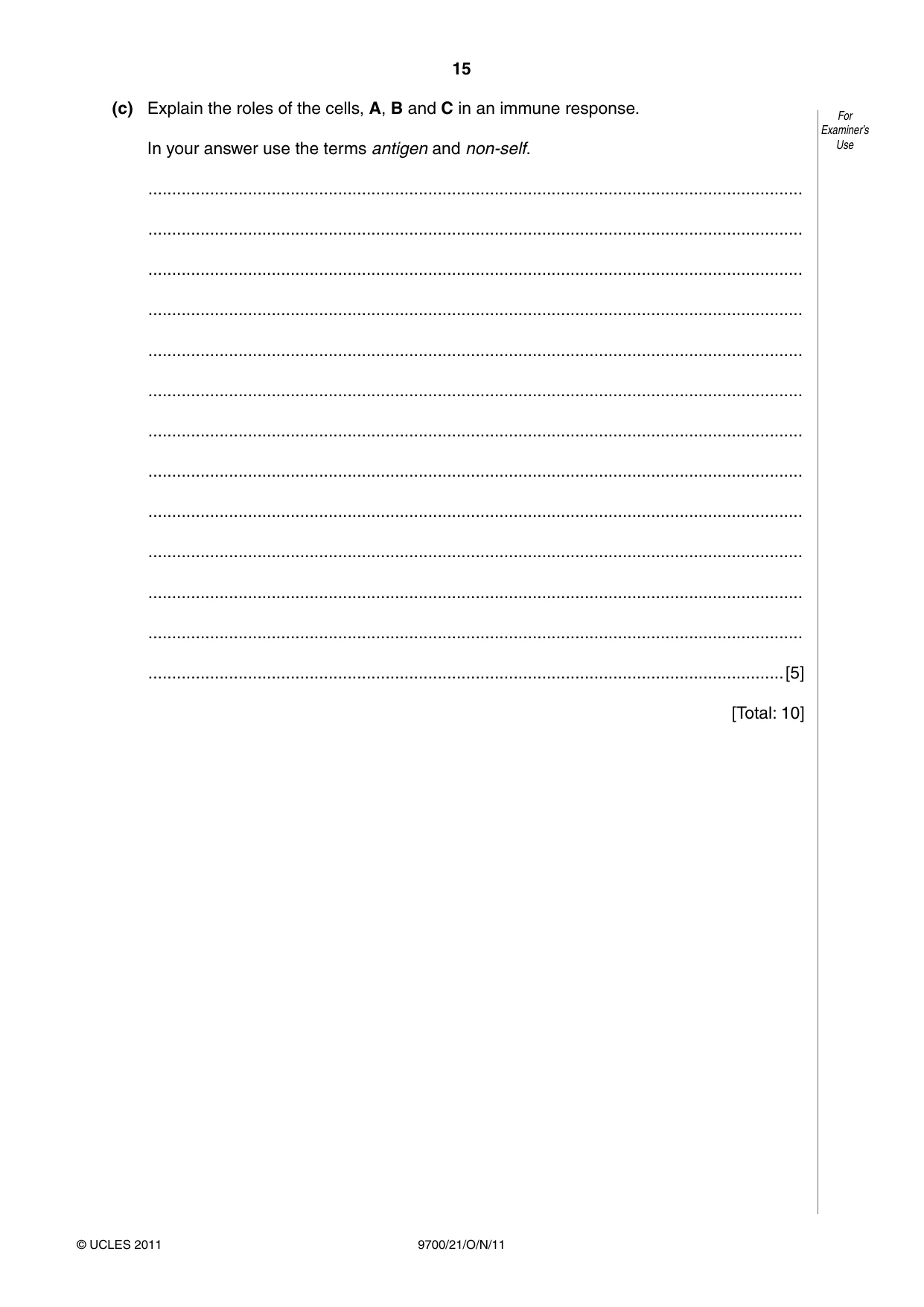
15 9700/21/O/N/11 © UCLES 2011 For Examiner’s Use (c) Explain the roles of the cells, A, B and C in an immune response. In your answer use the terms antigen and non-self. … … … … … … … … … … … … …[5] [Total: 10]
Question paper, page 16
16 9700/21/O/N/11 © UCLES 2011 BLANK PAGE Copyright Acknowledgements: Question 5, Fig. 5.1 © “Plant Cell Biology on DVD”; 2007; by B E S Gunning; www.plantcellbiologdvdyon.com. Permission to reproduce items where third-party owned material protected by copyright is included has been sought and cleared where possible. Every reasonable effort has been made by the publisher (UCLES) to trace copyright holders, but if any items requiring clearance have unwittingly been included, the publisher will be pleased to make amends at the earliest possible opportunity. University of Cambridge International Examinations is part of the Cambridge Assessment Group. Cambridge Assessment is the brand name of University of Cambridge Local Examinations Syndicate (UCLES), which is itself a department of the University of Cambridge.
Mark scheme, page 1
UNIVERSITY OF CAMBRIDGE INTERNATIONAL EXAMINATIONS GCE Advanced Subsidiary Level and GCE Advanced Level MARK SCHEME for the October/November 2011 question paper for the guidance of teachers 9700 BIOLOGY 9700/21 Paper 2 (AS Structured Questions), maximum raw mark 60 This mark scheme is published as an aid to teachers and candidates, to indicate the requirements of the examination. It shows the basis on which Examiners were instructed to award marks. It does not indicate the details of the discussions that took place at an Examiners’ meeting before marking began, which would have considered the acceptability of alternative answers. Mark schemes must be read in conjunction with the question papers and the report on the examination. • Cambridge will not enter into discussions or correspondence in connection with these mark schemes. Cambridge is publishing the mark schemes for the October/November 2011 question papers for most IGCSE, GCE Advanced Level and Advanced Subsidiary Level syllabuses and some Ordinary Level syllabuses.
Mark scheme, page 2
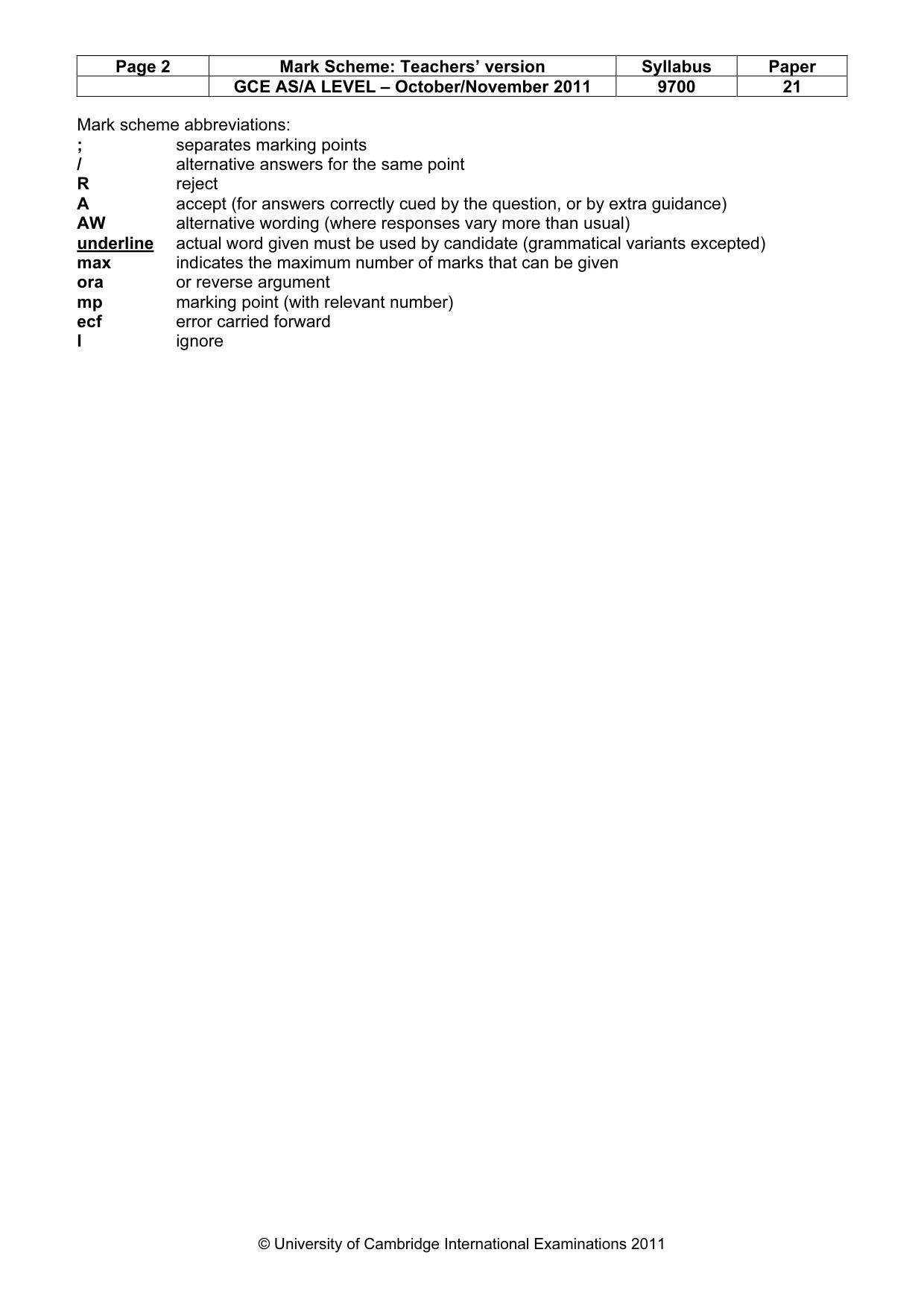
Page 2 Mark Scheme: Teachers’ version Syllabus Paper GCE AS/A LEVEL – October/November 2011 9700 21 © University of Cambridge International Examinations 2011 Mark scheme abbreviations: ; separates marking points / alternative answers for the same point R reject A accept (for answers correctly cued by the question, or by extra guidance) AW alternative wording (where responses vary more than usual) underline actual word given must be used by candidate (grammatical variants excepted) max indicates the maximum number of marks that can be given ora or reverse argument mp marking point (with relevant number) ecf error carried forward I ignore
Mark scheme, page 3
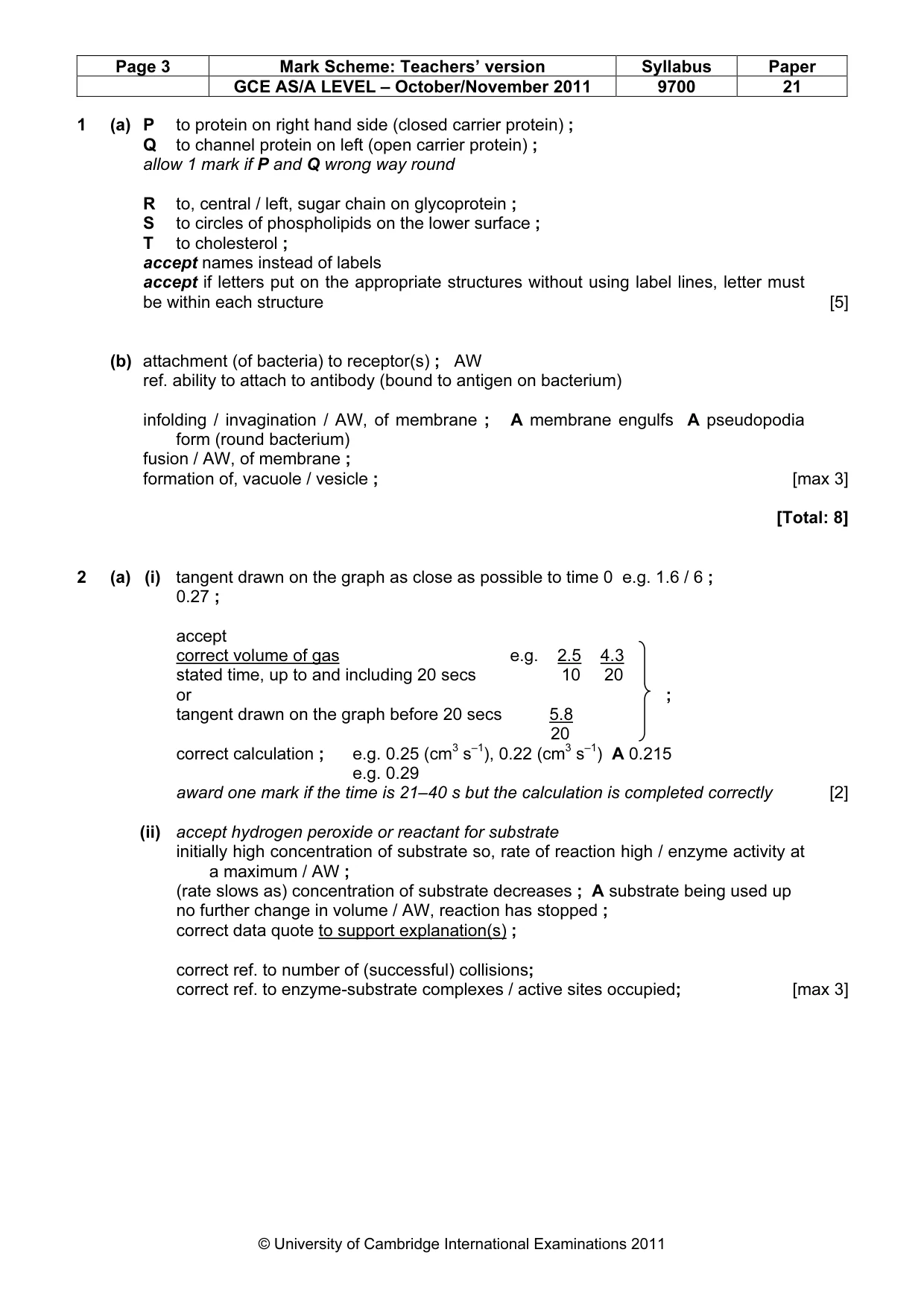
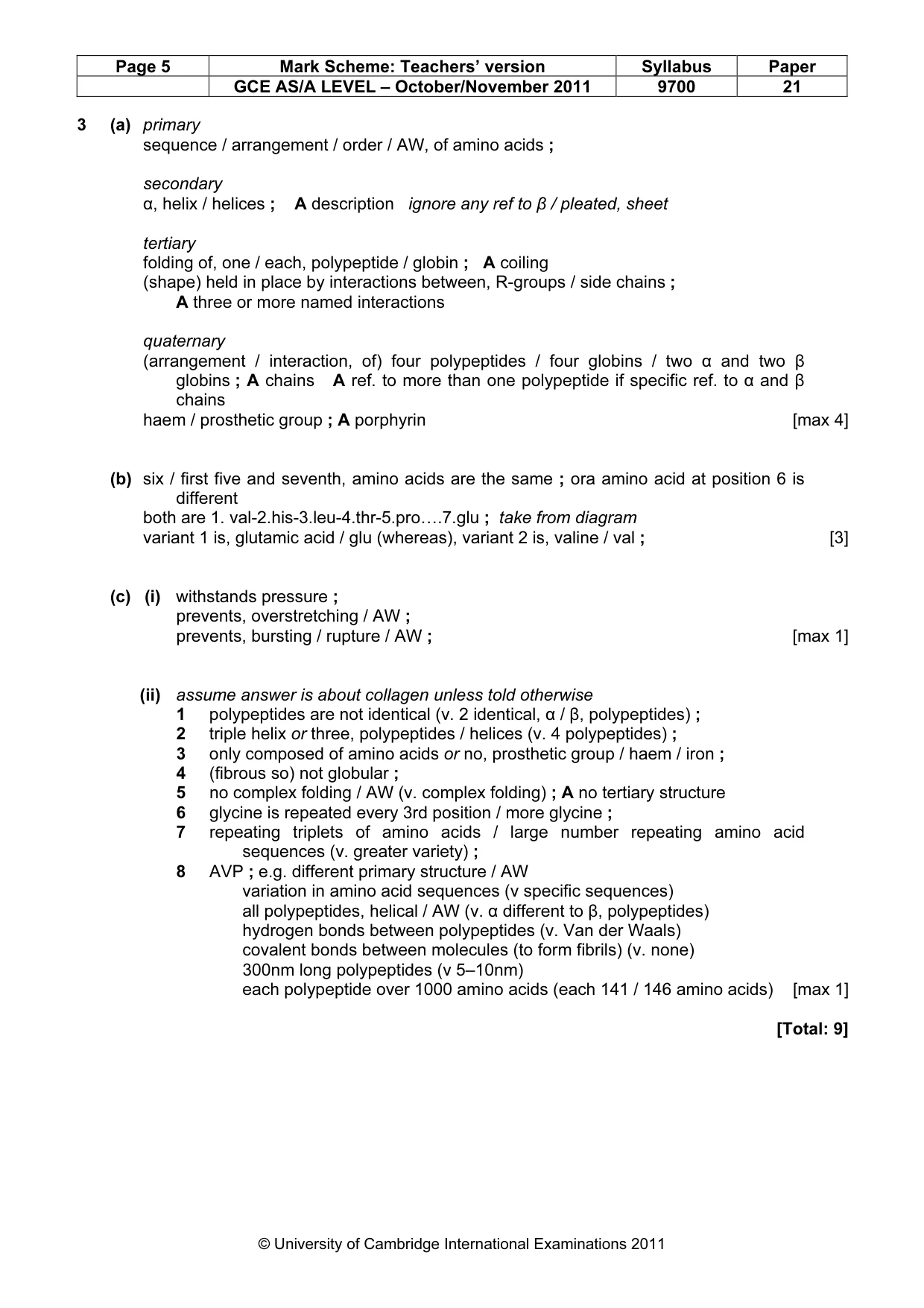
Page 3 Mark Scheme: Teachers’ version Syllabus Paper GCE AS/A LEVEL – October/November 2011 9700 21 © University of Cambridge International Examinations 2011 1 (a) P to protein on right hand side (closed carrier protein) ; Q to channel protein on left (open carrier protein) ; allow 1 mark if P and Q wrong way round R to, central / left, sugar chain on glycoprotein ; S to circles of phospholipids on the lower surface ; T to cholesterol ; accept names instead of labels accept if letters put on the appropriate structures without using label lines, letter must be within each structure [5] (b) attachment (of bacteria) to receptor(s) ; AW ref. ability to attach to antibody (bound to antigen on bacterium) infolding / invagination / AW, of membrane ; A membrane engulfs A pseudopodia form (round bacterium) fusion / AW, of membrane ; formation of, vacuole / vesicle ; [max 3] [Total: 8] 2 (a) (i) tangent drawn on the graph as close as possible to time 0 e.g. 1.6 / 6 ; 0.27 ; accept correct volume of gas e.g. 2.5 4.3 stated time, up to and including 20 secs 10 20 or ; tangent drawn on the graph before 20 secs 5.8 20 correct calculation ; e.g. 0.25 (cm3 s–1), 0.22 (cm3 s–1) A 0.215 e.g. 0.29 award one mark if the time is 21–40 s but the calculation is completed correctly [2] (ii) accept hydrogen peroxide or reactant for substrate initially high concentration of substrate so, rate of reaction high / enzyme activity at a maximum / AW ; (rate slows as) concentration of substrate decreases ; A substrate being used up no further change in volume / AW, reaction has stopped ; correct data quote to support explanation(s) ; correct ref. to number of (successful) collisions; correct ref. to enzyme-substrate complexes / active sites occupied; [max 3]
Mark scheme, page 4
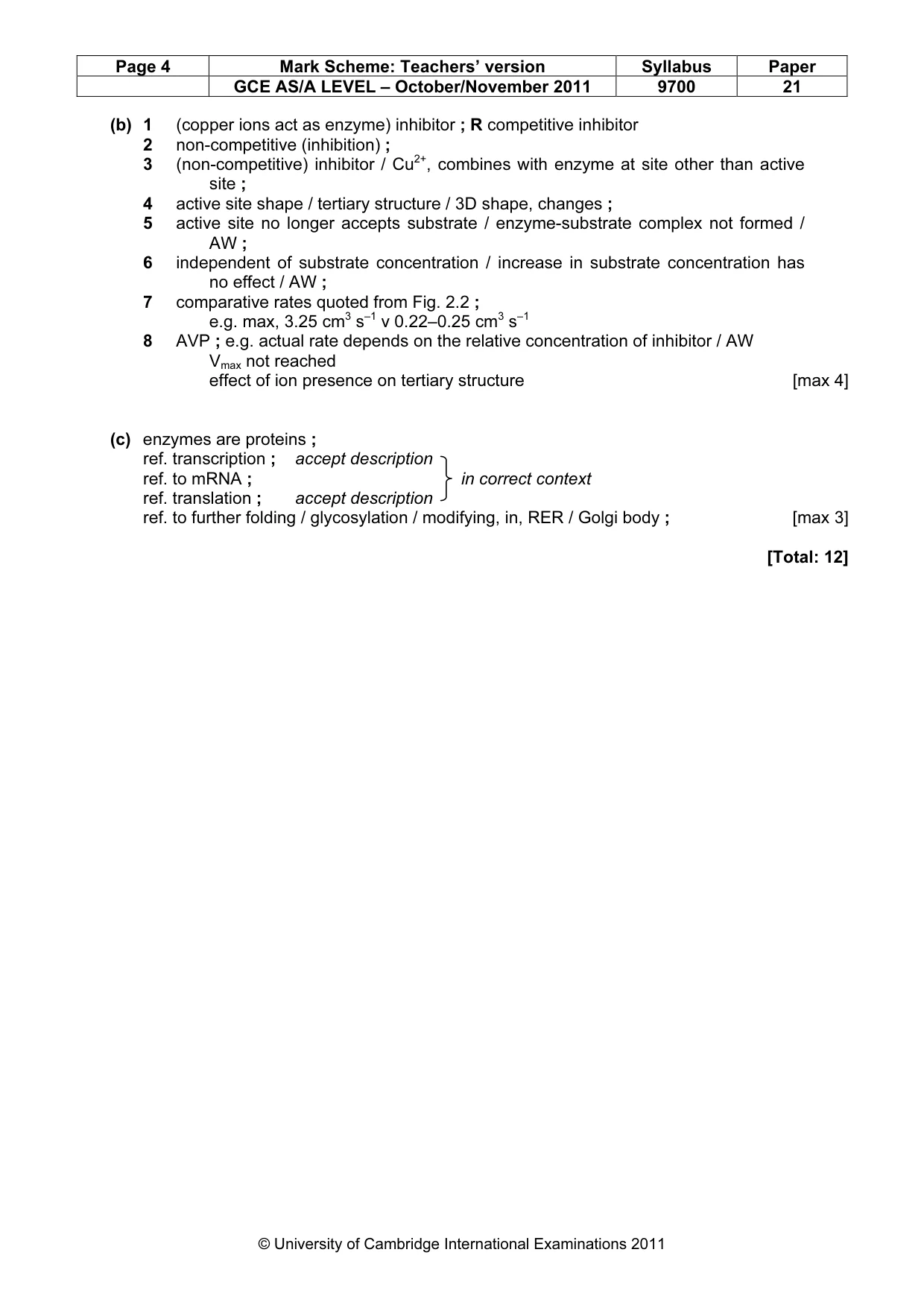
Page 4 Mark Scheme: Teachers’ version Syllabus Paper GCE AS/A LEVEL – October/November 2011 9700 21 © University of Cambridge International Examinations 2011 (b) 1 (copper ions act as enzyme) inhibitor ; R competitive inhibitor 2 non-competitive (inhibition) ; 3 (non-competitive) inhibitor / Cu2+, combines with enzyme at site other than active site ; 4 active site shape / tertiary structure / 3D shape, changes ; 5 active site no longer accepts substrate / enzyme-substrate complex not formed / AW ; 6 independent of substrate concentration / increase in substrate concentration has no effect / AW ; 7 comparative rates quoted from Fig. 2.2 ; e.g. max, 3.25 cm3 s–1 v 0.22–0.25 cm3 s–1 8 AVP ; e.g. actual rate depends on the relative concentration of inhibitor / AW Vmax not reached effect of ion presence on tertiary structure [max 4] (c) enzymes are proteins ; ref. transcription ; accept description ref. to mRNA ; in correct context ref. translation ; accept description ref. to further folding / glycosylation / modifying, in, RER / Golgi body ; [max 3] [Total: 12]
Mark scheme, page 5
Page 5 Mark Scheme: Teachers’ version Syllabus Paper GCE AS/A LEVEL – October/November 2011 9700 21 © University of Cambridge International Examinations 2011 3 (a) primary sequence / arrangement / order / AW, of amino acids ; secondary α, helix / helices ; A description ignore any ref to β / pleated, sheet tertiary folding of, one / each, polypeptide / globin ; A coiling (shape) held in place by interactions between, R-groups / side chains ; A three or more named interactions quaternary (arrangement / interaction, of) four polypeptides / four globins / two α and two β globins ; A chains A ref. to more than one polypeptide if specific ref. to α and β chains haem / prosthetic group ; A porphyrin [max 4] (b) six / first five and seventh, amino acids are the same ; ora amino acid at position 6 is different both are 1. val-2.his-3.leu-4.thr-5.pro….7.glu ; take from diagram variant 1 is, glutamic acid / glu (whereas), variant 2 is, valine / val ; [3] (c) (i) withstands pressure ; prevents, overstretching / AW ; prevents, bursting / rupture / AW ; [max 1] (ii) assume answer is about collagen unless told otherwise 1 polypeptides are not identical (v. 2 identical, α / β, polypeptides) ; 2 triple helix or three, polypeptides / helices (v. 4 polypeptides) ; 3 only composed of amino acids or no, prosthetic group / haem / iron ; 4 (fibrous so) not globular ; 5 no complex folding / AW (v. complex folding) ; A no tertiary structure 6 glycine is repeated every 3rd position / more glycine ; 7 repeating triplets of amino acids / large number repeating amino acid sequences (v. greater variety) ; 8 AVP ; e.g. different primary structure / AW variation in amino acid sequences (v specific sequences) all polypeptides, helical / AW (v. α different to β, polypeptides) hydrogen bonds between polypeptides (v. Van der Waals) covalent bonds between molecules (to form fibrils) (v. none) 300nm long polypeptides (v 5–10nm) each polypeptide over 1000 amino acids (each 141 / 146 amino acids) [max 1] [Total: 9]
Mark scheme, page 6
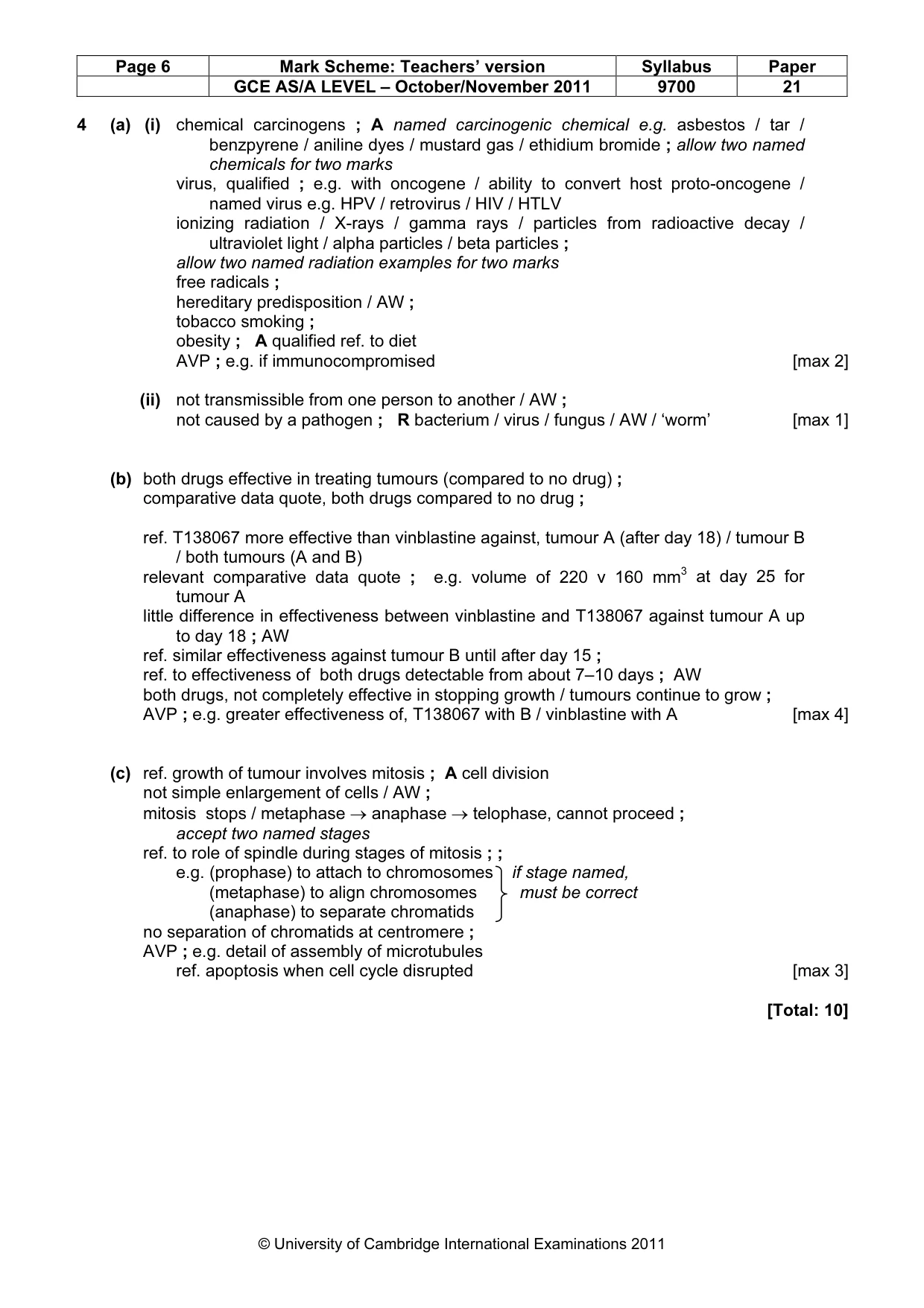
Page 6 Mark Scheme: Teachers’ version Syllabus Paper GCE AS/A LEVEL – October/November 2011 9700 21 © University of Cambridge International Examinations 2011 4 (a) (i) chemical carcinogens ; A named carcinogenic chemical e.g. asbestos / tar / benzpyrene / aniline dyes / mustard gas / ethidium bromide ; allow two named chemicals for two marks virus, qualified ; e.g. with oncogene / ability to convert host proto-oncogene / named virus e.g. HPV / retrovirus / HIV / HTLV ionizing radiation / X-rays / gamma rays / particles from radioactive decay / ultraviolet light / alpha particles / beta particles ; allow two named radiation examples for two marks free radicals ; hereditary predisposition / AW ; tobacco smoking ; obesity ; A qualified ref. to diet AVP ; e.g. if immunocompromised [max 2] (ii) not transmissible from one person to another / AW ; not caused by a pathogen ; R bacterium / virus / fungus / AW / ‘worm’ [max 1] (b) both drugs effective in treating tumours (compared to no drug) ; comparative data quote, both drugs compared to no drug ; ref. T138067 more effective than vinblastine against, tumour A (after day 18) / tumour B / both tumours (A and B) relevant comparative data quote ; e.g. volume of 220 v 160 mm3 at day 25 for tumour A little difference in effectiveness between vinblastine and T138067 against tumour A up to day 18 ; AW ref. similar effectiveness against tumour B until after day 15 ; ref. to effectiveness of both drugs detectable from about 7–10 days ; AW both drugs, not completely effective in stopping growth / tumours continue to grow ; AVP ; e.g. greater effectiveness of, T138067 with B / vinblastine with A [max 4] (c) ref. growth of tumour involves mitosis ; A cell division not simple enlargement of cells / AW ; mitosis stops / metaphase → anaphase → telophase, cannot proceed ; accept two named stages ref. to role of spindle during stages of mitosis ; ; e.g. (prophase) to attach to chromosomes if stage named, (metaphase) to align chromosomes must be correct (anaphase) to separate chromatids no separation of chromatids at centromere ; AVP ; e.g. detail of assembly of microtubules ref. apoptosis when cell cycle disrupted [max 3] [Total: 10]
Mark scheme, page 7
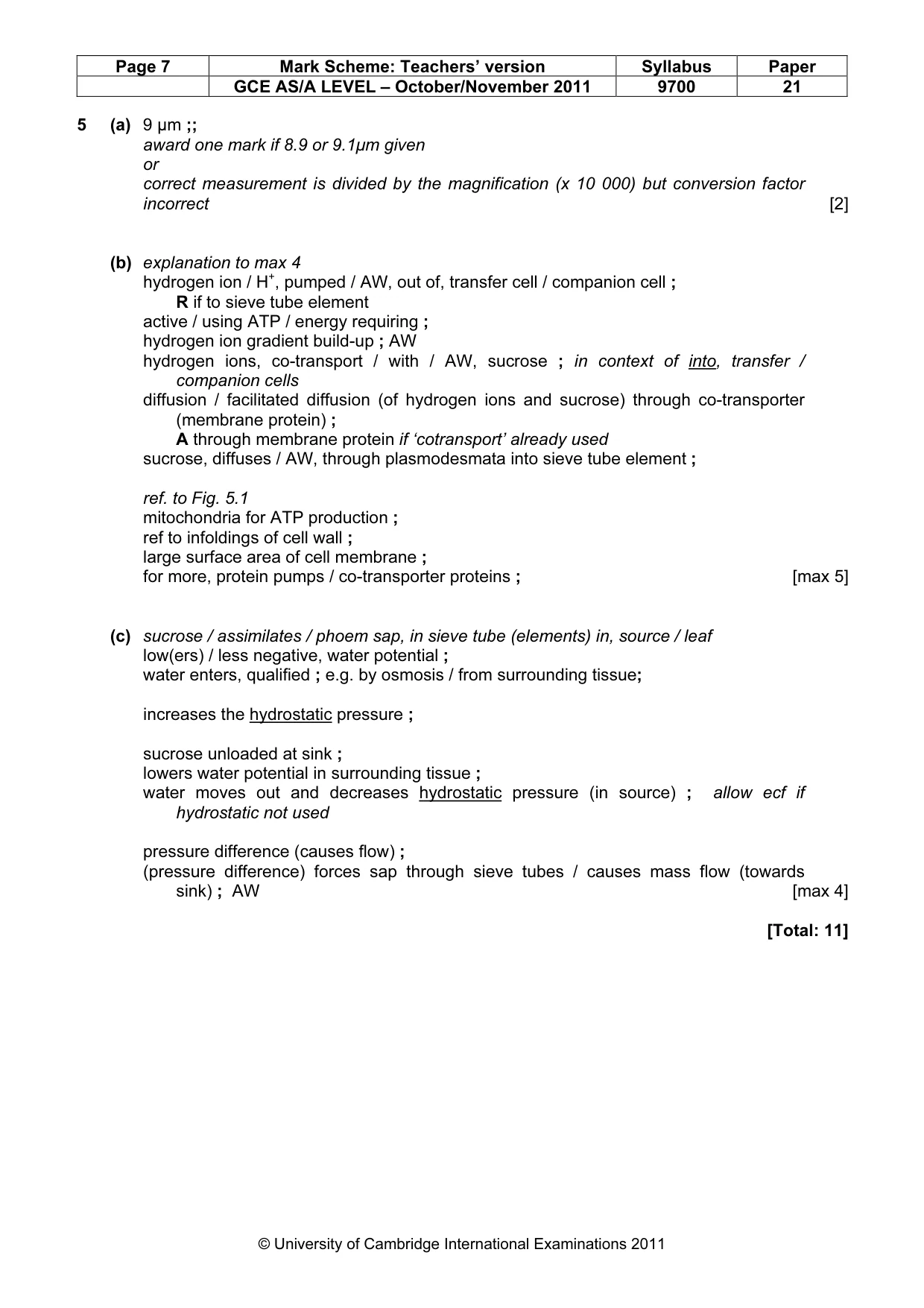
Page 7 Mark Scheme: Teachers’ version Syllabus Paper GCE AS/A LEVEL – October/November 2011 9700 21 © University of Cambridge International Examinations 2011 5 (a) 9 µm ;; award one mark if 8.9 or 9.1µm given or correct measurement is divided by the magnification (x 10 000) but conversion factor incorrect [2] (b) explanation to max 4 hydrogen ion / H+, pumped / AW, out of, transfer cell / companion cell ; R if to sieve tube element active / using ATP / energy requiring ; hydrogen ion gradient build-up ; AW hydrogen ions, co-transport / with / AW, sucrose ; in context of into, transfer / companion cells diffusion / facilitated diffusion (of hydrogen ions and sucrose) through co-transporter (membrane protein) ; A through membrane protein if ‘cotransport’ already used sucrose, diffuses / AW, through plasmodesmata into sieve tube element ; ref. to Fig. 5.1 mitochondria for ATP production ; ref to infoldings of cell wall ; large surface area of cell membrane ; for more, protein pumps / co-transporter proteins ; [max 5] (c) sucrose / assimilates / phoem sap, in sieve tube (elements) in, source / leaf low(ers) / less negative, water potential ; water enters, qualified ; e.g. by osmosis / from surrounding tissue; increases the hydrostatic pressure ; sucrose unloaded at sink ; lowers water potential in surrounding tissue ; water moves out and decreases hydrostatic pressure (in source) ; allow ecf if hydrostatic not used pressure difference (causes flow) ; (pressure difference) forces sap through sieve tubes / causes mass flow (towards sink) ; AW [max 4] [Total: 11]
Mark scheme, page 8
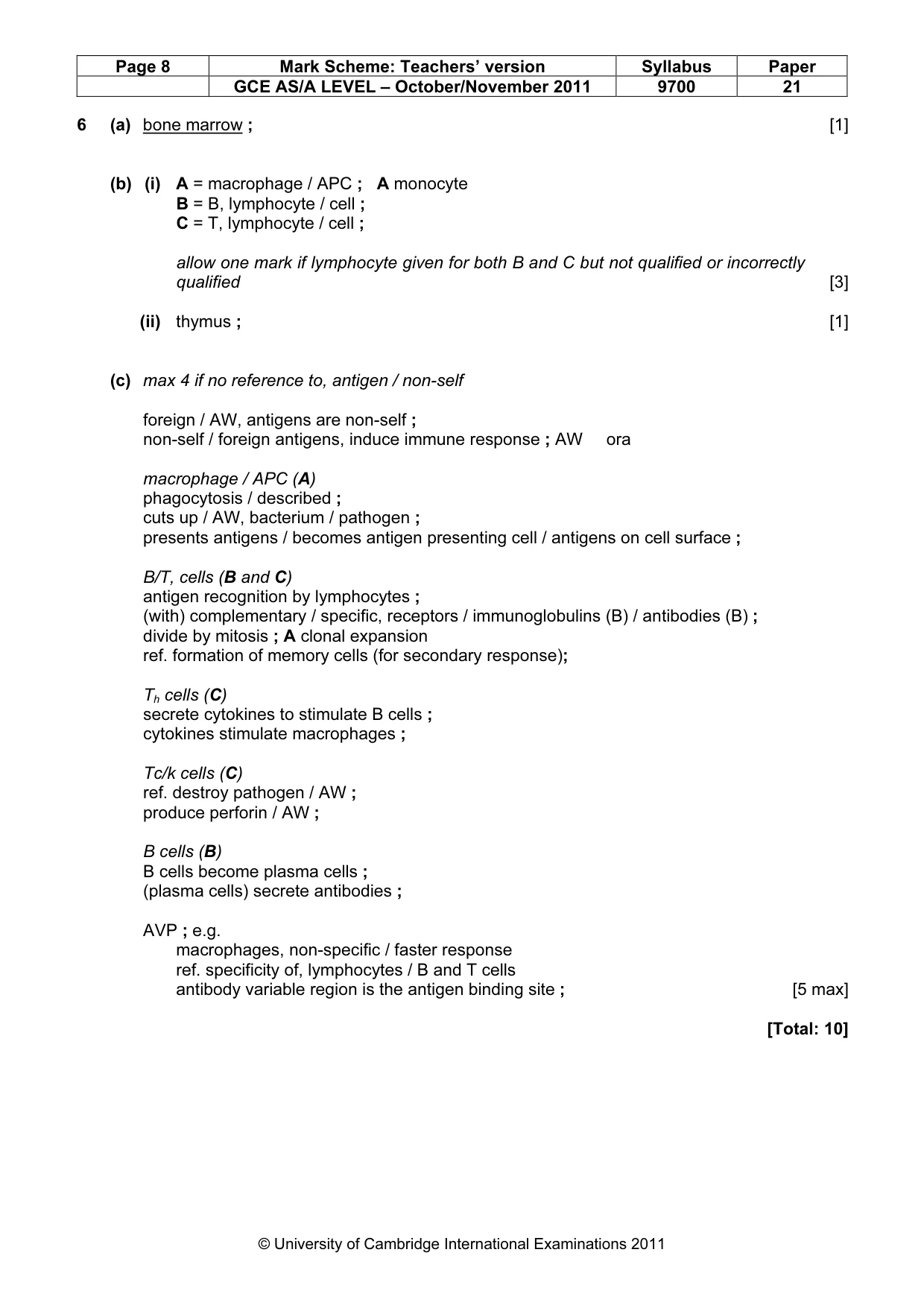
Page 8 Mark Scheme: Teachers’ version Syllabus Paper GCE AS/A LEVEL – October/November 2011 9700 21 © University of Cambridge International Examinations 2011 6 (a) bone marrow ; [1] (b) (i) A = macrophage / APC ; A monocyte B = B, lymphocyte / cell ; C = T, lymphocyte / cell ; allow one mark if lymphocyte given for both B and C but not qualified or incorrectly qualified [3] (ii) thymus ; [1] (c) max 4 if no reference to, antigen / non-self foreign / AW, antigens are non-self ; non-self / foreign antigens, induce immune response ; AW ora macrophage / APC (A) phagocytosis / described ; cuts up / AW, bacterium / pathogen ; presents antigens / becomes antigen presenting cell / antigens on cell surface ; B/T, cells (B and C) antigen recognition by lymphocytes ; (with) complementary / specific, receptors / immunoglobulins (B) / antibodies (B) ; divide by mitosis ; A clonal expansion ref. formation of memory cells (for secondary response); Th cells (C) secrete cytokines to stimulate B cells ; cytokines stimulate macrophages ; Tc/k cells (C) ref. destroy pathogen / AW ; produce perforin / AW ; B cells (B) B cells become plasma cells ; (plasma cells) secrete antibodies ; AVP ; e.g. macrophages, non-specific / faster response ref. specificity of, lymphocytes / B and T cells antibody variable region is the antigen binding site ; [5 max] [Total: 10]
What you needed in this session
Cambridge’s own grade thresholds for 2011 Oct/Nov, Paper 2 · Variant 1. A higher threshold means an easier paper — the bar moves with how the cohort did.