Cambridge A Level Biology 9700 — 2011 May/June Paper 2 · Variant 3
9700/23/M/J/11 · 60 marks · ≈68 min
The question paper and its mark scheme, free to read here and free to download. This is Cambridge’s own paper, exactly as it was sat.
Question paper16 pages


Mark scheme8 pages
Answers below. Sit the paper first if you are practising.

Paper as text
Question paper, page 1
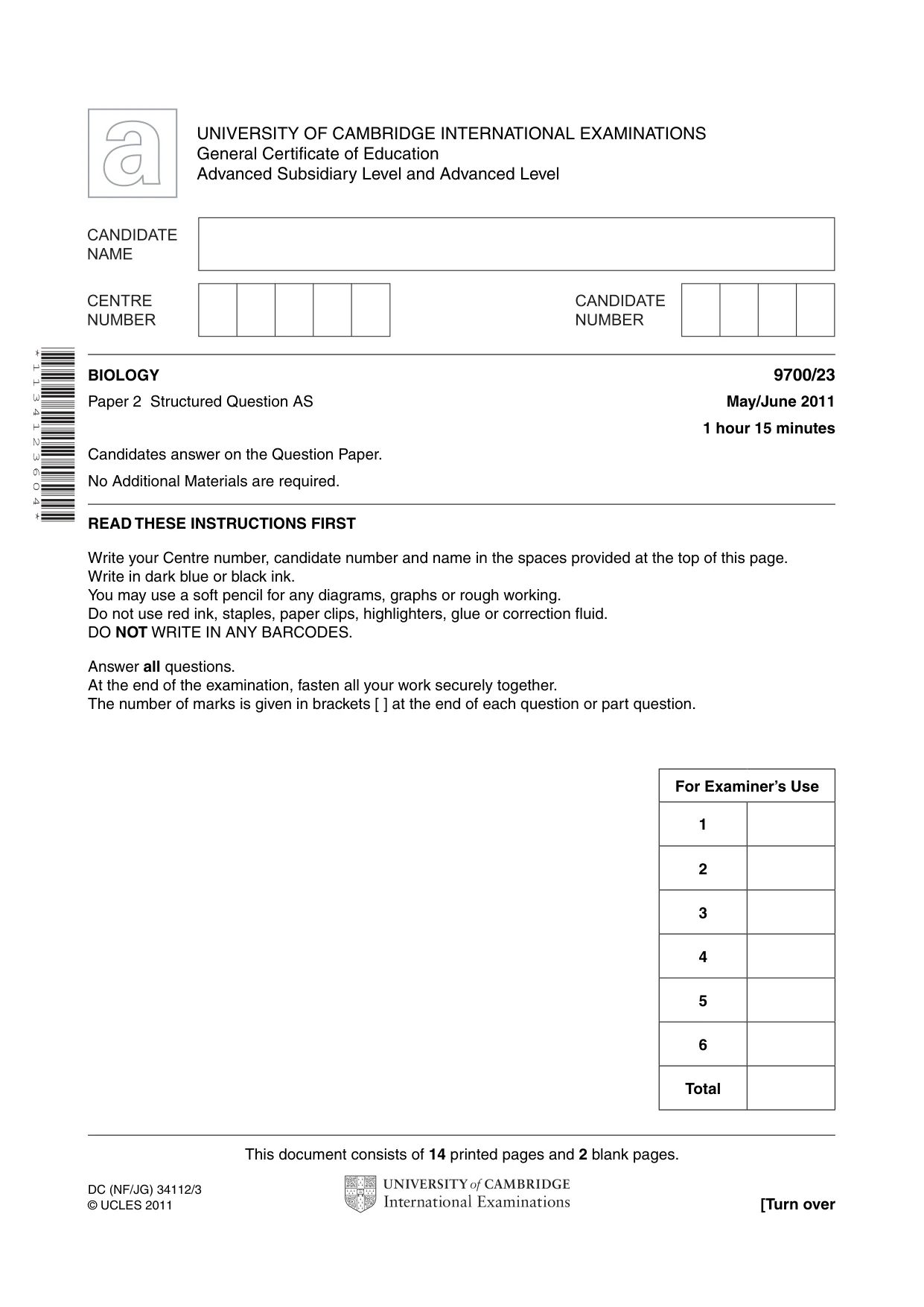
This document consists of 14 printed pages and 2 blank pages. DC (NF/JG) 34112/3 © UCLES 2011 [Turn over UNIVERSITY OF CAMBRIDGE INTERNATIONAL EXAMINATIONS General Certificate of Education Advanced Subsidiary Level and Advanced Level * 1 1 3 4 1 2 3 6 0 4 * BIOLOGY 9700/23 Paper 2 Structured Question AS May/June 2011 1 hour 15 minutes Candidates answer on the Question Paper. No Additional Materials are required. READ THESE INSTRUCTIONS FIRST Write your Centre number, candidate number and name in the spaces provided at the top of this page. Write in dark blue or black ink. You may use a soft pencil for any diagrams, graphs or rough working. Do not use red ink, staples, paper clips, highlighters, glue or correction fluid. DO NOT WRITE IN ANY BARCODES. Answer all questions. At the end of the examination, fasten all your work securely together. The number of marks is given in brackets [ ] at the end of each question or part question. For Examiner’s Use 1 2 3 4 5 6 Total
Question paper, page 2
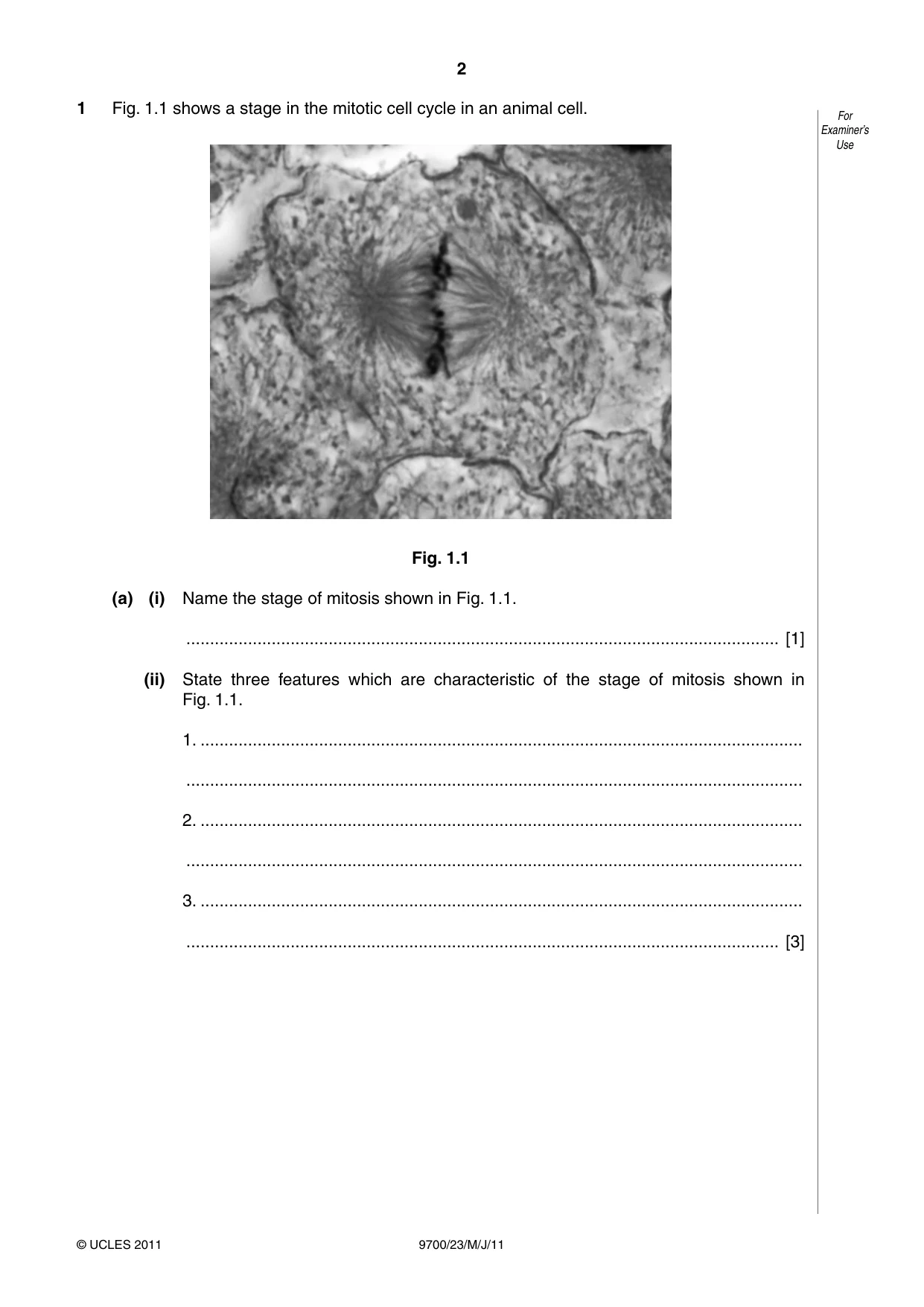
2 9700/23/M/J/11 © UCLES 2011 For Examiner’s Use 1 Fig. 1.1 shows a stage in the mitotic cell cycle in an animal cell. Fig. 1.1 (a) (i) Name the stage of mitosis shown in Fig. 1.1. … [1] (ii) State three features which are characteristic of the stage of mitosis shown in Fig. 1.1. 1. … … 2. … … 3. … … [3]
Question paper, page 3
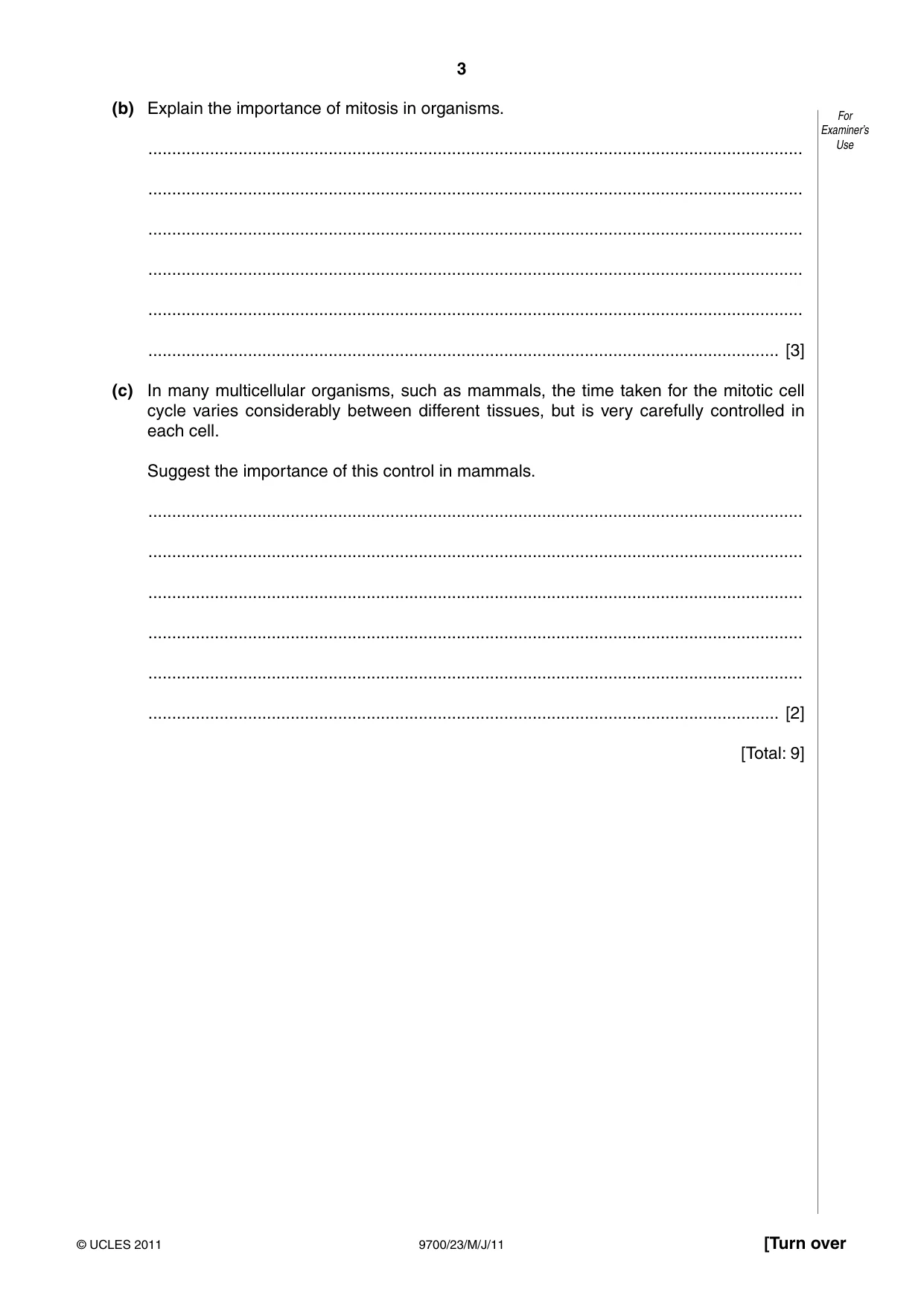
3 9700/23/M/J/11 © UCLES 2011 [Turn over For Examiner’s Use (b) Explain the importance of mitosis in organisms. … … … … … … [3] (c) In many multicellular organisms, such as mammals, the time taken for the mitotic cell cycle varies considerably between different tissues, but is very carefully controlled in each cell. Suggest the importance of this control in mammals. … … … … … … [2] [Total: 9]
Question paper, page 4
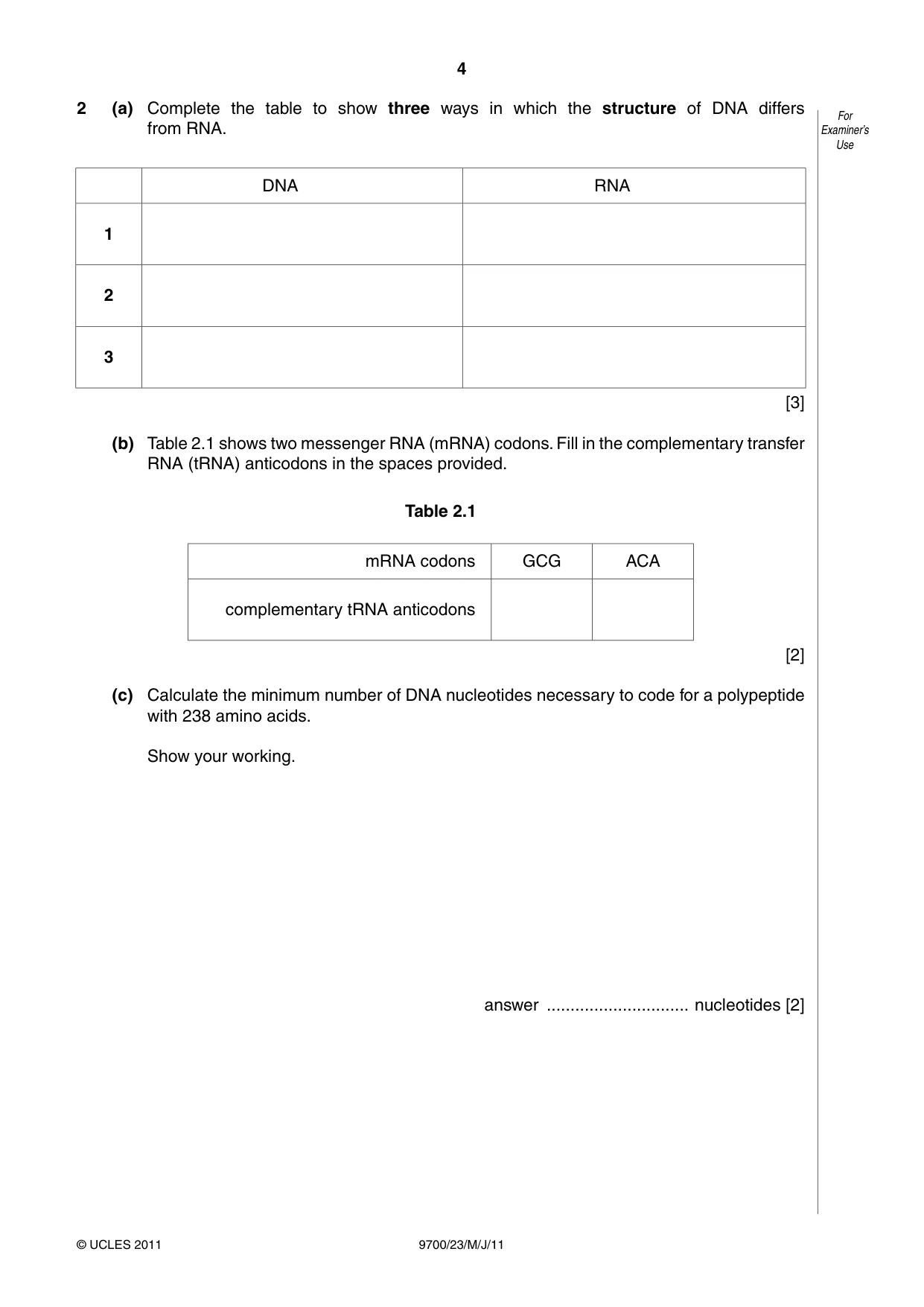
4 9700/23/M/J/11 © UCLES 2011 For Examiner’s Use 2 (a) Complete the table to show three ways in which the structure of DNA differs from RNA. DNA RNA 1 2 3 [3] (b) Table 2.1 shows two messenger RNA (mRNA) codons. Fill in the complementary transfer RNA (tRNA) anticodons in the spaces provided. Table 2.1 mRNA codons GCG ACA complementary tRNA anticodons [2] (c) Calculate the minimum number of DNA nucleotides necessary to code for a polypeptide with 238 amino acids. Show your working. answer … nucleotides [2]
Question paper, page 5
5 9700/23/M/J/11 © UCLES 2011 [Turn over For Examiner’s Use (d) Describe the role played by tRNA in polypeptide synthesis. … … … … … … … … … [4] [Total: 11]
Question paper, page 6
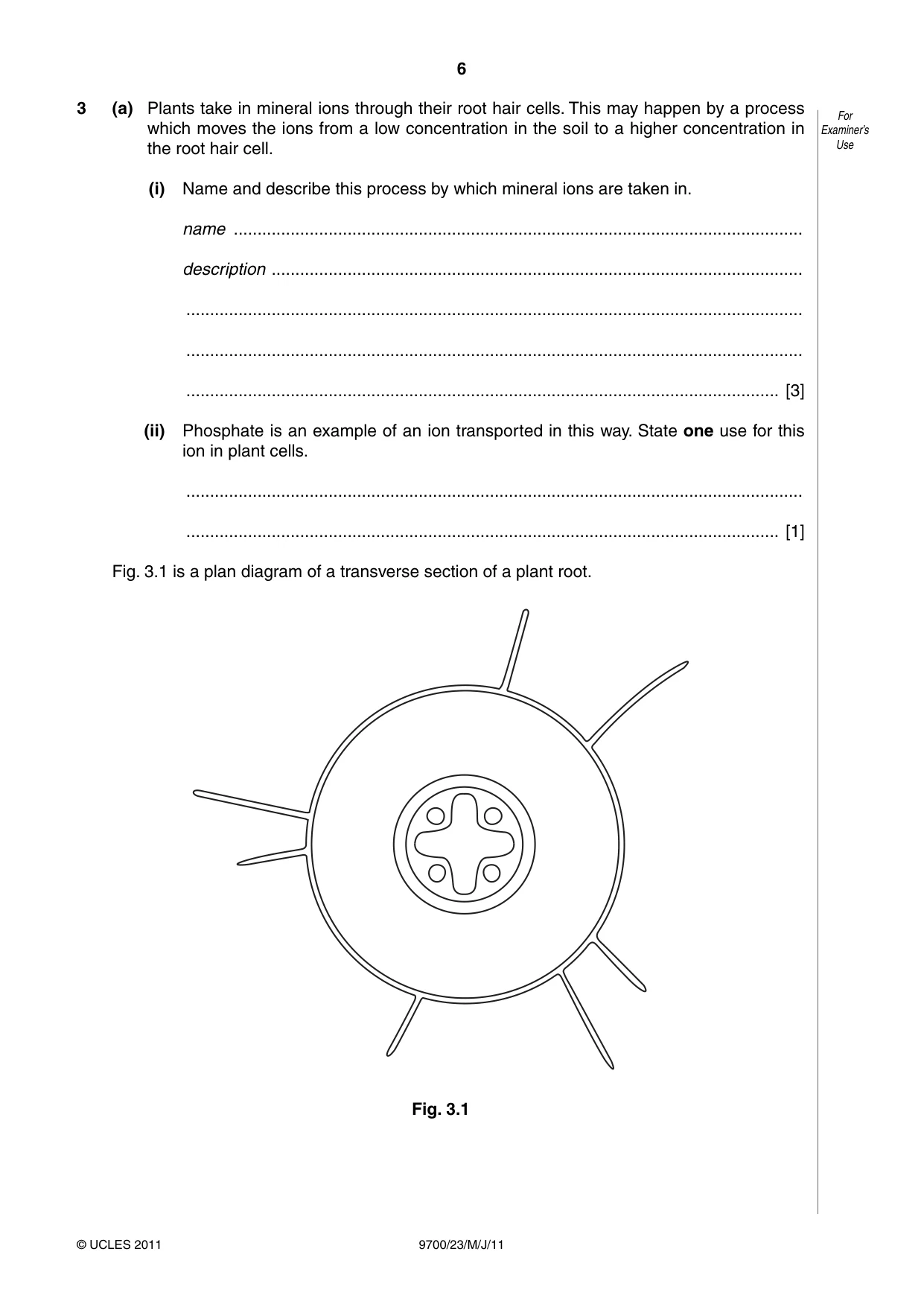
6 9700/23/M/J/11 © UCLES 2011 For Examiner’s Use 3 (a) Plants take in mineral ions through their root hair cells. This may happen by a process which moves the ions from a low concentration in the soil to a higher concentration in the root hair cell. (i) Name and describe this process by which mineral ions are taken in. name … description … … … … [3] (ii) Phosphate is an example of an ion transported in this way. State one use for this ion in plant cells. … … [1] Fig. 3.1 is a plan diagram of a transverse section of a plant root. Fig. 3.1
Question paper, page 7
7 9700/23/M/J/11 © UCLES 2011 [Turn over For Examiner’s Use (b) (i) Write the letter W on Fig. 3.1 in the area where cells are specialised for the transport of water and mineral ions. [1] (ii) Water is also absorbed from the soil by the root hair cells. Outline the mechanism by which this occurs. … … … … [2] (iii) Describe the pathway taken by water as it passes from the root hair cells into the cells which are specialised for transport of water and mineral ions. … … … … … … … … [4] [Total: 11]
Question paper, page 8
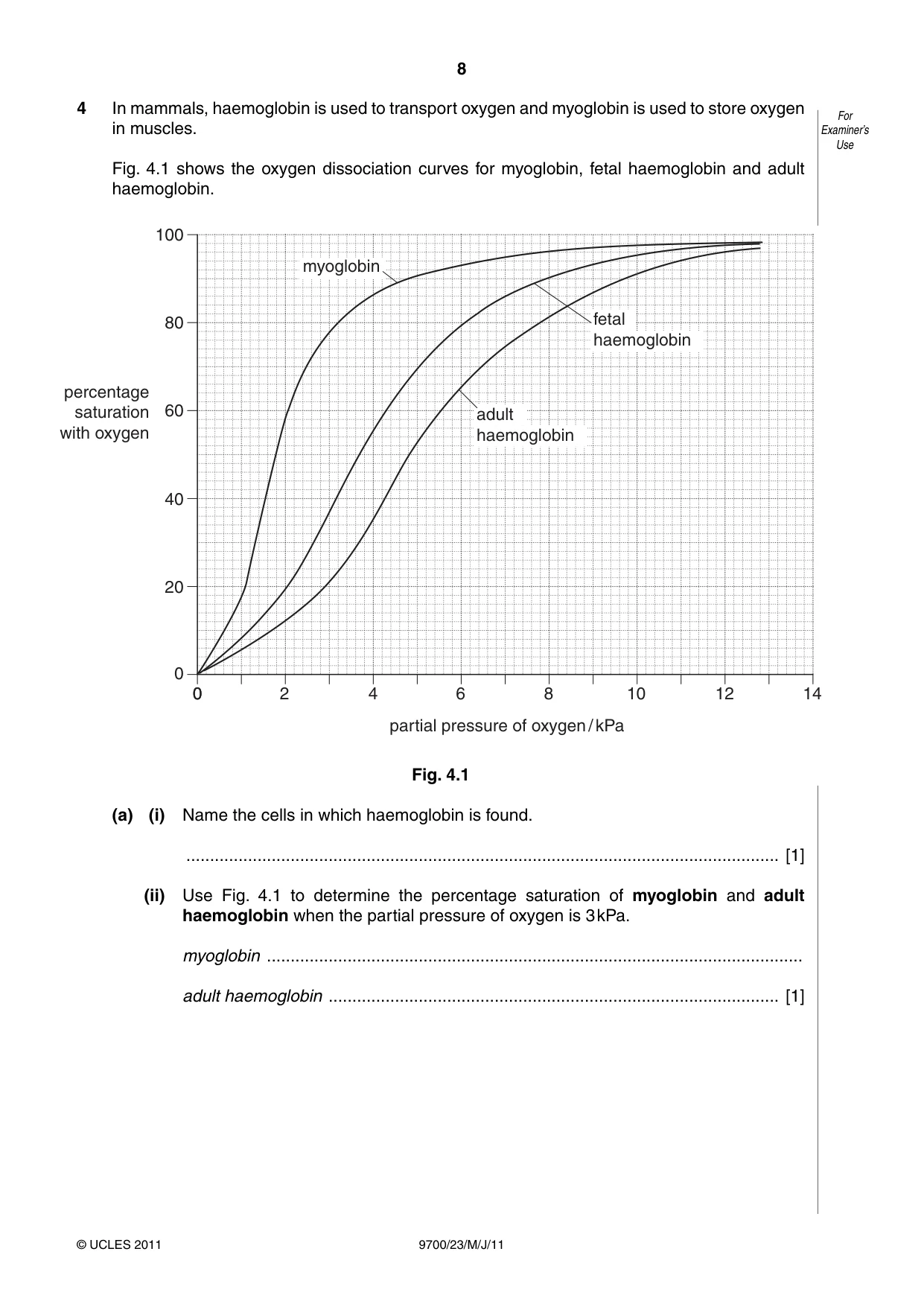
8 9700/23/M/J/11 © UCLES 2011 For Examiner’s Use 4 In mammals, haemoglobin is used to transport oxygen and myoglobin is used to store oxygen in muscles. Fig. 4.1 shows the oxygen dissociation curves for myoglobin, fetal haemoglobin and adult haemoglobin. 0 2 4 6 8 10 12 14 0 20 0 40 60 80 100 percentage saturation with oxygen partial pressure of oxygen / kPa fetal haemoglobin adult haemoglobin myoglobin Fig. 4.1 (a) (i) Name the cells in which haemoglobin is found. … [1] (ii) Use Fig. 4.1 to determine the percentage saturation of myoglobin and adult haemoglobin when the partial pressure of oxygen is 3 kPa. myoglobin … adult haemoglobin … [1]
Question paper, page 9
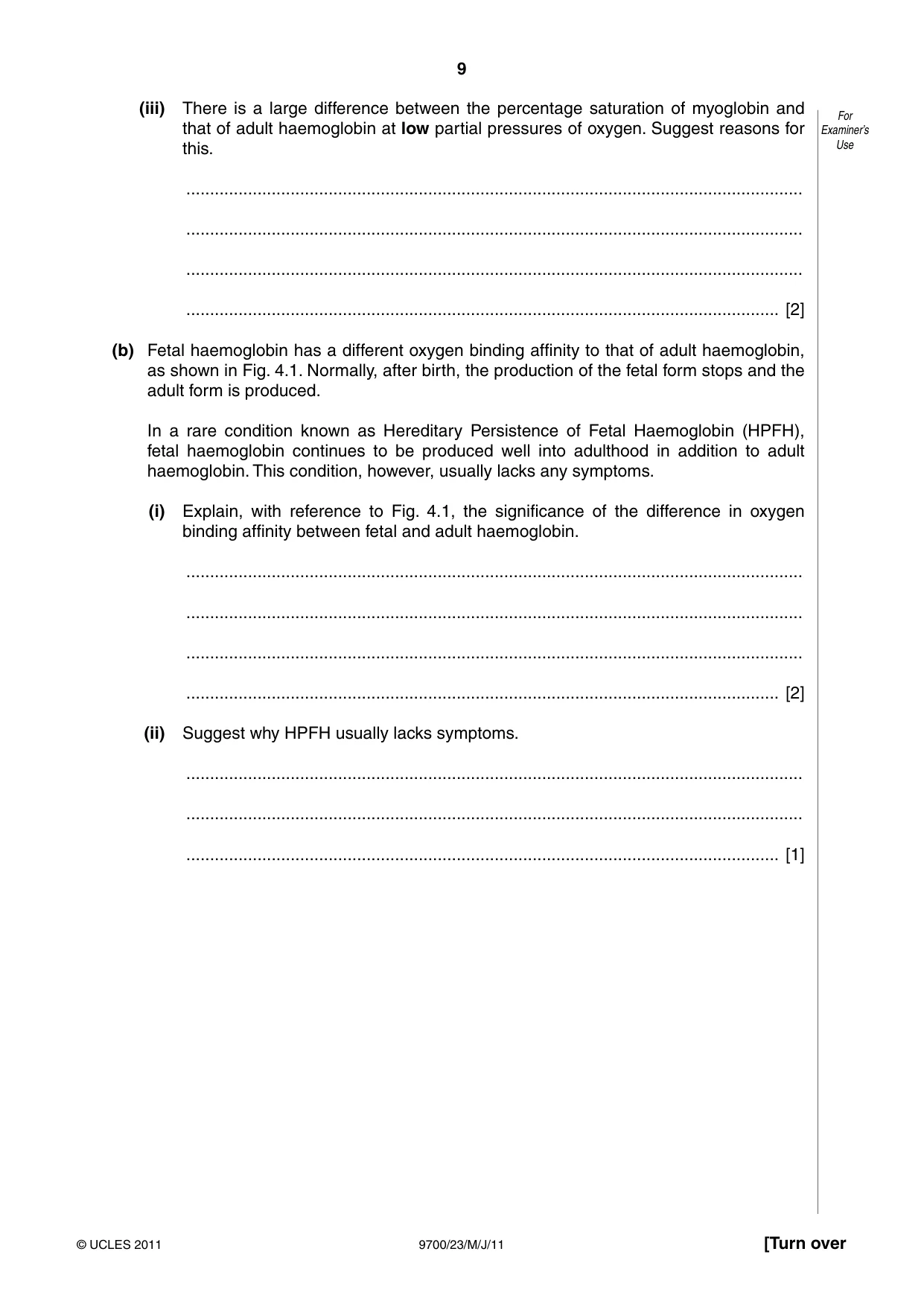
9 9700/23/M/J/11 © UCLES 2011 [Turn over For Examiner’s Use (iii) There is a large difference between the percentage saturation of myoglobin and that of adult haemoglobin at low partial pressures of oxygen. Suggest reasons for this. … … … … [2] (b) Fetal haemoglobin has a different oxygen binding affinity to that of adult haemoglobin, as shown in Fig. 4.1. Normally, after birth, the production of the fetal form stops and the adult form is produced. In a rare condition known as Hereditary Persistence of Fetal Haemoglobin (HPFH), fetal haemoglobin continues to be produced well into adulthood in addition to adult haemoglobin. This condition, however, usually lacks any symptoms. (i) Explain, with reference to Fig. 4.1, the significance of the difference in oxygen binding affinity between fetal and adult haemoglobin. … … … … [2] (ii) Suggest why HPFH usually lacks symptoms. … … … [1]
Question paper, page 10
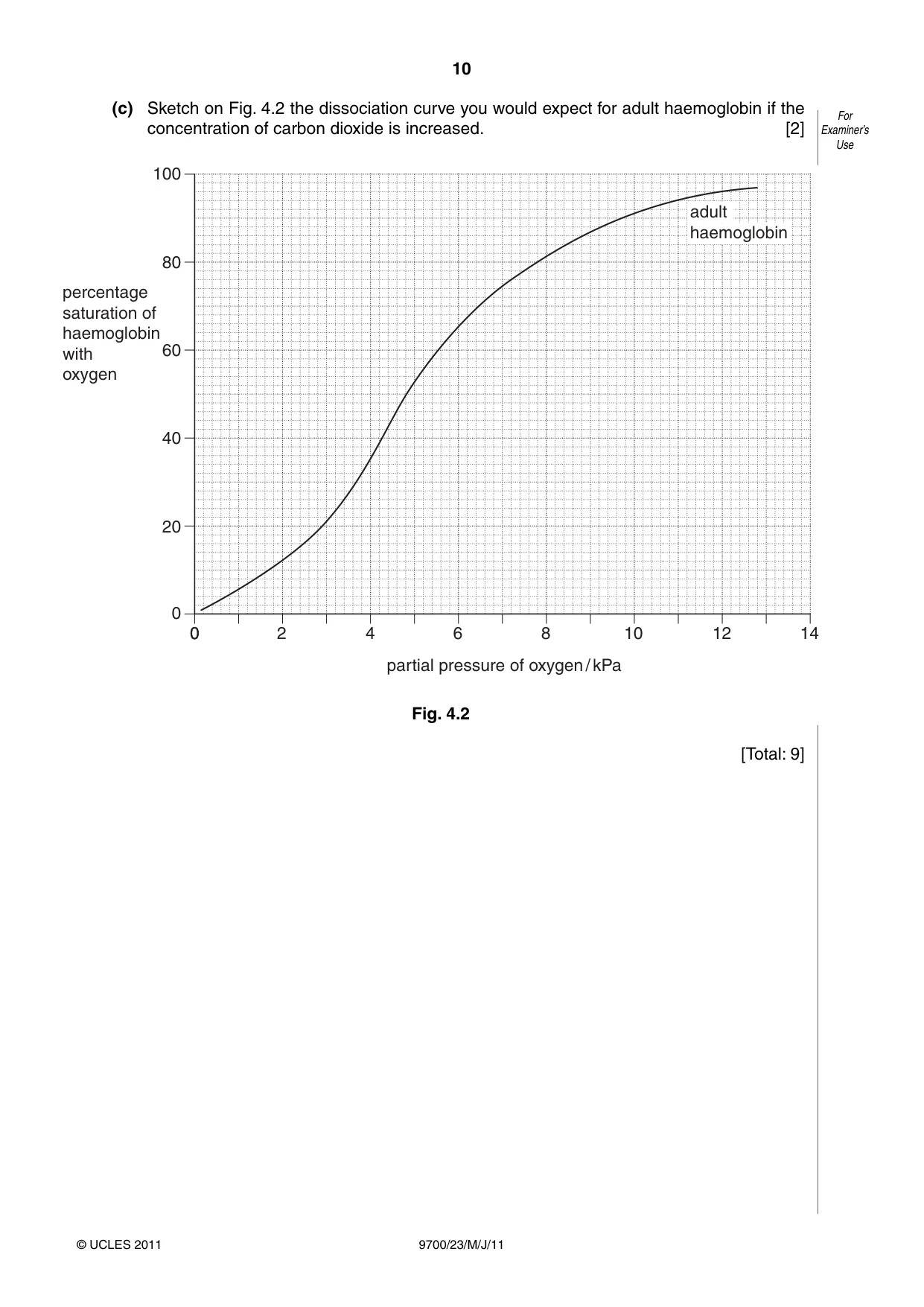
10 9700/23/M/J/11 © UCLES 2011 For Examiner’s Use (c) Sketch on Fig. 4.2 the dissociation curve you would expect for adult haemoglobin if the concentration of carbon dioxide is increased. [2] 0 2 4 6 8 10 12 14 0 20 0 40 60 80 100 percentage saturation of haemoglobin with oxygen partial pressure of oxygen / kPa adult haemoglobin Fig. 4.2 [Total: 9]
Question paper, page 11
11 9700/23/M/J/11 © UCLES 2011 [Turn over BLANK PAGE
Question paper, page 12
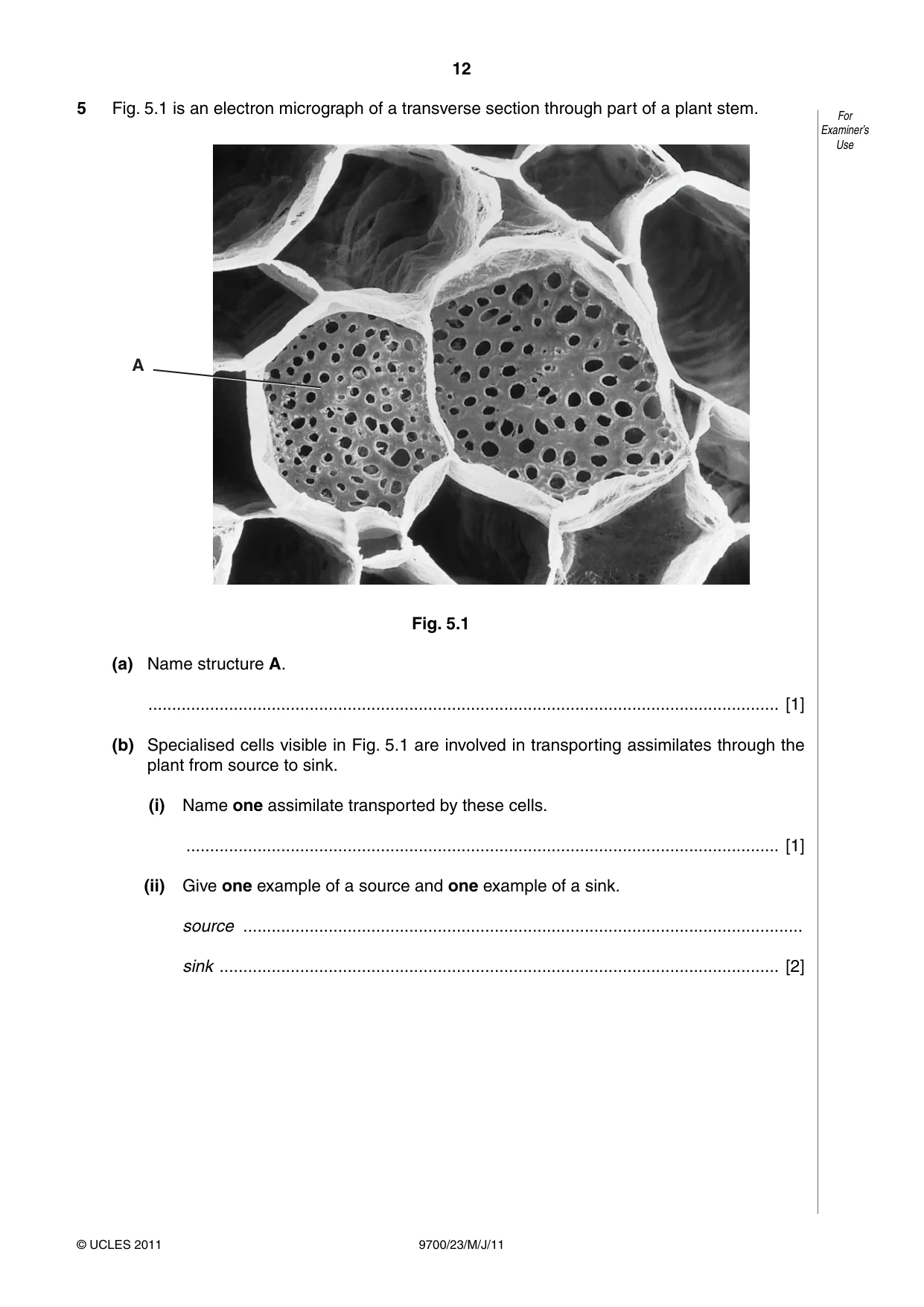
12 9700/23/M/J/11 © UCLES 2011 For Examiner’s Use 5 Fig. 5.1 is an electron micrograph of a transverse section through part of a plant stem. A Fig. 5.1 (a) Name structure A. … [1] (b) Specialised cells visible in Fig. 5.1 are involved in transporting assimilates through the plant from source to sink. (i) Name one assimilate transported by these cells. … [1] (ii) Give one example of a source and one example of a sink. source … sink … [2]
Question paper, page 13
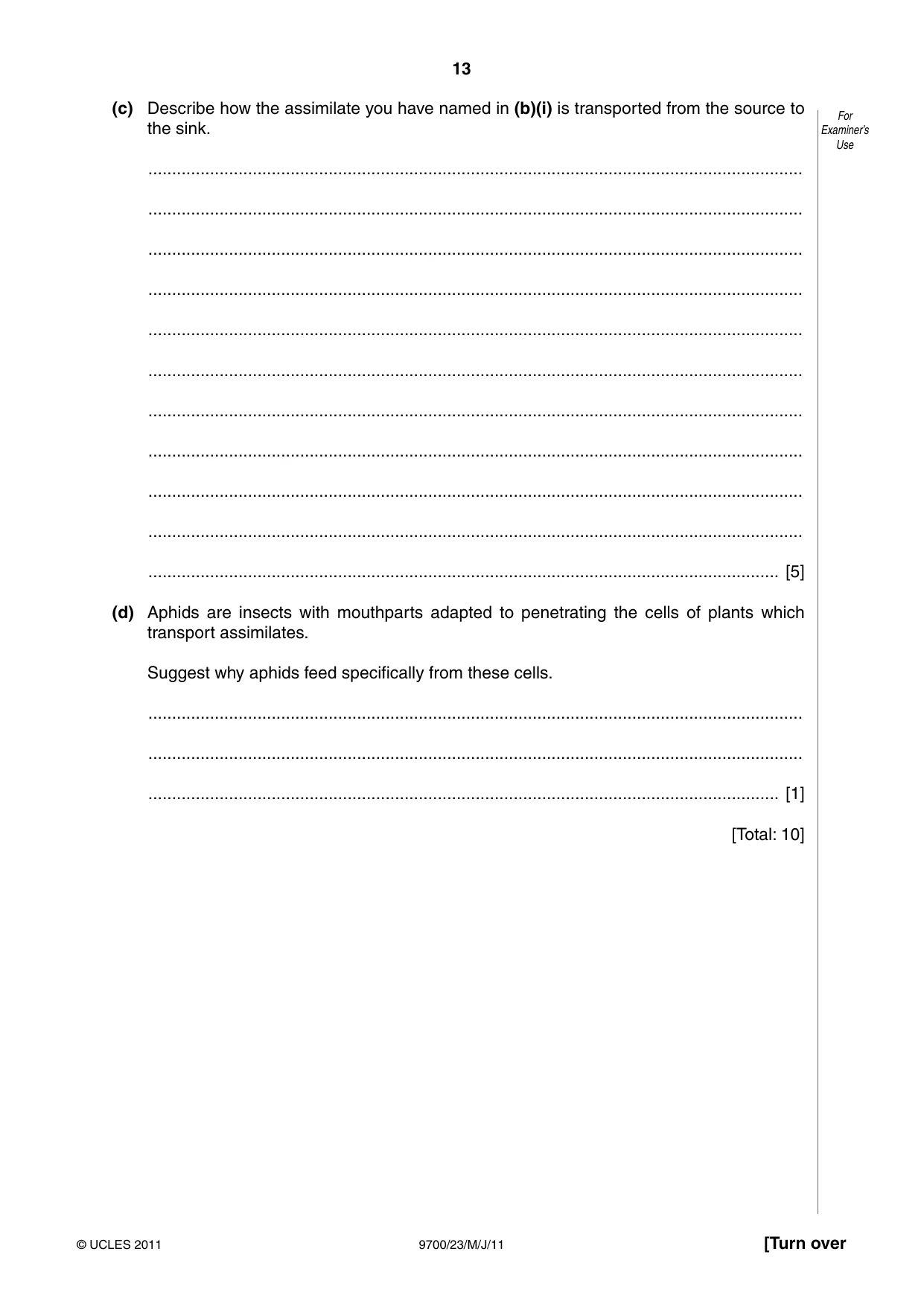
13 9700/23/M/J/11 © UCLES 2011 [Turn over For Examiner’s Use (c) Describe how the assimilate you have named in (b)(i) is transported from the source to the sink. … … … … … … … … … … … [5] (d) Aphids are insects with mouthparts adapted to penetrating the cells of plants which transport assimilates. Suggest why aphids feed specifically from these cells. … … … [1] [Total: 10]
Question paper, page 14
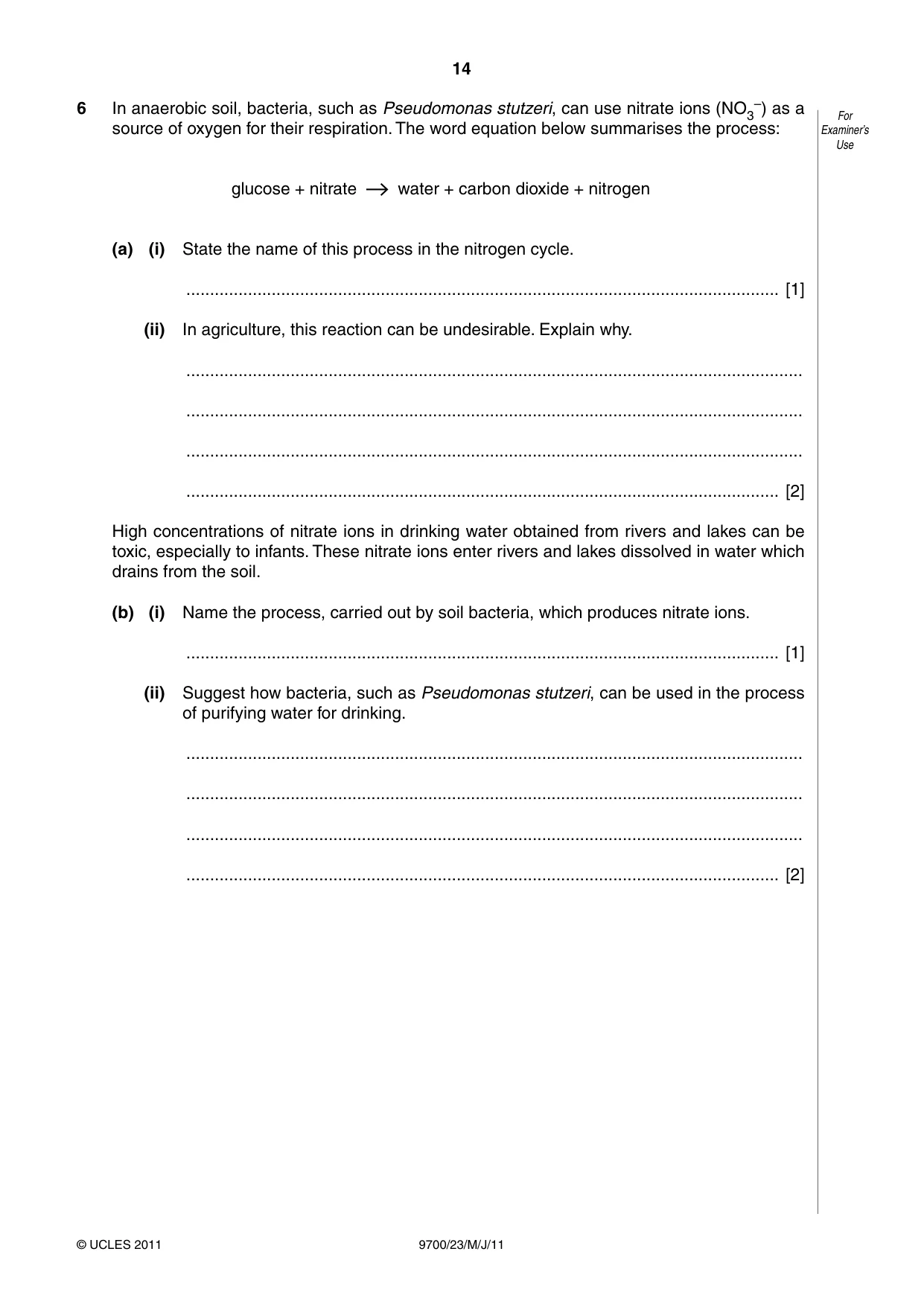
14 9700/23/M/J/11 © UCLES 2011 For Examiner’s Use 6 In anaerobic soil, bacteria, such as Pseudomonas stutzeri, can use nitrate ions (NO3 –) as a source of oxygen for their respiration. The word equation below summarises the process: glucose + nitrate water + carbon dioxide + nitrogen (a) (i) State the name of this process in the nitrogen cycle. … [1] (ii) In agriculture, this reaction can be undesirable. Explain why. … … … … [2] High concentrations of nitrate ions in drinking water obtained from rivers and lakes can be toxic, especially to infants. These nitrate ions enter rivers and lakes dissolved in water which drains from the soil. (b) (i) Name the process, carried out by soil bacteria, which produces nitrate ions. … [1] (ii) Suggest how bacteria, such as Pseudomonas stutzeri, can be used in the process of purifying water for drinking. … … … … [2]
Question paper, page 15
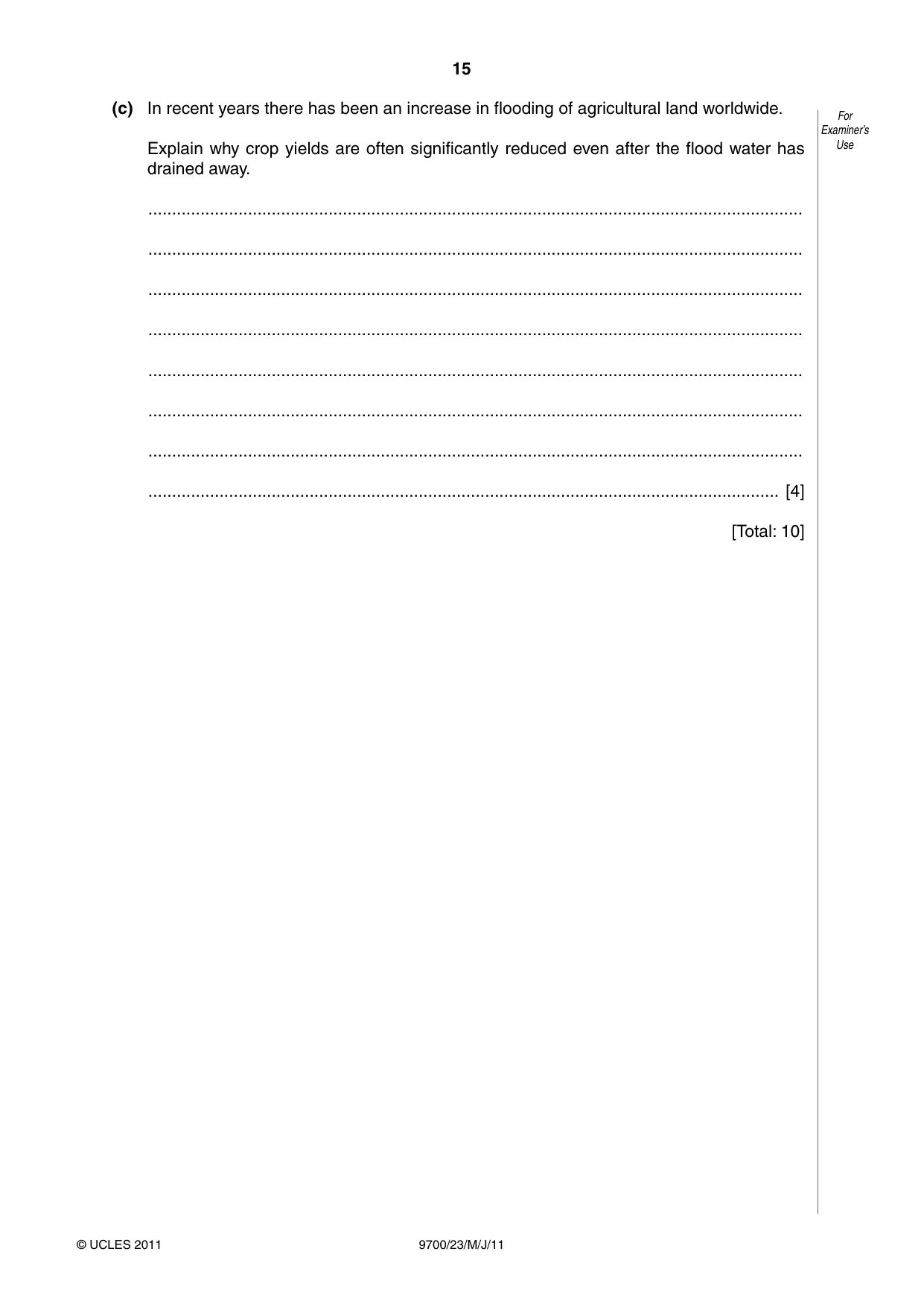
15 9700/23/M/J/11 © UCLES 2011 For Examiner’s Use (c) In recent years there has been an increase in flooding of agricultural land worldwide. Explain why crop yields are often significantly reduced even after the flood water has drained away. … … … … … … … … [4] [Total: 10]
Question paper, page 16
16 9700/23/M/J/11 © UCLES 2011 BLANK PAGE Copyright Acknowledgements: Fig. 1.1 Michael Abbey/Science Photo Library. Fig. 5.1 J. C. Revy, ISM/Science Photo Library. Permission to reproduce items where third-party owned material protected by copyright is included has been sought and cleared where possible. Every reasonable effort has been made by the publisher (UCLES) to trace copyright holders, but if any items requiring clearance have unwittingly been included, the publisher will be pleased to make amends at the earliest possible opportunity. University of Cambridge International Examinations is part of the Cambridge Assessment Group. Cambridge Assessment is the brand name of University of Cambridge Local Examinations Syndicate (UCLES), which is itself a department of the University of Cambridge.
Mark scheme, page 1
UNIVERSITY OF CAMBRIDGE INTERNATIONAL EXAMINATIONS GCE Advanced Subsidiary Level and GCE Advanced Level MARK SCHEME for the May/June 2011 question paper for the guidance of teachers 9700 BIOLOGY 9700/23 Paper 2 (AS Structured Questions), maximum raw mark 60 This mark scheme is published as an aid to teachers and candidates, to indicate the requirements of the examination. It shows the basis on which Examiners were instructed to award marks. It does not indicate the details of the discussions that took place at an Examiners’ meeting before marking began, which would have considered the acceptability of alternative answers. Mark schemes must be read in conjunction with the question papers and the report on the examination. • Cambridge will not enter into discussions or correspondence in connection with these mark schemes. Cambridge is publishing the mark schemes for the May/June 2011 question papers for most IGCSE, GCE Advanced Level and Advanced Subsidiary Level syllabuses and some Ordinary Level syllabuses.
Mark scheme, page 2
Page 2 Mark Scheme: Teachers’ version Syllabus Paper GCE AS/A LEVEL – May/June 2011 9700 23 © University of Cambridge International Examinations 2011 Mark scheme abbreviations: ; separates marking points / alternative answers for the same point R reject A accept (for answers correctly cued by the question, or by extra guidance) AW alternative wording (where responses vary more than usual) underline actual word given must be used by candidate (grammatical variants excepted) max indicates the maximum number of marks that can be given ora or reverse argument mp marking point (with relevant number) ecf error carried forward I ignore
Mark scheme, page 3
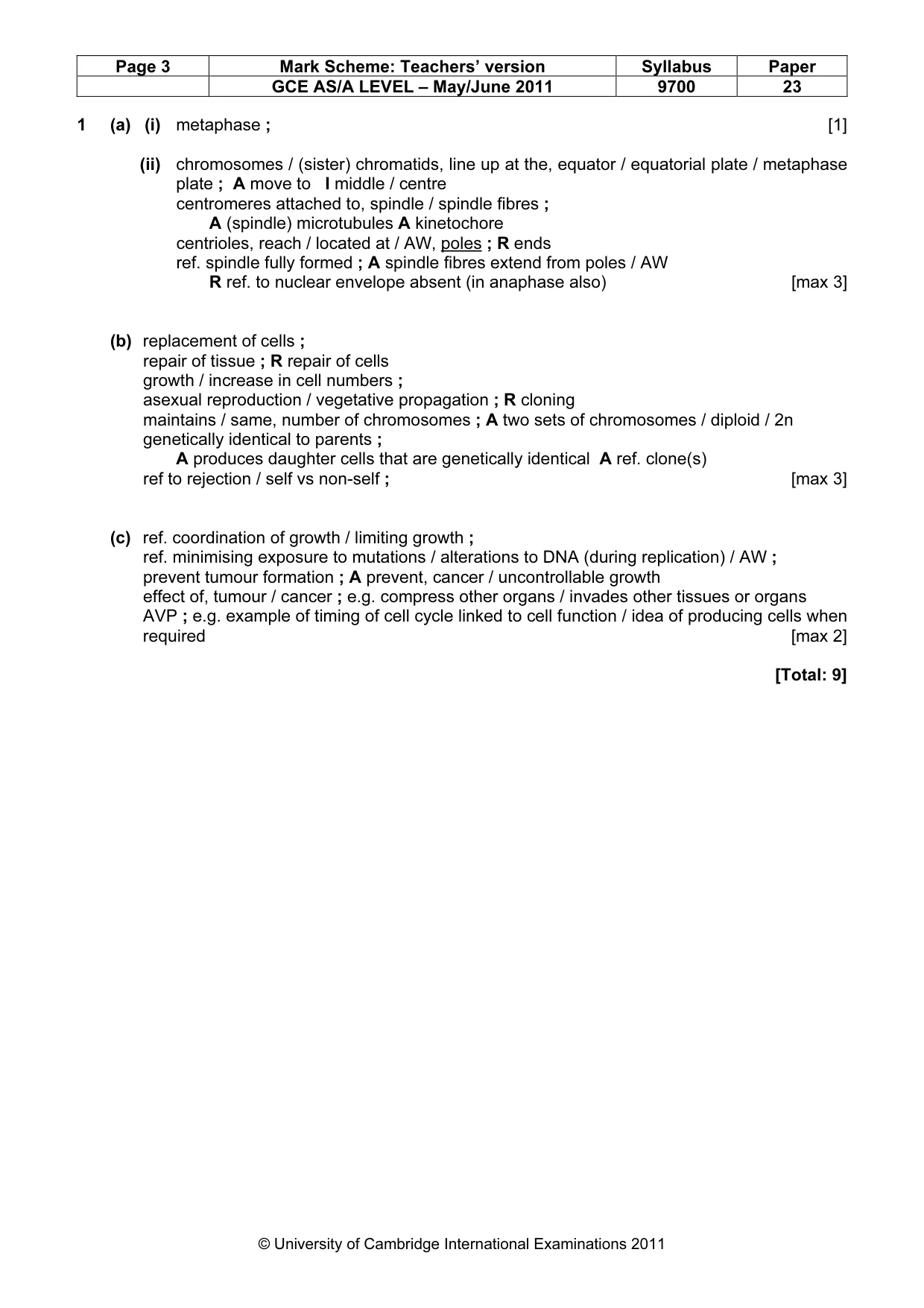
Page 3 Mark Scheme: Teachers’ version Syllabus Paper GCE AS/A LEVEL – May/June 2011 9700 23 © University of Cambridge International Examinations 2011 1 (a) (i) metaphase ; [1] (ii) chromosomes / (sister) chromatids, line up at the, equator / equatorial plate / metaphase plate ; A move to I middle / centre centromeres attached to, spindle / spindle fibres ; A (spindle) microtubules A kinetochore centrioles, reach / located at / AW, poles ; R ends ref. spindle fully formed ; A spindle fibres extend from poles / AW R ref. to nuclear envelope absent (in anaphase also) [max 3] (b) replacement of cells ; repair of tissue ; R repair of cells growth / increase in cell numbers ; asexual reproduction / vegetative propagation ; R cloning maintains / same, number of chromosomes ; A two sets of chromosomes / diploid / 2n genetically identical to parents ; A produces daughter cells that are genetically identical A ref. clone(s) ref to rejection / self vs non-self ; [max 3] (c) ref. coordination of growth / limiting growth ; ref. minimising exposure to mutations / alterations to DNA (during replication) / AW ; prevent tumour formation ; A prevent, cancer / uncontrollable growth effect of, tumour / cancer ; e.g. compress other organs / invades other tissues or organs AVP ; e.g. example of timing of cell cycle linked to cell function / idea of producing cells when required [max 2] [Total: 9]
Mark scheme, page 4
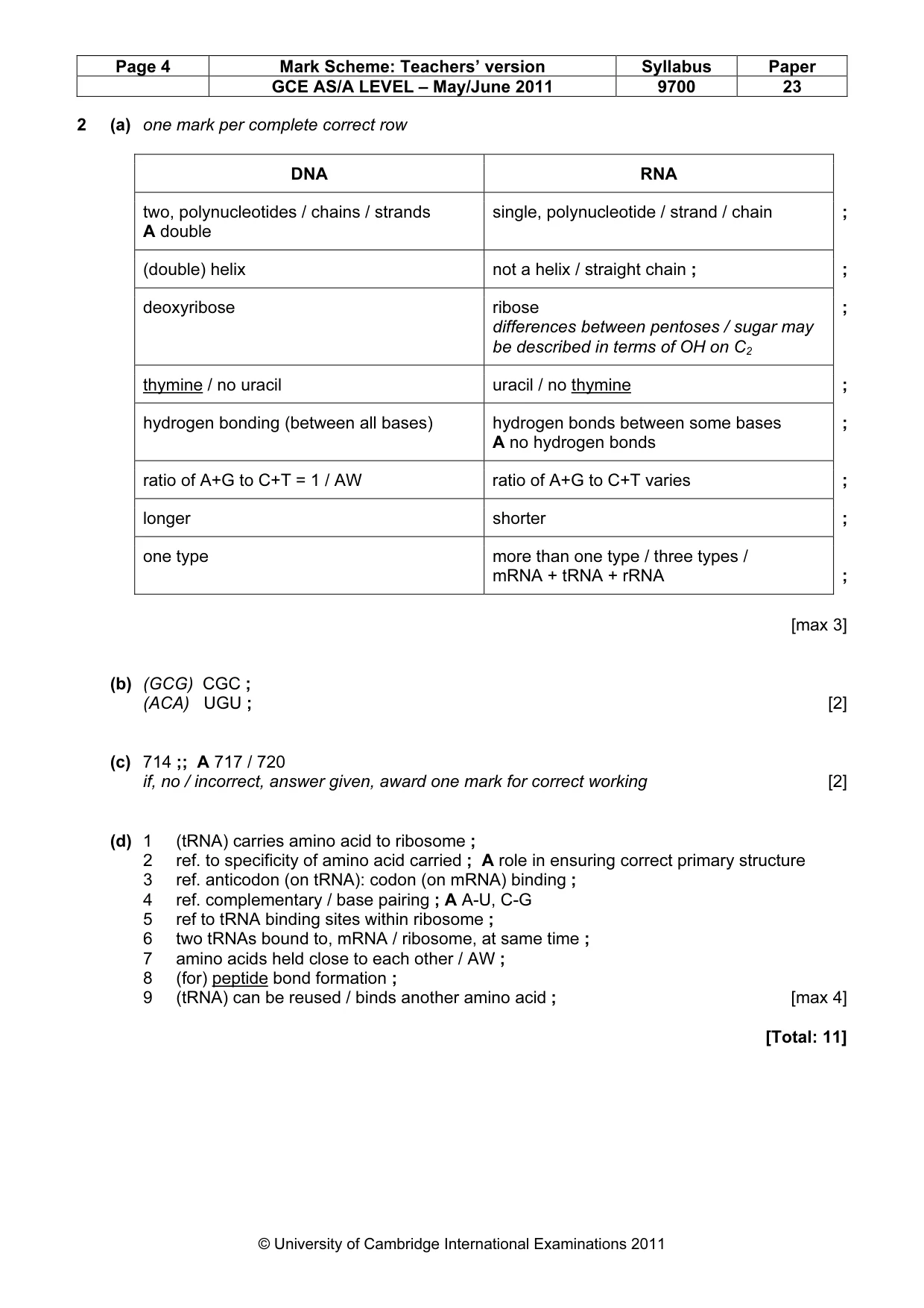
Page 4 Mark Scheme: Teachers’ version Syllabus Paper GCE AS/A LEVEL – May/June 2011 9700 23 © University of Cambridge International Examinations 2011 2 (a) one mark per complete correct row DNA RNA two, polynucleotides / chains / strands A double single, polynucleotide / strand / chain ; (double) helix not a helix / straight chain ; ; deoxyribose ribose differences between pentoses / sugar may be described in terms of OH on C2 ; thymine / no uracil uracil / no thymine ; hydrogen bonding (between all bases) hydrogen bonds between some bases A no hydrogen bonds ; ratio of A+G to C+T = 1 / AW ratio of A+G to C+T varies ; longer shorter ; one type more than one type / three types / mRNA + tRNA + rRNA ; [max 3] (b) (GCG) CGC ; (ACA) UGU ; [2] (c) 714 ;; A 717 / 720 if, no / incorrect, answer given, award one mark for correct working [2] (d) 1 (tRNA) carries amino acid to ribosome ; 2 ref. to specificity of amino acid carried ; A role in ensuring correct primary structure 3 ref. anticodon (on tRNA): codon (on mRNA) binding ; 4 ref. complementary / base pairing ; A A-U, C-G 5 ref to tRNA binding sites within ribosome ; 6 two tRNAs bound to, mRNA / ribosome, at same time ; 7 amino acids held close to each other / AW ; 8 (for) peptide bond formation ; 9 (tRNA) can be reused / binds another amino acid ; [max 4] [Total: 11]
Mark scheme, page 5
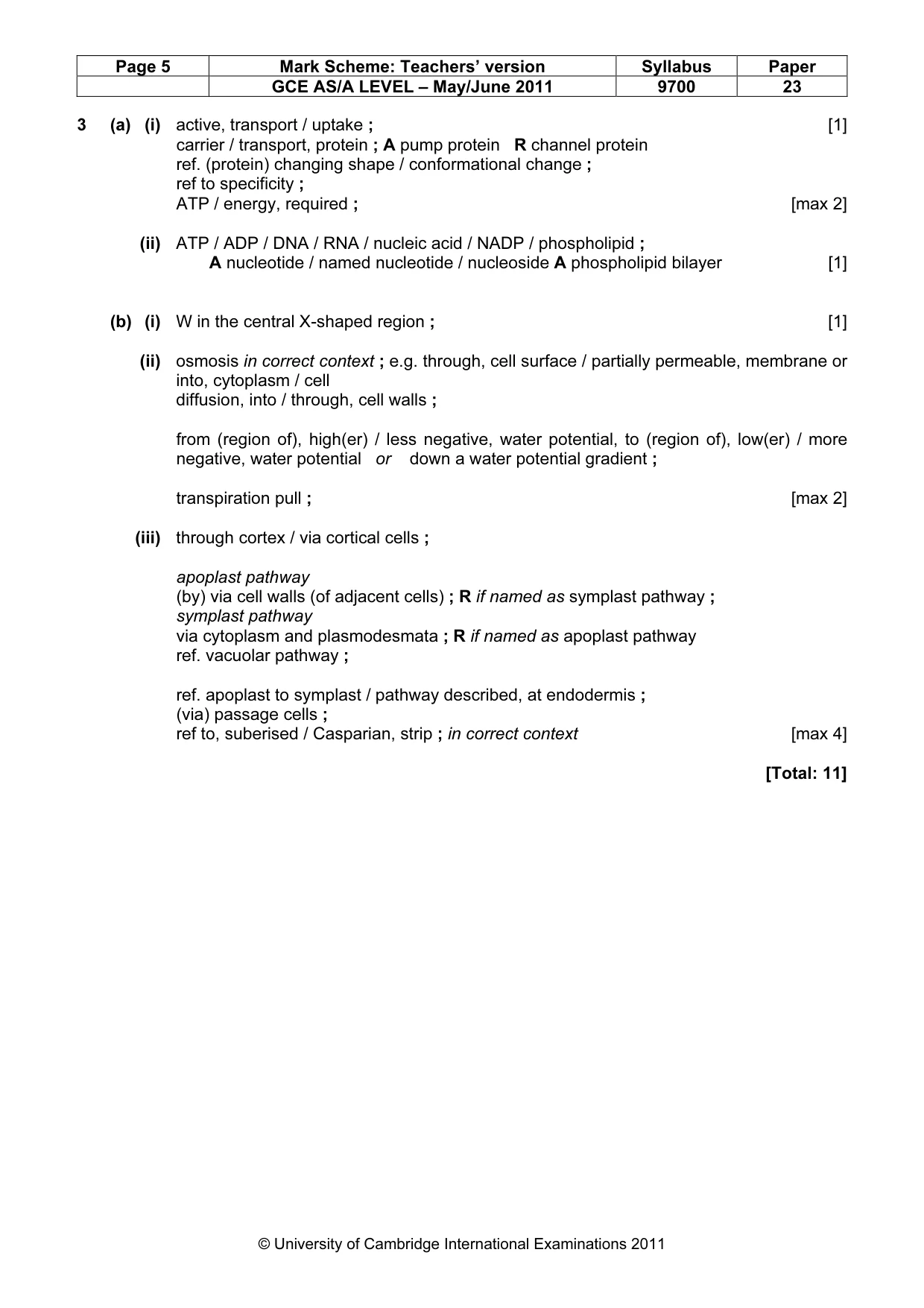
Page 5 Mark Scheme: Teachers’ version Syllabus Paper GCE AS/A LEVEL – May/June 2011 9700 23 © University of Cambridge International Examinations 2011 3 (a) (i) active, transport / uptake ; [1] carrier / transport, protein ; A pump protein R channel protein ref. (protein) changing shape / conformational change ; ref to specificity ; ATP / energy, required ; [max 2] (ii) ATP / ADP / DNA / RNA / nucleic acid / NADP / phospholipid ; A nucleotide / named nucleotide / nucleoside A phospholipid bilayer [1] (b) (i) W in the central X-shaped region ; [1] (ii) osmosis in correct context ; e.g. through, cell surface / partially permeable, membrane or into, cytoplasm / cell diffusion, into / through, cell walls ; from (region of), high(er) / less negative, water potential, to (region of), low(er) / more negative, water potential or down a water potential gradient ; transpiration pull ; [max 2] (iii) through cortex / via cortical cells ; apoplast pathway (by) via cell walls (of adjacent cells) ; R if named as symplast pathway ; symplast pathway via cytoplasm and plasmodesmata ; R if named as apoplast pathway ref. vacuolar pathway ; ref. apoplast to symplast / pathway described, at endodermis ; (via) passage cells ; ref to, suberised / Casparian, strip ; in correct context [max 4] [Total: 11]
Mark scheme, page 6
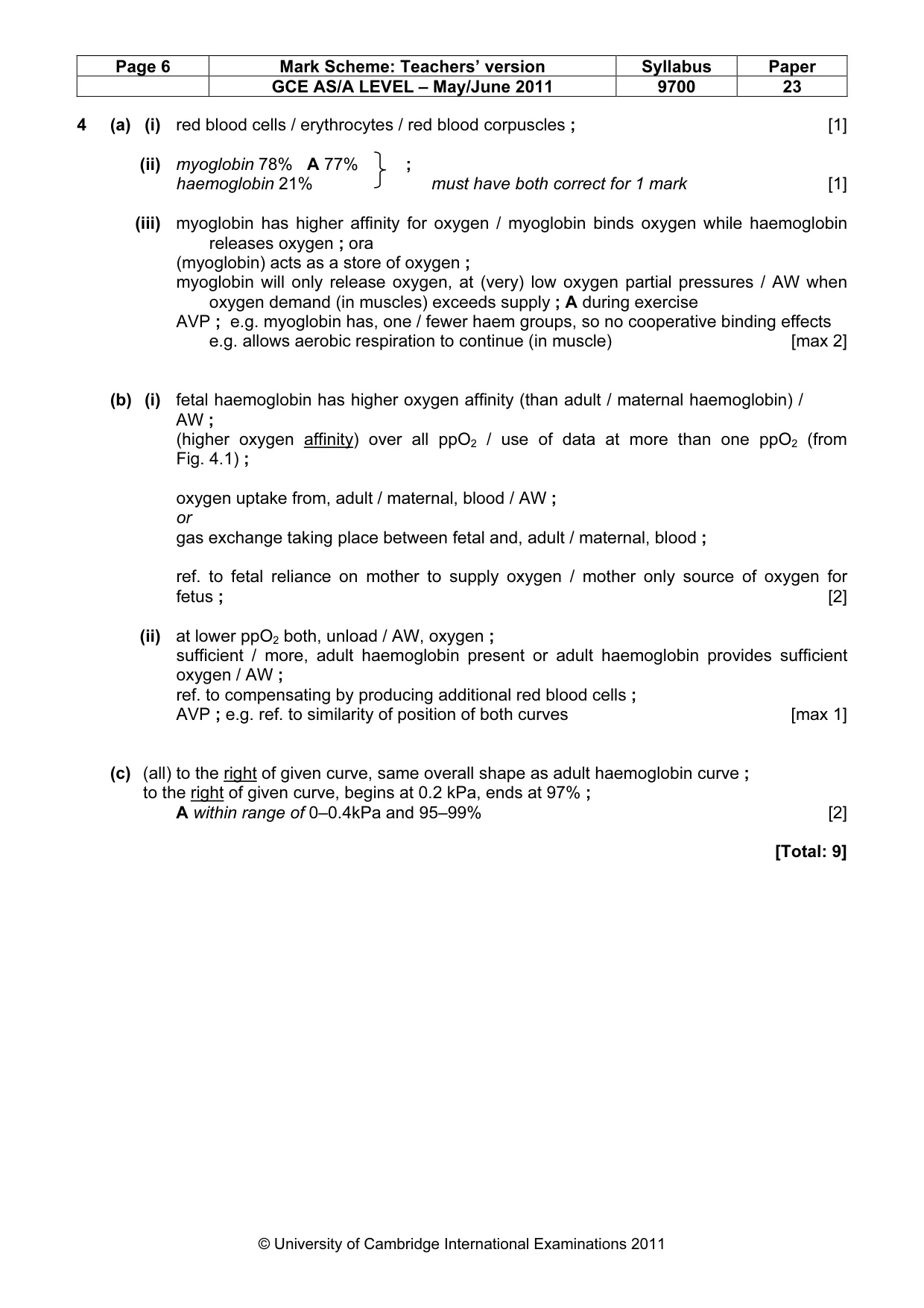
Page 6 Mark Scheme: Teachers’ version Syllabus Paper GCE AS/A LEVEL – May/June 2011 9700 23 © University of Cambridge International Examinations 2011 4 (a) (i) red blood cells / erythrocytes / red blood corpuscles ; [1] (ii) myoglobin 78% A 77% ; haemoglobin 21% must have both correct for 1 mark [1] (iii) myoglobin has higher affinity for oxygen / myoglobin binds oxygen while haemoglobin releases oxygen ; ora (myoglobin) acts as a store of oxygen ; myoglobin will only release oxygen, at (very) low oxygen partial pressures / AW when oxygen demand (in muscles) exceeds supply ; A during exercise AVP ; e.g. myoglobin has, one / fewer haem groups, so no cooperative binding effects e.g. allows aerobic respiration to continue (in muscle) [max 2] (b) (i) fetal haemoglobin has higher oxygen affinity (than adult / maternal haemoglobin) / AW ; (higher oxygen affinity) over all ppO2 / use of data at more than one ppO2 (from Fig. 4.1) ; oxygen uptake from, adult / maternal, blood / AW ; or gas exchange taking place between fetal and, adult / maternal, blood ; ref. to fetal reliance on mother to supply oxygen / mother only source of oxygen for fetus ; [2] (ii) at lower ppO2 both, unload / AW, oxygen ; sufficient / more, adult haemoglobin present or adult haemoglobin provides sufficient oxygen / AW ; ref. to compensating by producing additional red blood cells ; AVP ; e.g. ref. to similarity of position of both curves [max 1] (c) (all) to the right of given curve, same overall shape as adult haemoglobin curve ; to the right of given curve, begins at 0.2 kPa, ends at 97% ; A within range of 0–0.4kPa and 95–99% [2] [Total: 9]
Mark scheme, page 7
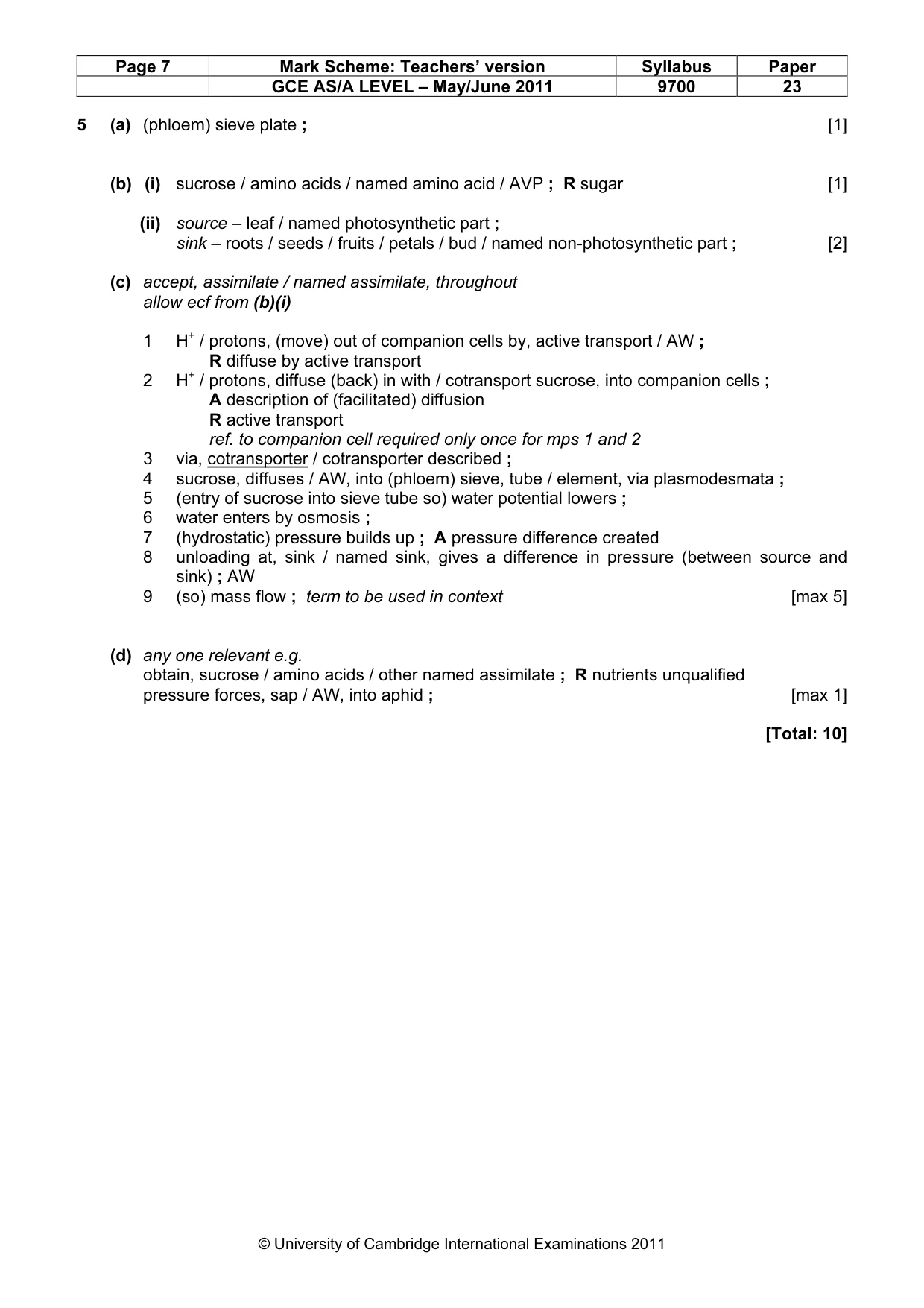
Page 7 Mark Scheme: Teachers’ version Syllabus Paper GCE AS/A LEVEL – May/June 2011 9700 23 © University of Cambridge International Examinations 2011 5 (a) (phloem) sieve plate ; [1] (b) (i) sucrose / amino acids / named amino acid / AVP ; R sugar [1] (ii) source – leaf / named photosynthetic part ; sink – roots / seeds / fruits / petals / bud / named non-photosynthetic part ; [2] (c) accept, assimilate / named assimilate, throughout allow ecf from (b)(i) 1 H+ / protons, (move) out of companion cells by, active transport / AW ; R diffuse by active transport 2 H+ / protons, diffuse (back) in with / cotransport sucrose, into companion cells ; A description of (facilitated) diffusion R active transport ref. to companion cell required only once for mps 1 and 2 3 via, cotransporter / cotransporter described ; 4 sucrose, diffuses / AW, into (phloem) sieve, tube / element, via plasmodesmata ; 5 (entry of sucrose into sieve tube so) water potential lowers ; 6 water enters by osmosis ; 7 (hydrostatic) pressure builds up ; A pressure difference created 8 unloading at, sink / named sink, gives a difference in pressure (between source and sink) ; AW 9 (so) mass flow ; term to be used in context [max 5] (d) any one relevant e.g. obtain, sucrose / amino acids / other named assimilate ; R nutrients unqualified pressure forces, sap / AW, into aphid ; [max 1] [Total: 10]
Mark scheme, page 8
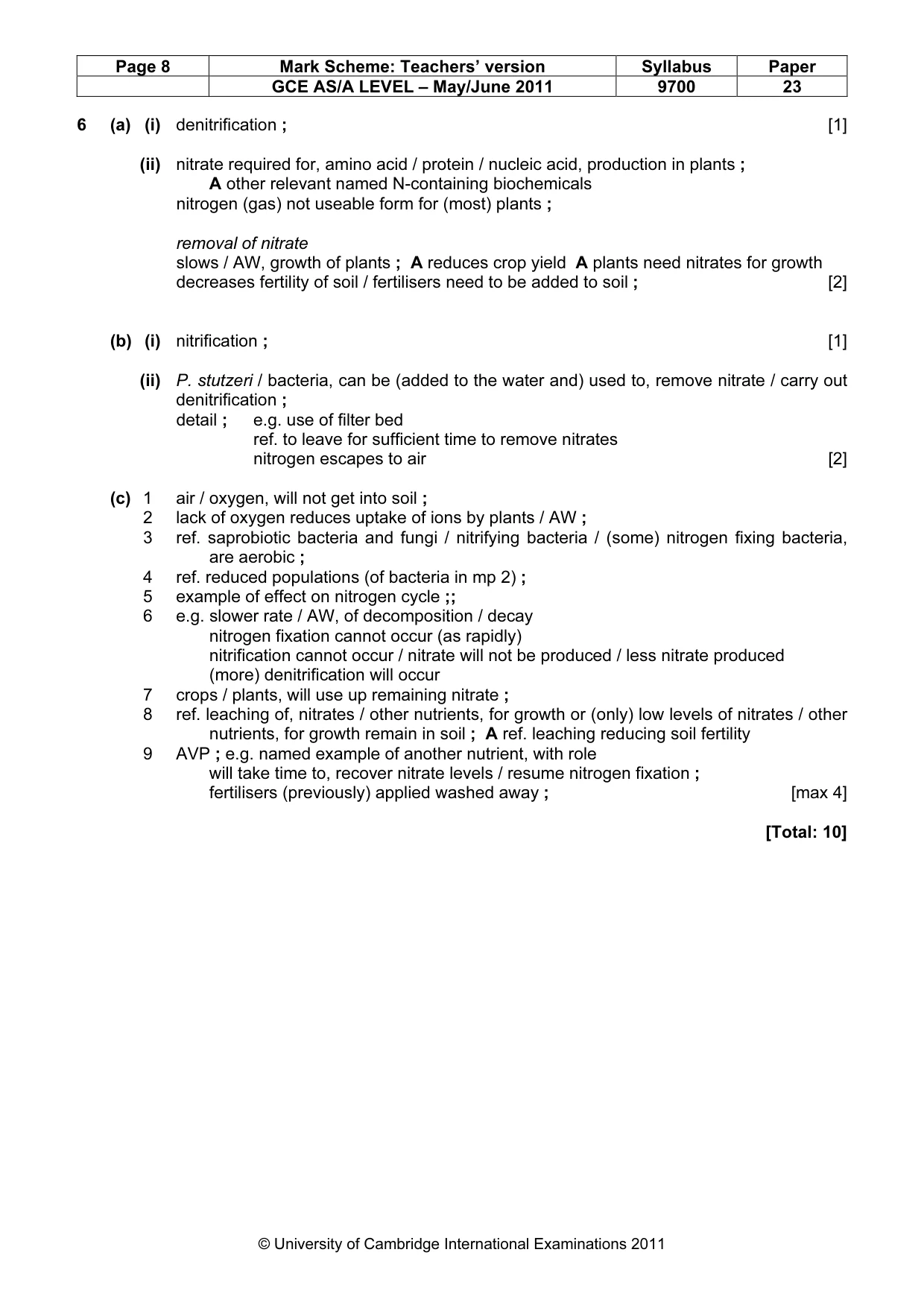
Page 8 Mark Scheme: Teachers’ version Syllabus Paper GCE AS/A LEVEL – May/June 2011 9700 23 © University of Cambridge International Examinations 2011 6 (a) (i) denitrification ; [1] (ii) nitrate required for, amino acid / protein / nucleic acid, production in plants ; A other relevant named N-containing biochemicals nitrogen (gas) not useable form for (most) plants ; removal of nitrate slows / AW, growth of plants ; A reduces crop yield A plants need nitrates for growth decreases fertility of soil / fertilisers need to be added to soil ; [2] (b) (i) nitrification ; [1] (ii) P. stutzeri / bacteria, can be (added to the water and) used to, remove nitrate / carry out denitrification ; detail ; e.g. use of filter bed ref. to leave for sufficient time to remove nitrates nitrogen escapes to air [2] (c) 1 air / oxygen, will not get into soil ; 2 lack of oxygen reduces uptake of ions by plants / AW ; 3 ref. saprobiotic bacteria and fungi / nitrifying bacteria / (some) nitrogen fixing bacteria, are aerobic ; 4 ref. reduced populations (of bacteria in mp 2) ; 5 example of effect on nitrogen cycle ;; 6 e.g. slower rate / AW, of decomposition / decay nitrogen fixation cannot occur (as rapidly) nitrification cannot occur / nitrate will not be produced / less nitrate produced (more) denitrification will occur 7 crops / plants, will use up remaining nitrate ; 8 ref. leaching of, nitrates / other nutrients, for growth or (only) low levels of nitrates / other nutrients, for growth remain in soil ; A ref. leaching reducing soil fertility 9 AVP ; e.g. named example of another nutrient, with role will take time to, recover nitrate levels / resume nitrogen fixation ; fertilisers (previously) applied washed away ; [max 4] [Total: 10]
What you needed in this session
Cambridge’s own grade thresholds for 2011 May/June, Paper 2 · Variant 3. A higher threshold means an easier paper — the bar moves with how the cohort did.