Cambridge A Level Biology 9700 — 2011 May/June Paper 2 · Variant 1
9700/21/M/J/11 · 60 marks · ≈68 min
The question paper and its mark scheme, free to read here and free to download. This is Cambridge’s own paper, exactly as it was sat.
Question paper16 pages
Mark scheme8 pages
Answers below. Sit the paper first if you are practising.
Paper as text
Question paper, page 1
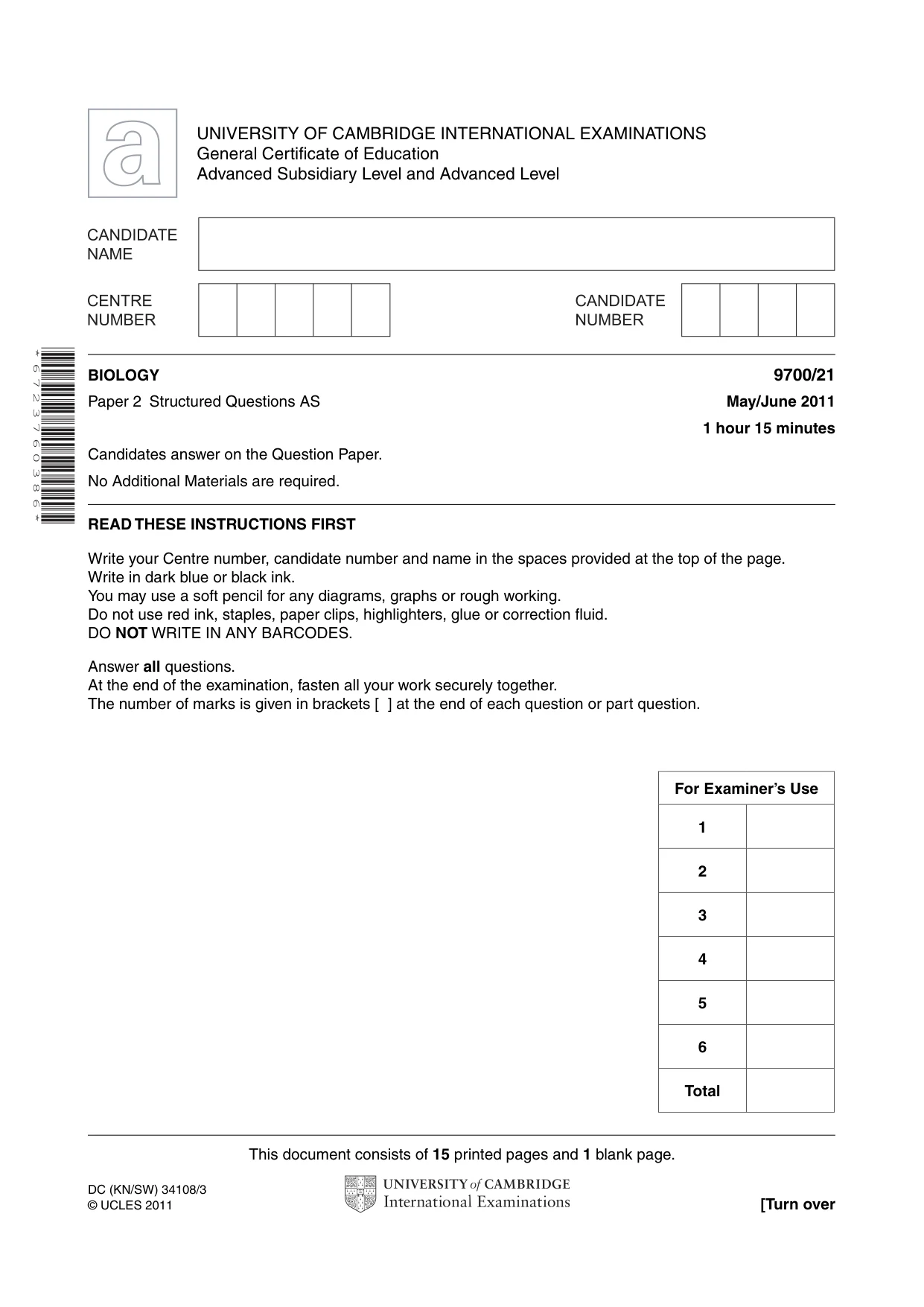
This document consists of 15 printed pages and 1 blank page. DC (KN/SW) 34108/3 © UCLES 2011 [Turn over UNIVERSITY OF CAMBRIDGE INTERNATIONAL EXAMINATIONS General Certificate of Education Advanced Subsidiary Level and Advanced Level READ THESE INSTRUCTIONS FIRST Write your Centre number, candidate number and name in the spaces provided at the top of the page. Write in dark blue or black ink. You may use a soft pencil for any diagrams, graphs or rough working. Do not use red ink, staples, paper clips, highlighters, glue or correction fluid. DO NOT WRITE IN ANY BARCODES. Answer all questions. At the end of the examination, fasten all your work securely together. The number of marks is given in brackets [ ] at the end of each question or part question. * 6 7 2 3 7 6 0 3 8 6 * BIOLOGY 9700/21 Paper 2 Structured Questions AS May/June 2011 1 hour 15 minutes Candidates answer on the Question Paper. No Additional Materials are required. For Examiner’s Use 1 2 3 4 5 6 Total
Question paper, page 2
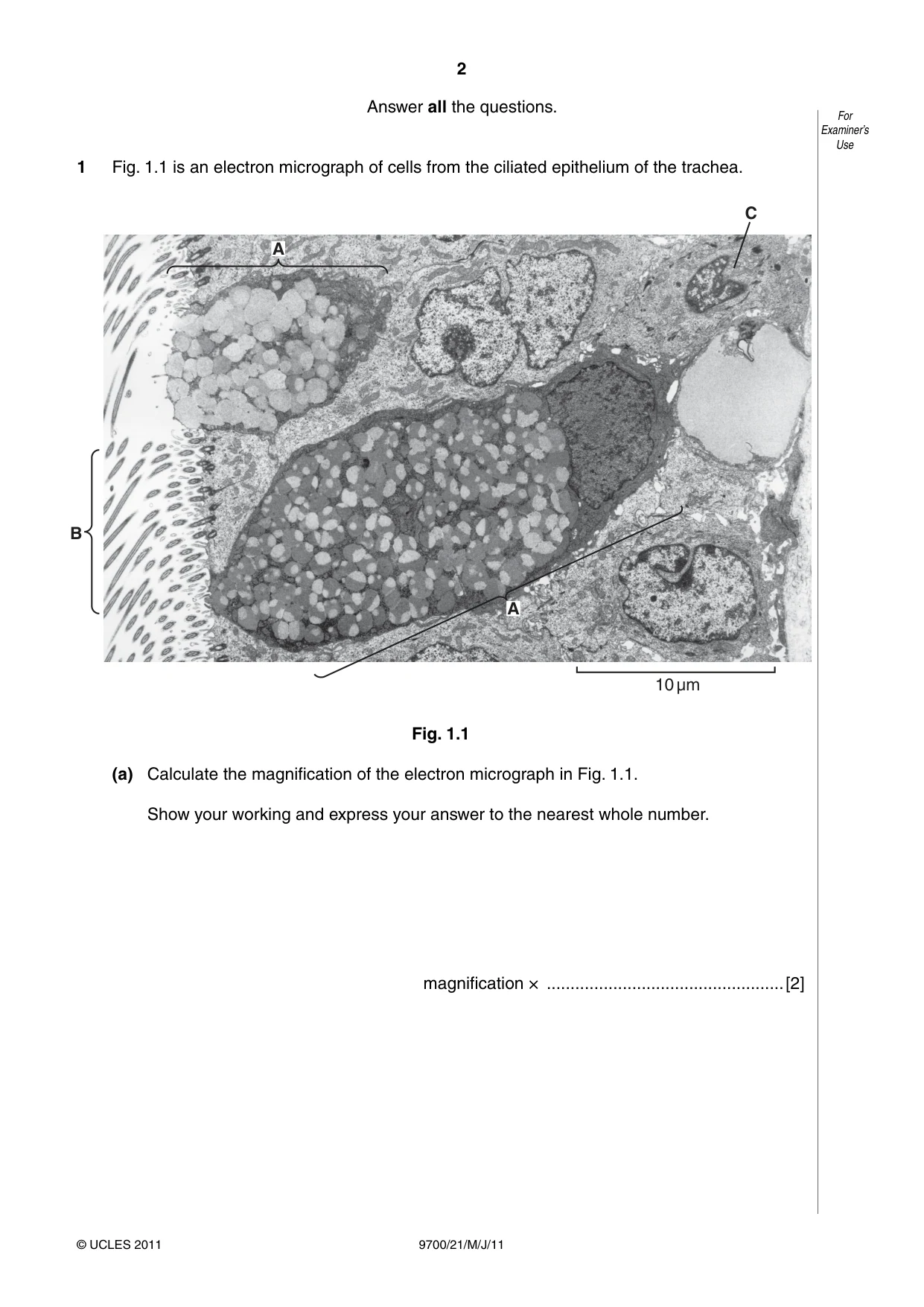
2 9700/21/M/J/11 © UCLES 2011 For Examiner’s Use Answer all the questions. 1 Fig. 1.1 is an electron micrograph of cells from the ciliated epithelium of the trachea. A C A 10 µm B Fig. 1.1 (a) Calculate the magnification of the electron micrograph in Fig. 1.1. Show your working and express your answer to the nearest whole number. magnification × …[2]
Question paper, page 3
3 9700/21/M/J/11 © UCLES 2011 [Turn over For Examiner’s Use (b) Explain how the cells labelled A and the structures labelled B in Fig. 1.1 protect the lining of the trachea. … … … … … … … … …[4] (c) Cells, such as C, at the base of the epithelium of the trachea divide by mitosis. Describe the changes that occur within the cell between the beginning of prophase and the end of metaphase. … … … … … … … … … … …[5] [Total: 11]
Question paper, page 4
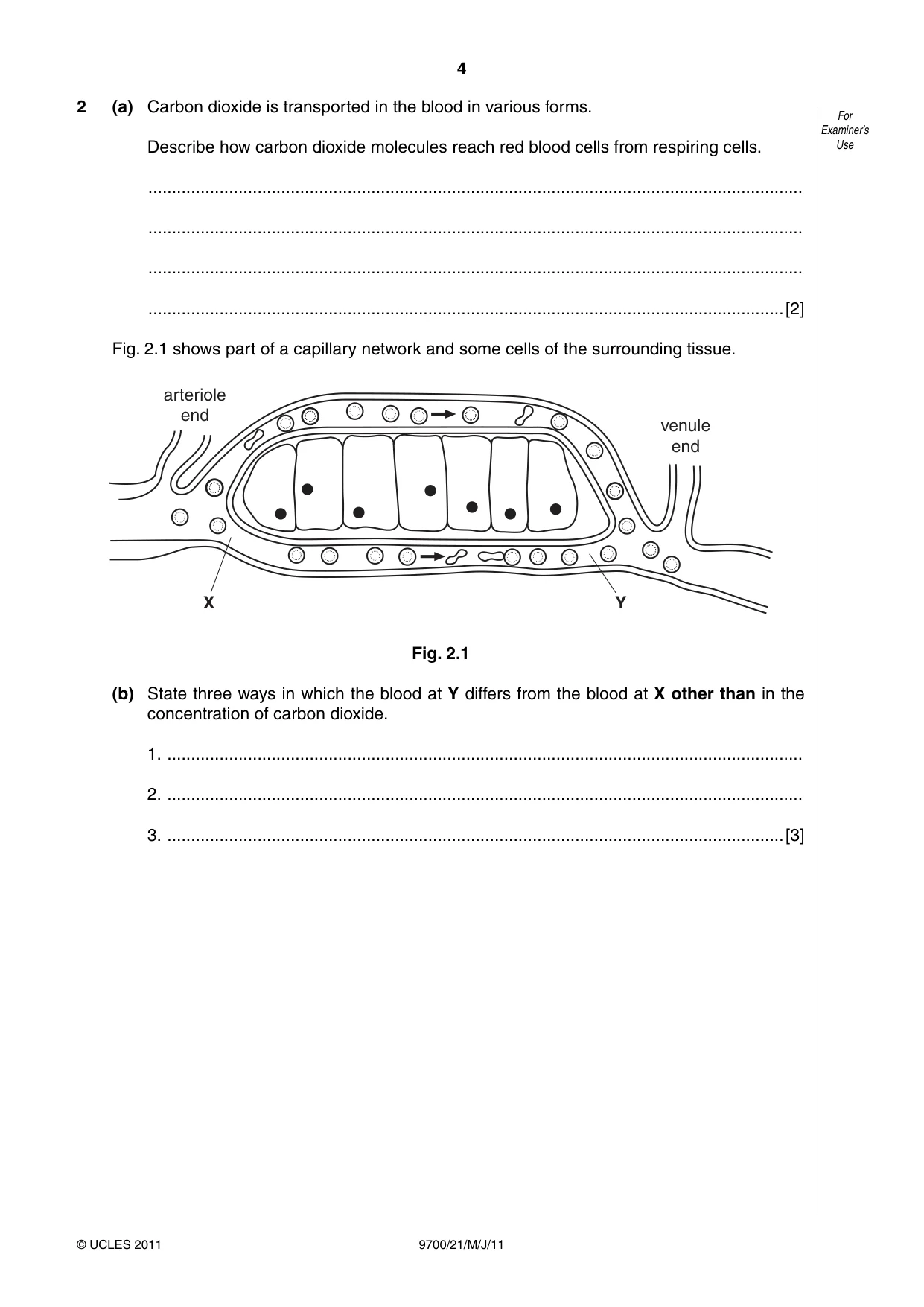
4 9700/21/M/J/11 © UCLES 2011 For Examiner’s Use 2 (a) Carbon dioxide is transported in the blood in various forms. Describe how carbon dioxide molecules reach red blood cells from respiring cells. … … … …[2] Fig. 2.1 shows part of a capillary network and some cells of the surrounding tissue. X Y venule end arteriole end Fig. 2.1 (b) State three ways in which the blood at Y differs from the blood at X other than in the concentration of carbon dioxide. 1. … 2. … 3. …[3]
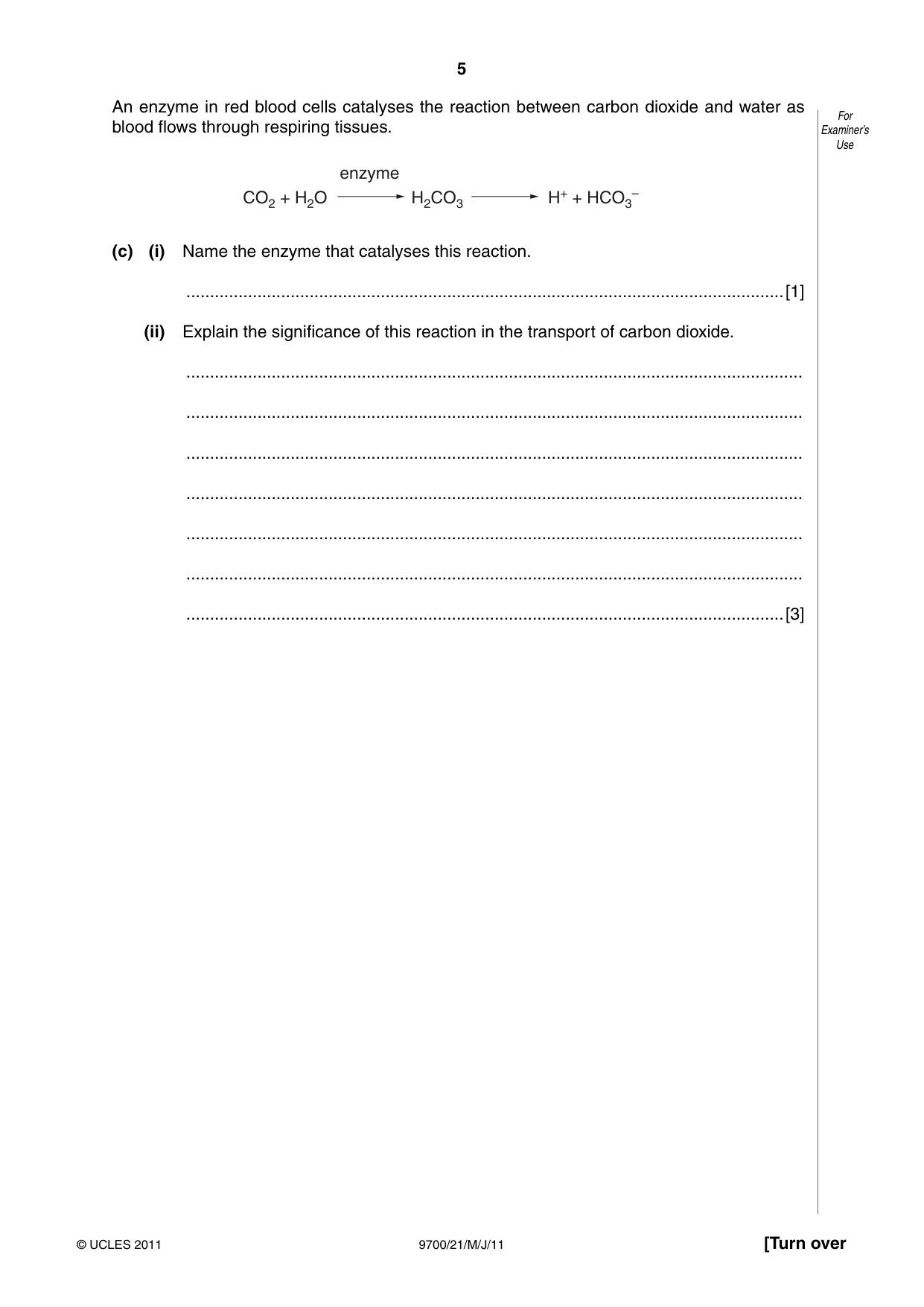
Question paper, page 5
5 9700/21/M/J/11 © UCLES 2011 [Turn over For Examiner’s Use An enzyme in red blood cells catalyses the reaction between carbon dioxide and water as blood flows through respiring tissues. CO2 + H2O H2CO3 enzyme H+ + HCO3 – (c) (i) Name the enzyme that catalyses this reaction. …[1] (ii) Explain the significance of this reaction in the transport of carbon dioxide. … … … … … … …[3]
Question paper, page 6
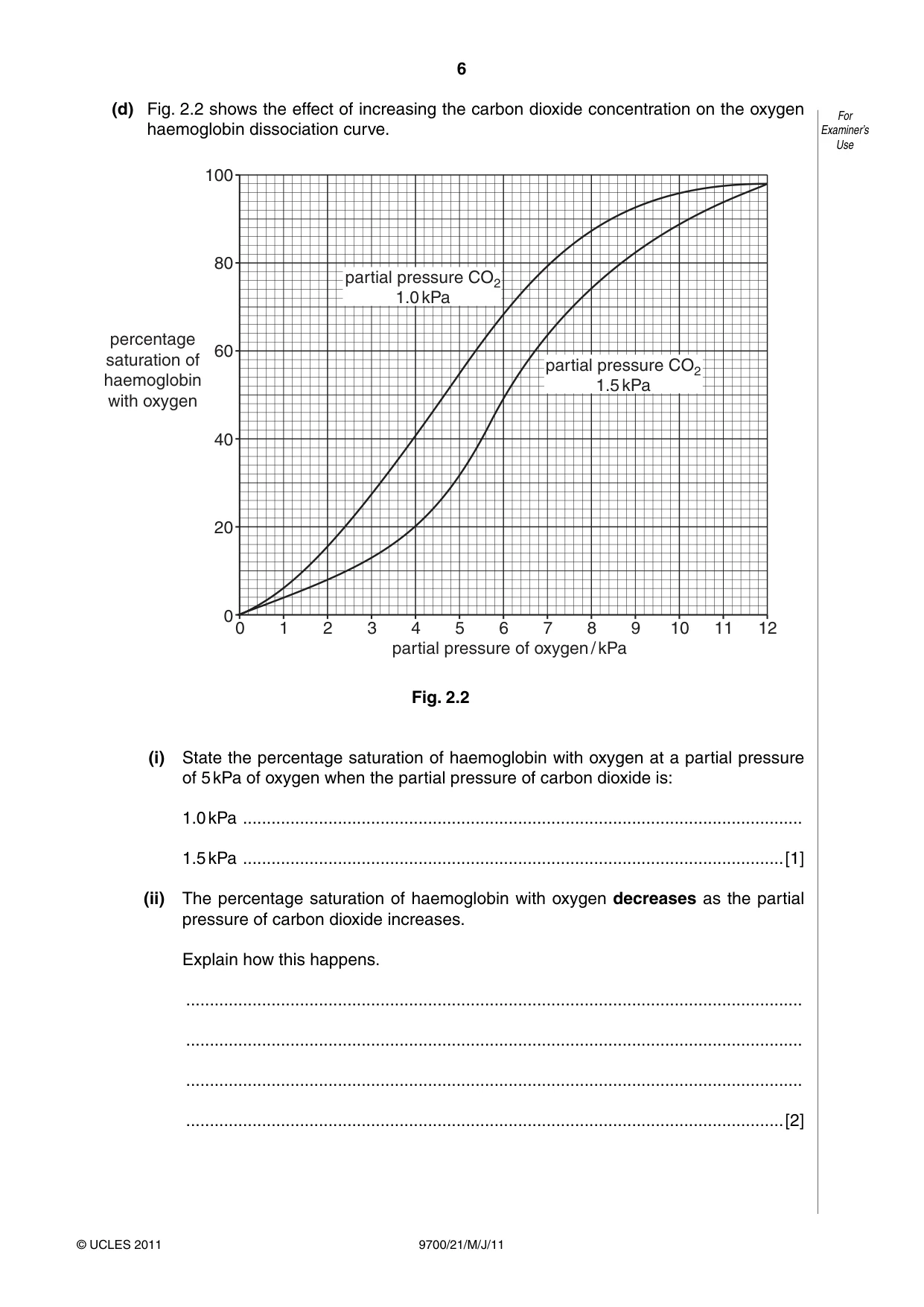
6 9700/21/M/J/11 © UCLES 2011 For Examiner’s Use (d) Fig. 2.2 shows the effect of increasing the carbon dioxide concentration on the oxygen haemoglobin dissociation curve. 0 0 20 40 60 80 100 1 2 3 4 5 partial pressure of oxygen / kPa percentage saturation of haemoglobin with oxygen 6 7 8 9 10 11 12 partial pressure CO2 1.0 kPa partial pressure CO2 1.5 kPa Fig. 2.2 (i) State the percentage saturation of haemoglobin with oxygen at a partial pressure of 5 kPa of oxygen when the partial pressure of carbon dioxide is: 1.0 kPa … 1.5 kPa …[1] (ii) The percentage saturation of haemoglobin with oxygen decreases as the partial pressure of carbon dioxide increases. Explain how this happens. … … … …[2]
Question paper, page 7
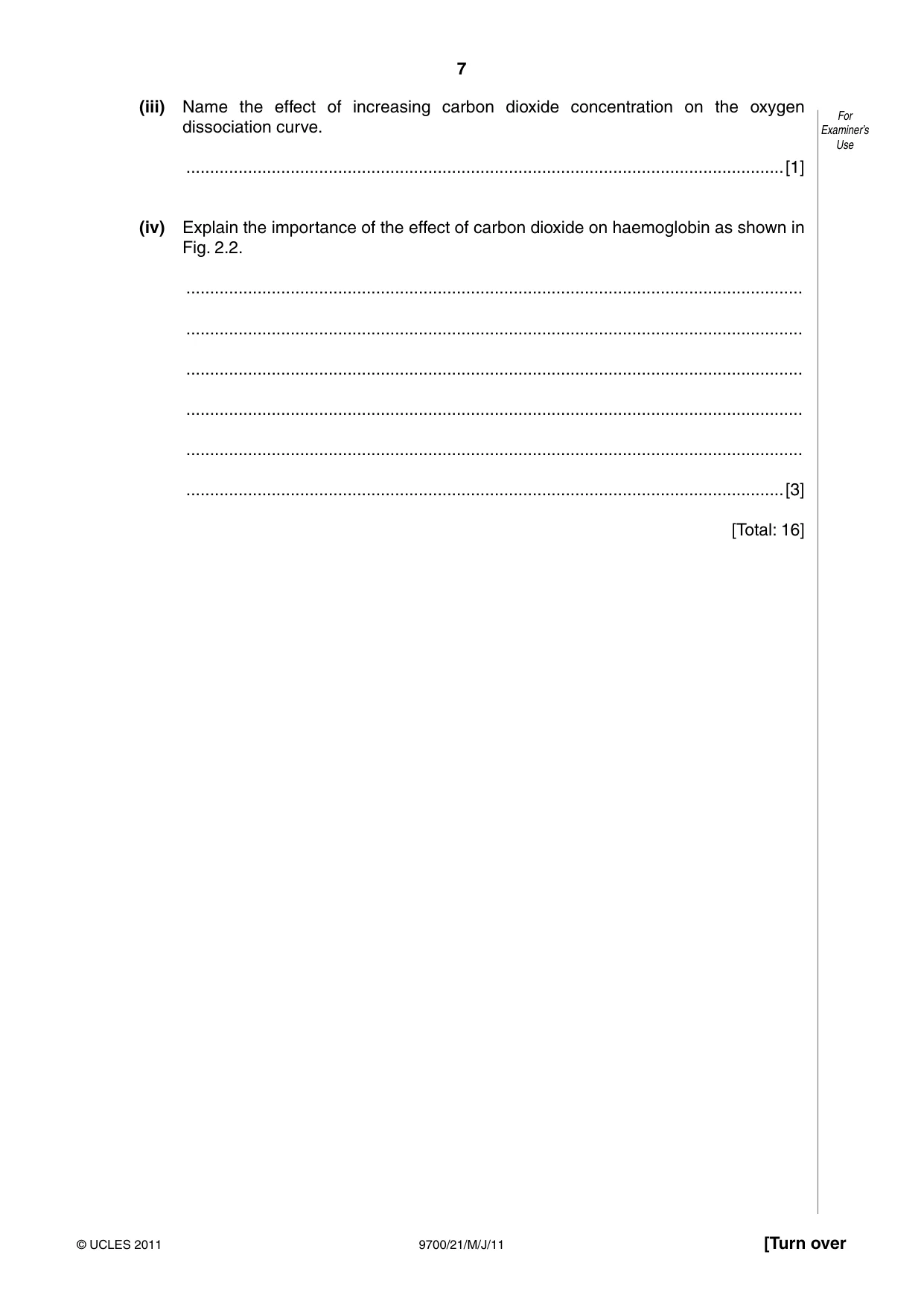
7 9700/21/M/J/11 © UCLES 2011 [Turn over For Examiner’s Use (iii) Name the effect of increasing carbon dioxide concentration on the oxygen dissociation curve. …[1] (iv) Explain the importance of the effect of carbon dioxide on haemoglobin as shown in Fig. 2.2. … … … … … …[3] [Total: 16]
Question paper, page 8
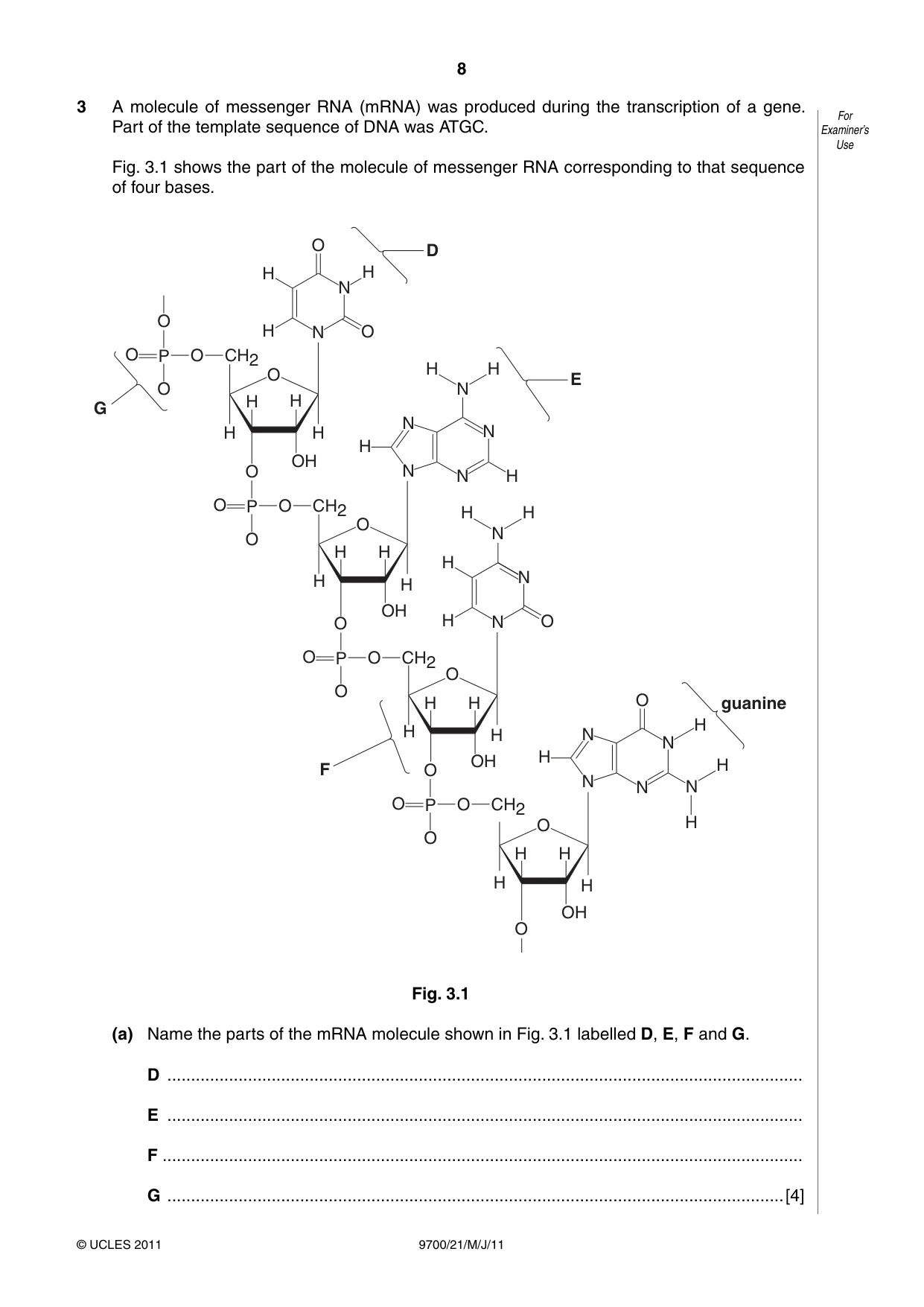
8 9700/21/M/J/11 © UCLES 2011 For Examiner’s Use 3 A molecule of messenger RNA (mRNA) was produced during the transcription of a gene. Part of the template sequence of DNA was ATGC. Fig. 3.1 shows the part of the molecule of messenger RNA corresponding to that sequence of four bases. D O O N N H H H H H H H H H H H H H H H H H H H N H N N N N H H H O N N H H N H H O N N N N N H H H H O OH OH OH OH O P O O O O CH2 P O O O O CH2 P O O O O CH2 P O O O O CH2 O O O E guanine G F Fig. 3.1 (a) Name the parts of the mRNA molecule shown in Fig. 3.1 labelled D, E, F and G. D … E … F … G …[4]
Question paper, page 9
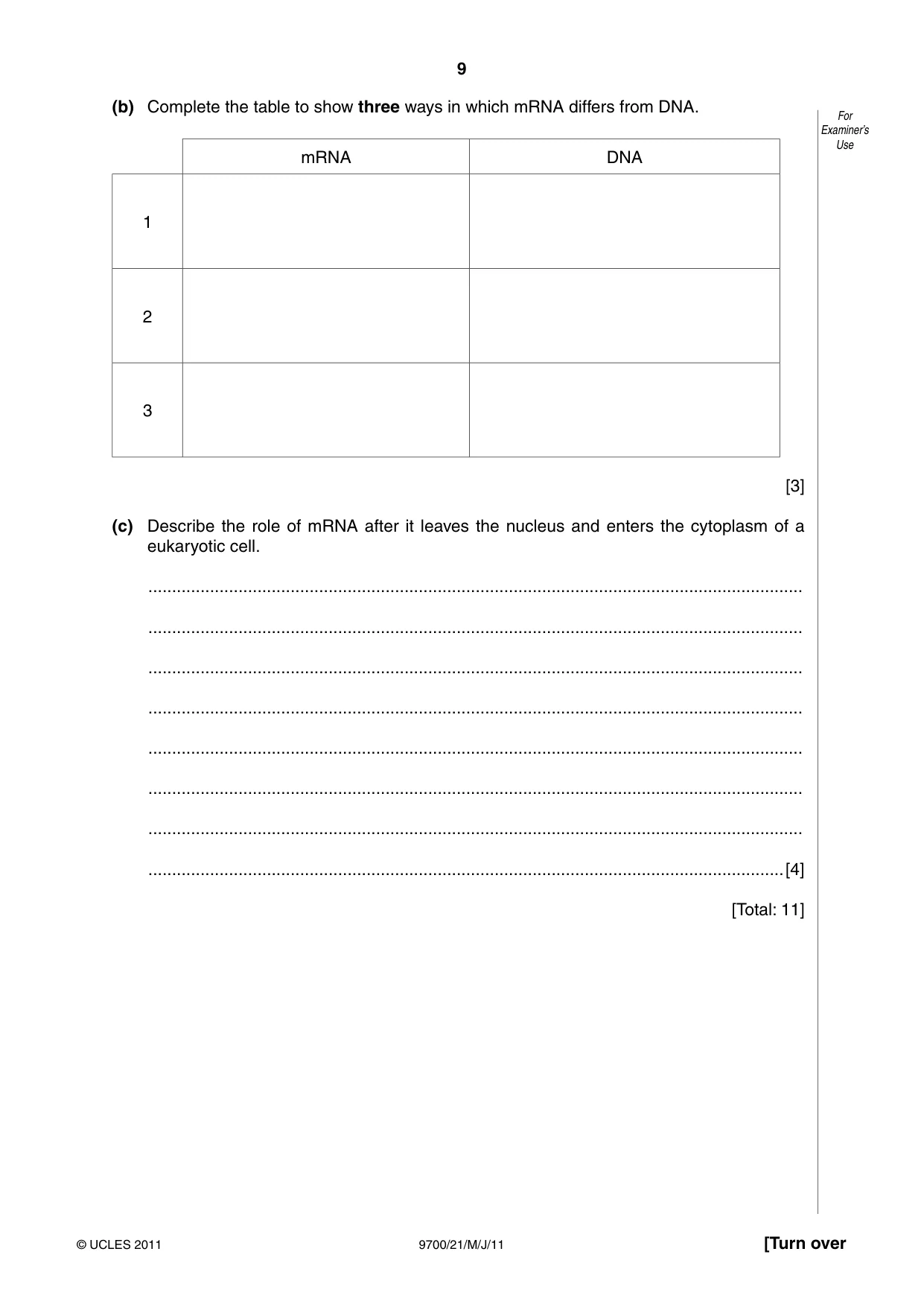
9 9700/21/M/J/11 © UCLES 2011 [Turn over For Examiner’s Use (b) Complete the table to show three ways in which mRNA differs from DNA. mRNA DNA 1 2 3 [3] (c) Describe the role of mRNA after it leaves the nucleus and enters the cytoplasm of a eukaryotic cell. … … … … … … … …[4] [Total: 11]
Question paper, page 10
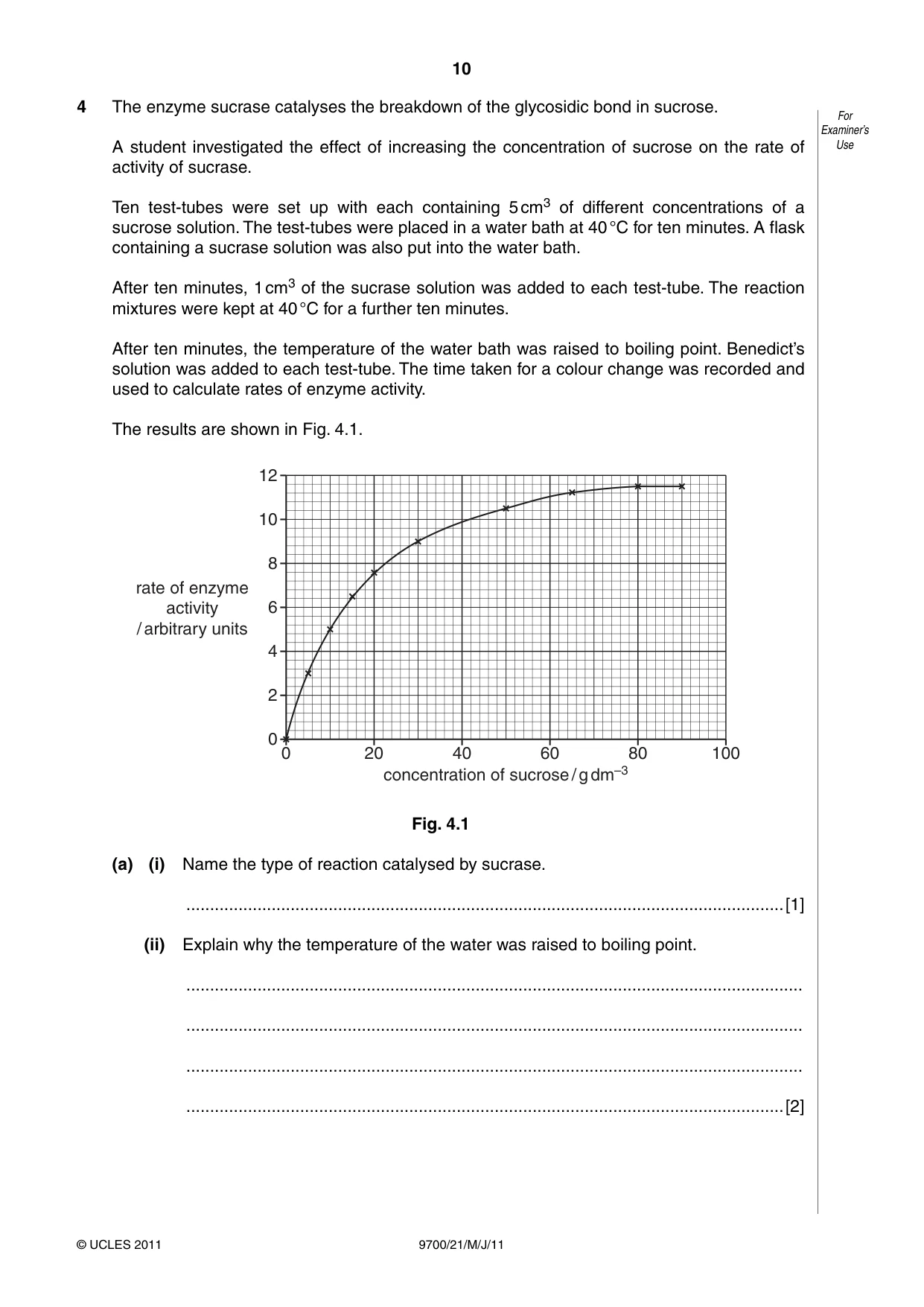
10 9700/21/M/J/11 © UCLES 2011 For Examiner’s Use 4 The enzyme sucrase catalyses the breakdown of the glycosidic bond in sucrose. A student investigated the effect of increasing the concentration of sucrose on the rate of activity of sucrase. Ten test-tubes were set up with each containing 5 cm3 of different concentrations of a sucrose solution. The test-tubes were placed in a water bath at 40 °C for ten minutes. A flask containing a sucrase solution was also put into the water bath. After ten minutes, 1 cm3 of the sucrase solution was added to each test-tube. The reaction mixtures were kept at 40 °C for a further ten minutes. After ten minutes, the temperature of the water bath was raised to boiling point. Benedict’s solution was added to each test-tube. The time taken for a colour change was recorded and used to calculate rates of enzyme activity. The results are shown in Fig. 4.1. 0 0 2 4 6 8 10 12 20 40 60 concentration of sucrose / g dm–3 rate of enzyme activity / arbitrary units 80 100 Fig. 4.1 (a) (i) Name the type of reaction catalysed by sucrase. …[1] (ii) Explain why the temperature of the water was raised to boiling point. … … … …[2]
Question paper, page 11
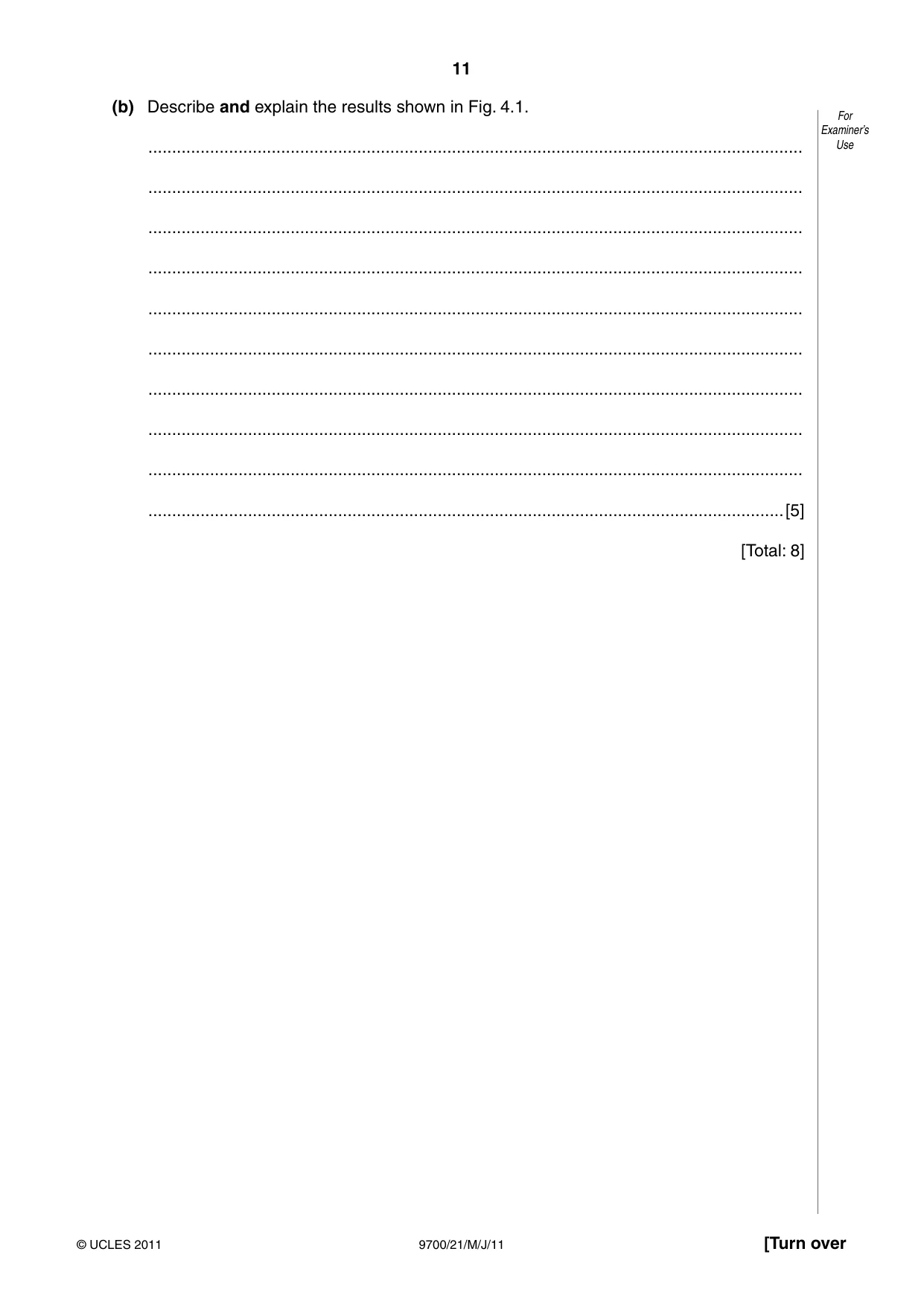
11 9700/21/M/J/11 © UCLES 2011 [Turn over For Examiner’s Use (b) Describe and explain the results shown in Fig. 4.1. … … … … … … … … … …[5] [Total: 8]
Question paper, page 12
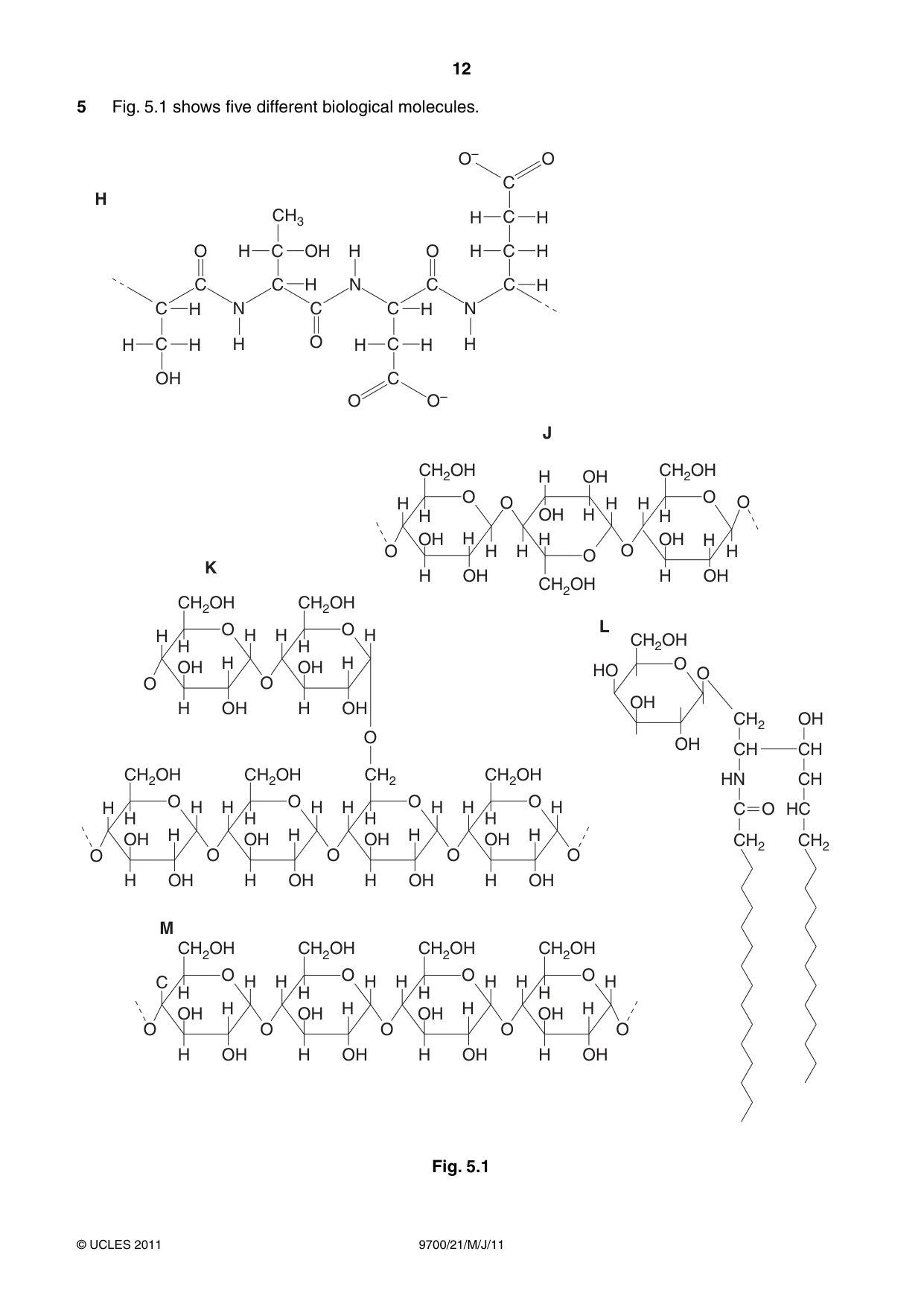
12 9700/21/M/J/11 © UCLES 2011 5 Fig. 5.1 shows five different biological molecules. CH2OH H O O O OH H H H OH CH2OH H CH2OH H H H O OH H H H OH H O O O OH H H H OH CH2OH C O O O OH H H H OH CH2OH O OH H H H OH H H O CH2OH H O O OH H H H OH CH2OH O OH H H H OH H H H O CH2OH H O O OH H H H OH CH2OH O OH H H H OH H H O H H O CH2 O O OH H H H OH CH2OH O OH H H H OH H H O O CH2OH O OH H H H OH H H O CH2OH O OH H H H OH H H H H O CH2OH O OH OH HO O CH2 CH2 CH C O HN OH CH2 CH CH HC C OH C C O H H O O H N C H H C C C O O O– O– C H H H C CH3 H OH H H N N C C C H H H C H H C H J K L M Fig. 5.1
Question paper, page 13
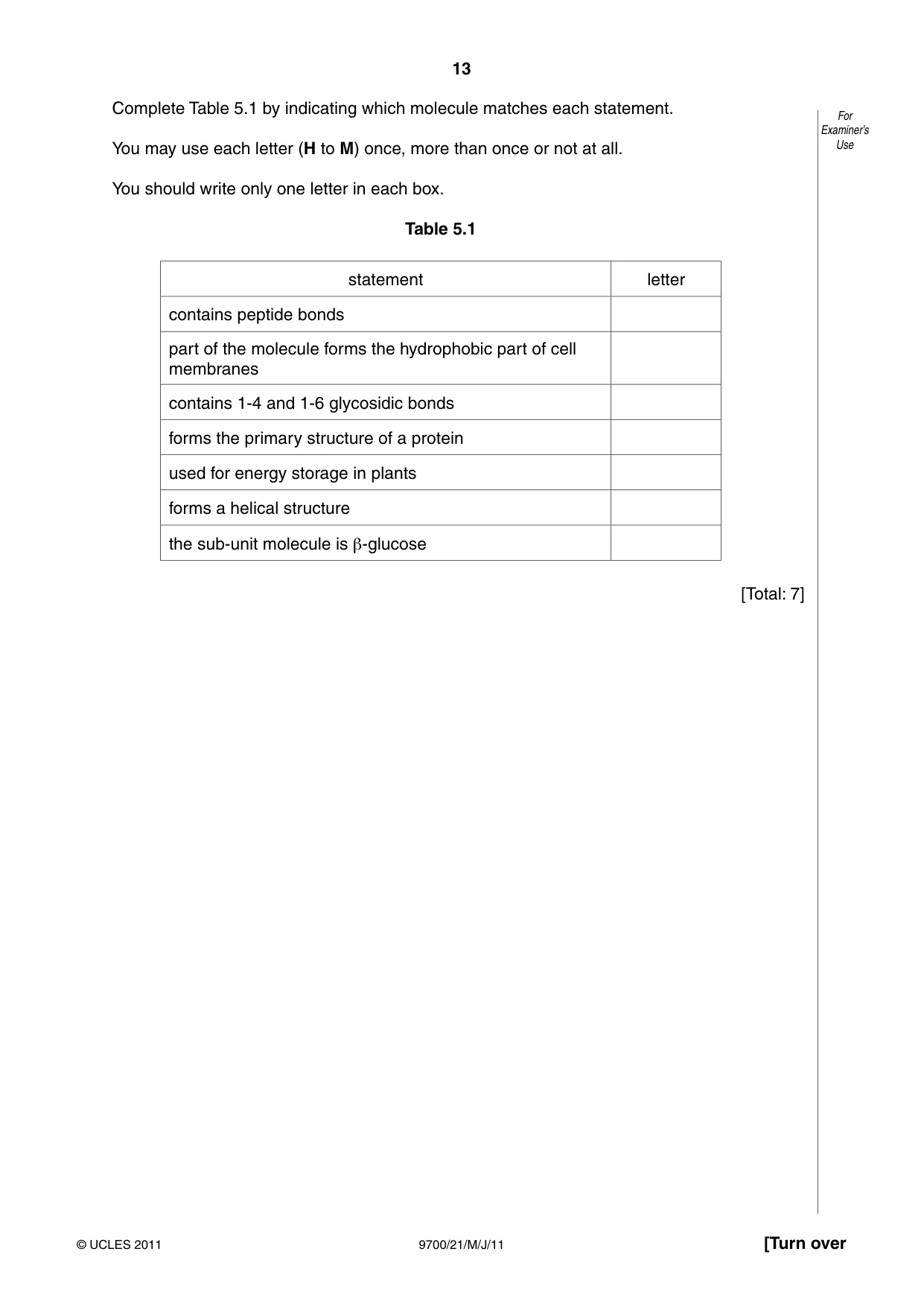
13 9700/21/M/J/11 © UCLES 2011 [Turn over For Examiner’s Use Complete Table 5.1 by indicating which molecule matches each statement. You may use each letter (H to M) once, more than once or not at all. You should write only one letter in each box. Table 5.1 statement letter contains peptide bonds part of the molecule forms the hydrophobic part of cell membranes contains 1-4 and 1-6 glycosidic bonds forms the primary structure of a protein used for energy storage in plants forms a helical structure the sub-unit molecule is β-glucose [Total: 7]
Question paper, page 14
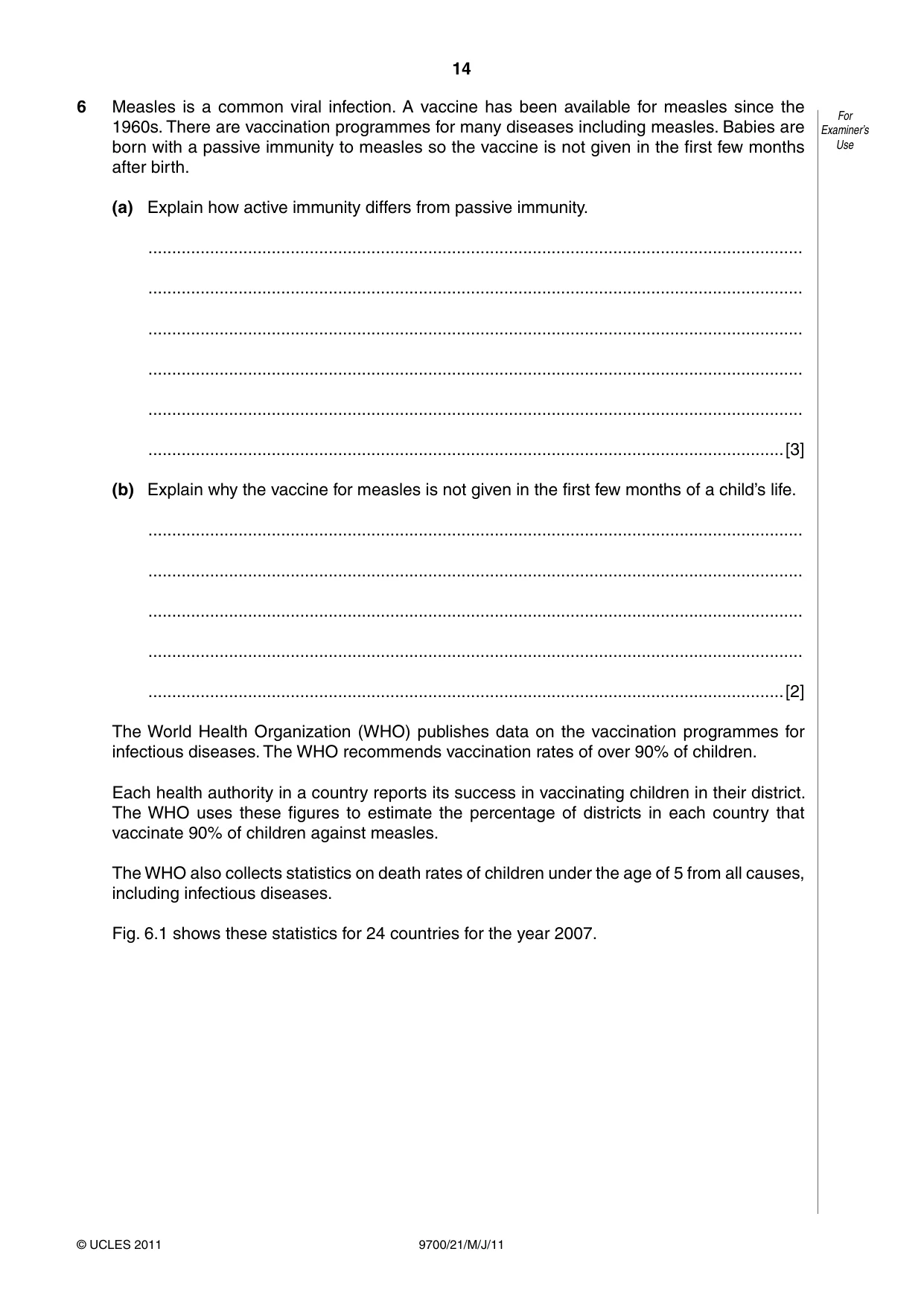
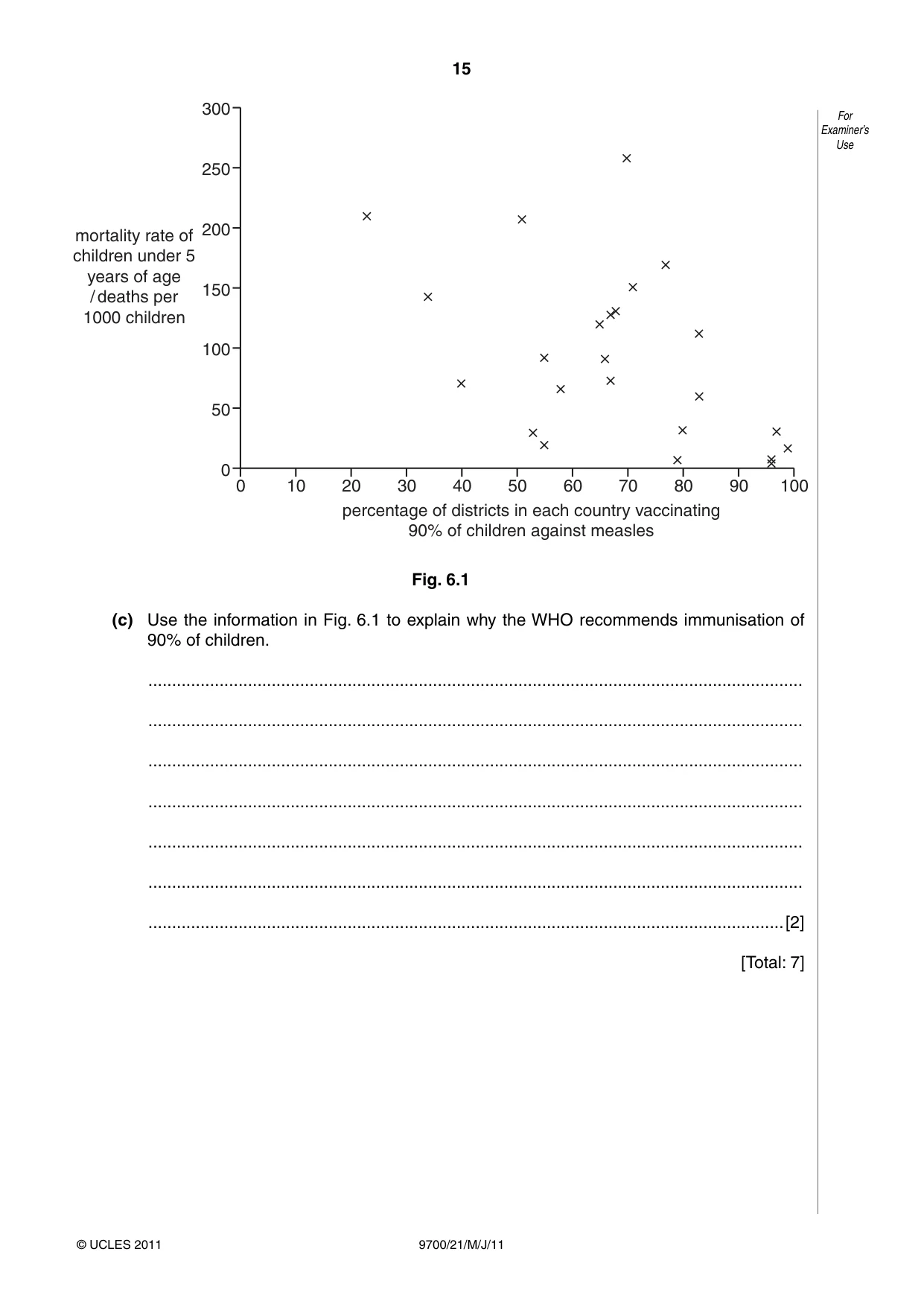
14 9700/21/M/J/11 © UCLES 2011 For Examiner’s Use 6 Measles is a common viral infection. A vaccine has been available for measles since the 1960s. There are vaccination programmes for many diseases including measles. Babies are born with a passive immunity to measles so the vaccine is not given in the first few months after birth. (a) Explain how active immunity differs from passive immunity. … … … … … …[3] (b) Explain why the vaccine for measles is not given in the first few months of a child’s life. … … … … …[2] The World Health Organization (WHO) publishes data on the vaccination programmes for infectious diseases. The WHO recommends vaccination rates of over 90% of children. Each health authority in a country reports its success in vaccinating children in their district. The WHO uses these figures to estimate the percentage of districts in each country that vaccinate 90% of children against measles. The WHO also collects statistics on death rates of children under the age of 5 from all causes, including infectious diseases. Fig. 6.1 shows these statistics for 24 countries for the year 2007.
Question paper, page 15
15 9700/21/M/J/11 © UCLES 2011 For Examiner’s Use 0 0 50 100 150 200 250 300 10 20 30 40 50 60 70 80 90 100 percentage of districts in each country vaccinating 90% of children against measles mortality rate of children under 5 years of age / deaths per 1000 children Fig. 6.1 (c) Use the information in Fig. 6.1 to explain why the WHO recommends immunisation of 90% of children. … … … … … … …[2] [Total: 7]
Question paper, page 16
16 9700/21/M/J/11 © UCLES 2011 BLANK PAGE Copyright Acknowledgements: Fig. 1.1 © Image taken by Prof. H. Wartenberg from Dr. Jastrow’s electron microscope atlas on http://www.drjastrow.de. Permission to reproduce items where third-party owned material protected by copyright is included has been sought and cleared where possible. Every reasonable effort has been made by the publisher (UCLES) to trace copyright holders, but if any items requiring clearance have unwittingly been included, the publisher will be pleased to make amends at the earliest possible opportunity. University of Cambridge International Examinations is part of the Cambridge Assessment Group. Cambridge Assessment is the brand name of University of Cambridge Local Examinations Syndicate (UCLES), which is itself a department of the University of Cambridge.
Mark scheme, page 1
UNIVERSITY OF CAMBRIDGE INTERNATIONAL EXAMINATIONS GCE Advanced Subsidiary Level and GCE Advanced Level MARK SCHEME for the May/June 2011 question paper for the guidance of teachers 9700 BIOLOGY 9700/21 Paper 2 (AS Structured Questions), maximum raw mark 60 This mark scheme is published as an aid to teachers and candidates, to indicate the requirements of the examination. It shows the basis on which Examiners were instructed to award marks. It does not indicate the details of the discussions that took place at an Examiners’ meeting before marking began, which would have considered the acceptability of alternative answers. Mark schemes must be read in conjunction with the question papers and the report on the examination. • Cambridge will not enter into discussions or correspondence in connection with these mark schemes. Cambridge is publishing the mark schemes for the May/June 2011 question papers for most IGCSE, GCE Advanced Level and Advanced Subsidiary Level syllabuses and some Ordinary Level syllabuses.
Mark scheme, page 2
Page 2 Mark Scheme: Teachers’ version Syllabus Paper GCE AS/A LEVEL – May/June 2011 9700 21 © University of Cambridge International Examinations 2011 Mark scheme abbreviations: ; separates marking points / alternative answers for the same point R reject A accept (for answers correctly cued by the question, or by extra guidance) AW alternative wording (where responses vary more than usual) underline actual word given must be used by candidate (grammatical variants excepted) max indicates the maximum number of marks that can be given ora or reverse argument mp marking point (with relevant number) ecf error carried forward I ignore
Mark scheme, page 3
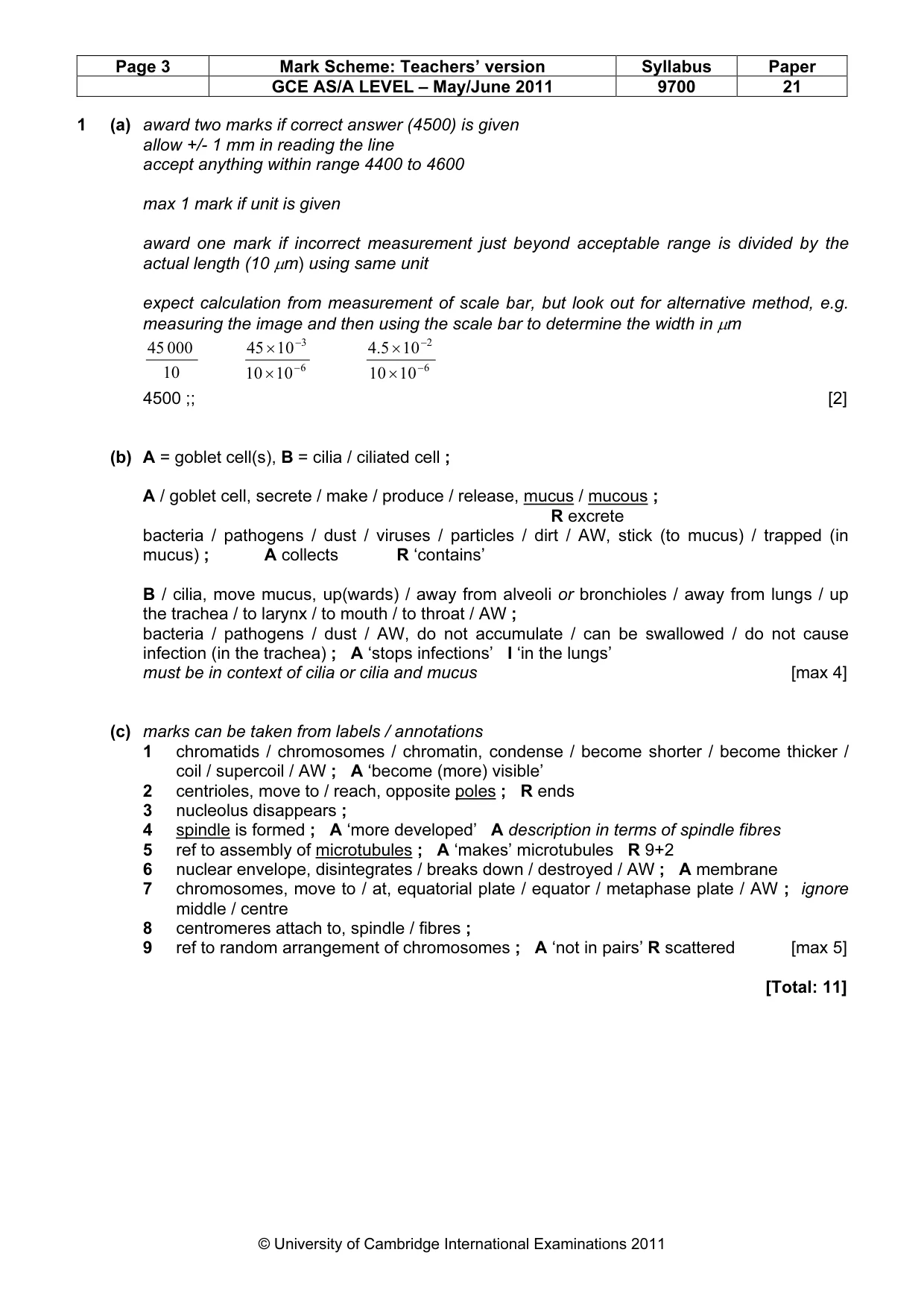
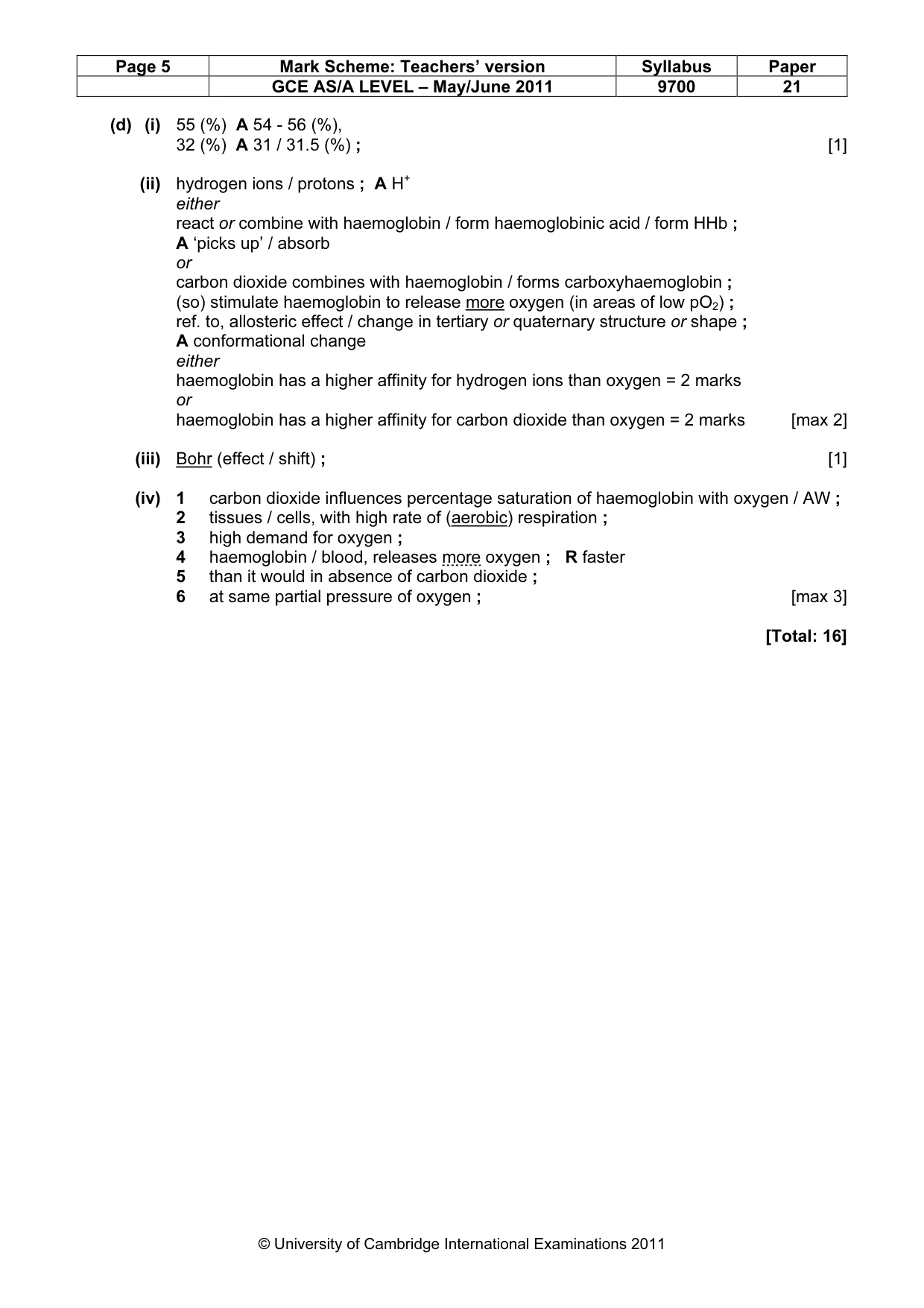
Page 3 Mark Scheme: Teachers’ version Syllabus Paper GCE AS/A LEVEL – May/June 2011 9700 21 © University of Cambridge International Examinations 2011 1 (a) award two marks if correct answer (4500) is given allow +/- 1 mm in reading the line accept anything within range 4400 to 4600 max 1 mark if unit is given award one mark if incorrect measurement just beyond acceptable range is divided by the actual length (10 µm) using same unit expect calculation from measurement of scale bar, but look out for alternative method, e.g. measuring the image and then using the scale bar to determine the width in µm 10 000 45 6 3 10 10 10 45 − − × × 6 2 10 10 10 5.4 − − × × 4500 ;; [2] (b) A = goblet cell(s), B = cilia / ciliated cell ; A / goblet cell, secrete / make / produce / release, mucus / mucous ; R excrete bacteria / pathogens / dust / viruses / particles / dirt / AW, stick (to mucus) / trapped (in mucus) ; A collects R ‘contains’ B / cilia, move mucus, up(wards) / away from alveoli or bronchioles / away from lungs / up the trachea / to larynx / to mouth / to throat / AW ; bacteria / pathogens / dust / AW, do not accumulate / can be swallowed / do not cause infection (in the trachea) ; A ‘stops infections’ I ‘in the lungs’ must be in context of cilia or cilia and mucus [max 4] (c) marks can be taken from labels / annotations 1 chromatids / chromosomes / chromatin, condense / become shorter / become thicker / coil / supercoil / AW ; A ‘become (more) visible’ 2 centrioles, move to / reach, opposite poles ; R ends 3 nucleolus disappears ; 4 spindle is formed ; A ‘more developed’ A description in terms of spindle fibres 5 ref to assembly of microtubules ; A ‘makes’ microtubules R 9+2 6 nuclear envelope, disintegrates / breaks down / destroyed / AW ; A membrane 7 chromosomes, move to / at, equatorial plate / equator / metaphase plate / AW ; ignore middle / centre 8 centromeres attach to, spindle / fibres ; 9 ref to random arrangement of chromosomes ; A ‘not in pairs’ R scattered [max 5] [Total: 11]
Mark scheme, page 4
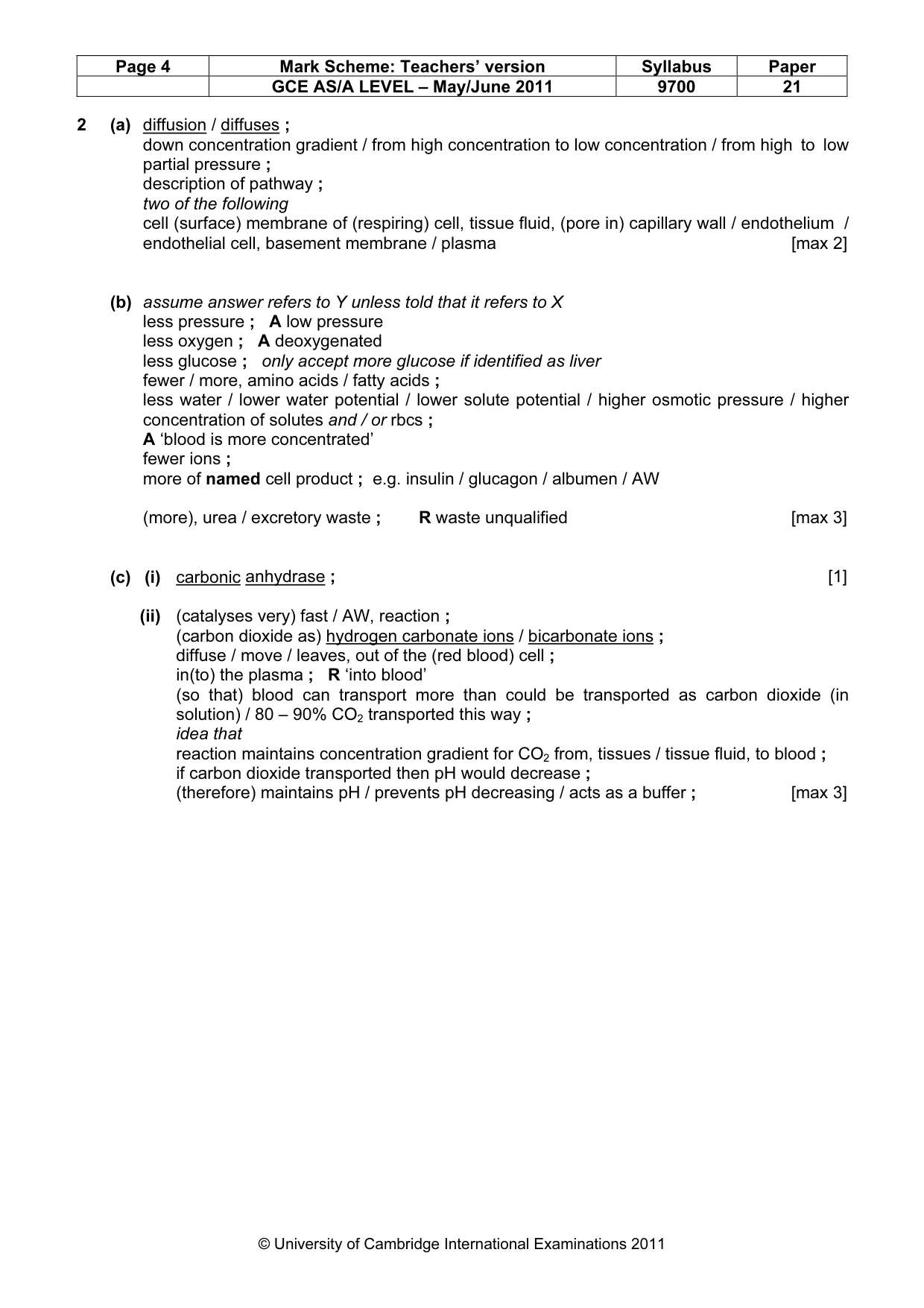
Page 4 Mark Scheme: Teachers’ version Syllabus Paper GCE AS/A LEVEL – May/June 2011 9700 21 © University of Cambridge International Examinations 2011 2 (a) diffusion / diffuses ; down concentration gradient / from high concentration to low concentration / from high to low partial pressure ; description of pathway ; two of the following cell (surface) membrane of (respiring) cell, tissue fluid, (pore in) capillary wall / endothelium / endothelial cell, basement membrane / plasma [max 2] (b) assume answer refers to Y unless told that it refers to X less pressure ; A low pressure less oxygen ; A deoxygenated less glucose ; only accept more glucose if identified as liver fewer / more, amino acids / fatty acids ; less water / lower water potential / lower solute potential / higher osmotic pressure / higher concentration of solutes and / or rbcs ; A ‘blood is more concentrated’ fewer ions ; more of named cell product ; e.g. insulin / glucagon / albumen / AW (more), urea / excretory waste ; R waste unqualified [max 3] (c) (i) carbonic anhydrase ; [1] (ii) (catalyses very) fast / AW, reaction ; (carbon dioxide as) hydrogen carbonate ions / bicarbonate ions ; diffuse / move / leaves, out of the (red blood) cell ; in(to) the plasma ; R ‘into blood’ (so that) blood can transport more than could be transported as carbon dioxide (in solution) / 80 – 90% CO2 transported this way ; idea that reaction maintains concentration gradient for CO2 from, tissues / tissue fluid, to blood ; if carbon dioxide transported then pH would decrease ; (therefore) maintains pH / prevents pH decreasing / acts as a buffer ; [max 3]
Mark scheme, page 5
Page 5 Mark Scheme: Teachers’ version Syllabus Paper GCE AS/A LEVEL – May/June 2011 9700 21 © University of Cambridge International Examinations 2011 (d) (i) 55 (%) A 54 - 56 (%), 32 (%) A 31 / 31.5 (%) ; [1] (ii) hydrogen ions / protons ; A H+ either react or combine with haemoglobin / form haemoglobinic acid / form HHb ; A ‘picks up’ / absorb or carbon dioxide combines with haemoglobin / forms carboxyhaemoglobin ; (so) stimulate haemoglobin to release more oxygen (in areas of low pO2) ; ref. to, allosteric effect / change in tertiary or quaternary structure or shape ; A conformational change either haemoglobin has a higher affinity for hydrogen ions than oxygen = 2 marks or haemoglobin has a higher affinity for carbon dioxide than oxygen = 2 marks [max 2] (iii) Bohr (effect / shift) ; [1] (iv) 1 carbon dioxide influences percentage saturation of haemoglobin with oxygen / AW ; 2 tissues / cells, with high rate of (aerobic) respiration ; 3 high demand for oxygen ; 4 haemoglobin / blood, releases more oxygen ; R faster 5 than it would in absence of carbon dioxide ; 6 at same partial pressure of oxygen ; [max 3] [Total: 16]
Mark scheme, page 6
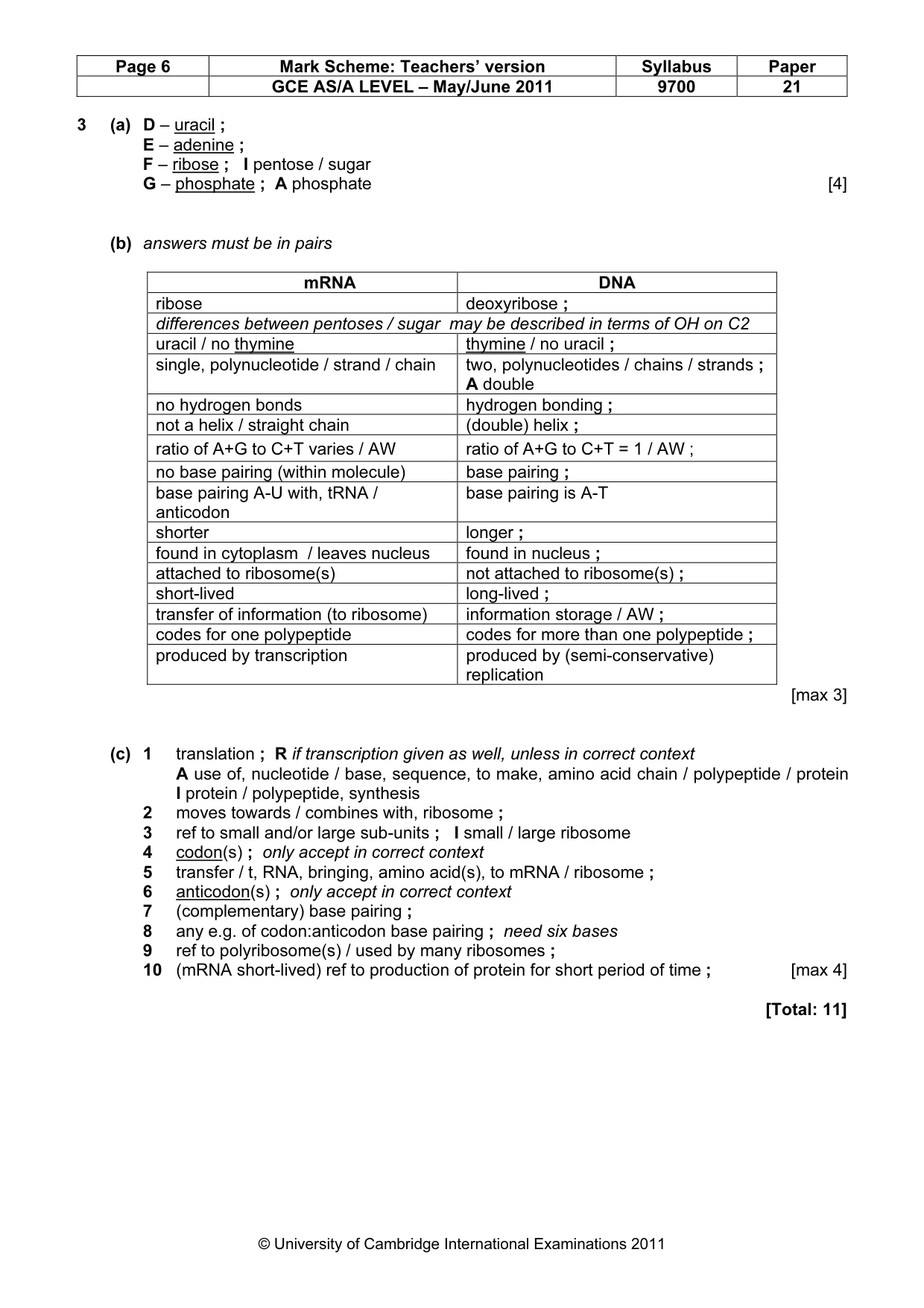
Page 6 Mark Scheme: Teachers’ version Syllabus Paper GCE AS/A LEVEL – May/June 2011 9700 21 © University of Cambridge International Examinations 2011 3 (a) D – uracil ; E – adenine ; F – ribose ; I pentose / sugar G – phosphate ; A phosphate [4] (b) answers must be in pairs mRNA DNA ribose deoxyribose ; differences between pentoses / sugar may be described in terms of OH on C2 uracil / no thymine thymine / no uracil ; single, polynucleotide / strand / chain two, polynucleotides / chains / strands ; A double no hydrogen bonds hydrogen bonding ; not a helix / straight chain (double) helix ; ratio of A+G to C+T varies / AW ratio of A+G to C+T = 1 / AW ; no base pairing (within molecule) base pairing ; base pairing A-U with, tRNA / anticodon base pairing is A-T shorter longer ; found in cytoplasm / leaves nucleus found in nucleus ; attached to ribosome(s) not attached to ribosome(s) ; short-lived long-lived ; transfer of information (to ribosome) information storage / AW ; codes for one polypeptide codes for more than one polypeptide ; produced by transcription produced by (semi-conservative) replication [max 3] (c) 1 translation ; R if transcription given as well, unless in correct context A use of, nucleotide / base, sequence, to make, amino acid chain / polypeptide / protein I protein / polypeptide, synthesis 2 moves towards / combines with, ribosome ; 3 ref to small and/or large sub-units ; I small / large ribosome 4 codon(s) ; only accept in correct context 5 transfer / t, RNA, bringing, amino acid(s), to mRNA / ribosome ; 6 anticodon(s) ; only accept in correct context 7 (complementary) base pairing ; 8 any e.g. of codon:anticodon base pairing ; need six bases 9 ref to polyribosome(s) / used by many ribosomes ; 10 (mRNA short-lived) ref to production of protein for short period of time ; [max 4] [Total: 11]
Mark scheme, page 7
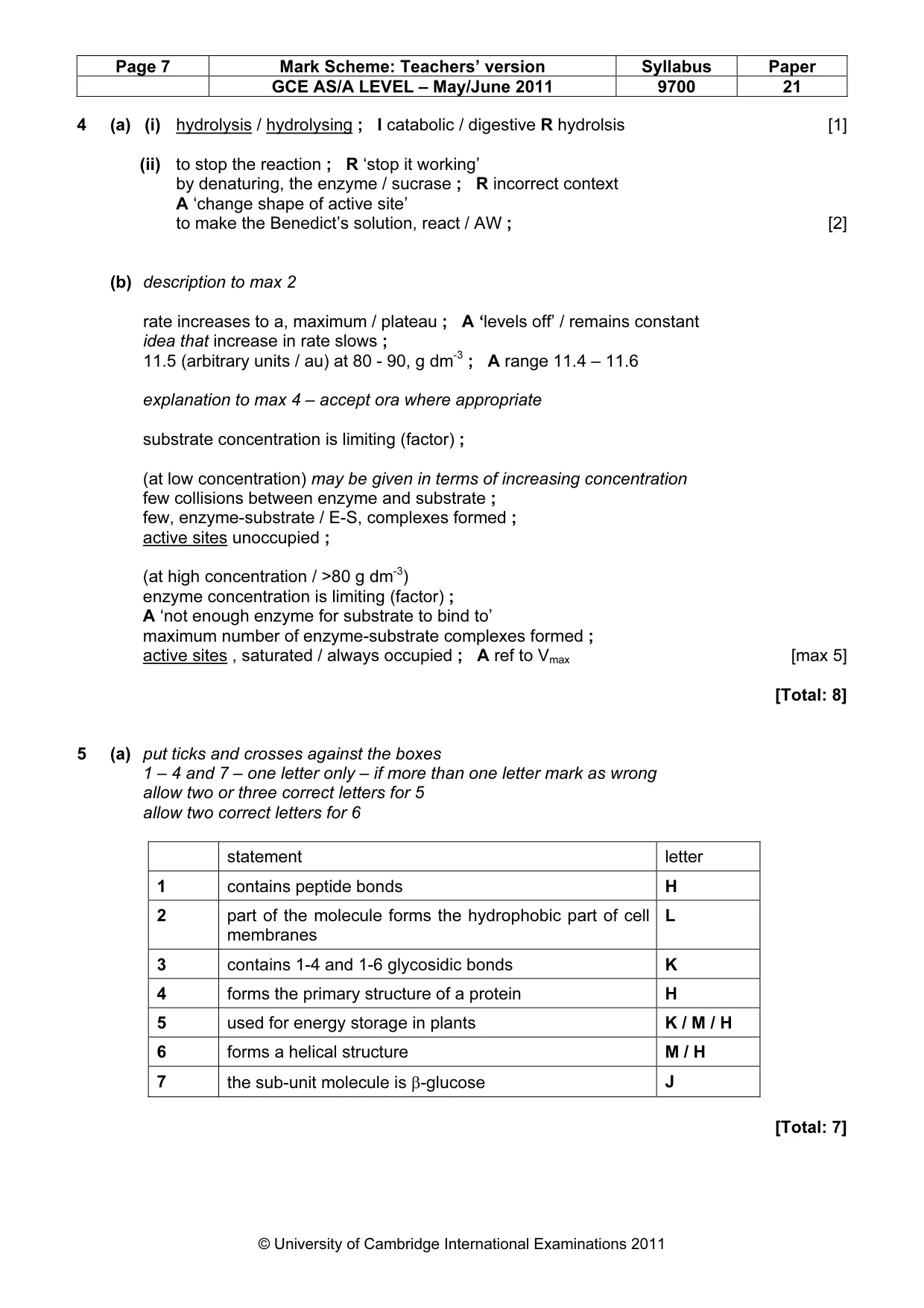
Page 7 Mark Scheme: Teachers’ version Syllabus Paper GCE AS/A LEVEL – May/June 2011 9700 21 © University of Cambridge International Examinations 2011 4 (a) (i) hydrolysis / hydrolysing ; I catabolic / digestive R hydrolsis [1] (ii) to stop the reaction ; R ‘stop it working’ by denaturing, the enzyme / sucrase ; R incorrect context A ‘change shape of active site’ to make the Benedict’s solution, react / AW ; [2] (b) description to max 2 rate increases to a, maximum / plateau ; A ‘levels off’ / remains constant idea that increase in rate slows ; 11.5 (arbitrary units / au) at 80 - 90, g dm-3 ; A range 11.4 – 11.6 explanation to max 4 – accept ora where appropriate substrate concentration is limiting (factor) ; (at low concentration) may be given in terms of increasing concentration few collisions between enzyme and substrate ; few, enzyme-substrate / E-S, complexes formed ; active sites unoccupied ; (at high concentration / >80 g dm-3) enzyme concentration is limiting (factor) ; A ‘not enough enzyme for substrate to bind to’ maximum number of enzyme-substrate complexes formed ; active sites , saturated / always occupied ; A ref to Vmax [max 5] [Total: 8] 5 (a) put ticks and crosses against the boxes 1 – 4 and 7 – one letter only – if more than one letter mark as wrong allow two or three correct letters for 5 allow two correct letters for 6 statement letter 1 contains peptide bonds H 2 part of the molecule forms the hydrophobic part of cell membranes L 3 contains 1-4 and 1-6 glycosidic bonds K 4 forms the primary structure of a protein H 5 used for energy storage in plants K / M / H 6 forms a helical structure M / H 7 the sub-unit molecule is β-glucose J [Total: 7]
Mark scheme, page 8
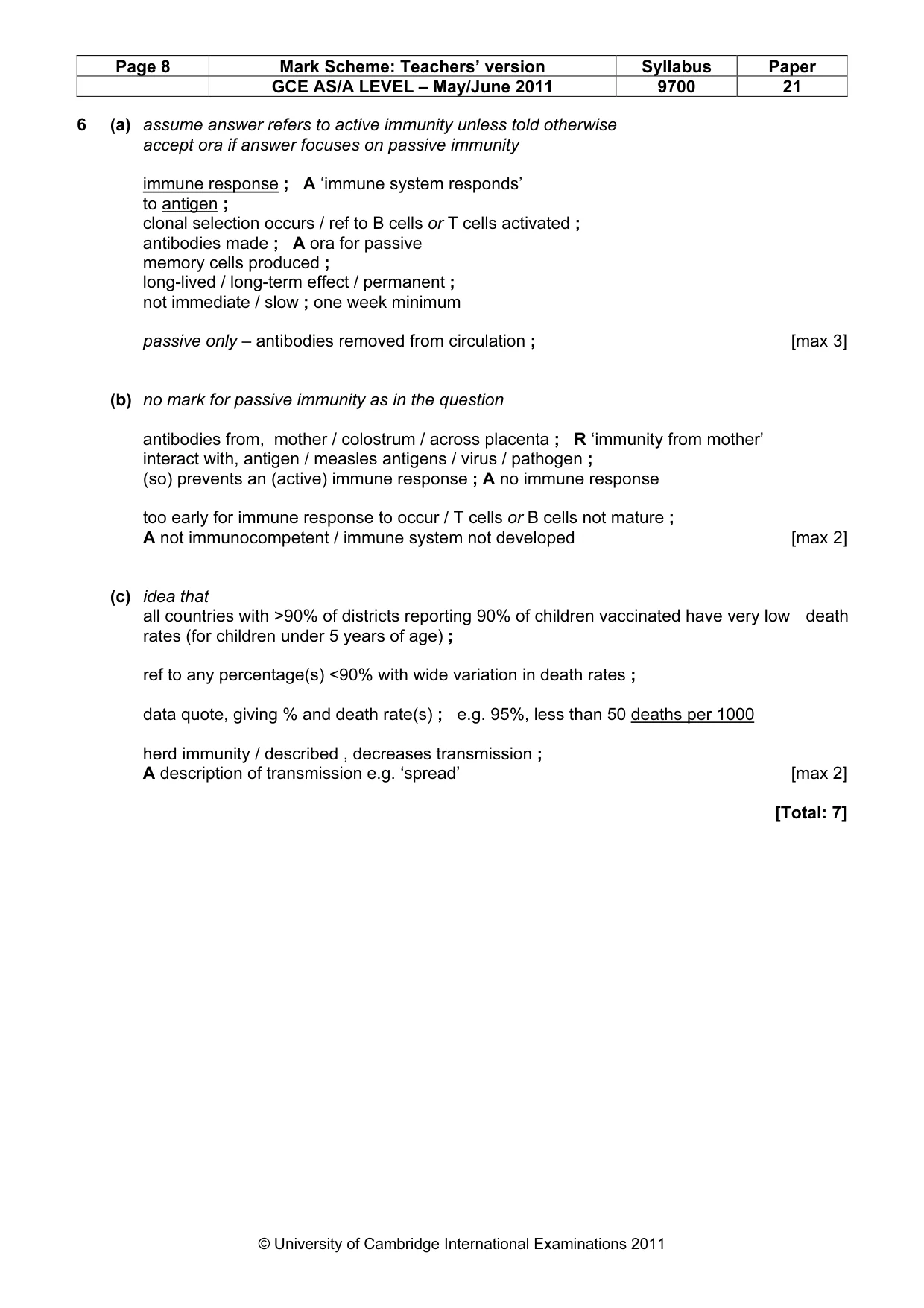
Page 8 Mark Scheme: Teachers’ version Syllabus Paper GCE AS/A LEVEL – May/June 2011 9700 21 © University of Cambridge International Examinations 2011 6 (a) assume answer refers to active immunity unless told otherwise accept ora if answer focuses on passive immunity immune response ; A ‘immune system responds’ to antigen ; clonal selection occurs / ref to B cells or T cells activated ; antibodies made ; A ora for passive memory cells produced ; long-lived / long-term effect / permanent ; not immediate / slow ; one week minimum passive only – antibodies removed from circulation ; [max 3] (b) no mark for passive immunity as in the question antibodies from, mother / colostrum / across placenta ; R ‘immunity from mother’ interact with, antigen / measles antigens / virus / pathogen ; (so) prevents an (active) immune response ; A no immune response too early for immune response to occur / T cells or B cells not mature ; A not immunocompetent / immune system not developed [max 2] (c) idea that all countries with >90% of districts reporting 90% of children vaccinated have very low death rates (for children under 5 years of age) ; ref to any percentage(s) <90% with wide variation in death rates ; data quote, giving % and death rate(s) ; e.g. 95%, less than 50 deaths per 1000 herd immunity / described , decreases transmission ; A description of transmission e.g. ‘spread’ [max 2] [Total: 7]
What you needed in this session
Cambridge’s own grade thresholds for 2011 May/June, Paper 2 · Variant 1. A higher threshold means an easier paper — the bar moves with how the cohort did.