Cambridge A Level Accounting 9706 — 2025 Oct/Nov Paper 2 · Variant 2
9706/22/O/N/25 · 6 questions · 90 marks · ≈101 min
The question paper and its mark scheme, free to read here and free to download. This is Cambridge’s own paper, exactly as it was sat.
Question paper20 pages
Mark scheme18 pages
Answers below. Sit the paper first if you are practising.
Questions as text
Q1 · R Limited is a retail business
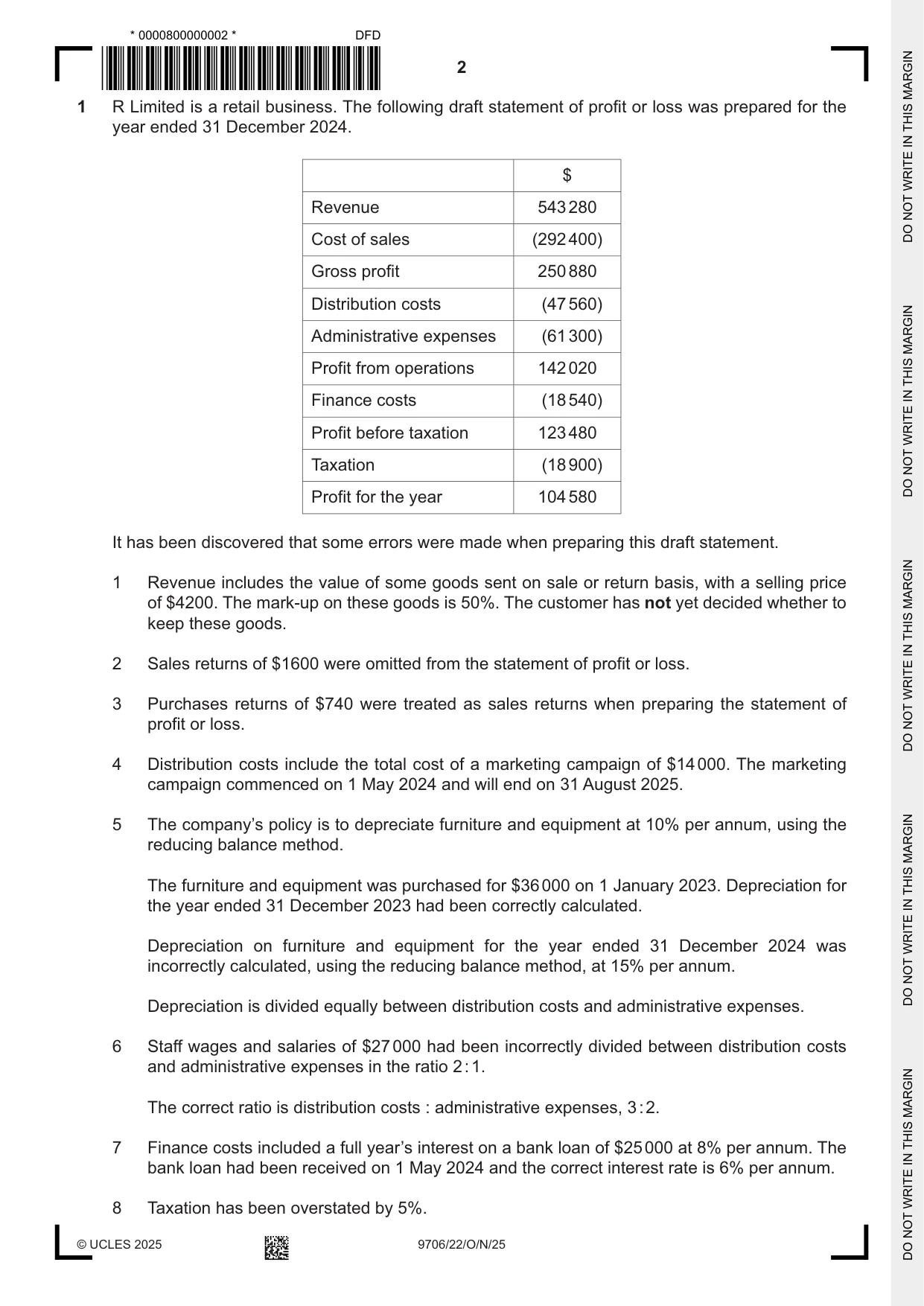
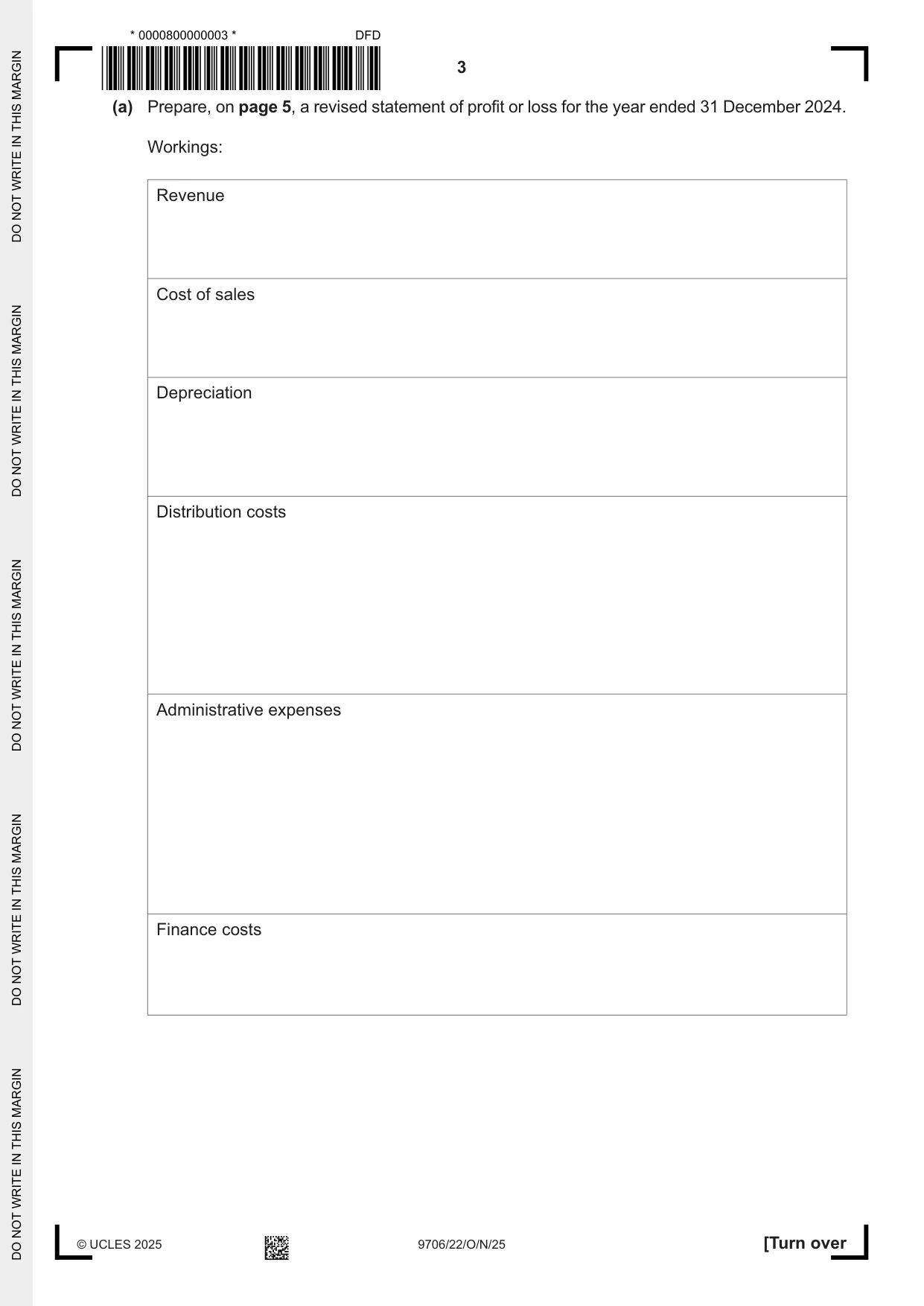
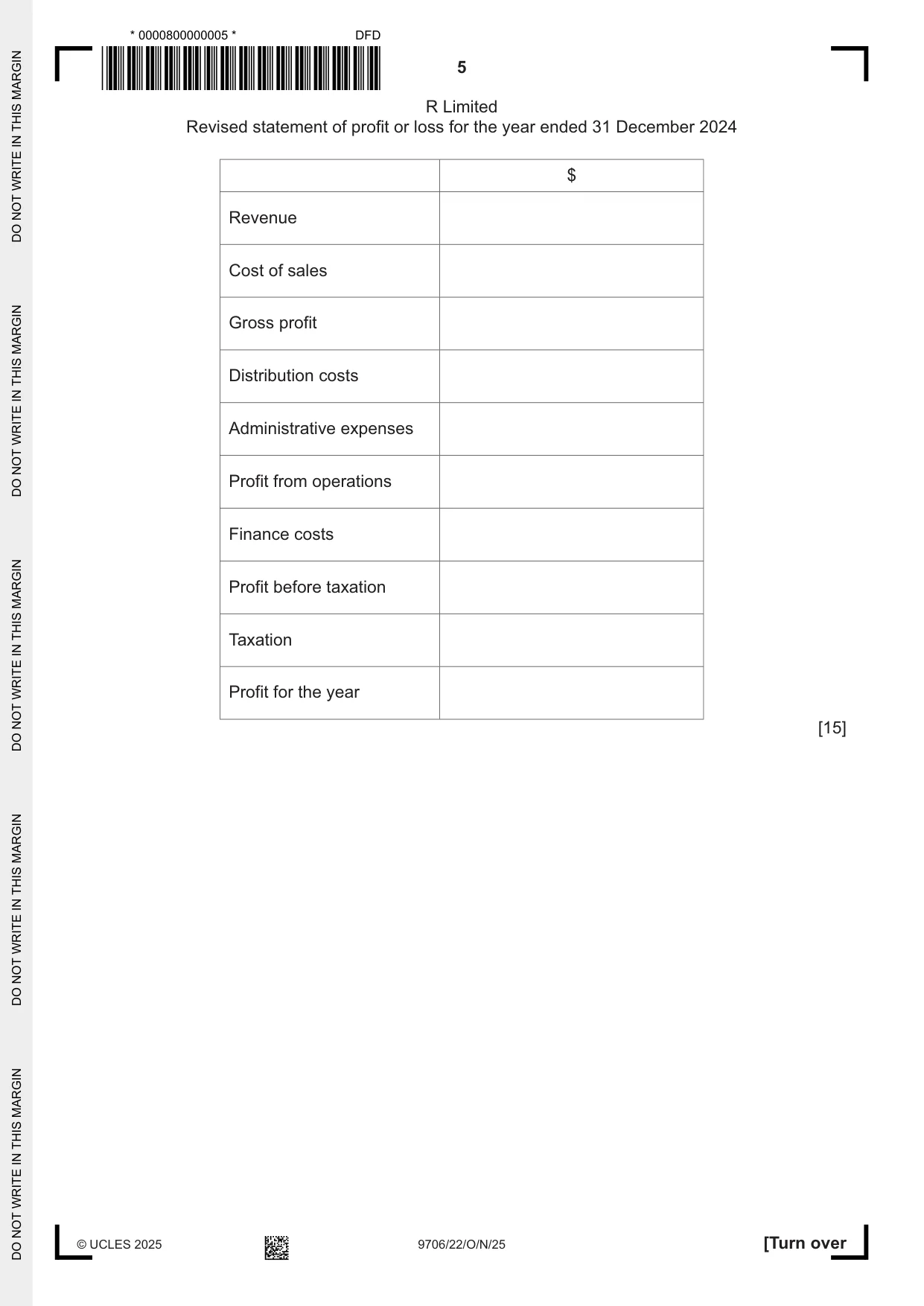
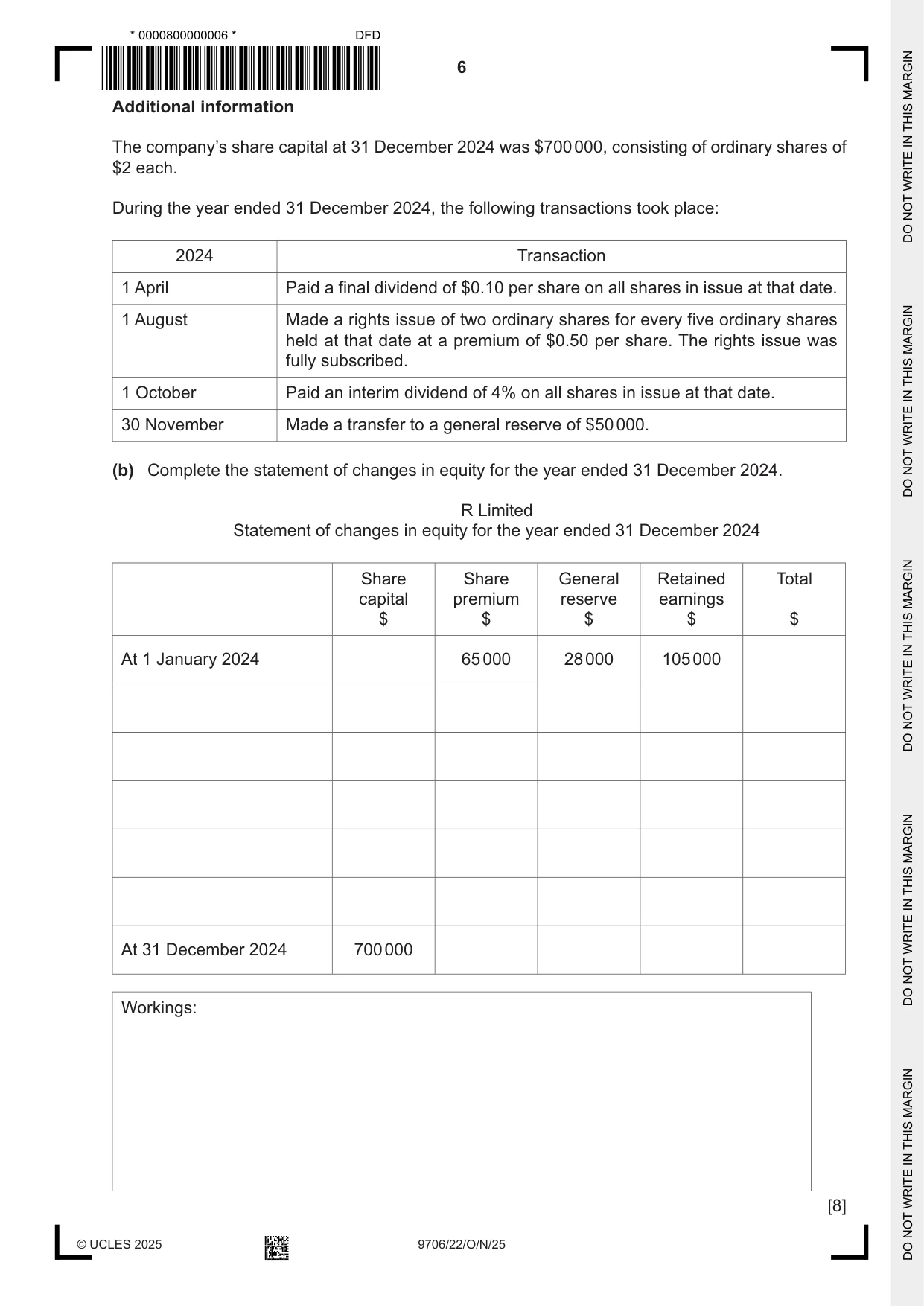
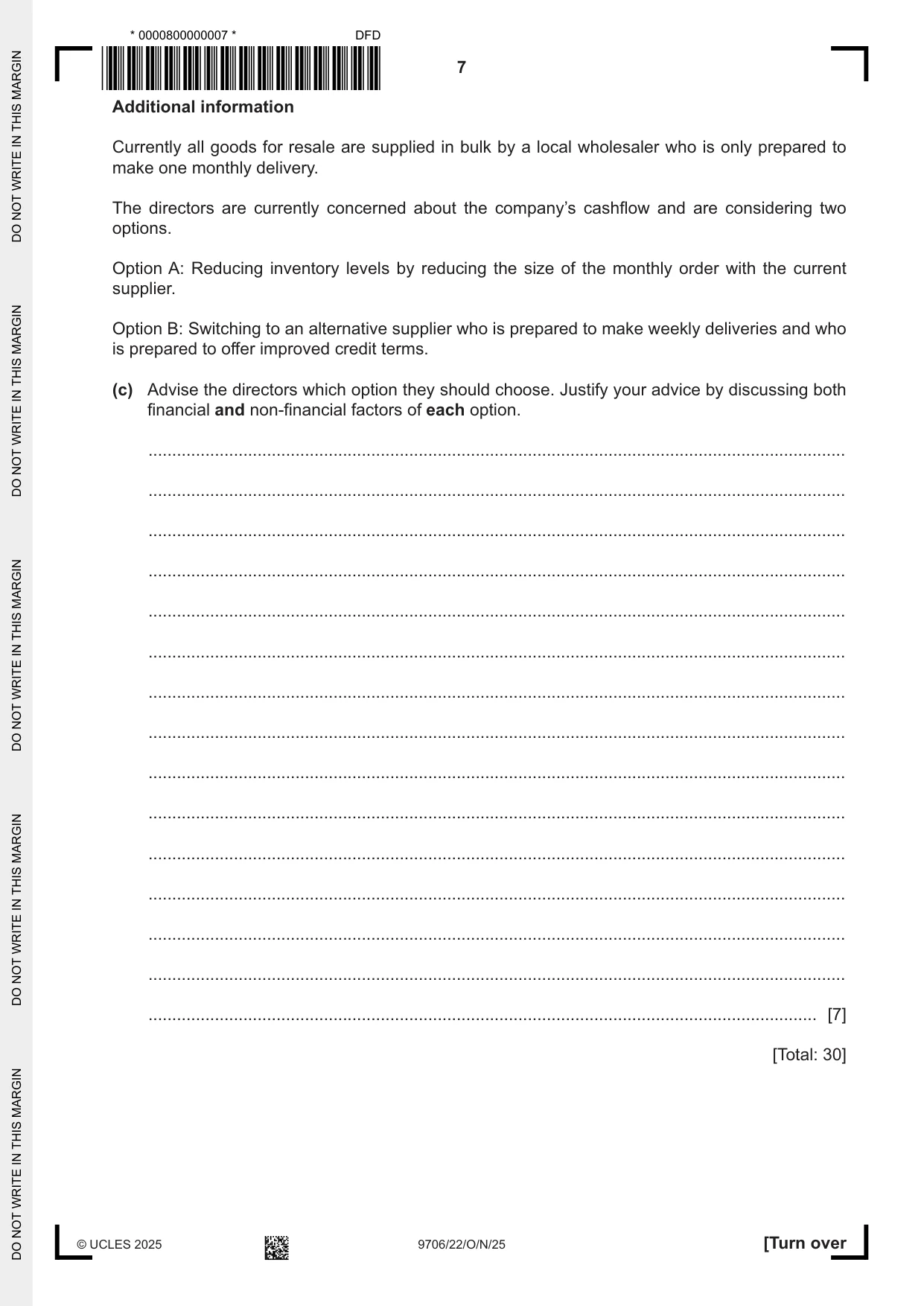
1 R Limited is a retail business. The following draft statement of profit or loss was prepared for the year ended 31 December 2024. $ Revenue 543 280 Cost of sales (292 400) Gross profit 250 880 Distribution costs (47 560) Administrative expenses (61 300) Profit from operations 142 020 Finance costs (18 540) Profit before taxation 123 480 Taxation (18 900) Profit for the year 104 580 It has been discovered that some errors were made when preparing this draft statement. 1 Revenue includes the value of some goods sent on sale or return basis, with a selling price of $4200. The mark-up on these goods is 50%. The customer has not yet decided whether to keep these goods. 2 Sales returns of $1600 were omitted from the statement of profit or loss. 3 Purchases returns of $740 were treated as sales returns when preparing the statement of profit or loss. 4 Distribution costs include the total cost of a marketing campaign of $14 000. The marketing campaign commenced on 1 May 2024 and will end on 31 August 2025. 5 The company’s policy is to depreciate furniture and equipment at 10% per annum, using the reducing balance method. The furniture and equipment was purchased for $36 000 on 1 January 2023. Depreciation for the year ended 31 December 2023 had been correctly calculated. Depreciation on furniture and equipment for the year ended 31 December 2024 was incorrectly calculated, using the reducing balance method, at 15% per annum. Depreciation is divided equally between distribution costs and administrative expenses. 6 Staff wages and salaries of $27 000 had been incorrectly divided between distribution costs and administrative expenses in the ratio 2 : 1. The correct ratio is distribution costs : administrative expenses, 3 : 2. 7 Finance costs included a full year’s interest on a bank loan of $25 000 at 8% per annum. The bank loan had been received on 1 May 2024 and the correct interest rate is 6% per annum. 8 Taxation has been overstated by 5%. (a) Prepare, on page 5, a revised statement of profit or loss for the year ended 31 December 2024. Workings: Revenue Cost of sales Depreciation Distribution costs Administrative expenses Finance costs R Limited Revised statement of profit or loss for the year ended 31 December 2024 $ Revenue Cost of sales Gross profit Distribution costs Administrative expenses Profit from operations Finance costs Profit before taxation Taxation Profit for the year [15] Additional information The company’s share capital at 31 December 2024 was $700 000, consisting of ordinary shares of $2 each. During the year ended 31 December 2024, the following transactions took place: 2024 Transaction 1 April Paid a final dividend of $0.10 per share on all shares in issue at that date. 1 August Made a rights issue of two ordinary shares for every five ordinary shares held at that date at a premium of $0.50 per share. The rights issue was fully subscribed. 1 October Paid an interim dividend of 4% on all shares in issue at that date. 30 November Made a transfer to a general reserve of $50 000. (b) Complete the statement of changes in equity for the year ended 31 December 2024. R Limited Statement of changes in equity for the year ended 31 December 2024 Share Share General Retained Total capital premium reserve earnings $ $ $ $ $ At 1 January 2024 65 000 28 000 105 000 At 31 December 2024 700 000 Workings: [8] Additional information Currently all goods for resale are supplied in bulk by a local wholesaler who is only prepared to make one monthly delivery. The directors are currently concerned about the company’s cashflow and are considering two options. Option A: Reducing inventory levels by reducing the size of the monthly order with the current supplier. Option B: Switching to an alternative supplier who is prepared to make weekly deliveries and who is prepared to offer improved credit terms. (c) Advise the directors which option they should choose. Justify your advice by discussing both financial and non-financial factors of each option. ................................................................................................................................................... ................................................................................................................................................... ................................................................................................................................................... ................................................................................................................................................... ................................................................................................................................................... ................................................................................................................................................... ................................................................................................................................................... ................................................................................................................................................... ................................................................................................................................................... ................................................................................................................................................... ................................................................................................................................................... ................................................................................................................................................... ................................................................................................................................................... ................................................................................................................................................... ............................................................................................................................................. [7] [Total: 30]
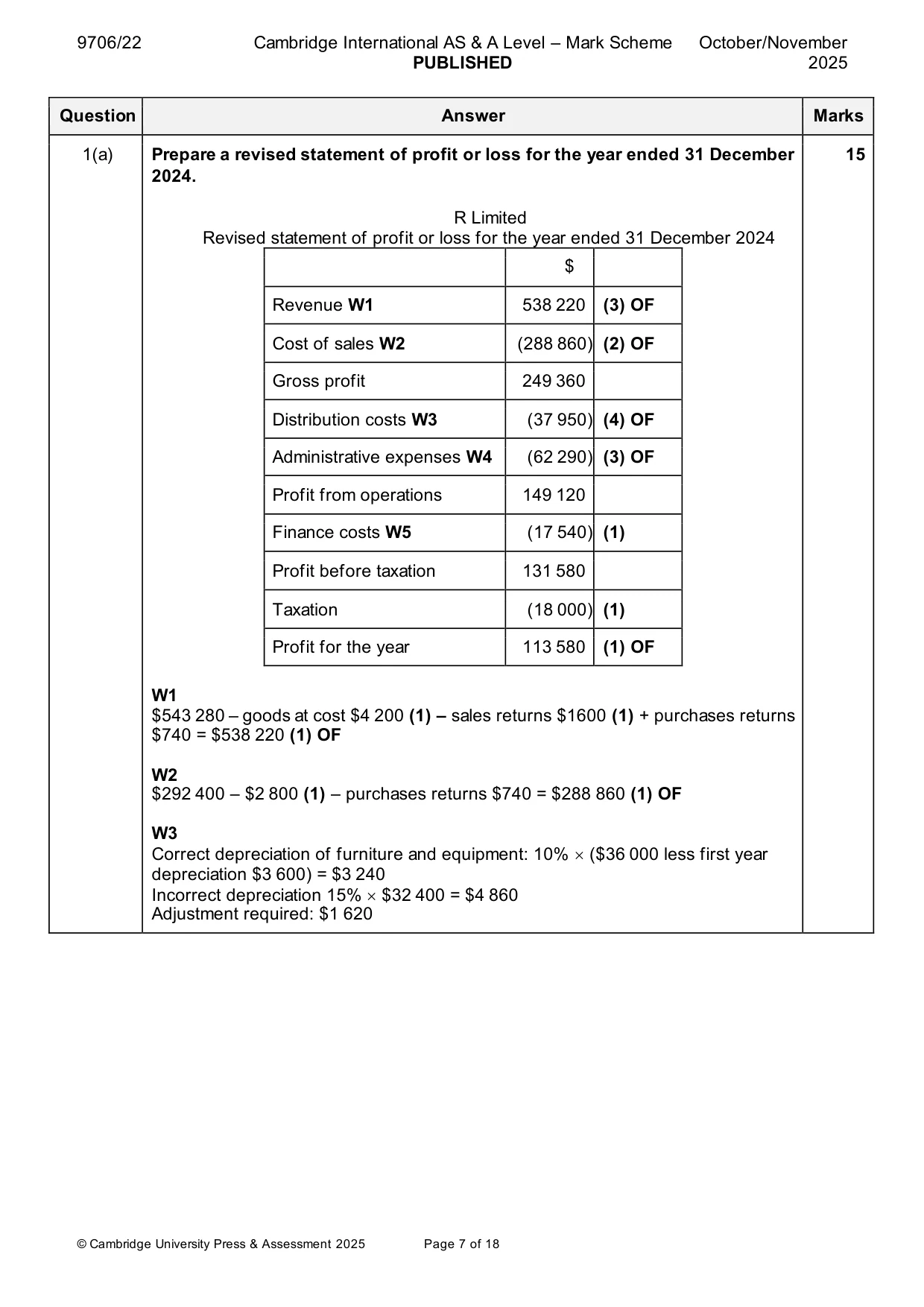
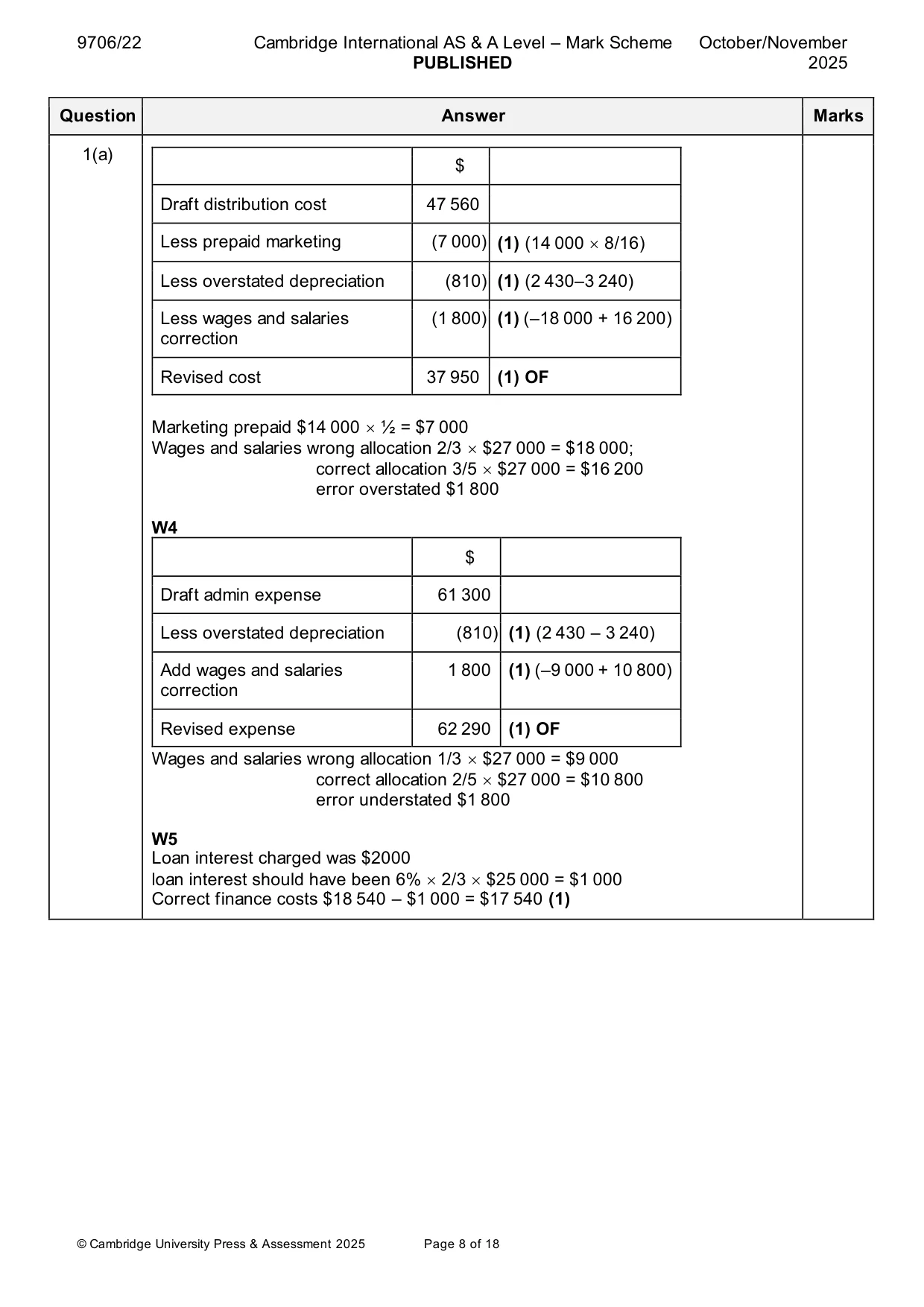
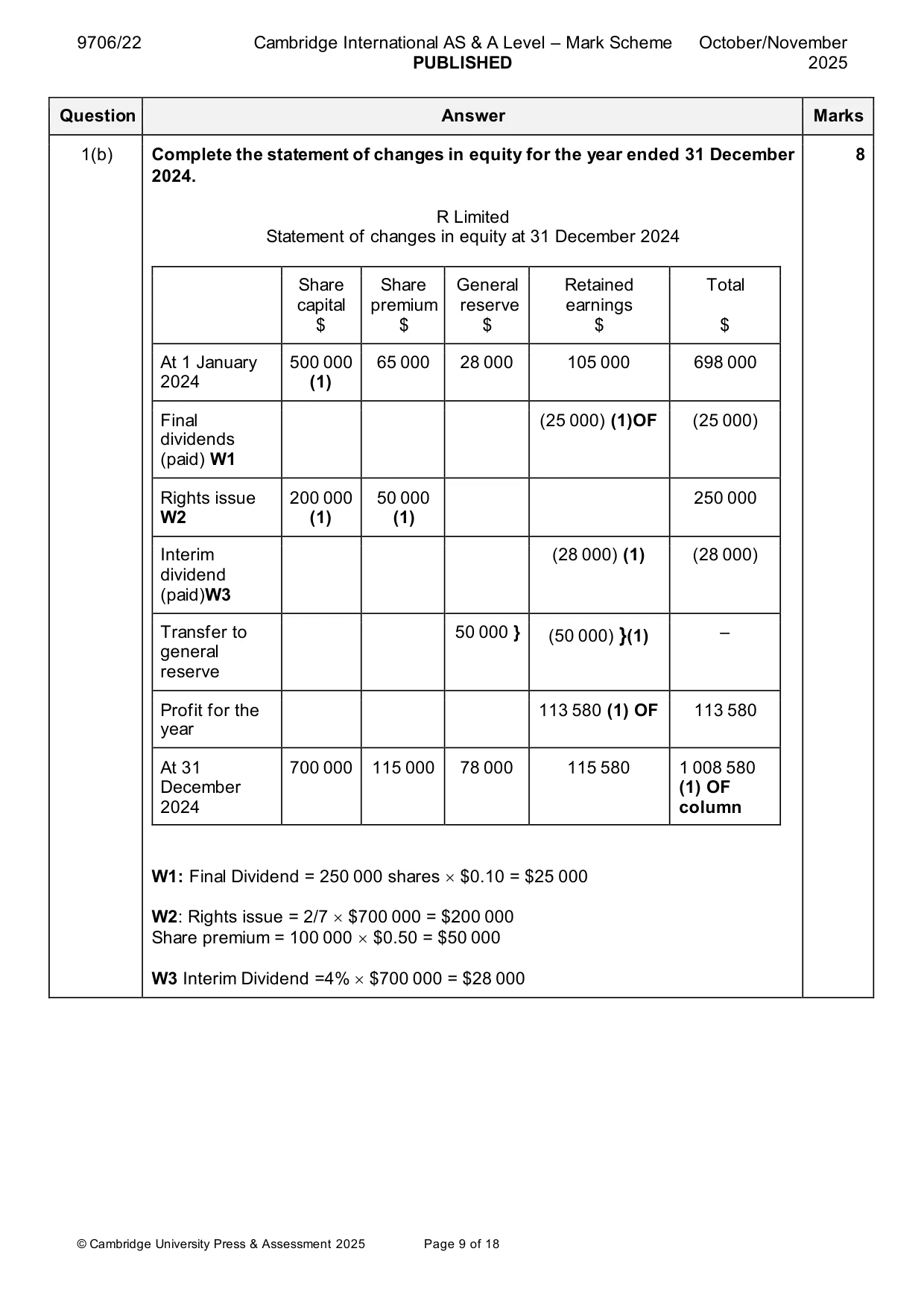
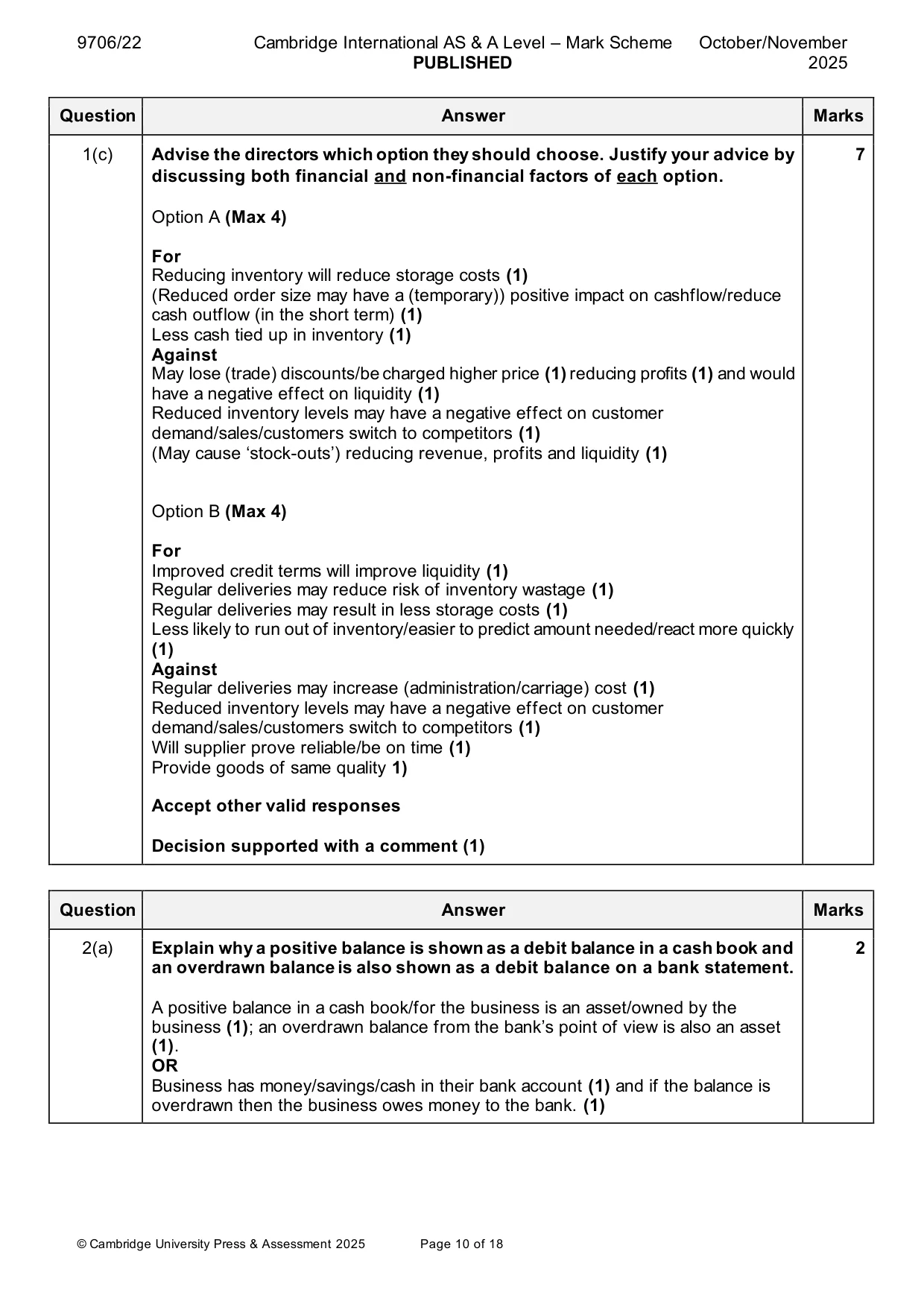
Mark scheme: Question Answer Marks 1(a) Prepare a revised statement of profit or loss for the year ended 31 December 15 2024. R Limited Revised statement of profit or loss for the year ended 31 December 2024 $ Revenue W1 538 220 (3) OF Cost of sales W2 (288 860) (2) OF Gross profit 249 360 Distribution costs W3 (37 950) (4) OF Administrative expenses W4 (62 290) (3) OF Profit from operations 149 120 Finance costs W5 (17 540) (1) Profit before taxation 131 580 Taxation (18 000) (1) Profit for the year 113 580 (1) OF W1 $543 280 – goods at cost $4 200 (1) – sales returns $1600 (1) + purchases returns $740 = $538 220 (1) OF W2 $292 400 – $2 800 (1) – purchases returns $740 = $288 860 (1) OF W3 Correct depreciation of furniture and equipment: 10% ($36 000 less first year depreciation $3 600) = $3 240 Incorrect depreciation 15% $32 400 = $4 860 Adjustment required: $1 620 1(a) $ Draft distribution cost 47 560 Less prepaid marketing (7 000) (1) (14 000 8/16) Less overstated depreciation (810) (1) (2 430–3 240) Less wages and salaries (1 800) (1) (–18 000 + 16 200) correction Revised cost 37 950 (1) OF Marketing prepaid $14 000 ½ = $7 000 Wages and salaries wrong allocation 2/3 $27 000 = $18 000; correct allocation 3/5 $27 000 = $16 200 error overstated $1 800 W4 $ Draft admin expense 61 300 Less overstated depreciation (810) (1) (2 430 – 3 240) Add wages and salaries 1 800 (1) (–9 000 + 10 800) correction Revised expense 62 290 (1) OF Wages and salaries wrong allocation 1/3 $27 000 = $9 000 correct allocation 2/5 $27 000 = $10 800 error understated $1 800 W5 Loan interest charged was $2000 loan interest should have been 6% 2/3 $25 000 = $1 000 Correct finance costs $18 540 – $1 000 = $17 540 (1) 1(b) Complete the statement of changes in equity for the year ended 31 December 8 2024. R Limited Statement of changes in equity at 31 December 2024 Share Share General Retained Total capital premium reserve earnings $ $ $ $ $ At 1 January 500 000 65 000 28 000 105 000 698 000 2024 (1) Final (25 000) (1)OF (25 000) dividends (paid) W1 Rights issue 200 000 50 000 250 000 W2 (1) (1) Interim (28 000) (1) (28 000) dividend (paid)W3 Transfer to 50 000 } (50 000) }(1) – general reserve Profit for the 113 580 (1) OF 113 580 year At 31 700 000 115 000 78 000 115 580 1 008 580 December (1) OF 2024 column W1: Final Dividend = 250 000 shares $0.10 = $25 000 W2: Rights issue = 2/7 $700 000 = $200 000 Share premium = 100 000 $0.50 = $50 000 W3 Interim Dividend =4% $700 000 = $28 000 1(c) Advise the directors which option they should choose. Justify your advice by 7 discussing both financial and non-financial factors of each option. Option A (Max 4) For Reducing inventory will reduce storage costs (1) (Reduced order size may have a (temporary)) positive impact on cashflow/reduce cash outflow (in the short term) (1) Less cash tied up in inventory (1) Against May lose (trade) discounts/be charged higher price (1) reducing profits (1) and would have a negative effect on liquidity (1) Reduced inventory levels may have a negative effect on customer demand/sales/customers switch to competitors (1) (May cause ‘stock-outs’) reducing revenue, profits and liquidity (1) Option B (Max 4) For Improved credit terms will improve liquidity (1) Regular deliveries may reduce risk of inventory wastage (1) Regular deliveries may result in less storage costs (1) Less likely to run out of inventory/easier to predict amount needed/react more quickly (1) Against Regular deliveries may increase (administration/carriage) cost (1) Reduced inventory levels may have a negative effect on customer demand/sales/customers switch to competitors (1) Will supplier prove reliable/be on time (1) Provide goods of same quality 1) Accept other valid responses Decision supported with a comment (1)
Q2 · Samira owns a business called SJB Supplies
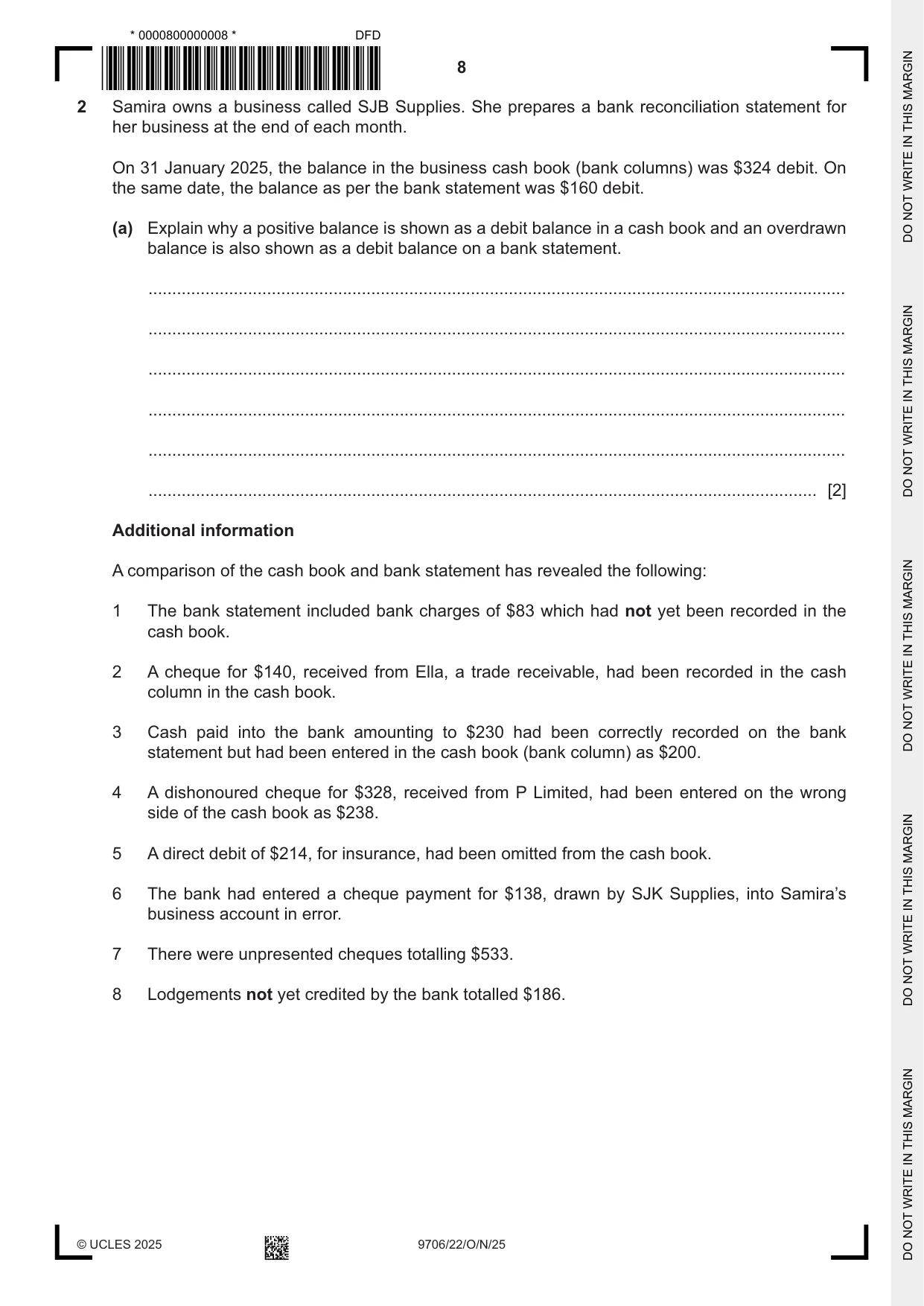
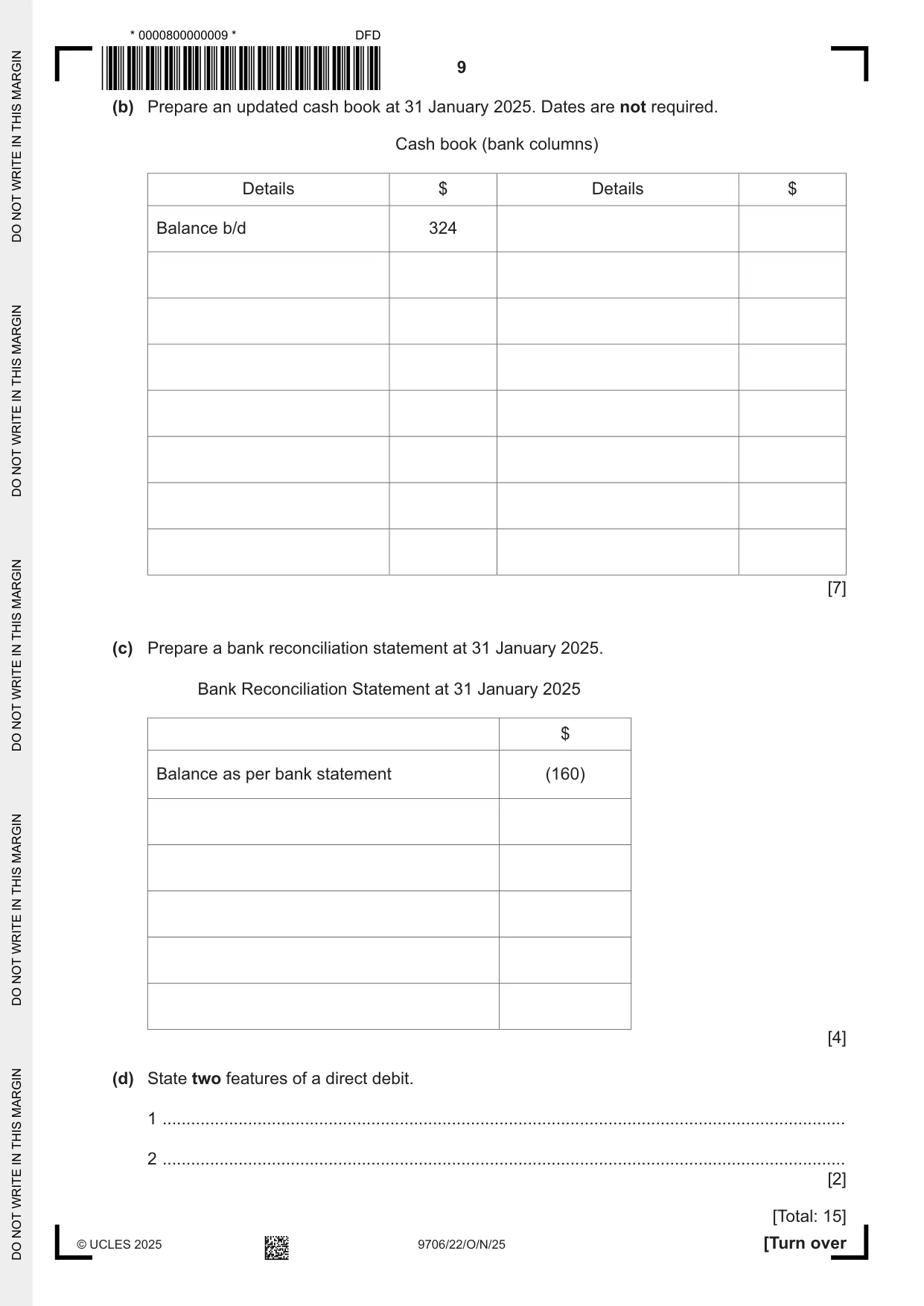
2 Samira owns a business called SJB Supplies. She prepares a bank reconciliation statement for her business at the end of each month. On 31 January 2025, the balance in the business cash book (bank columns) was $324 debit. On the same date, the balance as per the bank statement was $160 debit. (a) Explain why a positive balance is shown as a debit balance in a cash book and an overdrawn balance is also shown as a debit balance on a bank statement. ................................................................................................................................................... ................................................................................................................................................... ................................................................................................................................................... ................................................................................................................................................... ................................................................................................................................................... ............................................................................................................................................. [2] Additional information A comparison of the cash book and bank statement has revealed the following: 1 The bank statement included bank charges of $83 which had not yet been recorded in the cash book. 2 A cheque for $140, received from Ella, a trade receivable, had been recorded in the cash column in the cash book. 3 Cash paid into the bank amounting to $230 had been correctly recorded on the bank statement but had been entered in the cash book (bank column) as $200. 4 A dishonoured cheque for $328, received from P Limited, had been entered on the wrong side of the cash book as $238. 5 A direct debit of $214, for insurance, had been omitted from the cash book. 6 The bank had entered a cheque payment for $138, drawn by SJK Supplies, into Samira’s business account in error. 7 There were unpresented cheques totalling $533. 8 Lodgements not yet credited by the bank totalled $186. (b) Prepare an updated cash book at 31 January 2025. Dates are not required. Cash book (bank columns) Details $ Details $ Balance b/d 324 [7] (c) Prepare a bank reconciliation statement at 31 January 2025. Bank Reconciliation Statement at 31 January 2025 $ Balance as per bank statement (160) [4] (d) State two features of a direct debit. 1 ................................................................................................................................................ 2 ................................................................................................................................................ [2] [Total: 15]
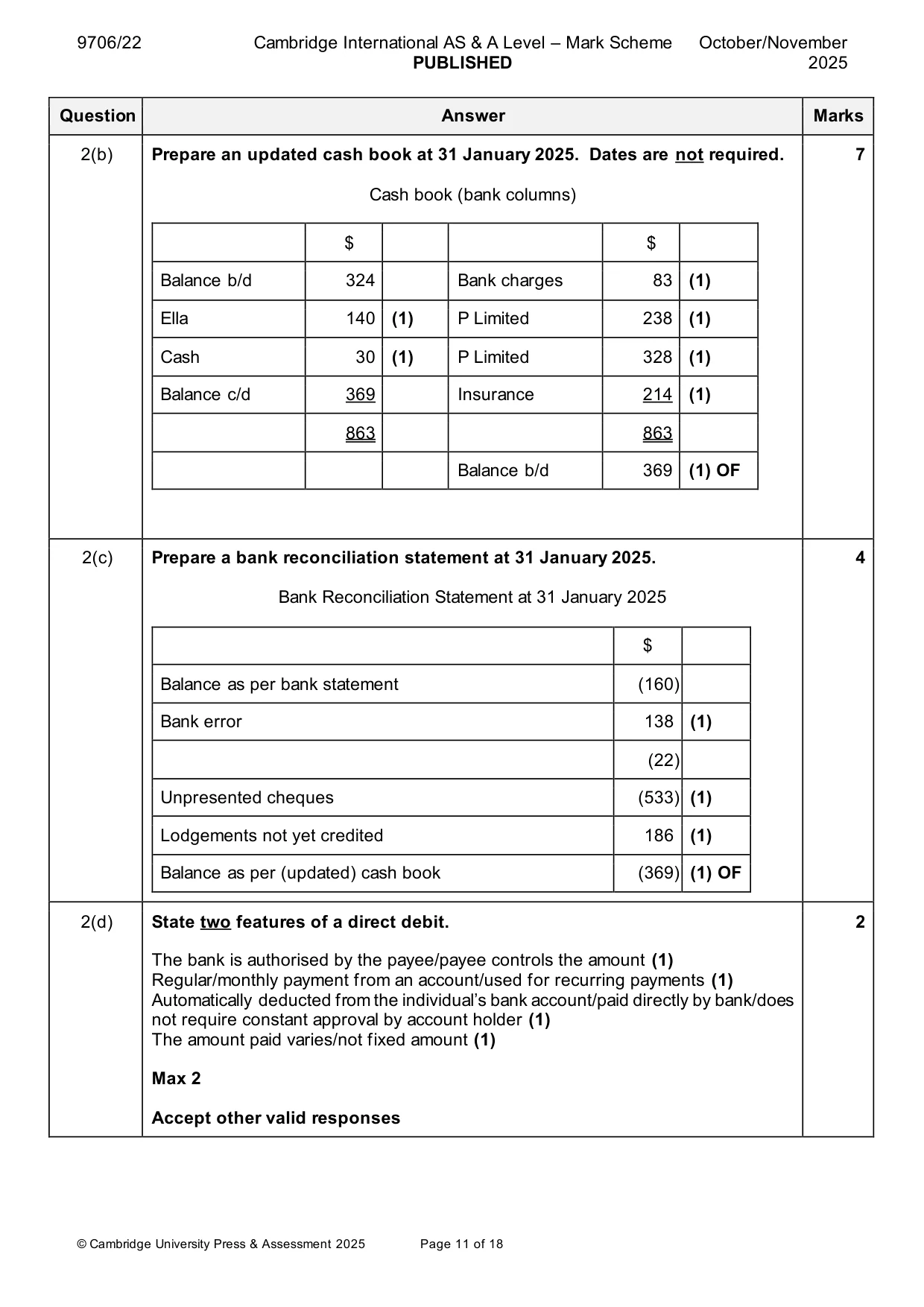
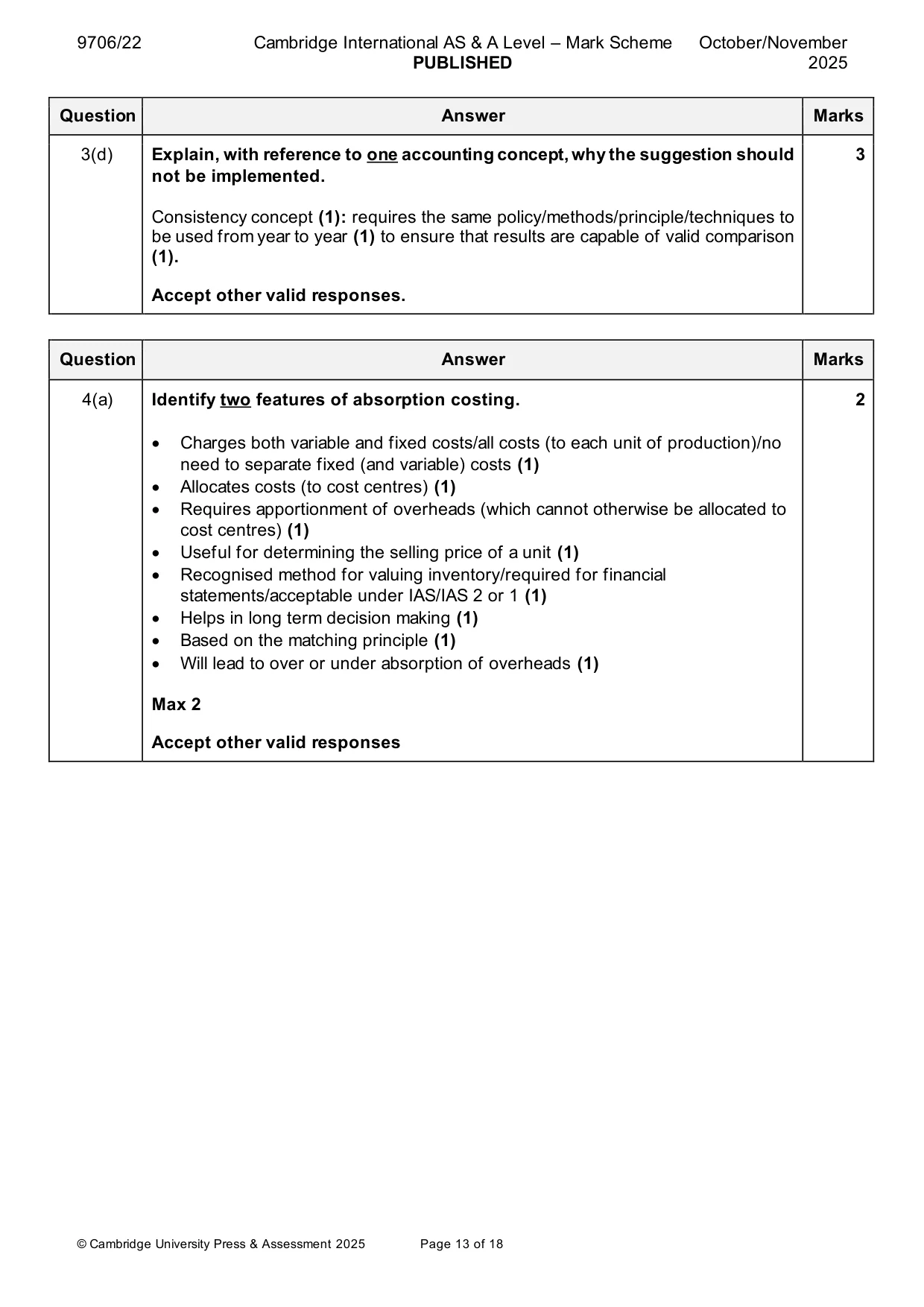
Mark scheme: 2(a) Explain why a positive balance is shown as a debit balance in a cash book and 2 an overdrawn balance is also shown as a debit balance on a bank statement. A positive balance in a cash book/for the business is an asset/owned by the business (1); an overdrawn balance from the bank’s point of view is also an asset (1). OR Business has money/savings/cash in their bank account (1) and if the balance is overdrawn then the business owes money to the bank. (1) 2(b) Prepare an updated cash book at 31 January 2025. Dates are not required. 7 Cash book (bank columns) $ $ Balance b/d 324 Bank charges 83 (1) Ella 140 (1) P Limited 238 (1) Cash 30 (1) P Limited 328 (1) Balance c/d 369 Insurance 214 (1) 863 863 Balance b/d 369 (1) OF 2(c) Prepare a bank reconciliation statement at 31 January 2025. 4 Bank Reconciliation Statement at 31 January 2025 $ Balance as per bank statement (160) Bank error 138 (1) (22) Unpresented cheques (533) (1) Lodgements not yet credited 186 (1) Balance as per (updated) cash book (369) (1) OF 2(d) State two features of a direct debit. 2 The bank is authorised by the payee/payee controls the amount (1) Regular/monthly payment from an account/used for recurring payments (1) Automatically deducted from the individual’s bank account/paid directly by bank/does not require constant approval by account holder (1) The amount paid varies/not fixed amount (1) Max 2 Accept other valid responses
Q3 · J Limited’s non-current assets are as follows: Cost Date of purchase $ Property…
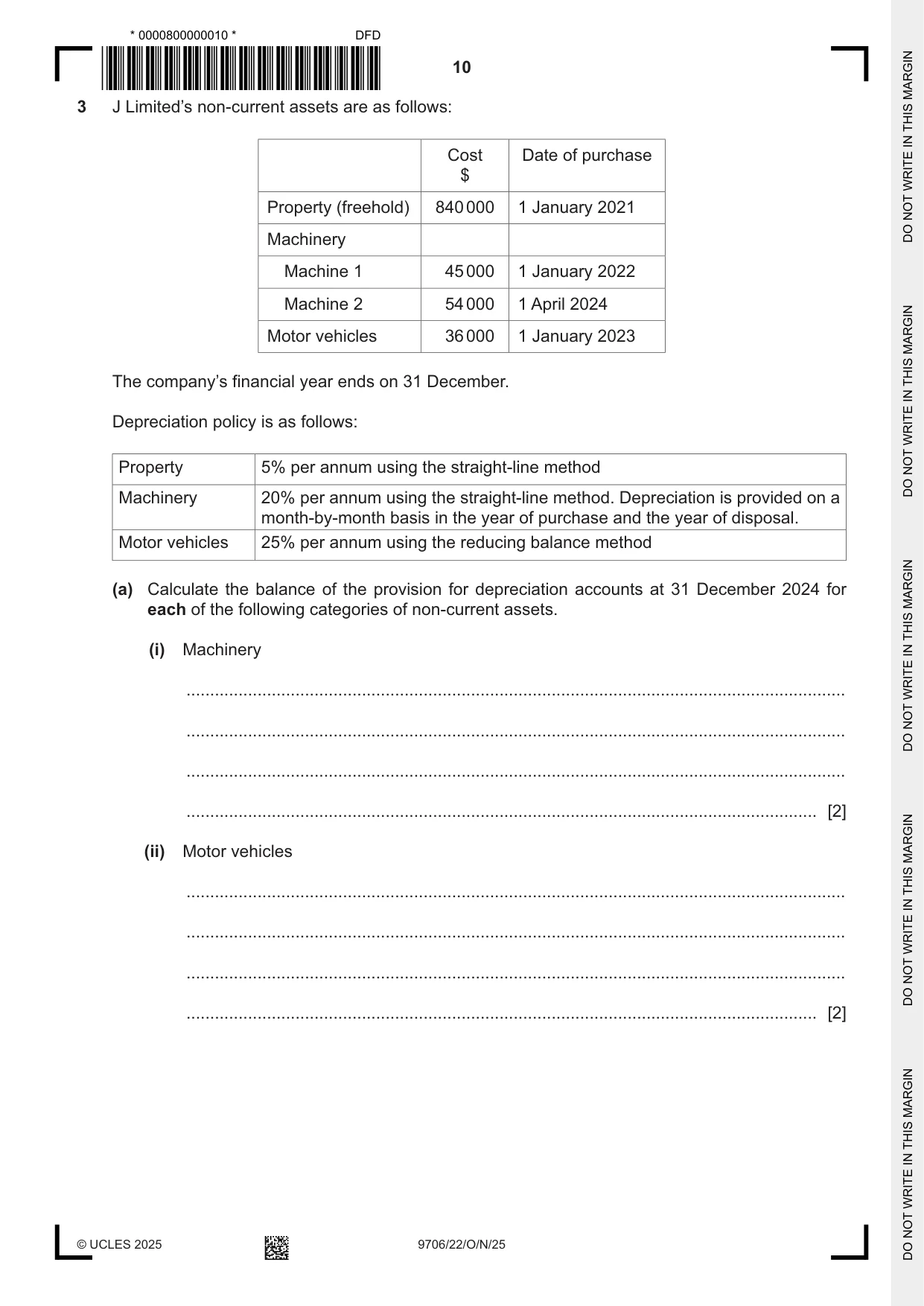
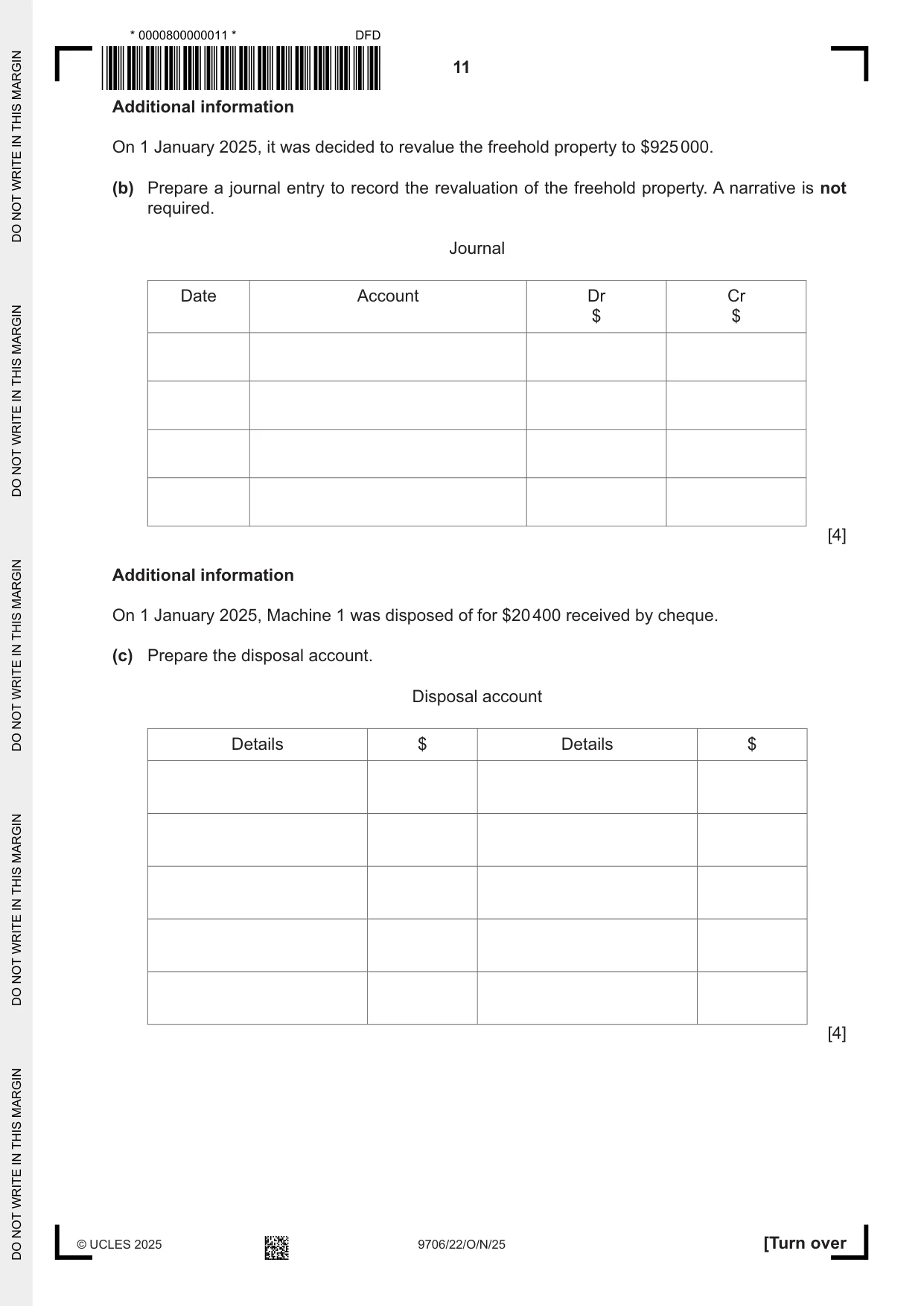
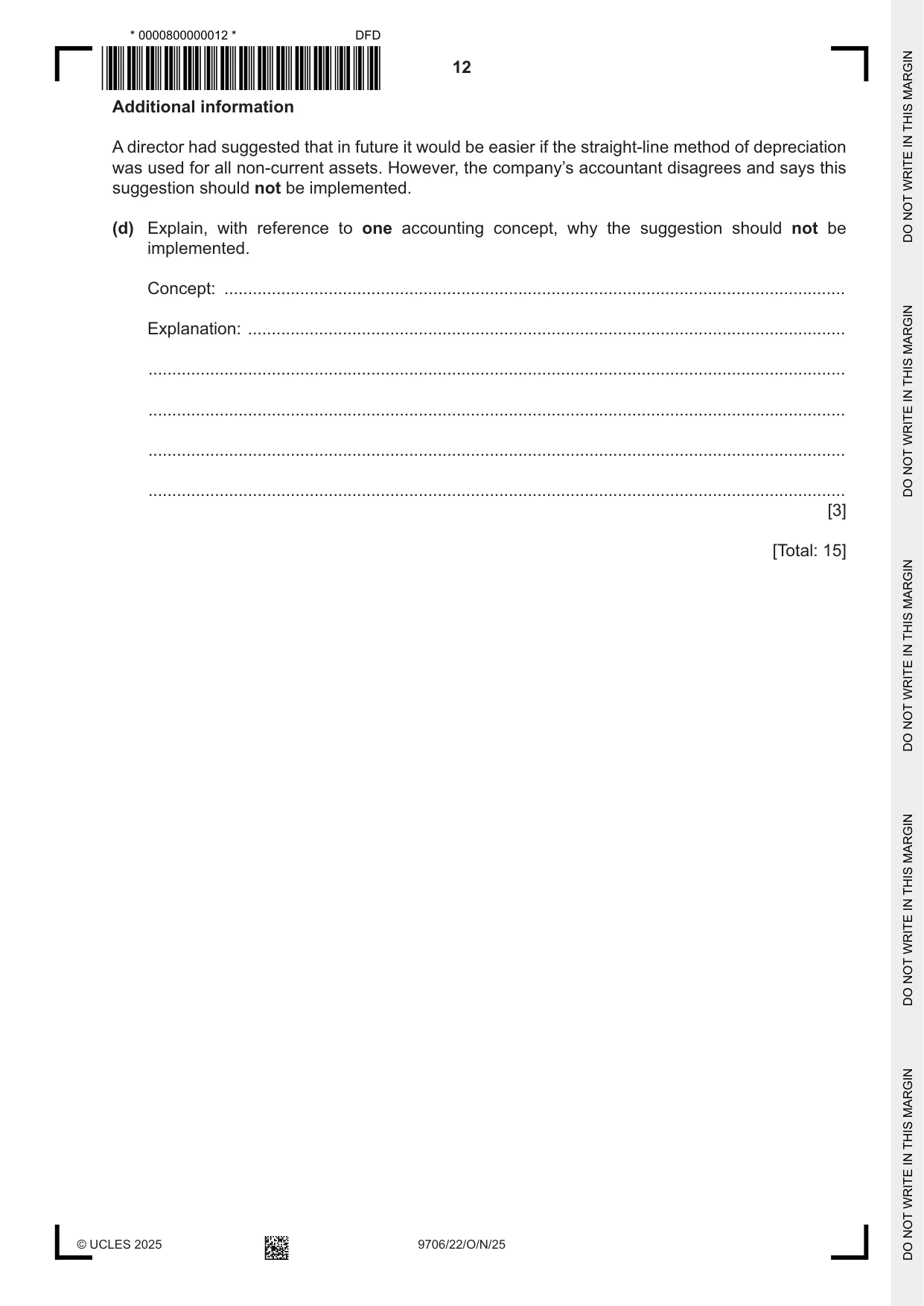
3 J Limited’s non-current assets are as follows: Cost Date of purchase $ Property (freehold) 840 000 1 January 2021 Machinery Machine 1 45 000 1 January 2022 Machine 2 54 000 1 April 2024 Motor vehicles 36 000 1 January 2023 The company’s financial year ends on 31 December. Depreciation policy is as follows: Property 5% per annum using the straight-line method Machinery 20% per annum using the straight-line method. Depreciation is provided on a month-by-month basis in the year of purchase and the year of disposal. Motor vehicles 25% per annum using the reducing balance method (a) Calculate the balance of the provision for depreciation accounts at 31 December 2024 for each of the following categories of non-current assets. (i) Machinery ........................................................................................................................................... ........................................................................................................................................... ........................................................................................................................................... ..................................................................................................................................... [2] (ii) Motor vehicles ........................................................................................................................................... ........................................................................................................................................... ........................................................................................................................................... ..................................................................................................................................... [2] Additional information On 1 January 2025, it was decided to revalue the freehold property to $925 000. (b) Prepare a journal entry to record the revaluation of the freehold property. A narrative is not required. Journal Date Account Dr Cr $ $ [4] Additional information On 1 January 2025, Machine 1 was disposed of for $20 400 received by cheque. (c) Prepare the disposal account. Disposal account Details $ Details $ [4] Additional information A director had suggested that in future it would be easier if the straight-line method of depreciation was used for all non-current assets. However, the company’s accountant disagrees and says this suggestion should not be implemented. (d) Explain, with reference to one accounting concept, why the suggestion should not be implemented. Concept: ................................................................................................................................... Explanation: .............................................................................................................................. ................................................................................................................................................... ................................................................................................................................................... ................................................................................................................................................... ................................................................................................................................................... [3] [Total: 15]
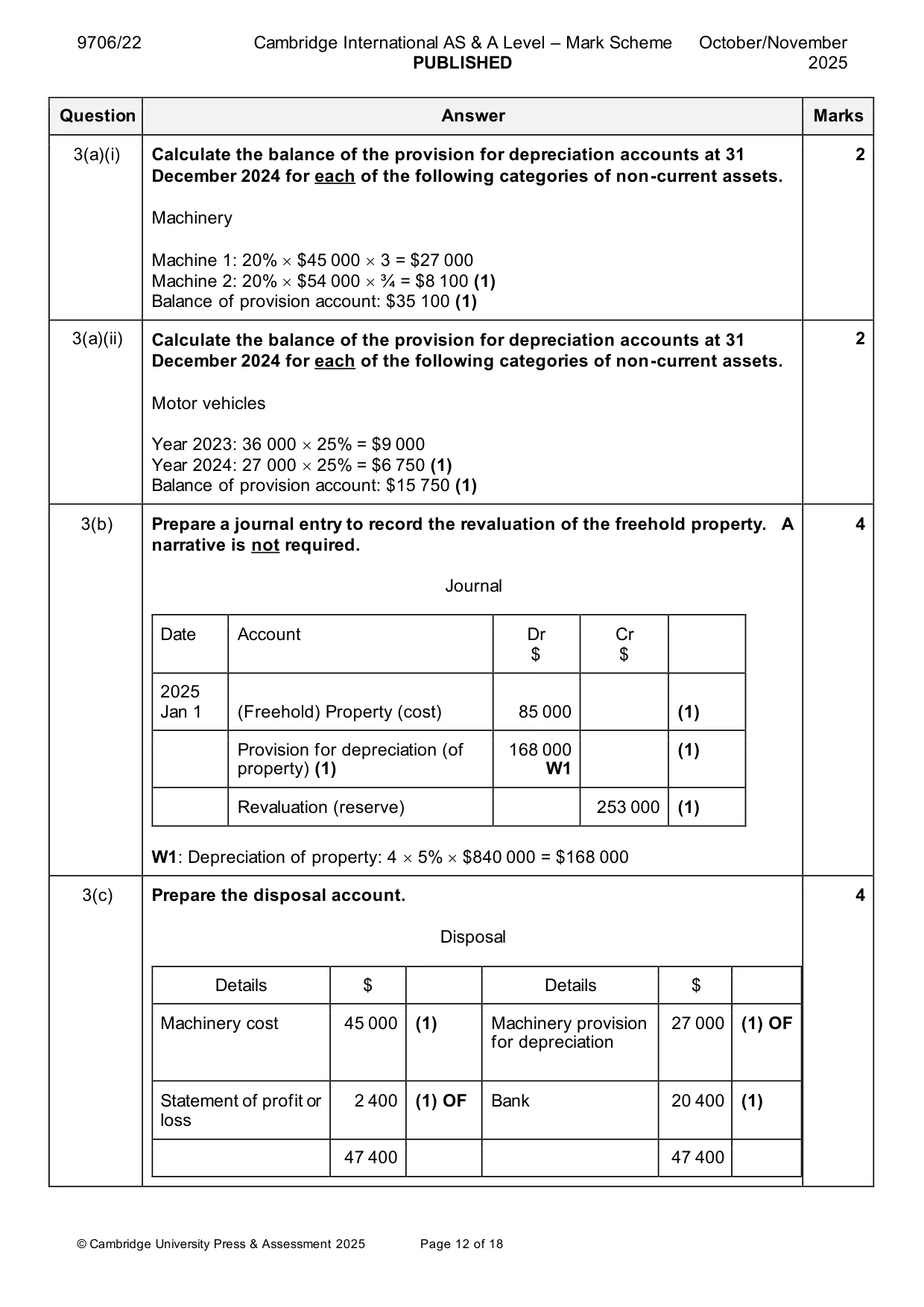
Mark scheme: 3(a)(i) Calculate the balance of the provision for depreciation accounts at 31 2 December 2024 for each of the following categories of non-current assets. Machinery Machine 1: 20% $45 000 3 = $27 000 Machine 2: 20% $54 000 ¾ = $8 100 (1) Balance of provision account: $35 100 (1) 3(a)(ii) Calculate the balance of the provision for depreciation accounts at 31 2 December 2024 for each of the following categories of non-current assets. Motor vehicles Year 2023: 36 000 25% = $9 000 Year 2024: 27 000 25% = $6 750 (1) Balance of provision account: $15 750 (1) 3(b) Prepare a journal entry to record the revaluation of the freehold property. A 4 narrative is not required. Journal Date Account Dr Cr $ $ 2025 Jan 1 (Freehold) Property (cost) 85 000 (1) Provision for depreciation (of 168 000 (1) property) (1) W1 Revaluation (reserve) 253 000 (1) W1: Depreciation of property: 4 5% $840 000 = $168 000 3(c) Prepare the disposal account. 4 Disposal Details $ Details $ Machinery cost 45 000 (1) Machinery provision 27 000 (1) OF for depreciation Statement of profit or 2 400 (1) OF Bank 20 400 (1) loss 47 400 47 400 3(d) Explain, with reference to one accounting concept, why the suggestion should 3 not be implemented. Consistency concept (1): requires the same policy/methods/principle/techniques to be used from year to year (1) to ensure that results are capable of valid comparison (1). Accept other valid responses.
Q4 · W Limited manufactures a single type of product at one of its factories
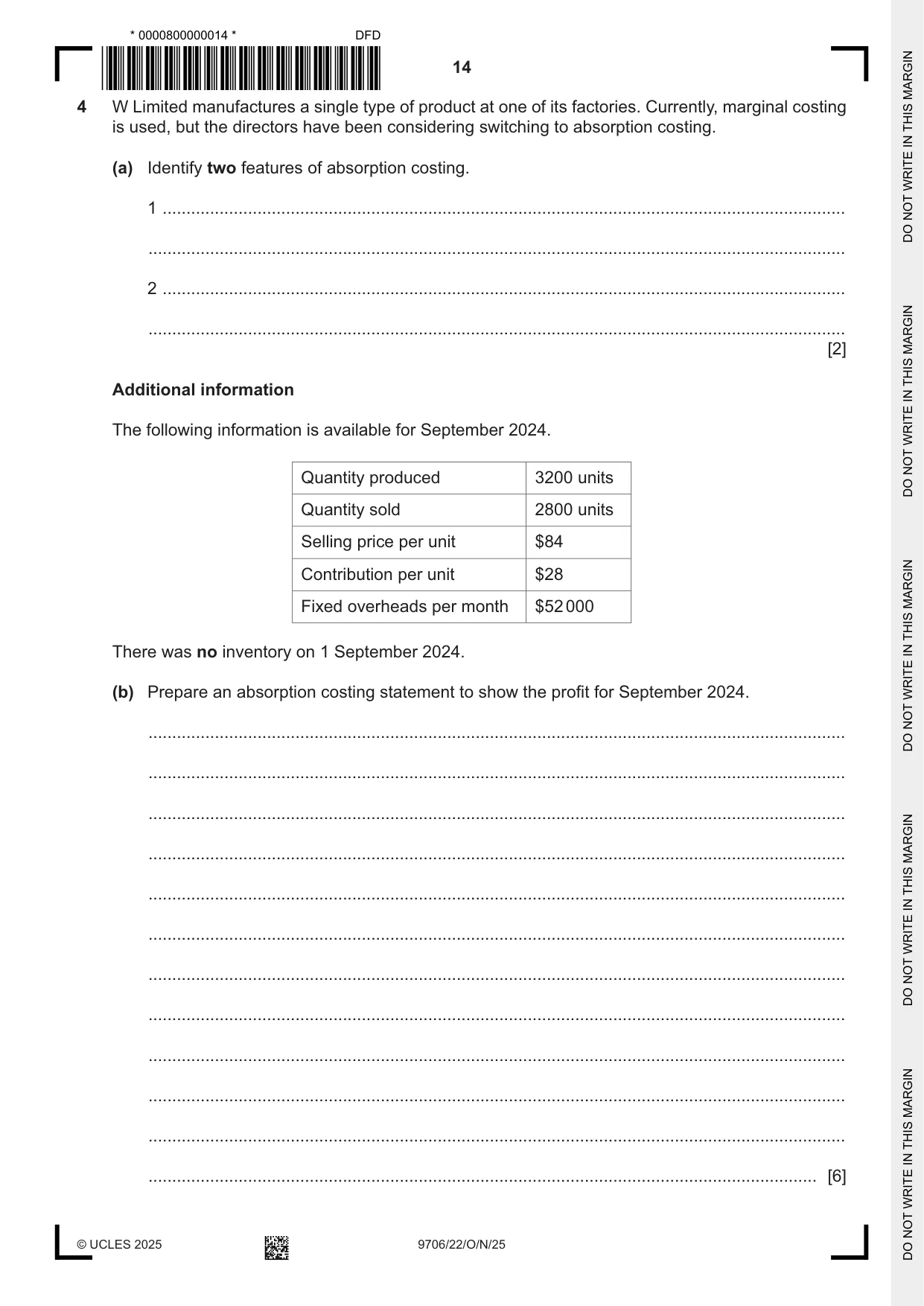
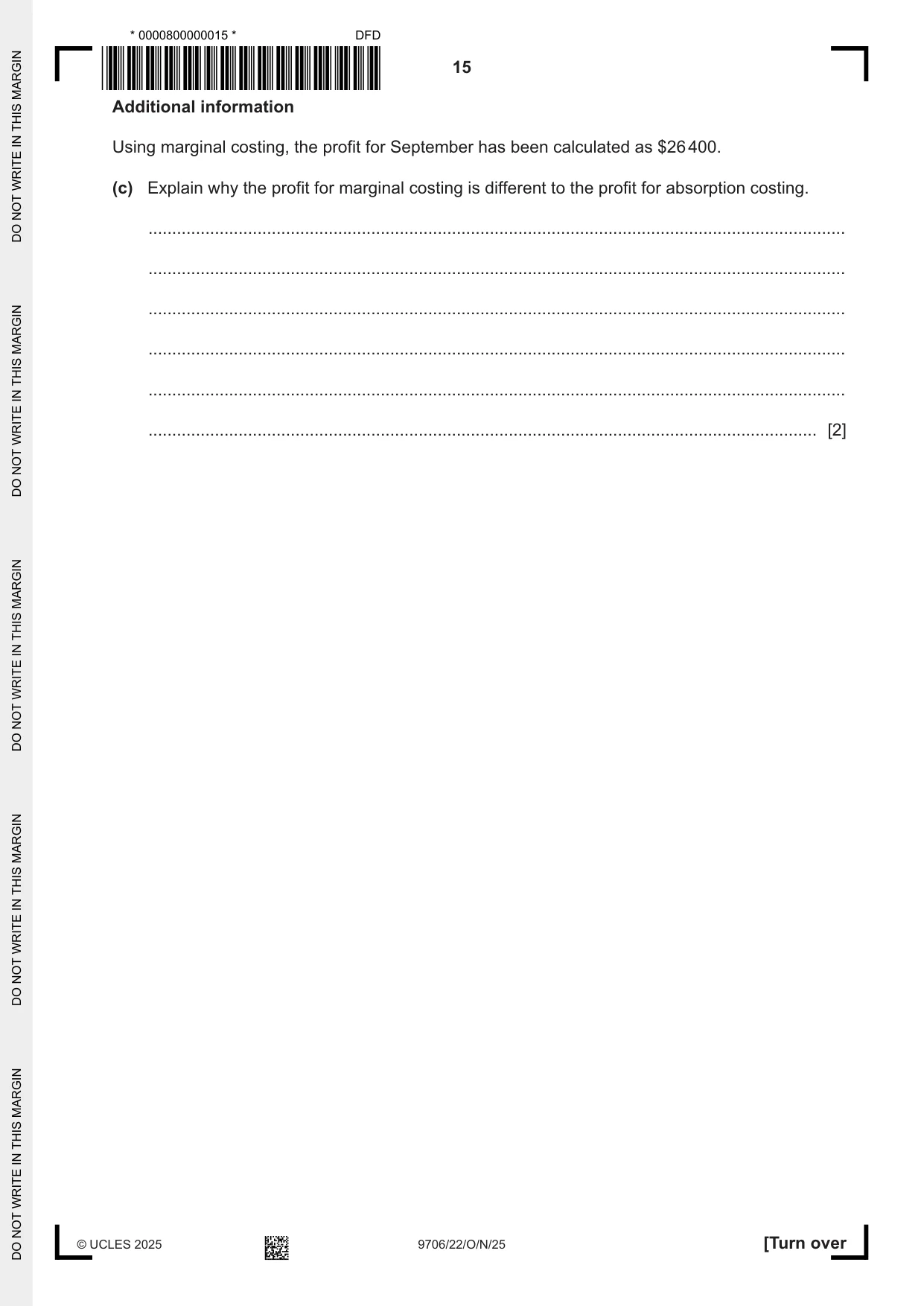
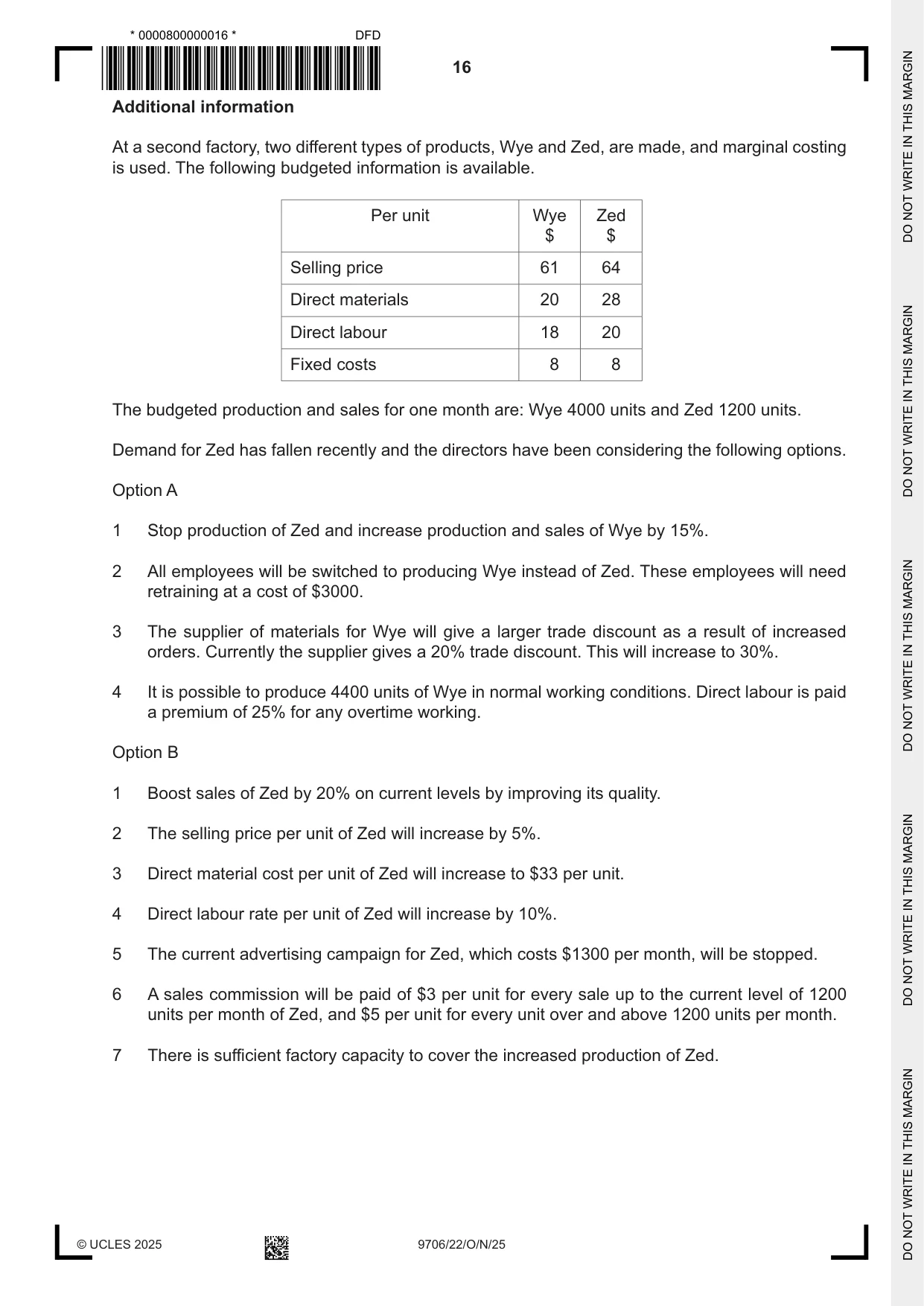
4 W Limited manufactures a single type of product at one of its factories. Currently, marginal costing is used, but the directors have been considering switching to absorption costing. (a) Identify two features of absorption costing. 1 ................................................................................................................................................ ................................................................................................................................................... 2 ................................................................................................................................................ ................................................................................................................................................... [2] Additional information The following information is available for September 2024. Quantity produced 3200 units Quantity sold 2800 units Selling price per unit $84 Contribution per unit $28 Fixed overheads per month $52 000 There was no inventory on 1 September 2024. (b) Prepare an absorption costing statement to show the profit for September 2024. ................................................................................................................................................... ................................................................................................................................................... ................................................................................................................................................... ................................................................................................................................................... ................................................................................................................................................... ................................................................................................................................................... ................................................................................................................................................... ................................................................................................................................................... ................................................................................................................................................... ................................................................................................................................................... ................................................................................................................................................... ............................................................................................................................................. [6] Additional information Using marginal costing, the profit for September has been calculated as $26 400. (c) Explain why the profit for marginal costing is different to the profit for absorption costing. ................................................................................................................................................... ................................................................................................................................................... ................................................................................................................................................... ................................................................................................................................................... ................................................................................................................................................... ............................................................................................................................................. [2] Additional information At a second factory, two different types of products, Wye and Zed, are made, and marginal costing is used. The following budgeted information is available. Per unit Wye Zed $ $ Selling price 61 64 Direct materials 20 28 Direct labour 18 20 Fixed costs 8 8 The budgeted production and sales for one month are: Wye 4000 units and Zed 1200 units. Demand for Zed has fallen recently and the directors have been considering the following options. Option A 1 Stop production of Zed and increase production and sales of Wye by 15%. 2 All employees will be switched to producing Wye instead of Zed. These employees will need retraining at a cost of $3000. 3 The supplier of materials for Wye will give a larger trade discount as a result of increased orders. Currently the supplier gives a 20% trade discount. This will increase to 30%. 4 It is possible to produce 4400 units of Wye in normal working conditions. Direct labour is paid a premium of 25% for any overtime working. Option B 1 Boost sales of Zed by 20% on current levels by improving its quality. 2 The selling price per unit of Zed will increase by 5%. 3 Direct material cost per unit of Zed will increase to $33 per unit. 4 Direct labour rate per unit of Zed will increase by 10%.
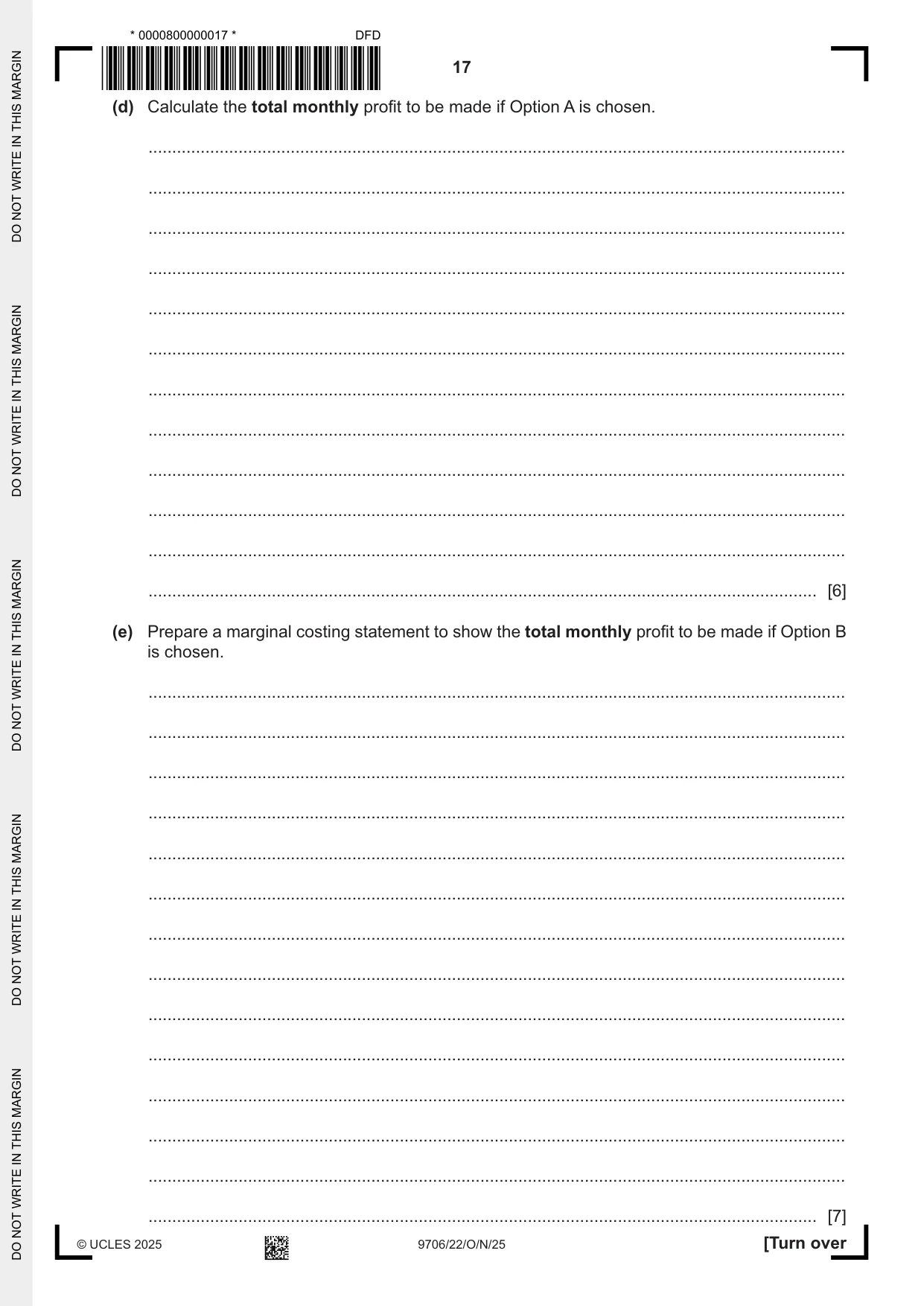
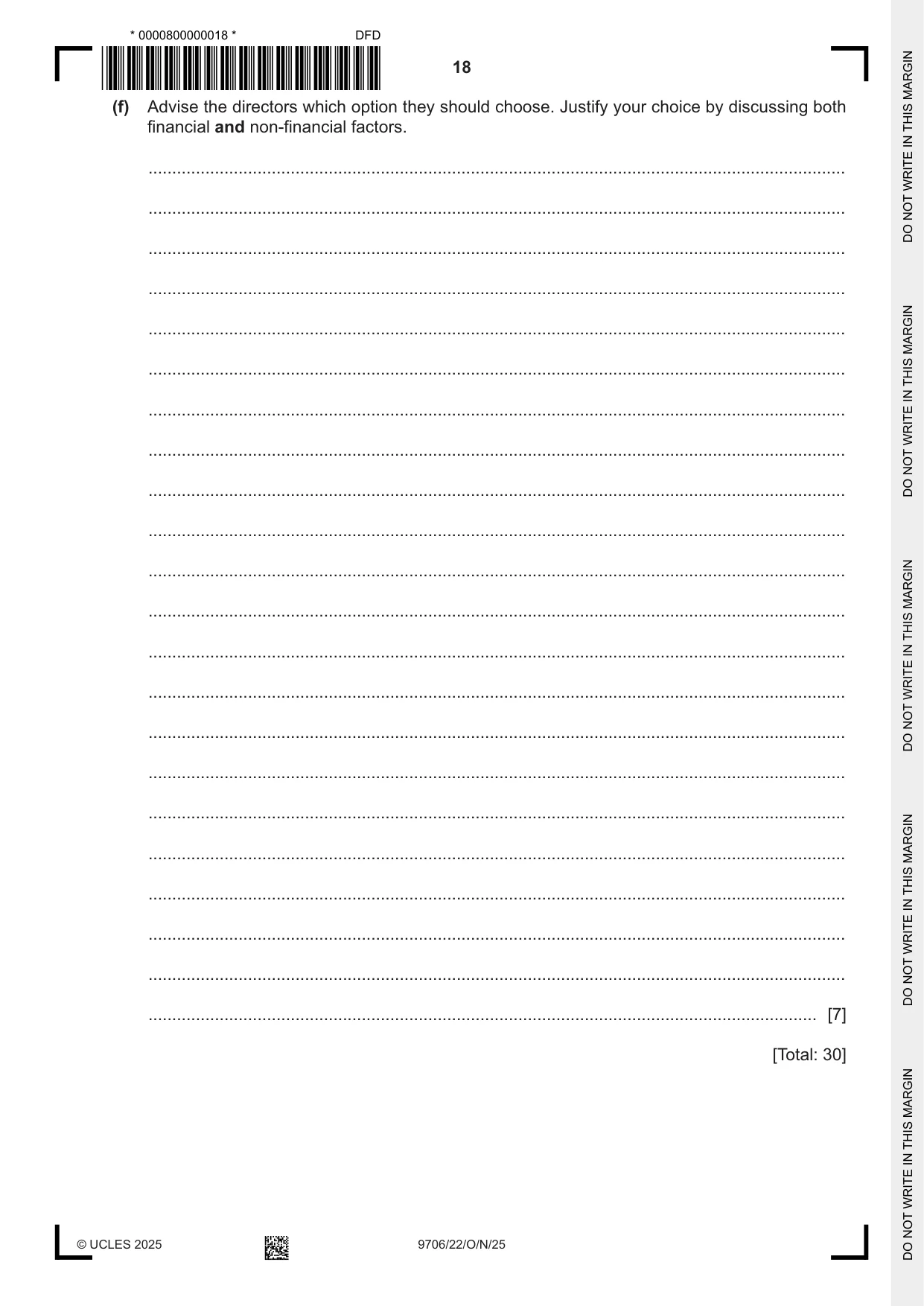
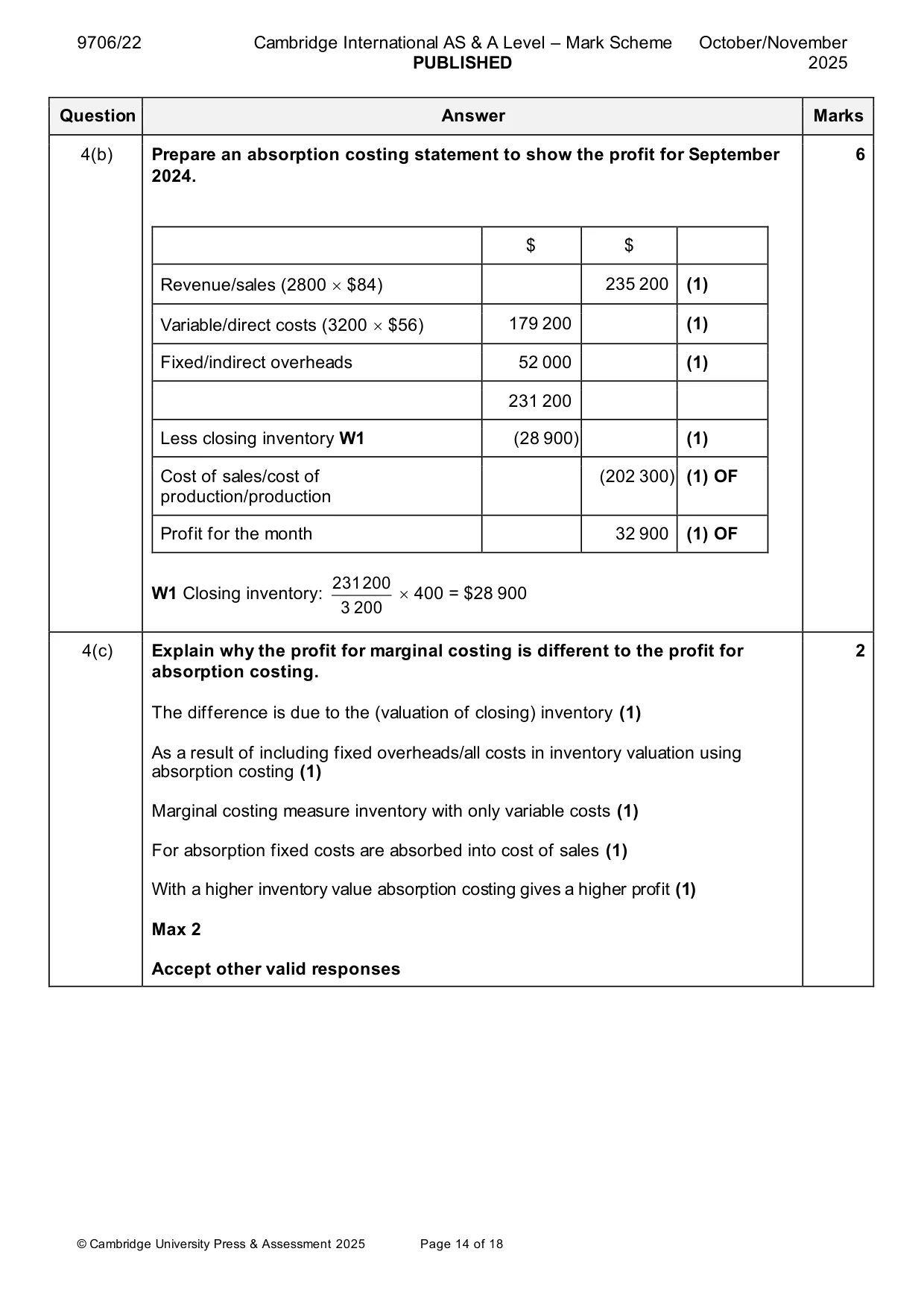
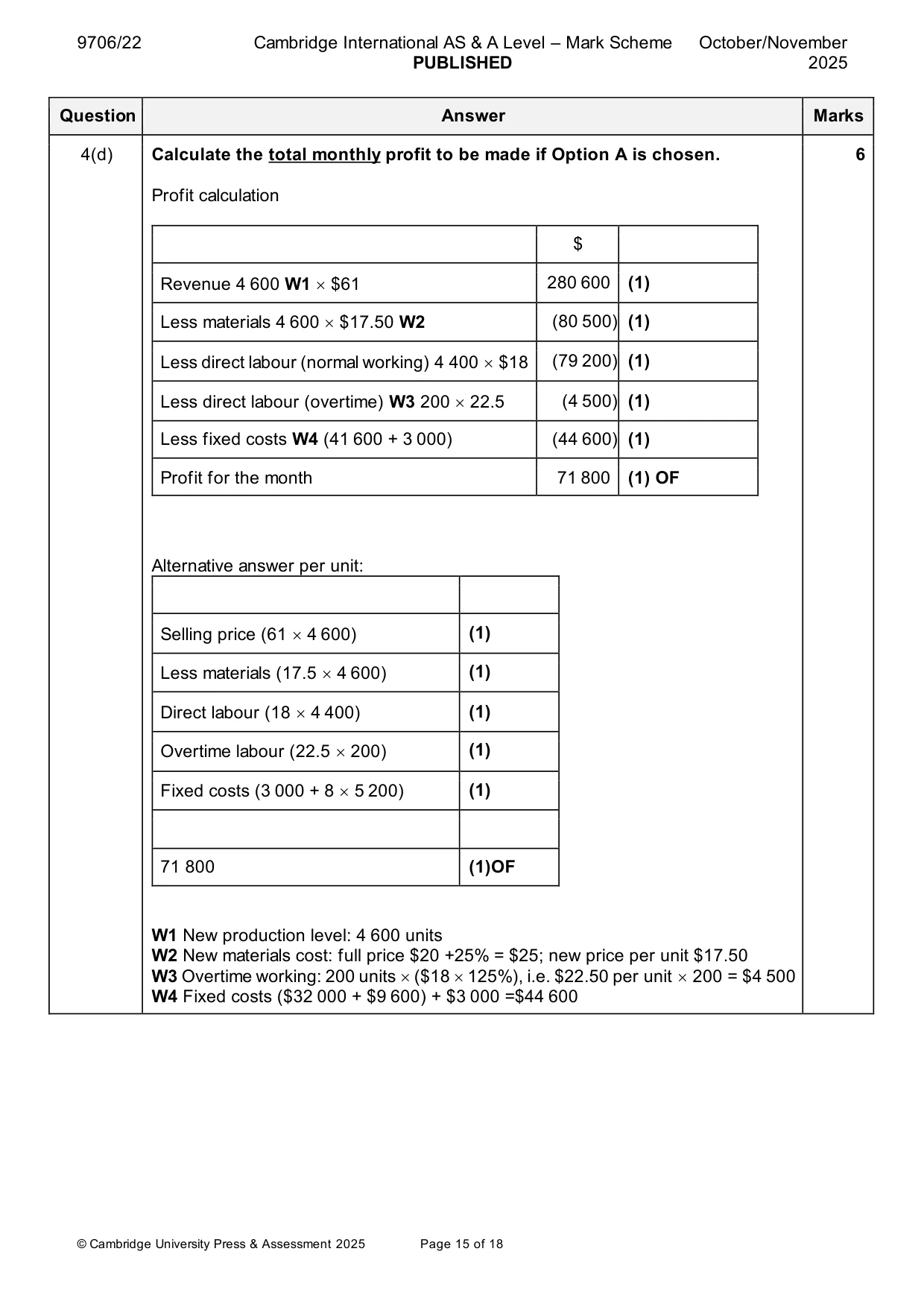
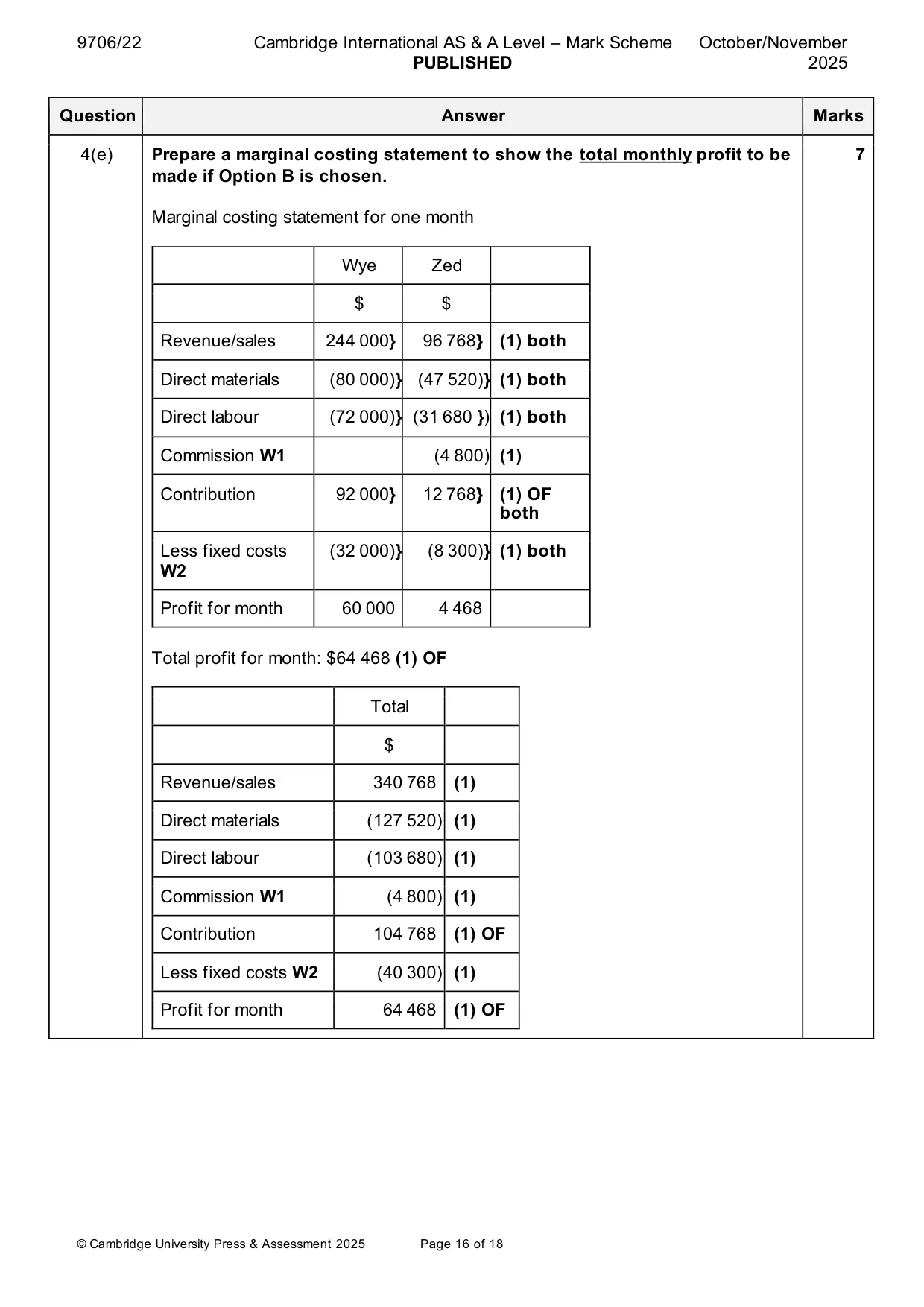
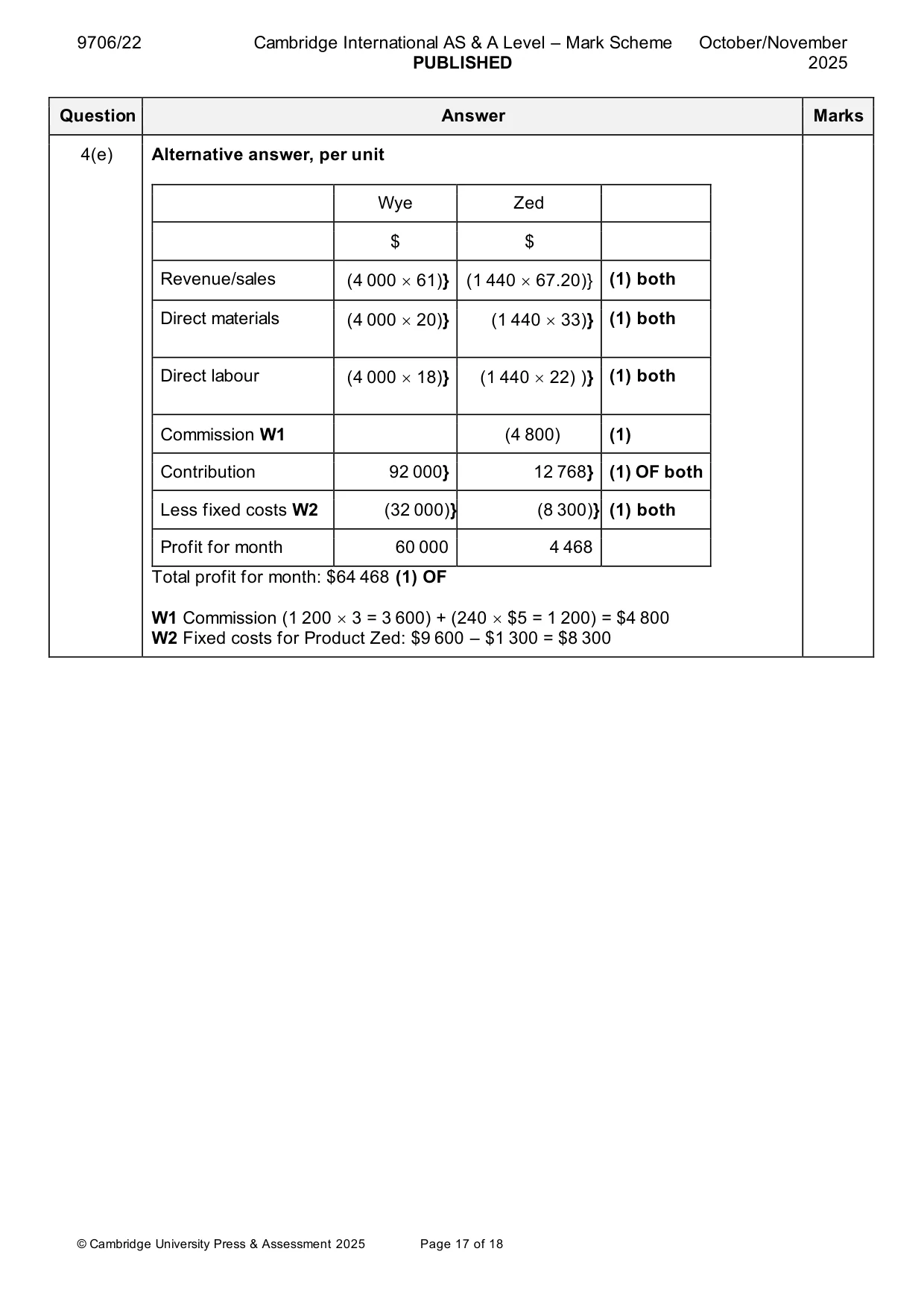
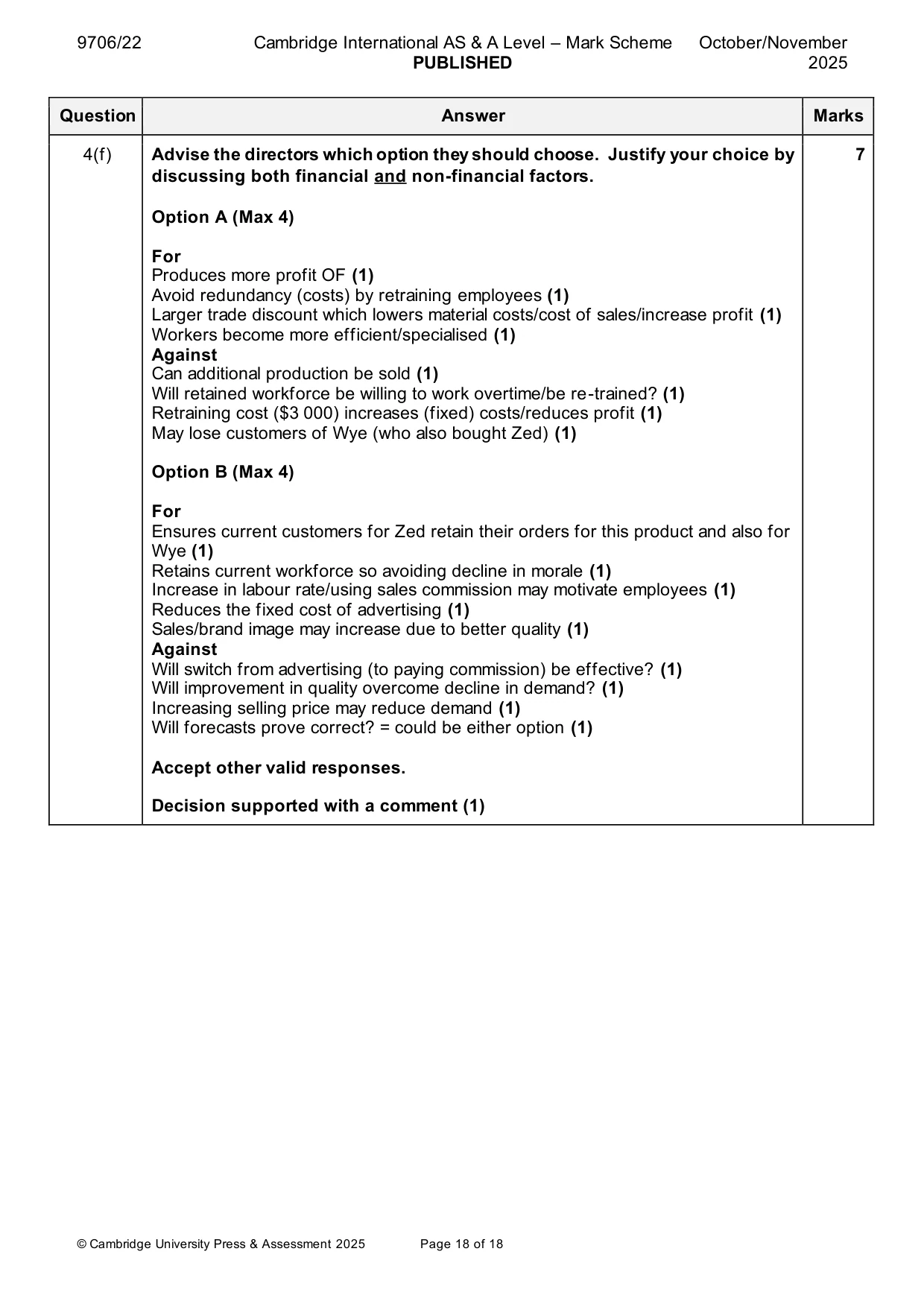
Mark scheme: 4(a) Identify two features of absorption costing. 2 • Charges both variable and fixed costs/all costs (to each unit of production)/no need to separate fixed (and variable) costs (1) • Allocates costs (to cost centres) (1) • Requires apportionment of overheads (which cannot otherwise be allocated to cost centres) (1) • Useful for determining the selling price of a unit (1) • Recognised method for valuing inventory/required for financial statements/acceptable under IAS/IAS 2 or 1 (1) • Helps in long term decision making (1) • Based on the matching principle (1) • Will lead to over or under absorption of overheads (1) Max 2 Accept other valid responses 4(b) Prepare an absorption costing statement to show the profit for September 6 2024. $ $ Revenue/sales (2800 $84) 235 200 (1) Variable/direct costs (3200 $56) 179 200 (1) Fixed/indirect overheads 52 000 (1) 231 200 Less closing inventory W1 (28 900) (1) Cost of sales/cost of (202 300) (1) OF production/production Profit for the month 32 900 (1) OF 231200 W1 Closing inventory: 400 = $28 900 3 200 4(c) Explain why the profit for marginal costing is different to the profit for 2 absorption costing. The difference is due to the (valuation of closing) inventory (1) As a result of including fixed overheads/all costs in inventory valuation using absorption costing (1) Marginal costing measure inventory with only variable costs (1) For absorption fixed costs are absorbed into cost of sales (1) With a higher inventory value absorption costing gives a higher profit (1) Max 2 Accept other valid responses 4(d) Calculate the total monthly profit to be made if Option A is chosen. 6 Profit calculation $ Revenue 4 600 W1 $61 280 600 (1) Less materials 4 600 $17.50 W2 (80 500) (1) Less direct labour (normal working) 4 400 $18 (79 200) (1) Less direct labour (overtime) W3 200 22.5 (4 500) (1) Less fixed costs W4 (41 600 + 3 000) (44 600) (1) Profit for the month 71 800 (1) OF Alternative answer per unit: Selling price (61 4 600) (1) Less materials (17.5 4 600) (1) Direct labour (18 4 400) (1) Overtime labour (22.5 200) (1) Fixed costs (3 000 + 8 5 200) (1) 71 800 (1)OF W1 New production level: 4 600 units W2 New materials cost: full price $20 +25% = $25; new price per unit $17.50 W3 Overtime working: 200 units ($18 125%), i.e. $22.50 per unit 200 = $4 500 W4 Fixed costs ($32 000 + $9 600) + $3 000 =$44 600 4(e) Prepare a marginal costing statement to show the total monthly profit to be 7 made if Option B is chosen. Marginal costing statement for one month Wye Zed $ $ Revenue/sales 244 000} 96 768} (1) both Direct materials (80 000)} (47 520)} (1) both Direct labour (72 000)} (31 680 }) (1) both Commission W1 (4 800) (1) Contribution 92 000} 12 768} (1) OF both Less fixed costs (32 000)} (8 300)} (1) both W2 Profit for month 60 000 4 468 Total profit for month: $64 468 (1) OF Total $ Revenue/sales 340 768 (1) Direct materials (127 520) (1) Direct labour (103 680) (1) Commission W1 (4 800) (1) Contribution 104 768 (1) OF Less fixed costs W2 (40 300) (1) Profit for month 64 468 (1) OF 4(e) Alternative answer, per unit Wye Zed $ $ Revenue/sales (4 000 61)} (1 440 67.20)} (1) both Direct materials (4 000 20)} (1 440 33)} (1) both Direct labour (4 000 18)} (1 440 22) )} (1) both Commission W1 (4 800) (1) Contribution 92 000} 12 768} (1) OF both Less fixed costs W2 (32 000)} (8 300)} (1) both Profit for month 60 000 4 468 Total profit for month: $64 468 (1) OF W1 Commission (1 200 3 = 3 600) + (240 $5 = 1 200) = $4 800 W2 Fixed costs for Product Zed: $9 600 – $1 300 = $8 300 4(f) Advise the directors which option they should choose. Justify your choice by 7 discussing both financial and non-financial factors. Option A (Max 4) For Produces more profit OF (1) Avoid redundancy (costs) by retraining employees (1) Larger trade discount which lowers material costs/cost of sales/increase profit (1) Workers become more efficient/specialised (1) Against Can additional production be sold (1) Will retained workforce be willing to work overtime/be re-trained? (1) Retraining cost ($3 000) increases (fixed) costs/reduces profit (1) May lose customers of Wye (who also bought Zed) (1) Option B (Max 4) For Ensures current customers for Zed retain their orders for this product and also for Wye (1) Retains current workforce so avoiding decline in morale (1) Increase in labour rate/using sales commission may motivate employees (1) Reduces the fixed cost of advertising (1) Sales/brand image may increase due to better quality (1) Against Will switch from advertising (to paying commission) be effective? (1) Will improvement in quality overcome decline in demand? (1) Increasing selling price may reduce demand (1) Will forecasts prove correct? = could be either option (1) Accept other valid responses. Decision supported with a comment (1)
Q6 · A sales commission will be paid of $3 per unit for every sale up to the current level of…
6 A sales commission will be paid of $3 per unit for every sale up to the current level of 1200 units per month of Zed, and $5 per unit for every unit over and above 1200 units per month.
Q7 · Calculate the total monthly profit to be made if Option A is chosen
(d) Calculate the total monthly profit to be made if Option A is chosen. ................................................................................................................................................... ................................................................................................................................................... ................................................................................................................................................... ................................................................................................................................................... ................................................................................................................................................... ................................................................................................................................................... ................................................................................................................................................... ................................................................................................................................................... ................................................................................................................................................... ................................................................................................................................................... ................................................................................................................................................... ............................................................................................................................................. [6] (e) Prepare a marginal costing statement to show the total monthly profit to be made if Option B is chosen. ................................................................................................................................................... ................................................................................................................................................... ................................................................................................................................................... ................................................................................................................................................... ................................................................................................................................................... ................................................................................................................................................... ................................................................................................................................................... ................................................................................................................................................... ................................................................................................................................................... ................................................................................................................................................... ................................................................................................................................................... ................................................................................................................................................... ................................................................................................................................................... ............................................................................................................................................. [7] (f) Advise the directors which option they should choose. Justify your choice by discussing both financial and non-financial factors. ................................................................................................................................................... ................................................................................................................................................... ................................................................................................................................................... ................................................................................................................................................... ................................................................................................................................................... ................................................................................................................................................... ................................................................................................................................................... ................................................................................................................................................... ................................................................................................................................................... ................................................................................................................................................... ................................................................................................................................................... ................................................................................................................................................... ................................................................................................................................................... ................................................................................................................................................... ................................................................................................................................................... ................................................................................................................................................... ................................................................................................................................................... ................................................................................................................................................... ................................................................................................................................................... ................................................................................................................................................... ................................................................................................................................................... ............................................................................................................................................. [7] [Total: 30]
What was in this paper
The subtopics covered by these 6 questions, and how many questions each got. Open one in a new tab to see every Cambridge question on it.
What you needed in this session
Cambridge’s own grade thresholds for 2025 Oct/Nov, Paper 2 · Variant 2. A higher threshold means an easier paper — the bar moves with how the cohort did.