Cambridge A Level Accounting 9706 — 2024 May/June Paper 2 · Variant 2
9706/22/M/J/24 · 6 questions · 90 marks · ≈101 min
The question paper and its mark scheme, free to read here and free to download. This is Cambridge’s own paper, exactly as it was sat.
Question paper16 pages
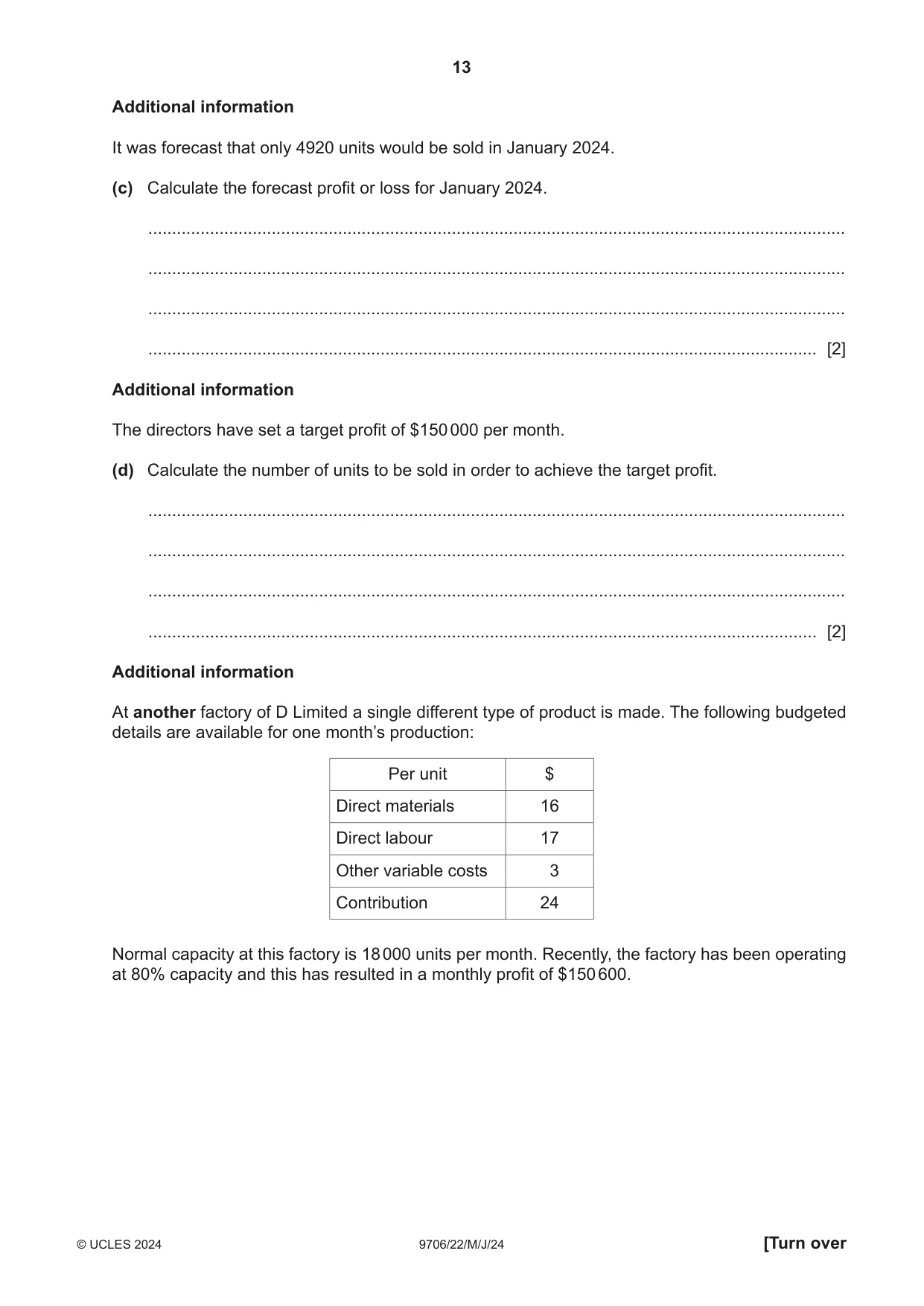
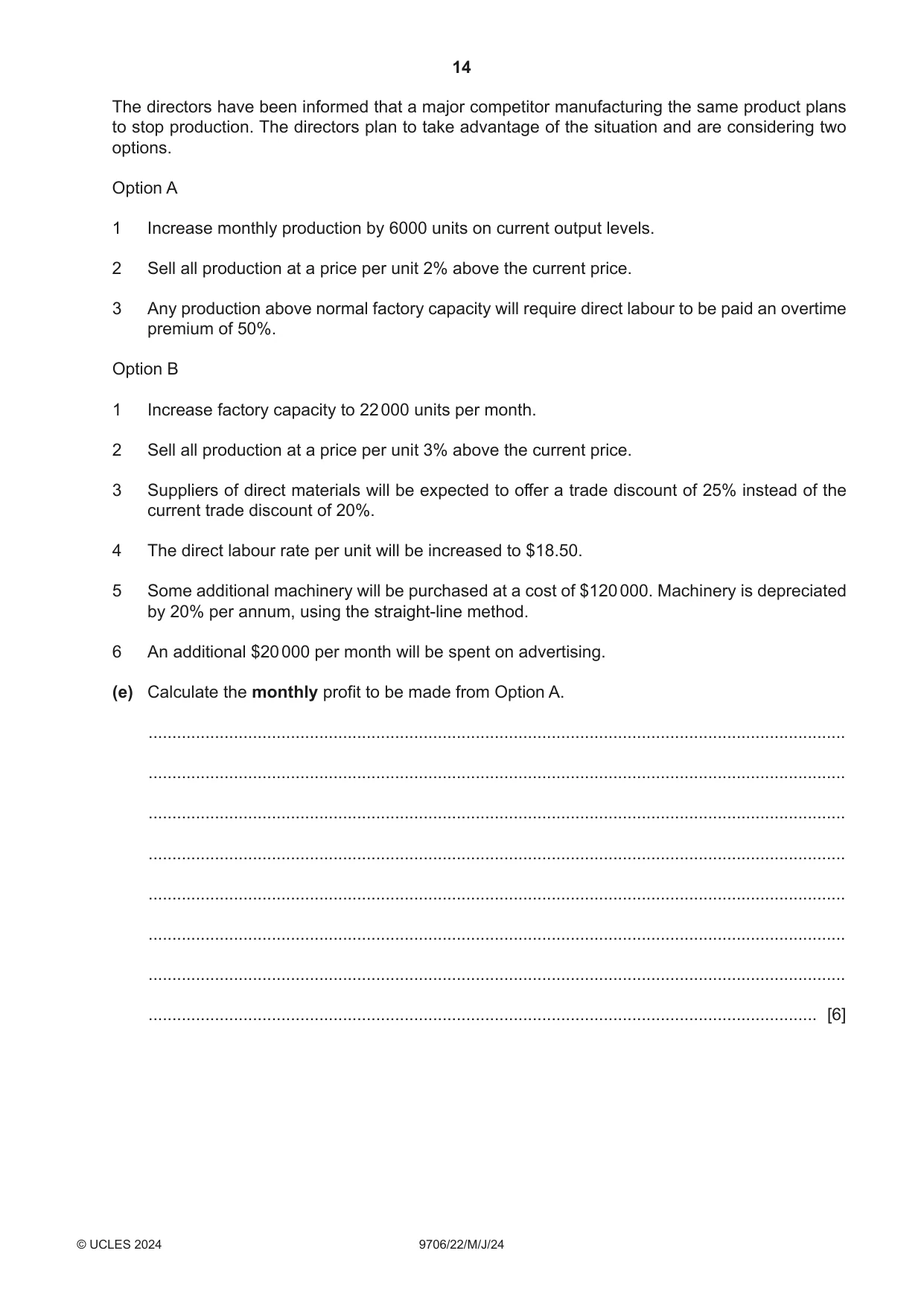
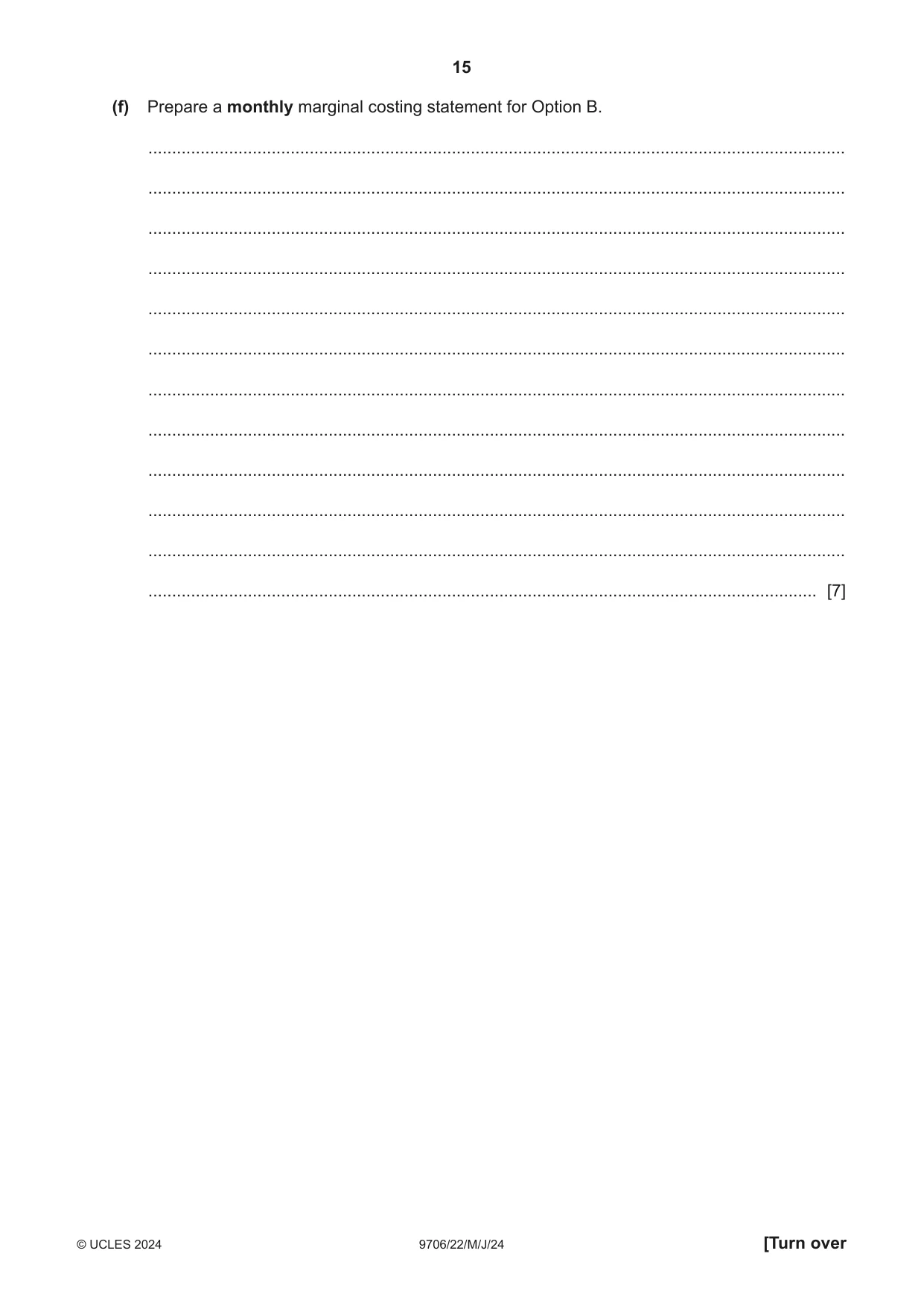
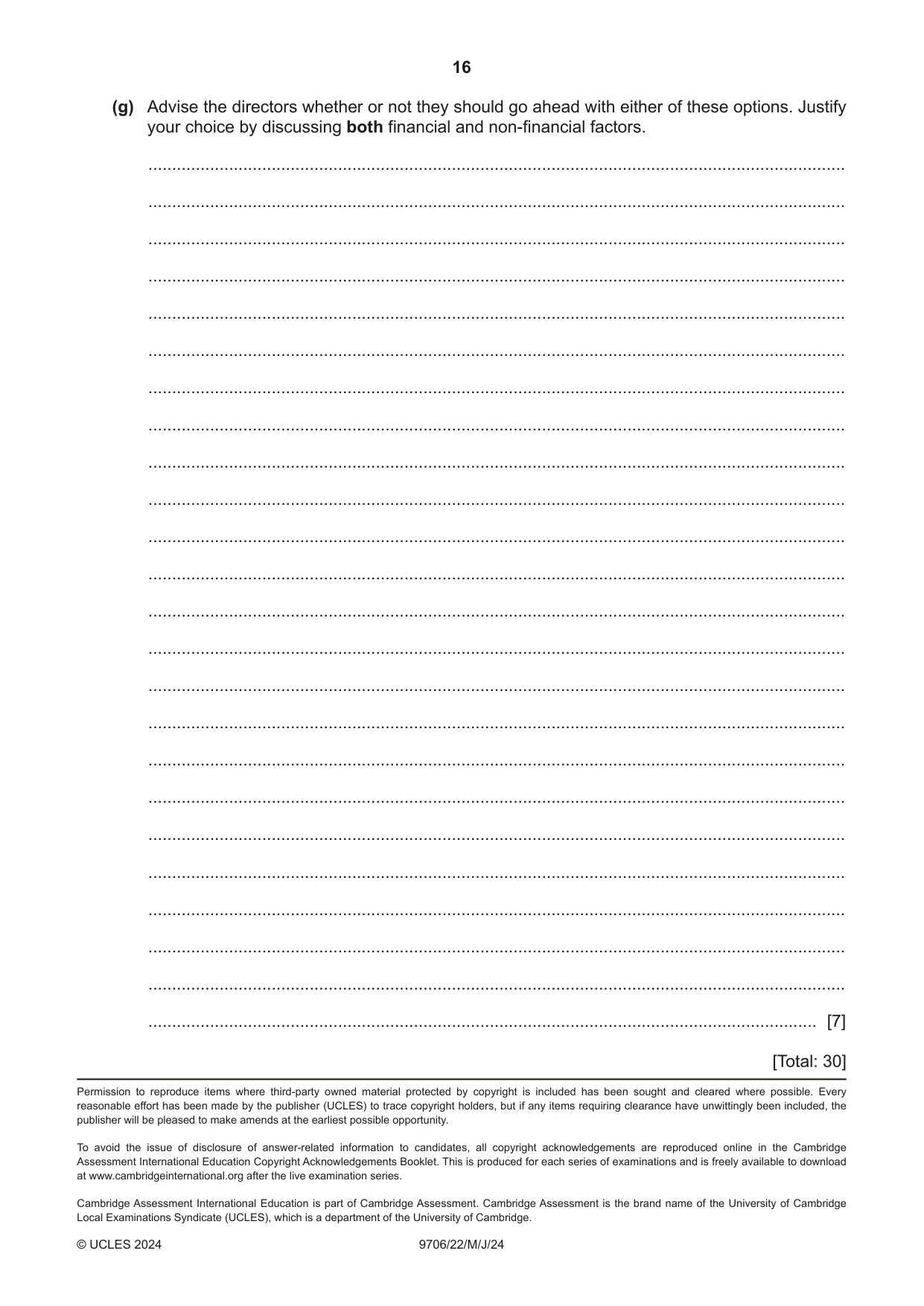
Mark scheme16 pages
Answers below. Sit the paper first if you are practising.
Questions as text
Q1 · Zahid owns a small retail business
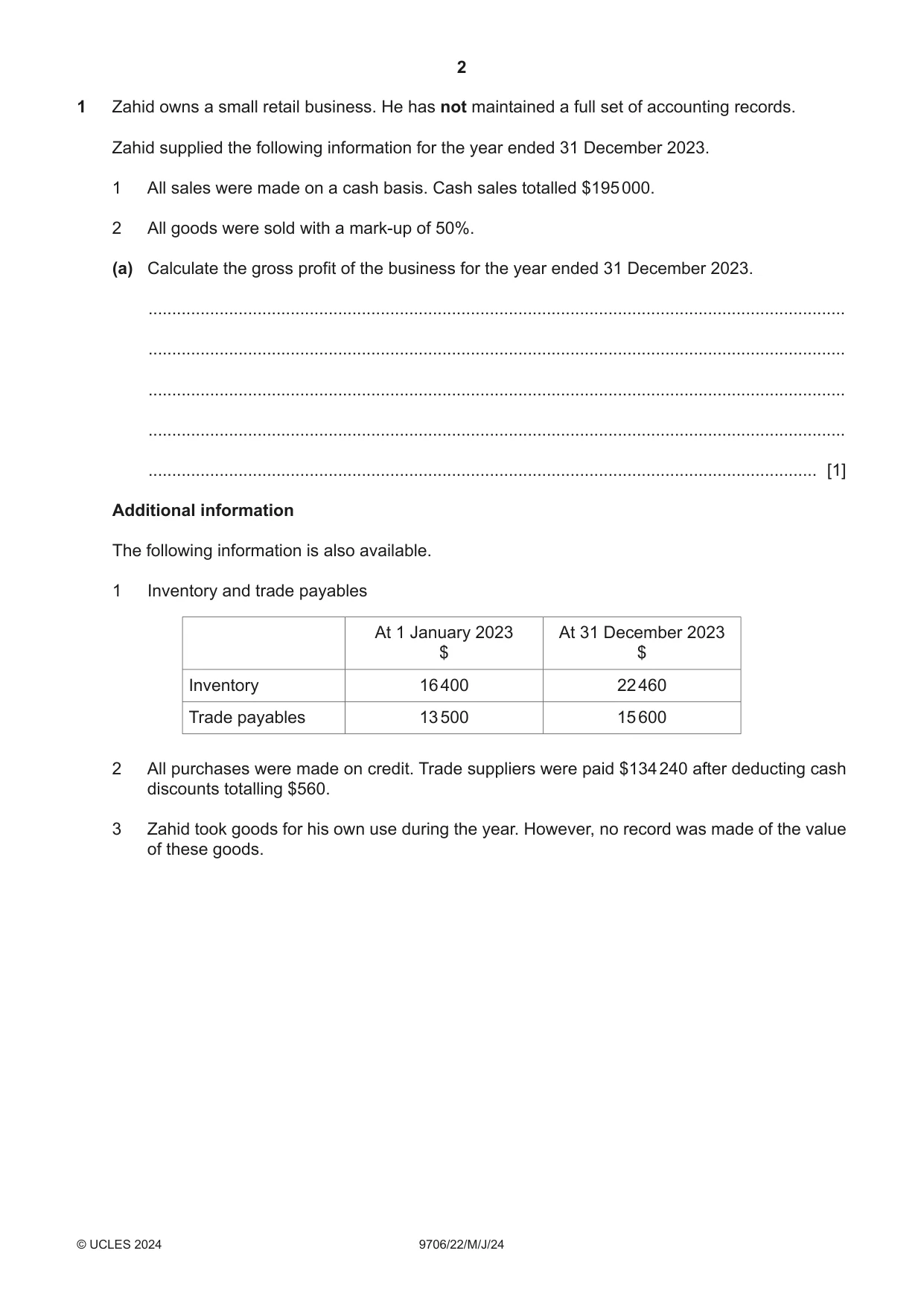
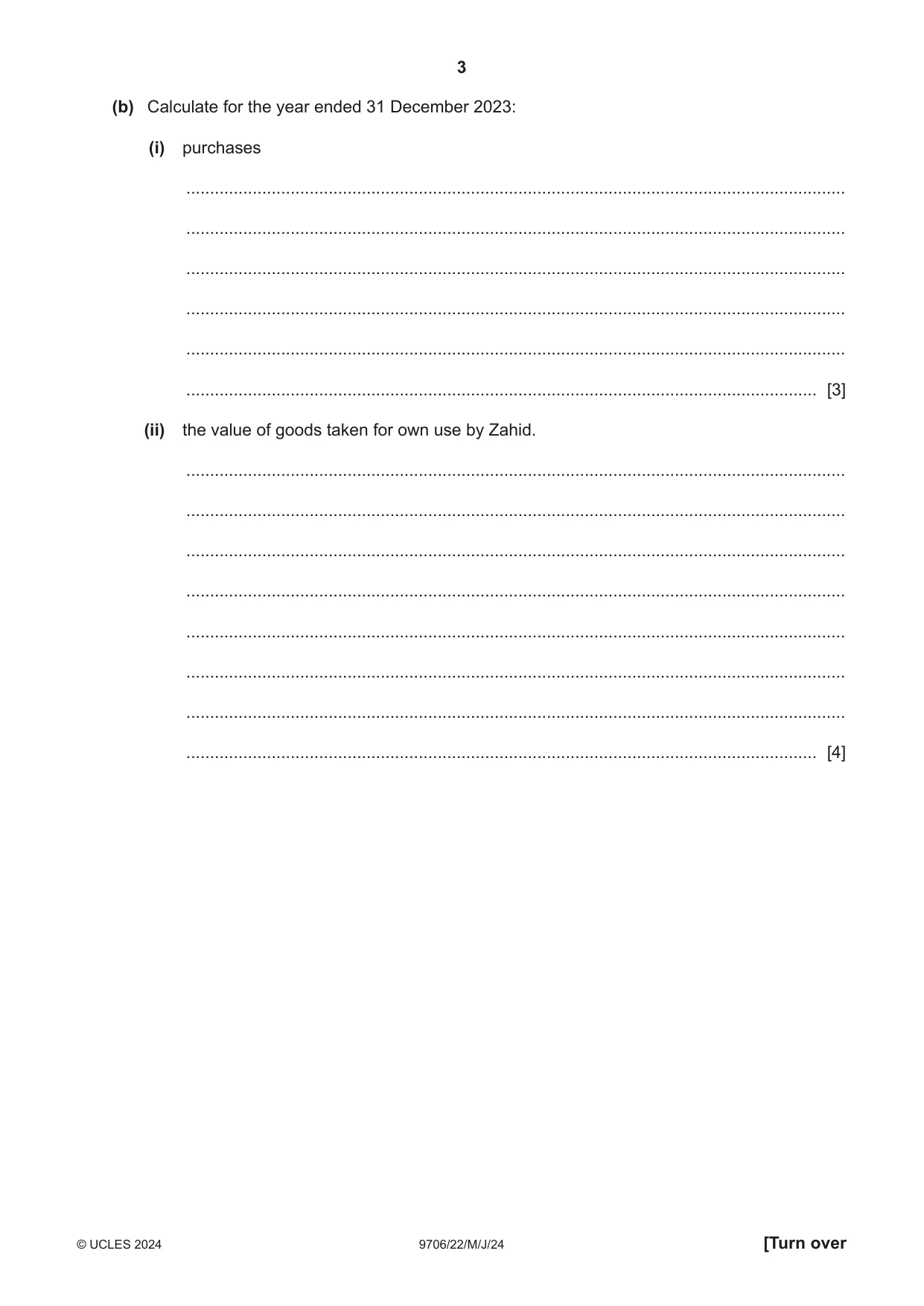
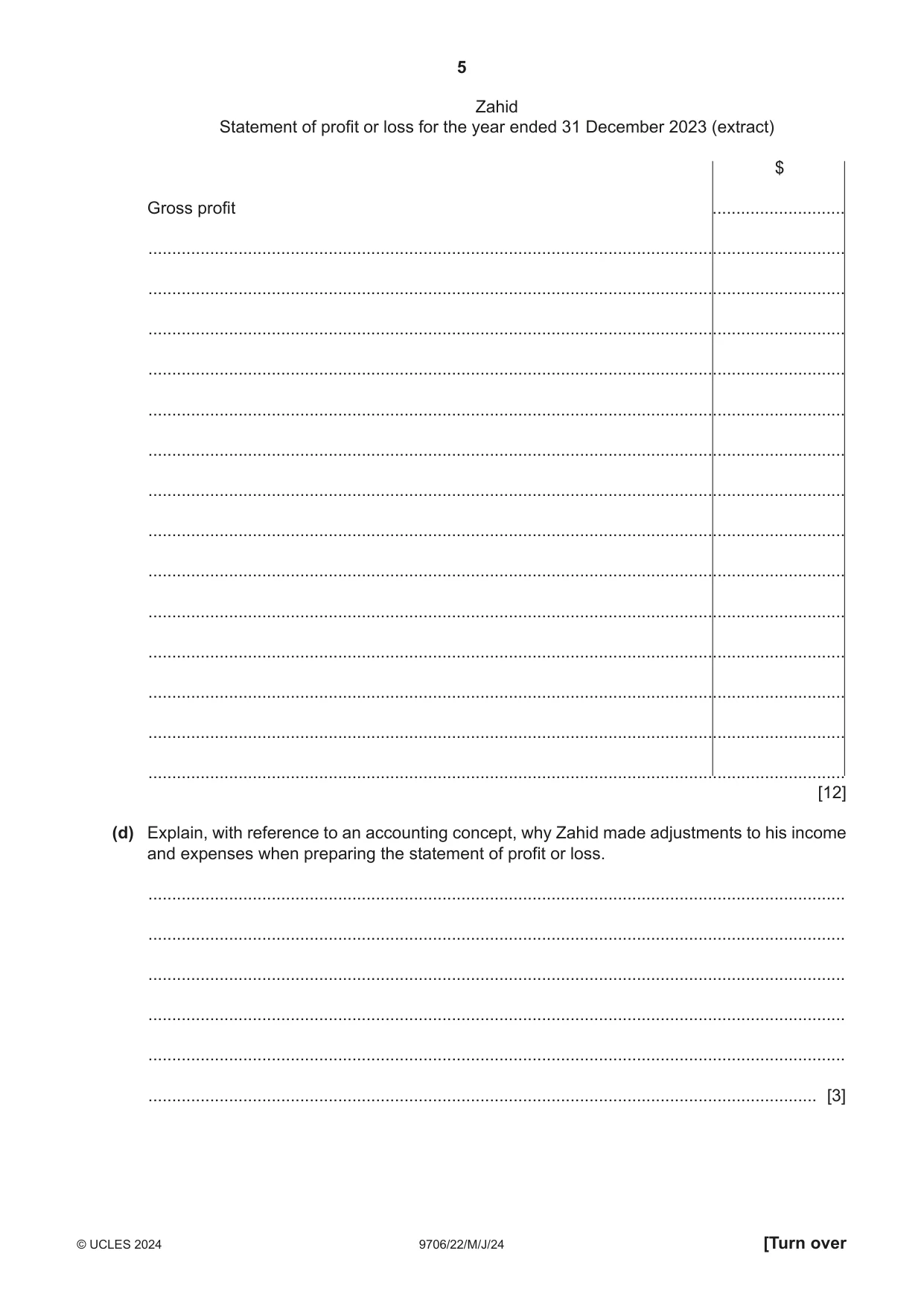
1 Zahid owns a small retail business. He has not maintained a full set of accounting records. Zahid supplied the following information for the year ended 31 December 2023. 1 All sales were made on a cash basis. Cash sales totalled $195 000. 2 All goods were sold with a mark-up of 50%. (a) Calculate the gross profit of the business for the year ended 31 December 2023. ................................................................................................................................................... ................................................................................................................................................... ................................................................................................................................................... ................................................................................................................................................... ............................................................................................................................................. [1] Additional information The following information is also available. 1 Inventory and trade payables At 1 January 2023 At 31 December 2023 $ $ Inventory 16 400 22 460 Trade payables 13 500 15 600 2 All purchases were made on credit. Trade suppliers were paid $134 240 after deducting cash discounts totalling $560. 3 Zahid took goods for his own use during the year. However, no record was made of the value of these goods. (b) Calculate for the year ended 31 December 2023: (i) purchases ........................................................................................................................................... ........................................................................................................................................... ........................................................................................................................................... ........................................................................................................................................... ........................................................................................................................................... ..................................................................................................................................... [3] (ii) the value of goods taken for own use by Zahid. ........................................................................................................................................... ........................................................................................................................................... ........................................................................................................................................... ........................................................................................................................................... ........................................................................................................................................... ........................................................................................................................................... ........................................................................................................................................... ..................................................................................................................................... [4] Additional information The following information is available for Zahid’s business. 1 Non-current assets Non-current assets had the following values. $ 1 January 2023 194 000 31 December 2023 188 000 During the year ended 31 December 2023, a non-current asset was sold for $5600, resulting in a profit on disposal of $2400. Additional non-current assets were purchased for $9200.
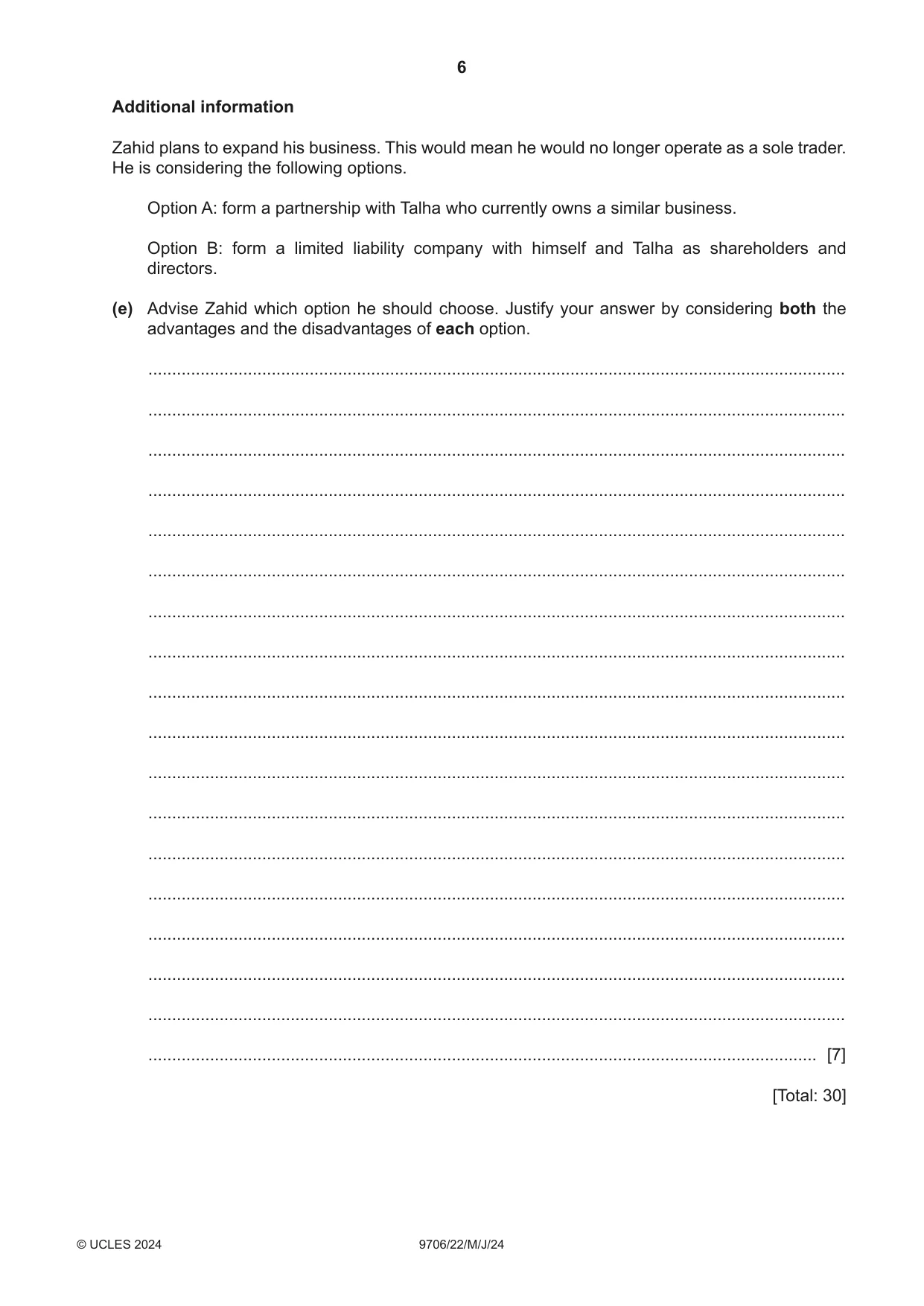
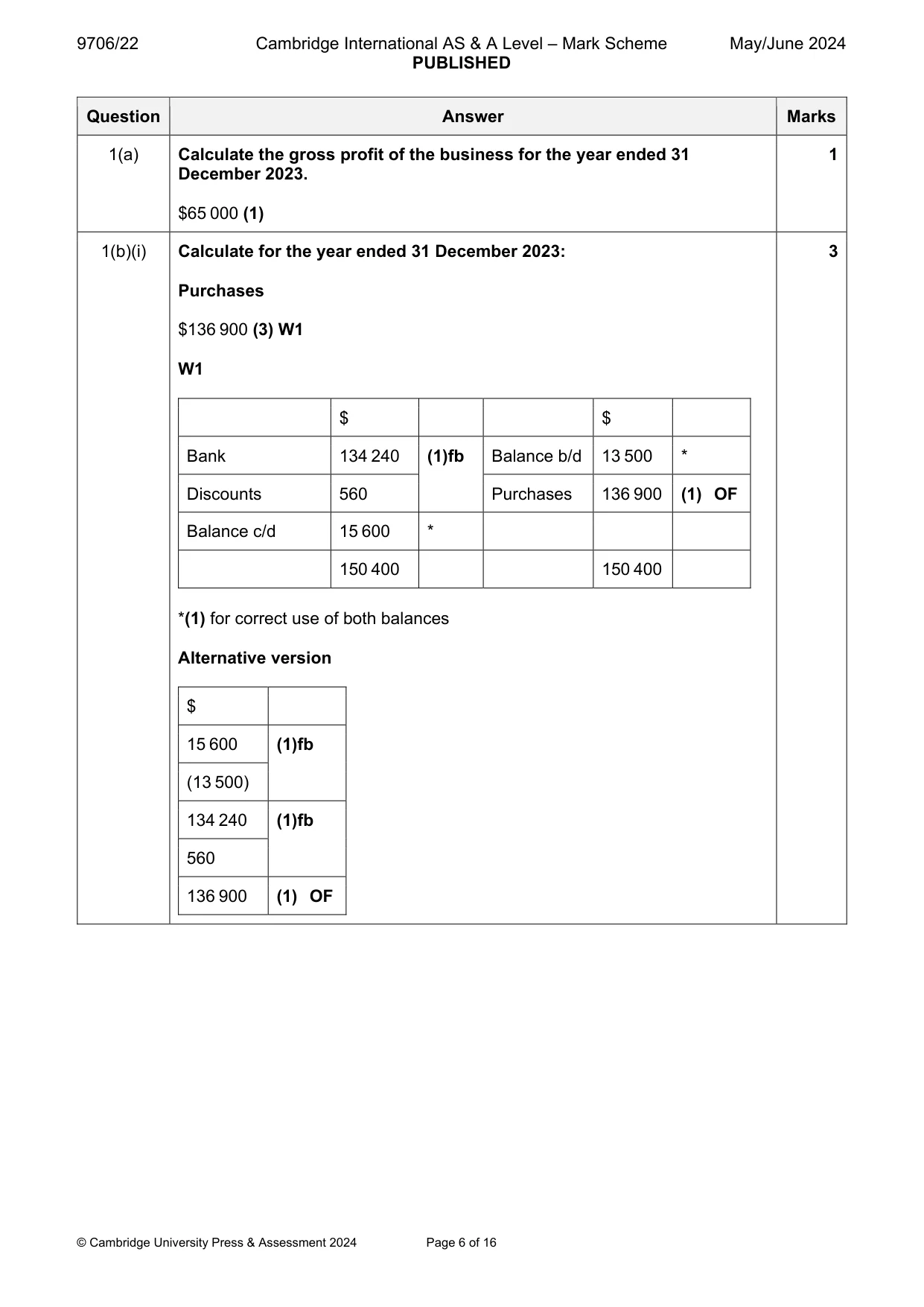
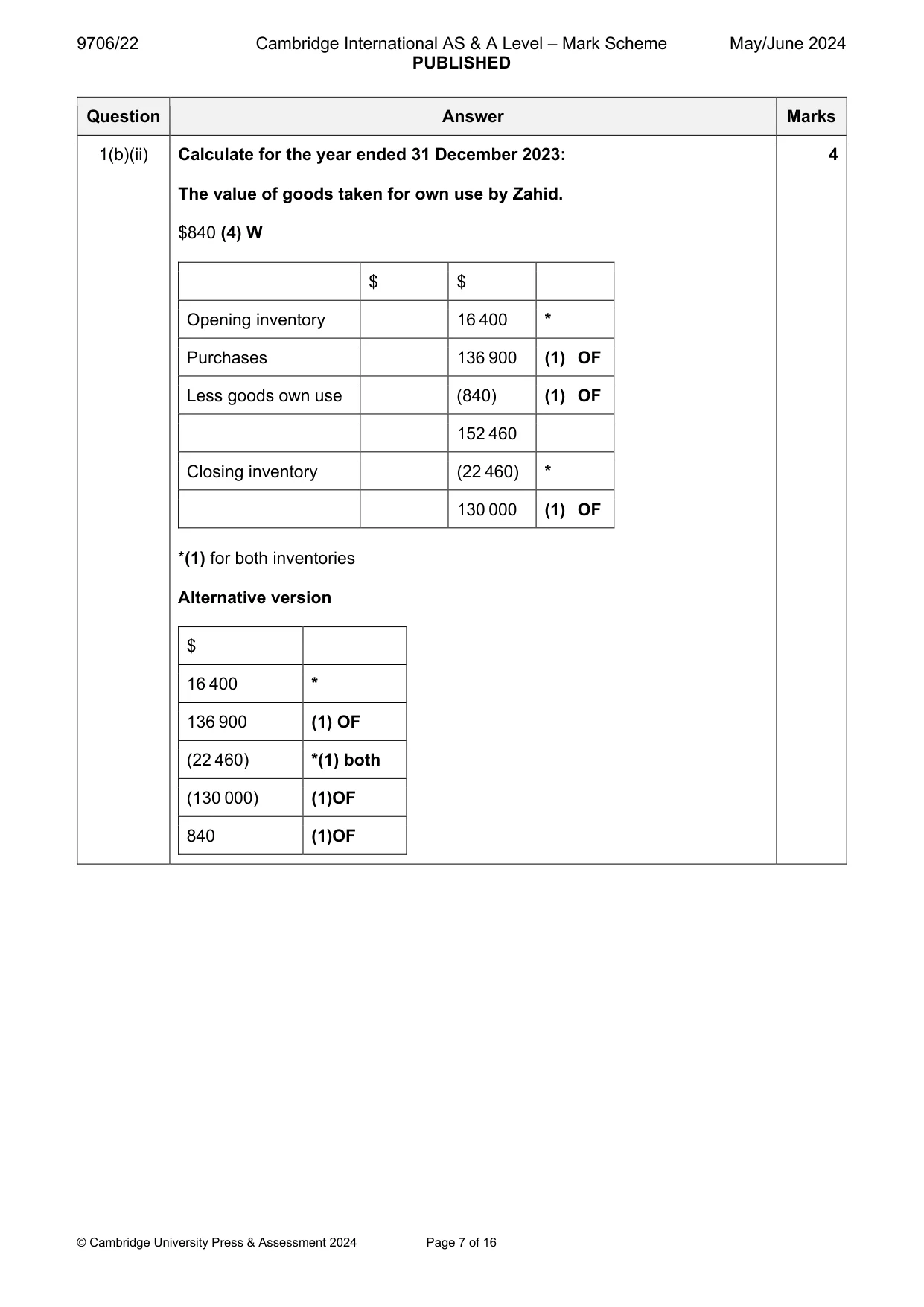
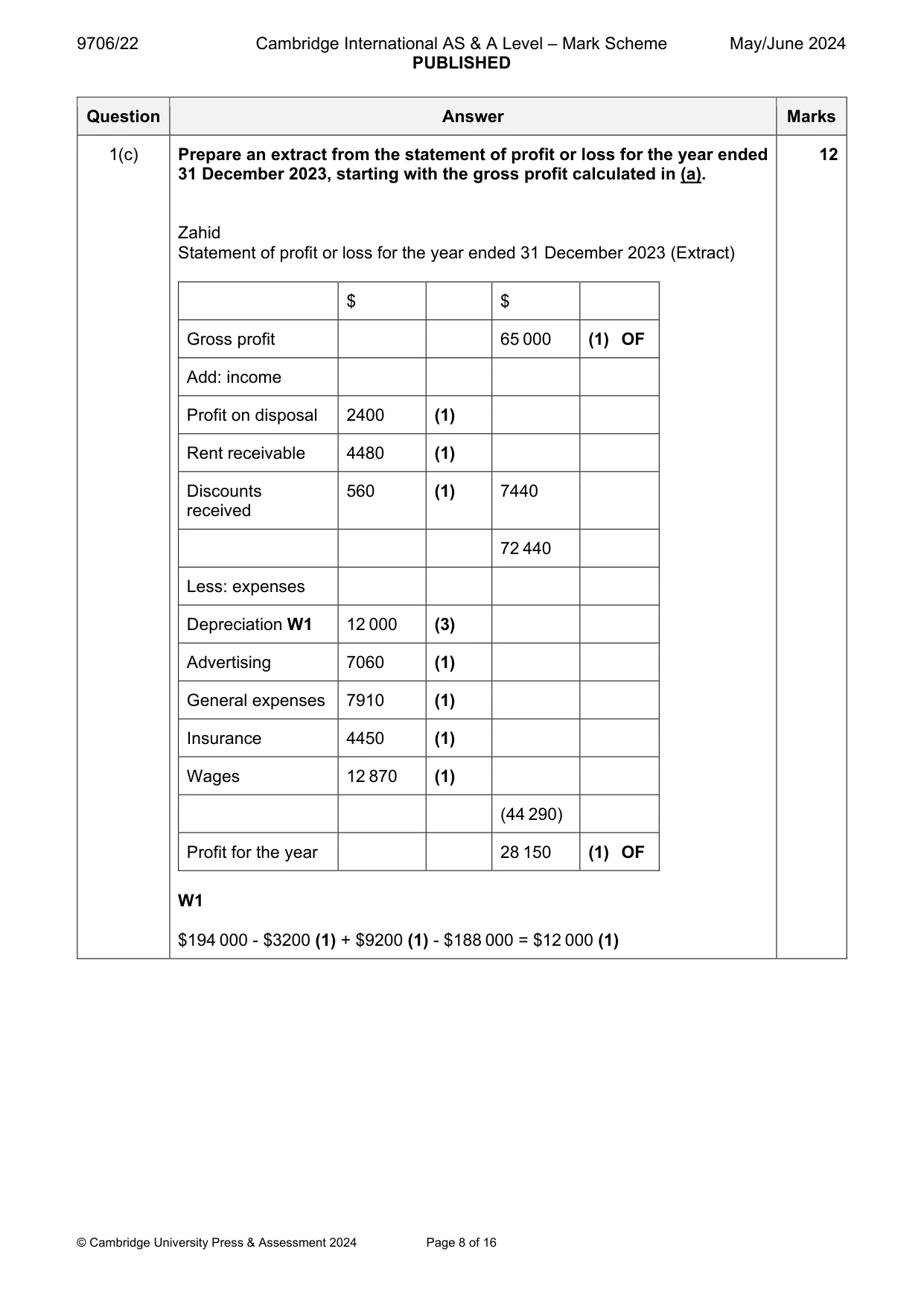
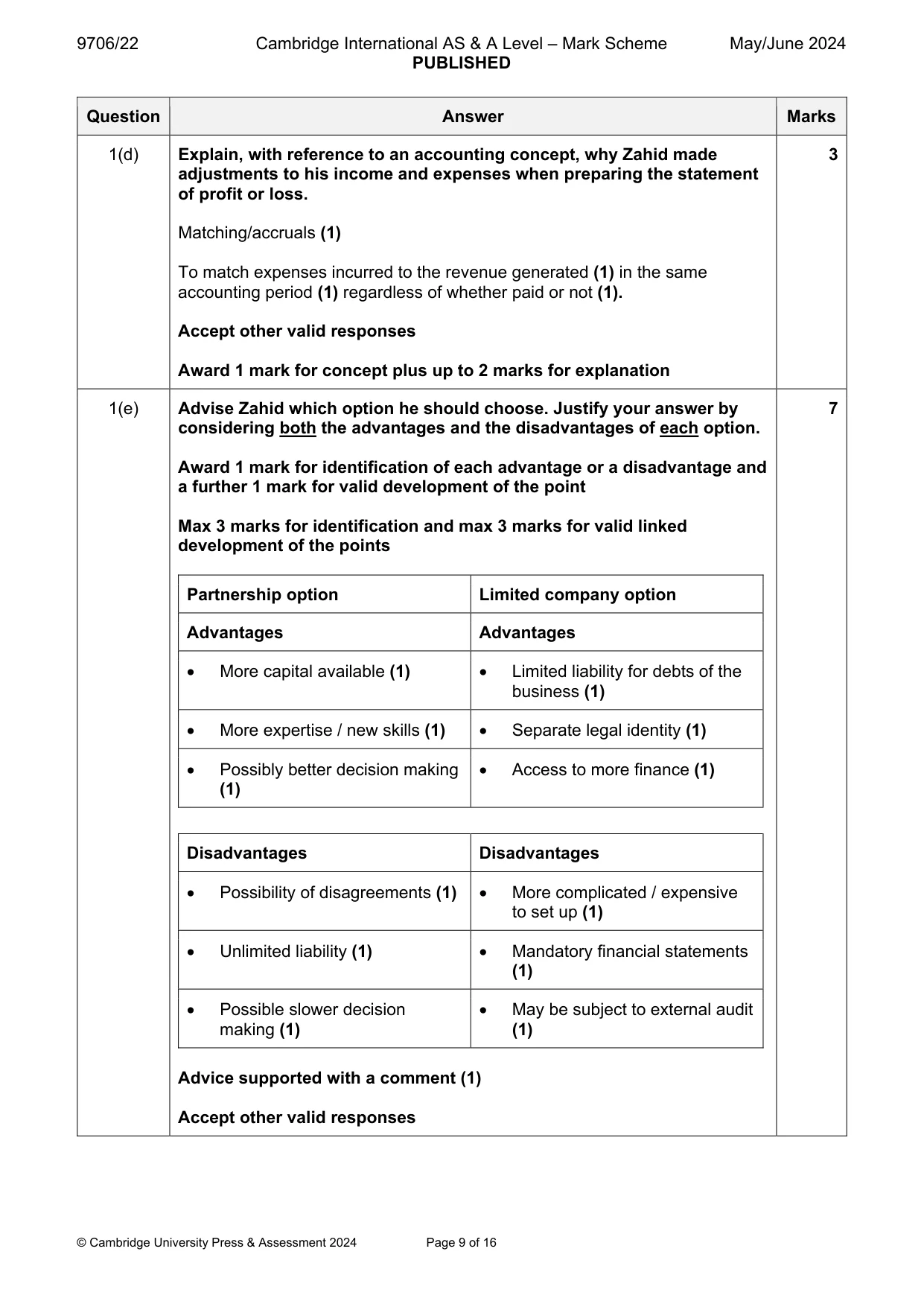
Mark scheme: Question Answer Marks 1(a) Calculate the gross profit of the business for the year ended 31 1 December 2023. $65 000 (1) 1(b)(i) Calculate for the year ended 31 December 2023: 3 Purchases $136 900 (3) W1 W1 $ $ Bank 134 240 (1)fb Balance b/d 13 500 * Discounts 560 Purchases 136 900 (1) OF Balance c/d 15 600 * 150 400 150 400 *(1) for correct use of both balances Alternative version $ 15 600 (1)fb (13 500) 134 240 (1)fb 560 136 900 (1) OF 1(b)(ii) Calculate for the year ended 31 December 2023: 4 The value of goods taken for own use by Zahid. $840 (4) W $ $ Opening inventory 16 400 * Purchases 136 900 (1) OF Less goods own use (840) (1) OF 152 460 Closing inventory (22 460) * 130 000 (1) OF *(1) for both inventories Alternative version $ 16 400 * 136 900 (1) OF (22 460) *(1) both (130 000) (1)OF 840 (1)OF 1(c) Prepare an extract from the statement of profit or loss for the year ended 12 31 December 2023, starting with the gross profit calculated in (a). Zahid Statement of profit or loss for the year ended 31 December 2023 (Extract) $ $ Gross profit 65 000 (1) OF Add: income Profit on disposal 2400 (1) Rent receivable 4480 (1) Discounts 560 (1) 7440 received 72 440 Less: expenses Depreciation W1 12 000 (3) Advertising 7060 (1) General expenses 7910 (1) Insurance 4450 (1) Wages 12 870 (1) (44 290) Profit for the year 28 150 (1) OF W1 $194 000 - $3200 (1) + $9200 (1) - $188 000 = $12 000 (1) 1(d) Explain, with reference to an accounting concept, why Zahid made 3 adjustments to his income and expenses when preparing the statement of profit or loss. Matching/accruals (1) To match expenses incurred to the revenue generated (1) in the same accounting period (1) regardless of whether paid or not (1). Accept other valid responses Award 1 mark for concept plus up to 2 marks for explanation 1(e) Advise Zahid which option he should choose. Justify your answer by 7 considering both the advantages and the disadvantages of each option. Award 1 mark for identification of each advantage or a disadvantage and a further 1 mark for valid development of the point Max 3 marks for identification and max 3 marks for valid linked development of the points Partnership option Limited company option Advantages Advantages More capital available (1) Limited liability for debts of the business (1) More expertise / new skills (1) Separate legal identity (1) Possibly better decision making Access to more finance (1) (1) Disadvantages Disadvantages Possibility of disagreements (1) More complicated / expensive to set up (1) Unlimited liability (1) Mandatory financial statements (1) Possible slower decision May be subject to external audit making (1) (1) Advice supported with a comment (1) Accept other valid responses
Q2 · Income from rent receivable At 1 January 2023 Bank receipts during the At 31 December…
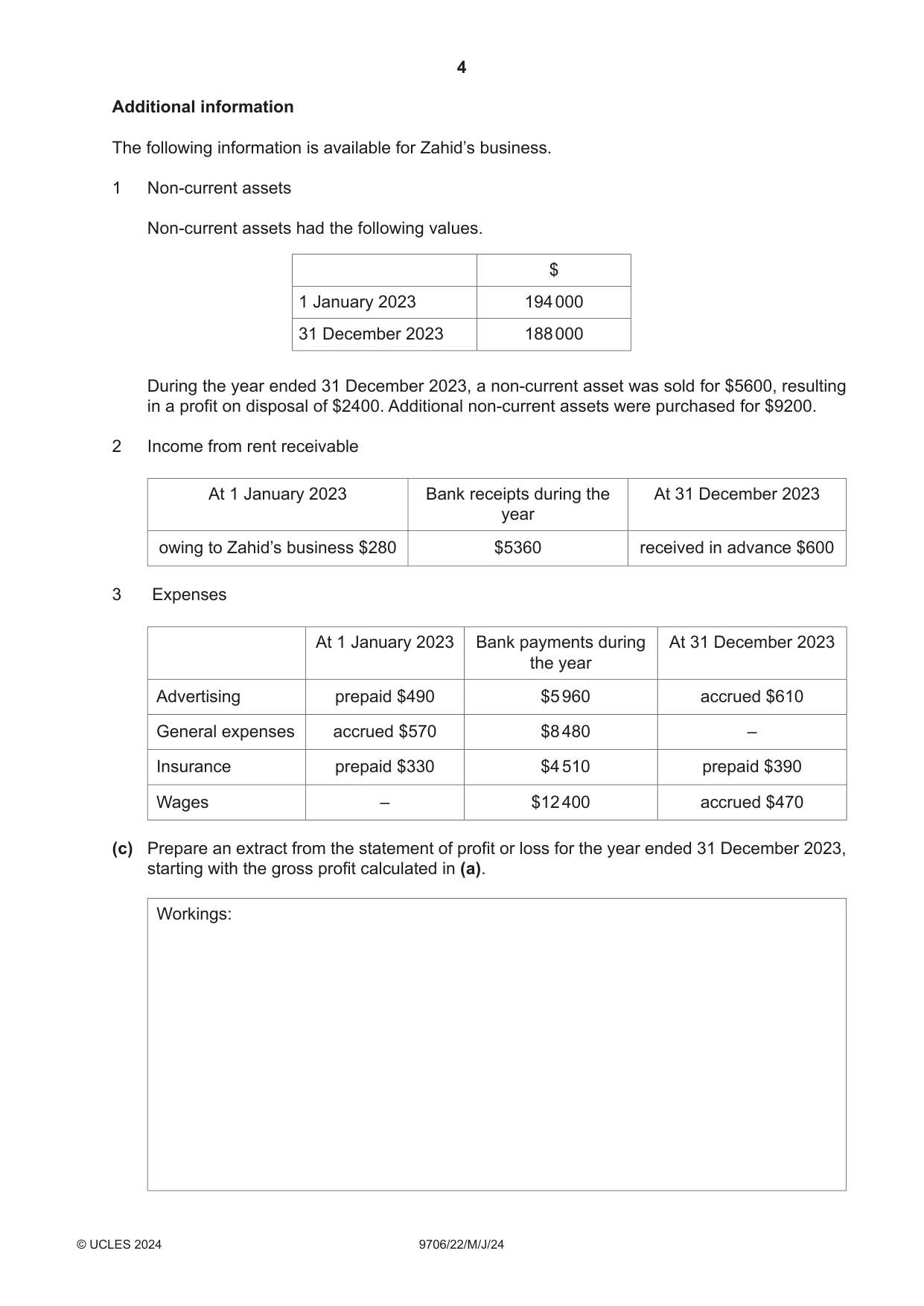
2 Income from rent receivable At 1 January 2023 Bank receipts during the At 31 December 2023 year owing to Zahid’s business $280 $5360 received in advance $600
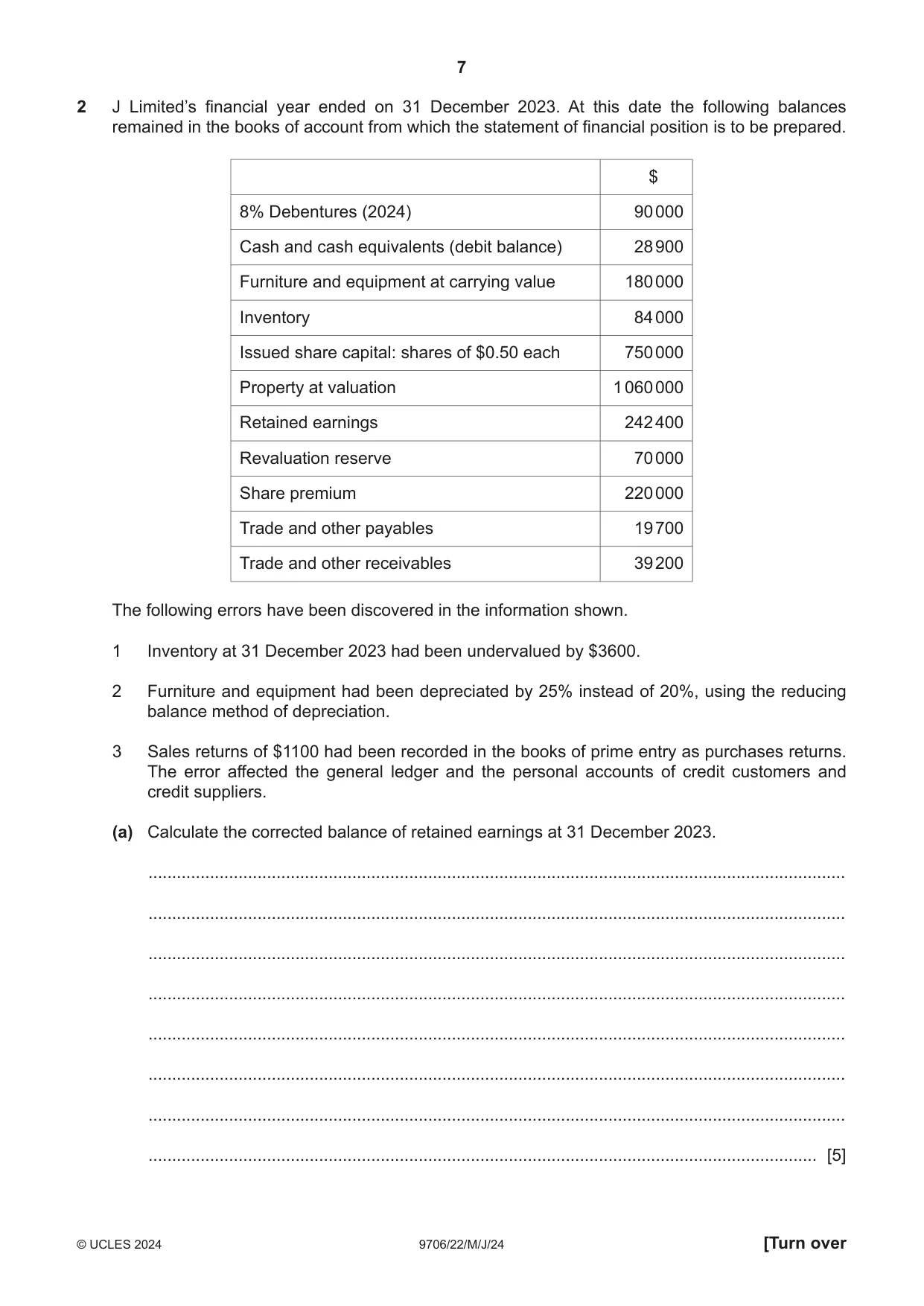
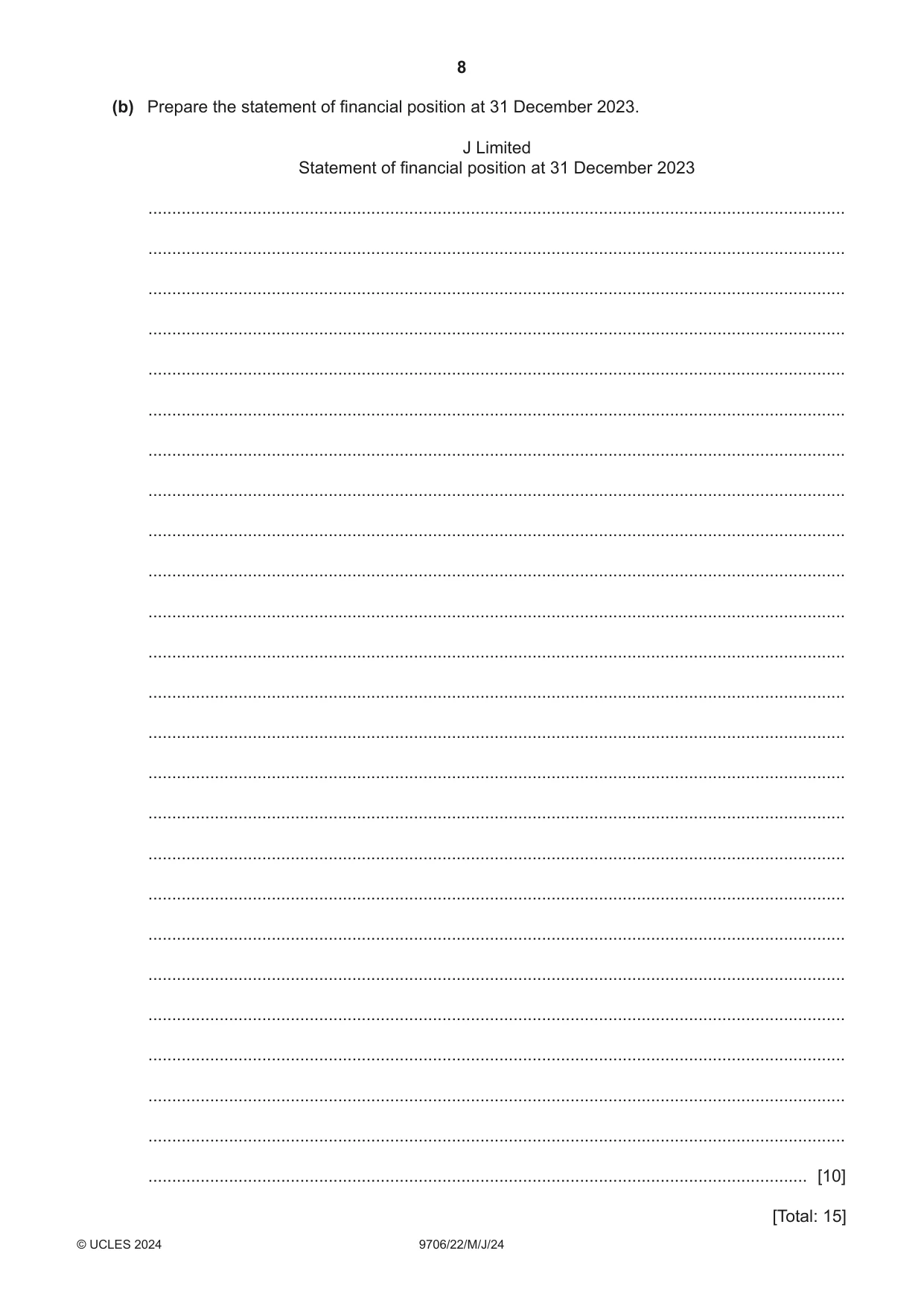
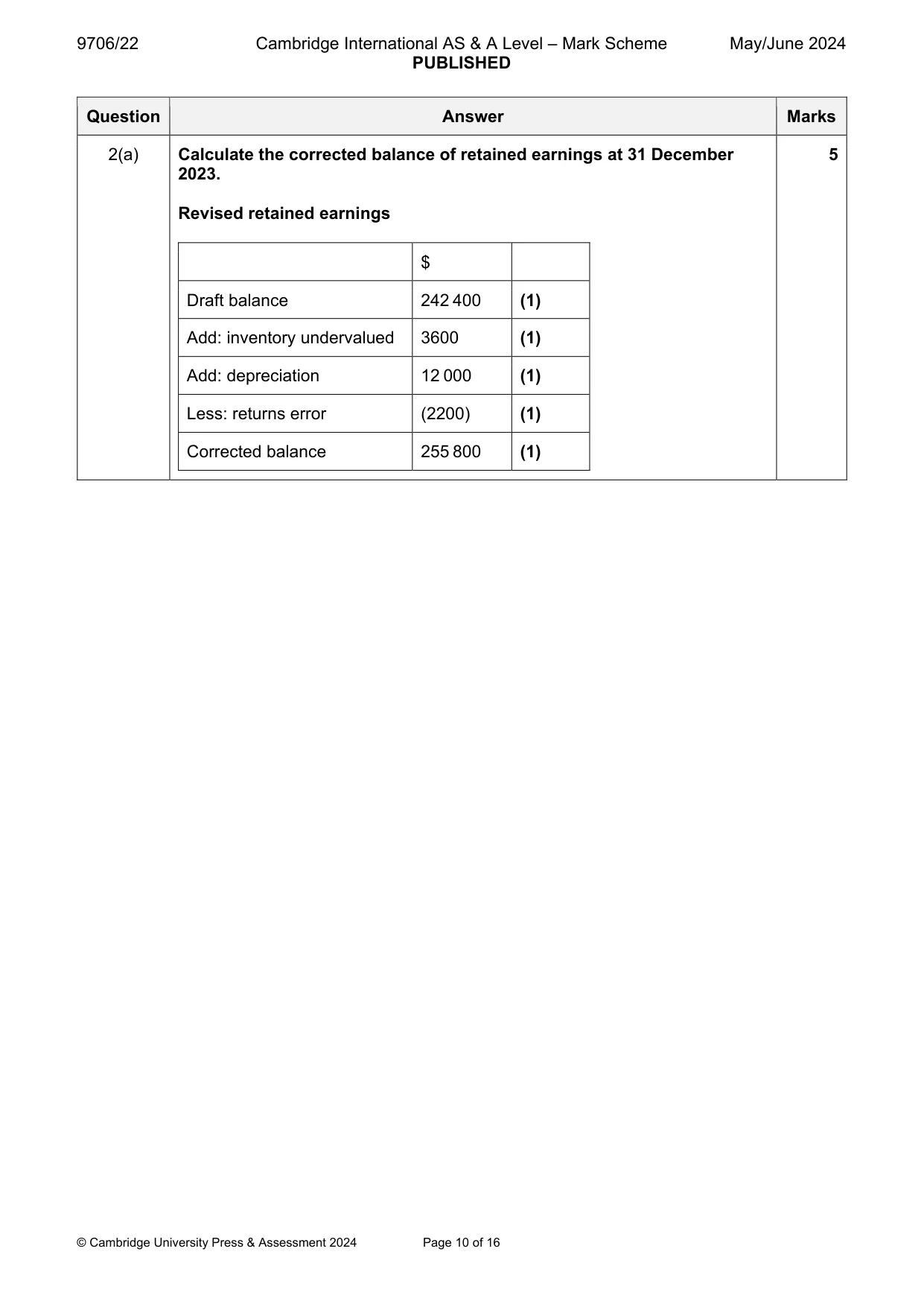
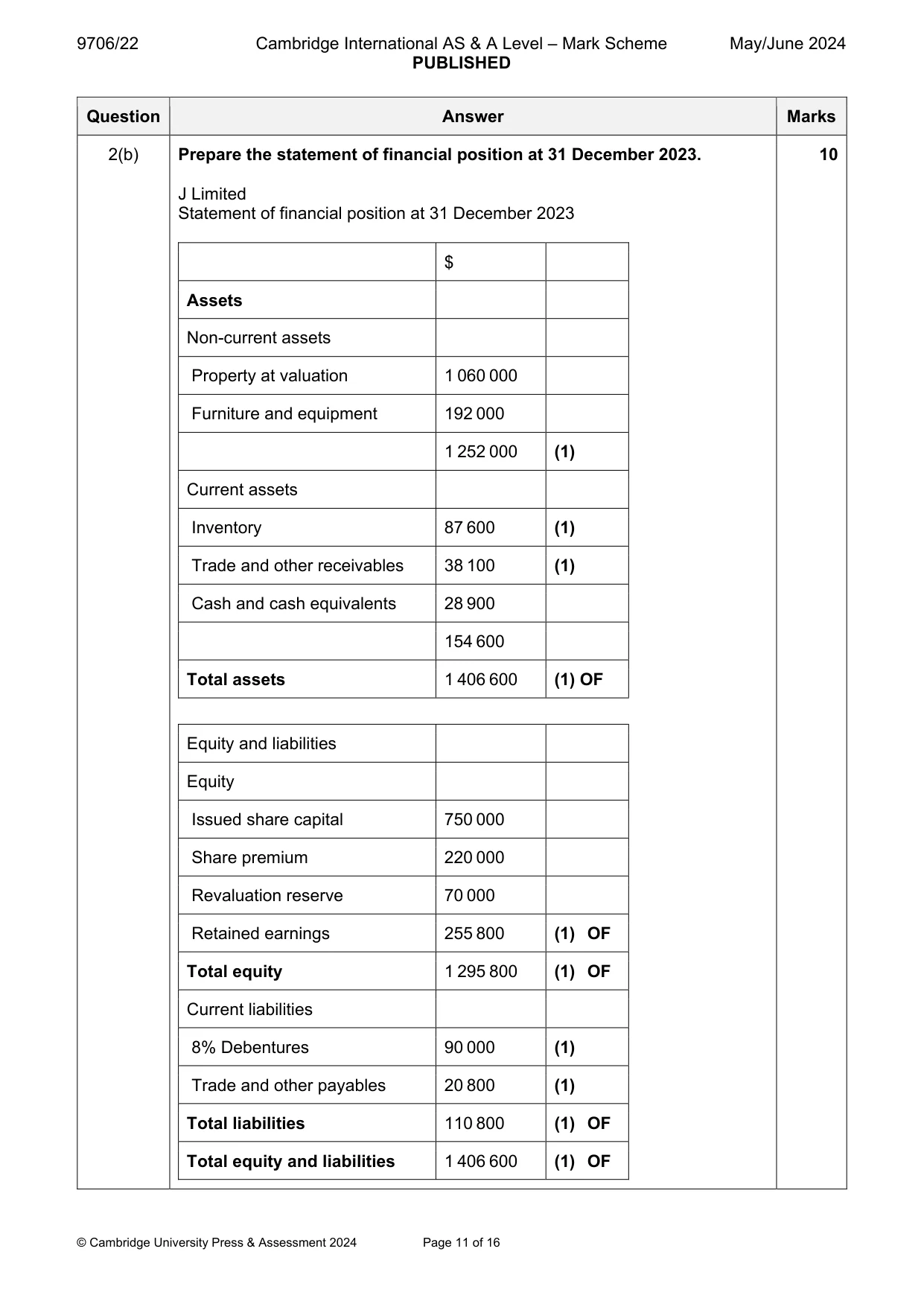
Mark scheme: 2(a) Calculate the corrected balance of retained earnings at 31 December 5 2023. Revised retained earnings $ Draft balance 242 400 (1) Add: inventory undervalued 3600 (1) Add: depreciation 12 000 (1) Less: returns error (2200) (1) Corrected balance 255 800 (1) 2(b) Prepare the statement of financial position at 31 December 2023. 10 J Limited Statement of financial position at 31 December 2023 $ Assets Non-current assets Property at valuation 1 060 000 Furniture and equipment 192 000 1 252 000 (1) Current assets Inventory 87 600 (1) Trade and other receivables 38 100 (1) Cash and cash equivalents 28 900 154 600 Total assets 1 406 600 (1) OF Equity and liabilities Equity Issued share capital 750 000 Share premium 220 000 Revaluation reserve 70 000 Retained earnings 255 800 (1) OF Total equity 1 295 800 (1) OF Current liabilities 8% Debentures 90 000 (1) Trade and other payables 20 800 (1) Total liabilities 110 800 (1) OF Total equity and liabilities 1 406 600 (1) OF
Q3 · Expenses At 1 January 2023 Bank payments during At 31 December 2023 the year Advertising…
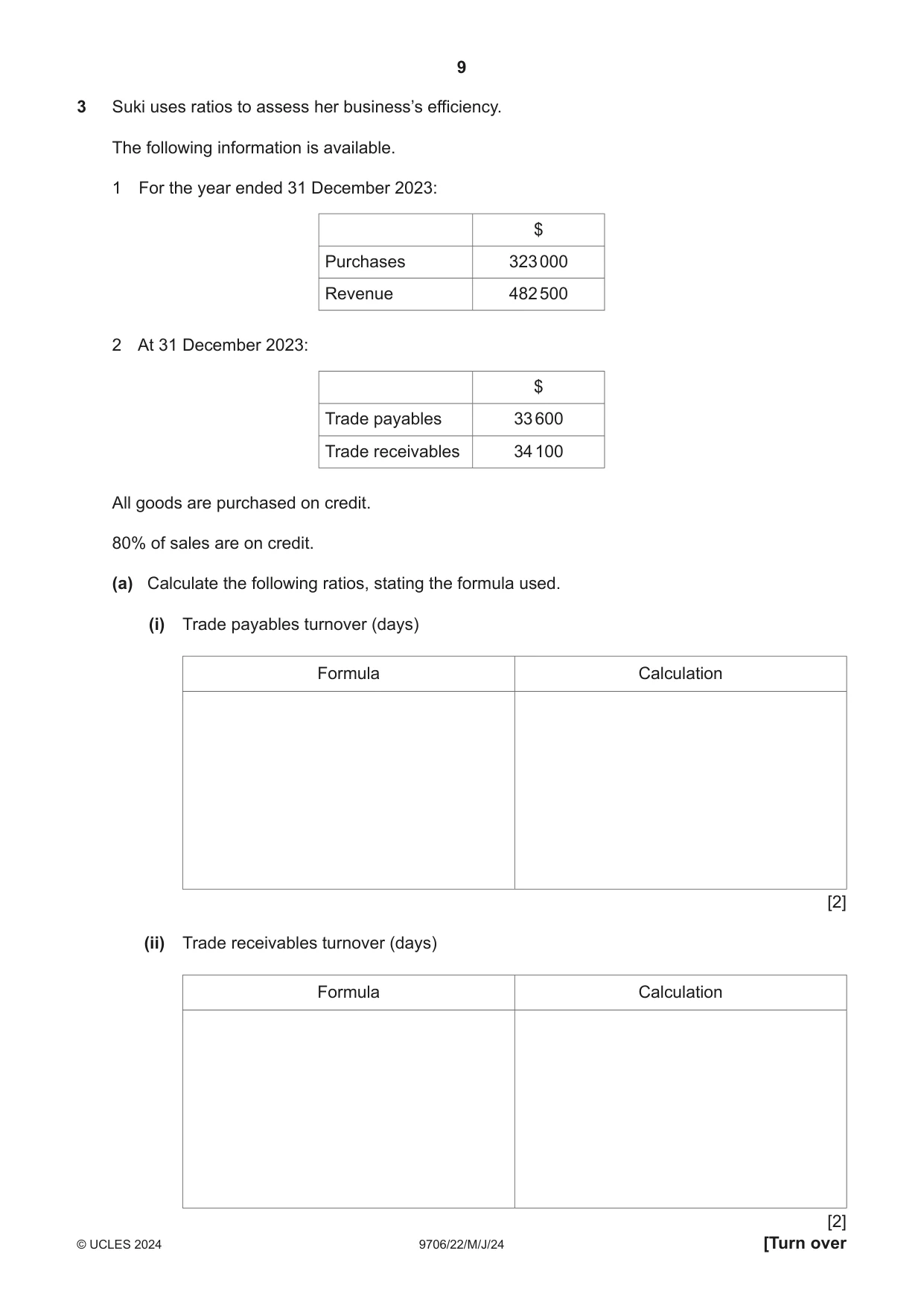
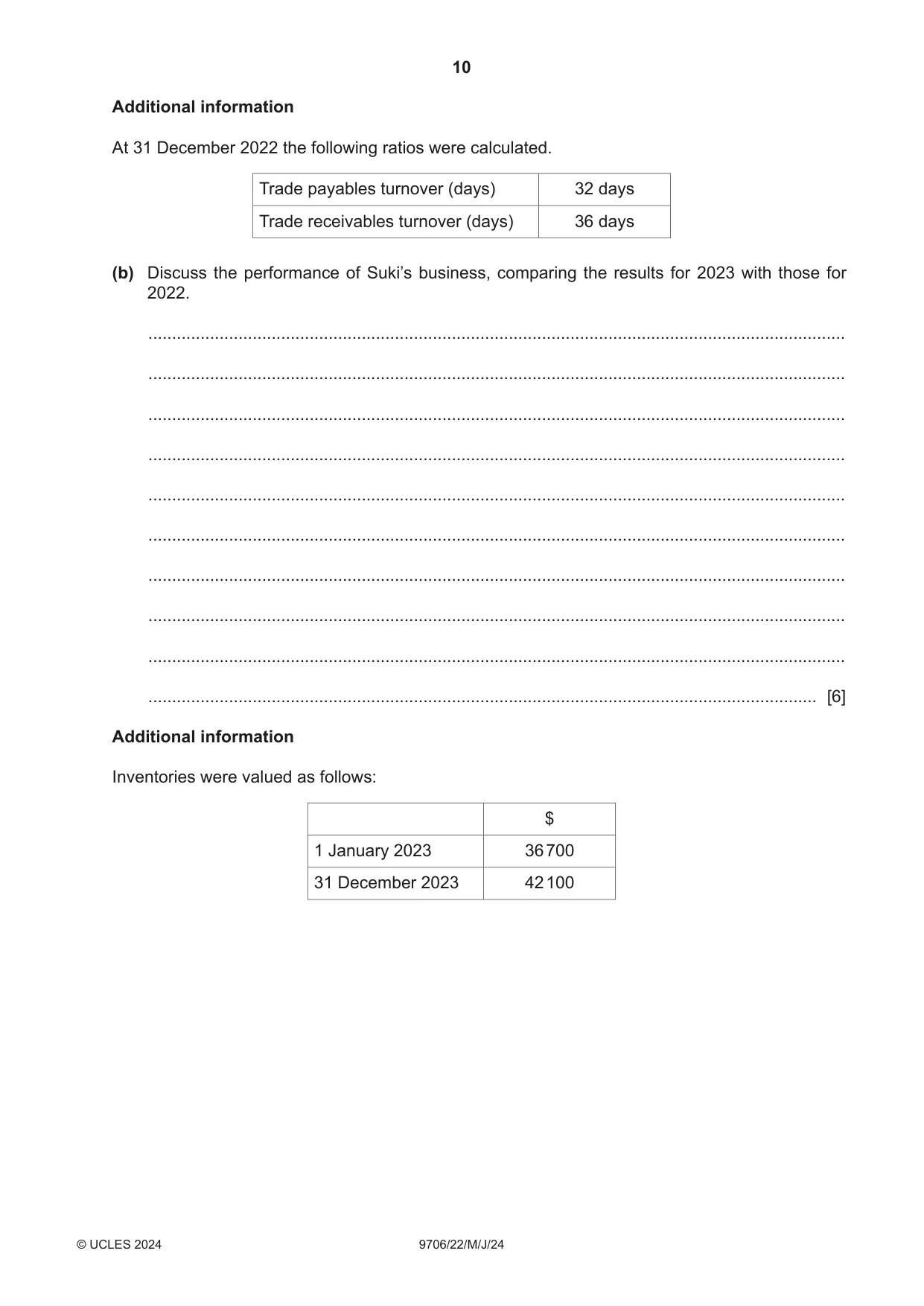
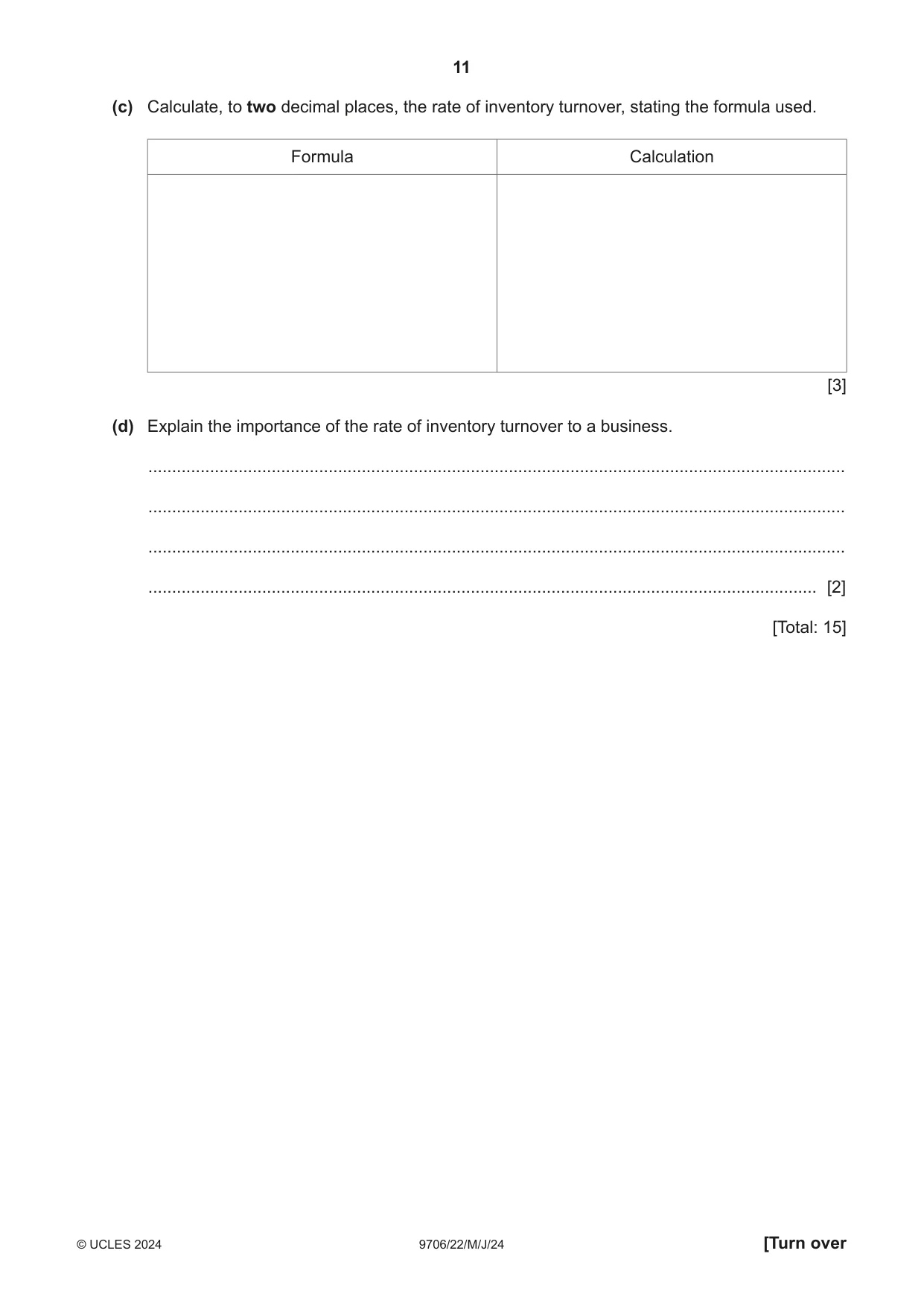
3 Expenses At 1 January 2023 Bank payments during At 31 December 2023 the year Advertising prepaid $490 $5 960 accrued $610 General expenses accrued $570 $8 480 – Insurance prepaid $330 $4 510 prepaid $390 Wages – $12 400 accrued $470 (c) Prepare an extract from the statement of profit or loss for the year ended 31 December 2023, starting with the gross profit calculated in (a). Workings: Zahid Statement of profit or loss for the year ended 31 December 2023 (extract) $ Gross profit ............................ ................................................................................................................................................... ................................................................................................................................................... ................................................................................................................................................... ................................................................................................................................................... ................................................................................................................................................... ................................................................................................................................................... ................................................................................................................................................... ................................................................................................................................................... ................................................................................................................................................... ................................................................................................................................................... ................................................................................................................................................... ................................................................................................................................................... ................................................................................................................................................... ................................................................................................................................................... [12] (d) Explain, with reference to an accounting concept, why Zahid made adjustments to his income and expenses when preparing the statement of profit or loss. ................................................................................................................................................... ................................................................................................................................................... ................................................................................................................................................... ................................................................................................................................................... ................................................................................................................................................... ............................................................................................................................................. [3] Additional information Zahid plans to expand his business. This would mean he would no longer operate as a sole trader. He is considering the following options. Option A: form a partnership with Talha who currently owns a similar business. Option B: form a limited liability company with himself and Talha as shareholders and directors. (e) Advise Zahid which option he should choose. Justify your answer by considering both the advantages and the disadvantages of each option. ................................................................................................................................................... ................................................................................................................................................... ................................................................................................................................................... ................................................................................................................................................... ................................................................................................................................................... ................................................................................................................................................... ................................................................................................................................................... ................................................................................................................................................... ................................................................................................................................................... ................................................................................................................................................... ................................................................................................................................................... ................................................................................................................................................... ................................................................................................................................................... ................................................................................................................................................... ................................................................................................................................................... ................................................................................................................................................... ................................................................................................................................................... ............................................................................................................................................. [7] [Total: 30] 2 J Limited’s financial year ended on 31 December 2023. At this date the following balances remained in the books of account from which the statement of financial position is to be prepared. $ 8% Debentures (2024) 90 000 Cash and cash equivalents (debit balance) 28 900 Furniture and equipment at carrying value 180 000 Inventory 84 000 Issued share capital: shares of $0.50 each 750 000 Property at valuation 1 060 000 Retained earnings 242 400 Revaluation reserve 70 000 Share premium 220 000 Trade and other payables 19 700 Trade and other receivables 39 200 The following errors have been discovered in the information shown. 1 Inventory at 31 December 2023 had been undervalued by $3600. 2 Furniture and equipment had been depreciated by 25% instead of 20%, using the reducing balance method of depreciation. 3 Sales returns of $1100 had been recorded in the books of prime entry as purchases returns. The error affected the general ledger and the personal accounts of credit customers and credit suppliers. (a) Calculate the corrected balance of retained earnings at 31 December 2023. ................................................................................................................................................... ................................................................................................................................................... ................................................................................................................................................... ................................................................................................................................................... ................................................................................................................................................... ................................................................................................................................................... ................................................................................................................................................... ............................................................................................................................................. [5] (b) Prepare the statement of financial position at 31 December 2023. J Limited Statement of financial position at 31 December 2023 ................................................................................................................................................... ................................................................................................................................................... ................................................................................................................................................... ................................................................................................................................................... ................................................................................................................................................... ................................................................................................................................................... ................................................................................................................................................... ................................................................................................................................................... ................................................................................................................................................... ................................................................................................................................................... ................................................................................................................................................... ................................................................................................................................................... ................................................................................................................................................... ................................................................................................................................................... ................................................................................................................................................... ................................................................................................................................................... ................................................................................................................................................... ................................................................................................................................................... ................................................................................................................................................... ................................................................................................................................................... ................................................................................................................................................... ................................................................................................................................................... ................................................................................................................................................... ................................................................................................................................................... ........................................................................................................................................... [10] [Total: 15] 3 Suki uses ratios to assess her business’s efficiency. The following information is available. 1 For the year ended 31 December 2023: $ Purchases 323 000 Revenue 482 500 2 At 31 December 2023: $ Trade payables 33 600 Trade receivables 34 100 All goods are purchased on credit. 80% of sales are on credit. (a) Calculate the following ratios, stating the formula used. (i) Trade payables turnover (days) Formula Calculation [2] (ii) Trade receivables turnover (days) Formula Calculation [2] Additional information At 31 December 2022 the following ratios were calculated. Trade payables turnover (days) 32 days Trade receivables turnover (days) 36 days (b) Discuss the performance of Suki’s business, comparing the results for 2023 with those for 2022. ................................................................................................................................................... ................................................................................................................................................... ................................................................................................................................................... ................................................................................................................................................... ................................................................................................................................................... ................................................................................................................................................... ................................................................................................................................................... ................................................................................................................................................... ................................................................................................................................................... ............................................................................................................................................. [6] Additional information Inventories were valued as follows: $ 1 January 2023 36 700 31 December 2023 42 100 (c) Calculate, to two decimal places, the rate of inventory turnover, stating the formula used. Formula Calculation [3] (d) Explain the importance of the rate of inventory turnover to a business. ................................................................................................................................................... ................................................................................................................................................... ................................................................................................................................................... ............................................................................................................................................. [2] [Total: 15]
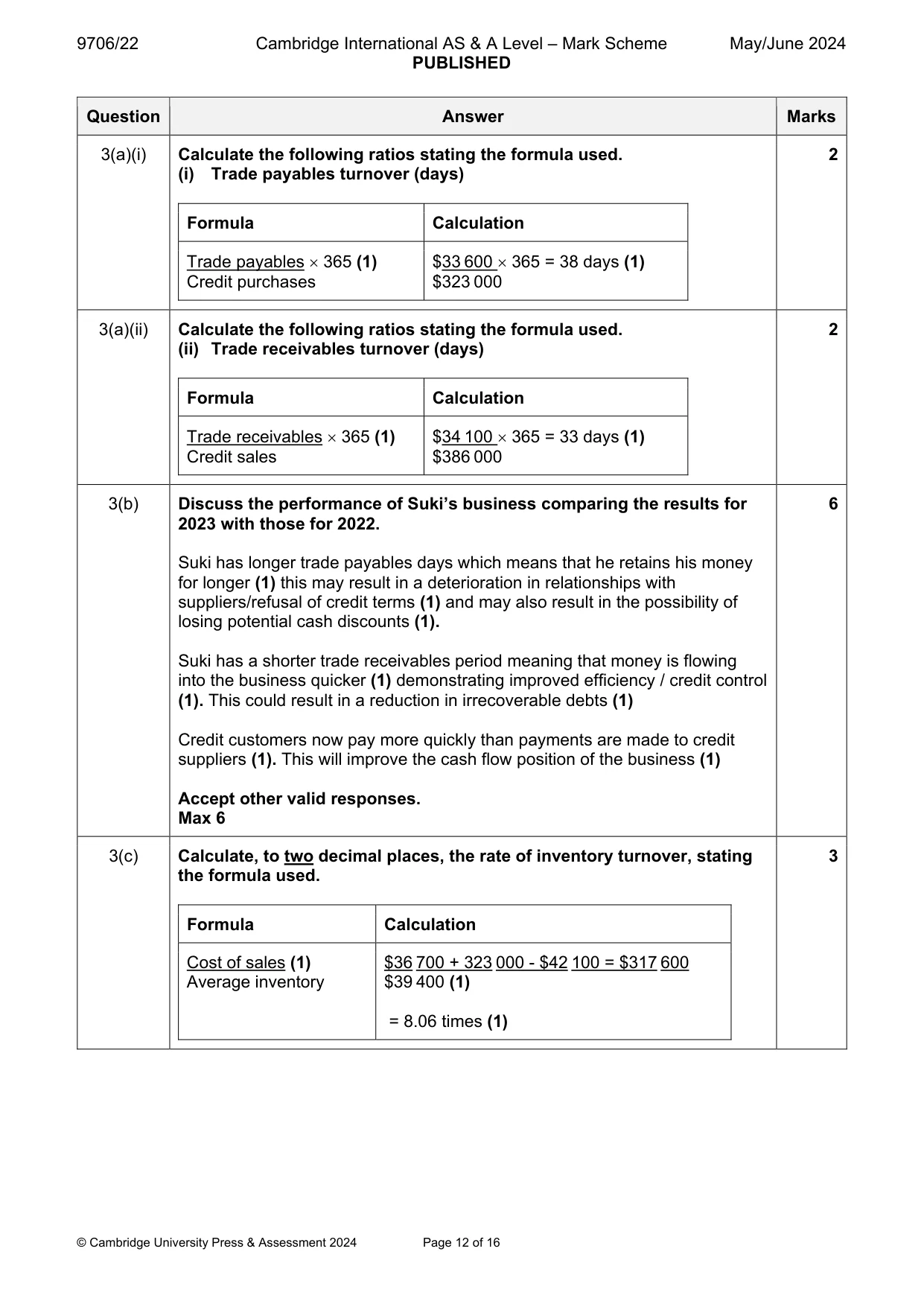
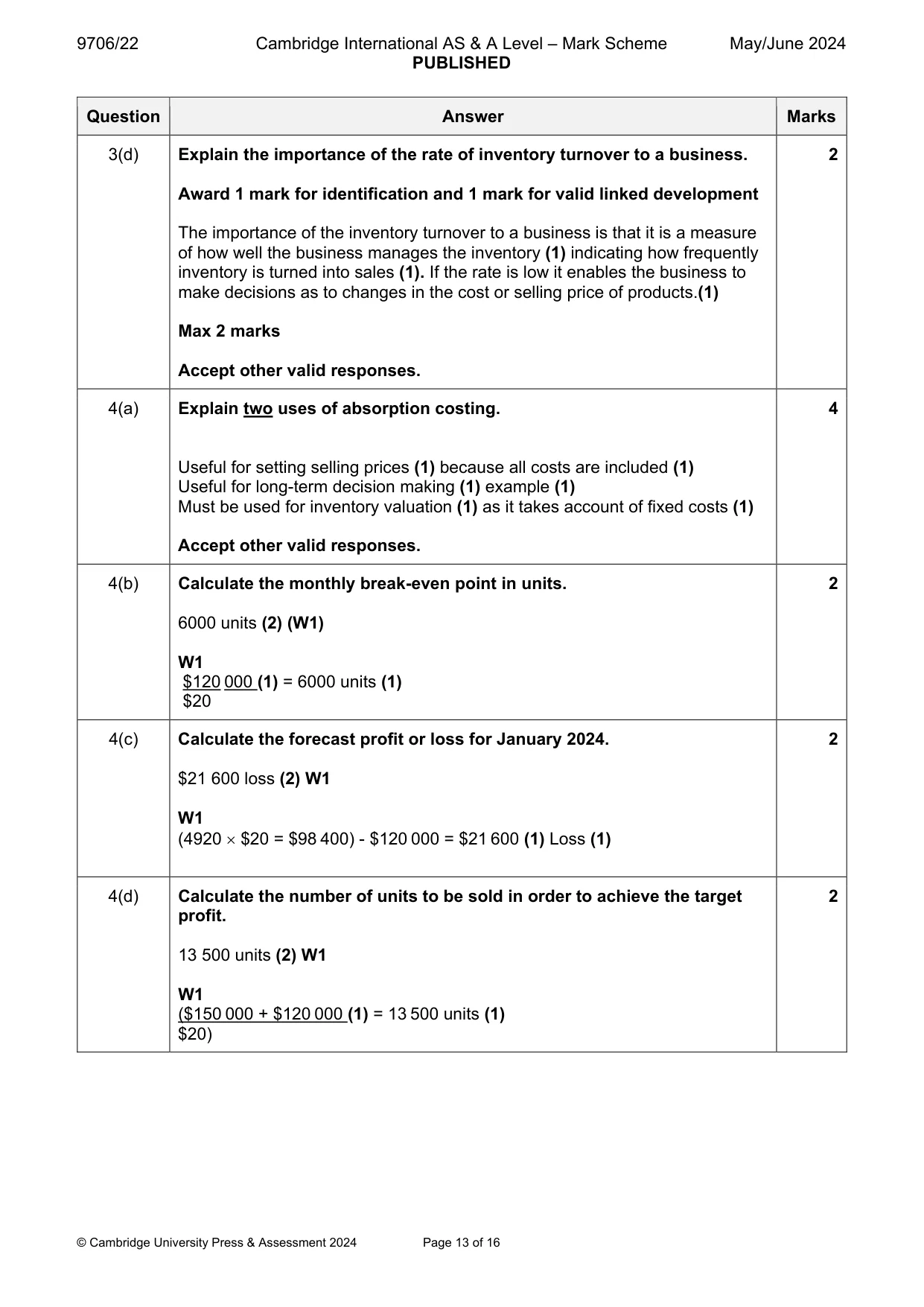
Mark scheme: 3(a)(i) Calculate the following ratios stating the formula used. 2 (i) Trade payables turnover (days) Formula Calculation Trade payables 365 (1) $33 600 365 = 38 days (1) Credit purchases $323 000 3(a)(ii) Calculate the following ratios stating the formula used. 2 (ii) Trade receivables turnover (days) Formula Calculation Trade receivables 365 (1) $34 100 365 = 33 days (1) Credit sales $386 000 3(b) Discuss the performance of Suki’s business comparing the results for 6 2023 with those for 2022. Suki has longer trade payables days which means that he retains his money for longer (1) this may result in a deterioration in relationships with suppliers/refusal of credit terms (1) and may also result in the possibility of losing potential cash discounts (1). Suki has a shorter trade receivables period meaning that money is flowing into the business quicker (1) demonstrating improved efficiency / credit control (1). This could result in a reduction in irrecoverable debts (1) Credit customers now pay more quickly than payments are made to credit suppliers (1). This will improve the cash flow position of the business (1) Accept other valid responses. Max 6 3(c) Calculate, to two decimal places, the rate of inventory turnover, stating 3 the formula used. Formula Calculation Cost of sales (1) $36 700 + 323 000 - $42 100 = $317 600 Average inventory $39 400 (1) = 8.06 times (1) 3(d) Explain the importance of the rate of inventory turnover to a business. 2 Award 1 mark for identification and 1 mark for valid linked development The importance of the inventory turnover to a business is that it is a measure of how well the business manages the inventory (1) indicating how frequently inventory is turned into sales (1). If the rate is low it enables the business to make decisions as to changes in the cost or selling price of products.(1) Max 2 marks Accept other valid responses.
More questions on Analysis and communication of accounting information
Q4 · D Limited is a manufacturing company
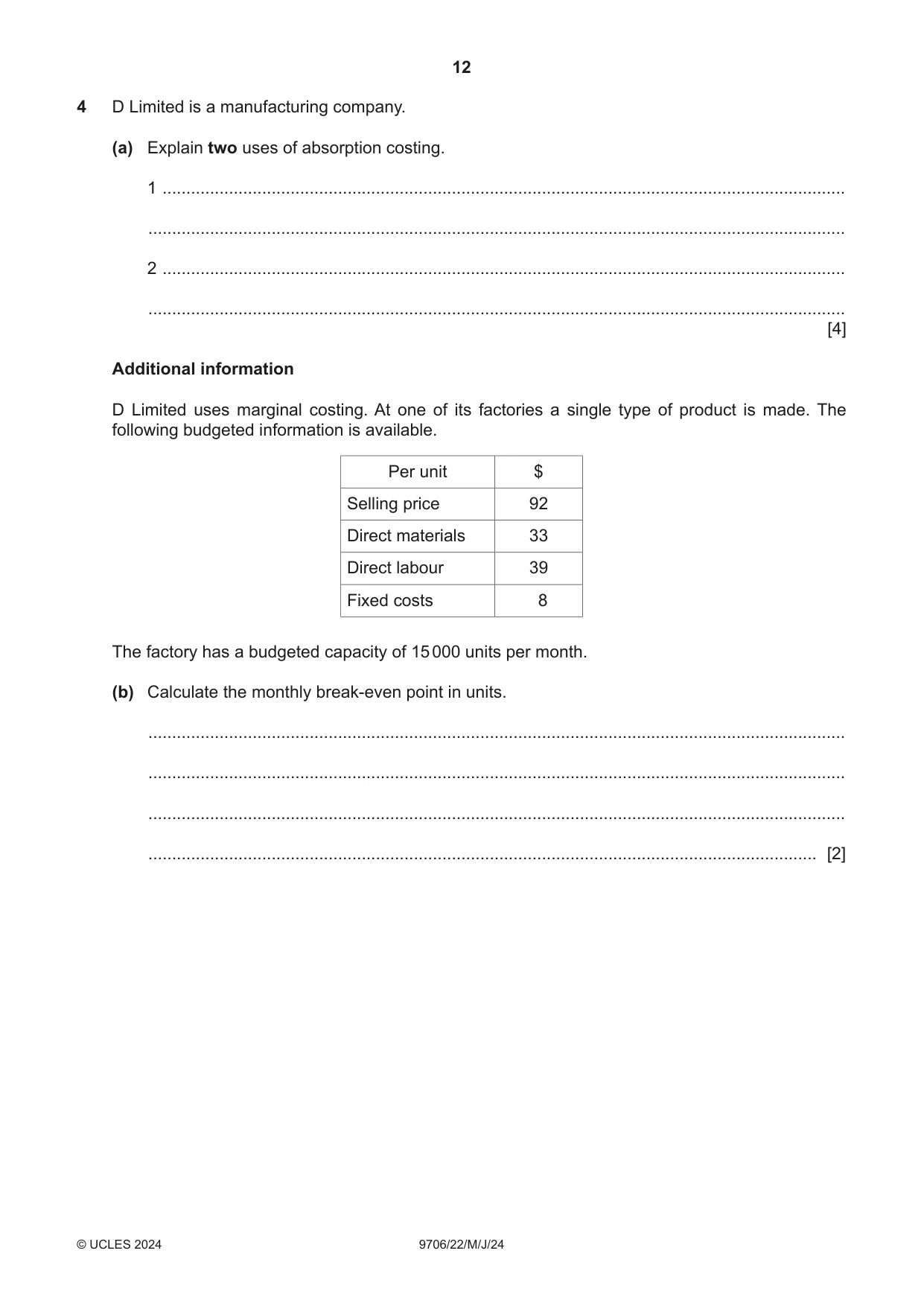
4 D Limited is a manufacturing company. (a) Explain two uses of absorption costing. 1 ................................................................................................................................................ ................................................................................................................................................... 2 ................................................................................................................................................ ................................................................................................................................................... [4] Additional information D Limited uses marginal costing. At one of its factories a single type of product is made. The following budgeted information is available. Per unit $ Selling price 92 Direct materials 33 Direct labour 39 Fixed costs 8 The factory has a budgeted capacity of 15 000 units per month. (b) Calculate the monthly break-even point in units. ................................................................................................................................................... ................................................................................................................................................... ................................................................................................................................................... ............................................................................................................................................. [2] Additional information It was forecast that only 4920 units would be sold in January 2024. (c) Calculate the forecast profit or loss for January 2024. ................................................................................................................................................... ................................................................................................................................................... ................................................................................................................................................... ............................................................................................................................................. [2] Additional information The directors have set a target profit of $150 000 per month. (d) Calculate the number of units to be sold in order to achieve the target profit. ................................................................................................................................................... ................................................................................................................................................... ................................................................................................................................................... ............................................................................................................................................. [2] Additional information At another factory of D Limited a single different type of product is made. The following budgeted details are available for one month’s production: Per unit $ Direct materials 16 Direct labour 17 Other variable costs 3 Contribution 24 Normal capacity at this factory is 18 000 units per month. Recently, the factory has been operating at 80% capacity and this has resulted in a monthly profit of $150 600. The directors have been informed that a major competitor manufacturing the same product plans to stop production. The directors plan to take advantage of the situation and are considering two options. Option A 1 Increase monthly production by 6000 units on current output levels. 2 Sell all production at a price per unit 2% above the current price. 3 Any production above normal factory capacity will require direct labour to be paid an overtime premium of 50%. Option B 1 Increase factory capacity to 22 000 units per month. 2 Sell all production at a price per unit 3% above the current price. 3 Suppliers of direct materials will be expected to offer a trade discount of 25% instead of the current trade discount of 20%. 4 The direct labour rate per unit will be increased to $18.50.
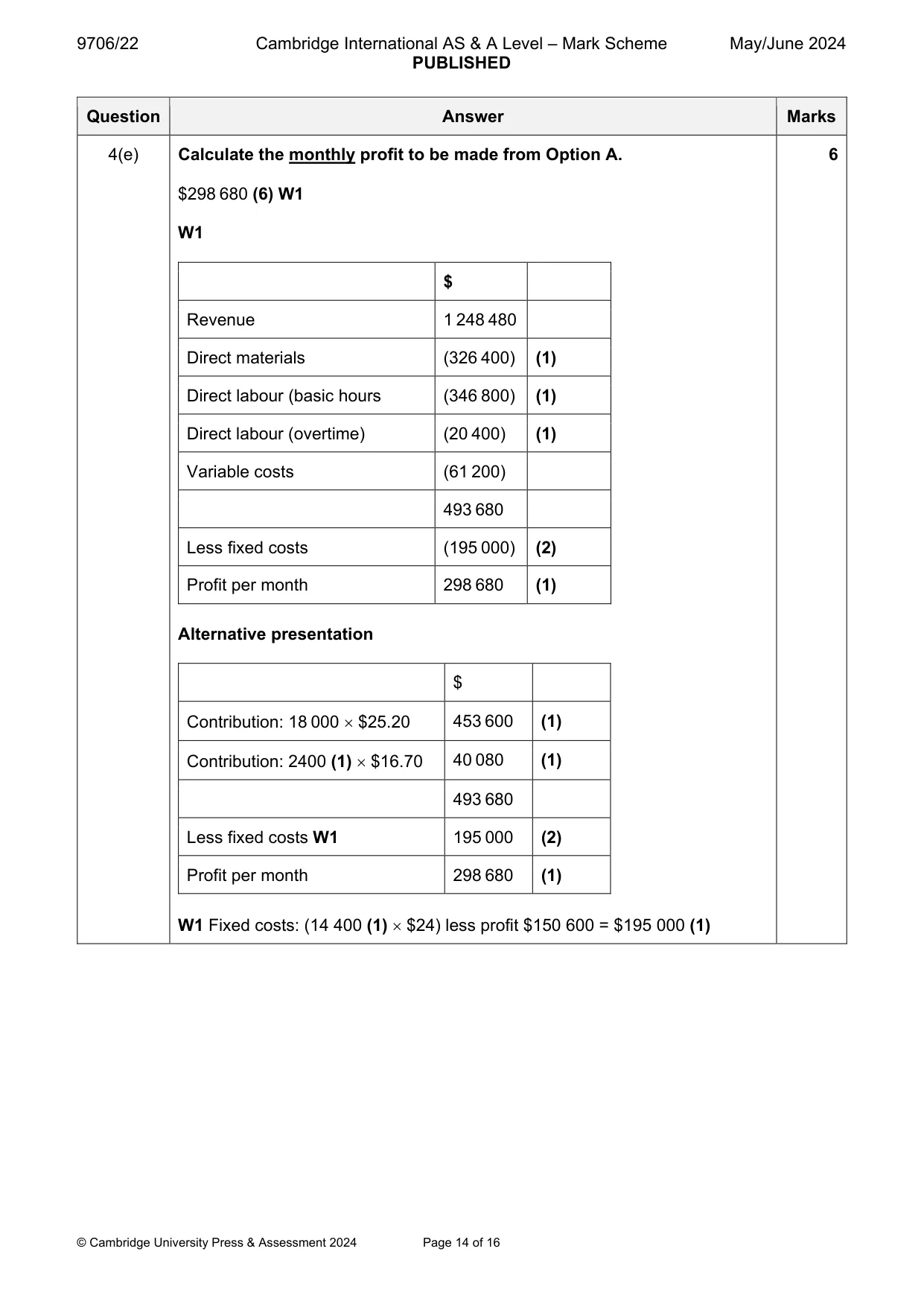
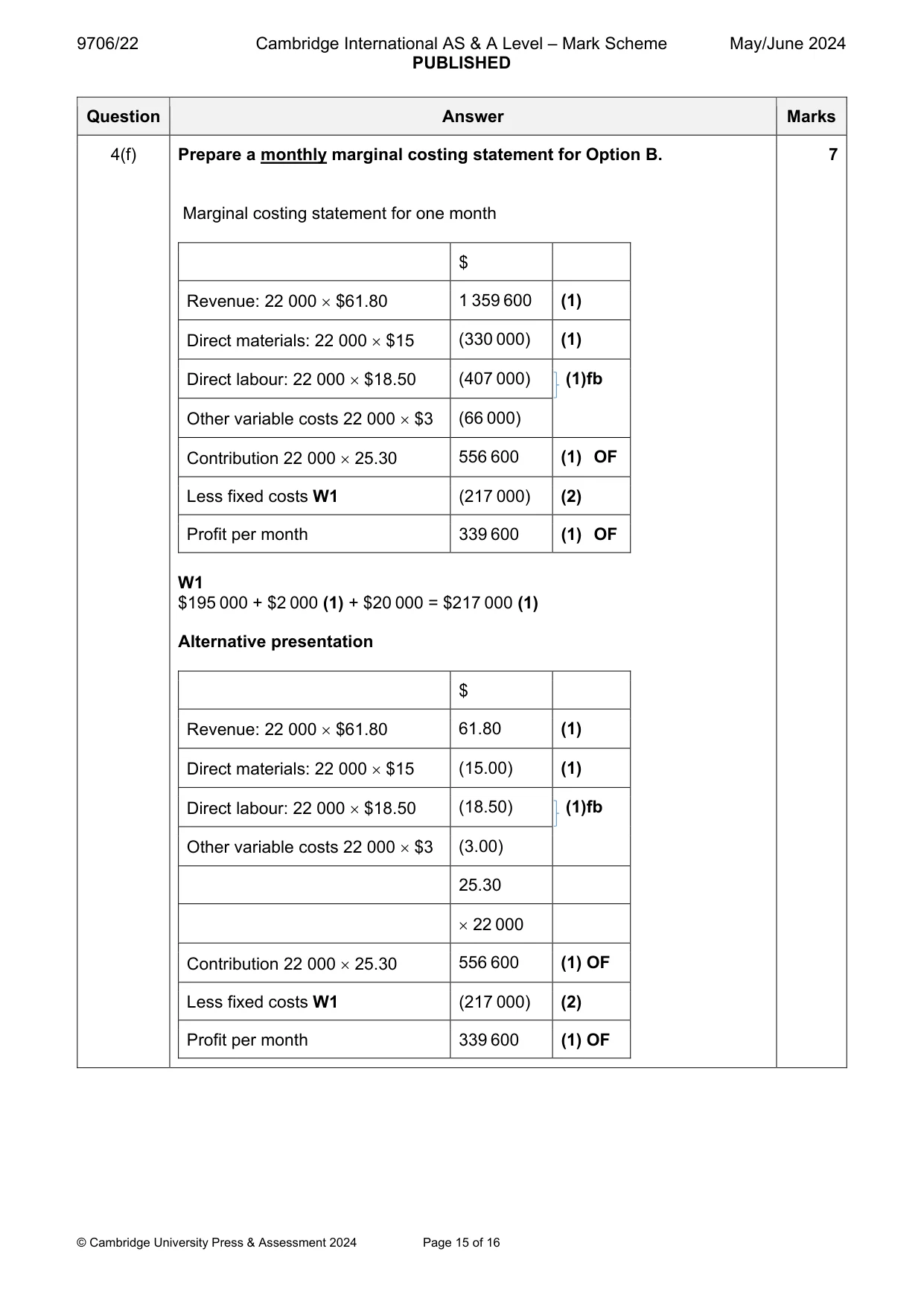
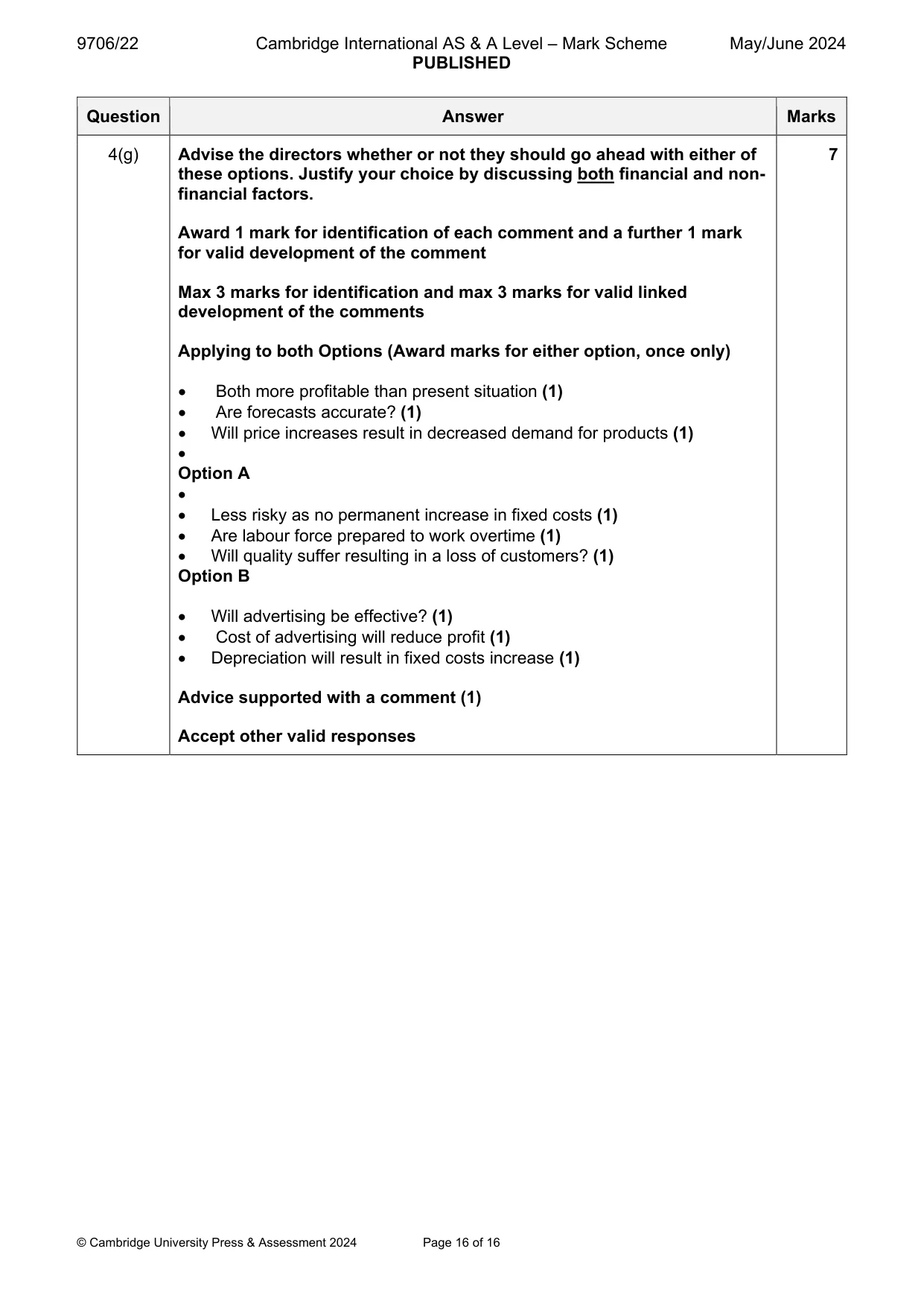
Mark scheme: 4(a) Explain two uses of absorption costing. 4 Useful for setting selling prices (1) because all costs are included (1) Useful for long-term decision making (1) example (1) Must be used for inventory valuation (1) as it takes account of fixed costs (1) Accept other valid responses. 4(b) Calculate the monthly break-even point in units. 2 6000 units (2) (W1) W1 $120 000 (1) = 6000 units (1) $20 4(c) Calculate the forecast profit or loss for January 2024. 2 $21 600 loss (2) W1 W1 (4920 $20 = $98 400) - $120 000 = $21 600 (1) Loss (1) 4(d) Calculate the number of units to be sold in order to achieve the target 2 profit. 13 500 units (2) W1 W1 ($150 000 + $120 000 (1) = 13 500 units (1) $20) 4(e) Calculate the monthly profit to be made from Option A. 6 $298 680 (6) W1 W1 $ Revenue 1 248 480 Direct materials (326 400) (1) Direct labour (basic hours (346 800) (1) Direct labour (overtime) (20 400) (1) Variable costs (61 200) 493 680 Less fixed costs (195 000) (2) Profit per month 298 680 (1) Alternative presentation $ Contribution: 18 000 $25.20 453 600 (1) Contribution: 2400 (1) $16.70 40 080 (1) 493 680 Less fixed costs W1 195 000 (2) Profit per month 298 680 (1) W1 Fixed costs: (14 400 (1) $24) less profit $150 600 = $195 000 (1) 4(f) Prepare a monthly marginal costing statement for Option B. 7 Marginal costing statement for one month $ Revenue: 22 000 $61.80 1 359 600 (1) Direct materials: 22 000 $15 (330 000) (1) Direct labour: 22 000 $18.50 (407 000) (1)fb Other variable costs 22 000 $3 (66 000) Contribution 22 000 25.30 556 600 (1) OF Less fixed costs W1 (217 000) (2) Profit per month 339 600 (1) OF W1 $195 000 + $2 000 (1) + $20 000 = $217 000 (1) Alternative presentation $ Revenue: 22 000 $61.80 61.80 (1) Direct materials: 22 000 $15 (15.00) (1) Direct labour: 22 000 $18.50 (18.50) (1)fb Other variable costs 22 000 $3 (3.00) 25.30 22 000 Contribution 22 000 25.30 556 600 (1) OF Less fixed costs W1 (217 000) (2) Profit per month 339 600 (1) OF 4(g) Advise the directors whether or not they should go ahead with either of 7 these options. Justify your choice by discussing both financial and non- financial factors. Award 1 mark for identification of each comment and a further 1 mark for valid development of the comment Max 3 marks for identification and max 3 marks for valid linked development of the comments Applying to both Options (Award marks for either option, once only) Both more profitable than present situation (1) Are forecasts accurate? (1) Will price increases result in decreased demand for products (1) Option A Less risky as no permanent increase in fixed costs (1) Are labour force prepared to work overtime (1) Will quality suffer resulting in a loss of customers? (1) Option B Will advertising be effective? (1) Cost of advertising will reduce profit (1) Depreciation will result in fixed costs increase (1) Advice supported with a comment (1) Accept other valid responses
Q5 · Some additional machinery will be purchased at a cost of $120 000
5 Some additional machinery will be purchased at a cost of $120 000. Machinery is depreciated by 20% per annum, using the straight-line method.
Q6 · An additional $20 000 per month will be spent on advertising
6 An additional $20 000 per month will be spent on advertising. (e) Calculate the monthly profit to be made from Option A. ................................................................................................................................................... ................................................................................................................................................... ................................................................................................................................................... ................................................................................................................................................... ................................................................................................................................................... ................................................................................................................................................... ................................................................................................................................................... ............................................................................................................................................. [6] (f) Prepare a monthly marginal costing statement for Option B. ................................................................................................................................................... ................................................................................................................................................... ................................................................................................................................................... ................................................................................................................................................... ................................................................................................................................................... ................................................................................................................................................... ................................................................................................................................................... ................................................................................................................................................... ................................................................................................................................................... ................................................................................................................................................... ................................................................................................................................................... ............................................................................................................................................. [7] (g) Advise the directors whether or not they should go ahead with either of these options. Justify your choice by discussing both financial and non-financial factors. ................................................................................................................................................... ................................................................................................................................................... ................................................................................................................................................... ................................................................................................................................................... ................................................................................................................................................... ................................................................................................................................................... ................................................................................................................................................... ................................................................................................................................................... ................................................................................................................................................... ................................................................................................................................................... ................................................................................................................................................... ................................................................................................................................................... ................................................................................................................................................... ................................................................................................................................................... ................................................................................................................................................... ................................................................................................................................................... ................................................................................................................................................... ................................................................................................................................................... ................................................................................................................................................... ................................................................................................................................................... ................................................................................................................................................... ................................................................................................................................................... ................................................................................................................................................... ............................................................................................................................................. [7] [Total: 30]
What was in this paper
The subtopics covered by these 6 questions, and how many questions each got. Open one in a new tab to see every Cambridge question on it.
What you needed in this session
Cambridge’s own grade thresholds for 2024 May/June, Paper 2 · Variant 2. A higher threshold means an easier paper — the bar moves with how the cohort did.