Cambridge A Level Accounting 9706 — 2024 Oct/Nov Paper 2 · Variant 2
9706/22/O/N/24 · 5 questions · 90 marks · ≈101 min
The question paper and its mark scheme, free to read here and free to download. This is Cambridge’s own paper, exactly as it was sat.
Question paper20 pages


Mark scheme18 pages
Answers below. Sit the paper first if you are practising.
Questions as text
Q1 · Ahmed is a sole trader
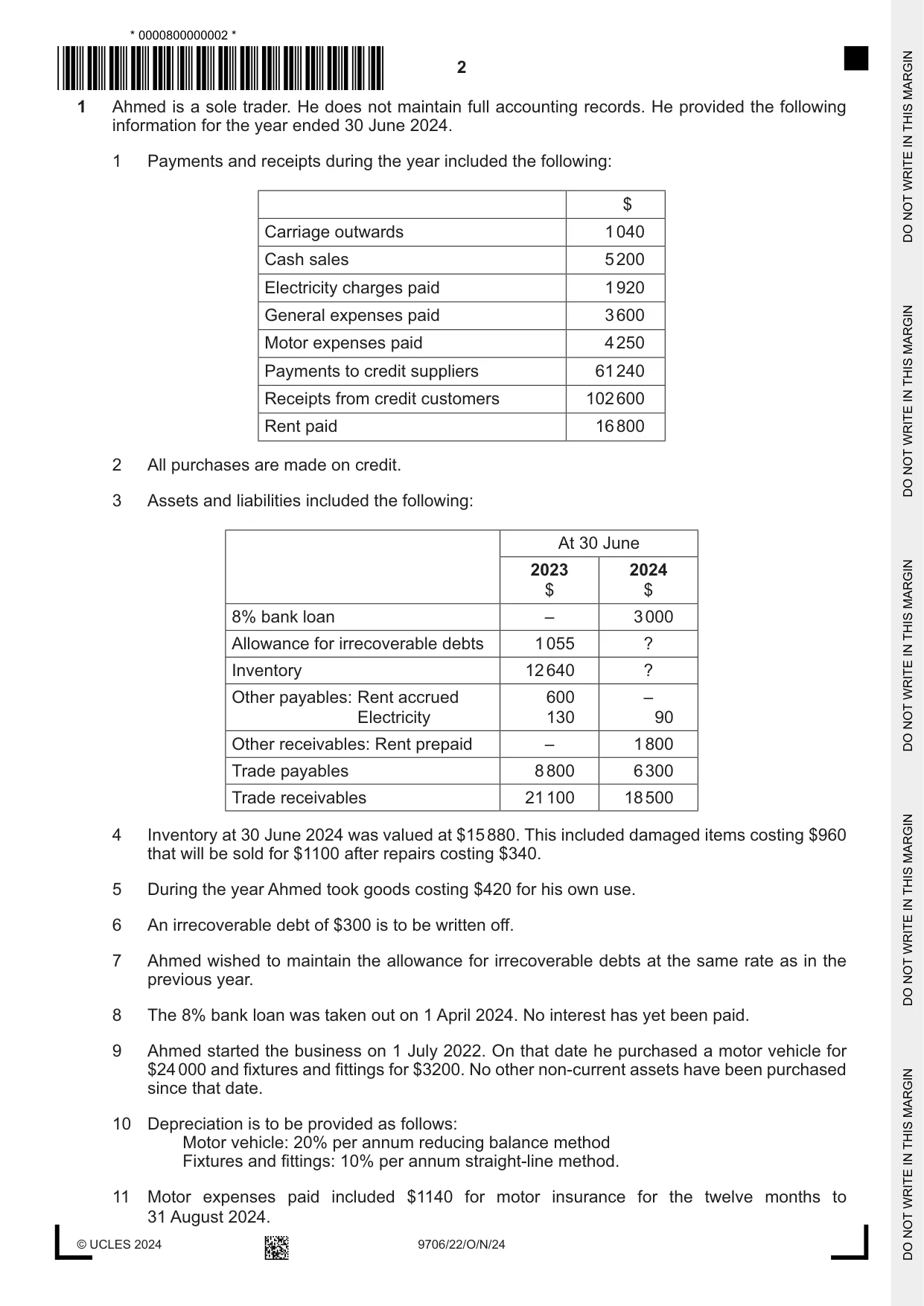
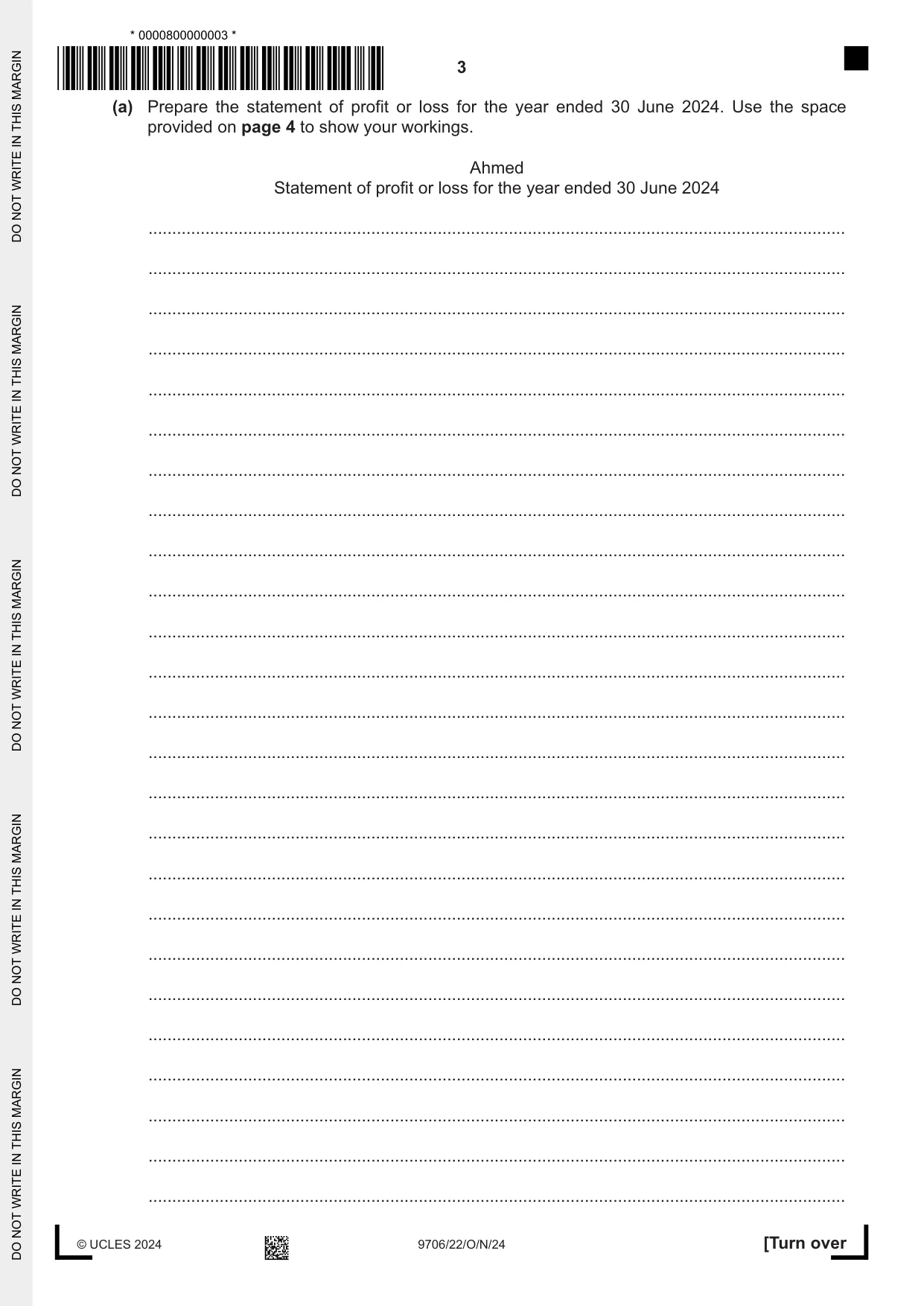
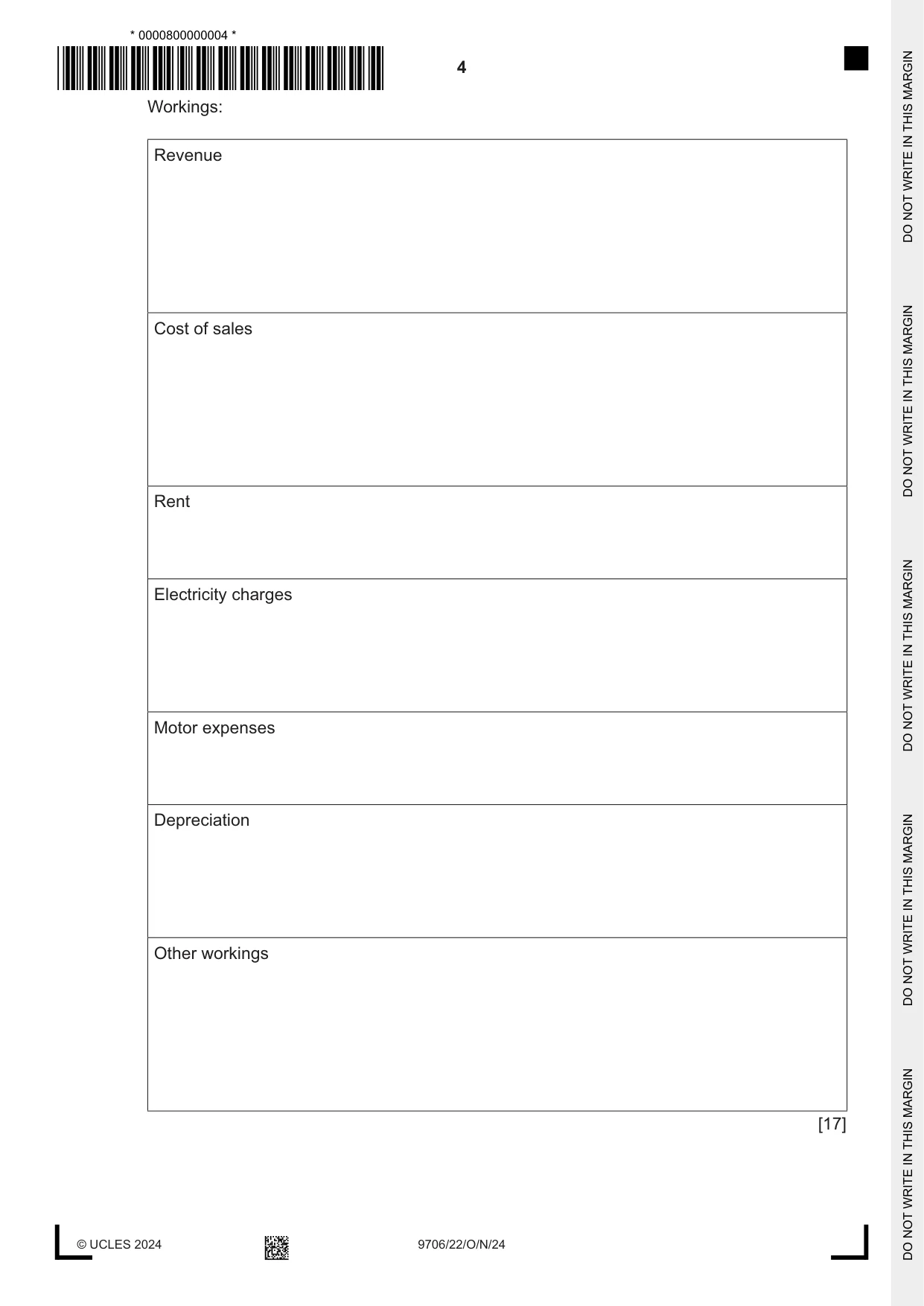
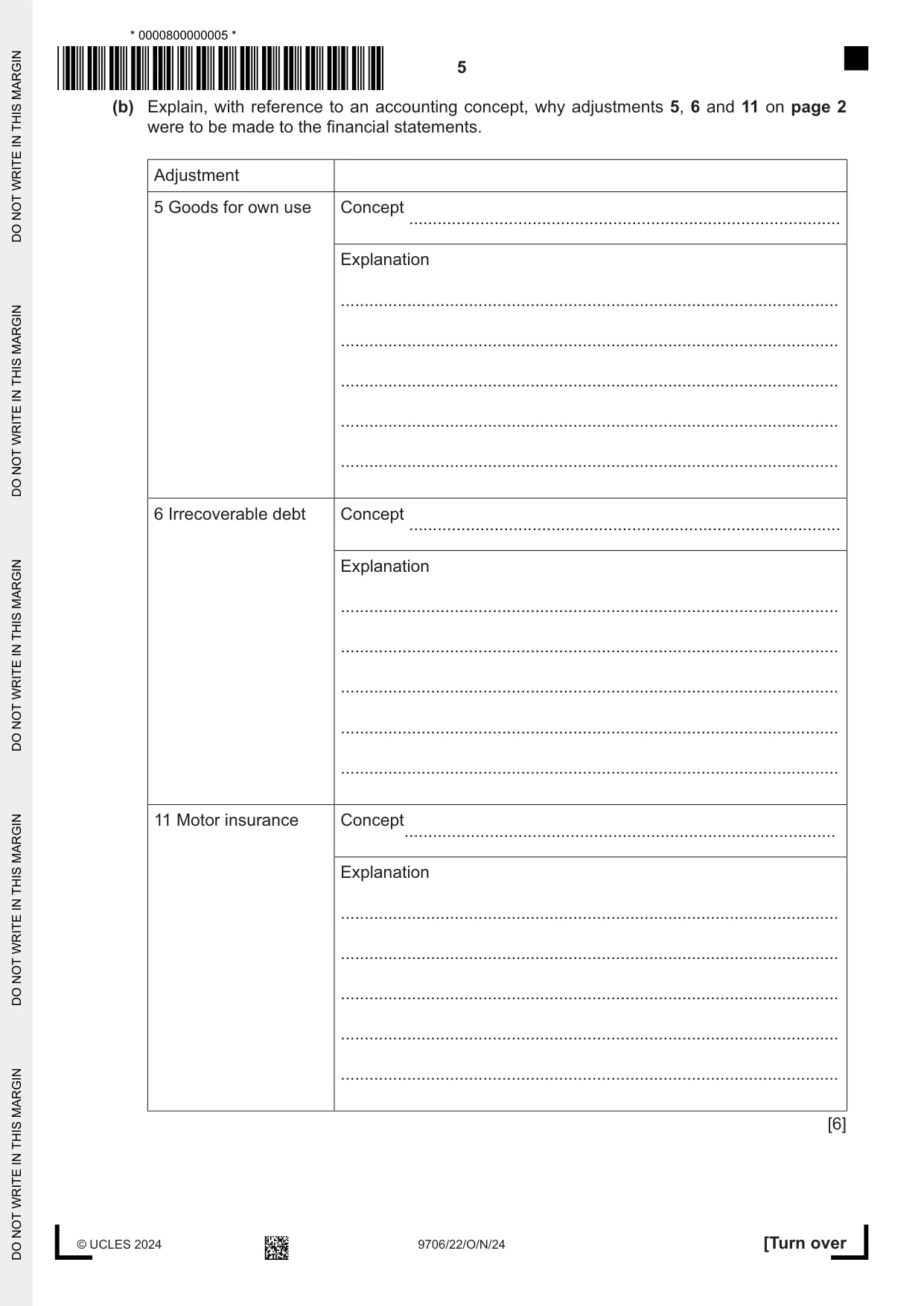
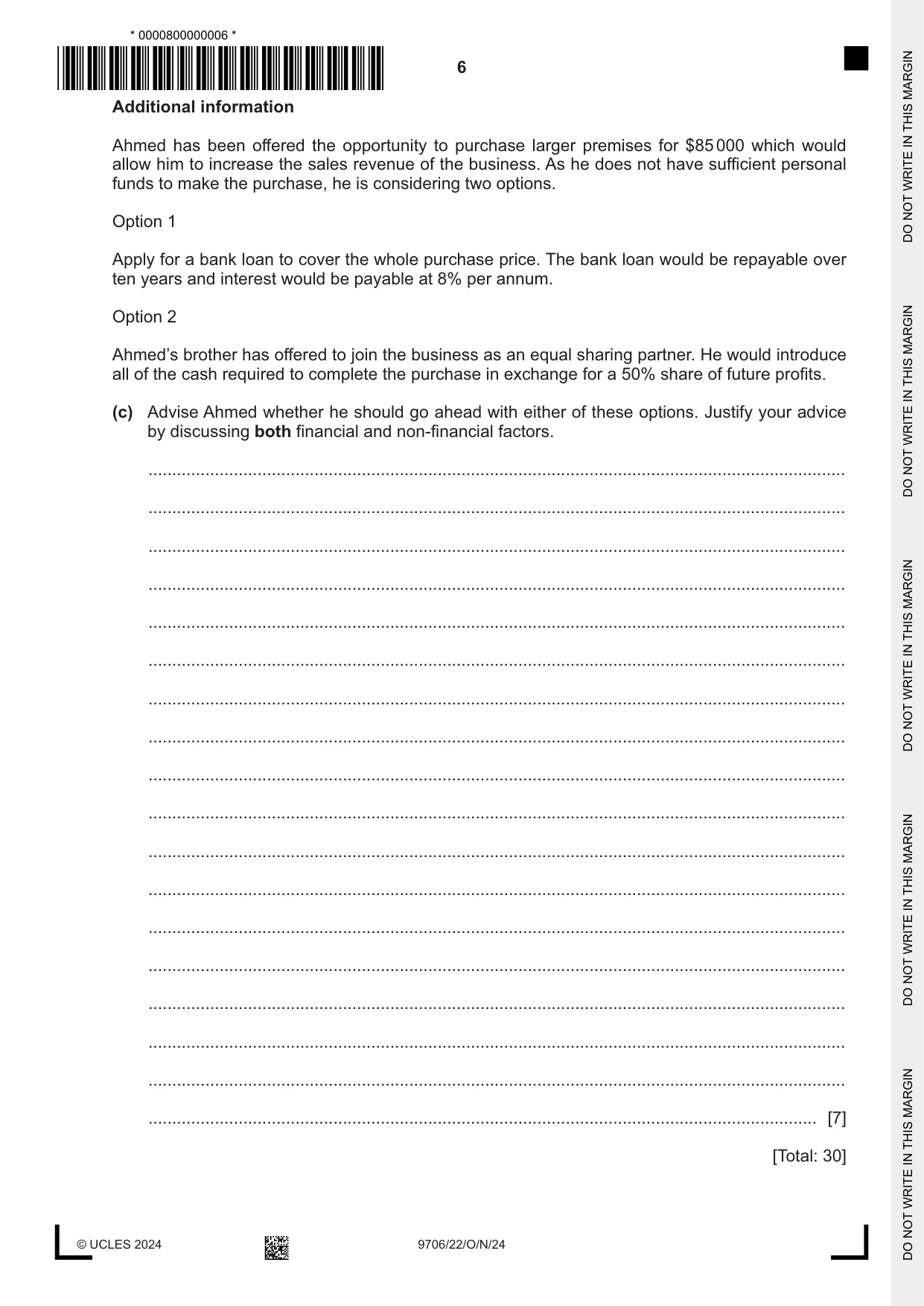
1 Ahmed is a sole trader. He does not maintain full accounting records. He provided the following information for the year ended 30 June 2024. 1 Payments and receipts during the year included the following: $ Carriage outwards 1 040 Cash sales 5 200 Electricity charges paid 1 920 General expenses paid 3 600 Motor expenses paid 4 250 Payments to credit suppliers 61 240 Receipts from credit customers 102 600 Rent paid 16 800 2 All purchases are made on credit. 3 Assets and liabilities included the following: At 30 June 2023 2024 $ $ 8% bank loan – 3 000 Allowance for irrecoverable debts 1 055 ? Inventory 12 640 ? Other payables: Rent accrued 600 – Electricity 130 90 Other receivables: Rent prepaid – 1 800 Trade payables 8 800 6 300 Trade receivables 21 100 18 500 4 Inventory at 30 June 2024 was valued at $15 880. This included damaged items costing $960 that will be sold for $1100 after repairs costing $340. 5 During the year Ahmed took goods costing $420 for his own use. 6 An irrecoverable debt of $300 is to be written off. 7 Ahmed wished to maintain the allowance for irrecoverable debts at the same rate as in the previous year. 8 The 8% bank loan was taken out on 1 April 2024. No interest has yet been paid. 9 Ahmed started the business on 1 July 2022. On that date he purchased a motor vehicle for $24 000 and fixtures and fittings for $3200. No other non-current assets have been purchased since that date. 10 Depreciation is to be provided as follows: Motor vehicle: 20% per annum reducing balance method Fixtures and fittings: 10% per annum straight-line method. 11 Motor expenses paid included $1140 for motor insurance for the twelve months to 31 August 2024. (a) Prepare the statement of profit or loss for the year ended 30 June 2024. Use the space provided on page 4 to show your workings. Ahmed Statement of profit or loss for the year ended 30 June 2024 ................................................................................................................................................... ................................................................................................................................................... ................................................................................................................................................... ................................................................................................................................................... ................................................................................................................................................... ................................................................................................................................................... ................................................................................................................................................... ................................................................................................................................................... ................................................................................................................................................... ................................................................................................................................................... ................................................................................................................................................... ................................................................................................................................................... ................................................................................................................................................... ................................................................................................................................................... ................................................................................................................................................... ................................................................................................................................................... ................................................................................................................................................... ................................................................................................................................................... ................................................................................................................................................... ................................................................................................................................................... ................................................................................................................................................... ................................................................................................................................................... ................................................................................................................................................... ................................................................................................................................................... ................................................................................................................................................... Workings: Revenue Cost of sales Rent Electricity charges Motor expenses Depreciation Other workings [17] (b) Explain, with reference to an accounting concept, why adjustments 5, 6 and 11 on page 2 were to be made to the financial statements. Adjustment 5 Goods for own use Concept ........................................................................................... Explanation ......................................................................................................... ......................................................................................................... ......................................................................................................... ......................................................................................................... ......................................................................................................... 6 Irrecoverable debt Concept ........................................................................................... Explanation ......................................................................................................... ......................................................................................................... ......................................................................................................... ......................................................................................................... ......................................................................................................... 11 Motor insurance Concept........................................................................................... Explanation ......................................................................................................... ......................................................................................................... ......................................................................................................... ......................................................................................................... ......................................................................................................... [6] Additional information Ahmed has been offered the opportunity to purchase larger premises for $85 000 which would allow him to increase the sales revenue of the business. As he does not have sufficient personal funds to make the purchase, he is considering two options. Option 1 Apply for a bank loan to cover the whole purchase price. The bank loan would be repayable over ten years and interest would be payable at 8% per annum. Option 2 Ahmed’s brother has offered to join the business as an equal sharing partner. He would introduce all of the cash required to complete the purchase in exchange for a 50% share of future profits. (c) Advise Ahmed whether he should go ahead with either of these options. Justify your advice by discussing both financial and non-financial factors. ................................................................................................................................................... ................................................................................................................................................... ................................................................................................................................................... ................................................................................................................................................... ................................................................................................................................................... ................................................................................................................................................... ................................................................................................................................................... ................................................................................................................................................... ................................................................................................................................................... ................................................................................................................................................... ................................................................................................................................................... ................................................................................................................................................... ................................................................................................................................................... ................................................................................................................................................... ................................................................................................................................................... ................................................................................................................................................... ................................................................................................................................................... ............................................................................................................................................. [7] [Total: 30]
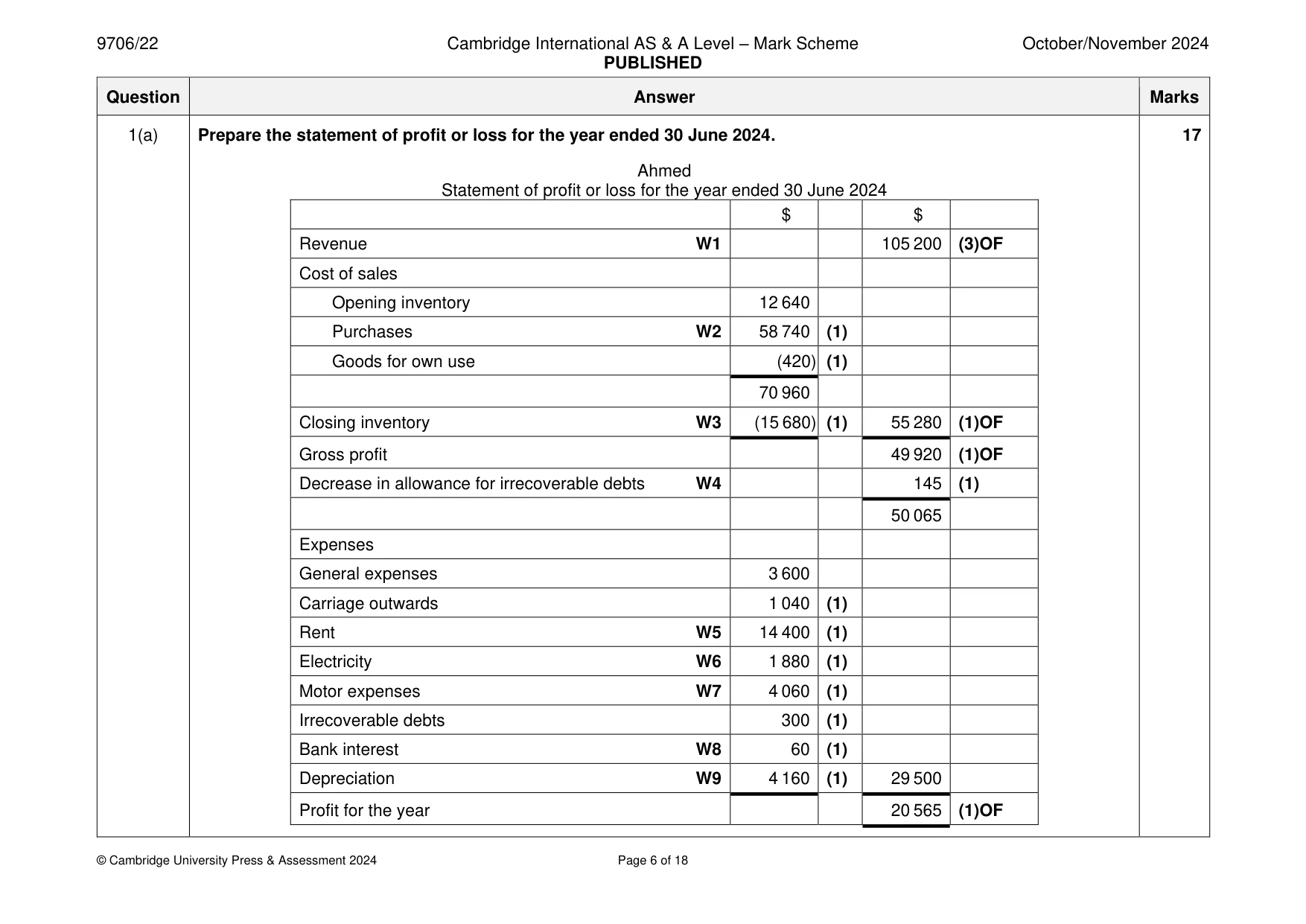
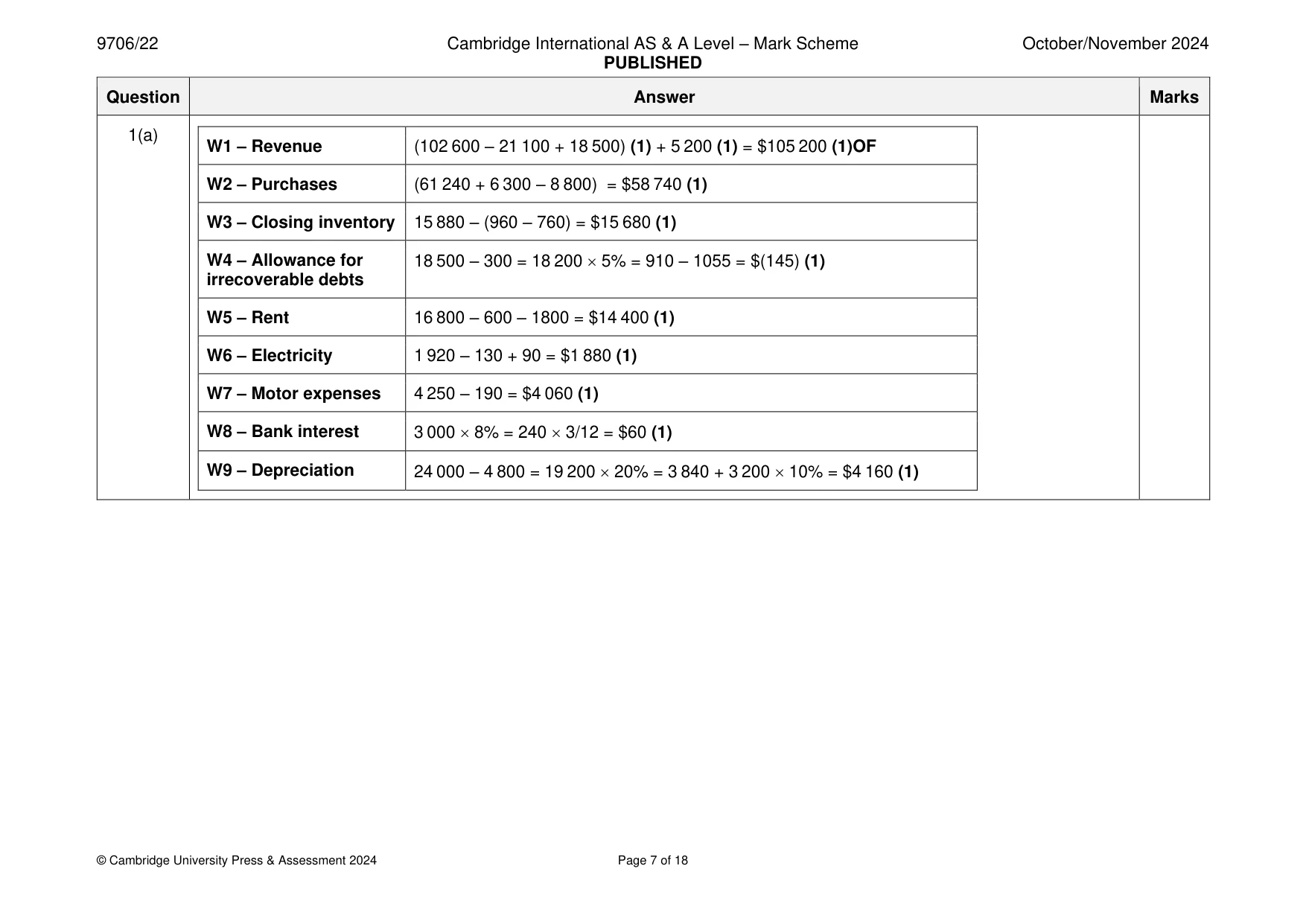
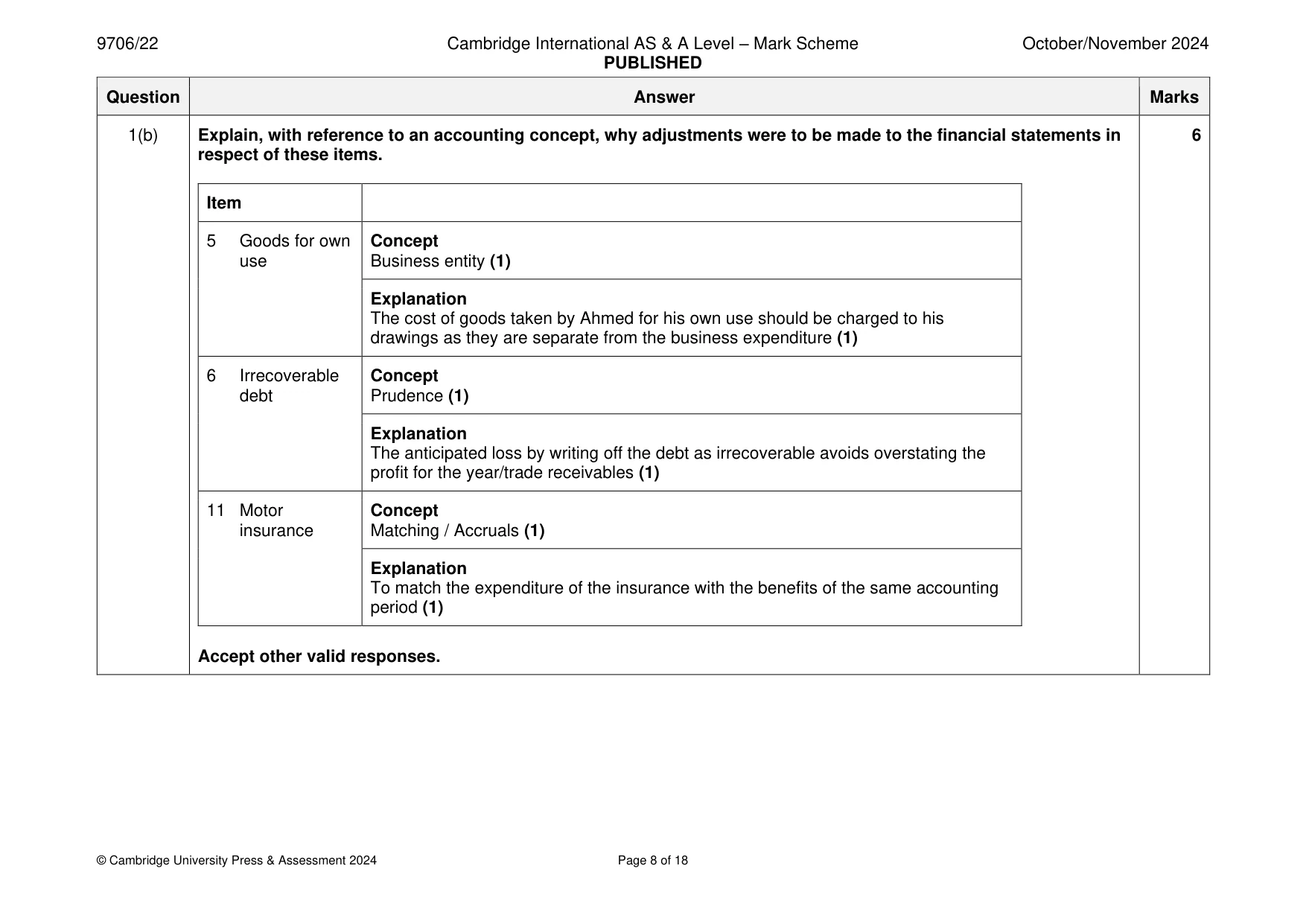
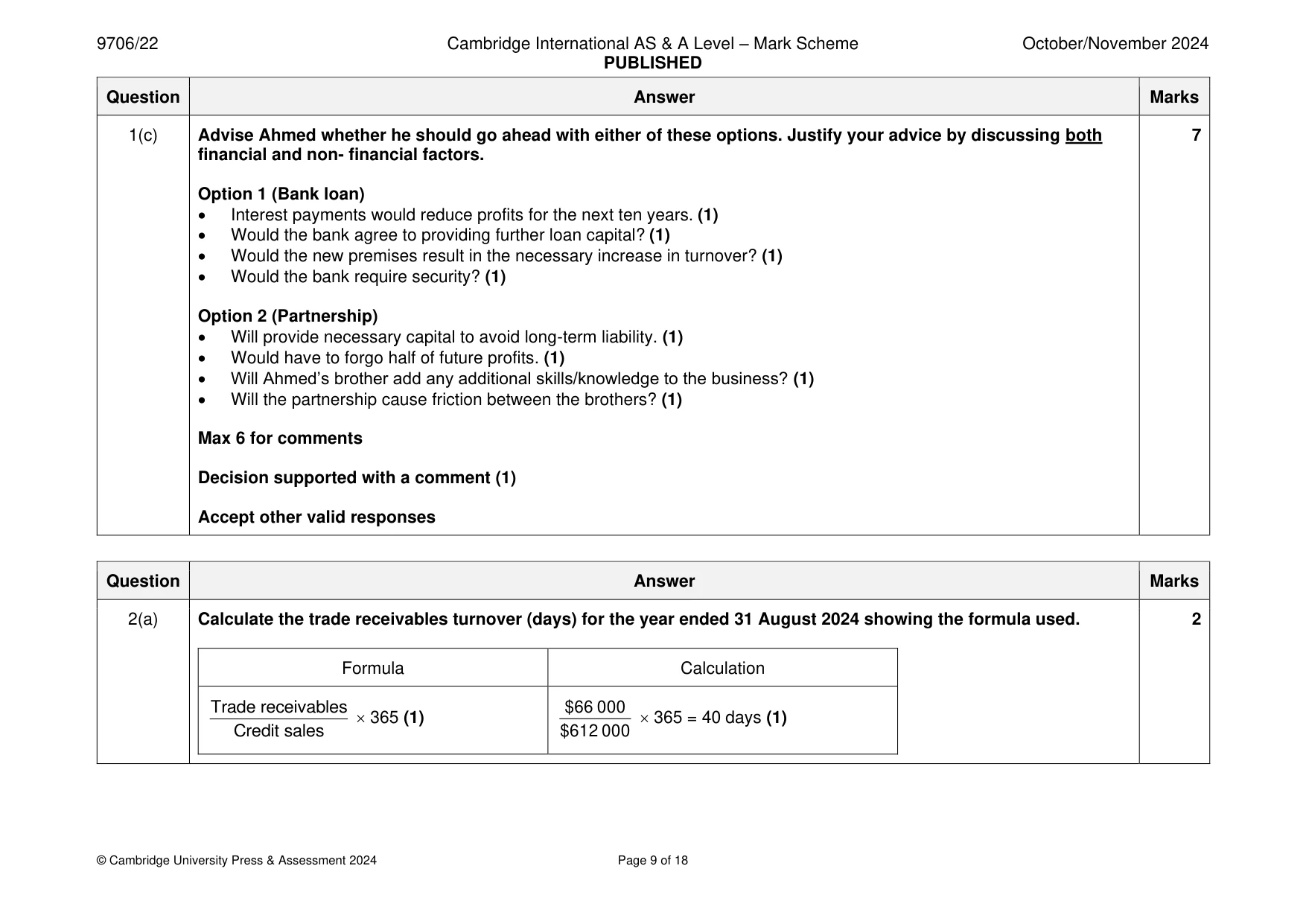
Mark scheme: Question Answer Marks 1(a) Prepare the statement of profit or loss for the year ended 30 June 2024. 17 Ahmed Statement of profit or loss for the year ended 30 June 2024 $ $ Revenue W1 105 200 (3)OF Cost of sales Opening inventory 12 640 Purchases W2 58 740 (1) Goods for own use (420) (1) 70 960 Closing inventory W3 (15 680) (1) 55 280 (1)OF Gross profit 49 920 (1)OF Decrease in allowance for irrecoverable debts W4 145 (1) 50 065 Expenses General expenses 3 600 Carriage outwards 1 040 (1) Rent W5 14 400 (1) Electricity W6 1 880 (1) Motor expenses W7 4 060 (1) Irrecoverable debts 300 (1) Bank interest W8 60 (1) Depreciation W9 4 160 (1) 29 500 Profit for the year 20 565 (1)OF 1(a) W1 – Revenue (102 600 – 21 100 + 18 500) (1) + 5 200 (1) = $105 200 (1)OF W2 – Purchases (61 240 + 6 300 – 8 800) = $58 740 (1) W3 – Closing inventory 15 880 – (960 – 760) = $15 680 (1) W4 – Allowance for 18 500 – 300 = 18 200 5% = 910 – 1055 = $(145) (1) irrecoverable debts W5 – Rent 16 800 – 600 – 1800 = $14 400 (1) W6 – Electricity 1 920 – 130 + 90 = $1 880 (1) W7 – Motor expenses 4 250 – 190 = $4 060 (1) W8 – Bank interest 3 000 8% = 240 3/12 = $60 (1) W9 – Depreciation 24 000 – 4 800 = 19 200 20% = 3 840 + 3 200 10% = $4 160 (1) 1(b) Explain, with reference to an accounting concept, why adjustments were to be made to the financial statements in 6 respect of these items. Item 5 Goods for own Concept use Business entity (1) Explanation The cost of goods taken by Ahmed for his own use should be charged to his drawings as they are separate from the business expenditure (1) 6 Irrecoverable Concept debt Prudence (1) Explanation The anticipated loss by writing off the debt as irrecoverable avoids overstating the profit for the year/trade receivables (1) 11 Motor Concept insurance Matching / Accruals (1) Explanation To match the expenditure of the insurance with the benefits of the same accounting period (1) Accept other valid responses. 1(c) Advise Ahmed whether he should go ahead with either of these options. Justify your advice by discussing both 7 financial and non- financial factors. Option 1 (Bank loan) • Interest payments would reduce profits for the next ten years. (1) • Would the bank agree to providing further loan capital? (1) • Would the new premises result in the necessary increase in turnover? (1) • Would the bank require security? (1) Option 2 (Partnership) • Will provide necessary capital to avoid long-term liability. (1) • Would have to forgo half of future profits. (1) • Will Ahmed’s brother add any additional skills/knowledge to the business? (1) • Will the partnership cause friction between the brothers? (1) Max 6 for comments Decision supported with a comment (1) Accept other valid responses
Q2 · W Limited provided the following extracts from the financial statements at 31 August 2024
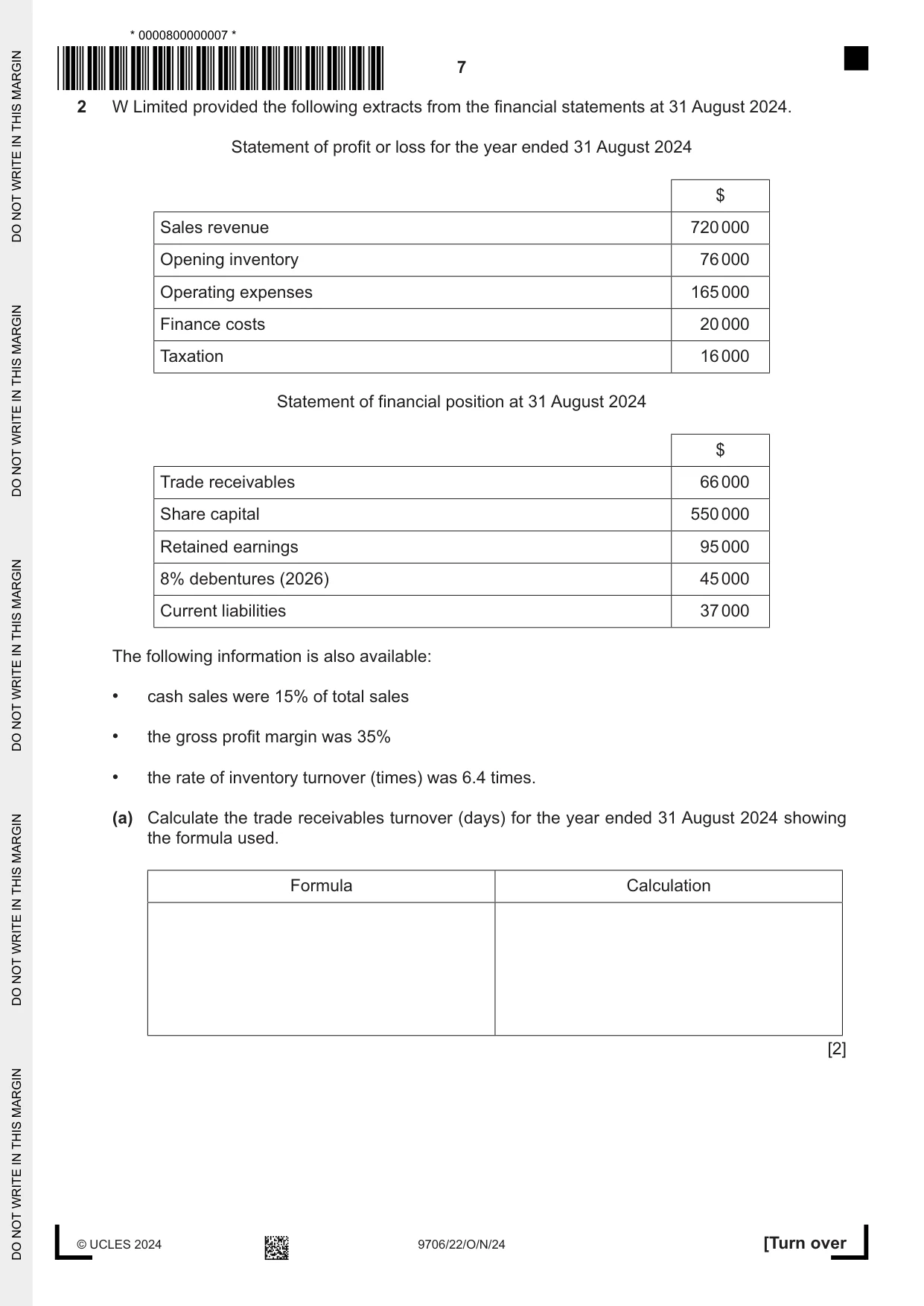
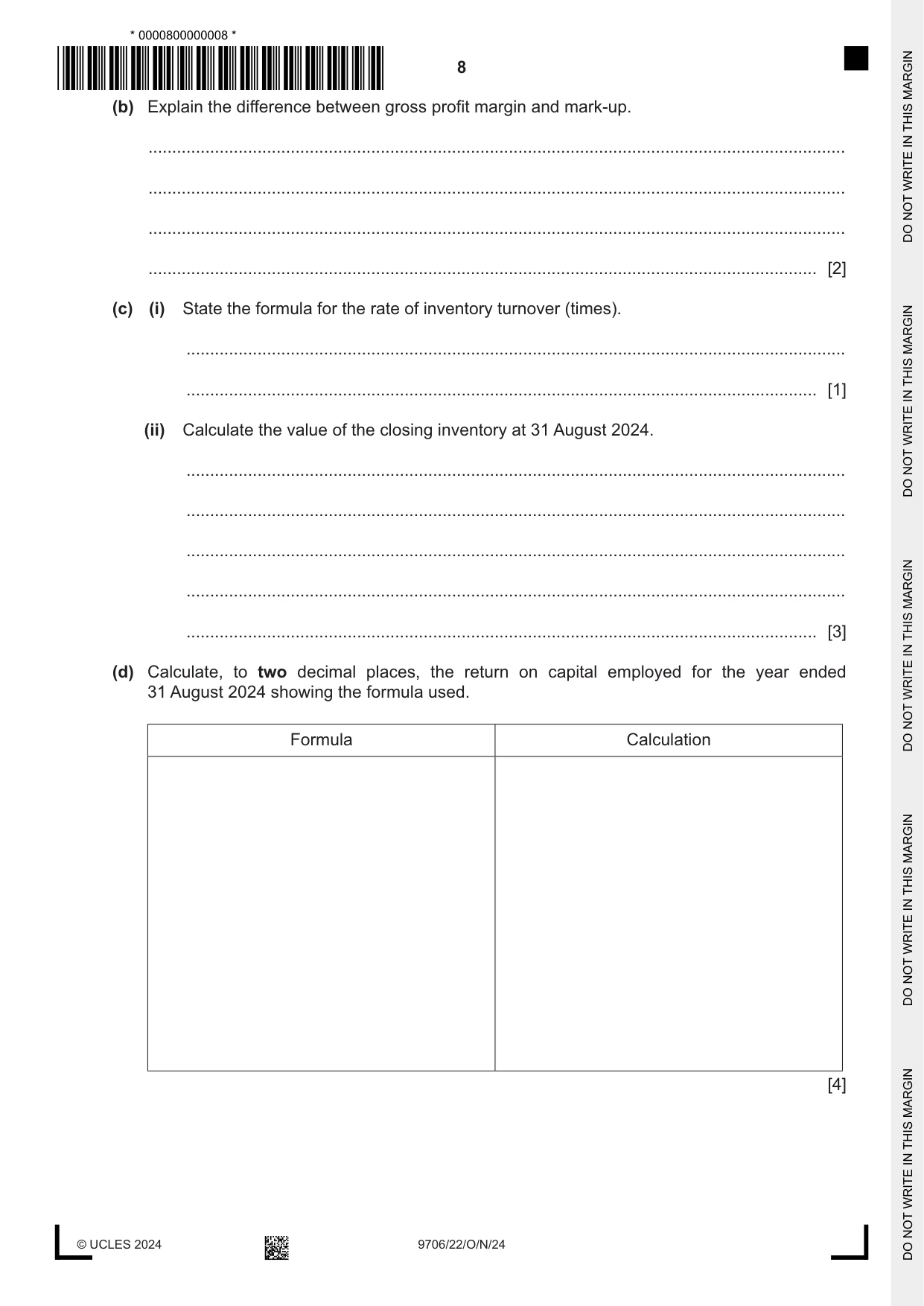
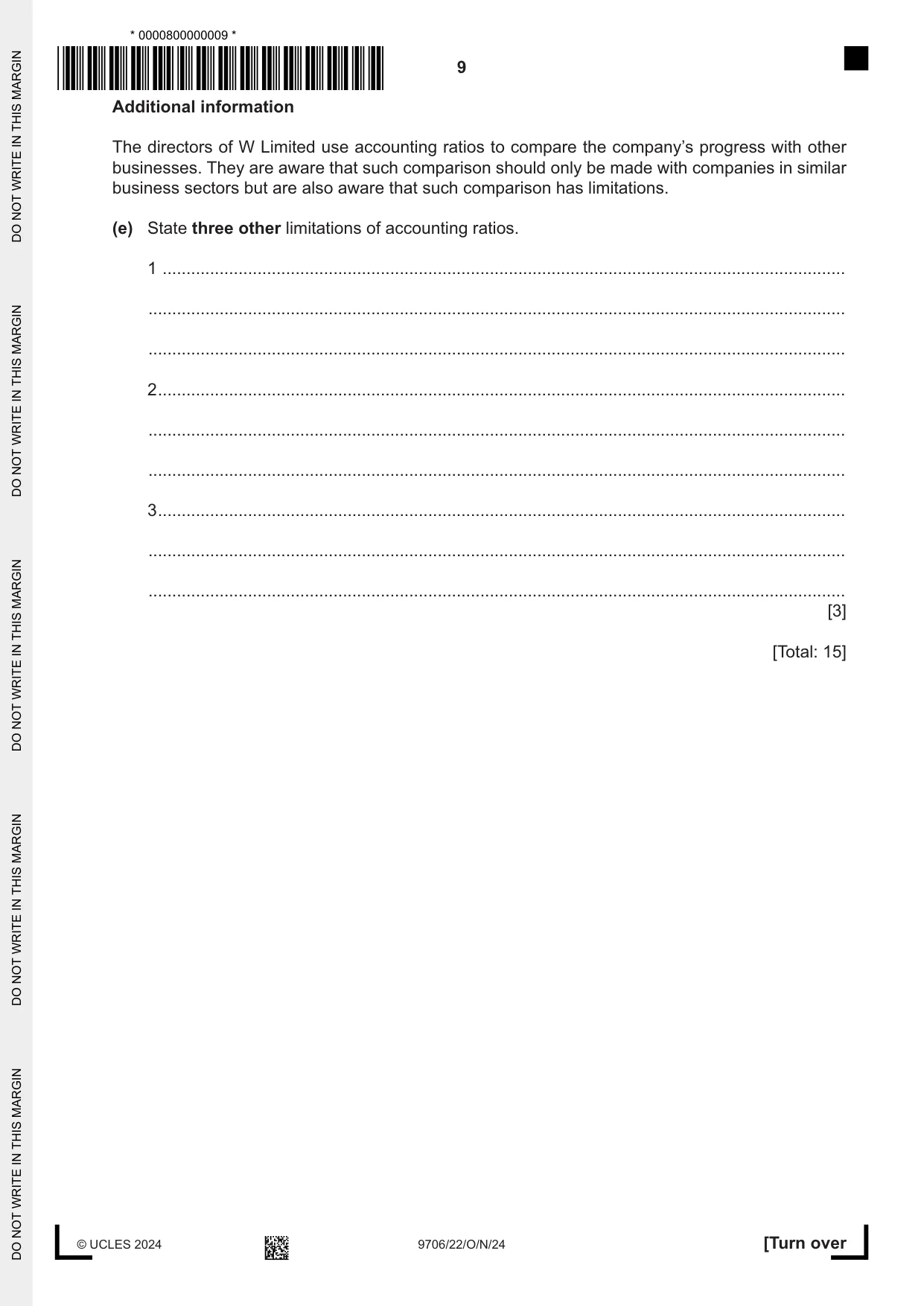
2 W Limited provided the following extracts from the financial statements at 31 August 2024. Statement of profit or loss for the year ended 31 August 2024 $ Sales revenue 720 000 Opening inventory 76 000 Operating expenses 165 000 Finance costs 20 000 Taxation 16 000 Statement of financial position at 31 August 2024 $ Trade receivables 66 000 Share capital 550 000 Retained earnings 95 000 8% debentures (2026) 45 000 Current liabilities 37 000 The following information is also available: • cash sales were 15% of total sales • the gross profit margin was 35% • the rate of inventory turnover (times) was 6.4 times. (a) Calculate the trade receivables turnover (days) for the year ended 31 August 2024 showing the formula used. Formula Calculation [2] (b) Explain the difference between gross profit margin and mark-up. ................................................................................................................................................... ................................................................................................................................................... ................................................................................................................................................... ............................................................................................................................................. [2] (c) (i) State the formula for the rate of inventory turnover (times). ........................................................................................................................................... ..................................................................................................................................... [1] (ii) Calculate the value of the closing inventory at 31 August 2024. ........................................................................................................................................... ........................................................................................................................................... ........................................................................................................................................... ........................................................................................................................................... ..................................................................................................................................... [3] (d) Calculate, to two decimal places, the return on capital employed for the year ended 31 August 2024 showing the formula used. Formula Calculation [4] Additional information The directors of W Limited use accounting ratios to compare the company’s progress with other businesses. They are aware that such comparison should only be made with companies in similar business sectors but are also aware that such comparison has limitations. (e) State three other limitations of accounting ratios. 1 ................................................................................................................................................ ................................................................................................................................................... ................................................................................................................................................... 2 ................................................................................................................................................. ................................................................................................................................................... ................................................................................................................................................... 3 ................................................................................................................................................. ................................................................................................................................................... ................................................................................................................................................... [3] [Total: 15]
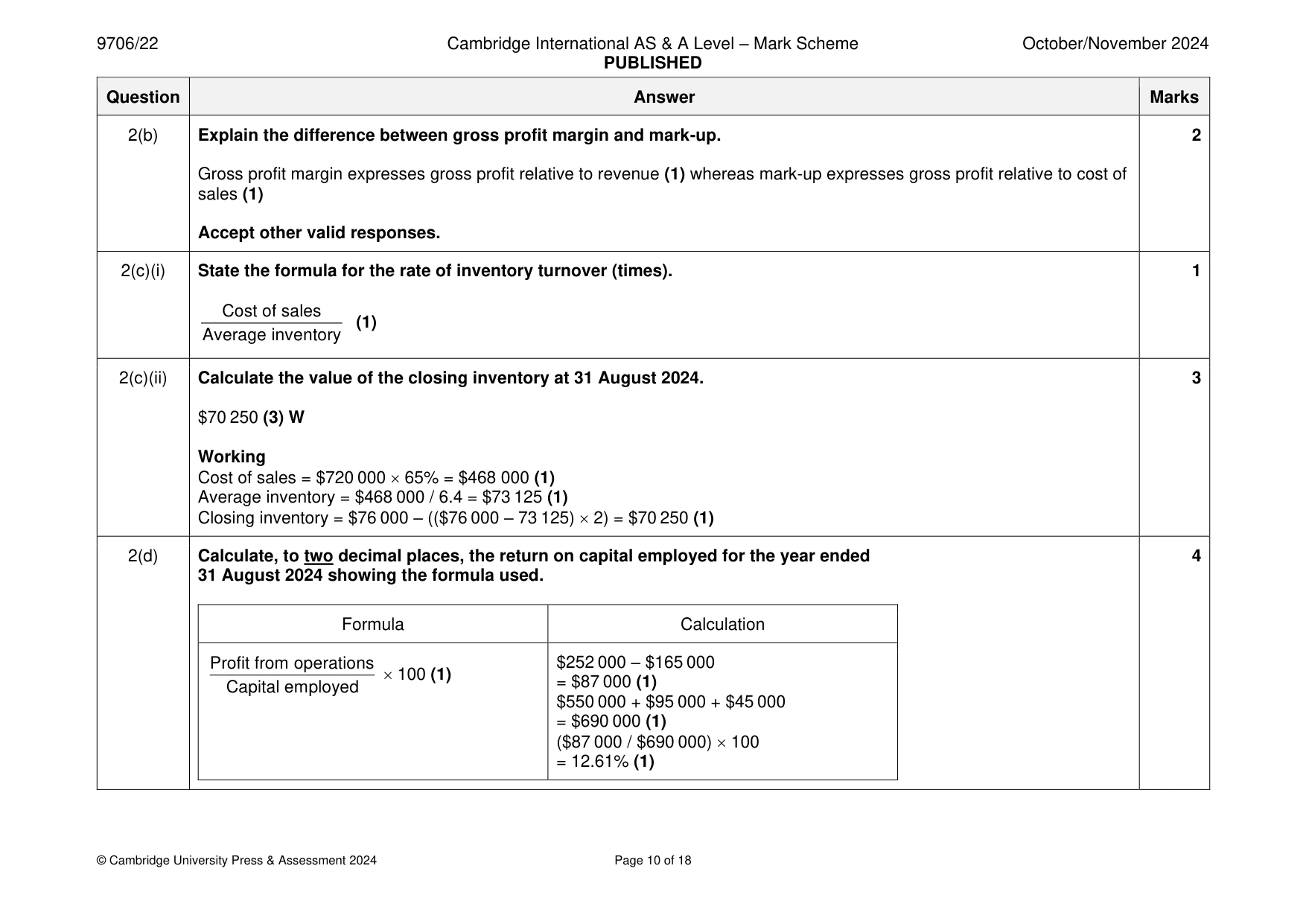
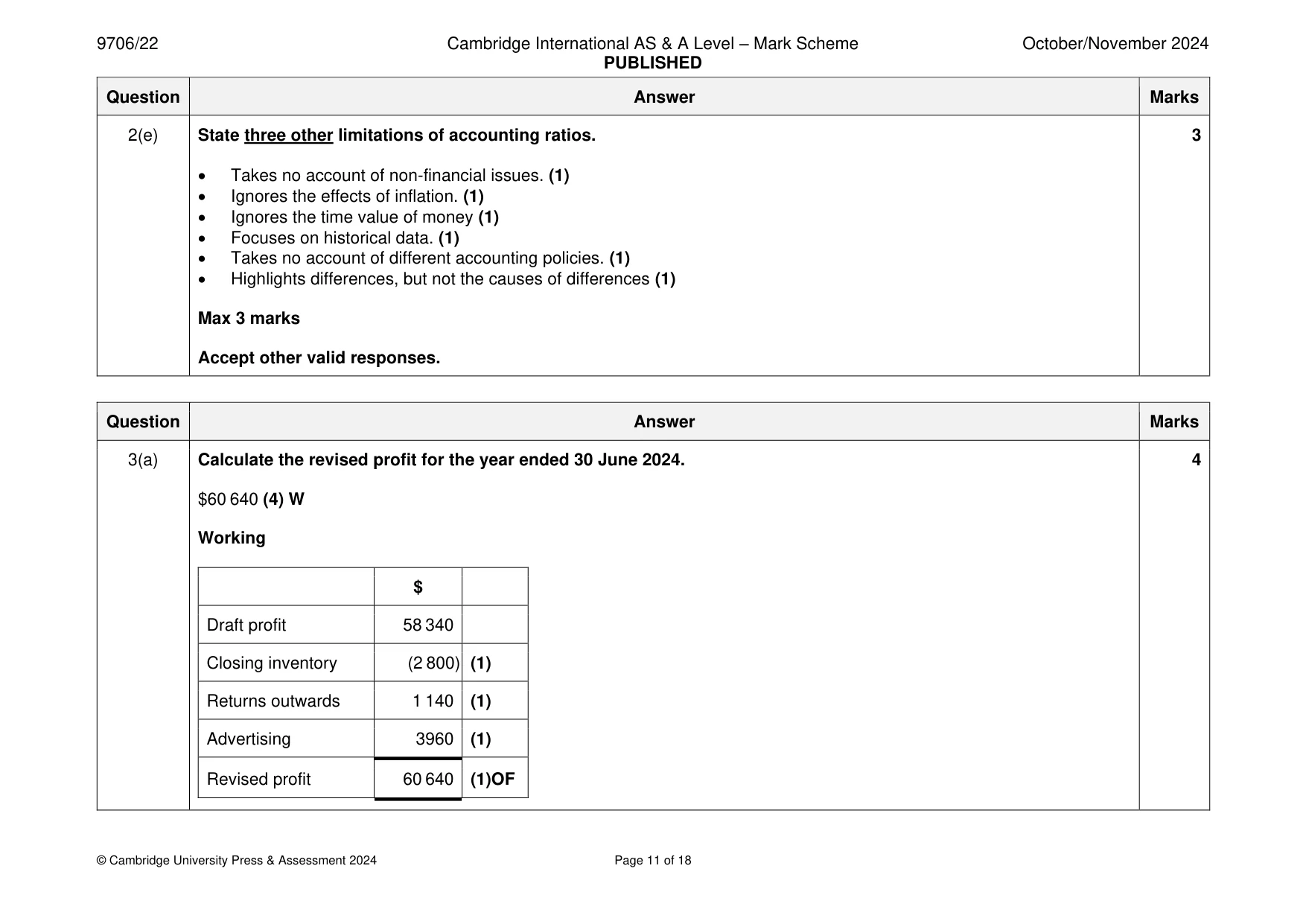
Mark scheme: 2(a) Calculate the trade receivables turnover (days) for the year ended 31 August 2024 showing the formula used. 2 Formula Calculation Trade receivables $66 000 365 (1) 365 = 40 days (1) Credit sales $612 000 2(b) Explain the difference between gross profit margin and mark-up. 2 Gross profit margin expresses gross profit relative to revenue (1) whereas mark-up expresses gross profit relative to cost of sales (1) Accept other valid responses. 2(c)(i) State the formula for the rate of inventory turnover (times). 1 Cost of sales (1) Average inventory 2(c)(ii) Calculate the value of the closing inventory at 31 August 2024. 3 $70 250 (3) W Working Cost of sales = $720 000 65% = $468 000 (1) Average inventory = $468 000 / 6.4 = $73 125 (1) Closing inventory = $76 000 – (($76 000 – 73 125) 2) = $70 250 (1) 2(d) Calculate, to two decimal places, the return on capital employed for the year ended 4 31 August 2024 showing the formula used. Formula Calculation Profit from operations $252 000 – $165 000 100 (1) = $87 000 (1) Capital employed $550 000 + $95 000 + $45 000 = $690 000 (1) ($87 000 / $690 000) 100 = 12.61% (1) 2(e) State three other limitations of accounting ratios. 3 • Takes no account of non-financial issues. (1) • Ignores the effects of inflation. (1) • Ignores the time value of money (1) • Focuses on historical data. (1) • Takes no account of different accounting policies. (1) • Highlights differences, but not the causes of differences (1) Max 3 marks Accept other valid responses.
More questions on Analysis and communication of accounting information
Q3 · The draft profit of L plc for the year ended 30 June 2024 was calculated at $58 340
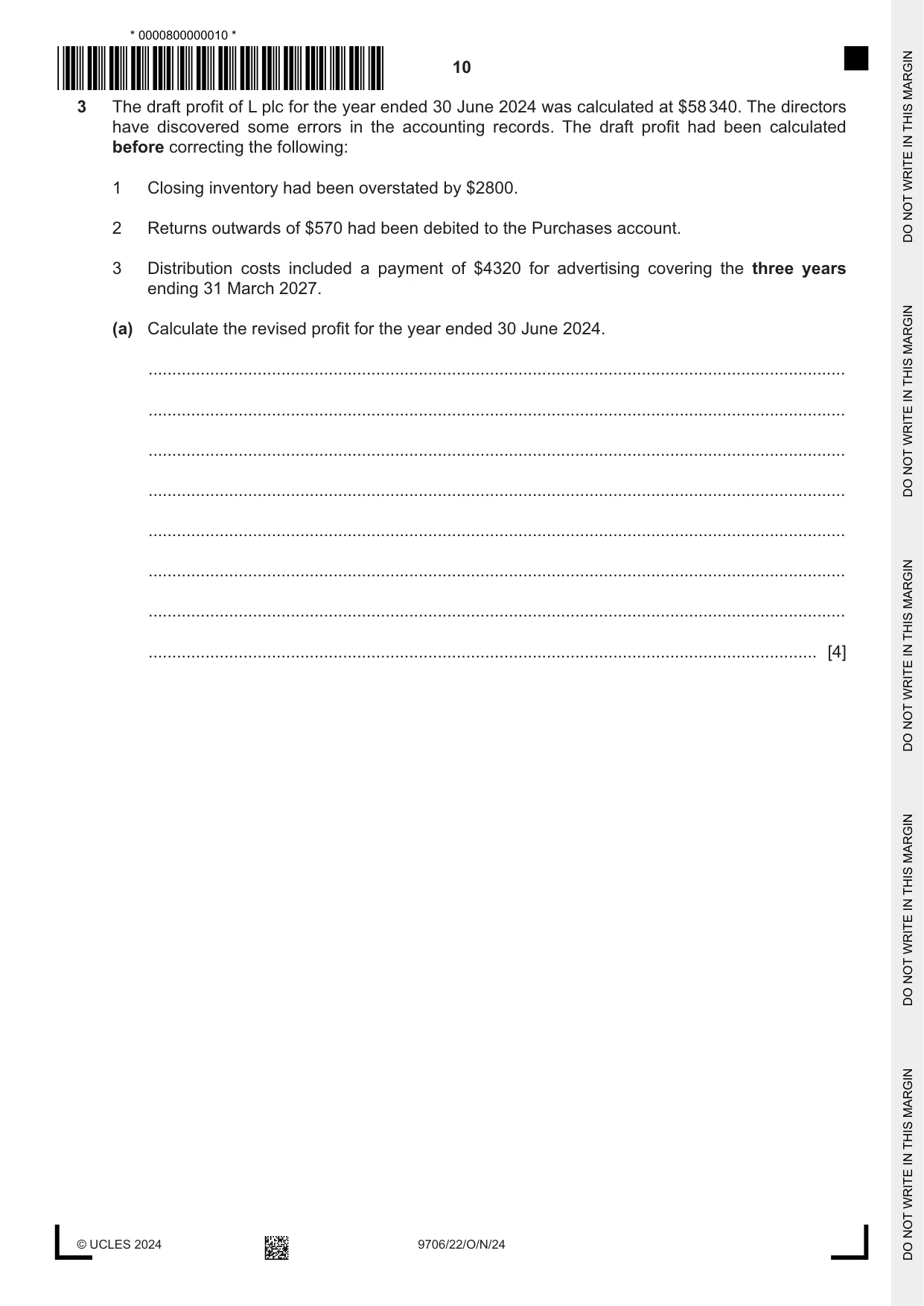
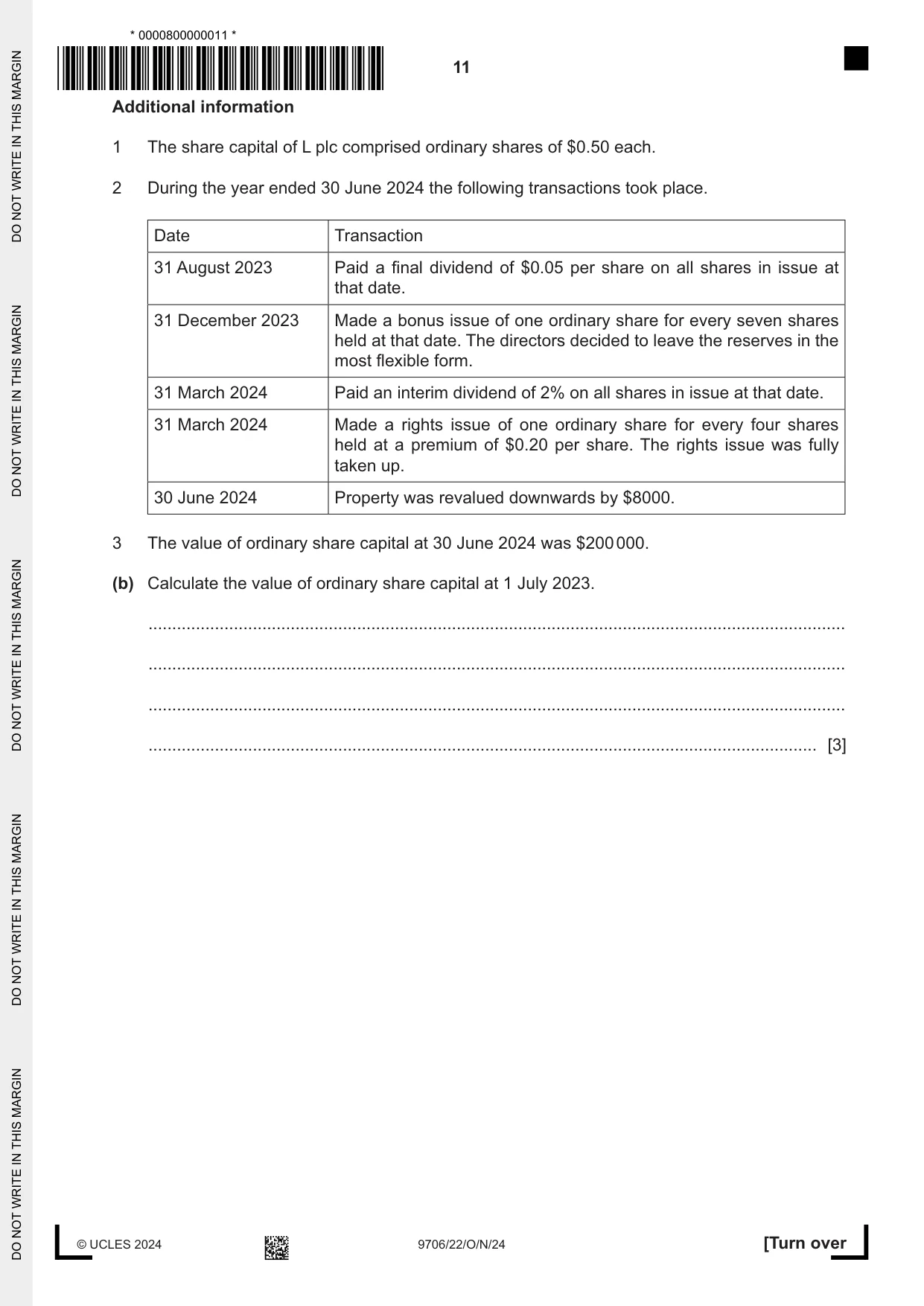
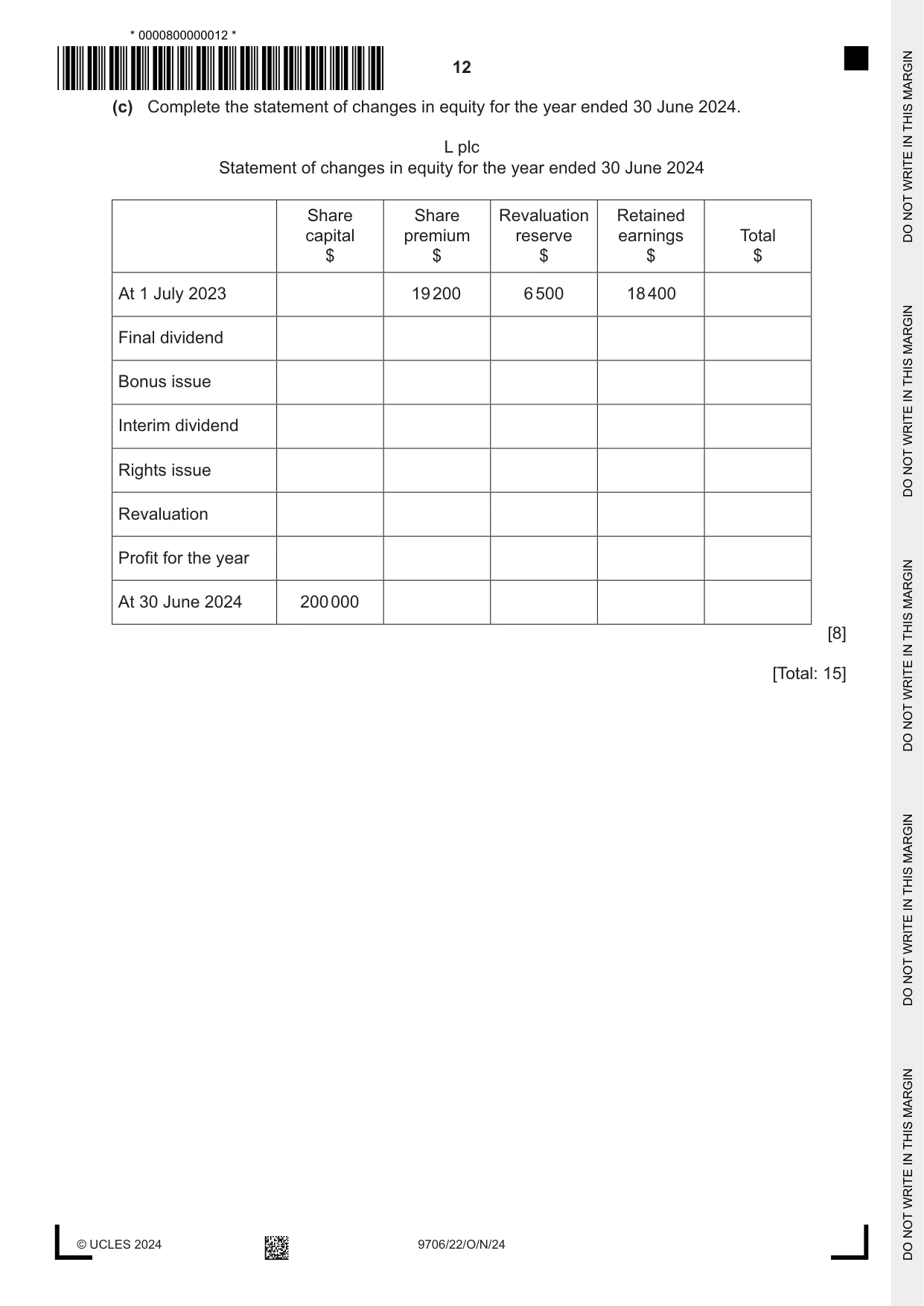
3 The draft profit of L plc for the year ended 30 June 2024 was calculated at $58 340. The directors have discovered some errors in the accounting records. The draft profit had been calculated before correcting the following: 1 Closing inventory had been overstated by $2800. 2 Returns outwards of $570 had been debited to the Purchases account. 3 Distribution costs included a payment of $4320 for advertising covering the three years ending 31 March 2027. (a) Calculate the revised profit for the year ended 30 June 2024. ................................................................................................................................................... ................................................................................................................................................... ................................................................................................................................................... ................................................................................................................................................... ................................................................................................................................................... ................................................................................................................................................... ................................................................................................................................................... ............................................................................................................................................. [4] Additional information 1 The share capital of L plc comprised ordinary shares of $0.50 each. 2 During the year ended 30 June 2024 the following transactions took place. Date Transaction 31 August 2023 Paid a final dividend of $0.05 per share on all shares in issue at that date. 31 December 2023 Made a bonus issue of one ordinary share for every seven shares held at that date. The directors decided to leave the reserves in the most flexible form. 31 March 2024 Paid an interim dividend of 2% on all shares in issue at that date. 31 March 2024 Made a rights issue of one ordinary share for every four shares held at a premium of $0.20 per share. The rights issue was fully taken up. 30 June 2024 Property was revalued downwards by $8000. 3 The value of ordinary share capital at 30 June 2024 was $200 000. (b) Calculate the value of ordinary share capital at 1 July 2023. ................................................................................................................................................... ................................................................................................................................................... ................................................................................................................................................... ............................................................................................................................................. [3] (c) Complete the statement of changes in equity for the year ended 30 June 2024. L plc Statement of changes in equity for the year ended 30 June 2024 Share Share Revaluation Retained capital premium reserve earnings Total $ $ $ $ $ At 1 July 2023 19 200 6 500 18 400 Final dividend Bonus issue Interim dividend Rights issue Revaluation Profit for the year At 30 June 2024 200 000 [8] [Total: 15]
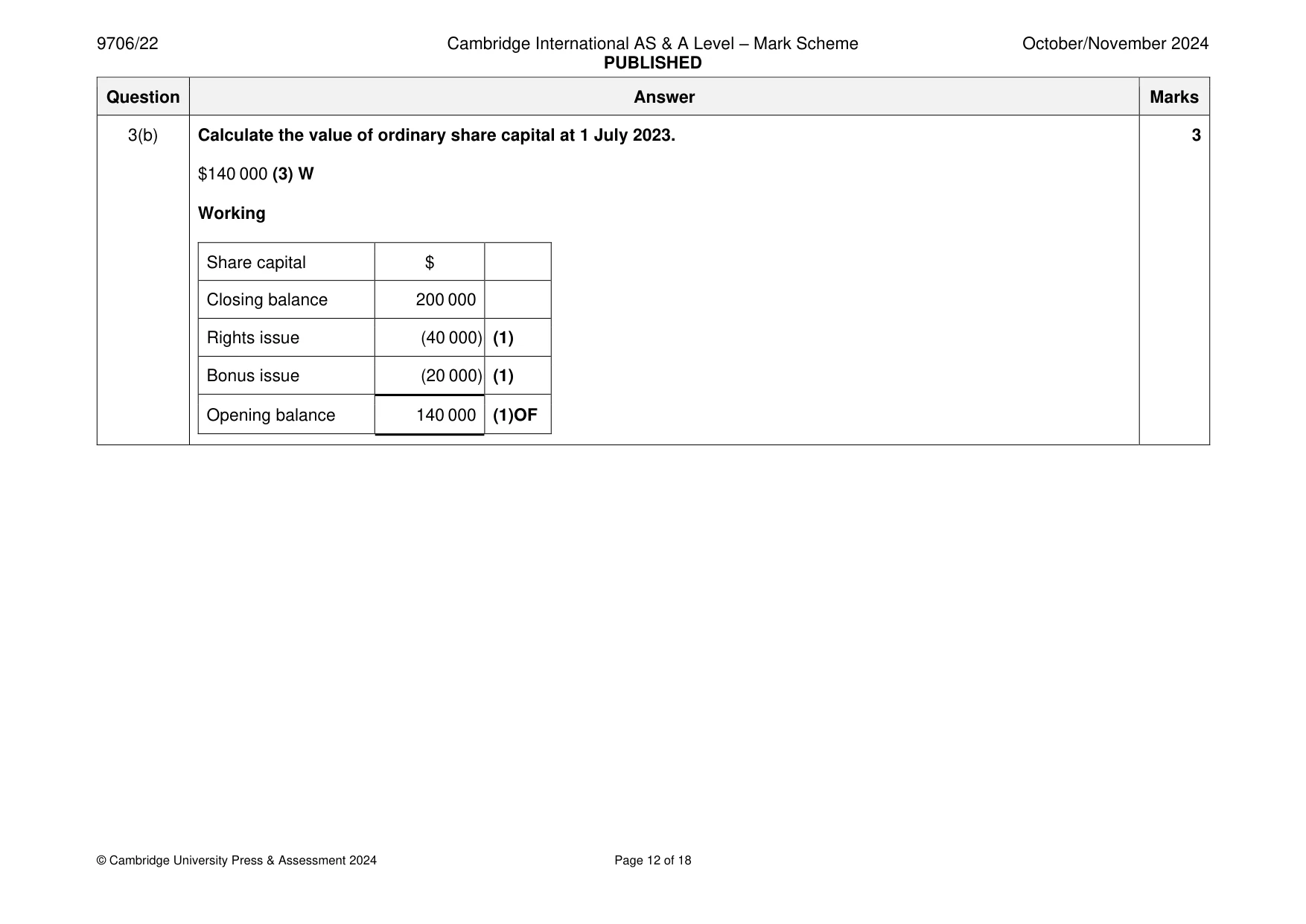
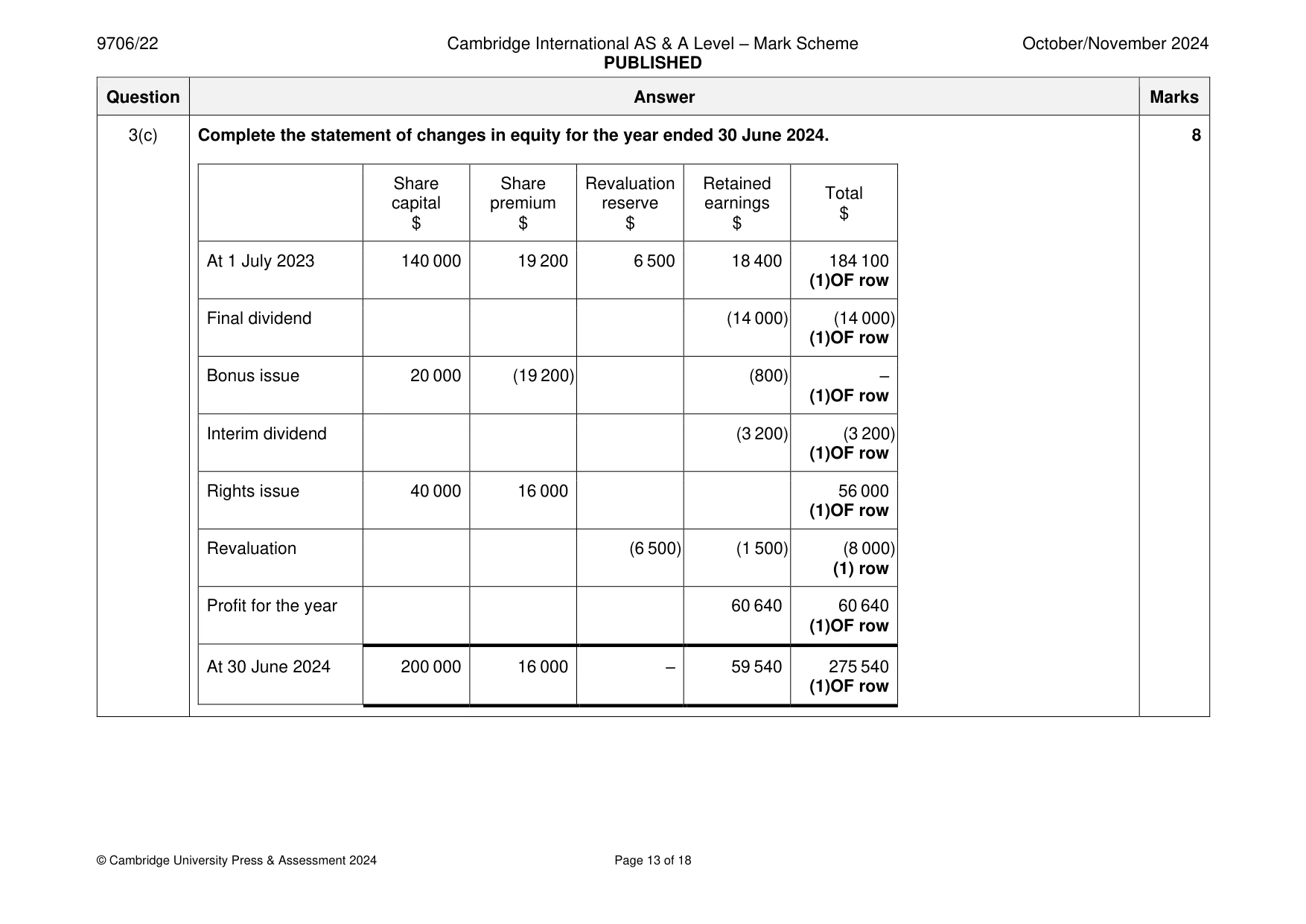
Mark scheme: 3(a) Calculate the revised profit for the year ended 30 June 2024. 4 $60 640 (4) W Working $ Draft profit 58 340 Closing inventory (2 800) (1) Returns outwards 1 140 (1) Advertising 3960 (1) Revised profit 60 640 (1)OF 3(b) Calculate the value of ordinary share capital at 1 July 2023. 3 $140 000 (3) W Working Share capital $ Closing balance 200 000 Rights issue (40 000) (1) Bonus issue (20 000) (1) Opening balance 140 000 (1)OF 3(c) Complete the statement of changes in equity for the year ended 30 June 2024. 8 Share Share Revaluation Retained Total capital premium reserve earnings $ $ $ $ $ At 1 July 2023 140 000 19 200 6 500 18 400 184 100 (1)OF row Final dividend (14 000) (14 000) (1)OF row Bonus issue 20 000 (19 200) (800) – (1)OF row Interim dividend (3 200) (3 200) (1)OF row Rights issue 40 000 16 000 56 000 (1)OF row Revaluation (6 500) (1 500) (8 000) (1) row Profit for the year 60 640 60 640 (1)OF row At 30 June 2024 200 000 16 000 – 59 540 275 540 (1)OF row
Q4 · Martina produces and sells a single type of product
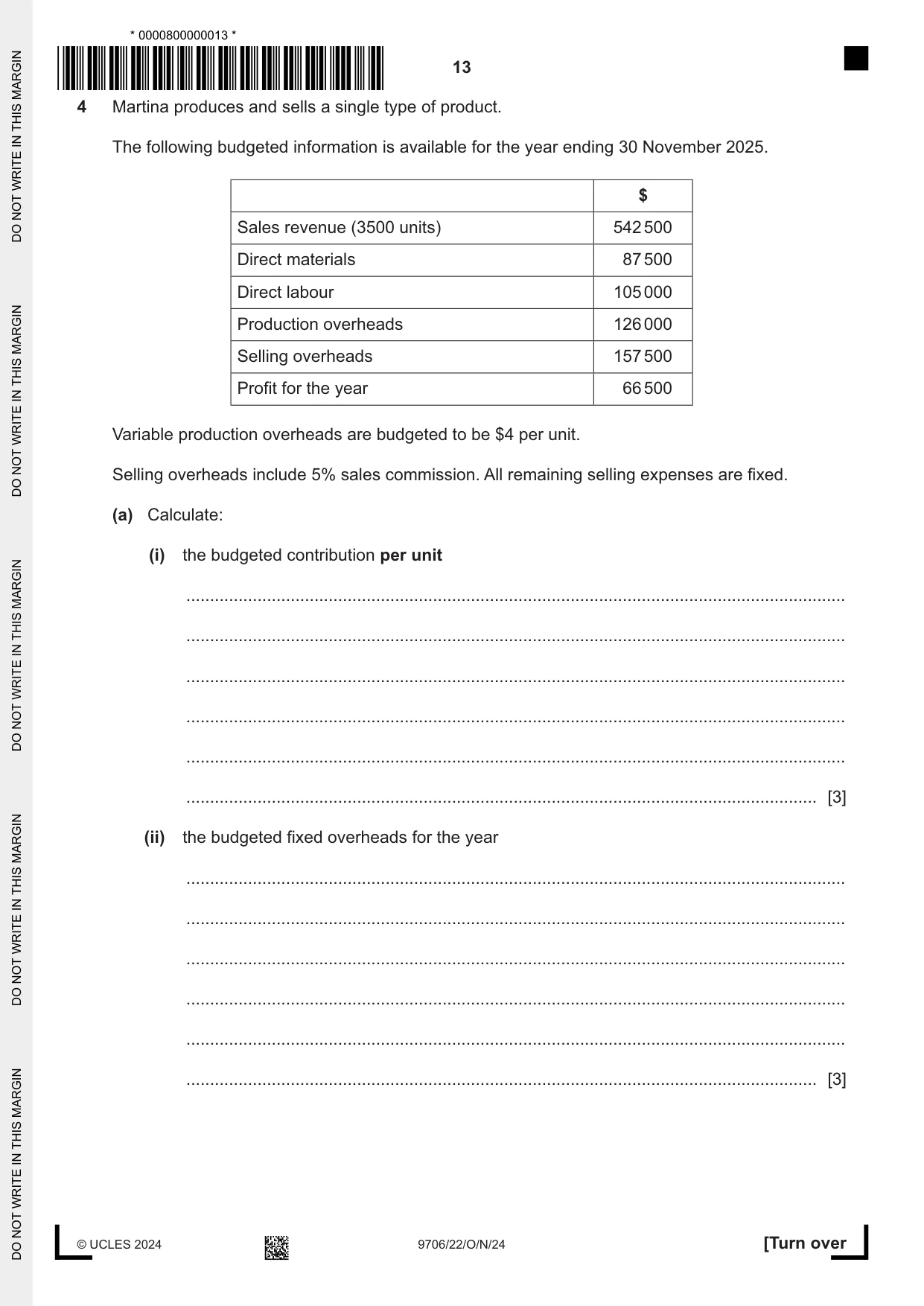
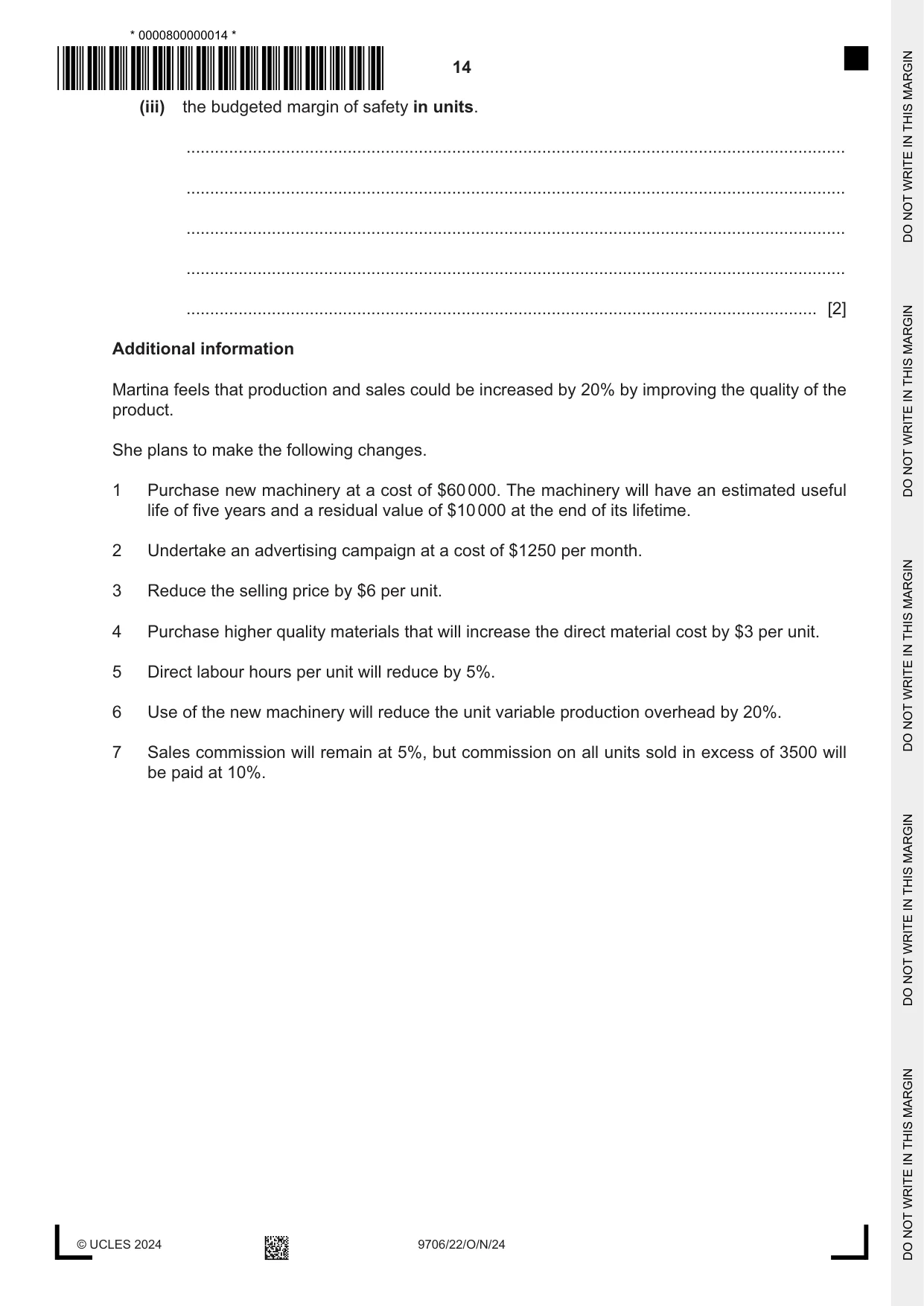
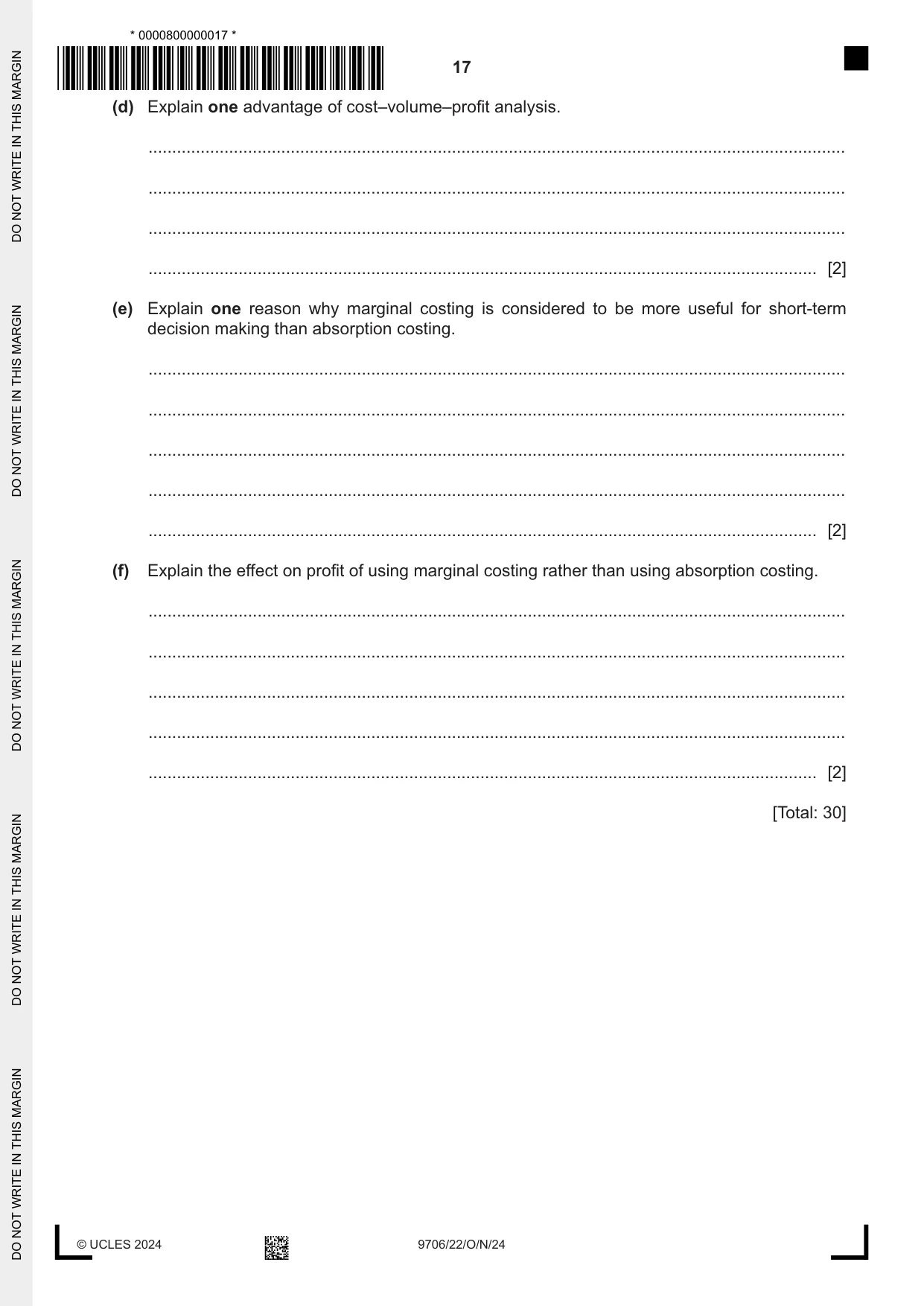
4 Martina produces and sells a single type of product. The following budgeted information is available for the year ending 30 November 2025. $ Sales revenue (3500 units) 542 500 Direct materials 87 500 Direct labour 105 000 Production overheads 126 000 Selling overheads 157 500 Profit for the year 66 500 Variable production overheads are budgeted to be $4 per unit. Selling overheads include 5% sales commission. All remaining selling expenses are fixed. (a) Calculate: (i) the budgeted contribution per unit ........................................................................................................................................... ........................................................................................................................................... ........................................................................................................................................... ........................................................................................................................................... ........................................................................................................................................... ..................................................................................................................................... [3] (ii) the budgeted fixed overheads for the year ........................................................................................................................................... ........................................................................................................................................... ........................................................................................................................................... ........................................................................................................................................... ........................................................................................................................................... ..................................................................................................................................... [3] (iii) the budgeted margin of safety in units. ........................................................................................................................................... ........................................................................................................................................... ........................................................................................................................................... ........................................................................................................................................... ..................................................................................................................................... [2] Additional information Martina feels that production and sales could be increased by 20% by improving the quality of the product. She plans to make the following changes. 1 Purchase new machinery at a cost of $60 000. The machinery will have an estimated useful life of five years and a residual value of $10 000 at the end of its lifetime. 2 Undertake an advertising campaign at a cost of $1250 per month. 3 Reduce the selling price by $6 per unit. 4 Purchase higher quality materials that will increase the direct material cost by $3 per unit.
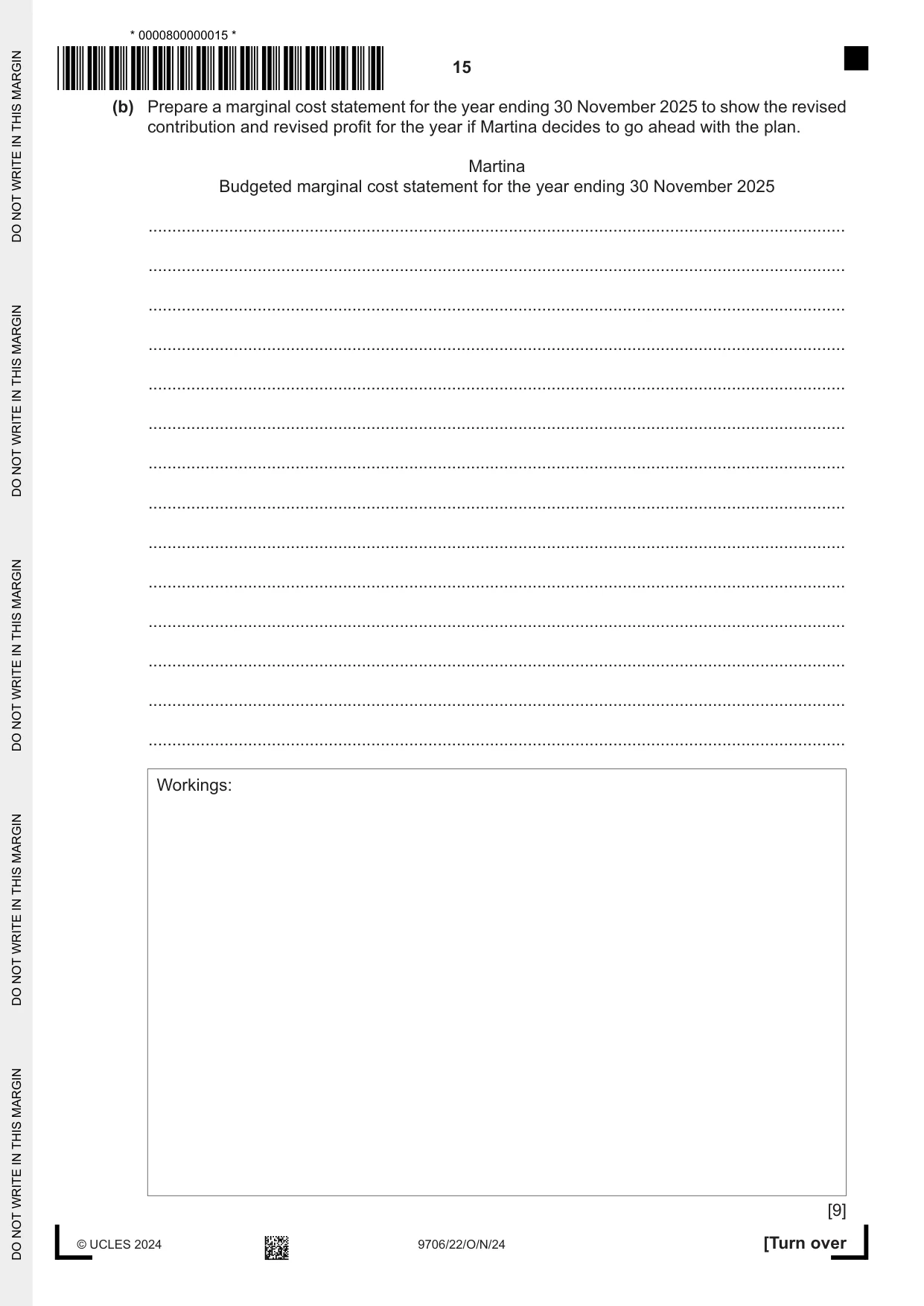
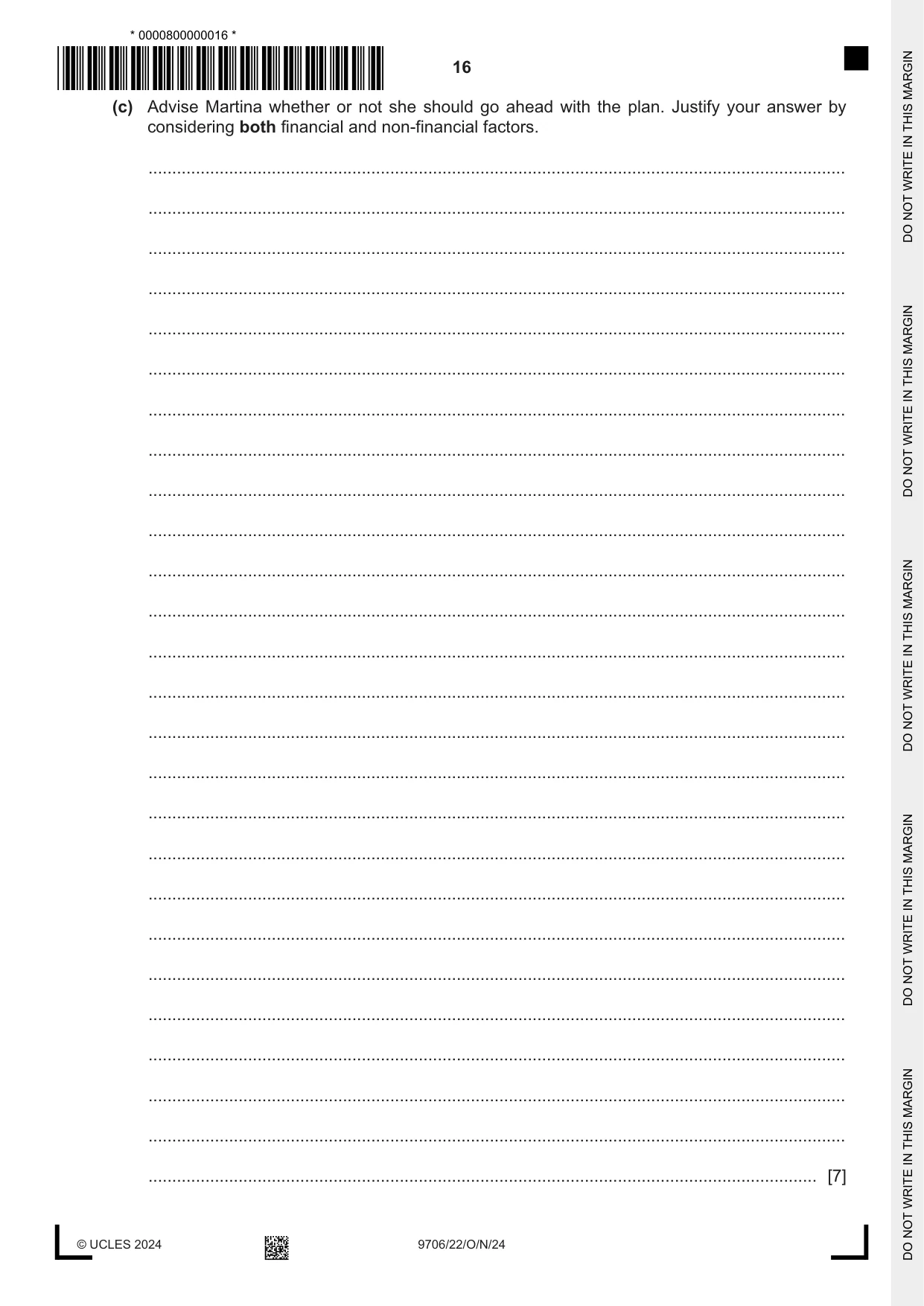
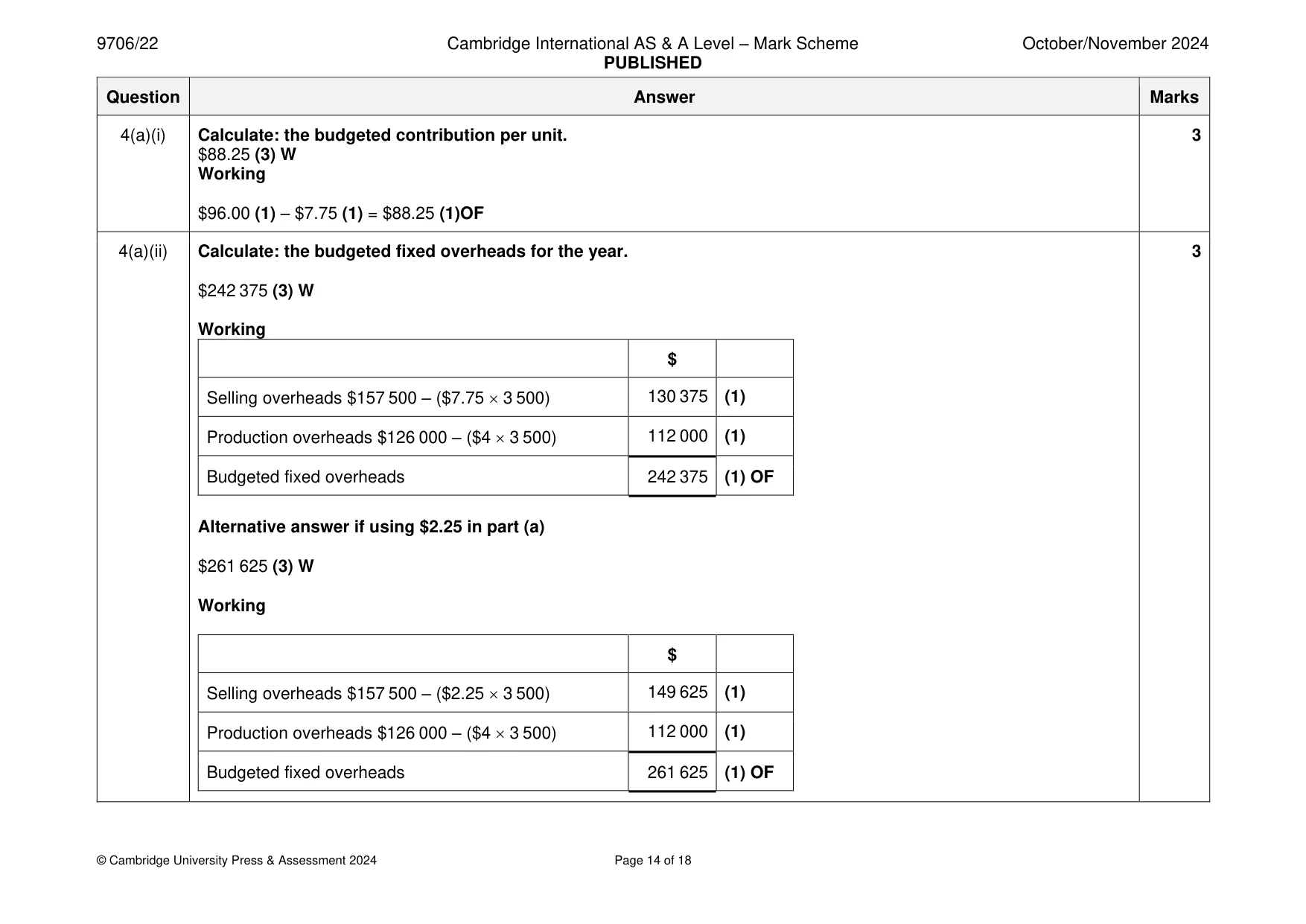
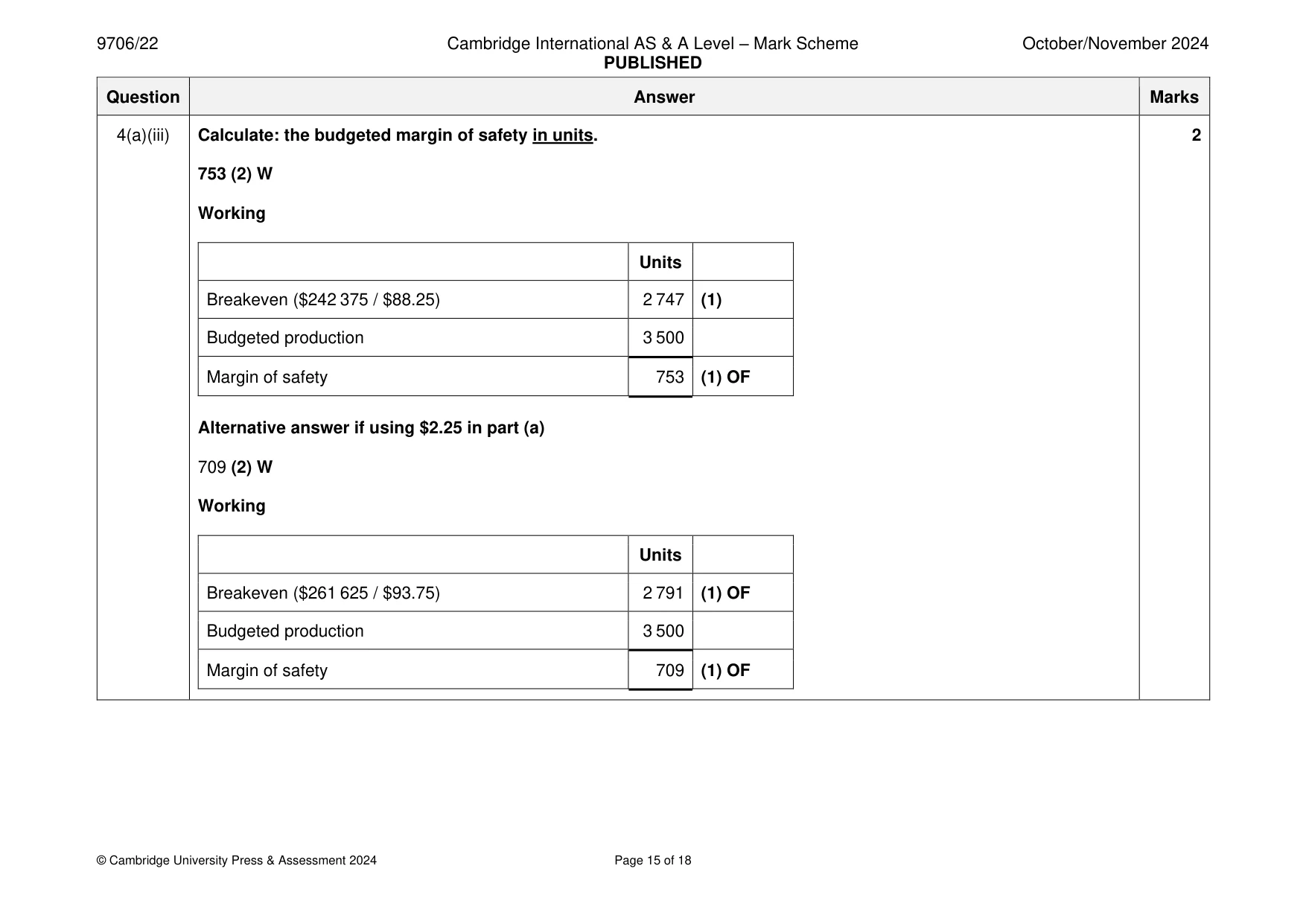
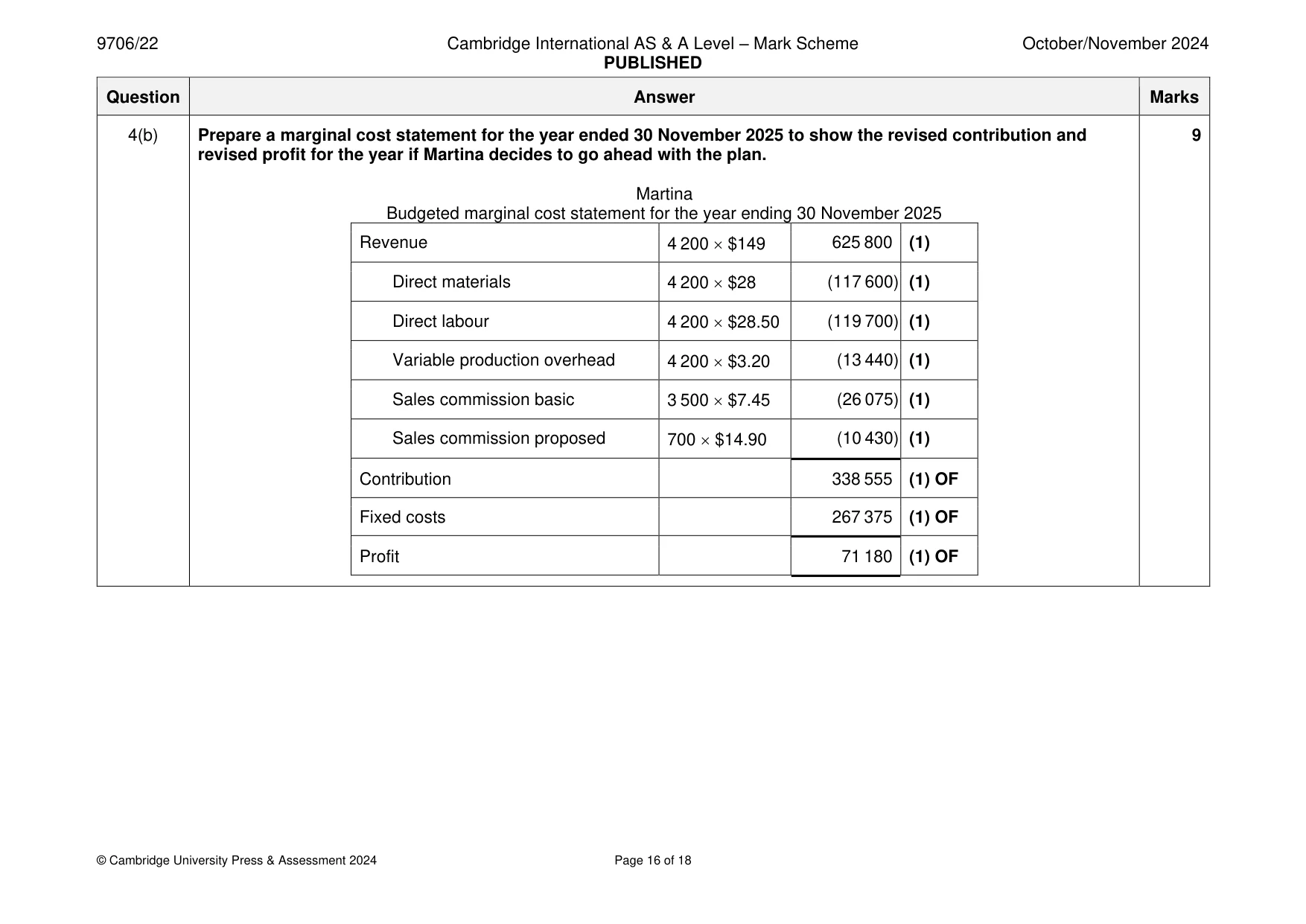
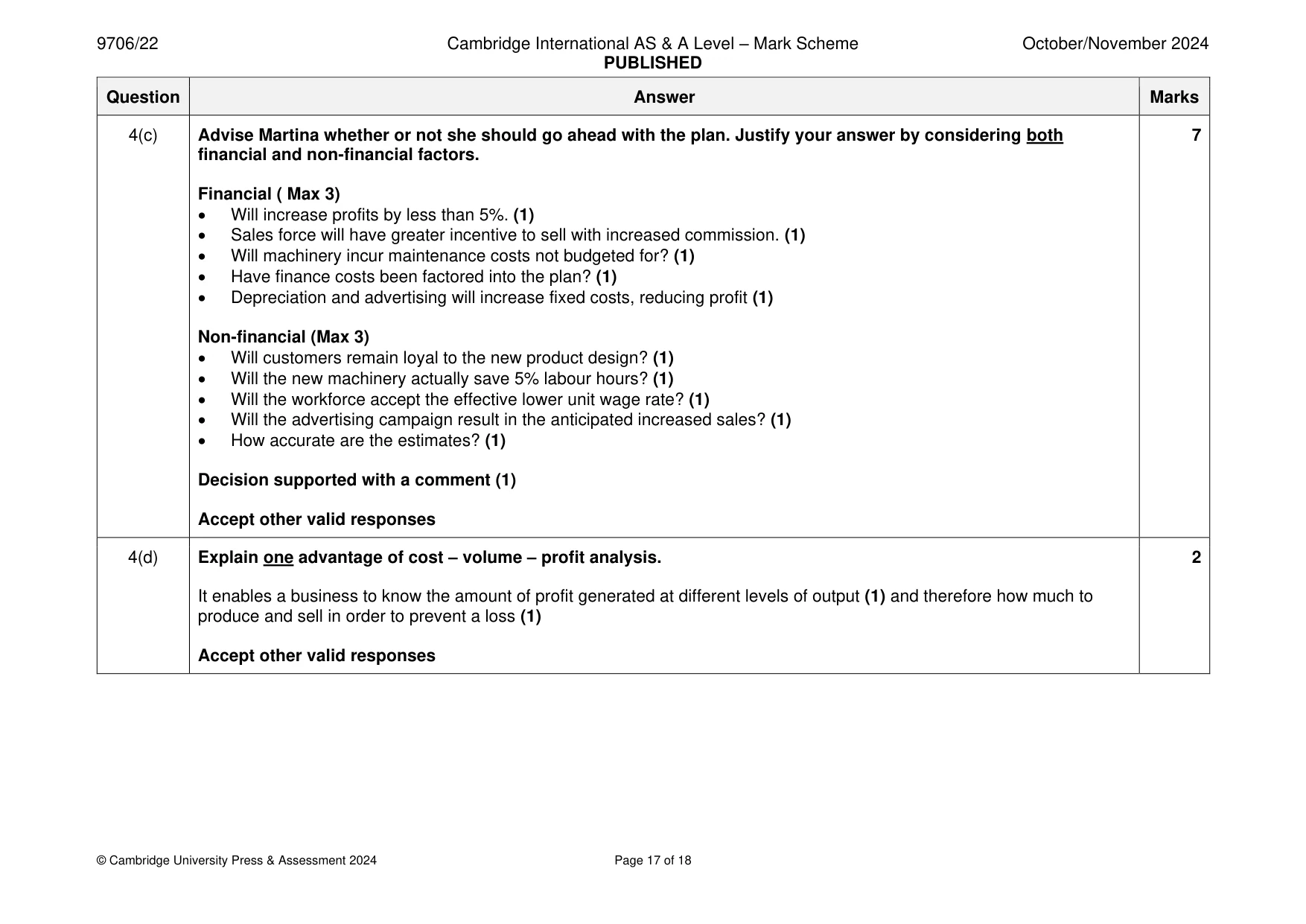
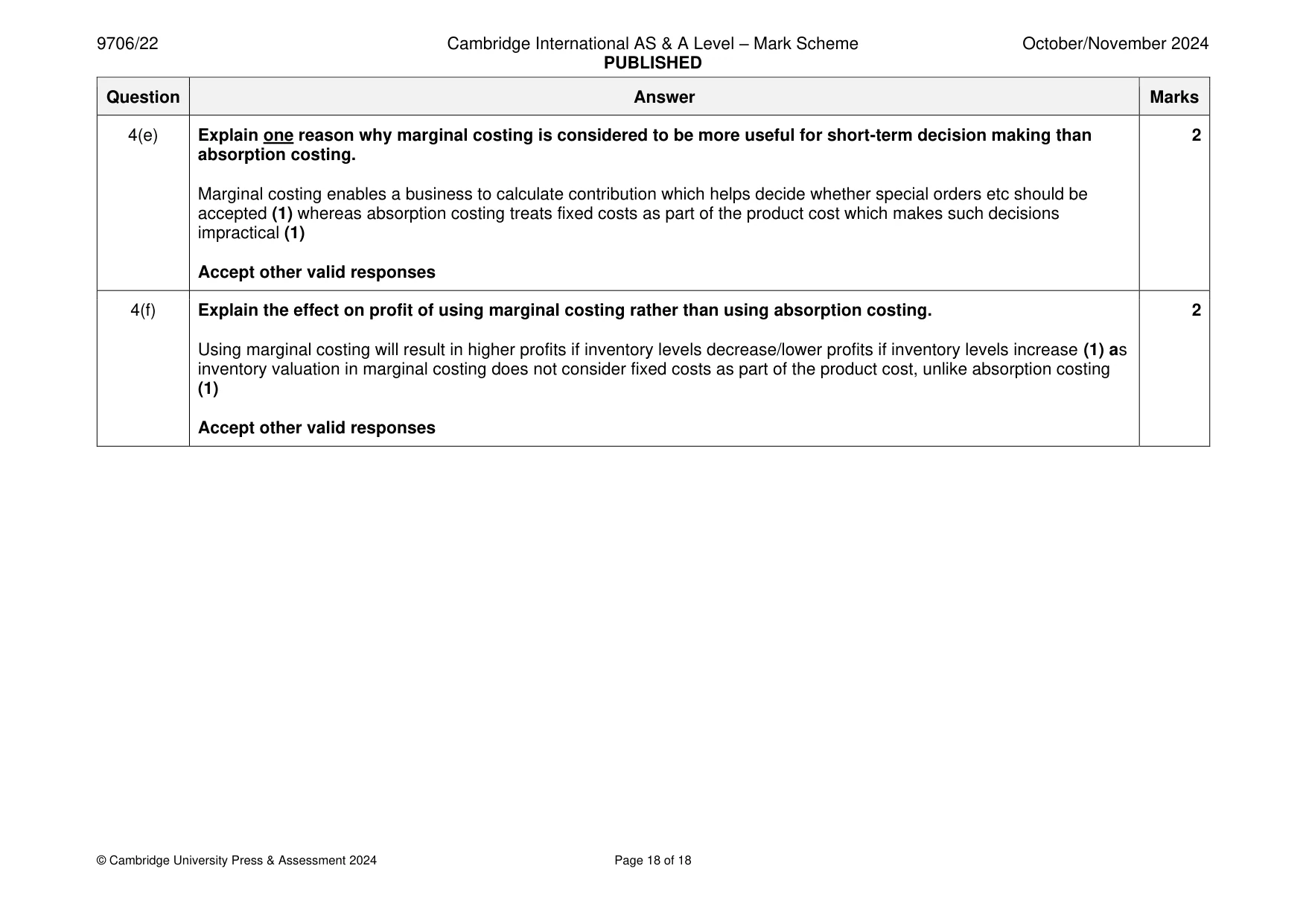
Mark scheme: 4(a)(i) Calculate: the budgeted contribution per unit. 3 $88.25 (3) W Working $96.00 (1) – $7.75 (1) = $88.25 (1)OF 4(a)(ii) Calculate: the budgeted fixed overheads for the year. 3 $242 375 (3) W Working $ Selling overheads $157 500 – ($7.75 3 500) 130 375 (1) Production overheads $126 000 – ($4 3 500) 112 000 (1) Budgeted fixed overheads 242 375 (1) OF Alternative answer if using $2.25 in part (a) $261 625 (3) W Working $ Selling overheads $157 500 – ($2.25 3 500) 149 625 (1) Production overheads $126 000 – ($4 3 500) 112 000 (1) Budgeted fixed overheads 261 625 (1) OF 4(a)(iii) Calculate: the budgeted margin of safety in units. 2 753 (2) W Working Units Breakeven ($242 375 / $88.25) 2 747 (1) Budgeted production 3 500 Margin of safety 753 (1) OF Alternative answer if using $2.25 in part (a) 709 (2) W Working Units Breakeven ($261 625 / $93.75) 2 791 (1) OF Budgeted production 3 500 Margin of safety 709 (1) OF 4(b) Prepare a marginal cost statement for the year ended 30 November 2025 to show the revised contribution and 9 revised profit for the year if Martina decides to go ahead with the plan. Martina Budgeted marginal cost statement for the year ending 30 November 2025 Revenue 4 200 $149 625 800 (1) Direct materials 4 200 $28 (117 600) (1) Direct labour 4 200 $28.50 (119 700) (1) Variable production overhead 4 200 $3.20 (13 440) (1) Sales commission basic 3 500 $7.45 (26 075) (1) Sales commission proposed 700 $14.90 (10 430) (1) Contribution 338 555 (1) OF Fixed costs 267 375 (1) OF Profit 71 180 (1) OF 4(c) Advise Martina whether or not she should go ahead with the plan. Justify your answer by considering both 7 financial and non-financial factors. Financial ( Max 3) • Will increase profits by less than 5%. (1) • Sales force will have greater incentive to sell with increased commission. (1) • Will machinery incur maintenance costs not budgeted for? (1) • Have finance costs been factored into the plan? (1) • Depreciation and advertising will increase fixed costs, reducing profit (1) Non-financial (Max 3) • Will customers remain loyal to the new product design? (1) • Will the new machinery actually save 5% labour hours? (1) • Will the workforce accept the effective lower unit wage rate? (1) • Will the advertising campaign result in the anticipated increased sales? (1) • How accurate are the estimates? (1) Decision supported with a comment (1) Accept other valid responses 4(d) Explain one advantage of cost – volume – profit analysis. 2 It enables a business to know the amount of profit generated at different levels of output (1) and therefore how much to produce and sell in order to prevent a loss (1) Accept other valid responses 4(e) Explain one reason why marginal costing is considered to be more useful for short-term decision making than 2 absorption costing. Marginal costing enables a business to calculate contribution which helps decide whether special orders etc should be accepted (1) whereas absorption costing treats fixed costs as part of the product cost which makes such decisions impractical (1) Accept other valid responses 4(f) Explain the effect on profit of using marginal costing rather than using absorption costing. 2 Using marginal costing will result in higher profits if inventory levels decrease/lower profits if inventory levels increase (1) as inventory valuation in marginal costing does not consider fixed costs as part of the product cost, unlike absorption costing (1) Accept other valid responses
Q7 · Prepare a marginal cost statement for the year ending 30 November 2025 to show the…
(b) Prepare a marginal cost statement for the year ending 30 November 2025 to show the revised contribution and revised profit for the year if Martina decides to go ahead with the plan. Martina Budgeted marginal cost statement for the year ending 30 November 2025 ................................................................................................................................................... ................................................................................................................................................... ................................................................................................................................................... ................................................................................................................................................... ................................................................................................................................................... ................................................................................................................................................... ................................................................................................................................................... ................................................................................................................................................... ................................................................................................................................................... ................................................................................................................................................... ................................................................................................................................................... ................................................................................................................................................... ................................................................................................................................................... ................................................................................................................................................... Workings: [9] (c) Advise Martina whether or not she should go ahead with the plan. Justify your answer by considering both financial and non-financial factors. ................................................................................................................................................... ................................................................................................................................................... ................................................................................................................................................... ................................................................................................................................................... ................................................................................................................................................... ................................................................................................................................................... ................................................................................................................................................... ................................................................................................................................................... ................................................................................................................................................... ................................................................................................................................................... ................................................................................................................................................... ................................................................................................................................................... ................................................................................................................................................... ................................................................................................................................................... ................................................................................................................................................... ................................................................................................................................................... ................................................................................................................................................... ................................................................................................................................................... ................................................................................................................................................... ................................................................................................................................................... ................................................................................................................................................... ................................................................................................................................................... ................................................................................................................................................... ................................................................................................................................................... ................................................................................................................................................... ............................................................................................................................................. [7]
What was in this paper
The subtopics covered by these 5 questions, and how many questions each got. Open one in a new tab to see every Cambridge question on it.
What you needed in this session
Cambridge’s own grade thresholds for 2024 Oct/Nov, Paper 2 · Variant 2. A higher threshold means an easier paper — the bar moves with how the cohort did.