Cambridge A Level Accounting 9706 — 2025 May/June Paper 2 · Variant 2
9706/22/M/J/25 · 6 questions · 90 marks · ≈101 min
The question paper and its mark scheme, free to read here and free to download. This is Cambridge’s own paper, exactly as it was sat.
Question paper20 pages
Mark scheme17 pages
Answers below. Sit the paper first if you are practising.
Questions as text
Q1 · H Limited’s financial year ended on 31 December 2024
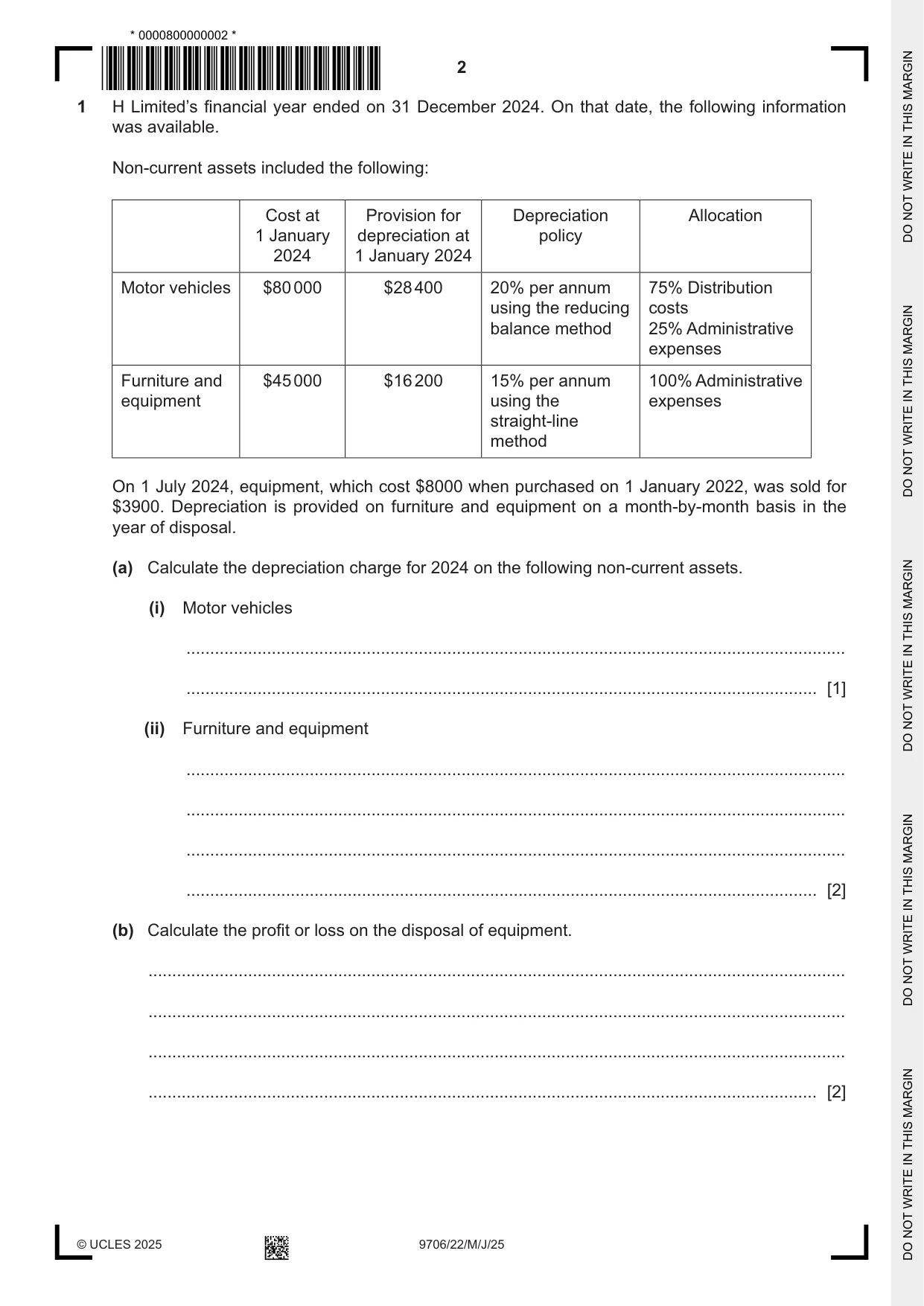
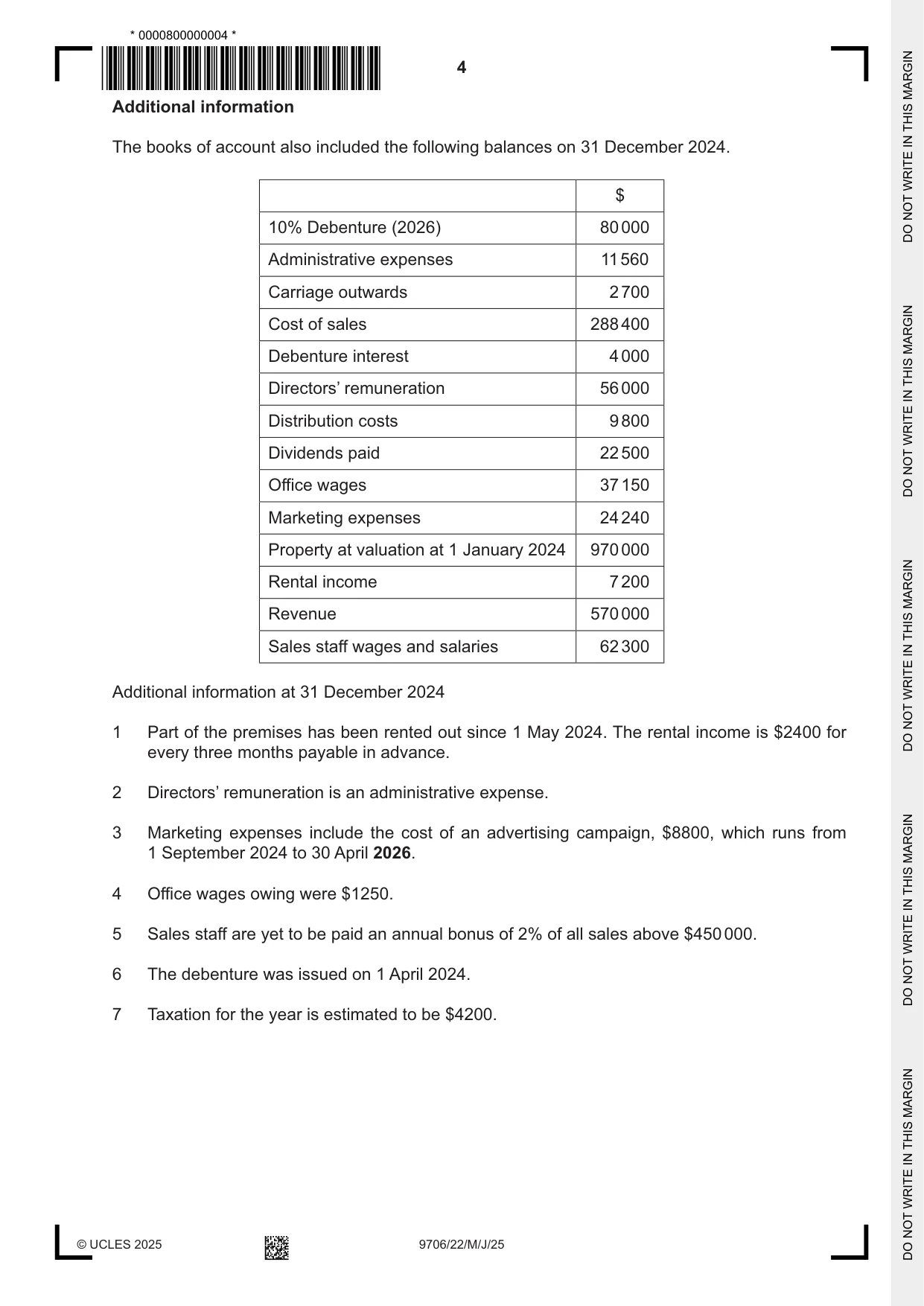
1 H Limited’s financial year ended on 31 December 2024. On that date, the following information was available. Non-current assets included the following: Cost at Provision for Depreciation Allocation 1 January depreciation at policy 2024 1 January 2024 Motor vehicles $80 000 $28 400 20% per annum 75% Distribution using the reducing costs balance method 25% Administrative expenses Furniture and $45 000 $16 200 15% per annum 100% Administrative equipment using the expenses straight-line method On 1 July 2024, equipment, which cost $8000 when purchased on 1 January 2022, was sold for $3900. Depreciation is provided on furniture and equipment on a month-by-month basis in the year of disposal. (a) Calculate the depreciation charge for 2024 on the following non-current assets. (i) Motor vehicles ........................................................................................................................................... ..................................................................................................................................... [1] (ii) Furniture and equipment ........................................................................................................................................... ........................................................................................................................................... ........................................................................................................................................... ..................................................................................................................................... [2] (b) Calculate the profit or loss on the disposal of equipment. ................................................................................................................................................... ................................................................................................................................................... ................................................................................................................................................... ............................................................................................................................................. [2] Additional information The books of account also included the following balances on 31 December 2024. $ 10% Debenture (2026) 80 000 Administrative expenses 11 560 Carriage outwards 2 700 Cost of sales 288 400 Debenture interest 4 000 Directors’ remuneration 56 000 Distribution costs 9 800 Dividends paid 22 500 Office wages 37 150 Marketing expenses 24 240 Property at valuation at 1 January 2024 970 000 Rental income 7 200 Revenue 570 000 Sales staff wages and salaries 62 300 Additional information at 31 December 2024 1 Part of the premises has been rented out since 1 May 2024. The rental income is $2400 for every three months payable in advance.
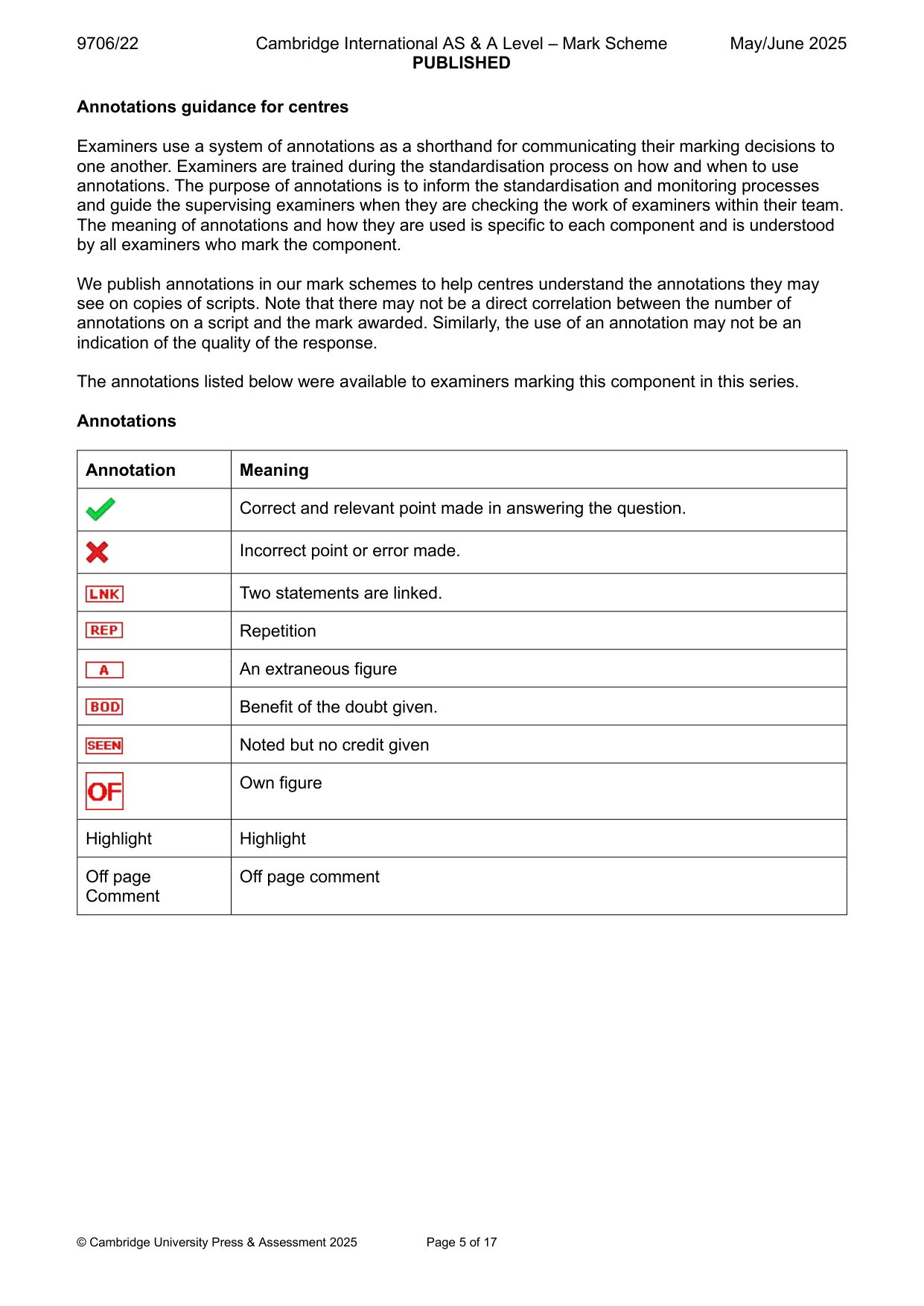
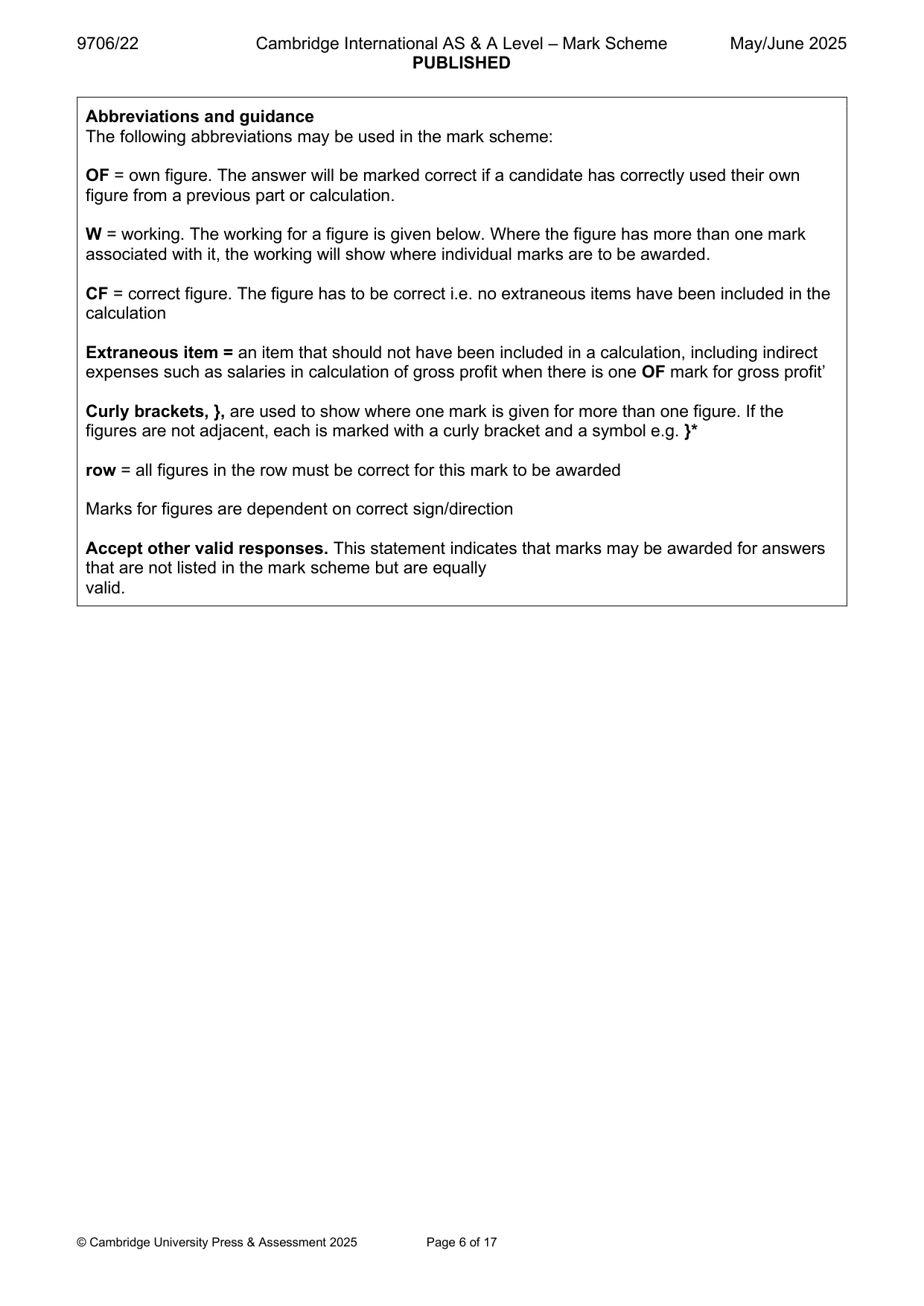
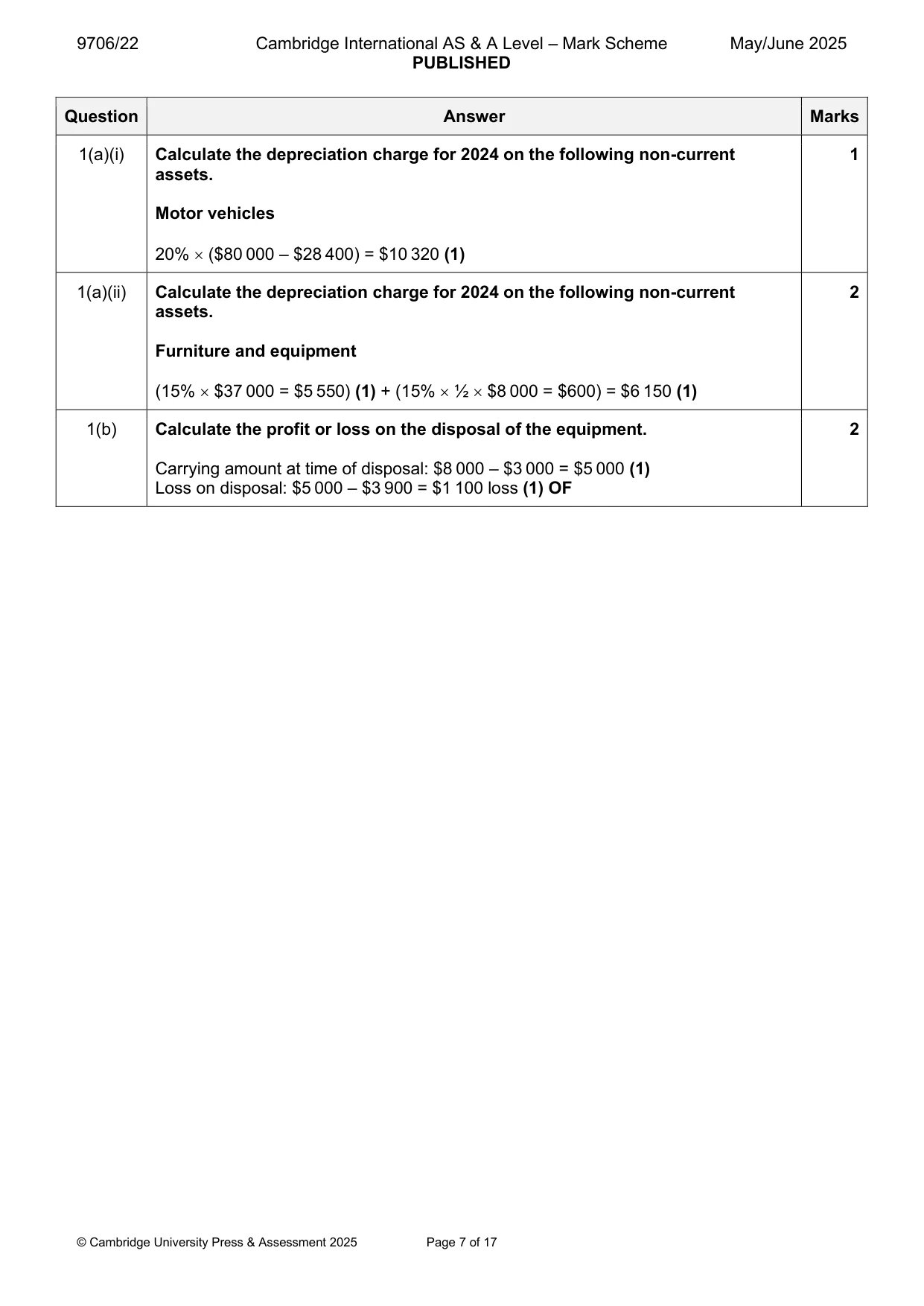
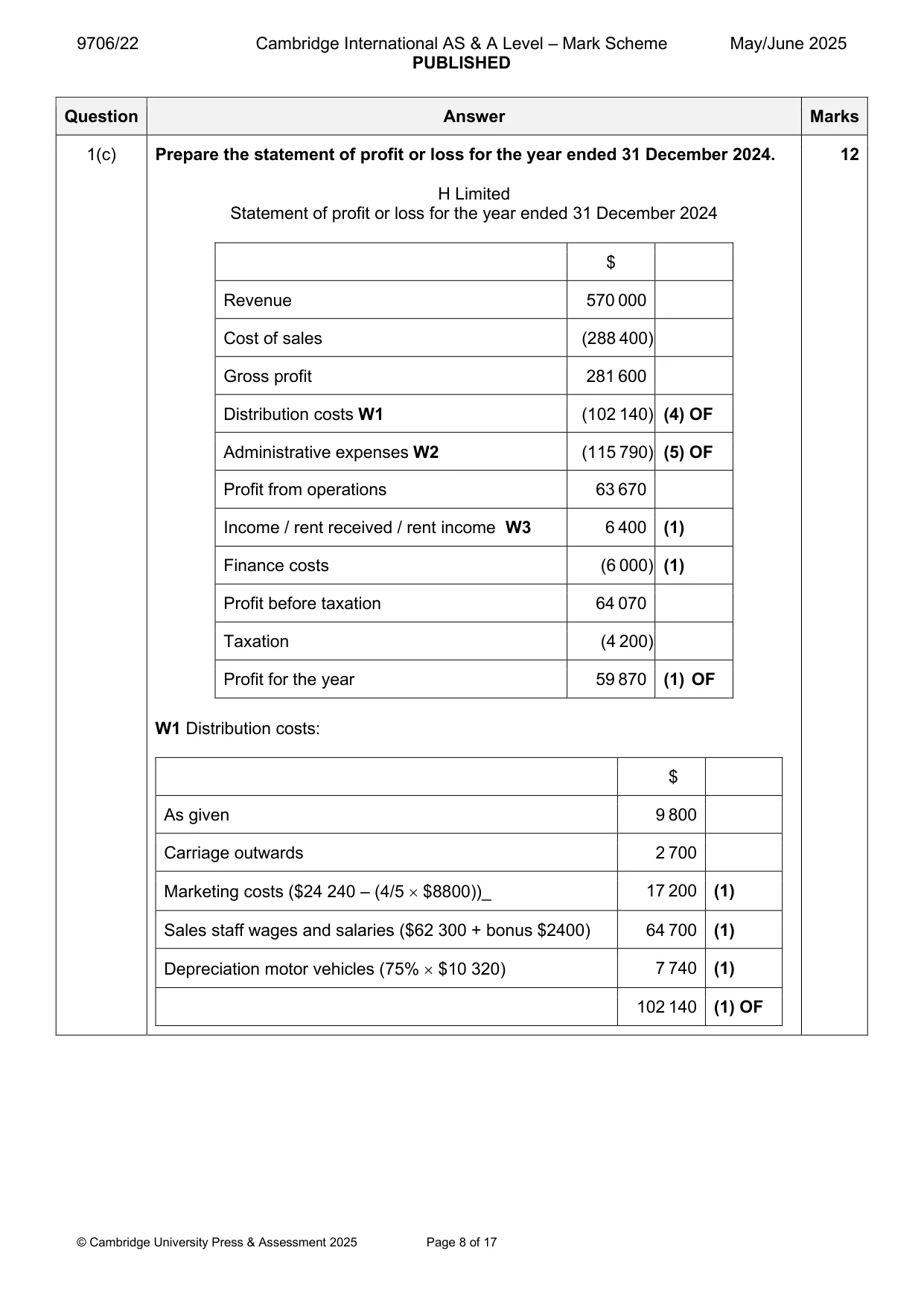
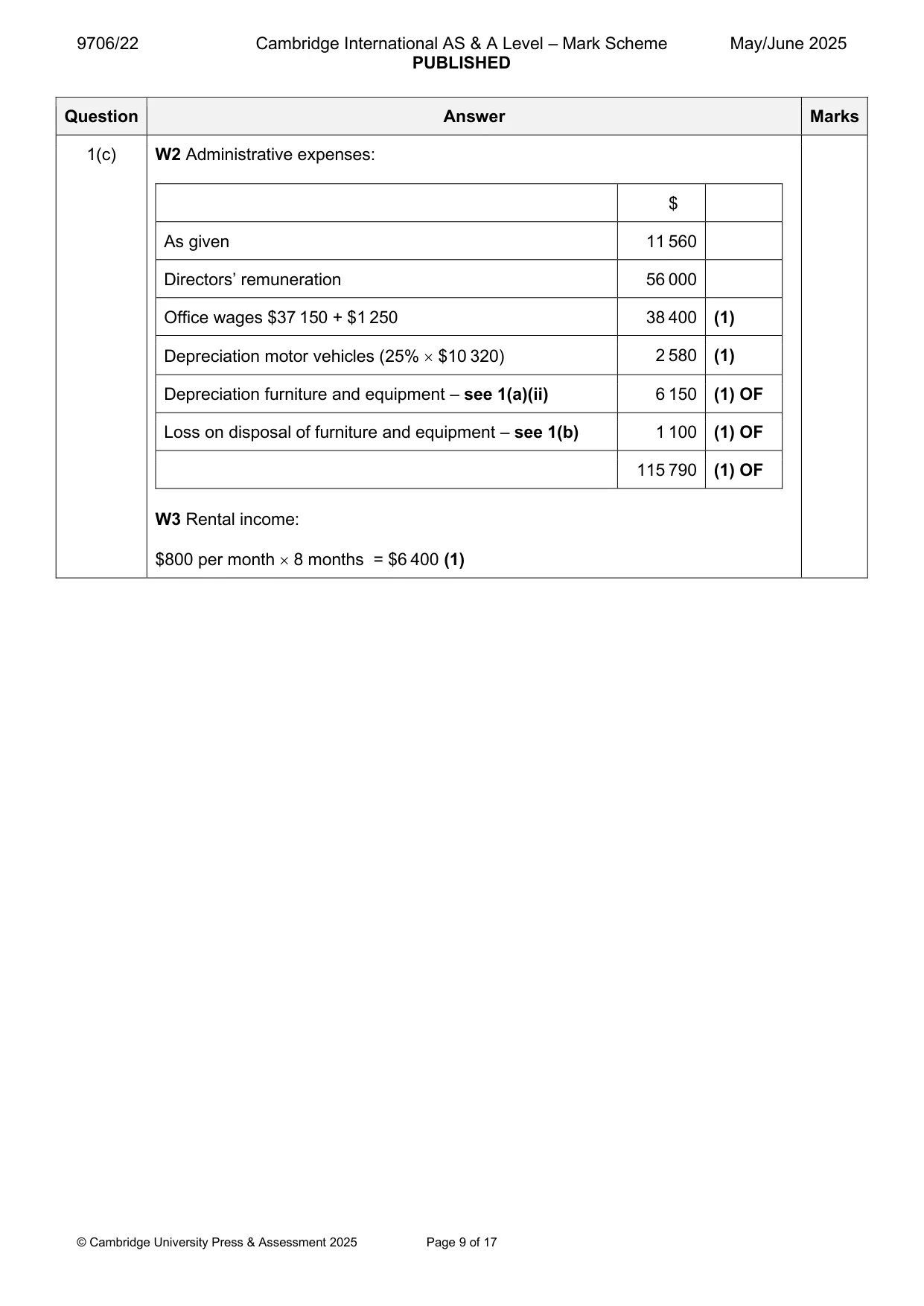
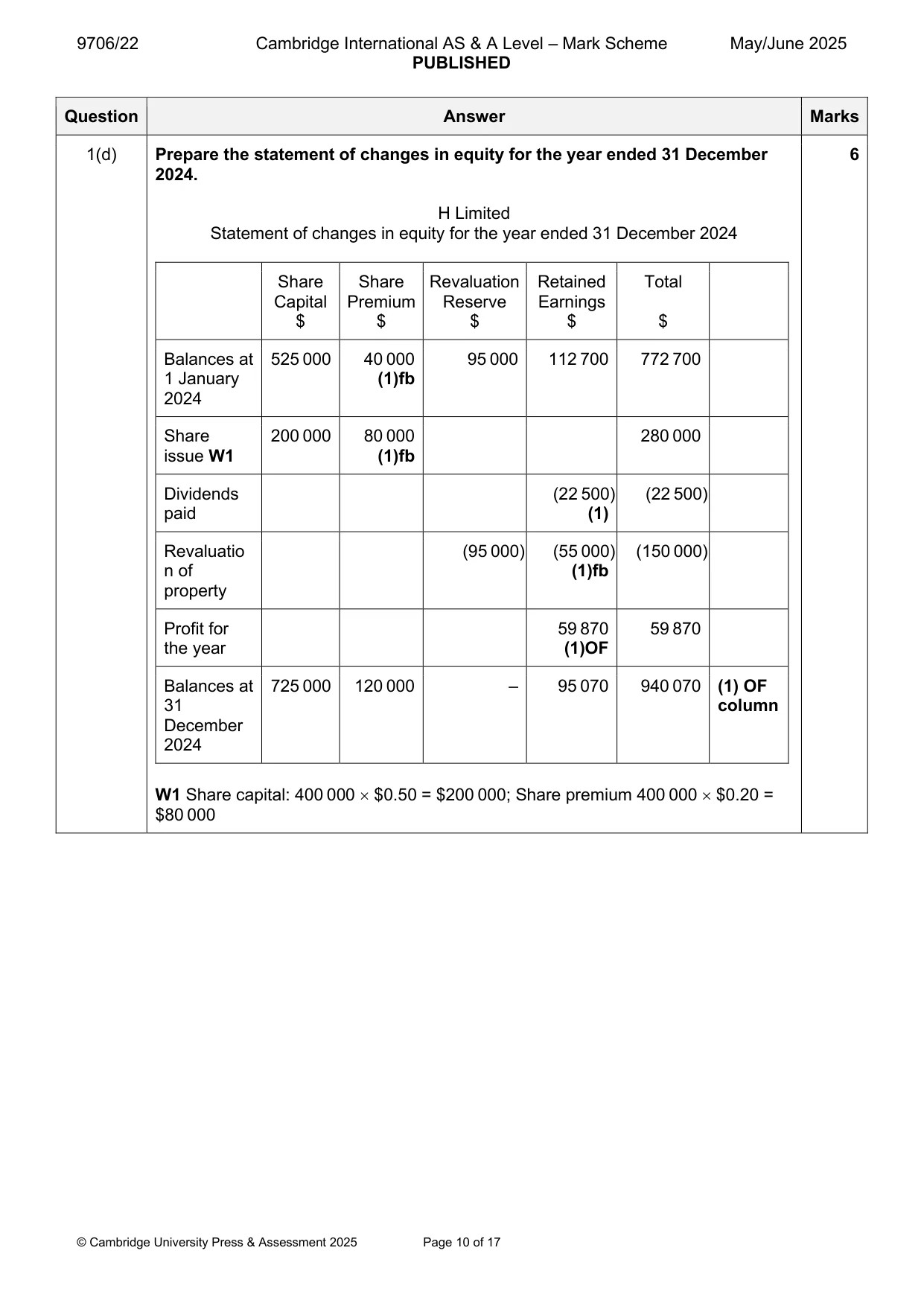
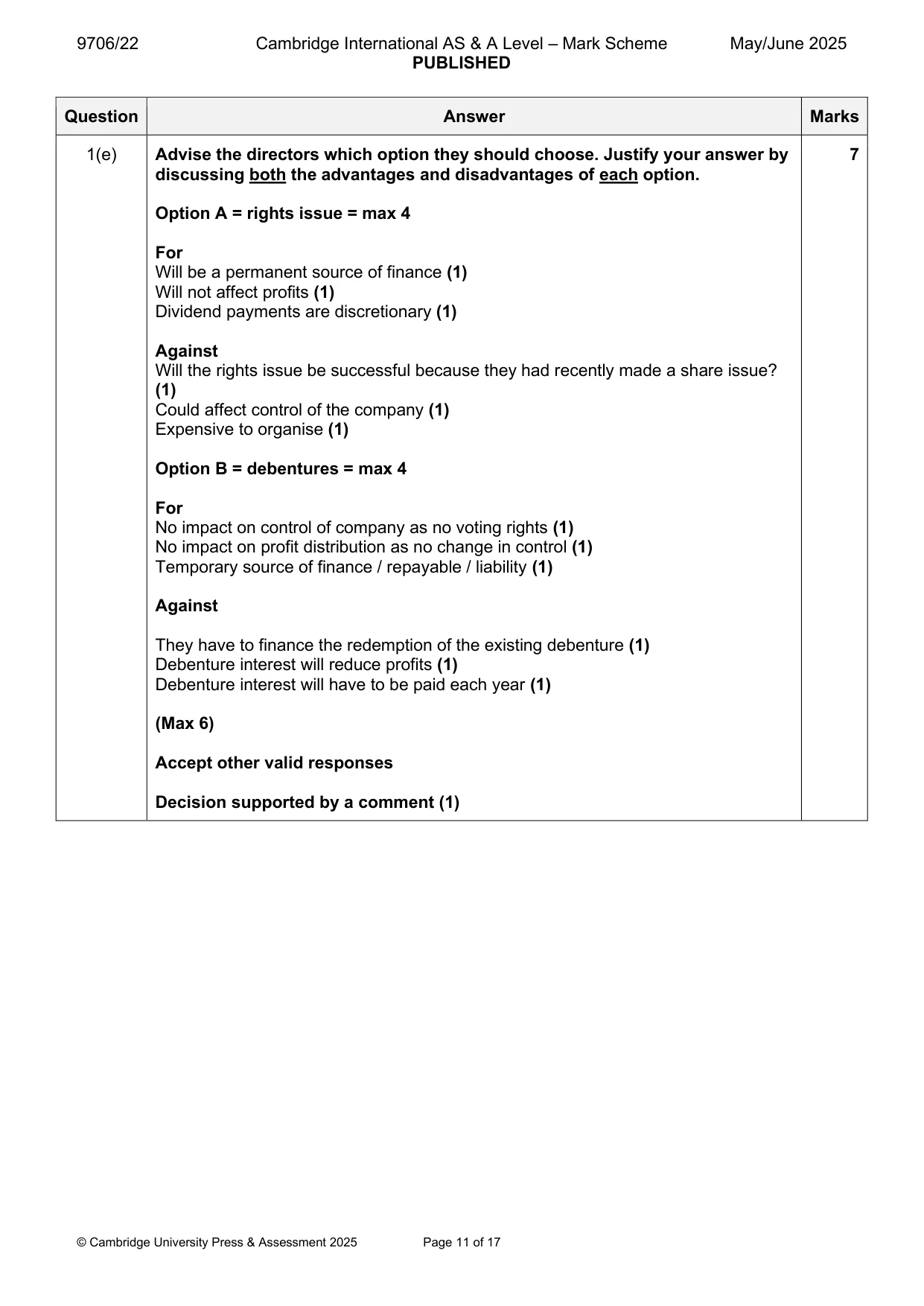
Mark scheme: Question Answer Marks 1(a)(i) Calculate the depreciation charge for 2024 on the following non-current 1 assets. Motor vehicles 20% ($80 000 – $28 400) = $10 320 (1) 1(a)(ii) Calculate the depreciation charge for 2024 on the following non-current 2 assets. Furniture and equipment (15% $37 000 = $5 550) (1) + (15% ½ $8 000 = $600) = $6 150 (1) 1(b) Calculate the profit or loss on the disposal of the equipment. 2 Carrying amount at time of disposal: $8 000 – $3 000 = $5 000 (1) Loss on disposal: $5 000 – $3 900 = $1 100 loss (1) OF 1(c) Prepare the statement of profit or loss for the year ended 31 December 2024. 12 H Limited Statement of profit or loss for the year ended 31 December 2024 $ Revenue 570 000 Cost of sales (288 400) Gross profit 281 600 Distribution costs W1 (102 140) (4) OF Administrative expenses W2 (115 790) (5) OF Profit from operations 63 670 Income / rent received / rent income W3 6 400 (1) Finance costs (6 000) (1) Profit before taxation 64 070 Taxation (4 200) Profit for the year 59 870 (1) OF W1 Distribution costs: $ As given 9 800 Carriage outwards 2 700 Marketing costs ($24 240 – (4/5 $8800))_ 17 200 (1) Sales staff wages and salaries ($62 300 + bonus $2400) 64 700 (1) Depreciation motor vehicles (75% $10 320) 7 740 (1) 102 140 (1) OF 1(c) W2 Administrative expenses: $ As given 11 560 Directors’ remuneration 56 000 Office wages $37 150 + $1 250 38 400 (1) Depreciation motor vehicles (25% $10 320) 2 580 (1) Depreciation furniture and equipment – see 1(a)(ii) 6 150 (1) OF Loss on disposal of furniture and equipment – see 1(b) 1 100 (1) OF 115 790 (1) OF W3 Rental income: $800 per month 8 months = $6 400 (1) 1(d) Prepare the statement of changes in equity for the year ended 31 December 6 2024. H Limited Statement of changes in equity for the year ended 31 December 2024 Share Share Revaluation Retained Total Capital Premium Reserve Earnings $ $ $ $ $ Balances at 525 000 40 000 95 000 112 700 772 700 1 January (1)fb 2024 Share 200 000 80 000 280 000 issue W1 (1)fb Dividends (22 500) (22 500) paid (1) Revaluatio (95 000) (55 000) (150 000) n of (1)fb property Profit for 59 870 59 870 the year (1)OF Balances at 725 000 120 000 – 95 070 940 070 (1) OF 31 column December 2024 W1 Share capital: 400 000 $0.50 = $200 000; Share premium 400 000 $0.20 = $80 000 1(e) Advise the directors which option they should choose. Justify your answer by 7 discussing both the advantages and disadvantages of each option. Option A = rights issue = max 4 For Will be a permanent source of finance (1) Will not affect profits (1) Dividend payments are discretionary (1) Against Will the rights issue be successful because they had recently made a share issue? (1) Could affect control of the company (1) Expensive to organise (1) Option B = debentures = max 4 For No impact on control of company as no voting rights (1) No impact on profit distribution as no change in control (1) Temporary source of finance / repayable / liability (1) Against They have to finance the redemption of the existing debenture (1) Debenture interest will reduce profits (1) Debenture interest will have to be paid each year (1) (Max 6) Accept other valid responses Decision supported by a comment (1)
Q2 · Virat prepared the trial balance at 28 February 2025, the end of his financial year
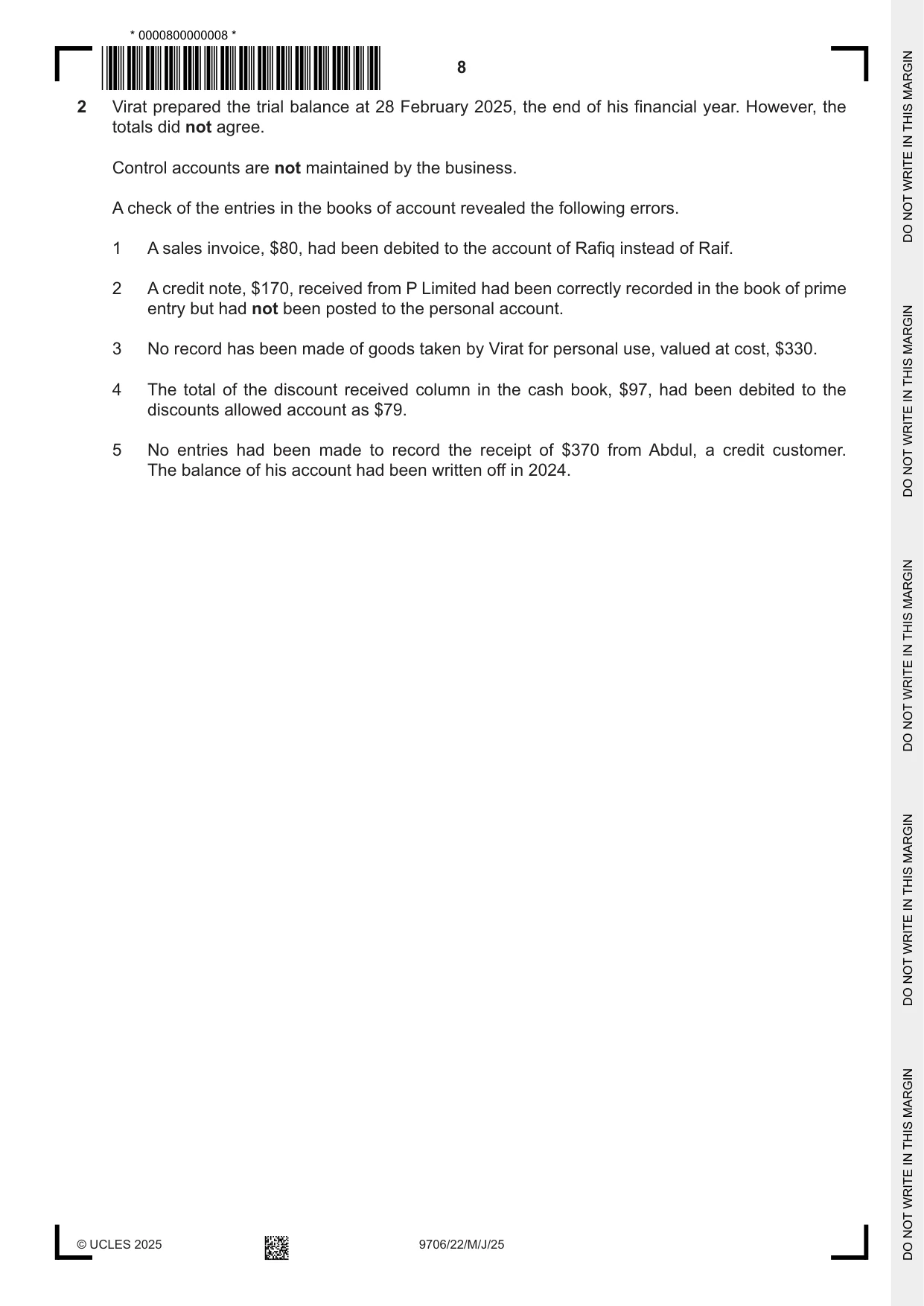
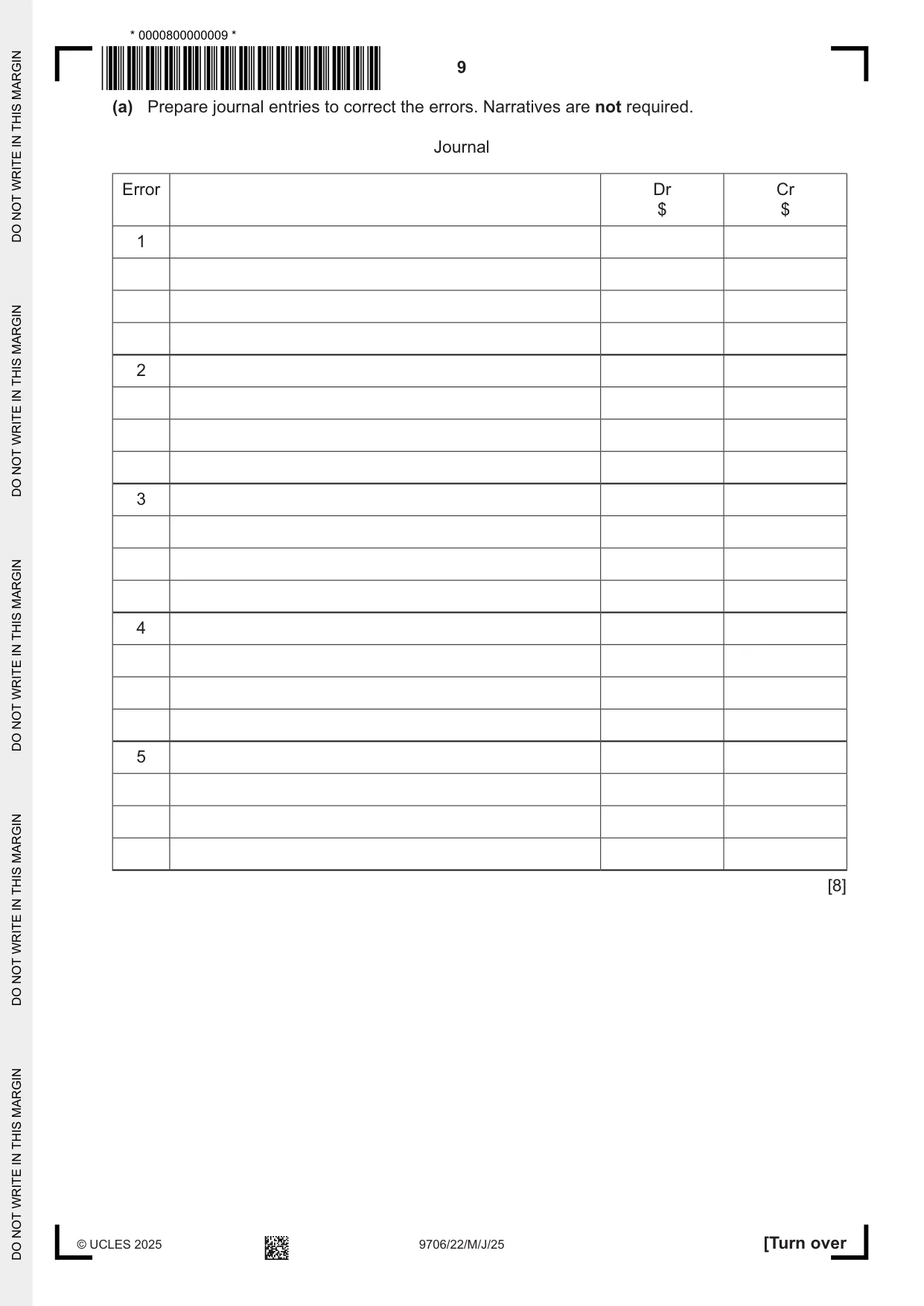
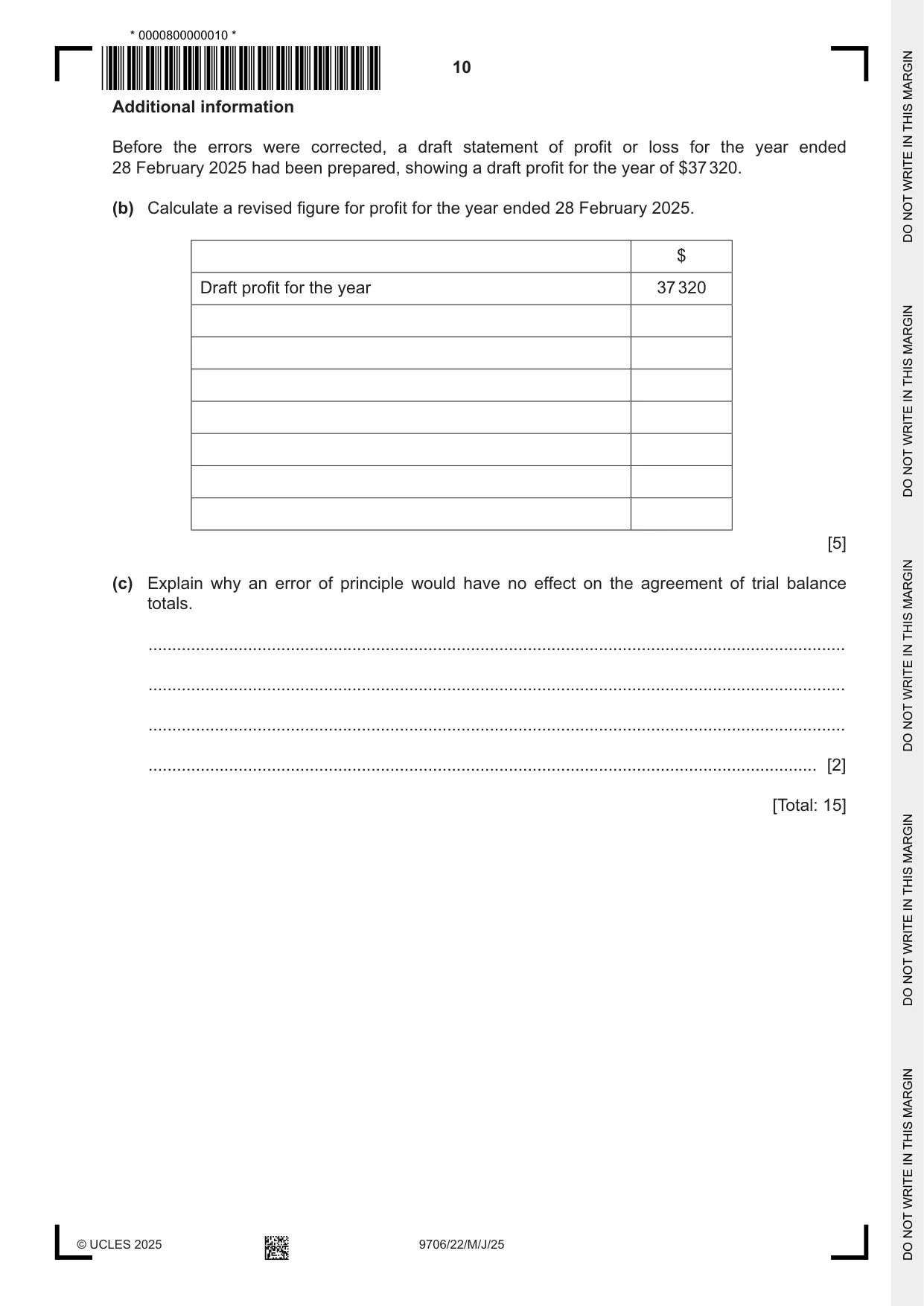
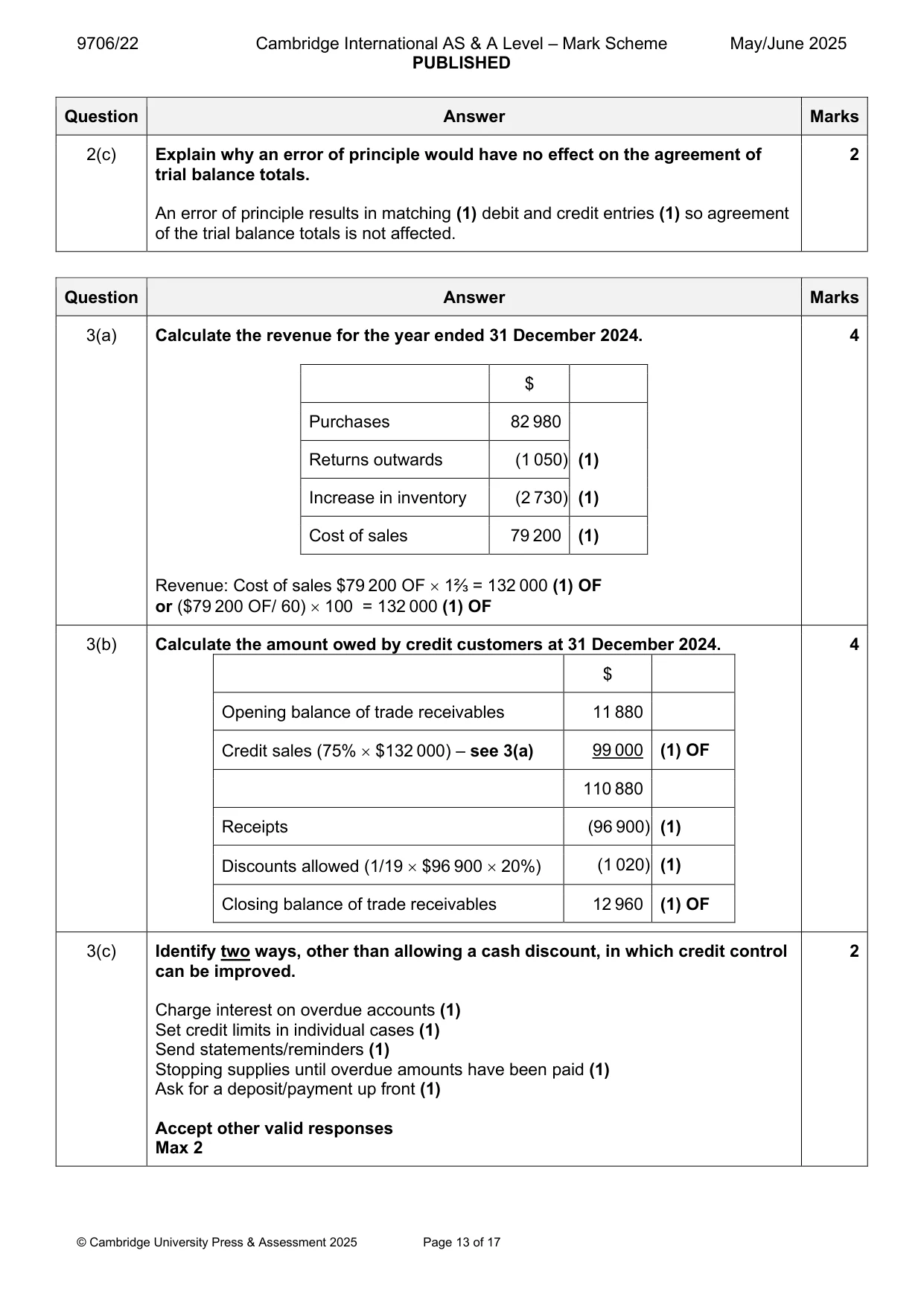
2 Virat prepared the trial balance at 28 February 2025, the end of his financial year. However, the totals did not agree. Control accounts are not maintained by the business. A check of the entries in the books of account revealed the following errors. 1 A sales invoice, $80, had been debited to the account of Rafiq instead of Raif. 2 A credit note, $170, received from P Limited had been correctly recorded in the book of prime entry but had not been posted to the personal account. 3 No record has been made of goods taken by Virat for personal use, valued at cost, $330. 4 The total of the discount received column in the cash book, $97, had been debited to the discounts allowed account as $79. 5 No entries had been made to record the receipt of $370 from Abdul, a credit customer. The balance of his account had been written off in 2024. (a) Prepare journal entries to correct the errors. Narratives are not required. Journal Error Dr Cr $ $ 1 2 3 4 5 [8] Additional information Before the errors were corrected, a draft statement of profit or loss for the year ended 28 February 2025 had been prepared, showing a draft profit for the year of $37 320. (b) Calculate a revised figure for profit for the year ended 28 February 2025. $ Draft profit for the year 37 320 [5] (c) Explain why an error of principle would have no effect on the agreement of trial balance totals. ................................................................................................................................................... ................................................................................................................................................... ................................................................................................................................................... ............................................................................................................................................. [2] [Total: 15]
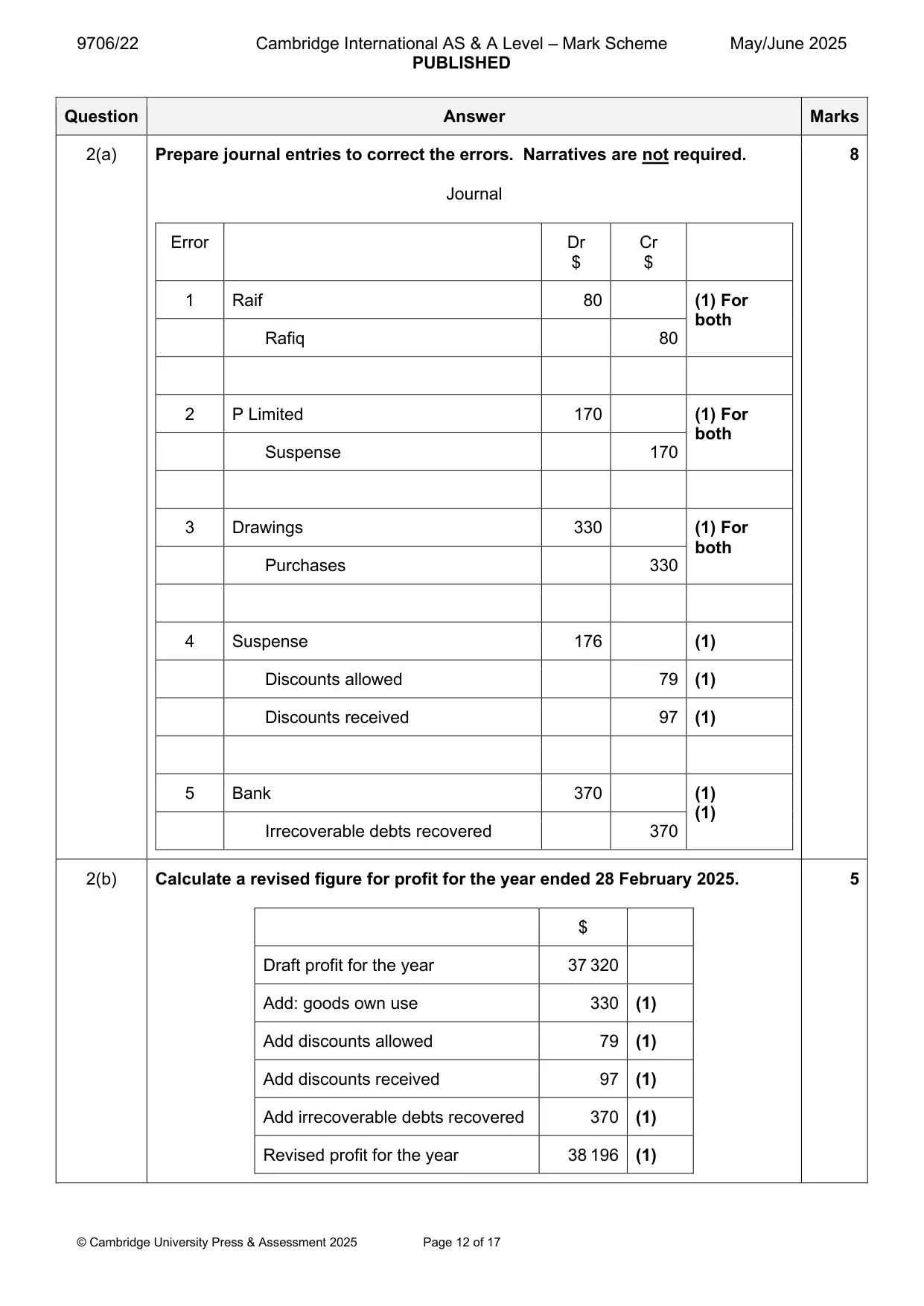
Mark scheme: Question Answer Marks 2(a) Prepare journal entries to correct the errors. Narratives are not required. 8 Journal Error Dr Cr $ $ 1 Raif 80 (1) For both Rafiq 80 2 P Limited 170 (1) For both Suspense 170 3 Drawings 330 (1) For both Purchases 330 4 Suspense 176 (1) Discounts allowed 79 (1) Discounts received 97 (1) 5 Bank 370 (1) (1) Irrecoverable debts recovered 370 2(b) Calculate a revised figure for profit for the year ended 28 February 2025. 5 $ Draft profit for the year 37 320 Add: goods own use 330 (1) Add discounts allowed 79 (1) Add discounts received 97 (1) Add irrecoverable debts recovered 370 (1) Revised profit for the year 38 196 (1) 2(c) Explain why an error of principle would have no effect on the agreement of 2 trial balance totals. An error of principle results in matching (1) debit and credit entries (1) so agreement of the trial balance totals is not affected.
Q3 · Marketing expenses include the cost of an advertising campaign, $8800, which runs from 1…
3 Marketing expenses include the cost of an advertising campaign, $8800, which runs from 1 September 2024 to 30 April 2026.
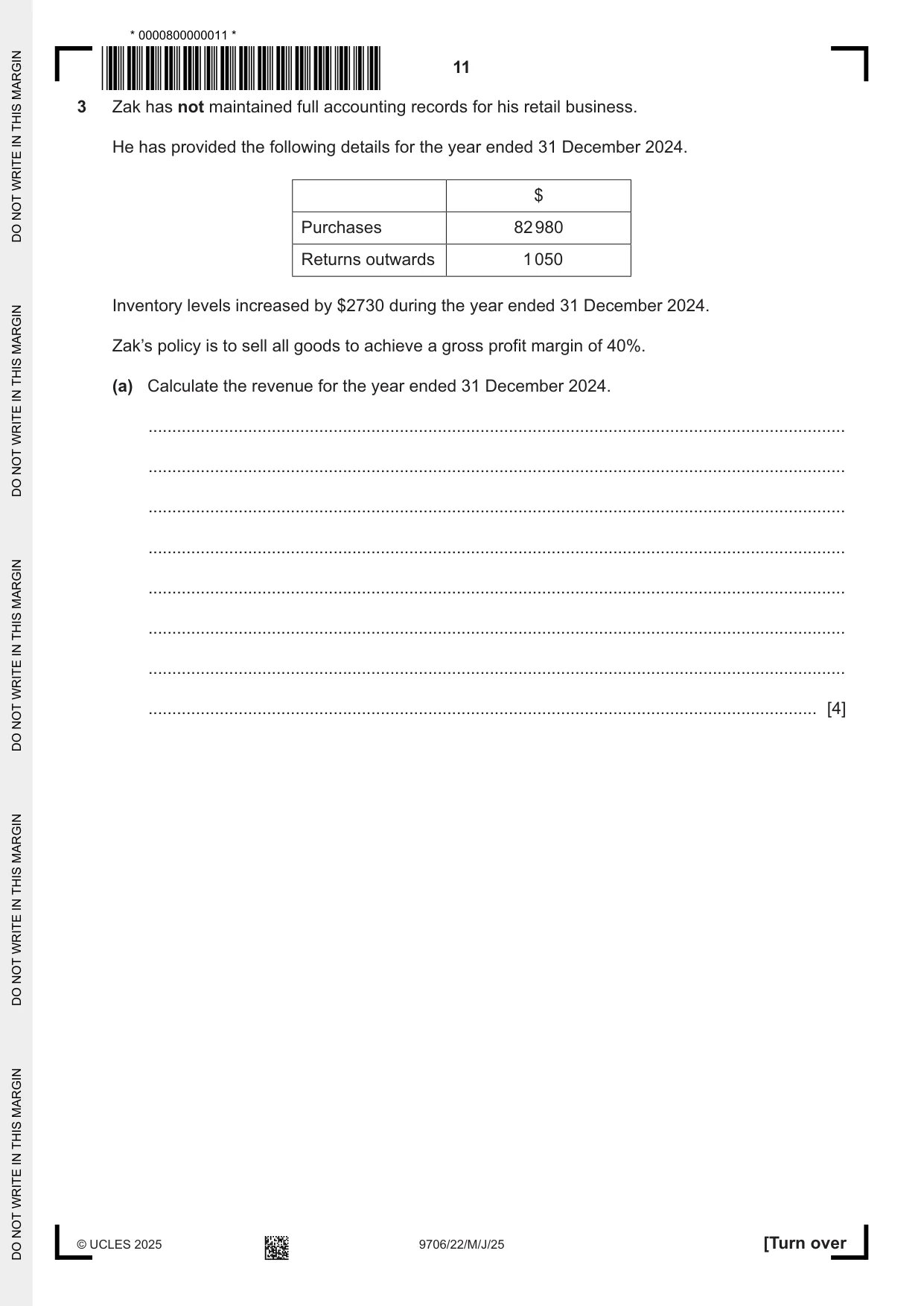
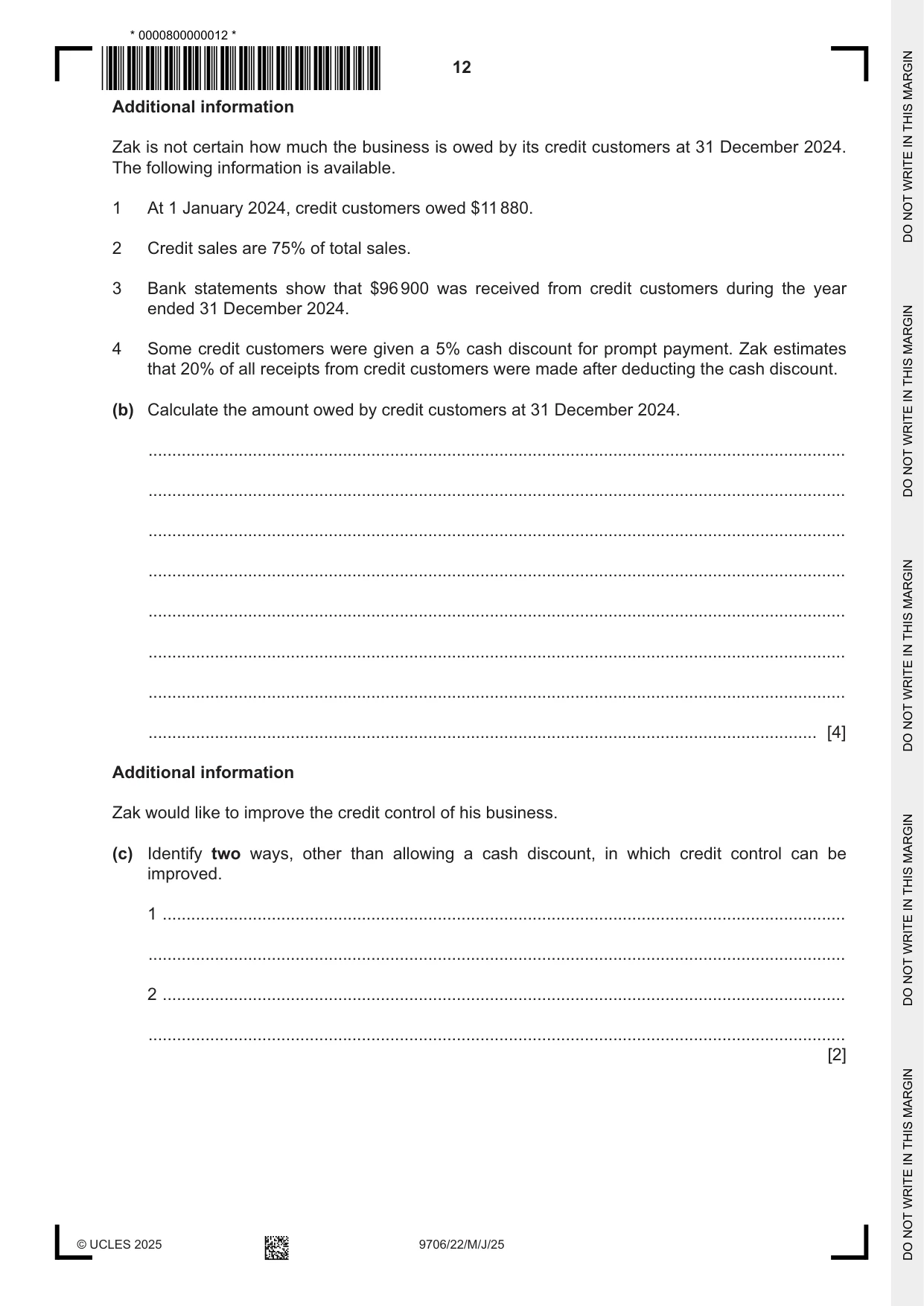
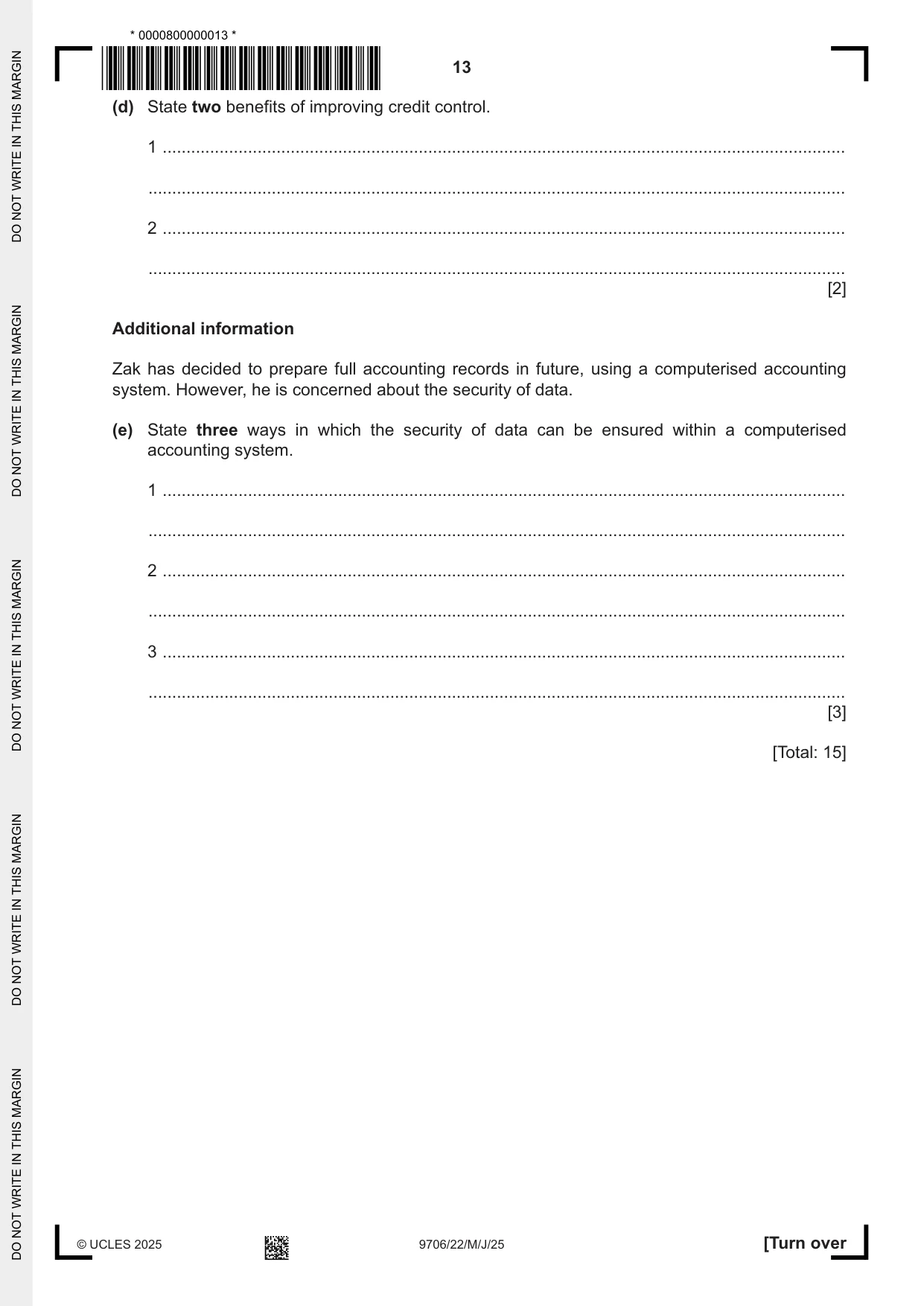
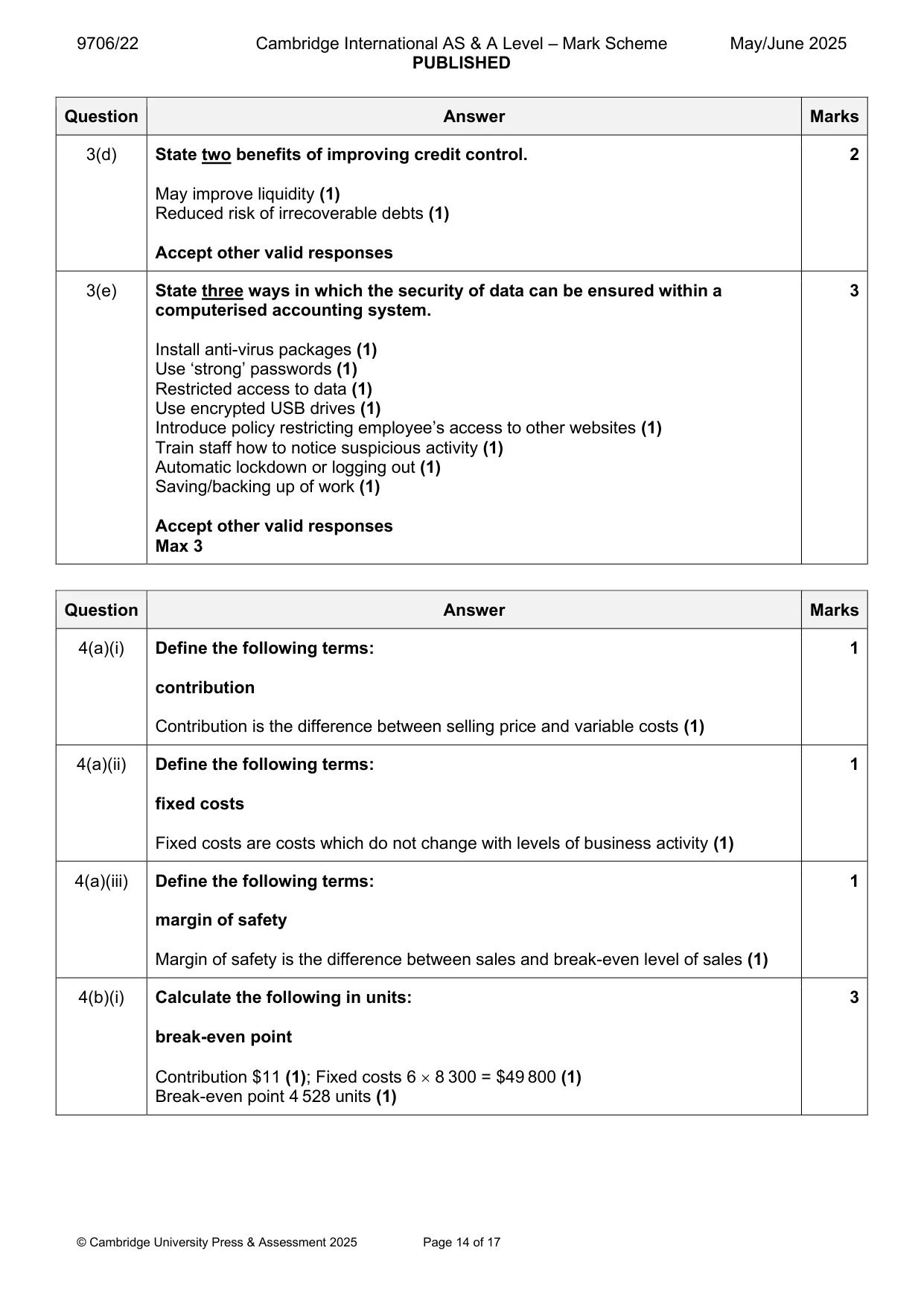
Mark scheme: 3(a) Calculate the revenue for the year ended 31 December 2024. 4 $ Purchases 82 980 Returns outwards (1 050) (1) Increase in inventory (2 730) (1) Cost of sales 79 200 (1) Revenue: Cost of sales $79 200 OF 1⅔ = 132 000 (1) OF or ($79 200 OF/ 60) 100 = 132 000 (1) OF 3(b) Calculate the amount owed by credit customers at 31 December 2024. 4 $ Opening balance of trade receivables 11 880 Credit sales (75% $132 000) – see 3(a) 99 000 (1) OF 110 880 Receipts (96 900) (1) Discounts allowed (1/19 $96 900 20%) (1 020) (1) Closing balance of trade receivables 12 960 (1) OF 3(c) Identify two ways, other than allowing a cash discount, in which credit control 2 can be improved. Charge interest on overdue accounts (1) Set credit limits in individual cases (1) Send statements/reminders (1) Stopping supplies until overdue amounts have been paid (1) Ask for a deposit/payment up front (1) Accept other valid responses Max 2 3(d) State two benefits of improving credit control. 2 May improve liquidity (1) Reduced risk of irrecoverable debts (1) Accept other valid responses 3(e) State three ways in which the security of data can be ensured within a 3 computerised accounting system. Install anti-virus packages (1) Use ‘strong’ passwords (1) Restricted access to data (1) Use encrypted USB drives (1) Introduce policy restricting employee’s access to other websites (1) Train staff how to notice suspicious activity (1) Automatic lockdown or logging out (1) Saving/backing up of work (1) Accept other valid responses Max 3
Q4 · M Limited manufactures a single product at one of its factories
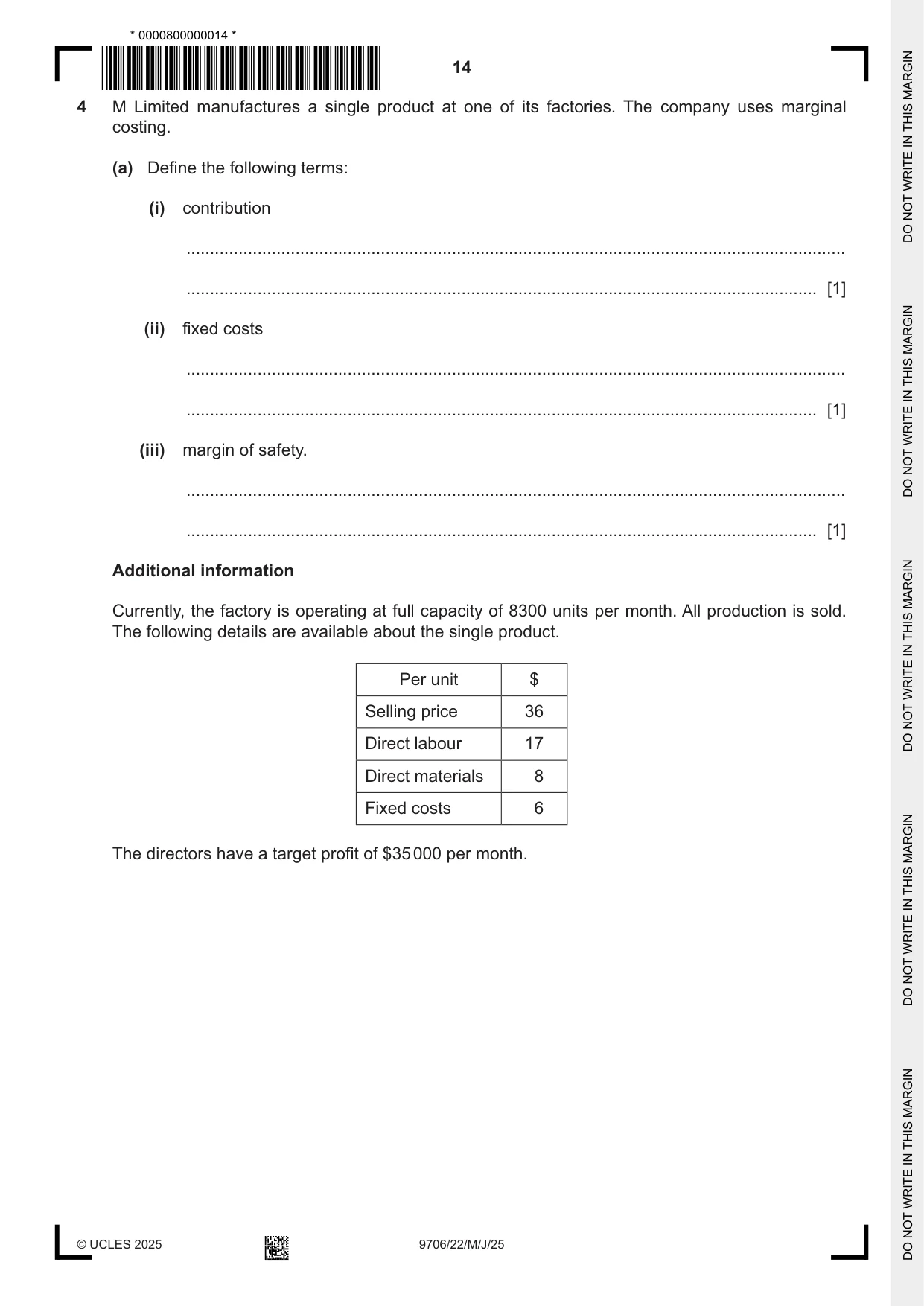
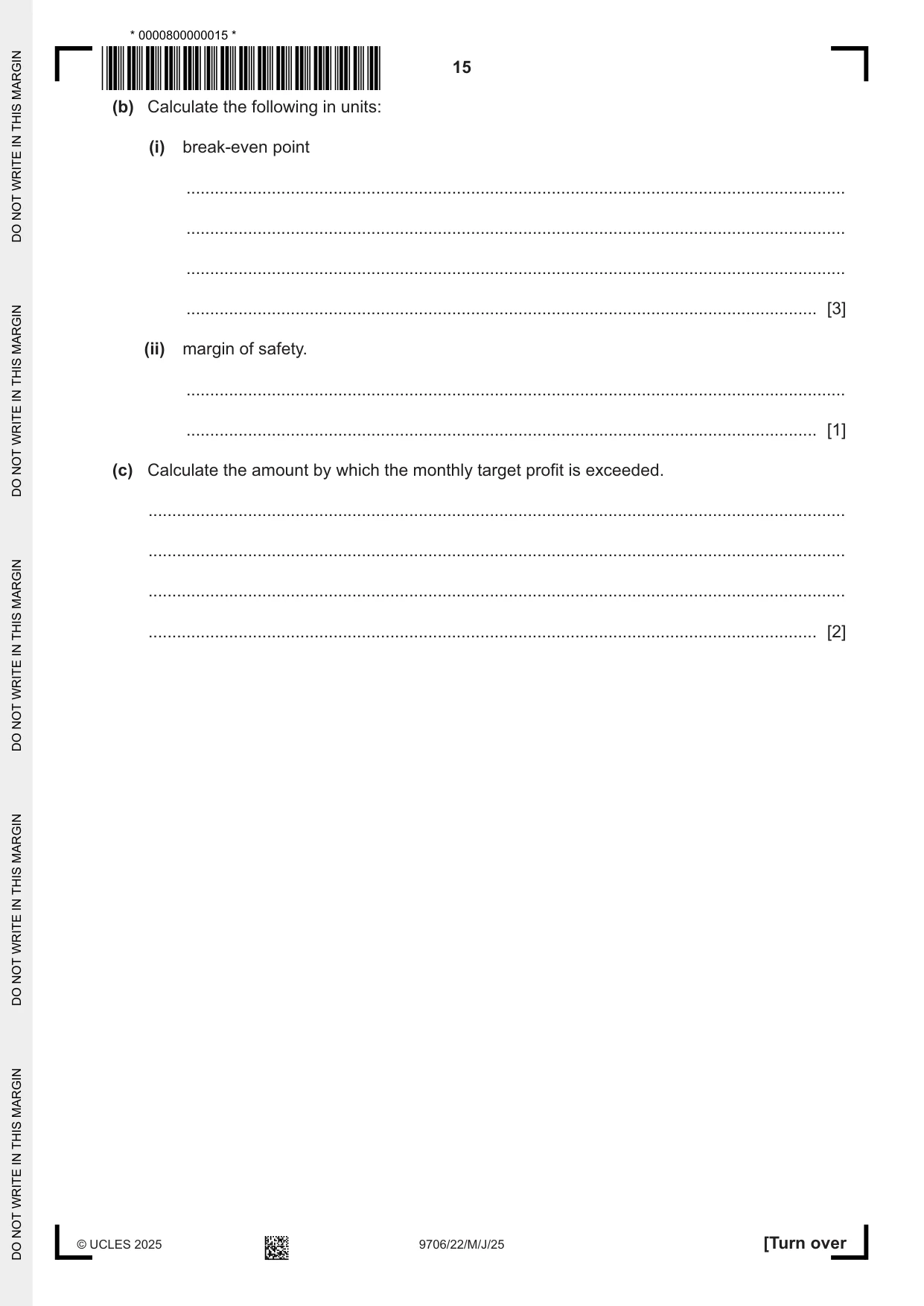
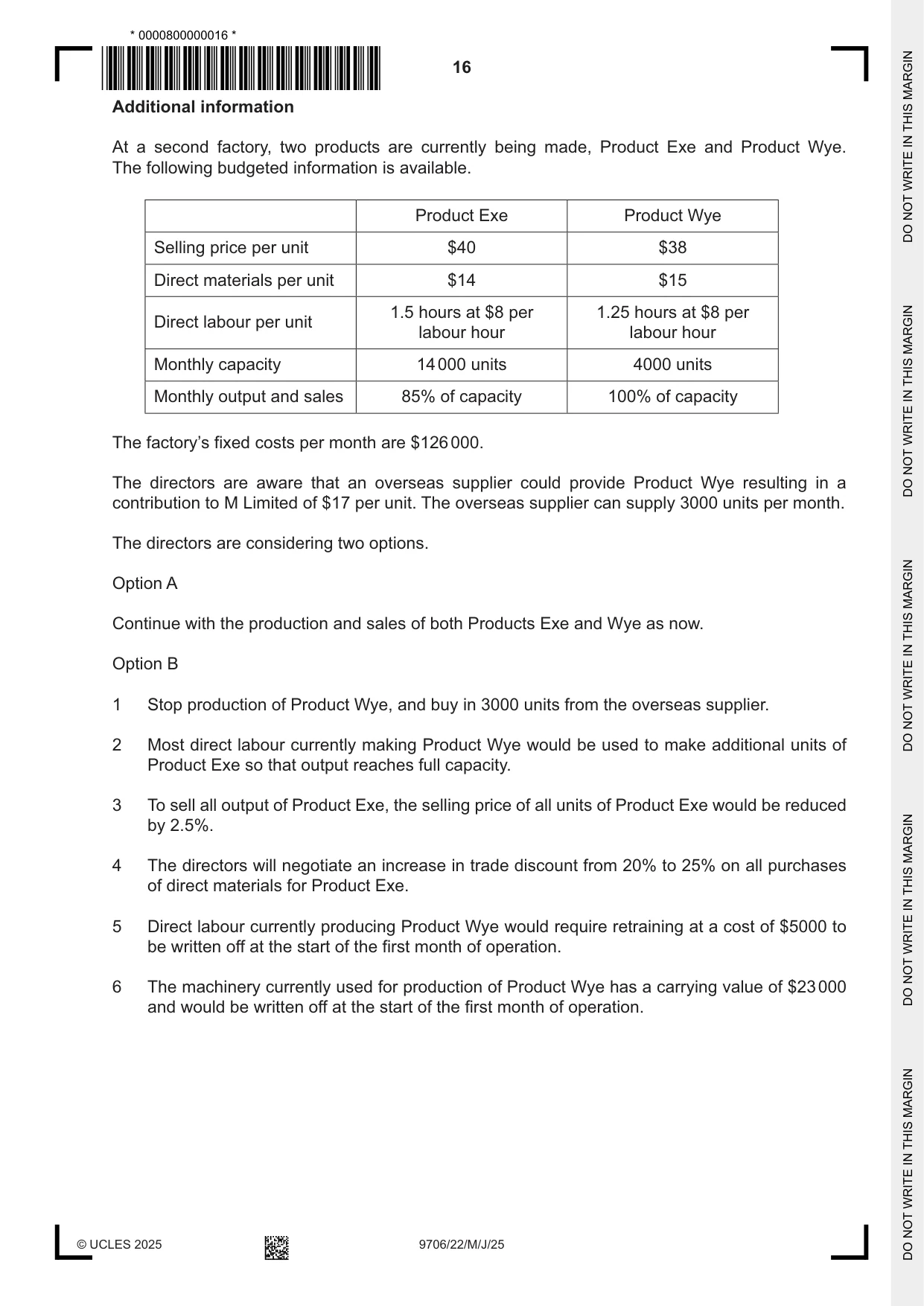
4 M Limited manufactures a single product at one of its factories. The company uses marginal costing. (a) Define the following terms: (i) contribution ........................................................................................................................................... ..................................................................................................................................... [1] (ii) fixed costs ........................................................................................................................................... ..................................................................................................................................... [1] (iii) margin of safety. ........................................................................................................................................... ..................................................................................................................................... [1] Additional information Currently, the factory is operating at full capacity of 8300 units per month. All production is sold. The following details are available about the single product. Per unit $ Selling price 36 Direct labour 17 Direct materials 8 Fixed costs 6 The directors have a target profit of $35 000 per month. (b) Calculate the following in units: (i) break-even point ........................................................................................................................................... ........................................................................................................................................... ........................................................................................................................................... ..................................................................................................................................... [3] (ii) margin of safety. ........................................................................................................................................... ..................................................................................................................................... [1] (c) Calculate the amount by which the monthly target profit is exceeded. ................................................................................................................................................... ................................................................................................................................................... ................................................................................................................................................... ............................................................................................................................................. [2] Additional information At a second factory, two products are currently being made, Product Exe and Product Wye. The following budgeted information is available. Product Exe Product Wye Selling price per unit $40 $38 Direct materials per unit $14 $15 1.5 hours at $8 per 1.25 hours at $8 per Direct labour per unit labour hour labour hour Monthly capacity 14 000 units 4000 units Monthly output and sales 85% of capacity 100% of capacity The factory’s fixed costs per month are $126 000. The directors are aware that an overseas supplier could provide Product Wye resulting in a contribution to M Limited of $17 per unit. The overseas supplier can supply 3000 units per month. The directors are considering two options. Option A Continue with the production and sales of both Products Exe and Wye as now. Option B 1 Stop production of Product Wye, and buy in 3000 units from the overseas supplier. 2 Most direct labour currently making Product Wye would be used to make additional units of Product Exe so that output reaches full capacity. 3 To sell all output of Product Exe, the selling price of all units of Product Exe would be reduced by 2.5%. 4 The directors will negotiate an increase in trade discount from 20% to 25% on all purchases of direct materials for Product Exe. 5 Direct labour currently producing Product Wye would require retraining at a cost of $5000 to be written off at the start of the first month of operation. 6 The machinery currently used for production of Product Wye has a carrying value of $23 000 and would be written off at the start of the first month of operation.
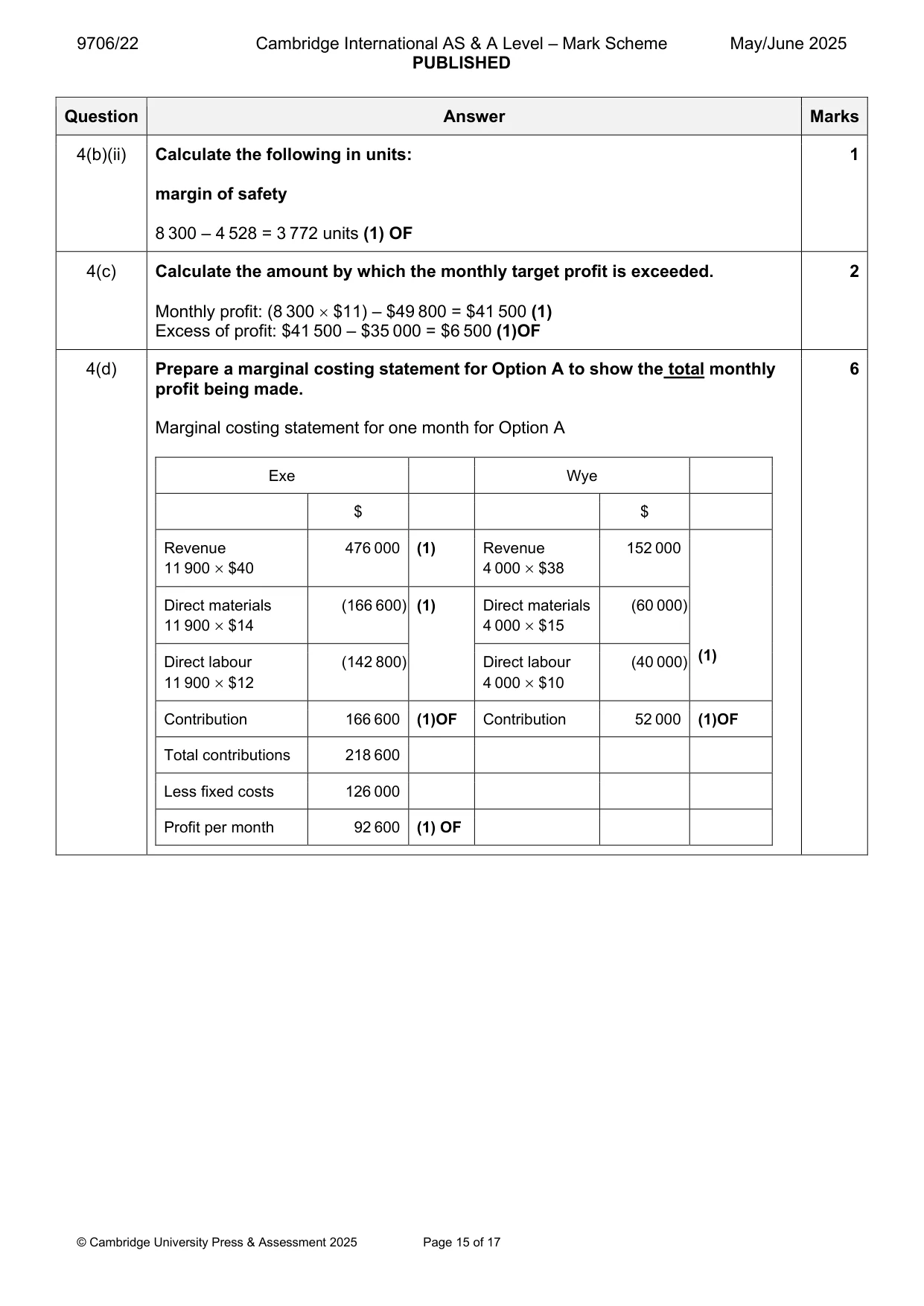
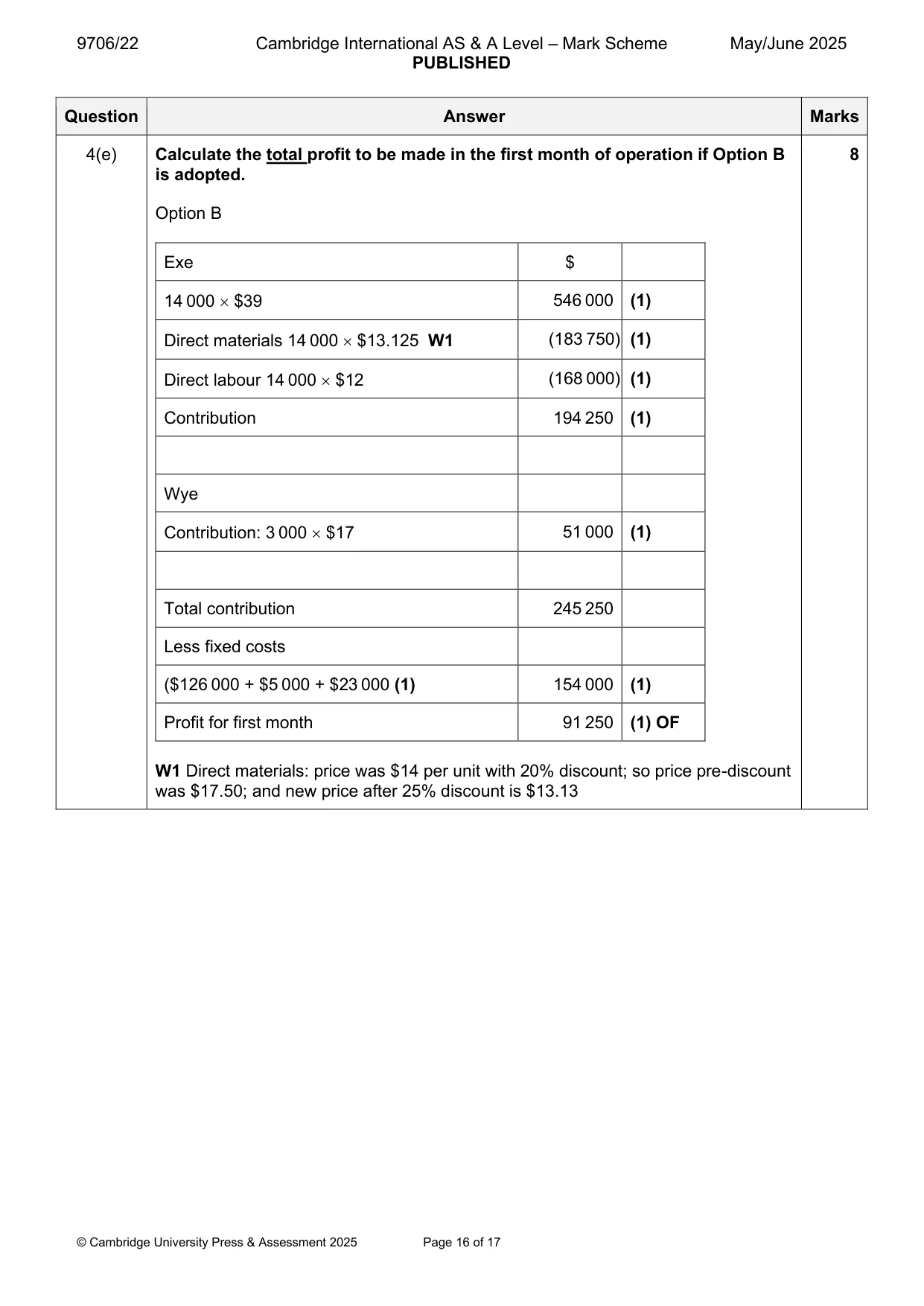
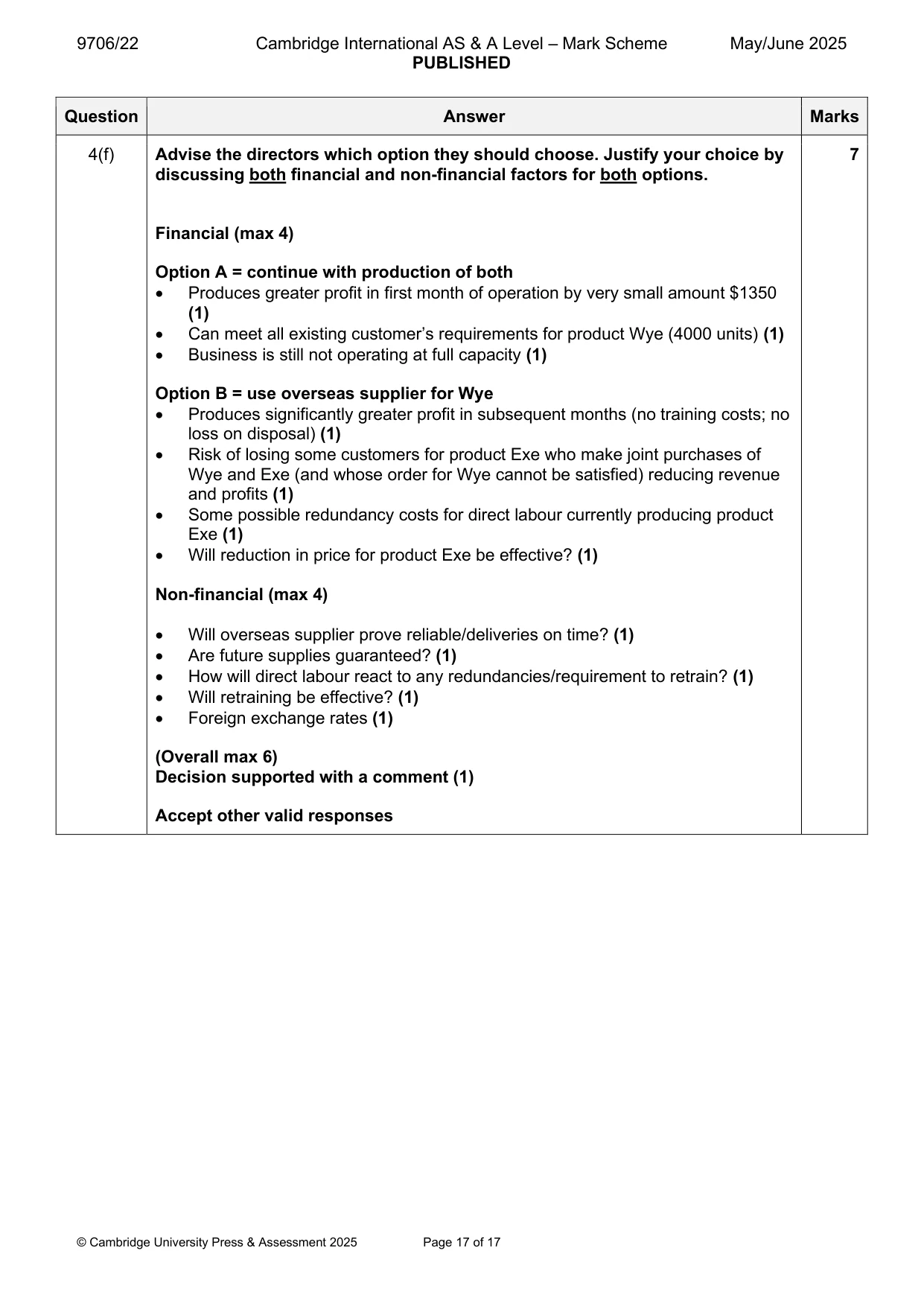
Mark scheme: Question Answer Marks 4(a)(i) Define the following terms: 1 contribution Contribution is the difference between selling price and variable costs (1) 4(a)(ii) Define the following terms: 1 fixed costs Fixed costs are costs which do not change with levels of business activity (1) 4(a)(iii) Define the following terms: 1 margin of safety Margin of safety is the difference between sales and break-even level of sales (1) 4(b)(i) Calculate the following in units: 3 break-even point Contribution $11 (1); Fixed costs 6 8 300 = $49 800 (1) Break-even point 4 528 units (1) 4(b)(ii) Calculate the following in units: 1 margin of safety 8 300 – 4 528 = 3 772 units (1) OF 4(c) Calculate the amount by which the monthly target profit is exceeded. 2 Monthly profit: (8 300 $11) – $49 800 = $41 500 (1) Excess of profit: $41 500 – $35 000 = $6 500 (1)OF 4(d) Prepare a marginal costing statement for Option A to show the total monthly 6 profit being made. Marginal costing statement for one month for Option A Exe Wye $ $ Revenue 476 000 (1) Revenue 152 000 11 900 $40 4 000 $38 Direct materials (166 600) (1) Direct materials (60 000) 11 900 $14 4 000 $15 (1) Direct labour (142 800) Direct labour (40 000) 11 900 $12 4 000 $10 Contribution 166 600 (1)OF Contribution 52 000 (1)OF Total contributions 218 600 Less fixed costs 126 000 Profit per month 92 600 (1) OF 4(e) Calculate the total profit to be made in the first month of operation if Option B 8 is adopted. Option B Exe $ 14 000 $39 546 000 (1) Direct materials 14 000 $13.125 W1 (183 750) (1) Direct labour 14 000 $12 (168 000) (1) Contribution 194 250 (1) Wye Contribution: 3 000 $17 51 000 (1) Total contribution 245 250 Less fixed costs ($126 000 + $5 000 + $23 000 (1) 154 000 (1) Profit for first month 91 250 (1) OF W1 Direct materials: price was $14 per unit with 20% discount; so price pre-discount was $17.50; and new price after 25% discount is $13.13 4(f) Advise the directors which option they should choose. Justify your choice by 7 discussing both financial and non-financial factors for both options. Financial (max 4) Option A = continue with production of both • Produces greater profit in first month of operation by very small amount $1350 (1) • Can meet all existing customer’s requirements for product Wye (4000 units) (1) • Business is still not operating at full capacity (1) Option B = use overseas supplier for Wye • Produces significantly greater profit in subsequent months (no training costs; no loss on disposal) (1) • Risk of losing some customers for product Exe who make joint purchases of Wye and Exe (and whose order for Wye cannot be satisfied) reducing revenue and profits (1) • Some possible redundancy costs for direct labour currently producing product Exe (1) • Will reduction in price for product Exe be effective? (1) Non-financial (max 4) • Will overseas supplier prove reliable/deliveries on time? (1) • Are future supplies guaranteed? (1) • How will direct labour react to any redundancies/requirement to retrain? (1) • Will retraining be effective? (1) • Foreign exchange rates (1) (Overall max 6) Decision supported with a comment (1) Accept other valid responses
Q7 · Prepare the statement of profit or loss for the year ended 31 December 2024
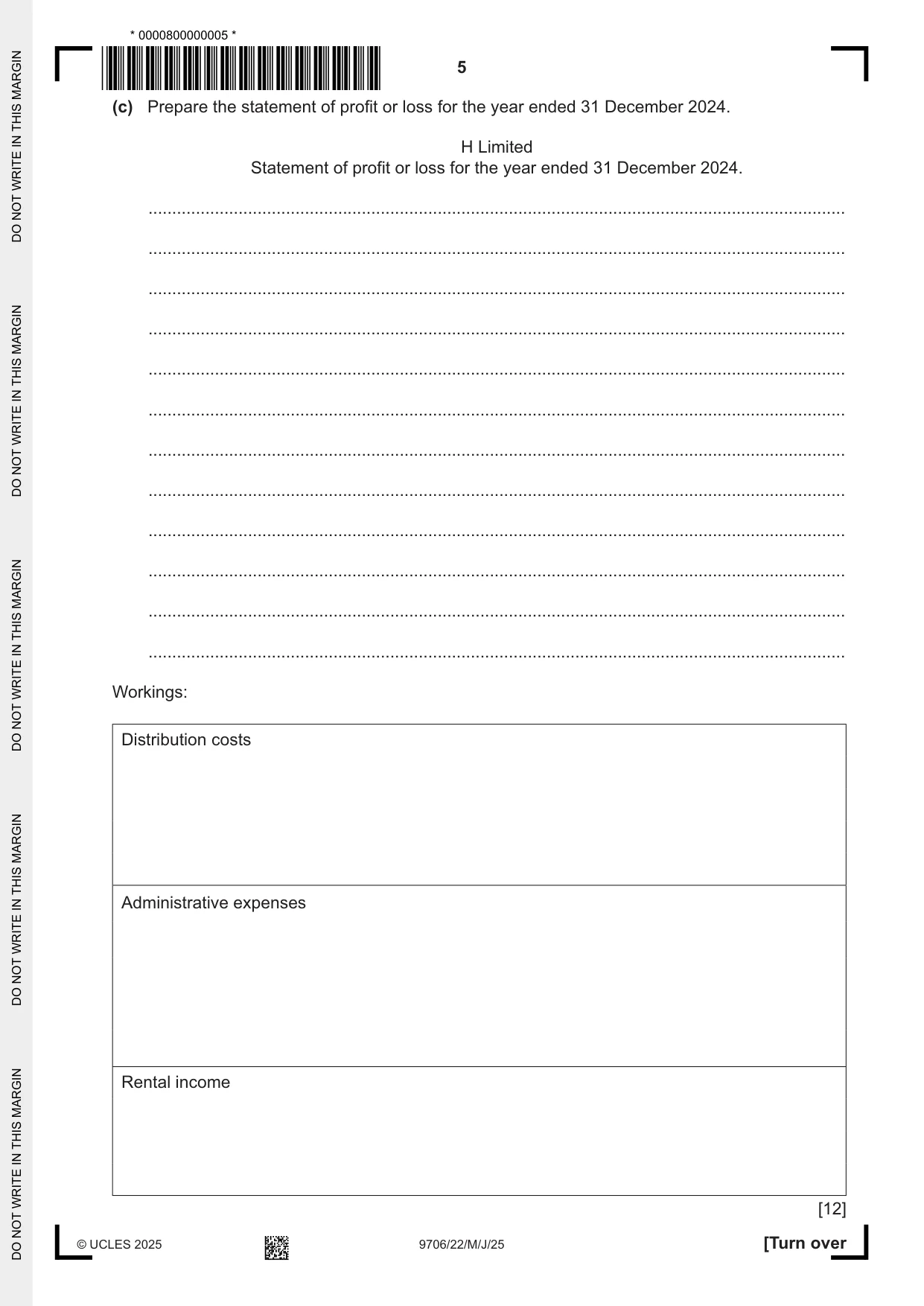
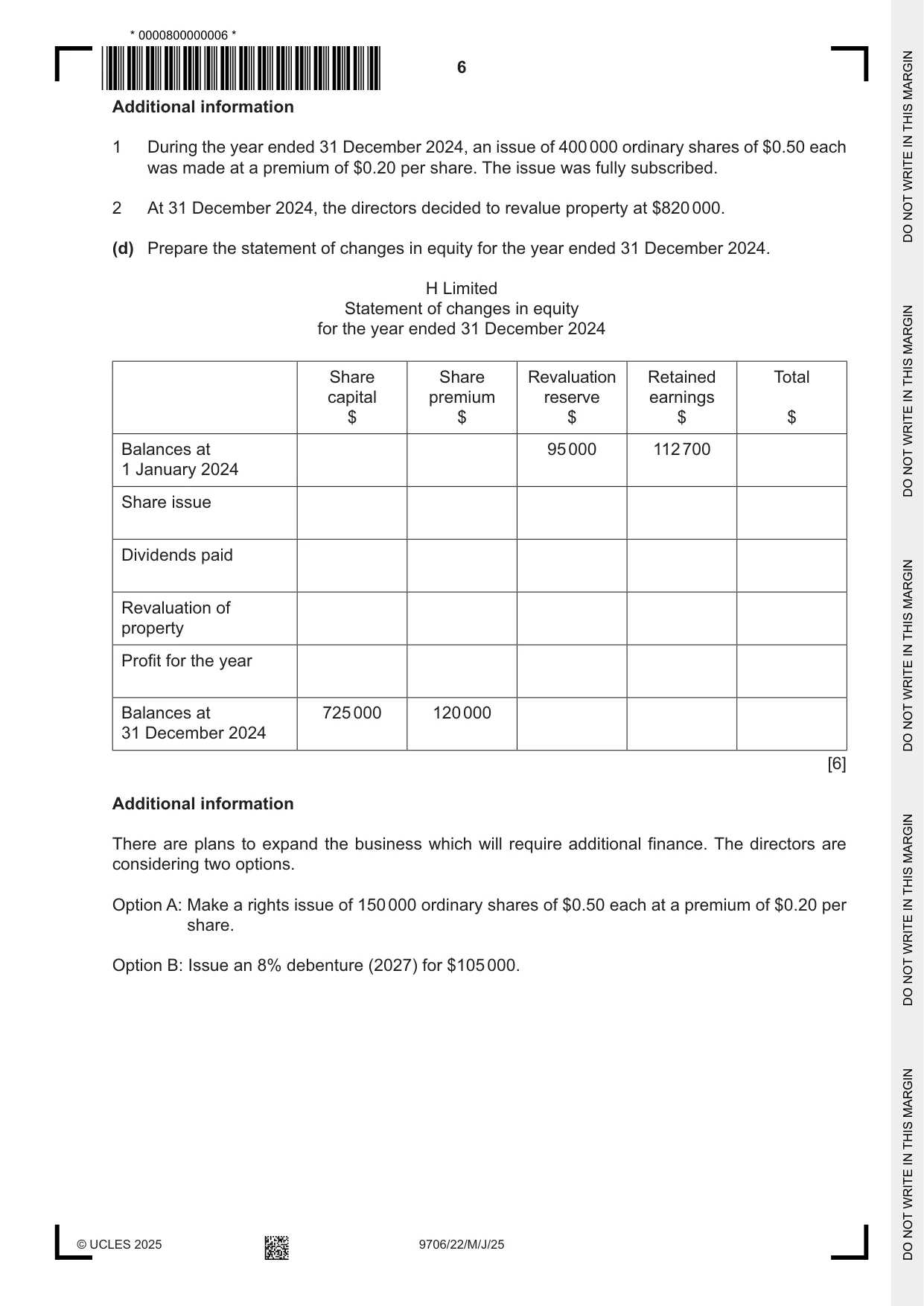
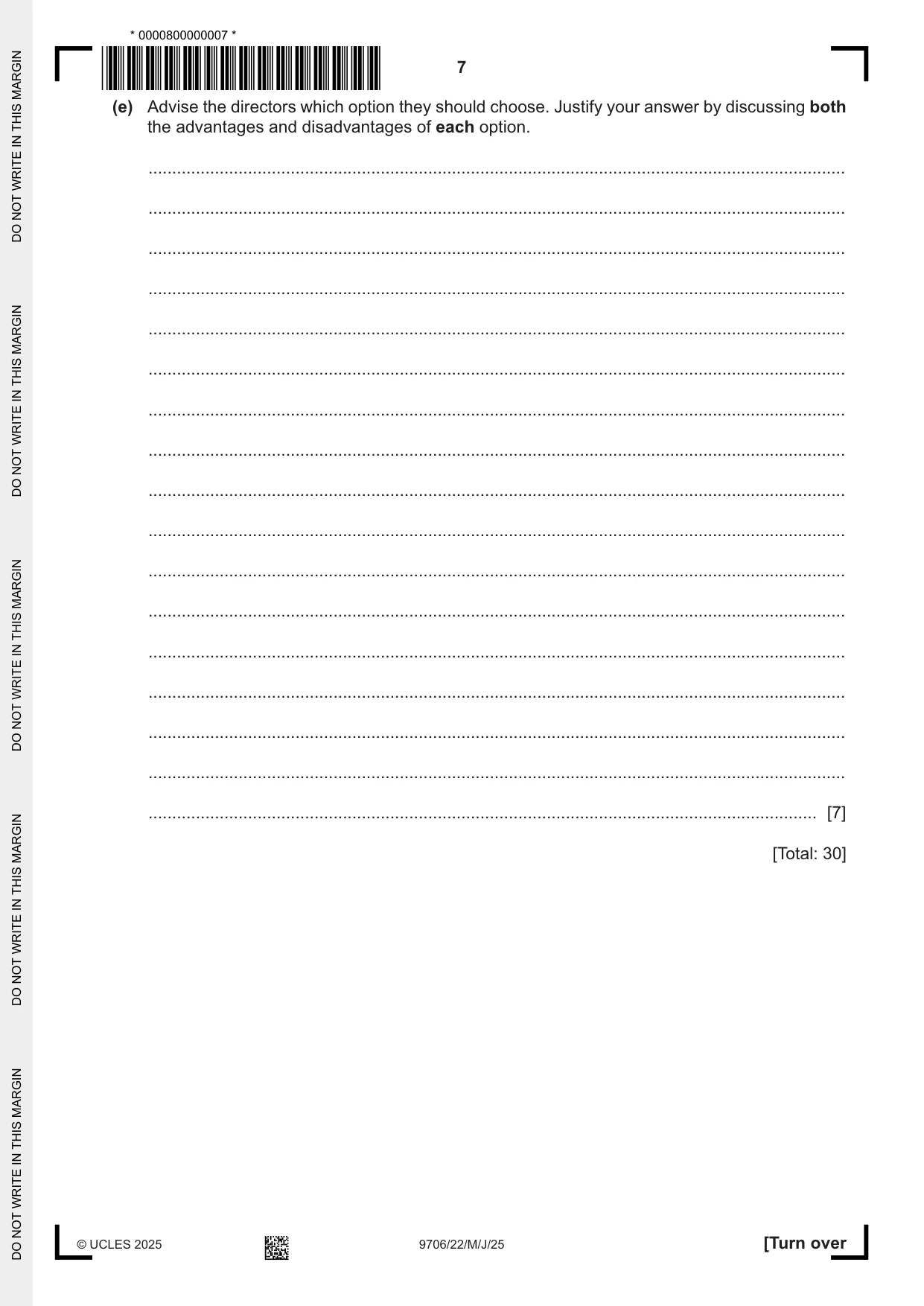
(c) Prepare the statement of profit or loss for the year ended 31 December 2024. H Limited Statement of profit or loss for the year ended 31 December 2024. ................................................................................................................................................... ................................................................................................................................................... ................................................................................................................................................... ................................................................................................................................................... ................................................................................................................................................... ................................................................................................................................................... ................................................................................................................................................... ................................................................................................................................................... ................................................................................................................................................... ................................................................................................................................................... ................................................................................................................................................... ................................................................................................................................................... Workings: Distribution costs Administrative expenses Rental income [12] Additional information 1 During the year ended 31 December 2024, an issue of 400 000 ordinary shares of $0.50 each was made at a premium of $0.20 per share. The issue was fully subscribed. 2 At 31 December 2024, the directors decided to revalue property at $820 000. (d) Prepare the statement of changes in equity for the year ended 31 December 2024. H Limited Statement of changes in equity for the year ended 31 December 2024 Share Share Revaluation Retained Total capital premium reserve earnings $ $ $ $ $ Balances at 95 000 112 700 1 January 2024 Share issue Dividends paid Revaluation of property Profit for the year Balances at 725 000 120 000 31 December 2024 [6] Additional information There are plans to expand the business which will require additional finance. The directors are considering two options. Option A: Make a rights issue of 150 000 ordinary shares of $0.50 each at a premium of $0.20 per share. Option B: Issue an 8% debenture (2027) for $105 000. (e) Advise the directors which option they should choose. Justify your answer by discussing both the advantages and disadvantages of each option. ................................................................................................................................................... ................................................................................................................................................... ................................................................................................................................................... ................................................................................................................................................... ................................................................................................................................................... ................................................................................................................................................... ................................................................................................................................................... ................................................................................................................................................... ................................................................................................................................................... ................................................................................................................................................... ................................................................................................................................................... ................................................................................................................................................... ................................................................................................................................................... ................................................................................................................................................... ................................................................................................................................................... ................................................................................................................................................... ............................................................................................................................................. [7] [Total: 30] 2 Virat prepared the trial balance at 28 February 2025, the end of his financial year. However, the totals did not agree. Control accounts are not maintained by the business. A check of the entries in the books of account revealed the following errors. 1 A sales invoice, $80, had been debited to the account of Rafiq instead of Raif. 2 A credit note, $170, received from P Limited had been correctly recorded in the book of prime entry but had not been posted to the personal account. 3 No record has been made of goods taken by Virat for personal use, valued at cost, $330. 4 The total of the discount received column in the cash book, $97, had been debited to the discounts allowed account as $79. 5 No entries had been made to record the receipt of $370 from Abdul, a credit customer. The balance of his account had been written off in 2024. (a) Prepare journal entries to correct the errors. Narratives are not required. Journal Error Dr Cr $ $ 1 2 3 4 5 [8] Additional information Before the errors were corrected, a draft statement of profit or loss for the year ended
Q28 · February 2025 had been prepared, showing a draft profit for the year of $37 320
28 February 2025 had been prepared, showing a draft profit for the year of $37 320. (b) Calculate a revised figure for profit for the year ended 28 February 2025. $ Draft profit for the year 37 320 [5] (c) Explain why an error of principle would have no effect on the agreement of trial balance totals. ................................................................................................................................................... ................................................................................................................................................... ................................................................................................................................................... ............................................................................................................................................. [2] [Total: 15] 3 Zak has not maintained full accounting records for his retail business. He has provided the following details for the year ended 31 December 2024. $ Purchases 82 980 Returns outwards 1 050 Inventory levels increased by $2730 during the year ended 31 December 2024. Zak’s policy is to sell all goods to achieve a gross profit margin of 40%. (a) Calculate the revenue for the year ended 31 December 2024. ................................................................................................................................................... ................................................................................................................................................... ................................................................................................................................................... ................................................................................................................................................... ................................................................................................................................................... ................................................................................................................................................... ................................................................................................................................................... ............................................................................................................................................. [4] Additional information Zak is not certain how much the business is owed by its credit customers at 31 December 2024. The following information is available. 1 At 1 January 2024, credit customers owed $11 880. 2 Credit sales are 75% of total sales. 3 Bank statements show that $96 900 was received from credit customers during the year ended 31 December 2024. 4 Some credit customers were given a 5% cash discount for prompt payment. Zak estimates that 20% of all receipts from credit customers were made after deducting the cash discount. (b) Calculate the amount owed by credit customers at 31 December 2024. ................................................................................................................................................... ................................................................................................................................................... ................................................................................................................................................... ................................................................................................................................................... ................................................................................................................................................... ................................................................................................................................................... ................................................................................................................................................... ............................................................................................................................................. [4] Additional information Zak would like to improve the credit control of his business. (c) Identify two ways, other than allowing a cash discount, in which credit control can be improved. 1 ................................................................................................................................................ ................................................................................................................................................... 2 ................................................................................................................................................ ................................................................................................................................................... [2]
What was in this paper
The subtopics covered by these 6 questions, and how many questions each got. Open one in a new tab to see every Cambridge question on it.
What you needed in this session
Cambridge’s own grade thresholds for 2025 May/June, Paper 2 · Variant 2. A higher threshold means an easier paper — the bar moves with how the cohort did.