Cambridge A Level Accounting 9706 — 2025 Feb/March Paper 2 · Variant 2
9706/22/F/M/25 · 5 questions · 90 marks · ≈101 min
The question paper and its mark scheme, free to read here and free to download. This is Cambridge’s own paper, exactly as it was sat.
Question paper24 pages
Mark scheme18 pages
Answers below. Sit the paper first if you are practising.
Questions as text
Q1 · Sara and Viraj are in partnership and own a wholesale business
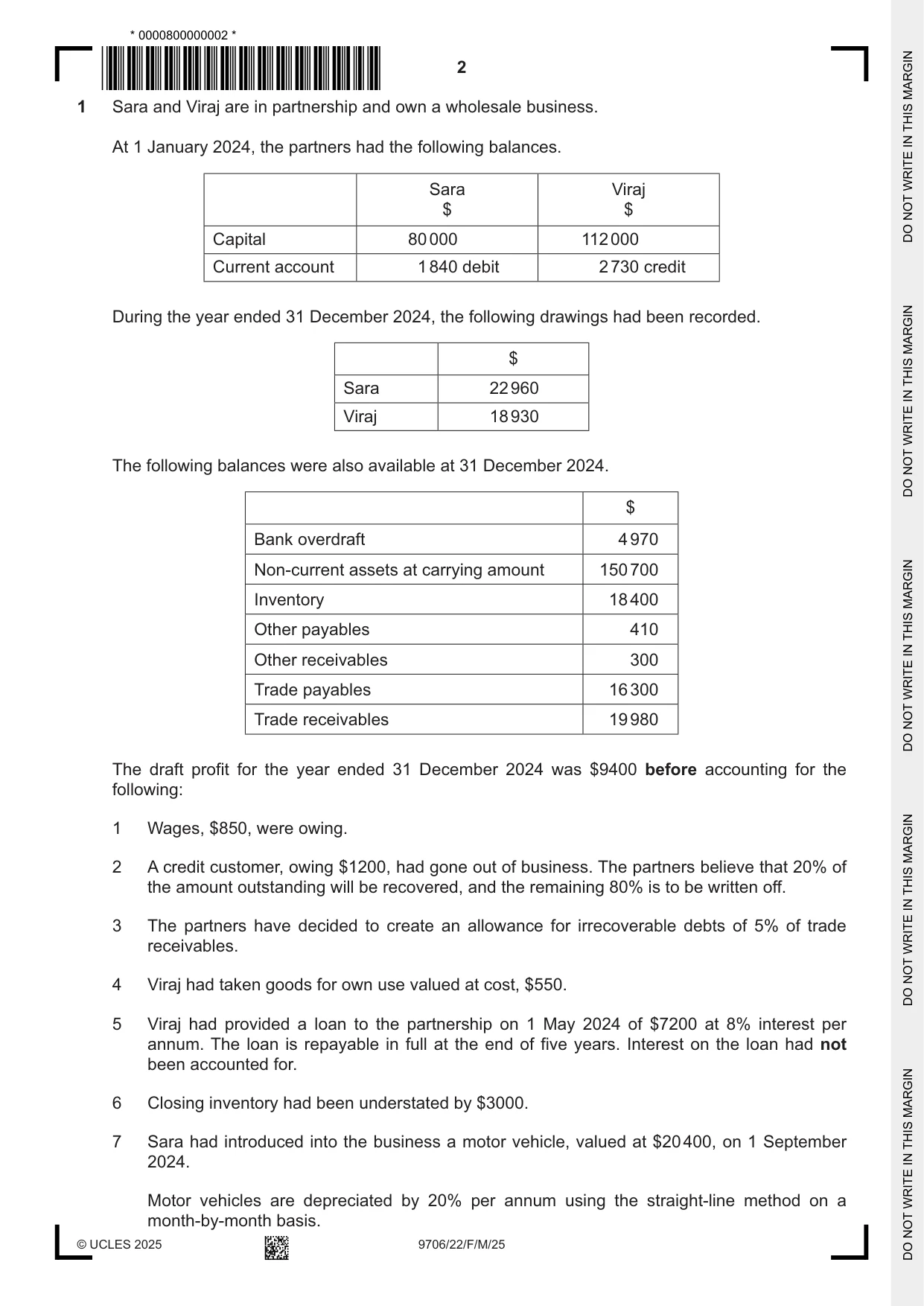
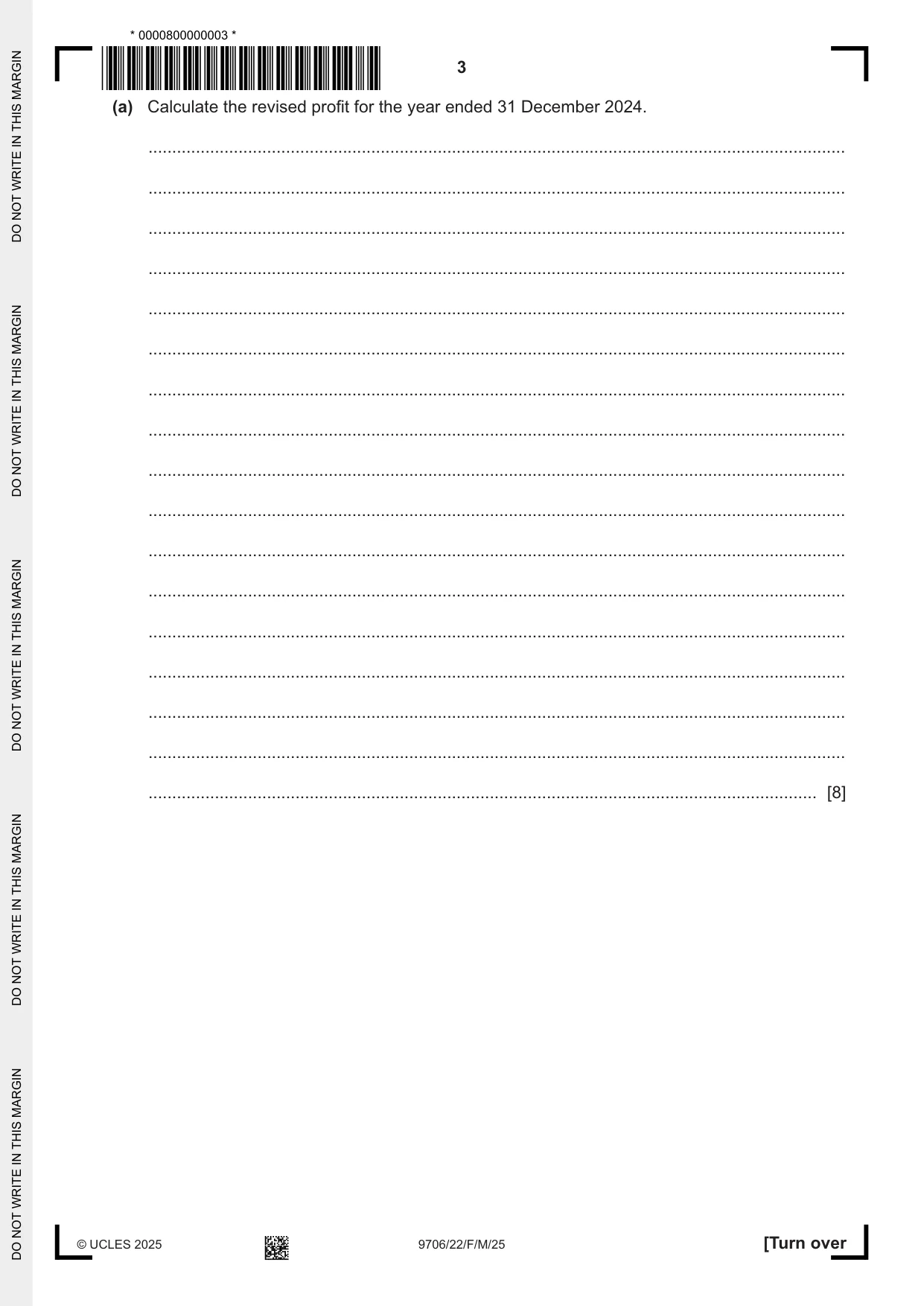
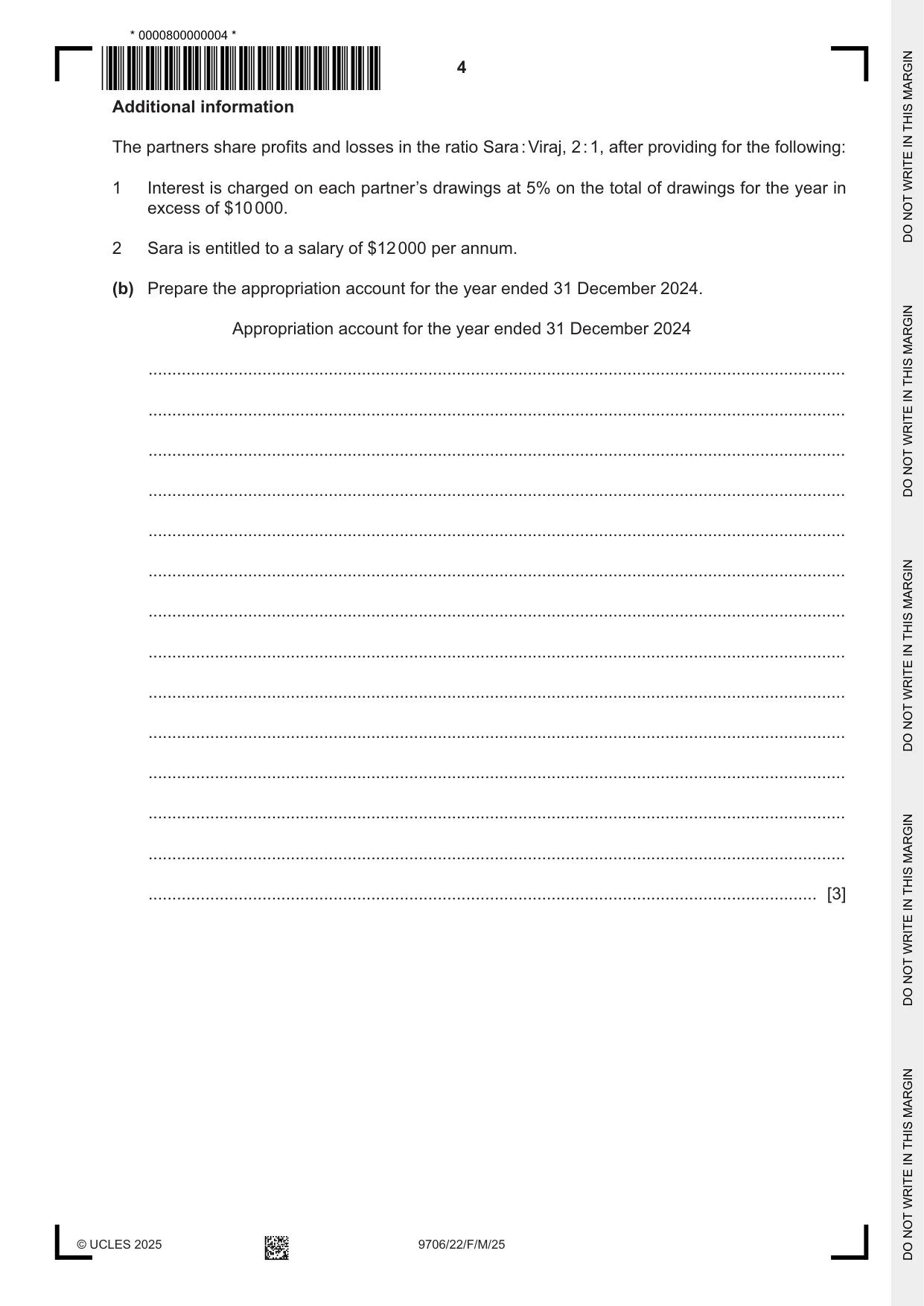
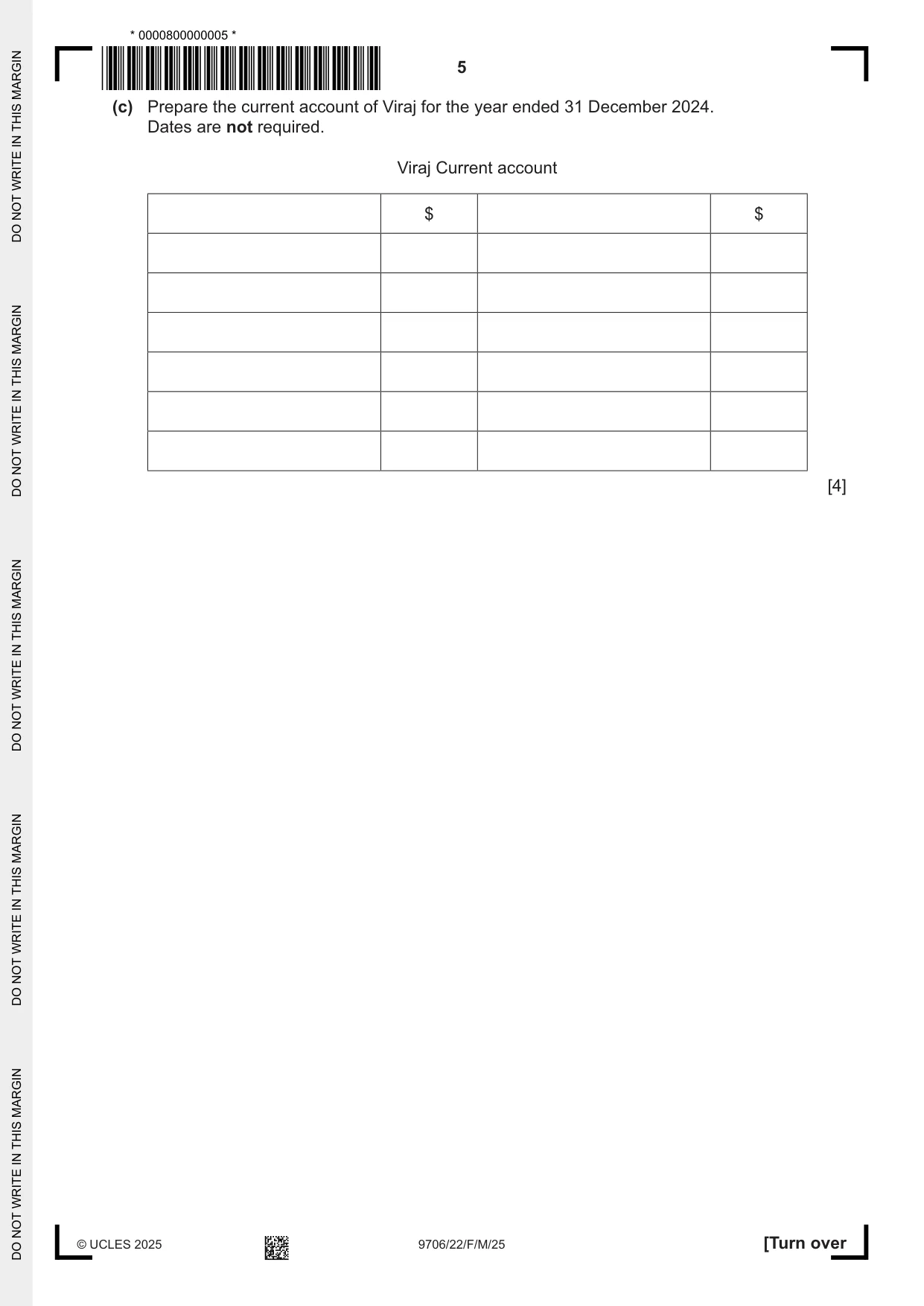
1 Sara and Viraj are in partnership and own a wholesale business. At 1 January 2024, the partners had the following balances. Sara Viraj $ $ Capital 80 000 112 000 Current account 1 840 debit 2 730 credit During the year ended 31 December 2024, the following drawings had been recorded. $ Sara 22 960 Viraj 18 930 The following balances were also available at 31 December 2024. $ Bank overdraft 4 970 Non‑current assets at carrying amount 150 700 Inventory 18 400 Other payables 410 Other receivables 300 Trade payables 16 300 Trade receivables 19 980 The draft profit for the year ended 31 December 2024 was $9400 before accounting for the following: 1 Wages, $850, were owing. 2 A credit customer, owing $1200, had gone out of business. The partners believe that 20% of the amount outstanding will be recovered, and the remaining 80% is to be written off. 3 The partners have decided to create an allowance for irrecoverable debts of 5% of trade receivables. 4 Viraj had taken goods for own use valued at cost, $550. 5 Viraj had provided a loan to the partnership on 1 May 2024 of $7200 at 8% interest per annum. The loan is repayable in full at the end of five years. Interest on the loan had not been accounted for. 6 Closing inventory had been understated by $3000. 7 Sara had introduced into the business a motor vehicle, valued at $20 400, on 1 September 2024. Motor vehicles are depreciated by 20% per annum using the straight‑line method on a month‑by‑month basis. (a) Calculate the revised profit for the year ended 31 December 2024. ................................................................................................................................................... ................................................................................................................................................... ................................................................................................................................................... ................................................................................................................................................... ................................................................................................................................................... ................................................................................................................................................... ................................................................................................................................................... ................................................................................................................................................... ................................................................................................................................................... ................................................................................................................................................... ................................................................................................................................................... ................................................................................................................................................... ................................................................................................................................................... ................................................................................................................................................... ................................................................................................................................................... ................................................................................................................................................... ............................................................................................................................................. [8] Additional information The partners share profits and losses in the ratio Sara : Viraj, 2 : 1, after providing for the following: 1 Interest is charged on each partner’s drawings at 5% on the total of drawings for the year in excess of $10 000.
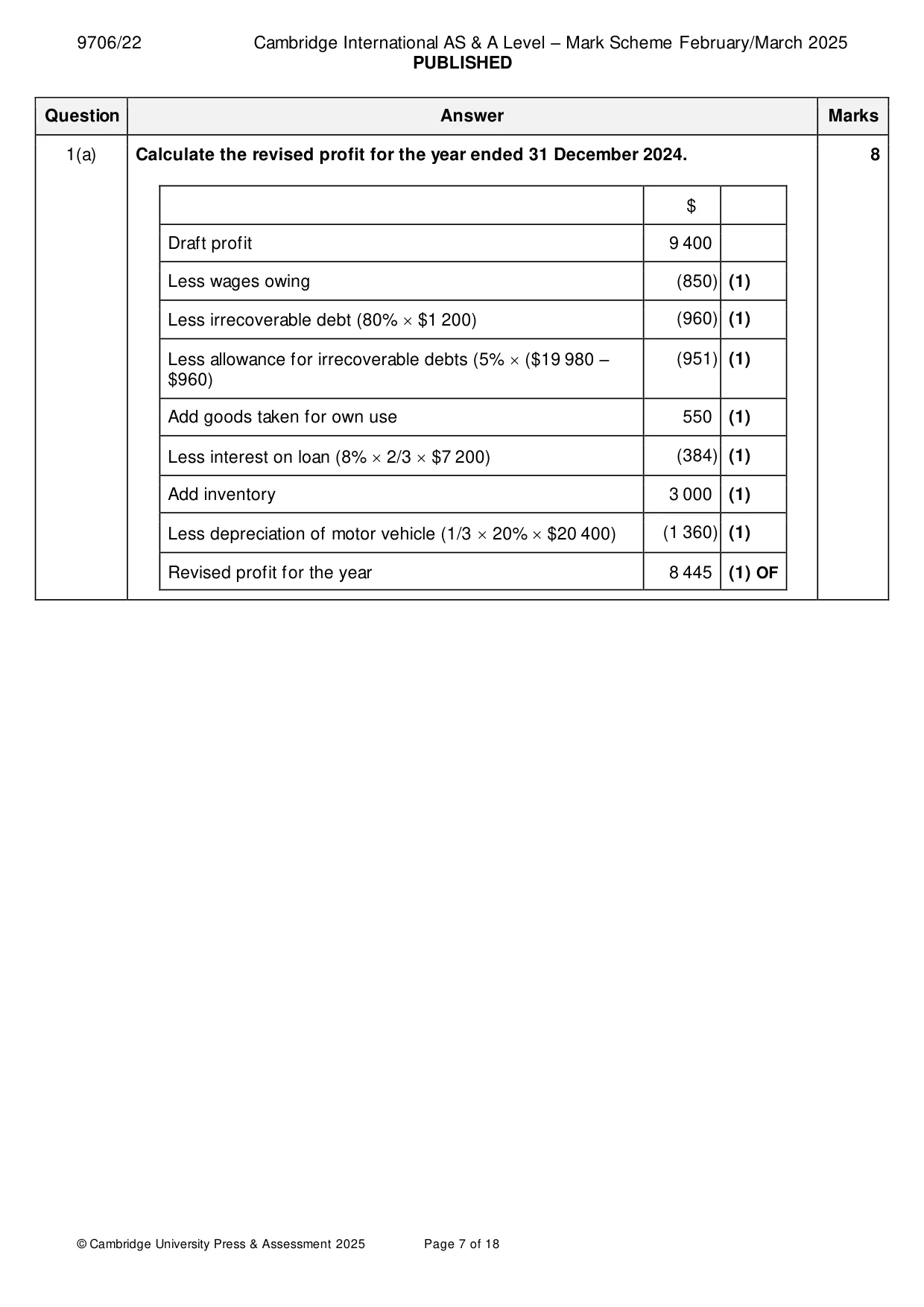
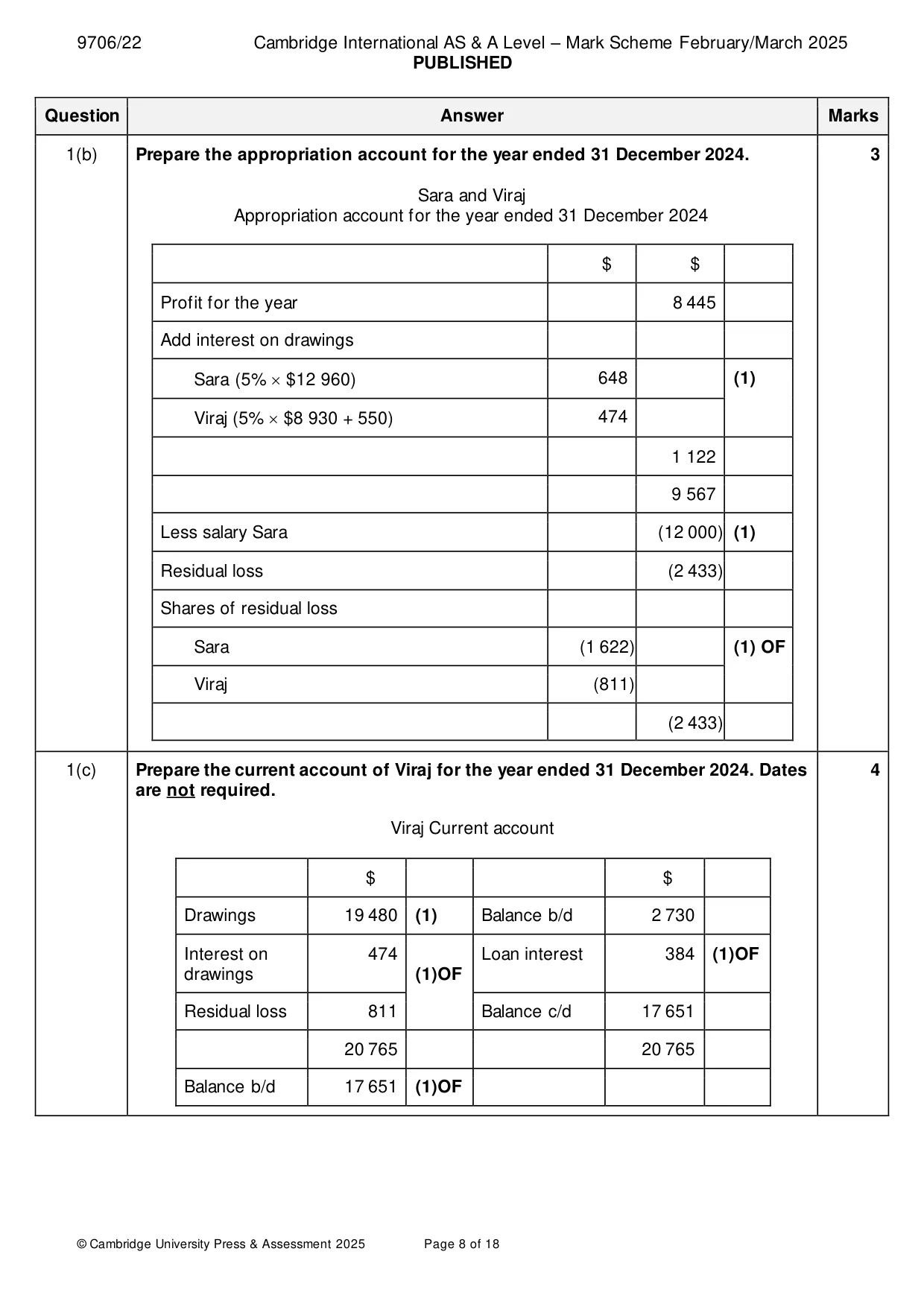
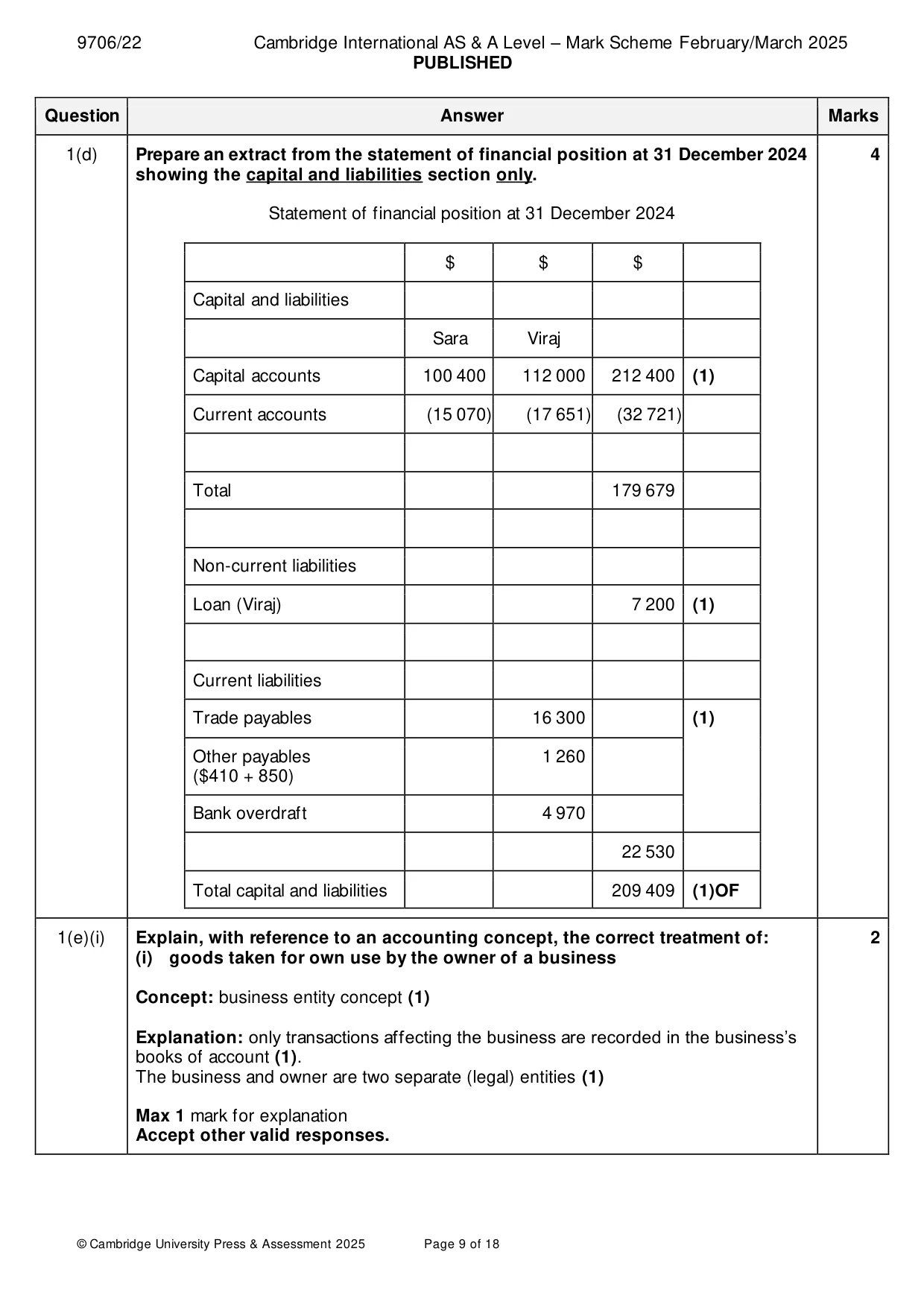
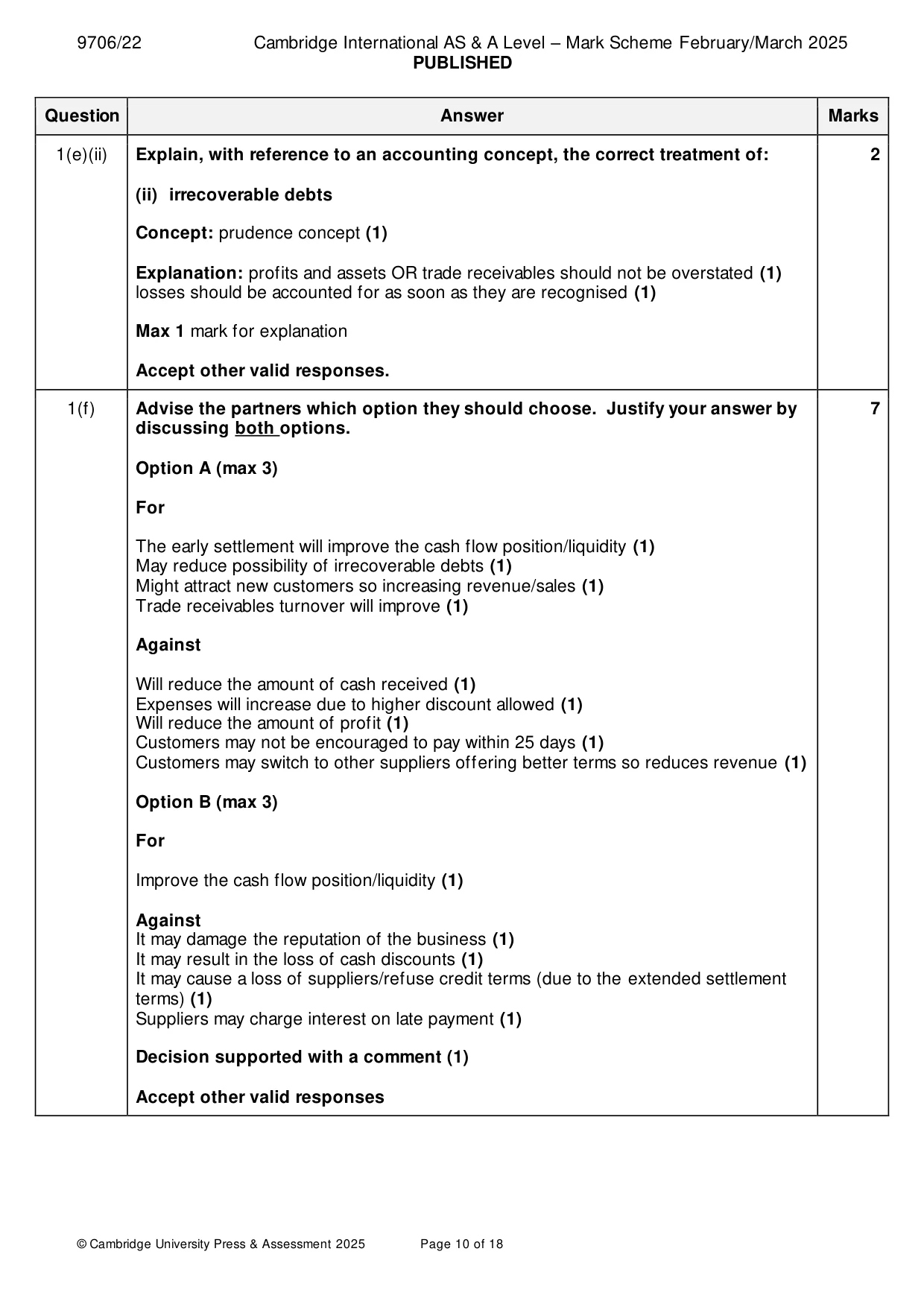
Mark scheme: Question Answer Marks 1(a) Calculate the revised profit for the year ended 31 December 2024. 8 $ Draft profit 9 400 Less wages owing (850) (1) Less irrecoverable debt (80% $1 200) (960) (1) Less allowance for irrecoverable debts (5% ($19 980 – (951) (1) $960) Add goods taken for own use 550 (1) Less interest on loan (8% 2/3 $7 200) (384) (1) Add inventory 3 000 (1) Less depreciation of motor vehicle (1/3 20% $20 400) (1 360) (1) Revised profit for the year 8 445 (1) OF 1(b) Prepare the appropriation account for the year ended 31 December 2024. 3 Sara and Viraj Appropriation account for the year ended 31 December 2024 $ $ Profit for the year 8 445 Add interest on drawings Sara (5% $12 960) 648 (1) Viraj (5% $8 930 + 550) 474 1 122 9 567 Less salary Sara (12 000) (1) Residual loss (2 433) Shares of residual loss Sara (1 622) (1) OF Viraj (811) (2 433) 1(c) Prepare the current account of Viraj for the year ended 31 December 2024. Dates 4 are not required. Viraj Current account $ $ Drawings 19 480 (1) Balance b/d 2 730 Interest on 474 Loan interest 384 (1)OF drawings (1)OF Residual loss 811 Balance c/d 17 651 20 765 20 765 Balance b/d 17 651 (1)OF 1(d) Prepare an extract from the statement of financial position at 31 December 2024 4 showing the capital and liabilities section only. Statement of financial position at 31 December 2024 $ $ $ Capital and liabilities Sara Viraj Capital accounts 100 400 112 000 212 400 (1) Current accounts (15 070) (17 651) (32 721) Total 179 679 Non-current liabilities Loan (Viraj) 7 200 (1) Current liabilities Trade payables 16 300 (1) Other payables 1 260 ($410 + 850) Bank overdraft 4 970 22 530 Total capital and liabilities 209 409 (1)OF 1(e)(i) Explain, with reference to an accounting concept, the correct treatment of: 2 (i) goods taken for own use by the owner of a business Concept: business entity concept (1) Explanation: only transactions affecting the business are recorded in the business’s books of account (1). The business and owner are two separate (legal) entities (1) Max 1 mark for explanation Accept other valid responses. 1(e)(ii) Explain, with reference to an accounting concept, the correct treatment of: 2 (ii) irrecoverable debts Concept: prudence concept (1) Explanation: profits and assets OR trade receivables should not be overstated (1) losses should be accounted for as soon as they are recognised (1) Max 1 mark for explanation Accept other valid responses. 1(f) Advise the partners which option they should choose. Justify your answer by 7 discussing both options. Option A (max 3) For The early settlement will improve the cash flow position/liquidity (1) May reduce possibility of irrecoverable debts (1) Might attract new customers so increasing revenue/sales (1) Trade receivables turnover will improve (1) Against Will reduce the amount of cash received (1) Expenses will increase due to higher discount allowed (1) Will reduce the amount of profit (1) Customers may not be encouraged to pay within 25 days (1) Customers may switch to other suppliers offering better terms so reduces revenue (1) Option B (max 3) For Improve the cash flow position/liquidity (1) Against It may damage the reputation of the business (1) It may result in the loss of cash discounts (1) It may cause a loss of suppliers/refuse credit terms (due to the extended settlement terms) (1) Suppliers may charge interest on late payment (1) Decision supported with a comment (1) Accept other valid responses
Q2 · Sara is entitled to a salary of $12 000 per annum
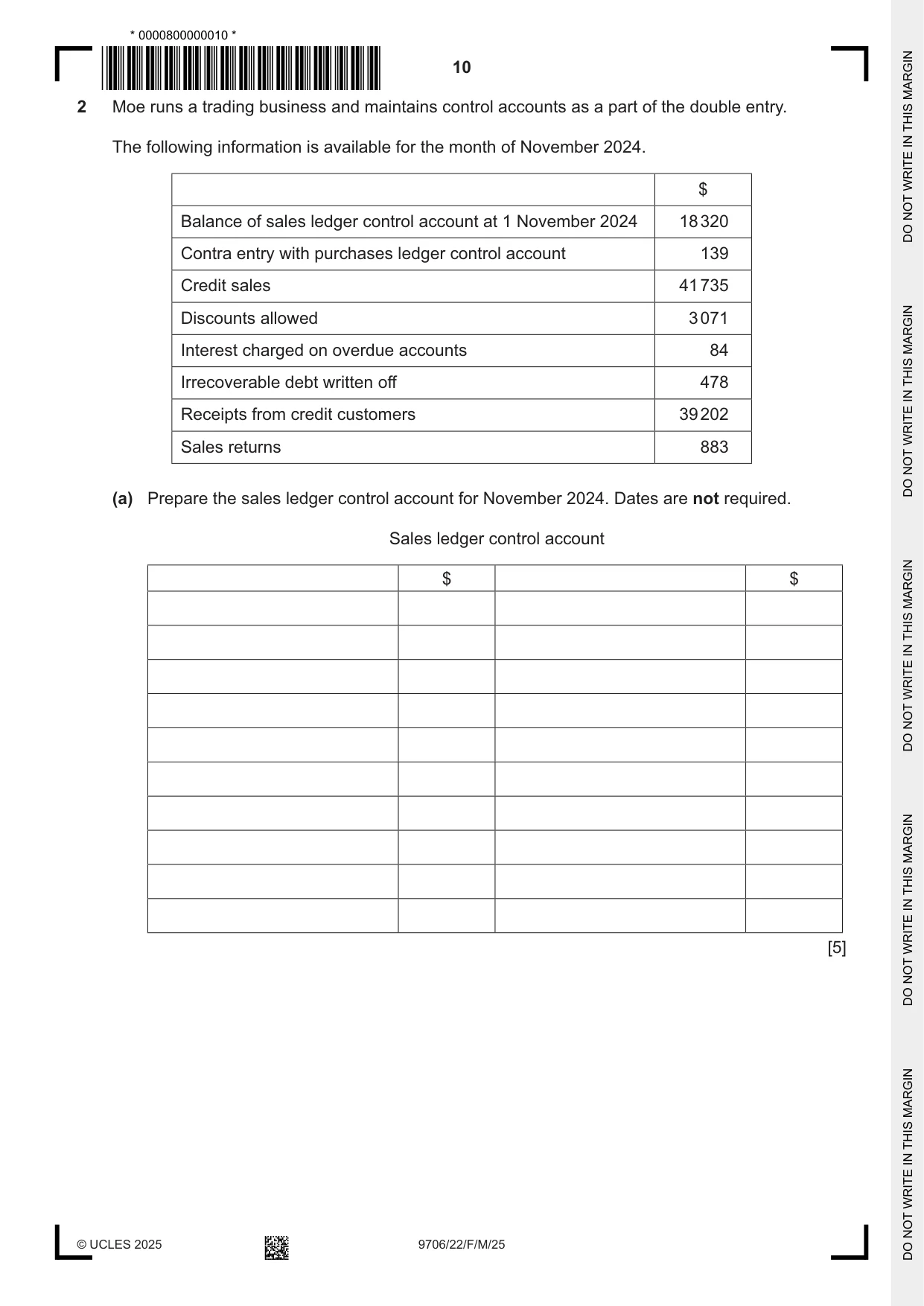
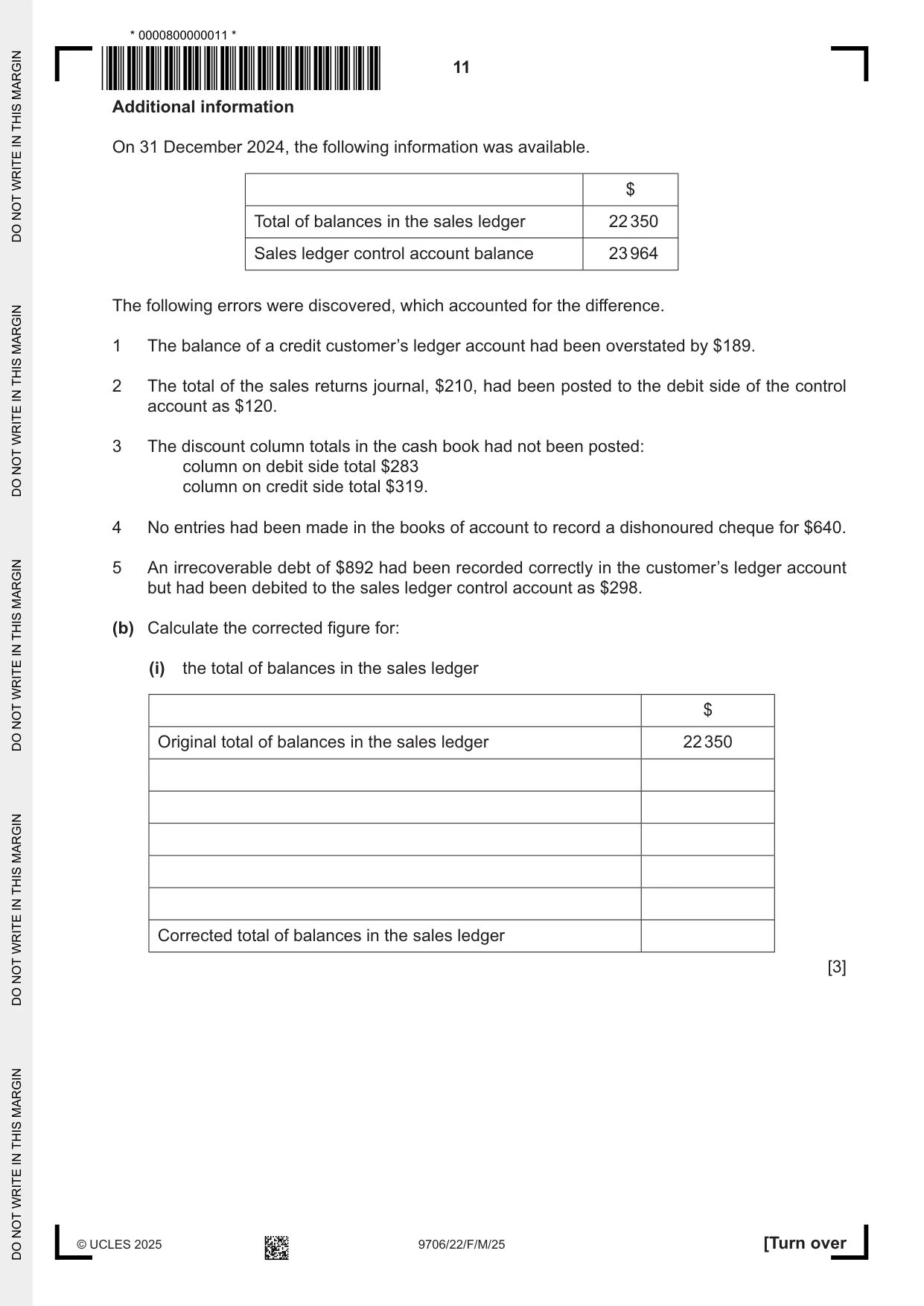
2 Sara is entitled to a salary of $12 000 per annum. (b) Prepare the appropriation account for the year ended 31 December 2024. Appropriation account for the year ended 31 December 2024 ................................................................................................................................................... ................................................................................................................................................... ................................................................................................................................................... ................................................................................................................................................... ................................................................................................................................................... ................................................................................................................................................... ................................................................................................................................................... ................................................................................................................................................... ................................................................................................................................................... ................................................................................................................................................... ................................................................................................................................................... ................................................................................................................................................... ................................................................................................................................................... ............................................................................................................................................. [3] (c) Prepare the current account of Viraj for the year ended 31 December 2024. Dates are not required. Viraj Current account $ $ [4] Additional information On 31 December 2024, the balance of Sara’s current account was $15 070 debit. (d) Prepare an extract from the statement of financial position at 31 December 2024 showing the capital and liabilities section only. Statement of financial position at 31 December 2024 Capital and liabilities ................................................................................................................................................... ................................................................................................................................................... ................................................................................................................................................... ................................................................................................................................................... ................................................................................................................................................... ................................................................................................................................................... ................................................................................................................................................... ................................................................................................................................................... ................................................................................................................................................... ................................................................................................................................................... ................................................................................................................................................... ................................................................................................................................................... ................................................................................................................................................... ................................................................................................................................................... ................................................................................................................................................... ................................................................................................................................................... ................................................................................................................................................... ................................................................................................................................................... ................................................................................................................................................... ............................................................................................................................................. [4] (e) Explain, with reference to an accounting concept, the correct treatment of: (i) goods taken for own use by the owner of a business Concept: ............................................................................................................................ Explanation: ...................................................................................................................... ........................................................................................................................................... ........................................................................................................................................... [2] (ii) irrecoverable debts. Concept: ............................................................................................................................ Explanation: ...................................................................................................................... ........................................................................................................................................... ........................................................................................................................................... [2] Additional information The partners are concerned about the liquidity of the business. The current credit terms are 30 days for both credit suppliers and credit customers. They have noticed that some credit customers are delaying the settlement of their invoices, whilst credit suppliers are always paid within 30 days. They are considering two options: Option A: introducing a 5% cash discount for all credit customers’ invoices settled within 25 days. Option B: paying credit suppliers within 35 days. (f) Advise the partners which option they should choose. Justify your answer by discussing both options. ................................................................................................................................................... ................................................................................................................................................... ................................................................................................................................................... ................................................................................................................................................... ................................................................................................................................................... ................................................................................................................................................... ................................................................................................................................................... ................................................................................................................................................... ................................................................................................................................................... ................................................................................................................................................... ................................................................................................................................................... ................................................................................................................................................... ................................................................................................................................................... ................................................................................................................................................... ................................................................................................................................................... ................................................................................................................................................... ................................................................................................................................................... ................................................................................................................................................... ................................................................................................................................................... ............................................................................................................................................. [7] [Total: 30] 2 Moe runs a trading business and maintains control accounts as a part of the double entry. The following information is available for the month of November 2024. $ Balance of sales ledger control account at 1 November 2024 18 320 Contra entry with purchases ledger control account 139 Credit sales 41 735 Discounts allowed 3 071 Interest charged on overdue accounts 84 Irrecoverable debt written off 478 Receipts from credit customers 39 202 Sales returns 883 (a) Prepare the sales ledger control account for November 2024. Dates are not required. Sales ledger control account $ $ [5] Additional information On 31 December 2024, the following information was available. $ Total of balances in the sales ledger 22 350 Sales ledger control account balance 23 964 The following errors were discovered, which accounted for the difference. 1 The balance of a credit customer’s ledger account had been overstated by $189. 2 The total of the sales returns journal, $210, had been posted to the debit side of the control account as $120.
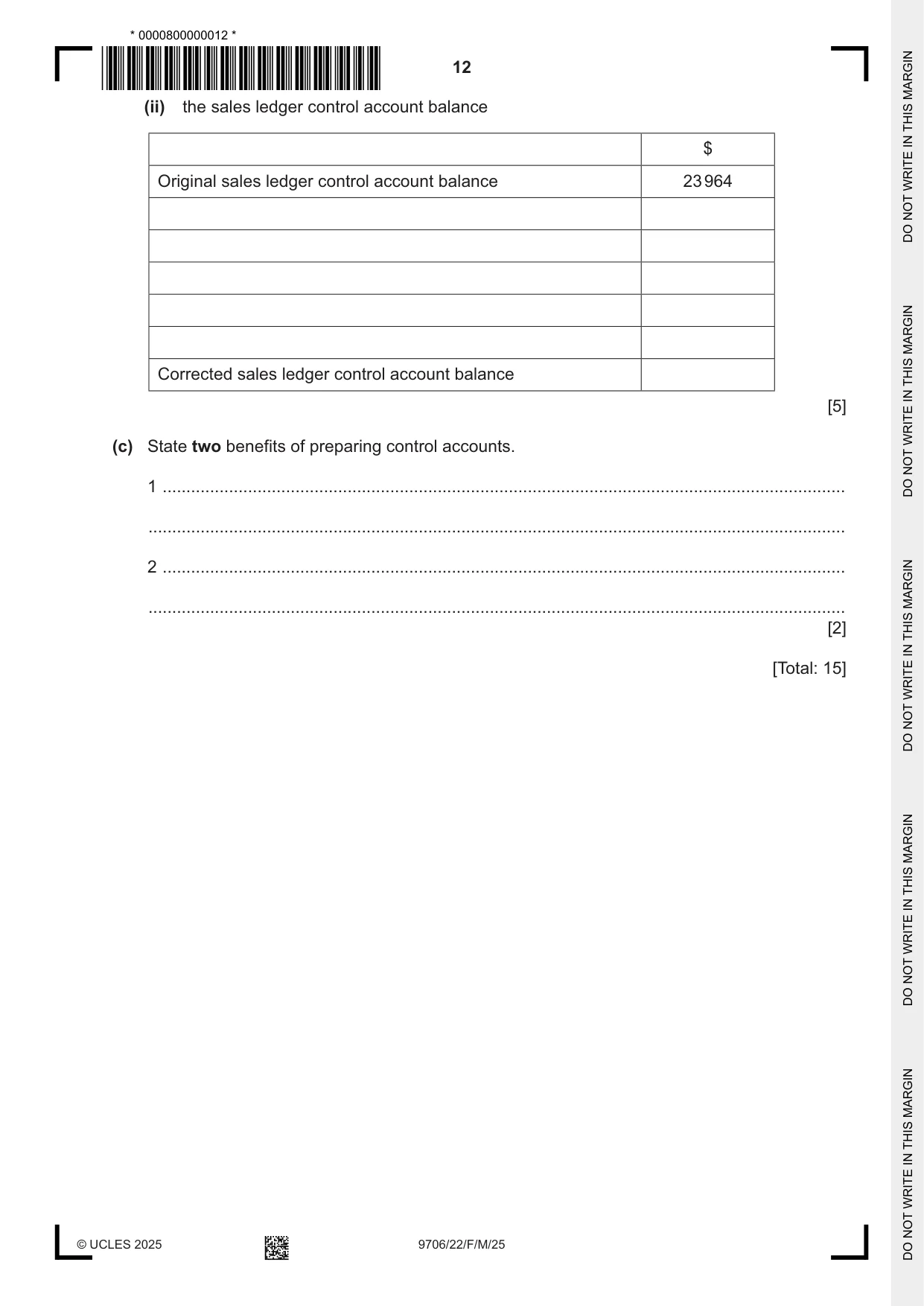
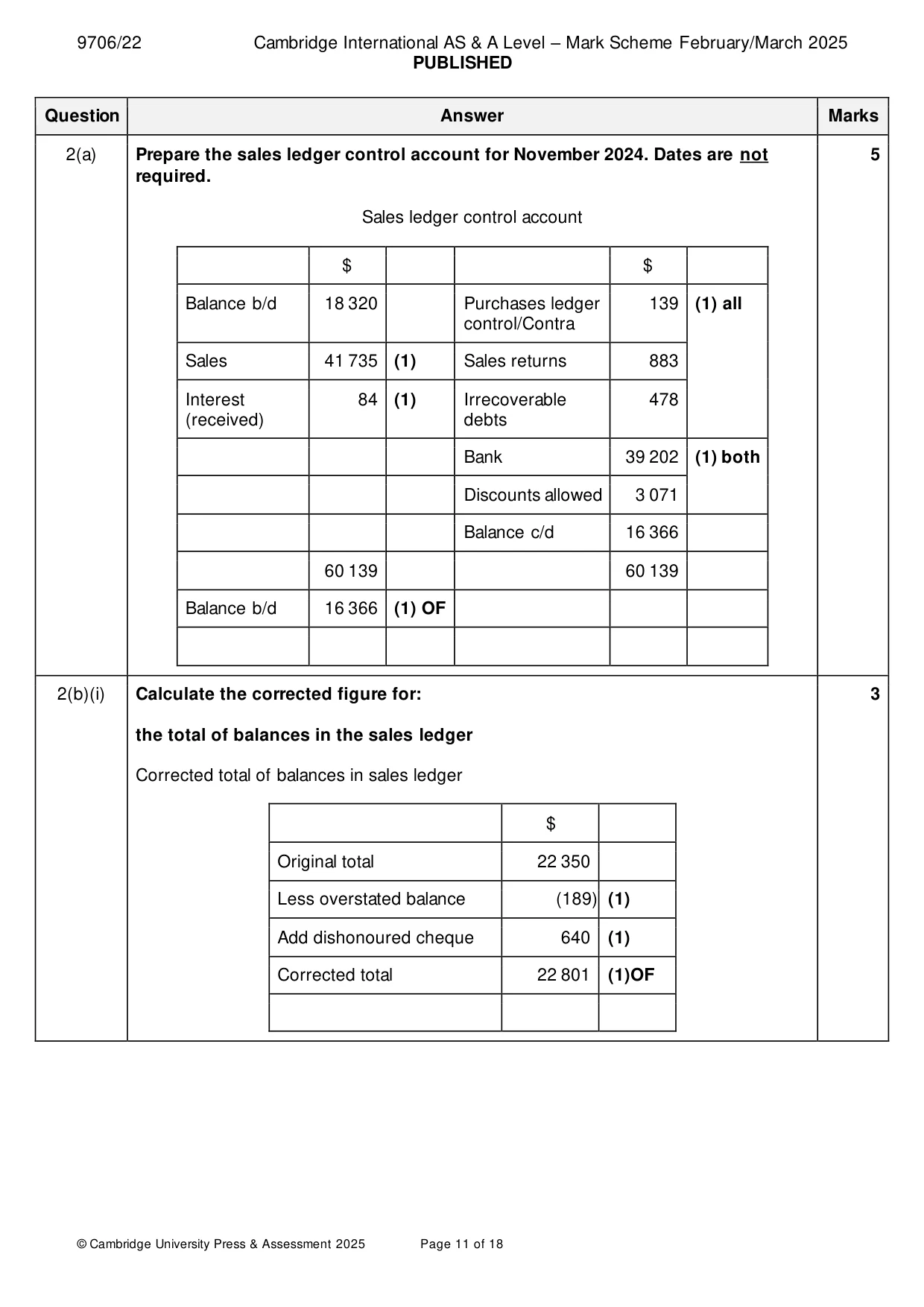
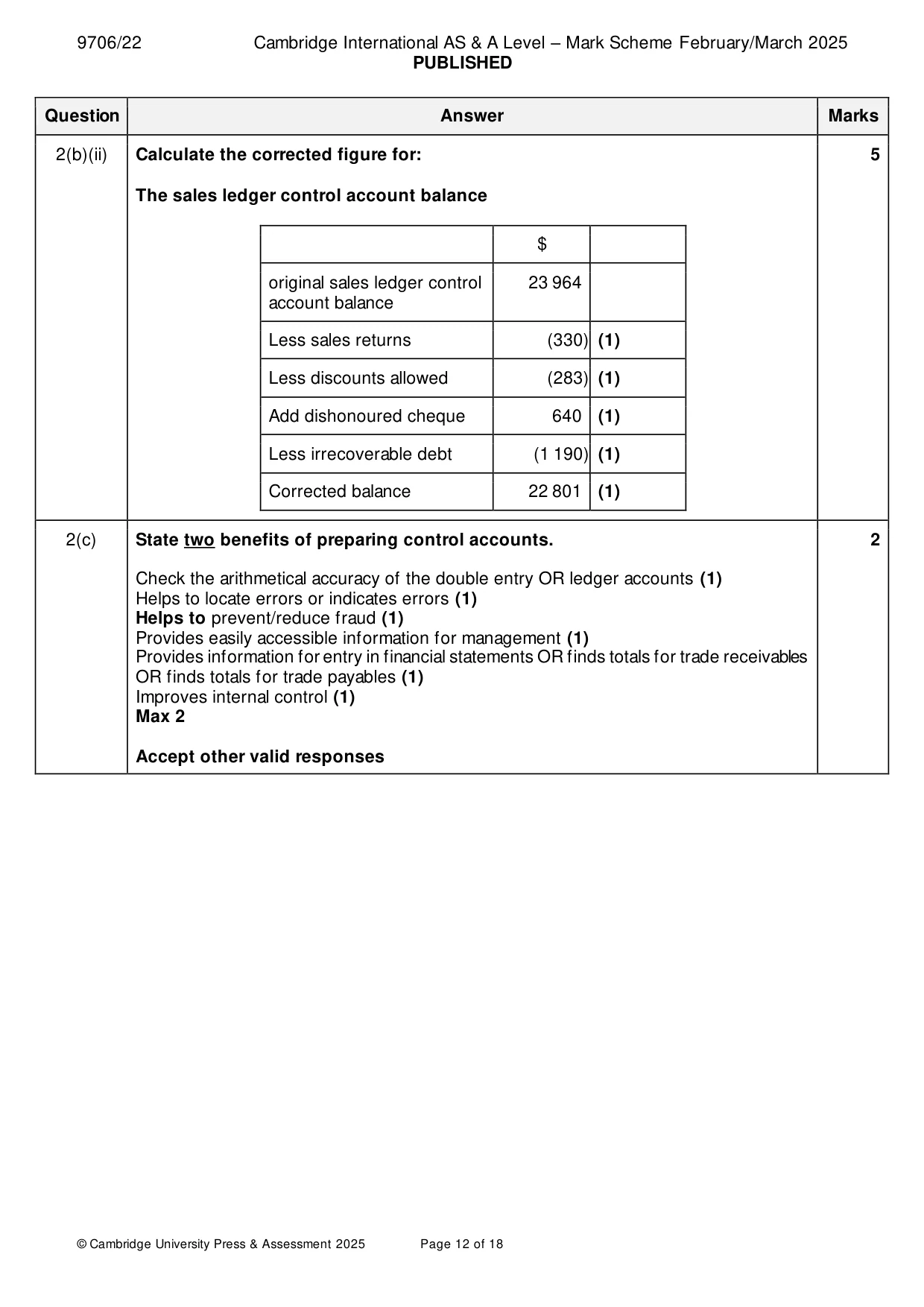
Mark scheme: 2(a) Prepare the sales ledger control account for November 2024. Dates are not 5 required. Sales ledger control account $ $ Balance b/d 18 320 Purchases ledger 139 (1) all control/Contra Sales 41 735 (1) Sales returns 883 Interest 84 (1) Irrecoverable 478 (received) debts Bank 39 202 (1) both Discounts allowed 3 071 Balance c/d 16 366 60 139 60 139 Balance b/d 16 366 (1) OF 2(b)(i) Calculate the corrected figure for: 3 the total of balances in the sales ledger Corrected total of balances in sales ledger $ Original total 22 350 Less overstated balance (189) (1) Add dishonoured cheque 640 (1) Corrected total 22 801 (1)OF 2(b)(ii) Calculate the corrected figure for: 5 The sales ledger control account balance $ original sales ledger control 23 964 account balance Less sales returns (330) (1) Less discounts allowed (283) (1) Add dishonoured cheque 640 (1) Less irrecoverable debt (1 190) (1) Corrected balance 22 801 (1) 2(c) State two benefits of preparing control accounts. 2 Check the arithmetical accuracy of the double entry OR ledger accounts (1) Helps to locate errors or indicates errors (1) Helps to prevent/reduce fraud (1) Provides easily accessible information for management (1) Provides information for entry in financial statements OR finds totals for trade receivables OR finds totals for trade payables (1) Improves internal control (1) Max 2 Accept other valid responses
Q3 · The discount column totals in the cash book had not been posted: column on debit side…
3 The discount column totals in the cash book had not been posted: column on debit side total $283 column on credit side total $319.
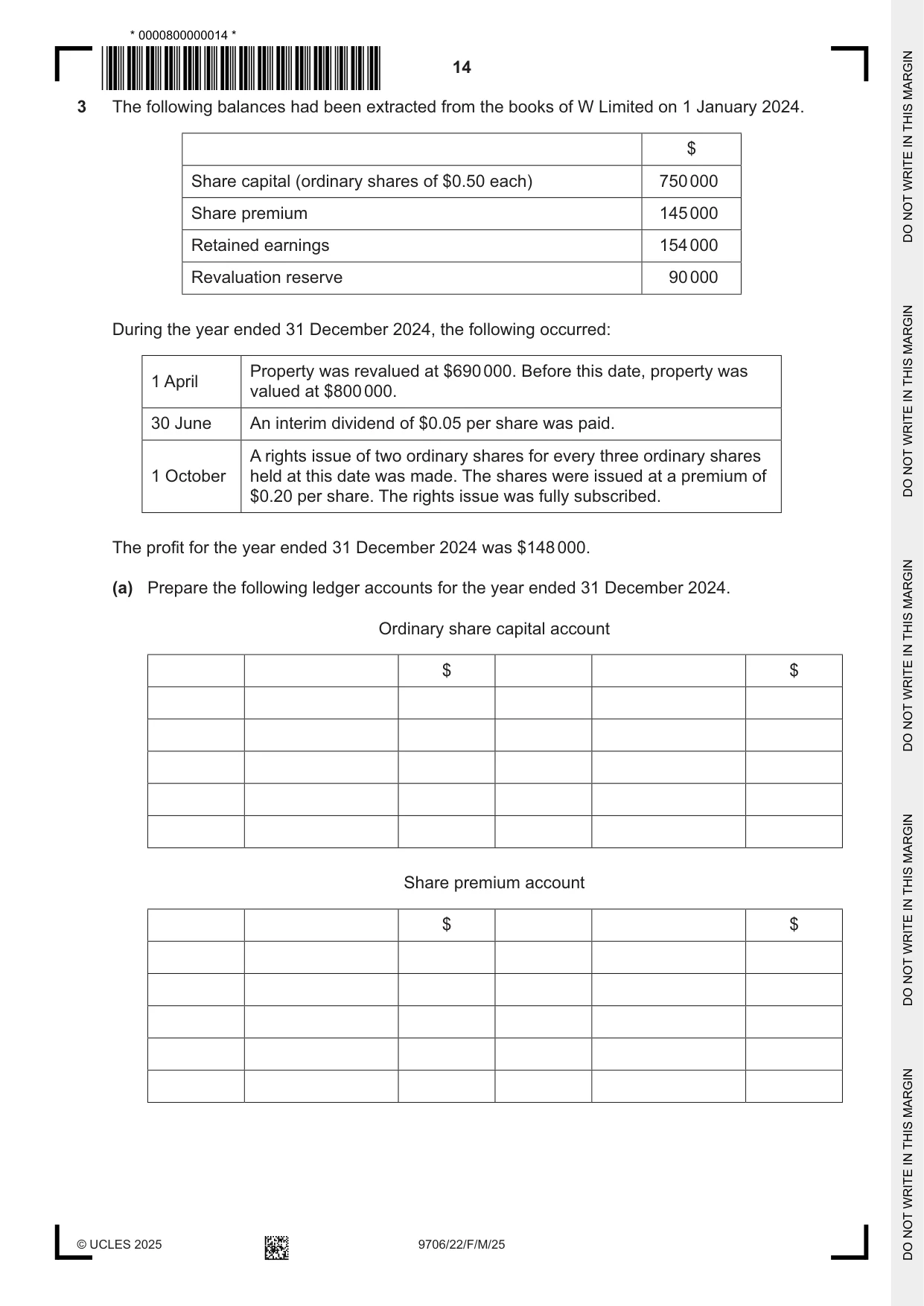
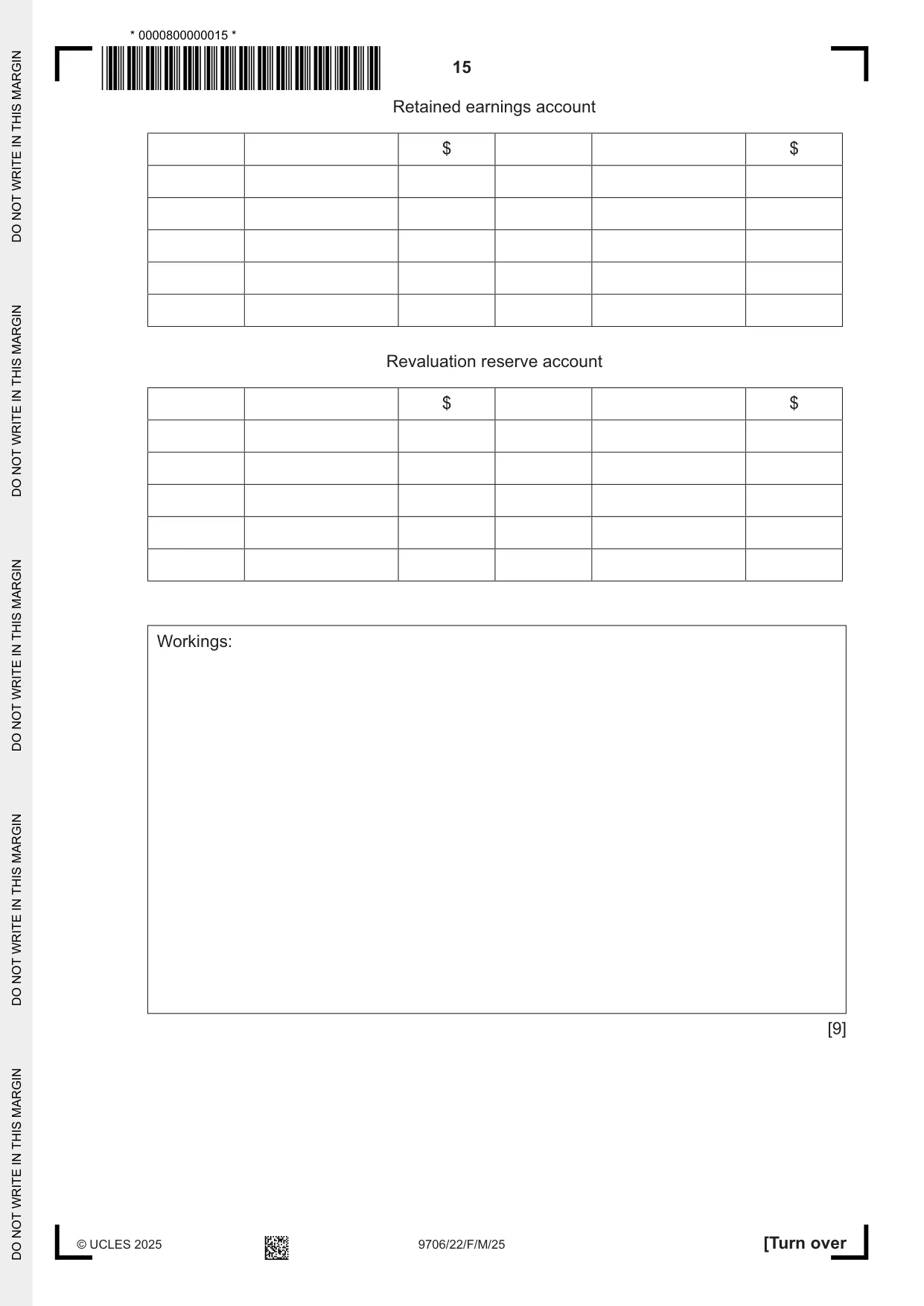
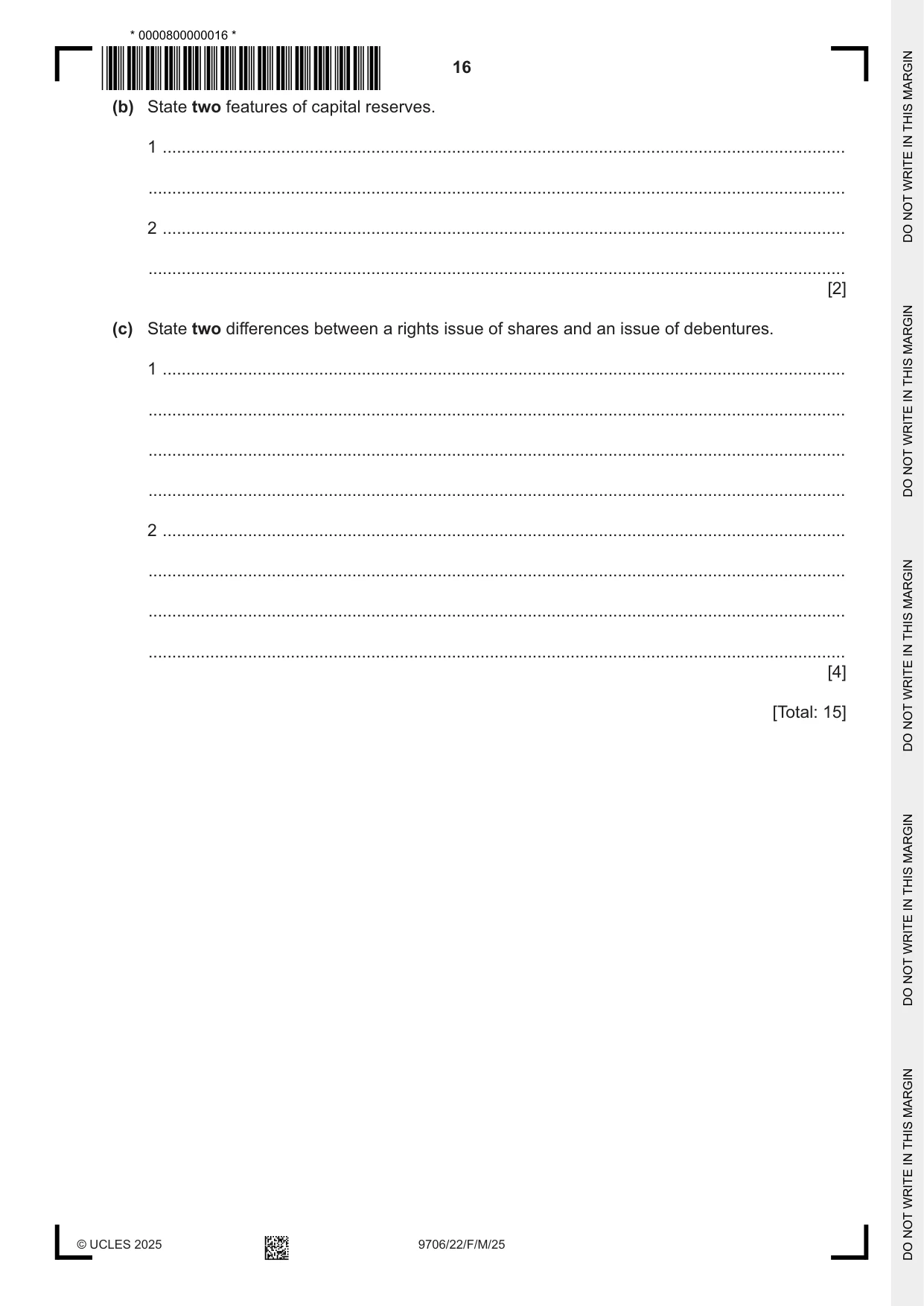
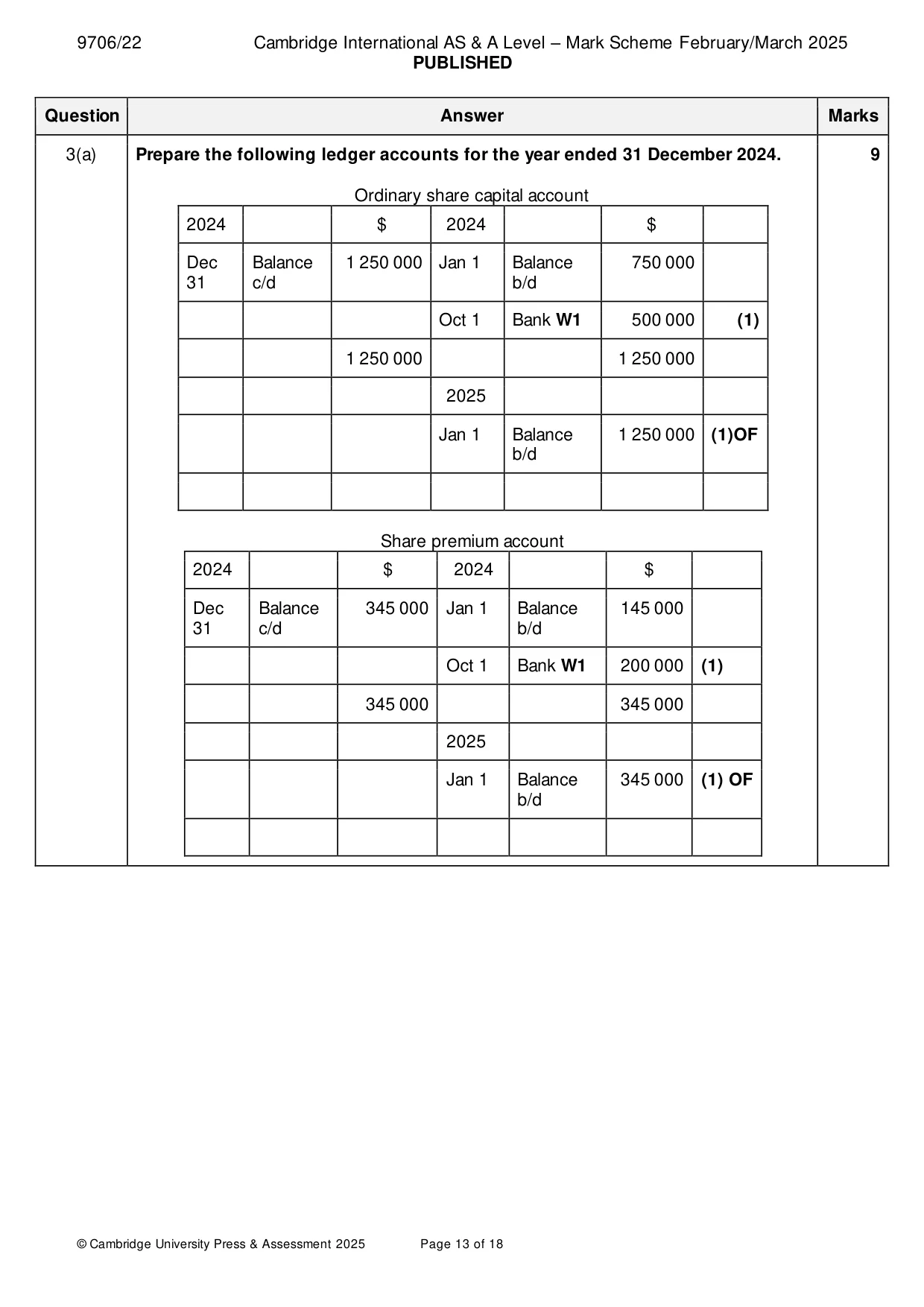
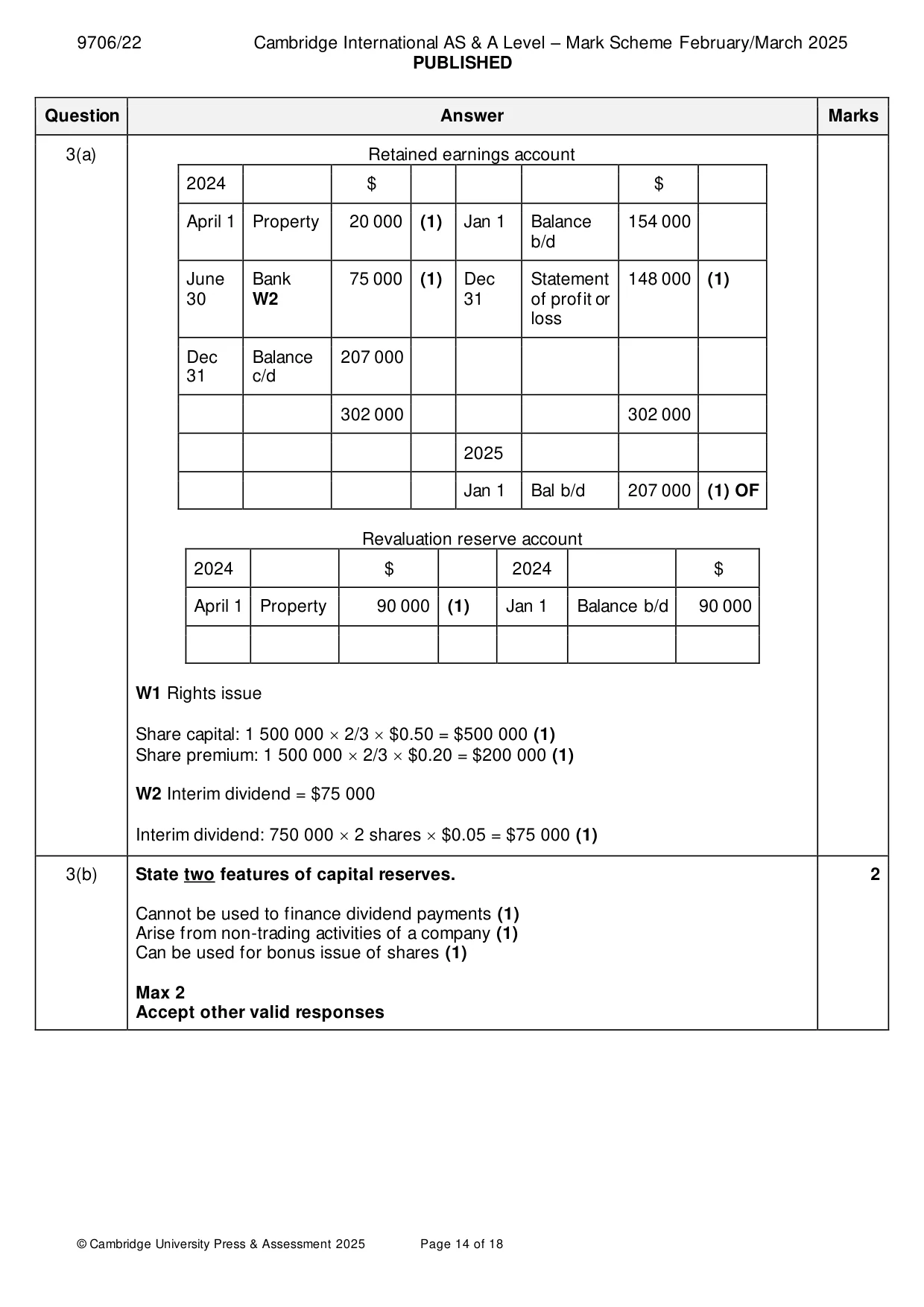
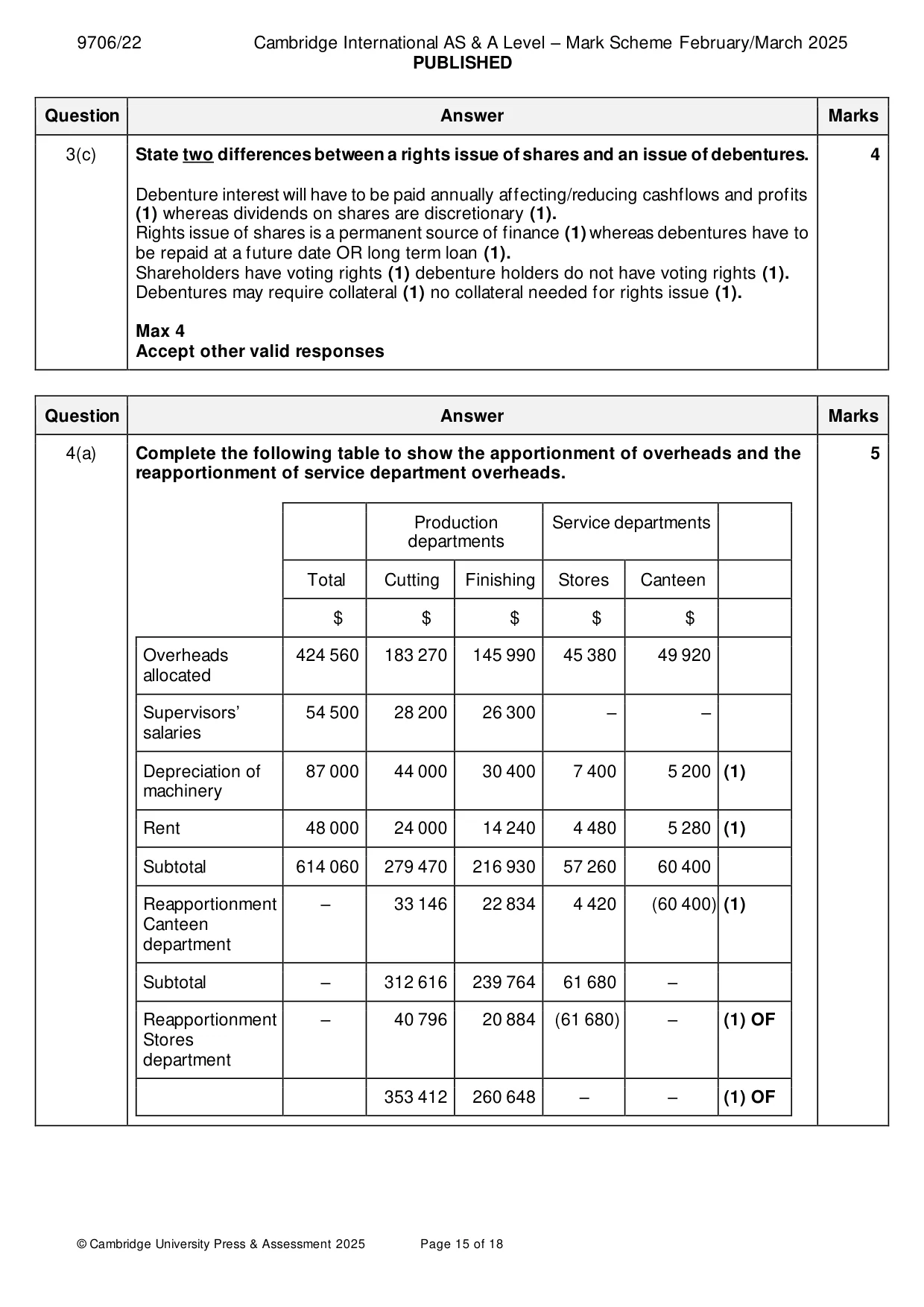
Mark scheme: 3(a) Prepare the following ledger accounts for the year ended 31 December 2024. 9 Ordinary share capital account 2024 $ 2024 $ Dec Balance 1 250 000 Jan 1 Balance 750 000 31 c/d b/d Oct 1 Bank W1 500 000 (1) 1 250 000 1 250 000 2025 Jan 1 Balance 1 250 000 (1)OF b/d Share premium account 2024 $ 2024 $ Dec Balance 345 000 Jan 1 Balance 145 000 31 c/d b/d Oct 1 Bank W1 200 000 (1) 345 000 345 000 2025 Jan 1 Balance 345 000 (1) OF b/d 3(a) Retained earnings account 2024 $ $ April 1 Property 20 000 (1) Jan 1 Balance 154 000 b/d June Bank 75 000 (1) Dec Statement 148 000 (1) 30 W2 31 of profit or loss Dec Balance 207 000 31 c/d 302 000 302 000 2025 Jan 1 Bal b/d 207 000 (1) OF Revaluation reserve account 2024 $ 2024 $ April 1 Property 90 000 (1) Jan 1 Balance b/d 90 000 W1 Rights issue Share capital: 1 500 000 2/3 $0.50 = $500 000 (1) Share premium: 1 500 000 2/3 $0.20 = $200 000 (1) W2 Interim dividend = $75 000 Interim dividend: 750 000 2 shares $0.05 = $75 000 (1) 3(b) State two features of capital reserves. 2 Cannot be used to finance dividend payments (1) Arise from non-trading activities of a company (1) Can be used for bonus issue of shares (1) Max 2 Accept other valid responses 3(c) State two differences between a rights issue of shares and an issue of debentures. 4 Debenture interest will have to be paid annually affecting/reducing cashflows and profits (1) whereas dividends on shares are discretionary (1). Rights issue of shares is a permanent source of finance (1) whereas debentures have to be repaid at a future date OR long term loan (1). Shareholders have voting rights (1) debenture holders do not have voting rights (1). Debentures may require collateral (1) no collateral needed for rights issue (1). Max 4 Accept other valid responses
Q4 · D Limited is a manufacturing company which uses absorption costing
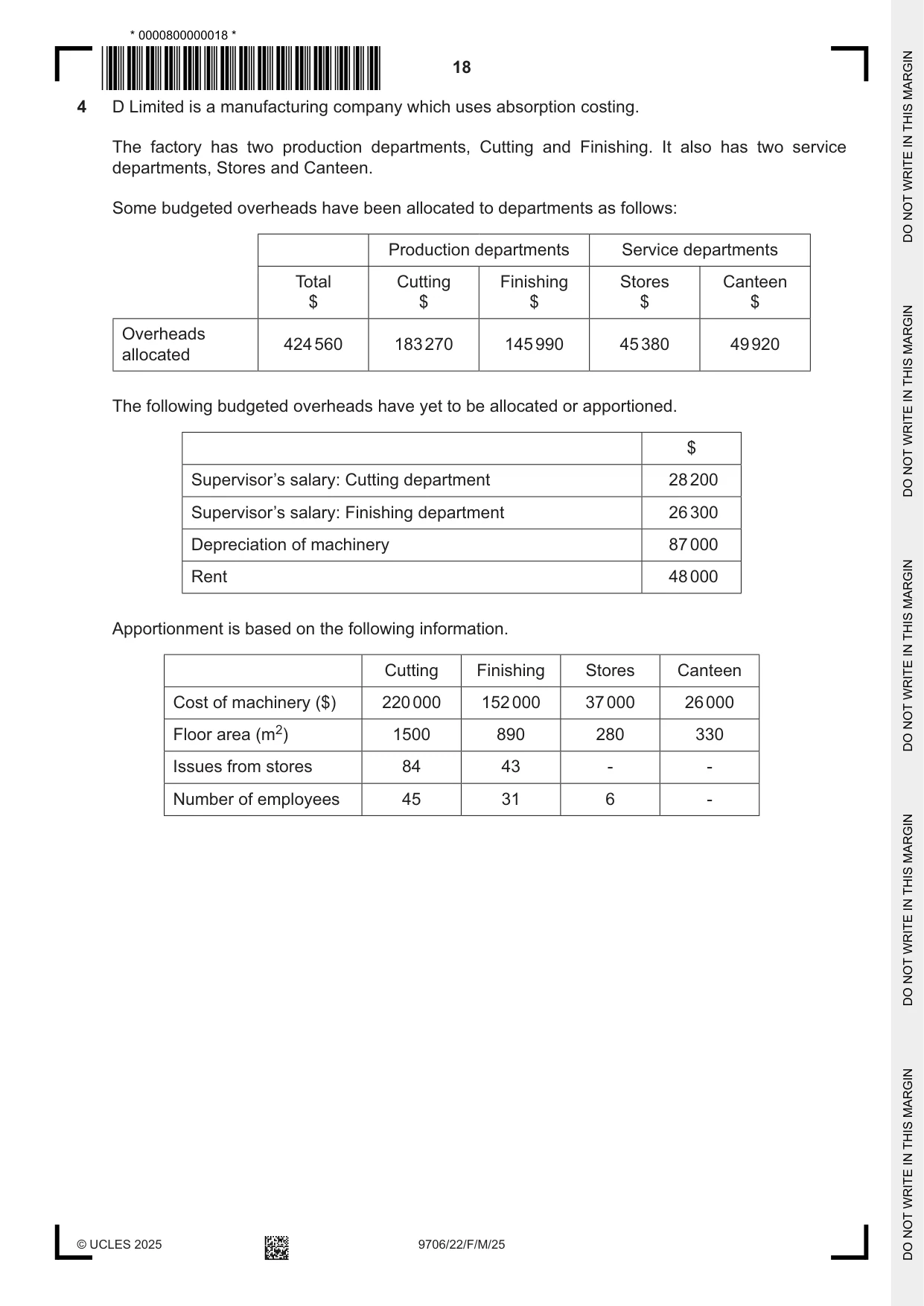
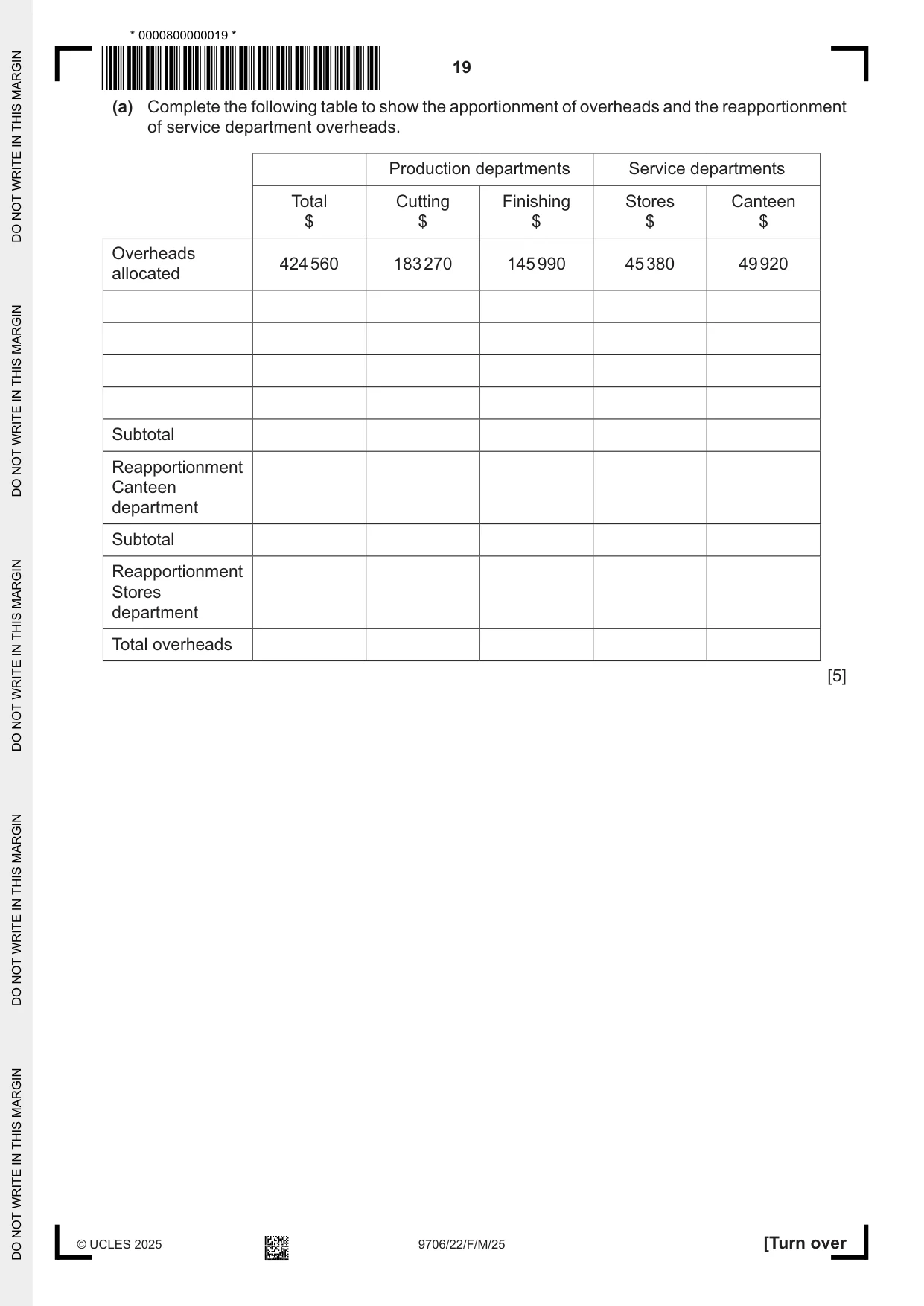
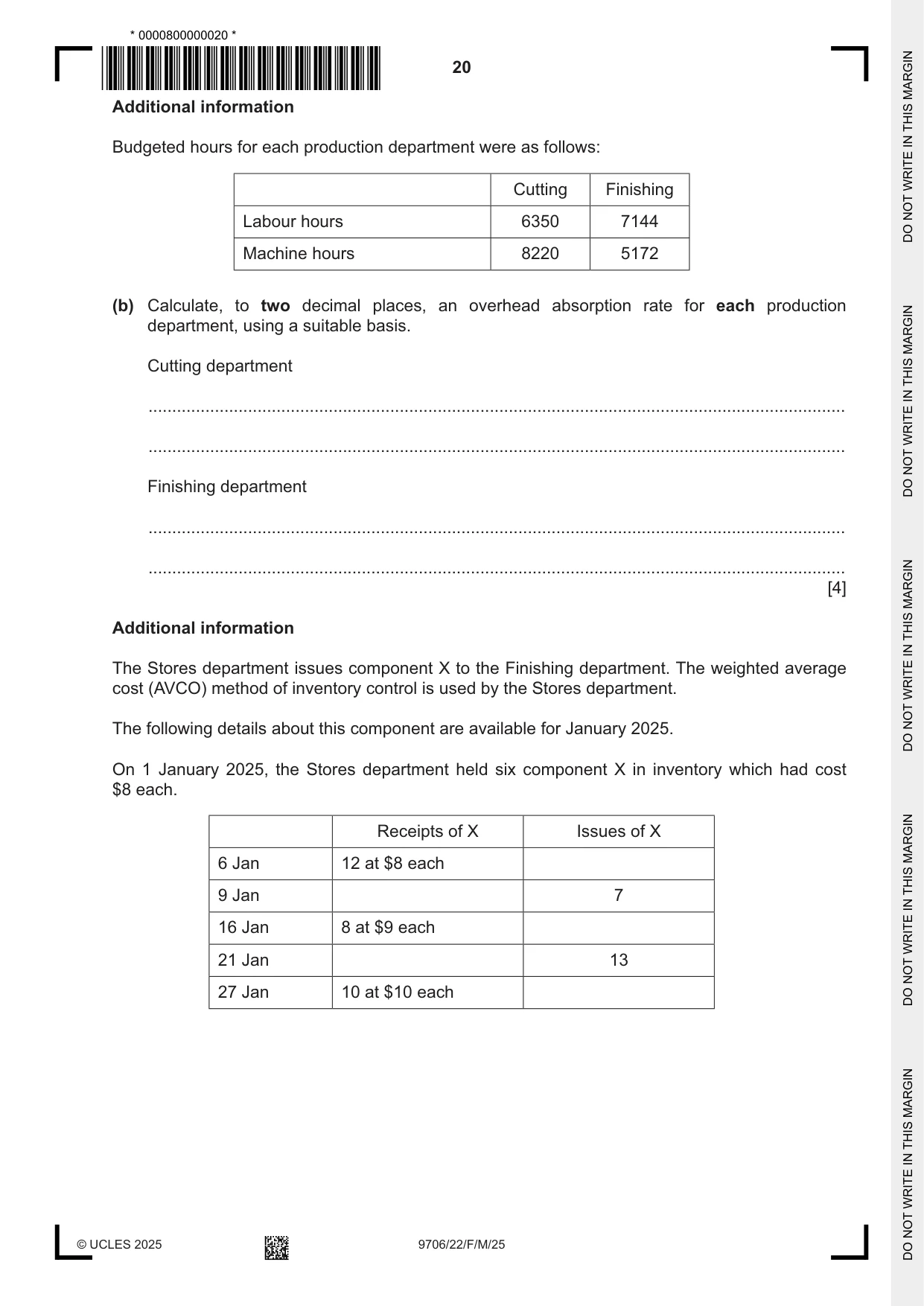
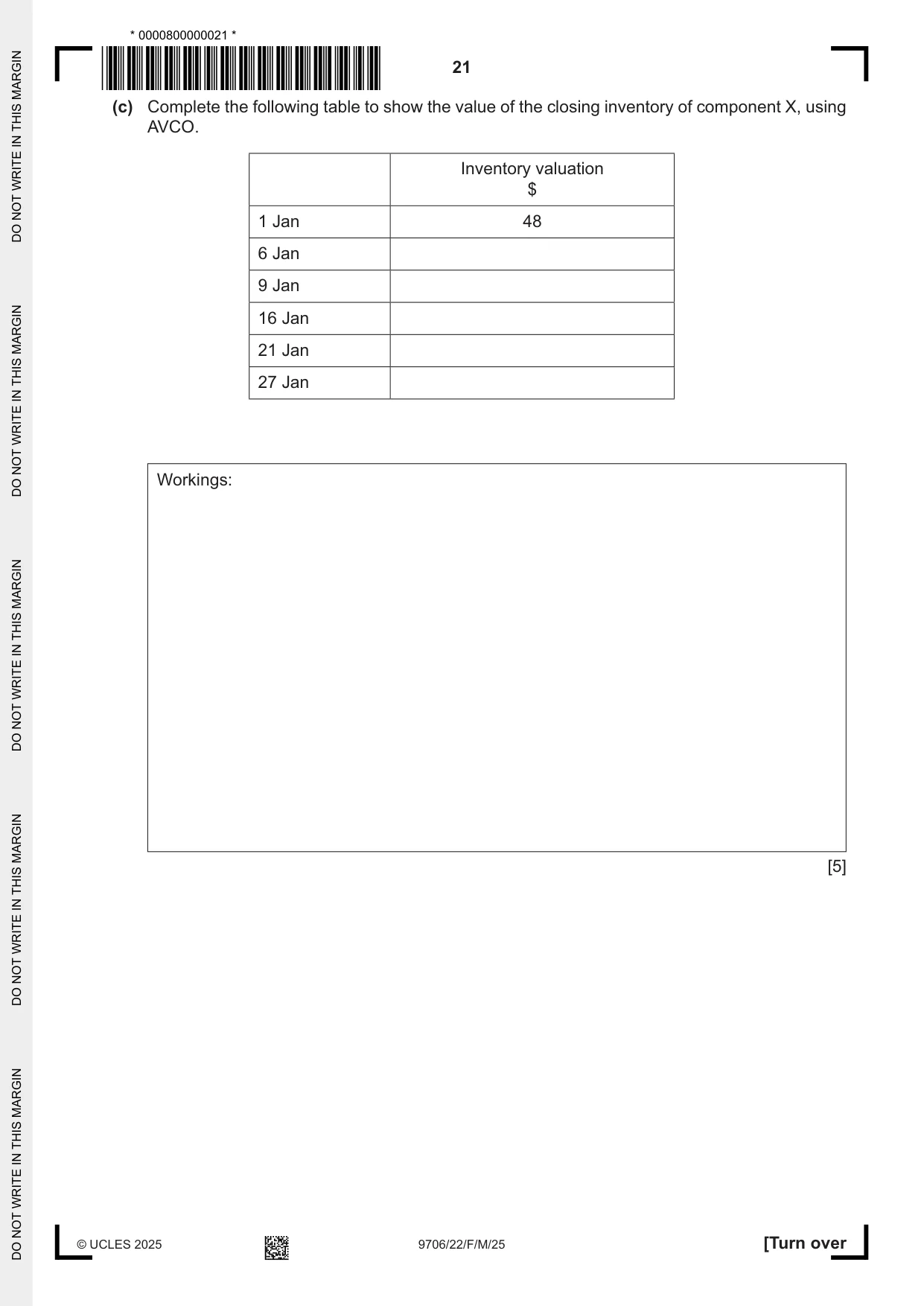
4 D Limited is a manufacturing company which uses absorption costing. The factory has two production departments, Cutting and Finishing. It also has two service departments, Stores and Canteen. Some budgeted overheads have been allocated to departments as follows: Production departments Service departments Total Cutting Finishing Stores Canteen $ $ $ $ $ Overheads 424 560 183 270 145 990 45 380 49 920 allocated The following budgeted overheads have yet to be allocated or apportioned. $ Supervisor’s salary: Cutting department 28 200 Supervisor’s salary: Finishing department 26 300 Depreciation of machinery 87 000 Rent 48 000 Apportionment is based on the following information. Cutting Finishing Stores Canteen Cost of machinery ($) 220 000 152 000 37 000 26 000 Floor area (m2) 1500 890 280 330 Issues from stores 84 43 ‑ ‑ Number of employees 45 31 6 ‑ (a) Complete the following table to show the apportionment of overheads and the reapportionment of service department overheads. Production departments Service departments Total Cutting Finishing Stores Canteen $ $ $ $ $ Overheads 424 560 183 270 145 990 45 380 49 920 allocated Subtotal Reapportionment Canteen department Subtotal Reapportionment Stores department Total overheads [5] Additional information Budgeted hours for each production department were as follows: Cutting Finishing Labour hours 6350 7144 Machine hours 8220 5172 (b) Calculate, to two decimal places, an overhead absorption rate for each production department, using a suitable basis. Cutting department ................................................................................................................................................... ................................................................................................................................................... Finishing department ................................................................................................................................................... ................................................................................................................................................... [4] Additional information The Stores department issues component X to the Finishing department. The weighted average cost (AVCO) method of inventory control is used by the Stores department. The following details about this component are available for January 2025. On 1 January 2025, the Stores department held six component X in inventory which had cost $8 each. Receipts of X Issues of X 6 Jan 12 at $8 each 9 Jan 7 16 Jan 8 at $9 each 21 Jan 13 27 Jan 10 at $10 each
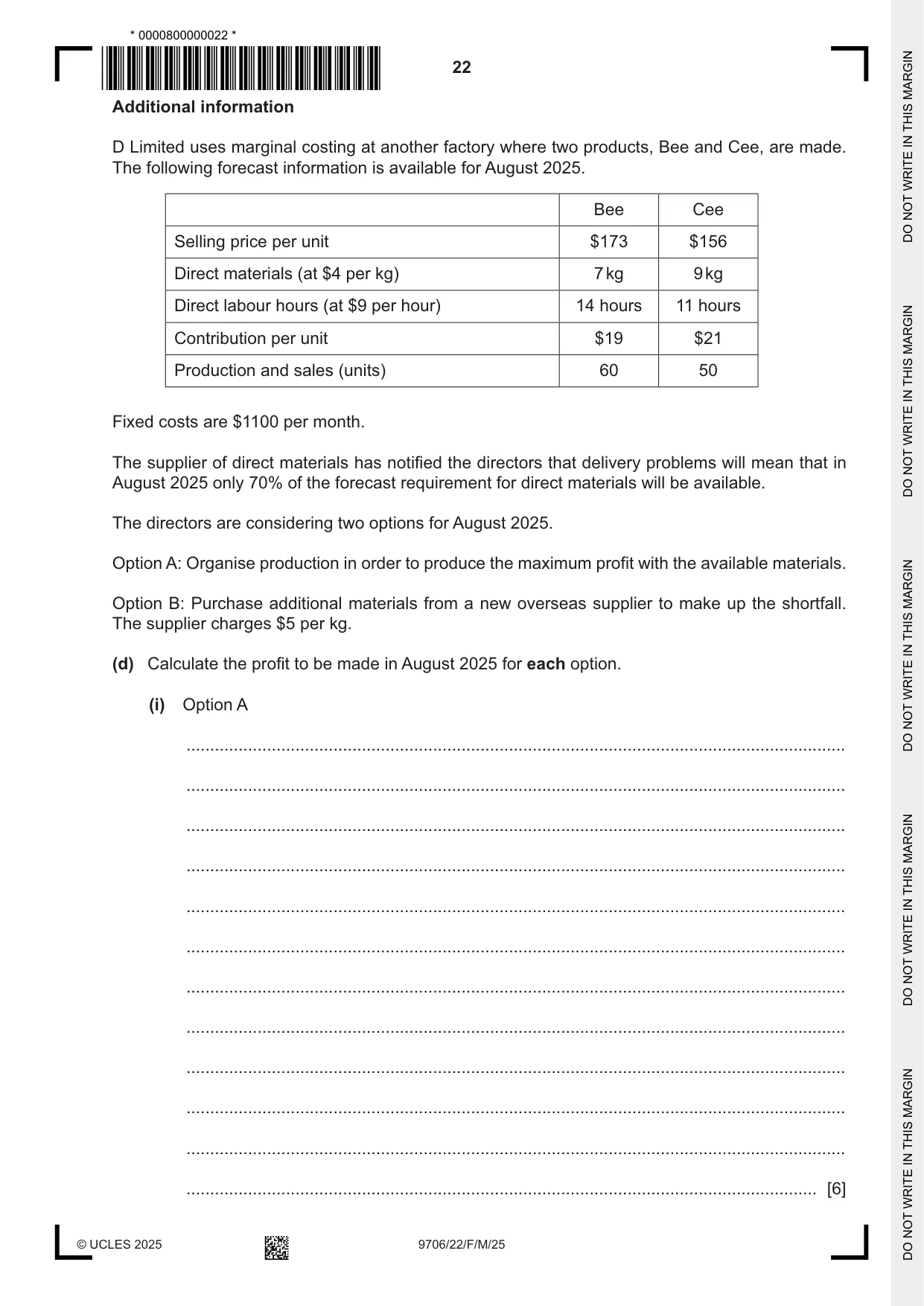
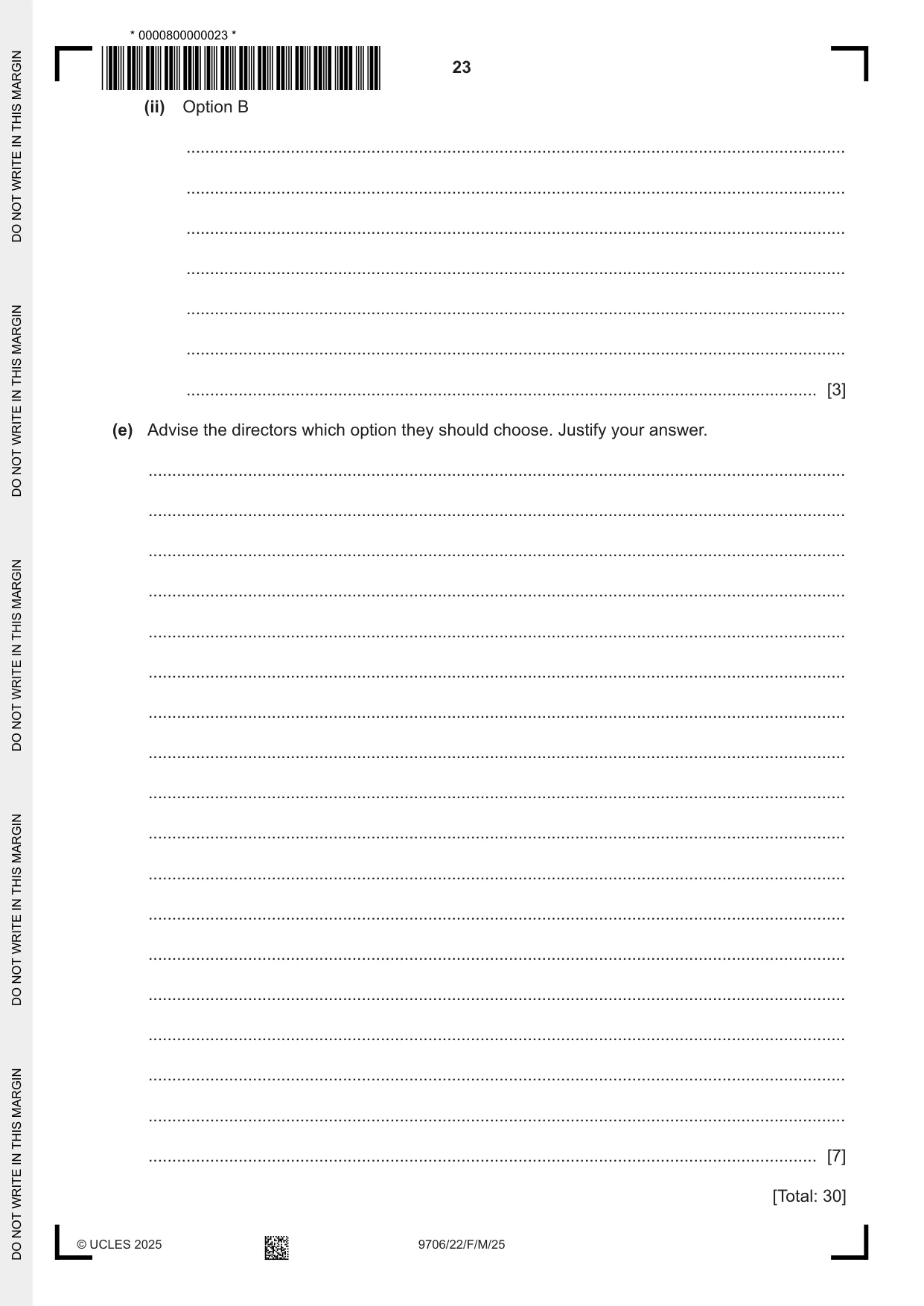
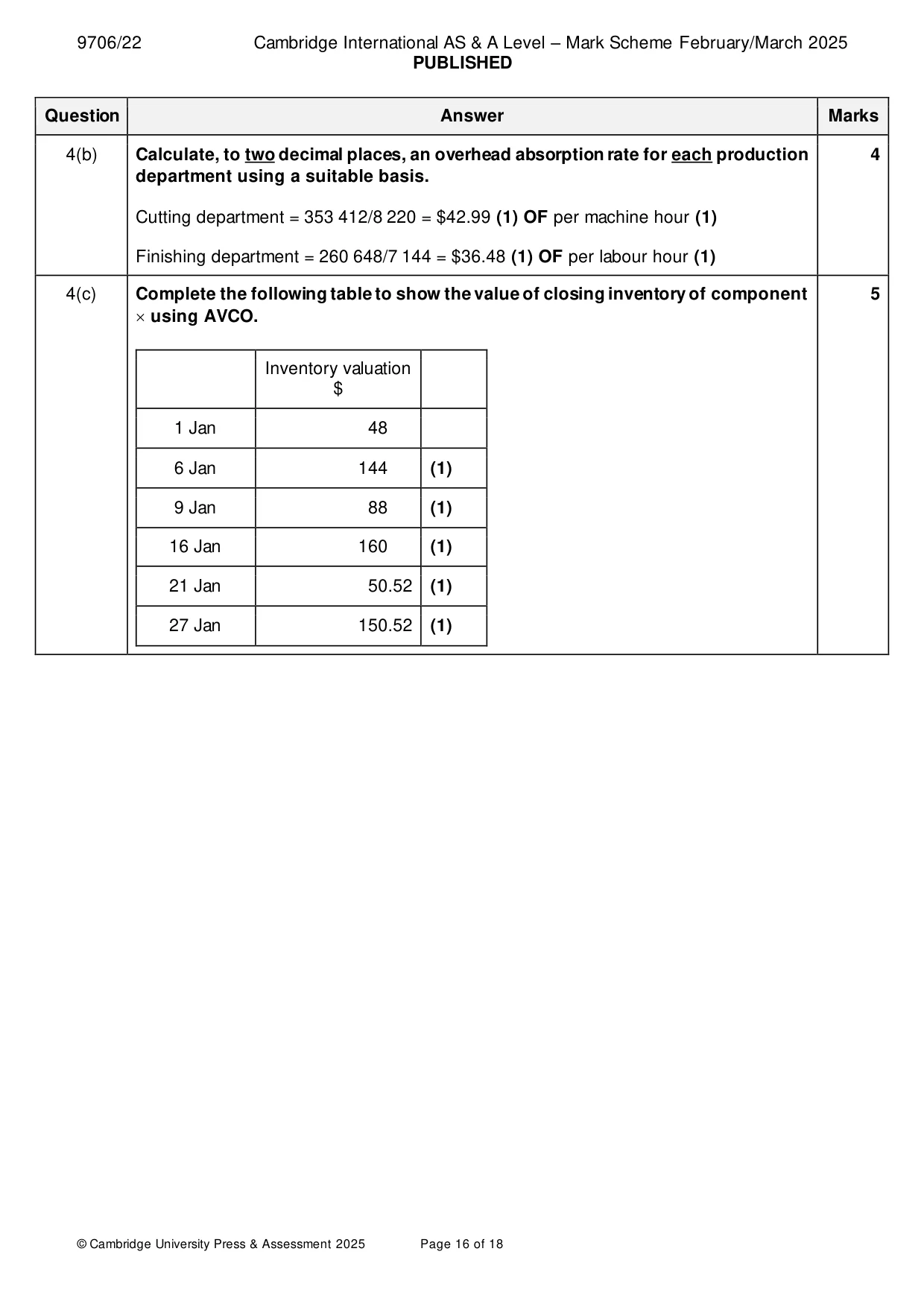
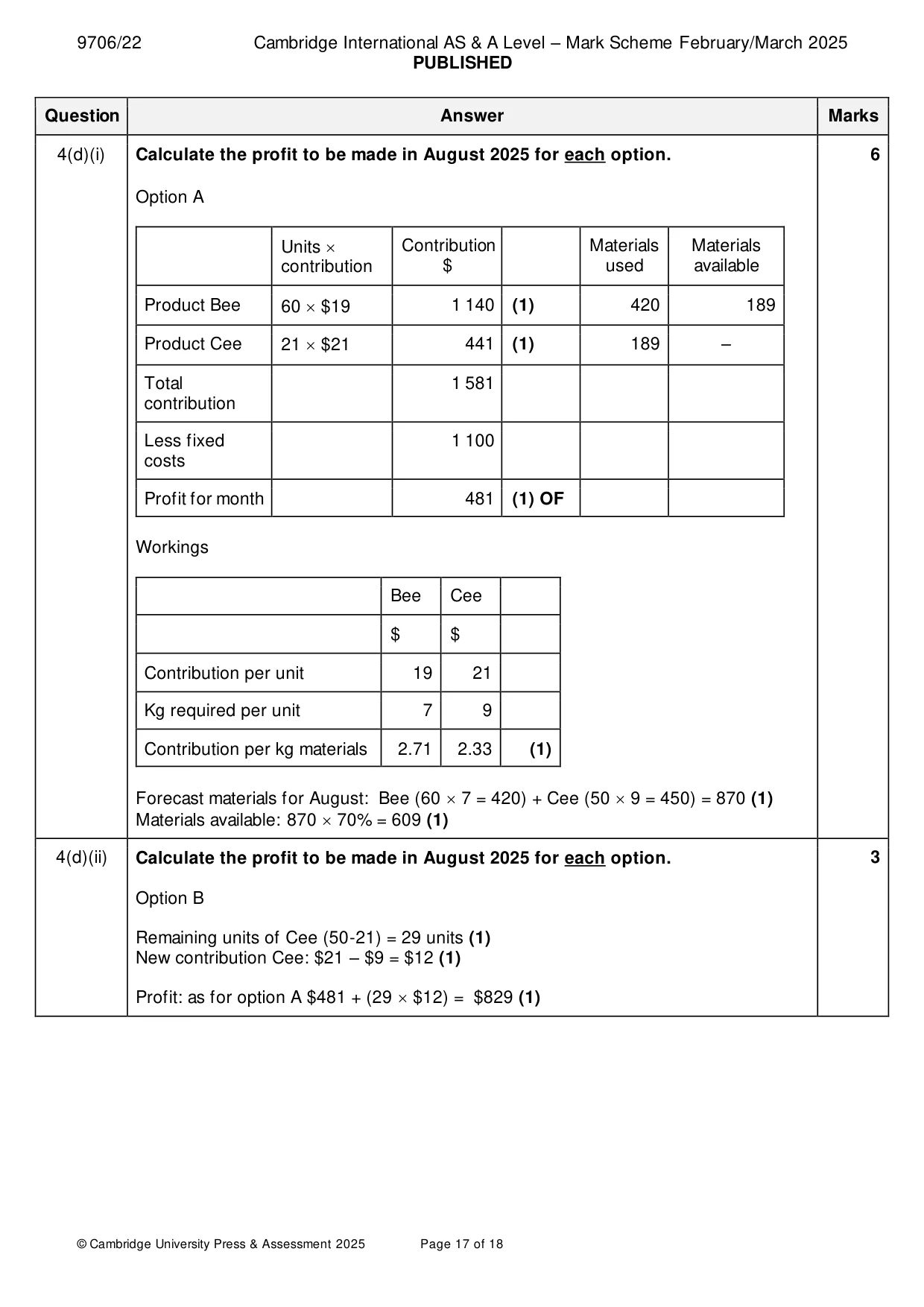
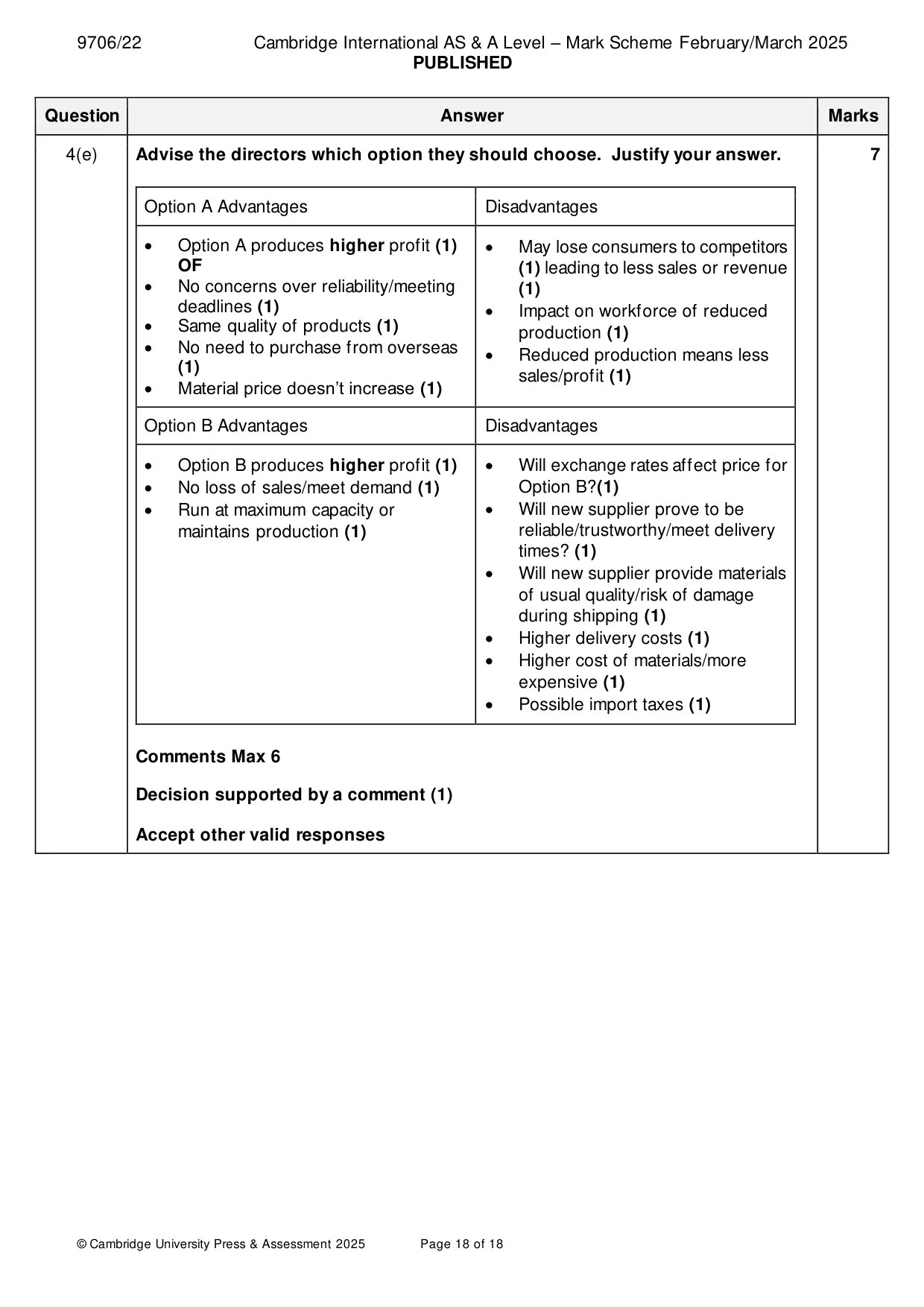
Mark scheme: Question Answer Marks 4(a) Complete the following table to show the apportionment of overheads and the 5 reapportionment of service department overheads. Production Service departments departments Total Cutting Finishing Stores Canteen $ $ $ $ $ Overheads 424 560 183 270 145 990 45 380 49 920 allocated Supervisors’ 54 500 28 200 26 300 – – salaries Depreciation of 87 000 44 000 30 400 7 400 5 200 (1) machinery Rent 48 000 24 000 14 240 4 480 5 280 (1) Subtotal 614 060 279 470 216 930 57 260 60 400 Reapportionment – 33 146 22 834 4 420 (60 400) (1) Canteen department Subtotal – 312 616 239 764 61 680 – Reapportionment – 40 796 20 884 (61 680) – (1) OF Stores department 353 412 260 648 – – (1) OF 4(b) Calculate, to two decimal places, an overhead absorption rate for each production 4 department using a suitable basis. Cutting department = 353 412/8 220 = $42.99 (1) OF per machine hour (1) Finishing department = 260 648/7 144 = $36.48 (1) OF per labour hour (1) 4(c) Complete the following table to show the value of closing inventory of component 5 using AVCO. Inventory valuation $ 1 Jan 48 6 Jan 144 (1) 9 Jan 88 (1) 16 Jan 160 (1) 21 Jan 50.52 (1) 27 Jan 150.52 (1) 4(d)(i) Calculate the profit to be made in August 2025 for each option. 6 Option A Units Contribution Materials Materials contribution $ used available Product Bee 60 $19 1 140 (1) 420 189 Product Cee 21 $21 441 (1) 189 – Total 1 581 contribution Less fixed 1 100 costs Profit for month 481 (1) OF Workings Bee Cee $ $ Contribution per unit 19 21 Kg required per unit 7 9 Contribution per kg materials 2.71 2.33 (1) Forecast materials for August: Bee (60 7 = 420) + Cee (50 9 = 450) = 870 (1) Materials available: 870 70% = 609 (1) 4(d)(ii) Calculate the profit to be made in August 2025 for each option. 3 Option B Remaining units of Cee (50-21) = 29 units (1) New contribution Cee: $21 – $9 = $12 (1) Profit: as for option A $481 + (29 $12) = $829 (1) 4(e) Advise the directors which option they should choose. Justify your answer. 7 Option A Advantages Disadvantages • Option A produces higher profit (1) • May lose consumers to competitors OF (1) leading to less sales or revenue • No concerns over reliability/meeting (1) deadlines (1) • Impact on workforce of reduced • Same quality of products (1) production (1) • No need to purchase from overseas • Reduced production means less (1) sales/profit (1) • Material price doesn’t increase (1) Option B Advantages Disadvantages • Option B produces higher profit (1) • Will exchange rates affect price for • No loss of sales/meet demand (1) Option B?(1) • Run at maximum capacity or • Will new supplier prove to be maintains production (1) reliable/trustworthy/meet delivery times? (1) • Will new supplier provide materials of usual quality/risk of damage during shipping (1) • Higher delivery costs (1) • Higher cost of materials/more expensive (1) • Possible import taxes (1) Comments Max 6 Decision supported by a comment (1) Accept other valid responses
Q5 · An irrecoverable debt of $892 had been recorded correctly in the customer’s ledger…
5 An irrecoverable debt of $892 had been recorded correctly in the customer’s ledger account but had been debited to the sales ledger control account as $298. (b) Calculate the corrected figure for: (i) the total of balances in the sales ledger $ Original total of balances in the sales ledger 22 350 Corrected total of balances in the sales ledger [3] (ii) the sales ledger control account balance $ Original sales ledger control account balance 23 964 Corrected sales ledger control account balance [5] (c) State two benefits of preparing control accounts. 1 ................................................................................................................................................ ................................................................................................................................................... 2 ................................................................................................................................................ ................................................................................................................................................... [2] [Total: 15]
What was in this paper
The subtopics covered by these 5 questions, and how many questions each got. Open one in a new tab to see every Cambridge question on it.
What you needed in this session
Cambridge’s own grade thresholds for 2025 Feb/March, Paper 2 · Variant 2. A higher threshold means an easier paper — the bar moves with how the cohort did.