Cambridge A Level Accounting 9706 — 2024 May/June Paper 2 · Variant 1
9706/21/M/J/24 · 5 questions · 90 marks · ≈101 min
The question paper and its mark scheme, free to read here and free to download. This is Cambridge’s own paper, exactly as it was sat.
Question paper20 pages





Mark scheme20 pages
Answers below. Sit the paper first if you are practising.
Questions as text
Q1 · Haroon and Rakesh are in partnership
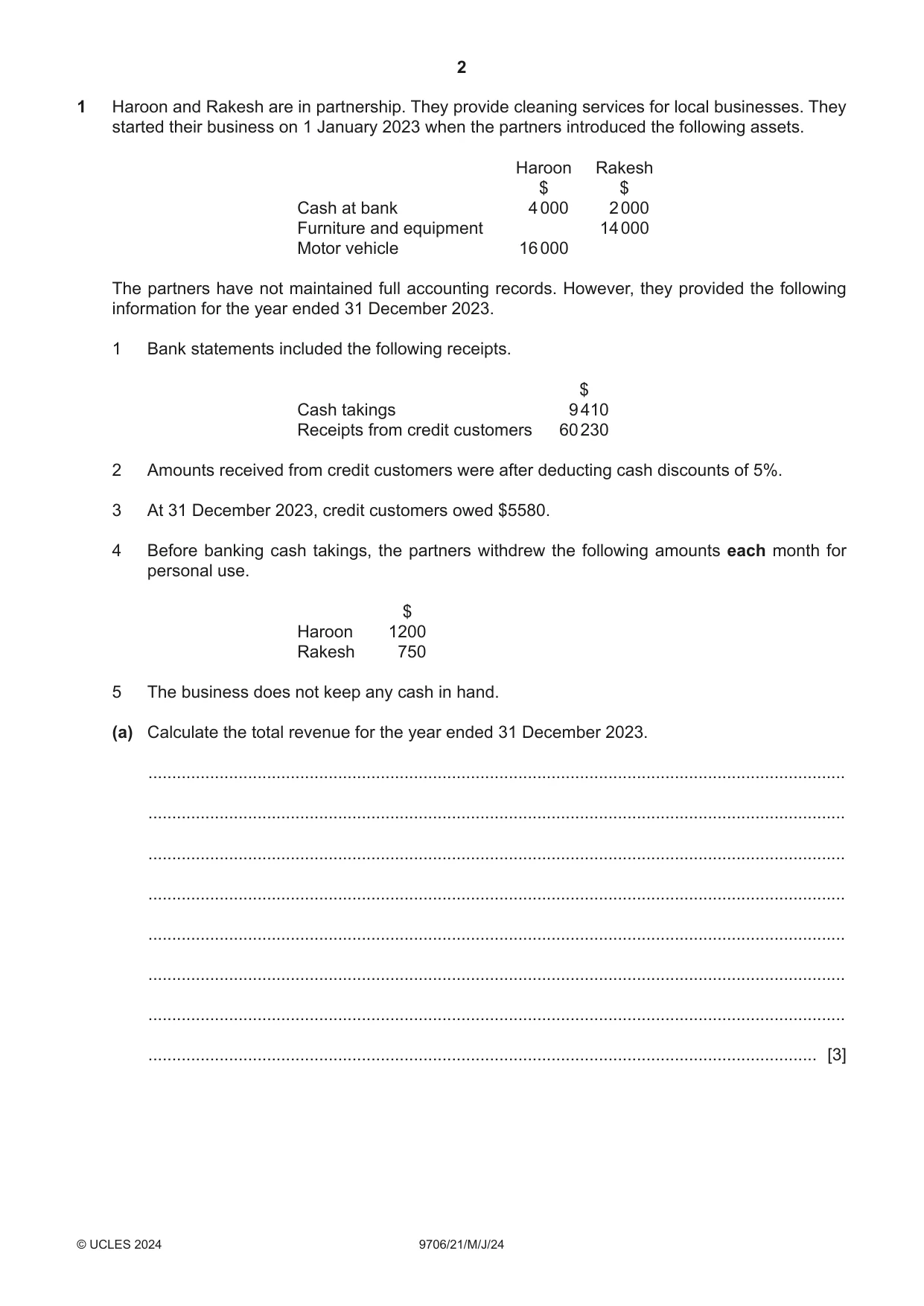
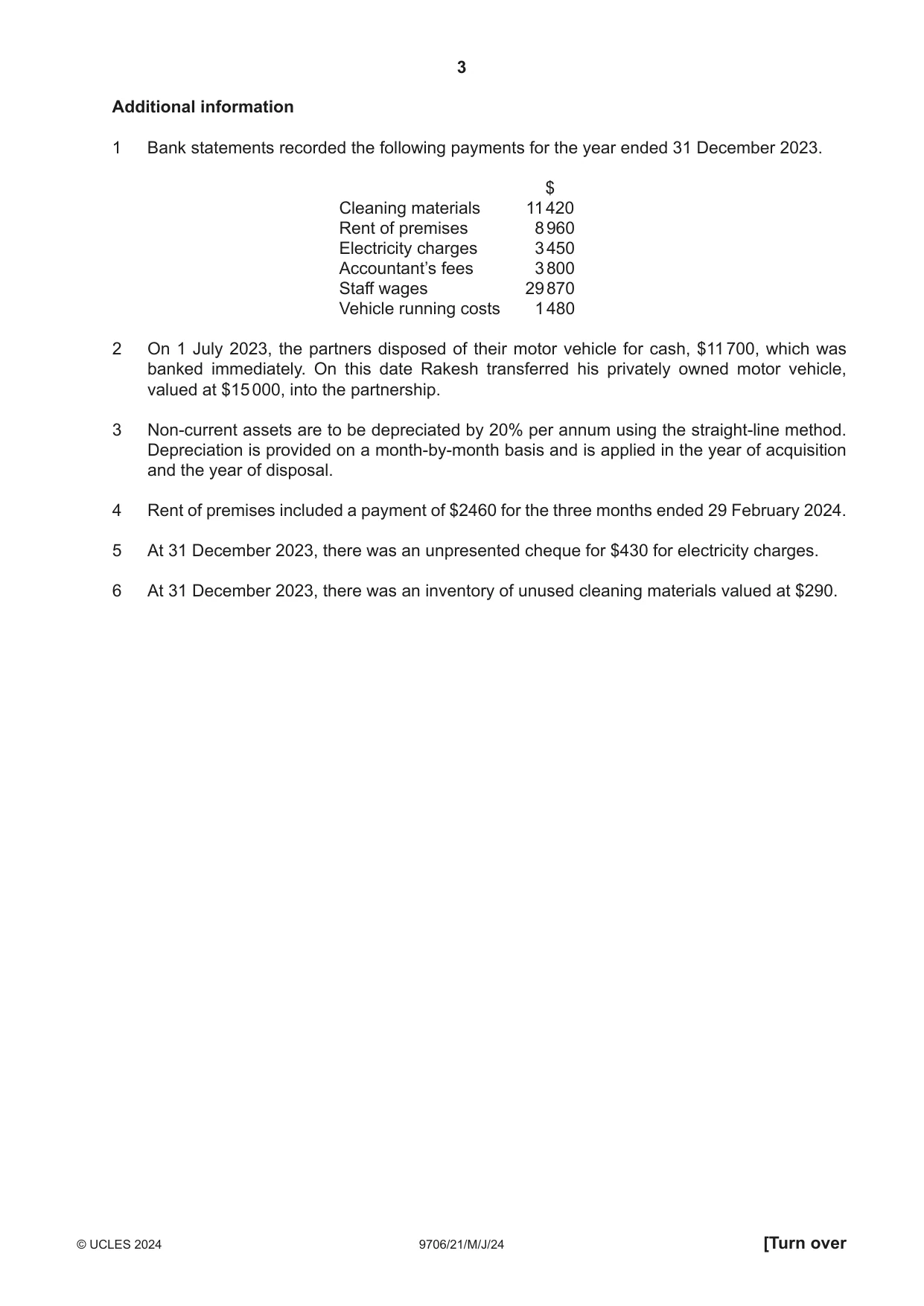
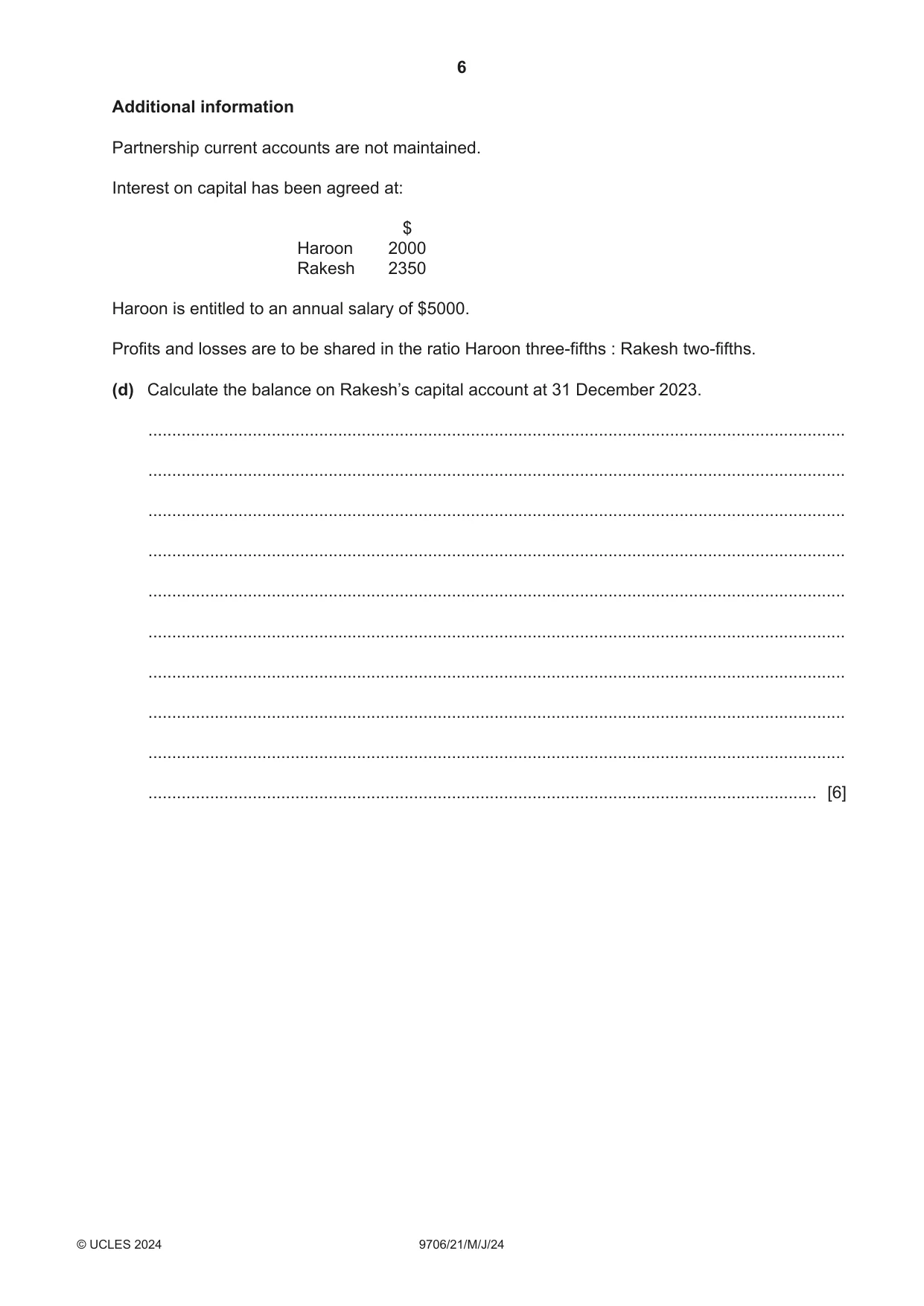
1 Haroon and Rakesh are in partnership. They provide cleaning services for local businesses. They started their business on 1 January 2023 when the partners introduced the following assets. Haroon Rakesh $ $ Cash at bank 4 000 2 000 Furniture and equipment 14 000 Motor vehicle 16 000 The partners have not maintained full accounting records. However, they provided the following information for the year ended 31 December 2023. 1 Bank statements included the following receipts. $ Cash takings 9 410 Receipts from credit customers 60 230 2 Amounts received from credit customers were after deducting cash discounts of 5%. 3 At 31 December 2023, credit customers owed $5580. 4 Before banking cash takings, the partners withdrew the following amounts each month for personal use. $ Haroon 1200 Rakesh 750 5 The business does not keep any cash in hand. (a) Calculate the total revenue for the year ended 31 December 2023. ................................................................................................................................................... ................................................................................................................................................... ................................................................................................................................................... ................................................................................................................................................... ................................................................................................................................................... ................................................................................................................................................... ................................................................................................................................................... ............................................................................................................................................. [3] Additional information 1 Bank statements recorded the following payments for the year ended 31 December 2023. $ Cleaning materials 11 420 Rent of premises 8 960 Electricity charges 3 450 Accountant’s fees 3 800 Staff wages 29 870 Vehicle running costs 1 480
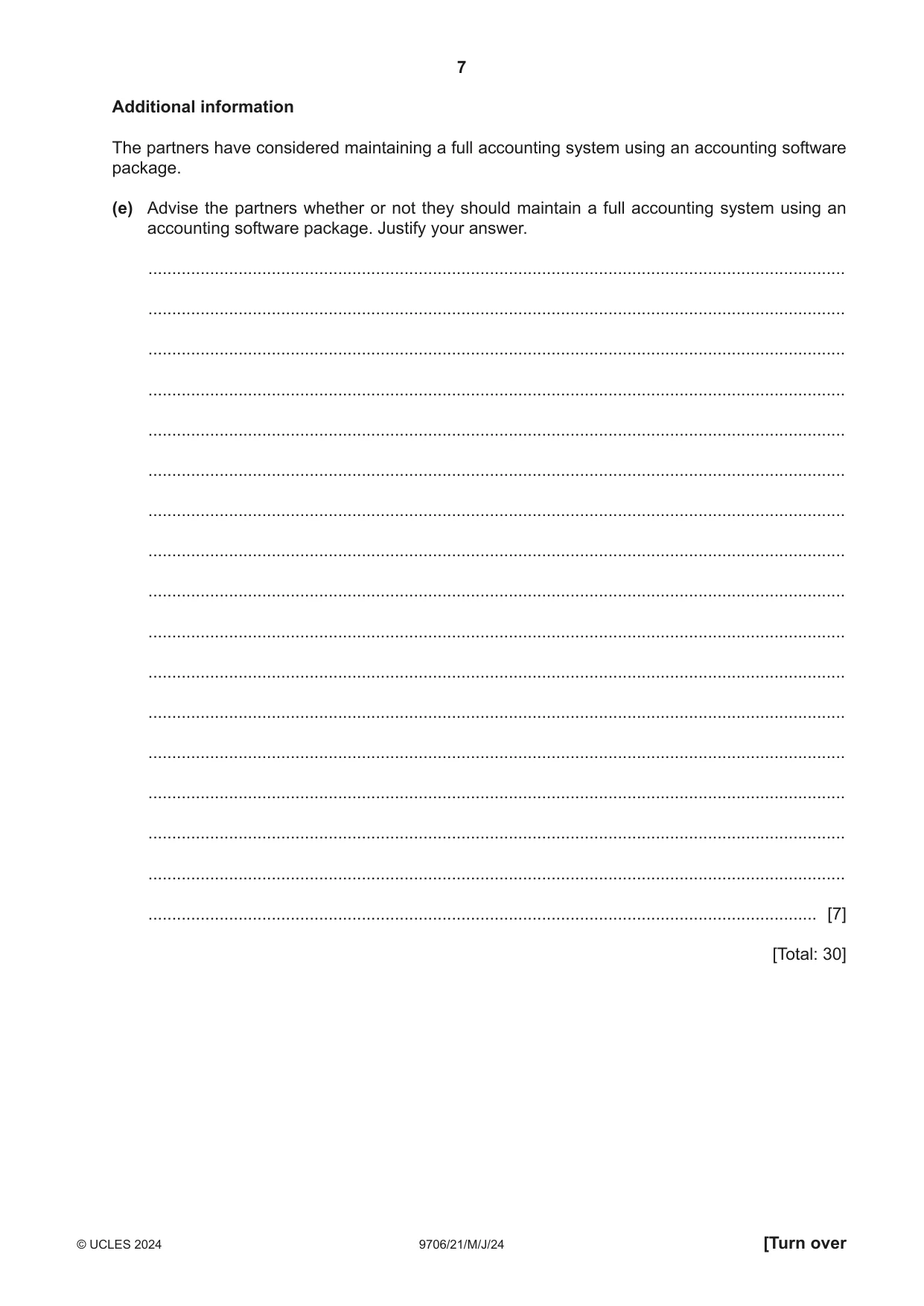
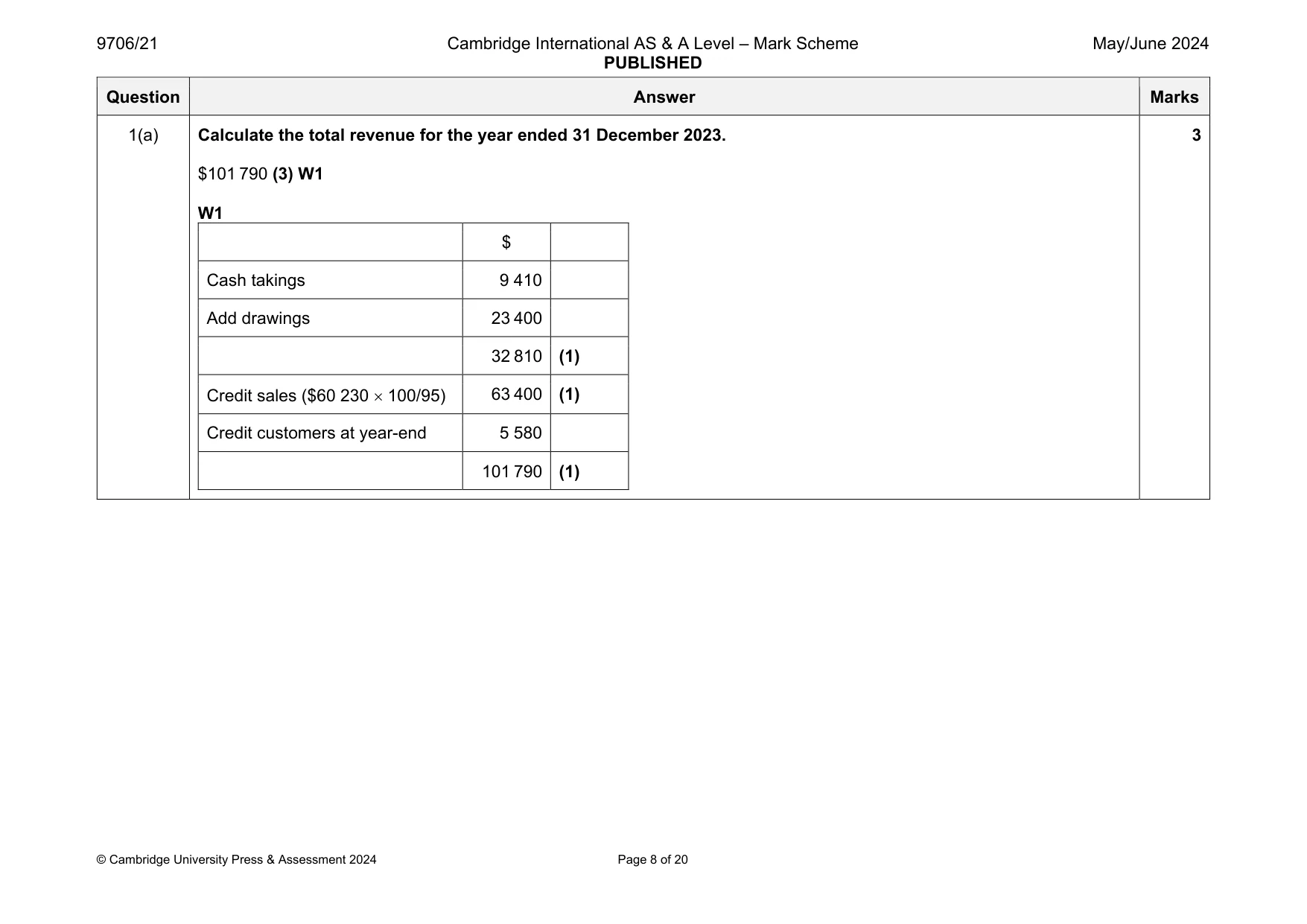
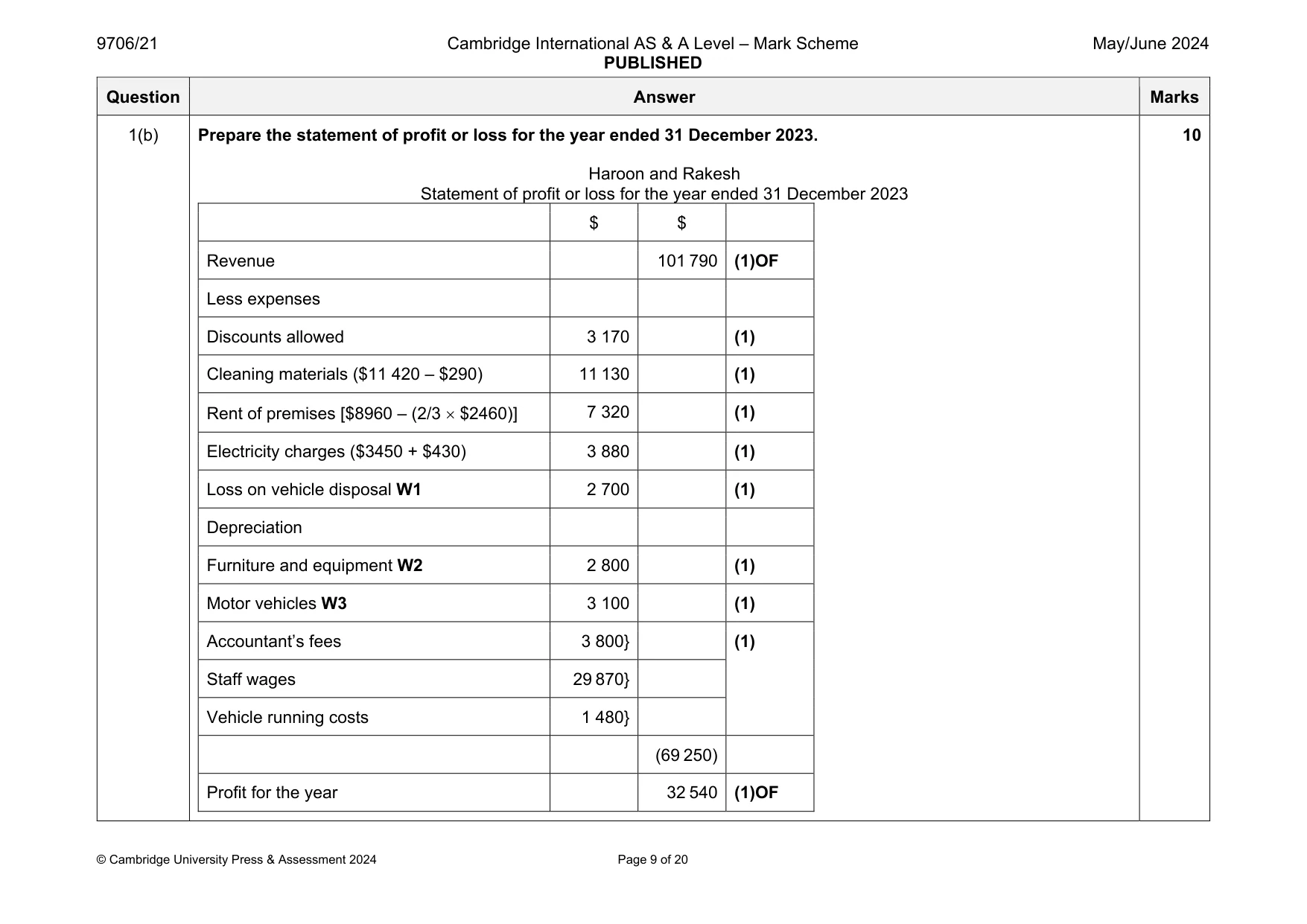
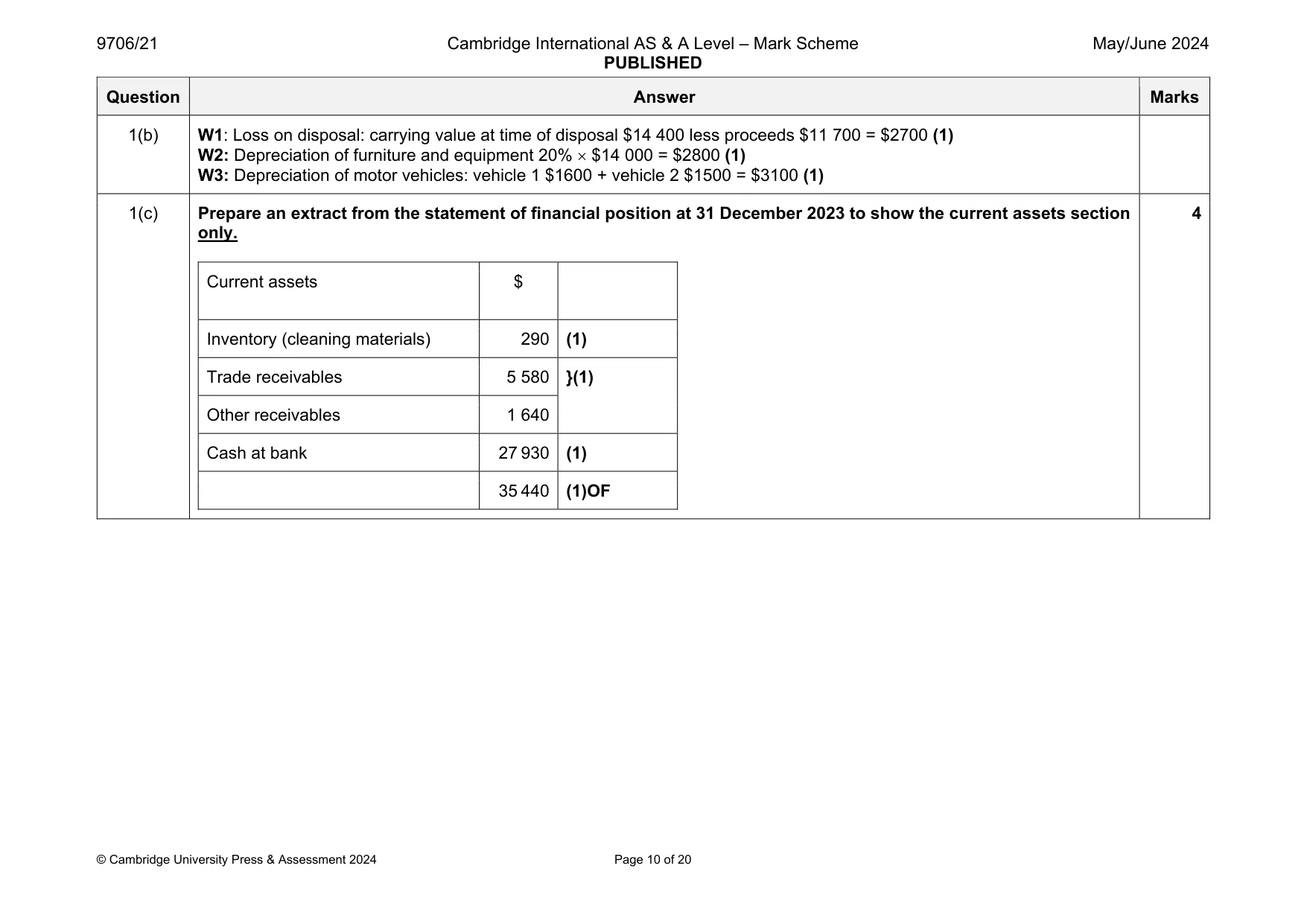
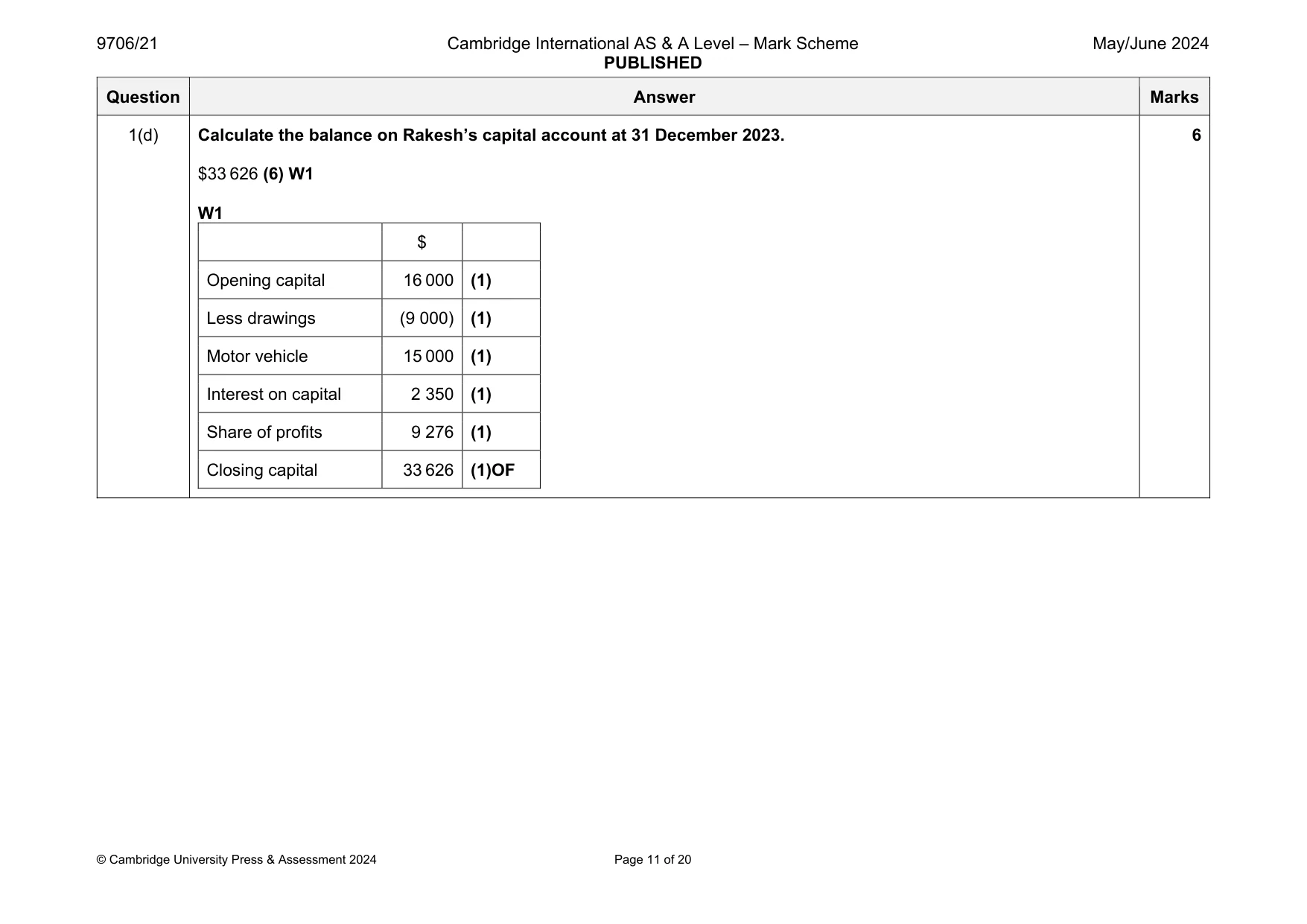
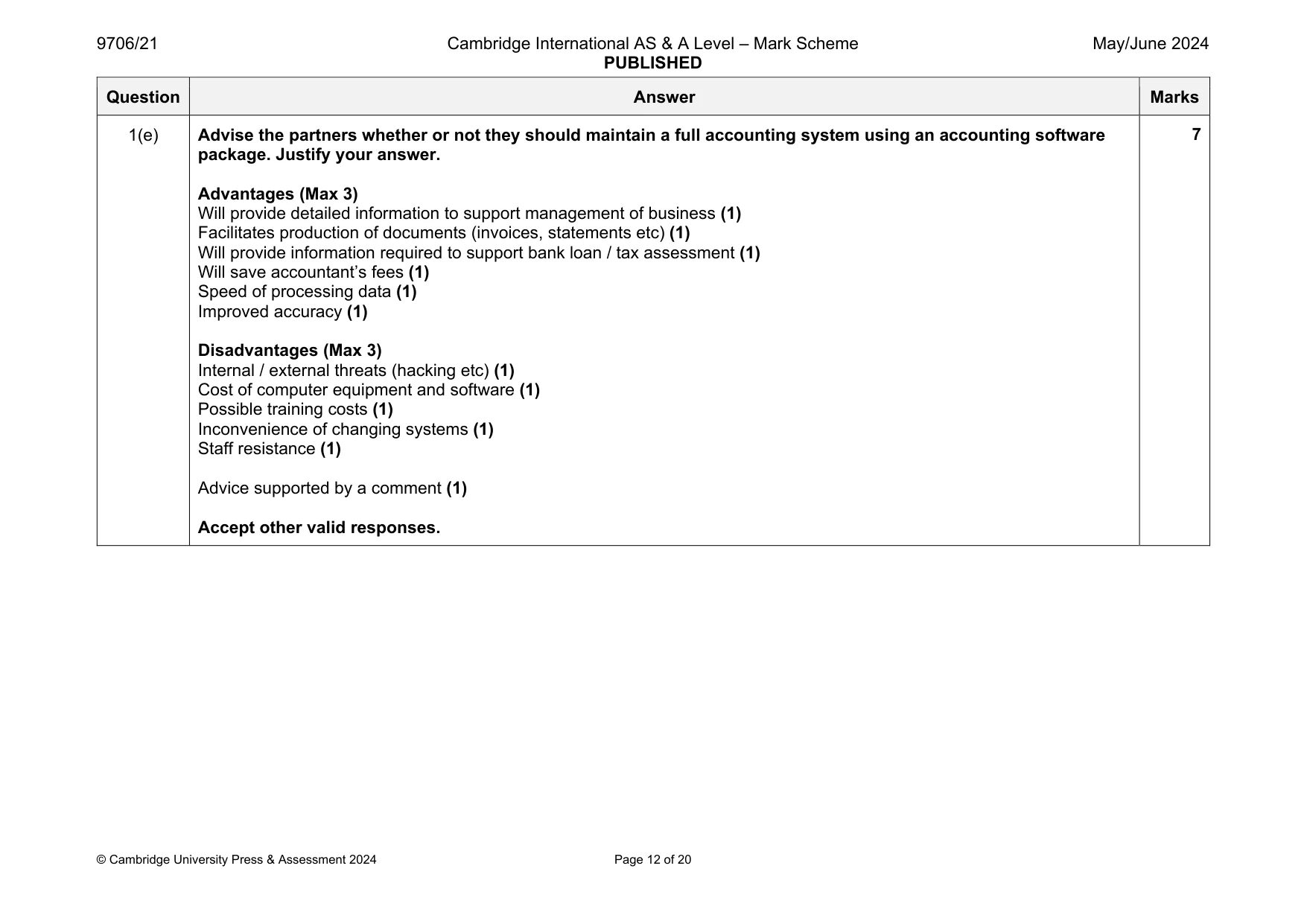
Mark scheme: 1(a) Calculate the total revenue for the year ended 31 December 2023. $101 790 (3) W1 W1 $ Cash takings 9 410 Add drawings 23 400 32 810 (1) Credit sales ($60 230 100/95) 63 400 (1) Credit customers at year-end 5 580 101 790 (1) 3 Question Answer Marks 1(b) Prepare the statement of profit or loss for the year ended 31 December 2023. Haroon and Rakesh Statement of profit or loss for the year ended 31 December 2023 $ $ Revenue 101 790 (1)OF Less expenses Discounts allowed 3 170 (1) Cleaning materials ($11 420 – $290) 11 130 (1) Rent of premises [$8960 – (2/3 $2460)] 7 320 (1) Electricity charges ($3450 + $430) 3 880 (1) Loss on vehicle disposal W1 2 700 (1) Depreciation Furniture and equipment W2 2 800 (1) Motor vehicles W3 3 100 (1) Accountant’s fees 3 800} (1) Staff wages 29 870} Vehicle running costs 1 480} (69 250) Profit for the year 32 540 (1)OF 10 Question Answer Marks 1(b) W1: Loss on disposal: carrying value at time of disposal $14 400 less proceeds $11 700 = $2700 (1) W2: Depreciation of furniture and equipment 20% $14 000 = $2800 (1) W3: Depreciation of motor vehicles: vehicle 1 $1600 + vehicle 2 $1500 = $3100 (1) 1(c) Prepare an extract from the statement of financial position at 31 December 2023 to show the current assets section only. Current assets $ Inventory (cleaning materials) 290 (1) Trade receivables 5 580 }(1) Other receivables 1 640 Cash at bank 27 930 (1) 35 440 (1)OF 4 Question Answer Marks 1(d) Calculate the balance on Rakesh’s capital account at 31 December 2023. $33 626 (6) W1 W1 $ Opening capital 16 000 (1) Less drawings (9 000) (1) Motor vehicle 15 000 (1) Interest on capital 2 350 (1) Share of profits 9 276 (1) Closing capital 33 626 (1)OF 6 Question Answer Marks 1(e) Advise the partners whether or not they should maintain a full accounting system using an accounting software package. Justify your answer. Advantages (Max 3) Will provide detailed information to support management of business (1) Facilitates production of documents (invoices, statements etc) (1) Will provide information required to support bank loan / tax assessment (1) Will save accountant’s fees (1) Speed of processing data (1) Improved accuracy (1) Disadvantages (Max 3) Internal / external threats (hacking etc) (1) Cost of computer equipment and software (1) Possible training costs (1) Inconvenience of changing systems (1) Staff resistance (1) Advice supported by a comment (1) Accept other valid responses. 7
Q2 · On 1 July 2023, the partners disposed of their motor vehicle for cash, $11 700, which was…
2 On 1 July 2023, the partners disposed of their motor vehicle for cash, $11 700, which was banked immediately. On this date Rakesh transferred his privately owned motor vehicle, valued at $15 000, into the partnership.
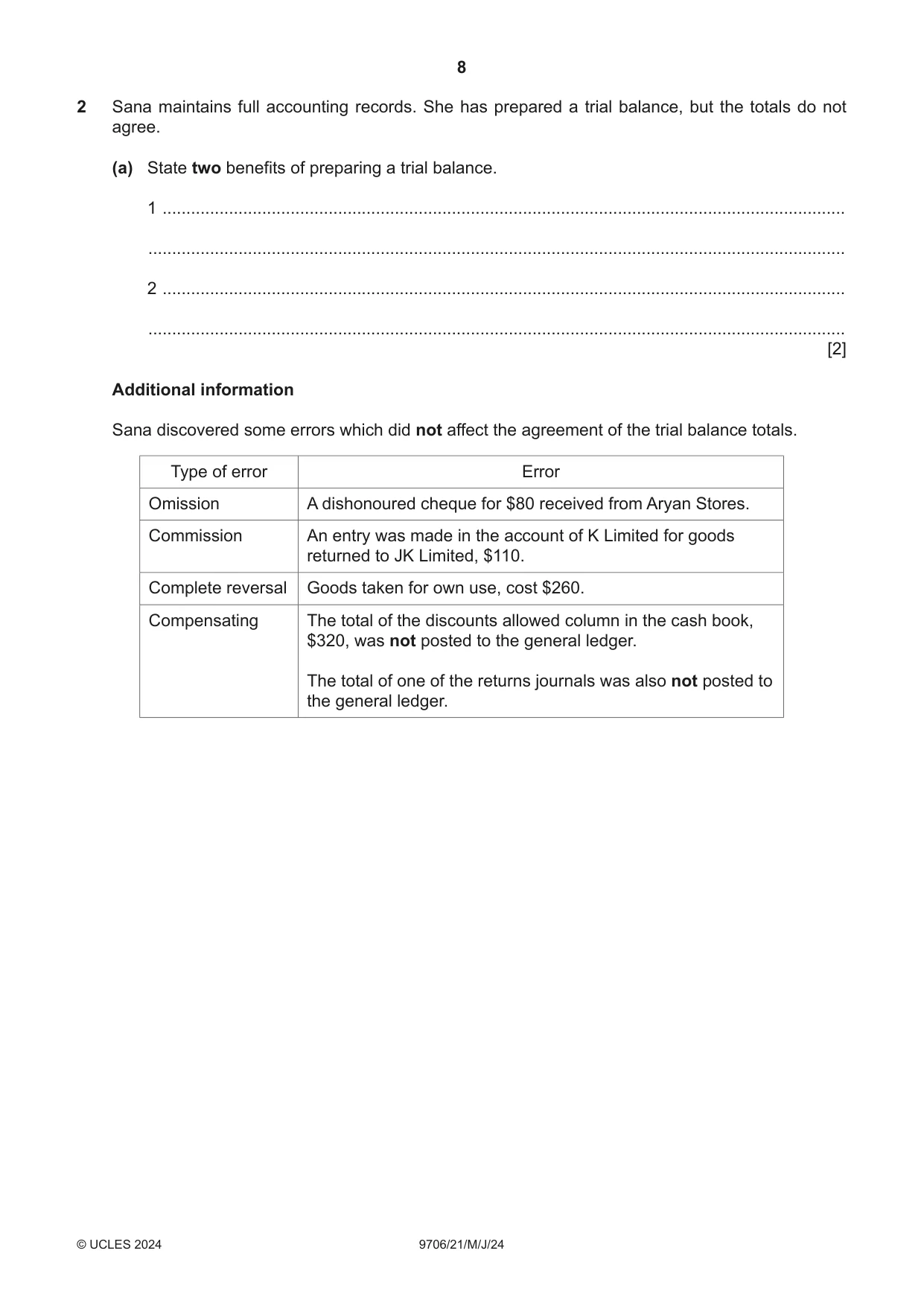
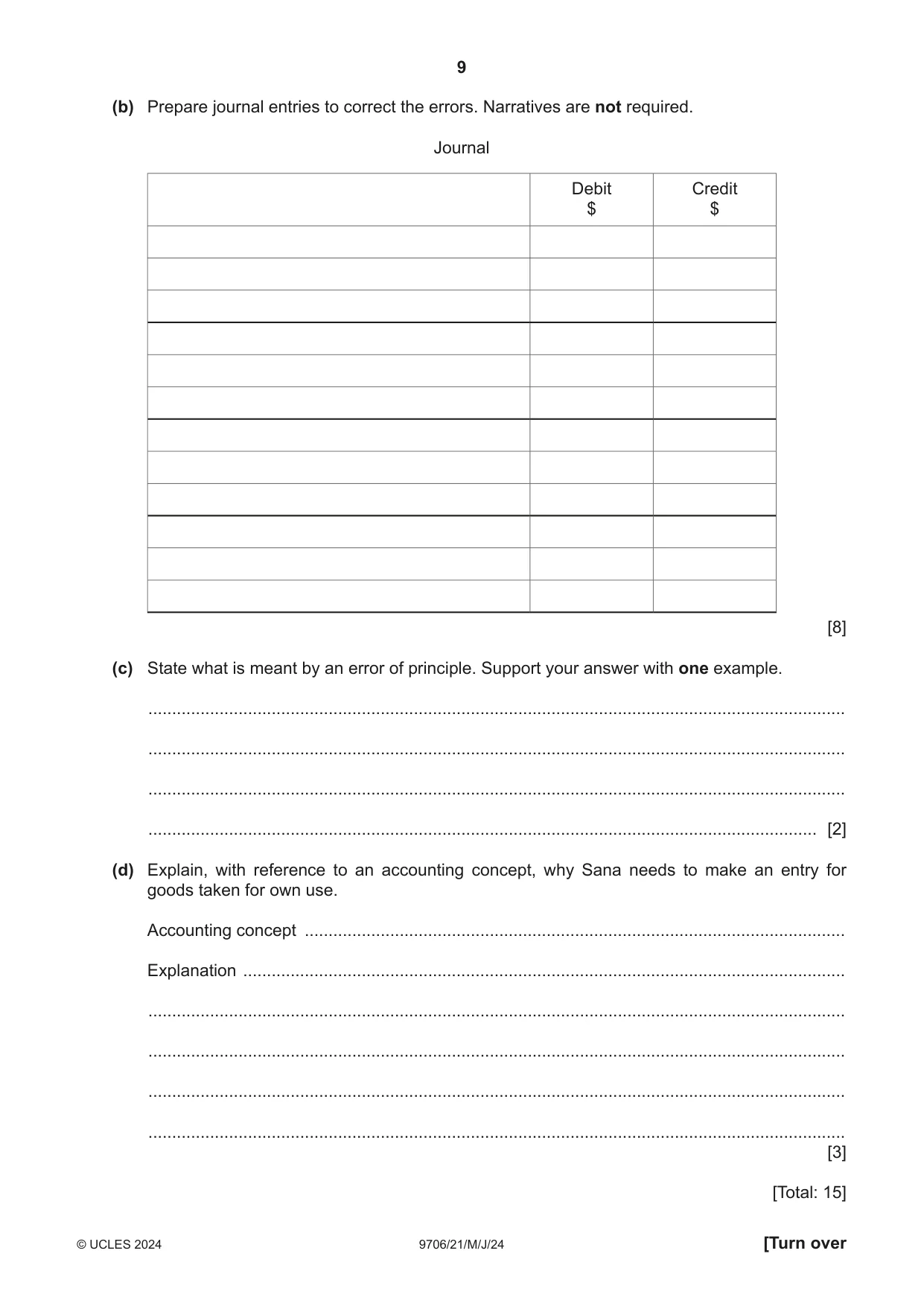
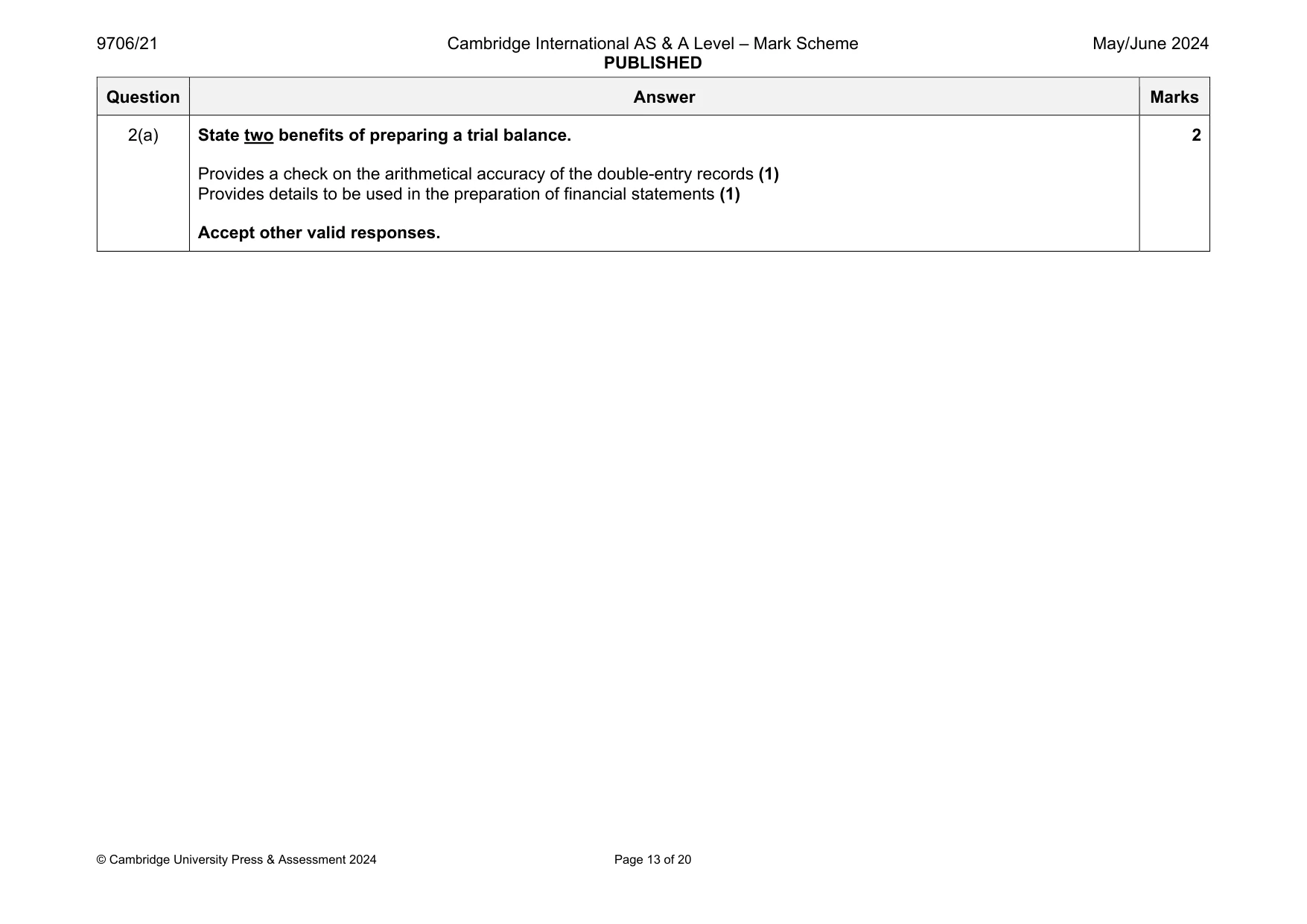
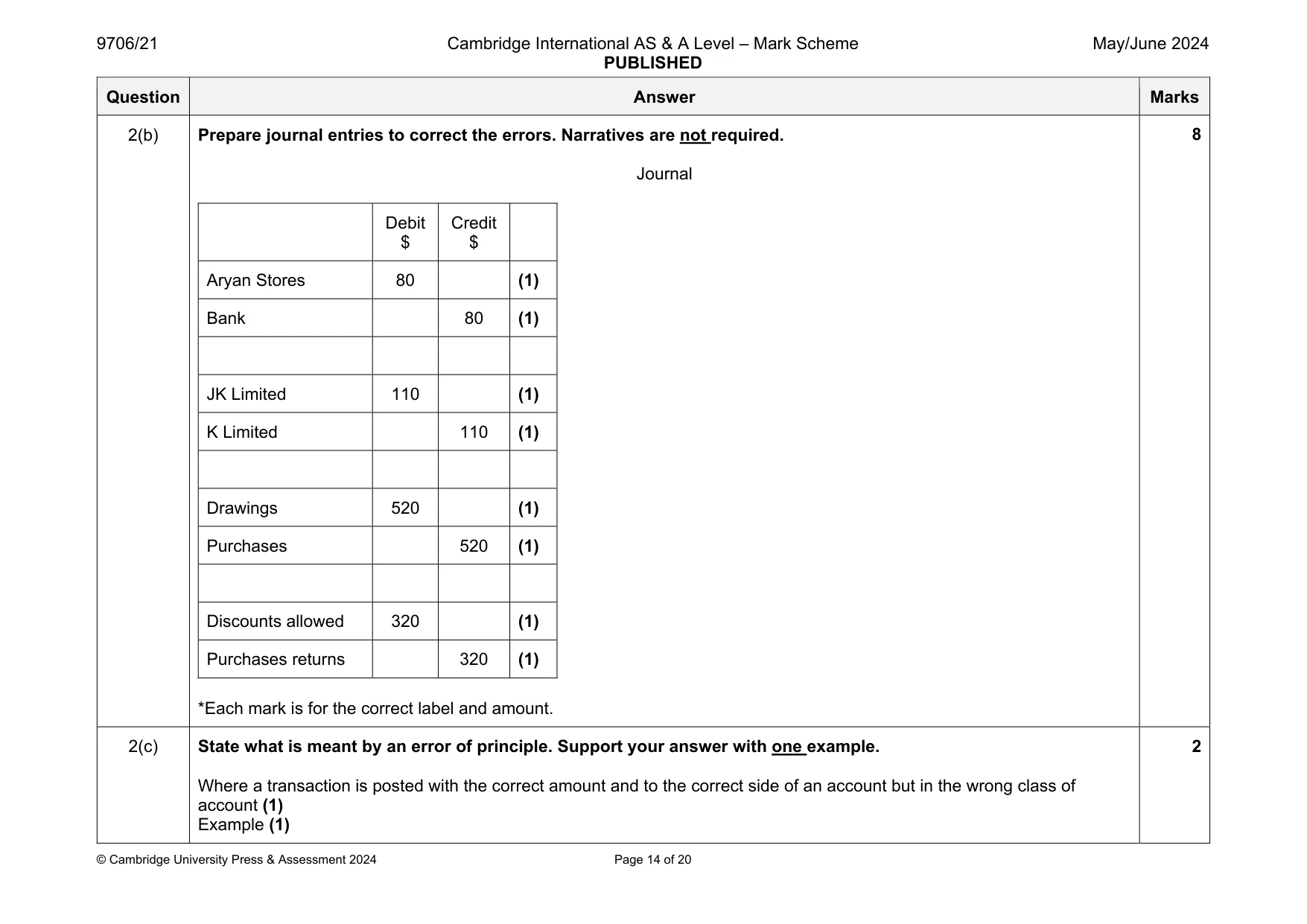
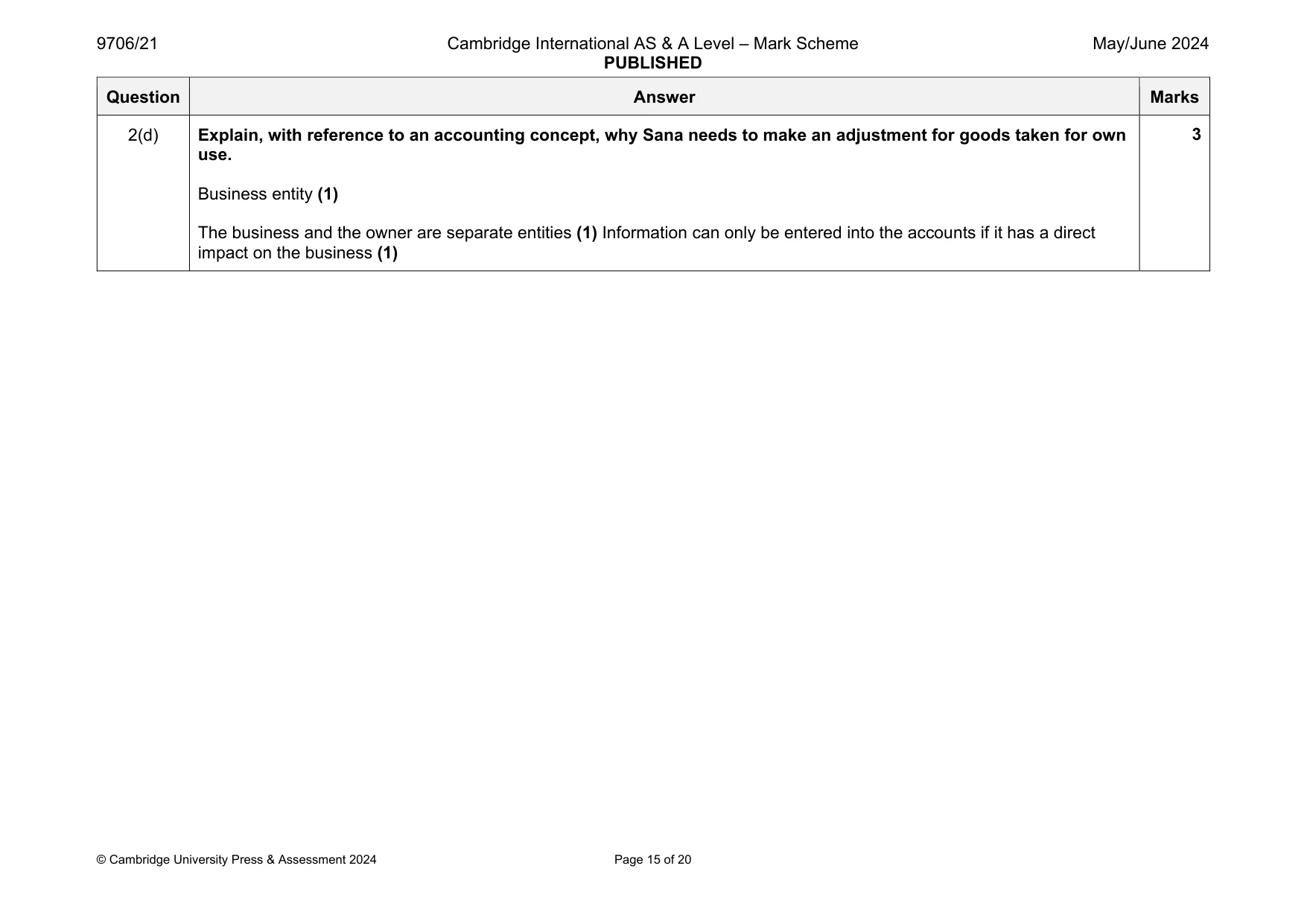
Mark scheme: 2(a) State two benefits of preparing a trial balance. Provides a check on the arithmetical accuracy of the double-entry records (1) Provides details to be used in the preparation of financial statements (1) Accept other valid responses. 2 Question Answer Marks 2(b) Prepare journal entries to correct the errors. Narratives are not required. Journal Debit $ Credit $ Aryan Stores 80 (1) Bank 80 (1) JK Limited 110 (1) K Limited 110 (1) Drawings 520 (1) Purchases 520 (1) Discounts allowed 320 (1) Purchases returns 320 (1) *Each mark is for the correct label and amount. 8 2(c) State what is meant by an error of principle. Support your answer with one example. Where a transaction is posted with the correct amount and to the correct side of an account but in the wrong class of account (1) Example (1) 2 Question Answer Marks 2(d) Explain, with reference to an accounting concept, why Sana needs to make an adjustment for goods taken for own use. Business entity (1) The business and the owner are separate entities (1) Information can only be entered into the accounts if it has a direct impact on the business (1) 3
Q3 · Non-current assets are to be depreciated by 20% per annum using the straight-line method
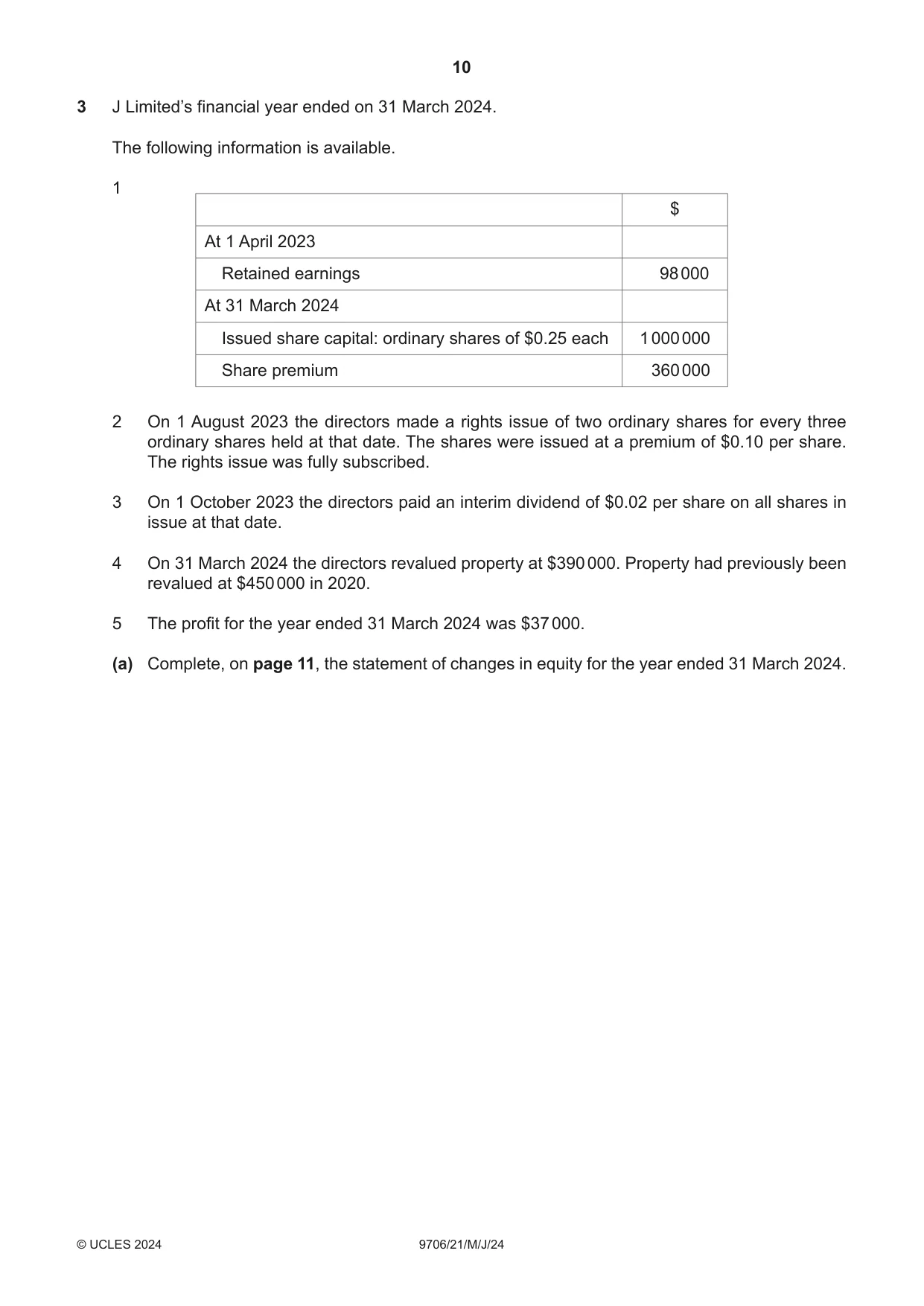
3 Non-current assets are to be depreciated by 20% per annum using the straight-line method. Depreciation is provided on a month-by-month basis and is applied in the year of acquisition and the year of disposal.
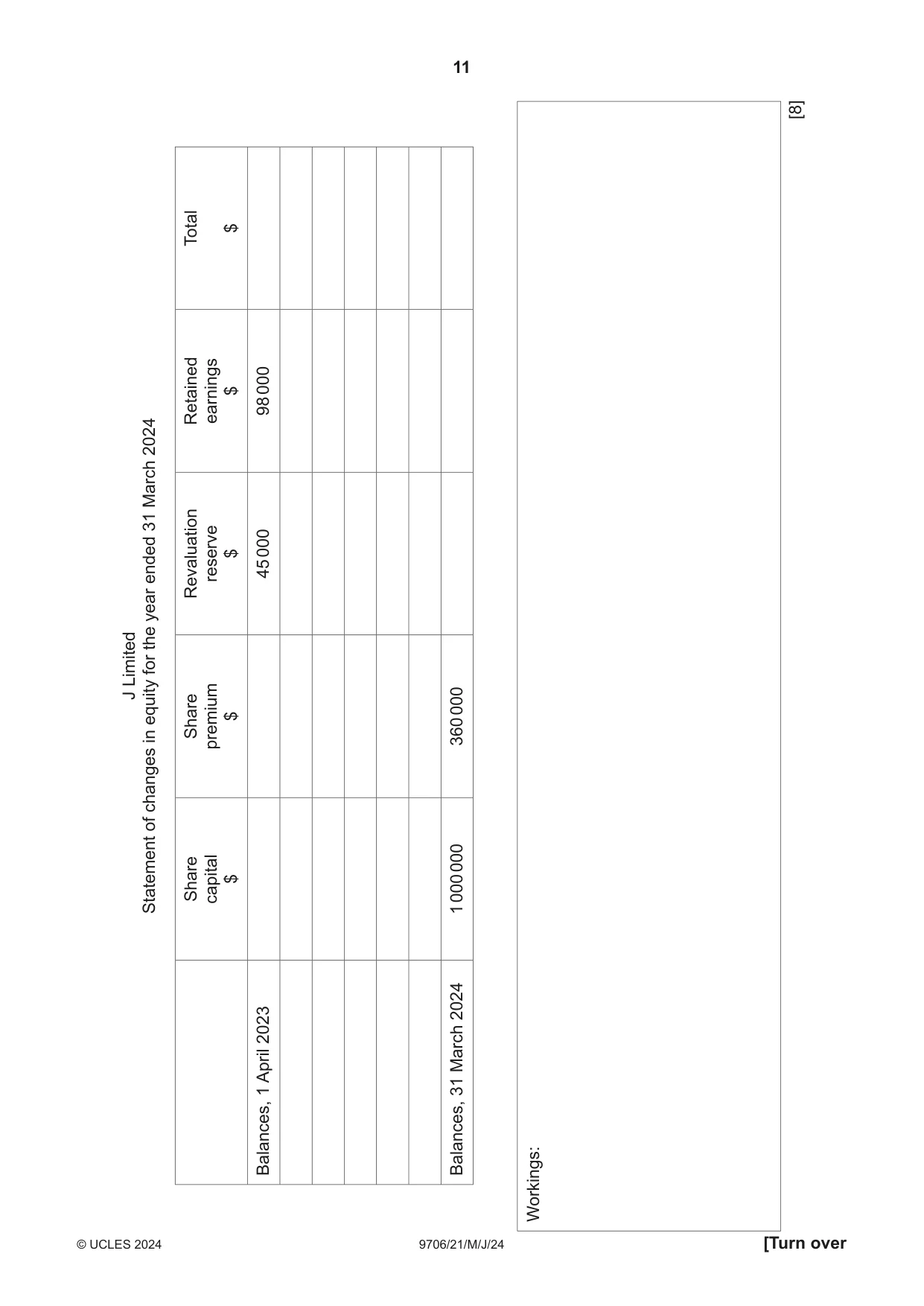
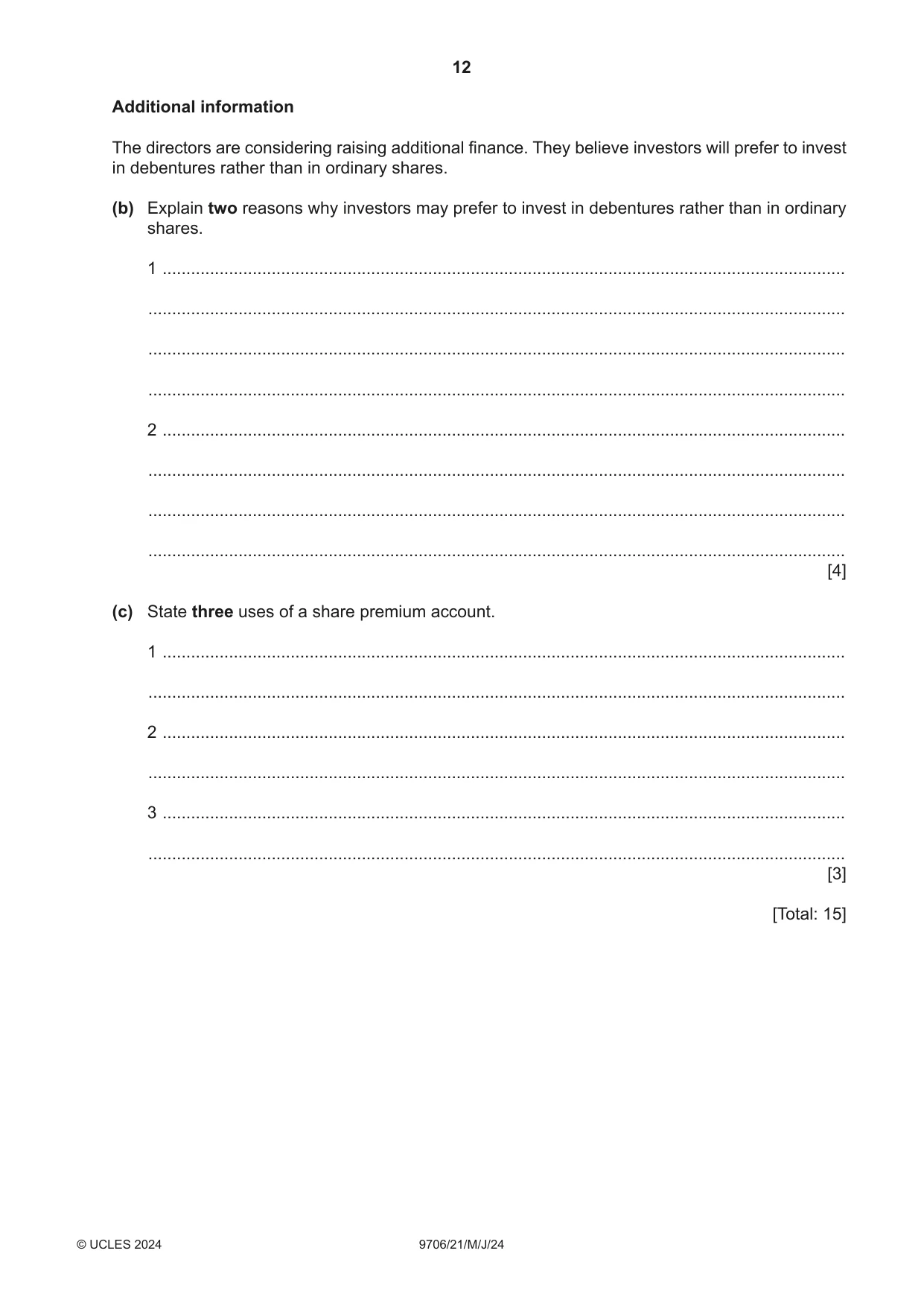
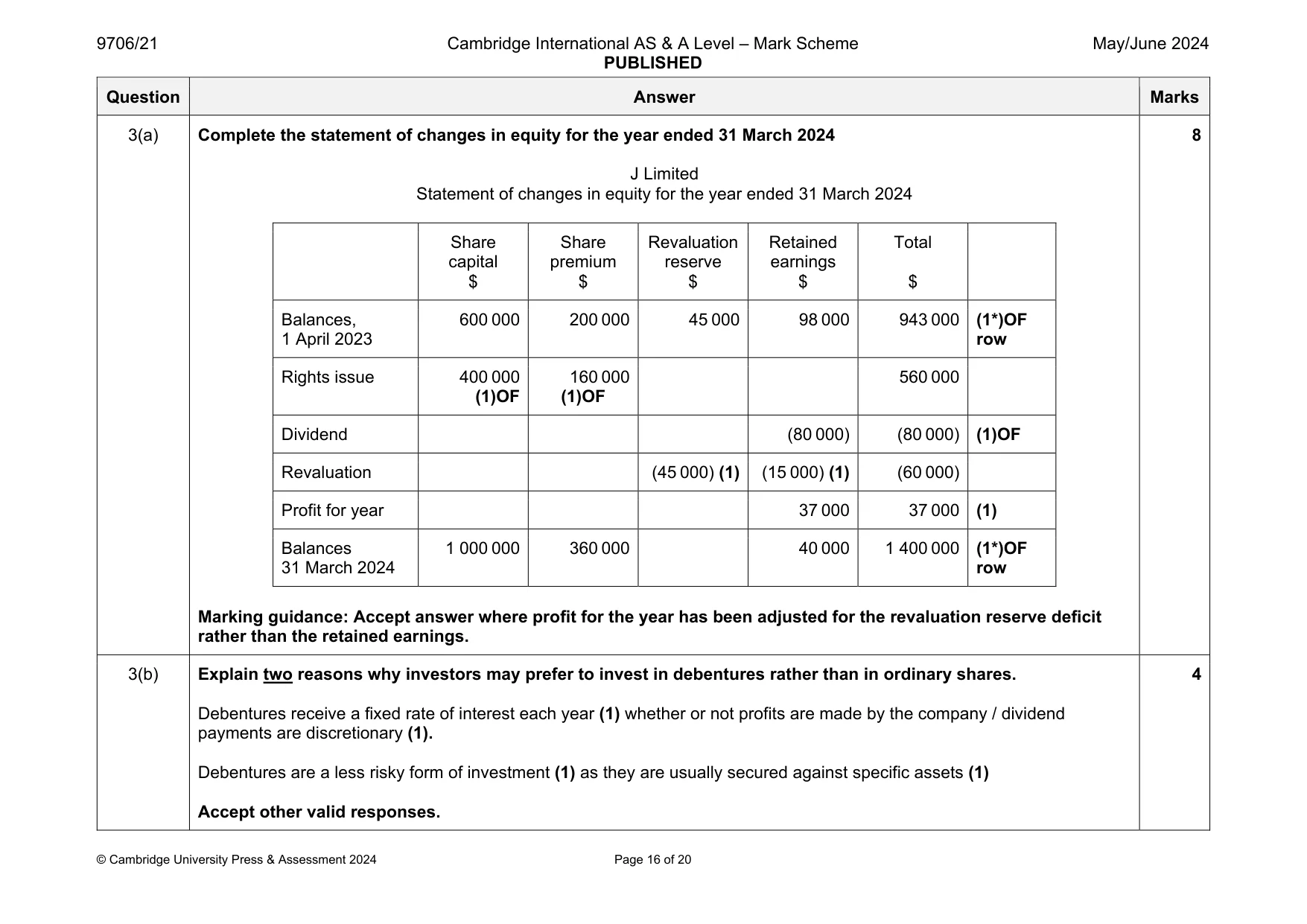
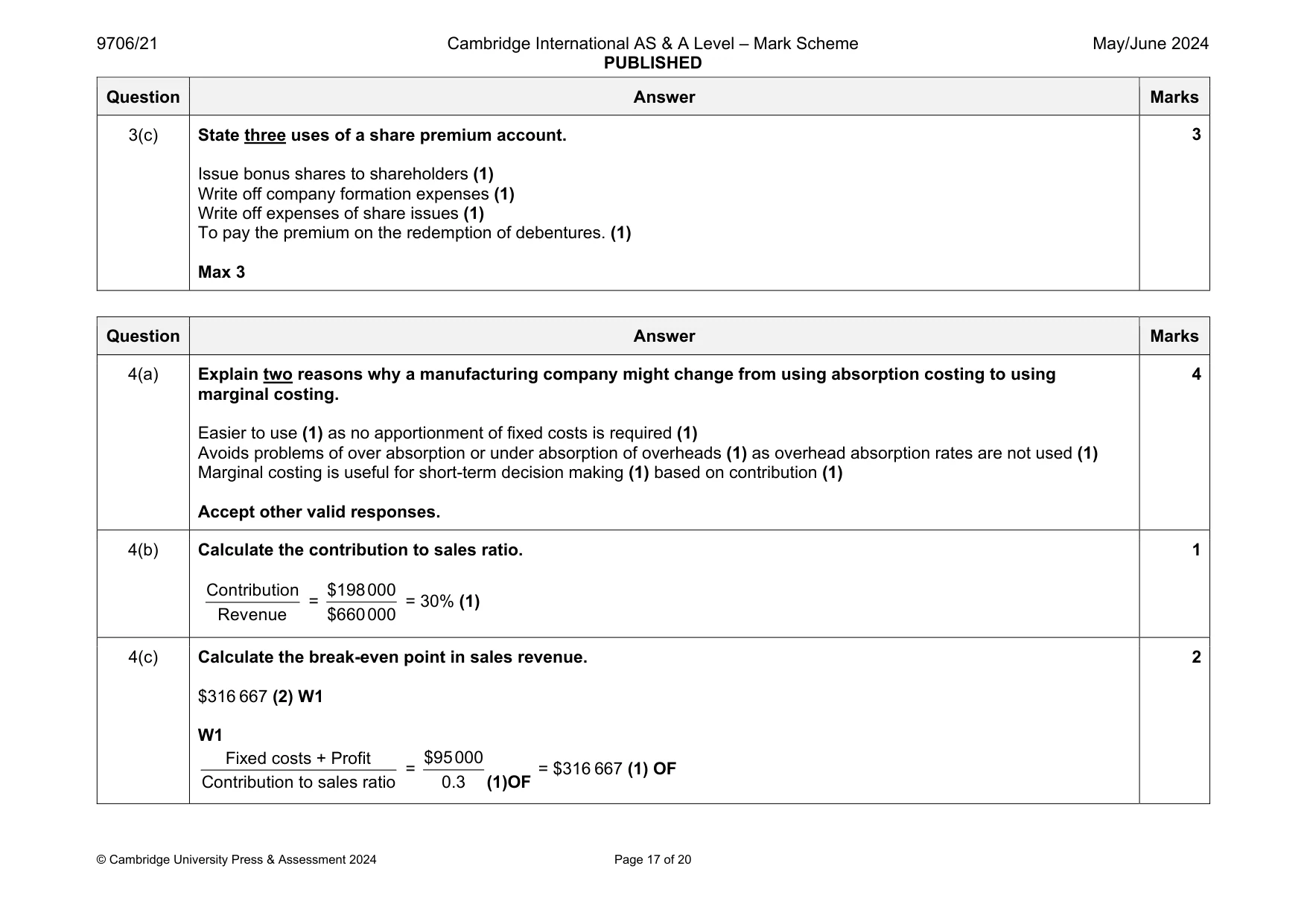
Mark scheme: 3(a) Complete the statement of changes in equity for the year ended 31 March 2024 J Limited Statement of changes in equity for the year ended 31 March 2024 Share capital $ Share premium $ Revaluation reserve $ Retained earnings $ Total $ Balances, 1 April 2023 600 000 200 000 45 000 98 000 943 000 (1*)OF row Rights issue 400 000 (1)OF 160 000 (1)OF 560 000 Dividend (80 000) (80 000) (1)OF Revaluation (45 000) (1) (15 000) (1) (60 000) Profit for year 37 000 37 000 (1) Balances 31 March 2024 1 000 000 360 000 40 000 1 400 000 (1*)OF row Marking guidance: Accept answer where profit for the year has been adjusted for the revaluation reserve deficit rather than the retained earnings. 8 3(b) Explain two reasons why investors may prefer to invest in debentures rather than in ordinary shares. Debentures receive a fixed rate of interest each year (1) whether or not profits are made by the company / dividend payments are discretionary (1). Debentures are a less risky form of investment (1) as they are usually secured against specific assets (1) Accept other valid responses. 4 Question Answer Marks 3(c) State three uses of a share premium account. Issue bonus shares to shareholders (1) Write off company formation expenses (1) Write off expenses of share issues (1) To pay the premium on the redemption of debentures. (1) Max 3 3
Q4 · K Limited is a manufacturing company which has recently changed from using absorption…
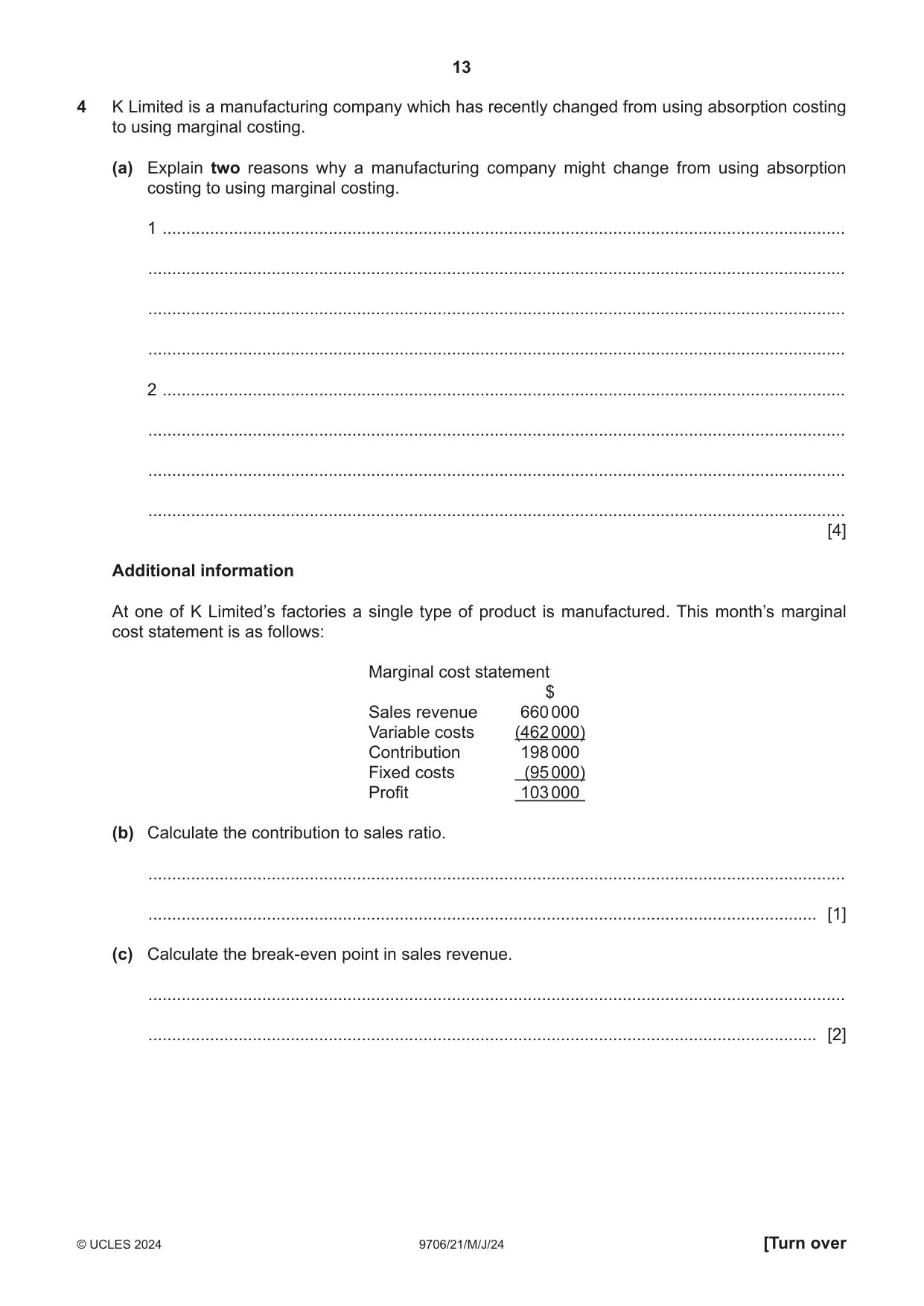
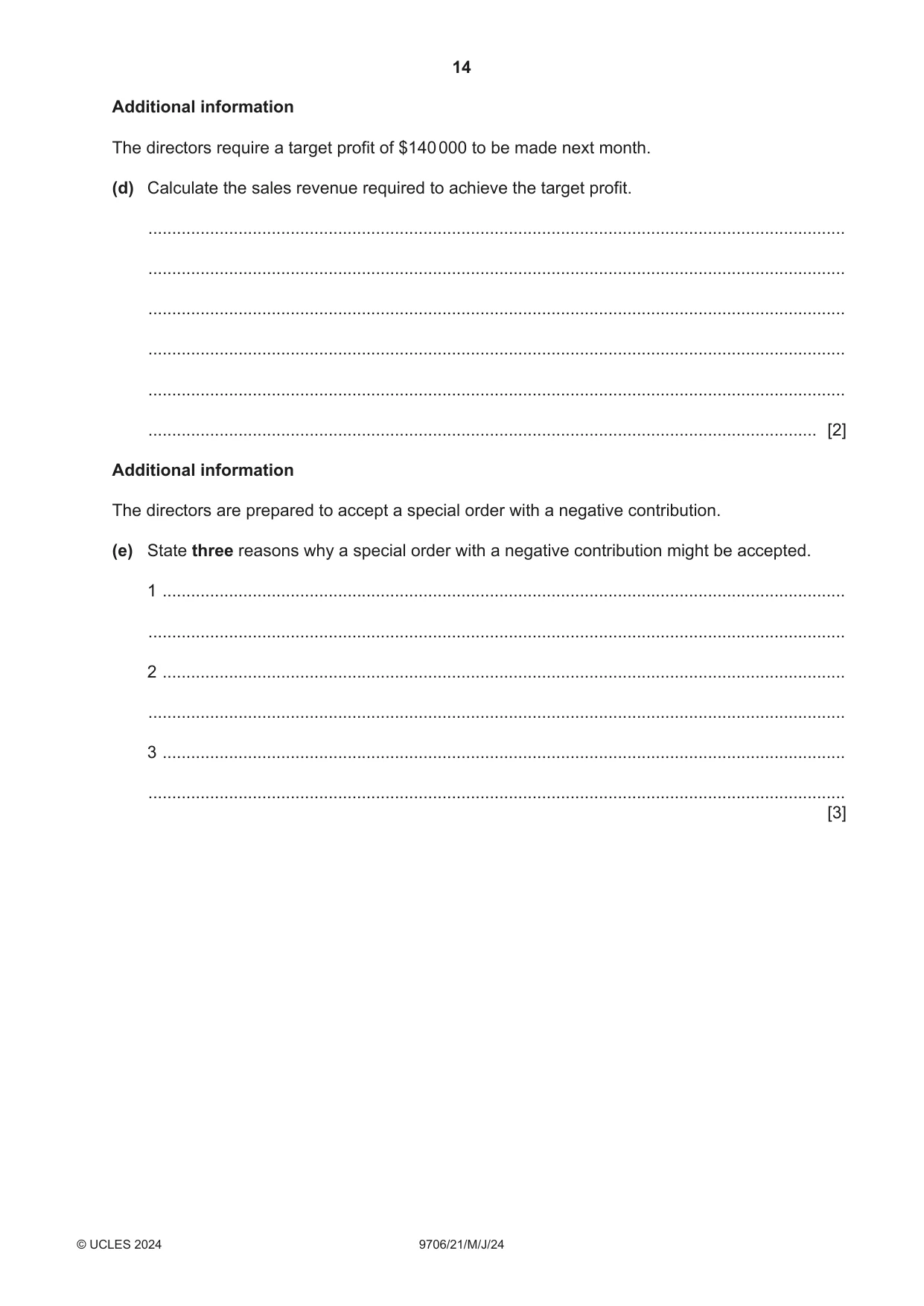
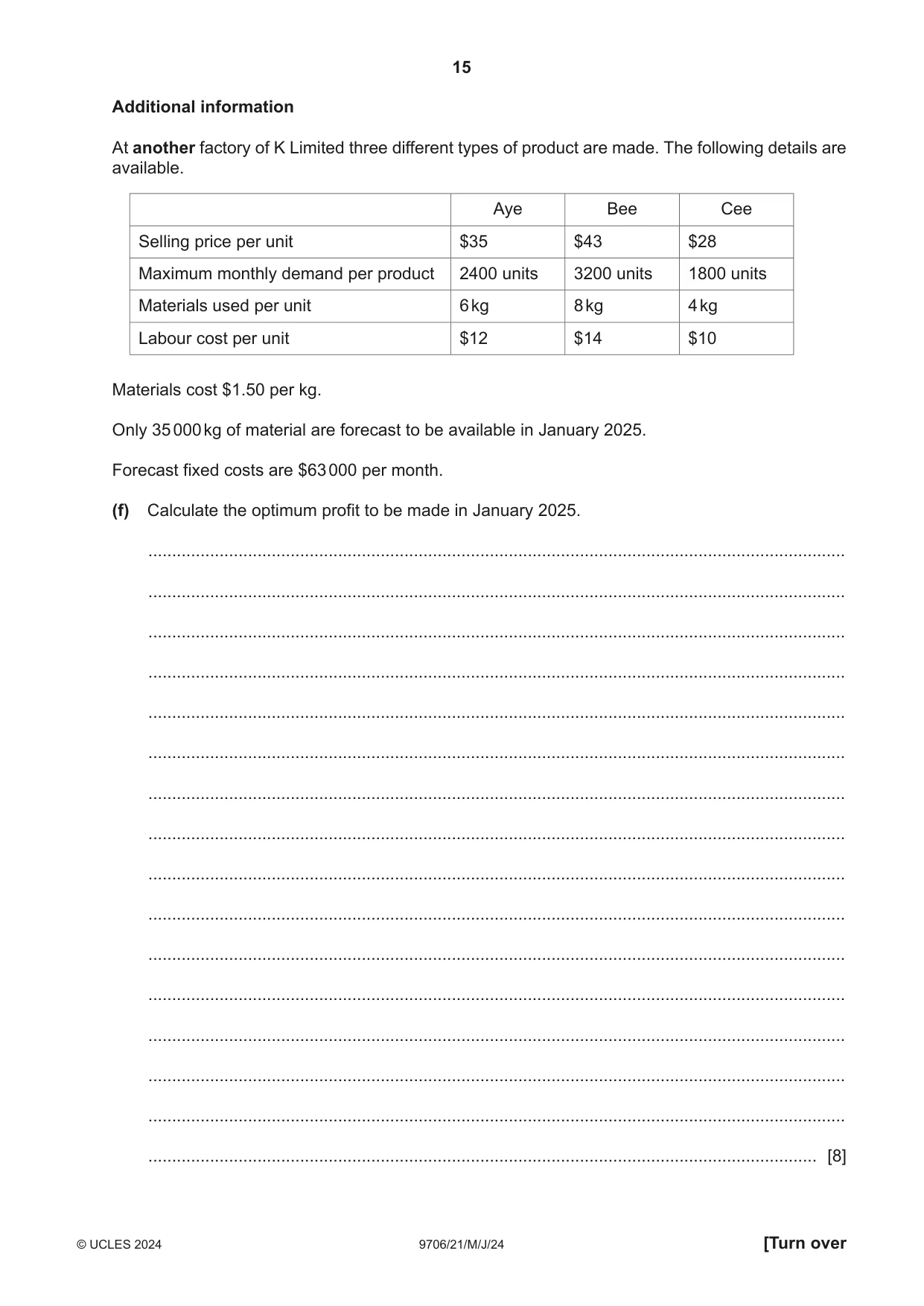
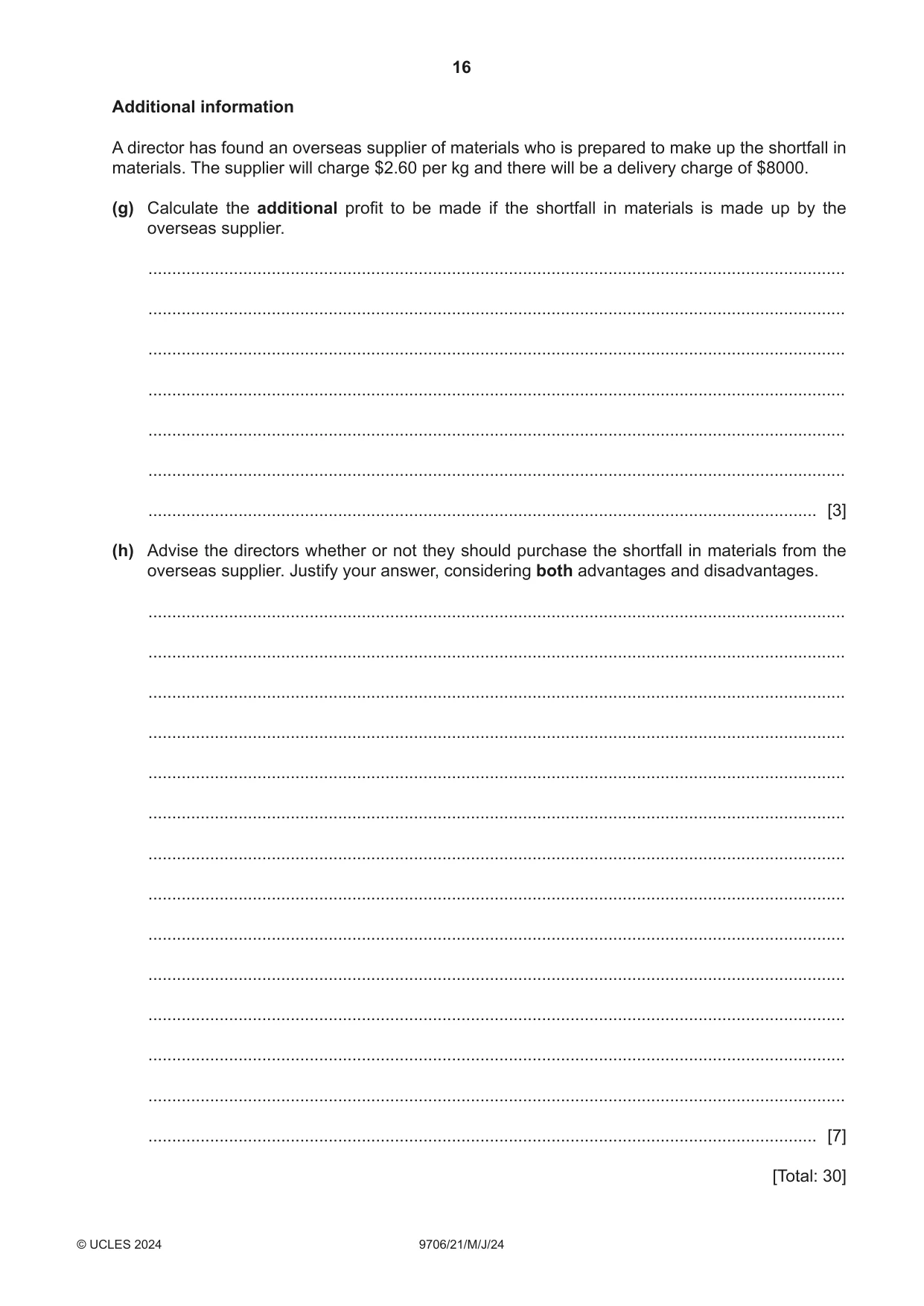
4 K Limited is a manufacturing company which has recently changed from using absorption costing to using marginal costing. (a) Explain two reasons why a manufacturing company might change from using absorption costing to using marginal costing. 1 ................................................................................................................................................ ................................................................................................................................................... ................................................................................................................................................... ................................................................................................................................................... 2 ................................................................................................................................................ ................................................................................................................................................... ................................................................................................................................................... ................................................................................................................................................... [4] Additional information At one of K Limited’s factories a single type of product is manufactured. This month’s marginal cost statement is as follows: Marginal cost statement $ Sales revenue 660 000 Variable costs (462 000) Contribution 198 000 Fixed costs (95 000) Profit 103 000 (b) Calculate the contribution to sales ratio. ................................................................................................................................................... ............................................................................................................................................. [1] (c) Calculate the break-even point in sales revenue. ................................................................................................................................................... ............................................................................................................................................. [2] Additional information The directors require a target profit of $140 000 to be made next month. (d) Calculate the sales revenue required to achieve the target profit. ................................................................................................................................................... ................................................................................................................................................... ................................................................................................................................................... ................................................................................................................................................... ................................................................................................................................................... ............................................................................................................................................. [2] Additional information The directors are prepared to accept a special order with a negative contribution. (e) State three reasons why a special order with a negative contribution might be accepted. 1 ................................................................................................................................................ ................................................................................................................................................... 2 ................................................................................................................................................ ................................................................................................................................................... 3 ................................................................................................................................................ ................................................................................................................................................... [3] Additional information At another factory of K Limited three different types of product are made. The following details are available. Aye Bee Cee Selling price per unit $35 $43 $28 Maximum monthly demand per product 2400 units 3200 units 1800 units Materials used per unit 6 kg 8 kg 4 kg Labour cost per unit $12 $14 $10 Materials cost $1.50 per kg. Only 35 000 kg of material are forecast to be available in January 2025. Forecast fixed costs are $63 000 per month. (f) Calculate the optimum profit to be made in January 2025. ................................................................................................................................................... ................................................................................................................................................... ................................................................................................................................................... ................................................................................................................................................... ................................................................................................................................................... ................................................................................................................................................... ................................................................................................................................................... ................................................................................................................................................... ................................................................................................................................................... ................................................................................................................................................... ................................................................................................................................................... ................................................................................................................................................... ................................................................................................................................................... ................................................................................................................................................... ................................................................................................................................................... ............................................................................................................................................. [8]
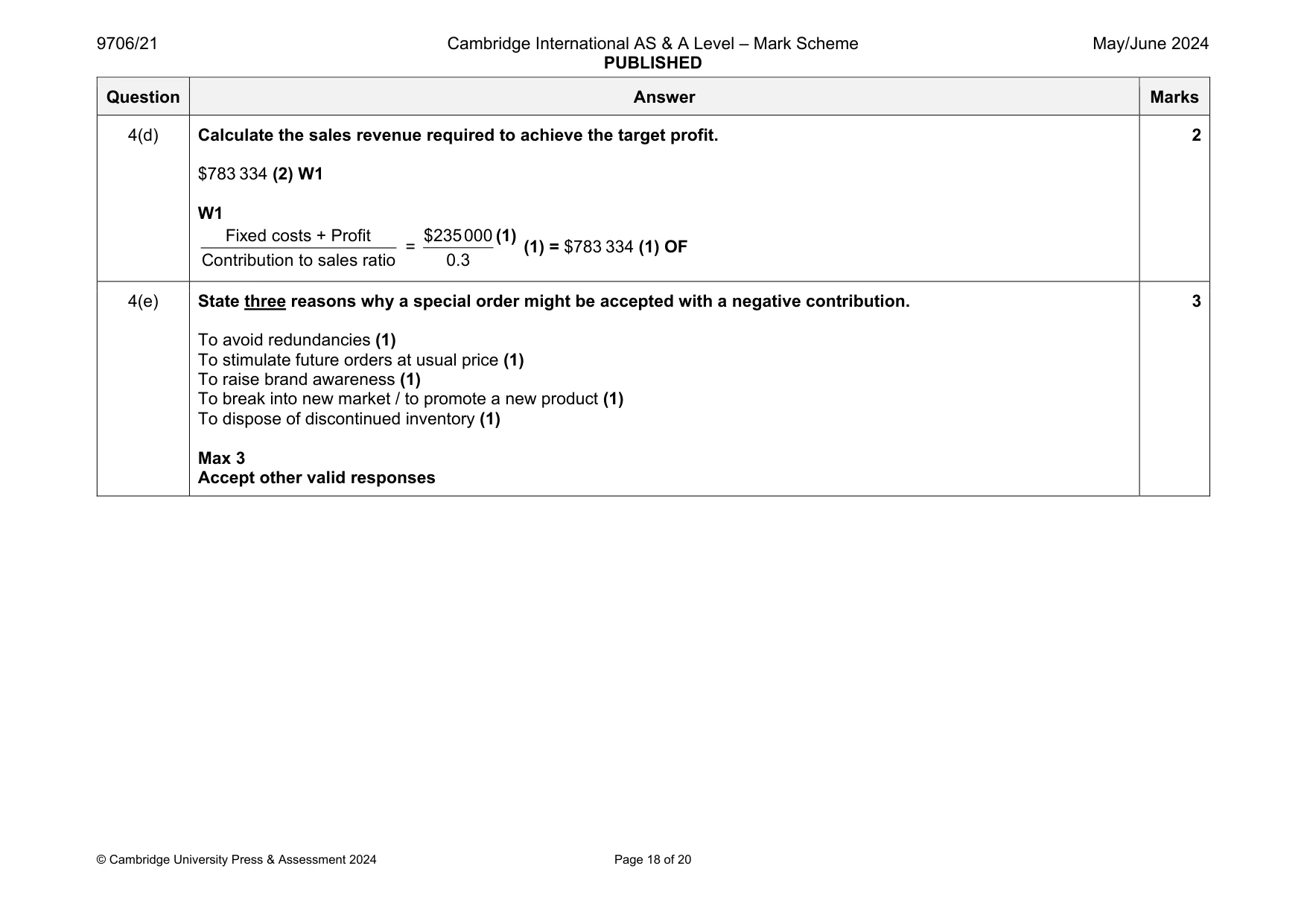
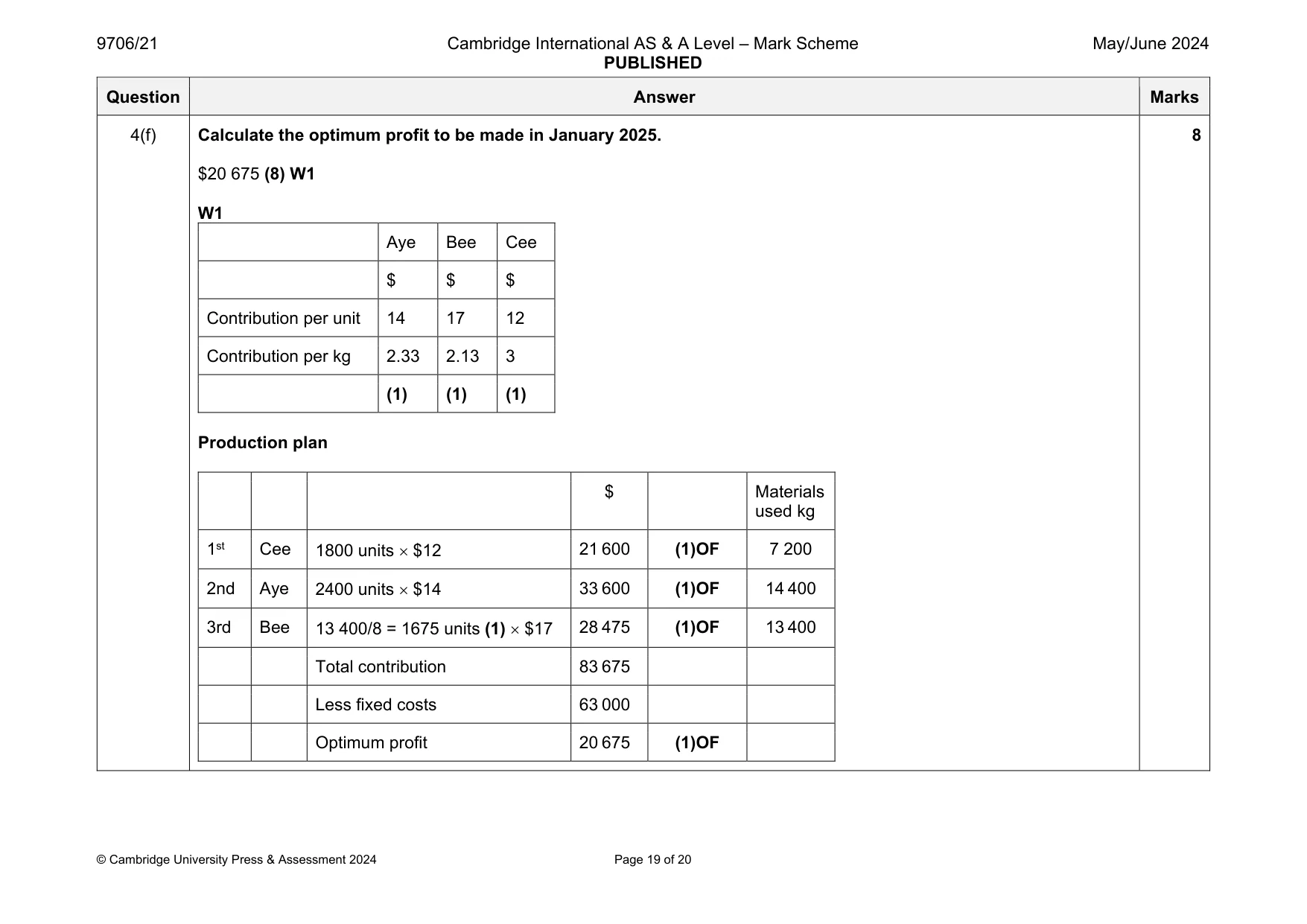
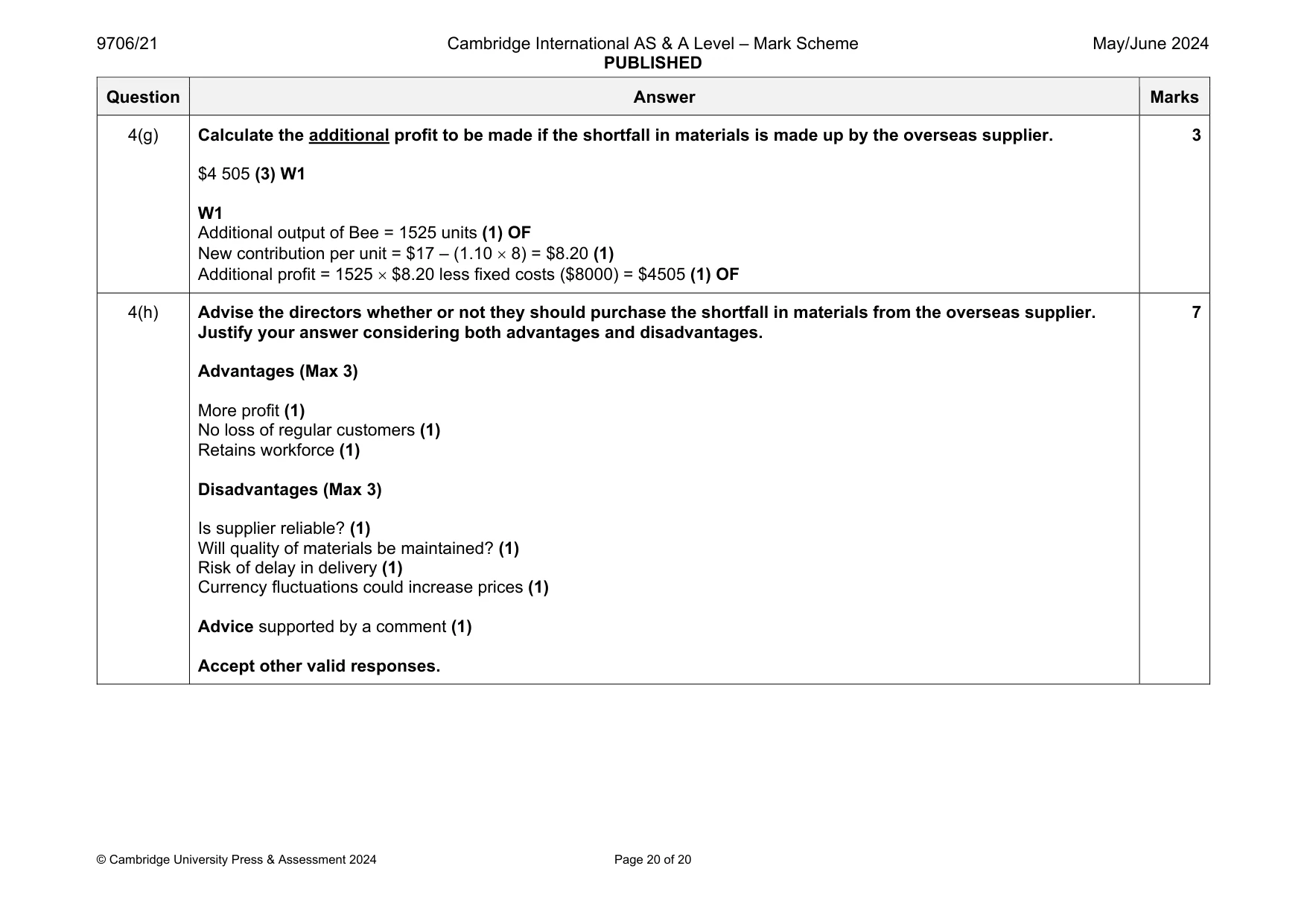
Mark scheme: 4(a) Explain two reasons why a manufacturing company might change from using absorption costing to using marginal costing. Easier to use (1) as no apportionment of fixed costs is required (1) Avoids problems of over absorption or under absorption of overheads (1) as overhead absorption rates are not used (1) Marginal costing is useful for short-term decision making (1) based on contribution (1) Accept other valid responses. 4(b) Calculate the contribution to sales ratio. Contribution Revenue = $198000 $660000 = 30% (1) 1 4(c) Calculate the break-even point in sales revenue. $316 667 (2) W1 W1 Fixed costs + Profit Contribution to sales ratio = $95000 0.3 (1)OF = $316 667 (1) OF 2 Question Answer Marks 4(d) Calculate the sales revenue required to achieve the target profit. $783 334 (2) W1 W1 Fixed costs + Profit Contribution to sales ratio = $235000 0.3 (1) (1) = $783 334 (1) OF 2 4(e) State three reasons why a special order might be accepted with a negative contribution. To avoid redundancies (1) To stimulate future orders at usual price (1) To raise brand awareness (1) To break into new market / to promote a new product (1) To dispose of discontinued inventory (1) Max 3 Accept other valid responses 3 Question Answer Marks 4(f) Calculate the optimum profit to be made in January 2025. $20 675 (8) W1 W1 Aye Bee Cee $ $ $ Contribution per unit 14 17 12 Contribution per kg 2.33 2.13 3 (1) (1) (1) Production plan $ Materials used kg 1st Cee 1800 units $12 21 600 (1)OF 7 200 2nd Aye 2400 units $14 33 600 (1)OF 14 400 3rd Bee 13 400/8 = 1675 units (1) $17 28 475 (1)OF 13 400 Total contribution 83 675 Less fixed costs 63 000 Optimum profit 20 675 (1)OF 8 Question Answer Marks 4(g) Calculate the additional profit to be made if the shortfall in materials is made up by the overseas supplier. $4 505 (3) W1 W1 Additional output of Bee = 1525 units (1) OF New contribution per unit = $17 – (1.10 8) = $8.20 (1) Additional profit = 1525 $8.20 less fixed costs ($8000) = $4505 (1) OF 3 4(h) Advise the directors whether or not they should purchase the shortfall in materials from the overseas supplier. Justify your answer considering both advantages and disadvantages. Advantages (Max 3) More profit (1) No loss of regular customers (1) Retains workforce (1) Disadvantages (Max 3) Is supplier reliable? (1) Will quality of materials be maintained? (1) Risk of delay in delivery (1) Currency fluctuations could increase prices (1) Advice supported by a comment (1) Accept other valid responses. 7
Q6 · Prepare the statement of profit or loss for the year ended 31 December 2023
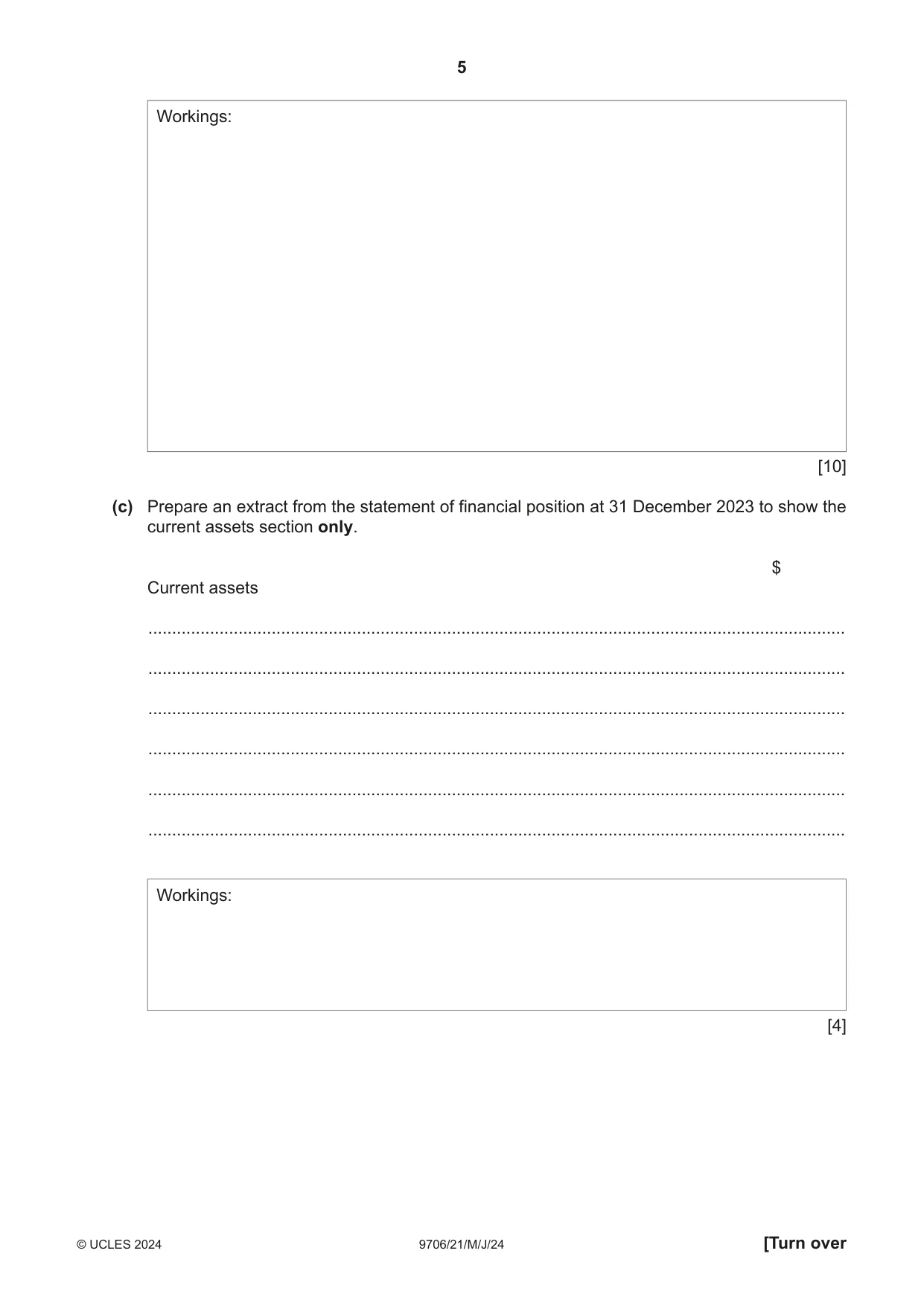
(b) Prepare the statement of profit or loss for the year ended 31 December 2023. Haroon and Rakesh Statement of profit or loss for the year ended 31 December 2023 ................................................................................................................................................... ................................................................................................................................................... ................................................................................................................................................... ................................................................................................................................................... ................................................................................................................................................... ................................................................................................................................................... ................................................................................................................................................... ................................................................................................................................................... ................................................................................................................................................... ................................................................................................................................................... ................................................................................................................................................... ................................................................................................................................................... ................................................................................................................................................... ................................................................................................................................................... ................................................................................................................................................... ................................................................................................................................................... ................................................................................................................................................... ................................................................................................................................................... ................................................................................................................................................... Workings: [10] (c) Prepare an extract from the statement of financial position at 31 December 2023 to show the current assets section only. $ Current assets ................................................................................................................................................... ................................................................................................................................................... ................................................................................................................................................... ................................................................................................................................................... ................................................................................................................................................... ................................................................................................................................................... Workings: [4]
What was in this paper
The subtopics covered by these 5 questions, and how many questions each got. Open one in a new tab to see every Cambridge question on it.
What you needed in this session
Cambridge’s own grade thresholds for 2024 May/June, Paper 2 · Variant 1. A higher threshold means an easier paper — the bar moves with how the cohort did.