Cambridge A Level Accounting 9706 — 2025 Feb/March Paper 1 · Variant 2
9706/12/F/M/25 · 30 marks · ≈34 min
The question paper and its mark scheme, free to read here and free to download. This is Cambridge’s own paper, exactly as it was sat.
Question paper12 pages
Mark scheme3 pages
Answers below. Sit the paper first if you are practising.
Paper as text
Question paper, page 1
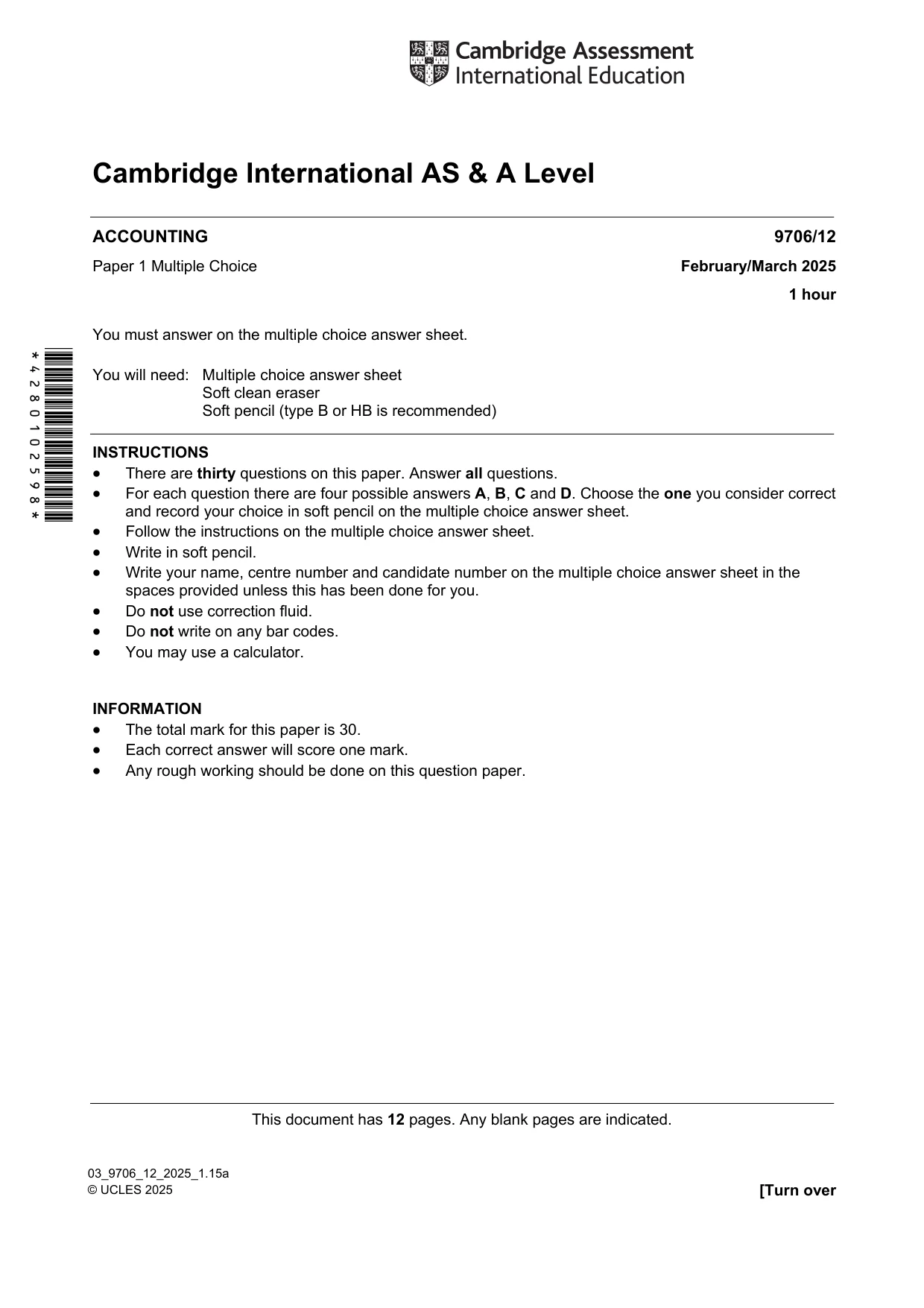
This document has 12 pages. Any blank pages are indicated. 03_9706_12_2025_1.15a © UCLES 2025 [Turn over *4280102598* Cambridge International AS & A Level ACCOUNTING 9706/12 Paper 1 Multiple Choice February/March 2025 1 hour You must answer on the multiple choice answer sheet. You will need: Multiple choice answer sheet Soft clean eraser Soft pencil (type B or HB is recommended) INSTRUCTIONS There are thirty questions on this paper. Answer all questions. For each question there are four possible answers A, B, C and D. Choose the one you consider correct and record your choice in soft pencil on the multiple choice answer sheet. Follow the instructions on the multiple choice answer sheet. Write in soft pencil. Write your name, centre number and candidate number on the multiple choice answer sheet in the spaces provided unless this has been done for you. Do not use correction fluid. Do not write on any bar codes. You may use a calculator. INFORMATION The total mark for this paper is 30. Each correct answer will score one mark. Any rough working should be done on this question paper.
Question paper, page 2
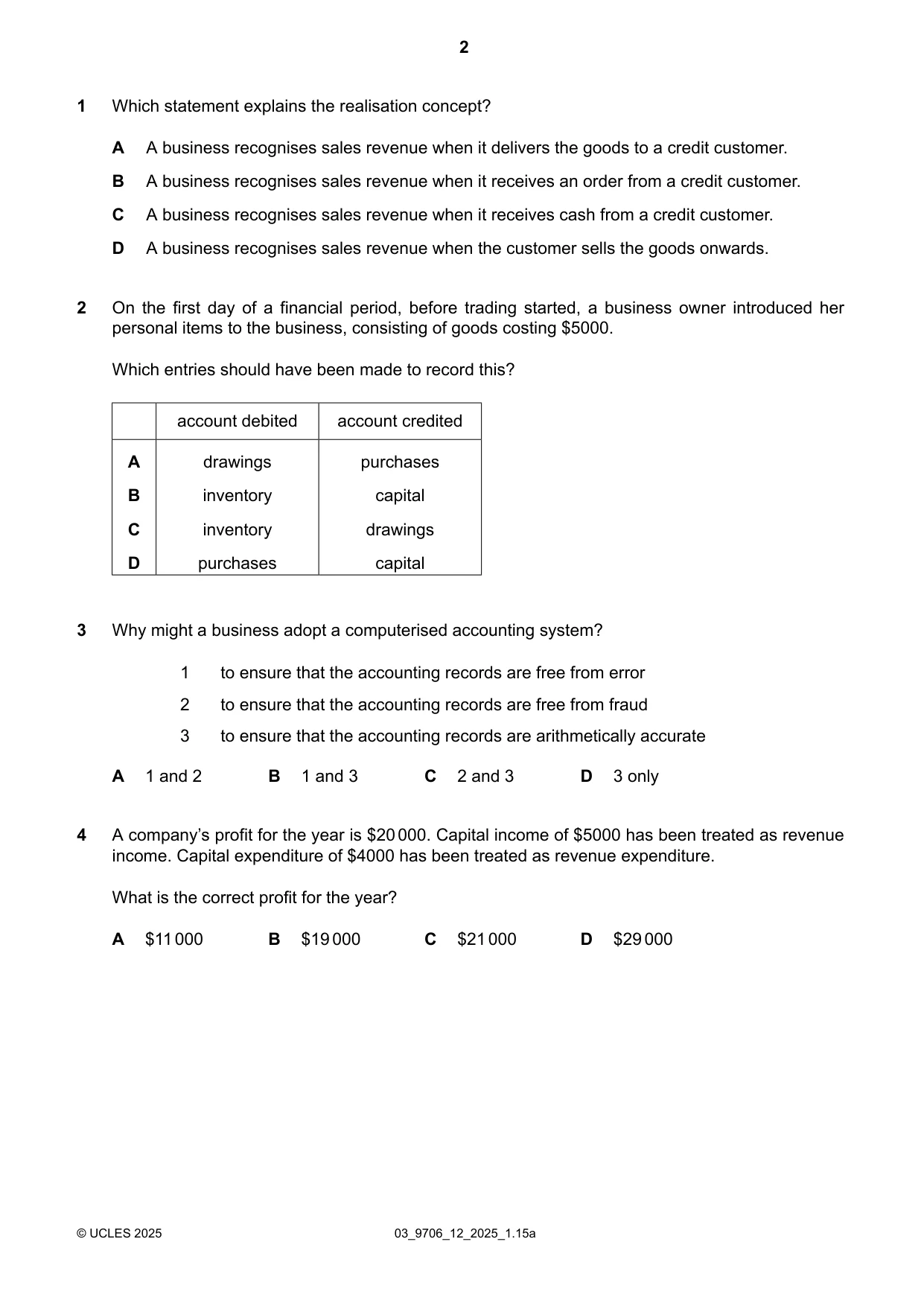
Which statement explains the realisation concept? 1 A business recognises sales revenue when it delivers the goods to a credit customer. A A business recognises sales revenue when it receives an order from a credit customer. B A business recognises sales revenue when it receives cash from a credit customer. C A business recognises sales revenue when the customer sells the goods onwards. D On the first day of a financial period, before trading started, a business owner introduced her personal items to the business, consisting of goods costing $5000. Which entries should have been made to record this? 2 account credited account debited purchases drawings A capital inventory B drawings inventory C capital purchases D Why might a business adopt a computerised accounting system? 3 1 to ensure that the accounting records are free from error 2 to ensure that the accounting records are free from fraud 3 to ensure that the accounting records are arithmetically accurate 3 only D 2 and 3 C 1 and 3 B 1 and 2 A A company’s profit for the year is $20000. Capital income of $5000 has been treated as revenue income. Capital expenditure of $4000 has been treated as revenue expenditure. What is the correct profit for the year? 4 $29000 D $21000 C $19000 B $11000 A 03_9706_12_2025_1.15a © UCLES 2025 2
Question paper, page 3
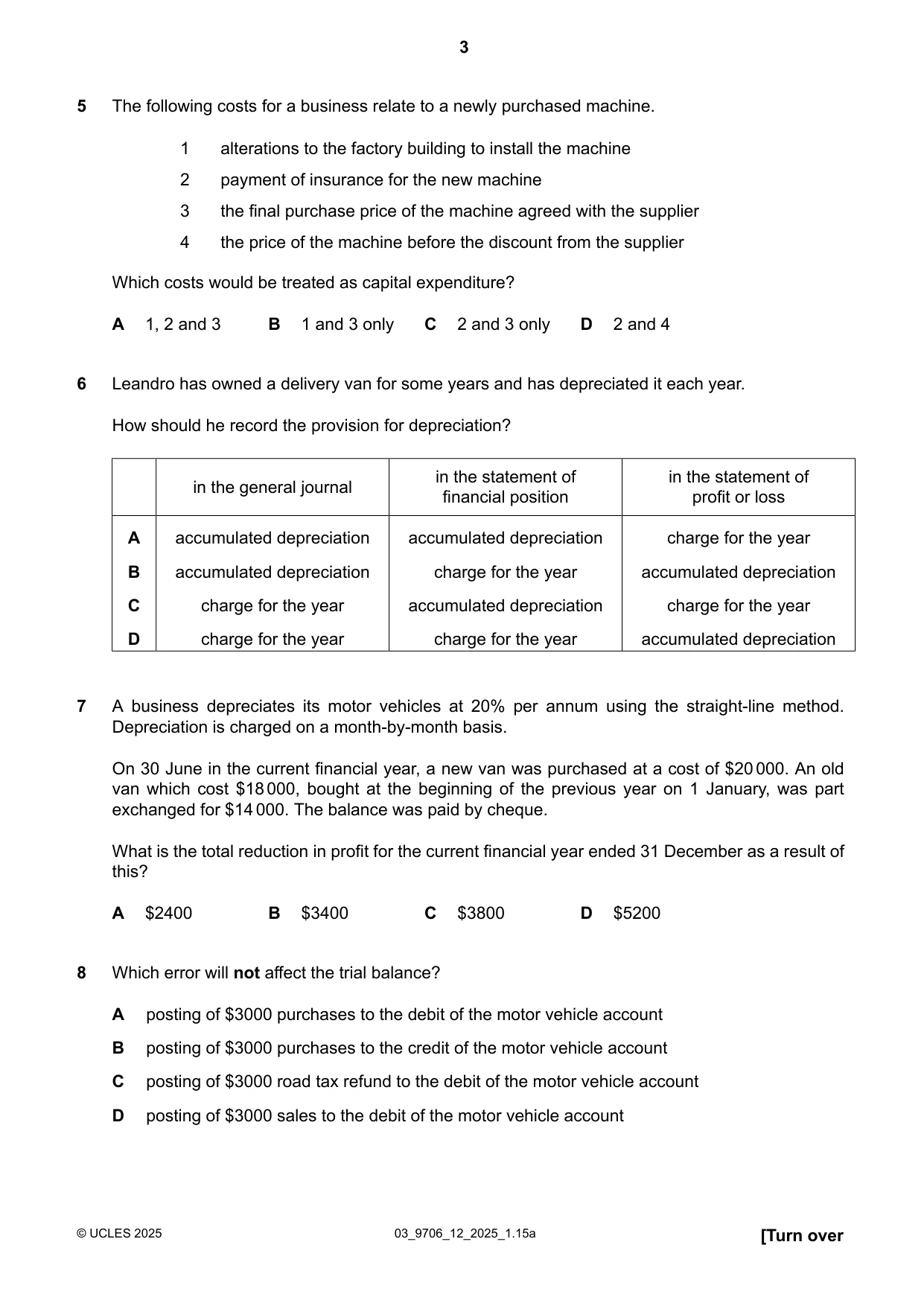
The following costs for a business relate to a newly purchased machine. 5 1 alterations to the factory building to install the machine 2 payment of insurance for the new machine 3 the final purchase price of the machine agreed with the supplier 4 the price of the machine before the discount from the supplier Which costs would be treated as capital expenditure? 2 and 4 D 2 and 3 only C 1 and 3 only B 1, 2 and 3 A Leandro has owned a delivery van for some years and has depreciated it each year. How should he record the provision for depreciation? 6 in the statement of profit or loss in the statement of financial position in the general journal charge for the year accumulated depreciation accumulated depreciation A accumulated depreciation charge for the year accumulated depreciation B charge for the year accumulated depreciation charge for the year C accumulated depreciation charge for the year charge for the year D A business depreciates its motor vehicles at 20% per annum using the straight-line method. Depreciation is charged on a month-by-month basis. On 30 June in the current financial year, a new van was purchased at a cost of $20000. An old van which cost $18000, bought at the beginning of the previous year on 1 January, was part exchanged for $14000. The balance was paid by cheque. What is the total reduction in profit for the current financial year ended 31 December as a result of this? 7 $5200 D $3800 C $3400 B $2400 A Which error will not affect the trial balance? 8 posting of $3000 purchases to the debit of the motor vehicle account A posting of $3000 purchases to the credit of the motor vehicle account B posting of $3000 road tax refund to the debit of the motor vehicle account C posting of $3000 sales to the debit of the motor vehicle account D [Turn over 03_9706_12_2025_1.15a © UCLES 2025 3
Question paper, page 4
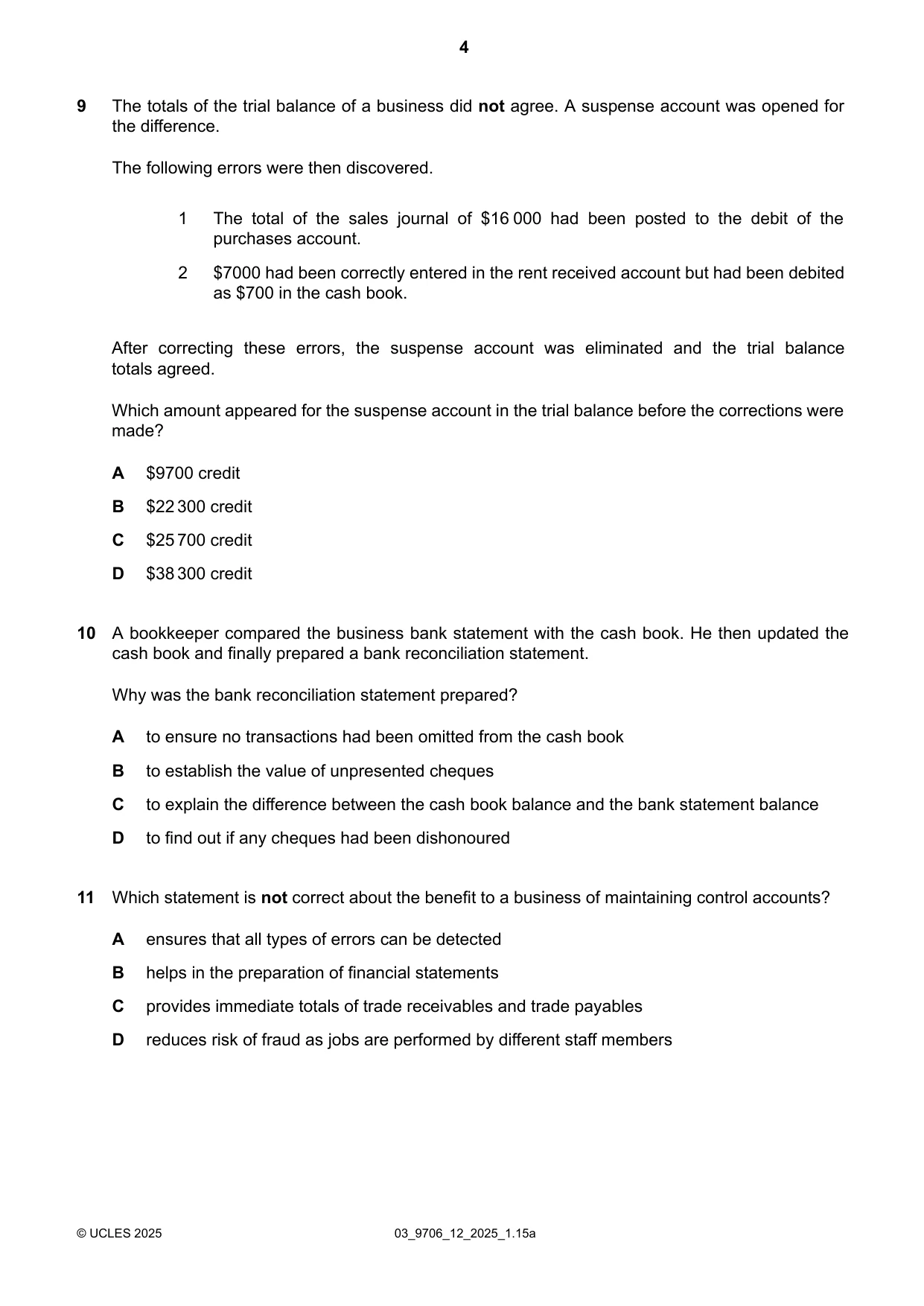
The totals of the trial balance of a business did not agree. A suspense account was opened for the difference. The following errors were then discovered. 9 1 The total of the sales journal of $16 000 had been posted to the debit of the purchases account. $7000 had been correctly entered in the rent received account but had been debited as $700 in the cash book. 2 After correcting these errors, the suspense account was eliminated and the trial balance totals agreed. Which amount appeared for the suspense account in the trial balance before the corrections were made? $9700 credit A $22300 credit B $25700 credit C $38300 credit D A bookkeeper compared the business bank statement with the cash book. He then updated the cash book and finally prepared a bank reconciliation statement. Why was the bank reconciliation statement prepared? 10 to ensure no transactions had been omitted from the cash book A to establish the value of unpresented cheques B to explain the difference between the cash book balance and the bank statement balance C to find out if any cheques had been dishonoured D Which statement is not correct about the benefit to a business of maintaining control accounts? 11 ensures that all types of errors can be detected A helps in the preparation of financial statements B provides immediate totals of trade receivables and trade payables C reduces risk of fraud as jobs are performed by different staff members D 03_9706_12_2025_1.15a © UCLES 2025 4
Question paper, page 5
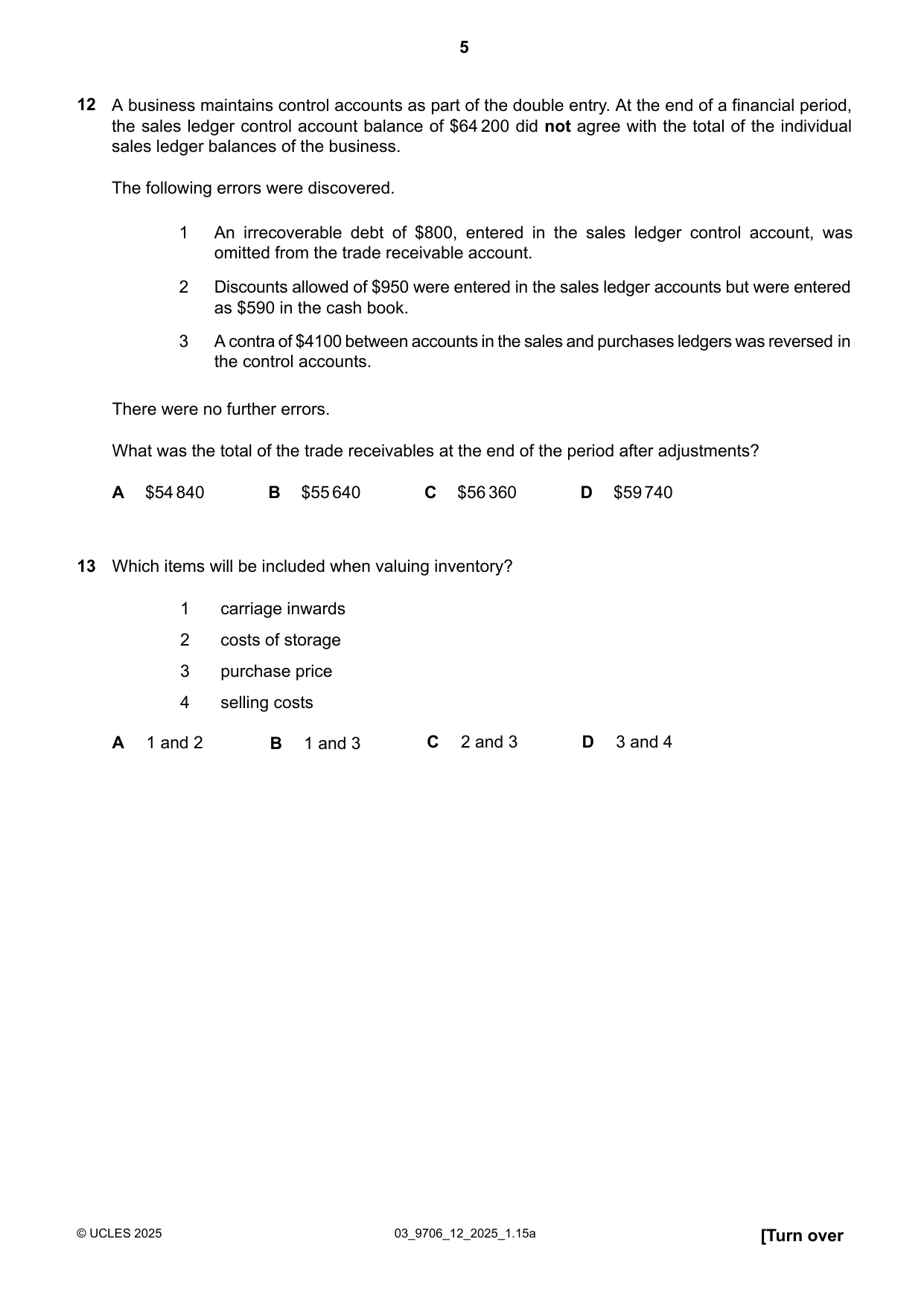
A business maintains control accounts as part of the double entry. At the end of a financial period, the sales ledger control account balance of $64 200 did not agree with the total of the individual sales ledger balances of the business. The following errors were discovered. 12 An irrecoverable debt of $800, entered in the sales ledger control account, was omitted from the trade receivable account. 1 Discounts allowed of $950 were entered in the sales ledger accounts but were entered as $590 in the cash book. 2 A contra of $4100 between accounts in the sales and purchases ledgers was reversed in the control accounts. 3 There were no further errors. What was the total of the trade receivables at the end of the period after adjustments? A $54 840 B $55 640 C $56 360 D $59 740 Which items will be included when valuing inventory? 13 1 carriage inwards 2 costs of storage 3 purchase price 4 selling costs 1 and 2 A 1 and 3 B 2 and 3 C 3 and 4 D [Turn over 03_9706_12_2025_1.15a © UCLES 2025 5
Question paper, page 6
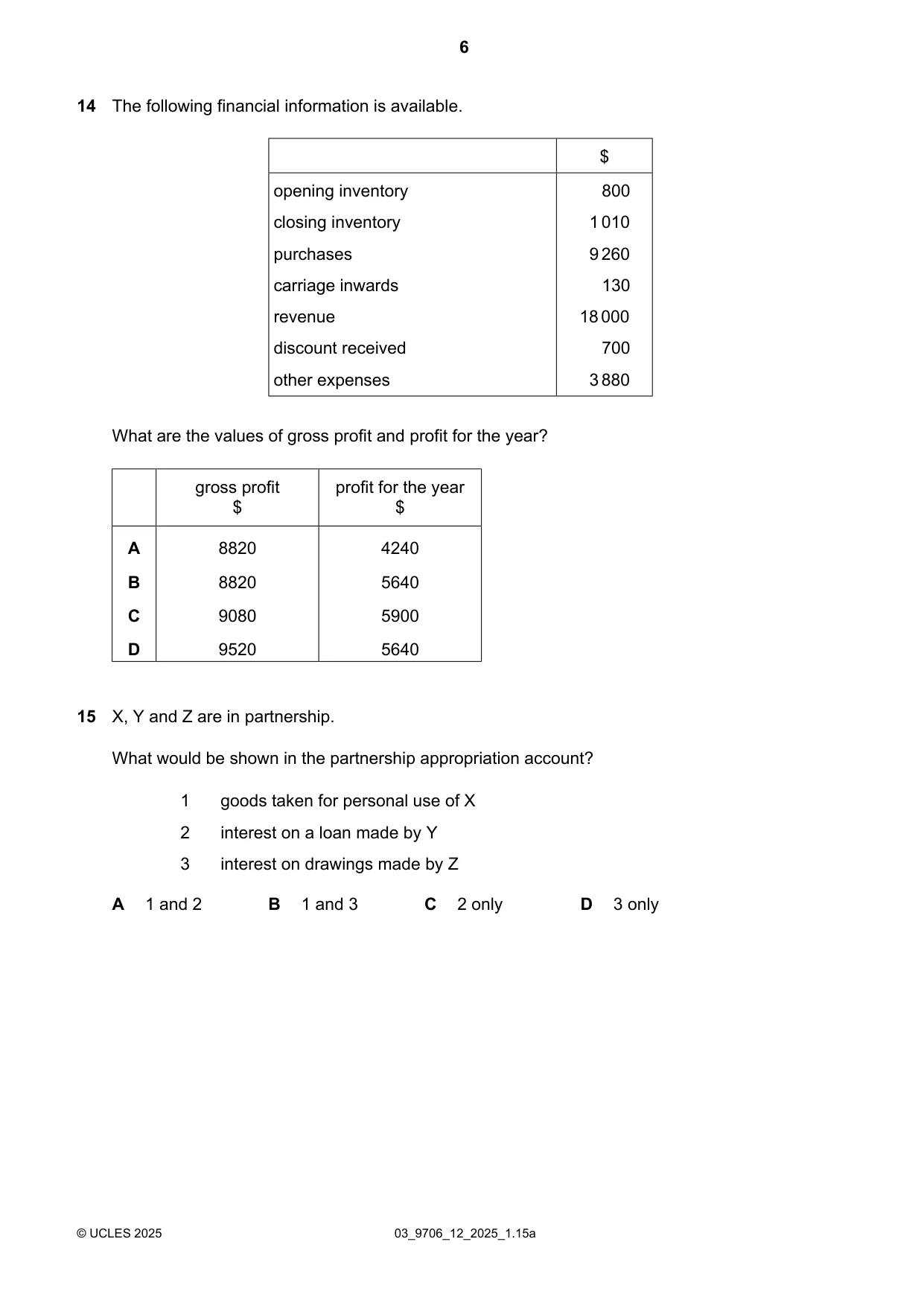
The following financial information is available. 14 $ 800 1010 9260 130 18000 700 3880 opening inventory closing inventory purchases carriage inwards revenue discount received other expenses What are the values of gross profit and profit for the year? profit for the year $ gross profit $ 4240 8820 A 5640 8820 B 5900 9080 C 5640 9520 D X, Y and Z are in partnership. What would be shown in the partnership appropriation account? 15 1 goods taken for personal use of X 2 interest on a loan made by Y 3 interest on drawings made by Z 3 only D 2 only C 1 and 3 B 1 and 2 A 03_9706_12_2025_1.15a © UCLES 2025 6
Question paper, page 7
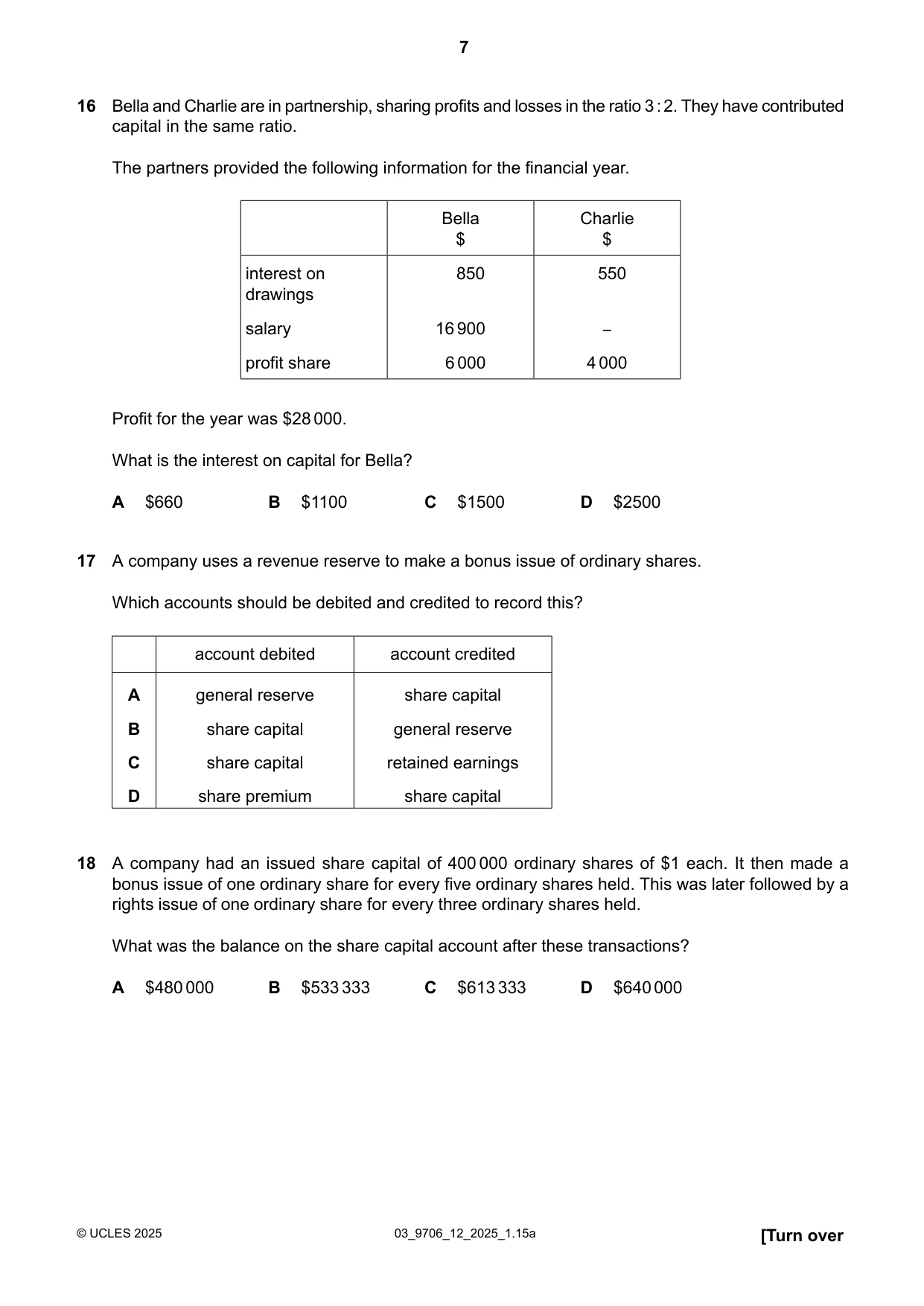
Bella and Charlie are in partnership, sharing profits and losses in the ratio 3:2. They have contributed capital in the same ratio. The partners provided the following information for the financial year. 16 Charlie $ Bella $ 550 850 interest on drawings − 16900 salary 4000 6000 profit share Profit for the year was $28000. What is the interest on capital for Bella? $2500 D $1500 C $1100 B $660 A A company uses a revenue reserve to make a bonus issue of ordinary shares. Which accounts should be debited and credited to record this? 17 account credited account debited share capital general reserve A general reserve share capital B retained earnings share capital C share capital share premium D 18 A company had an issued share capital of 400 000 ordinary shares of $1 each. It then made a bonus issue of one ordinary share for every five ordinary shares held. This was later followed by a rights issue of one ordinary share for every three ordinary shares held. What was the balance on the share capital account after these transactions? A $480 000 B $533 333 C $613 333 D $640 000 [Turn over 03_9706_12_2025_1.15a © UCLES 2025 7
Question paper, page 8
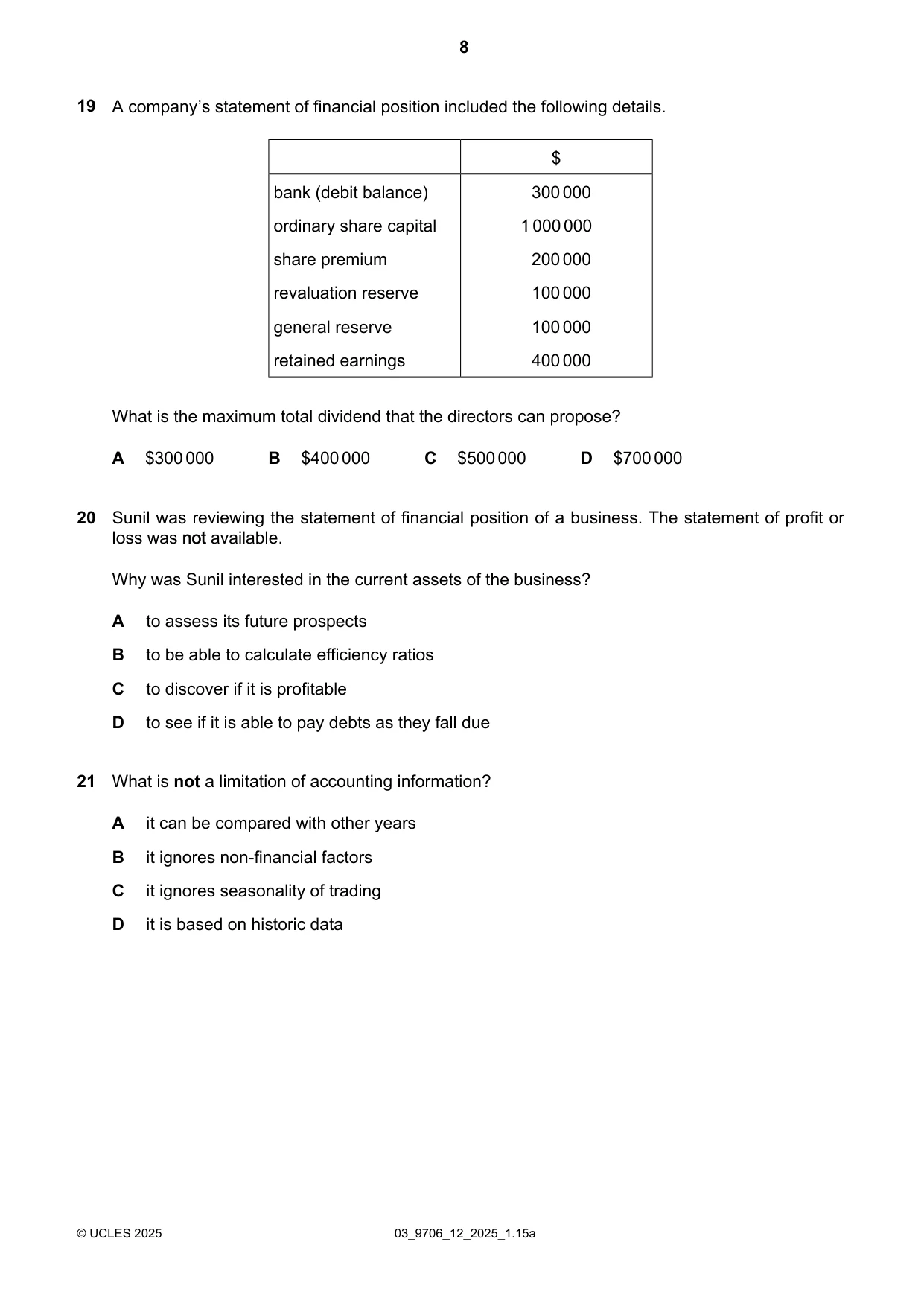
A company’s statement of financial position included the following details. 19 $ 300000 bank (debit balance) 1000000 ordinary share capital 200000 share premium 100000 revaluation reserve 100000 general reserve 400000 retained earnings What is the maximum total dividend that the directors can propose? $700000 D $500000 C $400000 B $300000 A Sunil was reviewing the statement of financial position of a business. The statement of profit or loss was not available. Why was Sunil interested in the current assets of the business? 20 to assess its future prospects A to be able to calculate efficiency ratios B to discover if it is profitable C to see if it is able to pay debts as they fall due D What is not a limitation of accounting information? 21 it can be compared with other years A it ignores non-financial factors B it ignores seasonality of trading C it is based on historic data D 03_9706_12_2025_1.15a © UCLES 2025 8
Question paper, page 9
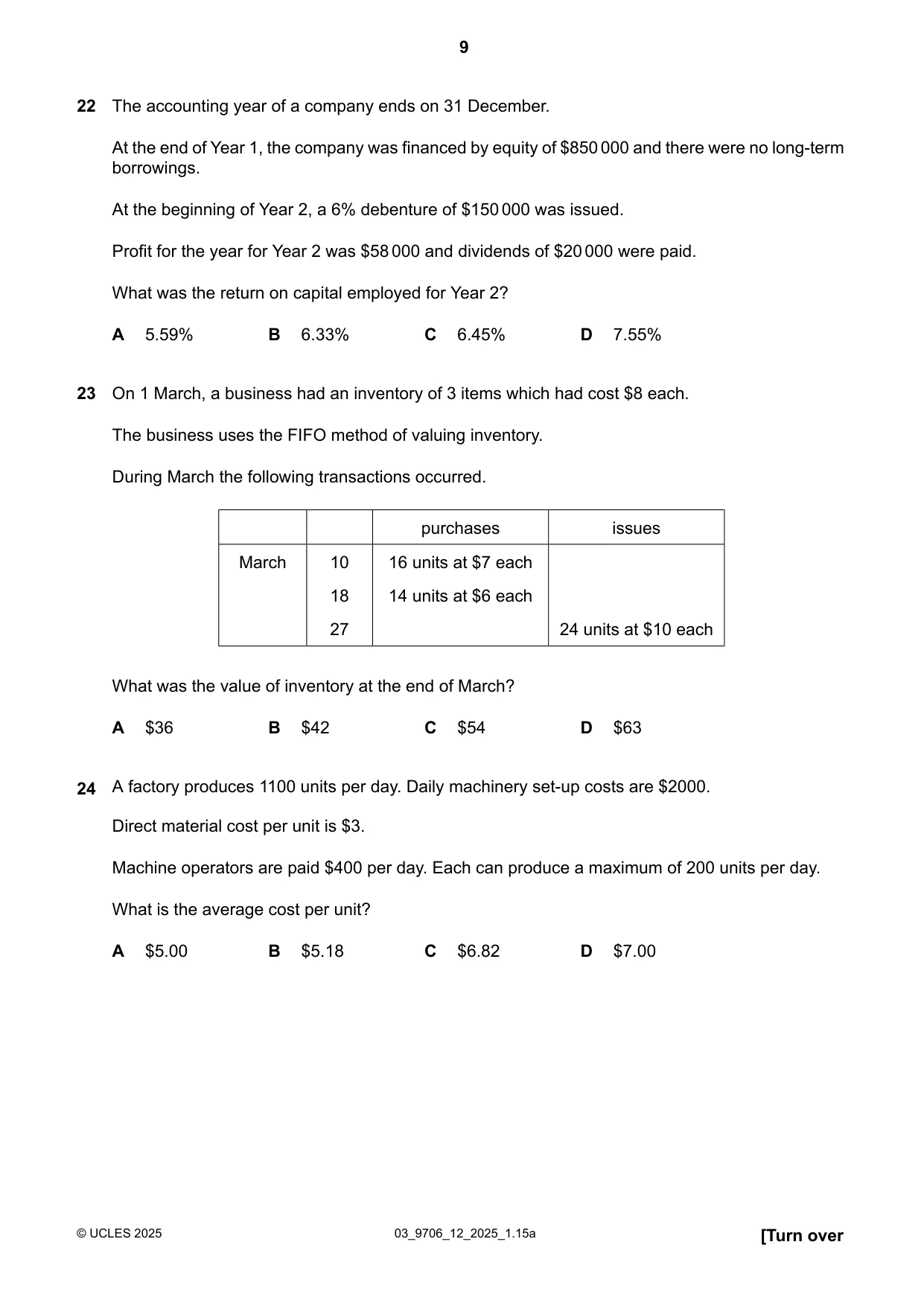
The accounting year of a company ends on 31 December. At the end of Year 1, the company was financed by equity of $850000 and there were no long-term borrowings. At the beginning of Year 2, a 6% debenture of $150000 was issued. Profit for the year for Year 2 was $58000 and dividends of $20000 were paid. What was the return on capital employed for Year 2? 22 7.55% D 6.45% C 6.33% B 5.59% A On 1 March, a business had an inventory of 3 items which had cost $8 each. The business uses the FIFO method of valuing inventory. During March the following transactions occurred. 23 issues purchases 16 units at $7 each 10 March 14 units at $6 each 18 24 units at $10 each 27 What was the value of inventory at the end of March? $63 D $54 C $42 B $36 A 24 A factory produces 1100 units per day. Daily machinery set-up costs are $2000. Direct material cost per unit is $3. Machine operators are paid $400 per day. Each can produce a maximum of 200 units per day. What is the average cost per unit? A $5.00 B $5.18 C $6.82 D $7.00 [Turn over 03_9706_12_2025_1.15a © UCLES 2025 9
Question paper, page 10
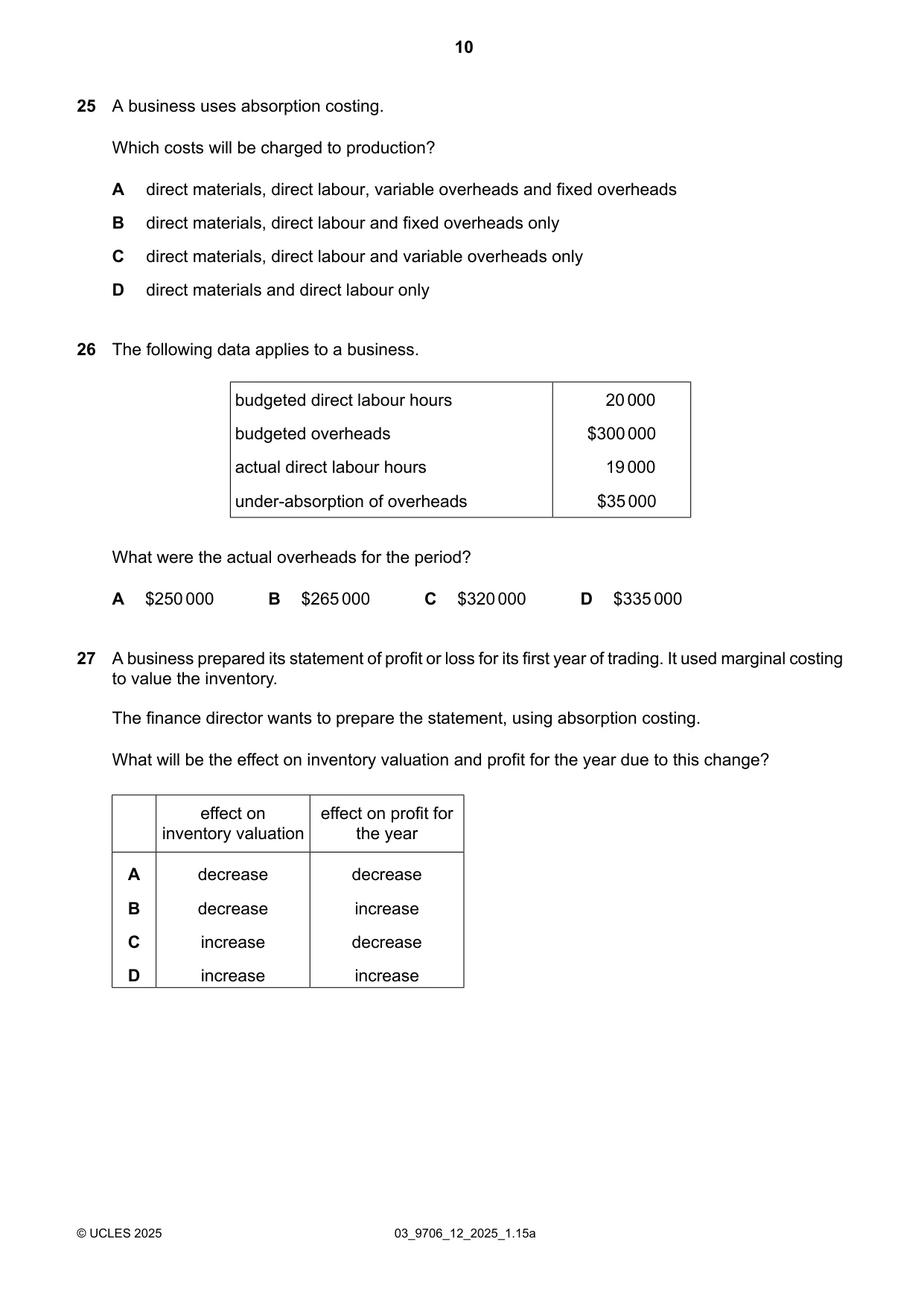
A business uses absorption costing. Which costs will be charged to production? 25 direct materials, direct labour, variable overheads and fixed overheads A direct materials, direct labour and fixed overheads only B direct materials, direct labour and variable overheads only C direct materials and direct labour only D The following data applies to a business. 26 20000 budgeted direct labour hours $300000 budgeted overheads 19000 actual direct labour hours $35000 under-absorption of overheads What were the actual overheads for the period? $335000 D $320000 C $265000 B $250000 A A business prepared its statement of profit or loss for its first year of trading. It used marginal costing to value the inventory. The finance director wants to prepare the statement, using absorption costing. What will be the effect on inventory valuation and profit for the year due to this change? 27 effect on profit for the year effect on inventory valuation decrease decrease A increase decrease B decrease increase C increase increase D 03_9706_12_2025_1.15a © UCLES 2025 10
Question paper, page 11
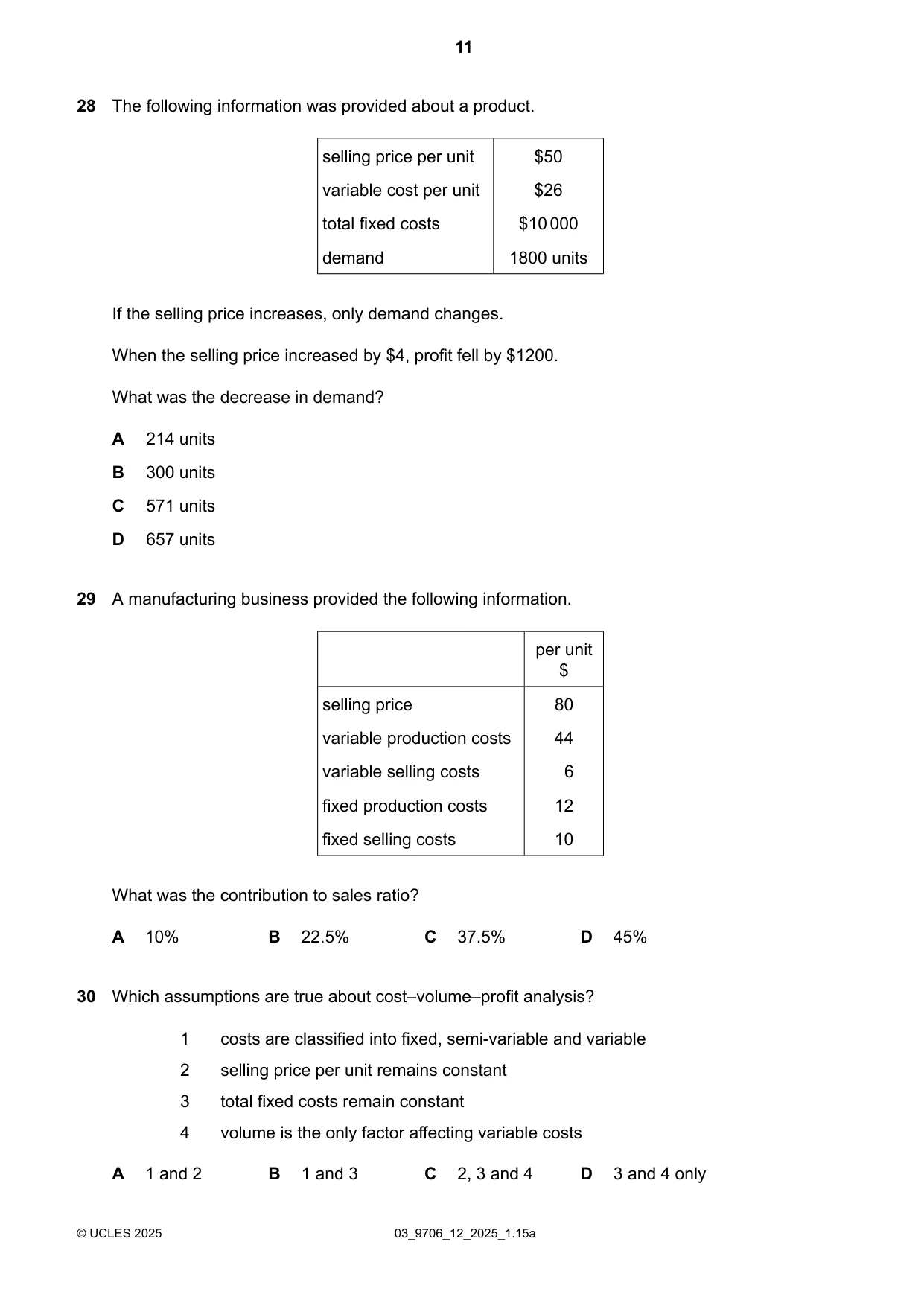
The following information was provided about a product. 28 $50 selling price per unit $26 variable cost per unit $10000 total fixed costs 1800 units demand If the selling price increases, only demand changes. When the selling price increased by $4, profit fell by $1200. What was the decrease in demand? 214 units A 300 units B 571 units C 657 units D A manufacturing business provided the following information. 29 per unit $ 80 selling price 44 variable production costs 6 variable selling costs 12 fixed production costs 10 fixed selling costs What was the contribution to sales ratio? 45% D 37.5% C 22.5% B 10% A Which assumptions are true about cost–volume–profit analysis? 30 1 costs are classified into fixed, semi-variable and variable 2 selling price per unit remains constant 3 total fixed costs remain constant 4 volume is the only factor affecting variable costs 3 and 4 only D 2, 3 and 4 C 1 and 3 B 1 and 2 A 03_9706_12_2025_1.15a © UCLES 2025 11
Question paper, page 12
Permission to reproduce items where third-party owned material protected by copyright is included has been sought and cleared where possible. Every reasonable effort has been made by the publisher (UCLES) to trace copyright holders, but if any items requiring clearance have unwittingly been included, the publisher will be pleased to make amends at the earliest possible opportunity. To avoid the issue of disclosure of answer-related information to candidates, all copyright acknowledgements are reproduced online in the Cambridge Assessment International Education Copyright Acknowledgements Booklet. This is produced for each series of examinations and is freely available to download at www.cambridgeinternational.org after the live examination series. Cambridge Assessment International Education is part of Cambridge Assessment. Cambridge Assessment is the brand name of the University of Cambridge Local Examinations Syndicate (UCLES), which is a department of the University of Cambridge. © UCLES 2025 03_9706_12_2025_1.15a 12 BLANK PAGE
Mark scheme, page 1
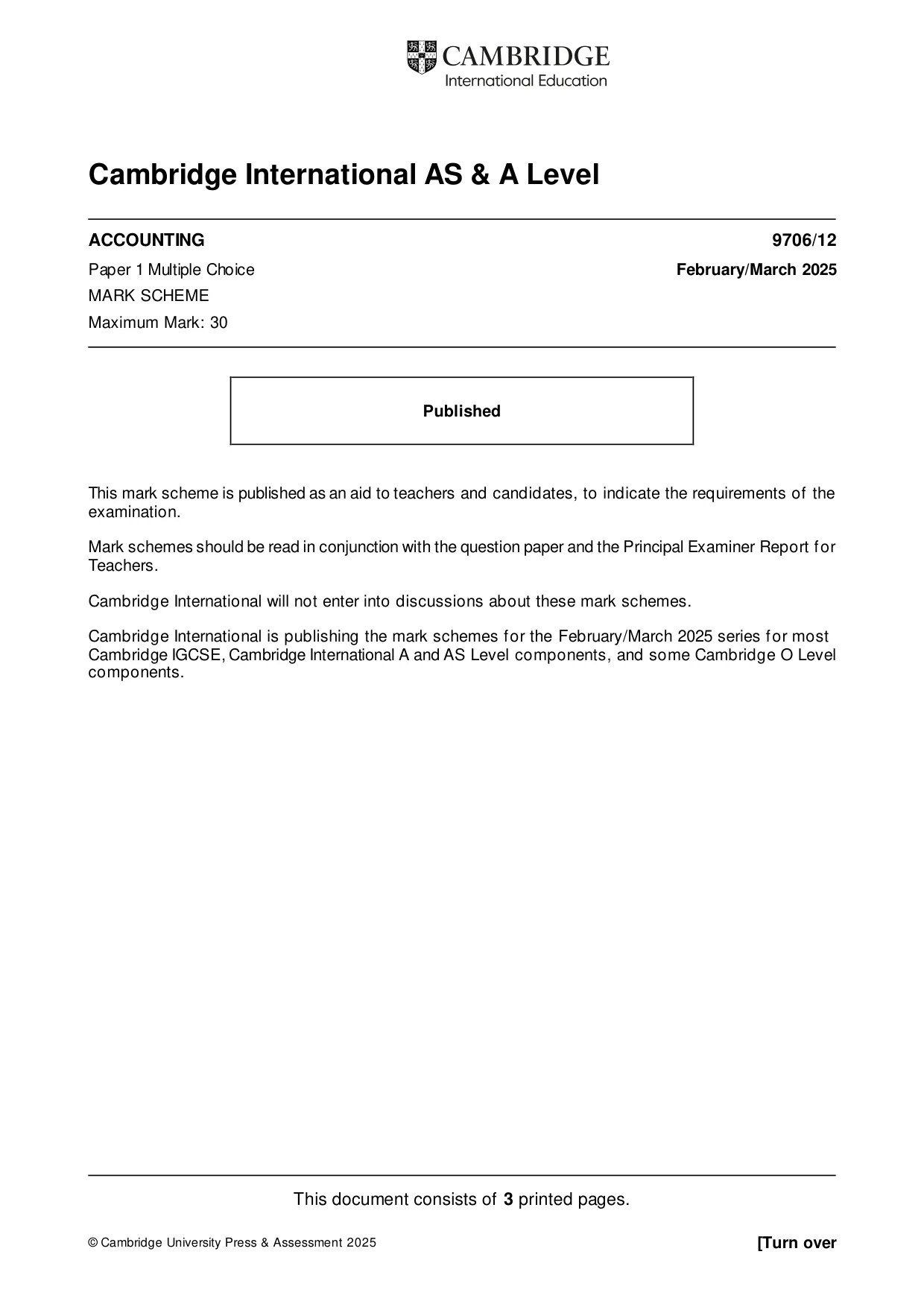
This document consists of 3 printed pages. © Cambridge University Press & Assessment 2025 [Turn over Cambridge International AS & A Level ACCOUNTING 9706/12 Paper 1 Multiple Choice February/March 2025 MARK SCHEME Maximum Mark: 30 Published This mark scheme is published as an aid to teachers and candidates, to indicate the requirements of the examination. Mark schemes should be read in conjunction with the question paper and the Principal Examiner Report for Teachers. Cambridge International will not enter into discussions about these mark schemes. Cambridge International is publishing the mark schemes for the February/March 2025 series for most Cambridge IGCSE, Cambridge International A and AS Level components, and some Cambridge O Level components.
Mark scheme, page 2
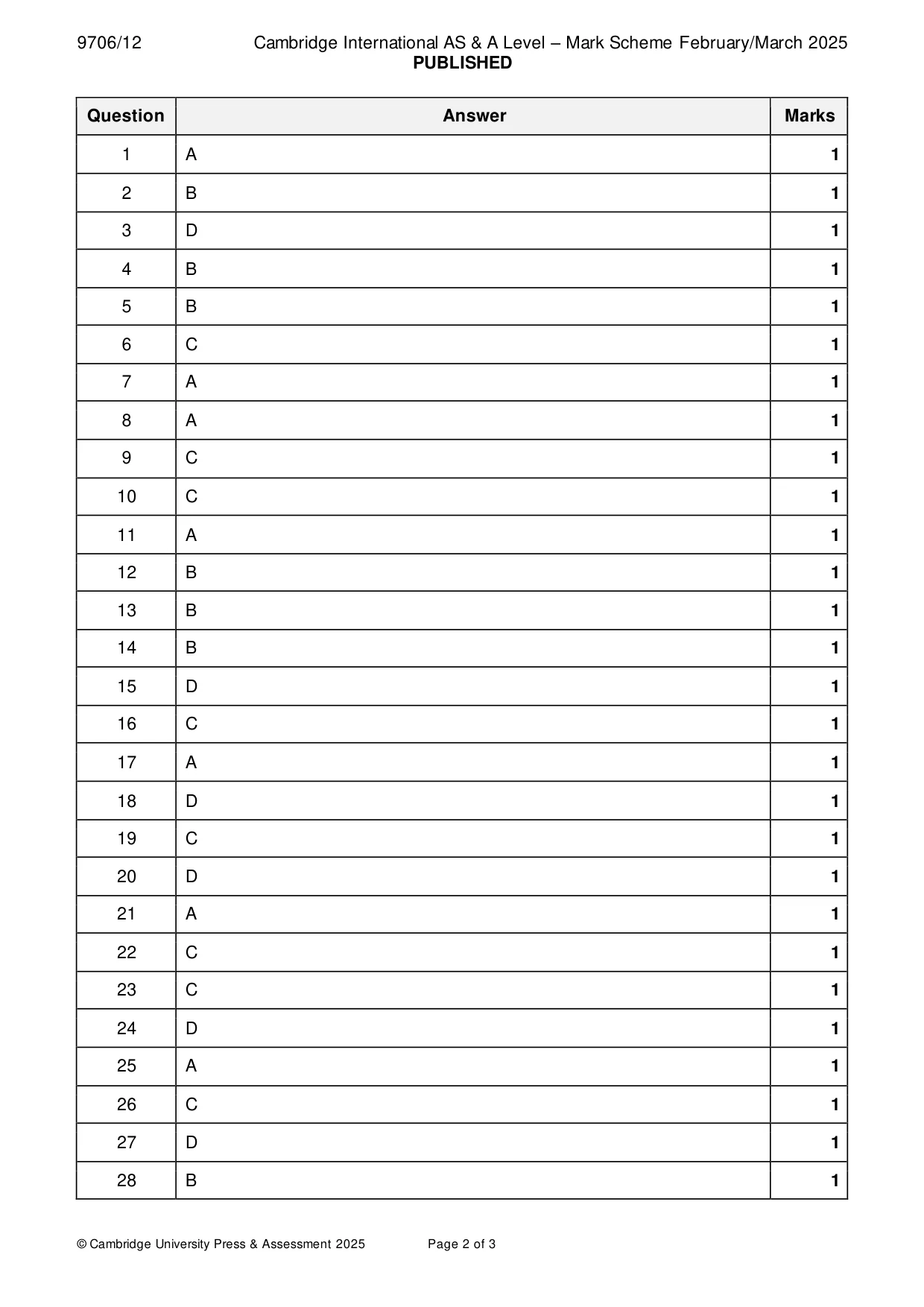
9706/12 Cambridge International AS & A Level – Mark Scheme PUBLISHED February/March 2025 © Cambridge University Press & Assessment 2025 Page 2 of 3 Question Answer Marks 1 A 1 2 B 1 3 D 1 4 B 1 5 B 1 6 C 1 7 A 1 8 A 1 9 C 1 10 C 1 11 A 1 12 B 1 13 B 1 14 B 1 15 D 1 16 C 1 17 A 1 18 D 1 19 C 1 20 D 1 21 A 1 22 C 1 23 C 1 24 D 1 25 A 1 26 C 1 27 D 1 28 B 1
Mark scheme, page 3
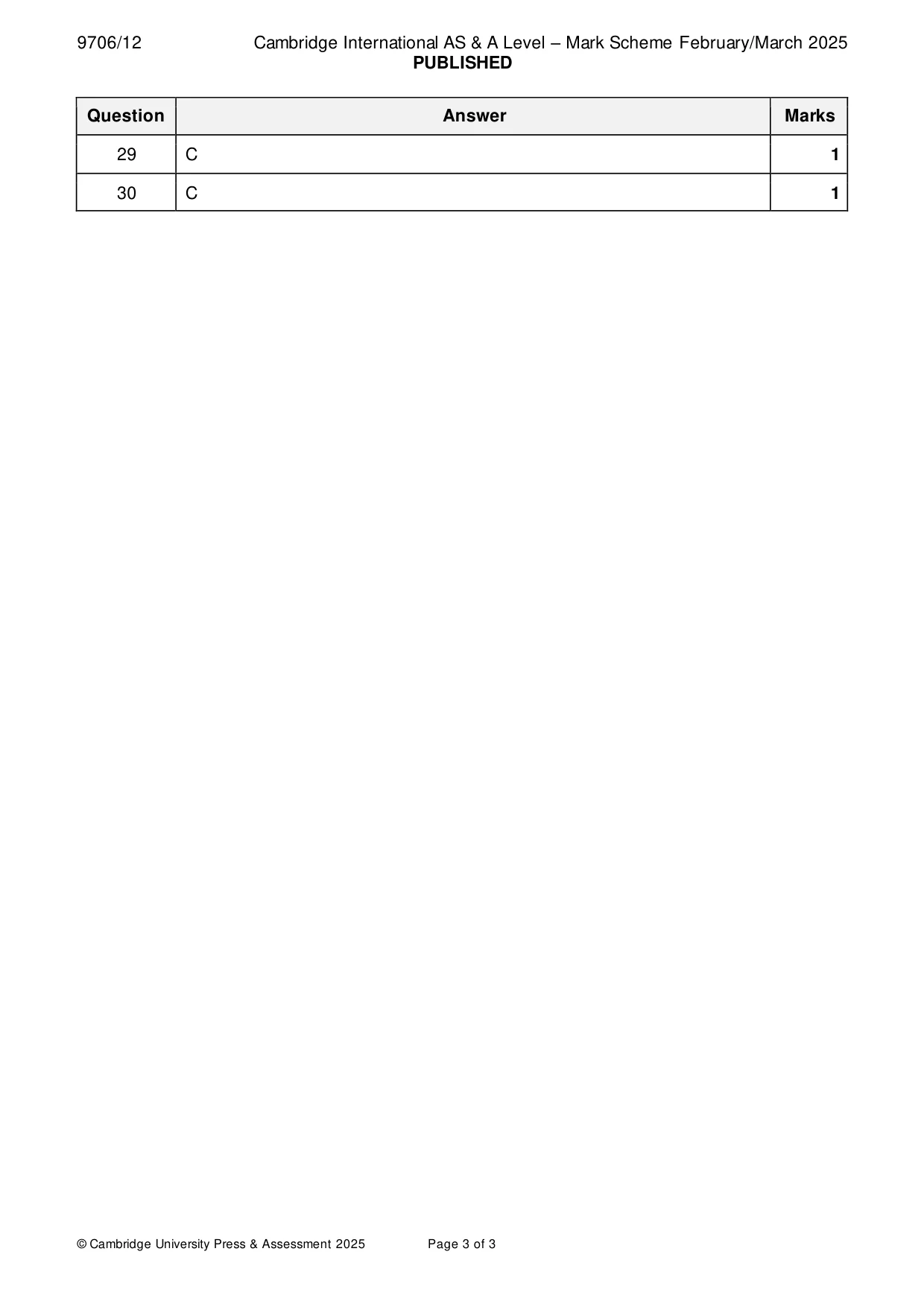
9706/12 Cambridge International AS & A Level – Mark Scheme PUBLISHED February/March 2025 © Cambridge University Press & Assessment 2025 Page 3 of 3 Question Answer Marks 29 C 1 30 C 1
What you needed in this session
Cambridge’s own grade thresholds for 2025 Feb/March, Paper 1 · Variant 2. A higher threshold means an easier paper — the bar moves with how the cohort did.