Cambridge A Level Accounting 9706 — 2023 May/June Paper 2 · Variant 2
9706/22/M/J/23 · 7 questions · 90 marks · ≈101 min
The question paper and its mark scheme, free to read here and free to download. This is Cambridge’s own paper, exactly as it was sat.
Question paper20 pages
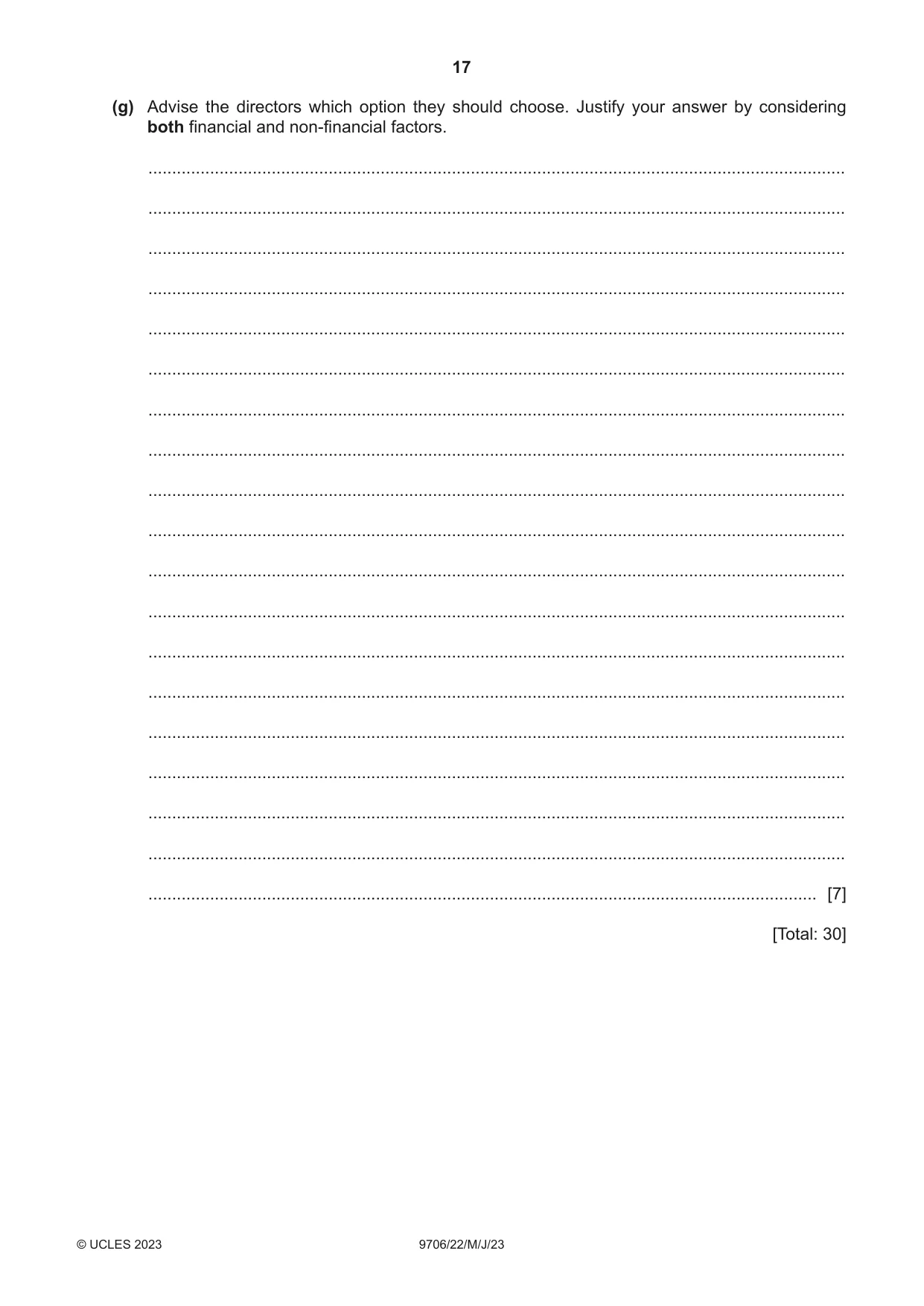


Mark scheme15 pages
Answers below. Sit the paper first if you are practising.
Questions as text
Q1 · J Limited’s financial year ended on 30 September 2022
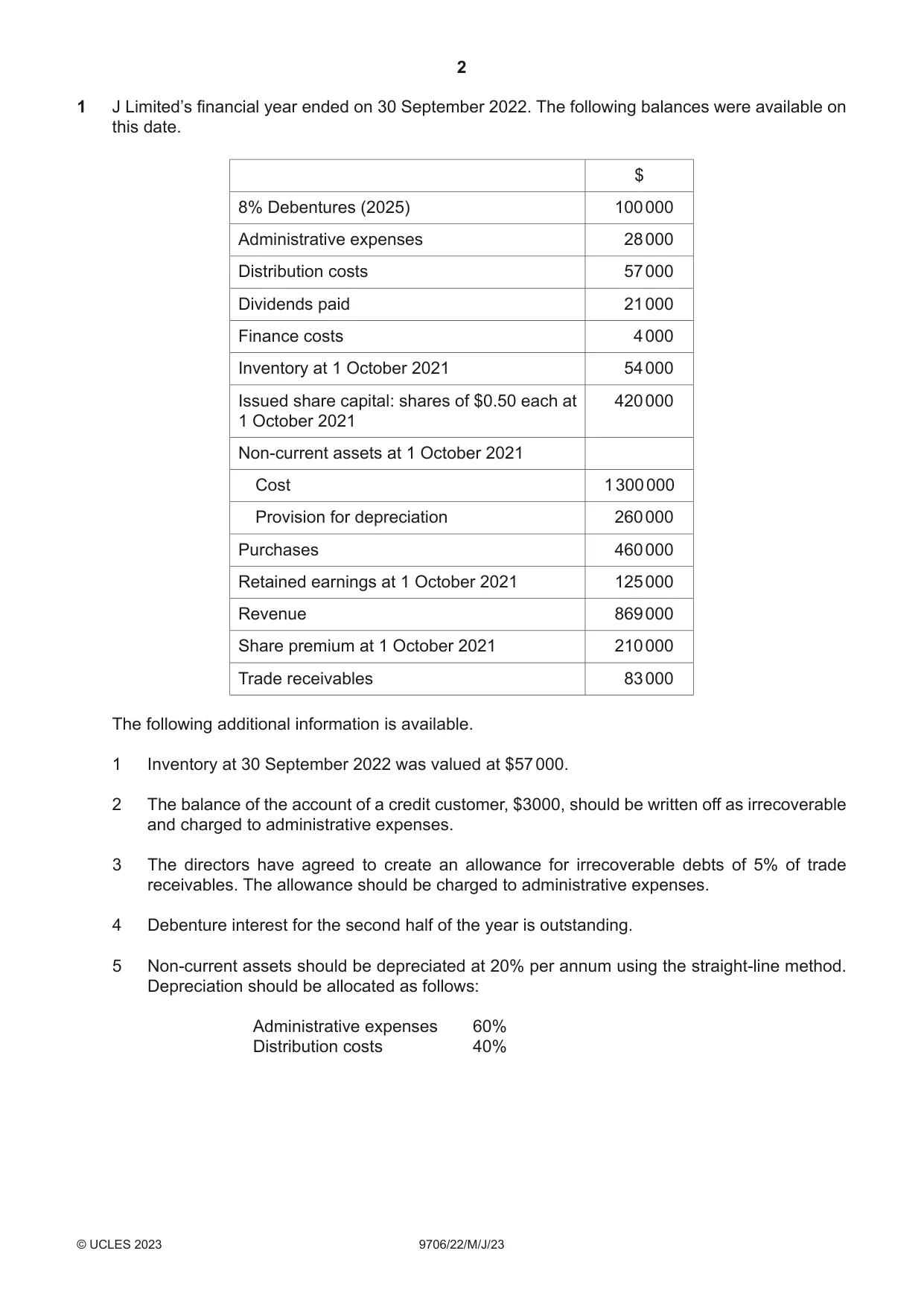
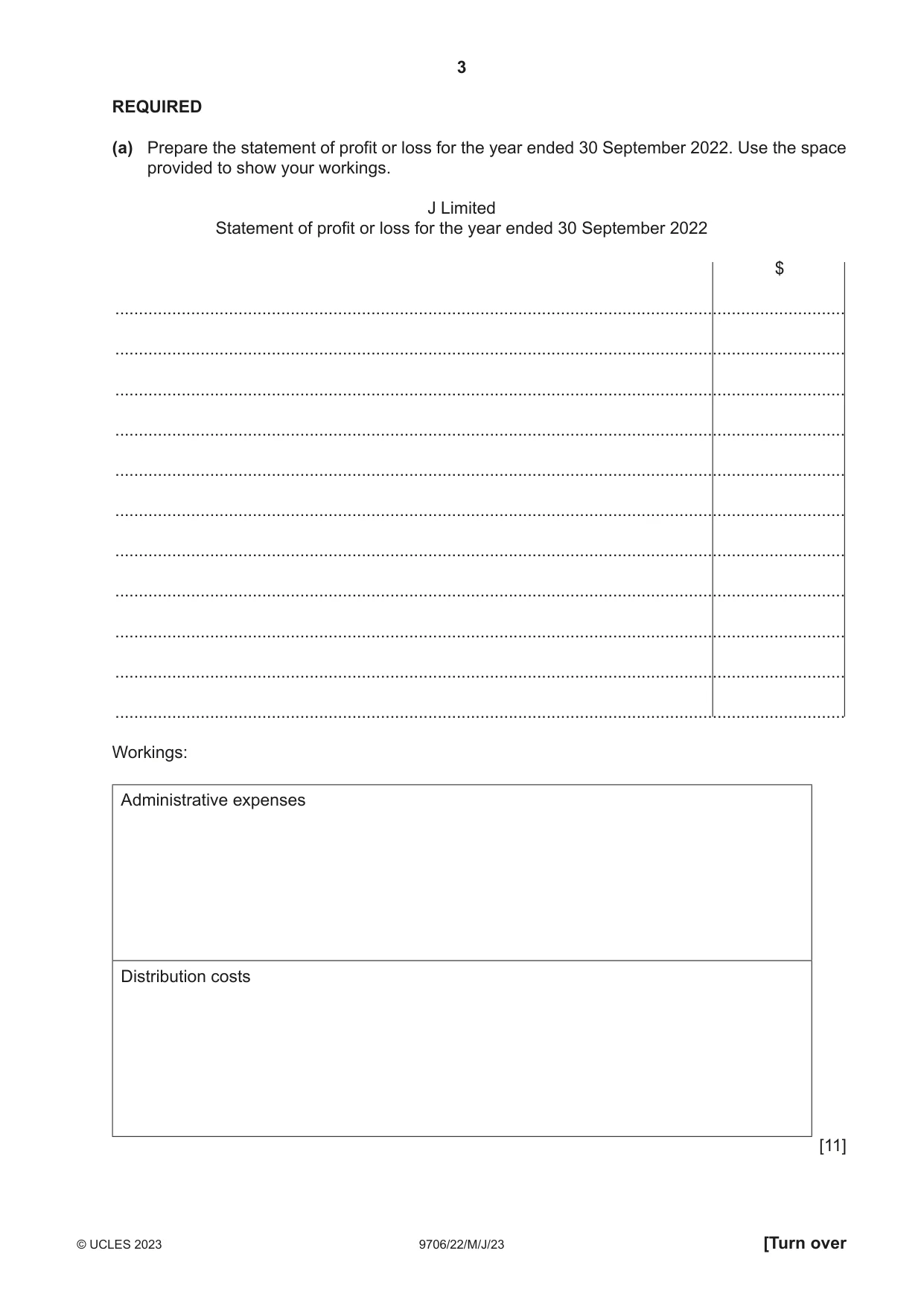
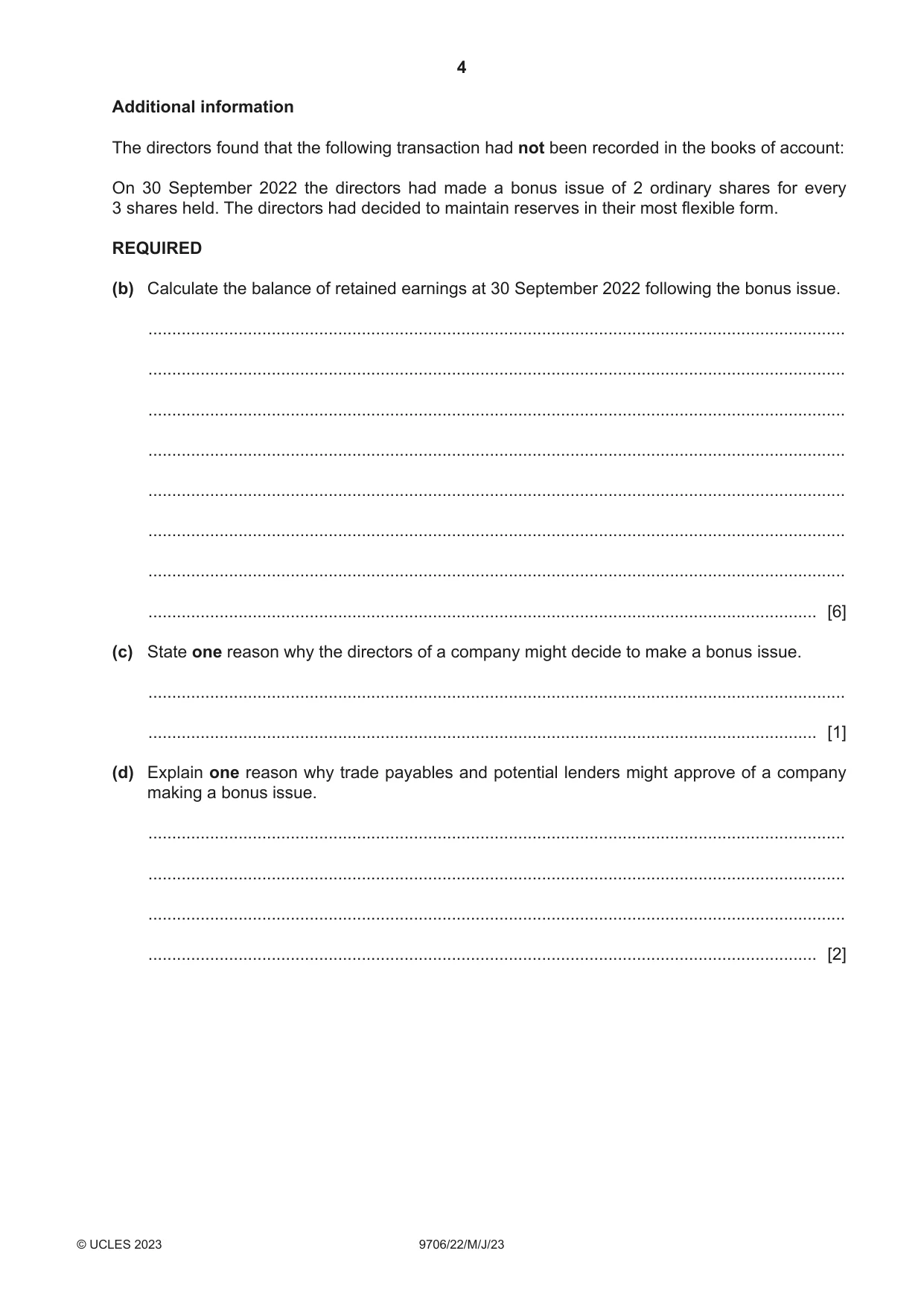
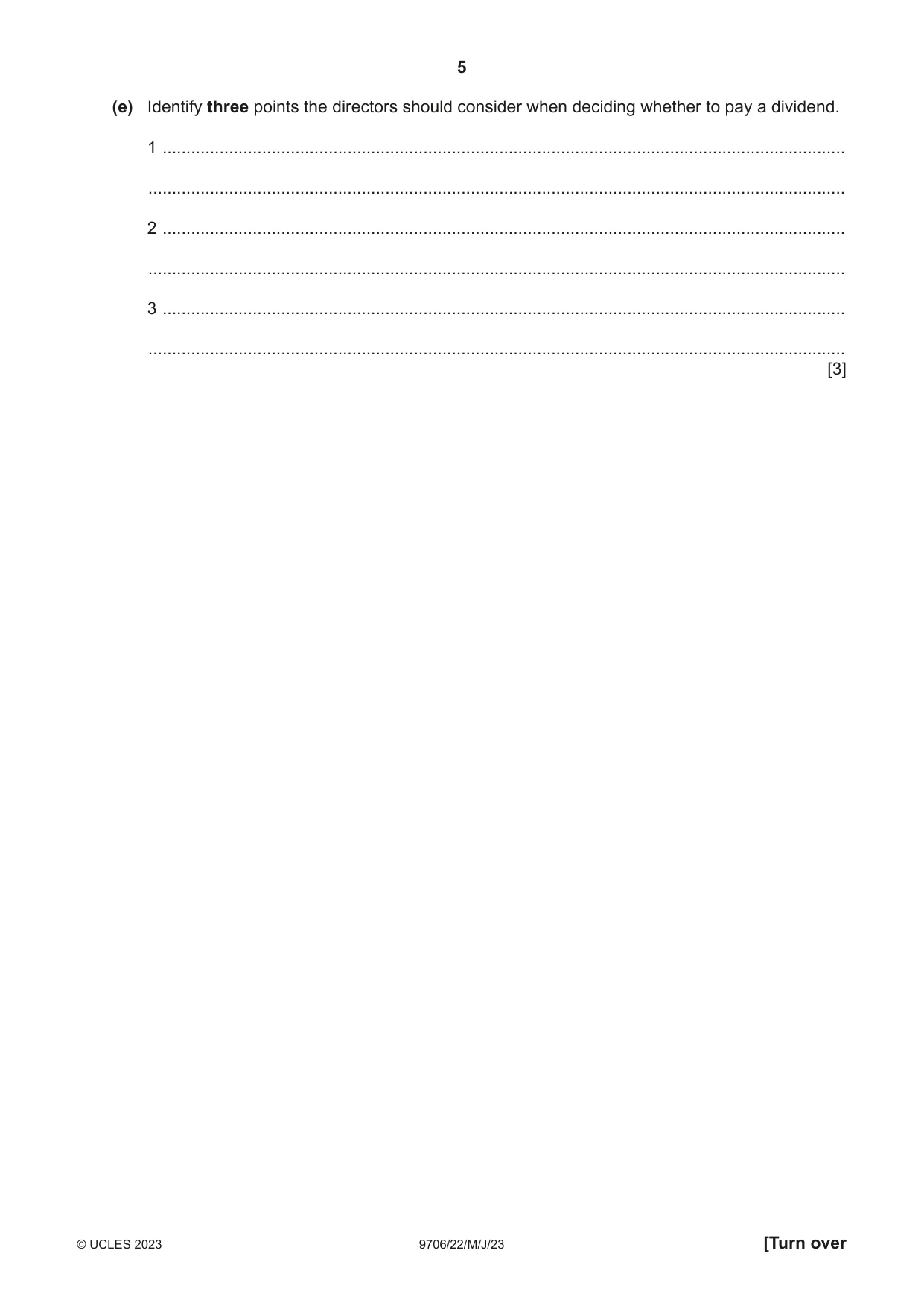
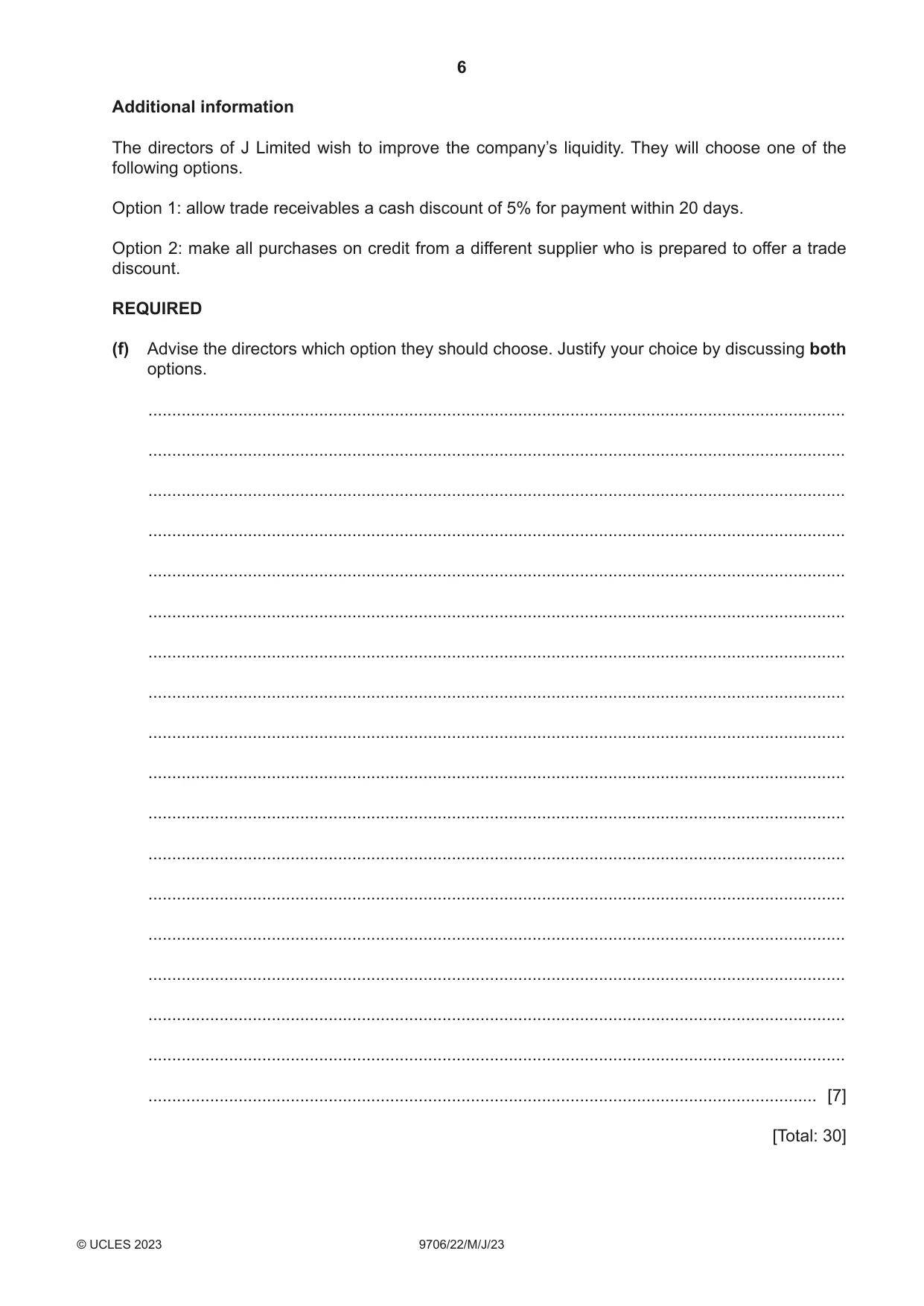
1 J Limited’s financial year ended on 30 September 2022. The following balances were available on this date. $ 8% Debentures (2025) 100 000 Administrative expenses 28 000 Distribution costs 57 000 Dividends paid 21 000 Finance costs 4 000 Inventory at 1 October 2021 54 000 Issued share capital: shares of $0.50 each at 420 000 1 October 2021 Non-current assets at 1 October 2021 Cost 1 300 000 Provision for depreciation 260 000 Purchases 460 000 Retained earnings at 1 October 2021 125 000 Revenue 869 000 Share premium at 1 October 2021 210 000 Trade receivables 83 000 The following additional information is available. 1 Inventory at 30 September 2022 was valued at $57 000. 2 The balance of the account of a credit customer, $3000, should be written off as irrecoverable and charged to administrative expenses. 3 The directors have agreed to create an allowance for irrecoverable debts of 5% of trade receivables. The allowance should be charged to administrative expenses. 4 Debenture interest for the second half of the year is outstanding. 5 Non-current assets should be depreciated at 20% per annum using the straight-line method. Depreciation should be allocated as follows: Administrative expenses 60% Distribution costs 40% REQUIRED (a) Prepare the statement of profit or loss for the year ended 30 September 2022. Use the space provided to show your workings. J Limited Statement of profit or loss for the year ended 30 September 2022 $ .......................................................................................................................................................... .......................................................................................................................................................... .......................................................................................................................................................... .......................................................................................................................................................... .......................................................................................................................................................... .......................................................................................................................................................... .......................................................................................................................................................... .......................................................................................................................................................... .......................................................................................................................................................... .......................................................................................................................................................... .......................................................................................................................................................... Workings: Administrative expenses Distribution costs [11] Additional information The directors found that the following transaction had not been recorded in the books of account: On 30 September 2022 the directors had made a bonus issue of 2 ordinary shares for every 3 shares held. The directors had decided to maintain reserves in their most flexible form. REQUIRED (b) Calculate the balance of retained earnings at 30 September 2022 following the bonus issue. ................................................................................................................................................... ................................................................................................................................................... ................................................................................................................................................... ................................................................................................................................................... ................................................................................................................................................... ................................................................................................................................................... ................................................................................................................................................... ............................................................................................................................................. [6] (c) State one reason why the directors of a company might decide to make a bonus issue. ................................................................................................................................................... ............................................................................................................................................. [1] (d) Explain one reason why trade payables and potential lenders might approve of a company making a bonus issue. ................................................................................................................................................... ................................................................................................................................................... ................................................................................................................................................... ............................................................................................................................................. [2] (e) Identify three points the directors should consider when deciding whether to pay a dividend. 1 ................................................................................................................................................ ................................................................................................................................................... 2 ................................................................................................................................................ ................................................................................................................................................... 3 ................................................................................................................................................ ................................................................................................................................................... [3] Additional information The directors of J Limited wish to improve the company’s liquidity. They will choose one of the following options. Option 1: allow trade receivables a cash discount of 5% for payment within 20 days. Option 2: make all purchases on credit from a different supplier who is prepared to offer a trade discount. REQUIRED (f) Advise the directors which option they should choose. Justify your choice by discussing both options. ................................................................................................................................................... ................................................................................................................................................... ................................................................................................................................................... ................................................................................................................................................... ................................................................................................................................................... ................................................................................................................................................... ................................................................................................................................................... ................................................................................................................................................... ................................................................................................................................................... ................................................................................................................................................... ................................................................................................................................................... ................................................................................................................................................... ................................................................................................................................................... ................................................................................................................................................... ................................................................................................................................................... ................................................................................................................................................... ................................................................................................................................................... ............................................................................................................................................. [7] [Total: 30]
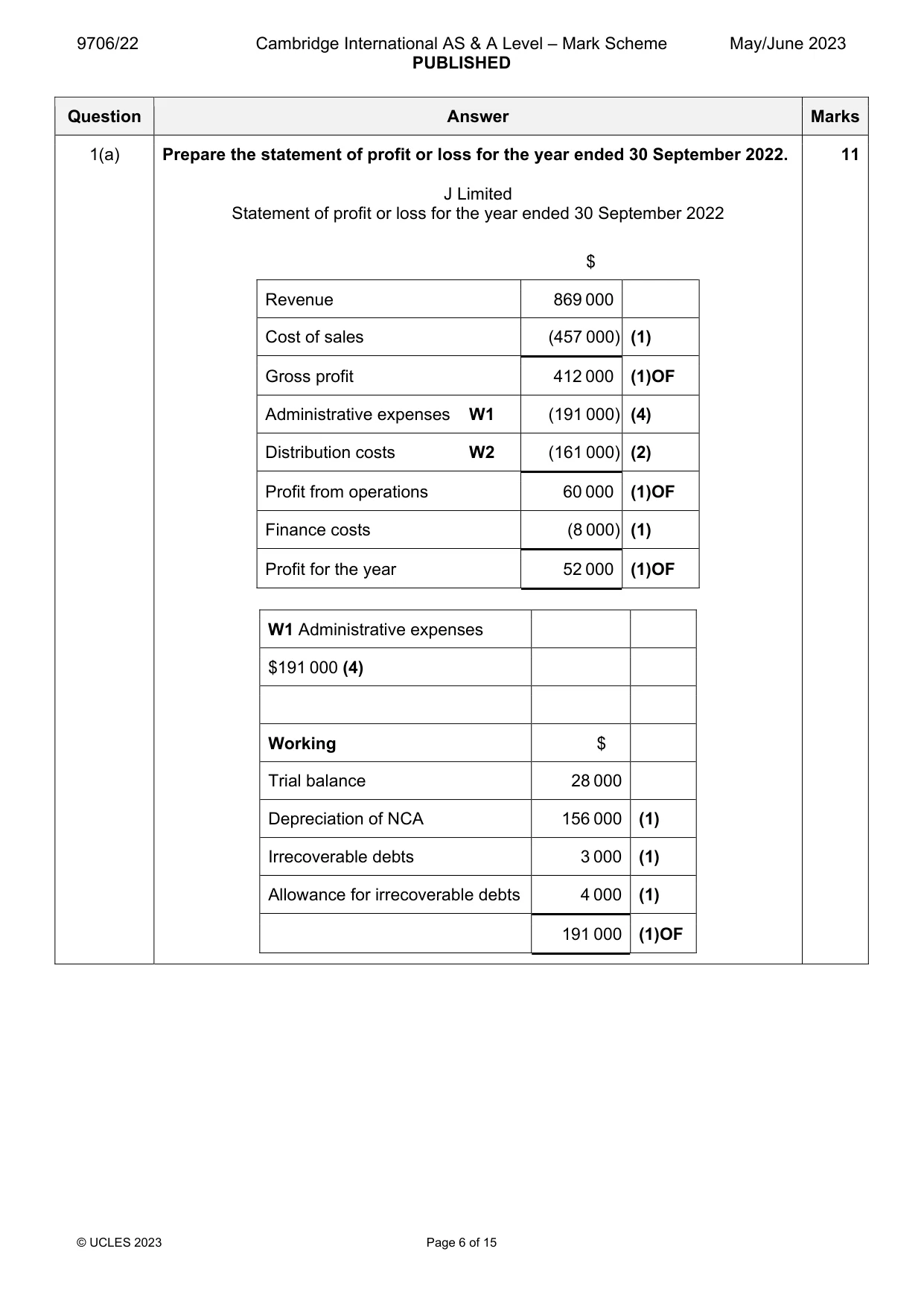
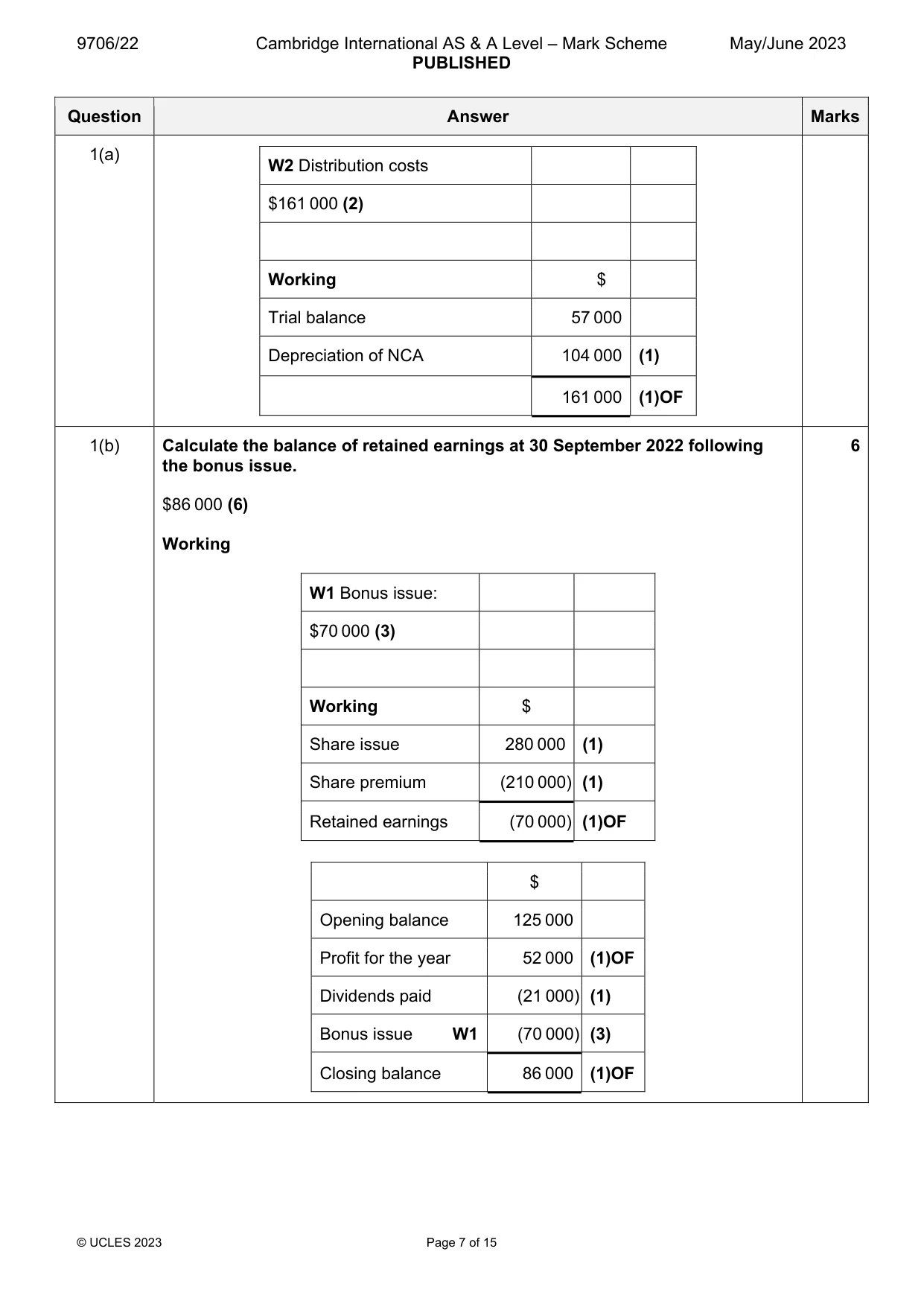
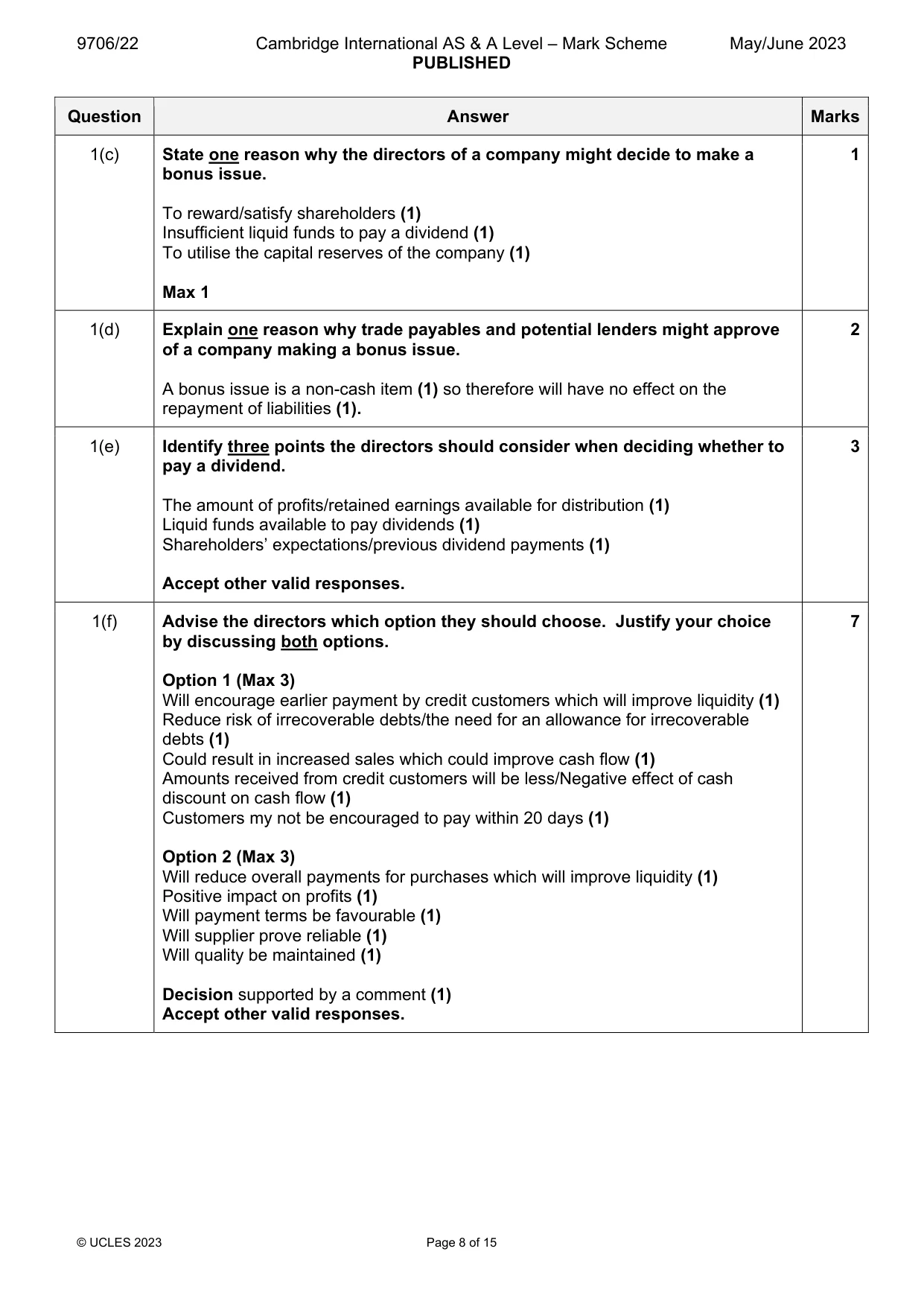
Mark scheme: Question Answer Marks 1(a) Prepare the statement of profit or loss for the year ended 30 September 2022. 11 J Limited Statement of profit or loss for the year ended 30 September 2022 $ Revenue 869 000 Cost of sales (457 000) (1) Gross profit 412 000 (1)OF Administrative expenses W1 (191 000) (4) Distribution costs W2 (161 000) (2) Profit from operations 60 000 (1)OF Finance costs (8 000) (1) Profit for the year 52 000 (1)OF W1 Administrative expenses $191 000 (4) Working $ Trial balance 28 000 Depreciation of NCA 156 000 (1) Irrecoverable debts 3 000 (1) Allowance for irrecoverable debts 4 000 (1) 191 000 (1)OF 1(a) W2 Distribution costs $161 000 (2) Working $ Trial balance 57 000 Depreciation of NCA 104 000 (1) 161 000 (1)OF 1(b) Calculate the balance of retained earnings at 30 September 2022 following 6 the bonus issue. $86 000 (6) Working W1 Bonus issue: $70 000 (3) Working $ Share issue 280 000 (1) Share premium (210 000) (1) Retained earnings (70 000) (1)OF $ Opening balance 125 000 Profit for the year 52 000 (1)OF Dividends paid (21 000) (1) Bonus issue W1 (70 000) (3) Closing balance 86 000 (1)OF 1(c) State one reason why the directors of a company might decide to make a 1 bonus issue. To reward/satisfy shareholders (1) Insufficient liquid funds to pay a dividend (1) To utilise the capital reserves of the company (1) Max 1 1(d) Explain one reason why trade payables and potential lenders might approve 2 of a company making a bonus issue. A bonus issue is a non-cash item (1) so therefore will have no effect on the repayment of liabilities (1). 1(e) Identify three points the directors should consider when deciding whether to 3 pay a dividend. The amount of profits/retained earnings available for distribution (1) Liquid funds available to pay dividends (1) Shareholders’ expectations/previous dividend payments (1) Accept other valid responses. 1(f) Advise the directors which option they should choose. Justify your choice 7 by discussing both options. Option 1 (Max 3) Will encourage earlier payment by credit customers which will improve liquidity (1) Reduce risk of irrecoverable debts/the need for an allowance for irrecoverable debts (1) Could result in increased sales which could improve cash flow (1) Amounts received from credit customers will be less/Negative effect of cash discount on cash flow (1) Customers my not be encouraged to pay within 20 days (1) Option 2 (Max 3) Will reduce overall payments for purchases which will improve liquidity (1) Positive impact on profits (1) Will payment terms be favourable (1) Will supplier prove reliable (1) Will quality be maintained (1) Decision supported by a comment (1) Accept other valid responses.
Q2 · Rudra prepares bank reconciliation statements for his business at the end of each month
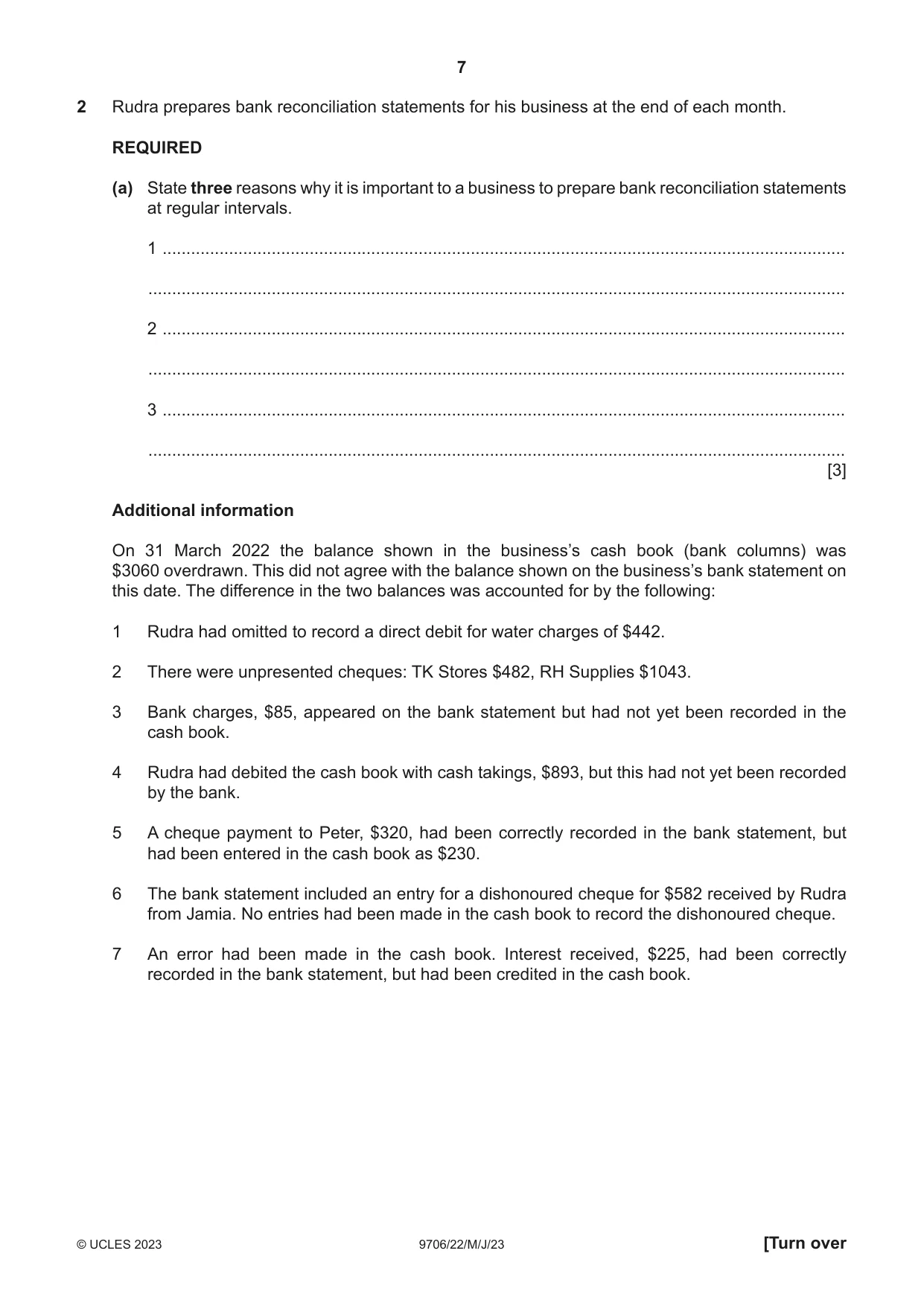
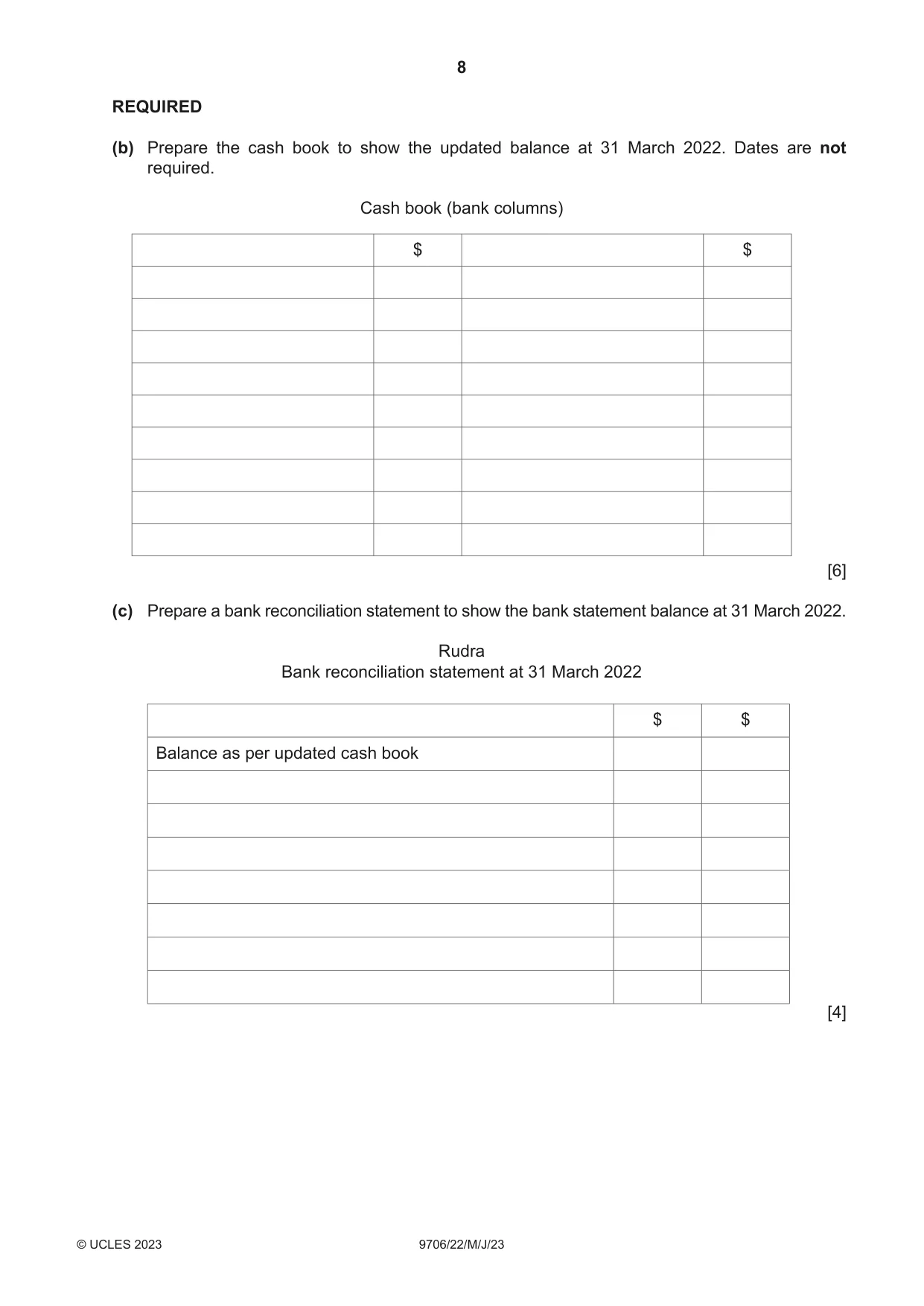
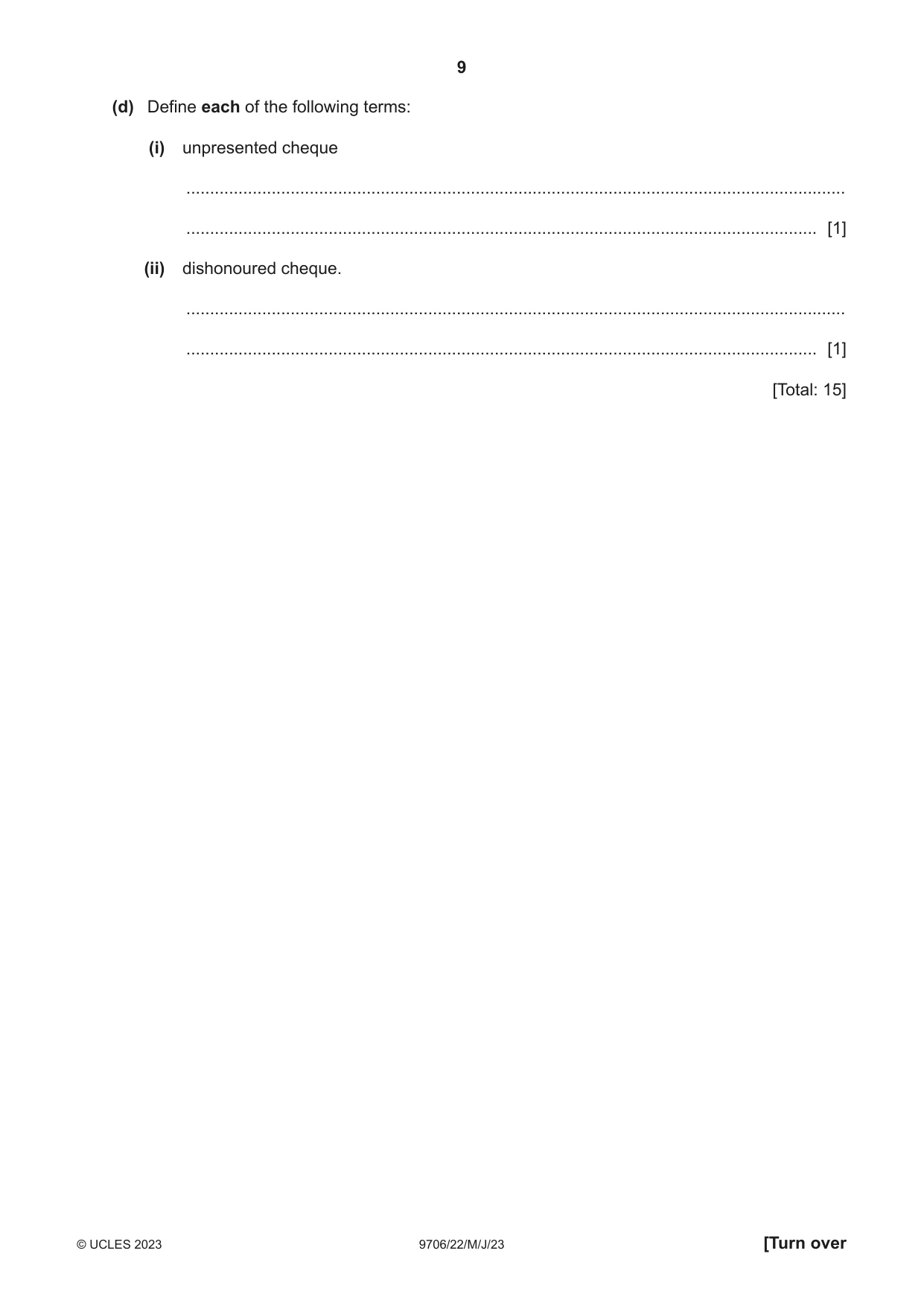
2 Rudra prepares bank reconciliation statements for his business at the end of each month. REQUIRED (a) State three reasons why it is important to a business to prepare bank reconciliation statements at regular intervals. 1 ................................................................................................................................................ ................................................................................................................................................... 2 ................................................................................................................................................ ................................................................................................................................................... 3 ................................................................................................................................................ ................................................................................................................................................... [3] Additional information On 31 March 2022 the balance shown in the business’s cash book (bank columns) was $3060 overdrawn. This did not agree with the balance shown on the business’s bank statement on this date. The difference in the two balances was accounted for by the following: 1 Rudra had omitted to record a direct debit for water charges of $442. 2 There were unpresented cheques: TK Stores $482, RH Supplies $1043. 3 Bank charges, $85, appeared on the bank statement but had not yet been recorded in the cash book. 4 Rudra had debited the cash book with cash takings, $893, but this had not yet been recorded by the bank. 5 A cheque payment to Peter, $320, had been correctly recorded in the bank statement, but had been entered in the cash book as $230. 6 The bank statement included an entry for a dishonoured cheque for $582 received by Rudra from Jamia. No entries had been made in the cash book to record the dishonoured cheque. 7 An error had been made in the cash book. Interest received, $225, had been correctly recorded in the bank statement, but had been credited in the cash book. REQUIRED (b) Prepare the cash book to show the updated balance at 31 March 2022. Dates are not required. Cash book (bank columns) $ $ [6] (c) Prepare a bank reconciliation statement to show the bank statement balance at 31 March 2022. Rudra Bank reconciliation statement at 31 March 2022 $ $ Balance as per updated cash book [4] (d) Define each of the following terms: (i) unpresented cheque ........................................................................................................................................... ..................................................................................................................................... [1] (ii) dishonoured cheque. ........................................................................................................................................... ..................................................................................................................................... [1] [Total: 15]
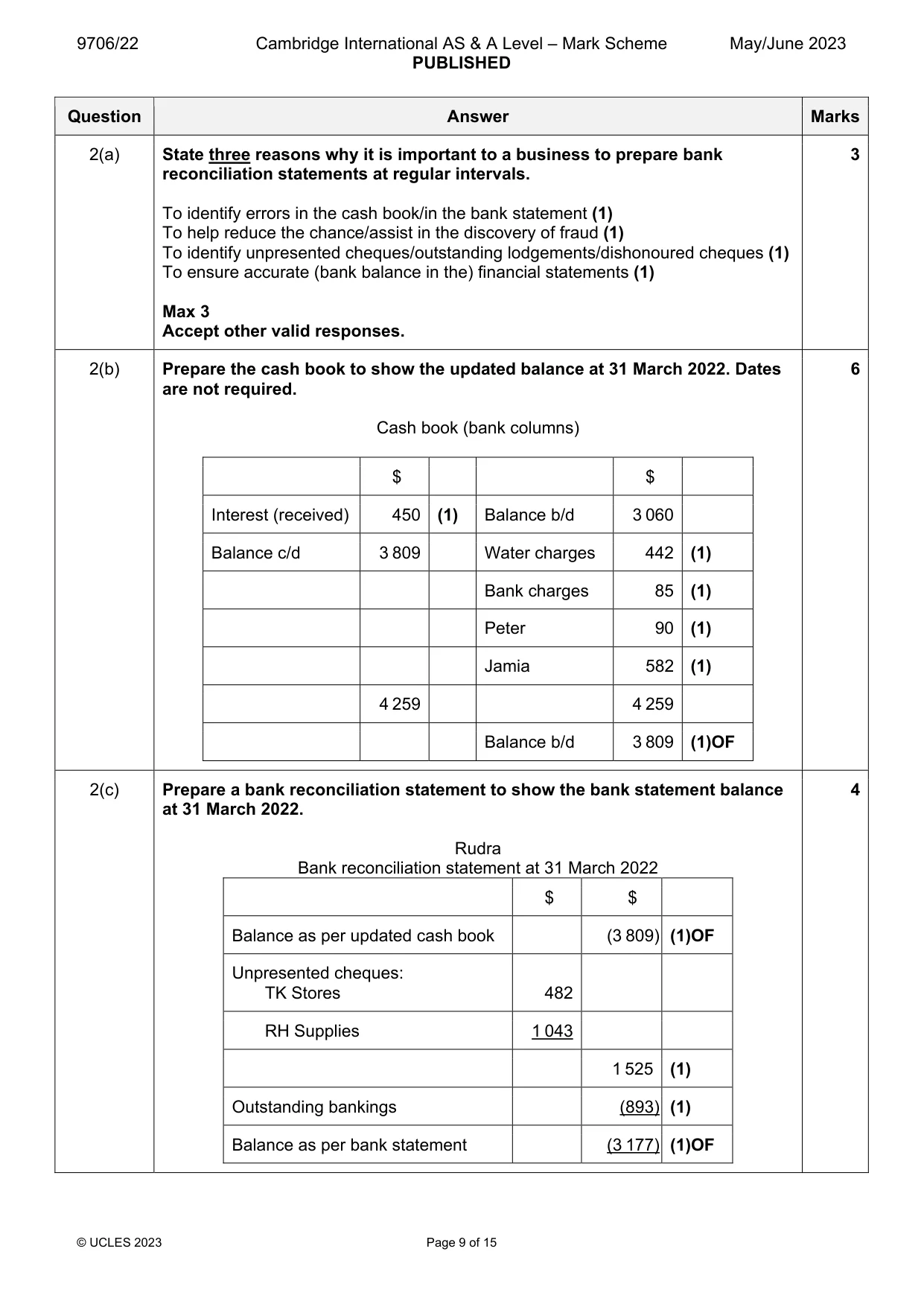
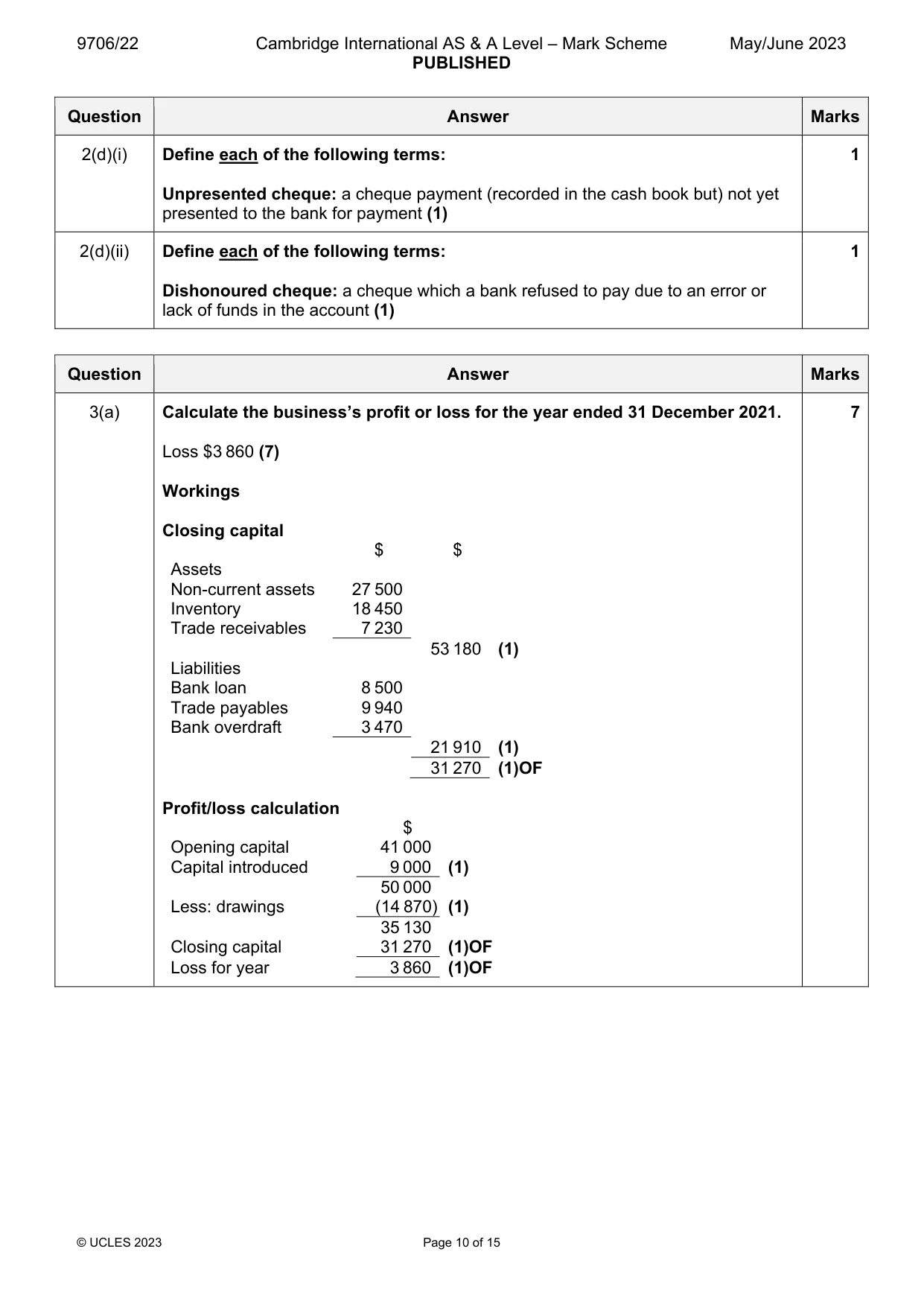
Mark scheme: 2(a) State three reasons why it is important to a business to prepare bank 3 reconciliation statements at regular intervals. To identify errors in the cash book/in the bank statement (1) To help reduce the chance/assist in the discovery of fraud (1) To identify unpresented cheques/outstanding lodgements/dishonoured cheques (1) To ensure accurate (bank balance in the) financial statements (1) Max 3 Accept other valid responses. 2(b) Prepare the cash book to show the updated balance at 31 March 2022. Dates 6 are not required. Cash book (bank columns) $ $ Interest (received) 450 (1) Balance b/d 3 060 Balance c/d 3 809 Water charges 442 (1) Bank charges 85 (1) Peter 90 (1) Jamia 582 (1) 4 259 4 259 Balance b/d 3 809 (1)OF 2(c) Prepare a bank reconciliation statement to show the bank statement balance 4 at 31 March 2022. Rudra Bank reconciliation statement at 31 March 2022 $ $ Balance as per updated cash book (3 809) (1)OF Unpresented cheques: TK Stores 482 RH Supplies 1 043 1 525 (1) Outstanding bankings (893) (1) Balance as per bank statement (3 177) (1)OF 2(d)(i) Define each of the following terms: 1 Unpresented cheque: a cheque payment (recorded in the cash book but) not yet presented to the bank for payment (1) 2(d)(ii) Define each of the following terms: 1 Dishonoured cheque: a cheque which a bank refused to pay due to an error or lack of funds in the account (1)
Q3 · Khaled opened his business on 1 January 2021 with a capital of $41 000
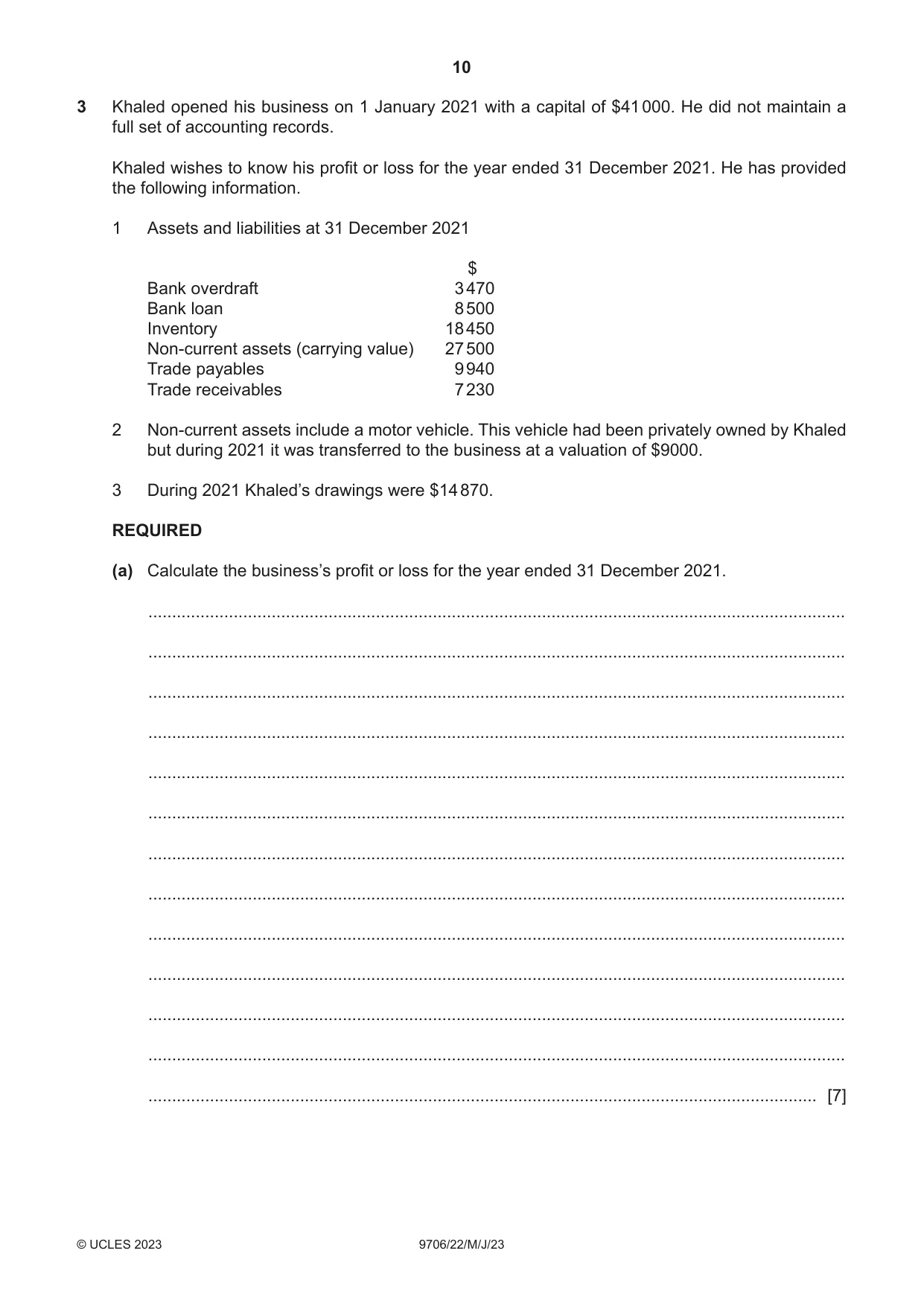
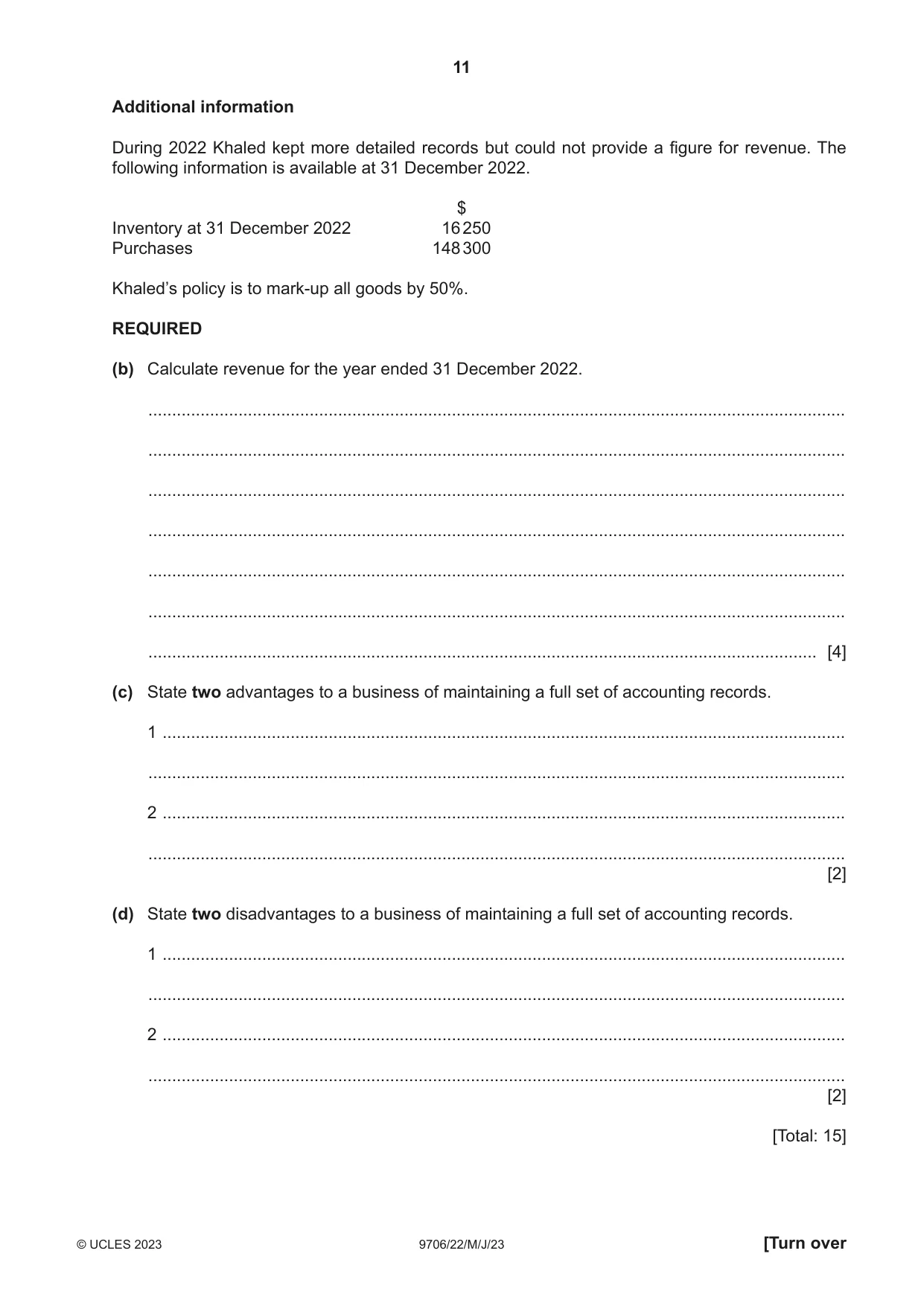
3 Khaled opened his business on 1 January 2021 with a capital of $41 000. He did not maintain a full set of accounting records. Khaled wishes to know his profit or loss for the year ended 31 December 2021. He has provided the following information. 1 Assets and liabilities at 31 December 2021 $ Bank overdraft 3 470 Bank loan 8 500 Inventory 18 450 Non-current assets (carrying value) 27 500 Trade payables 9 940 Trade receivables 7 230 2 Non-current assets include a motor vehicle. This vehicle had been privately owned by Khaled but during 2021 it was transferred to the business at a valuation of $9000. 3 During 2021 Khaled’s drawings were $14 870. REQUIRED (a) Calculate the business’s profit or loss for the year ended 31 December 2021. ................................................................................................................................................... ................................................................................................................................................... ................................................................................................................................................... ................................................................................................................................................... ................................................................................................................................................... ................................................................................................................................................... ................................................................................................................................................... ................................................................................................................................................... ................................................................................................................................................... ................................................................................................................................................... ................................................................................................................................................... ................................................................................................................................................... ............................................................................................................................................. [7] Additional information During 2022 Khaled kept more detailed records but could not provide a figure for revenue. The following information is available at 31 December 2022. $ Inventory at 31 December 2022 16 250 Purchases 148 300 Khaled’s policy is to mark-up all goods by 50%. REQUIRED (b) Calculate revenue for the year ended 31 December 2022. ................................................................................................................................................... ................................................................................................................................................... ................................................................................................................................................... ................................................................................................................................................... ................................................................................................................................................... ................................................................................................................................................... ............................................................................................................................................. [4] (c) State two advantages to a business of maintaining a full set of accounting records. 1 ................................................................................................................................................ ................................................................................................................................................... 2 ................................................................................................................................................ ................................................................................................................................................... [2] (d) State two disadvantages to a business of maintaining a full set of accounting records. 1 ................................................................................................................................................ ................................................................................................................................................... 2 ................................................................................................................................................ ................................................................................................................................................... [2] [Total: 15]
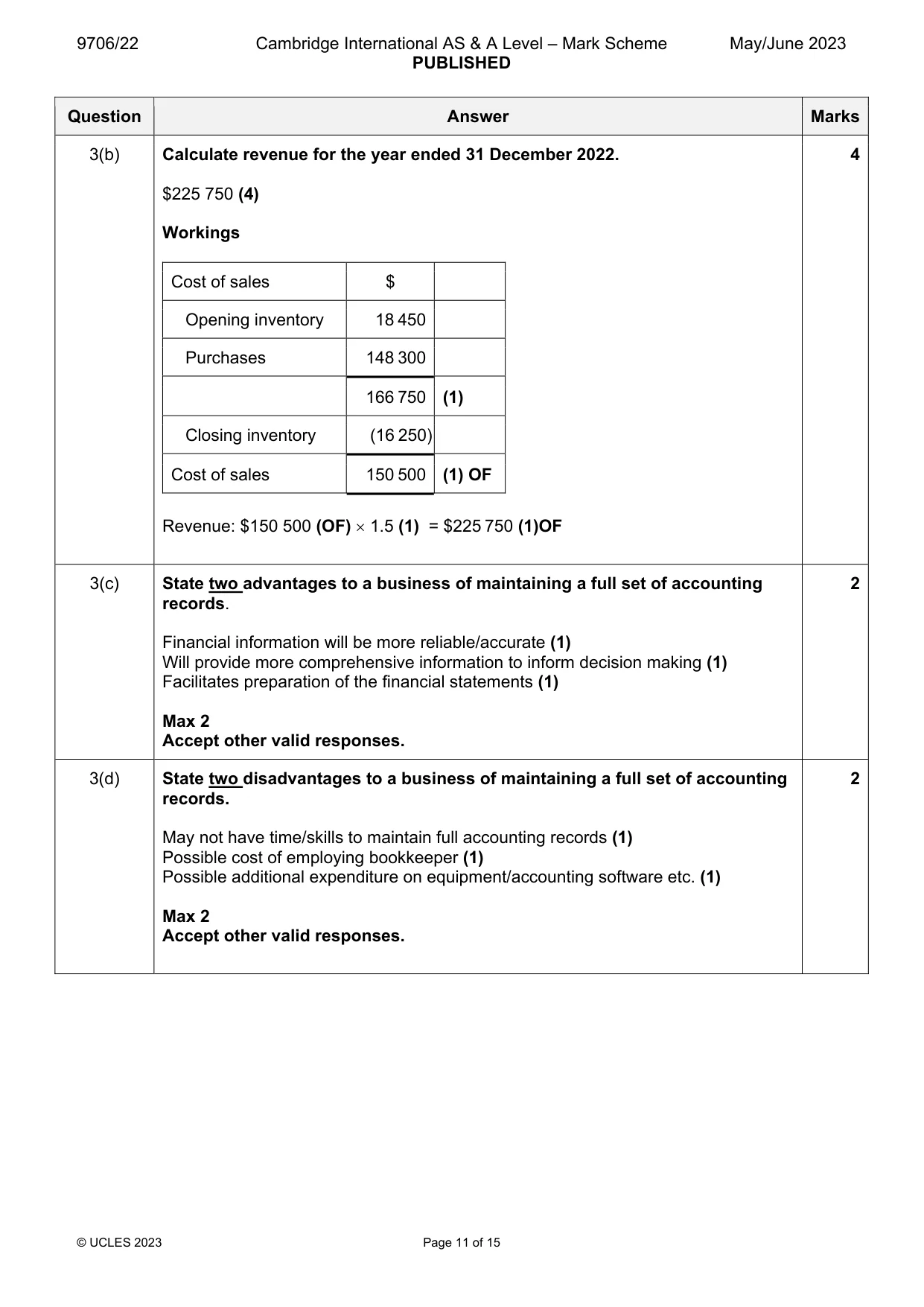
Mark scheme: 3(a) Calculate the business’s profit or loss for the year ended 31 December 2021. 7 Loss $3 860 (7) Workings Closing capital $ $ Assets Non-current assets 27 500 Inventory 18 450 Trade receivables 7 230 53 180 (1) Liabilities Bank loan 8 500 Trade payables 9 940 Bank overdraft 3 470 21 910 (1) 31 270 (1)OF Profit/loss calculation $ Opening capital 41 000 Capital introduced 9 000 (1) 50 000 Less: drawings (14 870) (1) 35 130 Closing capital 31 270 (1)OF Loss for year 3 860 (1)OF 3(b) Calculate revenue for the year ended 31 December 2022. 4 $225 750 (4) Workings Cost of sales $ Opening inventory 18 450 Purchases 148 300 166 750 (1) Closing inventory (16 250) Cost of sales 150 500 (1) OF Revenue: $150 500 (OF) 1.5 (1) = $225 750 (1)OF 3(c) State two advantages to a business of maintaining a full set of accounting 2 records. Financial information will be more reliable/accurate (1) Will provide more comprehensive information to inform decision making (1) Facilitates preparation of the financial statements (1) Max 2 Accept other valid responses. 3(d) State two disadvantages to a business of maintaining a full set of accounting 2 records. May not have time/skills to maintain full accounting records (1) Possible cost of employing bookkeeper (1) Possible additional expenditure on equipment/accounting software etc. (1) Max 2 Accept other valid responses.
Q4 · K Limited is a manufacturing company which has two production departments and one service…
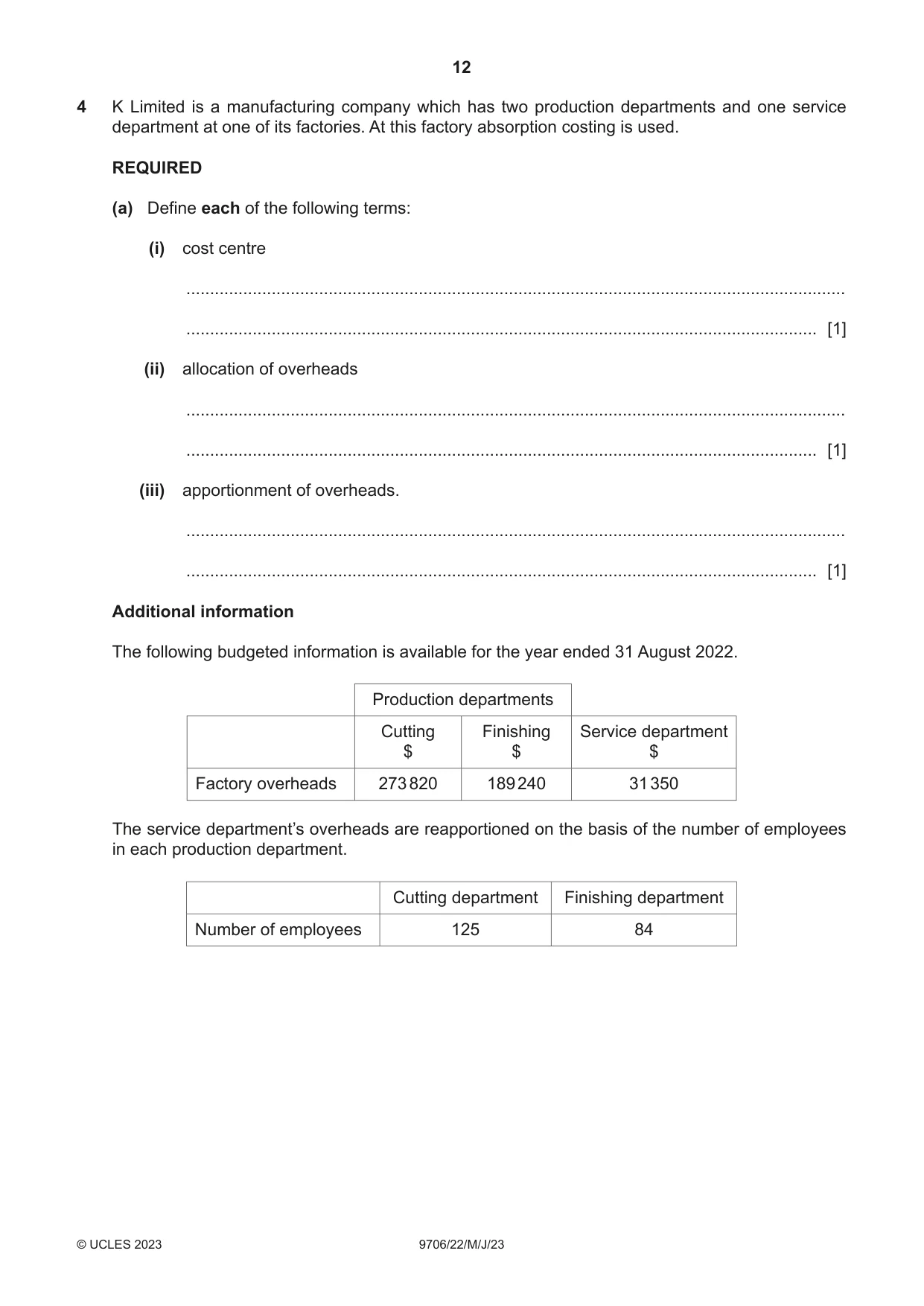
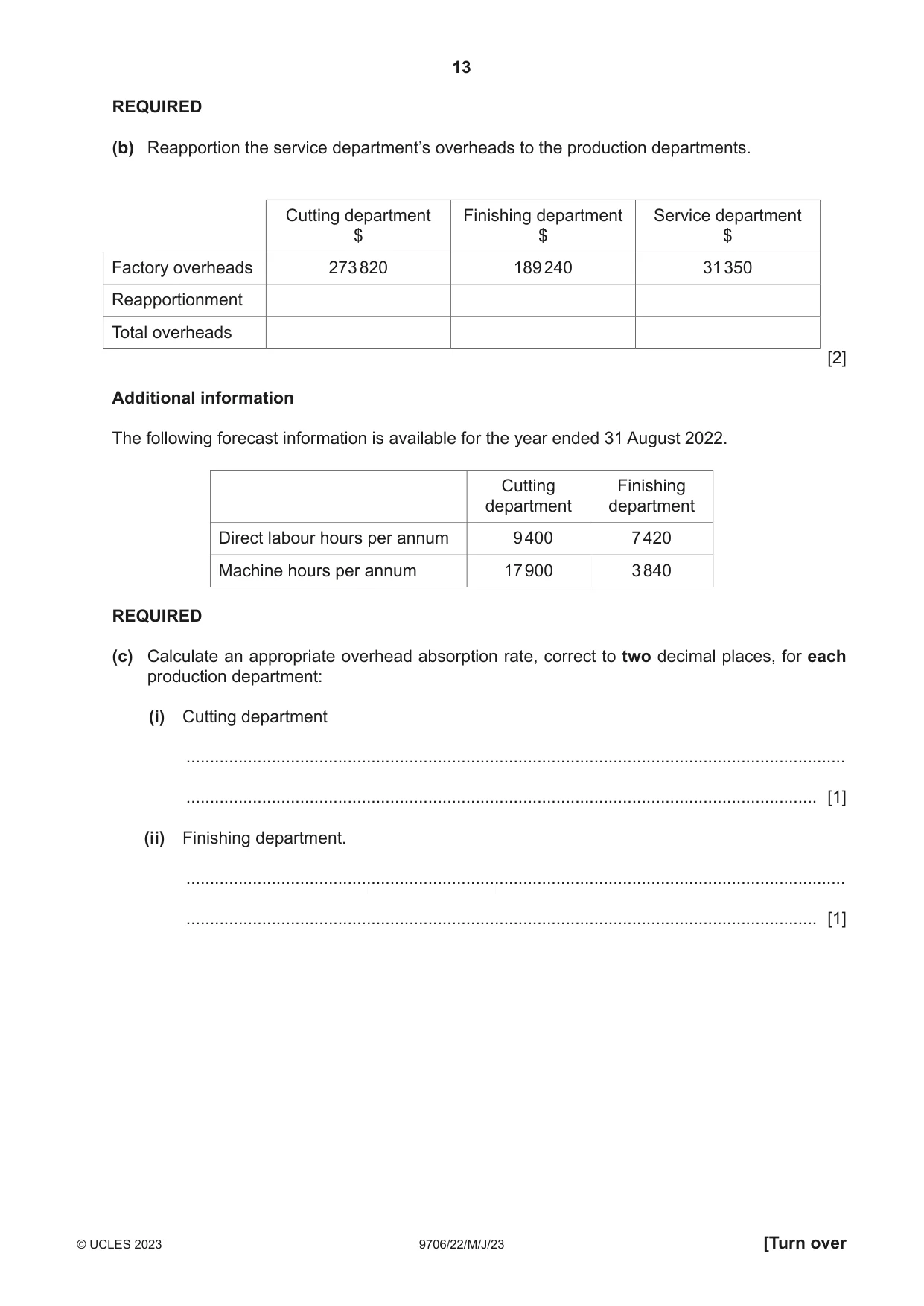
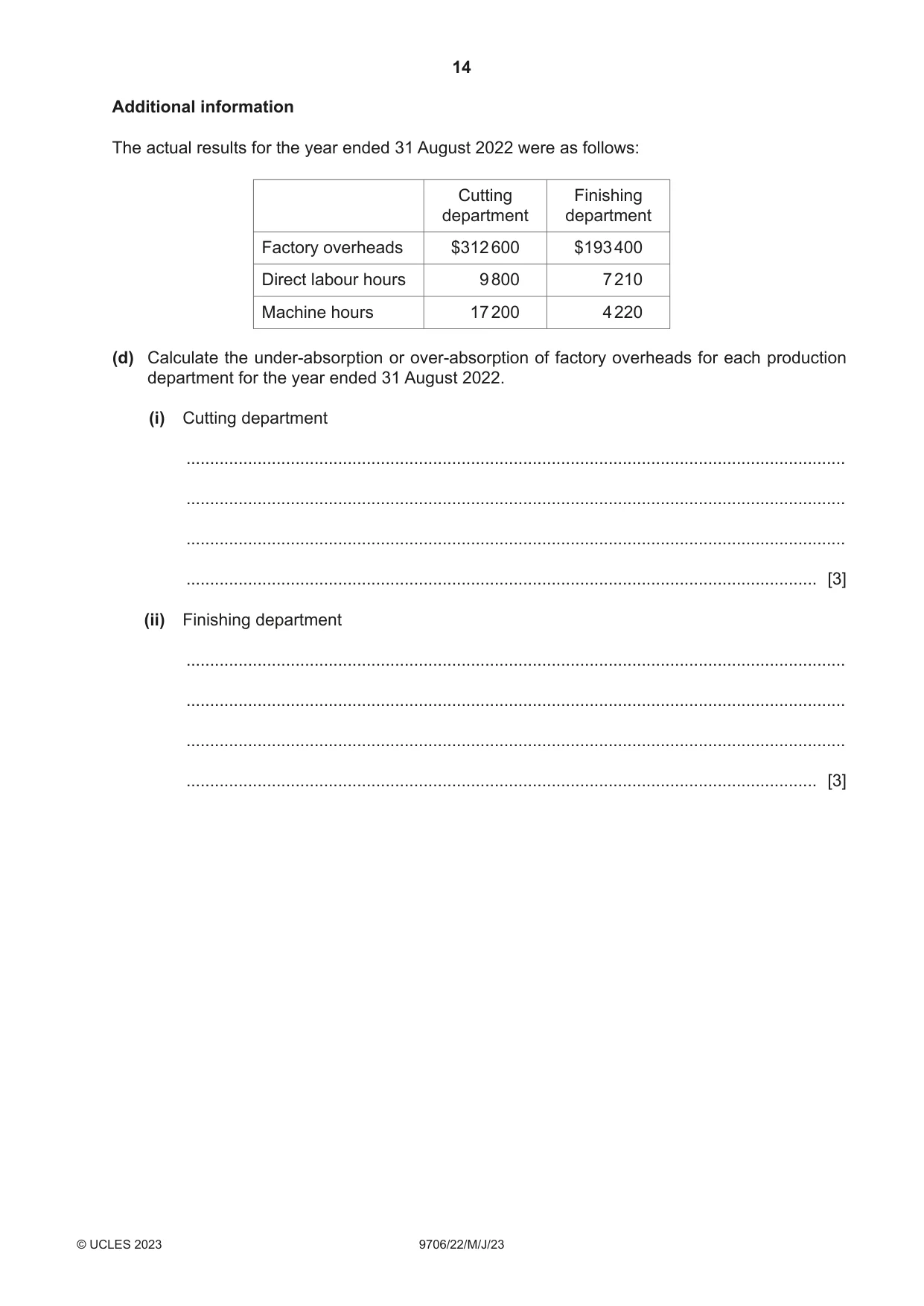
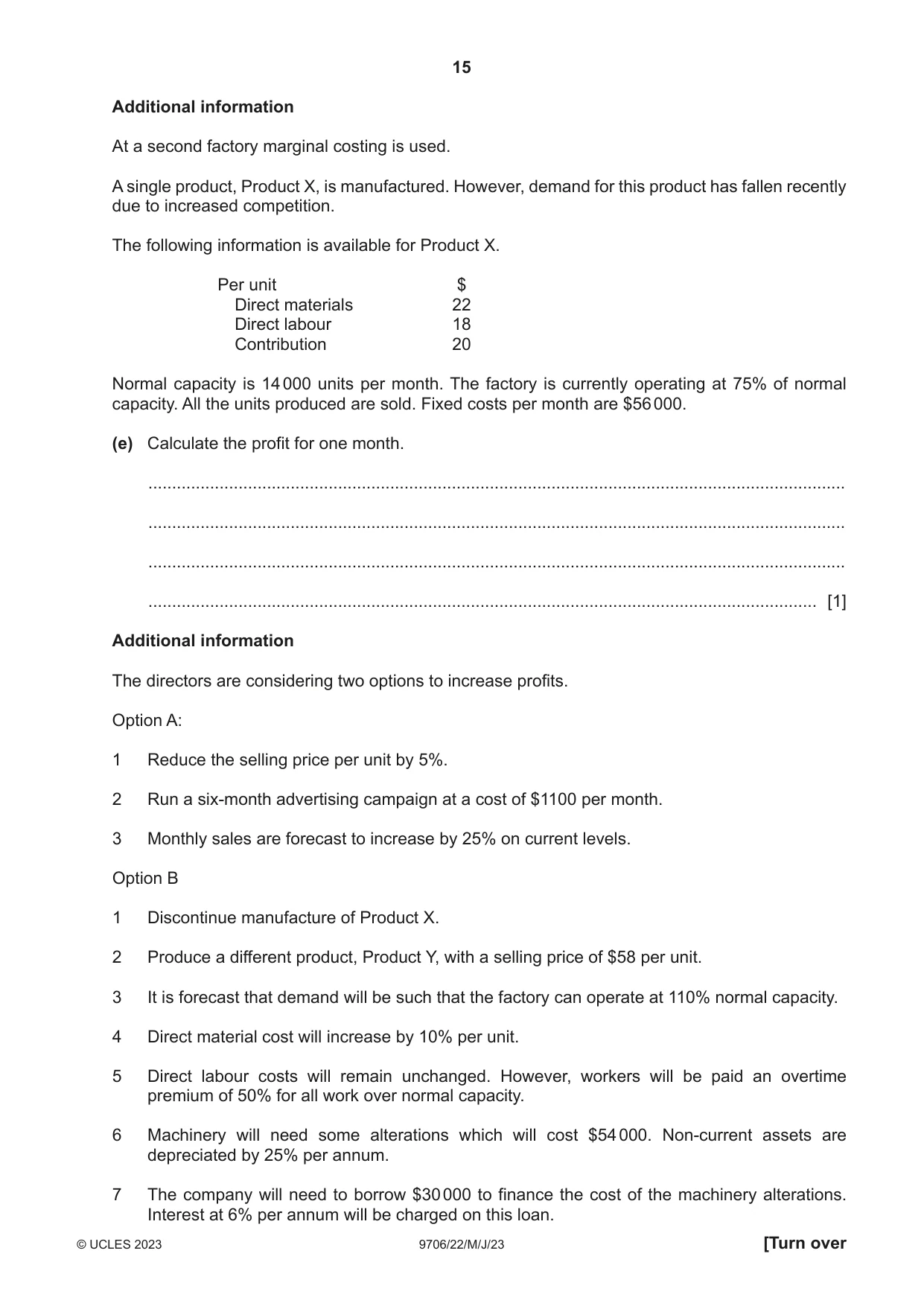
4 K Limited is a manufacturing company which has two production departments and one service department at one of its factories. At this factory absorption costing is used. REQUIRED (a) Define each of the following terms: (i) cost centre ........................................................................................................................................... ..................................................................................................................................... [1] (ii) allocation of overheads ........................................................................................................................................... ..................................................................................................................................... [1] (iii) apportionment of overheads. ........................................................................................................................................... ..................................................................................................................................... [1] Additional information The following budgeted information is available for the year ended 31 August 2022. Production departments Cutting Finishing Service department $ $ $ Factory overheads 273 820 189 240 31 350 The service department’s overheads are reapportioned on the basis of the number of employees in each production department. Cutting department Finishing department Number of employees 125 84 REQUIRED (b) Reapportion the service department’s overheads to the production departments. Cutting department Finishing department Service department $ $ $ Factory overheads 273 820 189 240 31 350 Reapportionment Total overheads [2] Additional information The following forecast information is available for the year ended 31 August 2022. Cutting Finishing department department Direct labour hours per annum 9 400 7 420 Machine hours per annum 17 900 3 840 REQUIRED (c) Calculate an appropriate overhead absorption rate, correct to two decimal places, for each production department: (i) Cutting department ........................................................................................................................................... ..................................................................................................................................... [1] (ii) Finishing department. ........................................................................................................................................... ..................................................................................................................................... [1] Additional information The actual results for the year ended 31 August 2022 were as follows: Cutting Finishing department department Factory overheads $312 600 $193 400 Direct labour hours 9 800 7 210 Machine hours 17 200 4 220 (d) Calculate the under-absorption or over-absorption of factory overheads for each production department for the year ended 31 August 2022. (i) Cutting department ........................................................................................................................................... ........................................................................................................................................... ........................................................................................................................................... ..................................................................................................................................... [3] (ii) Finishing department ........................................................................................................................................... ........................................................................................................................................... ........................................................................................................................................... ..................................................................................................................................... [3] Additional information At a second factory marginal costing is used. A single product, Product X, is manufactured. However, demand for this product has fallen recently due to increased competition. The following information is available for Product X. Per unit $ Direct materials 22 Direct labour 18 Contribution 20 Normal capacity is 14 000 units per month. The factory is currently operating at 75% of normal capacity. All the units produced are sold. Fixed costs per month are $56 000. (e) Calculate the profit for one month. ................................................................................................................................................... ................................................................................................................................................... ................................................................................................................................................... ............................................................................................................................................. [1] Additional information The directors are considering two options to increase profits. Option A: 1 Reduce the selling price per unit by 5%. 2 Run a six-month advertising campaign at a cost of $1100 per month. 3 Monthly sales are forecast to increase by 25% on current levels. Option B 1 Discontinue manufacture of Product X. 2 Produce a different product, Product Y, with a selling price of $58 per unit. 3 It is forecast that demand will be such that the factory can operate at 110% normal capacity. 4 Direct material cost will increase by 10% per unit.
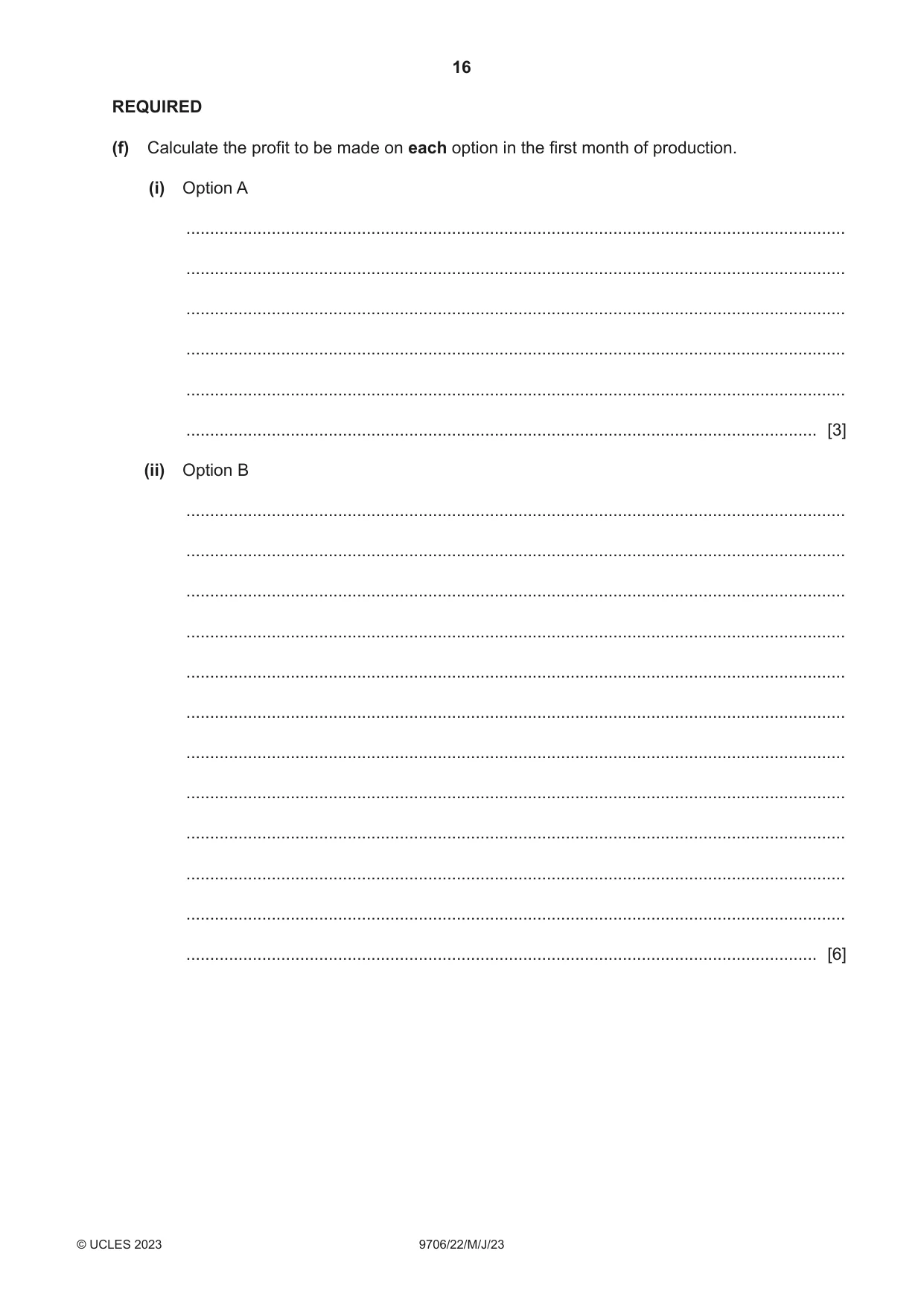
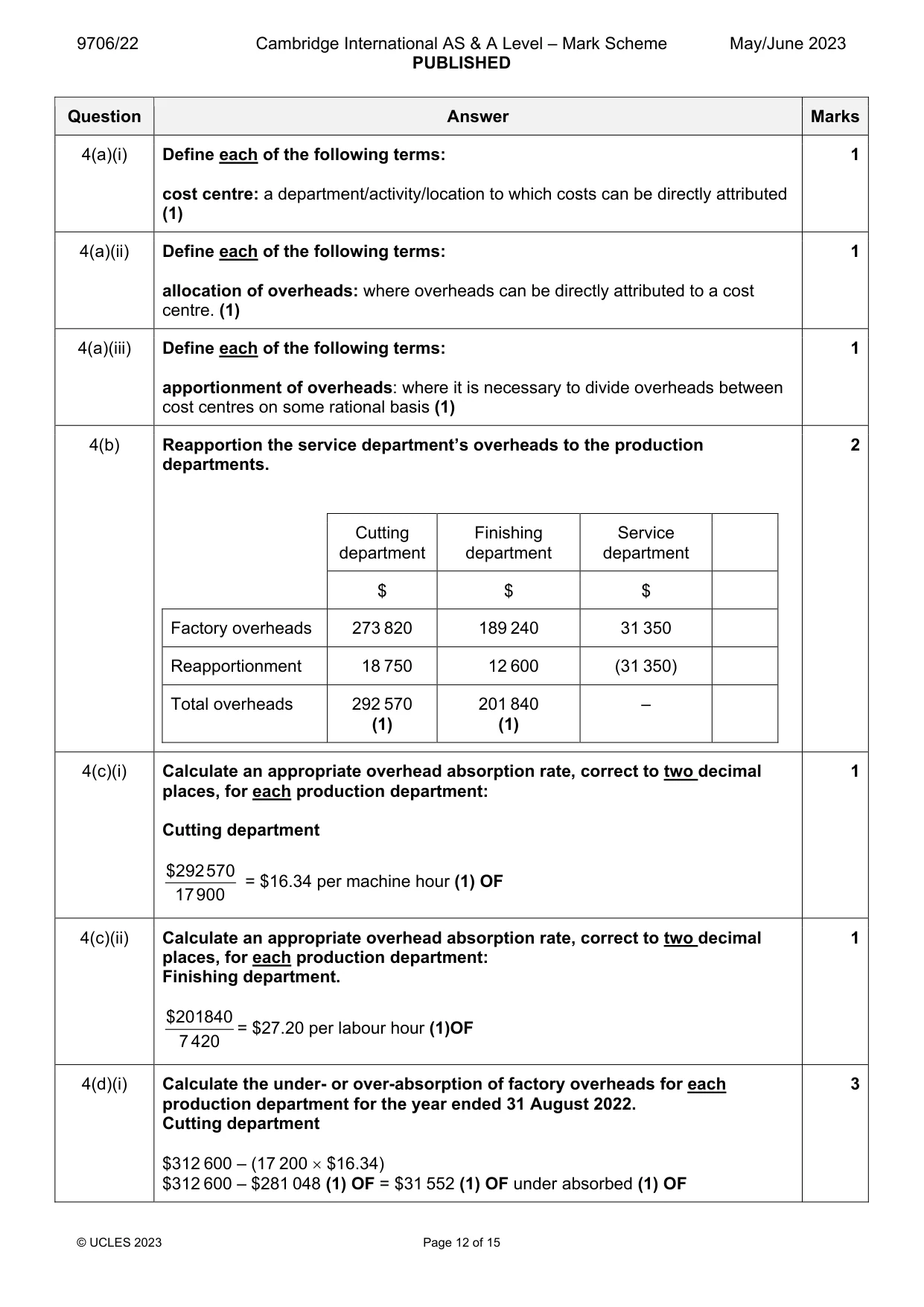
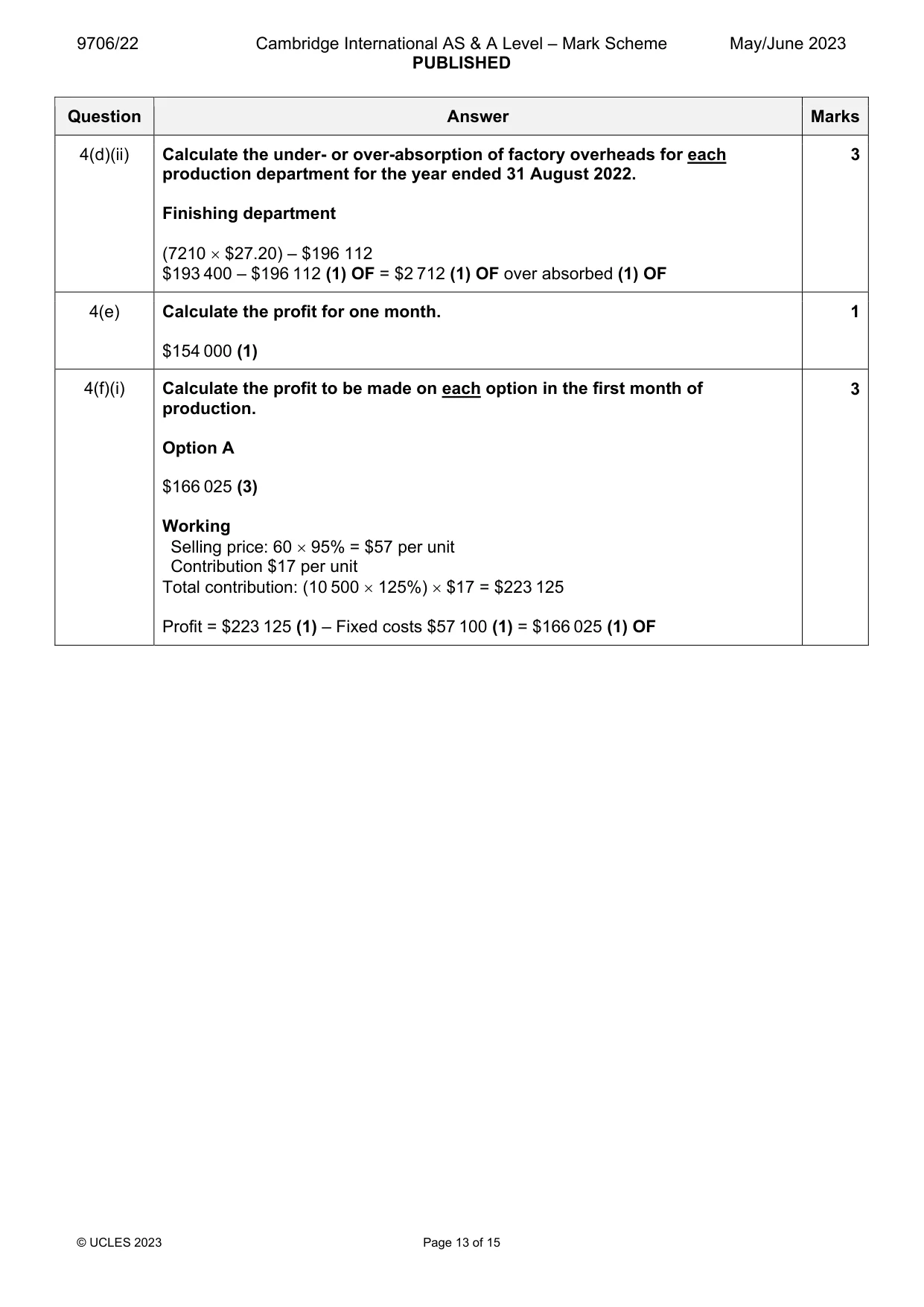
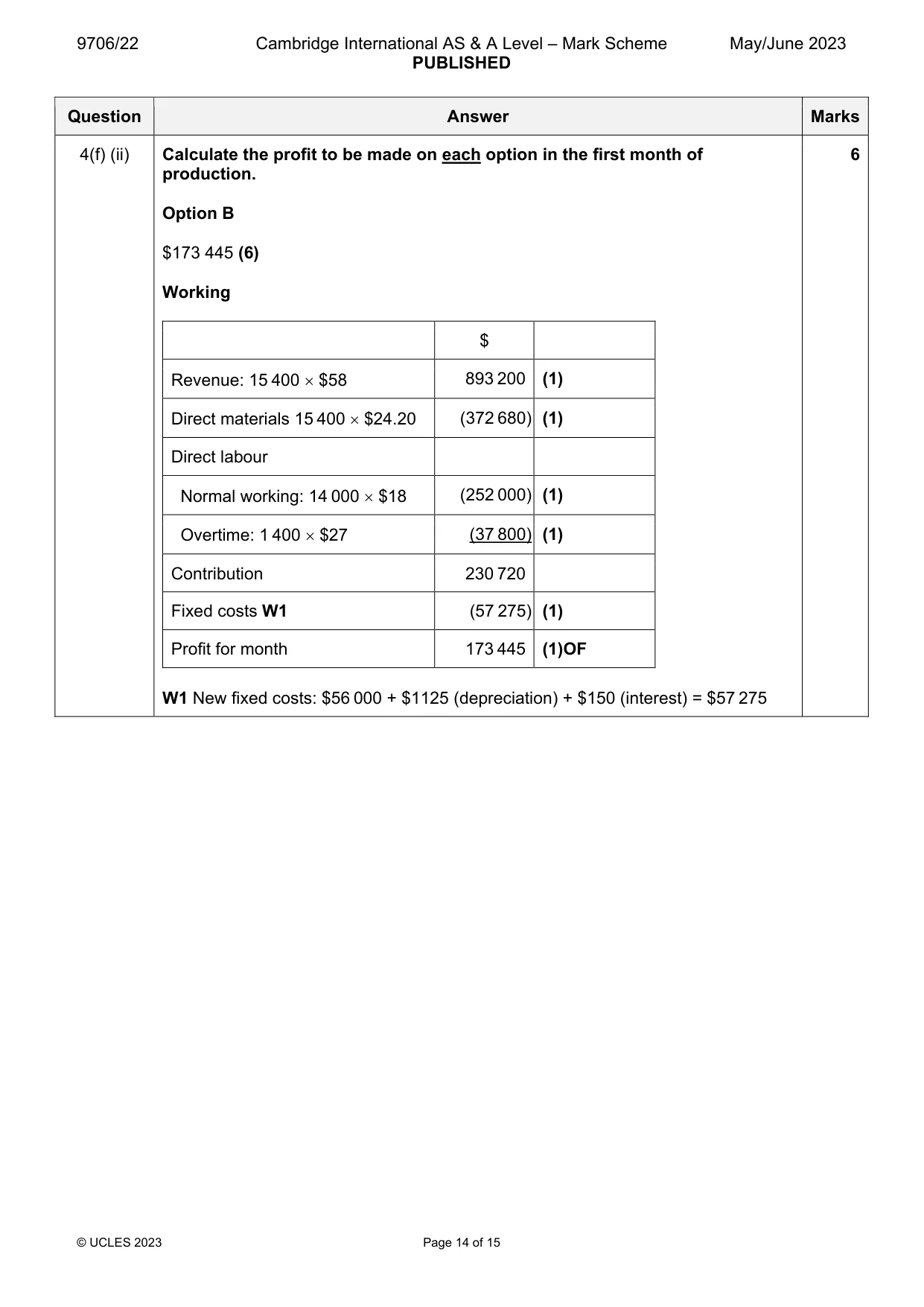
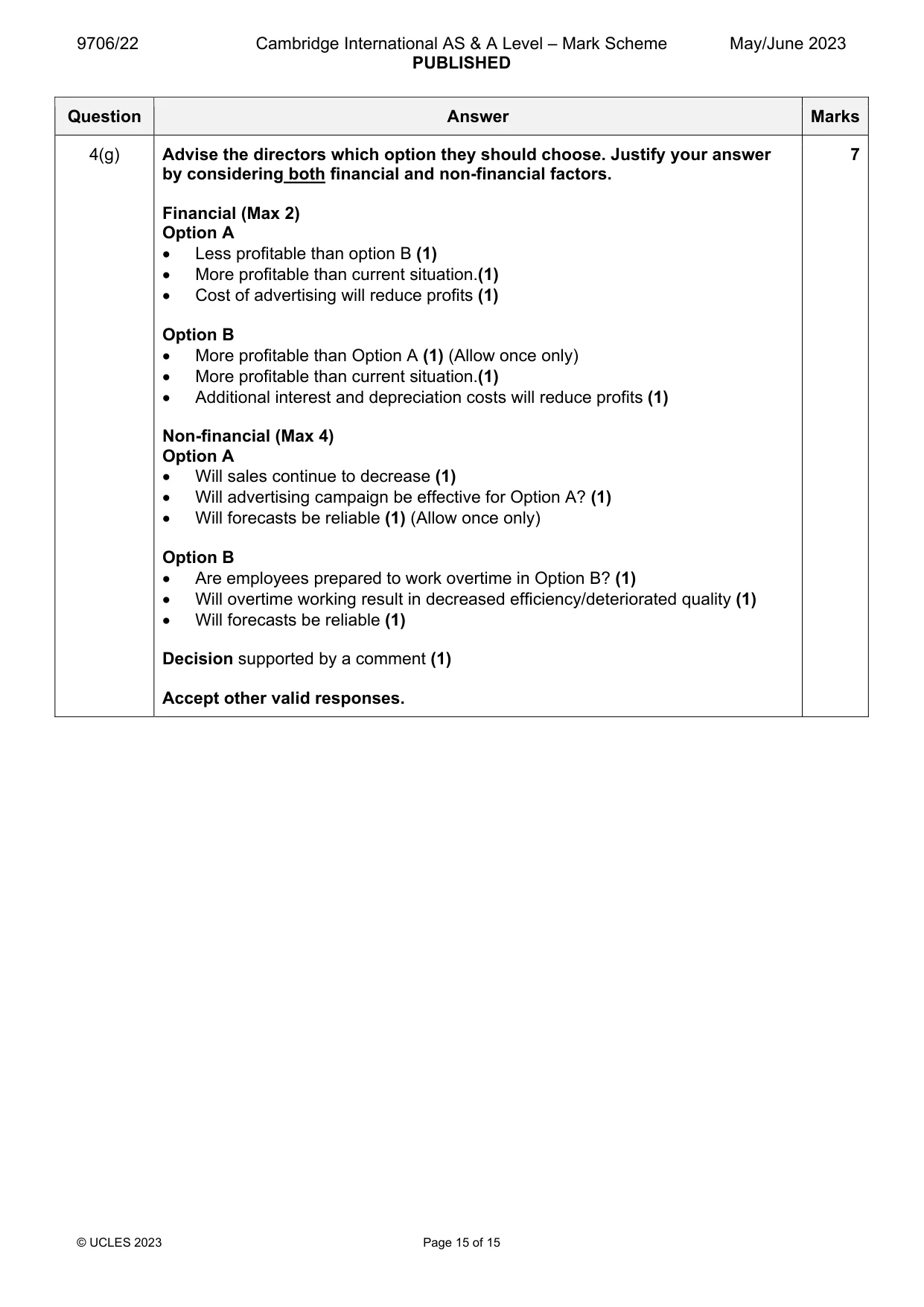
Mark scheme: 4(a)(i) Define each of the following terms: 1 cost centre: a department/activity/location to which costs can be directly attributed (1) 4(a)(ii) Define each of the following terms: 1 allocation of overheads: where overheads can be directly attributed to a cost centre. (1) 4(a)(iii) Define each of the following terms: 1 apportionment of overheads: where it is necessary to divide overheads between cost centres on some rational basis (1) 4(b) Reapportion the service department’s overheads to the production 2 departments. Cutting Finishing Service department department department $ $ $ Factory overheads 273 820 189 240 31 350 Reapportionment 18 750 12 600 (31 350) Total overheads 292 570 201 840 – (1) (1) 4(c)(i) Calculate an appropriate overhead absorption rate, correct to two decimal 1 places, for each production department: Cutting department $292570 = $16.34 per machine hour (1) OF 17900 4(c)(ii) Calculate an appropriate overhead absorption rate, correct to two decimal 1 places, for each production department: Finishing department. $201840 = $27.20 per labour hour (1)OF 7 420 4(d)(i) Calculate the under- or over-absorption of factory overheads for each 3 production department for the year ended 31 August 2022. Cutting department $312 600 – (17 200 $16.34) $312 600 – $281 048 (1) OF = $31 552 (1) OF under absorbed (1) OF 4(d)(ii) Calculate the under- or over-absorption of factory overheads for each 3 production department for the year ended 31 August 2022. Finishing department (7210 $27.20) – $196 112 $193 400 – $196 112 (1) OF = $2 712 (1) OF over absorbed (1) OF 4(e) Calculate the profit for one month. 1 $154 000 (1) 4(f)(i) Calculate the profit to be made on each option in the first month of 3 production. Option A $166 025 (3) Working Selling price: 60 95% = $57 per unit Contribution $17 per unit Total contribution: (10 500 125%) $17 = $223 125 Profit = $223 125 (1) – Fixed costs $57 100 (1) = $166 025 (1) OF 4(f) (ii) Calculate the profit to be made on each option in the first month of 6 production. Option B $173 445 (6) Working $ Revenue: 15 400 $58 893 200 (1) Direct materials 15 400 $24.20 (372 680) (1) Direct labour Normal working: 14 000 $18 (252 000) (1) Overtime: 1 400 $27 (37 800) (1) Contribution 230 720 Fixed costs W1 (57 275) (1) Profit for month 173 445 (1)OF W1 New fixed costs: $56 000 + $1125 (depreciation) + $150 (interest) = $57 275 4(g) Advise the directors which option they should choose. Justify your answer 7 by considering both financial and non-financial factors. Financial (Max 2) Option A Less profitable than option B (1) More profitable than current situation.(1) Cost of advertising will reduce profits (1) Option B More profitable than Option A (1) (Allow once only) More profitable than current situation.(1) Additional interest and depreciation costs will reduce profits (1) Non-financial (Max 4) Option A Will sales continue to decrease (1) Will advertising campaign be effective for Option A? (1) Will forecasts be reliable (1) (Allow once only) Option B Are employees prepared to work overtime in Option B? (1) Will overtime working result in decreased efficiency/deteriorated quality (1) Will forecasts be reliable (1) Decision supported by a comment (1) Accept other valid responses.
Q5 · Direct labour costs will remain unchanged
5 Direct labour costs will remain unchanged. However, workers will be paid an overtime premium of 50% for all work over normal capacity.
Q6 · Machinery will need some alterations which will cost $54 000
6 Machinery will need some alterations which will cost $54 000. Non-current assets are depreciated by 25% per annum.
Q7 · REQUIRED (f) Calculate the profit to be made on each option in the first month of…
REQUIRED (f) Calculate the profit to be made on each option in the first month of production. (i) Option A ........................................................................................................................................... ........................................................................................................................................... ........................................................................................................................................... ........................................................................................................................................... ........................................................................................................................................... ..................................................................................................................................... [3] (ii) Option B ........................................................................................................................................... ........................................................................................................................................... ........................................................................................................................................... ........................................................................................................................................... ........................................................................................................................................... ........................................................................................................................................... ........................................................................................................................................... ........................................................................................................................................... ........................................................................................................................................... ........................................................................................................................................... ........................................................................................................................................... ..................................................................................................................................... [6] (g) Advise the directors which option they should choose. Justify your answer by considering both financial and non-financial factors. ................................................................................................................................................... ................................................................................................................................................... ................................................................................................................................................... ................................................................................................................................................... ................................................................................................................................................... ................................................................................................................................................... ................................................................................................................................................... ................................................................................................................................................... ................................................................................................................................................... ................................................................................................................................................... ................................................................................................................................................... ................................................................................................................................................... ................................................................................................................................................... ................................................................................................................................................... ................................................................................................................................................... ................................................................................................................................................... ................................................................................................................................................... ................................................................................................................................................... ............................................................................................................................................. [7] [Total: 30]
What was in this paper
The subtopics covered by these 7 questions, and how many questions each got. Open one in a new tab to see every Cambridge question on it.
What you needed in this session
Cambridge’s own grade thresholds for 2023 May/June, Paper 2 · Variant 2. A higher threshold means an easier paper — the bar moves with how the cohort did.