Cambridge A Level Accounting 9706 — 2023 May/June Paper 2 · Variant 3
9706/23/M/J/23 · 6 questions · 90 marks · ≈101 min
The question paper and its mark scheme, free to read here and free to download. This is Cambridge’s own paper, exactly as it was sat.
Question paper16 pages
Mark scheme16 pages
Answers below. Sit the paper first if you are practising.
Questions as text
Q1 · Hamza owns a retail business with a financial year end of 31 December
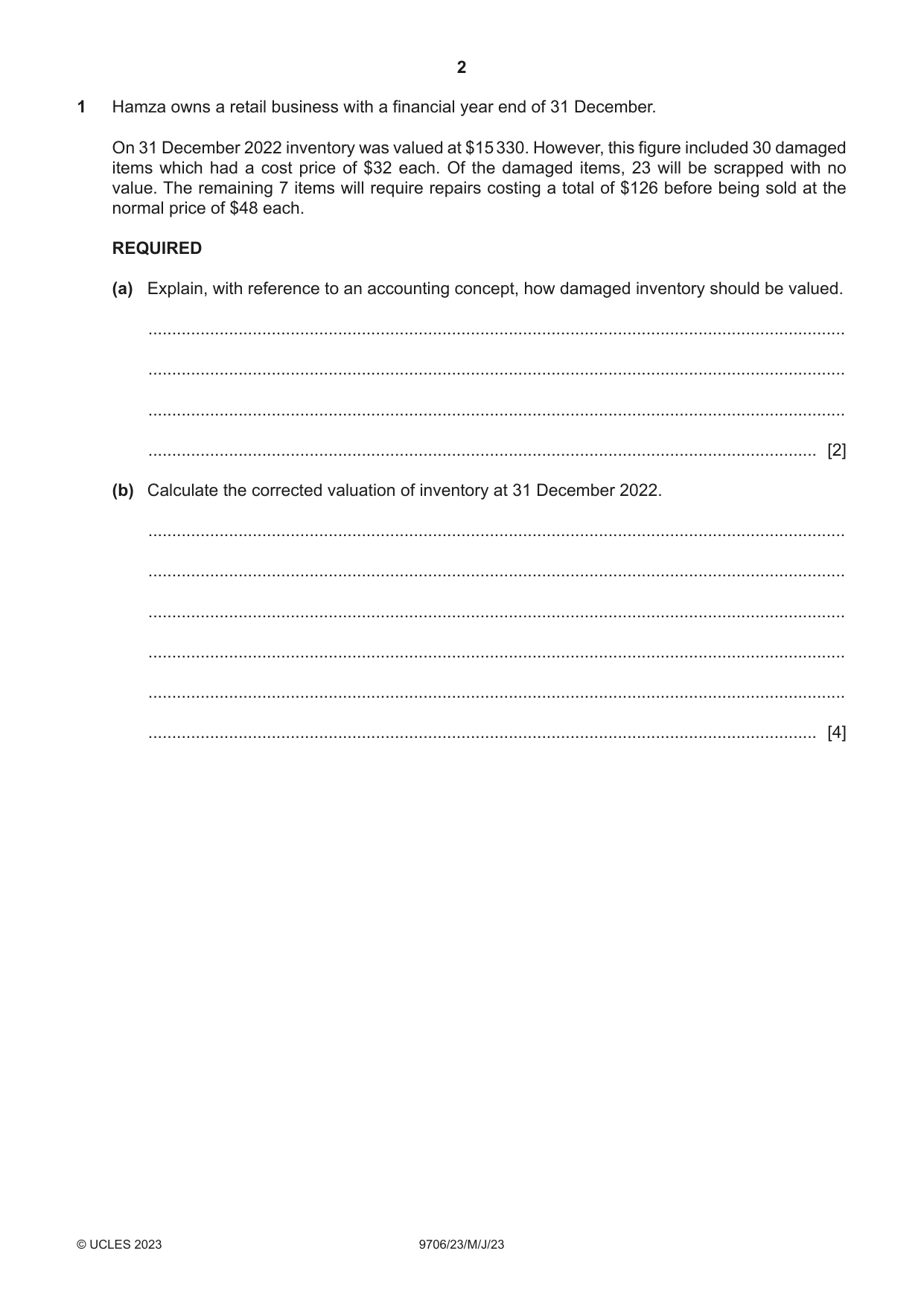
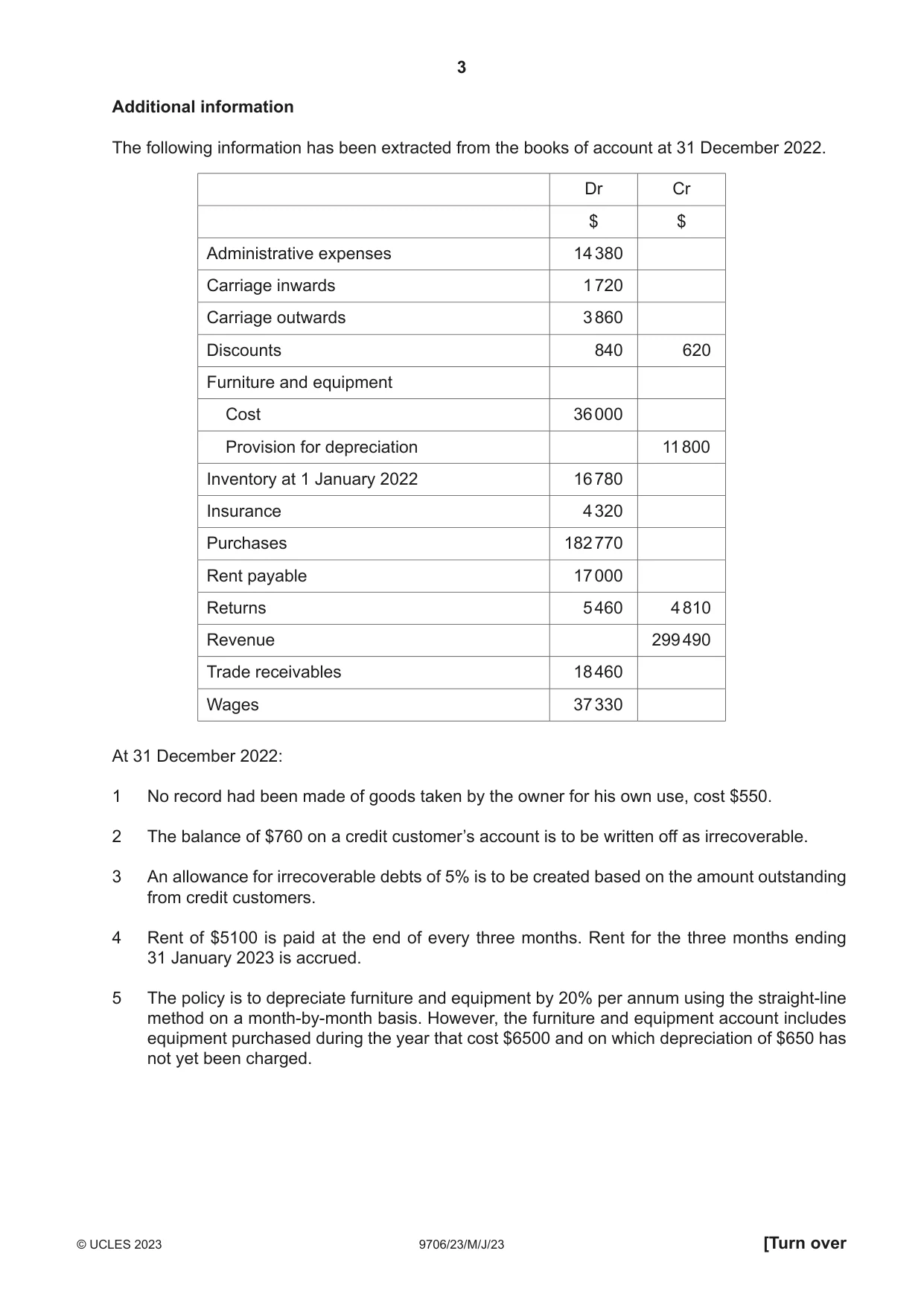
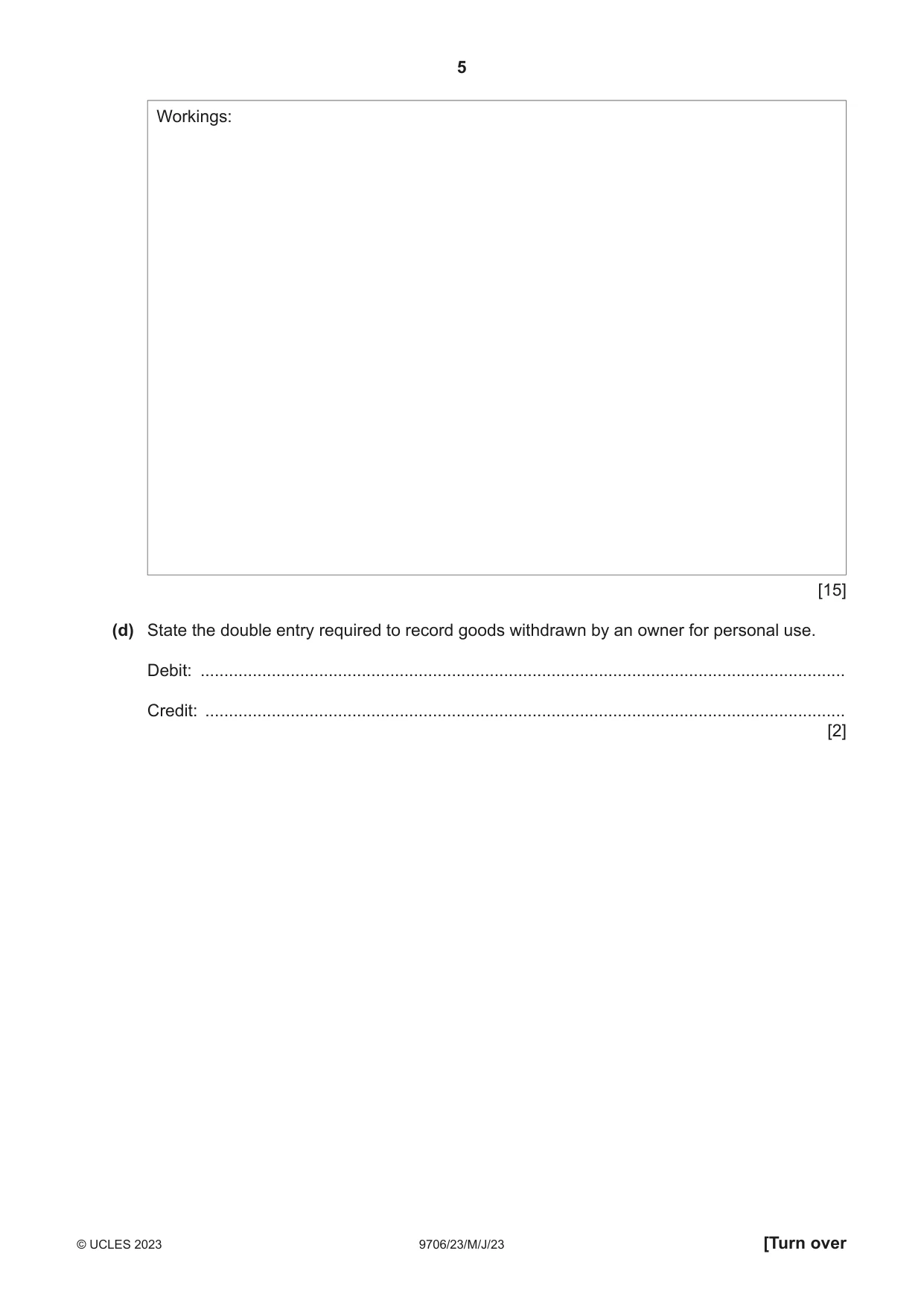
1 Hamza owns a retail business with a financial year end of 31 December. On 31 December 2022 inventory was valued at $15 330. However, this figure included 30 damaged items which had a cost price of $32 each. Of the damaged items, 23 will be scrapped with no value. The remaining 7 items will require repairs costing a total of $126 before being sold at the normal price of $48 each. REQUIRED (a) Explain, with reference to an accounting concept, how damaged inventory should be valued. ................................................................................................................................................... ................................................................................................................................................... ................................................................................................................................................... ............................................................................................................................................. [2] (b) Calculate the corrected valuation of inventory at 31 December 2022. ................................................................................................................................................... ................................................................................................................................................... ................................................................................................................................................... ................................................................................................................................................... ................................................................................................................................................... ............................................................................................................................................. [4] Additional information The following information has been extracted from the books of account at 31 December 2022. Dr Cr $ $ Administrative expenses 14 380 Carriage inwards 1 720 Carriage outwards 3 860 Discounts 840 620 Furniture and equipment Cost 36 000 Provision for depreciation 11 800 Inventory at 1 January 2022 16 780 Insurance 4 320 Purchases 182 770 Rent payable 17 000 Returns 5 460 4 810 Revenue 299 490 Trade receivables 18 460 Wages 37 330 At 31 December 2022: 1 No record had been made of goods taken by the owner for his own use, cost $550.
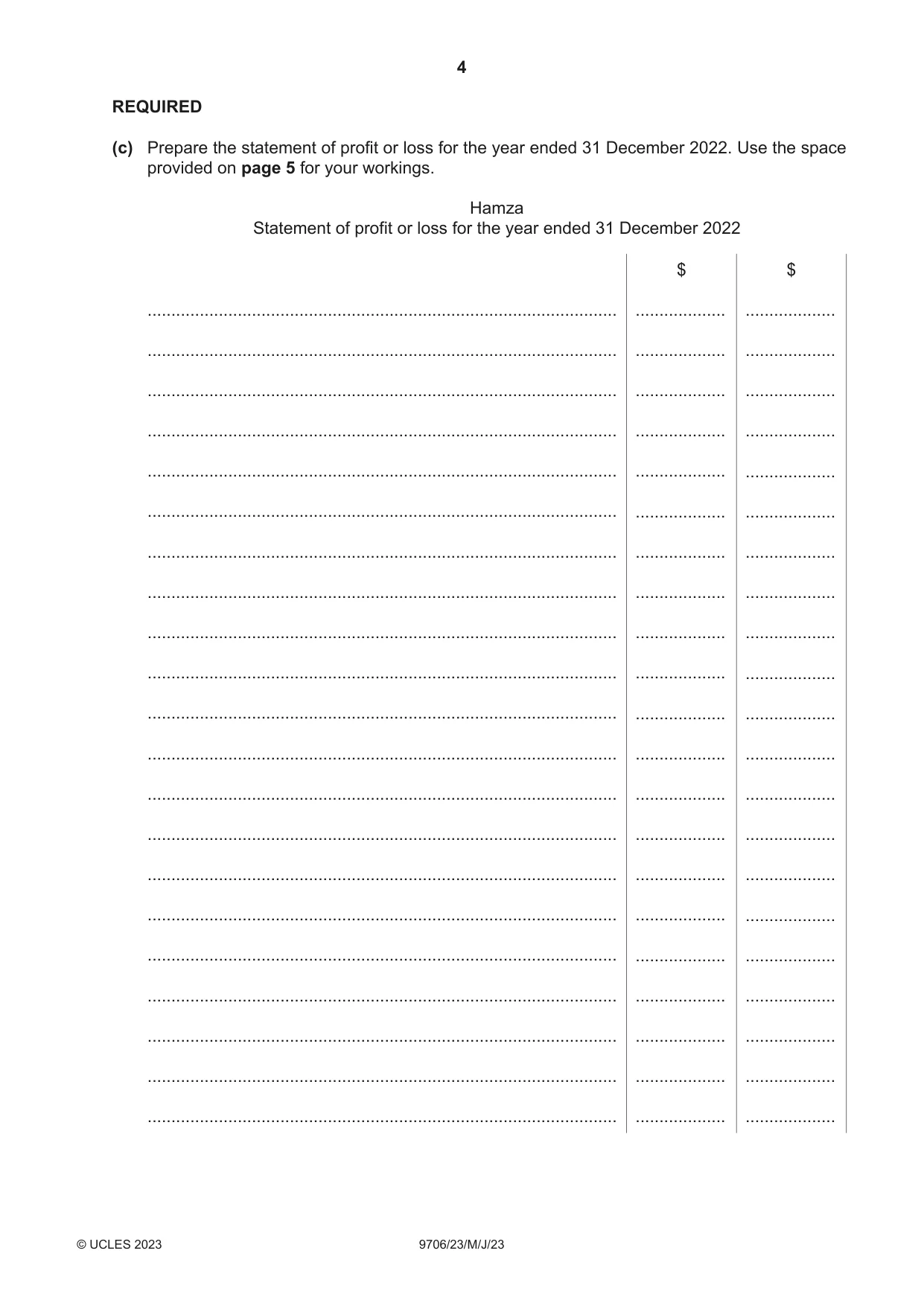
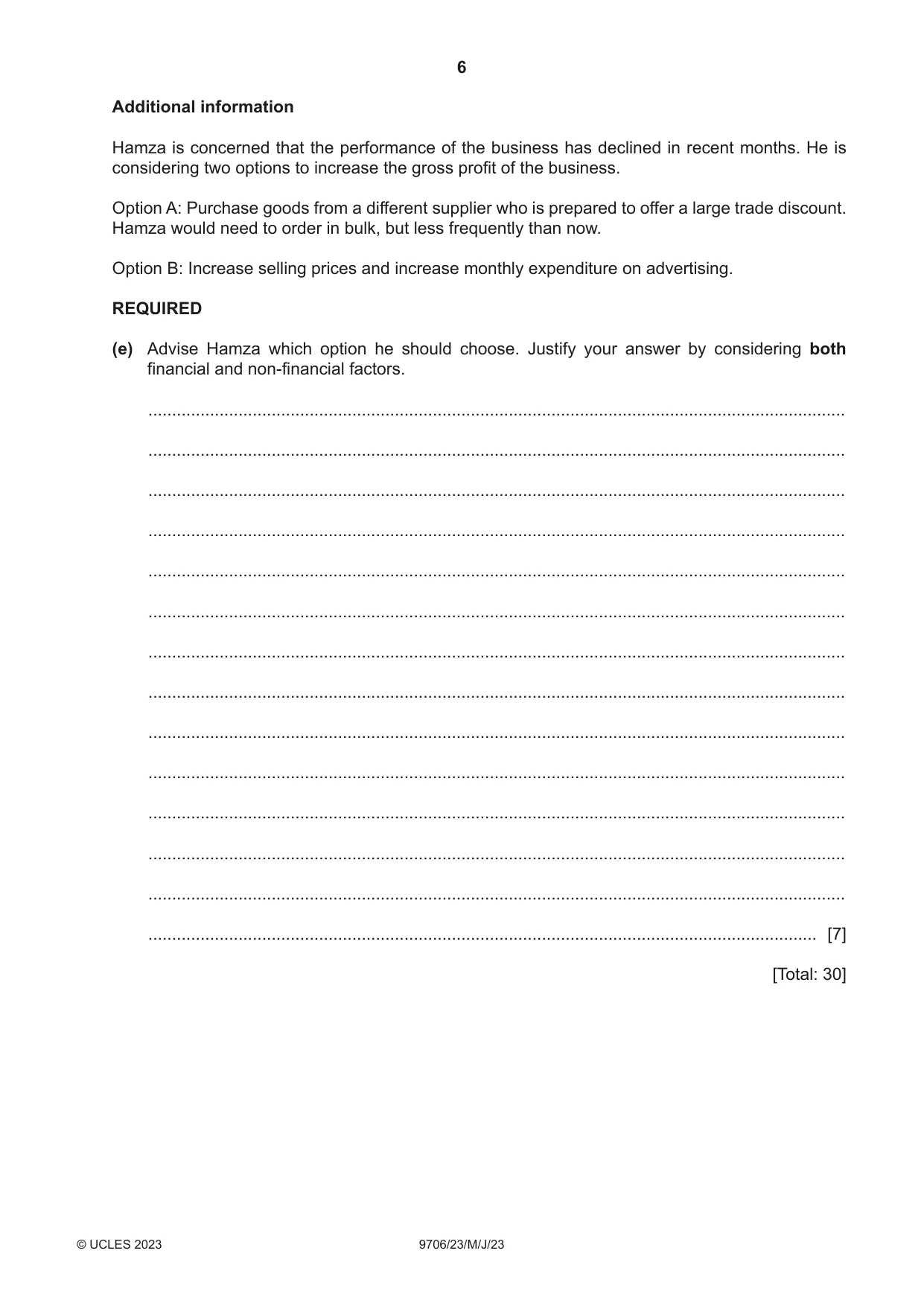
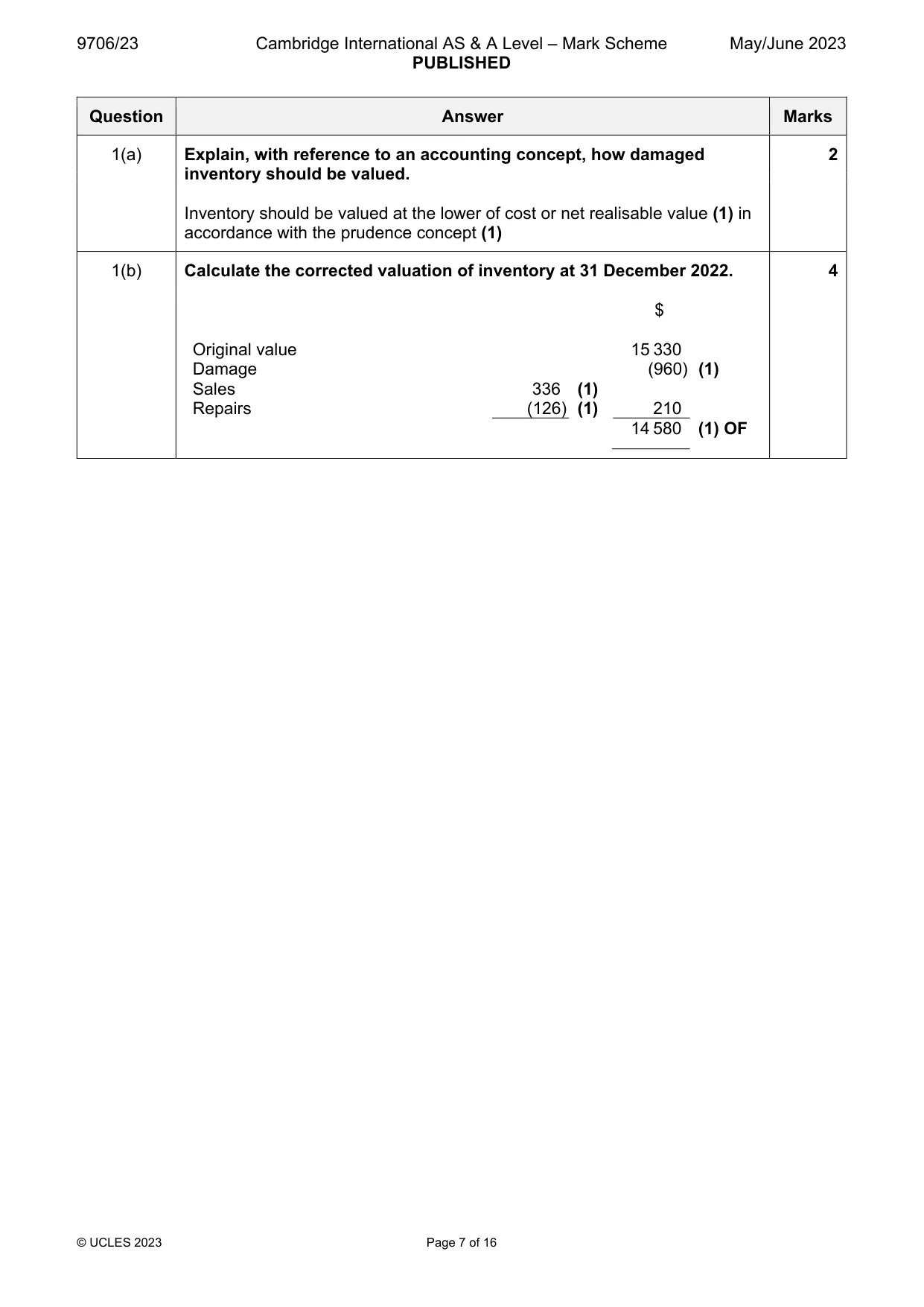
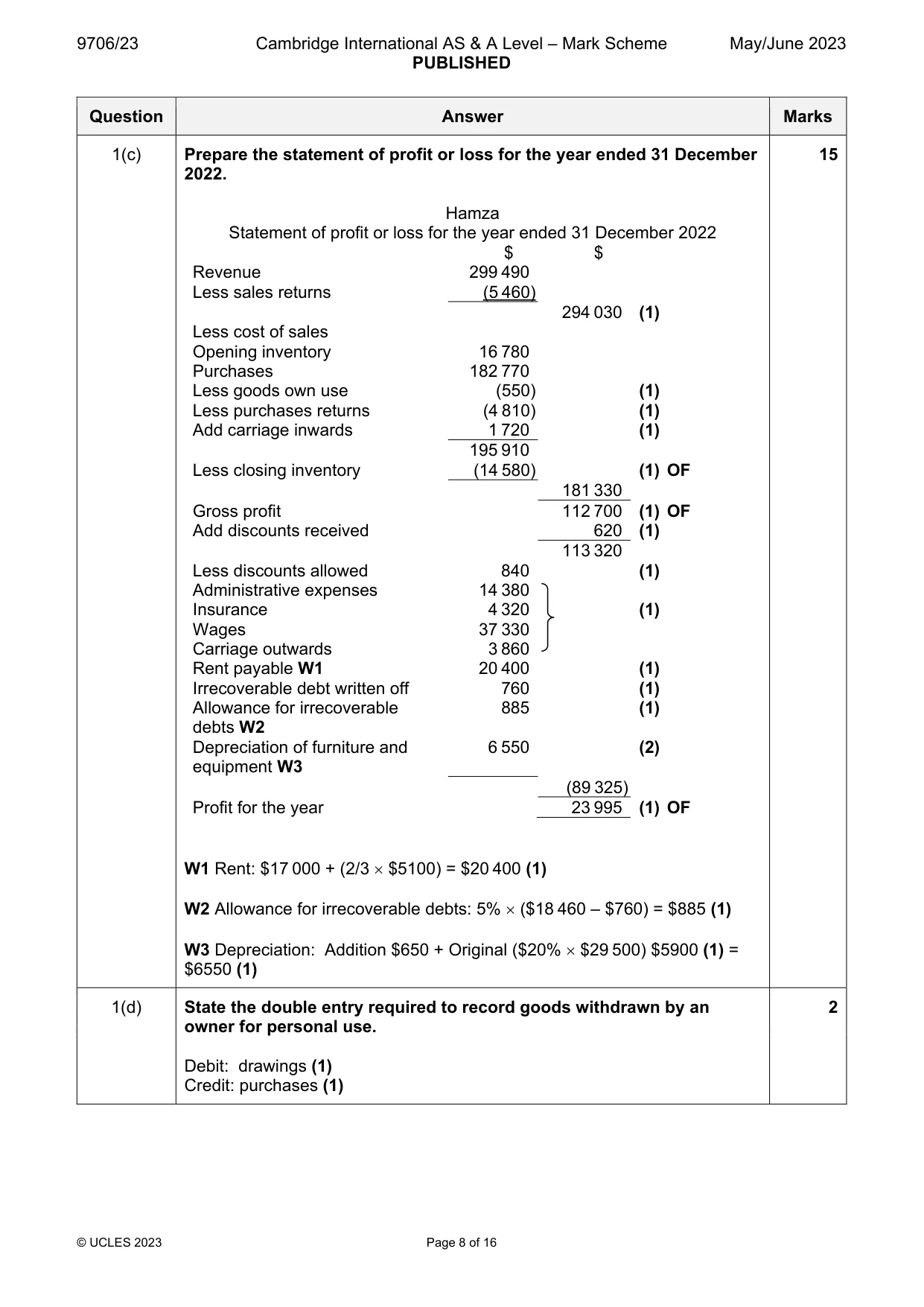
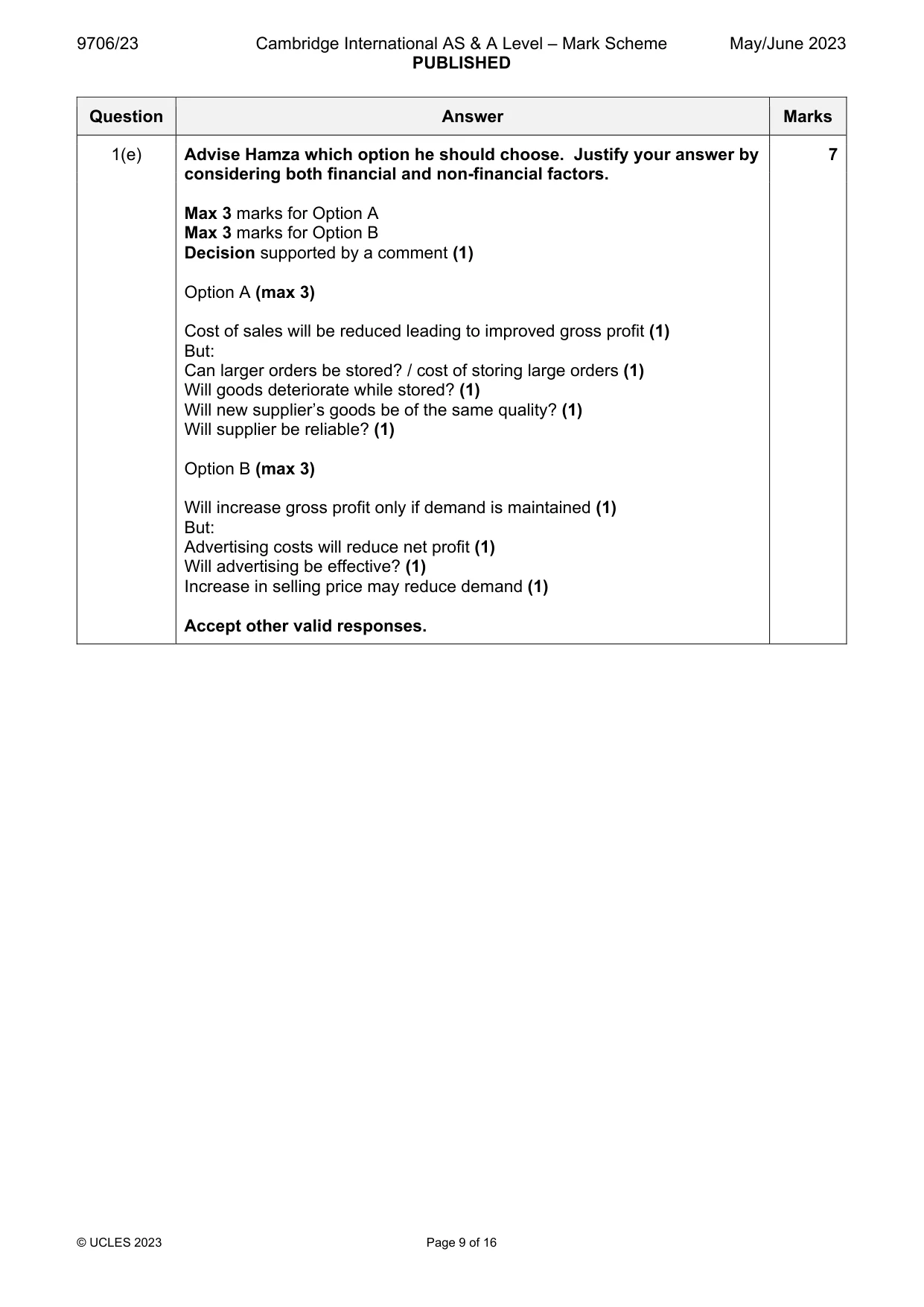
Mark scheme: Question Answer Marks 1(a) Explain, with reference to an accounting concept, how damaged 2 inventory should be valued. Inventory should be valued at the lower of cost or net realisable value (1) in accordance with the prudence concept (1) 1(b) Calculate the corrected valuation of inventory at 31 December 2022. 4 $ Original value 15 330 Damage (960) (1) Sales 336 (1) Repairs (126) (1) 210 14 580 (1) OF 1(c) Prepare the statement of profit or loss for the year ended 31 December 15 2022. Hamza Statement of profit or loss for the year ended 31 December 2022 $ $ Revenue 299 490 Less sales returns (5 460) 294 030 (1) Less cost of sales Opening inventory 16 780 Purchases 182 770 Less goods own use (550) (1) Less purchases returns (4 810) (1) Add carriage inwards 1 720 (1) 195 910 Less closing inventory (14 580) (1) OF 181 330 Gross profit 112 700 (1) OF Add discounts received 620 (1) 113 320 Less discounts allowed 840 (1) Administrative expenses 14 380 Insurance 4 320 (1) Wages 37 330 Carriage outwards 3 860 Rent payable W1 20 400 (1) Irrecoverable debt written off 760 (1) Allowance for irrecoverable 885 (1) debts W2 Depreciation of furniture and 6 550 (2) equipment W3 (89 325) Profit for the year 23 995 (1) OF W1 Rent: $17 000 + (2/3 $5100) = $20 400 (1) W2 Allowance for irrecoverable debts: 5% ($18 460 – $760) = $885 (1) W3 Depreciation: Addition $650 + Original ($20% $29 500) $5900 (1) = $6550 (1) 1(d) State the double entry required to record goods withdrawn by an 2 owner for personal use. Debit: drawings (1) Credit: purchases (1) 1(e) Advise Hamza which option he should choose. Justify your answer by 7 considering both financial and non-financial factors. Max 3 marks for Option A Max 3 marks for Option B Decision supported by a comment (1) Option A (max 3) Cost of sales will be reduced leading to improved gross profit (1) But: Can larger orders be stored? / cost of storing large orders (1) Will goods deteriorate while stored? (1) Will new supplier’s goods be of the same quality? (1) Will supplier be reliable? (1) Option B (max 3) Will increase gross profit only if demand is maintained (1) But: Advertising costs will reduce net profit (1) Will advertising be effective? (1) Increase in selling price may reduce demand (1) Accept other valid responses.
Q2 · Veda owns a retail business
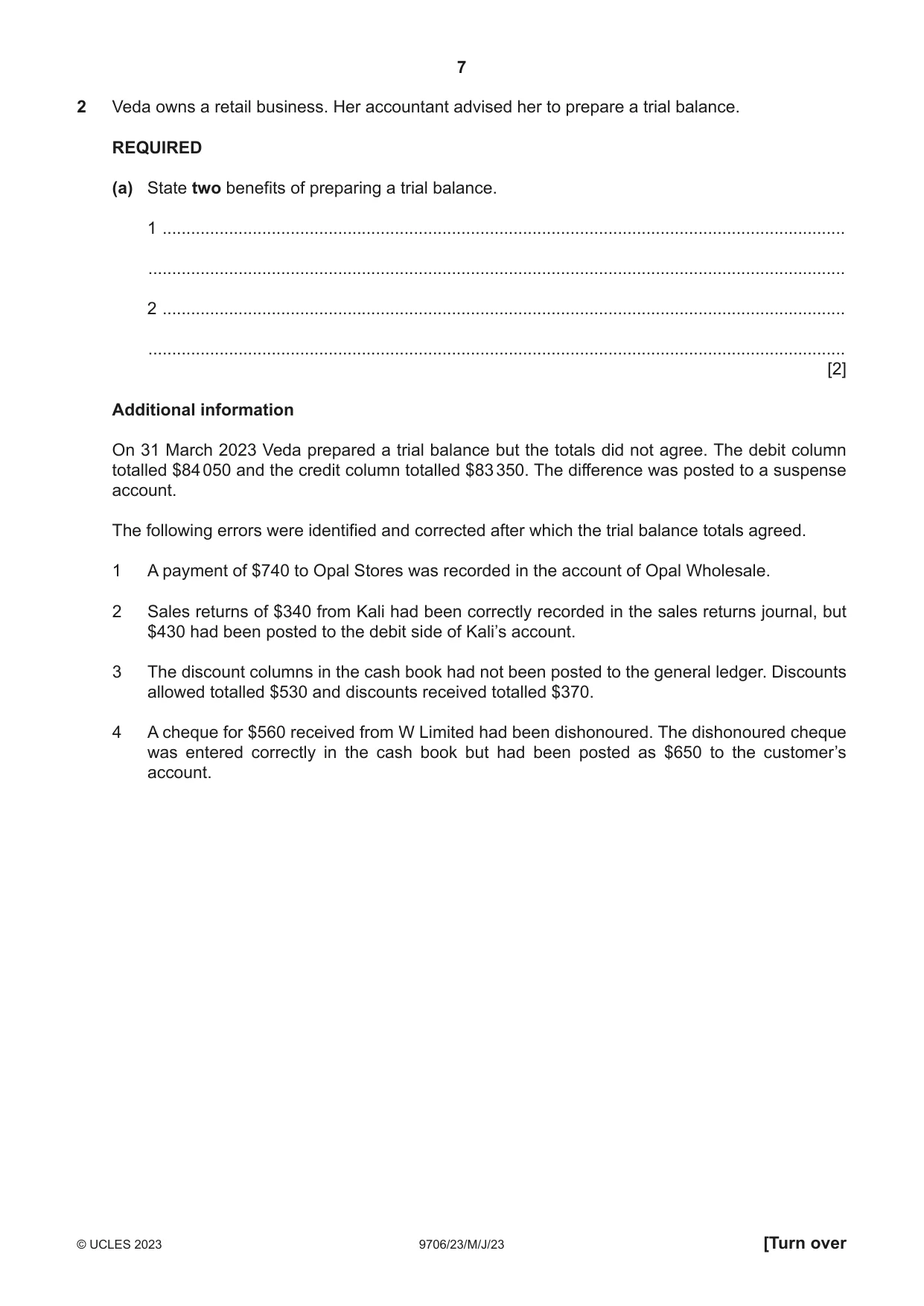
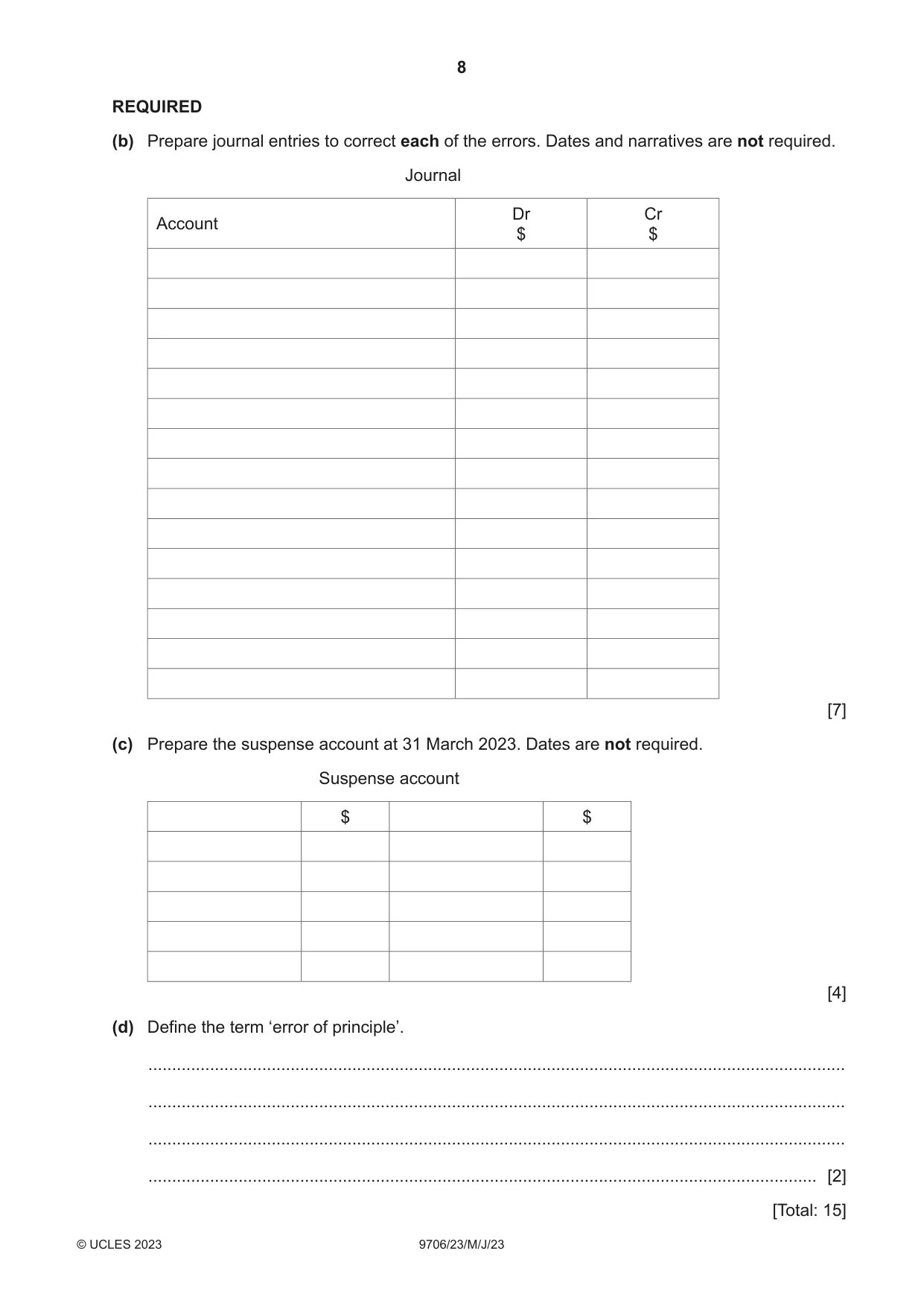
2 Veda owns a retail business. Her accountant advised her to prepare a trial balance. REQUIRED (a) State two benefits of preparing a trial balance. 1 ................................................................................................................................................ ................................................................................................................................................... 2 ................................................................................................................................................ ................................................................................................................................................... [2] Additional information On 31 March 2023 Veda prepared a trial balance but the totals did not agree. The debit column totalled $84 050 and the credit column totalled $83 350. The difference was posted to a suspense account. The following errors were identified and corrected after which the trial balance totals agreed. 1 A payment of $740 to Opal Stores was recorded in the account of Opal Wholesale. 2 Sales returns of $340 from Kali had been correctly recorded in the sales returns journal, but $430 had been posted to the debit side of Kali’s account. 3 The discount columns in the cash book had not been posted to the general ledger. Discounts allowed totalled $530 and discounts received totalled $370. 4 A cheque for $560 received from W Limited had been dishonoured. The dishonoured cheque was entered correctly in the cash book but had been posted as $650 to the customer’s account. REQUIRED (b) Prepare journal entries to correct each of the errors. Dates and narratives are not required. Journal Dr Cr Account $ $ [7] (c) Prepare the suspense account at 31 March 2023. Dates are not required. Suspense account $ $ [4] (d) Define the term ‘error of principle’. ................................................................................................................................................... ................................................................................................................................................... ................................................................................................................................................... ............................................................................................................................................. [2] [Total: 15]
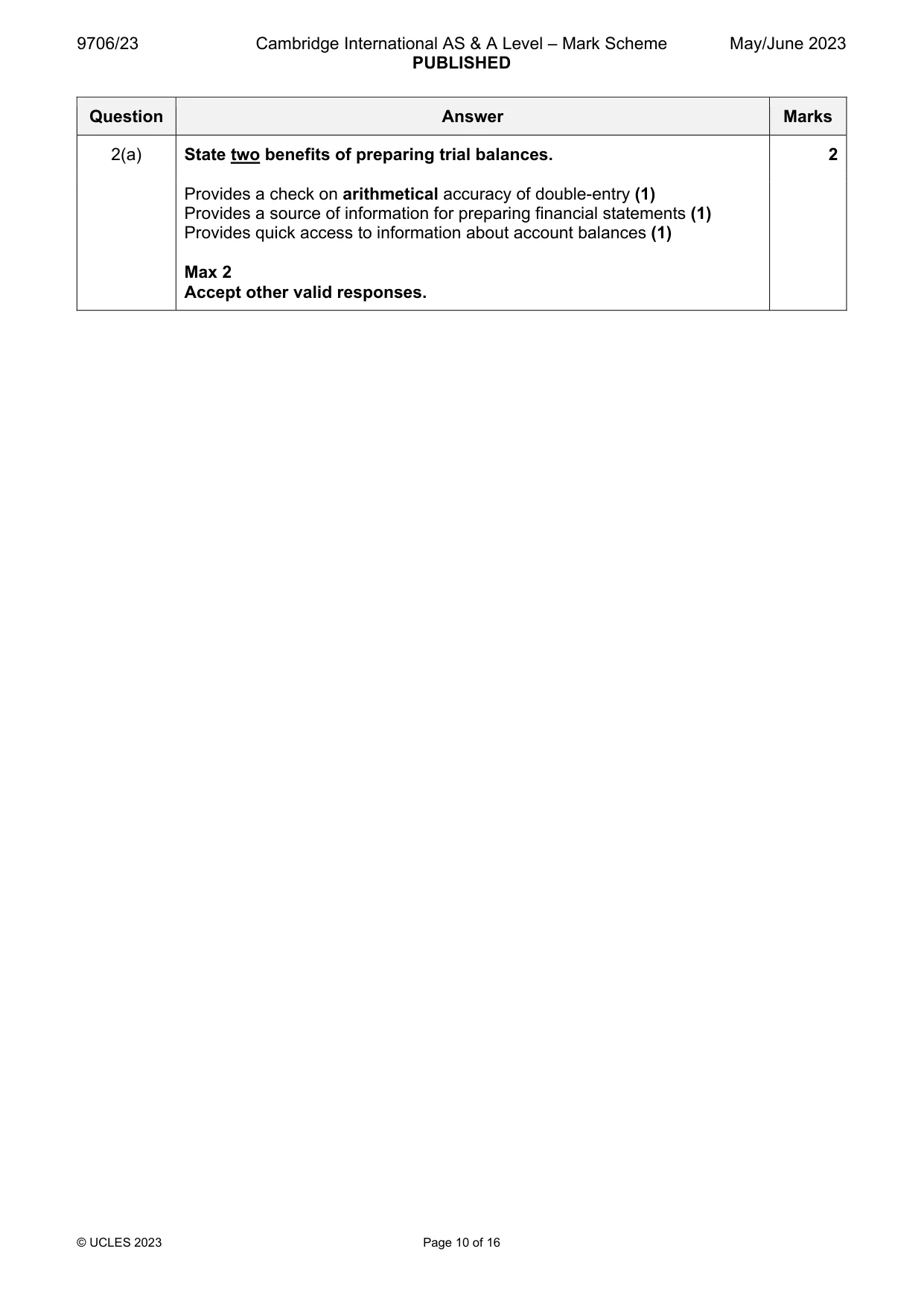
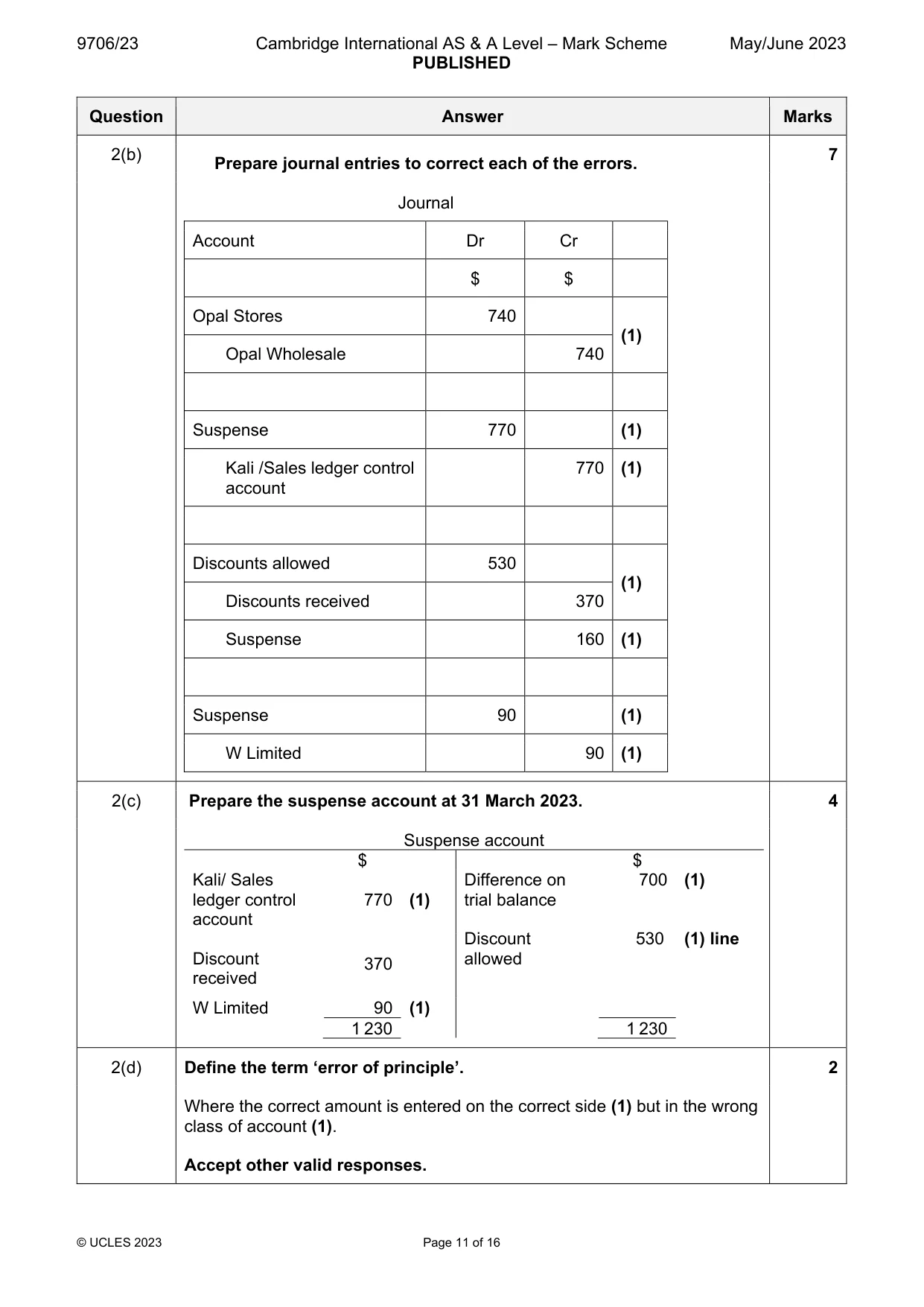
Mark scheme: Question Answer Marks 2(a) State two benefits of preparing trial balances. 2 Provides a check on arithmetical accuracy of double-entry (1) Provides a source of information for preparing financial statements (1) Provides quick access to information about account balances (1) Max 2 Accept other valid responses. 2(b) 7 Prepare journal entries to correct each of the errors. Journal Account Dr Cr $ $ Opal Stores 740 (1) Opal Wholesale 740 Suspense 770 (1) Kali /Sales ledger control 770 (1) account Discounts allowed 530 (1) Discounts received 370 Suspense 160 (1) Suspense 90 (1) W Limited 90 (1) 2(c) Prepare the suspense account at 31 March 2023. 4 Suspense account $ $ Kali/ Sales Difference on 700 (1) ledger control 770 (1) trial balance account Discount 530 (1) line Discount allowed 370 received W Limited 90 (1) 1 230 1 230 2(d) Define the term ‘error of principle’. 2 Where the correct amount is entered on the correct side (1) but in the wrong class of account (1). Accept other valid responses.
Q3 · An allowance for irrecoverable debts of 5% is to be created based on the amount…
3 An allowance for irrecoverable debts of 5% is to be created based on the amount outstanding from credit customers.
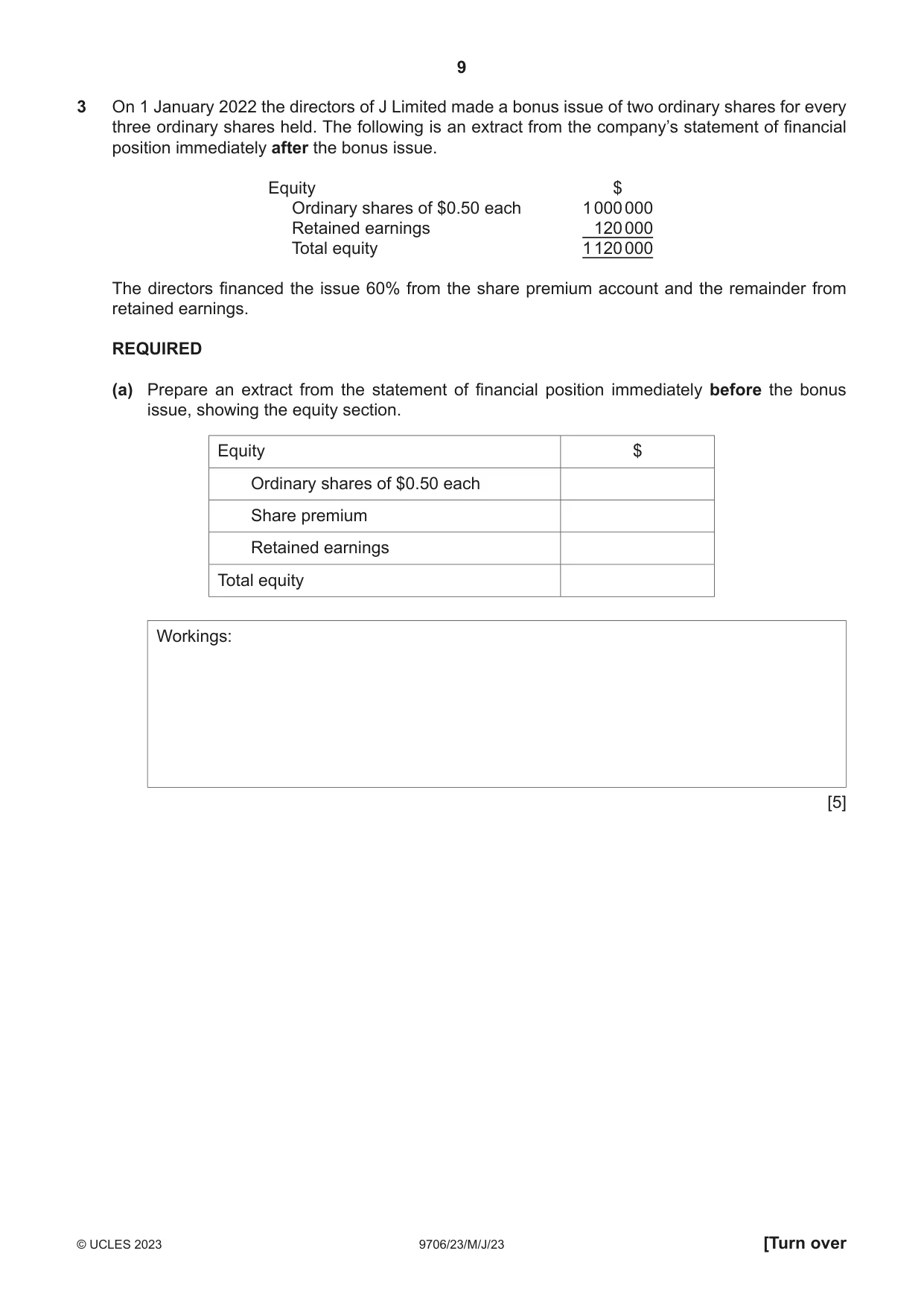
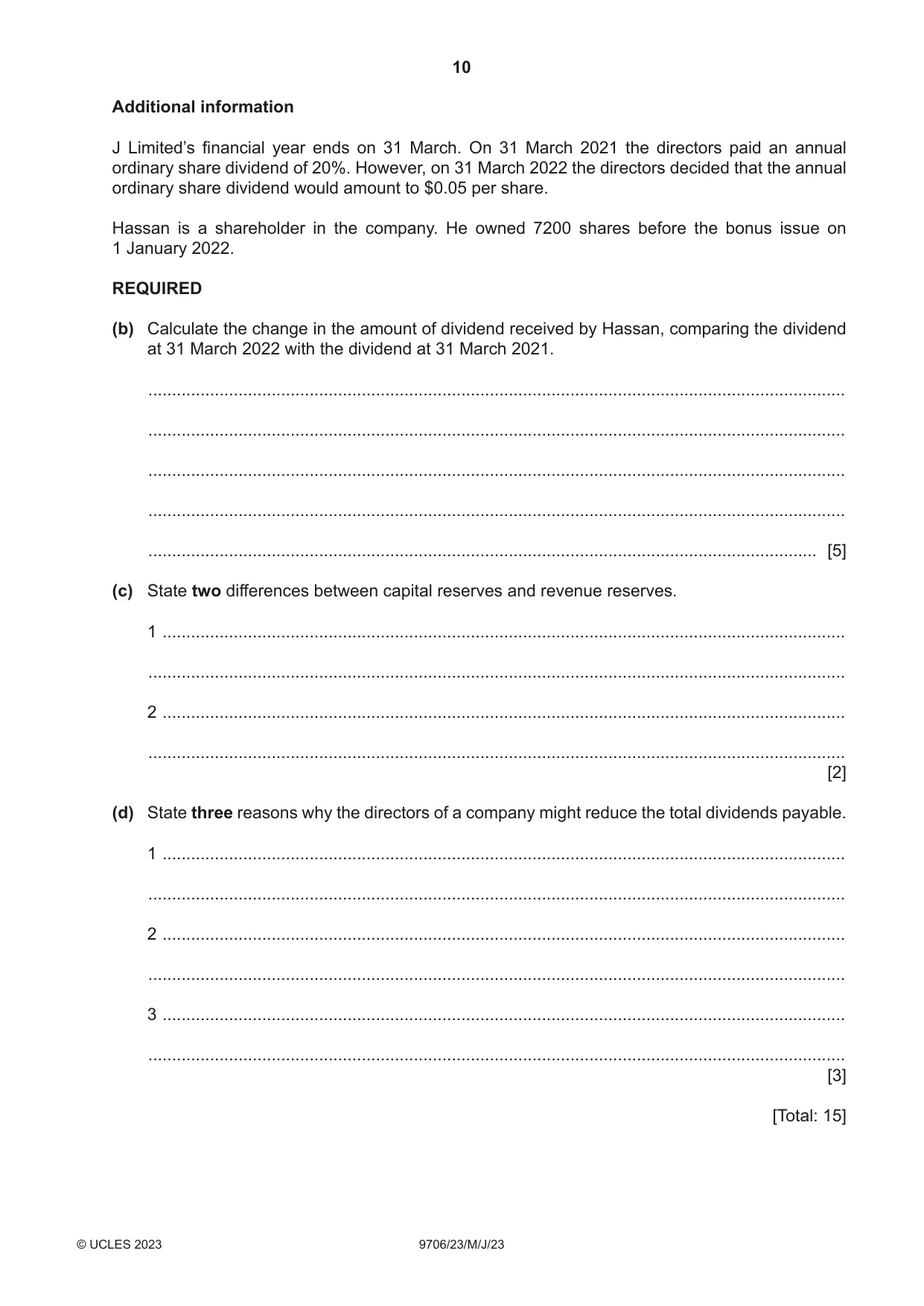
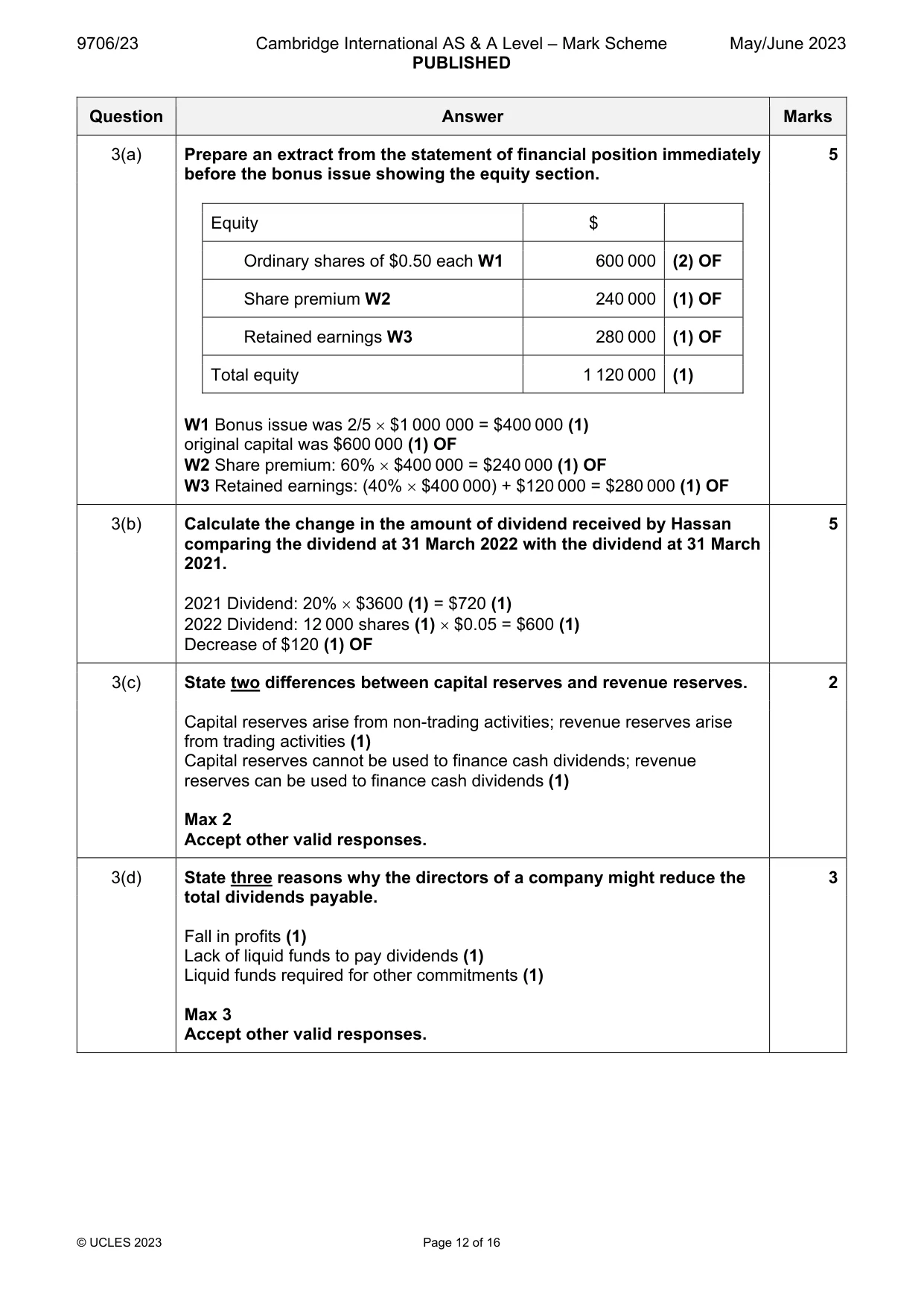
Mark scheme: 3(a) Prepare an extract from the statement of financial position immediately 5 before the bonus issue showing the equity section. Equity $ Ordinary shares of $0.50 each W1 600 000 (2) OF Share premium W2 240 000 (1) OF Retained earnings W3 280 000 (1) OF Total equity 1 120 000 (1) W1 Bonus issue was 2/5 $1 000 000 = $400 000 (1) original capital was $600 000 (1) OF W2 Share premium: 60% $400 000 = $240 000 (1) OF W3 Retained earnings: (40% $400 000) + $120 000 = $280 000 (1) OF 3(b) Calculate the change in the amount of dividend received by Hassan 5 comparing the dividend at 31 March 2022 with the dividend at 31 March 2021. 2021 Dividend: 20% $3600 (1) = $720 (1) 2022 Dividend: 12 000 shares (1) $0.05 = $600 (1) Decrease of $120 (1) OF 3(c) State two differences between capital reserves and revenue reserves. 2 Capital reserves arise from non-trading activities; revenue reserves arise from trading activities (1) Capital reserves cannot be used to finance cash dividends; revenue reserves can be used to finance cash dividends (1) Max 2 Accept other valid responses. 3(d) State three reasons why the directors of a company might reduce the 3 total dividends payable. Fall in profits (1) Lack of liquid funds to pay dividends (1) Liquid funds required for other commitments (1) Max 3 Accept other valid responses.
Q4 · Rent of $5100 is paid at the end of every three months
4 Rent of $5100 is paid at the end of every three months. Rent for the three months ending 31 January 2023 is accrued.
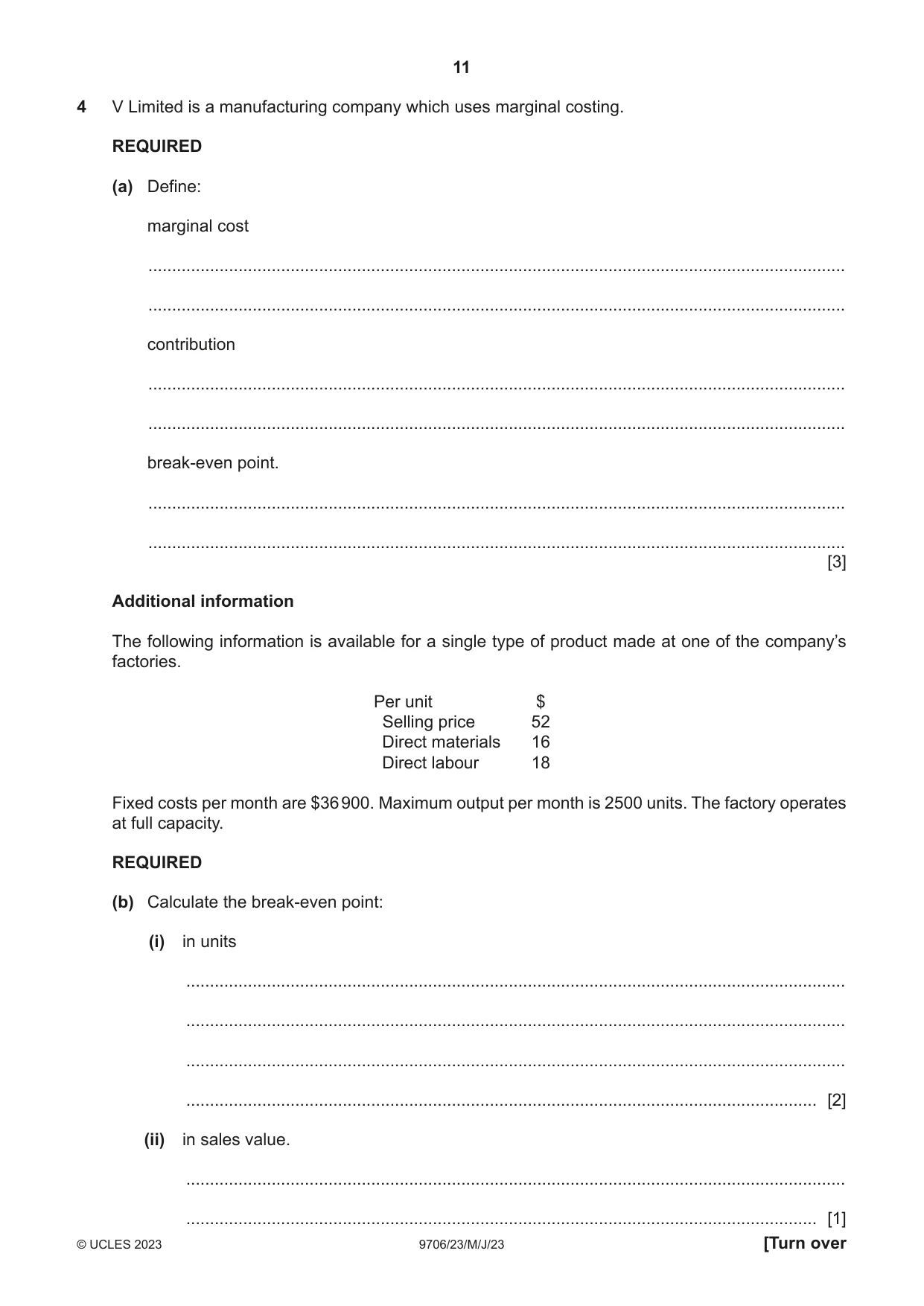
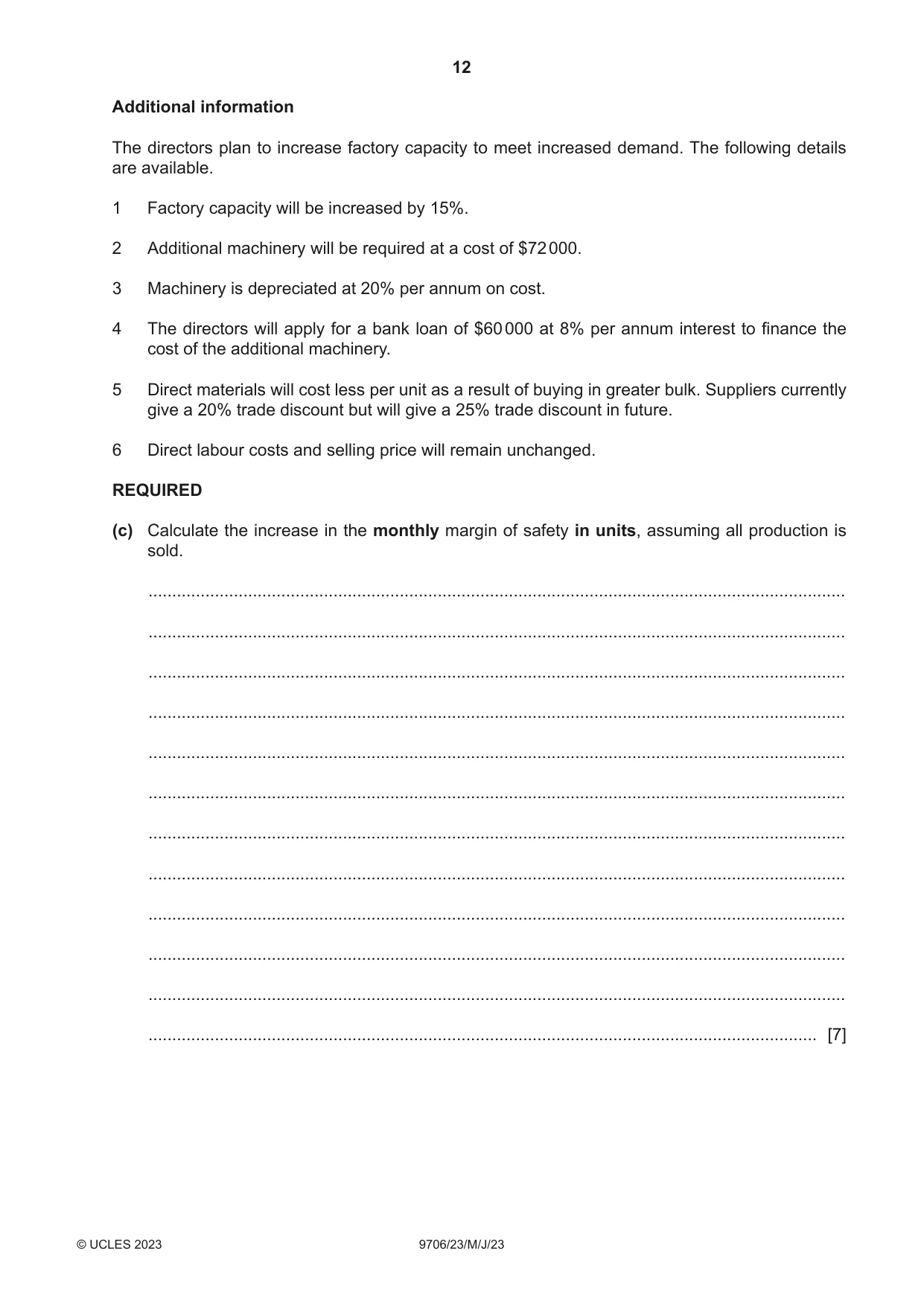
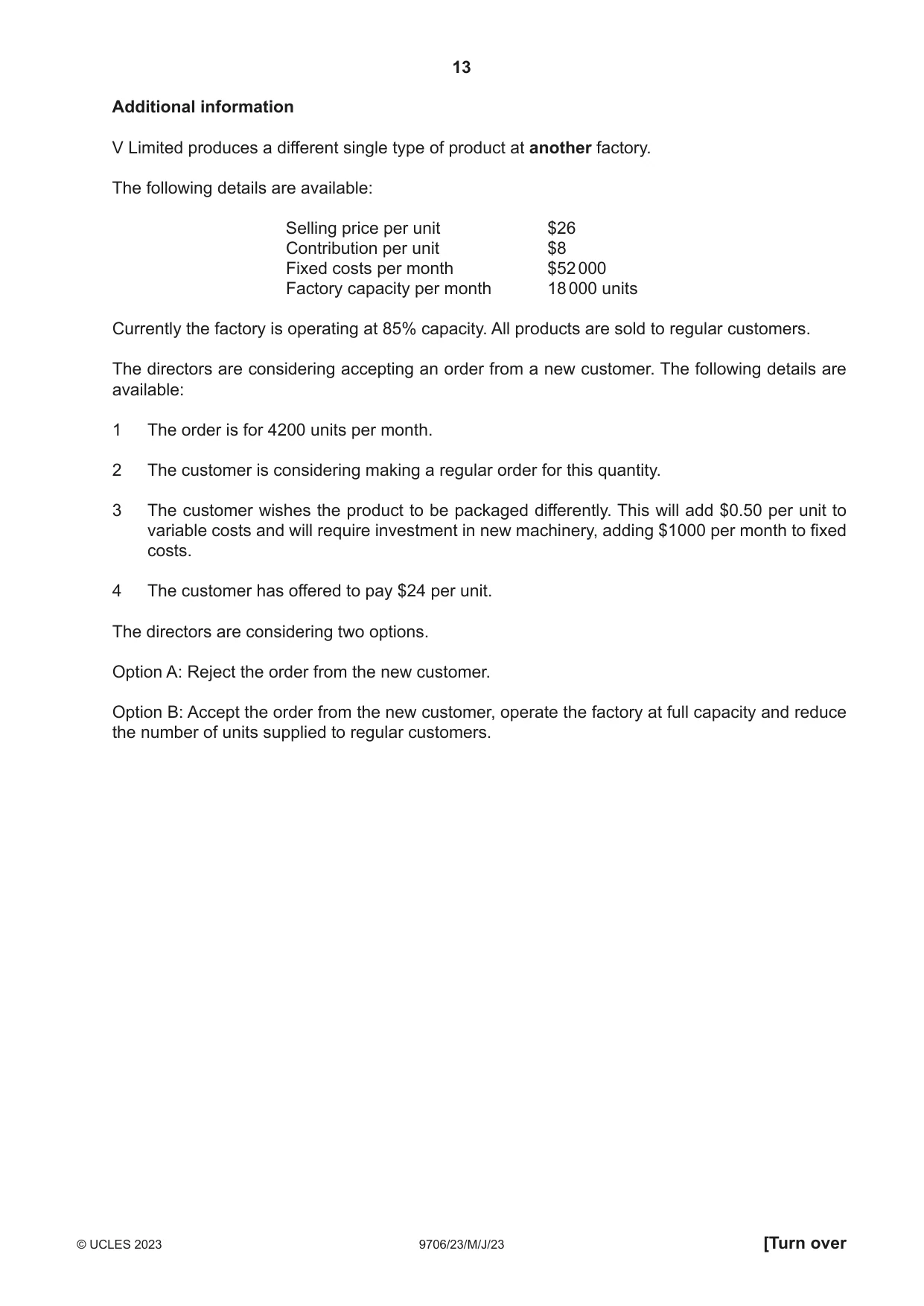
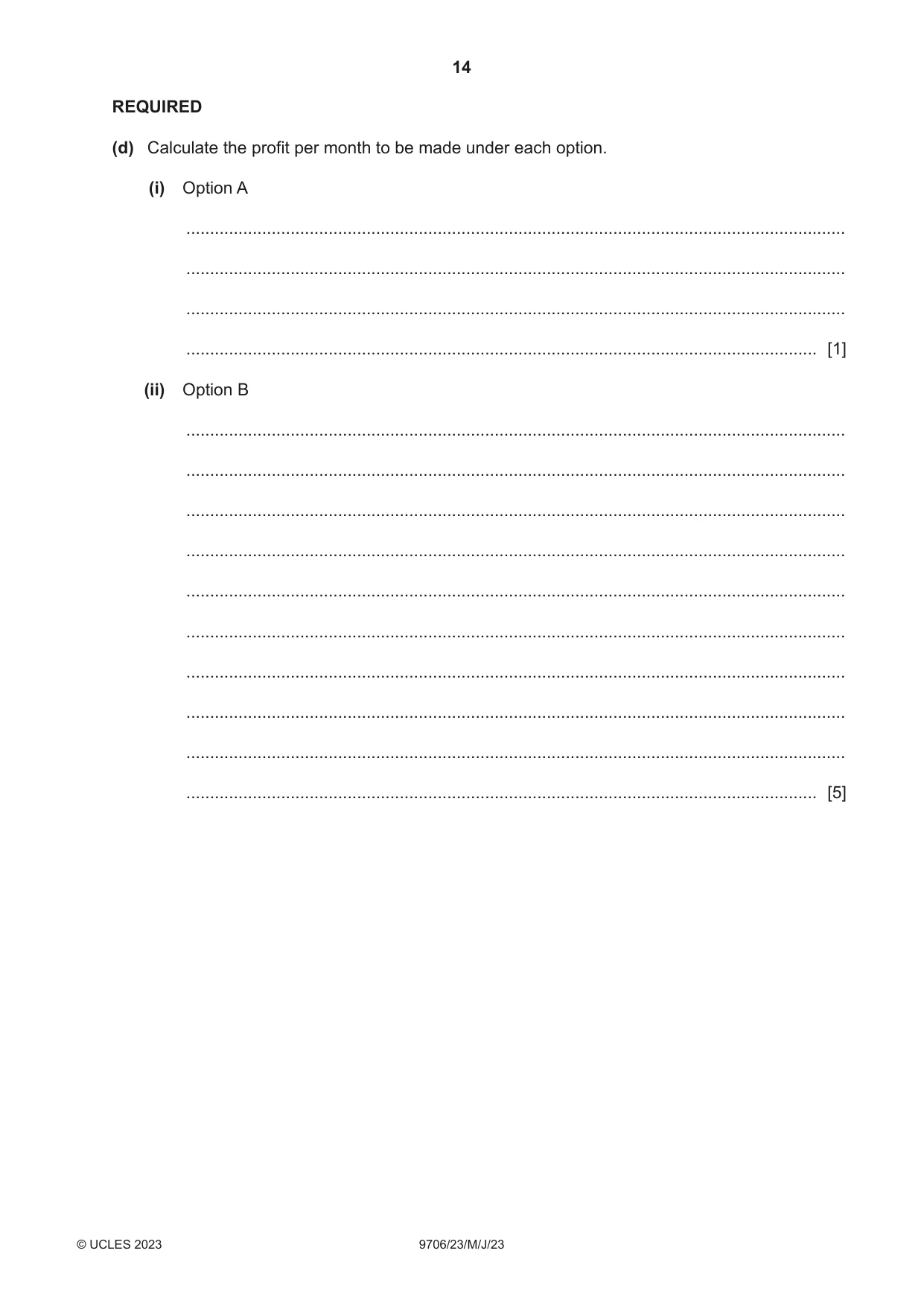
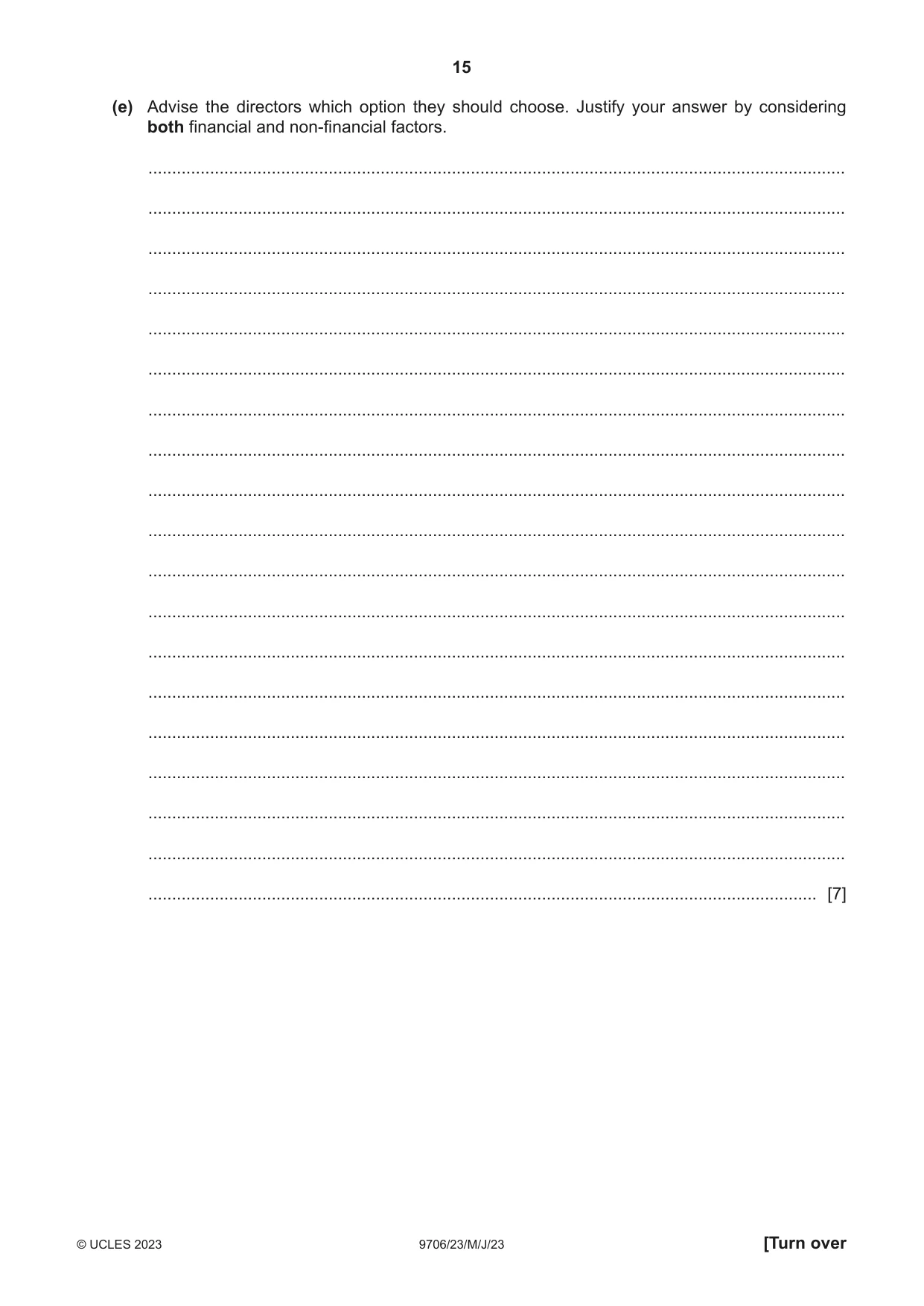
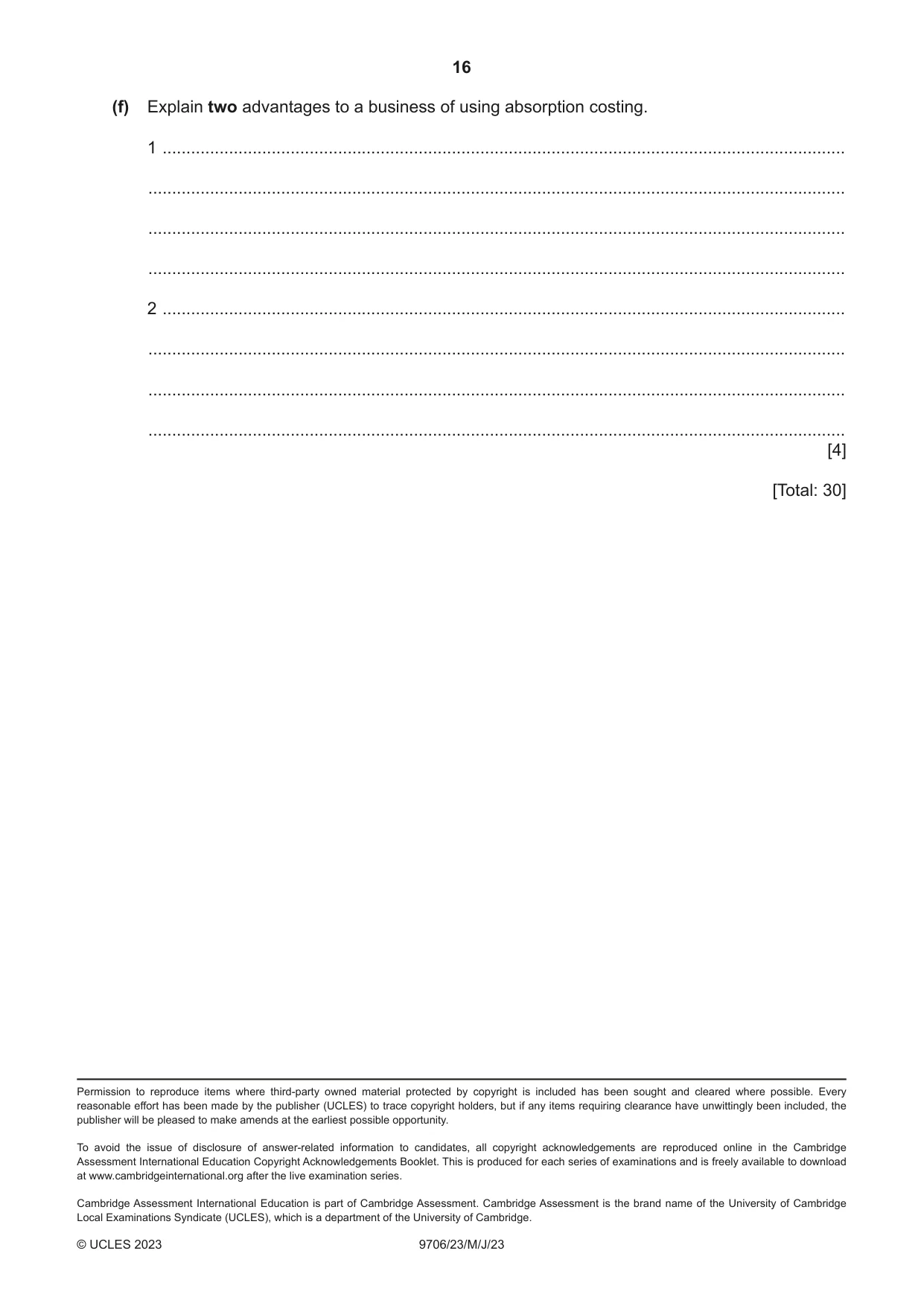
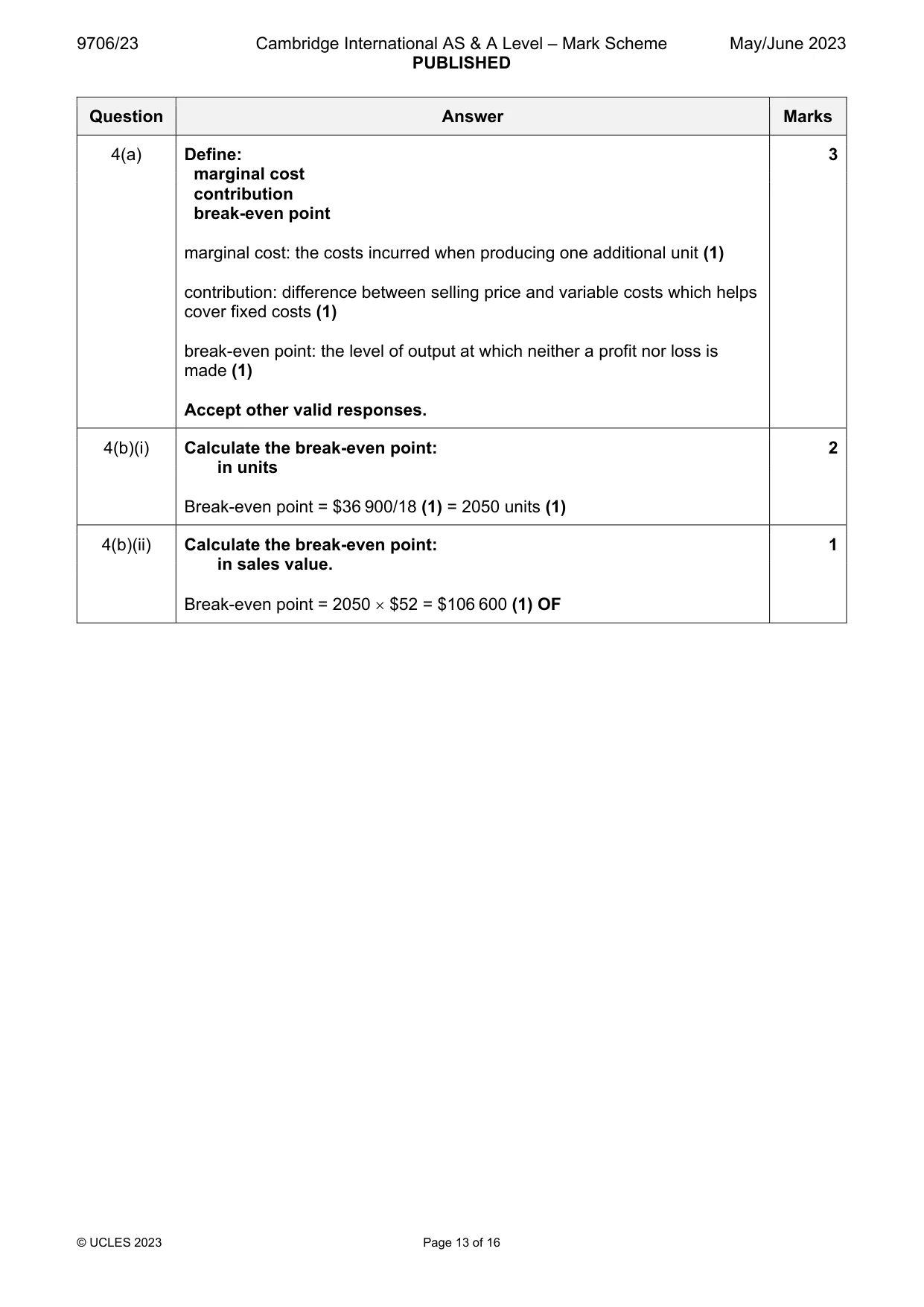
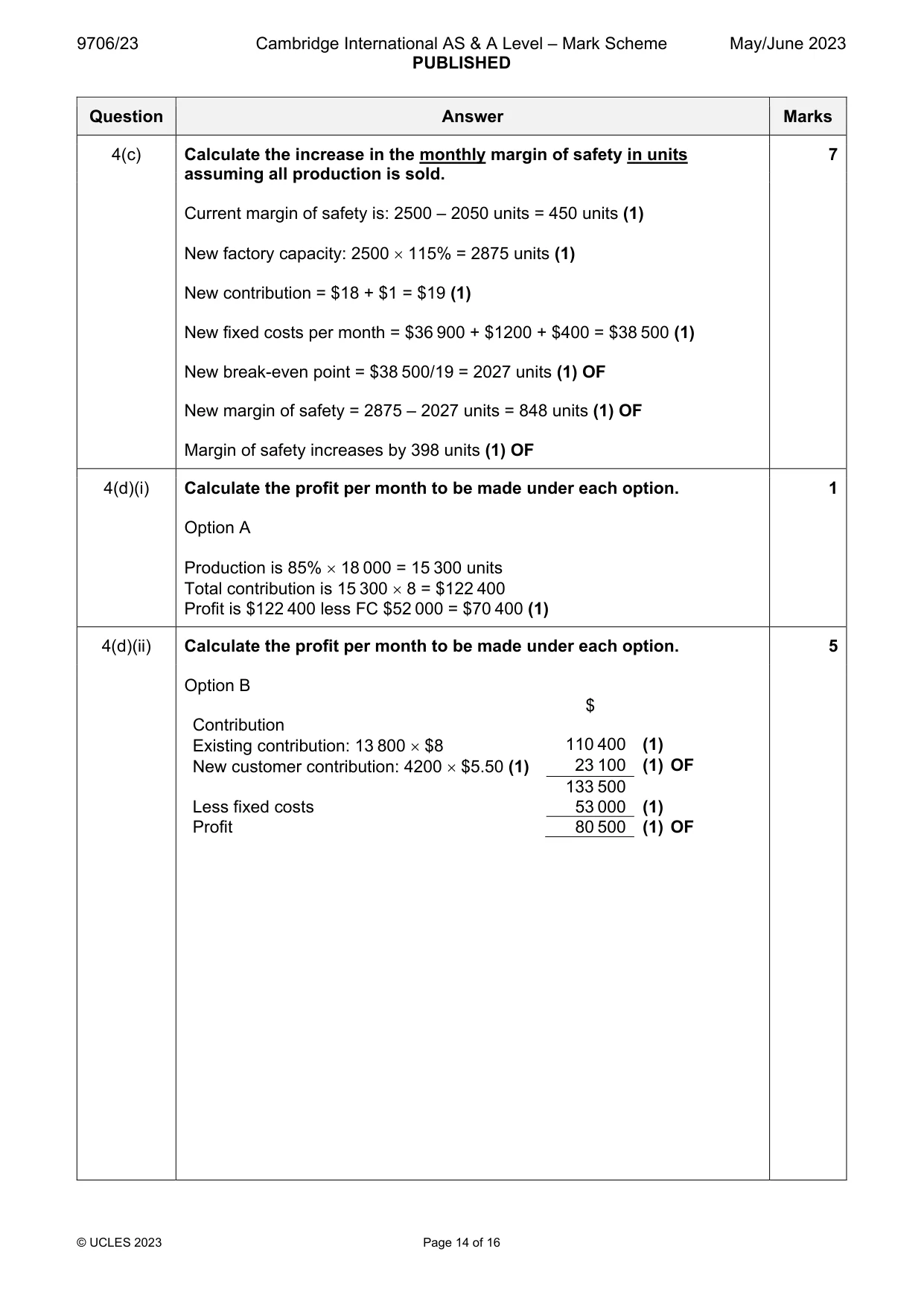
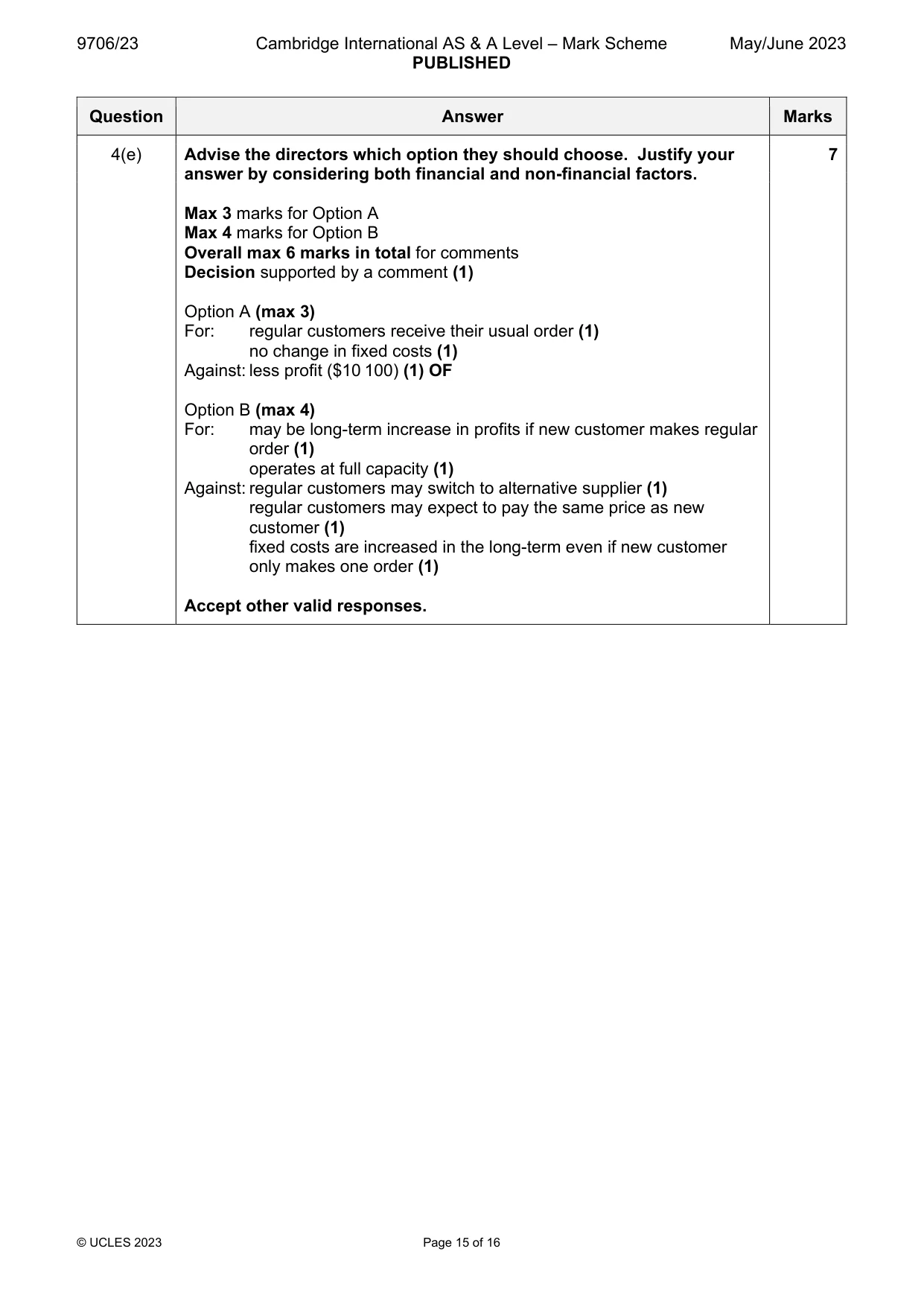
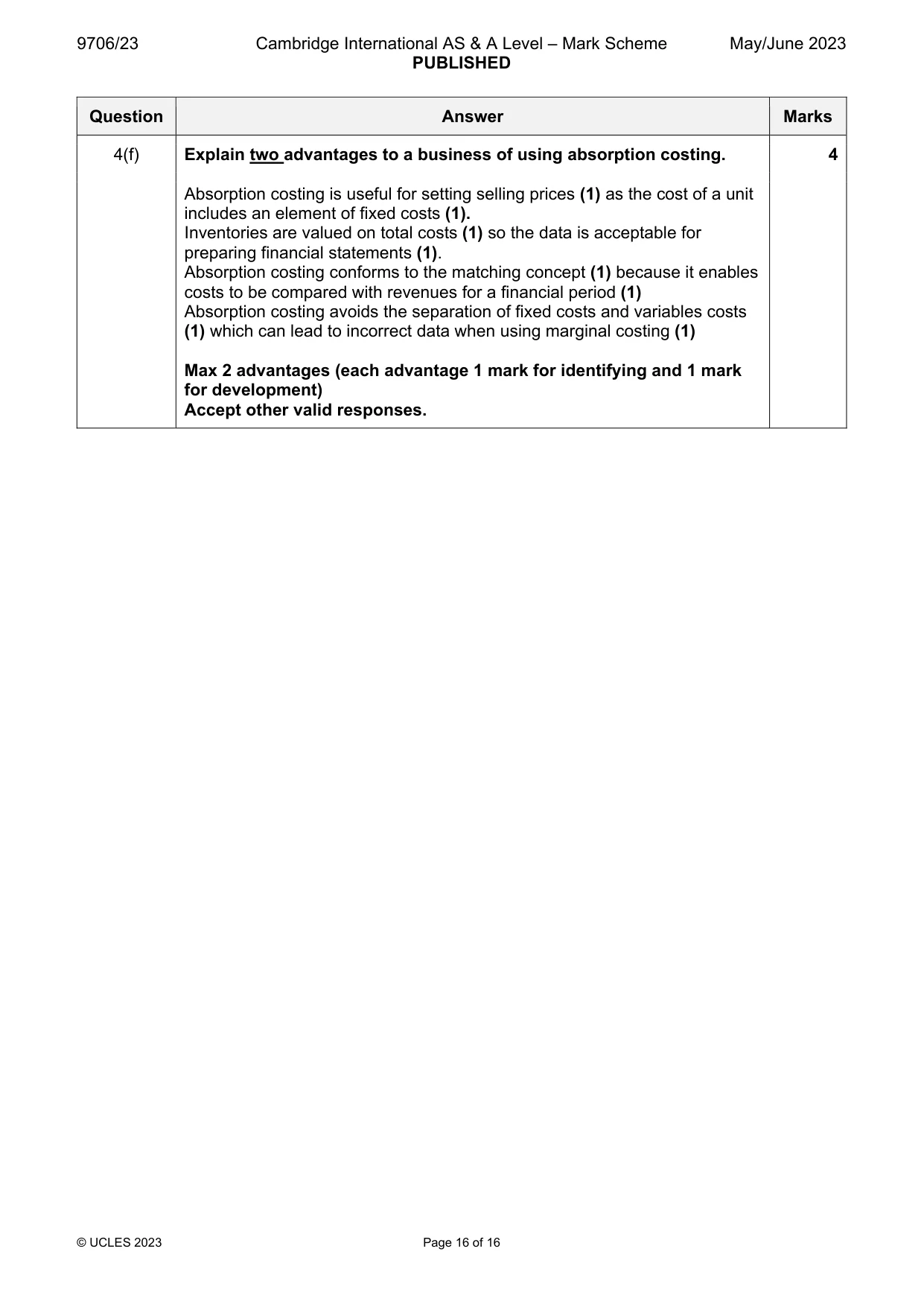
Mark scheme: 4(a) Define: 3 marginal cost contribution break-even point marginal cost: the costs incurred when producing one additional unit (1) contribution: difference between selling price and variable costs which helps cover fixed costs (1) break-even point: the level of output at which neither a profit nor loss is made (1) Accept other valid responses. 4(b)(i) Calculate the break-even point: 2 in units Break-even point = $36 900/18 (1) = 2050 units (1) 4(b)(ii) Calculate the break-even point: 1 in sales value. Break-even point = 2050 $52 = $106 600 (1) OF 4(c) Calculate the increase in the monthly margin of safety in units 7 assuming all production is sold. Current margin of safety is: 2500 – 2050 units = 450 units (1) New factory capacity: 2500 115% = 2875 units (1) New contribution = $18 + $1 = $19 (1) New fixed costs per month = $36 900 + $1200 + $400 = $38 500 (1) New break-even point = $38 500/19 = 2027 units (1) OF New margin of safety = 2875 – 2027 units = 848 units (1) OF Margin of safety increases by 398 units (1) OF 4(d)(i) Calculate the profit per month to be made under each option. 1 Option A Production is 85% 18 000 = 15 300 units Total contribution is 15 300 8 = $122 400 Profit is $122 400 less FC $52 000 = $70 400 (1) 4(d)(ii) Calculate the profit per month to be made under each option. 5 Option B $ Contribution Existing contribution: 13 800 $8 110 400 (1) New customer contribution: 4200 $5.50 (1) 23 100 (1) OF 133 500 Less fixed costs 53 000 (1) Profit 80 500 (1) OF 4(e) Advise the directors which option they should choose. Justify your 7 answer by considering both financial and non-financial factors. Max 3 marks for Option A Max 4 marks for Option B Overall max 6 marks in total for comments Decision supported by a comment (1) Option A (max 3) For: regular customers receive their usual order (1) no change in fixed costs (1) Against: less profit ($10 100) (1) OF Option B (max 4) For: may be long-term increase in profits if new customer makes regular order (1) operates at full capacity (1) Against: regular customers may switch to alternative supplier (1) regular customers may expect to pay the same price as new customer (1) fixed costs are increased in the long-term even if new customer only makes one order (1) Accept other valid responses. 4(f) Explain two advantages to a business of using absorption costing. 4 Absorption costing is useful for setting selling prices (1) as the cost of a unit includes an element of fixed costs (1). Inventories are valued on total costs (1) so the data is acceptable for preparing financial statements (1). Absorption costing conforms to the matching concept (1) because it enables costs to be compared with revenues for a financial period (1) Absorption costing avoids the separation of fixed costs and variables costs (1) which can lead to incorrect data when using marginal costing (1) Max 2 advantages (each advantage 1 mark for identifying and 1 mark for development) Accept other valid responses.
Q5 · The policy is to depreciate furniture and equipment by 20% per annum using the…
5 The policy is to depreciate furniture and equipment by 20% per annum using the straight‑line method on a month‑by‑month basis. However, the furniture and equipment account includes equipment purchased during the year that cost $6500 and on which depreciation of $650 has not yet been charged. REQUIRED (c) Prepare the statement of profit or loss for the year ended 31 D provided on page 5 for your workings. Hamza Statement of profit or loss for the year ended 31 ................................................................................................... ................................................................................................... ................................................................................................... ................................................................................................... ................................................................................................... ................................................................................................... ................................................................................................... ................................................................................................... ................................................................................................... ................................................................................................... ................................................................................................... ................................................................................................... ................................................................................................... ................................................................................................... ................................................................................................... ................................................................................................... ................................................................................................... ................................................................................................... ................................................................................................... ................................................................................................... ................................................................................................... Workings: [15] (d) State the double entry required to record goods withdrawn by an owner for personal use. Debit: ........................................................................................................................................ Credit: ....................................................................................................................................... [2] Additional information Hamza is concerned that the performance of the business has declined in recent months. He is considering two options to increase the gross profit of the business. Option A: Purchase goods from a different supplier who is prepared to offer a large trade discount. Hamza would need to order in bulk, but less frequently than now. Option B: Increase selling prices and increase monthly expenditure on advertising. REQUIRED (e) Advise Hamza which option he should choose. Justify your answer by considering both financial and non‑financial factors. ................................................................................................................................................... ................................................................................................................................................... ................................................................................................................................................... ................................................................................................................................................... ................................................................................................................................................... ................................................................................................................................................... ................................................................................................................................................... ................................................................................................................................................... ................................................................................................................................................... ................................................................................................................................................... ................................................................................................................................................... ................................................................................................................................................... ................................................................................................................................................... ............................................................................................................................................. [7] [Total: 30] 2 Veda owns a retail business. Her accountant advised her to prepare a trial balance. REQUIRED (a) State two benefits of preparing a trial balance. 1 ................................................................................................................................................ ................................................................................................................................................... 2 ................................................................................................................................................ ................................................................................................................................................... [2] Additional information On 31 March 2023 Veda prepared a trial balance but the totals did not agree. The debit column totalled $84 050 and the credit column totalled $83 350. The difference was posted to a suspense account. The following errors were identified and corrected after which the trial balance totals agreed. 1 A payment of $740 to Opal Stores was recorded in the account of Opal Wholesale. 2 Sales returns of $340 from Kali had been correctly recorded in the sales returns journal, but $430 had been posted to the debit side of Kali’s account. 3 The discount columns in the cash book had not been posted to the general ledger. Discounts allowed totalled $530 and discounts received totalled $370. 4 A cheque for $560 received from W Limited had been dishonoured. The dishonoured cheque was entered correctly in the cash book but had been posted as $650 to the customer’s account. REQUIRED (b) Prepare journal entries to correct each of the errors. Dates and narratives are not required. Journal Dr Cr Account $ $ [7] (c) Prepare the suspense account at 31 March 2023. Dates are not required. Suspense account $ $ [4] (d) Define the term ‘error of principle’. ................................................................................................................................................... ................................................................................................................................................... ................................................................................................................................................... ............................................................................................................................................. [2] [Total: 15] 3 On 1 January 2022 the directors of J Limited made a bonus issue of two ordinary shares for every three ordinary shares held. The following is an extract from the company’s statement of financial position immediately after the bonus issue. Equity $ Ordinary shares of $0.50 each 1 000 000 Retained earnings 120 000 Total equity 1 120 000 The directors financed the issue 60% from the share premium account and the remainder from retained earnings. REQUIRED (a) Prepare an extract from the statement of financial position immediately before the bonus issue, showing the equity section. Equity $ Ordinary shares of $0.50 each Share premium Retained earnings Total equity Workings: [5] Additional information J Limited’s financial year ends on 31 March. On 31 March 2021 the directors paid an annual ordinary share dividend of 20%. However, on 31 March 2022 the directors decided that the annual ordinary share dividend would amount to $0.05 per share. Hassan is a shareholder in the company. He owned 7200 shares before the bonus issue on 1 January 2022. REQUIRED (b) Calculate the change in the amount of dividend received by Hassan, comparing the dividend at 31 March 2022 with the dividend at 31 March 2021. ................................................................................................................................................... ................................................................................................................................................... ................................................................................................................................................... ................................................................................................................................................... ............................................................................................................................................. [5] (c) State two differences between capital reserves and revenue reserves. 1 ................................................................................................................................................ ................................................................................................................................................... 2 ................................................................................................................................................ ................................................................................................................................................... [2] (d) State three reasons why the directors of a company might reduce the total dividends payable. 1 ................................................................................................................................................ ................................................................................................................................................... 2 ................................................................................................................................................ ................................................................................................................................................... 3 ................................................................................................................................................ ................................................................................................................................................... [3] [Total: 15] 4 V Limited is a manufacturing company which uses marginal costing. REQUIRED (a) Define: marginal cost ................................................................................................................................................... ................................................................................................................................................... contribution ................................................................................................................................................... ................................................................................................................................................... break‑even point. ................................................................................................................................................... ................................................................................................................................................... [3] Additional information The following information is available for a single type of product made at one of the company’s factories. Per unit $ Selling price 52 Direct materials 16 Direct labour 18 Fixed costs per month are $36 900. Maximum output per month is 2500 units. The factory operates at full capacity. REQUIRED (b) Calculate the break‑even point: (i) in units ........................................................................................................................................... ........................................................................................................................................... ........................................................................................................................................... ..................................................................................................................................... [2] (ii) in sales value. ........................................................................................................................................... ..................................................................................................................................... [1] Additional information The directors plan to increase factory capacity to meet increased demand. The following details are available. 1 Factory capacity will be increased by 15%. 2 Additional machinery will be required at a cost of $72 000. 3 Machinery is depreciated at 20% per annum on cost. 4 The directors will apply for a bank loan of $60 000 at 8% per annum interest to finance the cost of the additional machinery. 5 Direct materials will cost less per unit as a result of buying in greater bulk. Suppliers currently give a 20% trade discount but will give a 25% trade discount in future.
Q6 · Direct labour costs and selling price will remain unchanged
6 Direct labour costs and selling price will remain unchanged. REQUIRED (c) Calculate the increase in the monthly margin of safety in units, assuming all production is sold. ................................................................................................................................................... ................................................................................................................................................... ................................................................................................................................................... ................................................................................................................................................... ................................................................................................................................................... ................................................................................................................................................... ................................................................................................................................................... ................................................................................................................................................... ................................................................................................................................................... ................................................................................................................................................... ................................................................................................................................................... ............................................................................................................................................. [7] Additional information V Limited produces a different single type of product at another factory. The following details are available: Selling price per unit $26 Contribution per unit $8 Fixed costs per month $52 000 Factory capacity per month 18 000 units Currently the factory is operating at 85% capacity. All products are sold to regular customers. The directors are considering accepting an order from a new customer. The following details are available: 1 The order is for 4200 units per month. 2 The customer is considering making a regular order for this quantity. 3 The customer wishes the product to be packaged differently. This will add $0.50 per unit to variable costs and will require investment in new machinery, adding $1000 per month to fixed costs. 4 The customer has offered to pay $24 per unit. The directors are considering two options. Option A: Reject the order from the new customer. Option B: Accept the order from the new customer, operate the factory at full capacity and reduce the number of units supplied to regular customers. REQUIRED (d) Calculate the profit per month to be made under each option. (i) Option A ........................................................................................................................................... ........................................................................................................................................... ........................................................................................................................................... ..................................................................................................................................... [1] (ii) Option B ........................................................................................................................................... ........................................................................................................................................... ........................................................................................................................................... ........................................................................................................................................... ........................................................................................................................................... ........................................................................................................................................... ........................................................................................................................................... ........................................................................................................................................... ........................................................................................................................................... ..................................................................................................................................... [5]
What was in this paper
The subtopics covered by these 6 questions, and how many questions each got. Open one in a new tab to see every Cambridge question on it.
What you needed in this session
Cambridge’s own grade thresholds for 2023 May/June, Paper 2 · Variant 3. A higher threshold means an easier paper — the bar moves with how the cohort did.