Cambridge A Level Accounting 9706 — 2023 May/June Paper 2 · Variant 1
9706/21/M/J/23 · 8 questions · 90 marks · ≈101 min
The question paper and its mark scheme, free to read here and free to download. This is Cambridge’s own paper, exactly as it was sat.
Question paper20 pages
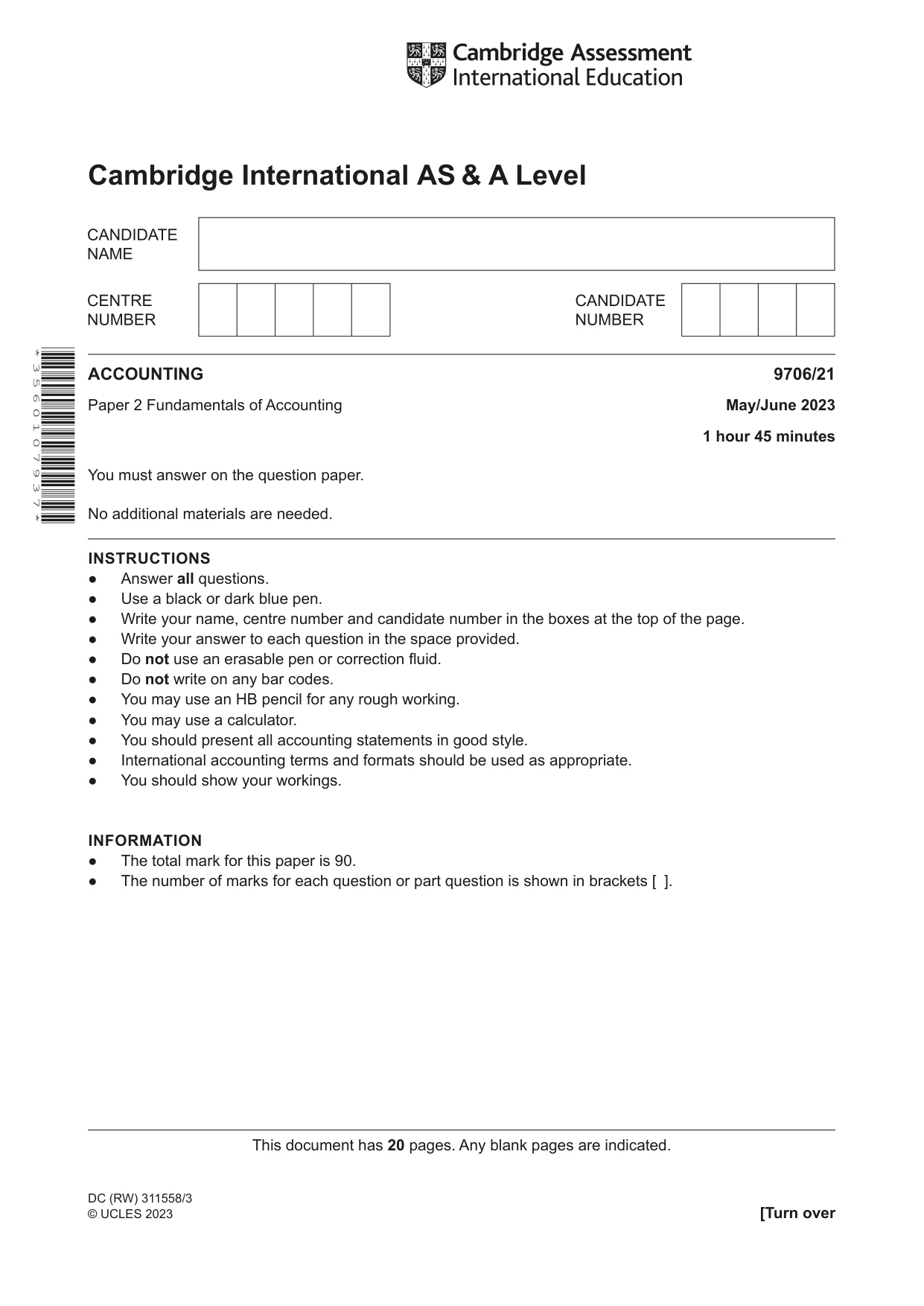
Mark scheme13 pages
Answers below. Sit the paper first if you are practising.
Questions as text
Q1 · Mima is the owner of a wholesale business, Mima Supplies
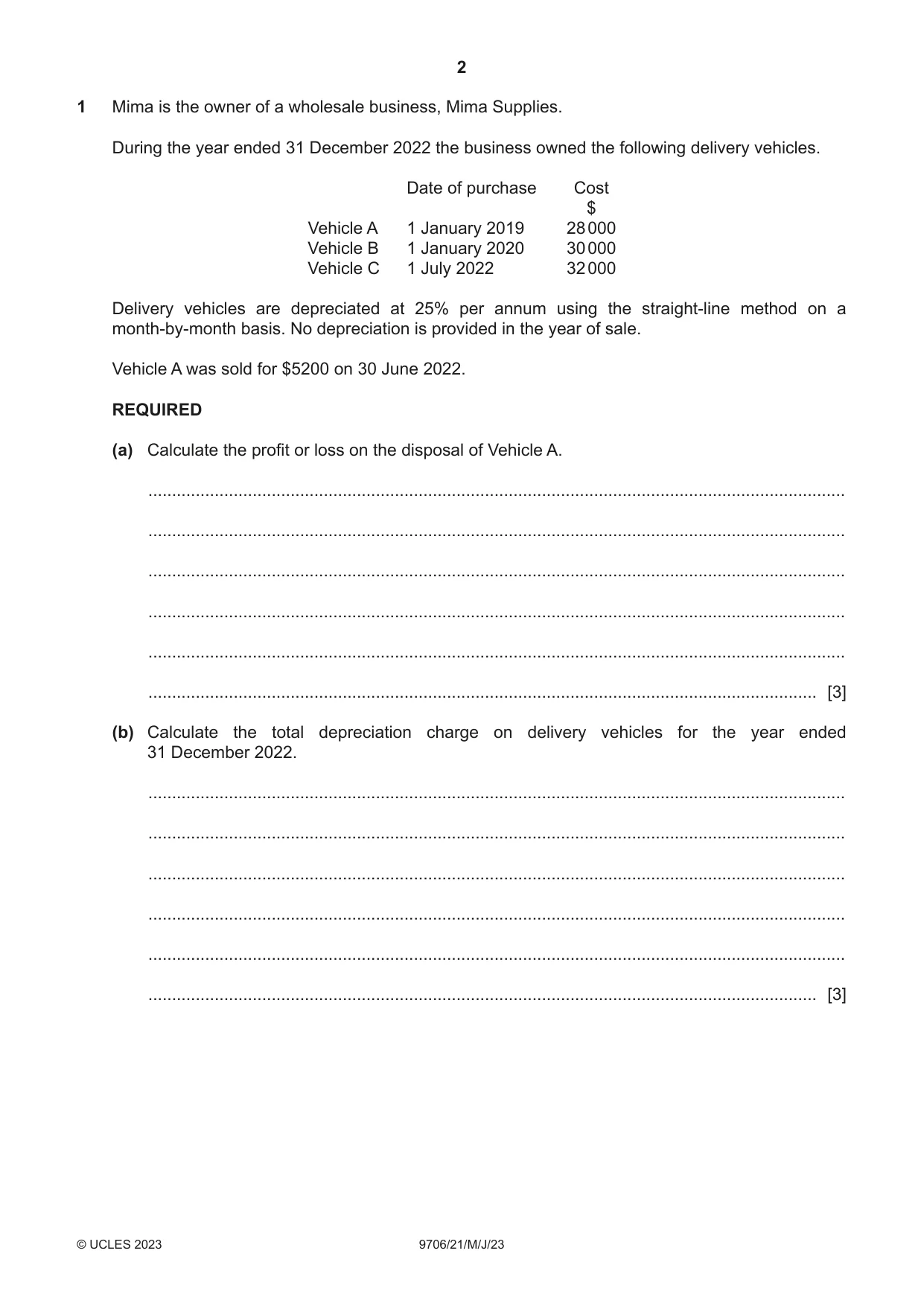
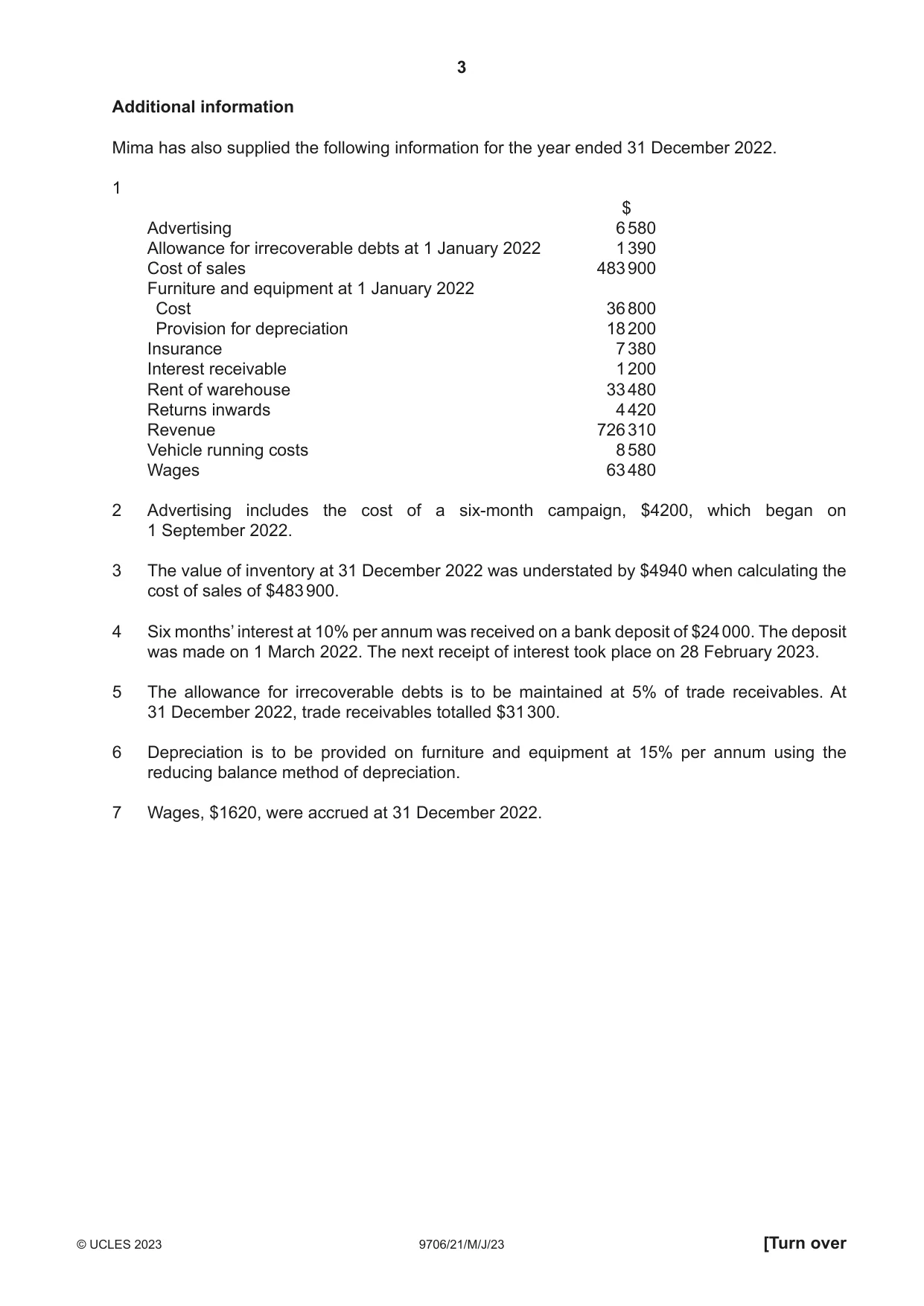
1 Mima is the owner of a wholesale business, Mima Supplies. During the year ended 31 December 2022 the business owned the following delivery vehicles. Date of purchase Cost $ Vehicle A 1 January 2019 28 000 Vehicle B 1 January 2020 30 000 Vehicle C 1 July 2022 32 000 Delivery vehicles are depreciated at 25% per annum using the straight‑line method on a month‑by‑month basis. No depreciation is provided in the year of sale. Vehicle A was sold for $5200 on 30 June 2022. REQUIRED (a) Calculate the profit or loss on the disposal of Vehicle A. ................................................................................................................................................... ................................................................................................................................................... ................................................................................................................................................... ................................................................................................................................................... ................................................................................................................................................... ............................................................................................................................................. [3] (b) Calculate the total depreciation charge on delivery vehicles for the year ended 31 December 2022. ................................................................................................................................................... ................................................................................................................................................... ................................................................................................................................................... ................................................................................................................................................... ................................................................................................................................................... ............................................................................................................................................. [3] Additional information Mima has also supplied the following information for the year ended 31 December 2022. 1 $ Advertising 6 580 Allowance for irrecoverable debts at 1 January 2022 1 390 Cost of sales 483 900 Furniture and equipment at 1 January 2022 Cost 36 800 Provision for depreciation 18 200 Insurance 7 380 Interest receivable 1 200 Rent of warehouse 33 480 Returns inwards 4 420 Revenue 726 310 Vehicle running costs 8 580 Wages 63 480
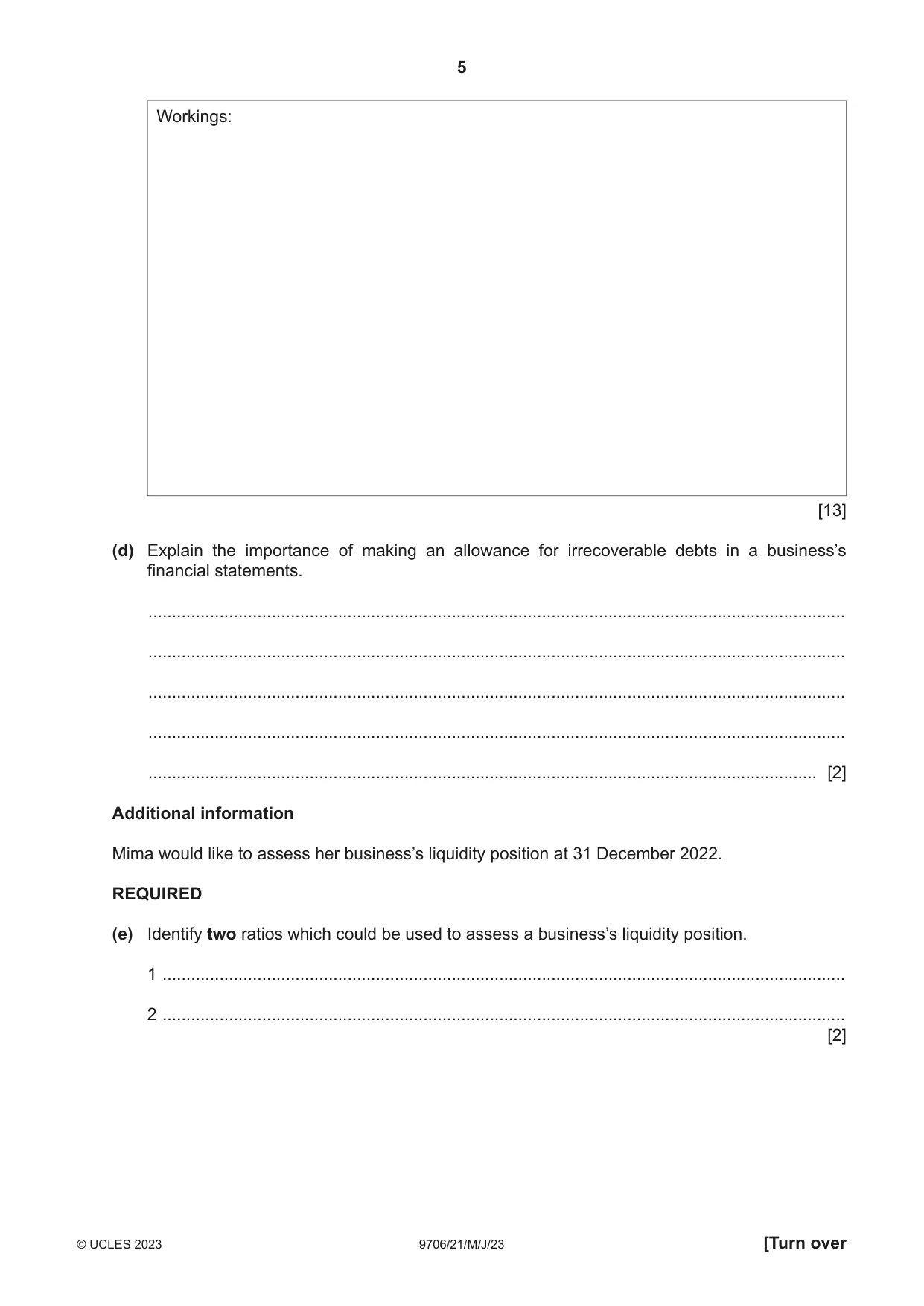
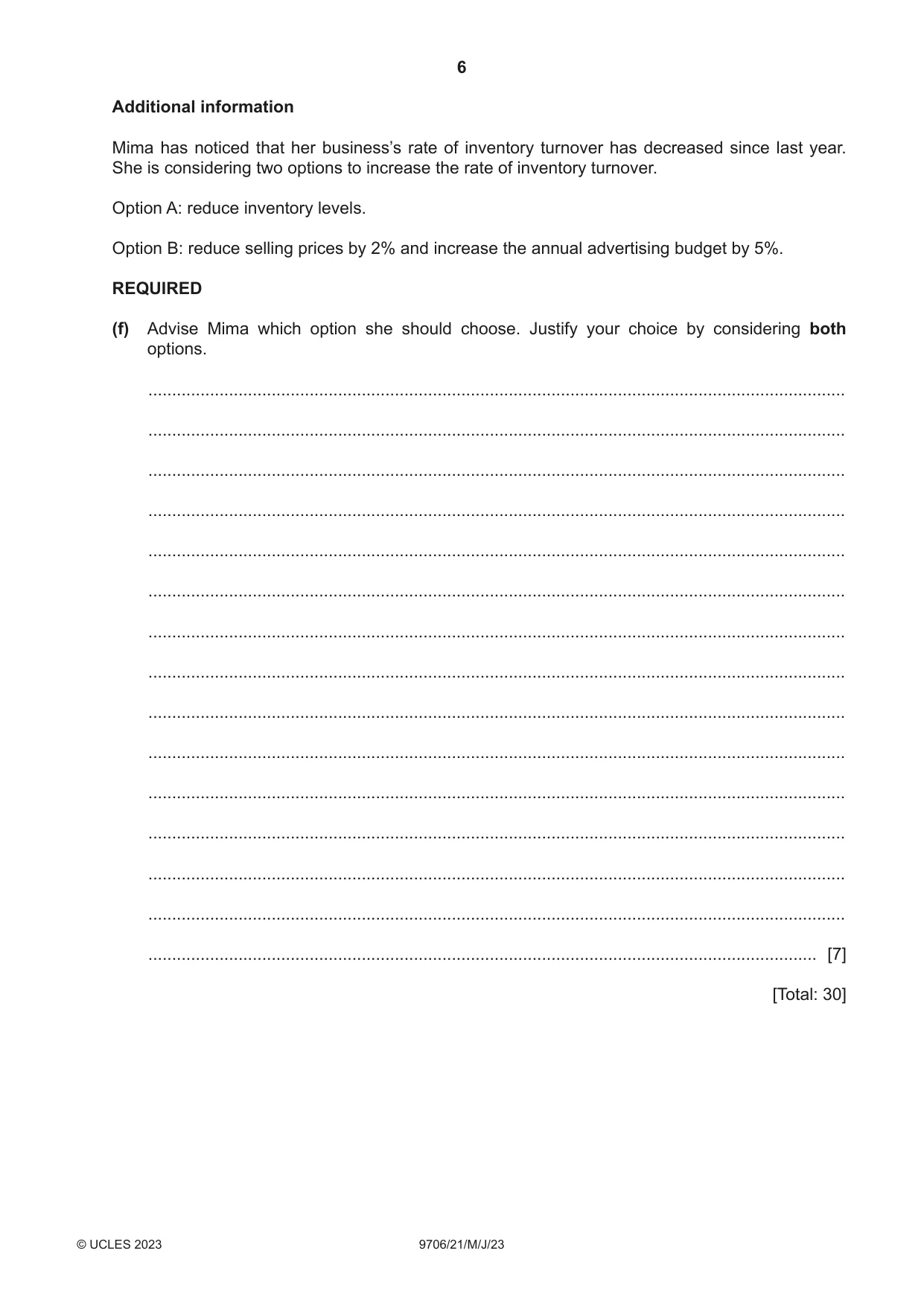
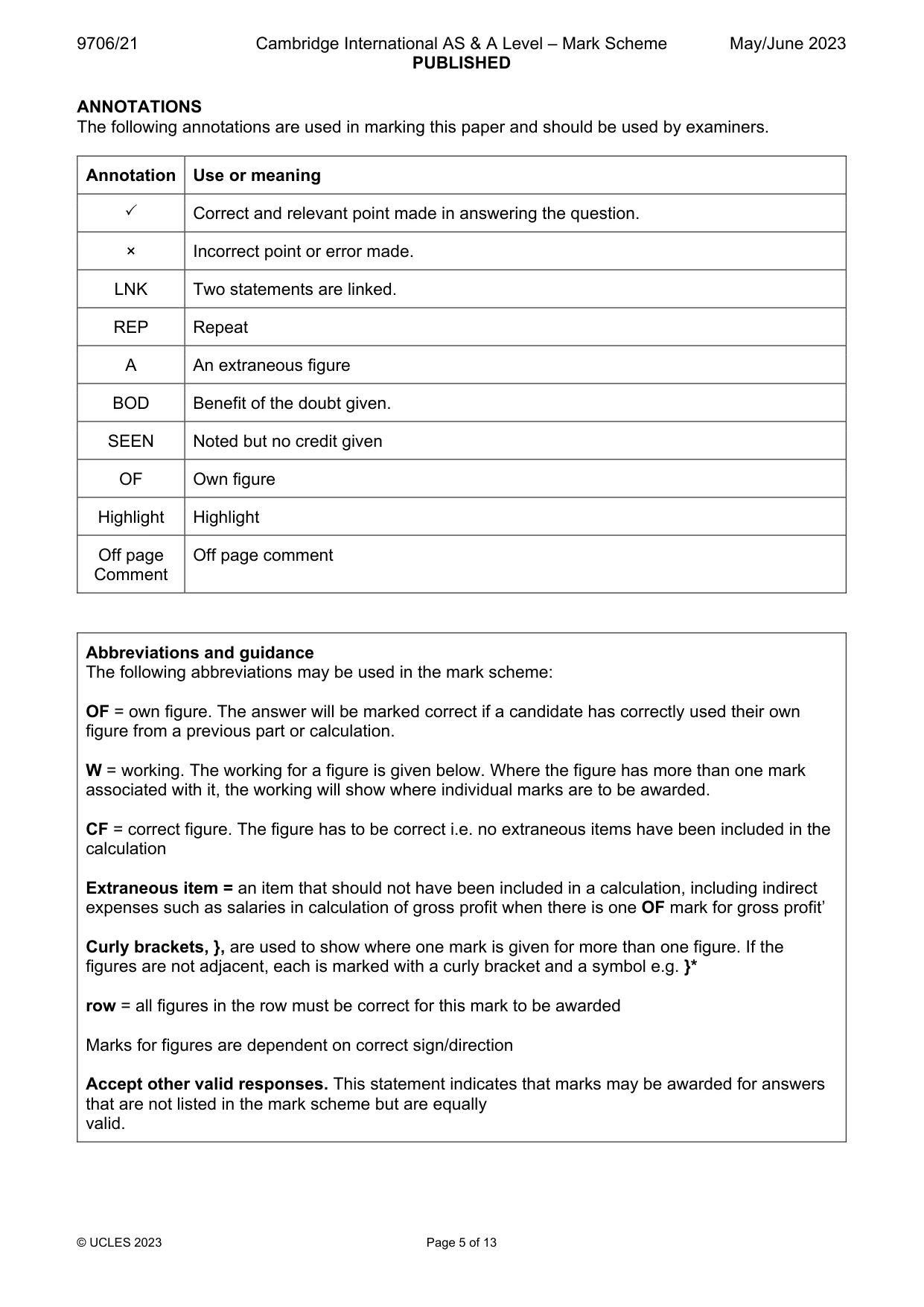
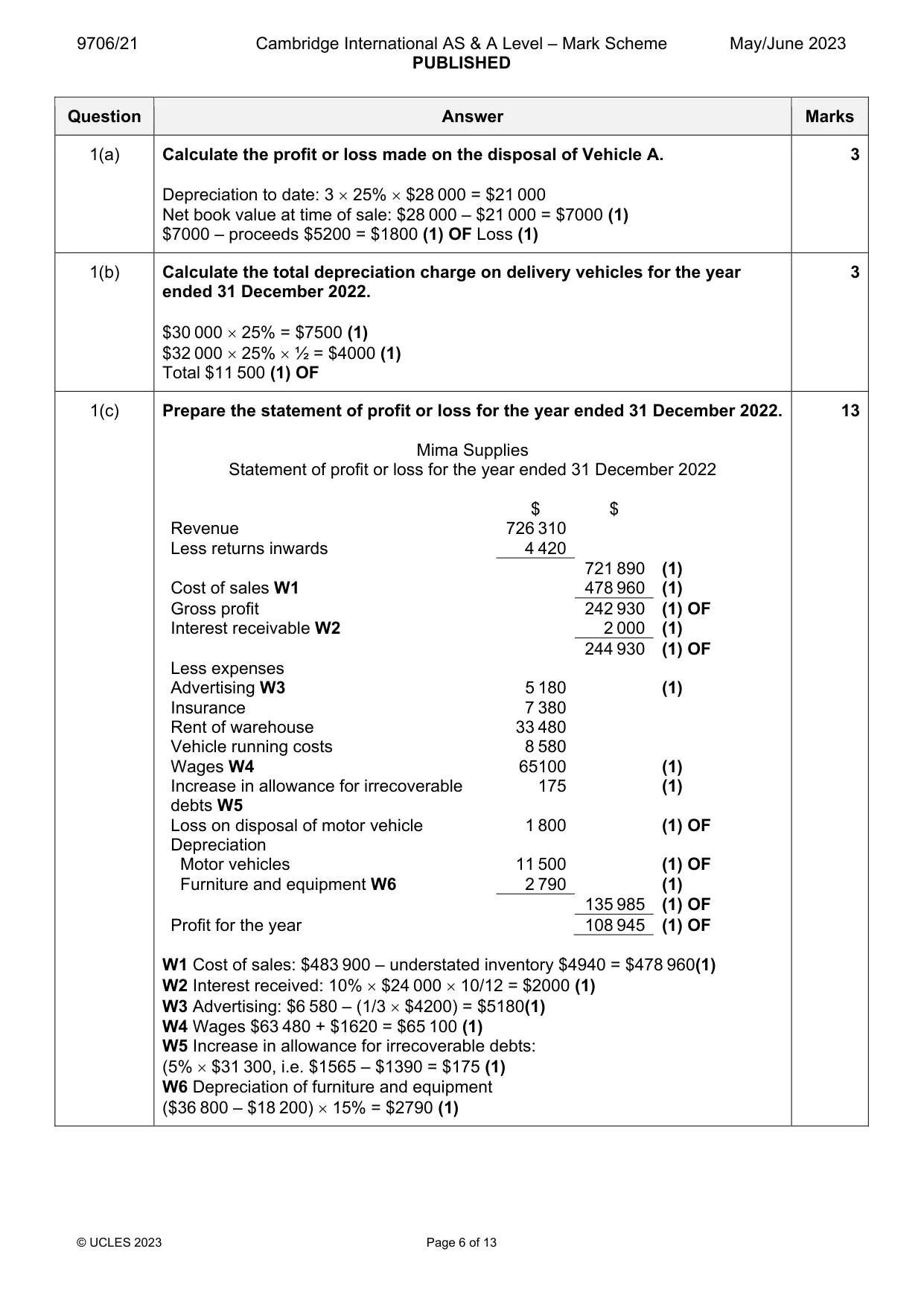
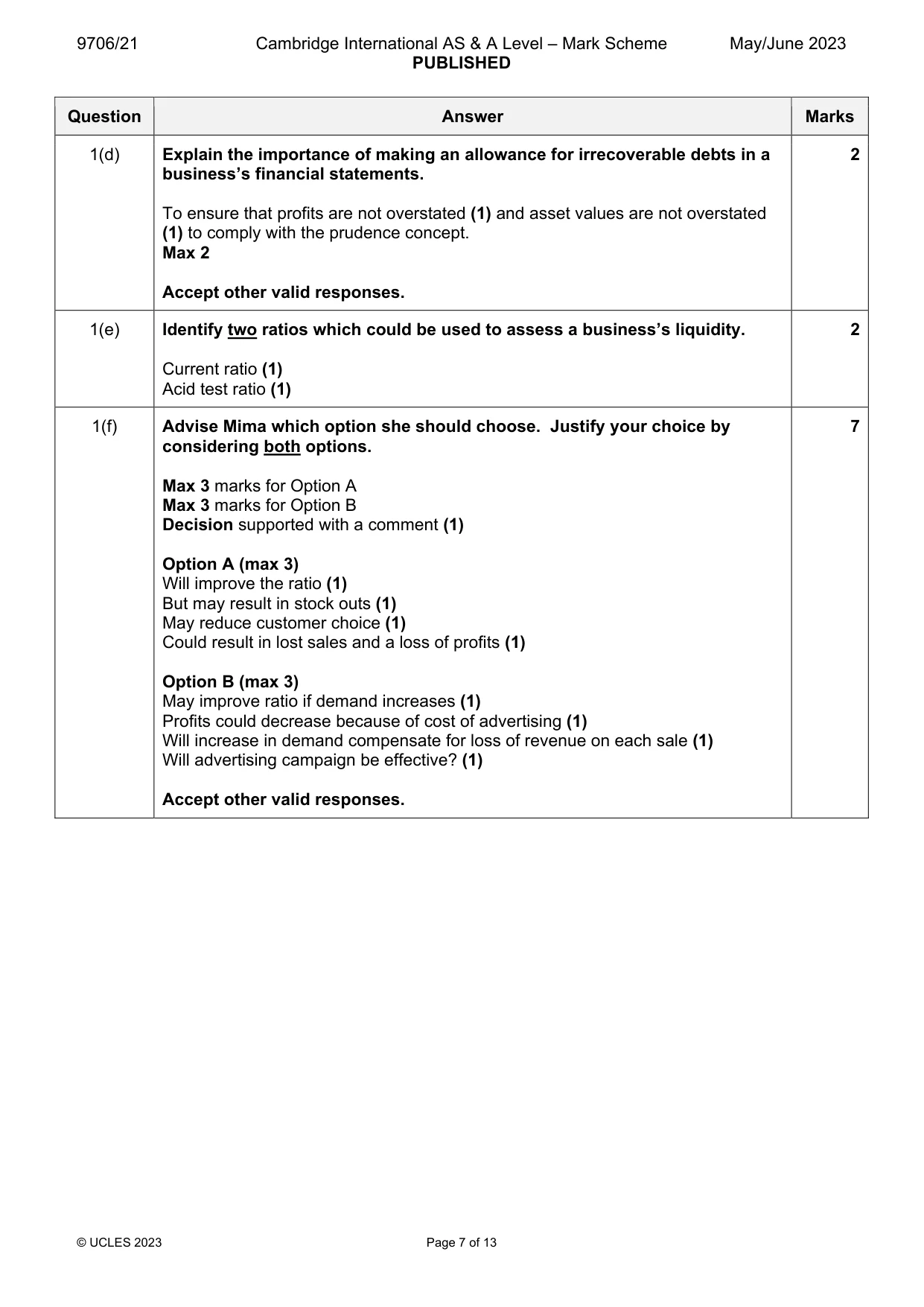
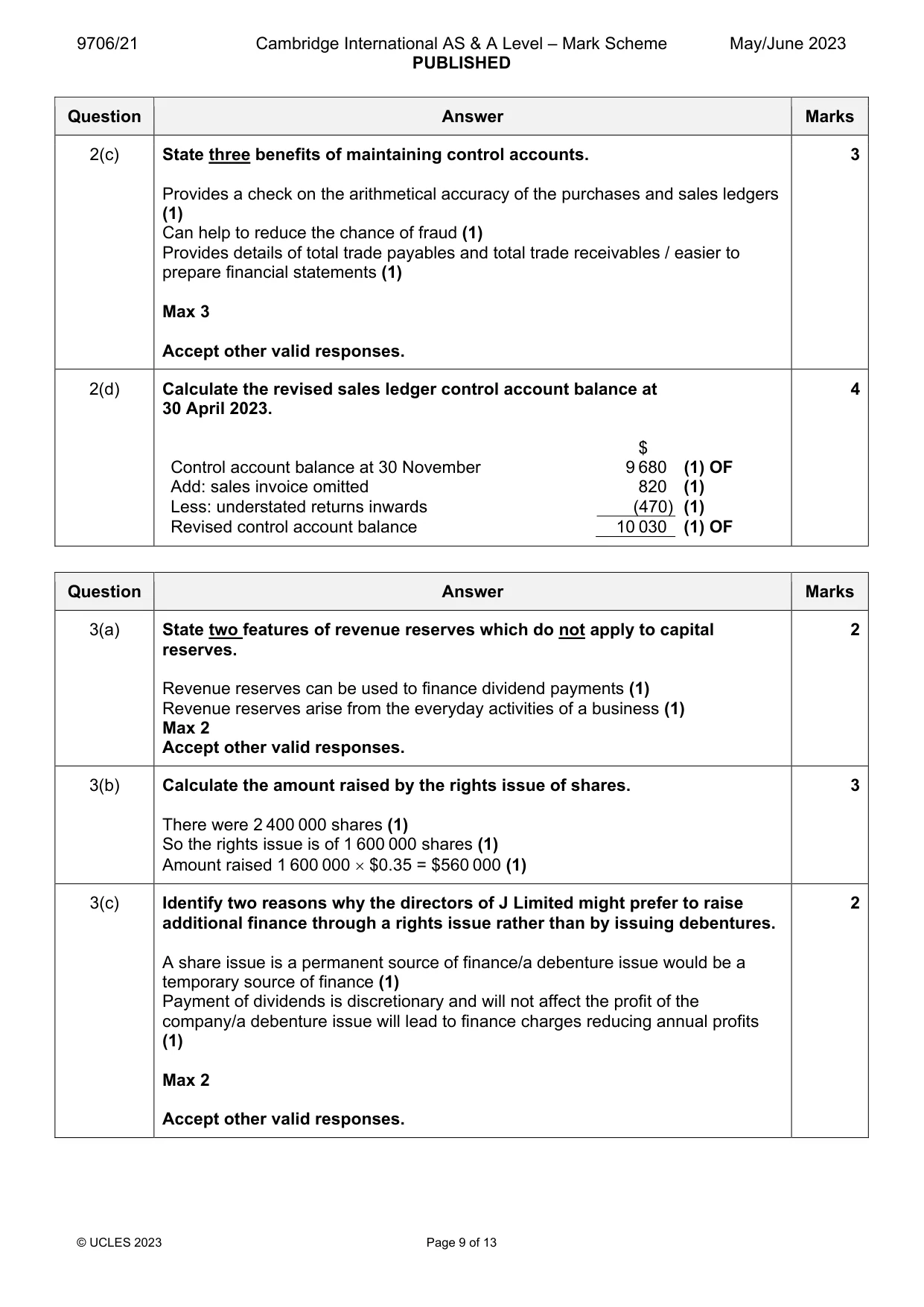
Mark scheme: Question Answer Marks 1(a) Calculate the profit or loss made on the disposal of Vehicle A. 3 Depreciation to date: 3 25% $28 000 = $21 000 Net book value at time of sale: $28 000 – $21 000 = $7000 (1) $7000 – proceeds $5200 = $1800 (1) OF Loss (1) 1(b) Calculate the total depreciation charge on delivery vehicles for the year 3 ended 31 December 2022. $30 000 25% = $7500 (1) $32 000 25% ½ = $4000 (1) Total $11 500 (1) OF 1(c) Prepare the statement of profit or loss for the year ended 31 December 2022. 13 Mima Supplies Statement of profit or loss for the year ended 31 December 2022 $ $ Revenue 726 310 Less returns inwards 4 420 721 890 (1) Cost of sales W1 478 960 (1) Gross profit 242 930 (1) OF Interest receivable W2 2 000 (1) 244 930 (1) OF Less expenses Advertising W3 5 180 (1) Insurance 7 380 Rent of warehouse 33 480 Vehicle running costs 8 580 Wages W4 65100 (1) Increase in allowance for irrecoverable 175 (1) debts W5 Loss on disposal of motor vehicle 1 800 (1) OF Depreciation Motor vehicles 11 500 (1) OF Furniture and equipment W6 2 790 (1) 135 985 (1) OF Profit for the year 108 945 (1) OF W1 Cost of sales: $483 900 – understated inventory $4940 = $478 960(1) W2 Interest received: 10% $24 000 10/12 = $2000 (1) W3 Advertising: $6 580 – (1/3 $4200) = $5180(1) W4 Wages $63 480 + $1620 = $65 100 (1) W5 Increase in allowance for irrecoverable debts: (5% $31 300, i.e. $1565 – $1390 = $175 (1) W6 Depreciation of furniture and equipment ($36 800 – $18 200) 15% = $2790 (1) 1(d) Explain the importance of making an allowance for irrecoverable debts in a 2 business’s financial statements. To ensure that profits are not overstated (1) and asset values are not overstated (1) to comply with the prudence concept. Max 2 Accept other valid responses. 1(e) Identify two ratios which could be used to assess a business’s liquidity. 2 Current ratio (1) Acid test ratio (1) 1(f) Advise Mima which option she should choose. Justify your choice by 7 considering both options. Max 3 marks for Option A Max 3 marks for Option B Decision supported with a comment (1) Option A (max 3) Will improve the ratio (1) But may result in stock outs (1) May reduce customer choice (1) Could result in lost sales and a loss of profits (1) Option B (max 3) May improve ratio if demand increases (1) Profits could decrease because of cost of advertising (1) Will increase in demand compensate for loss of revenue on each sale (1) Will advertising campaign be effective? (1) Accept other valid responses.
Q2 · Advertising includes the cost of a six‑month campaign, $4200, which began on 1 September…
2 Advertising includes the cost of a six‑month campaign, $4200, which began on 1 September 2022.
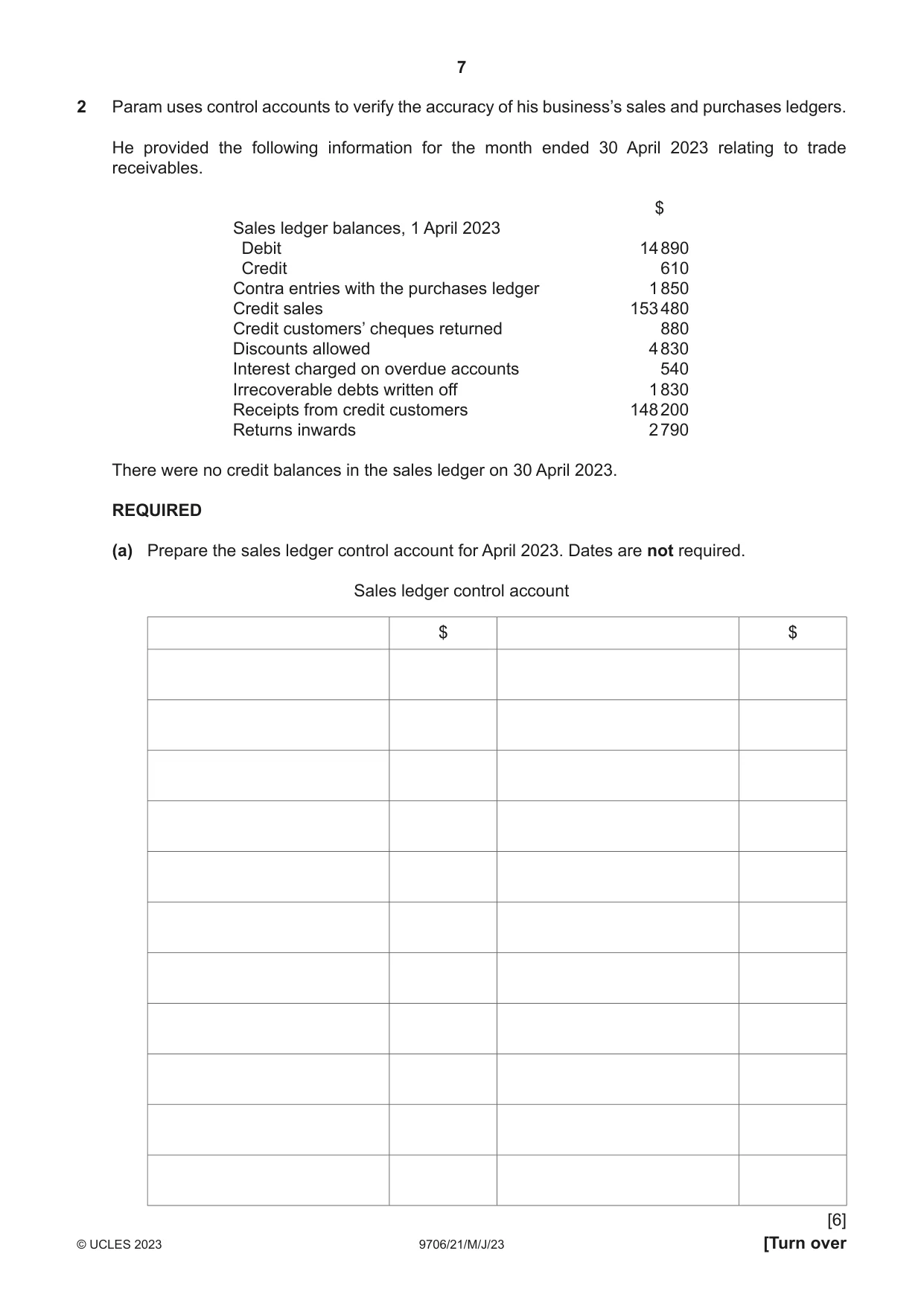
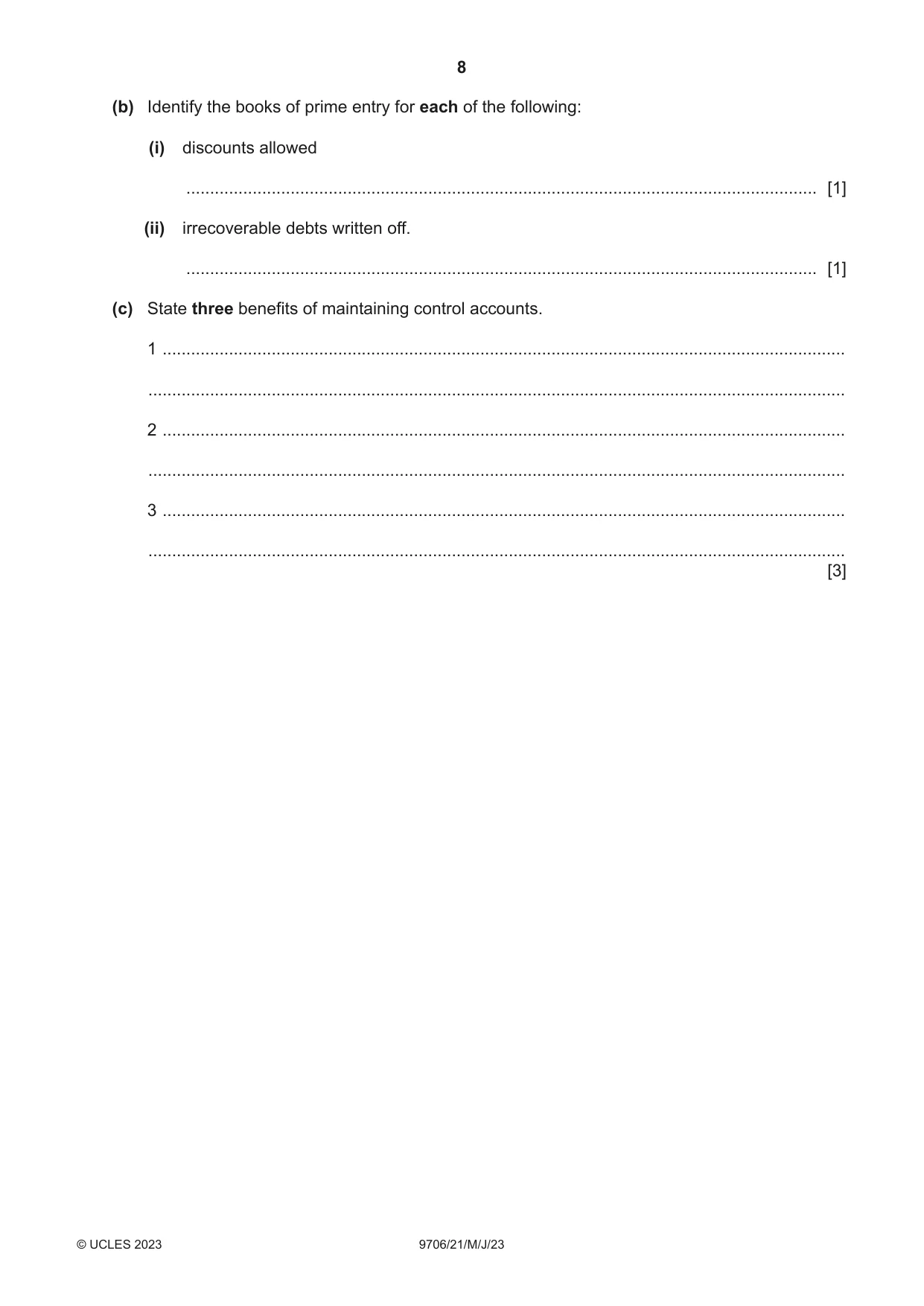
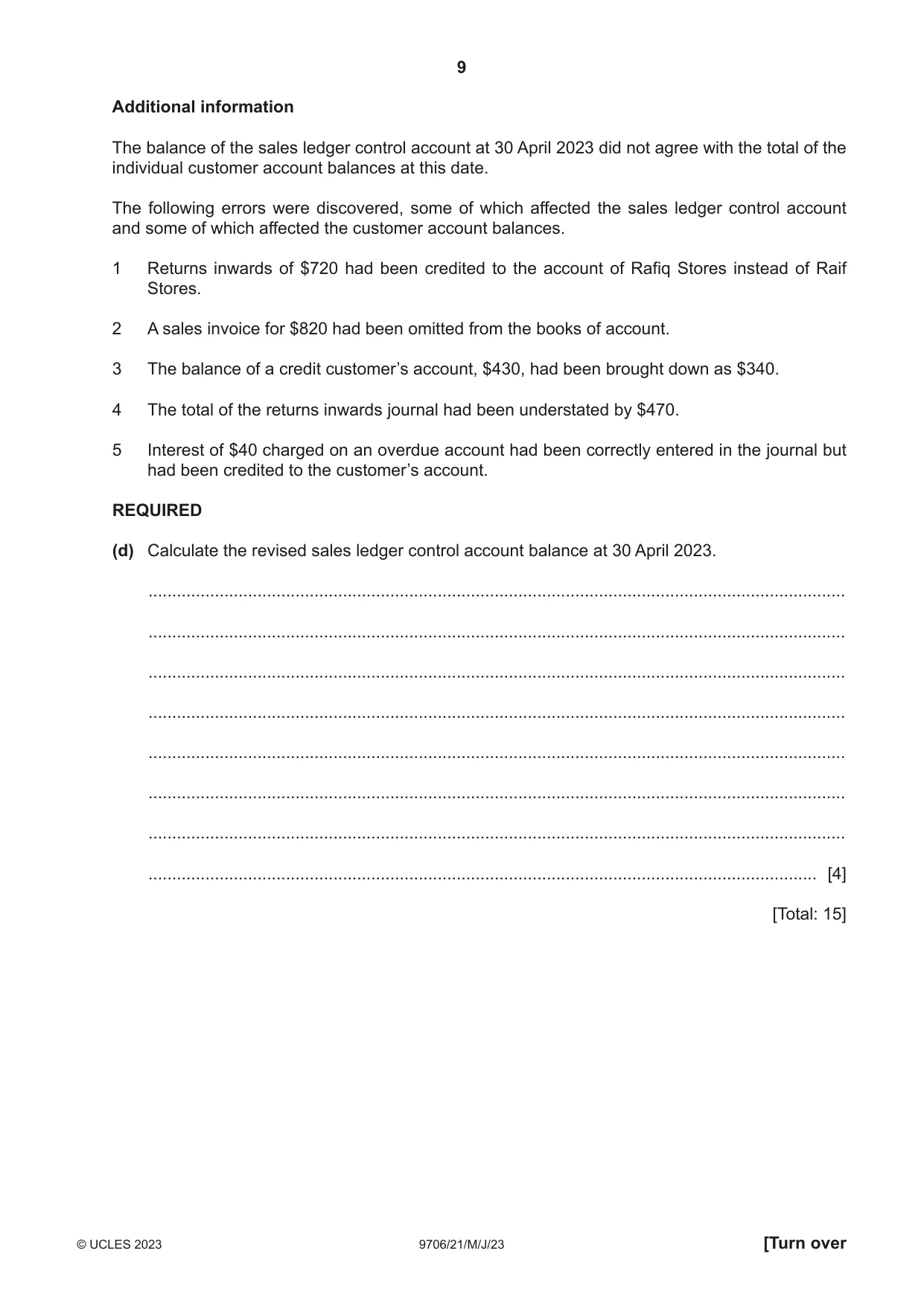
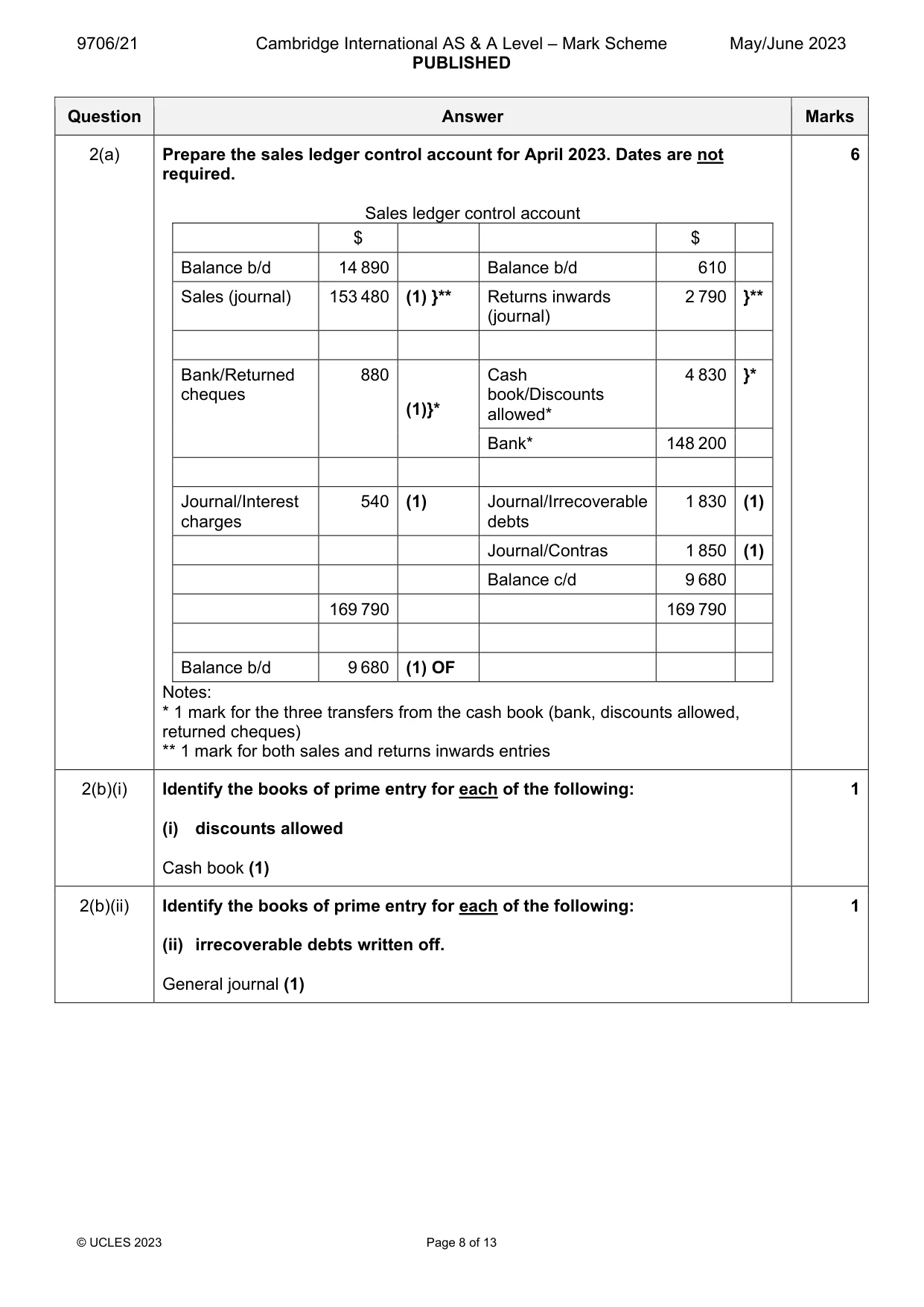
Mark scheme: 2(a) Prepare the sales ledger control account for April 2023. Dates are not 6 required. Sales ledger control account $ $ Balance b/d 14 890 Balance b/d 610 Sales (journal) 153 480 (1) }** Returns inwards 2 790 }** (journal) Bank/Returned 880 Cash 4 830 }* cheques book/Discounts (1)}* allowed* Bank* 148 200 Journal/Interest 540 (1) Journal/Irrecoverable 1 830 (1) charges debts Journal/Contras 1 850 (1) Balance c/d 9 680 169 790 169 790 Balance b/d 9 680 (1) OF Notes: * 1 mark for the three transfers from the cash book (bank, discounts allowed, returned cheques) ** 1 mark for both sales and returns inwards entries 2(b)(i) Identify the books of prime entry for each of the following: 1 (i) discounts allowed Cash book (1) 2(b)(ii) Identify the books of prime entry for each of the following: 1 (ii) irrecoverable debts written off. General journal (1) 2(c) State three benefits of maintaining control accounts. 3 Provides a check on the arithmetical accuracy of the purchases and sales ledgers (1) Can help to reduce the chance of fraud (1) Provides details of total trade payables and total trade receivables / easier to prepare financial statements (1) Max 3 Accept other valid responses. 2(d) Calculate the revised sales ledger control account balance at 4 30 April 2023. $ Control account balance at 30 November 9 680 (1) OF Add: sales invoice omitted 820 (1) Less: understated returns inwards (470) (1) Revised control account balance 10 030 (1) OF
Q3 · The value of inventory at 31 December 2022 was understated by $4940 when calculating the…
3 The value of inventory at 31 December 2022 was understated by $4940 when calculating the cost of sales of $483 900.
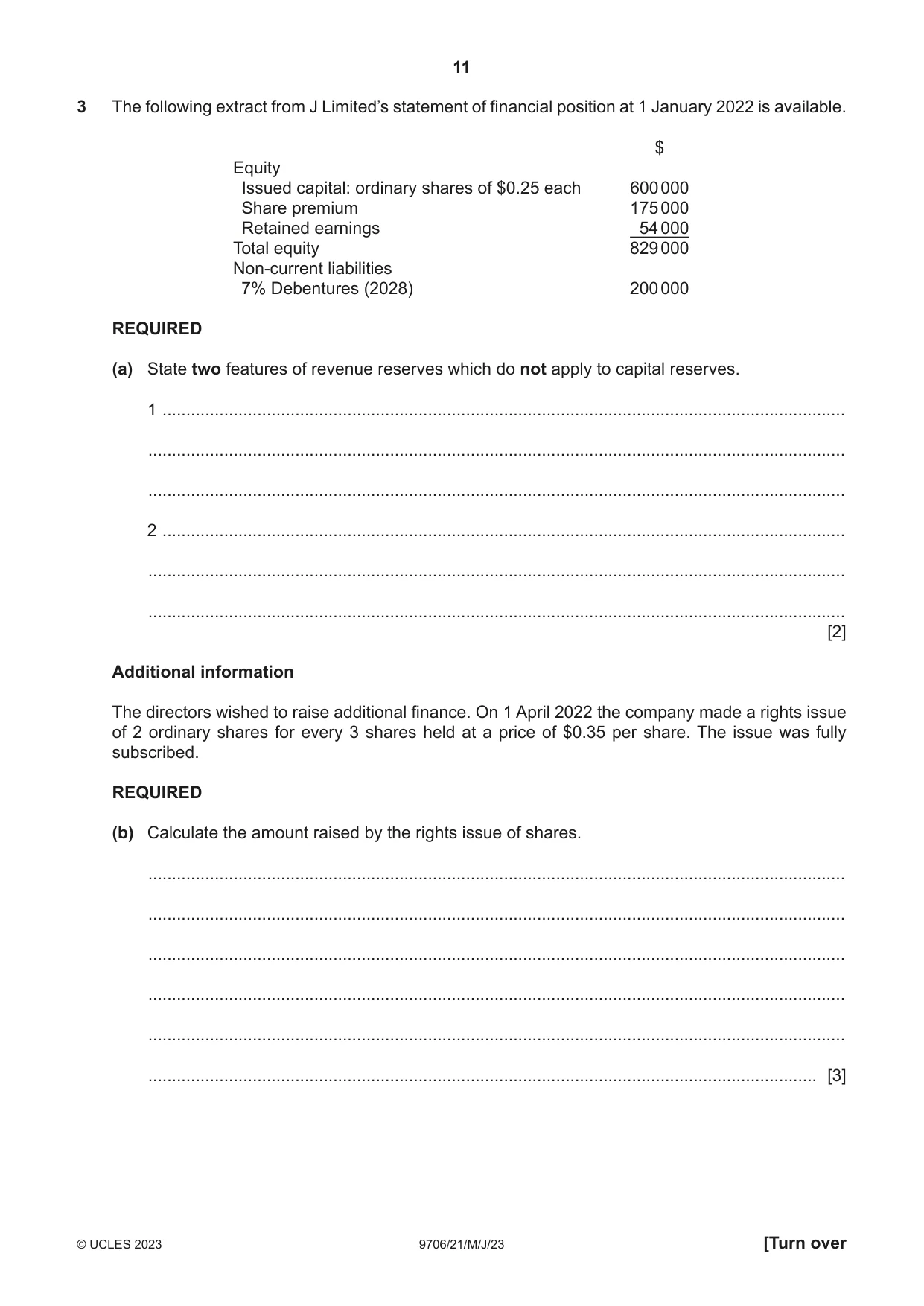
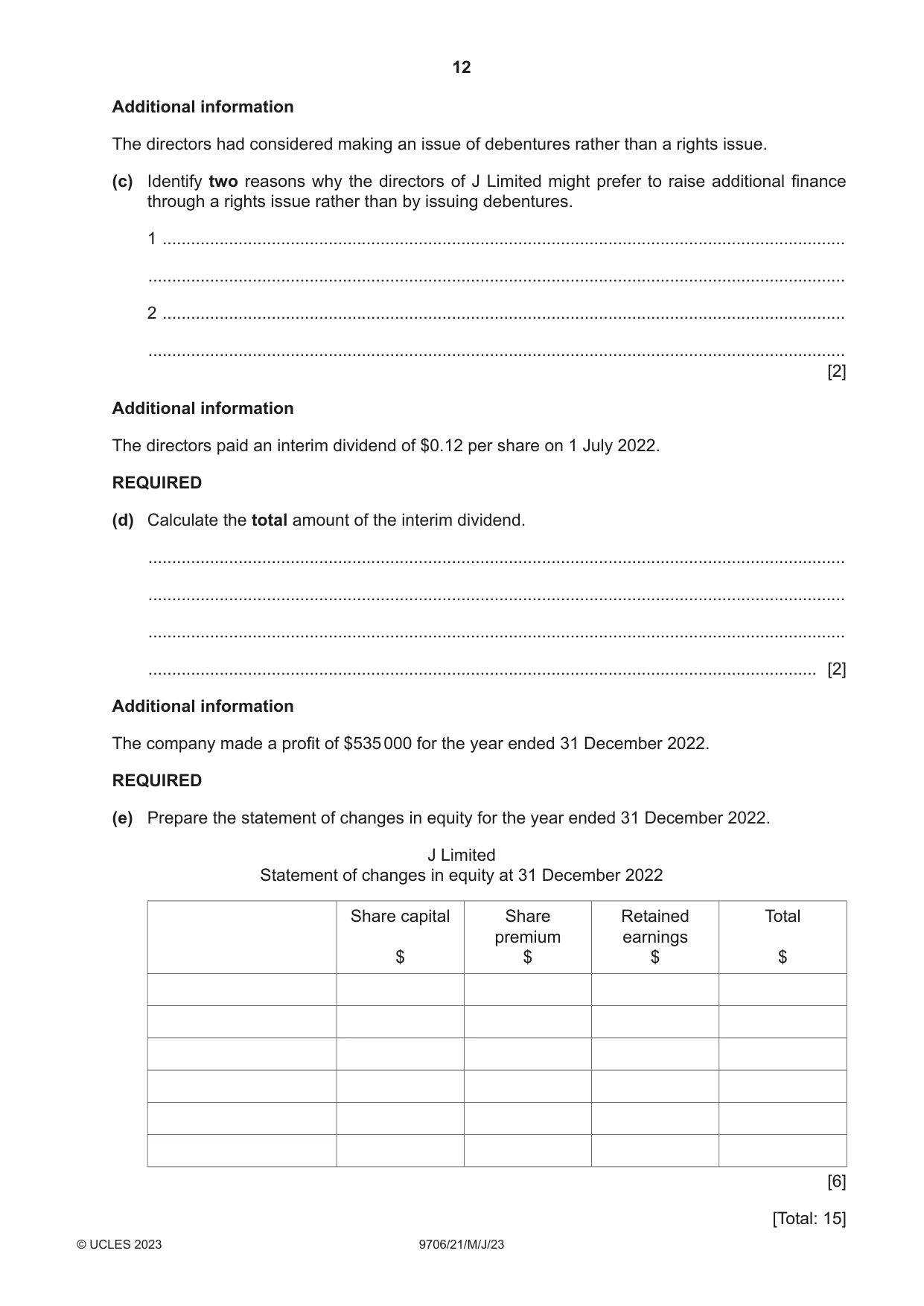
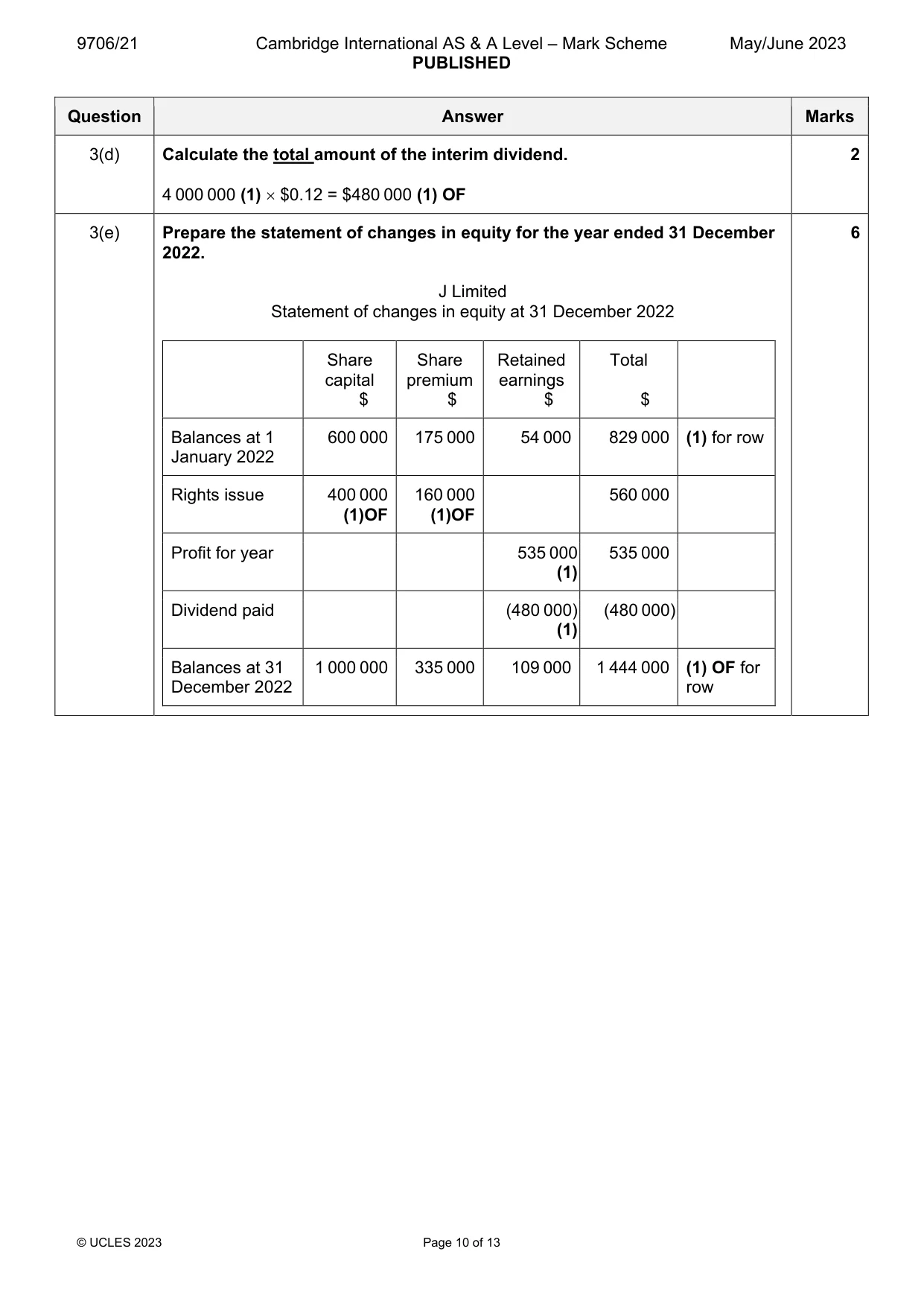
Mark scheme: 3(a) State two features of revenue reserves which do not apply to capital 2 reserves. Revenue reserves can be used to finance dividend payments (1) Revenue reserves arise from the everyday activities of a business (1) Max 2 Accept other valid responses. 3(b) Calculate the amount raised by the rights issue of shares. 3 There were 2 400 000 shares (1) So the rights issue is of 1 600 000 shares (1) Amount raised 1 600 000 $0.35 = $560 000 (1) 3(c) Identify two reasons why the directors of J Limited might prefer to raise 2 additional finance through a rights issue rather than by issuing debentures. A share issue is a permanent source of finance/a debenture issue would be a temporary source of finance (1) Payment of dividends is discretionary and will not affect the profit of the company/a debenture issue will lead to finance charges reducing annual profits (1) Max 2 Accept other valid responses. 3(d) Calculate the total amount of the interim dividend. 2 4 000 000 (1) $0.12 = $480 000 (1) OF 3(e) Prepare the statement of changes in equity for the year ended 31 December 6 2022. J Limited Statement of changes in equity at 31 December 2022 Share Share Retained Total capital premium earnings $ $ $ $ Balances at 1 600 000 175 000 54 000 829 000 (1) for row January 2022 Rights issue 400 000 160 000 560 000 (1)OF (1)OF Profit for year 535 000 535 000 (1) Dividend paid (480 000) (480 000) (1) Balances at 31 1 000 000 335 000 109 000 1 444 000 (1) OF for December 2022 row
Q4 · Six months’ interest at 10% per annum was received on a bank deposit of $24 000
4 Six months’ interest at 10% per annum was received on a bank deposit of $24 000. The deposit was made on 1 March 2022. The next receipt of interest took place on 28 February 2023.
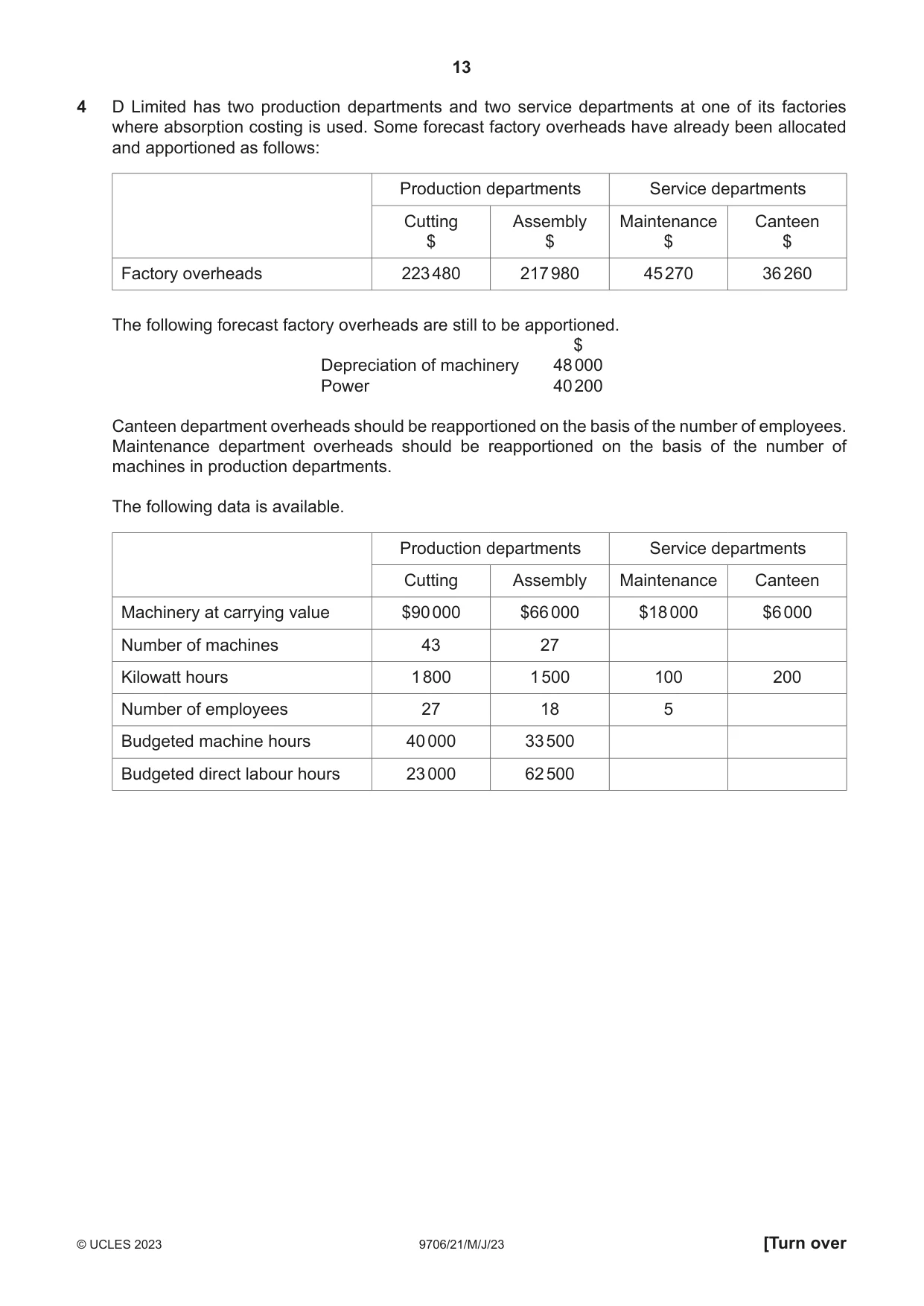
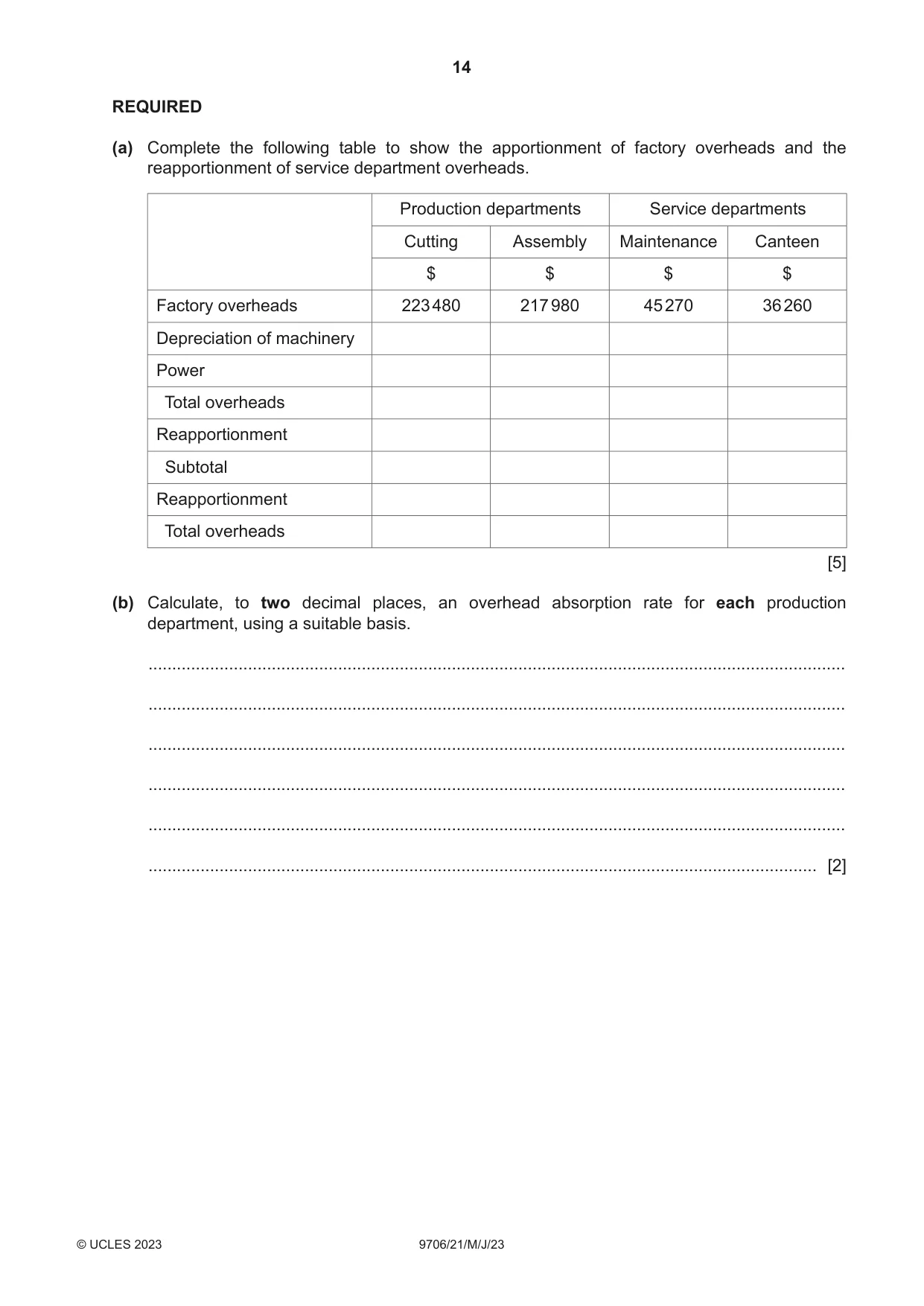
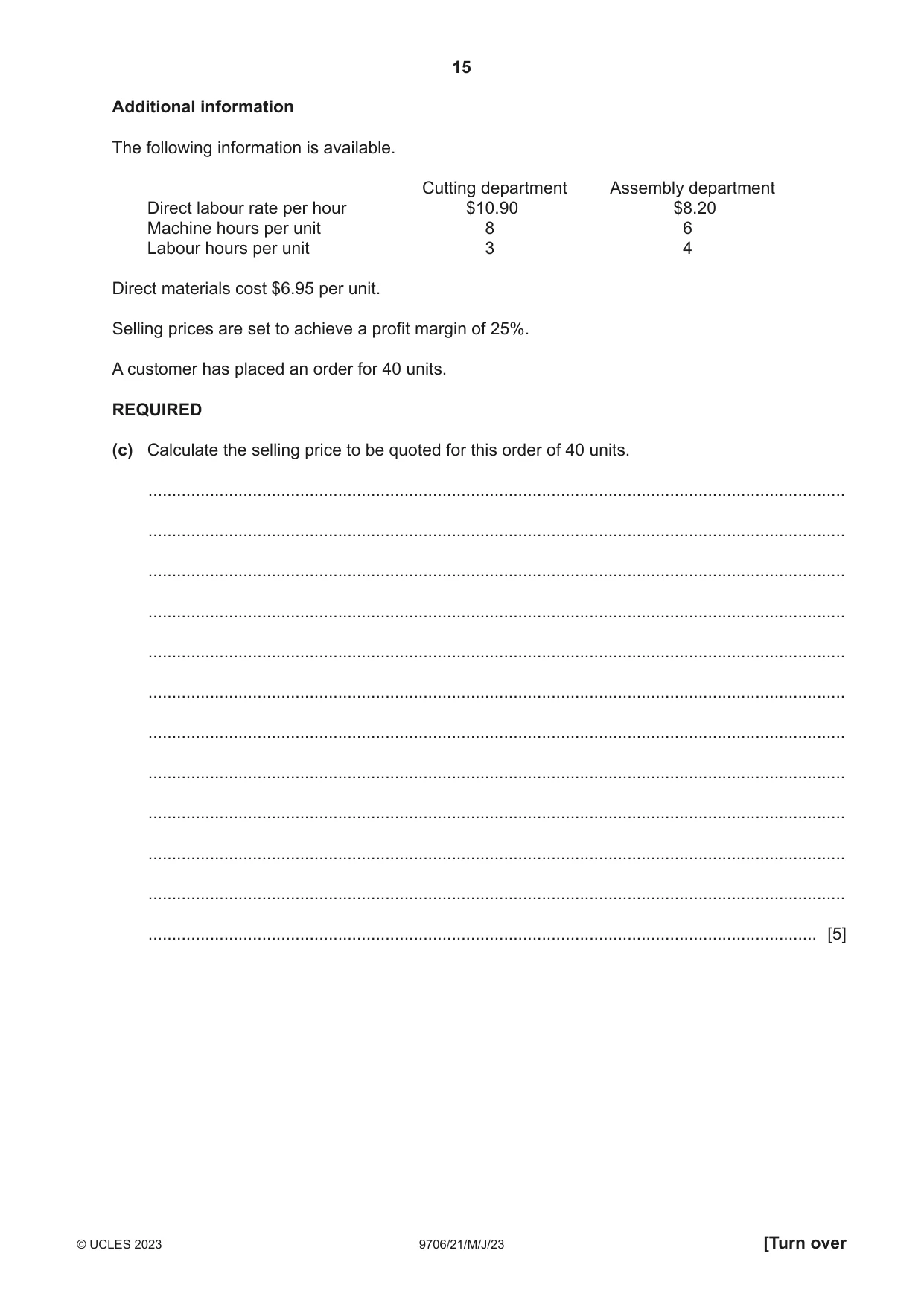
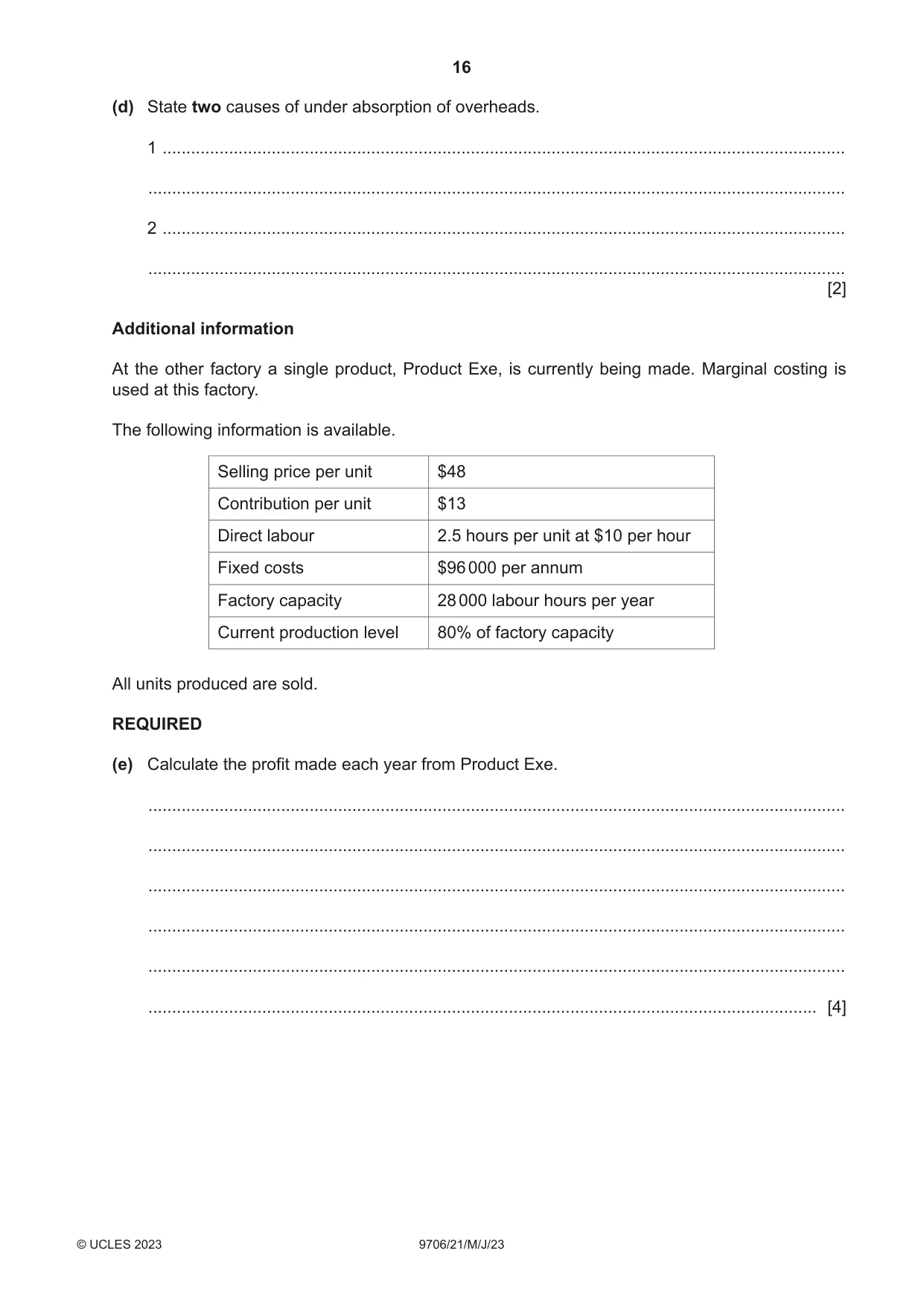
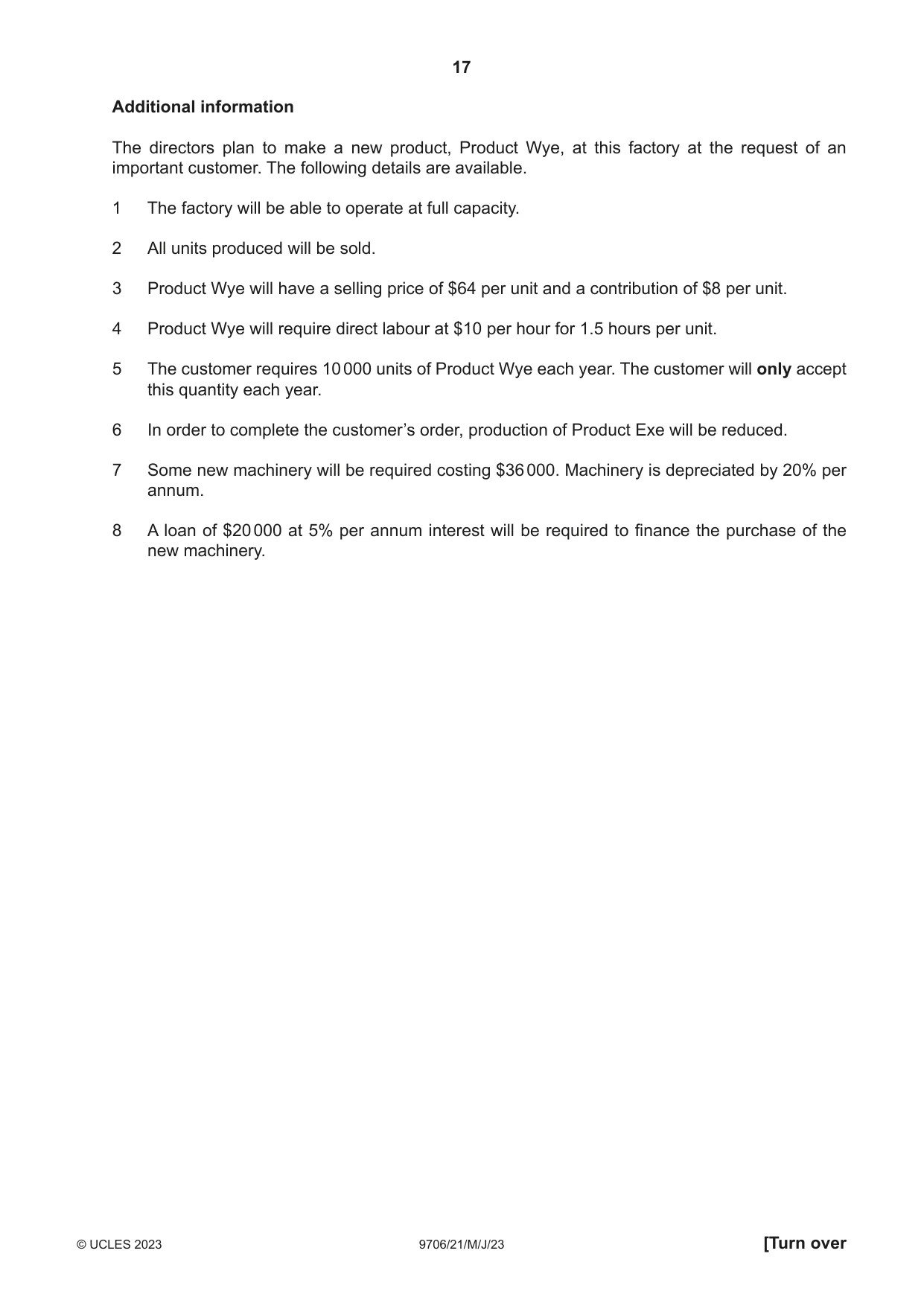
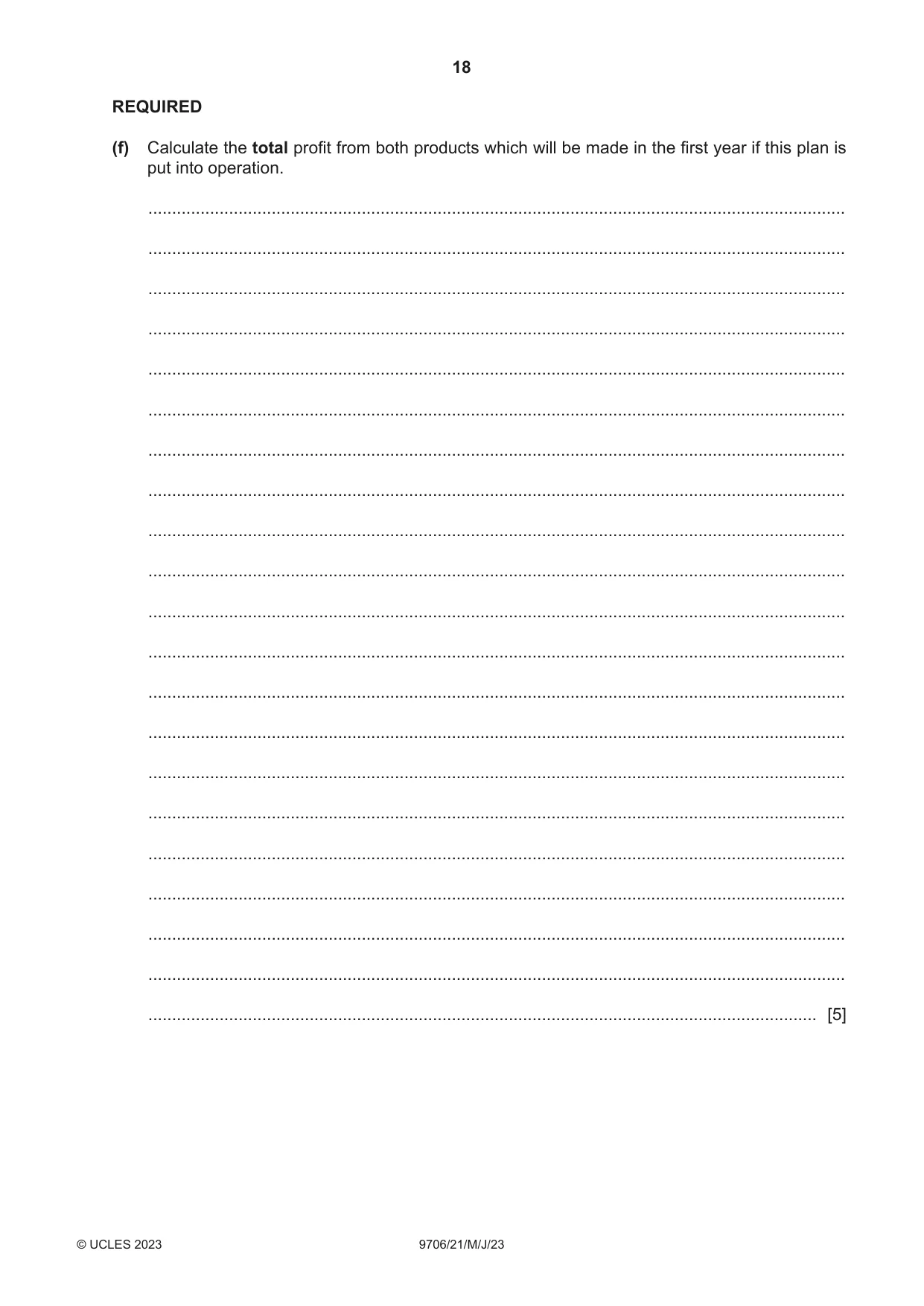
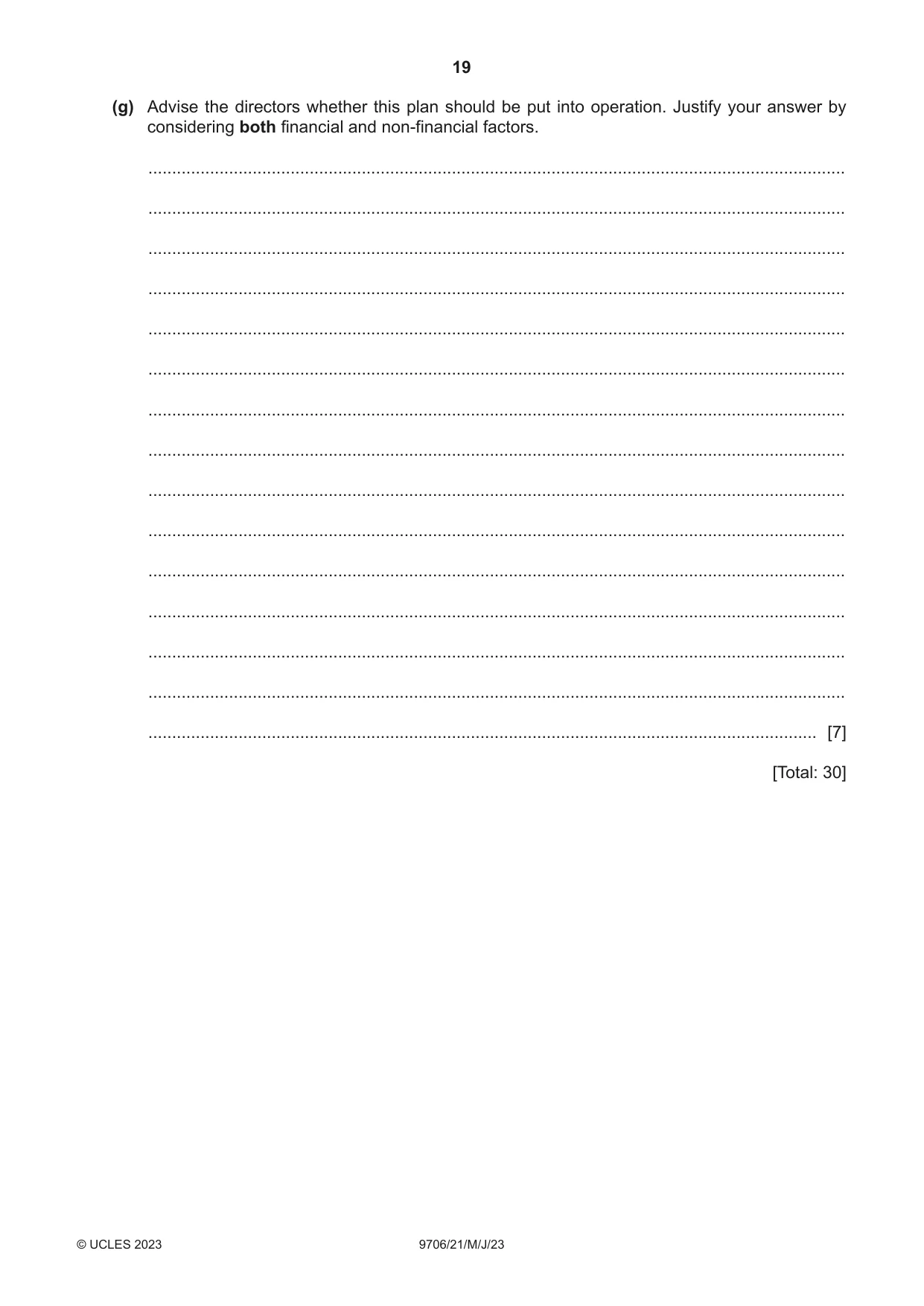
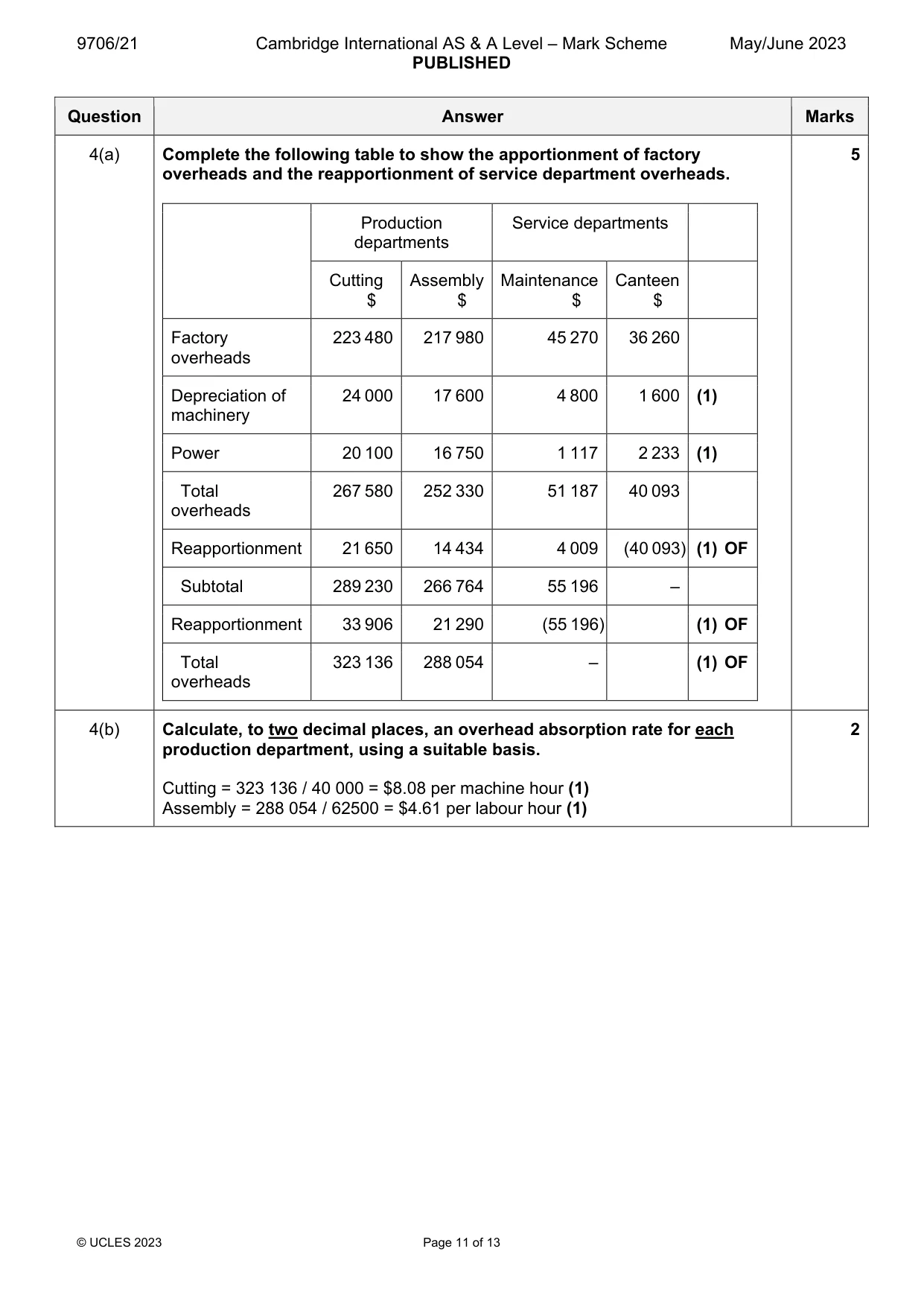
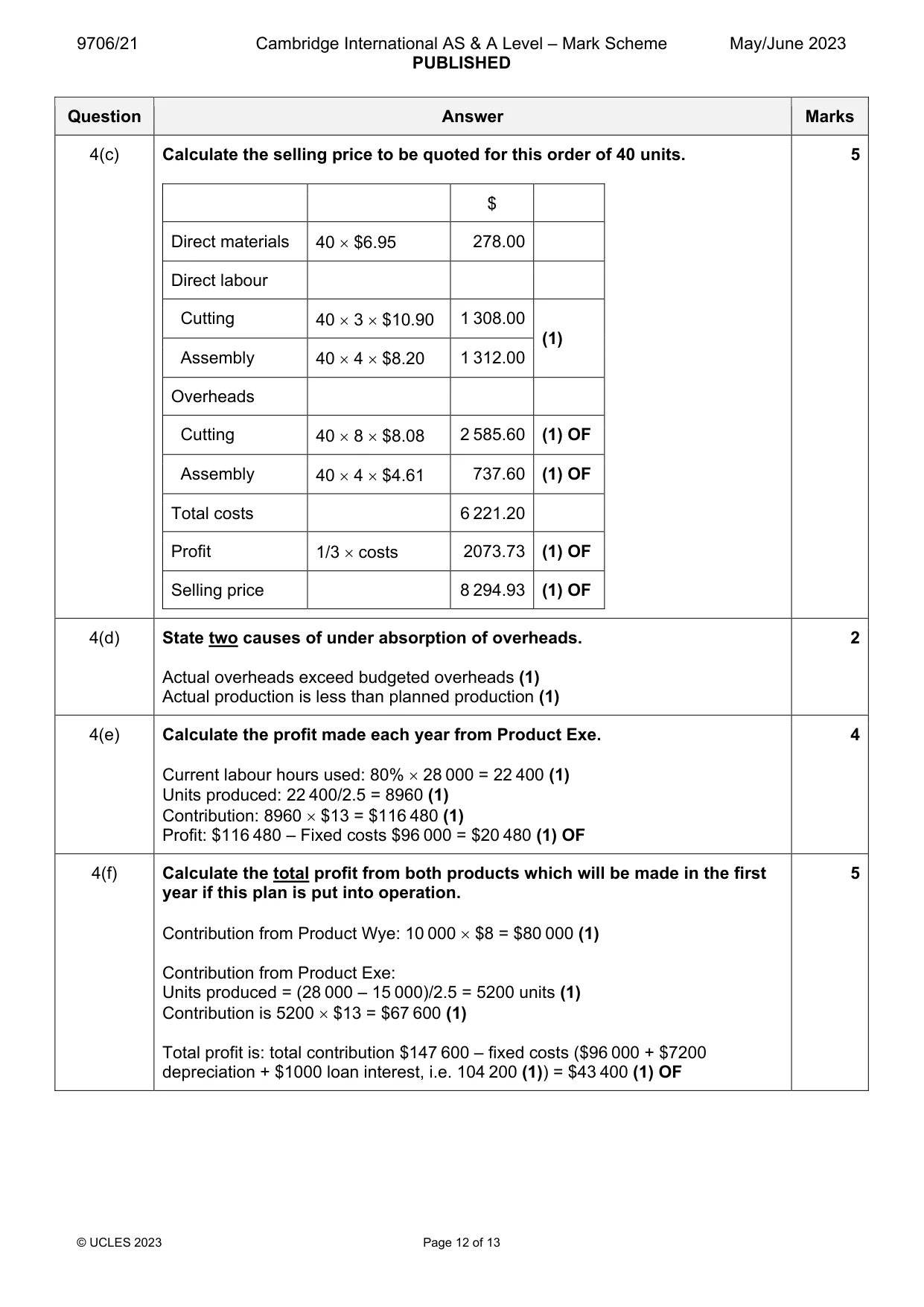
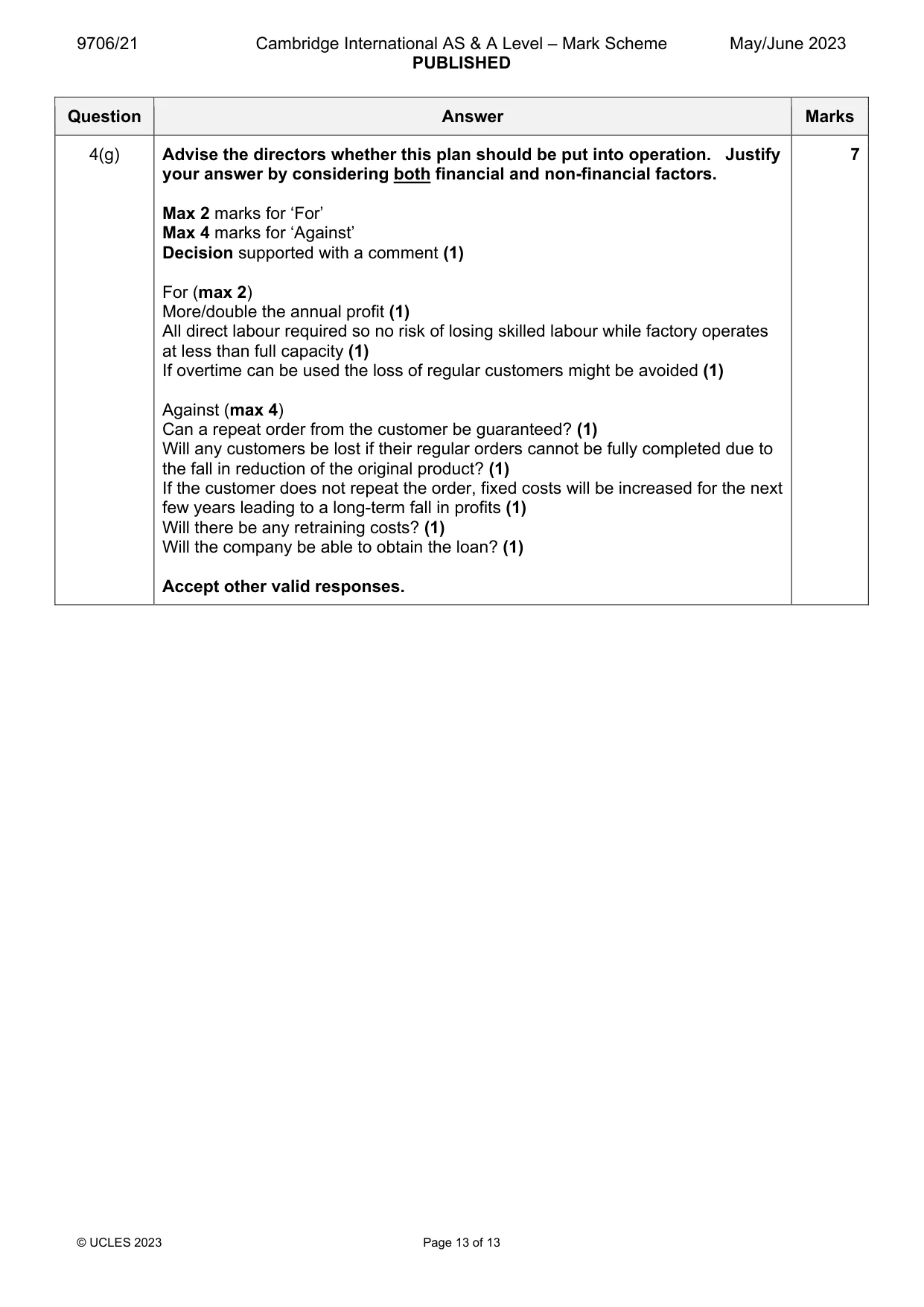
Mark scheme: 4(a) Complete the following table to show the apportionment of factory 5 overheads and the reapportionment of service department overheads. Production Service departments departments Cutting Assembly Maintenance Canteen $ $ $ $ Factory 223 480 217 980 45 270 36 260 overheads Depreciation of 24 000 17 600 4 800 1 600 (1) machinery Power 20 100 16 750 1 117 2 233 (1) Total 267 580 252 330 51 187 40 093 overheads Reapportionment 21 650 14 434 4 009 (40 093) (1) OF Subtotal 289 230 266 764 55 196 – Reapportionment 33 906 21 290 (55 196) (1) OF Total 323 136 288 054 – (1) OF overheads 4(b) Calculate, to two decimal places, an overhead absorption rate for each 2 production department, using a suitable basis. Cutting = 323 136 / 40 000 = $8.08 per machine hour (1) Assembly = 288 054 / 62500 = $4.61 per labour hour (1) 4(c) Calculate the selling price to be quoted for this order of 40 units. 5 $ Direct materials 40 $6.95 278.00 Direct labour Cutting 40 3 $10.90 1 308.00 (1) Assembly 40 4 $8.20 1 312.00 Overheads Cutting 40 8 $8.08 2 585.60 (1) OF Assembly 40 4 $4.61 737.60 (1) OF Total costs 6 221.20 Profit 1/3 costs 2073.73 (1) OF Selling price 8 294.93 (1) OF 4(d) State two causes of under absorption of overheads. 2 Actual overheads exceed budgeted overheads (1) Actual production is less than planned production (1) 4(e) Calculate the profit made each year from Product Exe. 4 Current labour hours used: 80% 28 000 = 22 400 (1) Units produced: 22 400/2.5 = 8960 (1) Contribution: 8960 $13 = $116 480 (1) Profit: $116 480 – Fixed costs $96 000 = $20 480 (1) OF 4(f) Calculate the total profit from both products which will be made in the first 5 year if this plan is put into operation. Contribution from Product Wye: 10 000 $8 = $80 000 (1) Contribution from Product Exe: Units produced = (28 000 – 15 000)/2.5 = 5200 units (1) Contribution is 5200 $13 = $67 600 (1) Total profit is: total contribution $147 600 – fixed costs ($96 000 + $7200 depreciation + $1000 loan interest, i.e. 104 200 (1)) = $43 400 (1) OF 4(g) Advise the directors whether this plan should be put into operation. Justify 7 your answer by considering both financial and non-financial factors. Max 2 marks for ‘For’ Max 4 marks for ‘Against’ Decision supported with a comment (1) For (max 2) More/double the annual profit (1) All direct labour required so no risk of losing skilled labour while factory operates at less than full capacity (1) If overtime can be used the loss of regular customers might be avoided (1) Against (max 4) Can a repeat order from the customer be guaranteed? (1) Will any customers be lost if their regular orders cannot be fully completed due to the fall in reduction of the original product? (1) If the customer does not repeat the order, fixed costs will be increased for the next few years leading to a long-term fall in profits (1) Will there be any retraining costs? (1) Will the company be able to obtain the loan? (1) Accept other valid responses.
Q5 · The allowance for irrecoverable debts is to be maintained at 5% of trade receivables
5 The allowance for irrecoverable debts is to be maintained at 5% of trade receivables. At 31 December 2022, trade receivables totalled $31 300.
Q6 · Depreciation is to be provided on furniture and equipment at 15% per annum using the…
6 Depreciation is to be provided on furniture and equipment at 15% per annum using the reducing balance method of depreciation.
Q7 · REQUIRED (c) Prepare the statement of profit or loss for the year ended 31 December 2022
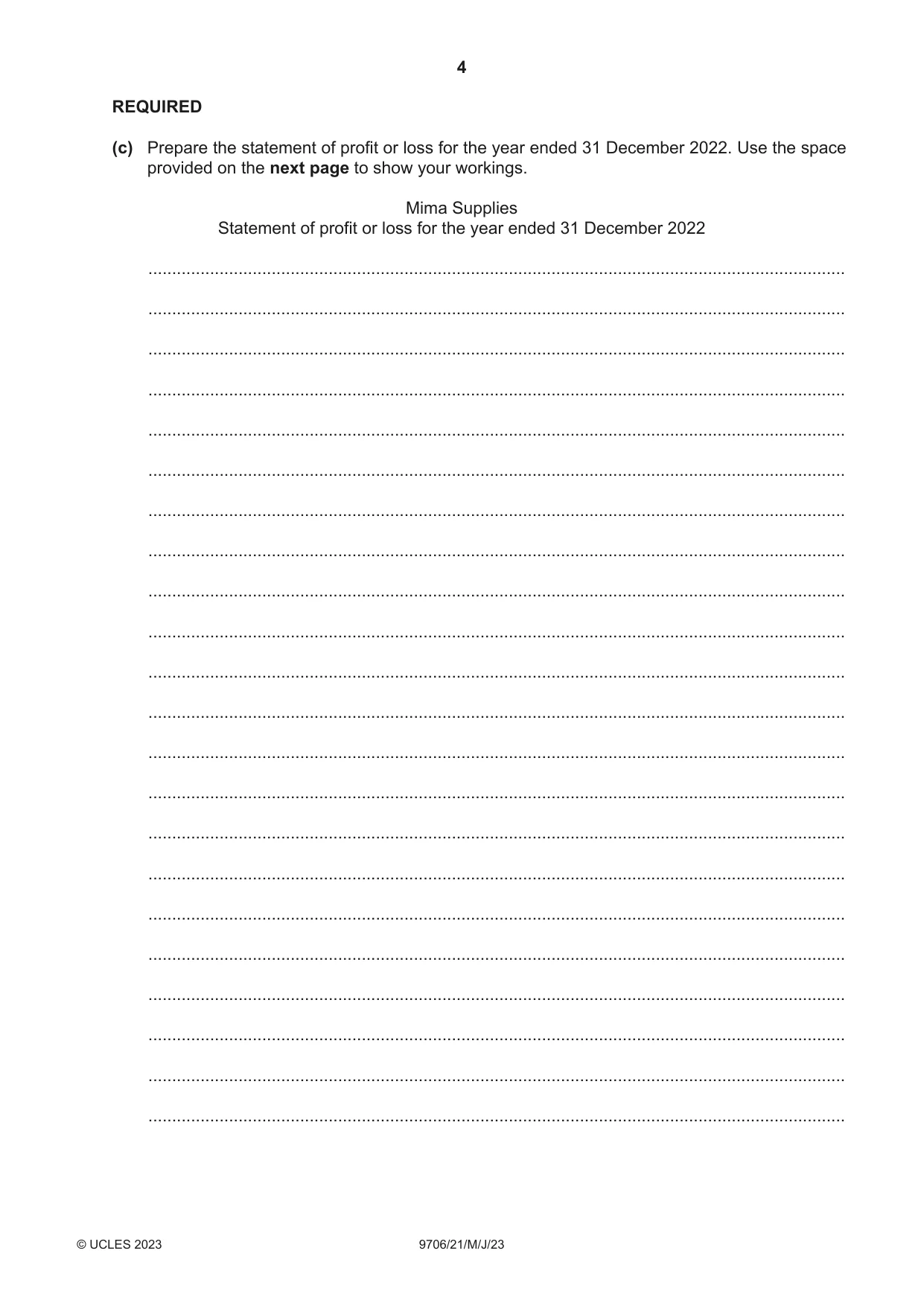
REQUIRED (c) Prepare the statement of profit or loss for the year ended 31 December 2022. Use the space provided on the next page to show your workings. Mima Supplies Statement of profit or loss for the year ended 31 December 2022 ................................................................................................................................................... ................................................................................................................................................... ................................................................................................................................................... ................................................................................................................................................... ................................................................................................................................................... ................................................................................................................................................... ................................................................................................................................................... ................................................................................................................................................... ................................................................................................................................................... ................................................................................................................................................... ................................................................................................................................................... ................................................................................................................................................... ................................................................................................................................................... ................................................................................................................................................... ................................................................................................................................................... ................................................................................................................................................... ................................................................................................................................................... ................................................................................................................................................... ................................................................................................................................................... ................................................................................................................................................... ................................................................................................................................................... ................................................................................................................................................... Workings: [13] (d) Explain the importance of making an allowance for irrecoverable debts in a business’s financial statements. ................................................................................................................................................... ................................................................................................................................................... ................................................................................................................................................... ................................................................................................................................................... ............................................................................................................................................. [2] Additional information Mima would like to assess her business’s liquidity position at 31 December 2022. REQUIRED (e) Identify two ratios which could be used to assess a business’s liquidity position. 1 ................................................................................................................................................ 2 ................................................................................................................................................ [2] Additional information Mima has noticed that her business’s rate of inventory turnover has decreased since last year. She is considering two options to increase the rate of inventory turnover. Option A: reduce inventory levels. Option B: reduce selling prices by 2% and increase the annual advertising budget by 5%. REQUIRED (f) Advise Mima which option she should choose. Justify your choice by considering both options. ................................................................................................................................................... ................................................................................................................................................... ................................................................................................................................................... ................................................................................................................................................... ................................................................................................................................................... ................................................................................................................................................... ................................................................................................................................................... ................................................................................................................................................... ................................................................................................................................................... ................................................................................................................................................... ................................................................................................................................................... ................................................................................................................................................... ................................................................................................................................................... ................................................................................................................................................... ............................................................................................................................................. [7] [Total: 30] 2 Param uses control accounts to verify the accuracy of his business’s sales and purchases ledgers. He provided the following information for the month ended 30 April 2023 relating to trade receivables. $ Sales ledger balances, 1 April 2023 Debit 14 890 Credit 610 Contra entries with the purchases ledger 1 850 Credit sales 153 480 Credit customers’ cheques returned 880 Discounts allowed 4 830 Interest charged on overdue accounts 540 Irrecoverable debts written off 1 830 Receipts from credit customers 148 200 Returns inwards 2 790 There were no credit balances in the sales ledger on 30 April 2023. REQUIRED (a) Prepare the sales ledger control account for April 2023. Dates are not required. Sales ledger control account $ $ [6] (b) Identify the books of prime entry for each of the following: (i) discounts allowed ..................................................................................................................................... [1] (ii) irrecoverable debts written off. ..................................................................................................................................... [1] (c) State three benefits of maintaining control accounts. 1 ................................................................................................................................................ ................................................................................................................................................... 2 ................................................................................................................................................ ................................................................................................................................................... 3 ................................................................................................................................................ ................................................................................................................................................... [3] Additional information The balance of the sales ledger control account at 30 April 2023 did not agree with the total of the individual customer account balances at this date. The following errors were discovered, some of which affected the sales ledger control account and some of which affected the customer account balances. 1 Returns inwards of $720 had been credited to the account of Rafiq Stores instead of Raif Stores. 2 A sales invoice for $820 had been omitted from the books of account. 3 The balance of a credit customer’s account, $430, had been brought down as $340. 4 The total of the returns inwards journal had been understated by $470. 5 Interest of $40 charged on an overdue account had been correctly entered in the journal but had been credited to the customer’s account. REQUIRED (d) Calculate the revised sales ledger control account balance at 30 April 2023. ................................................................................................................................................... ................................................................................................................................................... ................................................................................................................................................... ................................................................................................................................................... ................................................................................................................................................... ................................................................................................................................................... ................................................................................................................................................... ............................................................................................................................................. [4] [Total: 15] 3 The following extract from J Limited’s statement of financial position at 1 January 2022 is available. $ Equity Issued capital: ordinary shares of $0.25 each 600 000 Share premium 175 000 Retained earnings 54 000 Total equity 829 000 Non‑current liabilities 7% Debentures (2028) 200 000 REQUIRED (a) State two features of revenue reserves which do not apply to capital reserves. 1 ................................................................................................................................................ ................................................................................................................................................... ................................................................................................................................................... 2 ................................................................................................................................................ ................................................................................................................................................... ................................................................................................................................................... [2] Additional information The directors wished to raise additional finance. On 1 April 2022 the company made a rights issue of 2 ordinary shares for every 3 shares held at a price of $0.35 per share. The issue was fully subscribed. REQUIRED (b) Calculate the amount raised by the rights issue of shares. ................................................................................................................................................... ................................................................................................................................................... ................................................................................................................................................... ................................................................................................................................................... ................................................................................................................................................... ............................................................................................................................................. [3] Additional information The directors had considered making an issue of debentures rather than a rights issue. (c) Identify two reasons why the directors of J Limited might prefer to raise additional finance through a rights issue rather than by issuing debentures. 1 ................................................................................................................................................ ................................................................................................................................................... 2 ................................................................................................................................................ ................................................................................................................................................... [2] Additional information The directors paid an interim dividend of $0.12 per share on 1 July 2022. REQUIRED (d) Calculate the total amount of the interim dividend. ................................................................................................................................................... ................................................................................................................................................... ................................................................................................................................................... ............................................................................................................................................. [2] Additional information The company made a profit of $535 000 for the year ended 31 December 2022. REQUIRED (e) Prepare the statement of changes in equity for the year ended 31 December 2022. J Limited Statement of changes in equity at 31 December 2022 Share capital Share Retained Total premium earnings $ $ $ $ [6] [Total: 15] 4 D Limited has two production departments and two service departments at one of its factories where absorption costing is used. Some forecast factory overheads have already been allocated and apportioned as follows: Production departments Service departments Cutting Assembly Maintenance Canteen $ $ $ $ Factory overheads 223 480 217 980 45 270 36 260 The following forecast factory overheads are still to be apportioned. $ Depreciation of machinery 48 000 Power 40 200 Canteen department overheads should be reapportioned on the basis of the number of employees. Maintenance department overheads should be reapportioned on the basis of the number of machines in production departments. The following data is available. Production departments Service departments Cutting Assembly Maintenance Canteen Machinery at carrying value $90 000 $66 000 $18 000 $6 000 Number of machines 43 27 Kilowatt hours 1 800 1 500 100 200 Number of employees 27 18 5 Budgeted machine hours 40 000 33 500 Budgeted direct labour hours 23 000 62 500 REQUIRED (a) Complete the following table to show the apportionment of factory overheads and the reapportionment of service department overheads. Production departments Service departments Cutting Assembly Maintenance Canteen $ $ $ $ Factory overheads 223 480 217 980 45 270 36 260 Depreciation of machinery Power Total overheads Reapportionment Subtotal Reapportionment Total overheads [5] (b) Calculate, to two decimal places, an overhead absorption rate for each production department, using a suitable basis. ................................................................................................................................................... ................................................................................................................................................... ................................................................................................................................................... ................................................................................................................................................... ................................................................................................................................................... ............................................................................................................................................. [2] Additional information The following information is available. Cutting department Assembly department Direct labour rate per hour $10.90 $8.20 Machine hours per unit 8 6 Labour hours per unit 3 4 Direct materials cost $6.95 per unit. Selling prices are set to achieve a profit margin of 25%. A customer has placed an order for 40 units. REQUIRED (c) Calculate the selling price to be quoted for this order of 40 units. ................................................................................................................................................... ................................................................................................................................................... ................................................................................................................................................... ................................................................................................................................................... ................................................................................................................................................... ................................................................................................................................................... ................................................................................................................................................... ................................................................................................................................................... ................................................................................................................................................... ................................................................................................................................................... ................................................................................................................................................... ............................................................................................................................................. [5] (d) State two causes of under absorption of overheads. 1 ................................................................................................................................................ ................................................................................................................................................... 2 ................................................................................................................................................ ................................................................................................................................................... [2] Additional information At the other factory a single product, Product Exe, is currently being made. Marginal costing is used at this factory. The following information is available. Selling price per unit $48 Contribution per unit $13 Direct labour 2.5 hours per unit at $10 per hour Fixed costs $96 000 per annum Factory capacity 28 000 labour hours per year Current production level 80% of factory capacity All units produced are sold. REQUIRED (e) Calculate the profit made each year from Product Exe. ................................................................................................................................................... ................................................................................................................................................... ................................................................................................................................................... ................................................................................................................................................... ................................................................................................................................................... ............................................................................................................................................. [4] Additional information The directors plan to make a new product, Product Wye, at this factory at the request of an important customer. The following details are available. 1 The factory will be able to operate at full capacity. 2 All units produced will be sold. 3 Product Wye will have a selling price of $64 per unit and a contribution of $8 per unit. 4 Product Wye will require direct labour at $10 per hour for 1.5 hours per unit. 5 The customer requires 10 000 units of Product Wye each year. The customer will only accept this quantity each year. 6 In order to complete the customer’s order, production of Product Exe will be reduced. 7 Some new machinery will be required costing $36 000. Machinery is depreciated by 20% per annum.
Q8 · A loan of $20 000 at 5% per annum interest will be required to finance the purchase of…
8 A loan of $20 000 at 5% per annum interest will be required to finance the purchase of the new machinery. REQUIRED (f) Calculate the total profit from both products which will be made in the first year if this plan is put into operation. ................................................................................................................................................... ................................................................................................................................................... ................................................................................................................................................... ................................................................................................................................................... ................................................................................................................................................... ................................................................................................................................................... ................................................................................................................................................... ................................................................................................................................................... ................................................................................................................................................... ................................................................................................................................................... ................................................................................................................................................... ................................................................................................................................................... ................................................................................................................................................... ................................................................................................................................................... ................................................................................................................................................... ................................................................................................................................................... ................................................................................................................................................... ................................................................................................................................................... ................................................................................................................................................... ................................................................................................................................................... ............................................................................................................................................. [5] (g) Advise the directors whether this plan should be put into operation. Justify your answer by considering both financial and non‑financial factors. ................................................................................................................................................... ................................................................................................................................................... ................................................................................................................................................... ................................................................................................................................................... ................................................................................................................................................... ................................................................................................................................................... ................................................................................................................................................... ................................................................................................................................................... ................................................................................................................................................... ................................................................................................................................................... ................................................................................................................................................... ................................................................................................................................................... ................................................................................................................................................... ................................................................................................................................................... ............................................................................................................................................. [7] [Total: 30]
What was in this paper
The subtopics covered by these 8 questions, and how many questions each got. Open one in a new tab to see every Cambridge question on it.
What you needed in this session
Cambridge’s own grade thresholds for 2023 May/June, Paper 2 · Variant 1. A higher threshold means an easier paper — the bar moves with how the cohort did.