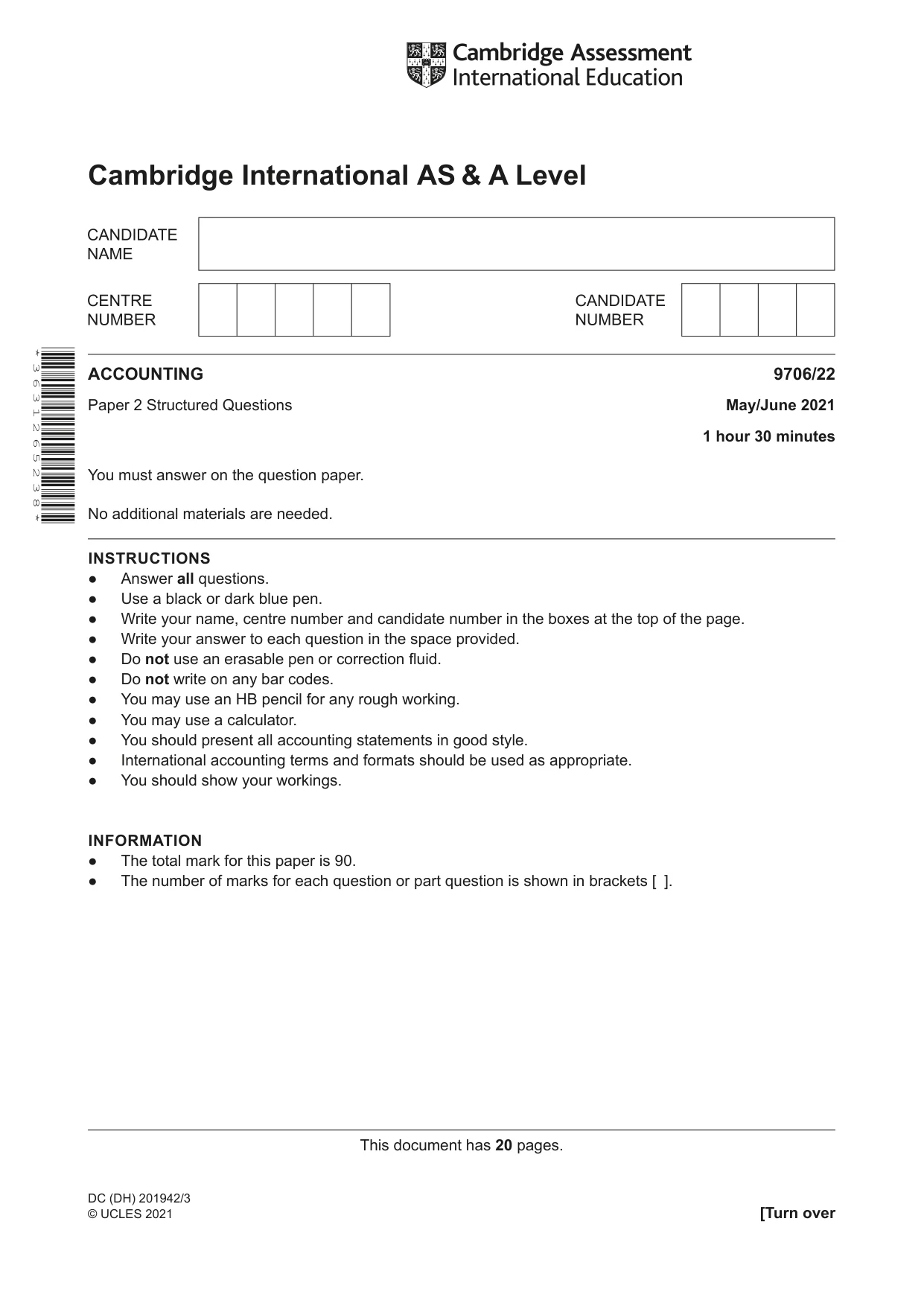
Cambridge A Level Accounting 9706 — 2021 May/June Paper 2 · Variant 2
9706/22/M/J/21 · 4 questions · 90 marks · ≈101 min
The question paper and its mark scheme, free to read here and free to download. This is Cambridge’s own paper, exactly as it was sat.
Question paper20 pages
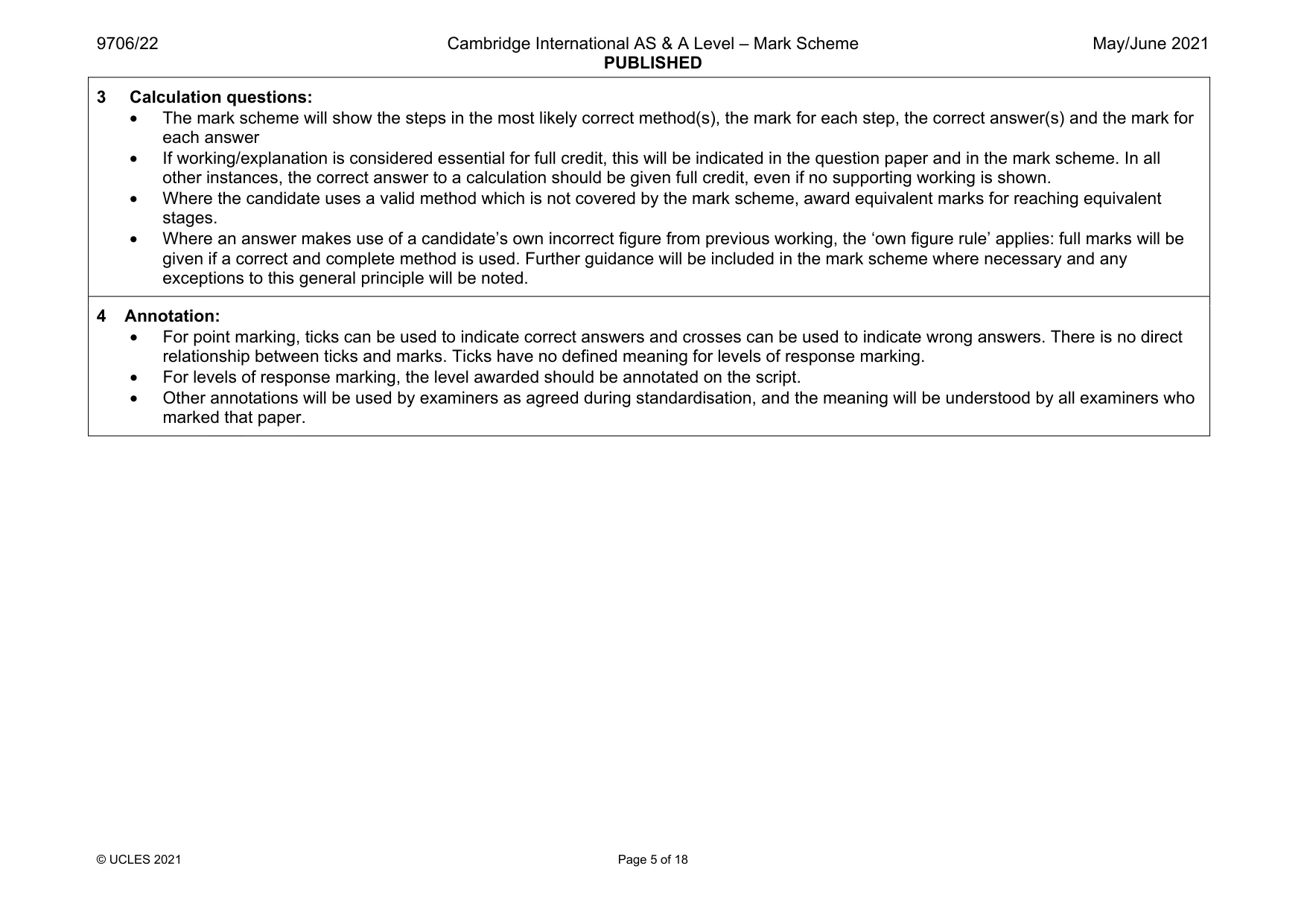
Mark scheme18 pages
Answers below. Sit the paper first if you are practising.
Questions as text
Q1 · N Limited is a trading business
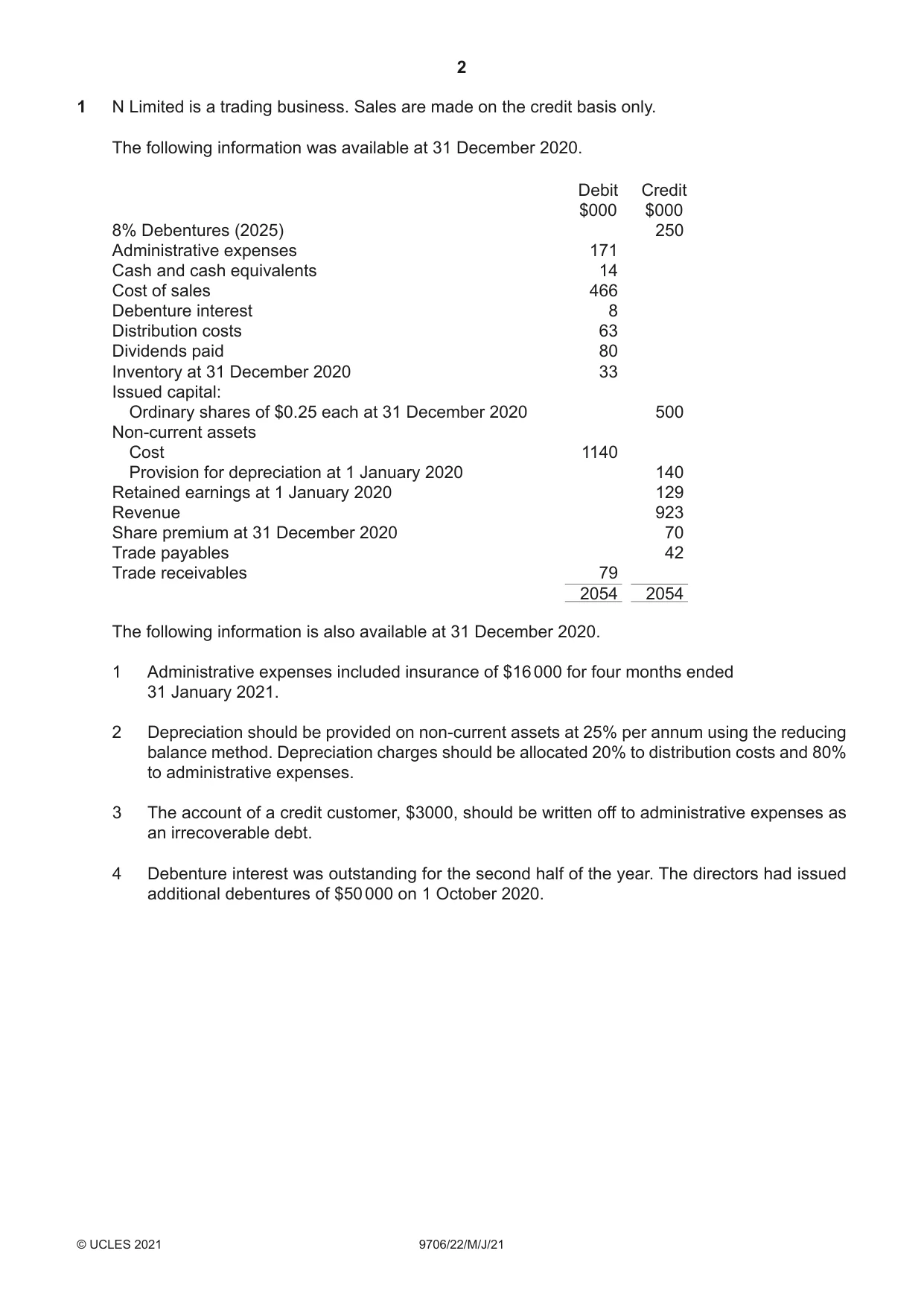
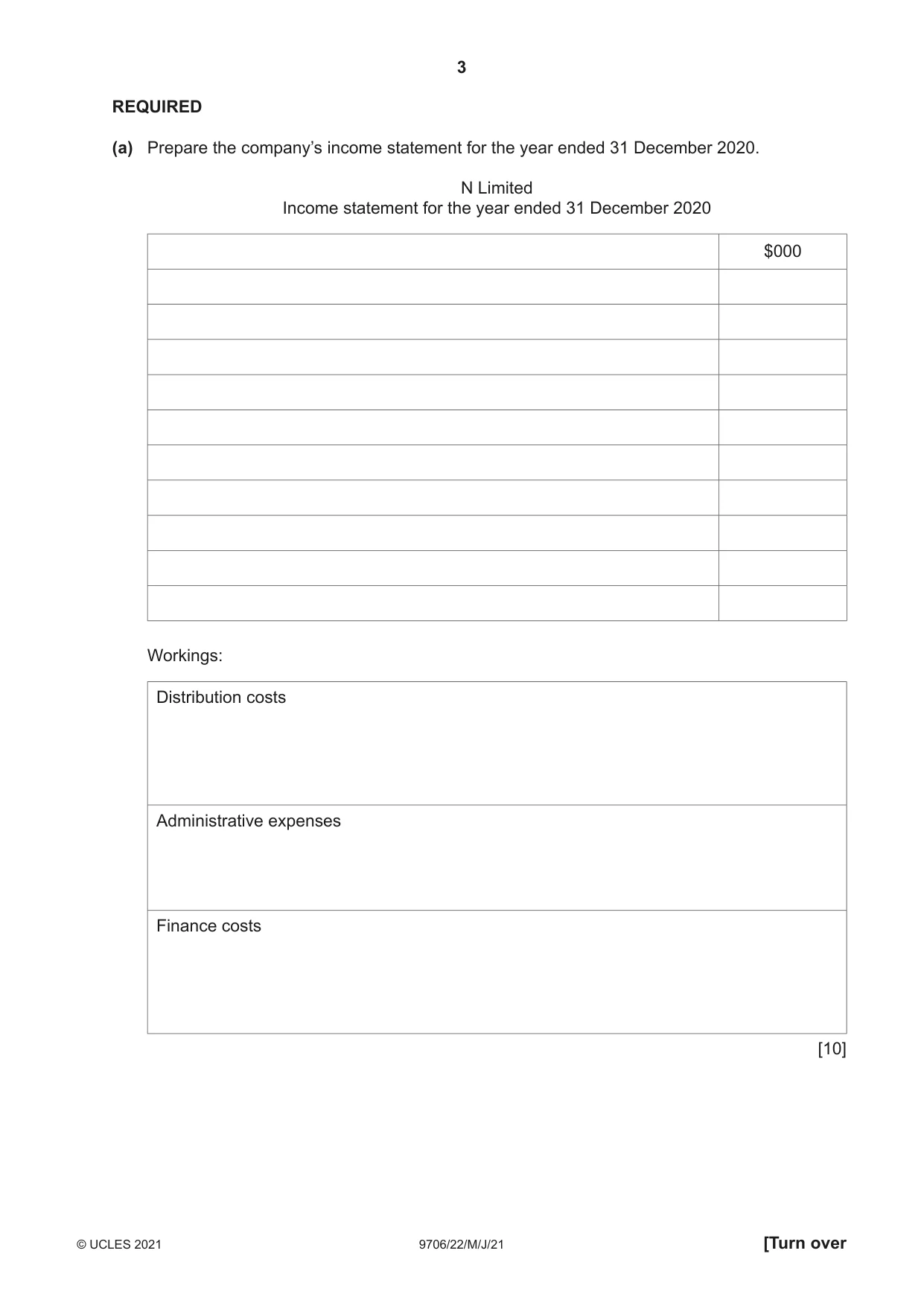
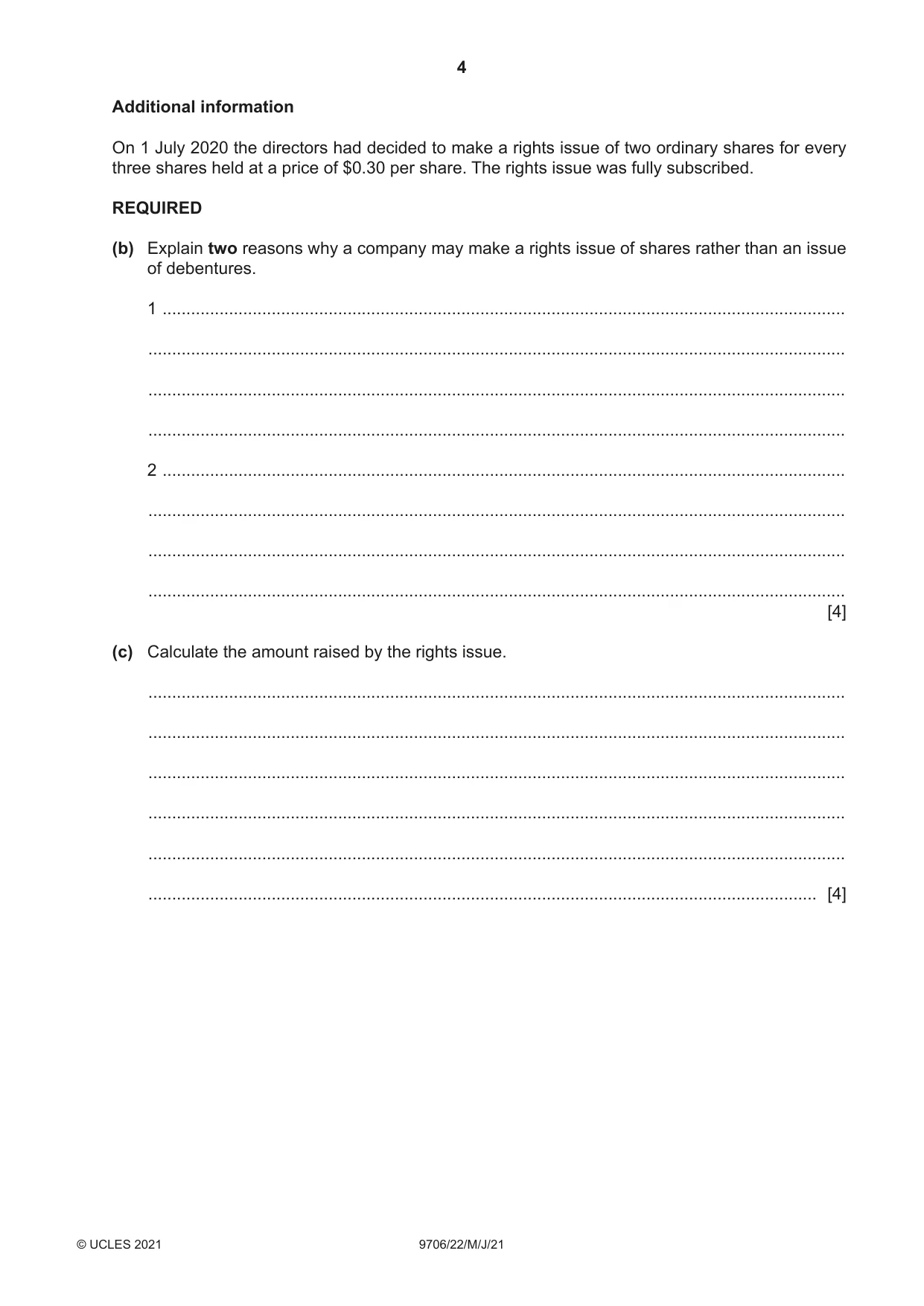
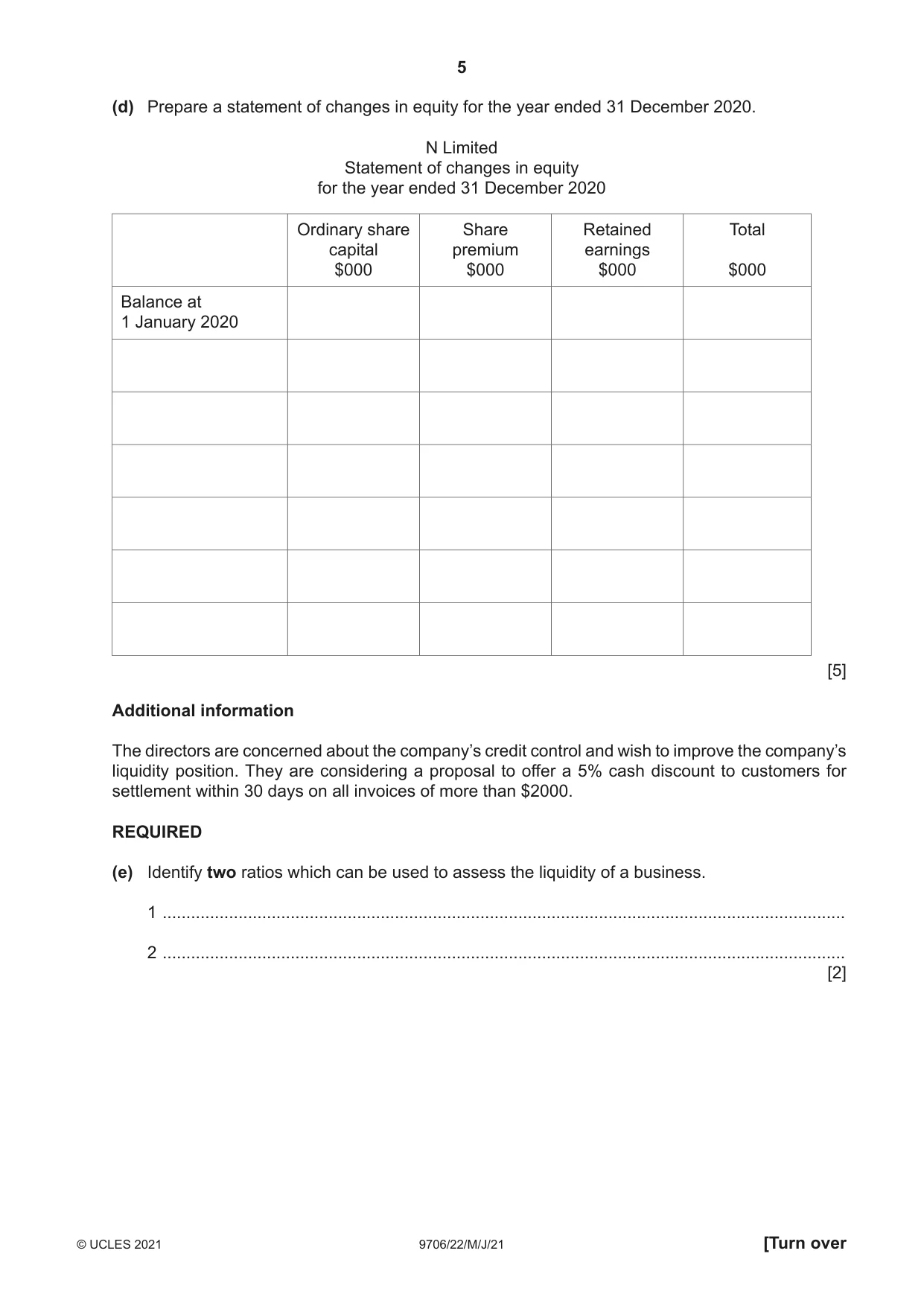
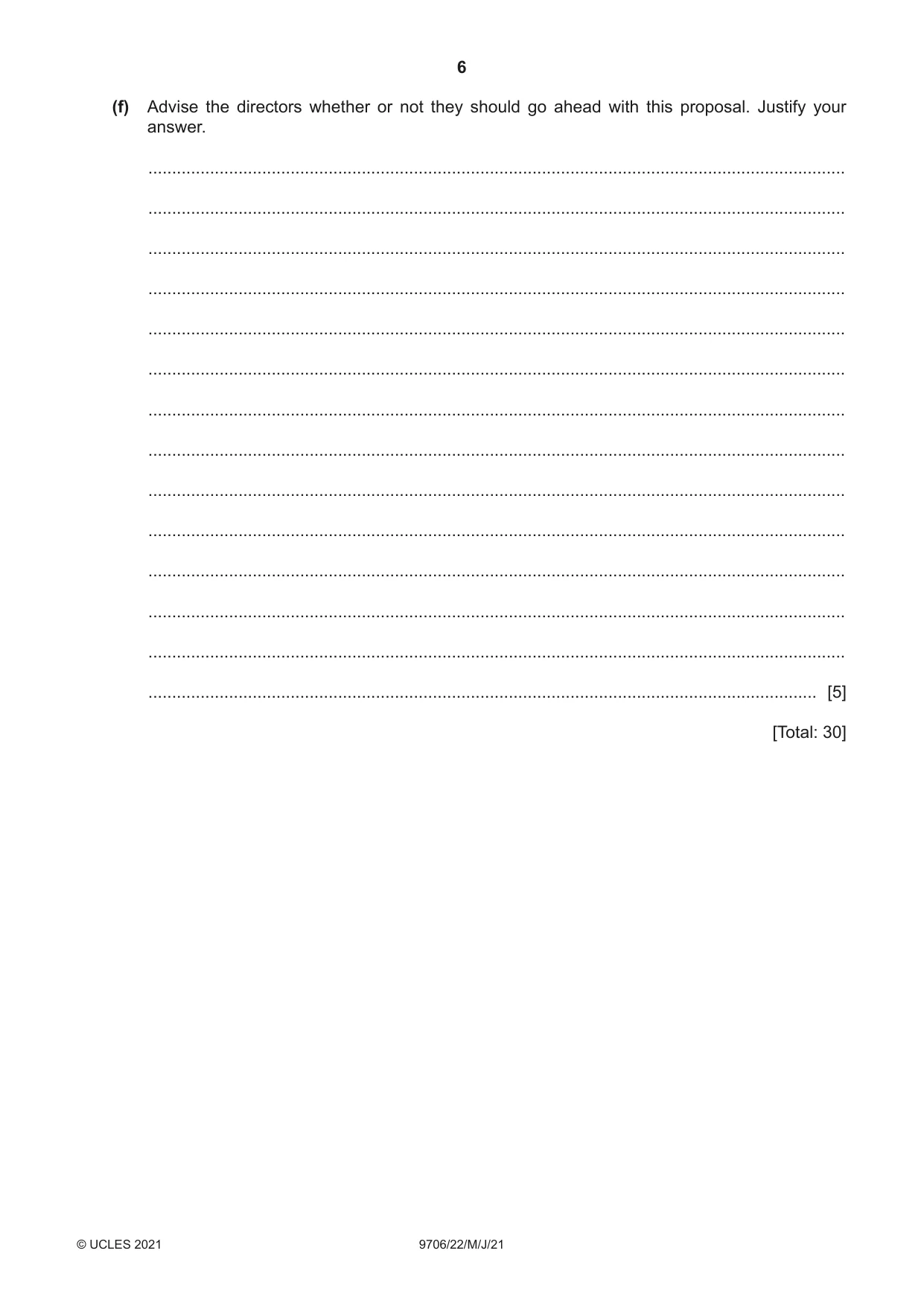
1 N Limited is a trading business. Sales are made on the credit basis only. The following information was available at 31 December 2020. Debit Credit $000 $000 8% Debentures (2025) 250 Administrative expenses 171 Cash and cash equivalents 14 Cost of sales 466 Debenture interest 8 Distribution costs 63 Dividends paid 80 Inventory at 31 December 2020 33 Issued capital: Ordinary shares of $0.25 each at 31 December 2020 500 Non-current assets Cost 1140 Provision for depreciation at 1 January 2020 140 Retained earnings at 1 January 2020 129 Revenue 923 Share premium at 31 December 2020 70 Trade payables 42 Trade receivables 79 2054 2054 The following information is also available at 31 December 2020. 1 Administrative expenses included insurance of $16 000 for four months ended 31 January 2021. 2 Depreciation should be provided on non-current assets at 25% per annum using the reducing balance method. Depreciation charges should be allocated 20% to distribution costs and 80% to administrative expenses. 3 The account of a credit customer, $3000, should be written off to administrative expenses as an irrecoverable debt. 4 Debenture interest was outstanding for the second half of the year. The directors had issued additional debentures of $50 000 on 1 October 2020. REQUIRED (a) Prepare the company’s income statement for the year ended 31 December 2020. N Limited Income statement for the year ended 31 December 2020 $000 Workings: Distribution costs Administrative expenses Finance costs [10] Additional information On 1 July 2020 the directors had decided to make a rights issue of two ordinary shares for every three shares held at a price of $0.30 per share. The rights issue was fully subscribed. REQUIRED (b) Explain two reasons why a company may make a rights issue of shares rather than an issue of debentures. 1 ................................................................................................................................................ ................................................................................................................................................... ................................................................................................................................................... ................................................................................................................................................... 2 ................................................................................................................................................ ................................................................................................................................................... ................................................................................................................................................... ................................................................................................................................................... [4] (c) Calculate the amount raised by the rights issue. ................................................................................................................................................... ................................................................................................................................................... ................................................................................................................................................... ................................................................................................................................................... ................................................................................................................................................... ............................................................................................................................................. [4] (d) Prepare a statement of changes in equity for the year ended 31 December 2020. N Limited Statement of changes in equity for the year ended 31 December 2020 Ordinary share Share Retained Total capital premium earnings $000 $000 $000 $000 Balance at 1 January 2020 [5] Additional information The directors are concerned about the company’s credit control and wish to improve the company’s liquidity position. They are considering a proposal to offer a 5% cash discount to customers for settlement within 30 days on all invoices of more than $2000. REQUIRED (e) Identify two ratios which can be used to assess the liquidity of a business. 1 ................................................................................................................................................ 2 ................................................................................................................................................ [2] (f) Advise the directors whether or not they should go ahead with this proposal. Justify your answer. ................................................................................................................................................... ................................................................................................................................................... ................................................................................................................................................... ................................................................................................................................................... ................................................................................................................................................... ................................................................................................................................................... ................................................................................................................................................... ................................................................................................................................................... ................................................................................................................................................... ................................................................................................................................................... ................................................................................................................................................... ................................................................................................................................................... ................................................................................................................................................... ............................................................................................................................................. [5] [Total: 30]
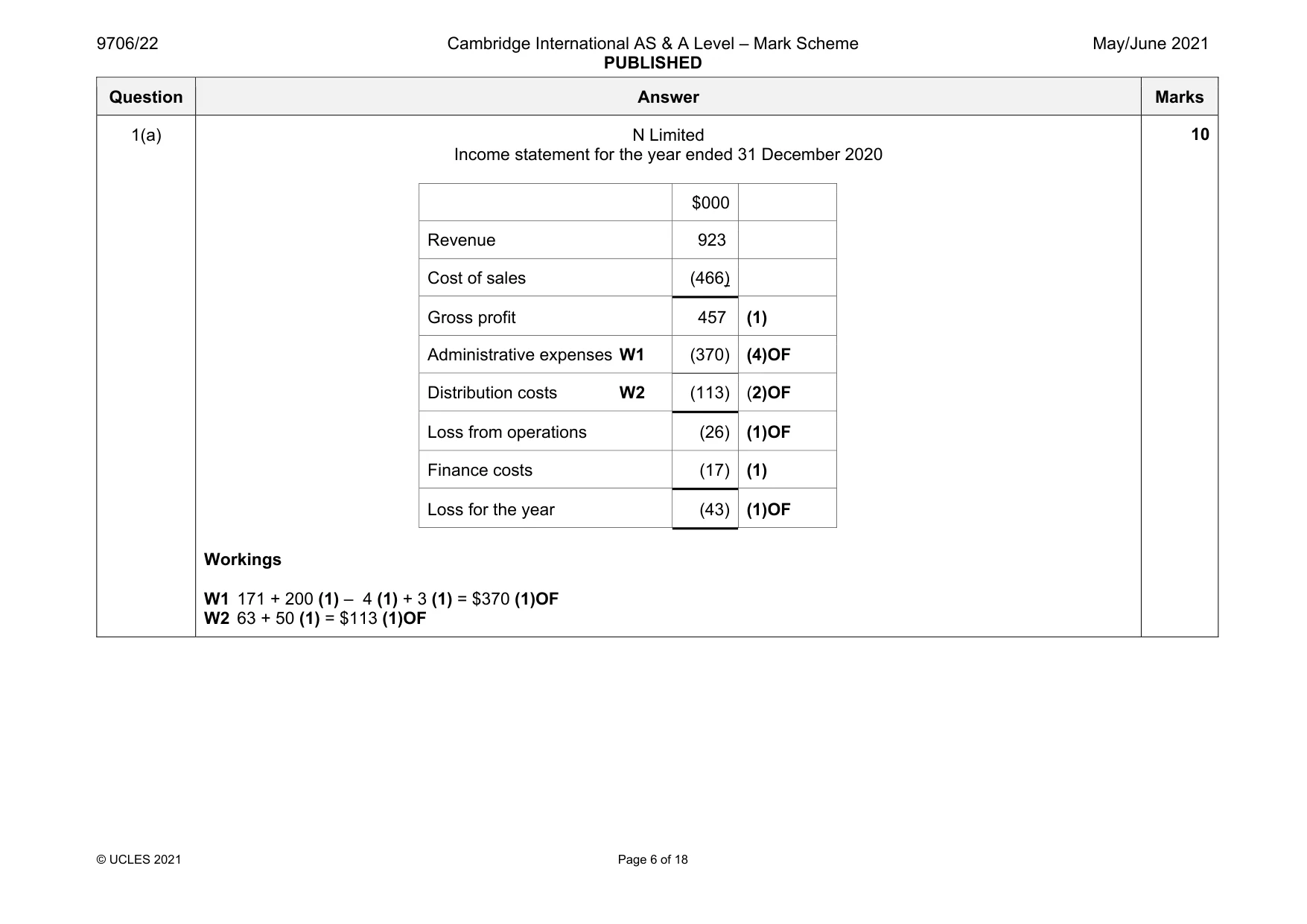
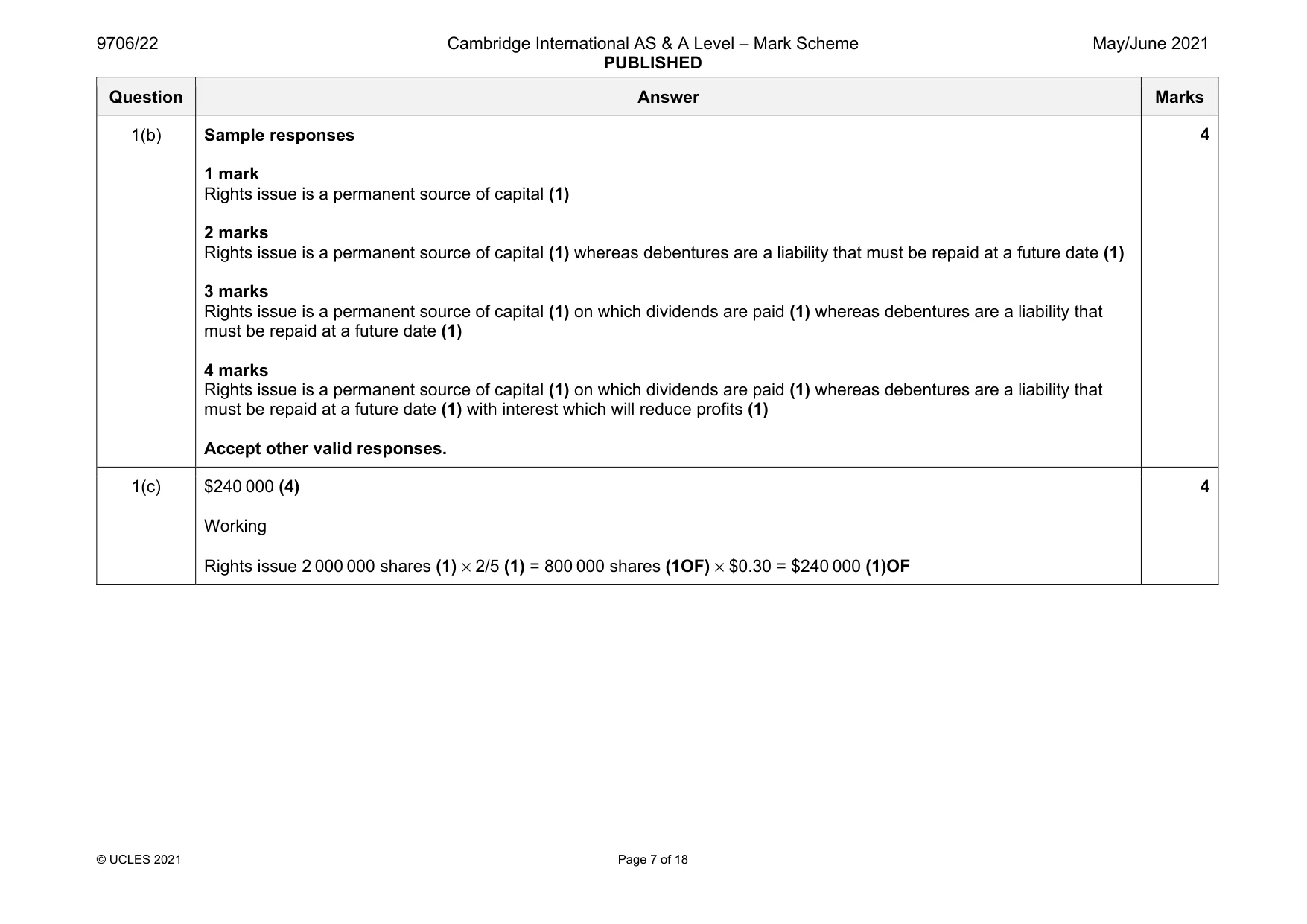
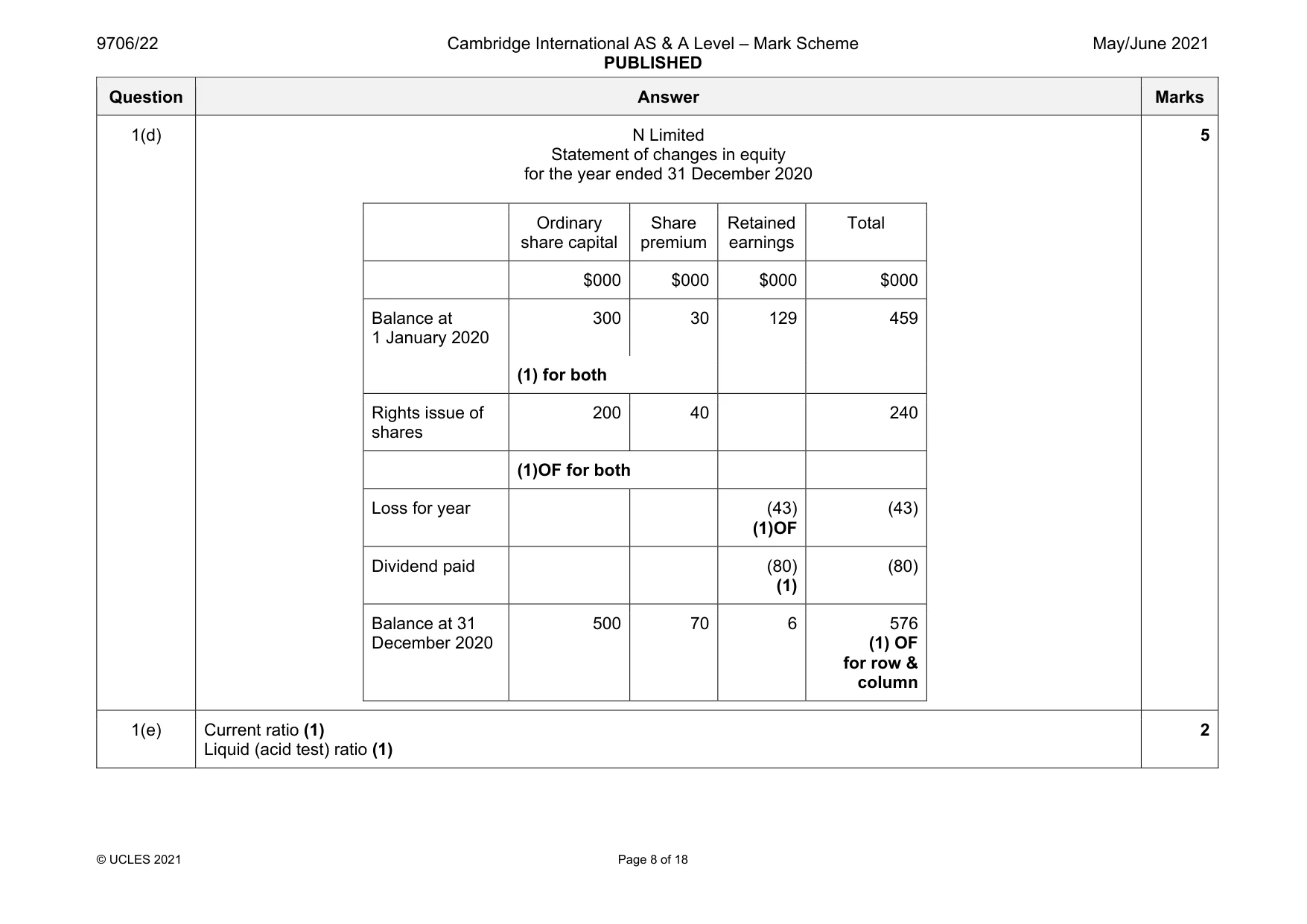
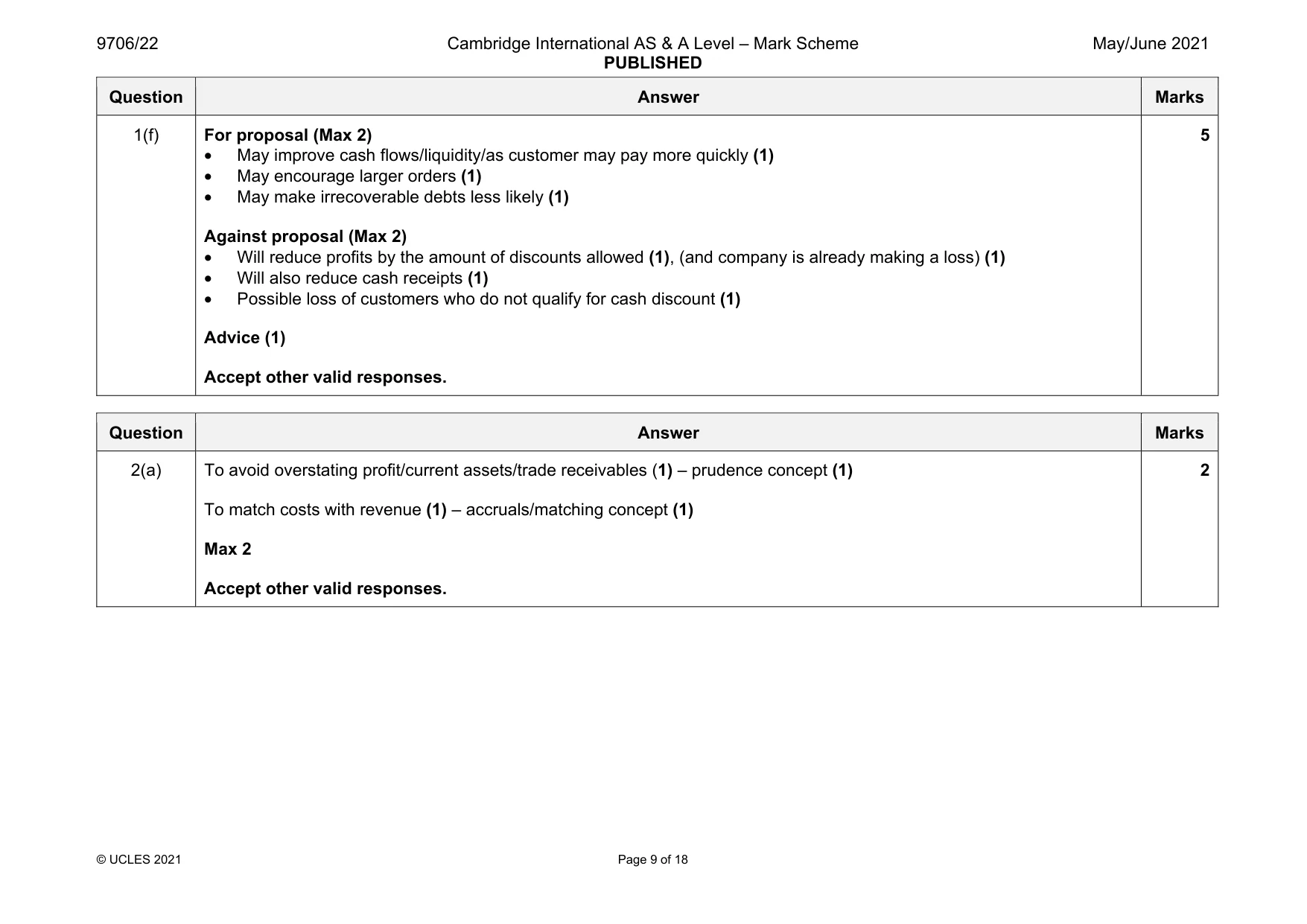
Mark scheme: 1(a) N Limited Income statement for the year ended 31 December 2020 $000 Revenue 923 Cost of sales (466) Gross profit 457 (1) Administrative expenses W1 (370) (4)OF Distribution costs W2 (113) (2)OF Loss from operations (26) (1)OF Finance costs (17) (1) Loss for the year (43) (1)OF Workings W1 171 + 200 (1) – 4 (1) + 3 (1) = $370 (1)OF W2 63 + 50 (1) = $113 (1)OF Question Answer Marks 1(b) Sample responses 1 mark Rights issue is a permanent source of capital (1) 2 marks Rights issue is a permanent source of capital (1) whereas debentures are a liability that must be repaid at a future date (1) 3 marks Rights issue is a permanent source of capital (1) on which dividends are paid (1) whereas debentures are a liability that must be repaid at a future date (1) 4 marks Rights issue is a permanent source of capital (1) on which dividends are paid (1) whereas debentures are a liability that must be repaid at a future date (1) with interest which will reduce profits (1) Accept other valid responses. 4 1(c) $240 000 (4) Working Rights issue 2 000 000 shares (1) × 2/5 (1) = 800 000 shares (1OF) × $0.30 = $240 000 (1)OF 4 Question Answer Marks 1(d) N Limited Statement of changes in equity for the year ended 31 December 2020 Ordinary share capital Share premium Retained earnings Total $000 $000 $000 $000 Balance at 1 January 2020 300 30 129 459 (1) for both Rights issue of shares 200 40 240 (1)OF for both Loss for year (43) (1)OF (43) Dividend paid (80) (1) (80) Balance at 31 December 2020 500 70 6 576 (1) OF for row & column 5 1(e) Current ratio (1) Liquid (acid test) ratio (1) 2 Question Answer Marks 1(f) For proposal (Max 2) • May improve cash flows/liquidity/as customer may pay more quickly (1) • May encourage larger orders (1) • May make irrecoverable debts less likely (1) Against proposal (Max 2) • Will reduce profits by the amount of discounts allowed (1), (and company is already making a loss) (1) • Will also reduce cash receipts (1) • Possible loss of customers who do not qualify for cash discount (1) Advice (1) Accept other valid responses. 5
Q2 · Zak owns a wholesale business
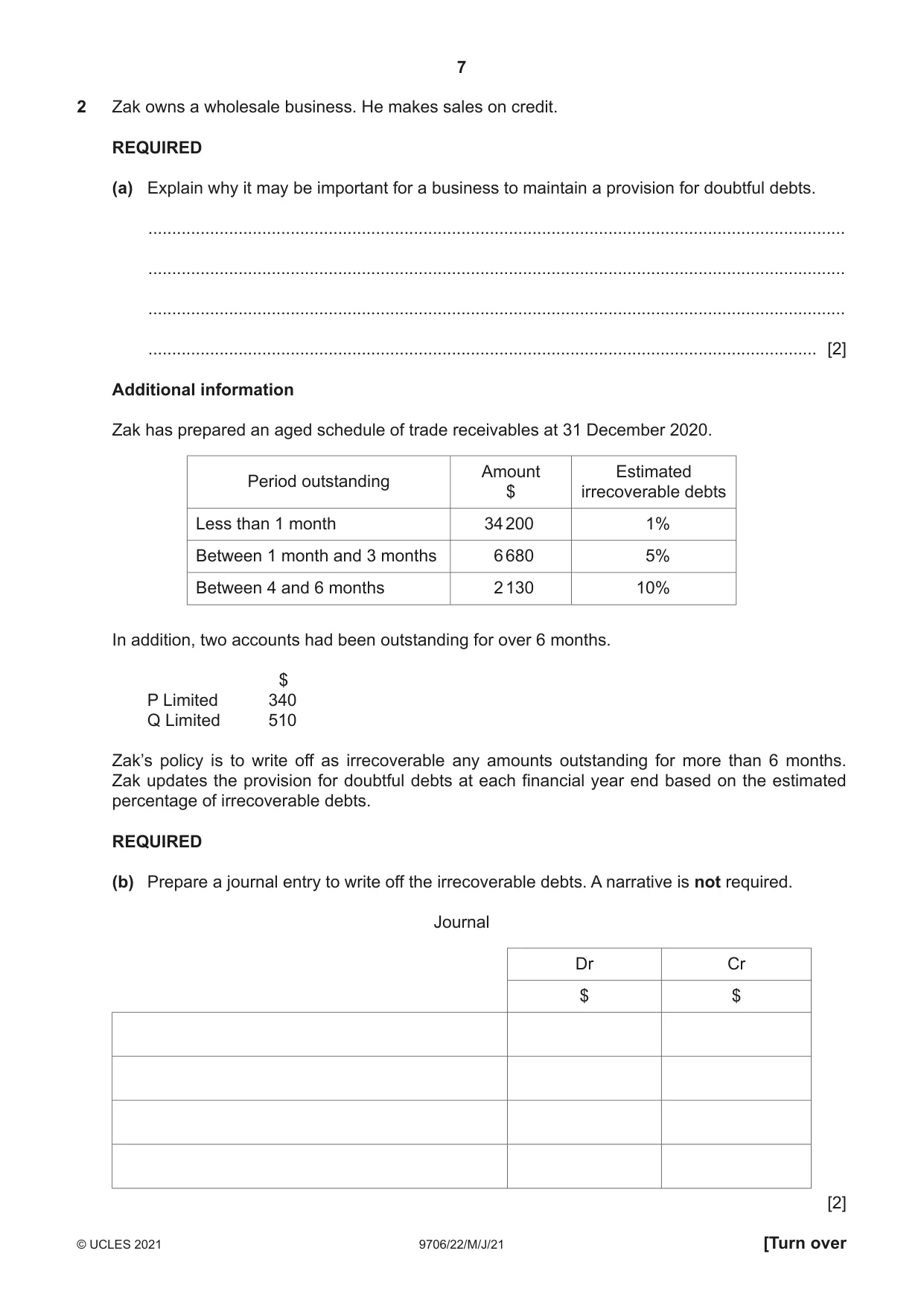
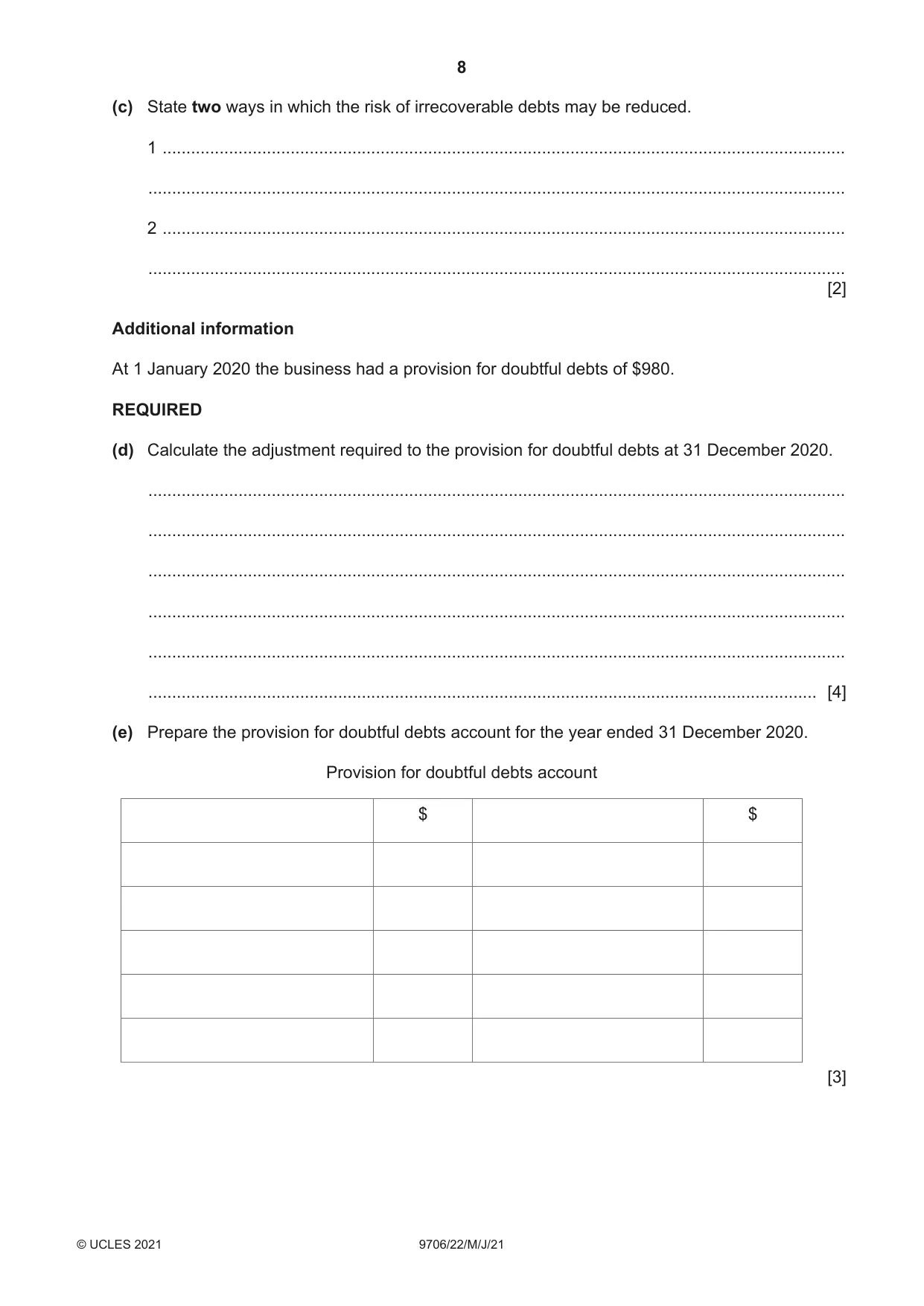
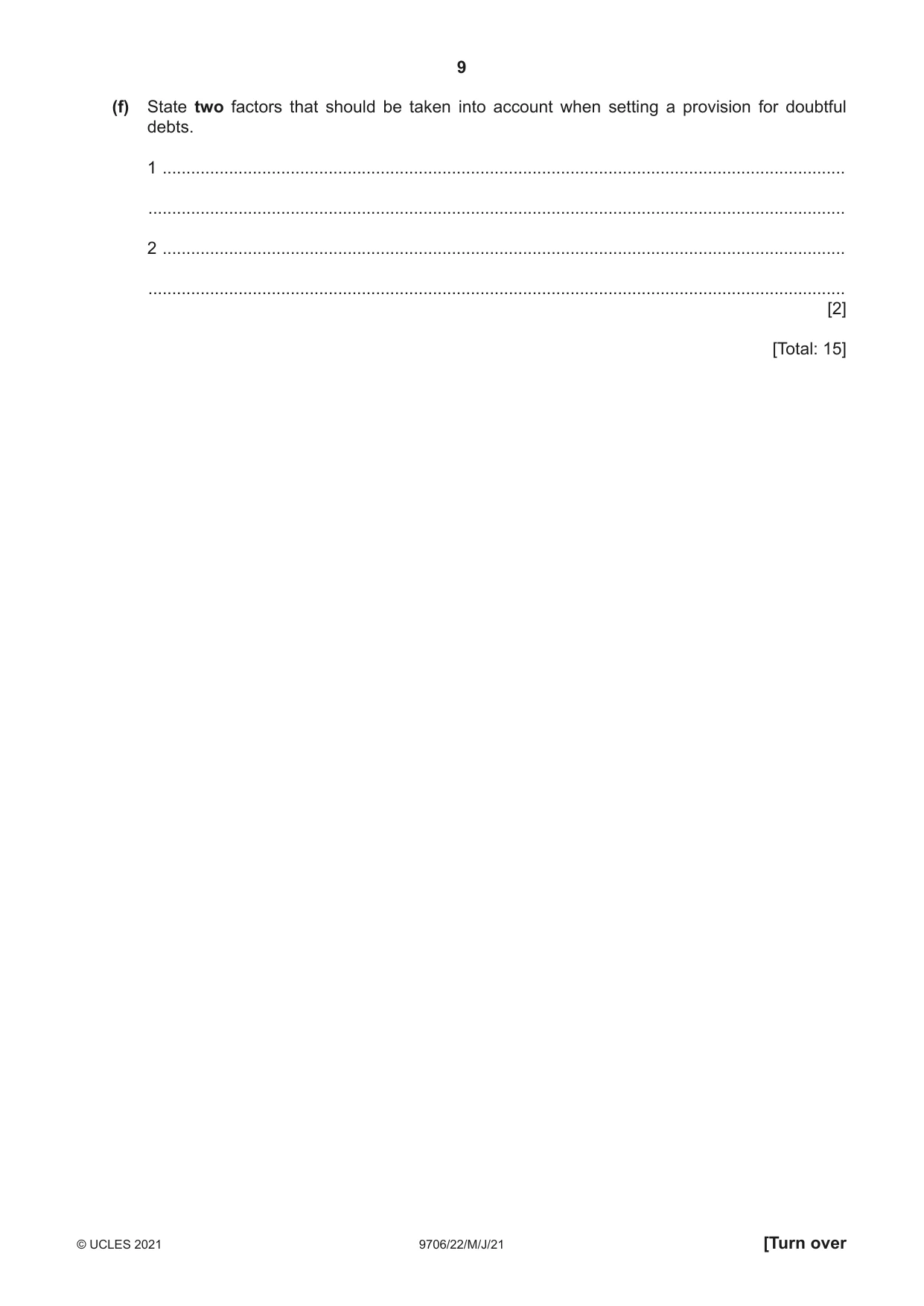
2 Zak owns a wholesale business. He makes sales on credit. REQUIRED (a) Explain why it may be important for a business to maintain a provision for doubtful debts. ................................................................................................................................................... ................................................................................................................................................... ................................................................................................................................................... ............................................................................................................................................. [2] Additional information Zak has prepared an aged schedule of trade receivables at 31 December 2020. Amount Estimated Period outstanding $ irrecoverable debts Less than 1 month 34 200 1% Between 1 month and 3 months 6 680 5% Between 4 and 6 months 2 130 10% In addition, two accounts had been outstanding for over 6 months. $ P Limited 340 Q Limited 510 Zak’s policy is to write off as irrecoverable any amounts outstanding for more than 6 months. Zak updates the provision for doubtful debts at each financial year end based on the estimated percentage of irrecoverable debts. REQUIRED (b) Prepare a journal entry to write off the irrecoverable debts. A narrative is not required. Journal Dr Cr $ $ [2] (c) State two ways in which the risk of irrecoverable debts may be reduced. 1 ................................................................................................................................................ ................................................................................................................................................... 2 ................................................................................................................................................ ................................................................................................................................................... [2] Additional information At 1 January 2020 the business had a provision for doubtful debts of $980. REQUIRED (d) Calculate the adjustment required to the provision for doubtful debts at 31 December 2020. ................................................................................................................................................... ................................................................................................................................................... ................................................................................................................................................... ................................................................................................................................................... ................................................................................................................................................... ............................................................................................................................................. [4] (e) Prepare the provision for doubtful debts account for the year ended 31 December 2020. Provision for doubtful debts account $ $ [3] (f) State two factors that should be taken into account when setting a provision for doubtful debts. 1 ................................................................................................................................................ ................................................................................................................................................... 2 ................................................................................................................................................ ................................................................................................................................................... [2] [Total: 15]
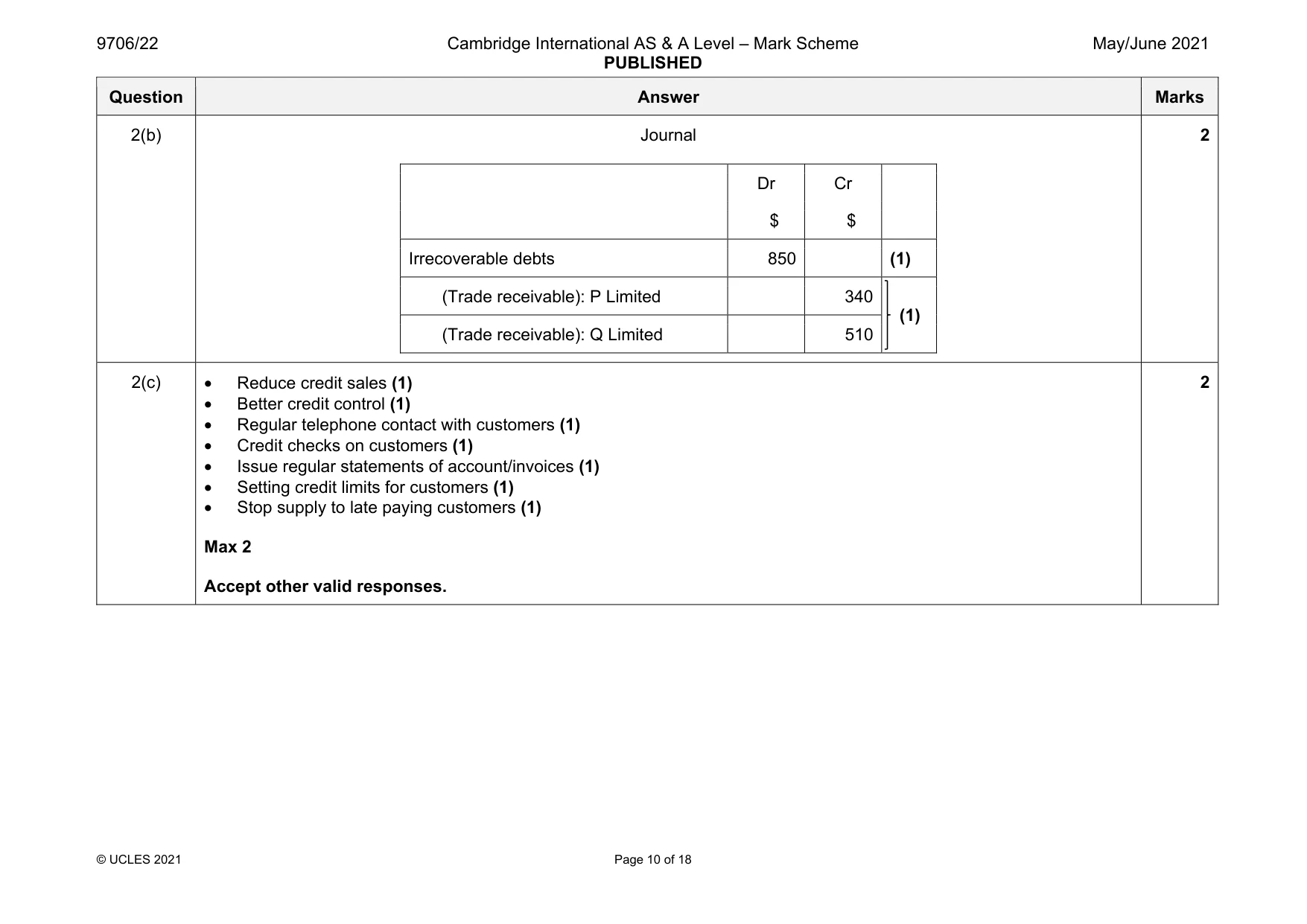
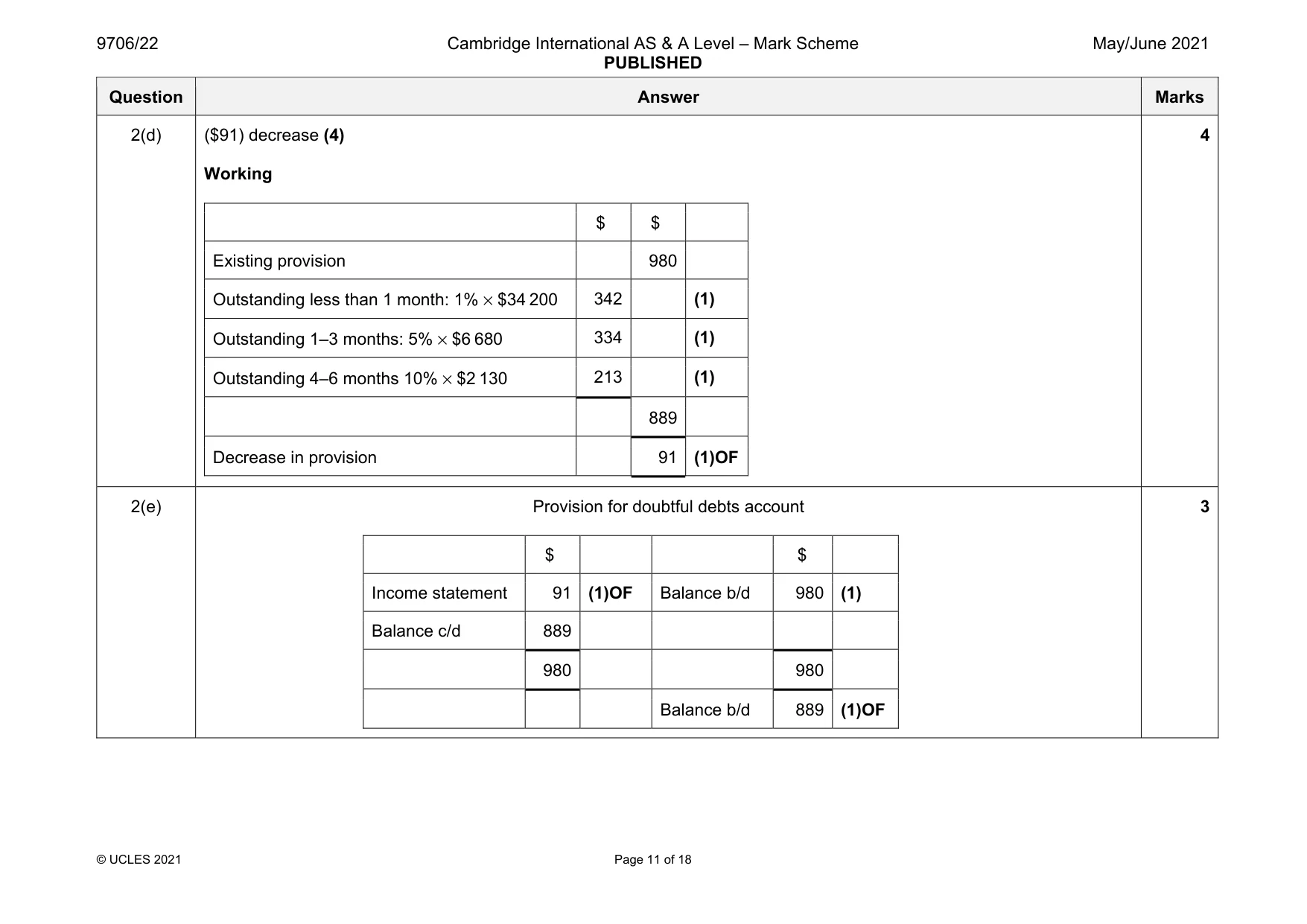
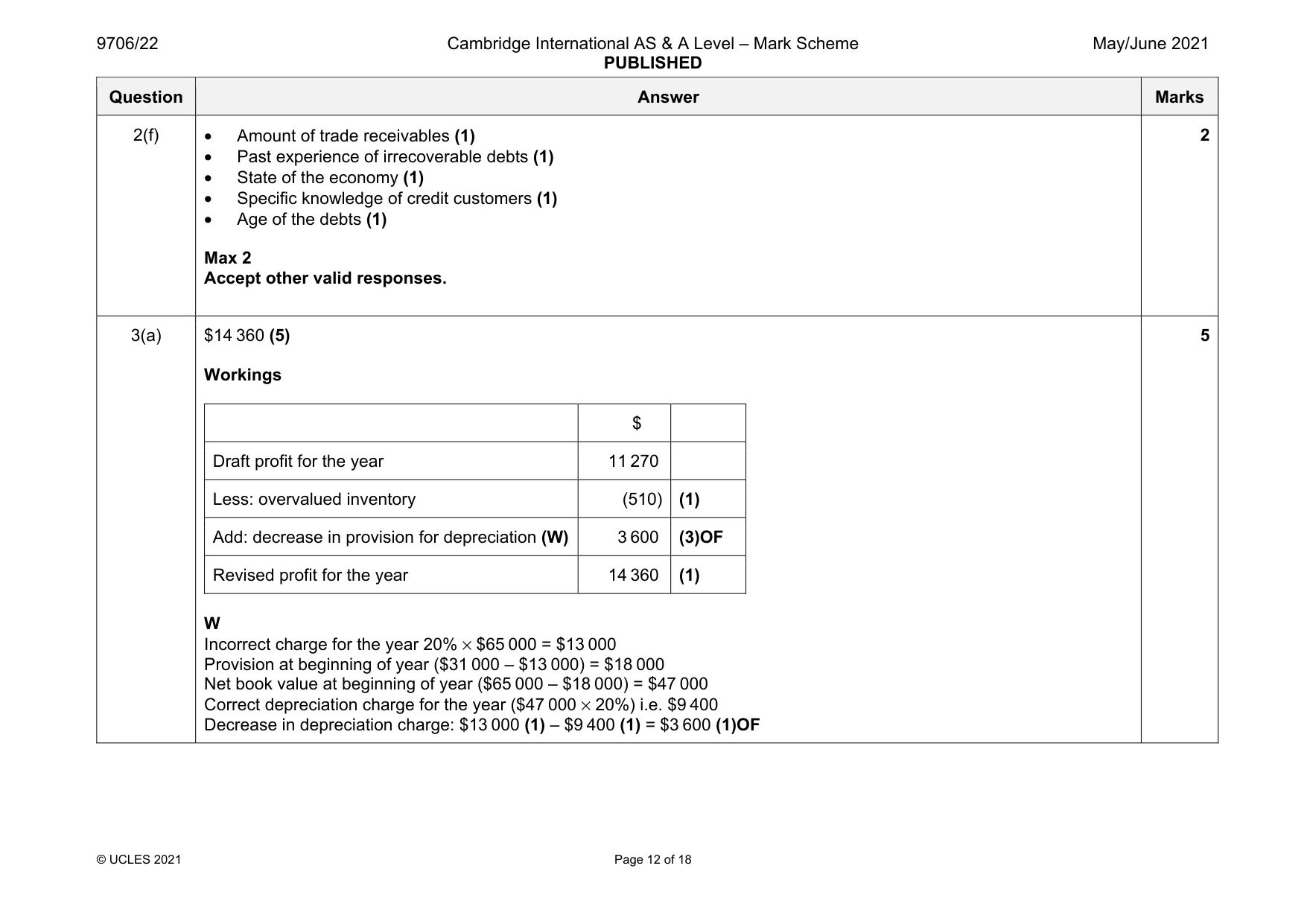
Mark scheme: 2(a) To avoid overstating profit/current assets/trade receivables (1) – prudence concept (1) To match costs with revenue (1) – accruals/matching concept (1) Max 2 Accept other valid responses. Question Answer Marks 2(b) Journal Dr Cr $ $ Irrecoverable debts 850 (1) (Trade receivable): P Limited 340 (1) (Trade receivable): Q Limited 510 2 2(c) • Reduce credit sales (1) • Better credit control (1) • Regular telephone contact with customers (1) • Credit checks on customers (1) • Issue regular statements of account/invoices (1) • Setting credit limits for customers (1) • Stop supply to late paying customers (1) Max 2 Accept other valid responses. 2 Question Answer Marks 2(d) ($91) decrease (4) Working $ $ Existing provision 980 Outstanding less than 1 month: 1% × $34 200 342 (1) Outstanding 1–3 months: 5% × $6 680 334 (1) Outstanding 4–6 months 10% × $2 130 213 (1) 889 Decrease in provision 91 (1)OF 4 2(e) Provision for doubtful debts account $ $ Income statement 91 (1)OF Balance b/d 980 (1) Balance c/d 889 980 980 Balance b/d 889 (1)OF 3 Question Answer Marks 2(f) • Amount of trade receivables (1) • Past experience of irrecoverable debts (1) • State of the economy (1) • Specific knowledge of credit customers (1) • Age of the debts (1) Max 2 Accept other valid responses. 2 5
Q3 · Jason prepared the following statement of financial position which contained errors
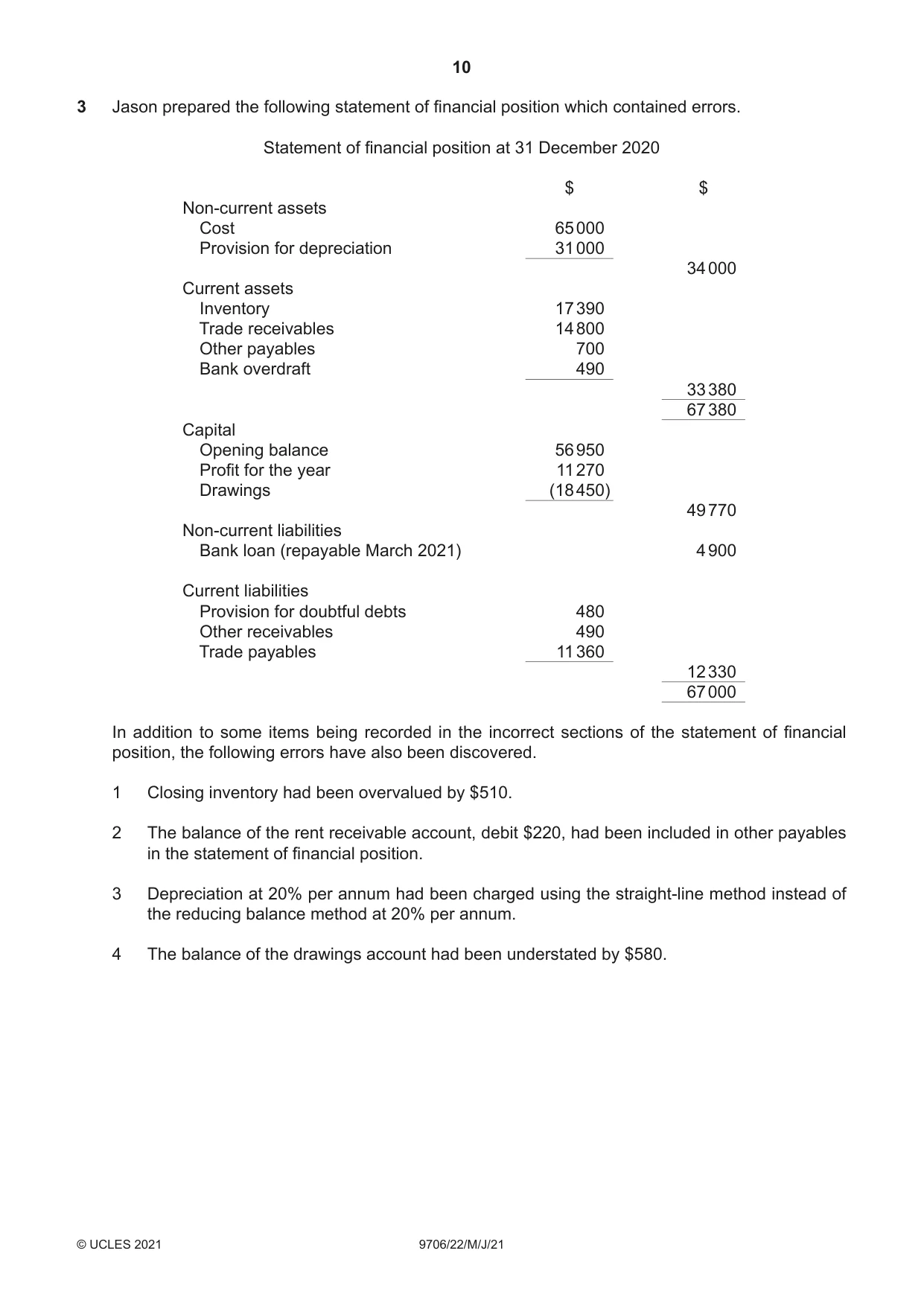
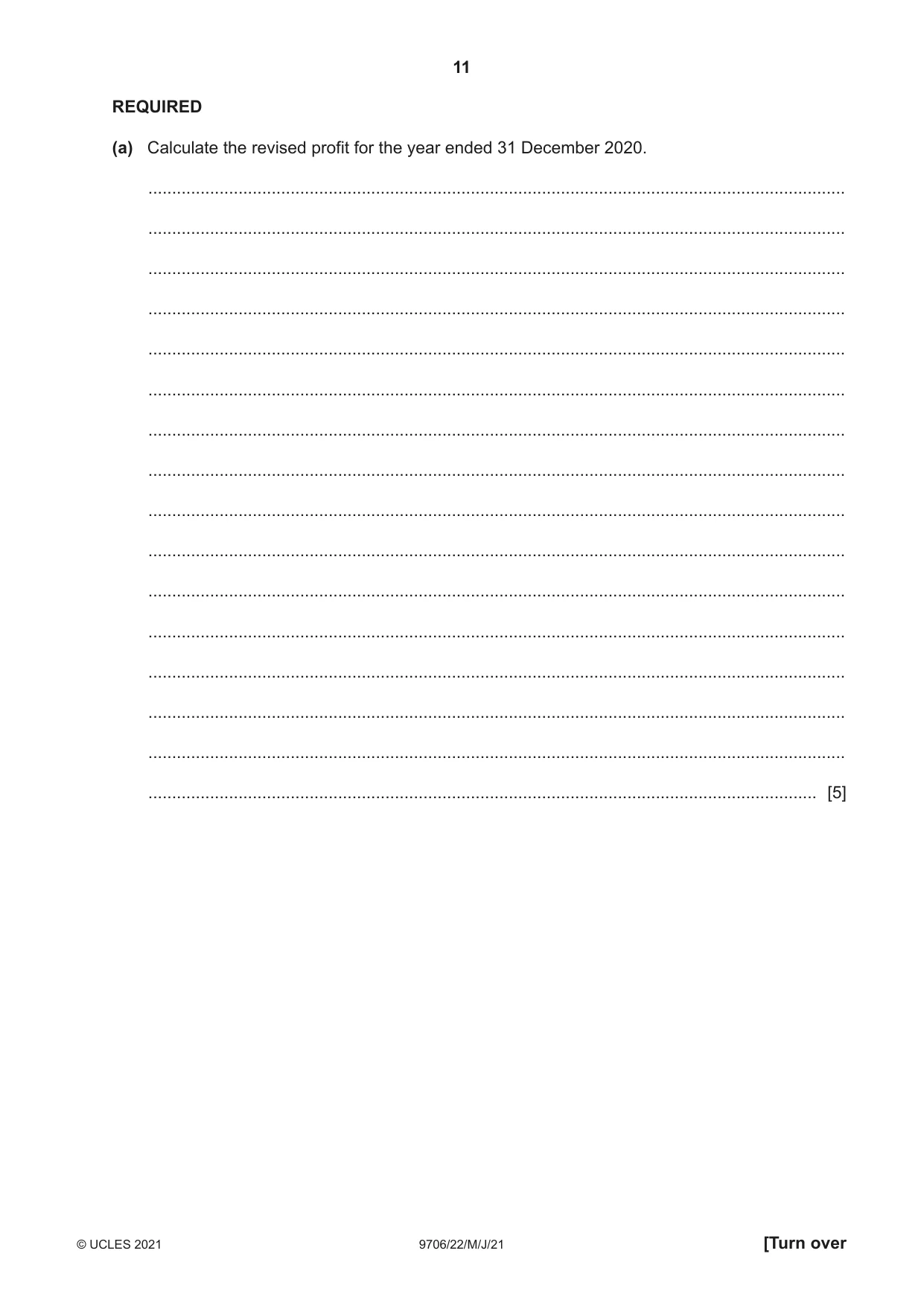
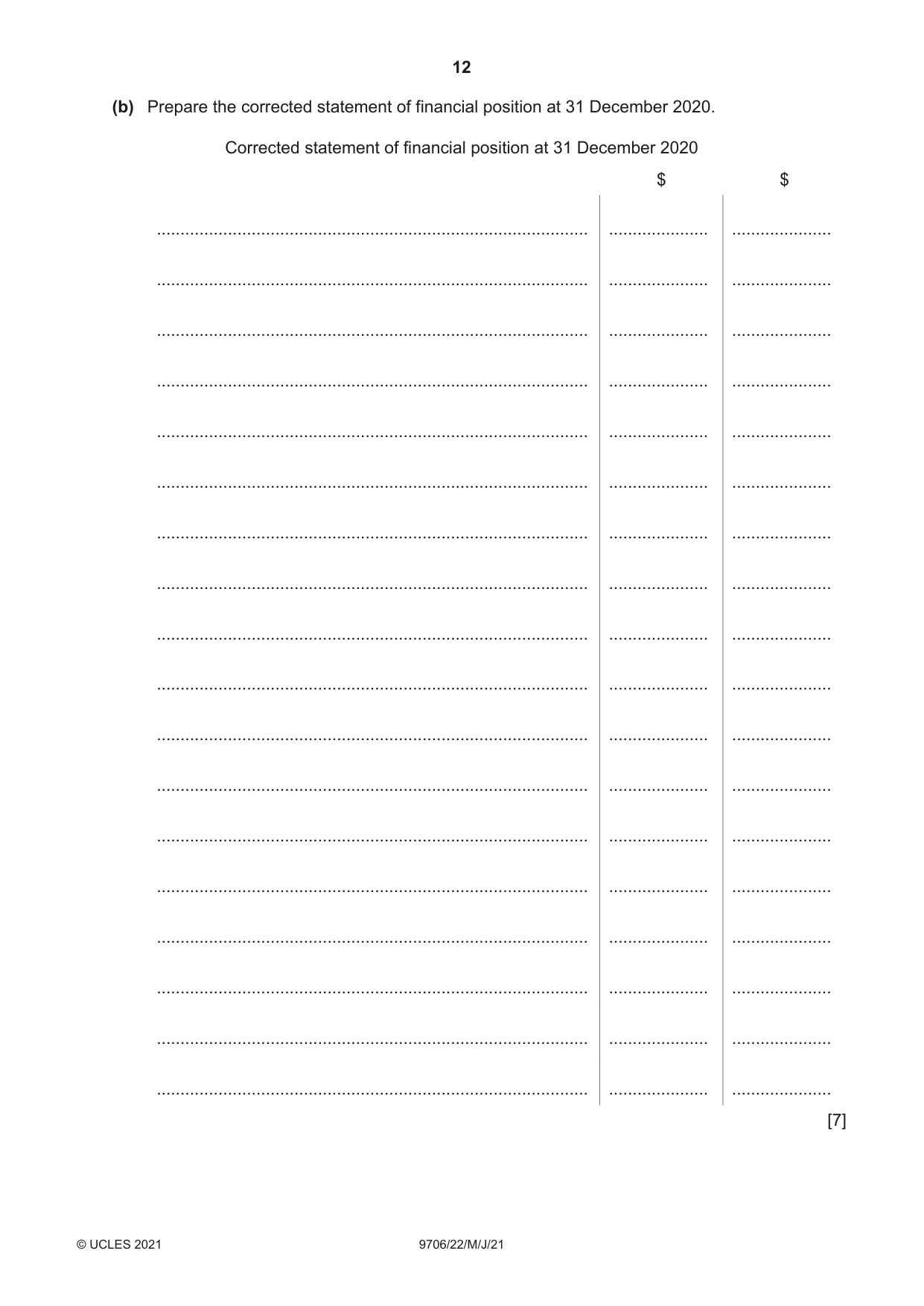
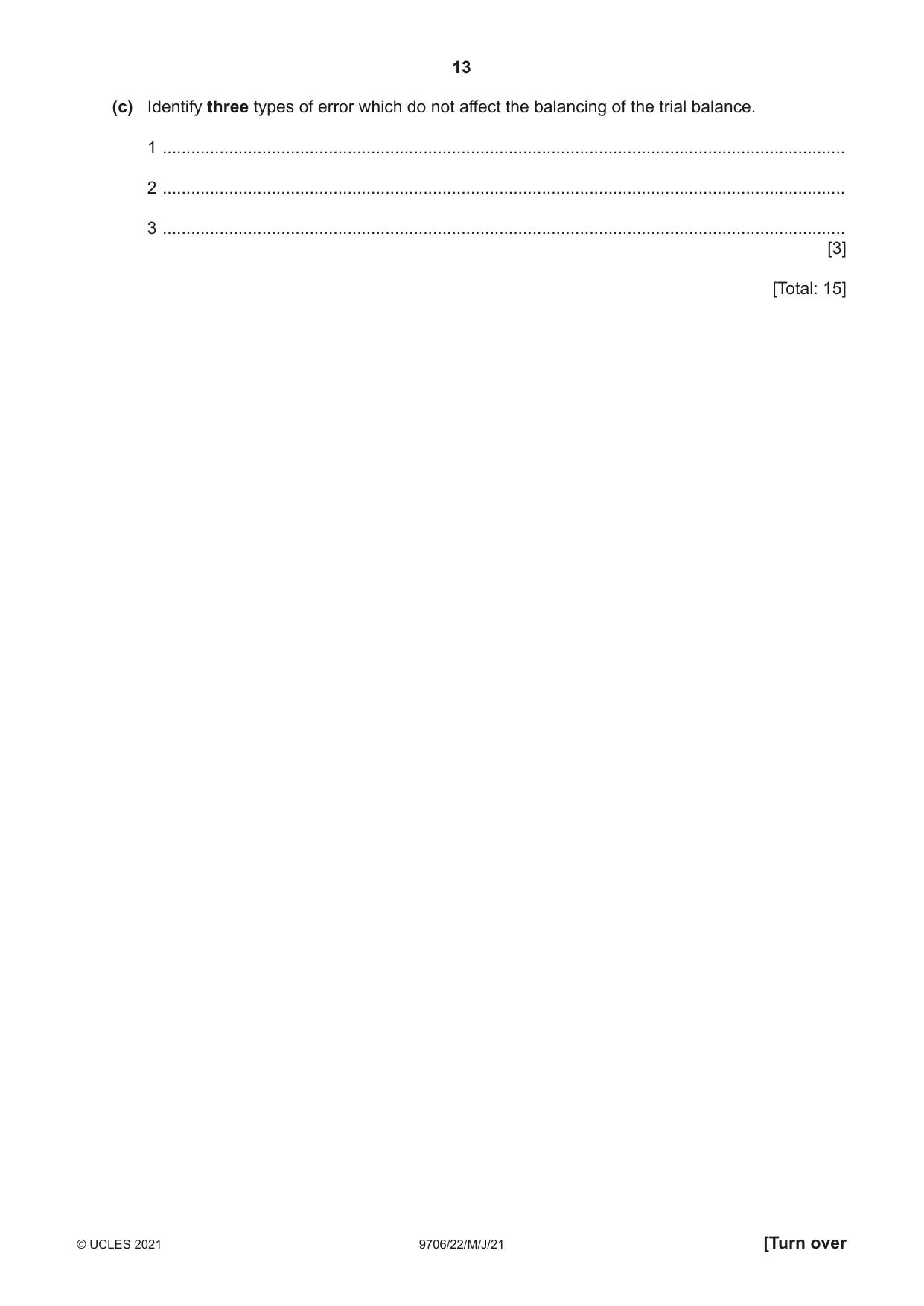
3 Jason prepared the following statement of financial position which contained errors. Statement of financial position at 31 December 2020 $ $ Non-current assets Cost 65 000 Provision for depreciation 31 000 34 000 Current assets Inventory 17 390 Trade receivables 14 800 Other payables 700 Bank overdraft 490 33 380 67 380 Capital Opening balance 56 950 Profit for the year 11 270 Drawings (18 450) 49 770 Non-current liabilities Bank loan (repayable March 2021) 4 900 Current liabilities Provision for doubtful debts 480 Other receivables 490 Trade payables 11 360 12 330 67 000 In addition to some items being recorded in the incorrect sections of the statement of financial position, the following errors have also been discovered. 1 Closing inventory had been overvalued by $510. 2 The balance of the rent receivable account, debit $220, had been included in other payables in the statement of financial position. 3 Depreciation at 20% per annum had been charged using the straight-line method instead of the reducing balance method at 20% per annum. 4 The balance of the drawings account had been understated by $580. REQUIRED (a) Calculate the revised profit for the year ended 31 December 2020. ................................................................................................................................................... ................................................................................................................................................... ................................................................................................................................................... ................................................................................................................................................... ................................................................................................................................................... ................................................................................................................................................... ................................................................................................................................................... ................................................................................................................................................... ................................................................................................................................................... ................................................................................................................................................... ................................................................................................................................................... ................................................................................................................................................... ................................................................................................................................................... ................................................................................................................................................... ................................................................................................................................................... ............................................................................................................................................. [5] (b) Prepare the corrected statement of financial position at 31 December 2020. Corrected statement of financial position at 31 December 2020 $ $ ........................................................................................... ..................... ..................... ........................................................................................... ..................... ..................... ........................................................................................... ..................... ..................... ........................................................................................... ..................... ..................... ........................................................................................... ..................... ..................... ........................................................................................... ..................... ..................... ........................................................................................... ..................... ..................... ........................................................................................... ..................... ..................... ........................................................................................... ..................... ..................... ........................................................................................... ..................... ..................... ........................................................................................... ..................... ..................... ........................................................................................... ..................... ..................... ........................................................................................... ..................... ..................... ........................................................................................... ..................... ..................... ........................................................................................... ..................... ..................... ........................................................................................... ..................... ..................... ........................................................................................... ..................... ..................... ........................................................................................... ..................... ..................... [7] (c) Identify three types of error which do not affect the balancing of the trial balance. 1 ................................................................................................................................................ 2 ................................................................................................................................................ 3 ................................................................................................................................................ [3] [Total: 15]
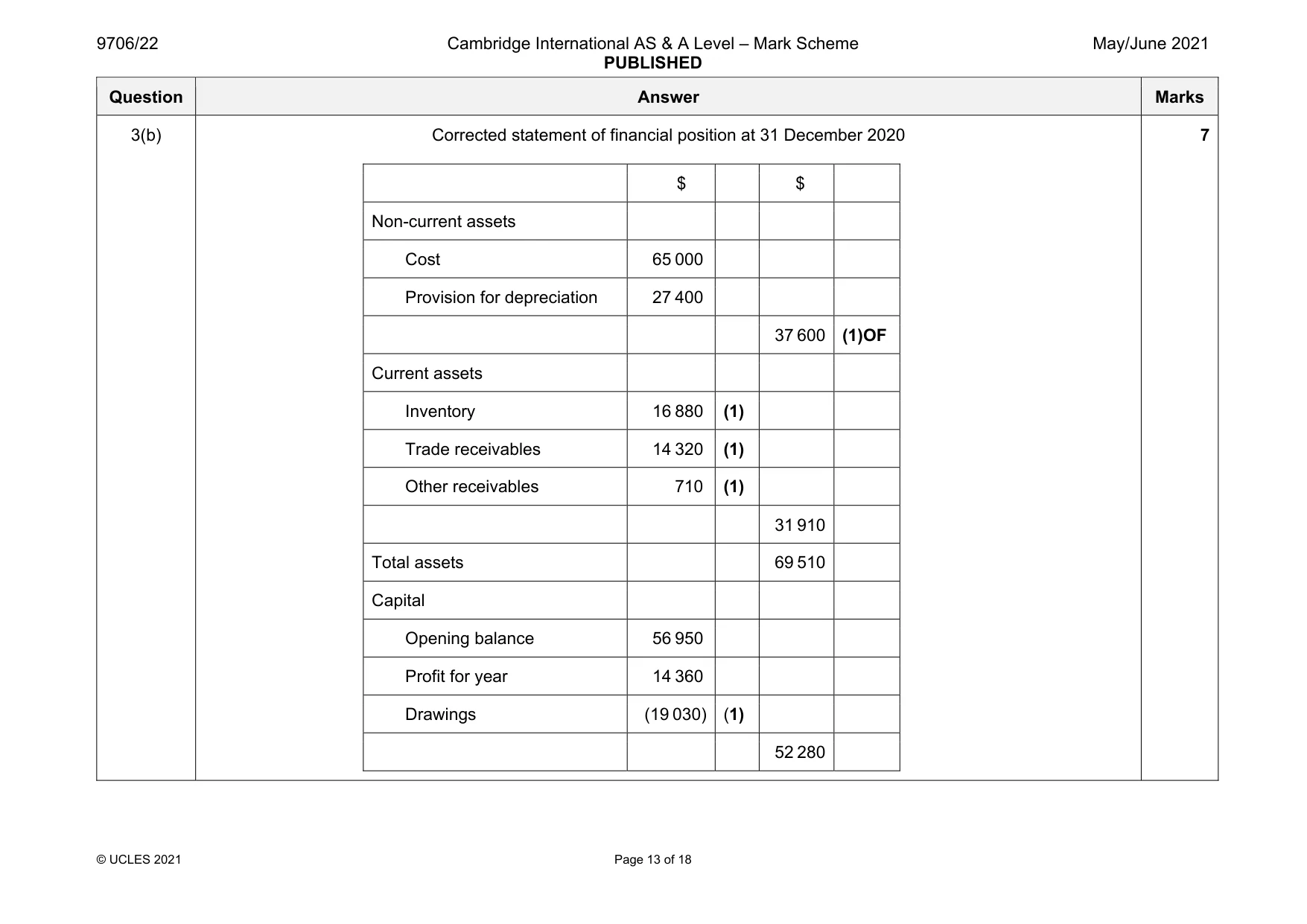
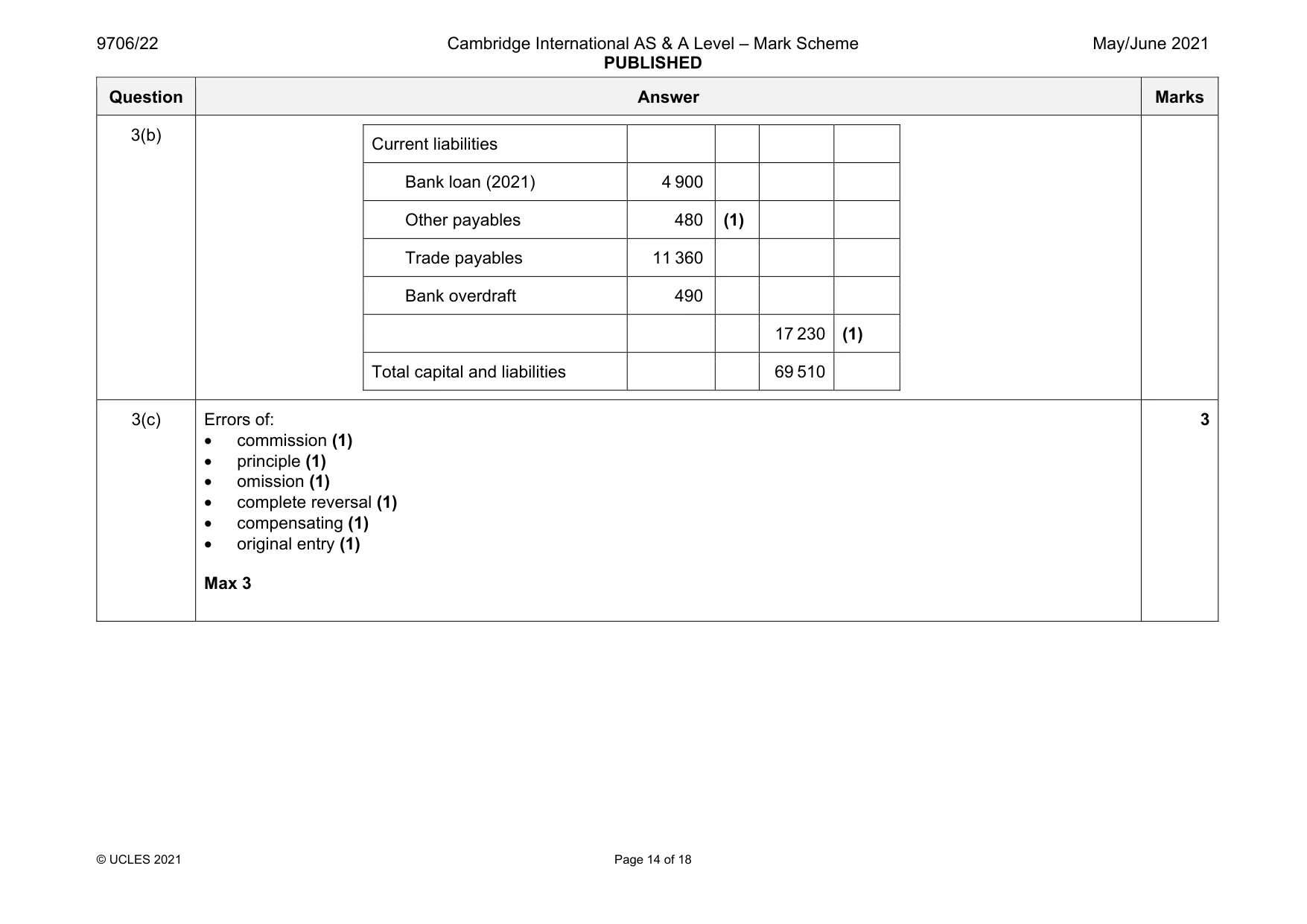
Mark scheme: 3(a) $14 360 (5) Workings $ Draft profit for the year 11 270 Less: overvalued inventory (510) (1) Add: decrease in provision for depreciation (W) 3 600 (3)OF Revised profit for the year 14 360 (1) W Incorrect charge for the year 20% × $65 000 = $13 000 Provision at beginning of year ($31 000 – $13 000) = $18 000 Net book value at beginning of year ($65 000 – $18 000) = $47 000 Correct depreciation charge for the year ($47 000 × 20%) i.e. $9 400 Decrease in depreciation charge: $13 000 (1) – $9 400 (1) = $3 600 (1)OF Question Answer Marks 3(b) Corrected statement of financial position at 31 December 2020 $ $ Non-current assets Cost 65 000 Provision for depreciation 27 400 37 600 (1)OF Current assets Inventory 16 880 (1) Trade receivables 14 320 (1) Other receivables 710 (1) 31 910 Total assets 69 510 Capital Opening balance 56 950 Profit for year 14 360 Drawings (19 030) (1) 52 280 7 Question Answer Marks 3(b) Current liabilities Bank loan (2021) 4 900 Other payables 480 (1) Trade payables 11 360 Bank overdraft 490 17 230 (1) Total capital and liabilities 69 510 3(c) Errors of: • commission (1) • principle (1) • omission (1) • complete reversal (1) • compensating (1) • original entry (1) Max 3 3
Q4 · T Limited manufactures goods at two factories: Factory A and Factory B
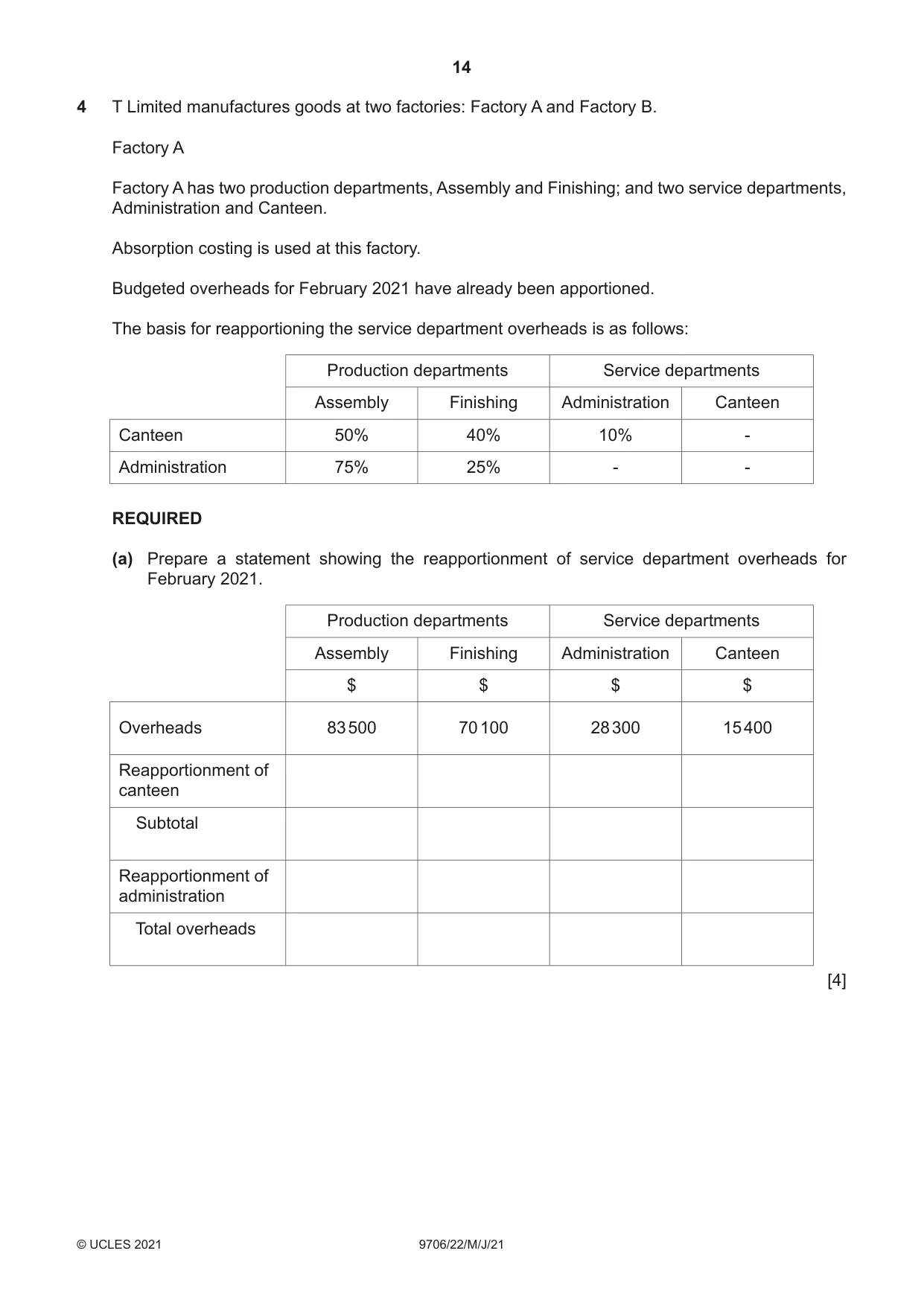
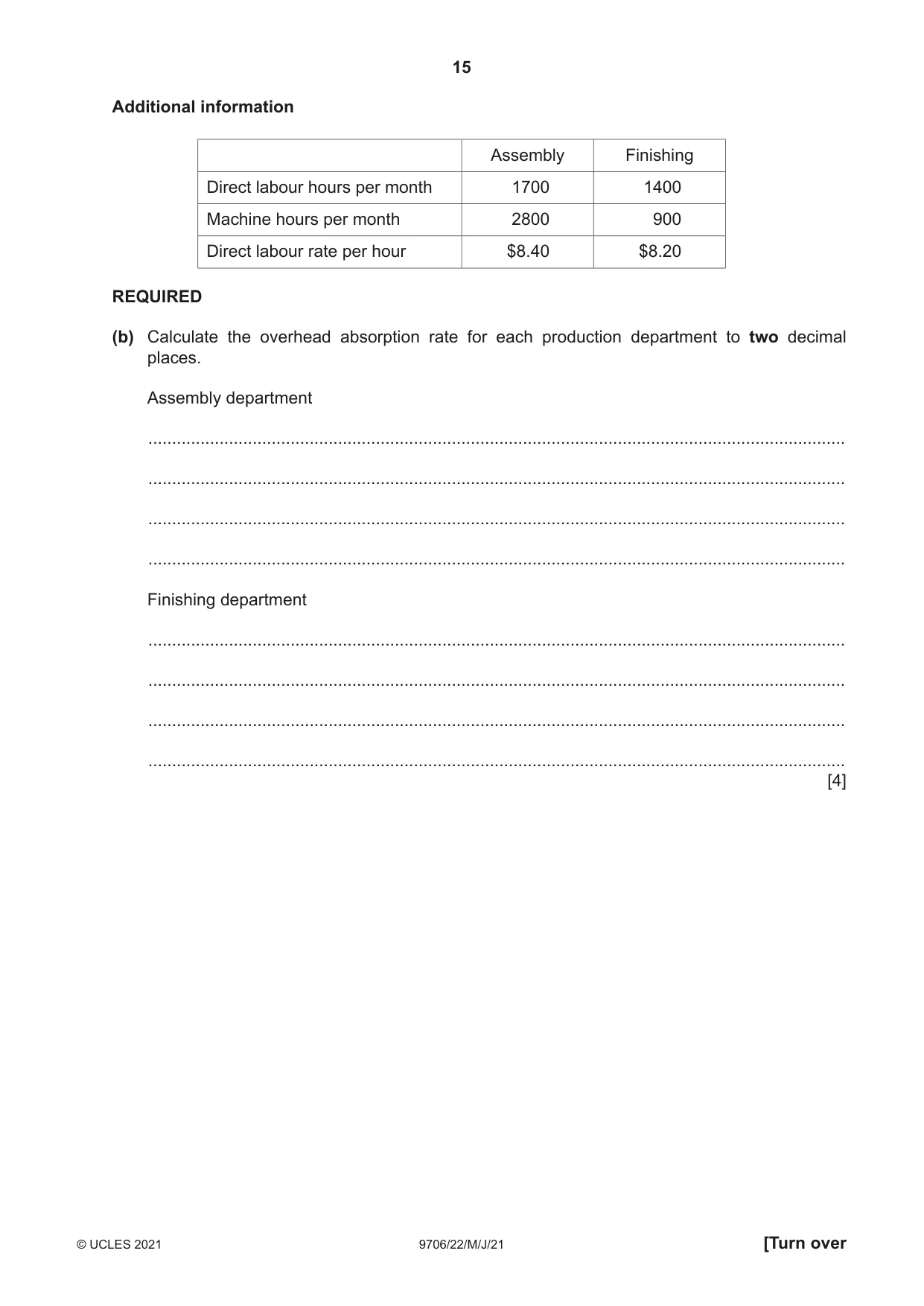
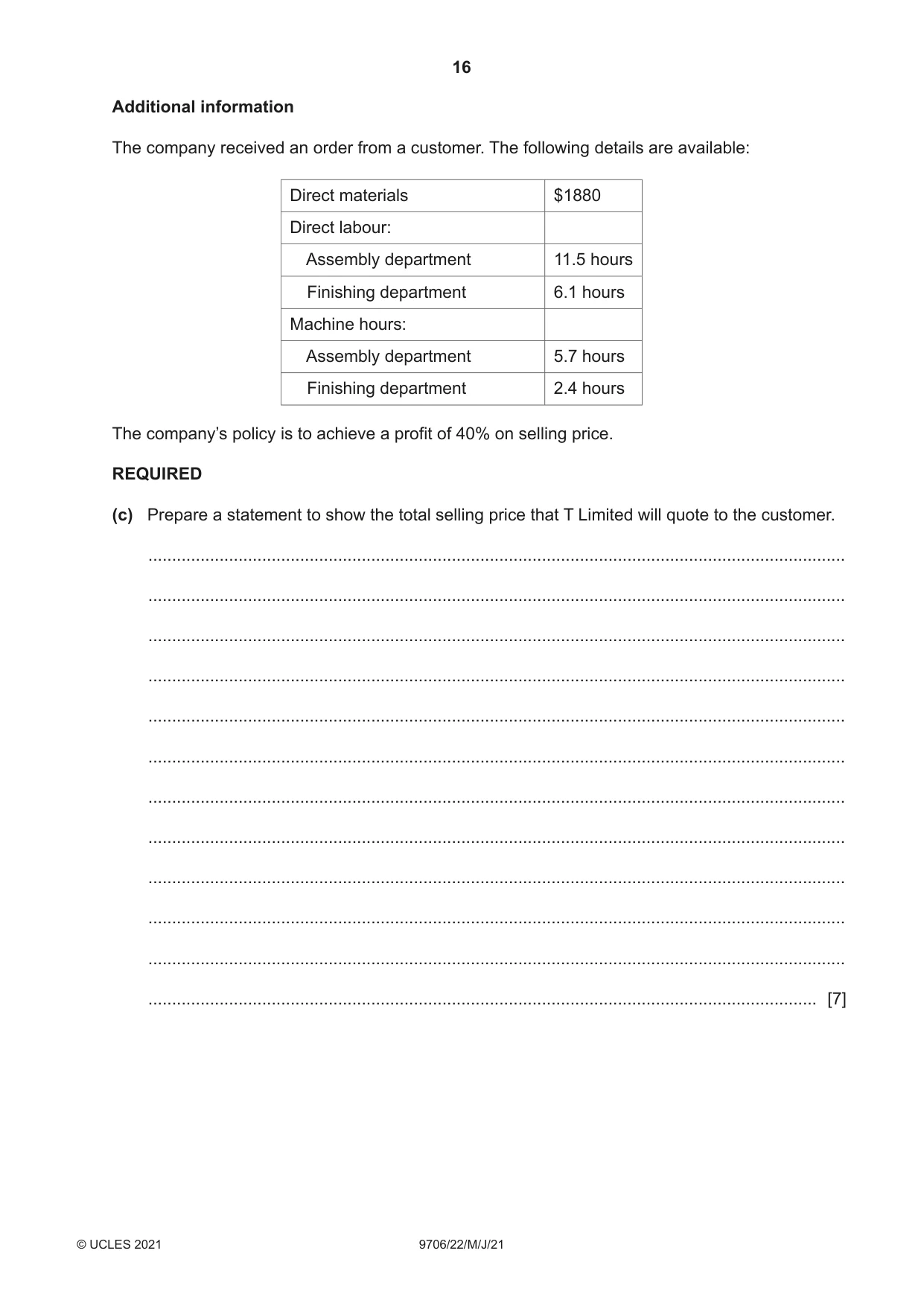
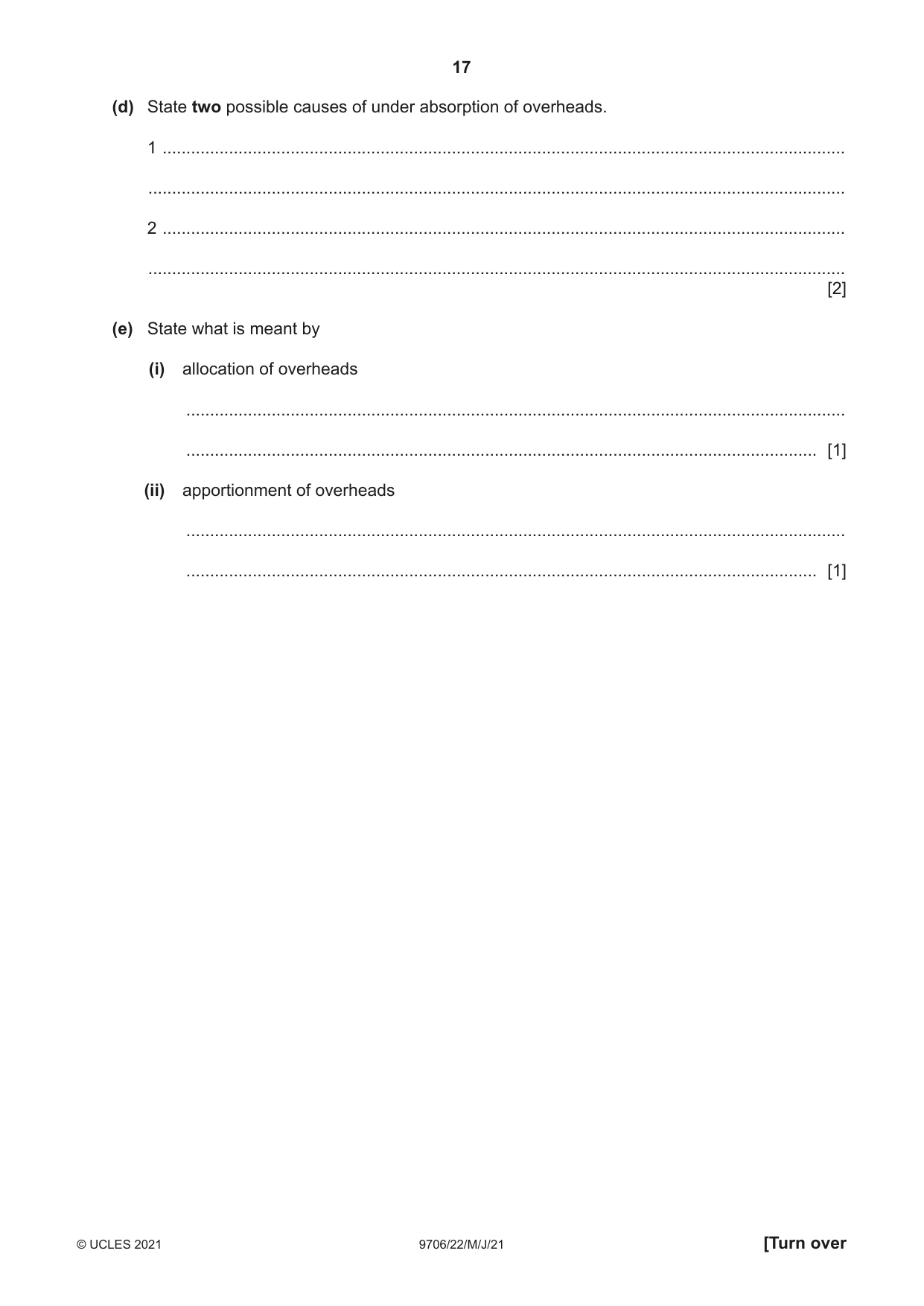
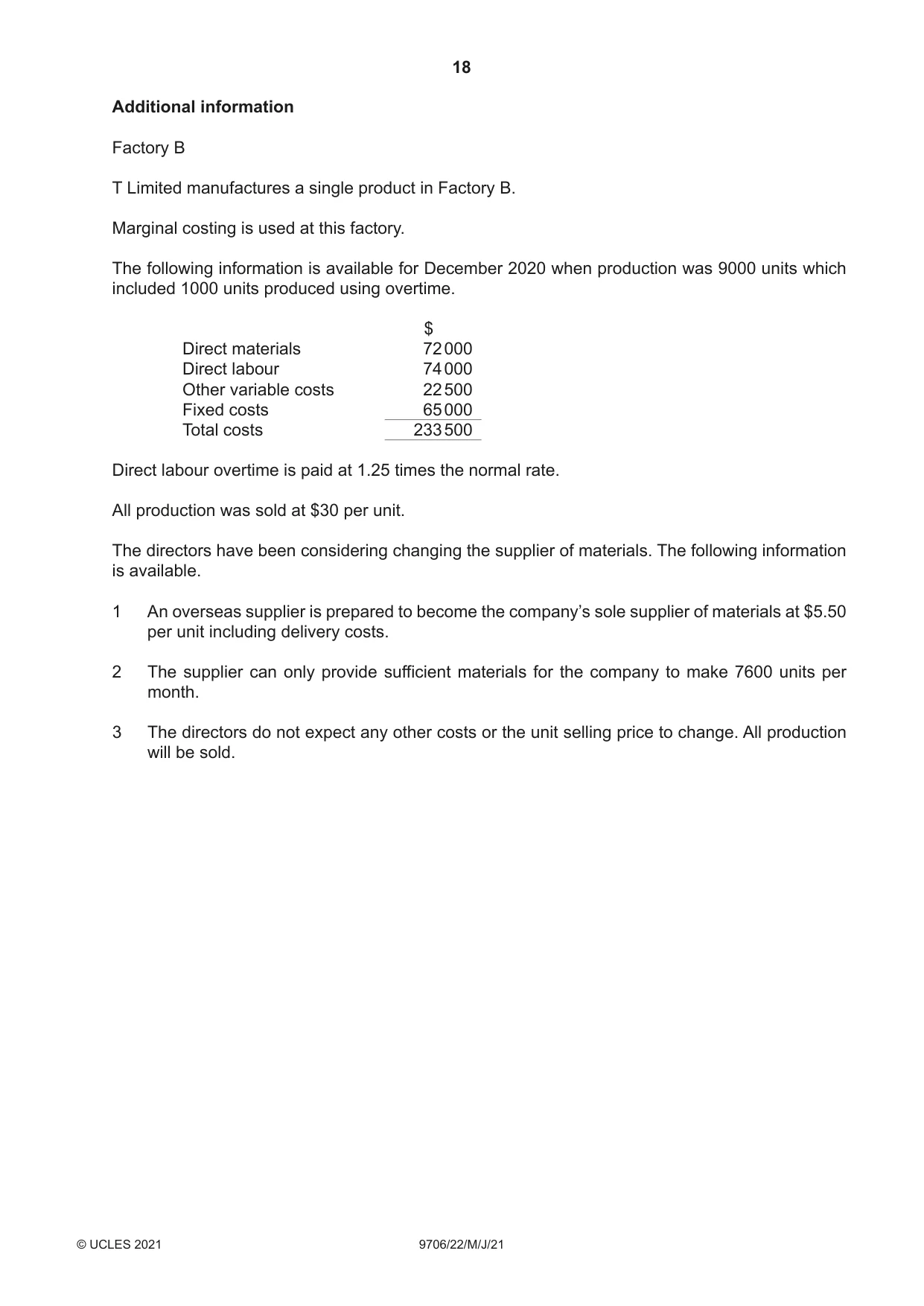
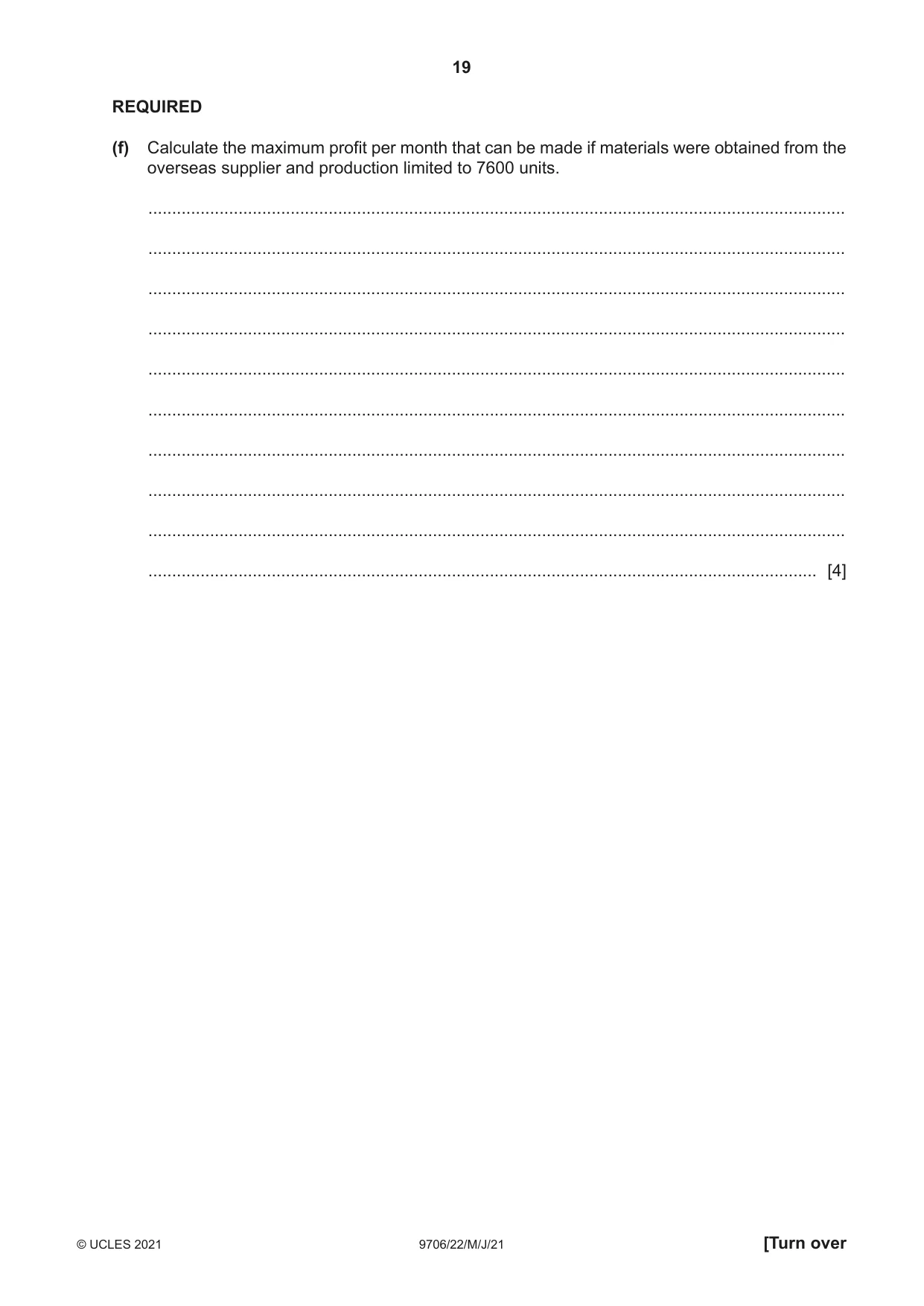
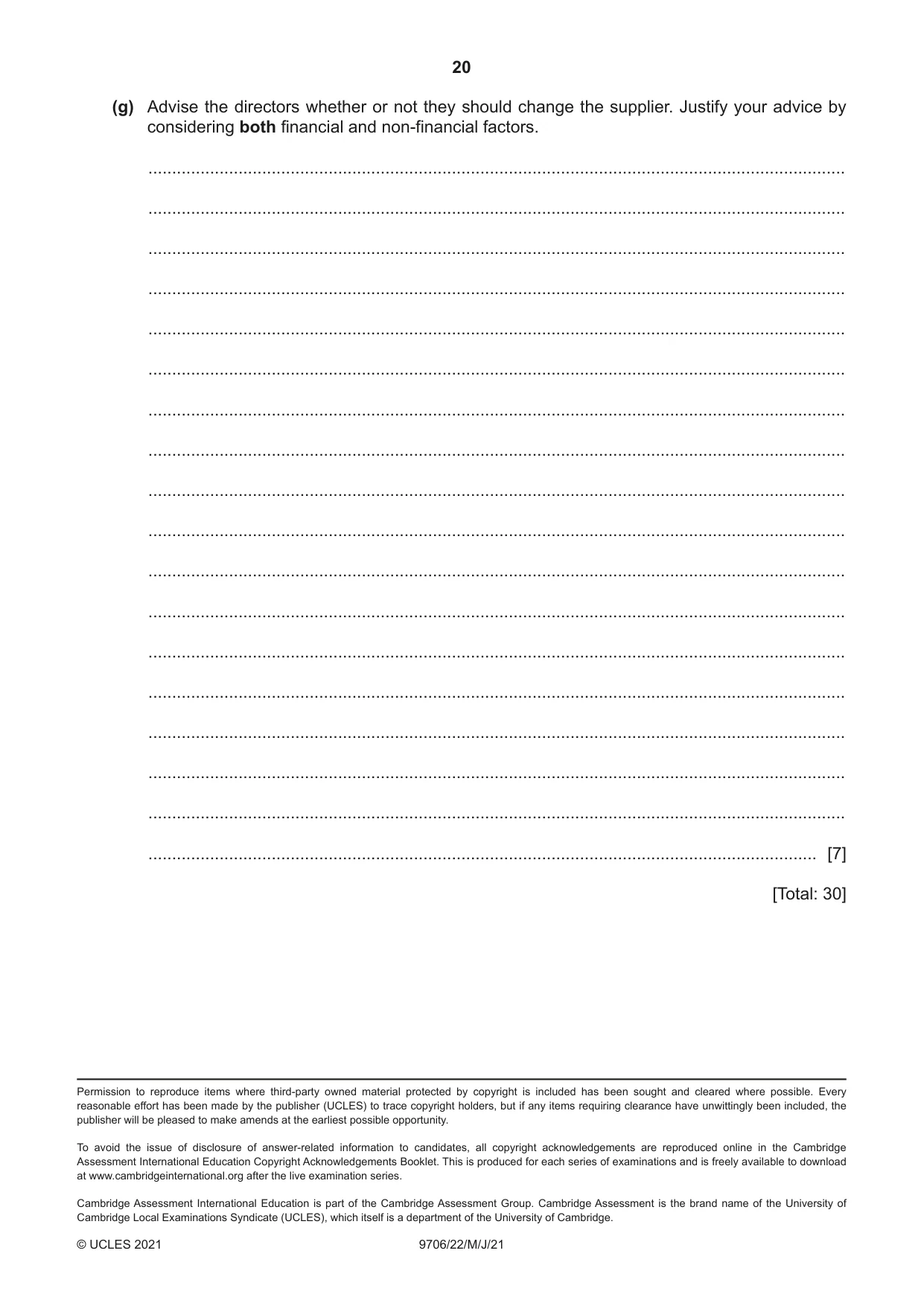
4 T Limited manufactures goods at two factories: Factory A and Factory B. Factory A Factory A has two production departments, Assembly and Finishing; and two service departments, Administration and Canteen. Absorption costing is used at this factory. Budgeted overheads for February 2021 have already been apportioned. The basis for reapportioning the service department overheads is as follows: Production departments Service departments Assembly Finishing Administration Canteen Canteen 50% 40% 10% - Administration 75% 25% - - REQUIRED (a) Prepare a statement showing the reapportionment of service department overheads for February 2021. Production departments Service departments Assembly Finishing Administration Canteen $ $ $ $ Overheads 83 500 70 100 28 300 15 400 Reapportionment of canteen Subtotal Reapportionment of administration Total overheads [4] Additional information Assembly Finishing Direct labour hours per month 1700 1400 Machine hours per month 2800 900 Direct labour rate per hour $8.40 $8.20 REQUIRED (b) Calculate the overhead absorption rate for each production department to two decimal places. Assembly department ................................................................................................................................................... ................................................................................................................................................... ................................................................................................................................................... ................................................................................................................................................... Finishing department ................................................................................................................................................... ................................................................................................................................................... ................................................................................................................................................... ................................................................................................................................................... [4] Additional information The company received an order from a customer. The following details are available: Direct materials $1880 Direct labour: Assembly department 11.5 hours Finishing department 6.1 hours Machine hours: Assembly department 5.7 hours Finishing department 2.4 hours The company’s policy is to achieve a profit of 40% on selling price. REQUIRED (c) Prepare a statement to show the total selling price that T Limited will quote to the customer. ................................................................................................................................................... ................................................................................................................................................... ................................................................................................................................................... ................................................................................................................................................... ................................................................................................................................................... ................................................................................................................................................... ................................................................................................................................................... ................................................................................................................................................... ................................................................................................................................................... ................................................................................................................................................... ................................................................................................................................................... ............................................................................................................................................. [7]
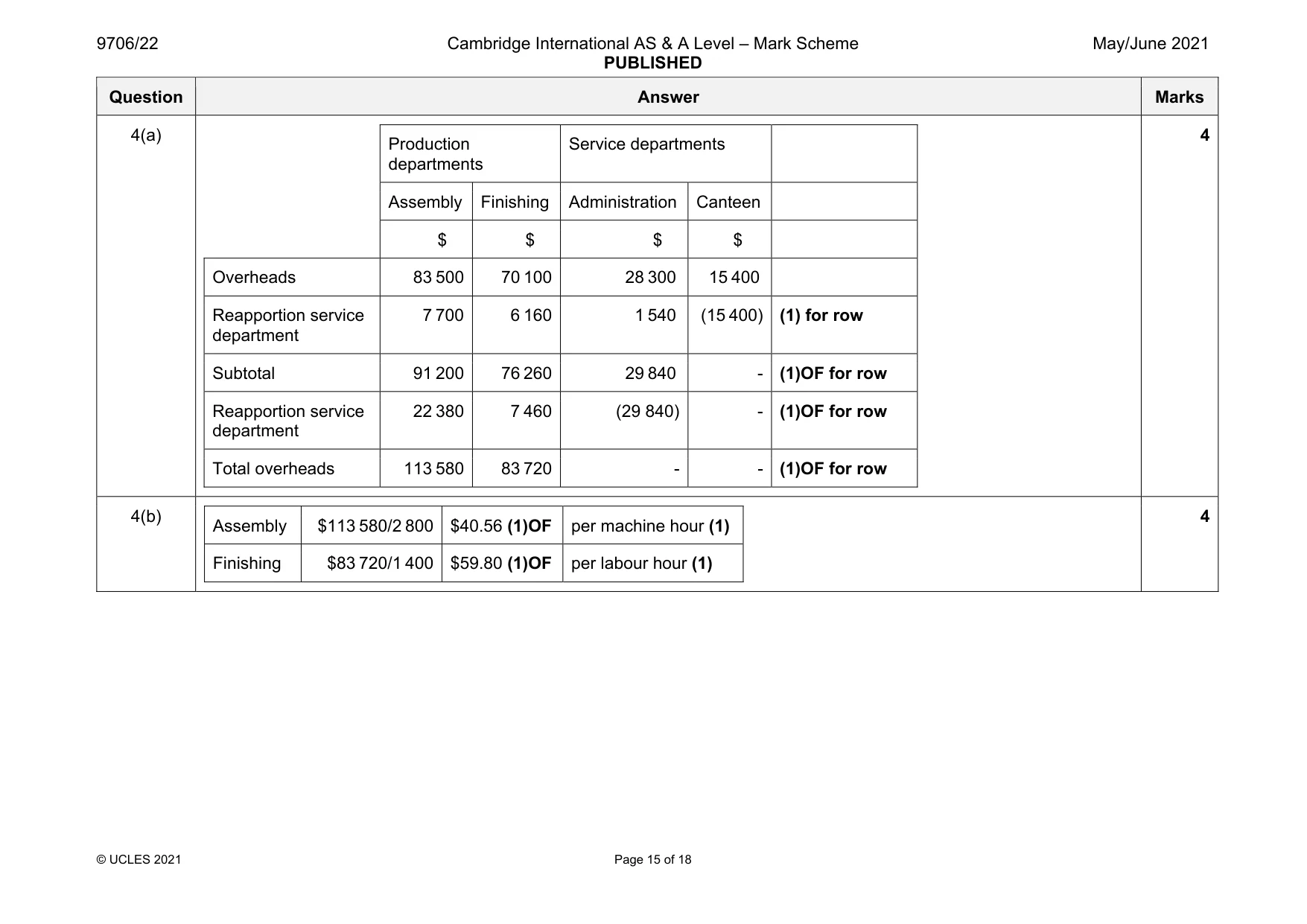
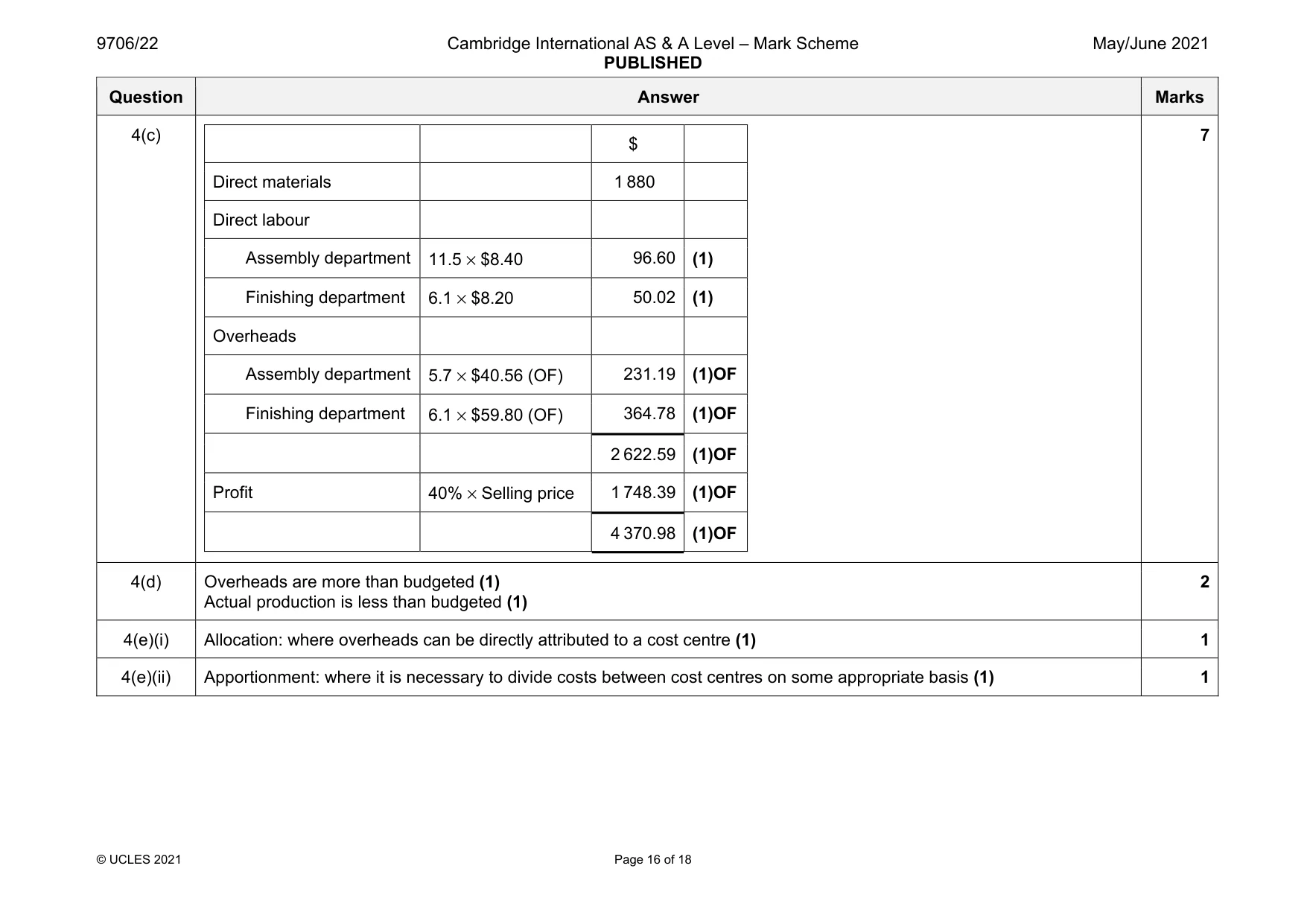
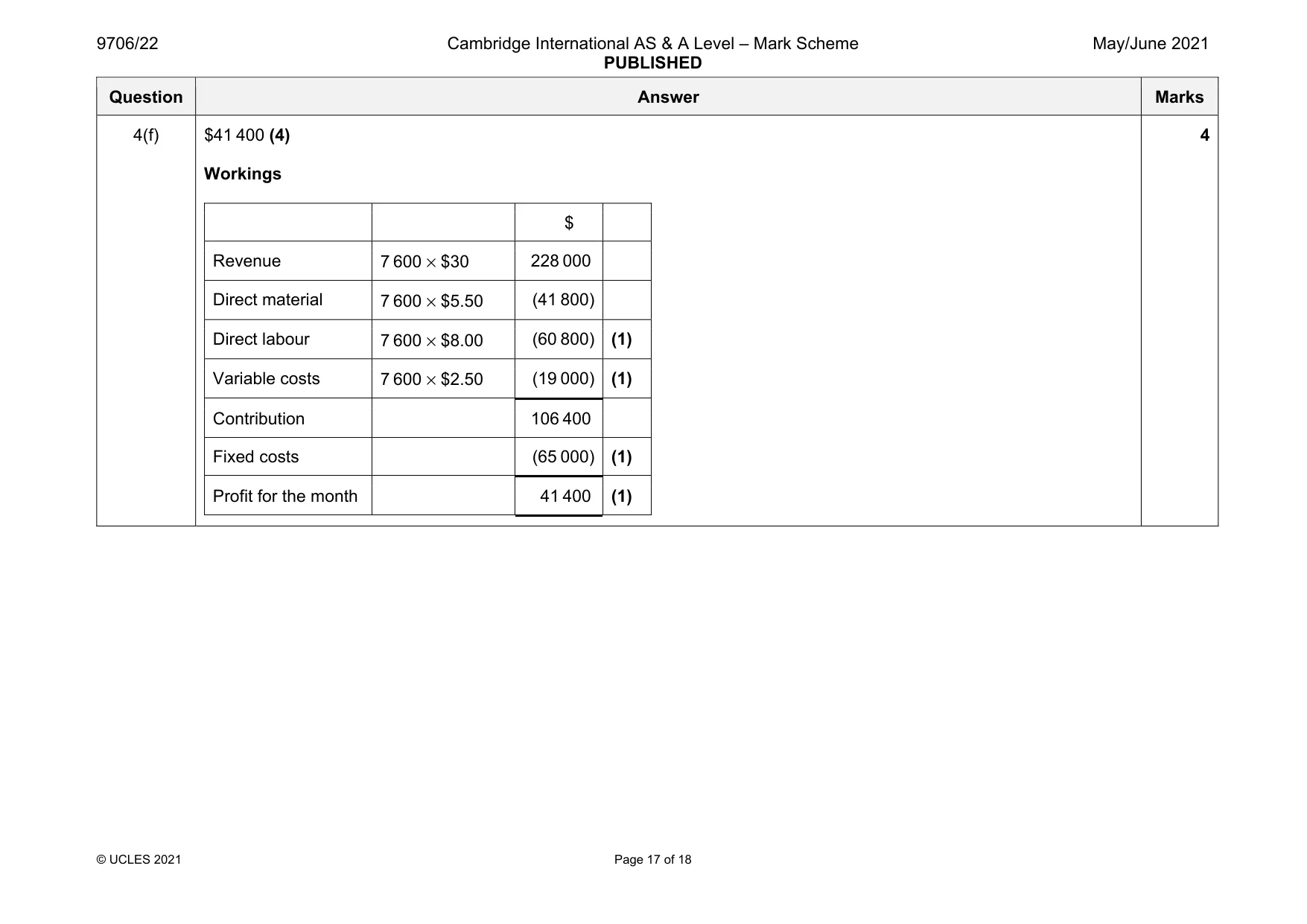
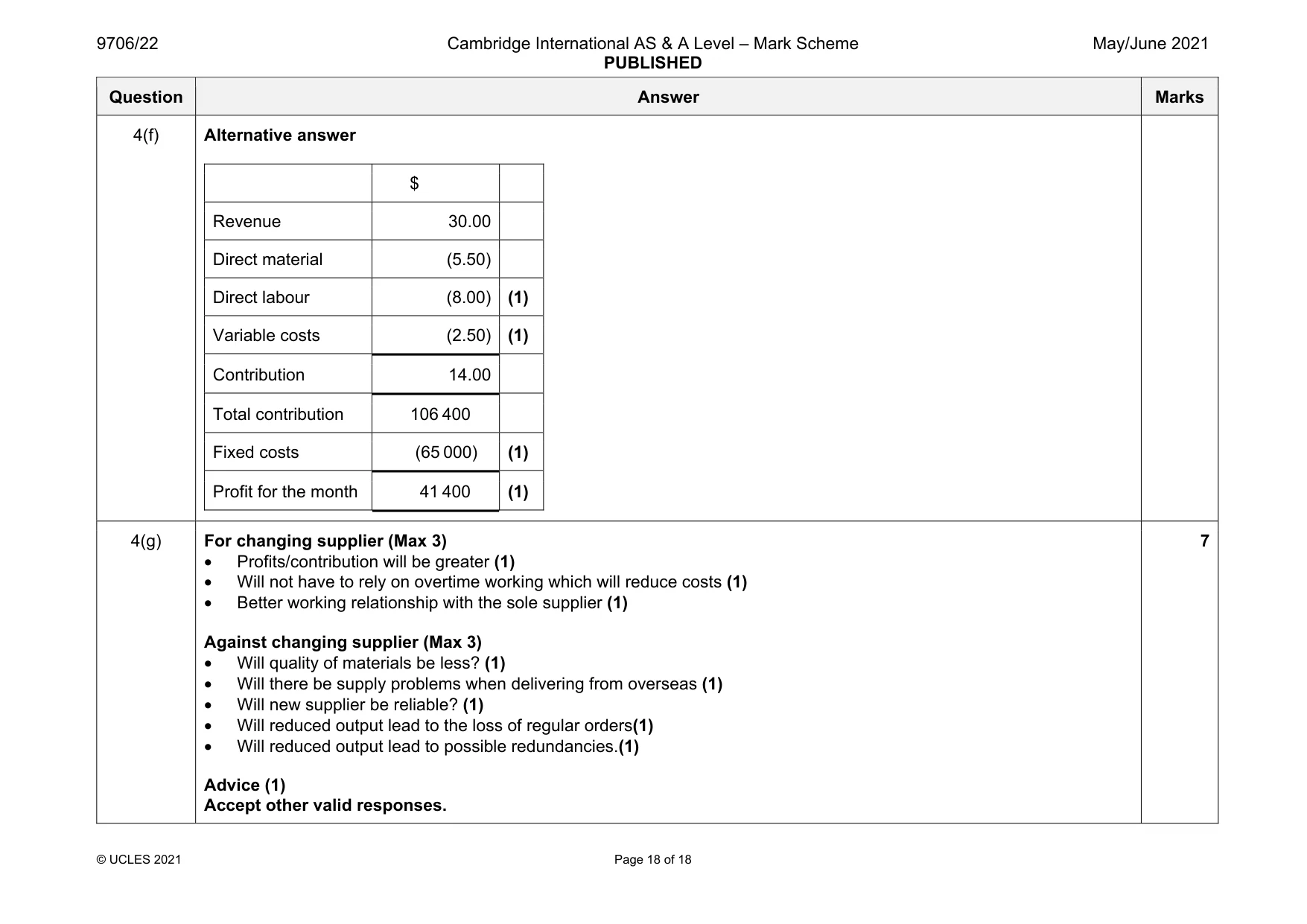
Mark scheme: 4(a) Production departments Service departments Assembly Finishing Administration Canteen $ $ $ $ Overheads 83 500 70 100 28 300 15 400 Reapportion service department 7 700 6 160 1 540 (15 400) (1) for row Subtotal 91 200 76 260 29 840 - (1)OF for row Reapportion service department 22 380 7 460 (29 840) - (1)OF for row Total overheads 113 580 83 720 - - (1)OF for row 4 4(b) Assembly $113 580/2 800 $40.56 (1)OF per machine hour (1) Finishing $83 720/1 400 $59.80 (1)OF per labour hour (1) 4 Question Answer Marks 4(c) $ Direct materials 1 880 Direct labour Assembly department 11.5 × $8.40 96.60 (1) Finishing department 6.1 × $8.20 50.02 (1) Overheads Assembly department 5.7 × $40.56 (OF) 231.19 (1)OF Finishing department 6.1 × $59.80 (OF) 364.78 (1)OF 2 622.59 (1)OF Profit 40% × Selling price 1 748.39 (1)OF 4 370.98 (1)OF 7 4(d) Overheads are more than budgeted (1) Actual production is less than budgeted (1) 2 4(e)(i) Allocation: where overheads can be directly attributed to a cost centre (1) 1 4(e)(ii) Apportionment: where it is necessary to divide costs between cost centres on some appropriate basis (1) 1 Question Answer Marks 4(f) $41 400 (4) Workings $ Revenue 7 600 × $30 228 000 Direct material 7 600 × $5.50 (41 800) Direct labour 7 600 × $8.00 (60 800) (1) Variable costs 7 600 × $2.50 (19 000) (1) Contribution 106 400 Fixed costs (65 000) (1) Profit for the month 41 400 (1) 4 Question Answer Marks 4(f) Alternative answer $ Revenue 30.00 Direct material (5.50) Direct labour (8.00) (1) Variable costs (2.50) (1) Contribution 14.00 Total contribution 106 400 Fixed costs (65 000) (1) Profit for the month 41 400 (1) 4(g) For changing supplier (Max 3) • Profits/contribution will be greater (1) • Will not have to rely on overtime working which will reduce costs (1) • Better working relationship with the sole supplier (1) Against changing supplier (Max 3) • Will quality of materials be less? (1) • Will there be supply problems when delivering from overseas (1) • Will new supplier be reliable? (1) • Will reduced output lead to the loss of regular orders(1) • Will reduced output lead to possible redundancies.(1) Advice (1) Accept other valid responses. 7
What was in this paper
The subtopics covered by these 4 questions, and how many questions each got. Open one in a new tab to see every Cambridge question on it.
What you needed in this session
Cambridge’s own grade thresholds for 2021 May/June, Paper 2 · Variant 2. A higher threshold means an easier paper — the bar moves with how the cohort did.