Cambridge A Level Accounting 9706 — 2021 May/June Paper 2 · Variant 3
9706/23/M/J/21 · 6 questions · 90 marks · ≈101 min
The question paper and its mark scheme, free to read here and free to download. This is Cambridge’s own paper, exactly as it was sat.
Question paper20 pages
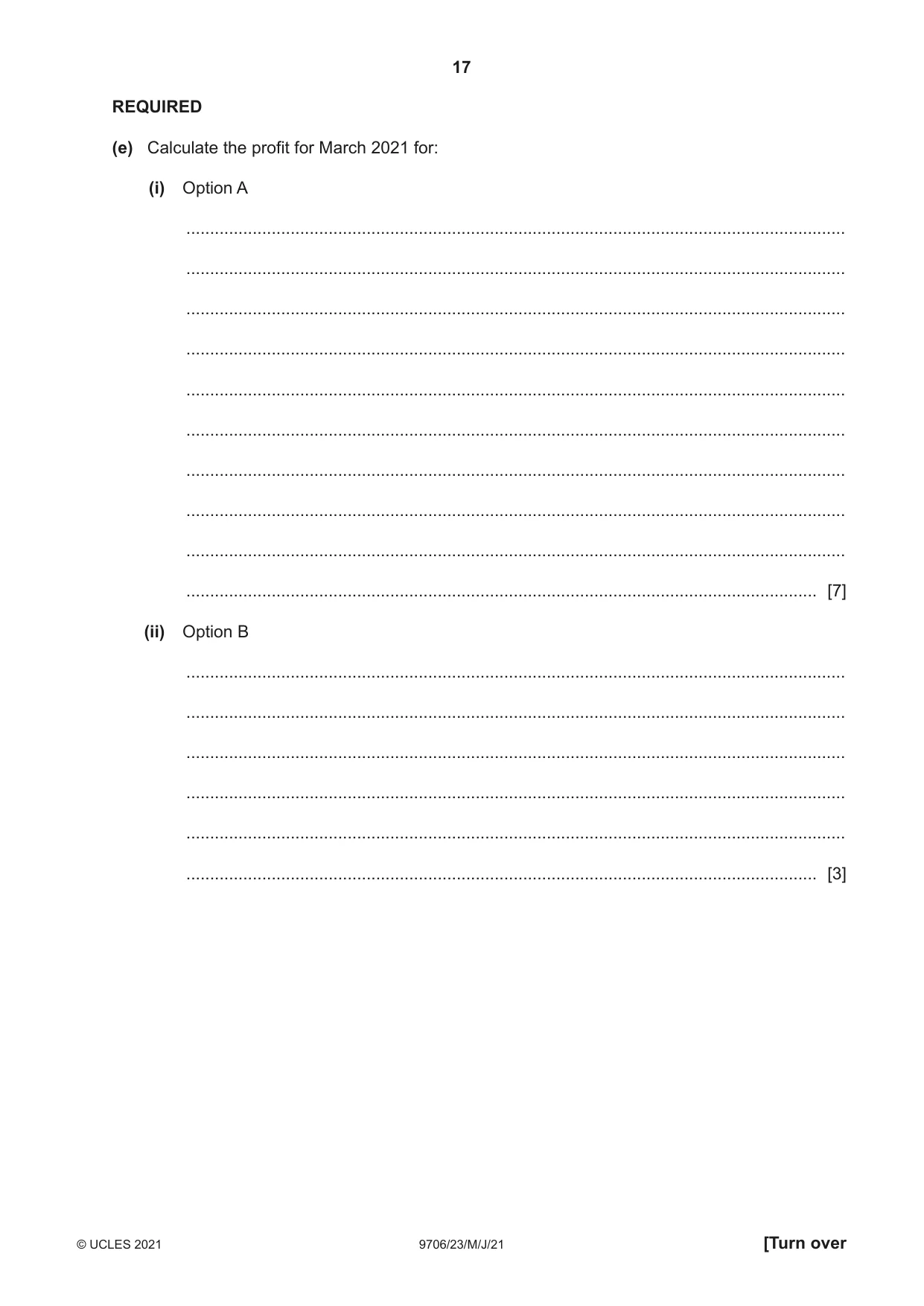
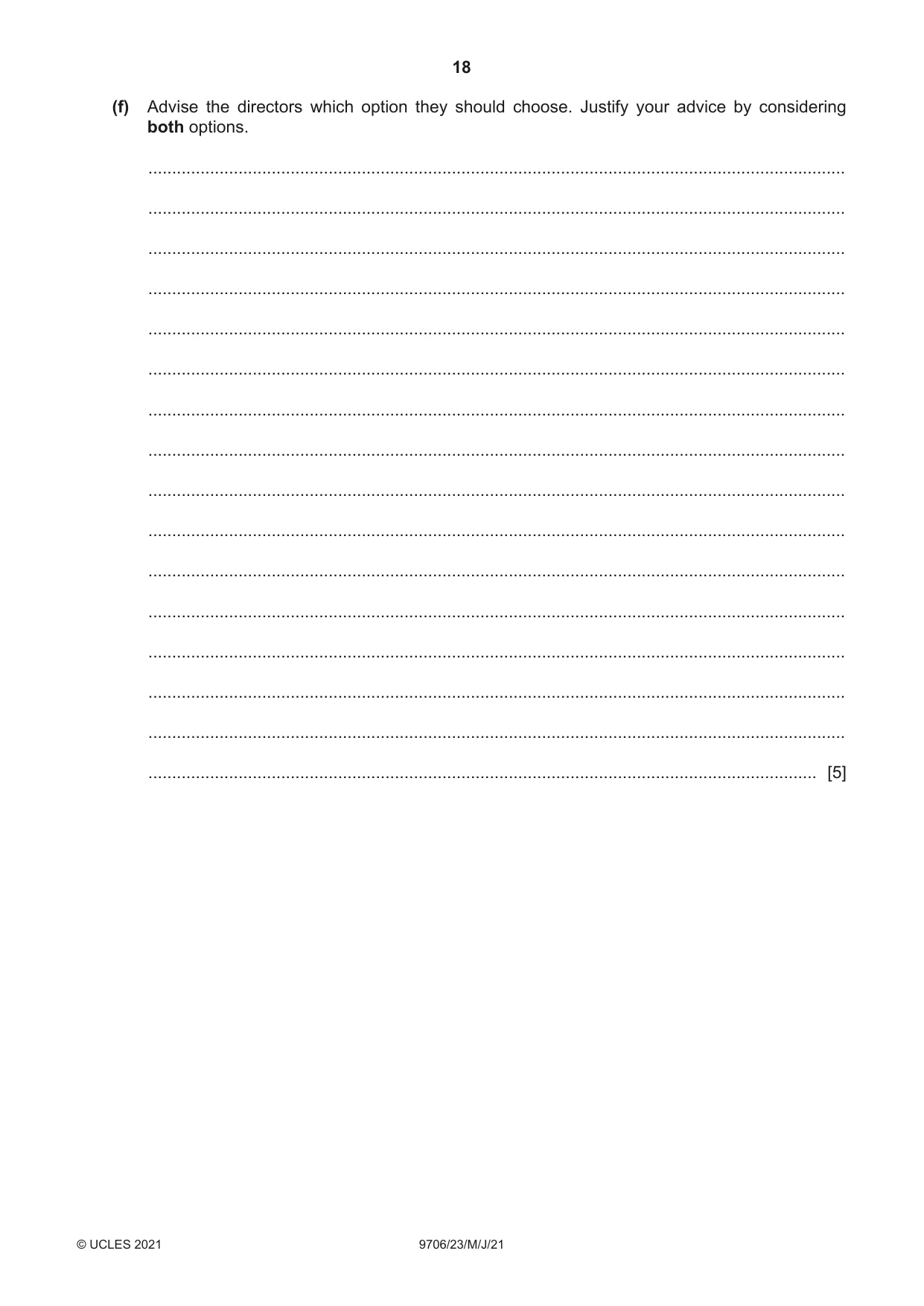
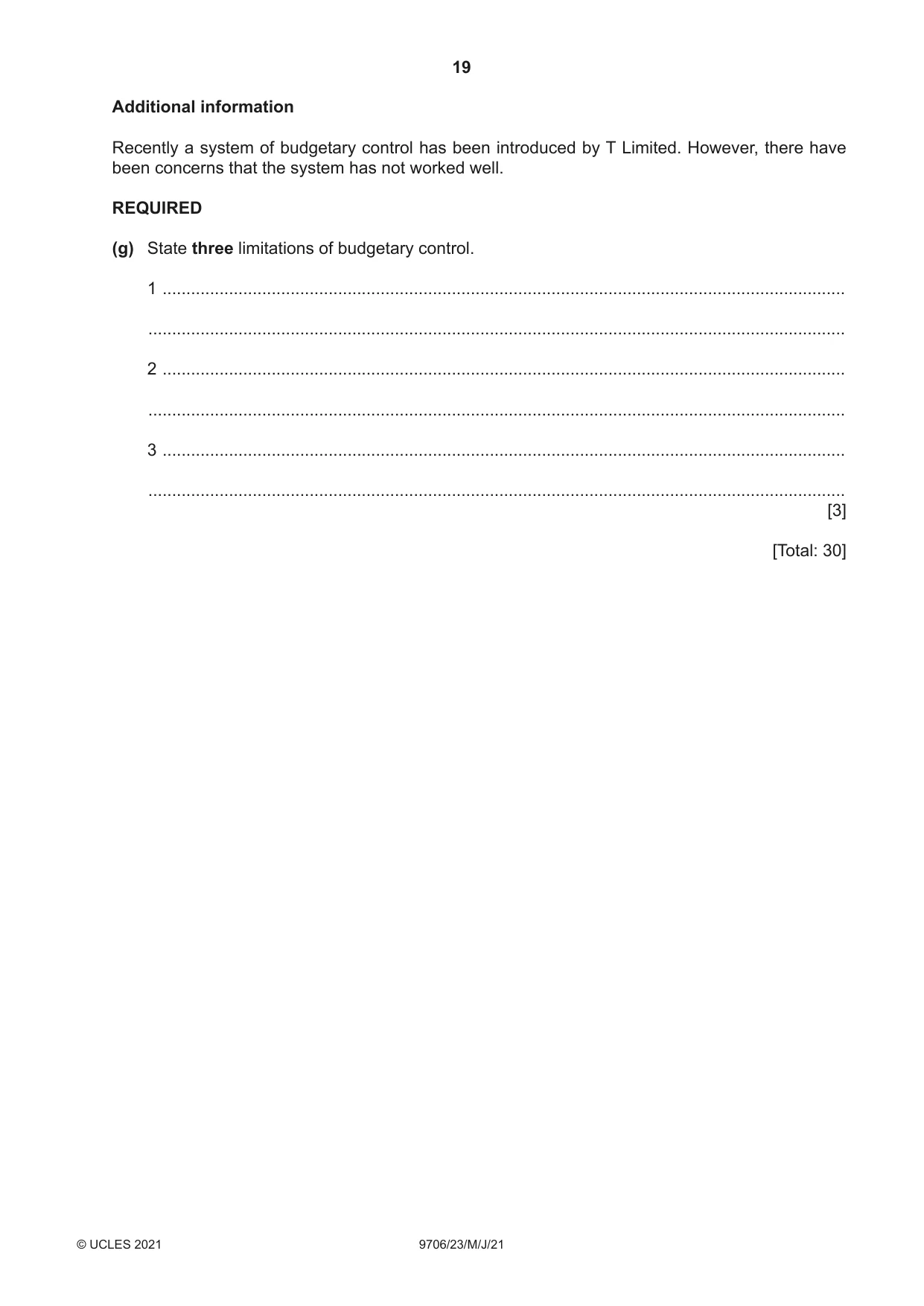
Mark scheme17 pages
Answers below. Sit the paper first if you are practising.
Questions as text
Q1 · Adam owns a retail business
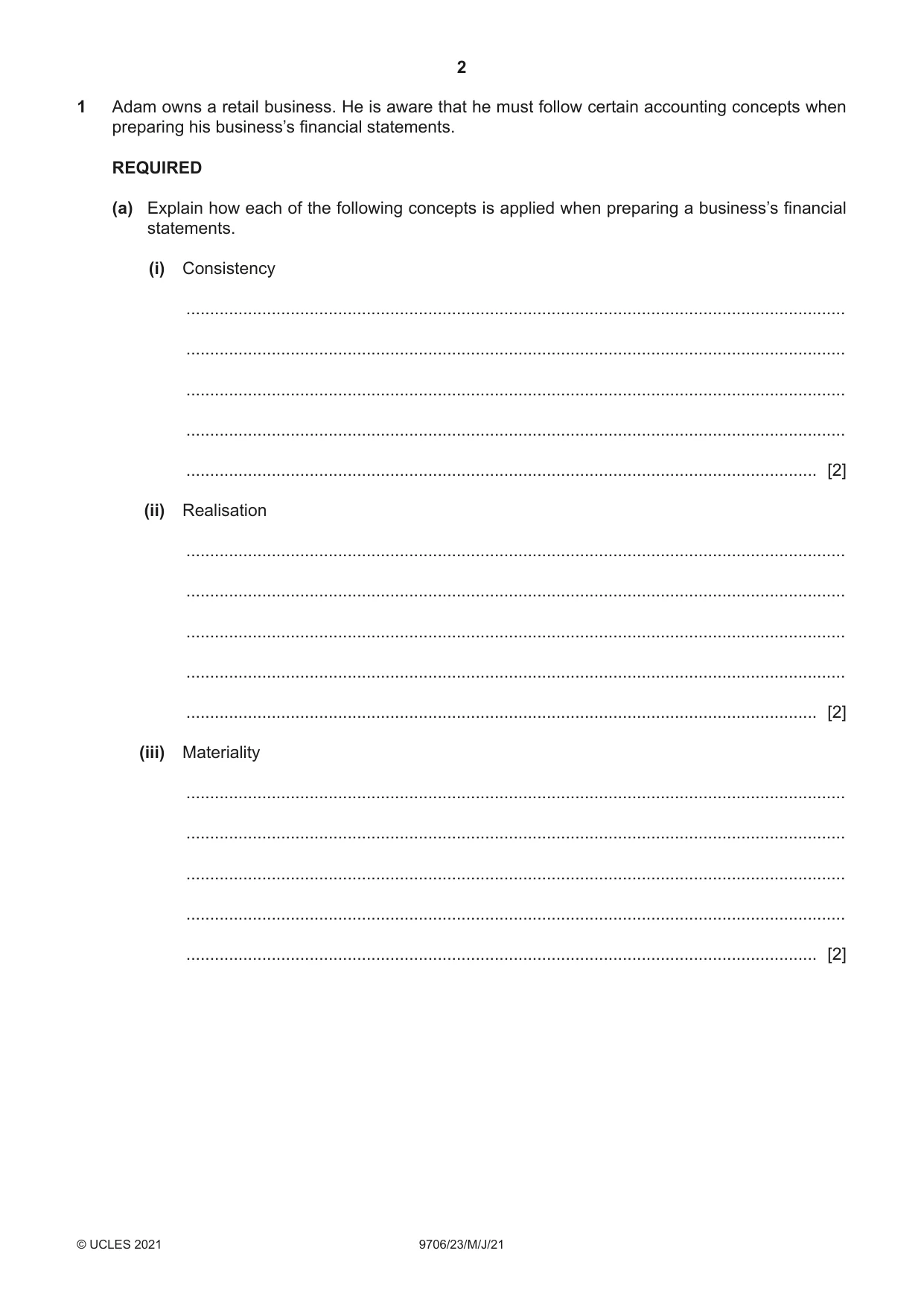
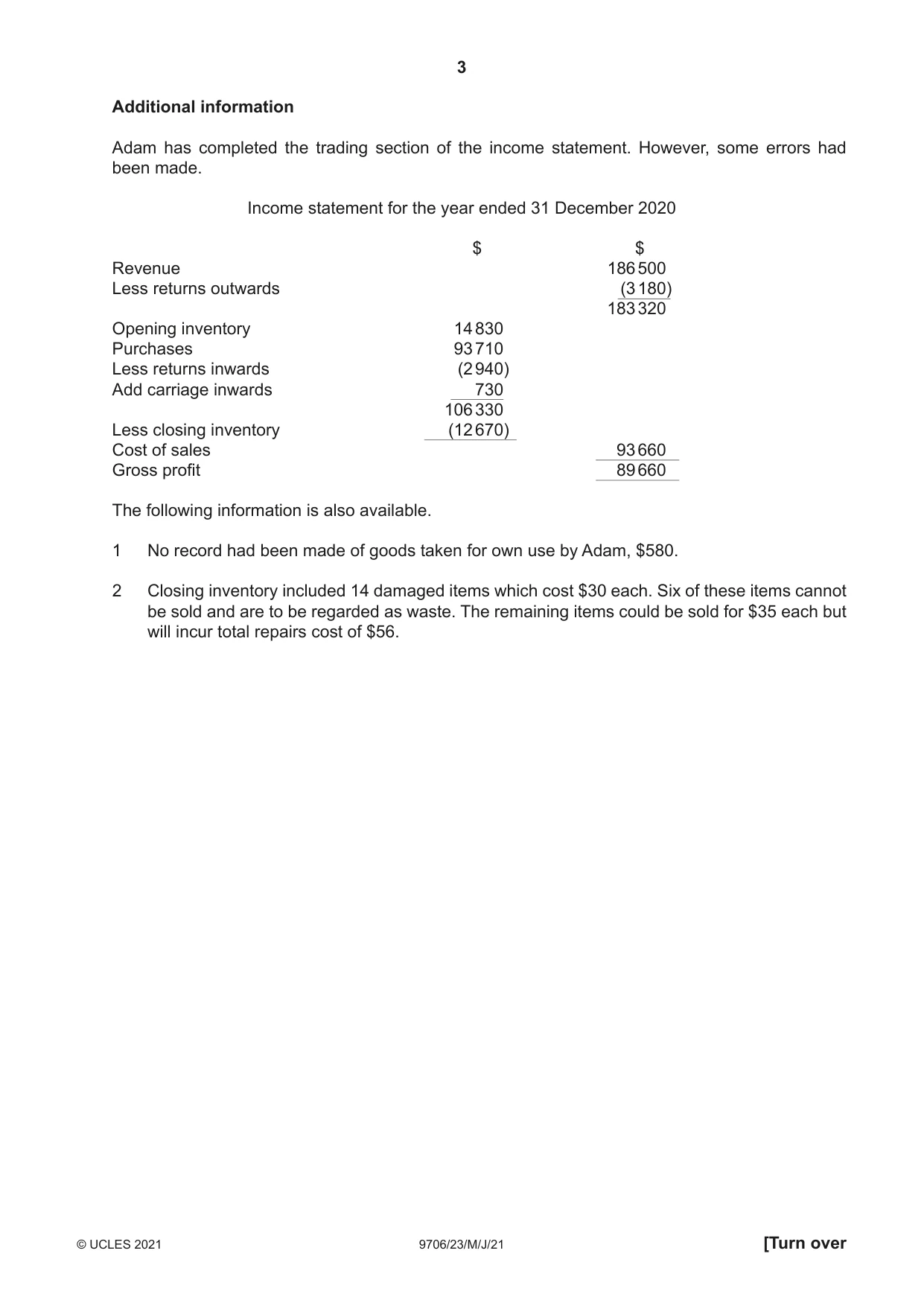
1 Adam owns a retail business. He is aware that he must follow certain accounting concepts when preparing his business’s financial statements. REQUIRED (a) Explain how each of the following concepts is applied when preparing a business’s financial statements. (i) Consistency ........................................................................................................................................... ........................................................................................................................................... ........................................................................................................................................... ........................................................................................................................................... ..................................................................................................................................... [2] (ii) Realisation ........................................................................................................................................... ........................................................................................................................................... ........................................................................................................................................... ........................................................................................................................................... ..................................................................................................................................... [2] (iii) Materiality ........................................................................................................................................... ........................................................................................................................................... ........................................................................................................................................... ........................................................................................................................................... ..................................................................................................................................... [2] Additional information Adam has completed the trading section of the income statement. However, some errors had been made. Income statement for the year ended 31 December 2020 $ $ Revenue 186 500 Less returns outwards (3 180) 183 320 Opening inventory 14 830 Purchases 93 710 Less returns inwards (2 940) Add carriage inwards 730 106 330 Less closing inventory (12 670) Cost of sales 93 660 Gross profit 89 660 The following information is also available. 1 No record had been made of goods taken for own use by Adam, $580.
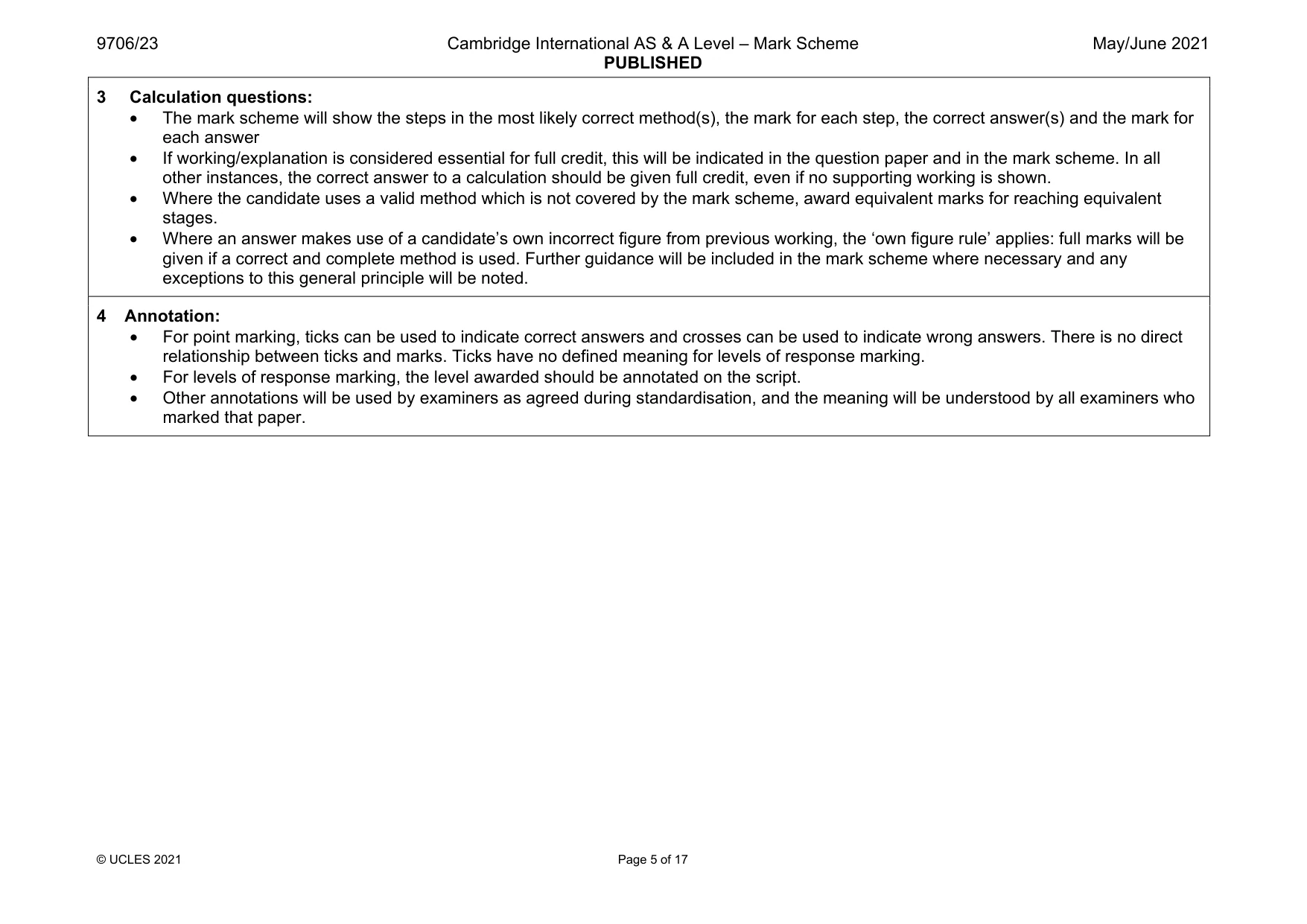
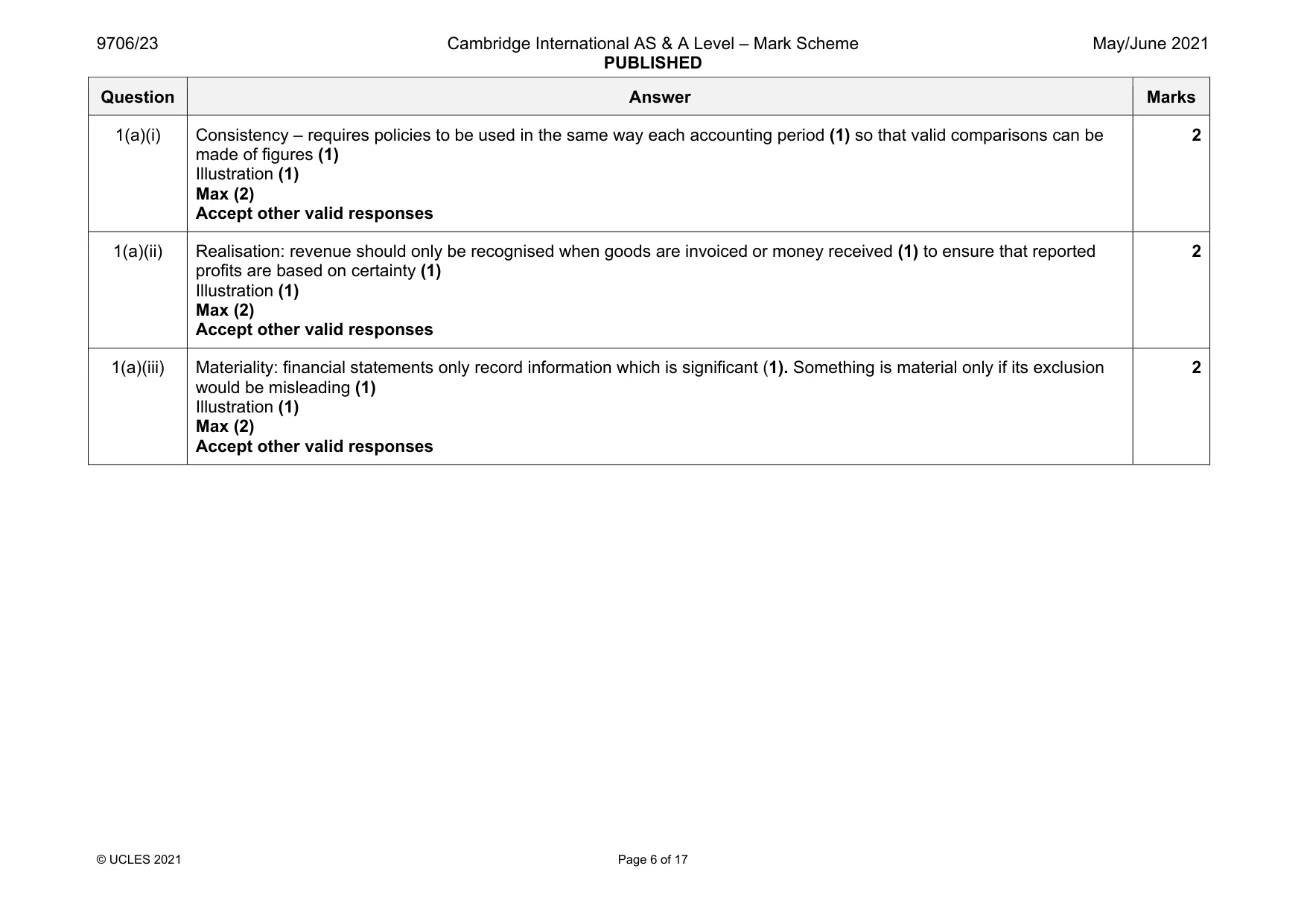
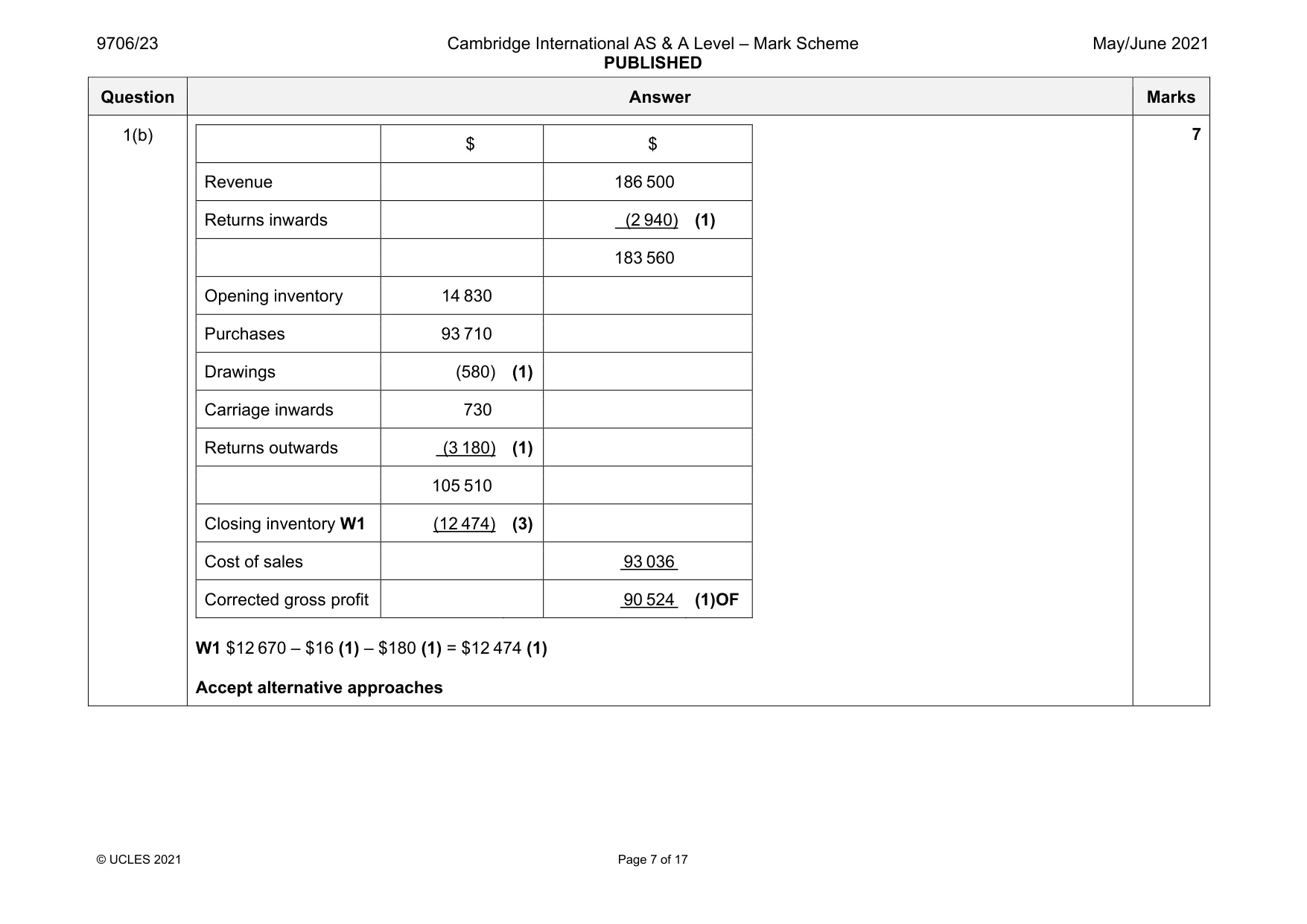
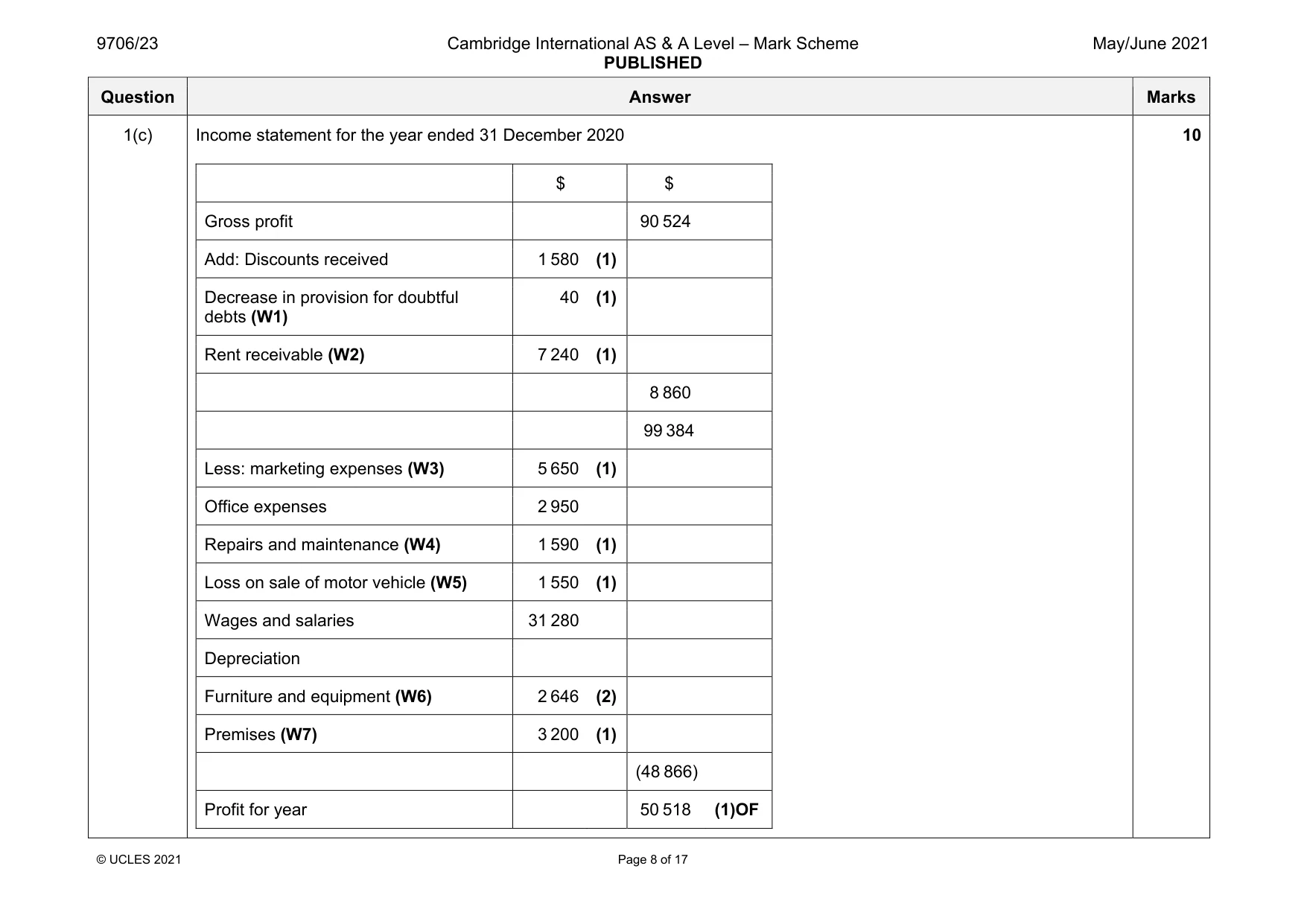
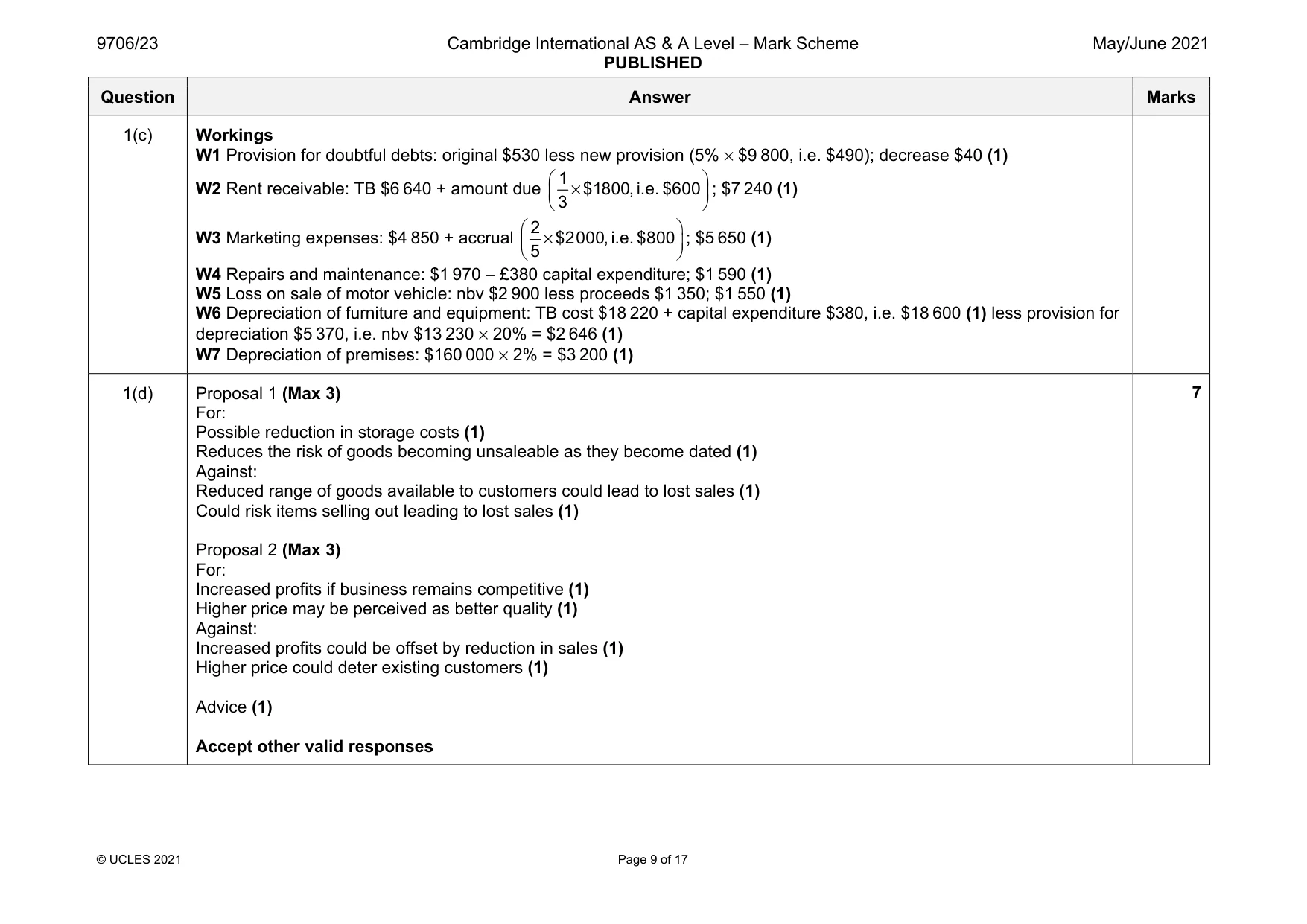
Mark scheme: 1(a)(i) Consistency – requires policies to be used in the same way each accounting period (1) so that valid comparisons can be made of figures (1) Illustration (1) Max (2) Accept other valid responses 2 1(a)(ii) Realisation: revenue should only be recognised when goods are invoiced or money received (1) to ensure that reported profits are based on certainty (1) Illustration (1) Max (2) Accept other valid responses 2 1(a)(iii) Materiality: financial statements only record information which is significant (1). Something is material only if its exclusion would be misleading (1) Illustration (1) Max (2) Accept other valid responses 2 Question Answer Marks 1(b) $ $ Revenue 186 500 Returns inwards (2 940) (1) 183 560 Opening inventory 14 830 Purchases 93 710 Drawings (580) (1) Carriage inwards 730 Returns outwards (3 180) (1) 105 510 Closing inventory W1 (12 474) (3) Cost of sales 93 036 Corrected gross profit 90 524 (1)OF W1 $12 670 – $16 (1) – $180 (1) = $12 474 (1) Accept alternative approaches 7 Question Answer Marks 1(c) Income statement for the year ended 31 December 2020 $ $ Gross profit 90 524 Add: Discounts received 1 580 (1) Decrease in provision for doubtful debts (W1) 40 (1) Rent receivable (W2) 7 240 (1) 8 860 99 384 Less: marketing expenses (W3) 5 650 (1) Office expenses 2 950 Repairs and maintenance (W4) 1 590 (1) Loss on sale of motor vehicle (W5) 1 550 (1) Wages and salaries 31 280 Depreciation Furniture and equipment (W6) 2 646 (2) Premises (W7) 3 200 (1) (48 866) Profit for year 50 518 (1)OF 10 Question Answer Marks 1(c) Workings W1 Provision for doubtful debts: original $530 less new provision (5% × $9 800, i.e. $490); decrease $40 (1) W2 Rent receivable: TB $6 640 + amount due 1 $1800, i.e. $600 3 × ; $7 240 (1) W3 Marketing expenses: $4 850 + accrual 2 $2000, i.e. $800 5 × ; $5 650 (1) W4 Repairs and maintenance: $1 970 – £380 capital expenditure; $1 590 (1) W5 Loss on sale of motor vehicle: nbv $2 900 less proceeds $1 350; $1 550 (1) W6 Depreciation of furniture and equipment: TB cost $18 220 + capital expenditure $380, i.e. $18 600 (1) less provision for depreciation $5 370, i.e. nbv $13 230 × 20% = $2 646 (1) W7 Depreciation of premises: $160 000 × 2% = $3 200 (1) 1(d) Proposal 1 (Max 3) For: Possible reduction in storage costs (1) Reduces the risk of goods becoming unsaleable as they become dated (1) Against: Reduced range of goods available to customers could lead to lost sales (1) Could risk items selling out leading to lost sales (1) Proposal 2 (Max 3) For: Increased profits if business remains competitive (1) Higher price may be perceived as better quality (1) Against: Increased profits could be offset by reduction in sales (1) Higher price could deter existing customers (1) Advice (1) Accept other valid responses 7
Q2 · Closing inventory included 14 damaged items which cost $30 each
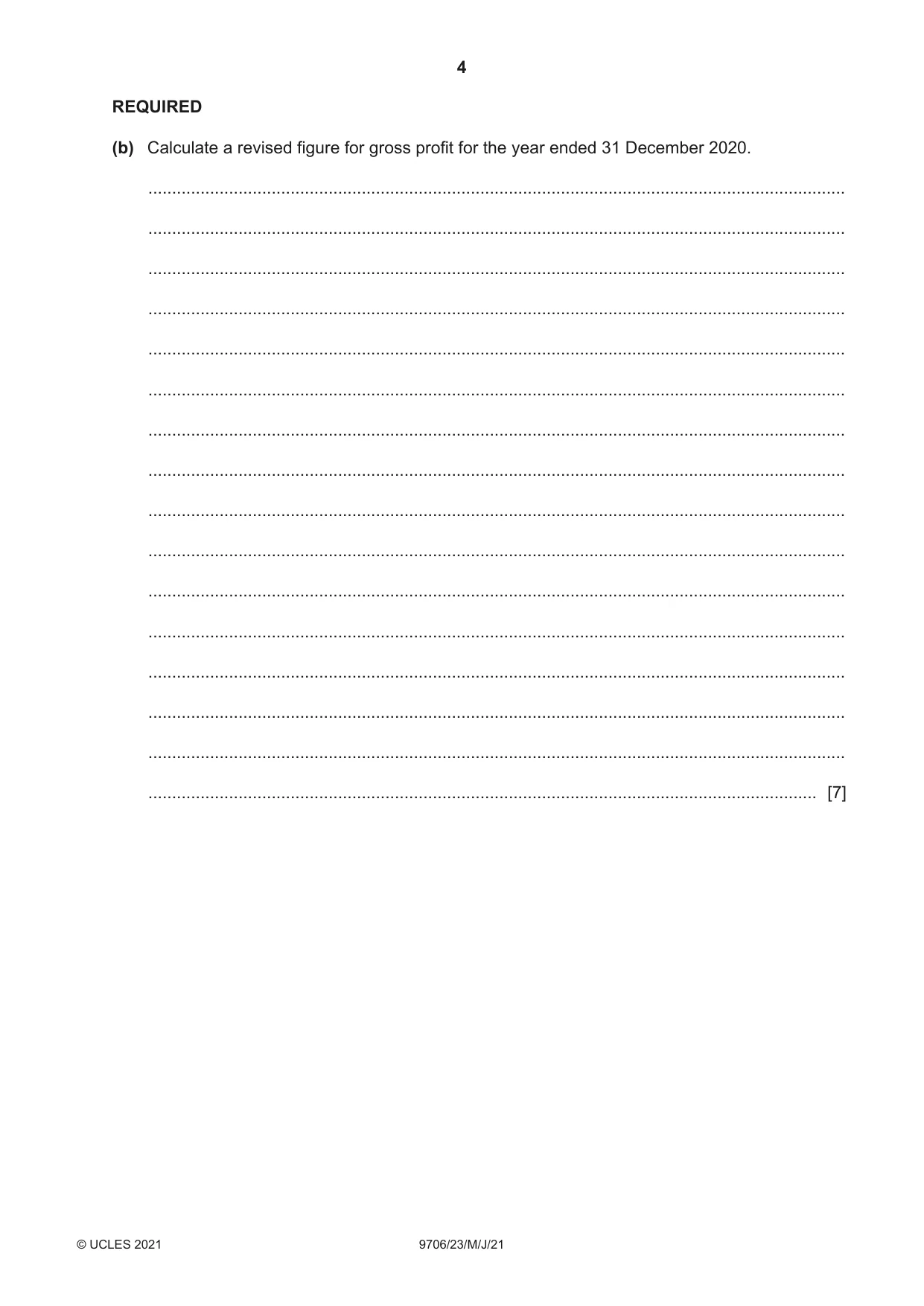
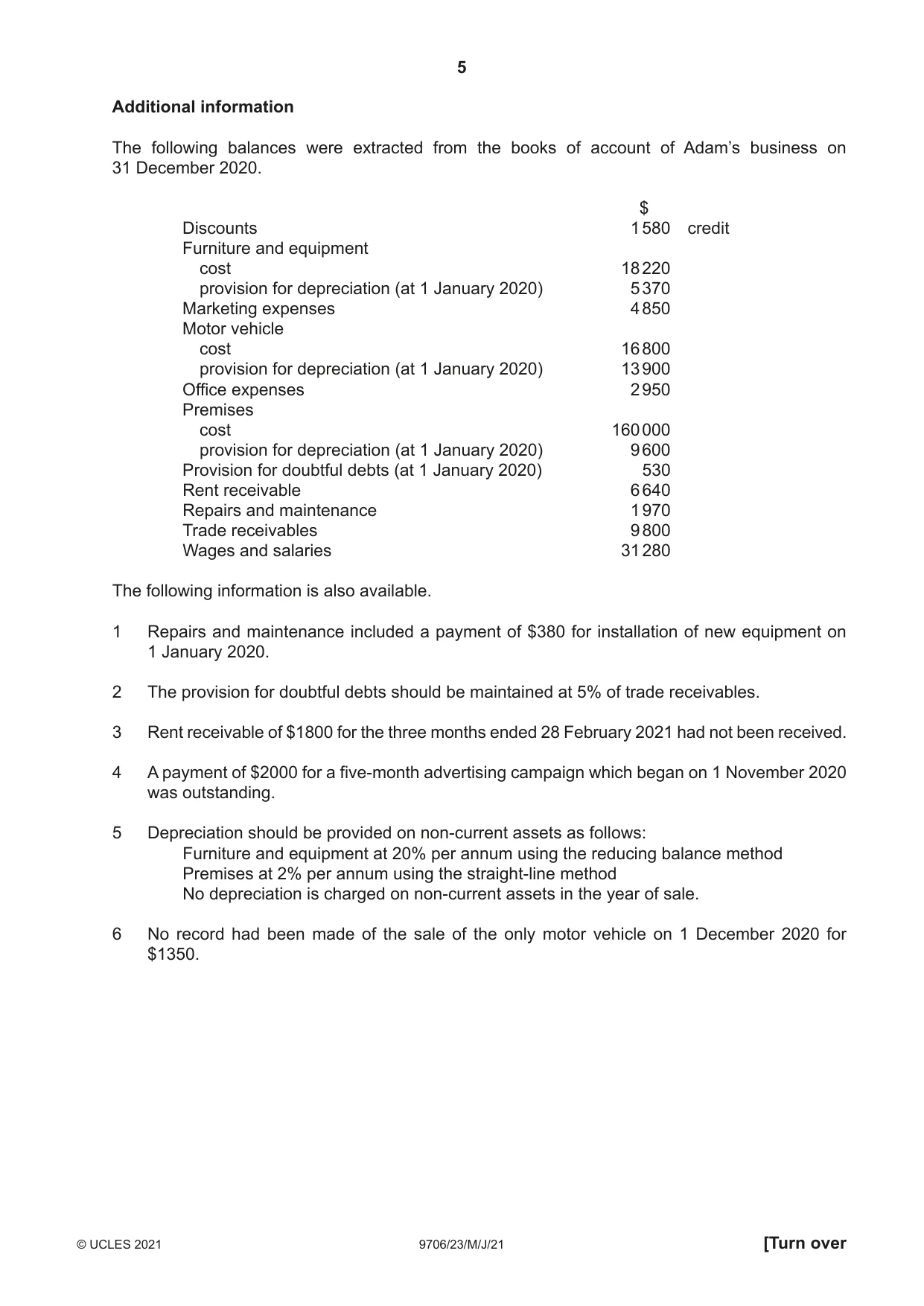
2 Closing inventory included 14 damaged items which cost $30 each. Six of these items cannot be sold and are to be regarded as waste. The remaining items could be sold for $35 each but will incur total repairs cost of $56. REQUIRED (b) Calculate a revised figure for gross profit for the year ended 31 December 2020. ................................................................................................................................................... ................................................................................................................................................... ................................................................................................................................................... ................................................................................................................................................... ................................................................................................................................................... ................................................................................................................................................... ................................................................................................................................................... ................................................................................................................................................... ................................................................................................................................................... ................................................................................................................................................... ................................................................................................................................................... ................................................................................................................................................... ................................................................................................................................................... ................................................................................................................................................... ................................................................................................................................................... ............................................................................................................................................. [7] Additional information The following balances were extracted from the books of account of Adam’s business on 31 December 2020. $ Discounts 1 580 credit Furniture and equipment cost 18 220 provision for depreciation (at 1 January 2020) 5 370 Marketing expenses 4 850 Motor vehicle cost 16 800 provision for depreciation (at 1 January 2020) 13 900 Office expenses 2 950 Premises cost 160 000 provision for depreciation (at 1 January 2020) 9 600 Provision for doubtful debts (at 1 January 2020) 530 Rent receivable 6 640 Repairs and maintenance 1 970 Trade receivables 9 800 Wages and salaries 31 280 The following information is also available. 1 Repairs and maintenance included a payment of $380 for installation of new equipment on 1 January 2020. 2 The provision for doubtful debts should be maintained at 5% of trade receivables.
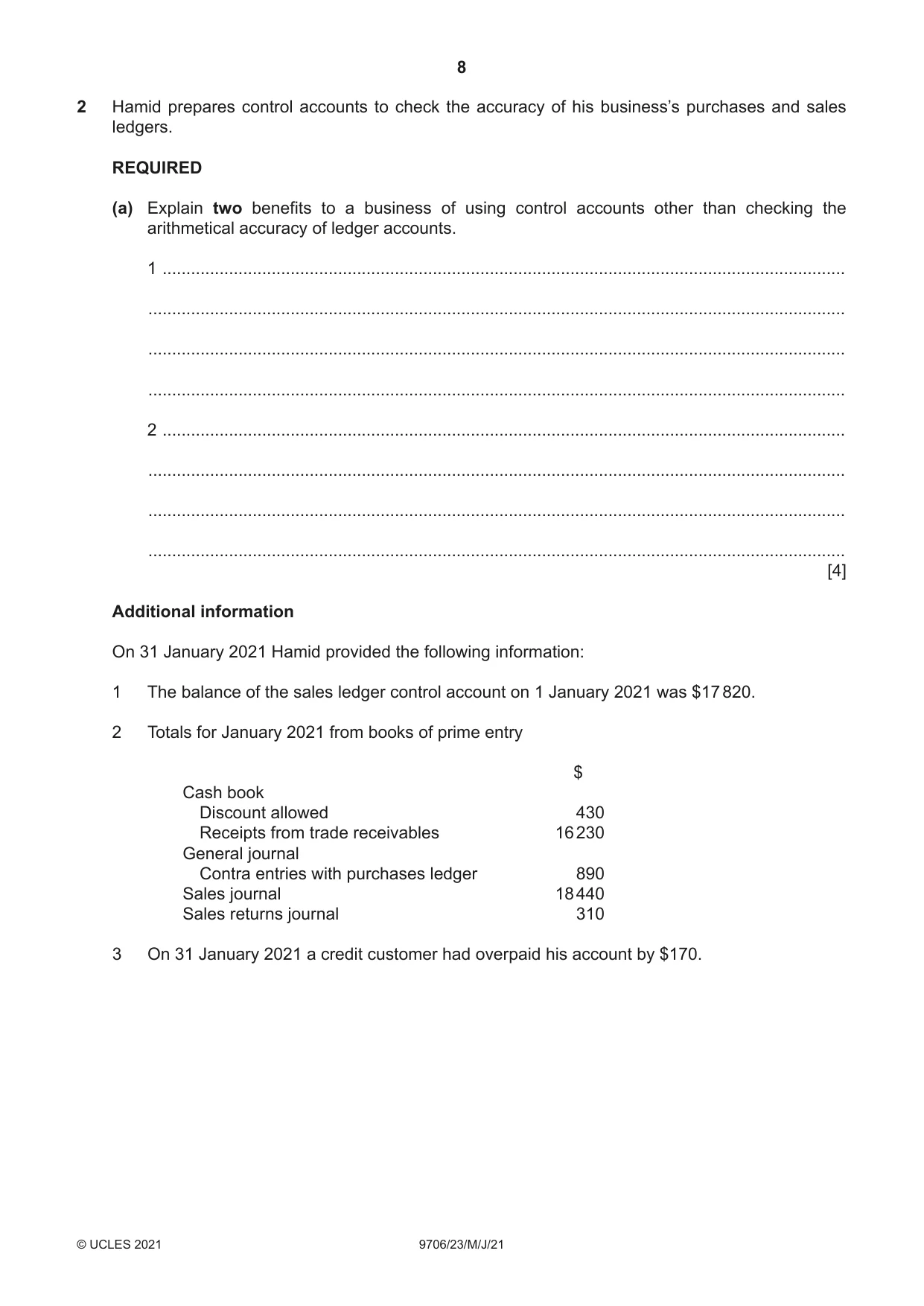
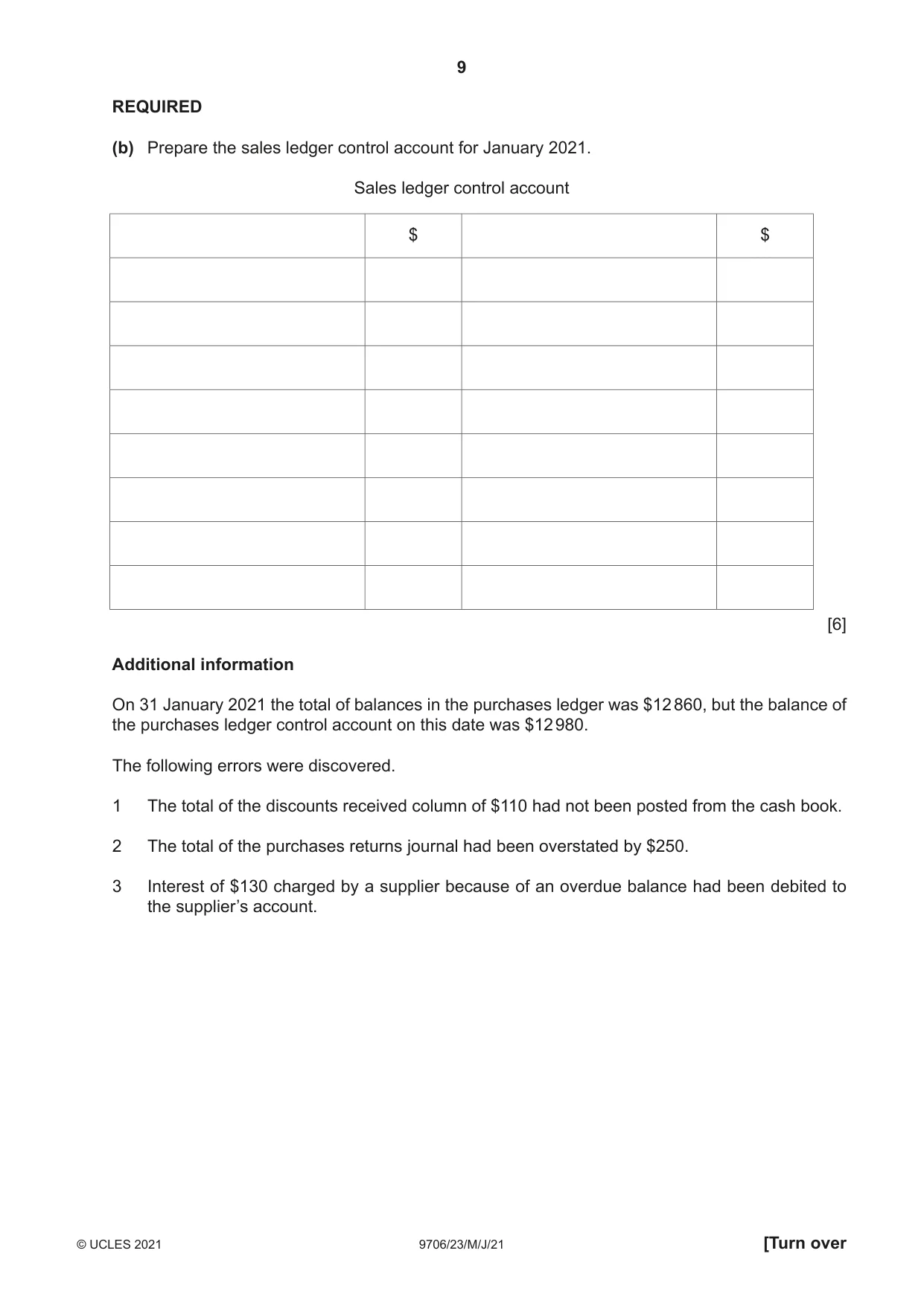
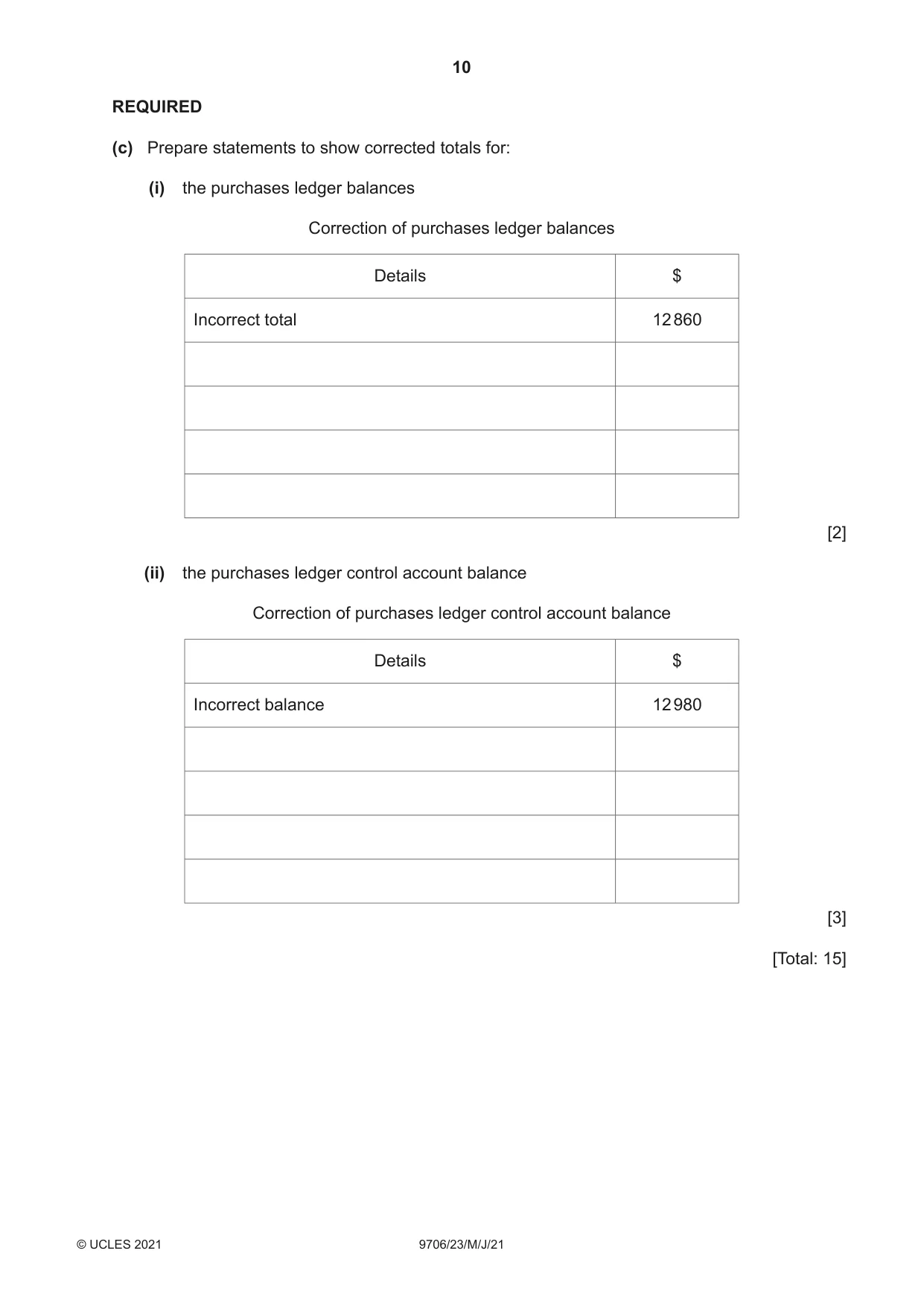
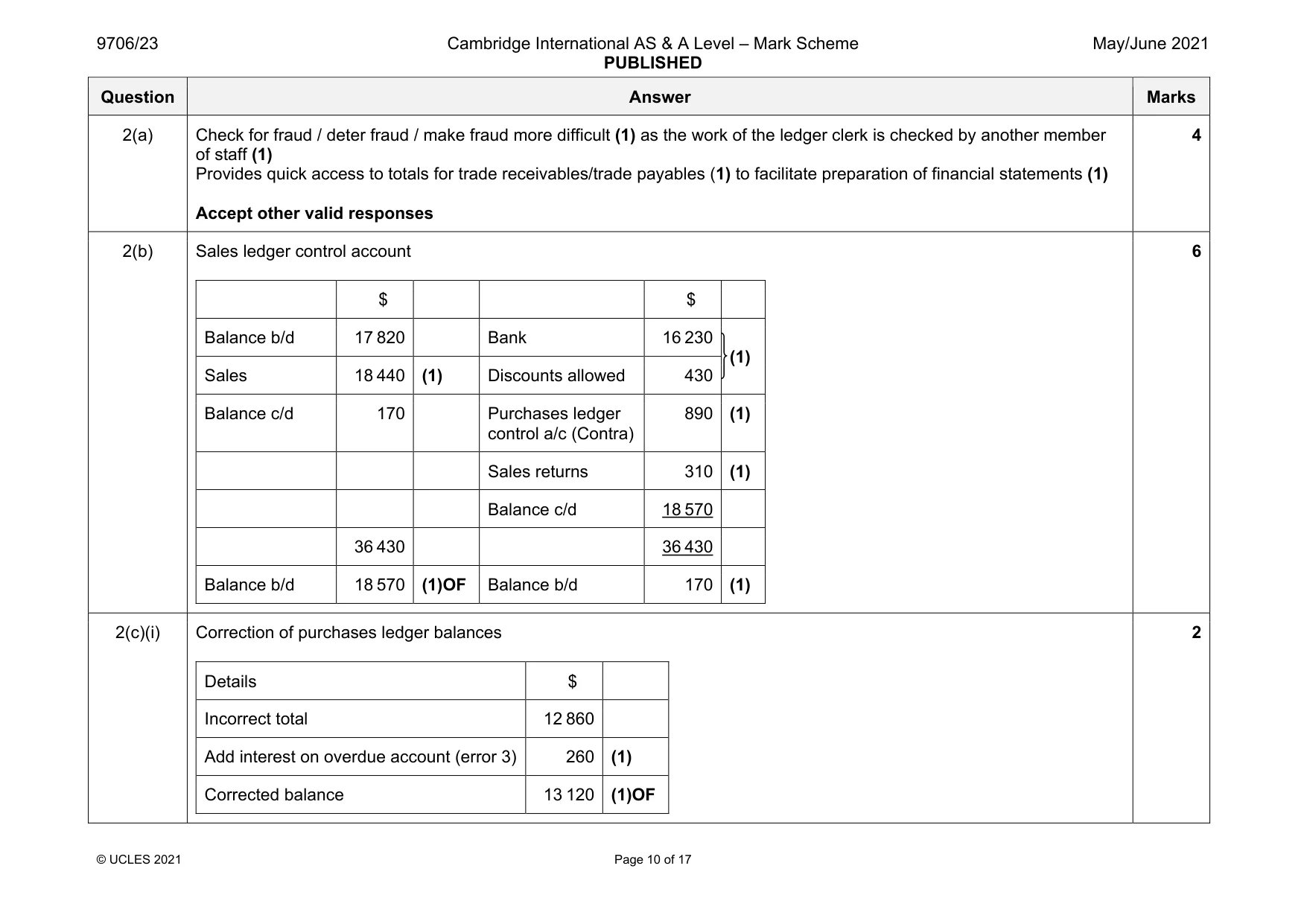
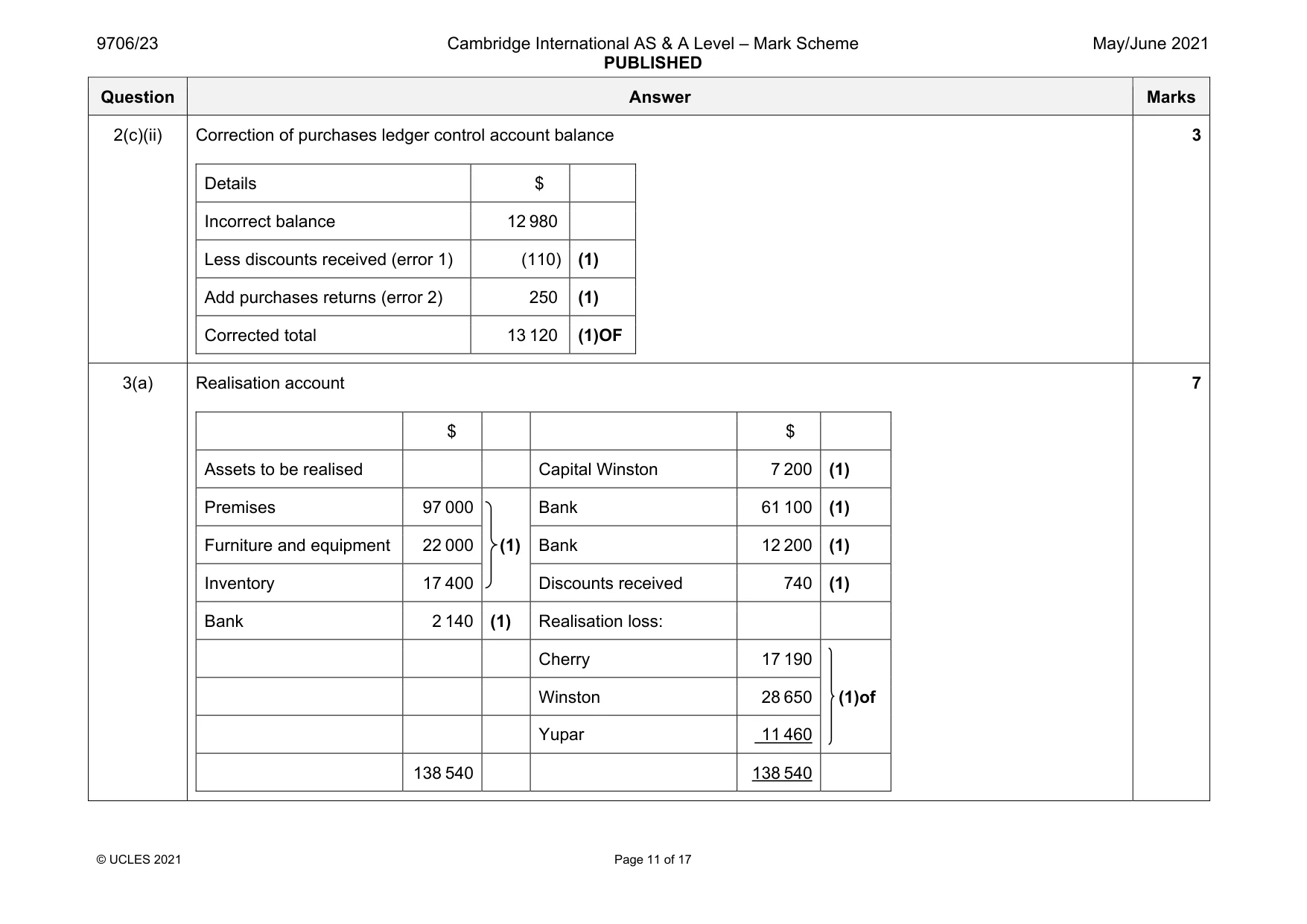
Mark scheme: 2(a) Check for fraud / deter fraud / make fraud more difficult (1) as the work of the ledger clerk is checked by another member of staff (1) Provides quick access to totals for trade receivables/trade payables (1) to facilitate preparation of financial statements (1) Accept other valid responses 4 2(b) Sales ledger control account $ $ Balance b/d 17 820 Bank 16 230 (1) Sales 18 440 (1) Discounts allowed 430 Balance c/d 170 Purchases ledger control a/c (Contra) 890 (1) Sales returns 310 (1) Balance c/d 18 570 36 430 36 430 Balance b/d 18 570 (1)OF Balance b/d 170 (1) 6 2(c)(i) Correction of purchases ledger balances Details $ Incorrect total 12 860 Add interest on overdue account (error 3) 260 (1) Corrected balance 13 120 (1)OF 2 Question Answer Marks 2(c)(ii) Correction of purchases ledger control account balance Details $ Incorrect balance 12 980 Less discounts received (error 1) (110) (1) Add purchases returns (error 2) 250 (1) Corrected total 13 120 (1)OF 3
Q3 · Cherry, Winston and Yupar were in partnership sharing profits and losses in the ratio 3…
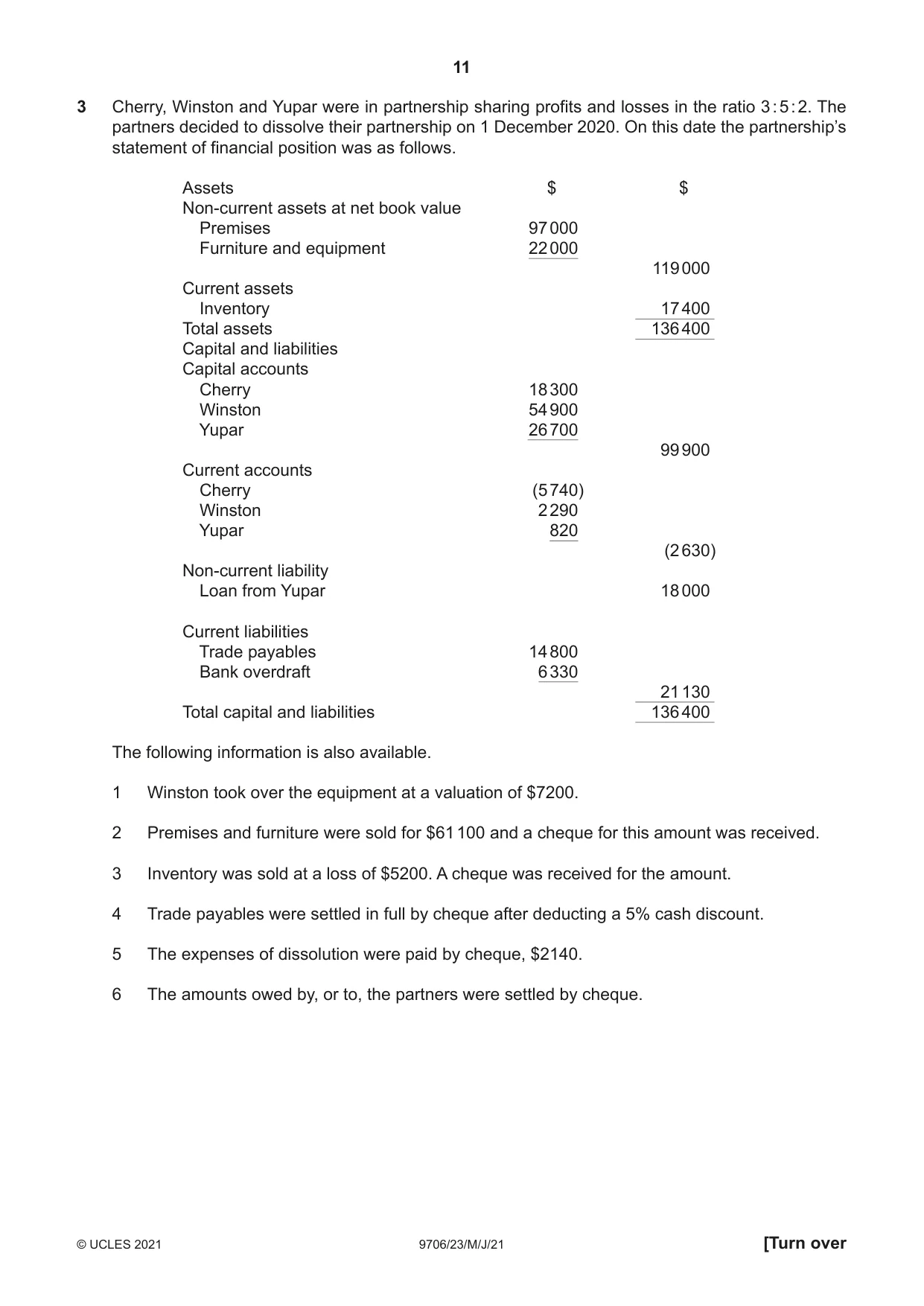
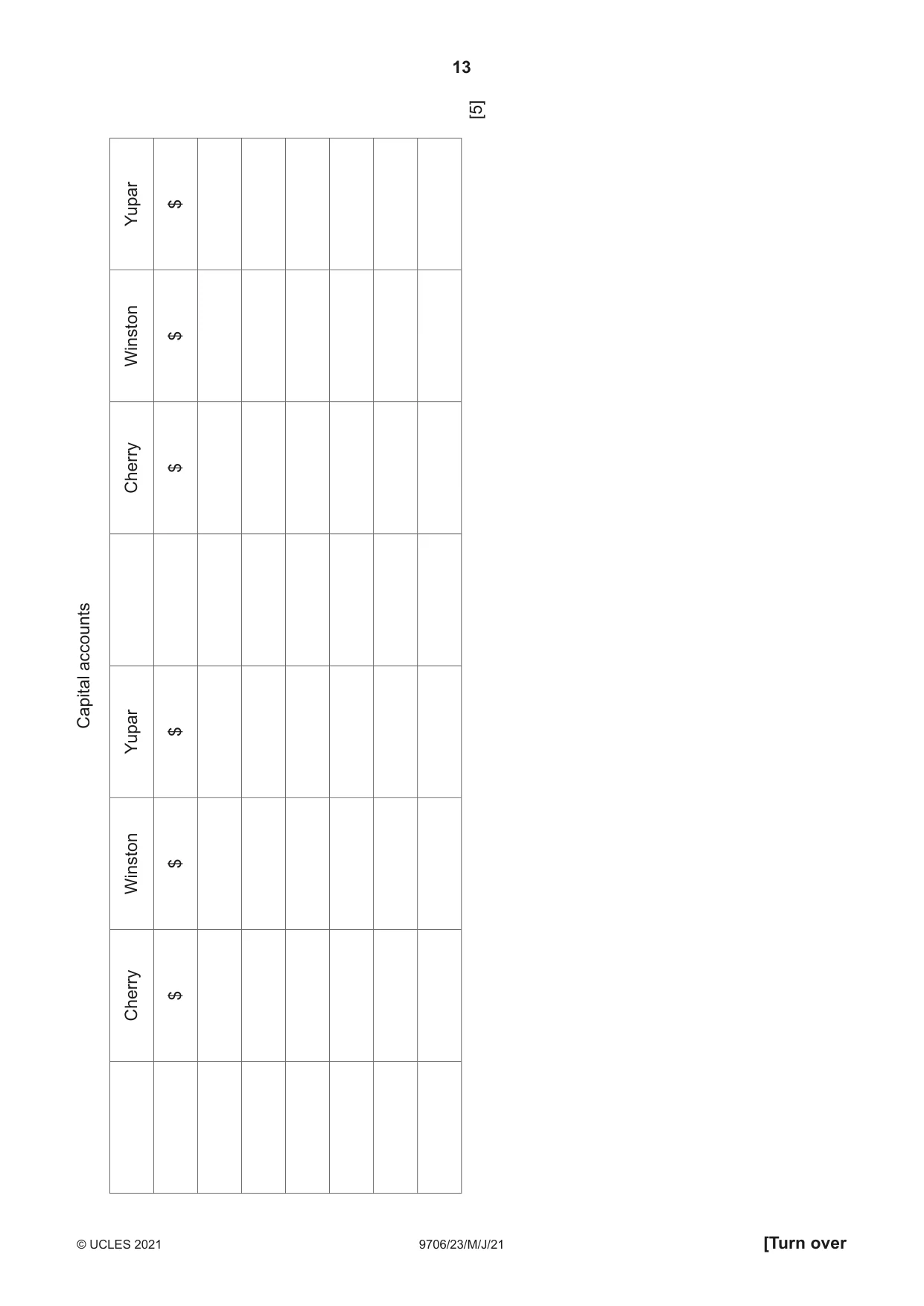
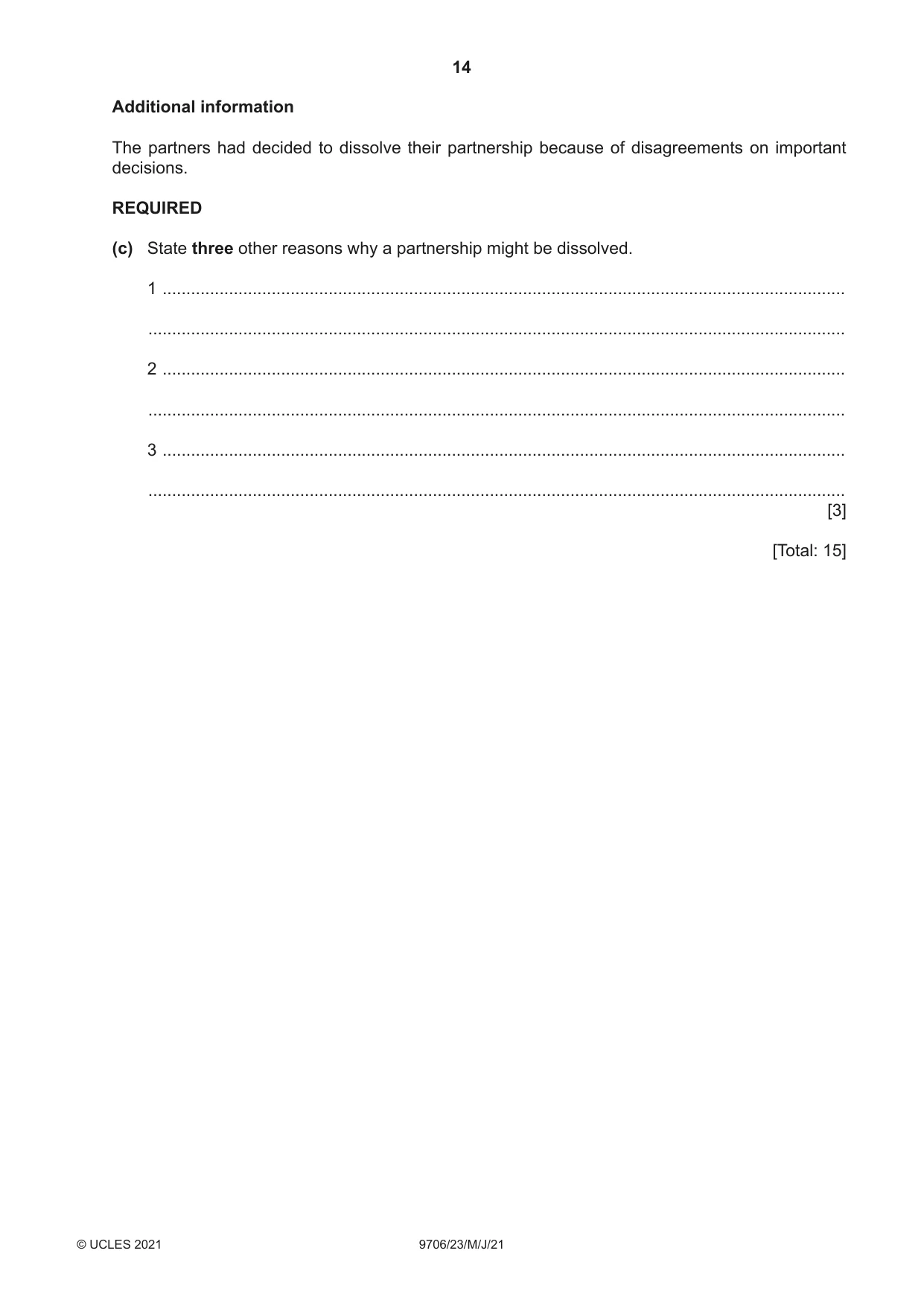
3 Cherry, Winston and Yupar were in partnership sharing profits and losses in the ratio 3 : 5 : 2. The partners decided to dissolve their partnership on 1 December 2020. On this date the partnership’s statement of financial position was as follows. Assets $ $ Non-current assets at net book value Premises 97 000 Furniture and equipment 22 000 119 000 Current assets Inventory 17 400 Total assets 136 400 Capital and liabilities Capital accounts Cherry 18 300 Winston 54 900 Yupar 26 700 99 900 Current accounts Cherry (5 740) Winston 2 290 Yupar 820 (2 630) Non-current liability Loan from Yupar 18 000 Current liabilities Trade payables 14 800 Bank overdraft 6 330 21 130 Total capital and liabilities 136 400 The following information is also available. 1 Winston took over the equipment at a valuation of $7200. 2 Premises and furniture were sold for $61 100 and a cheque for this amount was received. 3 Inventory was sold at a loss of $5200. A cheque was received for the amount. 4 Trade payables were settled in full by cheque after deducting a 5% cash discount. 5 The expenses of dissolution were paid by cheque, $2140. 6 The amounts owed by, or to, the partners were settled by cheque. REQUIRED (a) Prepare the realisation account to show the profit or loss made on the dissolution of the partnership. Realisation account $ $ [7] (b) Prepare, on the next page, the capital accounts of the partners recording the dissolution and final settlement of the amounts owed to, or by, each partner. [5] $ Yupar $ Winston $ Cherry accounts Capital $ Yupar $ Winston $ Cherry Additional information The partners had decided to dissolve their partnership because of disagreements on important decisions. REQUIRED (c) State three other reasons why a partnership might be dissolved. 1 ................................................................................................................................................ ................................................................................................................................................... 2 ................................................................................................................................................ ................................................................................................................................................... 3 ................................................................................................................................................ ................................................................................................................................................... [3] [Total: 15]
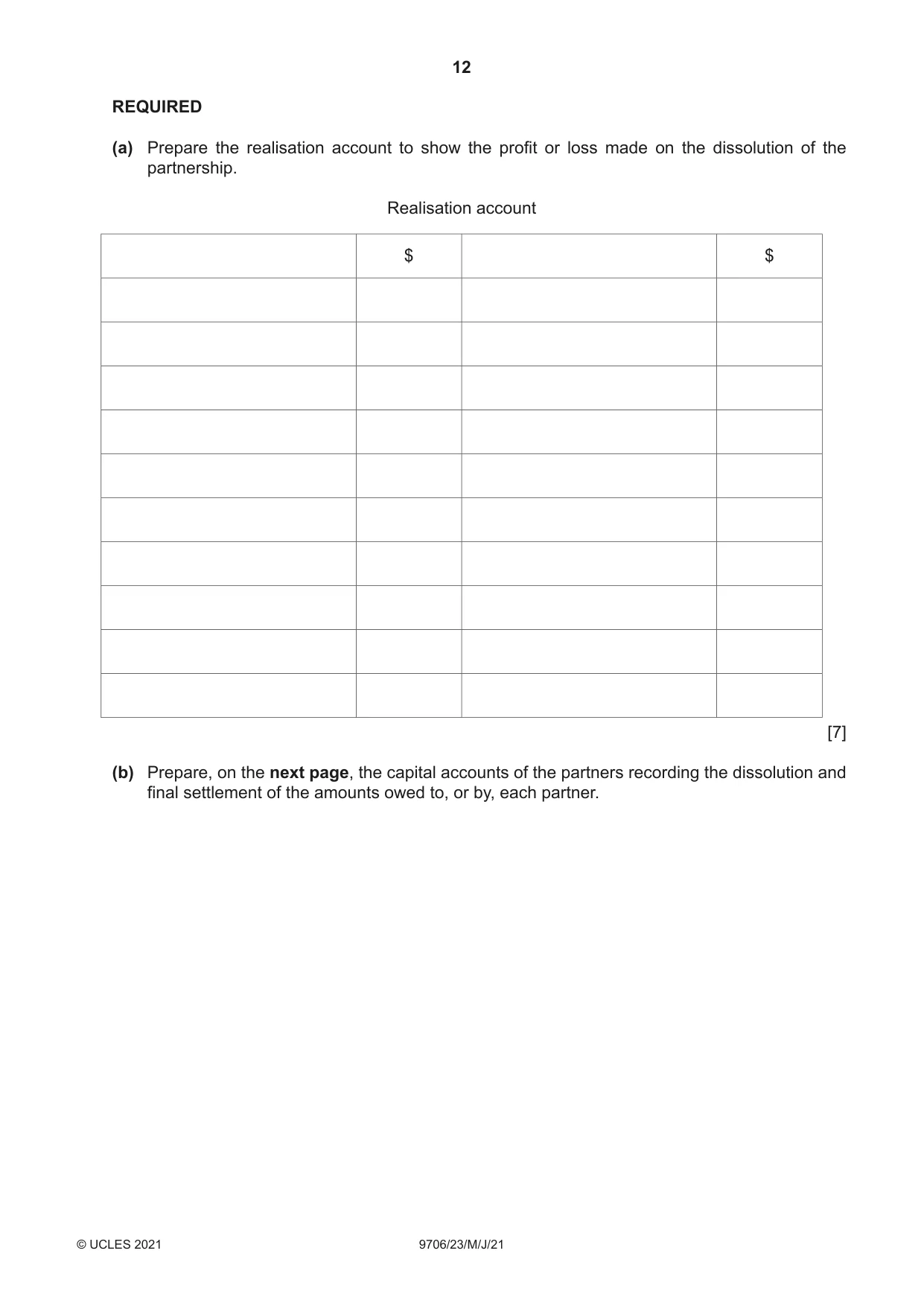
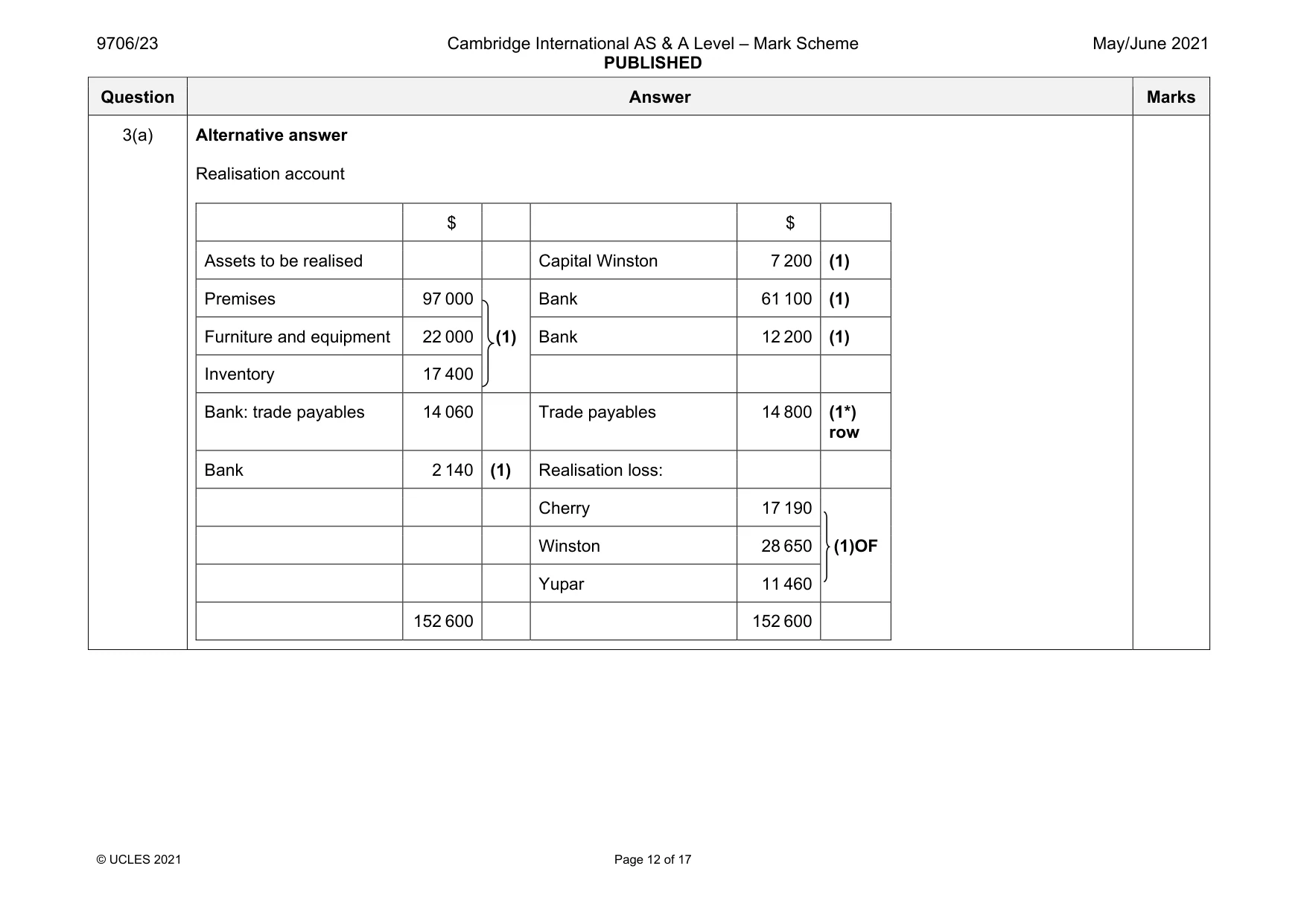
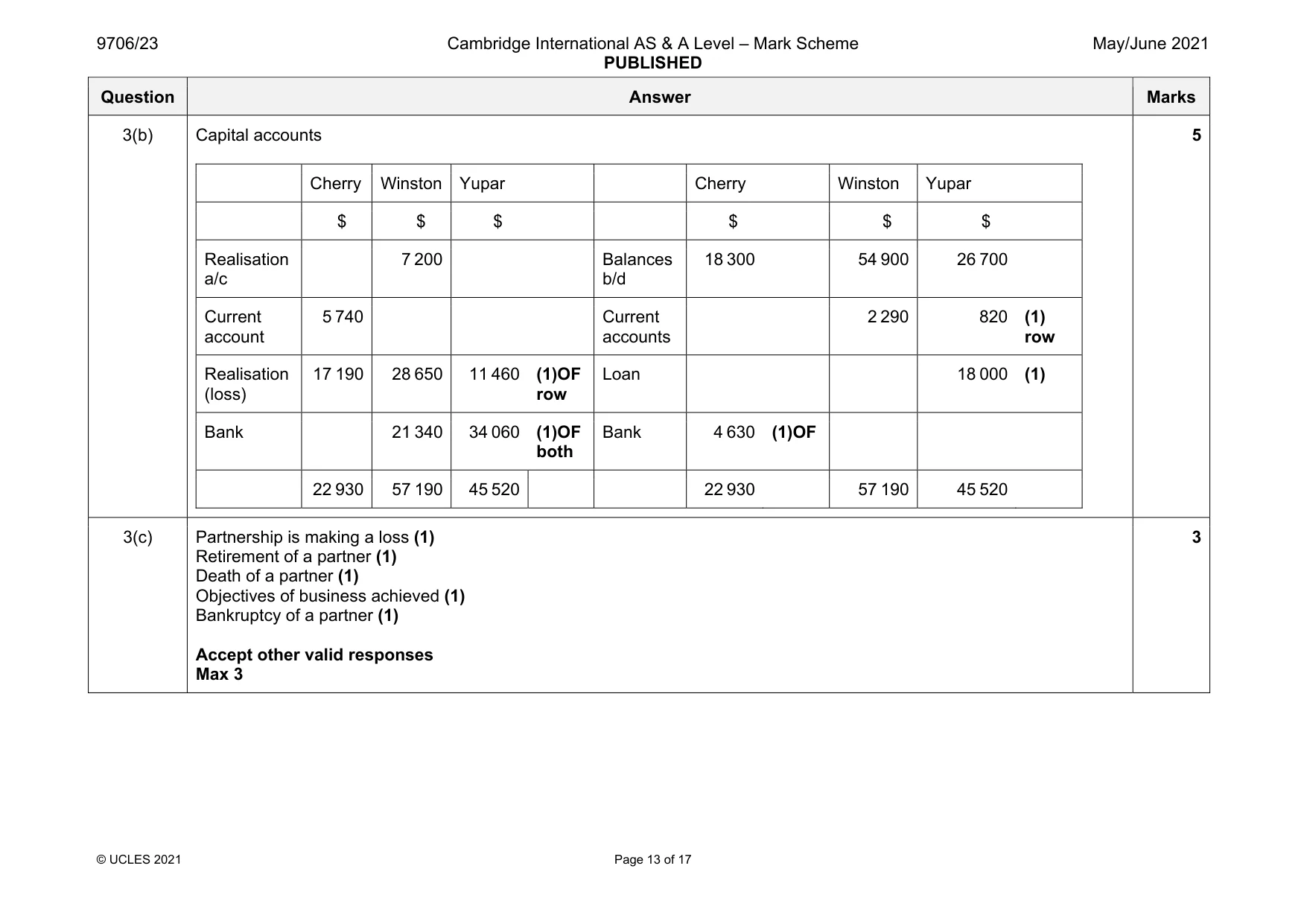
Mark scheme: 3(a) Realisation account $ $ Assets to be realised Capital Winston 7 200 (1) Premises 97 000 Bank 61 100 (1) Furniture and equipment 22 000 (1) Bank 12 200 (1) Inventory 17 400 Discounts received 740 (1) Bank 2 140 (1) Realisation loss: Cherry 17 190 Winston 28 650 (1)of Yupar 11 460 138 540 138 540 7 Question Answer Marks 3(a) Alternative answer Realisation account $ $ Assets to be realised Capital Winston 7 200 (1) Premises 97 000 Bank 61 100 (1) Furniture and equipment 22 000 (1) Bank 12 200 (1) Inventory 17 400 Bank: trade payables 14 060 Trade payables 14 800 (1*) row Bank 2 140 (1) Realisation loss: Cherry 17 190 Winston 28 650 (1)OF Yupar 11 460 152 600 152 600 Question Answer Marks 3(b) Capital accounts Cherry Winston Yupar Cherry Winston Yupar $ $ $ $ $ $ Realisation a/c 7 200 Balances b/d 18 300 54 900 26 700 Current account 5 740 Current accounts 2 290 820 (1) row Realisation (loss) 17 190 28 650 11 460 (1)OF row Loan 18 000 (1) Bank 21 340 34 060 (1)OF both Bank 4 630 (1)OF 22 930 57 190 45 520 22 930 57 190 45 520 5 3(c) Partnership is making a loss (1) Retirement of a partner (1) Death of a partner (1) Objectives of business achieved (1) Bankruptcy of a partner (1) Accept other valid responses Max 3 3
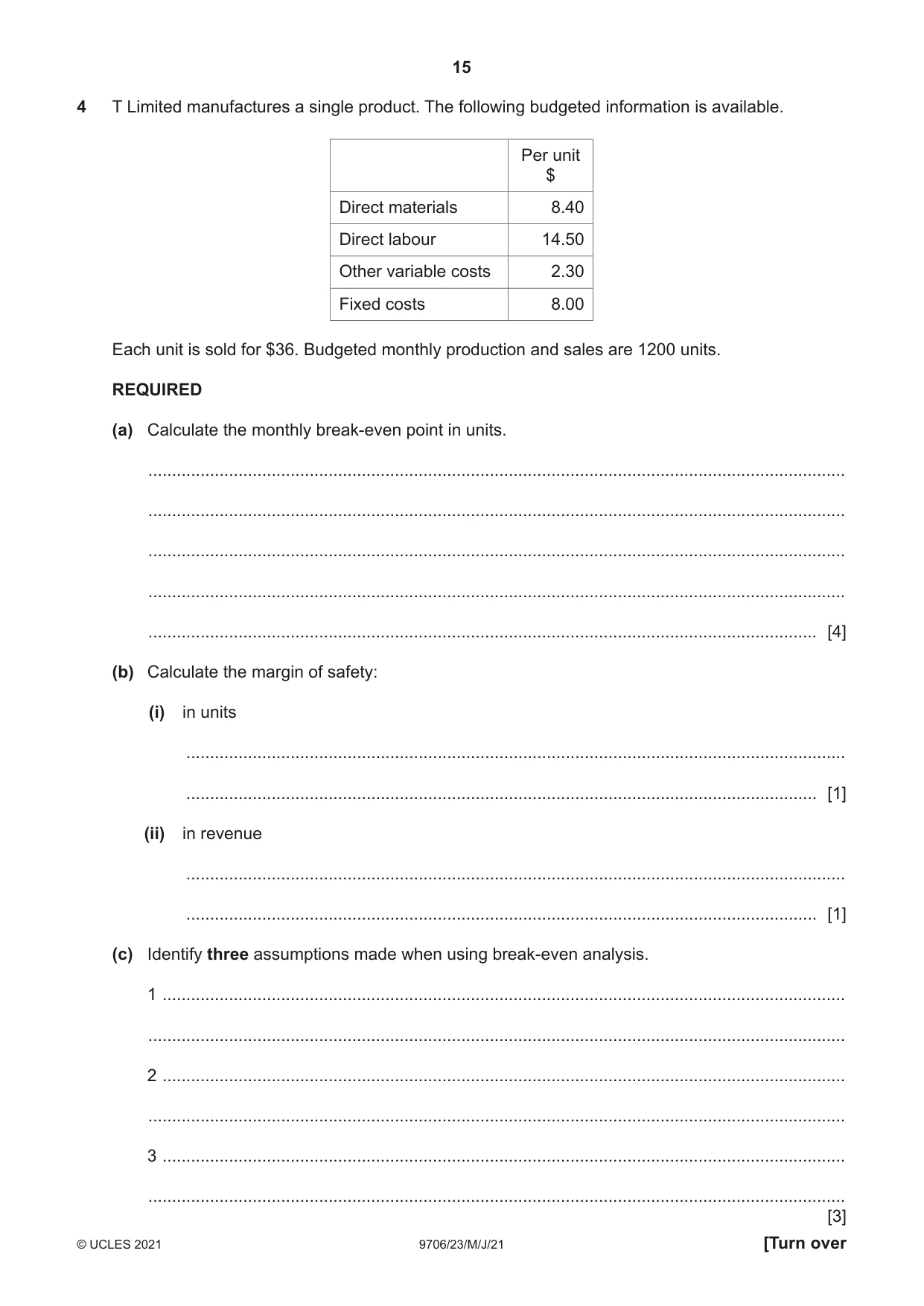
Q4 · A payment of $2000 for a five-month advertising campaign which began on 1 November 2020…
4 A payment of $2000 for a five-month advertising campaign which began on 1 November 2020 was outstanding.
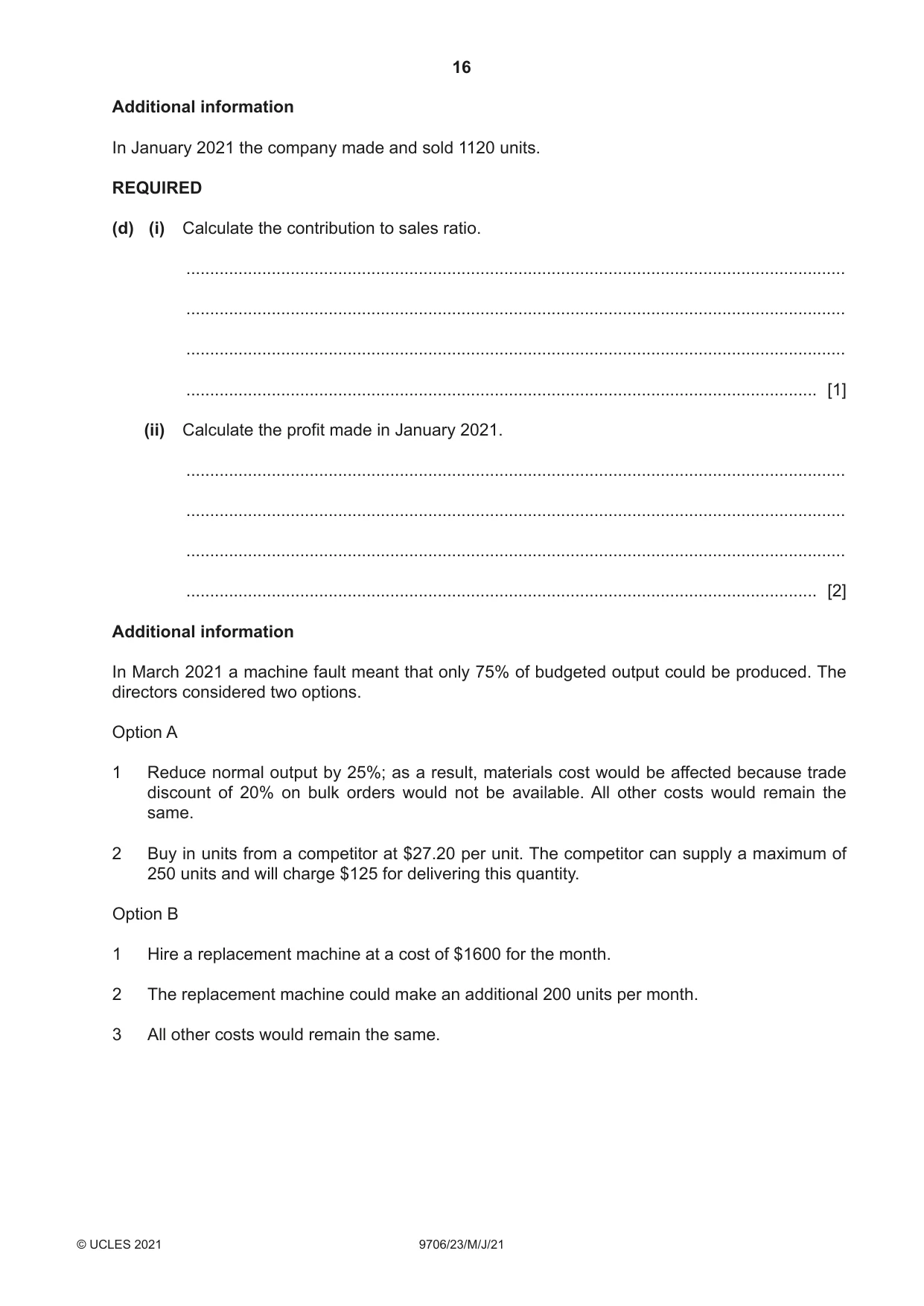
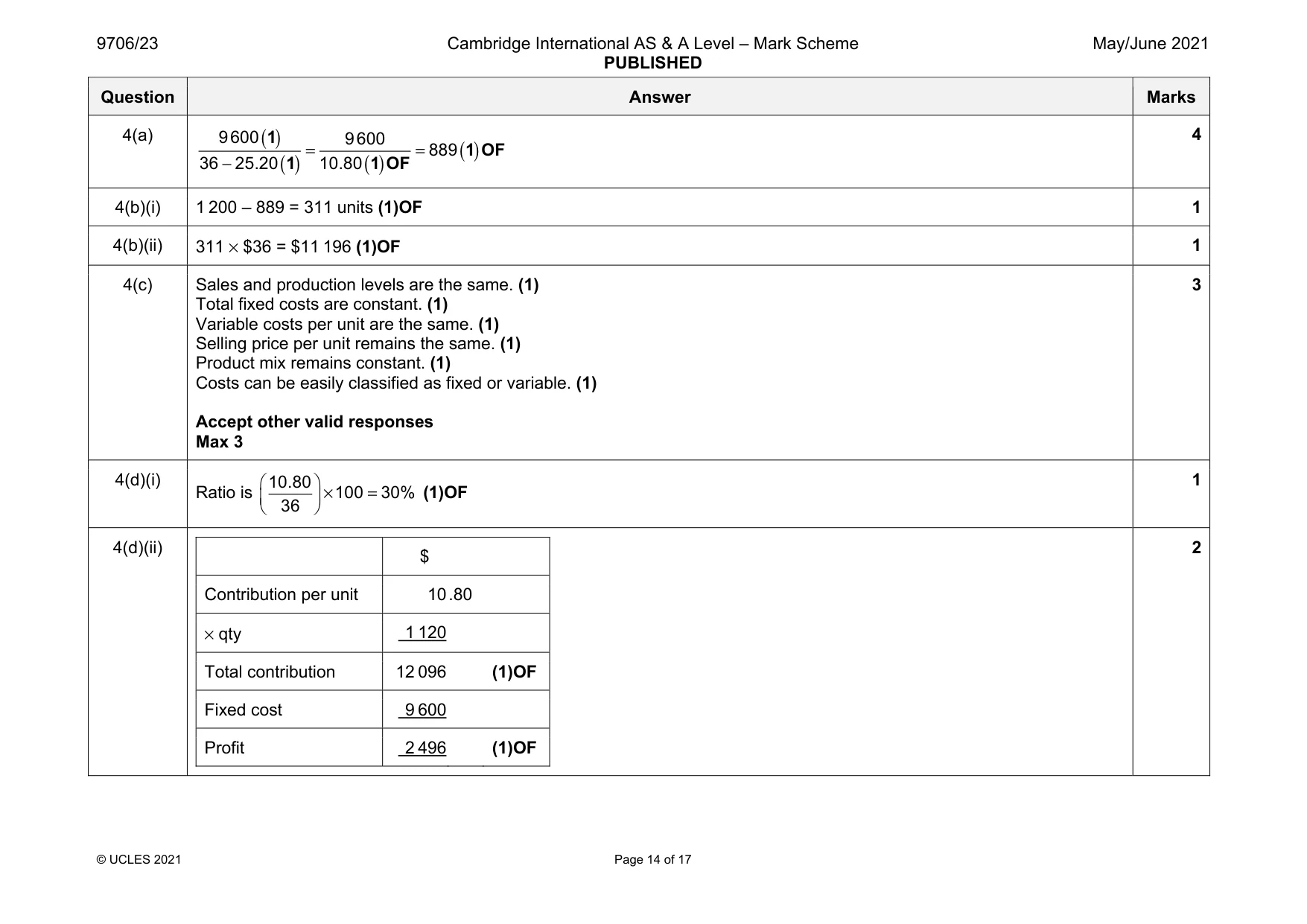
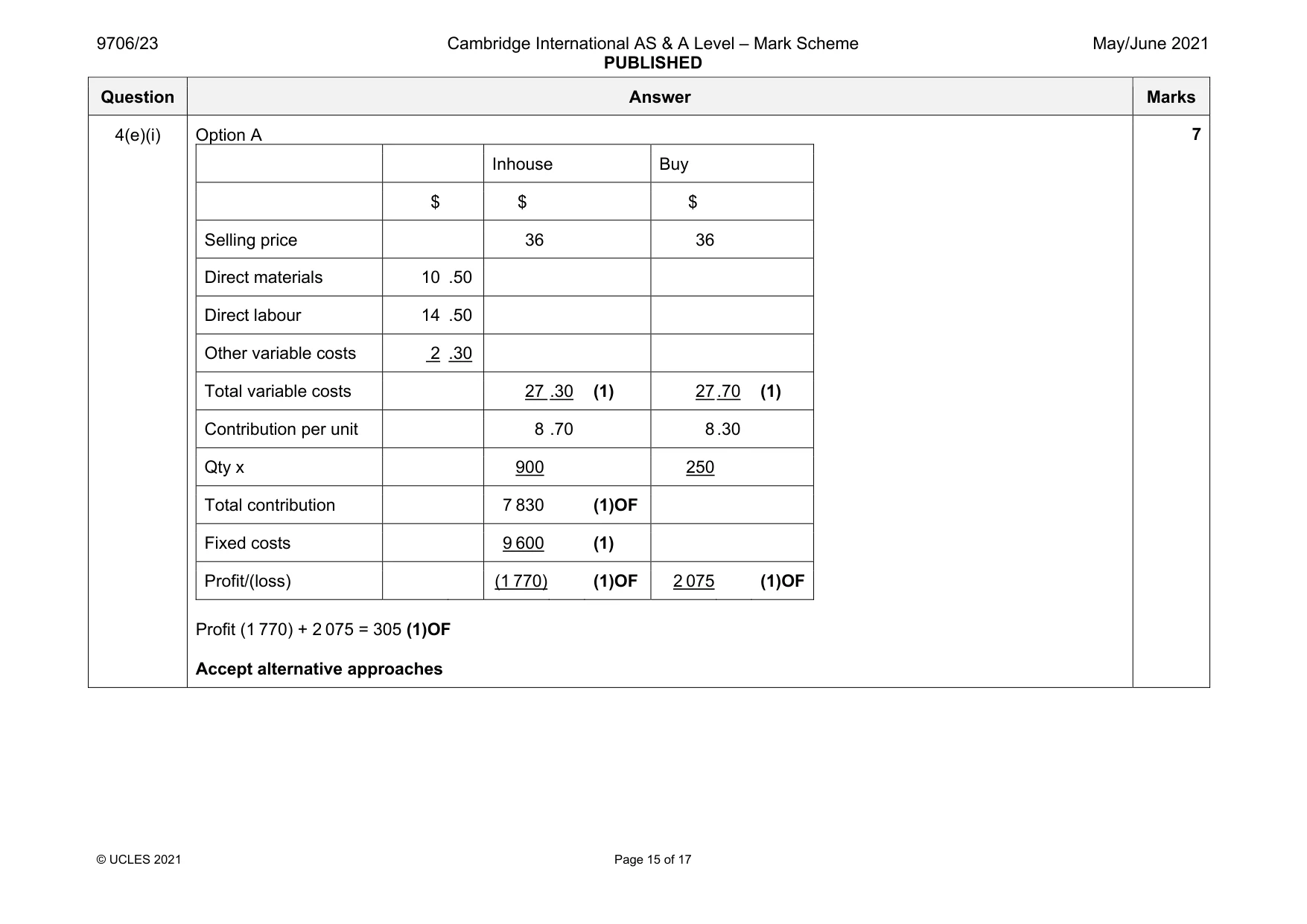
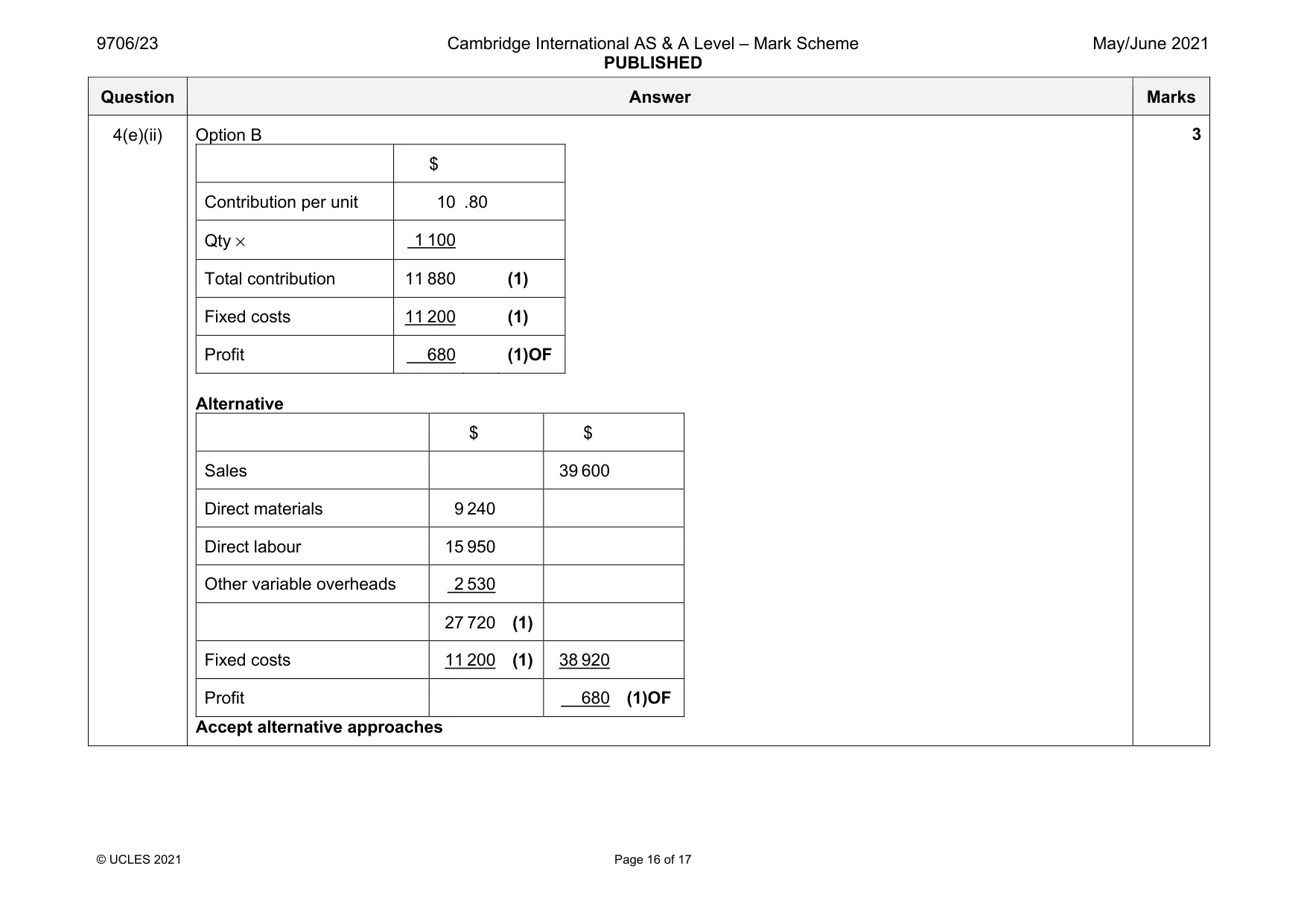
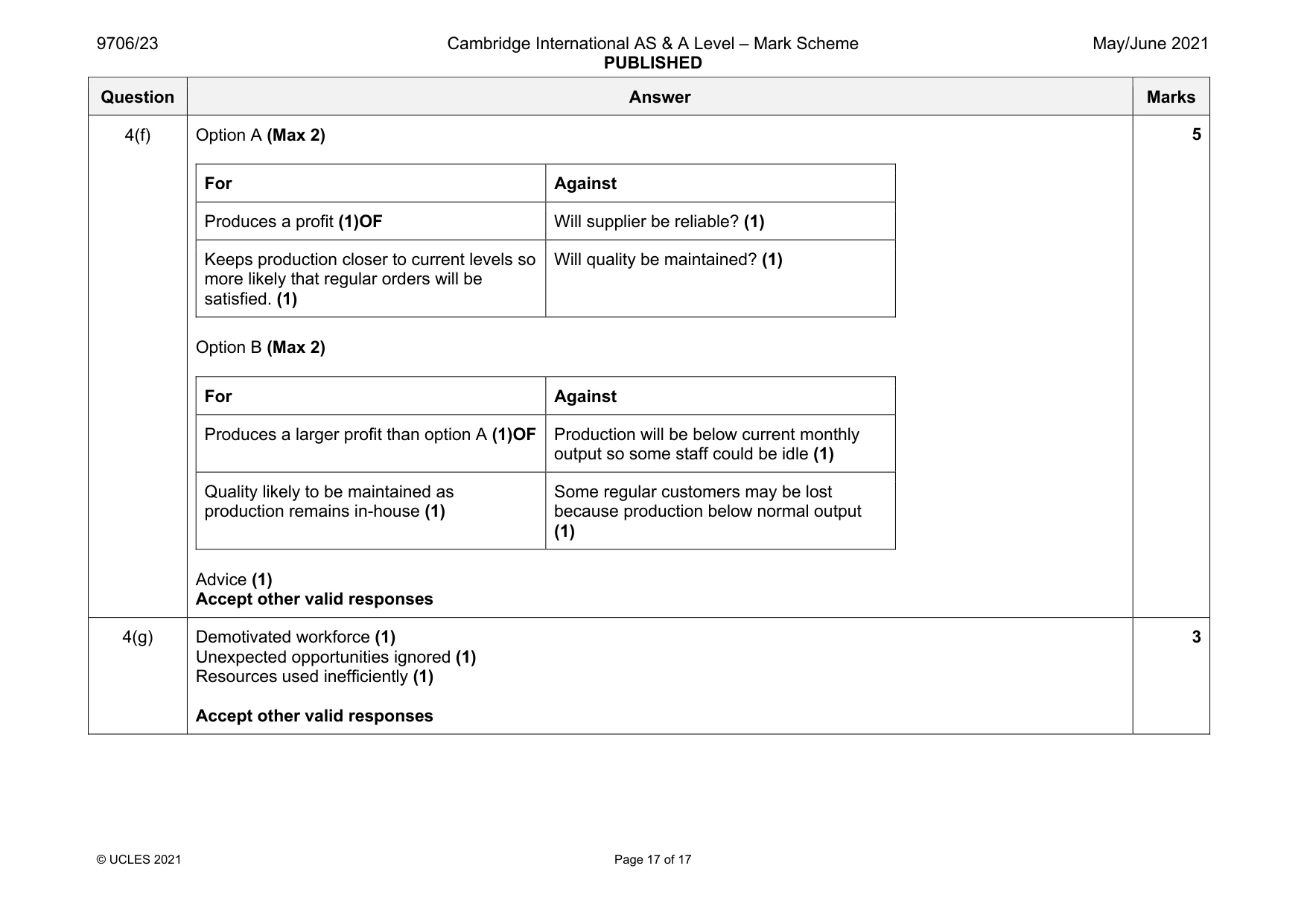
Mark scheme: 4(a) ( ) ( ) ( ) ( ) 9600 9600 889 36 25.20 10.80 = = − 1 1 OF 1 1 OF 4(b)(i) 1 200 – 889 = 311 units (1)OF 1 4(b)(ii) 311 × $36 = $11 196 (1)OF 1 4(c) Sales and production levels are the same. (1) Total fixed costs are constant. (1) Variable costs per unit are the same. (1) Selling price per unit remains the same. (1) Product mix remains constant. (1) Costs can be easily classified as fixed or variable. (1) Accept other valid responses Max 3 3 4(d)(i) Ratio is 10.80 100 30% 36 × = (1)OF 1 4(d)(ii) $ Contribution per unit 10 .80 × qty 1 120 Total contribution 12 096 (1)OF Fixed cost 9 600 Profit 2 496 (1)OF 2 Question Answer Marks 4(e)(i) Option A Inhouse Buy $ $ $ Selling price 36 36 Direct materials 10 .50 Direct labour 14 .50 Other variable costs 2 .30 Total variable costs 27 .30 (1) 27 .70 (1) Contribution per unit 8 .70 8 .30 Qty x 900 250 Total contribution 7 830 (1)OF Fixed costs 9 600 (1) Profit/(loss) (1 770) (1)OF 2 075 (1)OF Profit (1 770) + 2 075 = 305 (1)OF Accept alternative approaches 7 Question Answer Marks 4(e)(ii) Option B $ Contribution per unit 10 .80 Qty × 1 100 Total contribution 11 880 (1) Fixed costs 11 200 (1) Profit 680 (1)OF Alternative $ $ Sales 39 600 Direct materials 9 240 Direct labour 15 950 Other variable overheads 2 530 27 720 (1) Fixed costs 11 200 (1) 38 920 Profit 680 (1)OF Accept alternative approaches 3 Question Answer Marks 4(f) Option A (Max 2) For Against Produces a profit (1)OF Will supplier be reliable? (1) Keeps production closer to current levels so more likely that regular orders will be satisfied. (1) Will quality be maintained? (1) Option B (Max 2) For Against Produces a larger profit than option A (1)OF Production will be below current monthly output so some staff could be idle (1) Quality likely to be maintained as production remains in-house (1) Some regular customers may be lost because production below normal output (1) Advice (1) Accept other valid responses 5 4(g) Demotivated workforce (1) Unexpected opportunities ignored (1) Resources used inefficiently (1) Accept other valid responses 3
Q5 · Depreciation should be provided on non-current assets as follows: Furniture and equipment…
5 Depreciation should be provided on non-current assets as follows: Furniture and equipment at 20% per annum using the reducing balance method Premises at 2% per annum using the straight-line method No depreciation is charged on non-current assets in the year of sale.
Q6 · No record had been made of the sale of the only motor vehicle on 1 December 2020 for $1350
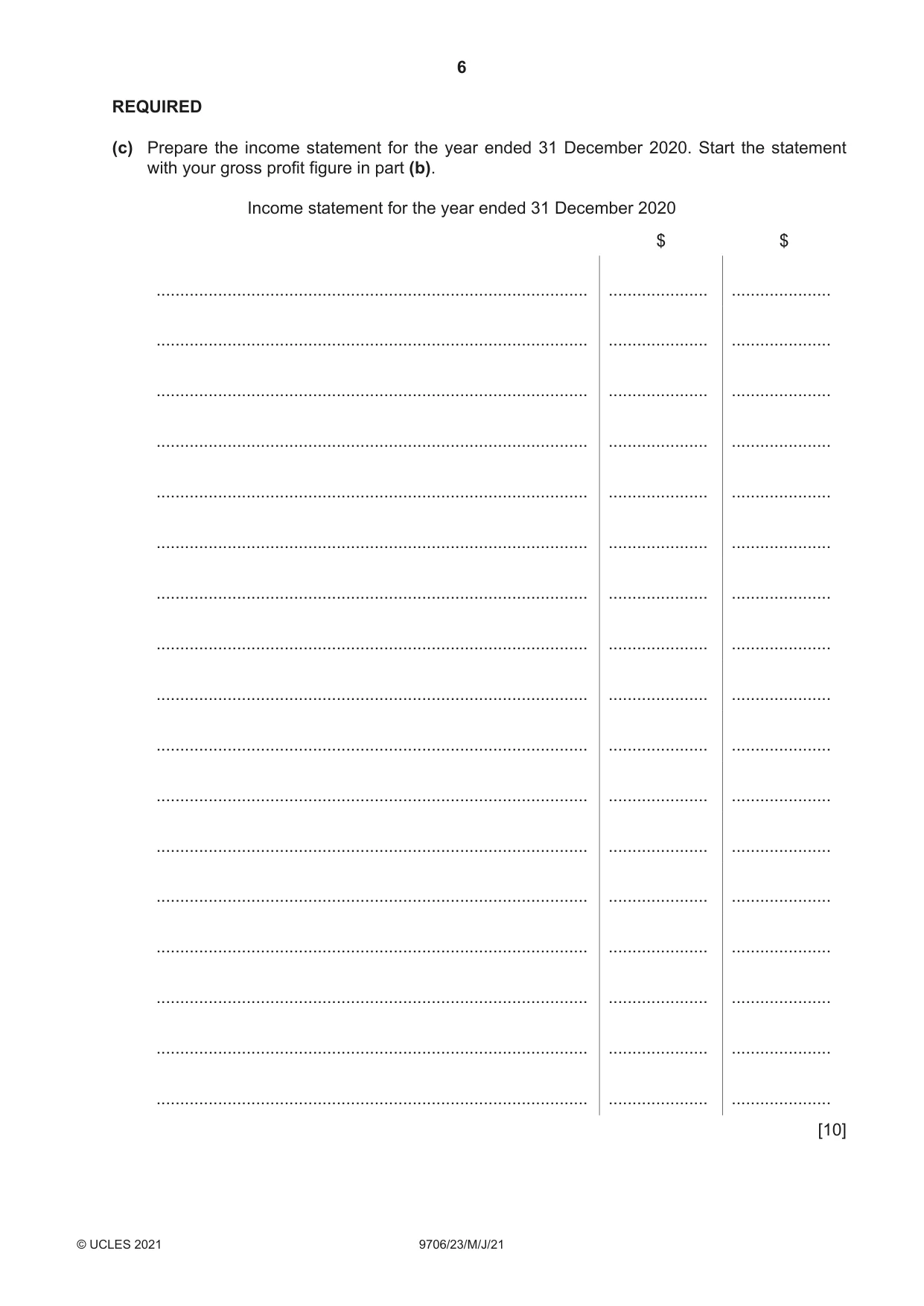
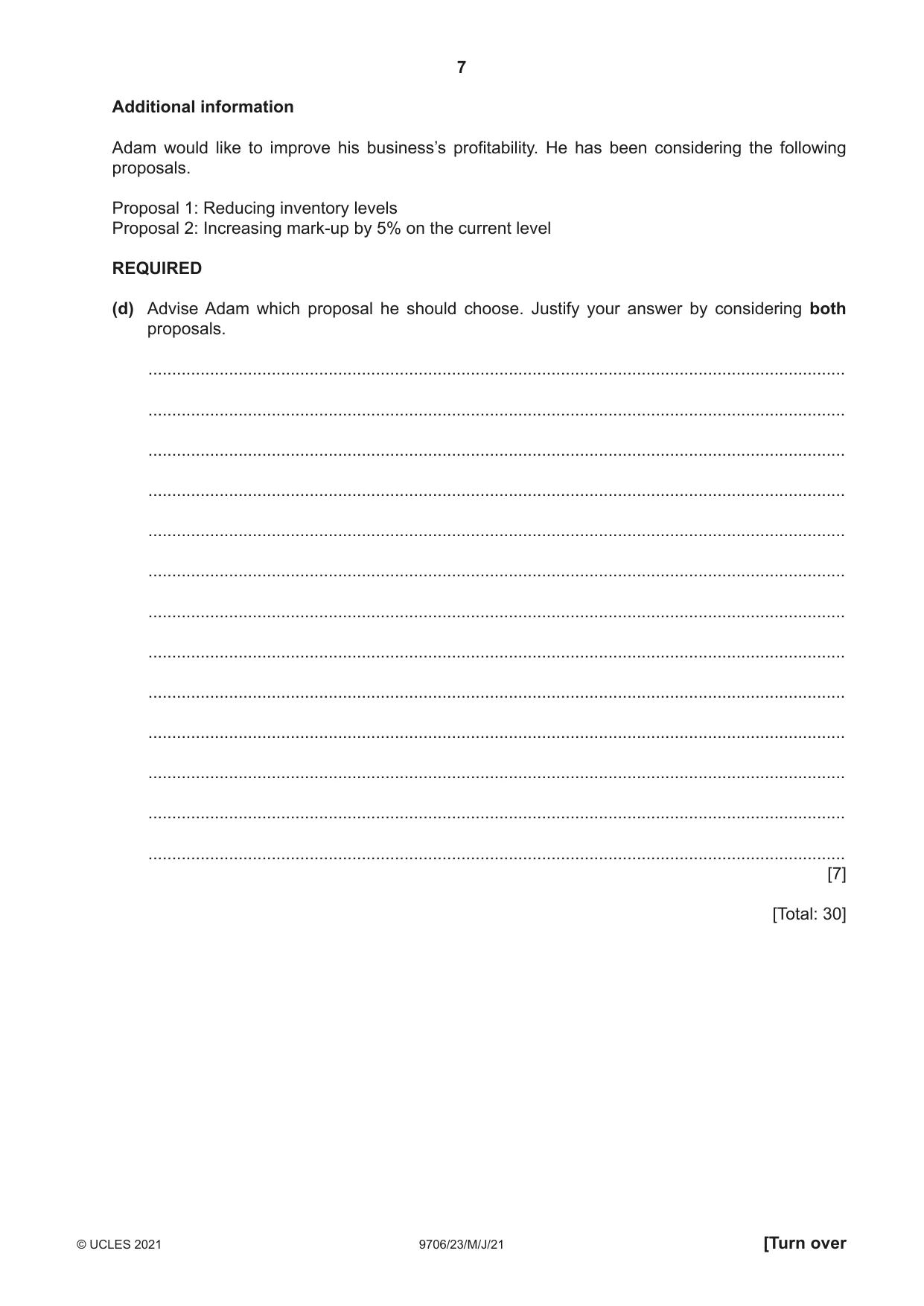
6 No record had been made of the sale of the only motor vehicle on 1 December 2020 for $1350. REQUIRED (c) Prepare the income statement for the year ended 31 December 2020. Start the statement with your gross profit figure in part (b). Income statement for the year ended 31 December 2020 $ $ ........................................................................................... ..................... ..................... ........................................................................................... ..................... ..................... ........................................................................................... ..................... ..................... ........................................................................................... ..................... ..................... ........................................................................................... ..................... ..................... ........................................................................................... ..................... ..................... ........................................................................................... ..................... ..................... ........................................................................................... ..................... ..................... ........................................................................................... ..................... ..................... ........................................................................................... ..................... ..................... ........................................................................................... ..................... ..................... ........................................................................................... ..................... ..................... ........................................................................................... ..................... ..................... ........................................................................................... ..................... ..................... ........................................................................................... ..................... ..................... ........................................................................................... ..................... ..................... ........................................................................................... ..................... ..................... [10] Additional information Adam would like to improve his business’s profitability. He has been considering the following proposals. Proposal 1: Reducing inventory levels Proposal 2: Increasing mark-up by 5% on the current level REQUIRED (d) Advise Adam which proposal he should choose. Justify your answer by considering both proposals. ................................................................................................................................................... ................................................................................................................................................... ................................................................................................................................................... ................................................................................................................................................... ................................................................................................................................................... ................................................................................................................................................... ................................................................................................................................................... ................................................................................................................................................... ................................................................................................................................................... ................................................................................................................................................... ................................................................................................................................................... ................................................................................................................................................... ................................................................................................................................................... [7] [Total: 30]
What was in this paper
The subtopics covered by these 6 questions, and how many questions each got. Open one in a new tab to see every Cambridge question on it.
What you needed in this session
Cambridge’s own grade thresholds for 2021 May/June, Paper 2 · Variant 3. A higher threshold means an easier paper — the bar moves with how the cohort did.