Cambridge A Level Accounting 9706 — 2020 May/June Paper 2 · Variant 2
9706/22/M/J/20 · 6 questions · 102 marks · ≈115 min
The question paper and its mark scheme, free to read here and free to download. This is Cambridge’s own paper, exactly as it was sat.
Question paper20 pages


Mark scheme10 pages
Answers below. Sit the paper first if you are practising.
Questions as text
Q1 · Tariq owns a retail business but does not maintain full accounting records
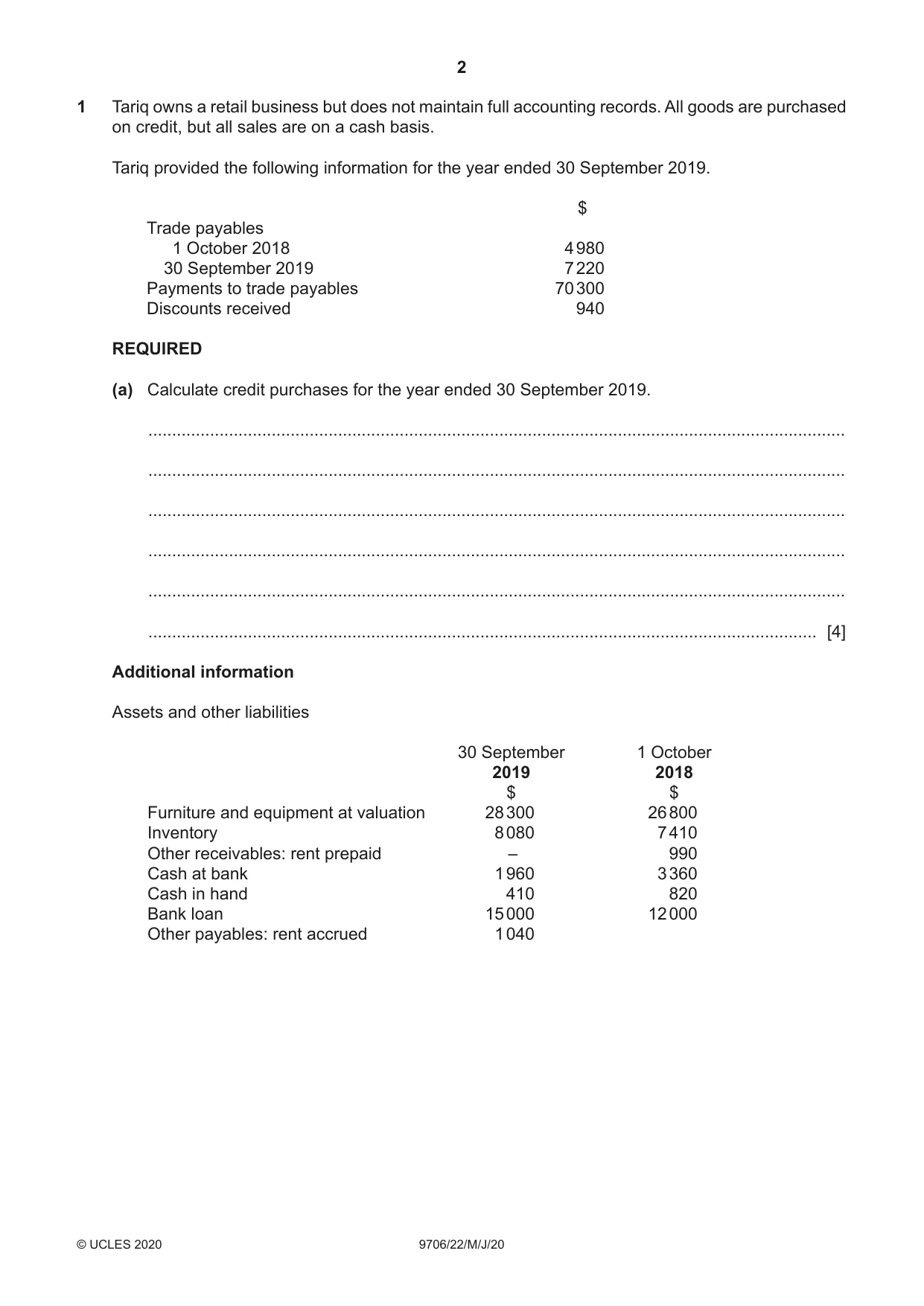
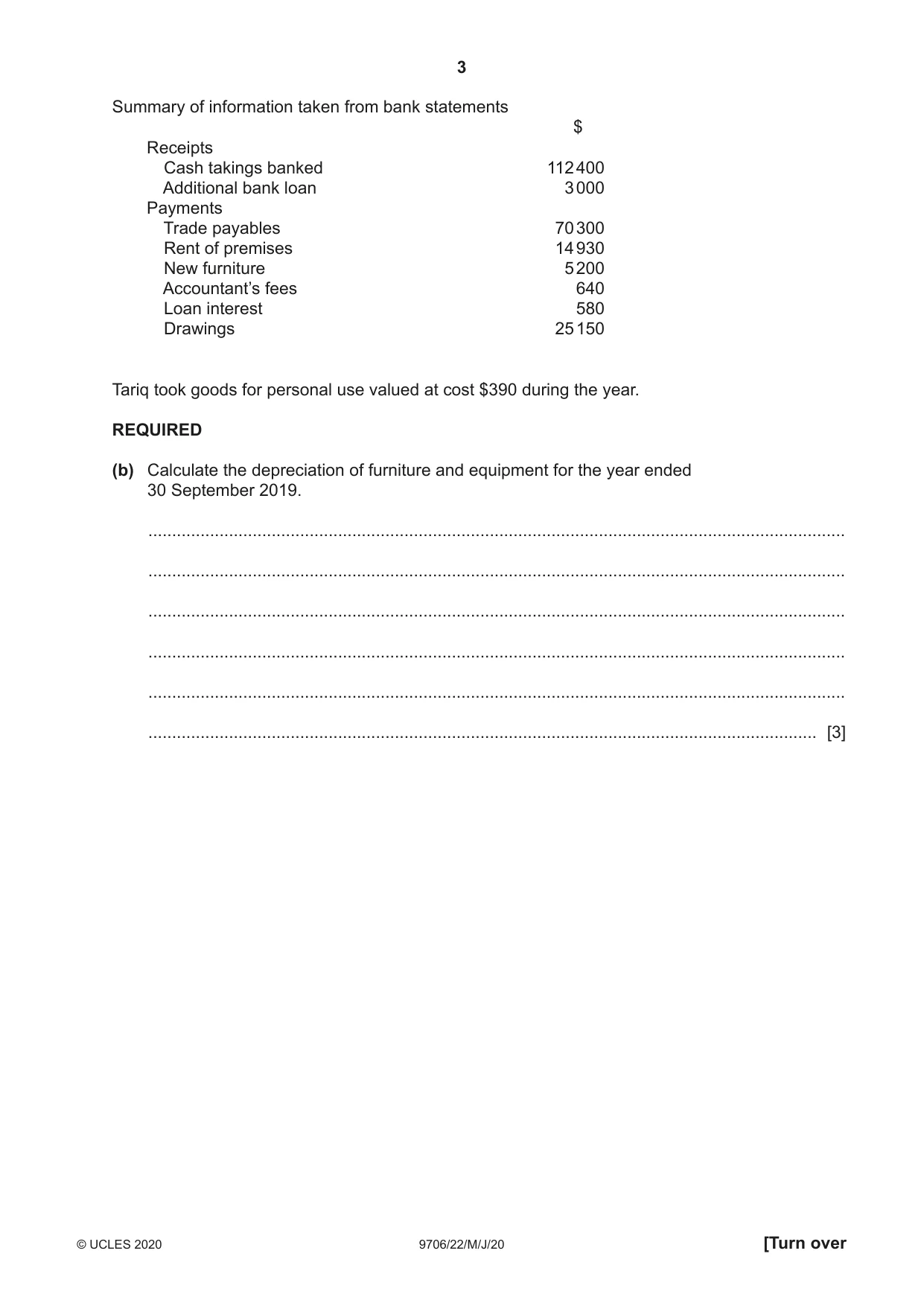
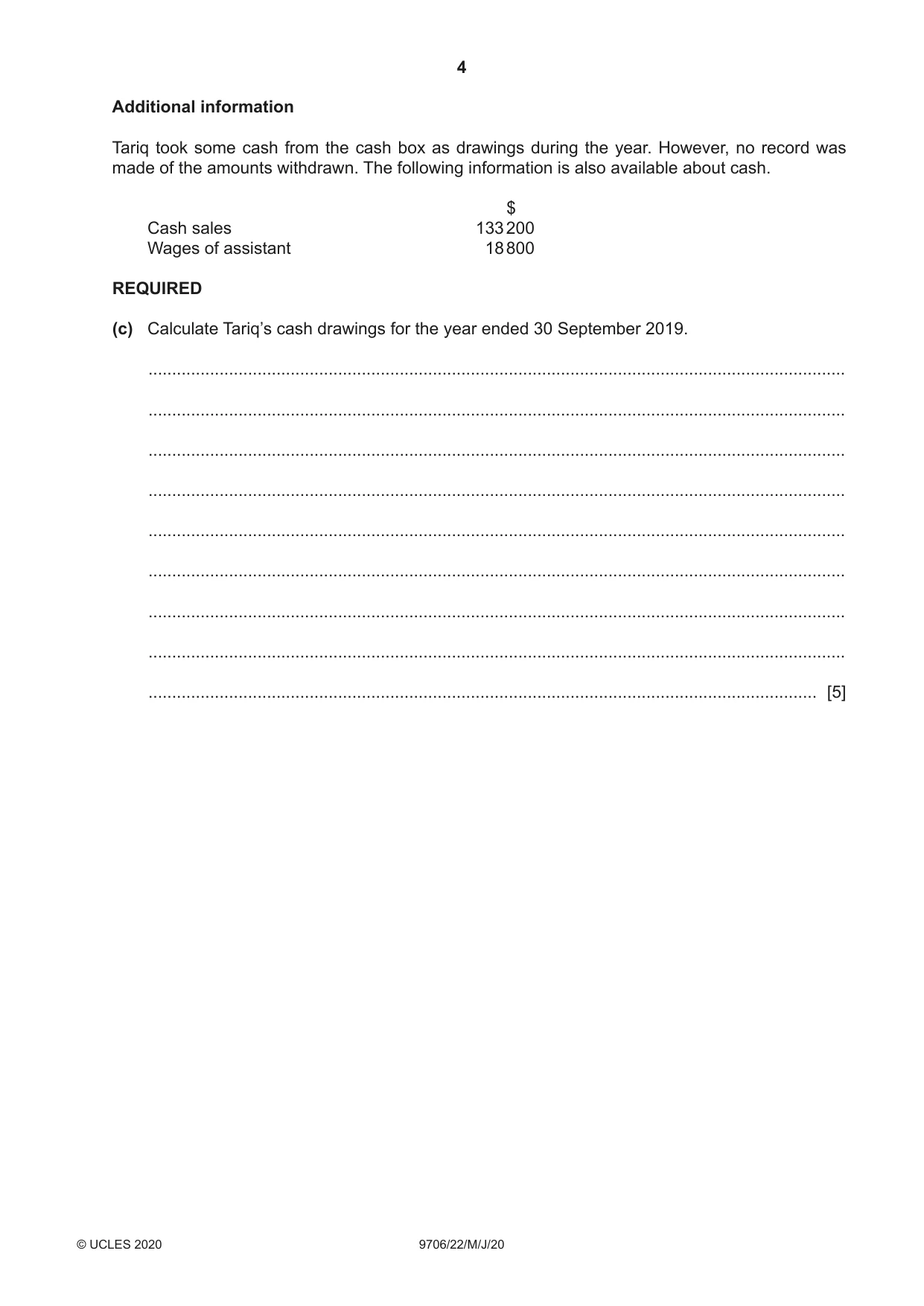
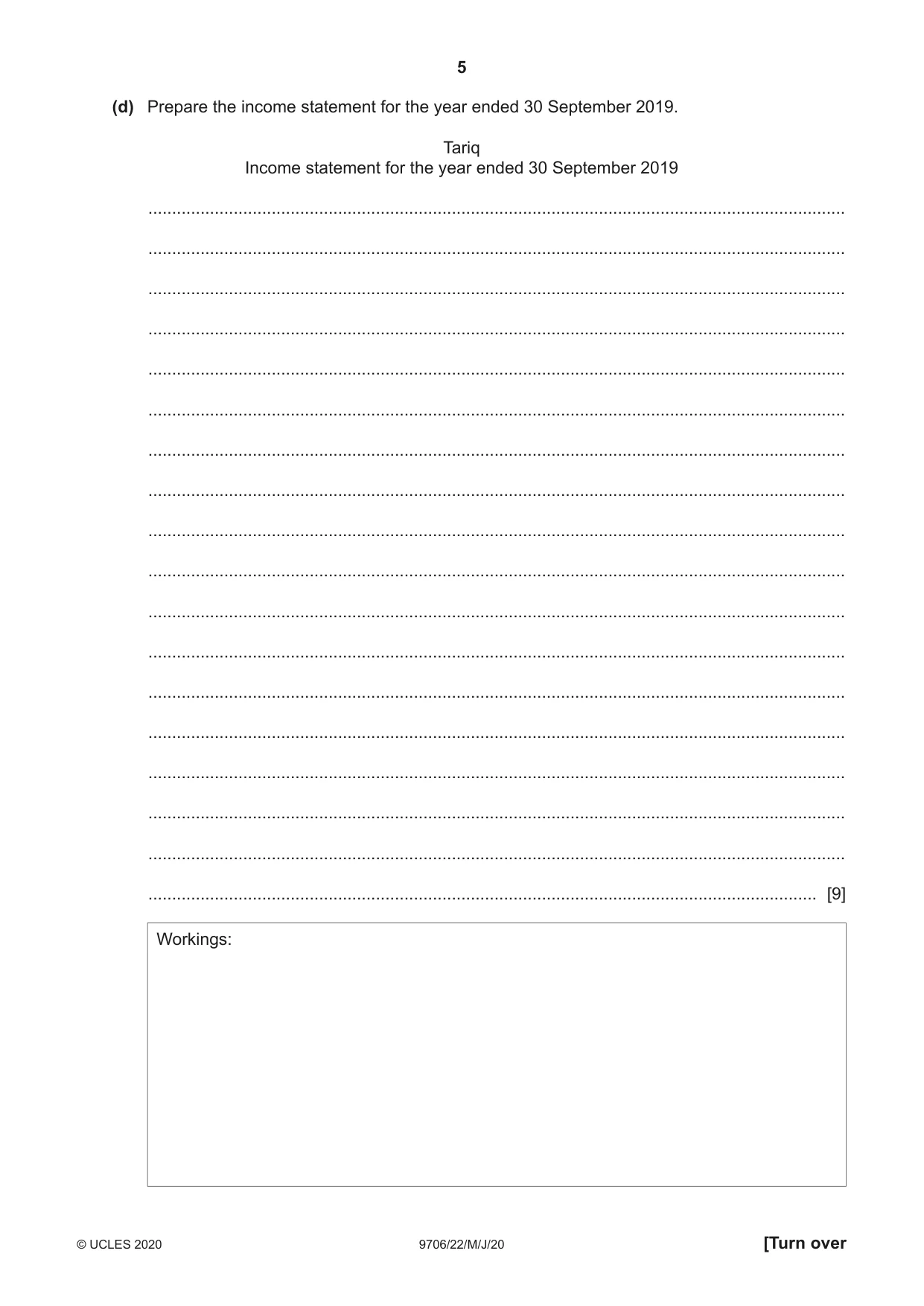
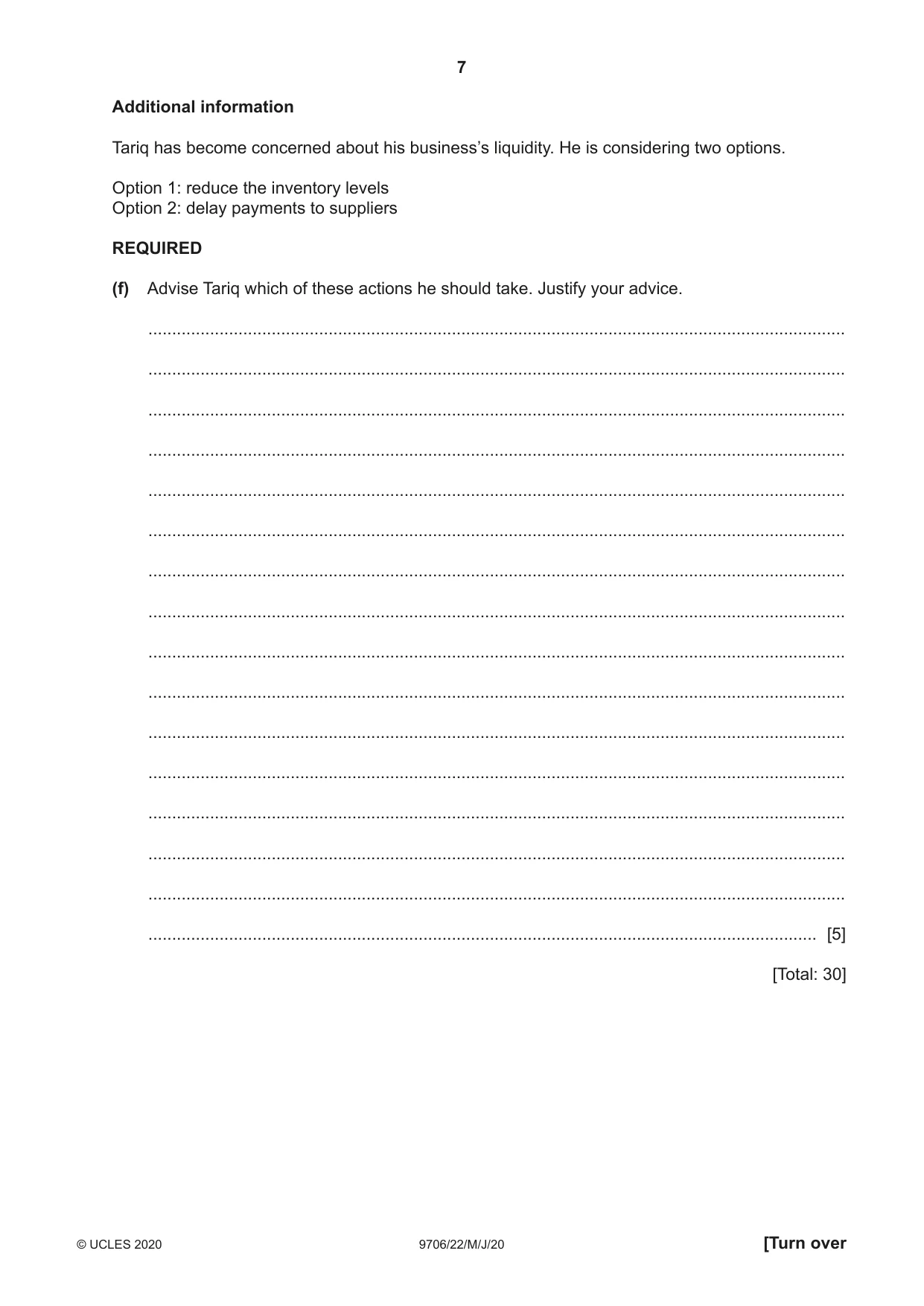
1 Tariq owns a retail business but does not maintain full accounting records. All goods are purchased on credit, but all sales are on a cash basis. Tariq provided the following information for the year ended 30 September 2019. $ Trade payables 1 October 2018 4 980 30 September 2019 7 220 Payments to trade payables 70 300 Discounts received 940 REQUIRED (a) Calculate credit purchases for the year ended 30 September 2019. ................................................................................................................................................... ................................................................................................................................................... ................................................................................................................................................... ................................................................................................................................................... ................................................................................................................................................... ............................................................................................................................................. [4] Additional information Assets and other liabilities 30 September 1 October 2019 2018 $ $ Furniture and equipment at valuation 28 300 26 800 Inventory 8 080 7 410 Other receivables: rent prepaid – 990 Cash at bank 1 960 3 360 Cash in hand 410 820 Bank loan 15 000 12 000 Other payables: rent accrued 1 040 Summary of information taken from bank statements $ Receipts Cash takings banked 112 400 Additional bank loan 3 000 Payments Trade payables 70 300 Rent of premises 14 930 New furniture 5 200 Accountant’s fees 640 Loan interest 580 Drawings 25 150 Tariq took goods for personal use valued at cost $390 during the year. REQUIRED (b) Calculate the depreciation of furniture and equipment for the year ended 30 September 2019. ................................................................................................................................................... ................................................................................................................................................... ................................................................................................................................................... ................................................................................................................................................... ................................................................................................................................................... ............................................................................................................................................. [3] Additional information Tariq took some cash from the cash box as drawings during the year. However, no record was made of the amounts withdrawn. The following information is also available about cash. $ Cash sales 133 200 Wages of assistant 18 800 REQUIRED (c) Calculate Tariq’s cash drawings for the year ended 30 September 2019. ................................................................................................................................................... ................................................................................................................................................... ................................................................................................................................................... ................................................................................................................................................... ................................................................................................................................................... ................................................................................................................................................... ................................................................................................................................................... ................................................................................................................................................... ............................................................................................................................................. [5] (d) Prepare the income statement for the year ended 30 September 2019. Tariq Income statement for the year ended 30 September 2019 ................................................................................................................................................... ................................................................................................................................................... ................................................................................................................................................... ................................................................................................................................................... ................................................................................................................................................... ................................................................................................................................................... ................................................................................................................................................... ................................................................................................................................................... ................................................................................................................................................... ................................................................................................................................................... ................................................................................................................................................... ................................................................................................................................................... ................................................................................................................................................... ................................................................................................................................................... ................................................................................................................................................... ................................................................................................................................................... ................................................................................................................................................... ............................................................................................................................................. [9] Workings: (e) Explain the accounting concepts of: (i) business entity ........................................................................................................................................... ........................................................................................................................................... ........................................................................................................................................... ........................................................................................................................................... [2] (ii) substance over form. ........................................................................................................................................... ........................................................................................................................................... ........................................................................................................................................... ........................................................................................................................................... [2] Additional information Tariq has become concerned about his business’s liquidity. He is considering two options. Option 1: reduce the inventory levels Option 2: delay payments to suppliers REQUIRED (f) Advise Tariq which of these actions he should take. Justify your advice. ................................................................................................................................................... ................................................................................................................................................... ................................................................................................................................................... ................................................................................................................................................... ................................................................................................................................................... ................................................................................................................................................... ................................................................................................................................................... ................................................................................................................................................... ................................................................................................................................................... ................................................................................................................................................... ................................................................................................................................................... ................................................................................................................................................... ................................................................................................................................................... ................................................................................................................................................... ................................................................................................................................................... ............................................................................................................................................. [5] [Total: 30]
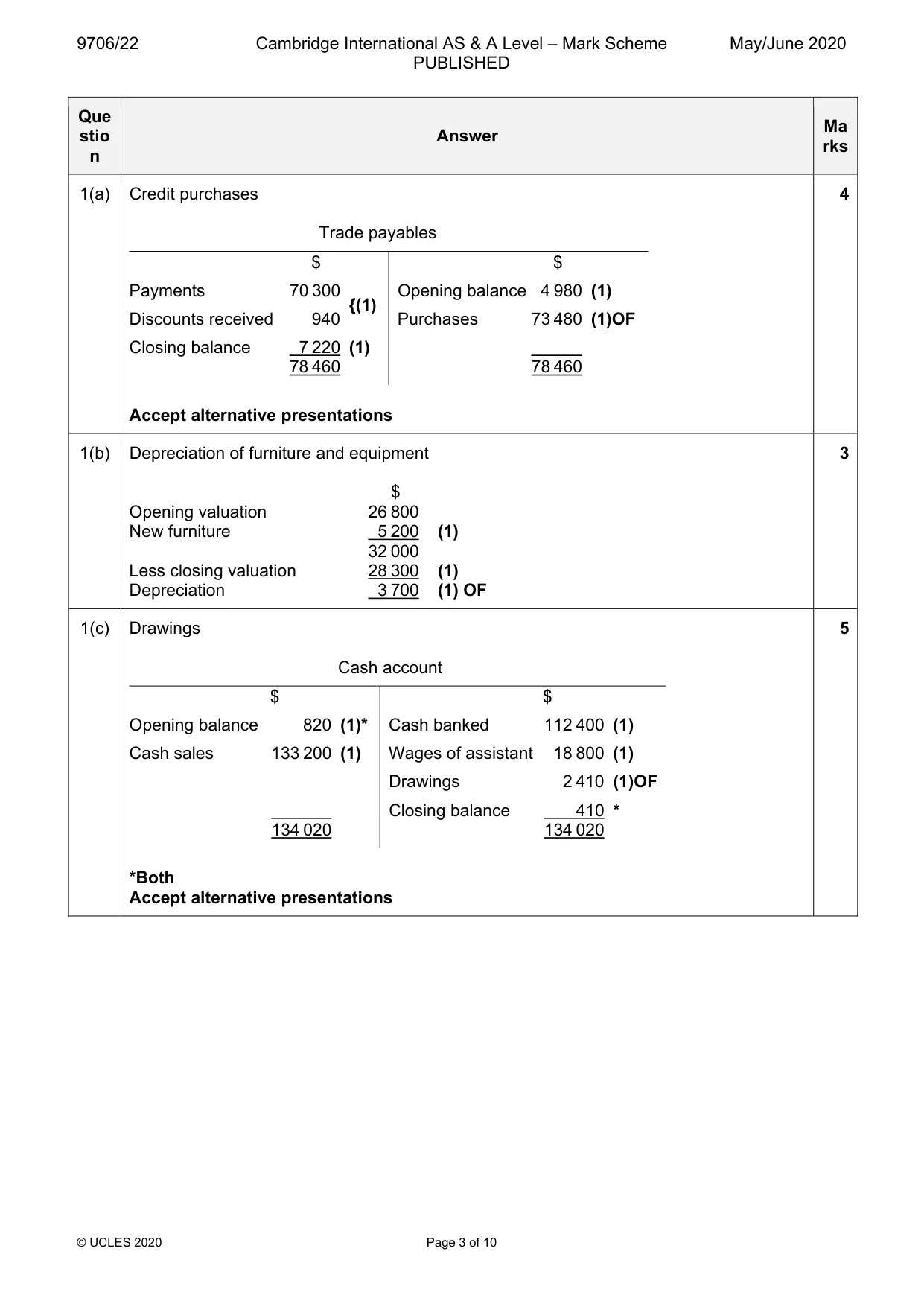
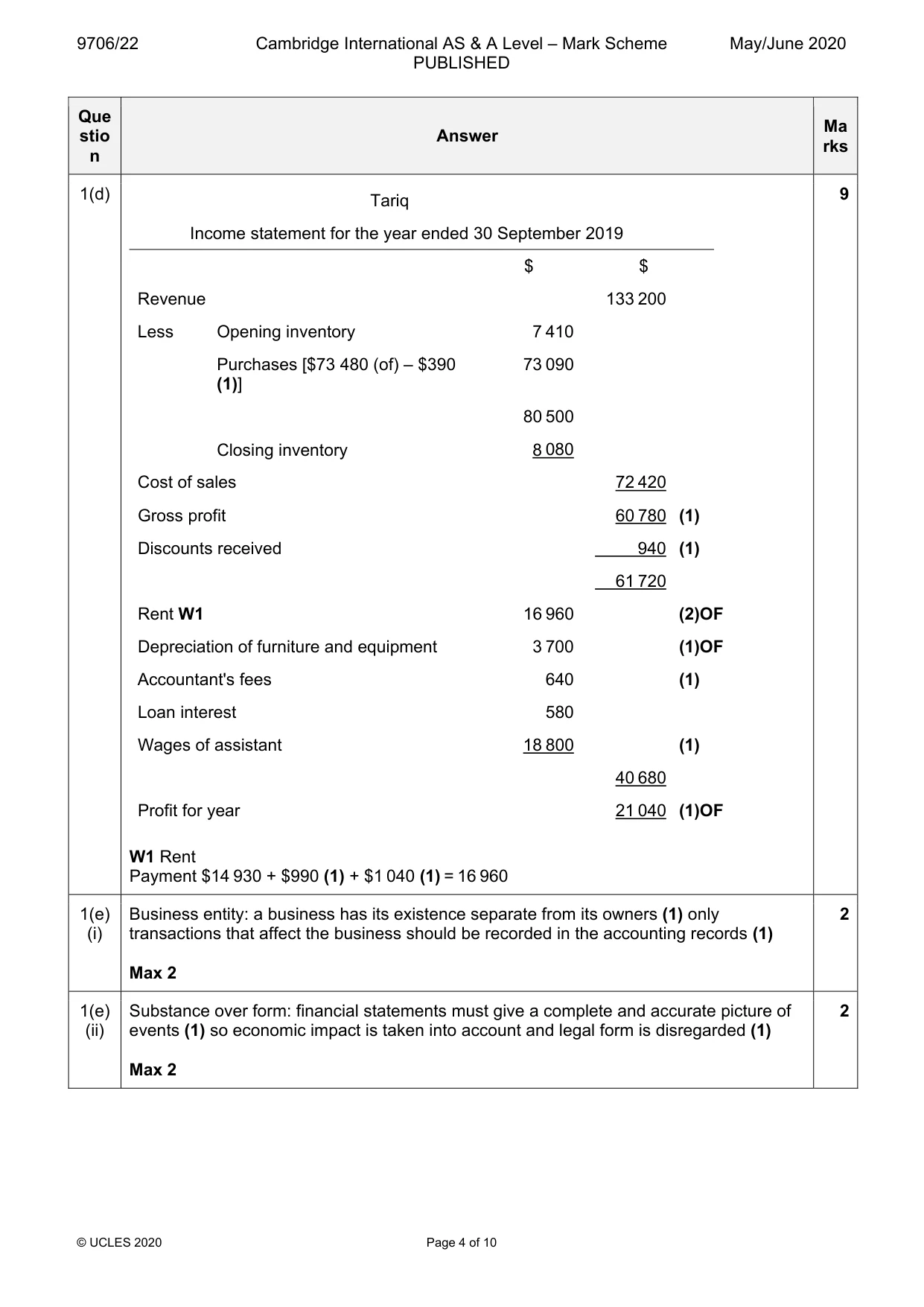
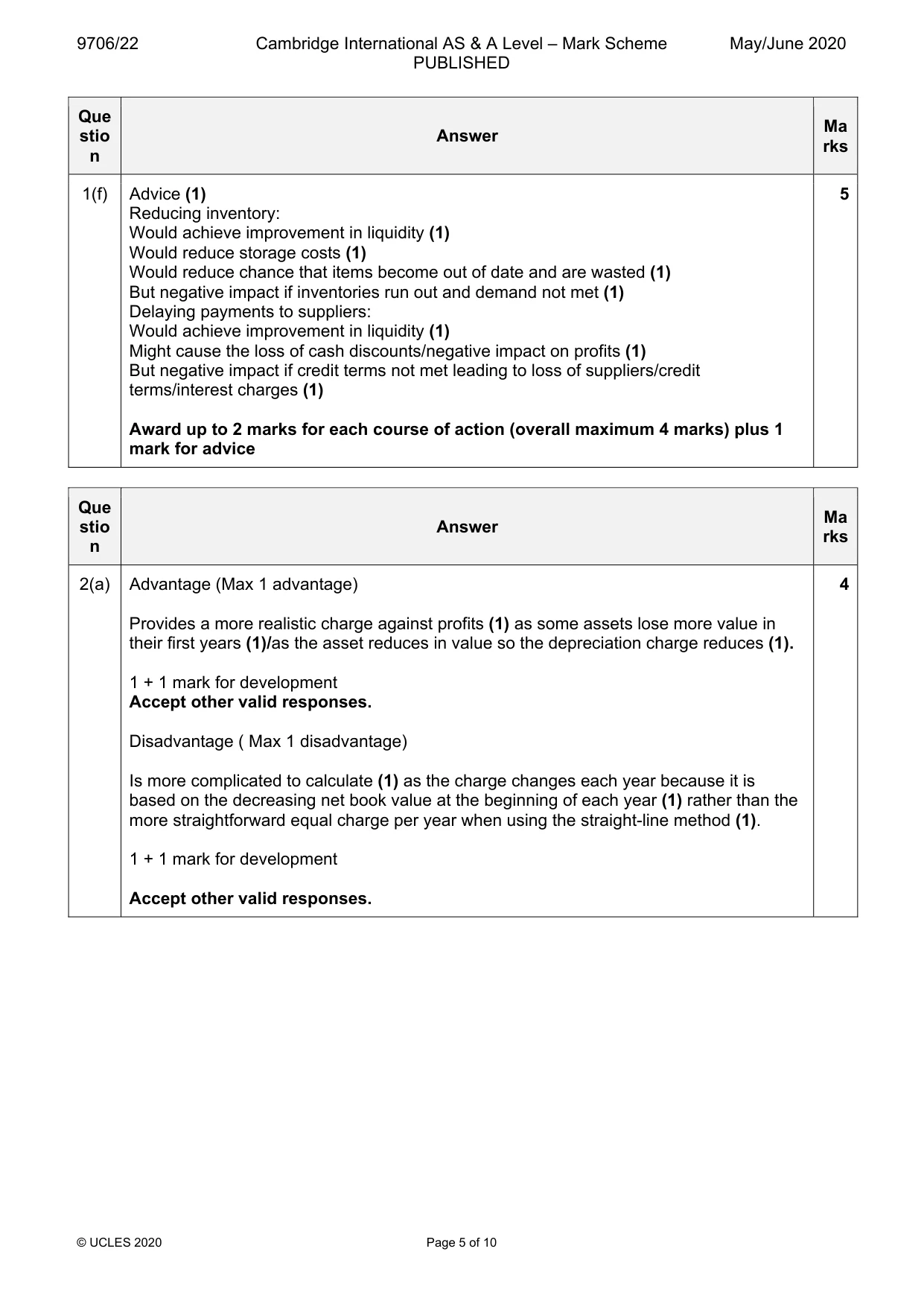
Mark scheme: 1(a) Credit purchases 4 Trade payables $ $ Payments 70 300 Opening balance 4 980 (1) {(1) Discounts received 940 Purchases 73 480 (1)OF Closing balance 7 220 (1) 00 000 78 460 78 460 Accept alternative presentations 1(b) Depreciation of furniture and equipment 3 $ Opening valuation 26 800 New furniture 5 200 (1) 32 000 Less closing valuation 28 300 (1) Depreciation 3 700 (1) OF 1(c) Drawings 5 Cash account $ $ Opening balance 820 (1)* Cash banked 112 400 (1) Cash sales 133 200 (1) Wages of assistant 18 800 (1) Drawings 2 410 (1)OF 000 000 Closing balance 410 * 134 020 134 020 *Both Accept alternative presentations Que Ma stio Answer rks n 1(d) 9 Tariq Income statement for the year ended 30 September 2019 $ $ Revenue 133 200 Less Opening inventory 7 410 Purchases [$73 480 (of) – $390 73 090 (1)] 80 500 Closing inventory 8 080 Cost of sales 72 420 Gross profit 60 780 (1) Discounts received 940 (1) 61 720 Rent W1 16 960 (2)OF Depreciation of furniture and equipment 3 700 (1)OF Accountant's fees 640 (1) Loan interest 580 Wages of assistant 18 800 (1) 40 680 Profit for year 21 040 (1)OF W1 Rent Payment $14 930 + $990 (1) + $1 040 (1) = 16 960 1(e) Business entity: a business has its existence separate from its owners (1) only 2 (i) transactions that affect the business should be recorded in the accounting records (1) Max 2 1(e) Substance over form: financial statements must give a complete and accurate picture of 2 (ii) events (1) so economic impact is taken into account and legal form is disregarded (1) Max 2 Que Ma stio Answer rks n 1(f) Advice (1) 5 Reducing inventory: Would achieve improvement in liquidity (1) Would reduce storage costs (1) Would reduce chance that items become out of date and are wasted (1) But negative impact if inventories run out and demand not met (1) Delaying payments to suppliers: Would achieve improvement in liquidity (1) Might cause the loss of cash discounts/negative impact on profits (1) But negative impact if credit terms not met leading to loss of suppliers/credit terms/interest charges (1) Award up to 2 marks for each course of action (overall maximum 4 marks) plus 1 mark for advice Que Ma stio Answer rks n
Q2 · Q Limited is a small wholesale business
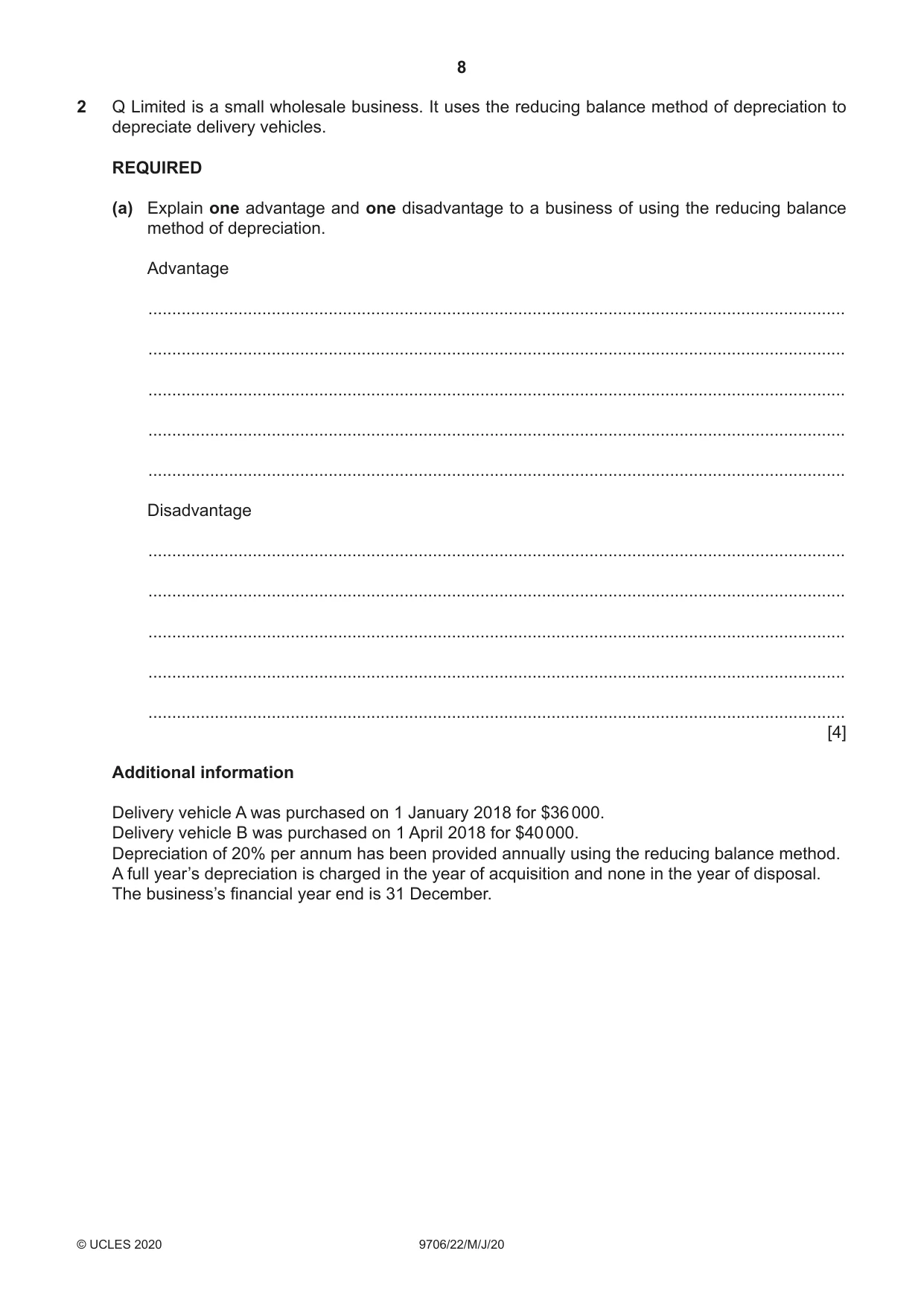
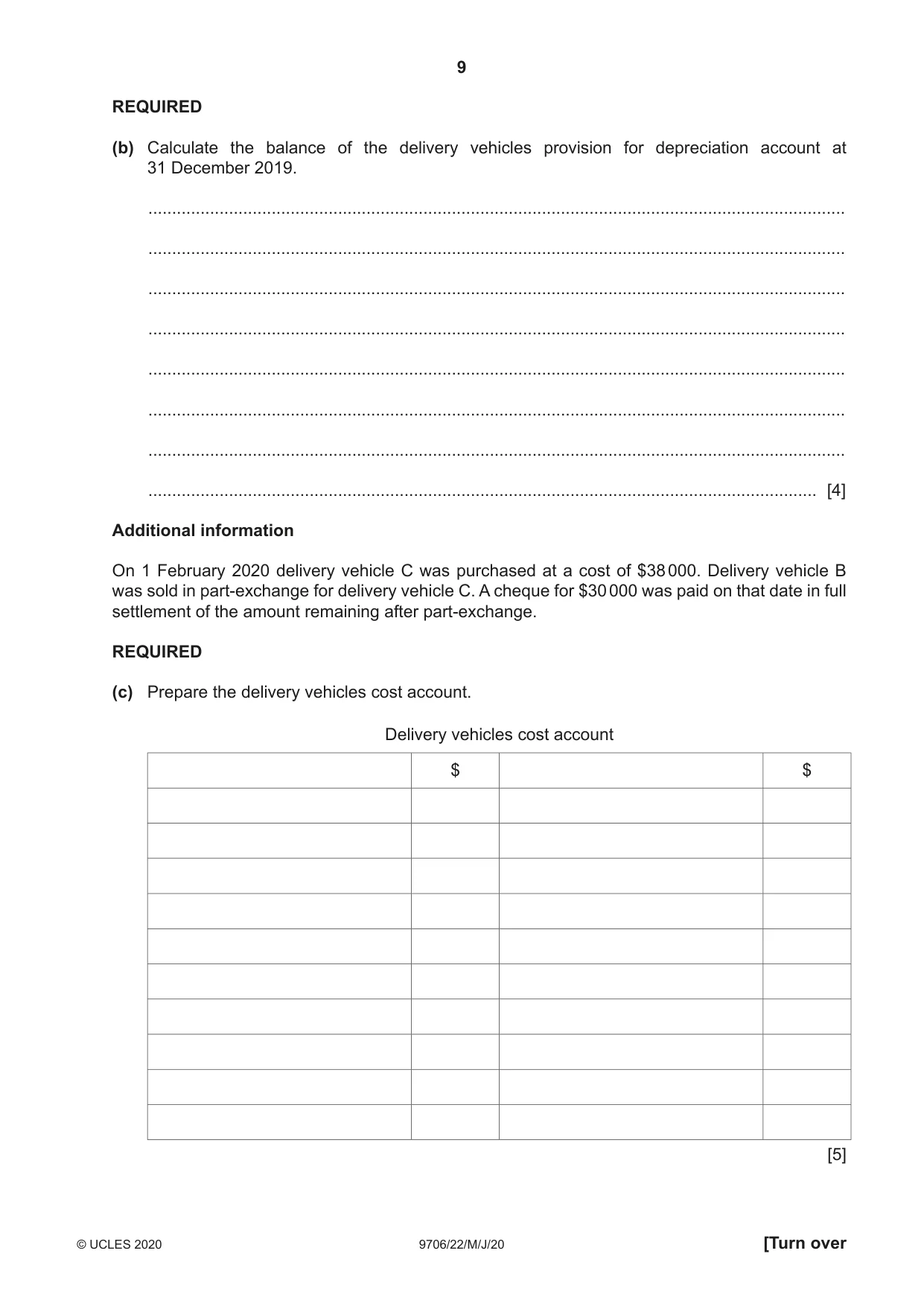
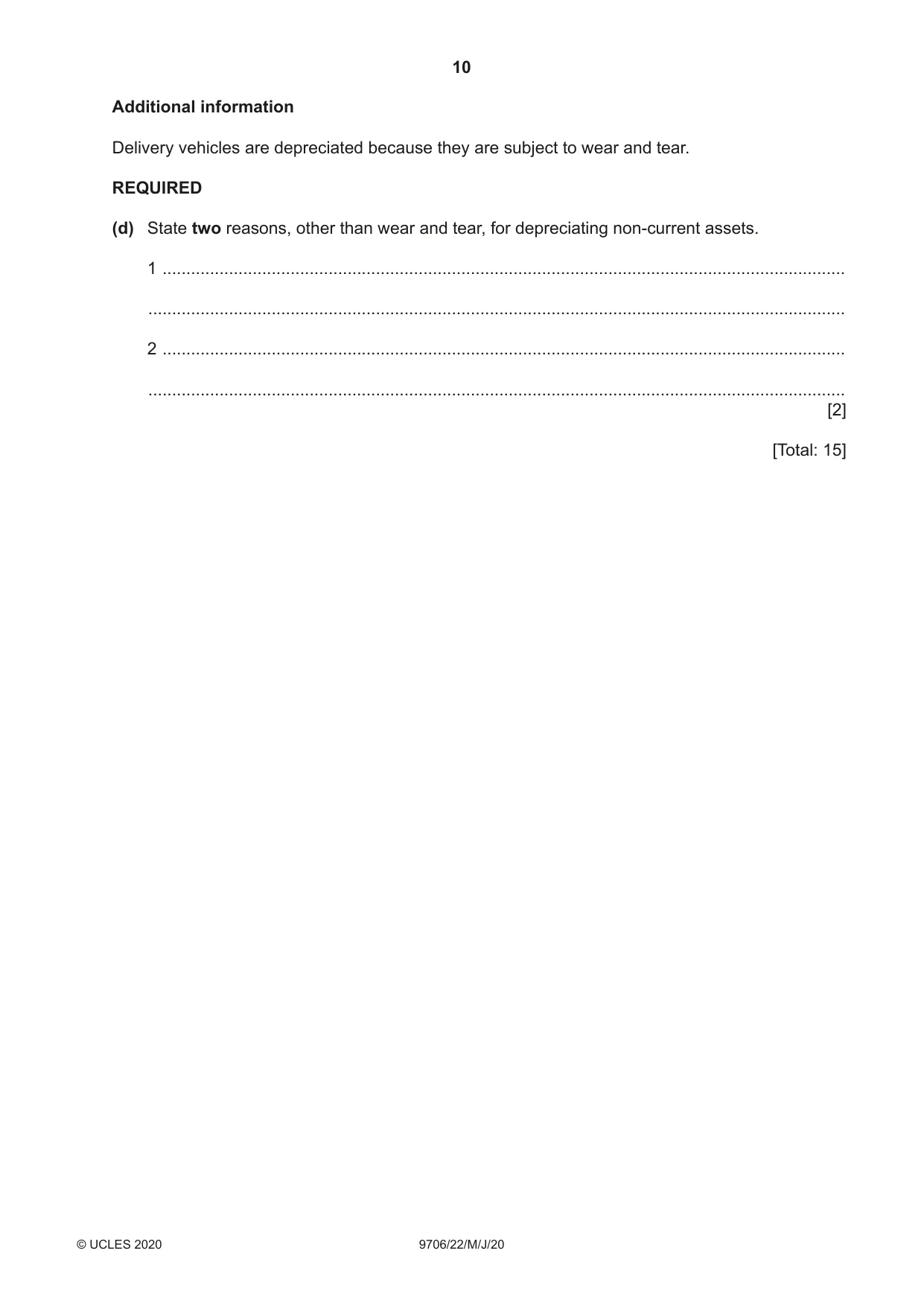
2 Q Limited is a small wholesale business. It uses the reducing balance method of depreciation to depreciate delivery vehicles. REQUIRED (a) Explain one advantage and one disadvantage to a business of using the reducing balance method of depreciation. Advantage ................................................................................................................................................... ................................................................................................................................................... ................................................................................................................................................... ................................................................................................................................................... ................................................................................................................................................... Disadvantage ................................................................................................................................................... ................................................................................................................................................... ................................................................................................................................................... ................................................................................................................................................... ................................................................................................................................................... [4] Additional information Delivery vehicle A was purchased on 1 January 2018 for $36 000. Delivery vehicle B was purchased on 1 April 2018 for $40 000. Depreciation of 20% per annum has been provided annually using the reducing balance method. A full year’s depreciation is charged in the year of acquisition and none in the year of disposal. The business’s financial year end is 31 December. REQUIRED (b) Calculate the balance of the delivery vehicles provision for depreciation account at 31 December 2019. ................................................................................................................................................... ................................................................................................................................................... ................................................................................................................................................... ................................................................................................................................................... ................................................................................................................................................... ................................................................................................................................................... ................................................................................................................................................... ............................................................................................................................................. [4] Additional information On 1 February 2020 delivery vehicle C was purchased at a cost of $38 000. Delivery vehicle B was sold in part-exchange for delivery vehicle C. A cheque for $30 000 was paid on that date in full settlement of the amount remaining after part-exchange. REQUIRED (c) Prepare the delivery vehicles cost account. Delivery vehicles cost account $ $ [5] Additional information Delivery vehicles are depreciated because they are subject to wear and tear. REQUIRED (d) State two reasons, other than wear and tear, for depreciating non-current assets. 1 ................................................................................................................................................ ................................................................................................................................................... 2 ................................................................................................................................................ ................................................................................................................................................... [2] [Total: 15] PLEASE TURN OVER
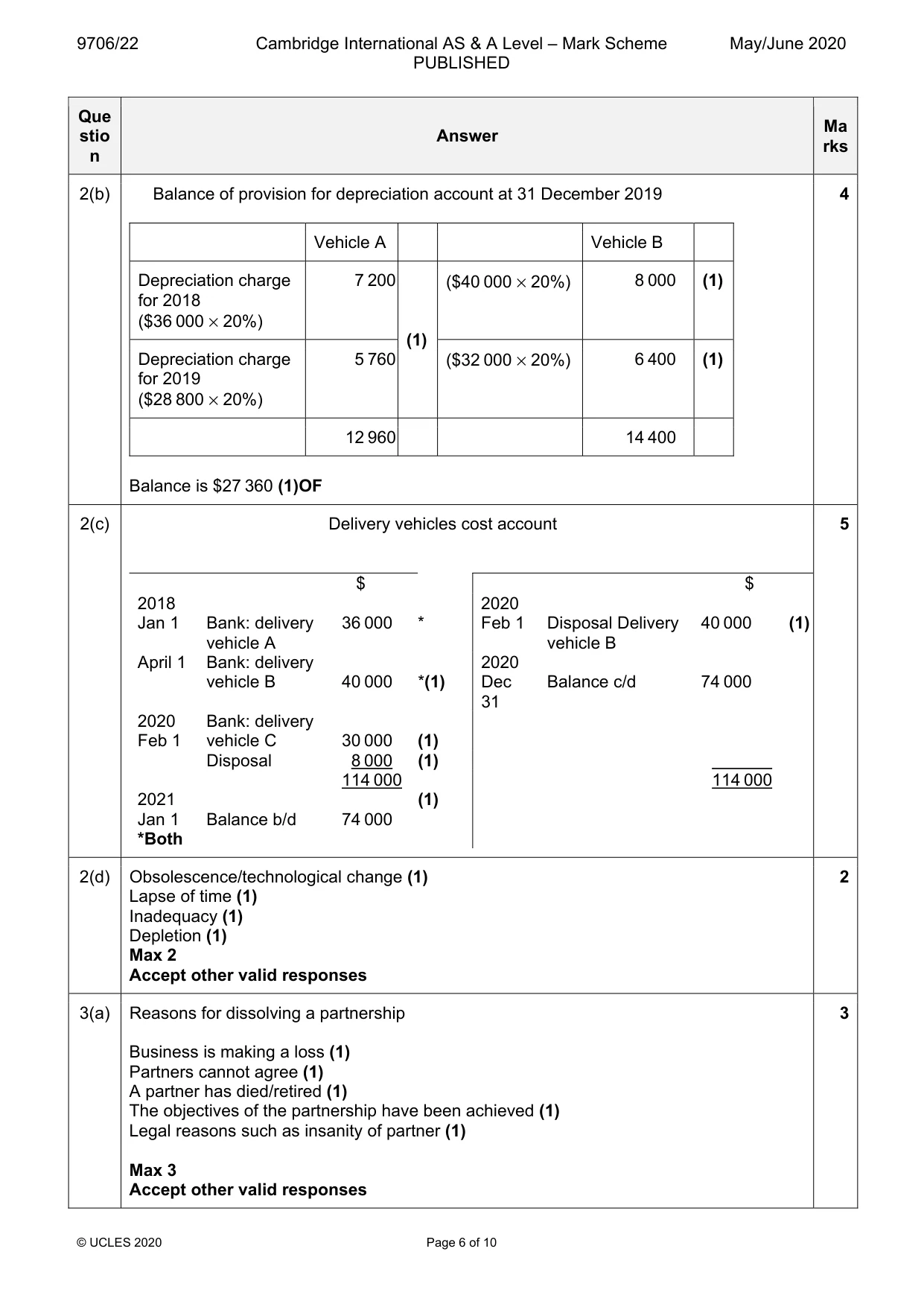
Mark scheme: 2(a) Advantage (Max 1 advantage) 4 Provides a more realistic charge against profits (1) as some assets lose more value in their first years (1)/as the asset reduces in value so the depreciation charge reduces (1). 1 + 1 mark for development Accept other valid responses. Disadvantage ( Max 1 disadvantage) Is more complicated to calculate (1) as the charge changes each year because it is based on the decreasing net book value at the beginning of each year (1) rather than the more straightforward equal charge per year when using the straight-line method (1). 1 + 1 mark for development Accept other valid responses. Que Ma stio Answer rks n 2(b) Balance of provision for depreciation account at 31 December 2019 4 Vehicle A Vehicle B Depreciation charge 7 200 ($40 000 × 20%) 8 000 (1) for 2018 ($36 000 × 20%) (1) Depreciation charge 5 760 ($32 000 × 20%) 6 400 (1) for 2019 ($28 800 × 20%) 12 960 14 400 Balance is $27 360 (1)OF 2(c) Delivery vehicles cost account 5 $ $ 2018 2020 Jan 1 Bank: delivery 36 000 * Feb 1 Disposal Delivery 40 000 (1) vehicle A vehicle B April 1 Bank: delivery 2020 vehicle B 40 000 *(1) Dec Balance c/d 74 000 31 2020 Bank: delivery Feb 1 vehicle C 30 000 (1) Disposal 8 000 (1) 000 000 114 000 114 000 2021 (1) Jan 1 Balance b/d 74 000 *Both 2(d) Obsolescence/technological change (1) 2 Lapse of time (1) Inadequacy (1) Depletion (1) Max 2 Accept other valid responses
Q3 · Xu and Zoe have been in partnership for a number of years
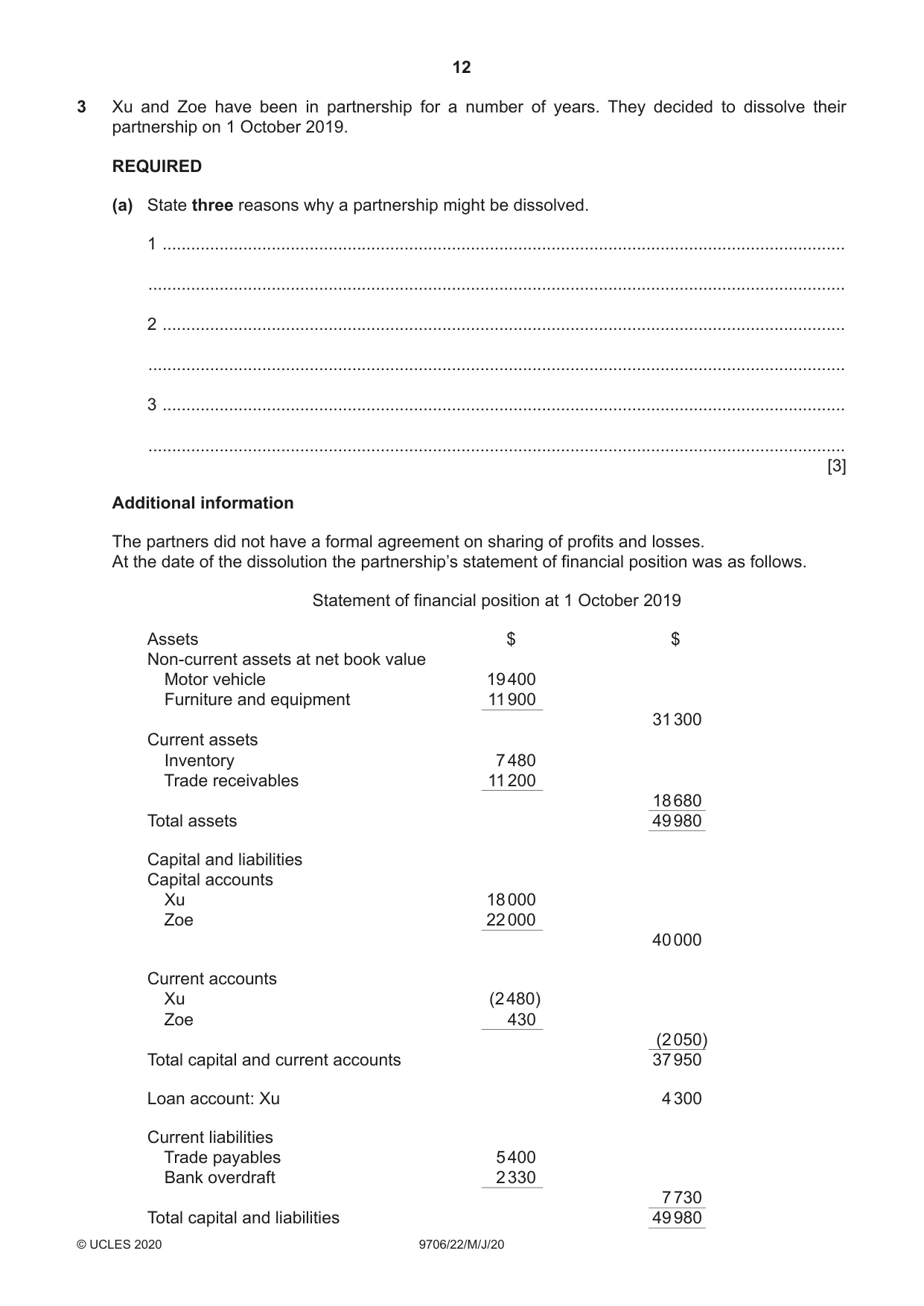
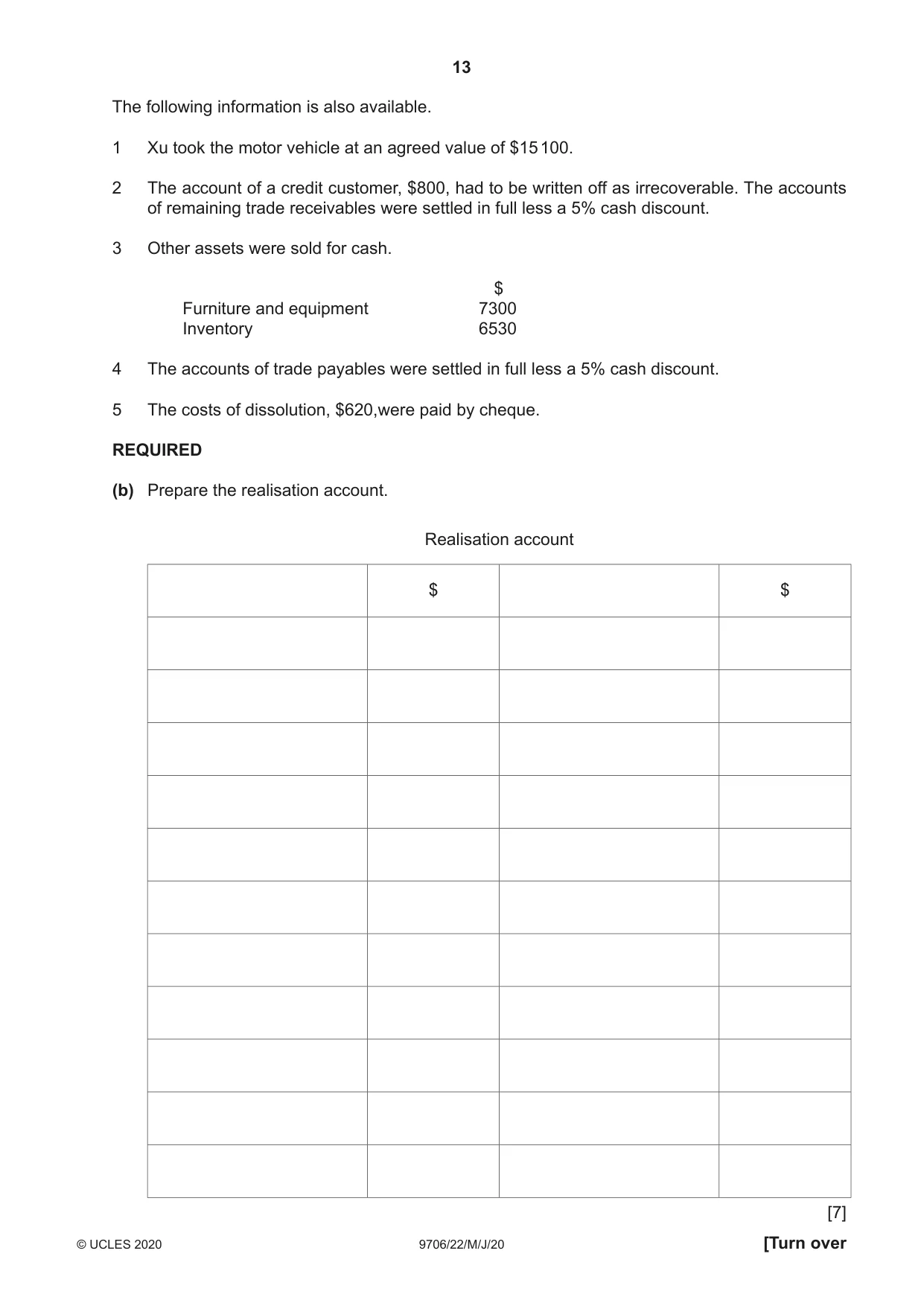
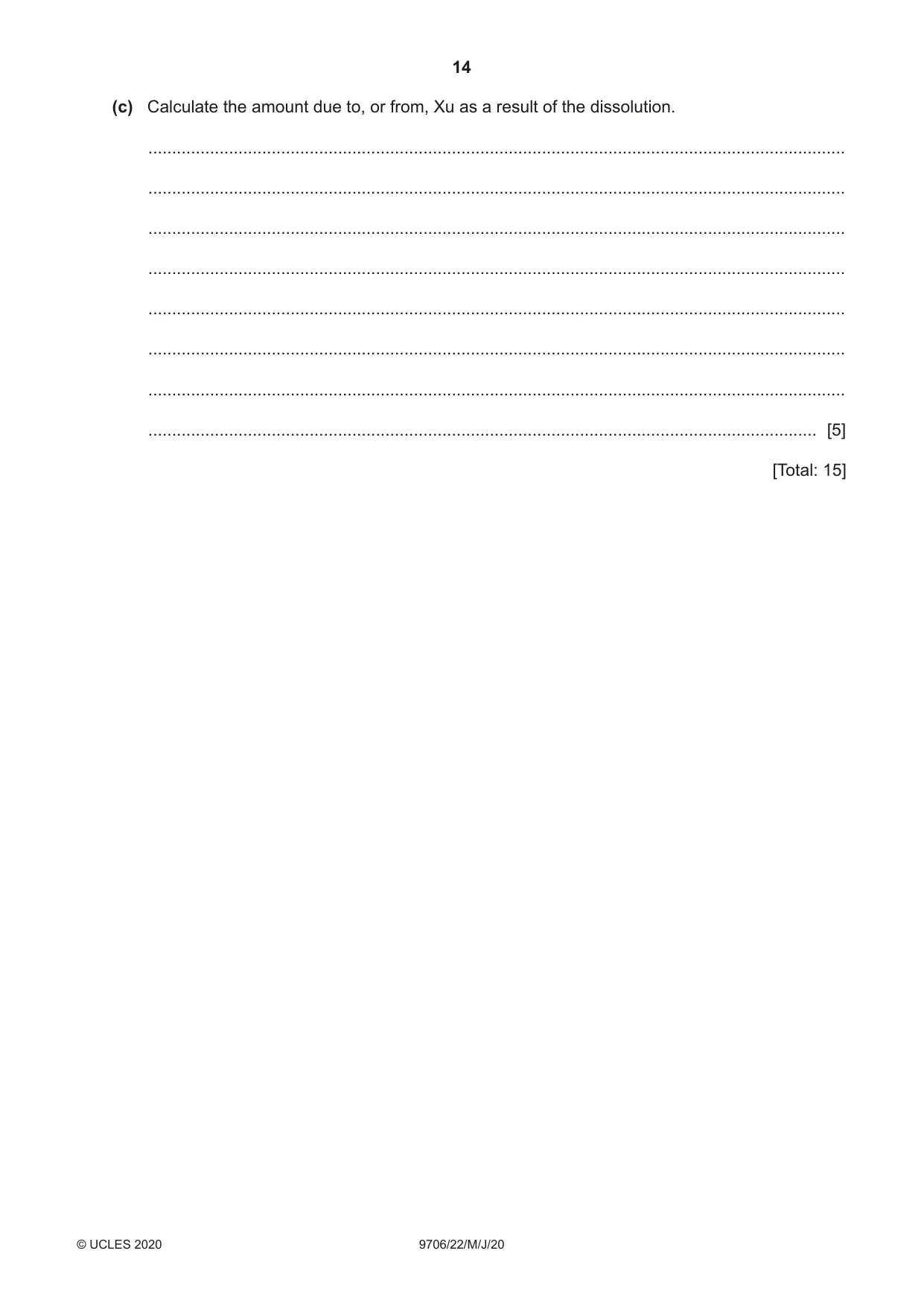
3 Xu and Zoe have been in partnership for a number of years. They decided to dissolve their partnership on 1 October 2019. REQUIRED (a) State three reasons why a partnership might be dissolved. 1 ................................................................................................................................................ ................................................................................................................................................... 2 ................................................................................................................................................ ................................................................................................................................................... 3 ................................................................................................................................................ ................................................................................................................................................... [3] Additional information The partners did not have a formal agreement on sharing of profits and losses. At the date of the dissolution the partnership’s statement of financial position was as follows. Statement of financial position at 1 October 2019 Assets $ $ Non-current assets at net book value Motor vehicle 19 400 Furniture and equipment 11 900 31 300 Current assets Inventory 7 480 Trade receivables 11 200 18 680 Total assets 49 980 Capital and liabilities Capital accounts Xu 18 000 Zoe 22 000 40 000 Current accounts Xu (2 480) Zoe 430 (2 050) Total capital and current accounts 37 950 Loan account: Xu 4 300 Current liabilities Trade payables 5 400 Bank overdraft 2 330 7 730 Total capital and liabilities 49 980 The following information is also available. 1 Xu took the motor vehicle at an agreed value of $15 100. 2 The account of a credit customer, $800, had to be written off as irrecoverable. The accounts of remaining trade receivables were settled in full less a 5% cash discount. 3 Other assets were sold for cash. $ Furniture and equipment 7300 Inventory 6530
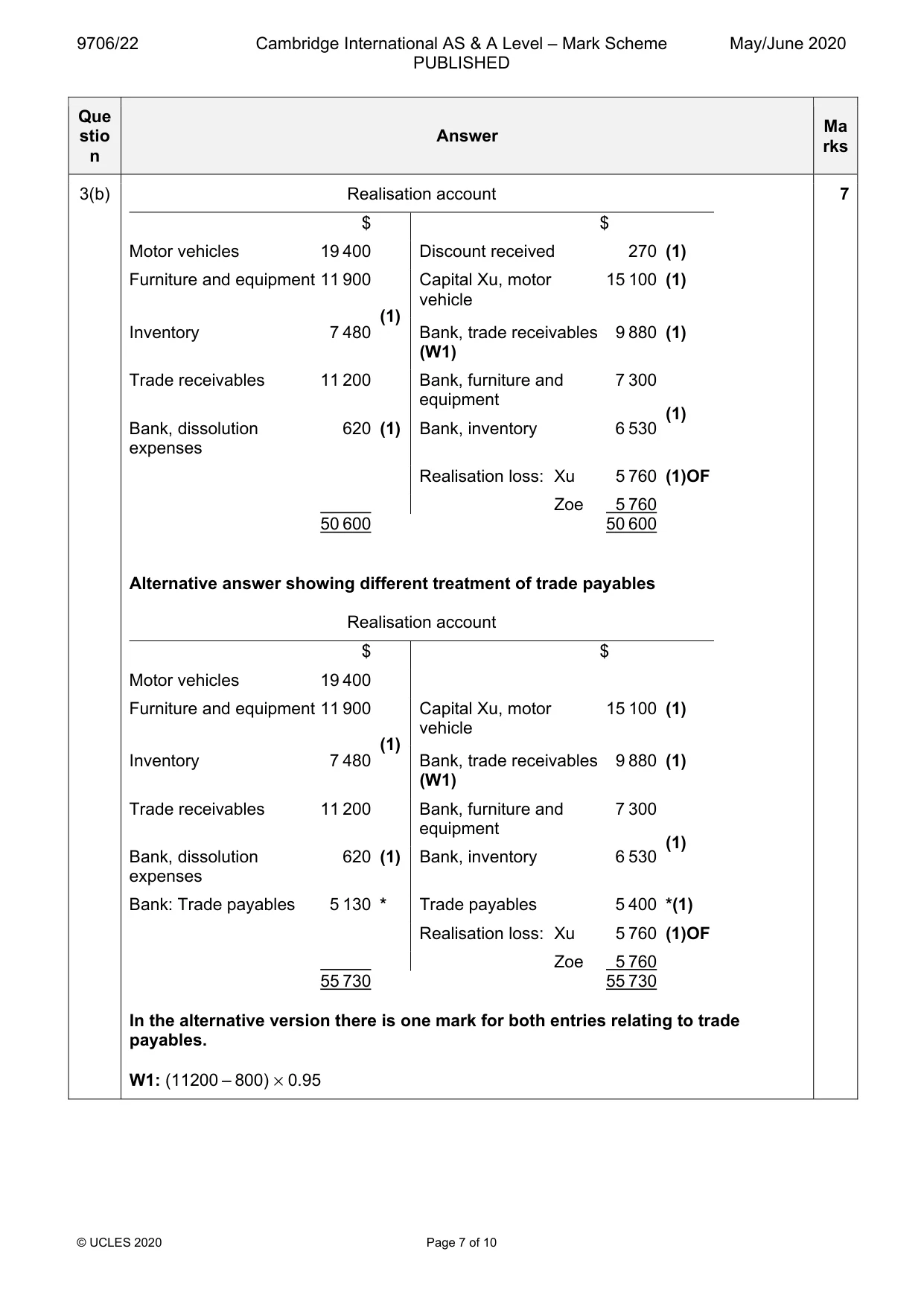
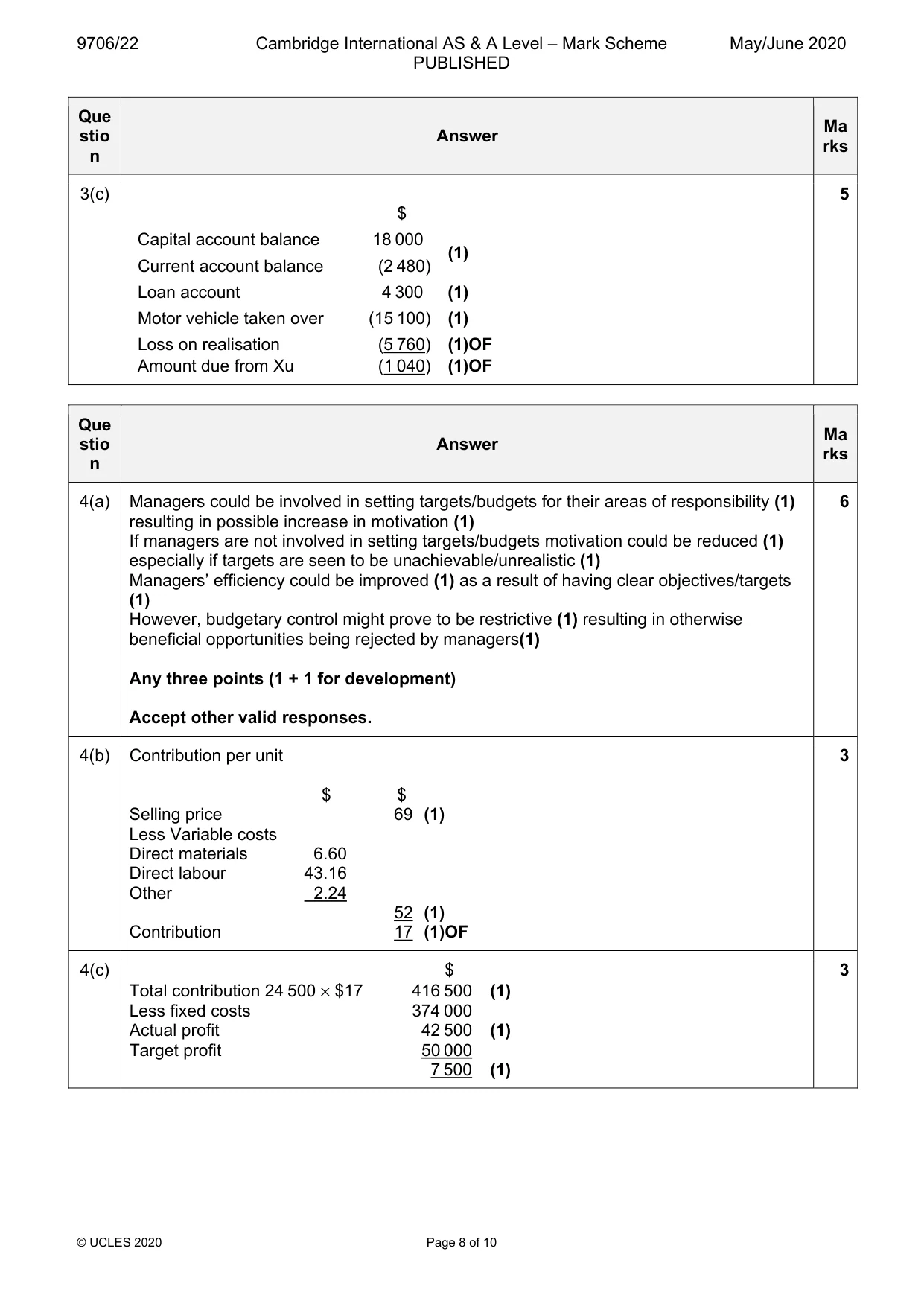
Mark scheme: 3(a) Reasons for dissolving a partnership 3 Business is making a loss (1) Partners cannot agree (1) A partner has died/retired (1) The objectives of the partnership have been achieved (1) Legal reasons such as insanity of partner (1) Max 3 Accept other valid responses Que Ma stio Answer rks n 3(b) Realisation account 7 $ $ Motor vehicles 19 400 Discount received 270 (1) Furniture and equipment 11 900 Capital Xu, motor 15 100 (1) vehicle (1) Inventory 7 480 Bank, trade receivables 9 880 (1) (W1) Trade receivables 11 200 Bank, furniture and 7 300 equipment (1) Bank, dissolution 620 (1) Bank, inventory 6 530 expenses Realisation loss: Xu 5 760 (1)OF 00 000 Zoe 5 760 50 600 50 600 Alternative answer showing different treatment of trade payables Realisation account $ $ Motor vehicles 19 400 Furniture and equipment 11 900 Capital Xu, motor 15 100 (1) vehicle (1) Inventory 7 480 Bank, trade receivables 9 880 (1) (W1) Trade receivables 11 200 Bank, furniture and 7 300 equipment (1) Bank, dissolution 620 (1) Bank, inventory 6 530 expenses Bank: Trade payables 5 130 * Trade payables 5 400 *(1) Realisation loss: Xu 5 760 (1)OF 00 000 Zoe 5 760 55 730 55 730 In the alternative version there is one mark for both entries relating to trade payables. W1: (11200 – 800) × 0.95 Que Ma stio Answer rks n 3(c) 5 $ Capital account balance 18 000 (1) Current account balance (2 480) Loan account 4 300 (1) Motor vehicle taken over (15 100) (1) Loss on realisation (5 760) (1)OF Amount due from Xu (1 040) (1)OF Que Ma stio Answer rks n
Q4 · DL Limited will soon be introducing a system of budgetary control
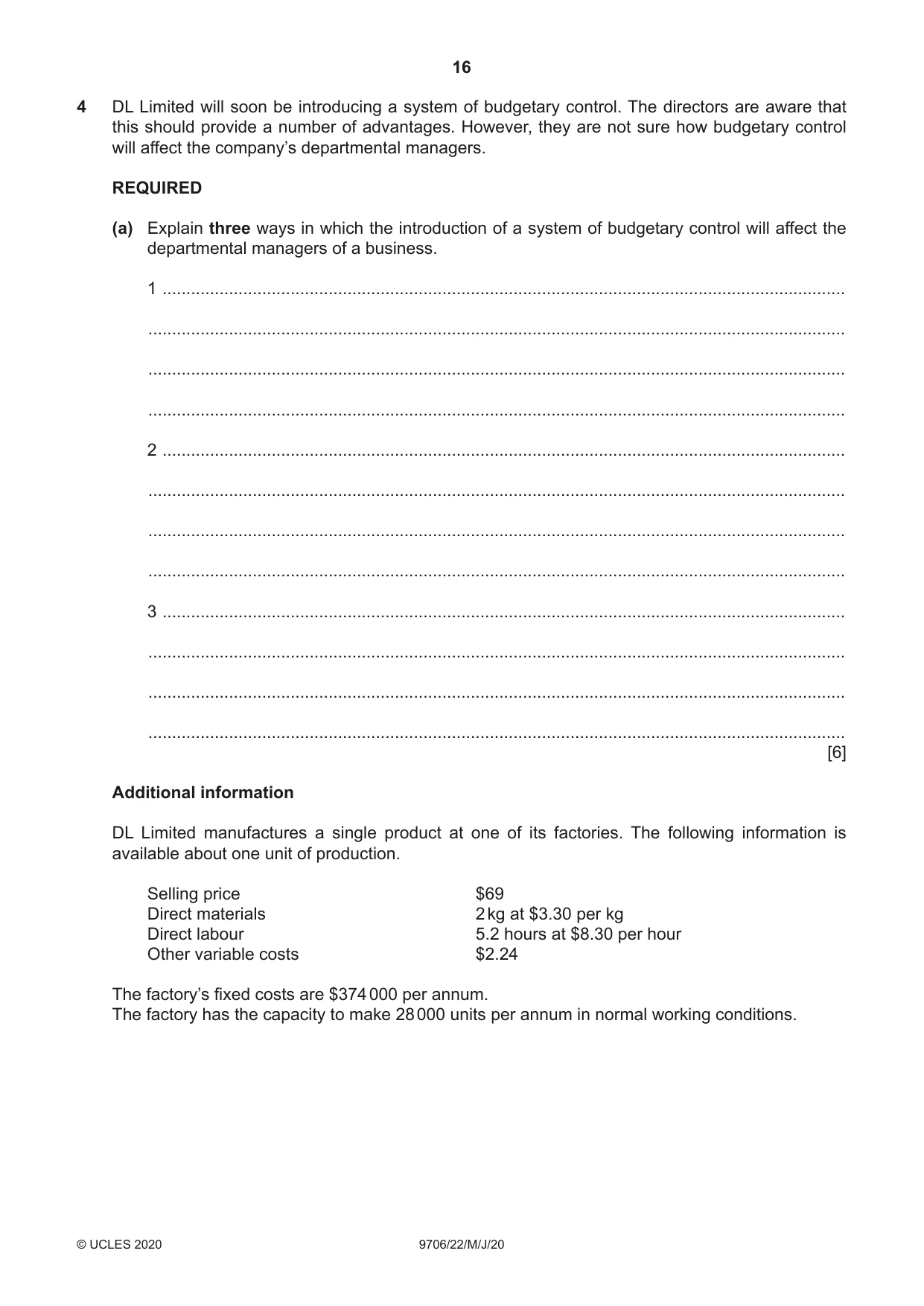
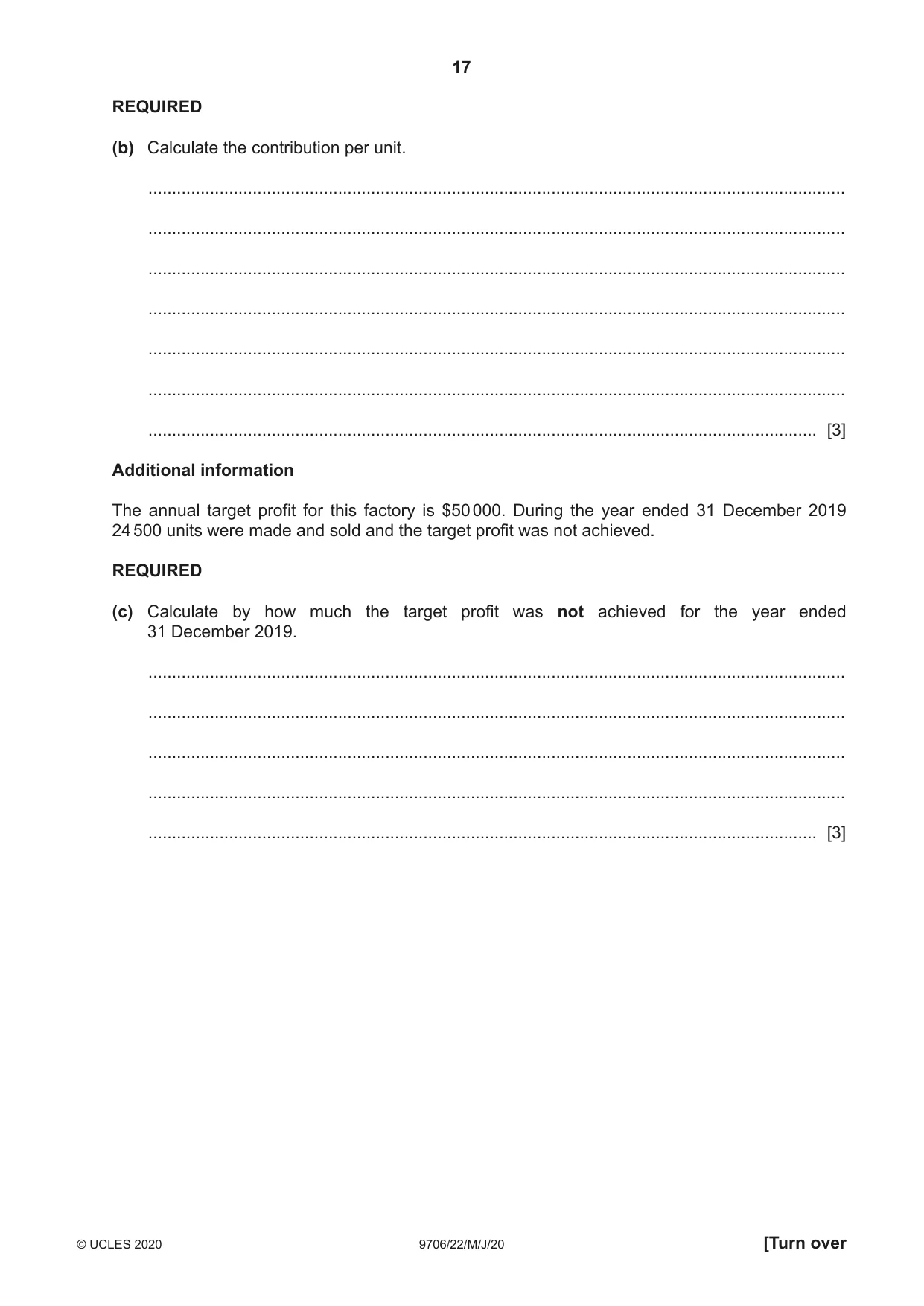
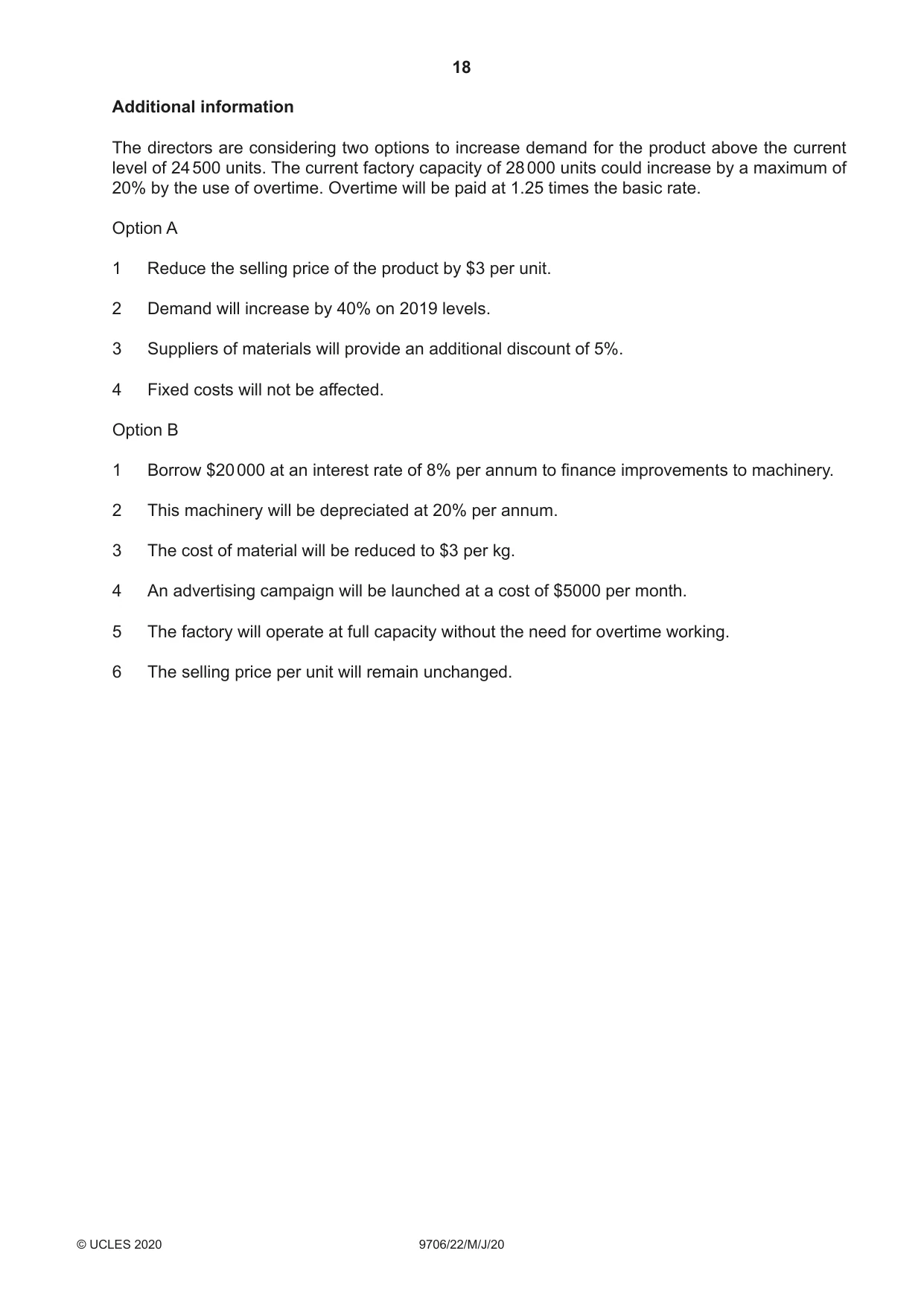
4 DL Limited will soon be introducing a system of budgetary control. The directors are aware that this should provide a number of advantages. However, they are not sure how budgetary control will affect the company’s departmental managers. REQUIRED (a) Explain three ways in which the introduction of a system of budgetary control will affect the departmental managers of a business. 1 ................................................................................................................................................ ................................................................................................................................................... ................................................................................................................................................... ................................................................................................................................................... 2 ................................................................................................................................................ ................................................................................................................................................... ................................................................................................................................................... ................................................................................................................................................... 3 ................................................................................................................................................ ................................................................................................................................................... ................................................................................................................................................... ................................................................................................................................................... [6] Additional information DL Limited manufactures a single product at one of its factories. The following information is available about one unit of production. Selling price $69 Direct materials 2 kg at $3.30 per kg Direct labour 5.2 hours at $8.30 per hour Other variable costs $2.24 The factory’s fixed costs are $374 000 per annum. The factory has the capacity to make 28 000 units per annum in normal working conditions. REQUIRED (b) Calculate the contribution per unit. ................................................................................................................................................... ................................................................................................................................................... ................................................................................................................................................... ................................................................................................................................................... ................................................................................................................................................... ................................................................................................................................................... ............................................................................................................................................. [3] Additional information The annual target profit for this factory is $50 000. During the year ended 31 December 2019 24 500 units were made and sold and the target profit was not achieved. REQUIRED (c) Calculate by how much the target profit was not achieved for the year ended 31 December 2019. ................................................................................................................................................... ................................................................................................................................................... ................................................................................................................................................... ................................................................................................................................................... ............................................................................................................................................. [3] Additional information The directors are considering two options to increase demand for the product above the current level of 24 500 units. The current factory capacity of 28 000 units could increase by a maximum of 20% by the use of overtime. Overtime will be paid at 1.25 times the basic rate. Option A 1 Reduce the selling price of the product by $3 per unit. 2 Demand will increase by 40% on 2019 levels. 3 Suppliers of materials will provide an additional discount of 5%. 4 Fixed costs will not be affected. Option B 1 Borrow $20 000 at an interest rate of 8% per annum to finance improvements to machinery. 2 This machinery will be depreciated at 20% per annum. 3 The cost of material will be reduced to $3 per kg. 4 An advertising campaign will be launched at a cost of $5000 per month. 5 The factory will operate at full capacity without the need for overtime working. 6 The selling price per unit will remain unchanged.
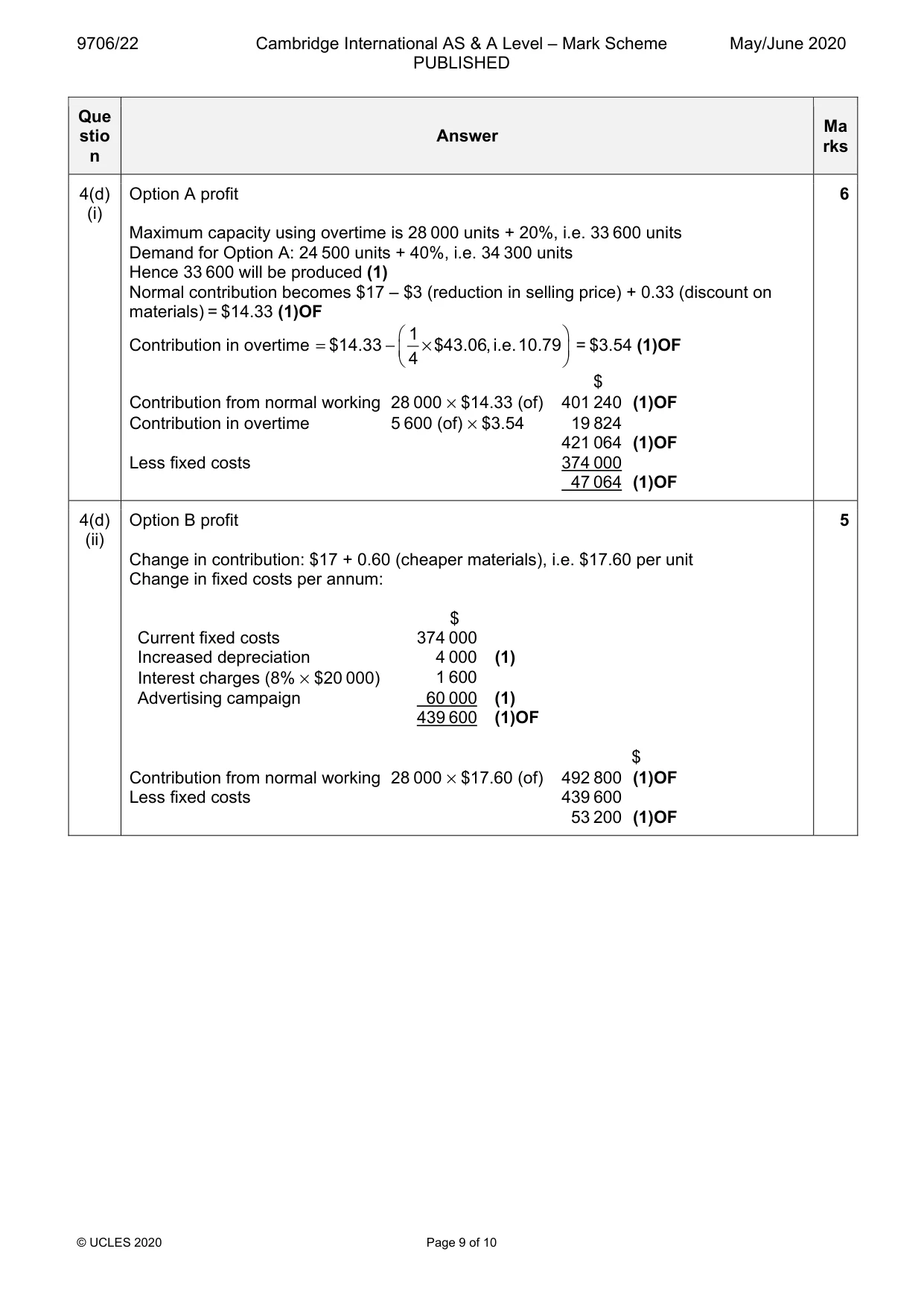
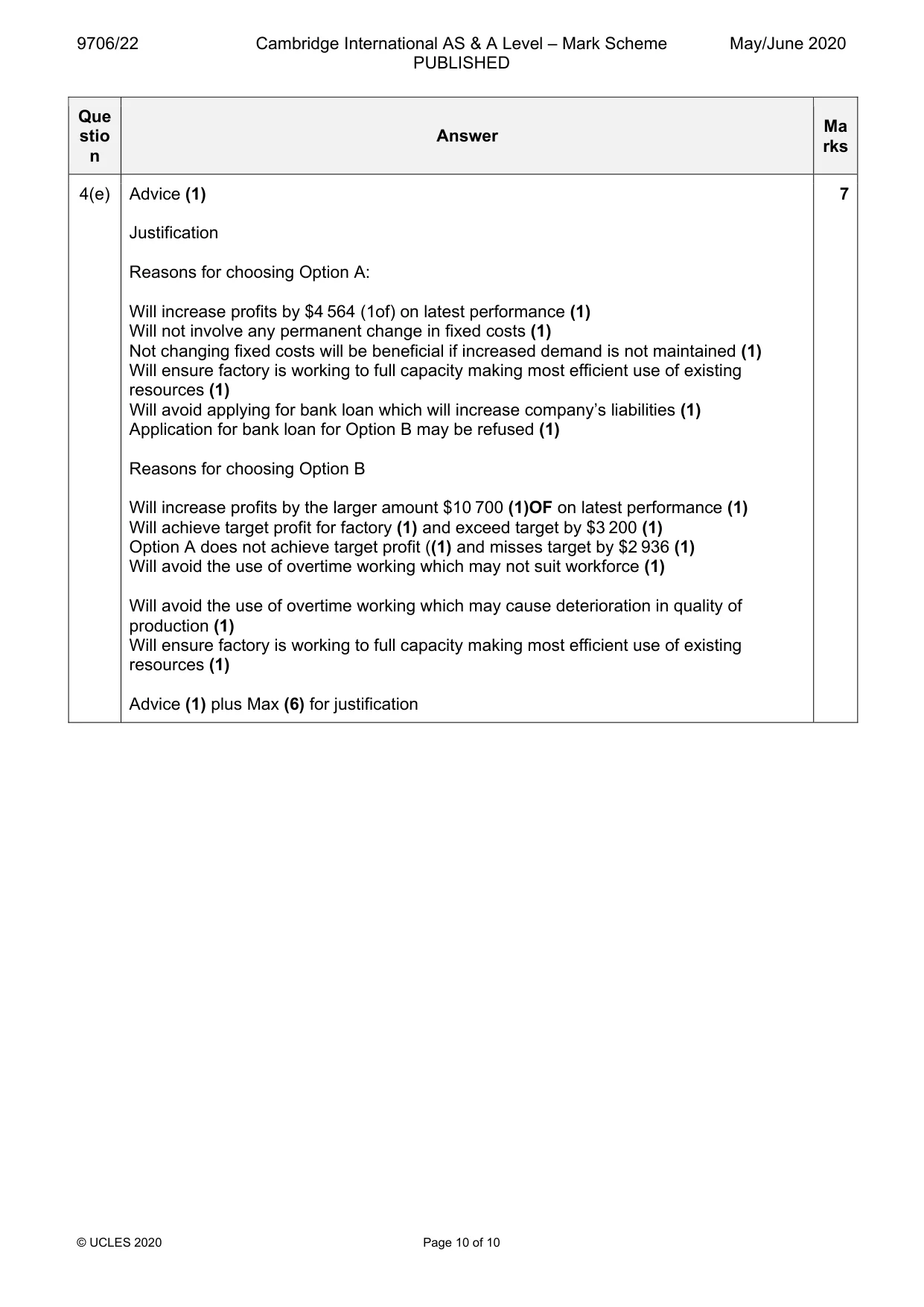
Mark scheme: 4(a) Managers could be involved in setting targets/budgets for their areas of responsibility (1) 6 resulting in possible increase in motivation (1) If managers are not involved in setting targets/budgets motivation could be reduced (1) especially if targets are seen to be unachievable/unrealistic (1) Managers’ efficiency could be improved (1) as a result of having clear objectives/targets (1) However, budgetary control might prove to be restrictive (1) resulting in otherwise beneficial opportunities being rejected by managers(1) Any three points (1 + 1 for development) Accept other valid responses. 4(b) Contribution per unit 3 $ $ Selling price 69 (1) Less Variable costs Direct materials 6.60 Direct labour 43.16 Other 2.24 52 (1) Contribution 17 (1)OF 4(c) $ 3 Total contribution 24 500 × $17 416 500 (1) Less fixed costs 374 000 Actual profit 42 500 (1) Target profit 50 000 7 500 (1) Que Ma stio Answer rks n 4(d) Option A profit 6 (i) Maximum capacity using overtime is 28 000 units + 20%, i.e. 33 600 units Demand for Option A: 24 500 units + 40%, i.e. 34 300 units Hence 33 600 will be produced (1) Normal contribution becomes $17 – $3 (reduction in selling price) + 0.33 (discount on materials) = $14.33 (1)OF 1 Contribution in overtime = $14.33 − × $43.06,i.e.10.79 = $3.54 (1)OF 4 $ Contribution from normal working 28 000 × $14.33 (of) 401 240 (1)OF Contribution in overtime 5 600 (of) × $3.54 19 824 421 064 (1)OF Less fixed costs 374 000 47 064 (1)OF 4(d) Option B profit 5 (ii) Change in contribution: $17 + 0.60 (cheaper materials), i.e. $17.60 per unit Change in fixed costs per annum: $ Current fixed costs 374 000 Increased depreciation 4 000 (1) Interest charges (8% × $20 000) 1 600 Advertising campaign 60 000 (1) 439 600 (1)OF $ Contribution from normal working 28 000 × $17.60 (of) 492 800 (1)OF Less fixed costs 439 600 53 200 (1)OF Que Ma stio Answer rks n 4(e) Advice (1) 7 Justification Reasons for choosing Option A: Will increase profits by $4 564 (1of) on latest performance (1) Will not involve any permanent change in fixed costs (1) Not changing fixed costs will be beneficial if increased demand is not maintained (1) Will ensure factory is working to full capacity making most efficient use of existing resources (1) Will avoid applying for bank loan which will increase company’s liabilities (1) Application for bank loan for Option B may be refused (1) Reasons for choosing Option B Will increase profits by the larger amount $10 700 (1)OF on latest performance (1) Will achieve target profit for factory (1) and exceed target by $3 200 (1) Option A does not achieve target profit ((1) and misses target by $2 936 (1) Will avoid the use of overtime working which may not suit workforce (1) Will avoid the use of overtime working which may cause deterioration in quality of production (1) Will ensure factory is working to full capacity making most efficient use of existing resources (1) Advice (1) plus Max (6) for justification
Q5 · The costs of dissolution, $620,were paid by cheque
5 The costs of dissolution, $620,were paid by cheque. REQUIRED (b) Prepare the realisation account. Realisation account $ $ [7] (c) Calculate the amount due to, or from, Xu as a result of the dissolution. ................................................................................................................................................... ................................................................................................................................................... ................................................................................................................................................... ................................................................................................................................................... ................................................................................................................................................... ................................................................................................................................................... ................................................................................................................................................... ............................................................................................................................................. [5] [Total: 15] PLEASE TURN OVER 4 DL Limited will soon be introducing a system of budgetary control. The directors are aware that this should provide a number of advantages. However, they are not sure how budgetary control will affect the company’s departmental managers. REQUIRED (a) Explain three ways in which the introduction of a system of budgetary control will affect the departmental managers of a business. 1 ................................................................................................................................................ ................................................................................................................................................... ................................................................................................................................................... ................................................................................................................................................... 2 ................................................................................................................................................ ................................................................................................................................................... ................................................................................................................................................... ................................................................................................................................................... 3 ................................................................................................................................................ ................................................................................................................................................... ................................................................................................................................................... ................................................................................................................................................... [6] Additional information DL Limited manufactures a single product at one of its factories. The following information is available about one unit of production. Selling price $69 Direct materials 2 kg at $3.30 per kg Direct labour 5.2 hours at $8.30 per hour Other variable costs $2.24 The factory’s fixed costs are $374 000 per annum. The factory has the capacity to make 28 000 units per annum in normal working conditions. REQUIRED (b) Calculate the contribution per unit. ................................................................................................................................................... ................................................................................................................................................... ................................................................................................................................................... ................................................................................................................................................... ................................................................................................................................................... ................................................................................................................................................... ............................................................................................................................................. [3] Additional information The annual target profit for this factory is $50 000. During the year ended 31 December 2019 24 500 units were made and sold and the target profit was not achieved. REQUIRED (c) Calculate by how much the target profit was not achieved for the year ended 31 December 2019. ................................................................................................................................................... ................................................................................................................................................... ................................................................................................................................................... ................................................................................................................................................... ............................................................................................................................................. [3] Additional information The directors are considering two options to increase demand for the product above the current level of 24 500 units. The current factory capacity of 28 000 units could increase by a maximum of 20% by the use of overtime. Overtime will be paid at 1.25 times the basic rate. Option A 1 Reduce the selling price of the product by $3 per unit. 2 Demand will increase by 40% on 2019 levels. 3 Suppliers of materials will provide an additional discount of 5%. 4 Fixed costs will not be affected. Option B 1 Borrow $20 000 at an interest rate of 8% per annum to finance improvements to machinery. 2 This machinery will be depreciated at 20% per annum. 3 The cost of material will be reduced to $3 per kg. 4 An advertising campaign will be launched at a cost of $5000 per month. 5 The factory will operate at full capacity without the need for overtime working.
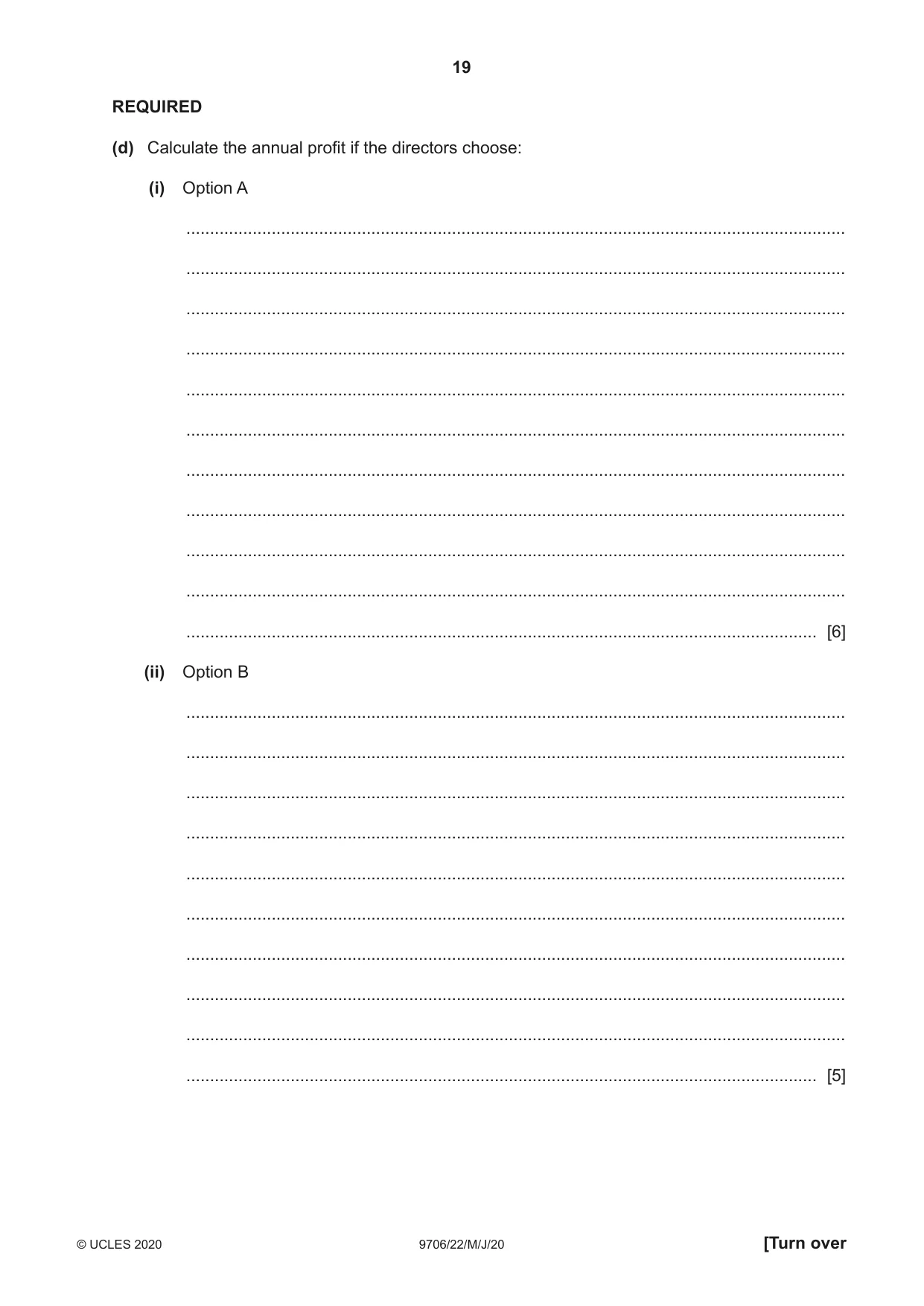
Q6 · REQUIRED (d) Calculate the annual profit if the directors choose: (i) Option A…
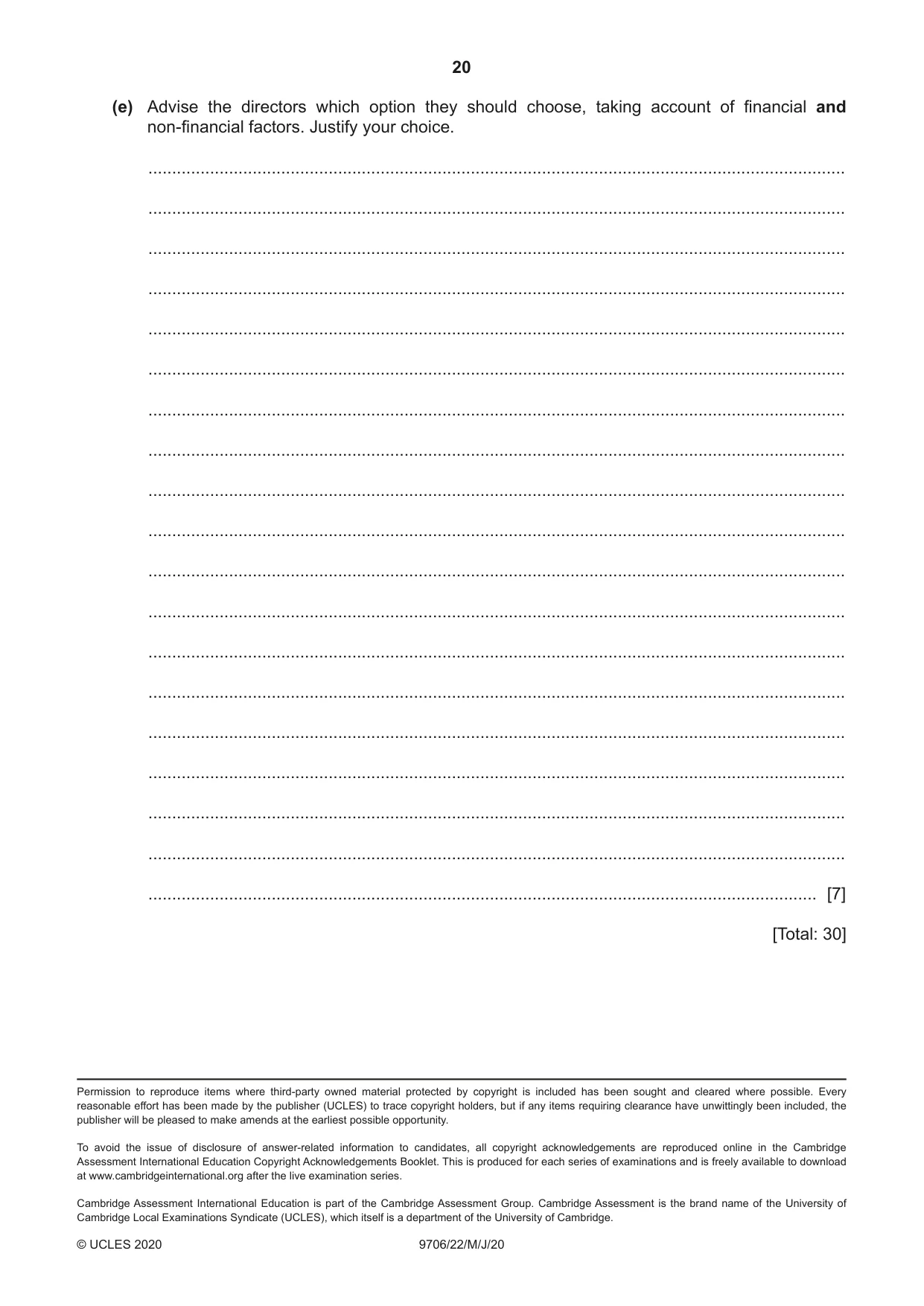
REQUIRED (d) Calculate the annual profit if the directors choose: (i) Option A ........................................................................................................................................... ........................................................................................................................................... ........................................................................................................................................... ........................................................................................................................................... ........................................................................................................................................... ........................................................................................................................................... ........................................................................................................................................... ........................................................................................................................................... ........................................................................................................................................... ........................................................................................................................................... ..................................................................................................................................... [6] (ii) Option B ........................................................................................................................................... ........................................................................................................................................... ........................................................................................................................................... ........................................................................................................................................... ........................................................................................................................................... ........................................................................................................................................... ........................................................................................................................................... ........................................................................................................................................... ........................................................................................................................................... ..................................................................................................................................... [5] (e) Advise the directors which option they should choose, taking account of financial and non-financial factors. Justify your choice. ................................................................................................................................................... ................................................................................................................................................... ................................................................................................................................................... ................................................................................................................................................... ................................................................................................................................................... ................................................................................................................................................... ................................................................................................................................................... ................................................................................................................................................... ................................................................................................................................................... ................................................................................................................................................... ................................................................................................................................................... ................................................................................................................................................... ................................................................................................................................................... ................................................................................................................................................... ................................................................................................................................................... ................................................................................................................................................... ................................................................................................................................................... ................................................................................................................................................... ............................................................................................................................................. [7] [Total: 30]
What was in this paper
The subtopics covered by these 6 questions, and how many questions each got. Open one in a new tab to see every Cambridge question on it.