Cambridge A Level Accounting 9706 — 2019 May/June Paper 2 · Variant 2
9706/22/M/J/19 · 4 questions · 90 marks · ≈101 min
The question paper and its mark scheme, free to read here and free to download. This is Cambridge’s own paper, exactly as it was sat.
Question paper20 pages
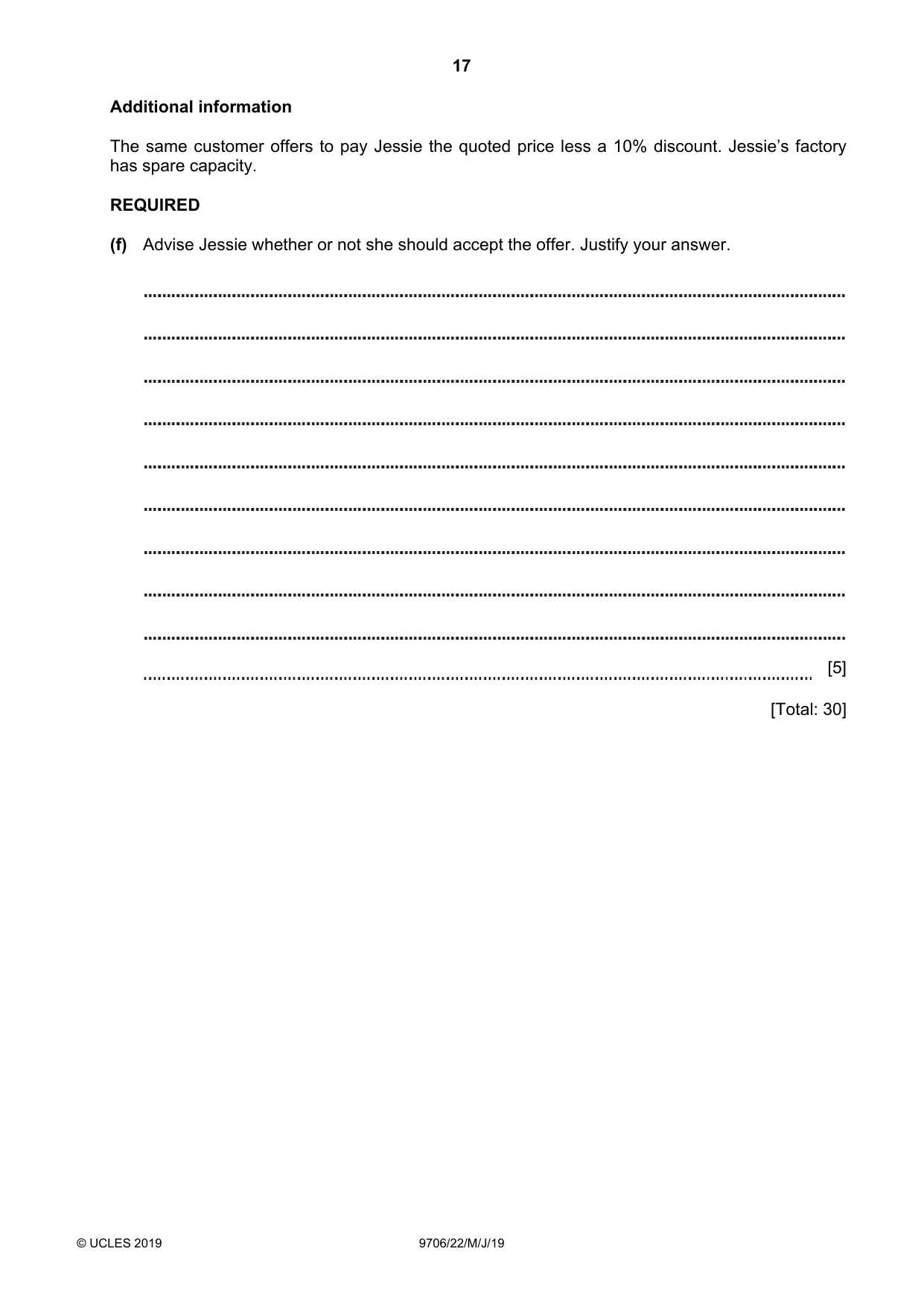


Mark scheme13 pages
Answers below. Sit the paper first if you are practising.
Questions as text
Q1 · Lee, a sole trader, provided the following information from his books of account on 30…
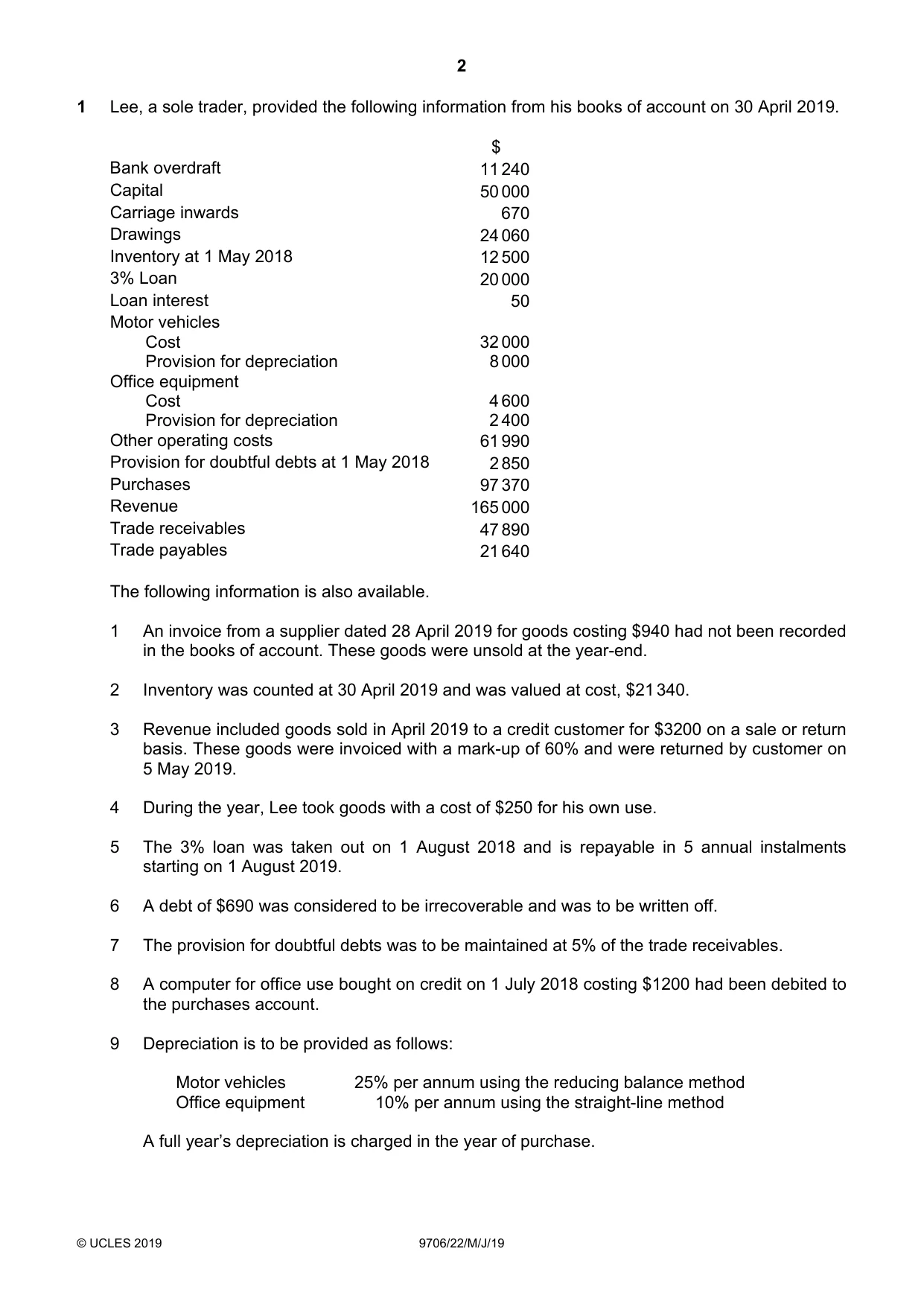
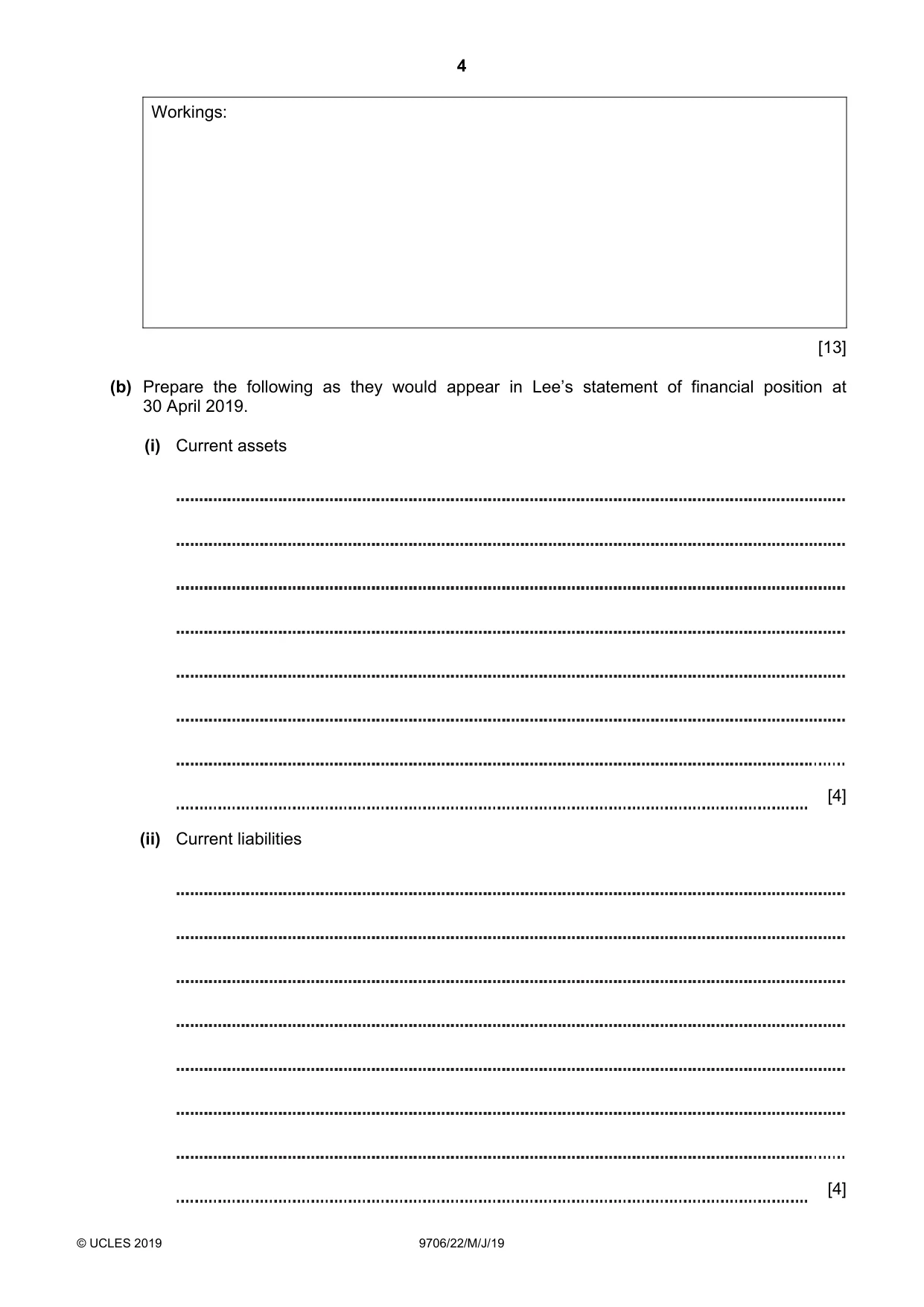
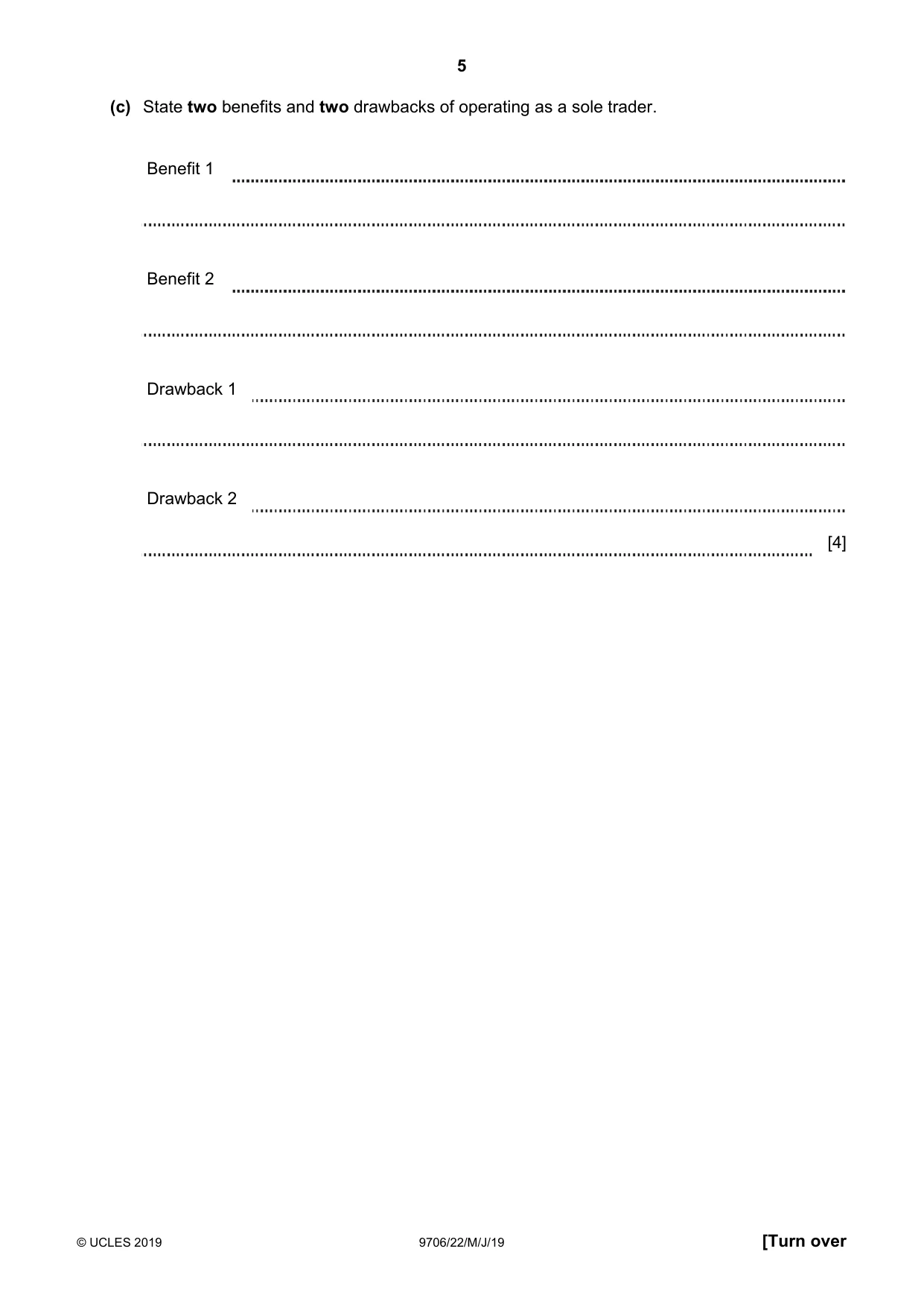
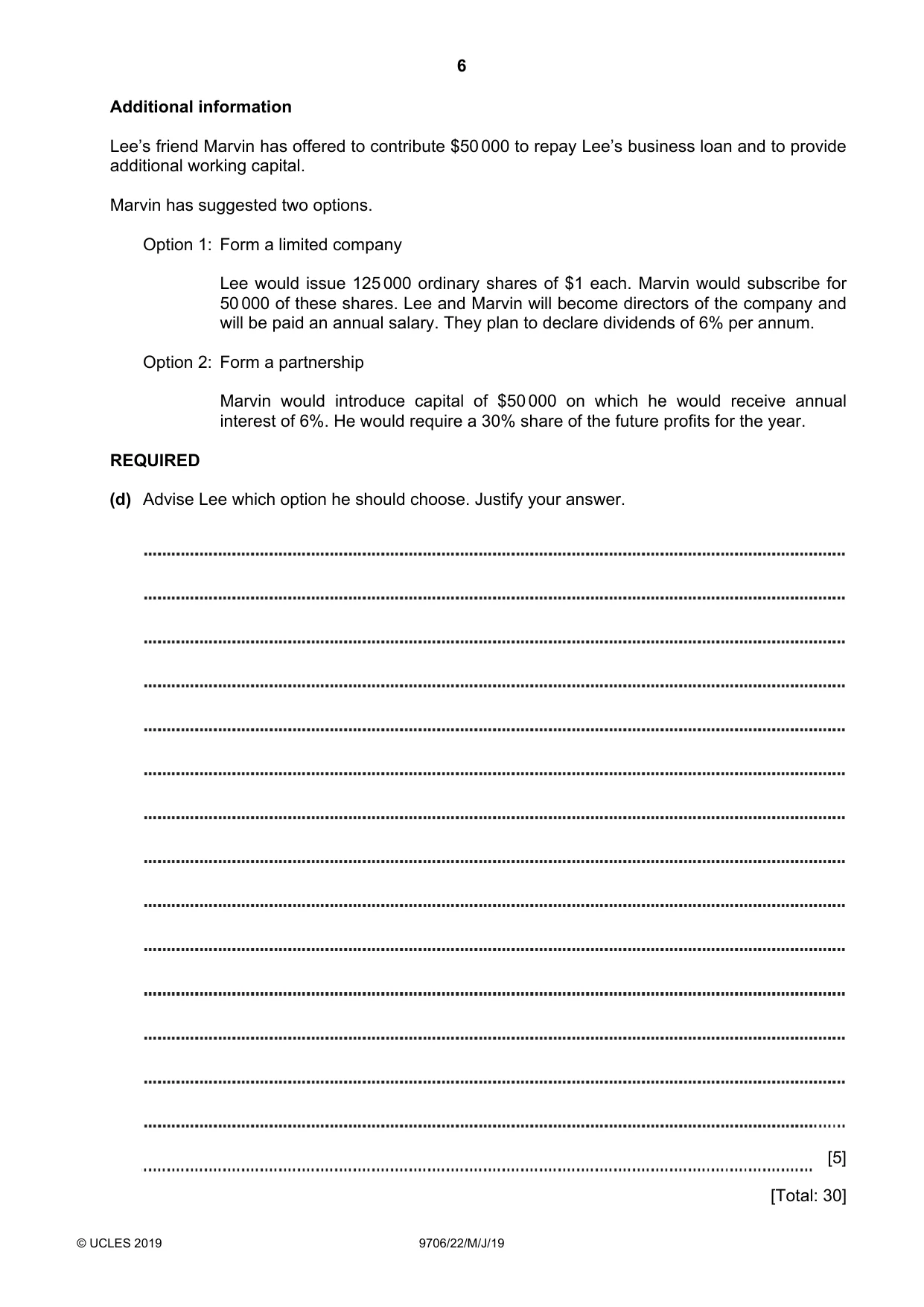
1 Lee, a sole trader, provided the following information from his books of account on 30 April 2019. $ Bank overdraft 11 240 Capital 50 000 Carriage inwards 670 Drawings 24 060 Inventory at 1 May 2018 12 500 3% Loan 20 000 Loan interest 50 Motor vehicles Cost 32 000 Provision for depreciation 8 000 Office equipment Cost 4 600 Provision for depreciation 2 400 Other operating costs 61 990 Provision for doubtful debts at 1 May 2018 2 850 Purchases 97 370 Revenue 165 000 Trade receivables 47 890 Trade payables 21 640 The following information is also available. 1 An invoice from a supplier dated 28 April 2019 for goods costing $940 had not been recorded in the books of account. These goods were unsold at the year-end. 2 Inventory was counted at 30 April 2019 and was valued at cost, $21 340. 3 Revenue included goods sold in April 2019 to a credit customer for $3200 on a sale or return basis. These goods were invoiced with a mark-up of 60% and were returned by customer on 5 May 2019. 4 During the year, Lee took goods with a cost of $250 for his own use. 5 The 3% loan was taken out on 1 August 2018 and is repayable in 5 annual instalments starting on 1 August 2019. 6 A debt of $690 was considered to be irrecoverable and was to be written off. 7 The provision for doubtful debts was to be maintained at 5% of the trade receivables. 8 A computer for office use bought on credit on 1 July 2018 costing $1200 had been debited to the purchases account. 9 Depreciation is to be provided as follows: Motor vehicles 25% per annum using the reducing balance method Office equipment 10% per annum using the straight-line method A full year’s depreciation is charged in the year of purchase. REQUIRED (a) Prepare Lee’s income statement for the year ended 30 April 2019. Use the space on the next page for your workings. Workings: [13] (b) Prepare the following as they would appear in Lee’s statement of financial position at 30 April 2019. (i) Current assets [4] (ii) Current liabilities [4] (c) State two benefits and two drawbacks of operating as a sole trader. Benefit 1 Benefit 2 Drawback 1 Drawback 2 [4] Additional information Lee’s friend Marvin has offered to contribute $50 000 to repay Lee’s business loan and to provide additional working capital. Marvin has suggested two options. Option 1: Form a limited company Lee would issue 125 000 ordinary shares of $1 each. Marvin would subscribe for 50 000 of these shares. Lee and Marvin will become directors of the company and will be paid an annual salary. They plan to declare dividends of 6% per annum. Option 2: Form a partnership Marvin would introduce capital of $50 000 on which he would receive annual interest of 6%. He would require a 30% share of the future profits for the year. REQUIRED (d) Advise Lee which option he should choose. Justify your answer. [5] [Total: 30]
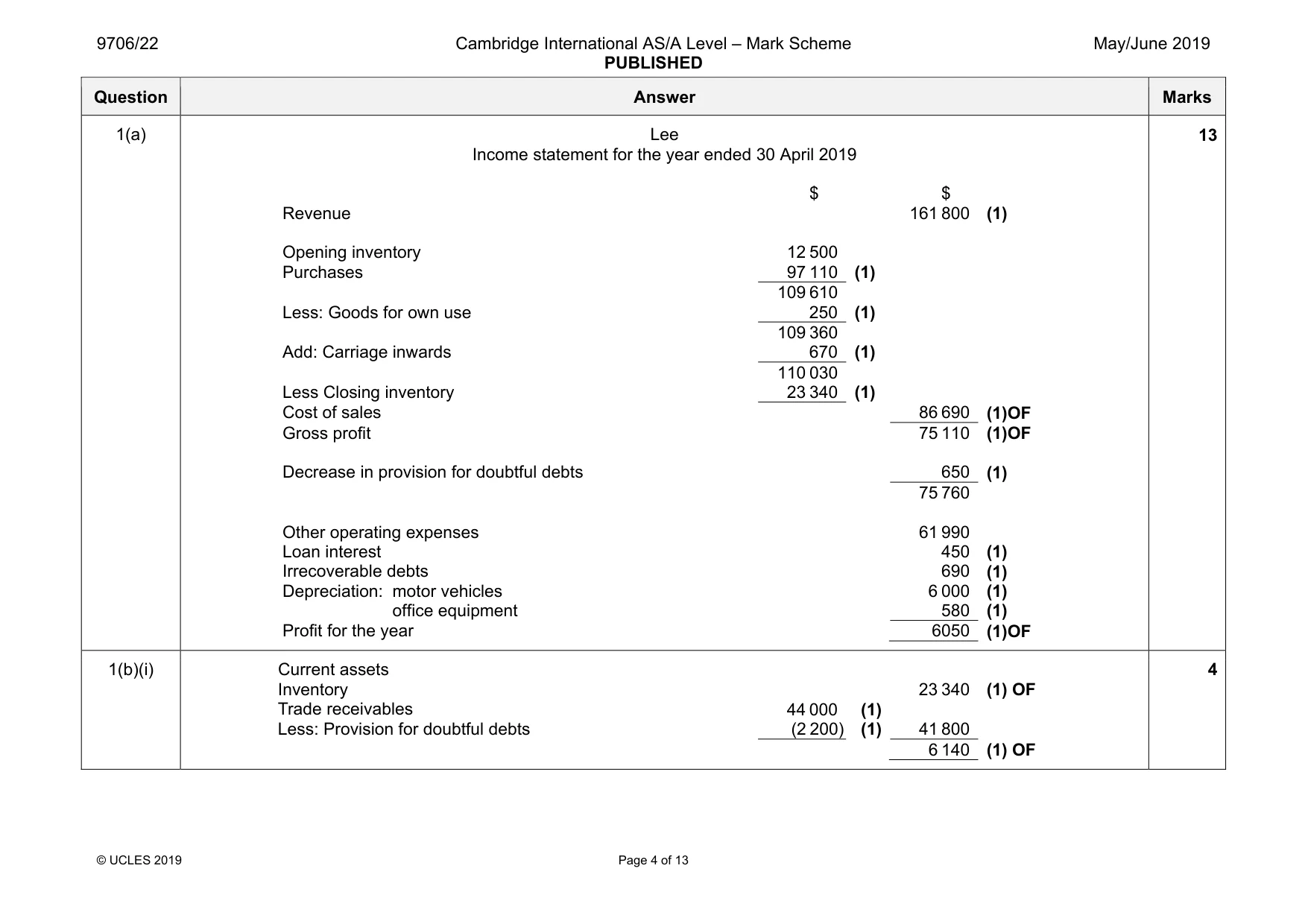
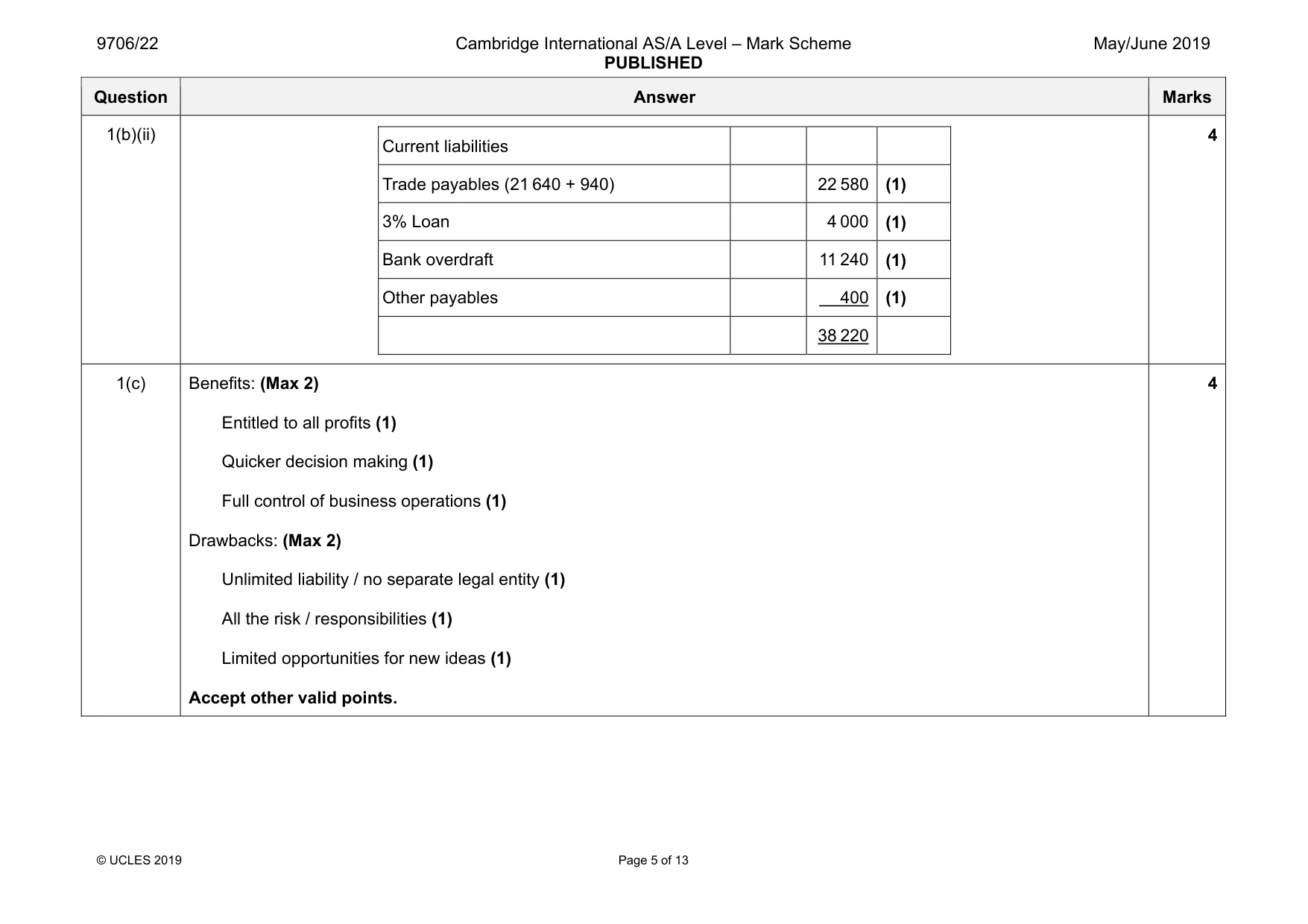
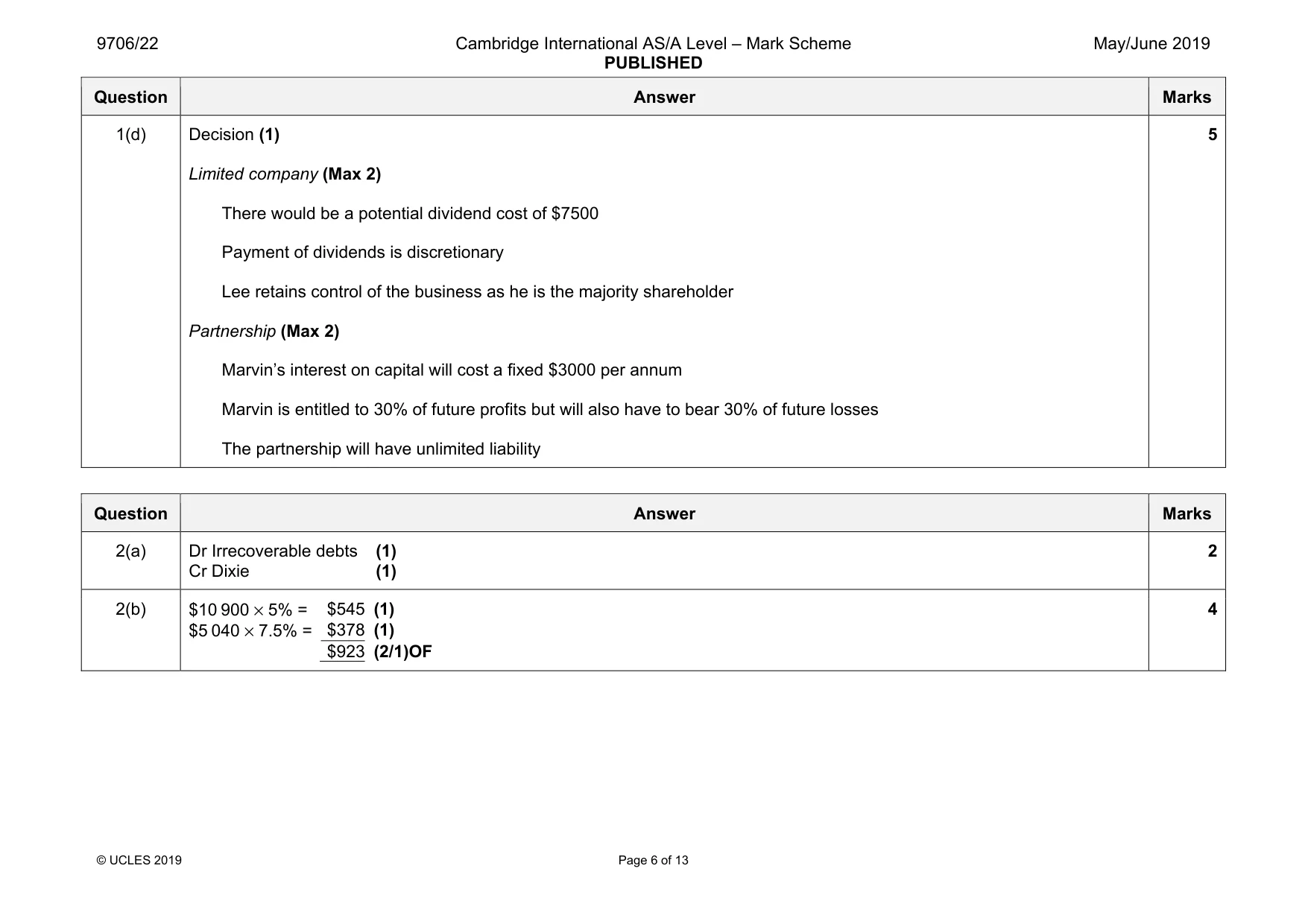
Mark scheme: 1(a) Lee Income statement for the year ended 30 April 2019 $ $ Revenue 161 800 (1) Opening inventory 12 500 Purchases 97 110 (1) 109 610 Less: Goods for own use 250 (1) 109 360 Add: Carriage inwards 670 (1) 110 030 Less Closing inventory 23 340 (1) Cost of sales 86 690 (1)OF Gross profit 75 110 (1)OF Decrease in provision for doubtful debts 650 (1) 75 760 Other operating expenses 61 990 Loan interest 450 (1) Irrecoverable debts 690 (1) Depreciation: motor vehicles 6 000 (1) office equipment 580 (1) Profit for the year 6050 (1)OF 13 1(b)(i) Current assets Inventory 23 340 (1) OF Trade receivables 44 000 (1) Less: Provision for doubtful debts (2 200) (1) 41 800 6 140 (1) OF 4 Question Answer Marks 1(b)(ii) Current liabilities Trade payables (21 640 + 940) 22 580 (1) 3% Loan 4 000 (1) Bank overdraft 11 240 (1) Other payables 400 (1) 38 220 4 1(c) Benefits: (Max 2) Entitled to all profits (1) Quicker decision making (1) Full control of business operations (1) Drawbacks: (Max 2) Unlimited liability / no separate legal entity (1) All the risk / responsibilities (1) Limited opportunities for new ideas (1) Accept other valid points. 4 Question Answer Marks 1(d) Decision (1) Limited company (Max 2) There would be a potential dividend cost of $7500 Payment of dividends is discretionary Lee retains control of the business as he is the majority shareholder Partnership (Max 2) Marvin’s interest on capital will cost a fixed $3000 per annum Marvin is entitled to 30% of future profits but will also have to bear 30% of future losses The partnership will have unlimited liability 5
Q2 · Sofia has provided the following information relating to her trade receivables at 31…
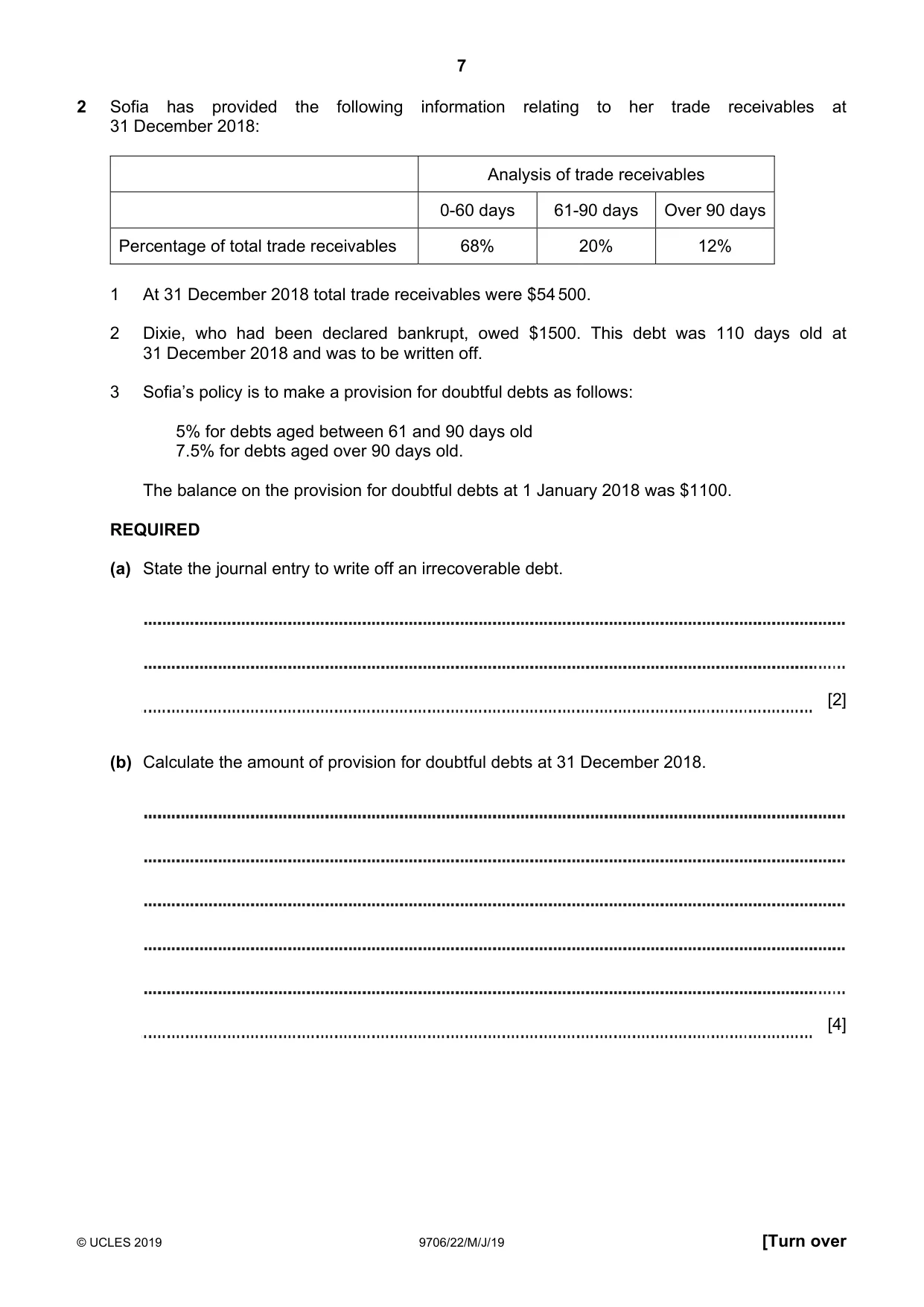
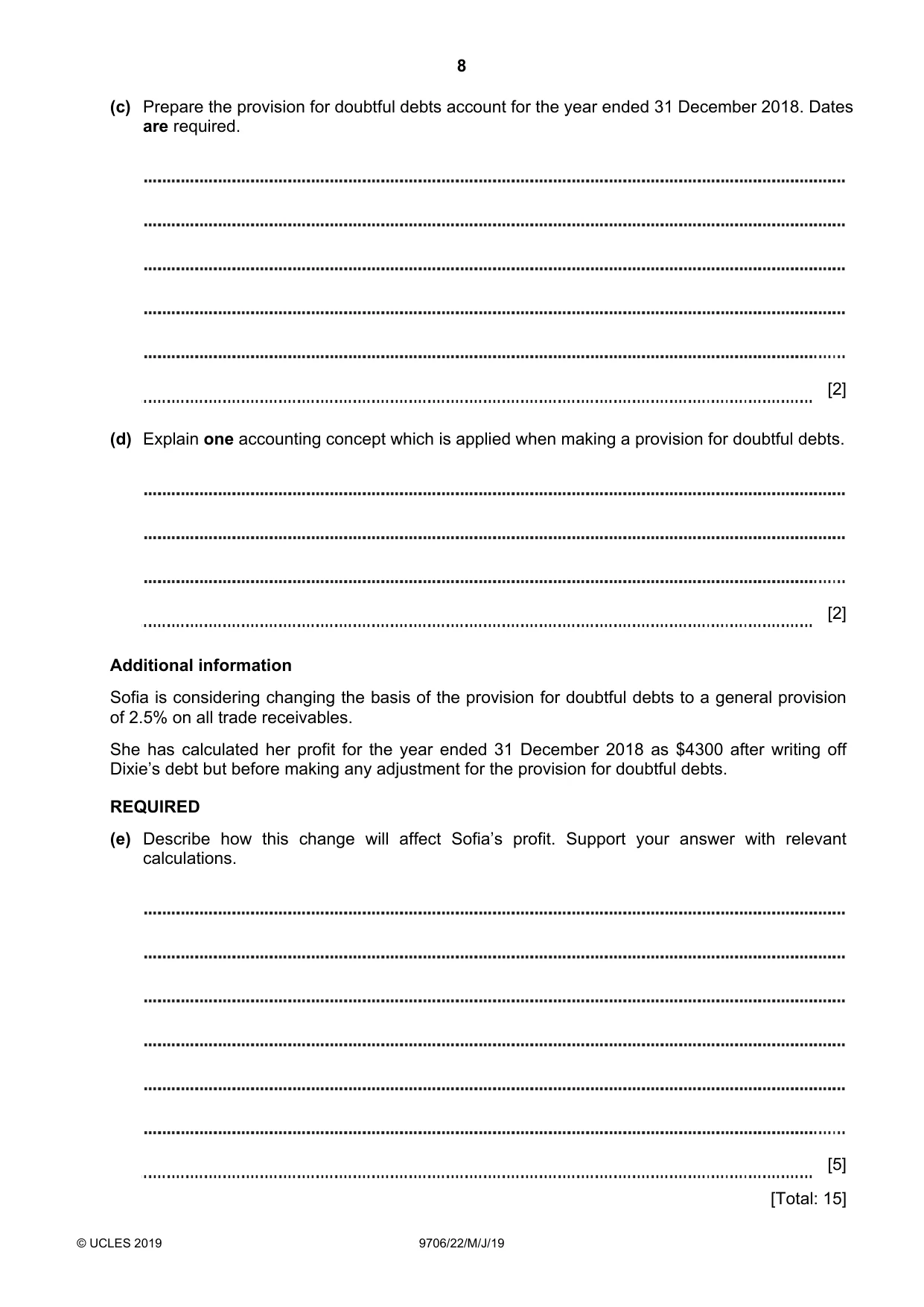
2 Sofia has provided the following information relating to her trade receivables at 31 December 2018: Analysis of trade receivables 0-60 days 61-90 days Over 90 days Percentage of total trade receivables 68% 20% 12% 1 At 31 December 2018 total trade receivables were $54 500. 2 Dixie, who had been declared bankrupt, owed $1500. This debt was 110 days old at 31 December 2018 and was to be written off. 3 Sofia’s policy is to make a provision for doubtful debts as follows: 5% for debts aged between 61 and 90 days old 7.5% for debts aged over 90 days old. The balance on the provision for doubtful debts at 1 January 2018 was $1100. REQUIRED (a) State the journal entry to write off an irrecoverable debt. [2] (b) Calculate the amount of provision for doubtful debts at 31 December 2018. [4] (c) Prepare the provision for doubtful debts account for the year ended 31 December 2018. Dates are required. [2] (d) Explain one accounting concept which is applied when making a provision for doubtful debts. [2] Additional information Sofia is considering changing the basis of the provision for doubtful debts to a general provision of 2.5% on all trade receivables. She has calculated her profit for the year ended 31 December 2018 as $4300 after writing off Dixie’s debt but before making any adjustment for the provision for doubtful debts. REQUIRED (e) Describe how this change will affect Sofia’s profit. Support your answer with relevant calculations. [5] [Total: 15]
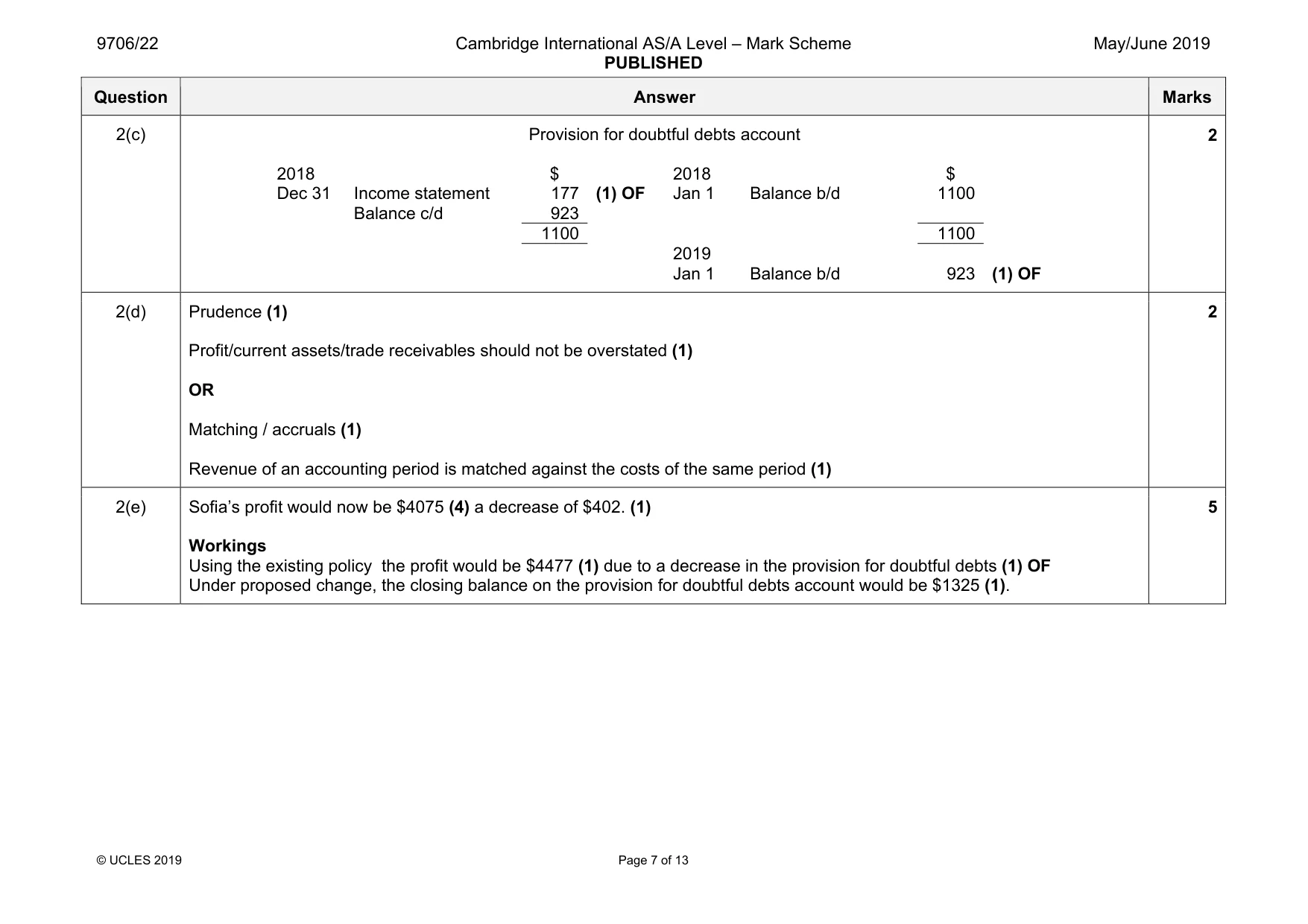
Mark scheme: 2(a) Dr Irrecoverable debts (1) Cr Dixie (1) 2 2(b) $10 900 × 5% = $545 (1) $5 040 × 7.5% = $378 (1) $923 (2/1)OF 4 Question Answer Marks 2(c) Provision for doubtful debts account 2018 $ 2018 $ Dec 31 Income statement 177 (1) OF Jan 1 Balance b/d 1100 Balance c/d 923 1100 1100 2019 Jan 1 Balance b/d 923 (1) OF 2 2(d) Prudence (1) Profit/current assets/trade receivables should not be overstated (1) OR Matching / accruals (1) Revenue of an accounting period is matched against the costs of the same period (1) 2 2(e) Sofia’s profit would now be $4075 (4) a decrease of $402. (1) Workings Using the existing policy the profit would be $4477 (1) due to a decrease in the provision for doubtful debts (1) OF Under proposed change, the closing balance on the provision for doubtful debts account would be $1325 (1). 5
Q3 · Financial statements provide information to enable users to evaluate the financial…
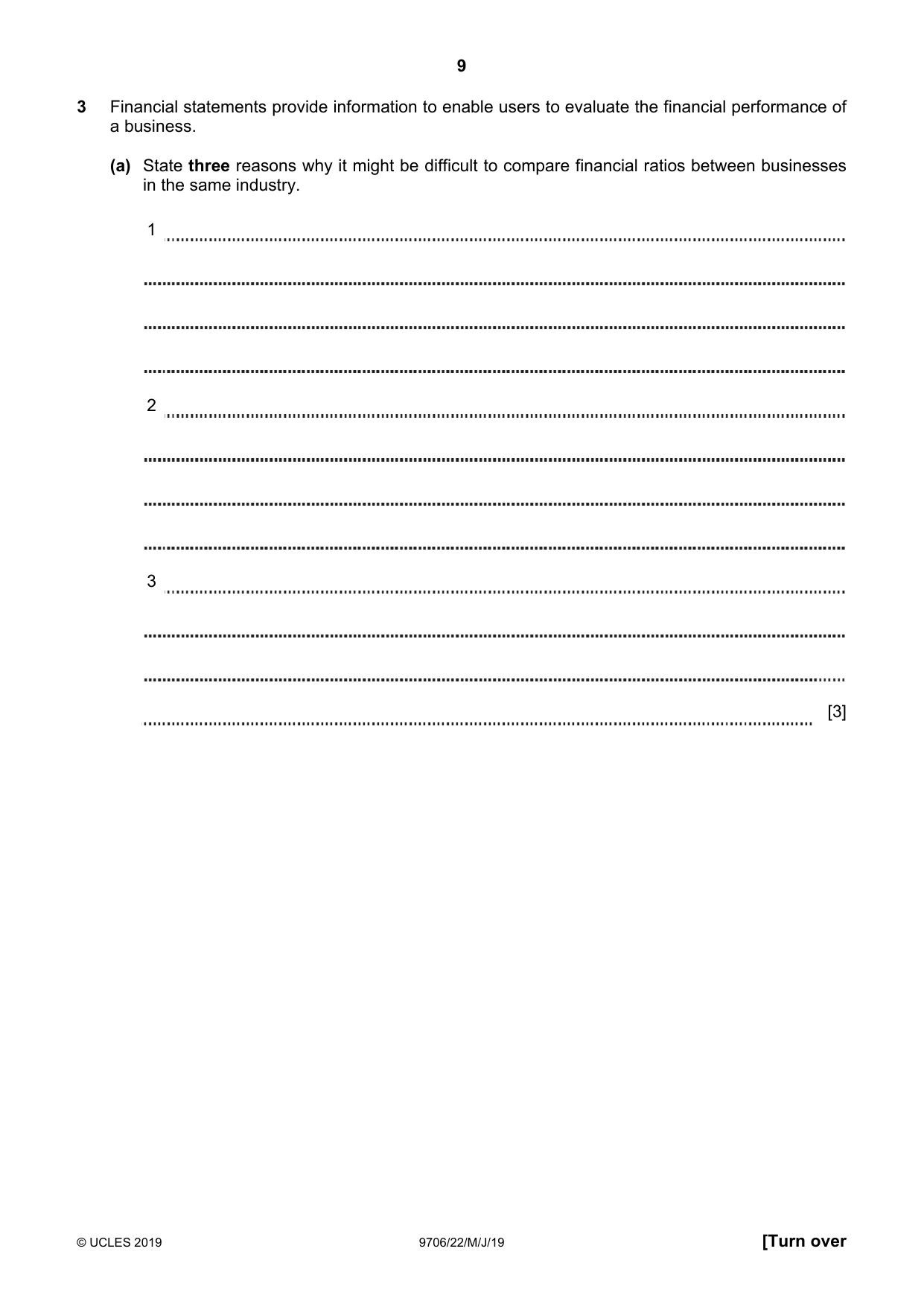
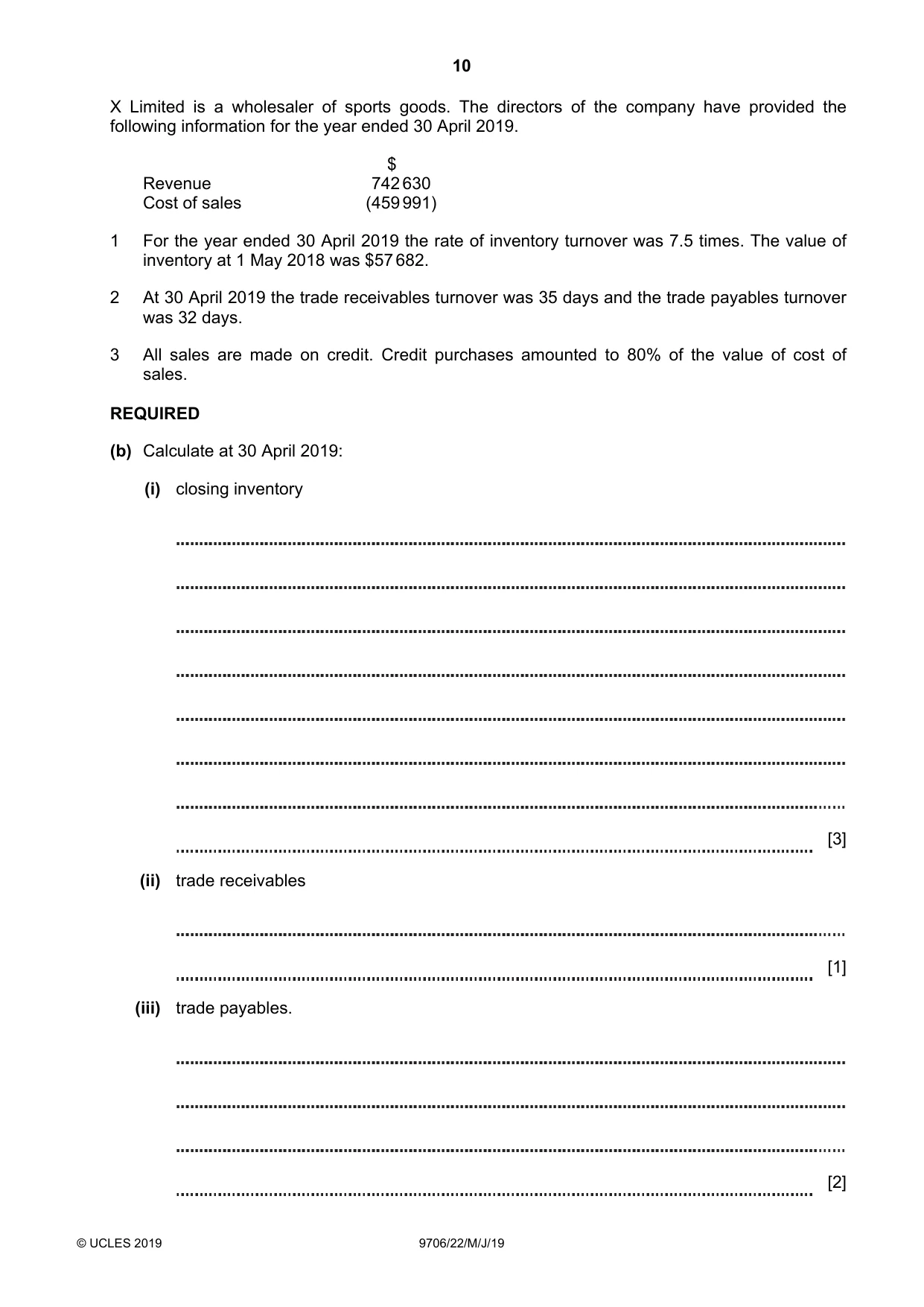
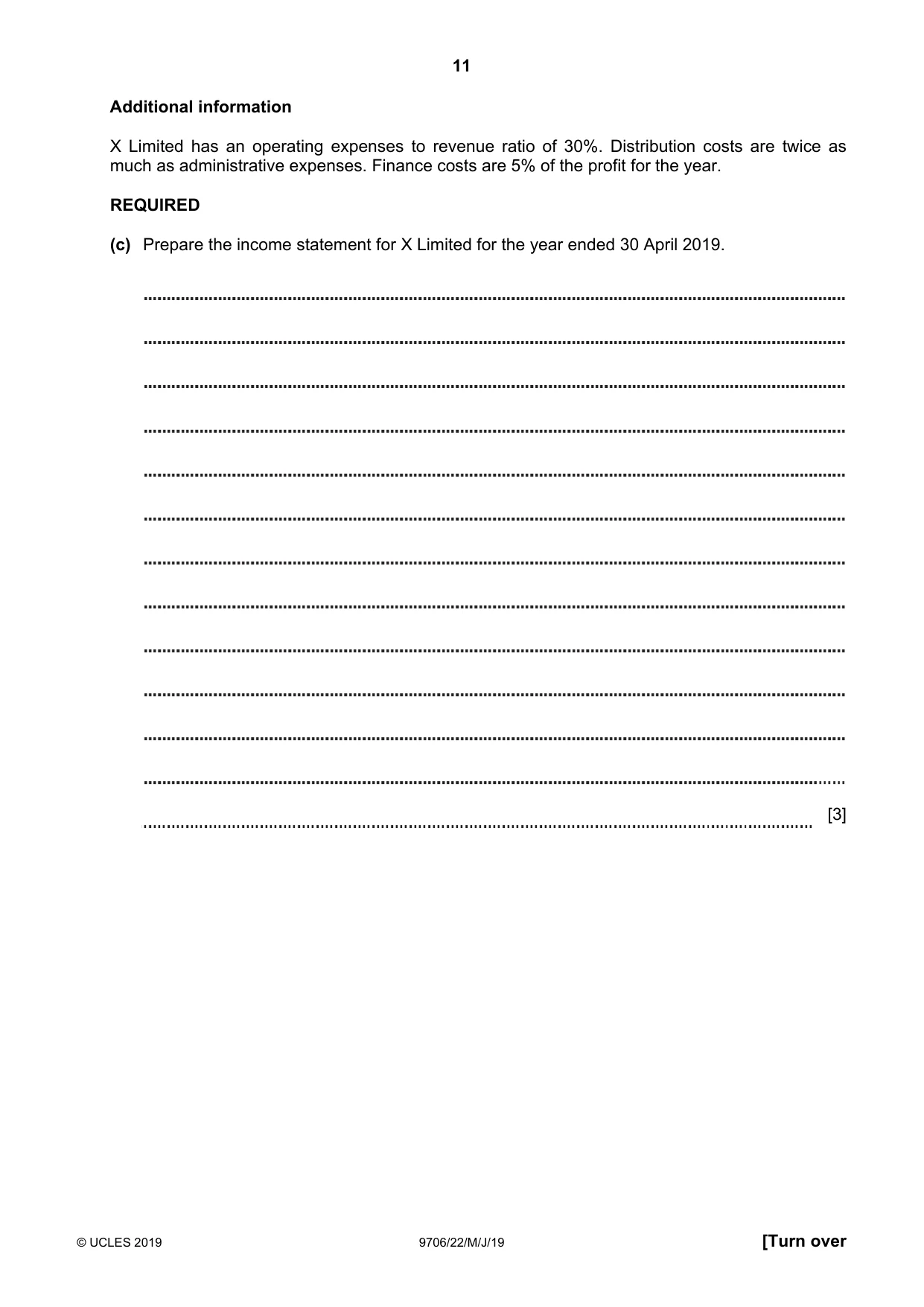
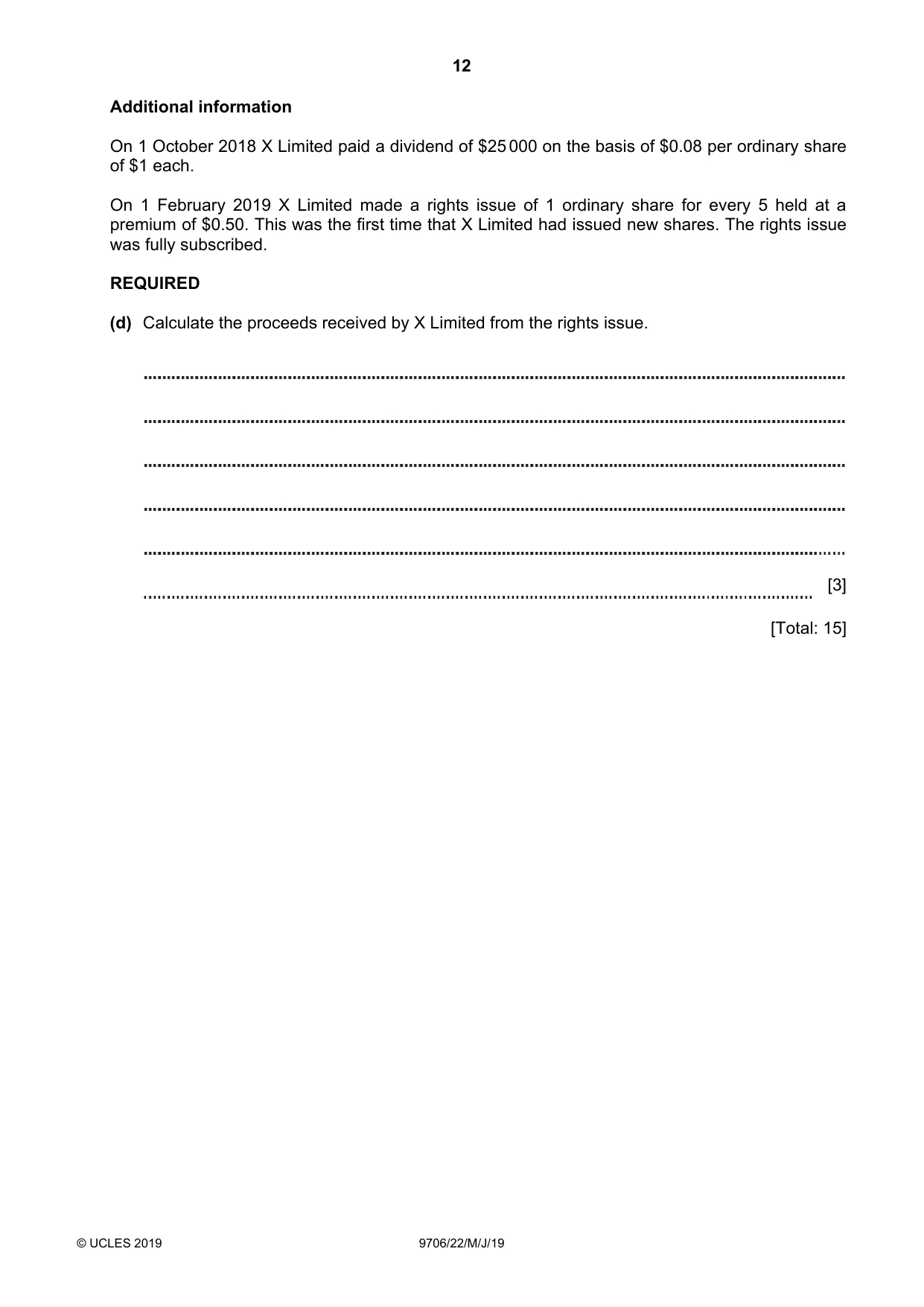
3 Financial statements provide information to enable users to evaluate the financial performance of a business. (a) State three reasons why it might be difficult to compare financial ratios between businesses in the same industry. 1 2 3 [3] X Limited is a wholesaler of sports goods. The directors of the company have provided the following information for the year ended 30 April 2019. $ Revenue 742 630 Cost of sales (459 991) 1 For the year ended 30 April 2019 the rate of inventory turnover was 7.5 times. The value of inventory at 1 May 2018 was $57 682. 2 At 30 April 2019 the trade receivables turnover was 35 days and the trade payables turnover was 32 days. 3 All sales are made on credit. Credit purchases amounted to 80% of the value of cost of sales. REQUIRED (b) Calculate at 30 April 2019: (i) closing inventory [3] (ii) trade receivables [1] (iii) trade payables. [2] Additional information X Limited has an operating expenses to revenue ratio of 30%. Distribution costs are twice as much as administrative expenses. Finance costs are 5% of the profit for the year. REQUIRED (c) Prepare the income statement for X Limited for the year ended 30 April 2019. [3] Additional information On 1 October 2018 X Limited paid a dividend of $25 000 on the basis of $0.08 per ordinary share of $1 each. On 1 February 2019 X Limited made a rights issue of 1 ordinary share for every 5 held at a premium of $0.50. This was the first time that X Limited had issued new shares. The rights issue was fully subscribed. REQUIRED (d) Calculate the proceeds received by X Limited from the rights issue. [3] [Total: 15]
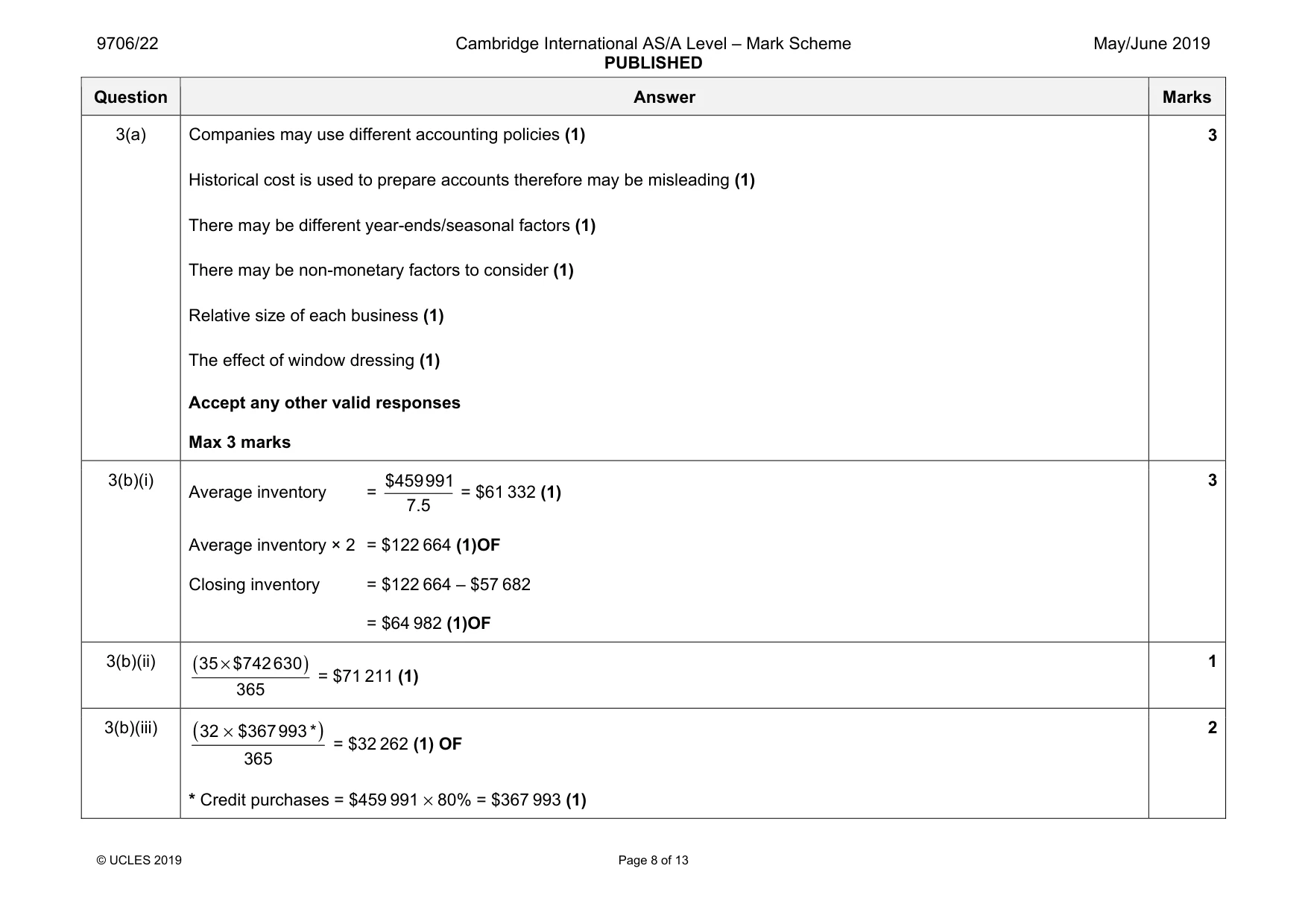
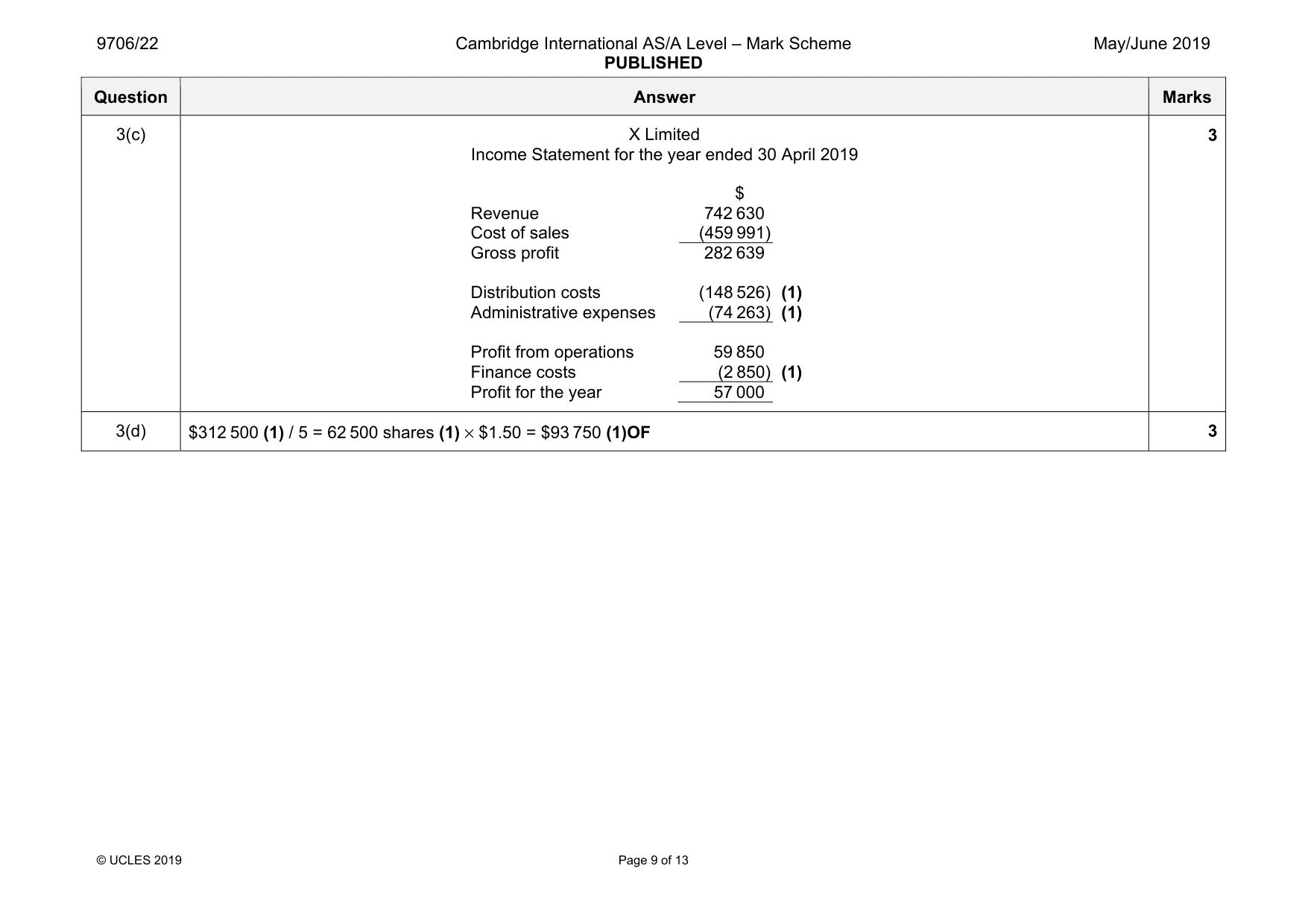
Mark scheme: 3(a) Companies may use different accounting policies (1) Historical cost is used to prepare accounts therefore may be misleading (1) There may be different year-ends/seasonal factors (1) There may be non-monetary factors to consider (1) Relative size of each business (1) The effect of window dressing (1) Accept any other valid responses Max 3 marks 3 3(b)(i) Average inventory = $459991 7.5 = $61 332 (1) Average inventory × 2 = $122 664 (1)OF Closing inventory = $122 664 – $57 682 = $64 982 (1)OF 3 3(b)(ii) ( ) 35 $742630 365 × = $71 211 (1) 1 3(b)(iii) ( ) 32 $367993 * 365 × = $32 262 (1) OF * Credit purchases = $459 991 × 80% = $367 993 (1) 2 Question Answer Marks 3(c) X Limited Income Statement for the year ended 30 April 2019 $ Revenue 742 630 Cost of sales (459 991) Gross profit 282 639 Distribution costs (148 526) (1) Administrative expenses (74 263) (1) Profit from operations 59 850 Finance costs (2 850) (1) Profit for the year 57 000 3 3(d) $312 500 (1) / 5 = 62 500 shares (1) × $1.50 = $93 750 (1)OF 3
Q4 · Jessie is a manufacturer and uses a single raw material to make her product
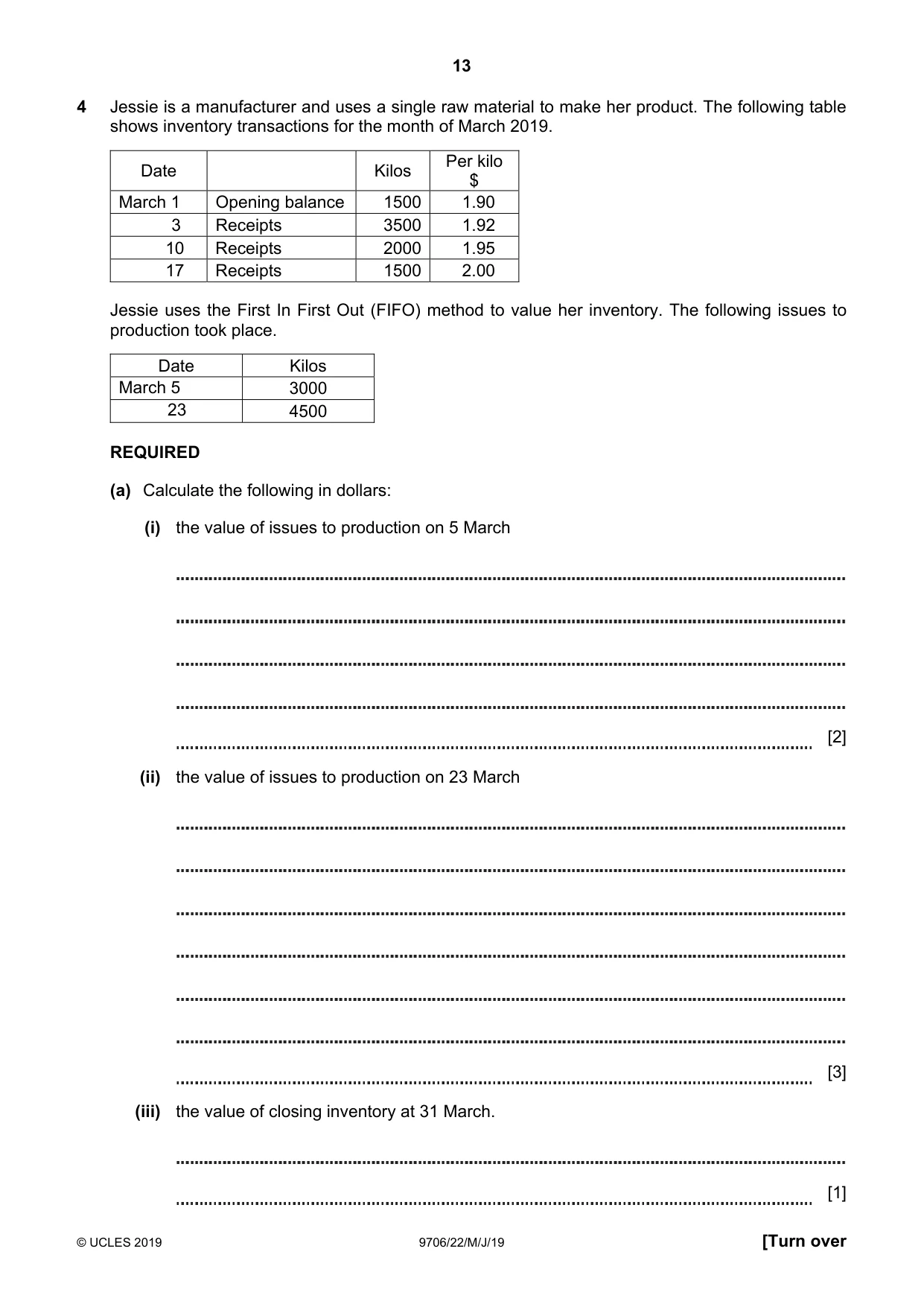
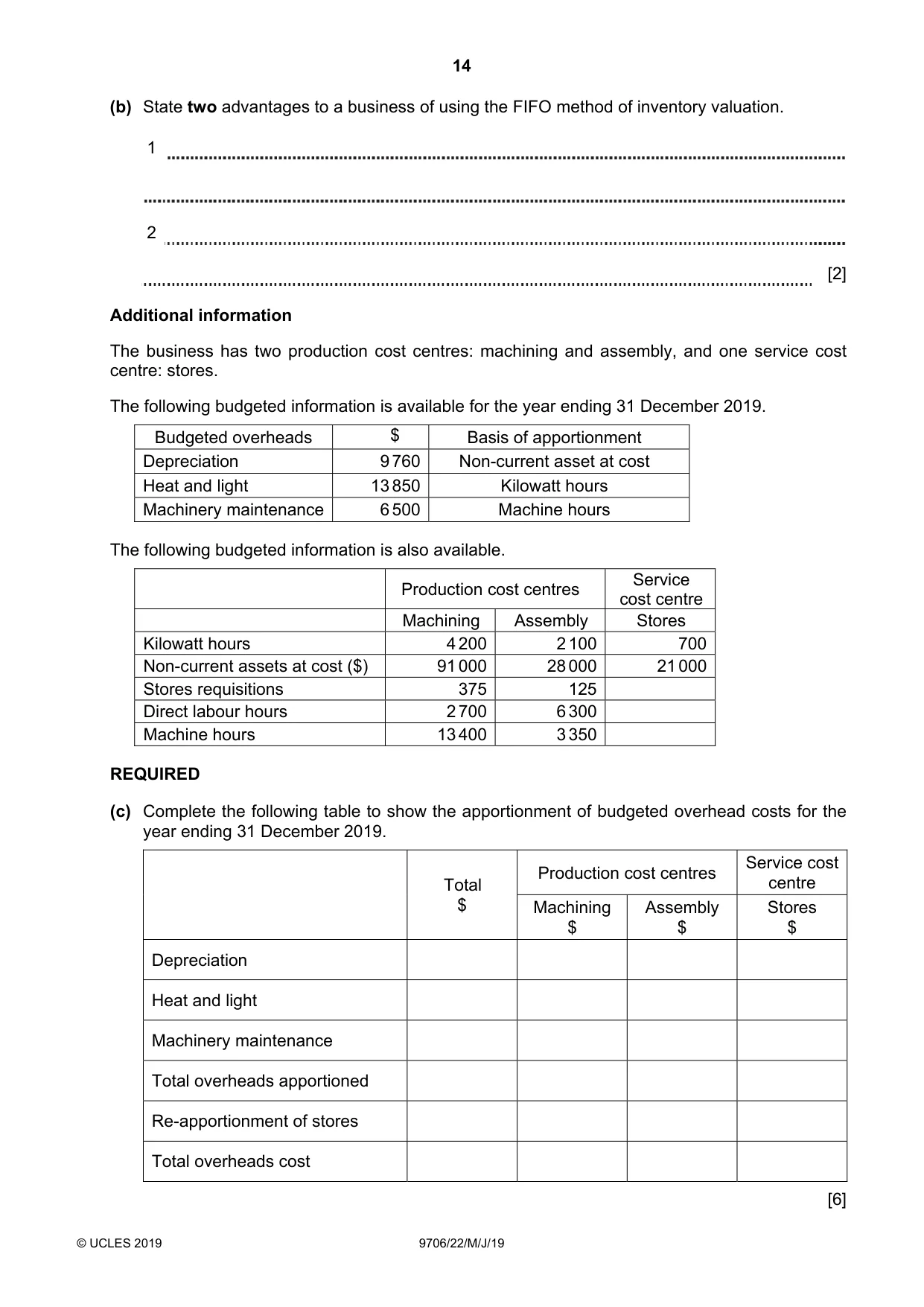
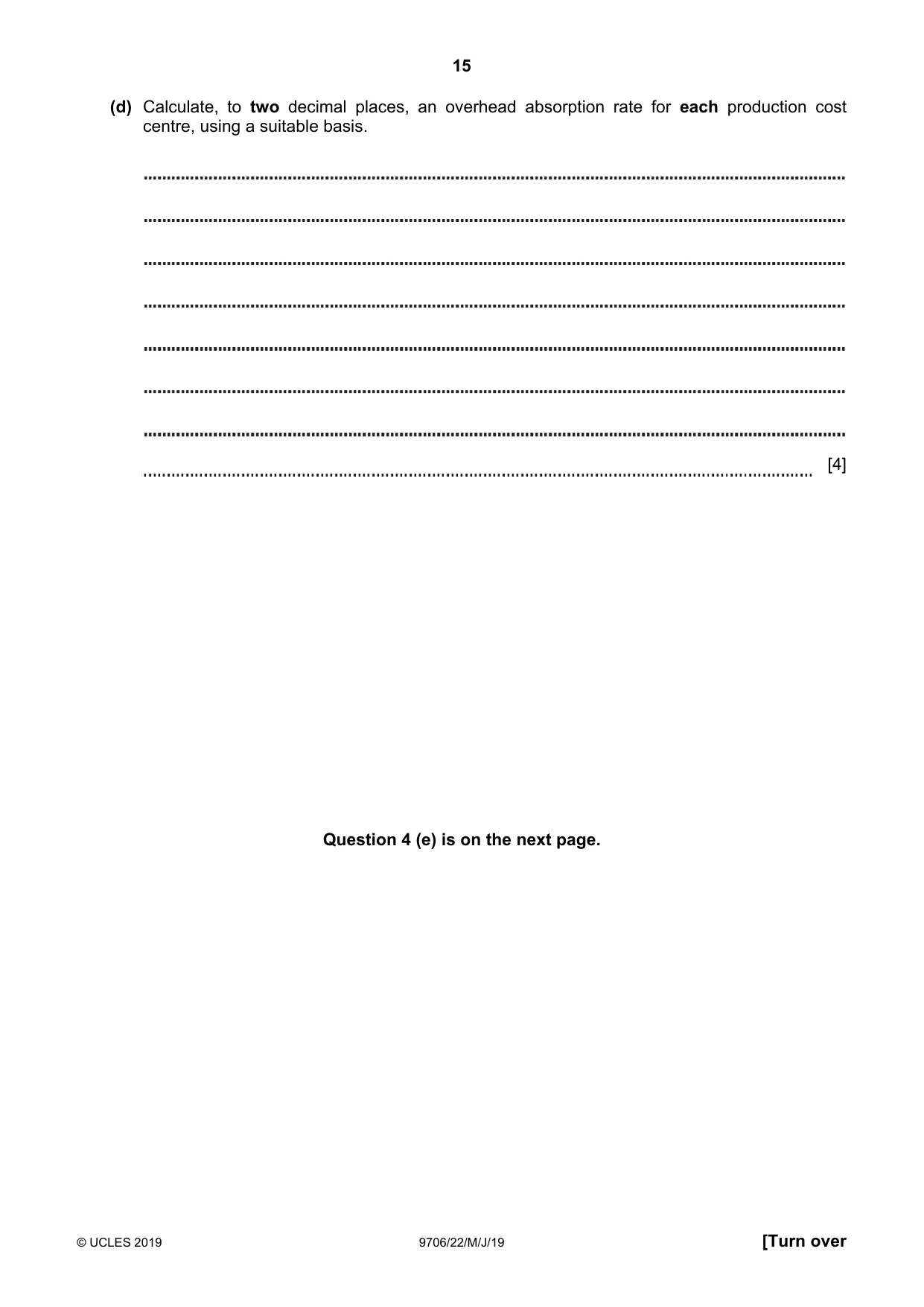
4 Jessie is a manufacturer and uses a single raw material to make her product. The following table shows inventory transactions for the month of March 2019. Per kilo Date Kilos $ March 1 Opening balance 1500 1.90 3 Receipts 3500 1.92 10 Receipts 2000 1.95 17 Receipts 1500 2.00 Jessie uses the First In First Out (FIFO) method to value her inventory. The following issues to production took place. Date Kilos March 5 3000 23 4500 REQUIRED (a) Calculate the following in dollars: (i) the value of issues to production on 5 March [2] (ii) the value of issues to production on 23 March [3] (iii) the value of closing inventory at 31 March. [1] (b) State two advantages to a business of using the FIFO method of inventory valuation. 1 2 [2] Additional information The business has two production cost centres: machining and assembly, and one service cost centre: stores. The following budgeted information is available for the year ending 31 December 2019. Budgeted overheads $ Basis of apportionment Depreciation 9 760 Non-current asset at cost Heat and light 13 850 Kilowatt hours Machinery maintenance 6 500 Machine hours The following budgeted information is also available. Service Production cost centres cost centre Machining Assembly Stores Kilowatt hours 4 200 2 100 700 Non-current assets at cost ($) 91 000 28 000 21 000 Stores requisitions 375 125 Direct labour hours 2 700 6 300 Machine hours 13 400 3 350 REQUIRED (c) Complete the following table to show the apportionment of budgeted overhead costs for the year ending 31 December 2019. Service cost Production cost centres Total centre $ Machining Assembly Stores $ $ $ Depreciation Heat and light Machinery maintenance Total overheads apportioned Re-apportionment of stores Total overheads cost [6] (d) Calculate, to two decimal places, an overhead absorption rate for each production cost centre, using a suitable basis. [4] Question 4 (e) is on the next page.
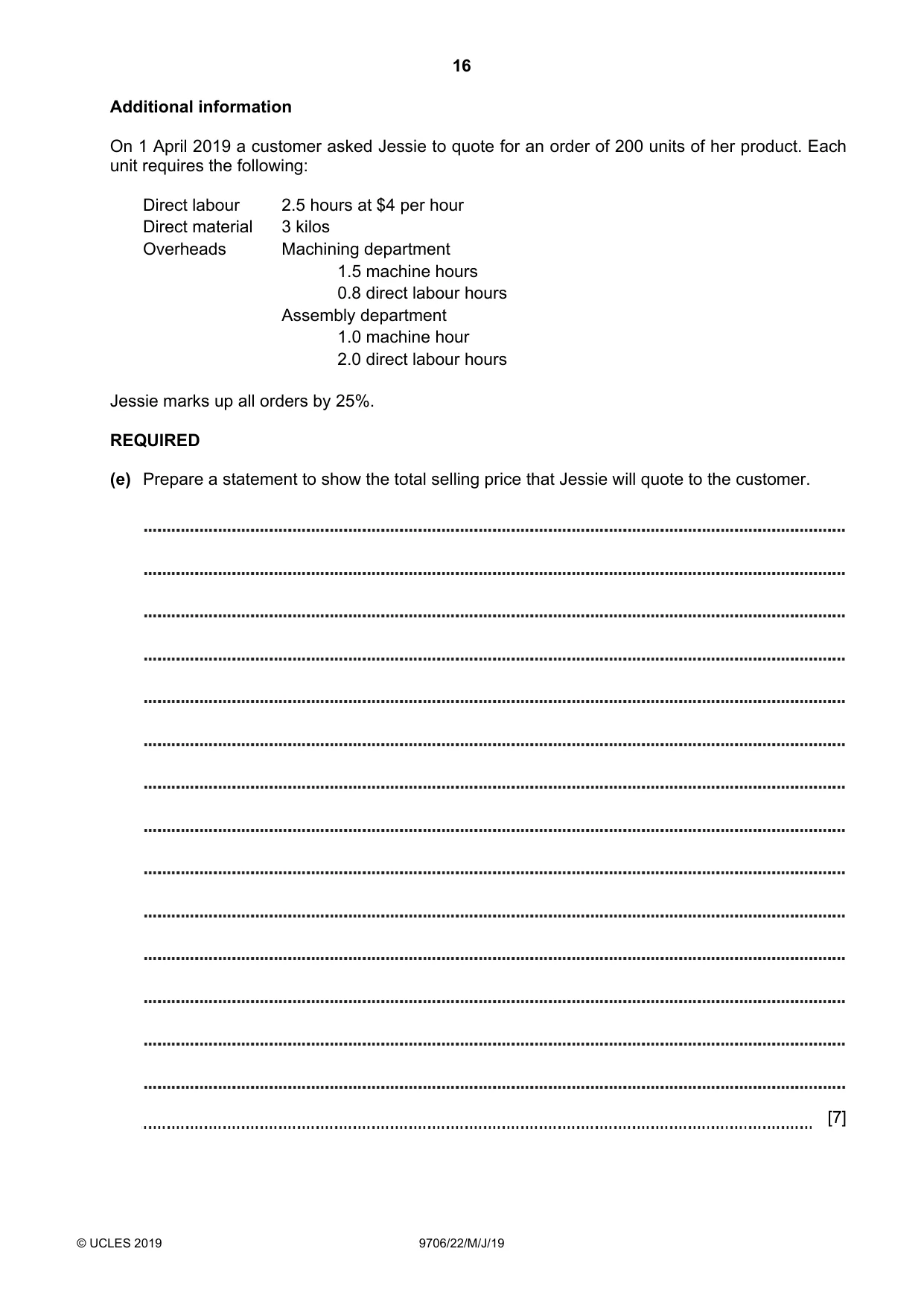
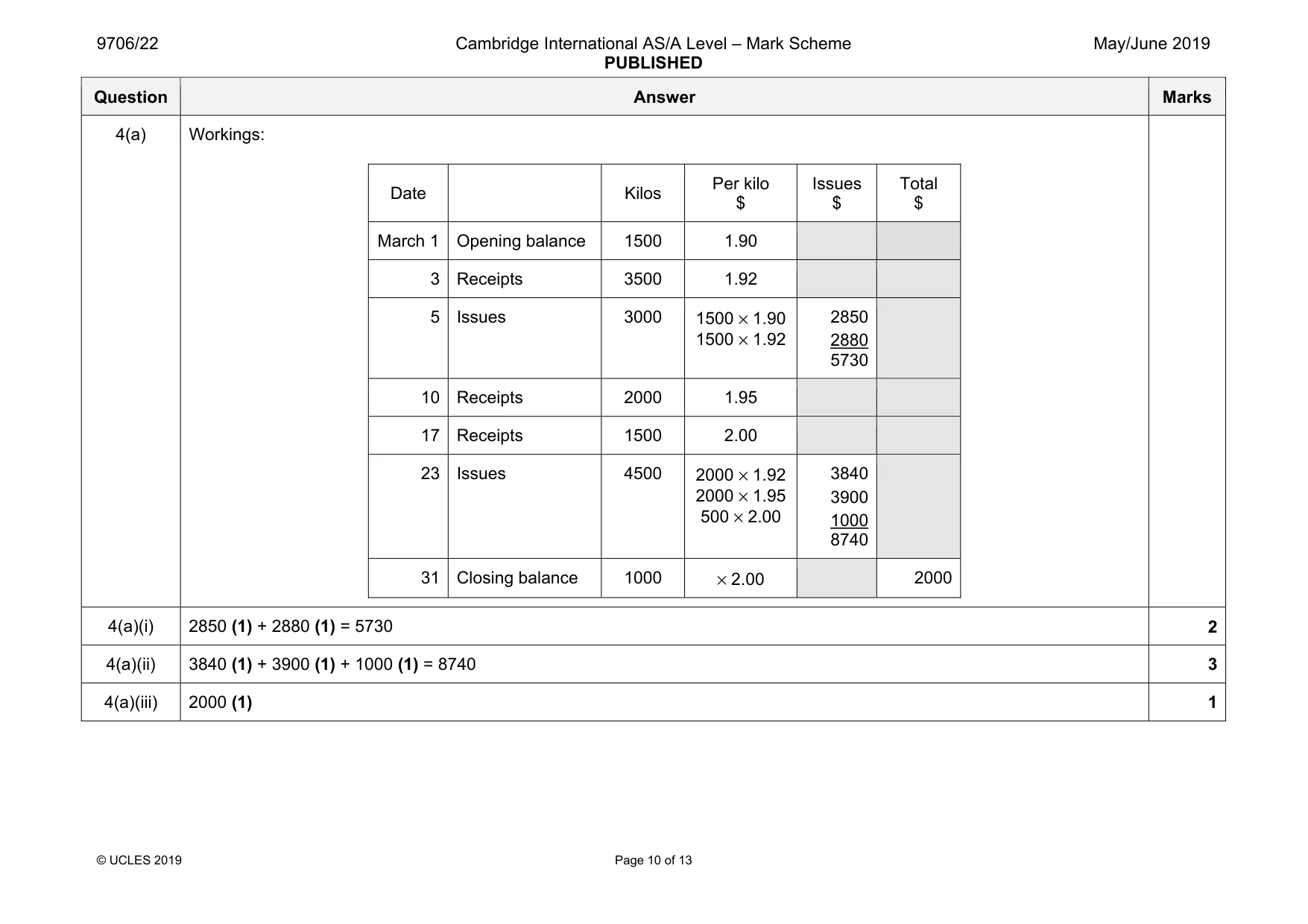
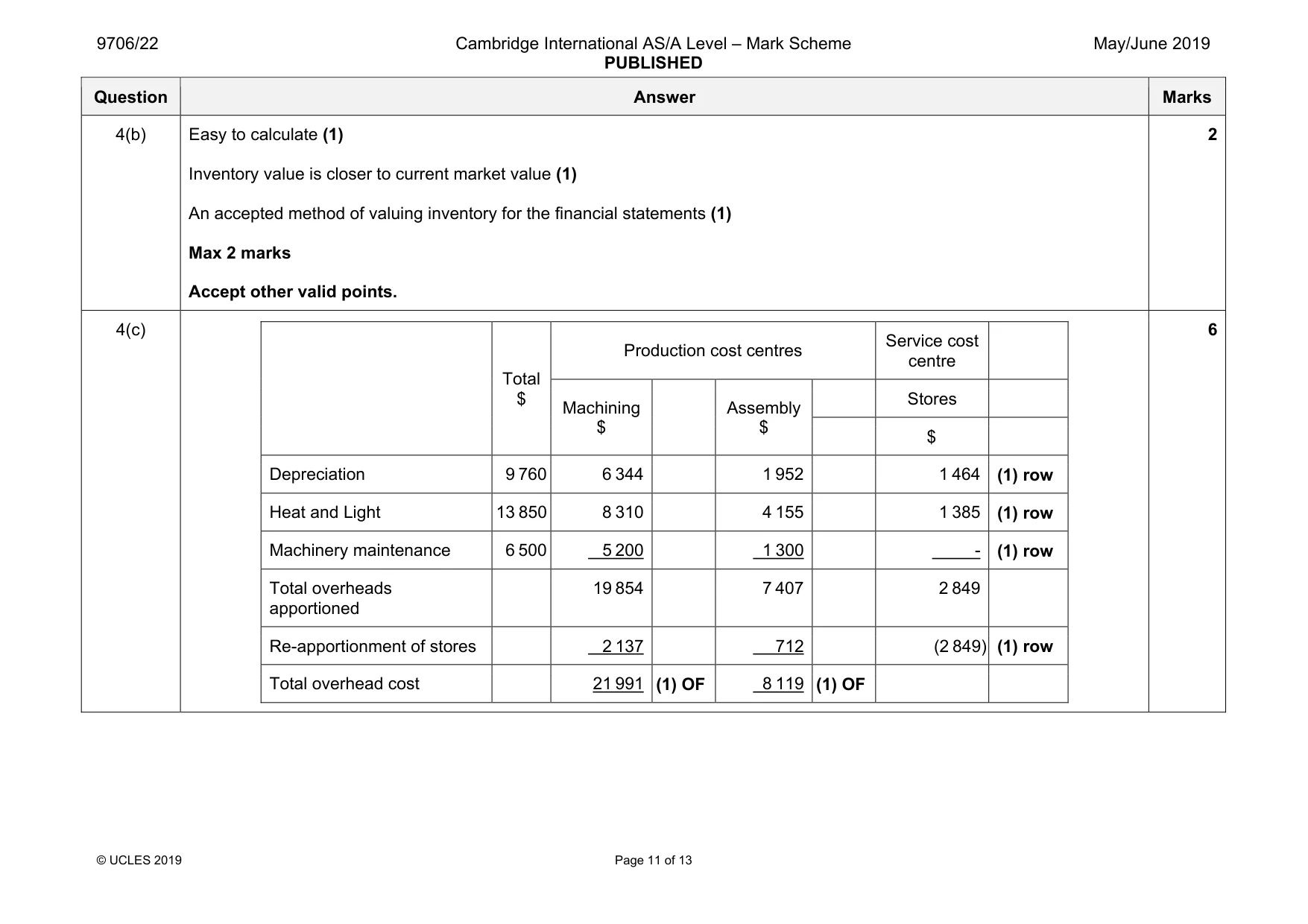
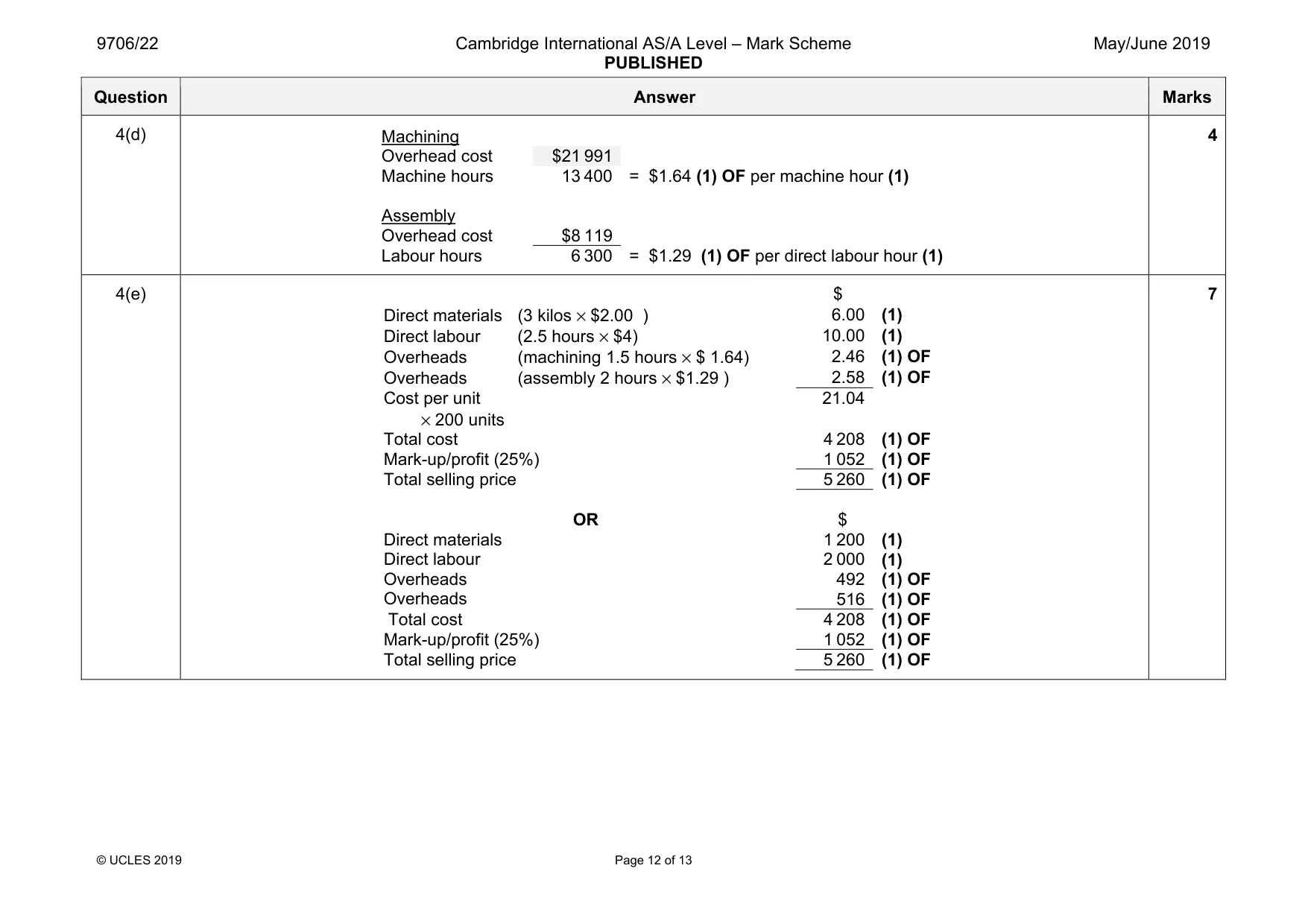
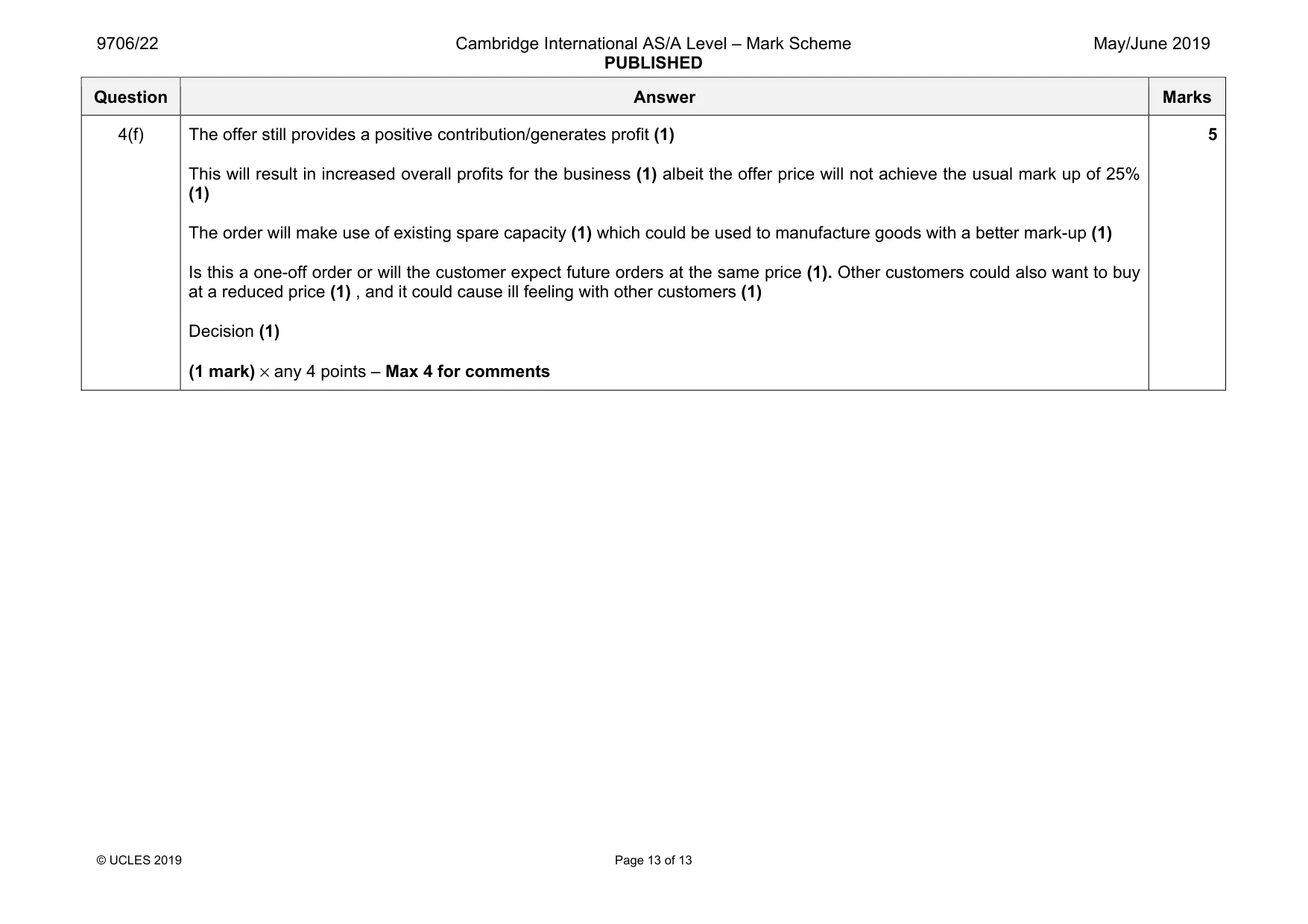
Mark scheme: 4(a) Workings: Date Kilos Per kilo $ Issues $ Total $ March 1 Opening balance 1500 1.90 3 Receipts 3500 1.92 5 Issues 3000 1500 × 1.90 1500 × 1.92 2850 2880 5730 10 Receipts 2000 1.95 17 Receipts 1500 2.00 23 Issues 4500 2000 × 1.92 2000 × 1.95 500 × 2.00 3840 3900 1000 8740 31 Closing balance 1000 × 2.00 2000 4(a)(i) 2850 (1) + 2880 (1) = 5730 2 4(a)(ii) 3840 (1) + 3900 (1) + 1000 (1) = 8740 3 4(a)(iii) 2000 (1) 1 Question Answer Marks 4(b) Easy to calculate (1) Inventory value is closer to current market value (1) An accepted method of valuing inventory for the financial statements (1) Max 2 marks Accept other valid points. 2 4(c) Total $ Production cost centres Service cost centre Machining $ Assembly $ Stores $ Depreciation 9 760 6 344 1 952 1 464 (1) row Heat and Light 13 850 8 310 4 155 1 385 (1) row Machinery maintenance 6 500 5 200 1 300 - (1) row Total overheads apportioned 19 854 7 407 2 849 Re-apportionment of stores 2 137 712 (2 849) (1) row Total overhead cost 21 991 (1) OF 8 119 (1) OF 6 Question Answer Marks 4(d) Machining Overhead cost $21 991 Machine hours 13 400 = $1.64 (1) OF per machine hour (1) Assembly Overhead cost $8 119 Labour hours 6 300 = $1.29 (1) OF per direct labour hour (1) 4 4(e) $ Direct materials (3 kilos × $2.00 ) 6.00 (1) Direct labour (2.5 hours × $4) 10.00 (1) Overheads (machining 1.5 hours × $ 1.64) 2.46 (1) OF Overheads (assembly 2 hours × $1.29 ) 2.58 (1) OF Cost per unit 21.04 × 200 units Total cost 4 208 (1) OF Mark-up/profit (25%) 1 052 (1) OF Total selling price 5 260 (1) OF OR $ Direct materials 1 200 (1) Direct labour 2 000 (1) Overheads 492 (1) OF Overheads 516 (1) OF Total cost 4 208 (1) OF Mark-up/profit (25%) 1 052 (1) OF Total selling price 5 260 (1) OF 7 Question Answer Marks 4(f) The offer still provides a positive contribution/generates profit (1) This will result in increased overall profits for the business (1) albeit the offer price will not achieve the usual mark up of 25% (1) The order will make use of existing spare capacity (1) which could be used to manufacture goods with a better mark-up (1) Is this a one-off order or will the customer expect future orders at the same price (1). Other customers could also want to buy at a reduced price (1) , and it could cause ill feeling with other customers (1) Decision (1) (1 mark) × any 4 points – Max 4 for comments 5
What was in this paper
The subtopics covered by these 4 questions, and how many questions each got. Open one in a new tab to see every Cambridge question on it.
What you needed in this session
Cambridge’s own grade thresholds for 2019 May/June, Paper 2 · Variant 2. A higher threshold means an easier paper — the bar moves with how the cohort did.