Cambridge A Level Accounting 9706 — 2019 May/June Paper 2 · Variant 3
9706/23/M/J/19 · 4 questions · 90 marks · ≈101 min
The question paper and its mark scheme, free to read here and free to download. This is Cambridge’s own paper, exactly as it was sat.
Question paper24 pages



Mark scheme16 pages
Answers below. Sit the paper first if you are practising.
Questions as text
Q1 · D Limited is a retailer of sports equipment
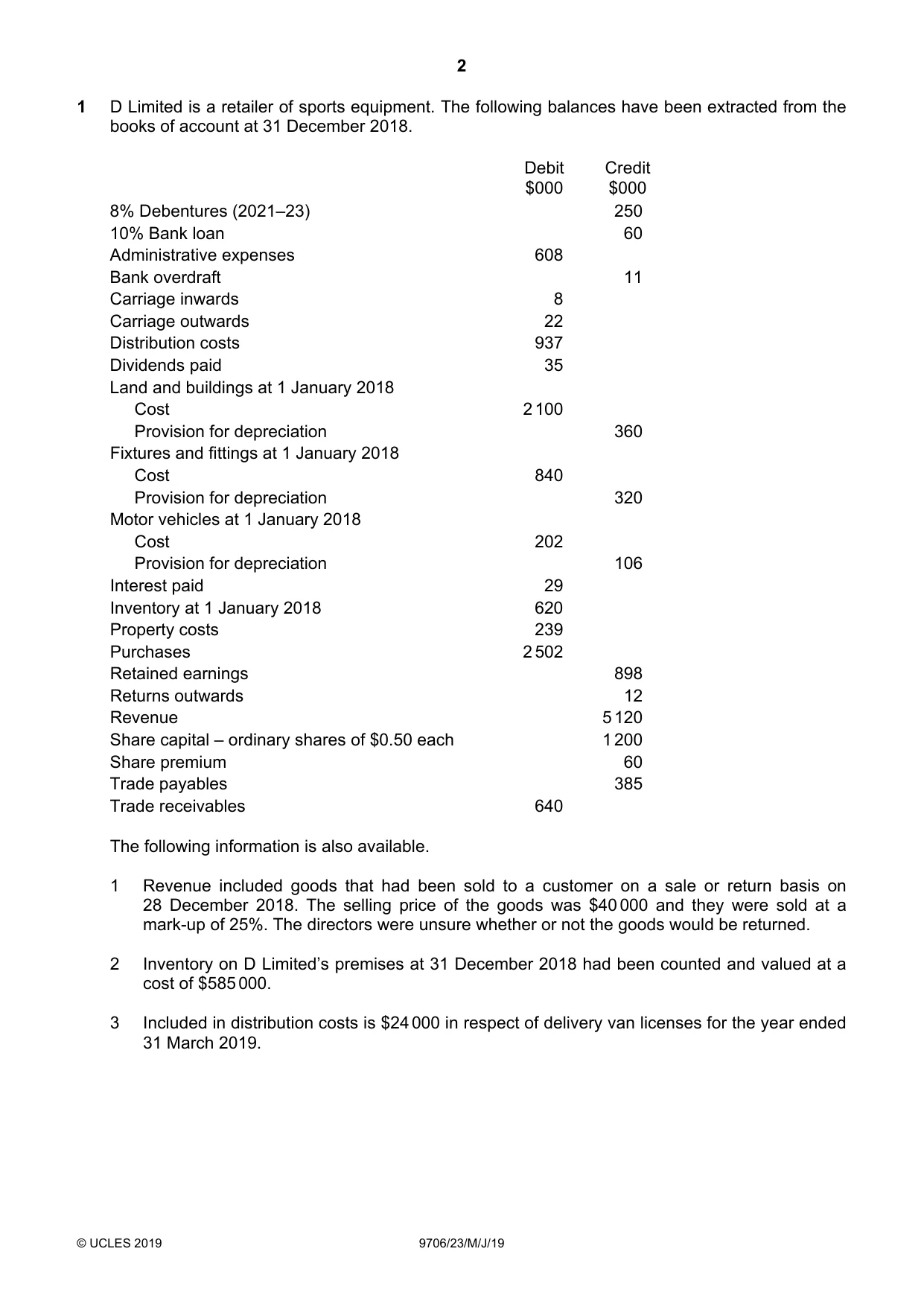
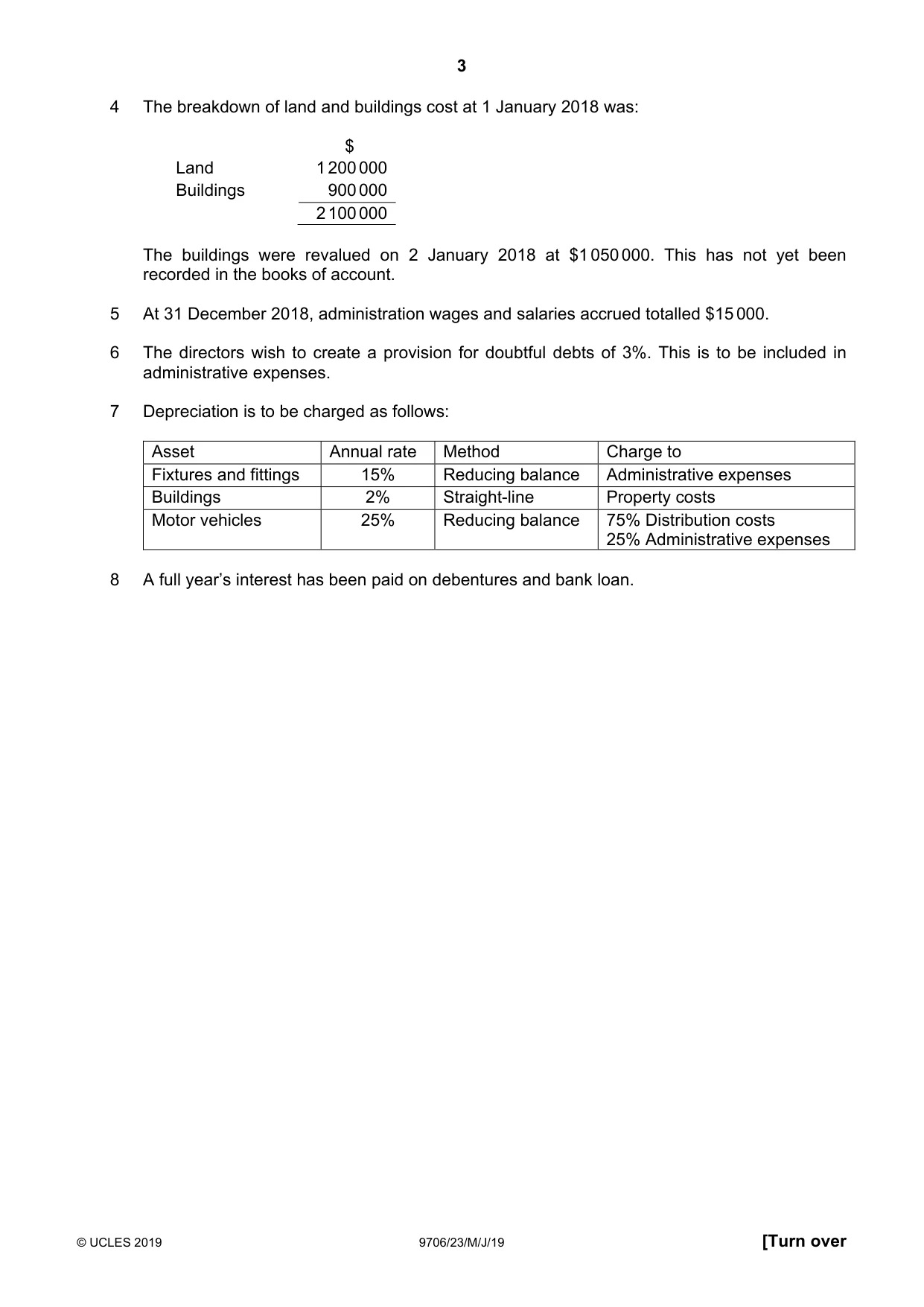
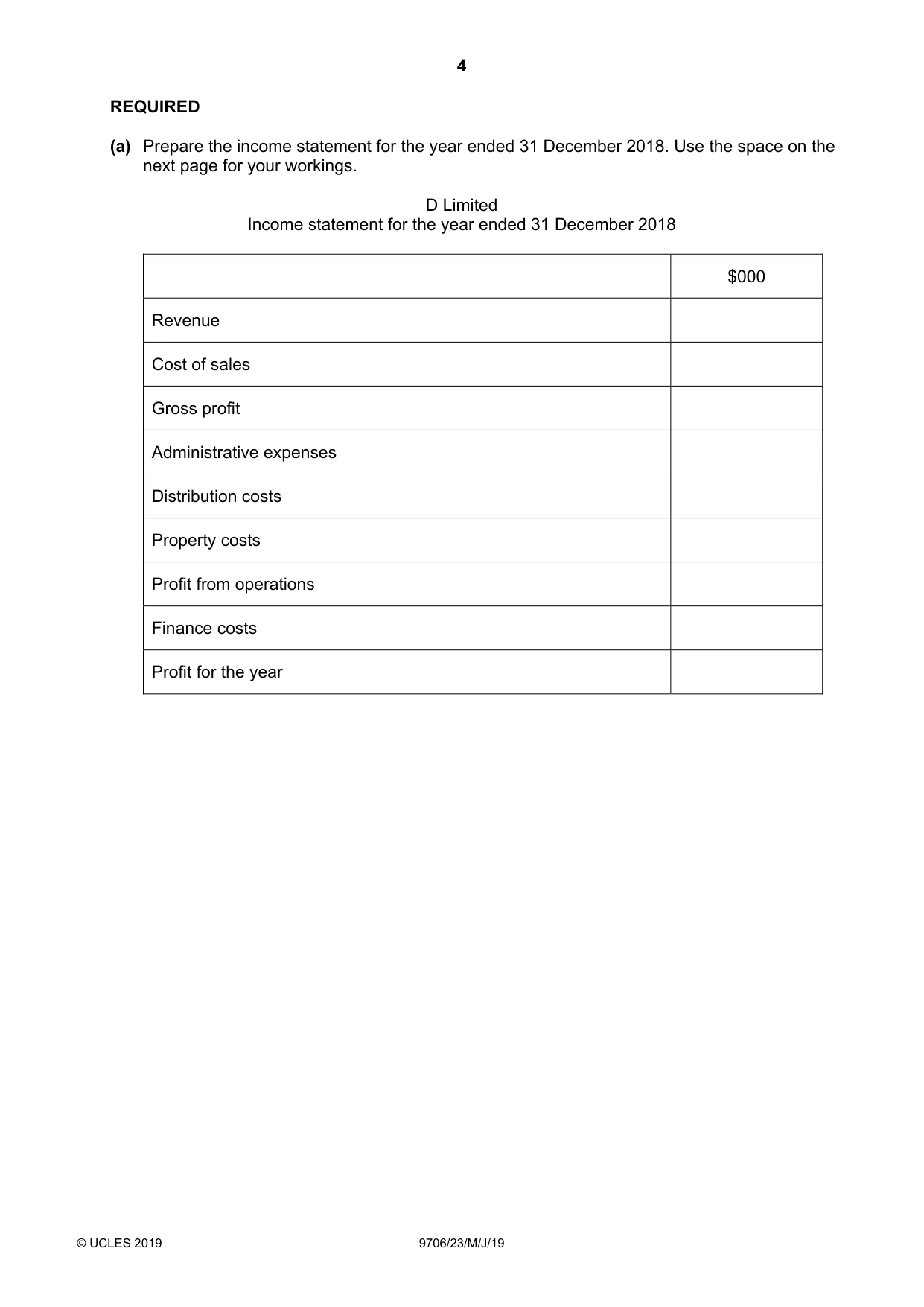
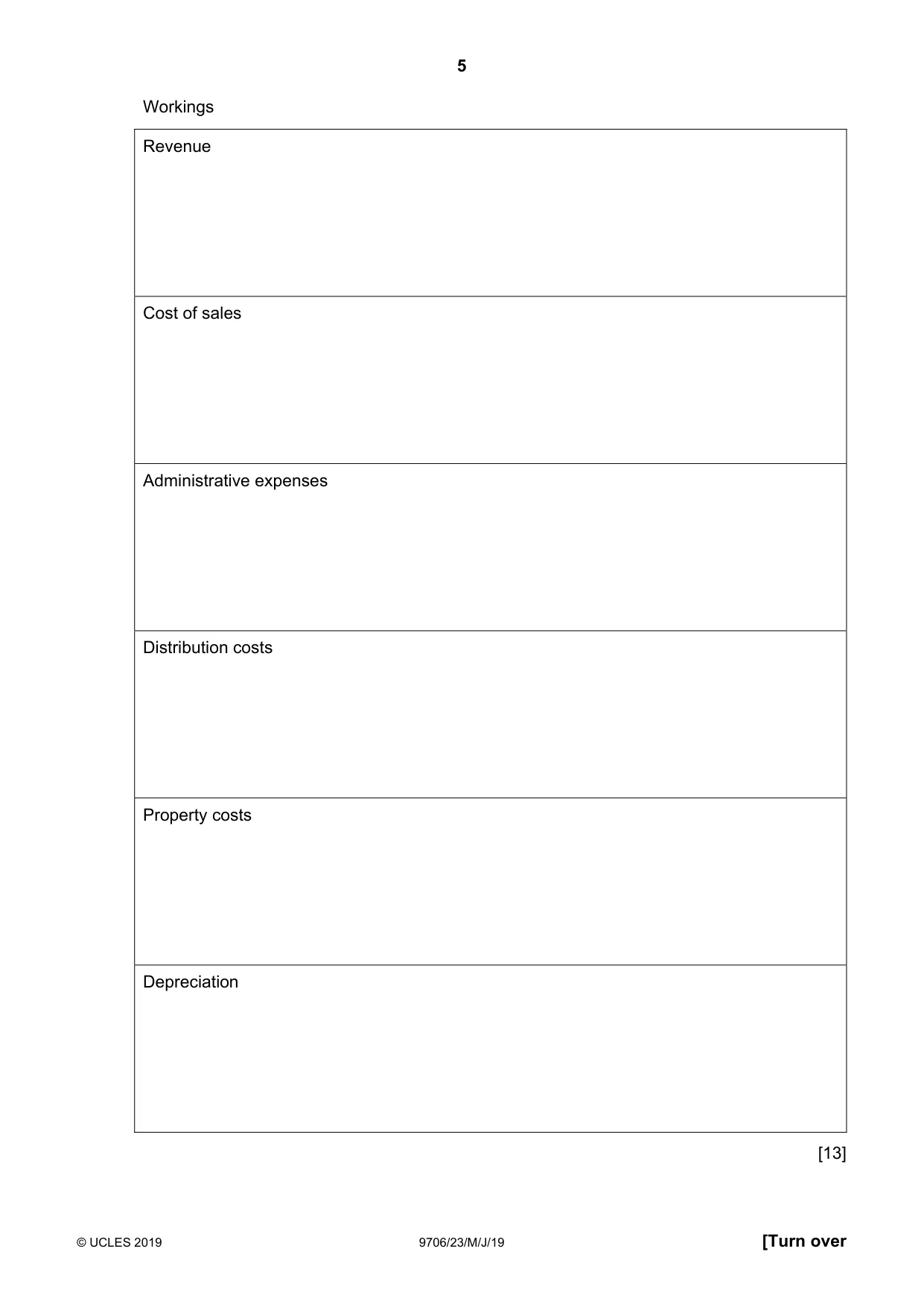
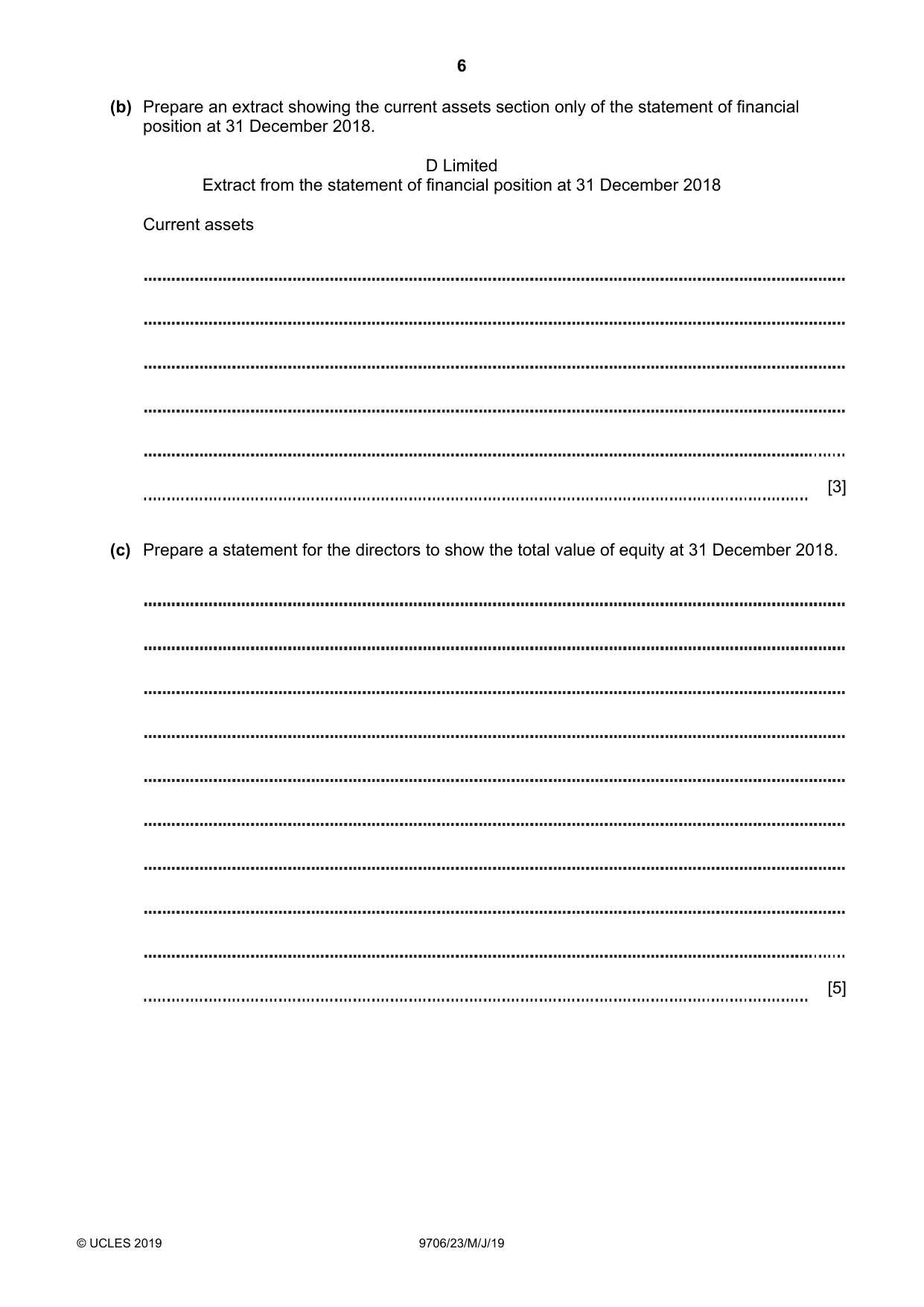
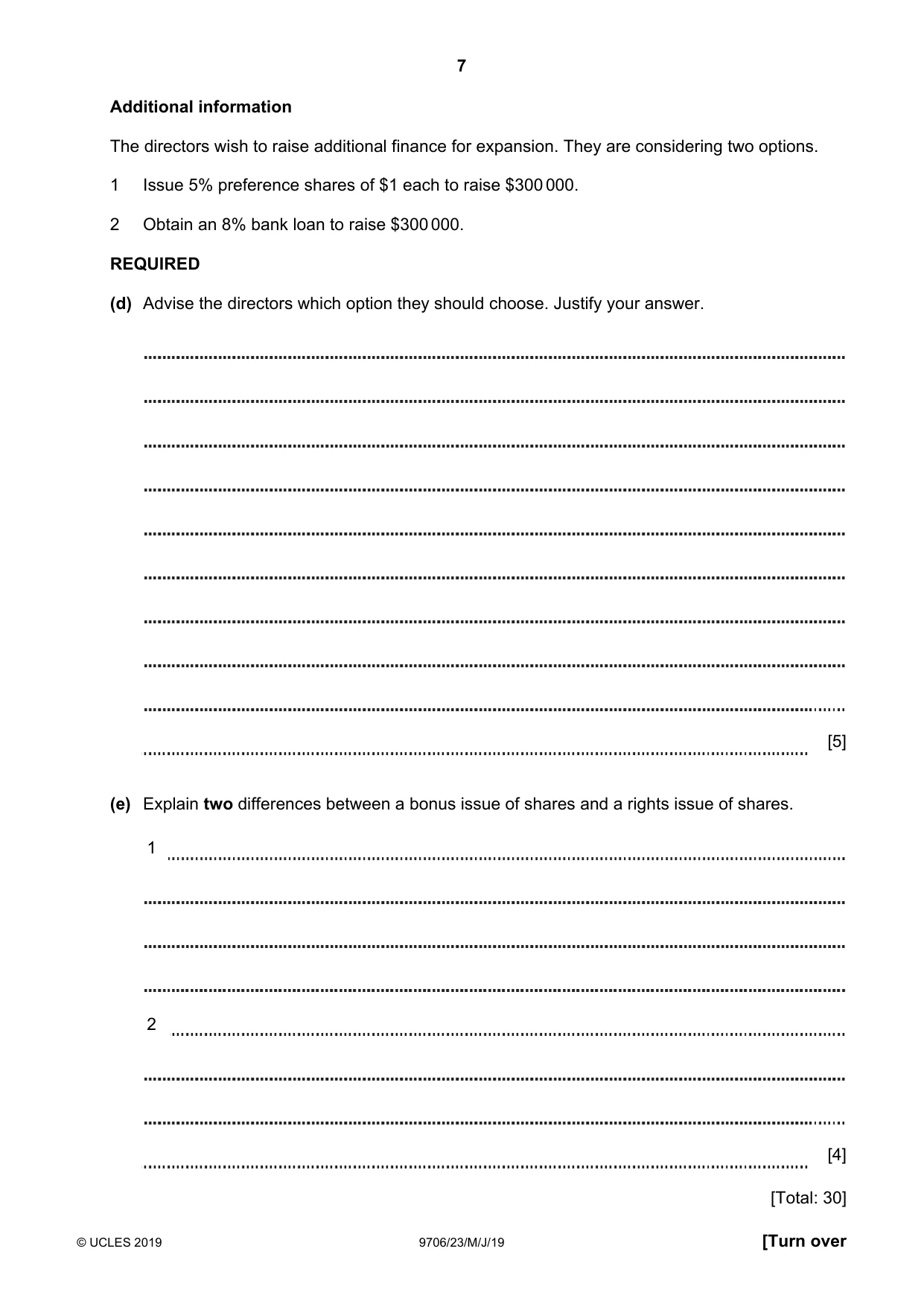
1 D Limited is a retailer of sports equipment. The following balances have been extracted from the books of account at 31 December 2018. Debit Credit $000 $000 8% Debentures (2021–23) 250 10% Bank loan 60 Administrative expenses 608 Bank overdraft 11 Carriage inwards 8 Carriage outwards 22 Distribution costs 937 Dividends paid 35 Land and buildings at 1 January 2018 Cost 2 100 Provision for depreciation 360 Fixtures and fittings at 1 January 2018 Cost 840 Provision for depreciation 320 Motor vehicles at 1 January 2018 Cost 202 Provision for depreciation 106 Interest paid 29 Inventory at 1 January 2018 620 Property costs 239 Purchases 2 502 Retained earnings 898 Returns outwards 12 Revenue 5 120 Share capital – ordinary shares of $0.50 each 1 200 Share premium 60 Trade payables 385 Trade receivables 640 The following information is also available. 1 Revenue included goods that had been sold to a customer on a sale or return basis on 28 December 2018. The selling price of the goods was $40 000 and they were sold at a mark-up of 25%. The directors were unsure whether or not the goods would be returned. 2 Inventory on D Limited’s premises at 31 December 2018 had been counted and valued at a cost of $585 000. 3 Included in distribution costs is $24 000 in respect of delivery van licenses for the year ended 31 March 2019. 4 The breakdown of land and buildings cost at 1 January 2018 was: $ Land 1 200 000 Buildings 900 000 2 100 000 The buildings were revalued on 2 January 2018 at $1 050 000. This has not yet been recorded in the books of account. 5 At 31 December 2018, administration wages and salaries accrued totalled $15 000. 6 The directors wish to create a provision for doubtful debts of 3%. This is to be included in administrative expenses. 7 Depreciation is to be charged as follows: Asset Annual rate Method Charge to Fixtures and fittings 15% Reducing balance Administrative expenses Buildings 2% Straight-line Property costs Motor vehicles 25% Reducing balance 75% Distribution costs 25% Administrative expenses 8 A full year’s interest has been paid on debentures and bank loan. REQUIRED (a) Prepare the income statement for the year ended 31 December 2018. Use the space on the next page for your workings. D Limited Income statement for the year ended 31 December 2018 $000 Revenue Cost of sales Gross profit Administrative expenses Distribution costs Property costs Profit from operations Finance costs Profit for the year Workings Revenue Cost of sales Administrative expenses Distribution costs Property costs Depreciation [13] (b) Prepare an extract showing the current assets section only of the statement of financial position at 31 December 2018. D Limited Extract from the statement of financial position at 31 December 2018 Current assets [3] (c) Prepare a statement for the directors to show the total value of equity at 31 December 2018. [5] Additional information The directors wish to raise additional finance for expansion. They are considering two options. 1 Issue 5% preference shares of $1 each to raise $300 000.
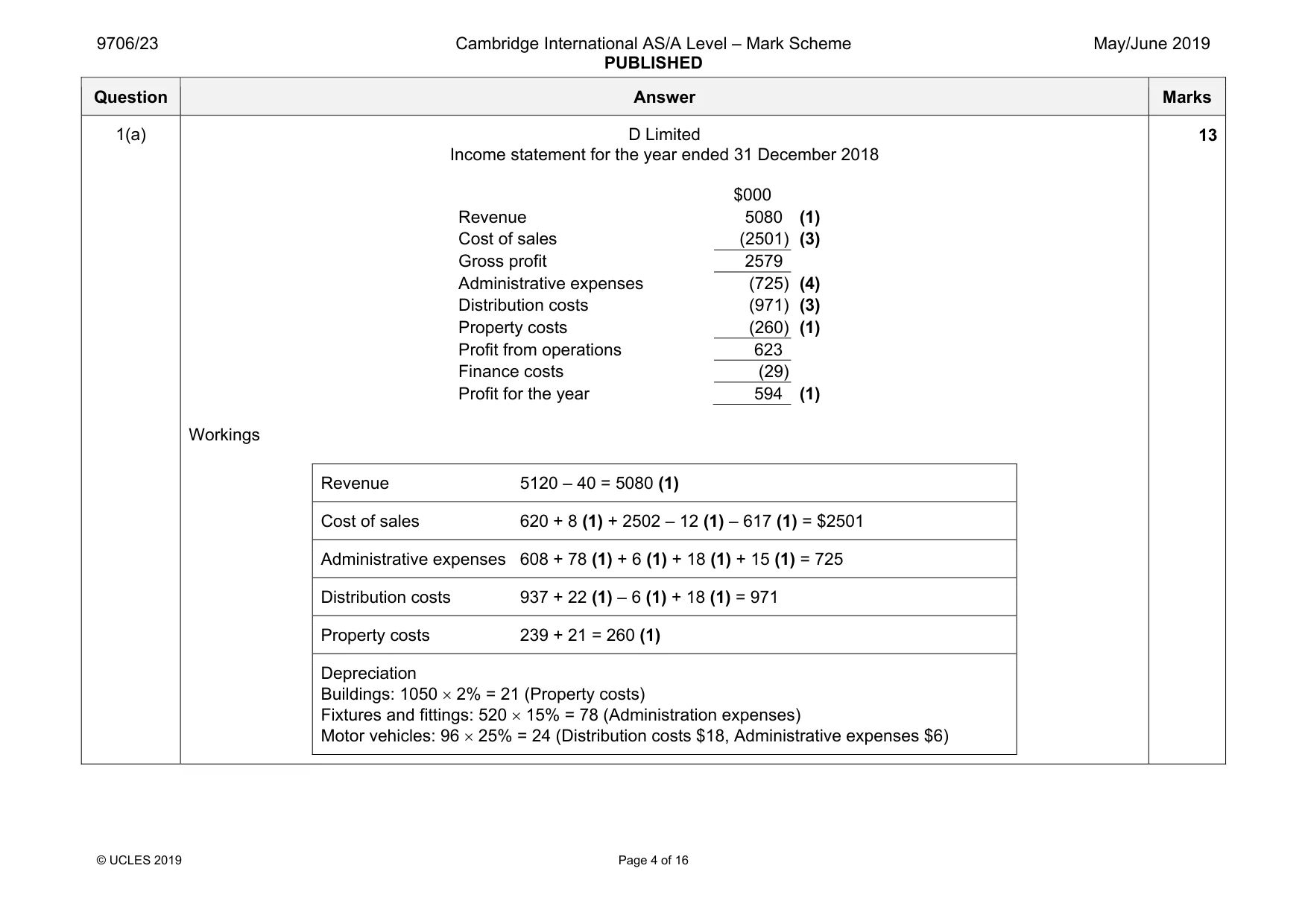
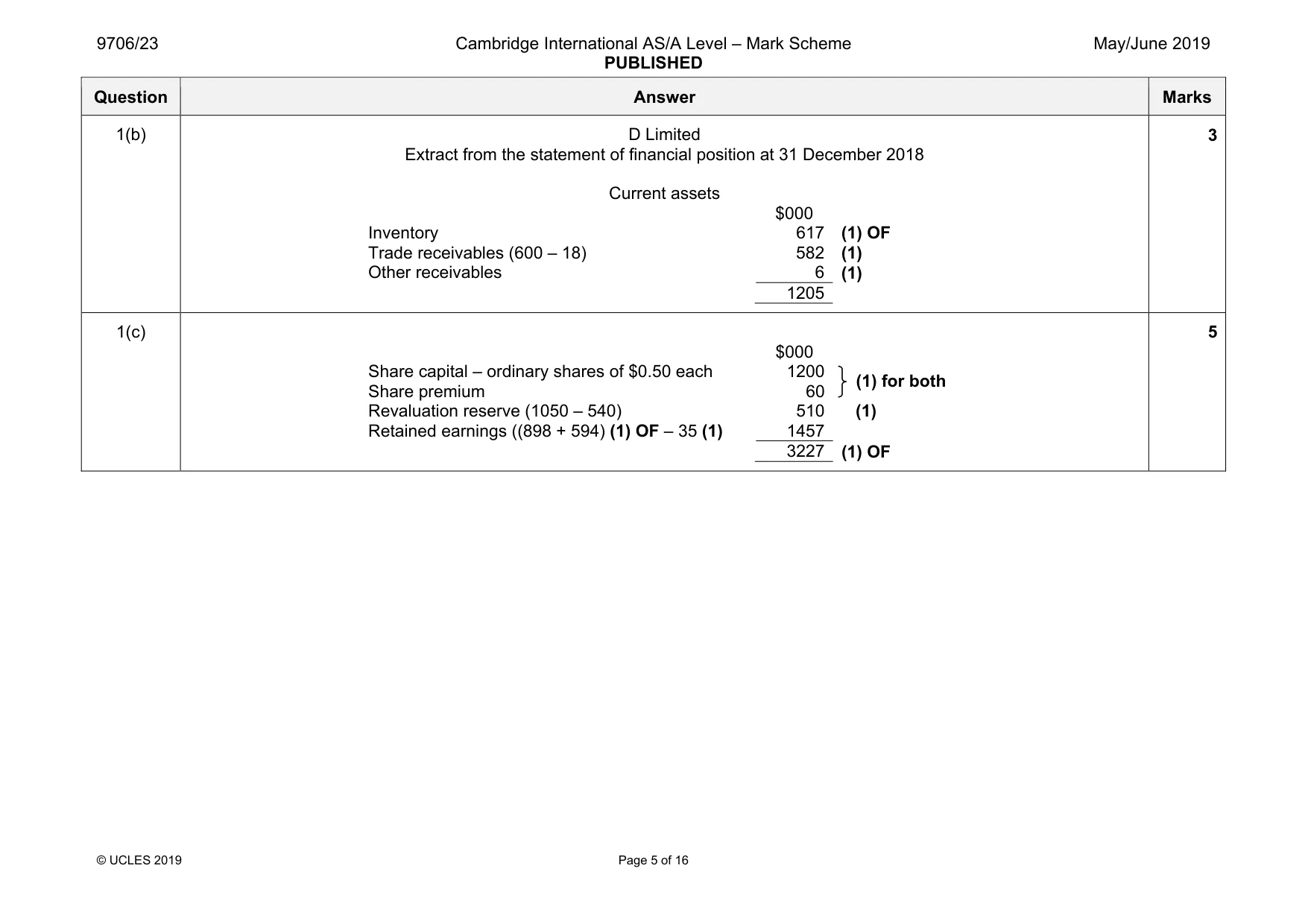
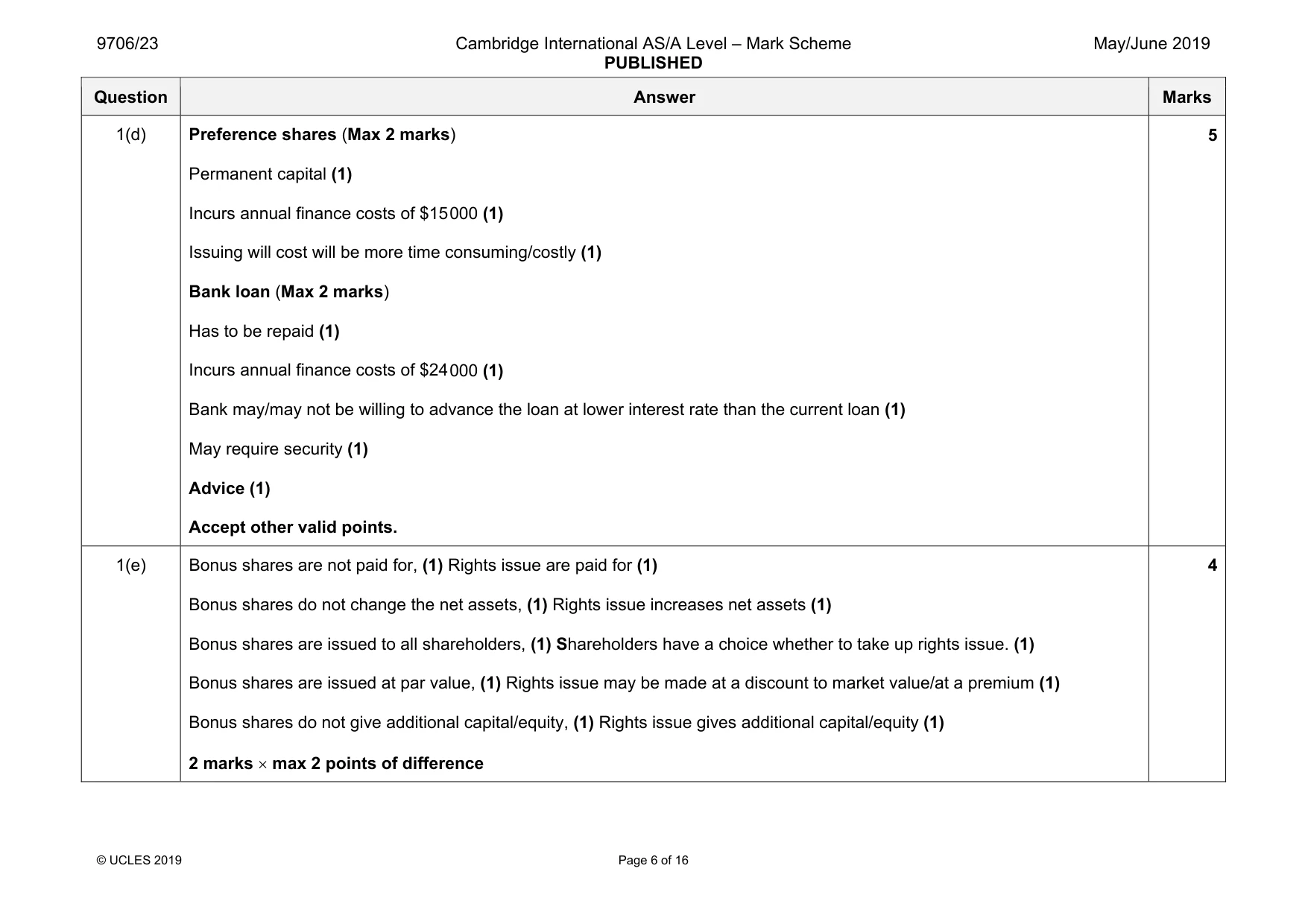
Mark scheme: 1(a) D Limited Income statement for the year ended 31 December 2018 $000 Revenue 5080 (1) Cost of sales (2501) (3) Gross profit 2579 Administrative expenses (725) (4) Distribution costs (971) (3) Property costs (260) (1) Profit from operations 623 Finance costs (29) Profit for the year 594 (1) Workings Revenue 5120 – 40 = 5080 (1) Cost of sales 620 + 8 (1) + 2502 – 12 (1) – 617 (1) = $2501 Administrative expenses 608 + 78 (1) + 6 (1) + 18 (1) + 15 (1) = 725 Distribution costs 937 + 22 (1) – 6 (1) + 18 (1) = 971 Property costs 239 + 21 = 260 (1) Depreciation Buildings: 1050 × 2% = 21 (Property costs) Fixtures and fittings: 520 × 15% = 78 (Administration expenses) Motor vehicles: 96 × 25% = 24 (Distribution costs $18, Administrative expenses $6) 13 Question Answer Marks 1(b) D Limited Extract from the statement of financial position at 31 December 2018 Current assets $000 Inventory 617 (1) OF Trade receivables (600 – 18) 582 (1) Other receivables 6 (1) 1205 3 1(c) $000 Share capital – ordinary shares of $0.50 each 1200 (1) for both Share premium 60 Revaluation reserve (1050 – 540) 510 (1) Retained earnings ((898 + 594) (1) OF – 35 (1) 1457 3227 (1) OF 5 Question Answer Marks 1(d) Preference shares (Max 2 marks) Permanent capital (1) Incurs annual finance costs of $15 000 (1) Issuing will cost will be more time consuming/costly (1) Bank loan (Max 2 marks) Has to be repaid (1) Incurs annual finance costs of $24 000 (1) Bank may/may not be willing to advance the loan at lower interest rate than the current loan (1) May require security (1) Advice (1) Accept other valid points. 5 1(e) Bonus shares are not paid for, (1) Rights issue are paid for (1) Bonus shares do not change the net assets, (1) Rights issue increases net assets (1) Bonus shares are issued to all shareholders, (1) Shareholders have a choice whether to take up rights issue. (1) Bonus shares are issued at par value, (1) Rights issue may be made at a discount to market value/at a premium (1) Bonus shares do not give additional capital/equity, (1) Rights issue gives additional capital/equity (1) 2 marks × max 2 points of difference 4
Q2 · Obtain an 8% bank loan to raise $300 000
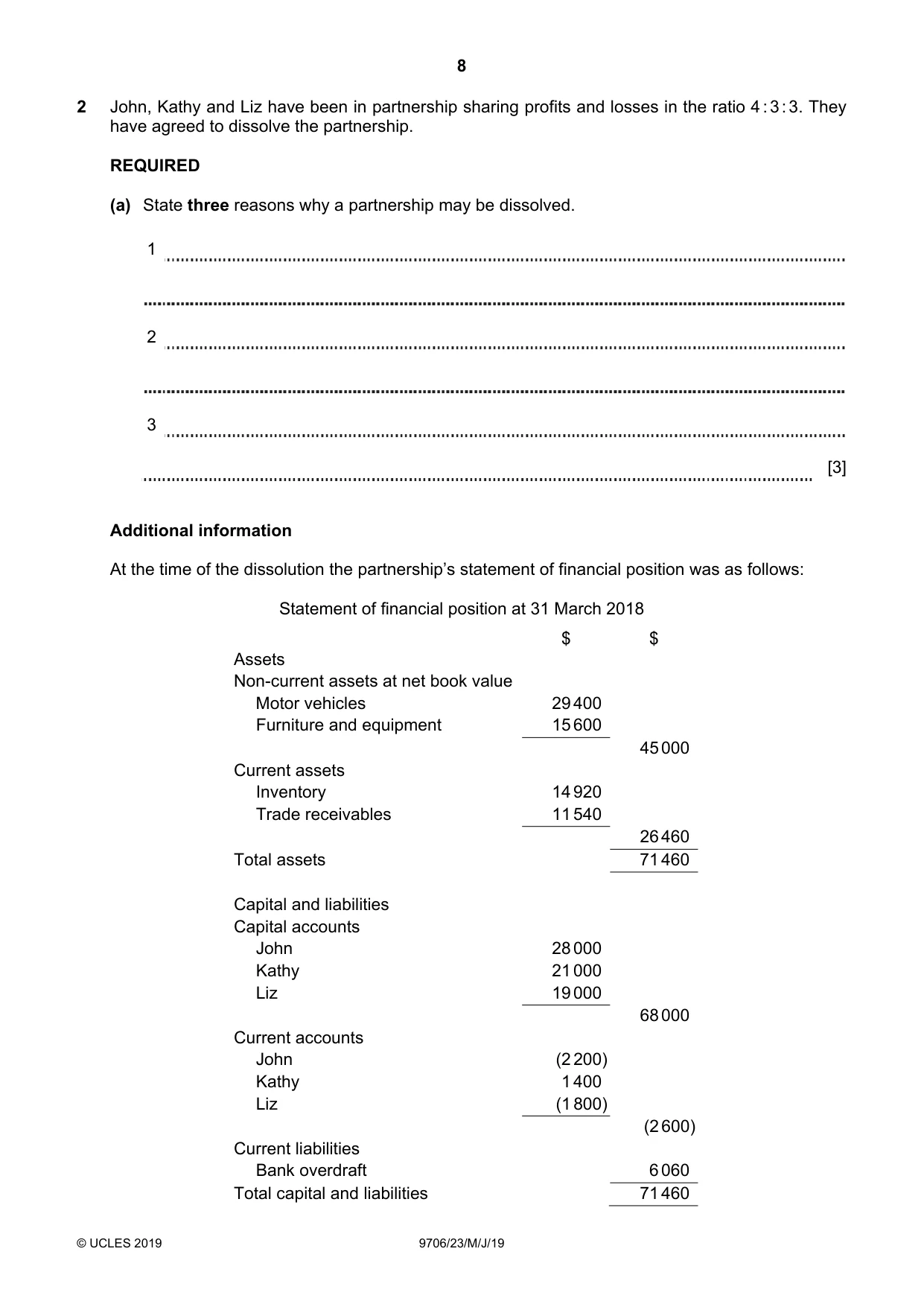
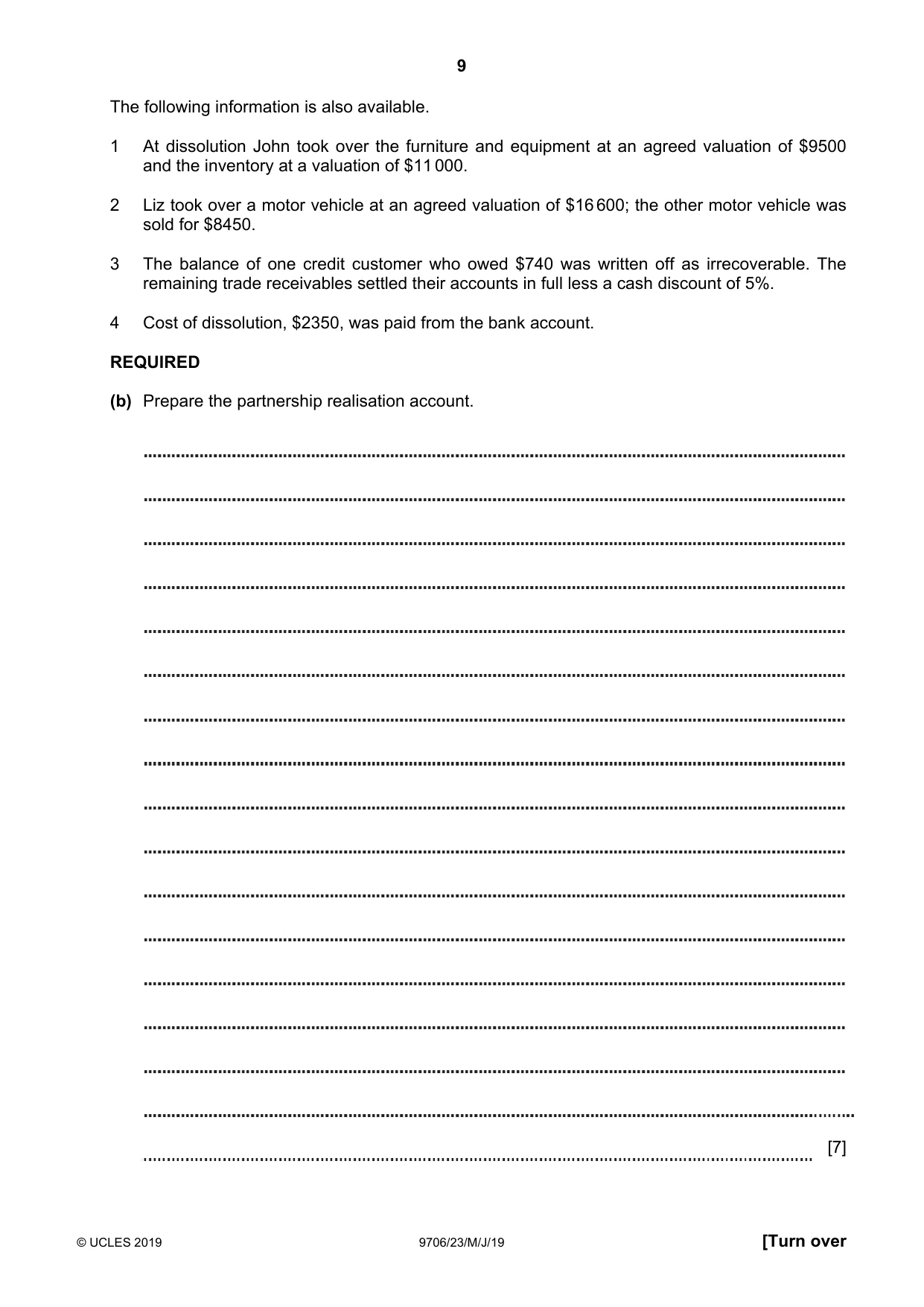
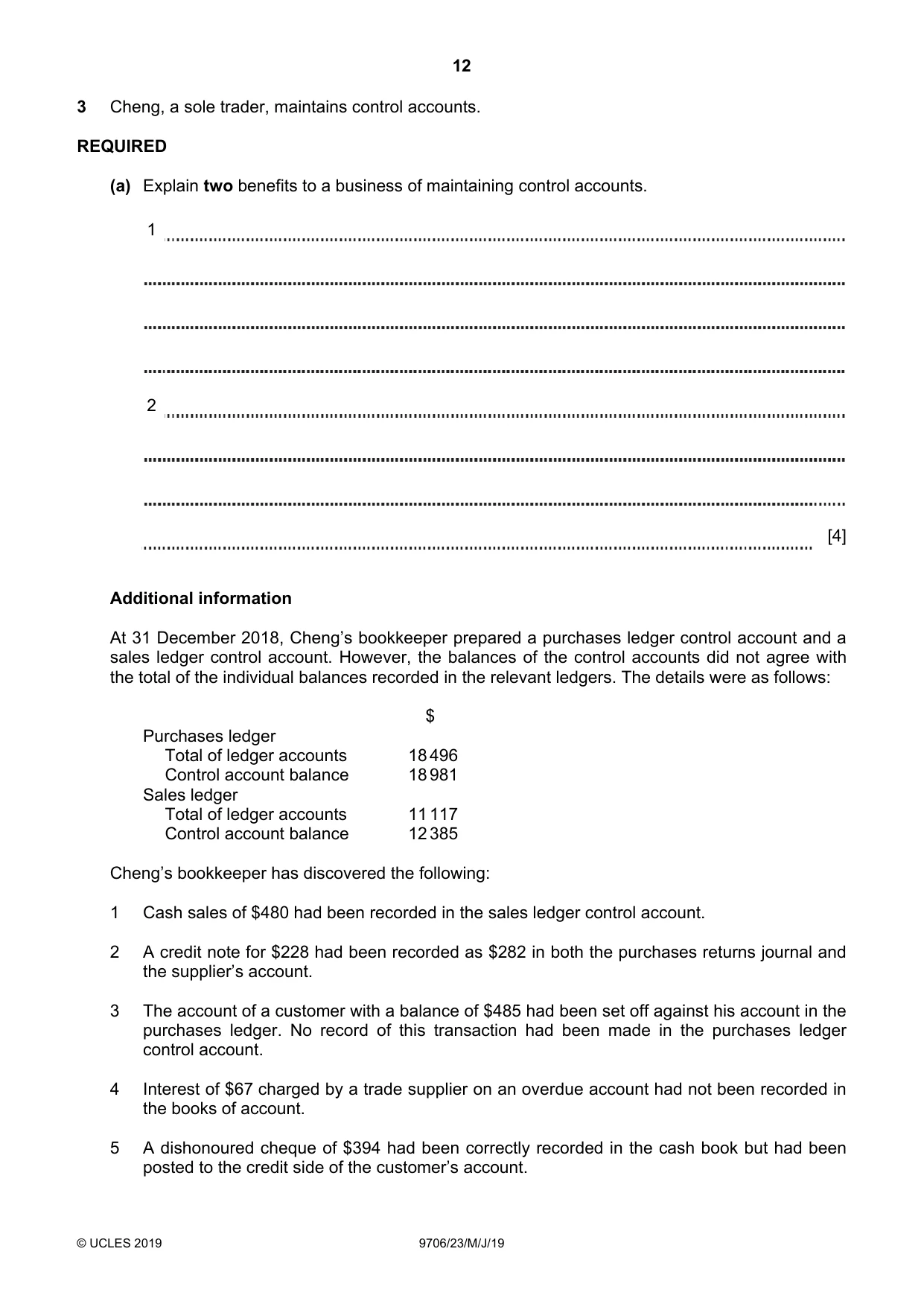
2 Obtain an 8% bank loan to raise $300 000. REQUIRED (d) Advise the directors which option they should choose. Justify your answer. [5] (e) Explain two differences between a bonus issue of shares and a rights issue of shares. 1 2 [4] [Total: 30] 2 John, Kathy and Liz have been in partnership sharing profits and losses in the ratio 4 : 3 : 3. They have agreed to dissolve the partnership. REQUIRED (a) State three reasons why a partnership may be dissolved. 1 2 3 [3] Additional information At the time of the dissolution the partnership’s statement of financial position was as follows: Statement of financial position at 31 March 2018 $ $ Assets Non-current assets at net book value Motor vehicles 29 400 Furniture and equipment 15 600 45 000 Current assets Inventory 14 920 Trade receivables 11 540 26 460 Total assets 71 460 Capital and liabilities Capital accounts John 28 000 Kathy 21 000 Liz 19 000 68 000 Current accounts John (2 200) Kathy 1 400 Liz (1 800) (2 600) Current liabilities Bank overdraft 6 060 Total capital and liabilities 71 460 The following information is also available. 1 At dissolution John took over the furniture and equipment at an agreed valuation of $9500 and the inventory at a valuation of $11 000. 2 Liz took over a motor vehicle at an agreed valuation of $16 600; the other motor vehicle was sold for $8450.
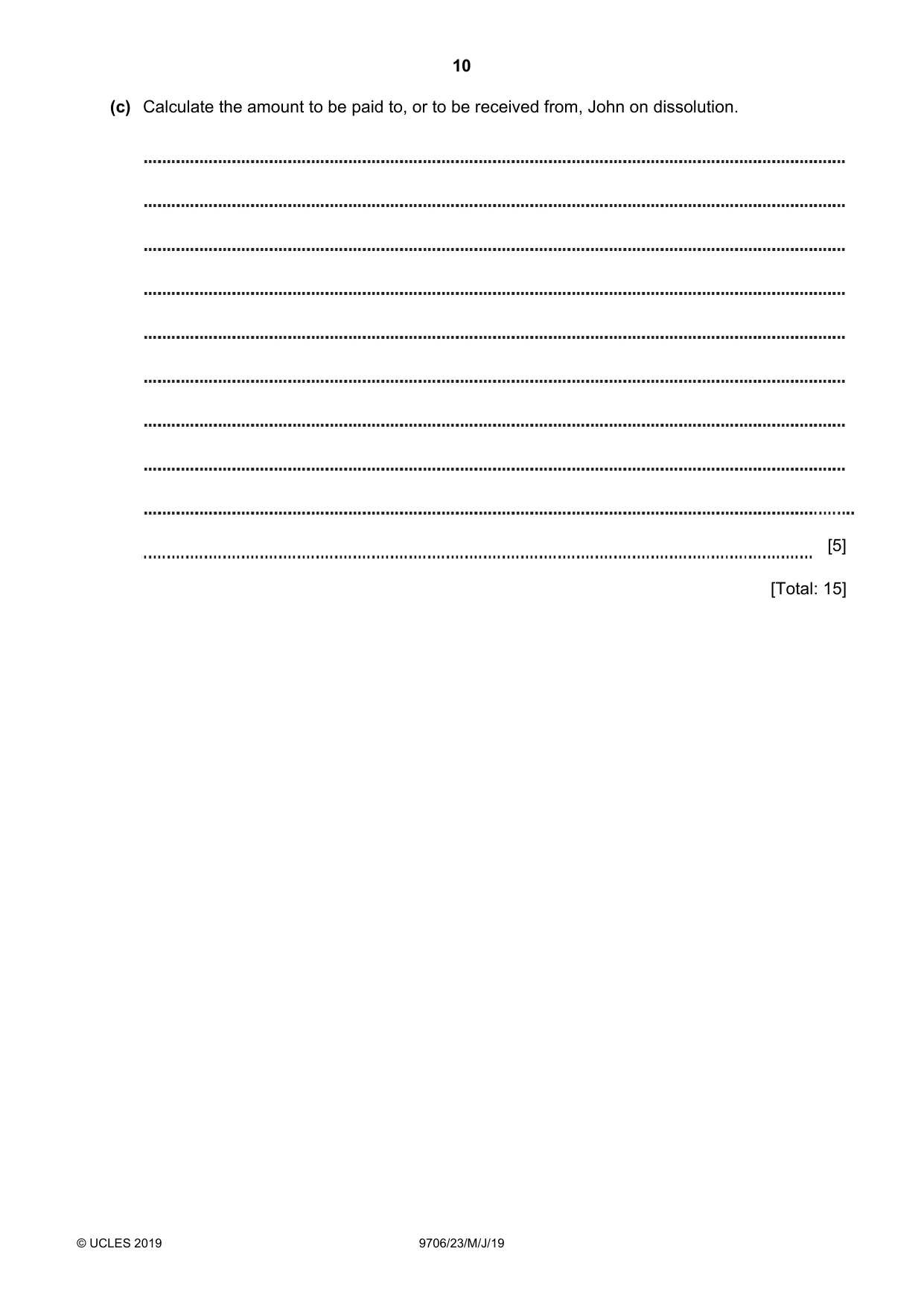
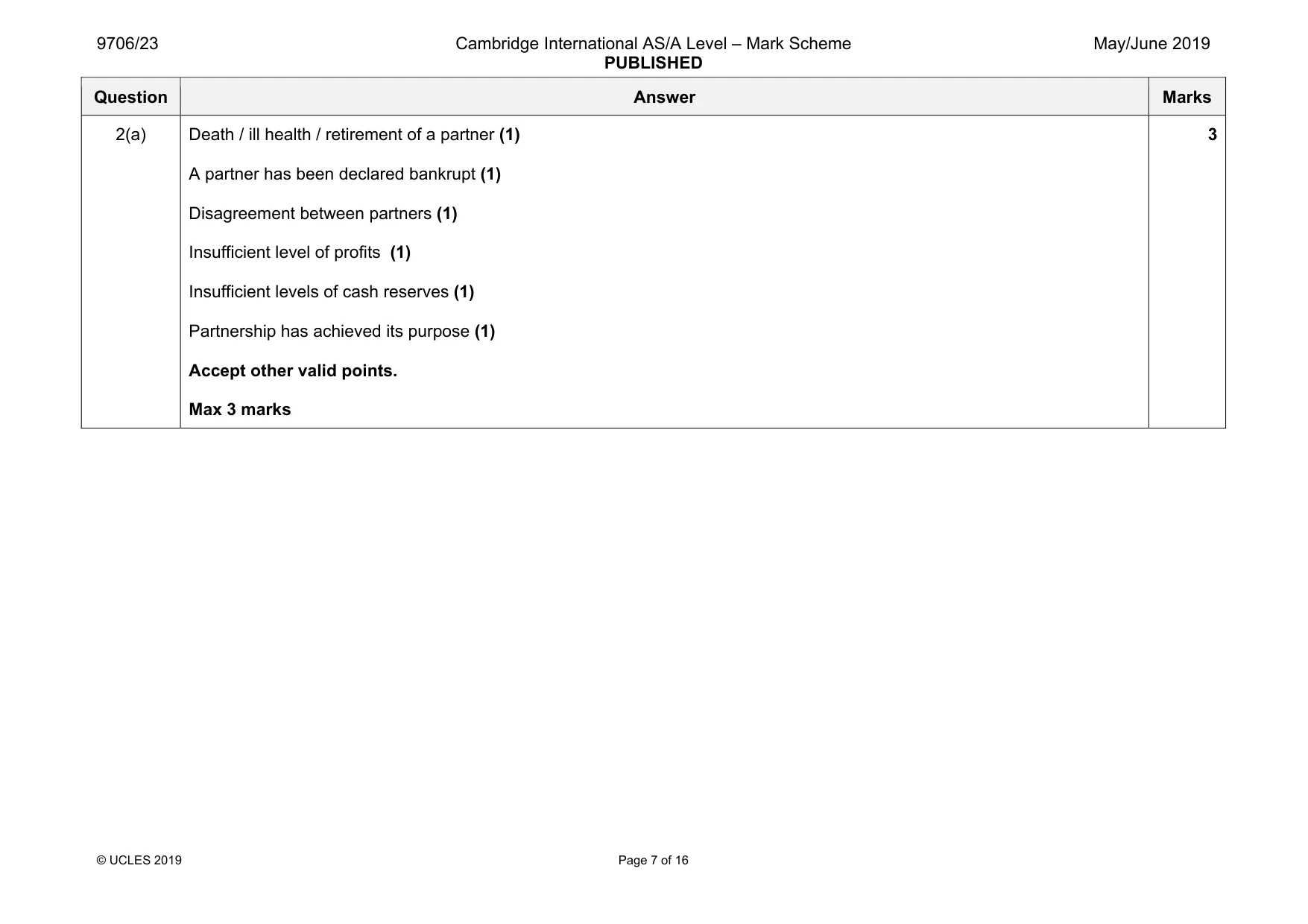
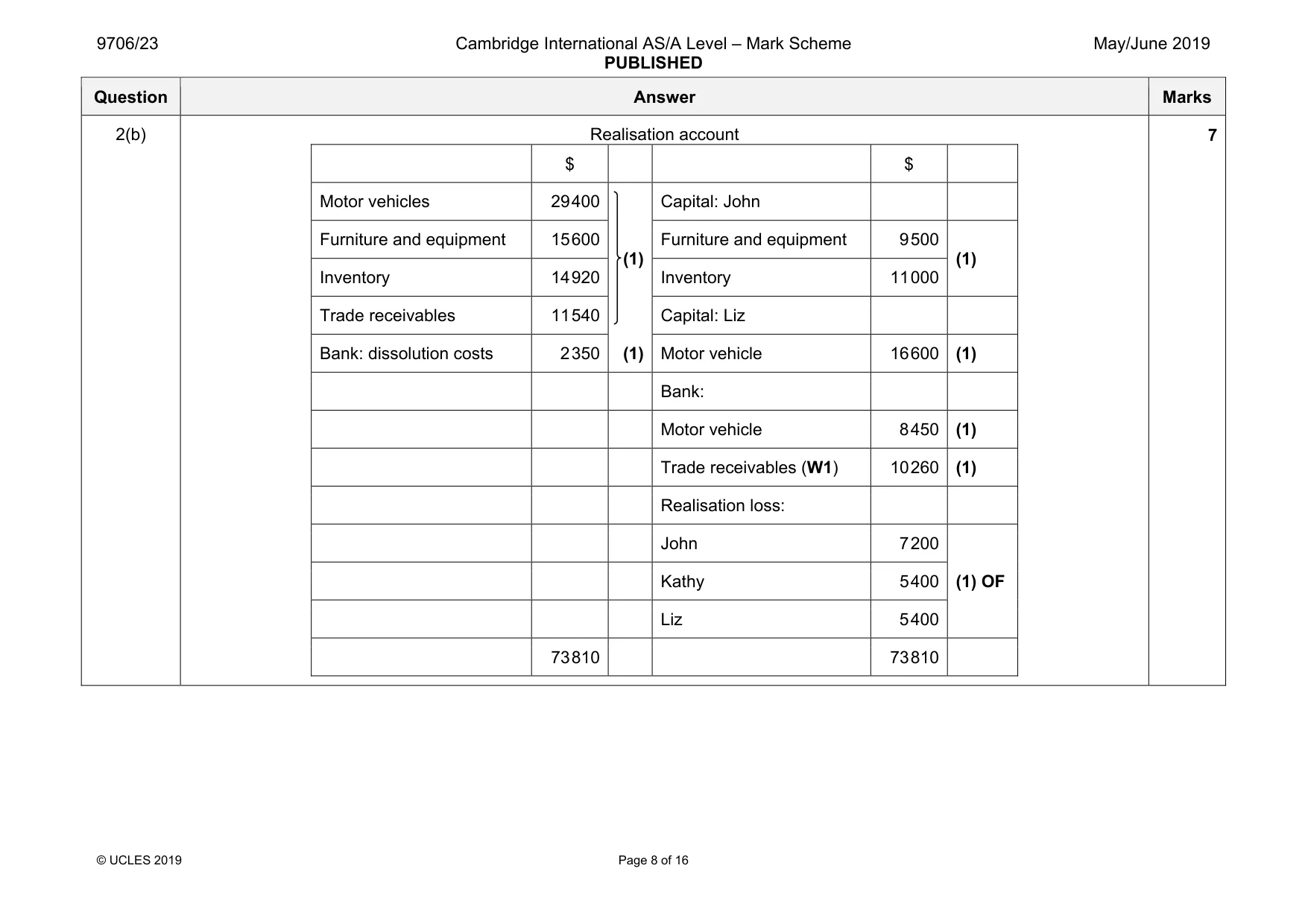
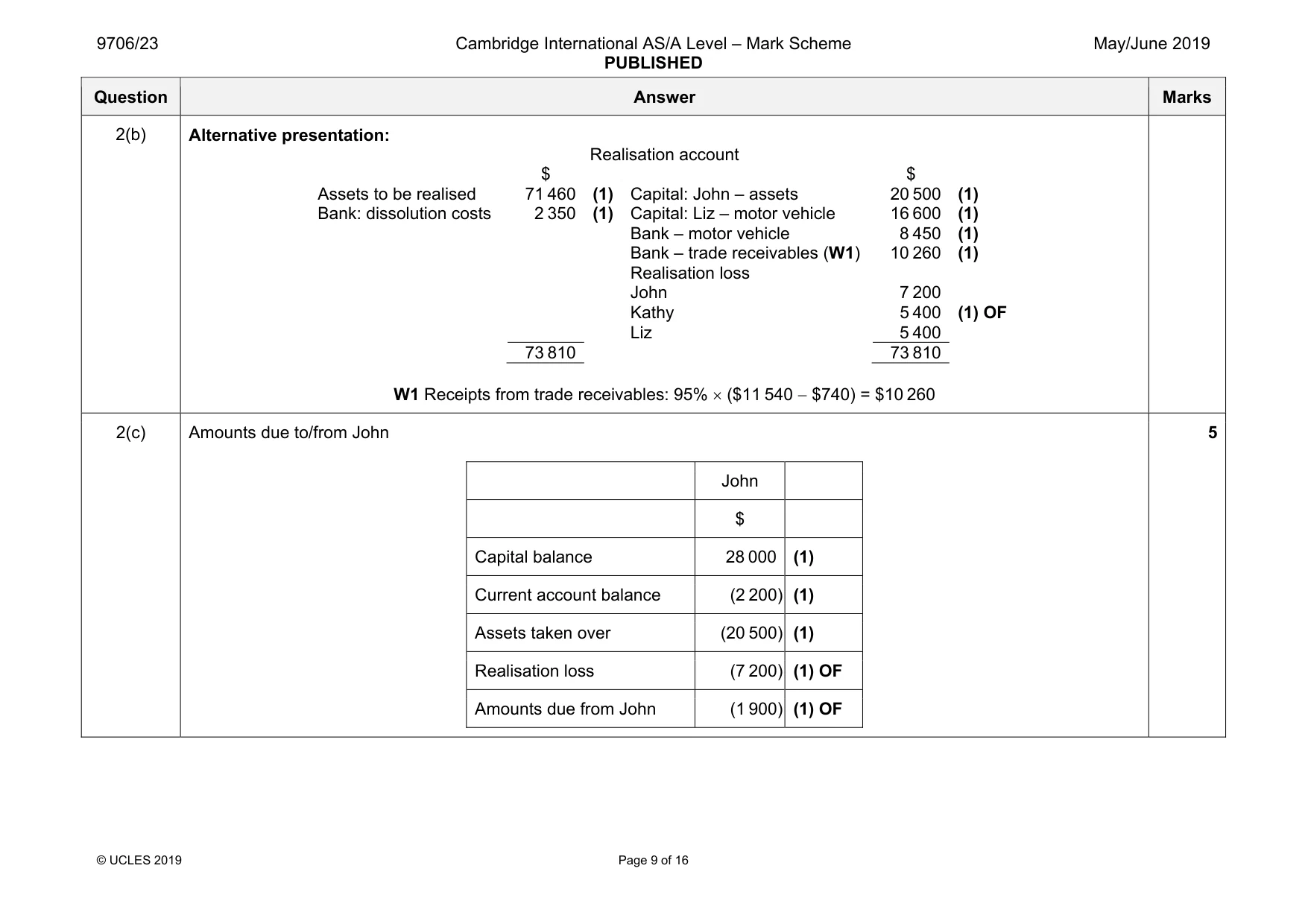
Mark scheme: 2(a) Death / ill health / retirement of a partner (1) A partner has been declared bankrupt (1) Disagreement between partners (1) Insufficient level of profits (1) Insufficient levels of cash reserves (1) Partnership has achieved its purpose (1) Accept other valid points. Max 3 marks 3 Question Answer Marks 2(b) Realisation account $ $ Motor vehicles 29 400 Capital: John Furniture and equipment 15 600 (1) Furniture and equipment 9 500 (1) Inventory 14 920 Inventory 11 000 Trade receivables 11 540 Capital: Liz Bank: dissolution costs 2 350 (1) Motor vehicle 16 600 (1) Bank: Motor vehicle 8 450 (1) Trade receivables (W1) 10 260 (1) Realisation loss: John 7 200 (1) OF Kathy 5 400 Liz 5 400 73 810 73 810 7 Question Answer Marks 2(b) Alternative presentation: Realisation account $ $ Assets to be realised 71 460 (1) Capital: John – assets 20 500 (1) Bank: dissolution costs 2 350 (1) Capital: Liz – motor vehicle 16 600 (1) Bank – motor vehicle 8 450 (1) Bank – trade receivables (W1) 10 260 (1) Realisation loss John 7 200 (1) OF Kathy 5 400 Liz 5 400 73 810 73 810 W1 Receipts from trade receivables: 95% × ($11 540 − $740) = $10 260 2(c) Amounts due to/from John John $ Capital balance 28 000 (1) Current account balance (2 200) (1) Assets taken over (20 500) (1) Realisation loss (7 200) (1) OF Amounts due from John (1 900) (1) OF 5
Q3 · The balance of one credit customer who owed $740 was written off as irrecoverable
3 The balance of one credit customer who owed $740 was written off as irrecoverable. The remaining trade receivables settled their accounts in full less a cash discount of 5%.
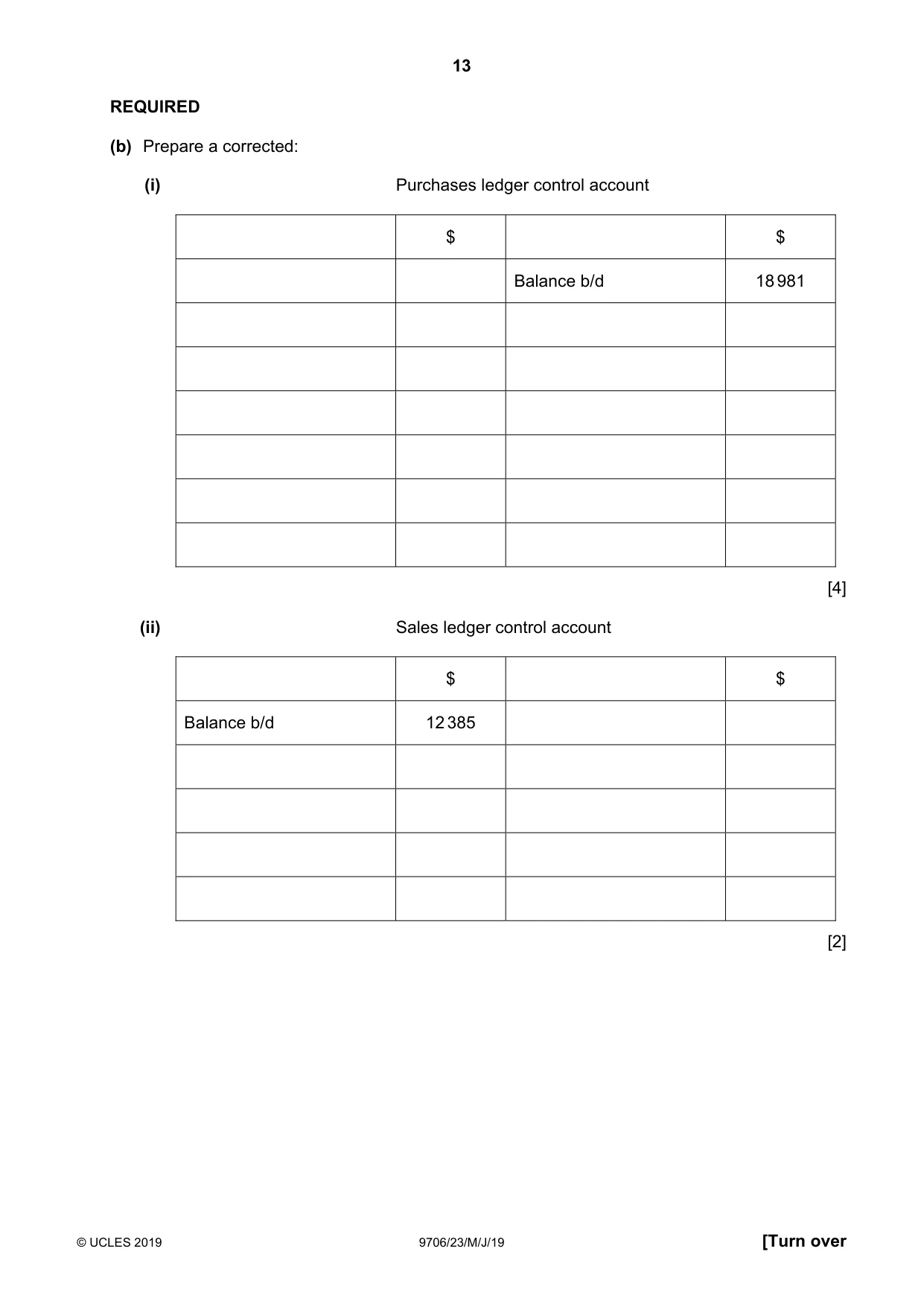
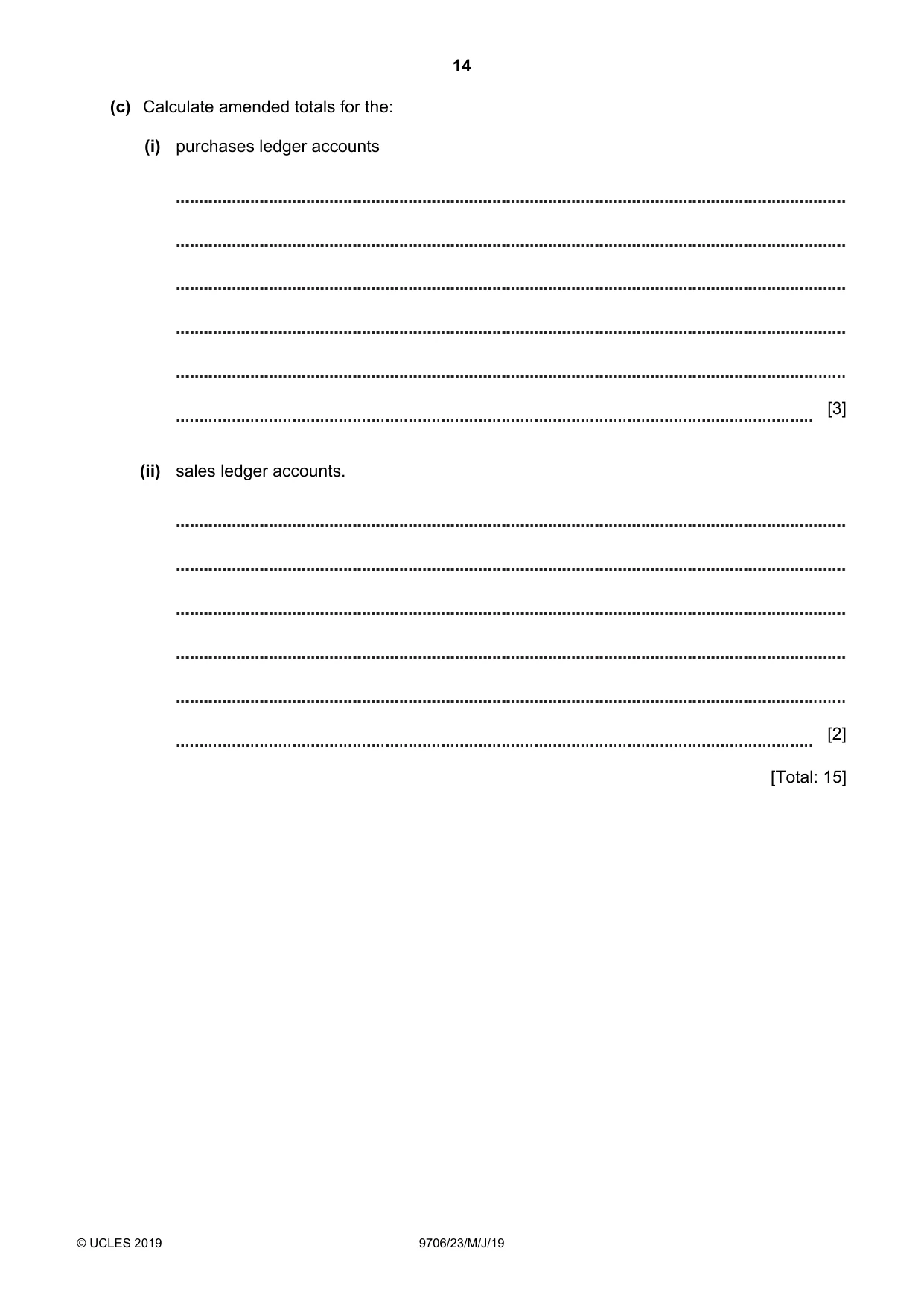
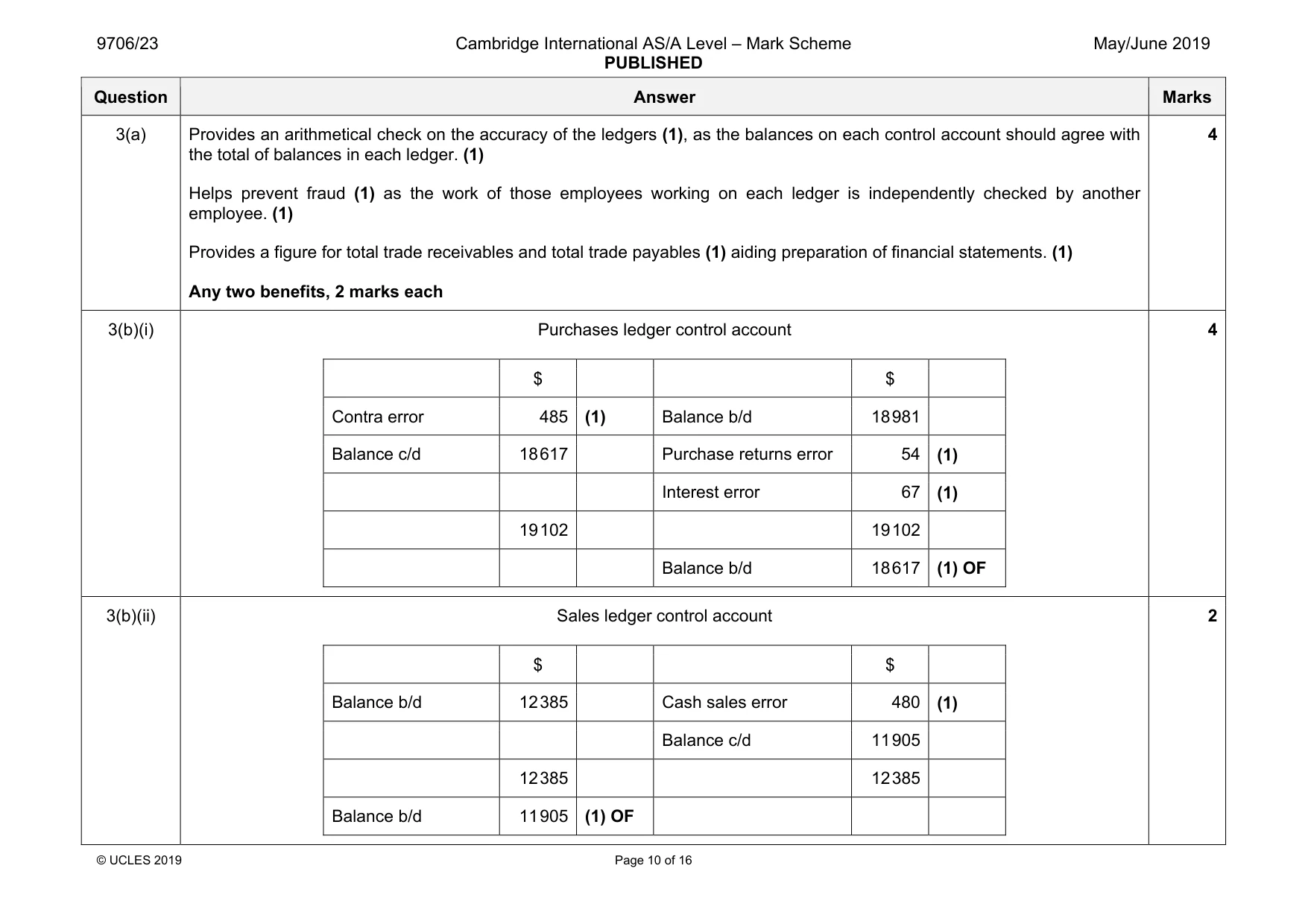
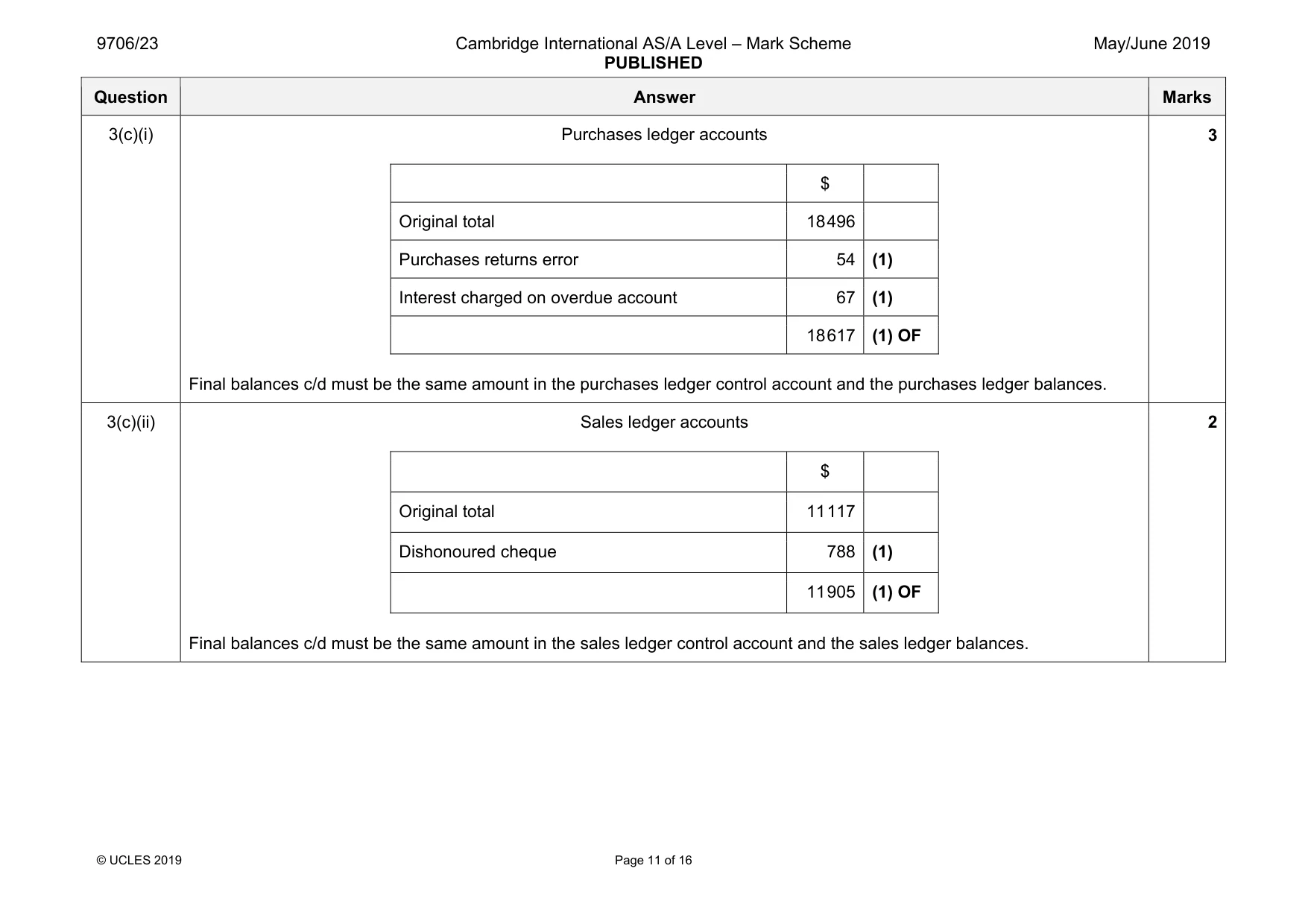
Mark scheme: 3(a) Provides an arithmetical check on the accuracy of the ledgers (1), as the balances on each control account should agree with the total of balances in each ledger. (1) Helps prevent fraud (1) as the work of those employees working on each ledger is independently checked by another employee. (1) Provides a figure for total trade receivables and total trade payables (1) aiding preparation of financial statements. (1) Any two benefits, 2 marks each 4 3(b)(i) Purchases ledger control account $ $ Contra error 485 (1) Balance b/d 18 981 Balance c/d 18 617 Purchase returns error 54 (1) Interest error 67 (1) 19 102 19 102 Balance b/d 18 617 (1) OF 4 3(b)(ii) Sales ledger control account $ $ Balance b/d 12 385 Cash sales error 480 (1) Balance c/d 11 905 12 385 12 385 Balance b/d 11 905 (1) OF 2 Question Answer Marks 3(c)(i) Purchases ledger accounts $ Original total 18 496 Purchases returns error 54 (1) Interest charged on overdue account 67 (1) 18 617 (1) OF Final balances c/d must be the same amount in the purchases ledger control account and the purchases ledger balances. 3 3(c)(ii) Sales ledger accounts $ Original total 11 117 Dishonoured cheque 788 (1) 11 905 (1) OF Final balances c/d must be the same amount in the sales ledger control account and the sales ledger balances. 2
Q4 · Cost of dissolution, $2350, was paid from the bank account
4 Cost of dissolution, $2350, was paid from the bank account. REQUIRED (b) Prepare the partnership realisation account. [7] (c) Calculate the amount to be paid to, or to be received from, John on dissolution. [5] [Total: 15] PLEASE TURN OVER
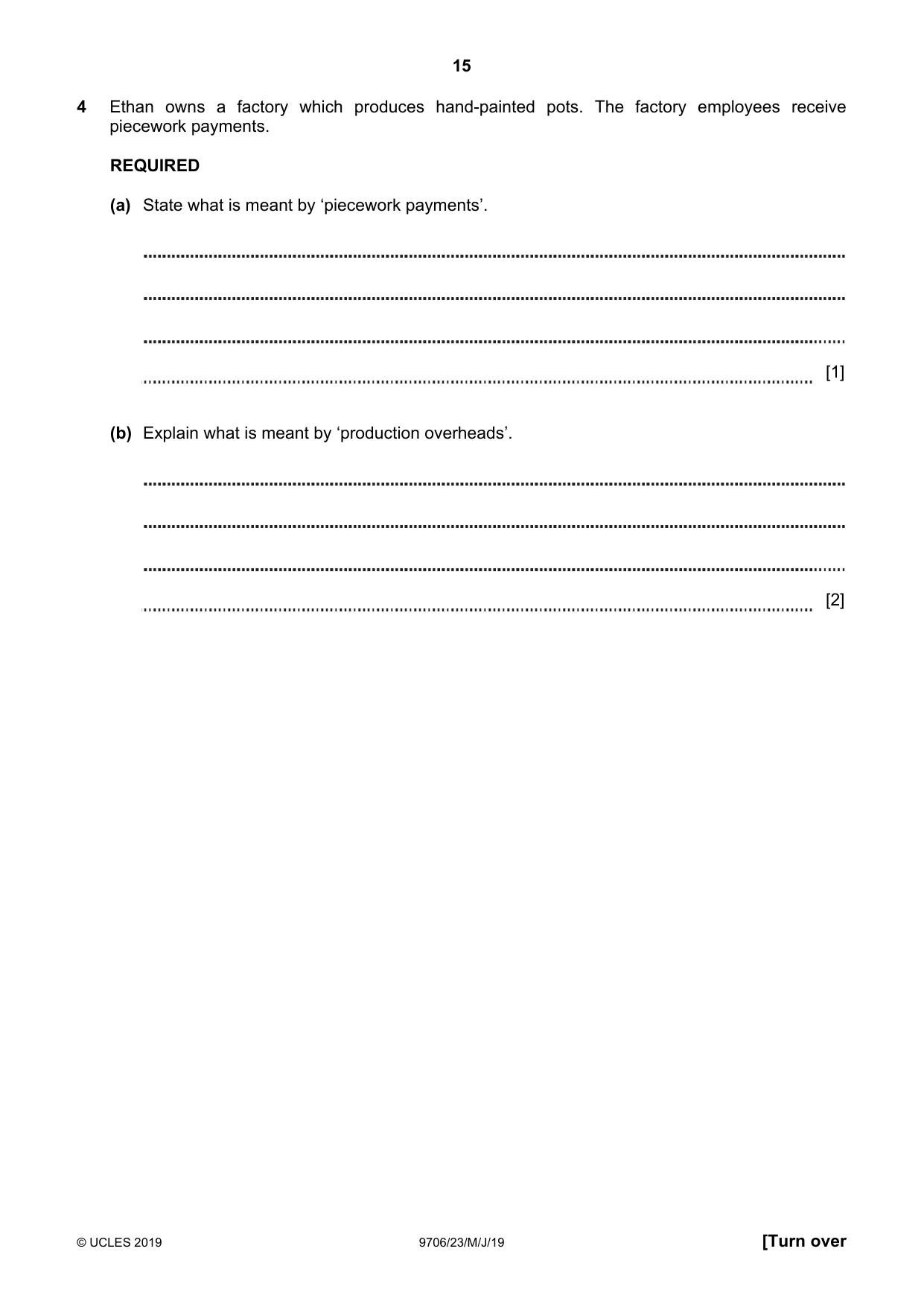
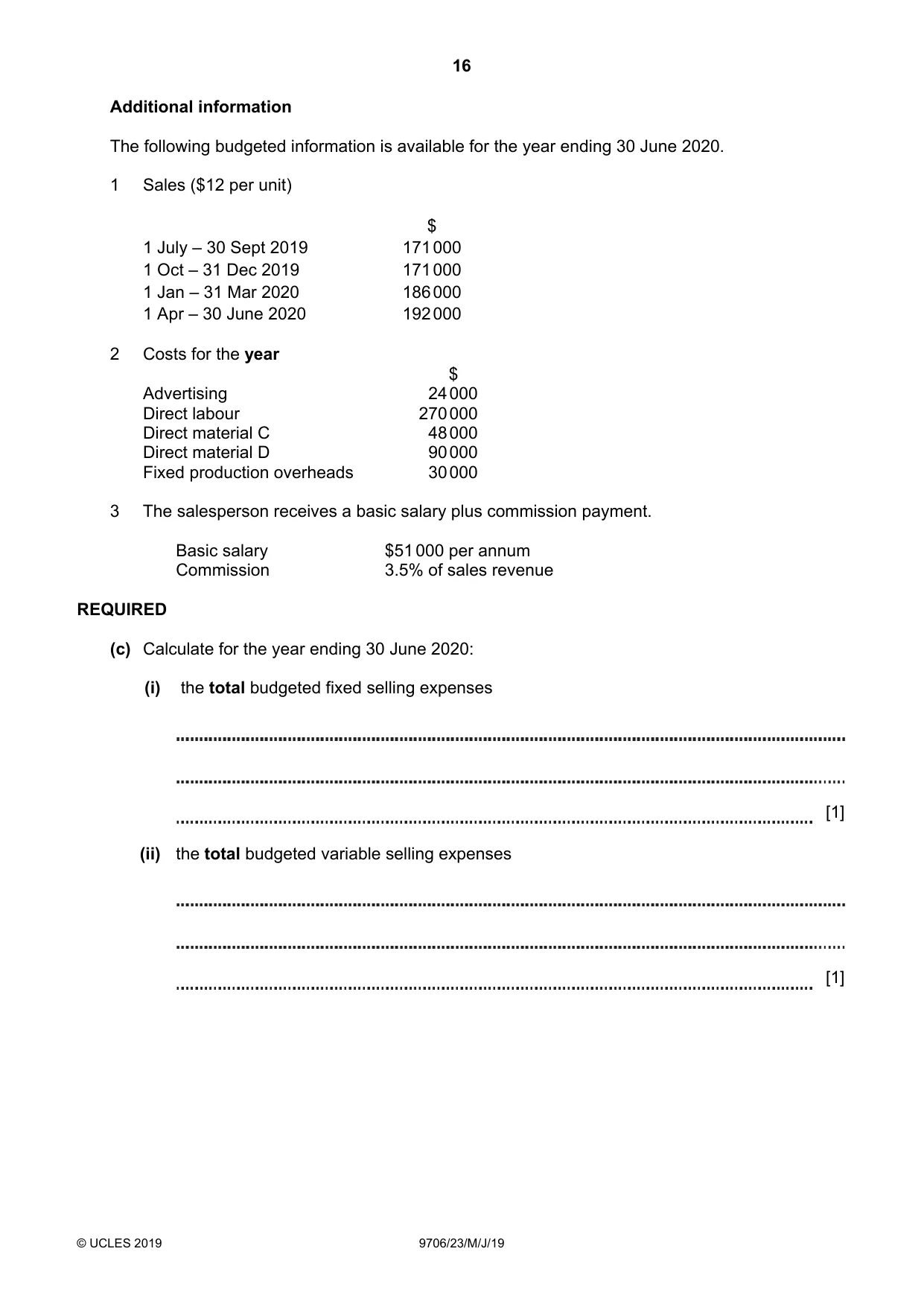
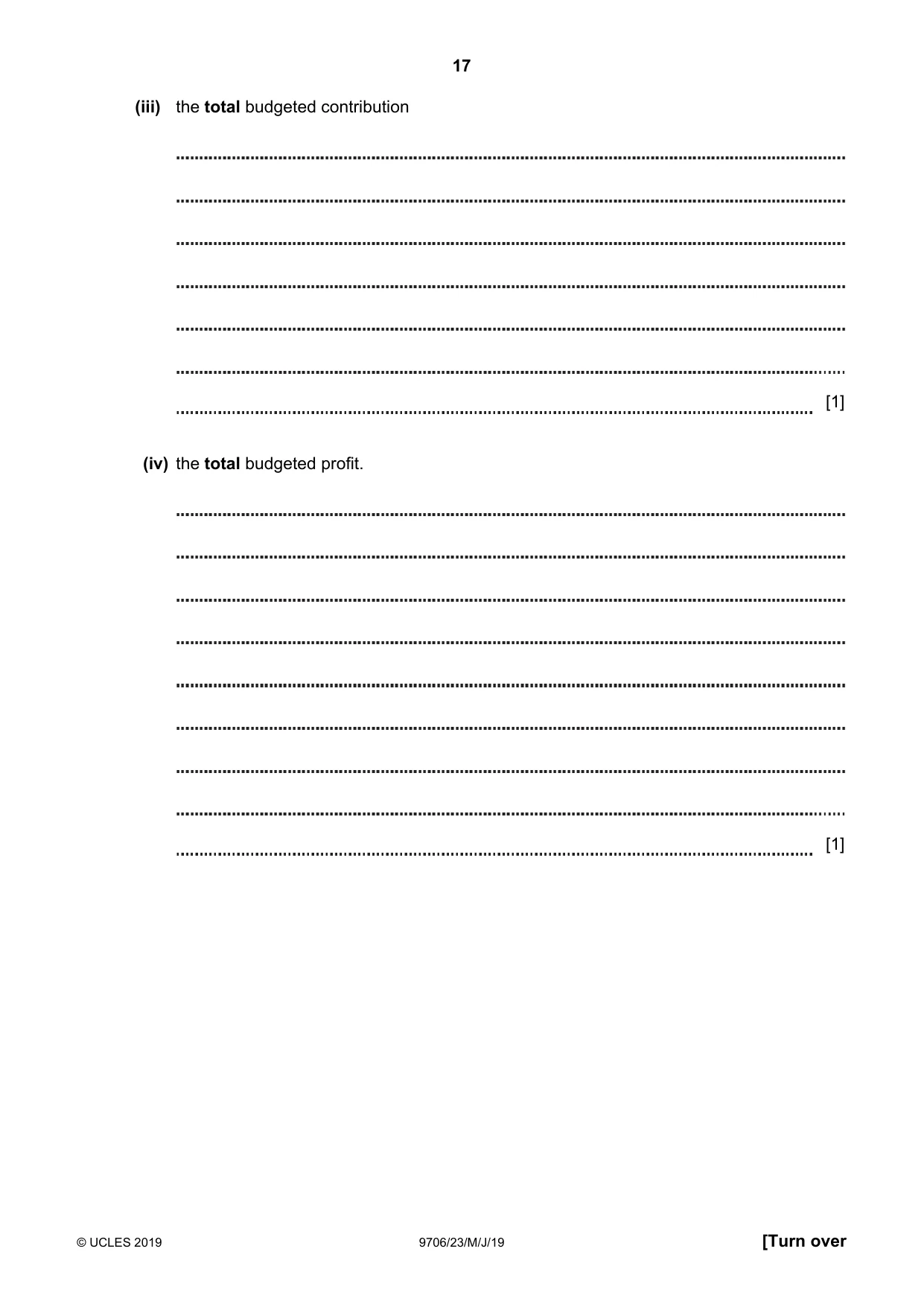
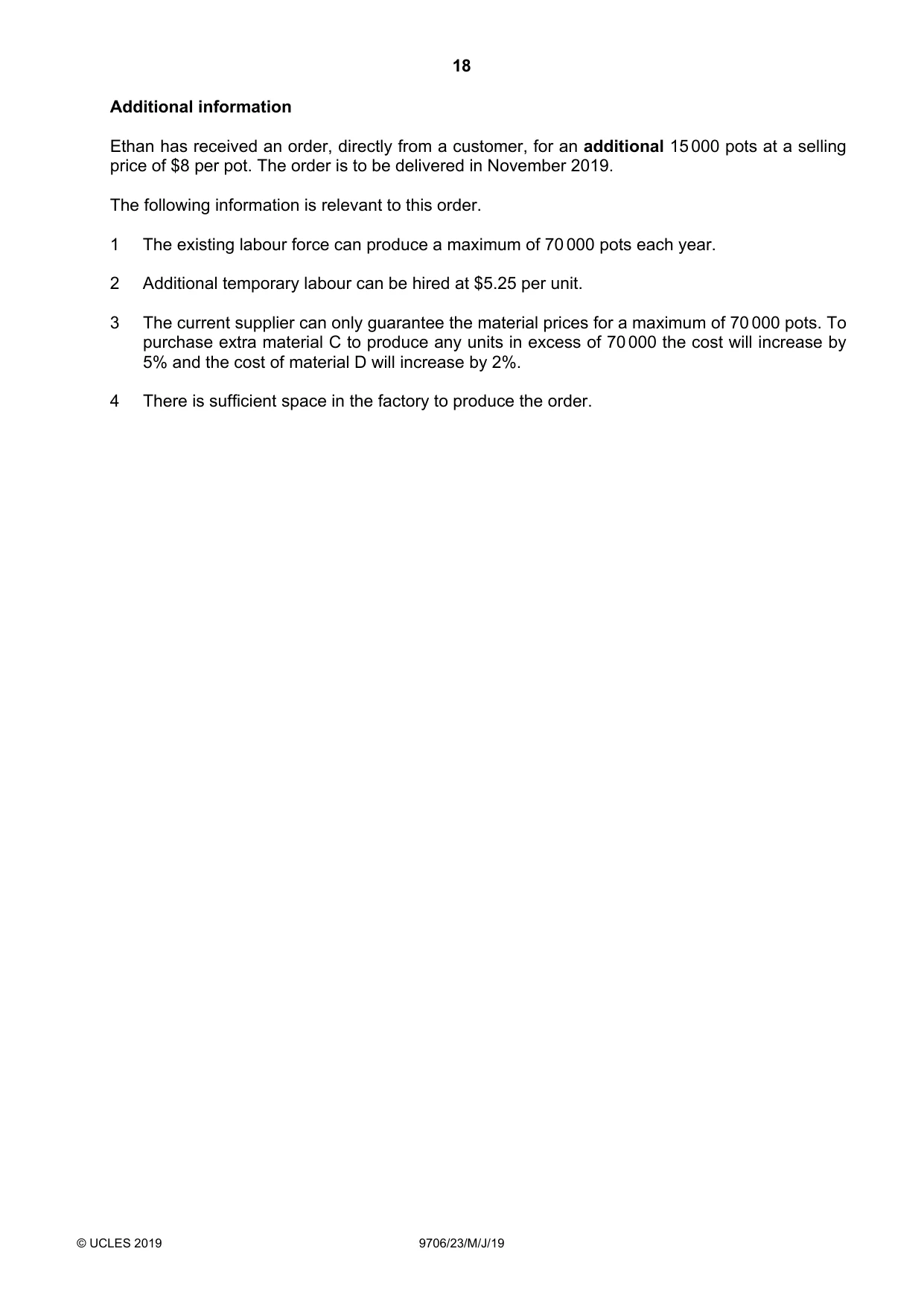
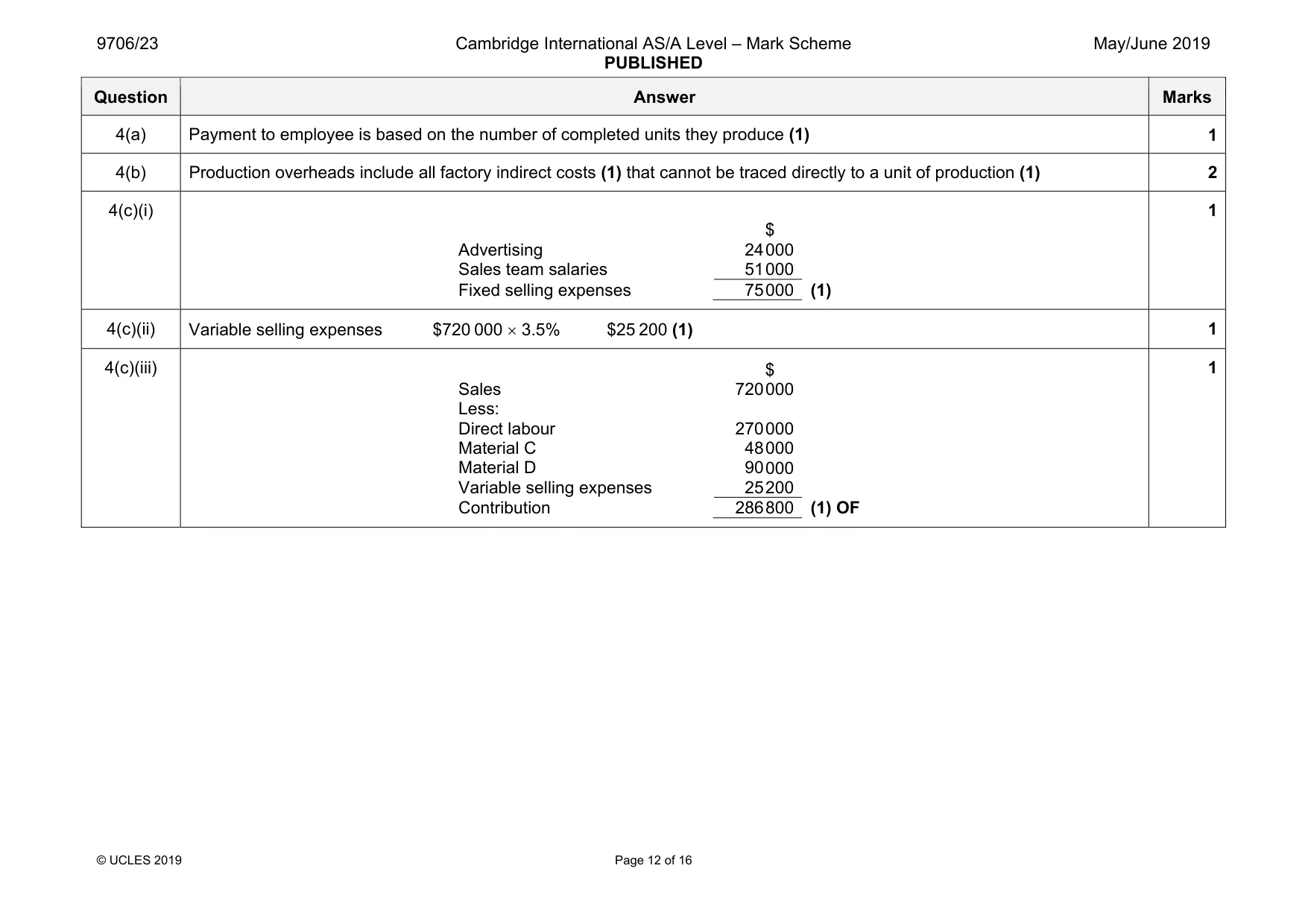
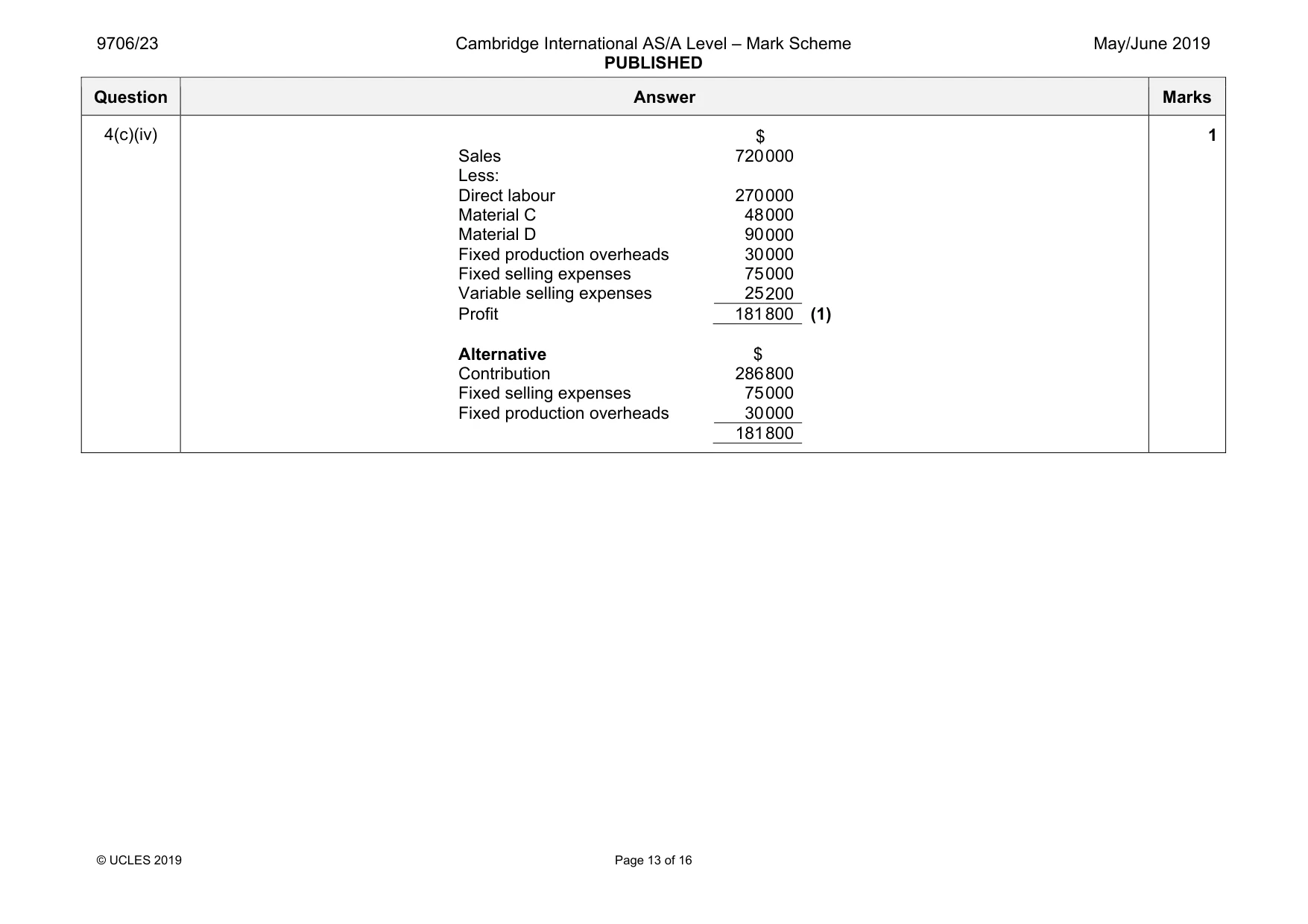
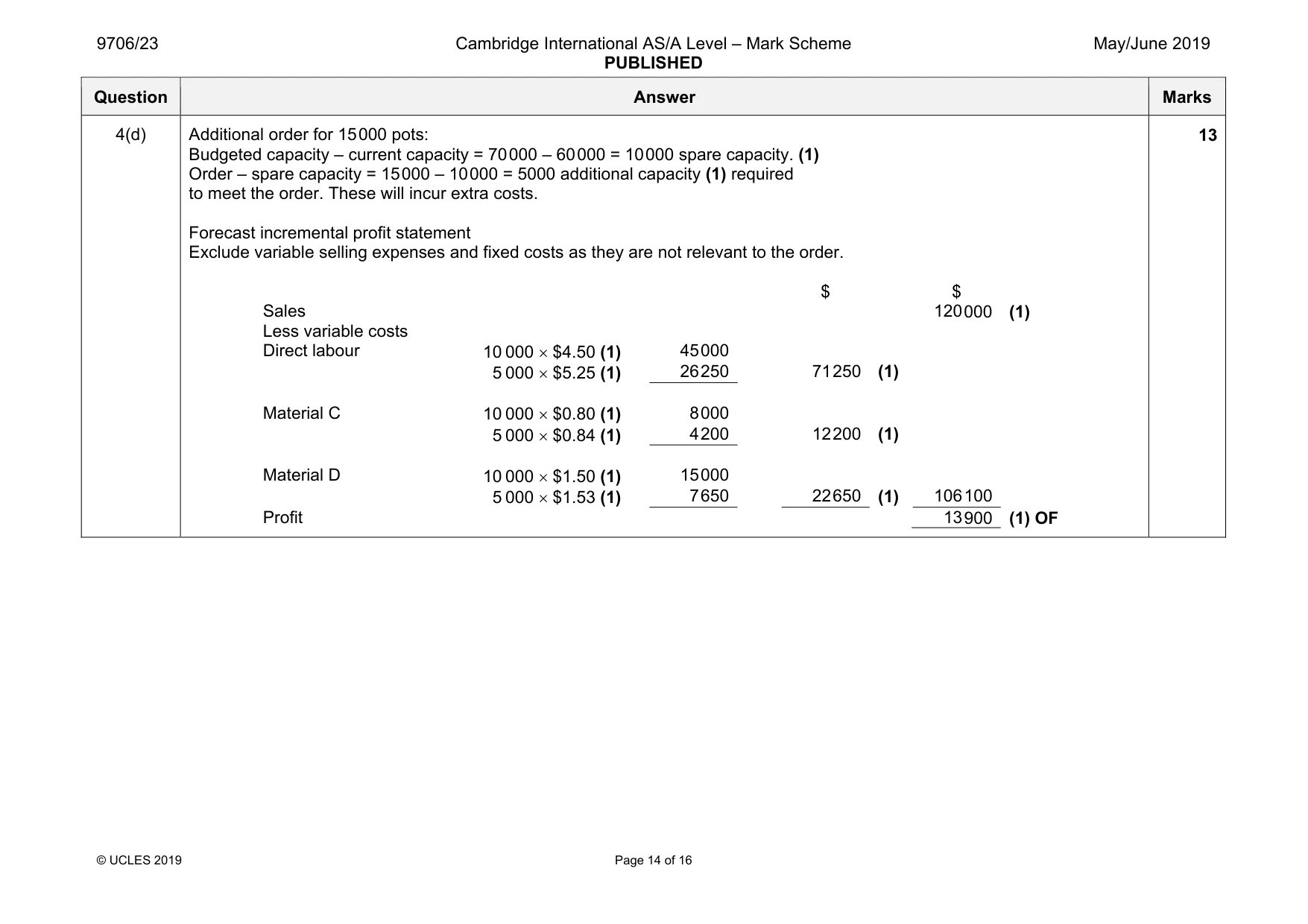
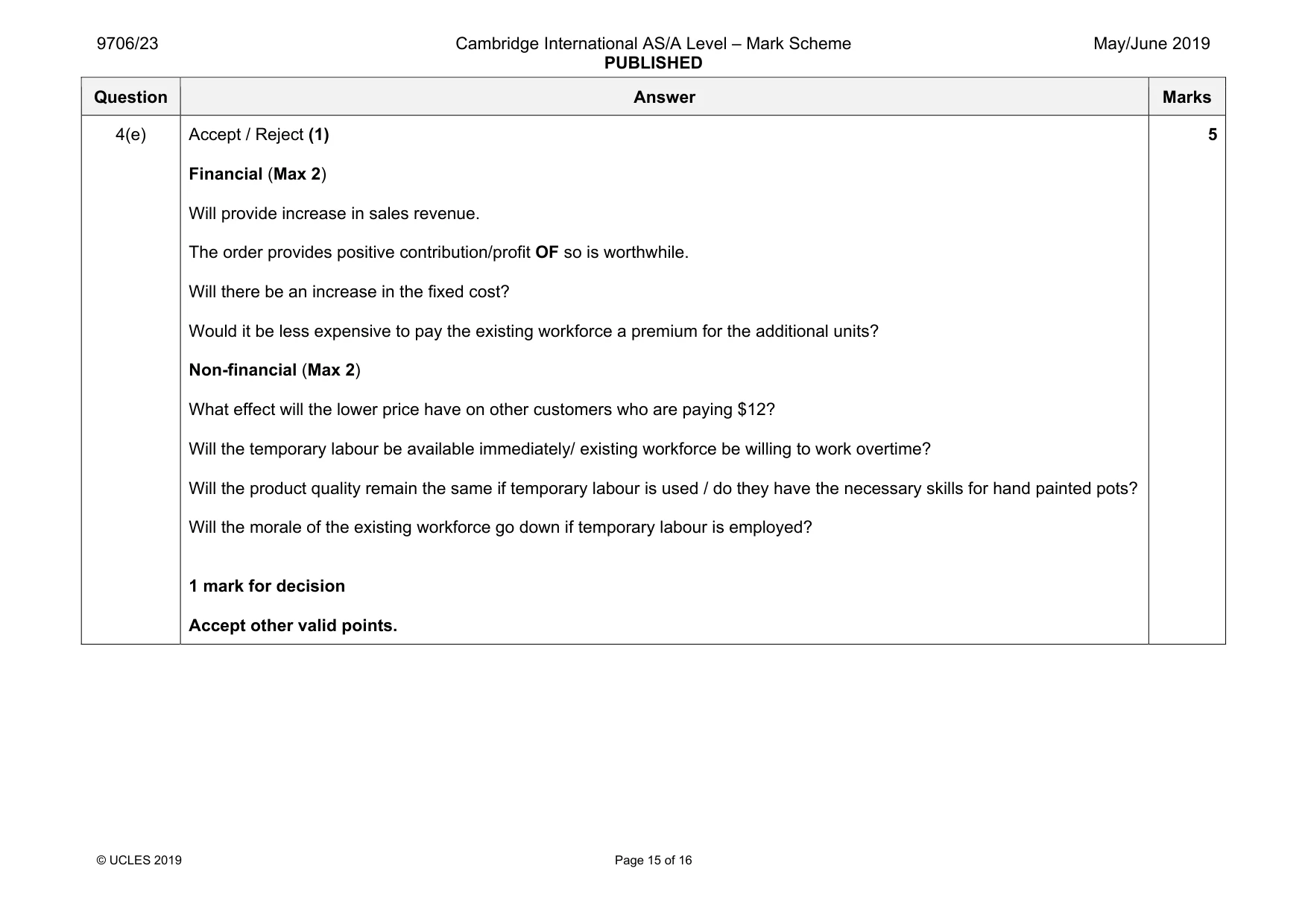
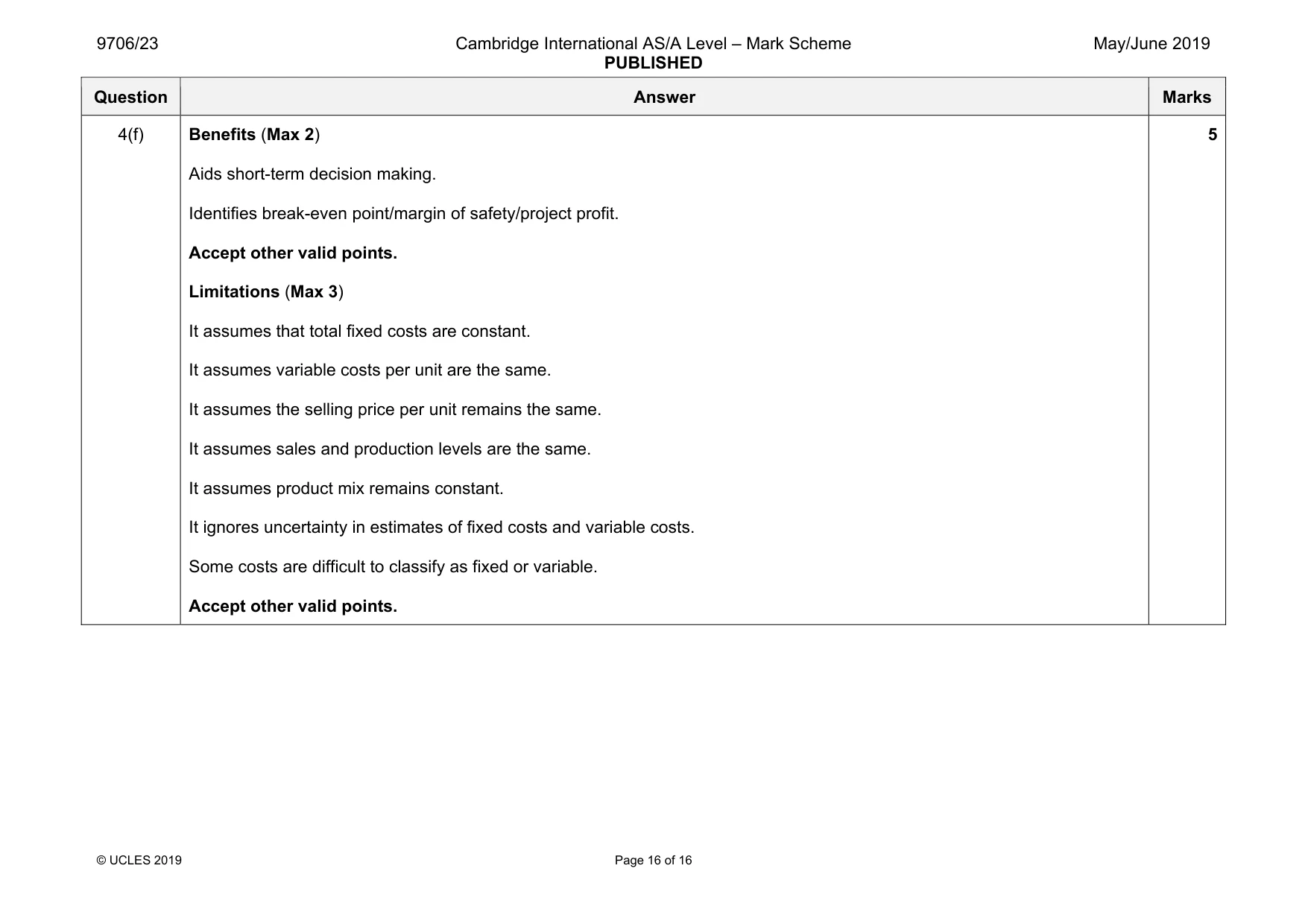
Mark scheme: 4(a) Payment to employee is based on the number of completed units they produce (1) 1 4(b) Production overheads include all factory indirect costs (1) that cannot be traced directly to a unit of production (1) 2 4(c)(i) $ Advertising 24 000 Sales team salaries 51 000 Fixed selling expenses 75 000 (1) 1 4(c)(ii) Variable selling expenses $720 000 × 3.5% $25 200 (1) 1 4(c)(iii) $ Sales 720 000 Less: Direct labour 270 000 Material C 48 000 Material D 90 000 Variable selling expenses 25 200 Contribution 286 800 (1) OF 1 Question Answer Marks 4(c)(iv) $ Sales 720 000 Less: Direct labour 270 000 Material C 48 000 Material D 90 000 Fixed production overheads 30 000 Fixed selling expenses 75 000 Variable selling expenses 25 200 Profit 181 800 (1) Alternative $ Contribution 286 800 Fixed selling expenses 75 000 Fixed production overheads 30 000 181 800 1 Question Answer Marks 4(d) Additional order for 15 000 pots: Budgeted capacity – current capacity = 70 000 – 60 000 = 10 000 spare capacity. (1) Order – spare capacity = 15 000 – 10 000 = 5000 additional capacity (1) required to meet the order. These will incur extra costs. Forecast incremental profit statement Exclude variable selling expenses and fixed costs as they are not relevant to the order. Sales $ $ 120 000 (1) Less variable costs Direct labour 10 000 × $4.50 (1) 45 000 5 000 × $5.25 (1) 26 250 71 250 (1) Material C 10 000 × $0.80 (1) 8 000 5 000 × $0.84 (1) 4 200 12 200 (1) Material D 10 000 × $1.50 (1) 15 000 5 000 × $1.53 (1) 7 650 22 650 (1) 106 100 Profit 13 900 (1) OF 13 Question Answer Marks 4(e) Accept / Reject (1) Financial (Max 2) Will provide increase in sales revenue. The order provides positive contribution/profit OF so is worthwhile. Will there be an increase in the fixed cost? Would it be less expensive to pay the existing workforce a premium for the additional units? Non-financial (Max 2) What effect will the lower price have on other customers who are paying $12? Will the temporary labour be available immediately/ existing workforce be willing to work overtime? Will the product quality remain the same if temporary labour is used / do they have the necessary skills for hand painted pots? Will the morale of the existing workforce go down if temporary labour is employed? 1 mark for decision Accept other valid points. 5 Question Answer Marks 4(f) Benefits (Max 2) Aids short-term decision making. Identifies break-even point/margin of safety/project profit. Accept other valid points. Limitations (Max 3) It assumes that total fixed costs are constant. It assumes variable costs per unit are the same. It assumes the selling price per unit remains the same. It assumes sales and production levels are the same. It assumes product mix remains constant. It ignores uncertainty in estimates of fixed costs and variable costs. Some costs are difficult to classify as fixed or variable. Accept other valid points. 5
What was in this paper
The subtopics covered by these 4 questions, and how many questions each got. Open one in a new tab to see every Cambridge question on it.
What you needed in this session
Cambridge’s own grade thresholds for 2019 May/June, Paper 2 · Variant 3. A higher threshold means an easier paper — the bar moves with how the cohort did.