Cambridge A Level Accounting 9706 — 2019 May/June Paper 2 · Variant 1
9706/21/M/J/19 · 5 questions · 90 marks · ≈101 min
The question paper and its mark scheme, free to read here and free to download. This is Cambridge’s own paper, exactly as it was sat.
Question paper20 pages




Mark scheme14 pages
Answers below. Sit the paper first if you are practising.
Questions as text
Q1 · Ahmed and Raji are in partnership as retailers but have not maintained full accounting…
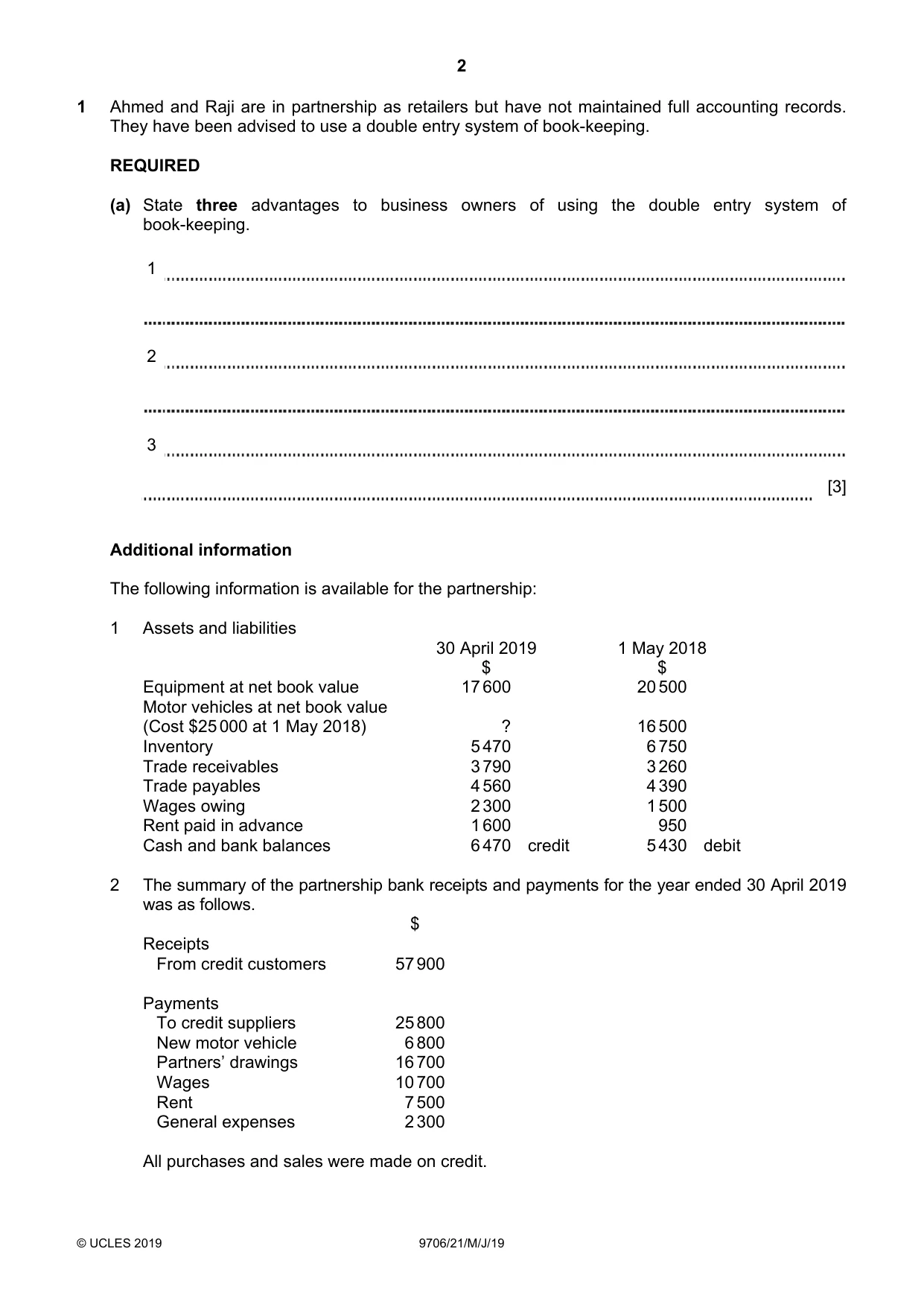
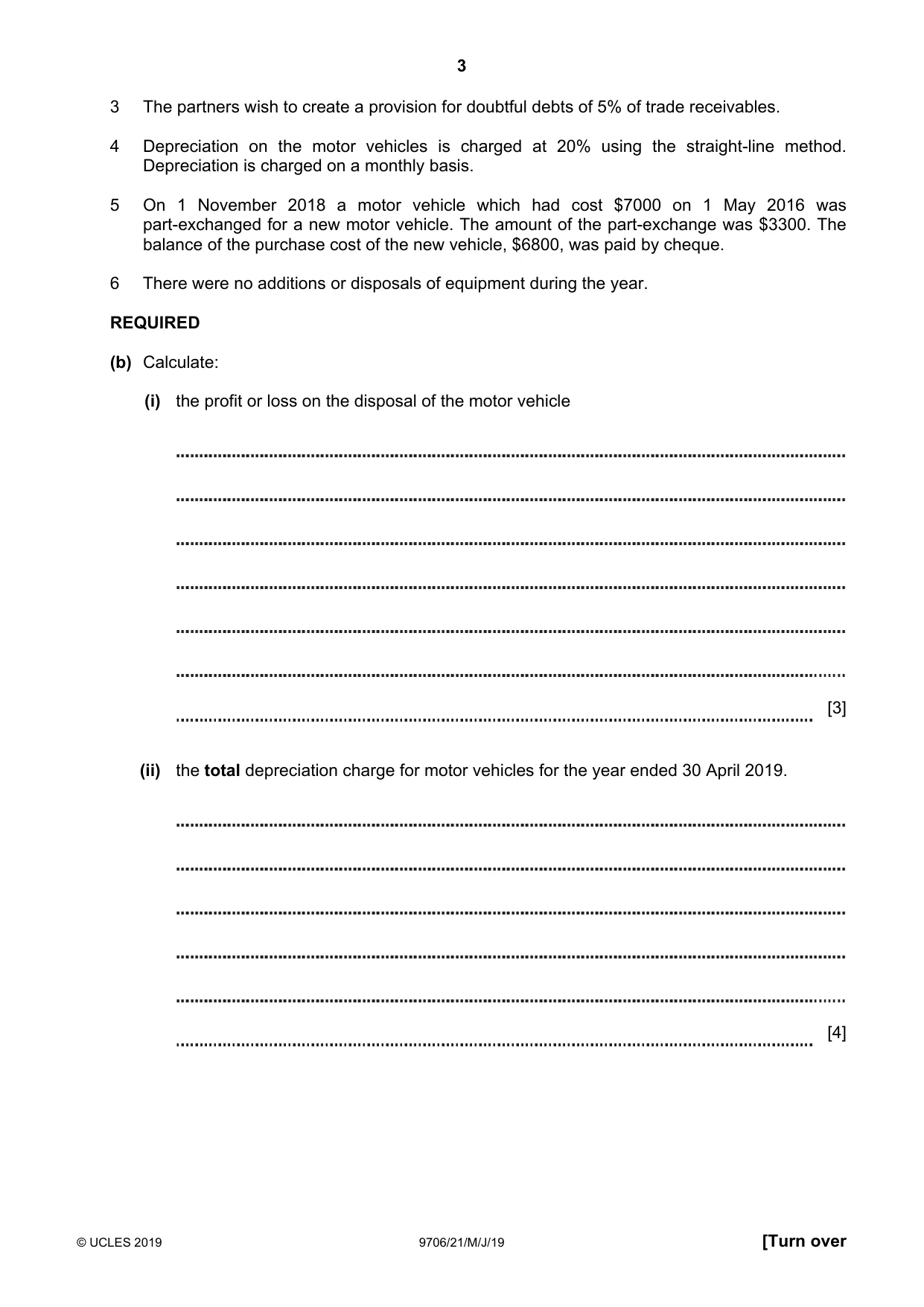
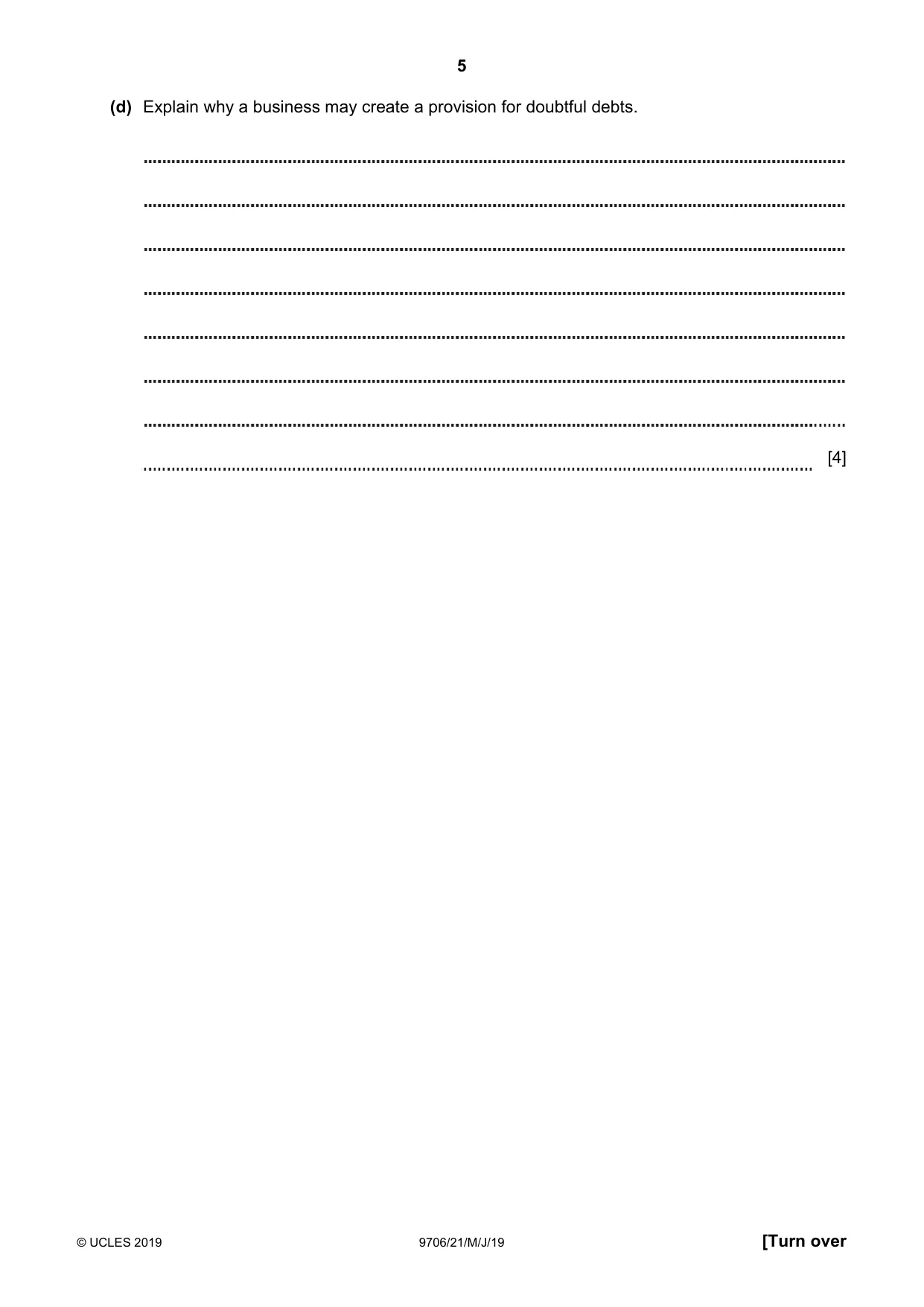
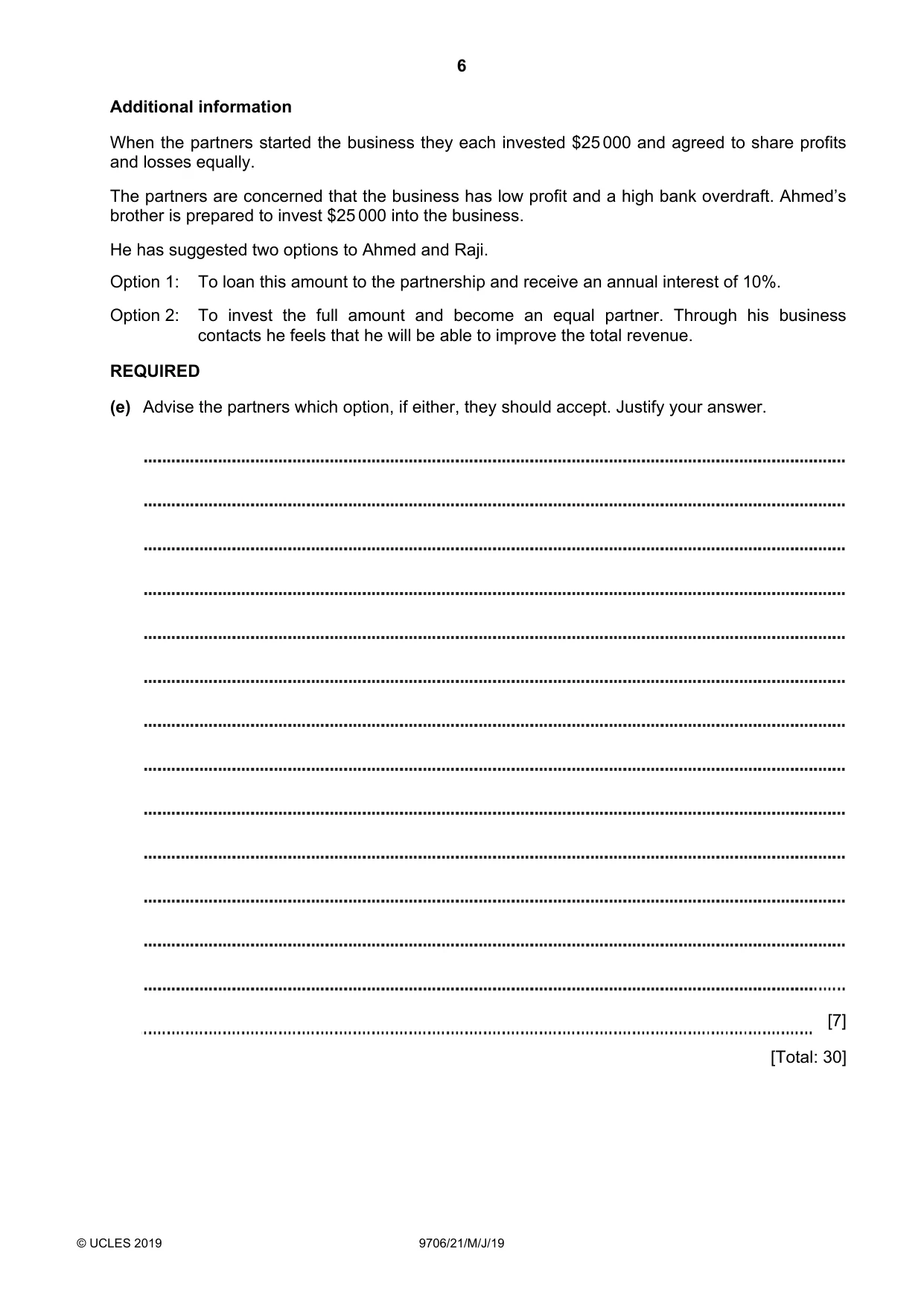
1 Ahmed and Raji are in partnership as retailers but have not maintained full accounting records. They have been advised to use a double entry system of book-keeping. REQUIRED (a) State three advantages to business owners of using the double entry system of book-keeping. 1 2 3 [3] Additional information The following information is available for the partnership: 1 Assets and liabilities 30 April 2019 1 May 2018 $ $ Equipment at net book value 17 600 20 500 Motor vehicles at net book value (Cost $25 000 at 1 May 2018) ? 16 500 Inventory 5 470 6 750 Trade receivables 3 790 3 260 Trade payables 4 560 4 390 Wages owing 2 300 1 500 Rent paid in advance 1 600 950 Cash and bank balances 6 470 credit 5 430 debit 2 The summary of the partnership bank receipts and payments for the year ended 30 April 2019 was as follows. $ Receipts From credit customers 57 900 Payments To credit suppliers 25 800 New motor vehicle 6 800 Partners’ drawings 16 700 Wages 10 700 Rent 7 500 General expenses 2 300 All purchases and sales were made on credit. 3 The partners wish to create a provision for doubtful debts of 5% of trade receivables. 4 Depreciation on the motor vehicles is charged at 20% using the straight-line method. Depreciation is charged on a monthly basis. 5 On 1 November 2018 a motor vehicle which had cost $7000 on 1 May 2016 was part-exchanged for a new motor vehicle. The amount of the part-exchange was $3300. The balance of the purchase cost of the new vehicle, $6800, was paid by cheque. 6 There were no additions or disposals of equipment during the year. REQUIRED (b) Calculate: (i) the profit or loss on the disposal of the motor vehicle [3] (ii) the total depreciation charge for motor vehicles for the year ended 30 April 2019. [4] (c) Prepare the income statement for the partnership for the year ended 30 April 2019. [9] (d) Explain why a business may create a provision for doubtful debts. [4] Additional information When the partners started the business they each invested $25 000 and agreed to share profits and losses equally. The partners are concerned that the business has low profit and a high bank overdraft. Ahmed’s brother is prepared to invest $25 000 into the business. He has suggested two options to Ahmed and Raji. Option 1: To loan this amount to the partnership and receive an annual interest of 10%. Option 2: To invest the full amount and become an equal partner. Through his business contacts he feels that he will be able to improve the total revenue. REQUIRED (e) Advise the partners which option, if either, they should accept. Justify your answer. [7] [Total: 30] PLEASE TURN OVER
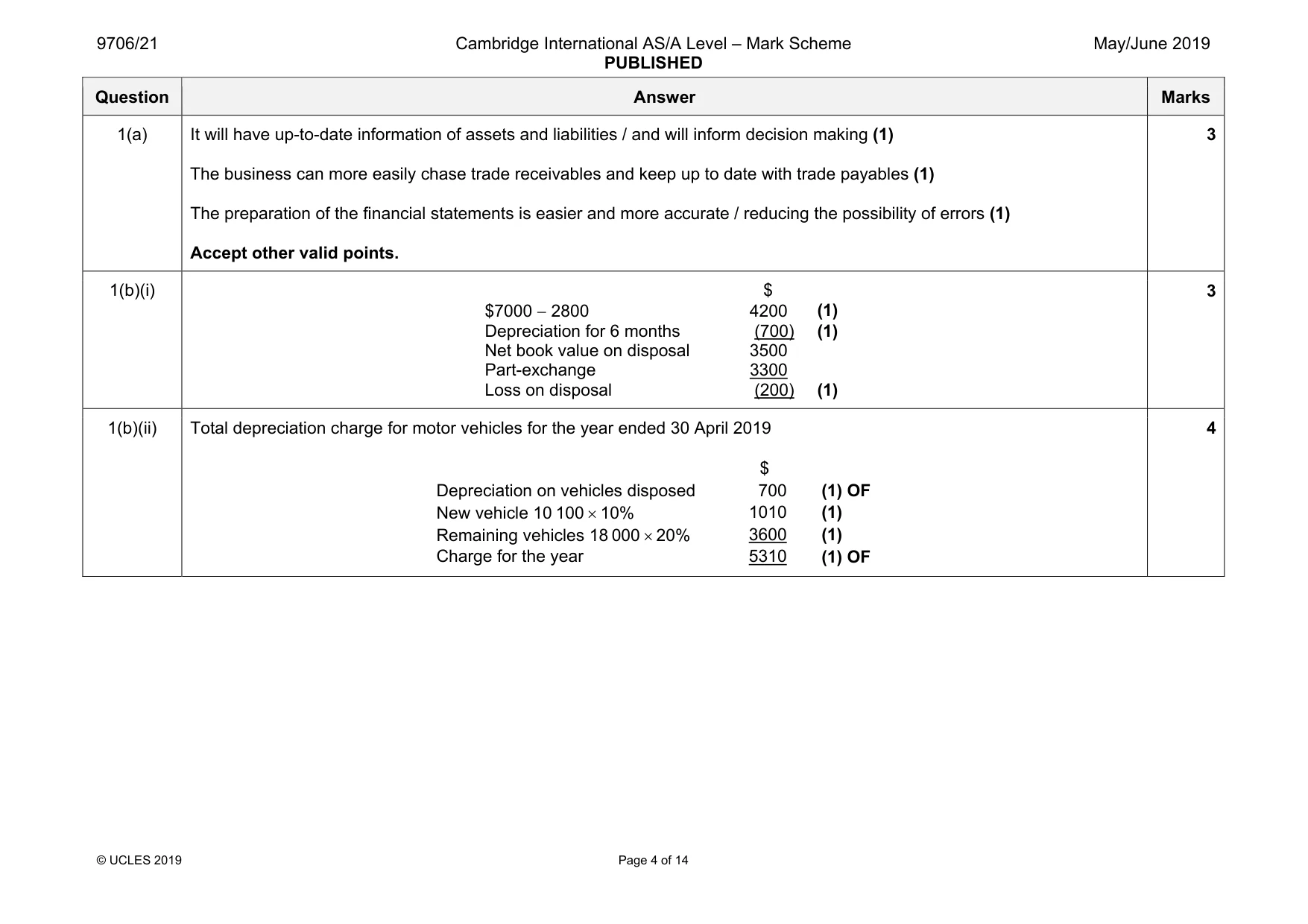
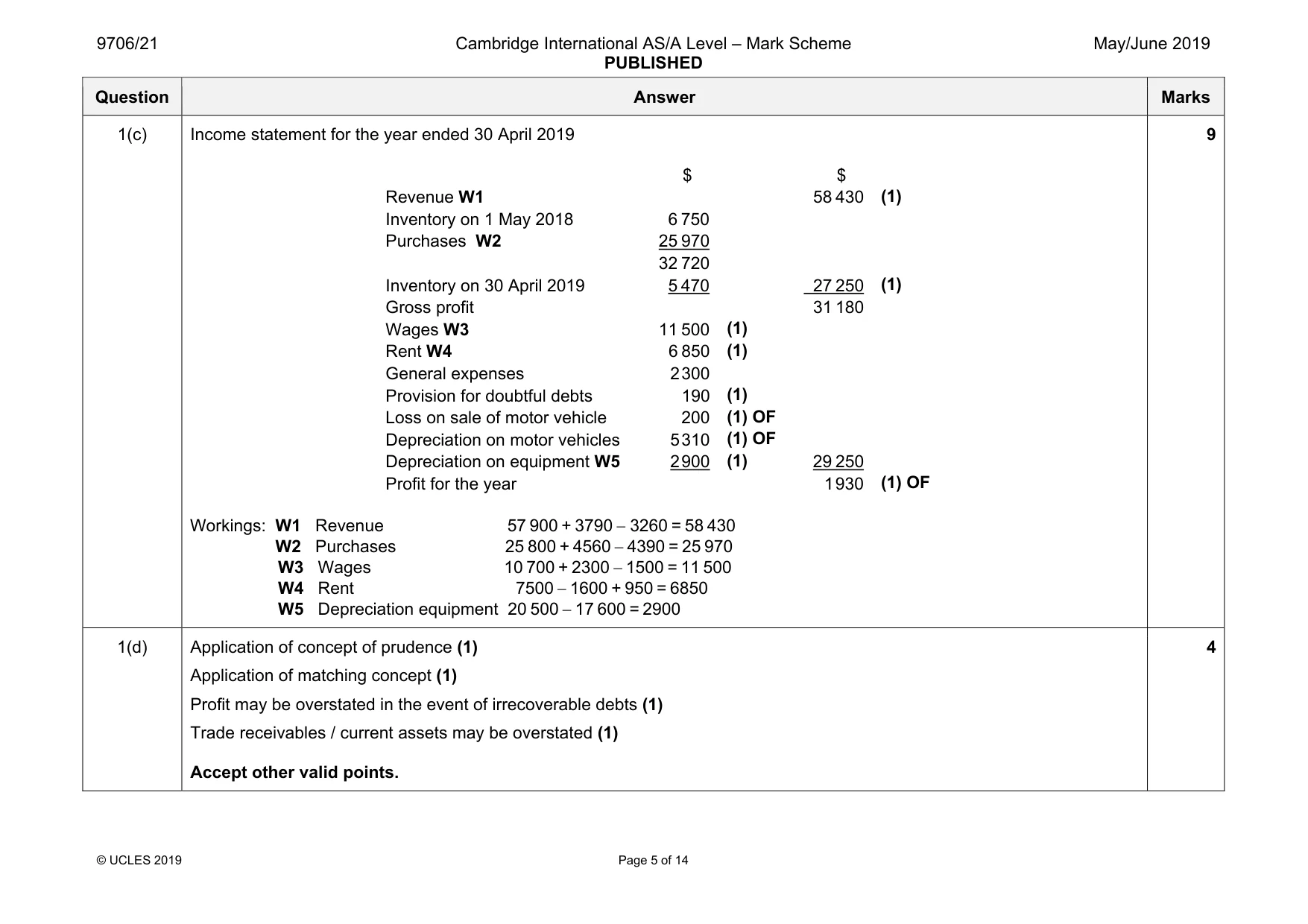
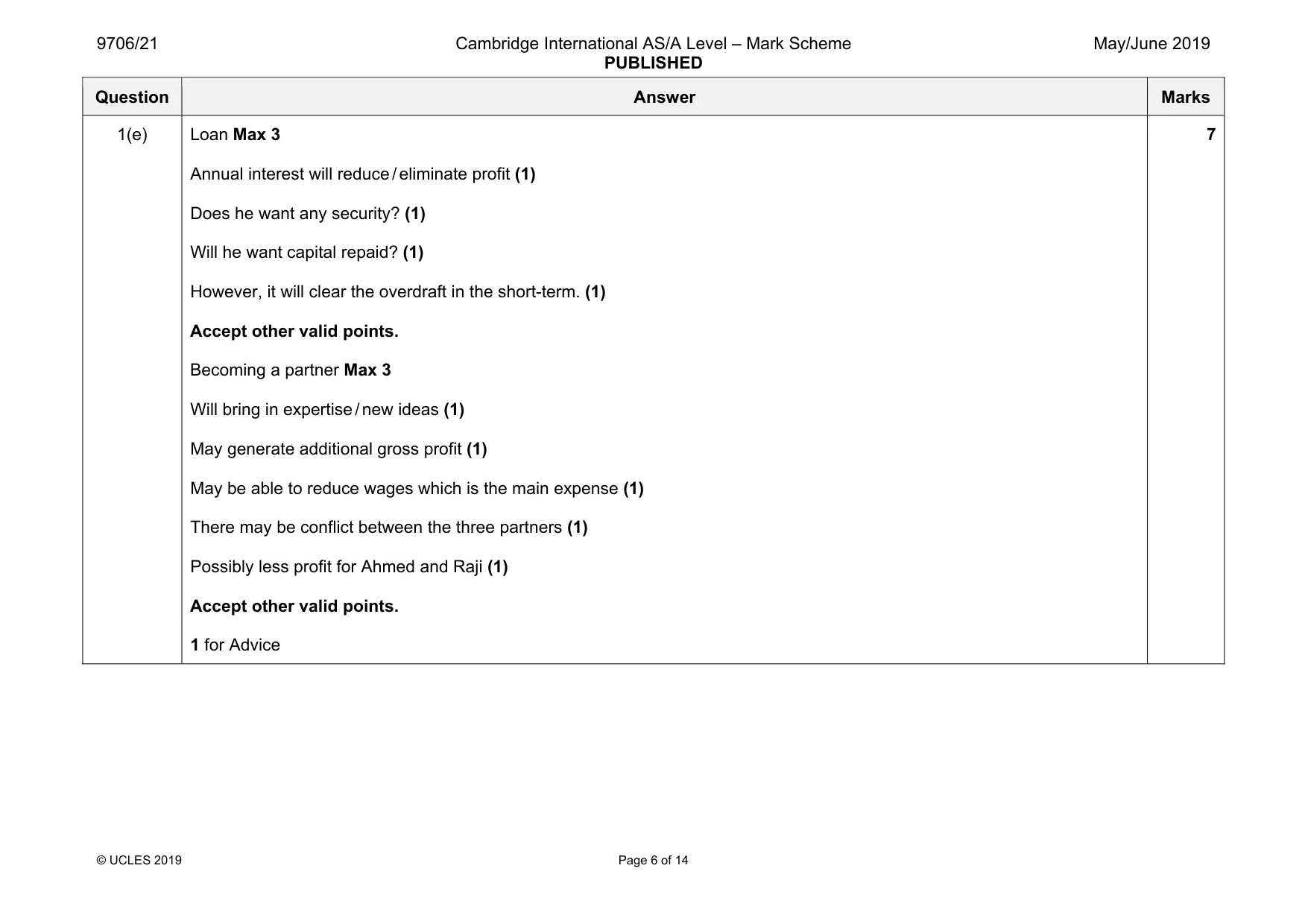
Mark scheme: 1(a) It will have up-to-date information of assets and liabilities / and will inform decision making (1) The business can more easily chase trade receivables and keep up to date with trade payables (1) The preparation of the financial statements is easier and more accurate / reducing the possibility of errors (1) Accept other valid points. 3 1(b)(i) $ $7000 − 2800 4200 (1) Depreciation for 6 months (700) (1) Net book value on disposal 3500 Part-exchange 3300 Loss on disposal (200) (1) 3 1(b)(ii) Total depreciation charge for motor vehicles for the year ended 30 April 2019 $ Depreciation on vehicles disposed 700 (1) OF New vehicle 10 100 × 10% 1010 (1) Remaining vehicles 18 000 × 20% 3600 (1) Charge for the year 5310 (1) OF 4 Question Answer Marks 1(c) Income statement for the year ended 30 April 2019 $ $ Revenue W1 58 430 (1) Inventory on 1 May 2018 6 750 Purchases W2 25 970 32 720 Inventory on 30 April 2019 5 470 27 250 (1) Gross profit 31 180 Wages W3 11 500 (1) Rent W4 6 850 (1) General expenses 2 300 Provision for doubtful debts 190 (1) Loss on sale of motor vehicle 200 (1) OF Depreciation on motor vehicles 5 310 (1) OF Depreciation on equipment W5 2 900 (1) 29 250 Profit for the year 1 930 (1) OF Workings: W1 Revenue 57 900 + 3790 − 3260 = 58 430 W2 Purchases 25 800 + 4560 − 4390 = 25 970 W3 Wages 10 700 + 2300 − 1500 = 11 500 W4 Rent 7500 − 1600 + 950 = 6850 W5 Depreciation equipment 20 500 − 17 600 = 2900 9 1(d) Application of concept of prudence (1) Application of matching concept (1) Profit may be overstated in the event of irrecoverable debts (1) Trade receivables / current assets may be overstated (1) Accept other valid points. 4 Question Answer Marks 1(e) Loan Max 3 Annual interest will reduce / eliminate profit (1) Does he want any security? (1) Will he want capital repaid? (1) However, it will clear the overdraft in the short-term. (1) Accept other valid points. Becoming a partner Max 3 Will bring in expertise / new ideas (1) May generate additional gross profit (1) May be able to reduce wages which is the main expense (1) There may be conflict between the three partners (1) Possibly less profit for Ahmed and Raji (1) Accept other valid points. 1 for Advice 7
Q2 · Lawrence provided the following information at 30 November 2018
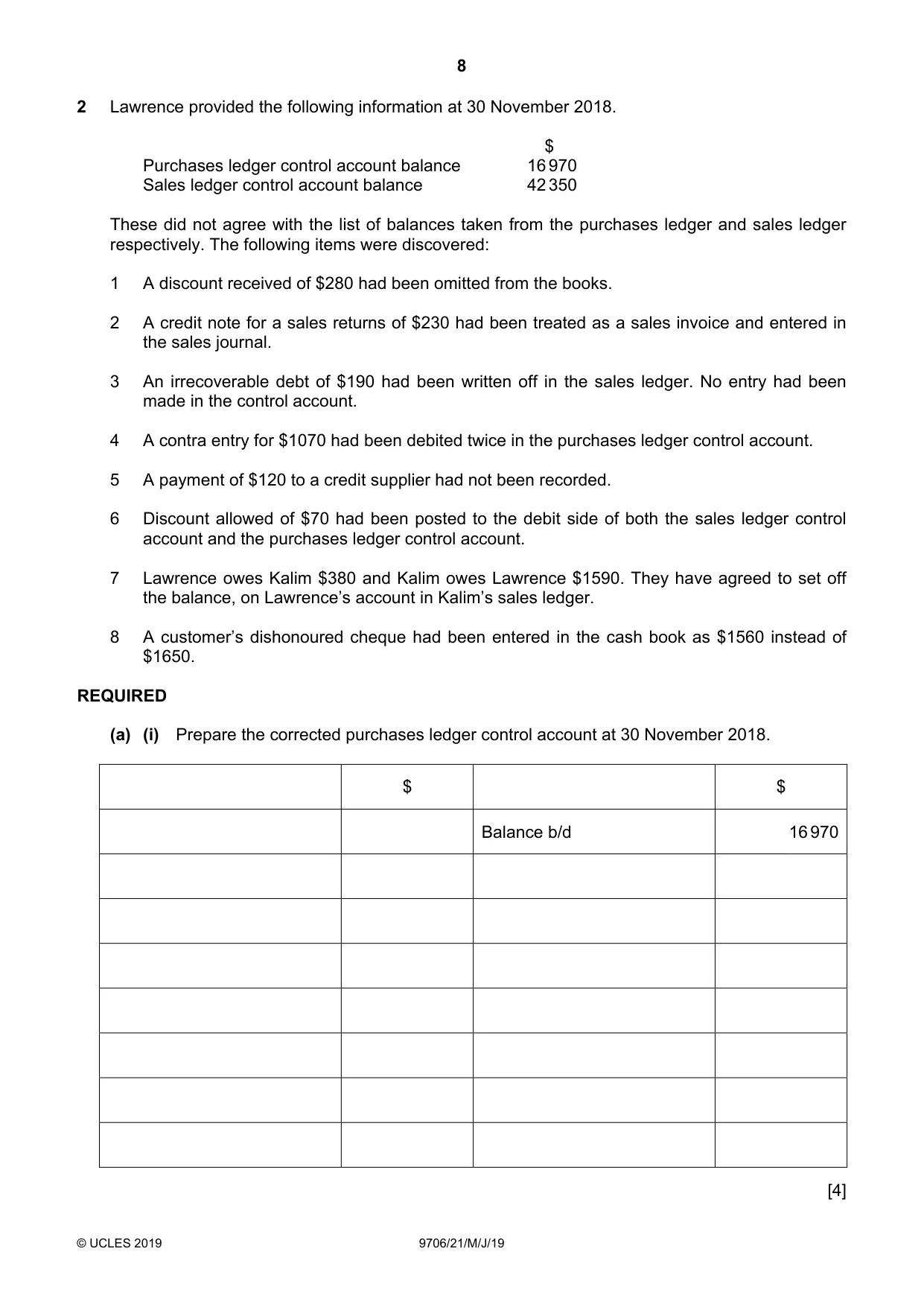
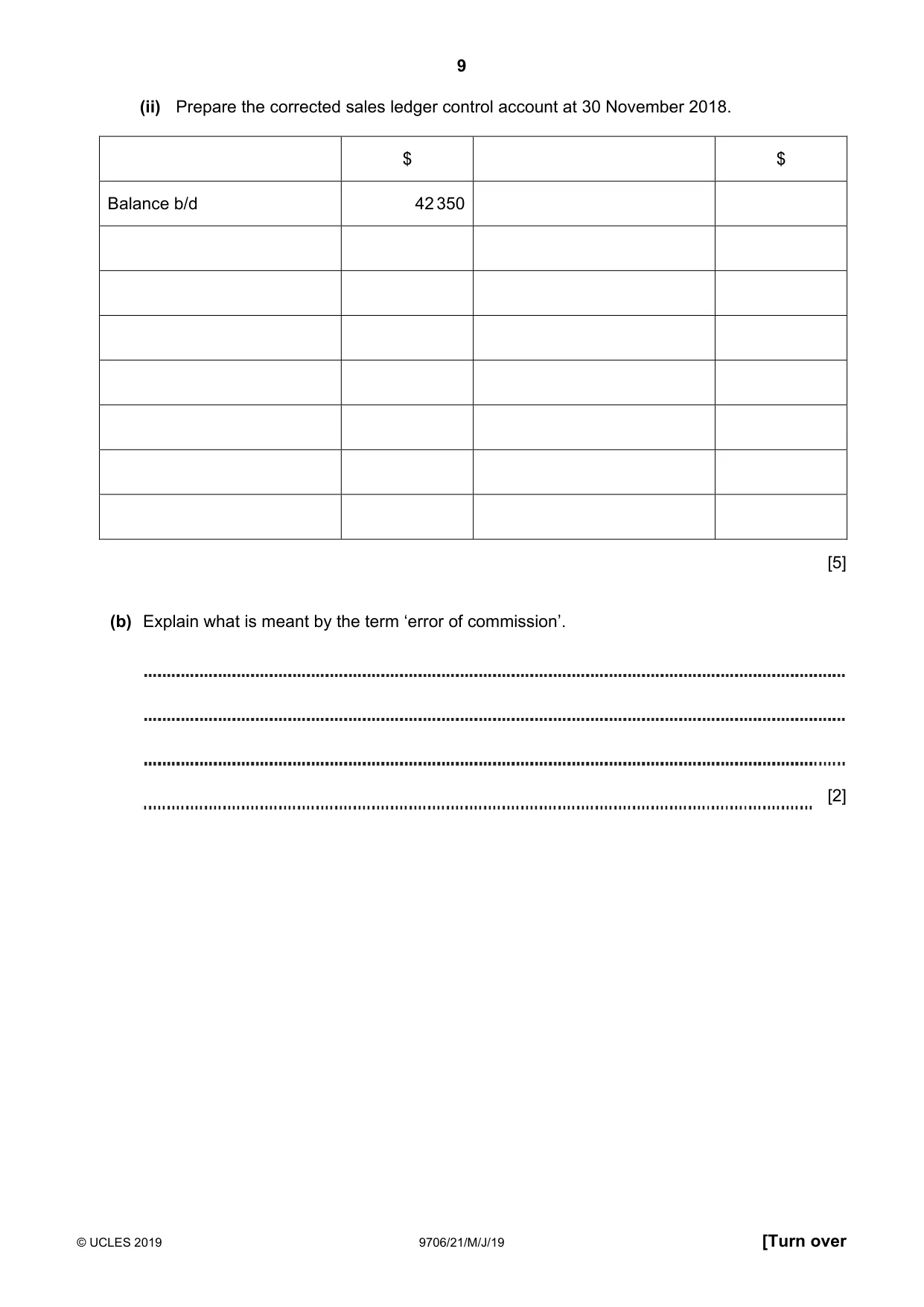
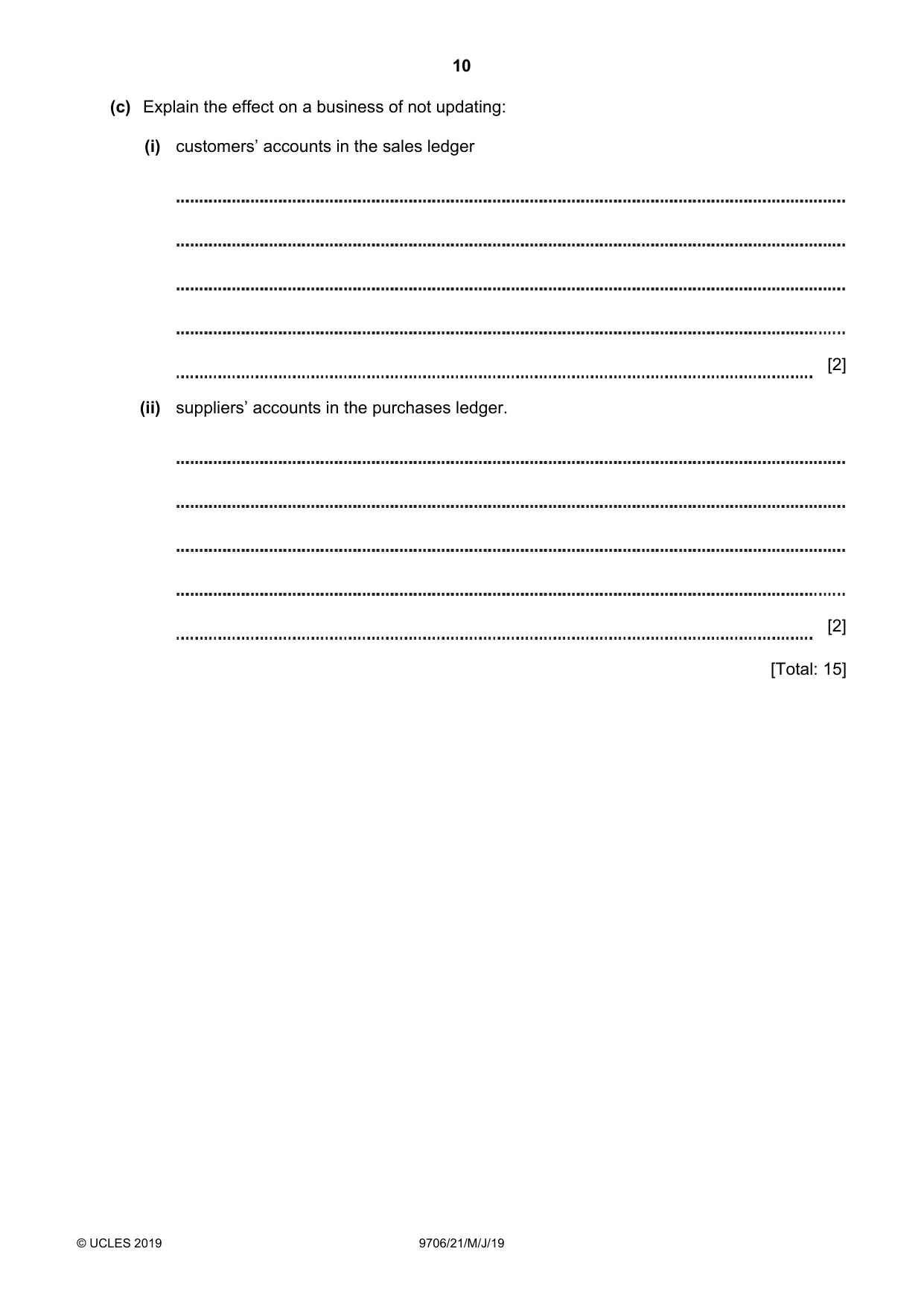
2 Lawrence provided the following information at 30 November 2018. $ Purchases ledger control account balance 16 970 Sales ledger control account balance 42 350 These did not agree with the list of balances taken from the purchases ledger and sales ledger respectively. The following items were discovered: 1 A discount received of $280 had been omitted from the books. 2 A credit note for a sales returns of $230 had been treated as a sales invoice and entered in the sales journal. 3 An irrecoverable debt of $190 had been written off in the sales ledger. No entry had been made in the control account. 4 A contra entry for $1070 had been debited twice in the purchases ledger control account. 5 A payment of $120 to a credit supplier had not been recorded. 6 Discount allowed of $70 had been posted to the debit side of both the sales ledger control account and the purchases ledger control account. 7 Lawrence owes Kalim $380 and Kalim owes Lawrence $1590. They have agreed to set off the balance, on Lawrence’s account in Kalim’s sales ledger. 8 A customer’s dishonoured cheque had been entered in the cash book as $1560 instead of $1650. REQUIRED (a) (i) Prepare the corrected purchases ledger control account at 30 November 2018. $ $ Balance b/d 16 970 [4] (ii) Prepare the corrected sales ledger control account at 30 November 2018. $ $ Balance b/d 42 350 [5] (b) Explain what is meant by the term ‘error of commission’. [2] (c) Explain the effect on a business of not updating: (i) customers’ accounts in the sales ledger [2] (ii) suppliers’ accounts in the purchases ledger. [2] [Total: 15] PLEASE TURN OVER
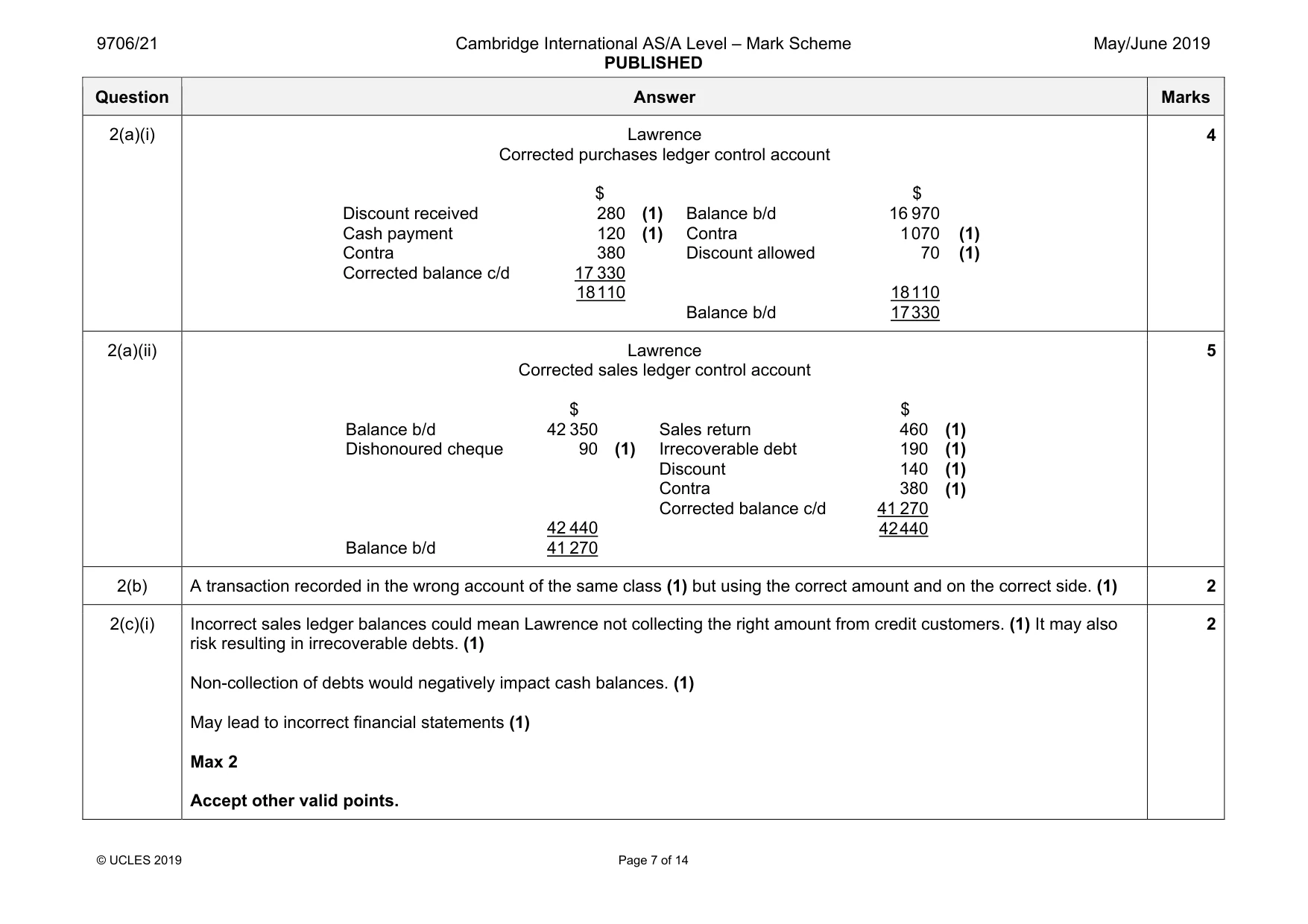
Mark scheme: 2(a)(i) Lawrence Corrected purchases ledger control account $ $ Discount received 280 (1) Balance b/d 16 970 Cash payment 120 (1) Contra 1 070 (1) Contra 380 Discount allowed 70 (1) Corrected balance c/d 17 330 18 110 18 110 Balance b/d 17 330 4 2(a)(ii) Lawrence Corrected sales ledger control account $ $ Balance b/d 42 350 Sales return 460 (1) Dishonoured cheque 90 (1) Irrecoverable debt 190 (1) Discount 140 (1) Contra 380 (1) Corrected balance c/d 41 270 42 440 42 440 Balance b/d 41 270 5 2(b) A transaction recorded in the wrong account of the same class (1) but using the correct amount and on the correct side. (1) 2 2(c)(i) Incorrect sales ledger balances could mean Lawrence not collecting the right amount from credit customers. (1) It may also risk resulting in irrecoverable debts. (1) Non-collection of debts would negatively impact cash balances. (1) May lead to incorrect financial statements (1) Max 2 Accept other valid points. 2 Question Answer Marks 2(c)(ii) Incorrect purchase ledger balances could mean possible disputes with suppliers affecting deliveries (1) and may result in credit facilities being withdrawn. (1) May lead to overpaying suppliers (1) May result in loss of opportunities of settlement discount. (1) Max 2 Accept other valid points. 2
Q3 · K Limited prepares annual accounts to 30 September
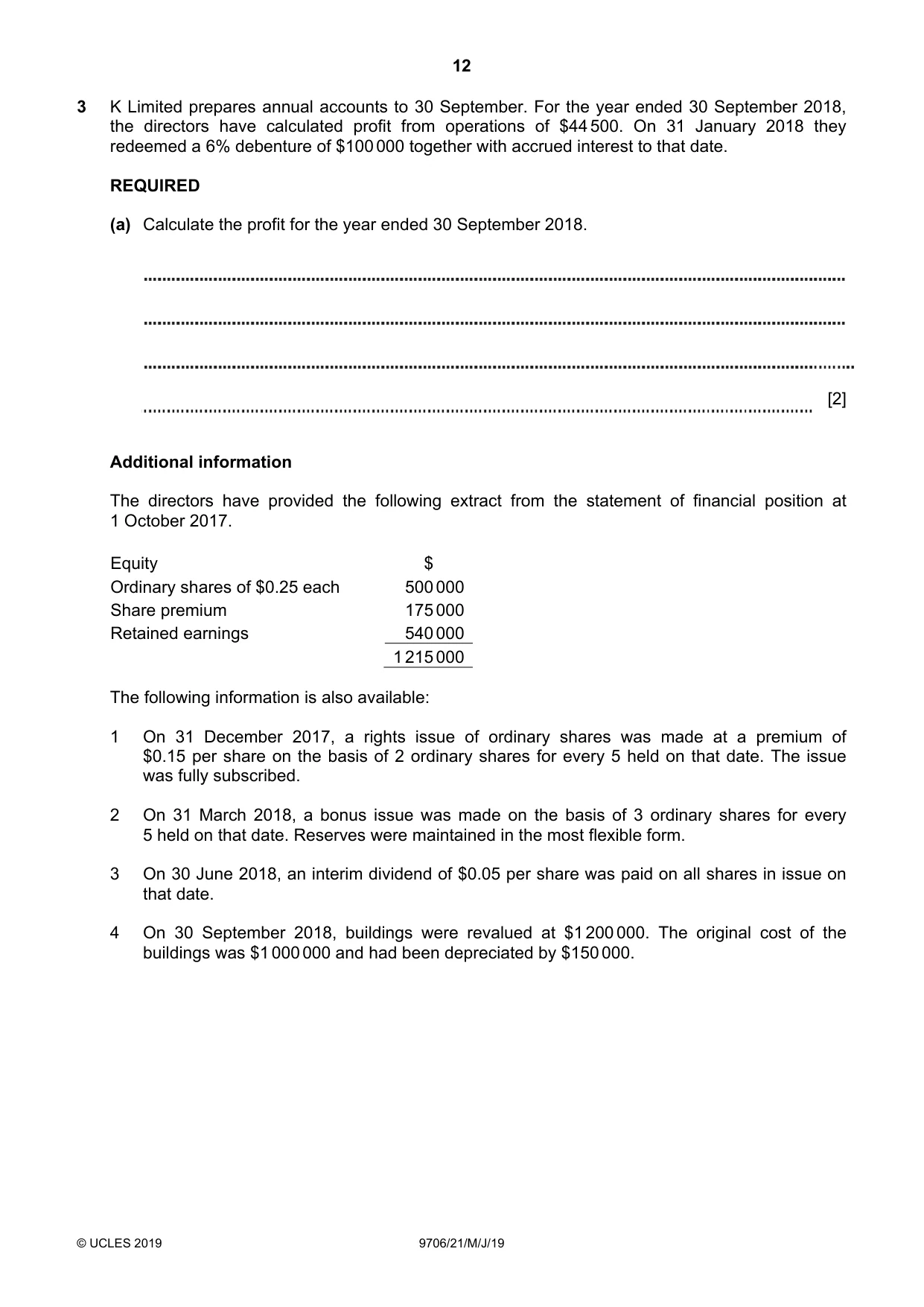
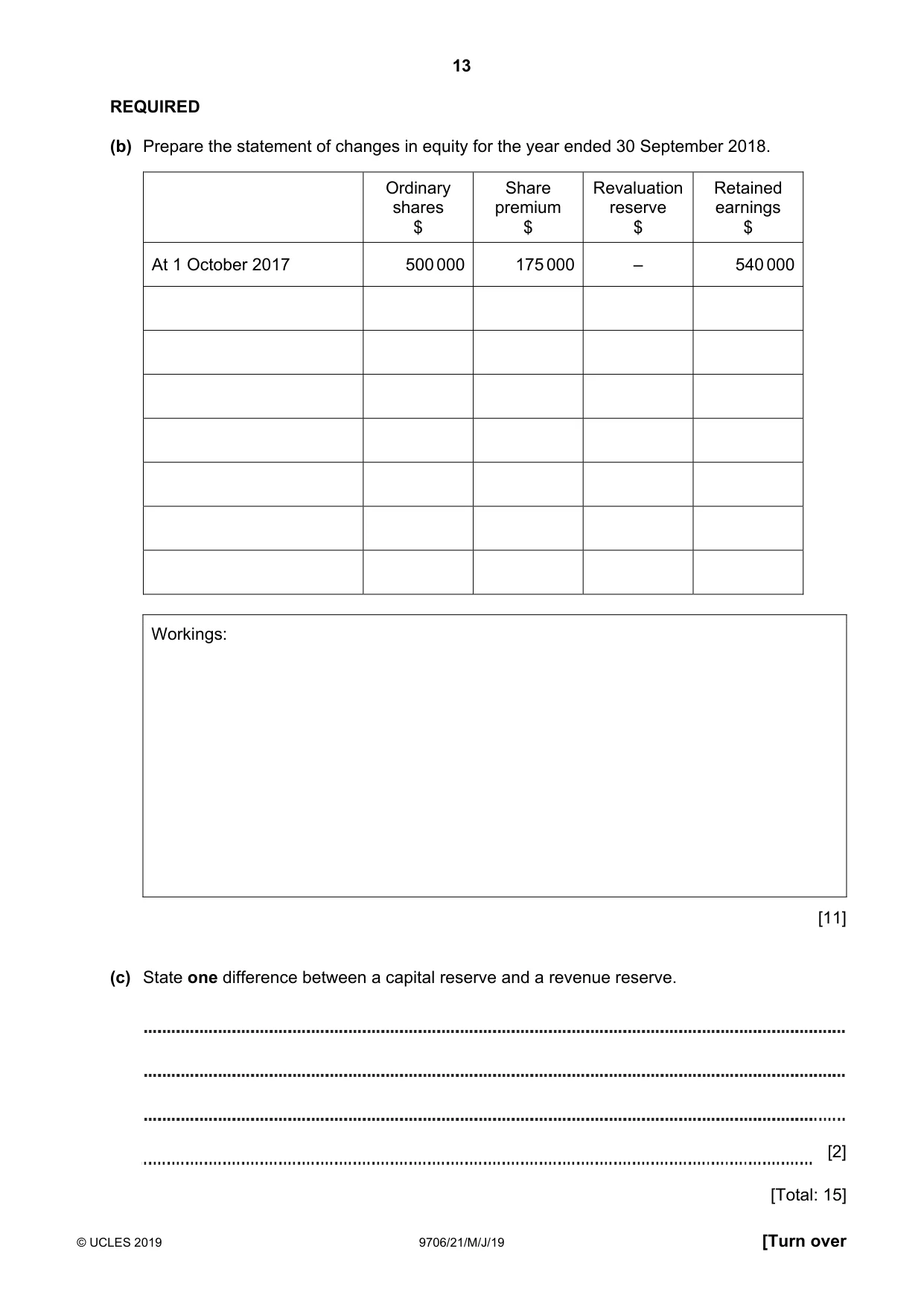
3 K Limited prepares annual accounts to 30 September. For the year ended 30 September 2018, the directors have calculated profit from operations of $44 500. On 31 January 2018 they redeemed a 6% debenture of $100 000 together with accrued interest to that date. REQUIRED (a) Calculate the profit for the year ended 30 September 2018. [2] Additional information The directors have provided the following extract from the statement of financial position at 1 October 2017. Equity $ Ordinary shares of $0.25 each 500 000 Share premium 175 000 Retained earnings 540 000 1 215 000 The following information is also available: 1 On 31 December 2017, a rights issue of ordinary shares was made at a premium of $0.15 per share on the basis of 2 ordinary shares for every 5 held on that date. The issue was fully subscribed. 2 On 31 March 2018, a bonus issue was made on the basis of 3 ordinary shares for every 5 held on that date. Reserves were maintained in the most flexible form. 3 On 30 June 2018, an interim dividend of $0.05 per share was paid on all shares in issue on that date. 4 On 30 September 2018, buildings were revalued at $1 200 000. The original cost of the buildings was $1 000 000 and had been depreciated by $150 000. REQUIRED (b) Prepare the statement of changes in equity for the year ended 30 September 2018. Ordinary Share Revaluation Retained shares premium reserve earnings $ $ $ $ At 1 October 2017 500 000 175 000 – 540 000 Workings: [11] (c) State one difference between a capital reserve and a revenue reserve. [2] [Total: 15]
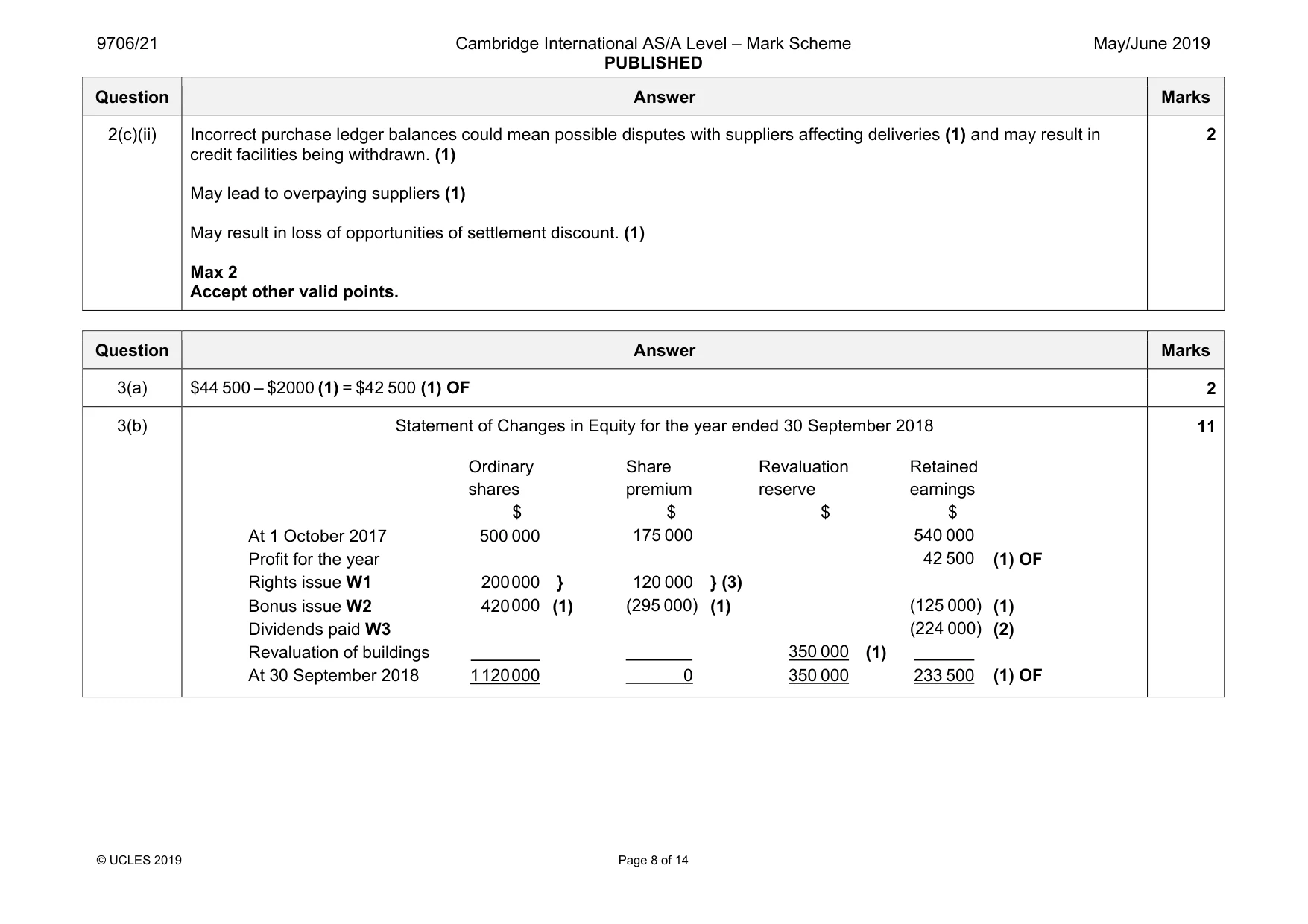
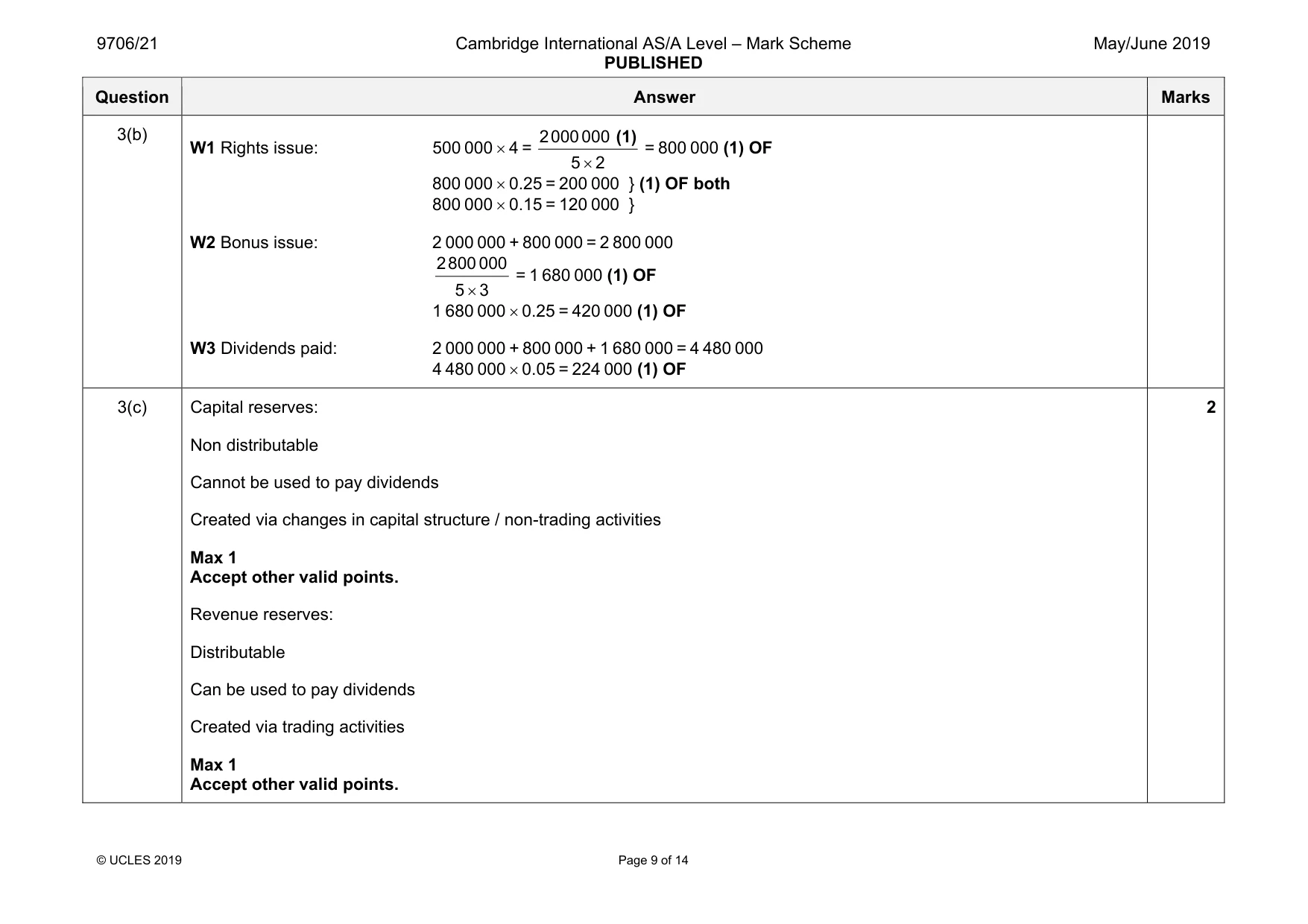
Mark scheme: 3(a) $44 500 – $2000 (1) = $42 500 (1) OF 2 3(b) Statement of Changes in Equity for the year ended 30 September 2018 Ordinary shares Share premium Revaluation reserve Retained earnings $ $ $ $ At 1 October 2017 500 000 175 000 540 000 Profit for the year 42 500 (1) OF Rights issue W1 200 000 } 120 000 } (3) Bonus issue W2 420 000 (1) (295 000) (1) (125 000) (1) Dividends paid W3 (224 000) (2) Revaluation of buildings 350 000 (1) At 30 September 2018 1 120 000 0 350 000 233 500 (1) OF 11 Question Answer Marks 3(b) W1 Rights issue: 500 000 × 4 = 2 5 000 000 2 × (1) = 800 000 (1) OF 800 000 × 0.25 = 200 000 } (1) OF both 800 000 × 0.15 = 120 000 } W2 Bonus issue: 2 000 000 + 800 000 = 2 800 000 3 5 000 800 2 × = 1 680 000 (1) OF 1 680 000 × 0.25 = 420 000 (1) OF W3 Dividends paid: 2 000 000 + 800 000 + 1 680 000 = 4 480 000 4 480 000 × 0.05 = 224 000 (1) OF 3(c) Capital reserves: Non distributable Cannot be used to pay dividends Created via changes in capital structure / non-trading activities Max 1 Accept other valid points. Revenue reserves: Distributable Can be used to pay dividends Created via trading activities Max 1 Accept other valid points. 2
Q4 · Ravi manufactures two products, Exe and Wye
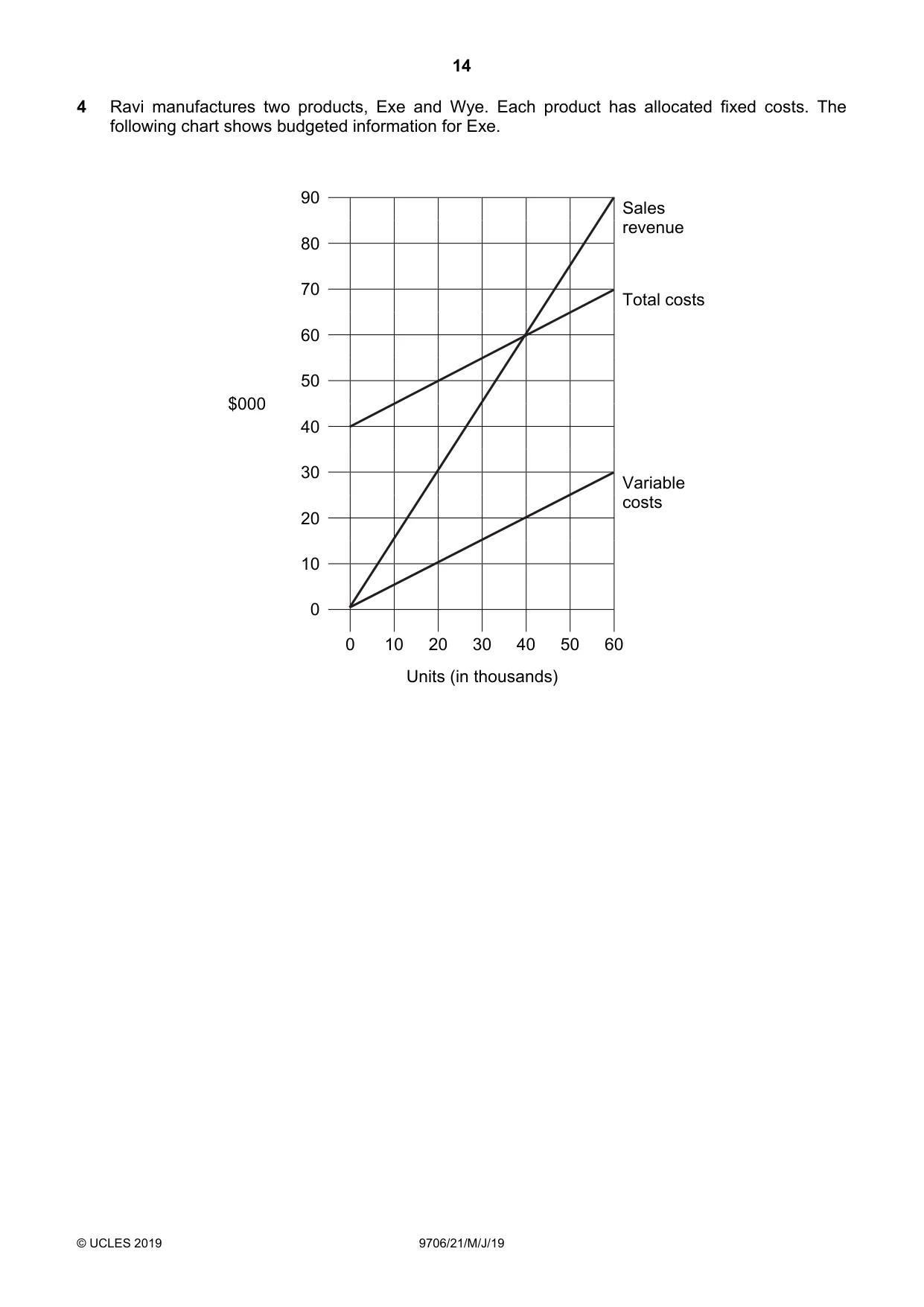
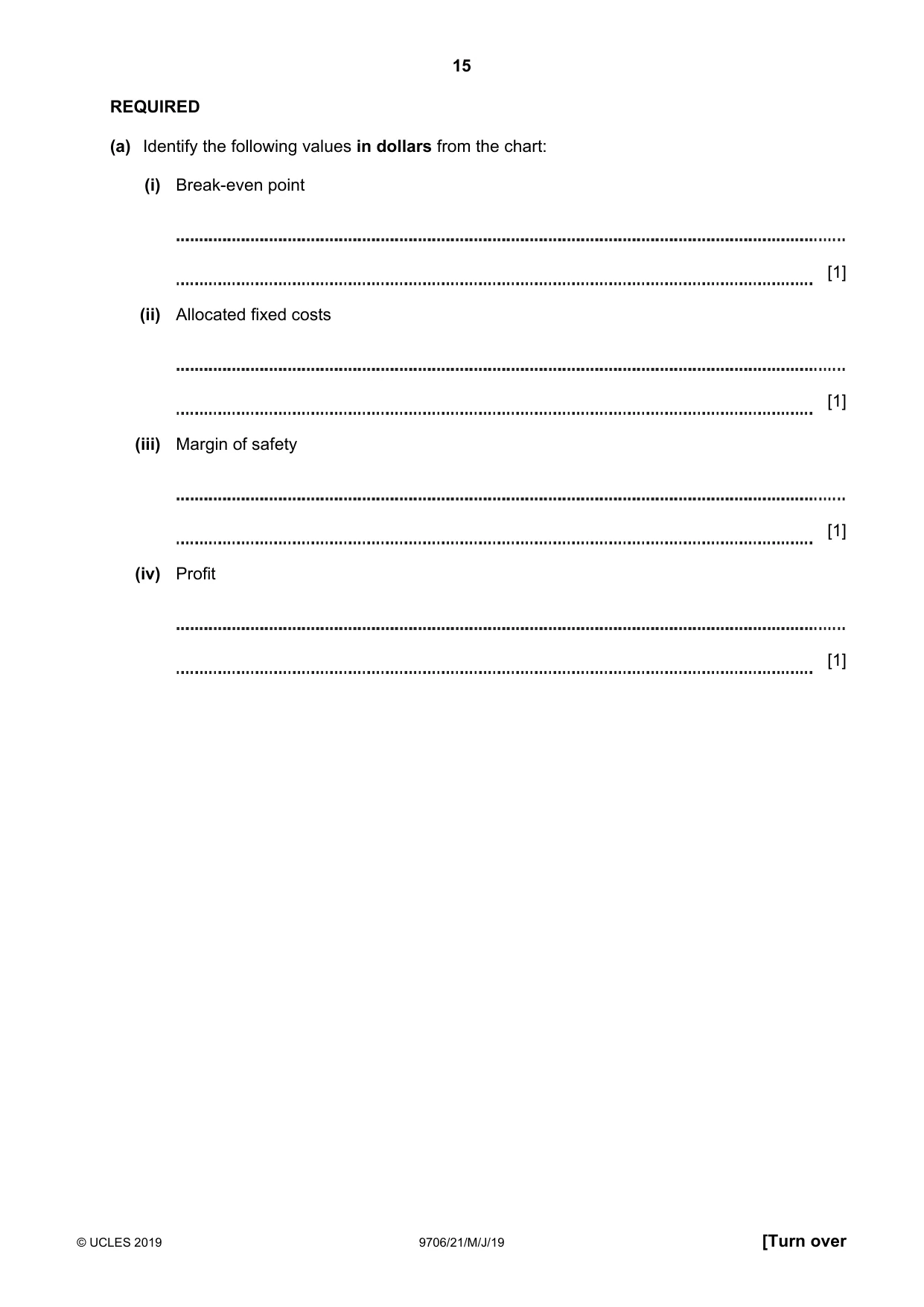
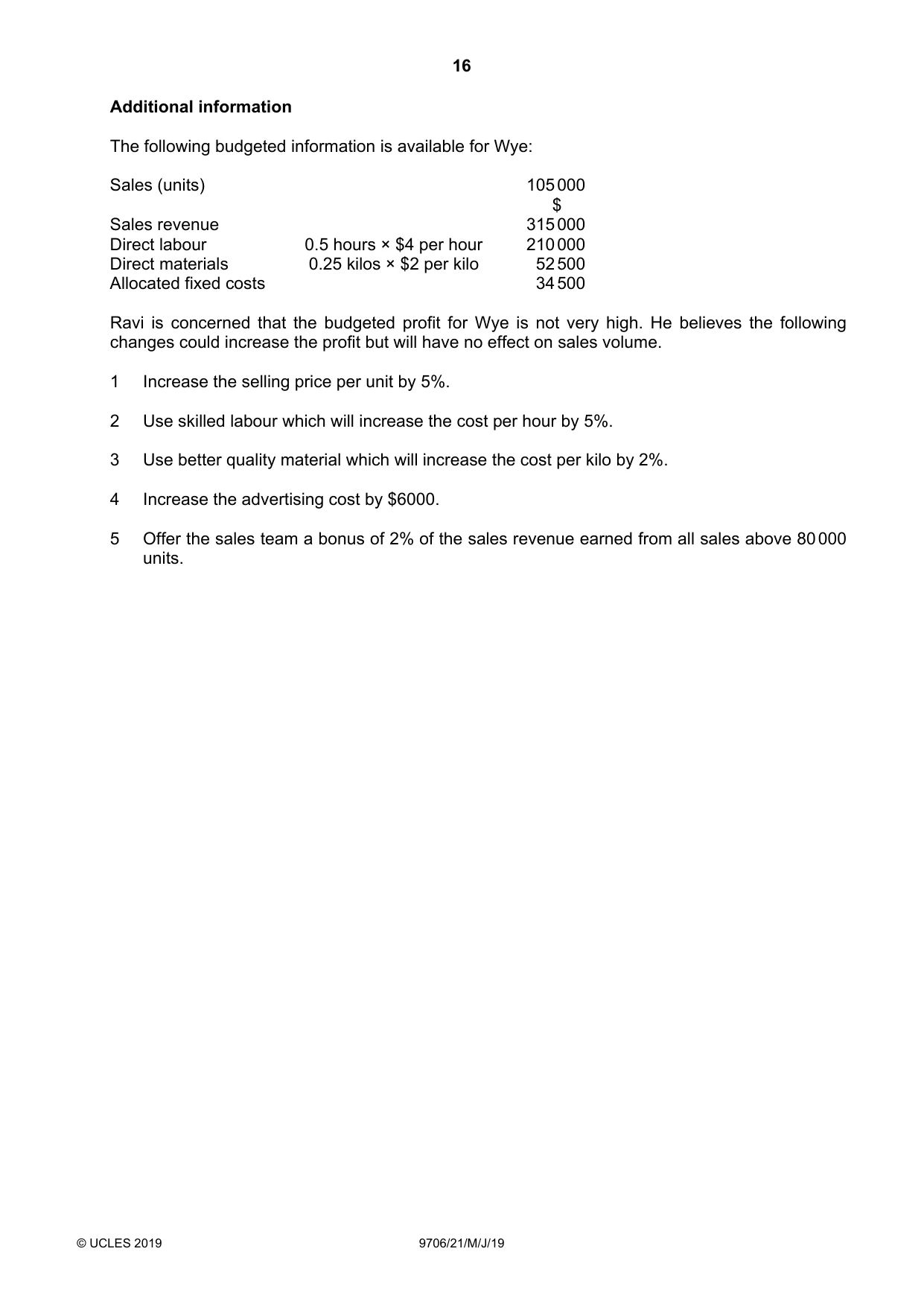
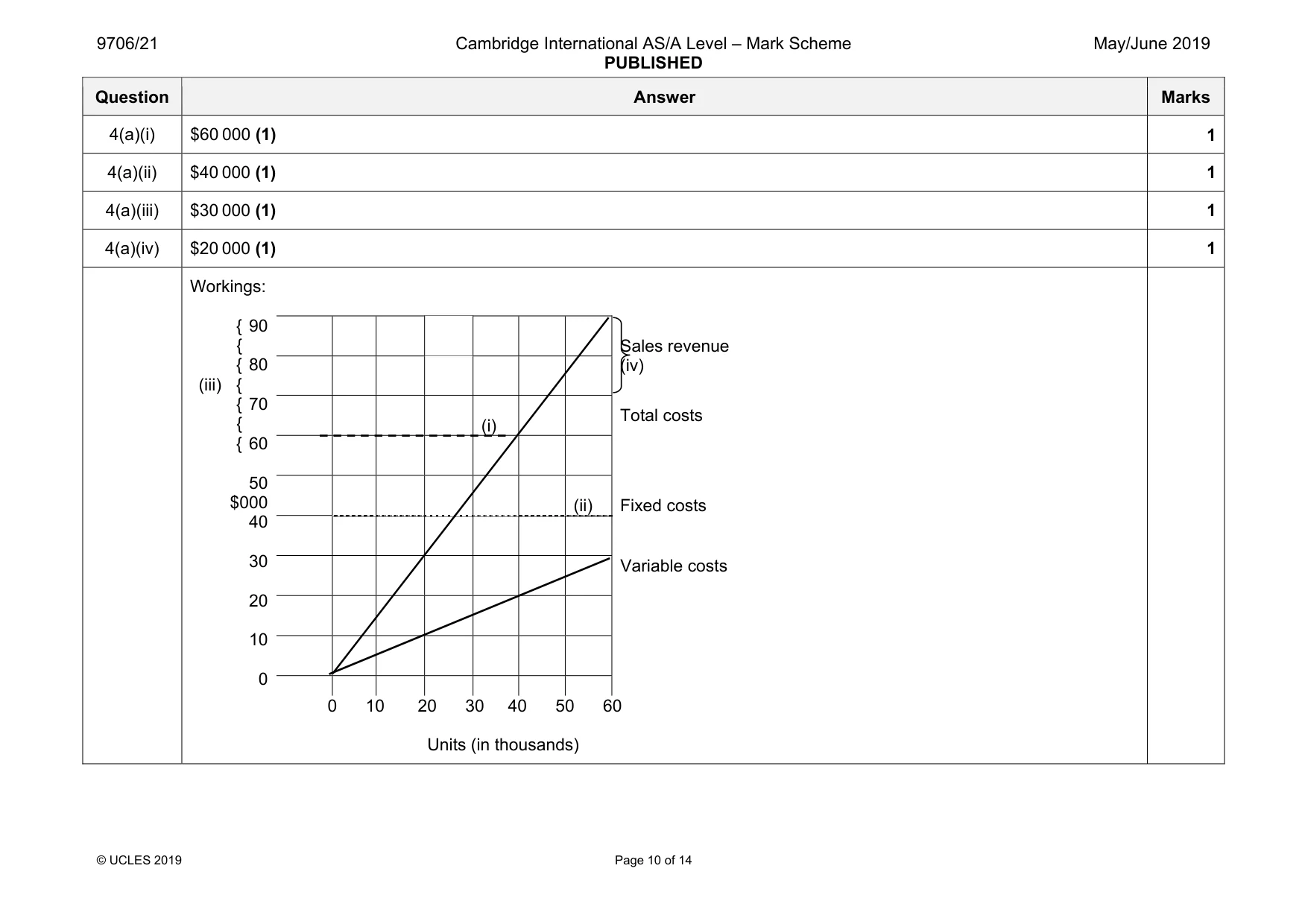
4 Ravi manufactures two products, Exe and Wye. Each product has allocated fixed costs. The following chart shows budgeted information for Exe. 90 Sales revenue 80 70 Total costs 60 50 $000 40 30 Variable costs 20 10 0 0 10 20 30 40 50 60 Units (in thousands) REQUIRED (a) Identify the following values in dollars from the chart: (i) Break-even point [1] (ii) Allocated fixed costs [1] (iii) Margin of safety [1] (iv) Profit [1] Additional information The following budgeted information is available for Wye: Sales (units) 105 000 $ Sales revenue 315 000 Direct labour 0.5 hours × $4 per hour 210 000 Direct materials 0.25 kilos × $2 per kilo 52 500 Allocated fixed costs 34 500 Ravi is concerned that the budgeted profit for Wye is not very high. He believes the following changes could increase the profit but will have no effect on sales volume. 1 Increase the selling price per unit by 5%. 2 Use skilled labour which will increase the cost per hour by 5%. 3 Use better quality material which will increase the cost per kilo by 2%. 4 Increase the advertising cost by $6000.
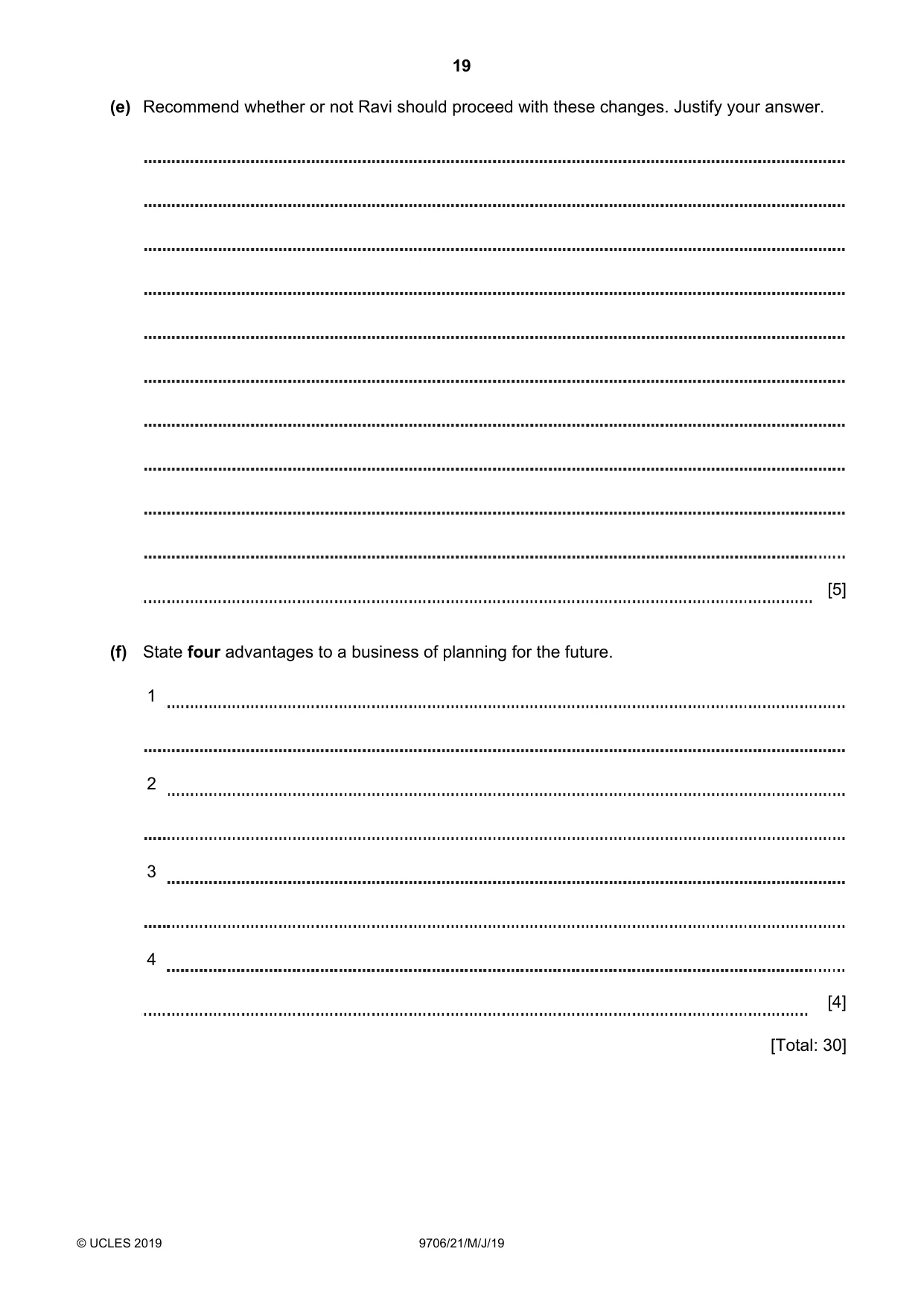
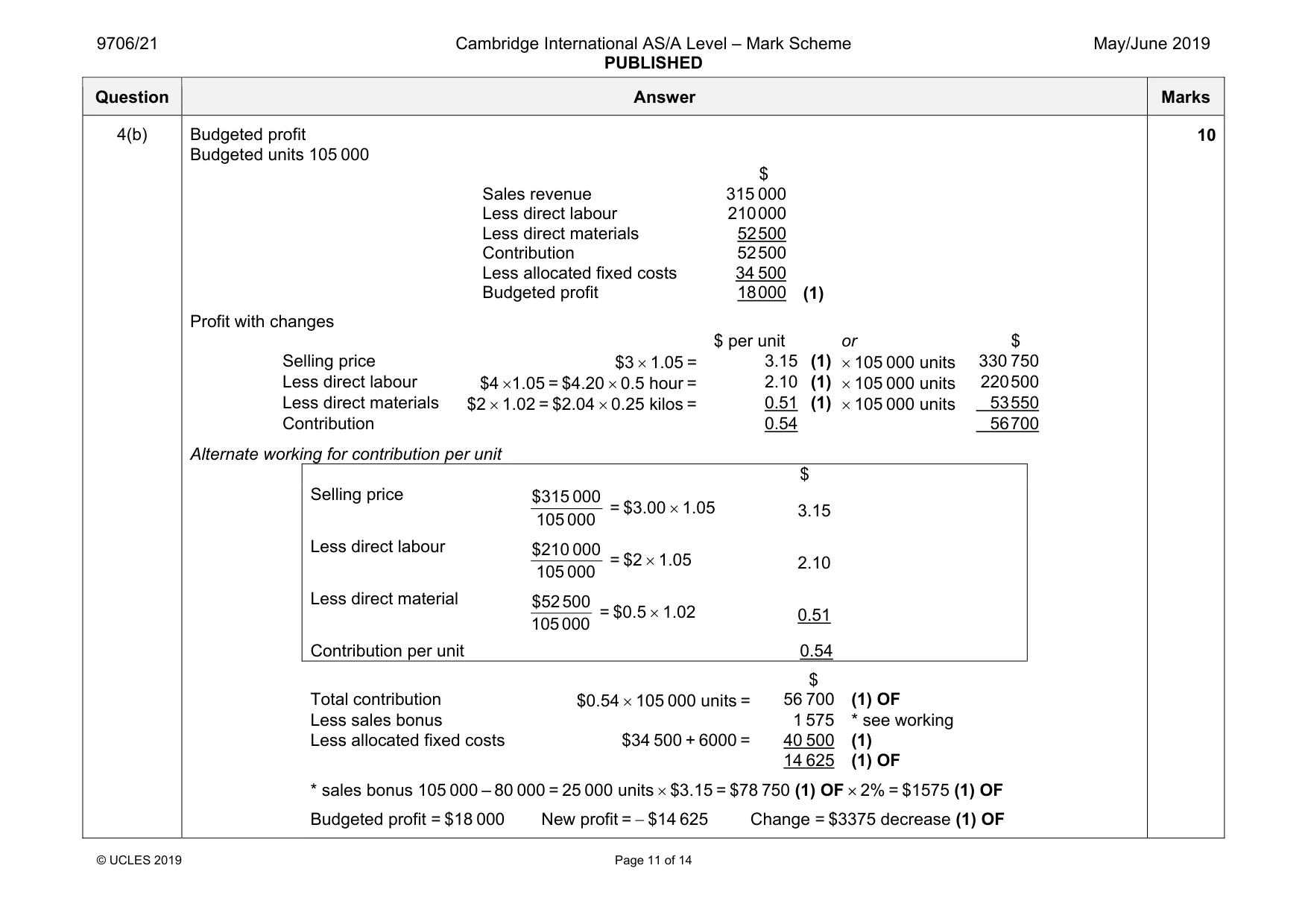
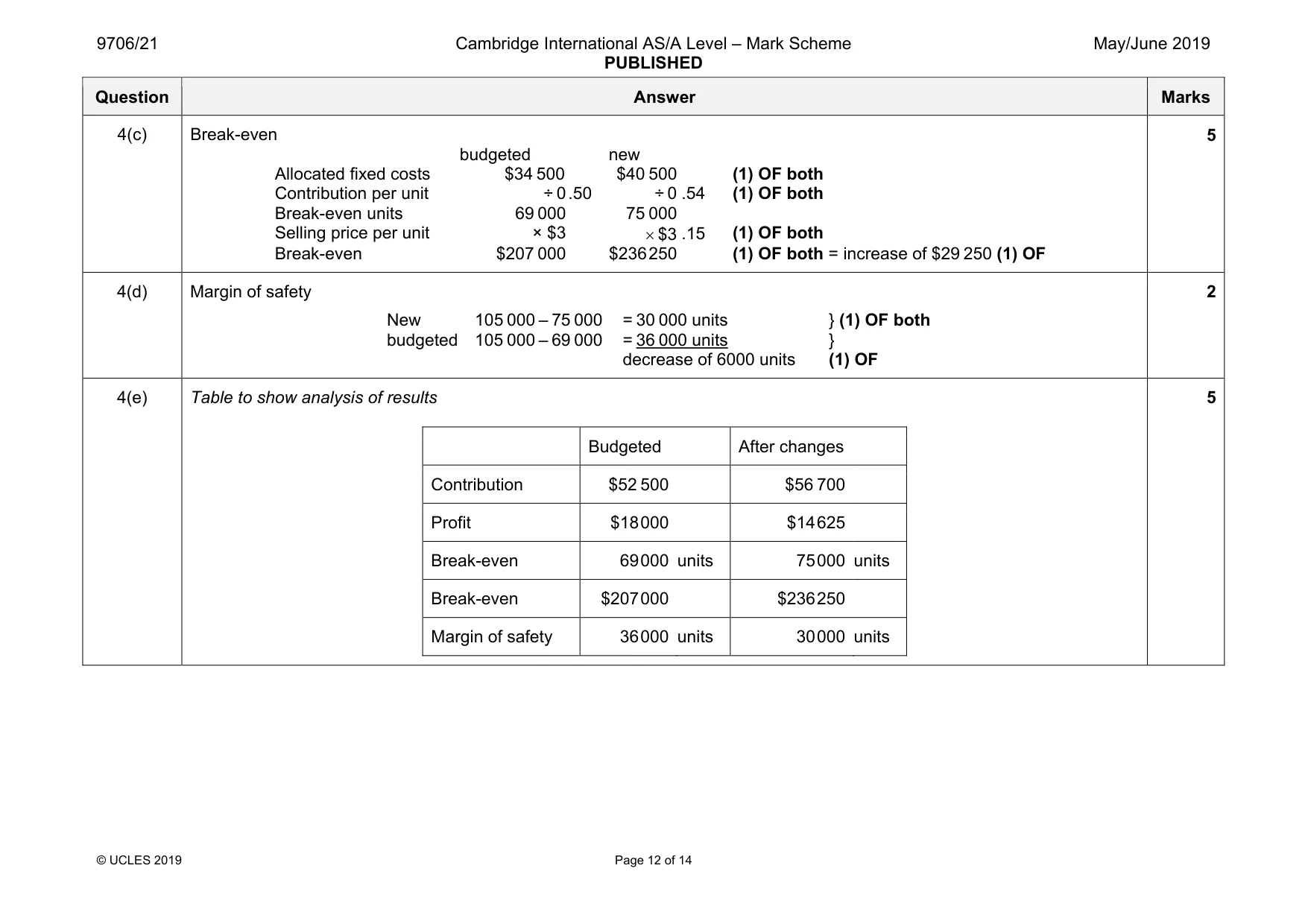
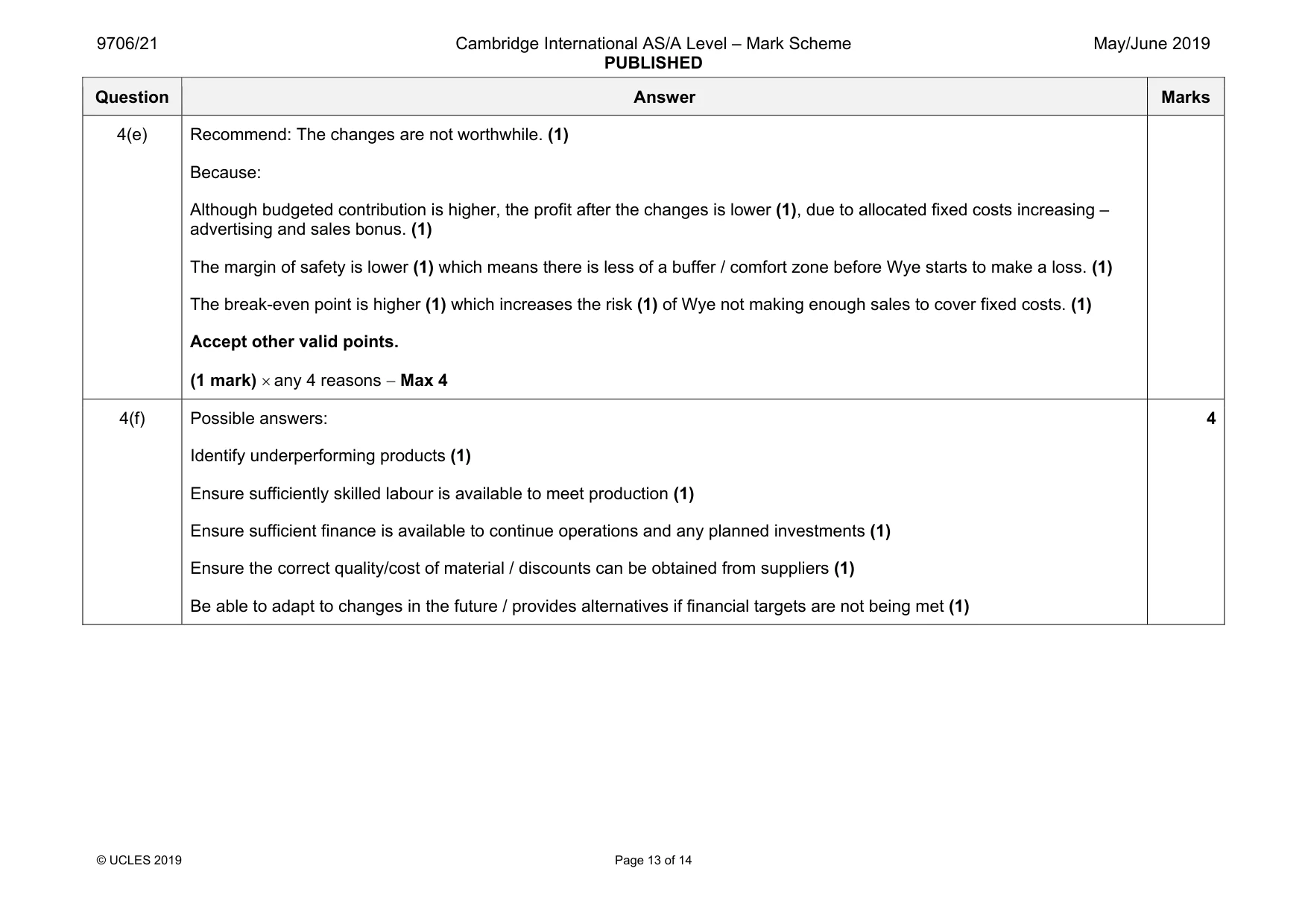
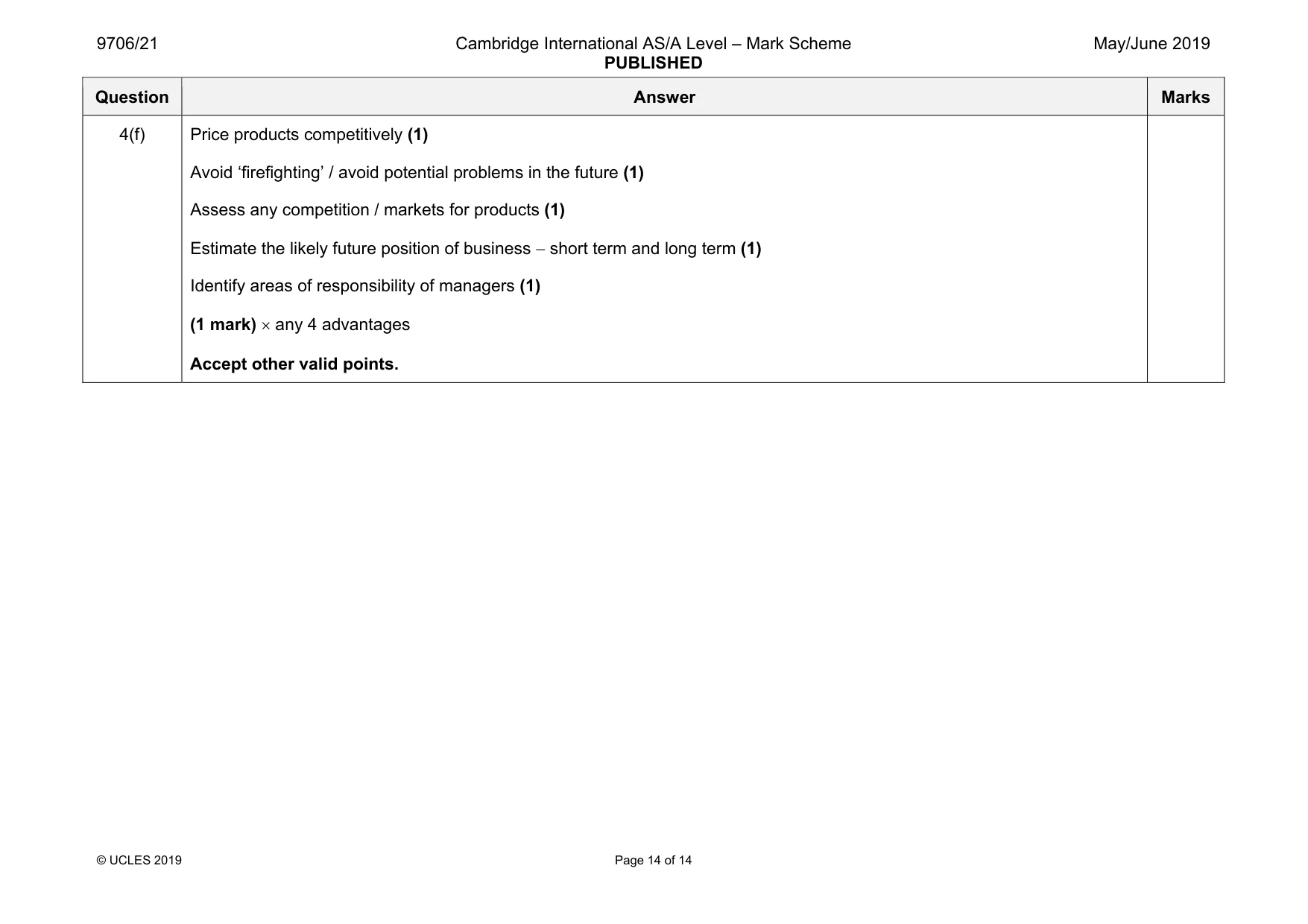
Mark scheme: 4(a)(i) $60 000 (1) 1 4(a)(ii) $40 000 (1) 1 4(a)(iii) $30 000 (1) 1 4(a)(iv) $20 000 (1) 1 Workings: { 90 { { 80 (iii) { { 70 { { 60 50 $000 40 30 20 10 0 Sales revenue (iv) (i) Total costs (ii) Fixed costs Variable costs 0 10 20 30 40 50 60 Units (in thousands) Question Answer Marks 4(b) Budgeted profit Budgeted units 105 000 $ Sales revenue 315 000 Less direct labour 210 000 Less direct materials 52 500 Contribution 52 500 Less allocated fixed costs 34 500 Budgeted profit 18 000 (1) Profit with changes $ per unit or $ Selling price $3 × 1.05 = 3.15 (1) × 105 000 units 330 750 Less direct labour $4 ×1.05 = $4.20 × 0.5 hour = 2.10 (1) × 105 000 units 220 500 Less direct materials $2 × 1.02 = $2.04 × 0.25 kilos = 0.51 (1) × 105 000 units 53 550 Contribution 0.54 56 700 Alternate working for contribution per unit $ Selling price 000 105 000 $315 = $3.00 × 1.05 3.15 Less direct labour 000 105 000 $210 = $2 × 1.05 2.10 Less direct material 000 105 500 $52 = $0.5 × 1.02 0.51 Contribution per unit 0.54 $ Total contribution $0.54 × 10⁵ 000 units = 56 700 (1) OF Less sales bonus 1 575 * see working Less allocated fixed costs $34 500 + 6000 = 40 500 (1) 14 625 (1) OF * sales bonus 105 000 – 80 000 = 25 000 units × $3.15 = $78 750 (1) OF × 2% = $1575 (1) OF Budgeted profit = $18 000 New profit = − $14 625 Change = $3375 decrease (1) OF 10 Question Answer Marks 4(c) Break-even budgeted new Allocated fixed costs $34 500 $40 500 (1) OF both Contribution per unit ÷ 0.50 ÷ 0 .54 (1) OF both Break-even units 69 000 75 000 Selling price per unit × $3 × $3 .15 (1) OF both Break-even $207 000 $236 250 (1) OF both = increase of $29 250 (1) OF 5 4(d) Margin of safety New 105 000 – 75 000 = 30 000 units } (1) OF both budgeted 105 000 – 69 000 = 36 000 units } decrease of 6000 units (1) OF 2 4(e) Table to show analysis of results Budgeted After changes Contribution $52 500 $56 700 Profit $18 000 $14 625 Break-even 69 000 units 75 000 units Break-even $207 000 $236 250 Margin of safety 36 000 units 30 000 units 5 Question Answer Marks 4(e) Recommend: The changes are not worthwhile. (1) Because: Although budgeted contribution is higher, the profit after the changes is lower (1), due to allocated fixed costs increasing – advertising and sales bonus. (1) The margin of safety is lower (1) which means there is less of a buffer / comfort zone before Wye starts to make a loss. (1) The break-even point is higher (1) which increases the risk (1) of Wye not making enough sales to cover fixed costs. (1) Accept other valid points. (1 mark) × any 4 reasons − Max 4 4(f) Possible answers: Identify underperforming products (1) Ensure sufficiently skilled labour is available to meet production (1) Ensure sufficient finance is available to continue operations and any planned investments (1) Ensure the correct quality/cost of material / discounts can be obtained from suppliers (1) Be able to adapt to changes in the future / provides alternatives if financial targets are not being met (1) 4 Question Answer Marks 4(f) Price products competitively (1) Avoid ‘firefighting’ / avoid potential problems in the future (1) Assess any competition / markets for products (1) Estimate the likely future position of business − short term and long term (1) Identify areas of responsibility of managers (1) (1 mark) × any 4 advantages Accept other valid points.
Q5 · REQUIRED (b) Calculate, for product Wye only, the effect of these changes on the budgeted…
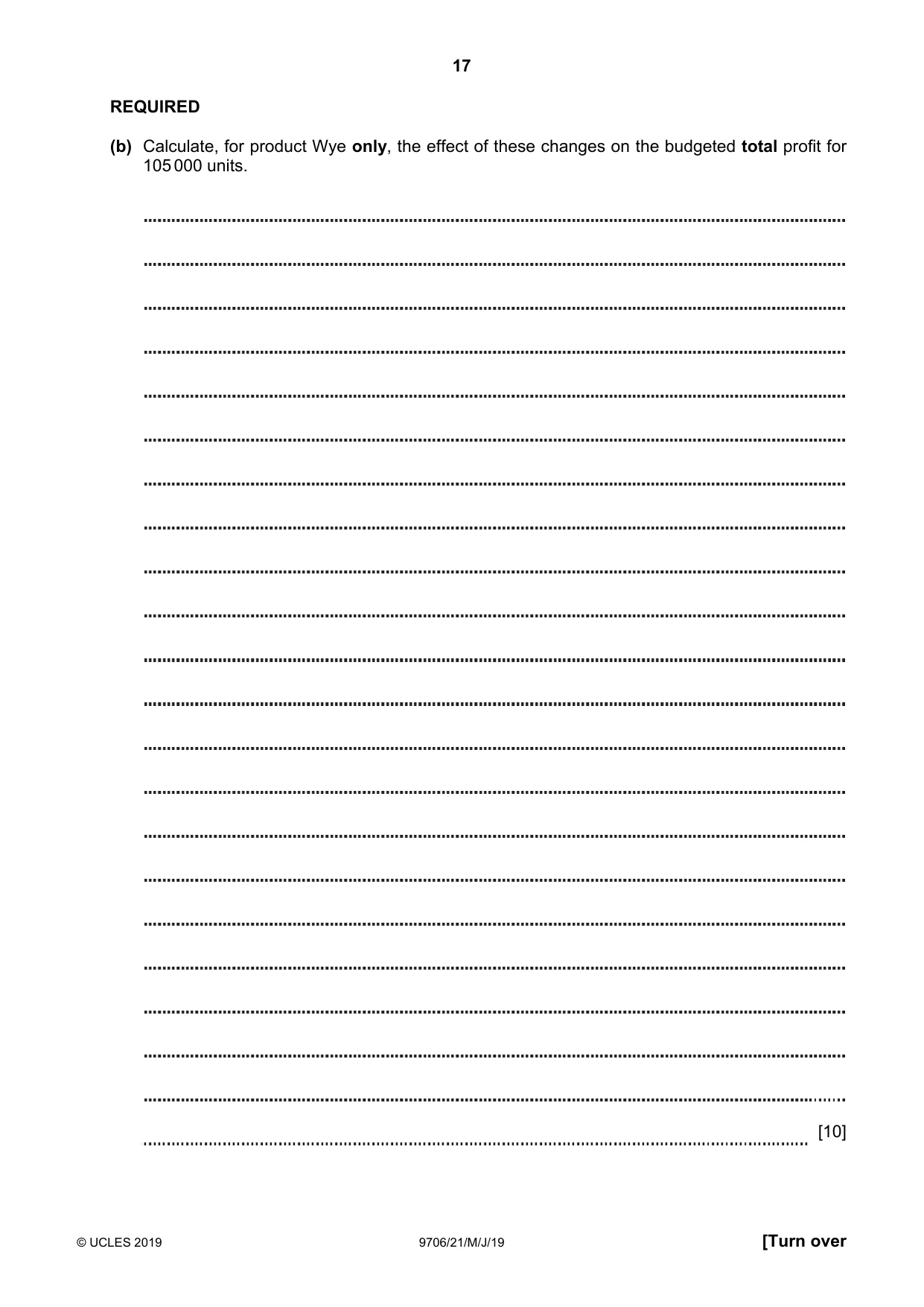
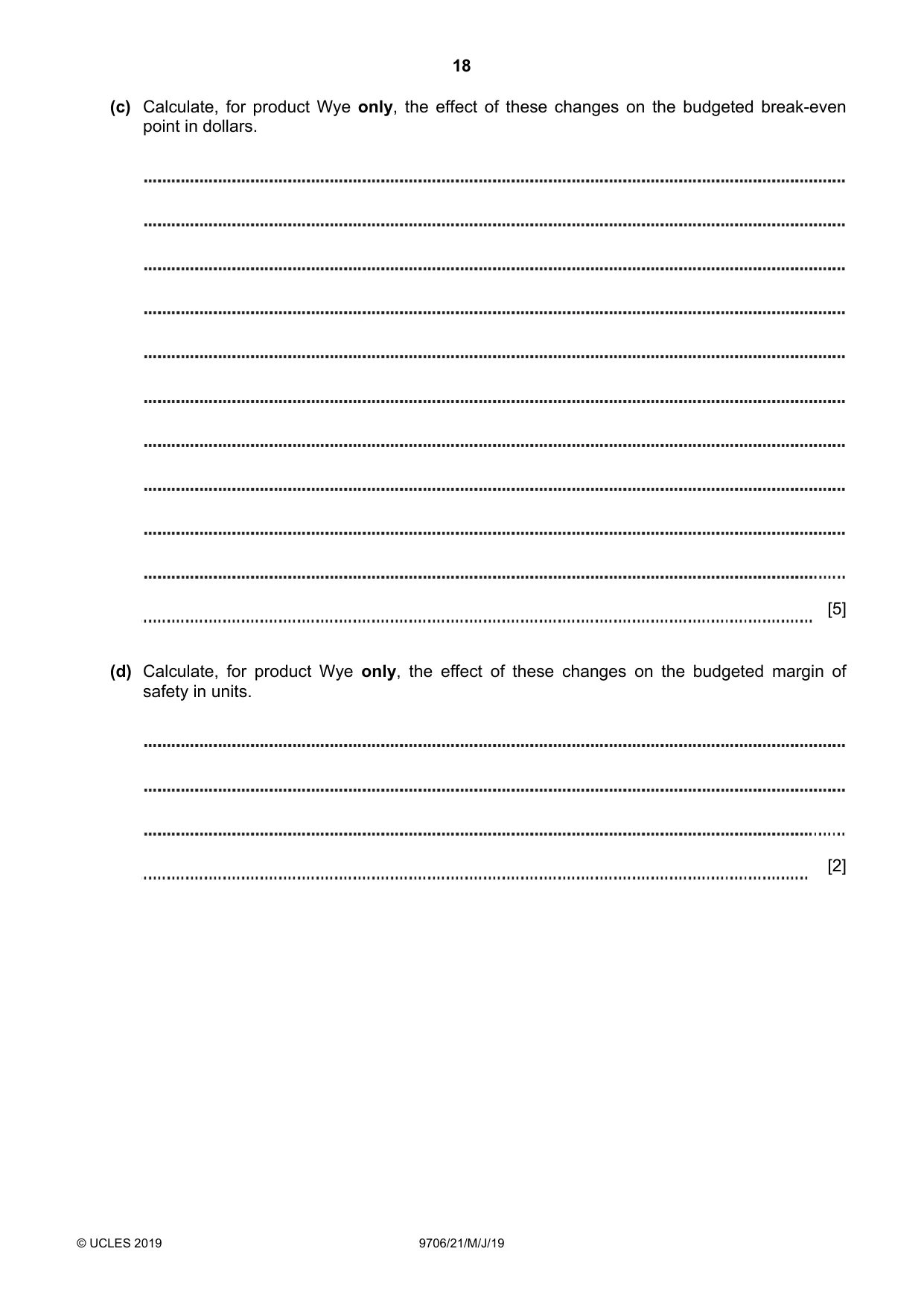
REQUIRED (b) Calculate, for product Wye only, the effect of these changes on the budgeted total profit for 105 000 units. [10] (c) Calculate, for product Wye only, the effect of these changes on the budgeted break-even point in dollars. [5] (d) Calculate, for product Wye only, the effect of these changes on the budgeted margin of safety in units. [2]
What was in this paper
The subtopics covered by these 5 questions, and how many questions each got. Open one in a new tab to see every Cambridge question on it.
What you needed in this session
Cambridge’s own grade thresholds for 2019 May/June, Paper 2 · Variant 1. A higher threshold means an easier paper — the bar moves with how the cohort did.