Cambridge A Level Accounting 9706 — 2018 Oct/Nov Paper 2 · Variant 2
9706/22/O/N/18 · 5 questions · 90 marks · ≈101 min
The question paper and its mark scheme, free to read here and free to download. This is Cambridge’s own paper, exactly as it was sat.
Question paper20 pages


Mark scheme12 pages
Answers below. Sit the paper first if you are practising.
Questions as text
Q1 · Finn started business on 1 January 2017
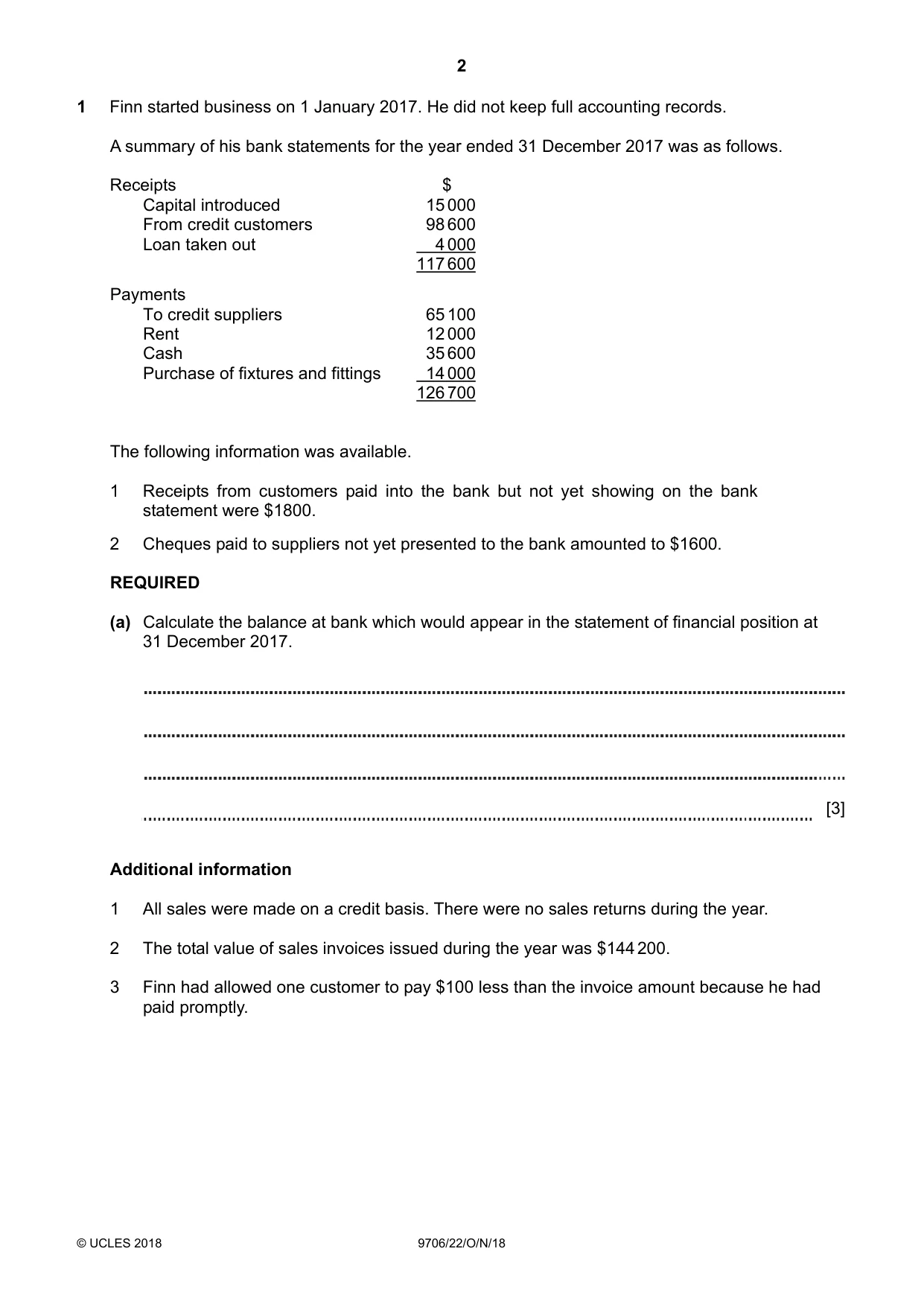
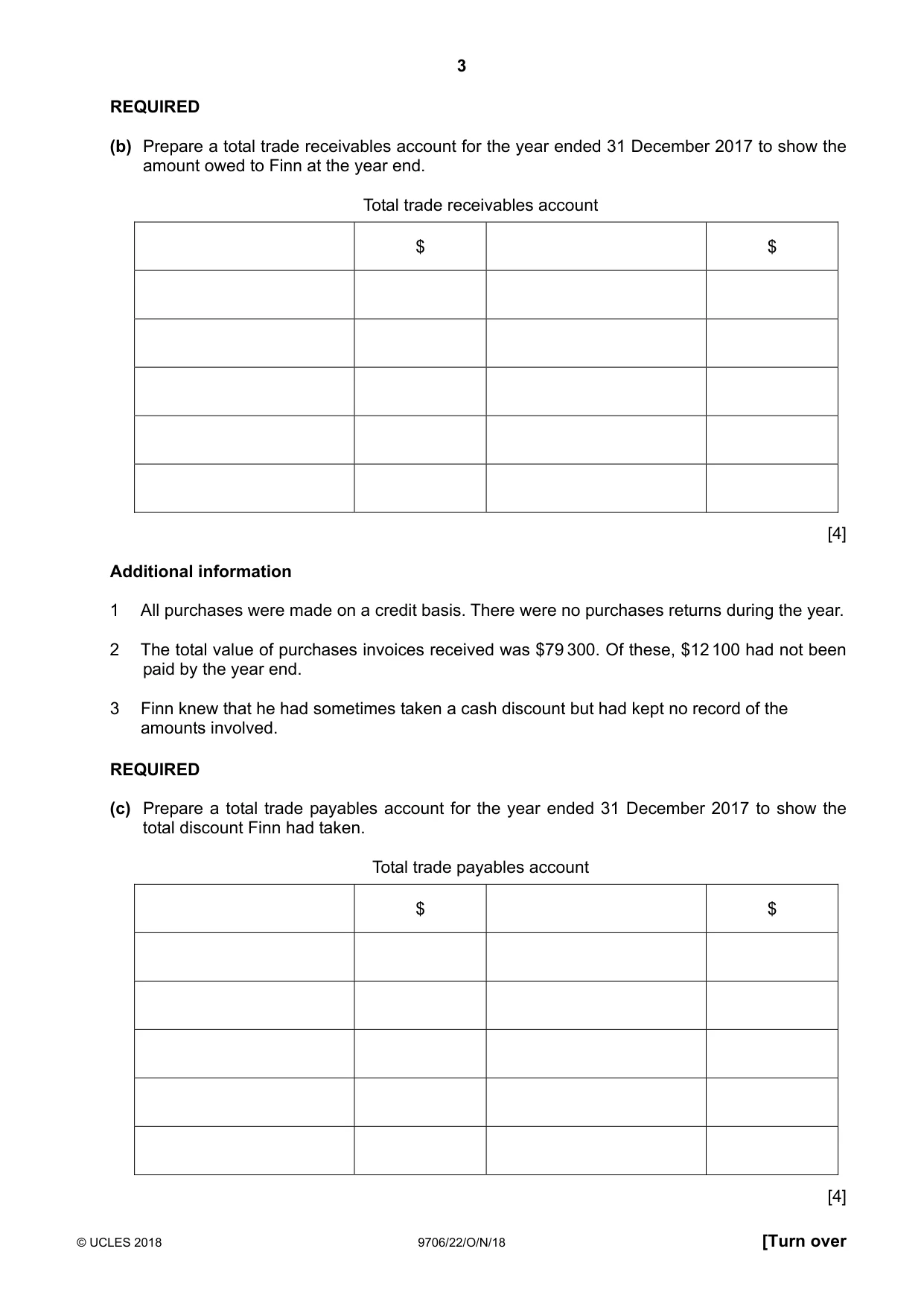
1 Finn started business on 1 January 2017. He did not keep full accounting records. A summary of his bank statements for the year ended 31 December 2017 was as follows. Receipts $ Capital introduced 15 000 From credit customers 98 600 Loan taken out 4 000 117 600 Payments To credit suppliers 65 100 Rent 12 000 Cash 35 600 Purchase of fixtures and fittings 14 000 126 700 The following information was available. 1 Receipts from customers paid into the bank but not yet showing on the bank statement were $1800. 2 Cheques paid to suppliers not yet presented to the bank amounted to $1600. REQUIRED (a) Calculate the balance at bank which would appear in the statement of financial position at 31 December 2017. [3] Additional information 1 All sales were made on a credit basis. There were no sales returns during the year. 2 The total value of sales invoices issued during the year was $144 200. 3 Finn had allowed one customer to pay $100 less than the invoice amount because he had paid promptly. REQUIRED (b) Prepare a total trade receivables account for the year ended 31 December 2017 to show the amount owed to Finn at the year end. Total trade receivables account $ $ [4] Additional information 1 All purchases were made on a credit basis. There were no purchases returns during the year.
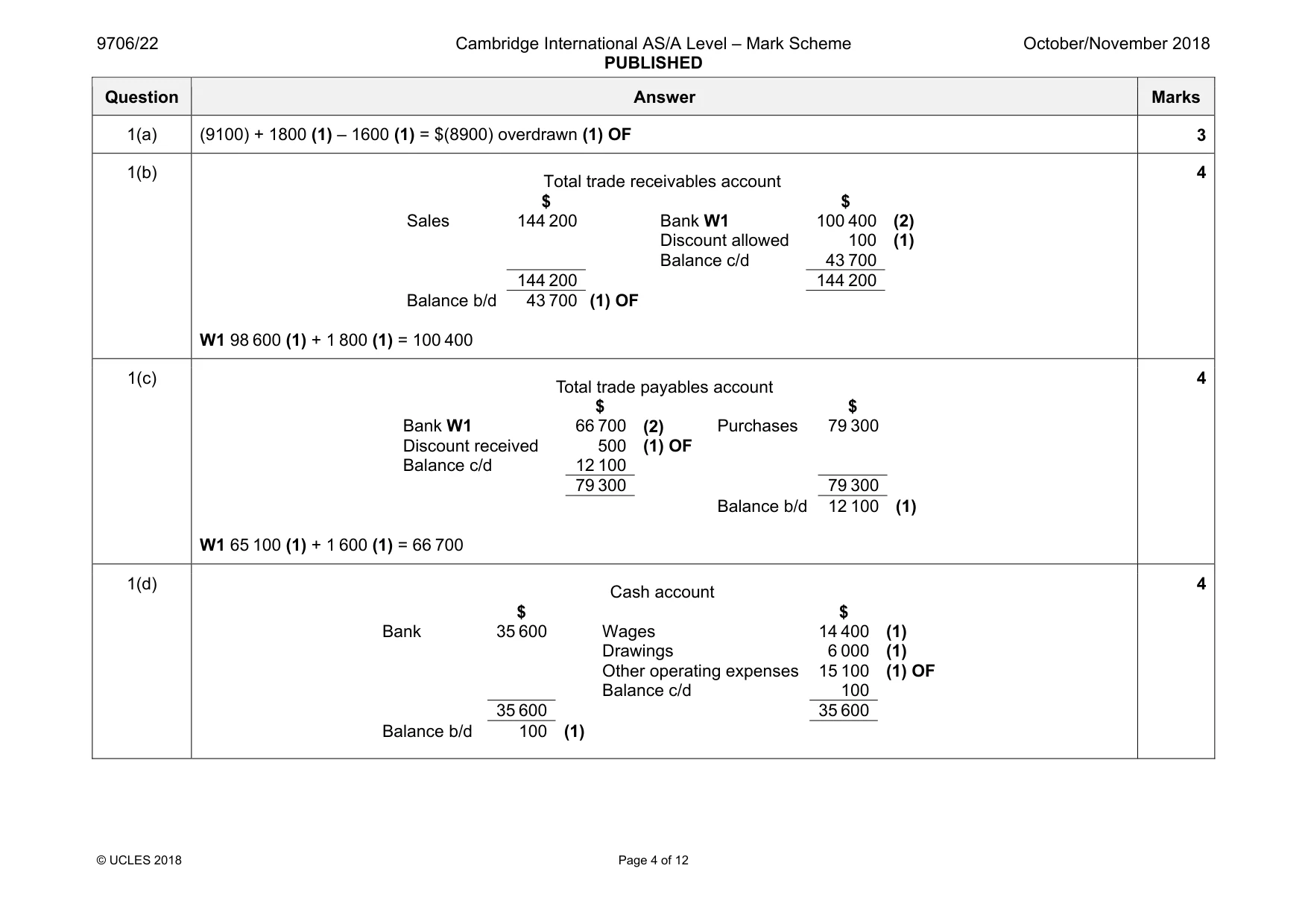
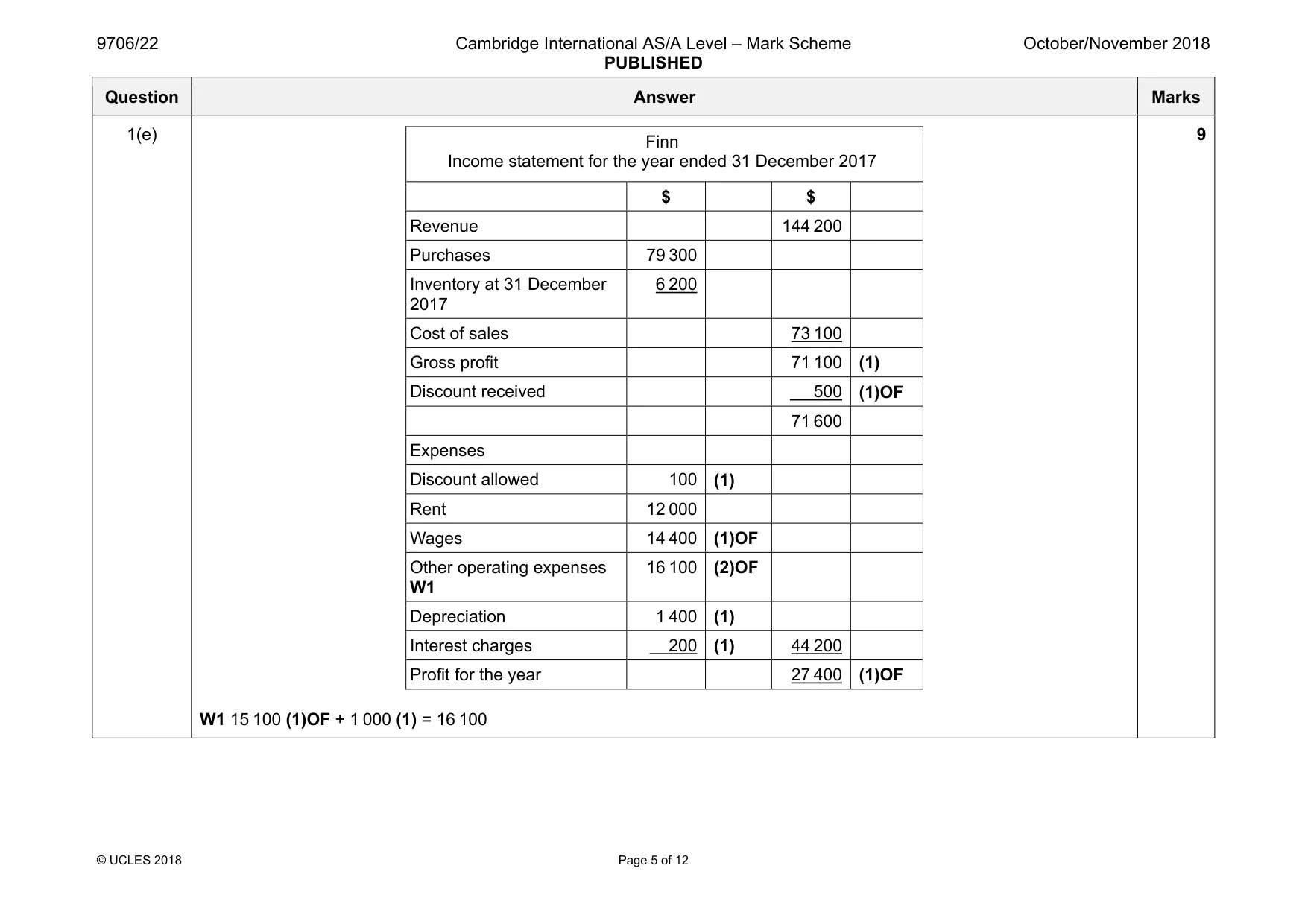
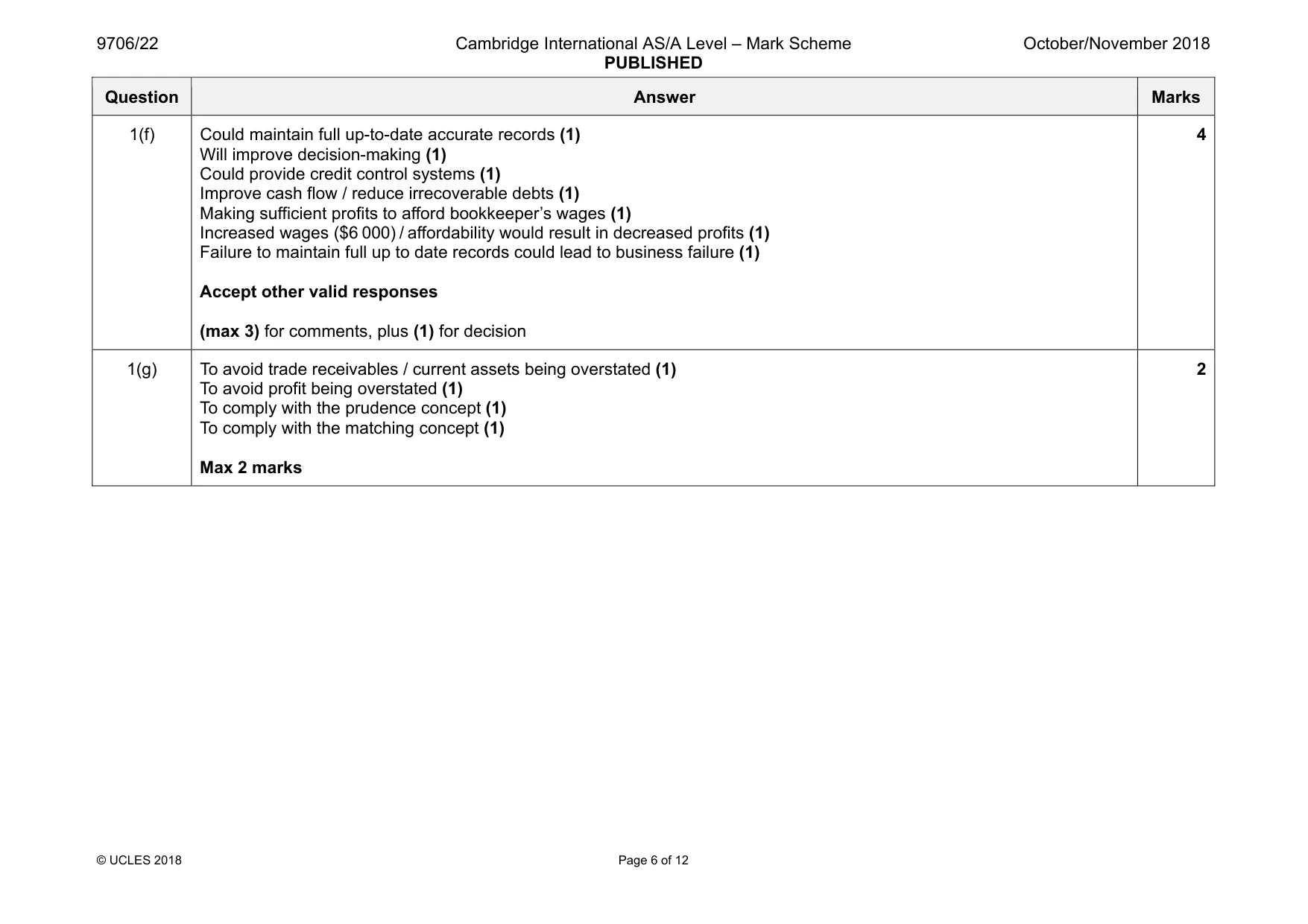
Mark scheme: 1(a) (9100) + 1800 (1) – 1600 (1) = $(8900) overdrawn (1) OF 3 1(b) Total trade receivables account $ $ Sales 144 200 Bank W1 100 400 (2) Discount allowed 100 (1) Balance c/d 43 700 144 200 144 200 Balance b/d 43 700 (1) OF W1 98 600 (1) + 1 800 (1) = 100 400 4 1(c) Total trade payables account $ $ Bank W1 66 700 (2) Purchases 79 300 Discount received 500 (1) OF Balance c/d 12 100 79 300 79 300 Balance b/d 12 100 (1) W1 65 100 (1) + 1 600 (1) = 66 700 4 1(d) Cash account $ $ Bank 35 600 Wages 14 400 (1) Drawings 6 000 (1) Other operating expenses 15 100 (1) OF Balance c/d 100 35 600 35 600 Balance b/d 100 (1) 4 Question Answer Marks 1(e) Finn Income statement for the year ended 31 December 2017 $ $ Revenue 144 200 Purchases 79 300 Inventory at 31 December 2017 6 200 Cost of sales 73 100 Gross profit 71 100 (1) Discount received 500 (1)OF 71 600 Expenses Discount allowed 100 (1) Rent 12 000 Wages 14 400 (1)OF Other operating expenses W1 16 100 (2)OF Depreciation 1 400 (1) Interest charges 200 (1) 44 200 Profit for the year 27 400 (1)OF W1 15 100 (1)OF + 1 000 (1) = 16 100 9 Question Answer Marks 1(f) Could maintain full up-to-date accurate records (1) Will improve decision-making (1) Could provide credit control systems (1) Improve cash flow / reduce irrecoverable debts (1) Making sufficient profits to afford bookkeeper’s wages (1) Increased wages ($6 000) / affordability would result in decreased profits (1) Failure to maintain full up to date records could lead to business failure (1) Accept other valid responses (max 3) for comments, plus (1) for decision 4 1(g) To avoid trade receivables / current assets being overstated (1) To avoid profit being overstated (1) To comply with the prudence concept (1) To comply with the matching concept (1) Max 2 marks 2
Q2 · The total value of purchases invoices received was $79 300
2 The total value of purchases invoices received was $79 300. Of these, $12 100 had not been paid by the year end.
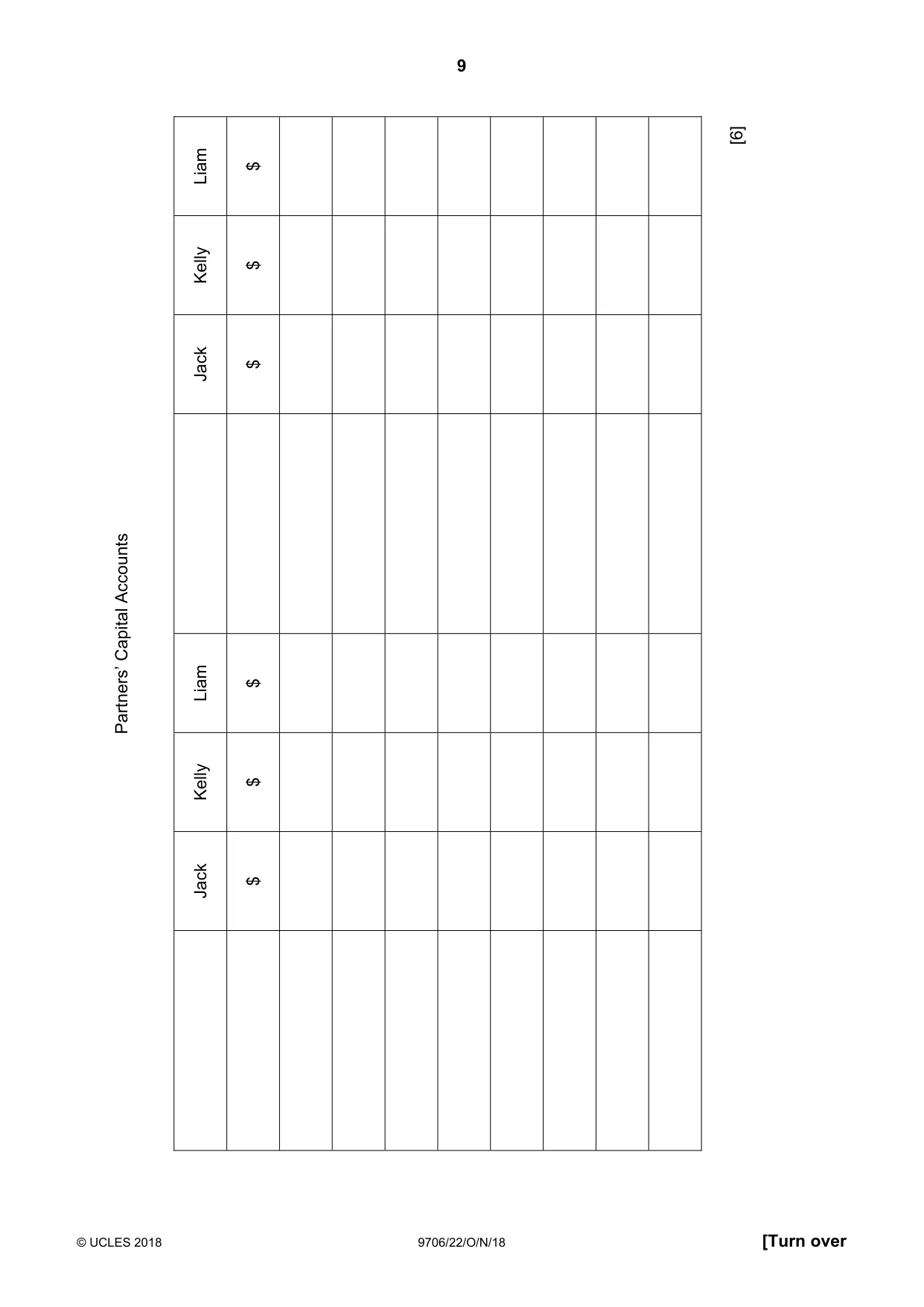
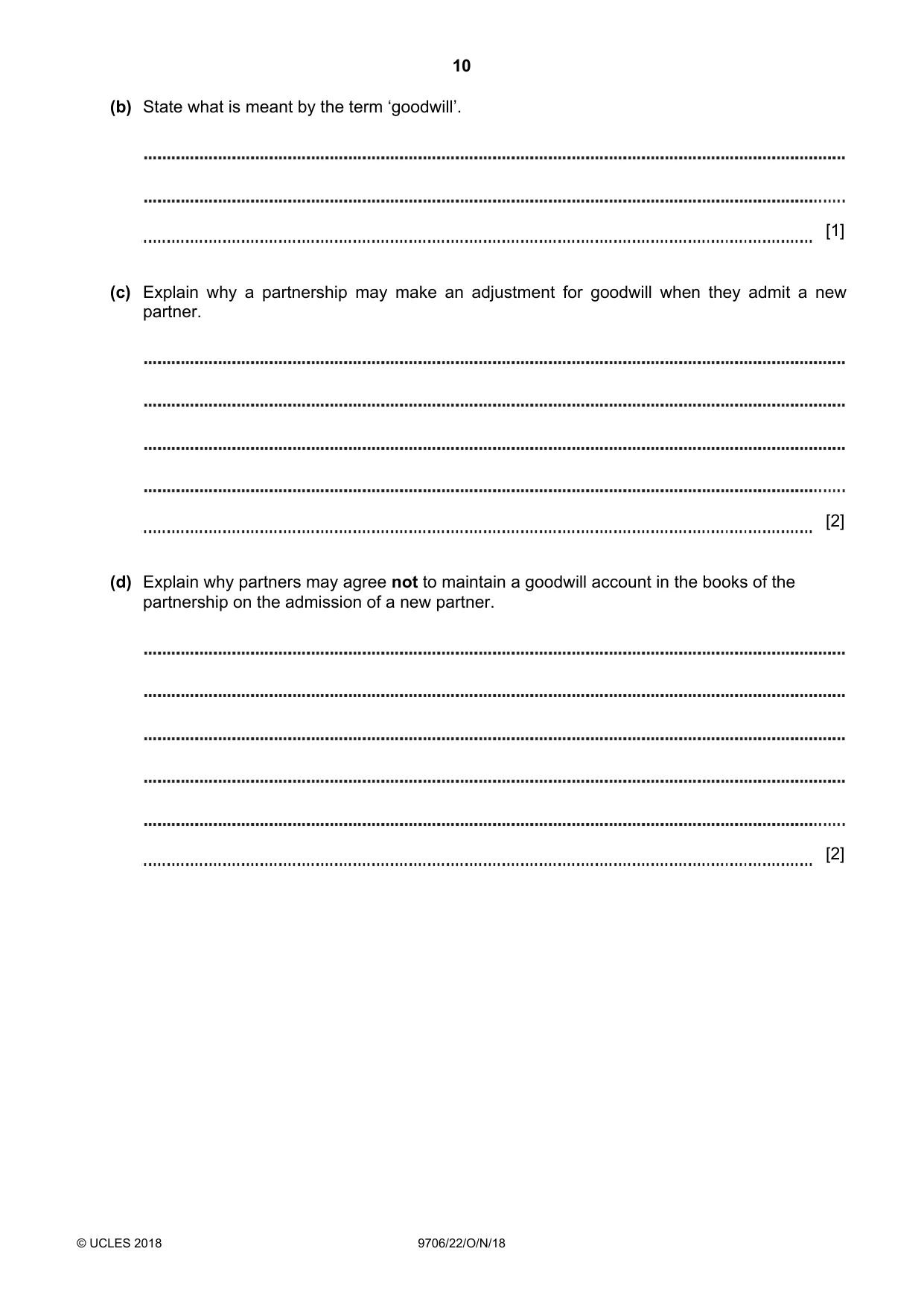
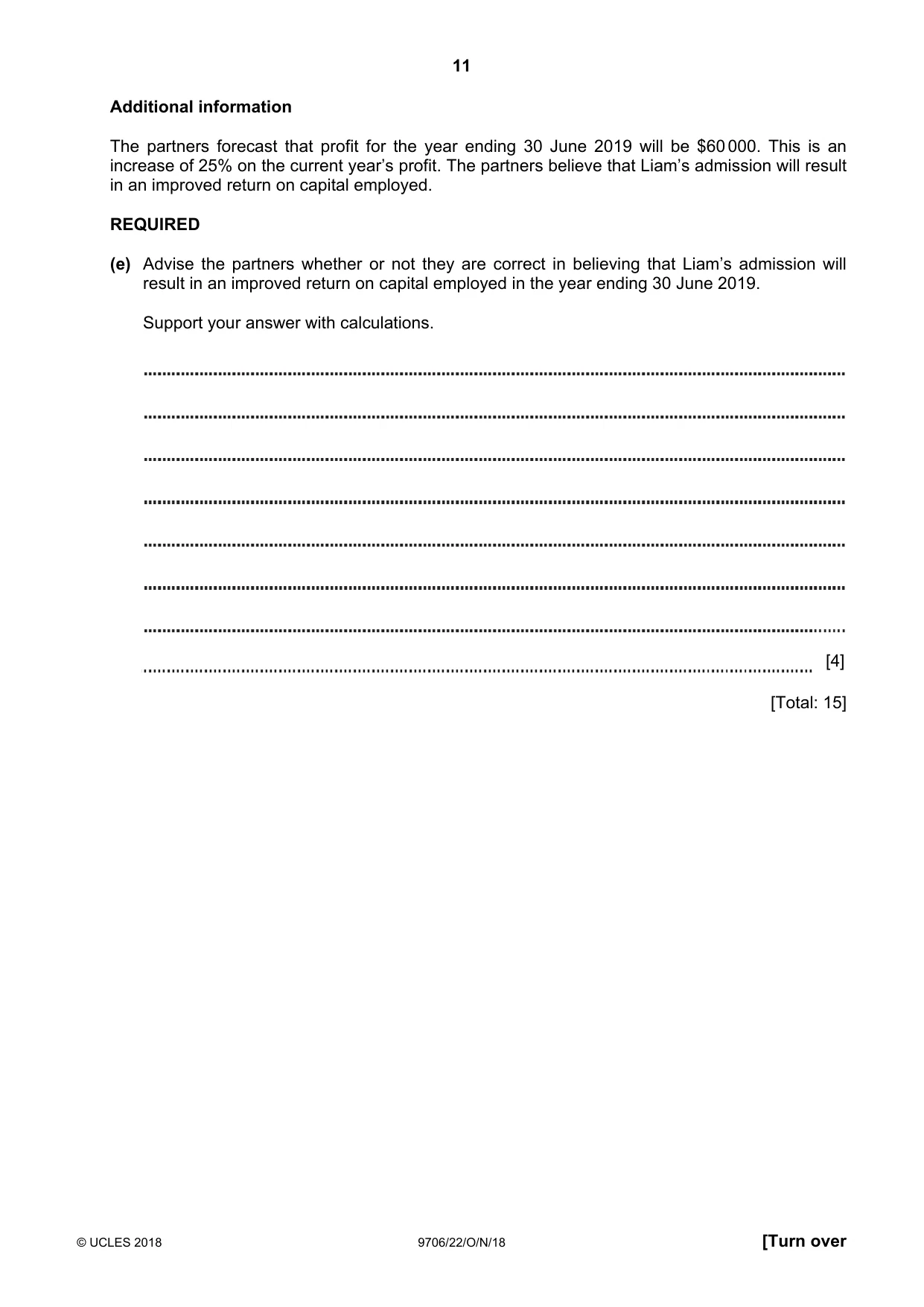
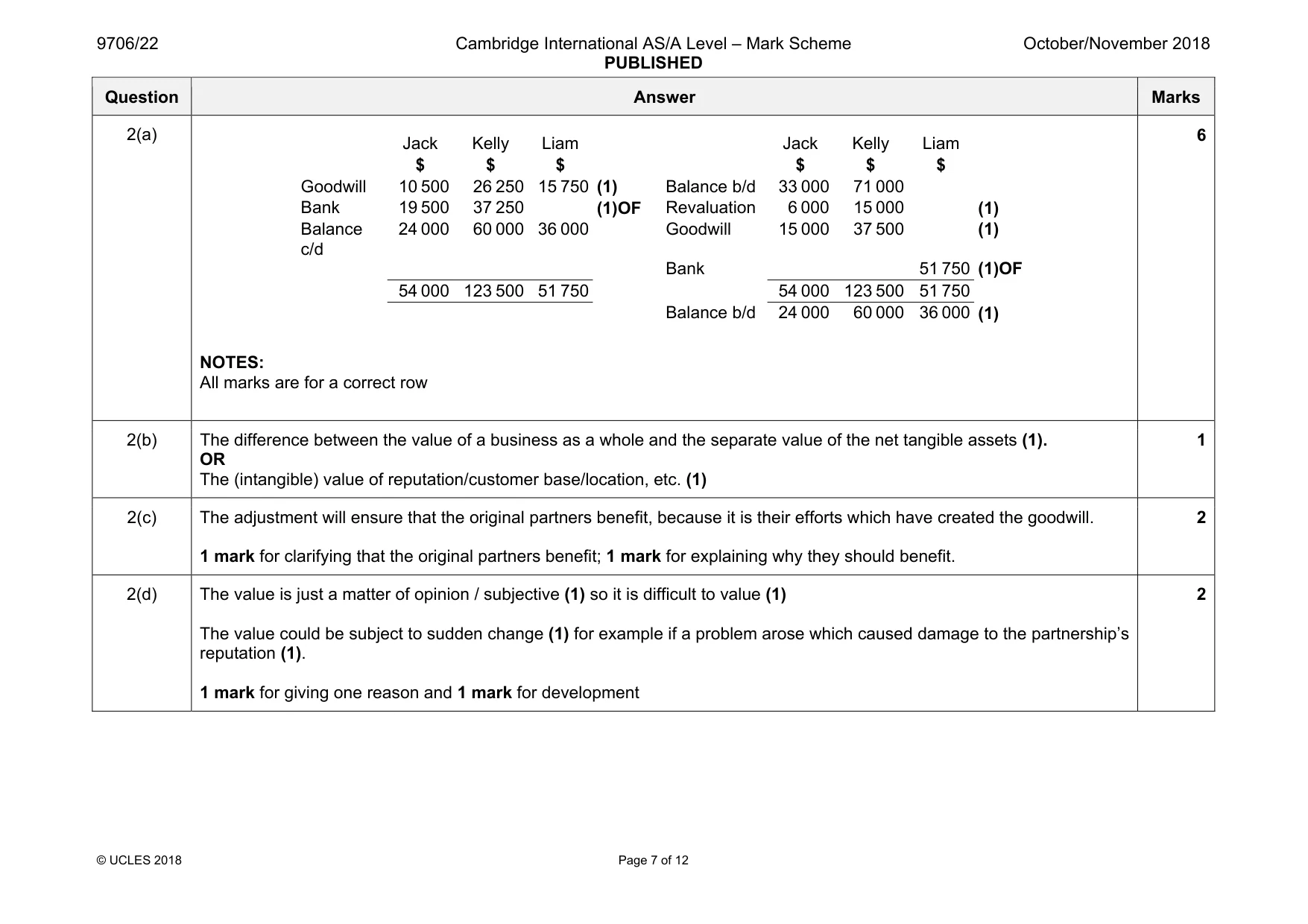
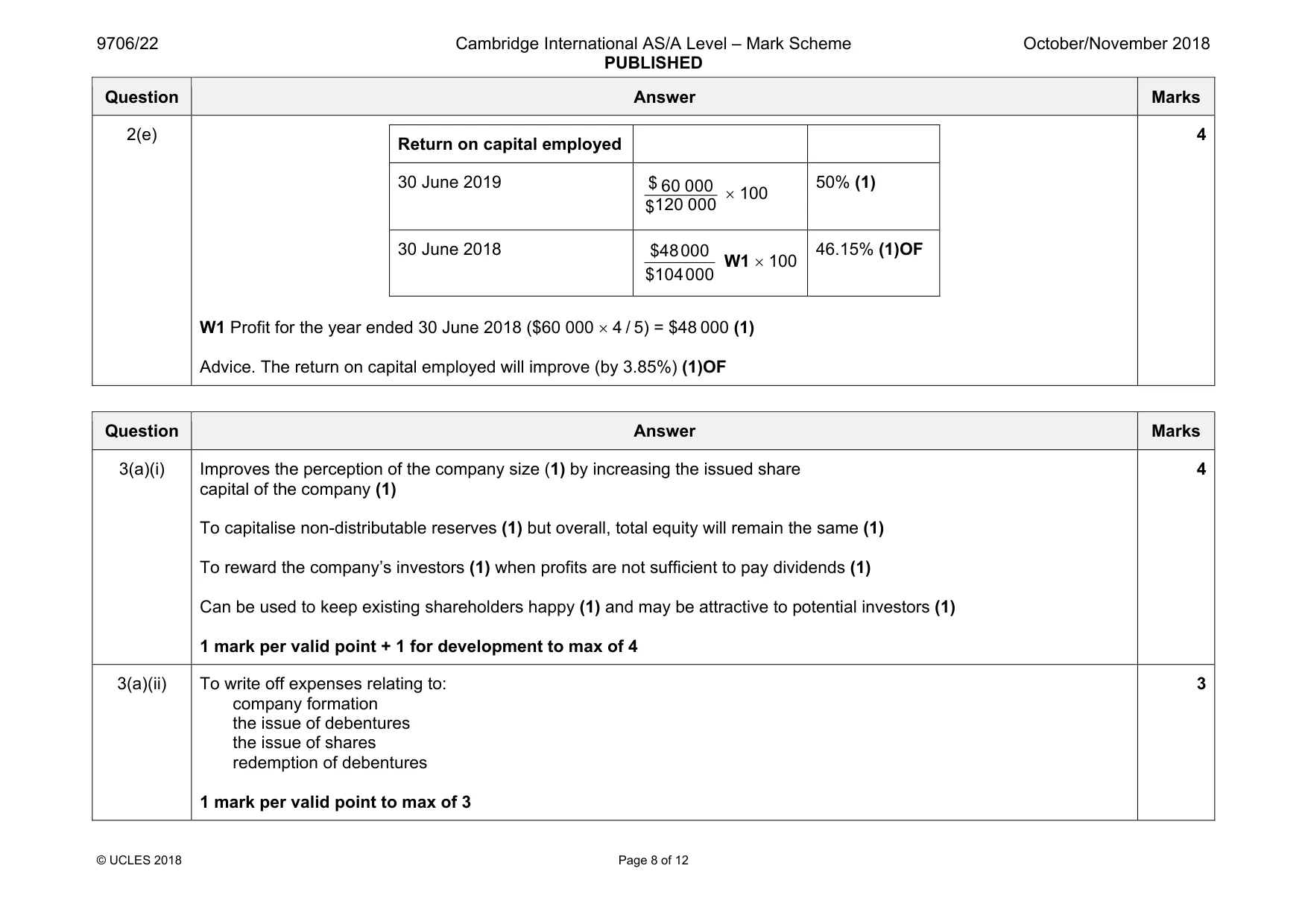
Mark scheme: 2(a) Jack Kelly Liam Jack Kelly Liam $ $ $ $ $ $ Goodwill 10 500 26 250 15 750 (1) Balance b/d 33 000 71 000 Bank 19 500 37 250 (1)OF Revaluation 6 000 15 000 (1) Balance c/d 24 000 60 000 36 000 Goodwill 15 000 37 500 (1) Bank 51 750 (1)OF 54 000 123 500 51 750 54 000 123 500 51 750 Balance b/d 24 000 60 000 36 000 (1) NOTES: All marks are for a correct row 6 2(b) The difference between the value of a business as a whole and the separate value of the net tangible assets (1). OR The (intangible) value of reputation/customer base/location, etc. (1) 1 2(c) The adjustment will ensure that the original partners benefit, because it is their efforts which have created the goodwill. 1 mark for clarifying that the original partners benefit; 1 mark for explaining why they should benefit. 2 2(d) The value is just a matter of opinion / subjective (1) so it is difficult to value (1) The value could be subject to sudden change (1) for example if a problem arose which caused damage to the partnership’s reputation (1). 1 mark for giving one reason and 1 mark for development 2 Question Answer Marks 2(e) Return on capital employed 30 June 2019 $ 60 000 120 000 $ × 100 50% (1) 30 June 2018 $48000 $104000 W1 × 100 46.15% (1)OF W1 Profit for the year ended 30 June 2018 ($60 000 × 4 / 5) = $48 000 (1) Advice. The return on capital employed will improve (by 3.85%) (1)OF 4
Q3 · Finn knew that he had sometimes taken a cash discount but had kept no record of the…
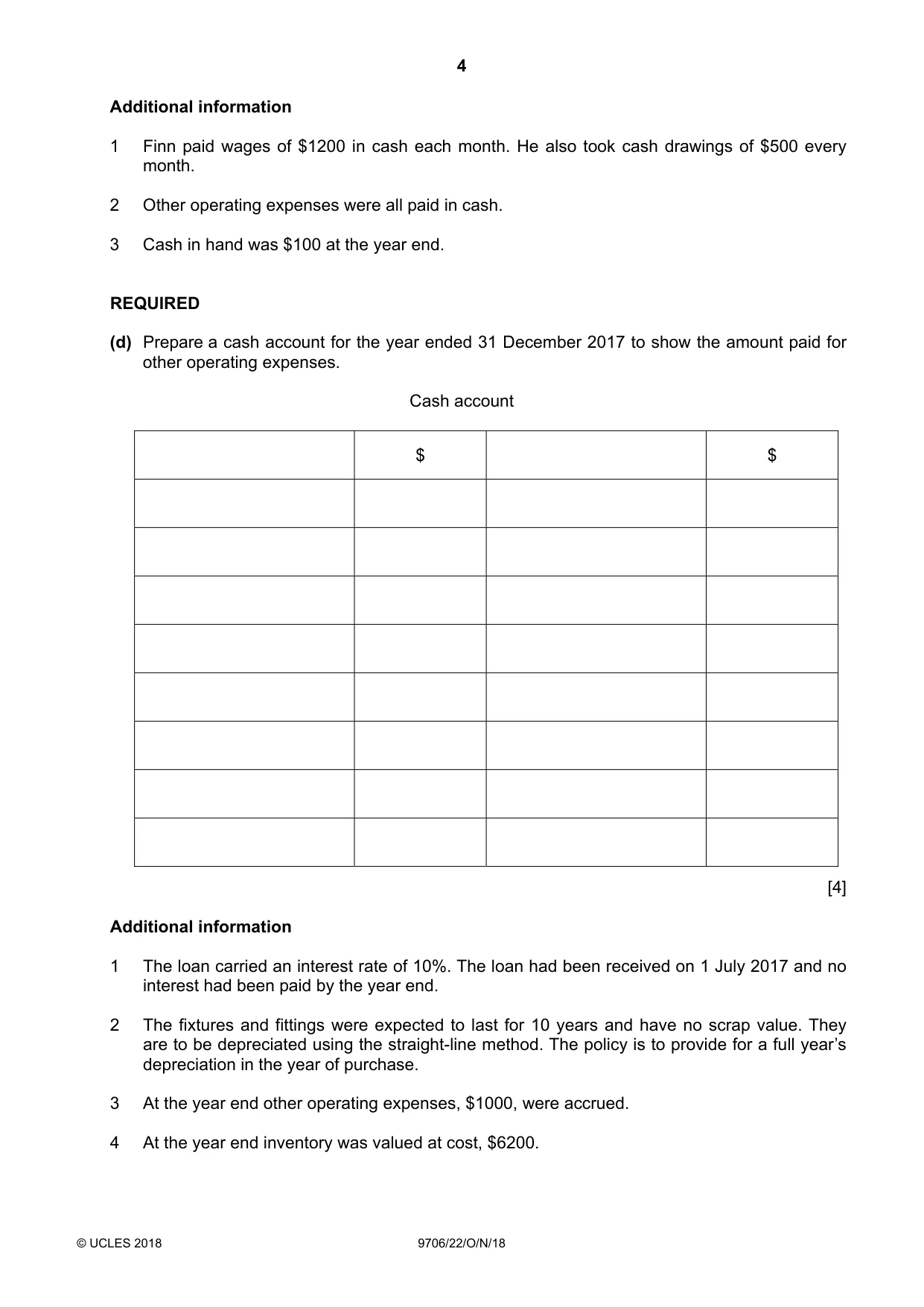
3 Finn knew that he had sometimes taken a cash discount but had kept no record of the amounts involved. REQUIRED (c) Prepare a total trade payables account for the year ended 31 December 2017 to show the total discount Finn had taken. Total trade payables account $ $ [4] Additional information 1 Finn paid wages of $1200 in cash each month. He also took cash drawings of $500 every month. 2 Other operating expenses were all paid in cash. 3 Cash in hand was $100 at the year end. REQUIRED (d) Prepare a cash account for the year ended 31 December 2017 to show the amount paid for other operating expenses. Cash account $ $ [4] Additional information 1 The loan carried an interest rate of 10%. The loan had been received on 1 July 2017 and no interest had been paid by the year end. 2 The fixtures and fittings were expected to last for 10 years and have no scrap value. They are to be depreciated using the straight-line method. The policy is to provide for a full year’s depreciation in the year of purchase. 3 At the year end other operating expenses, $1000, were accrued.
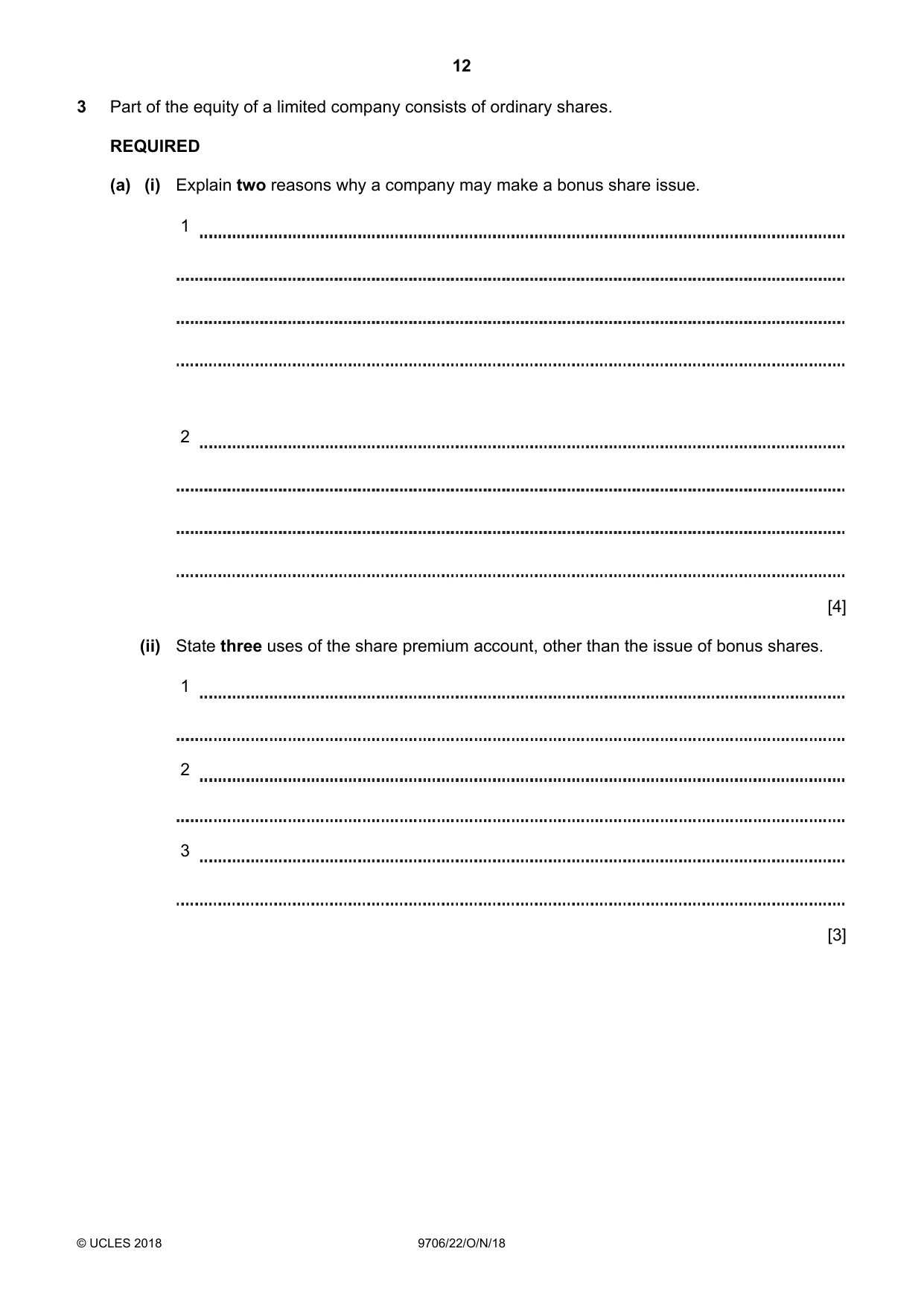
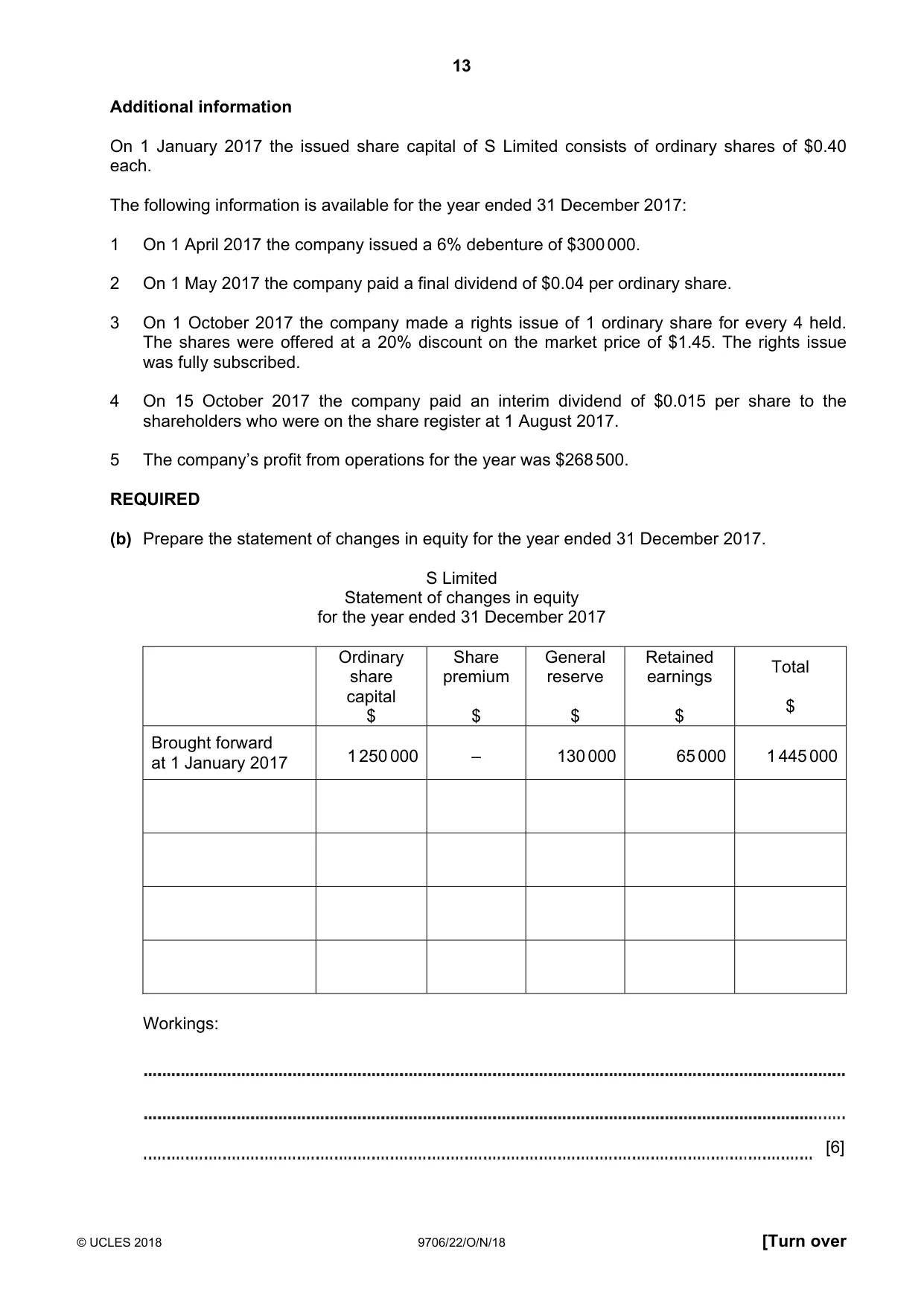
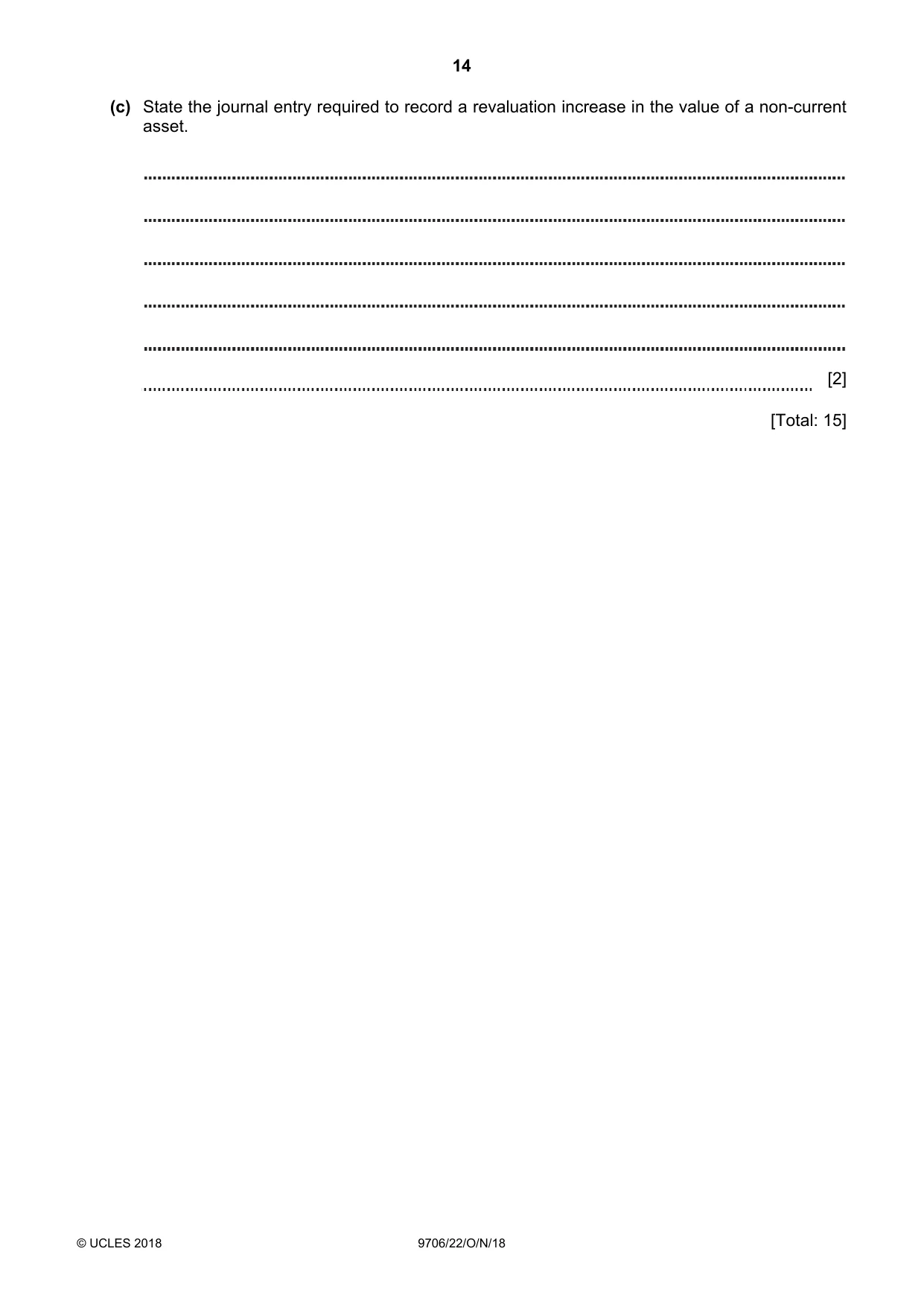
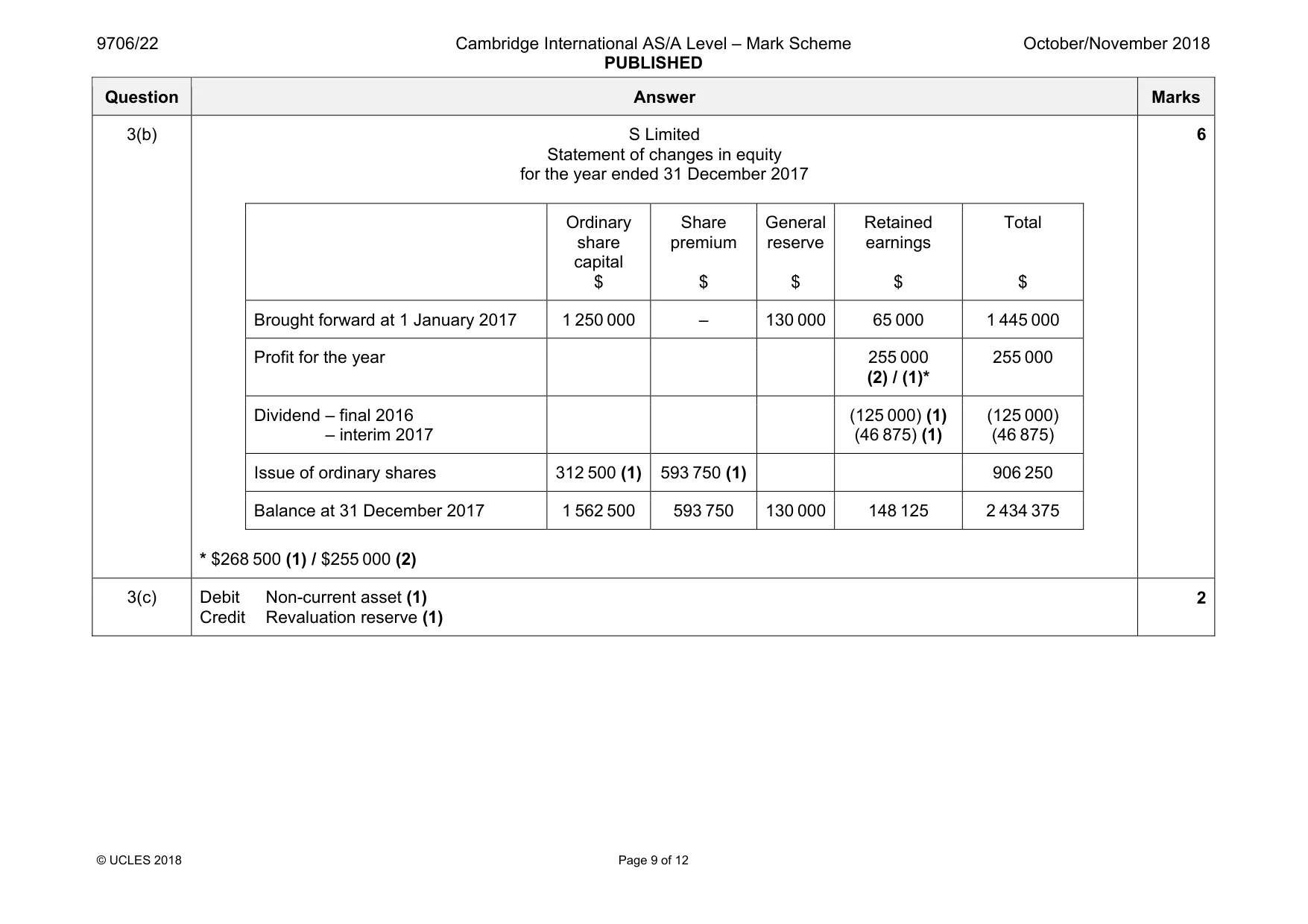
Mark scheme: 3(a)(i) Improves the perception of the company size (1) by increasing the issued share capital of the company (1) To capitalise non-distributable reserves (1) but overall, total equity will remain the same (1) To reward the company’s investors (1) when profits are not sufficient to pay dividends (1) Can be used to keep existing shareholders happy (1) and may be attractive to potential investors (1) 1 mark per valid point + 1 for development to max of 4 4 3(a)(ii) To write off expenses relating to: company formation the issue of debentures the issue of shares redemption of debentures 1 mark per valid point to max of 3 3 Question Answer Marks 3(b) S Limited Statement of changes in equity for the year ended 31 December 2017 Ordinary share capital $ Share premium $ General reserve $ Retained earnings $ Total $ Brought forward at 1 January 2017 1 250 000 – 130 000 65 000 1 445 000 Profit for the year 255 000 (2) / (1)* 255 000 Dividend – final 2016 – interim 2017 (125 000) (1) (46 875) (1) (125 000) (46 875) Issue of ordinary shares 312 500 (1) 593 750 (1) 906 250 Balance at 31 December 2017 1 562 500 593 750 130 000 148 125 2 434 375 * $268 500 (1) / $255 000 (2) 6 3(c) Debit Non-current asset (1) Credit Revaluation reserve (1) 2
Q4 · REQUIRED (e) Prepare the income statement for the year ended 31 December 2017
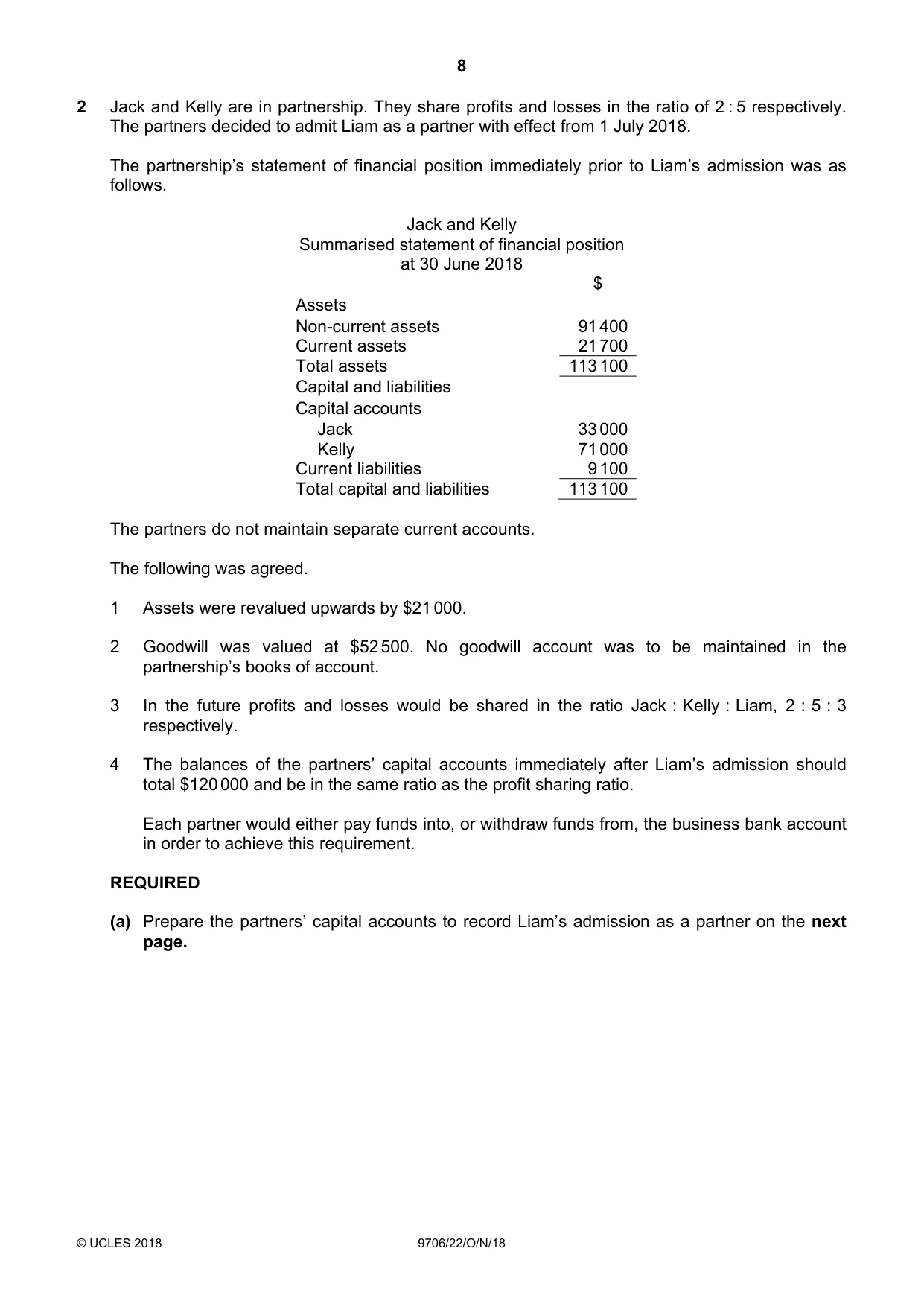
REQUIRED (e) Prepare the income statement for the year ended 31 December 2017. [9] (f) Advise Finn whether or not he should employ a book-keeper at a cost of $500 a month. Justify your answer. [4] (g) State two reasons why a trader might maintain a provision for doubtful debts. 1 2 [2] [Total: 30] PLEASE TURN OVER 2 Jack and Kelly are in partnership. They share profits and losses in the ratio of 2 : 5 respectively. The partners decided to admit Liam as a partner with effect from 1 July 2018. The partnership’s statement of financial position immediately prior to Liam’s admission was as follows. Jack and Kelly Summarised statement of financial position at 30 June 2018 $ Assets Non-current assets 91 400 Current assets 21 700 Total assets 113 100 Capital and liabilities Capital accounts Jack 33 000 Kelly 71 000 Current liabilities 9 100 Total capital and liabilities 113 100 The partners do not maintain separate current accounts. The following was agreed. 1 Assets were revalued upwards by $21 000. 2 Goodwill was valued at $52 500. No goodwill account was to be maintained in the partnership’s books of account. 3 In the future profits and losses would be shared in the ratio Jack : Kelly : Liam, 2 : 5 : 3 respectively. 4 The balances of the partners’ capital accounts immediately after Liam’s admission should total $120 000 and be in the same ratio as the profit sharing ratio. Each partner would either pay funds into, or withdraw funds from, the business bank account in order to achieve this requirement. REQUIRED (a) Prepare the partners’ capital accounts to record Liam’s admission as a partner on the next page. [6] $ Liam $ Kelly $ Jack Accounts Capital $ Partners’ Liam $ Kelly $ Jack (b) State what is meant by the term ‘goodwill’. [1] (c) Explain why a partnership may make an adjustment for goodwill when they admit a new partner. [2] (d) Explain why partners may agree not to maintain a goodwill account in the books of the partnership on the admission of a new partner. [2] Additional information The partners forecast that profit for the year ending 30 June 2019 will be $60 000. This is an increase of 25% on the current year’s profit. The partners believe that Liam’s admission will result in an improved return on capital employed. REQUIRED (e) Advise the partners whether or not they are correct in believing that Liam’s admission will result in an improved return on capital employed in the year ending 30 June 2019. Support your answer with calculations. [4] [Total: 15] 3 Part of the equity of a limited company consists of ordinary shares. REQUIRED (a) (i) Explain two reasons why a company may make a bonus share issue. 1 2 [4] (ii) State three uses of the share premium account, other than the issue of bonus shares. 1 2 3 [3] Additional information On 1 January 2017 the issued share capital of S Limited consists of ordinary shares of $0.40 each. The following information is available for the year ended 31 December 2017: 1 On 1 April 2017 the company issued a 6% debenture of $300 000. 2 On 1 May 2017 the company paid a final dividend of $0.04 per ordinary share. 3 On 1 October 2017 the company made a rights issue of 1 ordinary share for every 4 held. The shares were offered at a 20% discount on the market price of $1.45. The rights issue was fully subscribed. 4 On 15 October 2017 the company paid an interim dividend of $0.015 per share to the shareholders who were on the share register at 1 August 2017.
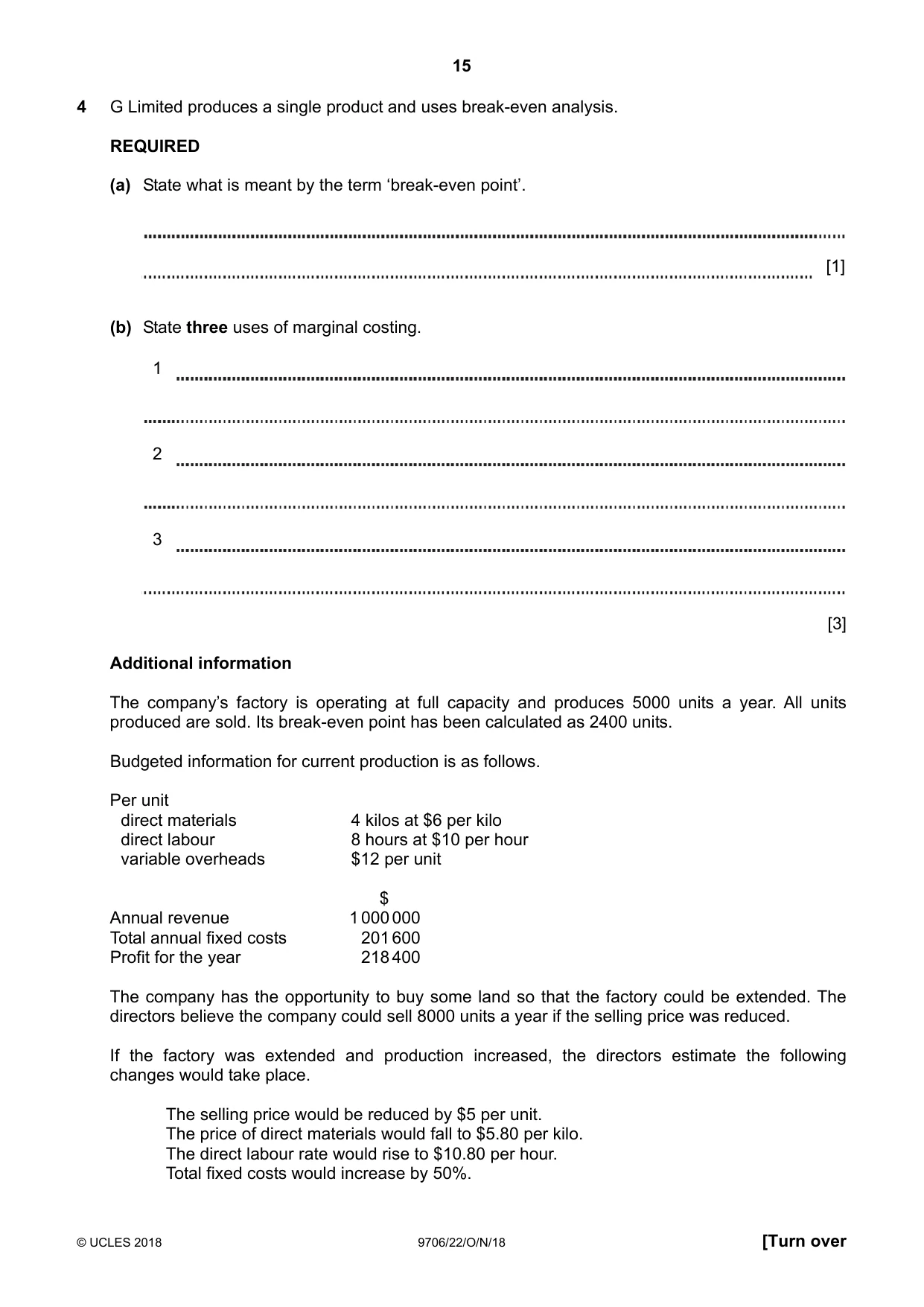
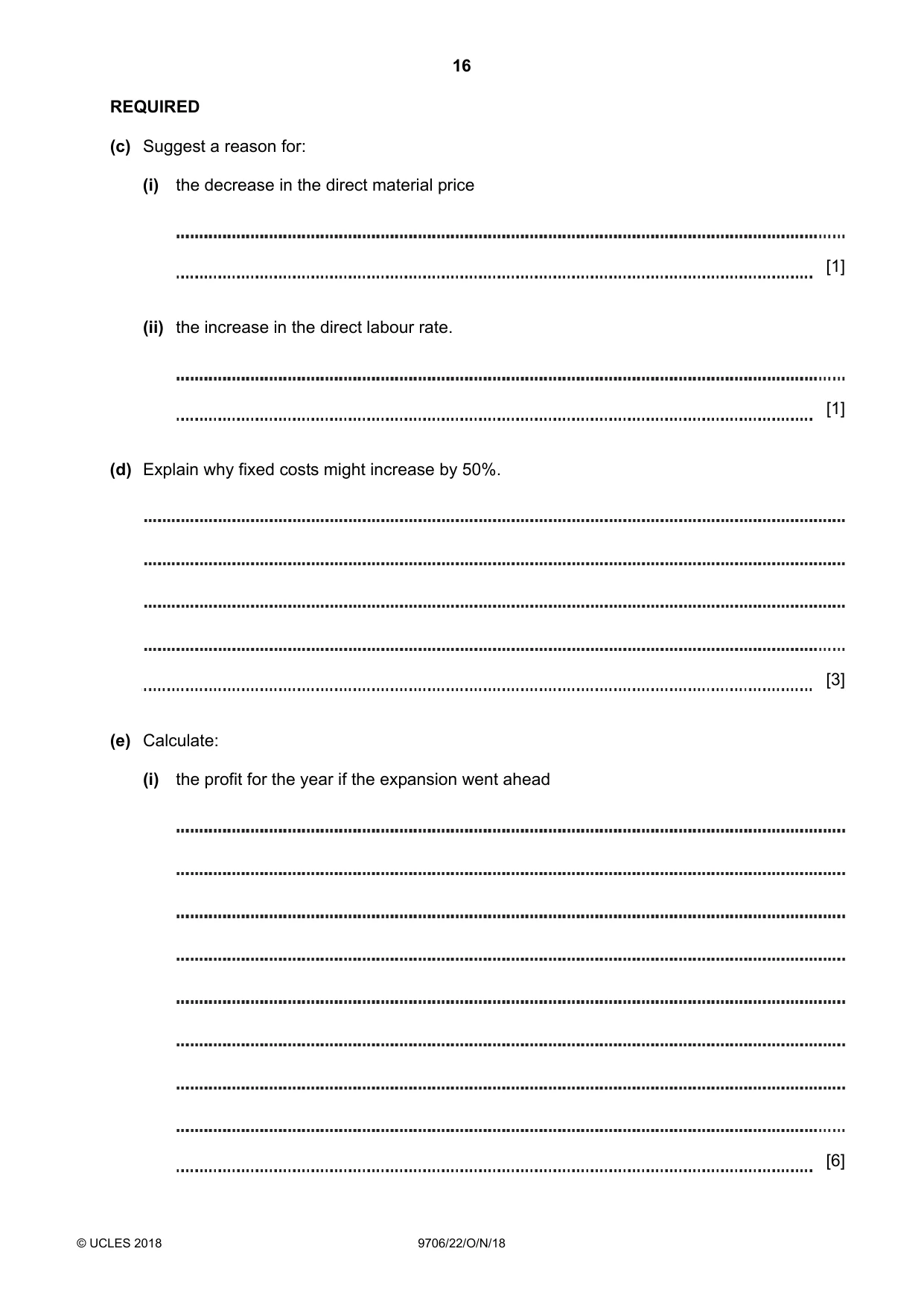
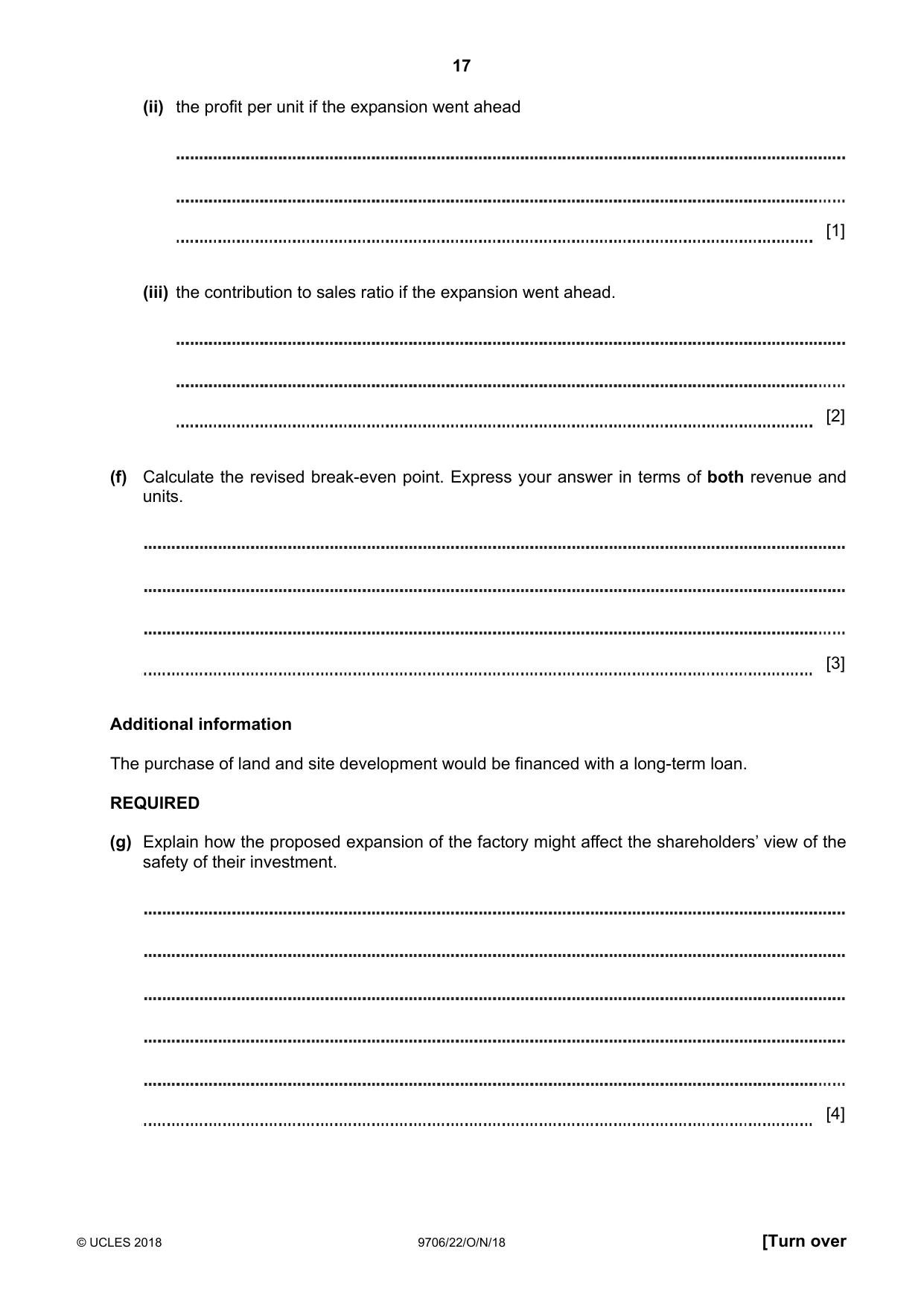
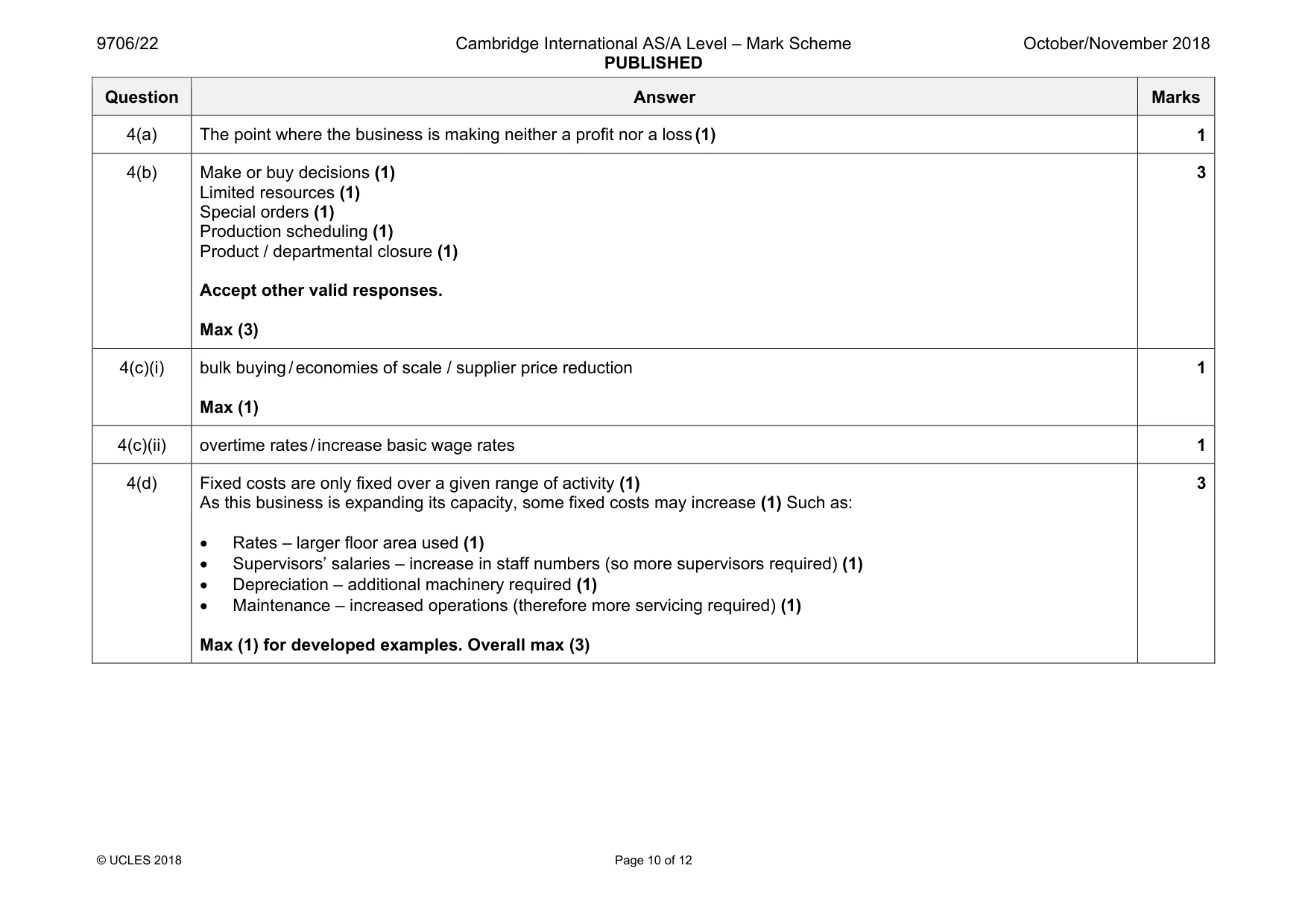
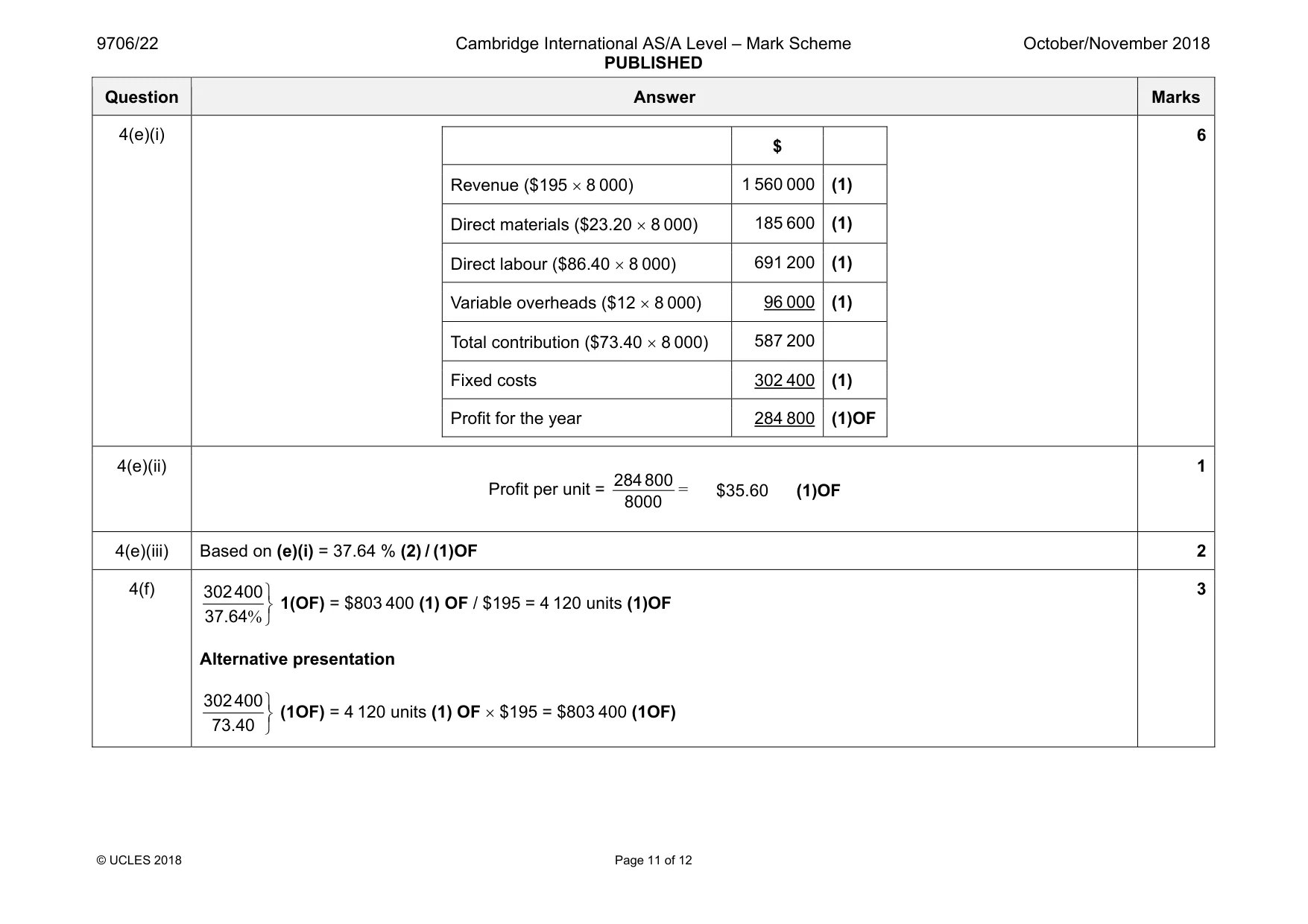
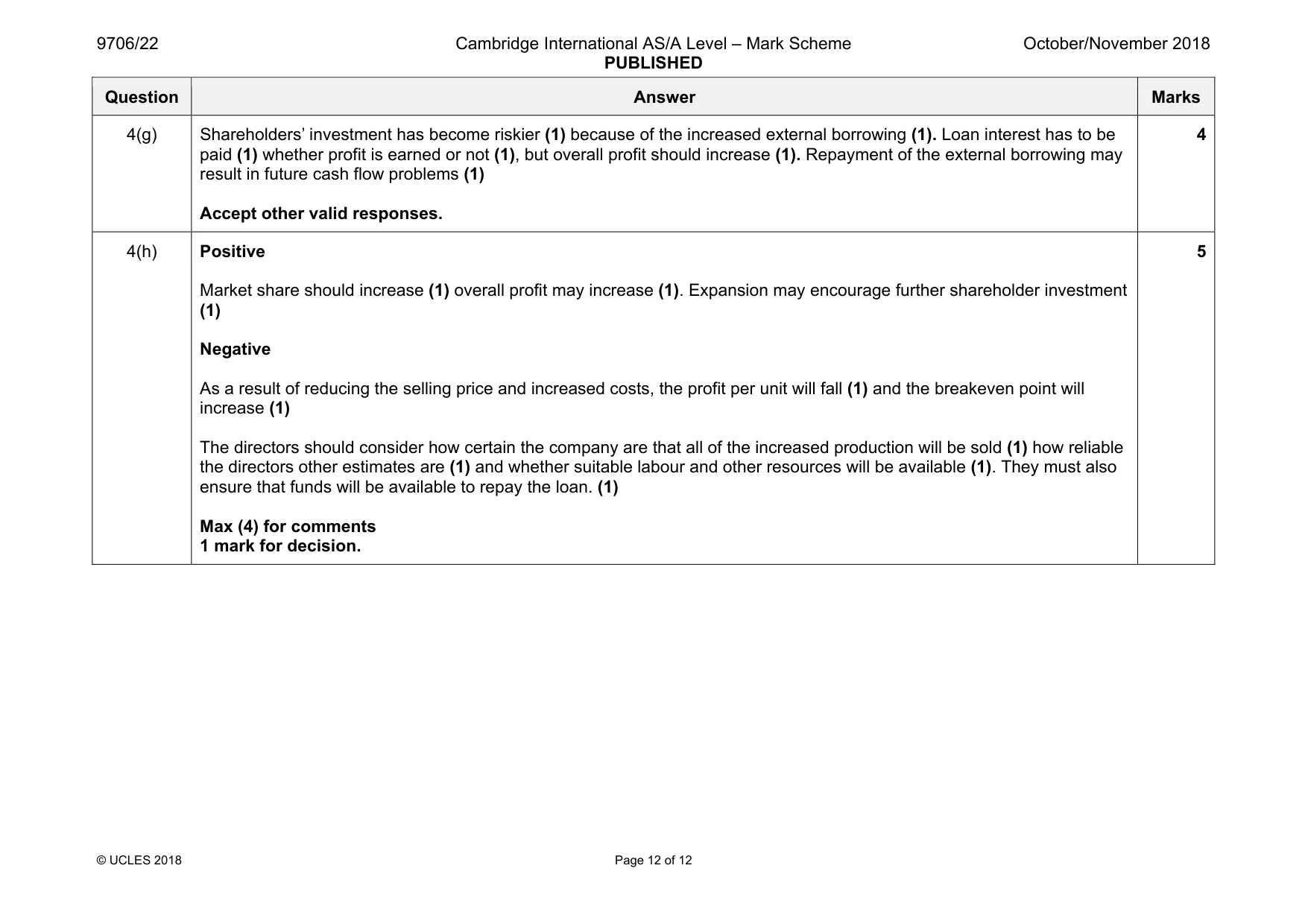
Mark scheme: 4(a) The point where the business is making neither a profit nor a loss (1) 1 4(b) Make or buy decisions (1) Limited resources (1) Special orders (1) Production scheduling (1) Product / departmental closure (1) Accept other valid responses. Max (3) 3 4(c)(i) bulk buying / economies of scale / supplier price reduction Max (1) 1 4(c)(ii) overtime rates / increase basic wage rates 1 4(d) Fixed costs are only fixed over a given range of activity (1) As this business is expanding its capacity, some fixed costs may increase (1) Such as: • Rates – larger floor area used (1) • Supervisors’ salaries – increase in staff numbers (so more supervisors required) (1) • Depreciation – additional machinery required (1) • Maintenance – increased operations (therefore more servicing required) (1) Max (1) for developed examples. Overall max (3) 3 Question Answer Marks 4(e)(i) $ Revenue ($195 × 8 000) 1 560 000 (1) Direct materials ($23.20 × 8 000) 185 600 (1) Direct labour ($86.40 × 8 000) 691 200 (1) Variable overheads ($12 × 8 000) 96 000 (1) Total contribution ($73.40 × 8 000) 587 200 Fixed costs 302 400 (1) Profit for the year 284 800 (1)OF 6 4(e)(ii) Profit per unit = 8000 800 284 = $35.60 (1)OF 1 4(e)(iii) Based on (e)(i) = 37.64 % (2) / (1)OF 2 4(f) 302400 37.64 % 1(OF) = $803 400 (1) OF / $195 = 4 120 units (1)OF Alternative presentation 302400 73.40 (1OF) = 4 120 units (1) OF × $195 = $803 400 (1OF) 3 Question Answer Marks 4(g) Shareholders’ investment has become riskier (1) because of the increased external borrowing (1). Loan interest has to be paid (1) whether profit is earned or not (1), but overall profit should increase (1). Repayment of the external borrowing may result in future cash flow problems (1) Accept other valid responses. 4 4(h) Positive Market share should increase (1) overall profit may increase (1). Expansion may encourage further shareholder investment (1) Negative As a result of reducing the selling price and increased costs, the profit per unit will fall (1) and the breakeven point will increase (1) The directors should consider how certain the company are that all of the increased production will be sold (1) how reliable the directors other estimates are (1) and whether suitable labour and other resources will be available (1). They must also ensure that funds will be available to repay the loan. (1) Max (4) for comments 1 mark for decision. 5
Q5 · The company’s profit from operations for the year was $268 500
5 The company’s profit from operations for the year was $268 500. REQUIRED (b) Prepare the statement of changes in equity for the year ended 31 December 2017. S Limited Statement of changes in equity for the year ended 31 December 2017 Ordinary Share General Retained Total share premium reserve earnings capital $ $ $ $ $ Brought forward 1 250 000 – 130 000 65 000 1 445 000 at 1 January 2017 Workings: [6] (c) State the journal entry required to record a revaluation increase in the value of a non-current asset. [2] [Total: 15] 4 G Limited produces a single product and uses break-even analysis. REQUIRED (a) State what is meant by the term ‘break-even point’. [1] (b) State three uses of marginal costing. 1 2 3 [3] Additional information The company’s factory is operating at full capacity and produces 5000 units a year. All units produced are sold. Its break-even point has been calculated as 2400 units. Budgeted information for current production is as follows. Per unit direct materials 4 kilos at $6 per kilo direct labour 8 hours at $10 per hour variable overheads $12 per unit $ Annual revenue 1 000 000 Total annual fixed costs 201 600 Profit for the year 218 400 The company has the opportunity to buy some land so that the factory could be extended. The directors believe the company could sell 8000 units a year if the selling price was reduced. If the factory was extended and production increased, the directors estimate the following changes would take place. The selling price would be reduced by $5 per unit. The price of direct materials would fall to $5.80 per kilo. The direct labour rate would rise to $10.80 per hour. Total fixed costs would increase by 50%.
What was in this paper
The subtopics covered by these 5 questions, and how many questions each got. Open one in a new tab to see every Cambridge question on it.
What you needed in this session
Cambridge’s own grade thresholds for 2018 Oct/Nov, Paper 2 · Variant 2. A higher threshold means an easier paper — the bar moves with how the cohort did.