Cambridge A Level Accounting 9706 — 2018 Oct/Nov Paper 2 · Variant 1
9706/21/O/N/18 · 6 questions · 90 marks · ≈101 min
The question paper and its mark scheme, free to read here and free to download. This is Cambridge’s own paper, exactly as it was sat.
Question paper20 pages



Mark scheme11 pages
Answers below. Sit the paper first if you are practising.
Questions as text
Q1 · Francesco is a sole trader who runs a small bicycle distribution business
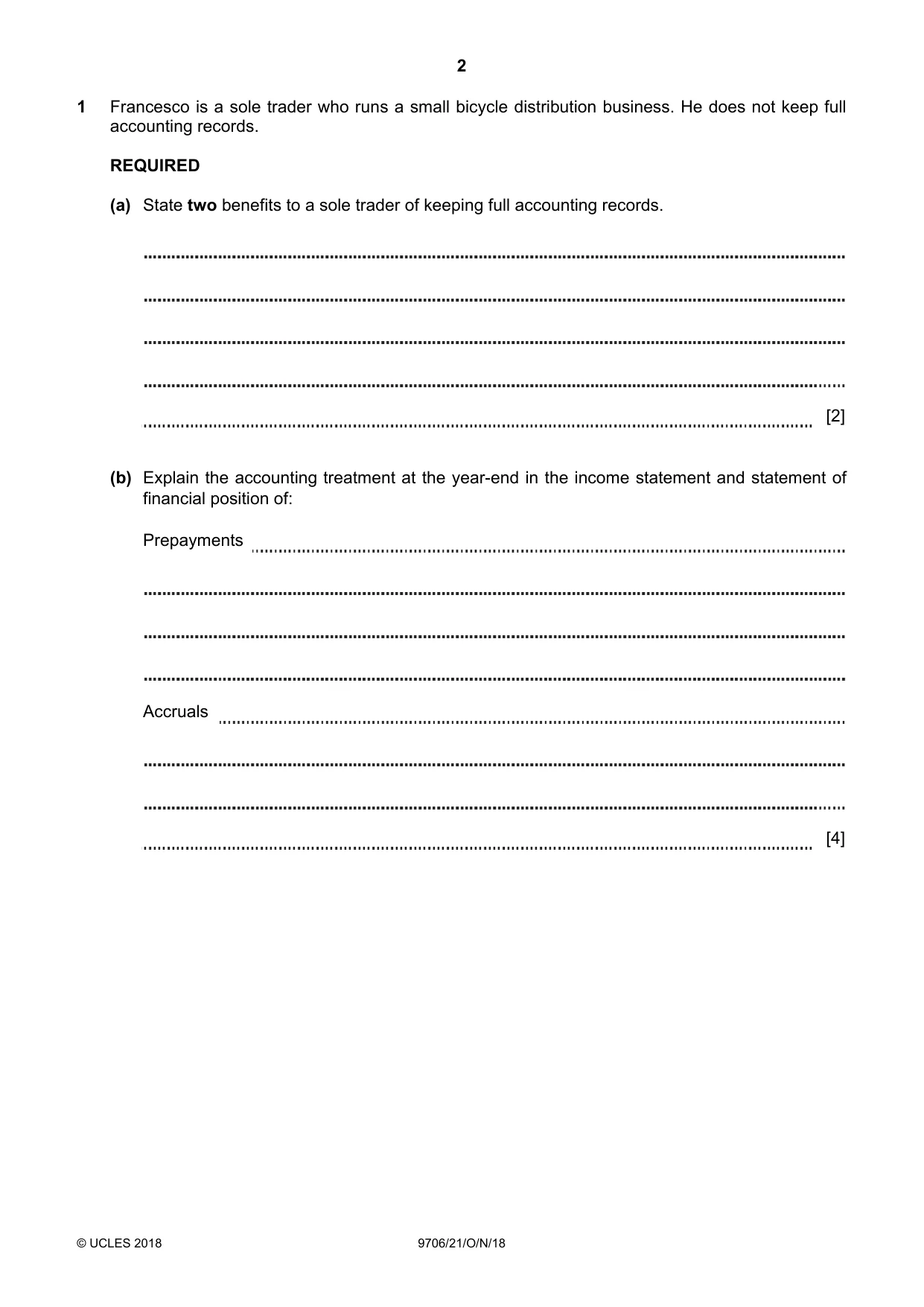
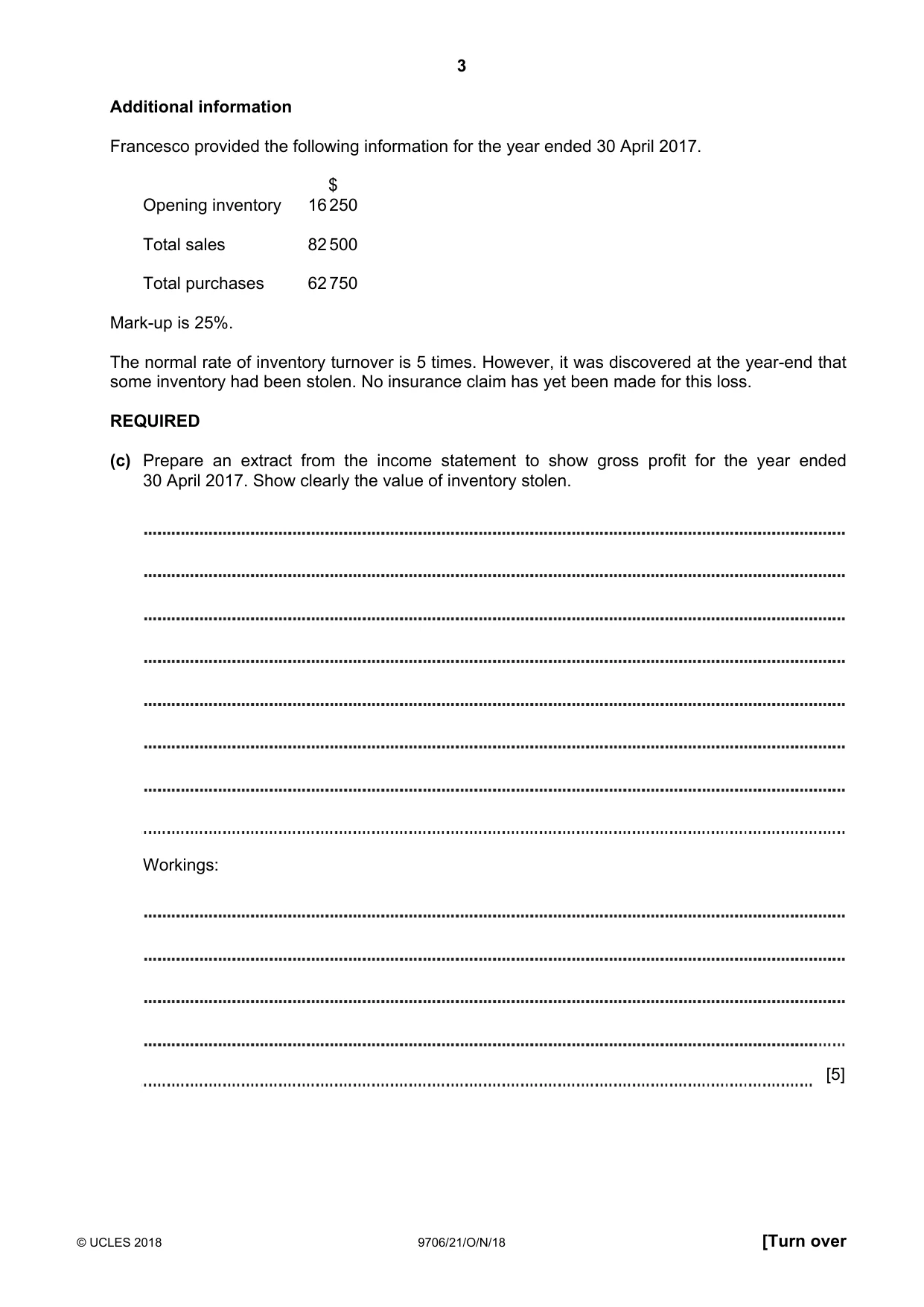
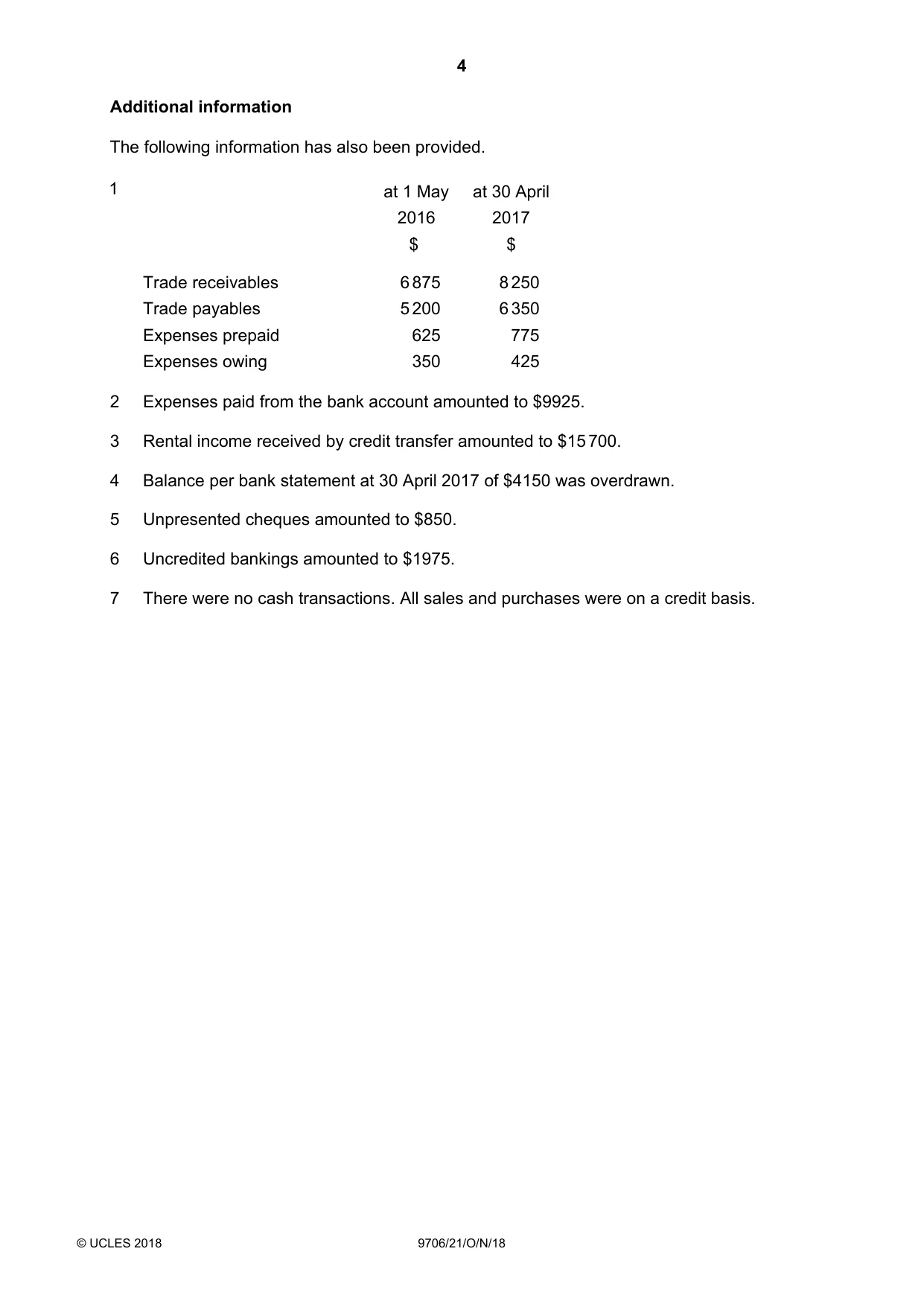
1 Francesco is a sole trader who runs a small bicycle distribution business. He does not keep full accounting records. REQUIRED (a) State two benefits to a sole trader of keeping full accounting records. [2] (b) Explain the accounting treatment at the year-end in the income statement and statement of financial position of: Prepayments Accruals [4] Additional information Francesco provided the following information for the year ended 30 April 2017. $ Opening inventory 16 250 Total sales 82 500 Total purchases 62 750 Mark-up is 25%. The normal rate of inventory turnover is 5 times. However, it was discovered at the year-end that some inventory had been stolen. No insurance claim has yet been made for this loss. REQUIRED (c) Prepare an extract from the income statement to show gross profit for the year ended 30 April 2017. Show clearly the value of inventory stolen. Workings: [5] Additional information The following information has also been provided. 1 at 1 May at 30 April 2016 2017 $ $ Trade receivables 6 875 8 250 Trade payables 5 200 6 350 Expenses prepaid 625 775 Expenses owing 350 425
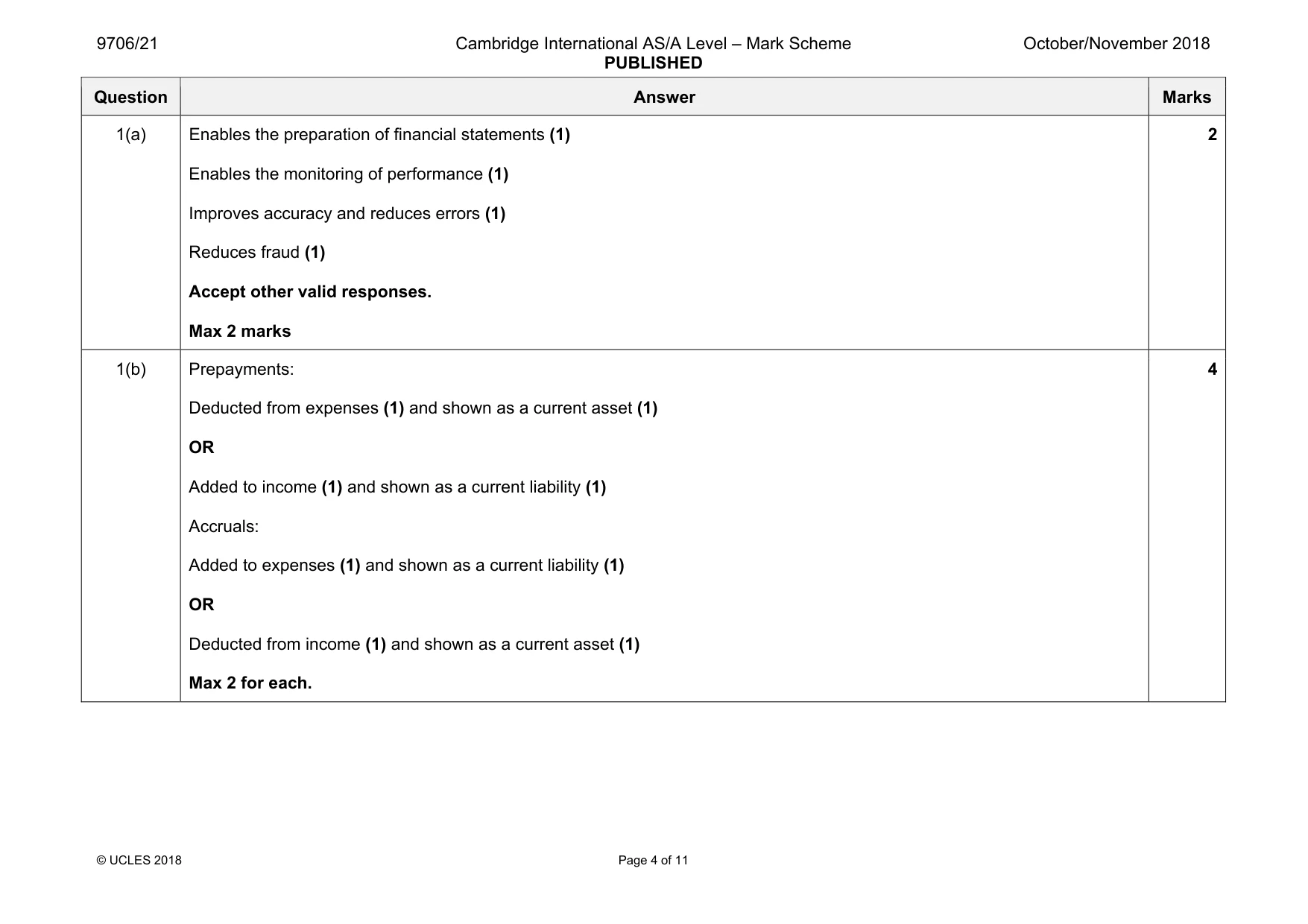
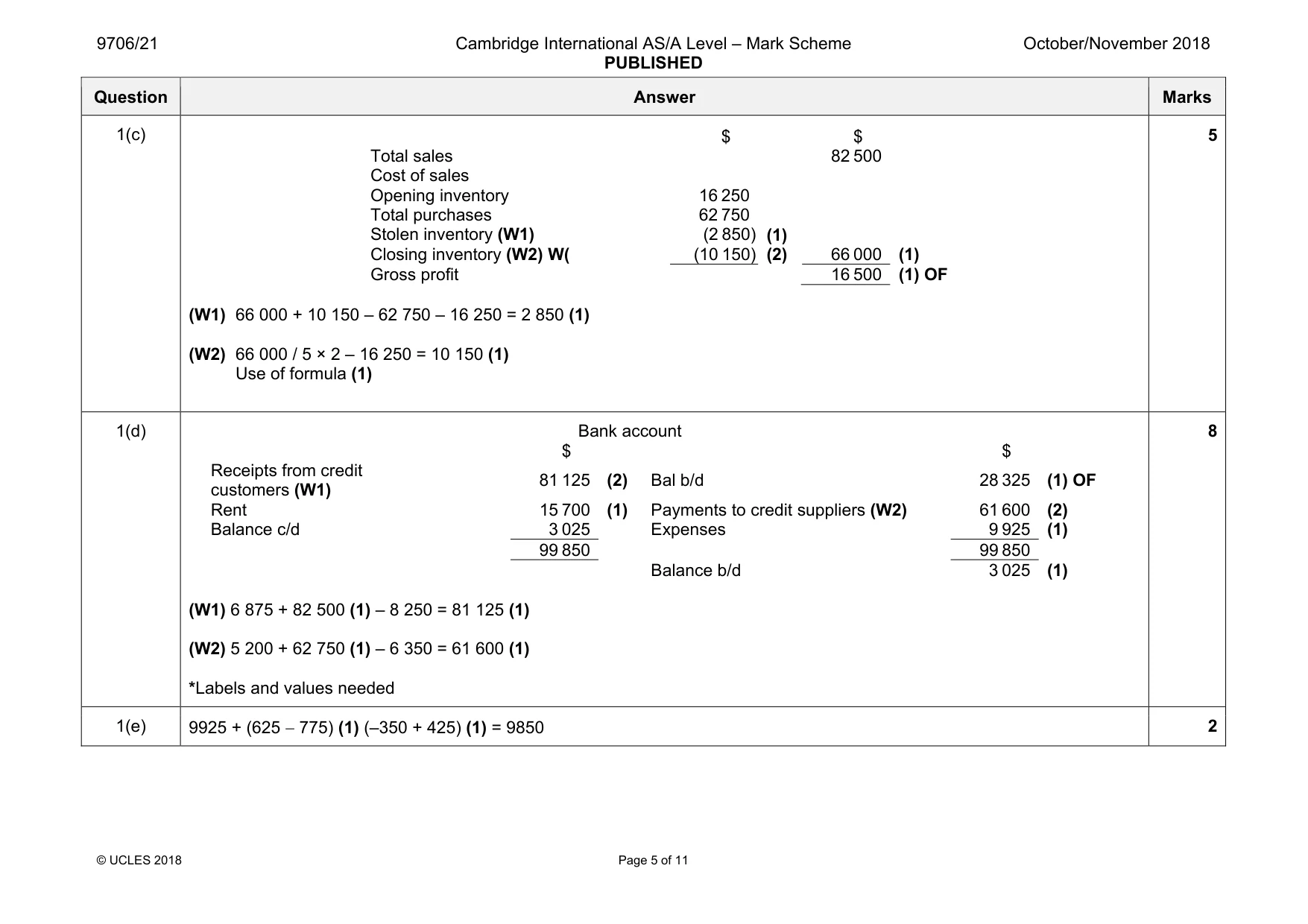
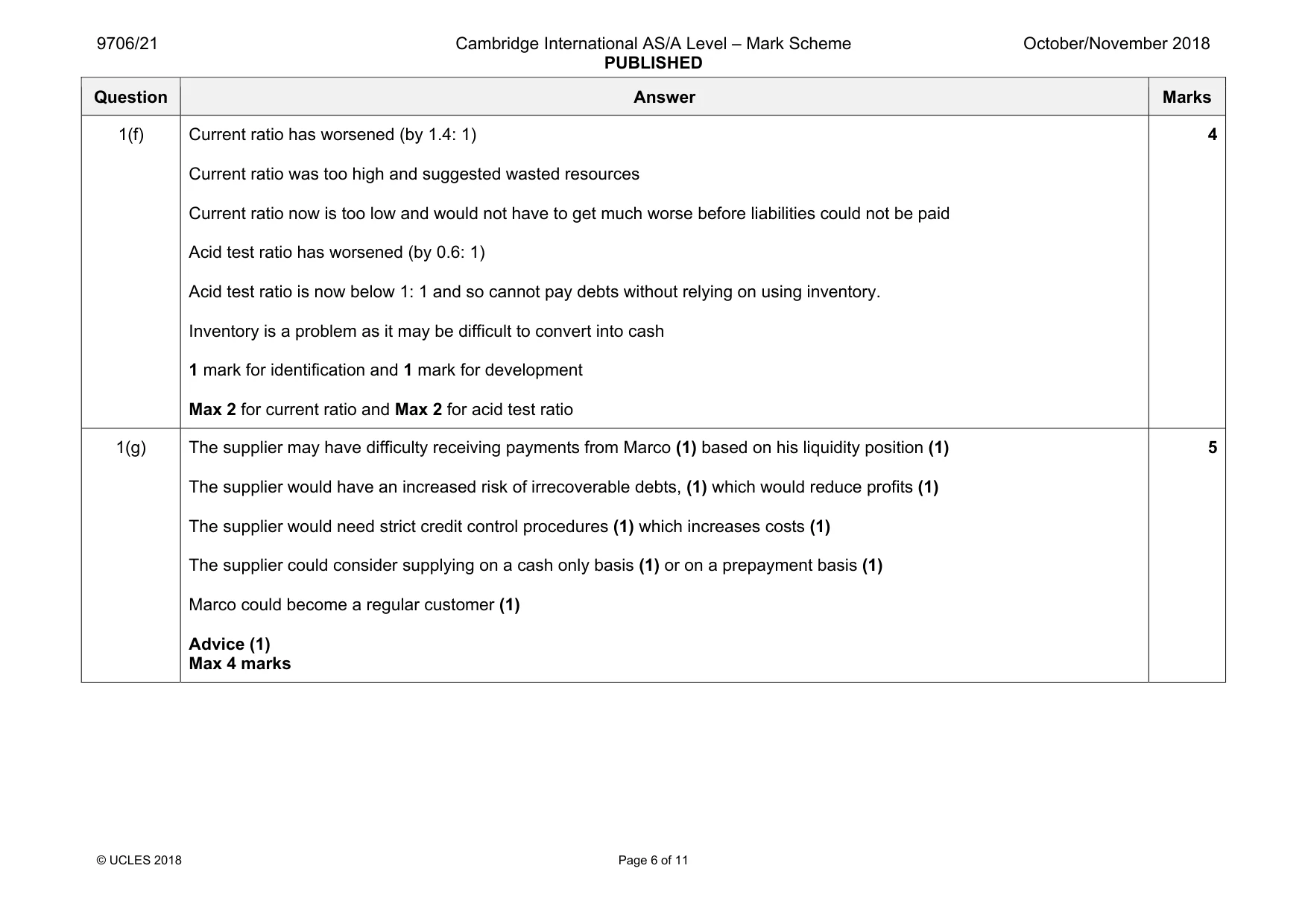
Mark scheme: 1(a) Enables the preparation of financial statements (1) Enables the monitoring of performance (1) Improves accuracy and reduces errors (1) Reduces fraud (1) Accept other valid responses. Max 2 marks 2 1(b) Prepayments: Deducted from expenses (1) and shown as a current asset (1) OR Added to income (1) and shown as a current liability (1) Accruals: Added to expenses (1) and shown as a current liability (1) OR Deducted from income (1) and shown as a current asset (1) Max 2 for each. 4 Question Answer Marks 1(c) $ $ Total sales 82 500 Cost of sales Opening inventory 16 250 Total purchases 62 750 Stolen inventory (W1) (2 850) (1) Closing inventory (W2) W( (10 150) (2) 66 000 (1) Gross profit 16 500 (1) OF (W1) 66 000 + 10 150 – 62 750 – 16 250 = 2 850 (1) (W2) 66 000 / 5 × 2 – 16 250 = 10 150 (1) Use of formula (1) 5 1(d) Bank account $ $ Receipts from credit customers (W1) 81 125 (2) Bal b/d 28 325 (1) OF Rent 15 700 (1) Payments to credit suppliers (W2) 61 600 (2) Balance c/d 3 025 Expenses 9 925 (1) 99 850 99 850 Balance b/d 3 025 (1) (W1) 6 875 + 82 500 (1) – 8 250 = 81 125 (1) (W2) 5 200 + 62 750 (1) – 6 350 = 61 600 (1) *Labels and values needed 8 1(e) 9925 + (625 − 775) (1) (–350 + 425) (1) = 9850 2 Question Answer Marks 1(f) Current ratio has worsened (by 1.4: 1) Current ratio was too high and suggested wasted resources Current ratio now is too low and would not have to get much worse before liabilities could not be paid Acid test ratio has worsened (by 0.6: 1) Acid test ratio is now below 1: 1 and so cannot pay debts without relying on using inventory. Inventory is a problem as it may be difficult to convert into cash 1 mark for identification and 1 mark for development Max 2 for current ratio and Max 2 for acid test ratio 4 1(g) The supplier may have difficulty receiving payments from Marco (1) based on his liquidity position (1) The supplier would have an increased risk of irrecoverable debts, (1) which would reduce profits (1) The supplier would need strict credit control procedures (1) which increases costs (1) The supplier could consider supplying on a cash only basis (1) or on a prepayment basis (1) Marco could become a regular customer (1) Advice (1) Max 4 marks 5
Q2 · A business depreciates its non-current assets
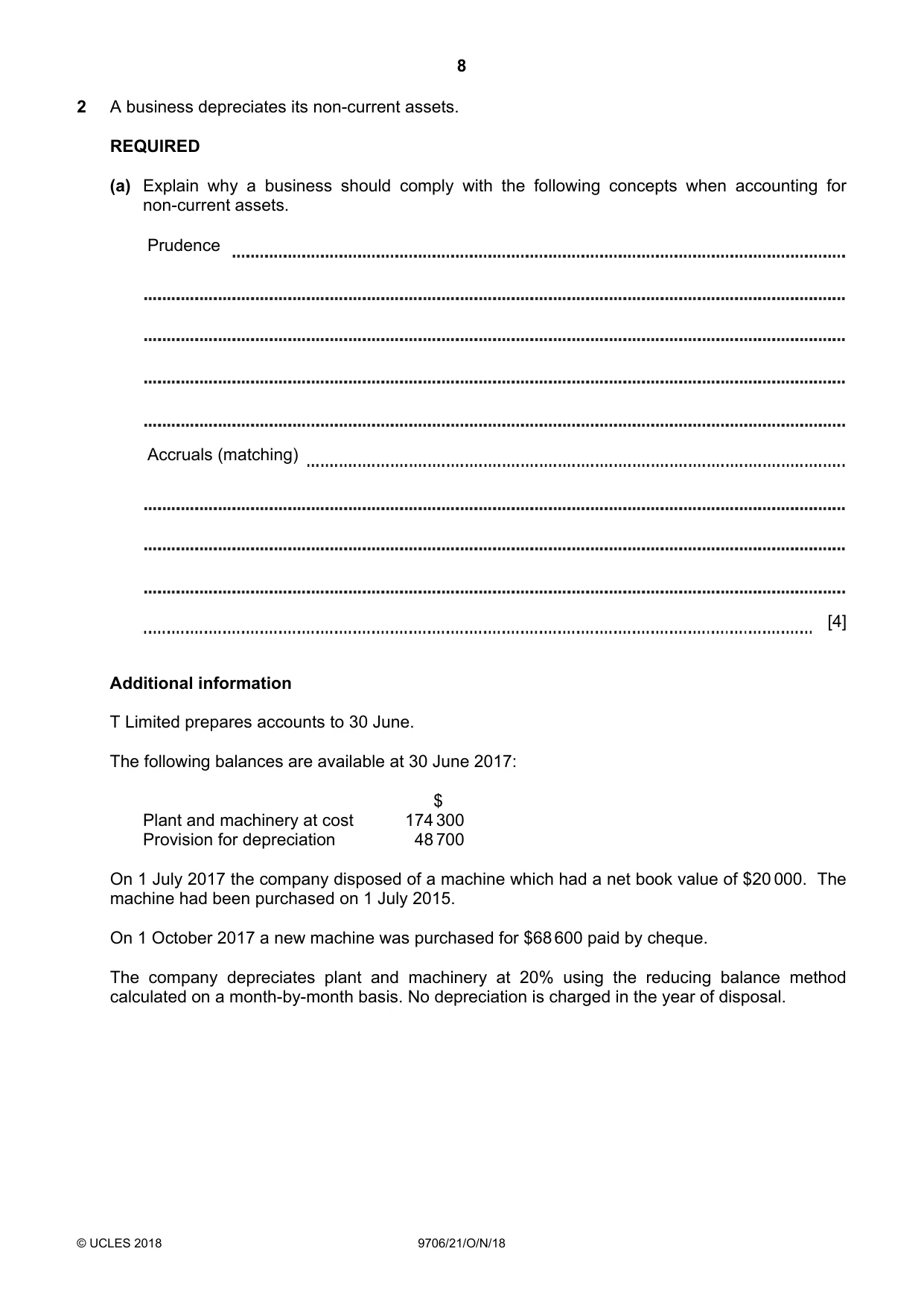
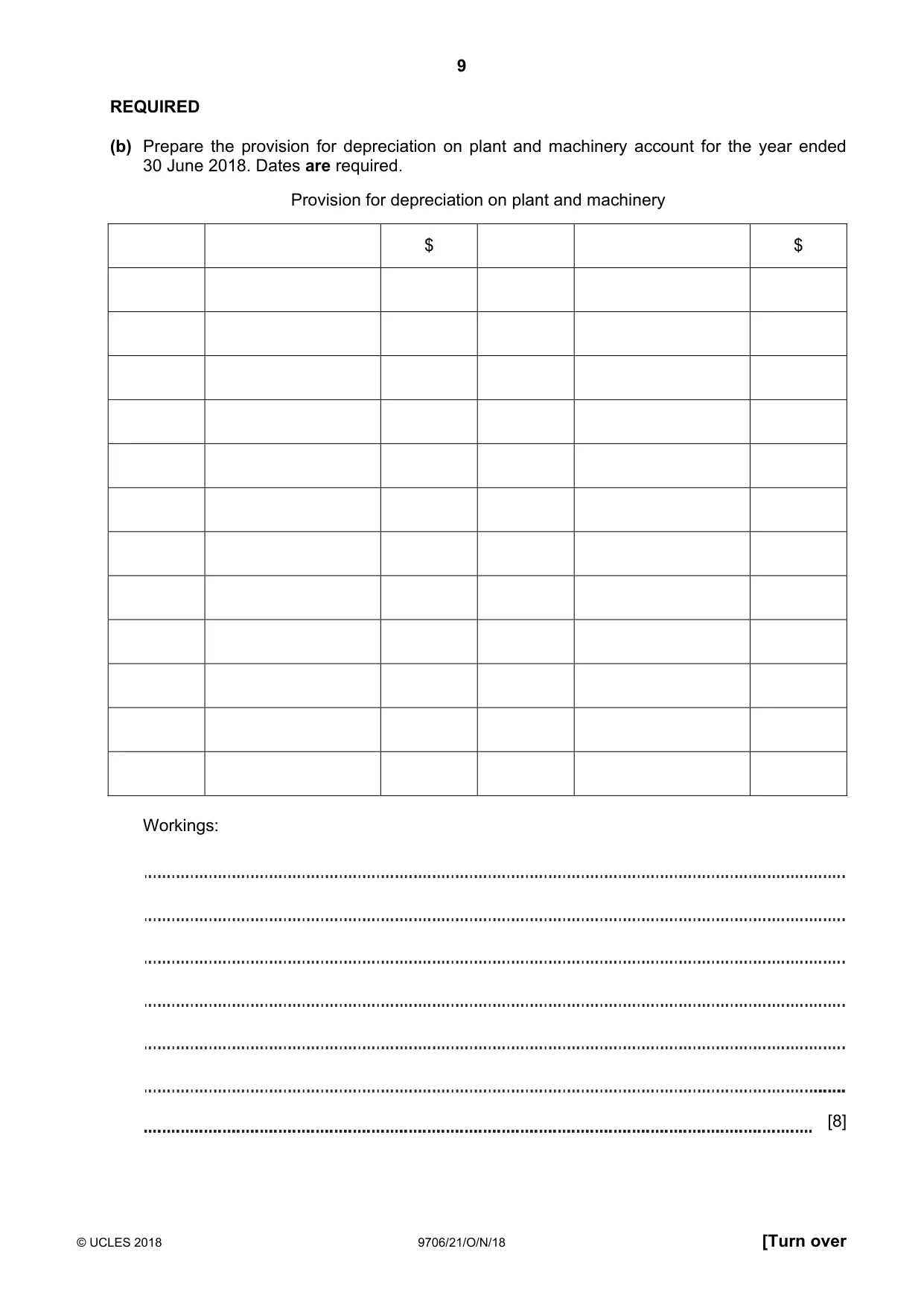
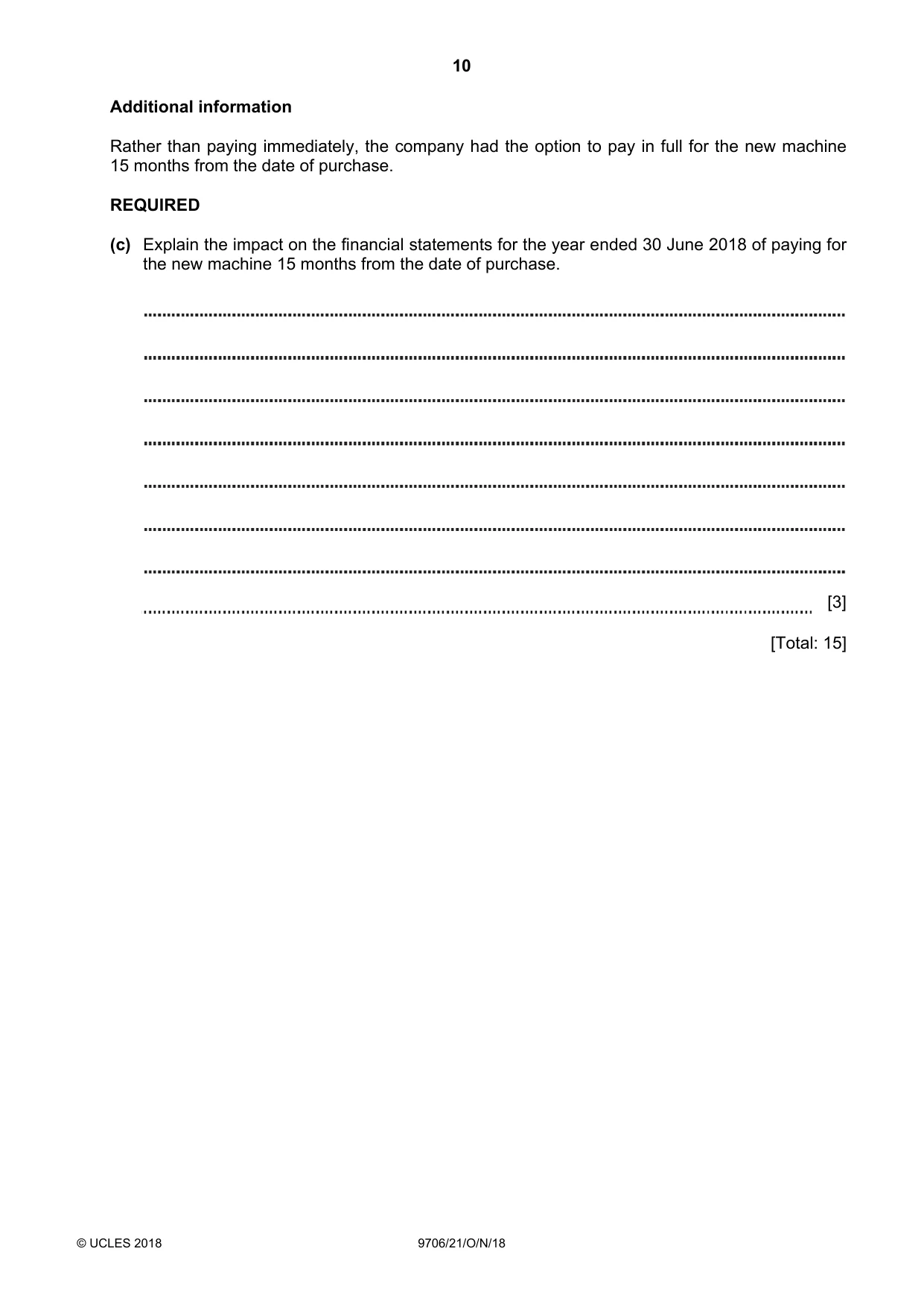
2 A business depreciates its non-current assets. REQUIRED (a) Explain why a business should comply with the following concepts when accounting for non-current assets. Prudence Accruals (matching) [4] Additional information T Limited prepares accounts to 30 June. The following balances are available at 30 June 2017: $ Plant and machinery at cost 174 300 Provision for depreciation 48 700 On 1 July 2017 the company disposed of a machine which had a net book value of $20 000. The machine had been purchased on 1 July 2015. On 1 October 2017 a new machine was purchased for $68 600 paid by cheque. The company depreciates plant and machinery at 20% using the reducing balance method calculated on a month-by-month basis. No depreciation is charged in the year of disposal. REQUIRED (b) Prepare the provision for depreciation on plant and machinery account for the year ended 30 June 2018. Dates are required. Provision for depreciation on plant and machinery $ $ Workings: [8] Additional information Rather than paying immediately, the company had the option to pay in full for the new machine 15 months from the date of purchase. REQUIRED (c) Explain the impact on the financial statements for the year ended 30 June 2018 of paying for the new machine 15 months from the date of purchase. [3] [Total: 15] PLEASE TURN OVER
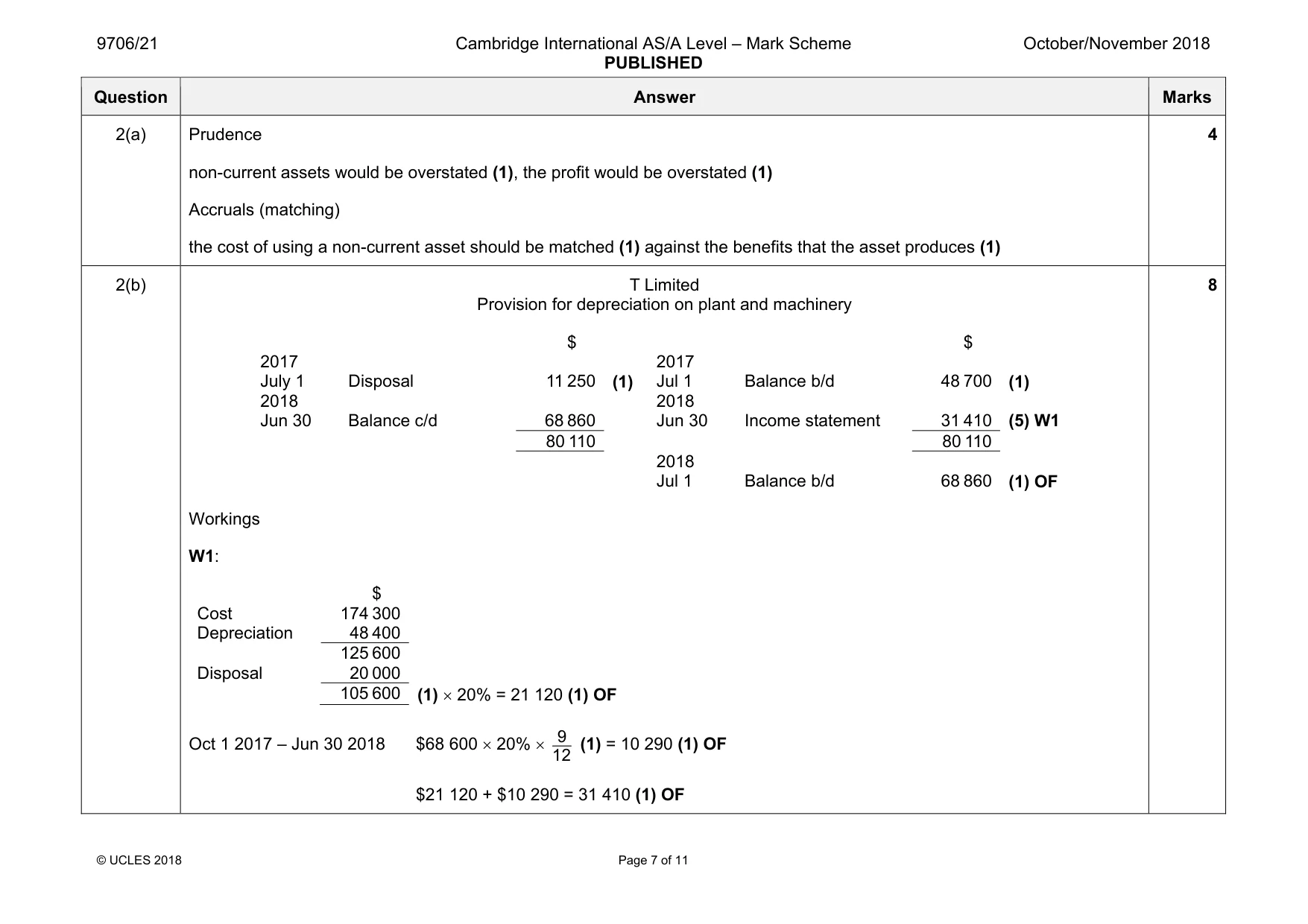
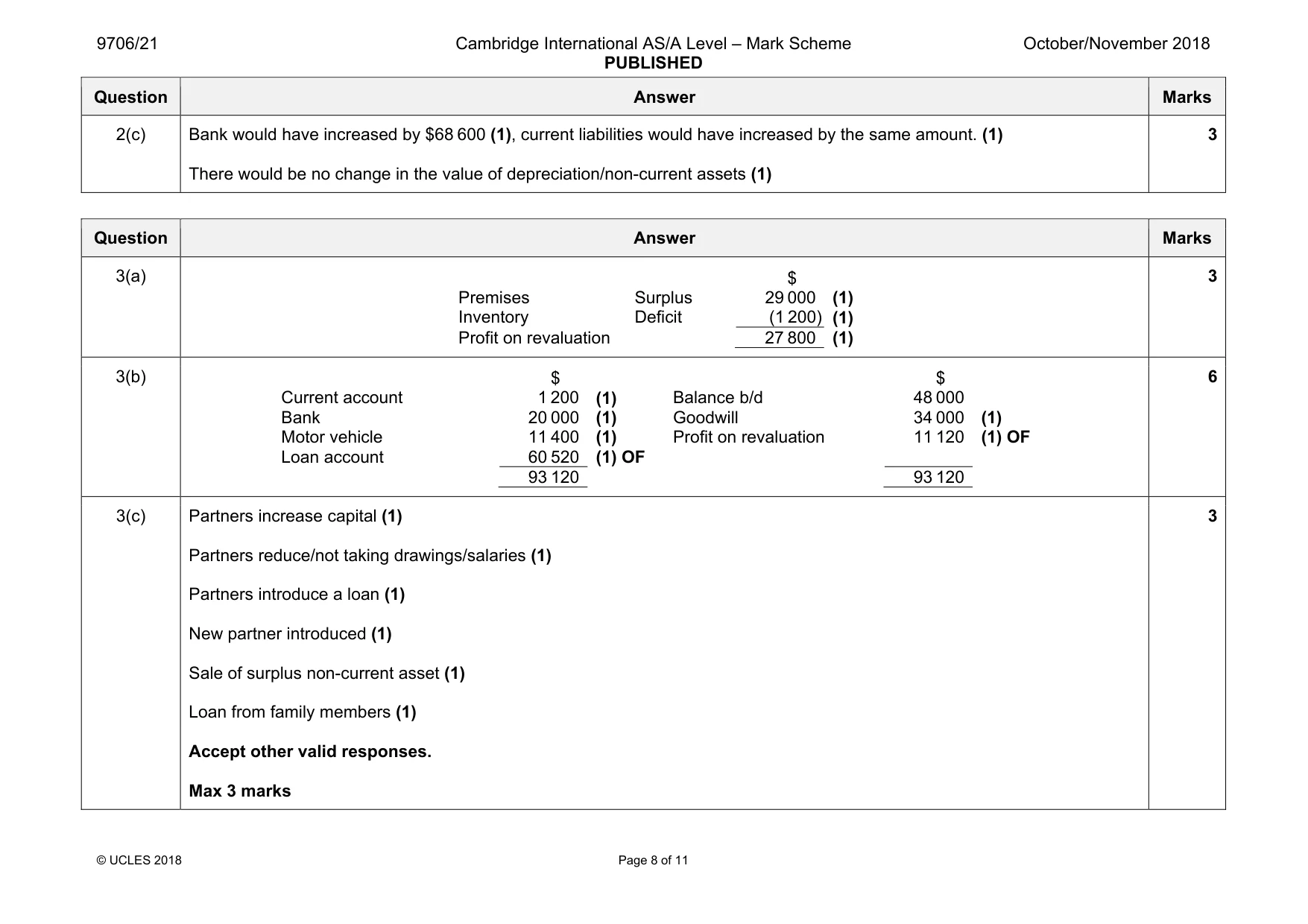
Mark scheme: 2(a) Prudence non-current assets would be overstated (1), the profit would be overstated (1) Accruals (matching) the cost of using a non-current asset should be matched (1) against the benefits that the asset produces (1) 4 2(b) T Limited Provision for depreciation on plant and machinery $ $ 2017 2017 July 1 Disposal 11 250 (1) Jul 1 Balance b/d 48 700 (1) 2018 2018 Jun 30 Balance c/d 68 860 Jun 30 Income statement 31 410 (5) W1 80 110 80 110 2018 Jul 1 Balance b/d 68 860 (1) OF Workings W1: $ Cost 174 300 Depreciation 48 400 125 600 Disposal 20 000 105 600 (1) × 20% = 21 120 (1) OF Oct 1 2017 – Jun 30 2018 $68 600 × 20% × 9 12 (1) = 10 290 (1) OF $21 120 + $10 290 = 31 410 (1) OF 8 Question Answer Marks 2(c) Bank would have increased by $68 600 (1), current liabilities would have increased by the same amount. (1) There would be no change in the value of depreciation/non-current assets (1) 3
Q3 · Aisha, Bilal and Cao have been in partnership for many years sharing profits and losses…
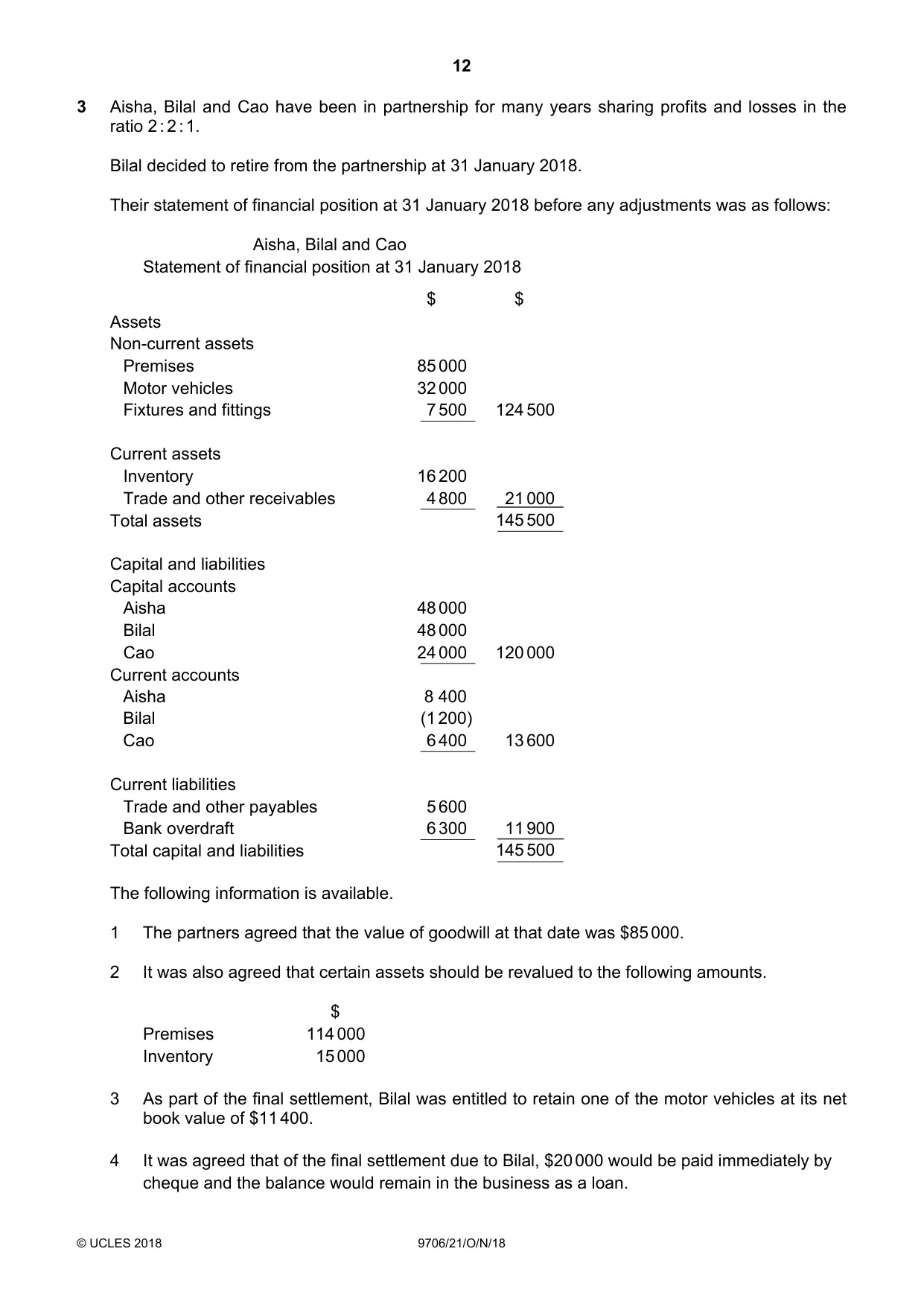
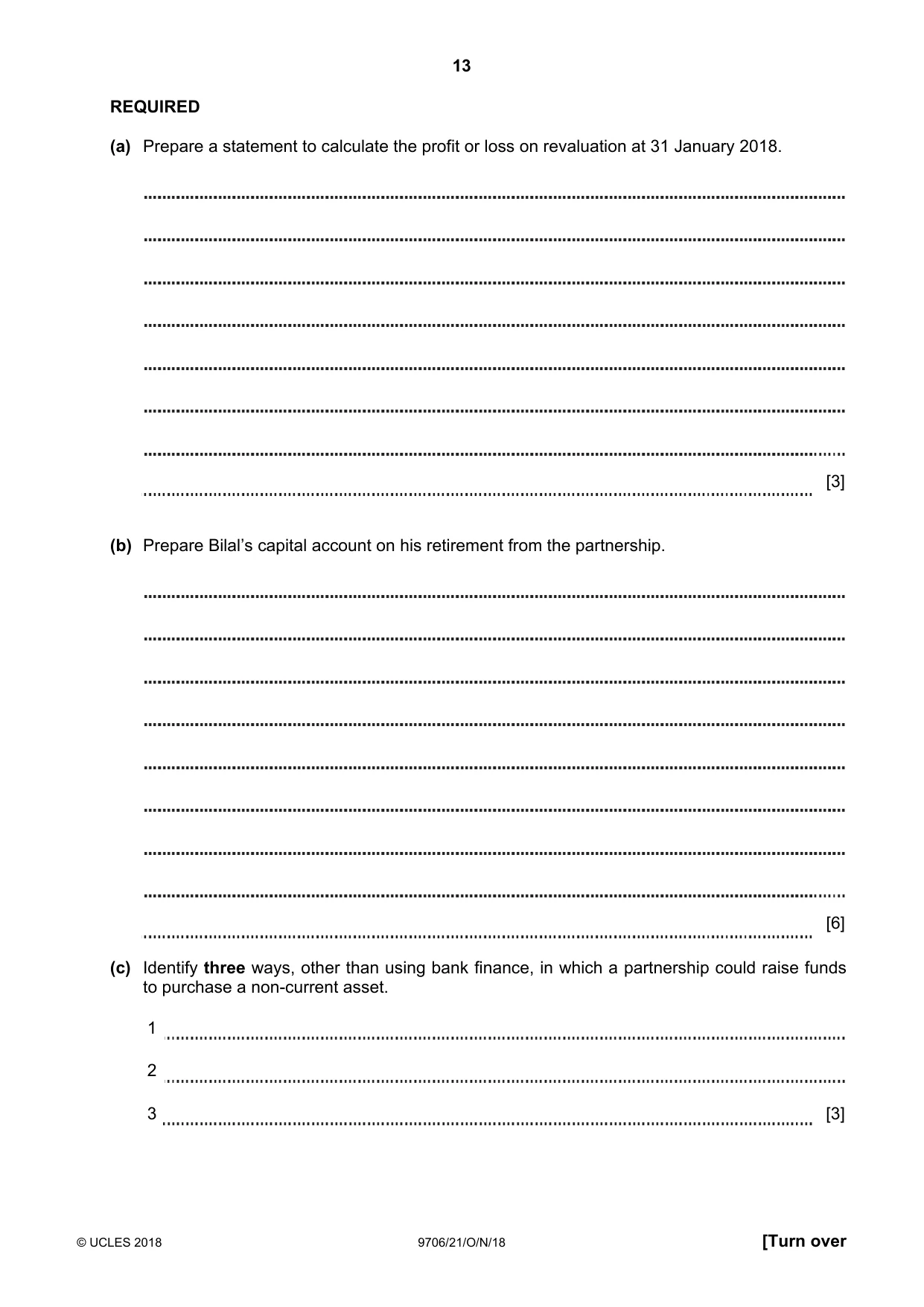
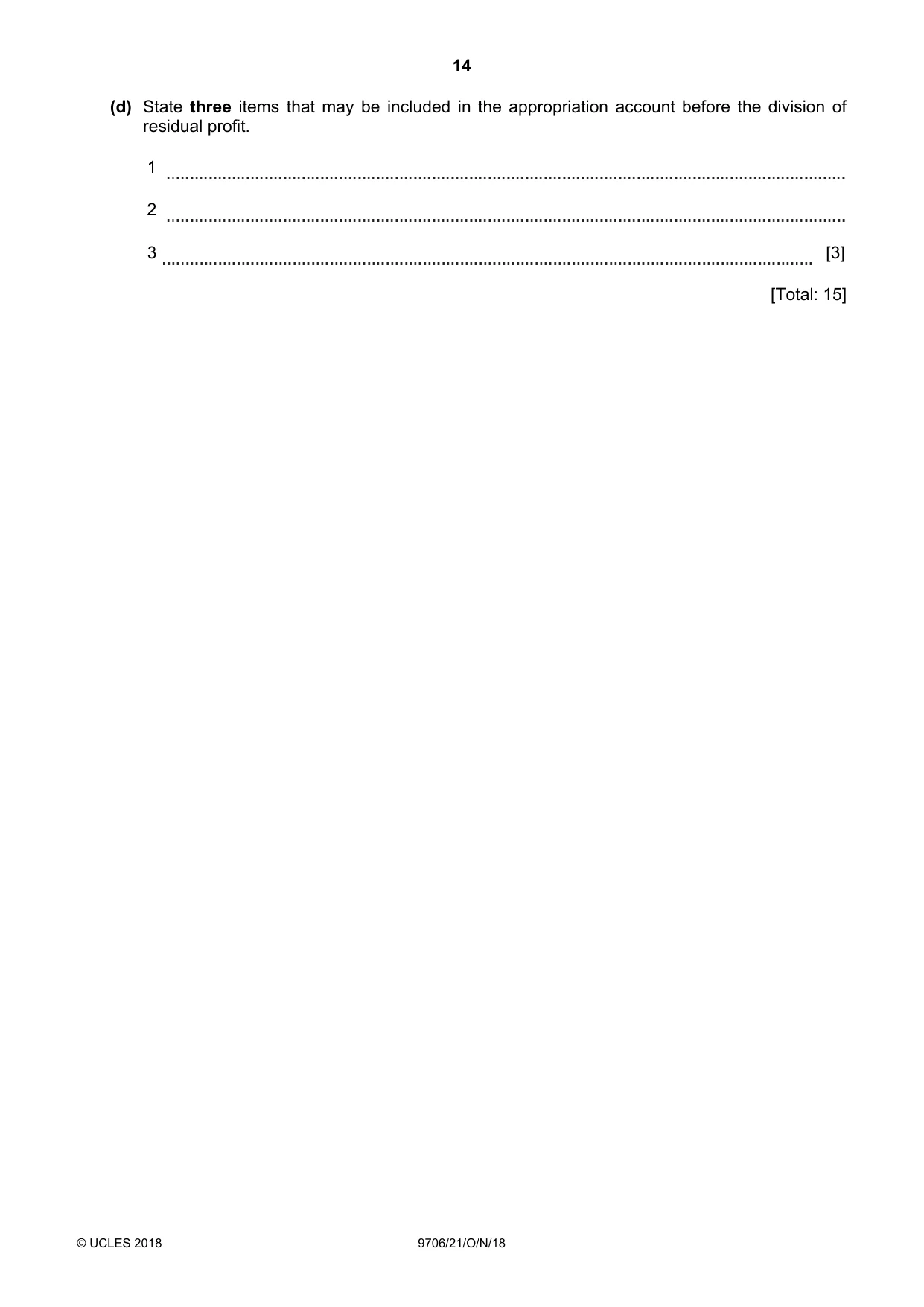
3 Aisha, Bilal and Cao have been in partnership for many years sharing profits and losses in the ratio 2 : 2 : 1. Bilal decided to retire from the partnership at 31 January 2018. Their statement of financial position at 31 January 2018 before any adjustments was as follows: Aisha, Bilal and Cao Statement of financial position at 31 January 2018 $ $ Assets Non-current assets Premises 85 000 Motor vehicles 32 000 Fixtures and fittings 7 500 124 500 Current assets Inventory 16 200 Trade and other receivables 4 800 21 000 Total assets 145 500 Capital and liabilities Capital accounts Aisha 48 000 Bilal 48 000 Cao 24 000 120 000 Current accounts Aisha 8 400 Bilal (1 200) Cao 6 400 13 600 Current liabilities Trade and other payables 5 600 Bank overdraft 6 300 11 900 Total capital and liabilities 145 500 The following information is available. 1 The partners agreed that the value of goodwill at that date was $85 000. 2 It was also agreed that certain assets should be revalued to the following amounts. $ Premises 114 000 Inventory 15 000 3 As part of the final settlement, Bilal was entitled to retain one of the motor vehicles at its net book value of $11 400. 4 It was agreed that of the final settlement due to Bilal, $20 000 would be paid immediately by cheque and the balance would remain in the business as a loan. REQUIRED (a) Prepare a statement to calculate the profit or loss on revaluation at 31 January 2018. [3] (b) Prepare Bilal’s capital account on his retirement from the partnership. [6] (c) Identify three ways, other than using bank finance, in which a partnership could raise funds to purchase a non-current asset. 1 2 3 [3] (d) State three items that may be included in the appropriation account before the division of residual profit. 1 2 3 [3] [Total: 15]
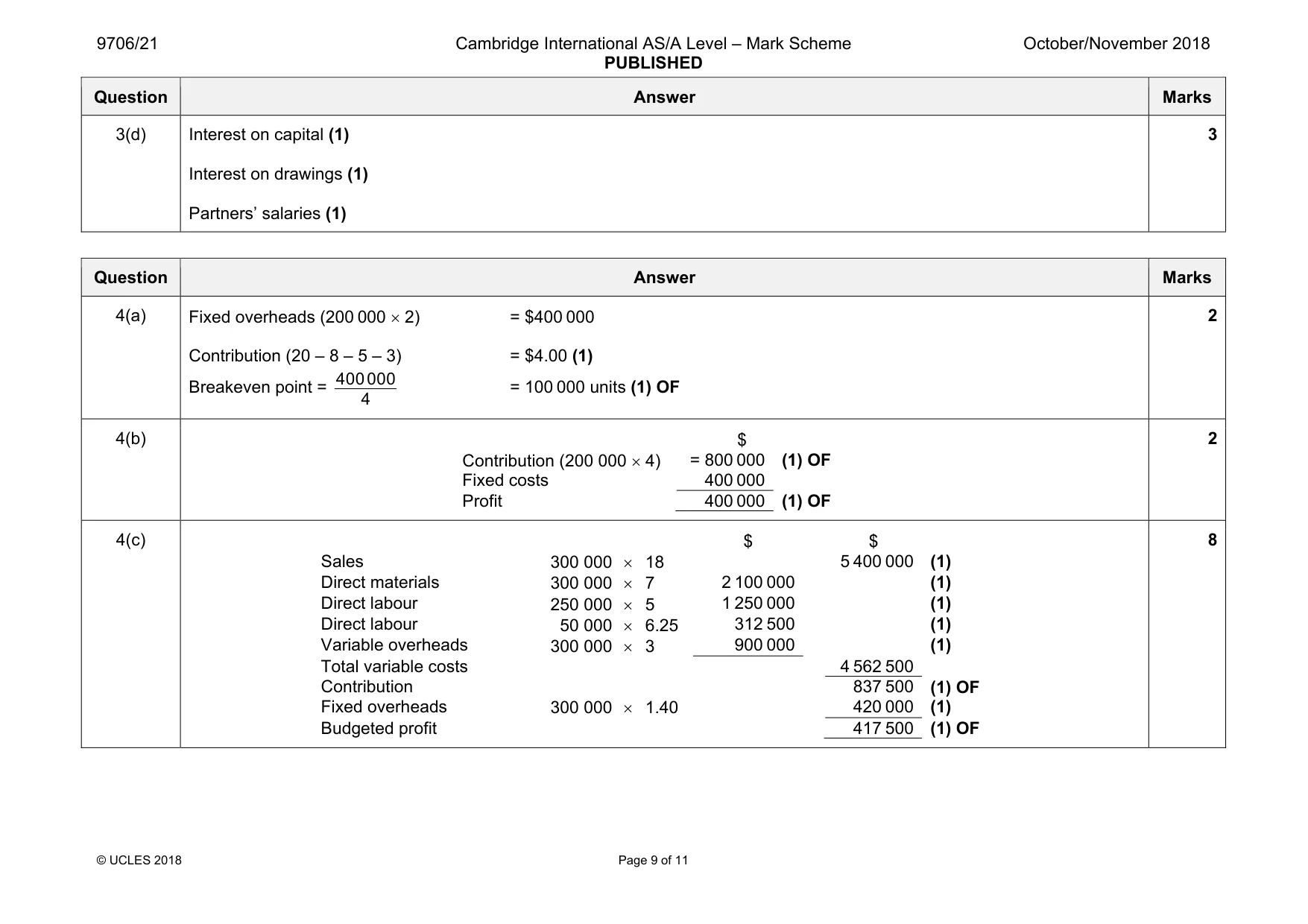
Mark scheme: 3(a) $ Premises Surplus 29 000 (1) Inventory Deficit (1 200) (1) Profit on revaluation 27 800 (1) 3 3(b) $ $ Current account 1 200 (1) Balance b/d 48 000 Bank 20 000 (1) Goodwill 34 000 (1) Motor vehicle 11 400 (1) Profit on revaluation 11 120 (1) OF Loan account 60 520 (1) OF 93 120 93 120 6 3(c) Partners increase capital (1) Partners reduce/not taking drawings/salaries (1) Partners introduce a loan (1) New partner introduced (1) Sale of surplus non-current asset (1) Loan from family members (1) Accept other valid responses. Max 3 marks 3 Question Answer Marks 3(d) Interest on capital (1) Interest on drawings (1) Partners’ salaries (1) 3
Q4 · DH Limited manufactures a single product
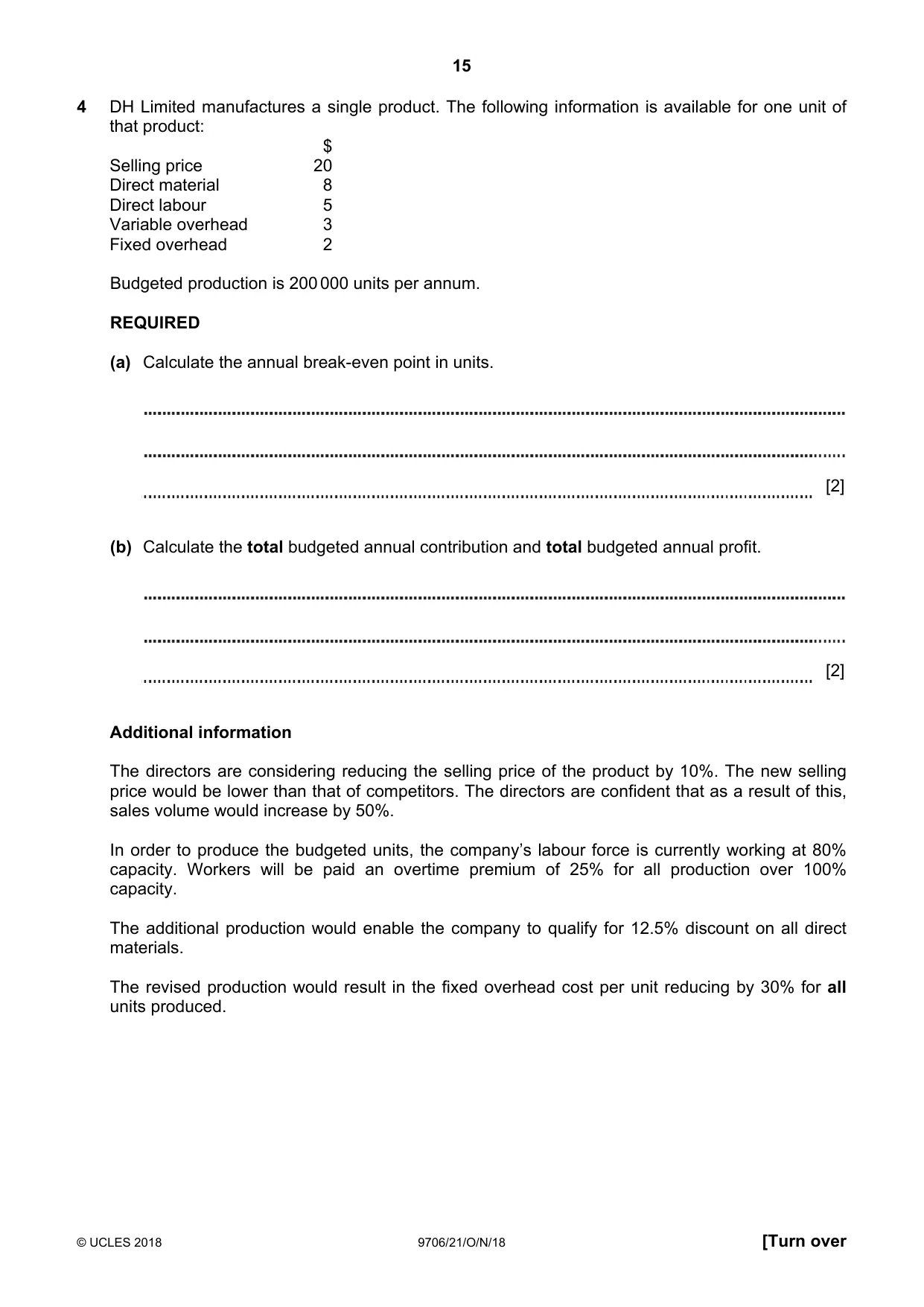
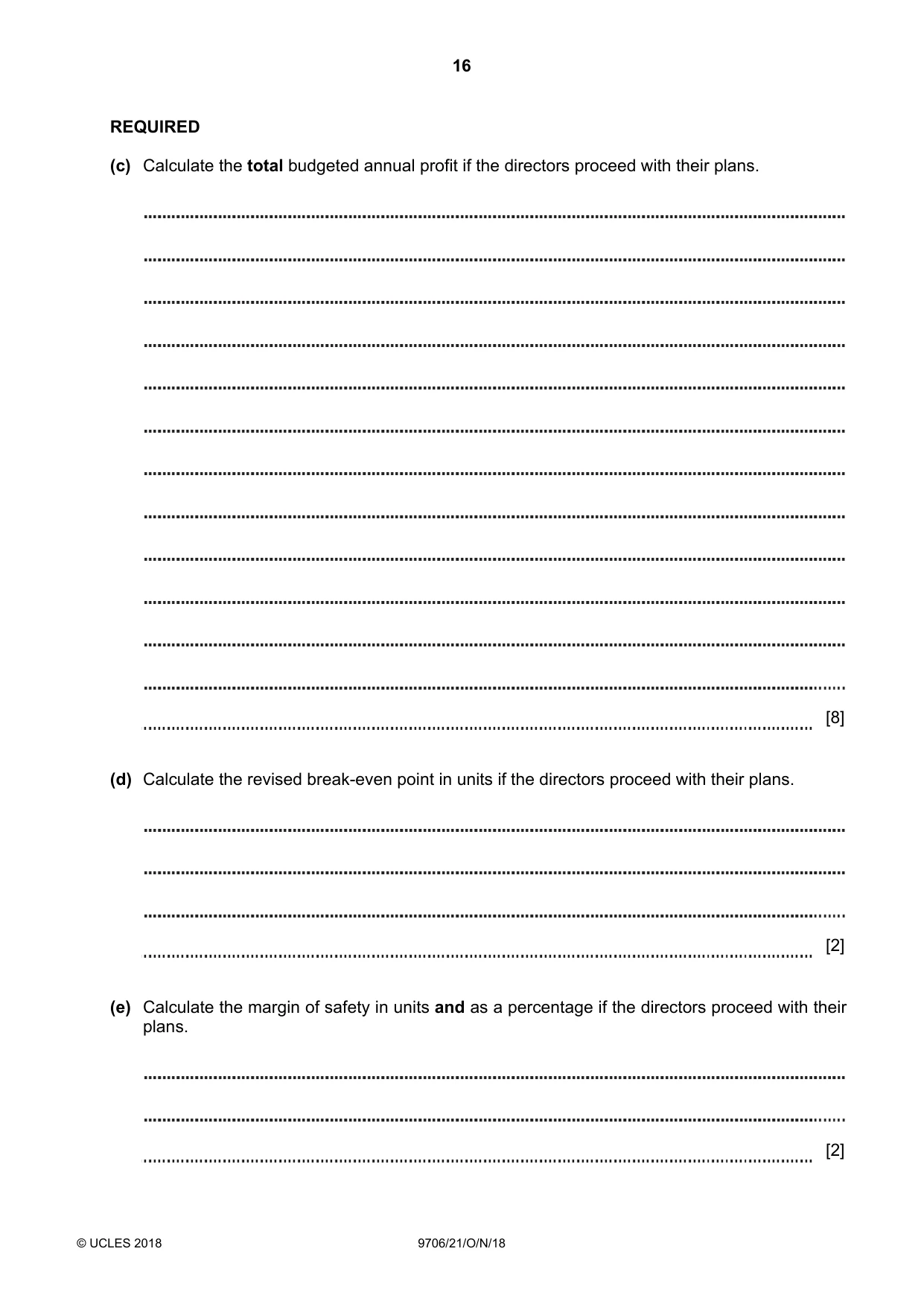
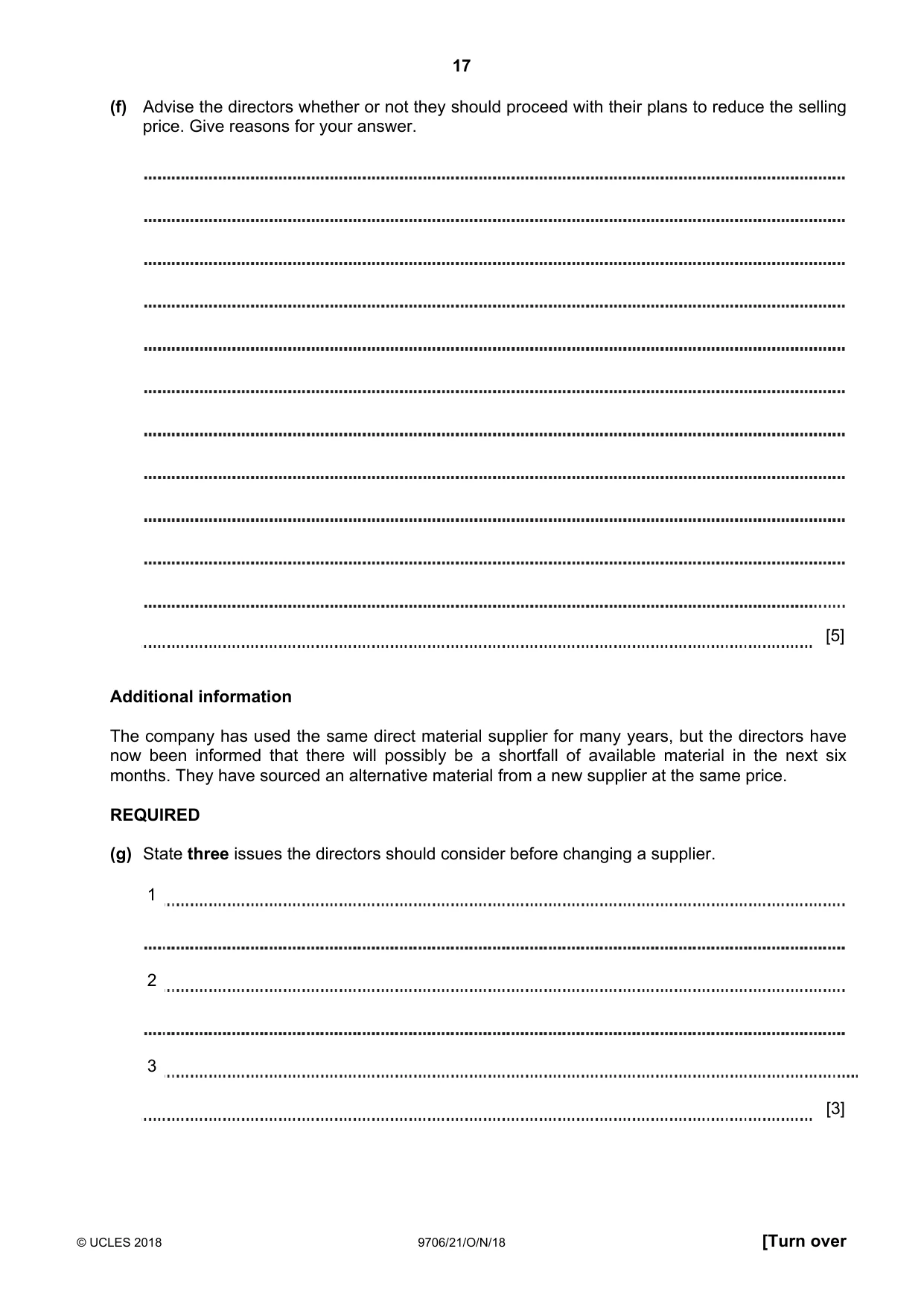
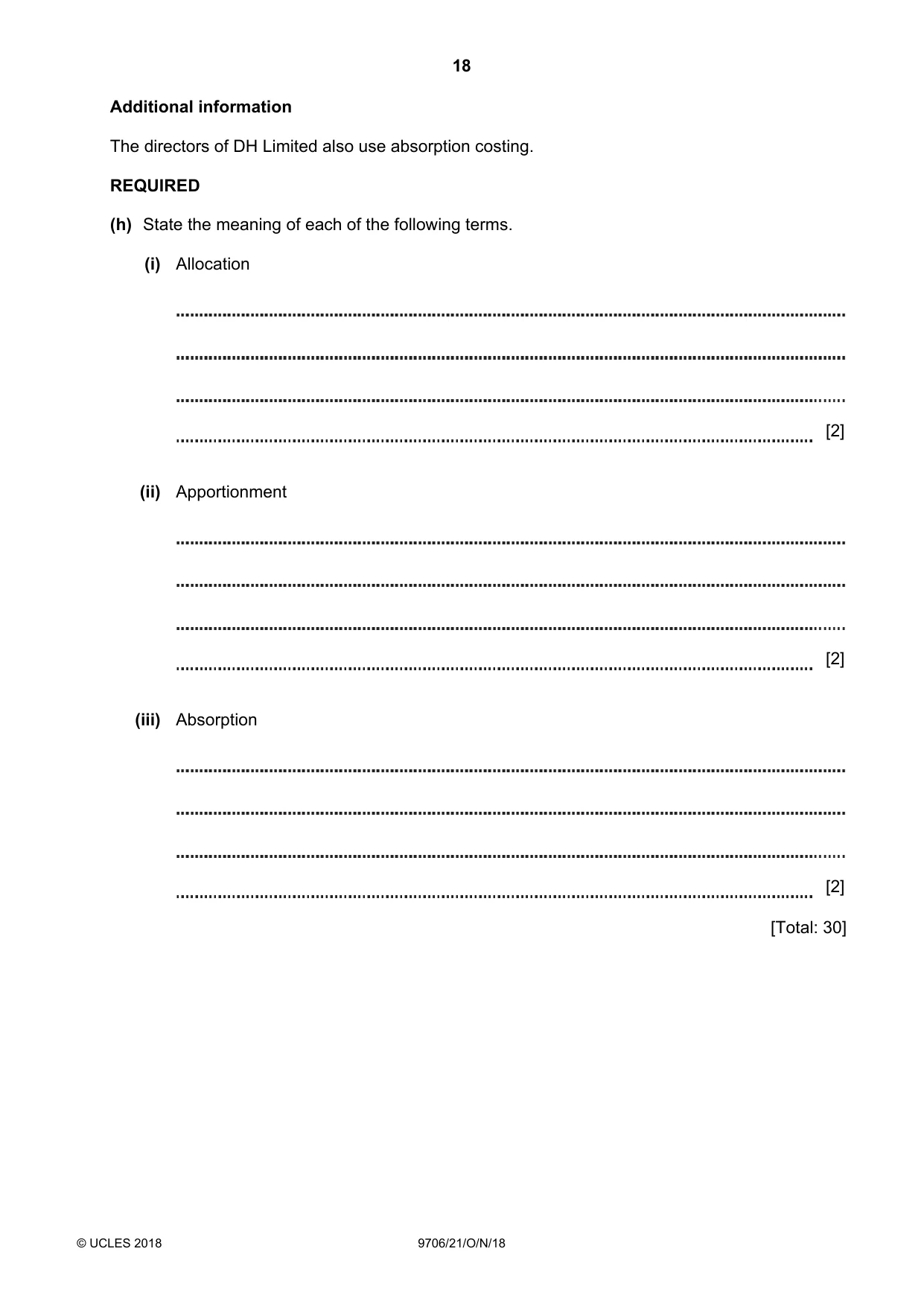
4 DH Limited manufactures a single product. The following information is available for one unit of that product: $ Selling price 20 Direct material 8 Direct labour 5 Variable overhead 3 Fixed overhead 2 Budgeted production is 200 000 units per annum. REQUIRED (a) Calculate the annual break-even point in units. [2] (b) Calculate the total budgeted annual contribution and total budgeted annual profit. [2] Additional information The directors are considering reducing the selling price of the product by 10%. The new selling price would be lower than that of competitors. The directors are confident that as a result of this, sales volume would increase by 50%. In order to produce the budgeted units, the company’s labour force is currently working at 80% capacity. Workers will be paid an overtime premium of 25% for all production over 100% capacity. The additional production would enable the company to qualify for 12.5% discount on all direct materials. The revised production would result in the fixed overhead cost per unit reducing by 30% for all units produced. REQUIRED (c) Calculate the total budgeted annual profit if the directors proceed with their plans. [8] (d) Calculate the revised break-even point in units if the directors proceed with their plans. [2] (e) Calculate the margin of safety in units and as a percentage if the directors proceed with their plans. [2] (f) Advise the directors whether or not they should proceed with their plans to reduce the selling price. Give reasons for your answer. [5] Additional information The company has used the same direct material supplier for many years, but the directors have now been informed that there will possibly be a shortfall of available material in the next six months. They have sourced an alternative material from a new supplier at the same price. REQUIRED (g) State three issues the directors should consider before changing a supplier. 1 2 3 [3]
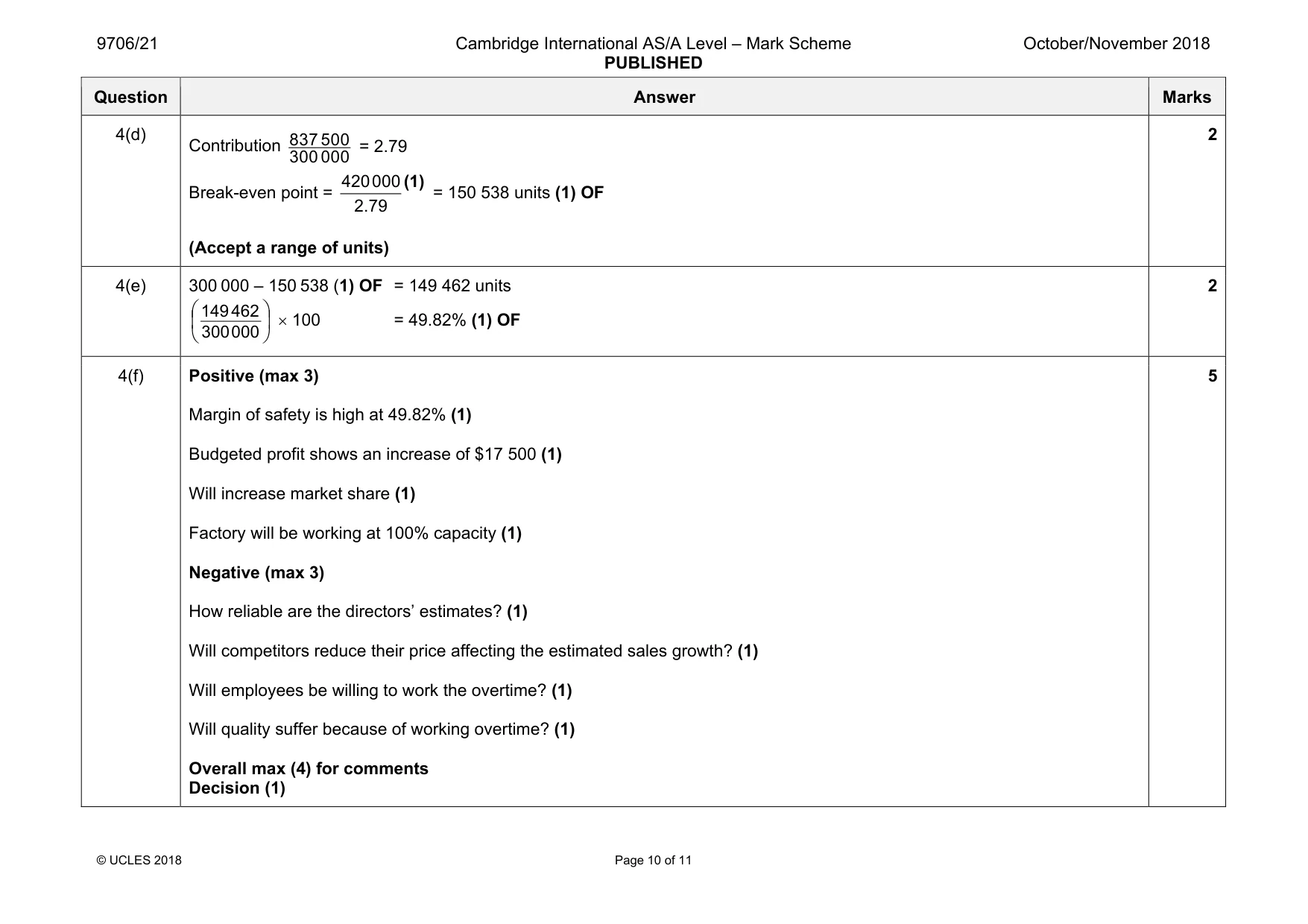
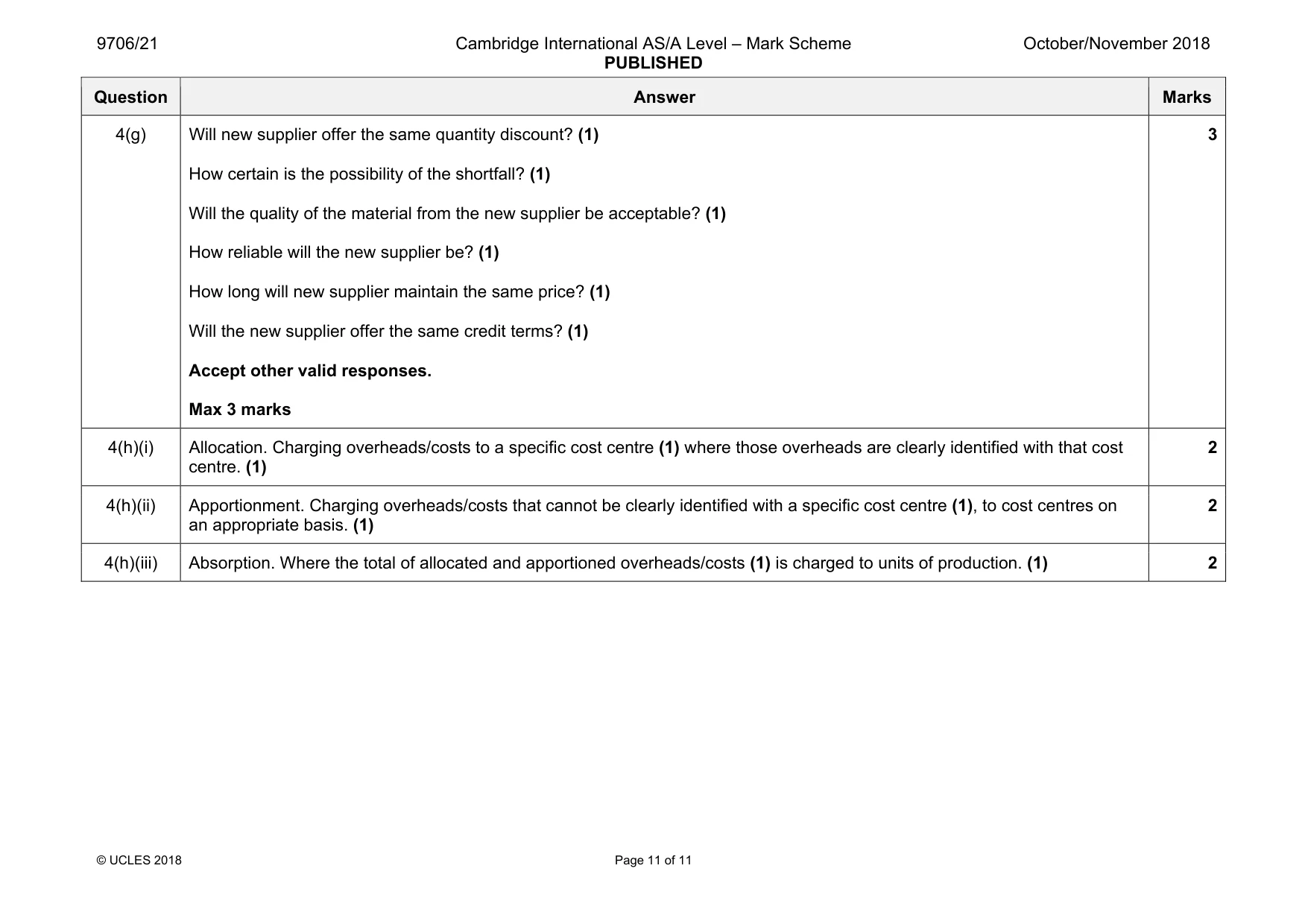
Mark scheme: 4(a) = $400 000 Contribution (20 – 8 – 5 – 3) = $4.00 (1) Breakeven point = 400000 4 = 100 000 units (1) OF 2 4(b) $ Contribution (200 000 × 4) = 800 000 (1) OF Fixed costs 400 000 Profit 400 000 (1) OF 2 4(c) $ $ Sales 300 000 × 18 5 400 000 (1) Direct materials 300 000 × 7 2 100 000 (1) Direct labour 250 000 × 5 1 250 000 (1) Direct labour 50 000 × 6.25 312 500 (1) Variable overheads 300 000 × 3 900 000 (1) Total variable costs 4 562 500 Contribution 837 500 (1) OF Fixed overheads 300 000 × 1.40 420 000 (1) Budgeted profit 417 500 (1) OF 8 Question Answer Marks 4(d) Contribution 837 500 300 000 = 2.79 Break-even point = 420000 2.79 (1) = 150 538 units (1) OF (Accept a range of units) 2 4(e) 300 000 – 150 538 (1) OF = 149 462 units 000 300 462 149 × 100 = 49.82% (1) OF 2 4(f) Positive (max 3) Margin of safety is high at 49.82% (1) Budgeted profit shows an increase of $17 500 (1) Will increase market share (1) Factory will be working at 100% capacity (1) Negative (max 3) How reliable are the directors’ estimates? (1) Will competitors reduce their price affecting the estimated sales growth? (1) Will employees be willing to work the overtime? (1) Will quality suffer because of working overtime? (1) Overall max (4) for comments Decision (1) 5 Question Answer Marks 4(g) Will new supplier offer the same quantity discount? (1) How certain is the possibility of the shortfall? (1) Will the quality of the material from the new supplier be acceptable? (1) How reliable will the new supplier be? (1) How long will new supplier maintain the same price? (1) Will the new supplier offer the same credit terms? (1) Accept other valid responses. Max 3 marks 3 4(h)(i) Allocation. Charging overheads/costs to a specific cost centre (1) where those overheads are clearly identified with that cost centre. (1) 2 4(h)(ii) Apportionment. Charging overheads/costs that cannot be clearly identified with a specific cost centre (1), to cost centres on an appropriate basis. (1) 2 4(h)(iii) Absorption. Where the total of allocated and apportioned overheads/costs (1) is charged to units of production. (1) 2
Q7 · REQUIRED (d) Prepare the bank account for the year ended 30 April 2017
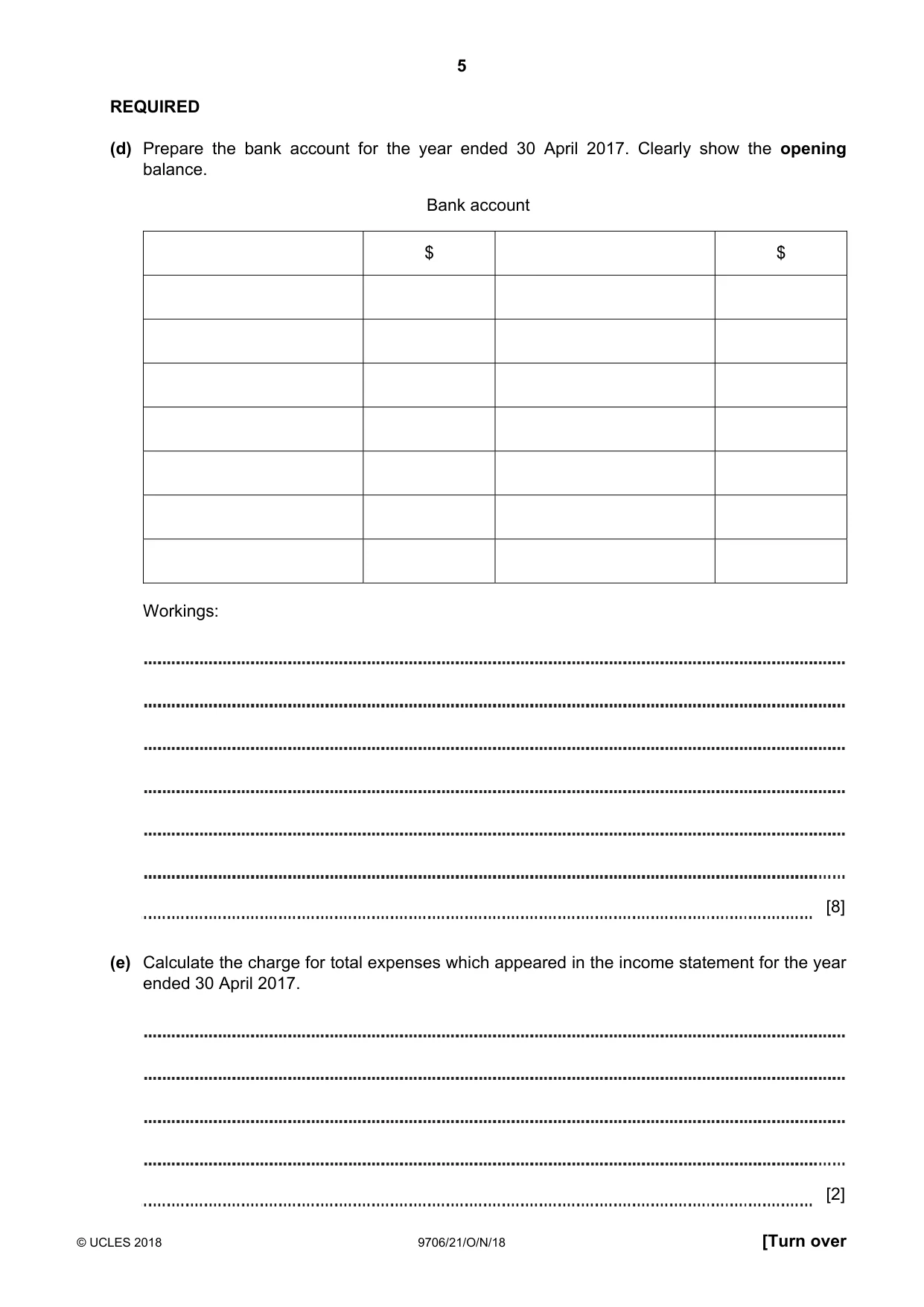
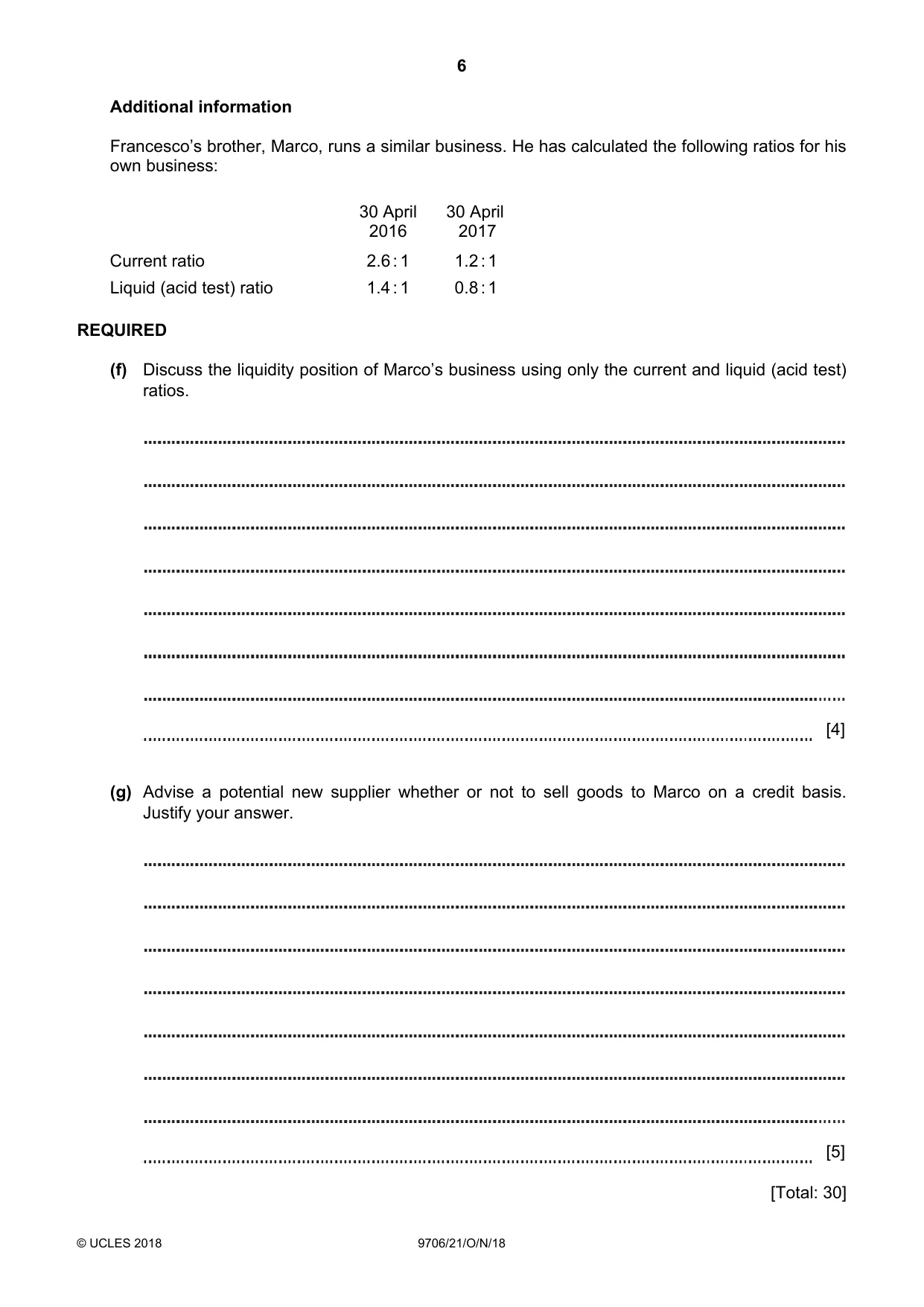
REQUIRED (d) Prepare the bank account for the year ended 30 April 2017. Clearly show the opening balance. Bank account $ $ Workings: [8] (e) Calculate the charge for total expenses which appeared in the income statement for the year ended 30 April 2017. [2] Additional information Francesco’s brother, Marco, runs a similar business. He has calculated the following ratios for his own business: 30 April 30 April 2016 2017 Current ratio 2.6 : 1 1.2 : 1 Liquid (acid test) ratio 1.4 : 1 0.8 : 1 REQUIRED (f) Discuss the liquidity position of Marco’s business using only the current and liquid (acid test) ratios. [4] (g) Advise a potential new supplier whether or not to sell goods to Marco on a credit basis. Justify your answer. [5] [Total: 30] PLEASE TURN OVER 2 A business depreciates its non-current assets. REQUIRED (a) Explain why a business should comply with the following concepts when accounting for non-current assets. Prudence Accruals (matching) [4] Additional information T Limited prepares accounts to 30 June. The following balances are available at 30 June 2017: $ Plant and machinery at cost 174 300 Provision for depreciation 48 700 On 1 July 2017 the company disposed of a machine which had a net book value of $20 000. The machine had been purchased on 1 July 2015. On 1 October 2017 a new machine was purchased for $68 600 paid by cheque. The company depreciates plant and machinery at 20% using the reducing balance method calculated on a month-by-month basis. No depreciation is charged in the year of disposal. REQUIRED (b) Prepare the provision for depreciation on plant and machinery account for the year ended 30 June 2018. Dates are required. Provision for depreciation on plant and machinery $ $ Workings: [8] Additional information Rather than paying immediately, the company had the option to pay in full for the new machine
Q15 · Months from the date of purchase
15 months from the date of purchase. REQUIRED (c) Explain the impact on the financial statements for the year ended 30 June 2018 of paying for the new machine 15 months from the date of purchase. [3] [Total: 15] PLEASE TURN OVER 3 Aisha, Bilal and Cao have been in partnership for many years sharing profits and losses in the ratio 2 : 2 : 1. Bilal decided to retire from the partnership at 31 January 2018. Their statement of financial position at 31 January 2018 before any adjustments was as follows: Aisha, Bilal and Cao Statement of financial position at 31 January 2018 $ $ Assets Non-current assets Premises 85 000 Motor vehicles 32 000 Fixtures and fittings 7 500 124 500 Current assets Inventory 16 200 Trade and other receivables 4 800 21 000 Total assets 145 500 Capital and liabilities Capital accounts Aisha 48 000 Bilal 48 000 Cao 24 000 120 000 Current accounts Aisha 8 400 Bilal (1 200) Cao 6 400 13 600 Current liabilities Trade and other payables 5 600 Bank overdraft 6 300 11 900 Total capital and liabilities 145 500 The following information is available. 1 The partners agreed that the value of goodwill at that date was $85 000. 2 It was also agreed that certain assets should be revalued to the following amounts. $ Premises 114 000 Inventory 15 000 3 As part of the final settlement, Bilal was entitled to retain one of the motor vehicles at its net book value of $11 400. 4 It was agreed that of the final settlement due to Bilal, $20 000 would be paid immediately by cheque and the balance would remain in the business as a loan.
What was in this paper
The subtopics covered by these 6 questions, and how many questions each got. Open one in a new tab to see every Cambridge question on it.
What you needed in this session
Cambridge’s own grade thresholds for 2018 Oct/Nov, Paper 2 · Variant 1. A higher threshold means an easier paper — the bar moves with how the cohort did.