Cambridge A Level Accounting 9706 — 2017 Oct/Nov Paper 2 · Variant 2
9706/22/O/N/17 · 4 questions · 90 marks · ≈101 min
The question paper and its mark scheme, free to read here and free to download. This is Cambridge’s own paper, exactly as it was sat.
Question paper16 pages
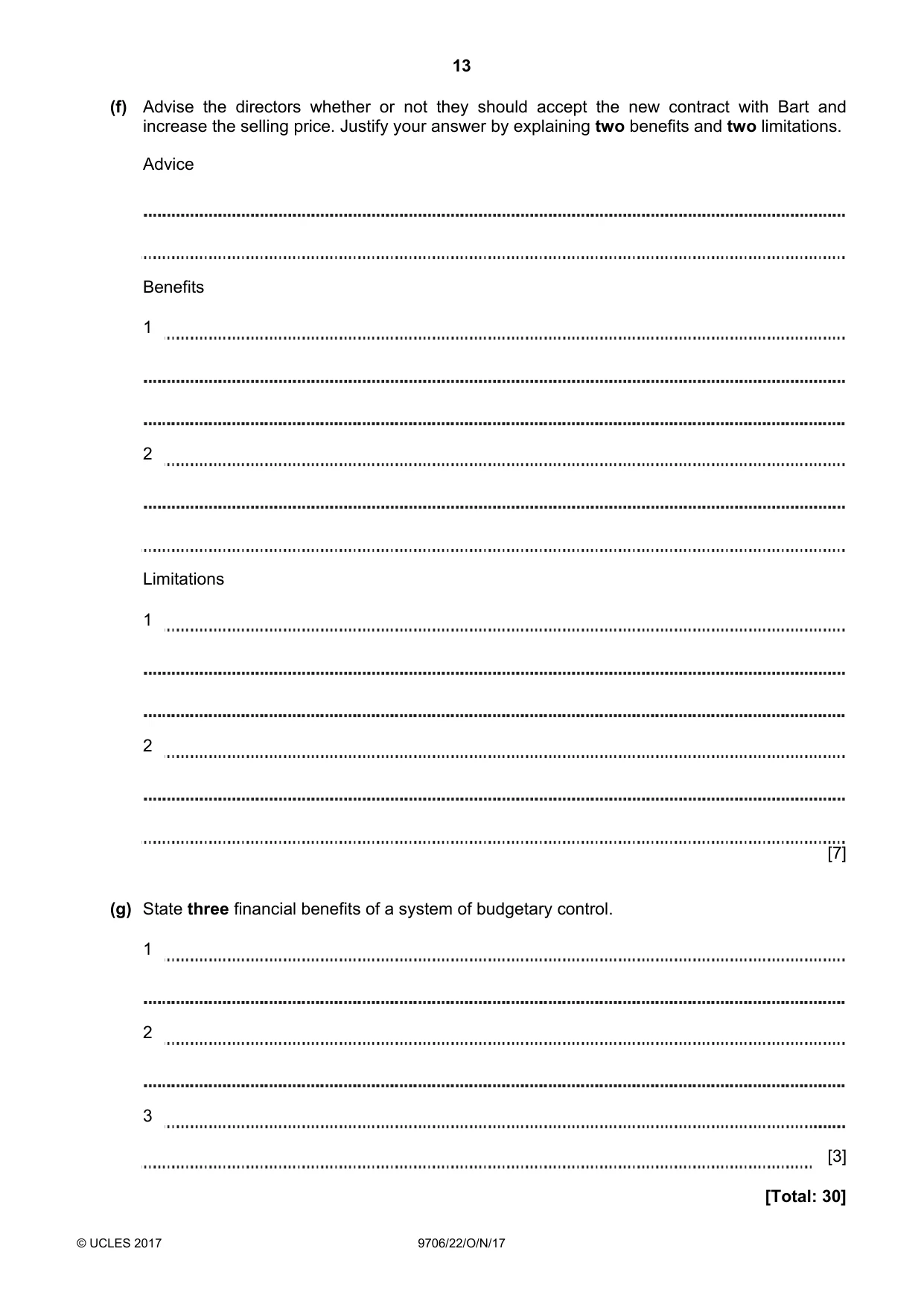


Mark scheme8 pages
Answers below. Sit the paper first if you are practising.
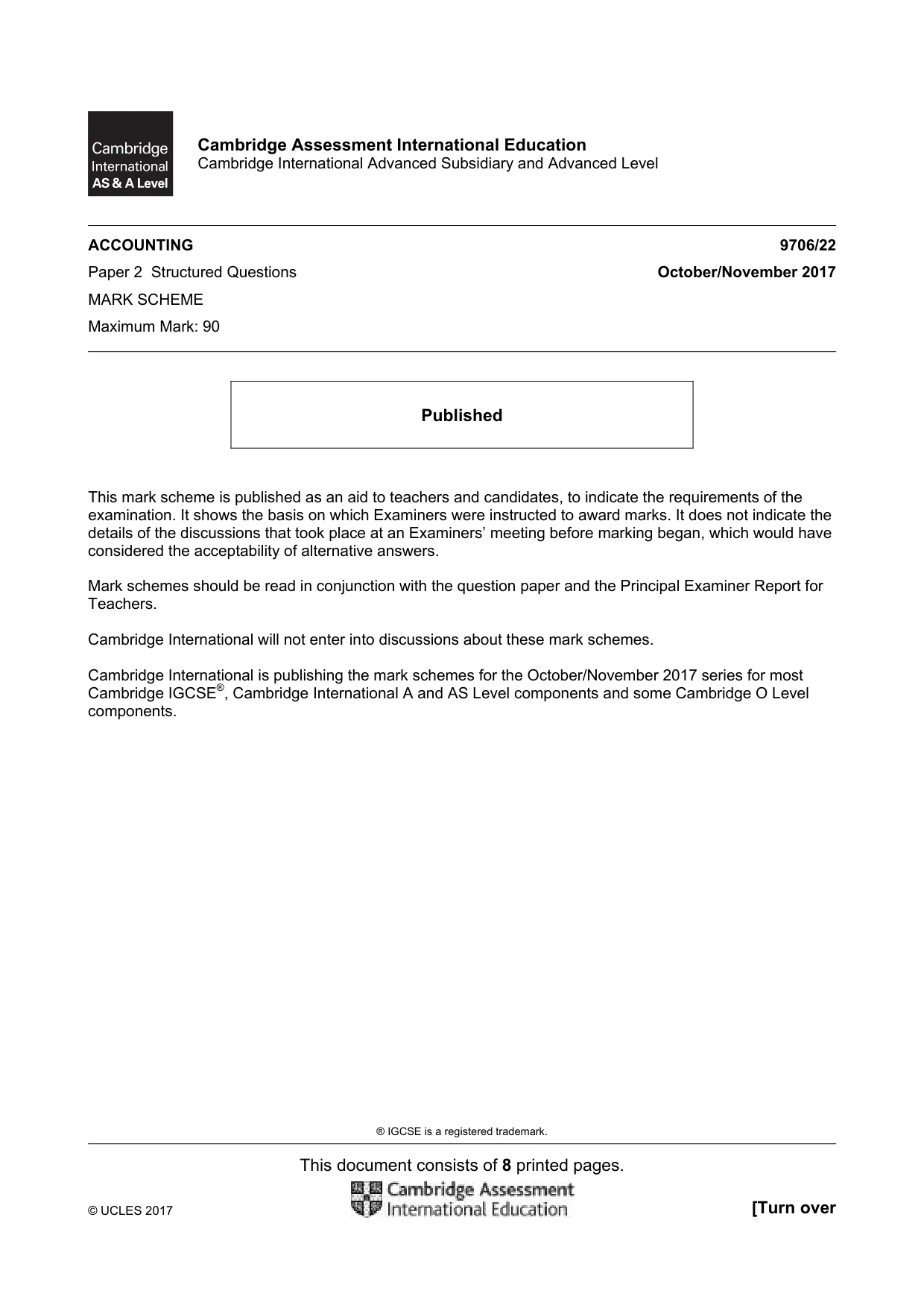
Questions as text
Q1 · Ross, a sole trader, owns a business selling computer equipment
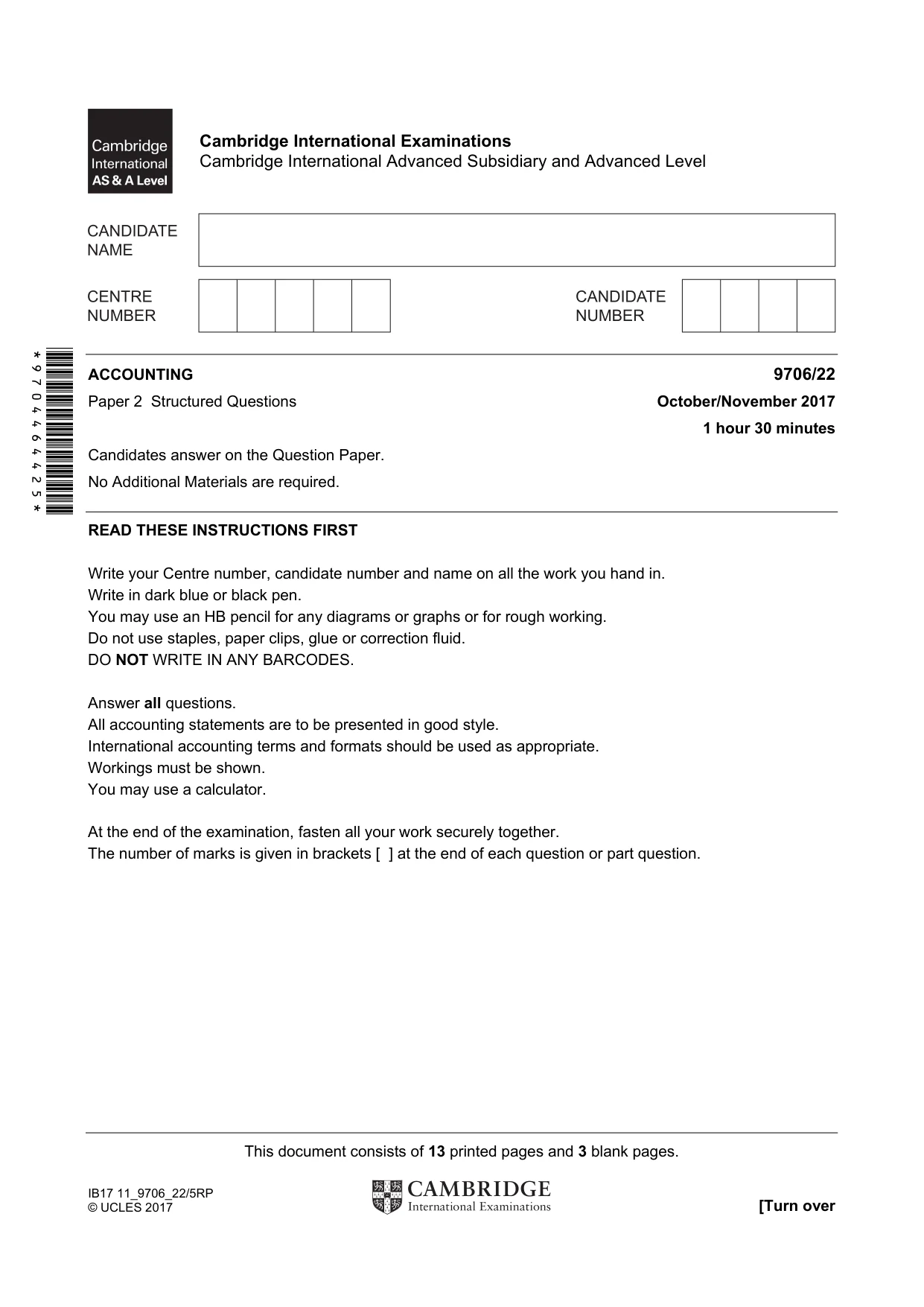
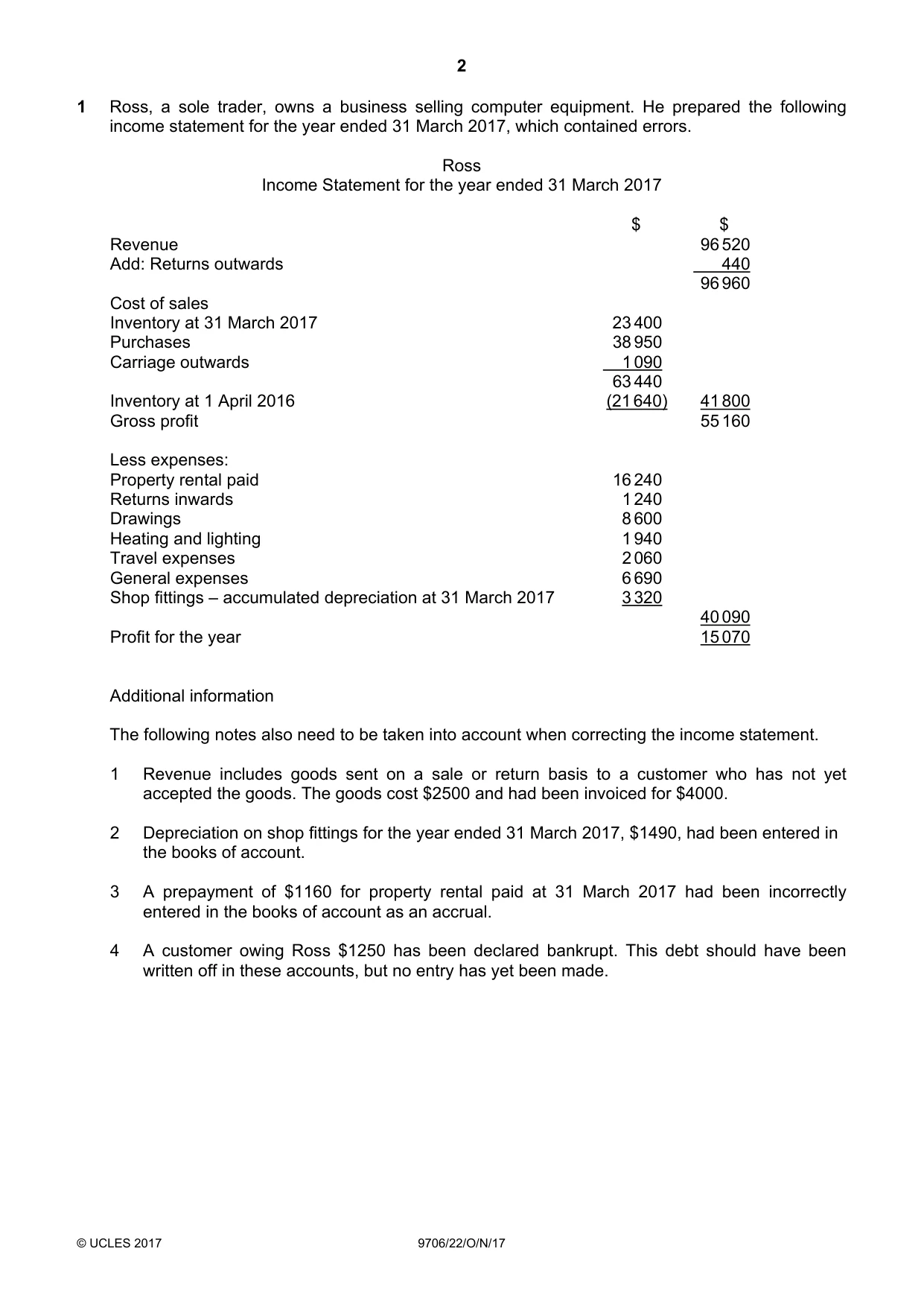
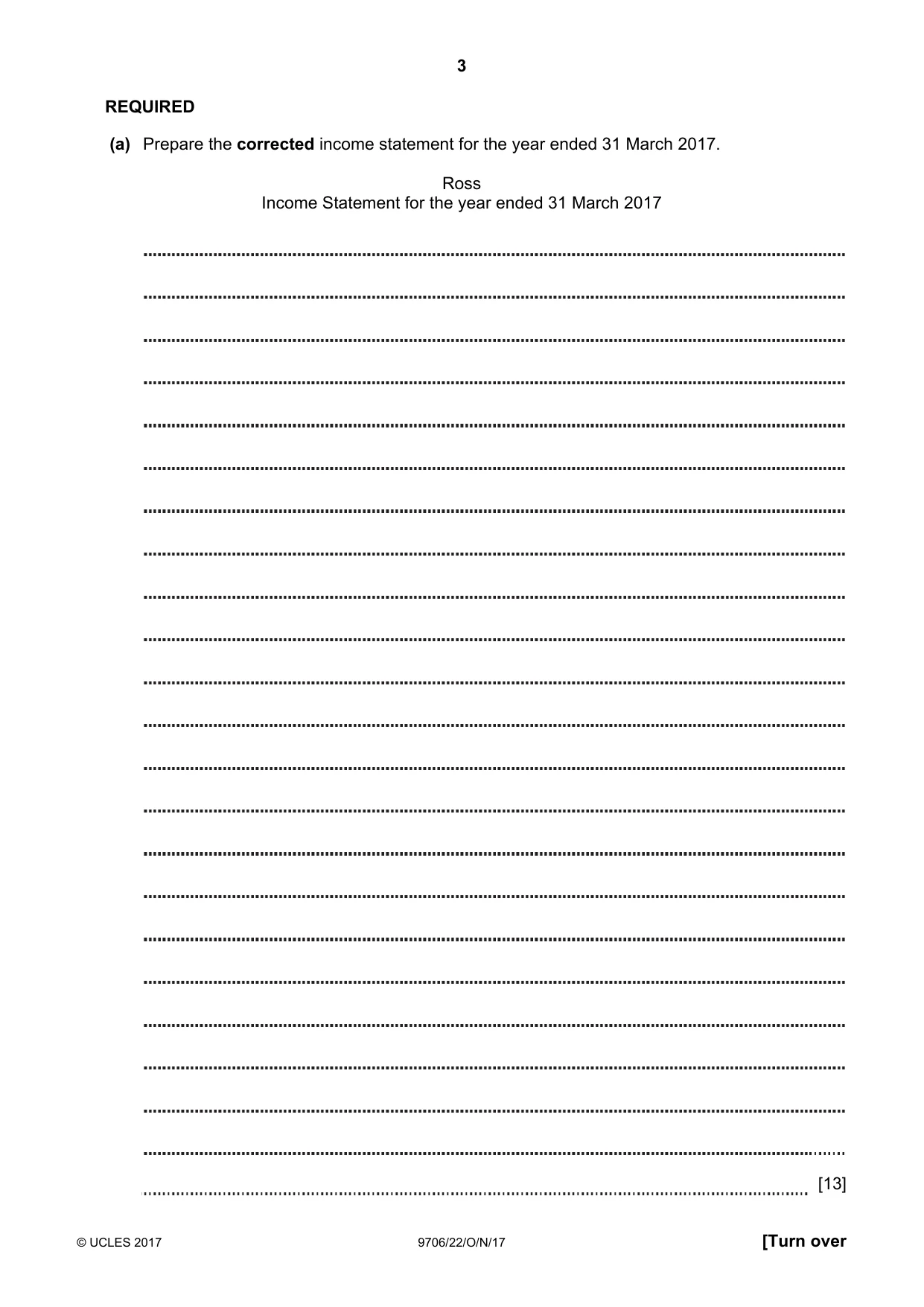
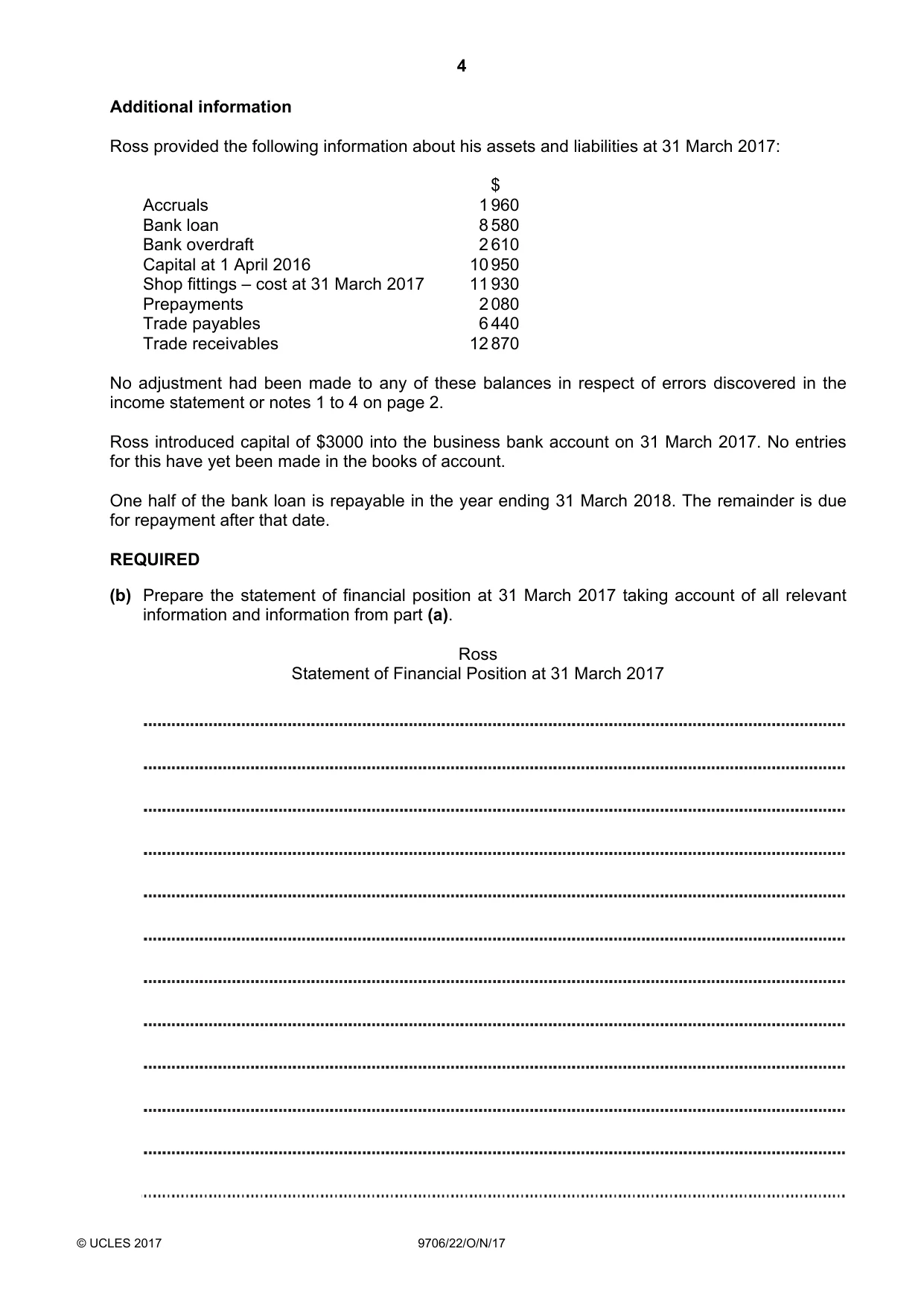
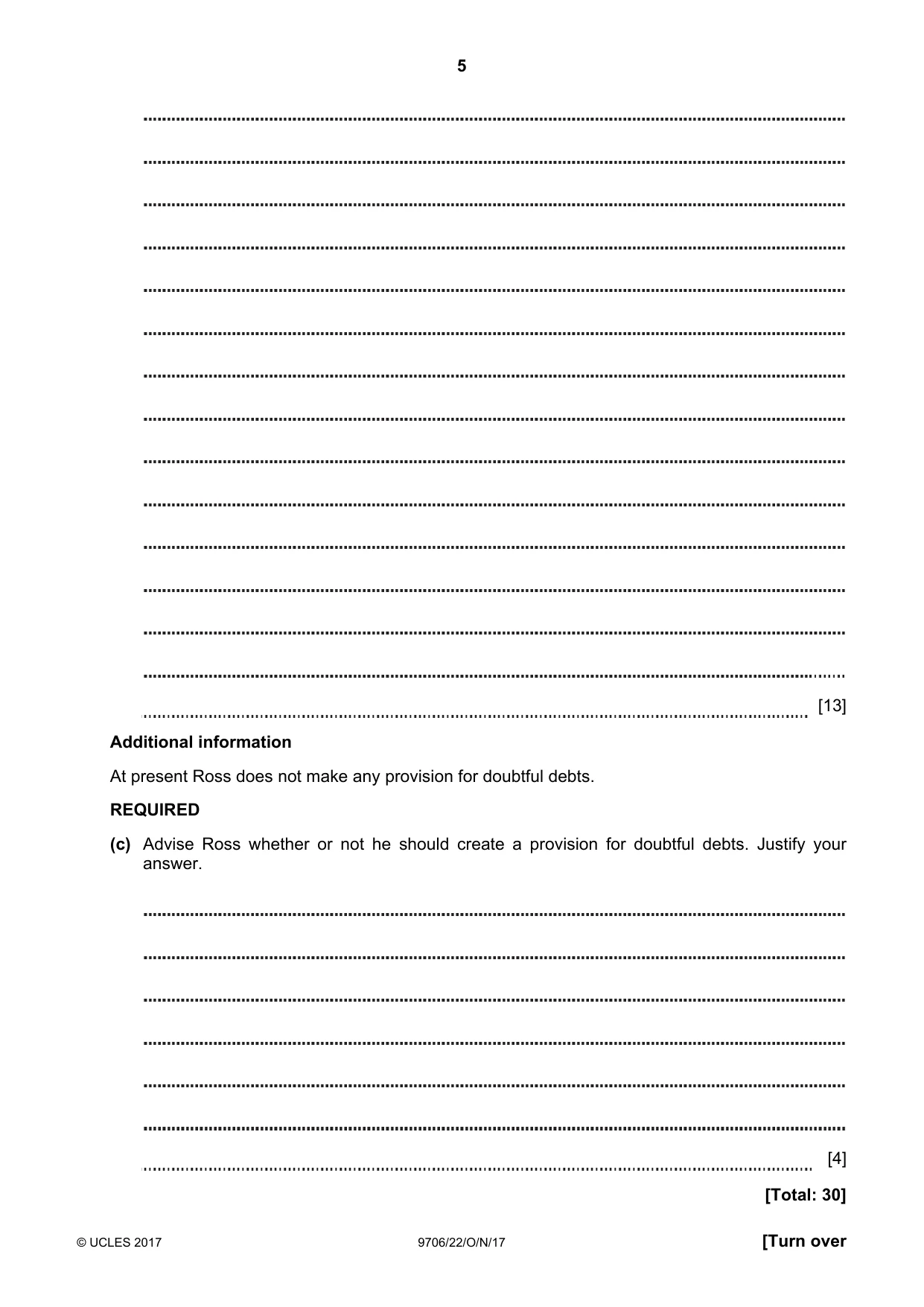
1 Ross, a sole trader, owns a business selling computer equipment. He prepared the following income statement for the year ended 31 March 2017, which contained errors. Ross Income Statement for the year ended 31 March 2017 $ $ Revenue 96 520 Add: Returns outwards 440 96 960 Cost of sales Inventory at 31 March 2017 23 400 Purchases 38 950 Carriage outwards 1 090 63 440 Inventory at 1 April 2016 (21 640) 41 800 Gross profit 55 160 Less expenses: Property rental paid 16 240 Returns inwards 1 240 Drawings 8 600 Heating and lighting 1 940 Travel expenses 2 060 General expenses 6 690 Shop fittings – accumulated depreciation at 31 March 2017 3 320 40 090 Profit for the year 15 070 Additional information The following notes also need to be taken into account when correcting the income statement. 1 Revenue includes goods sent on a sale or return basis to a customer who has not yet accepted the goods. The goods cost $2500 and had been invoiced for $4000. 2 Depreciation on shop fittings for the year ended 31 March 2017, $1490, had been entered in the books of account. 3 A prepayment of $1160 for property rental paid at 31 March 2017 had been incorrectly entered in the books of account as an accrual. 4 A customer owing Ross $1250 has been declared bankrupt. This debt should have been written off in these accounts, but no entry has yet been made. REQUIRED (a) Prepare the corrected income statement for the year ended 31 March 2017. Ross Income Statement for the year ended 31 March 2017 [13] Additional information Ross provided the following information about his assets and liabilities at 31 March 2017: $ Accruals 1 960 Bank loan 8 580 Bank overdraft 2 610 Capital at 1 April 2016 10 950 Shop fittings – cost at 31 March 2017 11 930 Prepayments 2 080 Trade payables 6 440 Trade receivables 12 870 No adjustment had been made to any of these balances in respect of errors discovered in the income statement or notes 1 to 4 on page 2. Ross introduced capital of $3000 into the business bank account on 31 March 2017. No entries for this have yet been made in the books of account. One half of the bank loan is repayable in the year ending 31 March 2018. The remainder is due for repayment after that date. REQUIRED (b) Prepare the statement of financial position at 31 March 2017 taking account of all relevant information and information from part (a). Ross Statement of Financial Position at 31 March 2017 [13] Additional information At present Ross does not make any provision for doubtful debts. REQUIRED (c) Advise Ross whether or not he should create a provision for doubtful debts. Justify your answer. [4] [Total: 30]
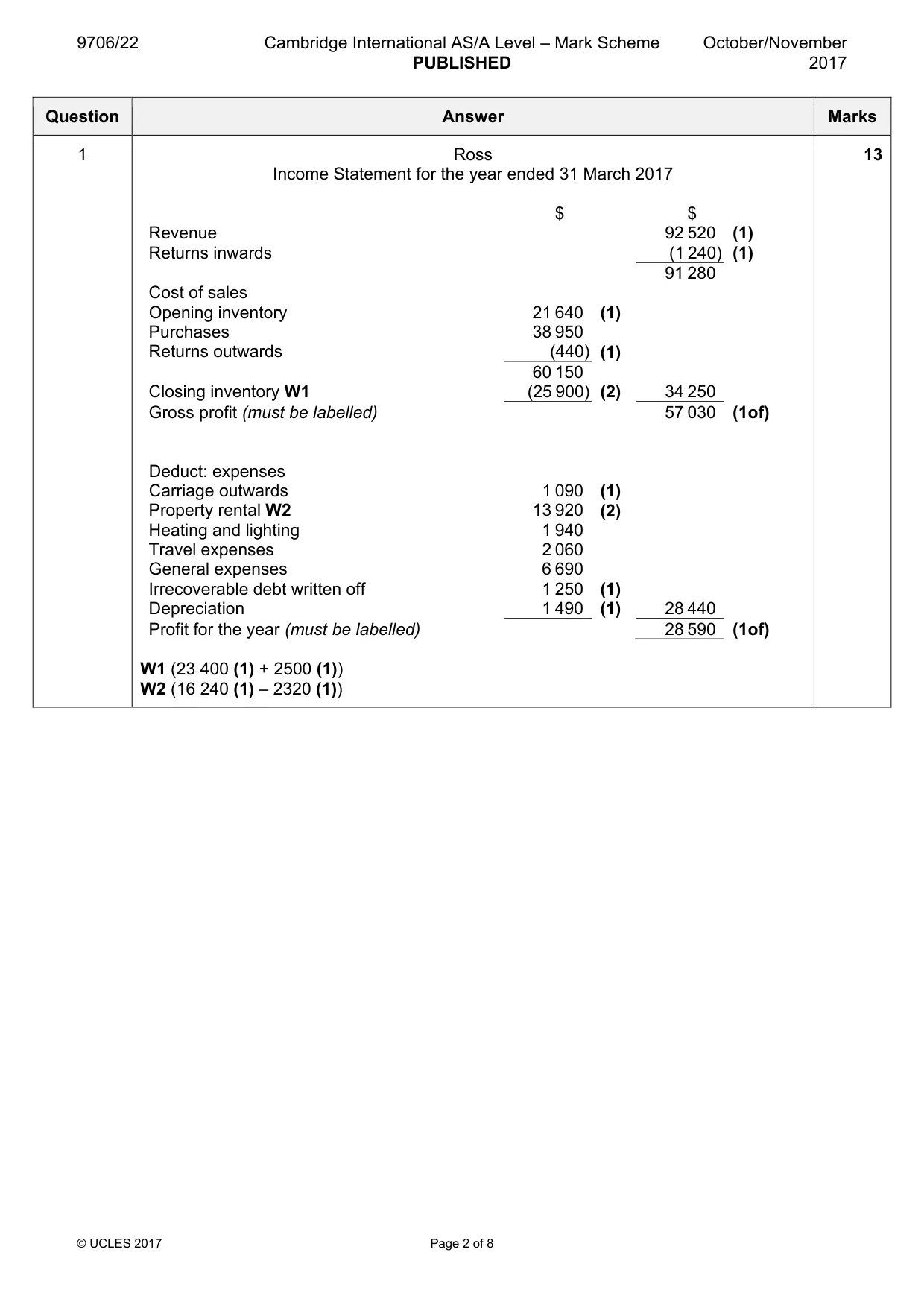
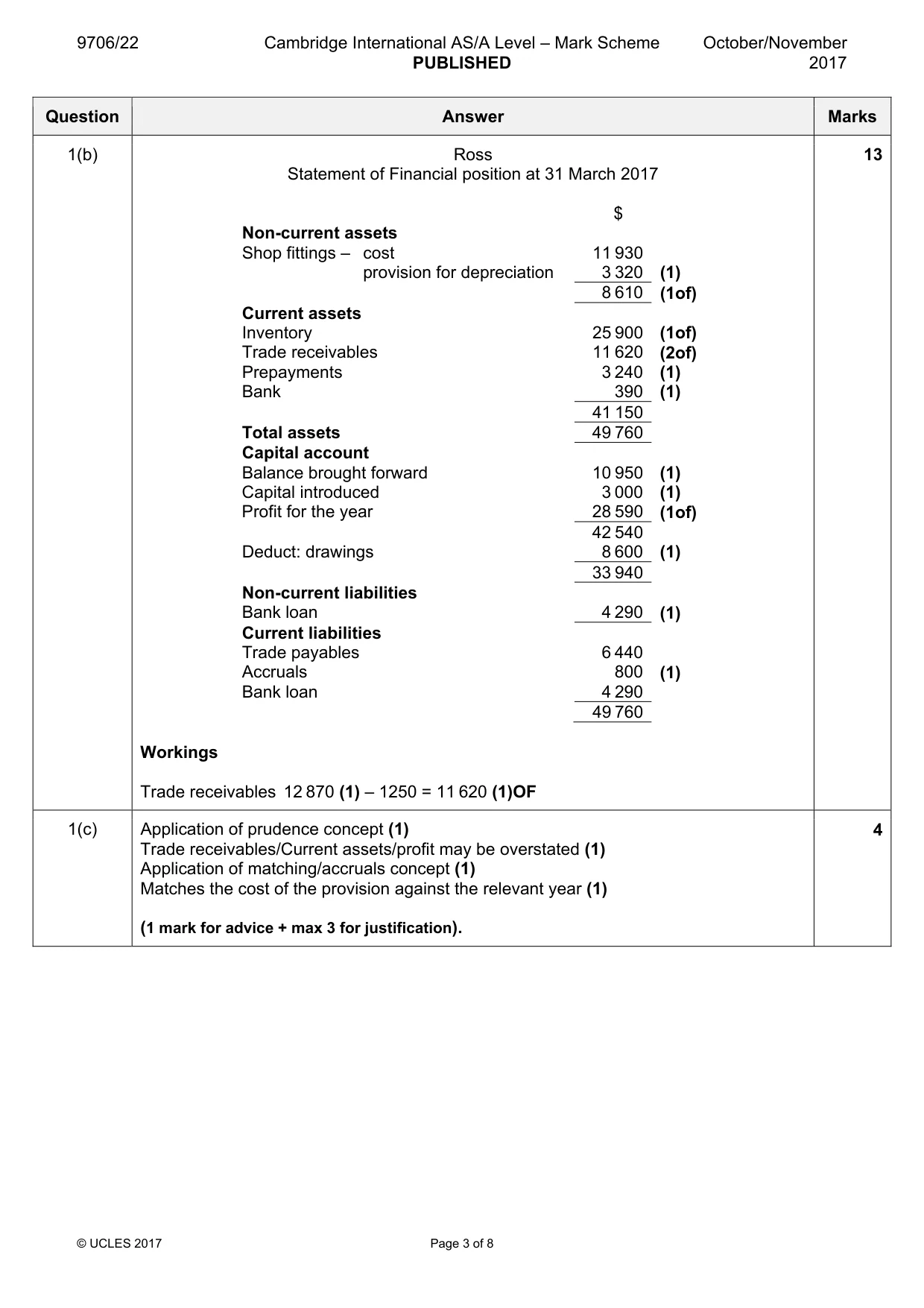
Mark scheme: Question Answer Marks 1 Ross 13 Income Statement for the year ended 31 March 2017 $ $ Revenue 92 520 (1) Returns inwards (1 240) (1) 91 280 Cost of sales Opening inventory 21 640 (1) Purchases 38 950 Returns outwards (440) (1) 60 150 Closing inventory W1 (25 900) (2) 34 250 Gross profit (must be labelled) 57 030 (1of) Deduct: expenses Carriage outwards 1 090 (1) Property rental W2 13 920 (2) Heating and lighting 1 940 Travel expenses 2 060 General expenses 6 690 Irrecoverable debt written off 1 250 (1) Depreciation 1 490 (1) 28 440 Profit for the year (must be labelled) 28 590 (1of) W1 (23 400 (1) + 2500 (1)) W2 (16 240 (1) – 2320 (1)) 1(b) Ross 13 Statement of Financial position at 31 March 2017 $ Non-current assets Shop fittings – cost 11 930 provision for depreciation 3 320 (1) 8 610 (1of) Current assets Inventory 25 900 (1of) Trade receivables 11 620 (2of) Prepayments 3 240 (1) Bank 390 (1) 41 150 Total assets 49 760 Capital account Balance brought forward 10 950 (1) Capital introduced 3 000 (1) Profit for the year 28 590 (1of) 42 540 Deduct: drawings 8 600 (1) 33 940 Non-current liabilities Bank loan 4 290 (1) Current liabilities Trade payables 6 440 Accruals 800 (1) Bank loan 4 290 49 760 Workings Trade receivables 12 870 (1) – 1250 = 11 620 (1)OF 1(c) Application of prudence concept (1) 4 Trade receivables/Current assets/profit may be overstated (1) Application of matching/accruals concept (1) Matches the cost of the provision against the relevant year (1) (1 mark for advice + max 3 for justification).
Q2 · Trott provided the following information for the year ended 30 April 2017: $ Sales ledger…
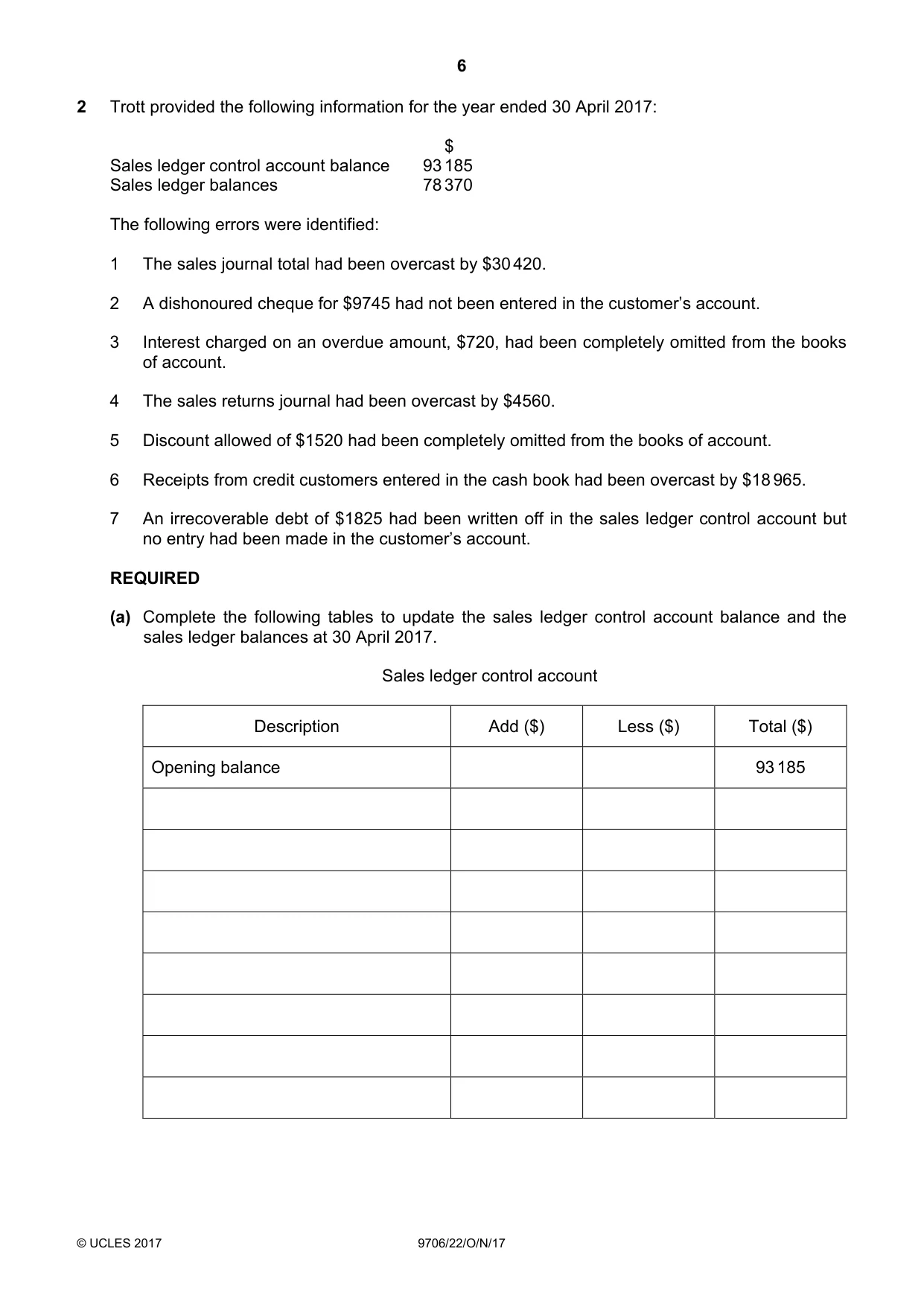
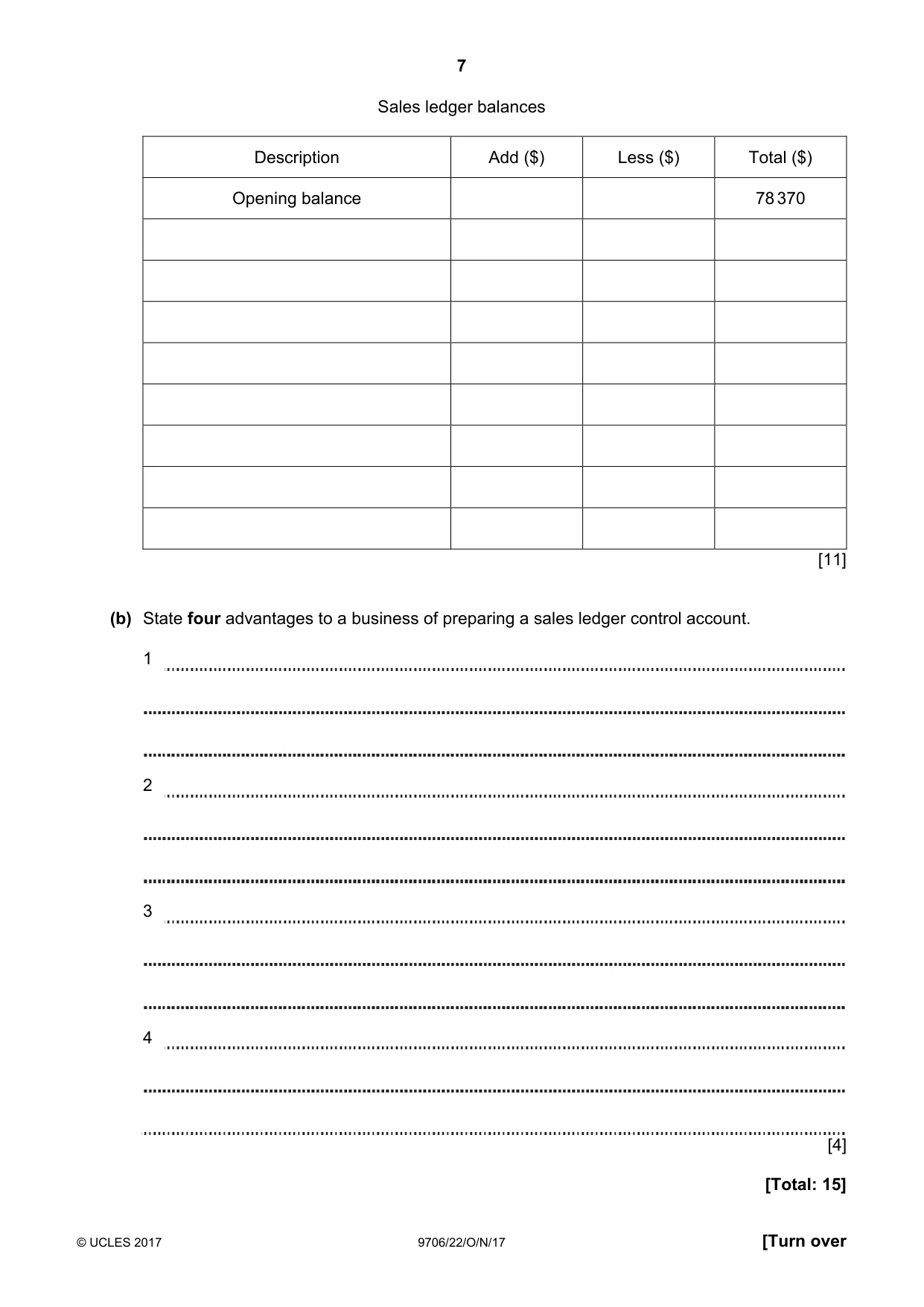
2 Trott provided the following information for the year ended 30 April 2017: $ Sales ledger control account balance 93 185 Sales ledger balances 78 370 The following errors were identified: 1 The sales journal total had been overcast by $30 420. 2 A dishonoured cheque for $9745 had not been entered in the customer’s account. 3 Interest charged on an overdue amount, $720, had been completely omitted from the books of account. 4 The sales returns journal had been overcast by $4560. 5 Discount allowed of $1520 had been completely omitted from the books of account. 6 Receipts from credit customers entered in the cash book had been overcast by $18 965. 7 An irrecoverable debt of $1825 had been written off in the sales ledger control account but no entry had been made in the customer’s account. REQUIRED (a) Complete the following tables to update the sales ledger control account balance and the sales ledger balances at 30 April 2017. Sales ledger control account Description Add ($) Less ($) Total ($) Opening balance 93 185 Sales ledger balances Description Add ($) Less ($) Total ($) Opening balance 78 370 [11] (b) State four advantages to a business of preparing a sales ledger control account. 1 2 3 4 [4] [Total: 15]
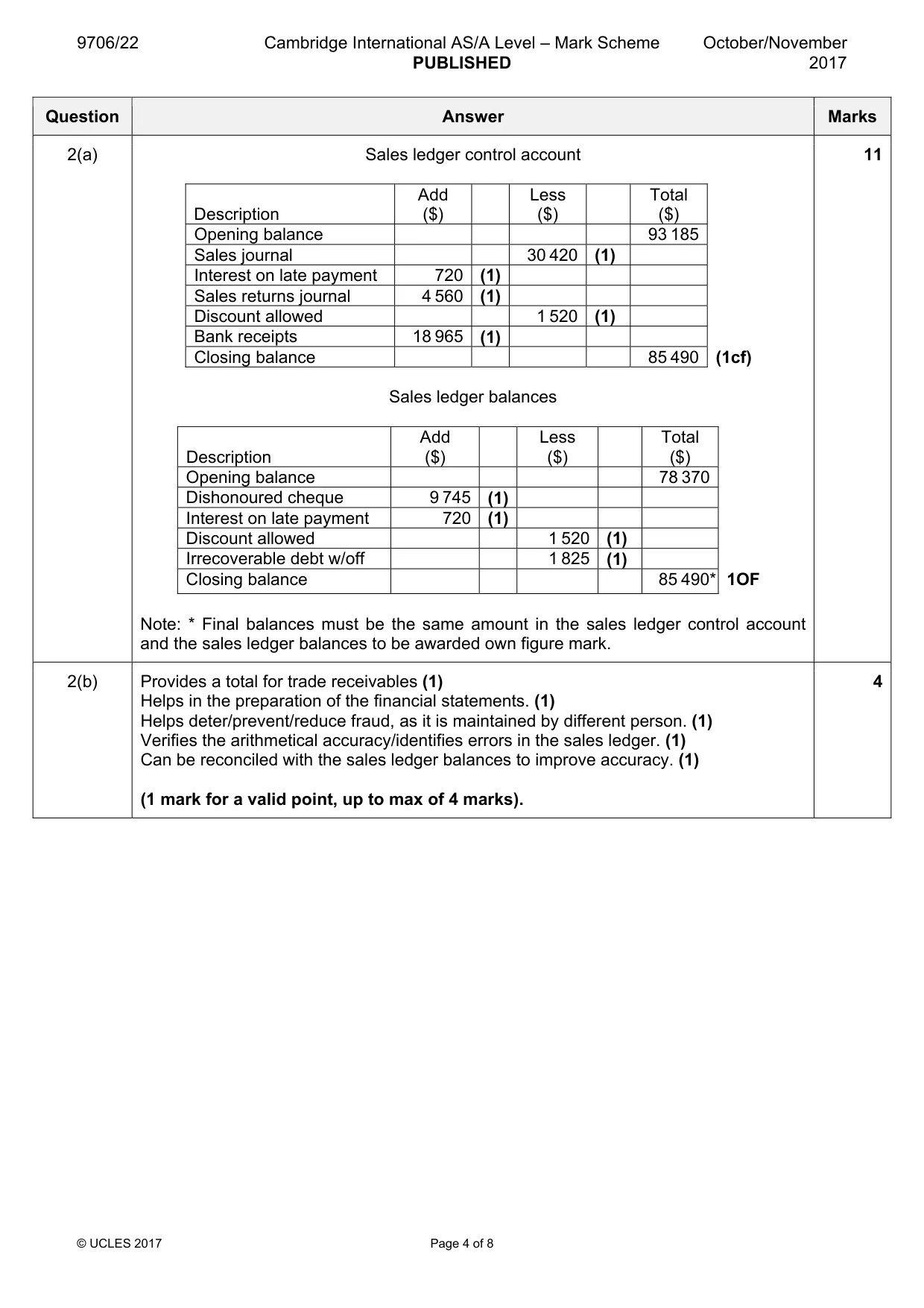
Mark scheme: 2(a) Sales ledger control account 11 Add Less Total Description ($) ($) ($) Opening balance 93 185 Sales journal 30 420 (1) Interest on late payment 720 (1) Sales returns journal 4 560 (1) Discount allowed 1 520 (1) Bank receipts 18 965 (1) Closing balance 85 490 (1cf) Sales ledger balances Add Less Total Description ($) ($) ($) Opening balance 78 370 Dishonoured cheque 9 745 (1) Interest on late payment 720 (1) Discount allowed 1 520 (1) Irrecoverable debt w/off 1 825 (1) Closing balance 85 490* 1OF Note: * Final balances must be the same amount in the sales ledger control account and the sales ledger balances to be awarded own figure mark. 2(b) Provides a total for trade receivables (1) 4 Helps in the preparation of the financial statements. (1) Helps deter/prevent/reduce fraud, as it is maintained by different person. (1) Verifies the arithmetical accuracy/identifies errors in the sales ledger. (1) Can be reconciled with the sales ledger balances to improve accuracy. (1) (1 mark for a valid point, up to max of 4 marks).
Q3 · K Limited has been trading for many years and prepares financial statements annually to…
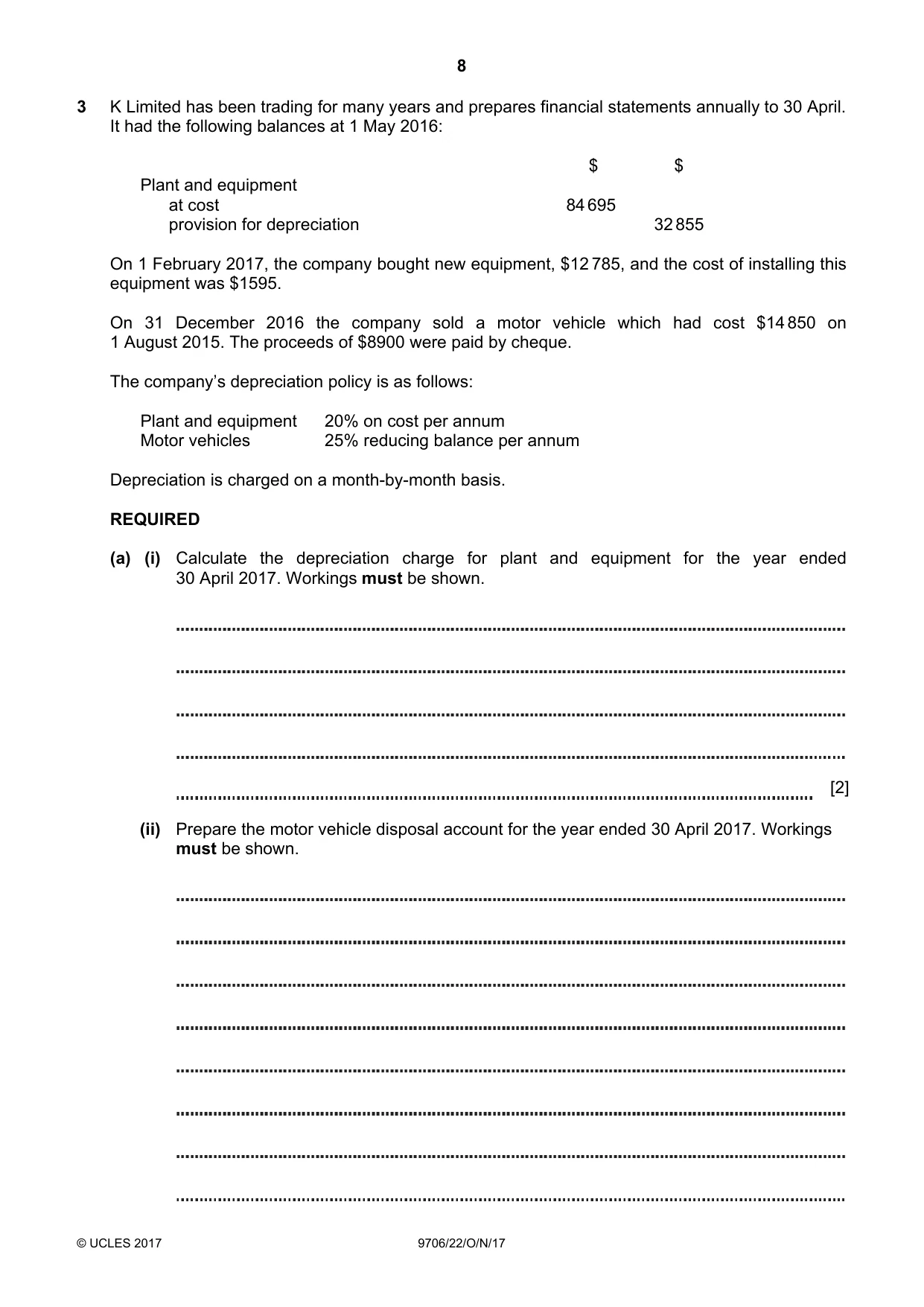
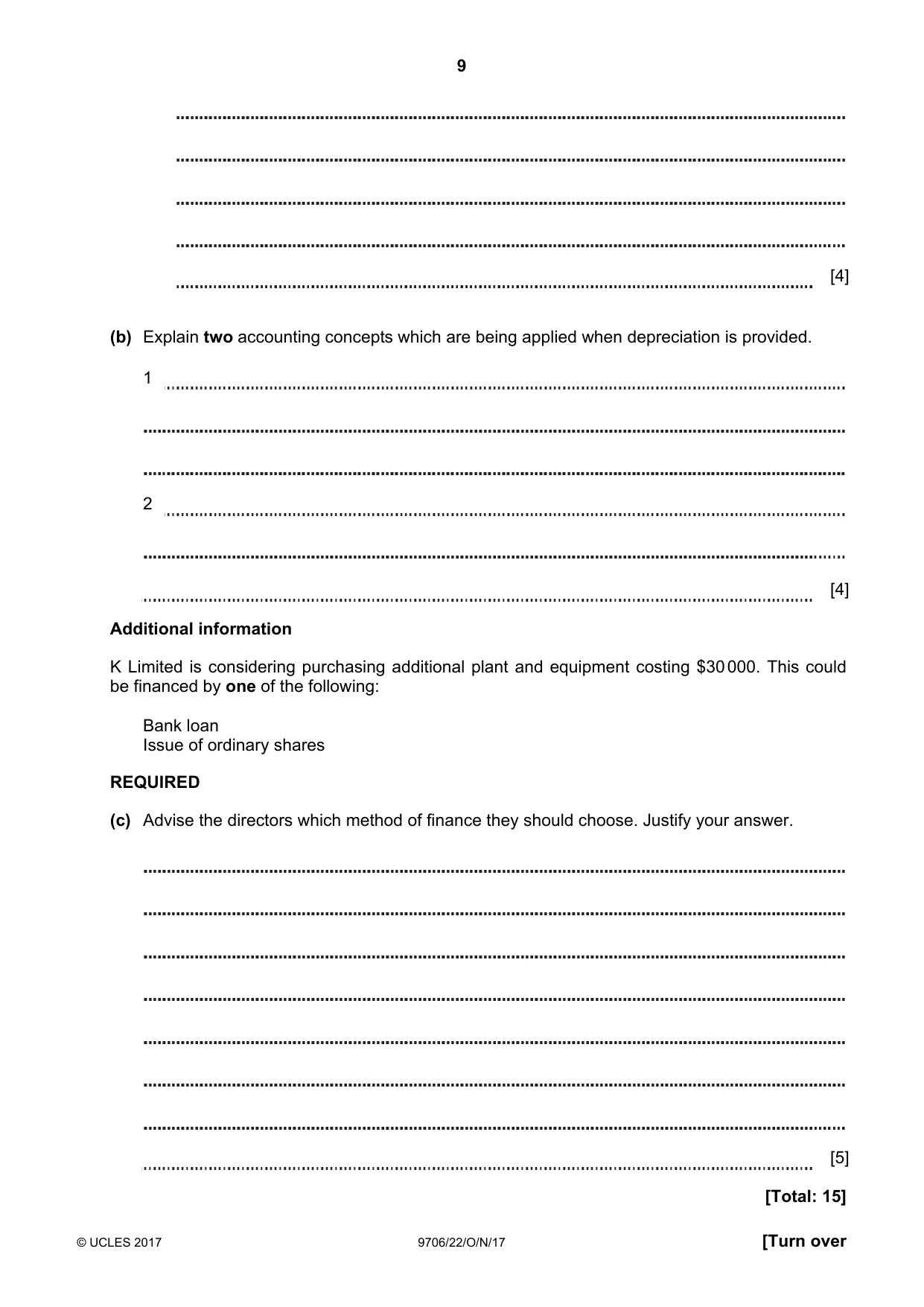
3 K Limited has been trading for many years and prepares financial statements annually to 30 April. It had the following balances at 1 May 2016: $ $ Plant and equipment at cost 84 695 provision for depreciation 32 855 On 1 February 2017, the company bought new equipment, $12 785, and the cost of installing this equipment was $1595. On 31 December 2016 the company sold a motor vehicle which had cost $14 850 on 1 August 2015. The proceeds of $8900 were paid by cheque. The company’s depreciation policy is as follows: Plant and equipment 20% on cost per annum Motor vehicles 25% reducing balance per annum Depreciation is charged on a month-by-month basis. REQUIRED (a) (i) Calculate the depreciation charge for plant and equipment for the year ended 30 April 2017. Workings must be shown. [2] (ii) Prepare the motor vehicle disposal account for the year ended 30 April 2017. Workings must be shown. [4] (b) Explain two accounting concepts which are being applied when depreciation is provided. 1 2 [4] Additional information K Limited is considering purchasing additional plant and equipment costing $30 000. This could be financed by one of the following: Bank loan Issue of ordinary shares REQUIRED (c) Advise the directors which method of finance they should choose. Justify your answer. [5] [Total: 15]
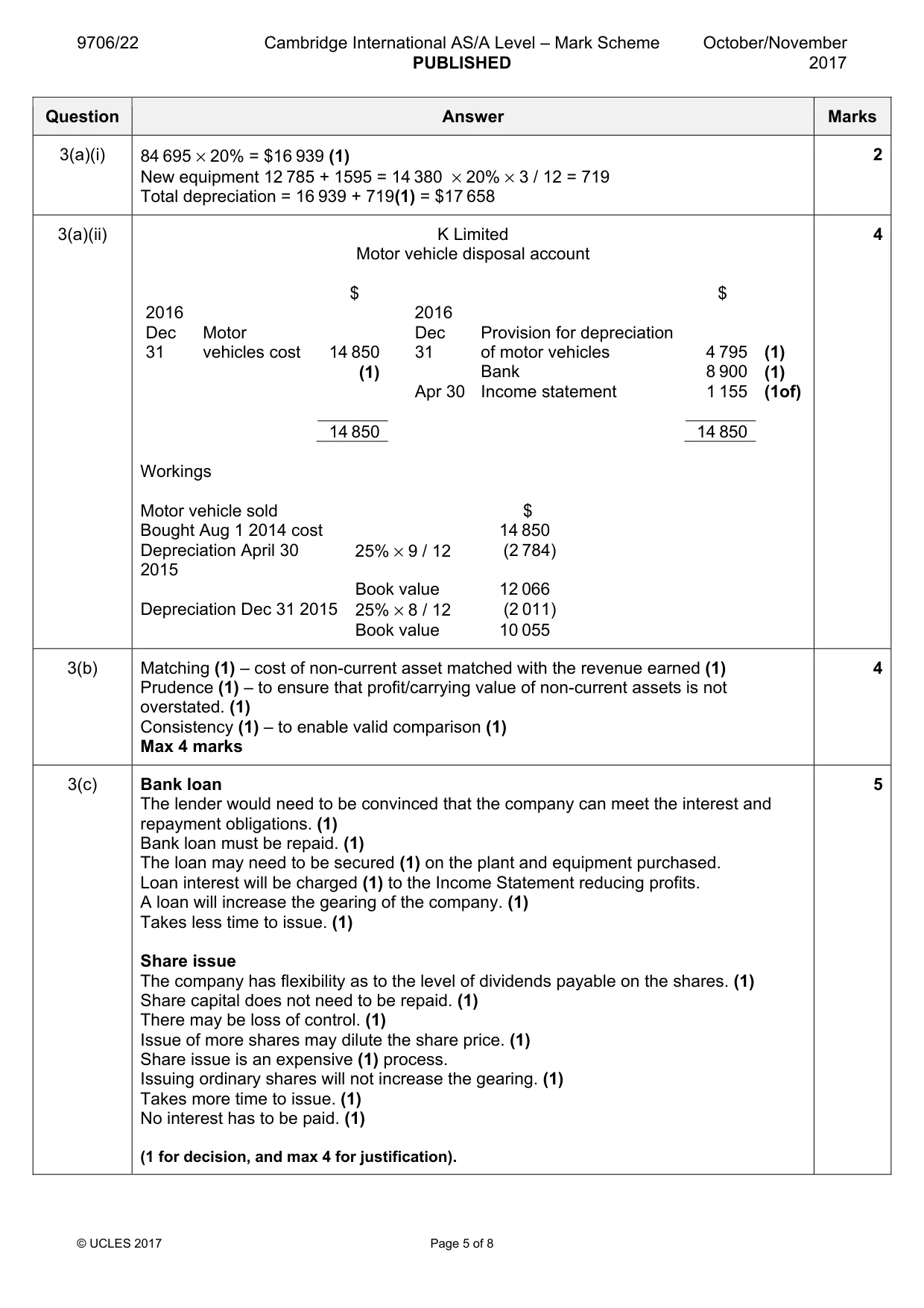
Mark scheme: 3(a)(i) 84 695 × 20% = $16 939 (1) 2 New equipment 12 785 + 1595 = 14 380 × 20% × 3 / 12 = 719 Total depreciation = 16 939 + 719(1) = $17 658 3(a)(ii) K Limited 4 Motor vehicle disposal account $ $ 2016 2016 Dec Motor Dec Provision for depreciation 31 vehicles cost 14 850 31 of motor vehicles 4 795 (1) (1) Bank 8 900 (1) Apr 30 Income statement 1 155 (1of) 14 850 14 850 Workings Motor vehicle sold $ Bought Aug 1 2014 cost 14 850 Depreciation April 30 25% × 9 / 12 (2 784) 2015 Book value 12 066 Depreciation Dec 31 2015 25% × 8 / 12 (2 011) Book value 10 055 3(b) Matching (1) – cost of non-current asset matched with the revenue earned (1) 4 Prudence (1) – to ensure that profit/carrying value of non-current assets is not overstated. (1) Consistency (1) – to enable valid comparison (1) Max 4 marks 3(c) Bank loan 5 The lender would need to be convinced that the company can meet the interest and repayment obligations. (1) Bank loan must be repaid. (1) The loan may need to be secured (1) on the plant and equipment purchased. Loan interest will be charged (1) to the Income Statement reducing profits. A loan will increase the gearing of the company. (1) Takes less time to issue. (1) Share issue The company has flexibility as to the level of dividends payable on the shares. (1) Share capital does not need to be repaid. (1) There may be loss of control. (1) Issue of more shares may dilute the share price. (1) Share issue is an expensive (1) process. Issuing ordinary shares will not increase the gearing. (1) Takes more time to issue. (1) No interest has to be paid. (1) (1 for decision, and max 4 for justification).
Q4 · J Limited manufactures a single product, a leather suitcase
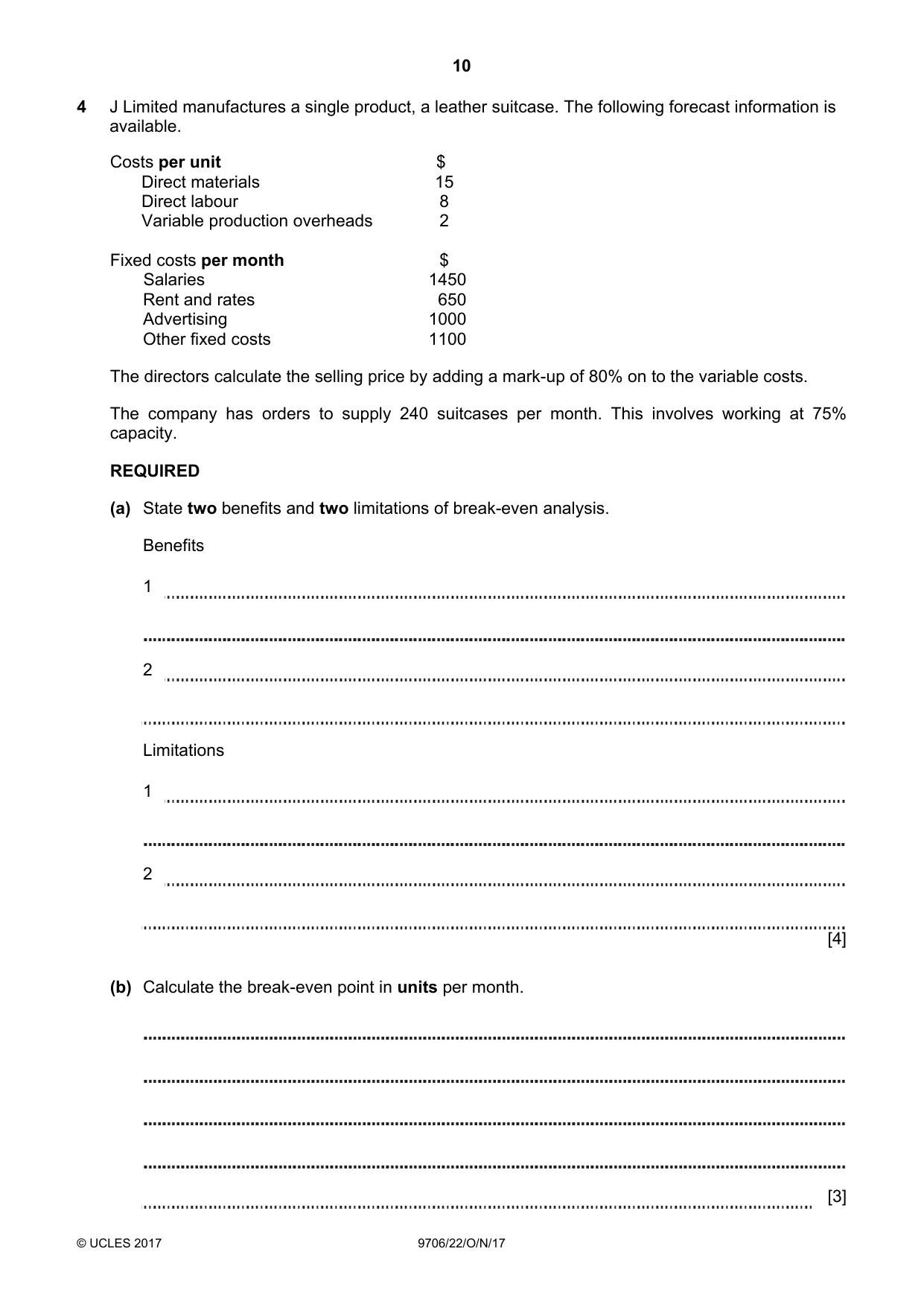
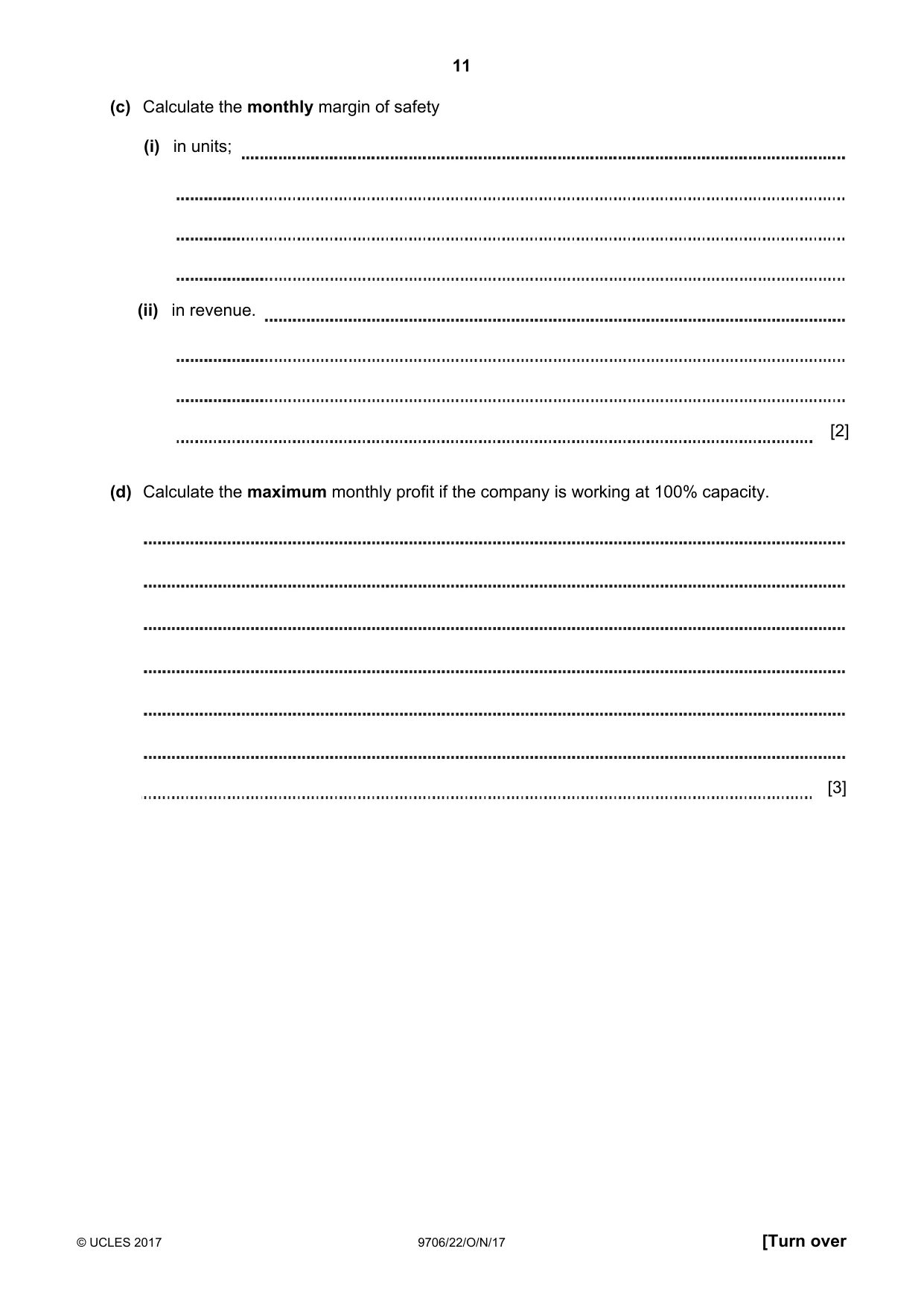
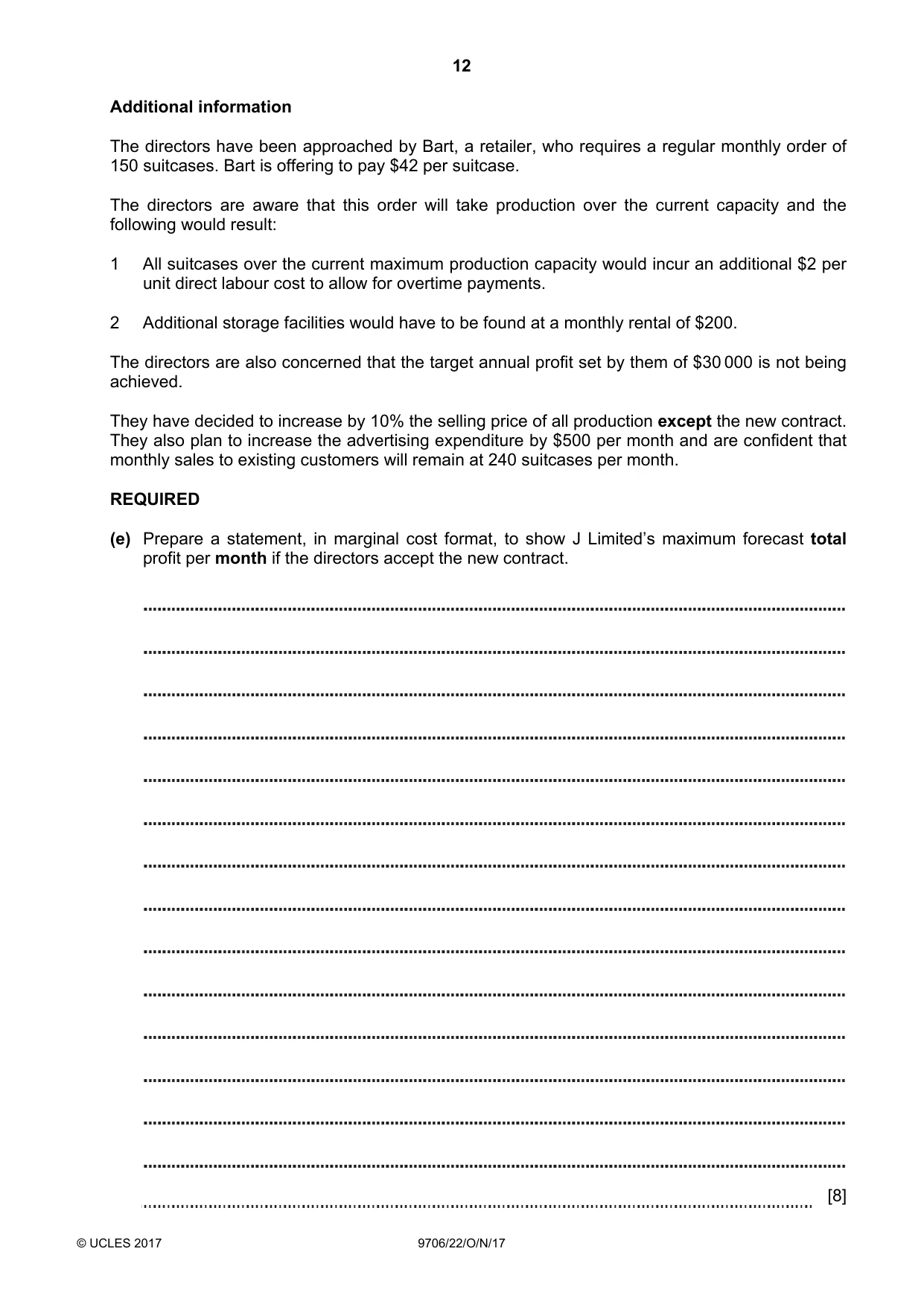
4 J Limited manufactures a single product, a leather suitcase. The following forecast information is available. Costs per unit $ Direct materials 15 Direct labour 8 Variable production overheads 2 Fixed costs per month $ Salaries 1450 Rent and rates 650 Advertising 1000 Other fixed costs 1100 The directors calculate the selling price by adding a mark-up of 80% on to the variable costs. The company has orders to supply 240 suitcases per month. This involves working at 75% capacity. REQUIRED (a) State two benefits and two limitations of break-even analysis. Benefits 1 2 Limitations 1 2 [4] (b) Calculate the break-even point in units per month. [3] (c) Calculate the monthly margin of safety (i) in units; (ii) in revenue. [2] (d) Calculate the maximum monthly profit if the company is working at 100% capacity. [3] Additional information The directors have been approached by Bart, a retailer, who requires a regular monthly order of 150 suitcases. Bart is offering to pay $42 per suitcase. The directors are aware that this order will take production over the current capacity and the following would result: 1 All suitcases over the current maximum production capacity would incur an additional $2 per unit direct labour cost to allow for overtime payments. 2 Additional storage facilities would have to be found at a monthly rental of $200. The directors are also concerned that the target annual profit set by them of $30 000 is not being achieved. They have decided to increase by 10% the selling price of all production except the new contract. They also plan to increase the advertising expenditure by $500 per month and are confident that monthly sales to existing customers will remain at 240 suitcases per month. REQUIRED (e) Prepare a statement, in marginal cost format, to show J Limited’s maximum forecast total profit per month if the directors accept the new contract. [8]
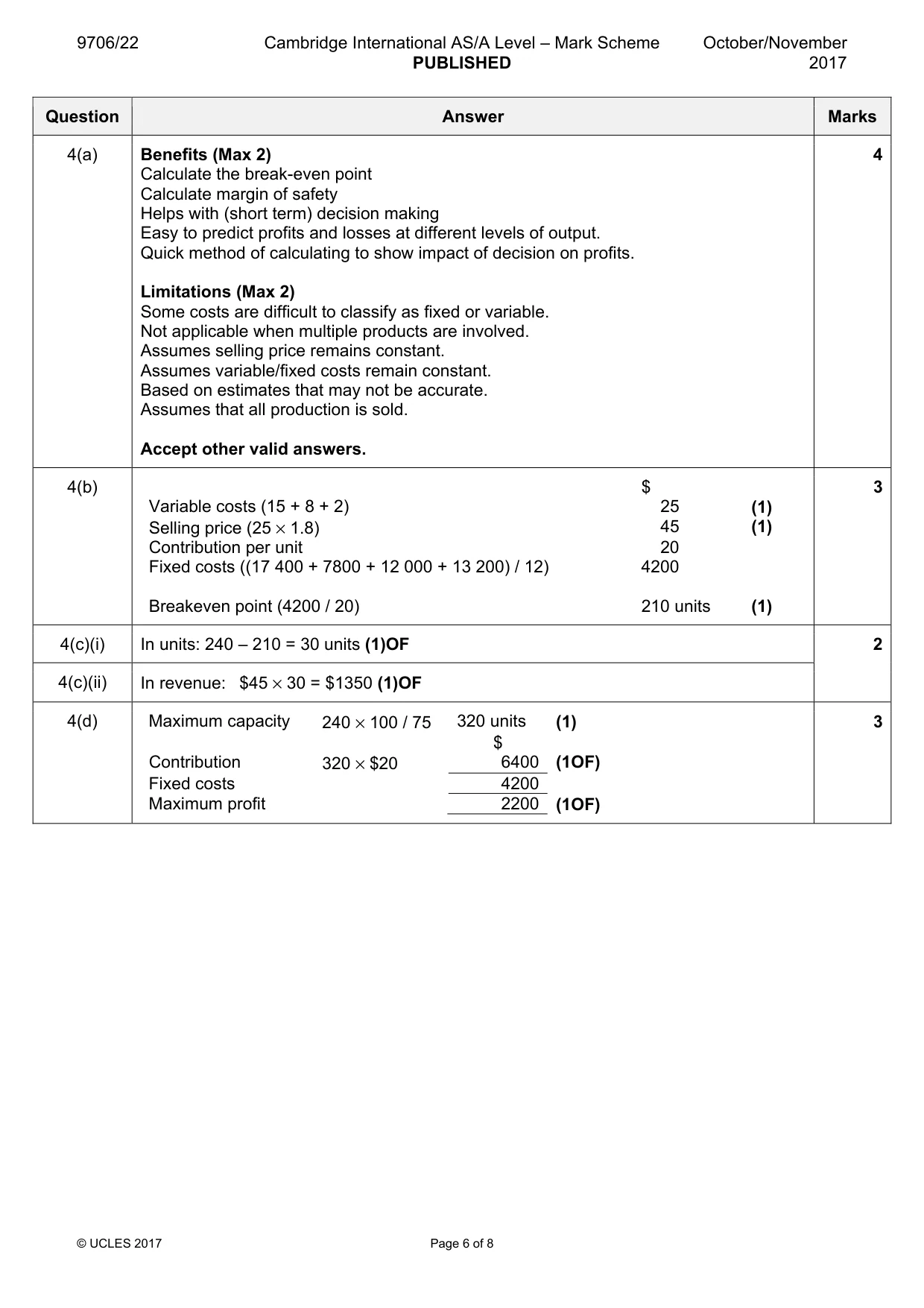
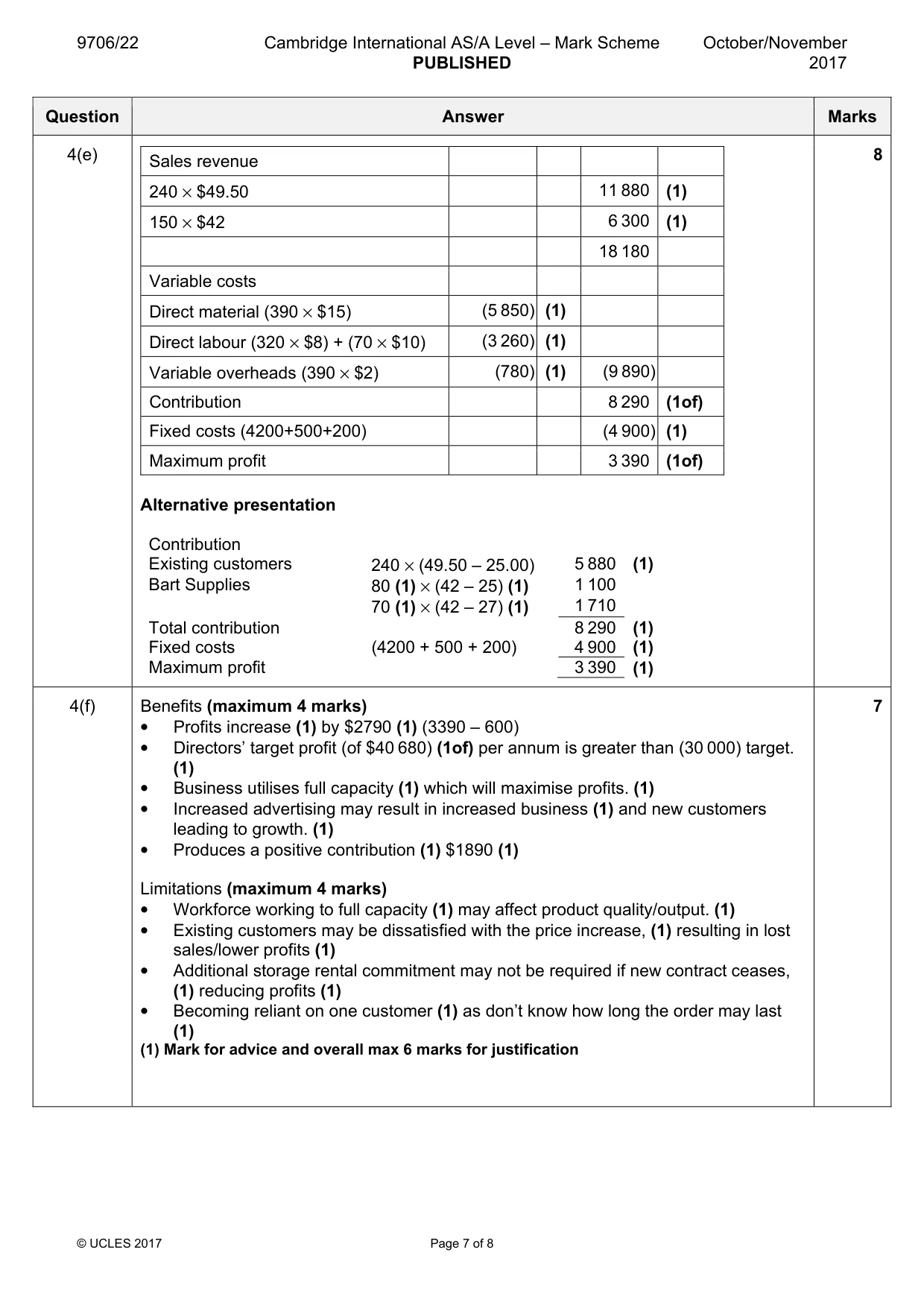
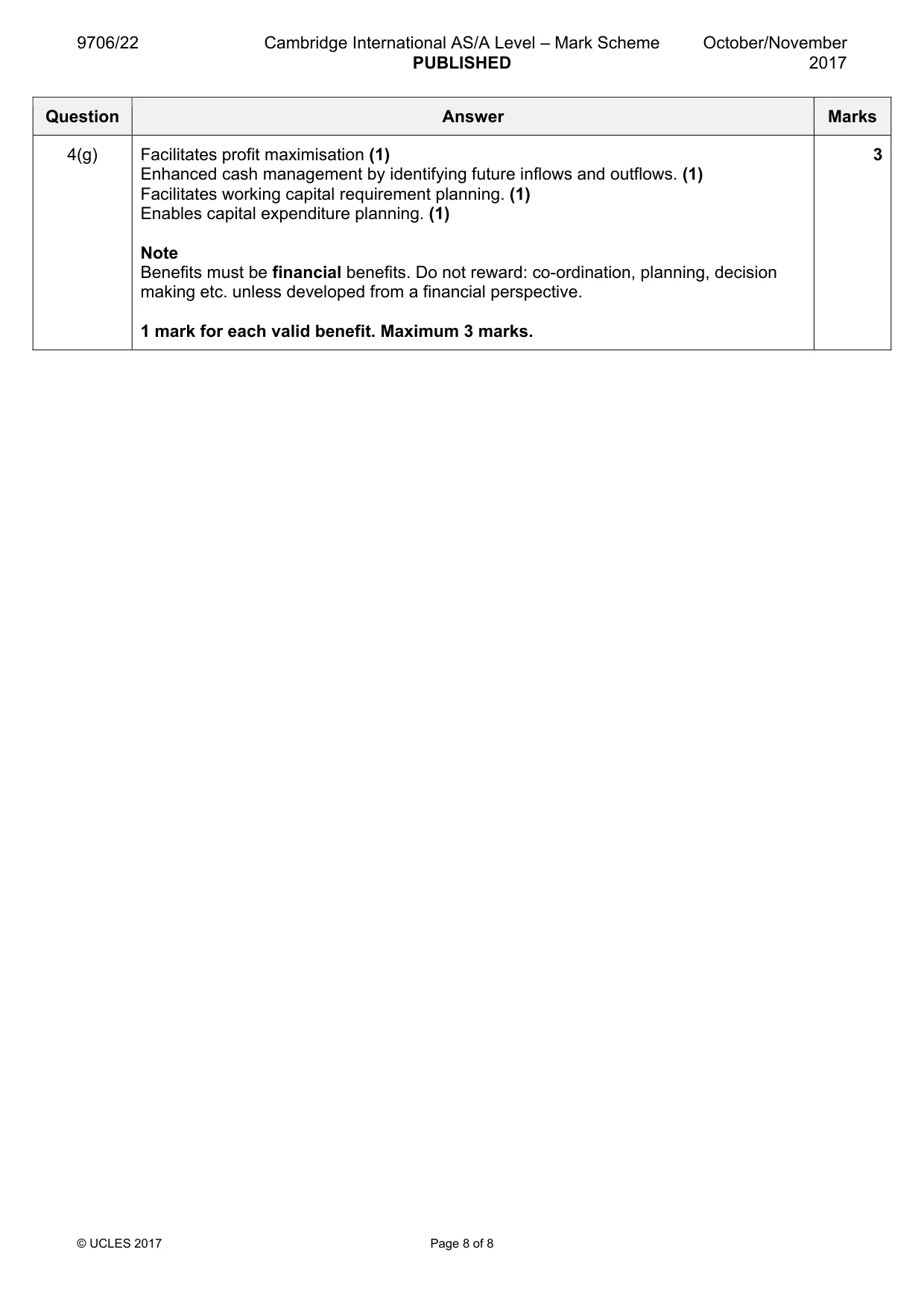
Mark scheme: 4(a) Benefits (Max 2) 4 Calculate the break-even point Calculate margin of safety Helps with (short term) decision making Easy to predict profits and losses at different levels of output. Quick method of calculating to show impact of decision on profits. Limitations (Max 2) Some costs are difficult to classify as fixed or variable. Not applicable when multiple products are involved. Assumes selling price remains constant. Assumes variable/fixed costs remain constant. Based on estimates that may not be accurate. Assumes that all production is sold. Accept other valid answers. 4(b) $ 3 Variable costs (15 + 8 + 2) 25 (1) Selling price (25 × 1.8) 45 (1) Contribution per unit 20 Fixed costs ((17 400 + 7800 + 12 000 + 13 200) / 12) 4200 Breakeven point (4200 / 20) 210 units (1) 4(c)(i) In units: 240 – 210 = 30 units (1)OF 2 4(c)(ii) In revenue: $45 × 30 = $1350 (1)OF 4(d) Maximum capacity 240 × 100 / 75 320 units (1) 3 $ Contribution 320 × $20 6400 (1OF) Fixed costs 4200 Maximum profit 2200 (1OF) 4(e) 8 Sales revenue 240 × $49.50 11 880 (1) 150 × $42 6 300 (1) 18 180 Variable costs Direct material (390 × $15) (5 850) (1) Direct labour (320 × $8) + (70 × $10) (3 260) (1) Variable overheads (390 × $2) (780) (1) (9 890) Contribution 8 290 (1of) Fixed costs (4200+500+200) (4 900) (1) Maximum profit 3 390 (1of) Alternative presentation Contribution Existing customers 240 × (49.50 – 25.00) 5 880 (1) Bart Supplies 80 (1) × (42 – 25) (1) 1 100 70 (1) × (42 – 27) (1) 1 710 Total contribution 8 290 (1) Fixed costs (4200 + 500 + 200) 4 900 (1) Maximum profit 3 390 (1) 4(f) Benefits (maximum 4 marks) 7 • Profits increase (1) by $2790 (1) (3390 – 600) • Directors’ target profit (of $40 680) (1of) per annum is greater than (30 000) target. (1) • Business utilises full capacity (1) which will maximise profits. (1) • Increased advertising may result in increased business (1) and new customers leading to growth. (1) • Produces a positive contribution (1) $1890 (1) Limitations (maximum 4 marks) • Workforce working to full capacity (1) may affect product quality/output. (1) • Existing customers may be dissatisfied with the price increase, (1) resulting in lost sales/lower profits (1) • Additional storage rental commitment may not be required if new contract ceases, (1) reducing profits (1) • Becoming reliant on one customer (1) as don’t know how long the order may last (1) (1) Mark for advice and overall max 6 marks for justification 4(g) Facilitates profit maximisation (1) 3 Enhanced cash management by identifying future inflows and outflows. (1) Facilitates working capital requirement planning. (1) Enables capital expenditure planning. (1) Note Benefits must be financial benefits. Do not reward: co-ordination, planning, decision making etc. unless developed from a financial perspective. 1 mark for each valid benefit. Maximum 3 marks.
What was in this paper
The subtopics covered by these 4 questions, and how many questions each got. Open one in a new tab to see every Cambridge question on it.
What you needed in this session
Cambridge’s own grade thresholds for 2017 Oct/Nov, Paper 2 · Variant 2. A higher threshold means an easier paper — the bar moves with how the cohort did.