Cambridge A Level Accounting 9706 — 2017 Oct/Nov Paper 2 · Variant 3
9706/23/O/N/17 · 5 questions · 90 marks · ≈101 min
The question paper and its mark scheme, free to read here and free to download. This is Cambridge’s own paper, exactly as it was sat.
Question paper20 pages

Mark scheme8 pages
Answers below. Sit the paper first if you are practising.
Questions as text
Q1 · F Limited is a large retail company
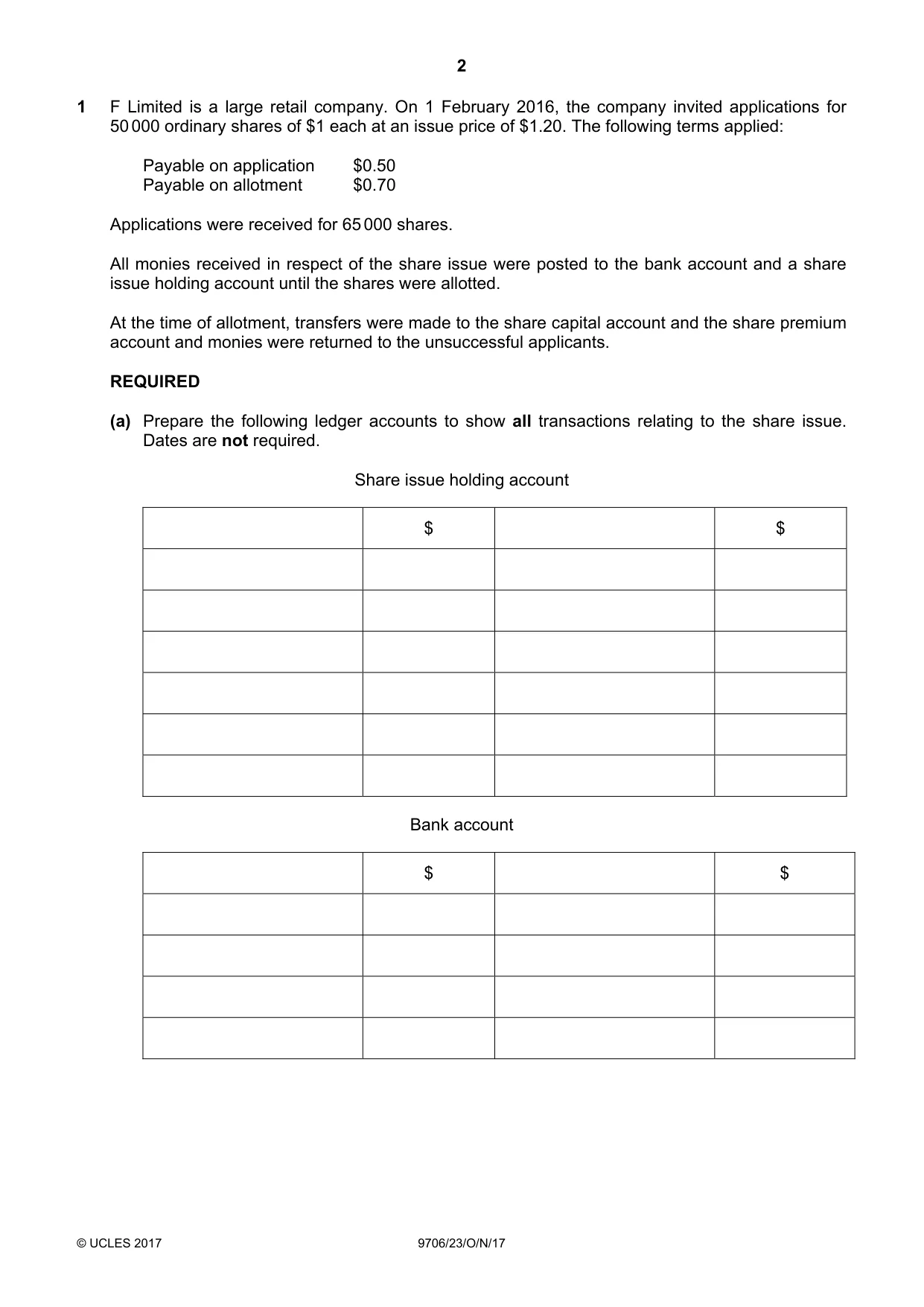
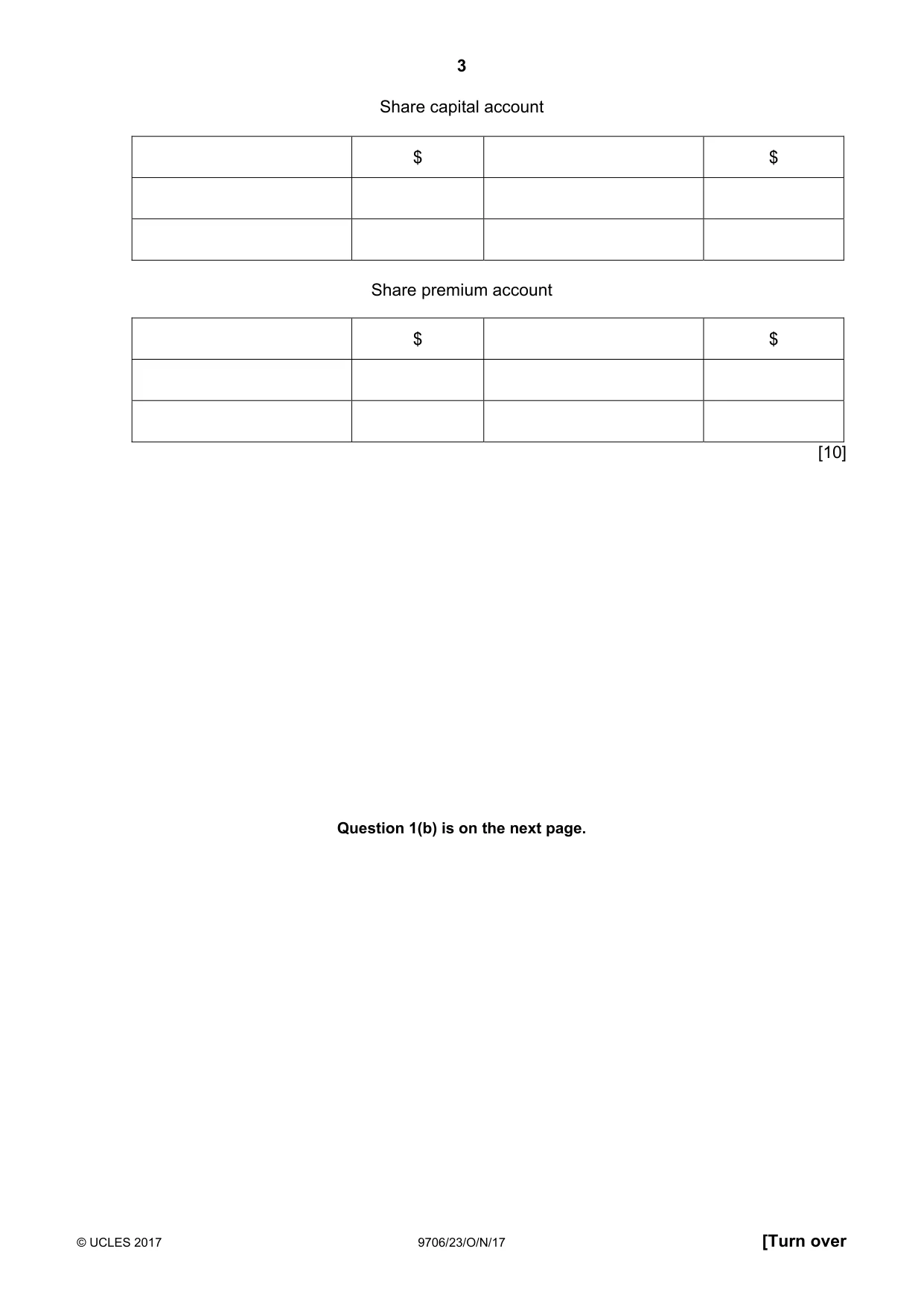
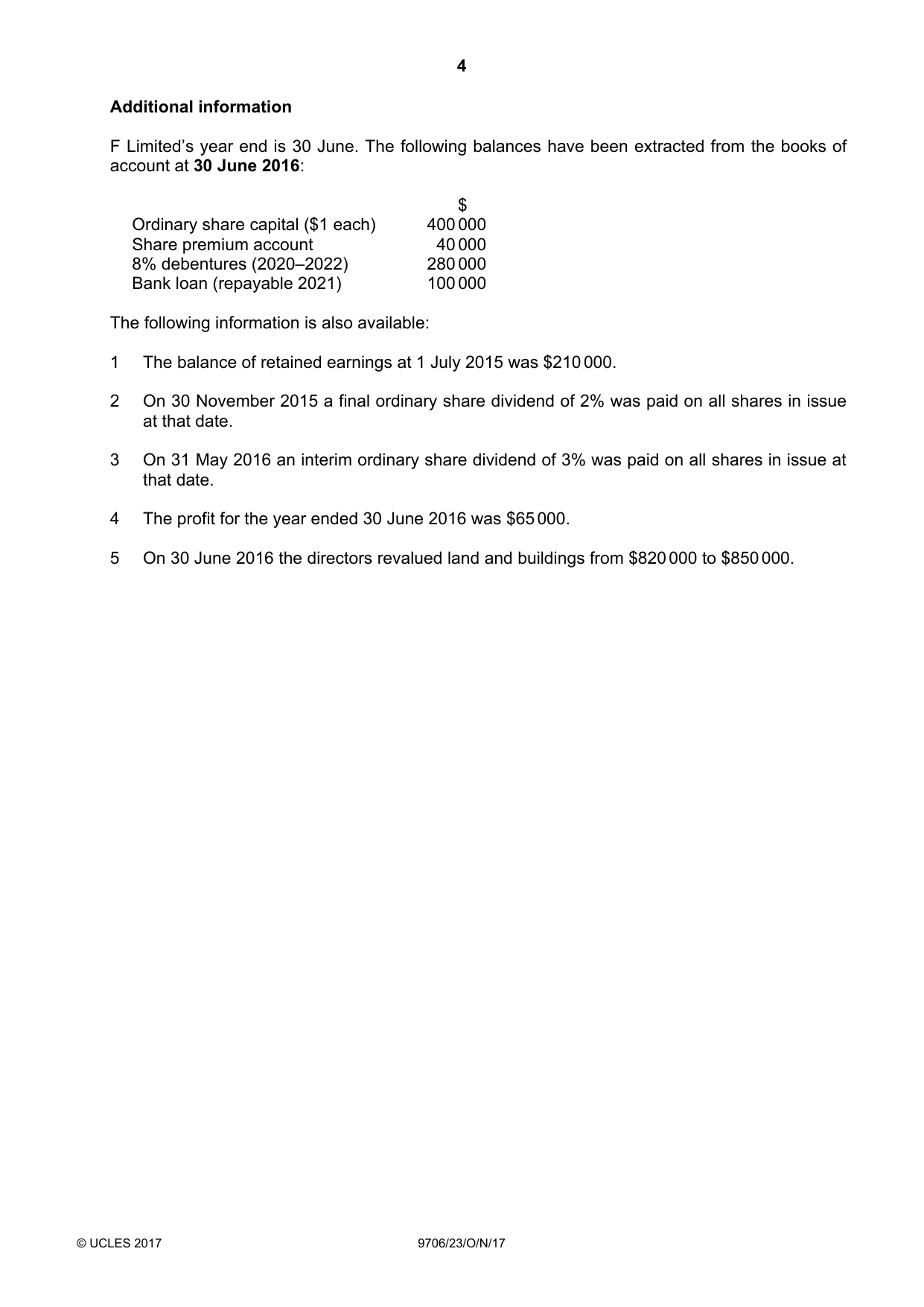
1 F Limited is a large retail company. On 1 February 2016, the company invited applications for 50 000 ordinary shares of $1 each at an issue price of $1.20. The following terms applied: Payable on application $0.50 Payable on allotment $0.70 Applications were received for 65 000 shares. All monies received in respect of the share issue were posted to the bank account and a share issue holding account until the shares were allotted. At the time of allotment, transfers were made to the share capital account and the share premium account and monies were returned to the unsuccessful applicants. REQUIRED (a) Prepare the following ledger accounts to show all transactions relating to the share issue. Dates are not required. Share issue holding account $ $ Bank account $ $ Share capital account $ $ Share premium account $ $ [10] Question 1(b) is on the next page. Additional information F Limited’s year end is 30 June. The following balances have been extracted from the books of account at 30 June 2016: $ Ordinary share capital ($1 each) 400 000 Share premium account 40 000 8% debentures (2020–2022) 280 000 Bank loan (repayable 2021) 100 000 The following information is also available: 1 The balance of retained earnings at 1 July 2015 was $210 000.
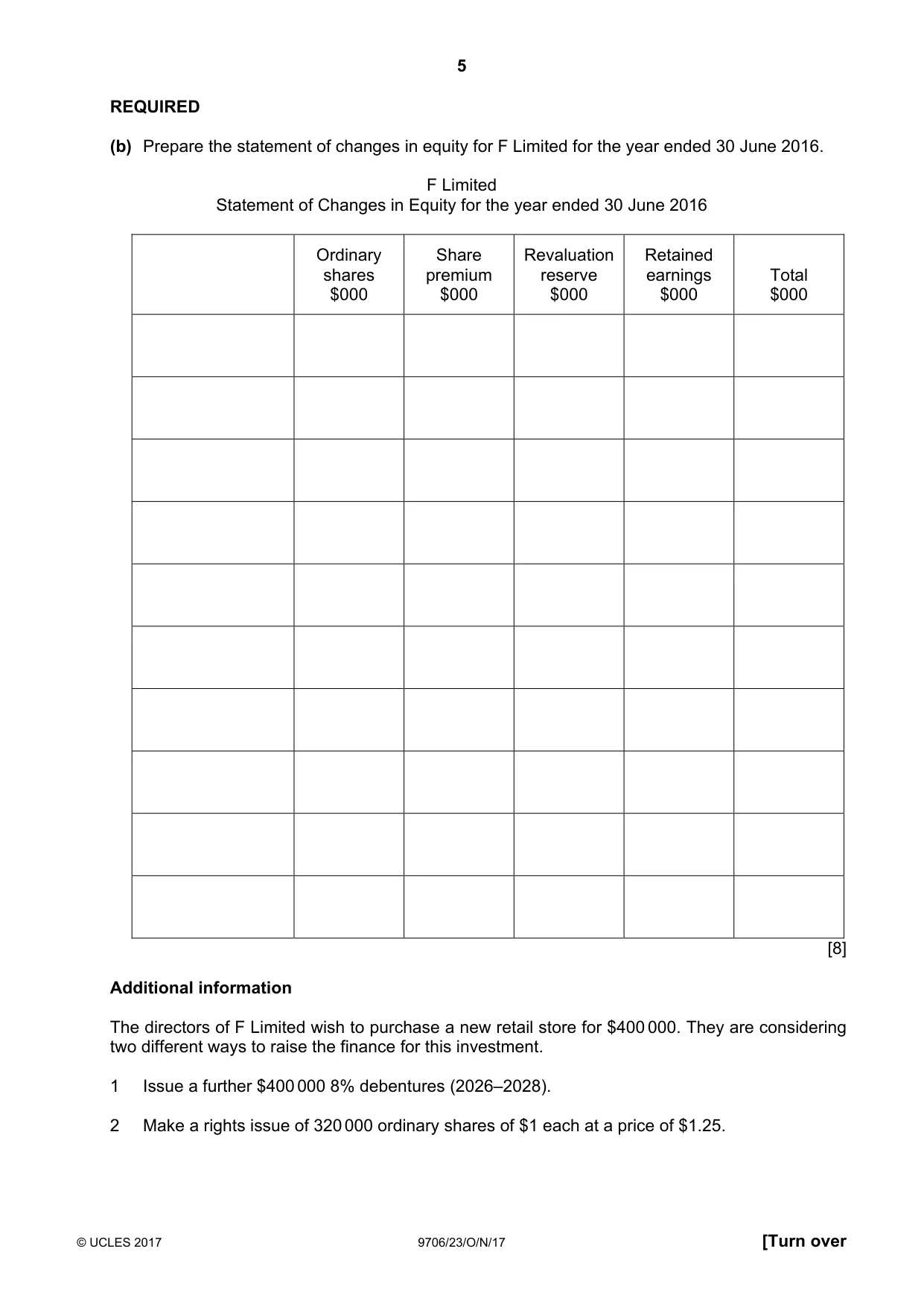
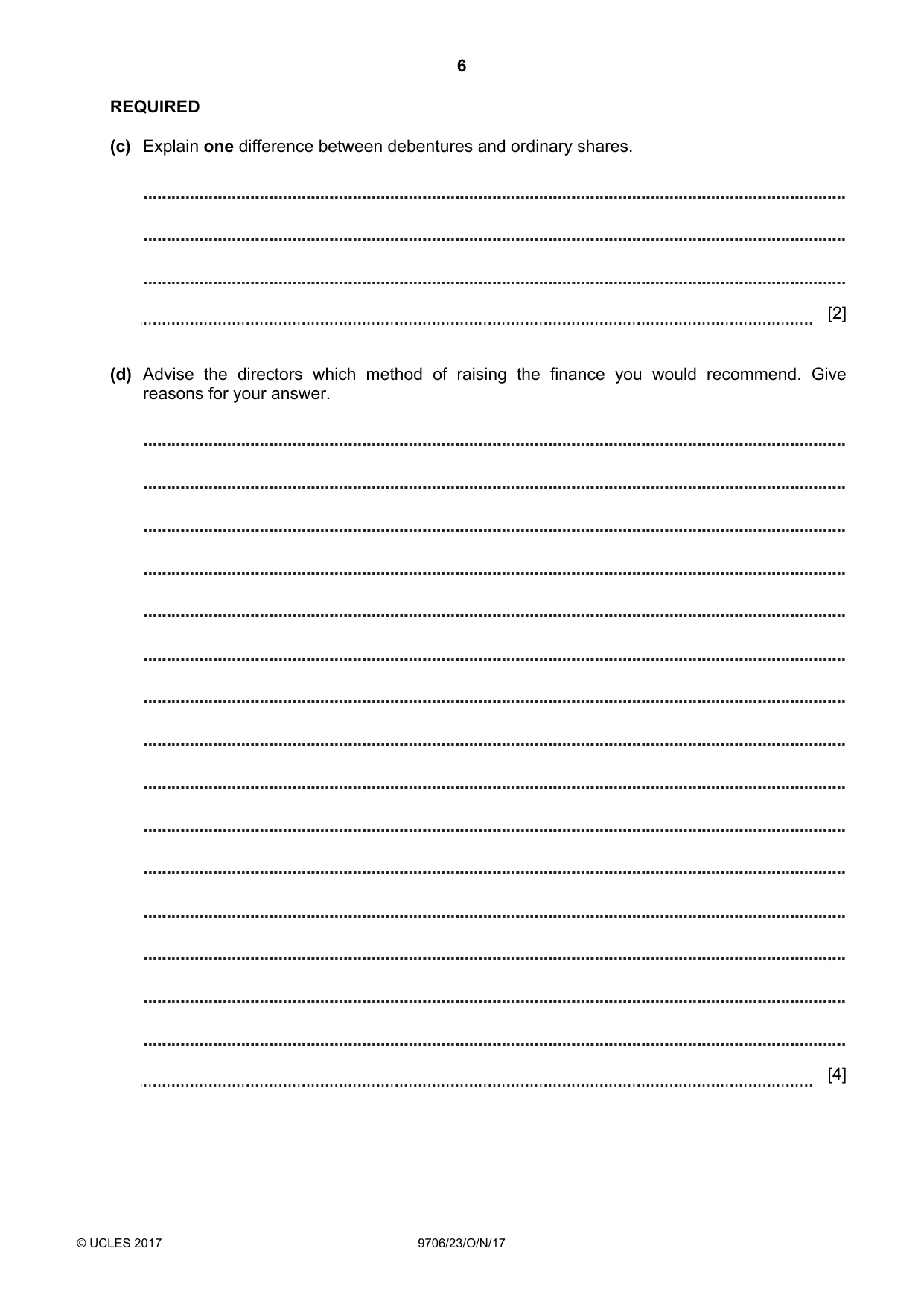
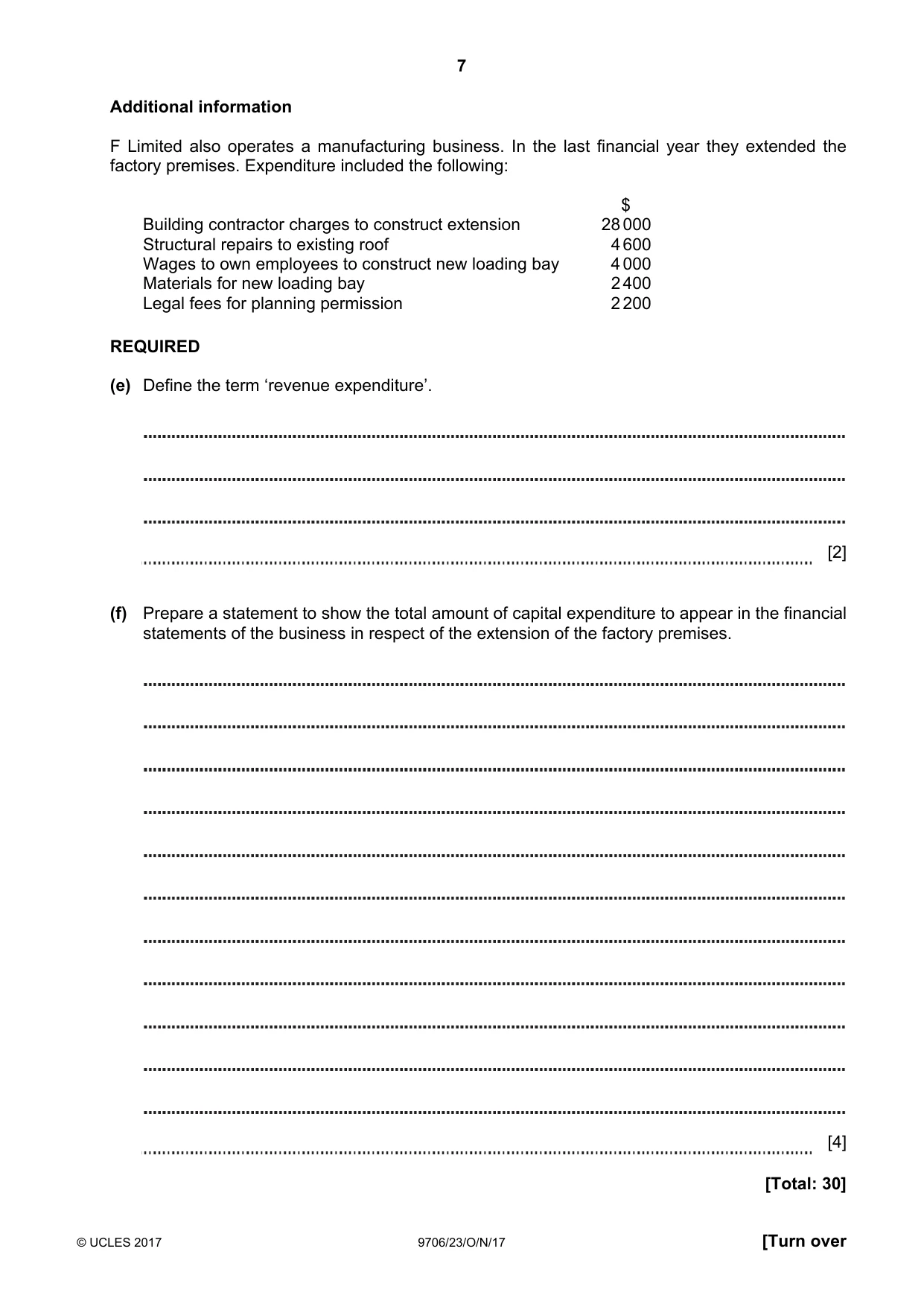
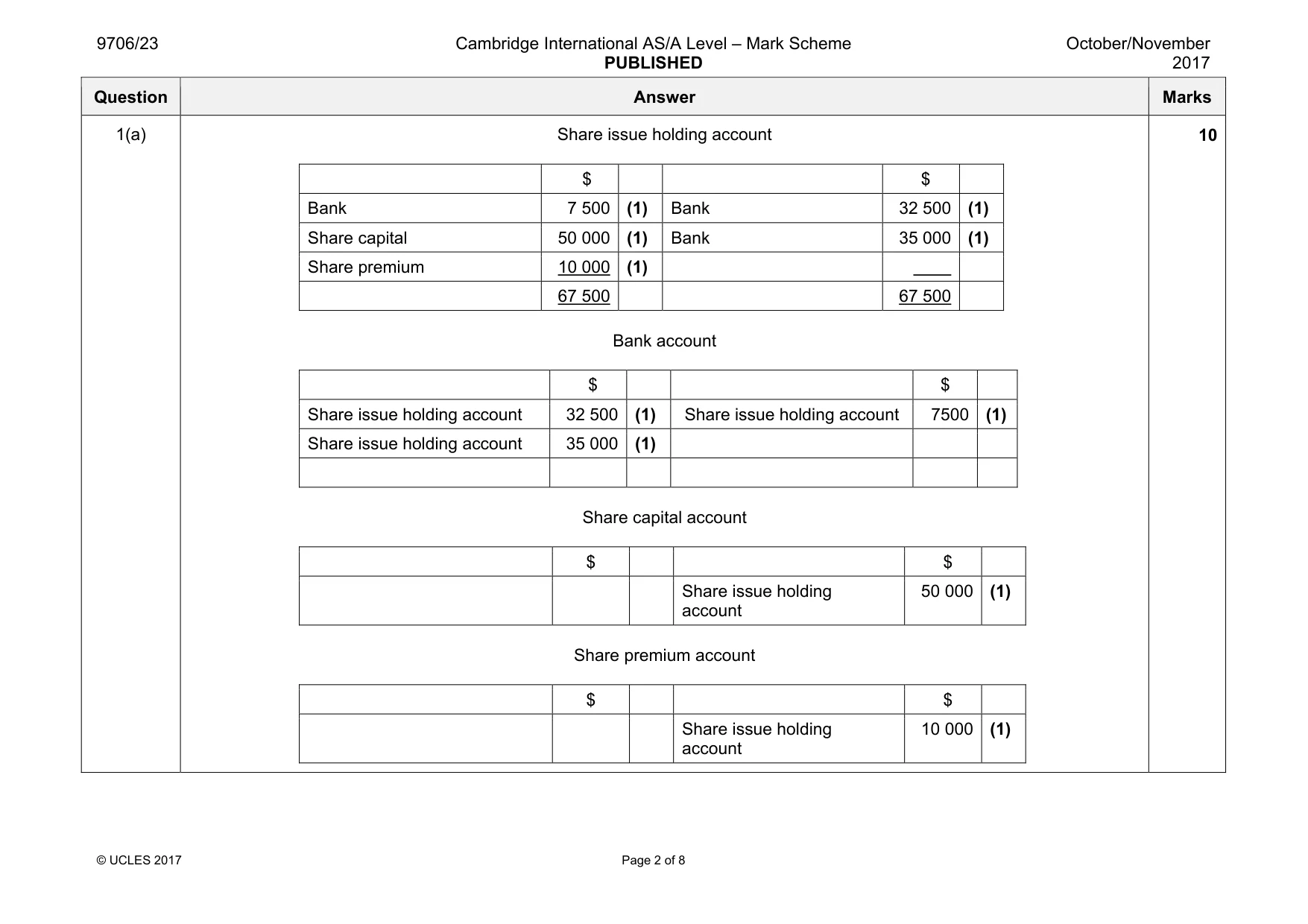
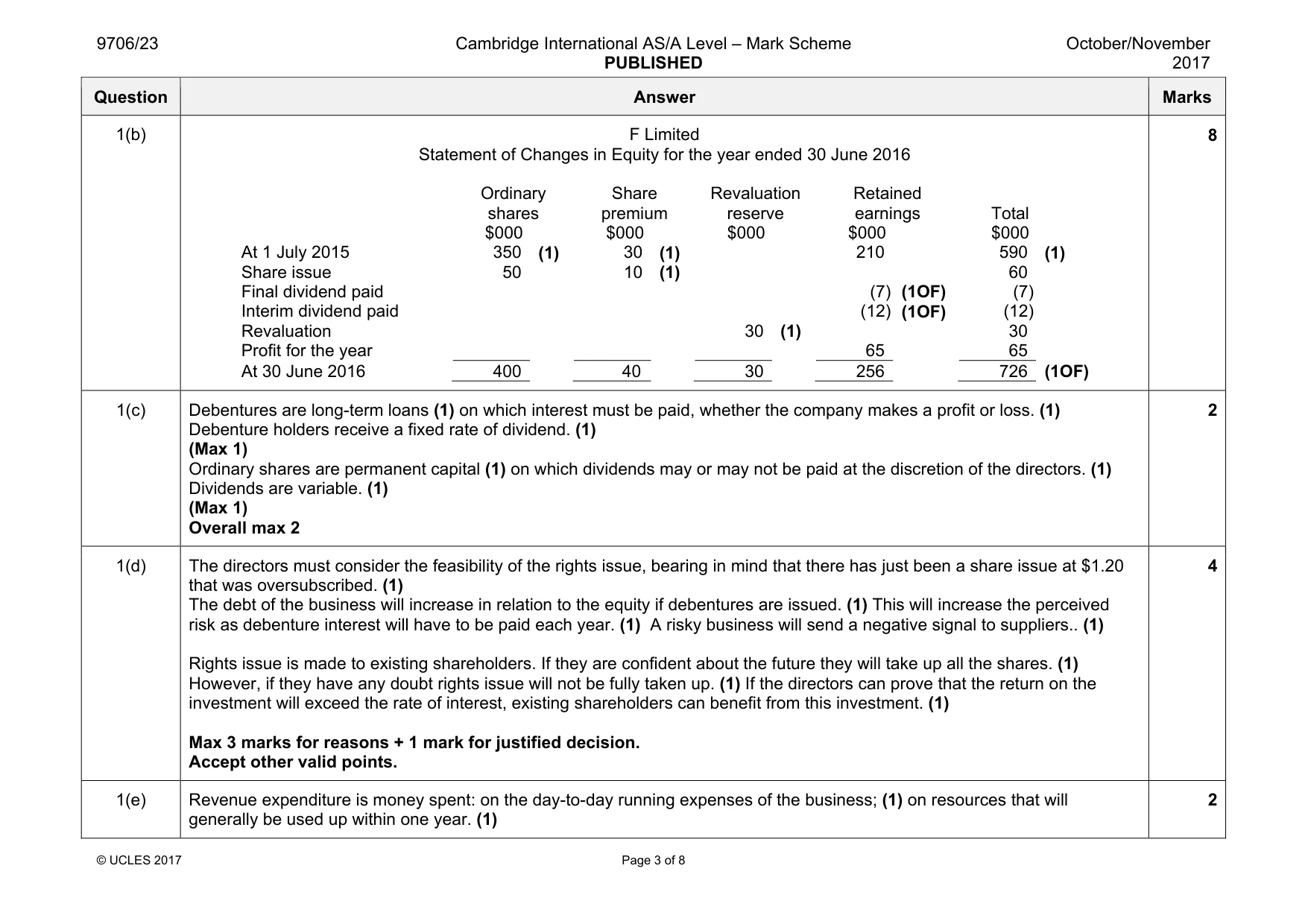
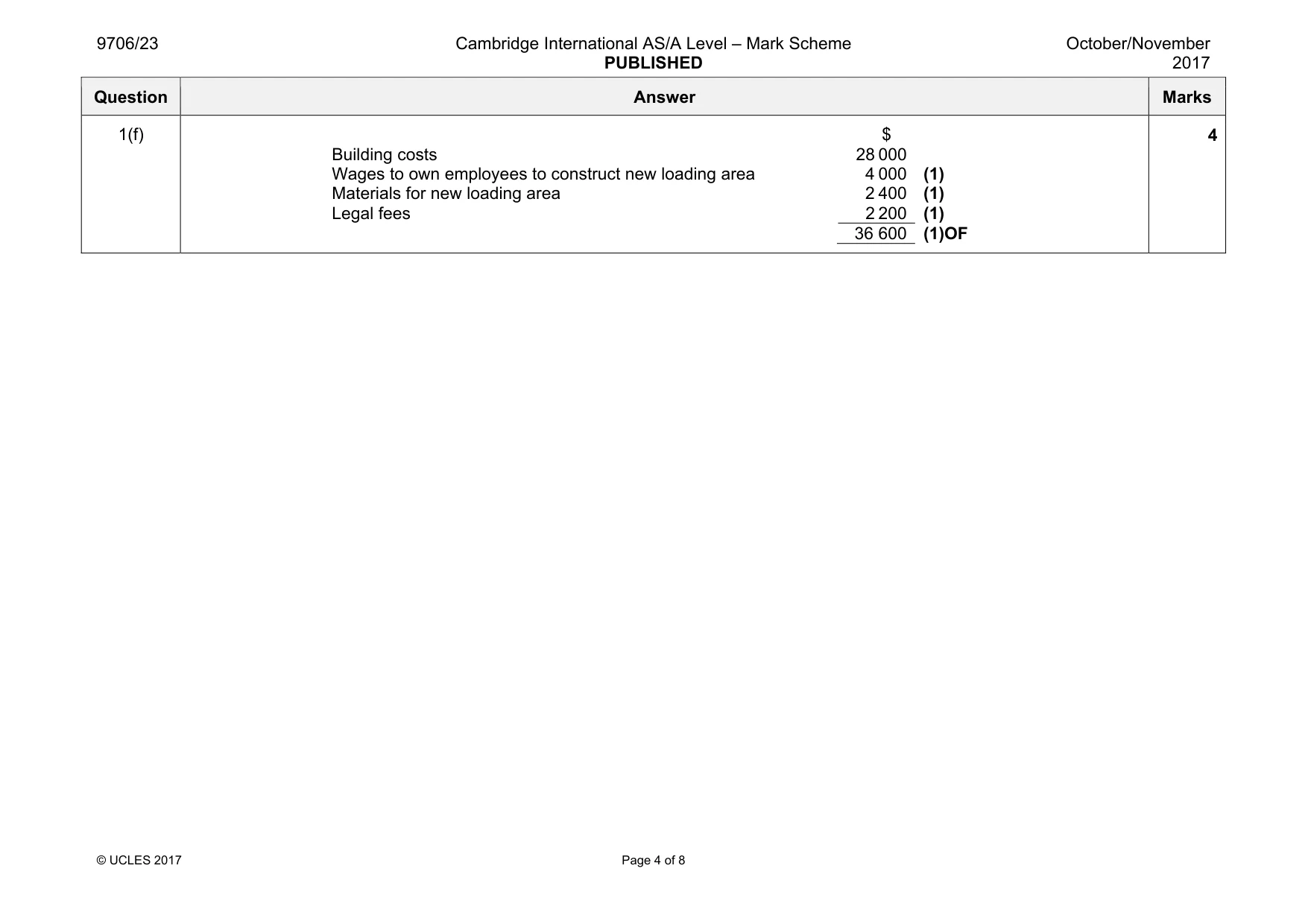
Mark scheme: 1(a) Share issue holding account $ $ Bank 7 500 (1) Bank 32 500 (1) Share capital 50 000 (1) Bank 35 000 (1) Share premium 10 000 (1) 67 500 67 500 Bank account $ $ Share issue holding account 32 500 (1) Share issue holding account 7500 (1) Share issue holding account 35 000 (1) Share capital account $ $ Share issue holding account 50 000 (1) Share premium account $ $ Share issue holding account 10 000 (1) 10 Question Answer Marks 1(b) F Limited Statement of Changes in Equity for the year ended 30 June 2016 Ordinary shares $000 Share premium $000 Revaluation reserve $000 Retained earnings $000 Total $000 At 1 July 2015 350 (1) 30 (1) 210 590 (1) Share issue 50 10 (1) 60 Final dividend paid (7) (1OF) (7) Interim dividend paid (12) (1OF) (12) Revaluation 30 (1) 30 Profit for the year 65 65 At 30 June 2016 400 40 30 256 726 (1OF) 8 1(c) Debentures are long-term loans (1) on which interest must be paid, whether the company makes a profit or loss. (1) Debenture holders receive a fixed rate of dividend. (1) (Max 1) Ordinary shares are permanent capital (1) on which dividends may or may not be paid at the discretion of the directors. (1) Dividends are variable. (1) (Max 1) Overall max 2 2 1(d) The directors must consider the feasibility of the rights issue, bearing in mind that there has just been a share issue at $1.20 that was oversubscribed. (1) The debt of the business will increase in relation to the equity if debentures are issued. (1) This will increase the perceived risk as debenture interest will have to be paid each year. (1) A risky business will send a negative signal to suppliers.. (1) Rights issue is made to existing shareholders. If they are confident about the future they will take up all the shares. (1) However, if they have any doubt rights issue will not be fully taken up. (1) If the directors can prove that the return on the investment will exceed the rate of interest, existing shareholders can benefit from this investment. (1) Max 3 marks for reasons + 1 mark for justified decision. Accept other valid points. 4 1(e) Revenue expenditure is money spent: on the day-to-day running expenses of the business; (1) on resources that will generally be used up within one year. (1) 2 Question Answer Marks 1(f) $ Building costs 28 000 Wages to own employees to construct new loading area 4 000 (1) Materials for new loading area 2 400 (1) Legal fees 2 200 (1) 36 600 (1)OF 4
Q2 · On 30 November 2015 a final ordinary share dividend of 2% was paid on all shares in issue…
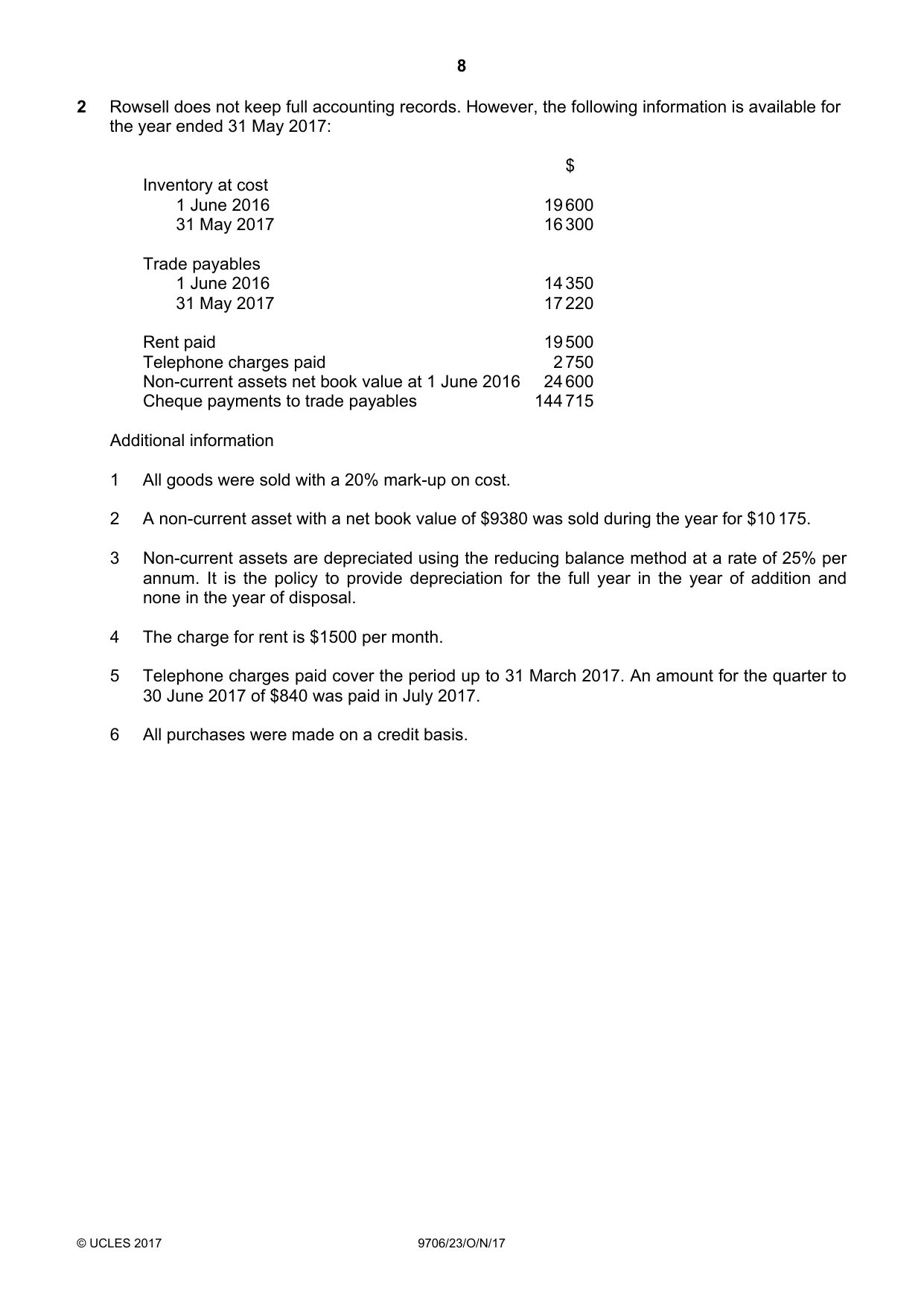
2 On 30 November 2015 a final ordinary share dividend of 2% was paid on all shares in issue at that date.
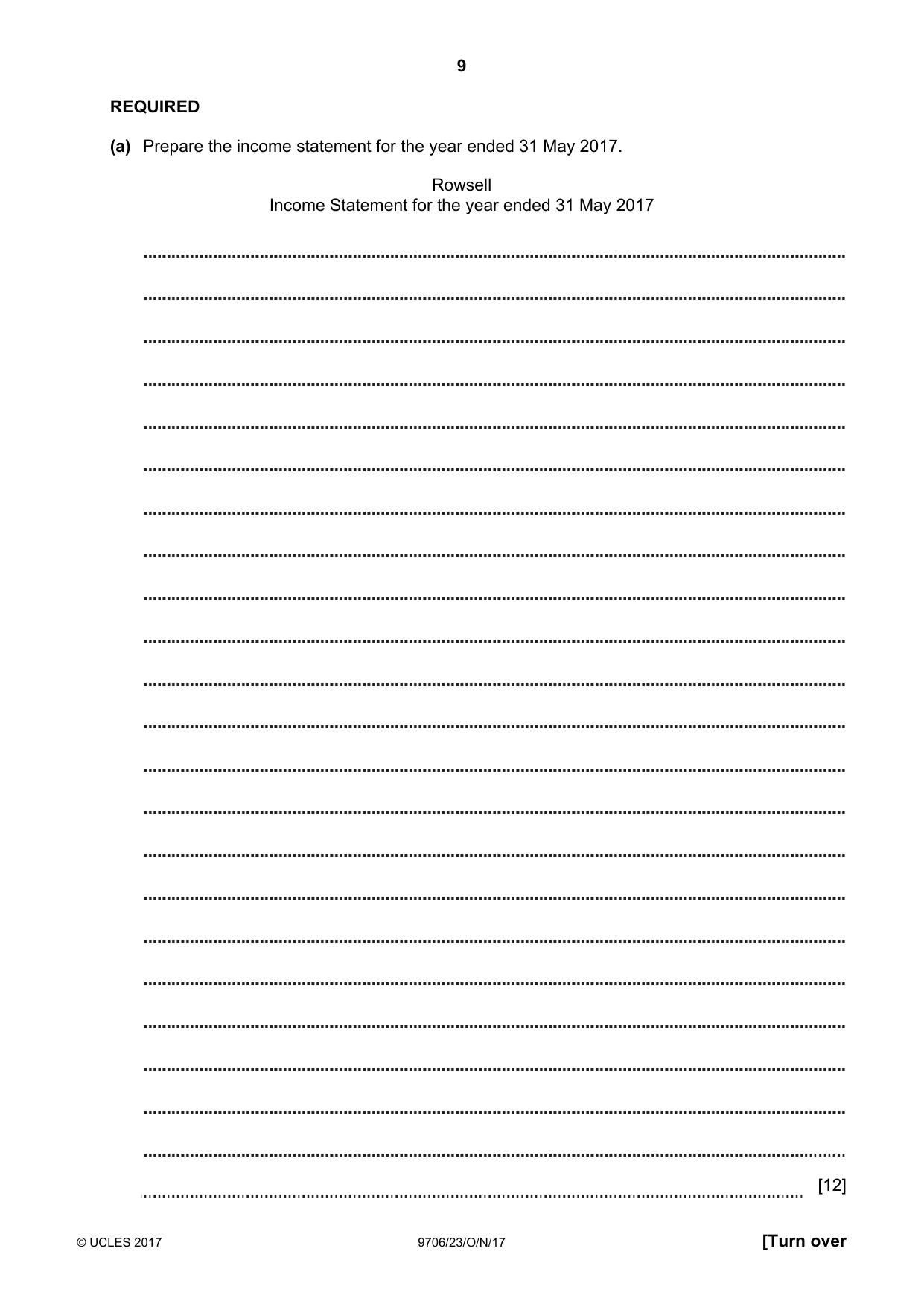
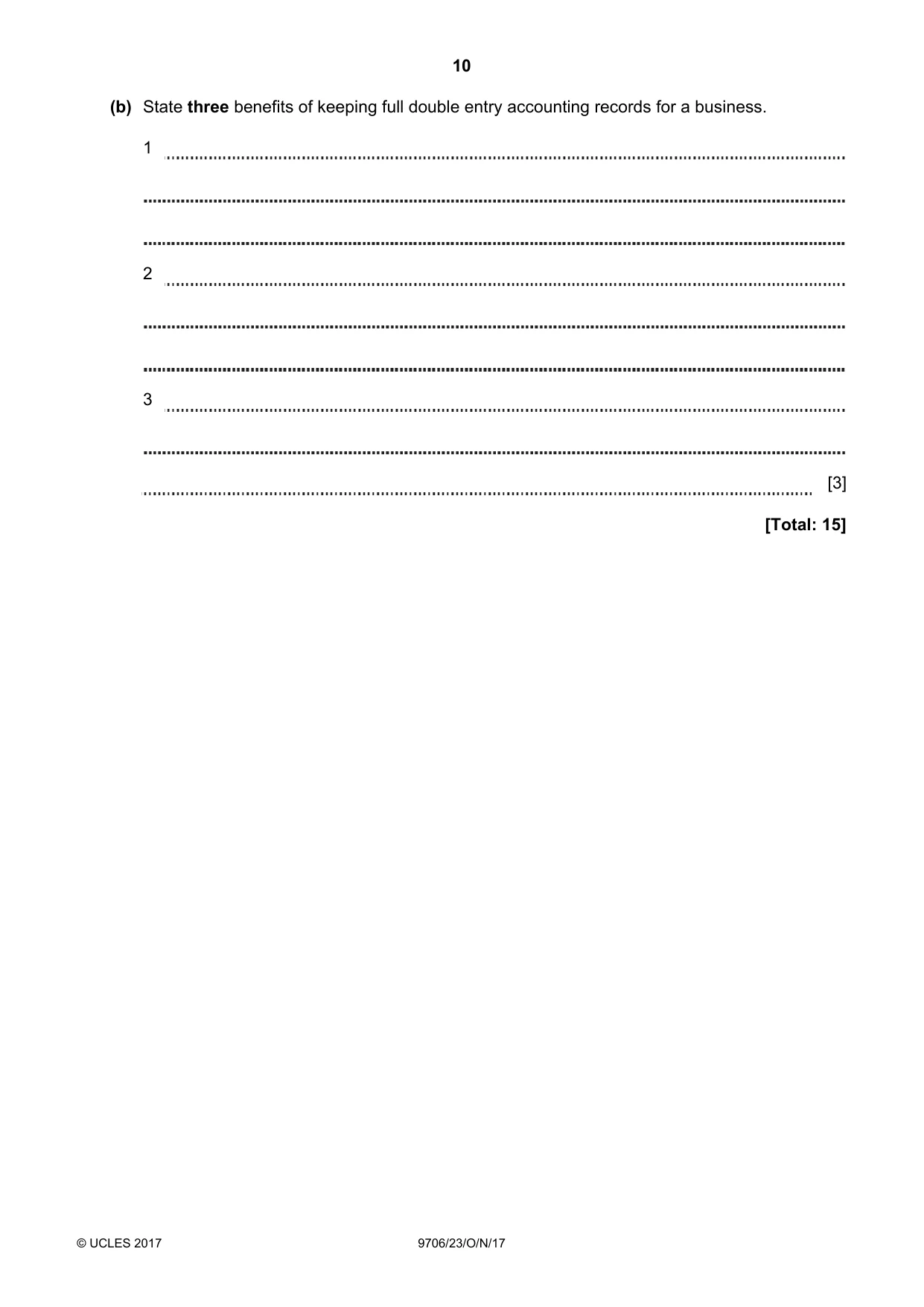
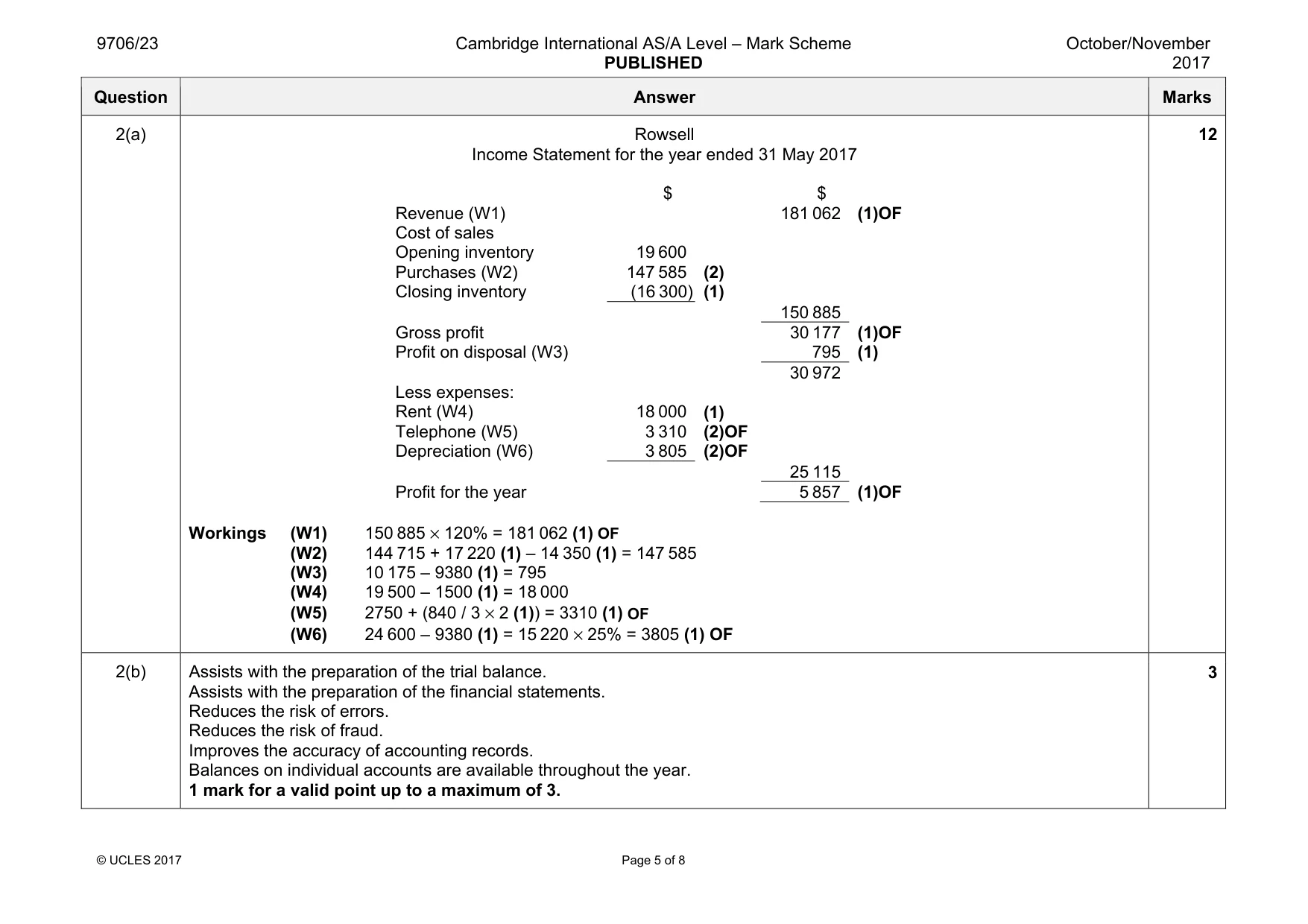
Mark scheme: 2(a) Rowsell Income Statement for the year ended 31 May 2017 $ $ Revenue (W1) 181 062 (1)OF Cost of sales Opening inventory 19 600 Purchases (W2) 147 585 (2) Closing inventory (16 300) (1) 150 885 Gross profit 30 177 (1)OF Profit on disposal (W3) 795 (1) 30 972 Less expenses: Rent (W4) 18 000 (1) Telephone (W5) 3 310 (2)OF Depreciation (W6) 3 805 (2)OF 25 115 Profit for the year 5 857 (1)OF Workings (W1) 150 885 × 120% = 181 062 (1) OF (W2) 144 715 + 17 220 (1) – 14 350 (1) = 147 585 (W3) 10 175 – 9380 (1) = 795 (W4) 19 500 – 1500 (1) = 18 000 (W5) 2750 + (840 / 3 × 2 (1)) = 3310 (1) OF (W6) 24 600 – 9380 (1) = 15 220 × 25% = 3805 (1) OF 12 2(b) Assists with the preparation of the trial balance. Assists with the preparation of the financial statements. Reduces the risk of errors. Reduces the risk of fraud. Improves the accuracy of accounting records. Balances on individual accounts are available throughout the year. 1 mark for a valid point up to a maximum of 3. 3
Q3 · On 31 May 2016 an interim ordinary share dividend of 3% was paid on all shares in issue…
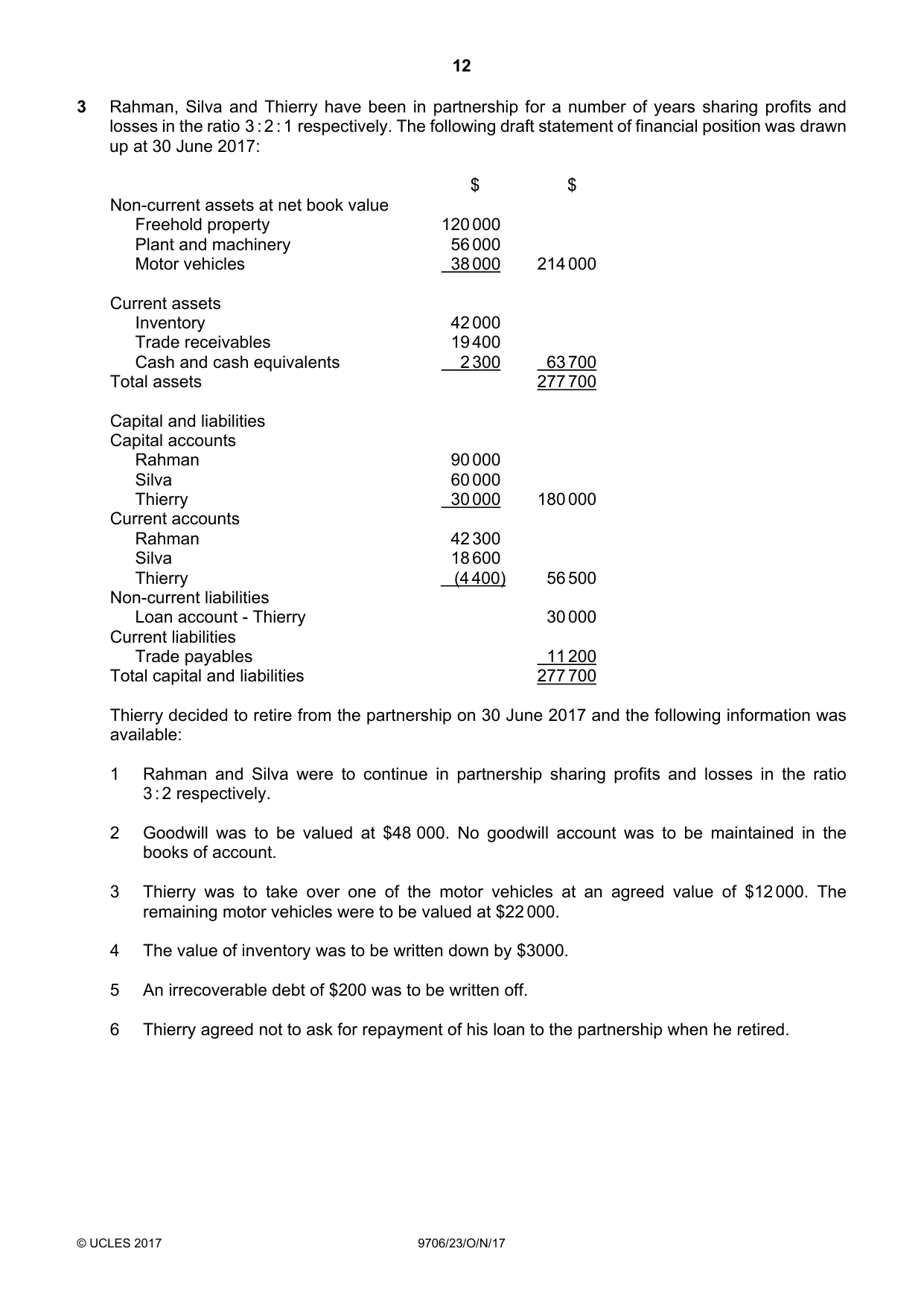
3 On 31 May 2016 an interim ordinary share dividend of 3% was paid on all shares in issue at that date.
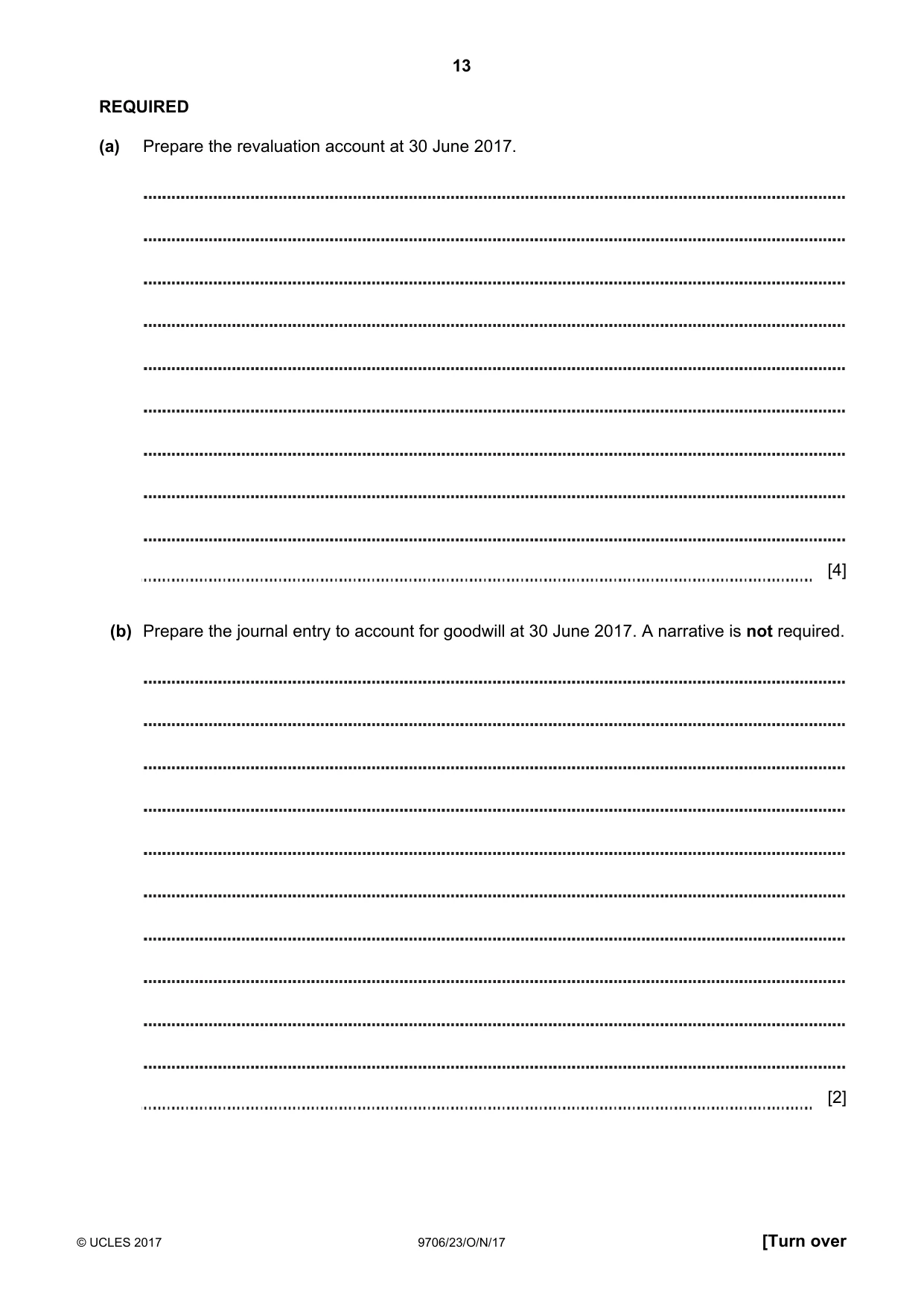
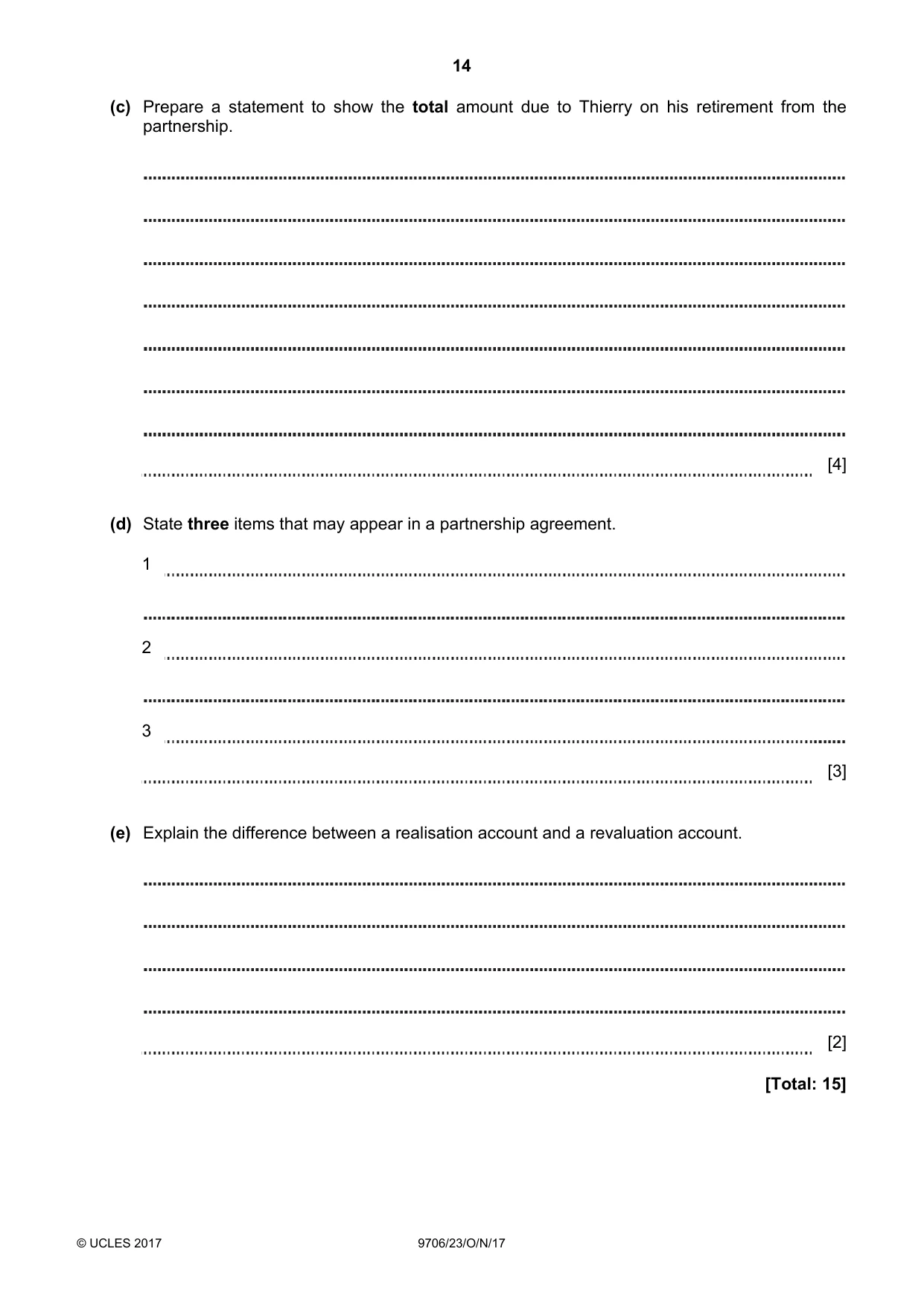
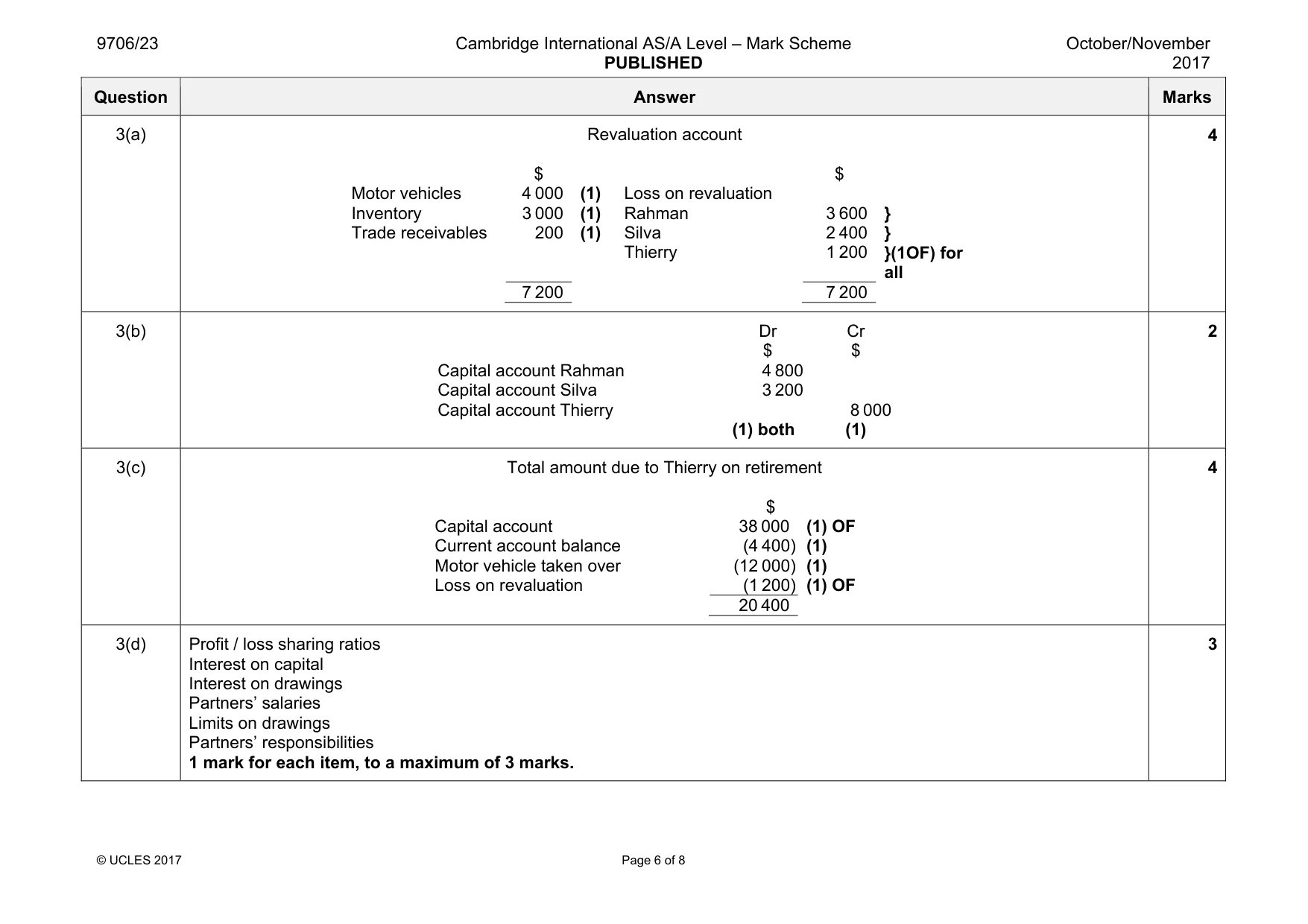
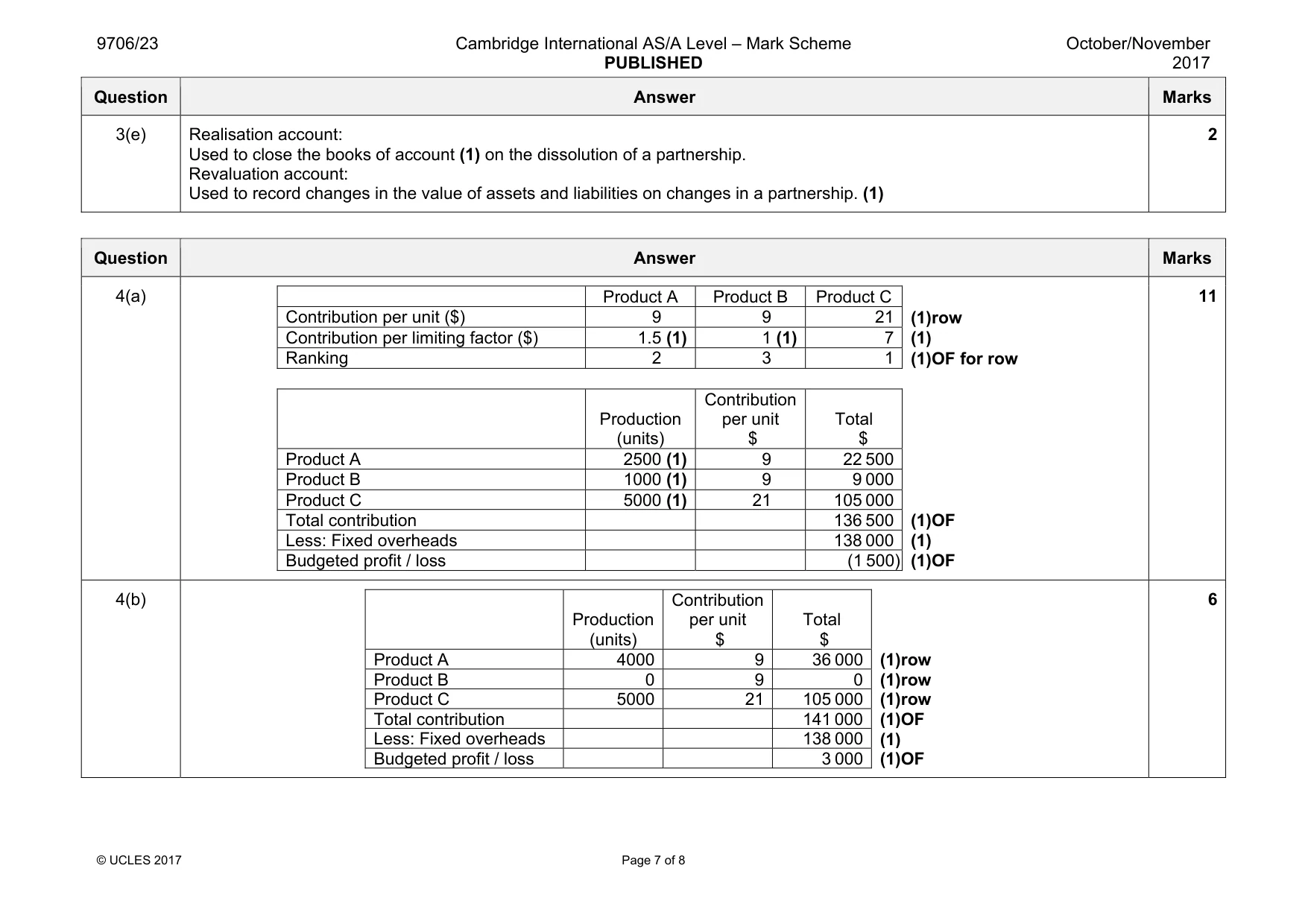
Mark scheme: 3(a) Revaluation account $ $ Motor vehicles 4 000 (1) Loss on revaluation Inventory 3 000 (1) Rahman 3 600 } Trade receivables 200 (1) Silva 2 400 } Thierry 1 200 }(1OF) for all 7 200 7 200 4 3(b) Dr $ Cr $ Capital account Rahman 4 800 Capital account Silva 3 200 Capital account Thierry 8 000 (1) both (1) 2 3(c) Total amount due to Thierry on retirement $ Capital account 38 000 (1) OF Current account balance (4 400) (1) Motor vehicle taken over (12 000) (1) Loss on revaluation (1 200) (1) OF 20 400 4 3(d) Profit / loss sharing ratios Interest on capital Interest on drawings Partners’ salaries Limits on drawings Partners’ responsibilities 1 mark for each item, to a maximum of 3 marks. 3 Question Answer Marks 3(e) Realisation account: Used to close the books of account (1) on the dissolution of a partnership. Revaluation account: Used to record changes in the value of assets and liabilities on changes in a partnership. (1) 2
Q4 · S Limited manufactures three different products
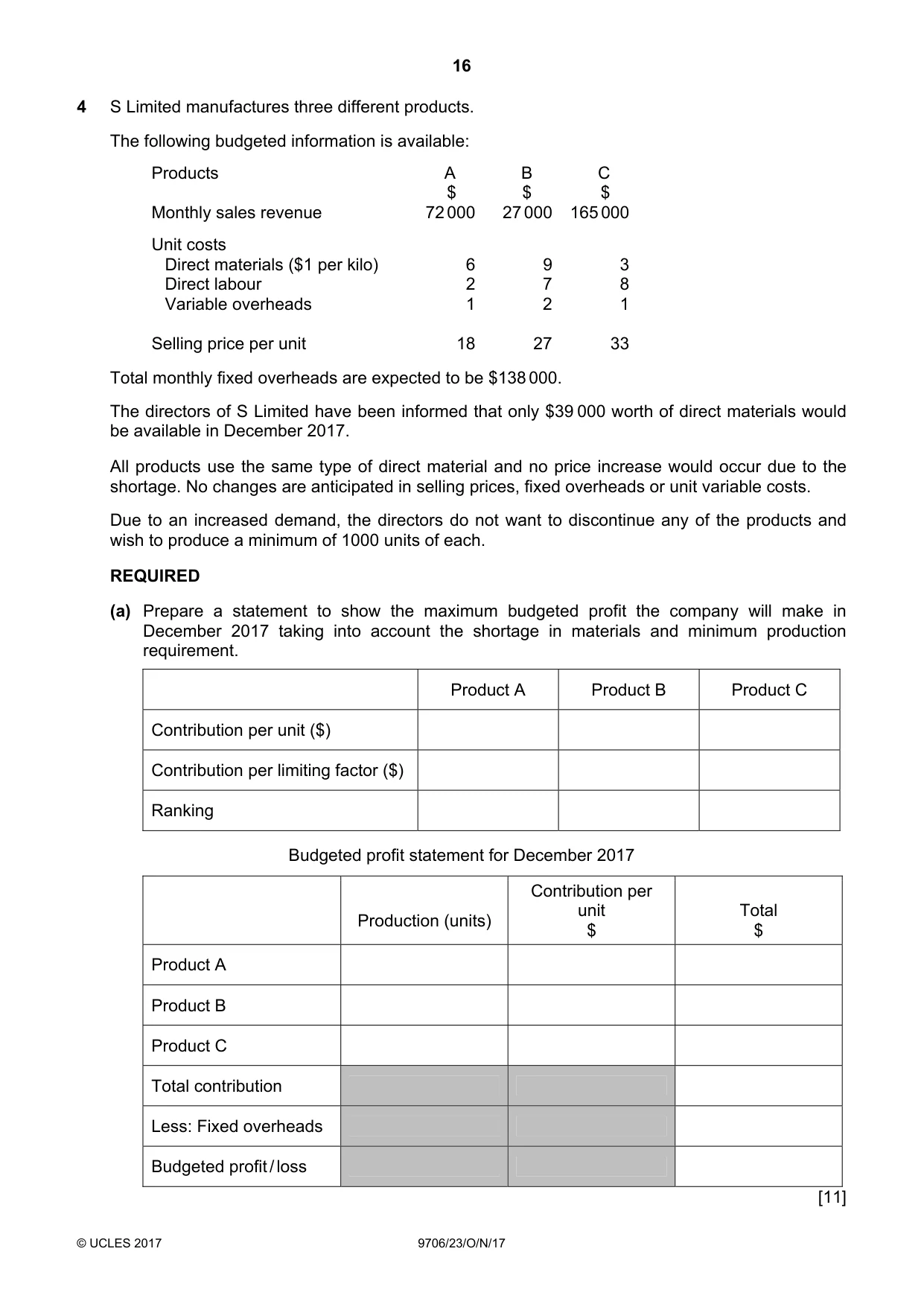
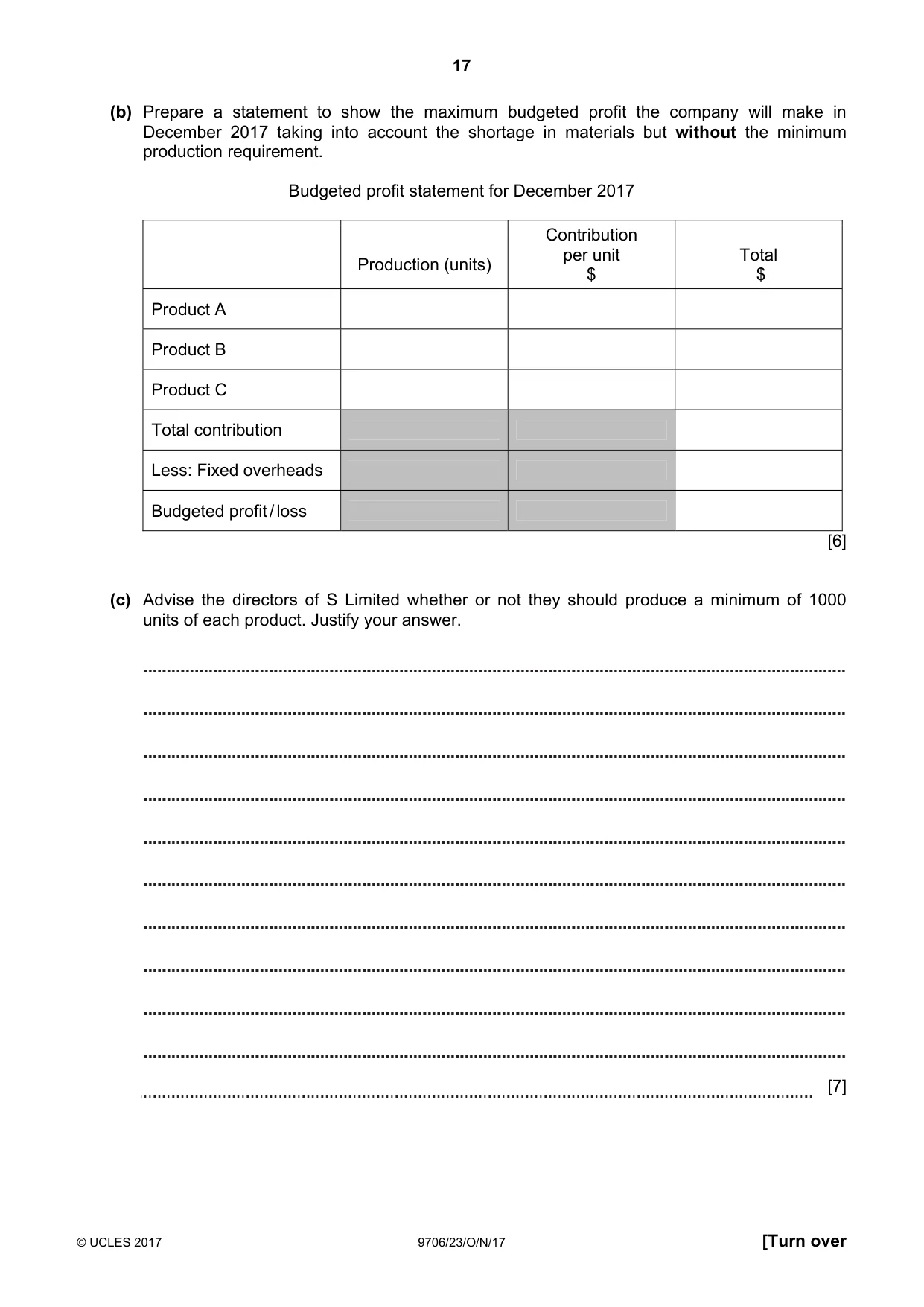
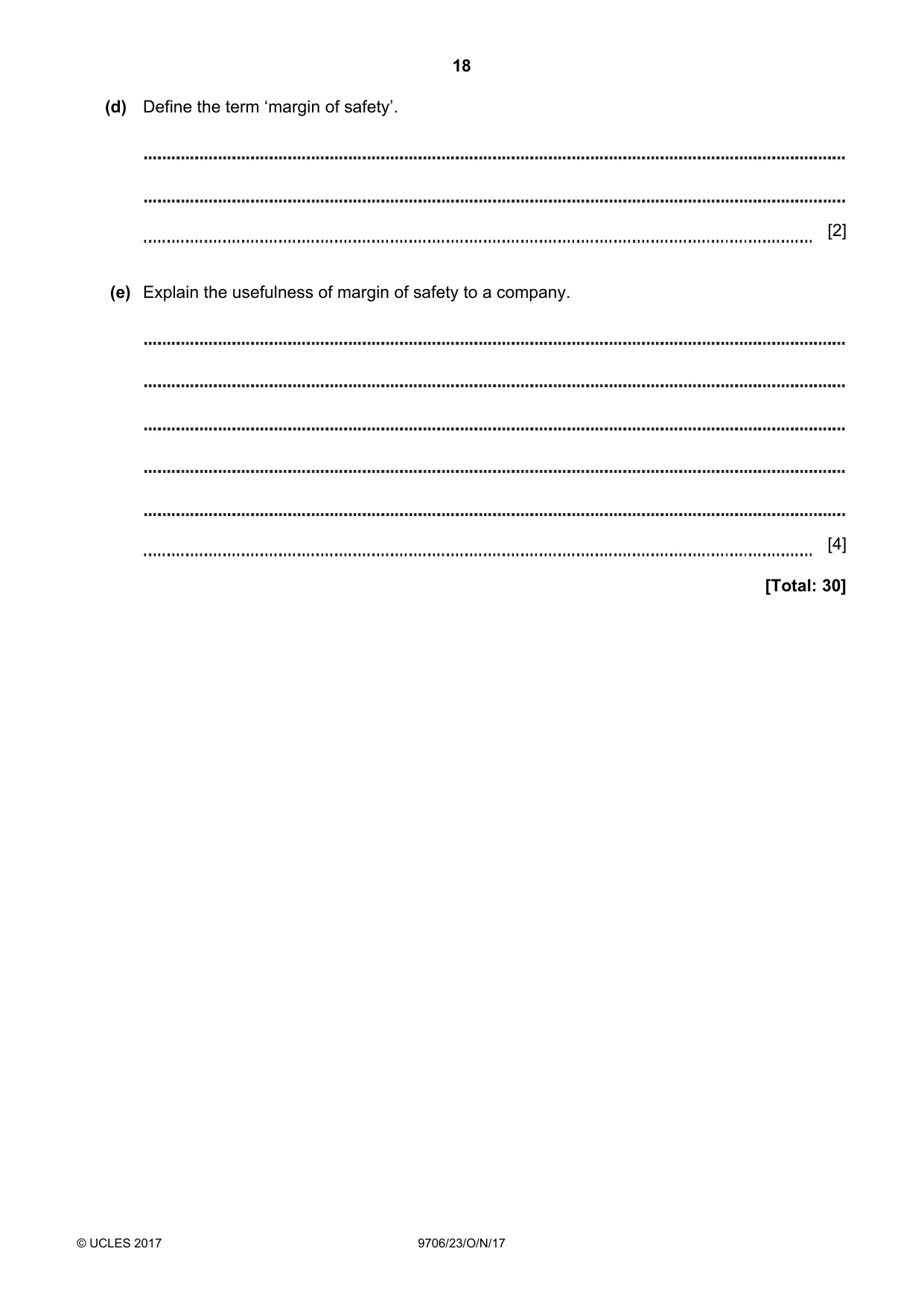
4 S Limited manufactures three different products. The following budgeted information is available: Products A B C $ $ $ Monthly sales revenue 72 000 27 000 165 000 Unit costs Direct materials ($1 per kilo) 6 9 3 Direct labour 2 7 8 Variable overheads 1 2 1 Selling price per unit 18 27 33 Total monthly fixed overheads are expected to be $138 000. The directors of S Limited have been informed that only $39 000 worth of direct materials would be available in December 2017. All products use the same type of direct material and no price increase would occur due to the shortage. No changes are anticipated in selling prices, fixed overheads or unit variable costs. Due to an increased demand, the directors do not want to discontinue any of the products and wish to produce a minimum of 1000 units of each. REQUIRED (a) Prepare a statement to show the maximum budgeted profit the company will make in December 2017 taking into account the shortage in materials and minimum production requirement. Product A Product B Product C Contribution per unit ($) Contribution per limiting factor ($) Ranking Budgeted profit statement for December 2017 Contribution per unit Total Production (units) $ $ Product A Product B Product C Total contribution Less: Fixed overheads Budgeted profit / loss [11] (b) Prepare a statement to show the maximum budgeted profit the company will make in December 2017 taking into account the shortage in materials but without the minimum production requirement. Budgeted profit statement for December 2017 Contribution per unit Total Production (units) $ $ Product A Product B Product C Total contribution Less: Fixed overheads Budgeted profit / loss [6] (c) Advise the directors of S Limited whether or not they should produce a minimum of 1000 units of each product. Justify your answer. [7] (d) Define the term ‘margin of safety’. [2] (e) Explain the usefulness of margin of safety to a company. [4] [Total: 30]
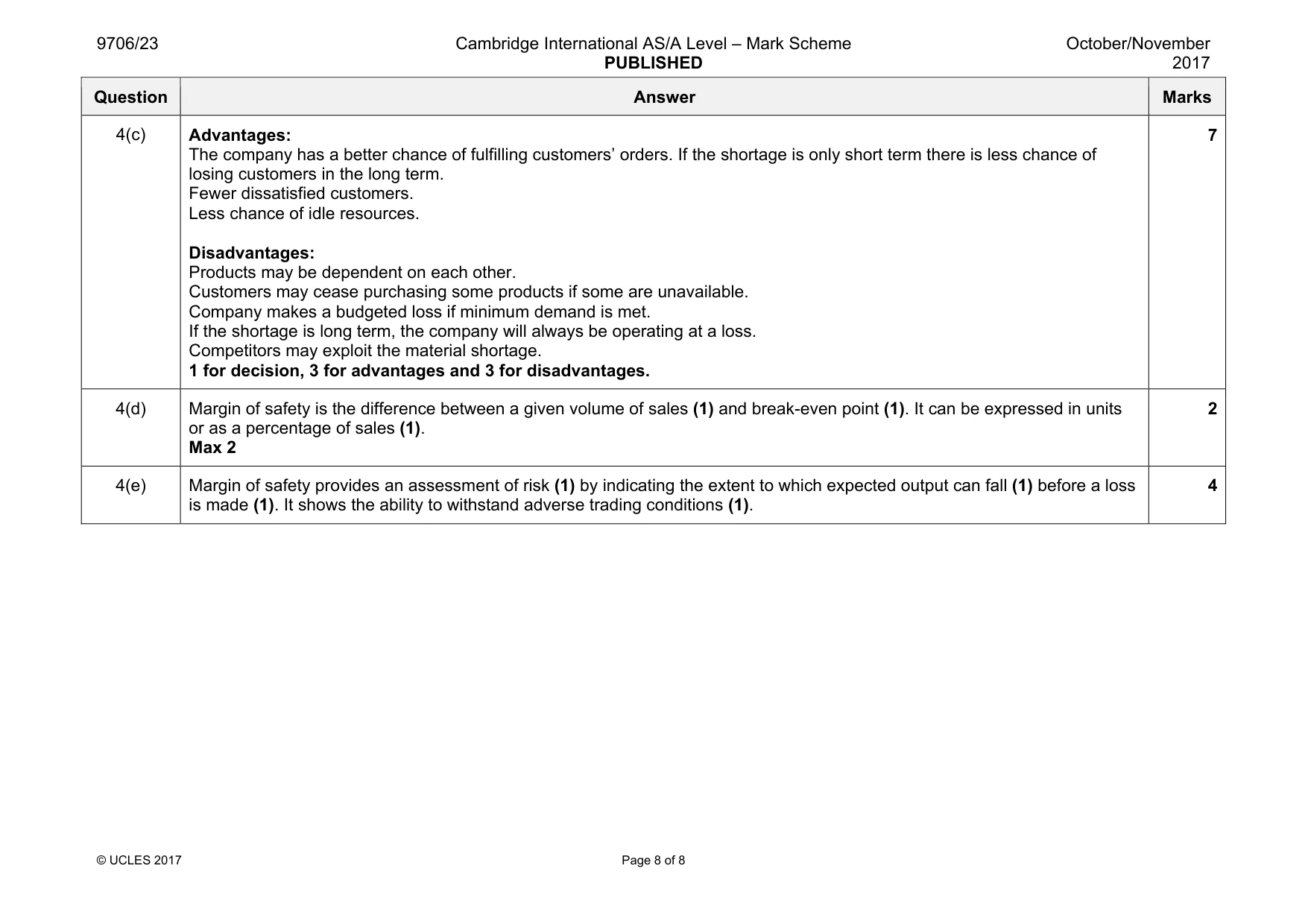
Mark scheme: 4(a) Product A Product B Product C Contribution per unit ($) 9 9 21 (1)row Contribution per limiting factor ($) 1.5 (1) 1 (1) 7 (1) Ranking 2 3 1 (1)OF for row Production (units) Contribution per unit $ Total $ Product A 2500 (1) 9 22 500 Product B 1000 (1) 9 9 000 Product C 5000 (1) 21 105 000 Total contribution 136 500 (1)OF Less: Fixed overheads 138 000 (1) Budgeted profit / loss (1 500) (1)OF 11 4(b) Production (units) Contribution per unit $ Total $ Product A 4000 9 36 000 (1)row Product B 0 9 0 (1)row Product C 5000 21 105 000 (1)row Total contribution 141 000 (1)OF Less: Fixed overheads 138 000 (1) Budgeted profit / loss 3 000 (1)OF 6 Question Answer Marks 4(c) Advantages: The company has a better chance of fulfilling customers’ orders. If the shortage is only short term there is less chance of losing customers in the long term. Fewer dissatisfied customers. Less chance of idle resources. Disadvantages: Products may be dependent on each other. Customers may cease purchasing some products if some are unavailable. Company makes a budgeted loss if minimum demand is met. If the shortage is long term, the company will always be operating at a loss. Competitors may exploit the material shortage. 1 for decision, 3 for advantages and 3 for disadvantages. 7 4(d) Margin of safety is the difference between a given volume of sales (1) and break-even point (1). It can be expressed in units or as a percentage of sales (1). Max 2 2 4(e) Margin of safety provides an assessment of risk (1) by indicating the extent to which expected output can fall (1) before a loss is made (1). It shows the ability to withstand adverse trading conditions (1). 4
Q5 · REQUIRED (b) Prepare the statement of changes in equity for F Limited for the year ended…
REQUIRED (b) Prepare the statement of changes in equity for F Limited for the year ended 30 June 2016. F Limited Statement of Changes in Equity for the year ended 30 June 2016 Ordinary Share Revaluation Retained shares premium reserve earnings Total $000 $000 $000 $000 $000 [8] Additional information The directors of F Limited wish to purchase a new retail store for $400 000. They are considering two different ways to raise the finance for this investment. 1 Issue a further $400 000 8% debentures (2026–2028). 2 Make a rights issue of 320 000 ordinary shares of $1 each at a price of $1.25. REQUIRED (c) Explain one difference between debentures and ordinary shares. [2] (d) Advise the directors which method of raising the finance you would recommend. Give reasons for your answer. [4]
What was in this paper
The subtopics covered by these 5 questions, and how many questions each got. Open one in a new tab to see every Cambridge question on it.
What you needed in this session
Cambridge’s own grade thresholds for 2017 Oct/Nov, Paper 2 · Variant 3. A higher threshold means an easier paper — the bar moves with how the cohort did.