Cambridge A Level Accounting 9706 — 2017 Oct/Nov Paper 2 · Variant 1
9706/21/O/N/17 · 6 questions · 90 marks · ≈101 min
The question paper and its mark scheme, free to read here and free to download. This is Cambridge’s own paper, exactly as it was sat.
Question paper20 pages




Mark scheme10 pages
Answers below. Sit the paper first if you are practising.
Questions as text
Q1 · Huan owns a business selling electrical goods
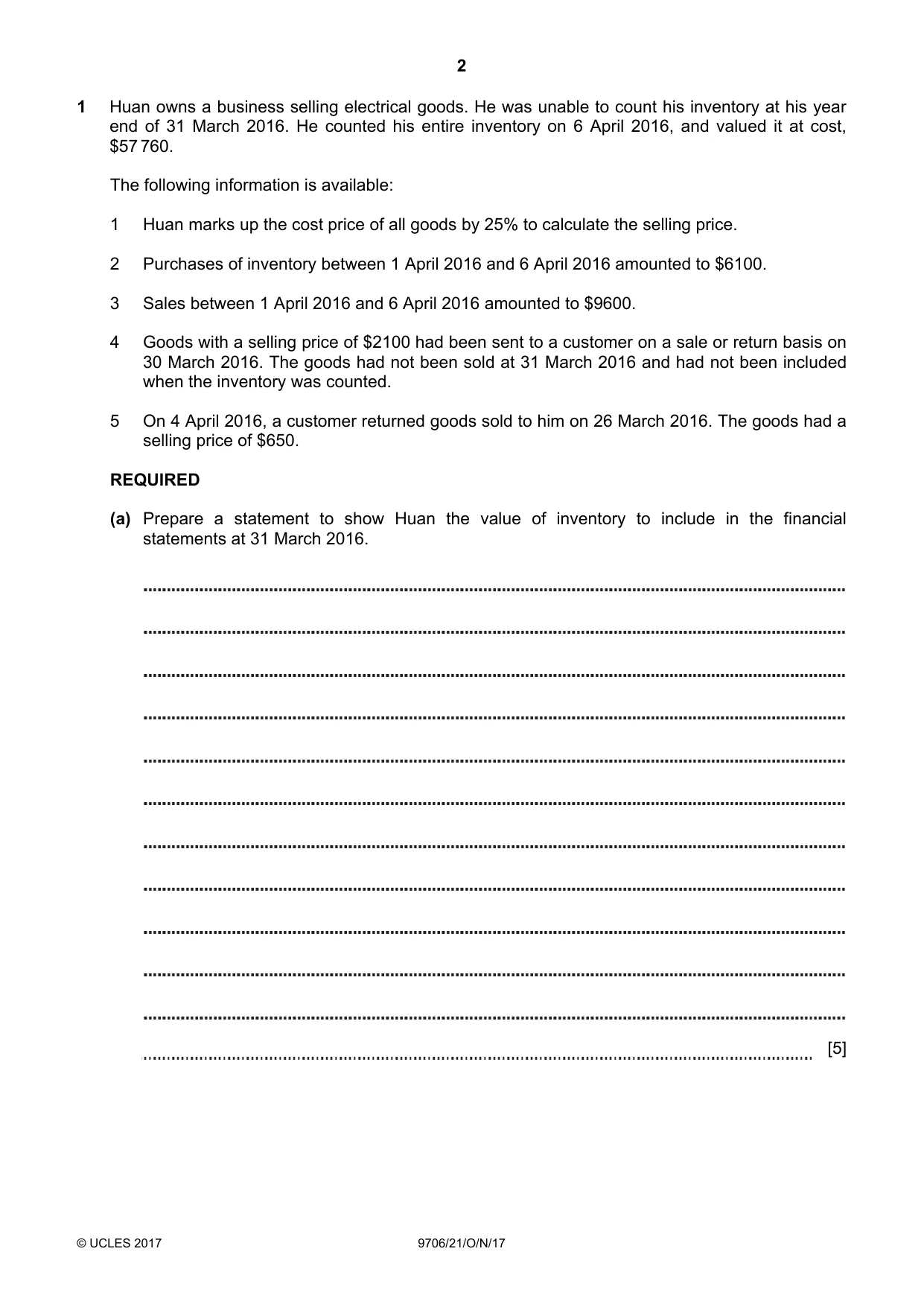
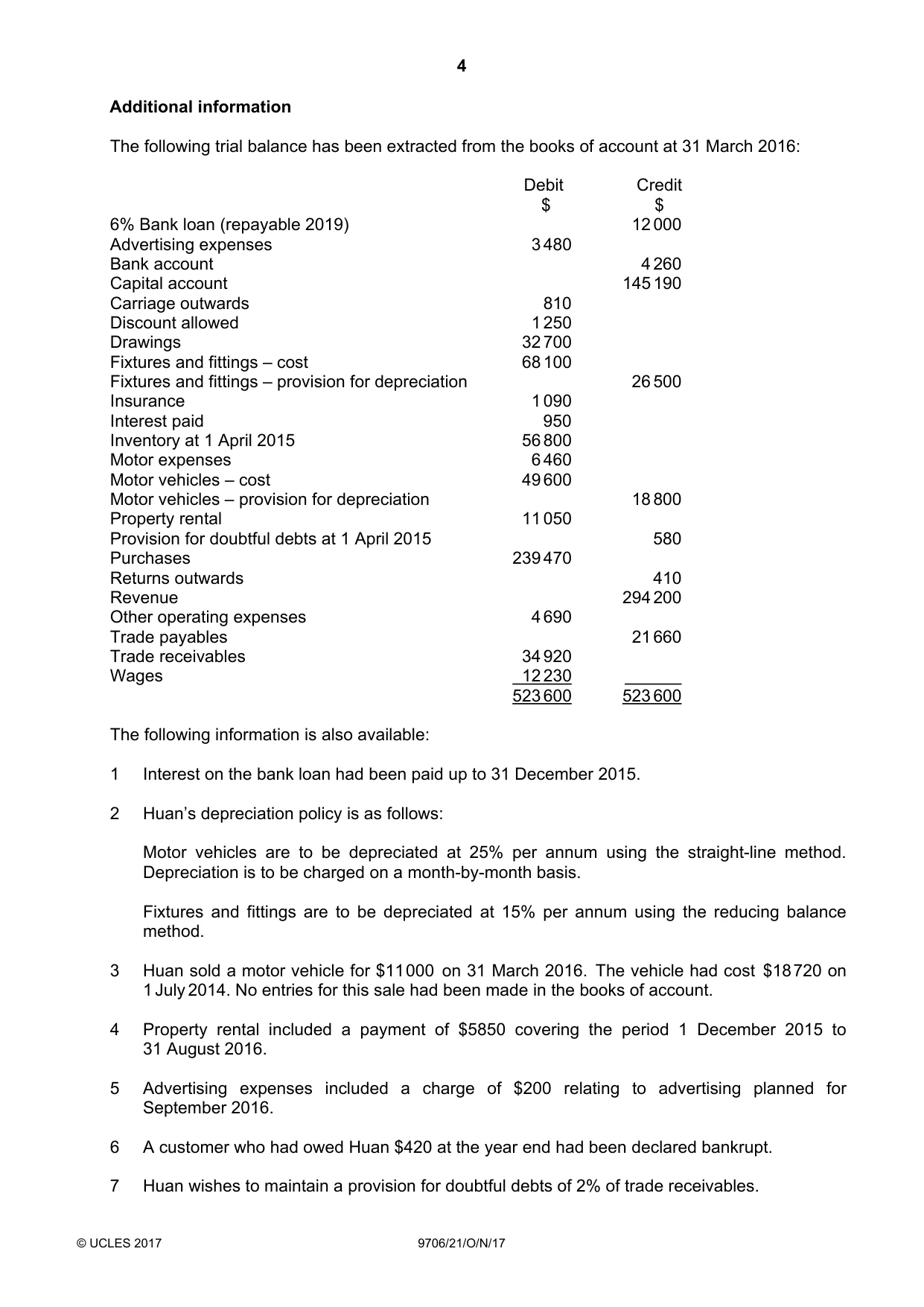
1 Huan owns a business selling electrical goods. He was unable to count his inventory at his year end of 31 March 2016. He counted his entire inventory on 6 April 2016, and valued it at cost, $57 760. The following information is available: 1 Huan marks up the cost price of all goods by 25% to calculate the selling price. 2 Purchases of inventory between 1 April 2016 and 6 April 2016 amounted to $6100. 3 Sales between 1 April 2016 and 6 April 2016 amounted to $9600. 4 Goods with a selling price of $2100 had been sent to a customer on a sale or return basis on 30 March 2016. The goods had not been sold at 31 March 2016 and had not been included when the inventory was counted. 5 On 4 April 2016, a customer returned goods sold to him on 26 March 2016. The goods had a selling price of $650. REQUIRED (a) Prepare a statement to show Huan the value of inventory to include in the financial statements at 31 March 2016. [5] Question 1(b) is on the next page. Additional information The following trial balance has been extracted from the books of account at 31 March 2016: Debit Credit $ $ 6% Bank loan (repayable 2019) 12 000 Advertising expenses 3 480 Bank account 4 260 Capital account 145 190 Carriage outwards 810 Discount allowed 1 250 Drawings 32 700 Fixtures and fittings – cost 68 100 Fixtures and fittings – provision for depreciation 26 500 Insurance 1 090 Interest paid 950 Inventory at 1 April 2015 56 800 Motor expenses 6 460 Motor vehicles – cost 49 600 Motor vehicles – provision for depreciation 18 800 Property rental 11 050 Provision for doubtful debts at 1 April 2015 580 Purchases 239 470 Returns outwards 410 Revenue 294 200 Other operating expenses 4 690 Trade payables 21 660 Trade receivables 34 920 Wages 12 230 523 600 523 600 The following information is also available: 1 Interest on the bank loan had been paid up to 31 December 2015.
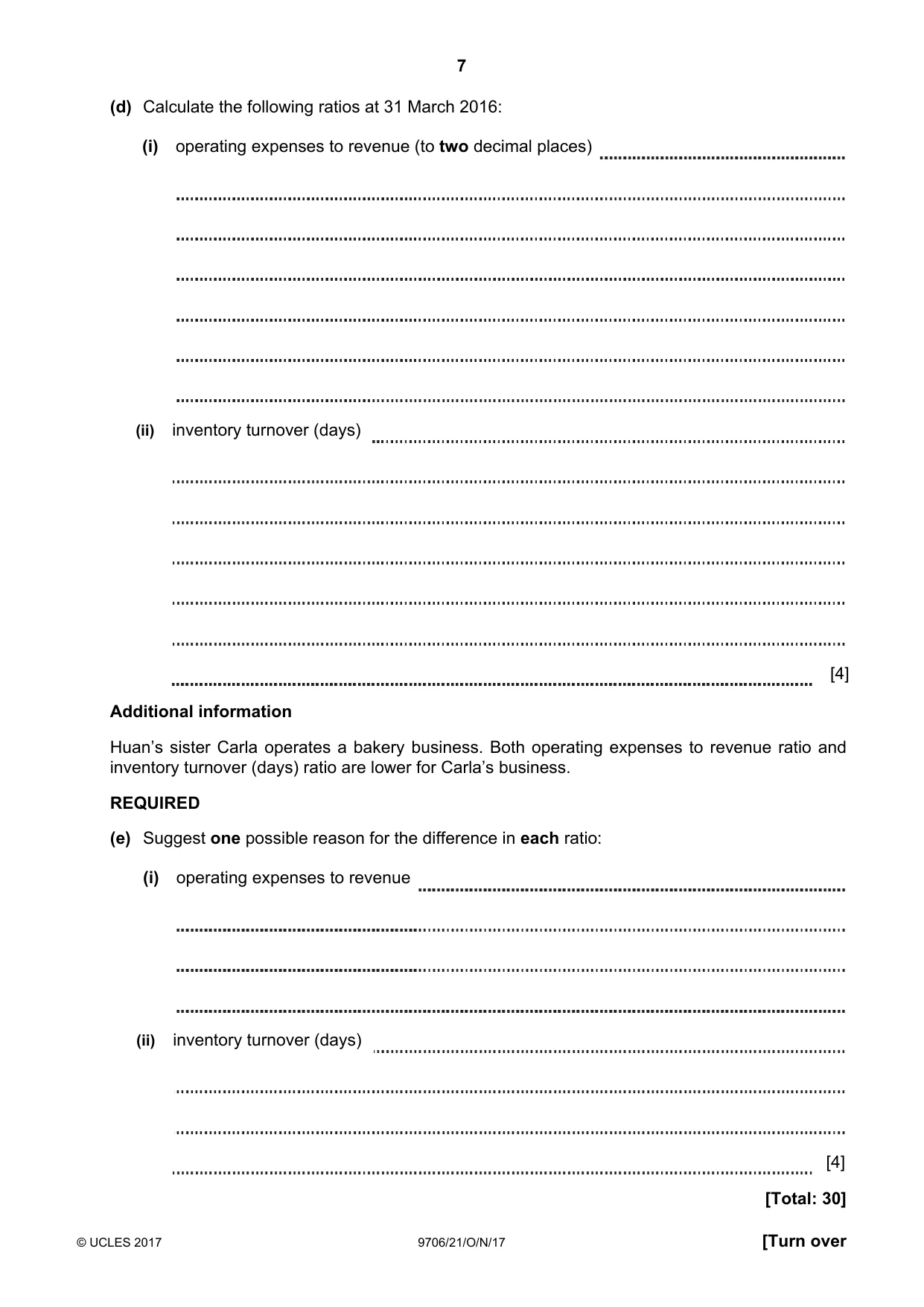
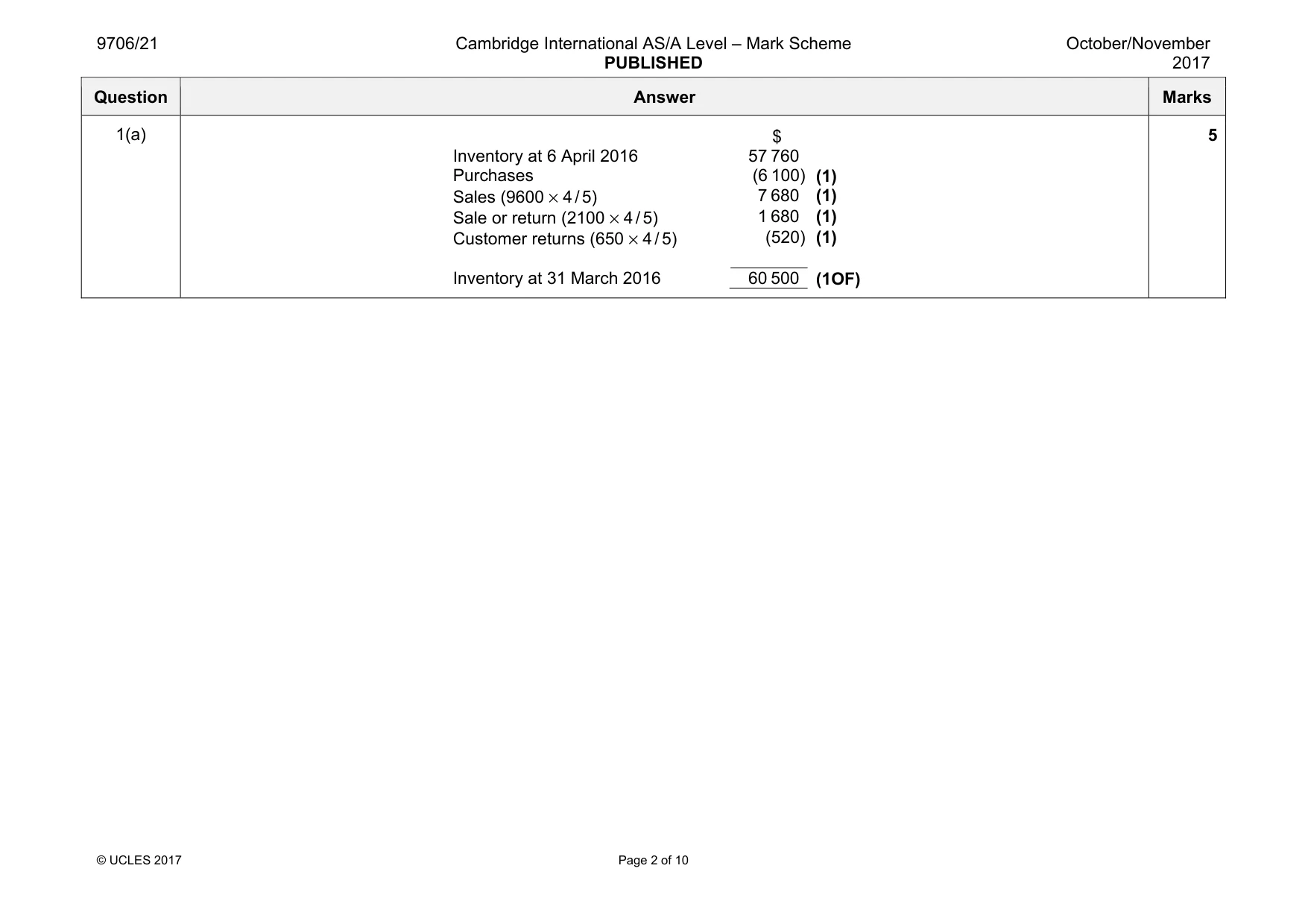
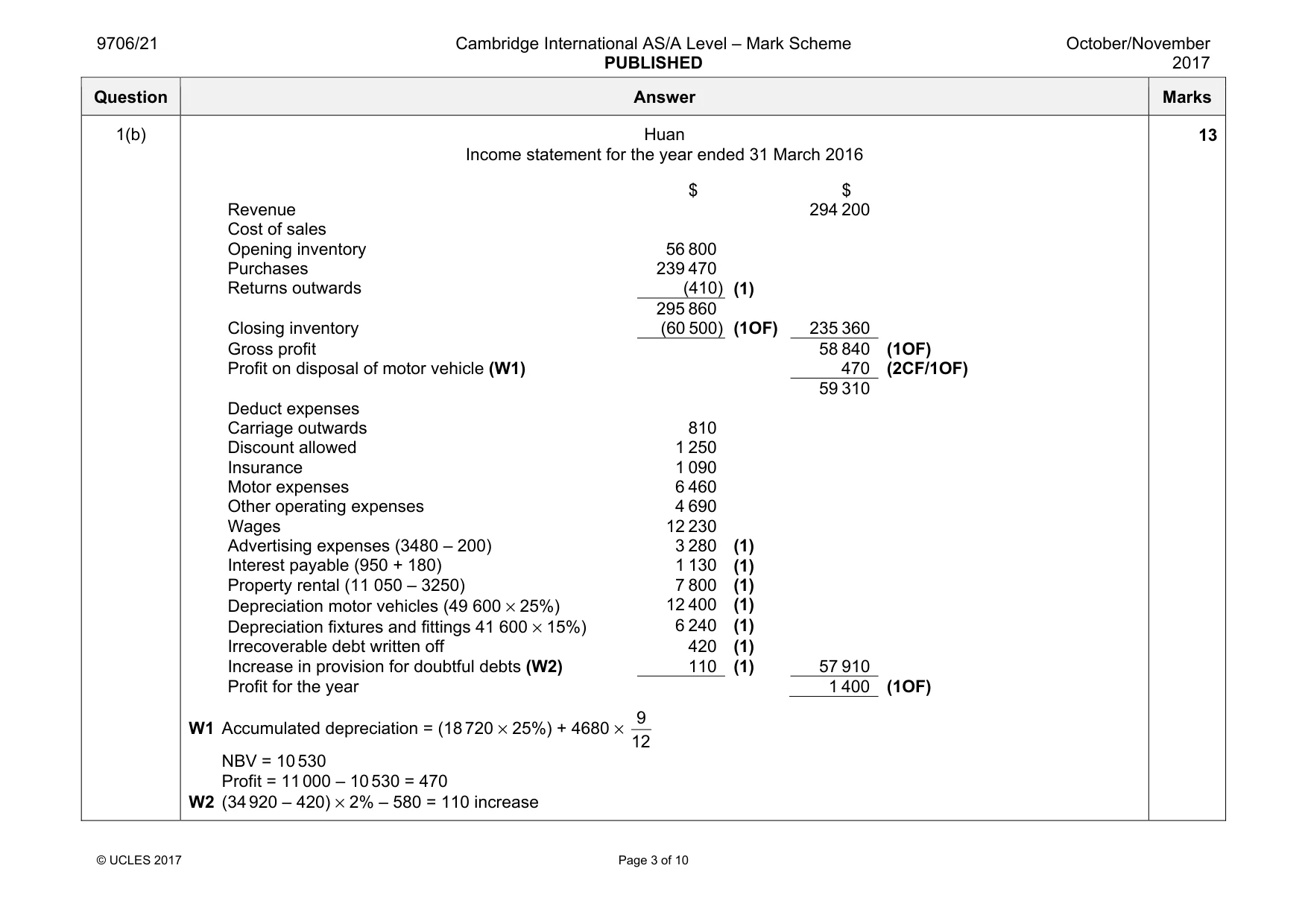
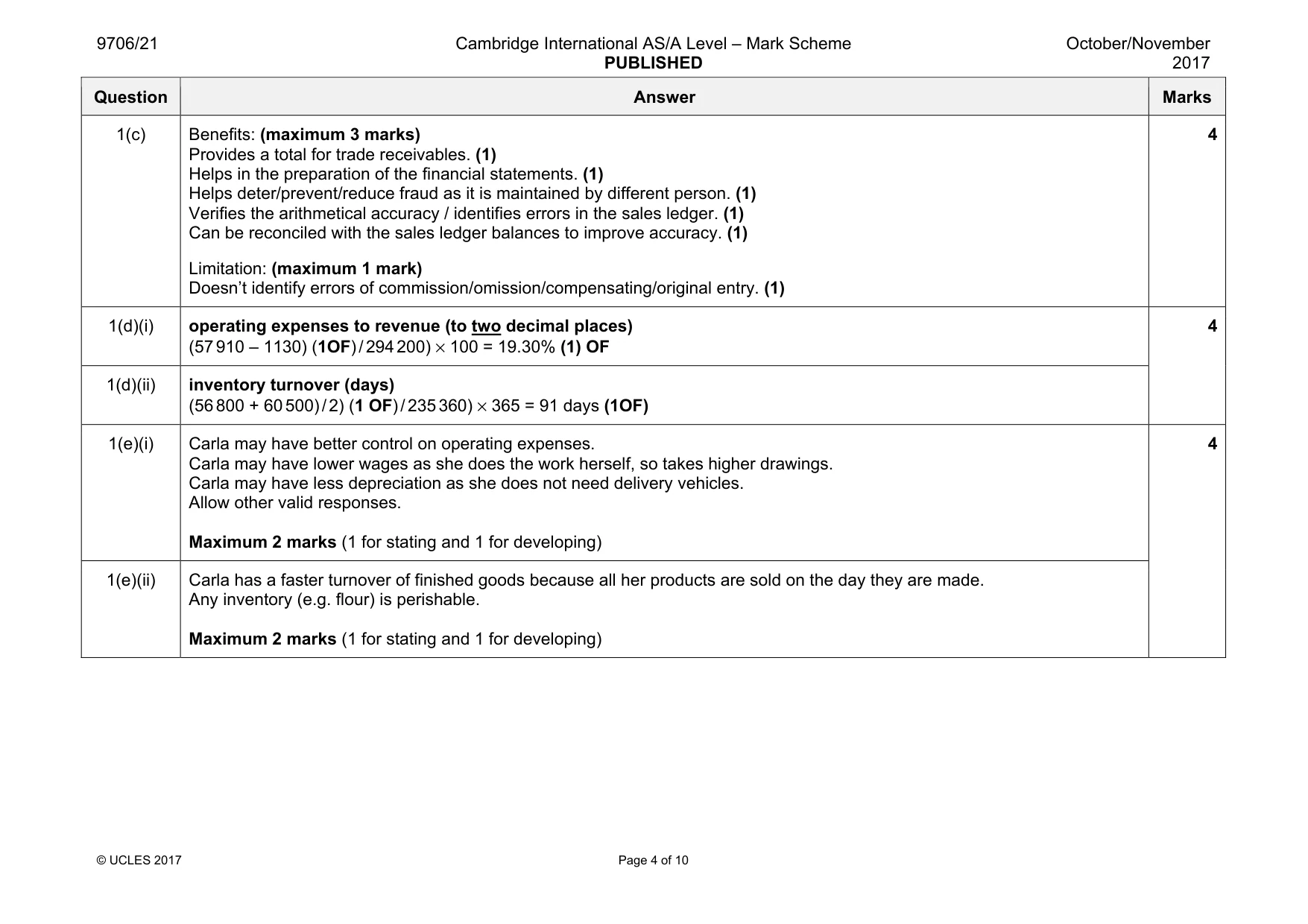
Mark scheme: 1(a) $ Inventory at 6 April 2016 57 760 Purchases (6 100) (1) Sales (9600 × 4 / 5) 7 680 (1) Sale or return (2100 × 4 / 5) 1 680 (1) Customer returns (650 × 4 / 5) (520) (1) Inventory at 31 March 2016 60 500 (1OF) 5 Question Answer Marks 1(b) Huan Income statement for the year ended 31 March 2016 $ $ Revenue 294 200 Cost of sales Opening inventory 56 800 Purchases 239 470 Returns outwards (410) (1) 295 860 Closing inventory (60 500) (1OF) 235 360 Gross profit 58 840 (1OF) Profit on disposal of motor vehicle (W1) 470 (2CF/1OF) 59 310 Deduct expenses Carriage outwards 810 Discount allowed 1 250 Insurance 1 090 Motor expenses 6 460 Other operating expenses 4 690 Wages 12 230 Advertising expenses (3480 – 200) 3 280 (1) Interest payable (950 + 180) 1 130 (1) Property rental (11 050 – 3250) 7 800 (1) Depreciation motor vehicles (49 600 × 25%) 12 400 (1) Depreciation fixtures and fittings 41 600 × 15%) 6 240 (1) Irrecoverable debt written off 420 (1) Increase in provision for doubtful debts (W2) 110 (1) 57 910 Profit for the year 1 400 (1OF) W1 Accumulated depreciation = (18 720 × 25%) + 4680 × 12 9 NBV = 10 530 Profit = 11 000 – 10 530 = 470 W2 (34 920 – 420) × 2% – 580 = 110 increase 13 Question Answer Marks 1(c) Benefits: (maximum 3 marks) Provides a total for trade receivables. (1) Helps in the preparation of the financial statements. (1) Helps deter/prevent/reduce fraud as it is maintained by different person. (1) Verifies the arithmetical accuracy / identifies errors in the sales ledger. (1) Can be reconciled with the sales ledger balances to improve accuracy. (1) Limitation: (maximum 1 mark) Doesn’t identify errors of commission/omission/compensating/original entry. (1) 4 1(d)(i) operating expenses to revenue (to two decimal places) (57 910 – 1130) (1OF) / 294 200) × 100 = 19.30% (1) OF 4 1(d)(ii) inventory turnover (days) (56 800 + 60 500) / 2) (1 OF) / 235 360) × 365 = 91 days (1OF) 1(e)(i) Carla may have better control on operating expenses. Carla may have lower wages as she does the work herself, so takes higher drawings. Carla may have less depreciation as she does not need delivery vehicles. Allow other valid responses. Maximum 2 marks (1 for stating and 1 for developing) 4 1(e)(ii) Carla has a faster turnover of finished goods because all her products are sold on the day they are made. Any inventory (e.g. flour) is perishable. Maximum 2 marks (1 for stating and 1 for developing)
Q2 · Huan’s depreciation policy is as follows: Motor vehicles are to be depreciated at 25% per…
2 Huan’s depreciation policy is as follows: Motor vehicles are to be depreciated at 25% per annum using the straight-line method. Depreciation is to be charged on a month-by-month basis. Fixtures and fittings are to be depreciated at 15% per annum using the reducing balance method.
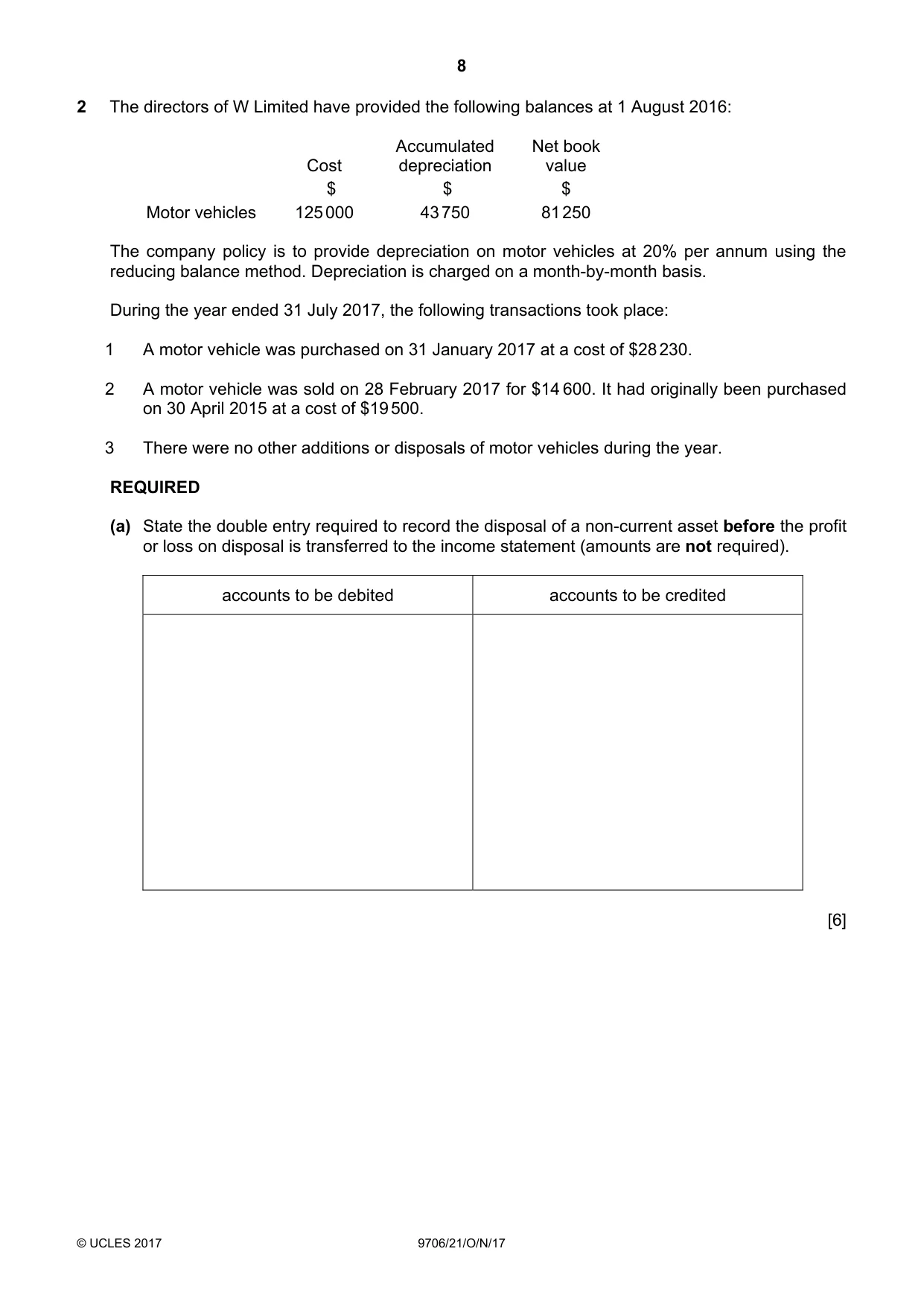
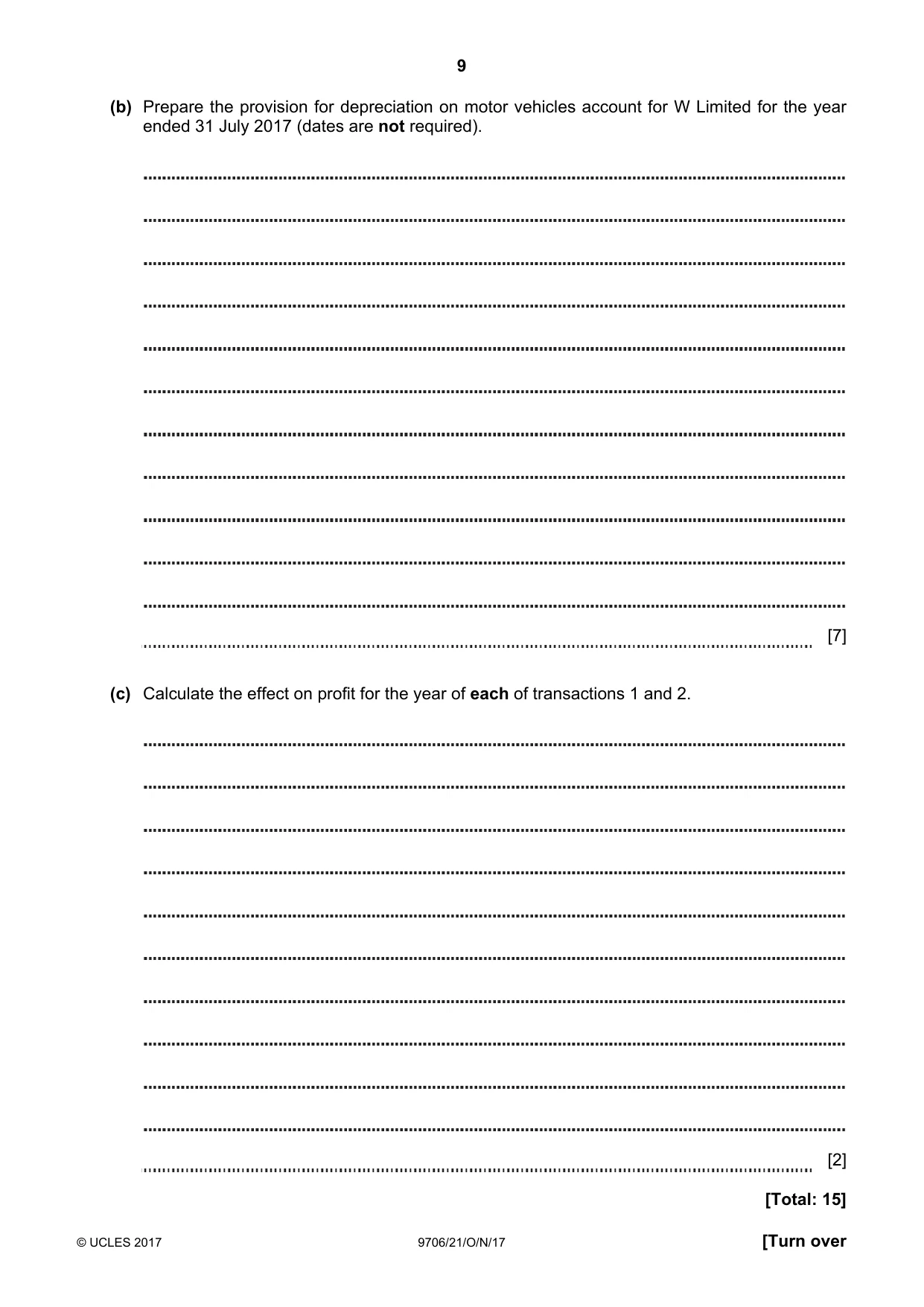
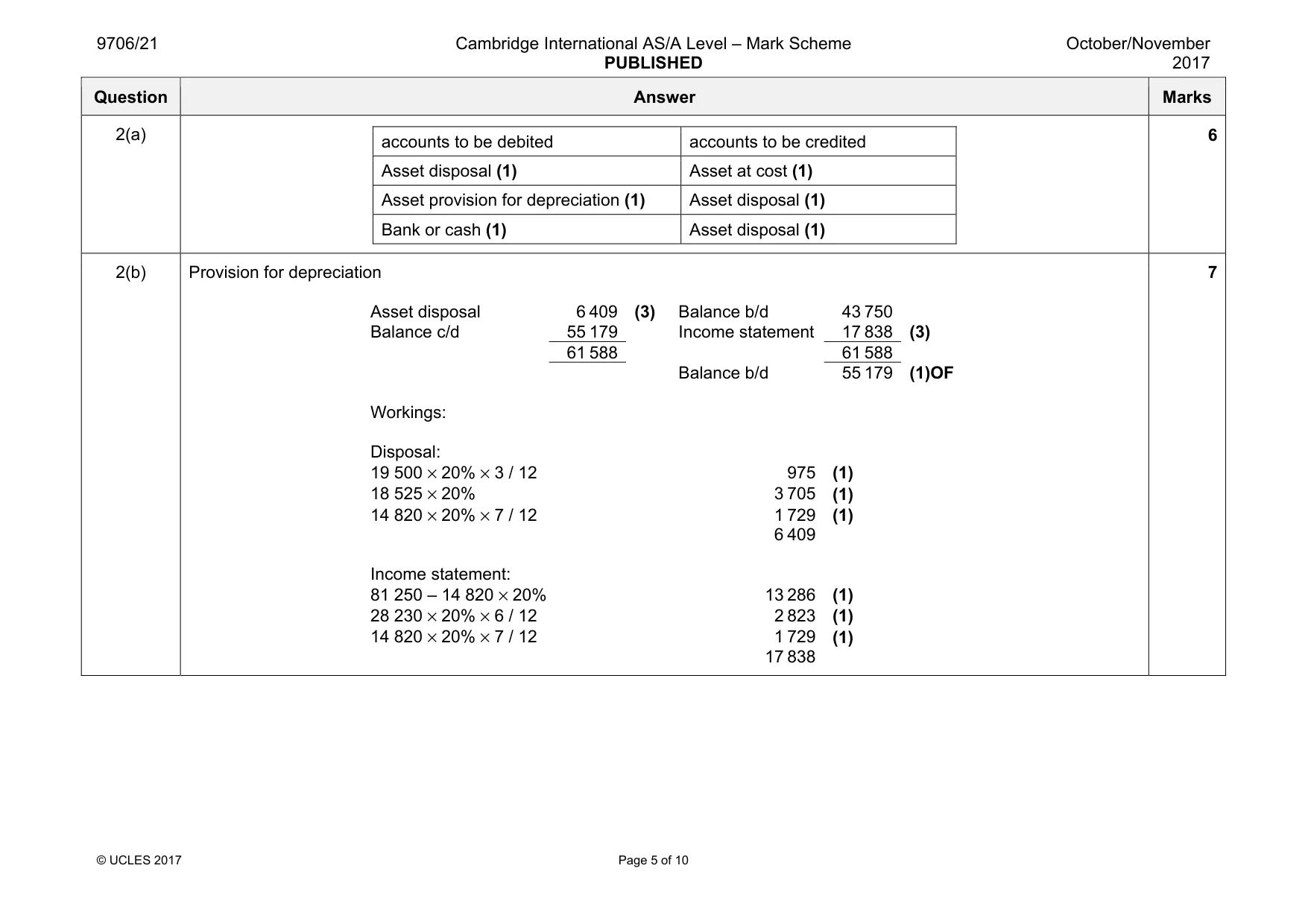
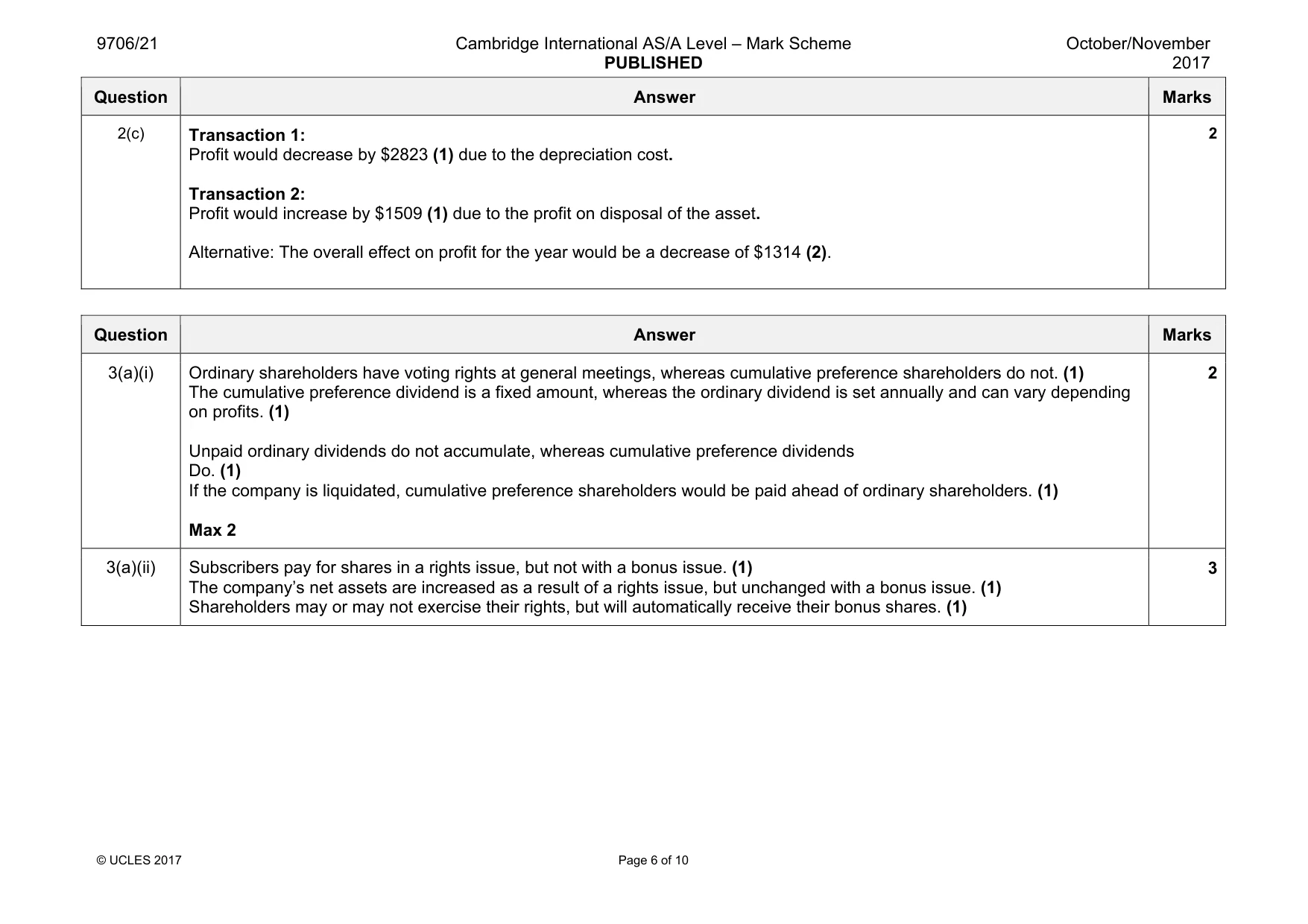
Mark scheme: 2(a) accounts to be debited accounts to be credited Asset disposal (1) Asset at cost (1) Asset provision for depreciation (1) Asset disposal (1) Bank or cash (1) Asset disposal (1) 6 2(b) Provision for depreciation Asset disposal 6 409 (3) Balance b/d 43 750 Balance c/d 55 179 Income statement 17 838 (3) 61 588 61 588 Balance b/d 55 179 (1)OF Workings: Disposal: 19 500 × 20% × 3 / 12 975 (1) 18 525 × 20% 3 705 (1) 14 820 × 20% × 7 / 12 1 729 (1) 6 409 Income statement: 81 250 – 14 820 × 20% 13 286 (1) 28 230 × 20% × 6 / 12 2 823 (1) 14 820 × 20% × 7 / 12 1 729 (1) 17 838 7 Question Answer Marks 2(c) Transaction 1: Profit would decrease by $2823 (1) due to the depreciation cost. Transaction 2: Profit would increase by $1509 (1) due to the profit on disposal of the asset. Alternative: The overall effect on profit for the year would be a decrease of $1314 (2). 2
Q3 · Huan sold a motor vehicle for $11 000 on 31 March 2016
3 Huan sold a motor vehicle for $11 000 on 31 March 2016. The vehicle had cost $18 720 on 1 July 2014. No entries for this sale had been made in the books of account.
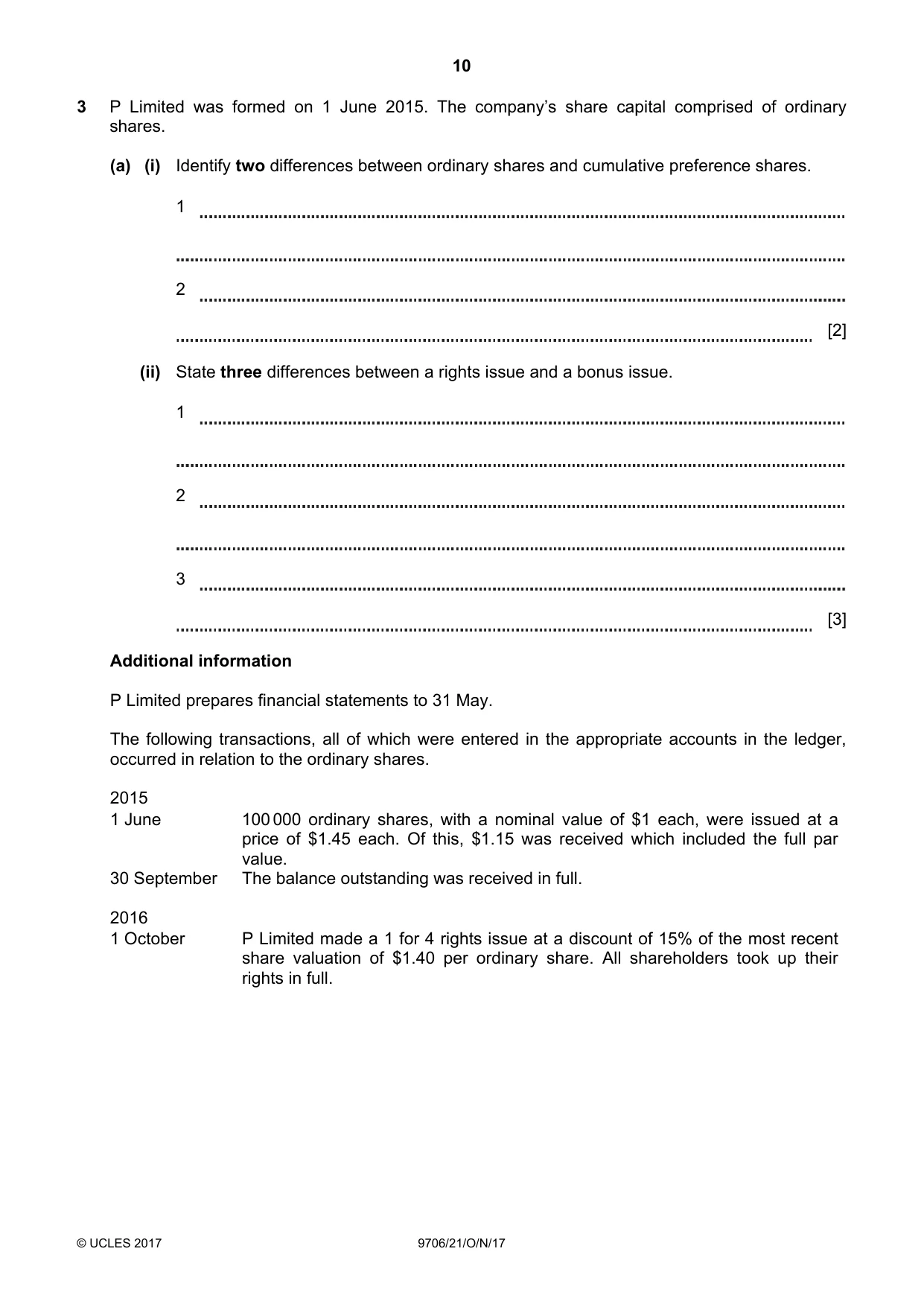
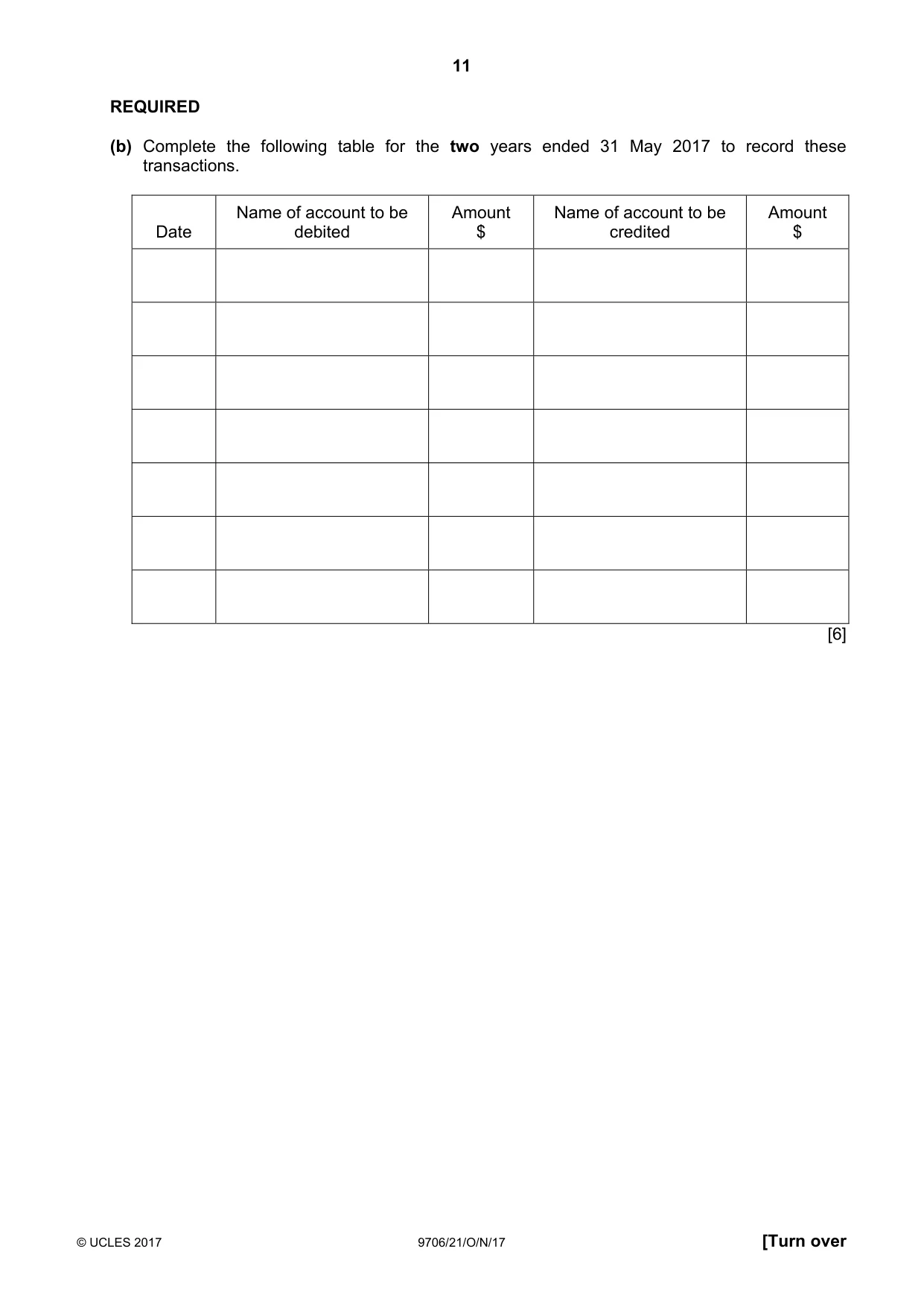
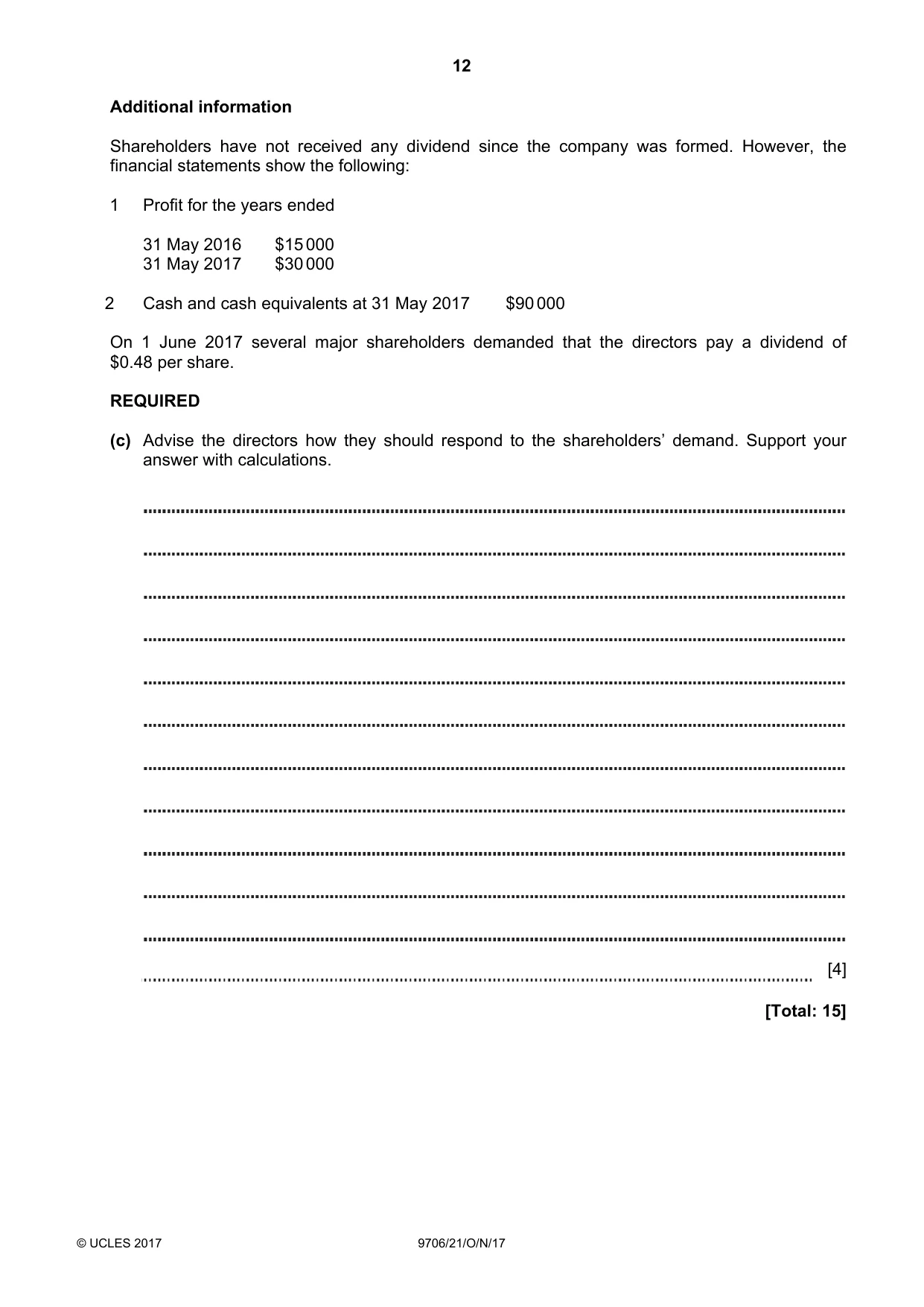
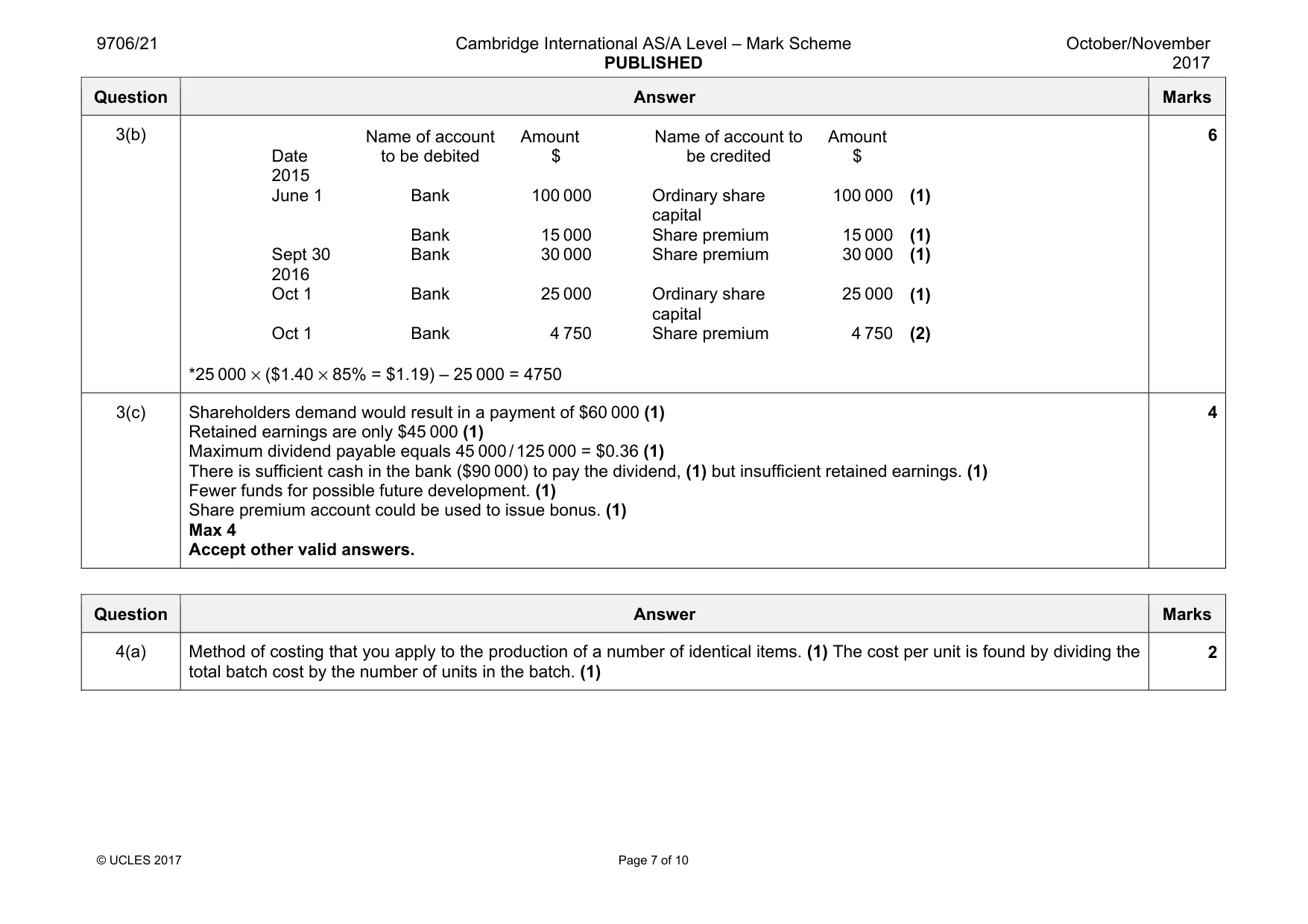
Mark scheme: 3(a)(i) Ordinary shareholders have voting rights at general meetings, whereas cumulative preference shareholders do not. (1) The cumulative preference dividend is a fixed amount, whereas the ordinary dividend is set annually and can vary depending on profits. (1) Unpaid ordinary dividends do not accumulate, whereas cumulative preference dividends Do. (1) If the company is liquidated, cumulative preference shareholders would be paid ahead of ordinary shareholders. (1) Max 2 2 3(a)(ii) Subscribers pay for shares in a rights issue, but not with a bonus issue. (1) The company’s net assets are increased as a result of a rights issue, but unchanged with a bonus issue. (1) Shareholders may or may not exercise their rights, but will automatically receive their bonus shares. (1) 3 Question Answer Marks 3(b) Date Name of account to be debited Amount $ Name of account to be credited Amount $ 2015 June 1 Bank 100 000 Ordinary share capital 100 000 (1) Bank 15 000 Share premium 15 000 (1) Sept 30 Bank 30 000 Share premium 30 000 (1) 2016 Oct 1 Bank 25 000 Ordinary share capital 25 000 (1) Oct 1 Bank 4 750 Share premium 4 750 (2) *25 000 × ($1.40 × 85% = $1.19) – 25 000 = 4750 6 3(c) Shareholders demand would result in a payment of $60 000 (1) Retained earnings are only $45 000 (1) Maximum dividend payable equals 45 000 / 125 000 = $0.36 (1) There is sufficient cash in the bank ($90 000) to pay the dividend, (1) but insufficient retained earnings. (1) Fewer funds for possible future development. (1) Share premium account could be used to issue bonus. (1) Max 4 Accept other valid answers. 4
Q4 · Property rental included a payment of $5850 covering the period 1 December 2015 to 31…
4 Property rental included a payment of $5850 covering the period 1 December 2015 to 31 August 2016.
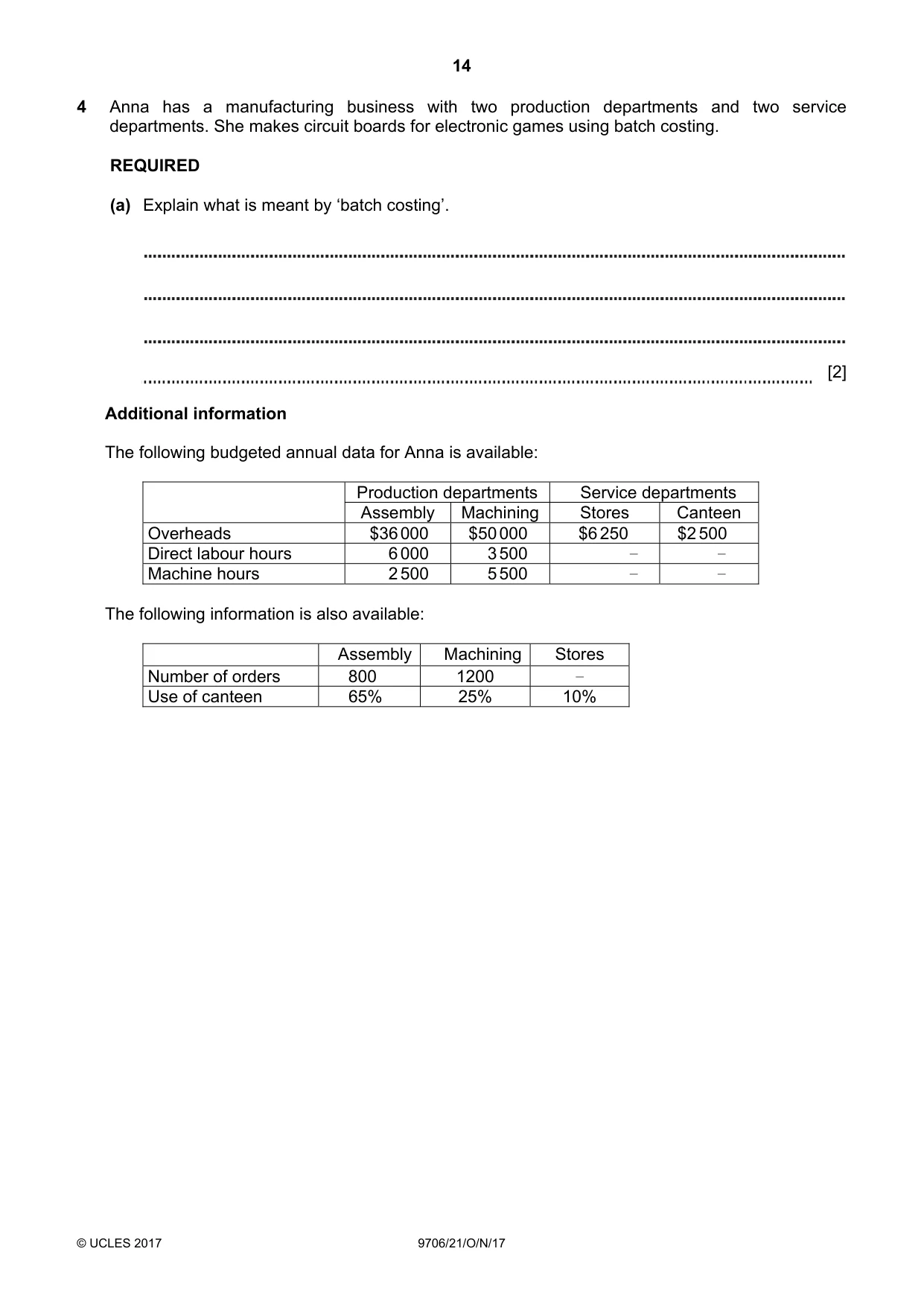
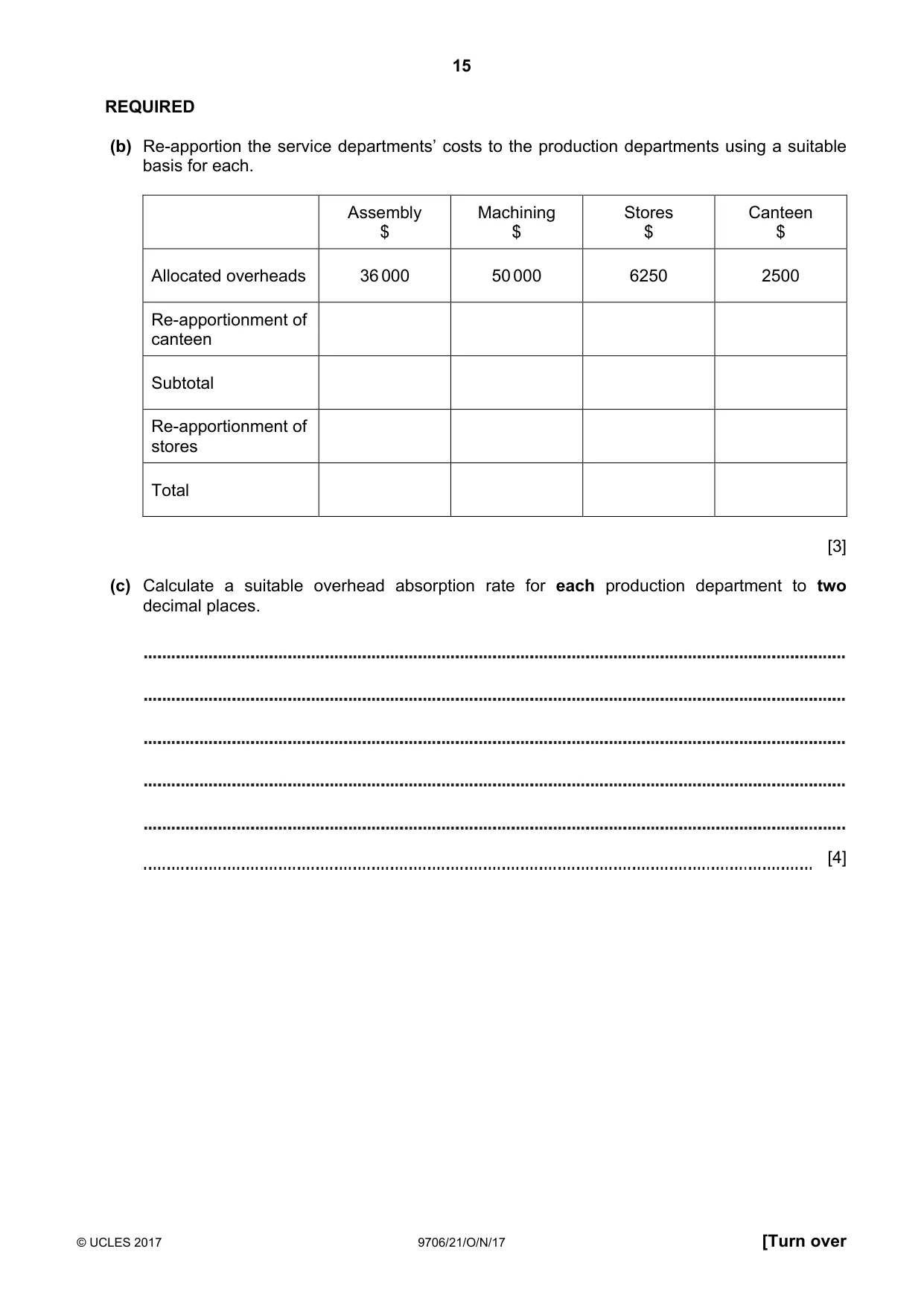
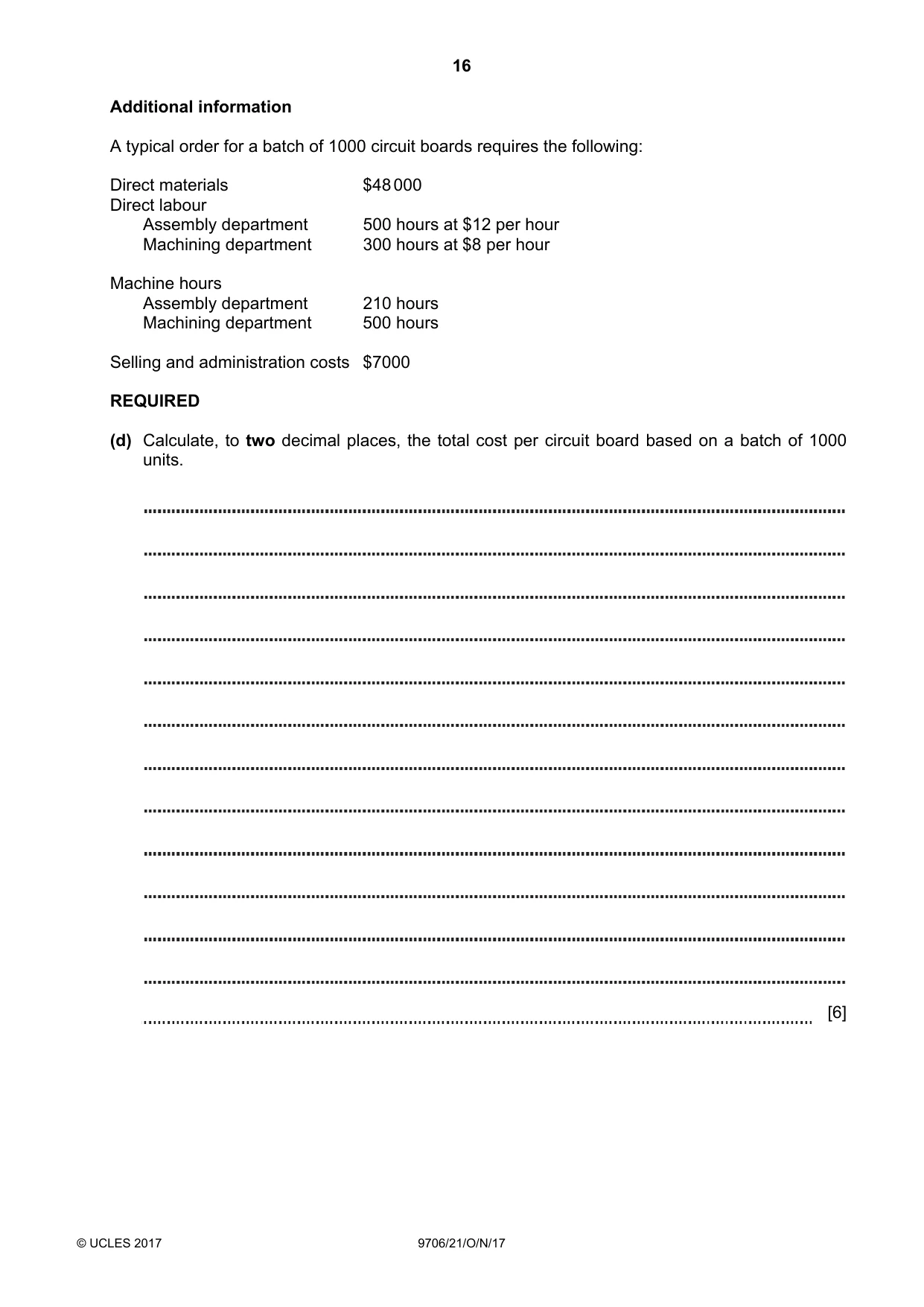
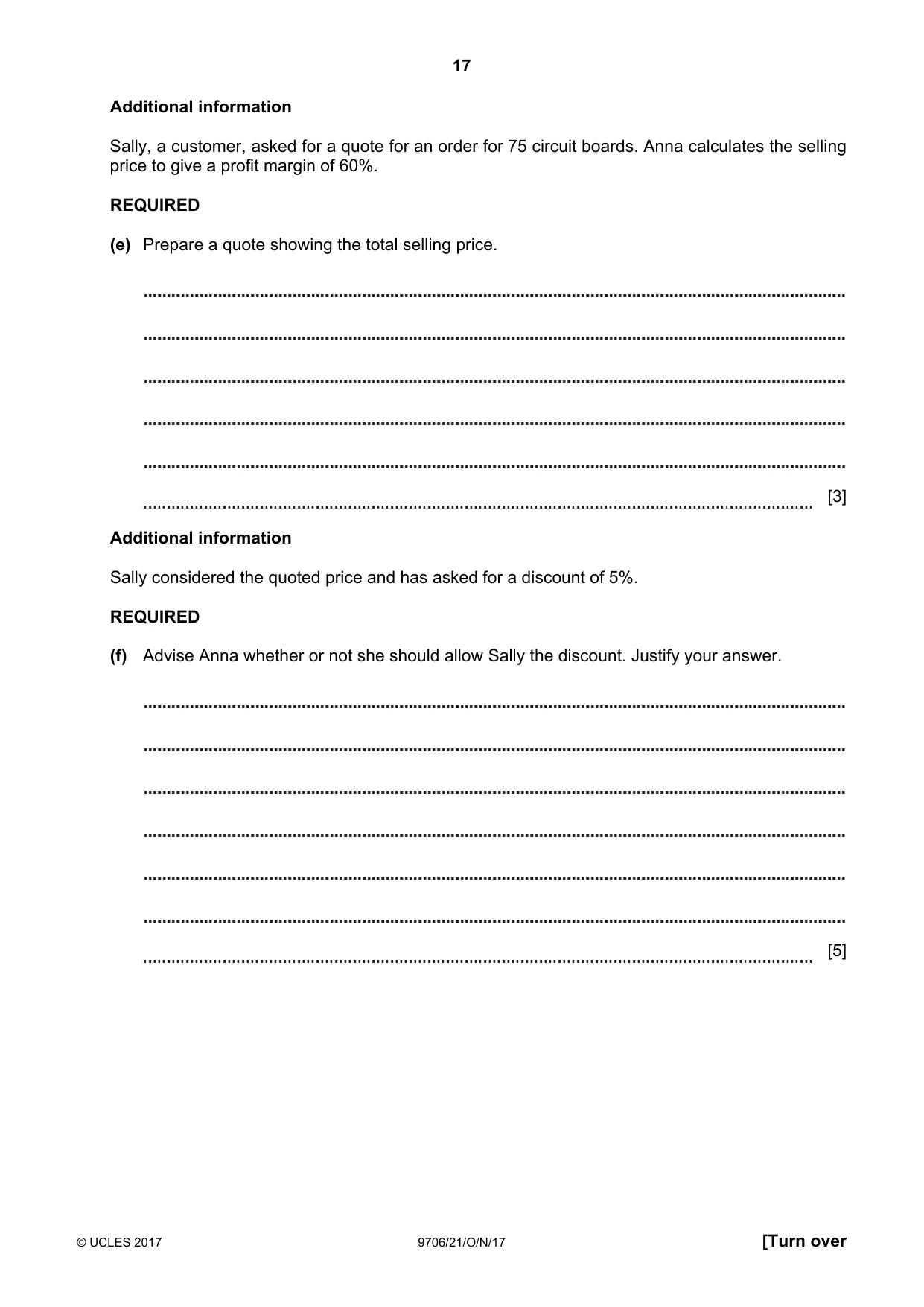
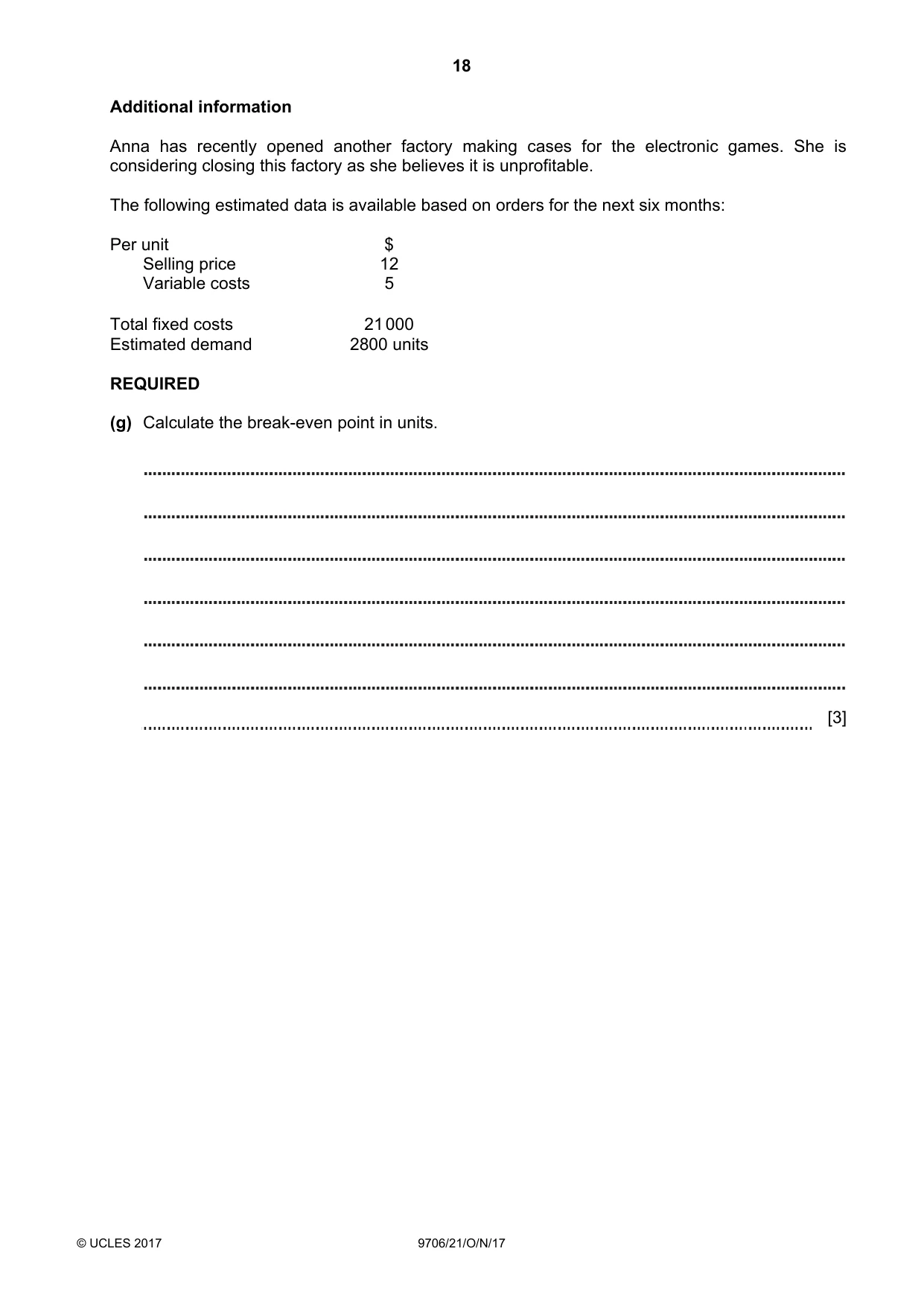
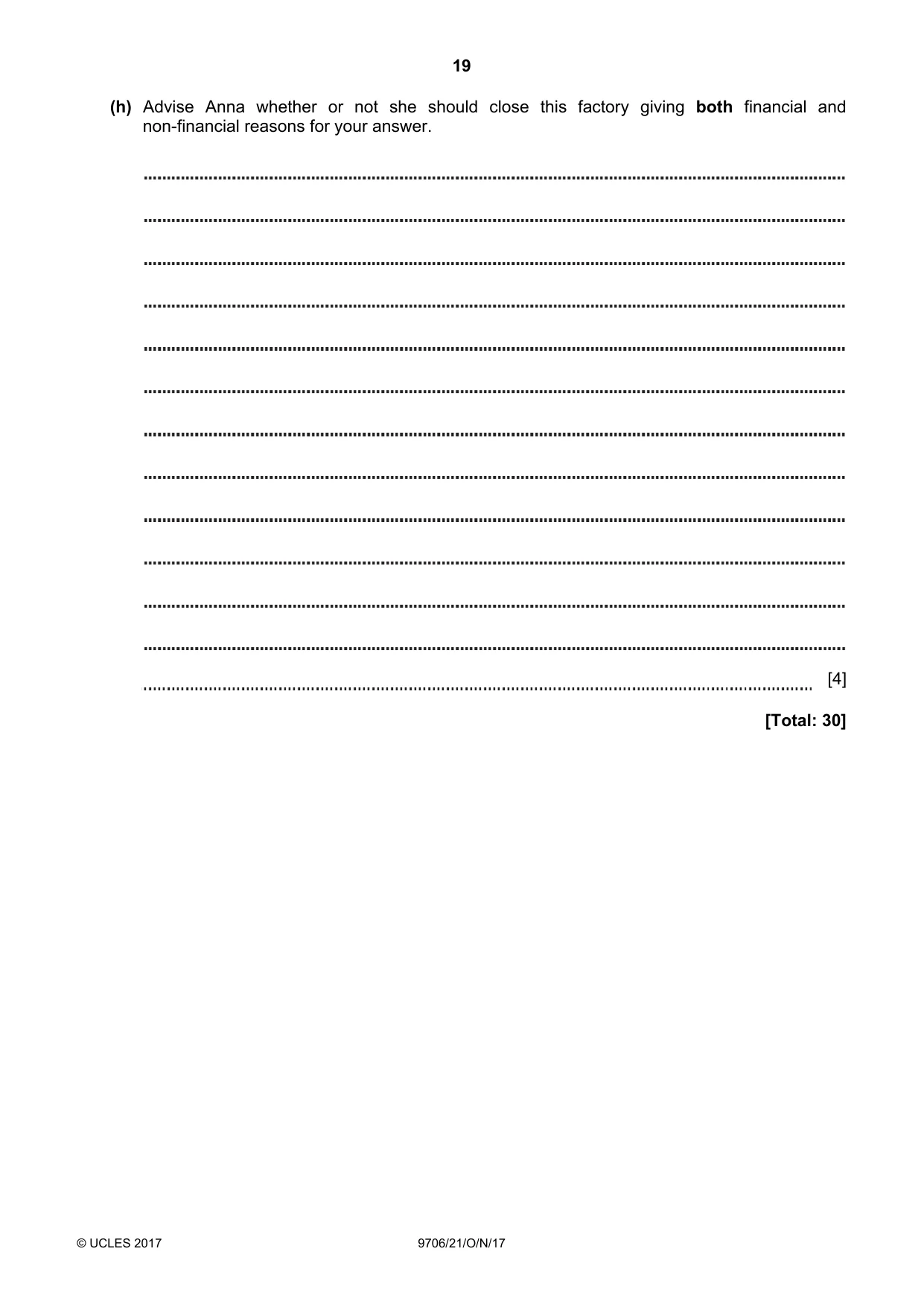
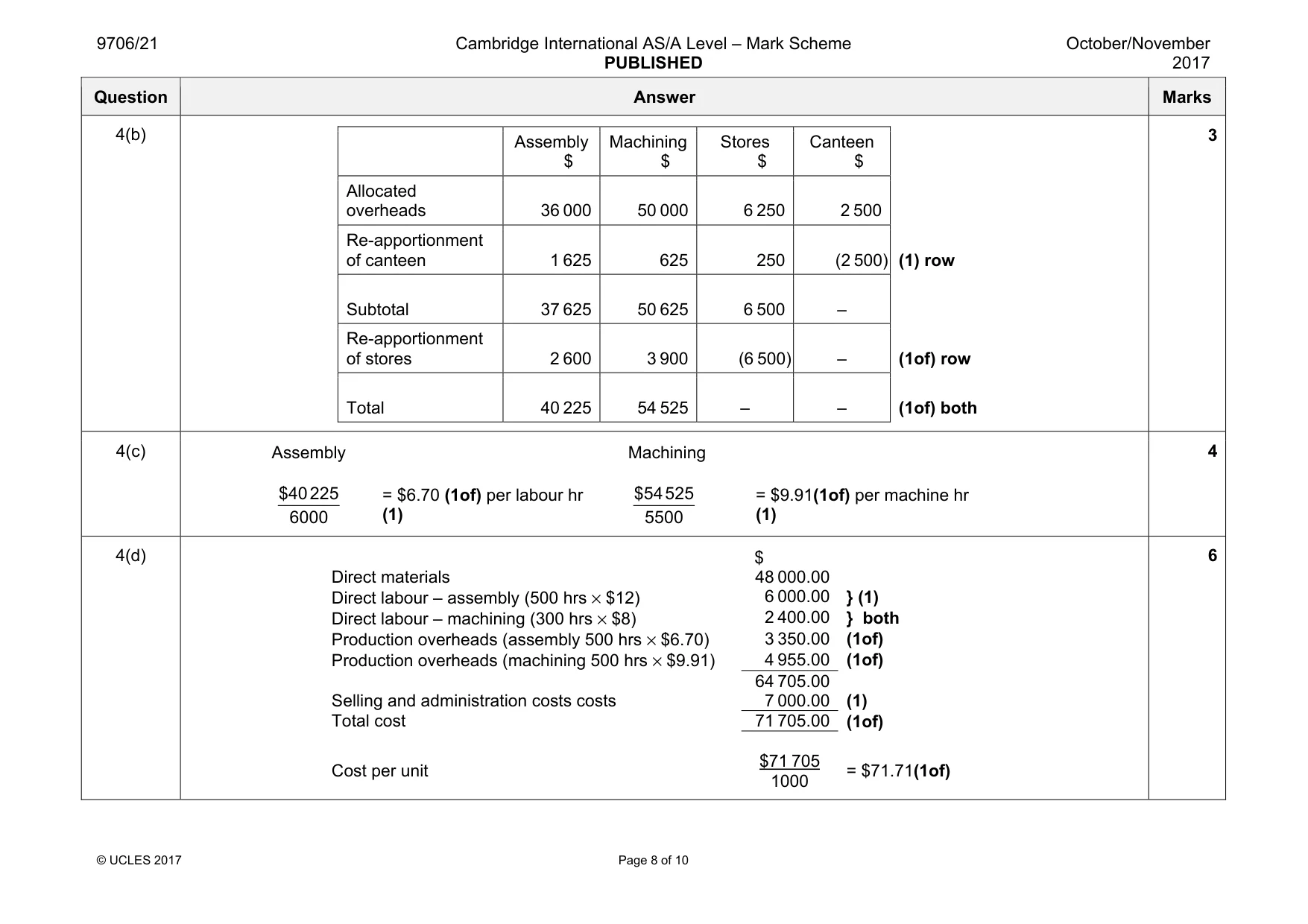
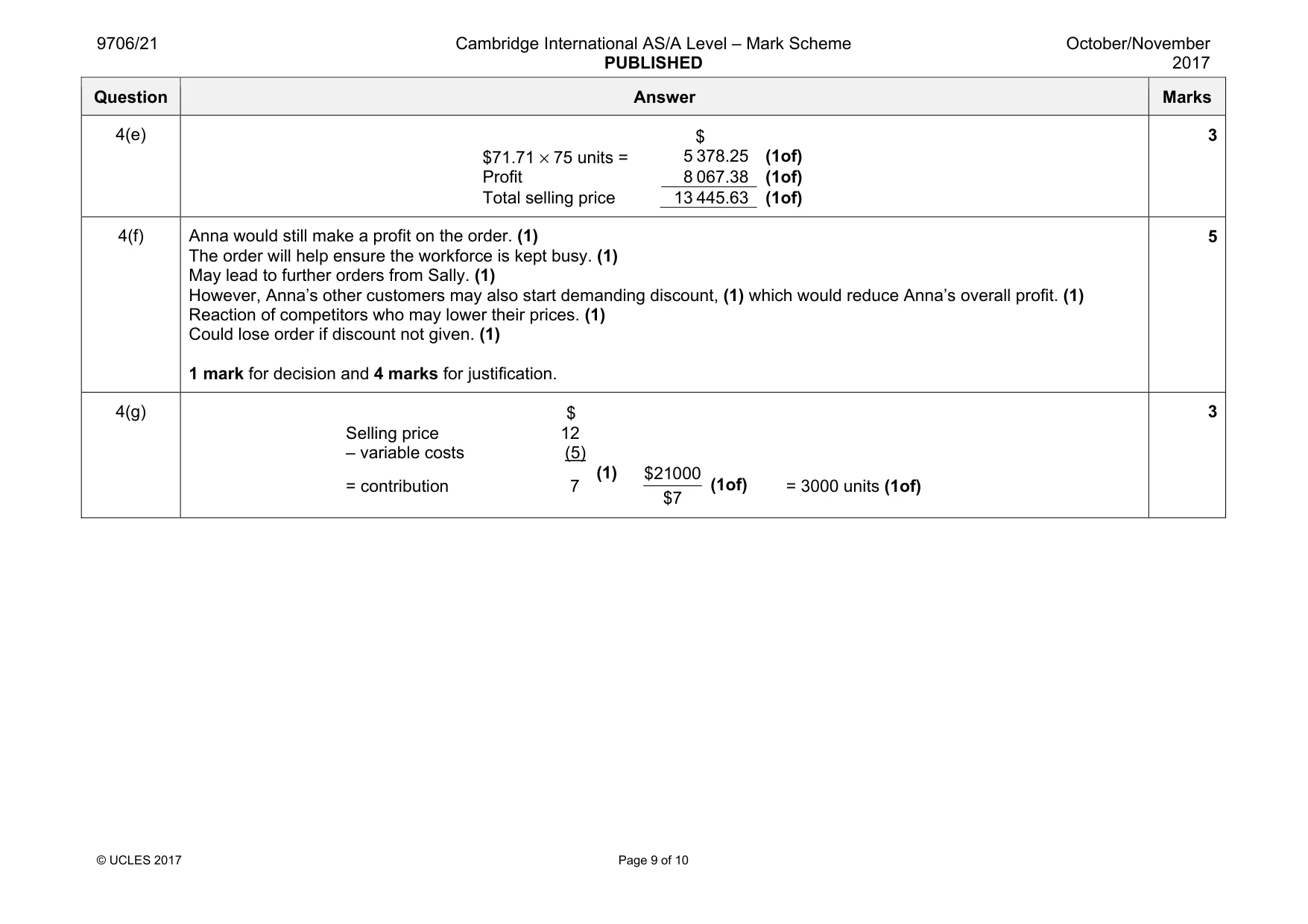
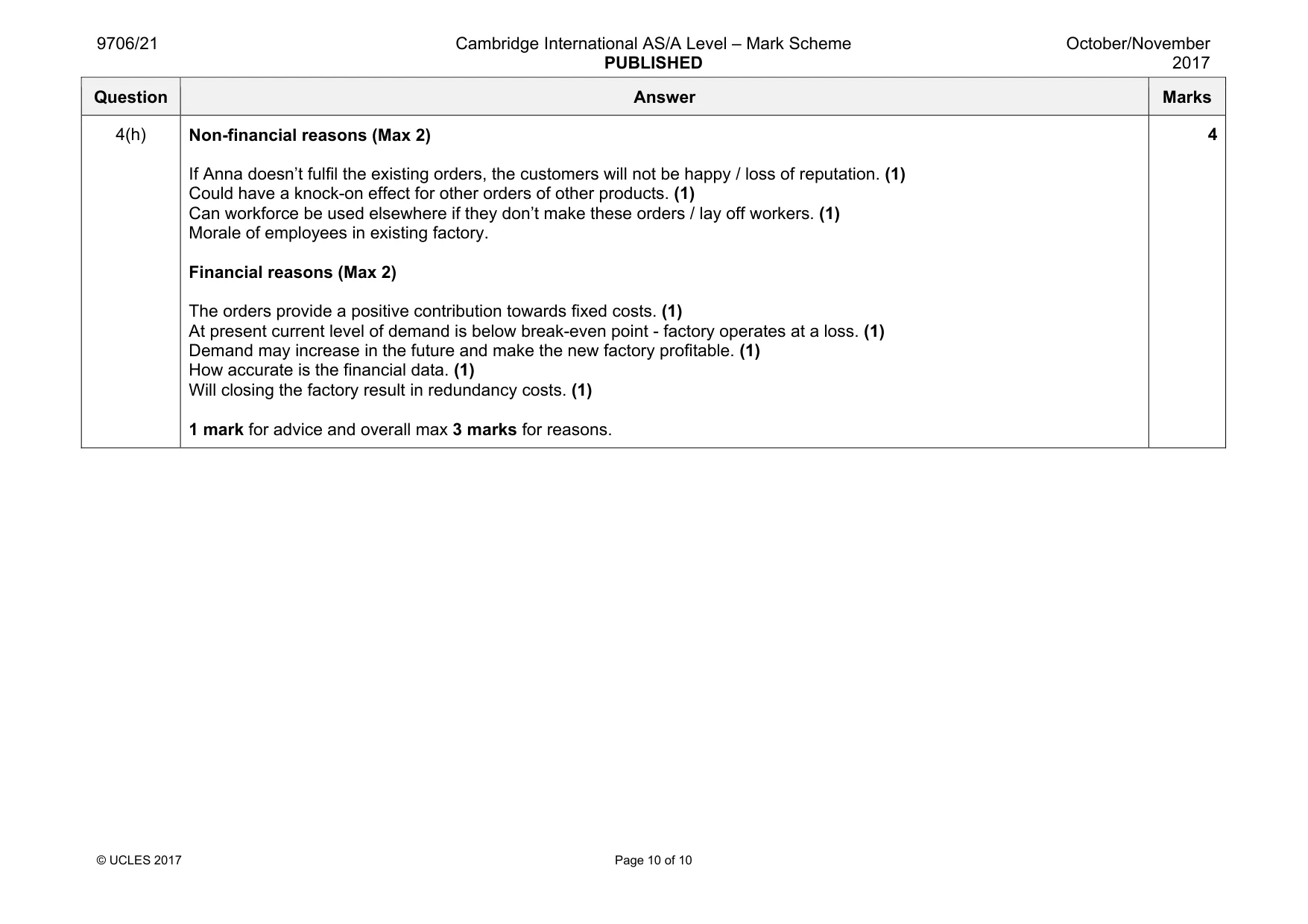
Mark scheme: 4(a) Method of costing that you apply to the production of a number of identical items. (1) The cost per unit is found by dividing the total batch cost by the number of units in the batch. (1) 2 Question Answer Marks 4(b) Assembly $ Machining $ Stores $ Canteen $ Allocated overheads 36 000 50 000 6 250 2 500 Re-apportionment of canteen 1 625 625 250 (2 500) (1) row Subtotal 37 625 50 625 6 500 – Re-apportionment of stores 2 600 3 900 (6 500) – (1of) row Total 40 225 54 525 – – (1of) both 3 4(c) Assembly Machining $40225 6000 = $6.70 (1of) per labour hr (1) $54525 5500 = $9.91(1of) per machine hr (1) 4 4(d) $ Direct materials 48 000.00 Direct labour – assembly (500 hrs × $12) 6 000.00 } (1) Direct labour – machining (300 hrs × $8) 2 400.00 } both Production overheads (assembly 500 hrs × $6.70) 3 350.00 (1of) Production overheads (machining 500 hrs × $9.91) 4 955.00 (1of) 64 705.00 Selling and administration costs costs 7 000.00 (1) Total cost 71 705.00 (1of) Cost per unit $71 705 1000 = $71.71(1of) 6 Question Answer Marks 4(e) $ $71.71 × 75 units = 5 378.25 (1of) Profit 8 067.38 (1of) Total selling price 13 445.63 (1of) 3 4(f) Anna would still make a profit on the order. (1) The order will help ensure the workforce is kept busy. (1) May lead to further orders from Sally. (1) However, Anna’s other customers may also start demanding discount, (1) which would reduce Anna’s overall profit. (1) Reaction of competitors who may lower their prices. (1) Could lose order if discount not given. (1) 1 mark for decision and 4 marks for justification. 5 4(g) $ Selling price 12 – variable costs (5) = contribution 7 (1) $21000 $7 (1of) = 3000 units (1of) 3 Question Answer Marks 4(h) Non-financial reasons (Max 2) If Anna doesn’t fulfil the existing orders, the customers will not be happy / loss of reputation. (1) Could have a knock-on effect for other orders of other products. (1) Can workforce be used elsewhere if they don’t make these orders / lay off workers. (1) Morale of employees in existing factory. Financial reasons (Max 2) The orders provide a positive contribution towards fixed costs. (1) At present current level of demand is below break-even point - factory operates at a loss. (1) Demand may increase in the future and make the new factory profitable. (1) How accurate is the financial data. (1) Will closing the factory result in redundancy costs. (1) 1 mark for advice and overall max 3 marks for reasons. 4
Q5 · Advertising expenses included a charge of $200 relating to advertising planned for…
5 Advertising expenses included a charge of $200 relating to advertising planned for September 2016.
Q7 · REQUIRED (b) Prepare an income statement for Huan for the year ended 31 March 2016
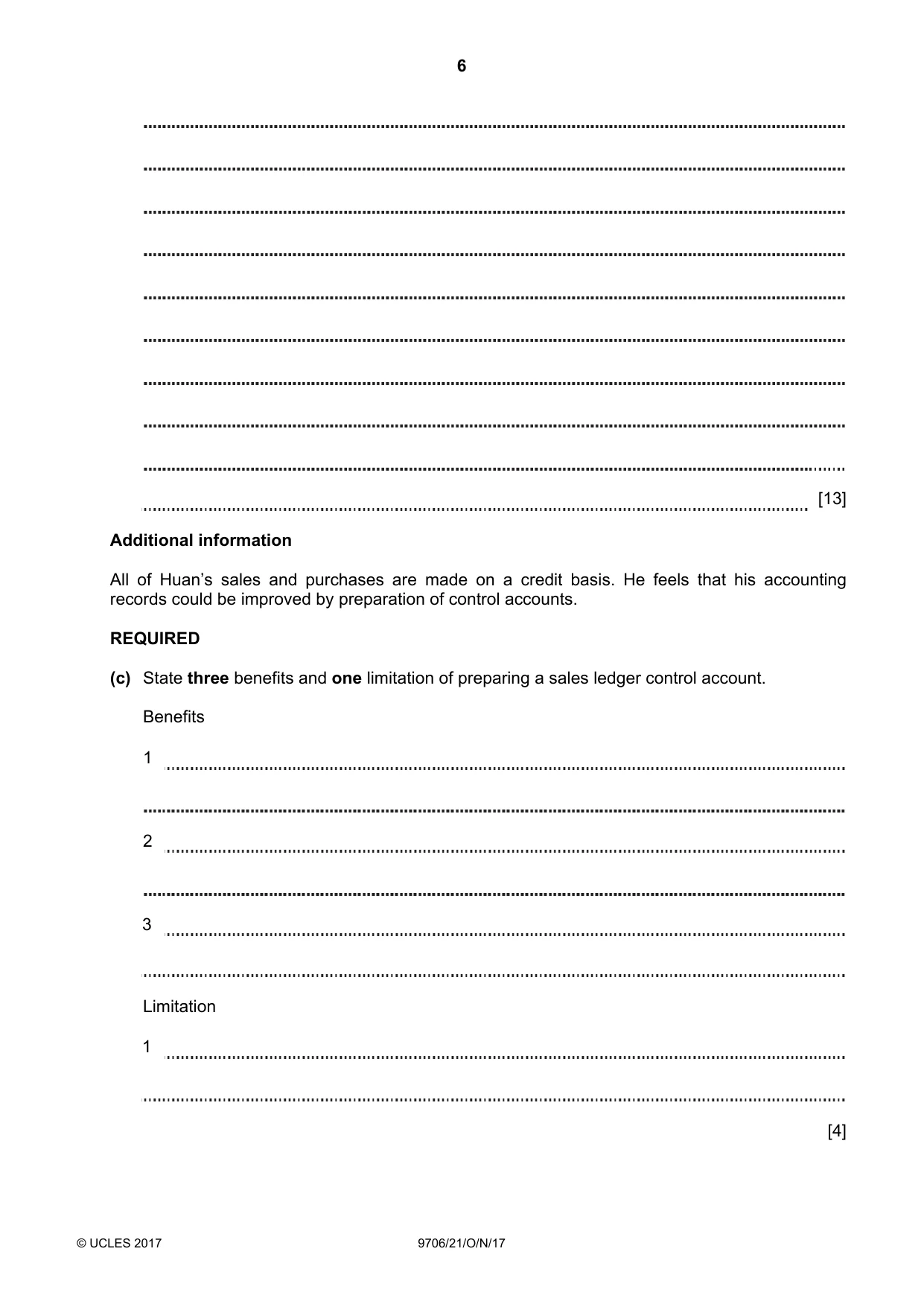
REQUIRED (b) Prepare an income statement for Huan for the year ended 31 March 2016. Huan Income statement for the year ended 31 March 2016 [13] Additional information All of Huan’s sales and purchases are made on a credit basis. He feels that his accounting records could be improved by preparation of control accounts. REQUIRED (c) State three benefits and one limitation of preparing a sales ledger control account. Benefits 1 2 3 Limitation 1 [4]
What was in this paper
The subtopics covered by these 6 questions, and how many questions each got. Open one in a new tab to see every Cambridge question on it.
What you needed in this session
Cambridge’s own grade thresholds for 2017 Oct/Nov, Paper 2 · Variant 1. A higher threshold means an easier paper — the bar moves with how the cohort did.