Cambridge A Level Accounting 9706 — 2017 May/June Paper 2 · Variant 2
9706/22/M/J/17 · 4 questions · 90 marks · ≈101 min
The question paper and its mark scheme, free to read here and free to download. This is Cambridge’s own paper, exactly as it was sat.
Question paper20 pages
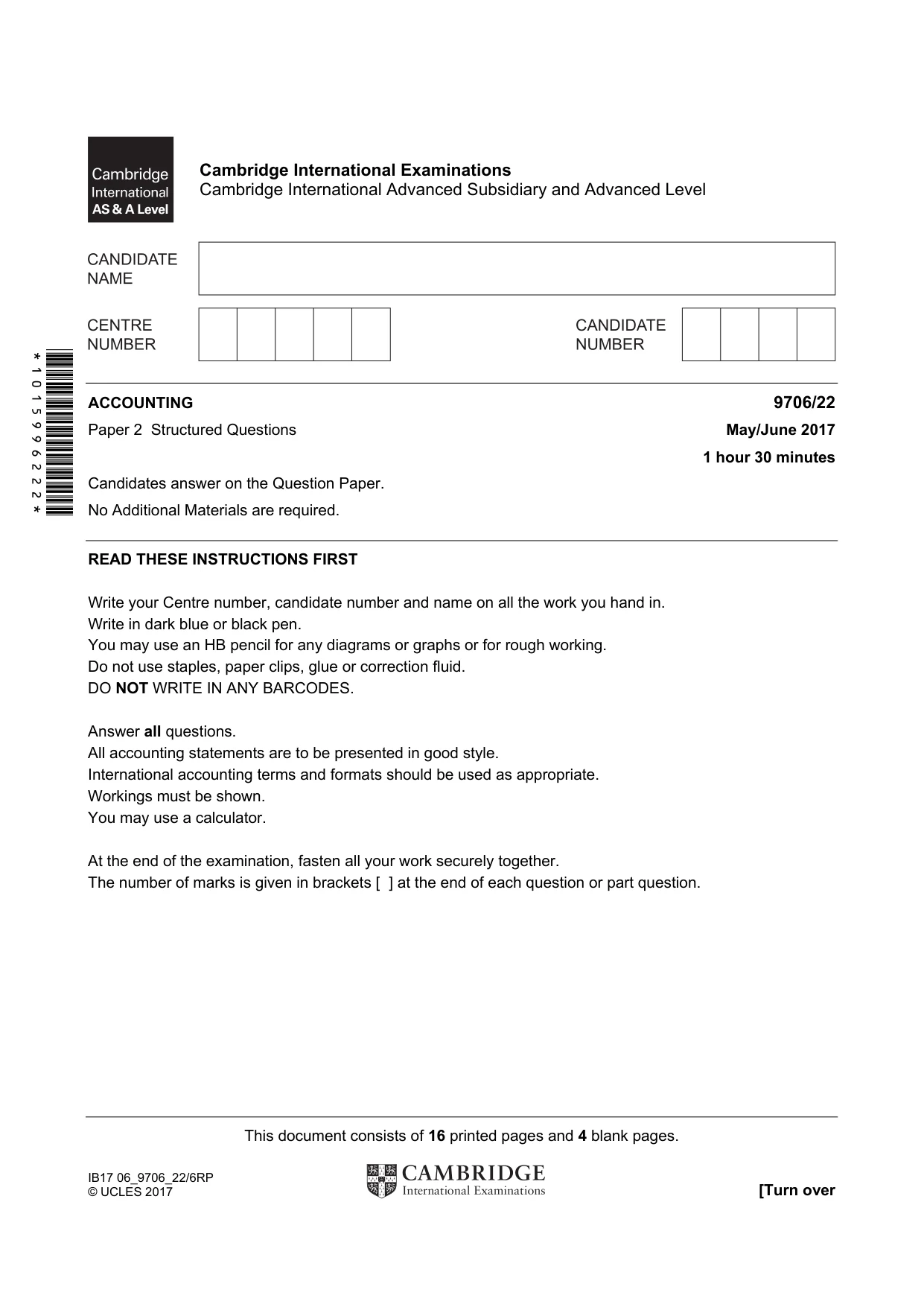



Mark scheme9 pages
Answers below. Sit the paper first if you are practising.
Questions as text
Q1 · B Limited is a private limited company trading as a wholesaler of garden equipment
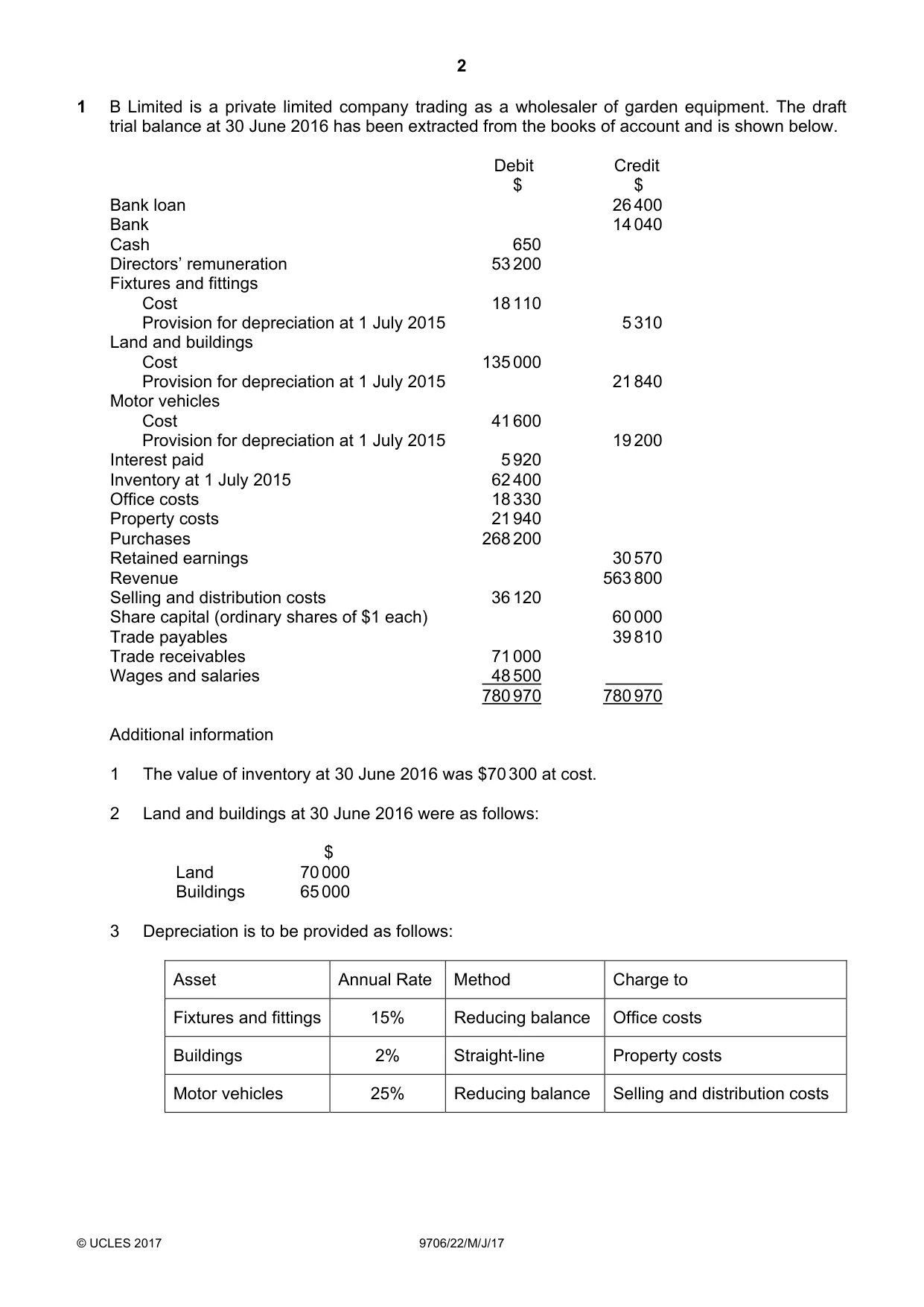
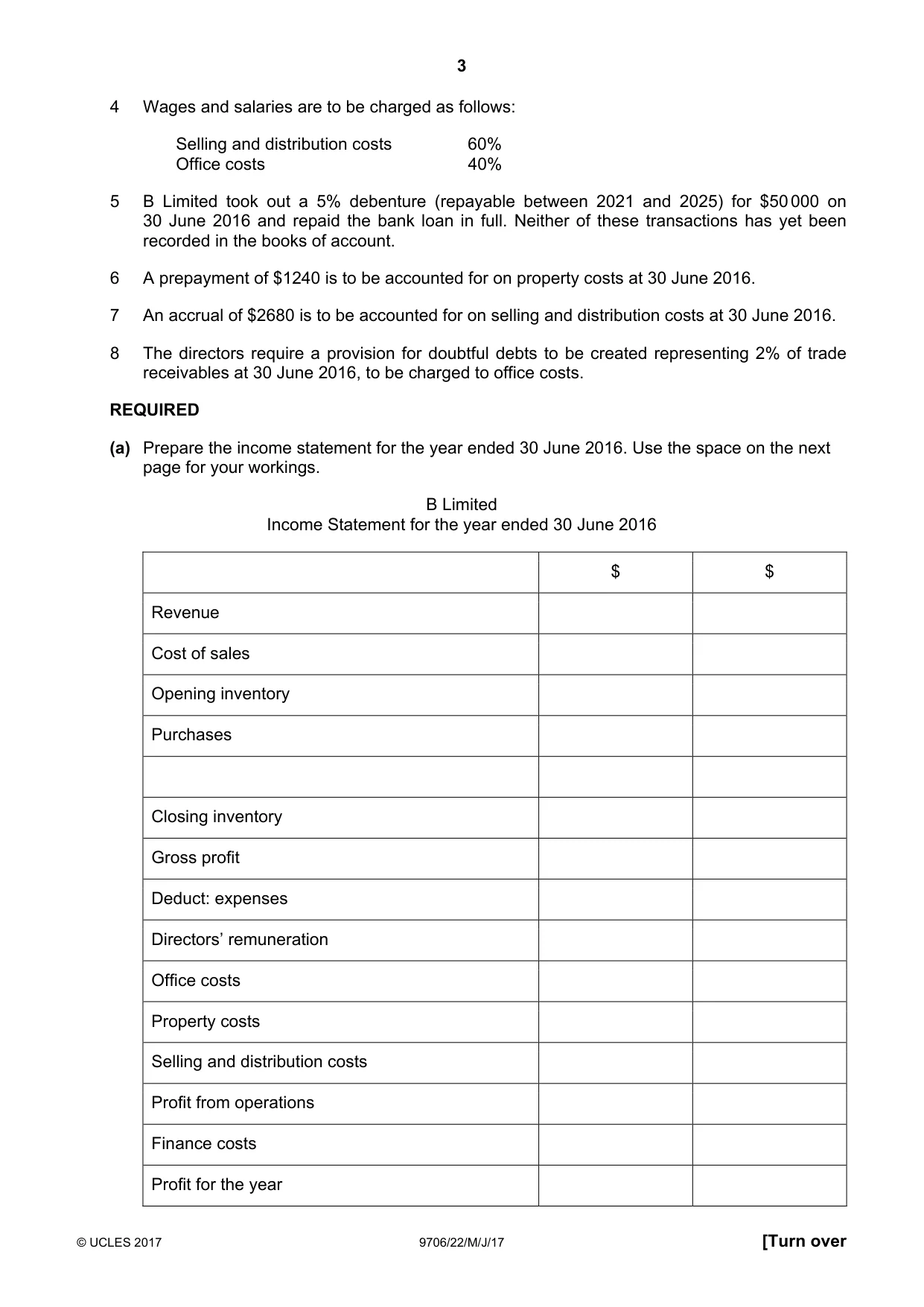
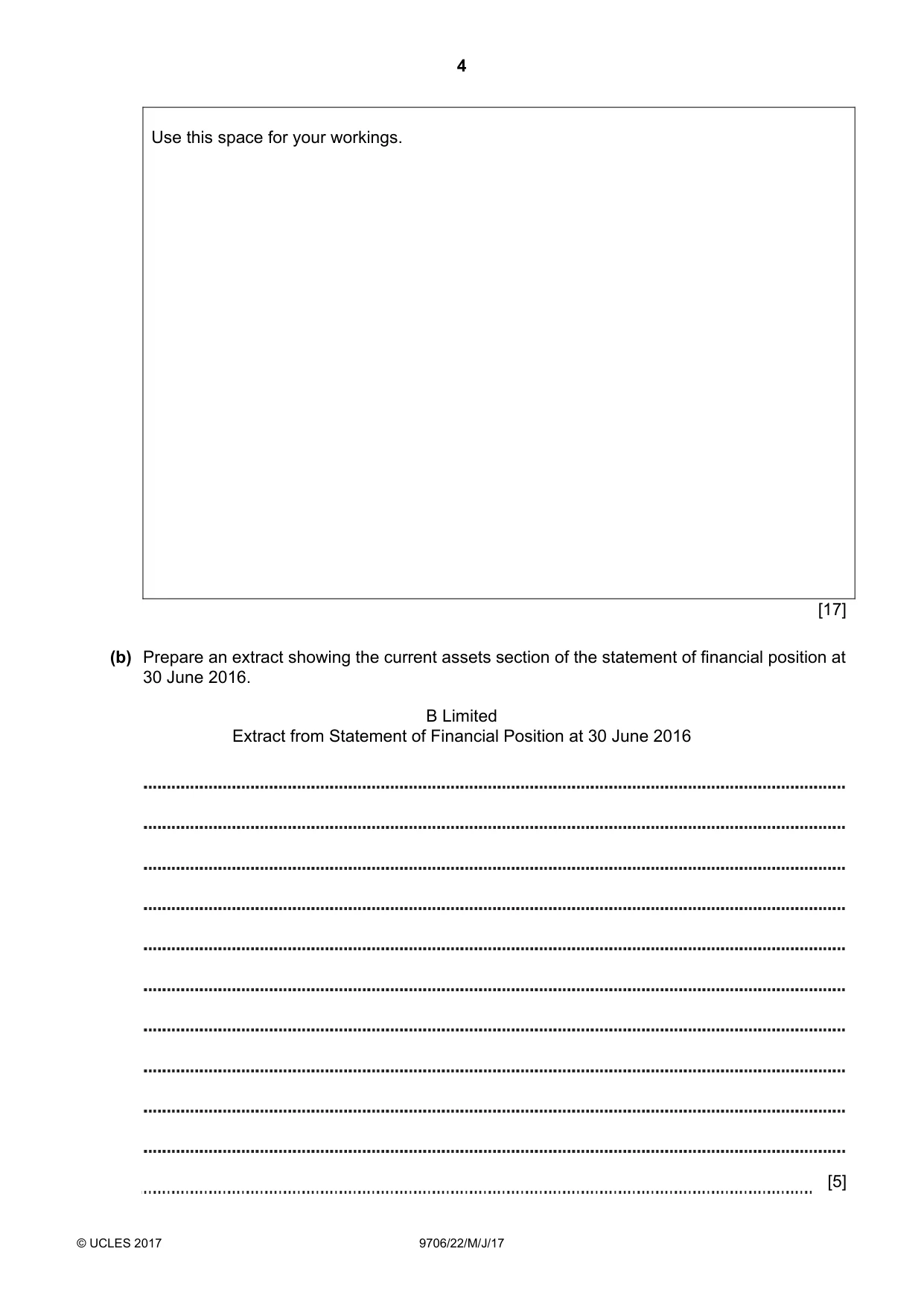
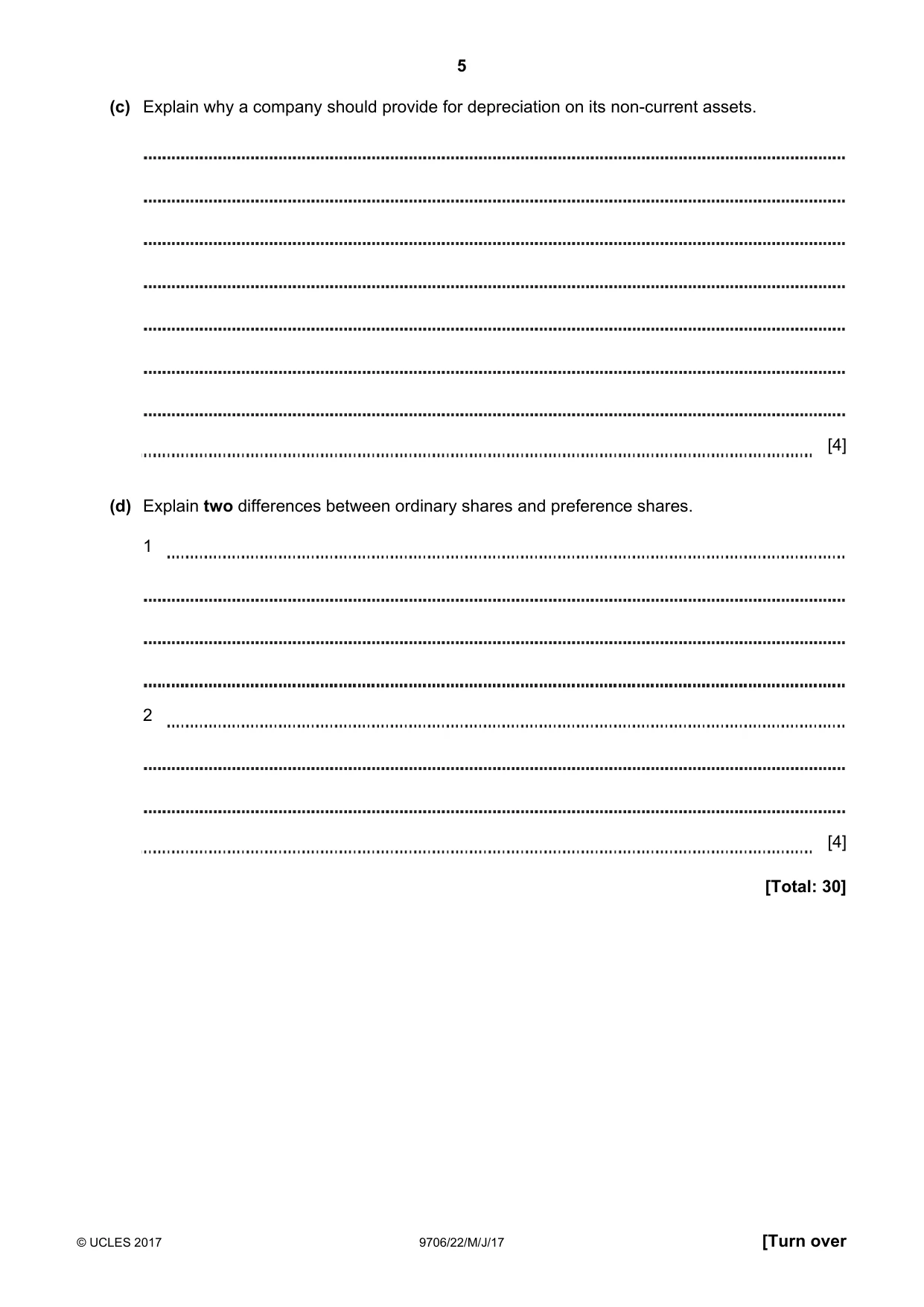
1 B Limited is a private limited company trading as a wholesaler of garden equipment. The draft trial balance at 30 June 2016 has been extracted from the books of account and is shown below. Debit Credit $ $ Bank loan 26 400 Bank 14 040 Cash 650 Directors’ remuneration 53 200 Fixtures and fittings Cost 18 110 Provision for depreciation at 1 July 2015 5 310 Land and buildings Cost 135 000 Provision for depreciation at 1 July 2015 21 840 Motor vehicles Cost 41 600 Provision for depreciation at 1 July 2015 19 200 Interest paid 5 920 Inventory at 1 July 2015 62 400 Office costs 18 330 Property costs 21 940 Purchases 268 200 Retained earnings 30 570 Revenue 563 800 Selling and distribution costs 36 120 Share capital (ordinary shares of $1 each) 60 000 Trade payables 39 810 Trade receivables 71 000 Wages and salaries 48 500 780 970 780 970 Additional information 1 The value of inventory at 30 June 2016 was $70 300 at cost. 2 Land and buildings at 30 June 2016 were as follows: $ Land 70 000 Buildings 65 000 3 Depreciation is to be provided as follows: Asset Annual Rate Method Charge to Fixtures and fittings 15% Reducing balance Office costs Buildings 2% Straight-line Property costs Motor vehicles 25% Reducing balance Selling and distribution costs 4 Wages and salaries are to be charged as follows: Selling and distribution costs 60% Office costs 40% 5 B Limited took out a 5% debenture (repayable between 2021 and 2025) for $50 000 on 30 June 2016 and repaid the bank loan in full. Neither of these transactions has yet been recorded in the books of account. 6 A prepayment of $1240 is to be accounted for on property costs at 30 June 2016. 7 An accrual of $2680 is to be accounted for on selling and distribution costs at 30 June 2016. 8 The directors require a provision for doubtful debts to be created representing 2% of trade receivables at 30 June 2016, to be charged to office costs. REQUIRED (a) Prepare the income statement for the year ended 30 June 2016. Use the space on the next page for your workings. B Limited Income Statement for the year ended 30 June 2016 $ $ Revenue Cost of sales Opening inventory Purchases Closing inventory Gross profit Deduct: expenses Directors’ remuneration Office costs Property costs Selling and distribution costs Profit from operations Finance costs Profit for the year Use this space for your workings. [17] (b) Prepare an extract showing the current assets section of the statement of financial position at 30 June 2016. B Limited Extract from Statement of Financial Position at 30 June 2016 [5] (c) Explain why a company should provide for depreciation on its non-current assets. [4] (d) Explain two differences between ordinary shares and preference shares. 1 2 [4] [Total: 30]
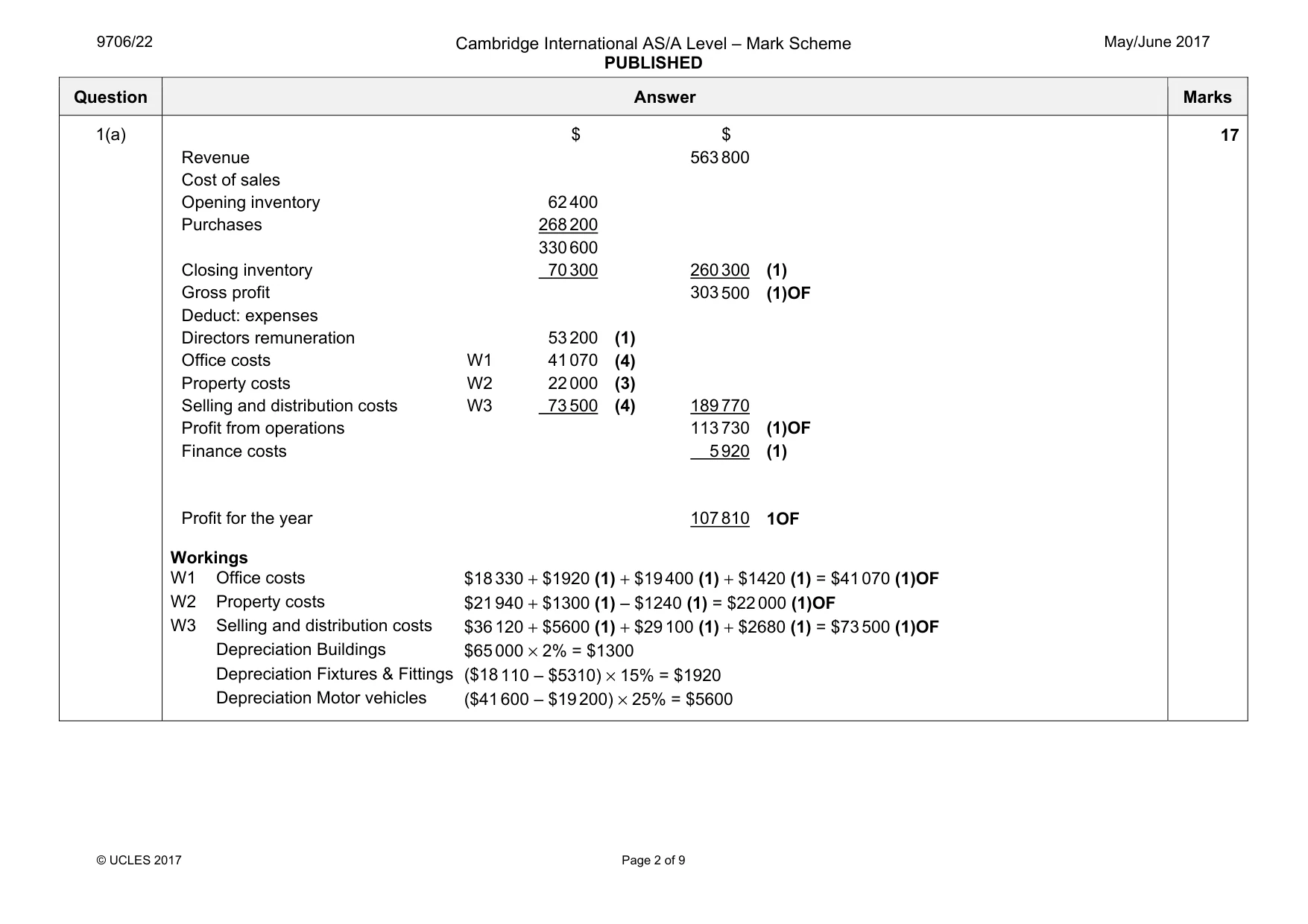
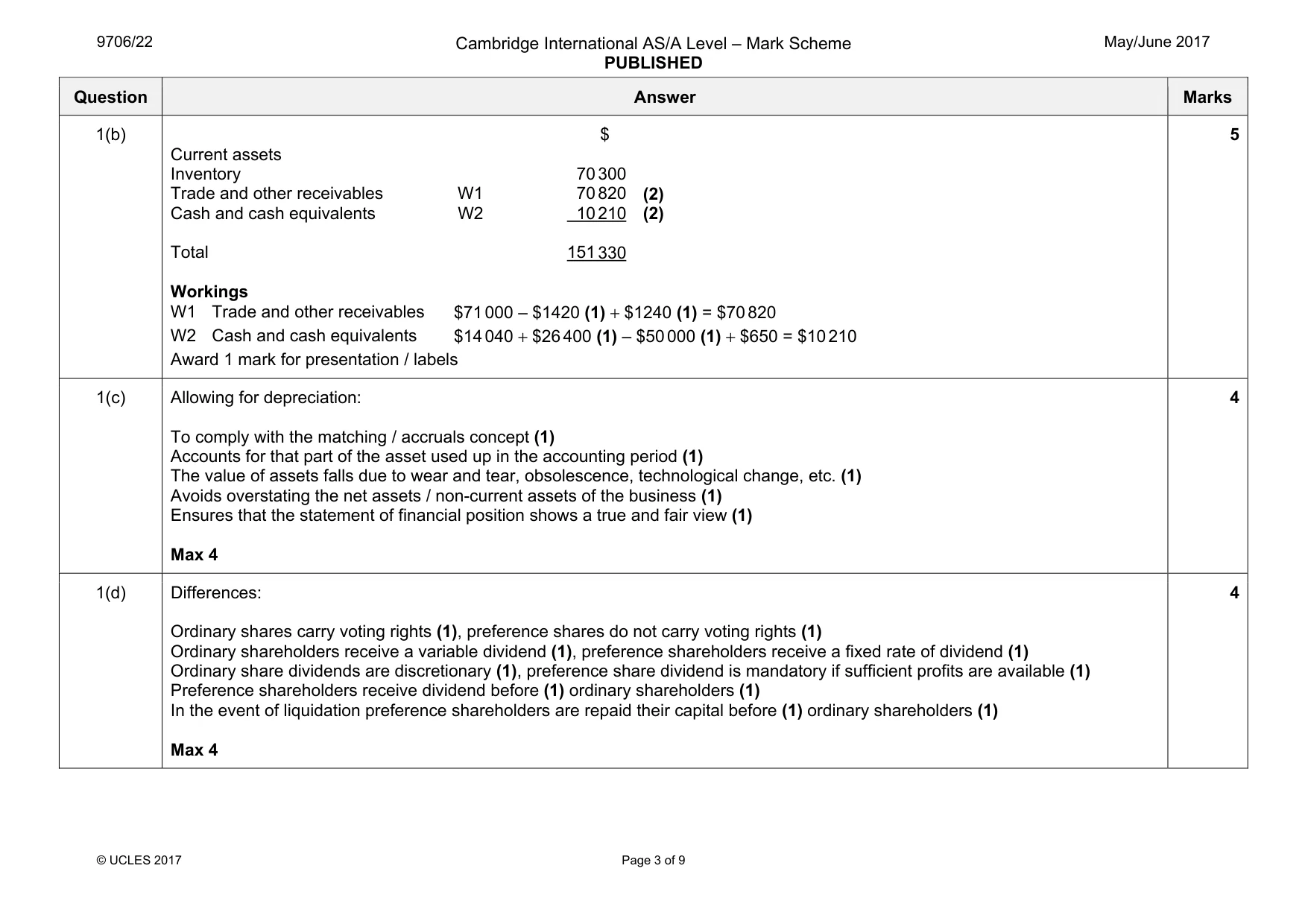
Mark scheme: 1(a) $ $ Revenue 563 800 Cost of sales Opening inventory 62 400 Purchases 268 200 330 600 Closing inventory 70 300 260 300 (1) Gross profit 303 500 (1)OF Deduct: expenses Directors remuneration 53 200 (1) Office costs W1 41 070 (4) Property costs W2 22 000 (3) Selling and distribution costs W3 73 500 (4) 189 770 Profit from operations 113 730 (1)OF Finance costs 5 920 (1) Profit for the year 107 810 1OF Workings W1 Office costs $18 330 + $1920 (1) + $19 400 (1) + $1420 (1) = $41 070 (1)OF W2 Property costs $21 940 + $1300 (1) – $1240 (1) = $22 000 (1)OF W3 Selling and distribution costs $36 120 + $5600 (1) + $29 100 (1) + $2680 (1) = $73 500 (1)OF Depreciation Buildings $65 000 × 2% = $1300 Depreciation Fixtures & Fittings ($18 110 – $5310) × 15% = $1920 Depreciation Motor vehicles ($41 600 – $19 200) × 25% = $5600 17 Question Answer Marks 1(b) $ Current assets Inventory 70 300 Trade and other receivables W1 70 820 (2) Cash and cash equivalents W2 10 210 (2) Total 151 330 Workings W1 Trade and other receivables $71 000 – $1420 (1) + $1240 (1) = $70 820 W2 Cash and cash equivalents $14 040 + $26 400 (1) – $50 000 (1) + $650 = $10 210 Award 1 mark for presentation / labels 5 1(c) Allowing for depreciation: To comply with the matching / accruals concept (1) Accounts for that part of the asset used up in the accounting period (1) The value of assets falls due to wear and tear, obsolescence, technological change, etc. (1) Avoids overstating the net assets / non-current assets of the business (1) Ensures that the statement of financial position shows a true and fair view (1) Max 4 4 1(d) Differences: Ordinary shares carry voting rights (1), preference shares do not carry voting rights (1) Ordinary shareholders receive a variable dividend (1), preference shareholders receive a fixed rate of dividend (1) Ordinary share dividends are discretionary (1), preference share dividend is mandatory if sufficient profits are available (1) Preference shareholders receive dividend before (1) ordinary shareholders (1) In the event of liquidation preference shareholders are repaid their capital before (1) ordinary shareholders (1) Max 4 4
Q2 · Wiggins has provided the following summary financial information for the year ended 30…
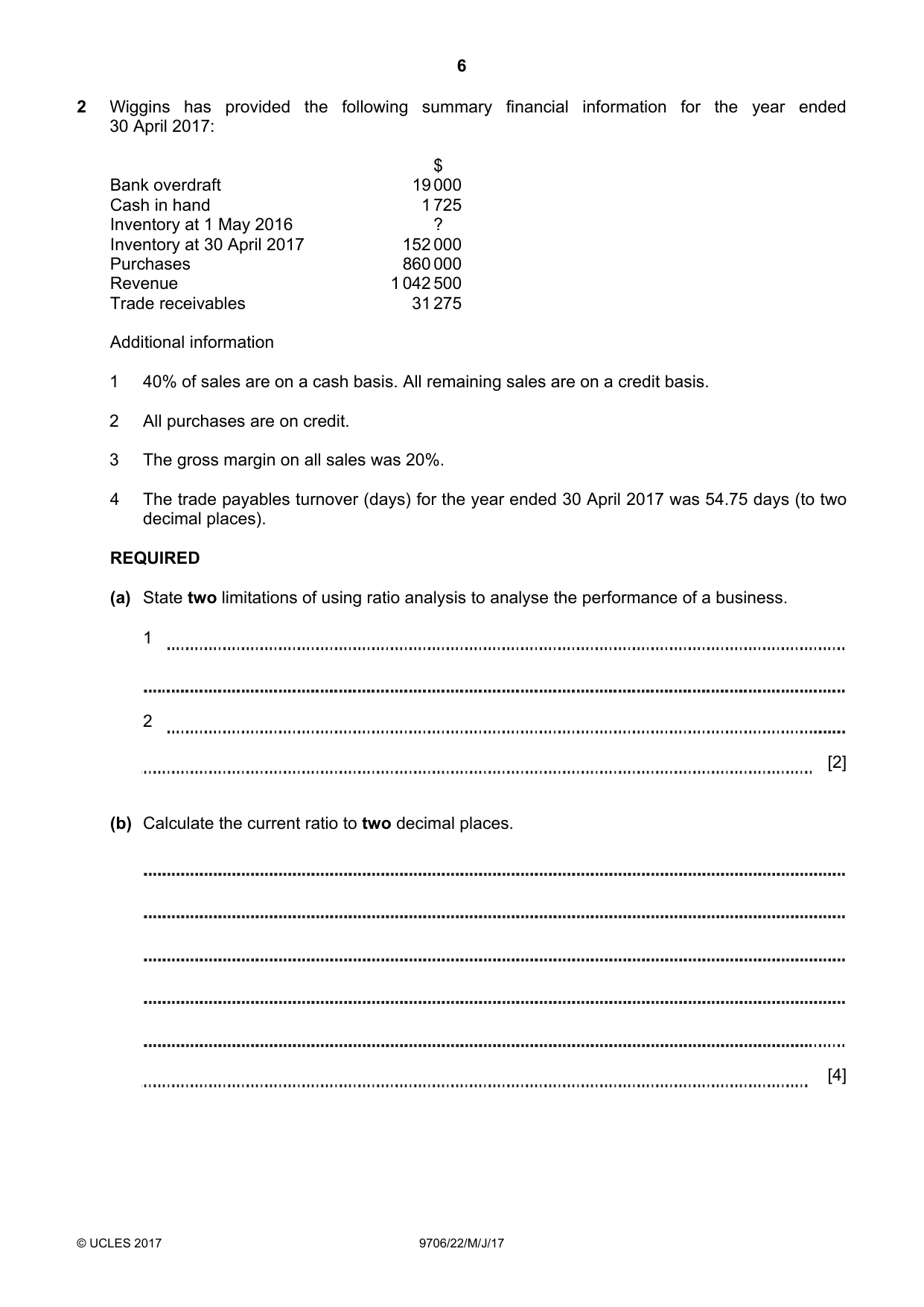
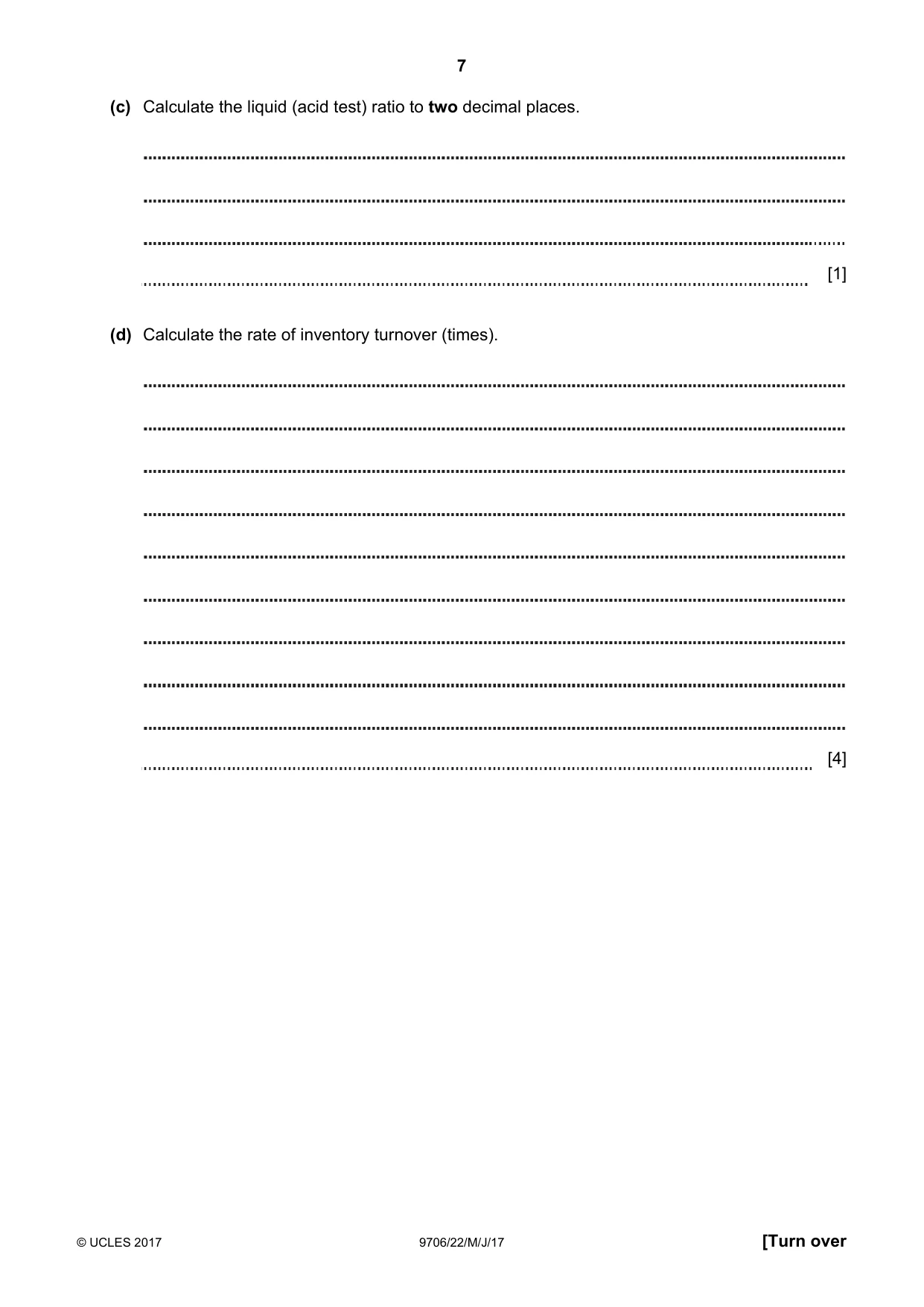
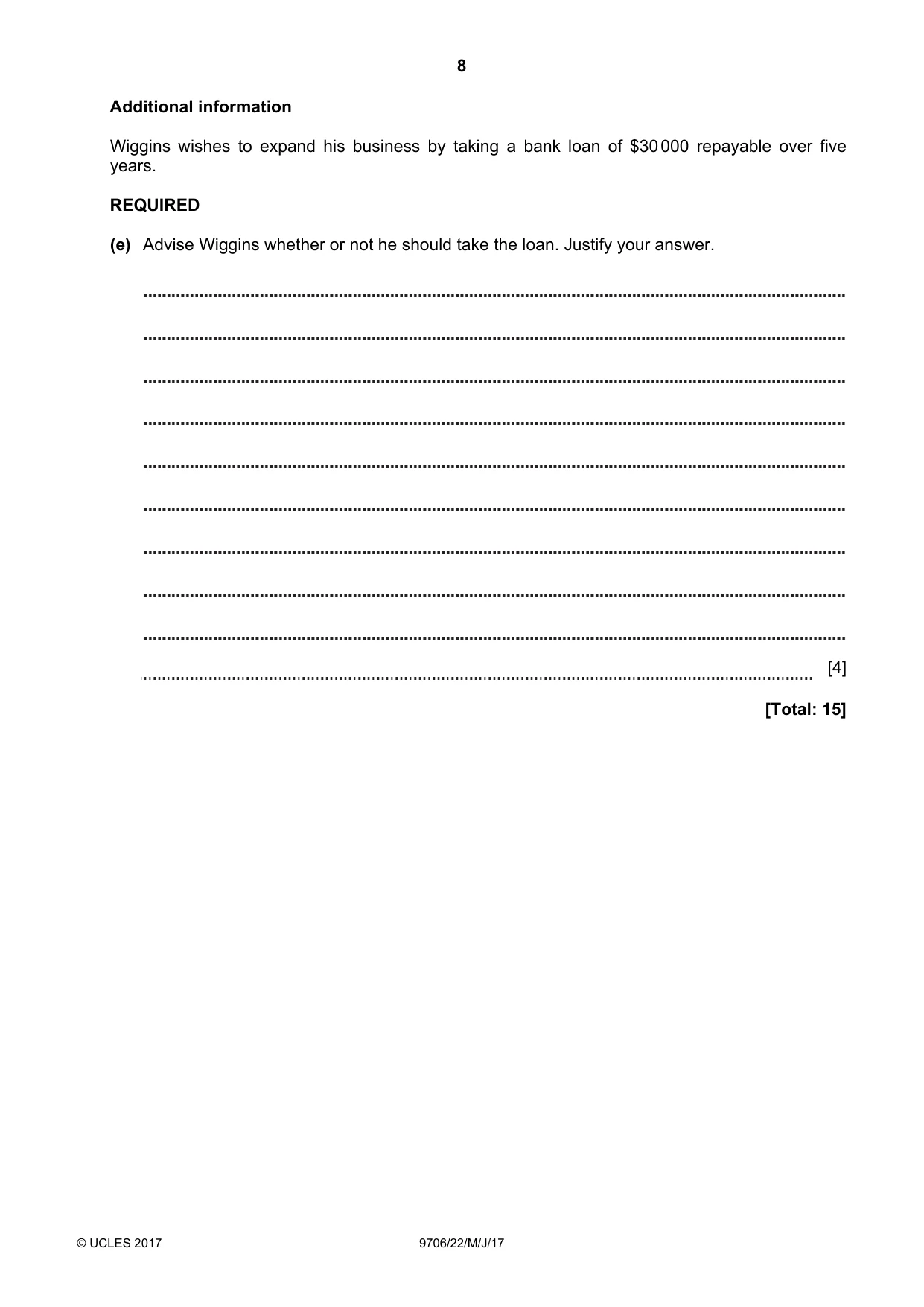
2 Wiggins has provided the following summary financial information for the year ended 30 April 2017: $ Bank overdraft 19 000 Cash in hand 1 725 Inventory at 1 May 2016 ? Inventory at 30 April 2017 152 000 Purchases 860 000 Revenue 1 042 500 Trade receivables 31 275 Additional information 1 40% of sales are on a cash basis. All remaining sales are on a credit basis. 2 All purchases are on credit. 3 The gross margin on all sales was 20%. 4 The trade payables turnover (days) for the year ended 30 April 2017 was 54.75 days (to two decimal places). REQUIRED (a) State two limitations of using ratio analysis to analyse the performance of a business. 1 2 [2] (b) Calculate the current ratio to two decimal places. [4] (c) Calculate the liquid (acid test) ratio to two decimal places. [1] (d) Calculate the rate of inventory turnover (times). [4] Additional information Wiggins wishes to expand his business by taking a bank loan of $30 000 repayable over five years. REQUIRED (e) Advise Wiggins whether or not he should take the loan. Justify your answer. [4] [Total: 15]
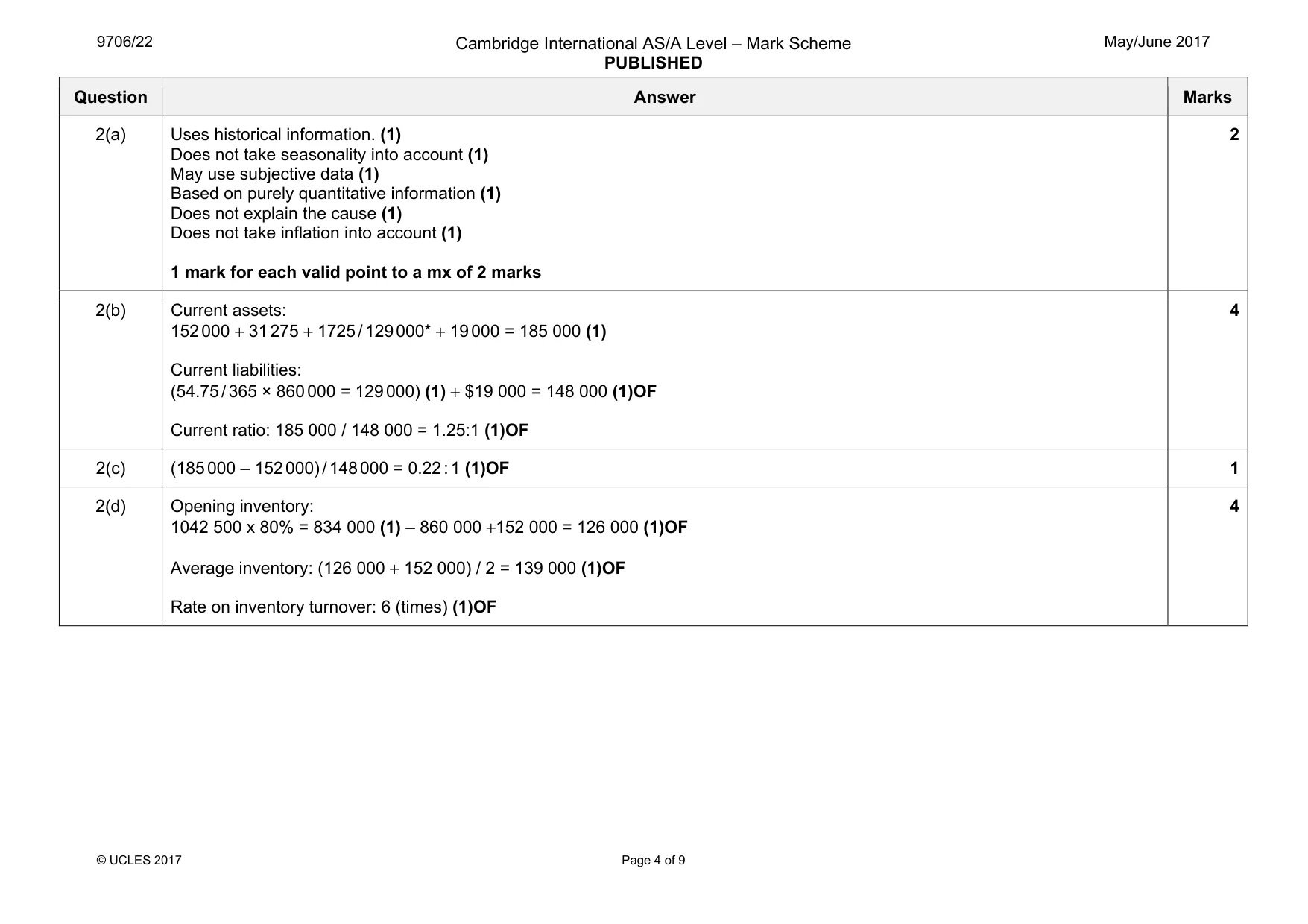
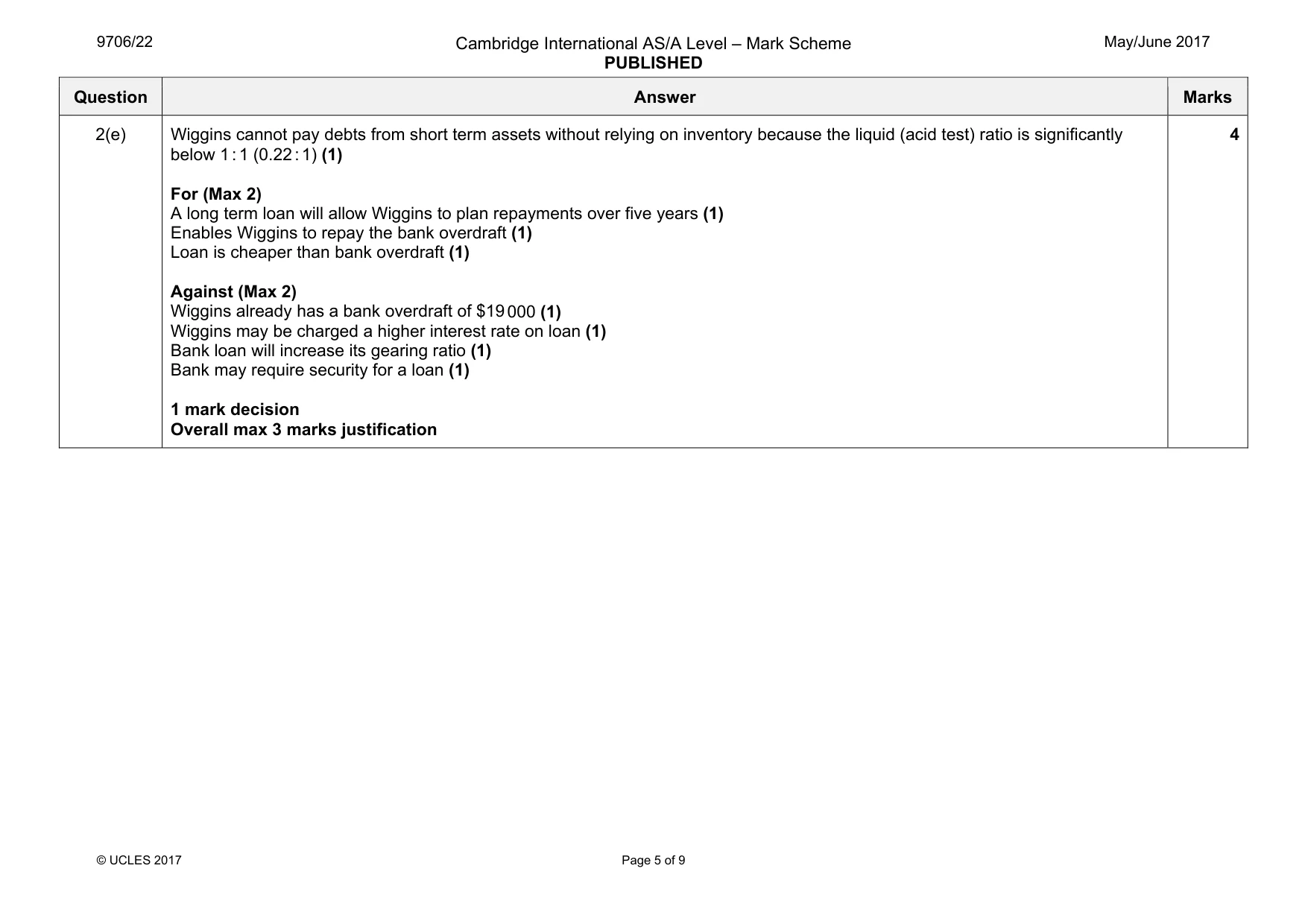
Mark scheme: 2(a) Uses historical information. (1) Does not take seasonality into account (1) May use subjective data (1) Based on purely quantitative information (1) Does not explain the cause (1) Does not take inflation into account (1) 1 mark for each valid point to a mx of 2 marks 2 2(b) Current assets: 152 000 + 31 275 + 1725 / 129 000* + 19 000 = 185 000 (1) Current liabilities: (54.75 / 365 × 860 000 = 129 000) (1) + $19 000 = 148 000 (1)OF Current ratio: 185 000 / 148 000 = 1.25:1 (1)OF 4 2(c) (185 000 – 152 000) / 148 000 = 0.22 : 1 (1)OF 1 2(d) Opening inventory: 1042 500 x 80% = 834 000 (1) – 860 000 +152 000 = 126 000 (1)OF Average inventory: (126 000 + 152 000) / 2 = 139 000 (1)OF Rate on inventory turnover: 6 (times) (1)OF 4 Question Answer Marks 2(e) Wiggins cannot pay debts from short term assets without relying on inventory because the liquid (acid test) ratio is significantly below 1 : 1 (0.22 : 1) (1) For (Max 2) A long term loan will allow Wiggins to plan repayments over five years (1) Enables Wiggins to repay the bank overdraft (1) Loan is cheaper than bank overdraft (1) Against (Max 2) Wiggins already has a bank overdraft of $19 000 (1) Wiggins may be charged a higher interest rate on loan (1) Bank loan will increase its gearing ratio (1) Bank may require security for a loan (1) 1 mark decision Overall max 3 marks justification 4
More questions on Analysis and communication of accounting information
Q3 · Amit, Wang and Susi have been trading in partnership for several years and prepare their…
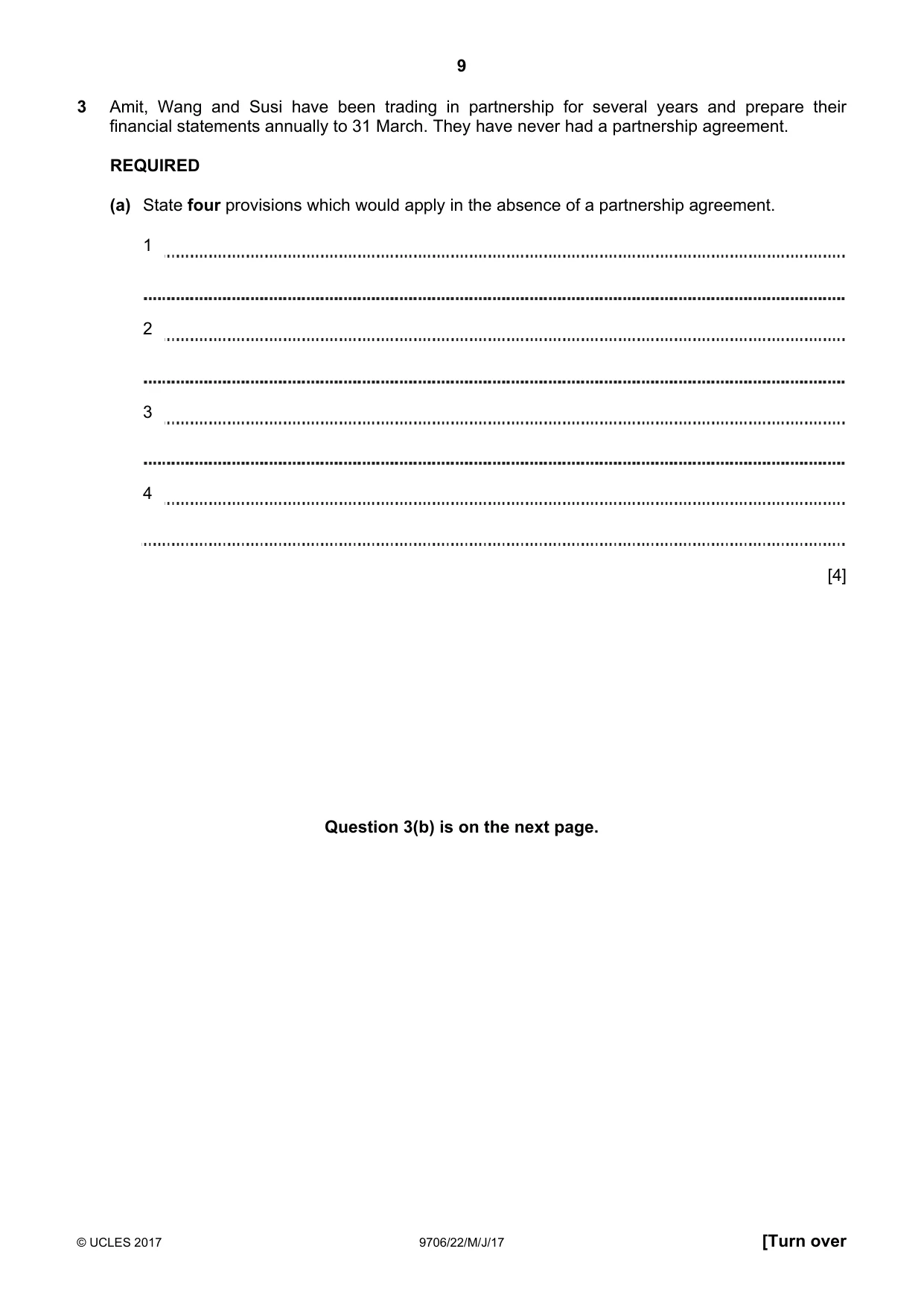
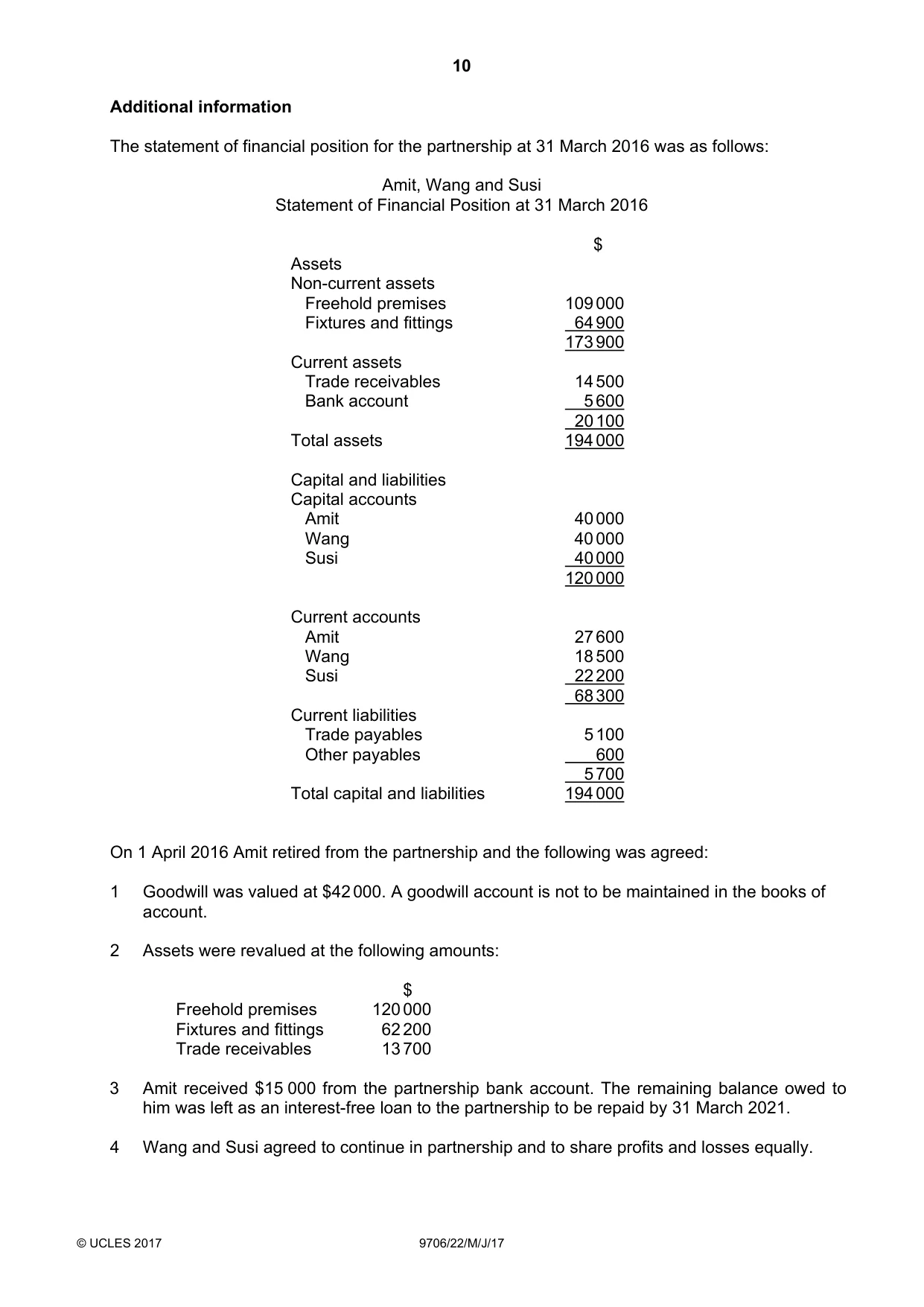
3 Amit, Wang and Susi have been trading in partnership for several years and prepare their financial statements annually to 31 March. They have never had a partnership agreement. REQUIRED (a) State four provisions which would apply in the absence of a partnership agreement. 1 2 3 4 [4] Question 3(b) is on the next page. Additional information The statement of financial position for the partnership at 31 March 2016 was as follows: Amit, Wang and Susi Statement of Financial Position at 31 March 2016 $ Assets Non-current assets Freehold premises 109 000 Fixtures and fittings 64 900 173 900 Current assets Trade receivables 14 500 Bank account 5 600 20 100 Total assets 194 000 Capital and liabilities Capital accounts Amit 40 000 Wang 40 000 Susi 40 000 120 000 Current accounts Amit 27 600 Wang 18 500 Susi 22 200 68 300 Current liabilities Trade payables 5 100 Other payables 600 5 700 Total capital and liabilities 194 000 On 1 April 2016 Amit retired from the partnership and the following was agreed: 1 Goodwill was valued at $42 000. A goodwill account is not to be maintained in the books of account. 2 Assets were revalued at the following amounts: $ Freehold premises 120 000 Fixtures and fittings 62 200 Trade receivables 13 700 3 Amit received $15 000 from the partnership bank account. The remaining balance owed to him was left as an interest-free loan to the partnership to be repaid by 31 March 2021.
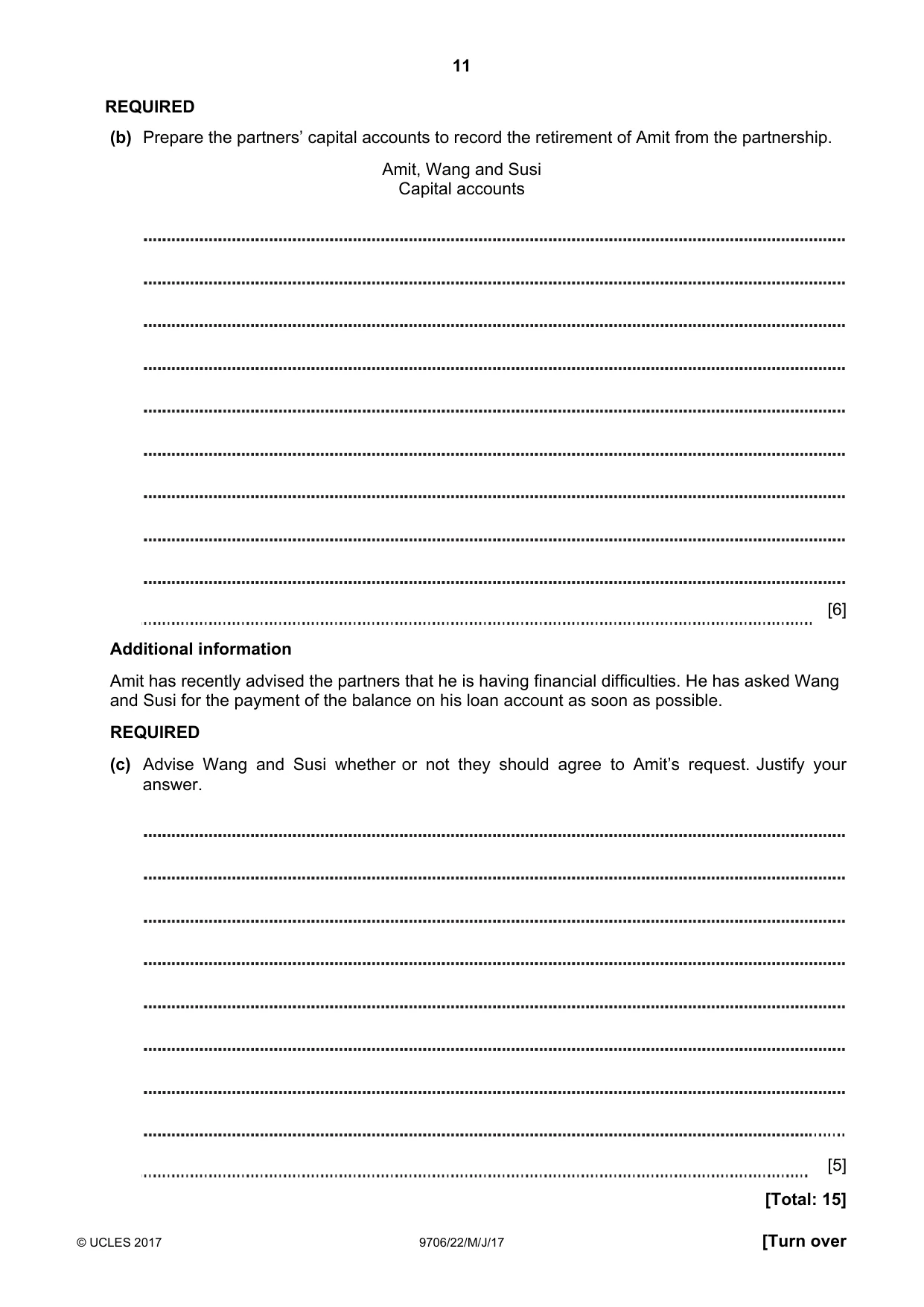
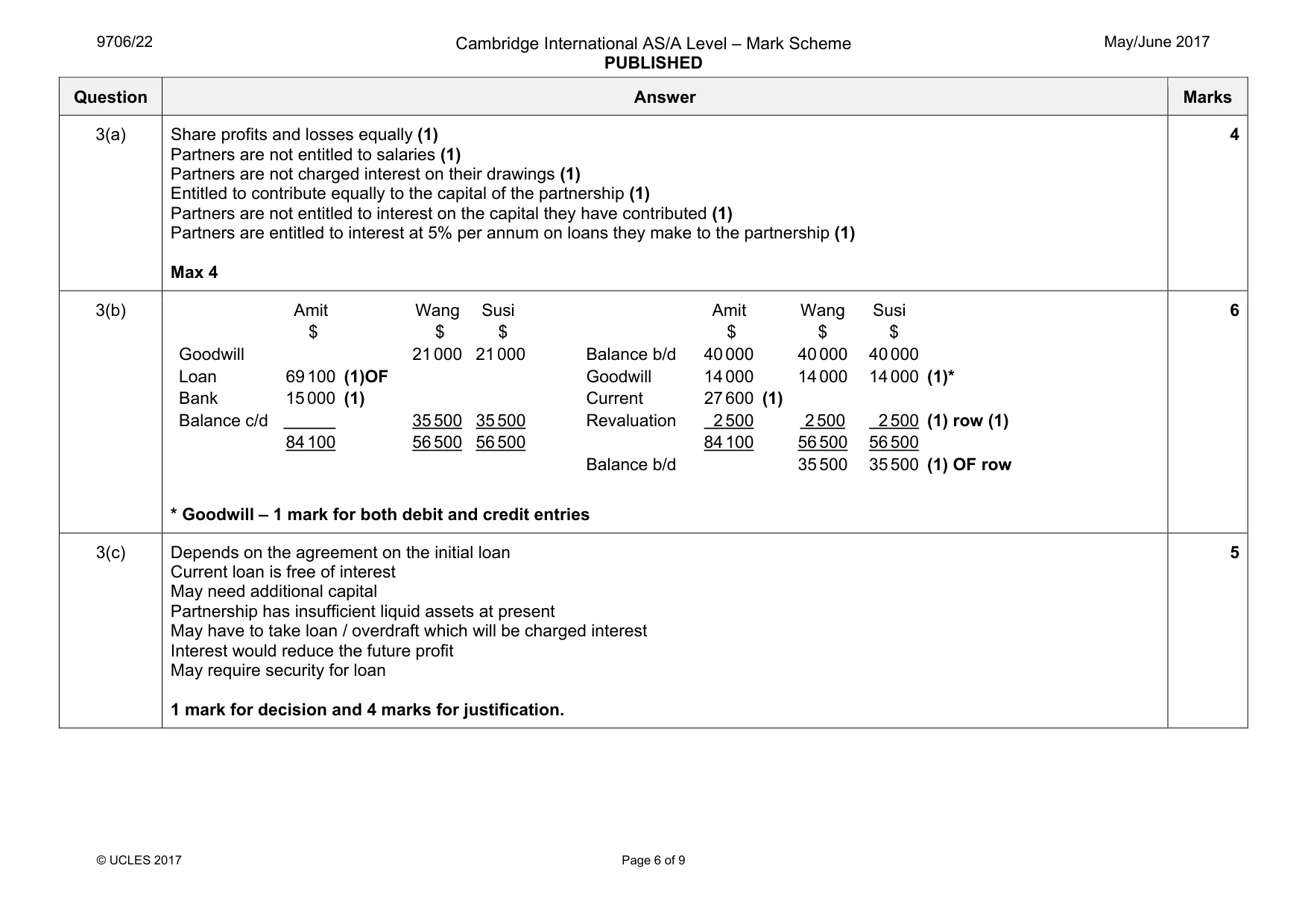
Mark scheme: 3(a) Share profits and losses equally (1) Partners are not entitled to salaries (1) Partners are not charged interest on their drawings (1) Entitled to contribute equally to the capital of the partnership (1) Partners are not entitled to interest on the capital they have contributed (1) Partners are entitled to interest at 5% per annum on loans they make to the partnership (1) Max 4 4 3(b) Amit Wang Susi Amit Wang Susi $ $ $ $ $ $ Goodwill 21 000 21 000 Balance b/d 40 000 40 000 40 000 Loan 69 100 (1)OF Goodwill 14 000 14 000 14 000 (1)* Bank 15 000 (1) Current 27 600 (1) Balance c/d 35 500 35 500 Revaluation 2 500 2 500 2 500 (1) row (1) 84 100 56 500 56 500 84 100 56 500 56 500 Balance b/d 35 500 35 500 (1) OF row * Goodwill – 1 mark for both debit and credit entries 6 3(c) Depends on the agreement on the initial loan Current loan is free of interest May need additional capital Partnership has insufficient liquid assets at present May have to take loan / overdraft which will be charged interest Interest would reduce the future profit May require security for loan 1 mark for decision and 4 marks for justification. 5
Q4 · REQUIRED (b) Prepare the partners’ capital accounts to record the retirement of Amit from…
REQUIRED (b) Prepare the partners’ capital accounts to record the retirement of Amit from the partnership. Amit, Wang and Susi Capital accounts [6] Additional information Amit has recently advised the partners that he is having financial difficulties. He has asked Wang and Susi for the payment of the balance on his loan account as soon as possible. REQUIRED (c) Advise Wang and Susi whether or not they should agree to Amit’s request. Justify your answer. [5] [Total: 15]
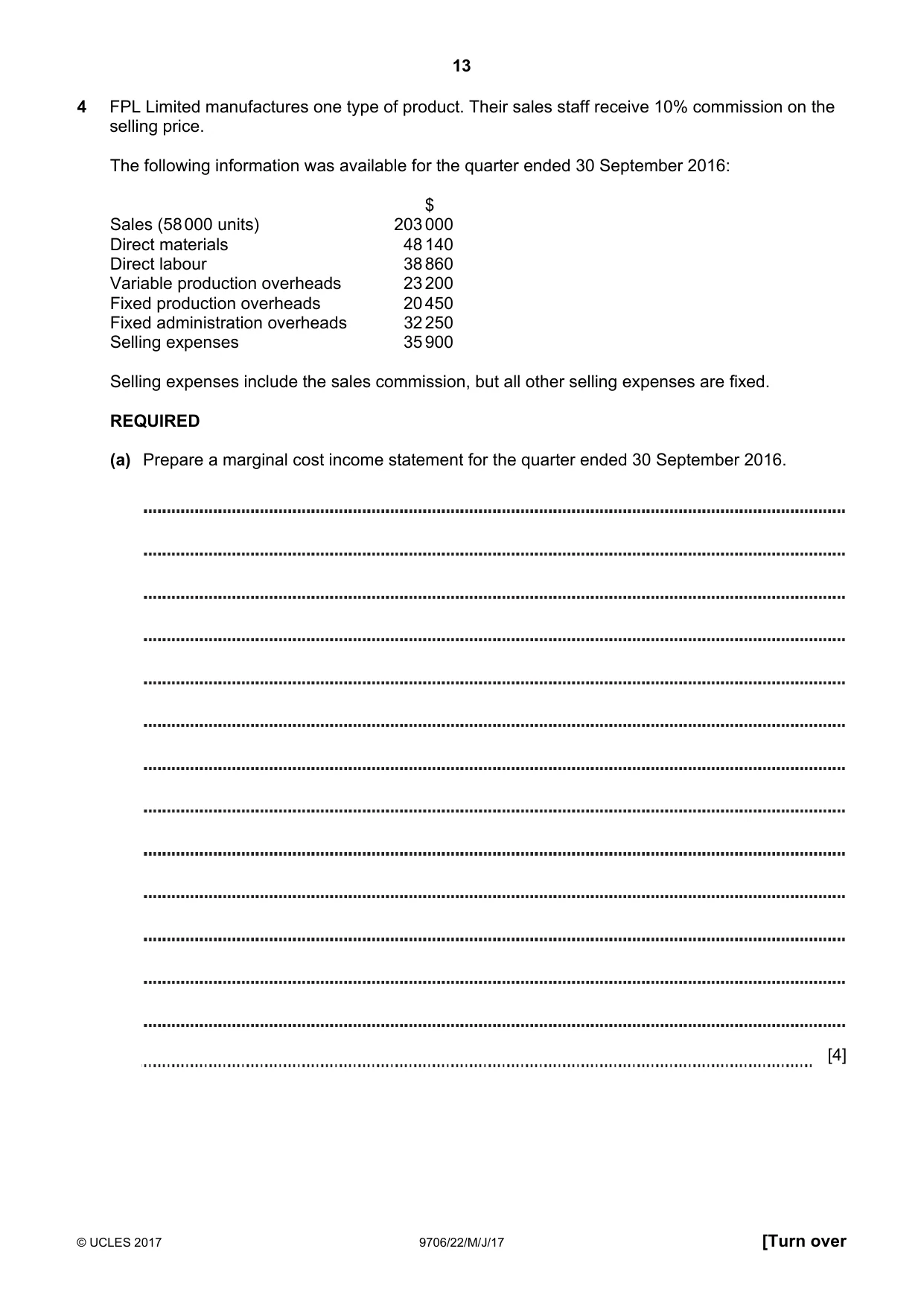
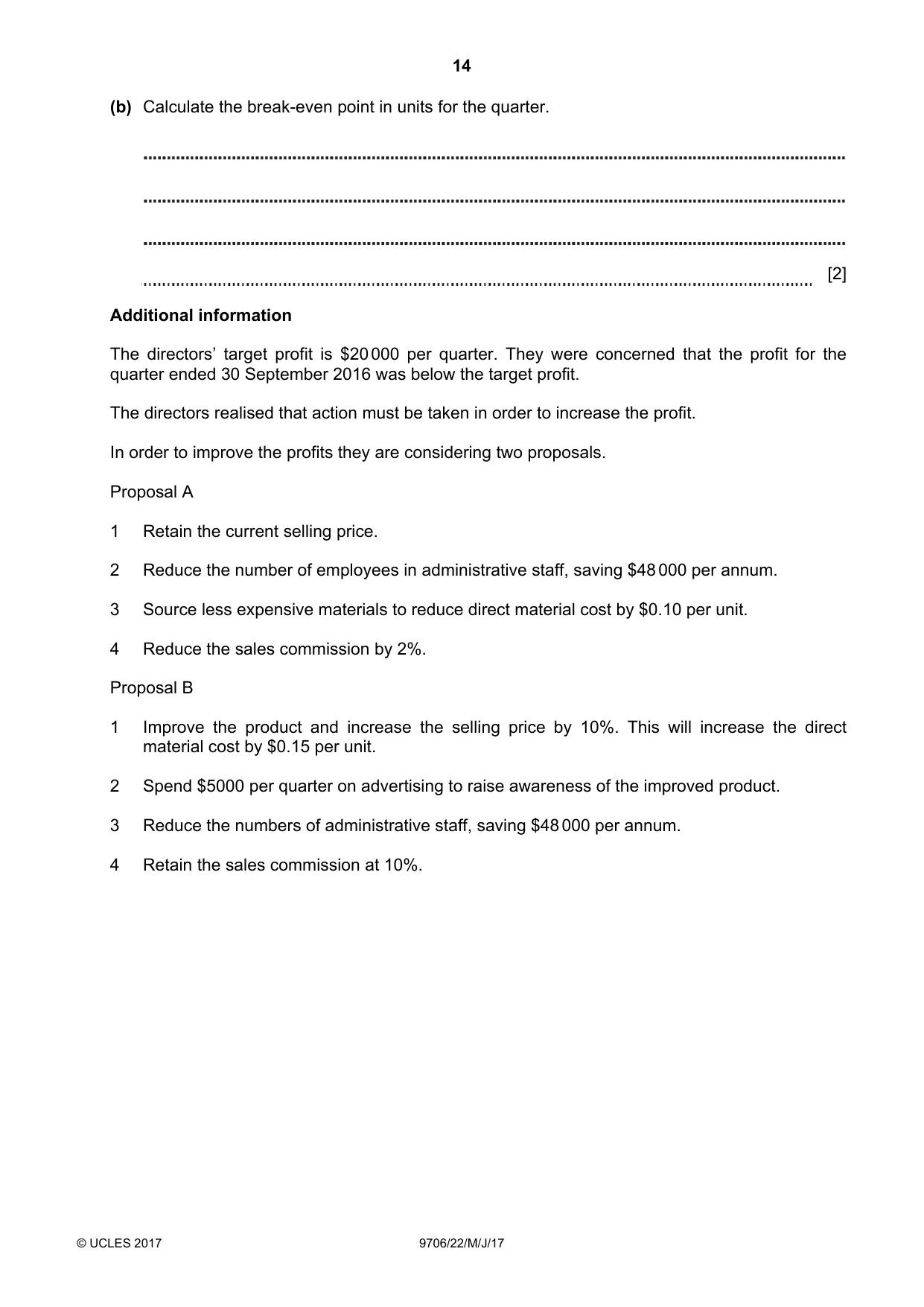
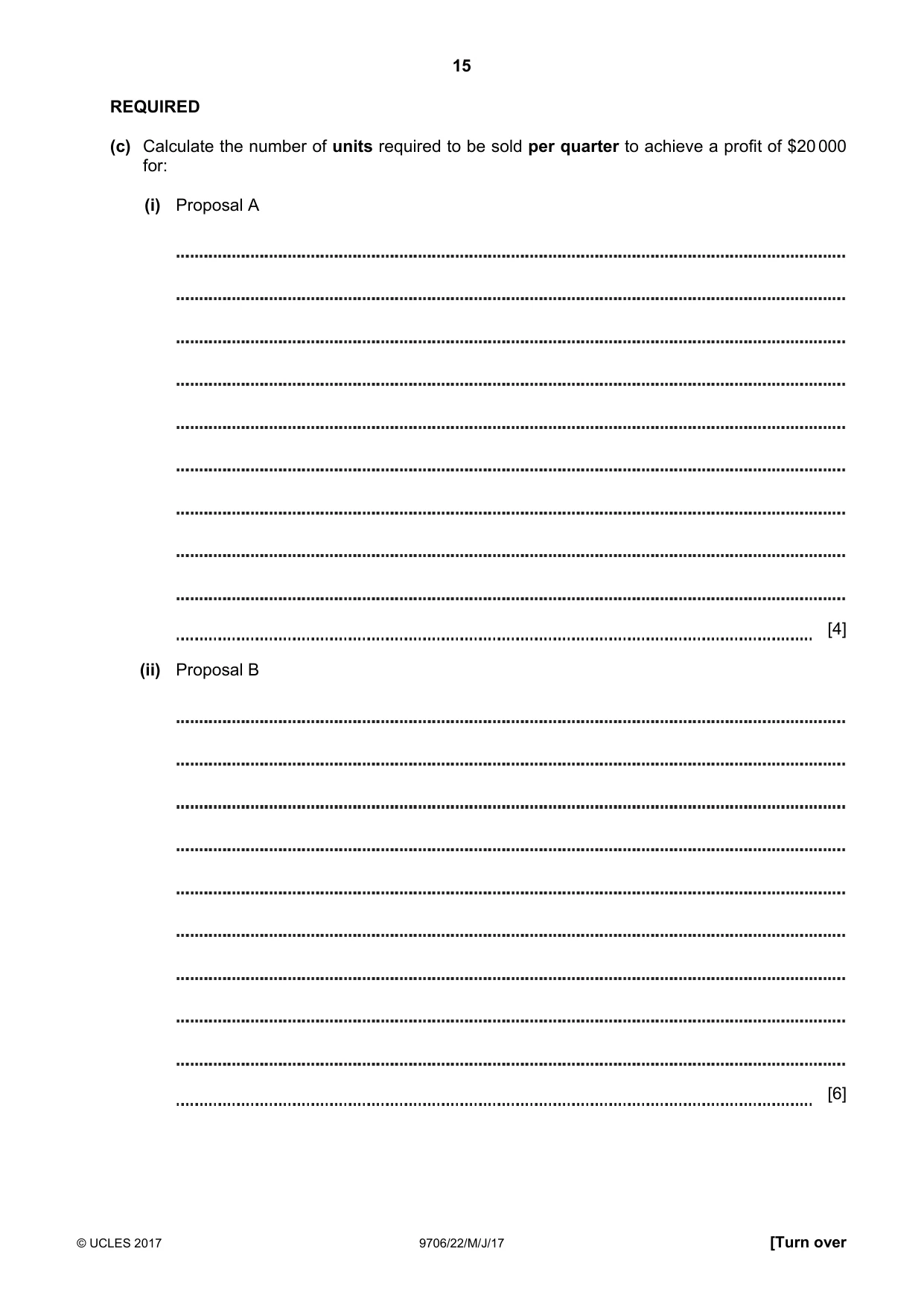
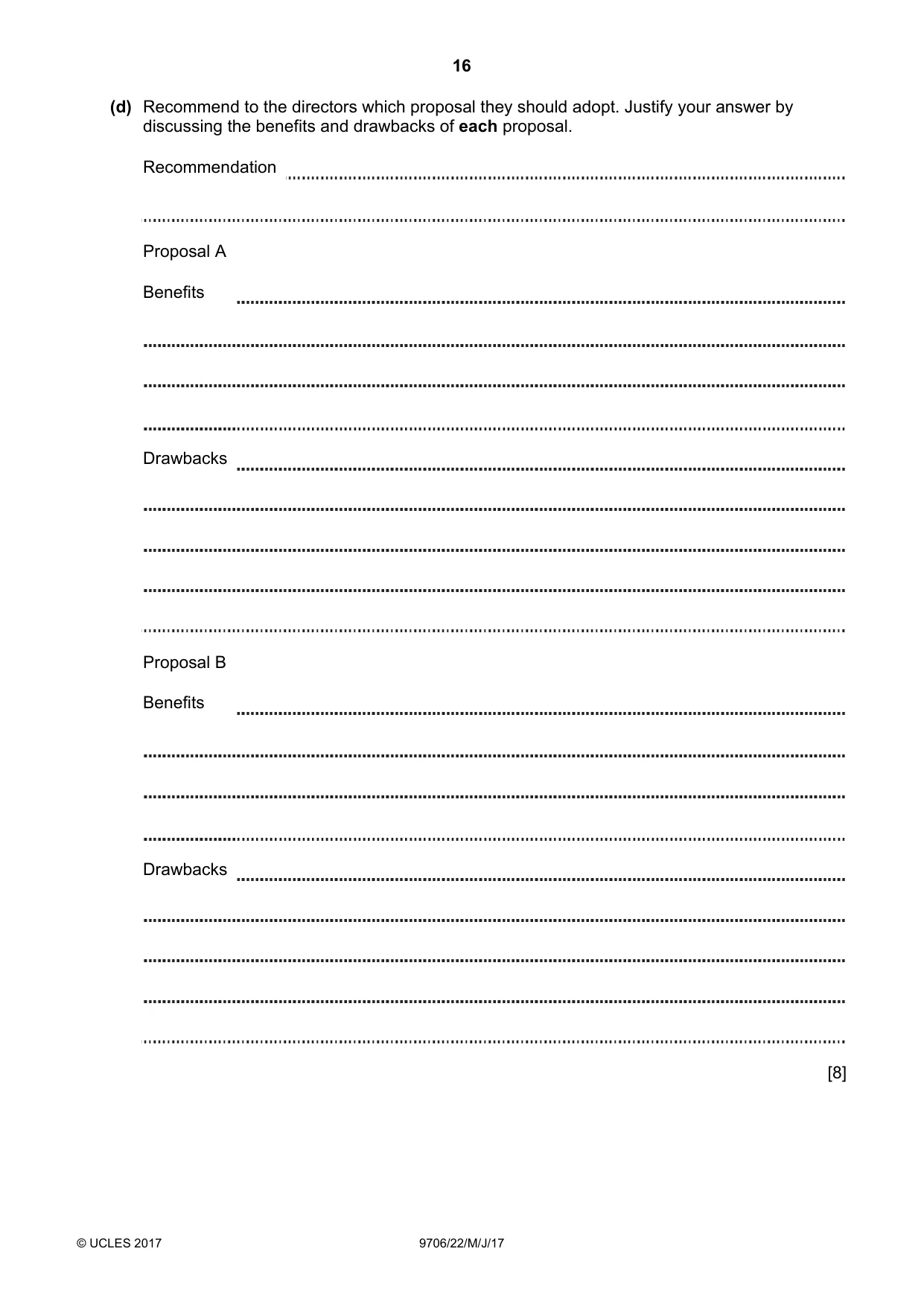
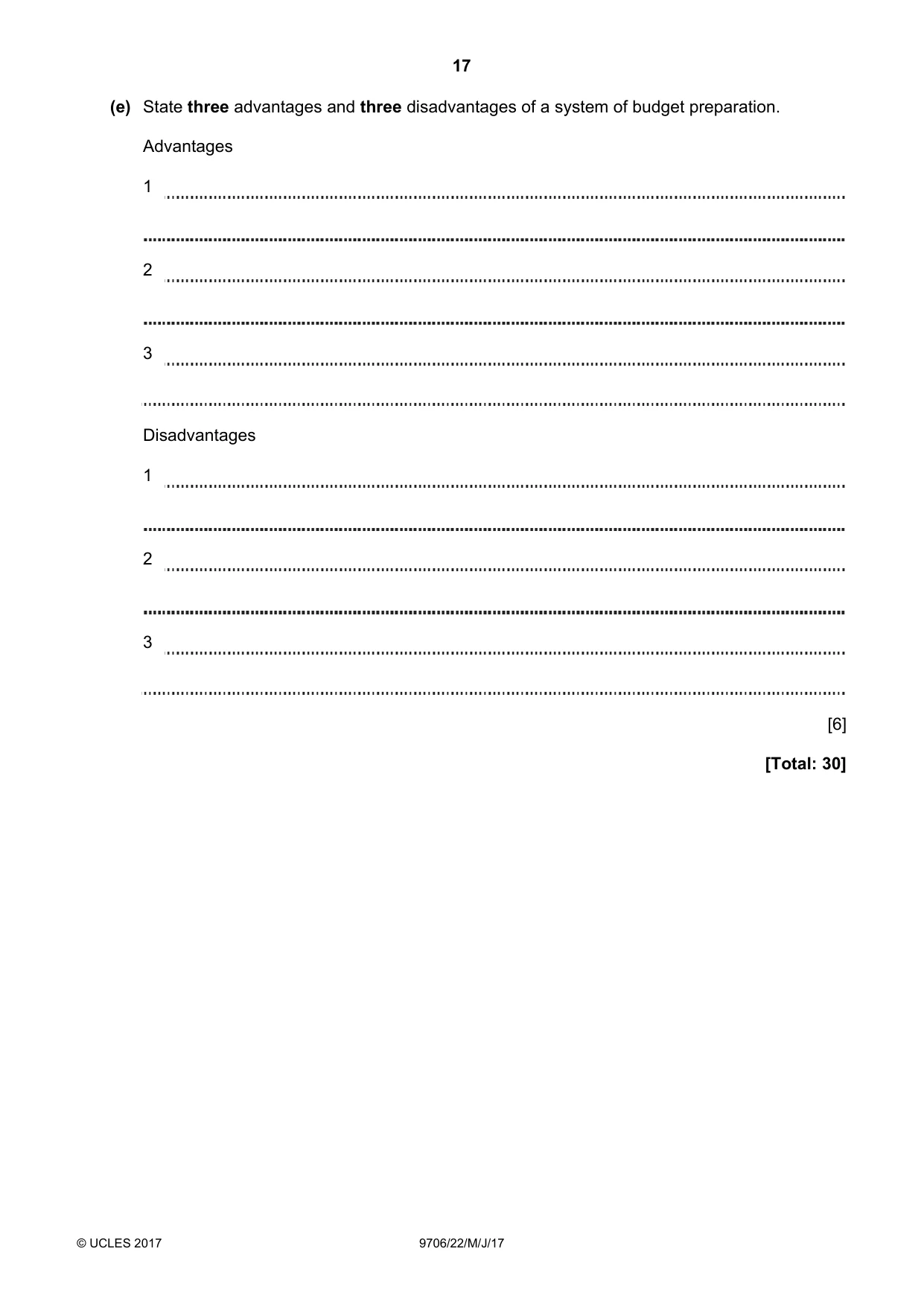
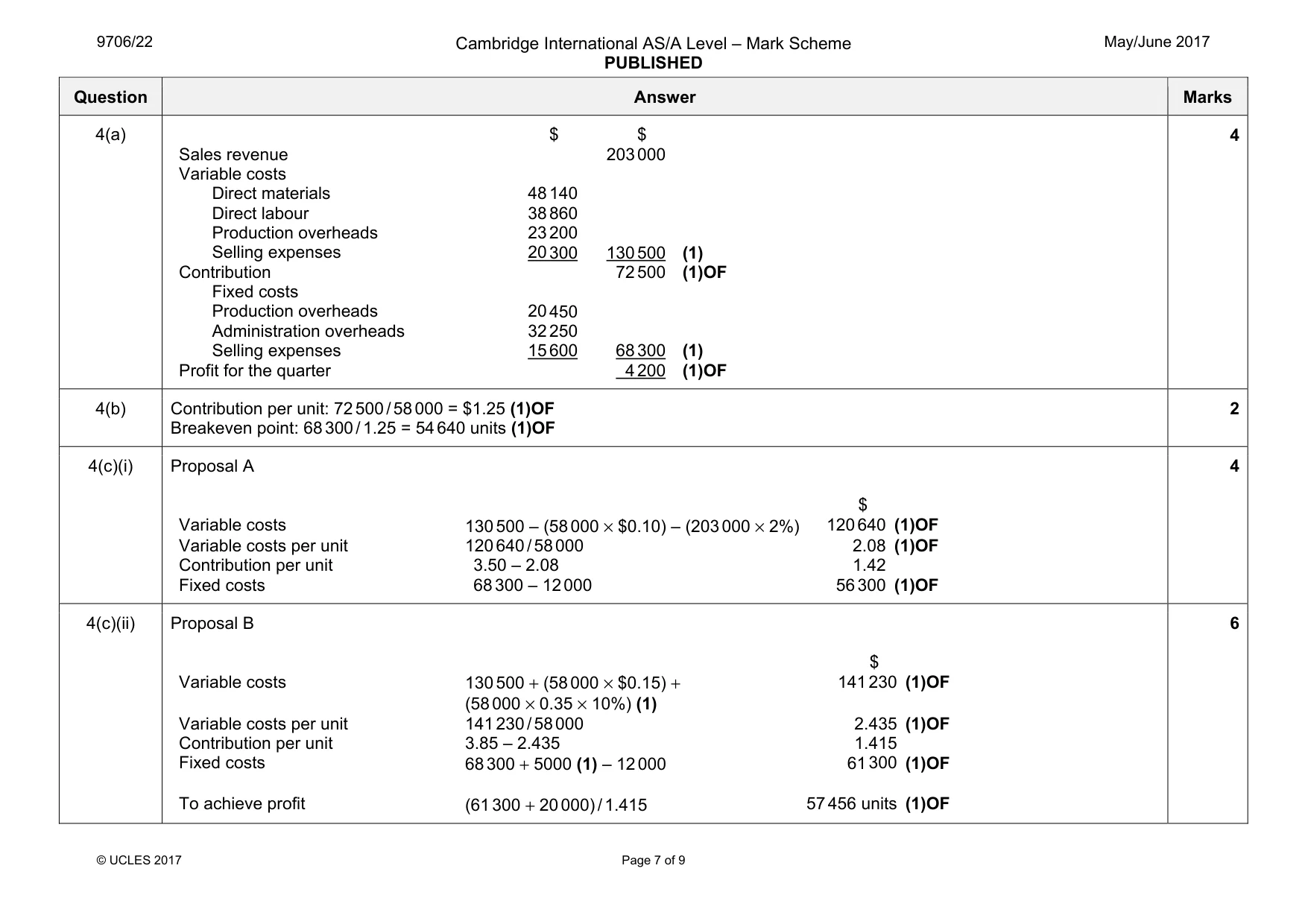
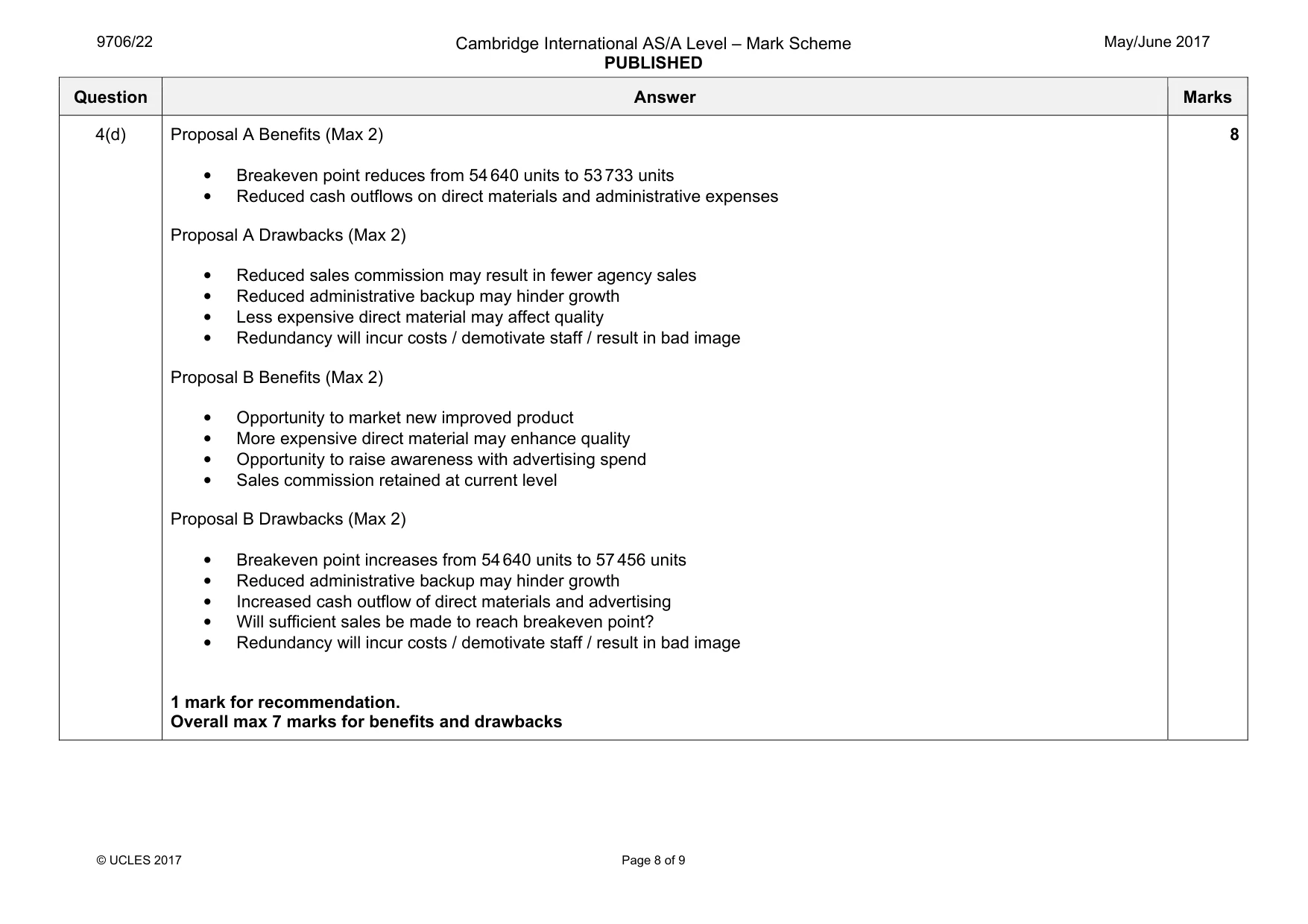
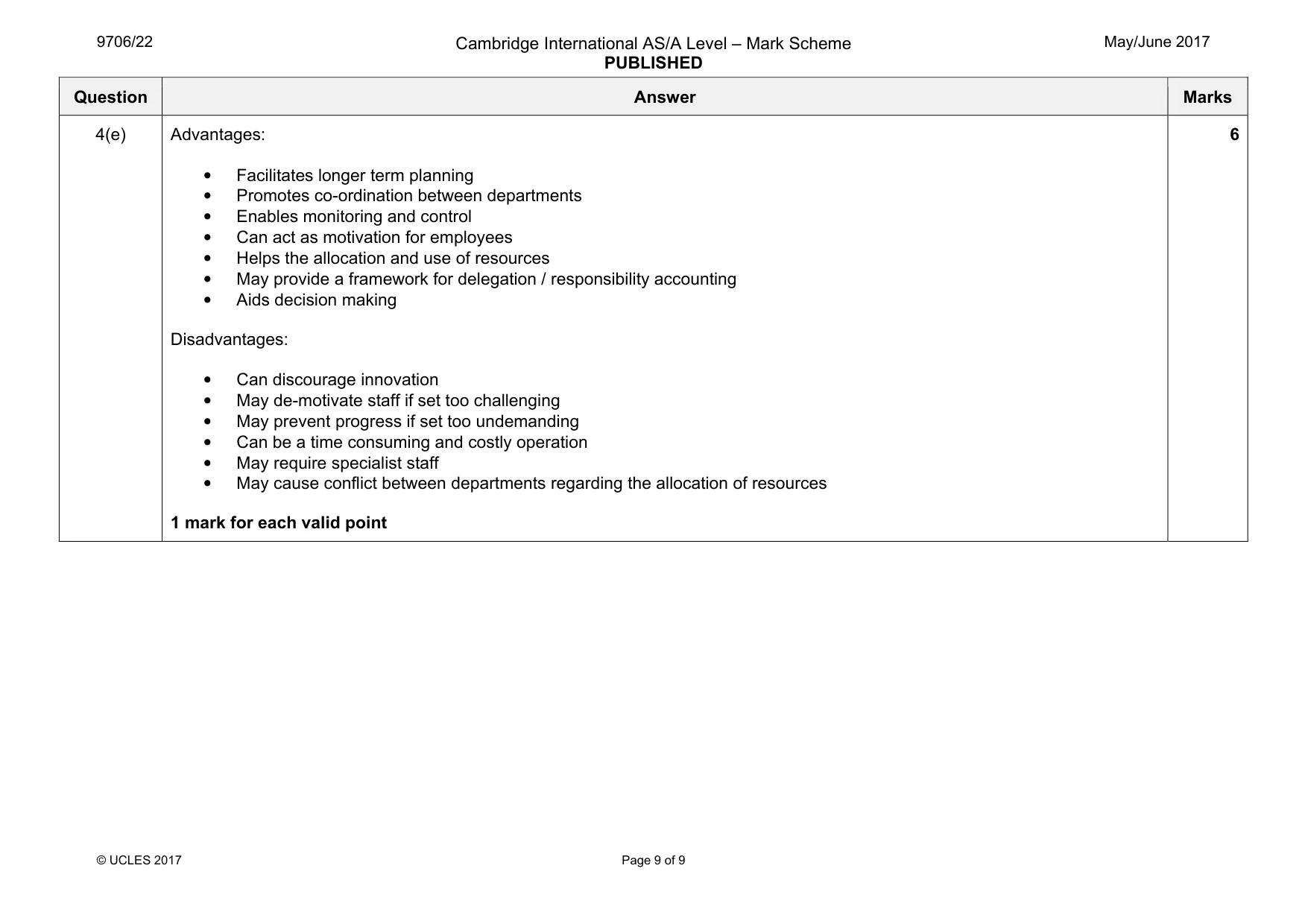
Mark scheme: 4(a) $ $ Sales revenue 203 000 Variable costs Direct materials 48 140 Direct labour 38 860 Production overheads 23 200 Selling expenses 20 300 130 500 (1) Contribution 72 500 (1)OF Fixed costs Production overheads 20 450 Administration overheads 32 250 Selling expenses 15 600 68 300 (1) Profit for the quarter 4 200 (1)OF 4 4(b) Contribution per unit: 72 500 / 58 000 = $1.25 (1)OF Breakeven point: 68 300 / 1.25 = 54 640 units (1)OF 2 4(c)(i) Proposal A $ Variable costs 130 500 – (58 000 × $0.10) – (203 000 × 2%) 120 640 (1)OF Variable costs per unit 120 640 / 58 000 2.08 (1)OF Contribution per unit 3.50 – 2.08 1.42 Fixed costs 68 300 – 12 000 56 300 (1)OF 4 4(c)(ii) Proposal B $ Variable costs 130 500 + (58 000 × $0.15) + (58 000 × 0.35 × 10%) (1) 141 230 (1)OF Variable costs per unit 141 230 / 58 000 2.435 (1)OF Contribution per unit 3.85 – 2.435 1.415 Fixed costs 68 300 + 5000 (1) – 12 000 61 300 (1)OF To achieve profit (61 300 + 20 000) / 1.415 57 456 units (1)OF 6 Question Answer Marks 4(d) Proposal A Benefits (Max 2) • Breakeven point reduces from 54 640 units to 53 733 units • Reduced cash outflows on direct materials and administrative expenses Proposal A Drawbacks (Max 2) • Reduced sales commission may result in fewer agency sales • Reduced administrative backup may hinder growth • Less expensive direct material may affect quality • Redundancy will incur costs / demotivate staff / result in bad image Proposal B Benefits (Max 2) • Opportunity to market new improved product • More expensive direct material may enhance quality • Opportunity to raise awareness with advertising spend • Sales commission retained at current level Proposal B Drawbacks (Max 2) • Breakeven point increases from 54 640 units to 57 456 units • Reduced administrative backup may hinder growth • Increased cash outflow of direct materials and advertising • Will sufficient sales be made to reach breakeven point? • Redundancy will incur costs / demotivate staff / result in bad image 1 mark for recommendation. Overall max 7 marks for benefits and drawbacks 8 Question Answer Marks 4(e) Advantages: • Facilitates longer term planning • Promotes co-ordination between departments • Enables monitoring and control • Can act as motivation for employees • Helps the allocation and use of resources • May provide a framework for delegation / responsibility accounting • Aids decision making Disadvantages: • Can discourage innovation • May de-motivate staff if set too challenging • May prevent progress if set too undemanding • Can be a time consuming and costly operation • May require specialist staff • May cause conflict between departments regarding the allocation of resources 1 mark for each valid point 6
What was in this paper
The subtopics covered by these 4 questions, and how many questions each got. Open one in a new tab to see every Cambridge question on it.
What you needed in this session
Cambridge’s own grade thresholds for 2017 May/June, Paper 2 · Variant 2. A higher threshold means an easier paper — the bar moves with how the cohort did.