Cambridge A Level Accounting 9706 — 2017 May/June Paper 2 · Variant 1
9706/21/M/J/17 · 4 questions · 90 marks · ≈101 min
The question paper and its mark scheme, free to read here and free to download. This is Cambridge’s own paper, exactly as it was sat.
Question paper20 pages
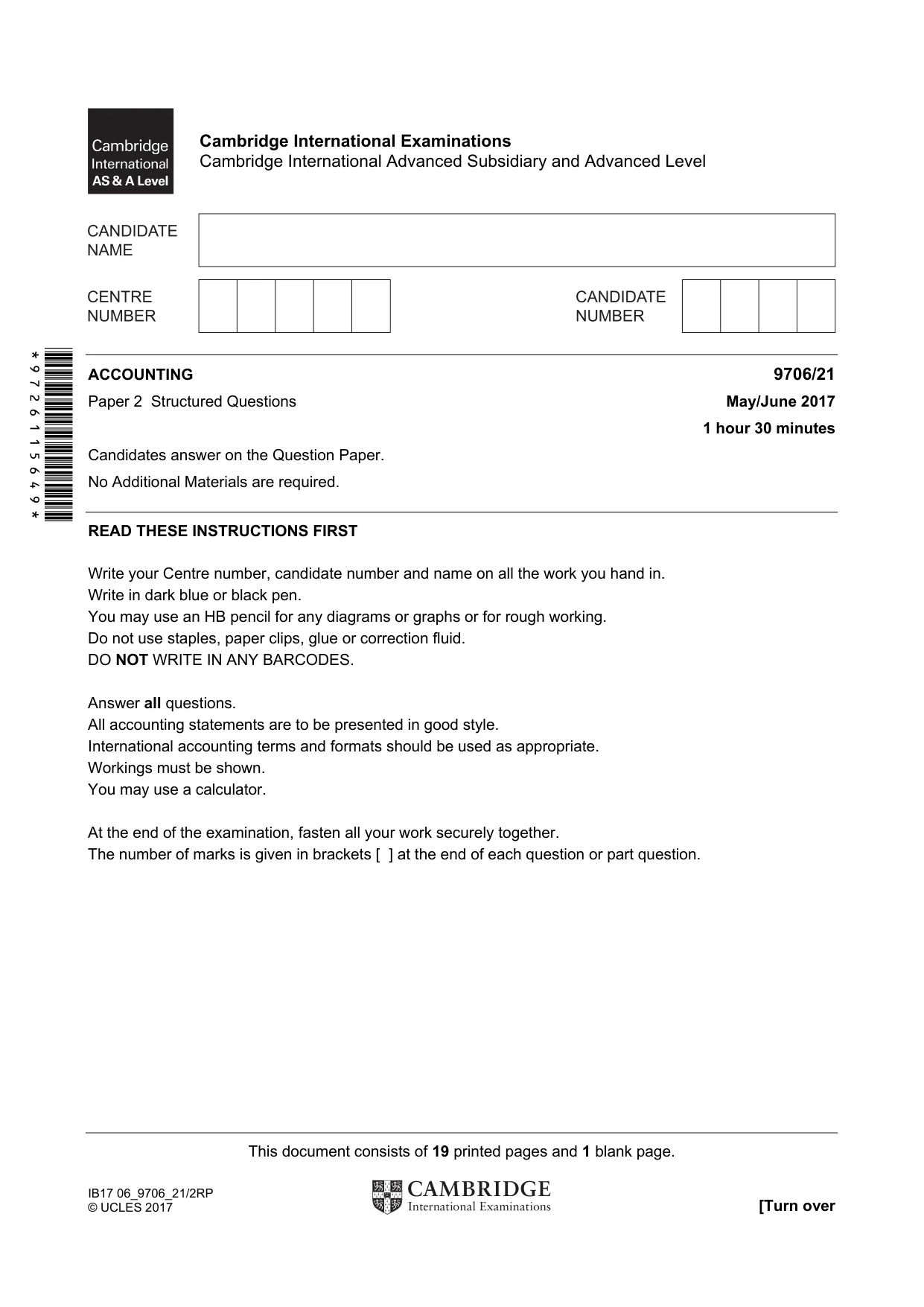
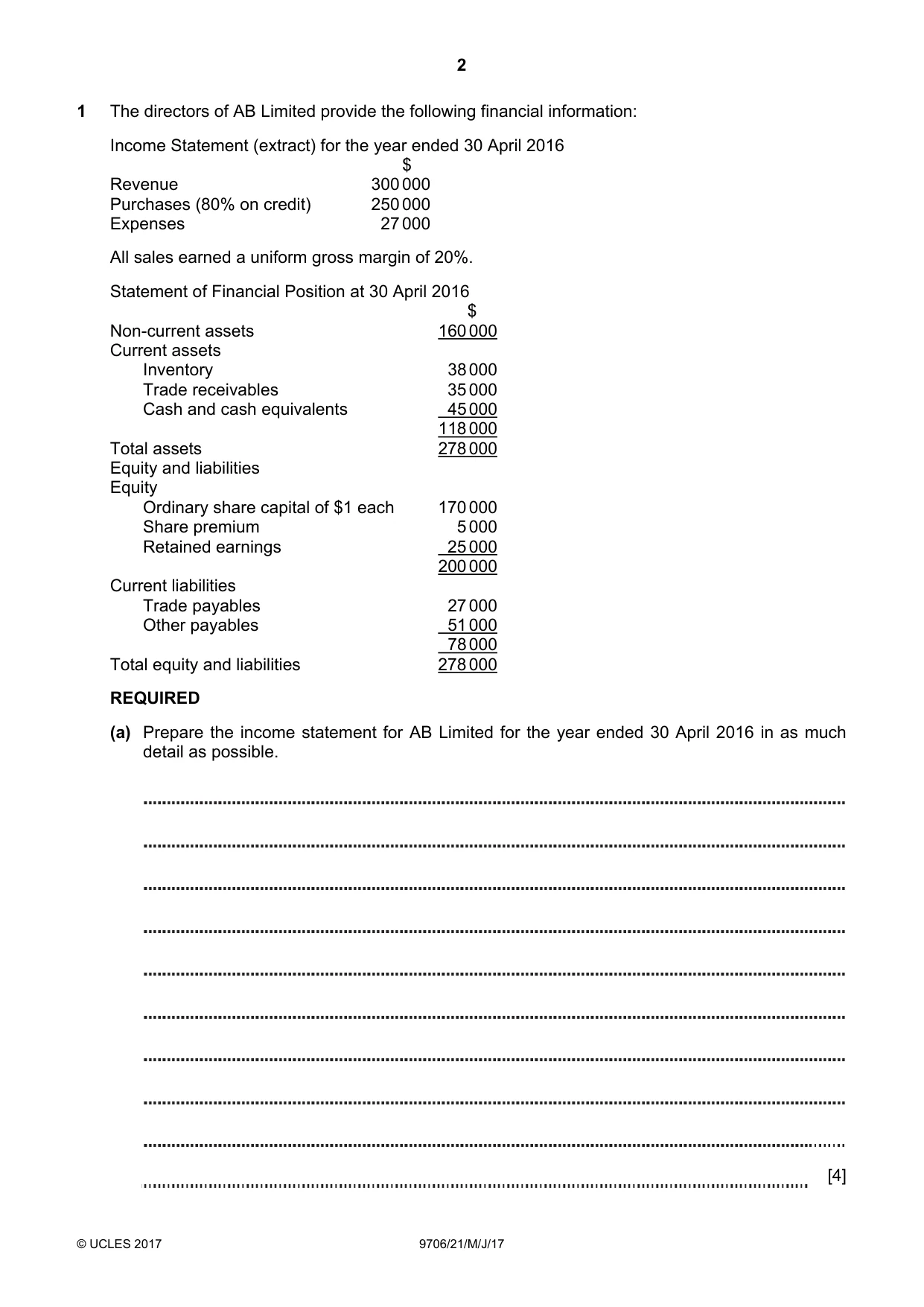
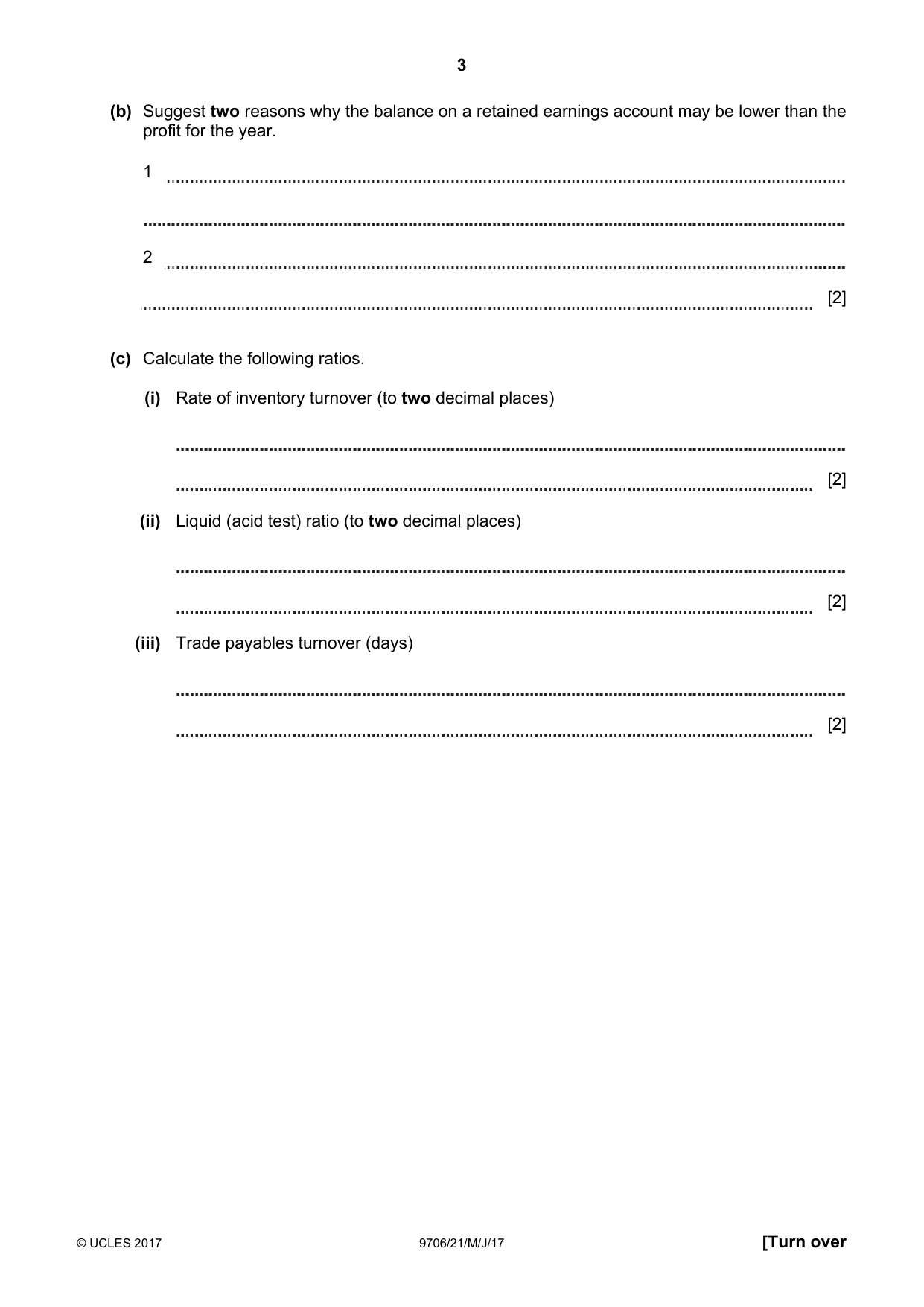
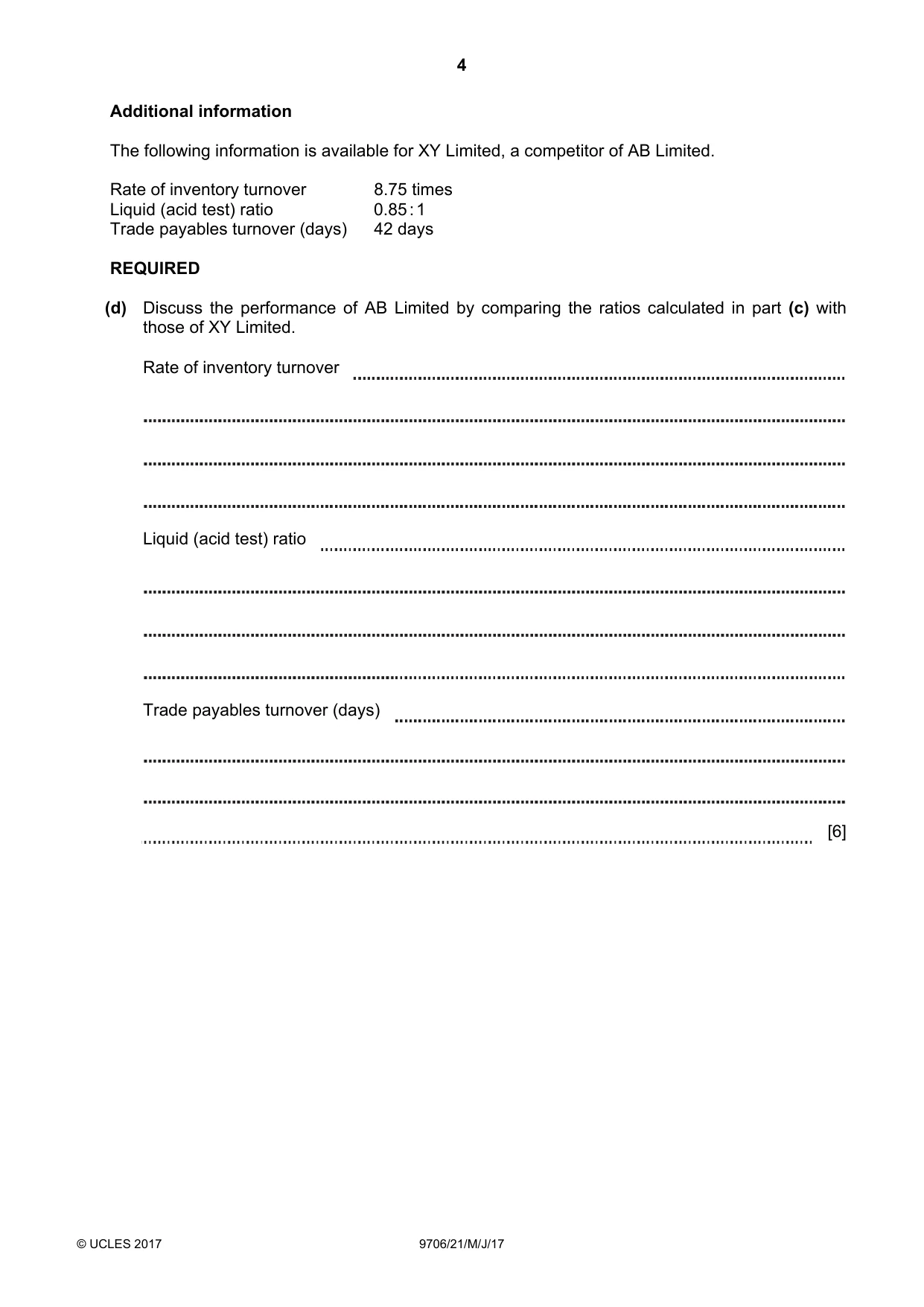


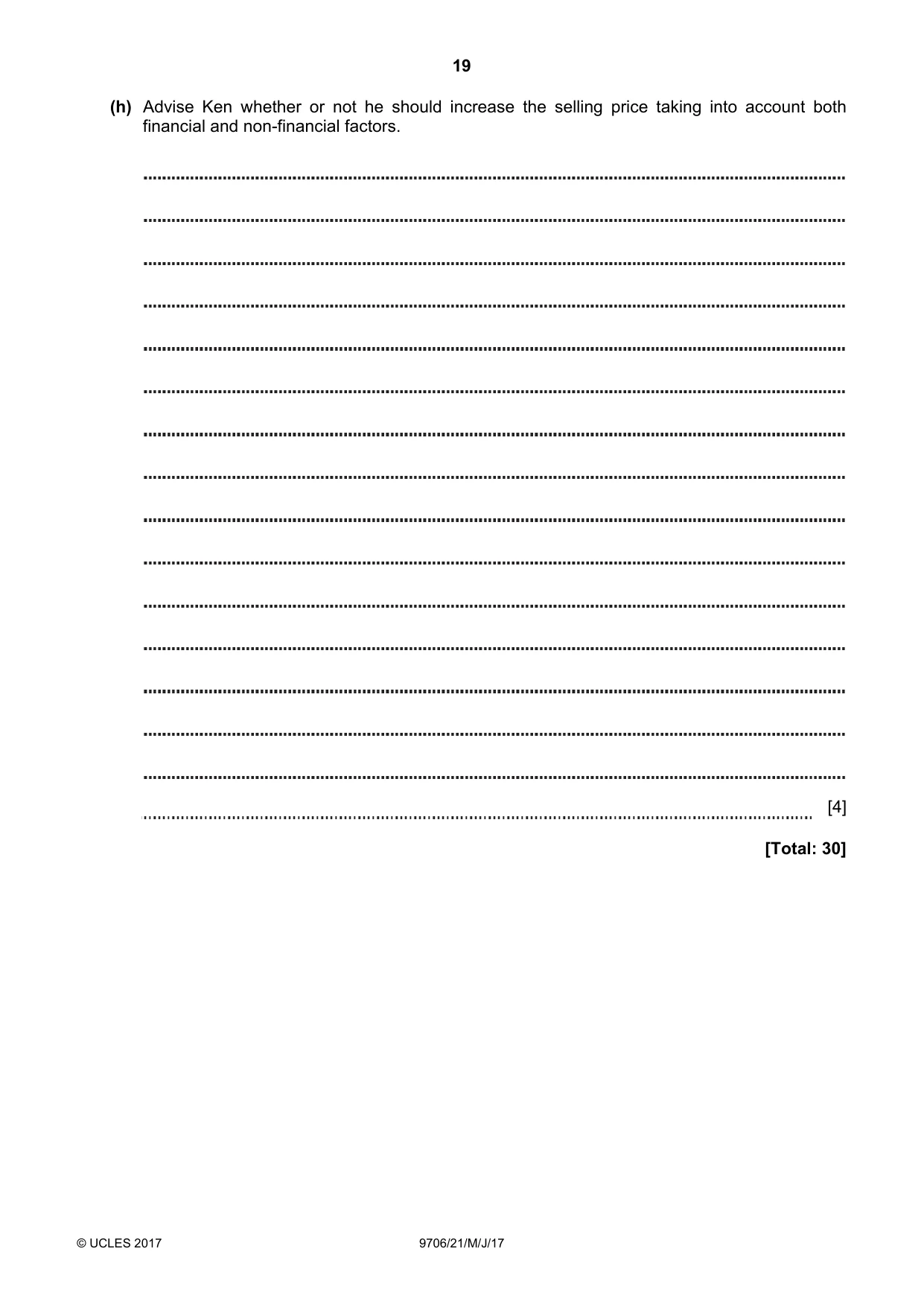
Mark scheme8 pages
Answers below. Sit the paper first if you are practising.
Questions as text
Q1 · The directors of AB Limited provide the following financial information: Income Statement…
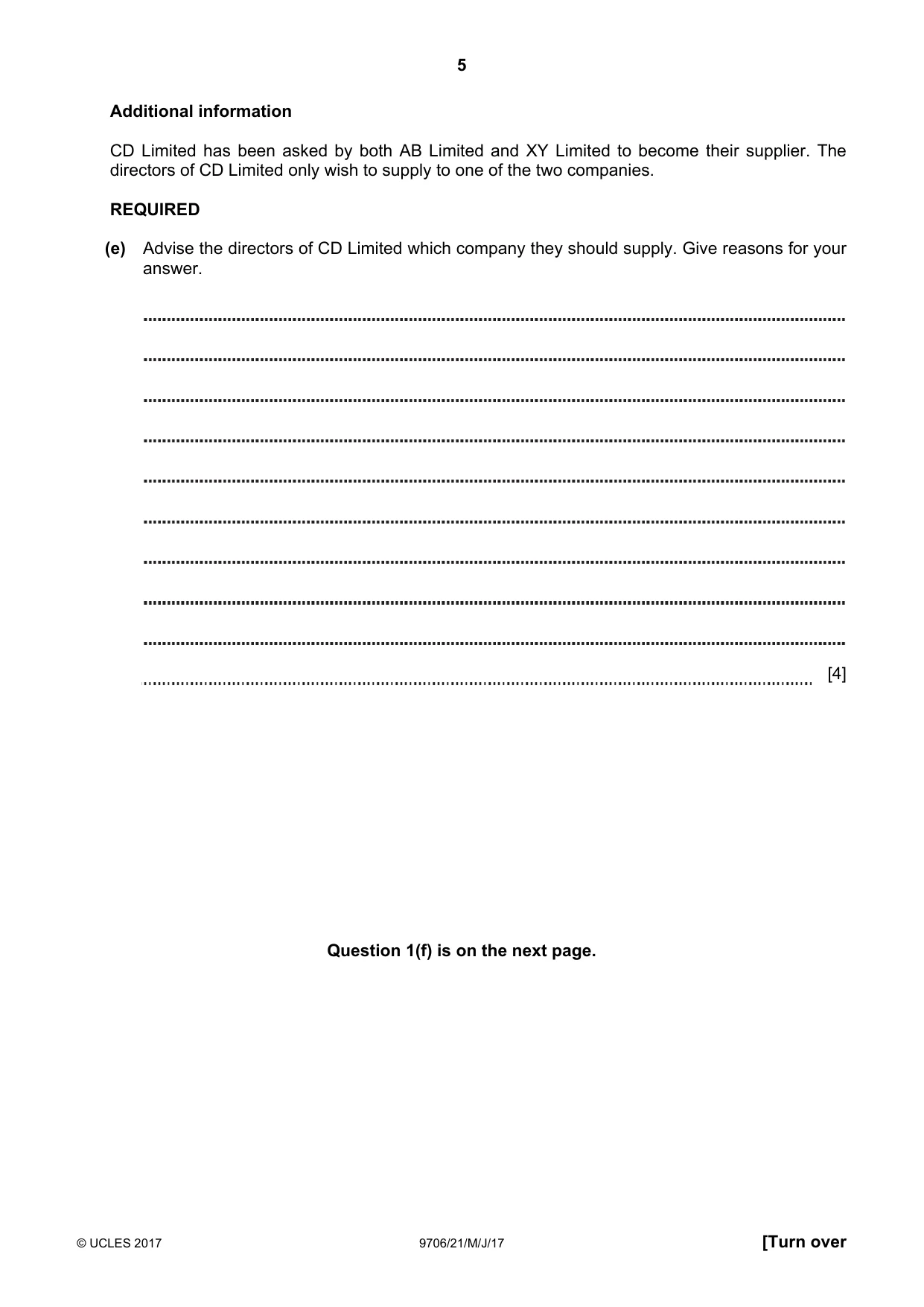
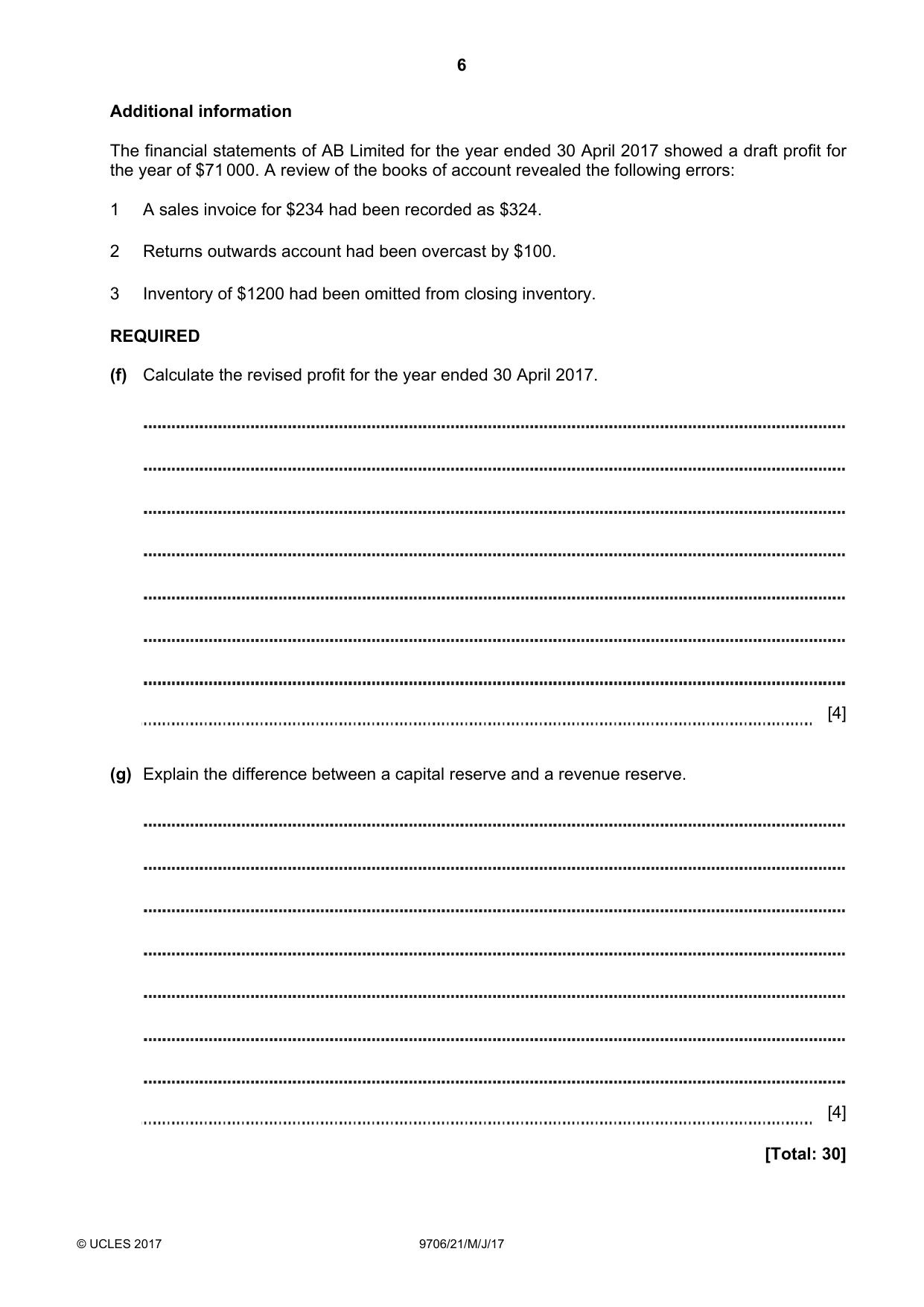
1 The directors of AB Limited provide the following financial information: Income Statement (extract) for the year ended 30 April 2016 $ Revenue 300 000 Purchases (80% on credit) 250 000 Expenses 27 000 All sales earned a uniform gross margin of 20%. Statement of Financial Position at 30 April 2016 $ Non-current assets 160 000 Current assets Inventory 38 000 Trade receivables 35 000 Cash and cash equivalents 45 000 118 000 Total assets 278 000 Equity and liabilities Equity Ordinary share capital of $1 each 170 000 Share premium 5 000 Retained earnings 25 000 200 000 Current liabilities Trade payables 27 000 Other payables 51 000 78 000 Total equity and liabilities 278 000 REQUIRED (a) Prepare the income statement for AB Limited for the year ended 30 April 2016 in as much detail as possible. [4] (b) Suggest two reasons why the balance on a retained earnings account may be lower than the profit for the year. 1 2 [2] (c) Calculate the following ratios. (i) Rate of inventory turnover (to two decimal places) [2] (ii) Liquid (acid test) ratio (to two decimal places) [2] (iii) Trade payables turnover (days) [2] Additional information The following information is available for XY Limited, a competitor of AB Limited. Rate of inventory turnover 8.75 times Liquid (acid test) ratio 0.85 : 1 Trade payables turnover (days) 42 days REQUIRED (d) Discuss the performance of AB Limited by comparing the ratios calculated in part (c) with those of XY Limited. Rate of inventory turnover Liquid (acid test) ratio Trade payables turnover (days) [6] Additional information CD Limited has been asked by both AB Limited and XY Limited to become their supplier. The directors of CD Limited only wish to supply to one of the two companies. REQUIRED (e) Advise the directors of CD Limited which company they should supply. Give reasons for your answer. [4] Question 1(f) is on the next page. Additional information The financial statements of AB Limited for the year ended 30 April 2017 showed a draft profit for the year of $71 000. A review of the books of account revealed the following errors: 1 A sales invoice for $234 had been recorded as $324. 2 Returns outwards account had been overcast by $100. 3 Inventory of $1200 had been omitted from closing inventory. REQUIRED (f) Calculate the revised profit for the year ended 30 April 2017. [4] (g) Explain the difference between a capital reserve and a revenue reserve. [4] [Total: 30] Question 2 is on the next page.
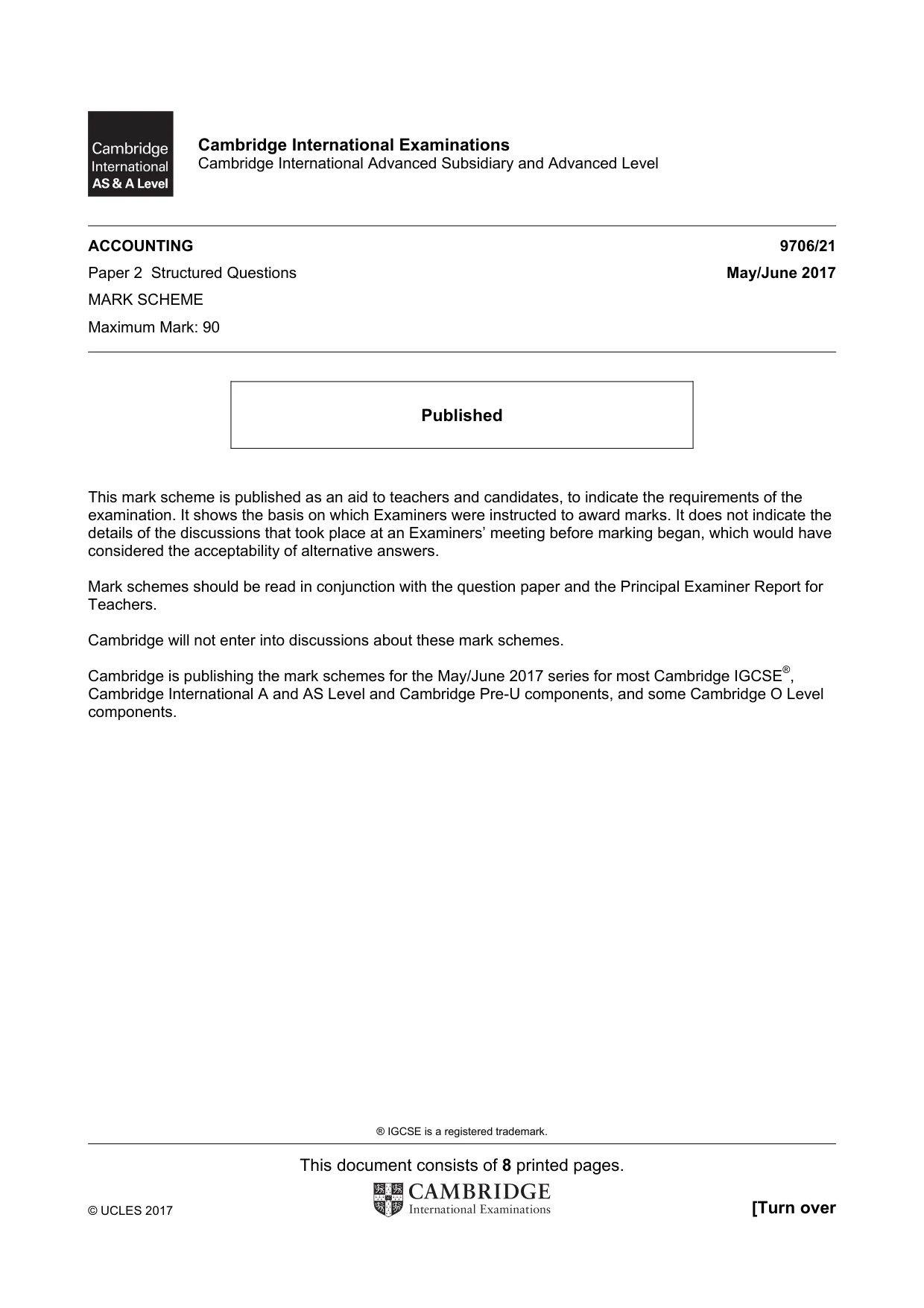
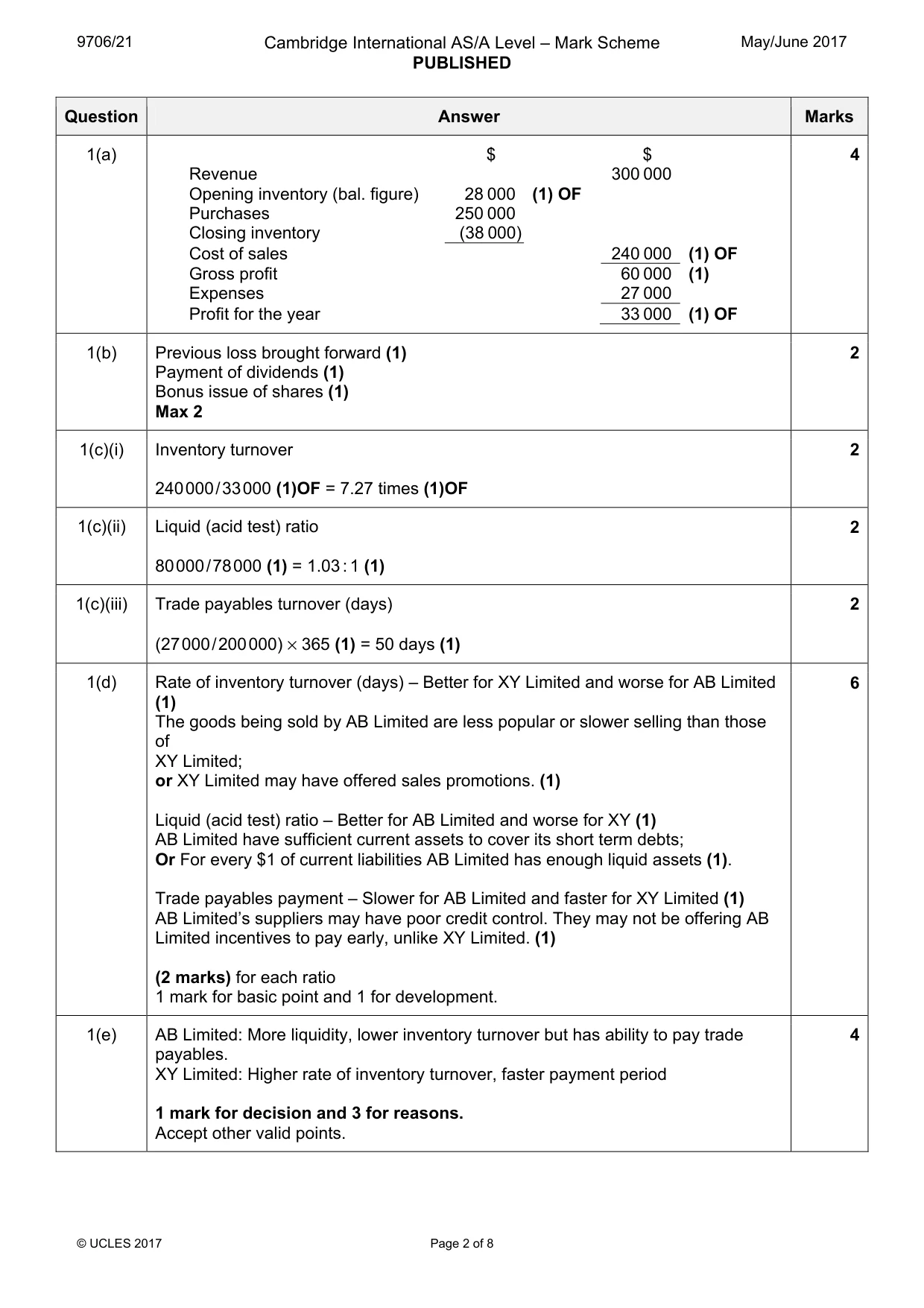
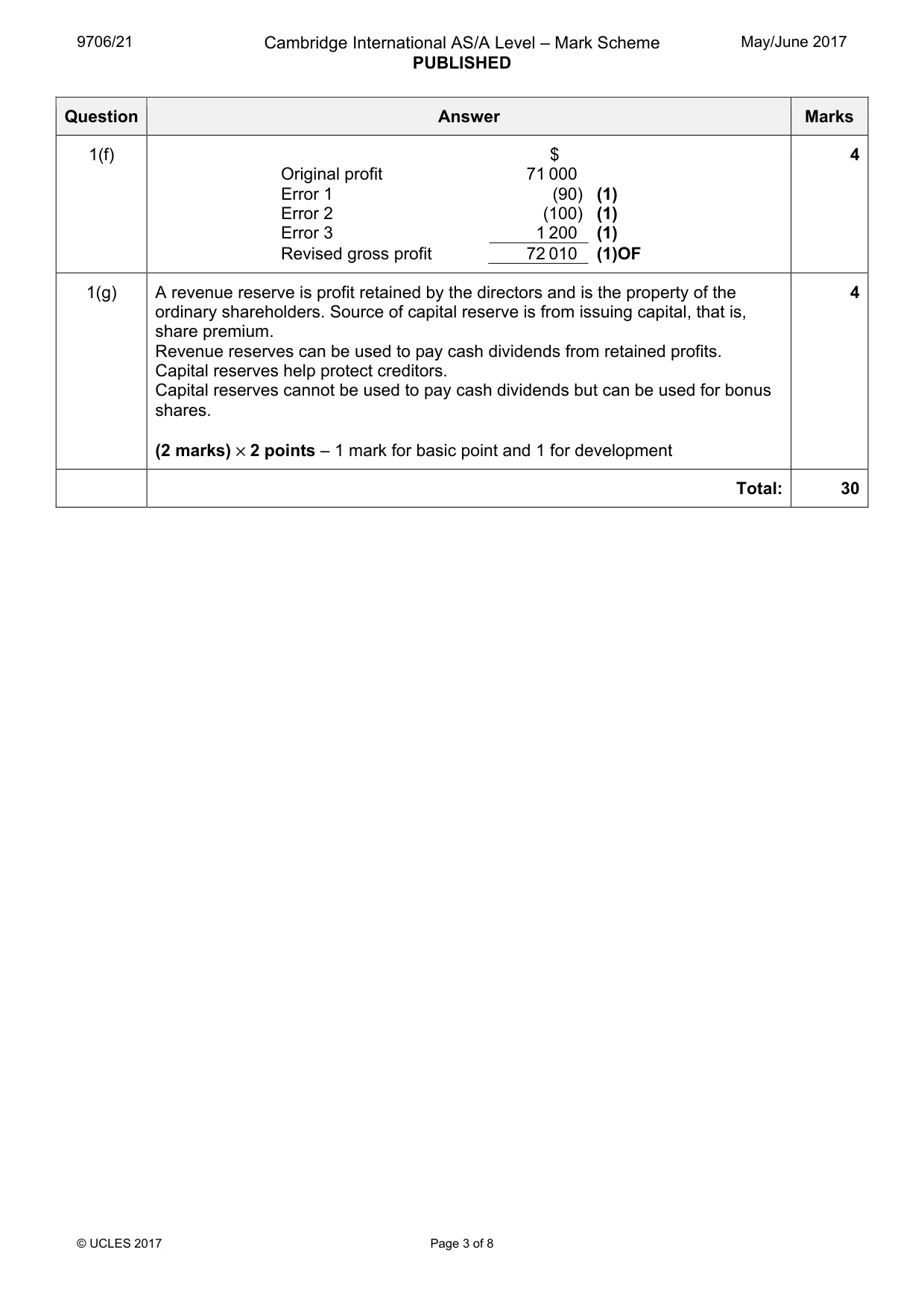
Mark scheme: Question Answer Marks 1(a) $ $ 4 Revenue 300 000 Opening inventory (bal. figure) 28 000 (1) OF Purchases 250 000 Closing inventory (38 000) Cost of sales 240 000 (1) OF Gross profit 60 000 (1) Expenses 27 000 Profit for the year 33 000 (1) OF 1(b) Previous loss brought forward (1) 2 Payment of dividends (1) Bonus issue of shares (1) Max 2 1(c)(i) Inventory turnover 2 240 000 / 33 000 (1)OF = 7.27 times (1)OF 1(c)(ii) Liquid (acid test) ratio 2 80 000 / 78 000 (1) = 1.03 : 1 (1) 1(c)(iii) Trade payables turnover (days) 2 (27 000 / 200 000) × 365 (1) = 50 days (1) 1(d) Rate of inventory turnover (days) – Better for XY Limited and worse for AB Limited 6 (1) The goods being sold by AB Limited are less popular or slower selling than those of XY Limited; or XY Limited may have offered sales promotions. (1) Liquid (acid test) ratio – Better for AB Limited and worse for XY (1) AB Limited have sufficient current assets to cover its short term debts; Or For every $1 of current liabilities AB Limited has enough liquid assets (1). Trade payables payment – Slower for AB Limited and faster for XY Limited (1) AB Limited’s suppliers may have poor credit control. They may not be offering AB Limited incentives to pay early, unlike XY Limited. (1) (2 marks) for each ratio 1 mark for basic point and 1 for development. 1(e) AB Limited: More liquidity, lower inventory turnover but has ability to pay trade 4 payables. XY Limited: Higher rate of inventory turnover, faster payment period 1 mark for decision and 3 for reasons. Accept other valid points. 1(f) $ 4 Original profit 71 000 Error 1 (90) (1) Error 2 (100) (1) Error 3 1 200 (1) Revised gross profit 72 010 (1)OF 1(g) A revenue reserve is profit retained by the directors and is the property of the 4 ordinary shareholders. Source of capital reserve is from issuing capital, that is, share premium. Revenue reserves can be used to pay cash dividends from retained profits. Capital reserves help protect creditors. Capital reserves cannot be used to pay cash dividends but can be used for bonus shares. (2 marks) × 2 points – 1 mark for basic point and 1 for development Total: 30
More questions on Analysis and communication of accounting information
Q2 · Amit and Binu are in partnership sharing profits and losses in the ratio 3 : 2…
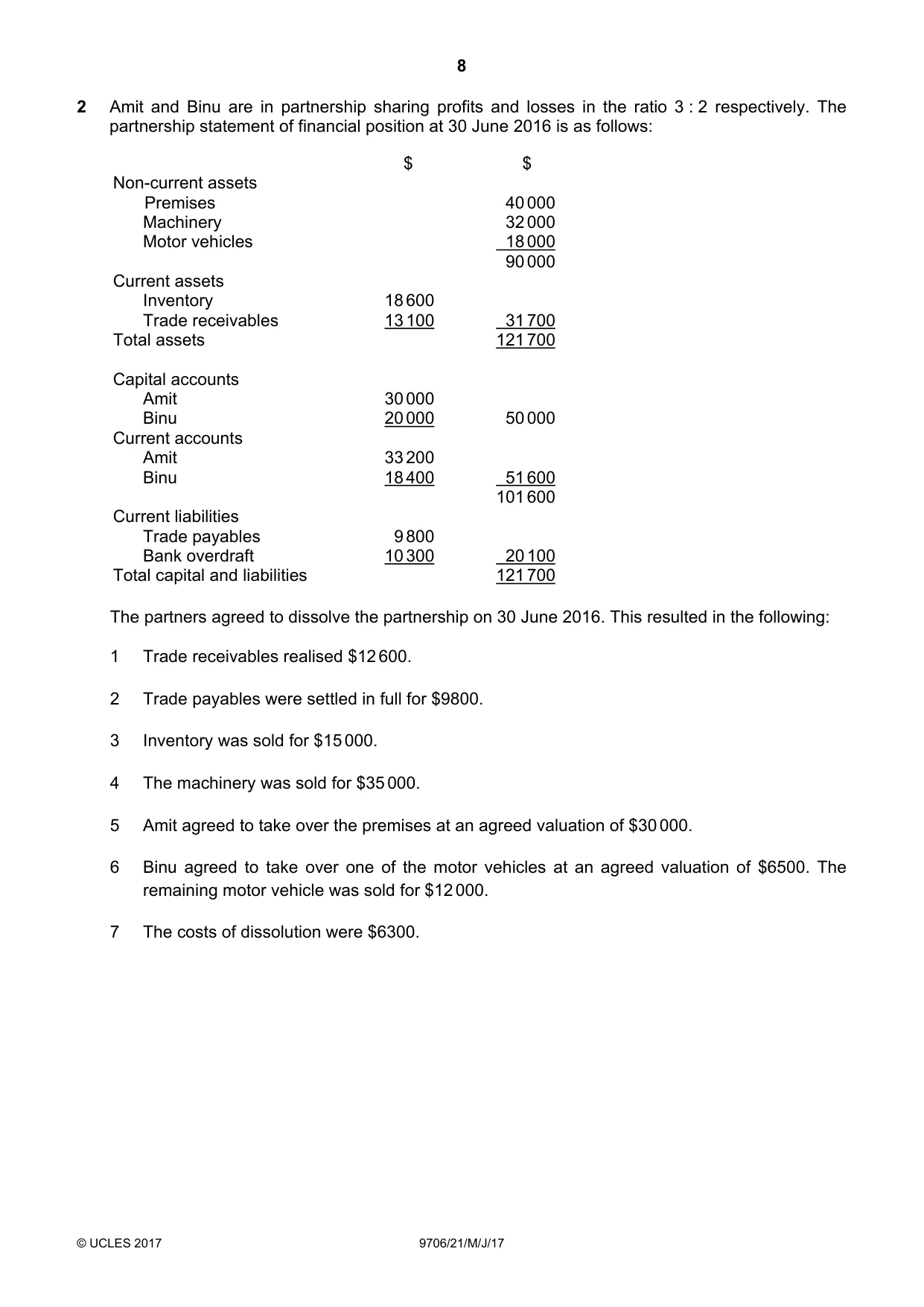
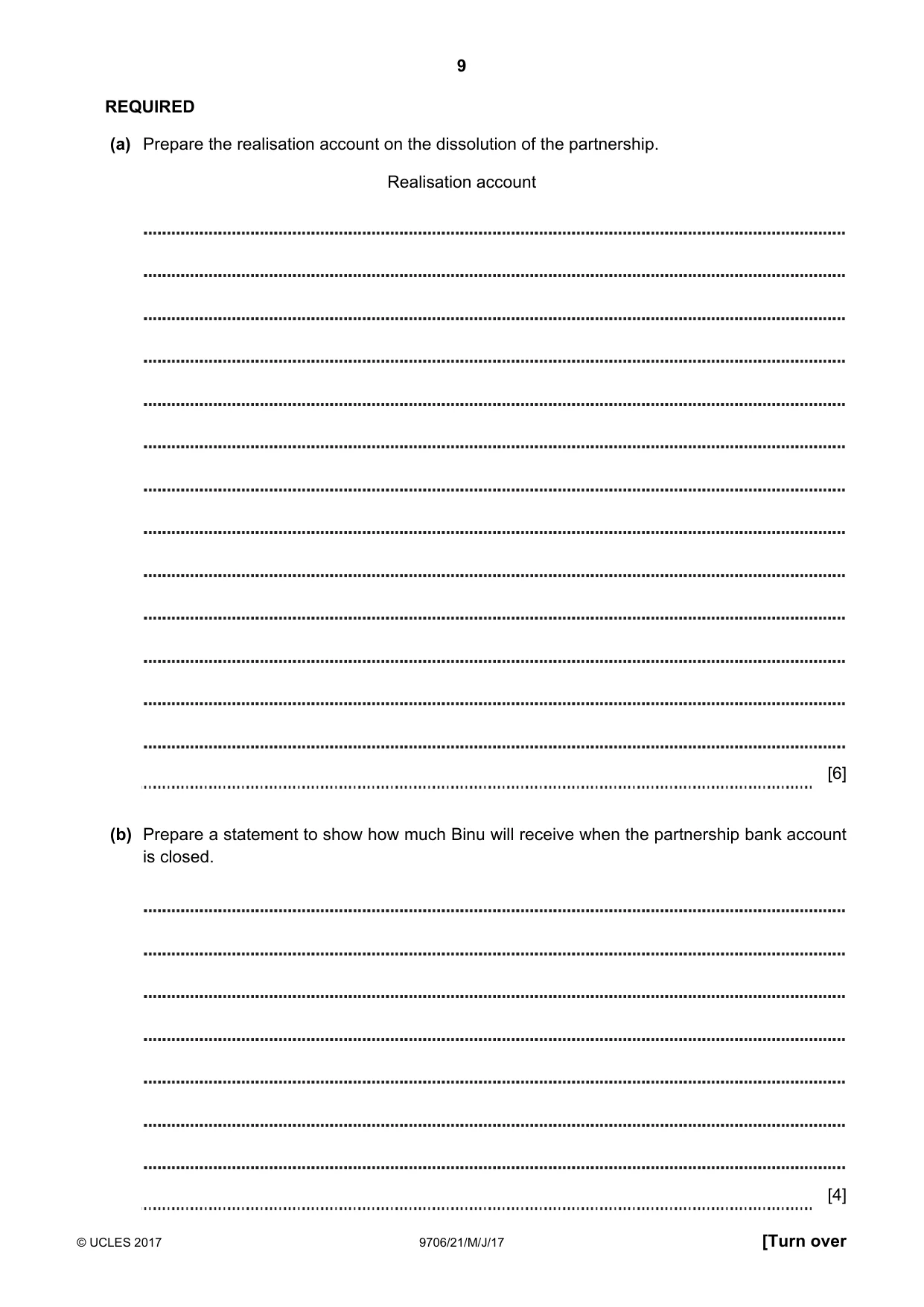
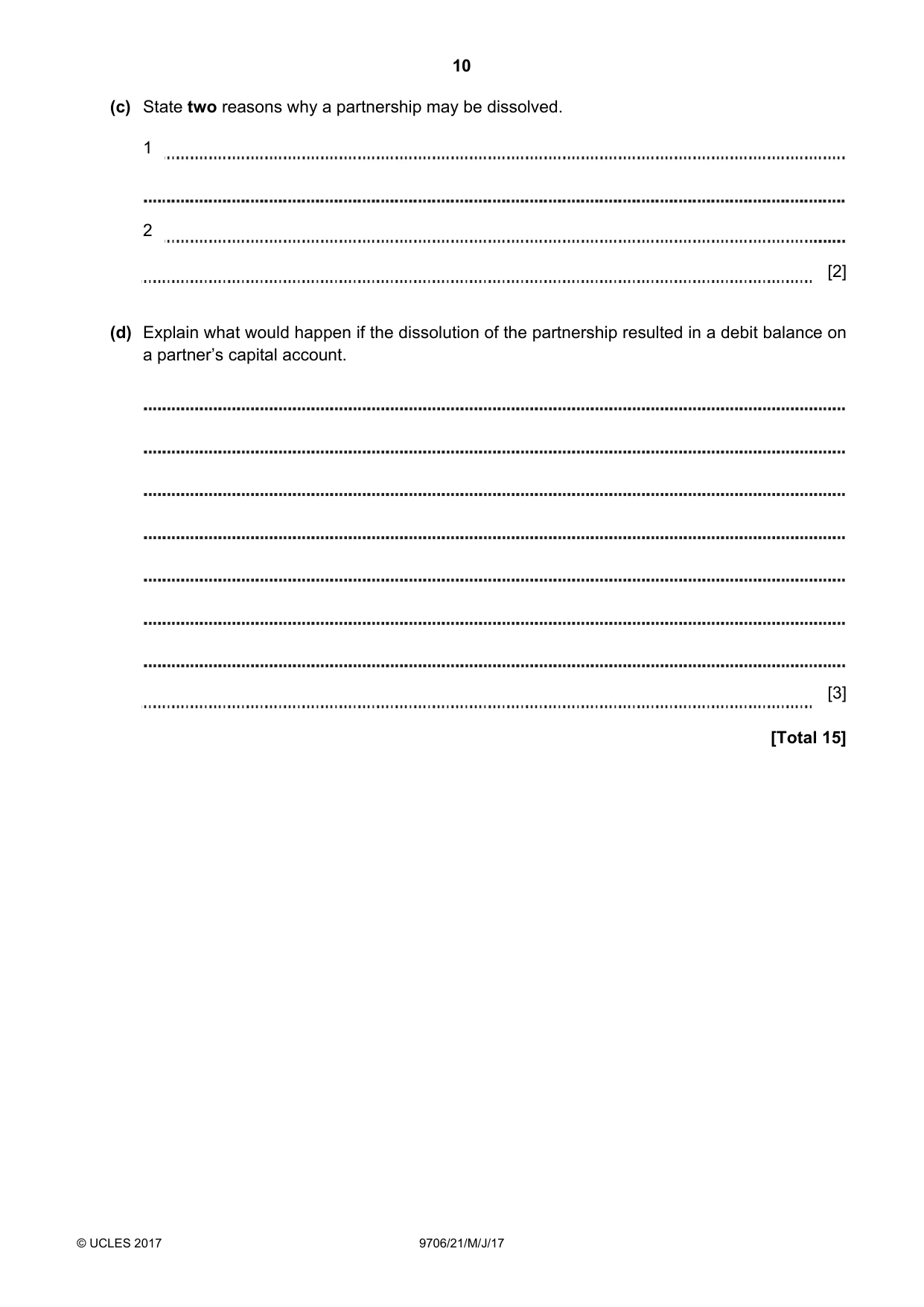
2 Amit and Binu are in partnership sharing profits and losses in the ratio 3 : 2 respectively. The partnership statement of financial position at 30 June 2016 is as follows: $ $ Non-current assets Premises 40 000 Machinery 32 000 Motor vehicles 18 000 90 000 Current assets Inventory 18 600 Trade receivables 13 100 31 700 Total assets 121 700 Capital accounts Amit 30 000 Binu 20 000 50 000 Current accounts Amit 33 200 Binu 18 400 51 600 101 600 Current liabilities Trade payables 9 800 Bank overdraft 10 300 20 100 Total capital and liabilities 121 700 The partners agreed to dissolve the partnership on 30 June 2016. This resulted in the following: 1 Trade receivables realised $12 600. 2 Trade payables were settled in full for $9800. 3 Inventory was sold for $15 000. 4 The machinery was sold for $35 000. 5 Amit agreed to take over the premises at an agreed valuation of $30 000. 6 Binu agreed to take over one of the motor vehicles at an agreed valuation of $6500. The remaining motor vehicle was sold for $12 000. 7 The costs of dissolution were $6300. REQUIRED (a) Prepare the realisation account on the dissolution of the partnership. Realisation account [6] (b) Prepare a statement to show how much Binu will receive when the partnership bank account is closed. [4] (c) State two reasons why a partnership may be dissolved. 1 2 [2] (d) Explain what would happen if the dissolution of the partnership resulted in a debit balance on a partner’s capital account. [3] [Total 15] Question 3 is on the next page.
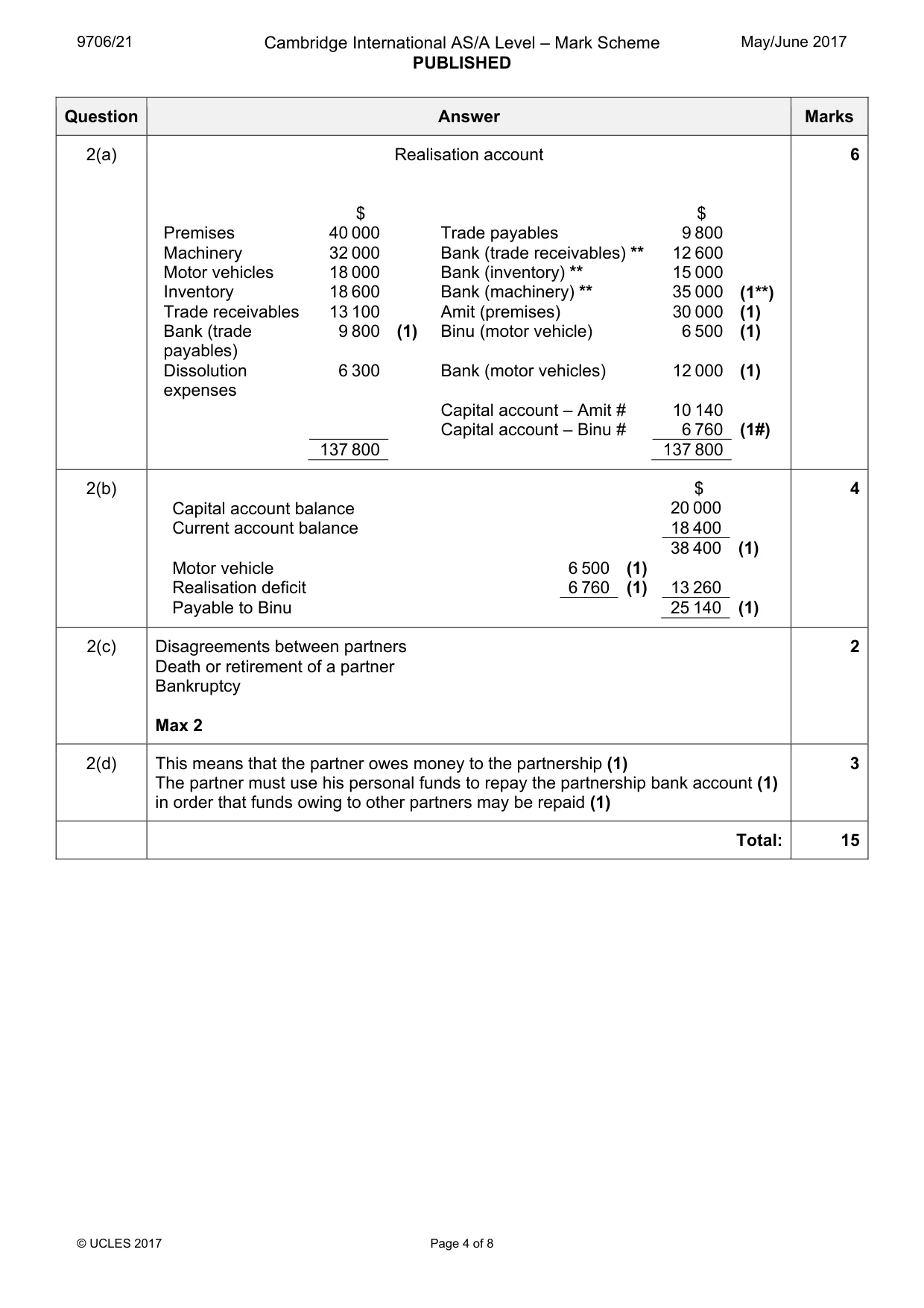
Mark scheme: 2(a) Realisation account 6 $ $ Premises 40 000 Trade payables 9 800 Machinery 32 000 Bank (trade receivables) ** 12 600 Motor vehicles 18 000 Bank (inventory) ** 15 000 Inventory 18 600 Bank (machinery) ** 35 000 (1**) Trade receivables 13 100 Amit (premises) 30 000 (1) Bank (trade 9 800 (1) Binu (motor vehicle) 6 500 (1) payables) Dissolution 6 300 Bank (motor vehicles) 12 000 (1) expenses Capital account – Amit # 10 140 Capital account – Binu # 6 760 (1#) 137 800 137 800 2(b) $ 4 Capital account balance 20 000 Current account balance 18 400 38 400 (1) Motor vehicle 6 500 (1) Realisation deficit 6 760 (1) 13 260 Payable to Binu 25 140 (1) 2(c) Disagreements between partners 2 Death or retirement of a partner Bankruptcy Max 2 2(d) This means that the partner owes money to the partnership (1) 3 The partner must use his personal funds to repay the partnership bank account (1) in order that funds owing to other partners may be repaid (1) Total: 15
Q3 · Meena did not keep full accounting records
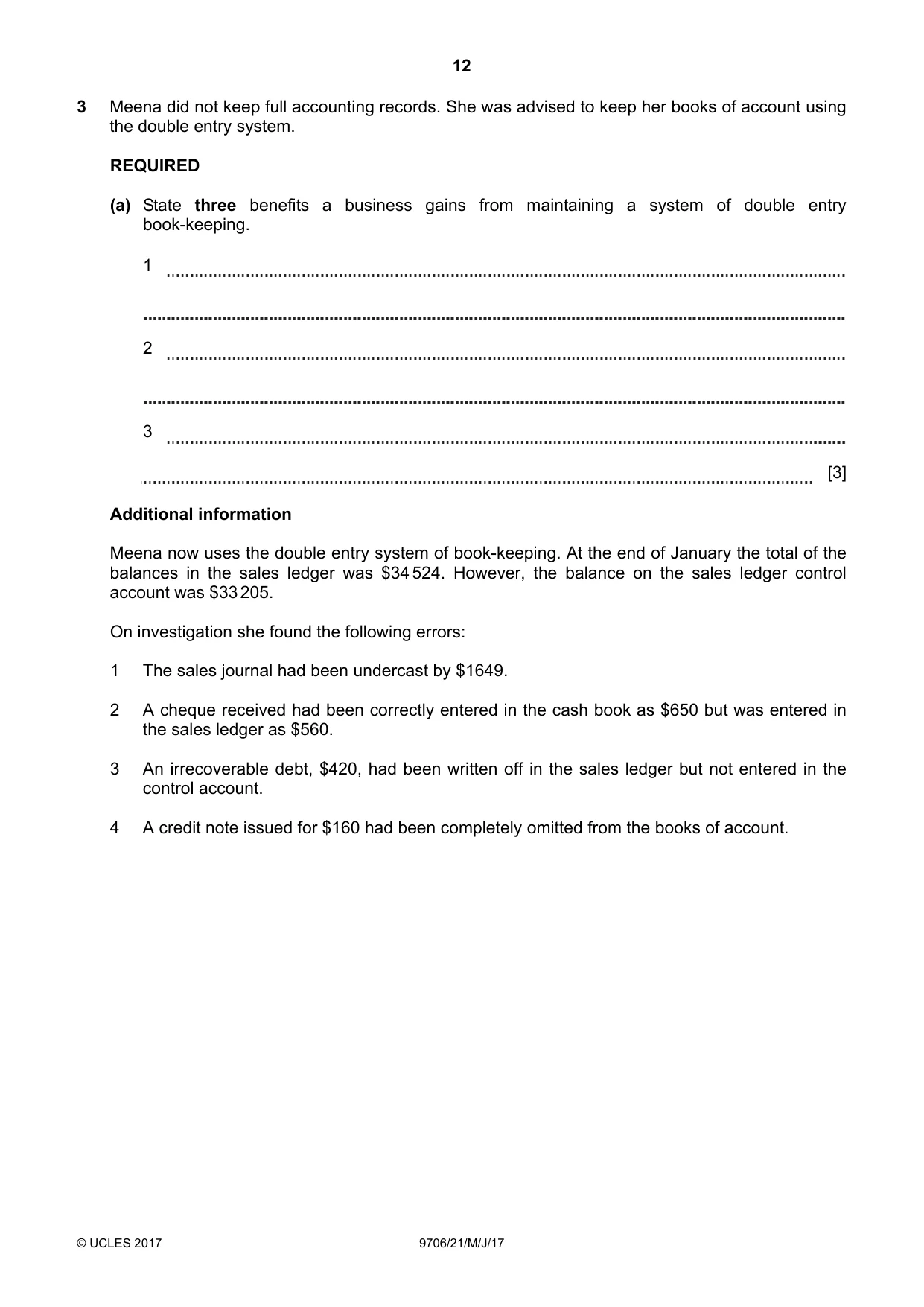
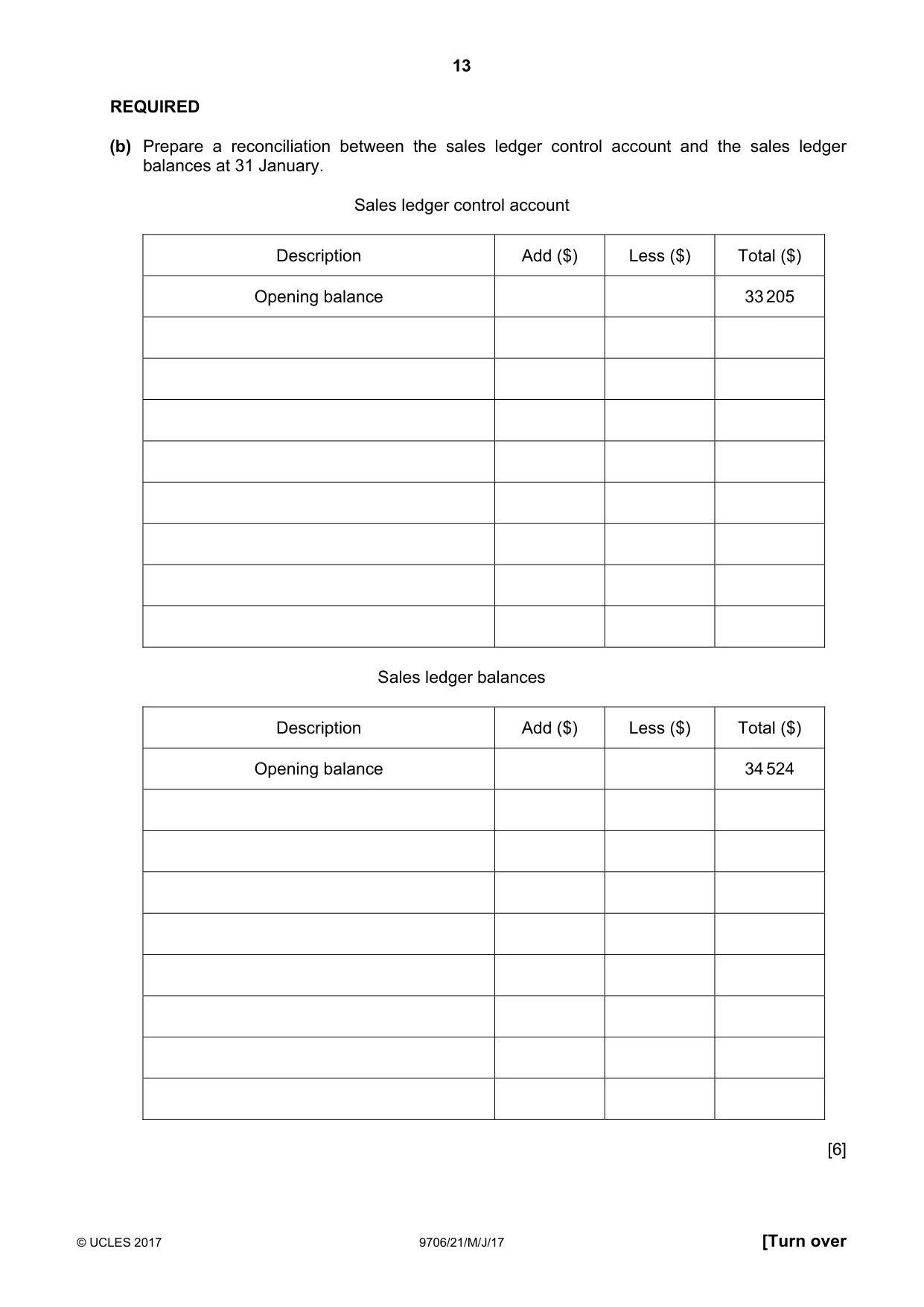
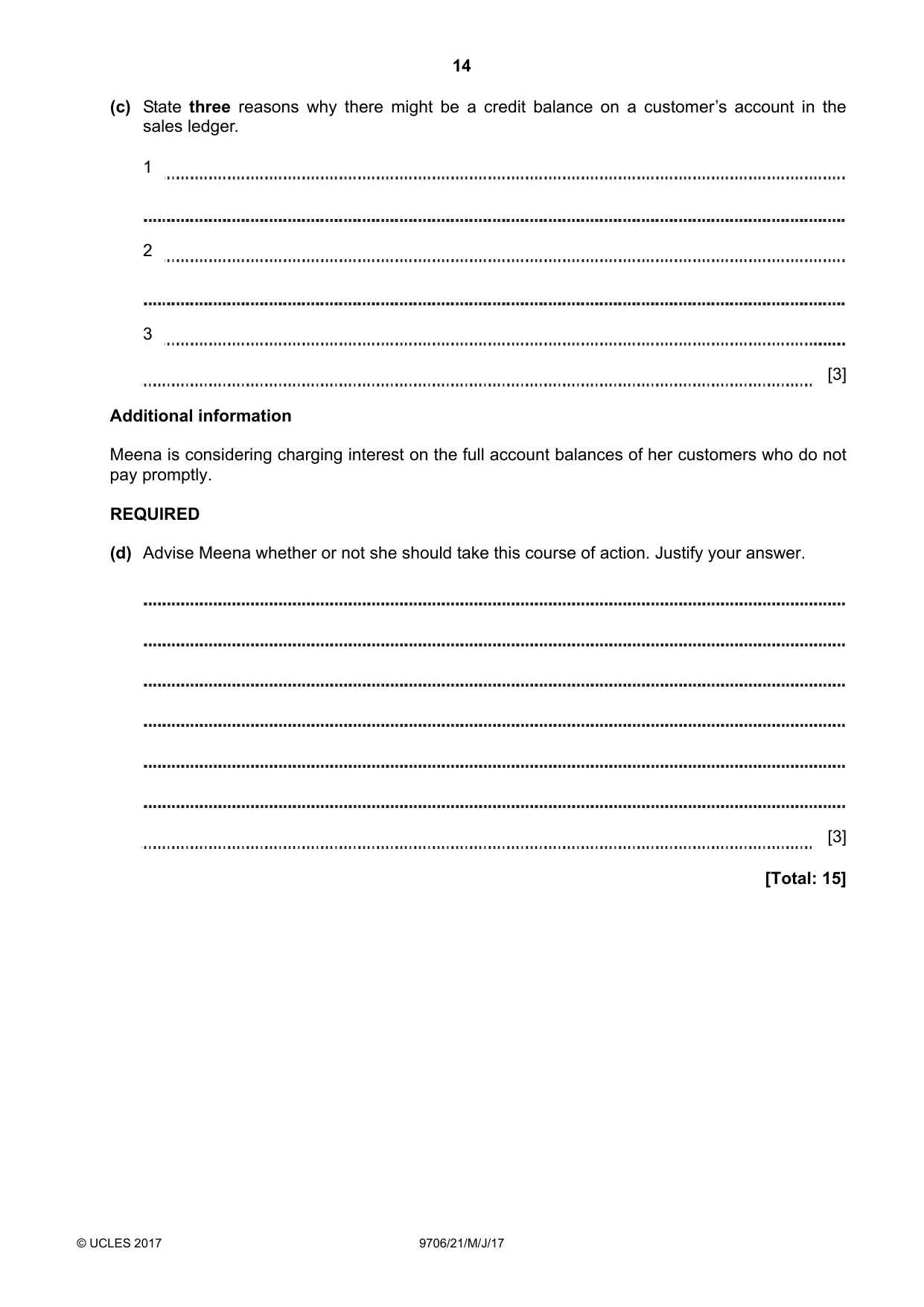
3 Meena did not keep full accounting records. She was advised to keep her books of account using the double entry system. REQUIRED (a) State three benefits a business gains from maintaining a system of double entry book-keeping. 1 2 3 [3] Additional information Meena now uses the double entry system of book-keeping. At the end of January the total of the balances in the sales ledger was $34 524. However, the balance on the sales ledger control account was $33 205. On investigation she found the following errors: 1 The sales journal had been undercast by $1649. 2 A cheque received had been correctly entered in the cash book as $650 but was entered in the sales ledger as $560. 3 An irrecoverable debt, $420, had been written off in the sales ledger but not entered in the control account. 4 A credit note issued for $160 had been completely omitted from the books of account. REQUIRED (b) Prepare a reconciliation between the sales ledger control account and the sales ledger balances at 31 January. Sales ledger control account Description Add ($) Less ($) Total ($) Opening balance 33 205 Sales ledger balances Description Add ($) Less ($) Total ($) Opening balance 34 524 [6] (c) State three reasons why there might be a credit balance on a customer’s account in the sales ledger. 1 2 3 [3] Additional information Meena is considering charging interest on the full account balances of her customers who do not pay promptly. REQUIRED (d) Advise Meena whether or not she should take this course of action. Justify your answer. [3] [Total: 15]
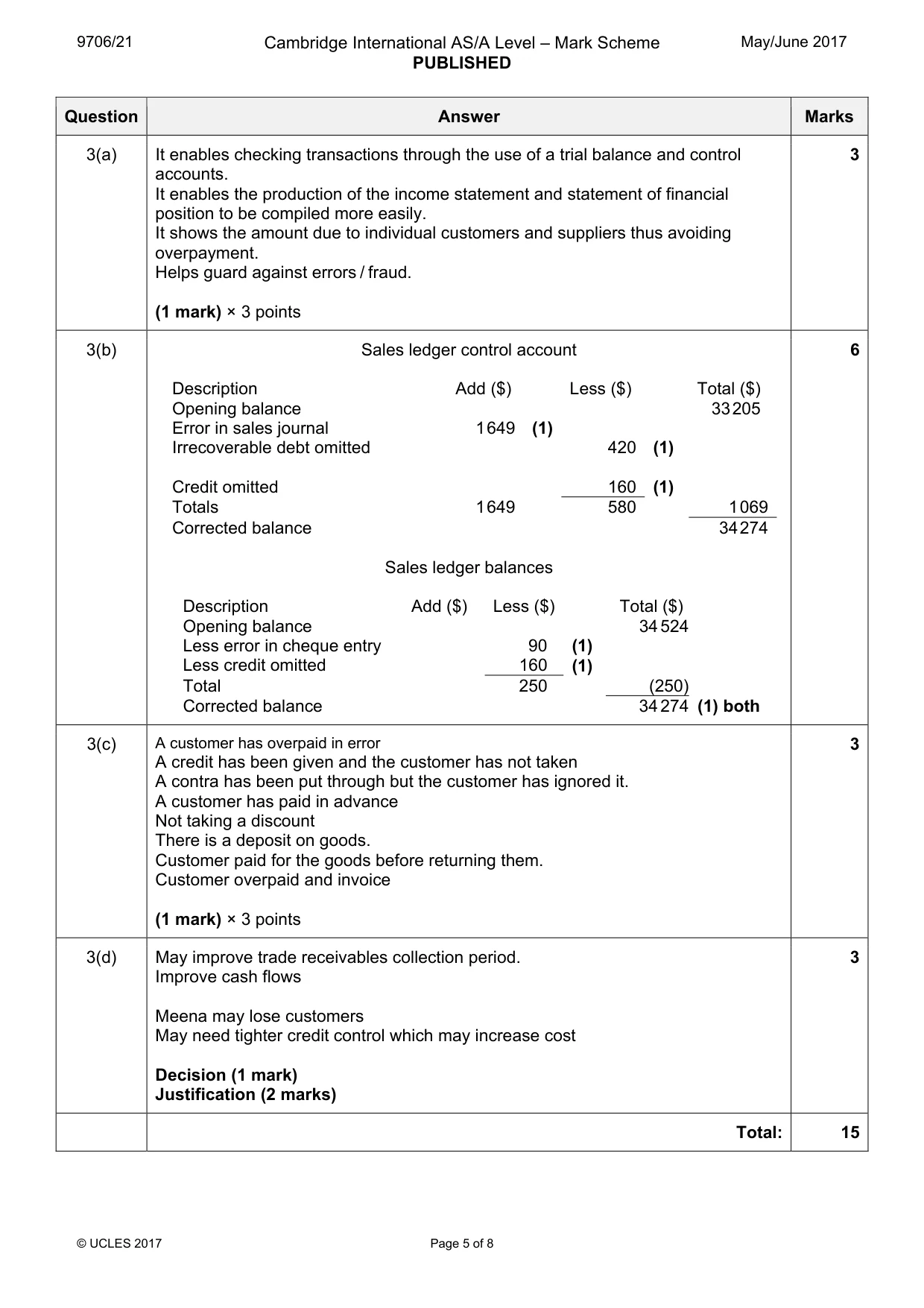
Mark scheme: 3(a) It enables checking transactions through the use of a trial balance and control 3 accounts. It enables the production of the income statement and statement of financial position to be compiled more easily. It shows the amount due to individual customers and suppliers thus avoiding overpayment. Helps guard against errors / fraud. (1 mark) × 3 points 3(b) Sales ledger control account 6 Description Add ($) Less ($) Total ($) Opening balance 33 205 Error in sales journal 1 649 (1) Irrecoverable debt omitted 420 (1) Credit omitted 160 (1) Totals 1 649 580 1 069 Corrected balance 34 274 Sales ledger balances Description Add ($) Less ($) Total ($) Opening balance 34 524 Less error in cheque entry 90 (1) Less credit omitted 160 (1) Total 250 (250) Corrected balance 34 274 (1) both 3(c) A customer has overpaid in error 3 A credit has been given and the customer has not taken A contra has been put through but the customer has ignored it. A customer has paid in advance Not taking a discount There is a deposit on goods. Customer paid for the goods before returning them. Customer overpaid and invoice (1 mark) × 3 points 3(d) May improve trade receivables collection period. 3 Improve cash flows Meena may lose customers May need tighter credit control which may increase cost Decision (1 mark) Justification (2 marks) Total: 15
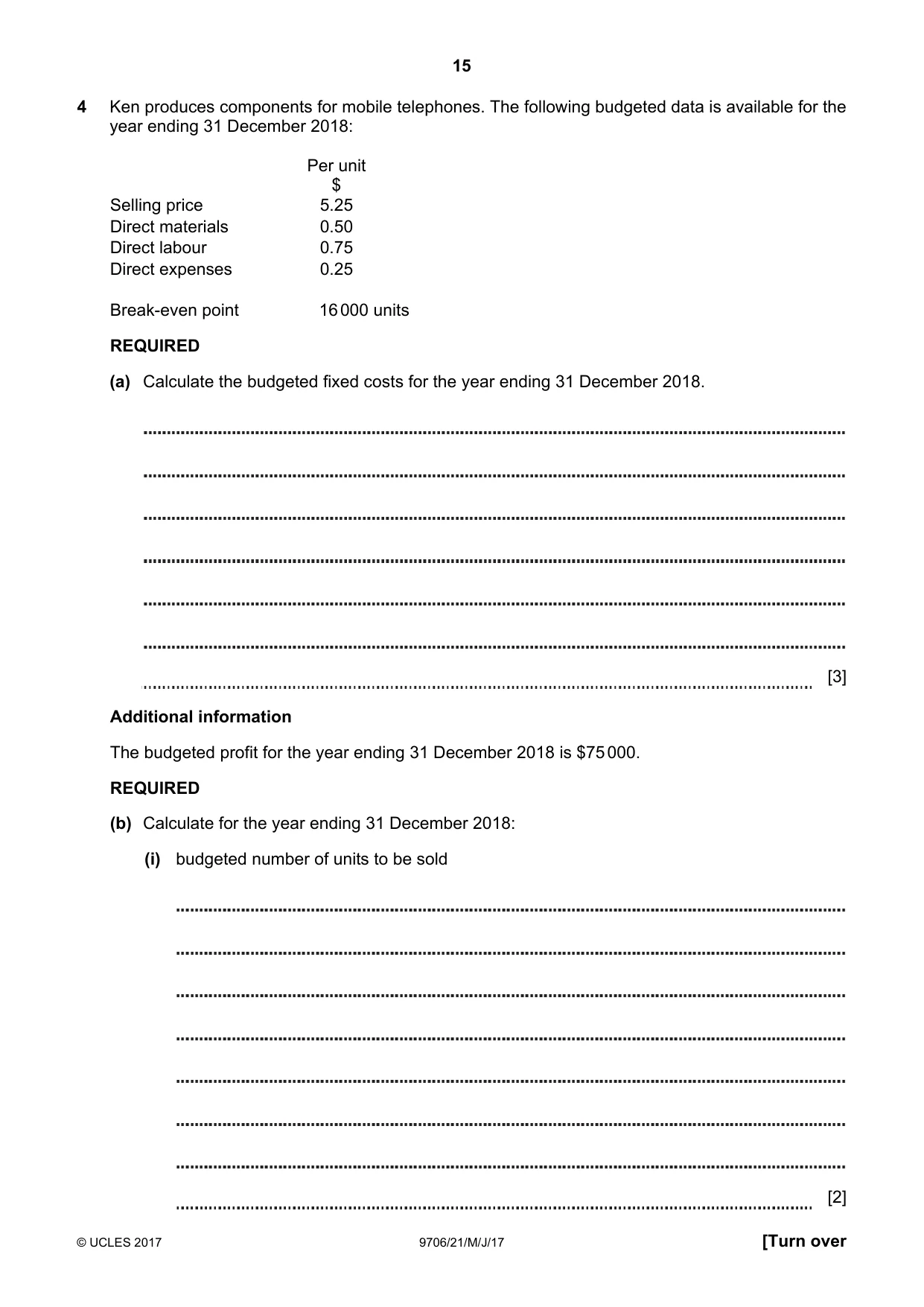
Q4 · Ken produces components for mobile telephones
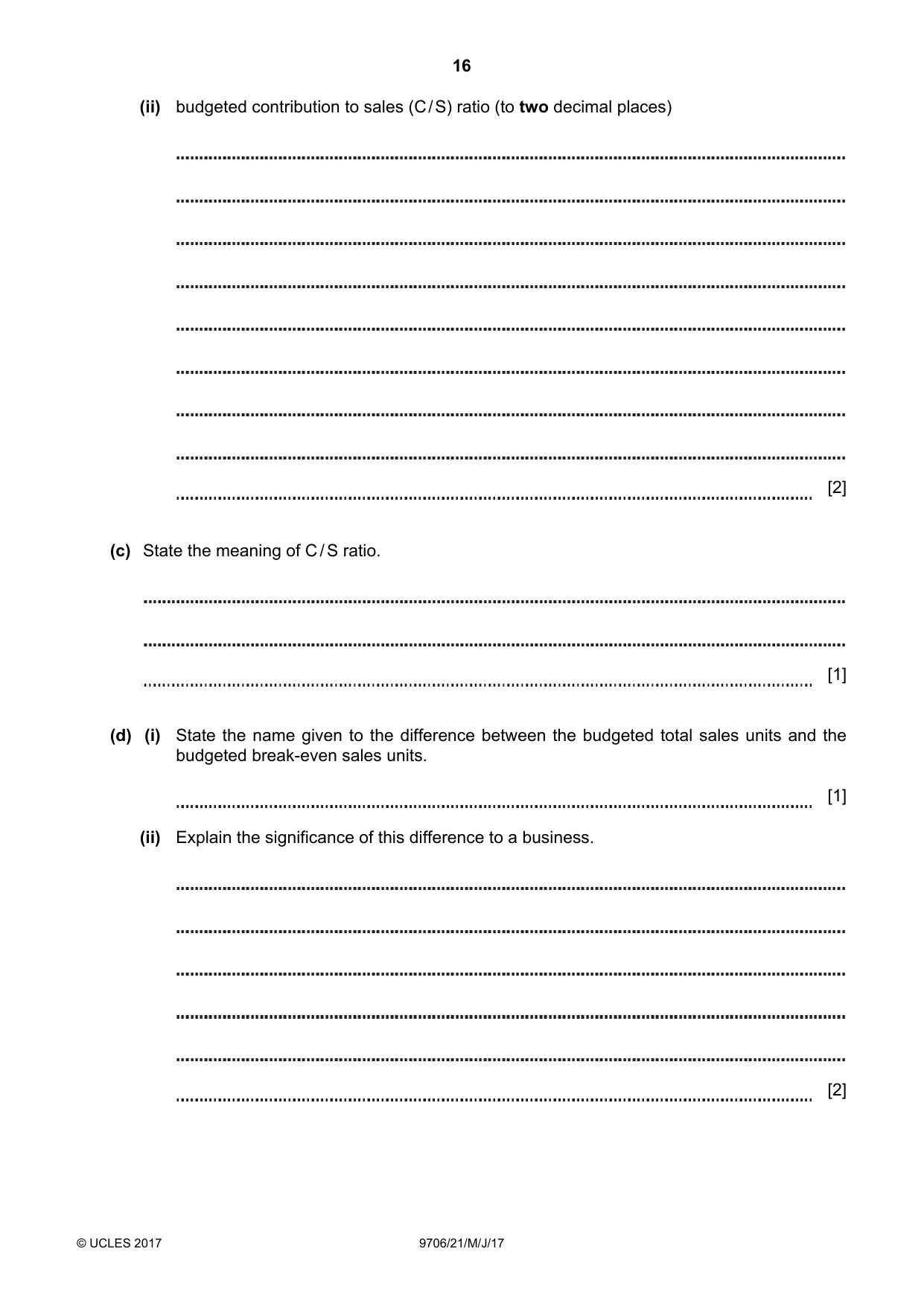
4 Ken produces components for mobile telephones. The following budgeted data is available for the year ending 31 December 2018: Per unit $ Selling price 5.25 Direct materials 0.50 Direct labour 0.75 Direct expenses 0.25 Break-even point 16 000 units REQUIRED (a) Calculate the budgeted fixed costs for the year ending 31 December 2018. [3] Additional information The budgeted profit for the year ending 31 December 2018 is $75 000. REQUIRED (b) Calculate for the year ending 31 December 2018: (i) budgeted number of units to be sold [2] (ii) budgeted contribution to sales (C / S) ratio (to two decimal places) [2] (c) State the meaning of C / S ratio. [1] (d) (i) State the name given to the difference between the budgeted total sales units and the budgeted break-even sales units. [1] (ii) Explain the significance of this difference to a business. [2] ed poi
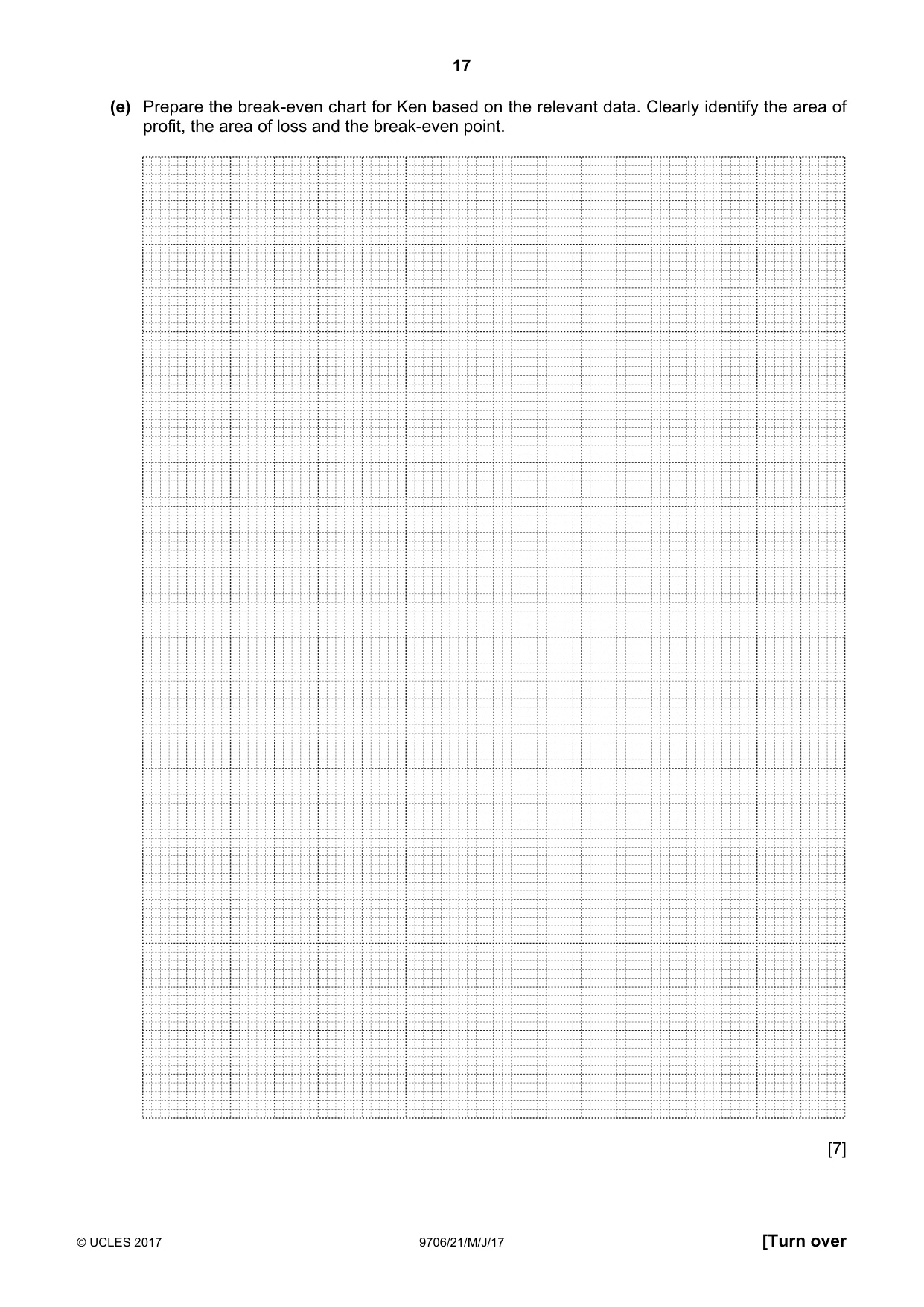
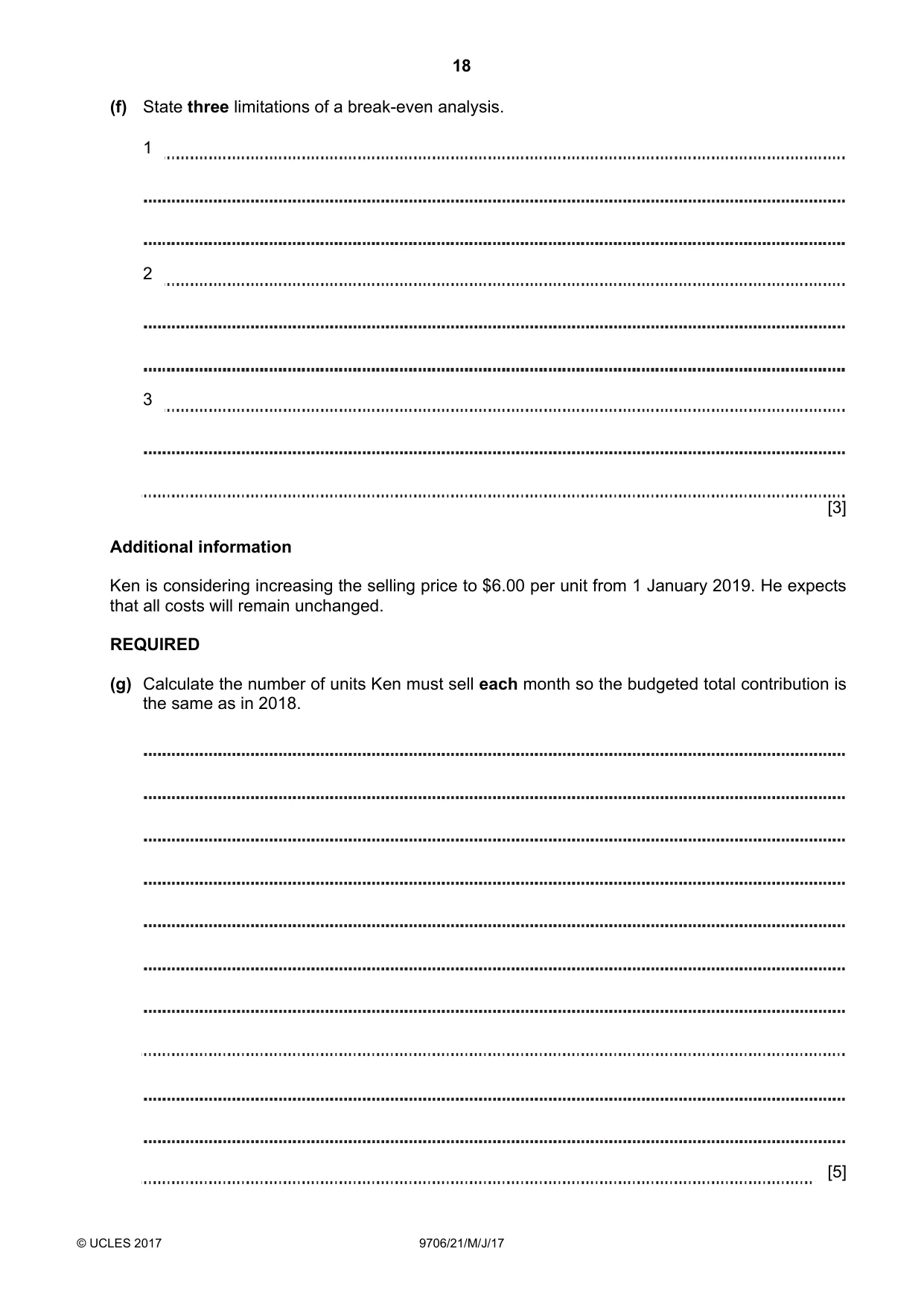
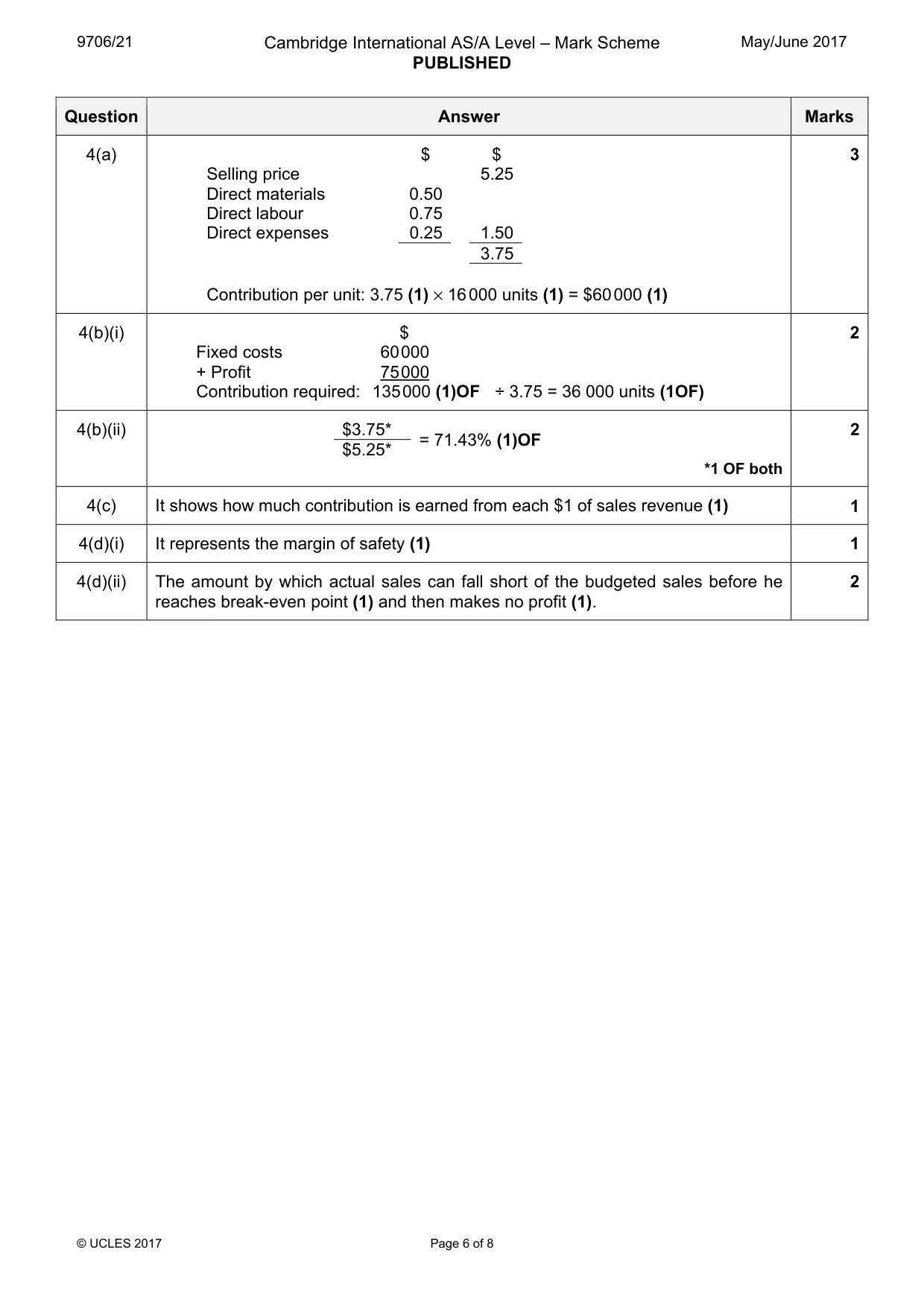
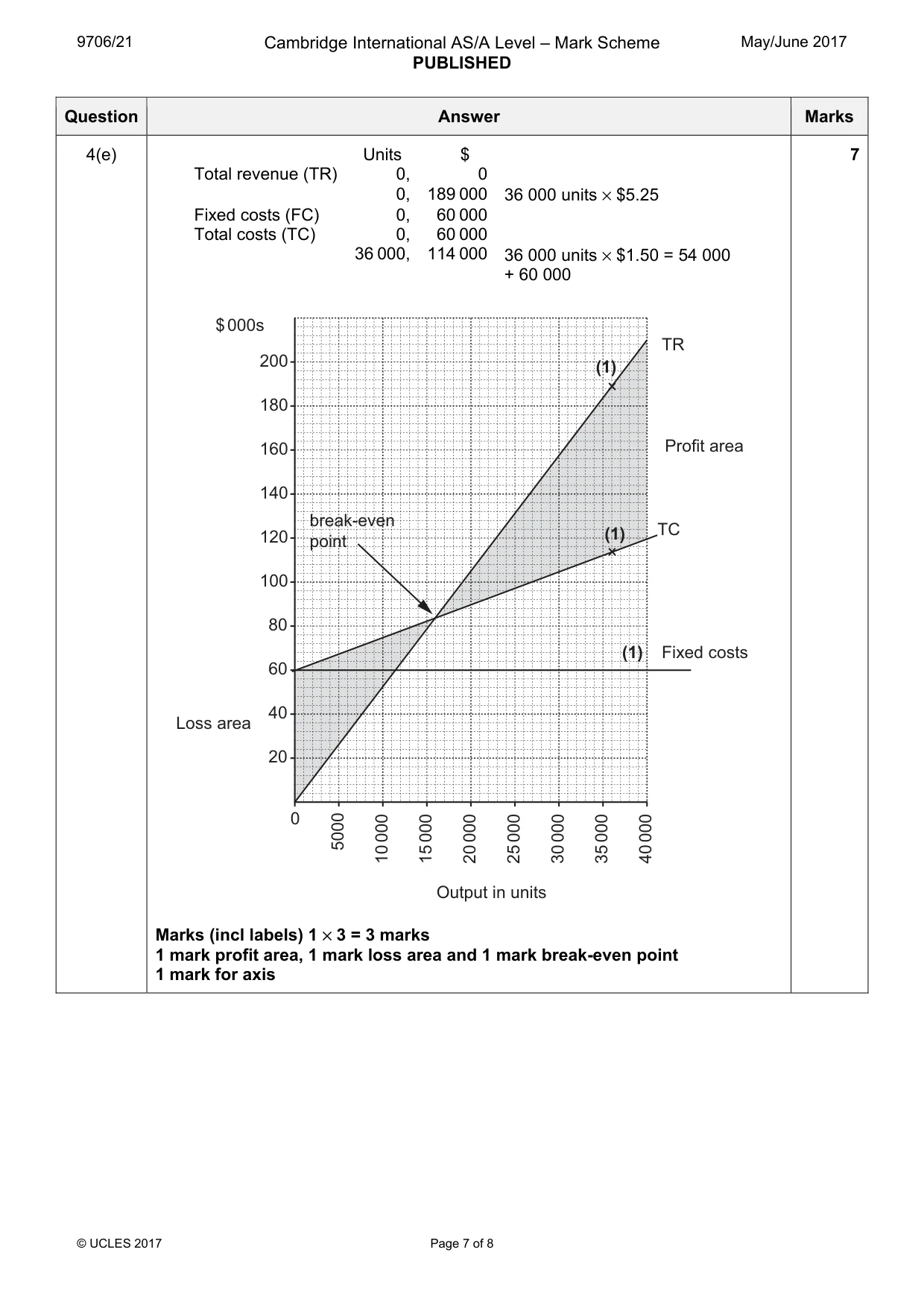
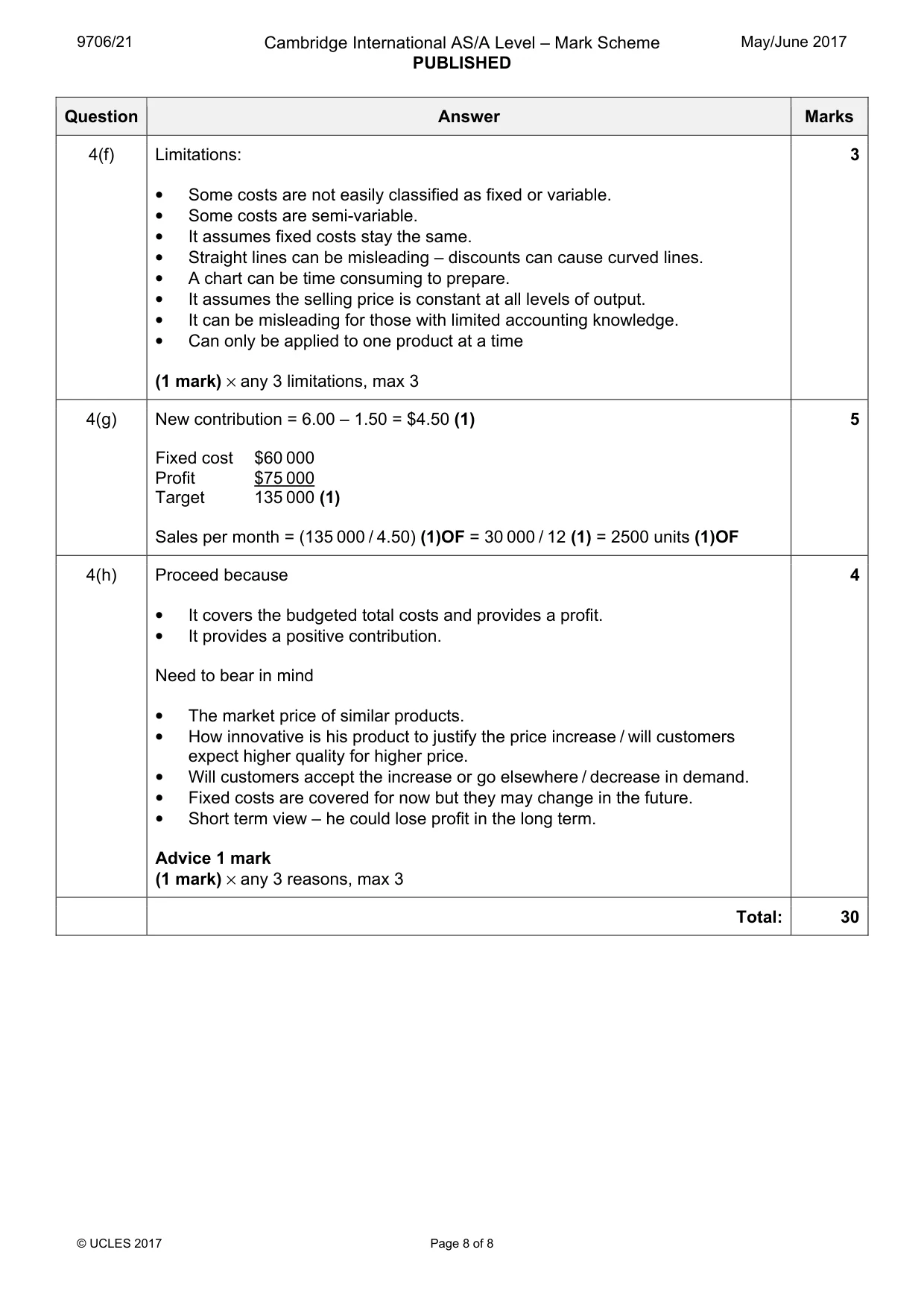
Mark scheme: 4(a) $ $ 3 Selling price 5.25 Direct materials 0.50 Direct labour 0.75 Direct expenses 0.25 1.50 3.75 Contribution per unit: 3.75 (1) × 16 000 units (1) = $60 000 (1) 4(b)(i) $ 2 Fixed costs 60 000 + Profit 75 000 Contribution required: 135 000 (1)OF ÷ 3.75 = 36 000 units (1OF) 4(b)(ii) $3.75* 2 = 71.43% (1)OF $5.25* *1 OF both 4(c) It shows how much contribution is earned from each $1 of sales revenue (1) 1 4(d)(i) It represents the margin of safety (1) 1 4(d)(ii) The amount by which actual sales can fall short of the budgeted sales before he 2 reaches break-even point (1) and then makes no profit (1). 4(e) Units $ 7 Total revenue (TR) 0, 0 0, 189 000 36 000 units × $5.25 Fixed costs (FC) 0, 60 000 Total costs (TC) 0, 60 000 36 000, 114 000 36 000 units × $1.50 = 54 000 + 60 000 $ 000s TR 200 (1) 180 160 Profit area 140 break-even TC 120 point (1) 100 80 (1) Fixed costs 60 40 Loss area 20 0 5000 000 000 000 000 000 000 000 10 15 20 25 30 35 40 Output in units Marks (incl labels) 1 × 3 = 3 marks 1 mark profit area, 1 mark loss area and 1 mark break-even point 1 mark for axis 4(f) Limitations: 3 • Some costs are not easily classified as fixed or variable. • Some costs are semi-variable. • It assumes fixed costs stay the same. • Straight lines can be misleading – discounts can cause curved lines. • A chart can be time consuming to prepare. • It assumes the selling price is constant at all levels of output. • It can be misleading for those with limited accounting knowledge. • Can only be applied to one product at a time (1 mark) × any 3 limitations, max 3 4(g) New contribution = 6.00 – 1.50 = $4.50 (1) 5 Fixed cost $60 000 Profit $75 000 Target 135 000 (1) Sales per month = (135 000 / 4.50) (1)OF = 30 000 / 12 (1) = 2500 units (1)OF 4(h) Proceed because 4 • It covers the budgeted total costs and provides a profit. • It provides a positive contribution. Need to bear in mind • The market price of similar products. • How innovative is his product to justify the price increase / will customers expect higher quality for higher price. • Will customers accept the increase or go elsewhere / decrease in demand. • Fixed costs are covered for now but they may change in the future. • Short term view – he could lose profit in the long term. Advice 1 mark (1 mark) × any 3 reasons, max 3 Total: 30
What was in this paper
The subtopics covered by these 4 questions, and how many questions each got. Open one in a new tab to see every Cambridge question on it.
What you needed in this session
Cambridge’s own grade thresholds for 2017 May/June, Paper 2 · Variant 1. A higher threshold means an easier paper — the bar moves with how the cohort did.