Cambridge A Level Accounting 9706 — 2016 Oct/Nov Paper 2 · Variant 2
9706/22/O/N/16 · 90 marks · ≈101 min
The question paper and its mark scheme, free to read here and free to download. This is Cambridge’s own paper, exactly as it was sat.
Question paper16 pages

Mark scheme7 pages
Answers below. Sit the paper first if you are practising.
Paper as text
Question paper, page 1
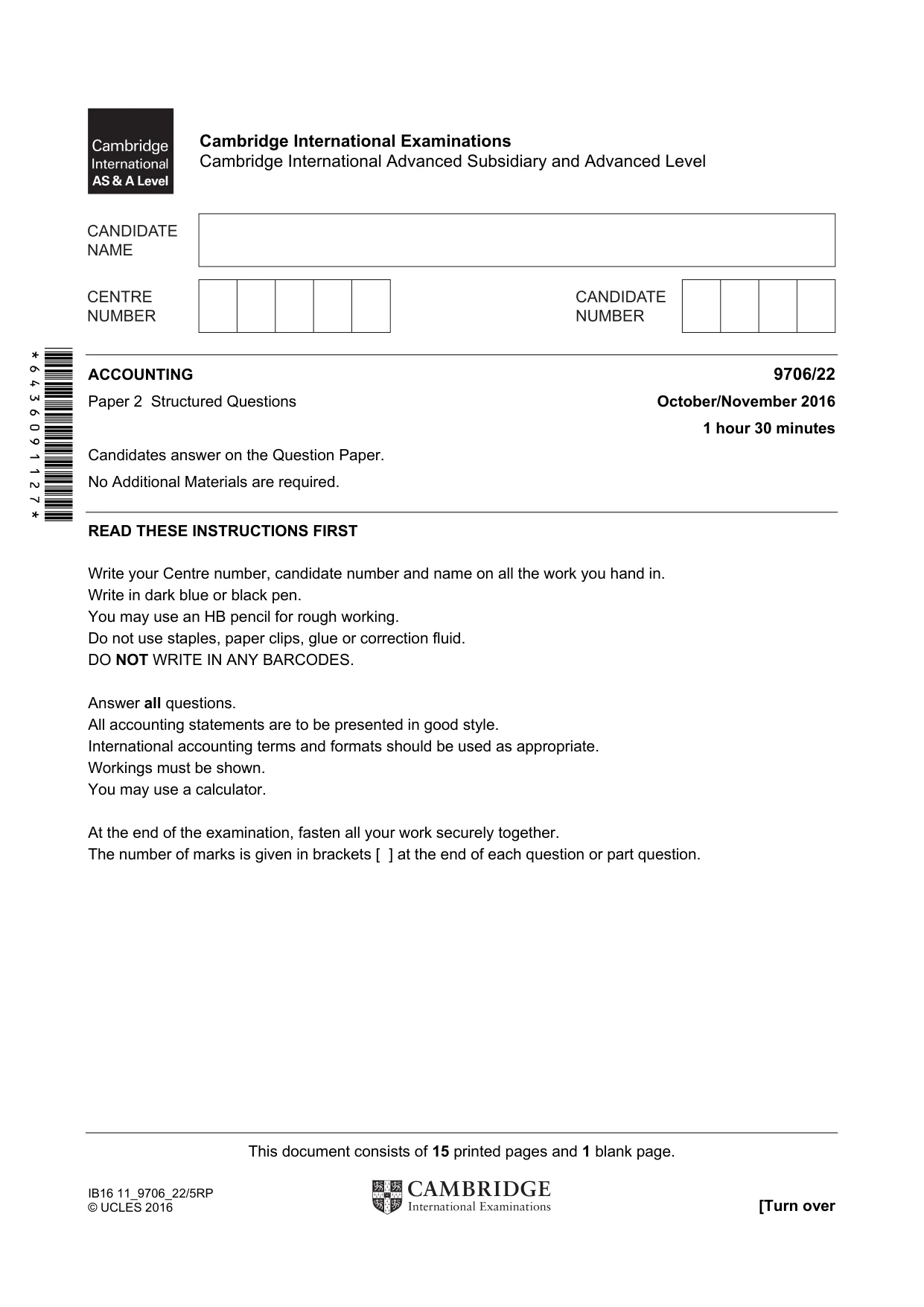
This document consists of 15 printed pages and 1 blank page. IB16 11_9706_22/5RP © UCLES 2016 [Turn over Cambridge International Examinations Cambridge International Advanced Subsidiary and Advanced Level ACCOUNTING 9706/22 Paper 2 Structured Questions October/November 2016 1 hour 30 minutes Candidates answer on the Question Paper. No Additional Materials are required. READ THESE INSTRUCTIONS FIRST Write your Centre number, candidate number and name on all the work you hand in. Write in dark blue or black pen. You may use an HB pencil for rough working. Do not use staples, paper clips, glue or correction fluid. DO NOT WRITE IN ANY BARCODES. Answer all questions. All accounting statements are to be presented in good style. International accounting terms and formats should be used as appropriate. Workings must be shown. You may use a calculator. At the end of the examination, fasten all your work securely together. The number of marks is given in brackets [ ] at the end of each question or part question.
Question paper, page 2
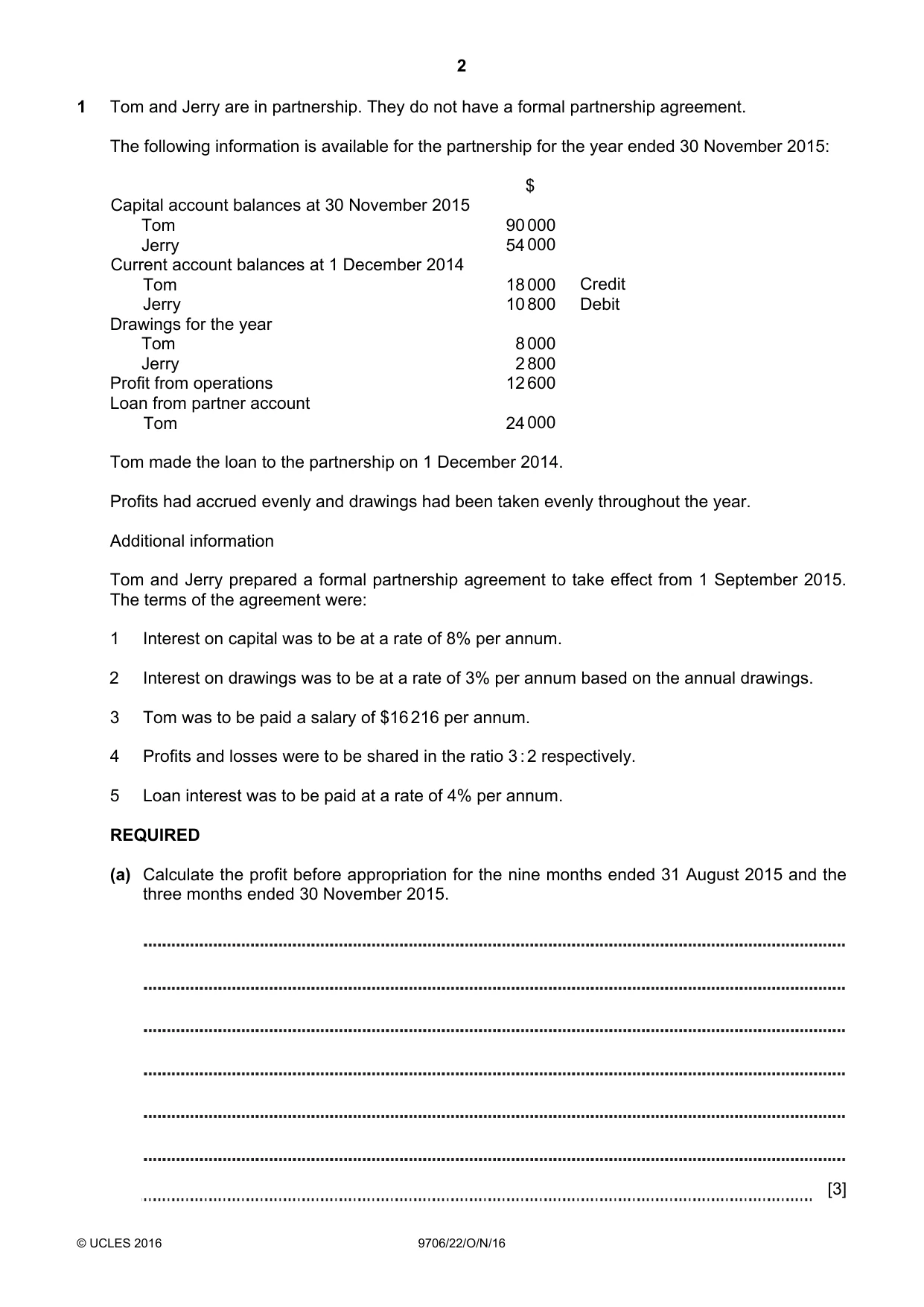
2 © UCLES 2016 9706/22/O/N/16 1 Tom and Jerry are in partnership. They do not have a formal partnership agreement. The following information is available for the partnership for the year ended 30 November 2015: $ Capital account balances at 30 November 2015 Tom 90 000 Jerry 54 000 Current account balances at 1 December 2014 Tom 18 000 Credit Jerry 10 800 Debit Drawings for the year Tom 8 000 Jerry 2 800 Profit from operations 12 600 Loan from partner account Tom 24 000 Tom made the loan to the partnership on 1 December 2014. Profits had accrued evenly and drawings had been taken evenly throughout the year. Additional information Tom and Jerry prepared a formal partnership agreement to take effect from 1 September 2015. The terms of the agreement were: 1 Interest on capital was to be at a rate of 8% per annum. 2 Interest on drawings was to be at a rate of 3% per annum based on the annual drawings. 3 Tom was to be paid a salary of $16 216 per annum. 4 Profits and losses were to be shared in the ratio 3 : 2 respectively. 5 Loan interest was to be paid at a rate of 4% per annum. REQUIRED (a) Calculate the profit before appropriation for the nine months ended 31 August 2015 and the three months ended 30 November 2015. [3]
Question paper, page 3
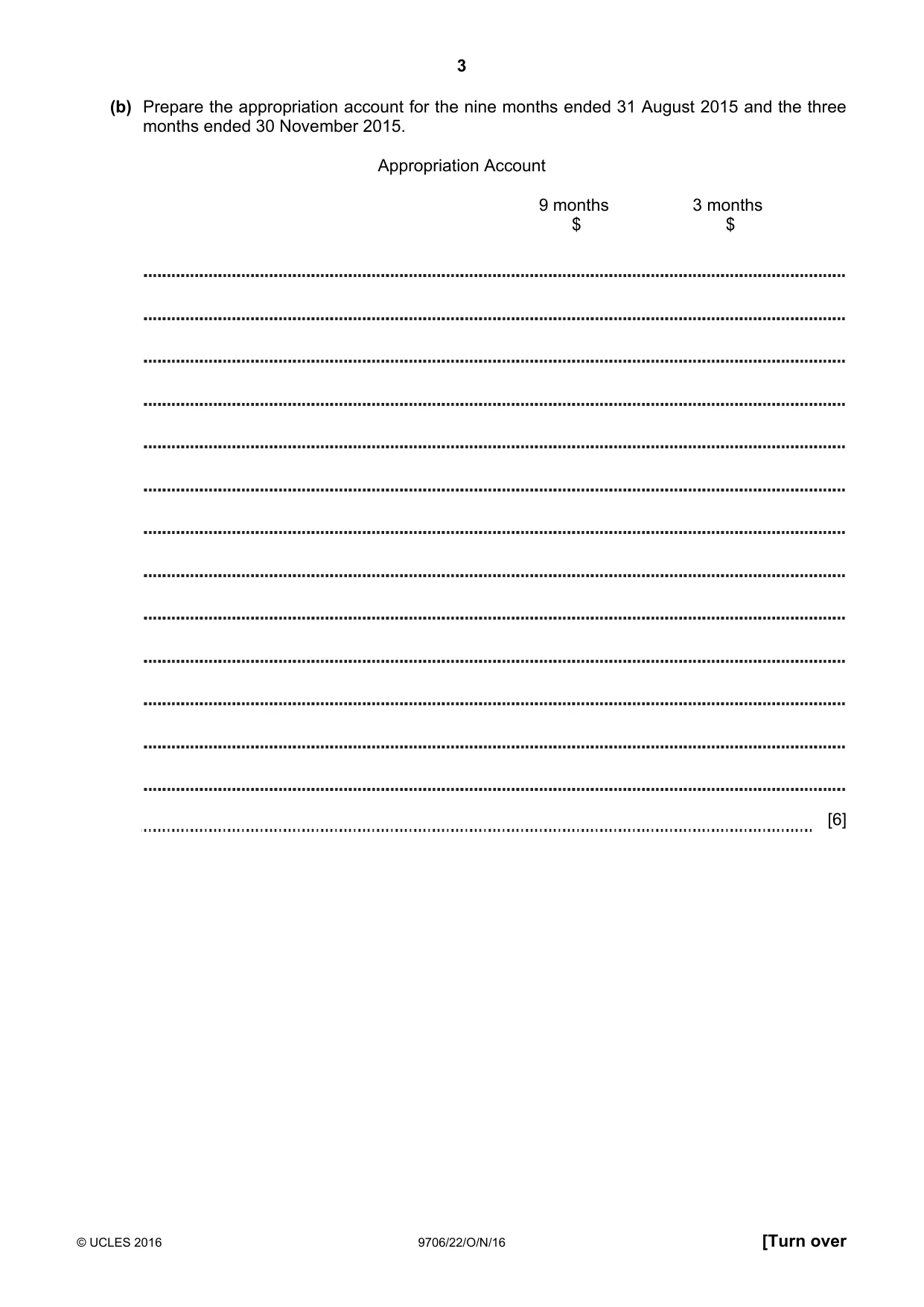
3 © UCLES 2016 9706/22/O/N/16 [Turn over (b) Prepare the appropriation account for the nine months ended 31 August 2015 and the three months ended 30 November 2015. Appropriation Account 9 months 3 months $ $ [6]
Question paper, page 4
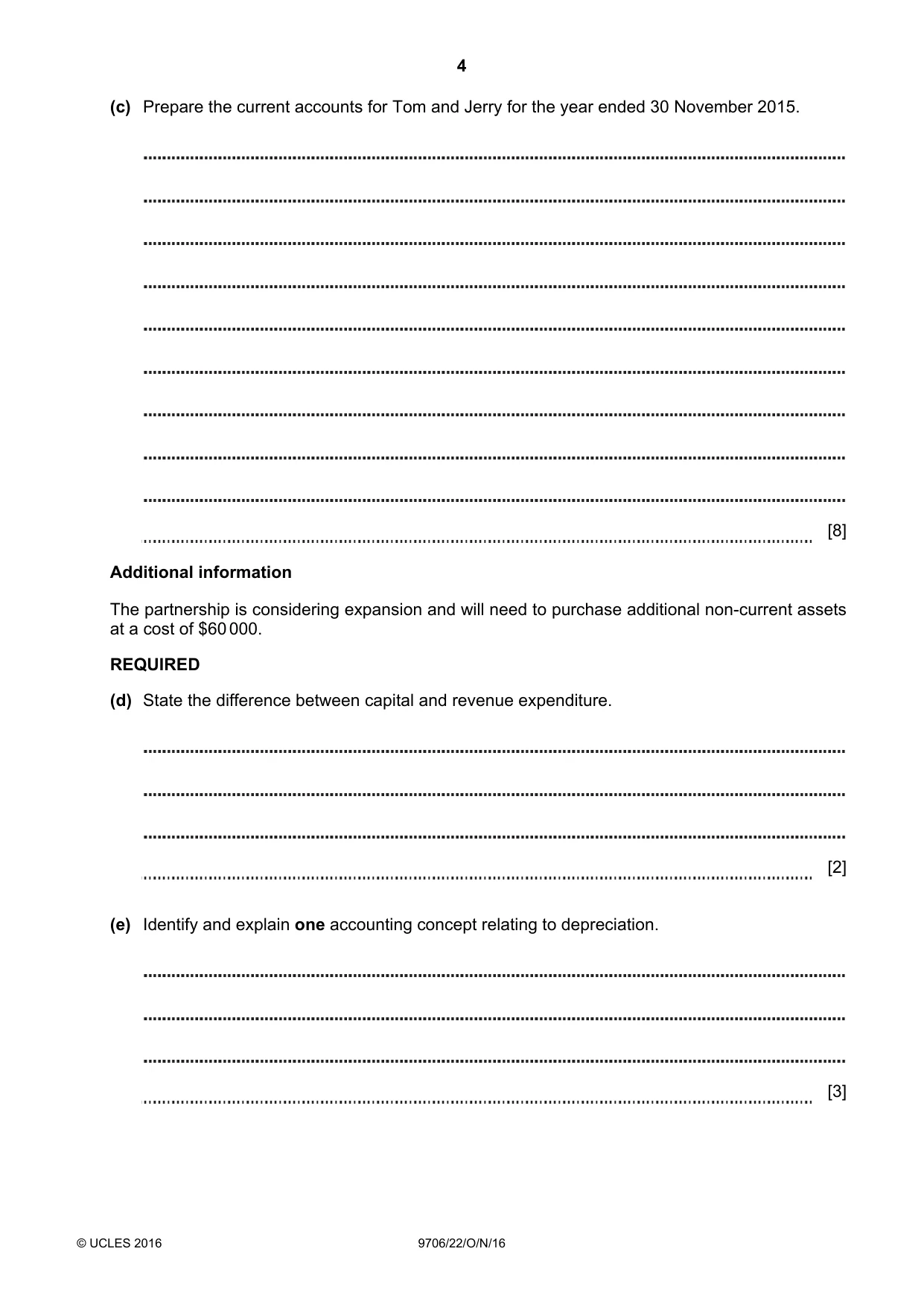
4 © UCLES 2016 9706/22/O/N/16 (c) Prepare the current accounts for Tom and Jerry for the year ended 30 November 2015. [8] Additional information The partnership is considering expansion and will need to purchase additional non-current assets at a cost of $60 000. REQUIRED (d) State the difference between capital and revenue expenditure. [2] (e) Identify and explain one accounting concept relating to depreciation. [3]
Question paper, page 5
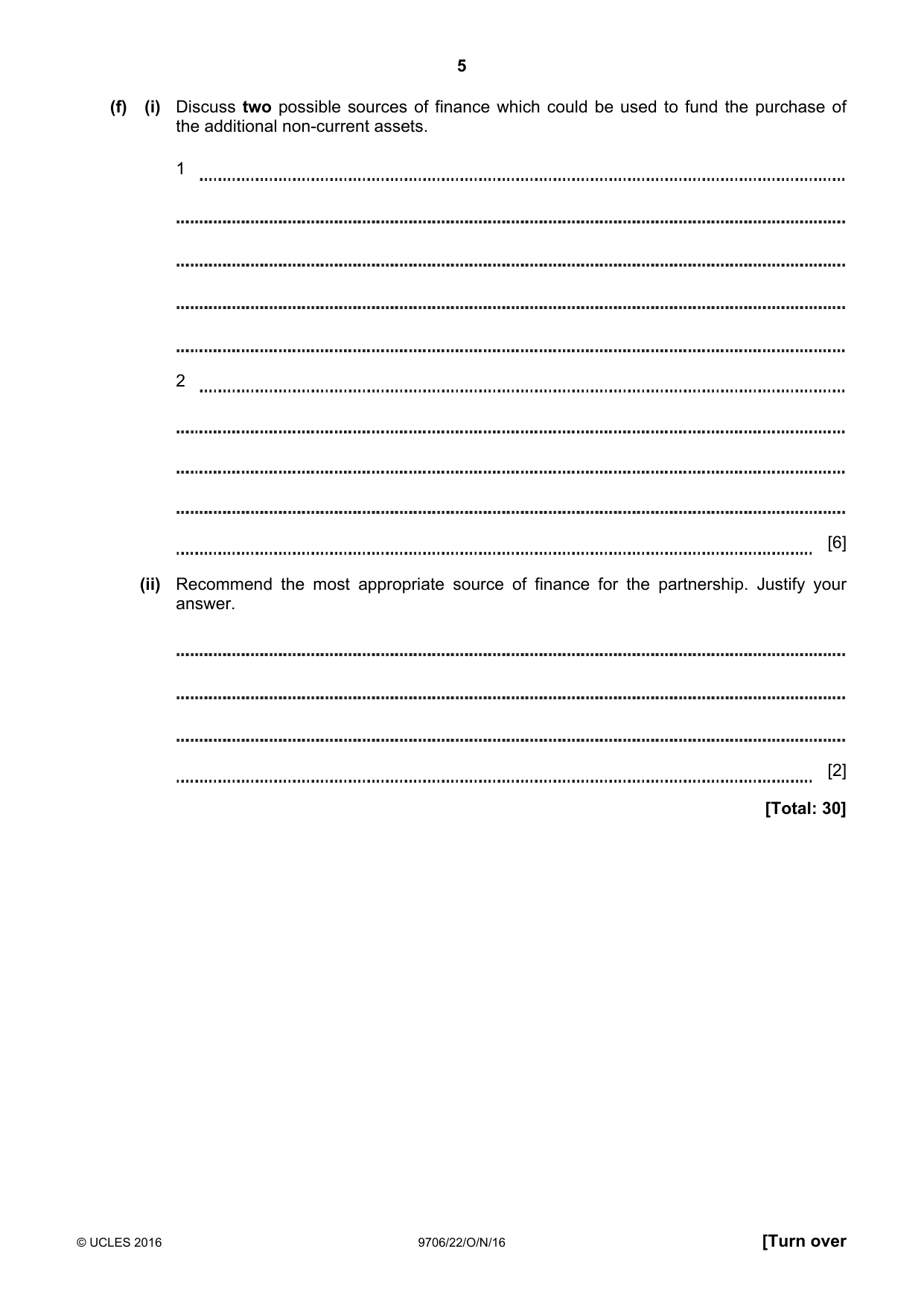
5 © UCLES 2016 9706/22/O/N/16 [Turn over (f) (i) Discuss two possible sources of finance which could be used to fund the purchase of the additional non-current assets. 1 2 [6] (ii) Recommend the most appropriate source of finance for the partnership. Justify your answer. [2] [Total: 30]
Question paper, page 6
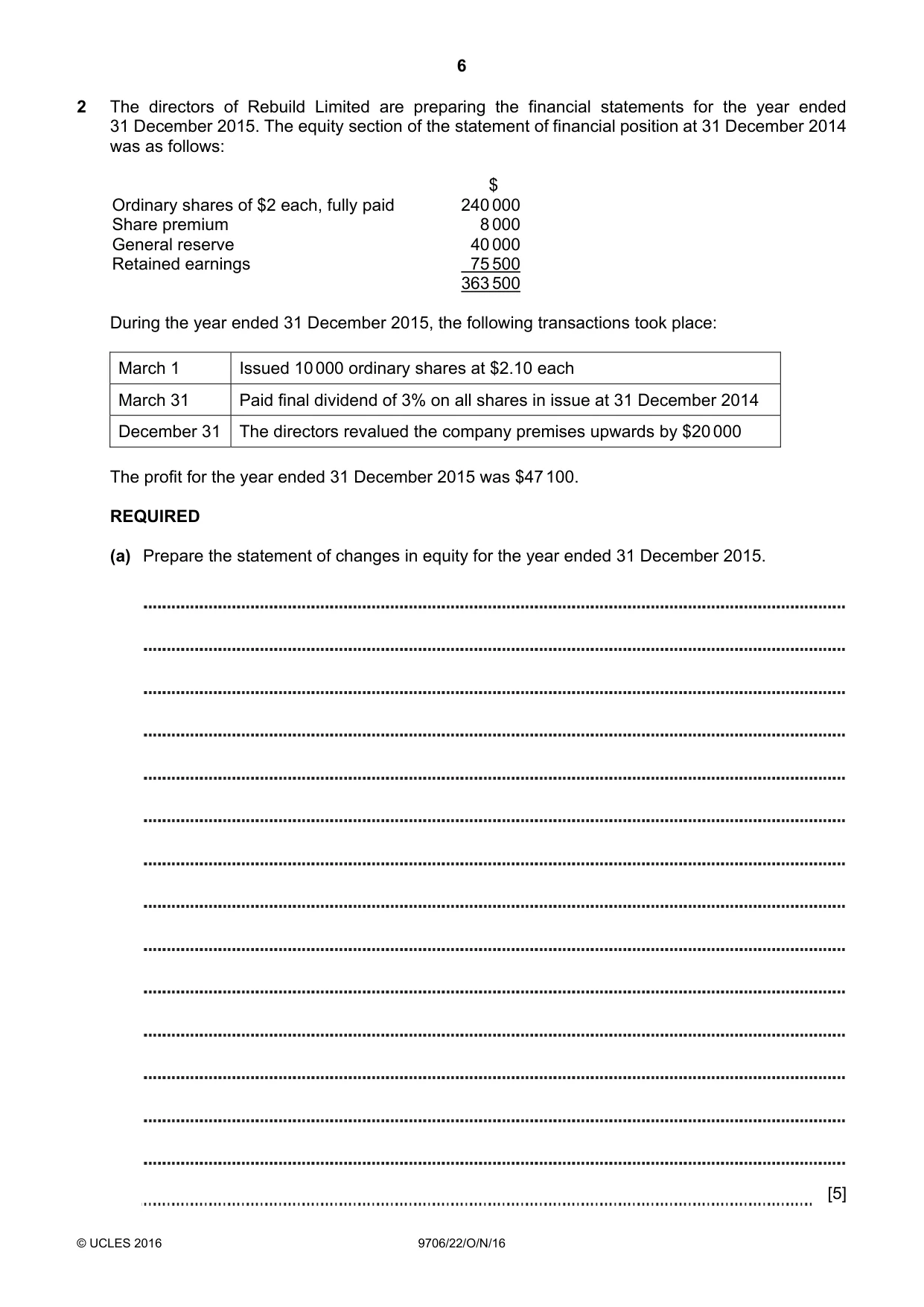
6 © UCLES 2016 9706/22/O/N/16 2 The directors of Rebuild Limited are preparing the financial statements for the year ended 31 December 2015. The equity section of the statement of financial position at 31 December 2014 was as follows: $ Ordinary shares of $2 each, fully paid 240 000 Share premium 8 000 General reserve 40 000 Retained earnings 75 500 363 500 During the year ended 31 December 2015, the following transactions took place: March 1 Issued 10 000 ordinary shares at $2.10 each March 31 Paid final dividend of 3% on all shares in issue at 31 December 2014 December 31 The directors revalued the company premises upwards by $20 000 The profit for the year ended 31 December 2015 was $47 100. REQUIRED (a) Prepare the statement of changes in equity for the year ended 31 December 2015. [5]
Question paper, page 7
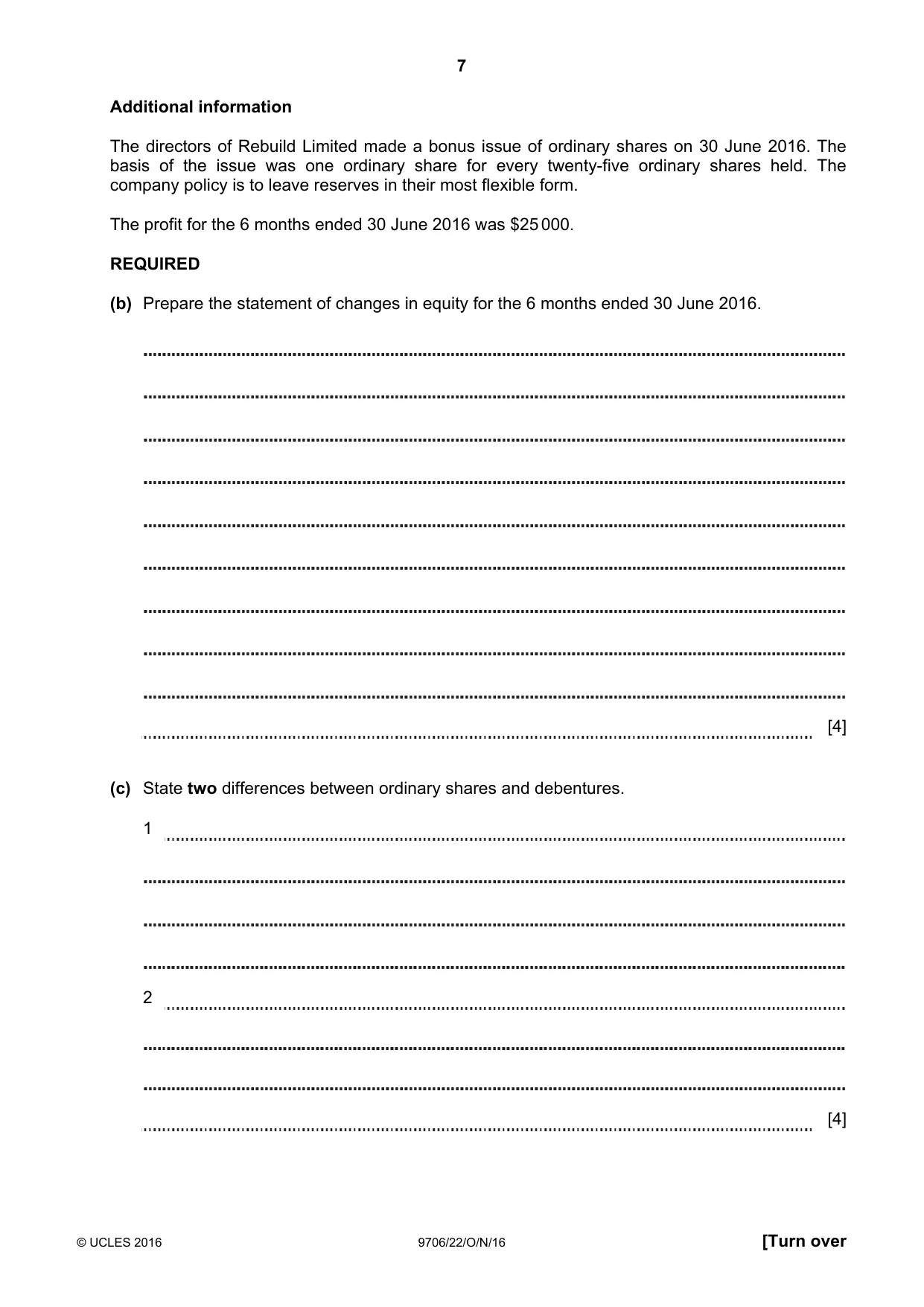
7 © UCLES 2016 9706/22/O/N/16 [Turn over Additional information The directors of Rebuild Limited made a bonus issue of ordinary shares on 30 June 2016. The basis of the issue was one ordinary share for every twenty-five ordinary shares held. The company policy is to leave reserves in their most flexible form. The profit for the 6 months ended 30 June 2016 was $25 000. REQUIRED (b) Prepare the statement of changes in equity for the 6 months ended 30 June 2016. [4] (c) State two differences between ordinary shares and debentures. 1 2 [4]
Question paper, page 8
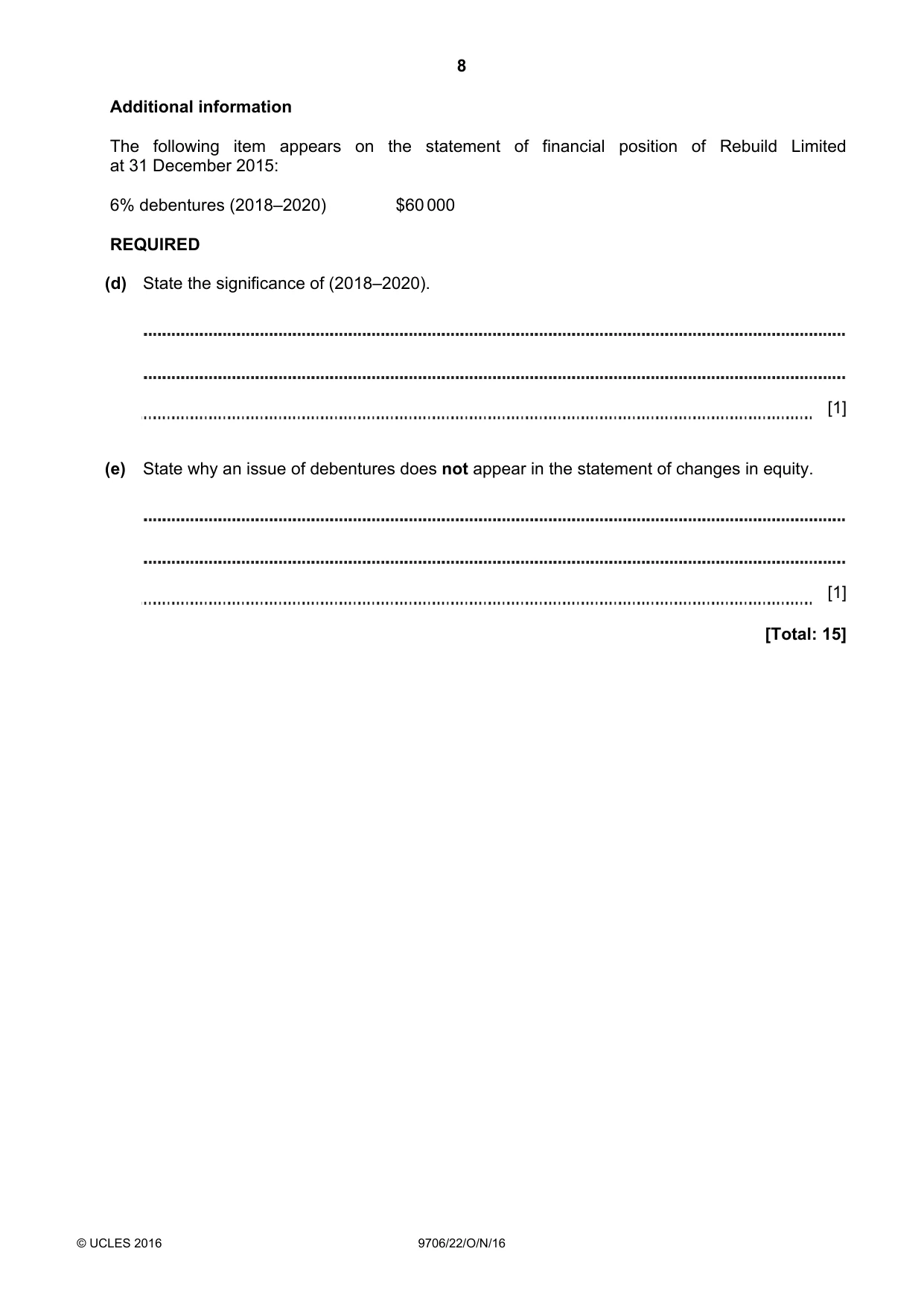
8 © UCLES 2016 9706/22/O/N/16 Additional information The following item appears on the statement of financial position of Rebuild Limited at 31 December 2015: 6% debentures (2018–2020) $60 000 REQUIRED (d) State the significance of (2018–2020). [1] (e) State why an issue of debentures does not appear in the statement of changes in equity. [1] [Total: 15]
Question paper, page 9
9 © UCLES 2016 9706/22/O/N/16 [Turn over Question 3 is on the next page.
Question paper, page 10
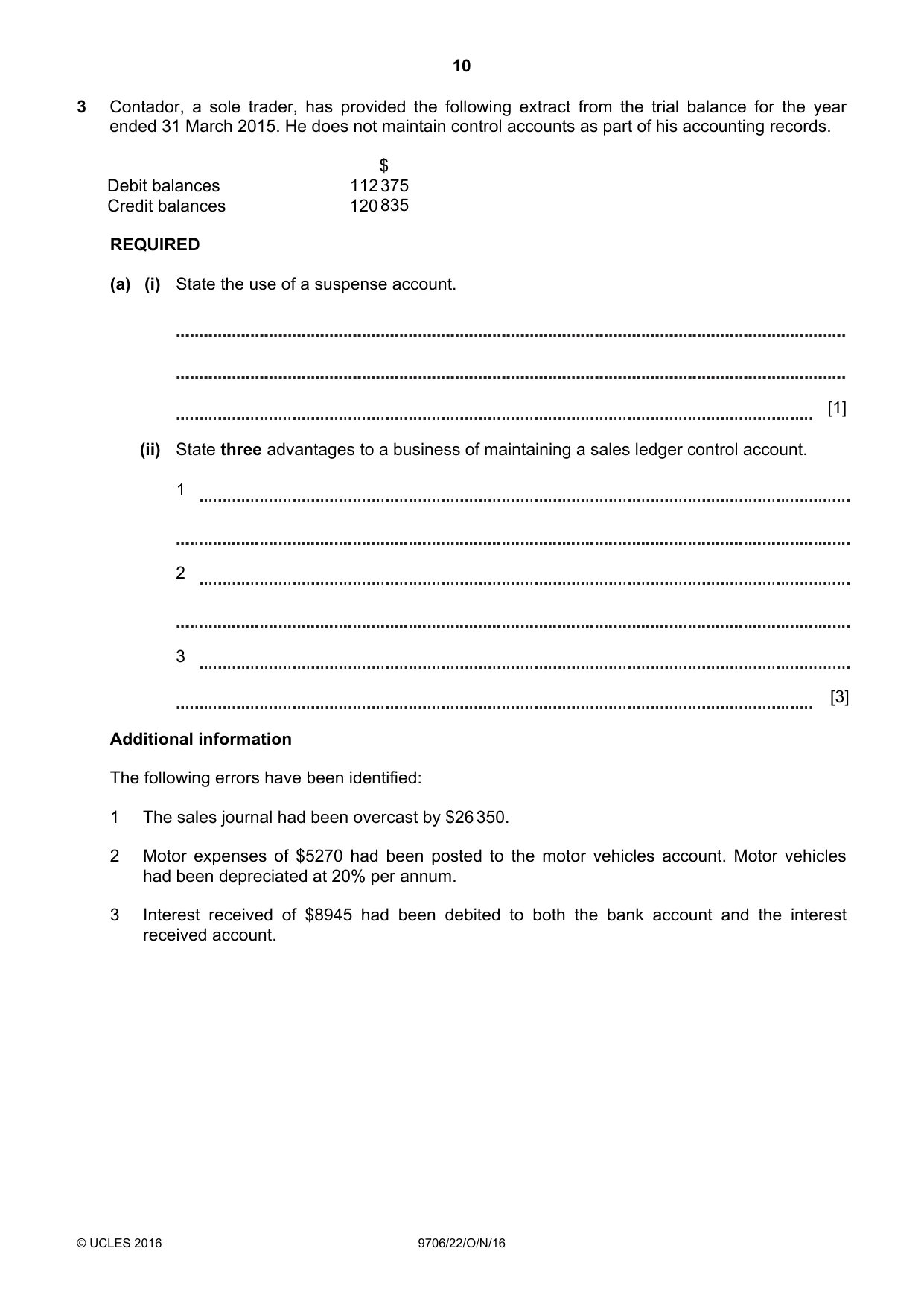
10 © UCLES 2016 9706/22/O/N/16 3 Contador, a sole trader, has provided the following extract from the trial balance for the year ended 31 March 2015. He does not maintain control accounts as part of his accounting records. $ Debit balances 112 375 Credit balances 120 835 REQUIRED (a) (i) State the use of a suspense account. [1] (ii) State three advantages to a business of maintaining a sales ledger control account. 1 2 3 [3] Additional information The following errors have been identified: 1 The sales journal had been overcast by $26 350. 2 Motor expenses of $5270 had been posted to the motor vehicles account. Motor vehicles had been depreciated at 20% per annum. 3 Interest received of $8945 had been debited to both the bank account and the interest received account.
Question paper, page 11
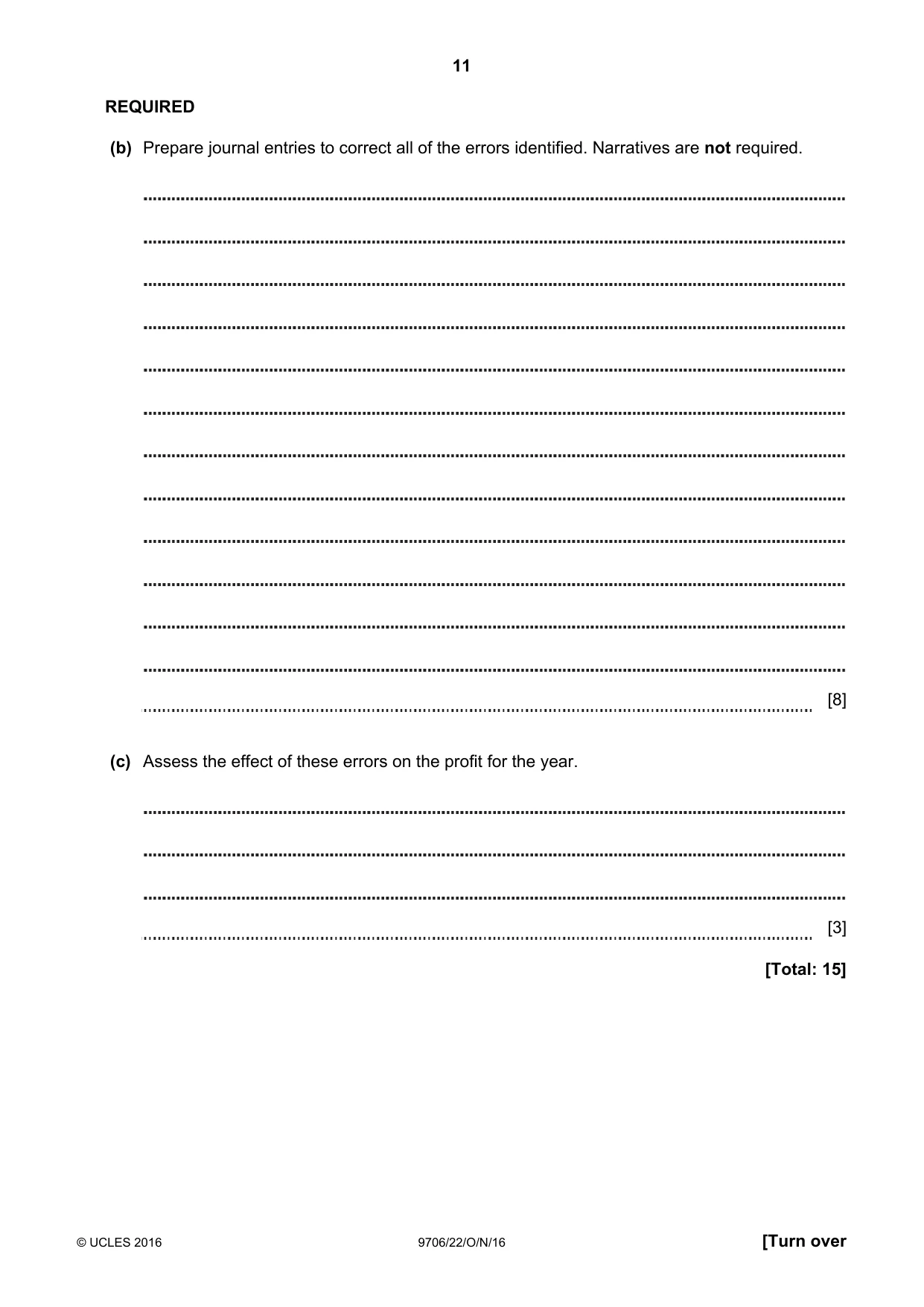
11 © UCLES 2016 9706/22/O/N/16 [Turn over REQUIRED (b) Prepare journal entries to correct all of the errors identified. Narratives are not required. [8] (c) Assess the effect of these errors on the profit for the year. [3] [Total: 15]
Question paper, page 12
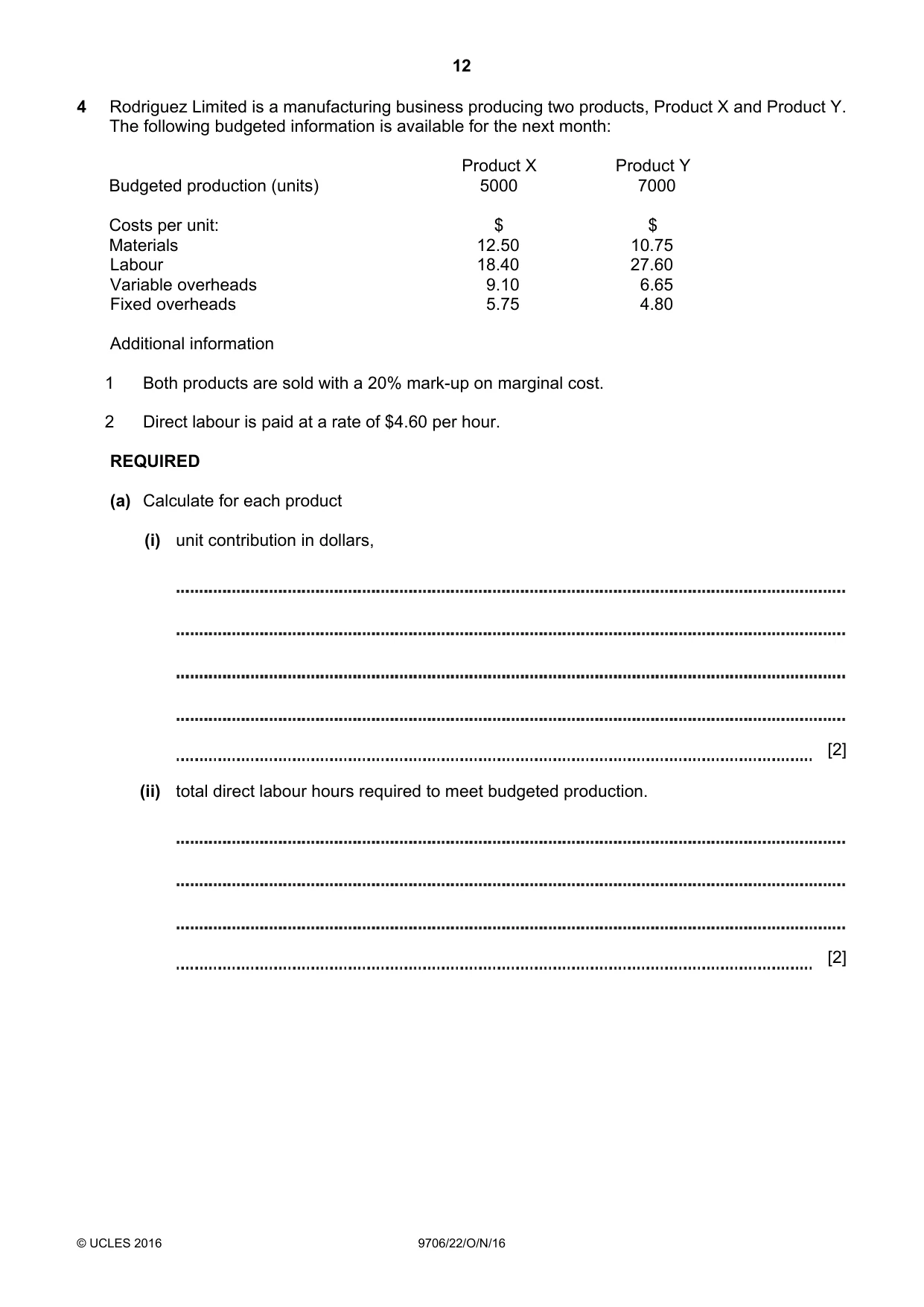
12 © UCLES 2016 9706/22/O/N/16 4 Rodriguez Limited is a manufacturing business producing two products, Product X and Product Y. The following budgeted information is available for the next month: Product X Product Y Budgeted production (units) 5000 7000 Costs per unit: $ $ Materials 12.50 10.75 Labour 18.40 27.60 Variable overheads 9.10 6.65 Fixed overheads 5.75 4.80 Additional information 1 Both products are sold with a 20% mark-up on marginal cost. 2 Direct labour is paid at a rate of $4.60 per hour. REQUIRED (a) Calculate for each product (i) unit contribution in dollars, [2] (ii) total direct labour hours required to meet budgeted production. [2]
Question paper, page 13
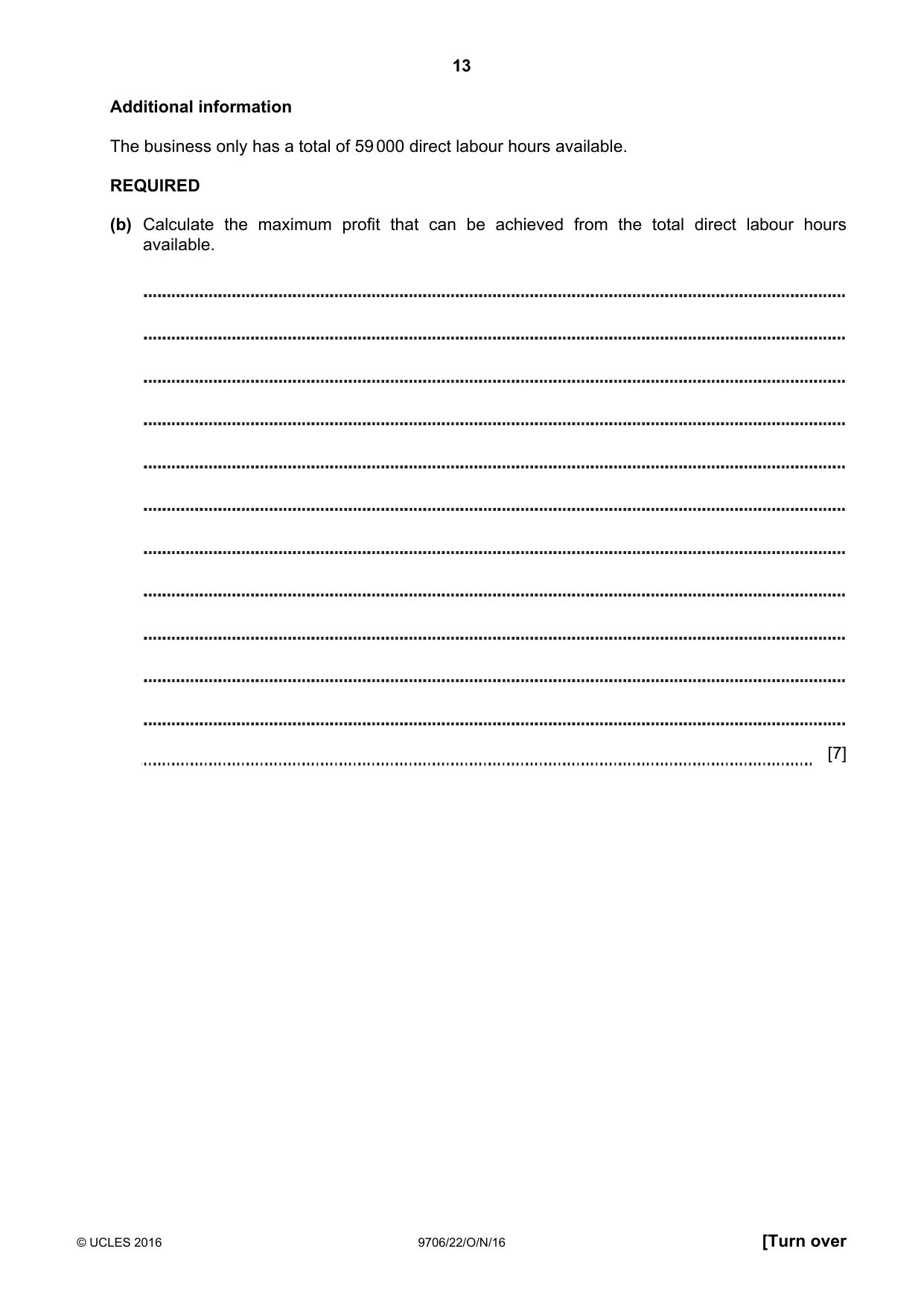
13 © UCLES 2016 9706/22/O/N/16 [Turn over Additional information The business only has a total of 59 000 direct labour hours available. REQUIRED (b) Calculate the maximum profit that can be achieved from the total direct labour hours available. [7]
Question paper, page 14
14 © UCLES 2016 9706/22/O/N/16 Additional information The company has two possible options to enable it to achieve the budgeted production. Option 1 Pay existing staff overtime. This will be paid at a rate of $5.75 per hour. Option 2 Buy in the required products from an external supplier at a cost of $50 per unit. REQUIRED (c) (i) Evaluate the options available to the company to achieve the budgeted production. Support your answers with calculations. Option 1 Option 2 [10]
Question paper, page 15
15 © UCLES 2016 9706/22/O/N/16 (ii) Recommend which option the company should choose. Justify your answer. [3] (d) (i) State three advantages of budgetary control. 1 2 3 [3] (ii) State three disadvantages of budgetary control. 1 2 3 [3] [Total: 30]
Question paper, page 16
16 Permission to reproduce items where third-party owned material protected by copyright is included has been sought and cleared where possible. Every reasonable effort has been made by the publisher (UCLES) to trace copyright holders, but if any items requiring clearance have unwittingly been included, the publisher will be pleased to make amends at the earliest possible opportunity. To avoid the issue of disclosure of answer-related information to candidates, all copyright acknowledgements are reproduced online in the Cambridge International Examinations Copyright Acknowledgements Booklet. This is produced for each series of examinations and is freely available to download at www.cie.org.uk after the live examination series. Cambridge International Examinations is part of the Cambridge Assessment Group. Cambridge Assessment is the brand name of University of Cambridge Local Examinations Syndicate (UCLES), which is itself a department of the University of Cambridge. © UCLES 2016 9706/22/O/N/16 BLANK PAGE
Mark scheme, page 1
® IGCSE is the registered trademark of Cambridge International Examinations. This document consists of 7 printed pages. © UCLES 2016 [Turn over Cambridge International Examinations Cambridge International Advanced Subsidiary and Advanced Level ACCOUNTING 9706/22 Paper 2 Structured Questions (Core) October/November 2016 MARK SCHEME Maximum Mark: 90 Published This mark scheme is published as an aid to teachers and candidates, to indicate the requirements of the examination. It shows the basis on which Examiners were instructed to award marks. It does not indicate the details of the discussions that took place at an Examiners’ meeting before marking began, which would have considered the acceptability of alternative answers. Mark schemes should be read in conjunction with the question paper and the Principal Examiner Report for Teachers. Cambridge will not enter into discussions about these mark schemes. Cambridge is publishing the mark schemes for the October/November 2016 series for most Cambridge IGCSE®, Cambridge International A and AS Level components and some Cambridge O Level components.
Mark scheme, page 2
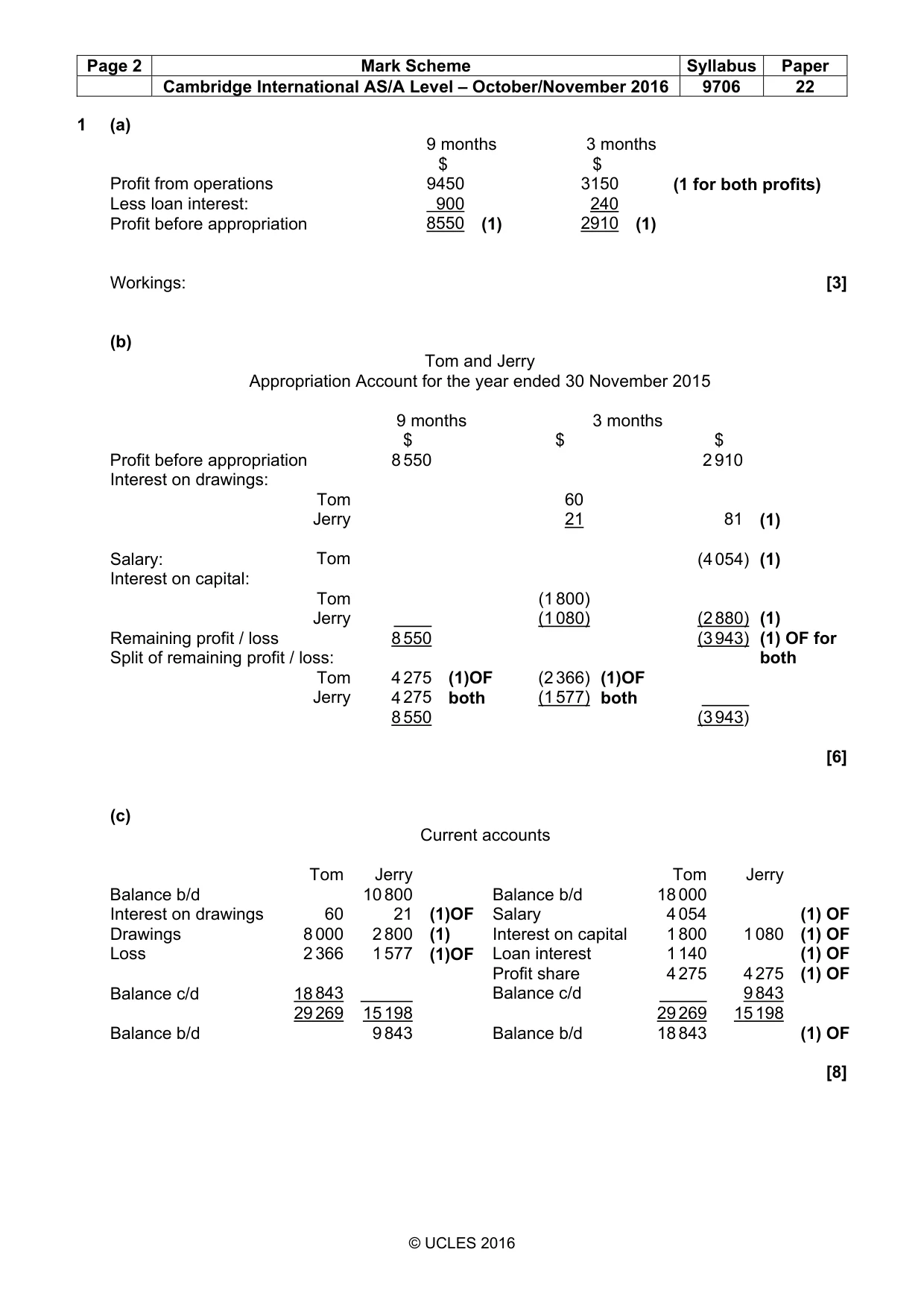
Page 2 Mark Scheme Syllabus Paper Cambridge International AS/A Level – October/November 2016 9706 22 © UCLES 2016 1 (a) 9 months 3 months $ $ Profit from operations 9450 3150 (1 for both profits) Less loan interest: 900 240 Profit before appropriation 8550 (1) 2910 (1) Workings: [3] (b) Tom and Jerry Appropriation Account for the year ended 30 November 2015 9 months 3 months $ $ $ Profit before appropriation 8 550 2 910 Interest on drawings: Tom 60 Jerry 21 81 (1) Salary: Tom (4 054) (1) Interest on capital: Tom (1 800) Jerry (1 080) (2 880) (1) Remaining profit / loss 8 550 (3 943) (1) OF for both Split of remaining profit / loss: Tom 4 275 (1)OF (2 366) (1)OF Jerry 4 275 both (1 577) both 8 550 (3 943) [6] (c) Current accounts Tom Jerry Tom Jerry Balance b/d 10 800 Balance b/d 18 000 Interest on drawings 60 21 (1)OF Salary 4 054 (1) OF Drawings 8 000 2 800 (1) Interest on capital 1 800 1 080 (1) OF Loss 2 366 1 577 (1)OF Loan interest 1 140 (1) OF Profit share 4 275 4 275 (1) OF Balance c/d 18 843 Balance c/d 9 843 29 269 15 198 29 269 15 198 Balance b/d 9 843 Balance b/d 18 843 (1) OF [8]
Mark scheme, page 3
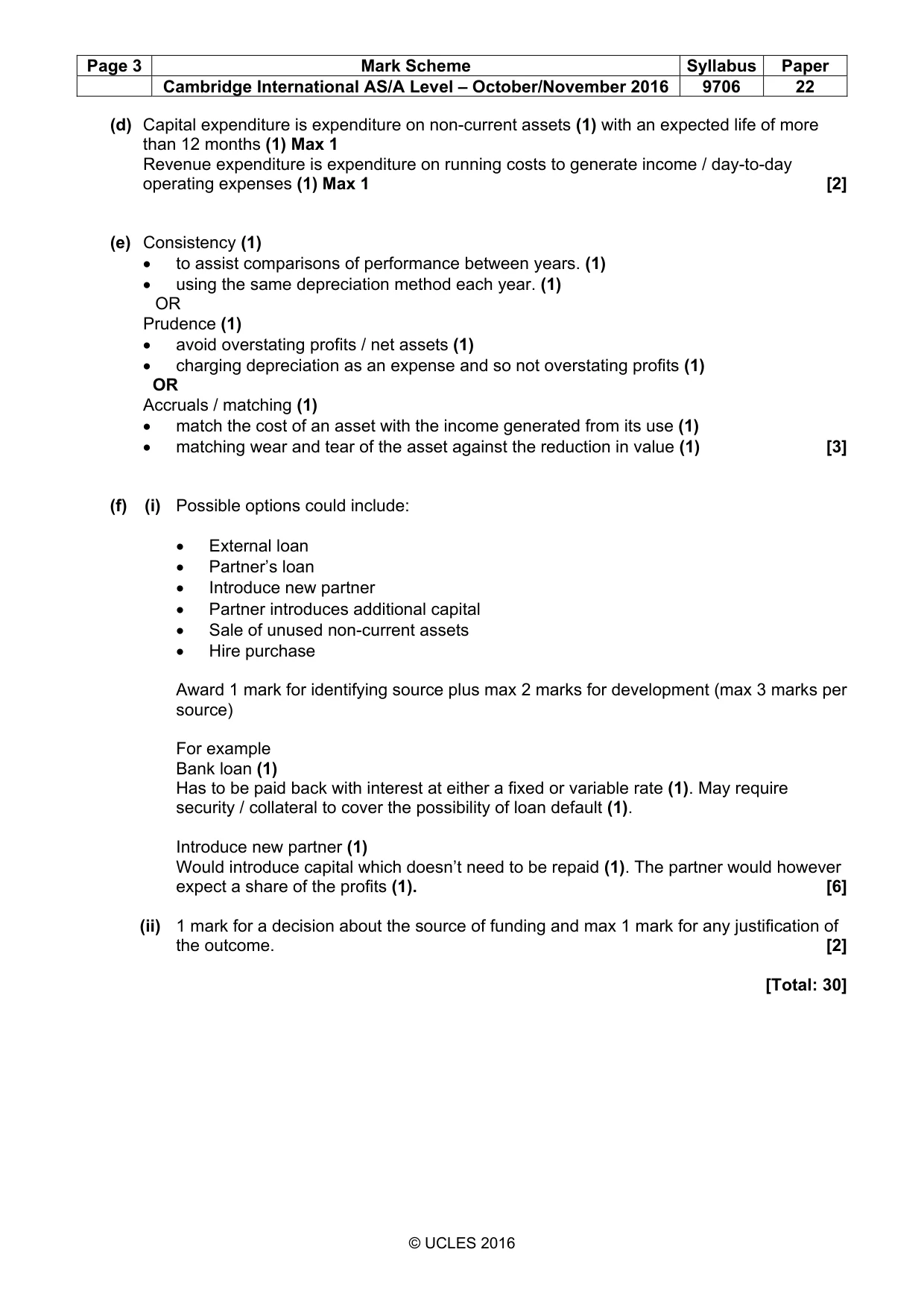
Page 3 Mark Scheme Syllabus Paper Cambridge International AS/A Level – October/November 2016 9706 22 © UCLES 2016 (d) Capital expenditure is expenditure on non-current assets (1) with an expected life of more than 12 months (1) Max 1 Revenue expenditure is expenditure on running costs to generate income / day-to-day operating expenses (1) Max 1 [2] (e) Consistency (1) • to assist comparisons of performance between years. (1) • using the same depreciation method each year. (1) OR Prudence (1) • avoid overstating profits / net assets (1) • charging depreciation as an expense and so not overstating profits (1) OR Accruals / matching (1) • match the cost of an asset with the income generated from its use (1) • matching wear and tear of the asset against the reduction in value (1) [3] (f) (i) Possible options could include: • External loan • Partner’s loan • Introduce new partner • Partner introduces additional capital • Sale of unused non-current assets • Hire purchase Award 1 mark for identifying source plus max 2 marks for development (max 3 marks per source) For example Bank loan (1) Has to be paid back with interest at either a fixed or variable rate (1). May require security / collateral to cover the possibility of loan default (1). Introduce new partner (1) Would introduce capital which doesn’t need to be repaid (1). The partner would however expect a share of the profits (1). [6] (ii) 1 mark for a decision about the source of funding and max 1 mark for any justification of the outcome. [2] [Total: 30]
Mark scheme, page 4
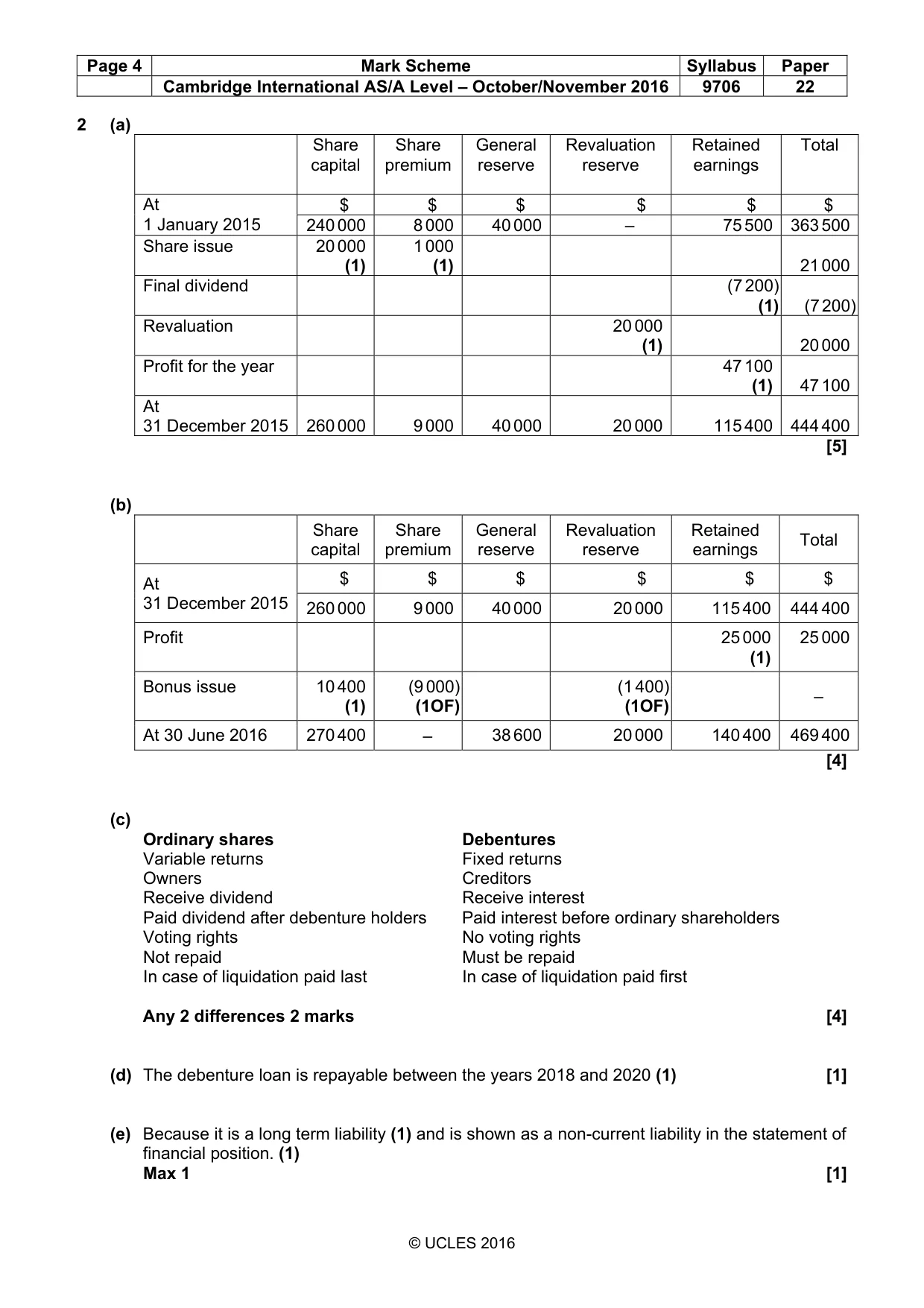
Page 4 Mark Scheme Syllabus Paper Cambridge International AS/A Level – October/November 2016 9706 22 © UCLES 2016 2 (a) Share capital Share premium General reserve Revaluation reserve Retained earnings Total At 1 January 2015 $ $ $ $ $ $ 240 000 8 000 40 000 – 75 500 363 500 Share issue 20 000 (1) 1 000 (1) 21 000 Final dividend (7 200) (1) (7 200) Revaluation 20 000 (1) 20 000 Profit for the year 47 100 (1) 47 100 At 31 December 2015 260 000 9 000 40 000 20 000 115 400 444 400 [5] (b) Share capital Share premium General reserve Revaluation reserve Retained earnings Total At 31 December 2015 $ $ $ $ $ $ 260 000 9 000 40 000 20 000 115 400 444 400 Profit 25 000 (1) 25 000 Bonus issue 10 400 (1) (9 000) (1OF) (1 400) (1OF) – At 30 June 2016 270 400 – 38 600 20 000 140 400 469 400 [4] (c) Ordinary shares Debentures Variable returns Fixed returns Owners Creditors Receive dividend Receive interest Paid dividend after debenture holders Paid interest before ordinary shareholders Voting rights No voting rights Not repaid Must be repaid In case of liquidation paid last In case of liquidation paid first Any 2 differences 2 marks [4] (d) The debenture loan is repayable between the years 2018 and 2020 (1) [1] (e) Because it is a long term liability (1) and is shown as a non-current liability in the statement of financial position. (1) Max 1 [1]
Mark scheme, page 5
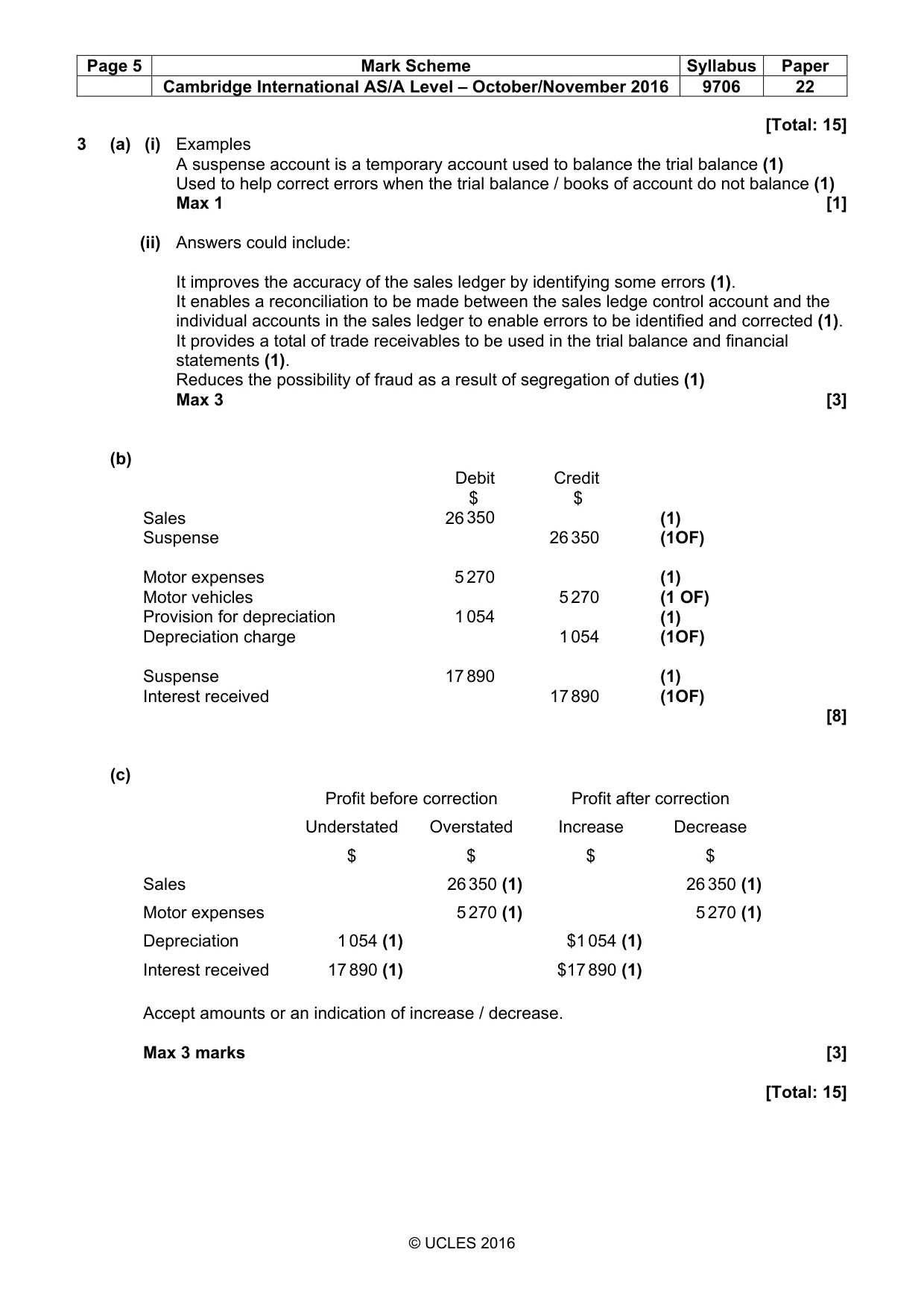
Page 5 Mark Scheme Syllabus Paper Cambridge International AS/A Level – October/November 2016 9706 22 © UCLES 2016 [Total: 15] 3 (a) (i) Examples A suspense account is a temporary account used to balance the trial balance (1) Used to help correct errors when the trial balance / books of account do not balance (1) Max 1 [1] (ii) Answers could include: It improves the accuracy of the sales ledger by identifying some errors (1). It enables a reconciliation to be made between the sales ledge control account and the individual accounts in the sales ledger to enable errors to be identified and corrected (1). It provides a total of trade receivables to be used in the trial balance and financial statements (1). Reduces the possibility of fraud as a result of segregation of duties (1) Max 3 [3] (b) Debit Credit $ $ Sales 26 350 (1) Suspense 26 350 (1OF) Motor expenses 5 270 (1) Motor vehicles 5 270 (1 OF) Provision for depreciation 1 054 (1) Depreciation charge 1 054 (1OF) Suspense 17 890 (1) Interest received 17 890 (1OF) [8] (c) Profit before correction Profit after correction Understated Overstated Increase Decrease $ $ $ $ Sales 26 350 (1) 26 350 (1) Motor expenses 5 270 (1) 5 270 (1) Depreciation 1 054 (1) $1 054 (1) Interest received 17 890 (1) $17 890 (1) Accept amounts or an indication of increase / decrease. Max 3 marks [3] [Total: 15]
Mark scheme, page 6
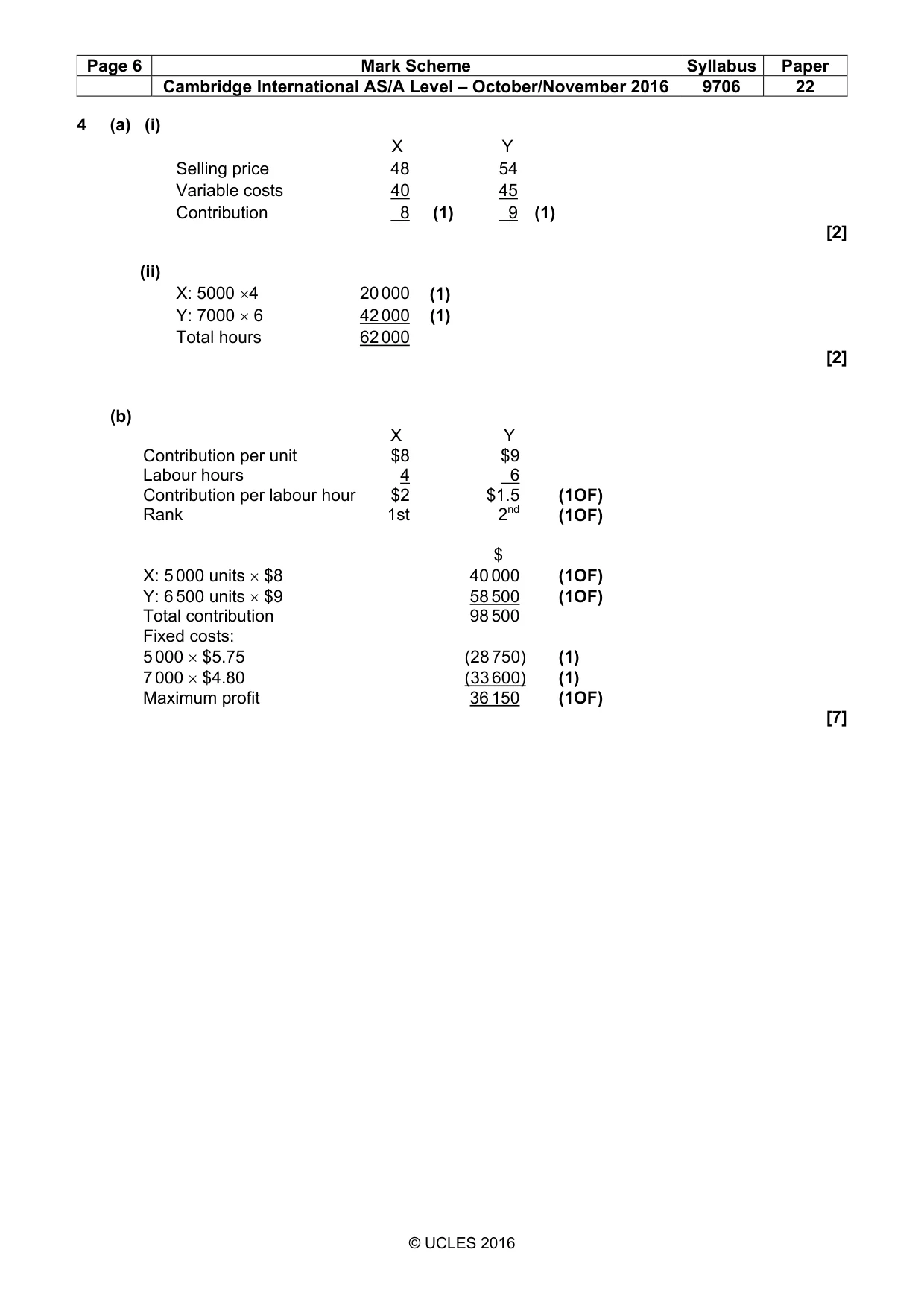
Page 6 Mark Scheme Syllabus Paper Cambridge International AS/A Level – October/November 2016 9706 22 © UCLES 2016 4 (a) (i) X Y Selling price 48 54 Variable costs 40 45 Contribution 8 (1) 9 (1) [2] (ii) X: 5000 ×4 20 000 (1) Y: 7000 × 6 42 000 (1) Total hours 62 000 [2] (b) X Y Contribution per unit $8 $9 Labour hours 4 6 Contribution per labour hour $2 $1.5 (1OF) Rank 1st 2nd (1OF) $ X: 5 000 units × $8 40 000 (1OF) Y: 6 500 units × $9 58 500 (1OF) Total contribution 98 500 Fixed costs: 5 000 × $5.75 (28 750) (1) 7 000 × $4.80 (33 600) (1) Maximum profit 36 150 (1OF) [7]
Mark scheme, page 7
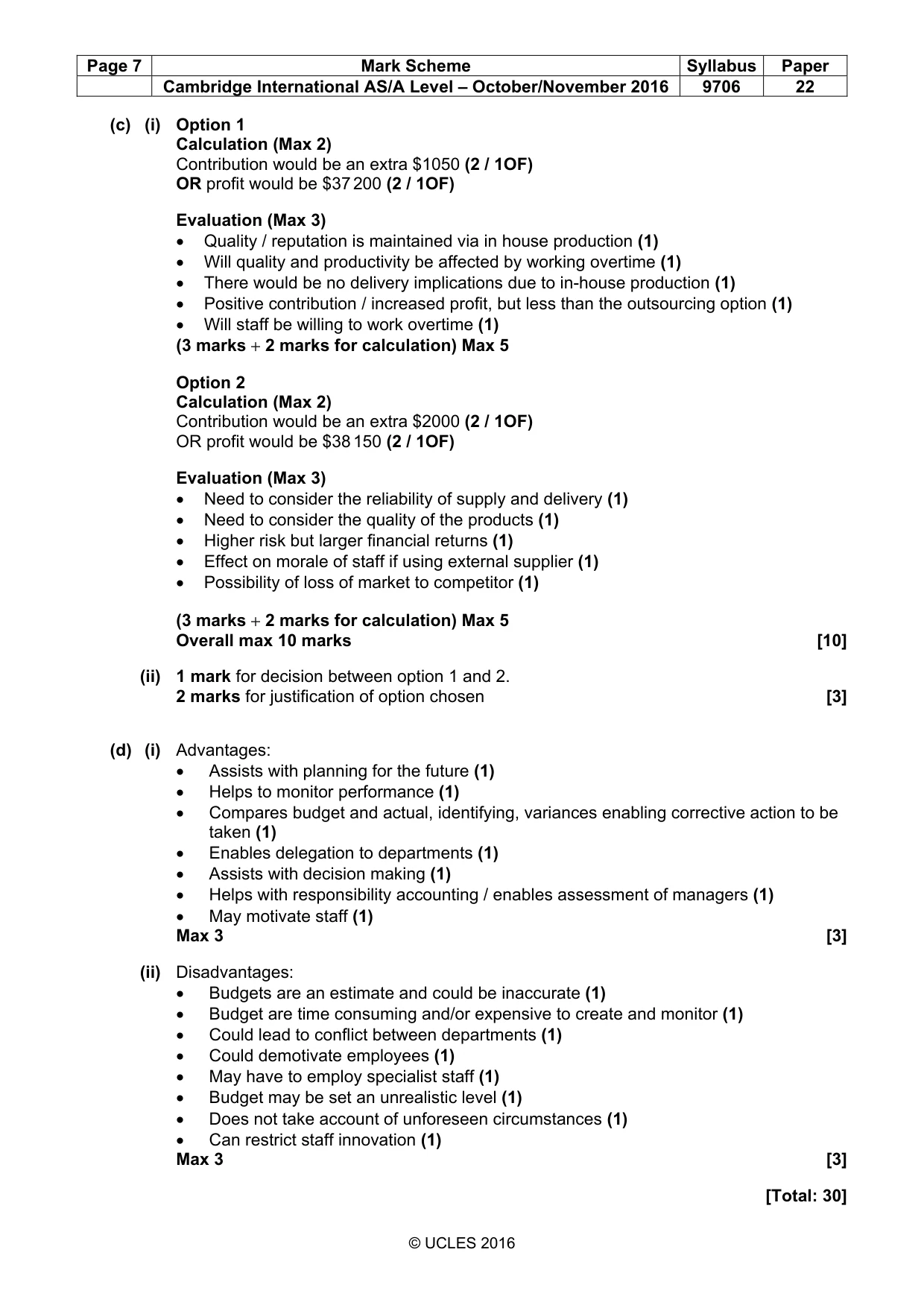
Page 7 Mark Scheme Syllabus Paper Cambridge International AS/A Level – October/November 2016 9706 22 © UCLES 2016 (c) (i) Option 1 Calculation (Max 2) Contribution would be an extra $1050 (2 / 1OF) OR profit would be $37 200 (2 / 1OF) Evaluation (Max 3) • Quality / reputation is maintained via in house production (1) • Will quality and productivity be affected by working overtime (1) • There would be no delivery implications due to in-house production (1) • Positive contribution / increased profit, but less than the outsourcing option (1) • Will staff be willing to work overtime (1) (3 marks + 2 marks for calculation) Max 5 Option 2 Calculation (Max 2) Contribution would be an extra $2000 (2 / 1OF) OR profit would be $38 150 (2 / 1OF) Evaluation (Max 3) • Need to consider the reliability of supply and delivery (1) • Need to consider the quality of the products (1) • Higher risk but larger financial returns (1) • Effect on morale of staff if using external supplier (1) • Possibility of loss of market to competitor (1) (3 marks + 2 marks for calculation) Max 5 Overall max 10 marks [10] (ii) 1 mark for decision between option 1 and 2. 2 marks for justification of option chosen [3] (d) (i) Advantages: • Assists with planning for the future (1) • Helps to monitor performance (1) • Compares budget and actual, identifying, variances enabling corrective action to be taken (1) • Enables delegation to departments (1) • Assists with decision making (1) • Helps with responsibility accounting / enables assessment of managers (1) • May motivate staff (1) Max 3 [3] (ii) Disadvantages: • Budgets are an estimate and could be inaccurate (1) • Budget are time consuming and/or expensive to create and monitor (1) • Could lead to conflict between departments (1) • Could demotivate employees (1) • May have to employ specialist staff (1) • Budget may be set an unrealistic level (1) • Does not take account of unforeseen circumstances (1) • Can restrict staff innovation (1) Max 3 [3] [Total: 30]
What you needed in this session
Cambridge’s own grade thresholds for 2016 Oct/Nov, Paper 2 · Variant 2. A higher threshold means an easier paper — the bar moves with how the cohort did.