Cambridge A Level Accounting 9706 — 2016 Oct/Nov Paper 2 · Variant 1
9706/21/O/N/16 · 90 marks · ≈101 min
The question paper and its mark scheme, free to read here and free to download. This is Cambridge’s own paper, exactly as it was sat.
Question paper16 pages

Mark scheme7 pages
Answers below. Sit the paper first if you are practising.
Paper as text
Question paper, page 1
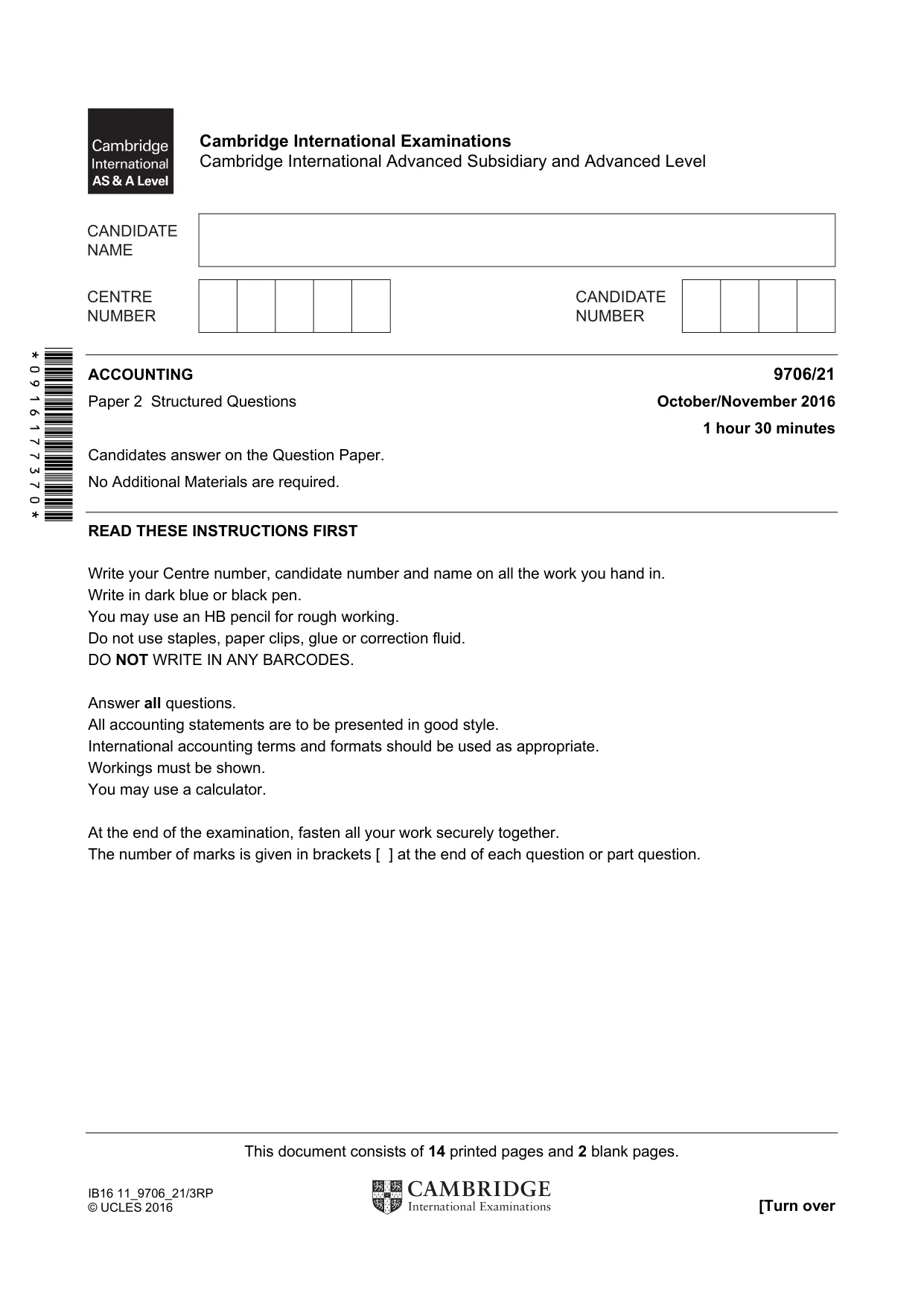
This document consists of 14 printed pages and 2 blank pages. IB16 11_9706_21/3RP © UCLES 2016 [Turn over Cambridge International Examinations Cambridge International Advanced Subsidiary and Advanced Level ACCOUNTING 9706/21 Paper 2 Structured Questions October/November 2016 1 hour 30 minutes Candidates answer on the Question Paper. No Additional Materials are required. READ THESE INSTRUCTIONS FIRST Write your Centre number, candidate number and name on all the work you hand in. Write in dark blue or black pen. You may use an HB pencil for rough working. Do not use staples, paper clips, glue or correction fluid. DO NOT WRITE IN ANY BARCODES. Answer all questions. All accounting statements are to be presented in good style. International accounting terms and formats should be used as appropriate. Workings must be shown. You may use a calculator. At the end of the examination, fasten all your work securely together. The number of marks is given in brackets [ ] at the end of each question or part question.
Question paper, page 2
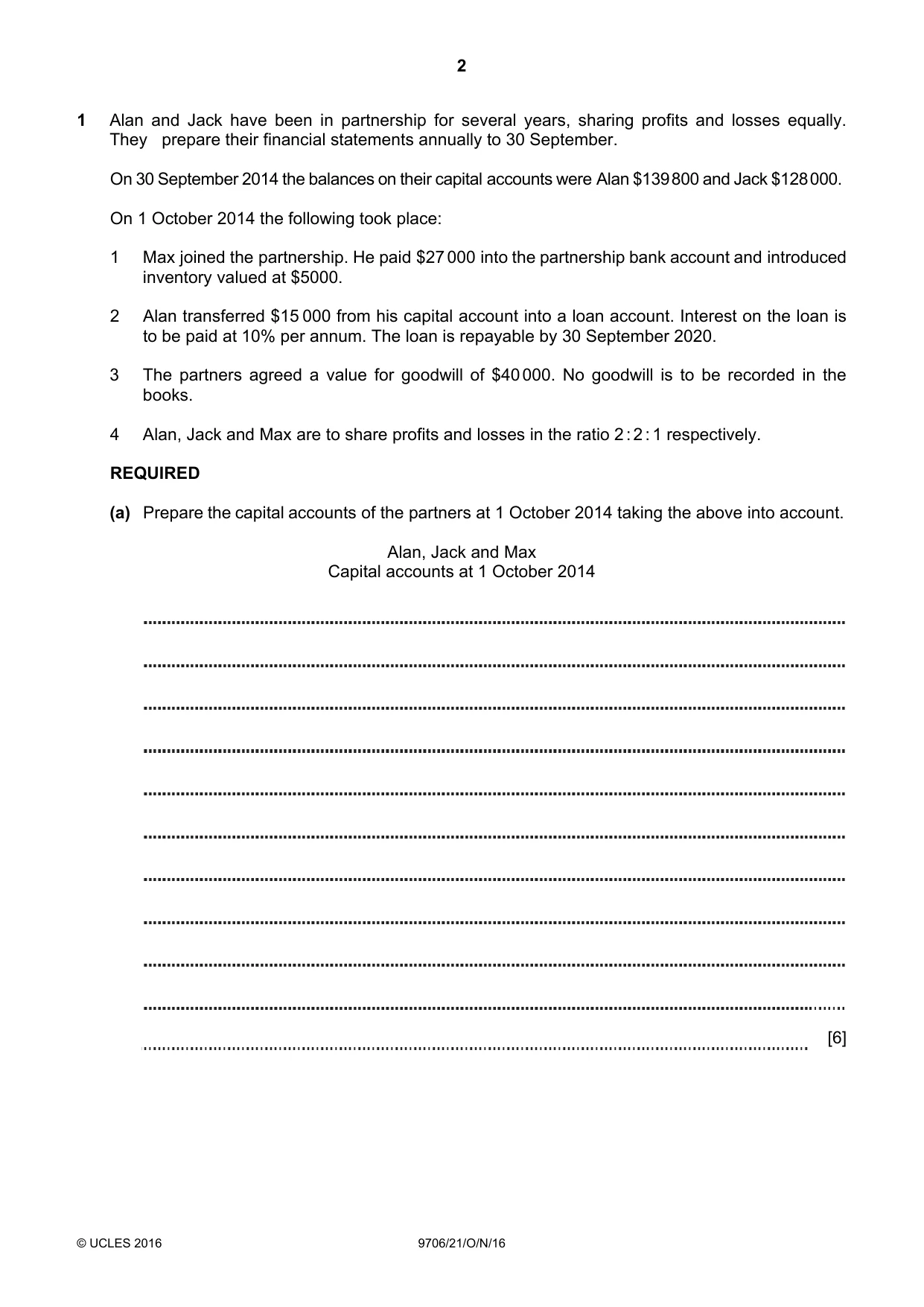
2 © UCLES 2016 9706/21/O/N/16 1 Alan and Jack have been in partnership for several years, sharing profits and losses equally. They prepare their financial statements annually to 30 September. On 30 September 2014 the balances on their capital accounts were Alan $139 800 and Jack $128 000. On 1 October 2014 the following took place: 1 Max joined the partnership. He paid $27 000 into the partnership bank account and introduced inventory valued at $5000. 2 Alan transferred $15 000 from his capital account into a loan account. Interest on the loan is to be paid at 10% per annum. The loan is repayable by 30 September 2020. 3 The partners agreed a value for goodwill of $40 000. No goodwill is to be recorded in the books. 4 Alan, Jack and Max are to share profits and losses in the ratio 2 : 2 : 1 respectively. REQUIRED (a) Prepare the capital accounts of the partners at 1 October 2014 taking the above into account. Alan, Jack and Max Capital accounts at 1 October 2014 [6]
Question paper, page 3
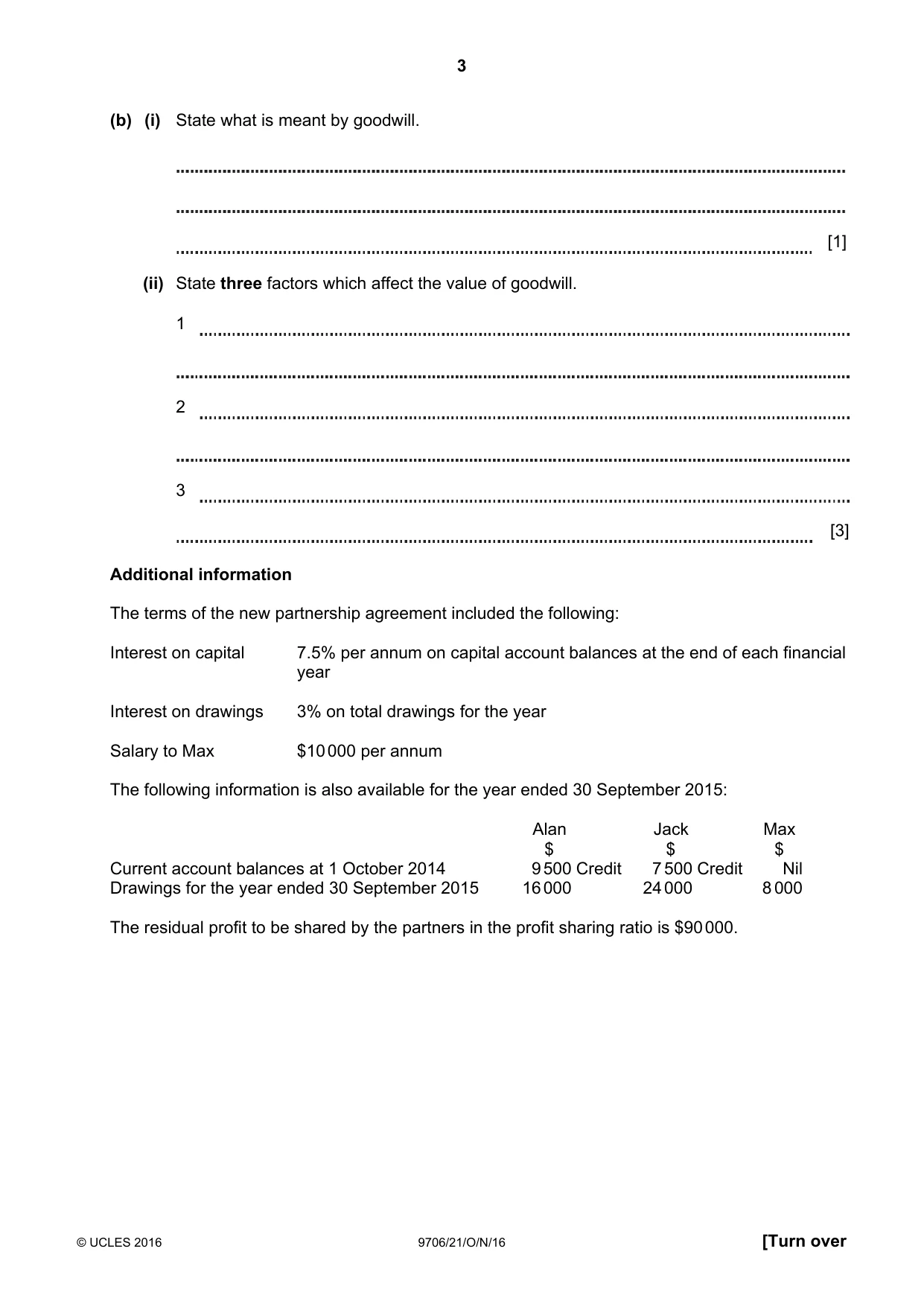
3 © UCLES 2016 9706/21/O/N/16 [Turn over (b) (i) State what is meant by goodwill. [1] (ii) State three factors which affect the value of goodwill. 1 2 3 [3] Additional information The terms of the new partnership agreement included the following: Interest on capital 7.5% per annum on capital account balances at the end of each financial year Interest on drawings 3% on total drawings for the year Salary to Max $10 000 per annum The following information is also available for the year ended 30 September 2015: Alan Jack Max $ $ $ Current account balances at 1 October 2014 9 500 Credit 7 500 Credit Nil Drawings for the year ended 30 September 2015 16 000 24 000 8 000 The residual profit to be shared by the partners in the profit sharing ratio is $90 000.
Question paper, page 4
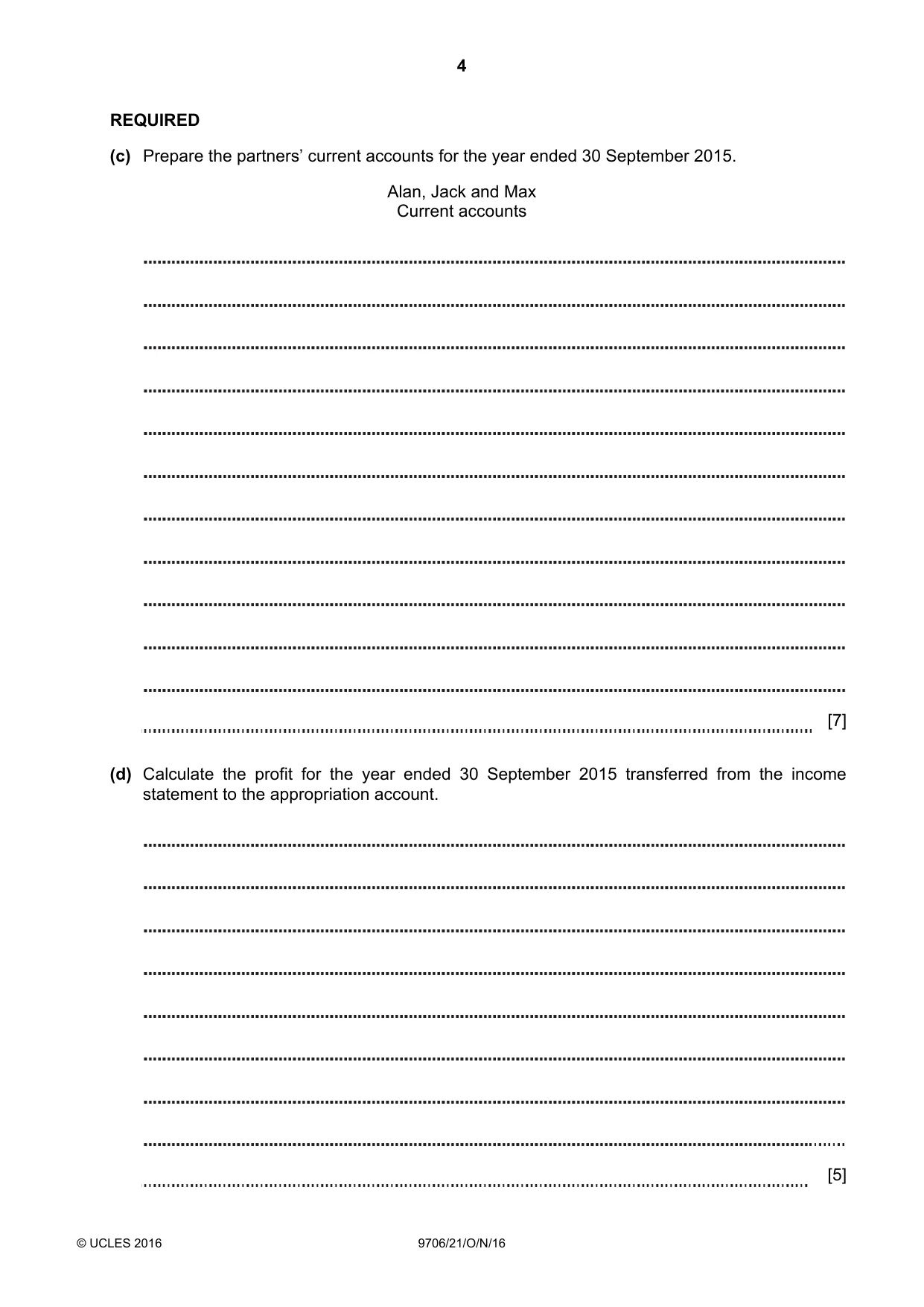
4 © UCLES 2016 9706/21/O/N/16 REQUIRED (c) Prepare the partners’ current accounts for the year ended 30 September 2015. Alan, Jack and Max Current accounts [7] (d) Calculate the profit for the year ended 30 September 2015 transferred from the income statement to the appropriation account. [5]
Question paper, page 5
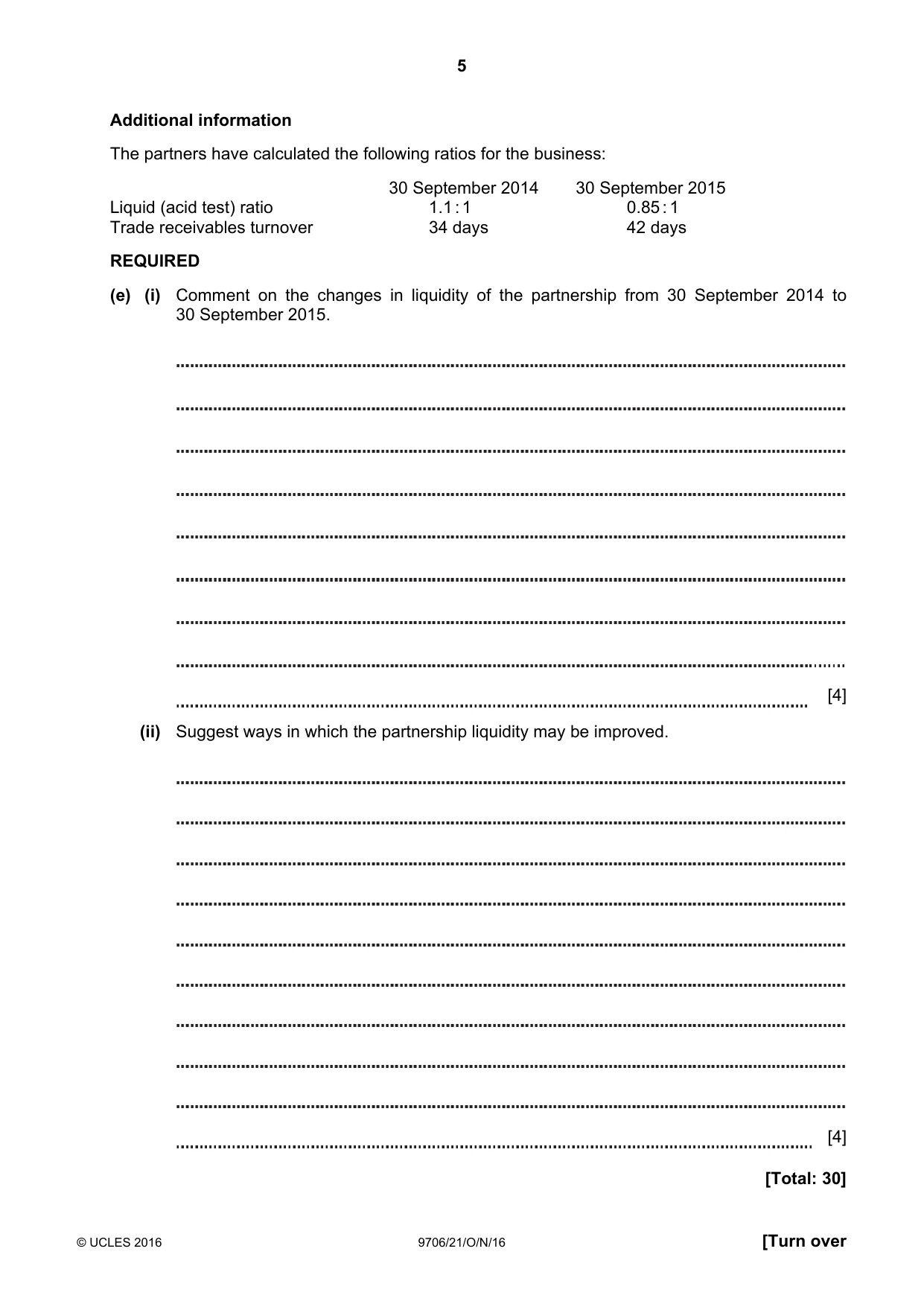
5 © UCLES 2016 9706/21/O/N/16 [Turn over Additional information The partners have calculated the following ratios for the business: 30 September 2014 30 September 2015 Liquid (acid test) ratio 1.1 : 1 0.85 : 1 Trade receivables turnover 34 days 42 days REQUIRED (e) (i) Comment on the changes in liquidity of the partnership from 30 September 2014 to 30 September 2015. [4] (ii) Suggest ways in which the partnership liquidity may be improved. [4] [Total: 30]
Question paper, page 6
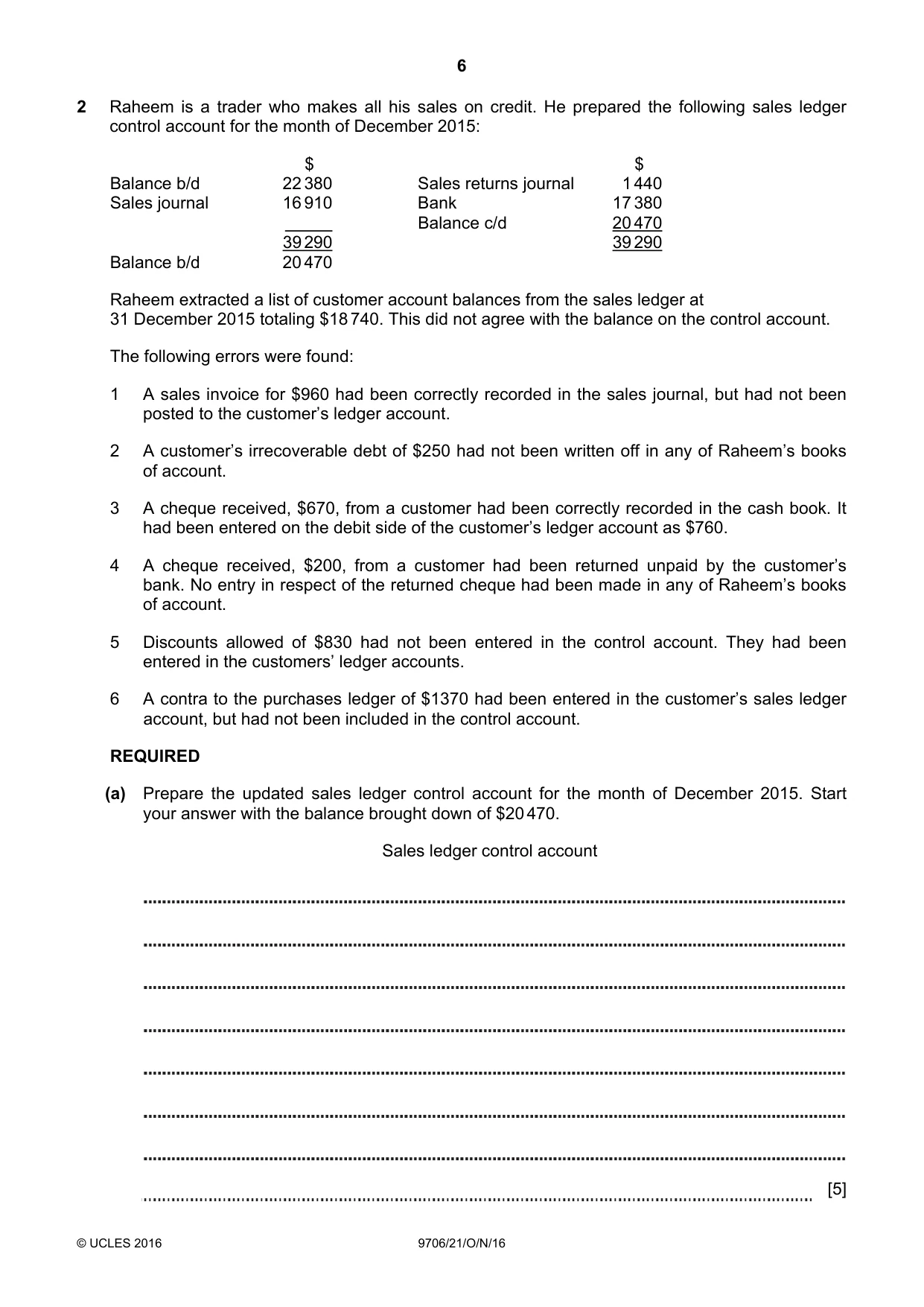
6 © UCLES 2016 9706/21/O/N/16 2 Raheem is a trader who makes all his sales on credit. He prepared the following sales ledger control account for the month of December 2015: $ $ Balance b/d 22 380 Sales returns journal 1 440 Sales journal 16 910 Bank 17 380 Balance c/d 20 470 39 290 39 290 Balance b/d 20 470 Raheem extracted a list of customer account balances from the sales ledger at 31 December 2015 totaling $18 740. This did not agree with the balance on the control account. The following errors were found: 1 A sales invoice for $960 had been correctly recorded in the sales journal, but had not been posted to the customer’s ledger account. 2 A customer’s irrecoverable debt of $250 had not been written off in any of Raheem’s books of account. 3 A cheque received, $670, from a customer had been correctly recorded in the cash book. It had been entered on the debit side of the customer’s ledger account as $760. 4 A cheque received, $200, from a customer had been returned unpaid by the customer’s bank. No entry in respect of the returned cheque had been made in any of Raheem’s books of account. 5 Discounts allowed of $830 had not been entered in the control account. They had been entered in the customers’ ledger accounts. 6 A contra to the purchases ledger of $1370 had been entered in the customer’s sales ledger account, but had not been included in the control account. REQUIRED (a) Prepare the updated sales ledger control account for the month of December 2015. Start your answer with the balance brought down of $20 470. Sales ledger control account [5]
Question paper, page 7
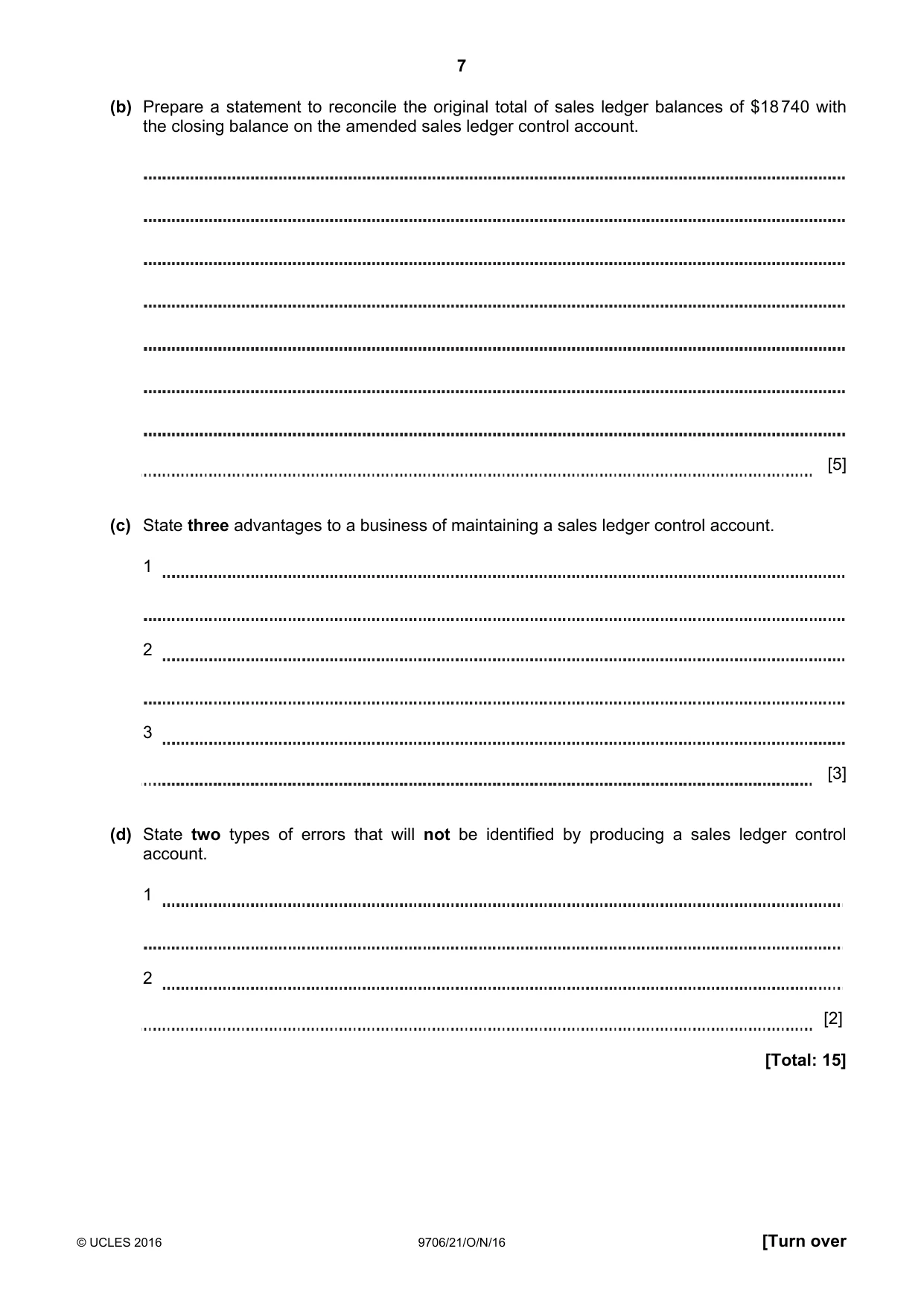
7 © UCLES 2016 9706/21/O/N/16 [Turn over (b) Prepare a statement to reconcile the original total of sales ledger balances of $18 740 with the closing balance on the amended sales ledger control account. [5] (c) State three advantages to a business of maintaining a sales ledger control account. 1 2 3 [3] (d) State two types of errors that will not be identified by producing a sales ledger control account. 1 2 [2] [Total: 15]
Question paper, page 8
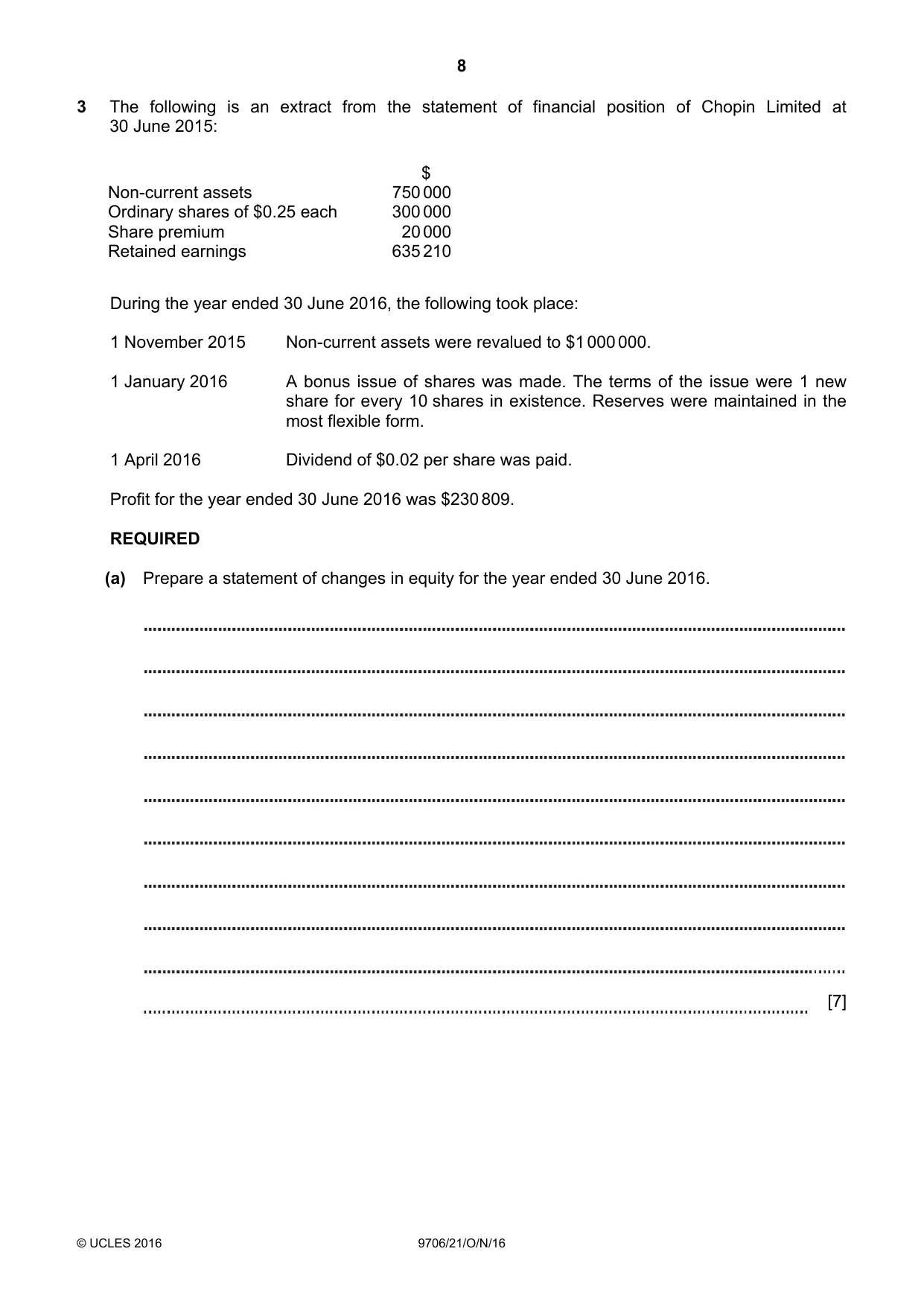
8 © UCLES 2016 9706/21/O/N/16 3 The following is an extract from the statement of financial position of Chopin Limited at 30 June 2015: During the year ended 30 June 2016, the following took place: 1 November 2015 Non-current assets were revalued to $1 000 000. 1 January 2016 A bonus issue of shares was made. The terms of the issue were 1 new share for every 10 shares in existence. Reserves were maintained in the most flexible form. 1 April 2016 Dividend of $0.02 per share was paid. Profit for the year ended 30 June 2016 was $230 809. REQUIRED (a) Prepare a statement of changes in equity for the year ended 30 June 2016. [7] $ Non-current assets 750 000 Ordinary shares of $0.25 each 300 000 Share premium 20 000 Retained earnings 635 210
Question paper, page 9
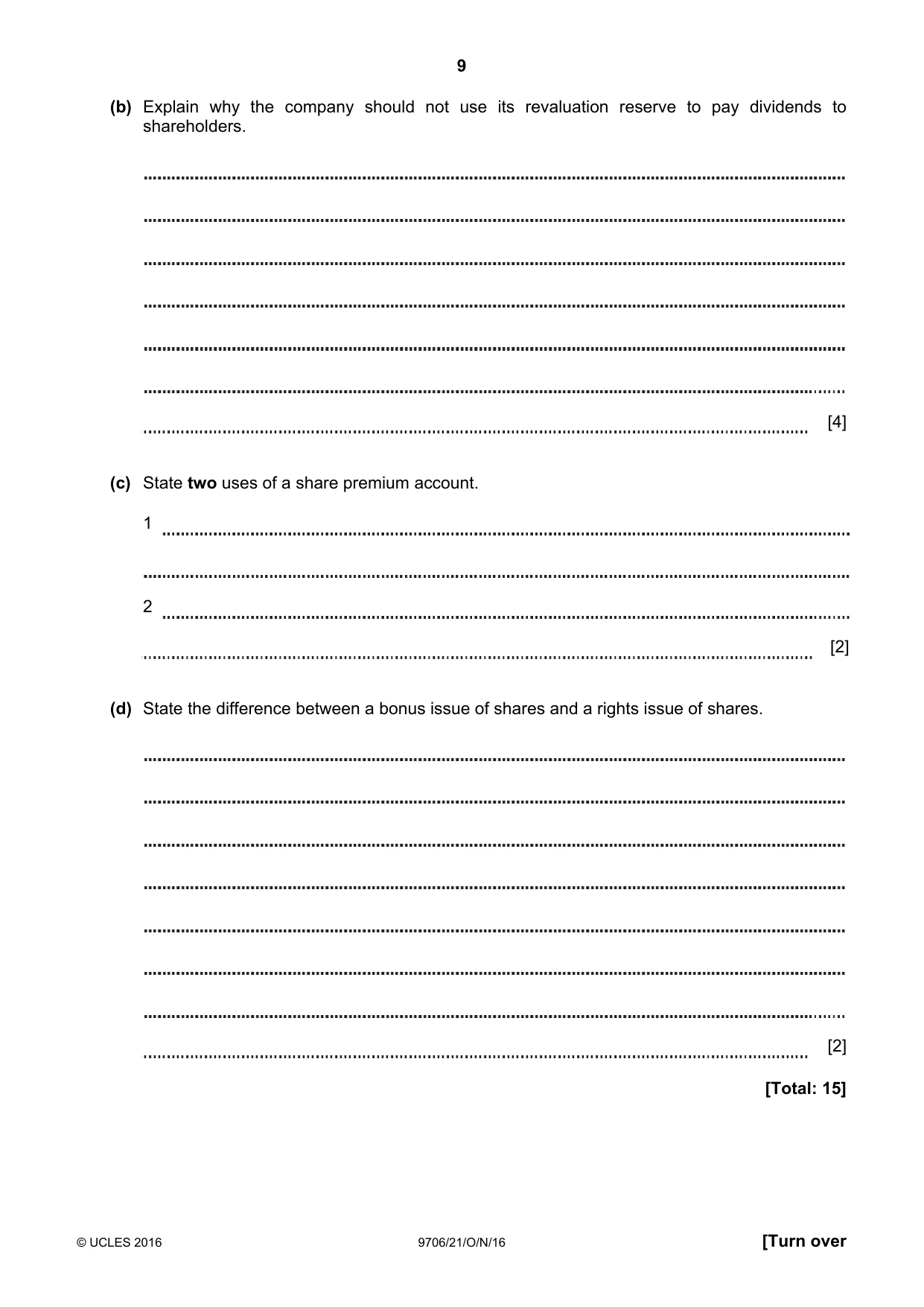
9 © UCLES 2016 9706/21/O/N/16 [Turn over (b) Explain why the company should not use its revaluation reserve to pay dividends to shareholders. [4] (c) State two uses of a share premium account. 1 2 [2] (d) State the difference between a bonus issue of shares and a rights issue of shares. [2] [Total: 15]
Question paper, page 10
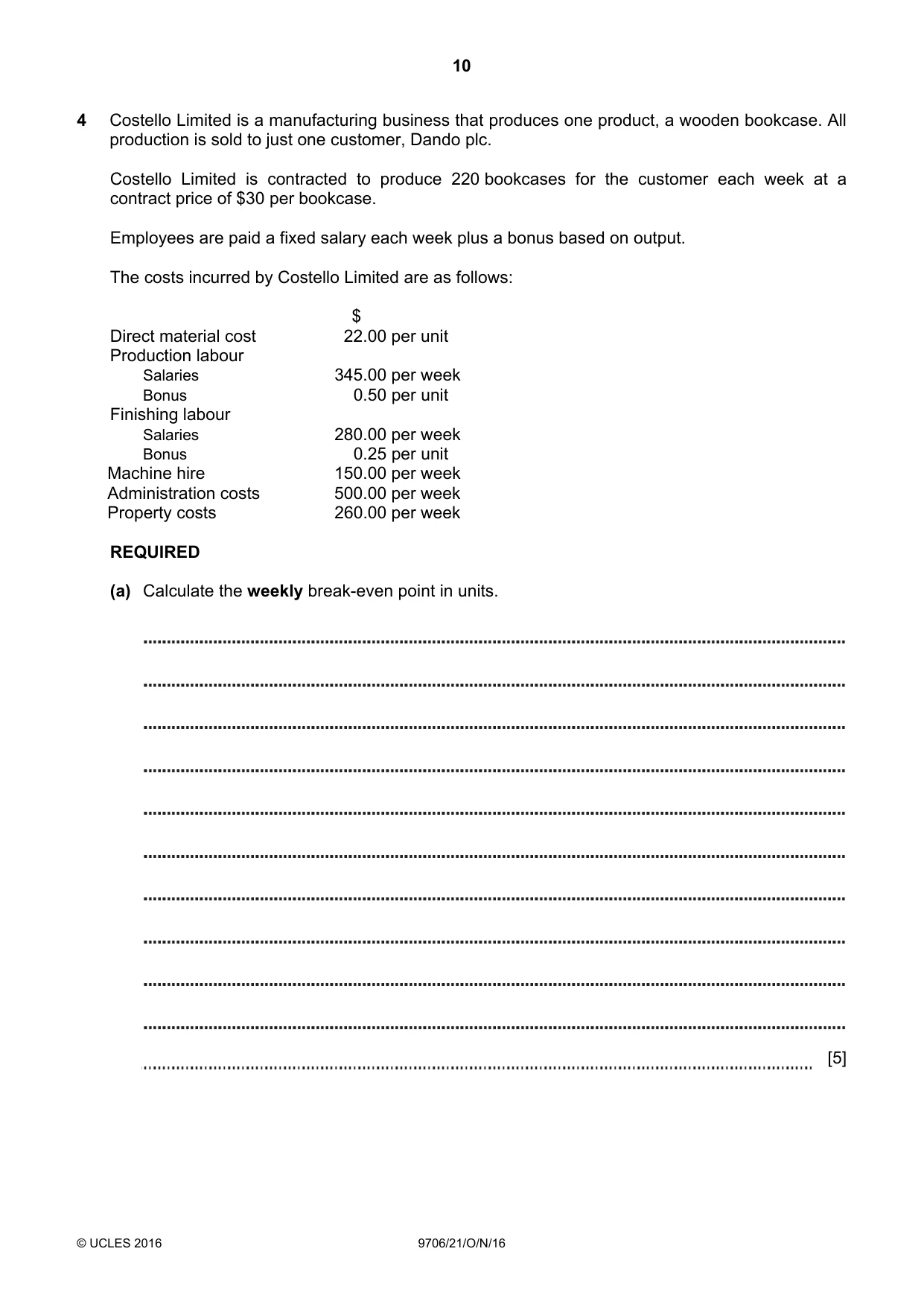
10 © UCLES 2016 9706/21/O/N/16 4 Costello Limited is a manufacturing business that produces one product, a wooden bookcase. All production is sold to just one customer, Dando plc. Costello Limited is contracted to produce 220 bookcases for the customer each week at a contract price of $30 per bookcase. Employees are paid a fixed salary each week plus a bonus based on output. The costs incurred by Costello Limited are as follows: $ Direct material cost 22.00 per unit Production labour Salaries 345.00 per week Bonus 0.50 per unit Finishing labour Salaries 280.00 per week Bonus 0.25 per unit Machine hire 150.00 per week Administration costs 500.00 per week Property costs 260.00 per week REQUIRED (a) Calculate the weekly break-even point in units. [5]
Question paper, page 11
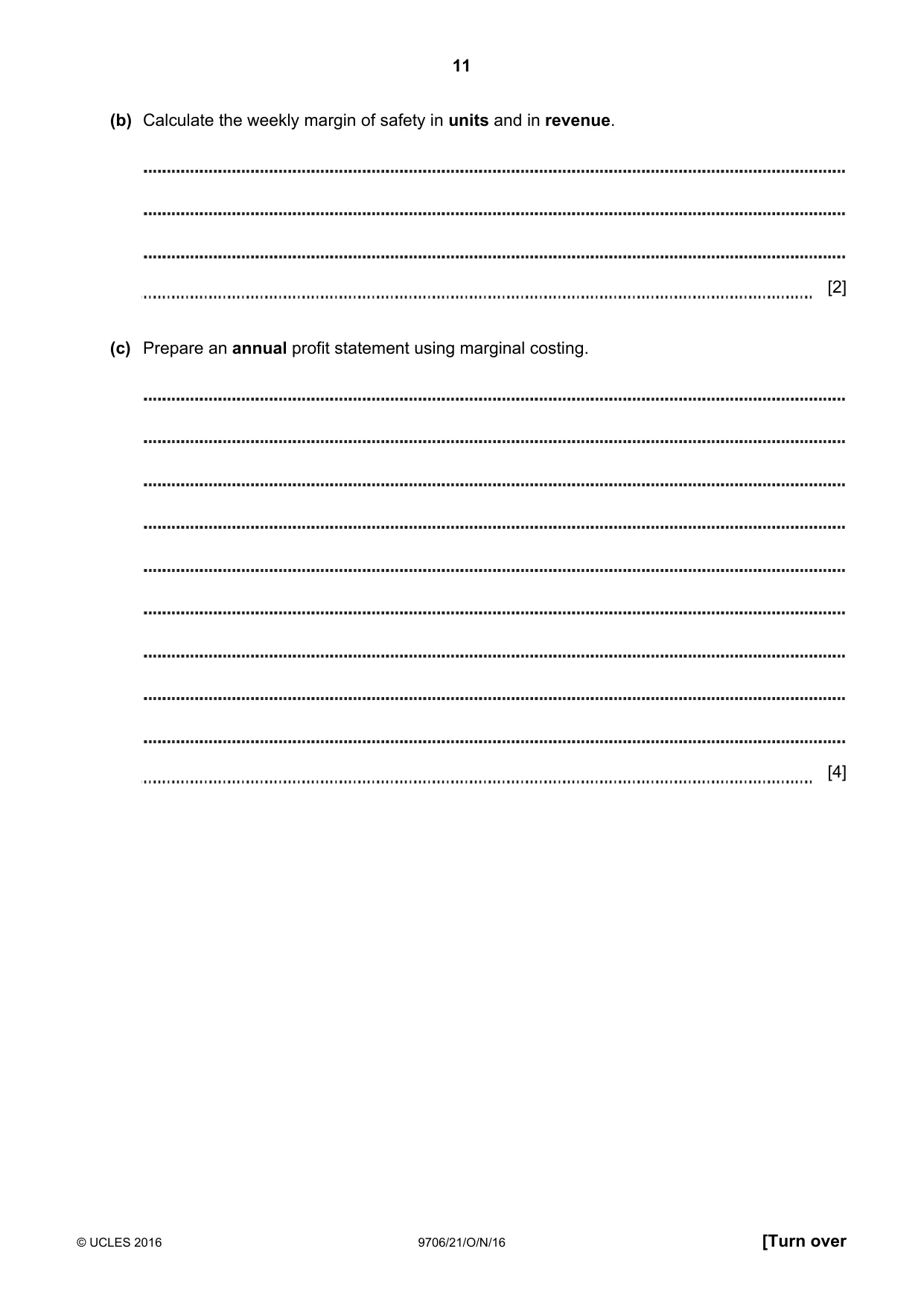
11 © UCLES 2016 9706/21/O/N/16 [Turn over (b) Calculate the weekly margin of safety in units and in revenue. [2] (c) Prepare an annual profit statement using marginal costing. [4]
Question paper, page 12
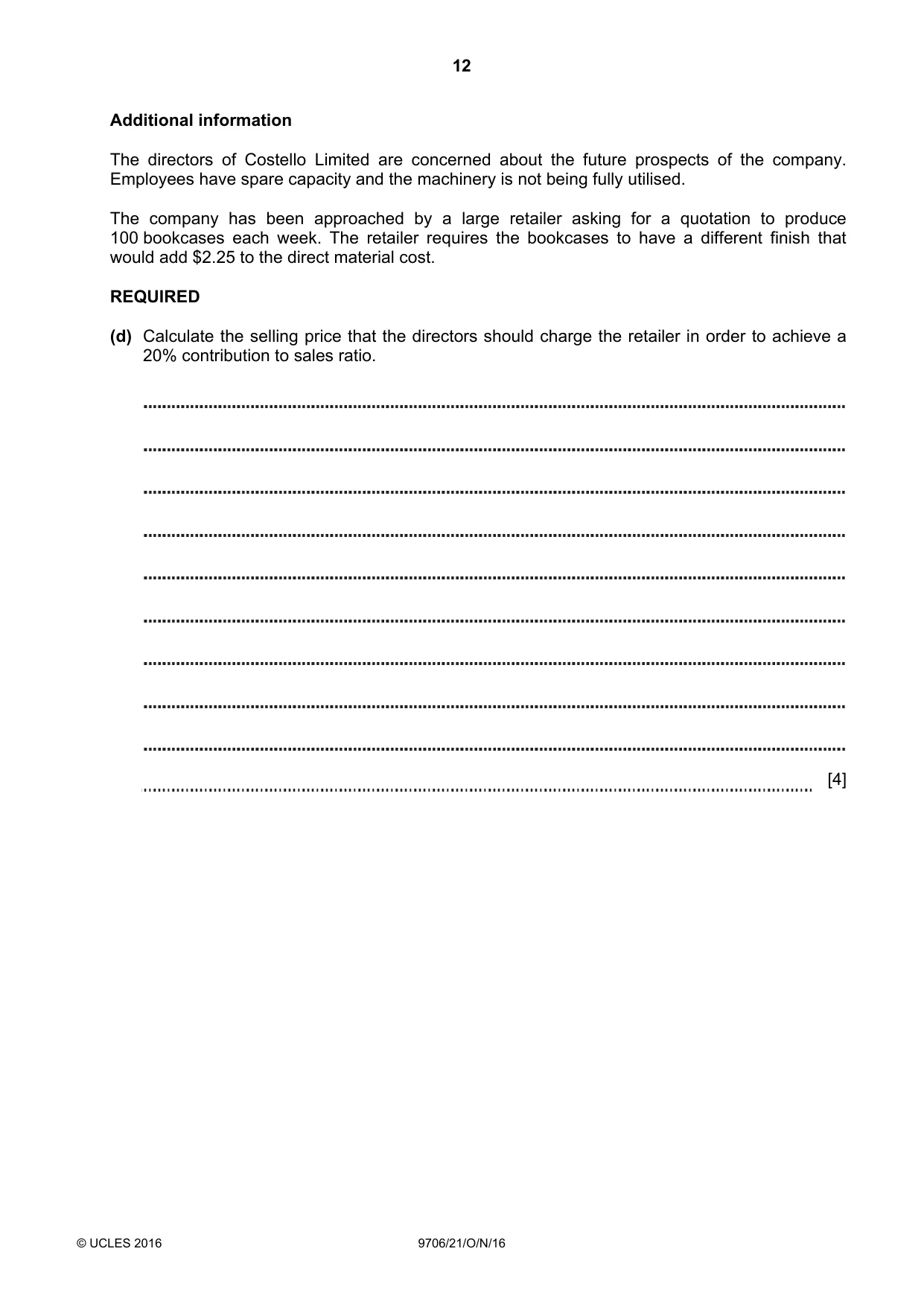
12 © UCLES 2016 9706/21/O/N/16 Additional information The directors of Costello Limited are concerned about the future prospects of the company. Employees have spare capacity and the machinery is not being fully utilised. The company has been approached by a large retailer asking for a quotation to produce 100 bookcases each week. The retailer requires the bookcases to have a different finish that would add $2.25 to the direct material cost. REQUIRED (d) Calculate the selling price that the directors should charge the retailer in order to achieve a 20% contribution to sales ratio. [4]
Question paper, page 13
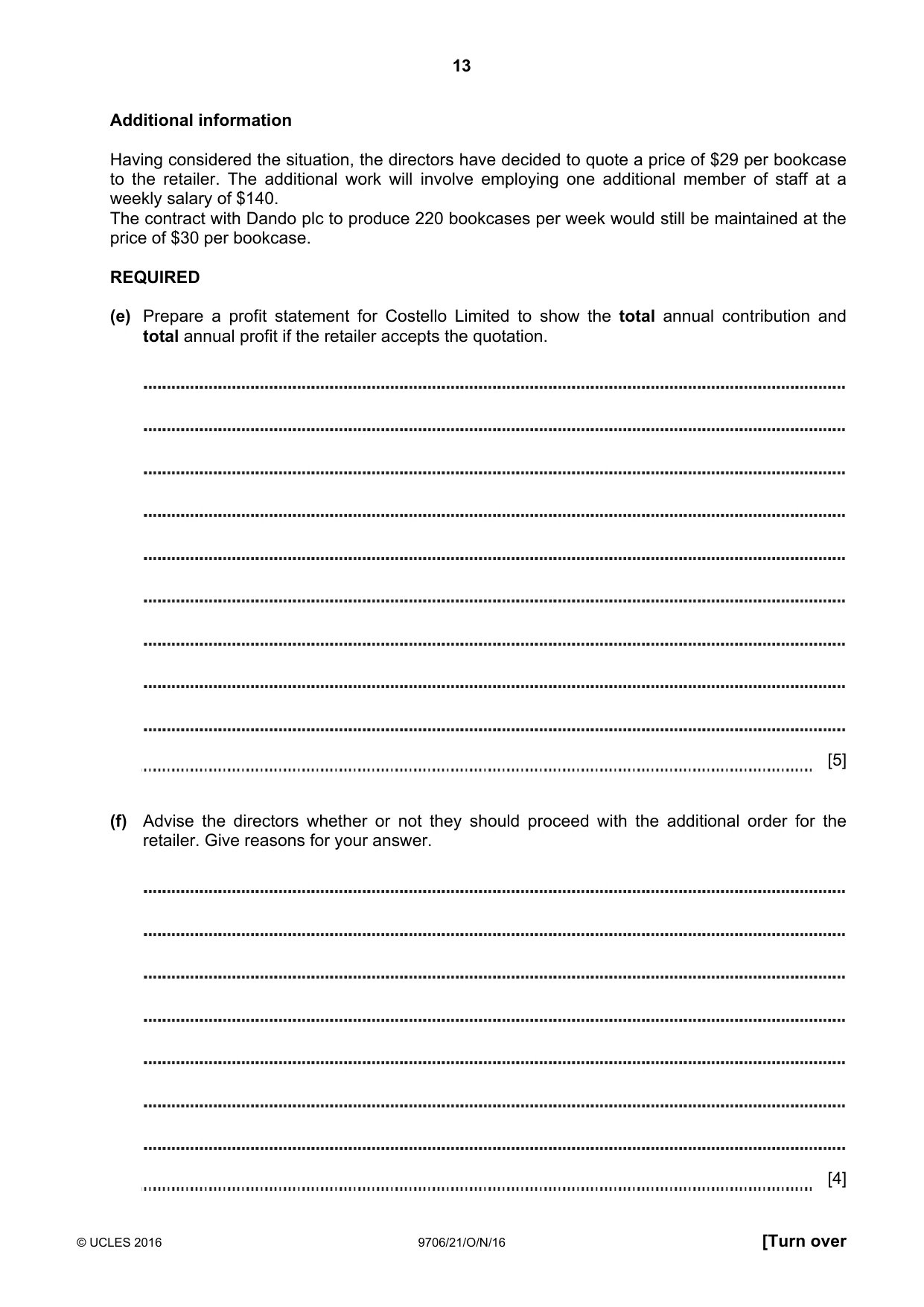
13 © UCLES 2016 9706/21/O/N/16 [Turn over Additional information Having considered the situation, the directors have decided to quote a price of $29 per bookcase to the retailer. The additional work will involve employing one additional member of staff at a weekly salary of $140. The contract with Dando plc to produce 220 bookcases per week would still be maintained at the price of $30 per bookcase. REQUIRED (e) Prepare a profit statement for Costello Limited to show the total annual contribution and total annual profit if the retailer accepts the quotation. [5] (f) Advise the directors whether or not they should proceed with the additional order for the retailer. Give reasons for your answer. [4]
Question paper, page 14
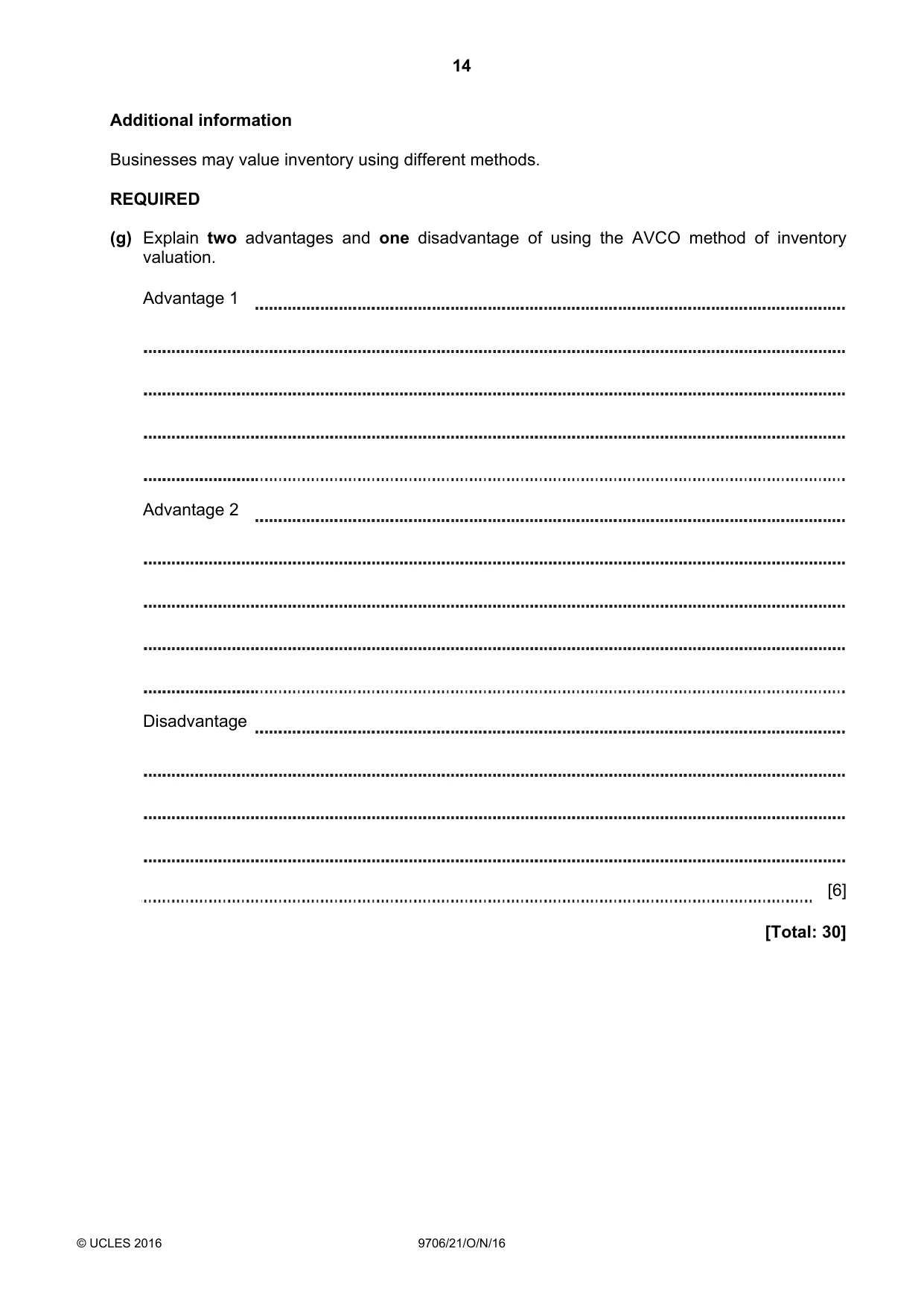
14 © UCLES 2016 9706/21/O/N/16 Additional information Businesses may value inventory using different methods. REQUIRED (g) Explain two advantages and one disadvantage of using the AVCO method of inventory valuation. Advantage 1 Advantage 2 Disadvantage [6] [Total: 30]
Question paper, page 15
15 © UCLES 2016 9706/21/O/N/16 BLANK PAGE
Question paper, page 16
16 Permission to reproduce items where third-party owned material protected by copyright is included has been sought and cleared where possible. Every reasonable effort has been made by the publisher (UCLES) to trace copyright holders, but if any items requiring clearance have unwittingly been included, the publisher will be pleased to make amends at the earliest possible opportunity. To avoid the issue of disclosure of answer-related information to candidates, all copyright acknowledgements are reproduced online in the Cambridge International Examinations Copyright Acknowledgements Booklet. This is produced for each series of examinations and is freely available to download at www.cie.org.uk after the live examination series. Cambridge International Examinations is part of the Cambridge Assessment Group. Cambridge Assessment is the brand name of University of Cambridge Local Examinations Syndicate (UCLES), which is itself a department of the University of Cambridge. © UCLES 2016 9706/21/O/N/16 BLANK PAGE
Mark scheme, page 1
® IGCSE is the registered trademark of Cambridge International Examinations. This document consists of 7 printed pages. © UCLES 2016 [Turn over Cambridge International Examinations Cambridge International Advanced Subsidiary and Advanced Level ACCOUNTING 9706/21 Paper 2 Structured Questions (Core) October/November 2016 MARK SCHEME Maximum Mark: 90 Published This mark scheme is published as an aid to teachers and candidates, to indicate the requirements of the examination. It shows the basis on which Examiners were instructed to award marks. It does not indicate the details of the discussions that took place at an Examiners’ meeting before marking began, which would have considered the acceptability of alternative answers. Mark schemes should be read in conjunction with the question paper and the Principal Examiner Report for Teachers. Cambridge will not enter into discussions about these mark schemes. Cambridge is publishing the mark schemes for the October/November 2016 series for most Cambridge IGCSE®, Cambridge International A and AS Level components and some Cambridge O Level components.
Mark scheme, page 2
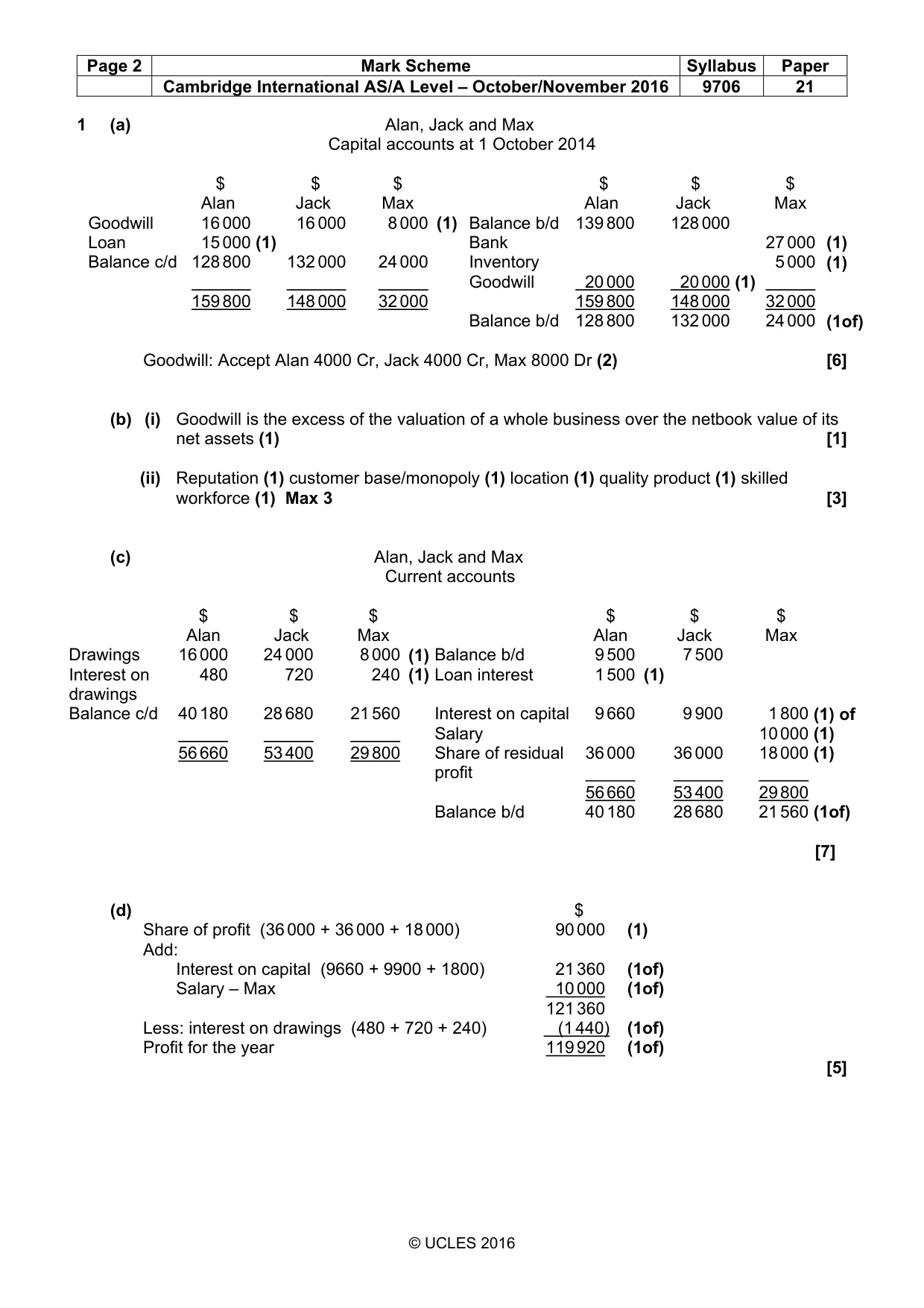
Page 2 Mark Scheme Syllabus Paper Cambridge International AS/A Level – October/November 2016 9706 21 © UCLES 2016 1 (a) Alan, Jack and Max Capital accounts at 1 October 2014 $ $ $ $ $ $ Alan Jack Max Alan Jack Max Goodwill 16 000 16 000 8 000 (1) Balance b/d 139 800 128 000 Loan 15 000 (1) Bank 27 000 (1) Balance c/d 128 800 132 000 24 000 Inventory 5 000 (1) Goodwill 20 000 20 000 (1) 159 800 148 000 32 000 159 800 148 000 32 000 Balance b/d 128 800 132 000 24 000 (1of) Goodwill: Accept Alan 4000 Cr, Jack 4000 Cr, Max 8000 Dr (2) [6] (b) (i) Goodwill is the excess of the valuation of a whole business over the netbook value of its net assets (1) [1] (ii) Reputation (1) customer base/monopoly (1) location (1) quality product (1) skilled workforce (1) Max 3 [3] (c) Alan, Jack and Max Current accounts $ $ $ $ $ $ Alan Jack Max Alan Jack Max Drawings 16 000 24 000 8 000 (1) Balance b/d 9 500 7 500 Interest on drawings 480 720 240 (1) Loan interest 1 500 (1) Balance c/d 40 180 28 680 21 560 Interest on capital 9 660 9 900 1 800 (1) of Salary 10 000 (1) 56 660 53 400 29 800 Share of residual profit 36 000 36 000 18 000 (1) 56 660 53 400 29 800 Balance b/d 40 180 28 680 21 560 (1of) [7] (d) $ Share of profit (36 000 + 36 000 + 18 000) 90 000 (1) Add: Interest on capital (9660 + 9900 + 1800) 21 360 (1of) Salary – Max 10 000 (1of) 121 360 Less: interest on drawings (480 + 720 + 240) (1 440) (1of) Profit for the year 119 920 (1of) [5]
Mark scheme, page 3
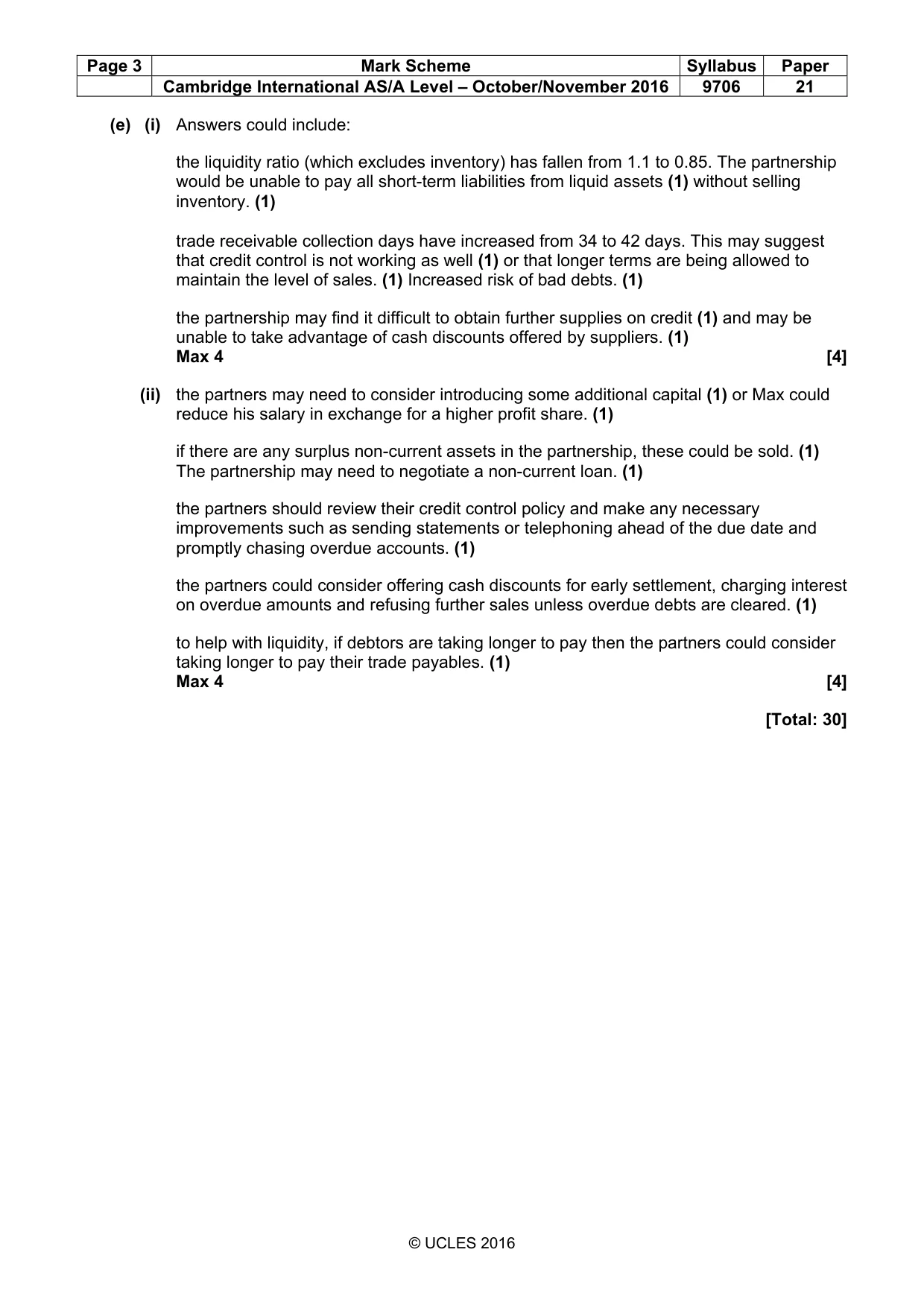
Page 3 Mark Scheme Syllabus Paper Cambridge International AS/A Level – October/November 2016 9706 21 © UCLES 2016 (e) (i) Answers could include: the liquidity ratio (which excludes inventory) has fallen from 1.1 to 0.85. The partnership would be unable to pay all short-term liabilities from liquid assets (1) without selling inventory. (1) trade receivable collection days have increased from 34 to 42 days. This may suggest that credit control is not working as well (1) or that longer terms are being allowed to maintain the level of sales. (1) Increased risk of bad debts. (1) the partnership may find it difficult to obtain further supplies on credit (1) and may be unable to take advantage of cash discounts offered by suppliers. (1) Max 4 [4] (ii) the partners may need to consider introducing some additional capital (1) or Max could reduce his salary in exchange for a higher profit share. (1) if there are any surplus non-current assets in the partnership, these could be sold. (1) The partnership may need to negotiate a non-current loan. (1) the partners should review their credit control policy and make any necessary improvements such as sending statements or telephoning ahead of the due date and promptly chasing overdue accounts. (1) the partners could consider offering cash discounts for early settlement, charging interest on overdue amounts and refusing further sales unless overdue debts are cleared. (1) to help with liquidity, if debtors are taking longer to pay then the partners could consider taking longer to pay their trade payables. (1) Max 4 [4] [Total: 30]
Mark scheme, page 4
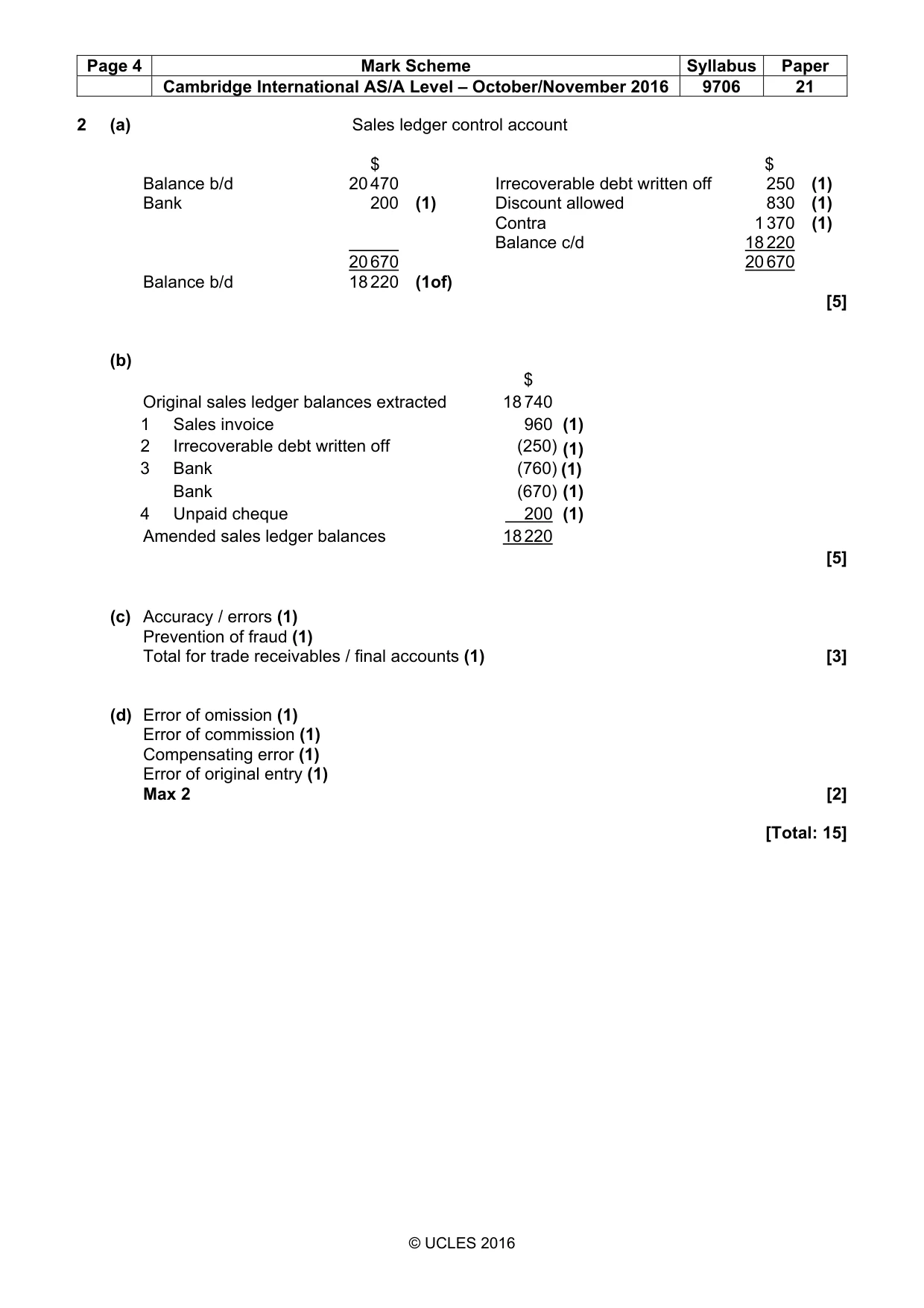
Page 4 Mark Scheme Syllabus Paper Cambridge International AS/A Level – October/November 2016 9706 21 © UCLES 2016 2 (a) Sales ledger control account $ $ Balance b/d 20 470 Irrecoverable debt written off 250 (1) Bank 200 (1) Discount allowed 830 (1) Contra 1 370 (1) Balance c/d 18 220 20 670 20 670 Balance b/d 18 220 (1of) [5] (b) $ Original sales ledger balances extracted 18 740 1 Sales invoice 960 (1) 2 Irrecoverable debt written off (250) (1) (1) 3 Bank (760) Bank (670) (1) 4 Unpaid cheque 200 (1) Amended sales ledger balances 18 220 [5] (c) Accuracy / errors (1) Prevention of fraud (1) Total for trade receivables / final accounts (1) [3] (d) Error of omission (1) Error of commission (1) Compensating error (1) Error of original entry (1) Max 2 [2] [Total: 15]
Mark scheme, page 5
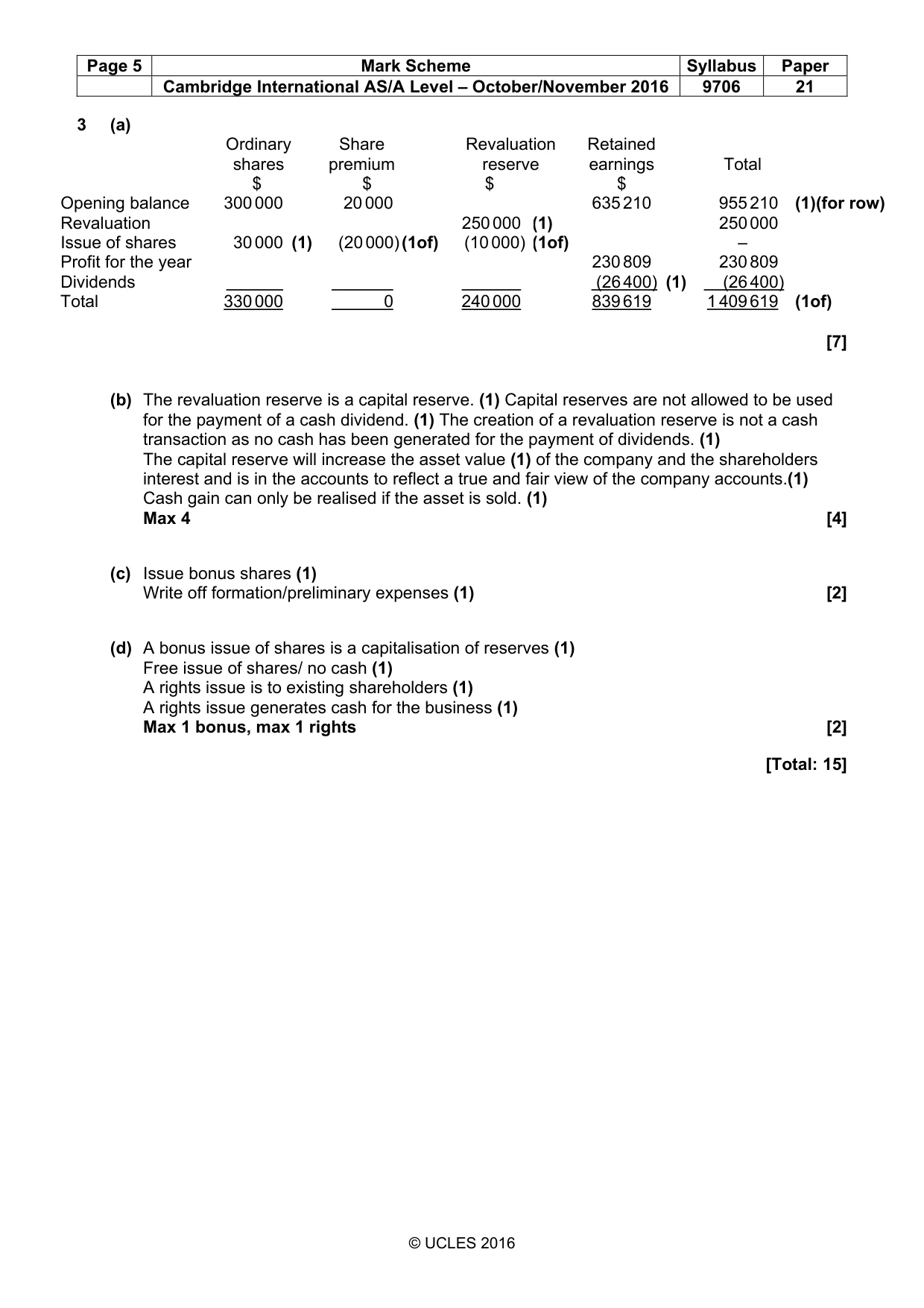
Page 5 Mark Scheme Syllabus Paper Cambridge International AS/A Level – October/November 2016 9706 21 © UCLES 2016 3 (a) Ordinary shares Share premium Revaluation reserve Retained earnings Total $ $ $ $ Opening balance 300 000 20 000 635 210 955 210 (1)(for row) Revaluation 250 000 (1) 250 000 Issue of shares 30 000 (1) (20 000)(1of) (10 000) (1of) – Profit for the year 230 809 230 809 Dividends (26 400) (1) (26 400) Total 330 000 0 240 000 839 619 1 409 619 (1of) [7] (b) The revaluation reserve is a capital reserve. (1) Capital reserves are not allowed to be used for the payment of a cash dividend. (1) The creation of a revaluation reserve is not a cash transaction as no cash has been generated for the payment of dividends. (1) The capital reserve will increase the asset value (1) of the company and the shareholders interest and is in the accounts to reflect a true and fair view of the company accounts.(1) Cash gain can only be realised if the asset is sold. (1) Max 4 [4] (c) Issue bonus shares (1) Write off formation/preliminary expenses (1) [2] (d) A bonus issue of shares is a capitalisation of reserves (1) Free issue of shares/ no cash (1) A rights issue is to existing shareholders (1) A rights issue generates cash for the business (1) Max 1 bonus, max 1 rights [2] [Total: 15]
Mark scheme, page 6
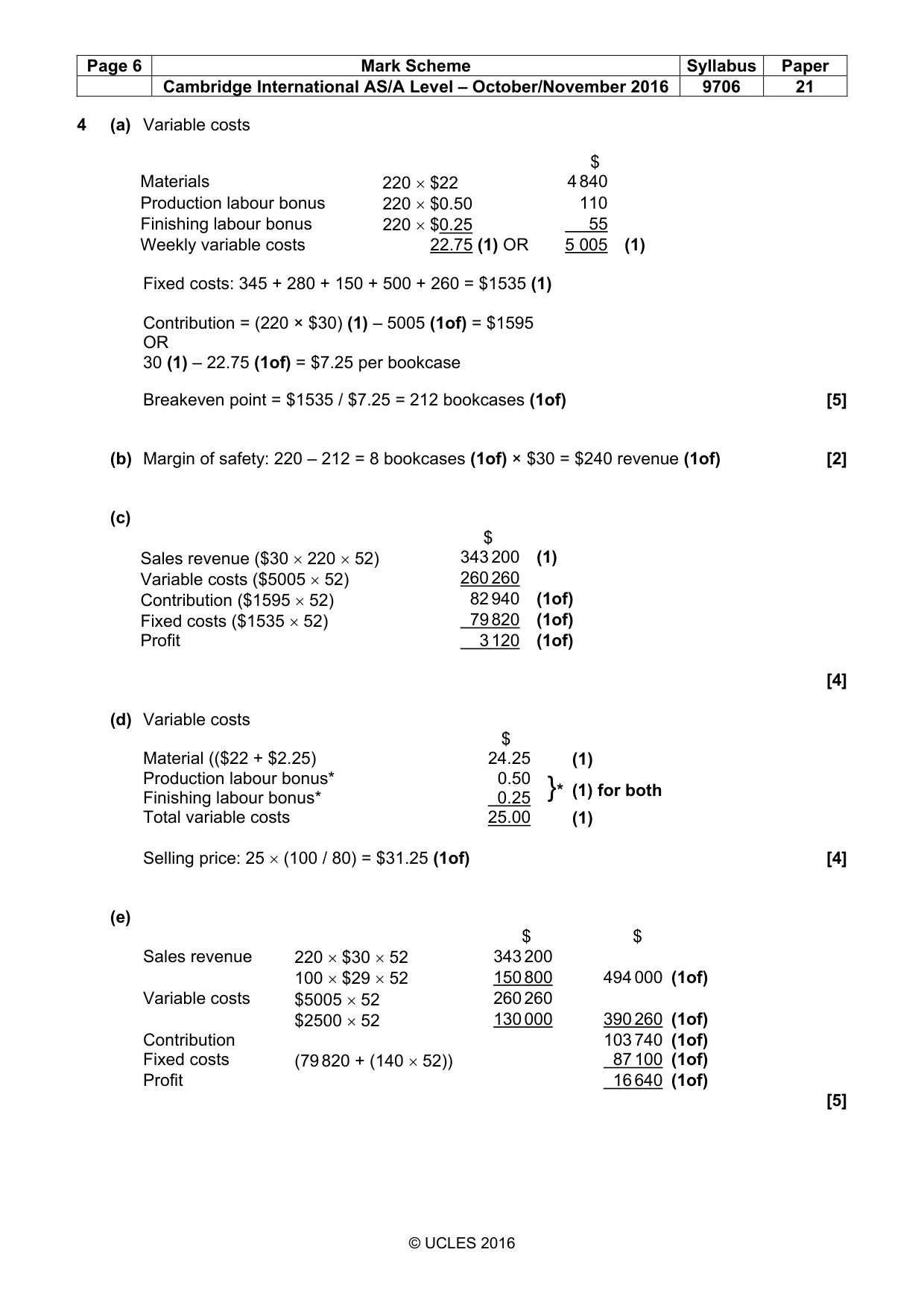
Page 6 Mark Scheme Syllabus Paper Cambridge International AS/A Level – October/November 2016 9706 21 © UCLES 2016 4 (a) Variable costs $ Materials 220 × $22 4 840 Production labour bonus 220 × $0.50 110 Finishing labour bonus 220 × $0.25 55 Weekly variable costs 22.75 (1) OR 5 005 (1) Fixed costs: 345 + 280 + 150 + 500 + 260 = $1535 (1) Contribution = (220 × $30) (1) – 5005 (1of) = $1595 OR 30 (1) – 22.75 (1of) = $7.25 per bookcase Breakeven point = $1535 / $7.25 = 212 bookcases (1of) [5] (b) Margin of safety: 220 – 212 = 8 bookcases (1of) × $30 = $240 revenue (1of) [2] (c) $ Sales revenue ($30 × 220 × 52) 343 200 (1) Variable costs ($5005 × 52) 260 260 Contribution ($1595 × 52) 82 940 (1of) Fixed costs ($1535 × 52) 79 820 (1of) Profit 3 120 (1of) [4] (d) Variable costs $ Material (($22 + $2.25) 24.25 (1) Production labour bonus* 0.50 }* (1) for both Finishing labour bonus* 0.25 Total variable costs 25.00 (1) Selling price: 25 × (100 / 80) = $31.25 (1of) [4] (e) $ $ Sales revenue 220 × $30 × 52 343 200 100 × $29 × 52 150 800 494 000 (1of) Variable costs $5005 × 52 260 260 $2500 × 52 130 000 390 260 (1of) Contribution 103 740 (1of) Fixed costs (79 820 + (140 × 52)) 87 100 (1of) Profit 16 640 (1of) [5]
Mark scheme, page 7
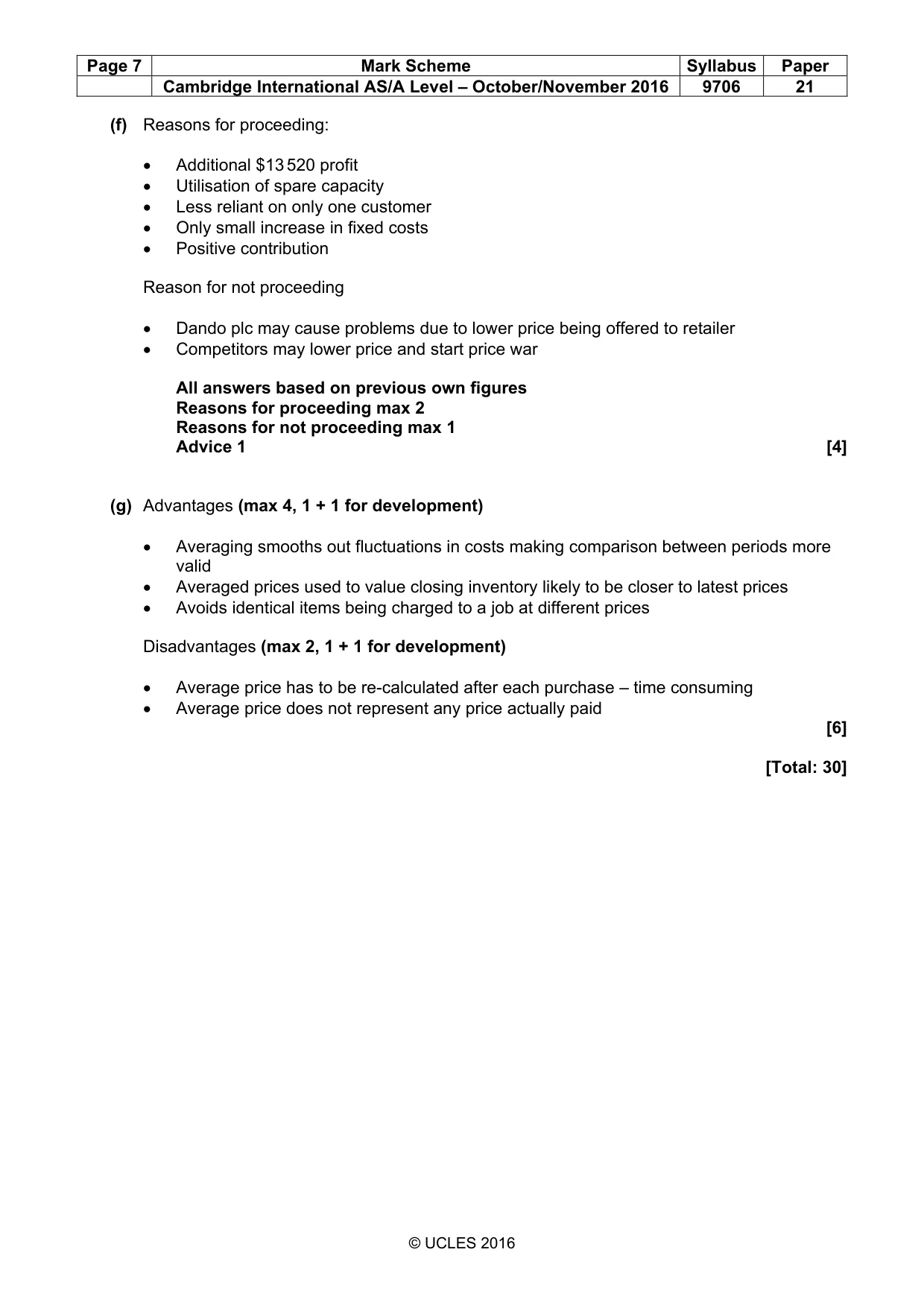
Page 7 Mark Scheme Syllabus Paper Cambridge International AS/A Level – October/November 2016 9706 21 © UCLES 2016 (f) Reasons for proceeding: • Additional $13 520 profit • Utilisation of spare capacity • Less reliant on only one customer • Only small increase in fixed costs • Positive contribution Reason for not proceeding • Dando plc may cause problems due to lower price being offered to retailer • Competitors may lower price and start price war All answers based on previous own figures Reasons for proceeding max 2 Reasons for not proceeding max 1 Advice 1 [4] (g) Advantages (max 4, 1 + 1 for development) • Averaging smooths out fluctuations in costs making comparison between periods more valid • Averaged prices used to value closing inventory likely to be closer to latest prices • Avoids identical items being charged to a job at different prices Disadvantages (max 2, 1 + 1 for development) • Average price has to be re-calculated after each purchase – time consuming • Average price does not represent any price actually paid [6] [Total: 30]
What you needed in this session
Cambridge’s own grade thresholds for 2016 Oct/Nov, Paper 2 · Variant 1. A higher threshold means an easier paper — the bar moves with how the cohort did.