Cambridge A Level Accounting 9706 — 2016 Oct/Nov Paper 2 · Variant 3
9706/23/O/N/16 · 90 marks · ≈101 min
The question paper and its mark scheme, free to read here and free to download. This is Cambridge’s own paper, exactly as it was sat.
Question paper20 pages


Mark scheme7 pages
Answers below. Sit the paper first if you are practising.
Paper as text
Question paper, page 1
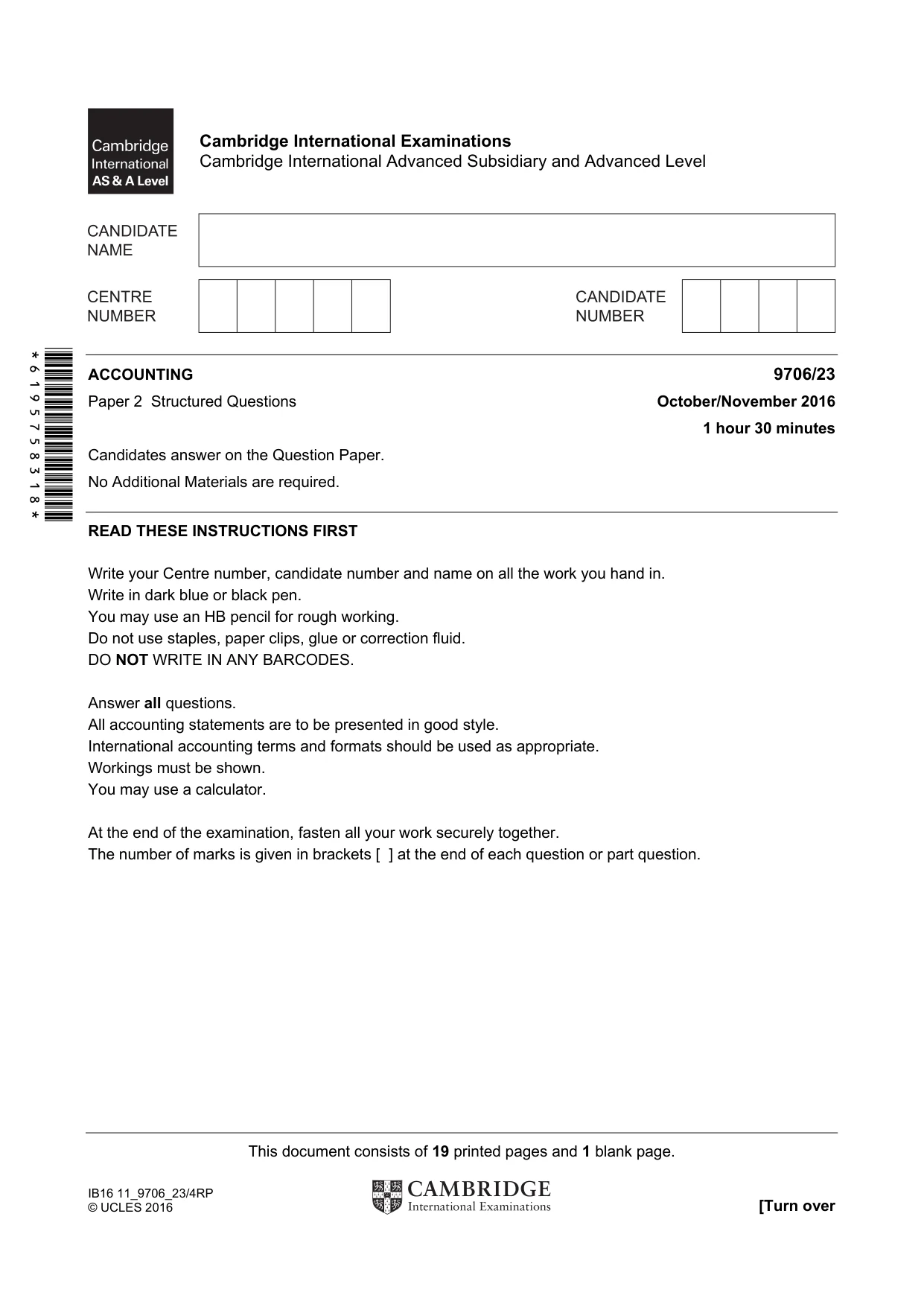
This document consists of 19 printed pages and 1 blank page. IB16 11_9706_23/4RP © UCLES 2016 [Turn over Cambridge International Examinations Cambridge International Advanced Subsidiary and Advanced Level ACCOUNTING 9706/23 Paper 2 Structured Questions October/November 2016 1 hour 30 minutes Candidates answer on the Question Paper. No Additional Materials are required. READ THESE INSTRUCTIONS FIRST Write your Centre number, candidate number and name on all the work you hand in. Write in dark blue or black pen. You may use an HB pencil for rough working. Do not use staples, paper clips, glue or correction fluid. DO NOT WRITE IN ANY BARCODES. Answer all questions. All accounting statements are to be presented in good style. International accounting terms and formats should be used as appropriate. Workings must be shown. You may use a calculator. At the end of the examination, fasten all your work securely together. The number of marks is given in brackets [ ] at the end of each question or part question.
Question paper, page 2
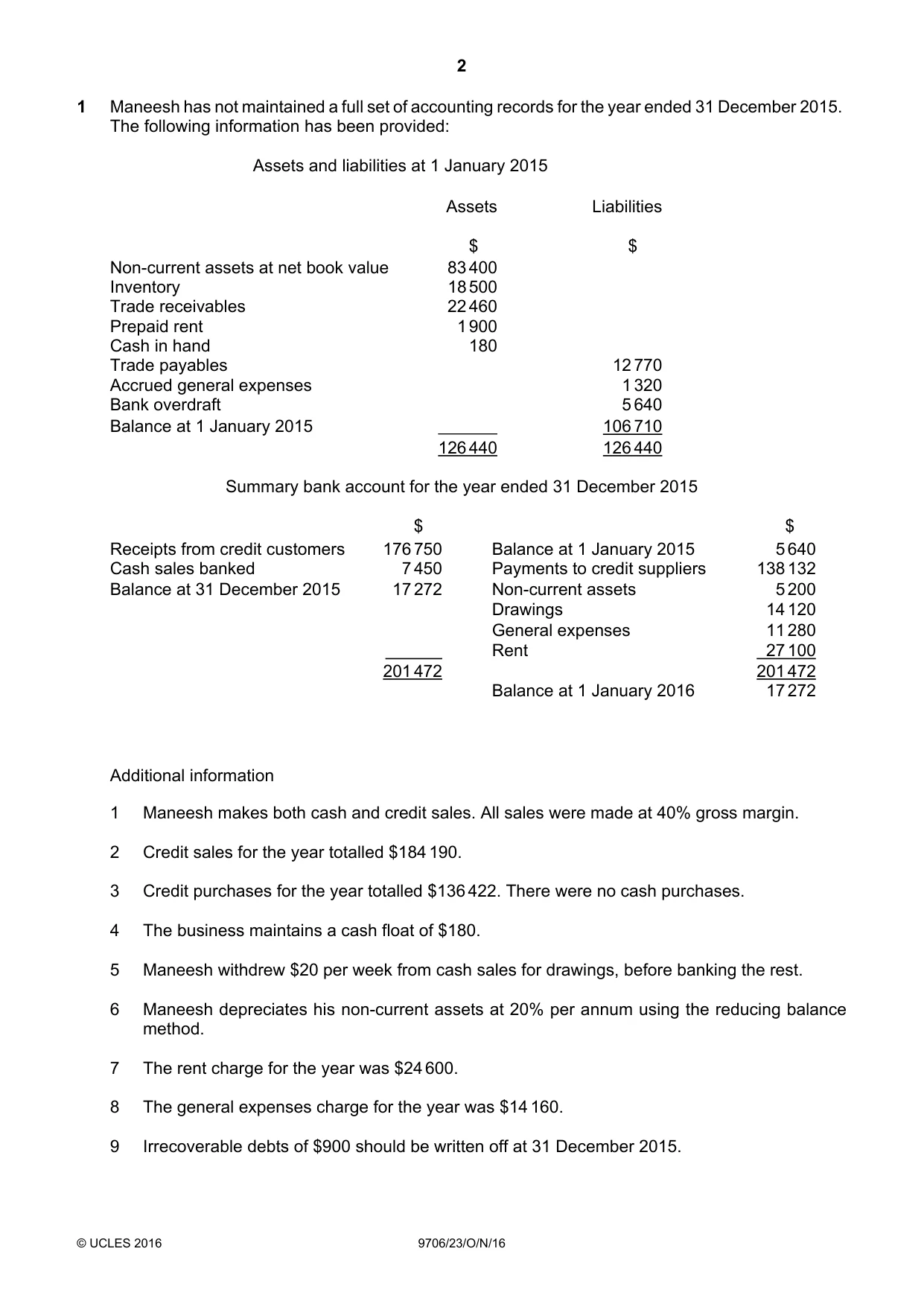
2 © UCLES 2016 9706/23/O/N/16 1 Maneesh has not maintained a full set of accounting records for the year ended 31 December 2015. The following information has been provided: Assets and liabilities at 1 January 2015 Assets Liabilities $ $ Non-current assets at net book value 83 400 Inventory 18 500 Trade receivables 22 460 Prepaid rent 1 900 Cash in hand 180 Trade payables 12 770 Accrued general expenses 1 320 Bank overdraft 5 640 Balance at 1 January 2015 106 710 126 440 126 440 Summary bank account for the year ended 31 December 2015 $ $ Receipts from credit customers 176 750 Balance at 1 January 2015 5 640 Cash sales banked 7 450 Payments to credit suppliers 138 132 Balance at 31 December 2015 17 272 Non-current assets 5 200 Drawings 14 120 General expenses 11 280 Rent 27 100 201 472 201 472 Balance at 1 January 2016 17 272 Additional information 1 Maneesh makes both cash and credit sales. All sales were made at 40% gross margin. 2 Credit sales for the year totalled $184 190. 3 Credit purchases for the year totalled $136 422. There were no cash purchases. 4 The business maintains a cash float of $180. 5 Maneesh withdrew $20 per week from cash sales for drawings, before banking the rest. 6 Maneesh depreciates his non-current assets at 20% per annum using the reducing balance method. 7 The rent charge for the year was $24 600. 8 The general expenses charge for the year was $14 160. 9 Irrecoverable debts of $900 should be written off at 31 December 2015.
Question paper, page 3
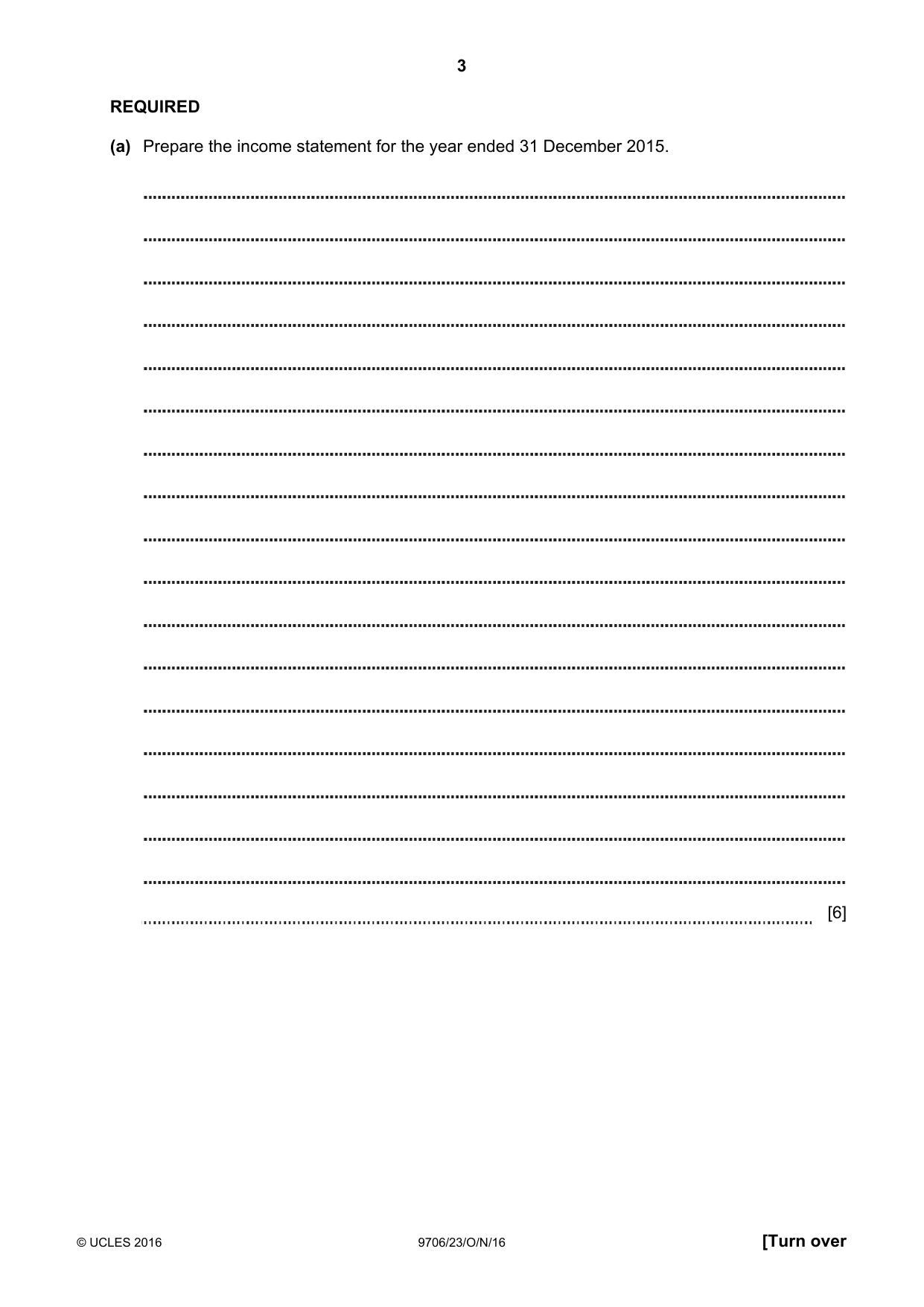
3 © UCLES 2016 9706/23/O/N/16 [Turn over REQUIRED (a) Prepare the income statement for the year ended 31 December 2015. [6]
Question paper, page 4
4 © UCLES 2016 9706/23/O/N/16 (b) Prepare the statement of financial position at 31 December 2015.
Question paper, page 5
5 © UCLES 2016 9706/23/O/N/16 [Turn over [9]
Question paper, page 6
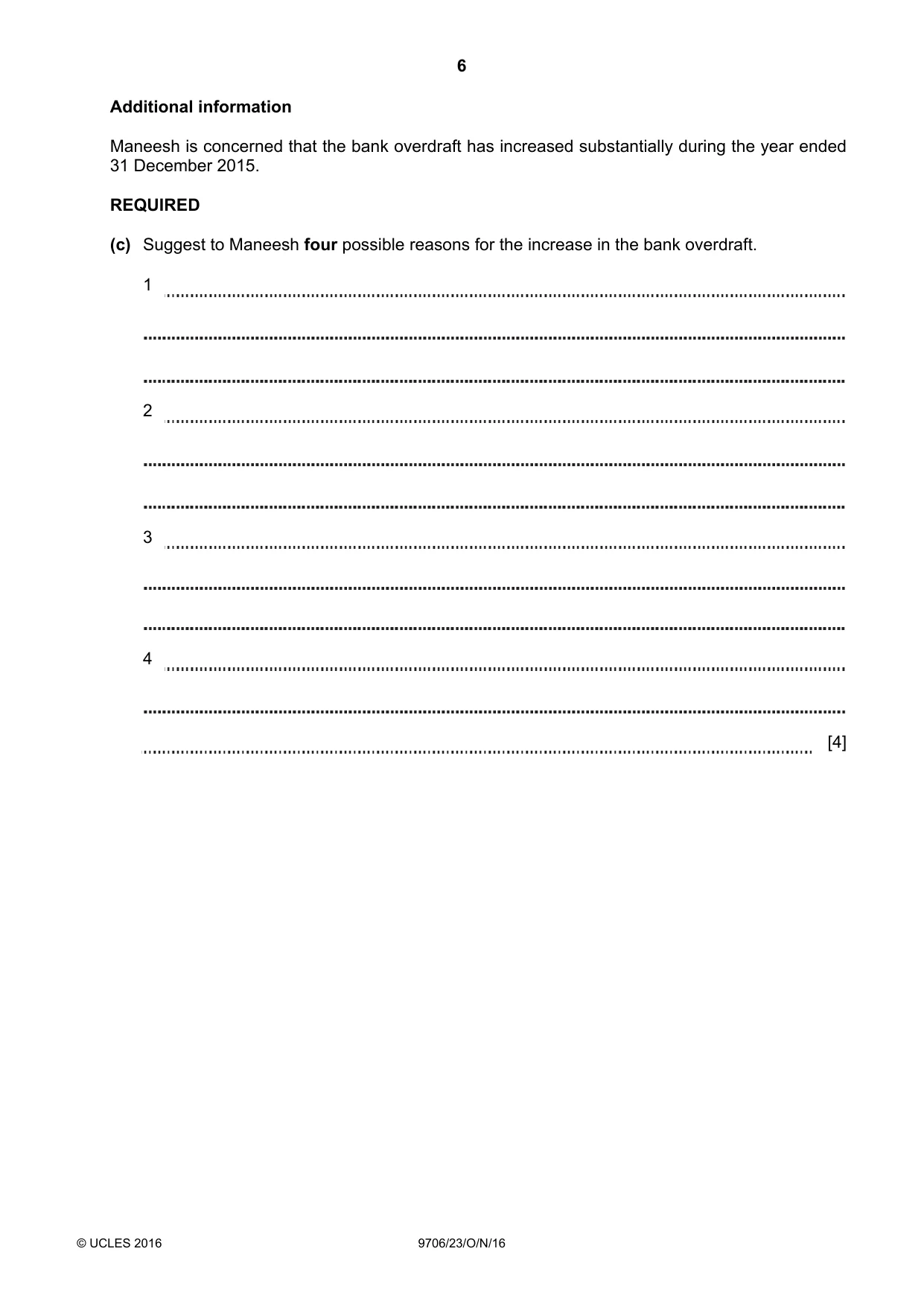
6 © UCLES 2016 9706/23/O/N/16 Additional information Maneesh is concerned that the bank overdraft has increased substantially during the year ended 31 December 2015. REQUIRED (c) Suggest to Maneesh four possible reasons for the increase in the bank overdraft. 1 2 3 4 [4]
Question paper, page 7
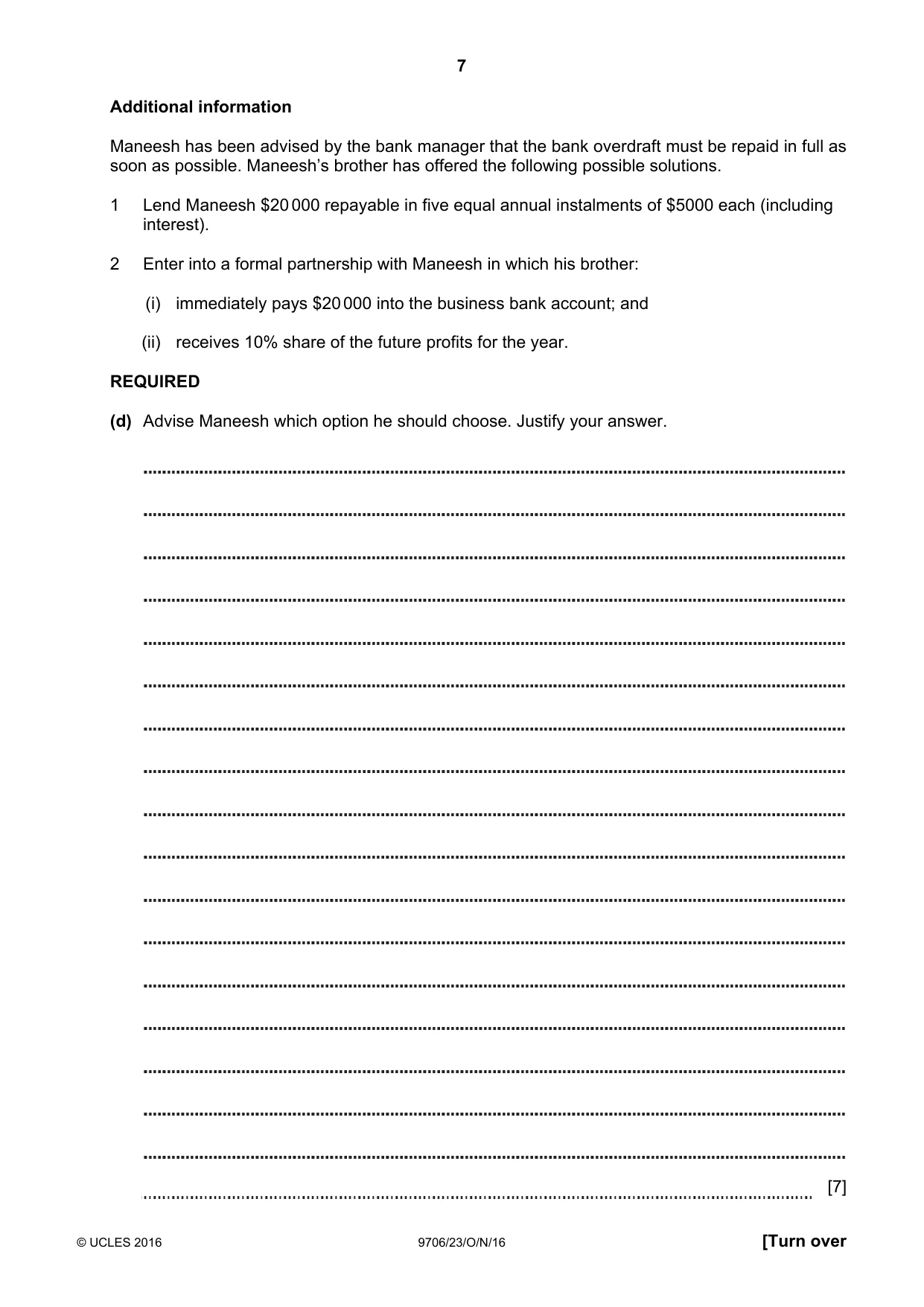
7 © UCLES 2016 9706/23/O/N/16 [Turn over Additional information Maneesh has been advised by the bank manager that the bank overdraft must be repaid in full as soon as possible. Maneesh’s brother has offered the following possible solutions. 1 Lend Maneesh $20 000 repayable in five equal annual instalments of $5000 each (including interest). 2 Enter into a formal partnership with Maneesh in which his brother: (i) immediately pays $20 000 into the business bank account; and (ii) receives 10% share of the future profits for the year. REQUIRED (d) Advise Maneesh which option he should choose. Justify your answer. [7]
Question paper, page 8
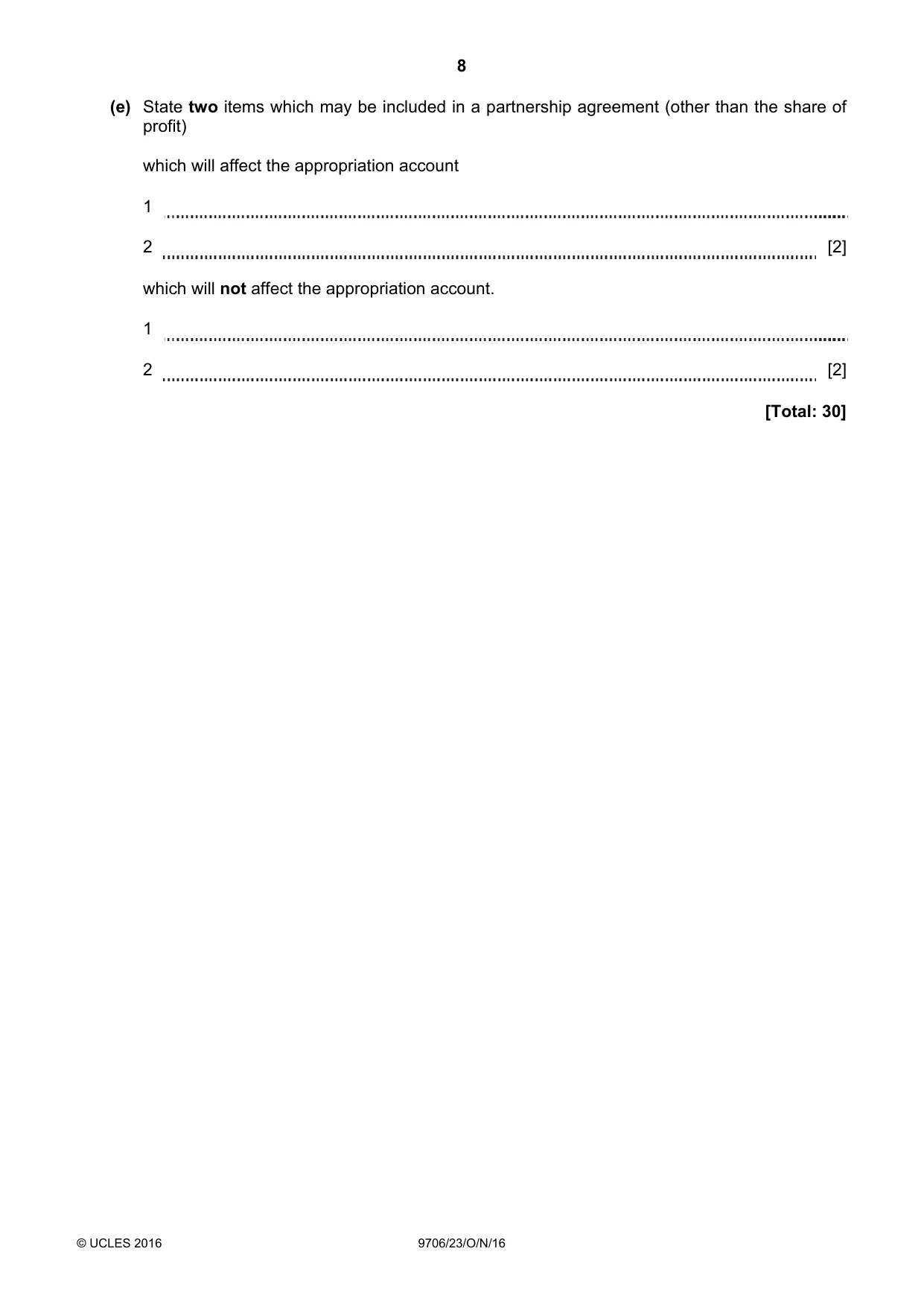
8 © UCLES 2016 9706/23/O/N/16 (e) State two items which may be included in a partnership agreement (other than the share of profit) which will affect the appropriation account 1 2 [2] which will not affect the appropriation account. 1 2 [2] [Total: 30]
Question paper, page 9
9 © UCLES 2016 9706/23/O/N/16 [Turn over Question 2 is on the next page.
Question paper, page 10
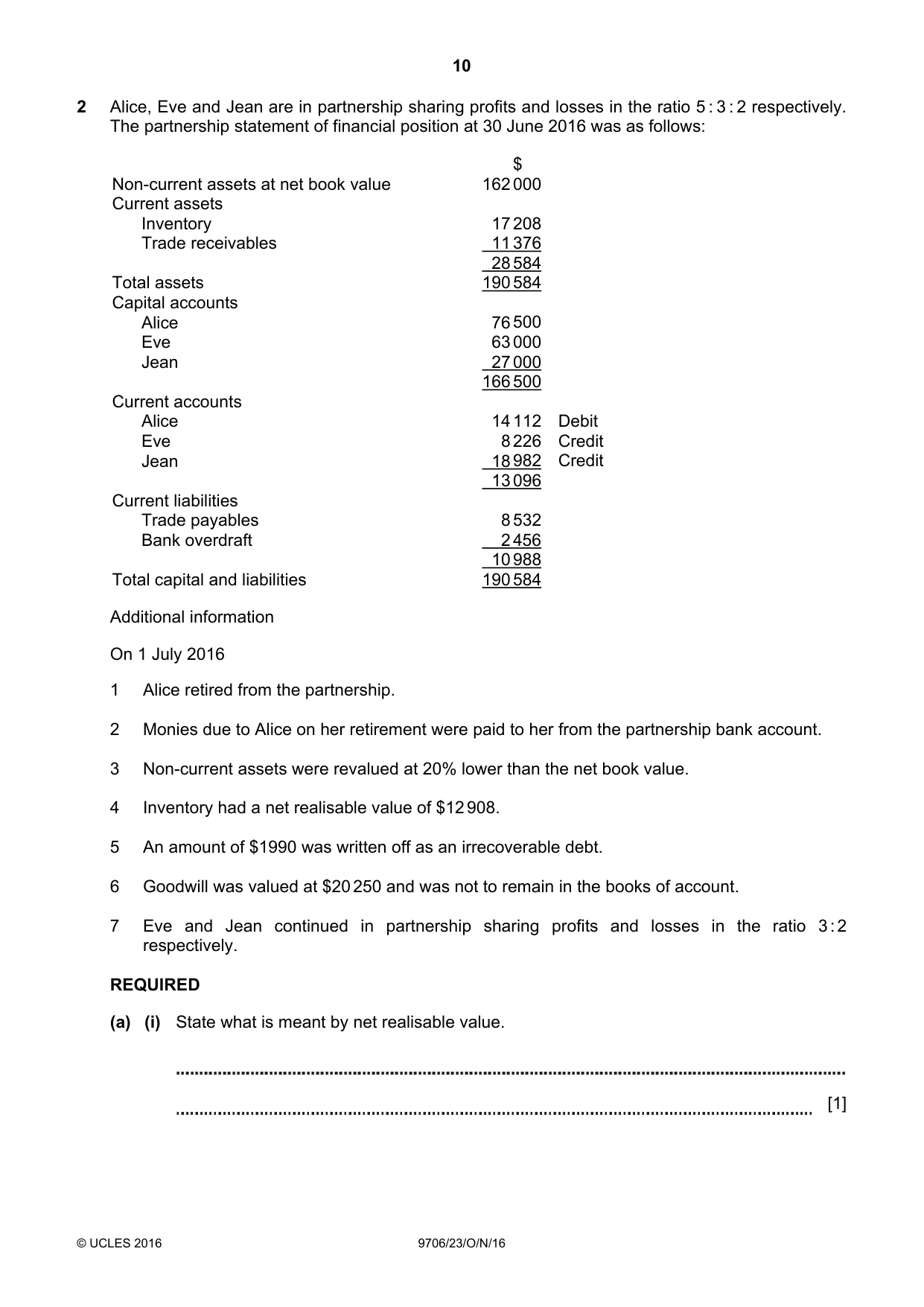
10 © UCLES 2016 9706/23/O/N/16 2 Alice, Eve and Jean are in partnership sharing profits and losses in the ratio 5 : 3 : 2 respectively. The partnership statement of financial position at 30 June 2016 was as follows: $ Non-current assets at net book value 162 000 Current assets Inventory 17 208 Trade receivables 11 376 28 584 Total assets 190 584 Capital accounts Alice 76 500 Eve 63 000 Jean 27 000 166 500 Current accounts Alice 14 112 Debit Eve 8 226 Credit Jean 18 982 Credit 13 096 Current liabilities Trade payables 8 532 Bank overdraft 2 456 10 988 Total capital and liabilities 190 584 Additional information On 1 July 2016 1 Alice retired from the partnership. 2 Monies due to Alice on her retirement were paid to her from the partnership bank account. 3 Non-current assets were revalued at 20% lower than the net book value. 4 Inventory had a net realisable value of $12 908. 5 An amount of $1990 was written off as an irrecoverable debt. 6 Goodwill was valued at $20 250 and was not to remain in the books of account. 7 Eve and Jean continued in partnership sharing profits and losses in the ratio 3 : 2 respectively. REQUIRED (a) (i) State what is meant by net realisable value. [1]
Question paper, page 11
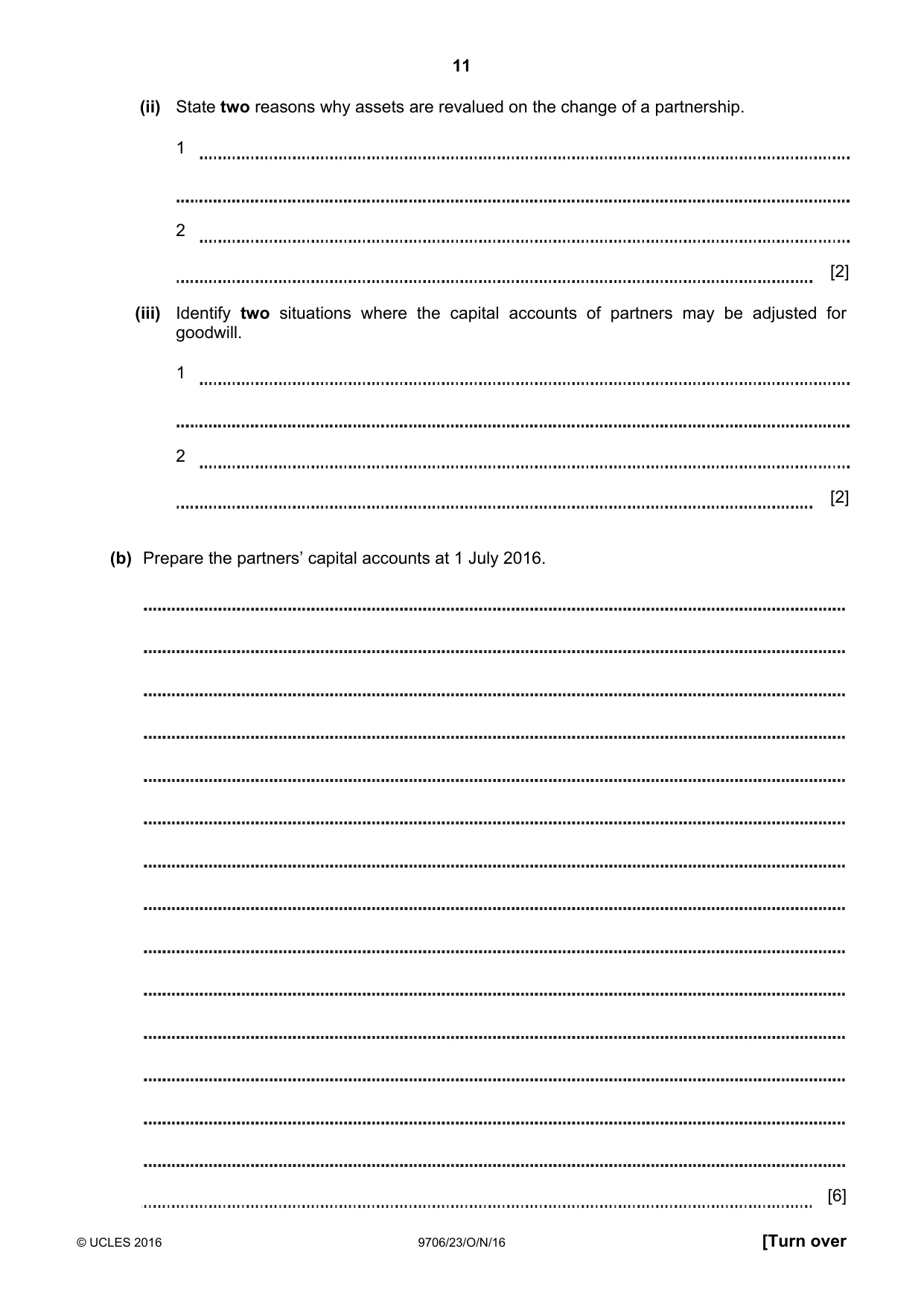
11 © UCLES 2016 9706/23/O/N/16 [Turn over (ii) State two reasons why assets are revalued on the change of a partnership. 1 2 [2] (iii) Identify two situations where the capital accounts of partners may be adjusted for goodwill. 1 2 [2] (b) Prepare the partners’ capital accounts at 1 July 2016. [6]
Question paper, page 12
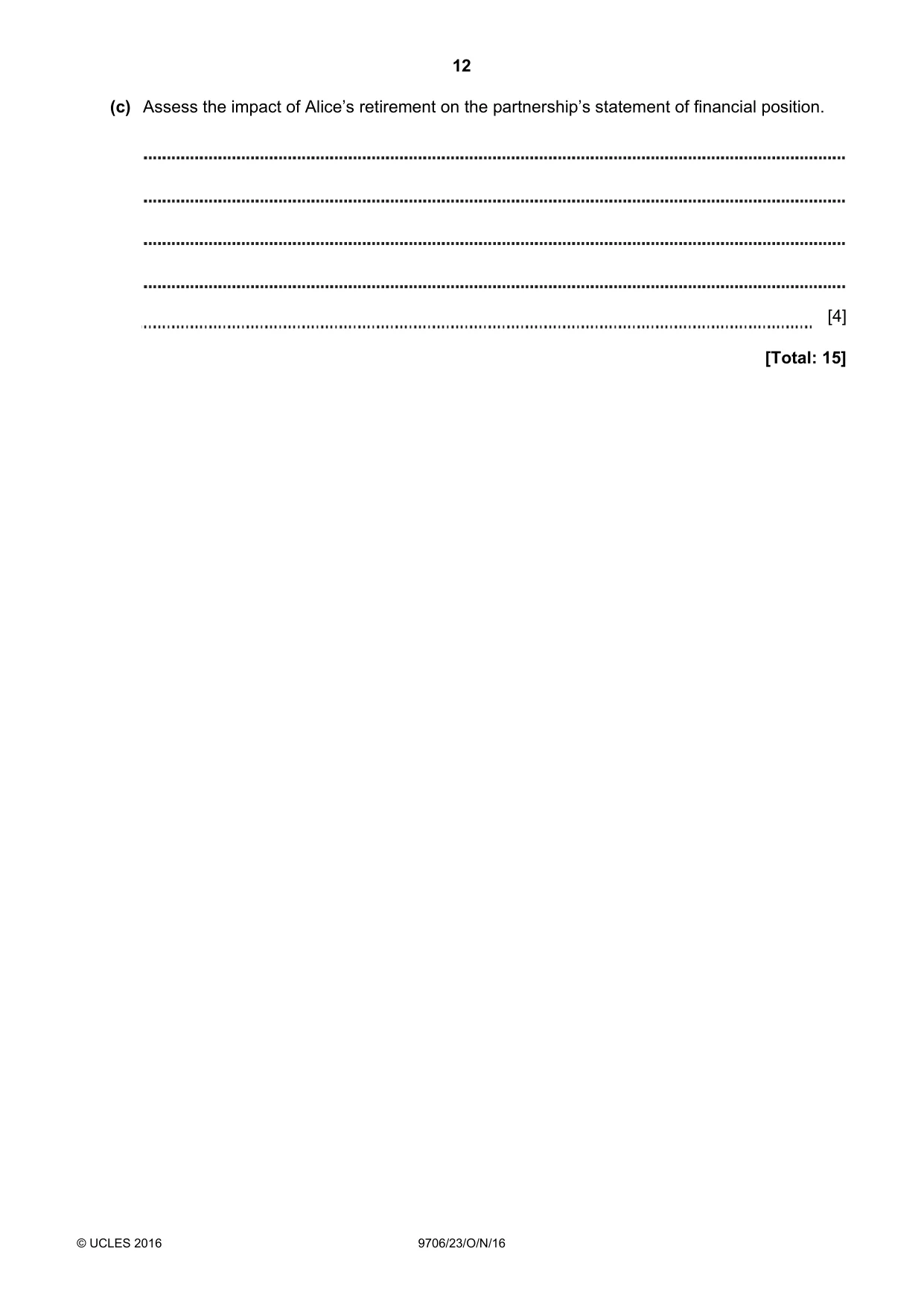
12 © UCLES 2016 9706/23/O/N/16 (c) Assess the impact of Alice’s retirement on the partnership’s statement of financial position. [4] [Total: 15]
Question paper, page 13
13 © UCLES 2016 9706/23/O/N/16 [Turn over Question 3 is on the next page.
Question paper, page 14
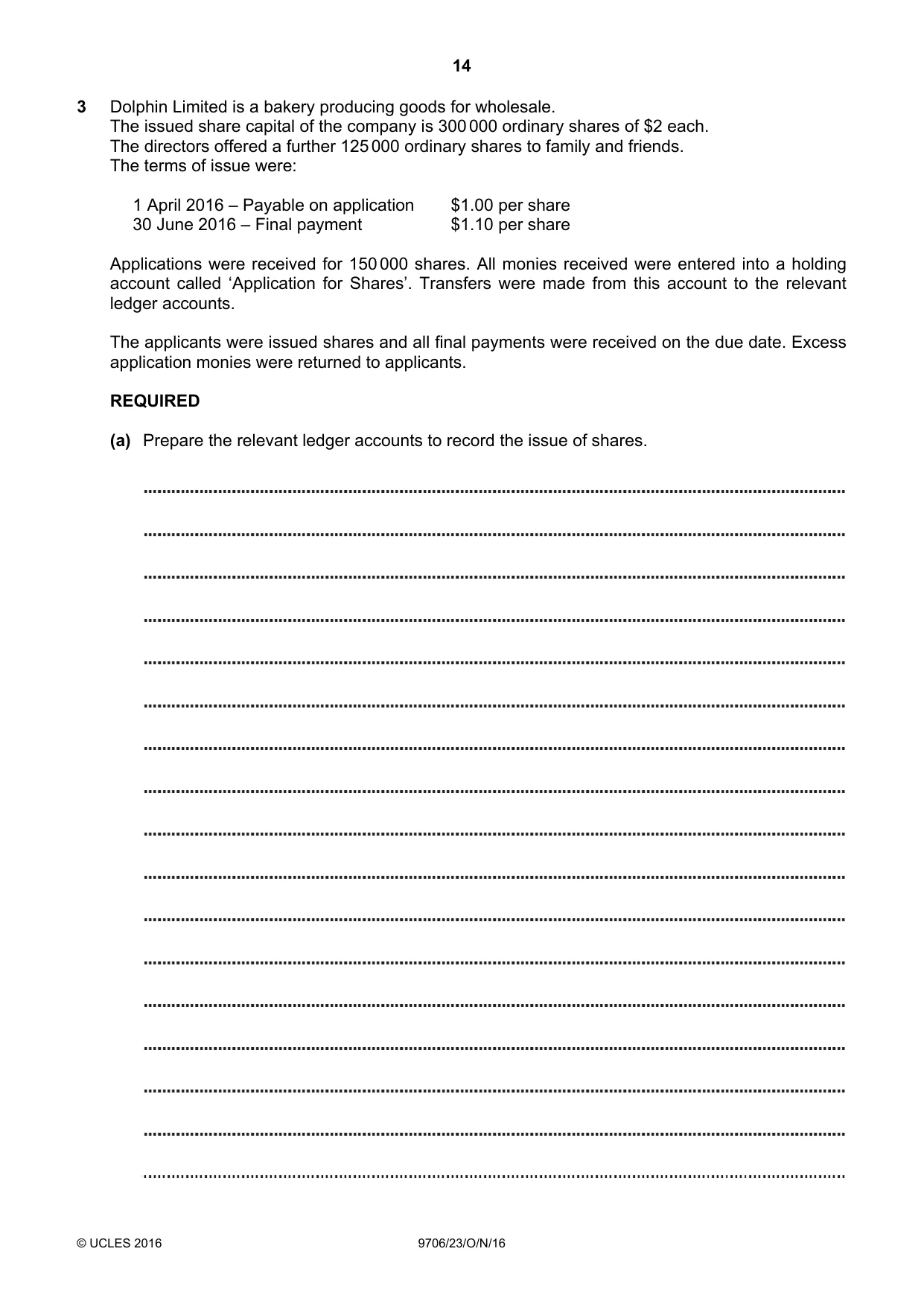
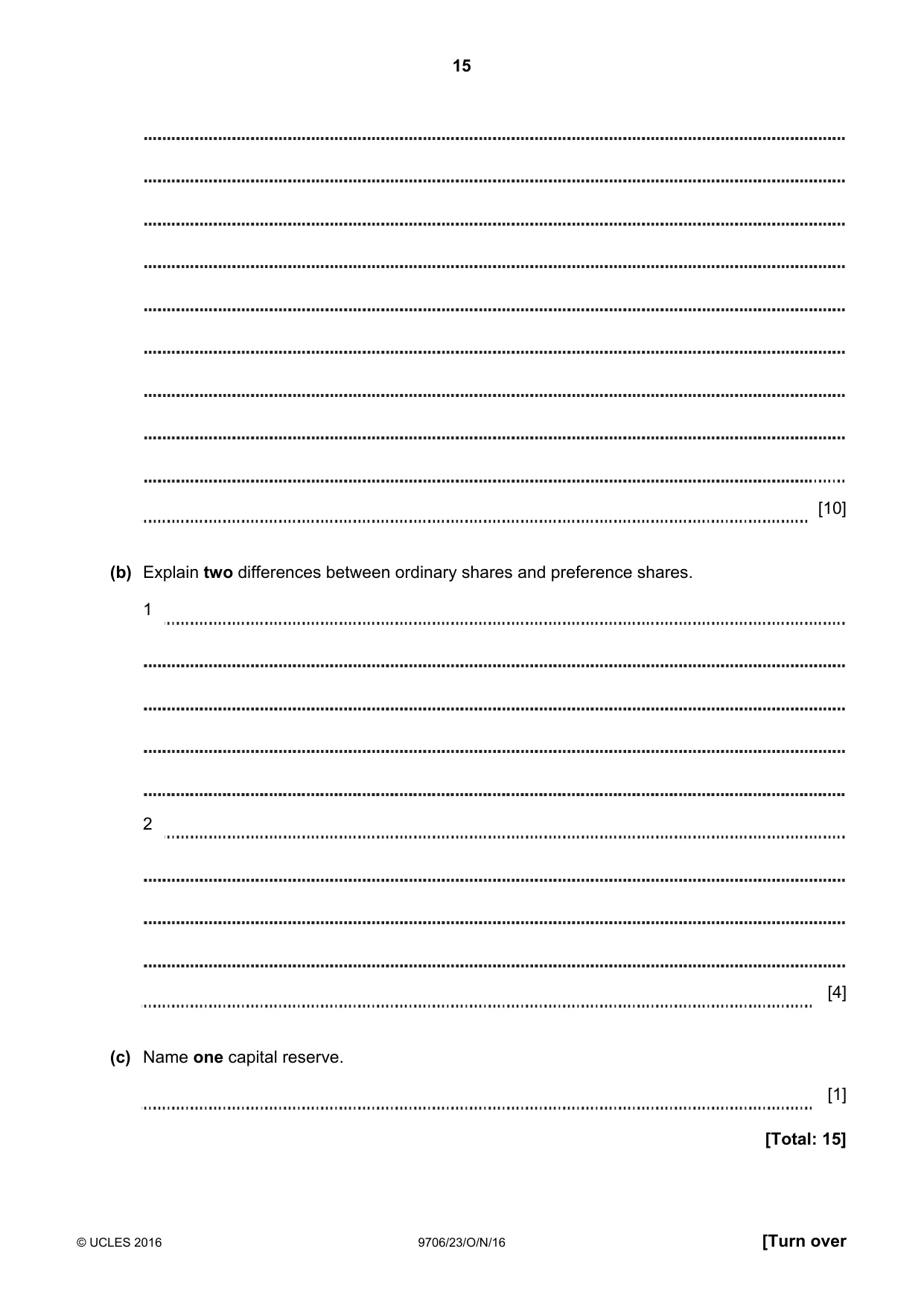
14 © UCLES 2016 9706/23/O/N/16 3 Dolphin Limited is a bakery producing goods for wholesale. The issued share capital of the company is 300 000 ordinary shares of $2 each. The directors offered a further 125 000 ordinary shares to family and friends. The terms of issue were: 1 April 2016 – Payable on application $1.00 per share 30 June 2016 – Final payment $1.10 per share Applications were received for 150 000 shares. All monies received were entered into a holding account called ‘Application for Shares’. Transfers were made from this account to the relevant ledger accounts. The applicants were issued shares and all final payments were received on the due date. Excess application monies were returned to applicants. REQUIRED (a) Prepare the relevant ledger accounts to record the issue of shares.
Question paper, page 15
15 © UCLES 2016 9706/23/O/N/16 [Turn over [10] (b) Explain two differences between ordinary shares and preference shares. 1 2 [4] (c) Name one capital reserve. [1] [Total: 15]
Question paper, page 16
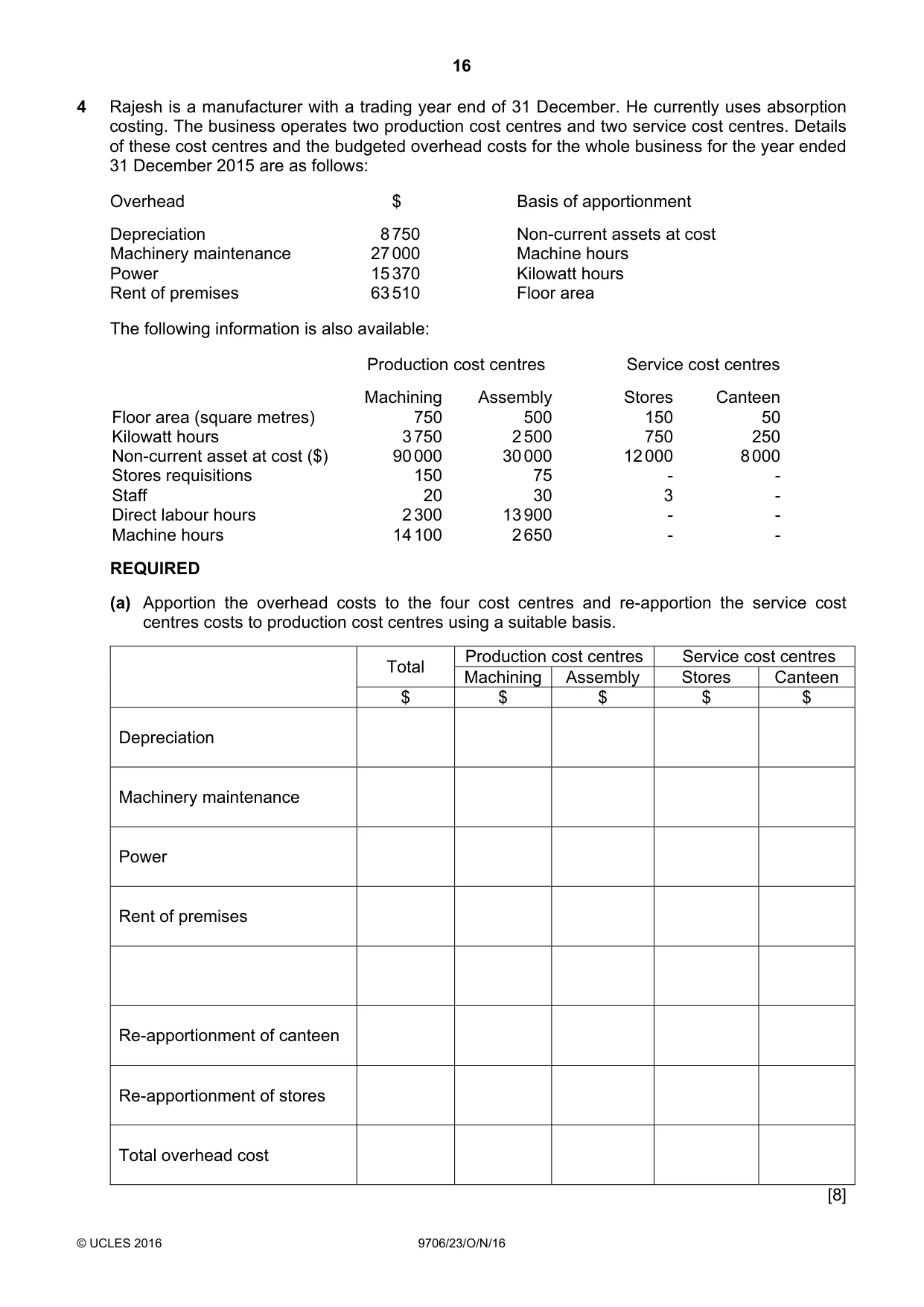
16 © UCLES 2016 9706/23/O/N/16 4 Rajesh is a manufacturer with a trading year end of 31 December. He currently uses absorption costing. The business operates two production cost centres and two service cost centres. Details of these cost centres and the budgeted overhead costs for the whole business for the year ended 31 December 2015 are as follows: Overhead $ Basis of apportionment Depreciation 8 750 Non-current assets at cost Machinery maintenance 27 000 Machine hours Power 15 370 Kilowatt hours Rent of premises 63 510 Floor area The following information is also available: Production cost centres Service cost centres Machining Assembly Stores Canteen Floor area (square metres) 750 500 150 50 Kilowatt hours 3 750 2 500 750 250 Non-current asset at cost ($) 90 000 30 000 12 000 8 000 Stores requisitions 150 75 - - Staff 20 30 3 - Direct labour hours 2 300 13 900 - - Machine hours 14 100 2 650 - - REQUIRED (a) Apportion the overhead costs to the four cost centres and re-apportion the service cost centres costs to production cost centres using a suitable basis. Total Production cost centres Service cost centres Machining Assembly Stores Canteen $ $ $ $ $ Depreciation Machinery maintenance Power Rent of premises Re-apportionment of canteen Re-apportionment of stores Total overhead cost [8]
Question paper, page 17
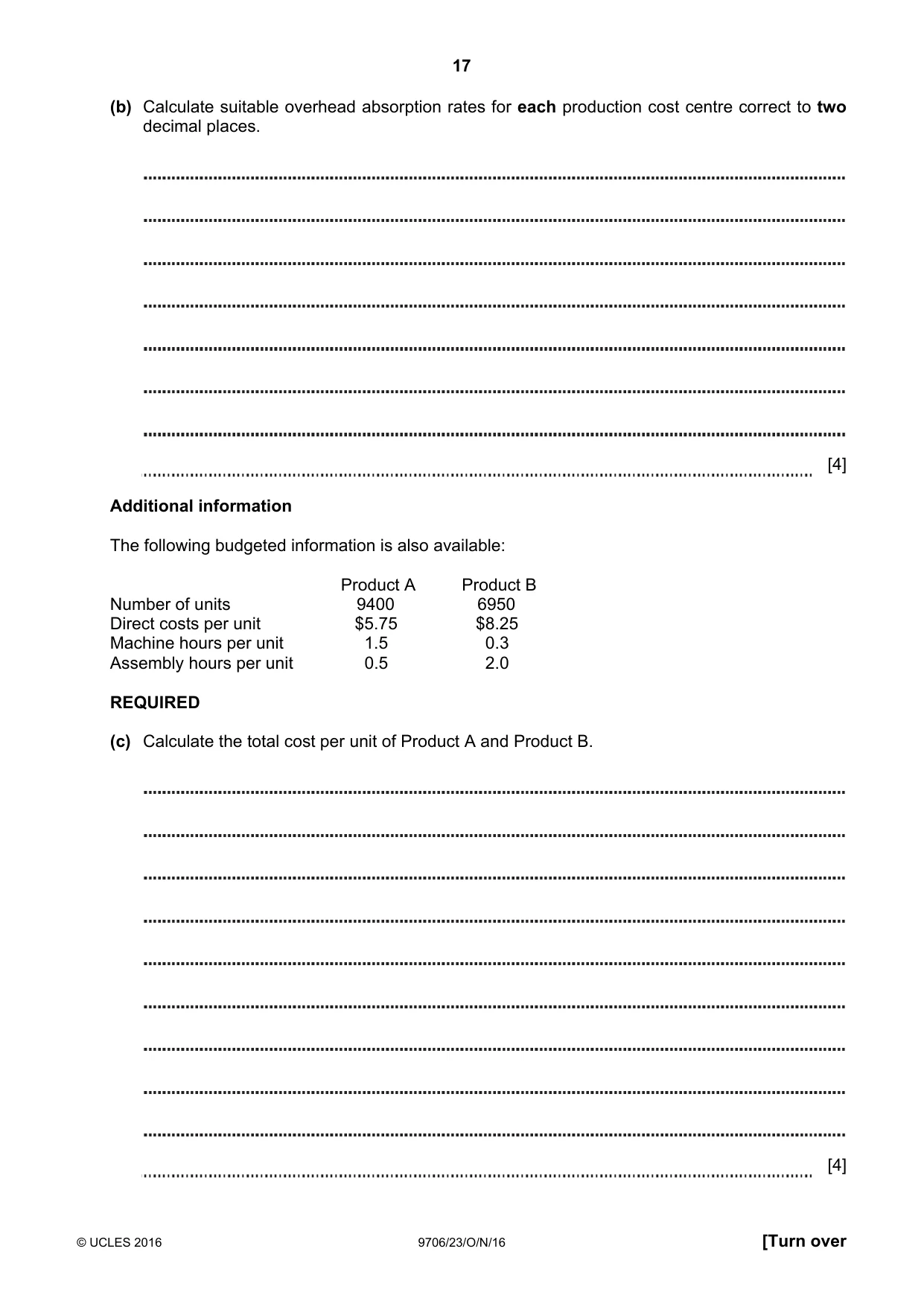
17 © UCLES 2016 9706/23/O/N/16 [Turn over (b) Calculate suitable overhead absorption rates for each production cost centre correct to two decimal places. [4] Additional information The following budgeted information is also available: Product A Product B Number of units 9400 6950 Direct costs per unit $5.75 $8.25 Machine hours per unit 1.5 0.3 Assembly hours per unit 0.5 2.0 REQUIRED (c) Calculate the total cost per unit of Product A and Product B. [4]
Question paper, page 18
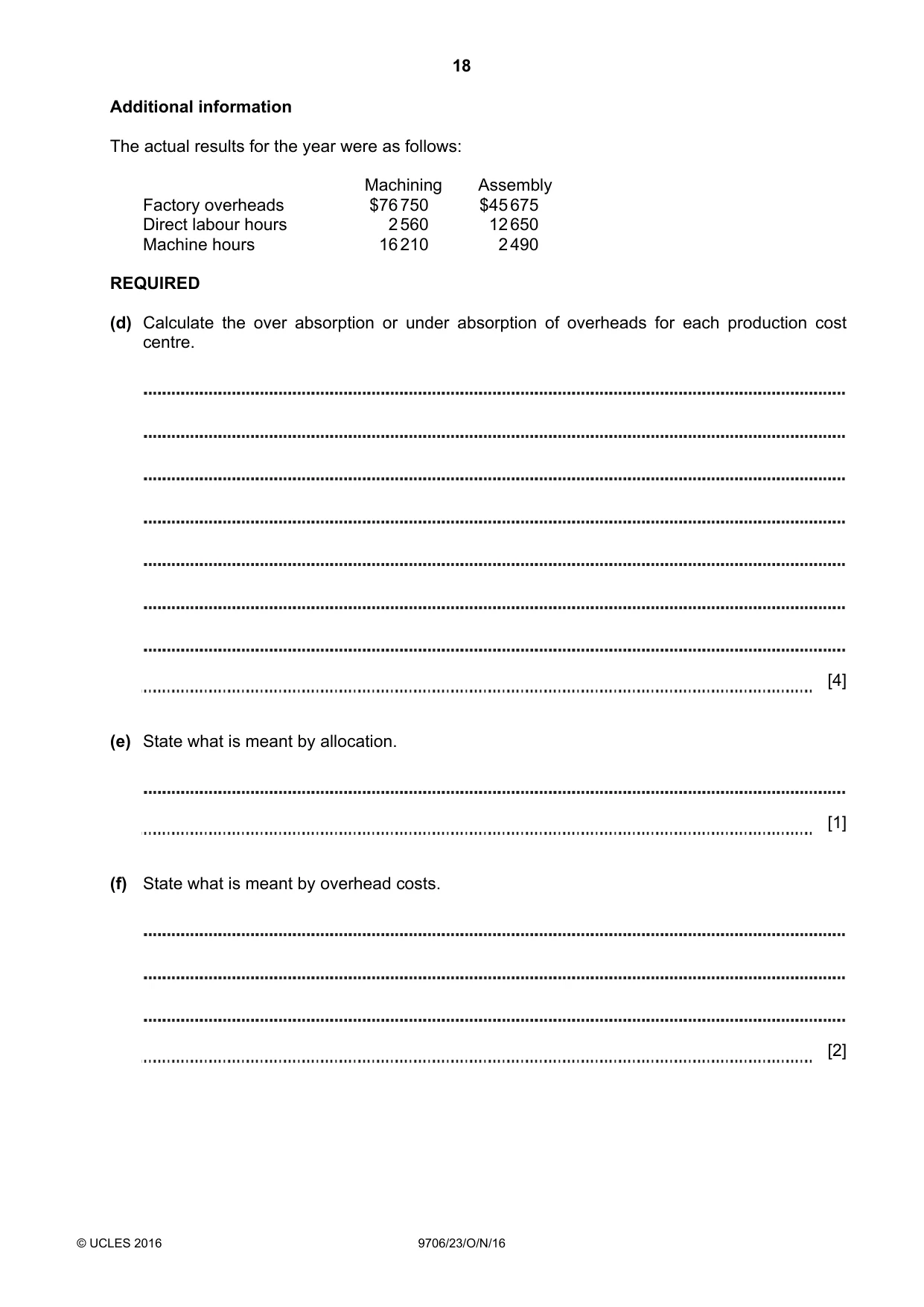
18 © UCLES 2016 9706/23/O/N/16 Additional information The actual results for the year were as follows: Machining Assembly Factory overheads $76 750 $45 675 Direct labour hours 2 560 12 650 Machine hours 16 210 2 490 REQUIRED (d) Calculate the over absorption or under absorption of overheads for each production cost centre. [4] (e) State what is meant by allocation. [1] (f) State what is meant by overhead costs. [2]
Question paper, page 19
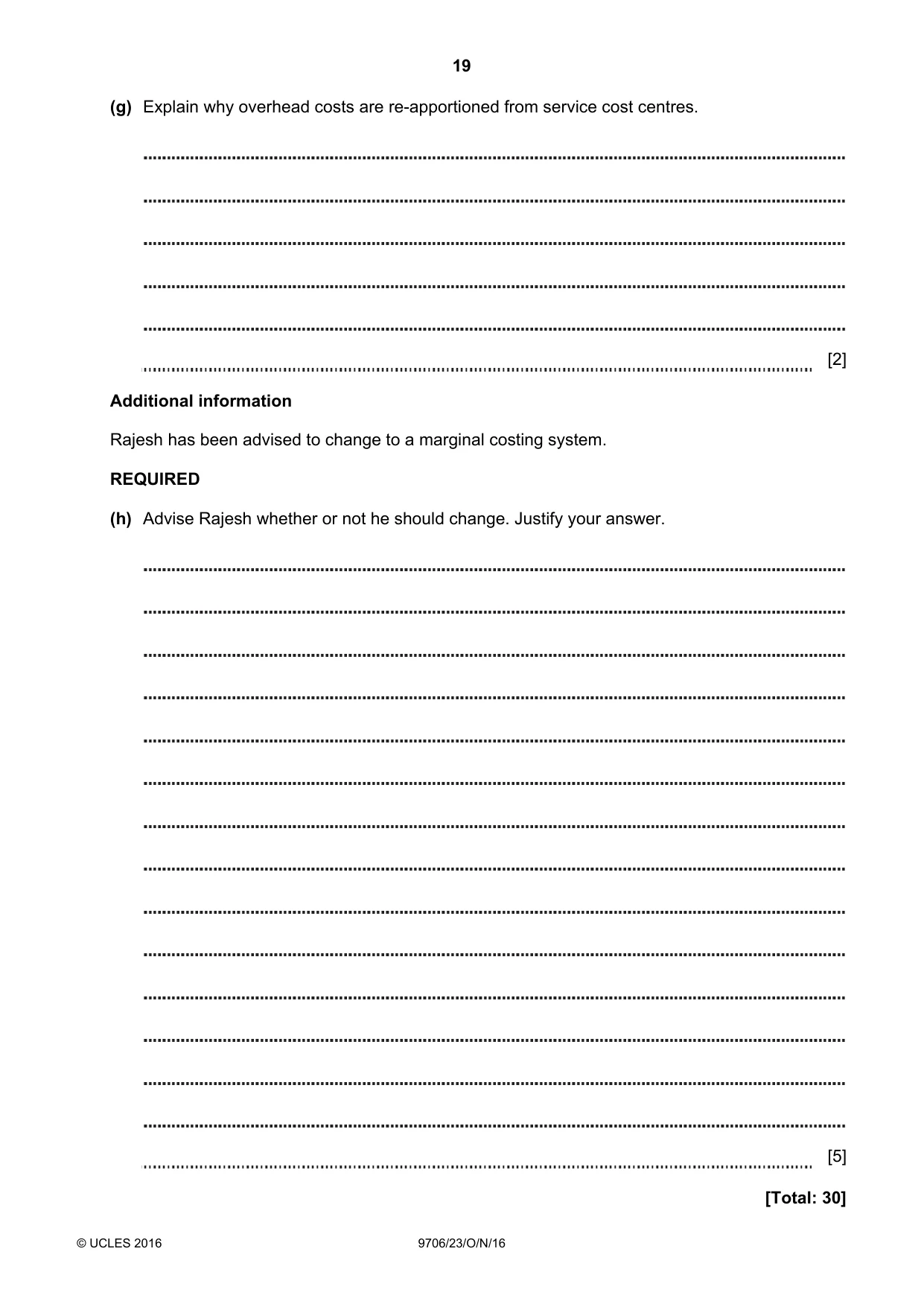
19 © UCLES 2016 9706/23/O/N/16 (g) Explain why overhead costs are re-apportioned from service cost centres. [2] Additional information Rajesh has been advised to change to a marginal costing system. REQUIRED (h) Advise Rajesh whether or not he should change. Justify your answer. [5] [Total: 30]
Question paper, page 20
20 Permission to reproduce items where third-party owned material protected by copyright is included has been sought and cleared where possible. Every reasonable effort has been made by the publisher (UCLES) to trace copyright holders, but if any items requiring clearance have unwittingly been included, the publisher will be pleased to make amends at the earliest possible opportunity. To avoid the issue of disclosure of answer-related information to candidates, all copyright acknowledgements are reproduced online in the Cambridge International Examinations Copyright Acknowledgements Booklet. This is produced for each series of examinations and is freely available to download at www.cie.org.uk after the live examination series. Cambridge International Examinations is part of the Cambridge Assessment Group. Cambridge Assessment is the brand name of University of Cambridge Local Examinations Syndicate (UCLES), which is itself a department of the University of Cambridge. © UCLES 2016 9706/23/O/N/16 BLANK PAGE
Mark scheme, page 1
® IGCSE is the registered trademark of Cambridge International Examinations. This document consists of 7 printed pages. © UCLES 2016 [Turn over Cambridge International Examinations Cambridge International Advanced Subsidiary and Advanced Level ACCOUNTING 9706/23 Paper 2 Structured Questions (Core) October/November 2016 MARK SCHEME Maximum Mark: 90 Published This mark scheme is published as an aid to teachers and candidates, to indicate the requirements of the examination. It shows the basis on which Examiners were instructed to award marks. It does not indicate the details of the discussions that took place at an Examiners’ meeting before marking began, which would have considered the acceptability of alternative answers. Mark schemes should be read in conjunction with the question paper and the Principal Examiner Report for Teachers. Cambridge will not enter into discussions about these mark schemes. Cambridge is publishing the mark schemes for the October/November 2016 series for most Cambridge IGCSE®, Cambridge International A and AS Level components and some Cambridge O Level components.
Mark scheme, page 2
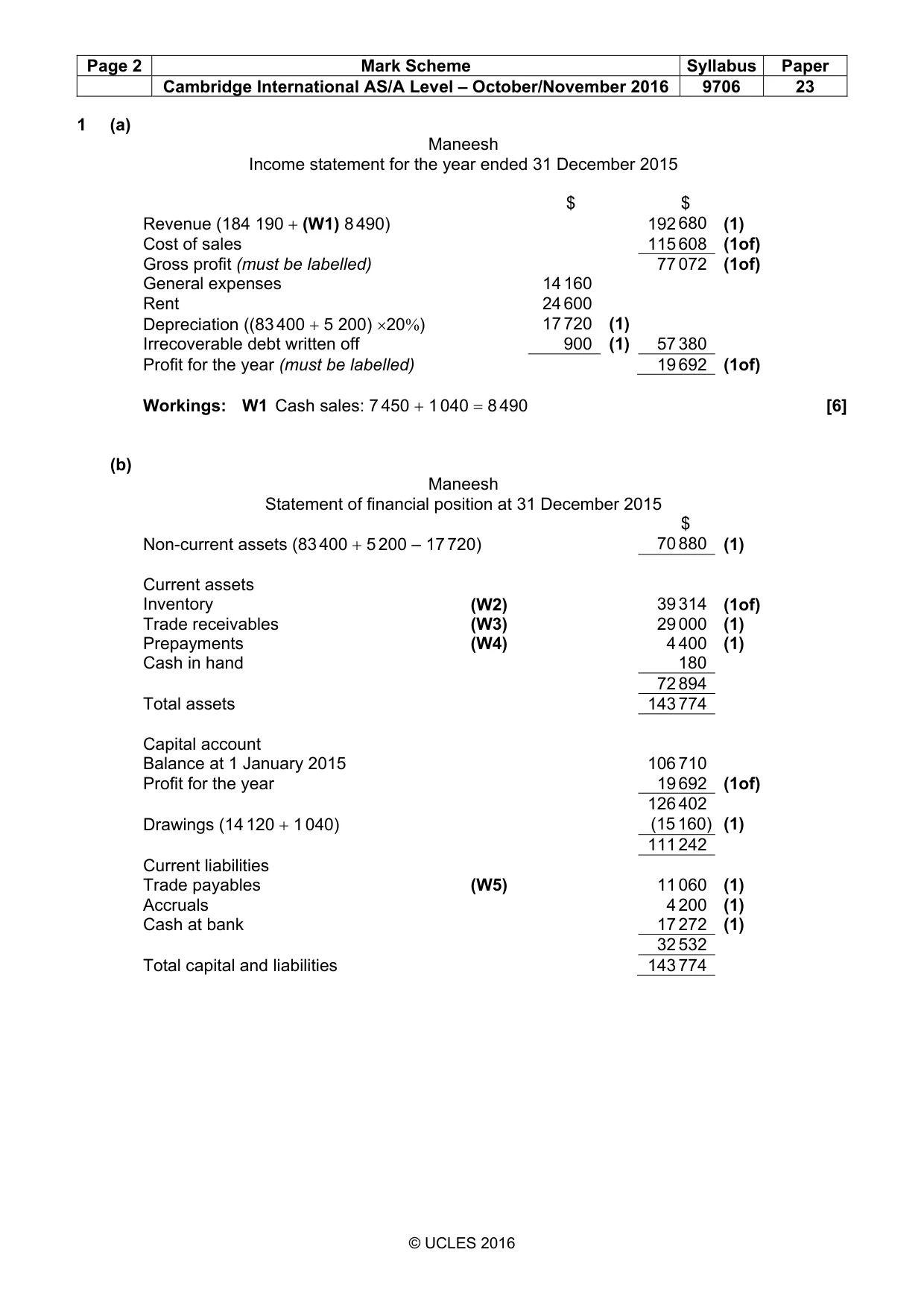
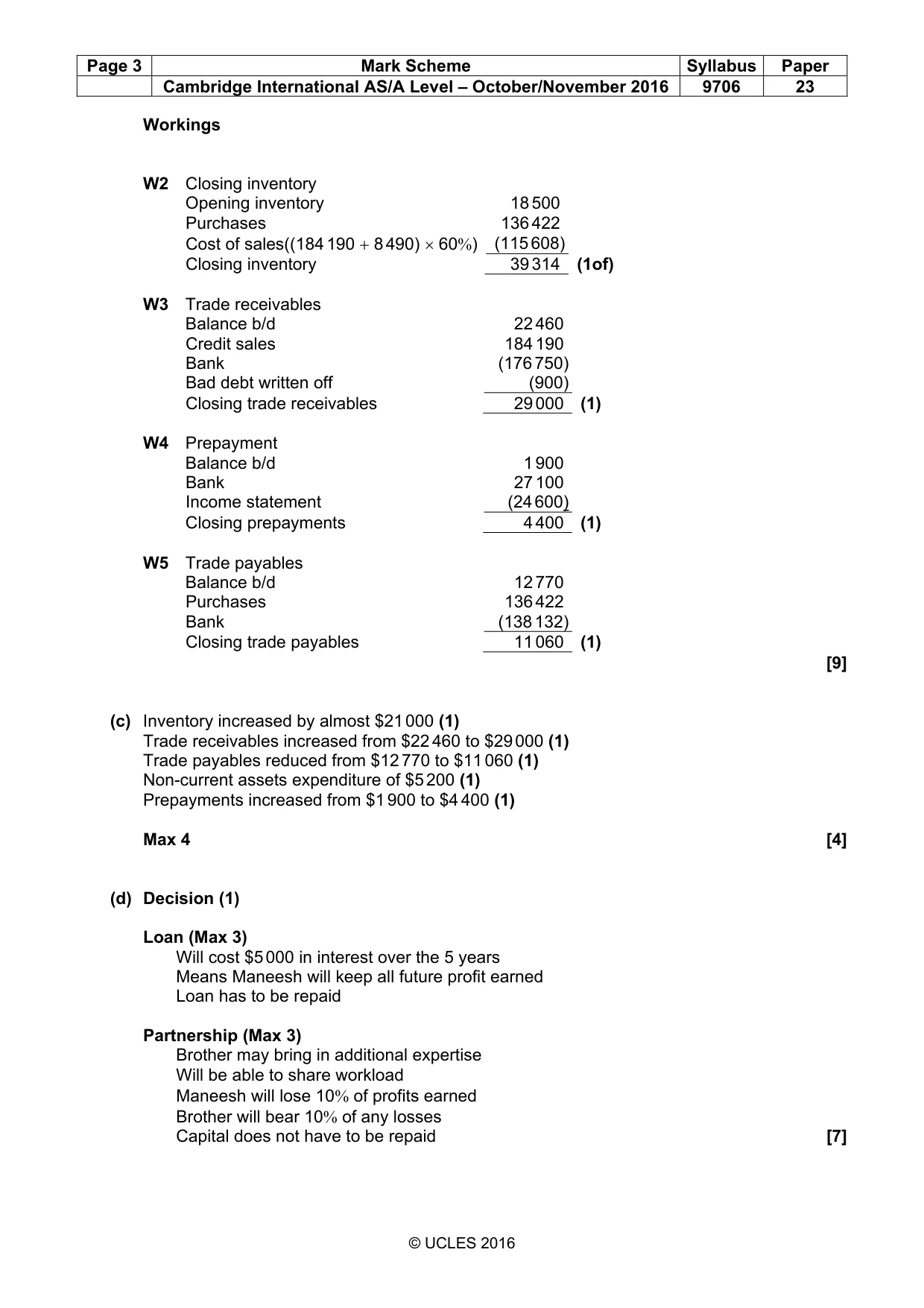
Page 2 Mark Scheme Syllabus Paper Cambridge International AS/A Level – October/November 2016 9706 23 © UCLES 2016 1 (a) Maneesh Income statement for the year ended 31 December 2015 $ $ Revenue (184 190 + (W1) 8 490) 192 680 (1) Cost of sales 115 608 (1of) Gross profit (must be labelled) 77 072 (1of) General expenses 14 160 Rent 24 600 Depreciation ((83 400 + 5 200) ×20%) 17 720 (1) Irrecoverable debt written off 900 (1) 57 380 Profit for the year (must be labelled) 19 692 (1of) Workings: W1 Cash sales: 7 450 + 1 040 = 8 490 [6] (b) Maneesh Statement of financial position at 31 December 2015 $ Non-current assets (83 400 + 5 200 – 17 720) 70 880 (1) Current assets Inventory (W2) 39 314 (1of) Trade receivables (W3) 29 000 (1) Prepayments (W4) 4 400 (1) Cash in hand 180 72 894 Total assets 143 774 Capital account Balance at 1 January 2015 106 710 Profit for the year 19 692 (1of) 126 402 Drawings (14 120 + 1 040) (15 160) (1) 111 242 Current liabilities Trade payables (W5) 11 060 (1) Accruals 4 200 (1) Cash at bank 17 272 (1) 32 532 Total capital and liabilities 143 774
Mark scheme, page 3
Page 3 Mark Scheme Syllabus Paper Cambridge International AS/A Level – October/November 2016 9706 23 © UCLES 2016 Workings W2 Closing inventory Opening inventory 18 500 Purchases 136 422 Cost of sales((184 190 + 8 490) × 60%) (115 608) Closing inventory 39 314 (1of) W3 Trade receivables Balance b/d 22 460 Credit sales 184 190 Bank (176 750) Bad debt written off (900) Closing trade receivables 29 000 (1) W4 Prepayment Balance b/d 1 900 Bank 27 100 Income statement (24 600) Closing prepayments 4 400 (1) W5 Trade payables Balance b/d 12 770 Purchases 136 422 Bank (138 132) Closing trade payables 11 060 (1) [9] (c) Inventory increased by almost $21 000 (1) Trade receivables increased from $22 460 to $29 000 (1) Trade payables reduced from $12 770 to $11 060 (1) Non-current assets expenditure of $5 200 (1) Prepayments increased from $1 900 to $4 400 (1) Max 4 [4] (d) Decision (1) Loan (Max 3) Will cost $5 000 in interest over the 5 years Means Maneesh will keep all future profit earned Loan has to be repaid Partnership (Max 3) Brother may bring in additional expertise Will be able to share workload Maneesh will lose 10% of profits earned Brother will bear 10% of any losses Capital does not have to be repaid [7]
Mark scheme, page 4
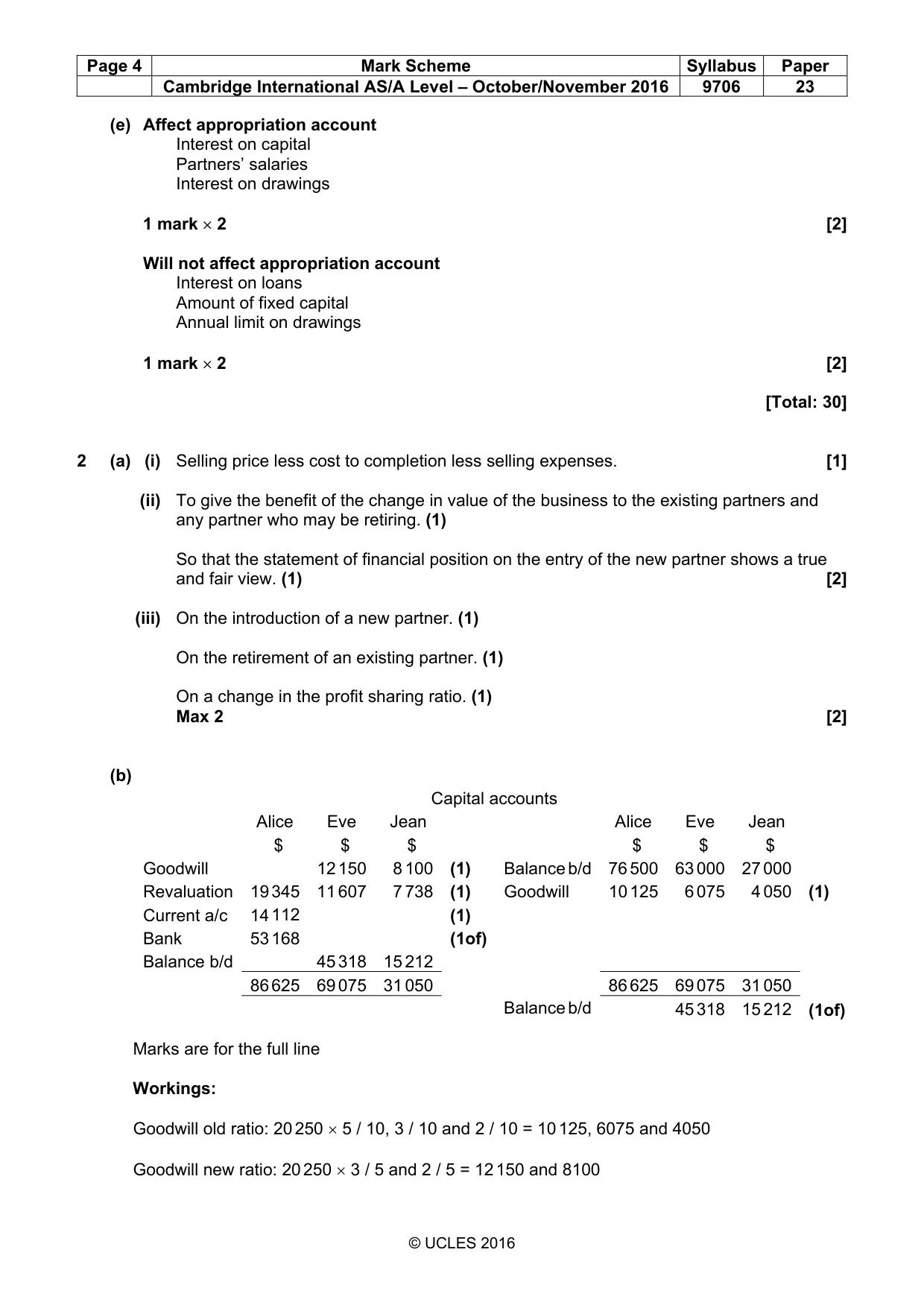
Page 4 Mark Scheme Syllabus Paper Cambridge International AS/A Level – October/November 2016 9706 23 © UCLES 2016 (e) Affect appropriation account Interest on capital Partners’ salaries Interest on drawings 1 mark × 2 [2] Will not affect appropriation account Interest on loans Amount of fixed capital Annual limit on drawings 1 mark × 2 [2] [Total: 30] 2 (a) (i) Selling price less cost to completion less selling expenses. [1] (ii) To give the benefit of the change in value of the business to the existing partners and any partner who may be retiring. (1) So that the statement of financial position on the entry of the new partner shows a true and fair view. (1) [2] (iii) On the introduction of a new partner. (1) On the retirement of an existing partner. (1) On a change in the profit sharing ratio. (1) Max 2 [2] (b) Capital accounts Alice Eve Jean Alice Eve Jean $ $ $ $ $ $ Goodwill 12 150 8 100 (1) Balance b/d 76 500 63 000 27 000 Revaluation 19 345 11 607 7 738 (1) Goodwill 10 125 6 075 4 050 (1) Current a/c 14 112 (1) Bank 53 168 (1of) Balance b/d 45 318 15 212 86 625 69 075 31 050 86 625 69 075 31 050 Balance b/d 45 318 15 212 (1of) Marks are for the full line Workings: Goodwill old ratio: 20 250 × 5 / 10, 3 / 10 and 2 / 10 = 10 125, 6075 and 4050 Goodwill new ratio: 20 250 × 3 / 5 and 2 / 5 = 12 150 and 8100
Mark scheme, page 5
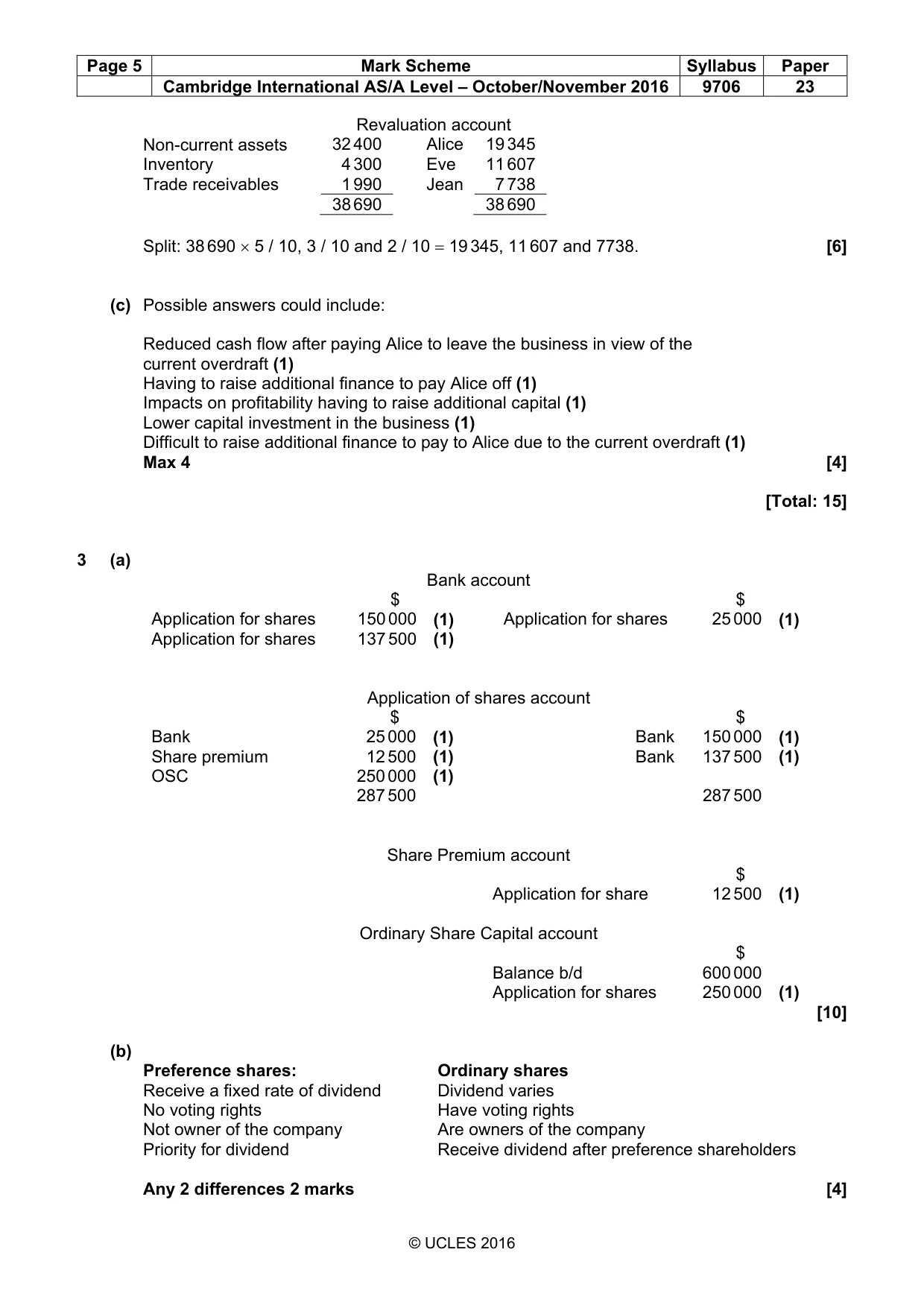
Page 5 Mark Scheme Syllabus Paper Cambridge International AS/A Level – October/November 2016 9706 23 © UCLES 2016 Revaluation account Non-current assets 32 400 Alice 19 345 Inventory 4 300 Eve 11 607 Trade receivables 1 990 Jean 7 738 38 690 38 690 Split: 38 690 × 5 / 10, 3 / 10 and 2 / 10 = 19 345, 11 607 and 7738. [6] (c) Possible answers could include: Reduced cash flow after paying Alice to leave the business in view of the current overdraft (1) Having to raise additional finance to pay Alice off (1) Impacts on profitability having to raise additional capital (1) Lower capital investment in the business (1) Difficult to raise additional finance to pay to Alice due to the current overdraft (1) Max 4 [4] [Total: 15] 3 (a) Bank account $ $ Application for shares 150 000 (1) Application for shares 25 000 (1) Application for shares 137 500 (1) Application of shares account $ $ Bank 25 000 (1) Bank 150 000 (1) Share premium 12 500 (1) Bank 137 500 (1) OSC 250 000 (1) 287 500 287 500 Share Premium account $ Application for share 12 500 (1) Ordinary Share Capital account $ Balance b/d 600 000 Application for shares 250 000 (1) [10] (b) Preference shares: Ordinary shares Receive a fixed rate of dividend Dividend varies No voting rights Have voting rights Not owner of the company Are owners of the company Priority for dividend Receive dividend after preference shareholders Any 2 differences 2 marks [4]
Mark scheme, page 6
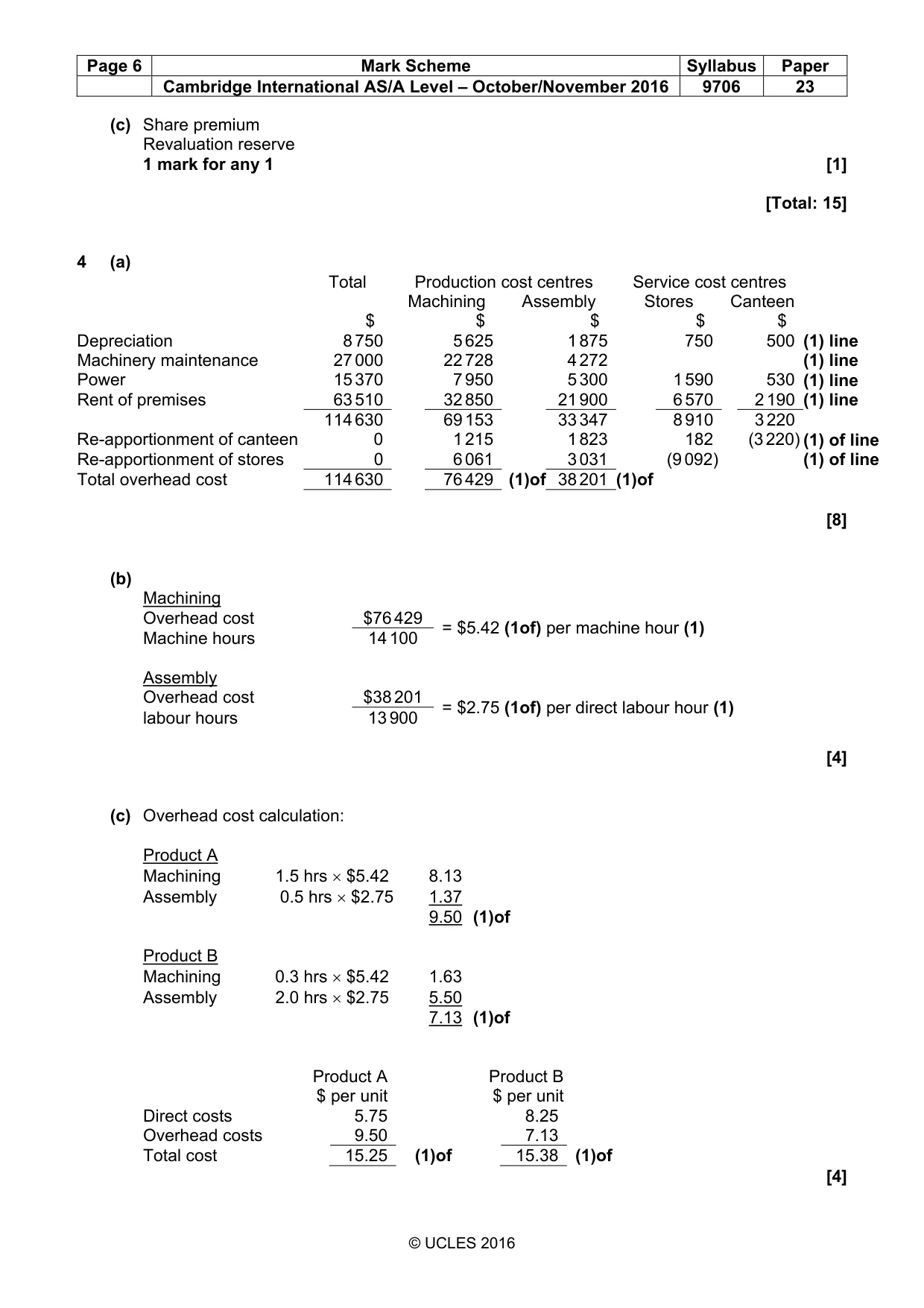
Page 6 Mark Scheme Syllabus Paper Cambridge International AS/A Level – October/November 2016 9706 23 © UCLES 2016 (c) Share premium Revaluation reserve 1 mark for any 1 [1] [Total: 15] 4 (a) Total Production cost centres Service cost centres Machining Assembly Stores Canteen $ $ $ $ $ Depreciation 8 750 5 625 1 875 750 500 (1) line Machinery maintenance 27 000 22 728 4 272 (1) line Power 15 370 7 950 5 300 1 590 530 (1) line Rent of premises 63 510 32 850 21 900 6 570 2 190 (1) line 114 630 69 153 33 347 8 910 3 220 Re-apportionment of canteen 0 1 215 1 823 182 (3 220) (1) of line Re-apportionment of stores 0 6 061 3 031 (9 092) (1) of line Total overhead cost 114 630 76 429 (1)of 38 201 (1)of [8] (b) Machining Overhead cost $76 429 = $5.42 (1of) per machine hour (1) Machine hours 14 100 Assembly Overhead cost $38 201 = $2.75 (1of) per direct labour hour (1) labour hours 13 900 [4] (c) Overhead cost calculation: Product A Machining 1.5 hrs × $5.42 8.13 Assembly 0.5 hrs × $2.75 1.37 9.50 (1)of Product B Machining 0.3 hrs × $5.42 1.63 Assembly 2.0 hrs × $2.75 5.50 7.13 (1)of Product A Product B $ per unit $ per unit Direct costs 5.75 8.25 Overhead costs 9.50 7.13 Total cost 15.25 (1)of 15.38 (1)of [4]
Mark scheme, page 7
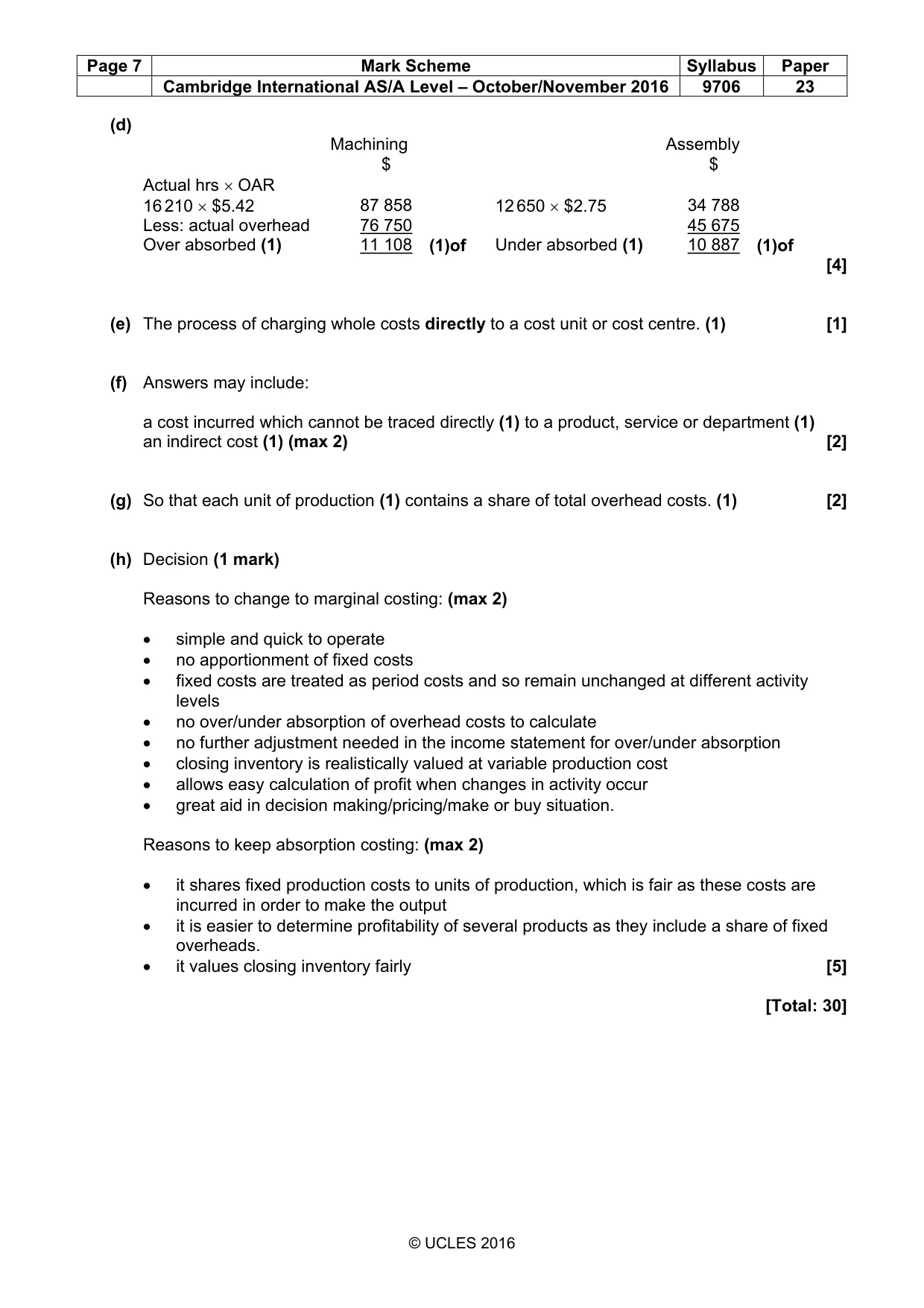
Page 7 Mark Scheme Syllabus Paper Cambridge International AS/A Level – October/November 2016 9706 23 © UCLES 2016 (d) Machining Assembly $ $ Actual hrs × OAR 16 210 × $5.42 87 858 12 650 × $2.75 34 788 Less: actual overhead 76 750 45 675 Over absorbed (1) 11 108 (1)of Under absorbed (1) 10 887 (1)of [4] (e) The process of charging whole costs directly to a cost unit or cost centre. (1) [1] (f) Answers may include: a cost incurred which cannot be traced directly (1) to a product, service or department (1) an indirect cost (1) (max 2) [2] (g) So that each unit of production (1) contains a share of total overhead costs. (1) [2] (h) Decision (1 mark) Reasons to change to marginal costing: (max 2) • simple and quick to operate • no apportionment of fixed costs • fixed costs are treated as period costs and so remain unchanged at different activity levels • no over/under absorption of overhead costs to calculate • no further adjustment needed in the income statement for over/under absorption • closing inventory is realistically valued at variable production cost • allows easy calculation of profit when changes in activity occur • great aid in decision making/pricing/make or buy situation. Reasons to keep absorption costing: (max 2) • it shares fixed production costs to units of production, which is fair as these costs are incurred in order to make the output • it is easier to determine profitability of several products as they include a share of fixed overheads. • it values closing inventory fairly [5] [Total: 30]
What you needed in this session
Cambridge’s own grade thresholds for 2016 Oct/Nov, Paper 2 · Variant 3. A higher threshold means an easier paper — the bar moves with how the cohort did.