Cambridge A Level Accounting 9706 — 2015 Oct/Nov Paper 2 · Variant 2
9706/22/O/N/15 · 90 marks · ≈101 min
The question paper and its mark scheme, free to read here and free to download. This is Cambridge’s own paper, exactly as it was sat.
Question paper16 pages

Mark scheme7 pages
Answers below. Sit the paper first if you are practising.
Paper as text
Question paper, page 1
This document consists of 14 printed pages and 2 blank pages. IB15 11_9706_22/5RP © UCLES 2015 [Turn over *5177343641* Cambridge International Examinations Cambridge International Advanced Subsidiary and Advanced Level ACCOUNTING 9706/22 Paper 2 Structured Questions October/November 2015 1 hour 30 minutes Candidates answer on the Question Paper. No Additional Materials are required. READ THESE INSTRUCTIONS FIRST Write your Centre number, candidate number and name on all the work you hand in. Write in dark blue or black pen. You may use an HB pencil for rough working. Do not use staples, paper clips, glue or correction fluid. DO NOT WRITE IN ANY BARCODES. Answer all questions. All accounting statements are to be presented in good style. International accounting terms and formats should be used as appropriate. Workings must be shown. You may use a calculator. At the end of the examination, fasten all your work securely together. The number of marks is given in brackets [ ] at the end of each question or part question.
Question paper, page 2
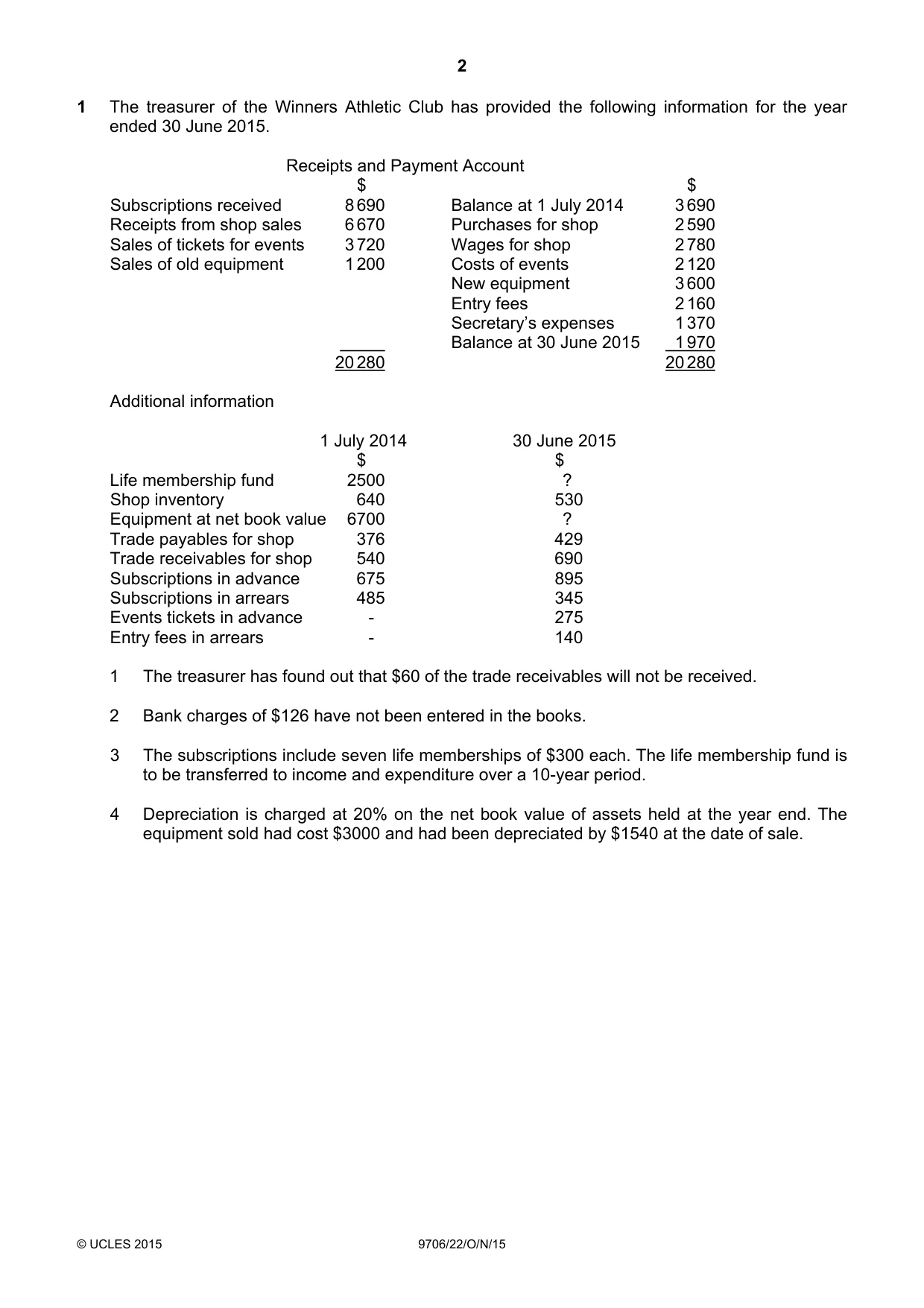
2 © UCLES 2015 9706/22/O/N/15 1 The treasurer of the Winners Athletic Club has provided the following information for the year ended 30 June 2015. Receipts and Payment Account $ $ Subscriptions received 8 690 Balance at 1 July 2014 3 690 Receipts from shop sales 6 670 Purchases for shop 2 590 Sales of tickets for events 3 720 Wages for shop 2 780 Sales of old equipment 1 200 Costs of events 2 120 New equipment 3 600 Entry fees 2 160 Secretary’s expenses 1 370 Balance at 30 June 2015 1 970 20 280 20 280 Additional information 1 July 2014 30 June 2015 $ $ Life membership fund 2500 ? Shop inventory 640 530 Equipment at net book value 6700 ? Trade payables for shop 376 429 Trade receivables for shop 540 690 Subscriptions in advance 675 895 Subscriptions in arrears 485 345 Events tickets in advance - 275 Entry fees in arrears - 140 1 The treasurer has found out that $60 of the trade receivables will not be received. 2 Bank charges of $126 have not been entered in the books. 3 The subscriptions include seven life memberships of $300 each. The life membership fund is to be transferred to income and expenditure over a 10-year period. 4 Depreciation is charged at 20% on the net book value of assets held at the year end. The equipment sold had cost $3000 and had been depreciated by $1540 at the date of sale.
Question paper, page 3
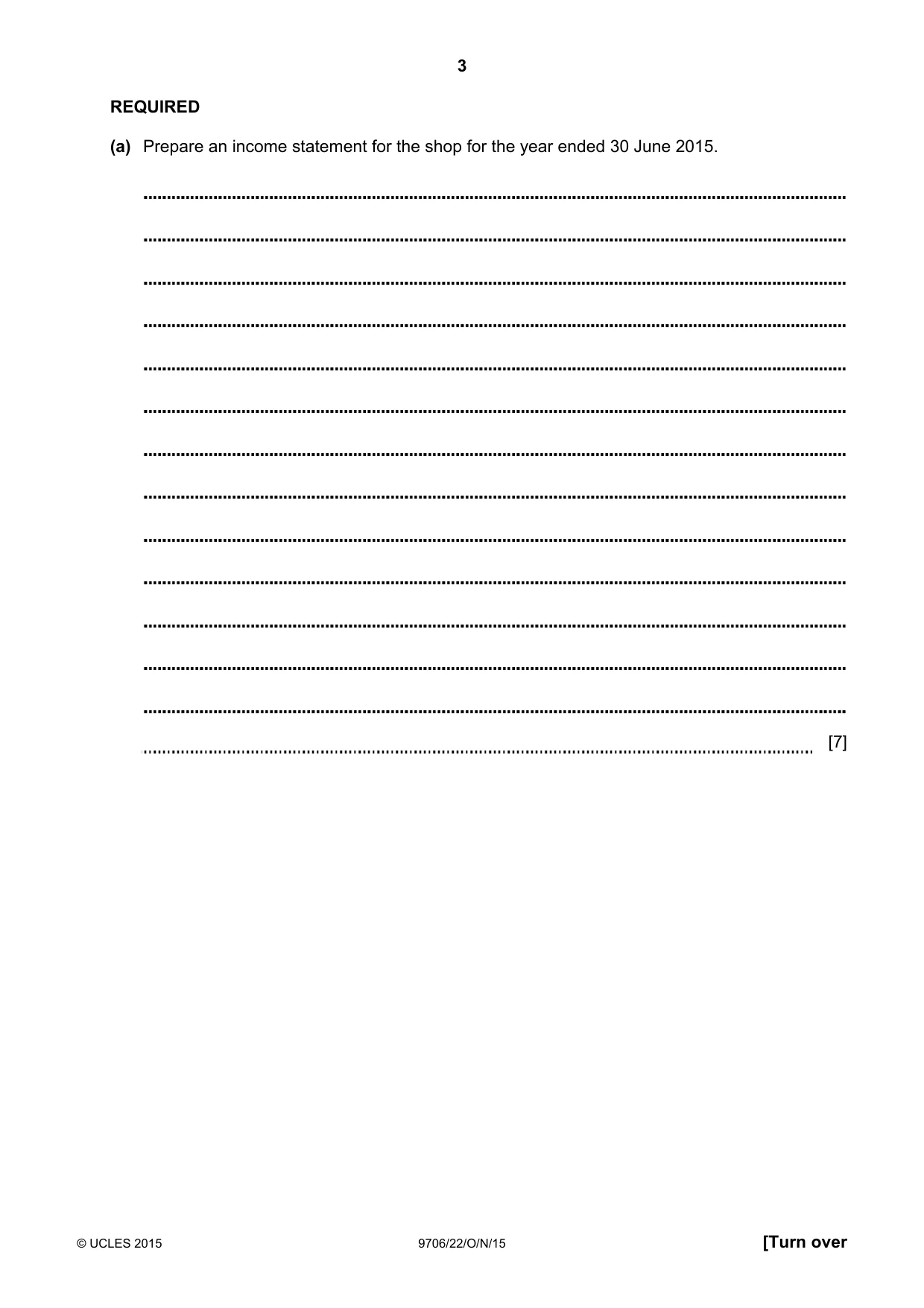
3 © UCLES 2015 9706/22/O/N/15 [Turn over REQUIRED (a) Prepare an income statement for the shop for the year ended 30 June 2015. [7]
Question paper, page 4
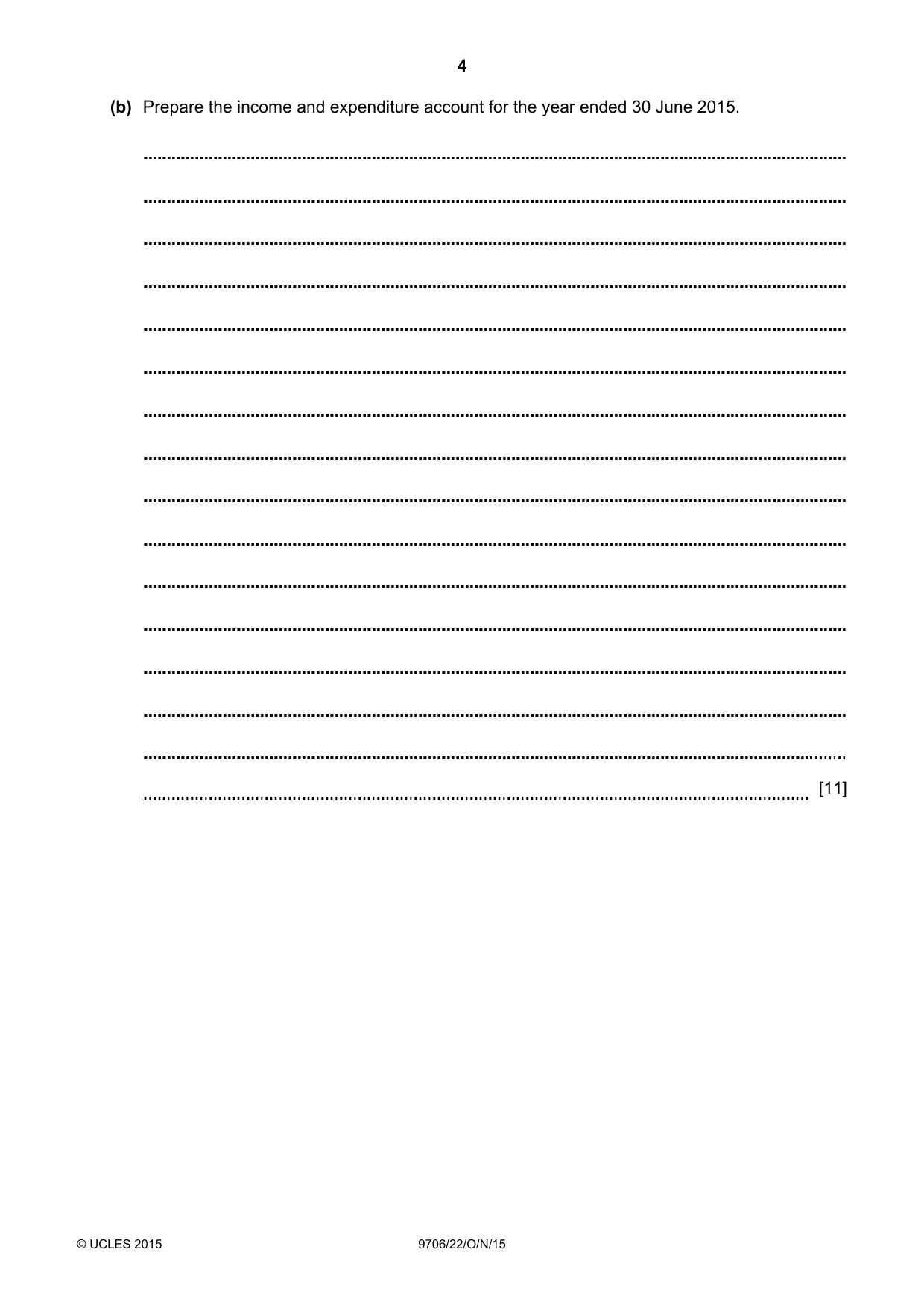
4 © UCLES 2015 9706/22/O/N/15 (b) Prepare the income and expenditure account for the year ended 30 June 2015. [11]
Question paper, page 5
5 © UCLES 2015 9706/22/O/N/15 [Turn over (c) Prepare the statement of financial position at 30 June 2015. [8]
Question paper, page 6
6 © UCLES 2015 9706/22/O/N/15 (d) Explain why no amounts have been entered in the financial statements in respect of the many hours worked during the year by volunteers. [2] (e) Explain why the amounts prepaid and accrued are included in the financial statements of the club. [2] [Total: 30]
Question paper, page 7
7 © UCLES 2015 9706/22/O/N/15 [Turn over BLANK PAGE
Question paper, page 8
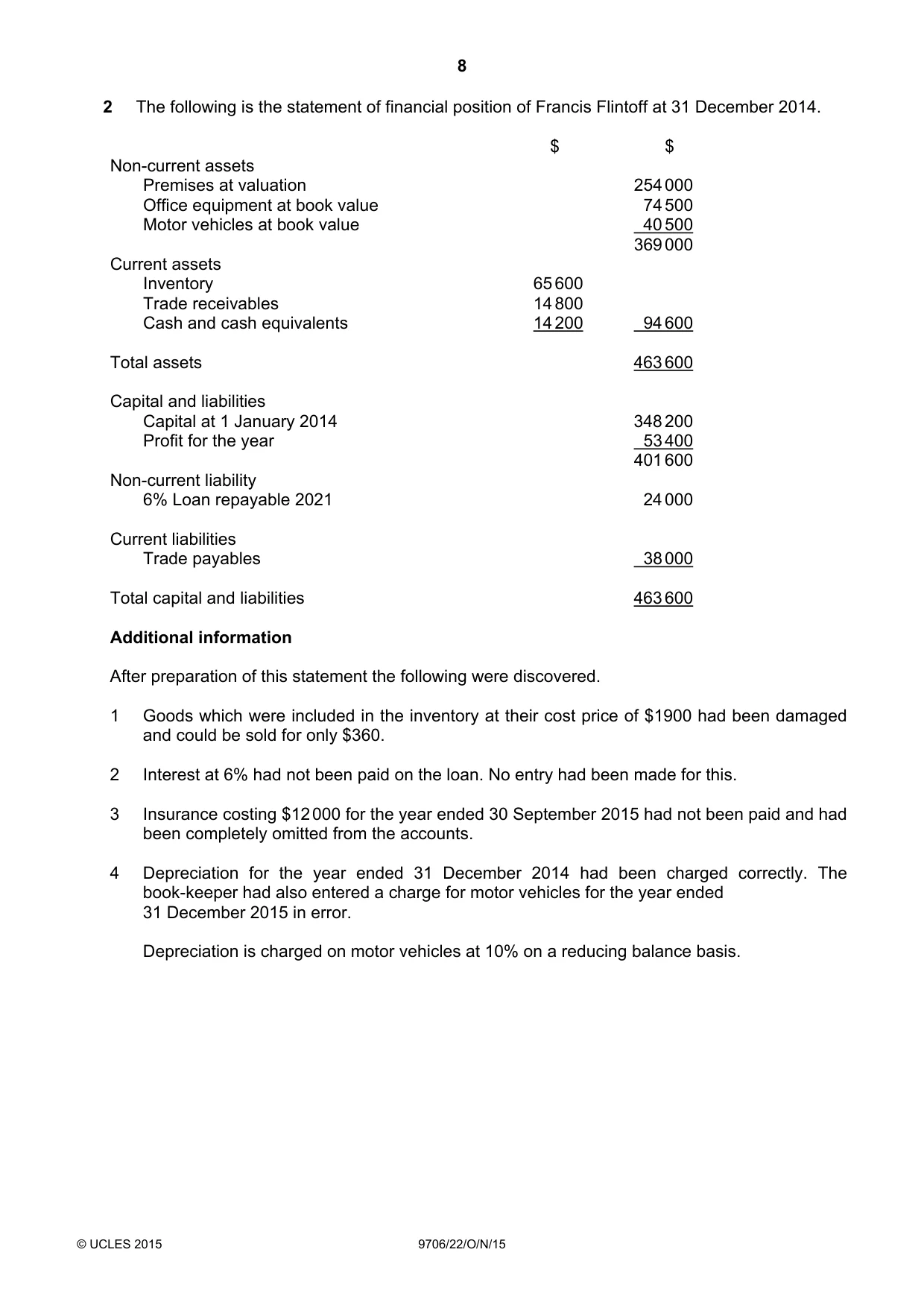
8 © UCLES 2015 9706/22/O/N/15 2 The following is the statement of financial position of Francis Flintoff at 31 December 2014. $ $ Non-current assets Premises at valuation 254 000 Office equipment at book value 74 500 Motor vehicles at book value 40 500 369 000 Current assets Inventory 65 600 Trade receivables 14 800 Cash and cash equivalents 14 200 94 600 Total assets 463 600 Capital and liabilities Capital at 1 January 2014 348 200 Profit for the year 53 400 401 600 Non-current liability 6% Loan repayable 2021 24 000 Current liabilities Trade payables 38 000 Total capital and liabilities 463 600 Additional information After preparation of this statement the following were discovered. 1 Goods which were included in the inventory at their cost price of $1900 had been damaged and could be sold for only $360. 2 Interest at 6% had not been paid on the loan. No entry had been made for this. 3 Insurance costing $12 000 for the year ended 30 September 2015 had not been paid and had been completely omitted from the accounts. 4 Depreciation for the year ended 31 December 2014 had been charged correctly. The book-keeper had also entered a charge for motor vehicles for the year ended 31 December 2015 in error. Depreciation is charged on motor vehicles at 10% on a reducing balance basis.
Question paper, page 9
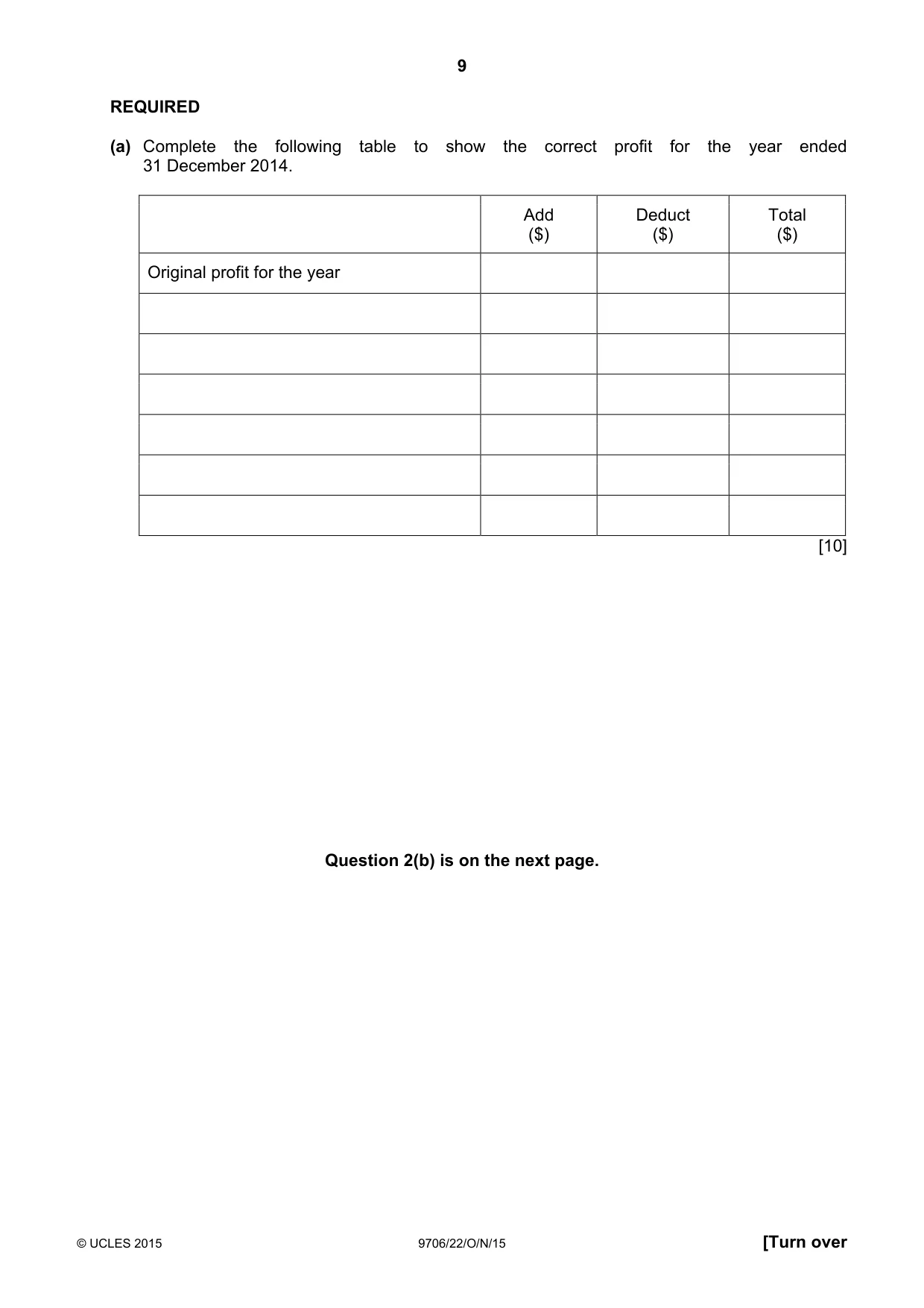
9 © UCLES 2015 9706/22/O/N/15 [Turn over REQUIRED (a) Complete the following table to show the correct profit for the year ended 31 December 2014. Add ($) Deduct ($) Total ($) Original profit for the year [10] Question 2(b) is on the next page.
Question paper, page 10
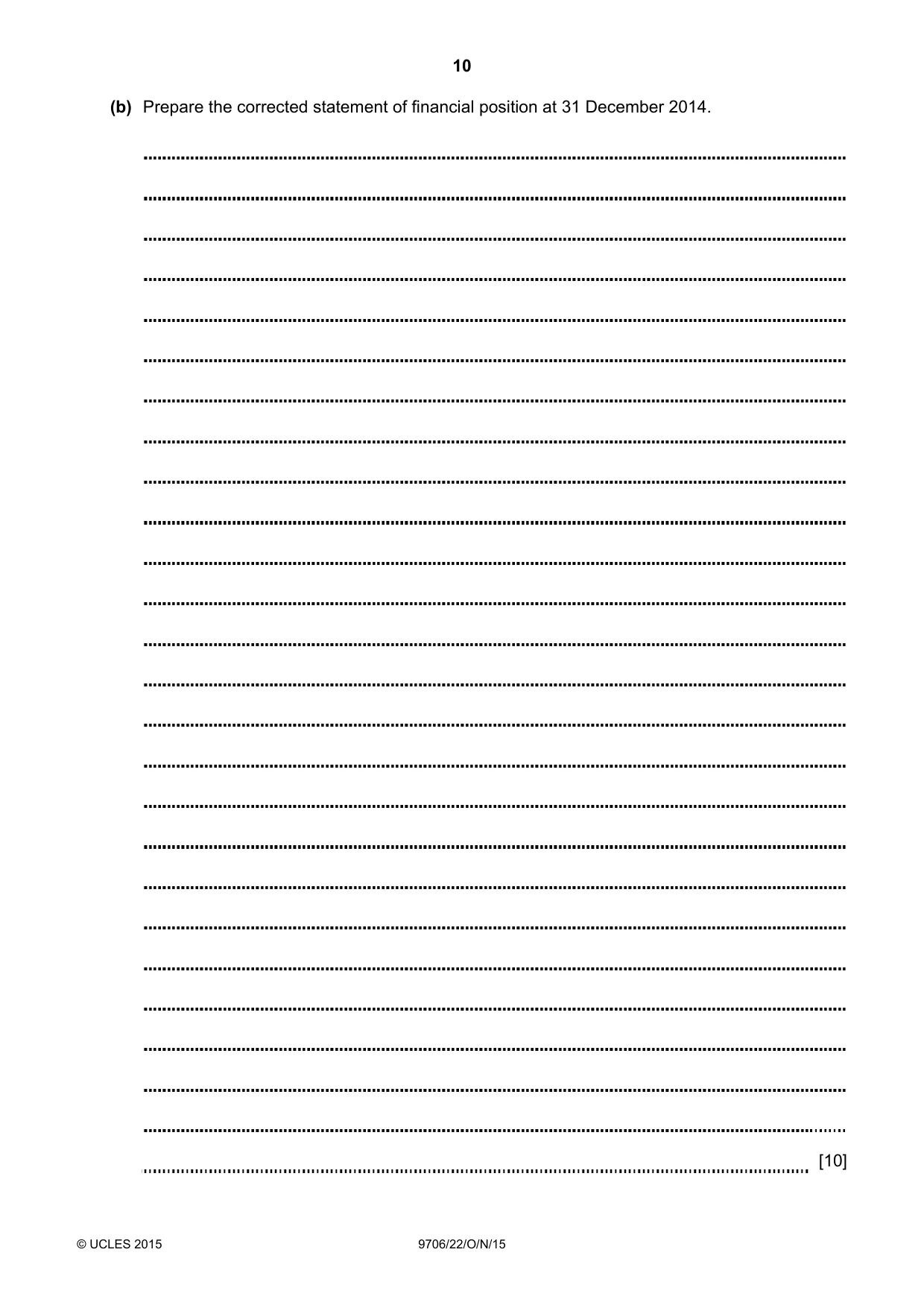
10 © UCLES 2015 9706/22/O/N/15 (b) Prepare the corrected statement of financial position at 31 December 2014. [10]
Question paper, page 11
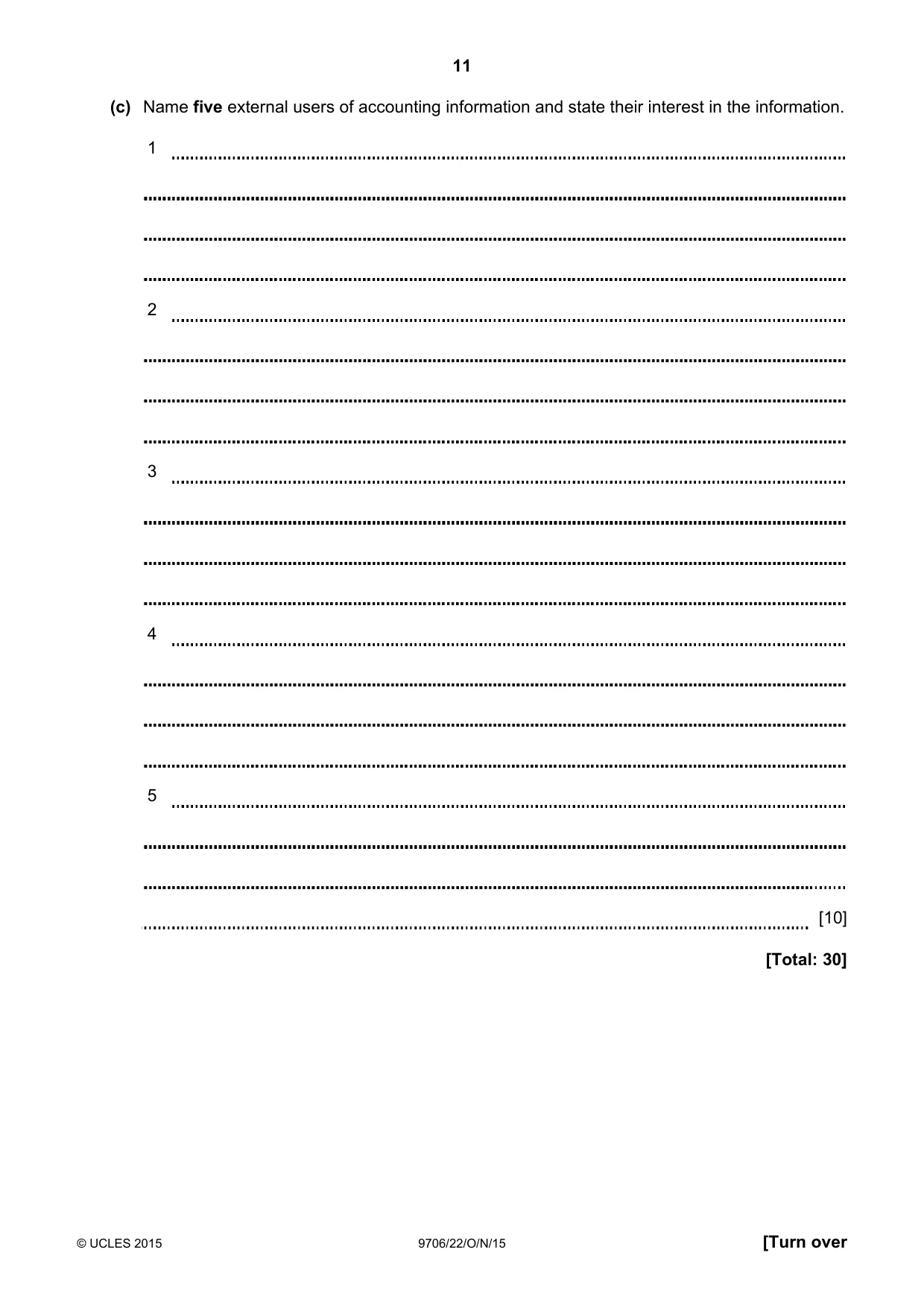
11 © UCLES 2015 9706/22/O/N/15 [Turn over (c) Name five external users of accounting information and state their interest in the information. 1 2 3 4 5 [10] [Total: 30]
Question paper, page 12
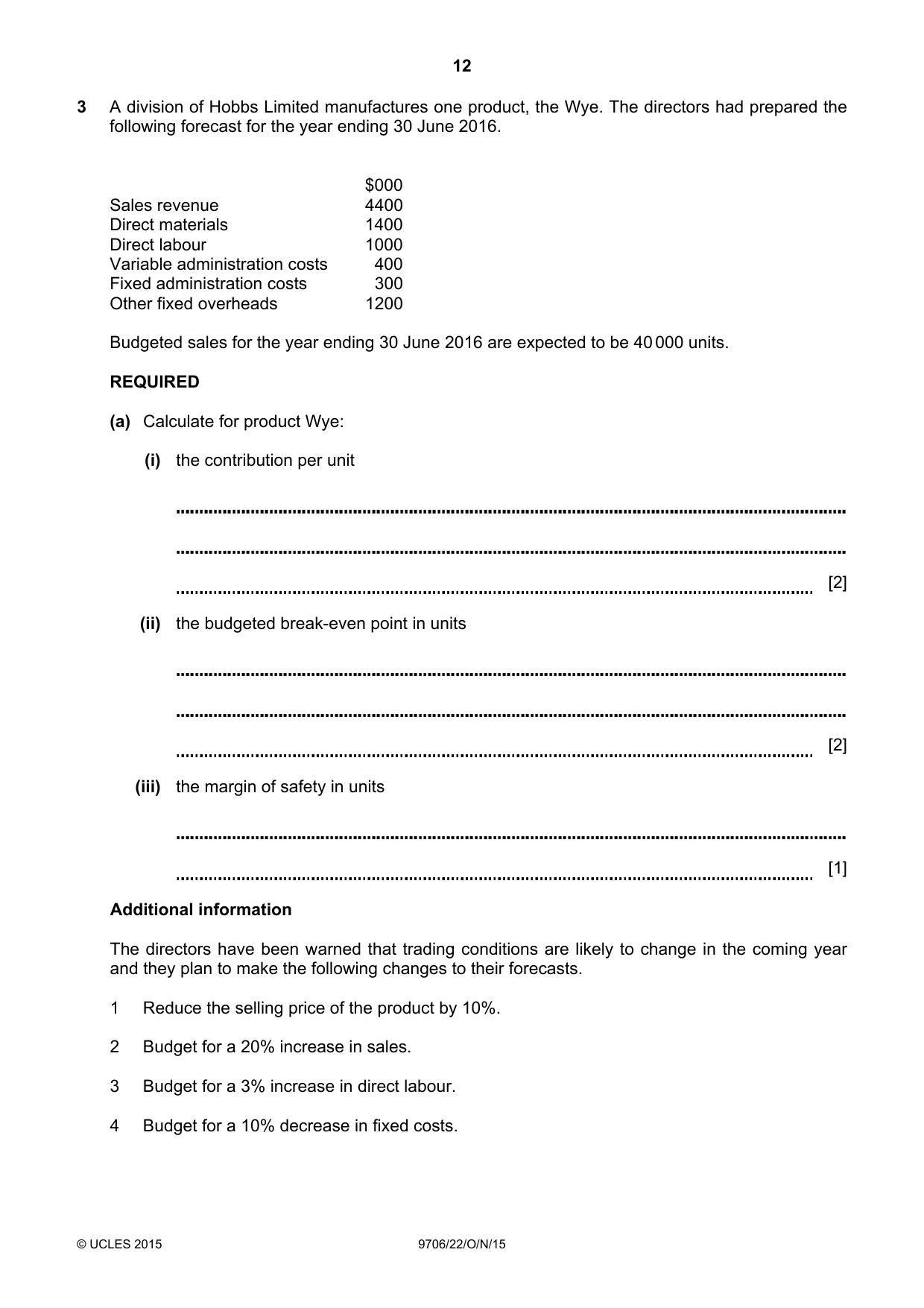
12 © UCLES 2015 9706/22/O/N/15 3 A division of Hobbs Limited manufactures one product, the Wye. The directors had prepared the following forecast for the year ending 30 June 2016. $000 Sales revenue 4400 Direct materials 1400 Direct labour 1000 Variable administration costs 400 Fixed administration costs 300 Other fixed overheads 1200 Budgeted sales for the year ending 30 June 2016 are expected to be 40 000 units. REQUIRED (a) Calculate for product Wye: (i) the contribution per unit [2] (ii) the budgeted break-even point in units [2] (iii) the margin of safety in units [1] Additional information The directors have been warned that trading conditions are likely to change in the coming year and they plan to make the following changes to their forecasts. 1 Reduce the selling price of the product by 10%. 2 Budget for a 20% increase in sales. 3 Budget for a 3% increase in direct labour. 4 Budget for a 10% decrease in fixed costs.
Question paper, page 13
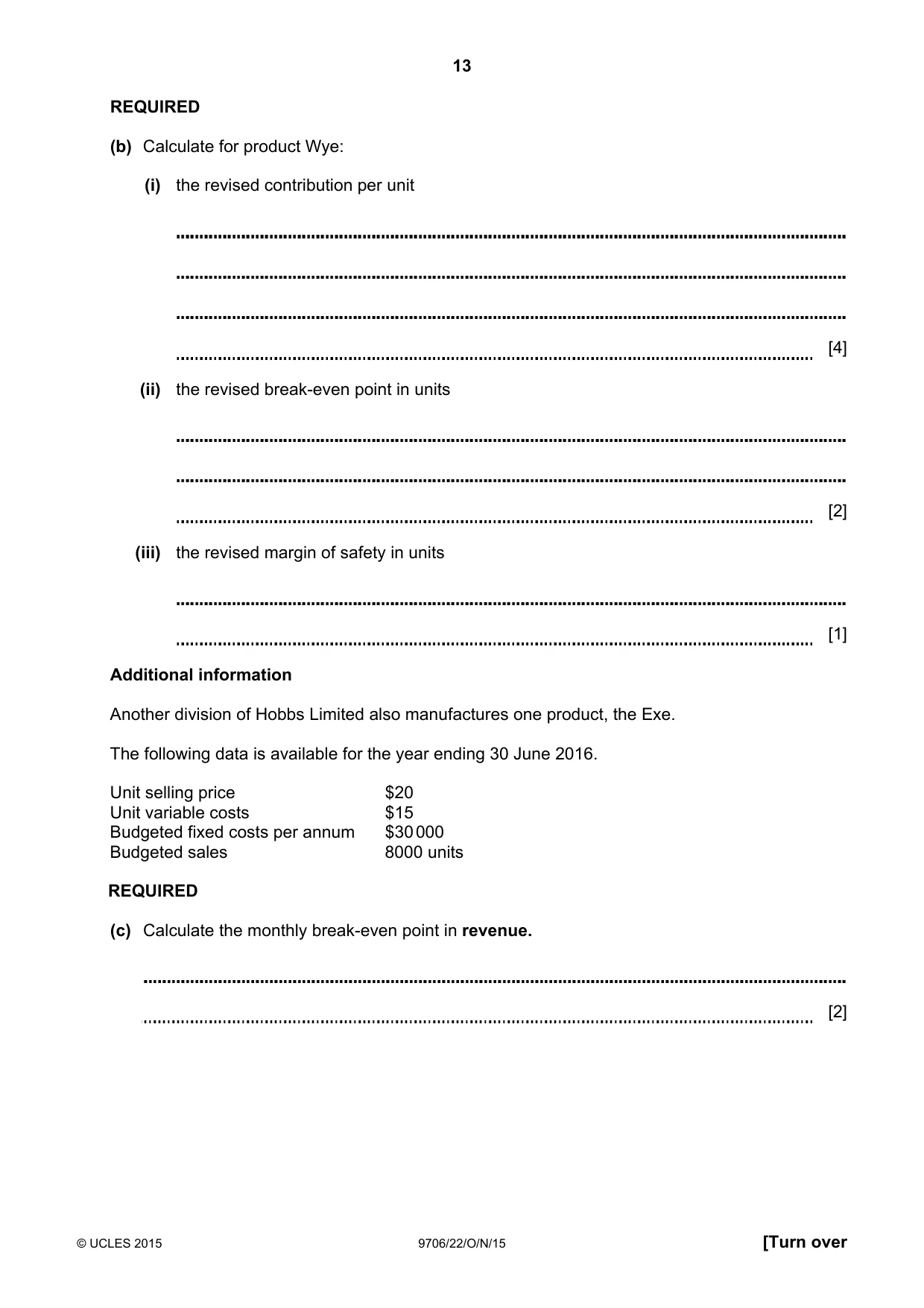
13 © UCLES 2015 9706/22/O/N/15 [Turn over REQUIRED (b) Calculate for product Wye: (i) the revised contribution per unit [4] (ii) the revised break-even point in units [2] (iii) the revised margin of safety in units [1] Additional information Another division of Hobbs Limited also manufactures one product, the Exe. The following data is available for the year ending 30 June 2016. Unit selling price $20 Unit variable costs $15 Budgeted fixed costs per annum $30 000 Budgeted sales 8000 units REQUIRED (c) Calculate the monthly break-even point in revenue. [2]
Question paper, page 14
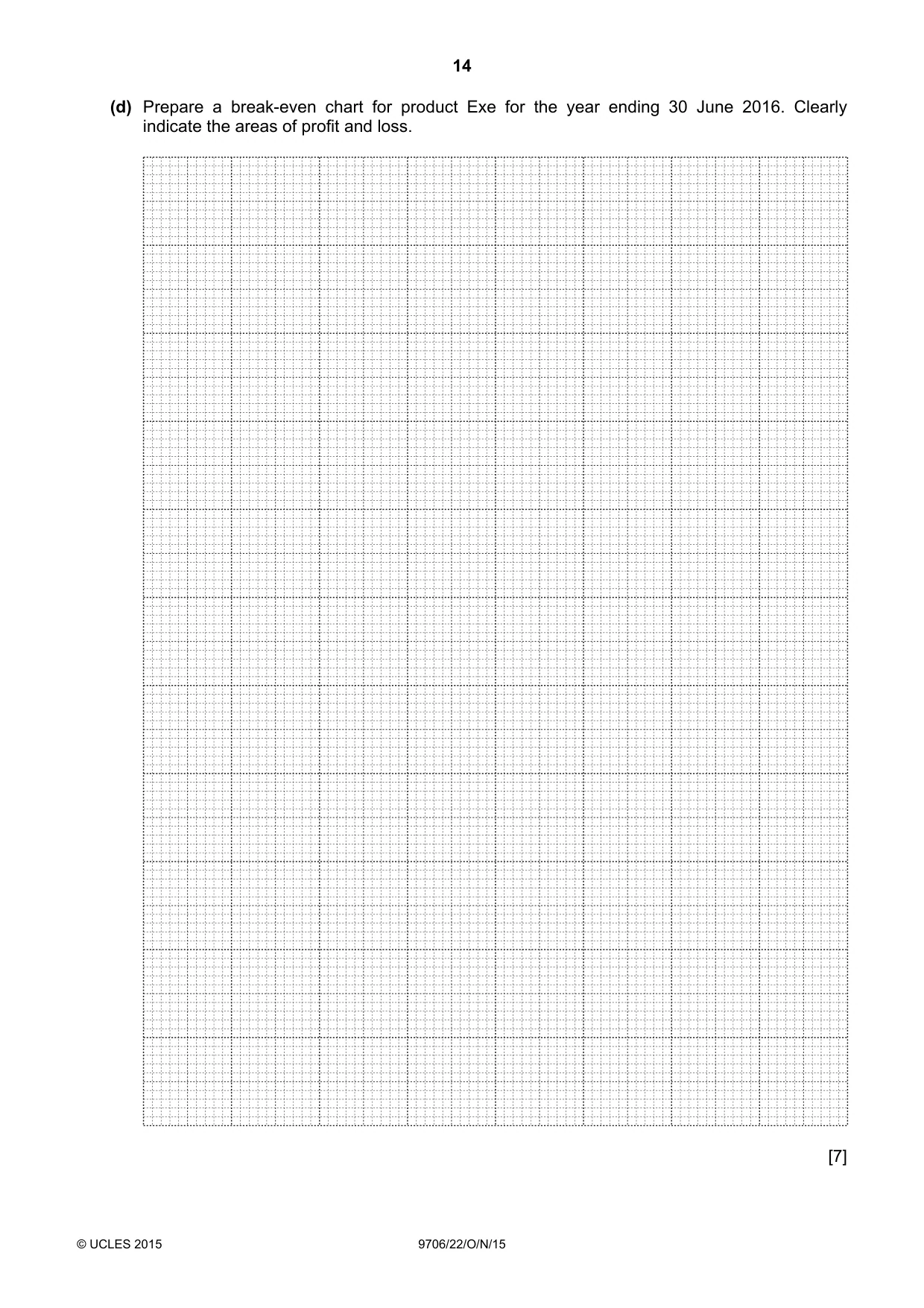
14 © UCLES 2015 9706/22/O/N/15 (d) Prepare a break-even chart for product Exe for the year ending 30 June 2016. Clearly indicate the areas of profit and loss. [7]
Question paper, page 15
15 © UCLES 2015 9706/22/O/N/15 (e) State three assumptions the accountant must make when preparing a break-even chart. 1 2 3 [3] Additional information The company uses marginal costing in order to calculate its break-even point for its ‘make or buy’ decisions. REQUIRED (f) State three further reasons why a business might use a marginal costing system. 1 2 3 [6] [Total: 30]
Question paper, page 16
16 Permission to reproduce items where third-party owned material protected by copyright is included has been sought and cleared where possible. Every reasonable effort has been made by the publisher (UCLES) to trace copyright holders, but if any items requiring clearance have unwittingly been included, the publisher will be pleased to make amends at the earliest possible opportunity. To avoid the issue of disclosure of answer-related information to candidates, all copyright acknowledgements are reproduced online in the Cambridge International Examinations Copyright Acknowledgements Booklet. This is produced for each series of examinations and is freely available to download at www.cie.org.uk after the live examination series. Cambridge International Examinations is part of the Cambridge Assessment Group. Cambridge Assessment is the brand name of University of Cambridge Local Examinations Syndicate (UCLES), which is itself a department of the University of Cambridge. © UCLES 2015 9706/22/O/N/15 BLANK PAGE
Mark scheme, page 1
® IGCSE is the registered trademark of Cambridge International Examinations. CAMBRIDGE INTERNATIONAL EXAMINATIONS Cambridge International Advanced Subsidiary and Advanced Level MARK SCHEME for the October/November 2015 series 9706 ACCOUNTING 9706/22 Paper 2 (Structured Questions – Core), maximum raw mark 90 This mark scheme is published as an aid to teachers and candidates, to indicate the requirements of the examination. It shows the basis on which Examiners were instructed to award marks. It does not indicate the details of the discussions that took place at an Examiners’ meeting before marking began, which would have considered the acceptability of alternative answers. Mark schemes should be read in conjunction with the question paper and the Principal Examiner Report for Teachers. Cambridge will not enter into discussions about these mark schemes. Cambridge is publishing the mark schemes for the October/November 2015 series for most Cambridge IGCSE®, Cambridge International A and AS Level components and some Cambridge O Level components.
Mark scheme, page 2
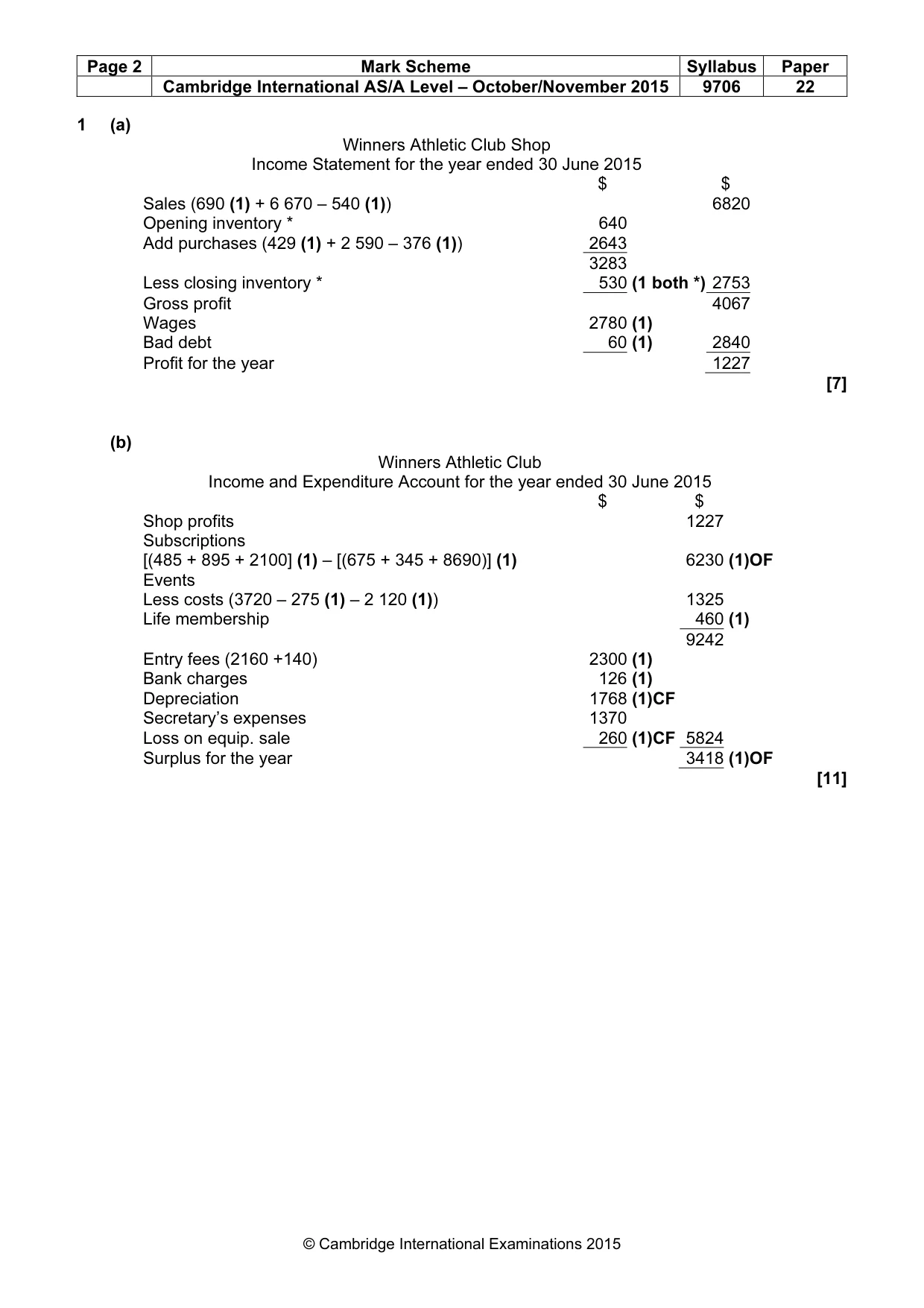
Page 2 Mark Scheme Syllabus Paper Cambridge International AS/A Level – October/November 2015 9706 22 © Cambridge International Examinations 2015 1 (a) Winners Athletic Club Shop Income Statement for the year ended 30 June 2015 $ $ Sales (690 (1) + 6 670 – 540 (1)) 6820 Opening inventory * 640 Add purchases (429 (1) + 2 590 – 376 (1)) 2643 3283 Less closing inventory * 530 (1 both *) 2753 Gross profit 4067 Wages 2780 (1) Bad debt 60 (1) 2840 Profit for the year 1227 [7] (b) Winners Athletic Club Income and Expenditure Account for the year ended 30 June 2015 $ $ Shop profits 1227 Subscriptions [(485 + 895 + 2100] (1) – [(675 + 345 + 8690)] (1) 6230 (1)OF Events Less costs (3720 – 275 (1) – 2 120 (1)) 1325 Life membership 460 (1) 9242 Entry fees (2160 +140) 2300 (1) Bank charges 126 (1) Depreciation 1768 (1)CF Secretary’s expenses 1370 Loss on equip. sale 260 (1)CF 5824 Surplus for the year 3418 (1)OF [11]
Mark scheme, page 3
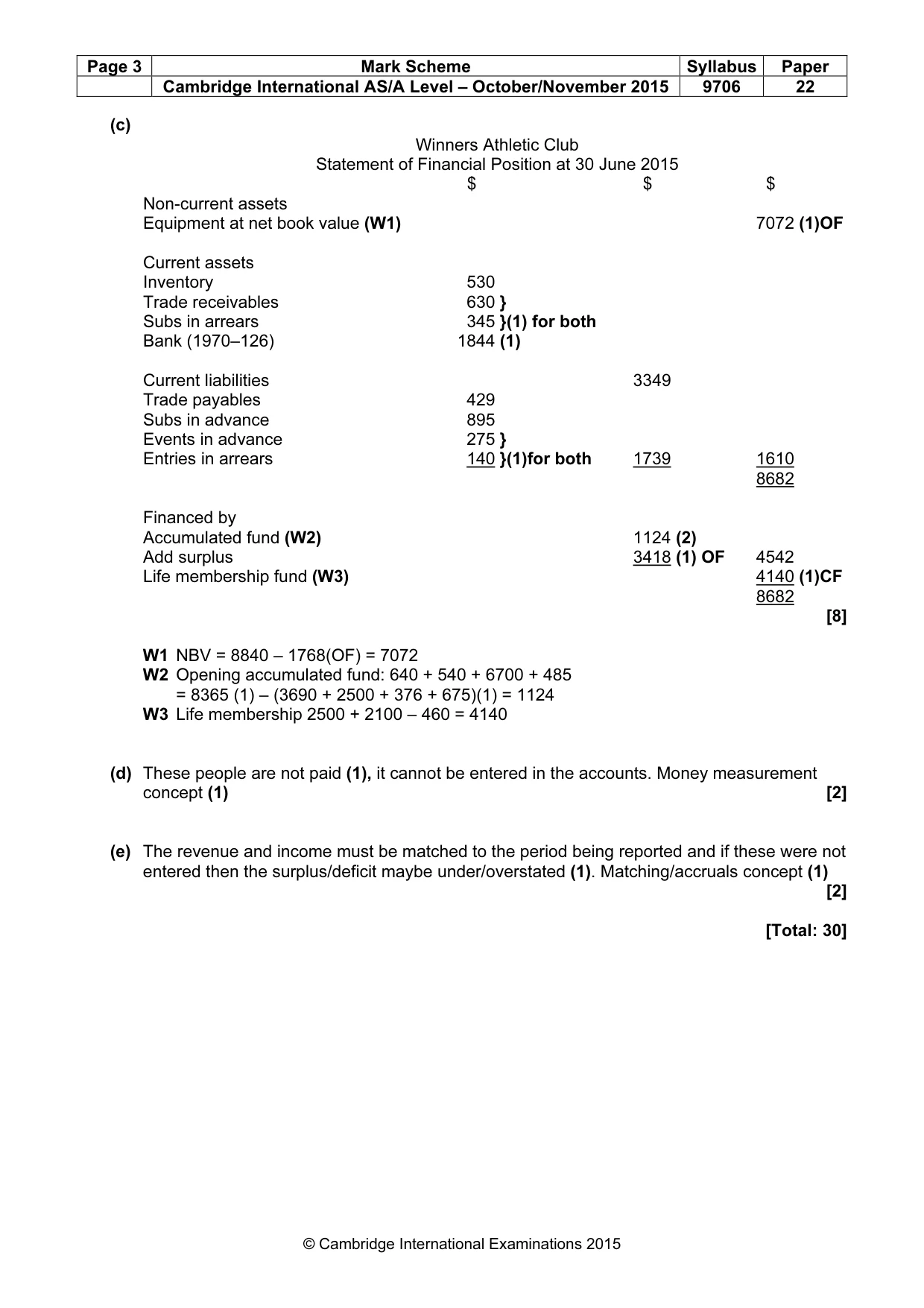
Page 3 Mark Scheme Syllabus Paper Cambridge International AS/A Level – October/November 2015 9706 22 © Cambridge International Examinations 2015 (c) Winners Athletic Club Statement of Financial Position at 30 June 2015 $ $ $ Non-current assets Equipment at net book value (W1) 7072 (1)OF Current assets Inventory 530 Trade receivables 630 } Subs in arrears 345 }(1) for both Bank (1970–126) 1844 (1) Current liabilities 3349 Trade payables 429 Subs in advance 895 Events in advance 275 } Entries in arrears 140 }(1)for both 1739 1610 8682 Financed by Accumulated fund (W2) 1124 (2) Add surplus 3418 (1) OF 4542 Life membership fund (W3) 4140 (1)CF 8682 [8] W1 NBV = 8840 – 1768(OF) = 7072 W2 Opening accumulated fund: 640 + 540 + 6700 + 485 = 8365 (1) – (3690 + 2500 + 376 + 675)(1) = 1124 W3 Life membership 2500 + 2100 – 460 = 4140 (d) These people are not paid (1), it cannot be entered in the accounts. Money measurement concept (1) [2] (e) The revenue and income must be matched to the period being reported and if these were not entered then the surplus/deficit maybe under/overstated (1). Matching/accruals concept (1) [2] [Total: 30]
Mark scheme, page 4
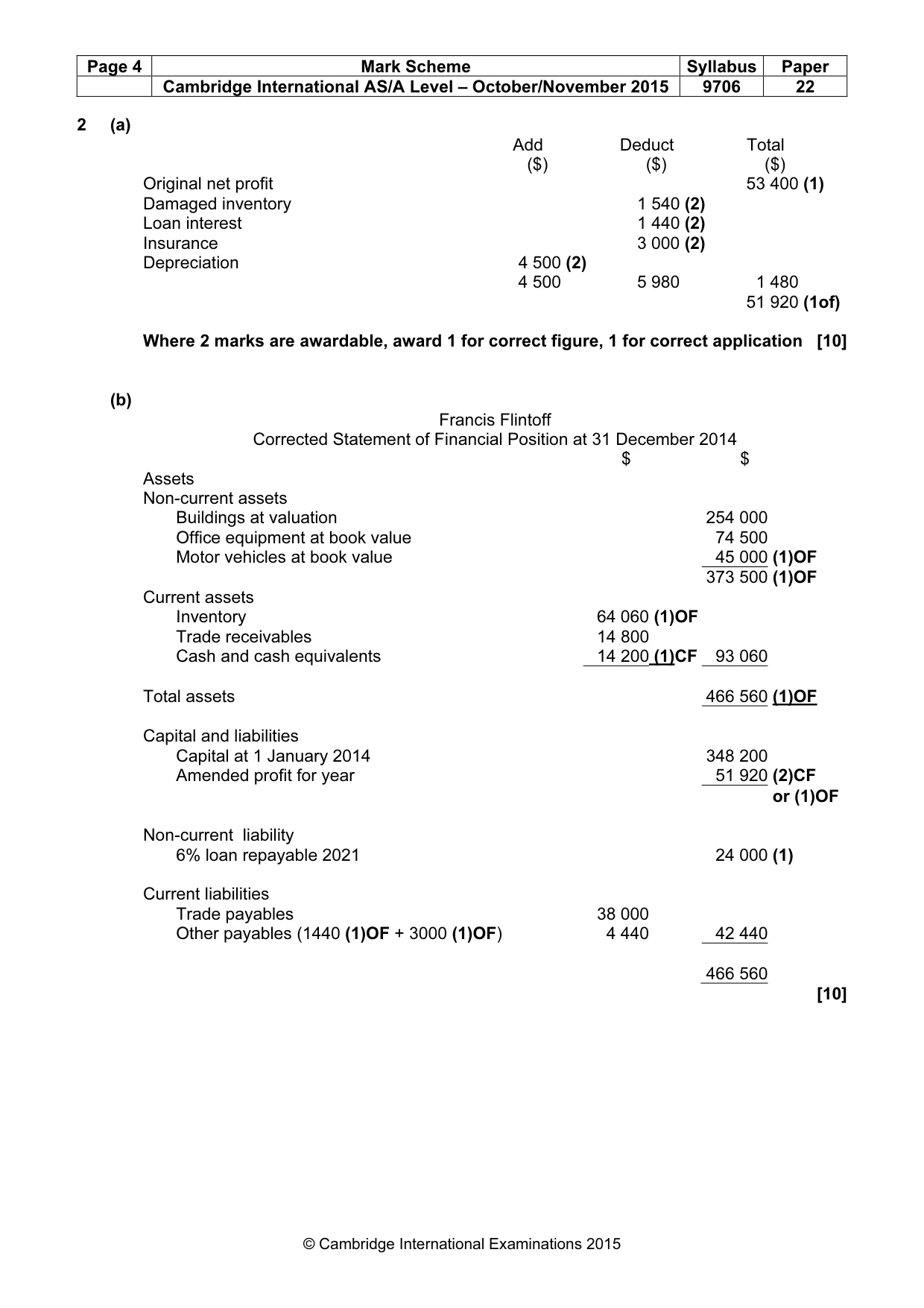
Page 4 Mark Scheme Syllabus Paper Cambridge International AS/A Level – October/November 2015 9706 22 © Cambridge International Examinations 2015 2 (a) Add Deduct Total ($) ($) ($) Original net profit 53 400 (1) Damaged inventory 1 540 (2) Loan interest 1 440 (2) Insurance 3 000 (2) Depreciation 4 500 (2) 4 500 5 980 1 480 51 920 (1of) Where 2 marks are awardable, award 1 for correct figure, 1 for correct application [10] (b) Francis Flintoff Corrected Statement of Financial Position at 31 December 2014 $ $ Assets Non-current assets Buildings at valuation 254 000 Office equipment at book value 74 500 Motor vehicles at book value 45 000 (1)OF 373 500 (1)OF Current assets Inventory 64 060 (1)OF Trade receivables 14 800 Cash and cash equivalents 14 200 (1)CF 93 060 Total assets 466 560 (1)OF Capital and liabilities Capital at 1 January 2014 348 200 Amended profit for year 51 920 (2)CF or (1)OF Non-current liability 6% loan repayable 2021 24 000 (1) Current liabilities Trade payables 38 000 Other payables (1440 (1)OF + 3000 (1)OF) 4 440 42 440 466 560 [10]
Mark scheme, page 5
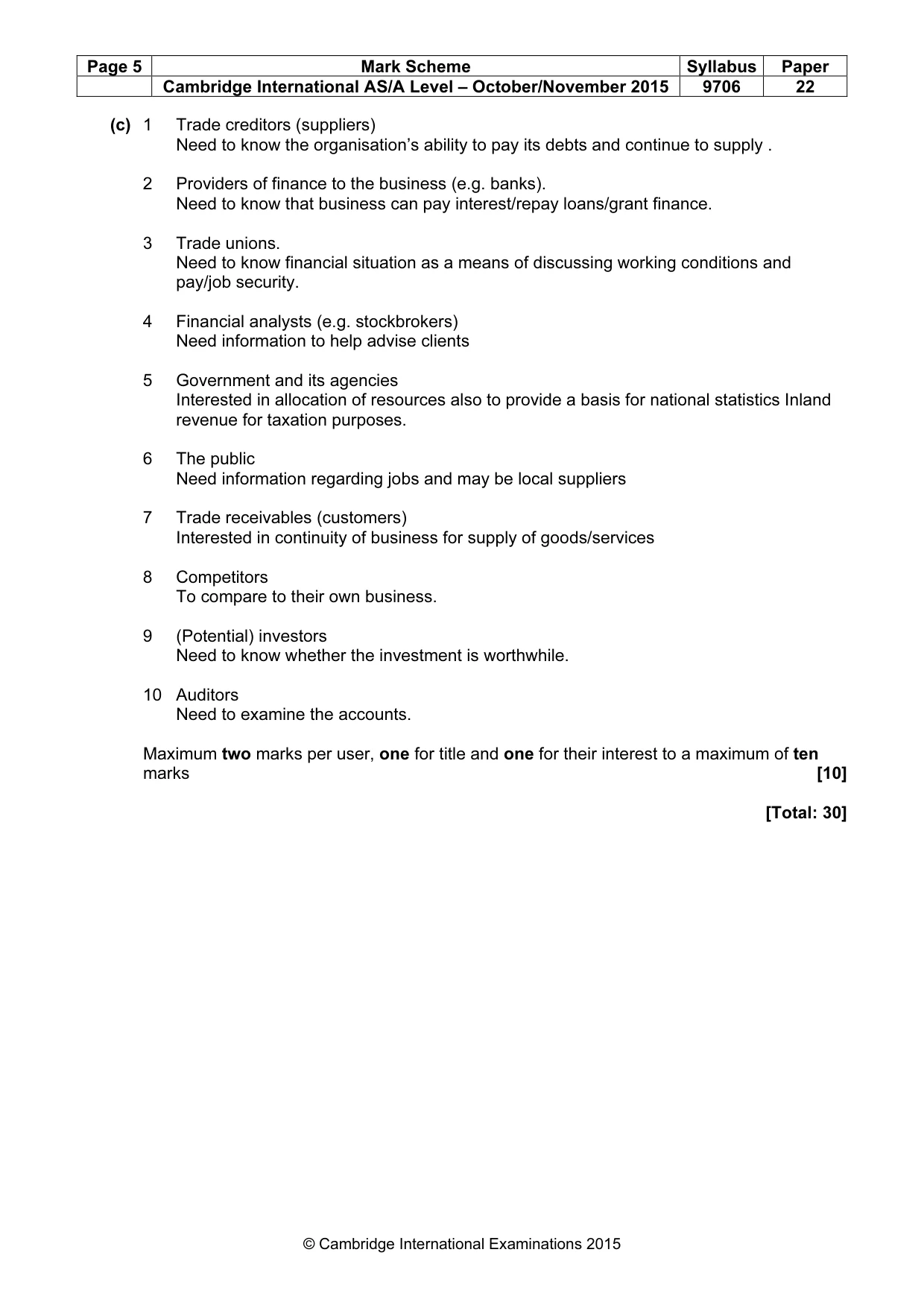
Page 5 Mark Scheme Syllabus Paper Cambridge International AS/A Level – October/November 2015 9706 22 © Cambridge International Examinations 2015 (c) 1 Trade creditors (suppliers) Need to know the organisation’s ability to pay its debts and continue to supply . 2 Providers of finance to the business (e.g. banks). Need to know that business can pay interest/repay loans/grant finance. 3 Trade unions. Need to know financial situation as a means of discussing working conditions and pay/job security. 4 Financial analysts (e.g. stockbrokers) Need information to help advise clients 5 Government and its agencies Interested in allocation of resources also to provide a basis for national statistics Inland revenue for taxation purposes. 6 The public Need information regarding jobs and may be local suppliers 7 Trade receivables (customers) Interested in continuity of business for supply of goods/services 8 Competitors To compare to their own business. 9 (Potential) investors Need to know whether the investment is worthwhile. 10 Auditors Need to examine the accounts. Maximum two marks per user, one for title and one for their interest to a maximum of ten marks [10] [Total: 30]
Mark scheme, page 6
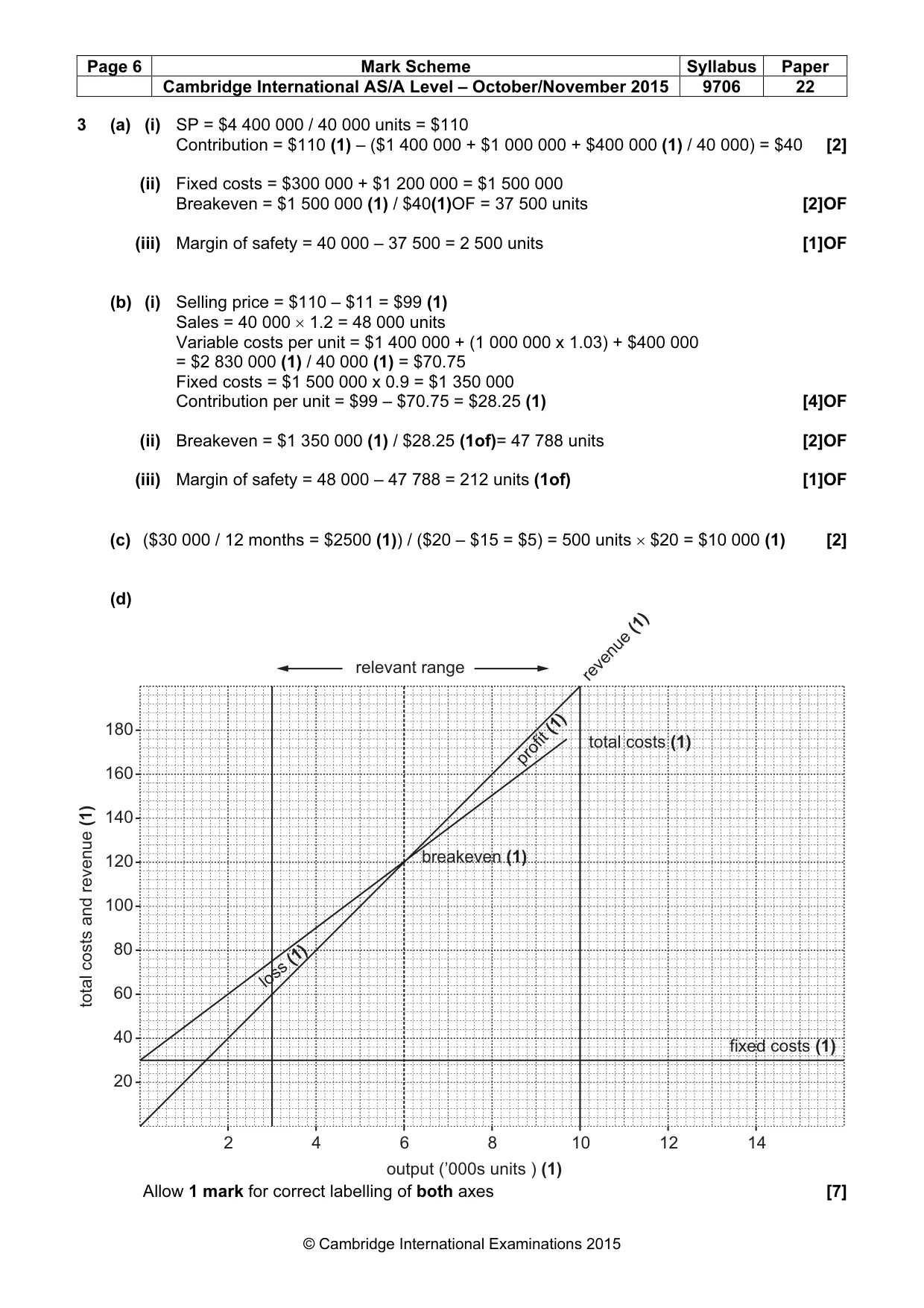
Page 6 Mark Scheme Syllabus Paper Cambridge International AS/A Level – October/November 2015 9706 22 © Cambridge International Examinations 2015 3 (a) (i) SP = $4 400 000 / 40 000 units = $110 Contribution = $110 (1) – ($1 400 000 + $1 000 000 + $400 000 (1) / 40 000) = $40 [2] (ii) Fixed costs = $300 000 + $1 200 000 = $1 500 000 Breakeven = $1 500 000 (1) / $40(1)OF = 37 500 units [2]OF (iii) Margin of safety = 40 000 – 37 500 = 2 500 units [1]OF (b) (i) Selling price = $110 – $11 = $99 (1) Sales = 40 000 × 1.2 = 48 000 units Variable costs per unit = $1 400 000 + (1 000 000 x 1.03) + $400 000 = $2 830 000 (1) / 40 000 (1) = $70.75 Fixed costs = $1 500 000 x 0.9 = $1 350 000 Contribution per unit = $99 – $70.75 = $28.25 (1) [4]OF (ii) Breakeven = $1 350 000 (1) / $28.25 (1of)= 47 788 units [2]OF (iii) Margin of safety = 48 000 – 47 788 = 212 units (1of) [1]OF (c) ($30 000 / 12 months = $2500 (1)) / ($20 – $15 = $5) = 500 units × $20 = $10 000 (1) [2] (d) Allow 1 mark for correct labelling of both axes [7] 20 40 60 80 100 120 140 160 180 2 4 6 8 10 12 14 output (’000s units ) (1) total costs and revenue (1) breakeven (1) fixed costs (1) profit (1) loss (1) revenue (1) total costs (1) relevant range
Mark scheme, page 7
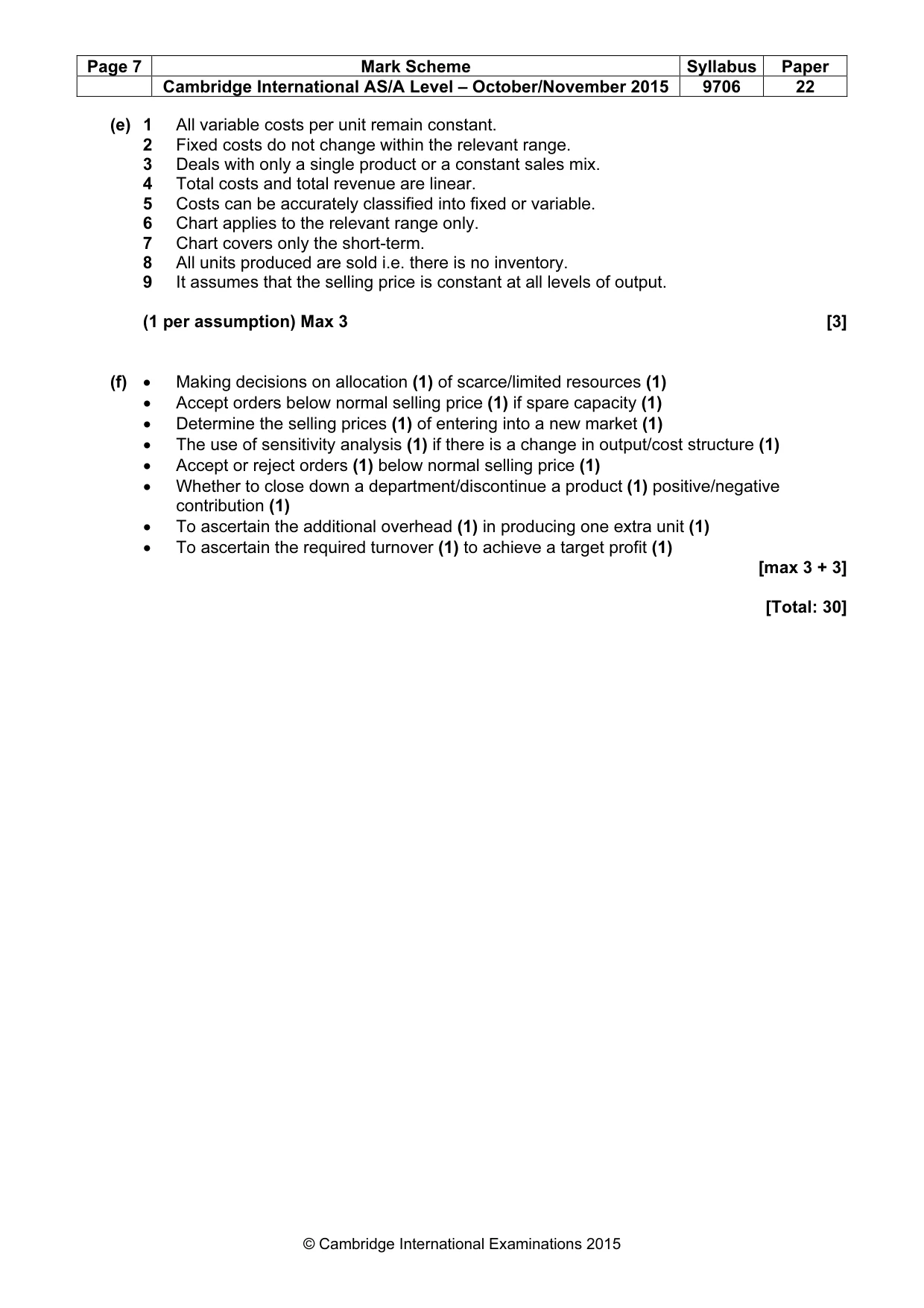
Page 7 Mark Scheme Syllabus Paper Cambridge International AS/A Level – October/November 2015 9706 22 © Cambridge International Examinations 2015 (e) 1 All variable costs per unit remain constant. 2 Fixed costs do not change within the relevant range. 3 Deals with only a single product or a constant sales mix. 4 Total costs and total revenue are linear. 5 Costs can be accurately classified into fixed or variable. 6 Chart applies to the relevant range only. 7 Chart covers only the short-term. 8 All units produced are sold i.e. there is no inventory. 9 It assumes that the selling price is constant at all levels of output. (1 per assumption) Max 3 [3] (f) • Making decisions on allocation (1) of scarce/limited resources (1) • Accept orders below normal selling price (1) if spare capacity (1) • Determine the selling prices (1) of entering into a new market (1) • The use of sensitivity analysis (1) if there is a change in output/cost structure (1) • Accept or reject orders (1) below normal selling price (1) • Whether to close down a department/discontinue a product (1) positive/negative contribution (1) • To ascertain the additional overhead (1) in producing one extra unit (1) • To ascertain the required turnover (1) to achieve a target profit (1) [max 3 + 3] [Total: 30]
What you needed in this session
Cambridge’s own grade thresholds for 2015 Oct/Nov, Paper 2 · Variant 2. A higher threshold means an easier paper — the bar moves with how the cohort did.