Cambridge A Level Accounting 9706 — 2015 Oct/Nov Paper 2 · Variant 1
9706/21/O/N/15 · 90 marks · ≈101 min
The question paper and its mark scheme, free to read here and free to download. This is Cambridge’s own paper, exactly as it was sat.
Question paper16 pages

Mark scheme8 pages
Answers below. Sit the paper first if you are practising.
Paper as text
Question paper, page 1
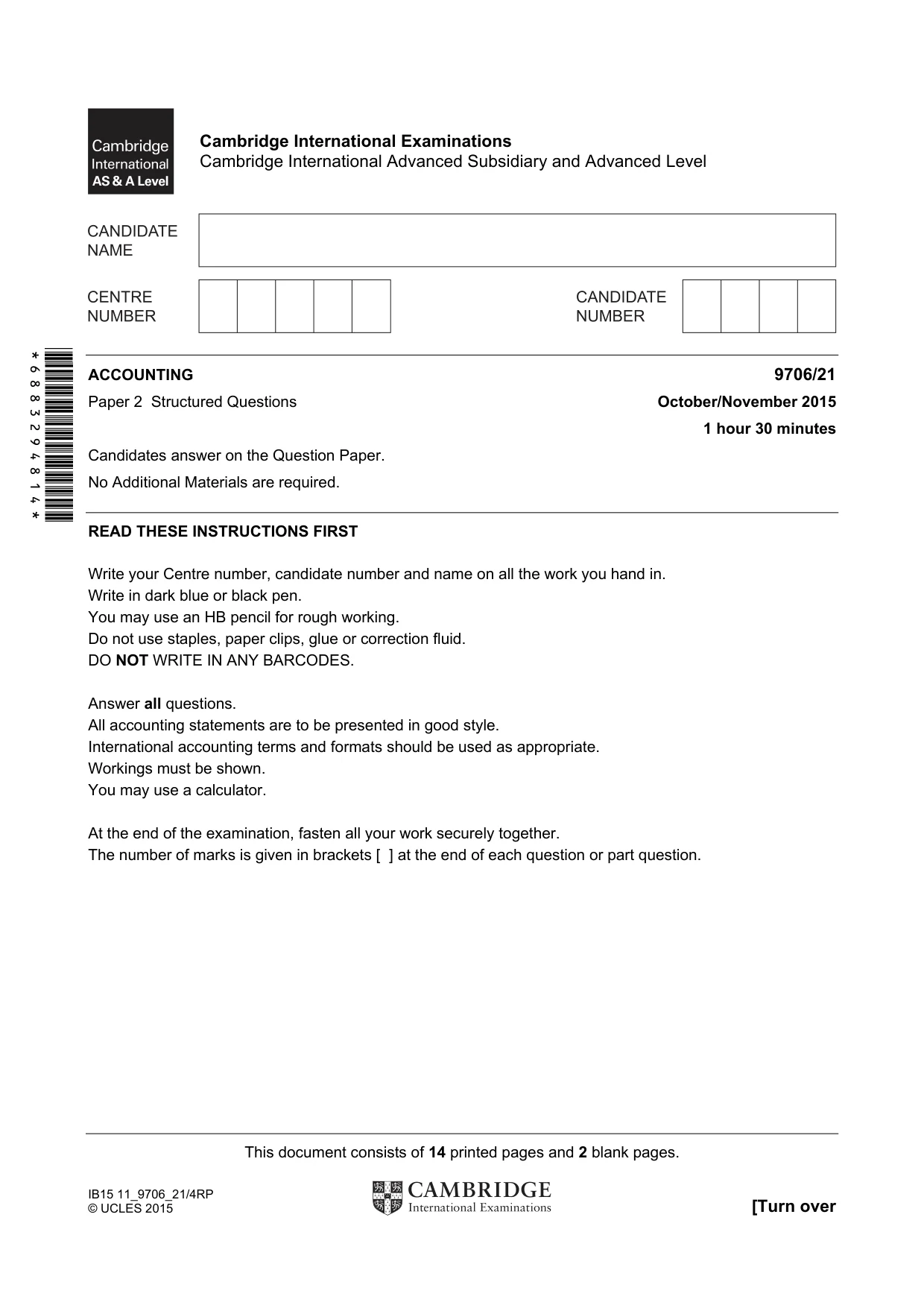
This document consists of 14 printed pages and 2 blank pages. IB15 11_9706_21/4RP © UCLES 2015 [Turn over *6883294814* Cambridge International Examinations Cambridge International Advanced Subsidiary and Advanced Level ACCOUNTING 9706/21 Paper 2 Structured Questions October/November 2015 1 hour 30 minutes Candidates answer on the Question Paper. No Additional Materials are required. READ THESE INSTRUCTIONS FIRST Write your Centre number, candidate number and name on all the work you hand in. Write in dark blue or black pen. You may use an HB pencil for rough working. Do not use staples, paper clips, glue or correction fluid. DO NOT WRITE IN ANY BARCODES. Answer all questions. All accounting statements are to be presented in good style. International accounting terms and formats should be used as appropriate. Workings must be shown. You may use a calculator. At the end of the examination, fasten all your work securely together. The number of marks is given in brackets [ ] at the end of each question or part question.
Question paper, page 2
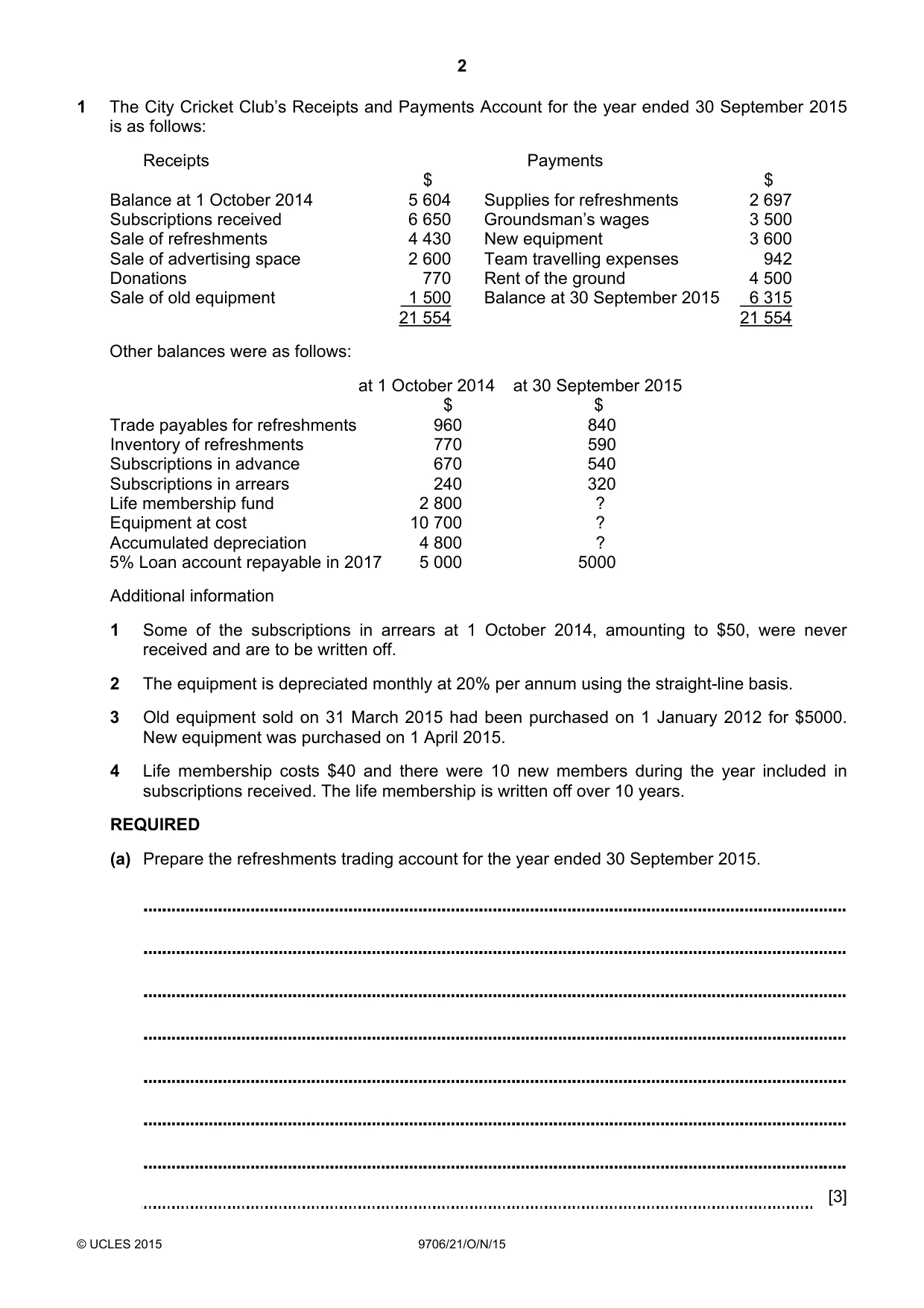
2 © UCLES 2015 9706/21/O/N/15 1 The City Cricket Club’s Receipts and Payments Account for the year ended 30 September 2015 is as follows: Receipts Payments $ $ Balance at 1 October 2014 5 604 Supplies for refreshments 2 697 Subscriptions received 6 650 Groundsman’s wages 3 500 Sale of refreshments 4 430 New equipment 3 600 Sale of advertising space 2 600 Team travelling expenses 942 Donations 770 Rent of the ground 4 500 Sale of old equipment 1 500 Balance at 30 September 2015 6 315 21 554 21 554 Other balances were as follows: at 1 October 2014 at 30 September 2015 $ $ Trade payables for refreshments 960 840 Inventory of refreshments 770 590 Subscriptions in advance 670 540 Subscriptions in arrears 240 320 Life membership fund 2 800 ? Equipment at cost 10 700 ? Accumulated depreciation 4 800 ? 5% Loan account repayable in 2017 5 000 5000 Additional information 1 Some of the subscriptions in arrears at 1 October 2014, amounting to $50, were never received and are to be written off. 2 The equipment is depreciated monthly at 20% per annum using the straight-line basis. 3 Old equipment sold on 31 March 2015 had been purchased on 1 January 2012 for $5000. New equipment was purchased on 1 April 2015. 4 Life membership costs $40 and there were 10 new members during the year included in subscriptions received. The life membership is written off over 10 years. REQUIRED (a) Prepare the refreshments trading account for the year ended 30 September 2015. [3]
Question paper, page 3
3 © UCLES 2015 9706/21/O/N/15 [Turn over (b) Prepare the club’s income and expenditure account for the year ended 30 September 2015. [12]
Question paper, page 4
4 © UCLES 2015 9706/21/O/N/15 (c) Prepare the club’s statement of financial position at 30 September 2015. [9]
Question paper, page 5
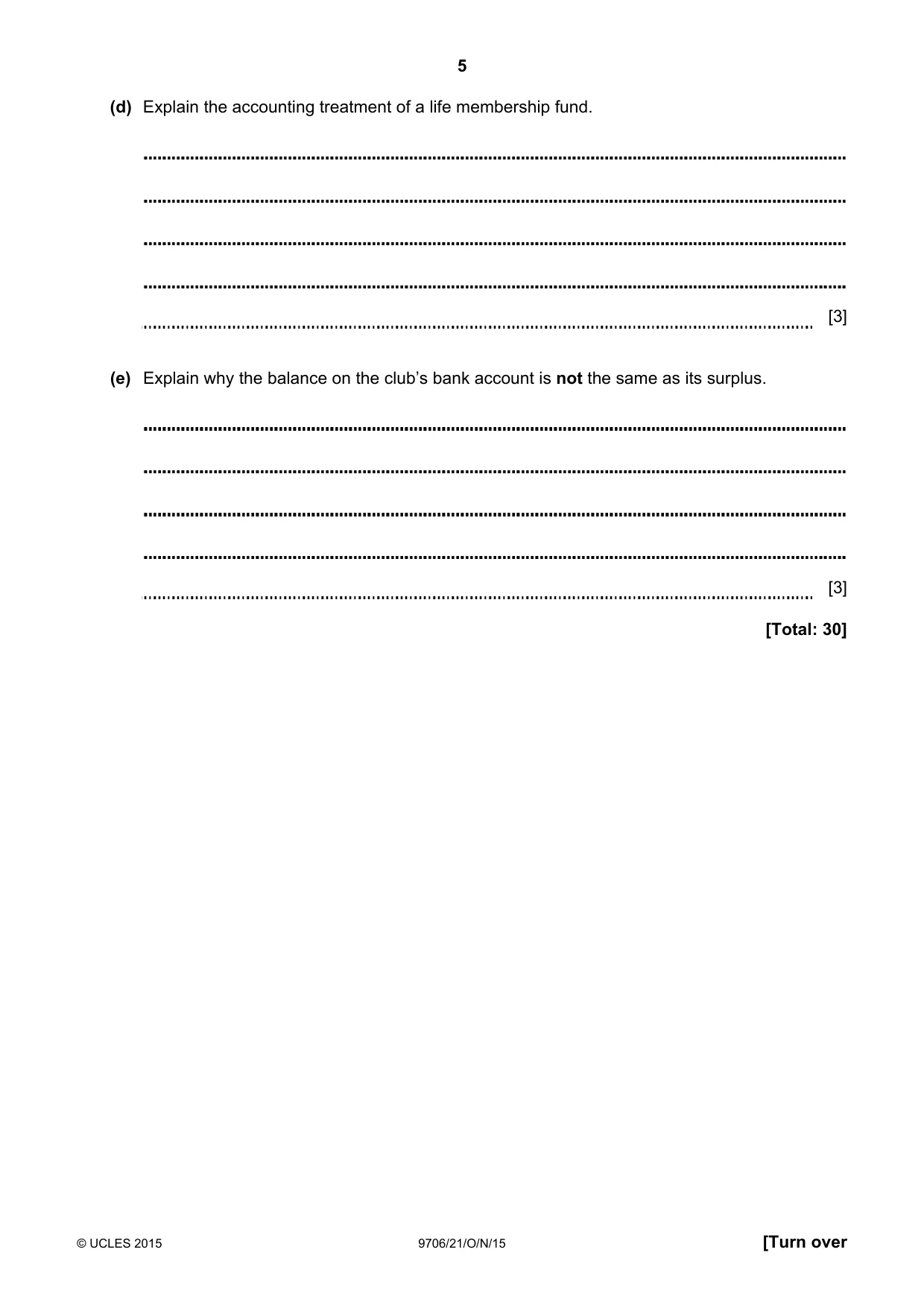
5 © UCLES 2015 9706/21/O/N/15 [Turn over (d) Explain the accounting treatment of a life membership fund. [3] (e) Explain why the balance on the club’s bank account is not the same as its surplus. [3] [Total: 30]
Question paper, page 6
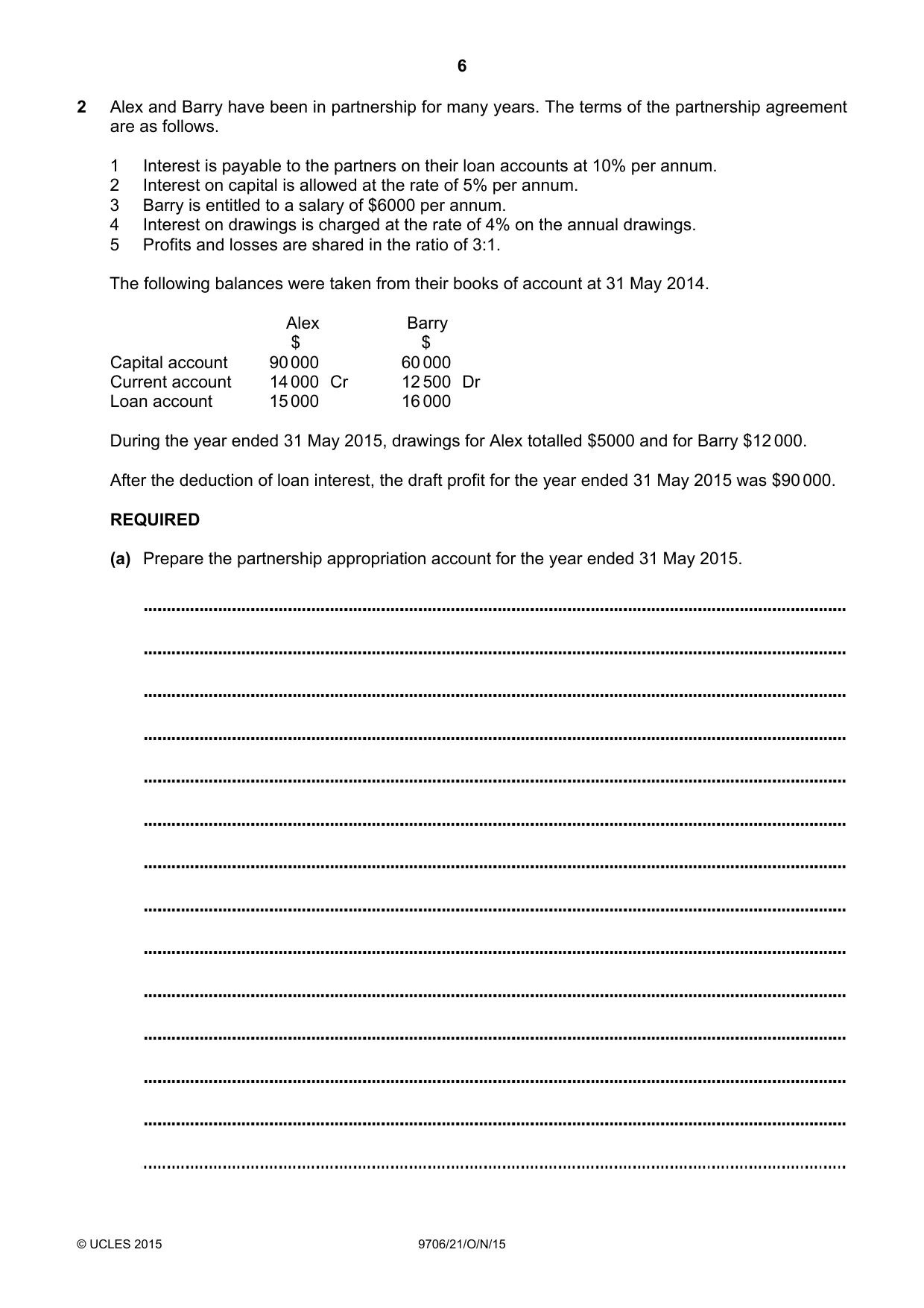
6 © UCLES 2015 9706/21/O/N/15 2 Alex and Barry have been in partnership for many years. The terms of the partnership agreement are as follows. 1 Interest is payable to the partners on their loan accounts at 10% per annum. 2 Interest on capital is allowed at the rate of 5% per annum. 3 Barry is entitled to a salary of $6000 per annum. 4 Interest on drawings is charged at the rate of 4% on the annual drawings. 5 Profits and losses are shared in the ratio of 3:1. The following balances were taken from their books of account at 31 May 2014. Alex Barry $ $ Capital account 90 000 60 000 Current account 14 000 Cr 12 500 Dr Loan account 15 000 16 000 During the year ended 31 May 2015, drawings for Alex totalled $5000 and for Barry $12 000. After the deduction of loan interest, the draft profit for the year ended 31 May 2015 was $90 000. REQUIRED (a) Prepare the partnership appropriation account for the year ended 31 May 2015.
Question paper, page 7
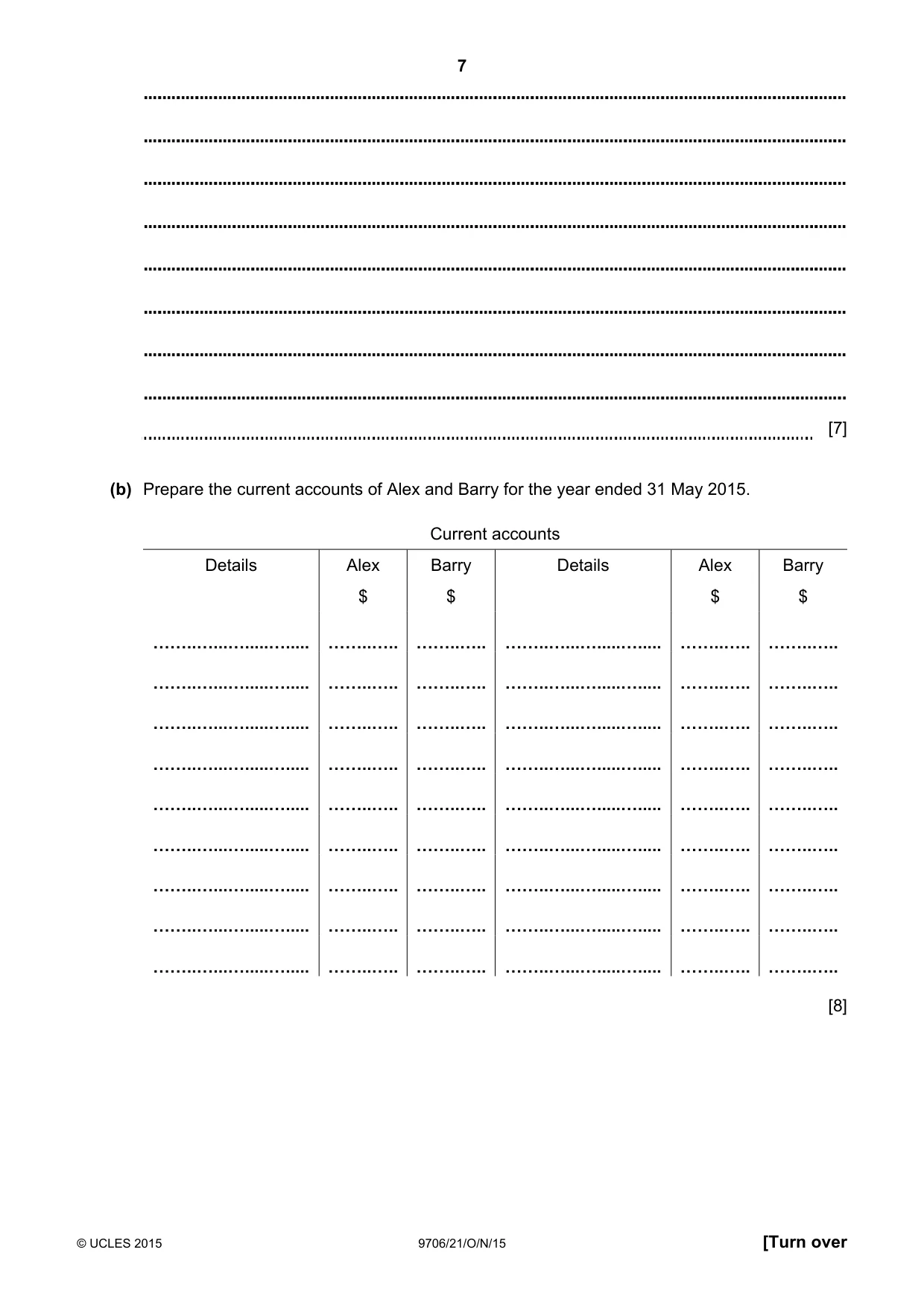
7 © UCLES 2015 9706/21/O/N/15 [Turn over [7] (b) Prepare the current accounts of Alex and Barry for the year ended 31 May 2015. Current accounts Details Alex Barry Details Alex Barry $ $ $ $ ««..«...«…«… ««..«.. ««..«.. ««..«...«…«… ««..«.. ««..«.. ««..«...«…«… ««..«.. ««..«.. ««..«...«…«… ««..«.. ««..«.. ««..«...«…«… ««..«.. ««..«.. ««..«...«…«… ««..«.. ««..«.. ««..«...«…«… ««..«.. ««..«.. ««..«...«…«… ««..«.. ««..«.. ««..«...«…«… ««..«.. ««..«.. ««..«...«…«… ««..«.. ««..«.. ««..«...«…«… ««..«.. ««..«.. ««..«...«…«… ««..«.. ««..«.. ««..«...«…«… ««..«.. ««..«.. ««..«...«…«… ««..«.. ««..«.. ««..«...«…«… ««..«.. ««..«.. ««..«...«…«… ««..«.. ««..«.. ««..«...«…«… ««..«.. ««..«.. ««..«...«…«… ««..«.. ««..«.. [8]
Question paper, page 8
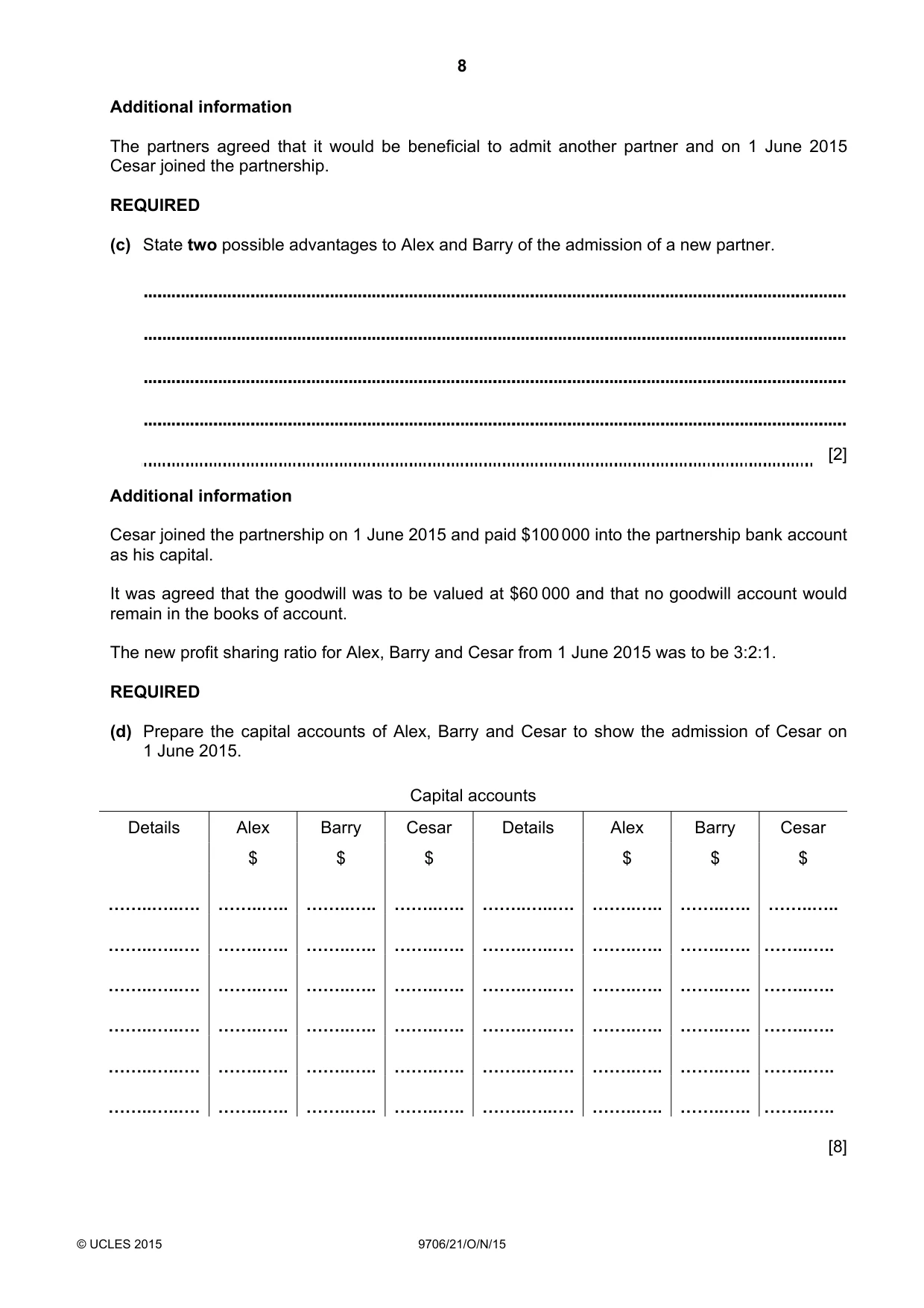
8 © UCLES 2015 9706/21/O/N/15 Additional information The partners agreed that it would be beneficial to admit another partner and on 1 June 2015 Cesar joined the partnership. REQUIRED (c) State two possible advantages to Alex and Barry of the admission of a new partner. [2] Additional information Cesar joined the partnership on 1 June 2015 and paid $100 000 into the partnership bank account as his capital. It was agreed that the goodwill was to be valued at $60 000 and that no goodwill account would remain in the books of account. The new profit sharing ratio for Alex, Barry and Cesar from 1 June 2015 was to be 3:2:1. REQUIRED (d) Prepare the capital accounts of Alex, Barry and Cesar to show the admission of Cesar on 1 June 2015. Capital accounts Details Alex Barry Cesar Details Alex Barry Cesar $ $ $ $ $ $ ««..«..«. ««..«.. ««..«.. ««..«.. ««..«..«. ««..«.. ««..«.. ««..«.. ««..«..«. ««..«.. ««..«.. ««..«.. ««..«..«. ««..«.. ««..«.. ««..«.. ««..«..«. ««..«.. ««..«.. ««..«.. ««..«..«. ««..«.. ««..«.. ««..«.. ««..«..«. ««..«.. ««..«.. ««..«.. ««..«..«. ««..«.. ««..«.. ««..«.. ««..«..«. ««..«.. ««..«.. ««..«.. ««..«..«. ««..«.. ««..«.. ««..«.. ««..«..«. ««..«.. ««..«.. ««..«.. ««..«..«. ««..«.. ««..«.. ««..«.. [8]
Question paper, page 9
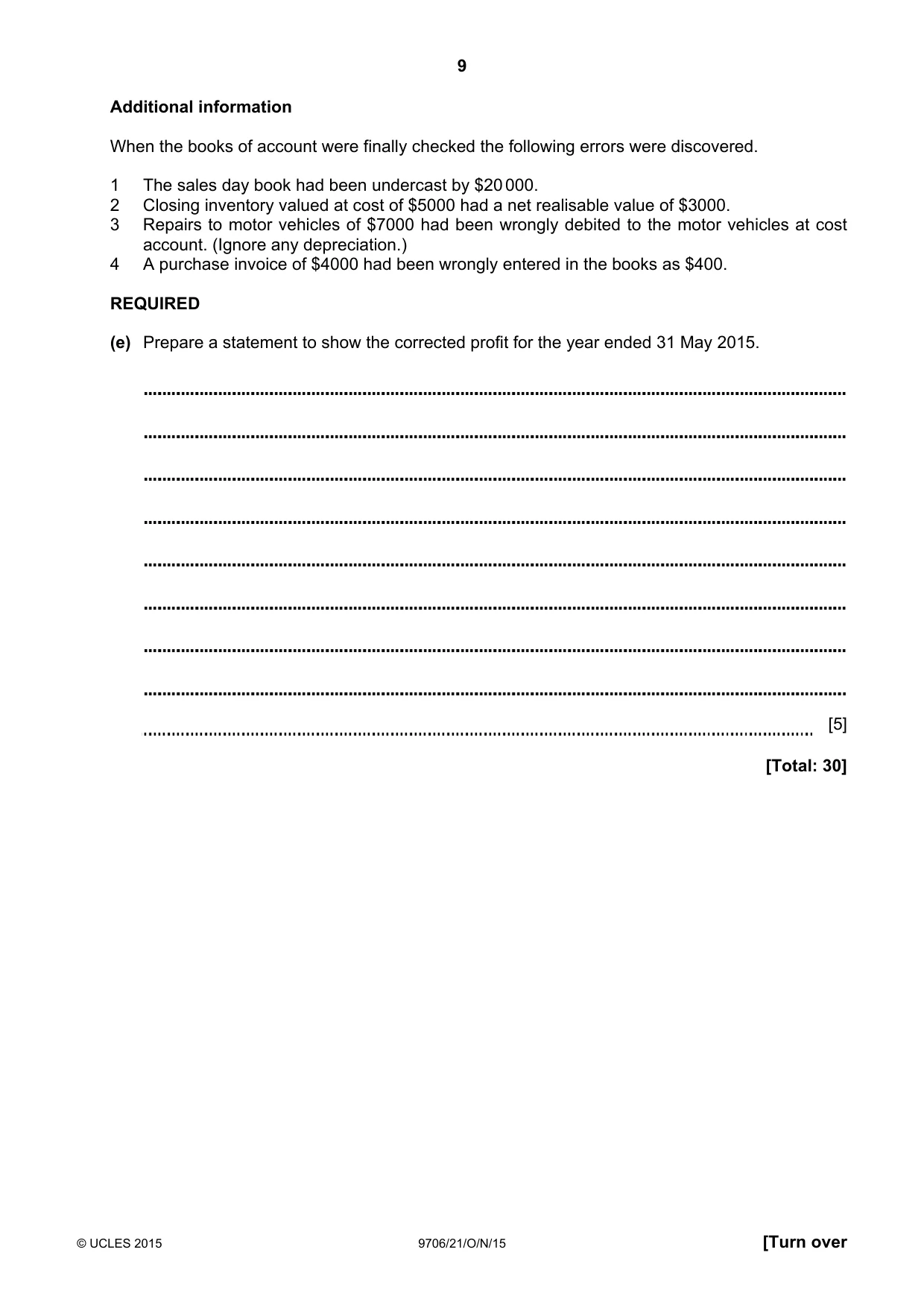
9 © UCLES 2015 9706/21/O/N/15 [Turn over Additional information When the books of account were finally checked the following errors were discovered. 1 The sales day book had been undercast by $20 000. 2 Closing inventory valued at cost of $5000 had a net realisable value of $3000. 3 Repairs to motor vehicles of $7000 had been wrongly debited to the motor vehicles at cost account. (Ignore any depreciation.) 4 A purchase invoice of $4000 had been wrongly entered in the books as $400. REQUIRED (e) Prepare a statement to show the corrected profit for the year ended 31 May 2015. [5] [Total: 30]
Question paper, page 10
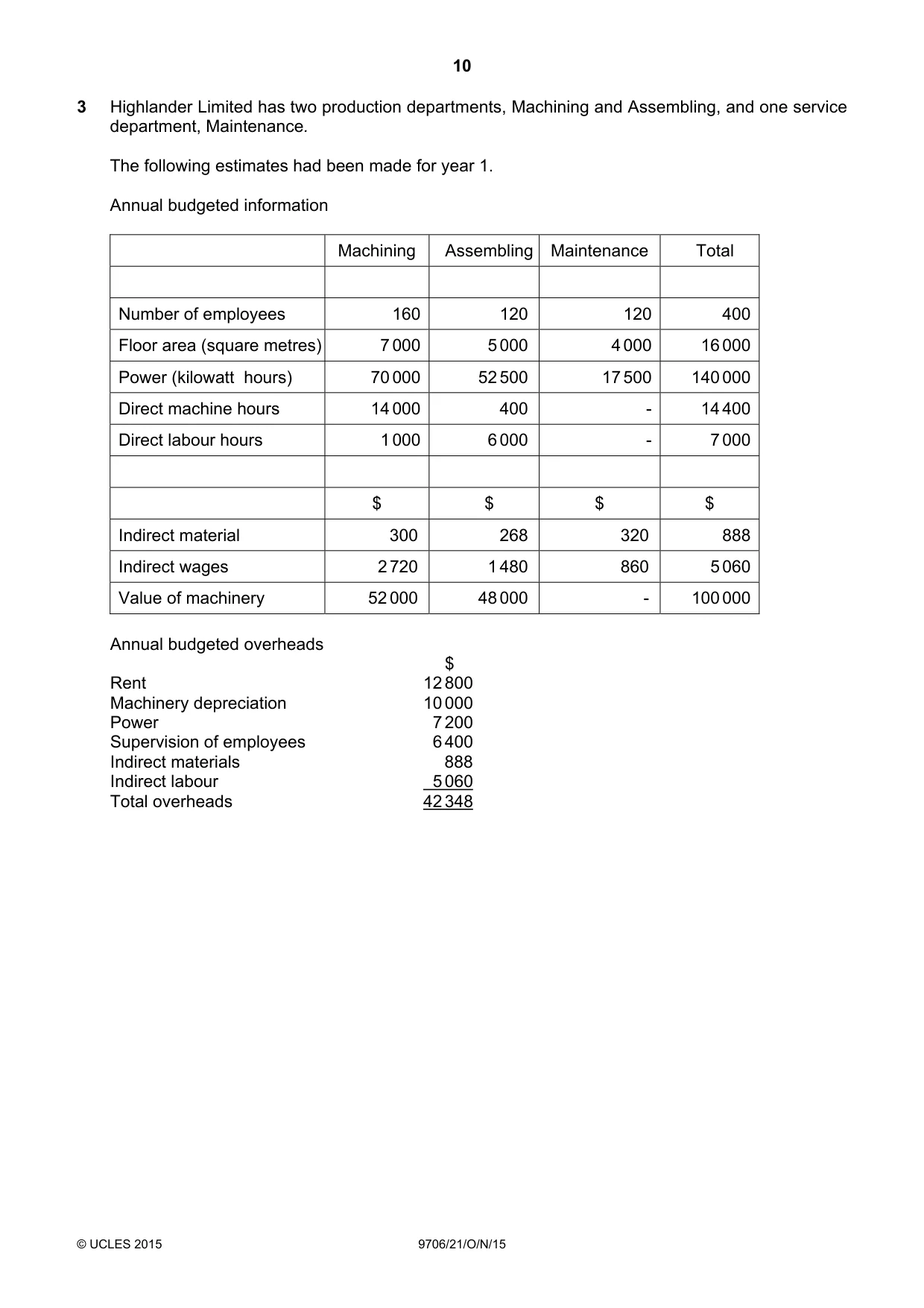
10 © UCLES 2015 9706/21/O/N/15 3 Highlander Limited has two production departments, Machining and Assembling, and one service department, Maintenance. The following estimates had been made for year 1. Annual budgeted information Machining Assembling Maintenance Total Number of employees 160 120 120 400 Floor area (square metres) 7 000 5 000 4 000 16 000 Power (kilowatt hours) 70 000 52 500 17 500 140 000 Direct machine hours 14 000 400 - 14 400 Direct labour hours 1 000 6 000 - 7 000 $ $ $ $ Indirect material 300 268 320 888 Indirect wages 2 720 1 480 860 5 060 Value of machinery 52 000 48 000 - 100 000 Annual budgeted overheads $ Rent 12 800 Machinery depreciation 10 000 Power 7 200 Supervision of employees 6 400 Indirect materials 888 Indirect labour 5 060 Total overheads 42 348
Question paper, page 11
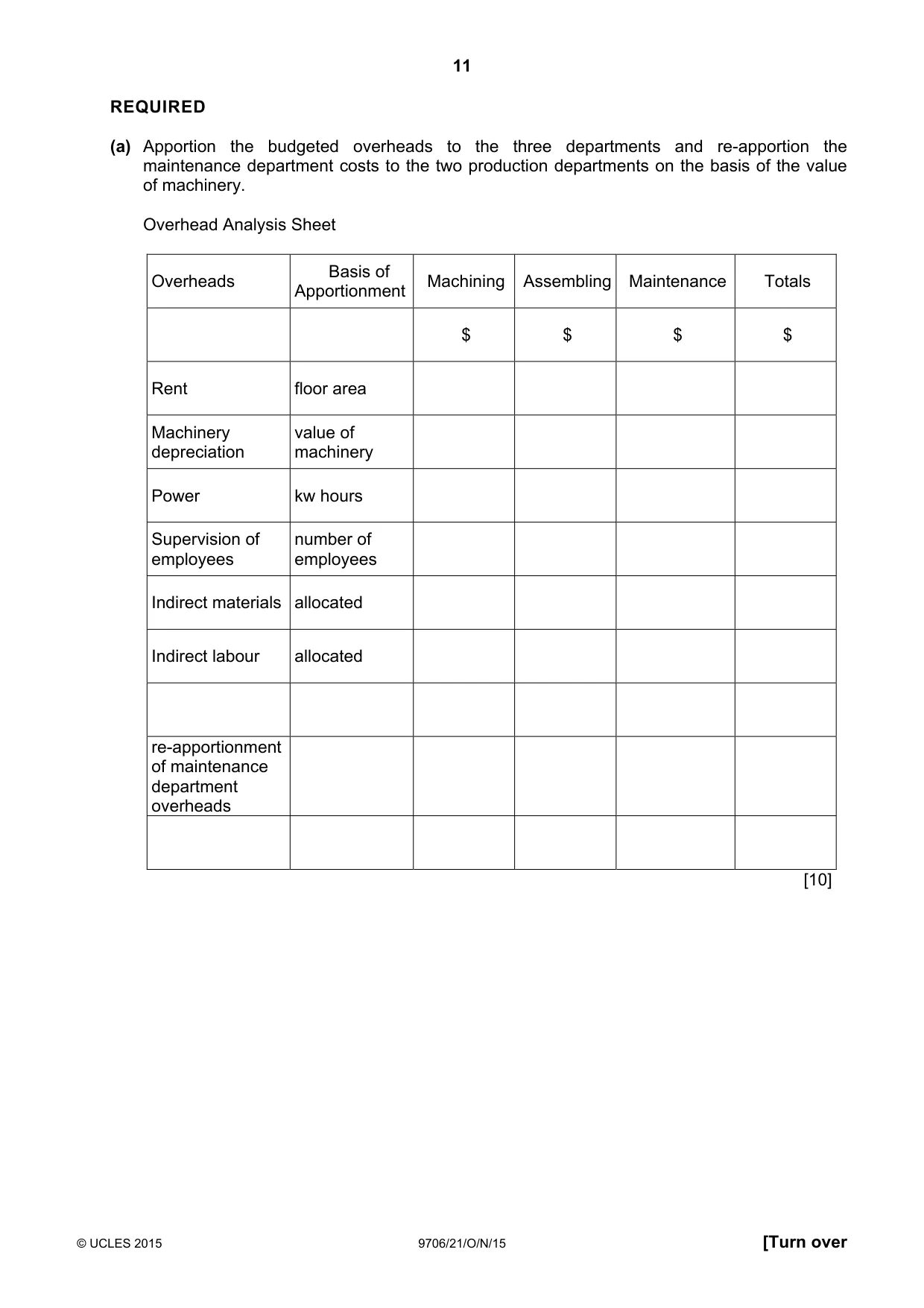
11 © UCLES 2015 9706/21/O/N/15 [Turn over REQUIRED (a) Apportion the budgeted overheads to the three departments and re-apportion the maintenance department costs to the two production departments on the basis of the value of machinery. Overhead Analysis Sheet Overheads Basis of Apportionment Machining Assembling Maintenance Totals $ $ $ $ Rent floor area Machinery depreciation value of machinery Power kw hours Supervision of employees number of employees Indirect materials allocated Indirect labour allocated re-apportionment of maintenance department overheads [10]
Question paper, page 12
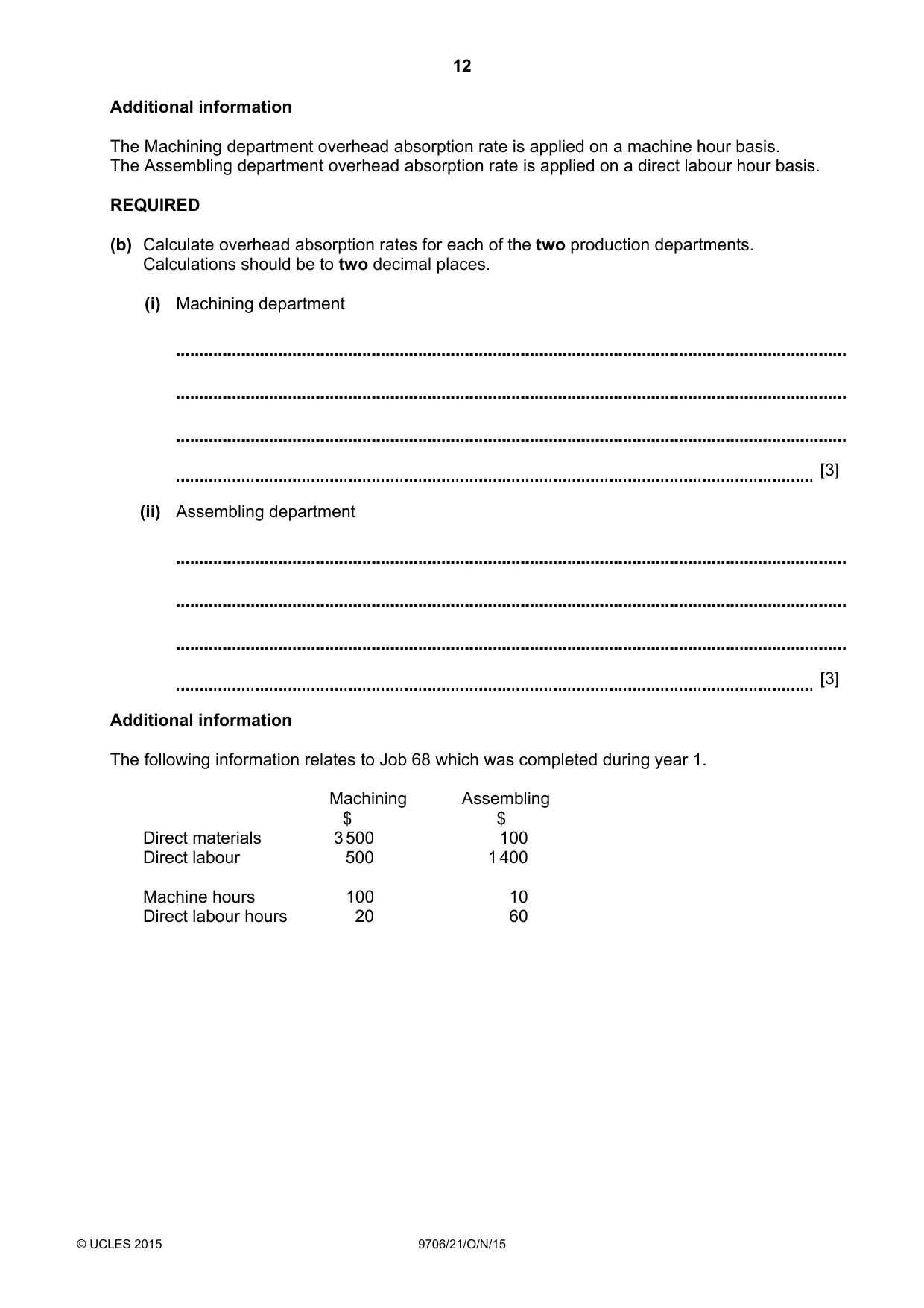
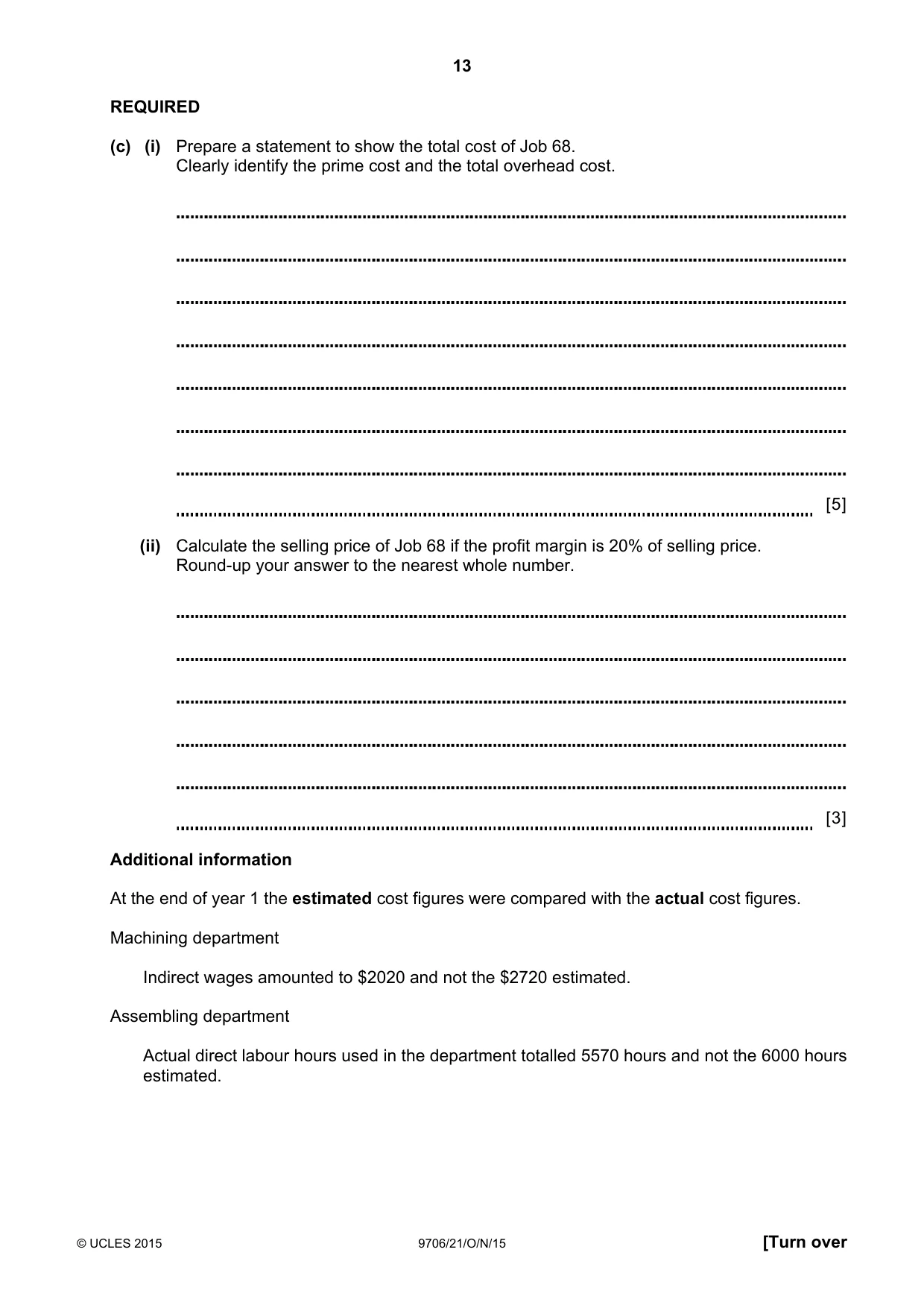
12 © UCLES 2015 9706/21/O/N/15 Additional information The Machining department overhead absorption rate is applied on a machine hour basis. The Assembling department overhead absorption rate is applied on a direct labour hour basis. REQUIRED (b) Calculate overhead absorption rates for each of the two production departments. Calculations should be to two decimal places. (i) Machining department [3] (ii) Assembling department [3] Additional information The following information relates to Job 68 which was completed during year 1. Machining Assembling $ $ Direct materials 3 500 100 Direct labour 500 1 400 Machine hours 100 10 Direct labour hours 20 60
Question paper, page 13
13 © UCLES 2015 9706/21/O/N/15 [Turn over REQUIRED (c) (i) Prepare a statement to show the total cost of Job 68. Clearly identify the prime cost and the total overhead cost. [5] (ii) Calculate the selling price of Job 68 if the profit margin is 20% of selling price. Round-up your answer to the nearest whole number. [3] Additional information At the end of year 1 the estimated cost figures were compared with the actual cost figures. Machining department Indirect wages amounted to $2020 and not the $2720 estimated. Assembling department Actual direct labour hours used in the department totalled 5570 hours and not the 6000 hours estimated.
Question paper, page 14
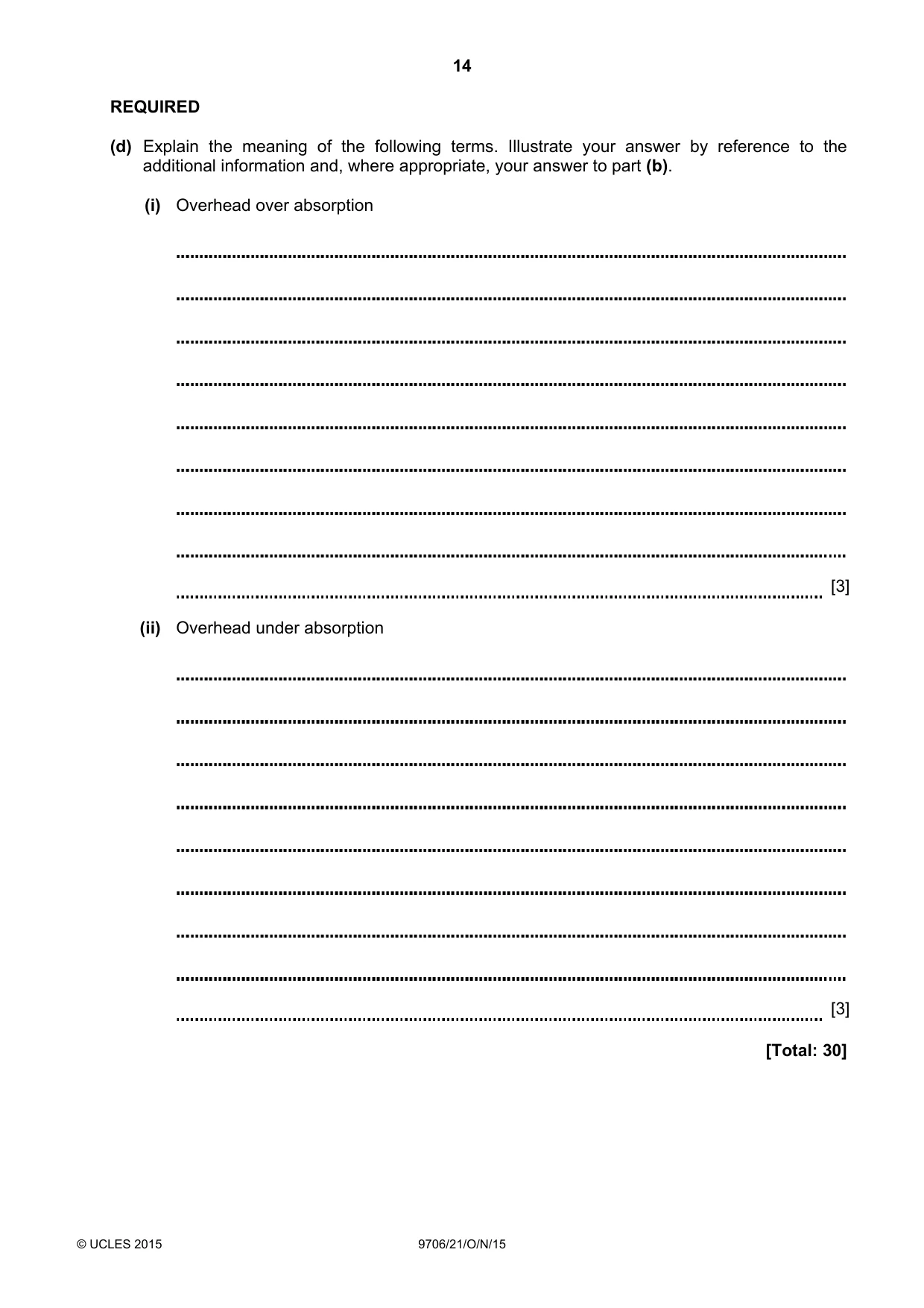
14 © UCLES 2015 9706/21/O/N/15 REQUIRED (d) Explain the meaning of the following terms. Illustrate your answer by reference to the additional information and, where appropriate, your answer to part (b). (i) Overhead over absorption [3] (ii) Overhead under absorption [3] [Total: 30]
Question paper, page 15
15 © UCLES 2015 9706/21/O/N/15 BLANK PAGE
Question paper, page 16
16 Permission to reproduce items where third-party owned material protected by copyright is included has been sought and cleared where possible. Every reasonable effort has been made by the publisher (UCLES) to trace copyright holders, but if any items requiring clearance have unwittingly been included, the publisher will be pleased to make amends at the earliest possible opportunity. To avoid the issue of disclosure of answer-related information to candidates, all copyright acknowledgements are reproduced online in the Cambridge International Examinations Copyright Acknowledgements Booklet. This is produced for each series of examinations and is freely available to download at www.cie.org.uk after the live examination series. Cambridge International Examinations is part of the Cambridge Assessment Group. Cambridge Assessment is the brand name of University of Cambridge Local Examinations Syndicate (UCLES), which is itself a department of the University of Cambridge. © UCLES 2015 9706/21/O/N/15 BLANK PAGE
Mark scheme, page 1
® IGCSE is the registered trademark of Cambridge International Examinations. CAMBRIDGE INTERNATIONAL EXAMINATIONS Cambridge International Advanced Subsidiary and Advanced Level MARK SCHEME for the October/November 2015 series 9706 ACCOUNTING 9706/21 Paper 2 (Structured Questions – Core), maximum raw mark 90 This mark scheme is published as an aid to teachers and candidates, to indicate the requirements of the examination. It shows the basis on which Examiners were instructed to award marks. It does not indicate the details of the discussions that took place at an Examiners’ meeting before marking began, which would have considered the acceptability of alternative answers. Mark schemes should be read in conjunction with the question paper and the Principal Examiner Report for Teachers. Cambridge will not enter into discussions about these mark schemes. Cambridge is publishing the mark schemes for the October/November 2015 series for most Cambridge IGCSE®, Cambridge International A and AS Level components and some Cambridge O Level components.
Mark scheme, page 2
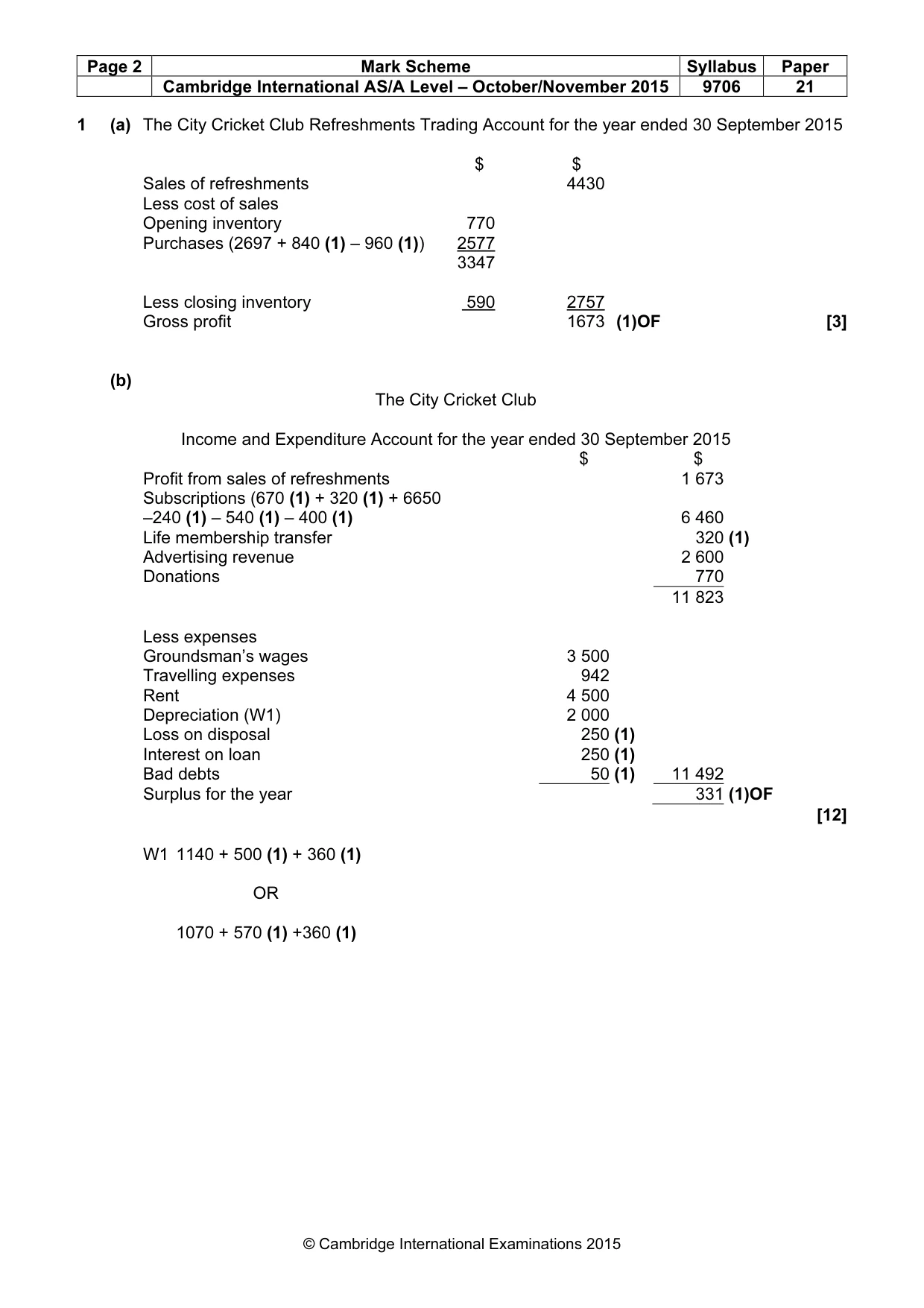
Page 2 Mark Scheme Syllabus Paper Cambridge International AS/A Level – October/November 2015 9706 21 © Cambridge International Examinations 2015 1 (a) The City Cricket Club Refreshments Trading Account for the year ended 30 September 2015 $ $ Sales of refreshments 4430 Less cost of sales Opening inventory 770 Purchases (2697 + 840 (1) – 960 (1)) 2577 3347 Less closing inventory 590 2757 Gross profit 1673 (1)OF [3] (b) The City Cricket Club Income and Expenditure Account for the year ended 30 September 2015 $ $ Profit from sales of refreshments 1 673 Subscriptions (670 (1) + 320 (1) + 6650 –240 (1) – 540 (1) – 400 (1) 6 460 Life membership transfer 320 (1) Advertising revenue 2 600 Donations 770 11 823 Less expenses Groundsman’s wages 3 500 Travelling expenses 942 Rent 4 500 Depreciation (W1) 2 000 Loss on disposal 250 (1) Interest on loan 250 (1) Bad debts 50 (1) 11 492 Surplus for the year 331 (1)OF [12] W1 1140 + 500 (1) + 360 (1) OR 1070 + 570 (1) +360 (1)
Mark scheme, page 3
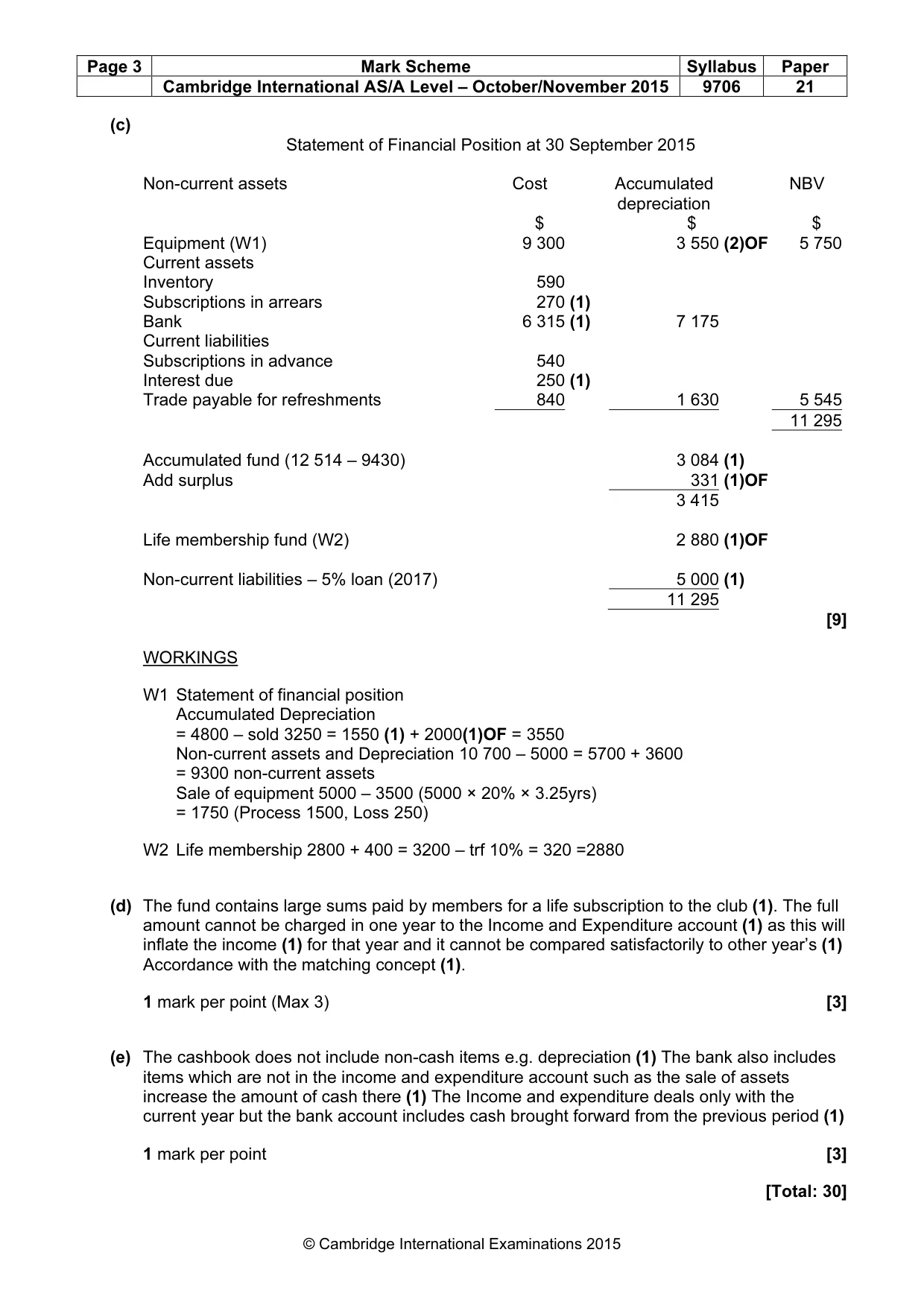
Page 3 Mark Scheme Syllabus Paper Cambridge International AS/A Level – October/November 2015 9706 21 © Cambridge International Examinations 2015 (c) Statement of Financial Position at 30 September 2015 Non-current assets Cost Accumulated depreciation NBV $ $ $ Equipment (W1) 9 300 3 550 (2)OF 5 750 Current assets Inventory 590 Subscriptions in arrears 270 (1) Bank 6 315 (1) 7 175 Current liabilities Subscriptions in advance 540 Interest due 250 (1) Trade payable for refreshments 840 1 630 5 545 11 295 Accumulated fund (12 514 – 9430) 3 084 (1) Add surplus 331 (1)OF 3 415 Life membership fund (W2) 2 880 (1)OF Non-current liabilities – 5% loan (2017) 5 000 (1) 11 295 [9] WORKINGS W1 Statement of financial position Accumulated Depreciation = 4800 – sold 3250 = 1550 (1) + 2000(1)OF = 3550 Non-current assets and Depreciation 10 700 – 5000 = 5700 + 3600 = 9300 non-current assets Sale of equipment 5000 – 3500 (5000 × 20% × 3.25yrs) = 1750 (Process 1500, Loss 250) W2 Life membership 2800 + 400 = 3200 – trf 10% = 320 =2880 (d) The fund contains large sums paid by members for a life subscription to the club (1). The full amount cannot be charged in one year to the Income and Expenditure account (1) as this will inflate the income (1) for that year and it cannot be compared satisfactorily to other year’s (1) Accordance with the matching concept (1). 1 mark per point (Max 3) [3] (e) The cashbook does not include non-cash items e.g. depreciation (1) The bank also includes items which are not in the income and expenditure account such as the sale of assets increase the amount of cash there (1) The Income and expenditure deals only with the current year but the bank account includes cash brought forward from the previous period (1) 1 mark per point [3] [Total: 30]
Mark scheme, page 4
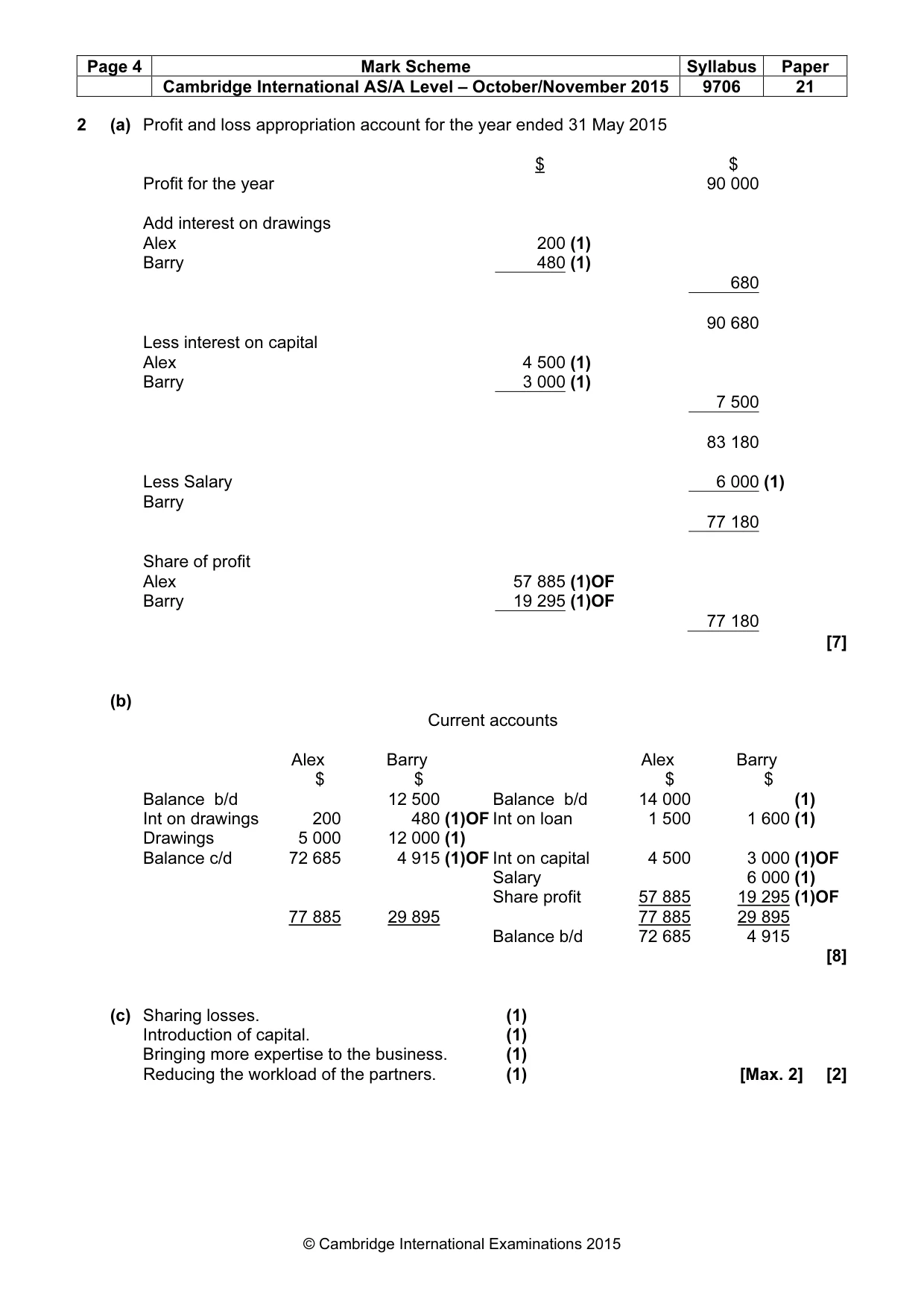
Page 4 Mark Scheme Syllabus Paper Cambridge International AS/A Level – October/November 2015 9706 21 © Cambridge International Examinations 2015 2 (a) Profit and loss appropriation account for the year ended 31 May 2015 $ $ Profit for the year 90 000 Add interest on drawings Alex 200 (1) Barry 480 (1) 680 90 680 Less interest on capital Alex 4 500 (1) Barry 3 000 (1) 7 500 83 180 Less Salary 6 000 (1) Barry 77 180 Share of profit Alex 57 885 (1)OF Barry 19 295 (1)OF 77 180 [7] (b) Current accounts Alex Barry Alex Barry $ $ $ $ Balance b/d 12 500 Balance b/d 14 000 (1) Int on drawings 200 480 (1)OF Int on loan 1 500 1 600 (1) Drawings 5 000 12 000 (1) Balance c/d 72 685 4 915 (1)OF Int on capital 4 500 3 000 (1)OF Salary 6 000 (1) Share profit 57 885 19 295 (1)OF 77 885 29 895 77 885 29 895 Balance b/d 72 685 4 915 [8] (c) Sharing losses. (1) Introduction of capital. (1) Bringing more expertise to the business. (1) Reducing the workload of the partners. (1) [Max. 2] [2]
Mark scheme, page 5
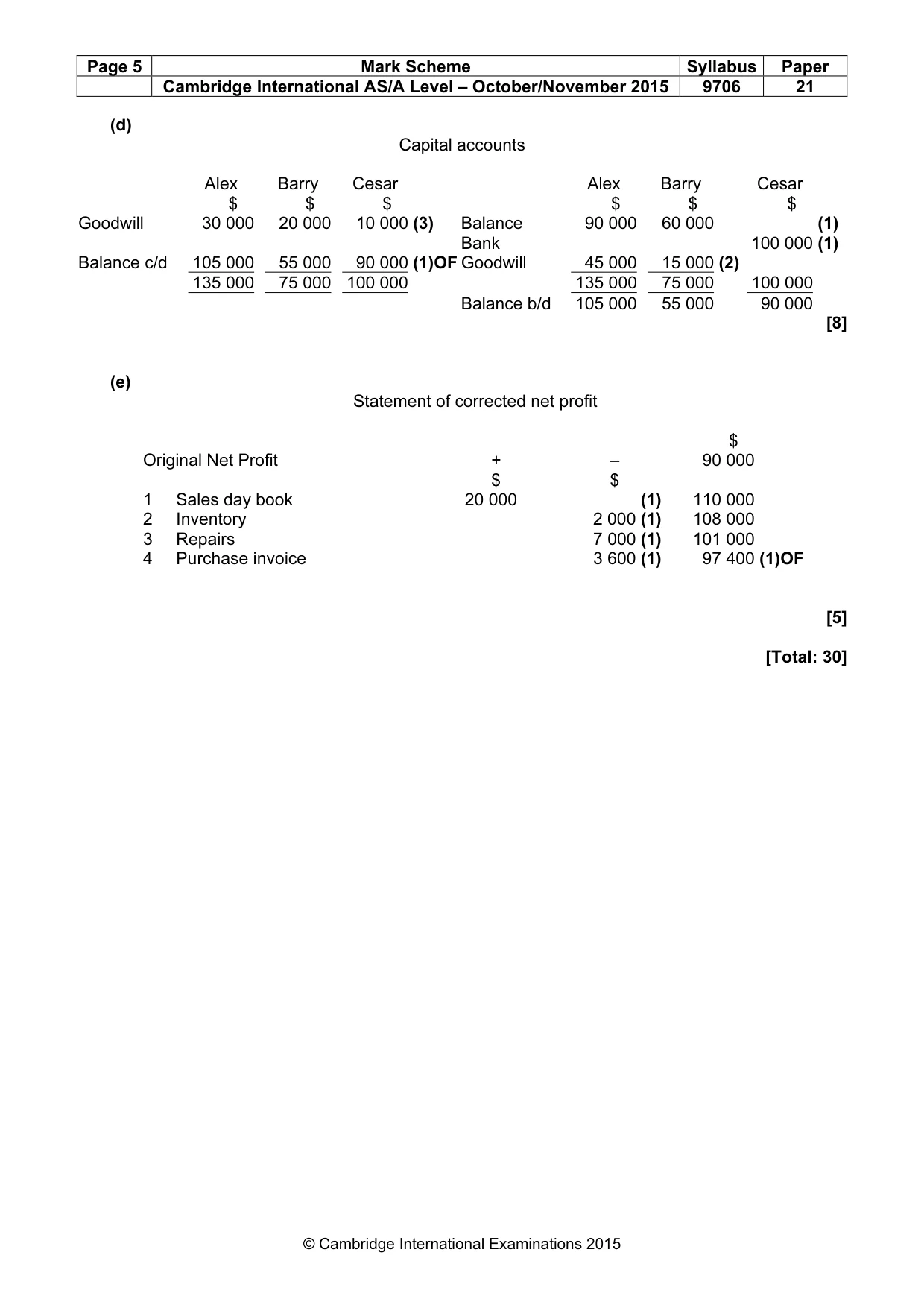
Page 5 Mark Scheme Syllabus Paper Cambridge International AS/A Level – October/November 2015 9706 21 © Cambridge International Examinations 2015 (d) Capital accounts Alex Barry Cesar Alex Barry Cesar $ $ $ $ $ $ Goodwill 30 000 20 000 10 000 (3) Balance 90 000 60 000 (1) Bank 100 000 (1) Balance c/d 105 000 55 000 90 000 (1)OF Goodwill 45 000 15 000 (2) 135 000 75 000 100 000 135 000 75 000 100 000 Balance b/d 105 000 55 000 90 000 [8] (e) Statement of corrected net profit $ Original Net Profit + – 90 000 $ $ 1 Sales day book 20 000 (1) 110 000 2 Inventory 2 000 (1) 108 000 3 Repairs 7 000 (1) 101 000 4 Purchase invoice 3 600 (1) 97 400 (1)OF [5] [Total: 30]
Mark scheme, page 6
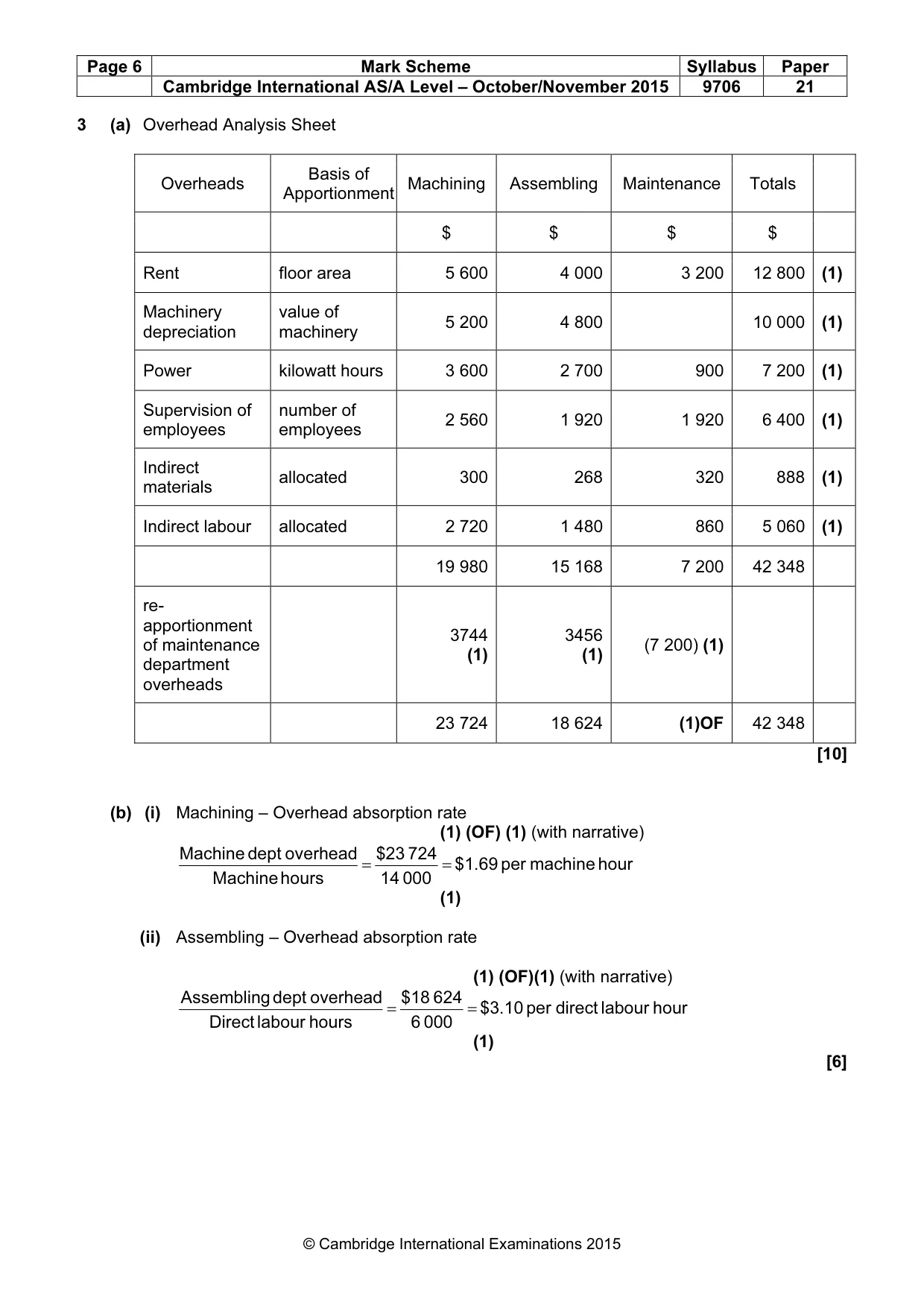
Page 6 Mark Scheme Syllabus Paper Cambridge International AS/A Level – October/November 2015 9706 21 © Cambridge International Examinations 2015 3 (a) Overhead Analysis Sheet Overheads Basis of Apportionment Machining Assembling Maintenance Totals $ $ $ $ Rent floor area 5 600 4 000 3 200 12 800 (1) Machinery depreciation value of machinery 5 200 4 800 10 000 (1) Power kilowatt hours 3 600 2 700 900 7 200 (1) Supervision of employees number of employees 2 560 1 920 1 920 6 400 (1) Indirect materials allocated 300 268 320 888 (1) Indirect labour allocated 2 720 1 480 860 5 060 (1) 19 980 15 168 7 200 42 348 re- apportionment of maintenance department overheads 3744 (1) 3456 (1) (7 200) (1) 23 724 18 624 (1)OF 42 348 [10] (b) (i) Machining – Overhead absorption rate (1) (OF) (1) (with narrative) hour machine per $1.69 000 14 724 $23 hours Machine overhead dept Machine = = (1) (ii) Assembling – Overhead absorption rate (1) (OF)(1) (with narrative) hour labour direct per $3.10 000 6 624 $18 hours labour Direct overhead dept Assembling = = (1) [6]
Mark scheme, page 7
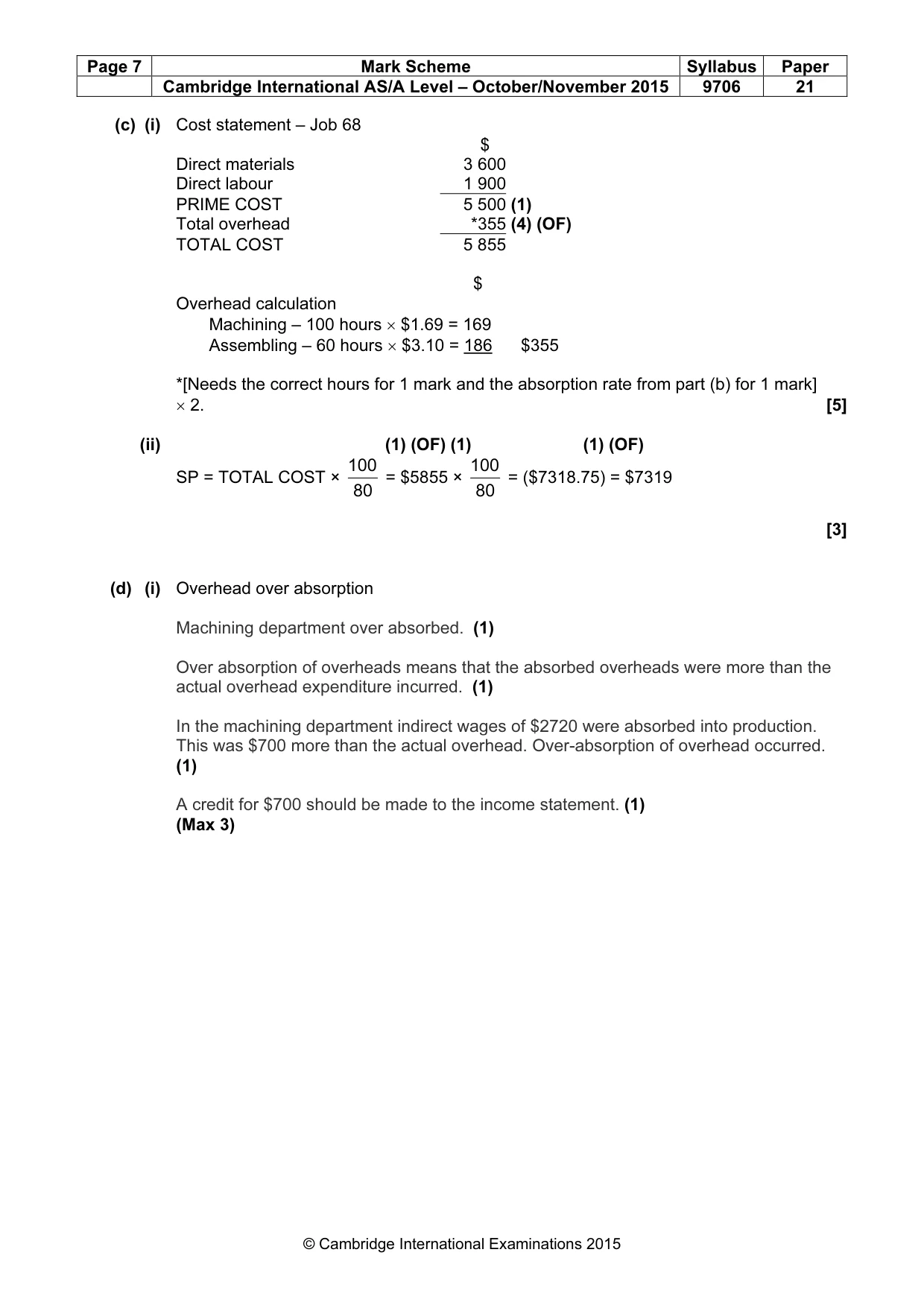
Page 7 Mark Scheme Syllabus Paper Cambridge International AS/A Level – October/November 2015 9706 21 © Cambridge International Examinations 2015 (c) (i) Cost statement – Job 68 $ Direct materials 3 600 Direct labour 1 900 PRIME COST 5 500 (1) Total overhead *355 (4) (OF) TOTAL COST 5 855 $ Overhead calculation Machining – 100 hours × $1.69 = 169 Assembling – 60 hours × $3.10 = 186 $355 *[Needs the correct hours for 1 mark and the absorption rate from part (b) for 1 mark] × 2. [5] (ii) (1) (OF) (1) (1) (OF) SP = TOTAL COST × 80 100 = $5855 × 80 100 = ($7318.75) = $7319 [3] (d) (i) Overhead over absorption Machining department over absorbed. (1) Over absorption of overheads means that the absorbed overheads were more than the actual overhead expenditure incurred. (1) In the machining department indirect wages of $2720 were absorbed into production. This was $700 more than the actual overhead. Over-absorption of overhead occurred. (1) A credit for $700 should be made to the income statement. (1) (Max 3)
Mark scheme, page 8
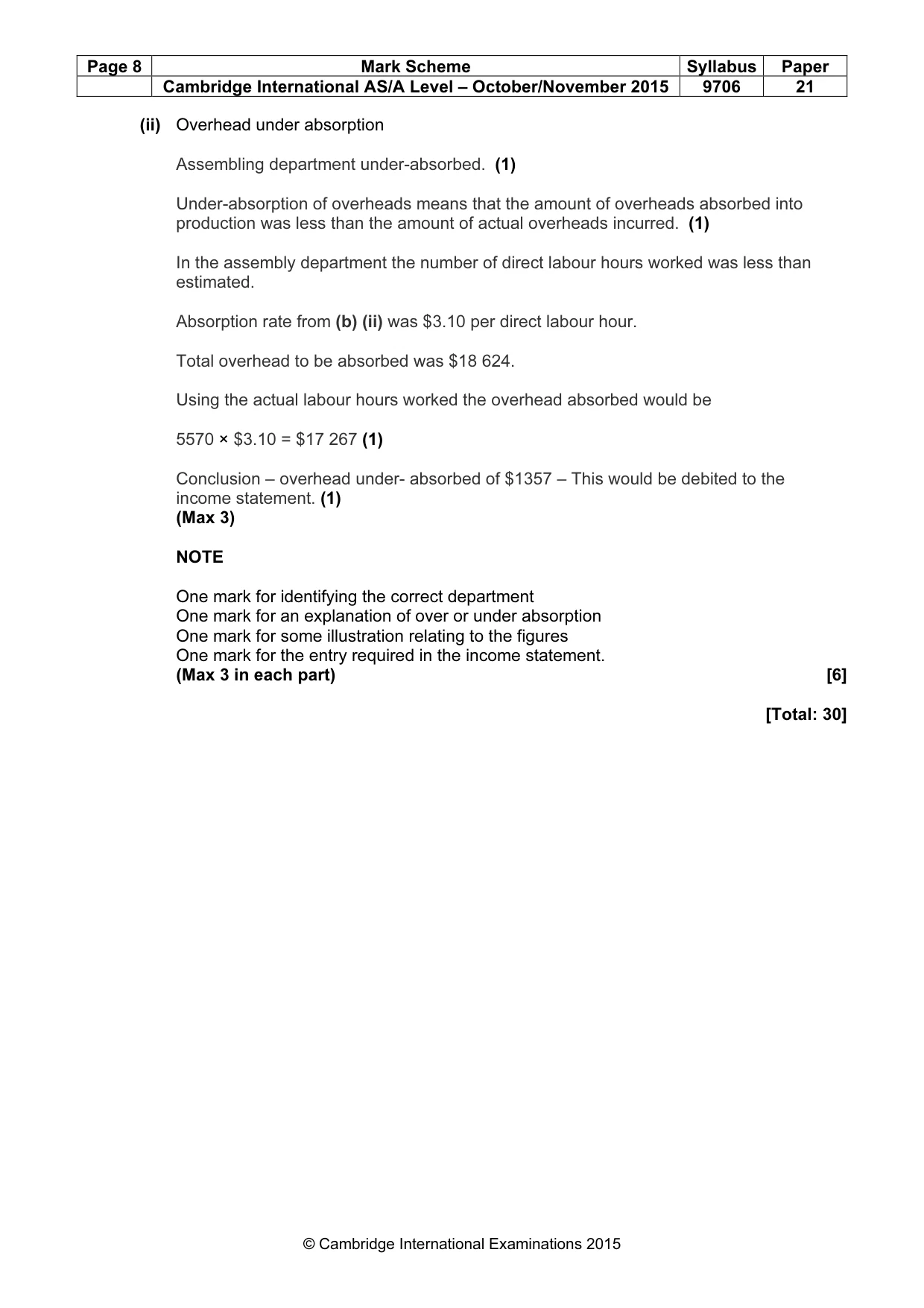
Page 8 Mark Scheme Syllabus Paper Cambridge International AS/A Level – October/November 2015 9706 21 © Cambridge International Examinations 2015 (ii) Overhead under absorption Assembling department under-absorbed. (1) Under-absorption of overheads means that the amount of overheads absorbed into production was less than the amount of actual overheads incurred. (1) In the assembly department the number of direct labour hours worked was less than estimated. Absorption rate from (b) (ii) was $3.10 per direct labour hour. Total overhead to be absorbed was $18 624. Using the actual labour hours worked the overhead absorbed would be 5570 × $3.10 = $17 267 (1) Conclusion – overhead under- absorbed of $1357 – This would be debited to the income statement. (1) (Max 3) NOTE One mark for identifying the correct department One mark for an explanation of over or under absorption One mark for some illustration relating to the figures One mark for the entry required in the income statement. (Max 3 in each part) [6] [Total: 30]
What you needed in this session
Cambridge’s own grade thresholds for 2015 Oct/Nov, Paper 2 · Variant 1. A higher threshold means an easier paper — the bar moves with how the cohort did.