Cambridge A Level Accounting 9706 — 2015 Oct/Nov Paper 2 · Variant 3
9706/23/O/N/15 · 90 marks · ≈101 min
The question paper and its mark scheme, free to read here and free to download. This is Cambridge’s own paper, exactly as it was sat.
Question paper16 pages
Mark scheme7 pages
Answers below. Sit the paper first if you are practising.
Paper as text
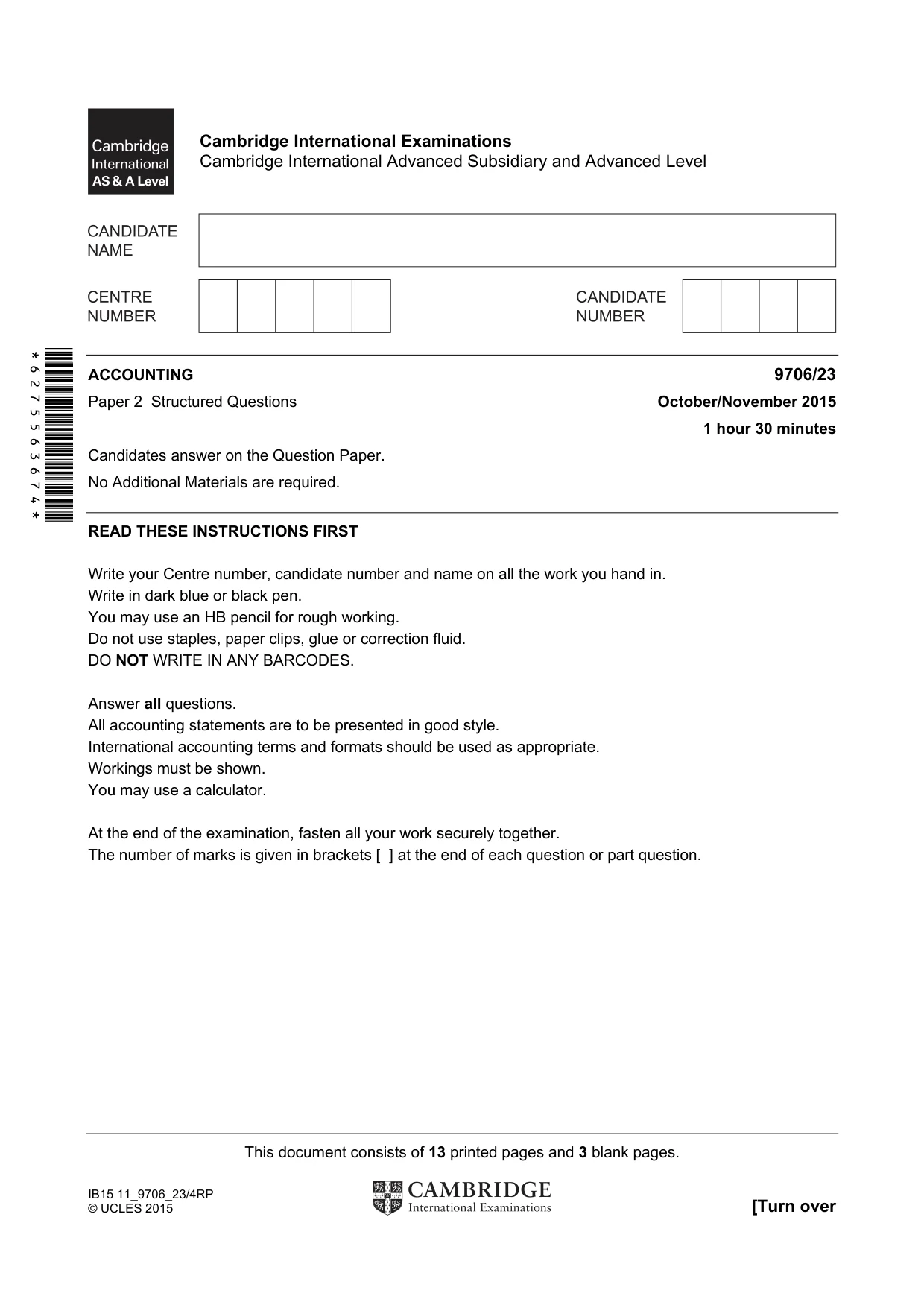
Question paper, page 1
This document consists of 13 printed pages and 3 blank pages. IB15 11_9706_23/4RP © UCLES 2015 [Turn over *6275563674* Cambridge International Examinations Cambridge International Advanced Subsidiary and Advanced Level ACCOUNTING 9706/23 Paper 2 Structured Questions October/November 2015 1 hour 30 minutes Candidates answer on the Question Paper. No Additional Materials are required. READ THESE INSTRUCTIONS FIRST Write your Centre number, candidate number and name on all the work you hand in. Write in dark blue or black pen. You may use an HB pencil for rough working. Do not use staples, paper clips, glue or correction fluid. DO NOT WRITE IN ANY BARCODES. Answer all questions. All accounting statements are to be presented in good style. International accounting terms and formats should be used as appropriate. Workings must be shown. You may use a calculator. At the end of the examination, fasten all your work securely together. The number of marks is given in brackets [ ] at the end of each question or part question.
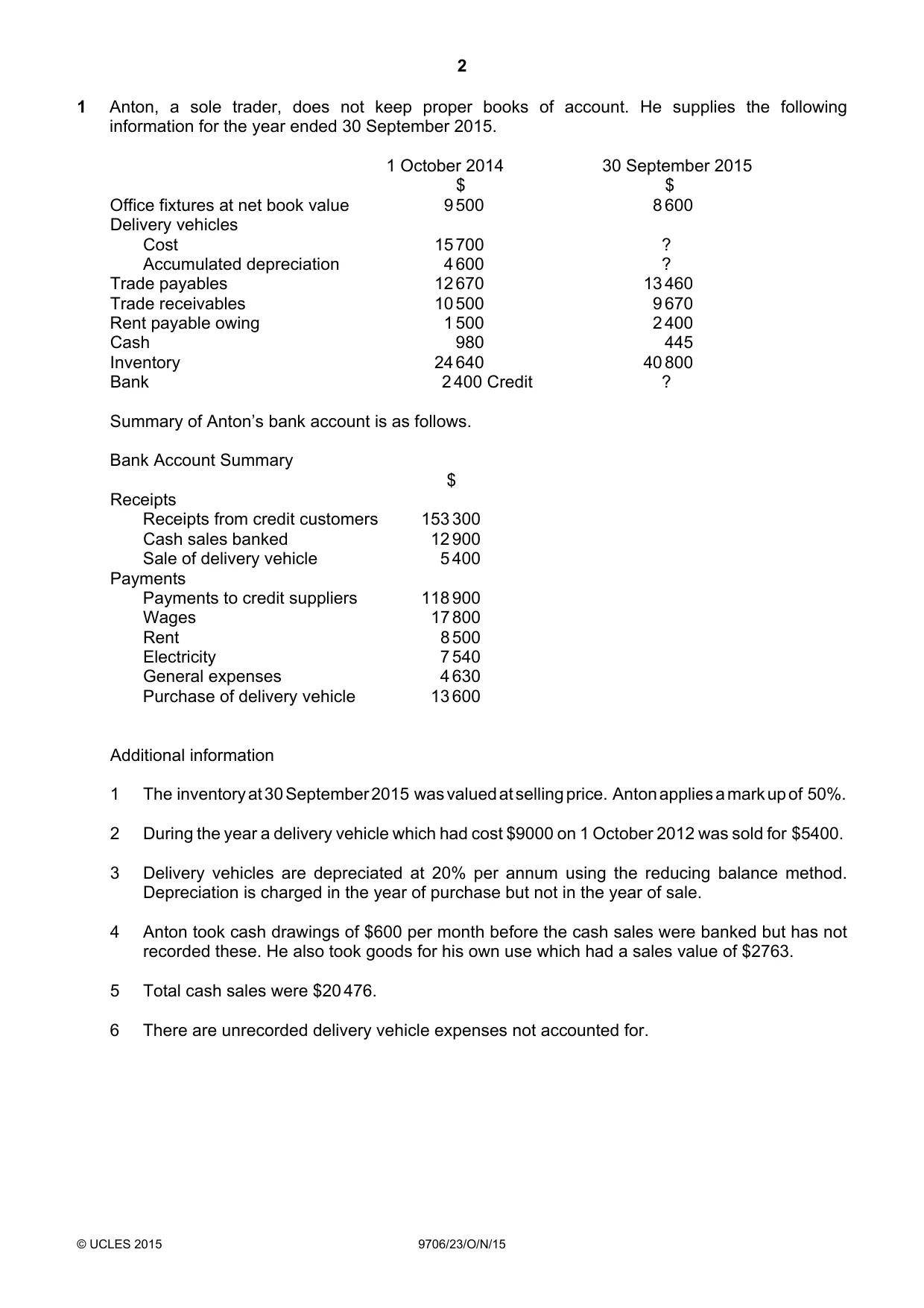
Question paper, page 2
2 © UCLES 2015 9706/23/O/N/15 1 Anton, a sole trader, does not keep proper books of account. He supplies the following information for the year ended 30 September 2015. 1 October 2014 30 September 2015 $ $ Office fixtures at net book value 9 500 8 600 Delivery vehicles Cost 15 700 ? Accumulated depreciation 4 600 ? Trade payables 12 670 13 460 Trade receivables 10 500 9 670 Rent payable owing 1 500 2 400 Cash 980 445 Inventory 24 640 40 800 Bank 2 400 Credit ? Summary of Anton’s bank account is as follows. Bank Account Summary $ Receipts Receipts from credit customers 153 300 Cash sales banked 12 900 Sale of delivery vehicle 5 400 Payments Payments to credit suppliers 118 900 Wages 17 800 Rent 8 500 Electricity 7 540 General expenses 4 630 Purchase of delivery vehicle 13 600 Additional information 1 The inventory at 30 September 2015 was valued at selling price. Anton applies a mark up of 50%. 2 During the year a delivery vehicle which had cost $9000 on 1 October 2012 was sold for $5400. 3 Delivery vehicles are depreciated at 20% per annum using the reducing balance method. Depreciation is charged in the year of purchase but not in the year of sale. 4 Anton took cash drawings of $600 per month before the cash sales were banked but has not recorded these. He also took goods for his own use which had a sales value of $2763. 5 Total cash sales were $20 476. 6 There are unrecorded delivery vehicle expenses not accounted for.
Question paper, page 3
3 © UCLES 2015 9706/23/O/N/15 [Turn over REQUIRED (a) Prepare Anton’s income statement for the year ended 30 September 2015. [16]
Question paper, page 4
4 © UCLES 2015 9706/23/O/N/15 (b) Prepare a statement of financial position at 30 September 2015.
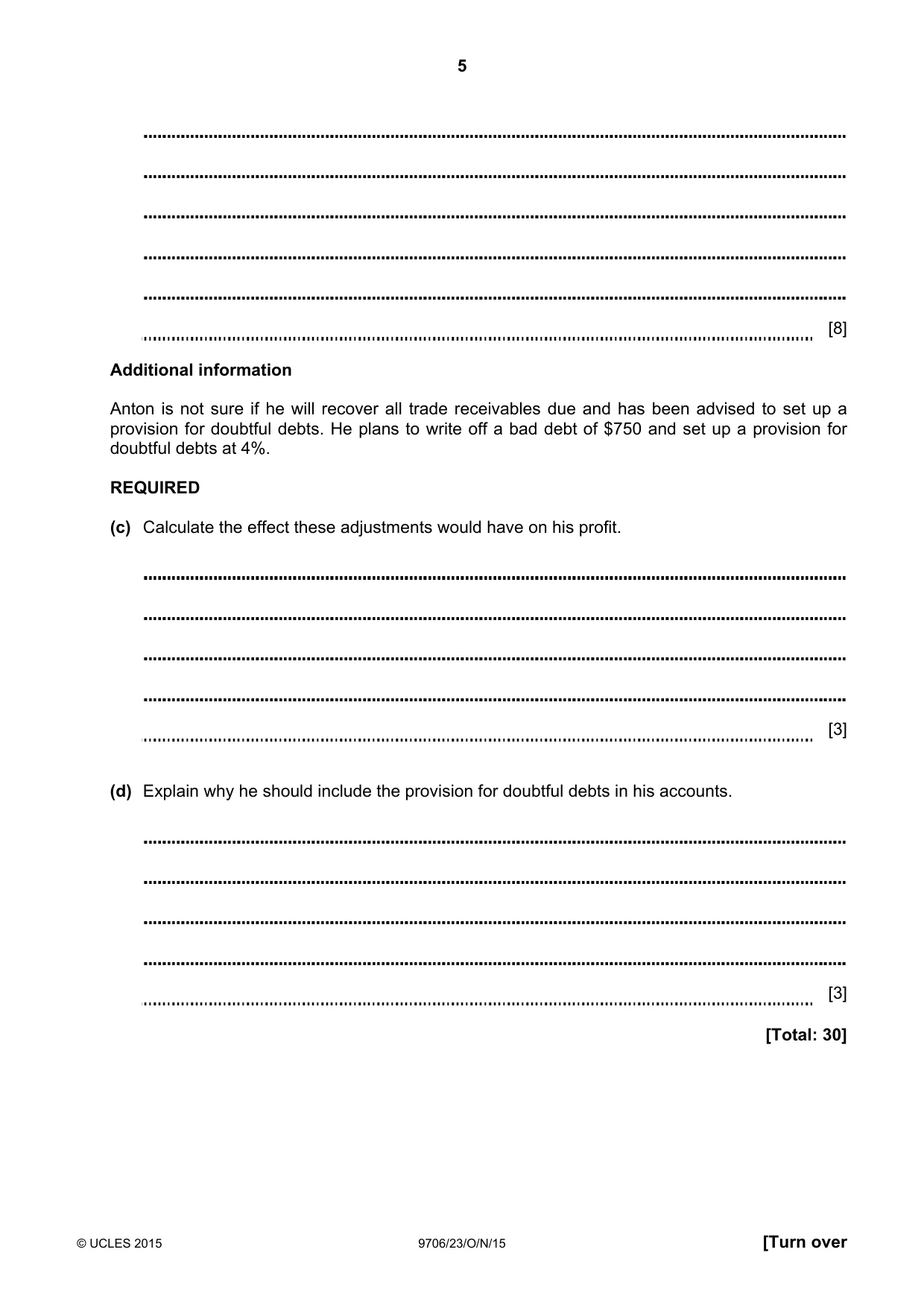
Question paper, page 5
5 © UCLES 2015 9706/23/O/N/15 [Turn over [8] Additional information Anton is not sure if he will recover all trade receivables due and has been advised to set up a provision for doubtful debts. He plans to write off a bad debt of $750 and set up a provision for doubtful debts at 4%. REQUIRED (c) Calculate the effect these adjustments would have on his profit. [3] (d) Explain why he should include the provision for doubtful debts in his accounts. [3] [Total: 30]
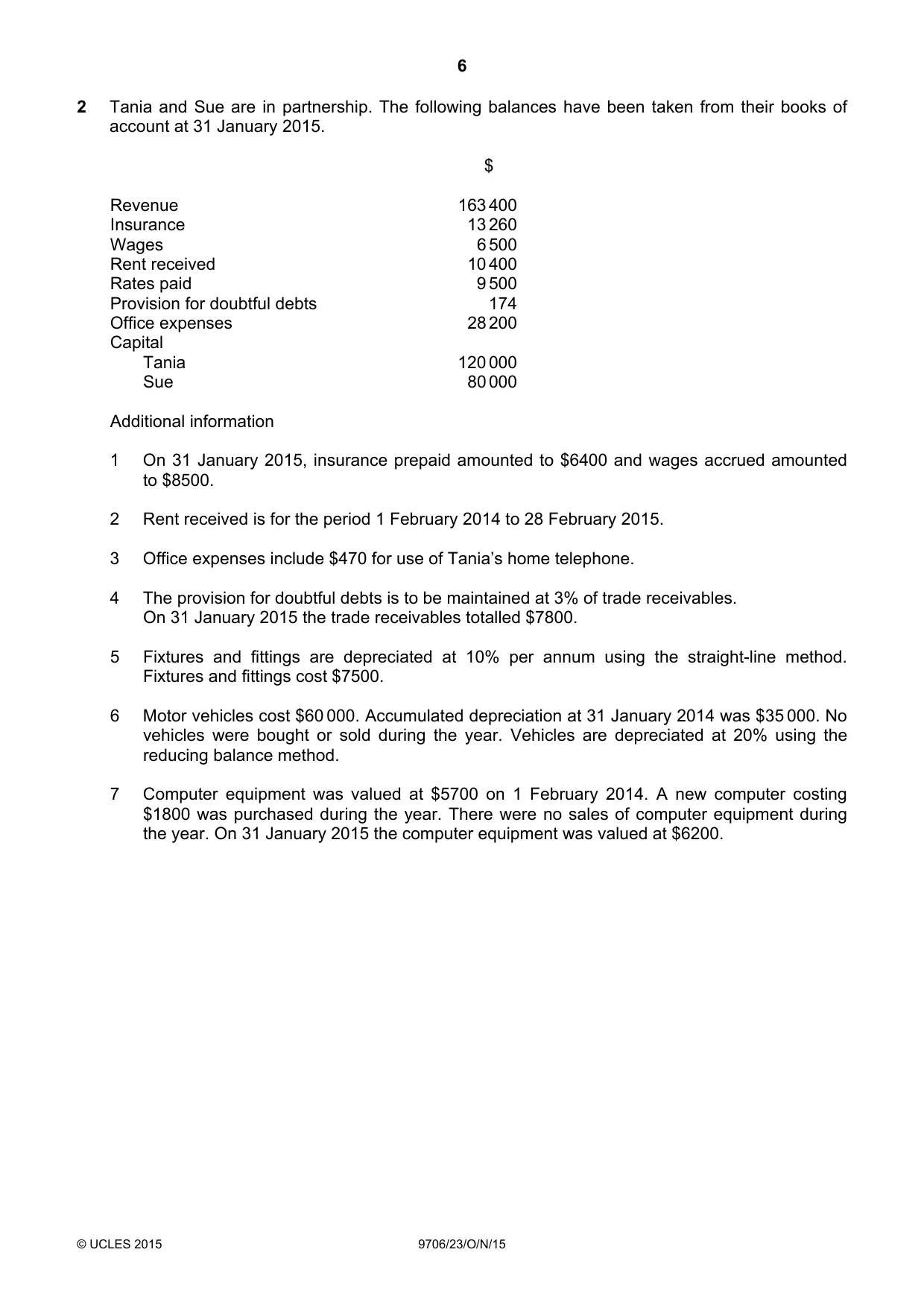
Question paper, page 6
6 © UCLES 2015 9706/23/O/N/15 2 Tania and Sue are in partnership. The following balances have been taken from their books of account at 31 January 2015. $ Revenue 163 400 Insurance 13 260 Wages 6 500 Rent received 10 400 Rates paid 9 500 Provision for doubtful debts 174 Office expenses 28 200 Capital Tania 120 000 Sue 80 000 Additional information 1 On 31 January 2015, insurance prepaid amounted to $6400 and wages accrued amounted to $8500. 2 Rent received is for the period 1 February 2014 to 28 February 2015. 3 Office expenses include $470 for use of Tania’s home telephone. 4 The provision for doubtful debts is to be maintained at 3% of trade receivables. On 31 January 2015 the trade receivables totalled $7800. 5 Fixtures and fittings are depreciated at 10% per annum using the straight-line method. Fixtures and fittings cost $7500. 6 Motor vehicles cost $60 000. Accumulated depreciation at 31 January 2014 was $35 000. No vehicles were bought or sold during the year. Vehicles are depreciated at 20% using the reducing balance method. 7 Computer equipment was valued at $5700 on 1 February 2014. A new computer costing $1800 was purchased during the year. There were no sales of computer equipment during the year. On 31 January 2015 the computer equipment was valued at $6200.
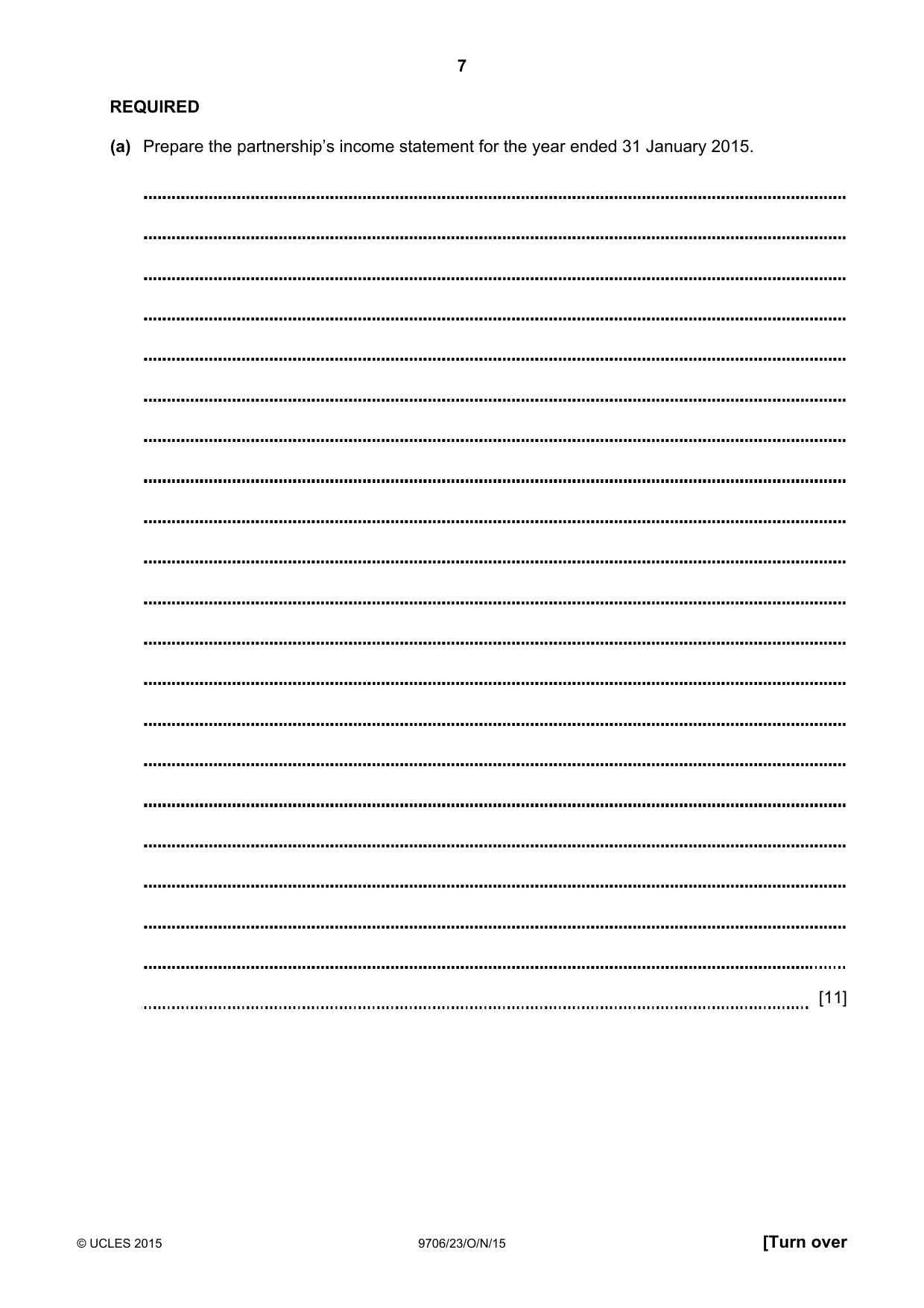
Question paper, page 7
7 © UCLES 2015 9706/23/O/N/15 [Turn over REQUIRED (a) Prepare the partnership’s income statement for the year ended 31 January 2015. [11]
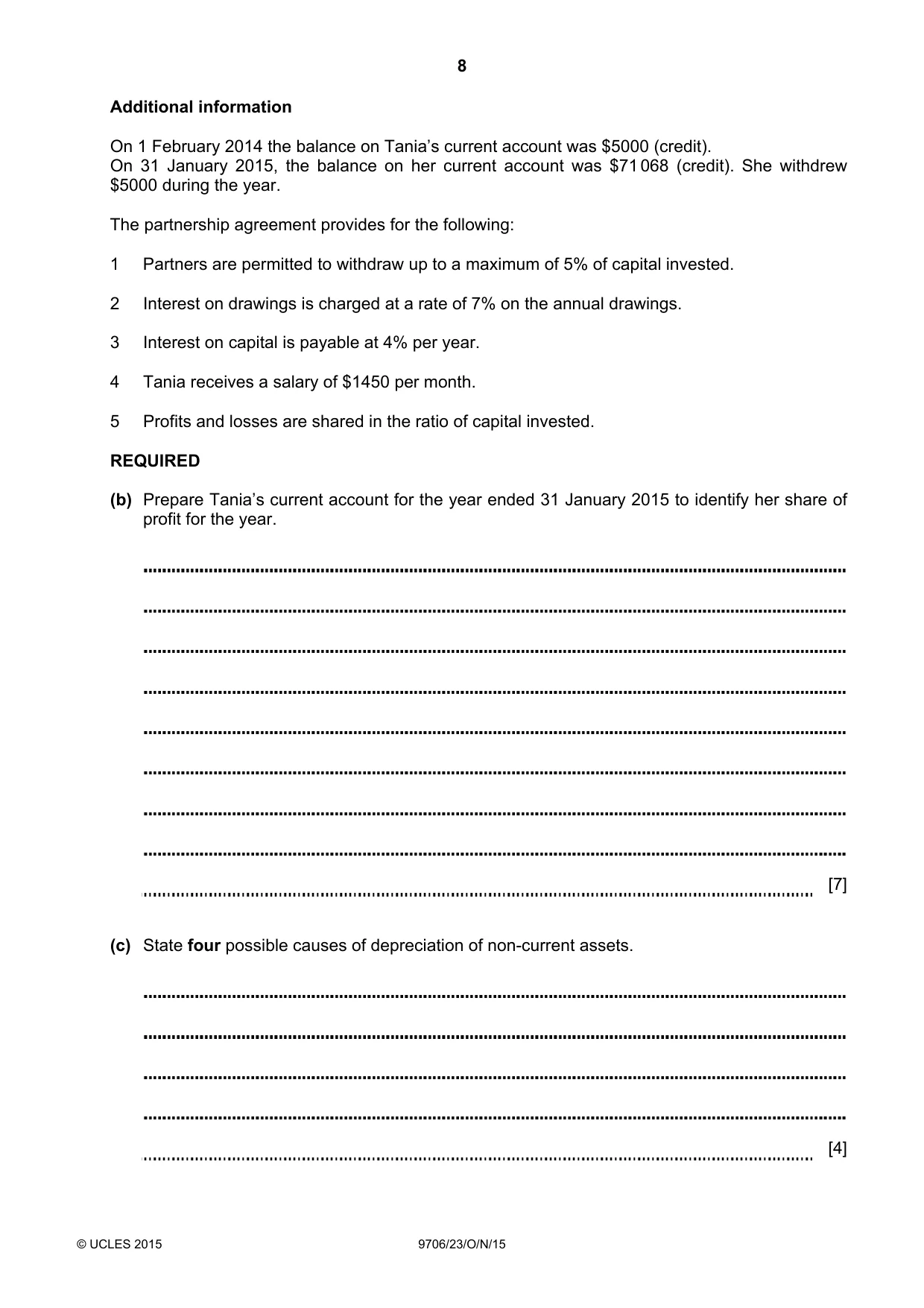
Question paper, page 8
8 © UCLES 2015 9706/23/O/N/15 Additional information On 1 February 2014 the balance on Tania’s current account was $5000 (credit). On 31 January 2015, the balance on her current account was $71 068 (credit). She withdrew $5000 during the year. The partnership agreement provides for the following: 1 Partners are permitted to withdraw up to a maximum of 5% of capital invested. 2 Interest on drawings is charged at a rate of 7% on the annual drawings. 3 Interest on capital is payable at 4% per year. 4 Tania receives a salary of $1450 per month. 5 Profits and losses are shared in the ratio of capital invested. REQUIRED (b) Prepare Tania’s current account for the year ended 31 January 2015 to identify her share of profit for the year. [7] (c) State four possible causes of depreciation of non-current assets. [4]
Question paper, page 9
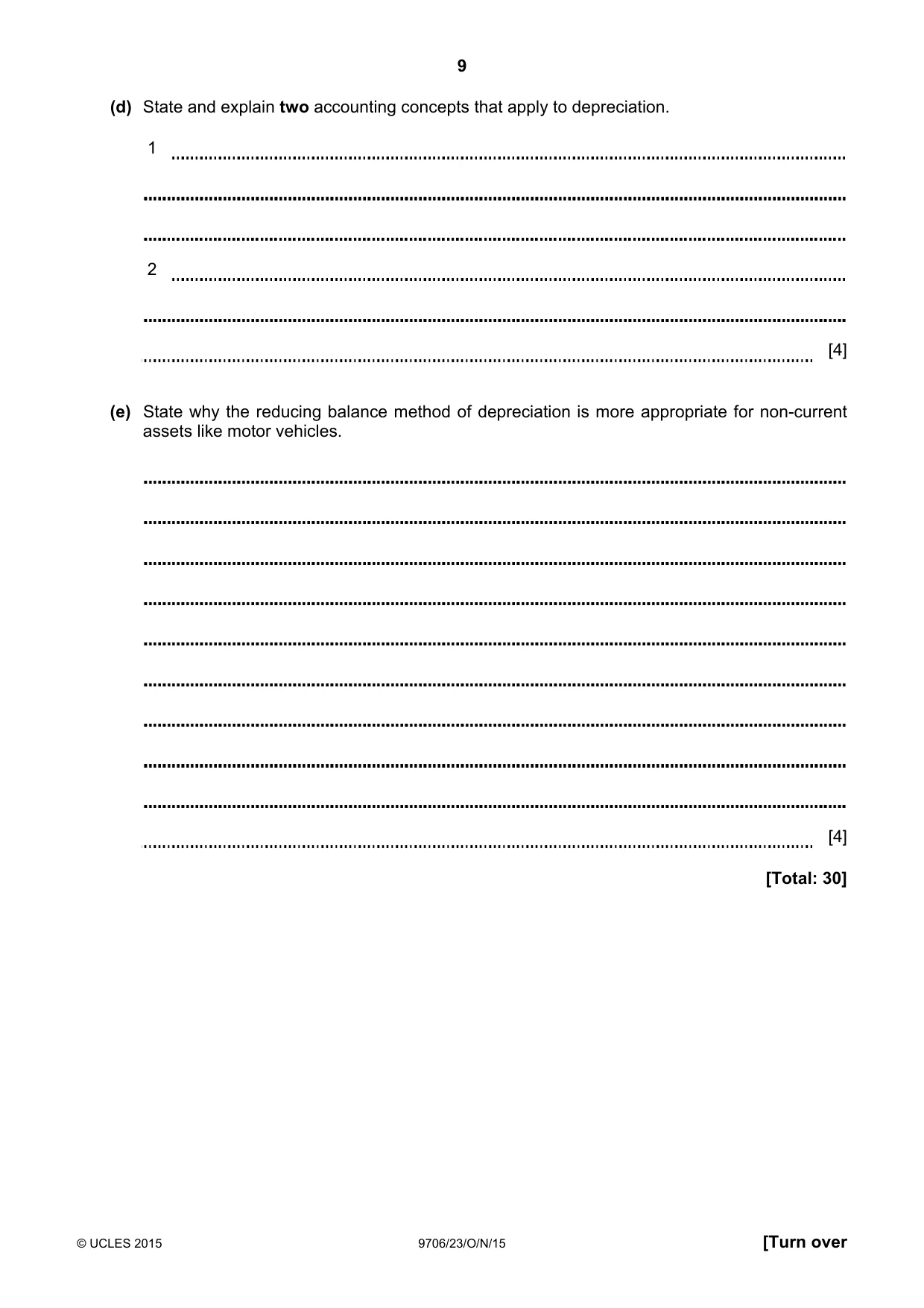
9 © UCLES 2015 9706/23/O/N/15 [Turn over (d) State and explain two accounting concepts that apply to depreciation. 1 2 [4] (e) State why the reducing balance method of depreciation is more appropriate for non-current assets like motor vehicles. [4] [Total: 30]
Question paper, page 10
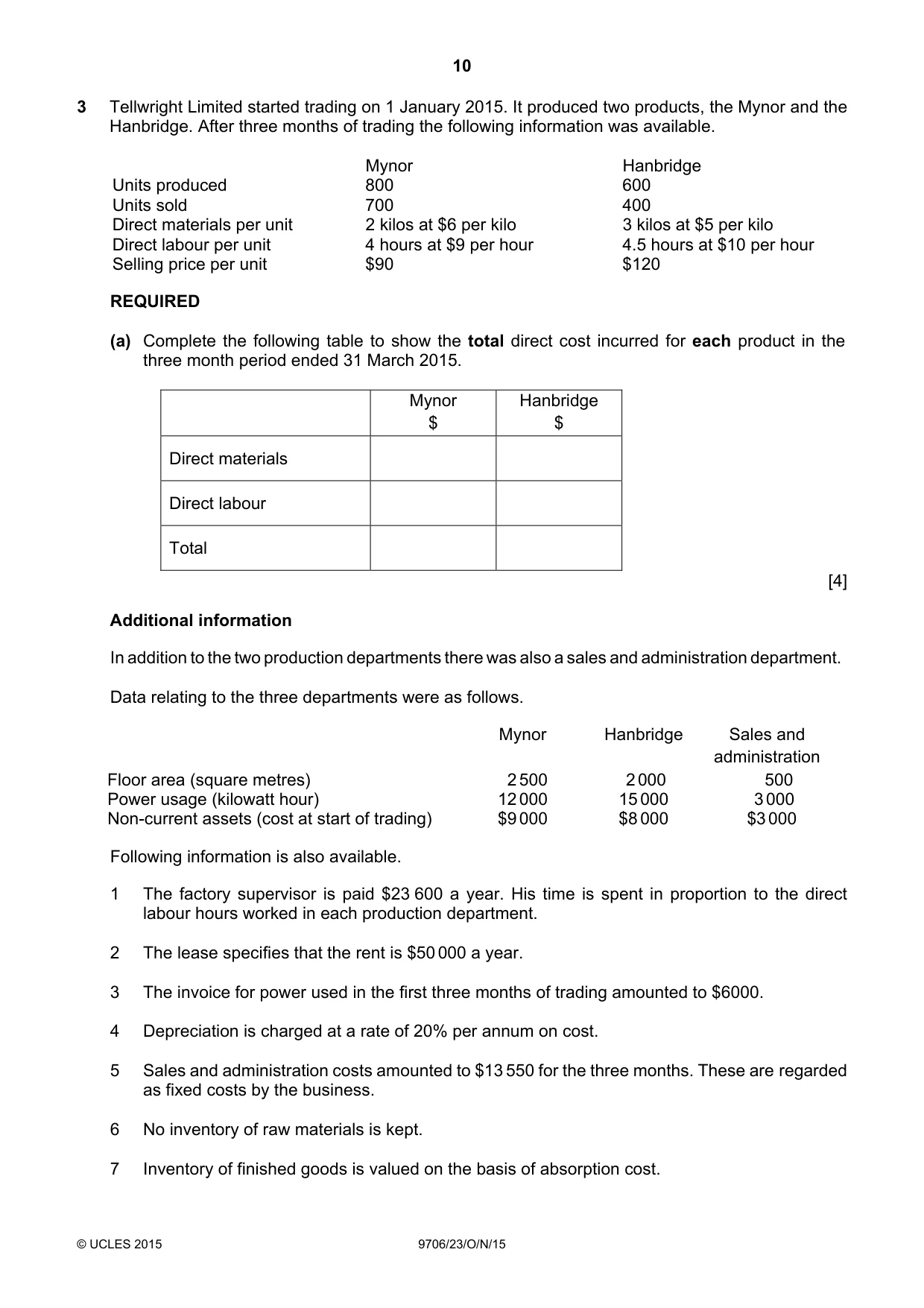
10 © UCLES 2015 9706/23/O/N/15 3 Tellwright Limited started trading on 1 January 2015. It produced two products, the Mynor and the Hanbridge. After three months of trading the following information was available. Mynor Hanbridge Units produced 800 600 Units sold 700 400 Direct materials per unit 2 kilos at $6 per kilo 3 kilos at $5 per kilo Direct labour per unit 4 hours at $9 per hour 4.5 hours at $10 per hour Selling price per unit $90 $120 REQUIRED (a) Complete the following table to show the total direct cost incurred for each product in the three month period ended 31 March 2015. Mynor $ Hanbridge $ Direct materials Direct labour Total [4] Additional information In addition to the two production departments there was also a sales and administration department. Data relating to the three departments were as follows. Mynor Hanbridge Sales and administration Floor area (square metres) 2 500 2 000 500 Power usage (kilowatt hour) 12 000 15 000 3 000 Non-current assets (cost at start of trading) $9 000 $8 000 $3 000 Following information is also available. 1 The factory supervisor is paid $23 600 a year. His time is spent in proportion to the direct labour hours worked in each production department. 2 The lease specifies that the rent is $50 000 a year. 3 The invoice for power used in the first three months of trading amounted to $6000. 4 Depreciation is charged at a rate of 20% per annum on cost. 5 Sales and administration costs amounted to $13 550 for the three months. These are regarded as fixed costs by the business. 6 No inventory of raw materials is kept. 7 Inventory of finished goods is valued on the basis of absorption cost.
Question paper, page 11
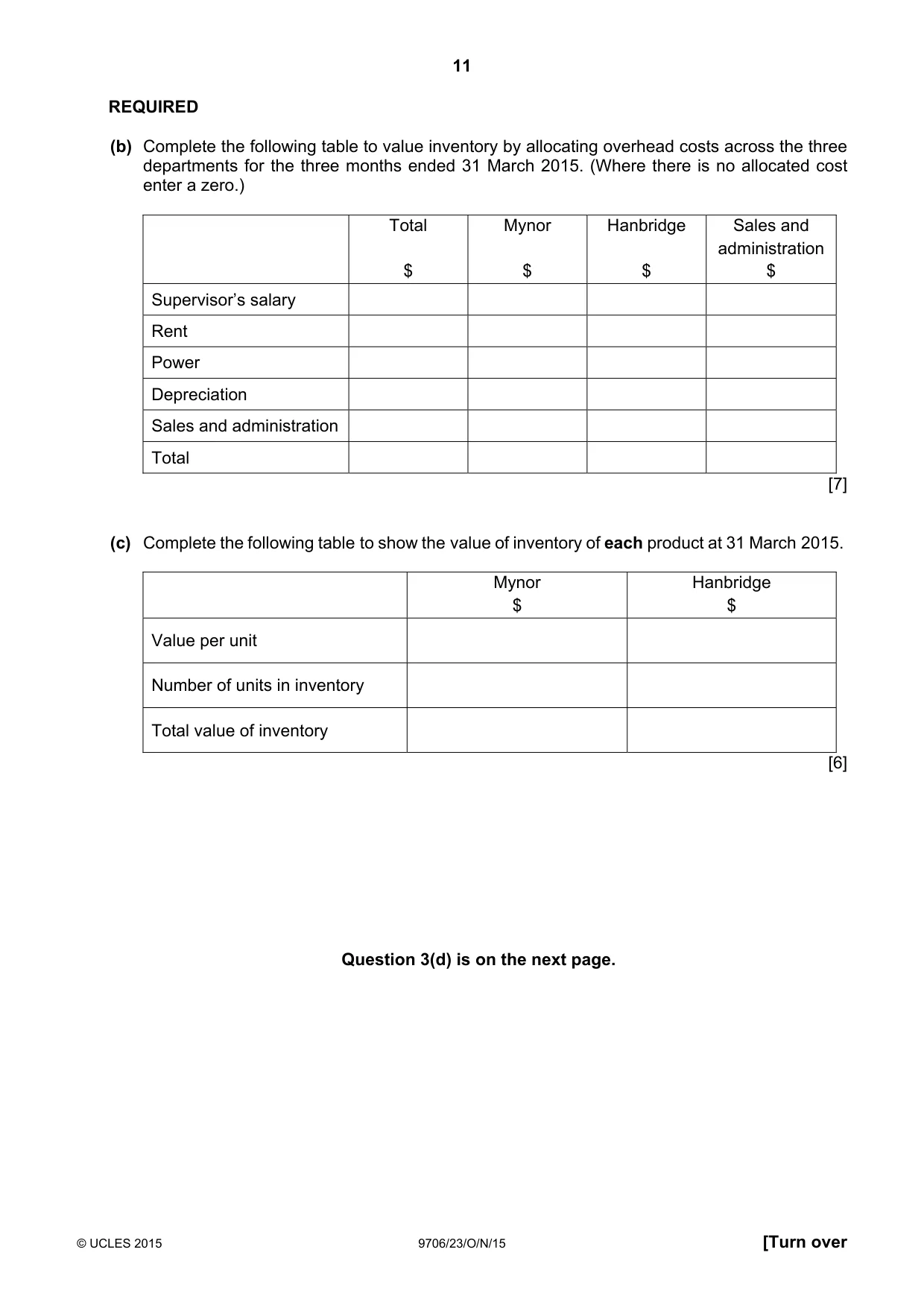
11 © UCLES 2015 9706/23/O/N/15 [Turn over REQUIRED (b) Complete the following table to value inventory by allocating overhead costs across the three departments for the three months ended 31 March 2015. (Where there is no allocated cost enter a zero.) Total $ Mynor $ Hanbridge $ Sales and administration $ Supervisor’s salary Rent Power Depreciation Sales and administration Total [7] (c) Complete the following table to show the value of inventory of each product at 31 March 2015. Mynor $ Hanbridge $ Value per unit Number of units in inventory Total value of inventory [6] Question 3(d) is on the next page.
Question paper, page 12
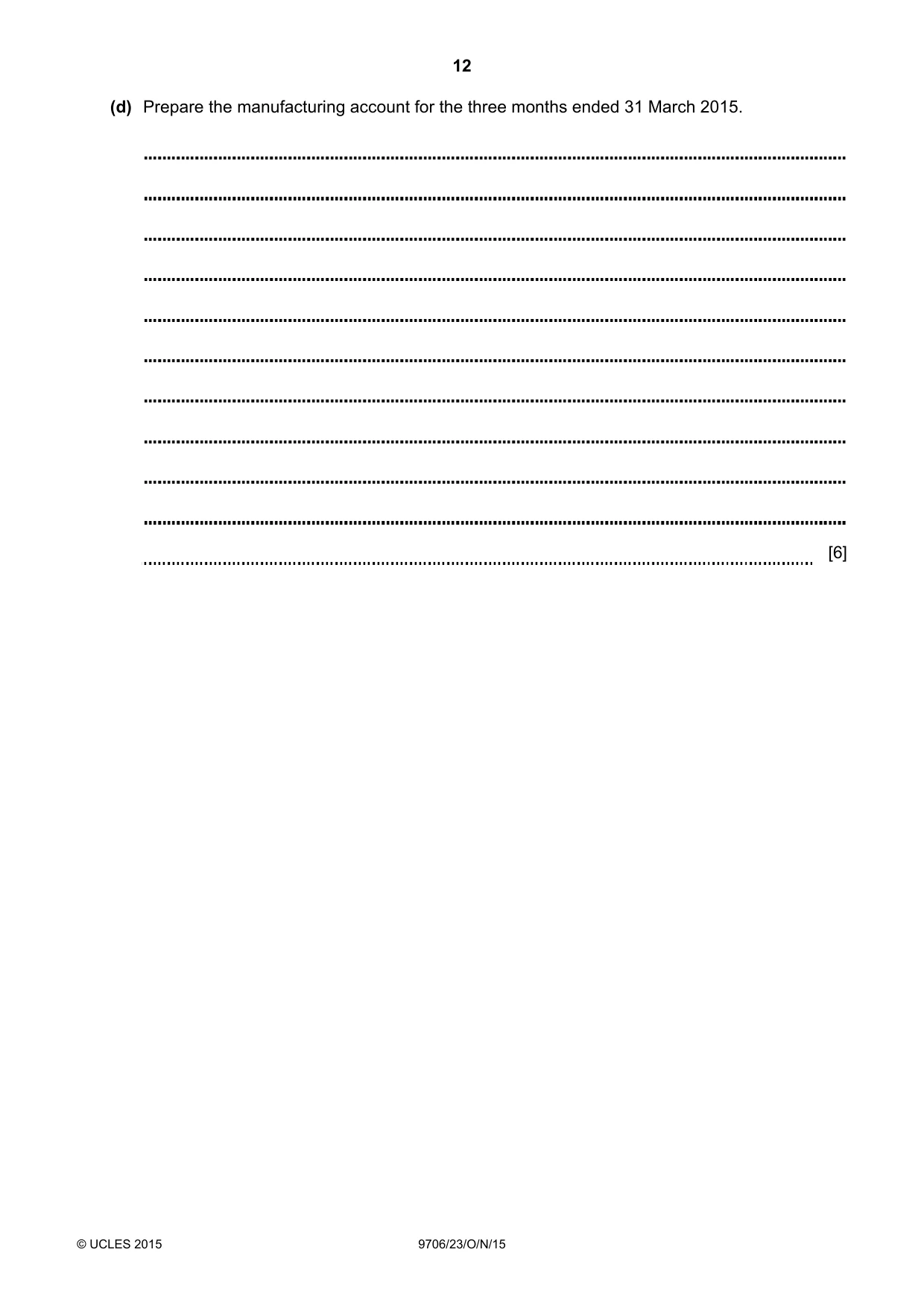
12 © UCLES 2015 9706/23/O/N/15 (d) Prepare the manufacturing account for the three months ended 31 March 2015. [6]
Question paper, page 13
13 © UCLES 2015 9706/23/O/N/15 (e) Prepare the income statement for the three months ended 31 March 2015. [7] [Total: 30]
Question paper, page 14
14 © UCLES 2015 9706/23/O/N/15 BLANK PAGE
Question paper, page 15
15 © UCLES 2015 9706/23/O/N/15 BLANK PAGE
Question paper, page 16
16 Permission to reproduce items where third-party owned material protected by copyright is included has been sought and cleared where possible. Every reasonable effort has been made by the publisher (UCLES) to trace copyright holders, but if any items requiring clearance have unwittingly been included, the publisher will be pleased to make amends at the earliest possible opportunity. To avoid the issue of disclosure of answer-related information to candidates, all copyright acknowledgements are reproduced online in the Cambridge International Examinations Copyright Acknowledgements Booklet. This is produced for each series of examinations and is freely available to download at www.cie.org.uk after the live examination series. Cambridge International Examinations is part of the Cambridge Assessment Group. Cambridge Assessment is the brand name of University of Cambridge Local Examinations Syndicate (UCLES), which is itself a department of the University of Cambridge. © UCLES 2015 9706/23/O/N/15 BLANK PAGE
Mark scheme, page 1
® IGCSE is the registered trademark of Cambridge International Examinations. CAMBRIDGE INTERNATIONAL EXAMINATIONS Cambridge International Advanced Subsidiary and Advanced Level MARK SCHEME for the October/November 2015 series 9706 ACCOUNTING 9706/23 Paper 2 (Structured Questions – Core), maximum raw mark 90 This mark scheme is published as an aid to teachers and candidates, to indicate the requirements of the examination. It shows the basis on which Examiners were instructed to award marks. It does not indicate the details of the discussions that took place at an Examiners’ meeting before marking began, which would have considered the acceptability of alternative answers. Mark schemes should be read in conjunction with the question paper and the Principal Examiner Report for Teachers. Cambridge will not enter into discussions about these mark schemes. Cambridge is publishing the mark schemes for the October/November 2015 series for most Cambridge IGCSE®, Cambridge International A and AS Level components and some Cambridge O Level components.
Mark scheme, page 2
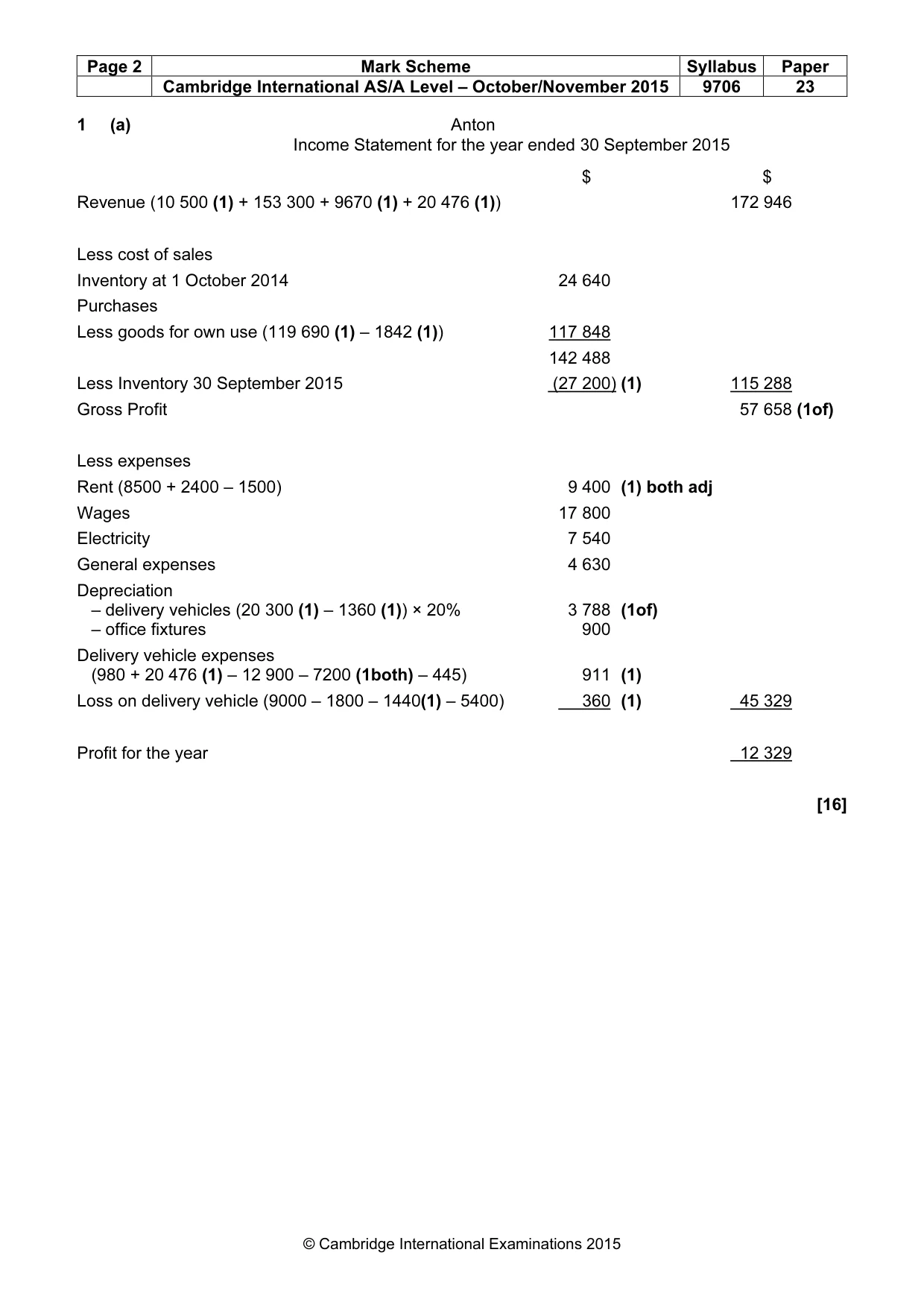
Page 2 Mark Scheme Syllabus Paper Cambridge International AS/A Level – October/November 2015 9706 23 © Cambridge International Examinations 2015 1 (a) Anton Income Statement for the year ended 30 September 2015 $ $ Revenue (10 500 (1) + 153 300 + 9670 (1) + 20 476 (1)) 172 946 Less cost of sales Inventory at 1 October 2014 24 640) Purchases Less goods for own use (119 690 (1) – 1842 (1)) 117 848) 142 488) Less Inventory 30 September 2015 (27 200) (1) 115 288 Gross Profit 57 658 (1of) Less expenses Rent (8500 + 2400 – 1500) 9 400) (1) both adj Wages 17 800) Electricity 7 540) General expenses 4 630) Depreciation – delivery vehicles (20 300 (1) – 1360 (1)) × 20% – office fixtures 3 788) 900) (1of) Delivery vehicle expenses (980 + 20 476 (1) – 12 900 – 7200 (1both) – 445) 911) (1) Loss on delivery vehicle (9000 – 1800 – 1440(1) – 5400) 360) (1) 45 329 Profit for the year 12 329 [16]
Mark scheme, page 3
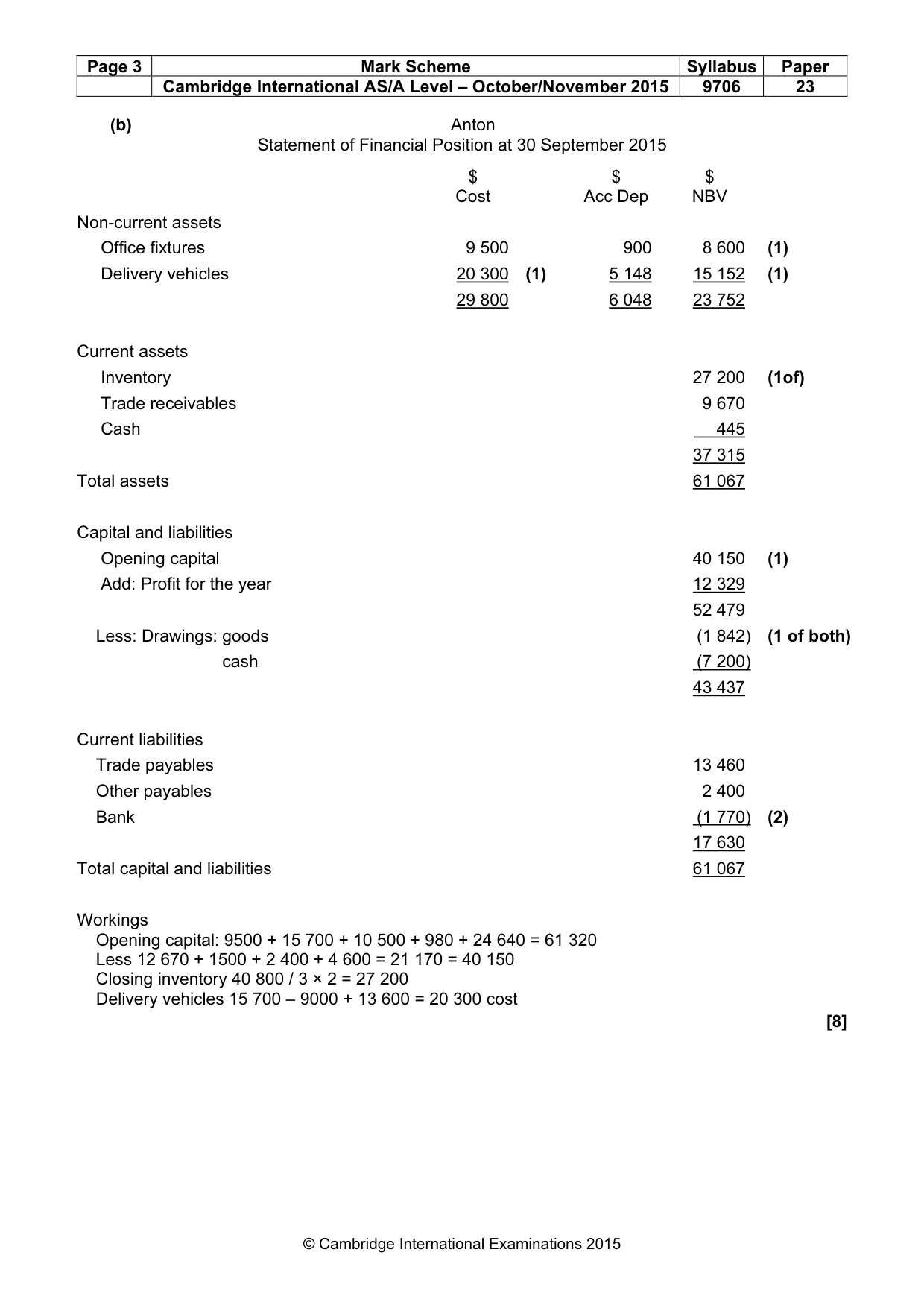
Page 3 Mark Scheme Syllabus Paper Cambridge International AS/A Level – October/November 2015 9706 23 © Cambridge International Examinations 2015 (b) Anton Statement of Financial Position at 30 September 2015 $ Cost $ Acc Dep $ NBV Non-current assets Office fixtures 9 500 900 8 600) (1) Delivery vehicles 20 300 (1) 5 148 15 152) (1) 29 800 6 048 23 752) Current assets Inventory 27 200) (1of) Trade receivables 9 670) Cash 445) 37 315) Total assets 61 067) Capital and liabilities Opening capital 40 150) (1) Add: Profit for the year 12 329) 52 479) Less: Drawings: goods (1 842) (1 of both) Less: Drawings: cash (7 200) 43 437) Current liabilities Trade payables 13 460) Other payables 2 400) Bank (1 770) (2) 17 630) Total capital and liabilities 61 067) Workings Opening capital: 9500 + 15 700 + 10 500 + 980 + 24 640 = 61 320 Less 12 670 + 1500 + 2 400 + 4 600 = 21 170 = 40 150 Closing inventory 40 800 / 3 × 2 = 27 200 Delivery vehicles 15 700 – 9000 + 13 600 = 20 300 cost [8]
Mark scheme, page 4
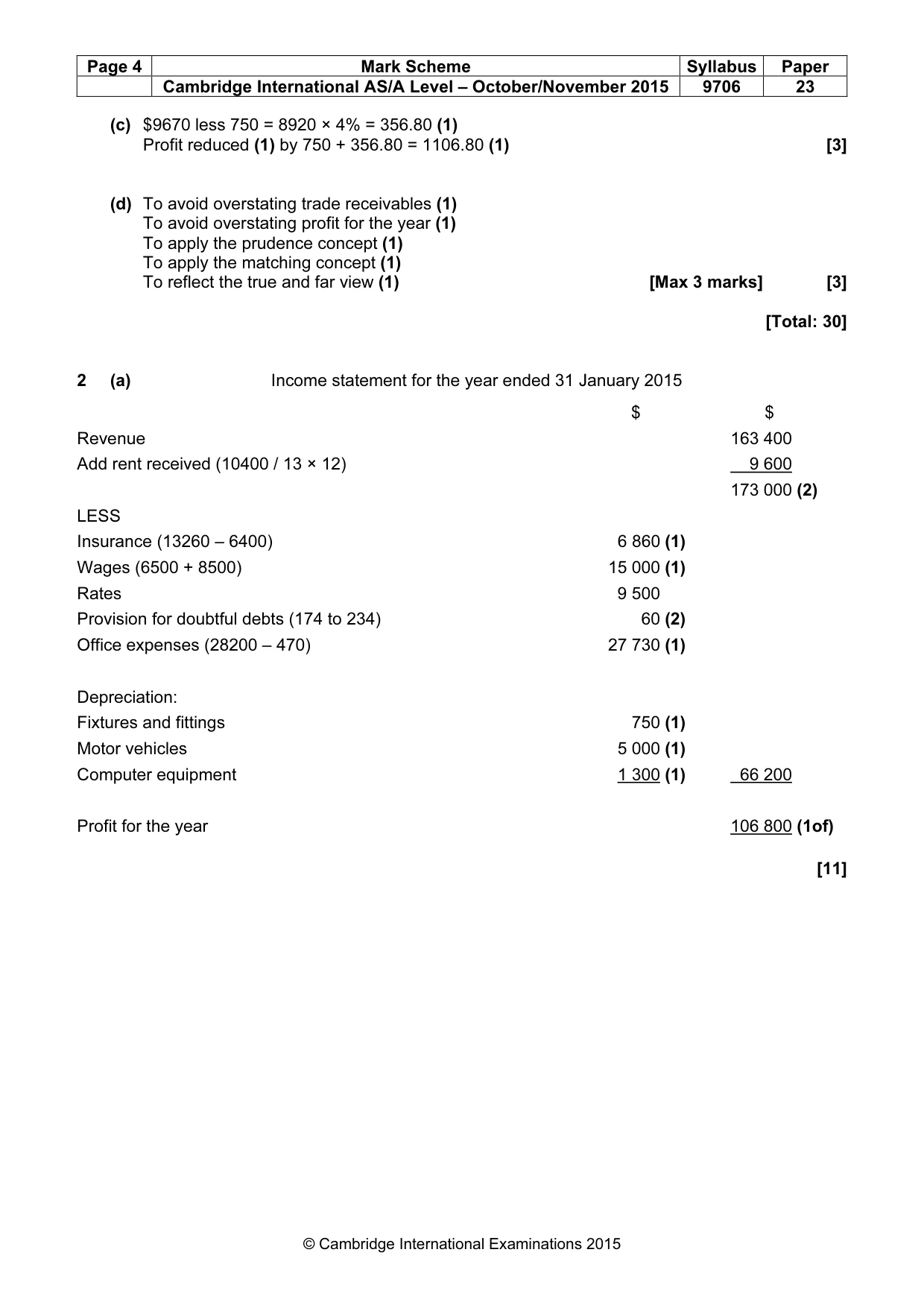
Page 4 Mark Scheme Syllabus Paper Cambridge International AS/A Level – October/November 2015 9706 23 © Cambridge International Examinations 2015 (c) $9670 less 750 = 8920 × 4% = 356.80 (1) Profit reduced (1) by 750 + 356.80 = 1106.80 (1) [3] (d) To avoid overstating trade receivables (1) To avoid overstating profit for the year (1) To apply the prudence concept (1) To apply the matching concept (1) To reflect the true and far view (1) [Max 3 marks] [3] [Total: 30] 2 (a) Income statement for the year ended 31 January 2015 $ $ Revenue 163 400 Add rent received (10400 / 13 × 12) 9 600 173 000 (2) LESS Insurance (13260 – 6400) 6 860 (1) Wages (6500 + 8500) 15 000 (1) Rates 9 500 Provision for doubtful debts (174 to 234) 60 (2) Office expenses (28200 – 470) 27 730 (1) Depreciation: Fixtures and fittings 750 (1) Motor vehicles 5 000 (1) Computer equipment 1 300 (1) 66 200 Profit for the year 106 800 (1of) [11]
Mark scheme, page 5
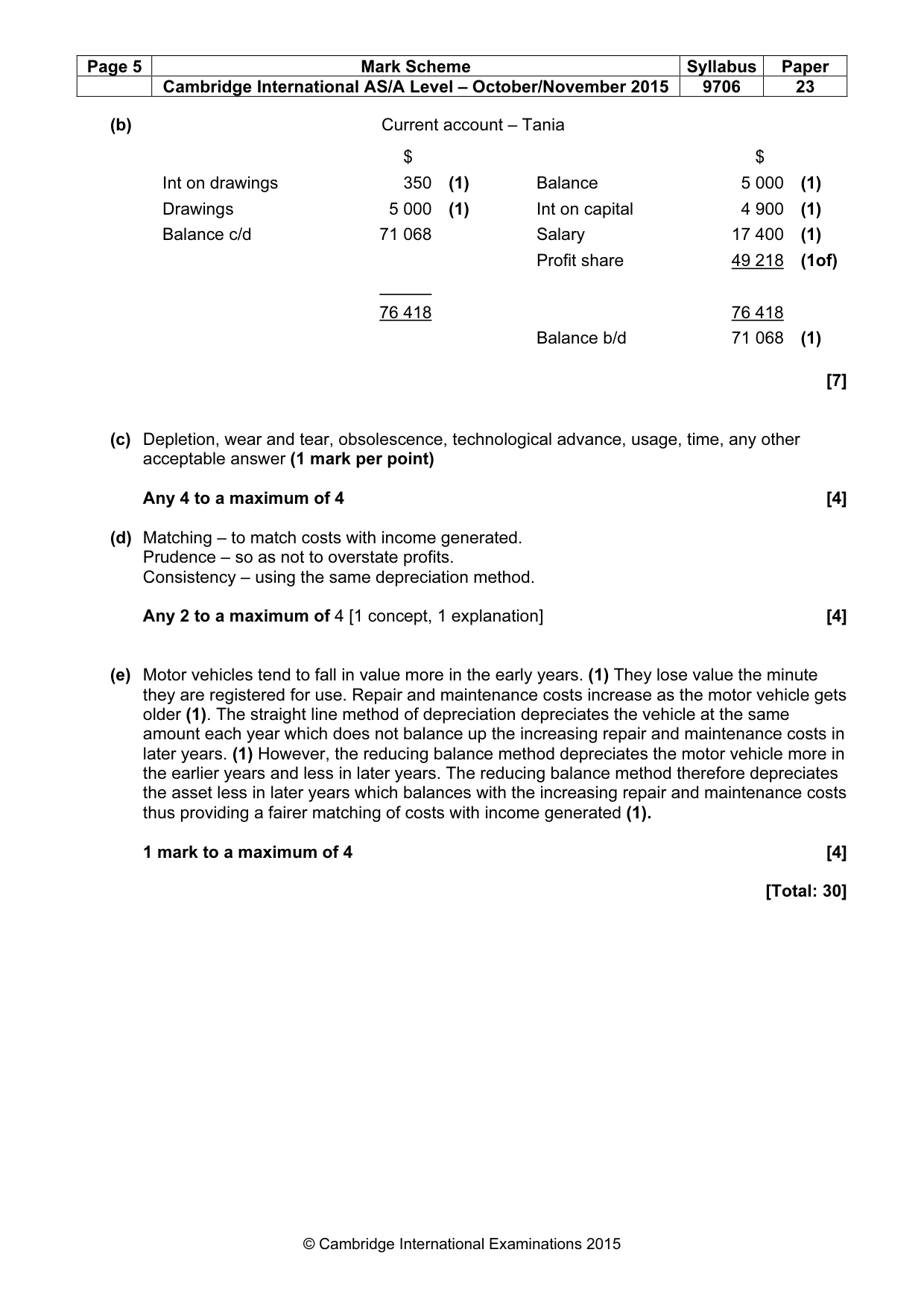
Page 5 Mark Scheme Syllabus Paper Cambridge International AS/A Level – October/November 2015 9706 23 © Cambridge International Examinations 2015 (b) Current account – Tania $ $ Int on drawings 350 (1) Balance 5 000 (1) Drawings 5 000 (1) Int on capital 4 900 (1) Balance c/d 71 068 Salary 17 400 (1) Profit share 49 218 (1of) 76 418 76 418 Balance b/d 71 068 (1) [7] (c) Depletion, wear and tear, obsolescence, technological advance, usage, time, any other acceptable answer (1 mark per point) Any 4 to a maximum of 4 [4] (d) Matching – to match costs with income generated. Prudence – so as not to overstate profits. Consistency – using the same depreciation method. Any 2 to a maximum of 4 [1 concept, 1 explanation] [4] (e) Motor vehicles tend to fall in value more in the early years. (1) They lose value the minute they are registered for use. Repair and maintenance costs increase as the motor vehicle gets older (1). The straight line method of depreciation depreciates the vehicle at the same amount each year which does not balance up the increasing repair and maintenance costs in later years. (1) However, the reducing balance method depreciates the motor vehicle more in the earlier years and less in later years. The reducing balance method therefore depreciates the asset less in later years which balances with the increasing repair and maintenance costs thus providing a fairer matching of costs with income generated (1). 1 mark to a maximum of 4 [4] [Total: 30]
Mark scheme, page 6
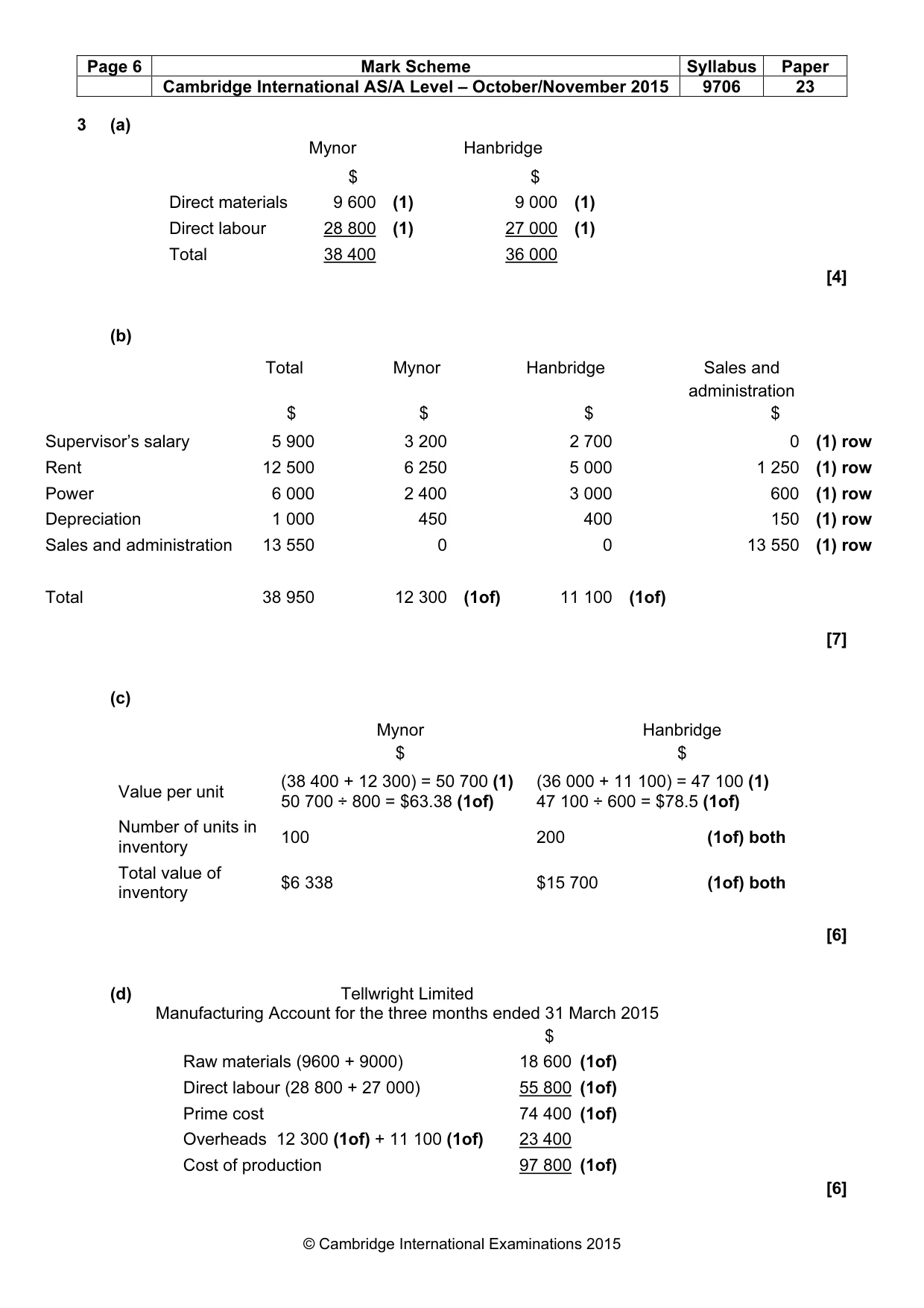
Page 6 Mark Scheme Syllabus Paper Cambridge International AS/A Level – October/November 2015 9706 23 © Cambridge International Examinations 2015 3 (a) Mynor Hanbridge $ $ Direct materials 9 600 (1) 9 000 (1) Direct labour 28 800 (1) 27 000 (1) Total 38 400 36 000 [4] (b) Total $ Mynor $ Hanbridge $ Sales and administration $ Supervisor’s salary 5 900 3 200 2 700 0 (1) row Rent 12 500 6 250 5 000 1 250 (1) row Power 6 000 2 400 3 000 600 (1) row Depreciation 1 000 450 400 150 (1) row Sales and administration 13 550 0 0 13 550 (1) row Total 38 950 12 300 (1of) 11 100 (1of) [7] (c) Mynor $ Hanbridge $ Value per unit (38 400 + 12 300) = 50 700 (1) 50 700 ÷ 800 = $63.38 (1of) (36 000 + 11 100) = 47 100 (1) 47 100 ÷ 600 = $78.5 (1of) Number of units in inventory 100 200 (1of) both Total value of inventory $6 338 $15 700 (1of) both [6] (d) Tellwright Limited Manufacturing Account for the three months ended 31 March 2015 $ Raw materials (9600 + 9000) 18 600 (1of) Direct labour (28 800 + 27 000) 55 800 (1of) Prime cost 74 400 (1of) Overheads 12 300 (1of) + 11 100 (1of) 23 400 Cost of production 97 800 (1of) [6]
Mark scheme, page 7
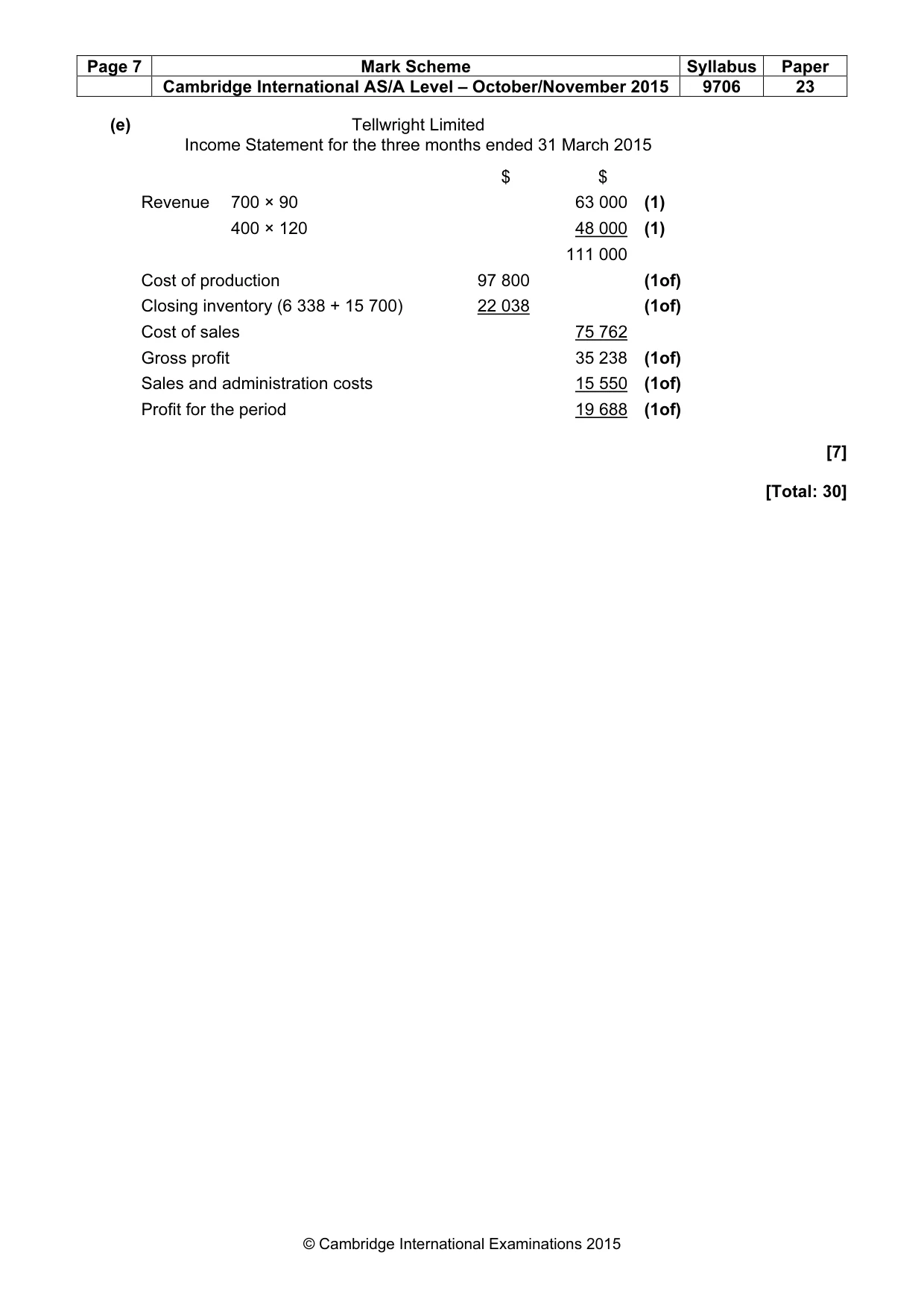
Page 7 Mark Scheme Syllabus Paper Cambridge International AS/A Level – October/November 2015 9706 23 © Cambridge International Examinations 2015 (e) Tellwright Limited Income Statement for the three months ended 31 March 2015 $ $ Revenue 700 × 90 63 000 (1) 400 × 120 48 000 (1) 111 000 Cost of production 97 800 (1of) Closing inventory (6 338 + 15 700) 22 038 (1of) Cost of sales 75 762 Gross profit 35 238 (1of) Sales and administration costs 15 550 (1of) Profit for the period 19 688 (1of) [7] [Total: 30]
What you needed in this session
Cambridge’s own grade thresholds for 2015 Oct/Nov, Paper 2 · Variant 3. A higher threshold means an easier paper — the bar moves with how the cohort did.