Cambridge A Level Accounting 9706 — 2015 May/June Paper 2 · Variant 2
9706/22/M/J/15 · 90 marks · ≈101 min
The question paper and its mark scheme, free to read here and free to download. This is Cambridge’s own paper, exactly as it was sat.
Question paper16 pages

Mark scheme
No mark scheme is in the library for this paper.
Paper as text
Question paper, page 1
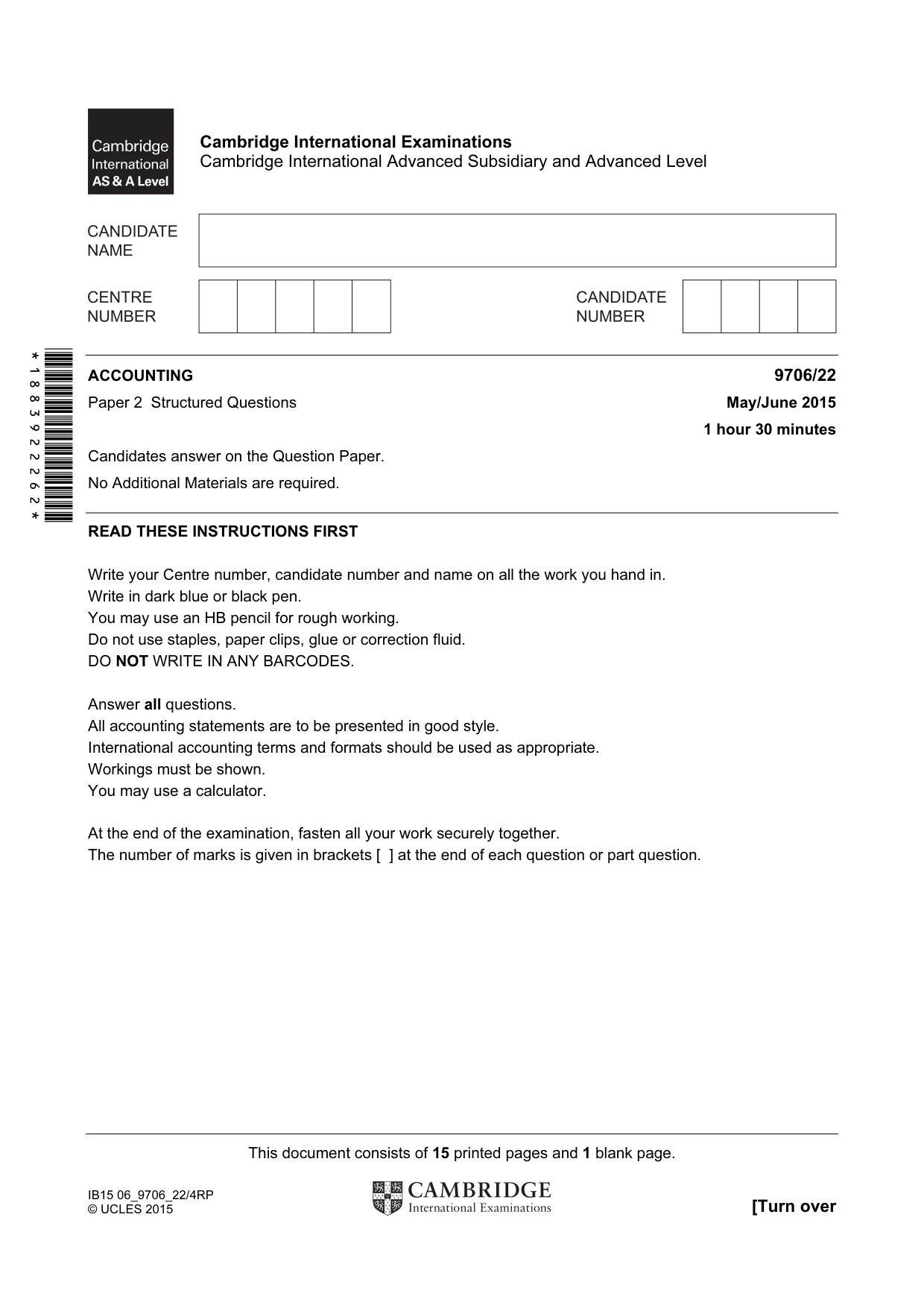
This document consists of 15 printed pages and 1 blank page. IB15 06_9706_22/4RP © UCLES 2015 [Turn over *1883922262* Cambridge International Examinations Cambridge International Advanced Subsidiary and Advanced Level ACCOUNTING 9706/22 Paper 2 Structured Questions May/June 2015 1 hour 30 minutes Candidates answer on the Question Paper. No Additional Materials are required. READ THESE INSTRUCTIONS FIRST Write your Centre number, candidate number and name on all the work you hand in. Write in dark blue or black pen. You may use an HB pencil for rough working. Do not use staples, paper clips, glue or correction fluid. DO NOT WRITE IN ANY BARCODES. Answer all questions. All accounting statements are to be presented in good style. International accounting terms and formats should be used as appropriate. Workings must be shown. You may use a calculator. At the end of the examination, fasten all your work securely together. The number of marks is given in brackets [ ] at the end of each question or part question.
Question paper, page 2
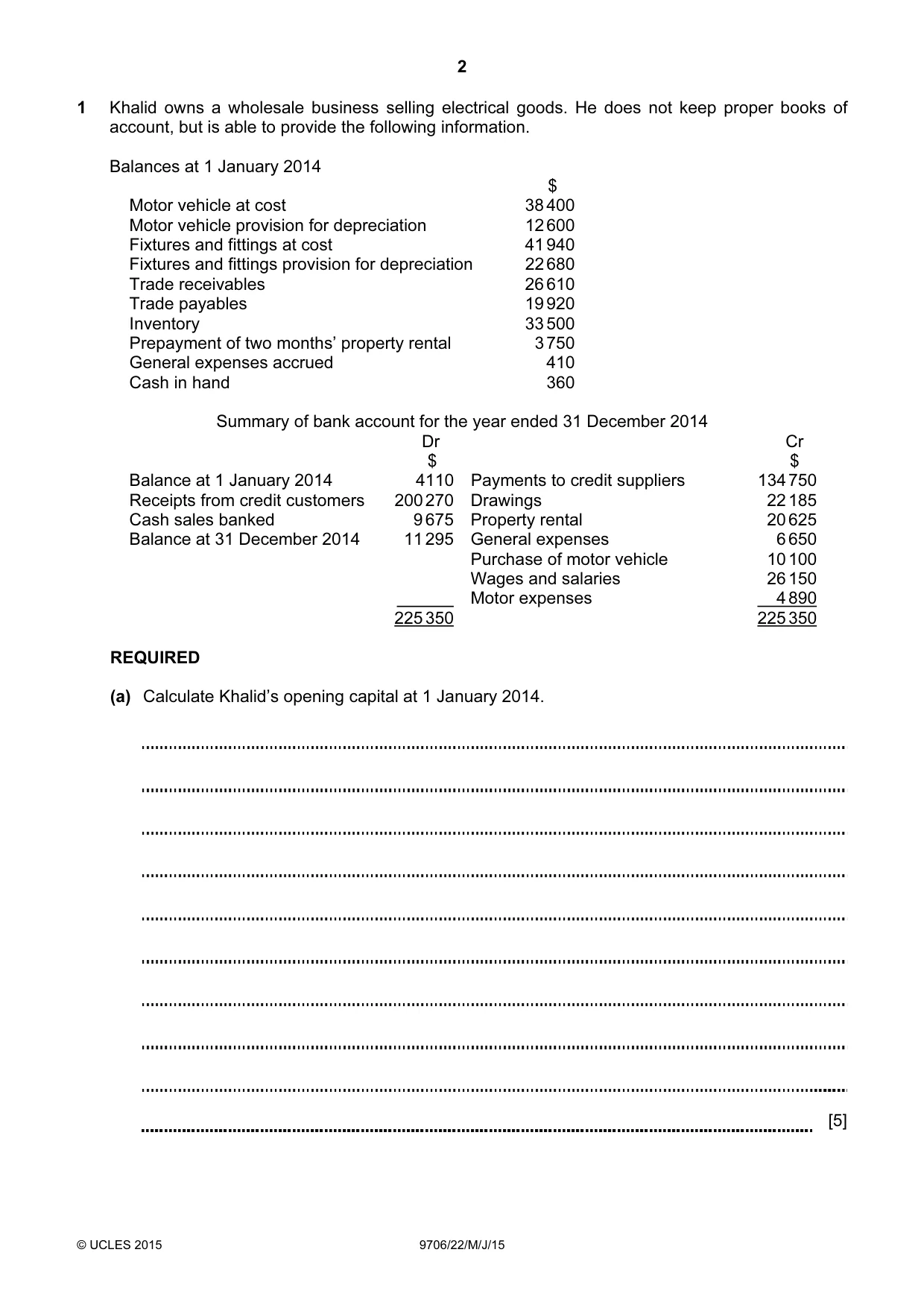
2 © UCLES 2015 9706/22/M/J/15 1 Khalid owns a wholesale business selling electrical goods. He does not keep proper books of account, but is able to provide the following information. Balances at 1 January 2014 $ Motor vehicle at cost 38 400 Motor vehicle provision for depreciation 12 600 Fixtures and fittings at cost 41 940 Fixtures and fittings provision for depreciation 22 680 Trade receivables 26 610 Trade payables 19 920 Inventory 33 500 Prepayment of two months’ property rental 3 750 General expenses accrued 410 Cash in hand 360 Summary of bank account for the year ended 31 December 2014 Dr Cr $ $ Balance at 1 January 2014 4110 Payments to credit suppliers 134 750 Receipts from credit customers 200 270 Drawings 22 185 Cash sales banked 9 675 Property rental 20 625 Balance at 31 December 2014 11 295 General expenses 6 650 Purchase of motor vehicle 10 100 Wages and salaries 26 150 Motor expenses 4 890 225 350 225 350 REQUIRED (a) Calculate Khalid’s opening capital at 1 January 2014. [5]
Question paper, page 3
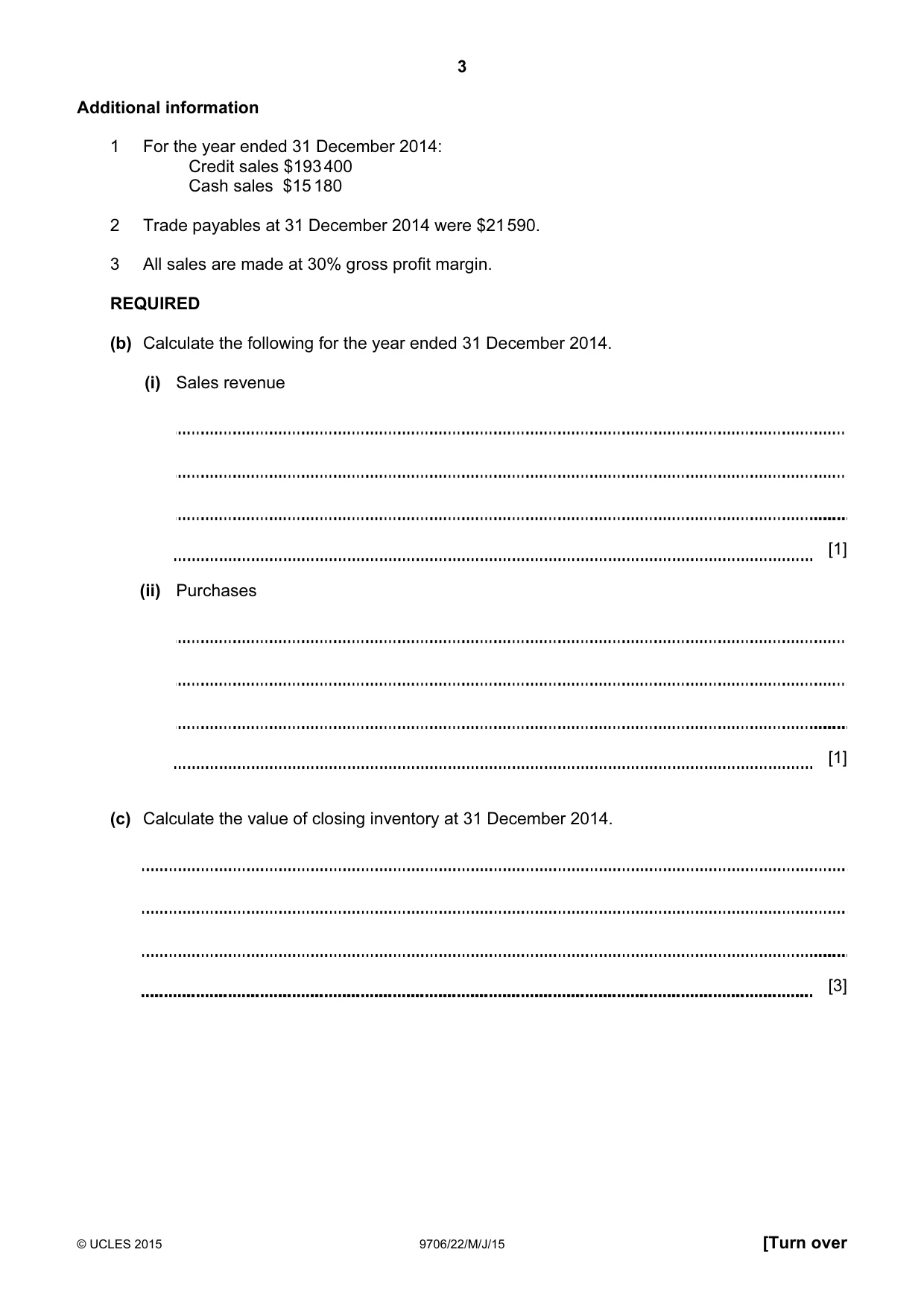
3 © UCLES 2015 9706/22/M/J/15 [Turn over Additional information 1 For the year ended 31 December 2014: Credit sales $193 400 Cash sales $15 180 2 Trade payables at 31 December 2014 were $21 590. 3 All sales are made at 30% gross profit margin. REQUIRED (b) Calculate the following for the year ended 31 December 2014. (i) Sales revenue [1] (ii) Purchases [1] (c) Calculate the value of closing inventory at 31 December 2014. [3]
Question paper, page 4
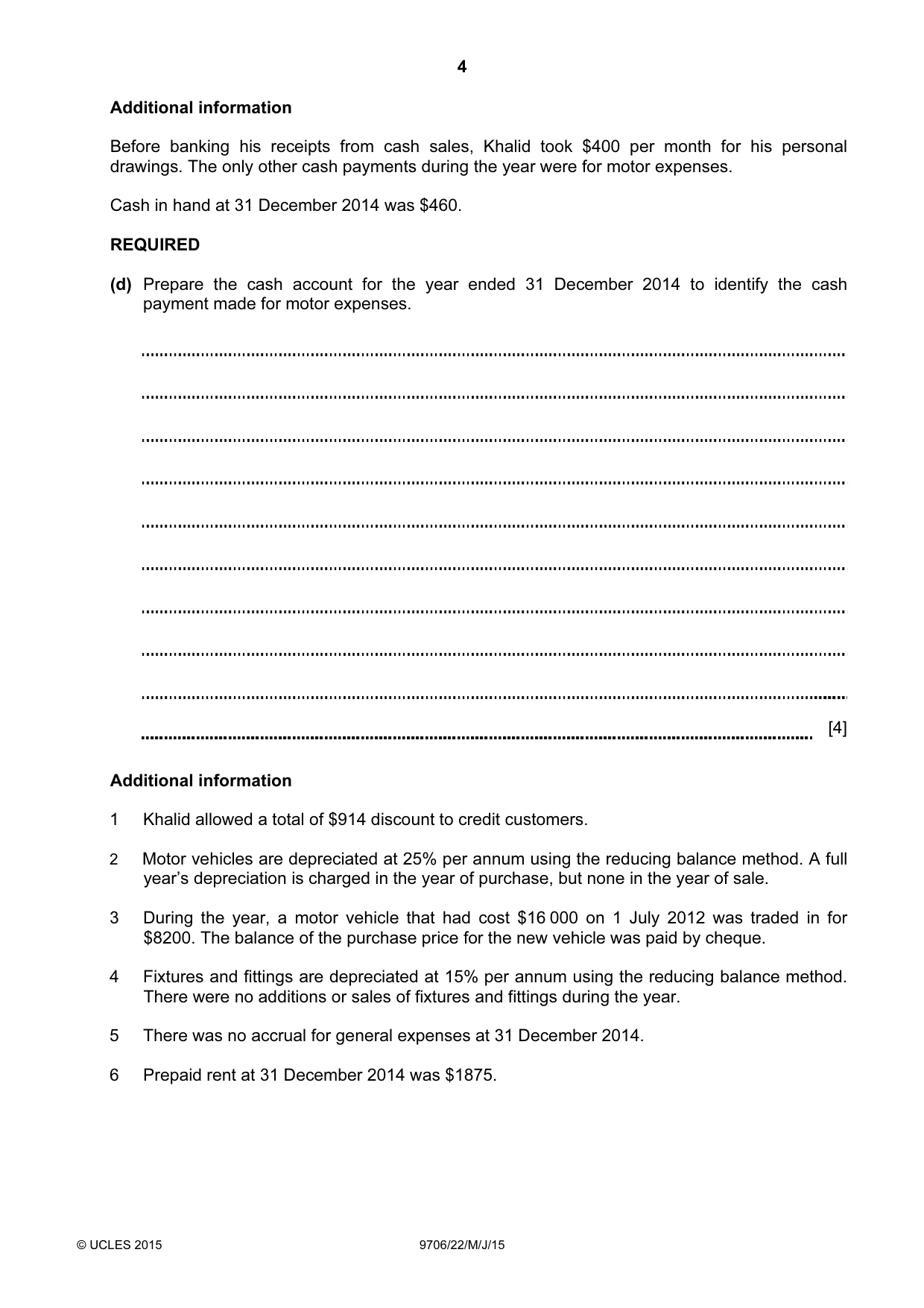
4 © UCLES 2015 9706/22/M/J/15 Additional information Before banking his receipts from cash sales, Khalid took $400 per month for his personal drawings. The only other cash payments during the year were for motor expenses. Cash in hand at 31 December 2014 was $460. REQUIRED (d) Prepare the cash account for the year ended 31 December 2014 to identify the cash payment made for motor expenses. [4] Additional information 1 Khalid allowed a total of $914 discount to credit customers. 2 Motor vehicles are depreciated at 25% per annum using the reducing balance method. A full year’s depreciation is charged in the year of purchase, but none in the year of sale. 3 During the year, a motor vehicle that had cost $16 000 on 1 July 2012 was traded in for $8200. The balance of the purchase price for the new vehicle was paid by cheque. 4 Fixtures and fittings are depreciated at 15% per annum using the reducing balance method. There were no additions or sales of fixtures and fittings during the year. 5 There was no accrual for general expenses at 31 December 2014. 6 Prepaid rent at 31 December 2014 was $1875.
Question paper, page 5
5 © UCLES 2015 9706/22/M/J/15 [Turn over REQUIRED (e) Prepare Khalid’s income statement for the year ended 31 December 2014. [16] [Total: 30]
Question paper, page 6
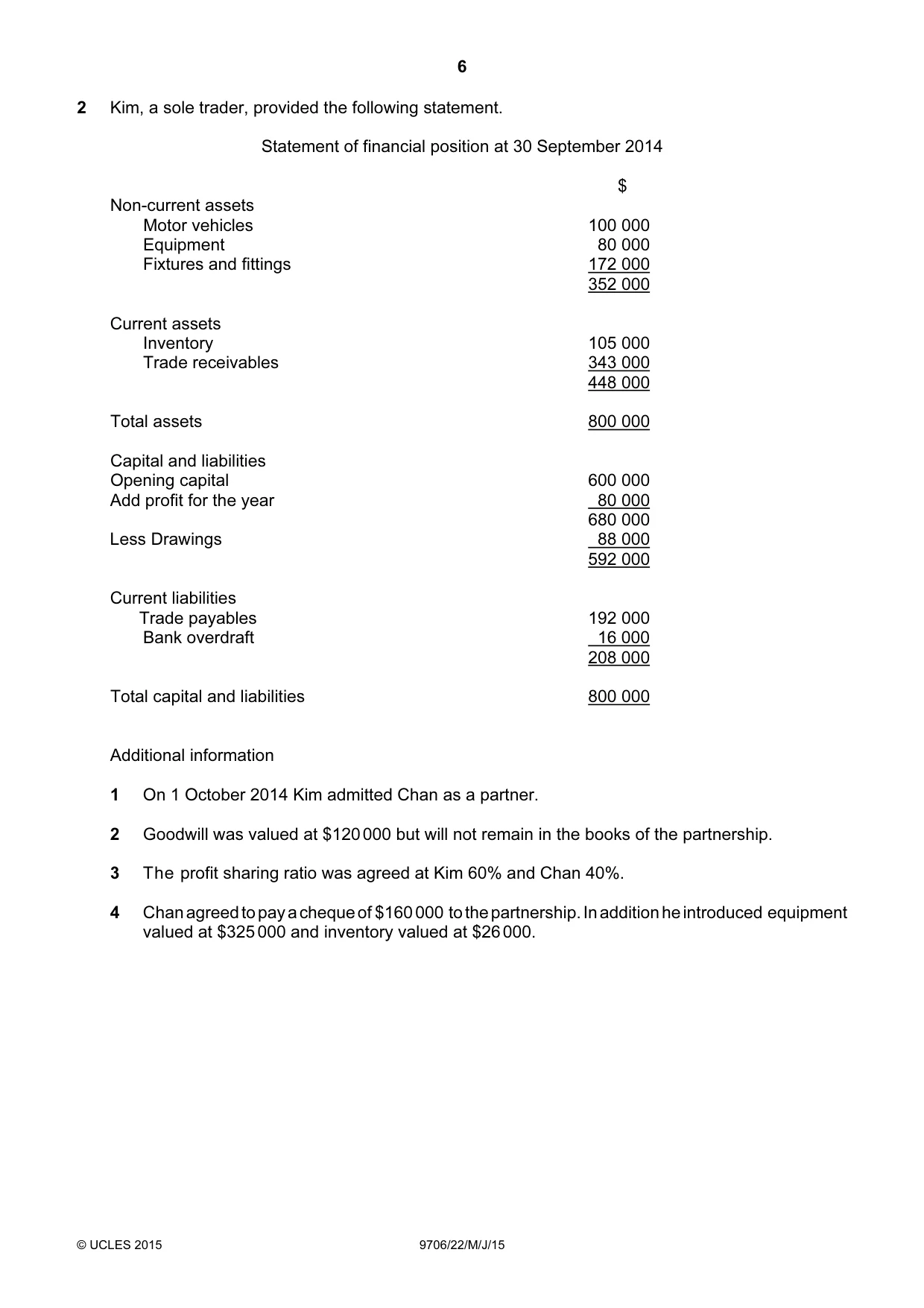
6 © UCLES 2015 9706/22/M/J/15 2 Kim, a sole trader, provided the following statement. Statement of financial position at 30 September 2014 $ Non-current assets Motor vehicles 100 000 Equipment 80 000 Fixtures and fittings 172 000 352 000 Current assets Inventory 105 000 Trade receivables 343 000 448 000 Total assets 800 000 Capital and liabilities Opening capital 600 000 Add profit for the year 80 000 680 000 Less Drawings 88 000 592 000 Current liabilities Trade payables 192 000 Bank overdraft 16 000 208 000 Total capital and liabilities 800 000 Additional information 1 On 1 October 2014 Kim admitted Chan as a partner. 2 Goodwill was valued at $120 000 but will not remain in the books of the partnership. 3 The profit sharing ratio was agreed at Kim 60% and Chan 40%. 4 Chan agreed to pay a cheque of $160 000 to the partnership. In addition he introduced equipment valued at $325 000 and inventory valued at $26 000.
Question paper, page 7
7 © UCLES 2015 9706/22/M/J/15 [Turn over REQUIRED (a) Prepare the capital accounts of Kim and Chan at 1 October 2014. [10]
Question paper, page 8
8 © UCLES 2015 9706/22/M/J/15 (b) Prepare a statement of financial position for the partnership at 1 October 2014. [8]
Question paper, page 9
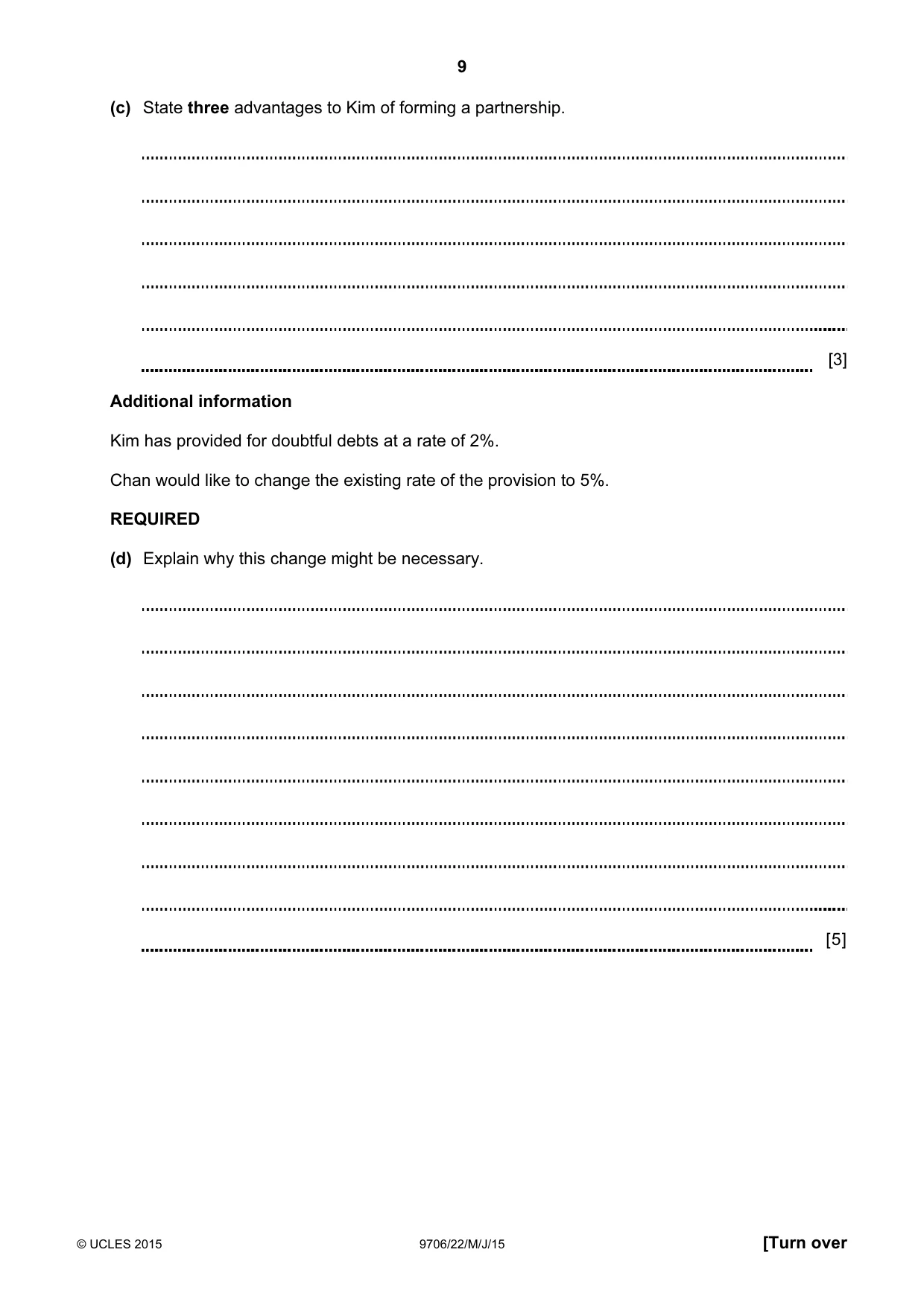
9 © UCLES 2015 9706/22/M/J/15 [Turn over (c) State three advantages to Kim of forming a partnership. [3] Additional information Kim has provided for doubtful debts at a rate of 2%. Chan would like to change the existing rate of the provision to 5%. REQUIRED (d) Explain why this change might be necessary. [5]
Question paper, page 10
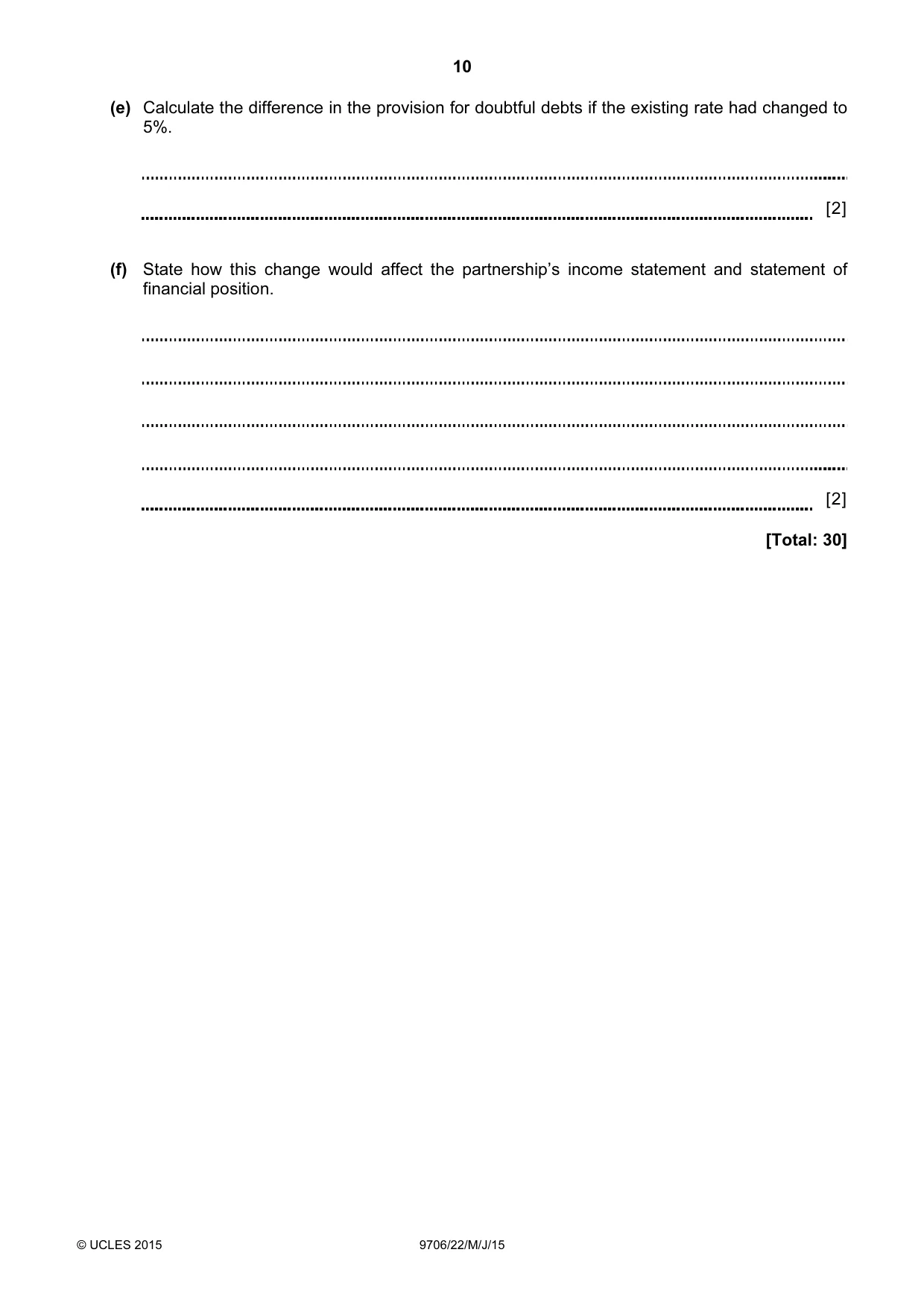
10 © UCLES 2015 9706/22/M/J/15 (e) Calculate the difference in the provision for doubtful debts if the existing rate had changed to 5%. [2] (f) State how this change would affect the partnership’s income statement and statement of financial position. [2] [Total: 30]
Question paper, page 11
11 © UCLES 2015 9706/22/M/J/15 [Turn over BLANK PAGE
Question paper, page 12
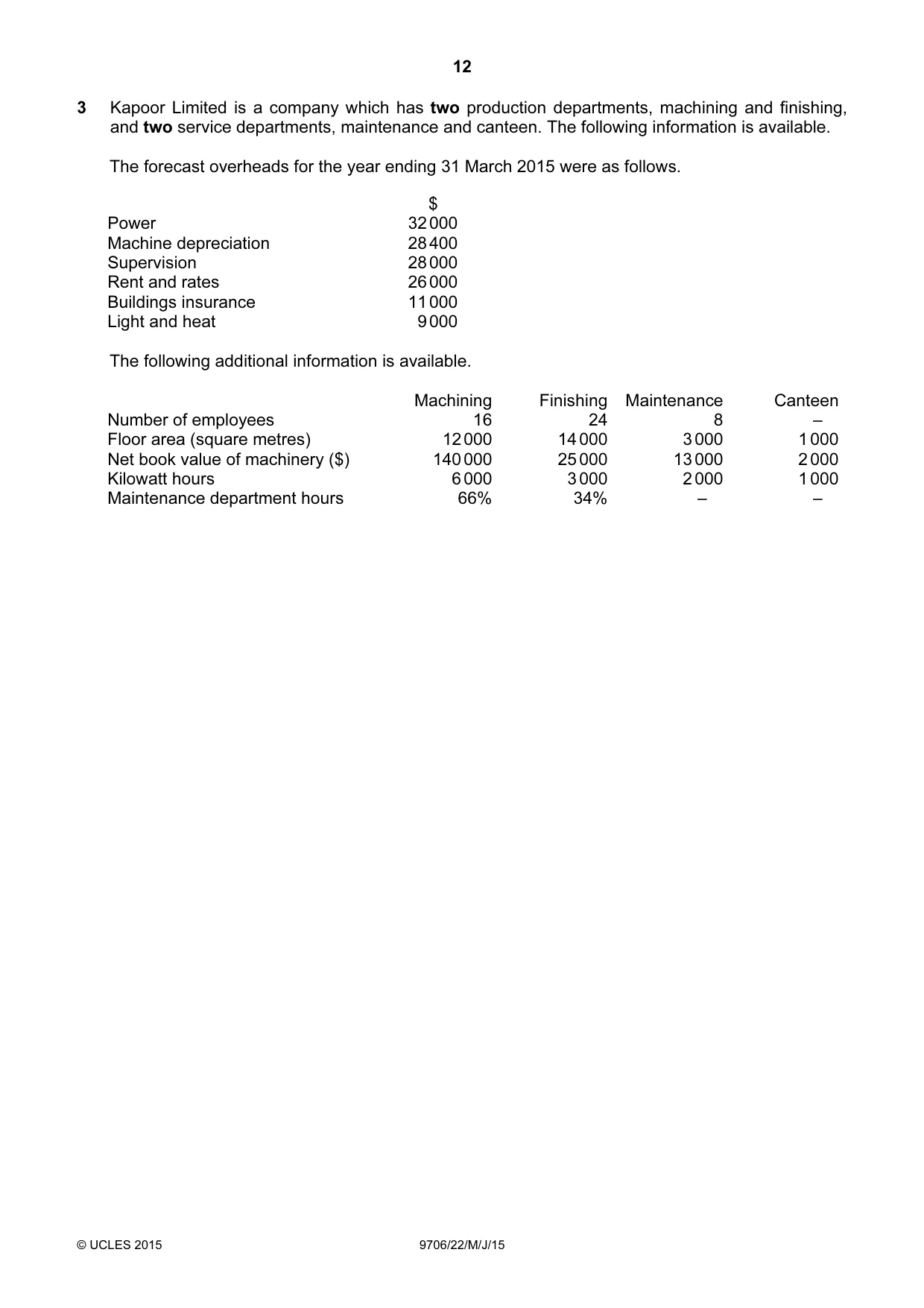
12 © UCLES 2015 9706/22/M/J/15 3 Kapoor Limited is a company which has two production departments, machining and finishing, and two service departments, maintenance and canteen. The following information is available. The forecast overheads for the year ending 31 March 2015 were as follows. $ Power 32 000 Machine depreciation 28 400 Supervision 28 000 Rent and rates 26 000 Buildings insurance 11 000 Light and heat 9 000 The following additional information is available. Machining Finishing Maintenance Canteen Number of employees 16 24 8 – Floor area (square metres) 12 000 14 000 3 000 1 000 Net book value of machinery ($) 140 000 25 000 13 000 2 000 Kilowatt hours 6 000 3 000 2 000 1 000 Maintenance department hours 66% 34% – –
Question paper, page 13
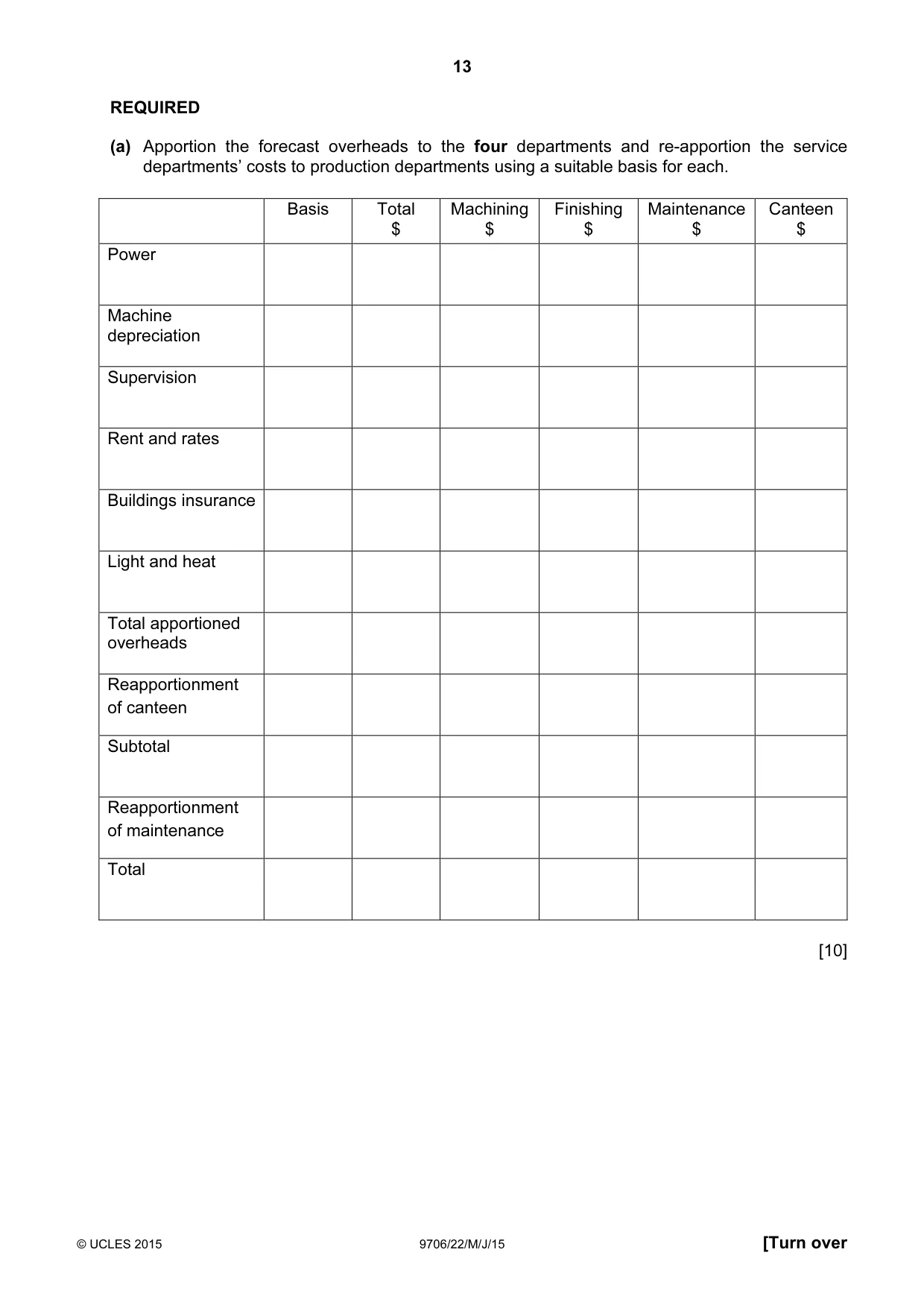
13 © UCLES 2015 9706/22/M/J/15 [Turn over REQUIRED (a) Apportion the forecast overheads to the four departments and re-apportion the service departments’ costs to production departments using a suitable basis for each. Basis Total $ Machining $ Finishing $ Maintenance $ Canteen $ Power Machine depreciation Supervision Rent and rates Buildings insurance Light and heat Total apportioned overheads Reapportionment of canteen Subtotal Reapportionment of maintenance Total [10]
Question paper, page 14
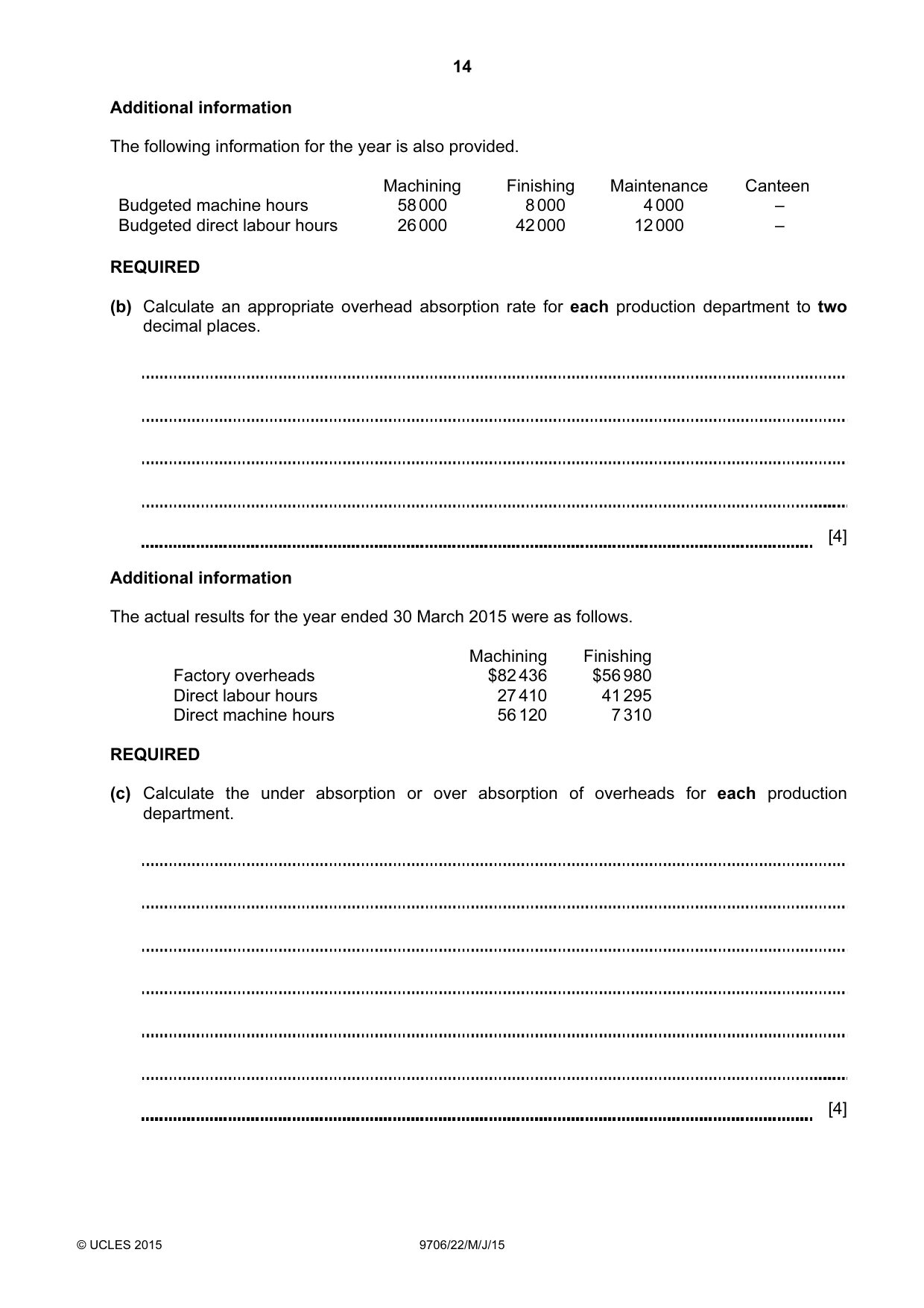
14 © UCLES 2015 9706/22/M/J/15 Additional information The following information for the year is also provided. Machining Finishing Maintenance Canteen Budgeted machine hours 58 000 8 000 4 000 – Budgeted direct labour hours 26 000 42 000 12 000 – REQUIRED (b) Calculate an appropriate overhead absorption rate for each production department to two decimal places. [4] Additional information The actual results for the year ended 30 March 2015 were as follows. Machining Finishing Factory overheads $82 436 $56 980 Direct labour hours 27 410 41 295 Direct machine hours 56 120 7 310 REQUIRED (c) Calculate the under absorption or over absorption of overheads for each production department. [4]
Question paper, page 15
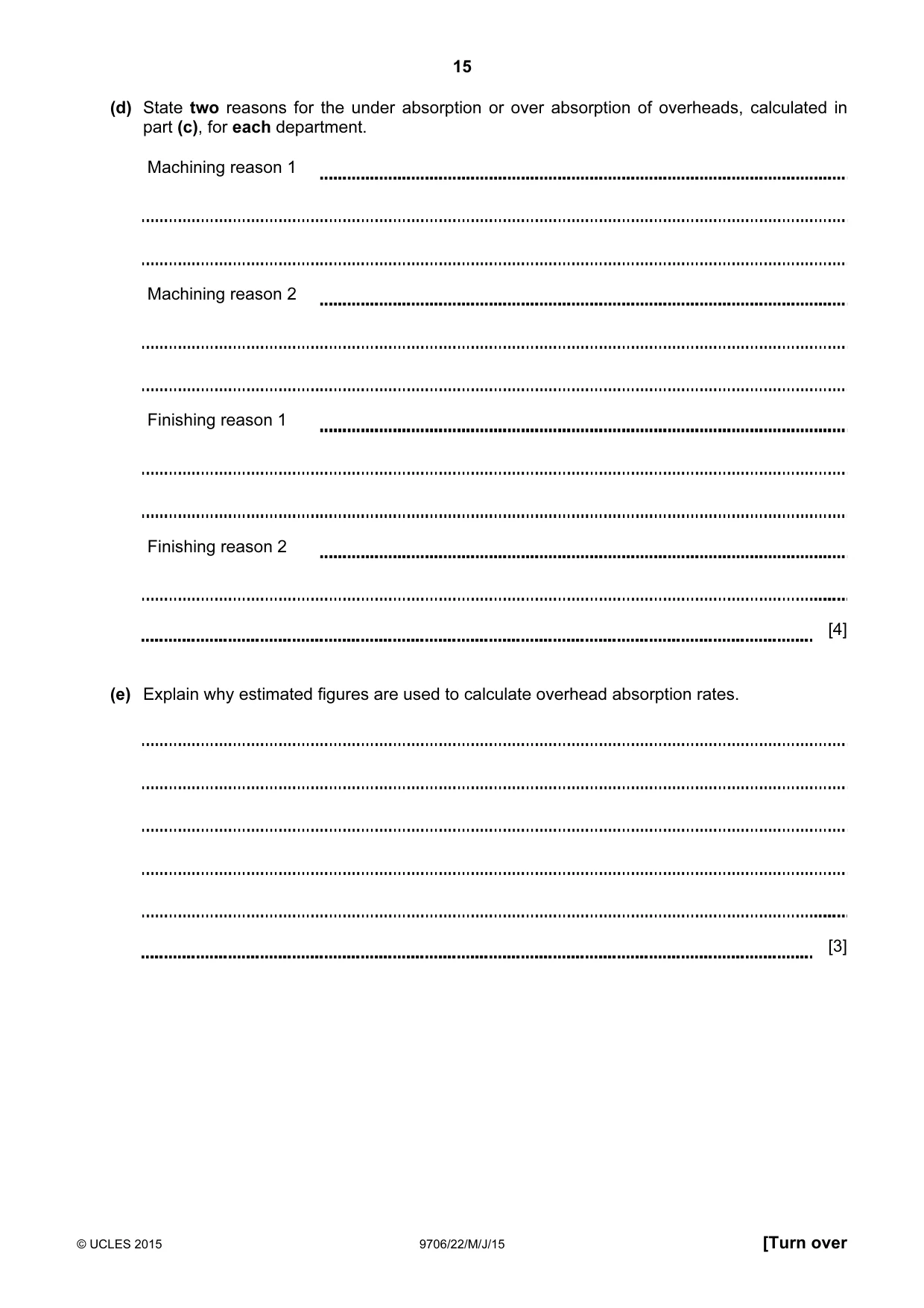
15 © UCLES 2015 9706/22/M/J/15 [Turn over (d) State two reasons for the under absorption or over absorption of overheads, calculated in part (c), for each department. Machining reason 1 Machining reason 2 Finishing reason 1 Finishing reason 2 [4] (e) Explain why estimated figures are used to calculate overhead absorption rates. [3]
Question paper, page 16
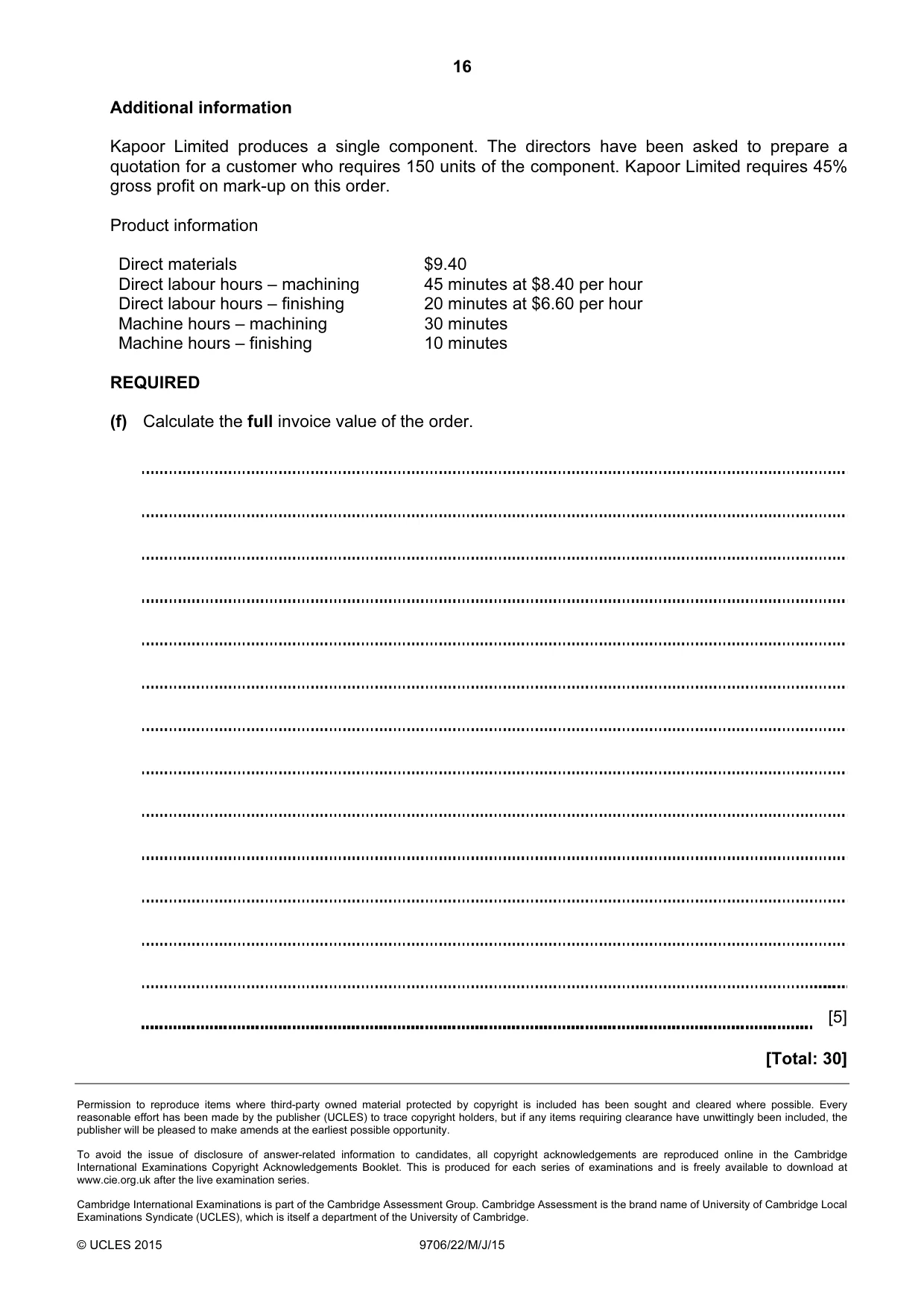
16 Permission to reproduce items where third-party owned material protected by copyright is included has been sought and cleared where possible. Every reasonable effort has been made by the publisher (UCLES) to trace copyright holders, but if any items requiring clearance have unwittingly been included, the publisher will be pleased to make amends at the earliest possible opportunity. To avoid the issue of disclosure of answer-related information to candidates, all copyright acknowledgements are reproduced online in the Cambridge International Examinations Copyright Acknowledgements Booklet. This is produced for each series of examinations and is freely available to download at www.cie.org.uk after the live examination series. Cambridge International Examinations is part of the Cambridge Assessment Group. Cambridge Assessment is the brand name of University of Cambridge Local Examinations Syndicate (UCLES), which is itself a department of the University of Cambridge. © UCLES 2015 9706/22/M/J/15 Additional information Kapoor Limited produces a single component. The directors have been asked to prepare a quotation for a customer who requires 150 units of the component. Kapoor Limited requires 45% gross profit on mark-up on this order. Product information Direct materials $9.40 Direct labour hours – machining 45 minutes at $8.40 per hour Direct labour hours – finishing 20 minutes at $6.60 per hour Machine hours – machining 30 minutes Machine hours – finishing 10 minutes REQUIRED (f) Calculate the full invoice value of the order. [5] [Total: 30]
What you needed in this session
Cambridge’s own grade thresholds for 2015 May/June, Paper 2 · Variant 2. A higher threshold means an easier paper — the bar moves with how the cohort did.