Cambridge A Level Accounting 9706 — 2015 May/June Paper 2 · Variant 3
9706/23/M/J/15 · 90 marks · ≈101 min
The question paper and its mark scheme, free to read here and free to download. This is Cambridge’s own paper, exactly as it was sat.
Question paper12 pages
Mark scheme6 pages
Answers below. Sit the paper first if you are practising.
Paper as text
Question paper, page 1
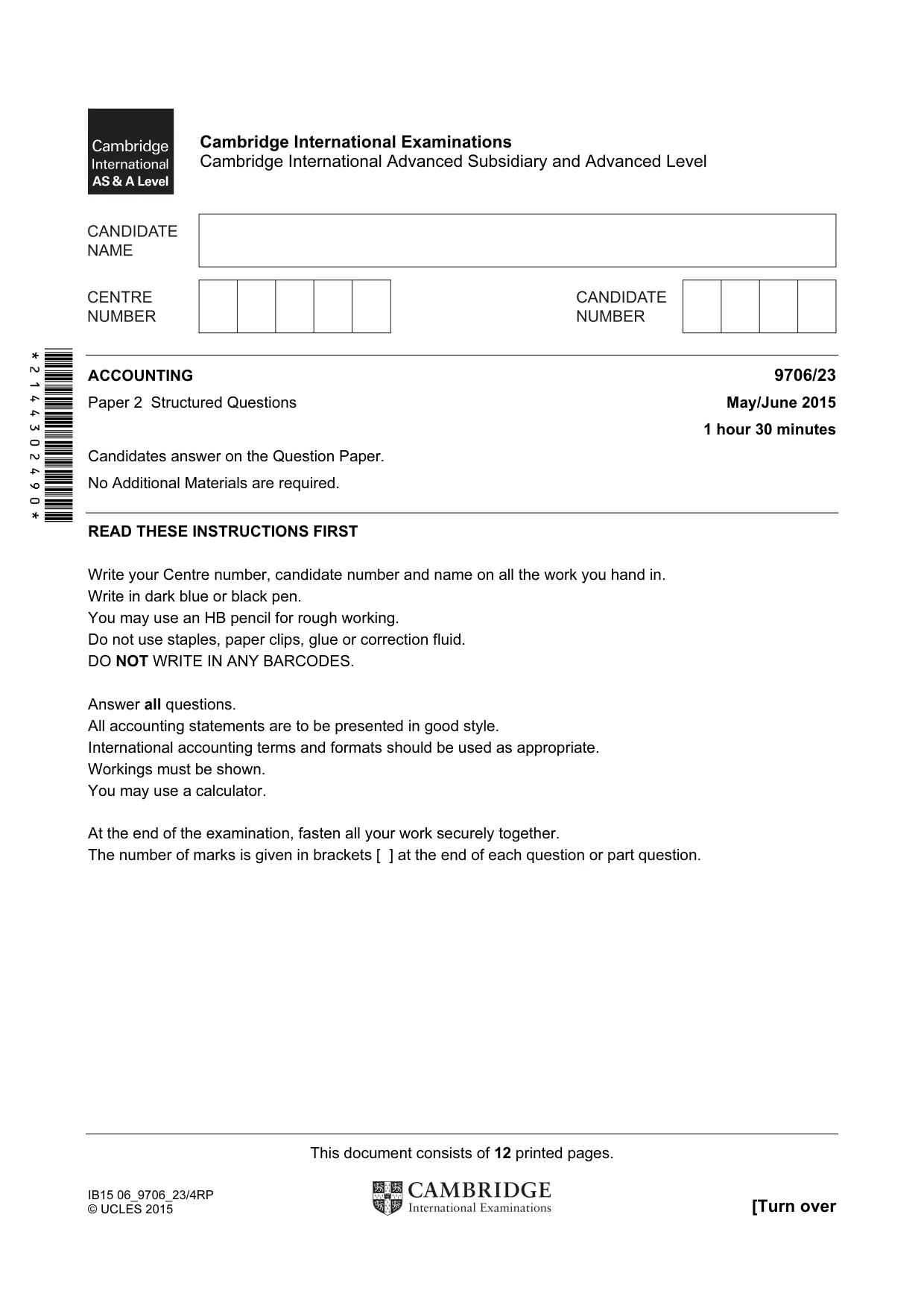
This document consists of 12 printed pages. IB15 06_9706_23/4RP © UCLES 2015 [Turn over *2144302490* Cambridge International Examinations Cambridge International Advanced Subsidiary and Advanced Level ACCOUNTING 9706/23 Paper 2 Structured Questions May/June 2015 1 hour 30 minutes Candidates answer on the Question Paper. No Additional Materials are required. READ THESE INSTRUCTIONS FIRST Write your Centre number, candidate number and name on all the work you hand in. Write in dark blue or black pen. You may use an HB pencil for rough working. Do not use staples, paper clips, glue or correction fluid. DO NOT WRITE IN ANY BARCODES. Answer all questions. All accounting statements are to be presented in good style. International accounting terms and formats should be used as appropriate. Workings must be shown. You may use a calculator. At the end of the examination, fasten all your work securely together. The number of marks is given in brackets [ ] at the end of each question or part question.
Question paper, page 2
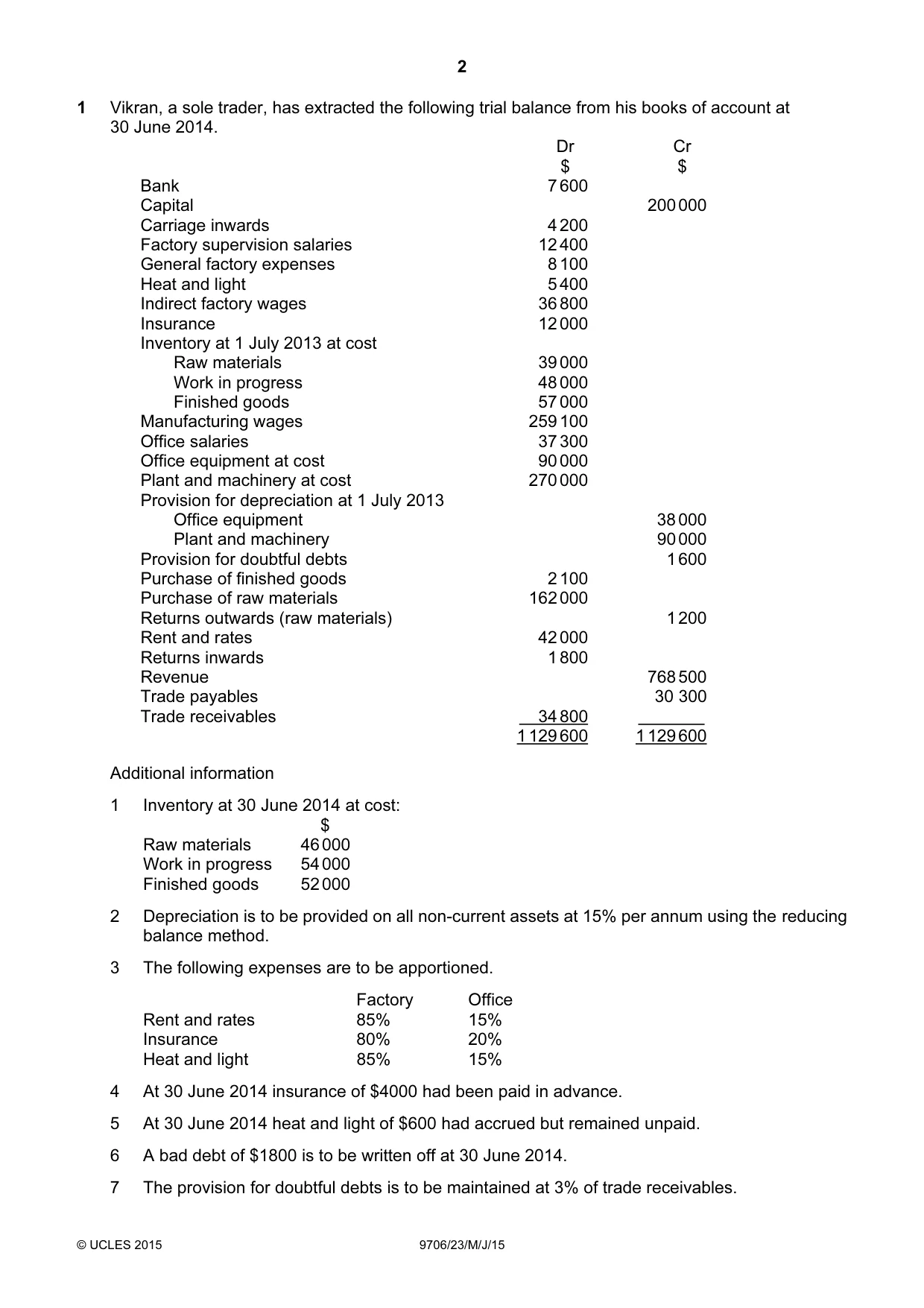
2 © UCLES 2015 9706/23/M/J/15 1 Vikran, a sole trader, has extracted the following trial balance from his books of account at 30 June 2014. Dr $ Cr $ Bank 7 600 Capital 200 000 Carriage inwards 4 200 Factory supervision salaries 12 400 General factory expenses 8 100 Heat and light 5 400 Indirect factory wages 36 800 Insurance 12 000 Inventory at 1 July 2013 at cost Raw materials 39 000 Work in progress 48 000 Finished goods 57 000 Manufacturing wages 259 100 Office salaries Office equipment at cost 37 300 90 000 Plant and machinery at cost 270 000 Provision for depreciation at 1 July 2013 Office equipment 38 000 Plant and machinery 90 000 Provision for doubtful debts 1 600 Purchase of finished goods 2 100 Purchase of raw materials 162 000 Returns outwards (raw materials) 1 200 Rent and rates 42 000 Returns inwards 1 800 Revenue 768 500 Trade payables 30 300 Trade receivables 34 800 1 129 600 1 129 600 Additional information 1 Inventory at 30 June 2014 at cost: $ Raw materials 46 000 Work in progress 54 000 Finished goods 52 000 2 Depreciation is to be provided on all non-current assets at 15% per annum using the reducing balance method. 3 The following expenses are to be apportioned. Factory Office Rent and rates 85% 15% Insurance 80% 20% Heat and light 85% 15% 4 At 30 June 2014 insurance of $4000 had been paid in advance. 5 At 30 June 2014 heat and light of $600 had accrued but remained unpaid. 6 A bad debt of $1800 is to be written off at 30 June 2014. 7 The provision for doubtful debts is to be maintained at 3% of trade receivables.
Question paper, page 3
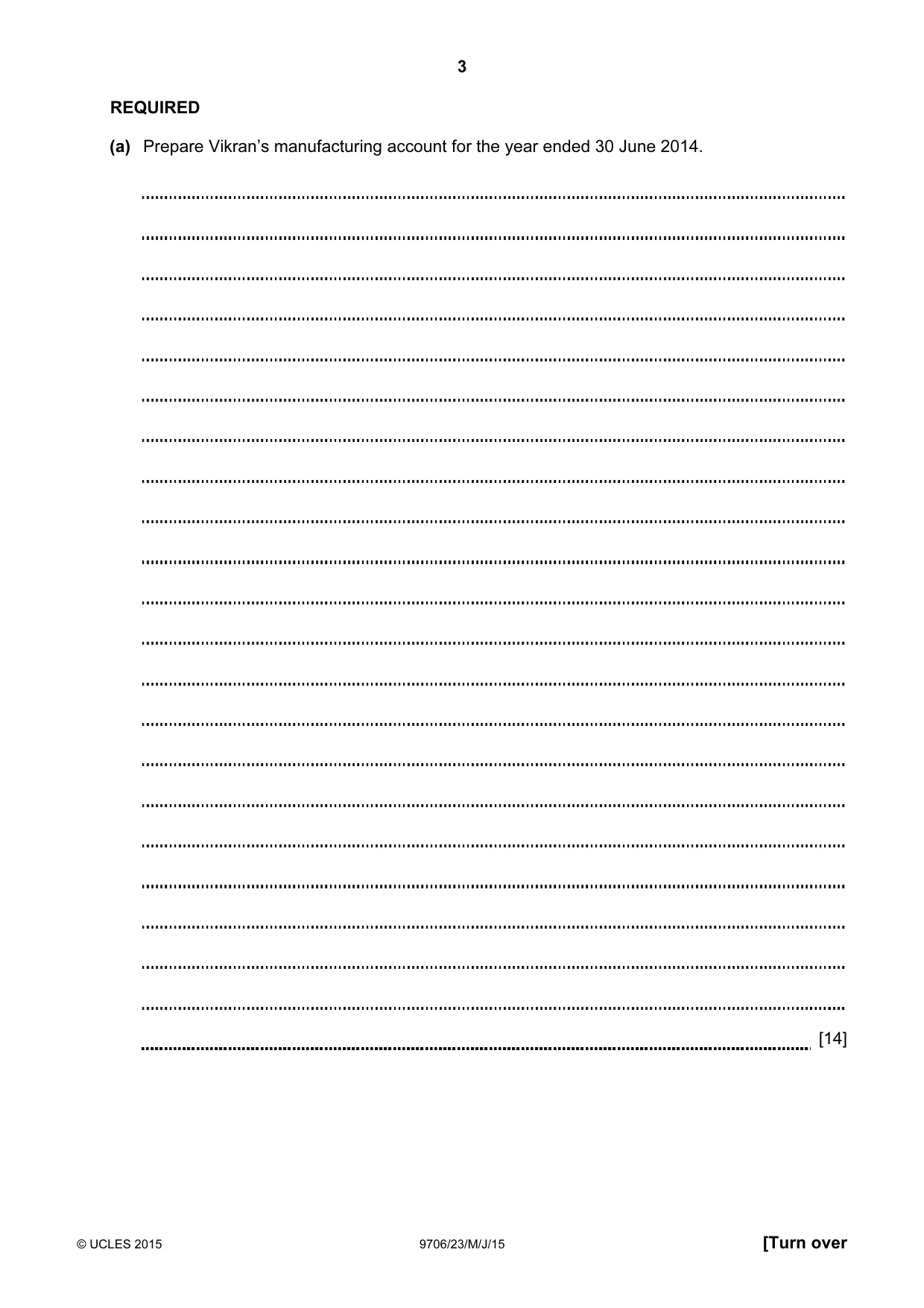
3 © UCLES 2015 9706/23/M/J/15 [Turn over REQUIRED (a) Prepare Vikran’s manufacturing account for the year ended 30 June 2014. [14]
Question paper, page 4
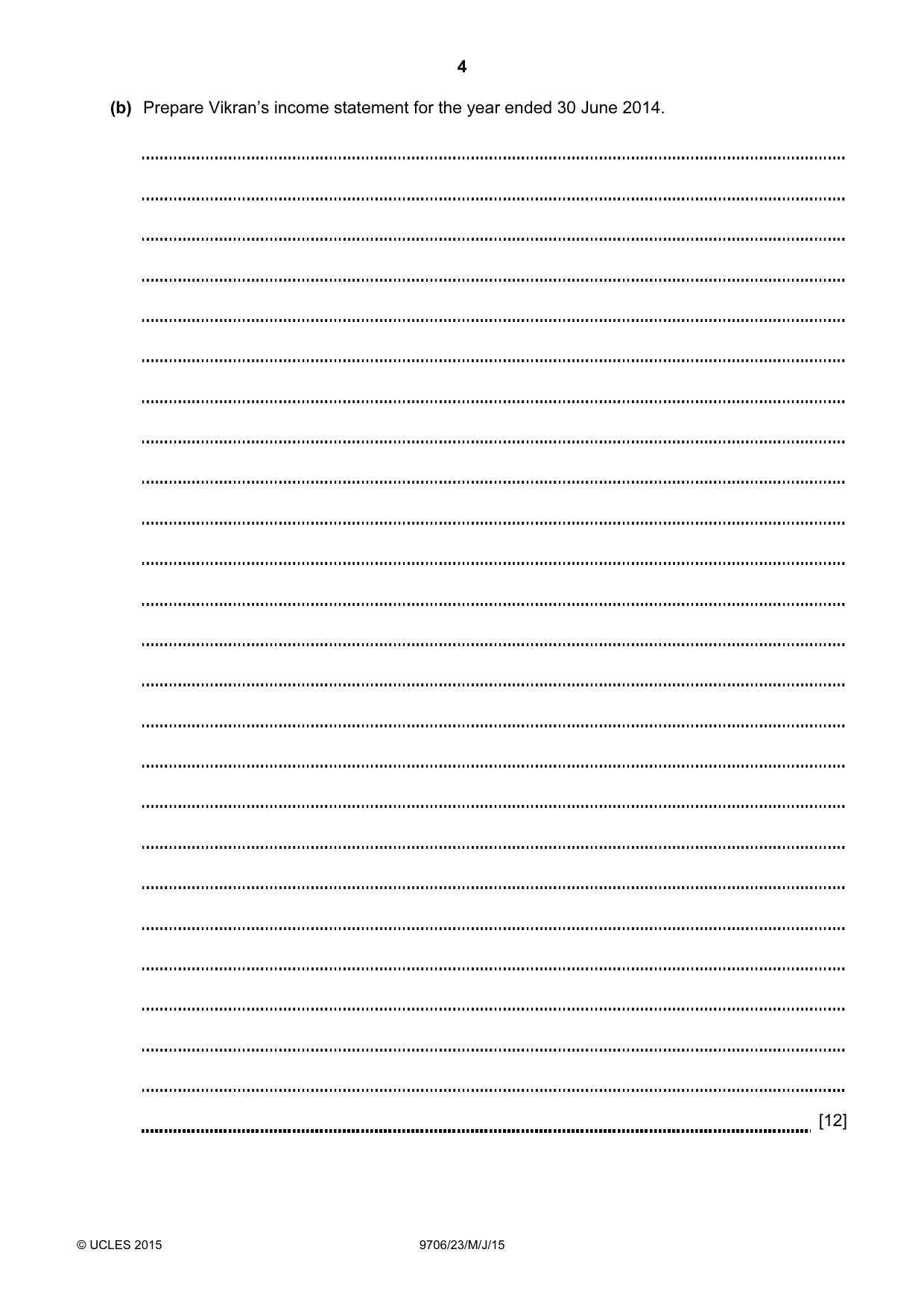
4 © UCLES 2015 9706/23/M/J/15 (b) Prepare Vikran’s income statement for the year ended 30 June 2014. [12]
Question paper, page 5
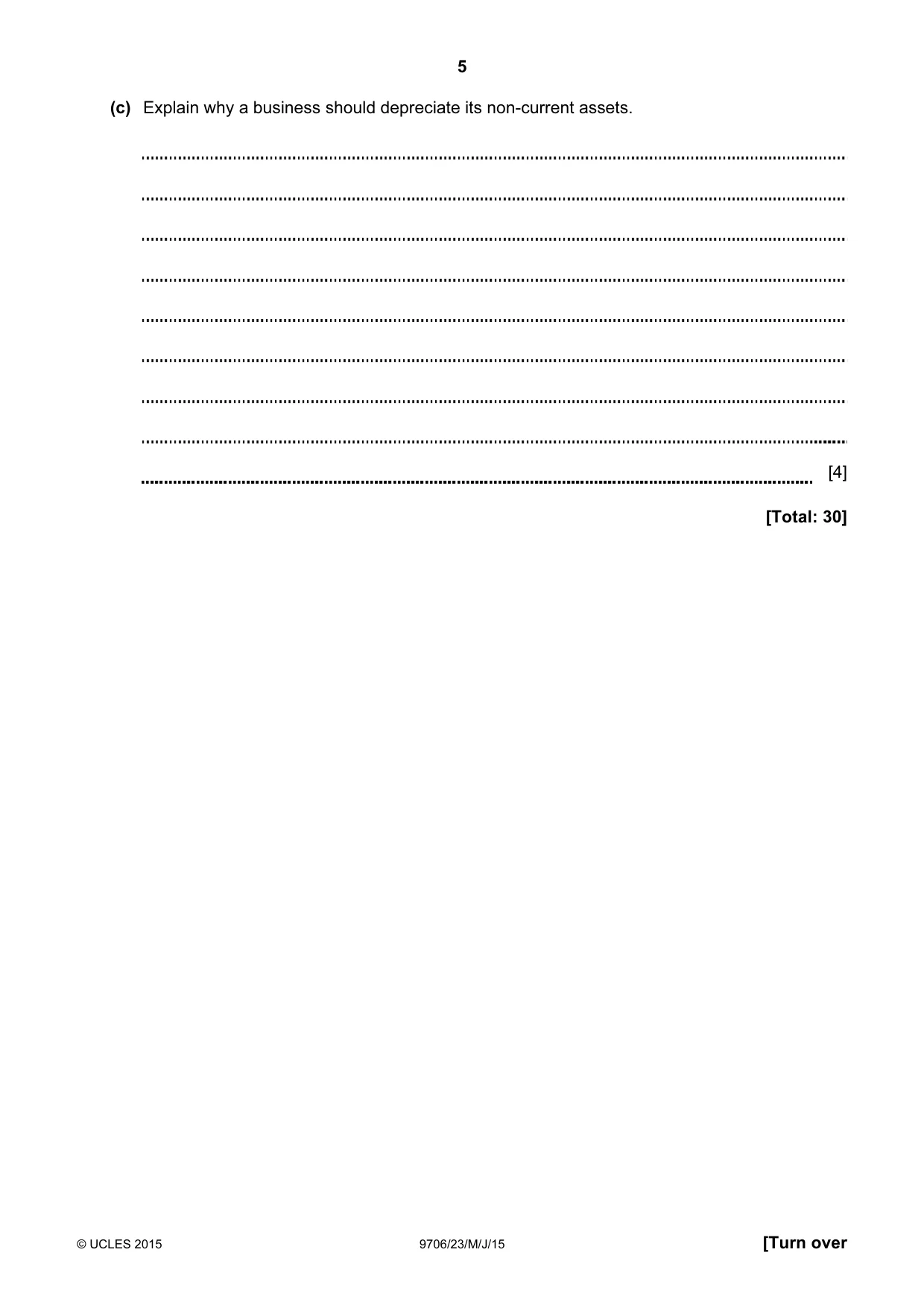
5 © UCLES 2015 9706/23/M/J/15 [Turn over (c) Explain why a business should depreciate its non-current assets. [4] [Total: 30]
Question paper, page 6
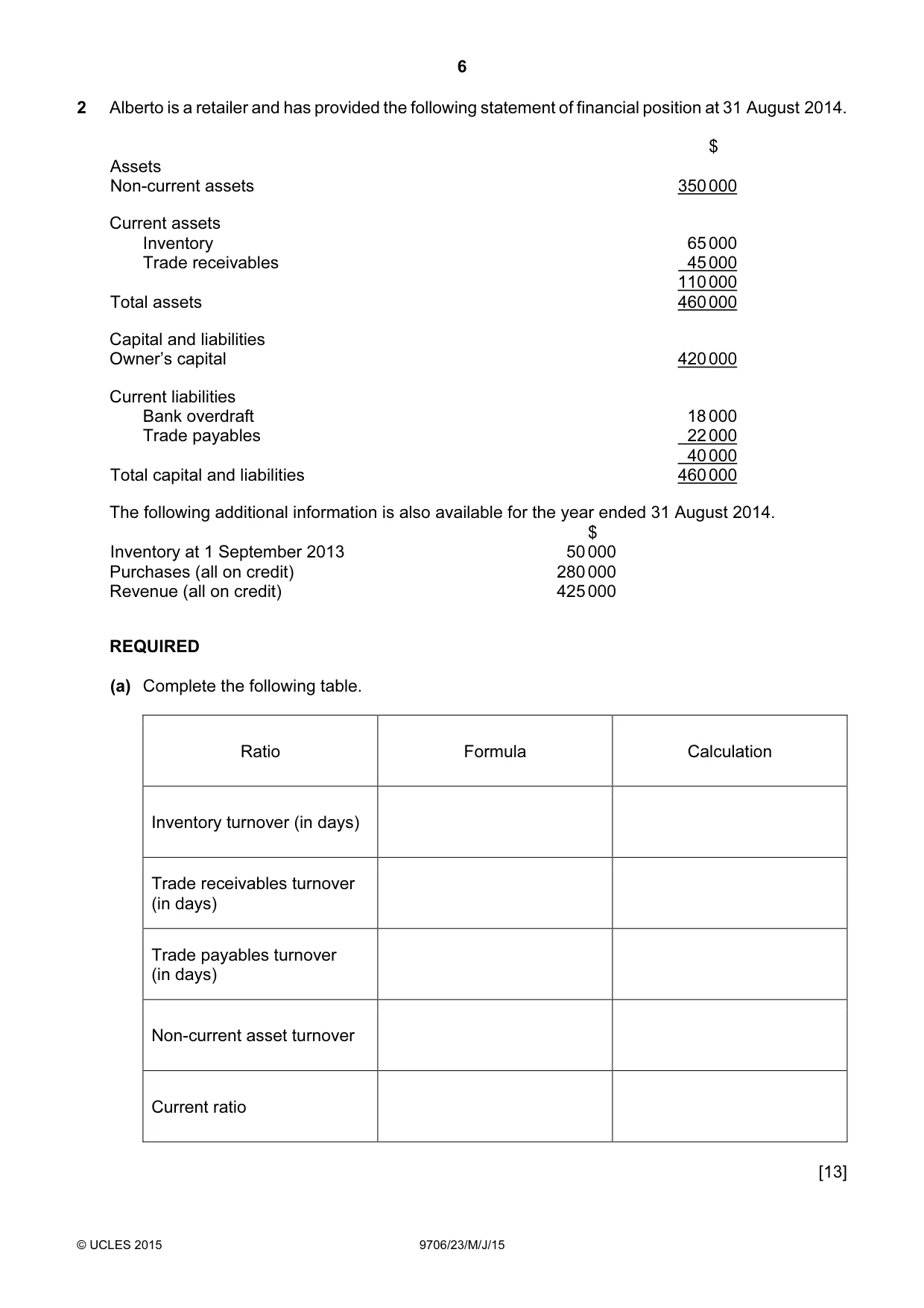
6 © UCLES 2015 9706/23/M/J/15 2 Alberto is a retailer and has provided the following statement of financial position at 31 August 2014. $ Assets Non-current assets 350 000 Current assets Inventory 65 000 Trade receivables 45 000 110 000 Total assets 460 000 Capital and liabilities Owner’s capital 420 000 Current liabilities Bank overdraft 18 000 Trade payables 22 000 40 000 Total capital and liabilities 460 000 The following additional information is also available for the year ended 31 August 2014. $ Inventory at 1 September 2013 50 000 Purchases (all on credit) 280 000 Revenue (all on credit) 425 000 REQUIRED (a) Complete the following table. Ratio Formula Calculation Inventory turnover (in days) Trade receivables turnover (in days) Trade payables turnover (in days) Non-current asset turnover Current ratio [13]
Question paper, page 7
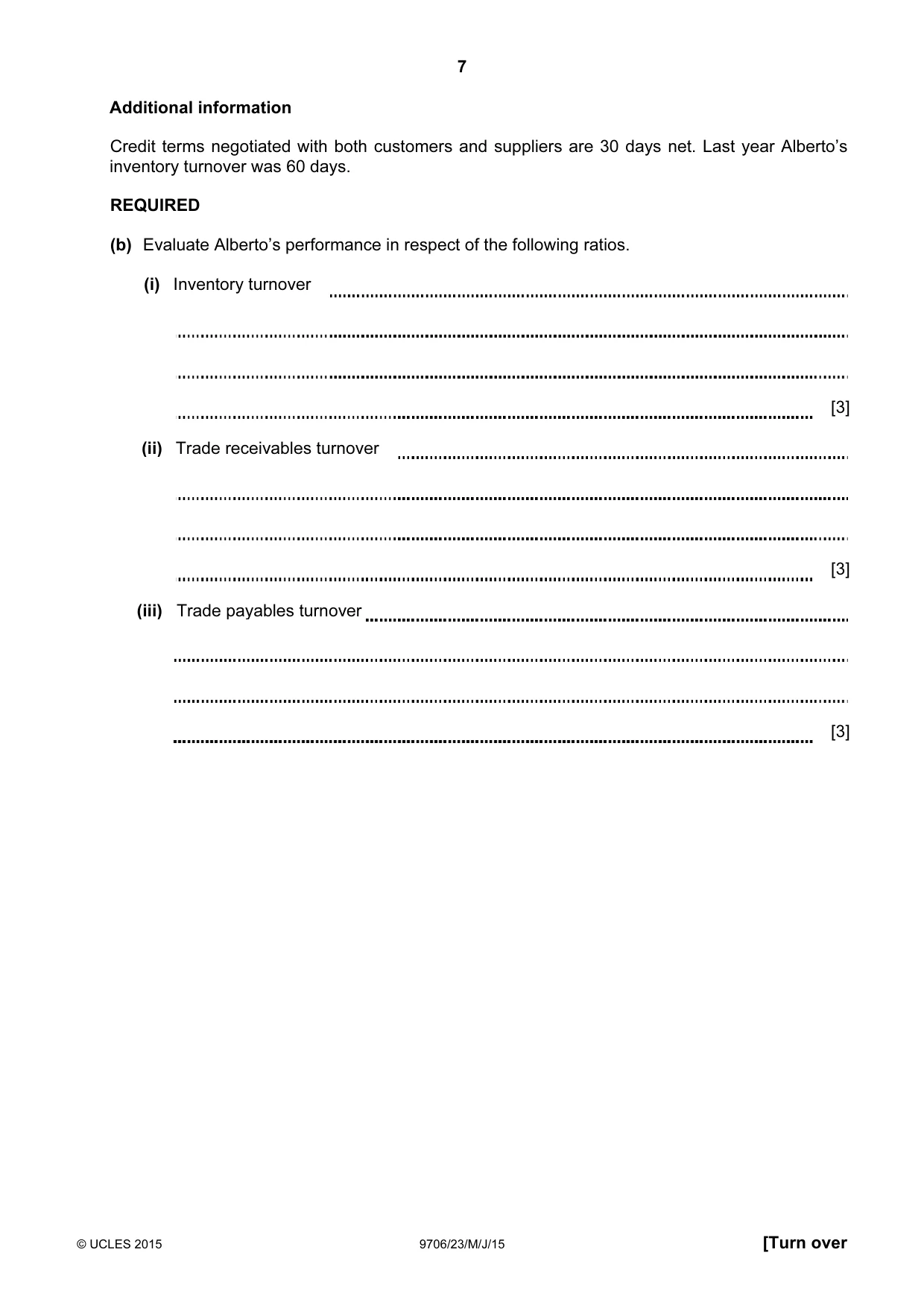
7 © UCLES 2015 9706/23/M/J/15 [Turn over Additional information Credit terms negotiated with both customers and suppliers are 30 days net. Last year Alberto’s inventory turnover was 60 days. REQUIRED (b) Evaluate Alberto’s performance in respect of the following ratios. (i) Inventory turnover [3] (ii) Trade receivables turnover [3] (iii) Trade payables turnover [3]
Question paper, page 8
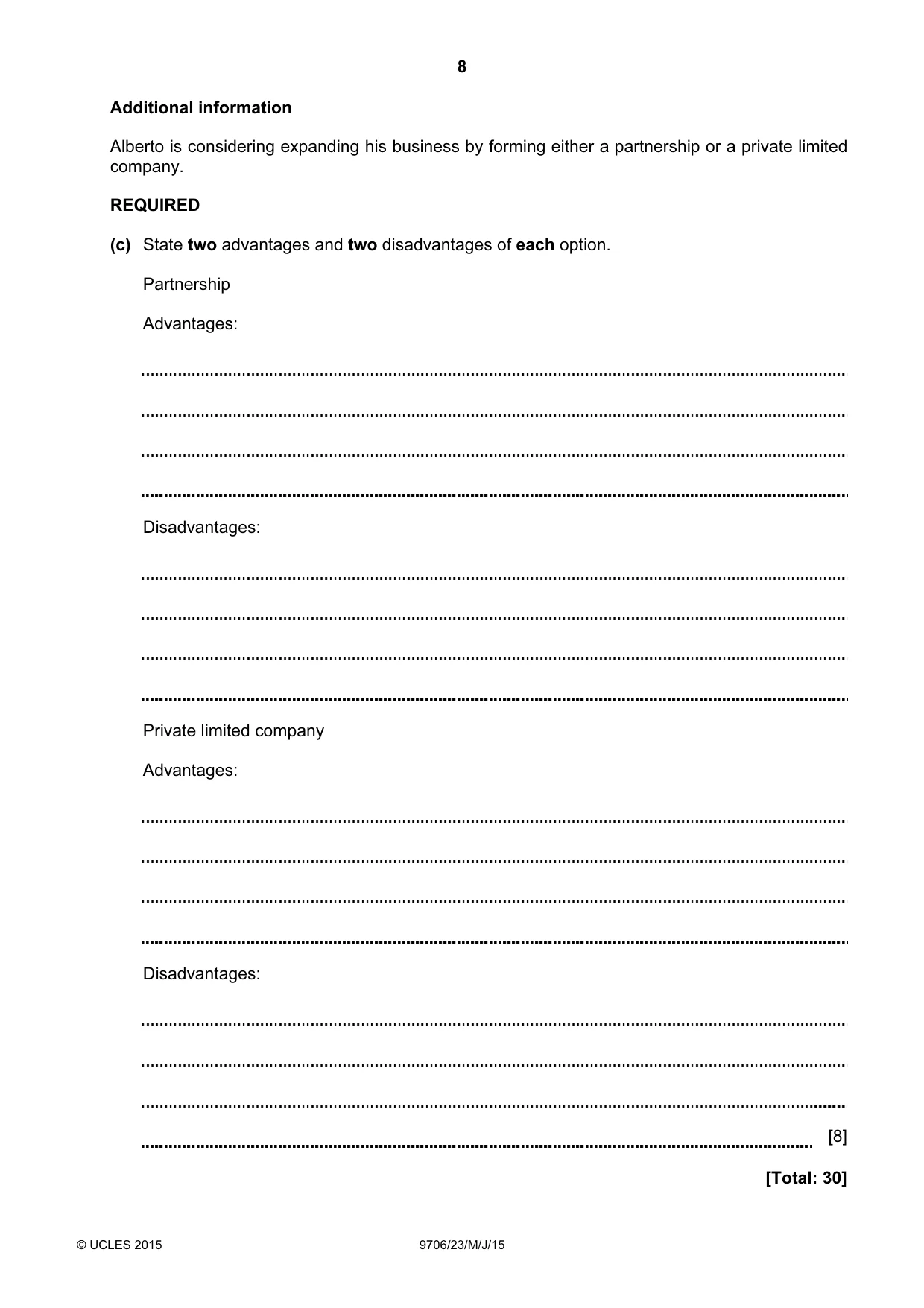
8 © UCLES 2015 9706/23/M/J/15 Additional information Alberto is considering expanding his business by forming either a partnership or a private limited company. REQUIRED (c) State two advantages and two disadvantages of each option. Partnership Advantages: Disadvantages: Private limited company Advantages: Disadvantages: [8] [Total: 30]
Question paper, page 9
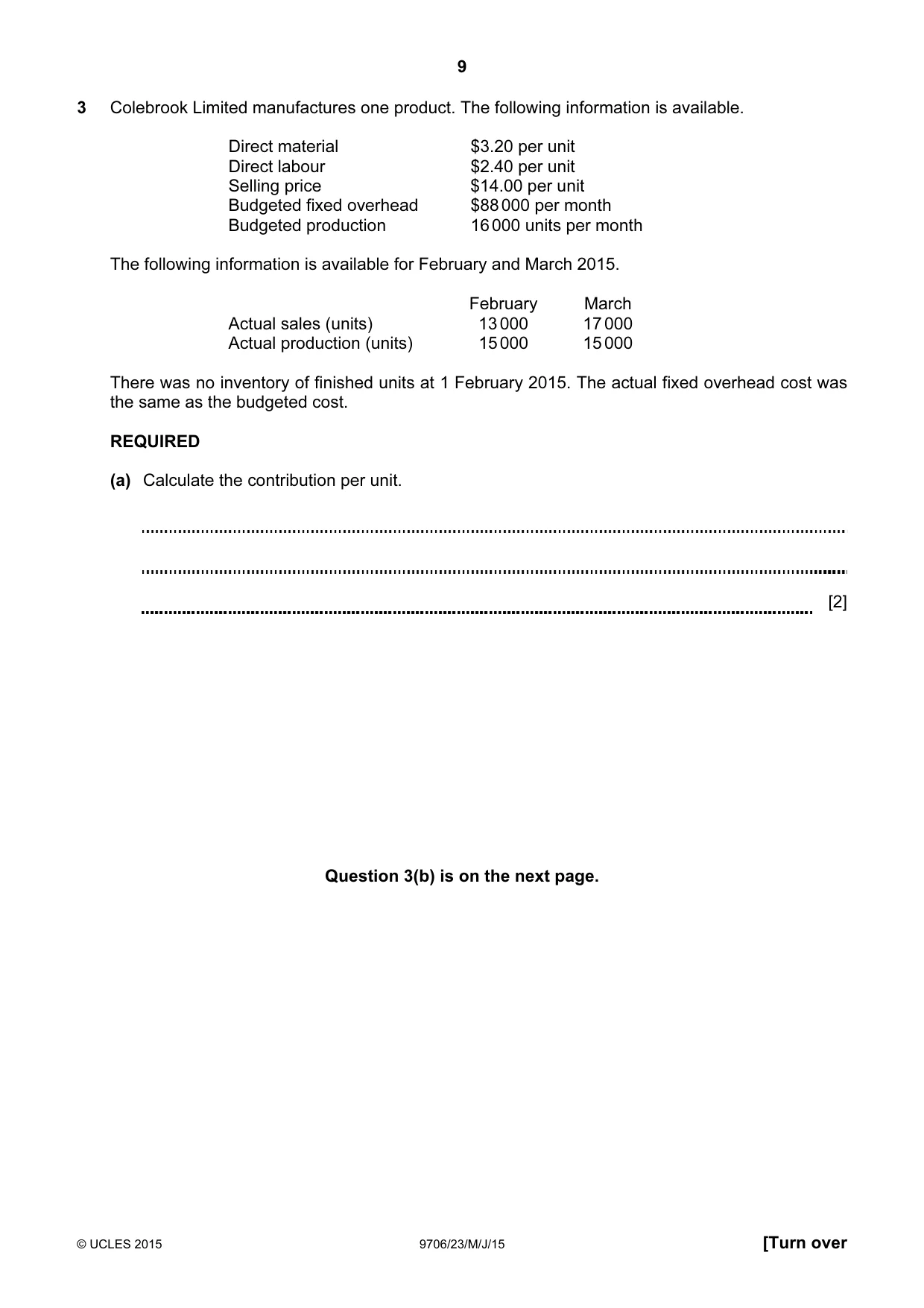
9 © UCLES 2015 9706/23/M/J/15 [Turn over 3 Colebrook Limited manufactures one product. The following information is available. Direct material $3.20 per unit Direct labour $2.40 per unit Selling price $14.00 per unit Budgeted fixed overhead $88 000 per month Budgeted production 16 000 units per month The following information is available for February and March 2015. February March Actual sales (units) 13 000 17 000 Actual production (units) 15 000 15 000 There was no inventory of finished units at 1 February 2015. The actual fixed overhead cost was the same as the budgeted cost. REQUIRED (a) Calculate the contribution per unit. [2] Question 3(b) is on the next page.
Question paper, page 10
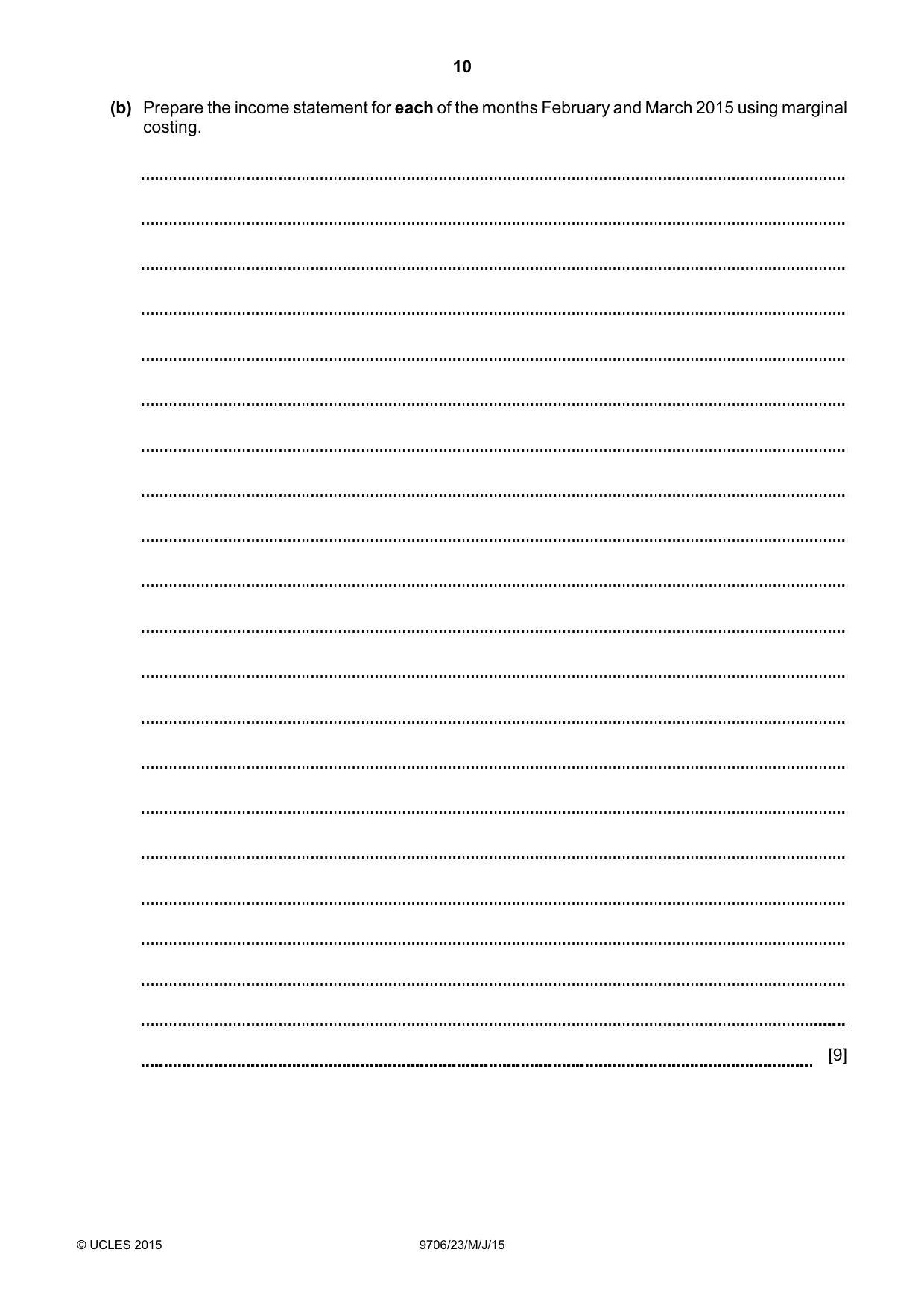
10 © UCLES 2015 9706/23/M/J/15 (b) Prepare the income statement for each of the months February and March 2015 using marginal costing. [9]
Question paper, page 11
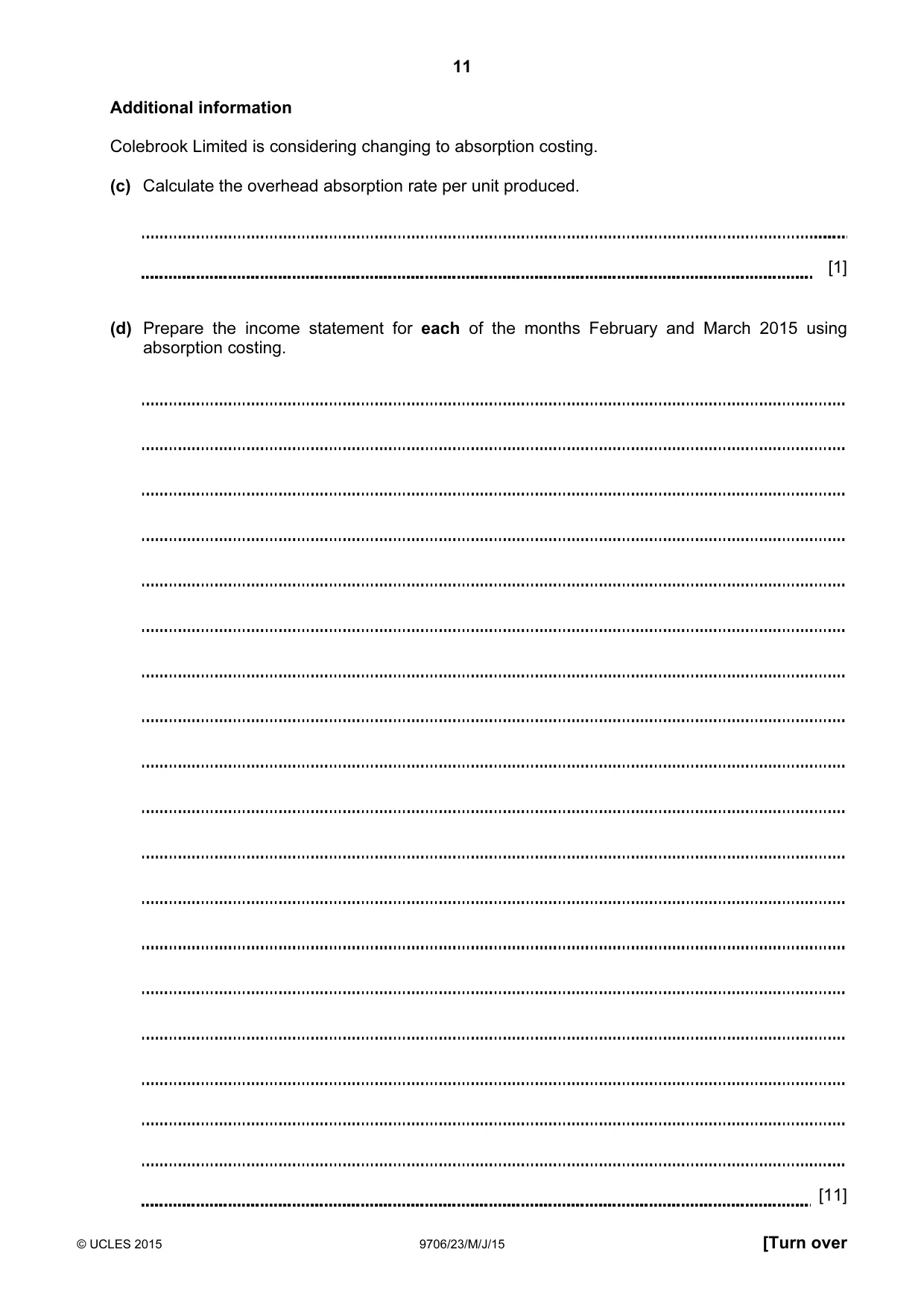
11 © UCLES 2015 9706/23/M/J/15 [Turn over Additional information Colebrook Limited is considering changing to absorption costing. (c) Calculate the overhead absorption rate per unit produced. [1] (d) Prepare the income statement for each of the months February and March 2015 using absorption costing. [11]
Question paper, page 12
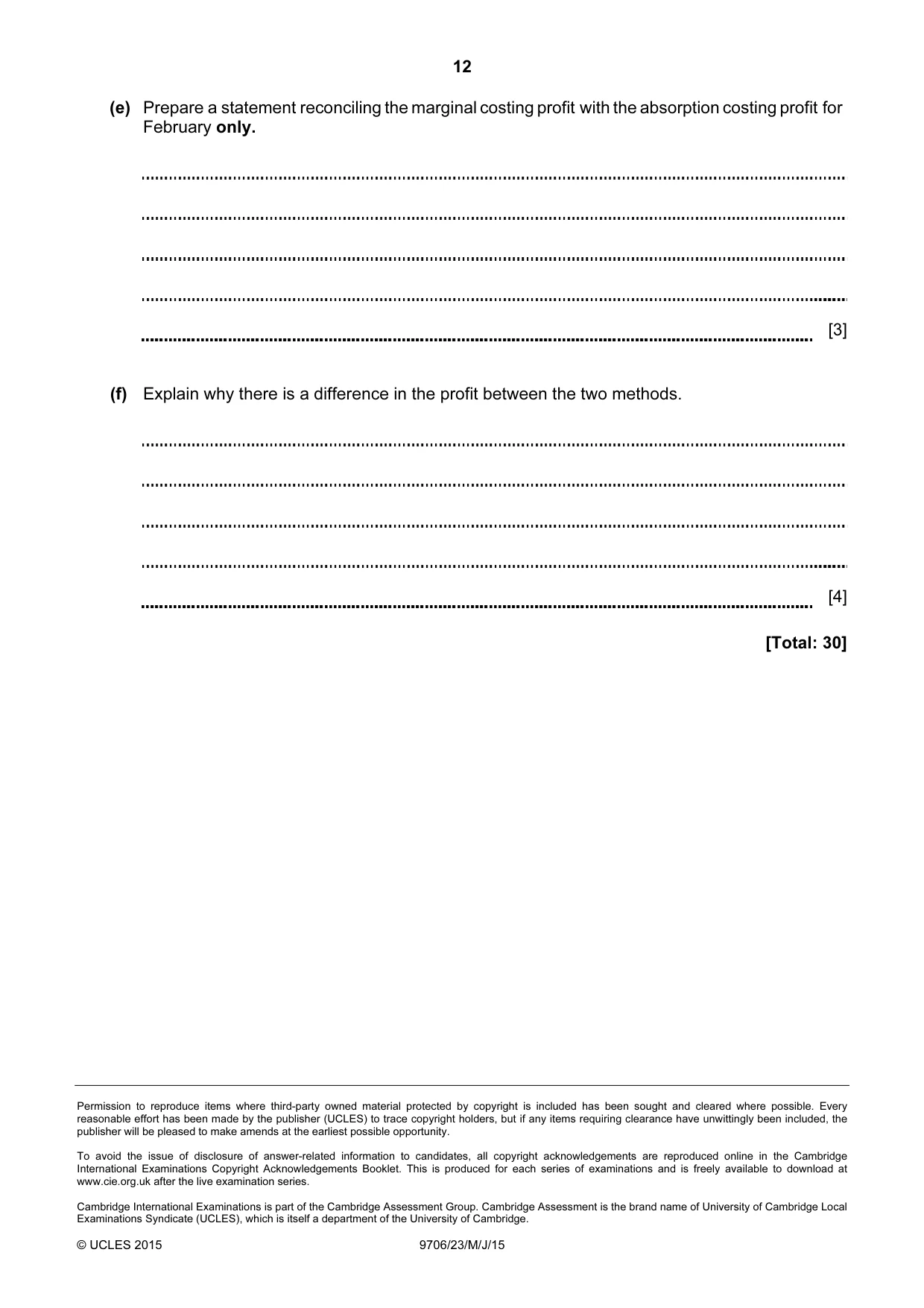
12 Permission to reproduce items where third-party owned material protected by copyright is included has been sought and cleared where possible. Every reasonable effort has been made by the publisher (UCLES) to trace copyright holders, but if any items requiring clearance have unwittingly been included, the publisher will be pleased to make amends at the earliest possible opportunity. To avoid the issue of disclosure of answer-related information to candidates, all copyright acknowledgements are reproduced online in the Cambridge International Examinations Copyright Acknowledgements Booklet. This is produced for each series of examinations and is freely available to download at www.cie.org.uk after the live examination series. Cambridge International Examinations is part of the Cambridge Assessment Group. Cambridge Assessment is the brand name of University of Cambridge Local Examinations Syndicate (UCLES), which is itself a department of the University of Cambridge. © UCLES 2015 9706/23/M/J/15 (e) Prepare a statement reconciling the marginal costing profit with the absorption costing profit for February only. [3] (f) Explain why there is a difference in the profit between the two methods. [4] [Total: 30]
Mark scheme, page 1
® IGCSE is the registered trademark of Cambridge International Examinations. CAMBRIDGE INTERNATIONAL EXAMINATIONS Cambridge International Advanced Subsidiary and Advanced Level MARK SCHEME for the May/June 2015 series 9706 ACCOUNTING 9706/23 Paper 2 (Structured Questions – Core), maximum raw mark 90 This mark scheme is published as an aid to teachers and candidates, to indicate the requirements of the examination. It shows the basis on which Examiners were instructed to award marks. It does not indicate the details of the discussions that took place at an Examiners’ meeting before marking began, which would have considered the acceptability of alternative answers. Mark schemes should be read in conjunction with the question paper and the Principal Examiner Report for Teachers. Cambridge will not enter into discussions about these mark schemes. Cambridge is publishing the mark schemes for the May/June 2015 series for most Cambridge IGCSE®, Cambridge International A and AS Level components and some Cambridge O Level components.
Mark scheme, page 2
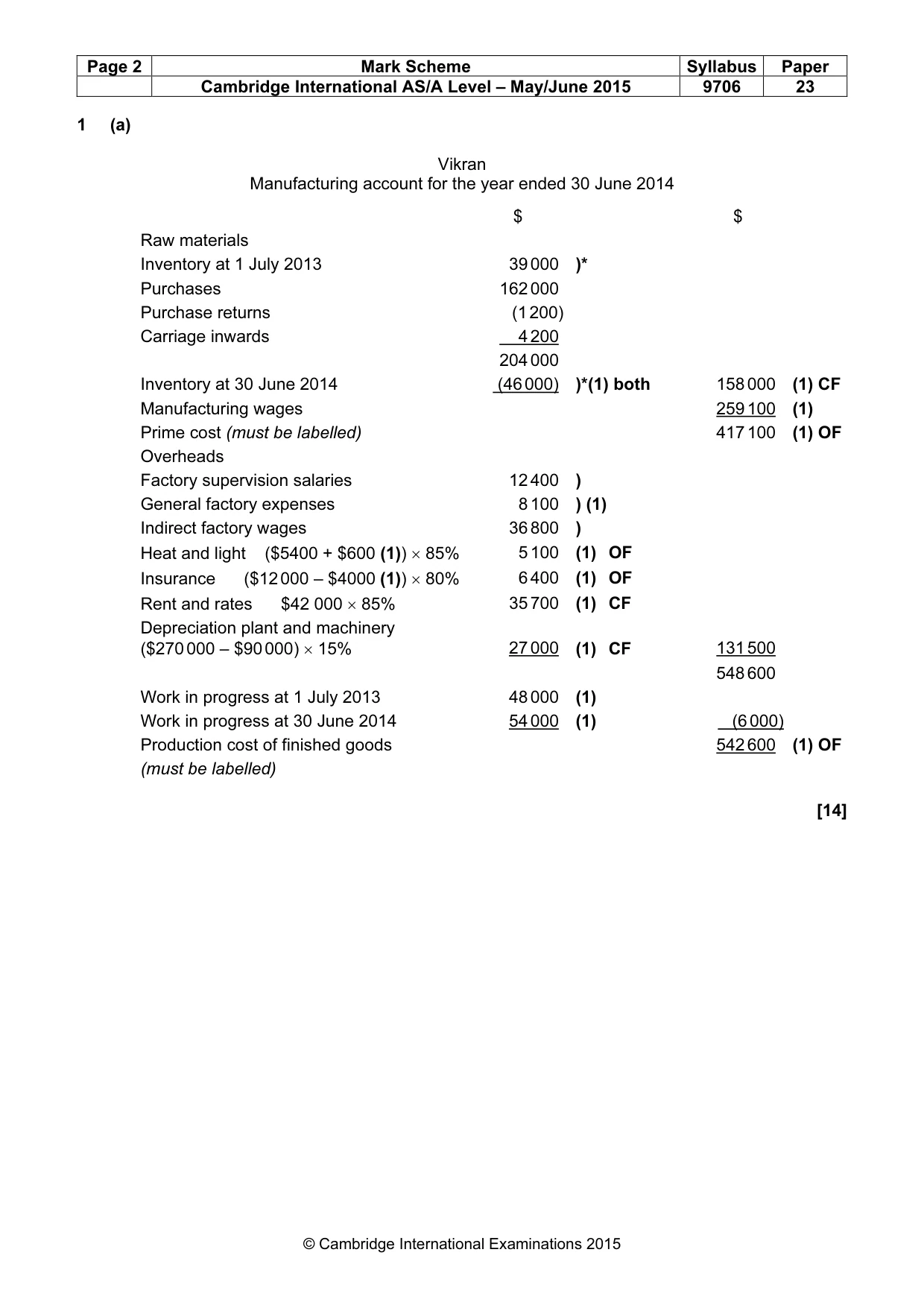
Page 2 Mark Scheme Syllabus Paper Cambridge International AS/A Level – May/June 2015 9706 23 © Cambridge International Examinations 2015 1 (a) Vikran Manufacturing account for the year ended 30 June 2014 $ $ Raw materials Inventory at 1 July 2013 39 000 )* Purchases 162 000 Purchase returns (1 200) Carriage inwards 4 200 204 000 Inventory at 30 June 2014 (46 000) )*(1) both 158 000 (1) CF Manufacturing wages 259 100 (1) Prime cost (must be labelled) 417 100 (1) OF Overheads Factory supervision salaries 12 400 ) General factory expenses 8 100 ) (1) Indirect factory wages 36 800 ) Heat and light ($5400 + $600 (1)) × 85% 5 100 (1) OF Insurance ($12 000 – $4000 (1)) × 80% 6 400 (1) OF Rent and rates $42 000 × 85% 35 700 (1) CF Depreciation plant and machinery ($270 000 – $90 000) × 15% 27 000 (1) CF 131 500 548 600 Work in progress at 1 July 2013 48 000 (1) Work in progress at 30 June 2014 54 000 (1) (6 000) Production cost of finished goods 542 600 (1) OF (must be labelled) [14]
Mark scheme, page 3
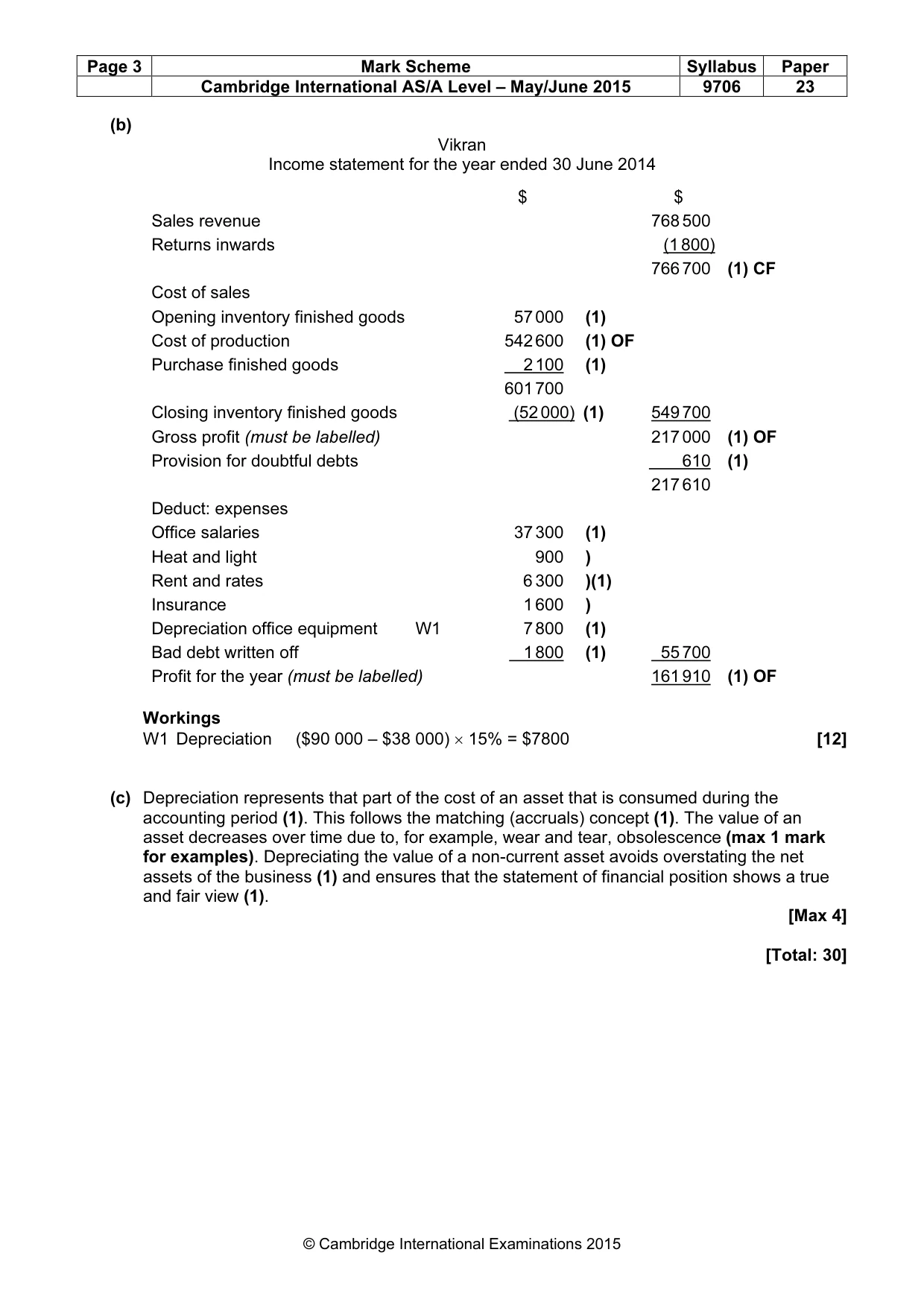
Page 3 Mark Scheme Syllabus Paper Cambridge International AS/A Level – May/June 2015 9706 23 © Cambridge International Examinations 2015 (b) Vikran Income statement for the year ended 30 June 2014 $ $ Sales revenue 768 500 Returns inwards (1 800) 766 700 (1) CF Cost of sales Opening inventory finished goods 57 000 (1) Cost of production 542 600 (1) OF Purchase finished goods 2 100 (1) 601 700 Closing inventory finished goods (52 000) (1) 549 700 Gross profit (must be labelled) 217 000 (1) OF Provision for doubtful debts 610 (1) 217 610 Deduct: expenses Office salaries 37 300 (1) Heat and light 900 ) Rent and rates 6 300 )(1) Insurance 1 600 ) Depreciation office equipment W1 7 800 (1) Bad debt written off 1 800 (1) 55 700 Profit for the year (must be labelled) 161 910 (1) OF Workings W1 Depreciation ($90 000 – $38 000) × 15% = $7800 [12] (c) Depreciation represents that part of the cost of an asset that is consumed during the accounting period (1). This follows the matching (accruals) concept (1). The value of an asset decreases over time due to, for example, wear and tear, obsolescence (max 1 mark for examples). Depreciating the value of a non-current asset avoids overstating the net assets of the business (1) and ensures that the statement of financial position shows a true and fair view (1). [Max 4] [Total: 30]
Mark scheme, page 4
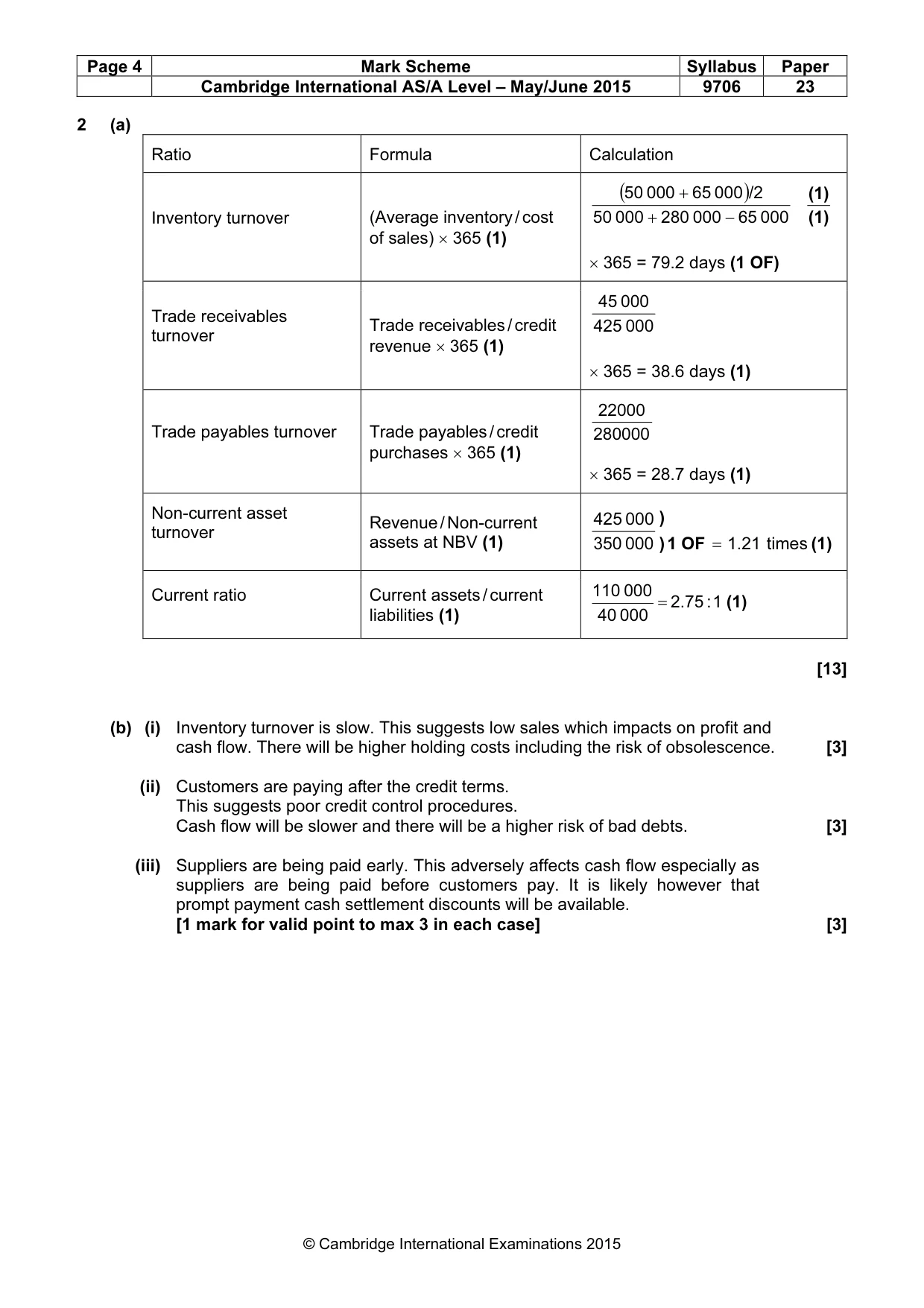
Page 4 Mark Scheme Syllabus Paper Cambridge International AS/A Level – May/June 2015 9706 23 © Cambridge International Examinations 2015 2 (a) Ratio Formula Calculation Inventory turnover (Average inventory / cost of sales) × 365 (1) ( ) (1) (1) 000 65 000 280 000 50 /2 000 65 000 50 − + + × 365 = 79.2 days (1 OF) Trade receivables turnover Trade receivables / credit revenue × 365 (1) 000 425 000 45 × 365 = 38.6 days (1) Trade payables turnover Trade payables / credit purchases × 365 (1) 280000 22000 × 365 = 28.7 days (1) Non-current asset turnover Revenue / Non-current assets at NBV (1) (1) OF 1 ) ) times 1.21 000 350 000 425 = Current ratio Current assets / current liabilities (1) (1) 1 : 2.75 000 40 000 110 = [13] (b) (i) Inventory turnover is slow. This suggests low sales which impacts on profit and cash flow. There will be higher holding costs including the risk of obsolescence. [3] (ii) Customers are paying after the credit terms. This suggests poor credit control procedures. Cash flow will be slower and there will be a higher risk of bad debts. [3] (iii) Suppliers are being paid early. This adversely affects cash flow especially as suppliers are being paid before customers pay. It is likely however that prompt payment cash settlement discounts will be available. [1 mark for valid point to max 3 in each case] [3]
Mark scheme, page 5
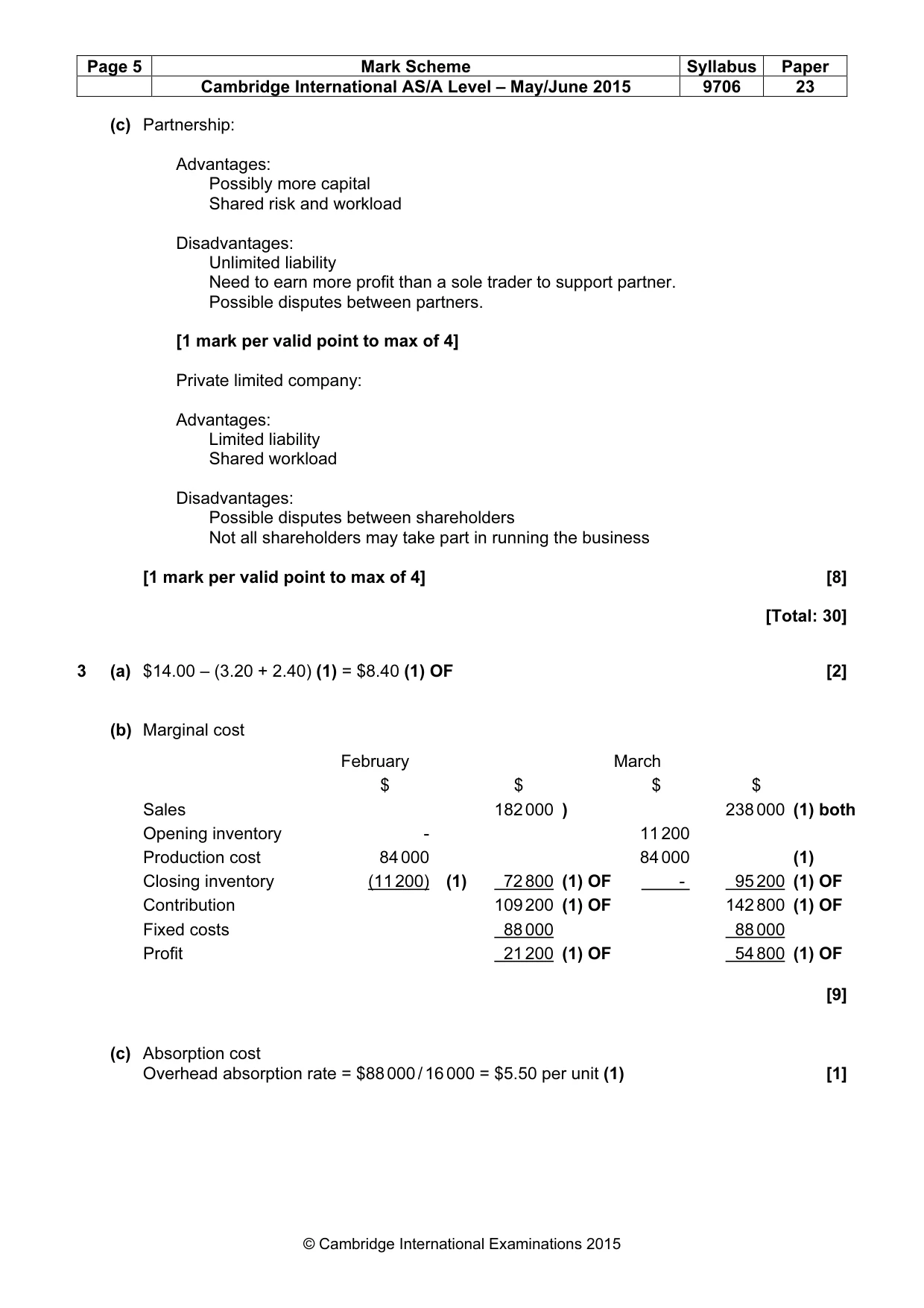
Page 5 Mark Scheme Syllabus Paper Cambridge International AS/A Level – May/June 2015 9706 23 © Cambridge International Examinations 2015 (c) Partnership: Advantages: Possibly more capital Shared risk and workload Disadvantages: Unlimited liability Need to earn more profit than a sole trader to support partner. Possible disputes between partners. [1 mark per valid point to max of 4] Private limited company: Advantages: Limited liability Shared workload Disadvantages: Possible disputes between shareholders Not all shareholders may take part in running the business [1 mark per valid point to max of 4] [8] [Total: 30] 3 (a) $14.00 – (3.20 + 2.40) (1) = $8.40 (1) OF [2] (b) Marginal cost February March $ $ $ $ Sales 182 000 ) 238 000 (1) both Opening inventory - 11 200 Production cost 84 000 84 000 (1) Closing inventory (11 200) (1) 72 800 (1) OF - 95 200 (1) OF Contribution 109 200 (1) OF 142 800 (1) OF Fixed costs 88 000 88 000 Profit 21 200 (1) OF 54 800 (1) OF [9] (c) Absorption cost Overhead absorption rate = $88 000 / 16 000 = $5.50 per unit (1) [1]
Mark scheme, page 6
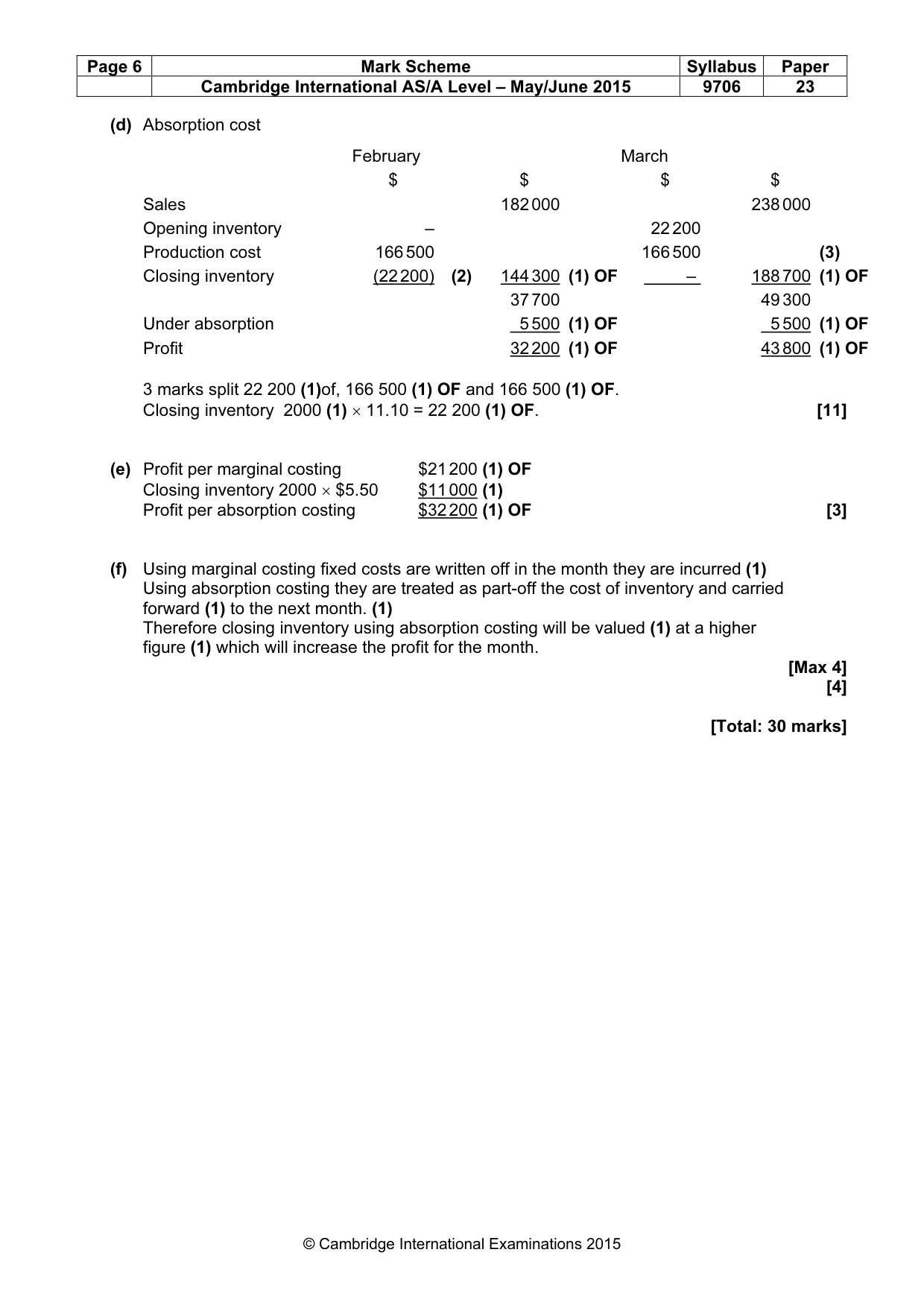
Page 6 Mark Scheme Syllabus Paper Cambridge International AS/A Level – May/June 2015 9706 23 © Cambridge International Examinations 2015 (d) Absorption cost February March $ $ $ $ Sales 182 000 238 000 Opening inventory – 22 200 Production cost 166 500 166 500 (3) Closing inventory (22 200) (2) 144 300 (1) OF – 188 700 (1) OF 37 700 49 300 Under absorption 5 500 (1) OF 5 500 (1) OF Profit 32 200 (1) OF 43 800 (1) OF 3 marks split 22 200 (1)of, 166 500 (1) OF and 166 500 (1) OF. Closing inventory 2000 (1) × 11.10 = 22 200 (1) OF. [11] (e) Profit per marginal costing $21 200 (1) OF Closing inventory 2000 × $5.50 $11 000 (1) Profit per absorption costing $32 200 (1) OF [3] (f) Using marginal costing fixed costs are written off in the month they are incurred (1) Using absorption costing they are treated as part-off the cost of inventory and carried forward (1) to the next month. (1) Therefore closing inventory using absorption costing will be valued (1) at a higher figure (1) which will increase the profit for the month. [Max 4] [4] [Total: 30 marks]
What you needed in this session
Cambridge’s own grade thresholds for 2015 May/June, Paper 2 · Variant 3. A higher threshold means an easier paper — the bar moves with how the cohort did.