Cambridge A Level Accounting 9706 — 2015 May/June Paper 2 · Variant 1
9706/21/M/J/15 · 90 marks · ≈101 min
The question paper and its mark scheme, free to read here and free to download. This is Cambridge’s own paper, exactly as it was sat.
Question paper16 pages



Mark scheme
No mark scheme is in the library for this paper.
Paper as text
Question paper, page 1
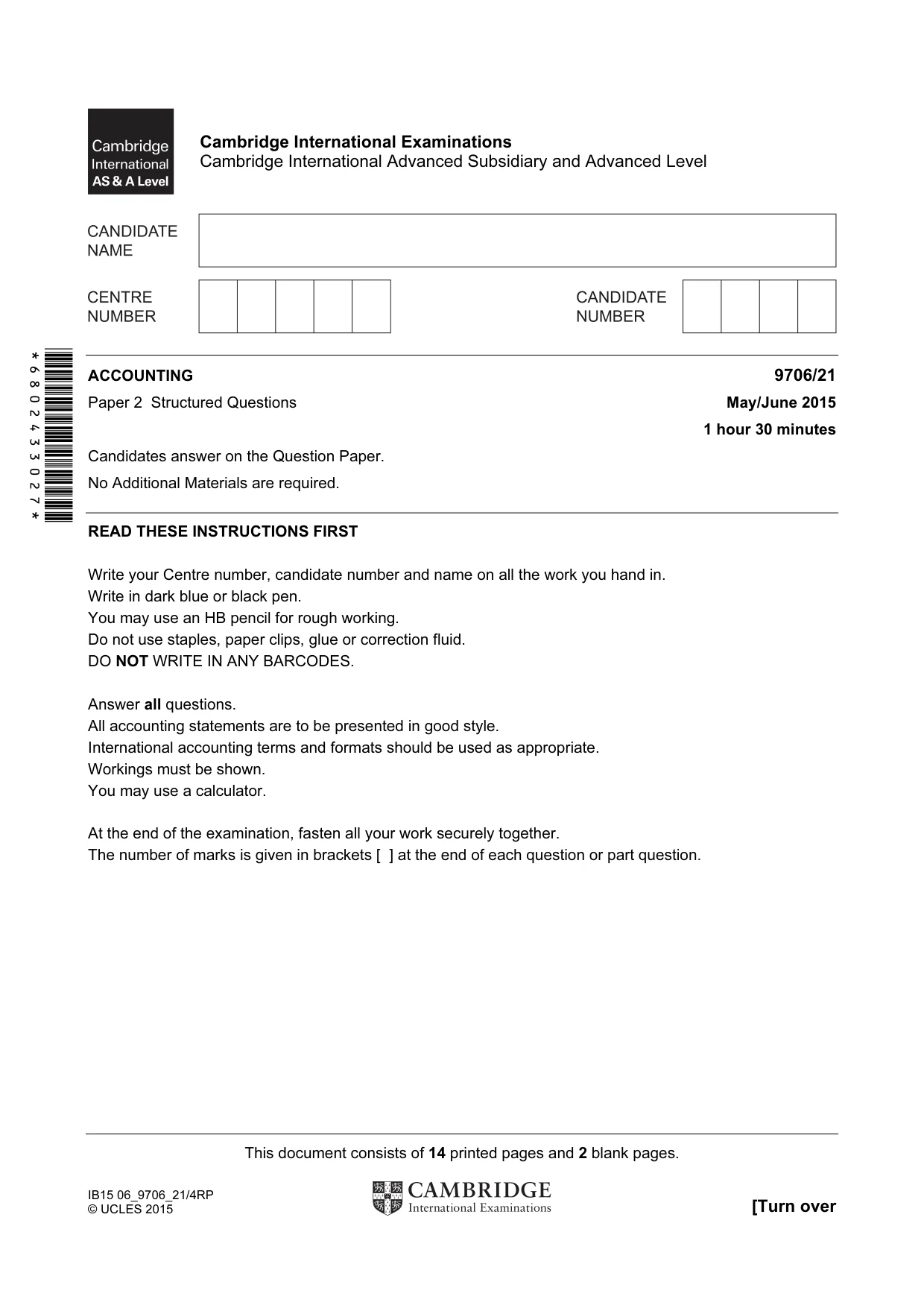
This document consists of 14 printed pages and 2 blank pages. IB15 06_9706_21/4RP © UCLES 2015 [Turn over *6802433027* Cambridge International Examinations Cambridge International Advanced Subsidiary and Advanced Level ACCOUNTING 9706/21 Paper 2 Structured Questions May/June 2015 1 hour 30 minutes Candidates answer on the Question Paper. No Additional Materials are required. READ THESE INSTRUCTIONS FIRST Write your Centre number, candidate number and name on all the work you hand in. Write in dark blue or black pen. You may use an HB pencil for rough working. Do not use staples, paper clips, glue or correction fluid. DO NOT WRITE IN ANY BARCODES. Answer all questions. All accounting statements are to be presented in good style. International accounting terms and formats should be used as appropriate. Workings must be shown. You may use a calculator. At the end of the examination, fasten all your work securely together. The number of marks is given in brackets [ ] at the end of each question or part question.
Question paper, page 2
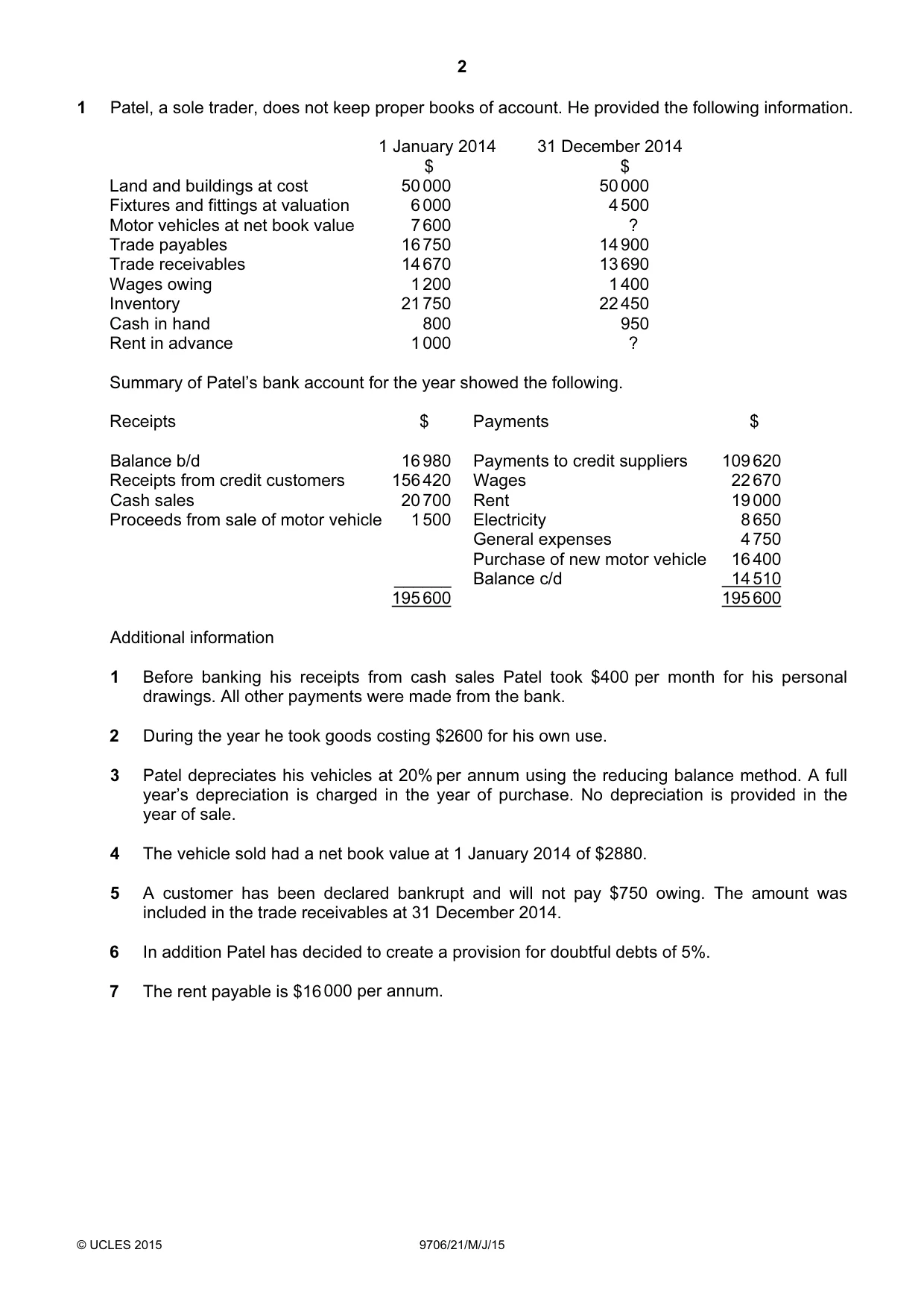
2 © UCLES 2015 9706/21/M/J/15 1 Patel, a sole trader, does not keep proper books of account. He provided the following information. 1 January 2014 31 December 2014 $ $ Land and buildings at cost 50 000 50 000 Fixtures and fittings at valuation 6 000 4 500 Motor vehicles at net book value 7 600 ? Trade payables 16 750 14 900 Trade receivables 14 670 13 690 Wages owing 1 200 1 400 Inventory 21 750 22 450 Cash in hand 800 950 Rent in advance 1 000 ? Summary of Patel’s bank account for the year showed the following. Receipts $ Payments $ Balance b/d 16 980 Payments to credit suppliers 109 620 Receipts from credit customers 156 420 Wages 22 670 Cash sales 20 700 Rent 19 000 Proceeds from sale of motor vehicle 1 500 Electricity 8 650 General expenses 4 750 Purchase of new motor vehicle 16 400 ______ Balance c/d 14 510 195 600 195 600 Additional information 1 Before banking his receipts from cash sales Patel took $400 per month for his personal drawings. All other payments were made from the bank. 2 During the year he took goods costing $2600 for his own use. 3 Patel depreciates his vehicles at 20% per annum using the reducing balance method. A full year’s depreciation is charged in the year of purchase. No depreciation is provided in the year of sale. 4 The vehicle sold had a net book value at 1 January 2014 of $2880. 5 A customer has been declared bankrupt and will not pay $750 owing. The amount was included in the trade receivables at 31 December 2014. 6 In addition Patel has decided to create a provision for doubtful debts of 5%. 7 The rent payable is $16 000 per annum.
Question paper, page 3
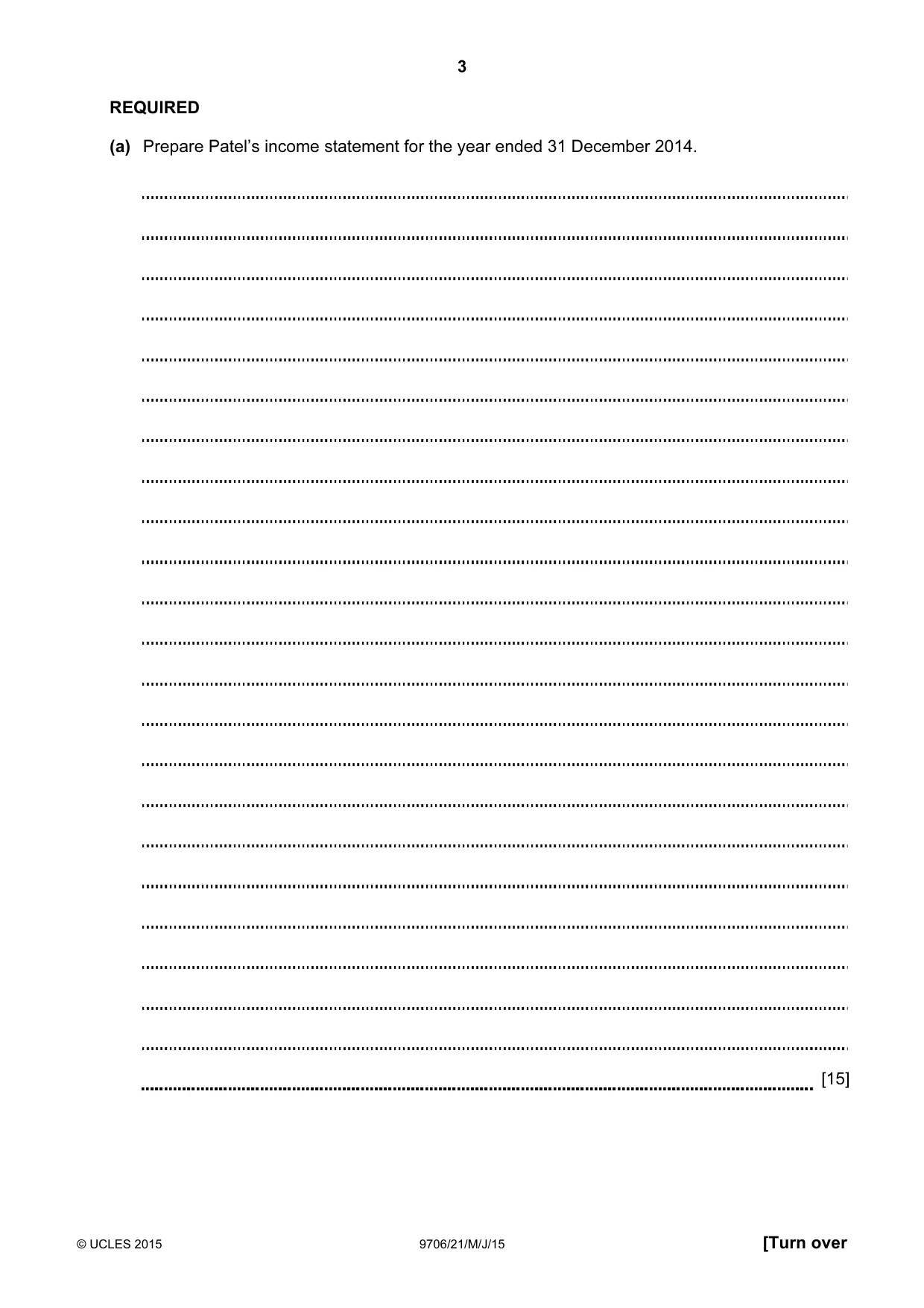
3 © UCLES 2015 9706/21/M/J/15 [Turn over REQUIRED (a) Prepare Patel’s income statement for the year ended 31 December 2014. [15]
Question paper, page 4
4 © UCLES 2015 9706/21/M/J/15 (b) Prepare Patel’s statement of financial position at 31 December 2014.
Question paper, page 5
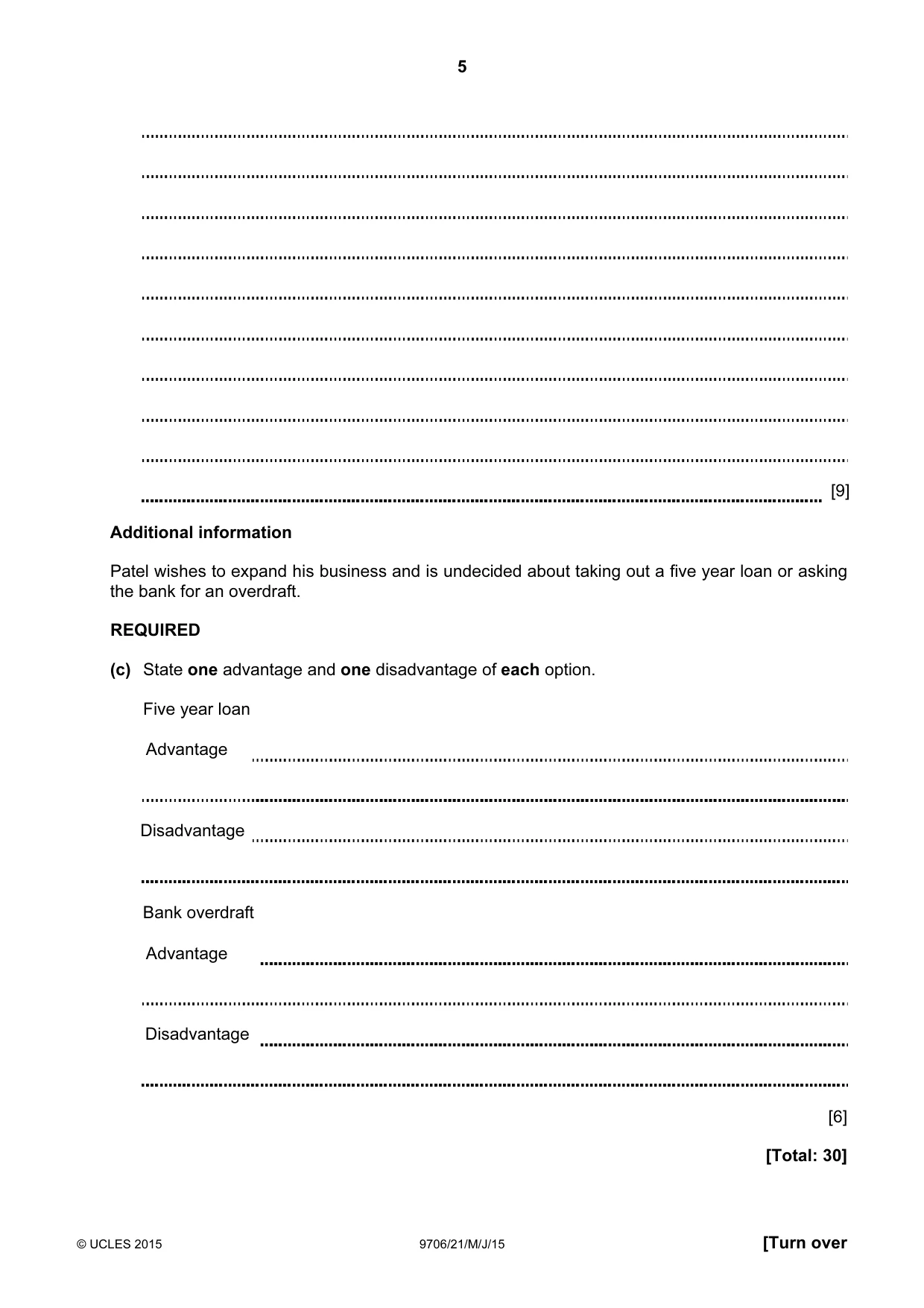
5 © UCLES 2015 9706/21/M/J/15 [Turn over [9] Additional information Patel wishes to expand his business and is undecided about taking out a five year loan or asking the bank for an overdraft. REQUIRED (c) State one advantage and one disadvantage of each option. Five year loan Advantage Disadvantage Bank overdraft Advantage Disadvantage [6] [Total: 30]
Question paper, page 6
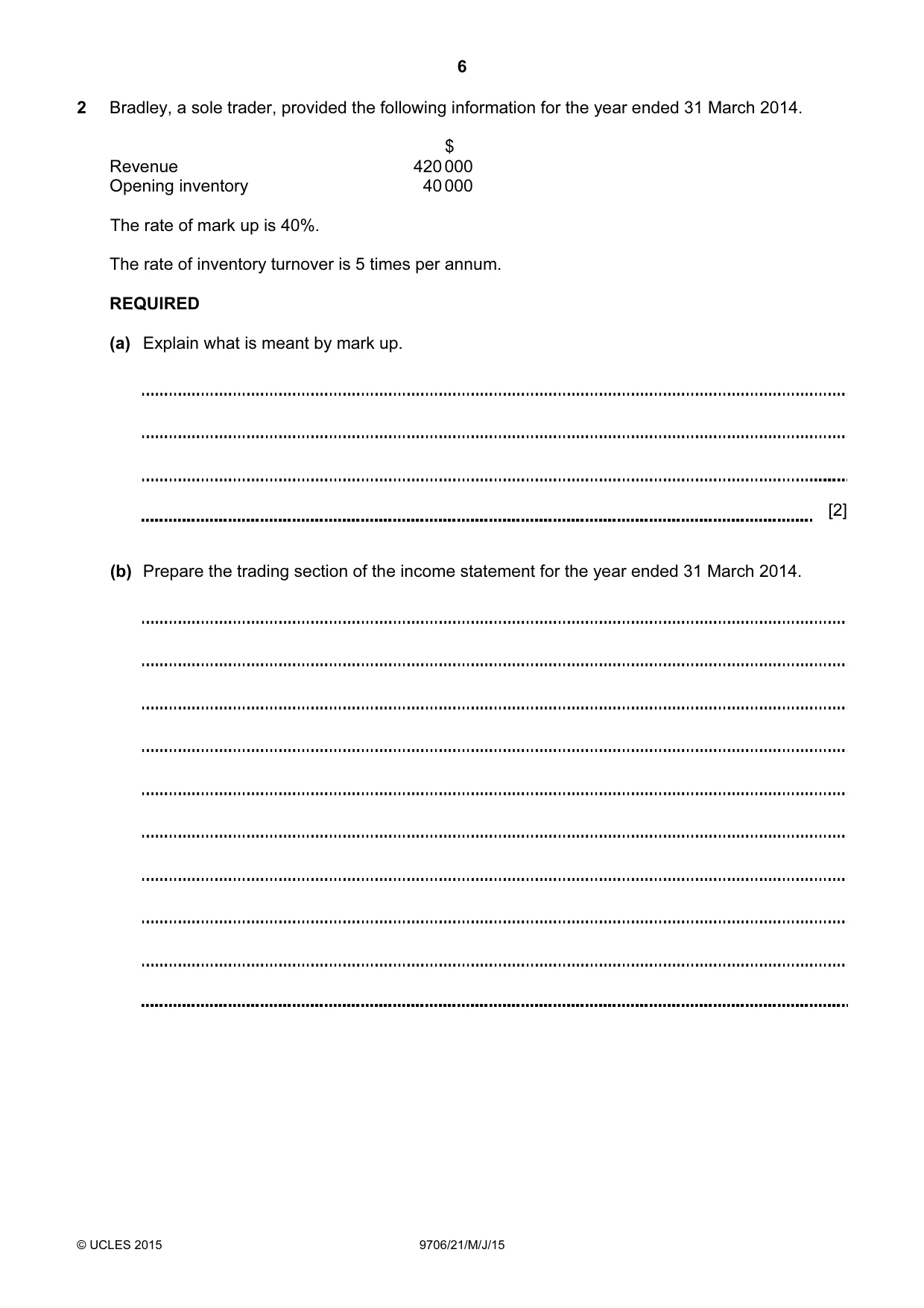
6 © UCLES 2015 9706/21/M/J/15 2 Bradley, a sole trader, provided the following information for the year ended 31 March 2014. $ Revenue 420 000 Opening inventory 40 000 The rate of mark up is 40%. The rate of inventory turnover is 5 times per annum. REQUIRED (a) Explain what is meant by mark up. [2] (b) Prepare the trading section of the income statement for the year ended 31 March 2014.
Question paper, page 7
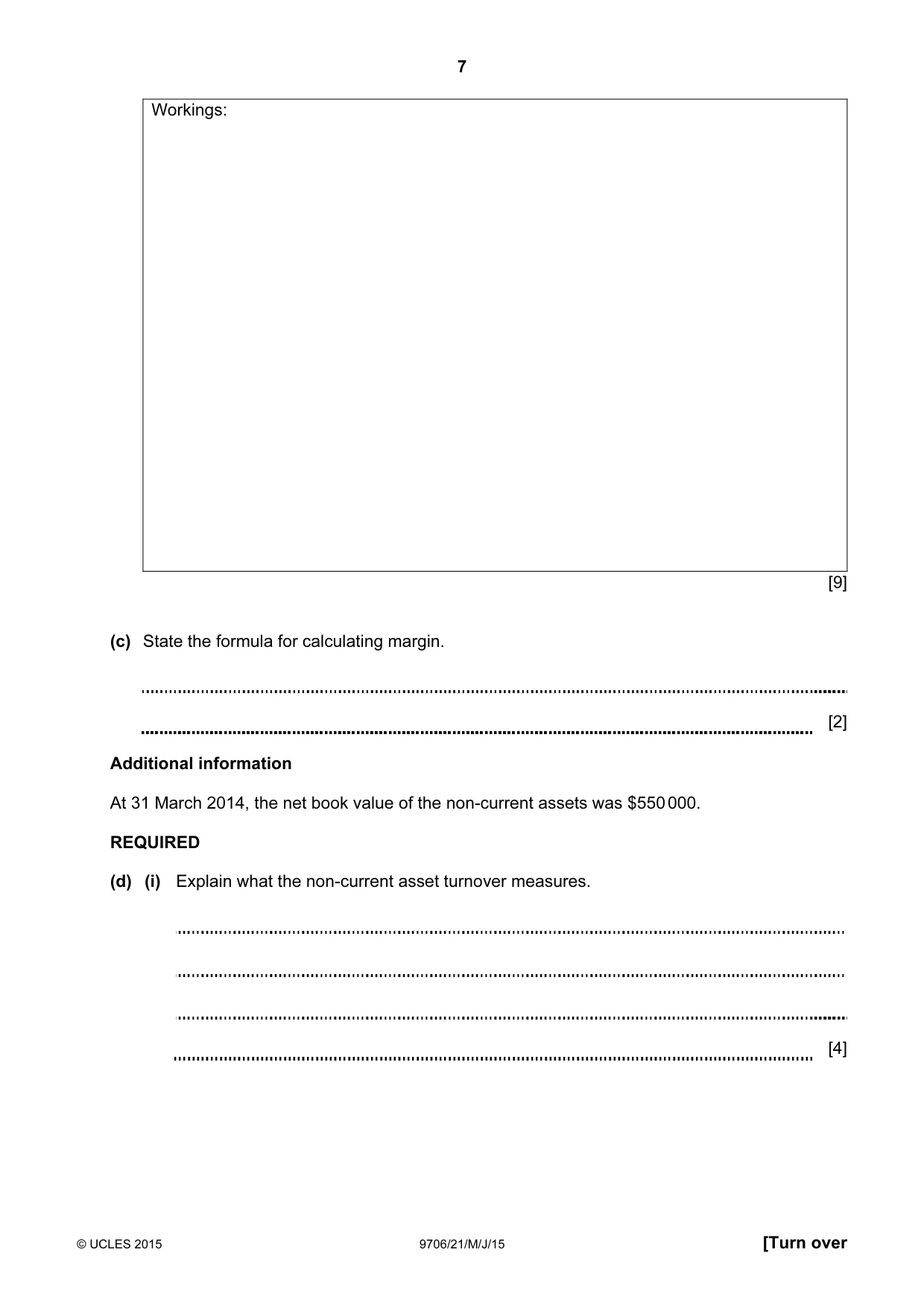
7 © UCLES 2015 9706/21/M/J/15 [Turn over Workings: [9] (c) State the formula for calculating margin. [2] Additional information At 31 March 2014, the net book value of the non-current assets was $550 000. REQUIRED (d) (i) Explain what the non-current asset turnover measures. [4]
Question paper, page 8
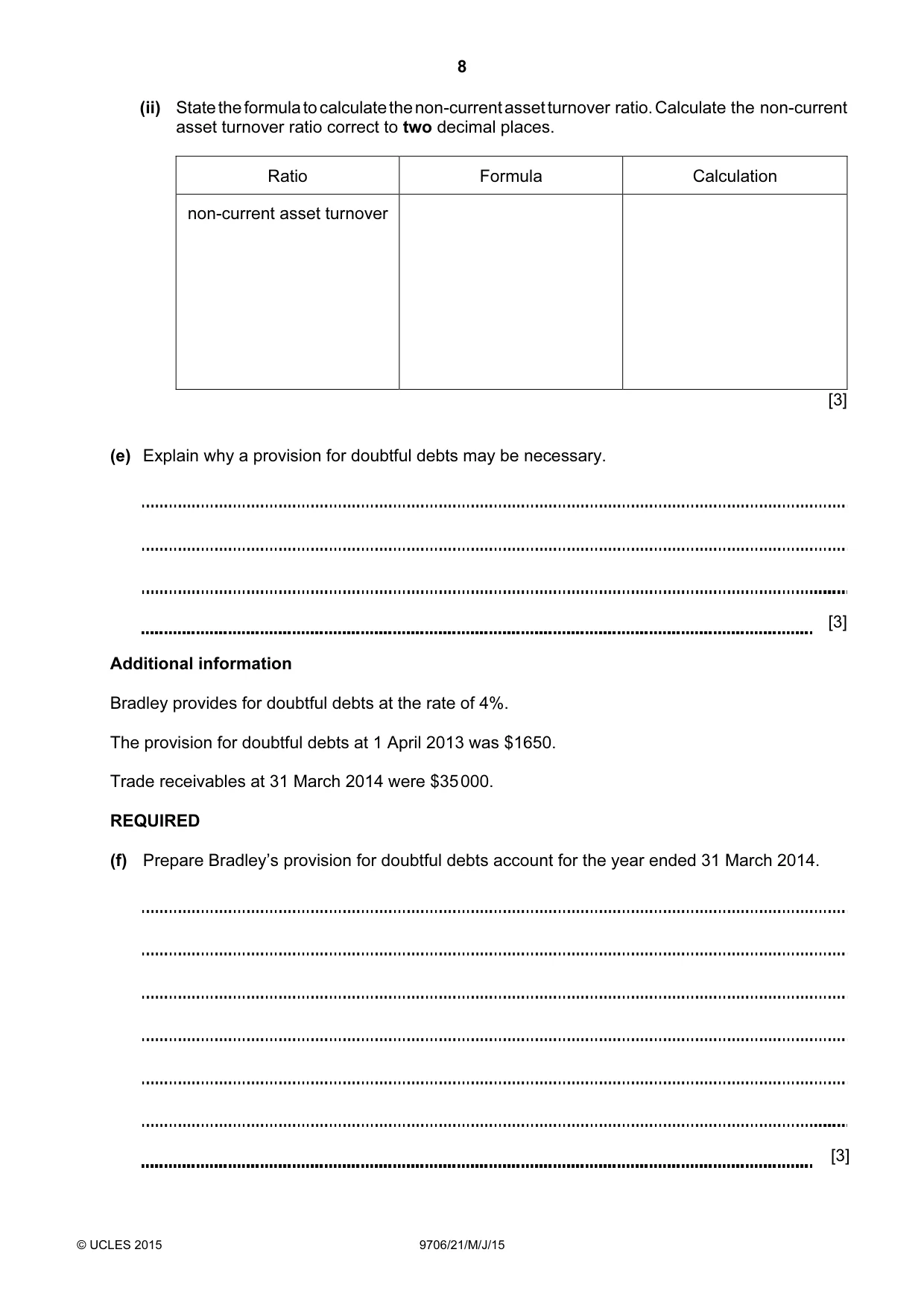
8 © UCLES 2015 9706/21/M/J/15 (ii) State the formula to calculate the non-current asset turnover ratio. Calculate the non-current asset turnover ratio correct to two decimal places. Ratio Formula Calculation non-current asset turnover [3] (e) Explain why a provision for doubtful debts may be necessary. [3] Additional information Bradley provides for doubtful debts at the rate of 4%. The provision for doubtful debts at 1 April 2013 was $1650. Trade receivables at 31 March 2014 were $35 000. REQUIRED (f) Prepare Bradley’s provision for doubtful debts account for the year ended 31 March 2014. [3]
Question paper, page 9
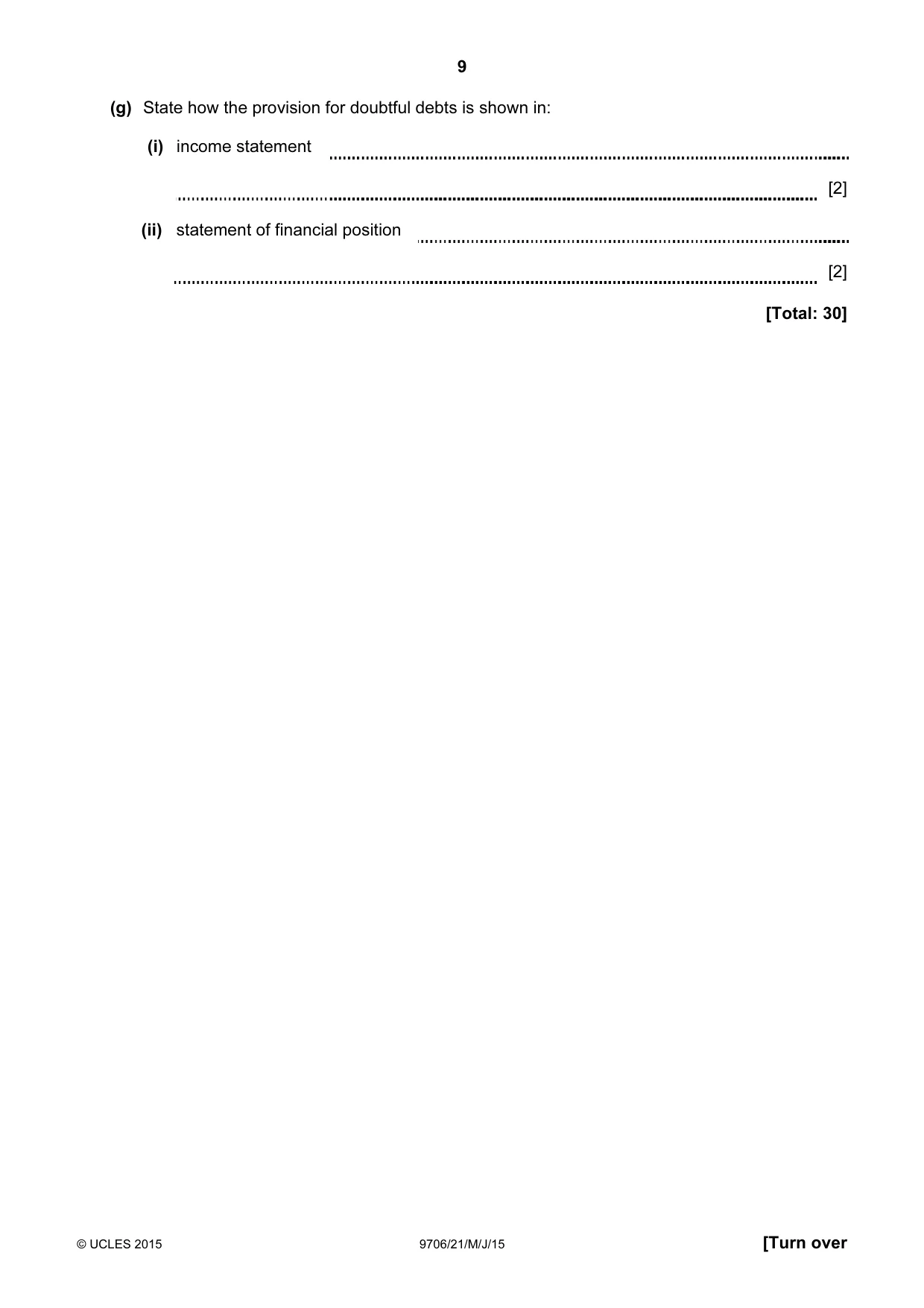
9 © UCLES 2015 9706/21/M/J/15 [Turn over (g) State how the provision for doubtful debts is shown in: (i) income statement [2] (ii) statement of financial position [2] [Total: 30]
Question paper, page 10
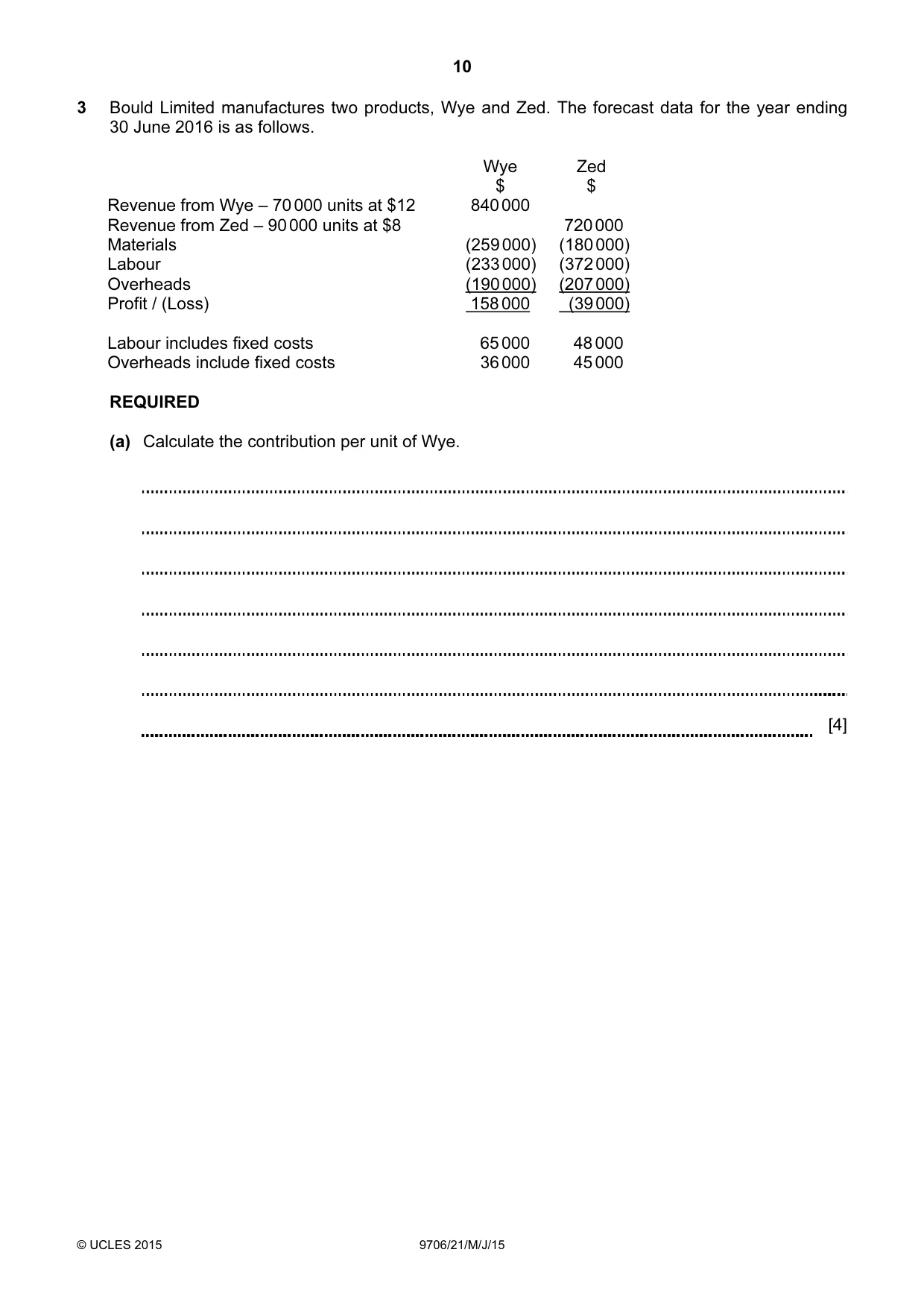
10 © UCLES 2015 9706/21/M/J/15 3 Bould Limited manufactures two products, Wye and Zed. The forecast data for the year ending 30 June 2016 is as follows. Wye Zed $ $ Revenue from Wye – 70 000 units at $12 840 000 Revenue from Zed – 90 000 units at $8 720 000 Materials (259 000) (180 000) Labour (233 000) (372 000) Overheads (190 000) (207 000) Profit / (Loss) 158 000 (39 000) Labour includes fixed costs 65 000 48 000 Overheads include fixed costs 36 000 45 000 REQUIRED (a) Calculate the contribution per unit of Wye. [4]
Question paper, page 11
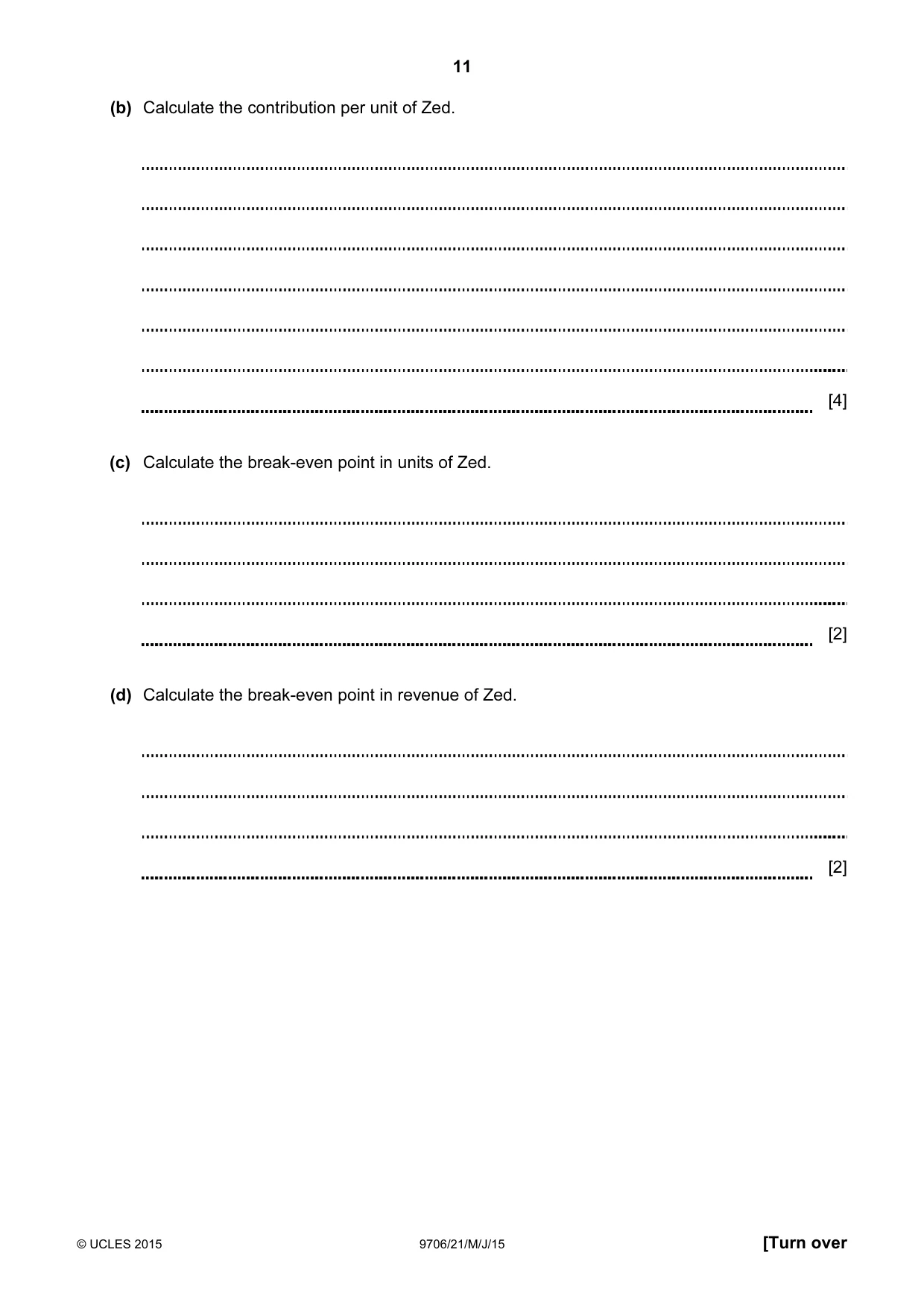
11 © UCLES 2015 9706/21/M/J/15 [Turn over (b) Calculate the contribution per unit of Zed. [4] (c) Calculate the break-even point in units of Zed. [2] (d) Calculate the break-even point in revenue of Zed. [2]
Question paper, page 12
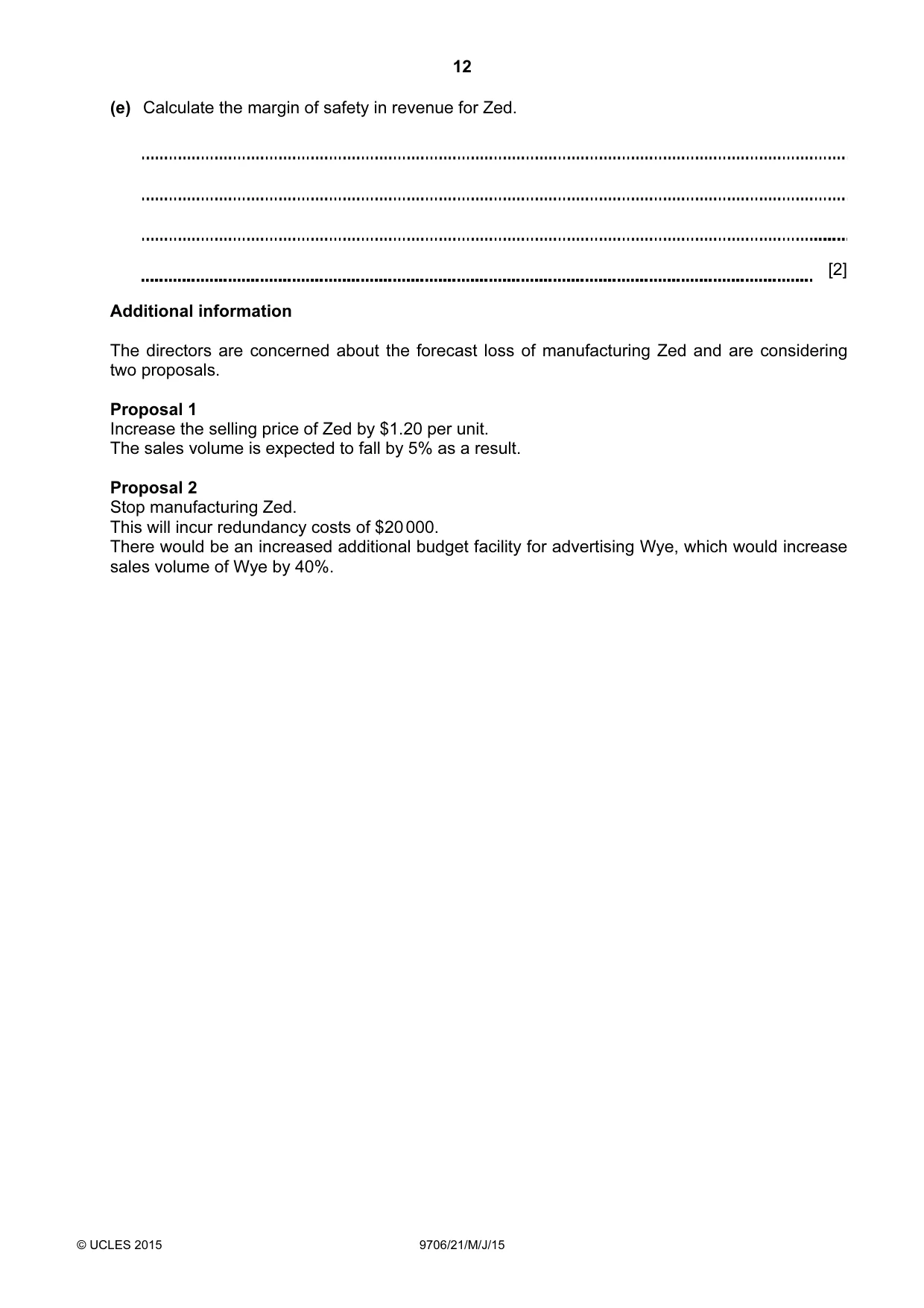
12 © UCLES 2015 9706/21/M/J/15 (e) Calculate the margin of safety in revenue for Zed. [2] Additional information The directors are concerned about the forecast loss of manufacturing Zed and are considering two proposals. Proposal 1 Increase the selling price of Zed by $1.20 per unit. The sales volume is expected to fall by 5% as a result. Proposal 2 Stop manufacturing Zed. This will incur redundancy costs of $20 000. There would be an increased additional budget facility for advertising Wye, which would increase sales volume of Wye by 40%.
Question paper, page 13
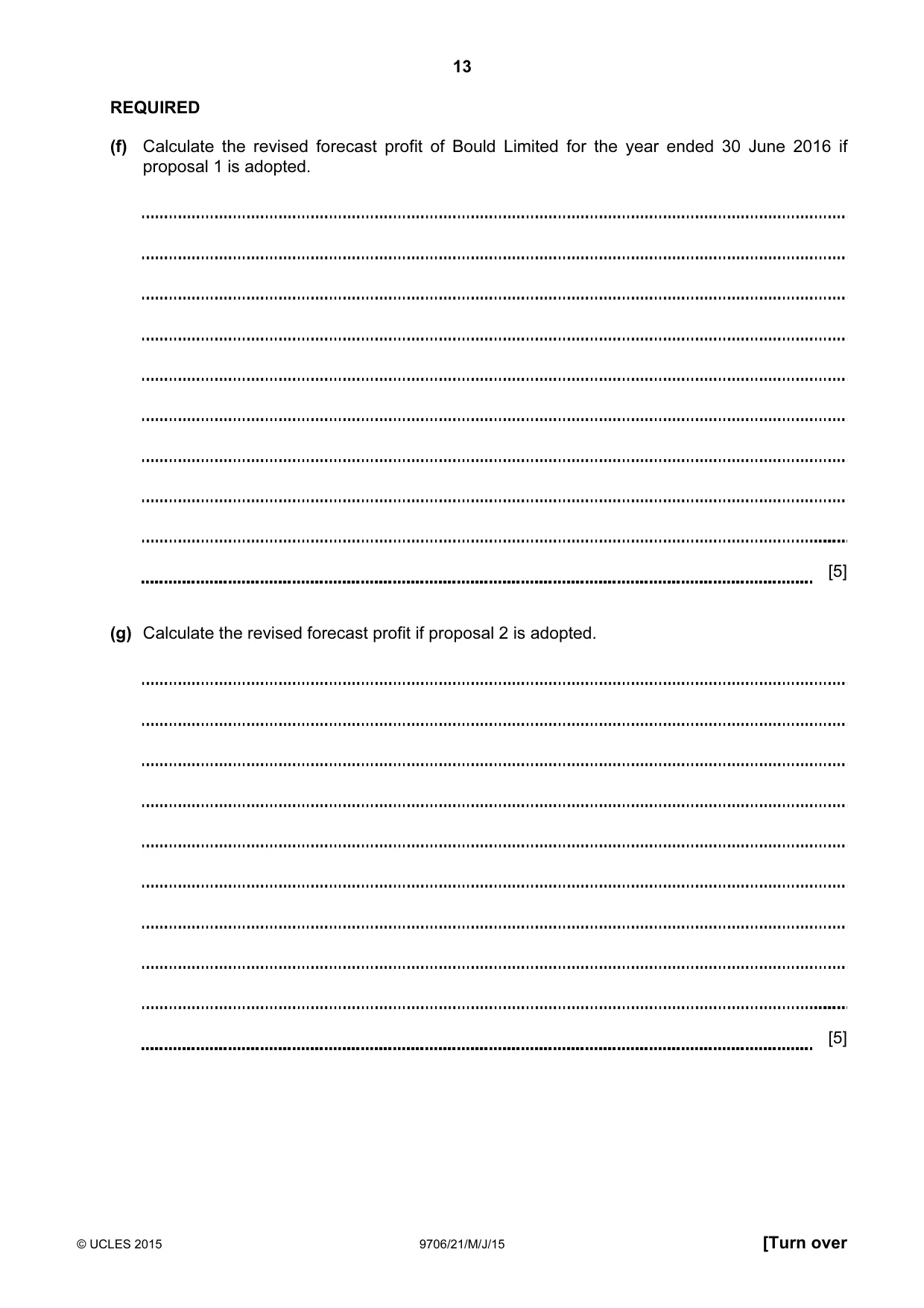
13 © UCLES 2015 9706/21/M/J/15 [Turn over REQUIRED (f) Calculate the revised forecast profit of Bould Limited for the year ended 30 June 2016 if proposal 1 is adopted. [5] (g) Calculate the revised forecast profit if proposal 2 is adopted. [5]
Question paper, page 14
14 © UCLES 2015 9706/21/M/J/15 (h) Advise, with reasons, which proposal the directors should adopt. Proposal Evaluation [6] [Total: 30]
Question paper, page 15
15 © UCLES 2015 9706/21/M/J/15 BLANK PAGE
Question paper, page 16
16 Permission to reproduce items where third-party owned material protected by copyright is included has been sought and cleared where possible. Every reasonable effort has been made by the publisher (UCLES) to trace copyright holders, but if any items requiring clearance have unwittingly been included, the publisher will be pleased to make amends at the earliest possible opportunity. To avoid the issue of disclosure of answer-related information to candidates, all copyright acknowledgements are reproduced online in the Cambridge International Examinations Copyright Acknowledgements Booklet. This is produced for each series of examinations and is freely available to download at www.cie.org.uk after the live examination series. Cambridge International Examinations is part of the Cambridge Assessment Group. Cambridge Assessment is the brand name of University of Cambridge Local Examinations Syndicate (UCLES), which is itself a department of the University of Cambridge. © UCLES 2015 9706/21/M/J/15 BLANK PAGE
What you needed in this session
Cambridge’s own grade thresholds for 2015 May/June, Paper 2 · Variant 1. A higher threshold means an easier paper — the bar moves with how the cohort did.