Cambridge A Level Accounting 9706 — 2014 Oct/Nov Paper 4 · Variant 2
9706/42/O/N/14 · 120 marks · ≈135 min
The question paper and its mark scheme, free to read here and free to download. This is Cambridge’s own paper, exactly as it was sat.
Question paper8 pages
Mark scheme5 pages
Answers below. Sit the paper first if you are practising.
Paper as text
Question paper, page 1
This document consists of 7 printed pages, 1 blank page and 1 insert. IB14 11_9706_42/7RP © UCLES 2014 [Turn over *8201703774* Cambridge International Examinations Cambridge International Advanced Level ACCOUNTING 9706/42 Paper 4 Problem Solving (Supplementary Topics) October/November 2014 2 hours No Additional Materials are required. READ THESE INSTRUCTIONS FIRST An answer booklet is provided inside this question paper. You should follow the instructions on the front cover of the answer booklet. If you need additional answer paper ask the invigilator for a continuation booklet. Answer all questions. All accounting statements are to be presented in good style. International accounting terms and formats should be used as appropriate. Workings should be shown. You may use a calculator. The number of marks is given in brackets [ ] at the end of each question or part question.
Question paper, page 2
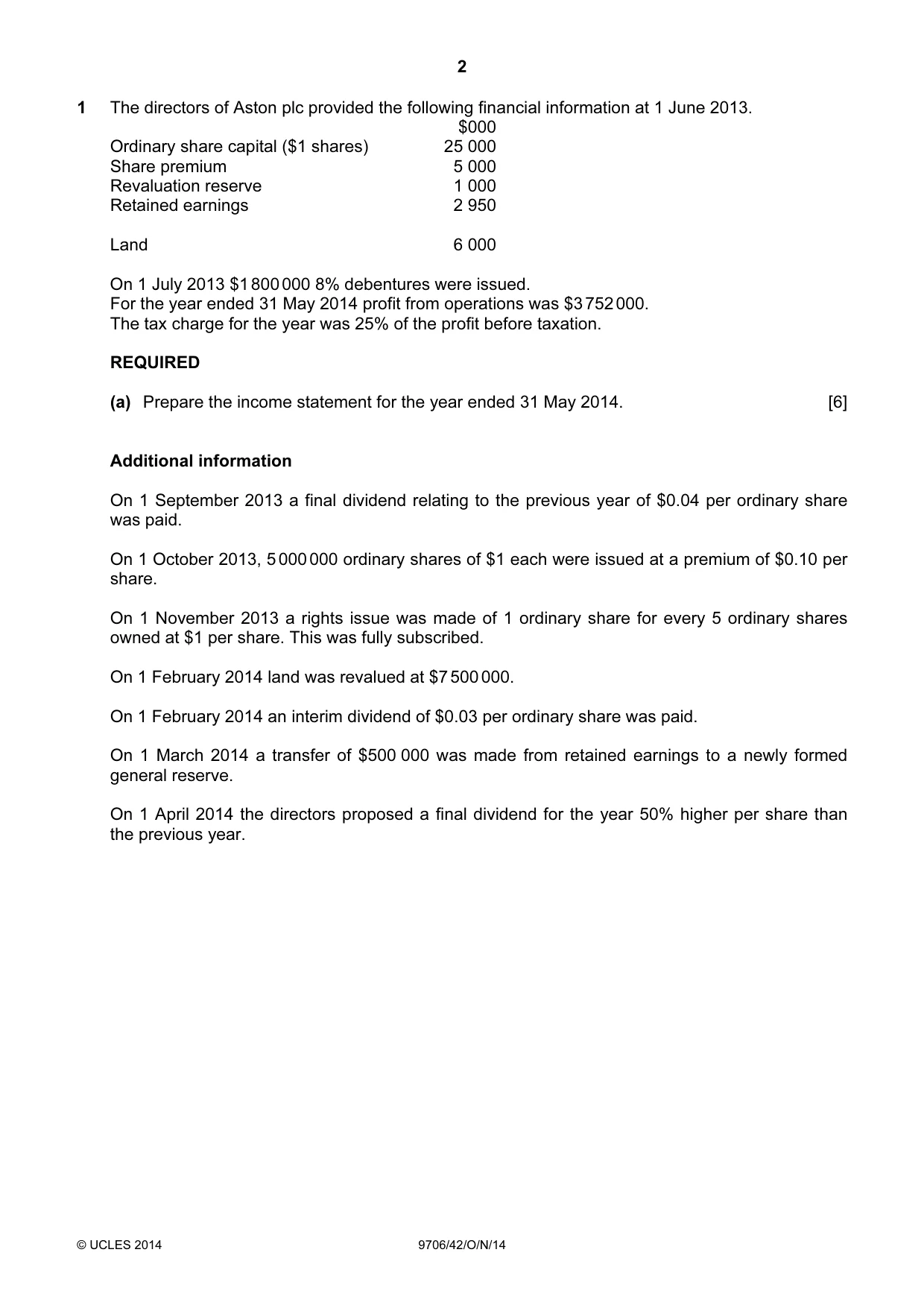
2 © UCLES 2014 9706/42/O/N/14 1 The directors of Aston plc provided the following financial information at 1 June 2013. $000 Ordinary share capital ($1 shares) 25 000 Share premium 5 000 Revaluation reserve 1 000 Retained earnings 2 950 Land 6 000 On 1 July 2013 $1 800 000 8% debentures were issued. For the year ended 31 May 2014 profit from operations was $3 752 000. The tax charge for the year was 25% of the profit before taxation. REQUIRED (a) Prepare the income statement for the year ended 31 May 2014. [6] Additional information On 1 September 2013 a final dividend relating to the previous year of $0.04 per ordinary share was paid. On 1 October 2013, 5 000 000 ordinary shares of $1 each were issued at a premium of $0.10 per share. On 1 November 2013 a rights issue was made of 1 ordinary share for every 5 ordinary shares owned at $1 per share. This was fully subscribed. On 1 February 2014 land was revalued at $7 500 000. On 1 February 2014 an interim dividend of $0.03 per ordinary share was paid. On 1 March 2014 a transfer of $500 000 was made from retained earnings to a newly formed general reserve. On 1 April 2014 the directors proposed a final dividend for the year 50% higher per share than the previous year.
Question paper, page 3
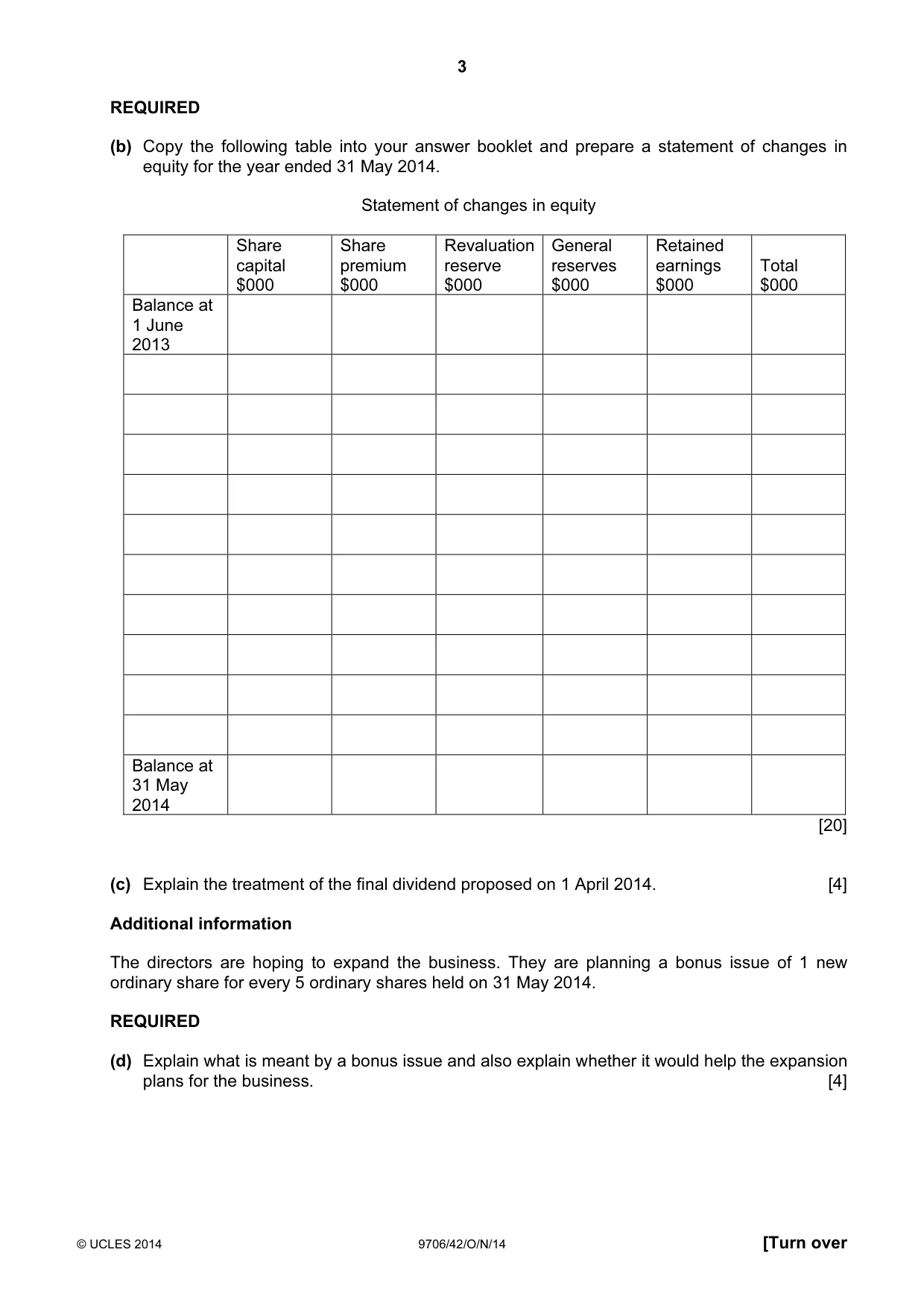
3 © UCLES 2014 9706/42/O/N/14 [Turn over REQUIRED (b) Copy the following table into your answer booklet and prepare a statement of changes in equity for the year ended 31 May 2014. Statement of changes in equity Share capital $000 Share premium $000 Revaluation reserve $000 General reserves $000 Retained earnings $000 Total $000 Balance at 1 June 2013 Balance at 31 May 2014 [20] (c) Explain the treatment of the final dividend proposed on 1 April 2014. [4] Additional information The directors are hoping to expand the business. They are planning a bonus issue of 1 new ordinary share for every 5 ordinary shares held on 31 May 2014. REQUIRED (d) Explain what is meant by a bonus issue and also explain whether it would help the expansion plans for the business. [4]
Question paper, page 4
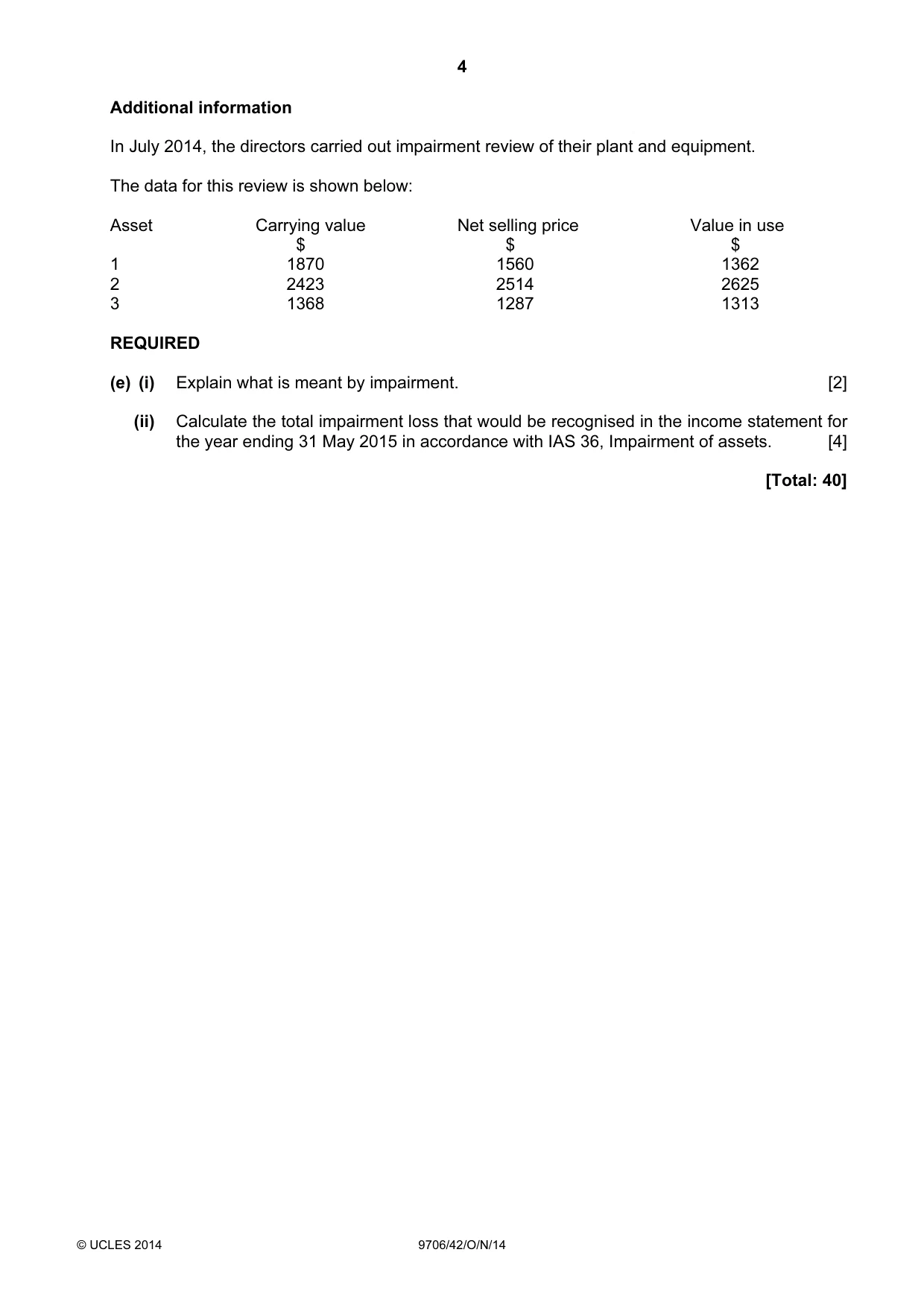
4 © UCLES 2014 9706/42/O/N/14 Additional information In July 2014, the directors carried out impairment review of their plant and equipment. The data for this review is shown below: Asset Carrying value Net selling price Value in use $ $ $ 1 1870 1560 1362 2 2423 2514 2625 3 1368 1287 1313 REQUIRED (e) (i) Explain what is meant by impairment. [2] (ii) Calculate the total impairment loss that would be recognised in the income statement for the year ending 31 May 2015 in accordance with IAS 36, Impairment of assets. [4] [Total: 40]
Question paper, page 5
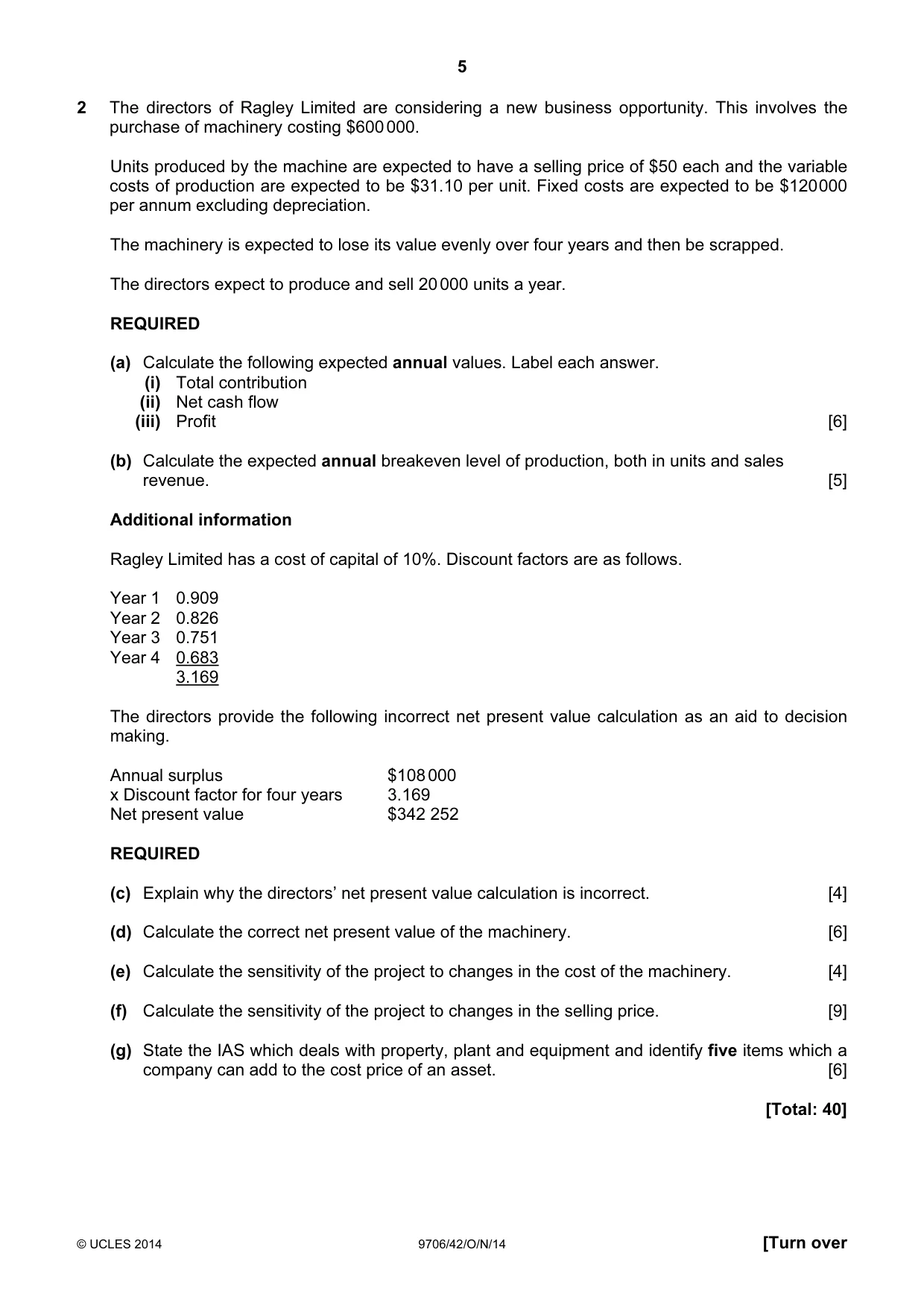
5 © UCLES 2014 9706/42/O/N/14 [Turn over 2 The directors of Ragley Limited are considering a new business opportunity. This involves the purchase of machinery costing $600 000. Units produced by the machine are expected to have a selling price of $50 each and the variable costs of production are expected to be $31.10 per unit. Fixed costs are expected to be $120 000 per annum excluding depreciation. The machinery is expected to lose its value evenly over four years and then be scrapped. The directors expect to produce and sell 20 000 units a year. REQUIRED (a) Calculate the following expected annual values. Label each answer. (i) Total contribution (ii) Net cash flow (iii) Profit [6] (b) Calculate the expected annual breakeven level of production, both in units and sales revenue. [5] Additional information Ragley Limited has a cost of capital of 10%. Discount factors are as follows. Year 1 0.909 Year 2 0.826 Year 3 0.751 Year 4 0.683 3.169 The directors provide the following incorrect net present value calculation as an aid to decision making. Annual surplus $108 000 x Discount factor for four years 3.169 Net present value $342 252 REQUIRED (c) Explain why the directors’ net present value calculation is incorrect. [4] (d) Calculate the correct net present value of the machinery. [6] (e) Calculate the sensitivity of the project to changes in the cost of the machinery. [4] (f) Calculate the sensitivity of the project to changes in the selling price. [9] (g) State the IAS which deals with property, plant and equipment and identify five items which a company can add to the cost price of an asset. [6] [Total: 40]
Question paper, page 6
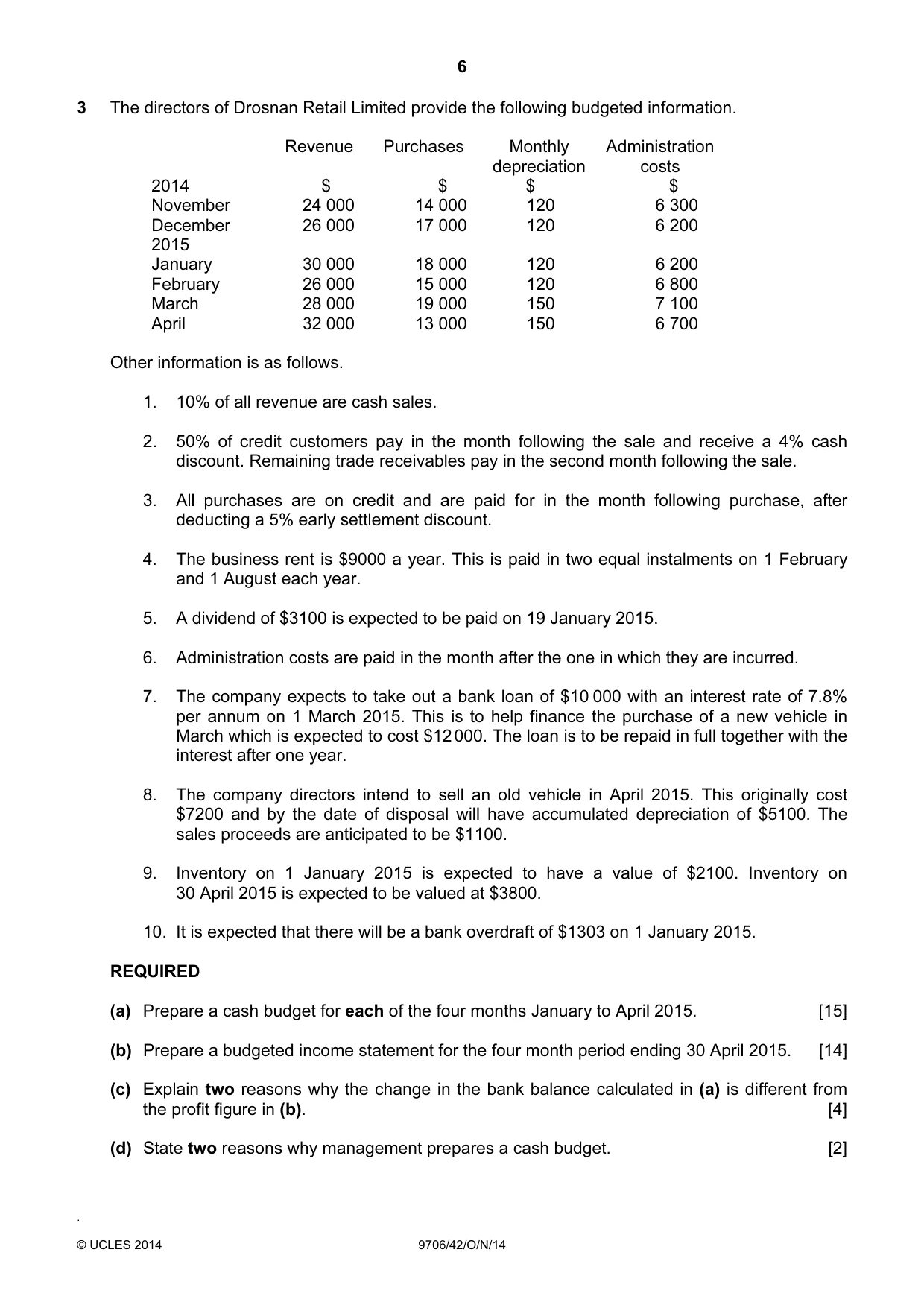
6 . © UCLES 2014 9706/42/O/N/14 3 The directors of Drosnan Retail Limited provide the following budgeted information. Revenue Purchases Monthly depreciation Administration costs 2014 $ $ $ $ November 24 000 14 000 120 6 300 December 26 000 17 000 120 6 200 2015 January 30 000 18 000 120 6 200 February 26 000 15 000 120 6 800 March 28 000 19 000 150 7 100 April 32 000 13 000 150 6 700 Other information is as follows. 1. 10% of all revenue are cash sales. 2. 50% of credit customers pay in the month following the sale and receive a 4% cash discount. Remaining trade receivables pay in the second month following the sale. 3. All purchases are on credit and are paid for in the month following purchase, after deducting a 5% early settlement discount. 4. The business rent is $9000 a year. This is paid in two equal instalments on 1 February and 1 August each year. 5. A dividend of $3100 is expected to be paid on 19 January 2015. 6. Administration costs are paid in the month after the one in which they are incurred. 7. The company expects to take out a bank loan of $10 000 with an interest rate of 7.8% per annum on 1 March 2015. This is to help finance the purchase of a new vehicle in March which is expected to cost $12 000. The loan is to be repaid in full together with the interest after one year. 8. The company directors intend to sell an old vehicle in April 2015. This originally cost $7200 and by the date of disposal will have accumulated depreciation of $5100. The sales proceeds are anticipated to be $1100. 9. Inventory on 1 January 2015 is expected to have a value of $2100. Inventory on 30 April 2015 is expected to be valued at $3800. 10. It is expected that there will be a bank overdraft of $1303 on 1 January 2015. REQUIRED (a) Prepare a cash budget for each of the four months January to April 2015. [15] (b) Prepare a budgeted income statement for the four month period ending 30 April 2015. [14] (c) Explain two reasons why the change in the bank balance calculated in (a) is different from the profit figure in (b). [4] (d) State two reasons why management prepares a cash budget. [2]
Question paper, page 7
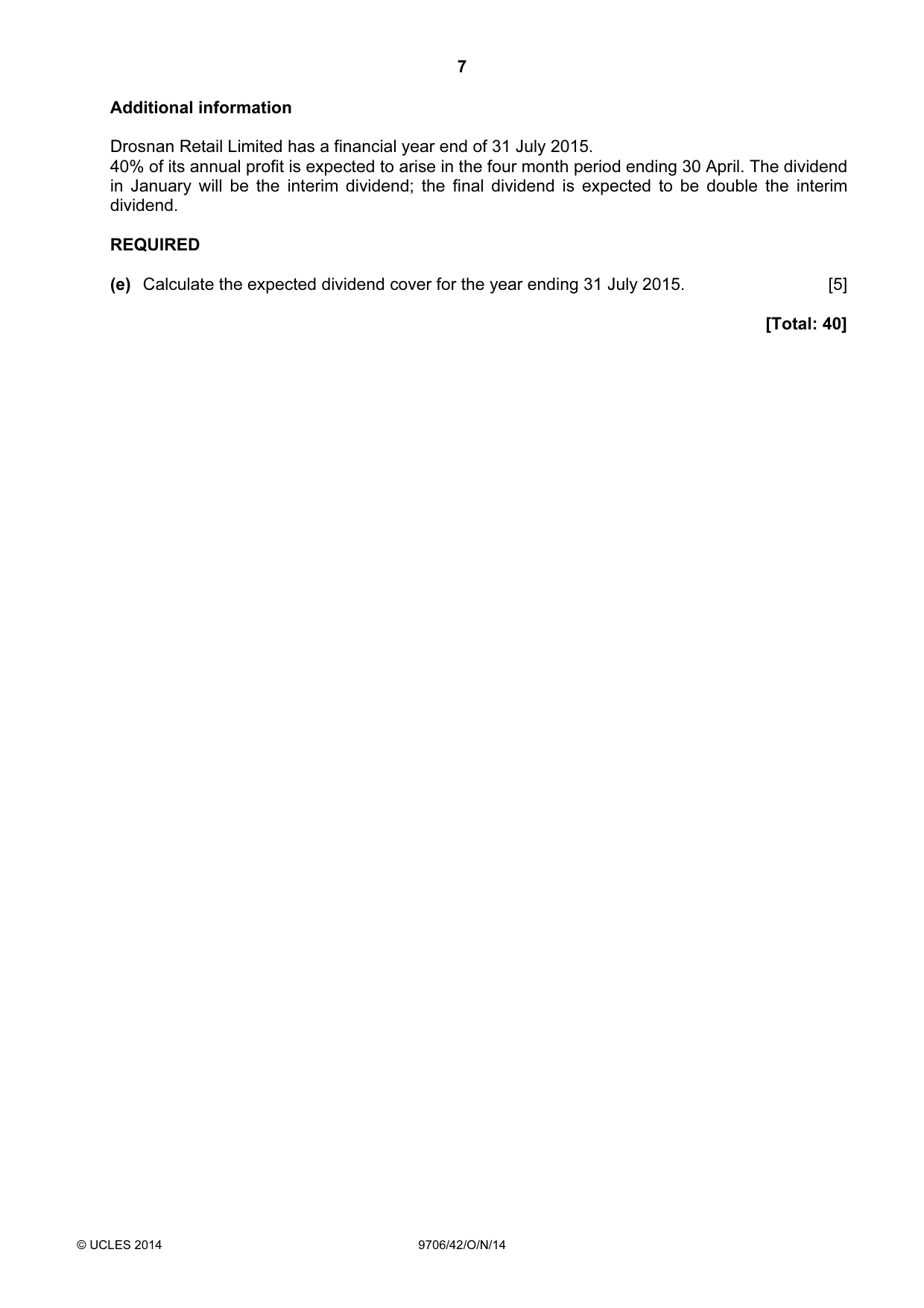
7 © UCLES 2014 9706/42/O/N/14 Additional information Drosnan Retail Limited has a financial year end of 31 July 2015. 40% of its annual profit is expected to arise in the four month period ending 30 April. The dividend in January will be the interim dividend; the final dividend is expected to be double the interim dividend. REQUIRED (e) Calculate the expected dividend cover for the year ending 31 July 2015. [5] [Total: 40]
Question paper, page 8
8 Permission to reproduce items where third-party owned material protected by copyright is included has been sought and cleared where possible. Every reasonable effort has been made by the publisher (UCLES) to trace copyright holders, but if any items requiring clearance have unwittingly been included, the publisher will be pleased to make amends at the earliest possible opportunity. Cambridge International Examinations is part of the Cambridge Assessment Group. Cambridge Assessment is the brand name of University of Cambridge Local Examinations Syndicate (UCLES), which is itself a department of the University of Cambridge. © UCLES 2014 9706/42/O/N/14 BLANK PAGE
Mark scheme, page 1
® IGCSE is the registered trademark of Cambridge International Examinations. CAMBRIDGE INTERNATIONAL EXAMINATIONS Cambridge International Advanced Level MARK SCHEME for the October/November 2014 series 9706 ACCOUNTING 9706/42 Paper 4 (Problem Solving – Supplement), maximum raw mark 120 This mark scheme is published as an aid to teachers and candidates, to indicate the requirements of the examination. It shows the basis on which Examiners were instructed to award marks. It does not indicate the details of the discussions that took place at an Examiners’ meeting before marking began, which would have considered the acceptability of alternative answers. Mark schemes should be read in conjunction with the question paper and the Principal Examiner Report for Teachers. Cambridge will not enter into discussions about these mark schemes. Cambridge is publishing the mark schemes for the October/November 2014 series for most Cambridge IGCSE®, Cambridge International A and AS Level components and some Cambridge O Level components.
Mark scheme, page 2
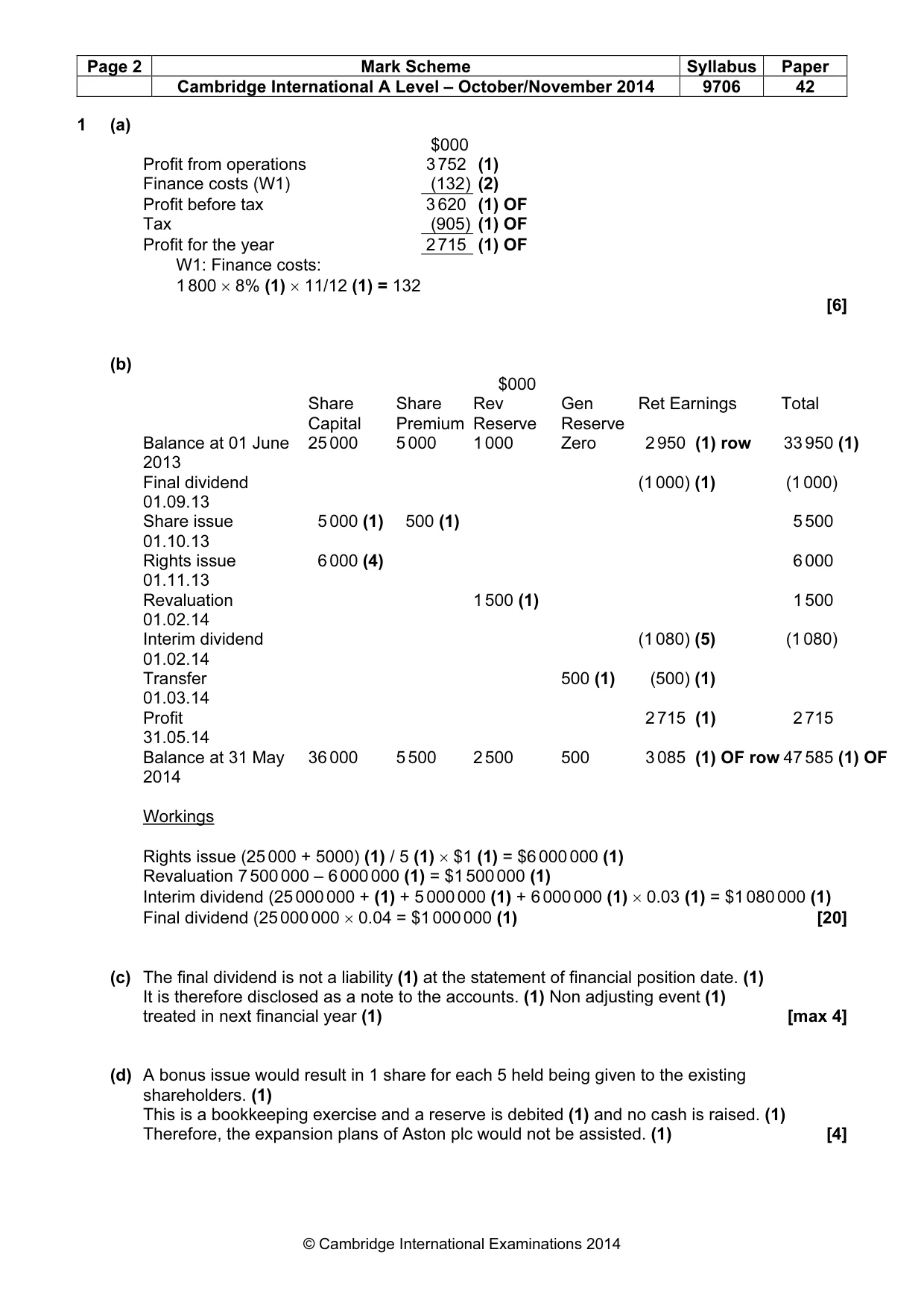
Page 2 Mark Scheme Syllabus Paper Cambridge International A Level – October/November 2014 9706 42 © Cambridge International Examinations 2014 1 (a) $000 Profit from operations 3 752. (1) Finance costs (W1) (132) (2) Profit before tax 3 620. (1) OF Tax (905) (1) OF Profit for the year 2 715. (1) OF W1: Finance costs: 1 800 × 8% (1) × 11/12 (1) = 132 [6] (b) $000 Share Capital Share Premium Rev Reserve Gen Reserve Ret Earnings Total Balance at 01 June 2013 25 000 5 000 1 000 Zero 2 950 (1) row 33 950 (1) Final dividend 01.09.13 (1 000) (1) (1 000) Share issue 01.10.13 5 000 (1) 500 (1) 5 500 Rights issue 01.11.13 6 000 (4) 6 000 Revaluation 01.02.14 1 500 (1) 1 500 Interim dividend 01.02.14 (1 080) (5) (1 080) Transfer 01.03.14 500 (1) (500) (1) Profit 31.05.14 2 715 (1) 2 715 Balance at 31 May 2014 36 000 5 500 2 500 500 3 085 (1) OF row 47 585 (1) OF Workings Rights issue (25 000 + 5000) (1) / 5 (1) × $1 (1) = $6 000 000 (1) Revaluation 7 500 000 – 6 000 000 (1) = $1 500 000 (1) Interim dividend (25 000 000 + (1) + 5 000 000 (1) + 6 000 000 (1) × 0.03 (1) = $1 080 000 (1) Final dividend (25 000 000 × 0.04 = $1 000 000 (1) [20] (c) The final dividend is not a liability (1) at the statement of financial position date. (1) It is therefore disclosed as a note to the accounts. (1) Non adjusting event (1) treated in next financial year (1) [max 4] (d) A bonus issue would result in 1 share for each 5 held being given to the existing shareholders. (1) This is a bookkeeping exercise and a reserve is debited (1) and no cash is raised. (1) Therefore, the expansion plans of Aston plc would not be assisted. (1) [4]
Mark scheme, page 3
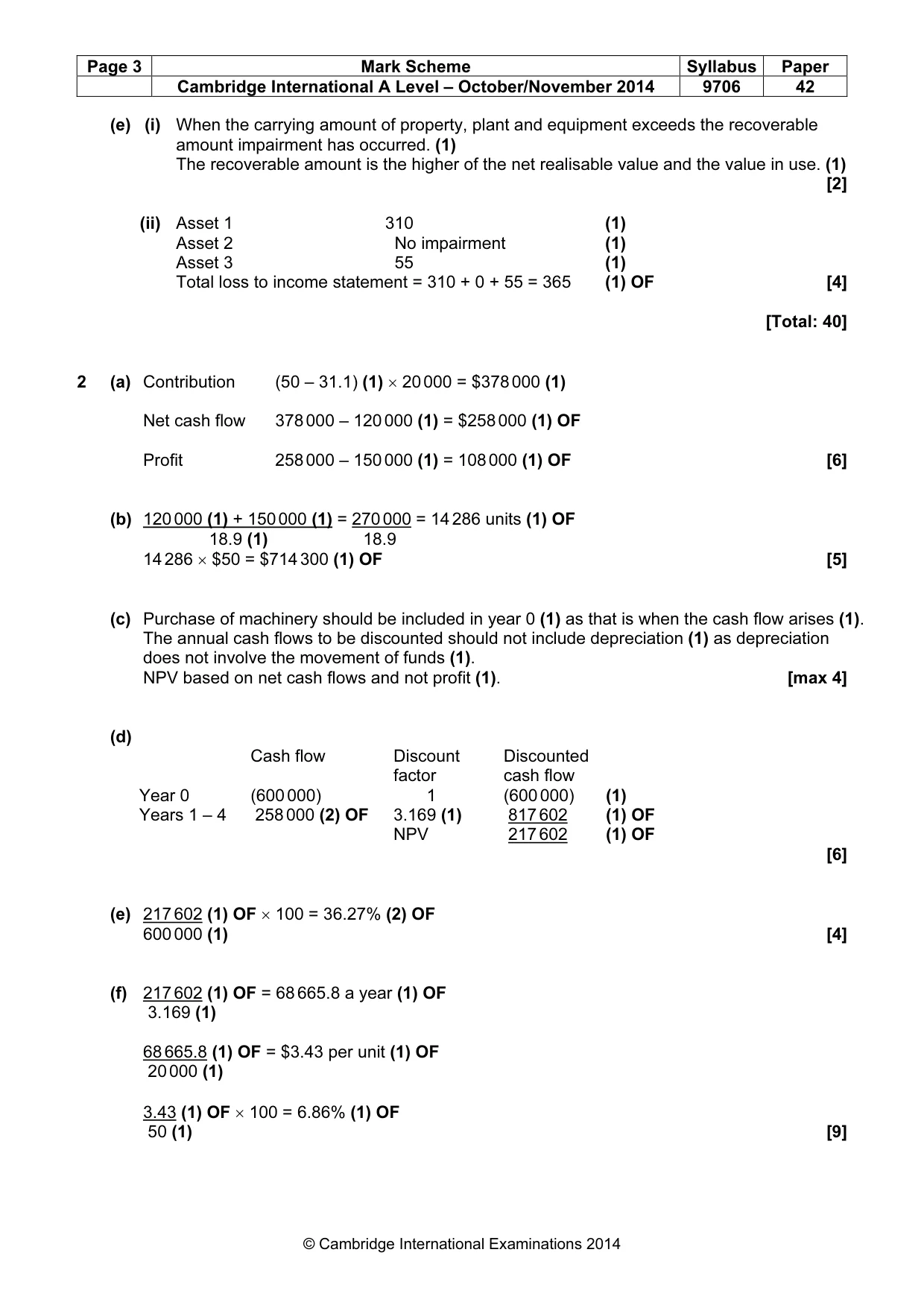
Page 3 Mark Scheme Syllabus Paper Cambridge International A Level – October/November 2014 9706 42 © Cambridge International Examinations 2014 (e) (i) When the carrying amount of property, plant and equipment exceeds the recoverable amount impairment has occurred. (1) The recoverable amount is the higher of the net realisable value and the value in use. (1) [2] (ii) Asset 1 310 (1) Asset 2 No impairment (1) Asset 3 55 (1) Total loss to income statement = 310 + 0 + 55 = 365 (1) OF [4] [Total: 40] 2 (a) Contribution (50 – 31.1) (1) × 20 000 = $378 000 (1) Net cash flow 378 000 – 120 000 (1) = $258 000 (1) OF Profit 258 000 – 150 000 (1) = 108 000 (1) OF [6] (b) 120 000 (1) + 150 000 (1) = 270 000 = 14 286 units (1) OF 18.9 (1) 18.9 14 286 × $50 = $714 300 (1) OF [5] (c) Purchase of machinery should be included in year 0 (1) as that is when the cash flow arises (1). The annual cash flows to be discounted should not include depreciation (1) as depreciation does not involve the movement of funds (1). NPV based on net cash flows and not profit (1). [max 4] (d) Cash flow Discount factor Discounted cash flow Year 0 (600 000) 1 (600 000) (1) Years 1 – 4 258 000 (2) OF 3.169 (1) 817 602 (1) OF NPV 217 602 (1) OF [6] (e) 217 602 (1) OF × 100 = 36.27% (2) OF 600 000 (1) [4] (f) 217 602 (1) OF = 68 665.8 a year (1) OF 3.169 (1) 68 665.8 (1) OF = $3.43 per unit (1) OF 20 000 (1) 3.43 (1) OF × 100 = 6.86% (1) OF 50 (1) [9]
Mark scheme, page 4
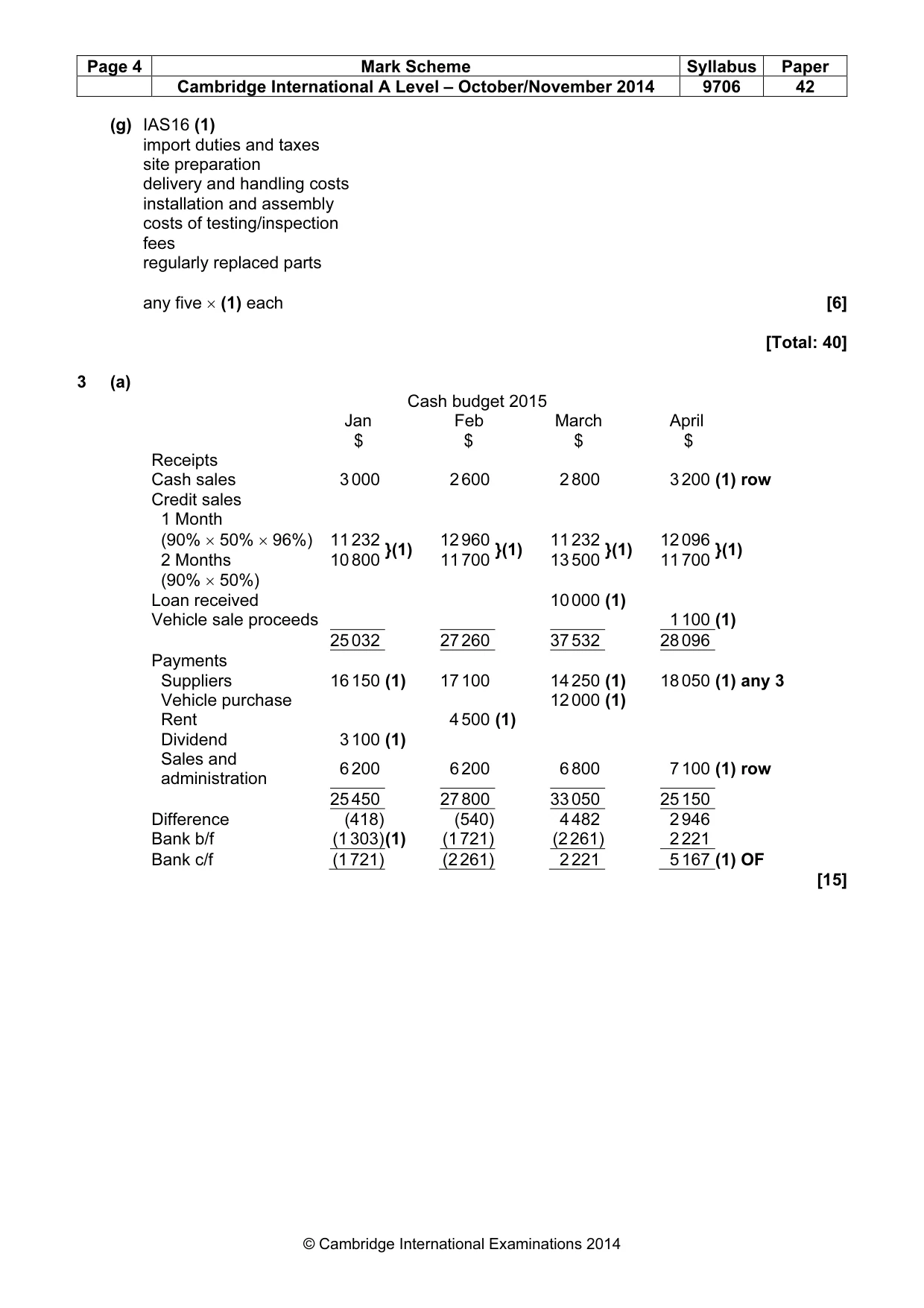
Page 4 Mark Scheme Syllabus Paper Cambridge International A Level – October/November 2014 9706 42 © Cambridge International Examinations 2014 (g) IAS16 (1) import duties and taxes site preparation delivery and handling costs installation and assembly costs of testing/inspection fees regularly replaced parts any five × (1) each [6] [Total: 40] 3 (a) Cash budget 2015 Jan Feb March April $ $ $ $ Receipts Cash sales 3 000 2 600 2 800 3 200 (1) row Credit sales 1 Month (90% × 50% × 96%) 11 232 }(1) 12 960 }(1) 11 232 }(1) 12 096 }(1) 2 Months (90% × 50%) 10 800 11 700 13 500 11 700 Loan received 10 000 (1) Vehicle sale proceeds 1 100 (1) 25 032 27 260 37 532 28 096 Payments Suppliers 16 150 (1) 17 100 14 250 (1) 18 050 (1) any 3 Vehicle purchase 12 000 (1) Rent 4 500 (1) Dividend 3 100 (1) Sales and administration 6 200 6 200 6 800 7 100 (1) row 25 450 27 800 33 050 25 150 Difference (418) (540) 4 482 2 946 Bank b/f (1 303) (1) (1 721) (2 261) 2 221 Bank c/f (1 721) (2 261) 2 221 5 167 (1) OF [15]
Mark scheme, page 5
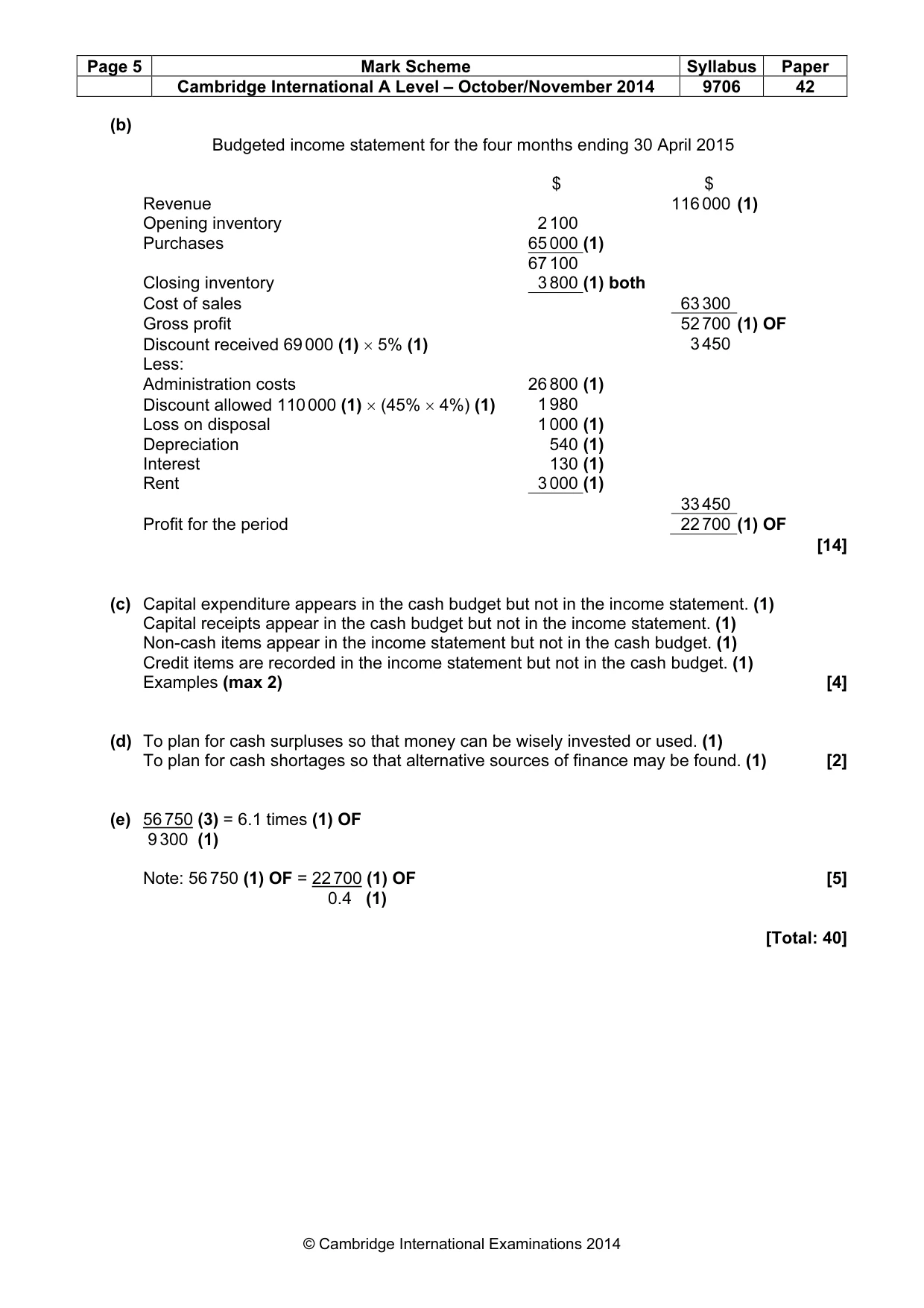
Page 5 Mark Scheme Syllabus Paper Cambridge International A Level – October/November 2014 9706 42 © Cambridge International Examinations 2014 (b) Budgeted income statement for the four months ending 30 April 2015 $ $ Revenue 116 000 (1) Opening inventory 2 100 Purchases 65 000 (1) 67 100 Closing inventory 3 800 (1) both Cost of sales 63 300 Gross profit 52 700 (1) OF Discount received 69 000 (1) × 5% (1) 3 450 Less: Administration costs 26 800 (1) Discount allowed 110 000 (1) × (45% × 4%) (1) 1 980 Loss on disposal 1 000 (1) Depreciation 540 (1) Interest 130 (1) Rent 3 000 (1) 33 450 Profit for the period 22 700 (1) OF [14] (c) Capital expenditure appears in the cash budget but not in the income statement. (1) Capital receipts appear in the cash budget but not in the income statement. (1) Non-cash items appear in the income statement but not in the cash budget. (1) Credit items are recorded in the income statement but not in the cash budget. (1) Examples (max 2) [4] (d) To plan for cash surpluses so that money can be wisely invested or used. (1) To plan for cash shortages so that alternative sources of finance may be found. (1) [2] (e) 56 750 (3) = 6.1 times (1) OF 9 300 (1) Note: 56 750 (1) OF = 22 700 (1) OF [5] 0.4 (1) [Total: 40]
What you needed in this session
Cambridge’s own grade thresholds for 2014 Oct/Nov, Paper 4 · Variant 2. A higher threshold means an easier paper — the bar moves with how the cohort did.