Cambridge A Level Accounting 9706 — 2024 May/June Paper 4 · Variant 2
9706/42/M/J/24 · 2 questions · 50 marks · ≈56 min
The question paper and its mark scheme, free to read here and free to download. This is Cambridge’s own paper, exactly as it was sat.
Question paper12 pages


Mark scheme17 pages
Answers below. Sit the paper first if you are practising.
Questions as text
Q1 · Read Source A in the insert
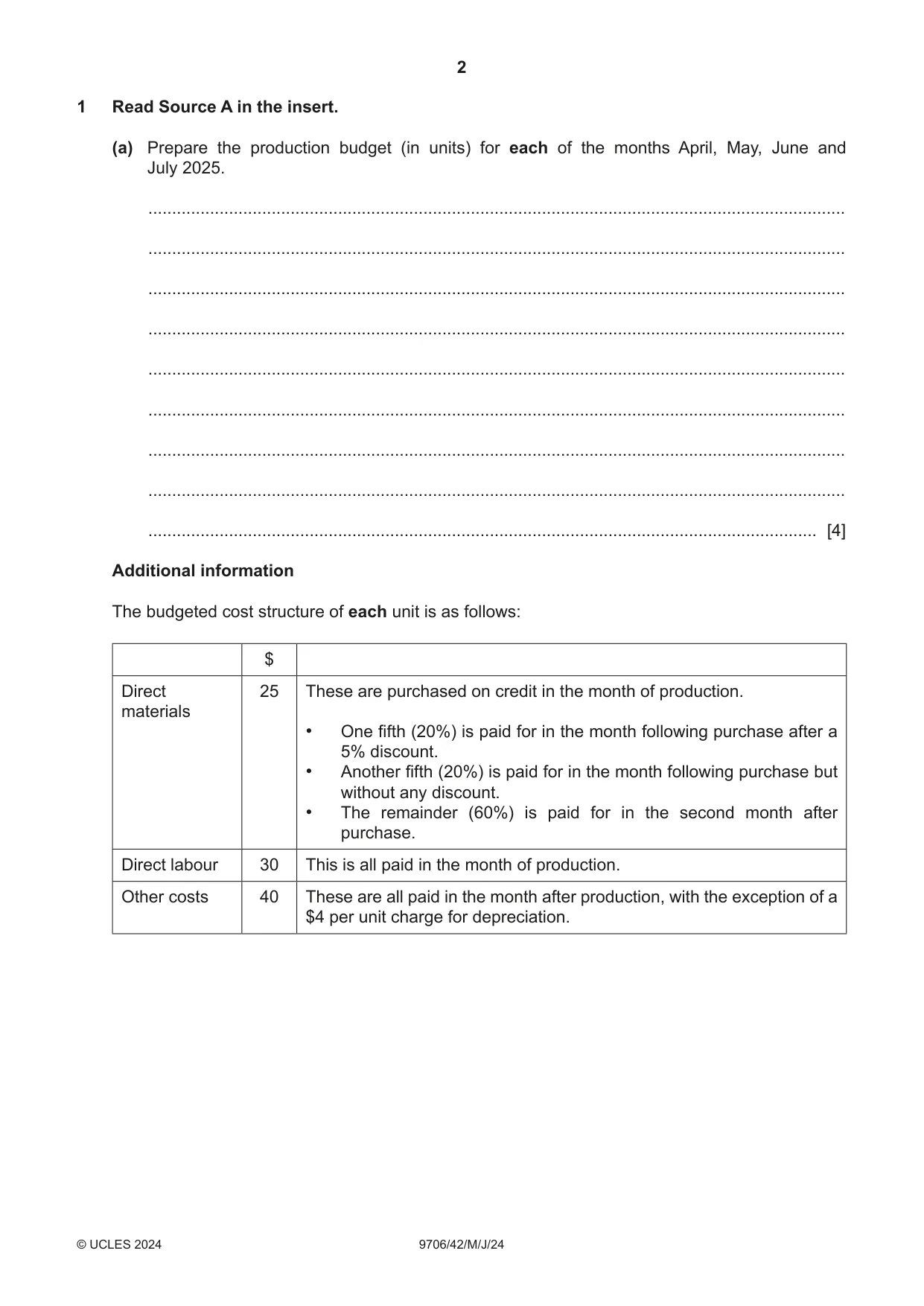
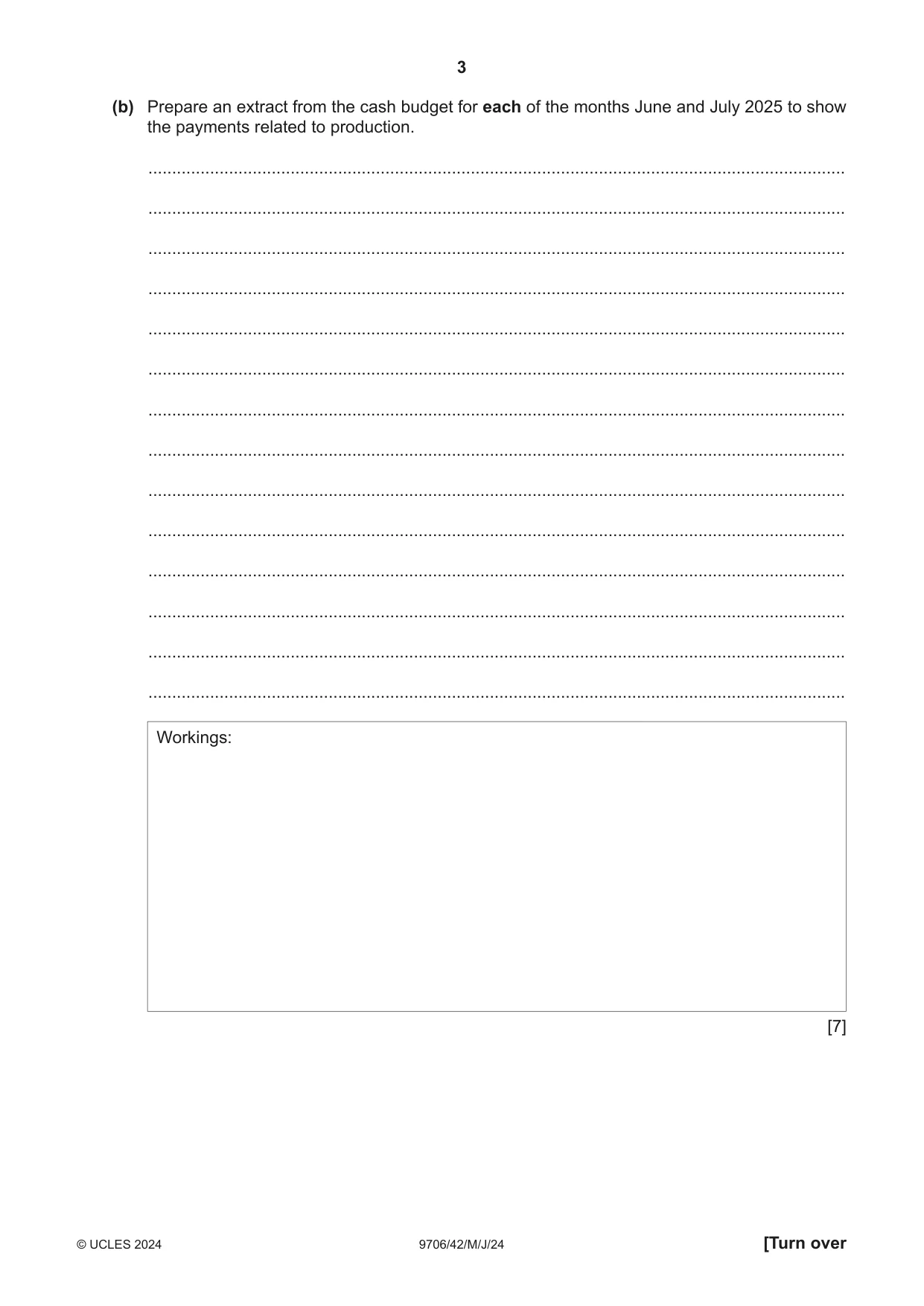
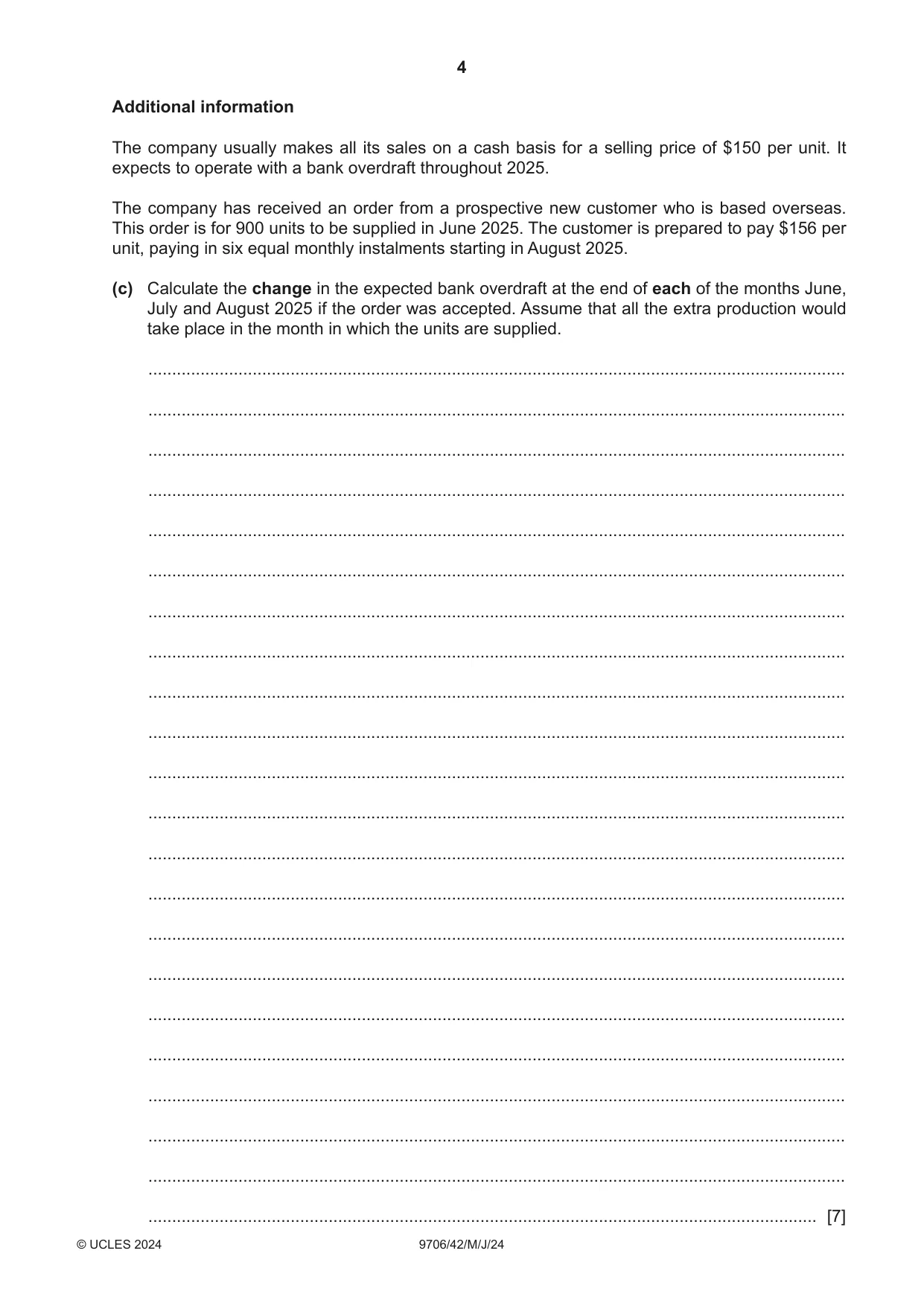
1 Read Source A in the insert. (a) Prepare the production budget (in units) for each of the months April, May, June and July 2025. ................................................................................................................................................... ................................................................................................................................................... ................................................................................................................................................... ................................................................................................................................................... ................................................................................................................................................... ................................................................................................................................................... ................................................................................................................................................... ................................................................................................................................................... ............................................................................................................................................. [4] Additional information The budgeted cost structure of each unit is as follows: $ Direct 25 These are purchased on credit in the month of production. materials • One fifth (20%) is paid for in the month following purchase after a 5% discount. • Another fifth (20%) is paid for in the month following purchase but without any discount. • The remainder (60%) is paid for in the second month after purchase. Direct labour 30 This is all paid in the month of production. Other costs 40 These are all paid in the month after production, with the exception of a $4 per unit charge for depreciation. (b) Prepare an extract from the cash budget for each of the months June and July 2025 to show the payments related to production. ................................................................................................................................................... ................................................................................................................................................... ................................................................................................................................................... ................................................................................................................................................... ................................................................................................................................................... ................................................................................................................................................... ................................................................................................................................................... ................................................................................................................................................... ................................................................................................................................................... ................................................................................................................................................... ................................................................................................................................................... ................................................................................................................................................... ................................................................................................................................................... ................................................................................................................................................... Workings: [7] Additional information The company usually makes all its sales on a cash basis for a selling price of $150 per unit. It expects to operate with a bank overdraft throughout 2025. The company has received an order from a prospective new customer who is based overseas. This order is for 900 units to be supplied in June 2025. The customer is prepared to pay $156 per unit, paying in six equal monthly instalments starting in August 2025. (c) Calculate the change in the expected bank overdraft at the end of each of the months June, July and August 2025 if the order was accepted. Assume that all the extra production would take place in the month in which the units are supplied. ................................................................................................................................................... ................................................................................................................................................... ................................................................................................................................................... ................................................................................................................................................... ................................................................................................................................................... ................................................................................................................................................... ................................................................................................................................................... ................................................................................................................................................... ................................................................................................................................................... ................................................................................................................................................... ................................................................................................................................................... ................................................................................................................................................... ................................................................................................................................................... ................................................................................................................................................... ................................................................................................................................................... ................................................................................................................................................... ................................................................................................................................................... ................................................................................................................................................... ................................................................................................................................................... ................................................................................................................................................... ................................................................................................................................................... ............................................................................................................................................. [7] (d) Advise the directors whether or not the company should accept the order. Justify your answer. ................................................................................................................................................... ................................................................................................................................................... ................................................................................................................................................... ................................................................................................................................................... ................................................................................................................................................... ................................................................................................................................................... ................................................................................................................................................... ................................................................................................................................................... ................................................................................................................................................... ................................................................................................................................................... ................................................................................................................................................... ................................................................................................................................................... ................................................................................................................................................... ................................................................................................................................................... ................................................................................................................................................... ................................................................................................................................................... ................................................................................................................................................... ................................................................................................................................................... ............................................................................................................................................. [7] [Total: 25]
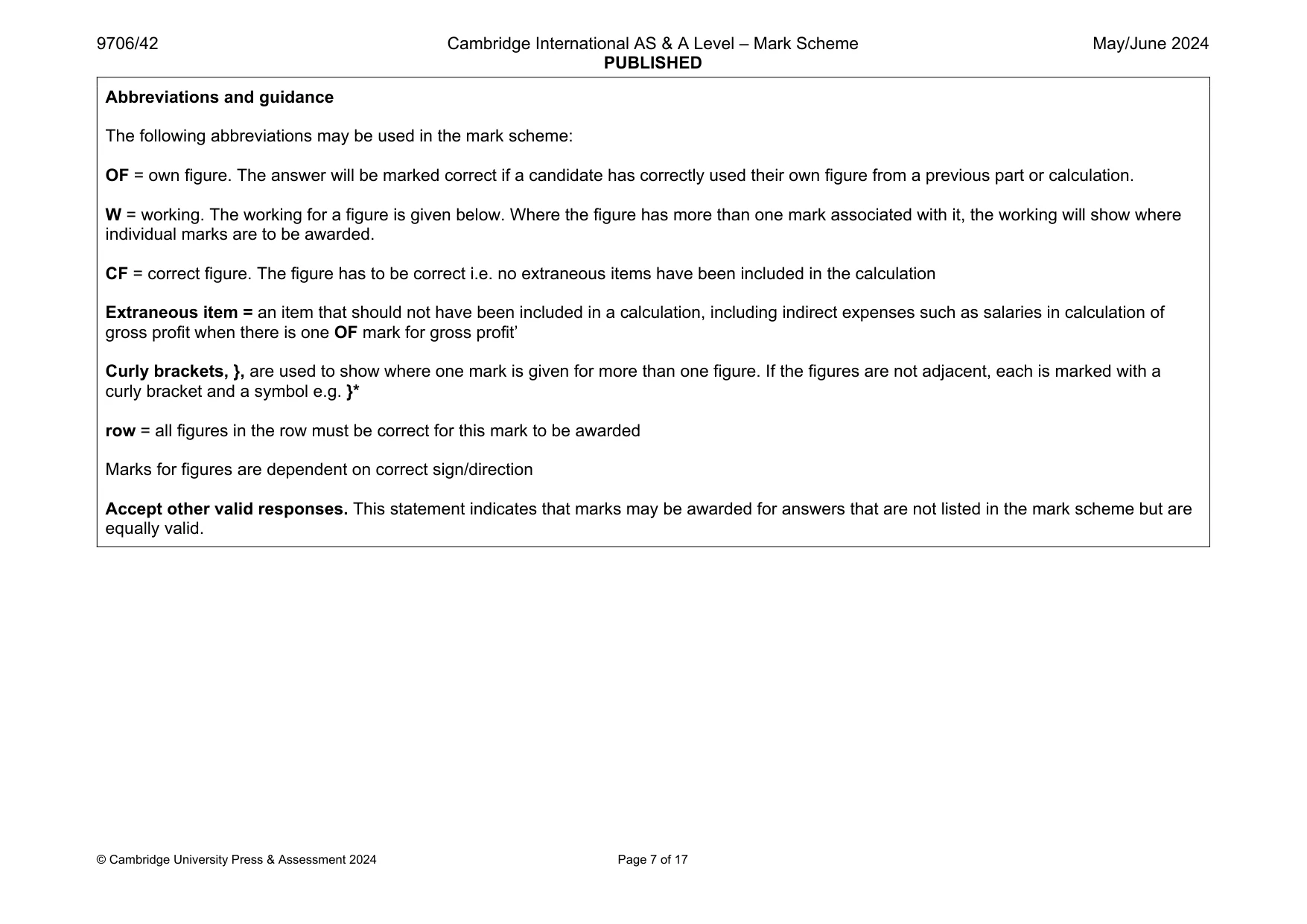
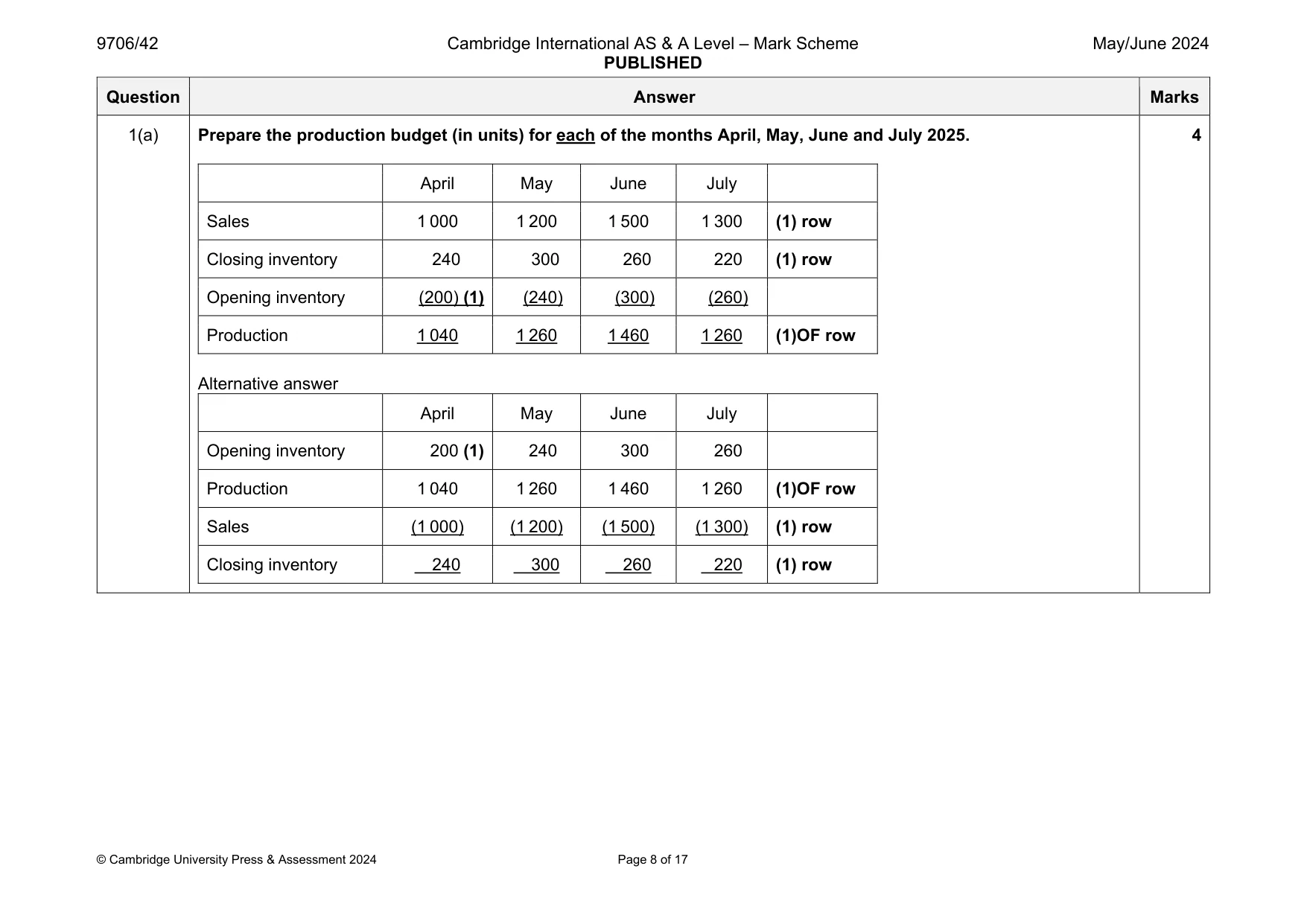
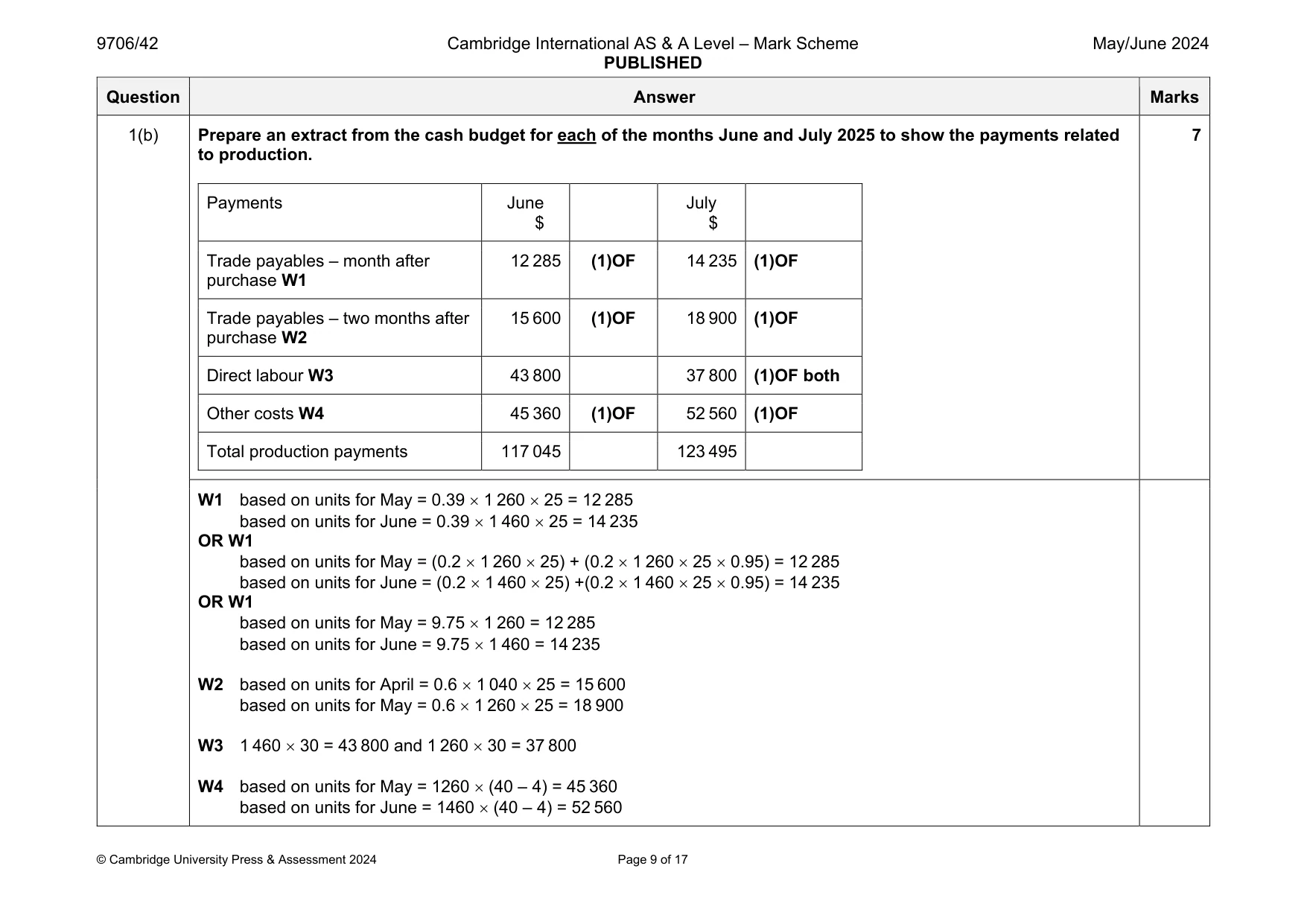
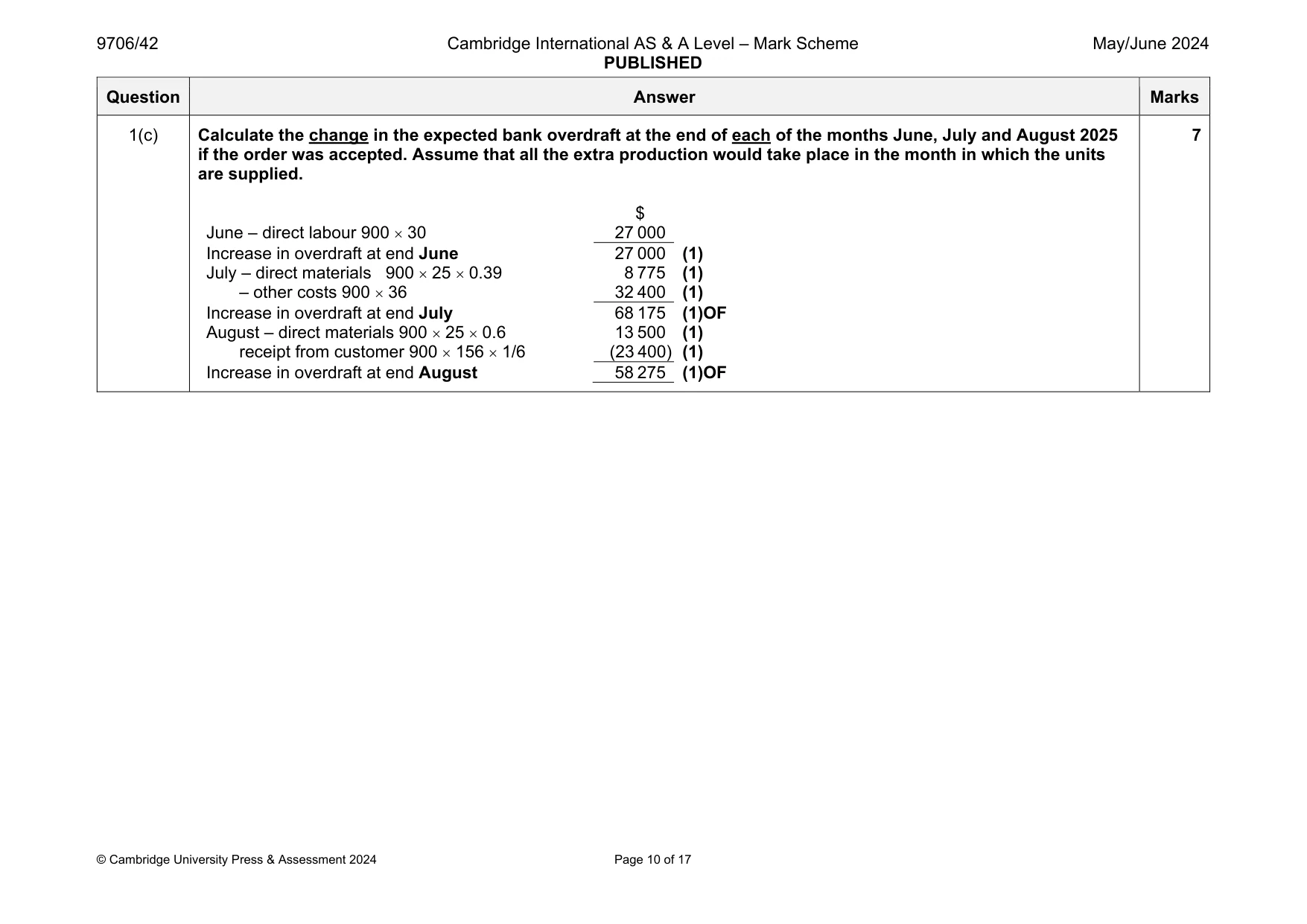
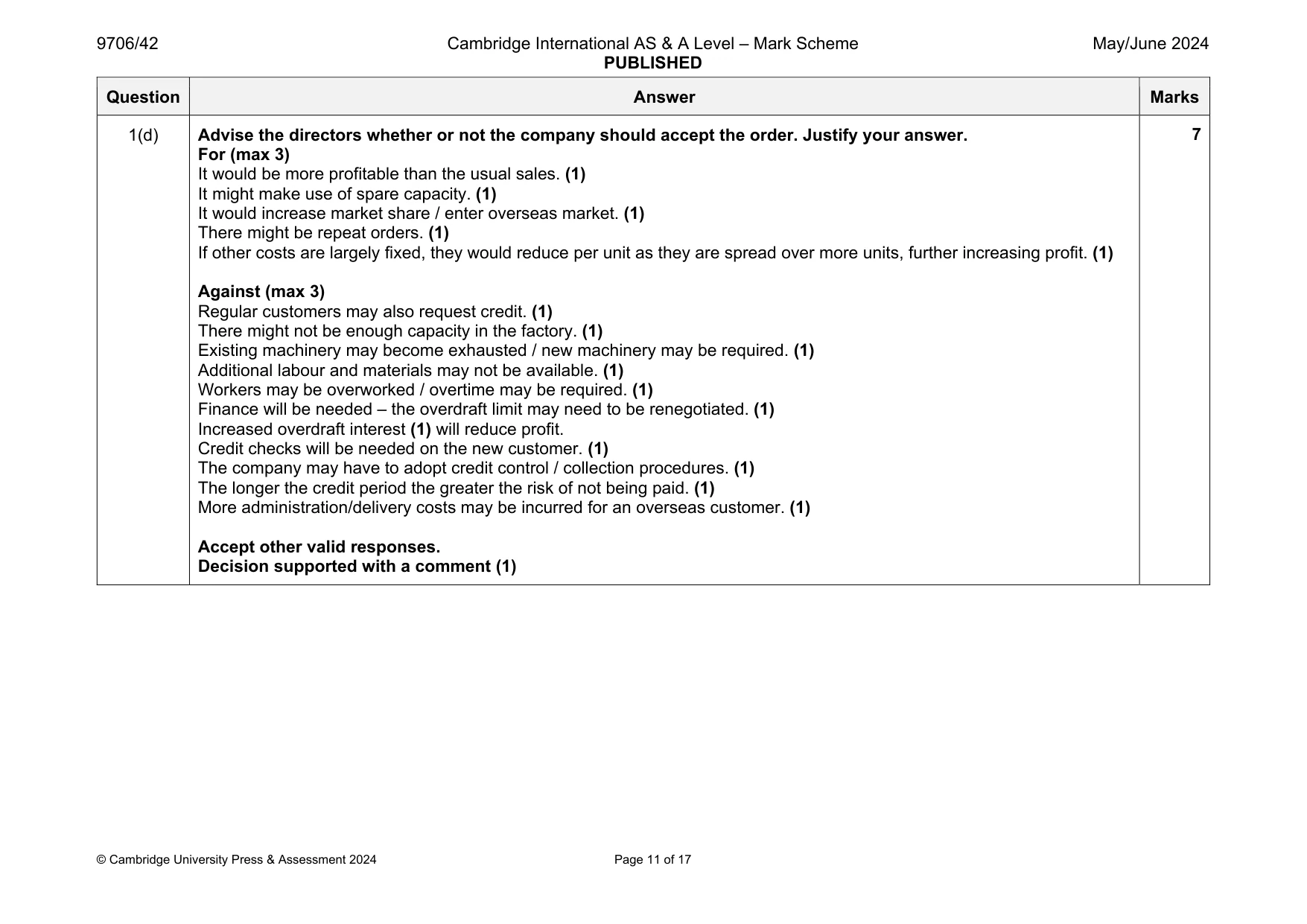
Mark scheme: 1(a) Prepare the production budget (in units) for each of the months April, May, June and July 2025. April May June July Sales 1 000 1 200 1 500 1 300 (1) row Closing inventory 240 300 260 220 (1) row Opening inventory (200) (1) (240) (300) (260) Production 1 040 1 260 1 460 1 260 (1)OF row Alternative answer April May June July Opening inventory 200 (1) 240 300 260 Production 1 040 1 260 1 460 1 260 (1)OF row Sales (1 000) (1 200) (1 500) (1 300) (1) row Closing inventory 240 300 260 220 (1) row 4 Question Answer Marks 1(b) Prepare an extract from the cash budget for each of the months June and July 2025 to show the payments related to production. Payments June $ July $ Trade payables – month after purchase W1 12 285 (1)OF 14 235 (1)OF Trade payables – two months after purchase W2 15 600 (1)OF 18 900 (1)OF Direct labour W3 43 800 37 800 (1)OF both Other costs W4 45 360 (1)OF 52 560 (1)OF Total production payments 117 045 123 495 7 W1 based on units for May = 0.39 1 260 25 = 12 285 based on units for June = 0.39 1 460 25 = 14 235 OR W1 based on units for May = (0.2 1 260 25) + (0.2 1 260 25 0.95) = 12 285 based on units for June = (0.2 1 460 25) +(0.2 1 460 25 0.95) = 14 235 OR W1 based on units for May = 9.75 1 260 = 12 285 based on units for June = 9.75 1 460 = 14 235 W2 based on units for April = 0.6 1 040 25 = 15 600 based on units for May = 0.6 1 260 25 = 18 900 W3 1 460 30 = 43 800 and 1 260 30 = 37 800 W4 based on units for May = 1260 (40 – 4) = 45 360 based on units for June = 1460 (40 – 4) = 52 560 Question Answer Marks 1(c) Calculate the change in the expected bank overdraft at the end of each of the months June, July and August 2025 if the order was accepted. Assume that all the extra production would take place in the month in which the units are supplied. $ June – direct labour 900 30 27 000 Increase in overdraft at end June 27 000 (1) July – direct materials 900 25 0.39 8 775 (1) – other costs 900 36 32 400 (1) Increase in overdraft at end July 68 175 (1)OF August – direct materials 900 25 0.6 13 500 (1) receipt from customer 900 156 1/6 (23 400) (1) Increase in overdraft at end August 58 275 (1)OF 7 Question Answer Marks 1(d) Advise the directors whether or not the company should accept the order. Justify your answer. For (max 3) It would be more profitable than the usual sales. (1) It might make use of spare capacity. (1) It would increase market share / enter overseas market. (1) There might be repeat orders. (1) If other costs are largely fixed, they would reduce per unit as they are spread over more units, further increasing profit. (1) Against (max 3) Regular customers may also request credit. (1) There might not be enough capacity in the factory. (1) Existing machinery may become exhausted / new machinery may be required. (1) Additional labour and materials may not be available. (1) Workers may be overworked / overtime may be required. (1) Finance will be needed – the overdraft limit may need to be renegotiated. (1) Increased overdraft interest (1) will reduce profit. Credit checks will be needed on the new customer. (1) The company may have to adopt credit control / collection procedures. (1) The longer the credit period the greater the risk of not being paid. (1) More administration/delivery costs may be incurred for an overseas customer. (1) Accept other valid responses. Decision supported with a comment (1) 7
Q2 · Read Source B in the insert
2 Read Source B in the insert. (a) State why cost drivers are used in the application of activity based costing (ABC). ................................................................................................................................................... ............................................................................................................................................. [1] (b) Calculate the selling price of one unit of each product. ................................................................................................................................................... ................................................................................................................................................... ................................................................................................................................................... ................................................................................................................................................... ................................................................................................................................................... ................................................................................................................................................... ................................................................................................................................................... ................................................................................................................................................... ................................................................................................................................................... ................................................................................................................................................... ................................................................................................................................................... ................................................................................................................................................... ................................................................................................................................................... ................................................................................................................................................... ................................................................................................................................................... ................................................................................................................................................... ................................................................................................................................................... Workings: [9] Additional information Sooraj is considering using machine hours rather than carrying values to allocate the depreciation cost. (c) Calculate the change in selling price of one unit of each product if Sooraj uses machine hours as the cost driver for depreciation cost. ................................................................................................................................................... ................................................................................................................................................... ................................................................................................................................................... ................................................................................................................................................... ................................................................................................................................................... ................................................................................................................................................... ................................................................................................................................................... ................................................................................................................................................... ................................................................................................................................................... ................................................................................................................................................... ................................................................................................................................................... ................................................................................................................................................... ............................................................................................................................................. [5] (d) Explain the relationship between the choice of cost driver and profit. ................................................................................................................................................... ................................................................................................................................................... ................................................................................................................................................... ................................................................................................................................................... ................................................................................................................................................... ............................................................................................................................................. [3] Additional information In recent months, actual results have been unfavourable in comparison with the budgeted figures. On one occasion, the manufacture of Product A had been stopped and sales lost because the sole supplier of some of the components of that product had been unable to fulfil Sooraj’s orders. Sooraj is considering manufacturing these components in his own factory instead of buying them in. He estimates that the total direct material cost of Product A would fall to $30 per unit and that the labour requirement for Product A would increase to 5 hours per unit, with the wage rate unchanged. The budgeted depreciation cost would increase by $8000 per annum. Sooraj is unclear whether overheads other than depreciation would be affected. (e) Advise Sooraj whether or not he should manufacture these components for Product A in his own factory. Justify your answer. Your answer should include any effect on the costs of Product B. ................................................................................................................................................... ................................................................................................................................................... ................................................................................................................................................... ................................................................................................................................................... ................................................................................................................................................... ................................................................................................................................................... ................................................................................................................................................... ................................................................................................................................................... ................................................................................................................................................... ................................................................................................................................................... ................................................................................................................................................... ................................................................................................................................................... ................................................................................................................................................... ................................................................................................................................................... ................................................................................................................................................... ................................................................................................................................................... ................................................................................................................................................... ................................................................................................................................................... ...................................................................................................................................................
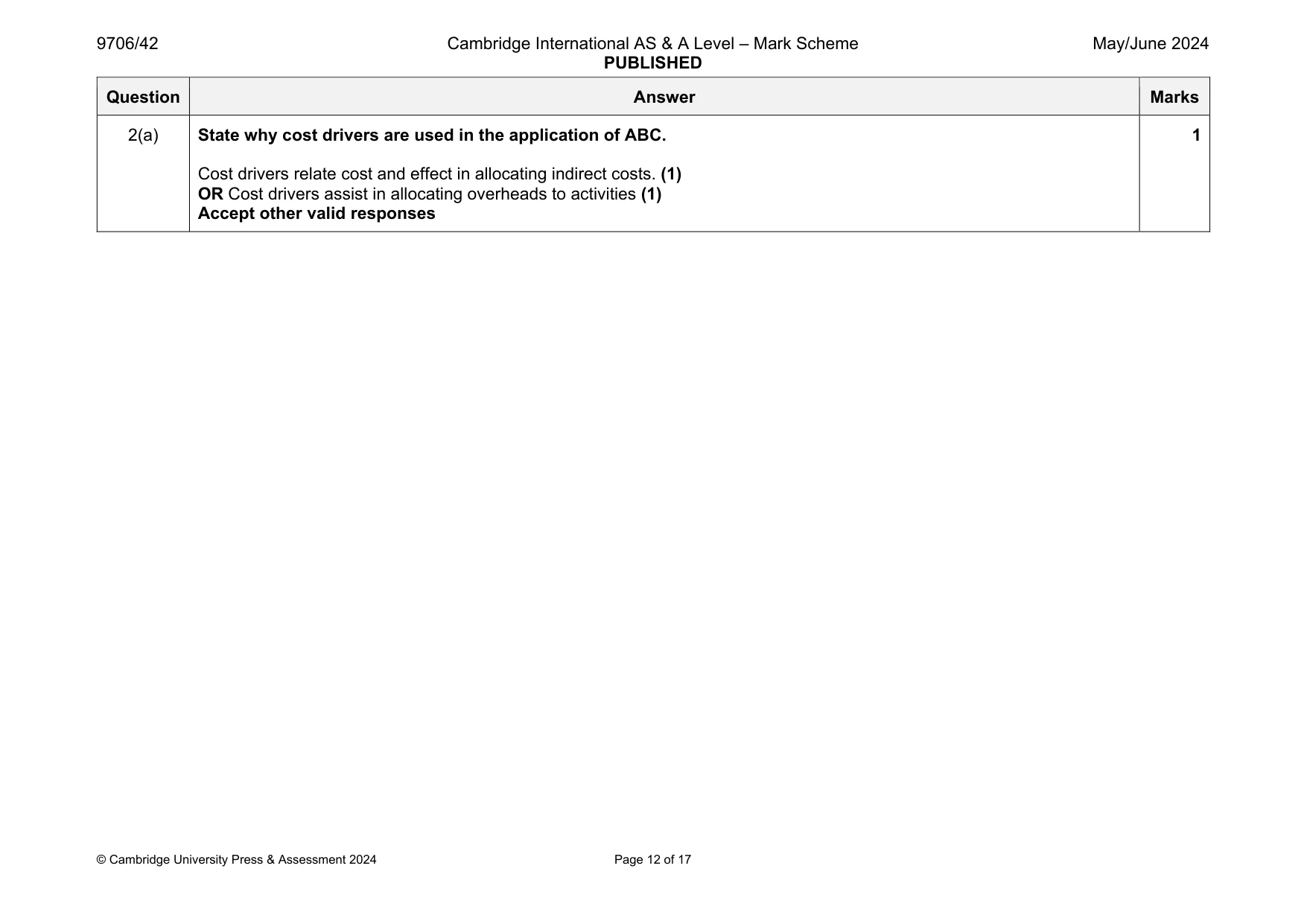
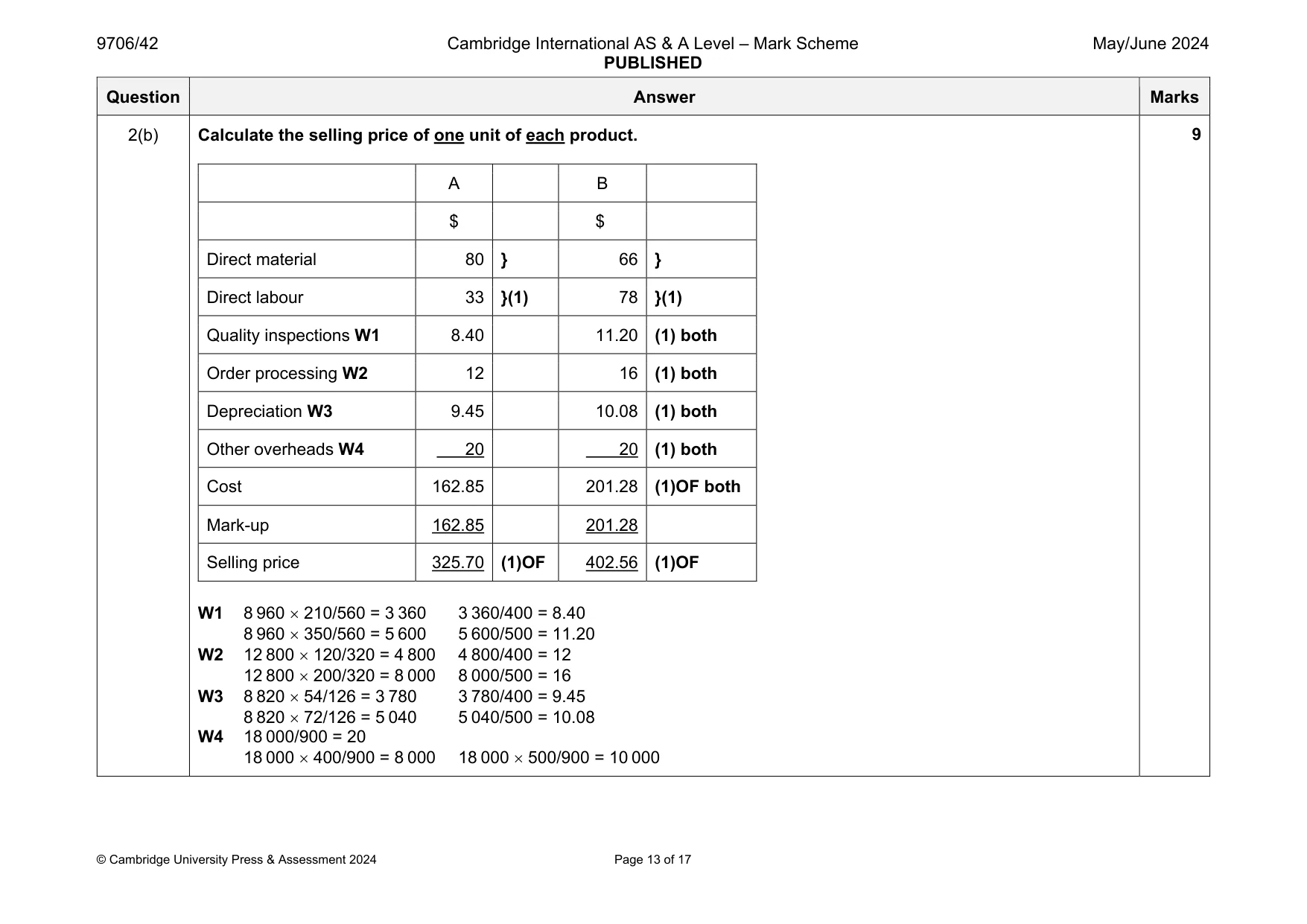
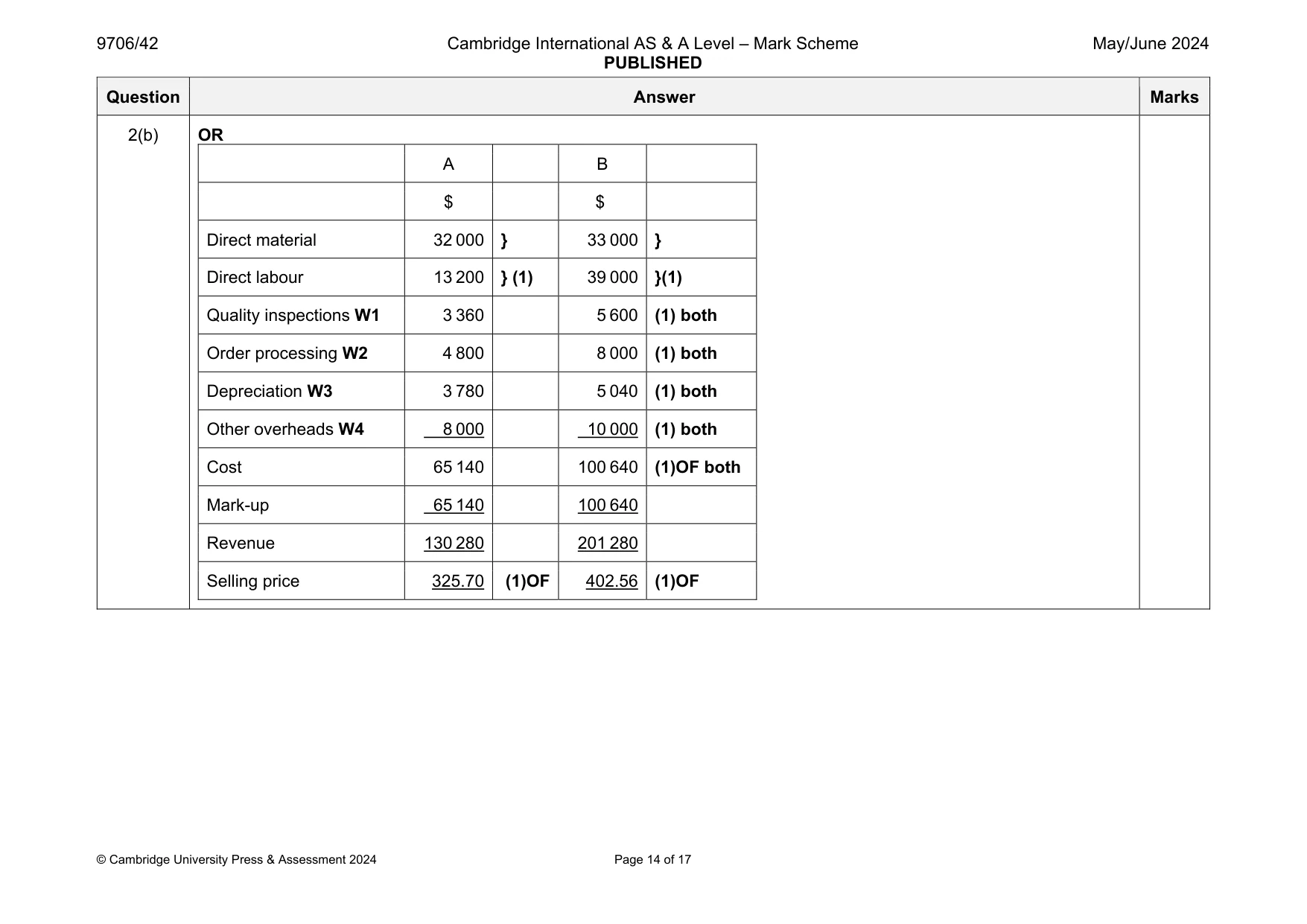
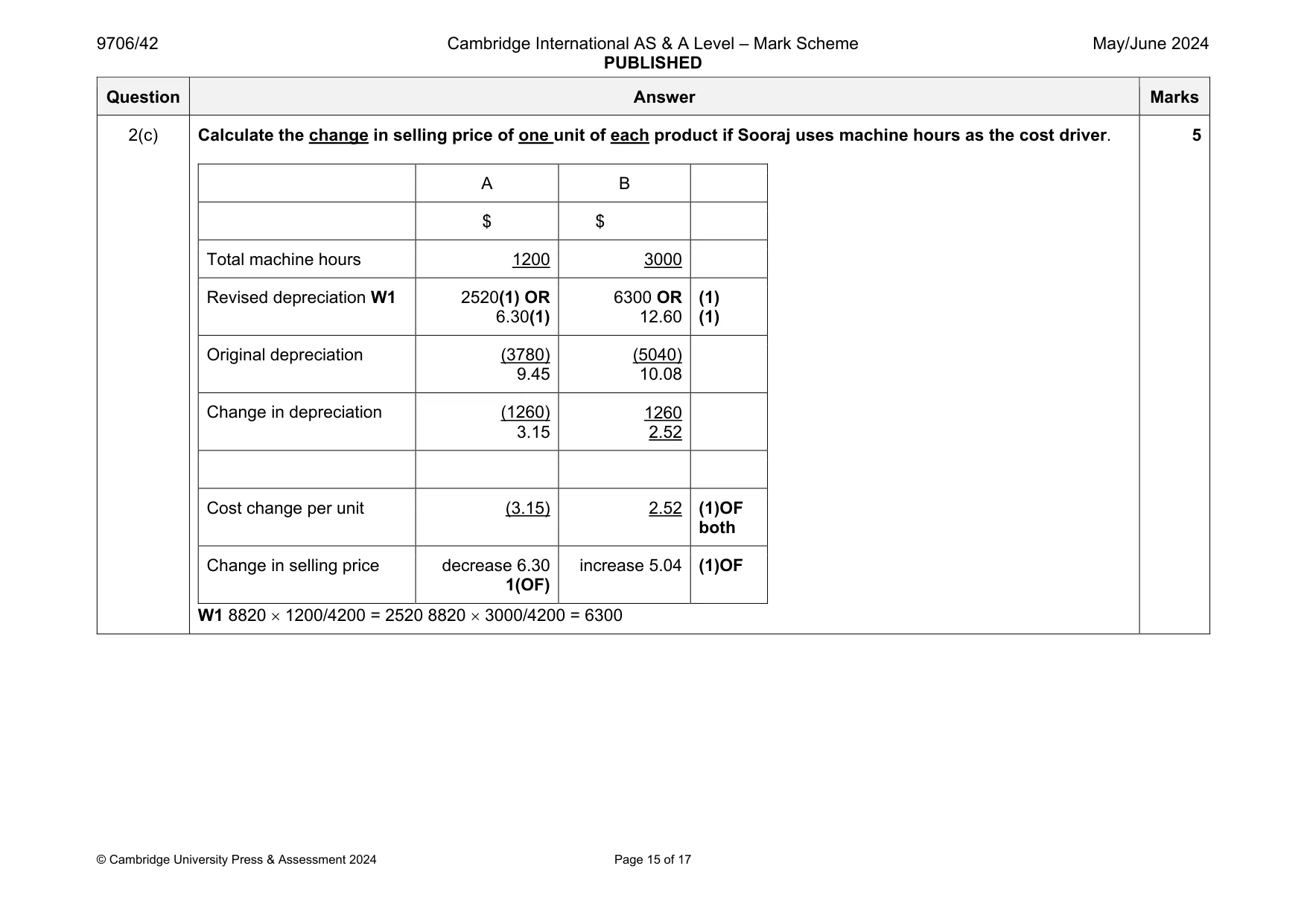
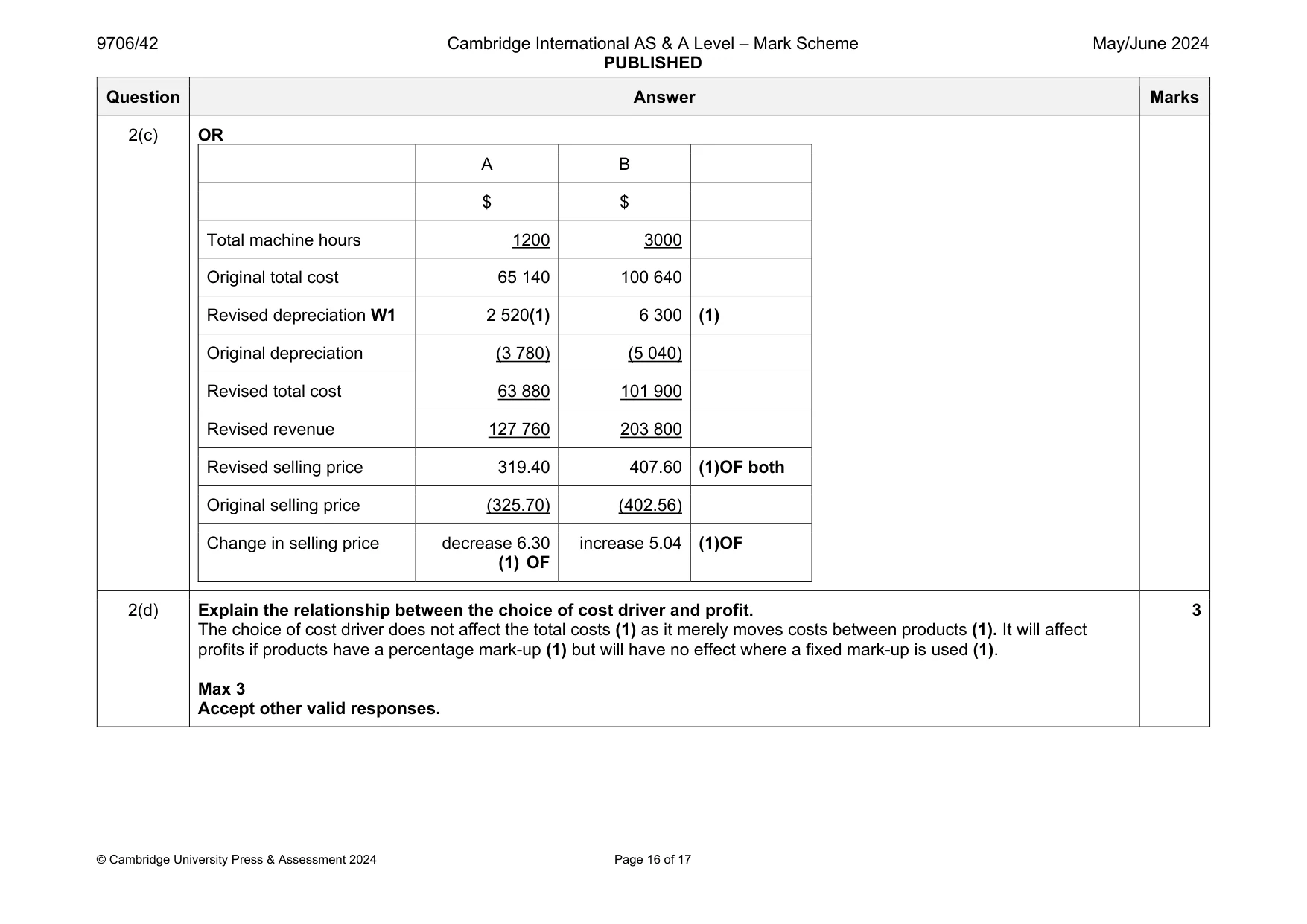
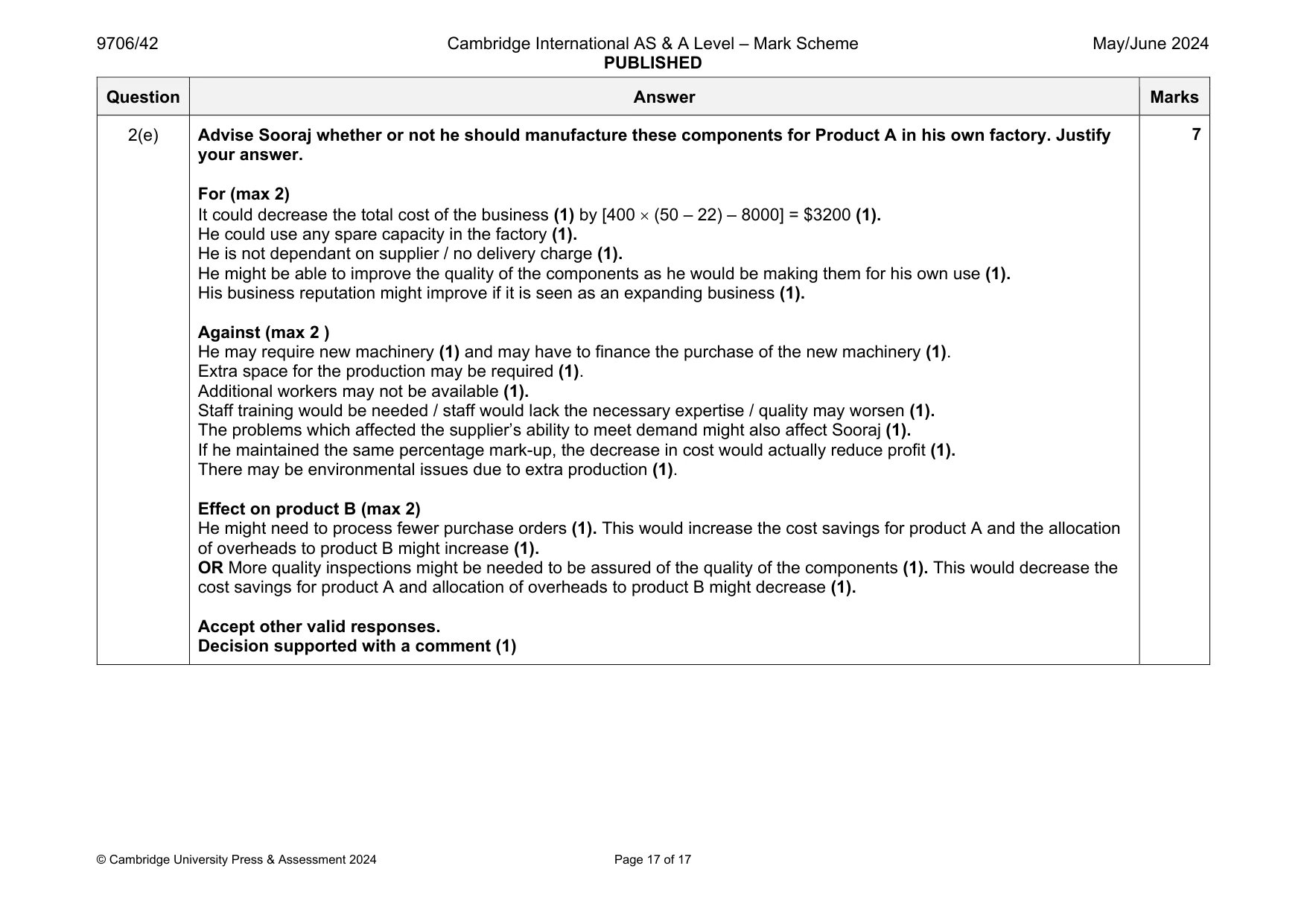
Mark scheme: 2(a) State why cost drivers are used in the application of ABC. Cost drivers relate cost and effect in allocating indirect costs. (1) OR Cost drivers assist in allocating overheads to activities (1) Accept other valid responses 1 Question Answer Marks 2(b) Calculate the selling price of one unit of each product. A B $ $ Direct material 80 } 66 } Direct labour 33 }(1) 78 }(1) Quality inspections W1 8.40 11.20 (1) both Order processing W2 12 16 (1) both Depreciation W3 9.45 10.08 (1) both Other overheads W4 20 20 (1) both Cost 162.85 201.28 (1)OF both Mark-up 162.85 201.28 Selling price 325.70 (1)OF 402.56 (1)OF W1 8 960 210/560 = 3 360 3 360/400 = 8.40 8 960 350/560 = 5 600 5 600/500 = 11.20 W2 12 800 120/320 = 4 800 4 800/400 = 12 12 800 200/320 = 8 000 8 000/500 = 16 W3 8 820 54/126 = 3 780 3 780/400 = 9.45 8 820 72/126 = 5 040 5 040/500 = 10.08 W4 18 000/900 = 20 18 000 400/900 = 8 000 18 000 500/900 = 10 000 9 Question Answer Marks 2(b) OR A B $ $ Direct material 32 000 } 33 000 } Direct labour 13 200 } (1) 39 000 }(1) Quality inspections W1 3 360 5 600 (1) both Order processing W2 4 800 8 000 (1) both Depreciation W3 3 780 5 040 (1) both Other overheads W4 8 000 10 000 (1) both Cost 65 140 100 640 (1)OF both Mark-up 65 140 100 640 Revenue 130 280 201 280 Selling price 325.70 (1)OF 402.56 (1)OF Question Answer Marks 2(c) Calculate the change in selling price of one unit of each product if Sooraj uses machine hours as the cost driver. A B $ $ Total machine hours 1200 3000 Revised depreciation W1 2520(1) OR 6.30(1) 6300 OR 12.60 (1) (1) Original depreciation (3780) 9.45 (5040) 10.08 Change in depreciation (1260) 3.15 1260 2.52 Cost change per unit (3.15) 2.52 (1)OF both Change in selling price decrease 6.30 1(OF) increase 5.04 (1)OF W1 8820 1200/4200 = 2520 8820 3000/4200 = 6300 5 Question Answer Marks 2(c) OR A B $ $ Total machine hours 1200 3000 Original total cost 65 140 100 640 Revised depreciation W1 2 520(1) 6 300 (1) Original depreciation (3 780) (5 040) Revised total cost 63 880 101 900 Revised revenue 127 760 203 800 Revised selling price 319.40 407.60 (1)OF both Original selling price (325.70) (402.56) Change in selling price decrease 6.30 (1) OF increase 5.04 (1)OF 2(d) Explain the relationship between the choice of cost driver and profit. The choice of cost driver does not affect the total costs (1) as it merely moves costs between products (1). It will affect profits if products have a percentage mark-up (1) but will have no effect where a fixed mark-up is used (1). Max 3 Accept other valid responses. 3 Question Answer Marks 2(e) Advise Sooraj whether or not he should manufacture these components for Product A in his own factory. Justify your answer. For (max 2) It could decrease the total cost of the business (1) by [400 (50 – 22) – 8000] = $3200 (1). He could use any spare capacity in the factory (1). He is not dependant on supplier / no delivery charge (1). He might be able to improve the quality of the components as he would be making them for his own use (1). His business reputation might improve if it is seen as an expanding business (1). Against (max 2 ) He may require new machinery (1) and may have to finance the purchase of the new machinery (1). Extra space for the production may be required (1). Additional workers may not be available (1). Staff training would be needed / staff would lack the necessary expertise / quality may worsen (1). The problems which affected the supplier’s ability to meet demand might also affect Sooraj (1). If he maintained the same percentage mark-up, the decrease in cost would actually reduce profit (1). There may be environmental issues due to extra production (1). Effect on product B (max 2) He might need to process fewer purchase orders (1). This would increase the cost savings for product A and the allocation of overheads to product B might increase (1). OR More quality inspections might be needed to be assured of the quality of the components (1). This would decrease the cost savings for product A and allocation of overheads to product B might decrease (1). Accept other valid responses. Decision supported with a comment (1) 7
What was in this paper
The subtopics covered by these 2 questions, and how many questions each got. Open one in a new tab to see every Cambridge question on it.
What you needed in this session
Cambridge’s own grade thresholds for 2024 May/June, Paper 4 · Variant 2. A higher threshold means an easier paper — the bar moves with how the cohort did.