Cambridge A Level Accounting 9706 — 2014 Oct/Nov Paper 4 · Variant 3
9706/43/O/N/14 · 120 marks · ≈135 min
The question paper and its mark scheme, free to read here and free to download. This is Cambridge’s own paper, exactly as it was sat.
Question paper8 pages
Mark scheme6 pages
Answers below. Sit the paper first if you are practising.
Paper as text
Question paper, page 1
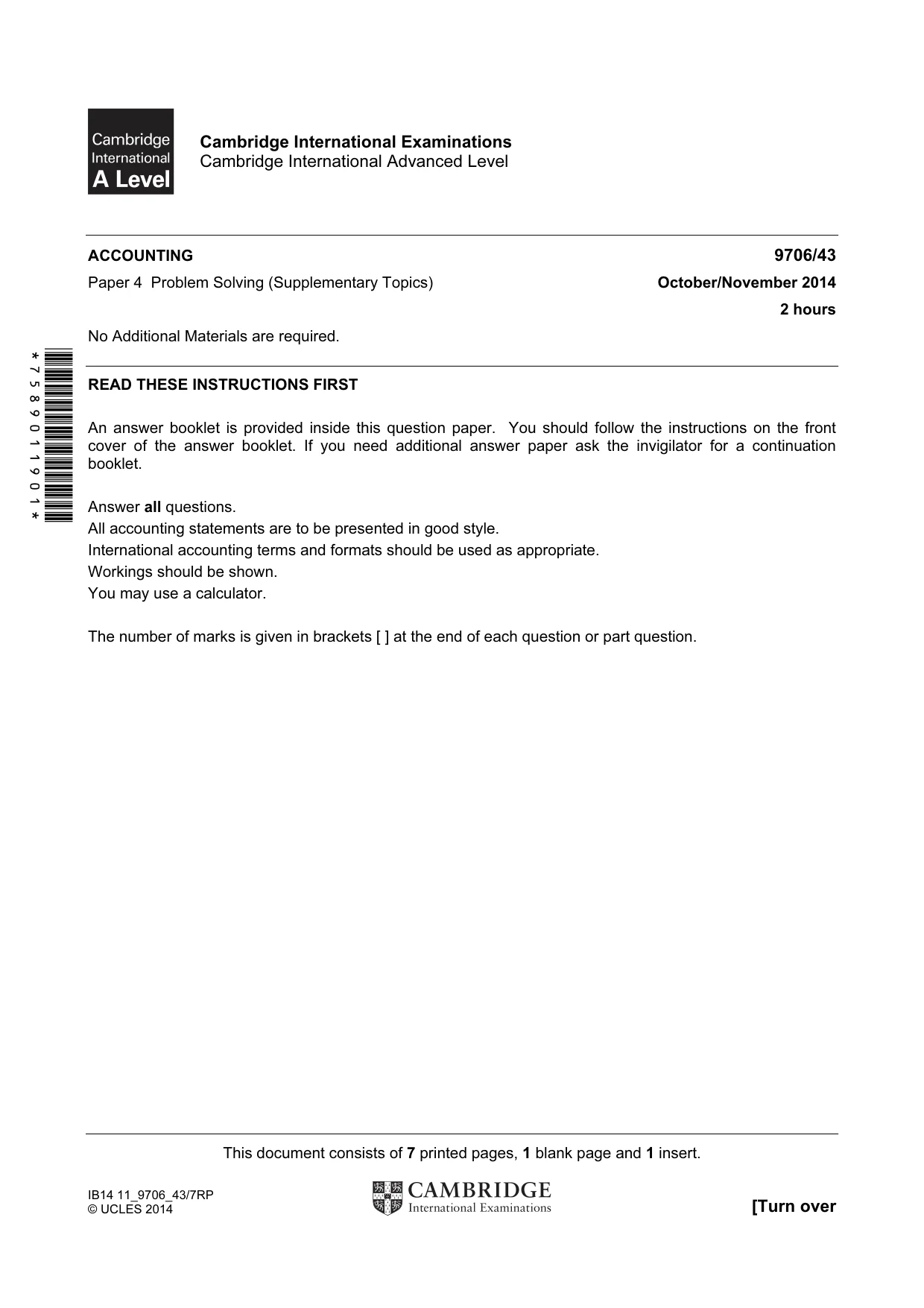
This document consists of 7 printed pages, 1 blank page and 1 insert. IB14 11_9706_43/7RP © UCLES 2014 [Turn over *7589011901* Cambridge International Examinations Cambridge International Advanced Level ACCOUNTING 9706/43 Paper 4 Problem Solving (Supplementary Topics) October/November 2014 2 hours No Additional Materials are required. READ THESE INSTRUCTIONS FIRST An answer booklet is provided inside this question paper. You should follow the instructions on the front cover of the answer booklet. If you need additional answer paper ask the invigilator for a continuation booklet. Answer all questions. All accounting statements are to be presented in good style. International accounting terms and formats should be used as appropriate. Workings should be shown. You may use a calculator. The number of marks is given in brackets [ ] at the end of each question or part question.
Question paper, page 2
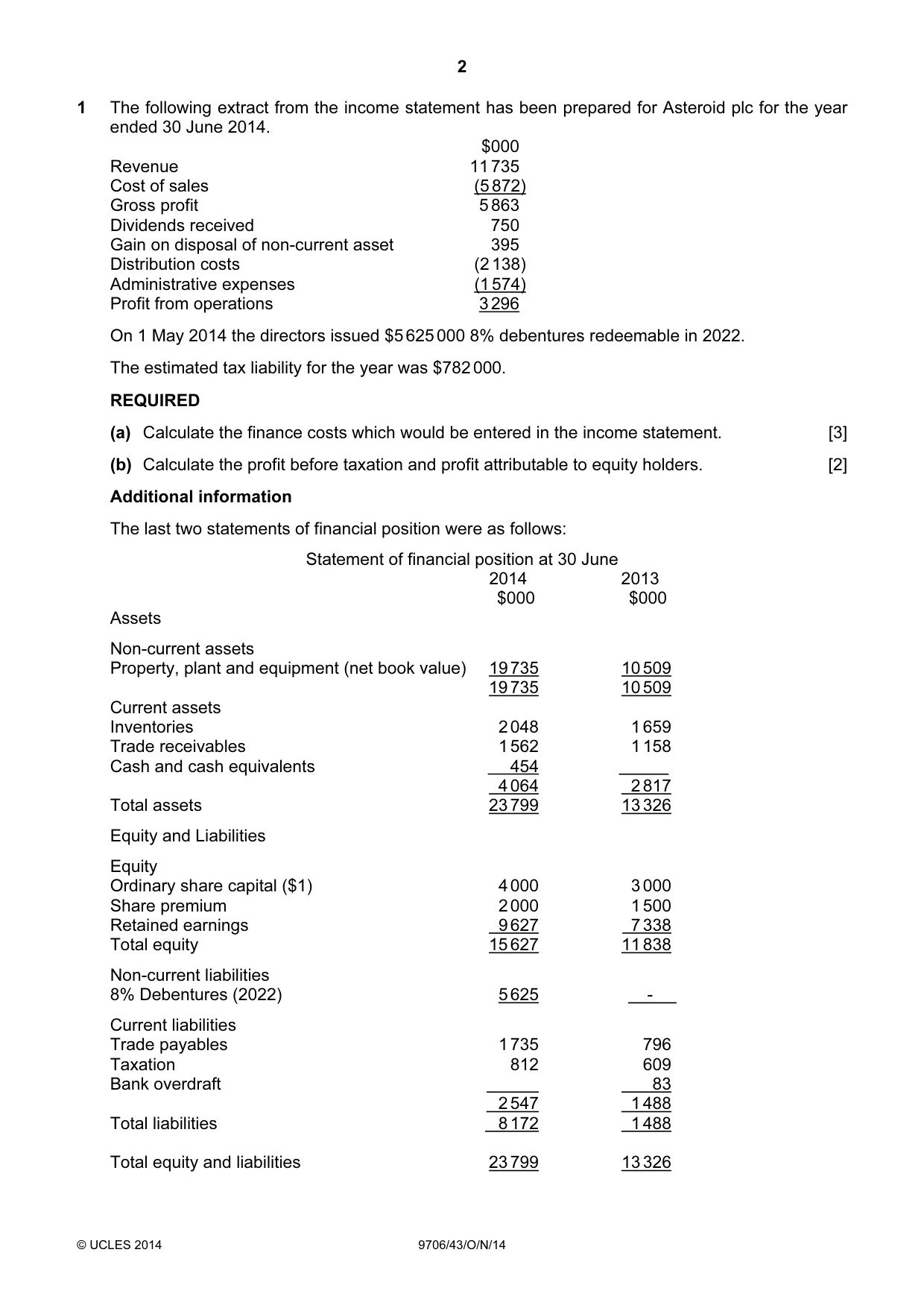
2 © UCLES 2014 9706/43/O/N/14 1 The following extract from the income statement has been prepared for Asteroid plc for the year ended 30 June 2014. $000 Revenue 11 735 Cost of sales (5 872) Gross profit 5 863 Dividends received 750 Gain on disposal of non-current asset 395 Distribution costs (2 138) Administrative expenses (1 574) Profit from operations 3 296 On 1 May 2014 the directors issued $5 625 000 8% debentures redeemable in 2022. The estimated tax liability for the year was $782 000. REQUIRED (a) Calculate the finance costs which would be entered in the income statement. [3] (b) Calculate the profit before taxation and profit attributable to equity holders. [2] Additional information The last two statements of financial position were as follows: Statement of financial position at 30 June 2014 2013 $000 $000 Assets Non-current assets Property, plant and equipment (net book value) 19 735 10 509 19 735 10 509 Current assets Inventories 2 048 1 659 Trade receivables 1 562 1 158 Cash and cash equivalents 454 4 064 2 817 Total assets 23 799 13 326 Equity and Liabilities Equity Ordinary share capital ($1) 4 000 3 000 Share premium 2 000 1 500 Retained earnings 9 627 7 338 Total equity 15 627 11 838 Non-current liabilities 8% Debentures (2022) 5 625 - Current liabilities Trade payables 1 735 796 Taxation 812 609 Bank overdraft 83 2 547 1 488 Total liabilities 8 172 1 488 Total equity and liabilities 23 799 13 326
Question paper, page 3
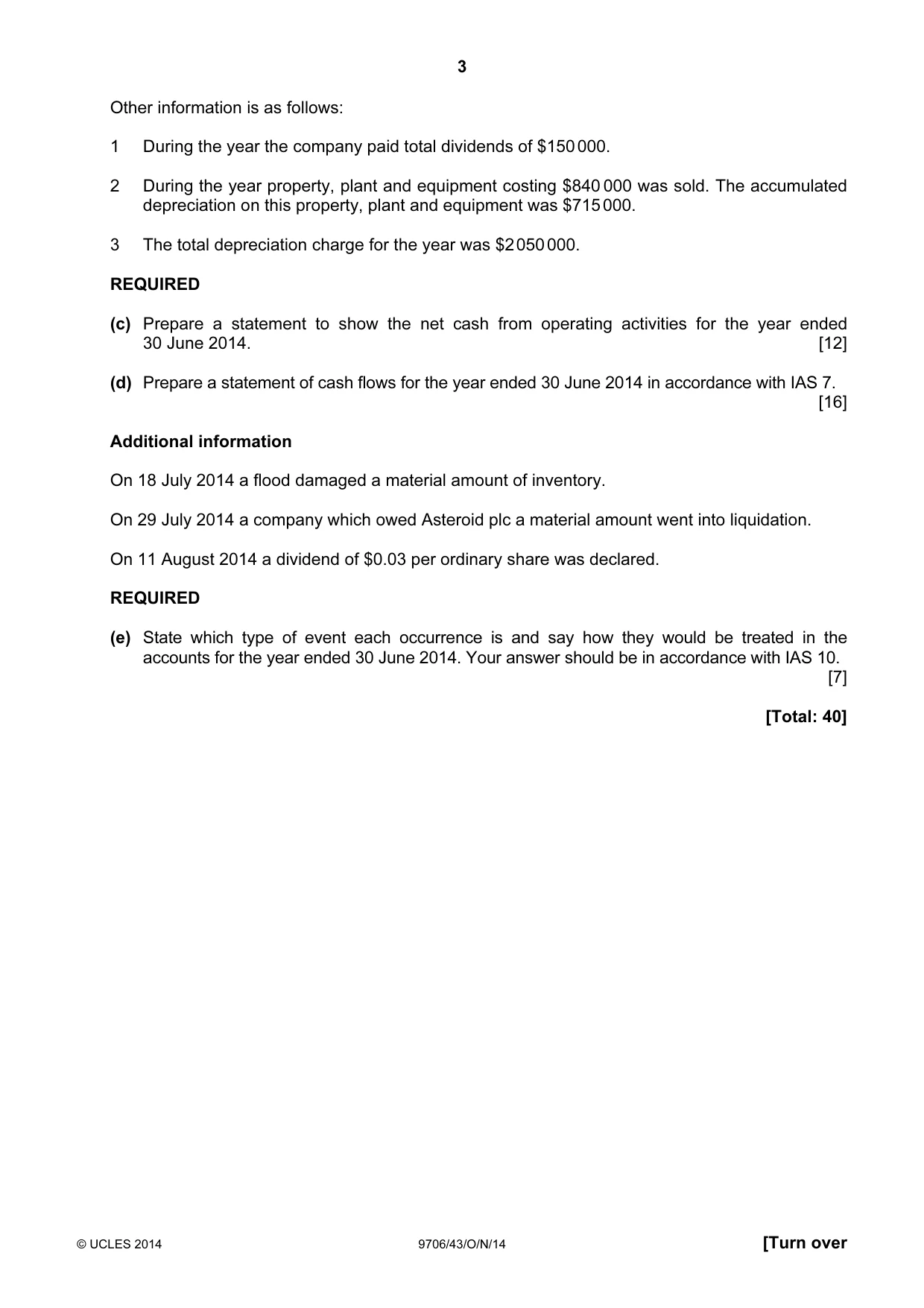
3 © UCLES 2014 9706/43/O/N/14 [Turn over Other information is as follows: 1 During the year the company paid total dividends of $150 000. 2 During the year property, plant and equipment costing $840 000 was sold. The accumulated depreciation on this property, plant and equipment was $715 000. 3 The total depreciation charge for the year was $2 050 000. REQUIRED (c) Prepare a statement to show the net cash from operating activities for the year ended 30 June 2014. [12] (d) Prepare a statement of cash flows for the year ended 30 June 2014 in accordance with IAS 7. [16] Additional information On 18 July 2014 a flood damaged a material amount of inventory. On 29 July 2014 a company which owed Asteroid plc a material amount went into liquidation. On 11 August 2014 a dividend of $0.03 per ordinary share was declared. REQUIRED (e) State which type of event each occurrence is and say how they would be treated in the accounts for the year ended 30 June 2014. Your answer should be in accordance with IAS 10. [7] [Total: 40]
Question paper, page 4
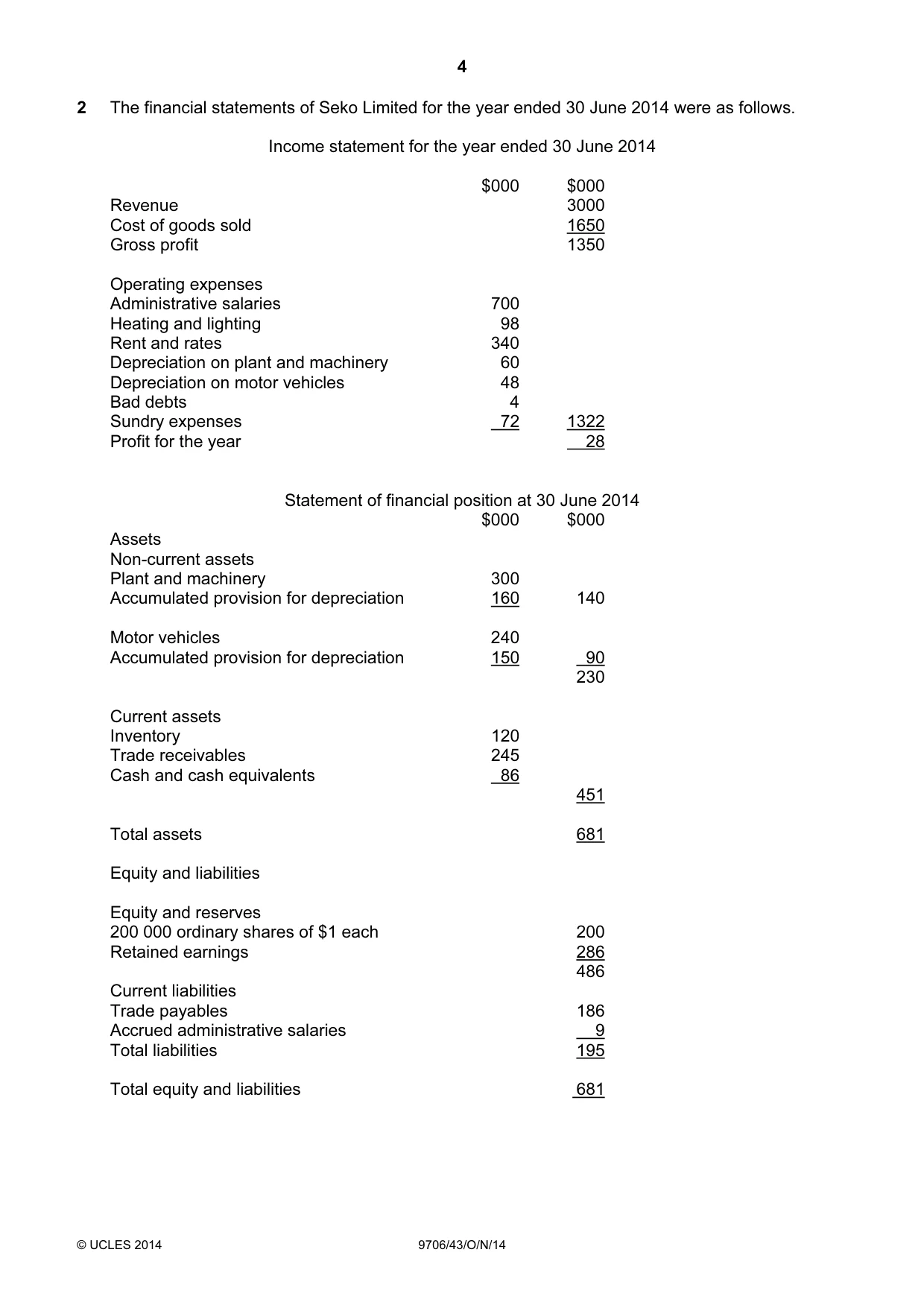
4 © UCLES 2014 9706/43/O/N/14 2 The financial statements of Seko Limited for the year ended 30 June 2014 were as follows. Income statement for the year ended 30 June 2014 $000 $000 Revenue 3000 Cost of goods sold 1650 Gross profit 1350 Operating expenses Administrative salaries 700 Heating and lighting 98 Rent and rates 340 Depreciation on plant and machinery 60 Depreciation on motor vehicles 48 Bad debts 4 Sundry expenses 72 1322 Profit for the year 28 Statement of financial position at 30 June 2014 $000 $000 Assets Non-current assets Plant and machinery 300 Accumulated provision for depreciation 160 140 Motor vehicles 240 Accumulated provision for depreciation 150 90 230 Current assets Inventory 120 Trade receivables 245 Cash and cash equivalents 86 451 Total assets 681 Equity and liabilities Equity and reserves 200 000 ordinary shares of $1 each 200 Retained earnings 286 486 Current liabilities Trade payables 186 Accrued administrative salaries 9 Total liabilities 195 Total equity and liabilities 681
Question paper, page 5
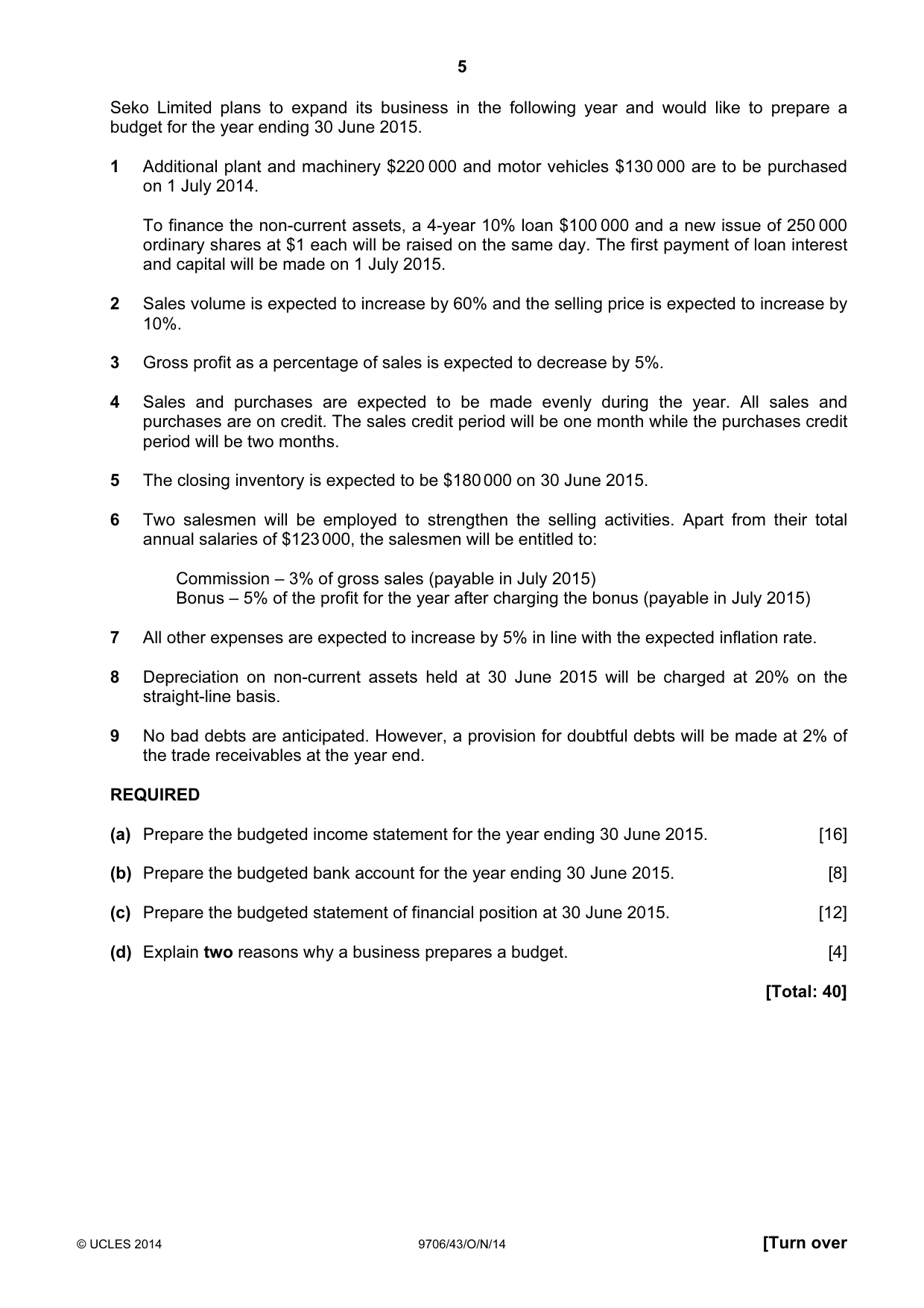
5 © UCLES 2014 9706/43/O/N/14 [Turn over Seko Limited plans to expand its business in the following year and would like to prepare a budget for the year ending 30 June 2015. 1 Additional plant and machinery $220 000 and motor vehicles $130 000 are to be purchased on 1 July 2014. To finance the non-current assets, a 4-year 10% loan $100 000 and a new issue of 250 000 ordinary shares at $1 each will be raised on the same day. The first payment of loan interest and capital will be made on 1 July 2015. 2 Sales volume is expected to increase by 60% and the selling price is expected to increase by 10%. 3 Gross profit as a percentage of sales is expected to decrease by 5%. 4 Sales and purchases are expected to be made evenly during the year. All sales and purchases are on credit. The sales credit period will be one month while the purchases credit period will be two months. 5 The closing inventory is expected to be $180 000 on 30 June 2015. 6 Two salesmen will be employed to strengthen the selling activities. Apart from their total annual salaries of $123 000, the salesmen will be entitled to: Commission – 3% of gross sales (payable in July 2015) Bonus – 5% of the profit for the year after charging the bonus (payable in July 2015) 7 All other expenses are expected to increase by 5% in line with the expected inflation rate. 8 Depreciation on non-current assets held at 30 June 2015 will be charged at 20% on the straight-line basis. 9 No bad debts are anticipated. However, a provision for doubtful debts will be made at 2% of the trade receivables at the year end. REQUIRED (a) Prepare the budgeted income statement for the year ending 30 June 2015. [16] (b) Prepare the budgeted bank account for the year ending 30 June 2015. [8] (c) Prepare the budgeted statement of financial position at 30 June 2015. [12] (d) Explain two reasons why a business prepares a budget. [4] [Total: 40]
Question paper, page 6
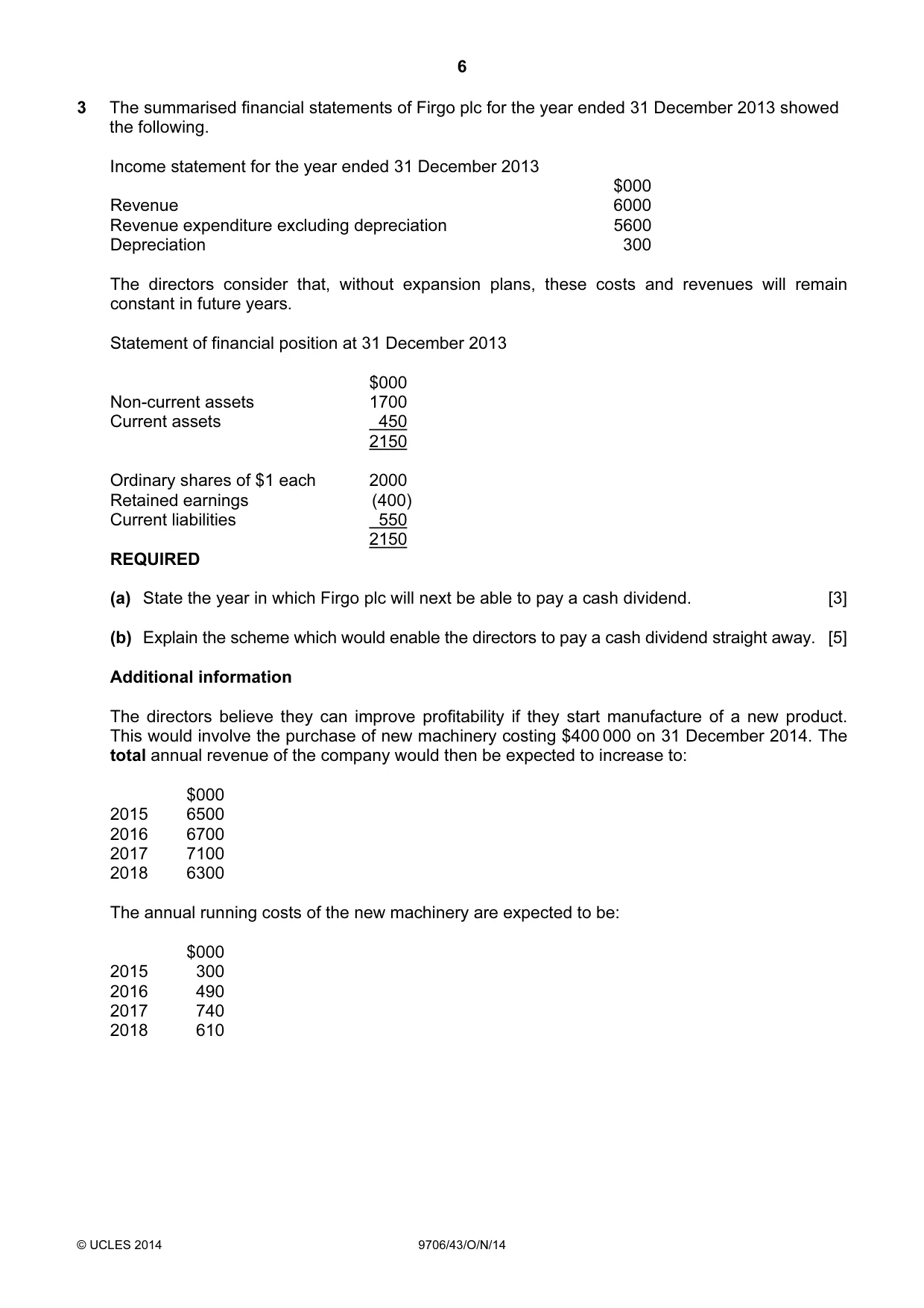
6 © UCLES 2014 9706/43/O/N/14 3 The summarised financial statements of Firgo plc for the year ended 31 December 2013 showed the following. Income statement for the year ended 31 December 2013 $000 Revenue 6000 Revenue expenditure excluding depreciation 5600 Depreciation 300 The directors consider that, without expansion plans, these costs and revenues will remain constant in future years. Statement of financial position at 31 December 2013 $000 Non-current assets 1700 Current assets 450 2150 Ordinary shares of $1 each 2000 Retained earnings (400) Current liabilities 550 2150 REQUIRED (a) State the year in which Firgo plc will next be able to pay a cash dividend. [3] (b) Explain the scheme which would enable the directors to pay a cash dividend straight away. [5] Additional information The directors believe they can improve profitability if they start manufacture of a new product. This would involve the purchase of new machinery costing $400 000 on 31 December 2014. The total annual revenue of the company would then be expected to increase to: $000 2015 6500 2016 6700 2017 7100 2018 6300 The annual running costs of the new machinery are expected to be: $000 2015 300 2016 490 2017 740 2018 610
Question paper, page 7
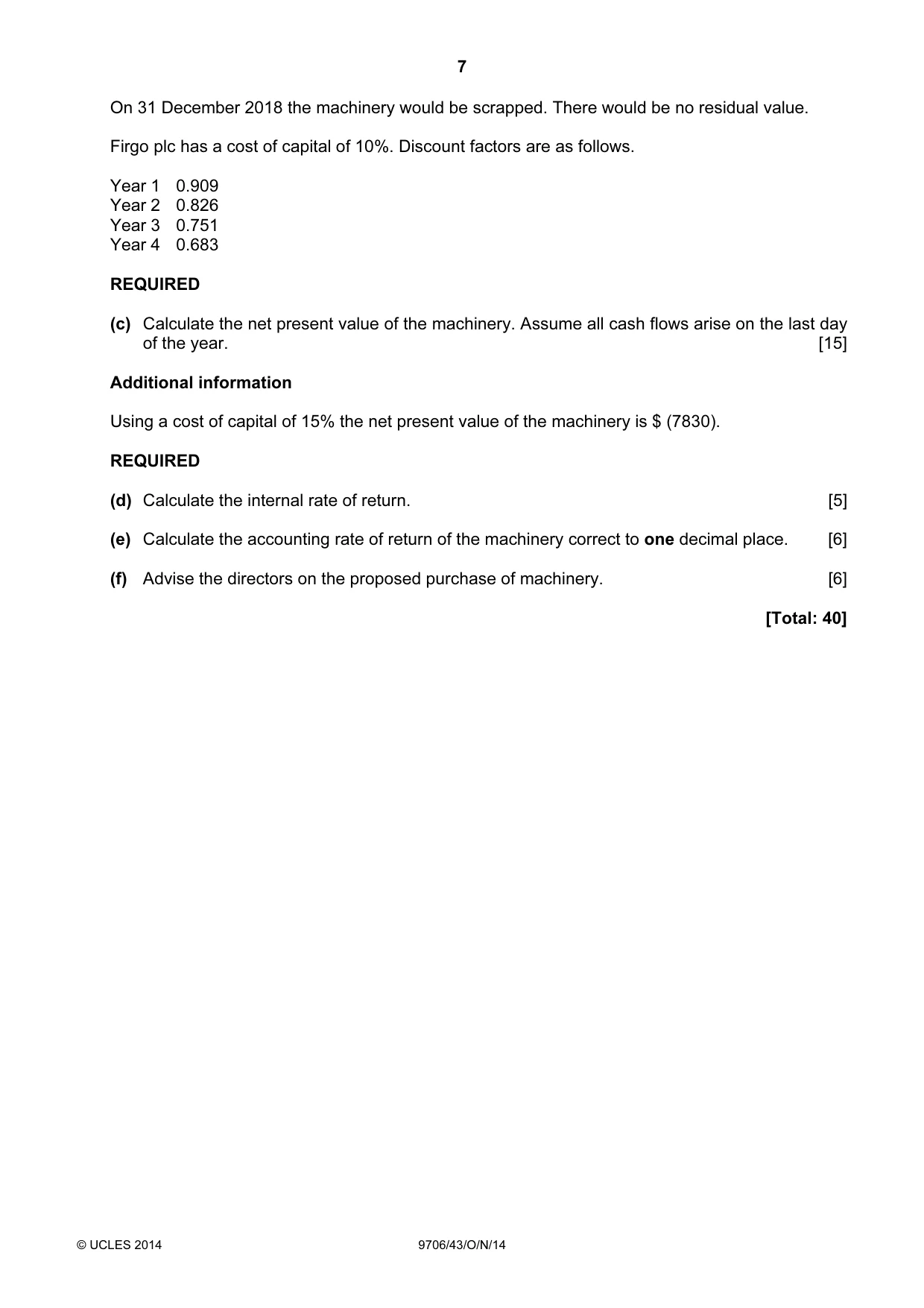
7 © UCLES 2014 9706/43/O/N/14 On 31 December 2018 the machinery would be scrapped. There would be no residual value. Firgo plc has a cost of capital of 10%. Discount factors are as follows. Year 1 0.909 Year 2 0.826 Year 3 0.751 Year 4 0.683 REQUIRED (c) Calculate the net present value of the machinery. Assume all cash flows arise on the last day of the year. [15] Additional information Using a cost of capital of 15% the net present value of the machinery is $ (7830). REQUIRED (d) Calculate the internal rate of return. [5] (e) Calculate the accounting rate of return of the machinery correct to one decimal place. [6] (f) Advise the directors on the proposed purchase of machinery. [6] [Total: 40]
Question paper, page 8
8 Permission to reproduce items where third-party owned material protected by copyright is included has been sought and cleared where possible. Every reasonable effort has been made by the publisher (UCLES) to trace copyright holders, but if any items requiring clearance have unwittingly been included, the publisher will be pleased to make amends at the earliest possible opportunity. Cambridge International Examinations is part of the Cambridge Assessment Group. Cambridge Assessment is the brand name of University of Cambridge Local Examinations Syndicate (UCLES), which is itself a department of the University of Cambridge. © UCLES 2014 9706/43/O/N/14 BLANK PAGE
Mark scheme, page 1
® IGCSE is the registered trademark of Cambridge International Examinations. CAMBRIDGE INTERNATIONAL EXAMINATIONS Cambridge International Advanced Level MARK SCHEME for the October/November 2014 series 9706 ACCOUNTING 9706/43 Paper 4 (Problem Solving – Supplement), maximum raw mark 120 This mark scheme is published as an aid to teachers and candidates, to indicate the requirements of the examination. It shows the basis on which Examiners were instructed to award marks. It does not indicate the details of the discussions that took place at an Examiners’ meeting before marking began, which would have considered the acceptability of alternative answers. Mark schemes should be read in conjunction with the question paper and the Principal Examiner Report for Teachers. Cambridge will not enter into discussions about these mark schemes. Cambridge is publishing the mark schemes for the October/November 2014 series for most Cambridge IGCSE®, Cambridge International A and AS Level components and some Cambridge O Level components.
Mark scheme, page 2
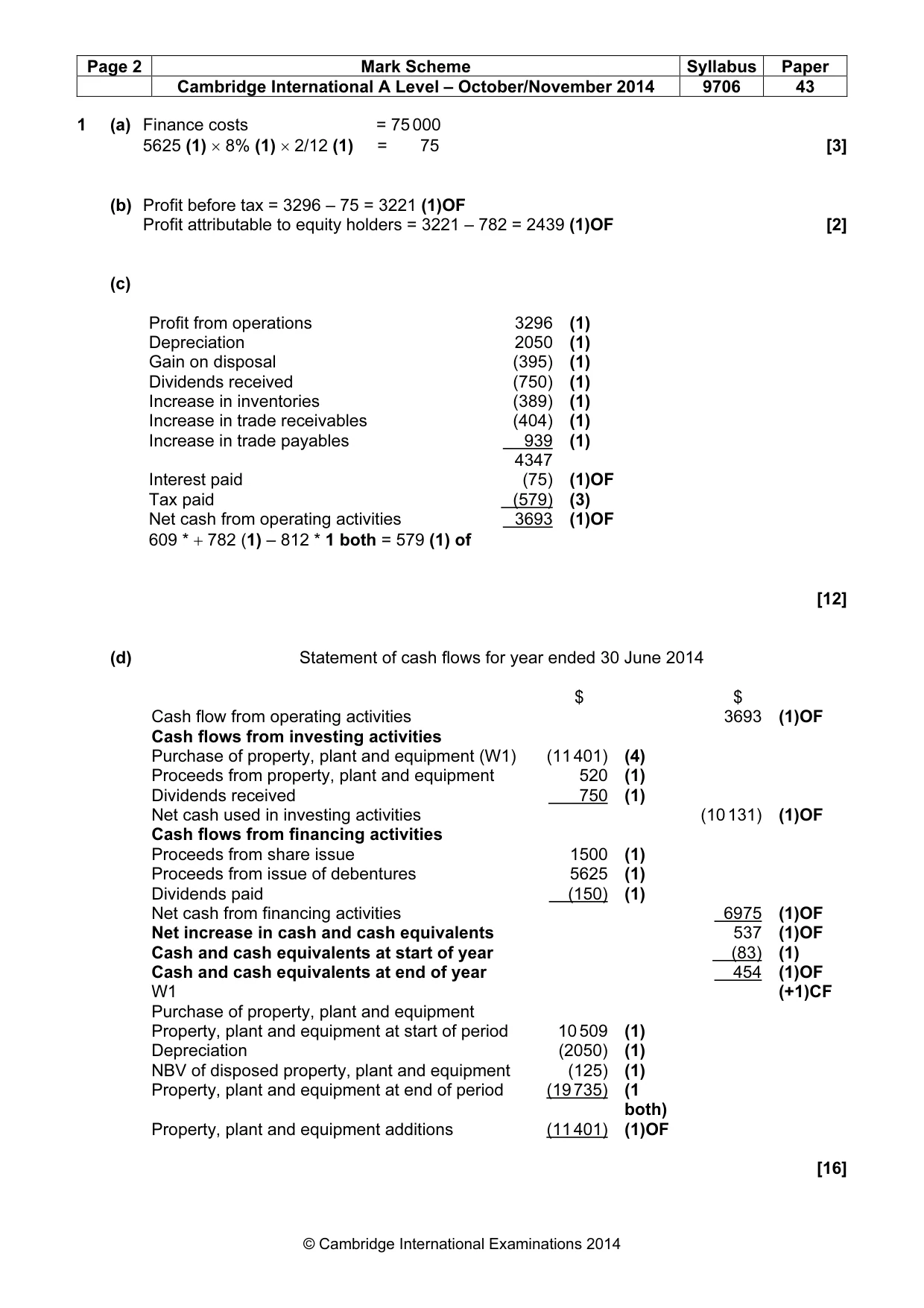
Page 2 Mark Scheme Syllabus Paper Cambridge International A Level – October/November 2014 9706 43 © Cambridge International Examinations 2014 1 (a) Finance costs = 75 000 5625 (1) × 8% (1) × 2/12 (1) = 75 [3] (b) Profit before tax = 3296 – 75 = 3221 (1)OF Profit attributable to equity holders = 3221 – 782 = 2439 (1)OF [2] (c) Profit from operations 3296 (1) Depreciation 2050 (1) Gain on disposal (395) (1) Dividends received (750) (1) Increase in inventories (389) (1) Increase in trade receivables (404) (1) Increase in trade payables 939 (1) 4347 Interest paid (75) (1)OF Tax paid (579) (3) Net cash from operating activities 3693 (1)OF 609 * + 782 (1) – 812 * 1 both = 579 (1) of [12] (d) Statement of cash flows for year ended 30 June 2014 $ $ Cash flow from operating activities 3693 (1)OF Cash flows from investing activities Purchase of property, plant and equipment (W1) (11 401) (4) Proceeds from property, plant and equipment 520 (1) Dividends received 750 (1) Net cash used in investing activities (10 131) (1)OF Cash flows from financing activities Proceeds from share issue 1500 (1) Proceeds from issue of debentures 5625 (1) Dividends paid (150) (1) Net cash from financing activities 6975 (1)OF Net increase in cash and cash equivalents 537 (1)OF Cash and cash equivalents at start of year (83) (1) Cash and cash equivalents at end of year 454 (1)OF W1 (+1)CF Purchase of property, plant and equipment Property, plant and equipment at start of period 10 509 (1) Depreciation (2050) (1) NBV of disposed property, plant and equipment (125) (1) Property, plant and equipment at end of period (19 735) (1 both) Property, plant and equipment additions (11 401) (1)OF [16]
Mark scheme, page 3
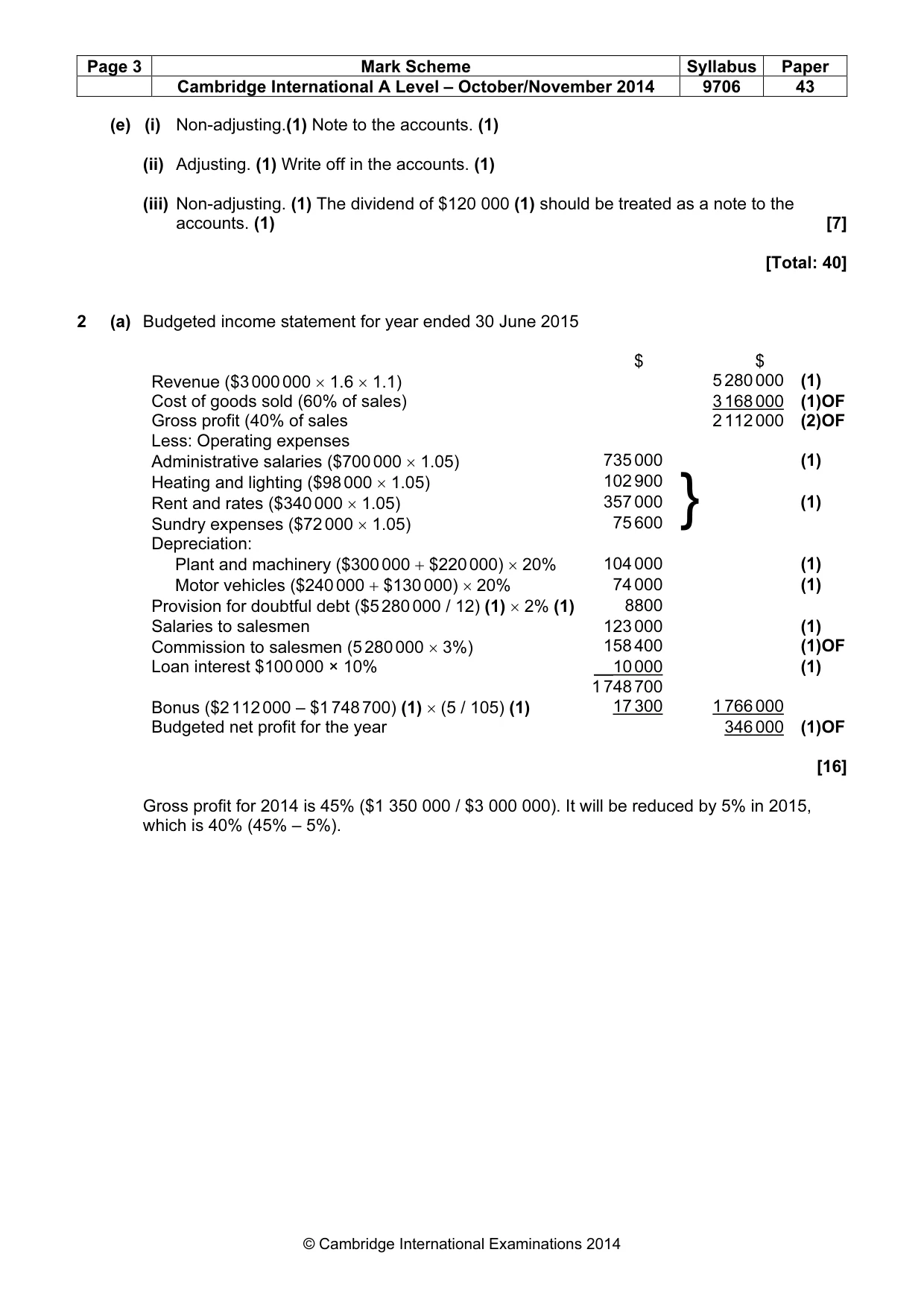
Page 3 Mark Scheme Syllabus Paper Cambridge International A Level – October/November 2014 9706 43 © Cambridge International Examinations 2014 (e) (i) Non-adjusting.(1) Note to the accounts. (1) (ii) Adjusting. (1) Write off in the accounts. (1) (iii) Non-adjusting. (1) The dividend of $120 000 (1) should be treated as a note to the accounts. (1) [7] [Total: 40] 2 (a) Budgeted income statement for year ended 30 June 2015 $ $ Revenue ($3 000 000 × 1.6 × 1.1) 5 280 000 (1) Cost of goods sold (60% of sales) 3 168 000 (1)OF Gross profit (40% of sales 2 112 000 (2)OF Less: Operating expenses Administrative salaries ($700 000 × 1.05) 735 000 } (1) Heating and lighting ($98 000 × 1.05) 102 900 Rent and rates ($340 000 × 1.05) 357 000 (1) Sundry expenses ($72 000 × 1.05) 75 600 Depreciation: Plant and machinery ($300 000 + $220 000) × 20% 104 000 (1) Motor vehicles ($240 000 + $130 000) × 20% 74 000 (1) Provision for doubtful debt ($5 280 000 / 12) (1) × 2% (1) 8800 Salaries to salesmen 123 000 (1) Commission to salesmen (5 280 000 × 3%) 158 400 (1)OF Loan interest $100 000 × 10% __10 000 (1) 1 748 700 Bonus ($2 112 000 – $1 748 700) (1) × (5 / 105) (1) 17 300 1 766 000 Budgeted net profit for the year 346 000 (1)OF [16] Gross profit for 2014 is 45% ($1 350 000 / $3 000 000). It will be reduced by 5% in 2015, which is 40% (45% – 5%).
Mark scheme, page 4
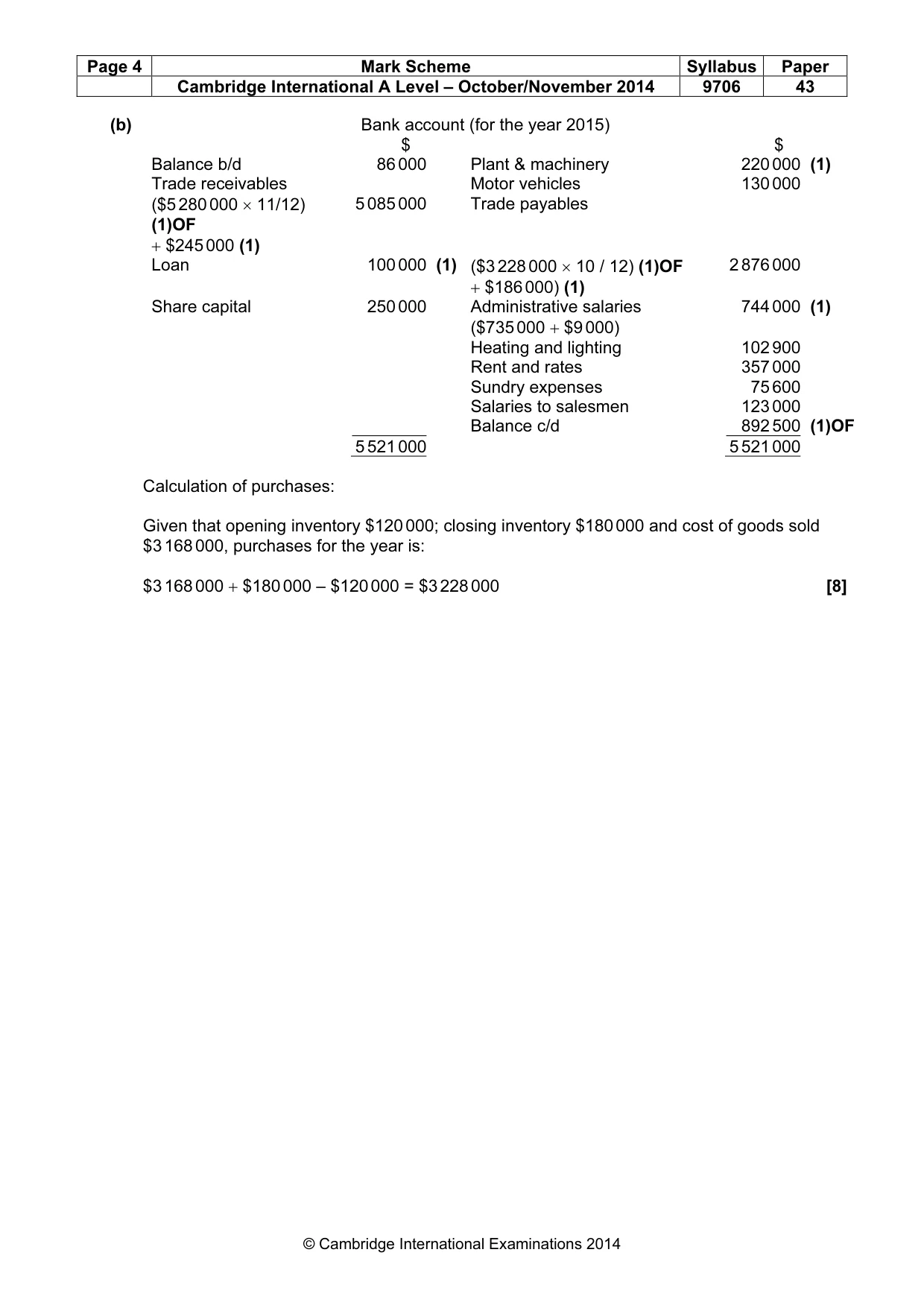
Page 4 Mark Scheme Syllabus Paper Cambridge International A Level – October/November 2014 9706 43 © Cambridge International Examinations 2014 (b) Bank account (for the year 2015) $ $ Balance b/d 86 000 Plant & machinery 220 000 (1) Trade receivables Motor vehicles 130 000 ($5 280 000 × 11/12) (1)OF + $245 000 (1) 5 085 000 Trade payables Loan 100 000 (1) ($3 228 000 × 10 / 12) (1)OF + $186 000) (1) 2 876 000 Share capital 250 000 Administrative salaries 744 000 (1) ($735 000 + $9 000) Heating and lighting 102 900 Rent and rates 357 000 Sundry expenses 75 600 Salaries to salesmen 123 000 Balance c/d 892 500 (1)OF 5 521 000 5 521 000 Calculation of purchases: Given that opening inventory $120 000; closing inventory $180 000 and cost of goods sold $3 168 000, purchases for the year is: $3 168 000 + $180 000 – $120 000 = $3 228 000 [8]
Mark scheme, page 5
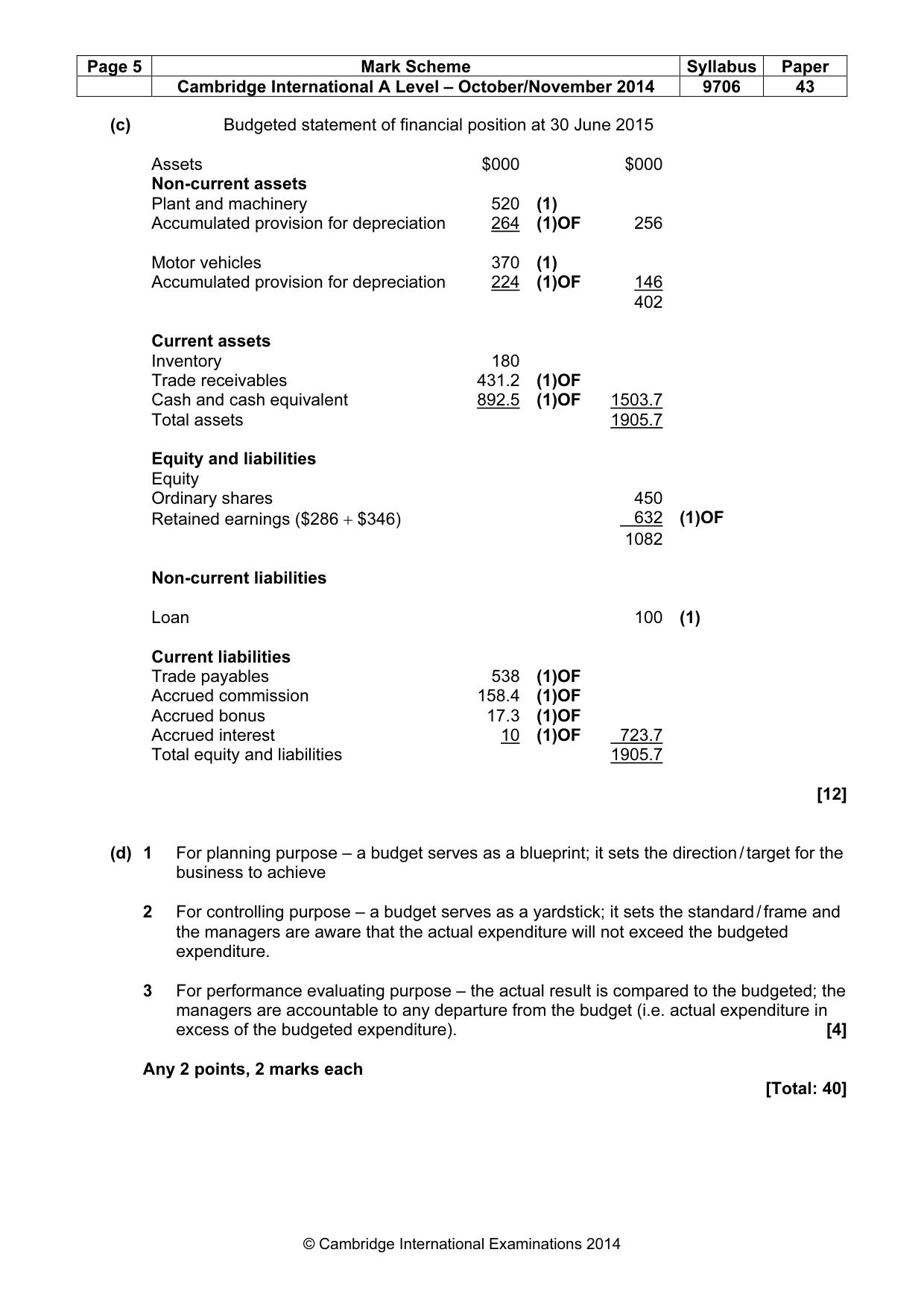
Page 5 Mark Scheme Syllabus Paper Cambridge International A Level – October/November 2014 9706 43 © Cambridge International Examinations 2014 (c) Budgeted statement of financial position at 30 June 2015 Assets $000 $000 Non-current assets Plant and machinery 520 (1) Accumulated provision for depreciation 264 (1)OF 256 Motor vehicles 370 (1) Accumulated provision for depreciation 224 (1)OF 146 402 Current assets Inventory 180 Trade receivables 431.2 (1)OF Cash and cash equivalent 892.5 (1)OF 1503.7 Total assets 1905.7 Equity and liabilities Equity Ordinary shares 450 Retained earnings ($286 + $346) 632 (1)OF 1082 Non-current liabilities Loan 100 (1) Current liabilities Trade payables 538 (1)OF Accrued commission 158.4 (1)OF Accrued bonus 17.3 (1)OF Accrued interest 10 (1)OF 723.7 Total equity and liabilities 1905.7 [12] (d) 1 For planning purpose – a budget serves as a blueprint; it sets the direction / target for the business to achieve 2 For controlling purpose – a budget serves as a yardstick; it sets the standard / frame and the managers are aware that the actual expenditure will not exceed the budgeted expenditure. 3 For performance evaluating purpose – the actual result is compared to the budgeted; the managers are accountable to any departure from the budget (i.e. actual expenditure in excess of the budgeted expenditure). [4] Any 2 points, 2 marks each [Total: 40]
Mark scheme, page 6
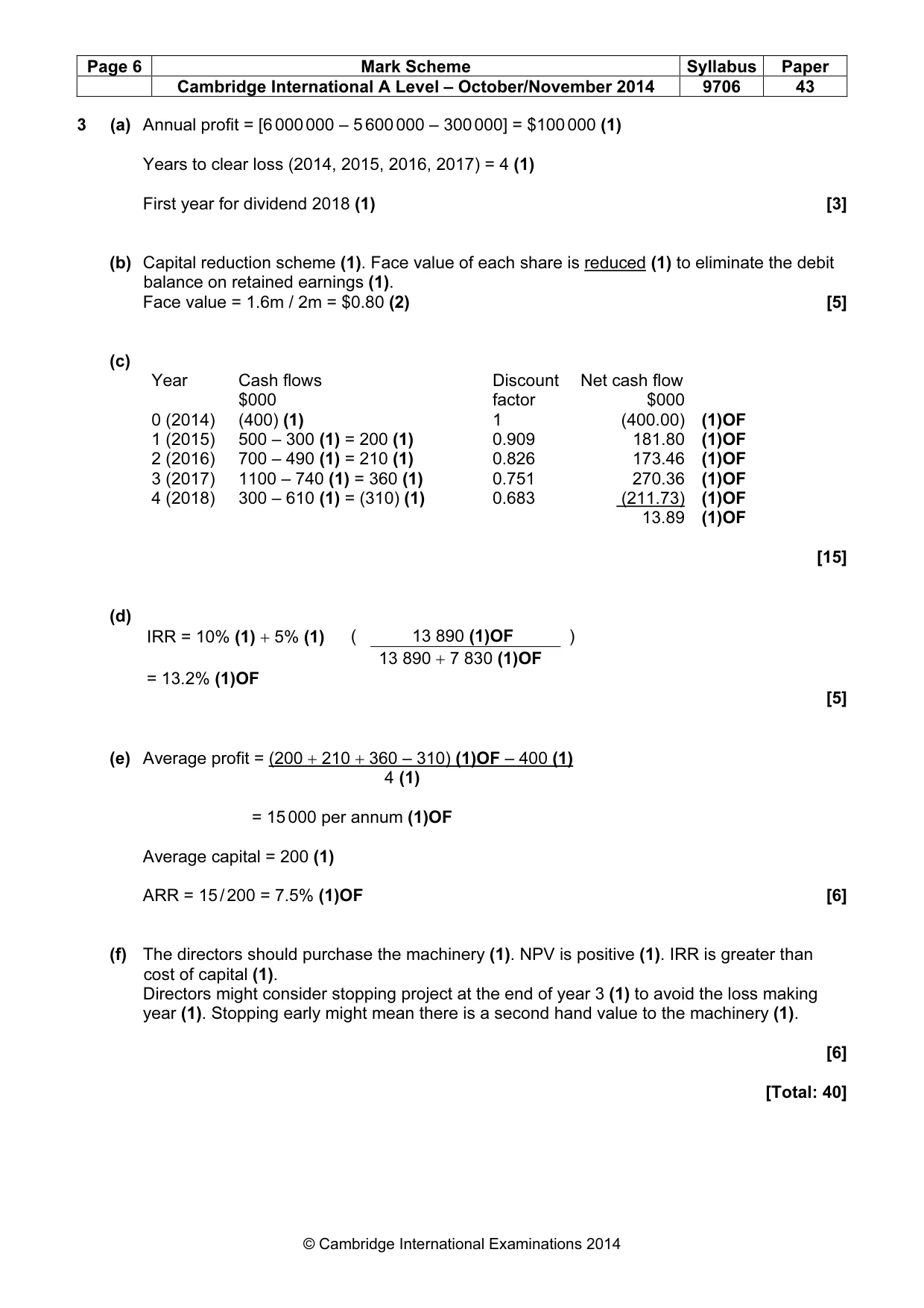
Page 6 Mark Scheme Syllabus Paper Cambridge International A Level – October/November 2014 9706 43 © Cambridge International Examinations 2014 3 (a) Annual profit = [6 000 000 – 5 600 000 – 300 000] = $100 000 (1) Years to clear loss (2014, 2015, 2016, 2017) = 4 (1) First year for dividend 2018 (1) [3] (b) Capital reduction scheme (1). Face value of each share is reduced (1) to eliminate the debit balance on retained earnings (1). Face value = 1.6m / 2m = $0.80 (2) [5] (c) Year Cash flows Discount Net cash flow $000 factor $000 0 (2014) (400) (1) 1 (400.00) (1)OF 1 (2015) 500 – 300 (1) = 200 (1) 0.909 181.80 (1)OF 2 (2016) 700 – 490 (1) = 210 (1) 0.826 173.46 (1)OF 3 (2017) 1100 – 740 (1) = 360 (1) 0.751 270.36 (1)OF 4 (2018) 300 – 610 (1) = (310) (1) 0.683 (211.73) (1)OF 13.89 (1)OF [15] (d) IRR = 10% (1) + 5% (1) ( 13 890 (1)OF ) 13 890 + 7 830 (1)OF = 13.2% (1)OF [5] (e) Average profit = (200 + 210 + 360 – 310) (1)OF – 400 (1) 4 (1) = 15 000 per annum (1)OF Average capital = 200 (1) ARR = 15 / 200 = 7.5% (1)OF [6] (f) The directors should purchase the machinery (1). NPV is positive (1). IRR is greater than cost of capital (1). Directors might consider stopping project at the end of year 3 (1) to avoid the loss making year (1). Stopping early might mean there is a second hand value to the machinery (1). [6] [Total: 40]
What you needed in this session
Cambridge’s own grade thresholds for 2014 Oct/Nov, Paper 4 · Variant 3. A higher threshold means an easier paper — the bar moves with how the cohort did.