Cambridge A Level Accounting 9706 — 2014 May/June Paper 2 · Variant 2
9706/22/M/J/14 · 90 marks · ≈101 min
The question paper and its mark scheme, free to read here and free to download. This is Cambridge’s own paper, exactly as it was sat.
Question paper12 pages
Mark scheme5 pages
Answers below. Sit the paper first if you are practising.
Paper as text
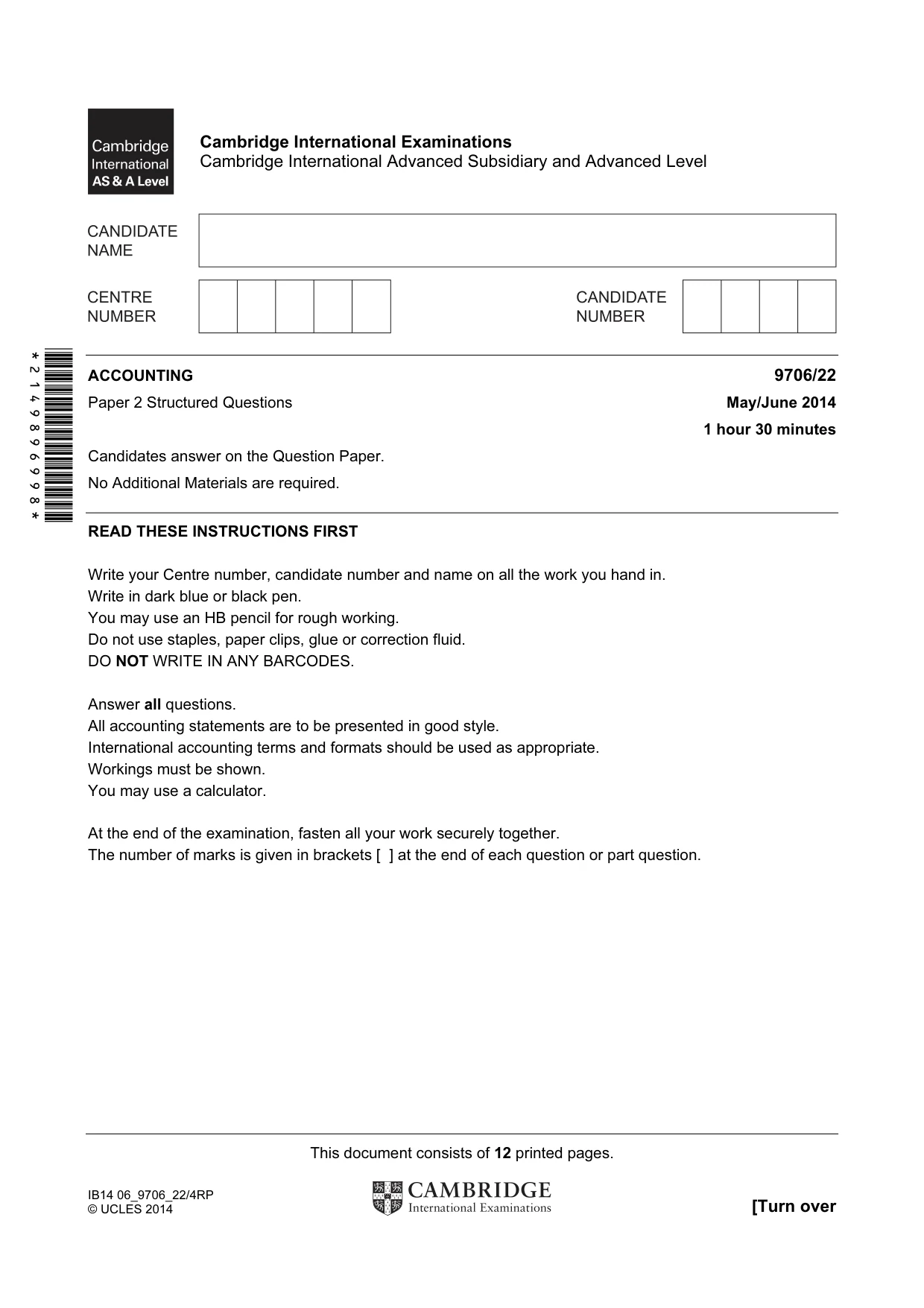
Question paper, page 1
This document consists of 12 printed pages. IB14 06_9706_22/4RP © UCLES 2014 [Turn over *2149896998* Cambridge International Examinations Cambridge International Advanced Subsidiary and Advanced Level ACCOUNTING 9706/22 Paper 2 Structured Questions May/June 2014 1 hour 30 minutes Candidates answer on the Question Paper. No Additional Materials are required. READ THESE INSTRUCTIONS FIRST Write your Centre number, candidate number and name on all the work you hand in. Write in dark blue or black pen. You may use an HB pencil for rough working. Do not use staples, paper clips, glue or correction fluid. DO NOT WRITE IN ANY BARCODES. Answer all questions. All accounting statements are to be presented in good style. International accounting terms and formats should be used as appropriate. Workings must be shown. You may use a calculator. At the end of the examination, fasten all your work securely together. The number of marks is given in brackets [ ] at the end of each question or part question.
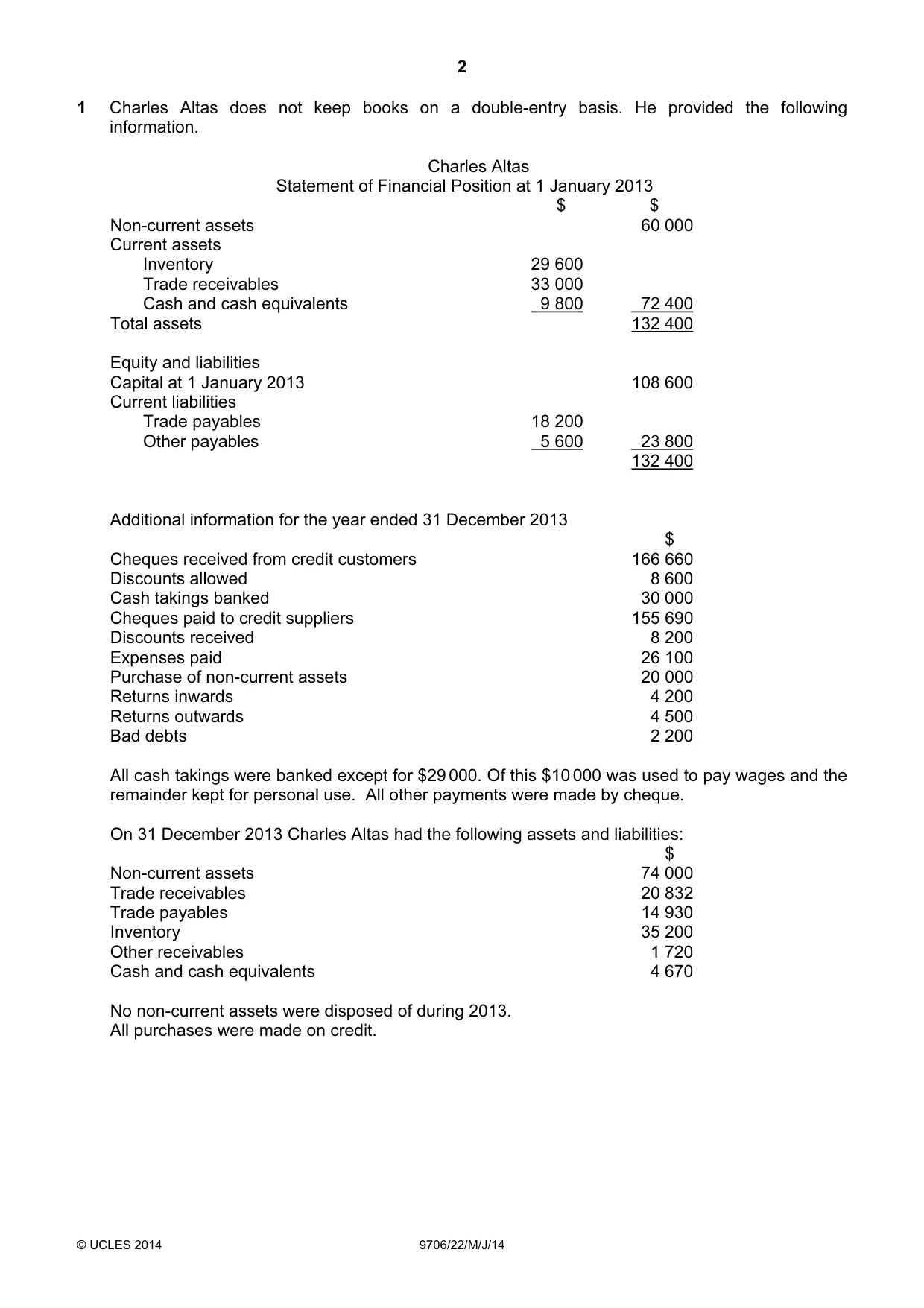
Question paper, page 2
2 © UCLES 2014 9706/22/M/J/14 1 Charles Altas does not keep books on a double-entry basis. He provided the following information. Charles Altas Statement of Financial Position at 1 January 2013 $ $ Non-current assets 60 000 Current assets Inventory 29 600 Trade receivables 33 000 Cash and cash equivalents 9 800 72 400 Total assets 132 400 Equity and liabilities Capital at 1 January 2013 108 600 Current liabilities Trade payables 18 200 Other payables 5 600 23 800 132 400 Additional information for the year ended 31 December 2013 $ Cheques received from credit customers 166 660 Discounts allowed 8 600 Cash takings banked 30 000 Cheques paid to credit suppliers 155 690 Discounts received 8 200 Expenses paid 26 100 Purchase of non-current assets 20 000 Returns inwards 4 200 Returns outwards 4 500 Bad debts 2 200 All cash takings were banked except for $29 000. Of this $10 000 was used to pay wages and the remainder kept for personal use. All other payments were made by cheque. On 31 December 2013 Charles Altas had the following assets and liabilities: $ Non-current assets 74 000 Trade receivables 20 832 Trade payables 14 930 Inventory 35 200 Other receivables 1 720 Cash and cash equivalents 4 670 No non-current assets were disposed of during 2013. All purchases were made on credit.
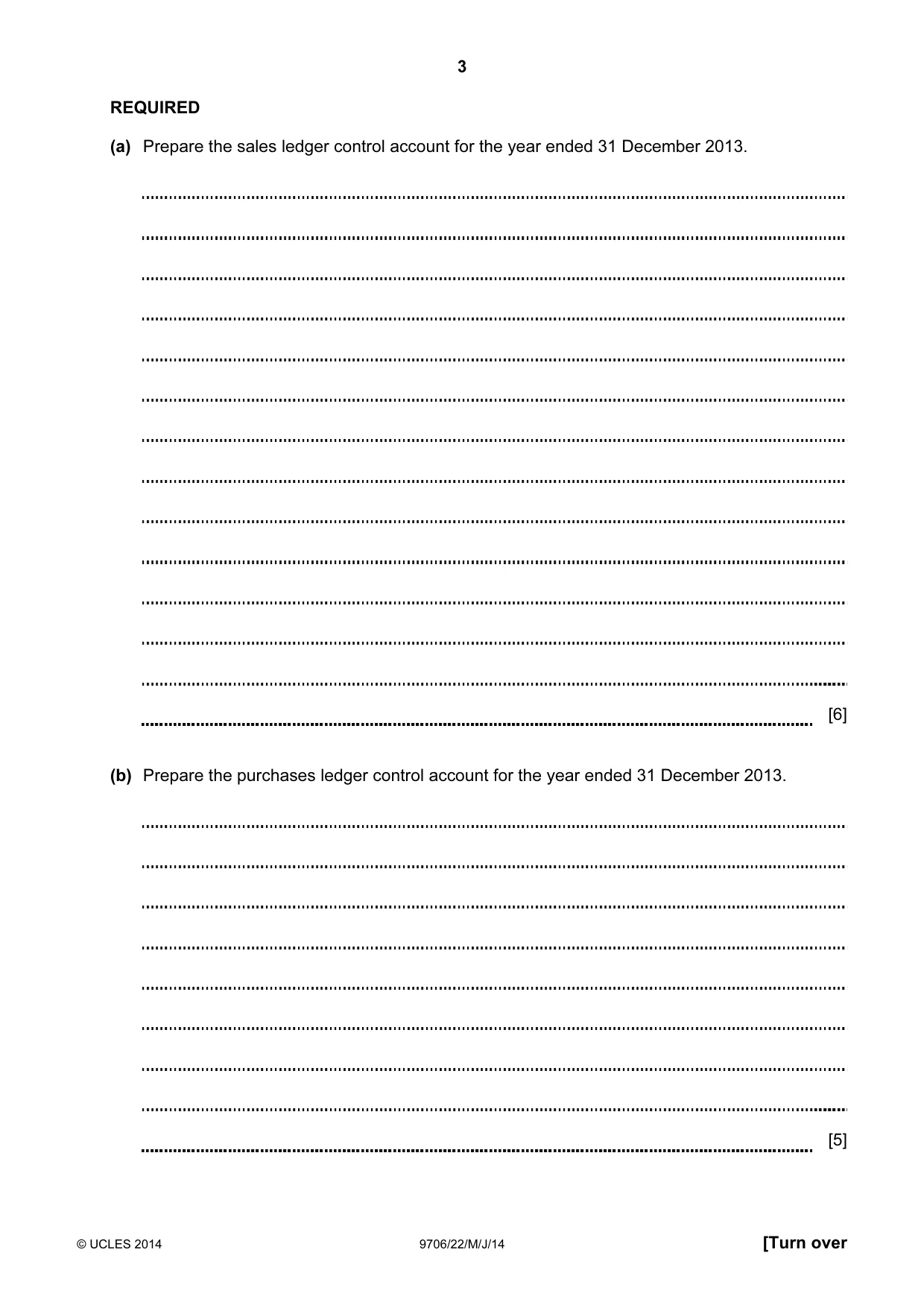
Question paper, page 3
3 © UCLES 2014 9706/22/M/J/14 [Turn over REQUIRED (a) Prepare the sales ledger control account for the year ended 31 December 2013. [6] (b) Prepare the purchases ledger control account for the year ended 31 December 2013. [5]
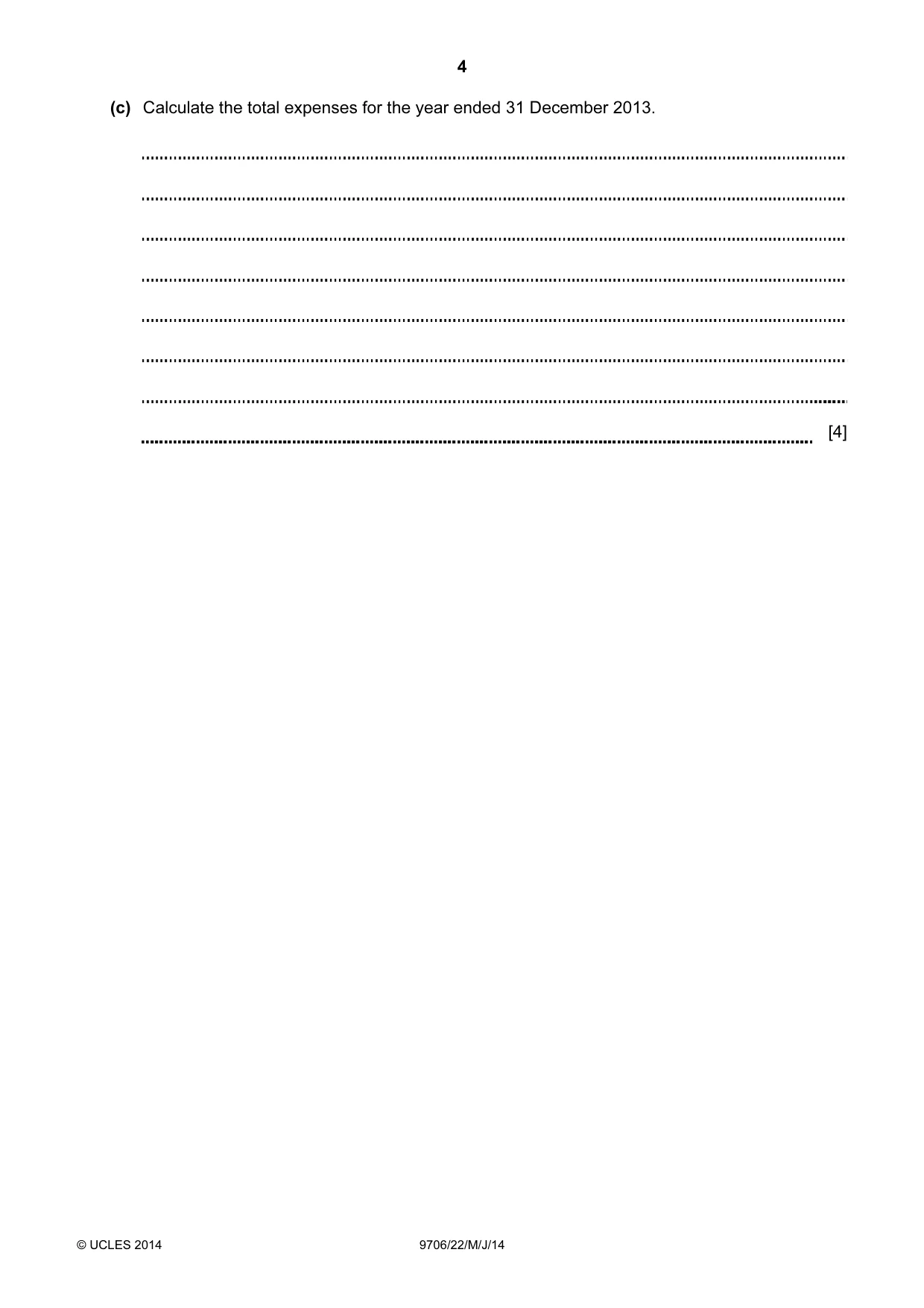
Question paper, page 4
4 © UCLES 2014 9706/22/M/J/14 (c) Calculate the total expenses for the year ended 31 December 2013. [4]
Question paper, page 5
5 © UCLES 2014 9706/22/M/J/14 [Turn over (d) Prepare the income statement for the year ended 31 December 2013. [15] [Total: 30]
Question paper, page 6
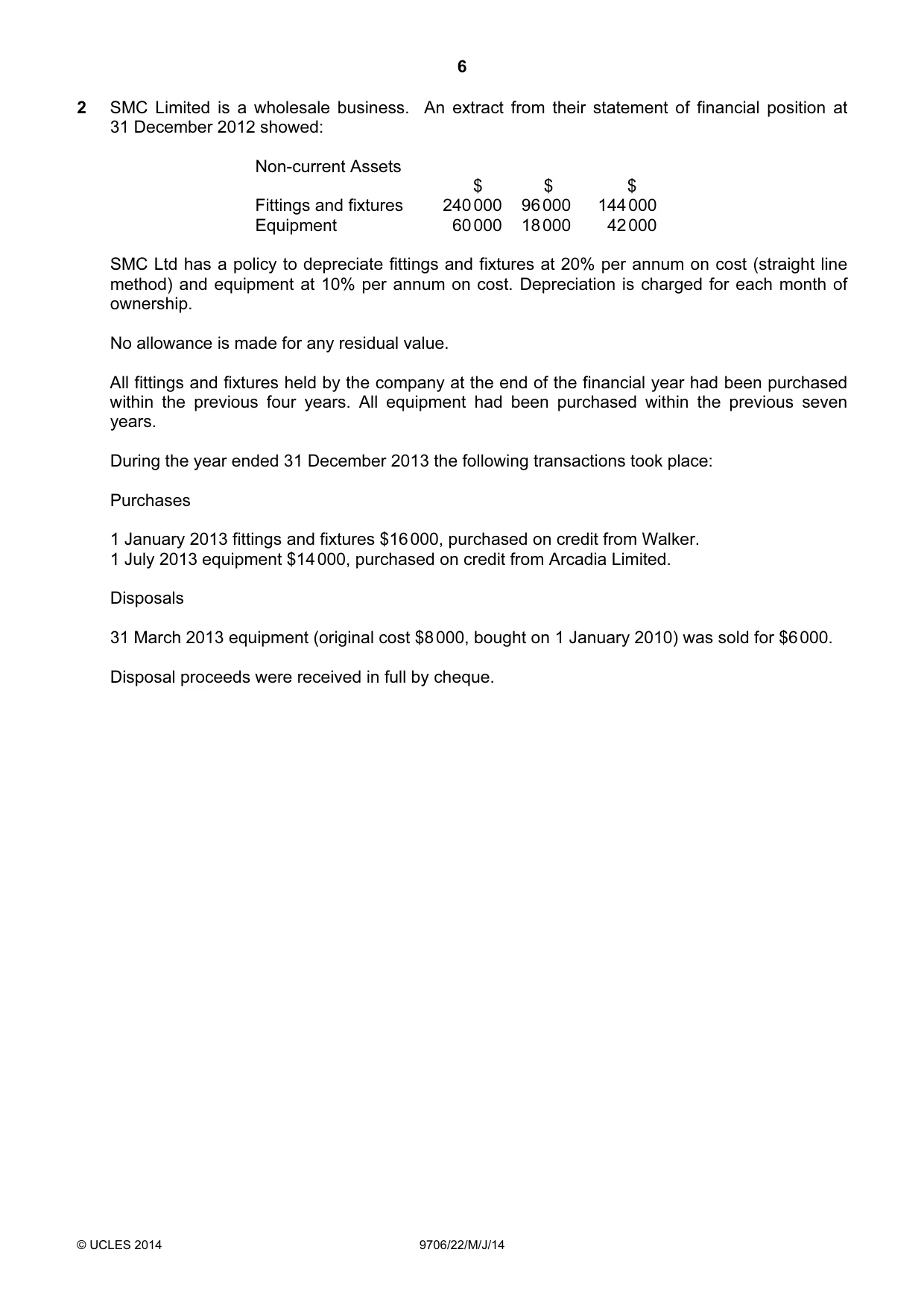
6 © UCLES 2014 9706/22/M/J/14 2 SMC Limited is a wholesale business. An extract from their statement of financial position at 31 December 2012 showed: Non-current Assets $ $ $ Fittings and fixtures 240 000 96 000 144 000 Equipment 60 000 18 000 42 000 SMC Ltd has a policy to depreciate fittings and fixtures at 20% per annum on cost (straight line method) and equipment at 10% per annum on cost. Depreciation is charged for each month of ownership. No allowance is made for any residual value. All fittings and fixtures held by the company at the end of the financial year had been purchased within the previous four years. All equipment had been purchased within the previous seven years. During the year ended 31 December 2013 the following transactions took place: Purchases 1 January 2013 fittings and fixtures $16 000, purchased on credit from Walker. 1 July 2013 equipment $14 000, purchased on credit from Arcadia Limited. Disposals 31 March 2013 equipment (original cost $8 000, bought on 1 January 2010) was sold for $6 000. Disposal proceeds were received in full by cheque.
Question paper, page 7
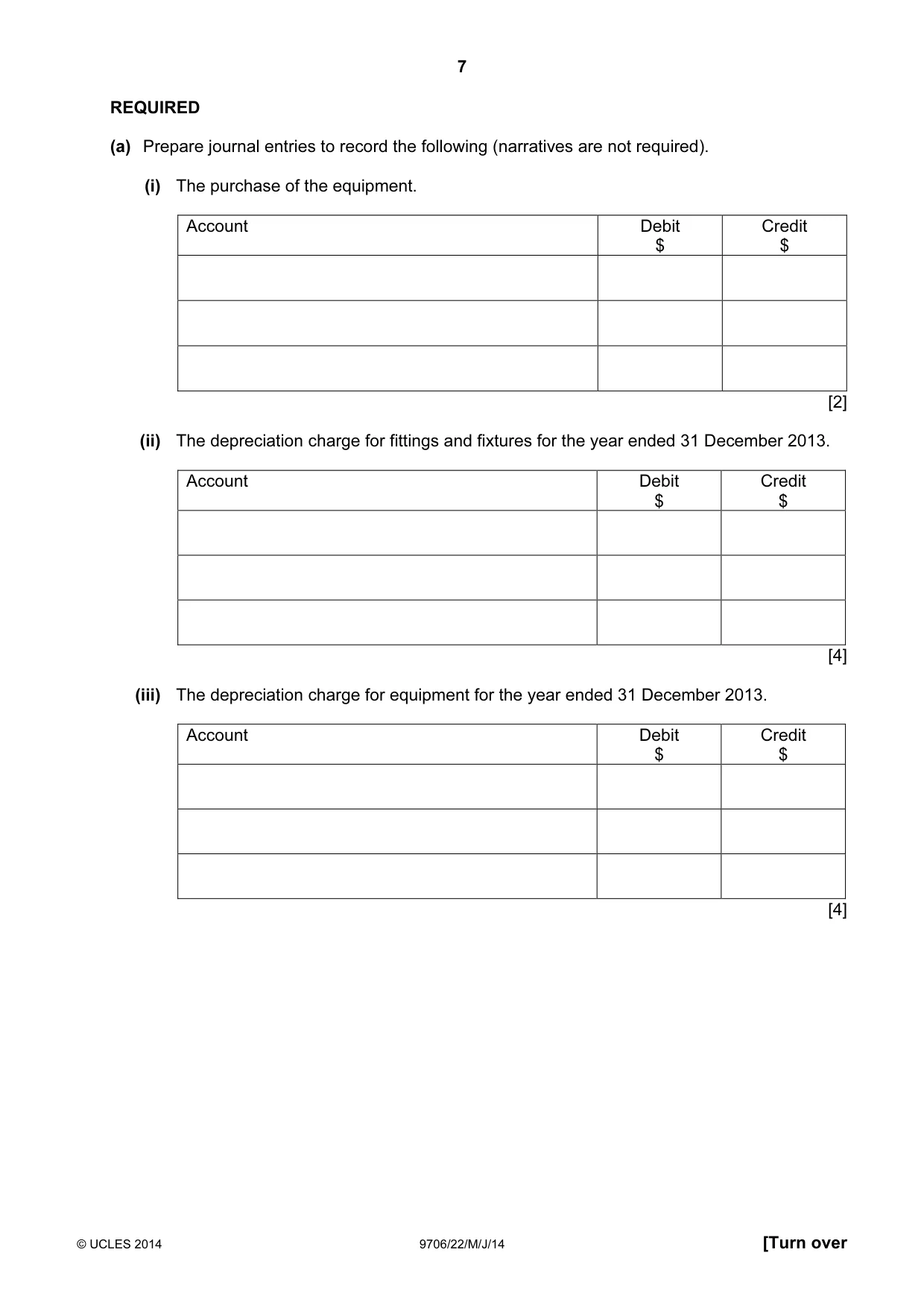
7 © UCLES 2014 9706/22/M/J/14 [Turn over REQUIRED (a) Prepare journal entries to record the following (narratives are not required). (i) The purchase of the equipment. Account Debit $ Credit $ [2] (ii) The depreciation charge for fittings and fixtures for the year ended 31 December 2013. Account Debit $ Credit $ [4] (iii) The depreciation charge for equipment for the year ended 31 December 2013. Account Debit $ Credit $ [4]
Question paper, page 8
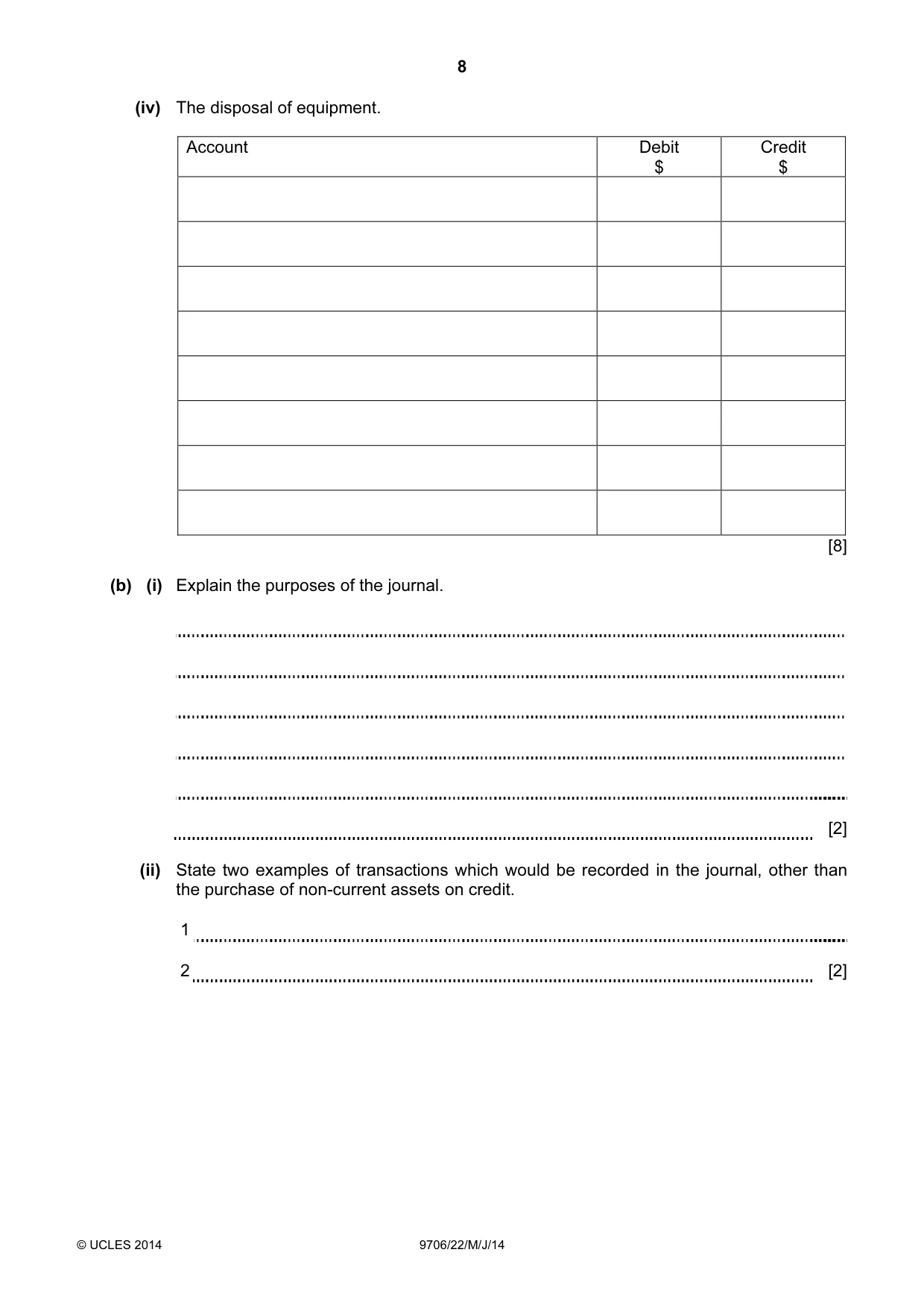
8 © UCLES 2014 9706/22/M/J/14 (iv) The disposal of equipment. Account Debit $ Credit $ [8] (b) (i) Explain the purposes of the journal. [2] (ii) State two examples of transactions which would be recorded in the journal, other than the purchase of non-current assets on credit. 1 2 [2]
Question paper, page 9
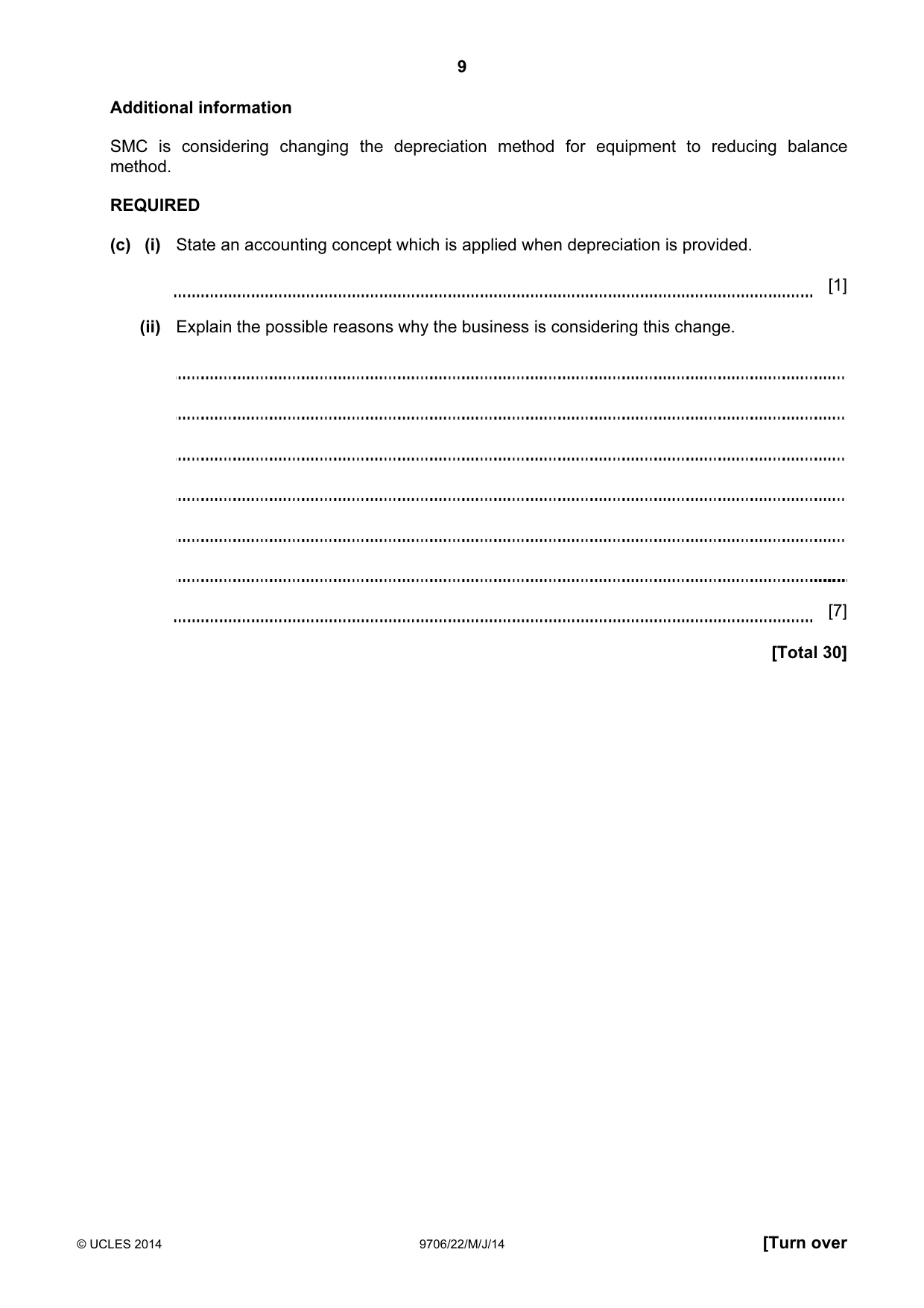
9 © UCLES 2014 9706/22/M/J/14 [Turn over Additional information SMC is considering changing the depreciation method for equipment to reducing balance method. REQUIRED (c) (i) State an accounting concept which is applied when depreciation is provided. [1] (ii) Explain the possible reasons why the business is considering this change. [7] [Total 30]
Question paper, page 10
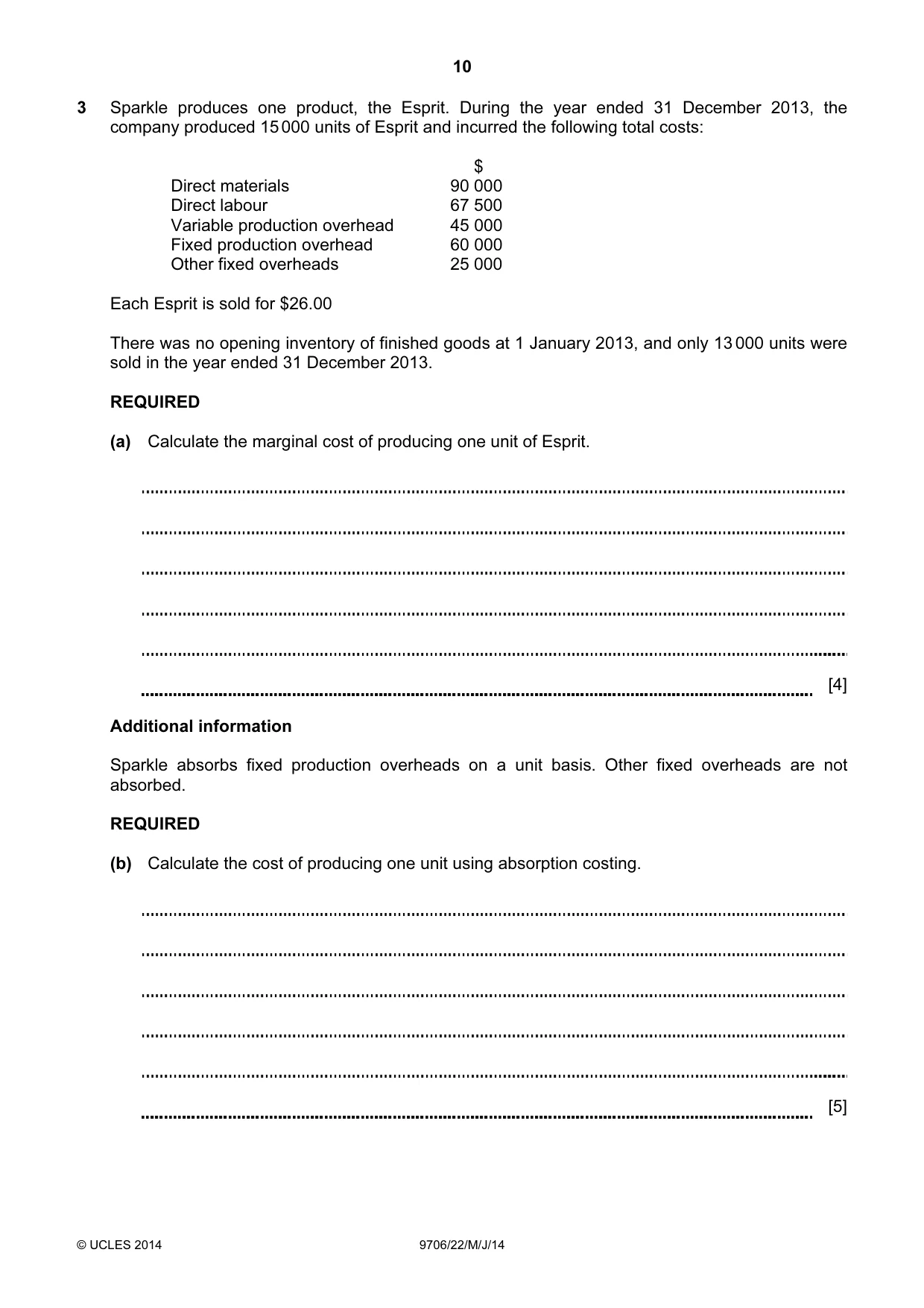
10 © UCLES 2014 9706/22/M/J/14 3 Sparkle produces one product, the Esprit. During the year ended 31 December 2013, the company produced 15 000 units of Esprit and incurred the following total costs: $ Direct materials 90 000 Direct labour 67 500 Variable production overhead 45 000 Fixed production overhead 60 000 Other fixed overheads 25 000 Each Esprit is sold for $26.00 There was no opening inventory of finished goods at 1 January 2013, and only 13 000 units were sold in the year ended 31 December 2013. REQUIRED (a) Calculate the marginal cost of producing one unit of Esprit. [4] Additional information Sparkle absorbs fixed production overheads on a unit basis. Other fixed overheads are not absorbed. REQUIRED (b) Calculate the cost of producing one unit using absorption costing. [5]
Question paper, page 11
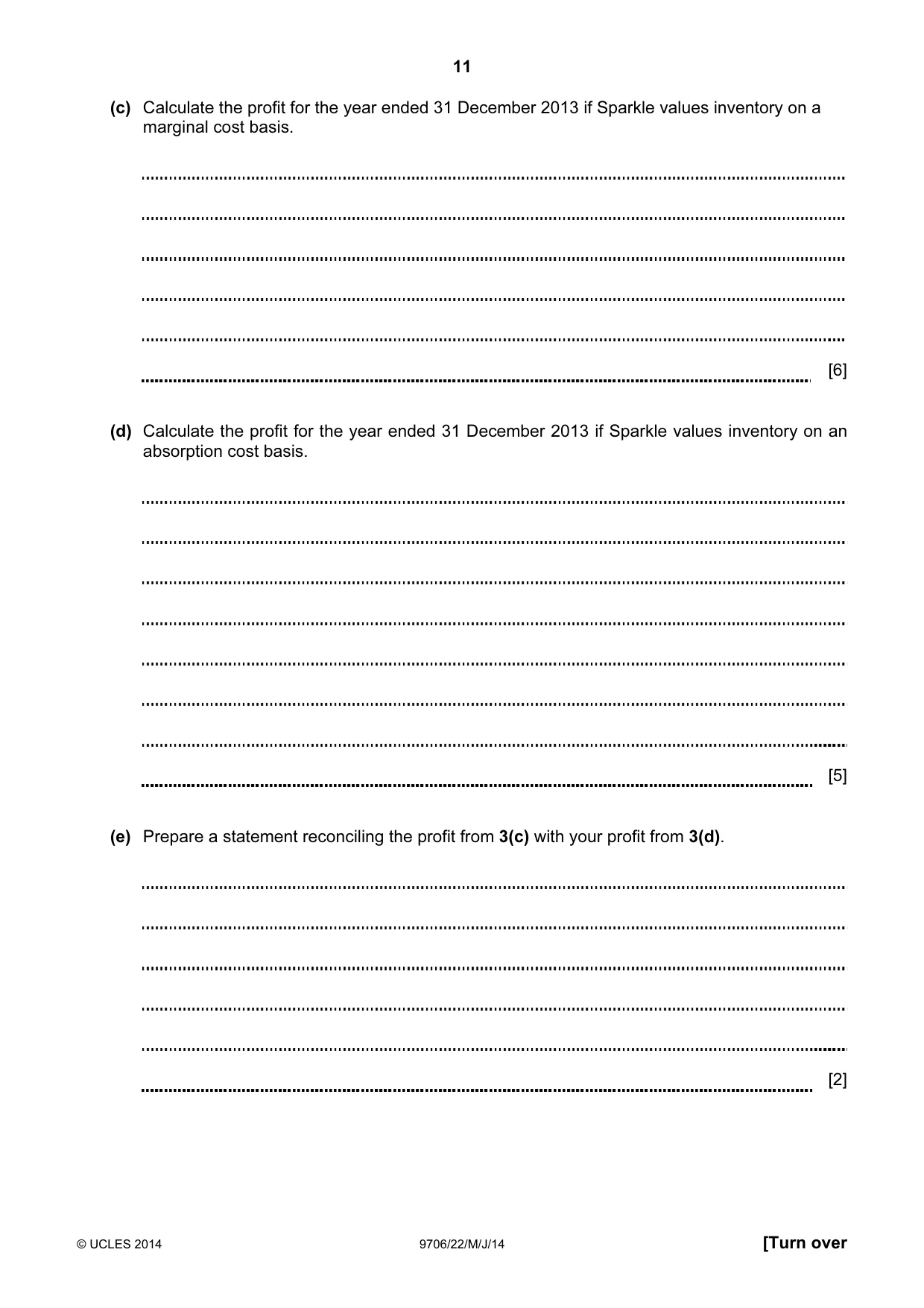
11 © UCLES 2014 9706/22/M/J/14 [Turn over (c) Calculate the profit for the year ended 31 December 2013 if Sparkle values inventory on a marginal cost basis. [6] (d) Calculate the profit for the year ended 31 December 2013 if Sparkle values inventory on an absorption cost basis. [5] (e) Prepare a statement reconciling the profit from 3(c) with your profit from 3(d). [2]
Question paper, page 12
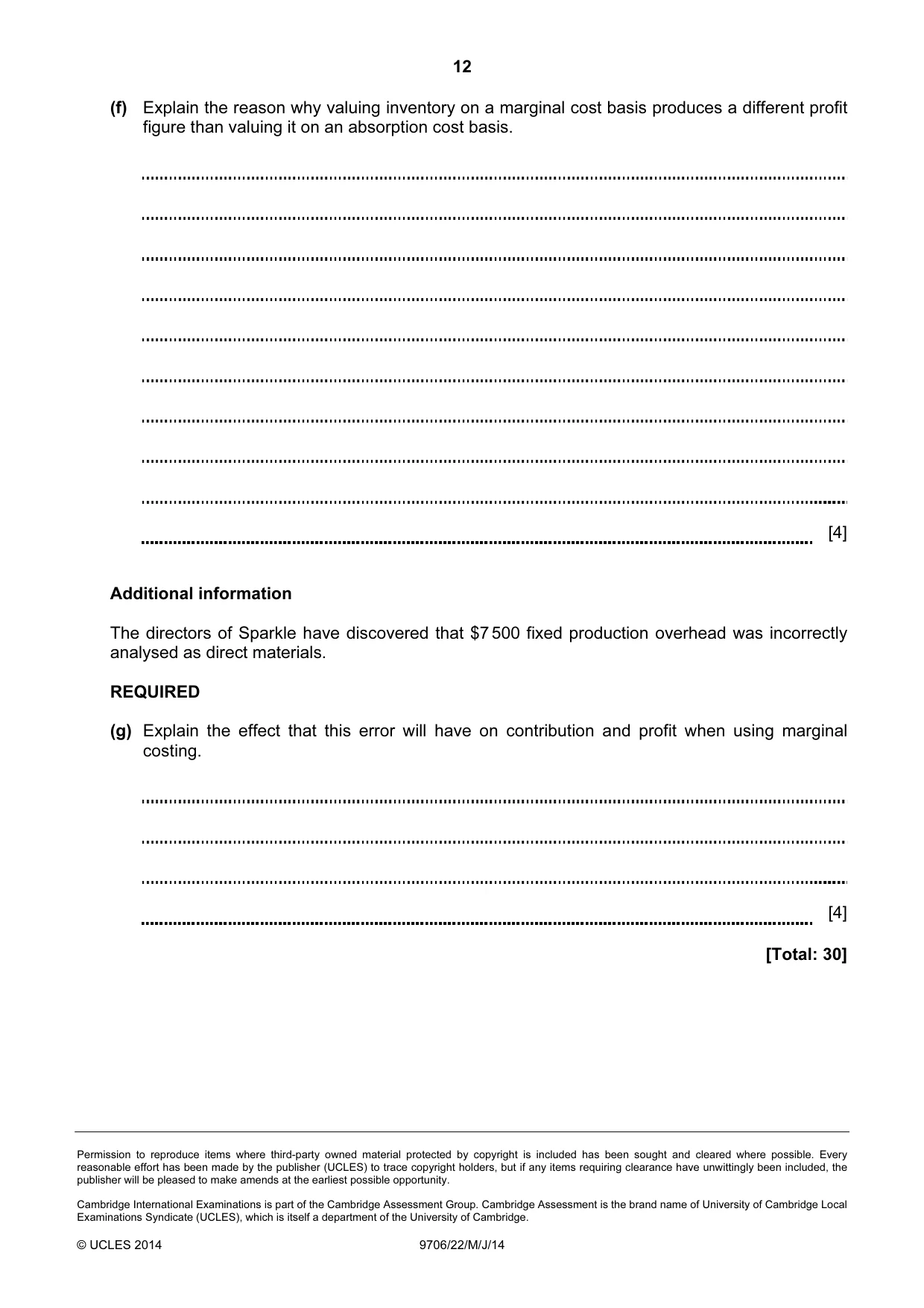
12 Permission to reproduce items where third-party owned material protected by copyright is included has been sought and cleared where possible. Every reasonable effort has been made by the publisher (UCLES) to trace copyright holders, but if any items requiring clearance have unwittingly been included, the publisher will be pleased to make amends at the earliest possible opportunity. Cambridge International Examinations is part of the Cambridge Assessment Group. Cambridge Assessment is the brand name of University of Cambridge Local Examinations Syndicate (UCLES), which is itself a department of the University of Cambridge. © UCLES 2014 9706/22/M/J/14 (f) Explain the reason why valuing inventory on a marginal cost basis produces a different profit figure than valuing it on an absorption cost basis. [4] Additional information The directors of Sparkle have discovered that $7 500 fixed production overhead was incorrectly analysed as direct materials. REQUIRED (g) Explain the effect that this error will have on contribution and profit when using marginal costing. [4] [Total: 30]
Mark scheme, page 1
CAMBRIDGE INTERNATIONAL EXAMINATIONS GCE Advanced Subsidiary Level and GCE Advanced Level MARK SCHEME for the May/June 2014 series 9706 ACCOUNTING 9706/22 Paper 2 (Structured Questions – Core), maximum raw mark 90 This mark scheme is published as an aid to teachers and candidates, to indicate the requirements of the examination. It shows the basis on which Examiners were instructed to award marks. It does not indicate the details of the discussions that took place at an Examiners’ meeting before marking began, which would have considered the acceptability of alternative answers. Mark schemes should be read in conjunction with the question paper and the Principal Examiner Report for Teachers. Cambridge will not enter into discussions about these mark schemes. Cambridge is publishing the mark schemes for the May/June 2014 series for most IGCSE, GCE Advanced Level and Advanced Subsidiary Level components and some Ordinary Level components.
Mark scheme, page 2
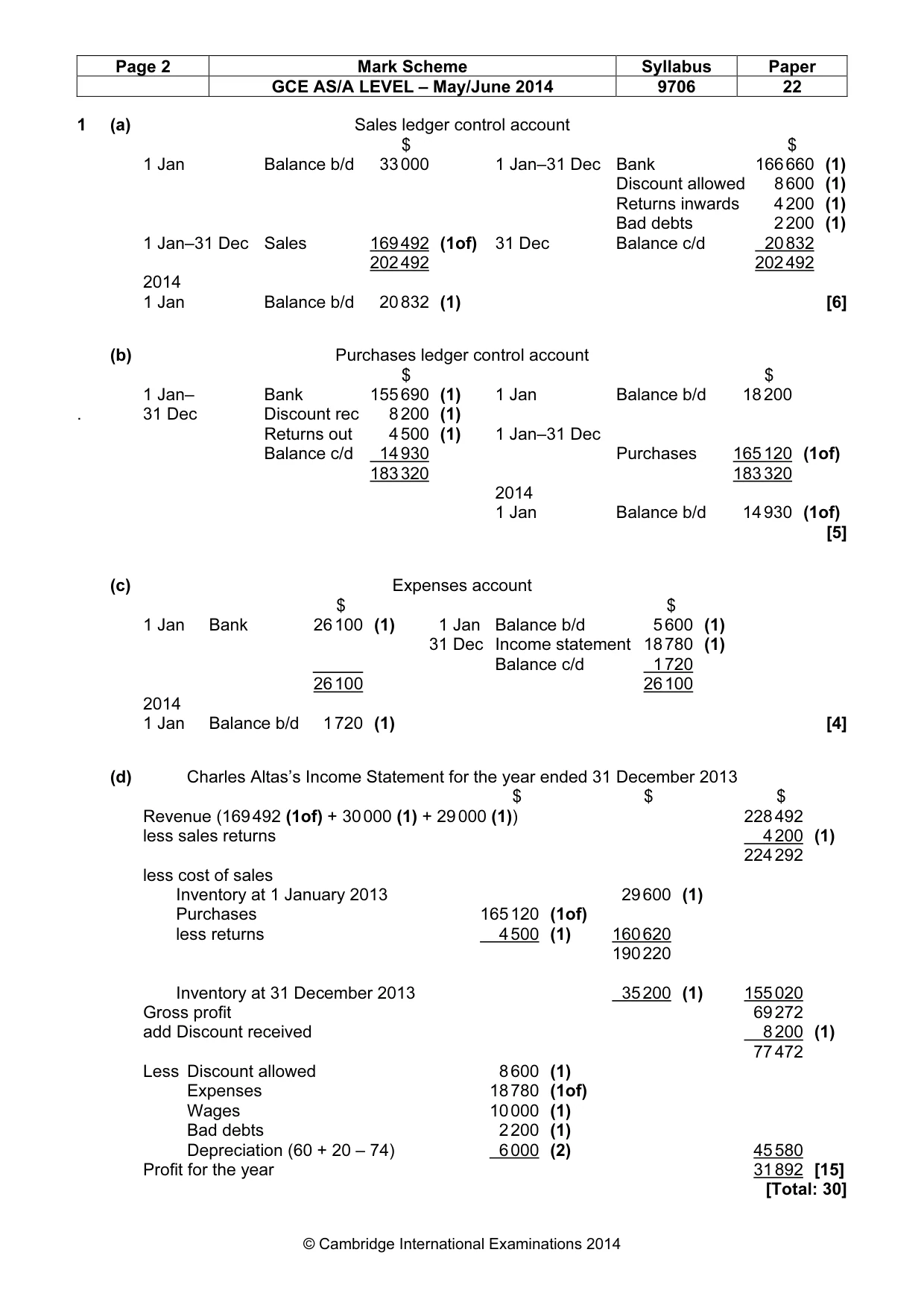
Page 2 Mark Scheme Syllabus Paper GCE AS/A LEVEL – May/June 2014 9706 22 © Cambridge International Examinations 2014 1 (a) Sales ledger control account $ $ 1 Jan Balance b/d 33 000 1 Jan–31 Dec Bank 166 660 (1) Discount allowed 8 600 (1) Returns inwards 4 200 (1) Bad debts 2 200 (1) 1 Jan–31 Dec Sales 169 492 (1of) 31 Dec Balance c/d 20 832 202 492 202 492 2014 1 Jan Balance b/d 20 832 (1) [6] (b) Purchases ledger control account $ $ 1 Jan– Bank 155 690 (1) 1 Jan Balance b/d 18 200 . 31 Dec Discount rec 8 200 (1) Returns out 4 500 (1) 1 Jan–31 Dec Balance c/d 14 930 Purchases 165 120 (1of) 183 320 183 320 2014 1 Jan Balance b/d 14 930 (1of) [5] (c) Expenses account $ $ 1 Jan Bank 26 100 (1) 1 Jan Balance b/d 5 600 (1) 31 Dec Income statement 18 780 (1) Balance c/d 1 720 26 100 26 100 2014 1 Jan Balance b/d 1 720 (1) [4] (d) Charles Altas’s Income Statement for the year ended 31 December 2013 $ $ $ Revenue (169 492 (1of) + 30 000 (1) + 29 000 (1)) 228 492 less sales returns 4 200 (1) 224 292 less cost of sales Inventory at 1 January 2013 29 600 (1) Purchases 165 120 (1of) less returns 4 500 (1) 160 620 190 220 Inventory at 31 December 2013 35 200 (1) 155 020 Gross profit 69 272 add Discount received 8 200 (1) 77 472 Less Discount allowed 8 600 (1) Expenses 18 780 (1of) Wages 10 000 (1) Bad debts 2 200 (1) Depreciation (60 + 20 – 74) 6 000 (2) 45 580 Profit for the year 31 892 [15] [Total: 30]
Mark scheme, page 3
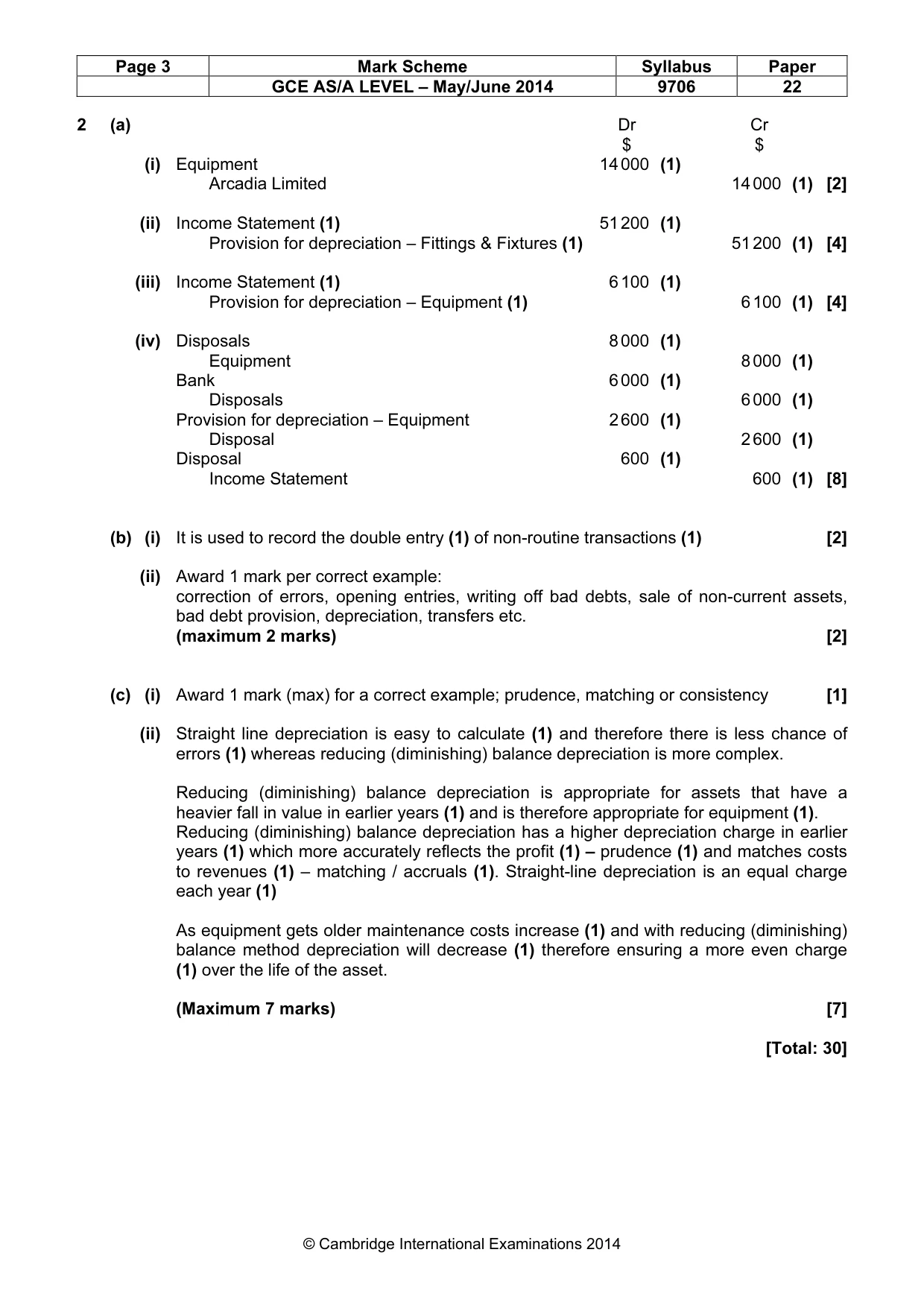
Page 3 Mark Scheme Syllabus Paper GCE AS/A LEVEL – May/June 2014 9706 22 © Cambridge International Examinations 2014 2 (a) Dr Cr $ $ (i) Equipment 14 000 (1) Arcadia Limited 14 000 (1) [2] (ii) Income Statement (1) 51 200 (1) Provision for depreciation – Fittings & Fixtures (1) 51 200 (1) [4] (iii) Income Statement (1) 6 100 (1) Provision for depreciation – Equipment (1) 6 100 (1) [4] (iv) Disposals 8 000 (1) Equipment 8 000 (1) Bank 6 000 (1) Disposals 6 000 (1) Provision for depreciation – Equipment 2 600 (1) Disposal 2 600 (1) Disposal 600 (1) Income Statement 600 (1) [8] (b) (i) It is used to record the double entry (1) of non-routine transactions (1) [2] (ii) Award 1 mark per correct example: correction of errors, opening entries, writing off bad debts, sale of non-current assets, bad debt provision, depreciation, transfers etc. (maximum 2 marks) [2] (c) (i) Award 1 mark (max) for a correct example; prudence, matching or consistency [1] (ii) Straight line depreciation is easy to calculate (1) and therefore there is less chance of errors (1) whereas reducing (diminishing) balance depreciation is more complex. Reducing (diminishing) balance depreciation is appropriate for assets that have a heavier fall in value in earlier years (1) and is therefore appropriate for equipment (1). Reducing (diminishing) balance depreciation has a higher depreciation charge in earlier years (1) which more accurately reflects the profit (1) – prudence (1) and matches costs to revenues (1) – matching / accruals (1). Straight-line depreciation is an equal charge each year (1) As equipment gets older maintenance costs increase (1) and with reducing (diminishing) balance method depreciation will decrease (1) therefore ensuring a more even charge (1) over the life of the asset. (Maximum 7 marks) [7] [Total: 30]
Mark scheme, page 4
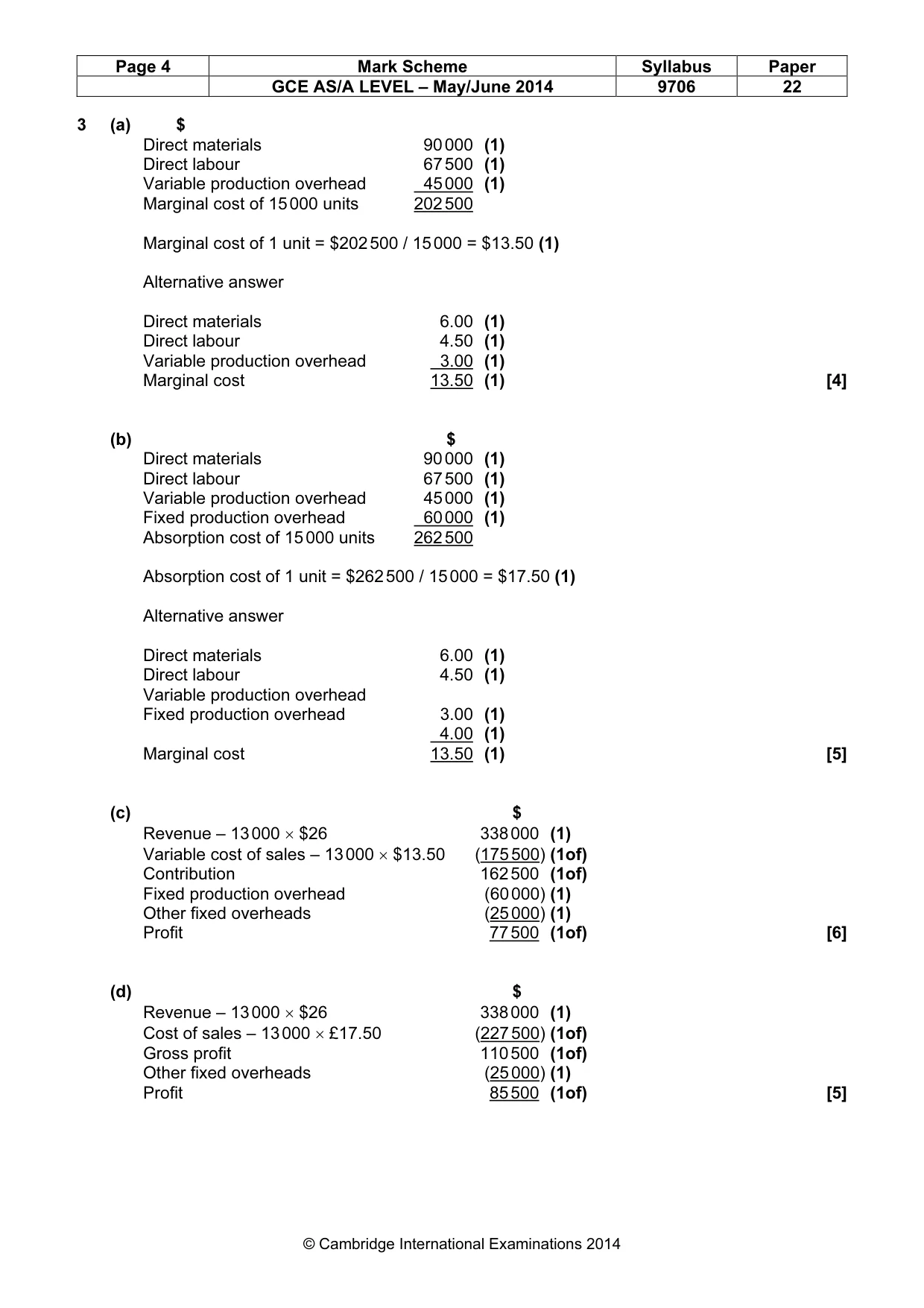
Page 4 Mark Scheme Syllabus Paper GCE AS/A LEVEL – May/June 2014 9706 22 © Cambridge International Examinations 2014 3 (a) $ Direct materials 90 000 (1) Direct labour 67 500 (1) Variable production overhead 45 000 (1) Marginal cost of 15 000 units 202 500 Marginal cost of 1 unit = $202 500 / 15 000 = $13.50 (1) Alternative answer Direct materials 6.00 (1) Direct labour 4.50 (1) Variable production overhead 3.00 (1) Marginal cost 13.50 (1) [4] (b) $ Direct materials 90 000 (1) Direct labour 67 500 (1) Variable production overhead 45 000 (1) Fixed production overhead 60 000 (1) Absorption cost of 15 000 units 262 500 Absorption cost of 1 unit = $262 500 / 15 000 = $17.50 (1) Alternative answer Direct materials 6.00 (1) Direct labour 4.50 (1) Variable production overhead Fixed production overhead 3.00 (1) 4.00 (1) Marginal cost 13.50 (1) [5] (c) $ Revenue – 13 000 × $26 338 000 (1) Variable cost of sales – 13 000 × $13.50 (175 500) (1of) Contribution 162 500 (1of) Fixed production overhead (60 000) (1) Other fixed overheads (25 000) (1) Profit 77 500 (1of) [6] (d) $ Revenue – 13 000 × $26 338 000 (1) Cost of sales – 13 000 × £17.50 (227 500) (1of) Gross profit 110 500 (1of) Other fixed overheads (25 000) (1) Profit 85 500 (1of) [5]
Mark scheme, page 5
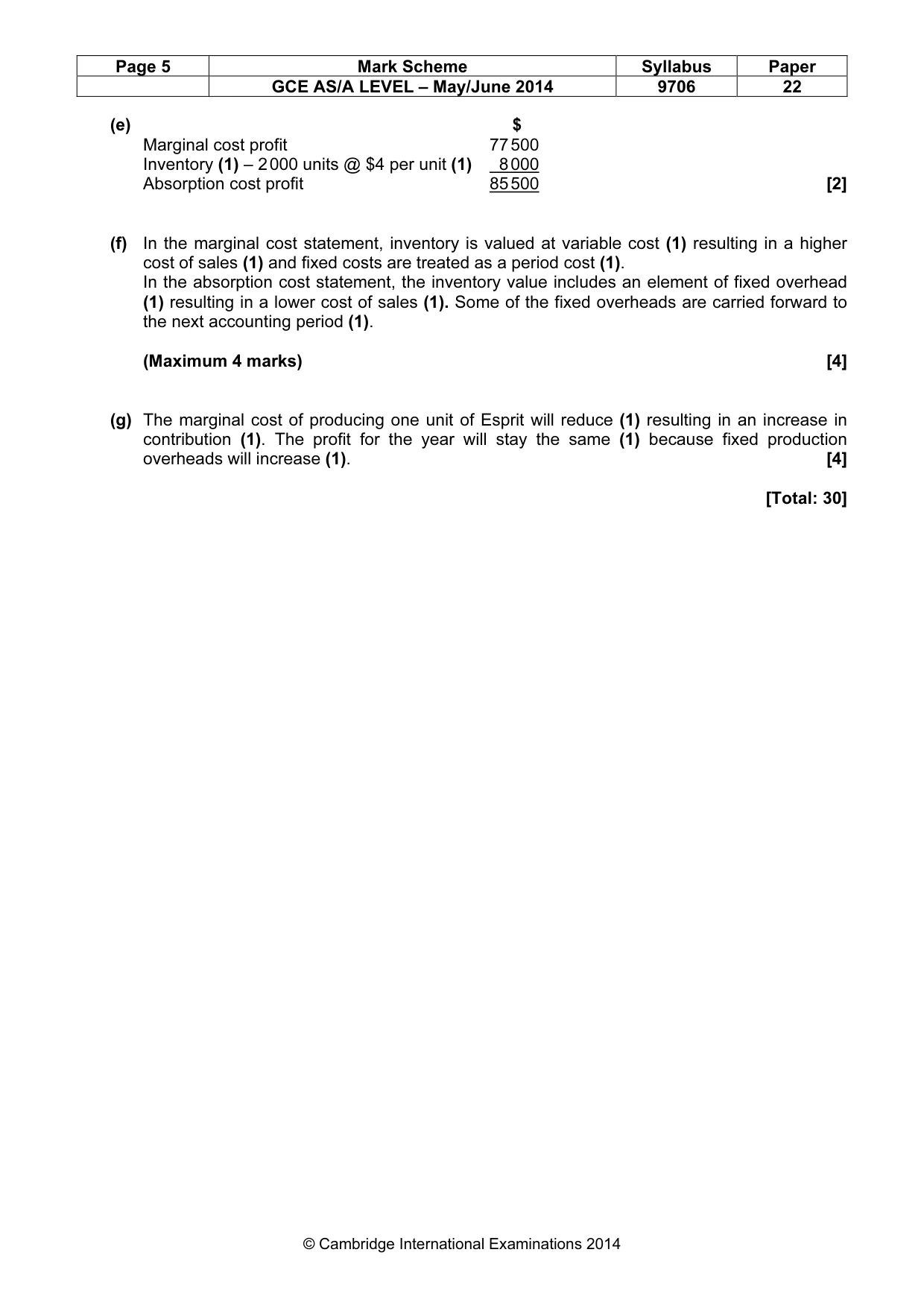
Page 5 Mark Scheme Syllabus Paper GCE AS/A LEVEL – May/June 2014 9706 22 © Cambridge International Examinations 2014 (e) $ Marginal cost profit 77 500 Inventory (1) – 2 000 units @ $4 per unit (1) 8 000 Absorption cost profit 85 500 [2] (f) In the marginal cost statement, inventory is valued at variable cost (1) resulting in a higher cost of sales (1) and fixed costs are treated as a period cost (1). In the absorption cost statement, the inventory value includes an element of fixed overhead (1) resulting in a lower cost of sales (1). Some of the fixed overheads are carried forward to the next accounting period (1). (Maximum 4 marks) [4] (g) The marginal cost of producing one unit of Esprit will reduce (1) resulting in an increase in contribution (1). The profit for the year will stay the same (1) because fixed production overheads will increase (1). [4] [Total: 30]
What you needed in this session
Cambridge’s own grade thresholds for 2014 May/June, Paper 2 · Variant 2. A higher threshold means an easier paper — the bar moves with how the cohort did.