Cambridge A Level Accounting 9706 — 2014 May/June Paper 2 · Variant 3
9706/23/M/J/14 · 90 marks · ≈101 min
The question paper and its mark scheme, free to read here and free to download. This is Cambridge’s own paper, exactly as it was sat.
Question paper16 pages

Mark scheme6 pages
Answers below. Sit the paper first if you are practising.
Paper as text
Question paper, page 1
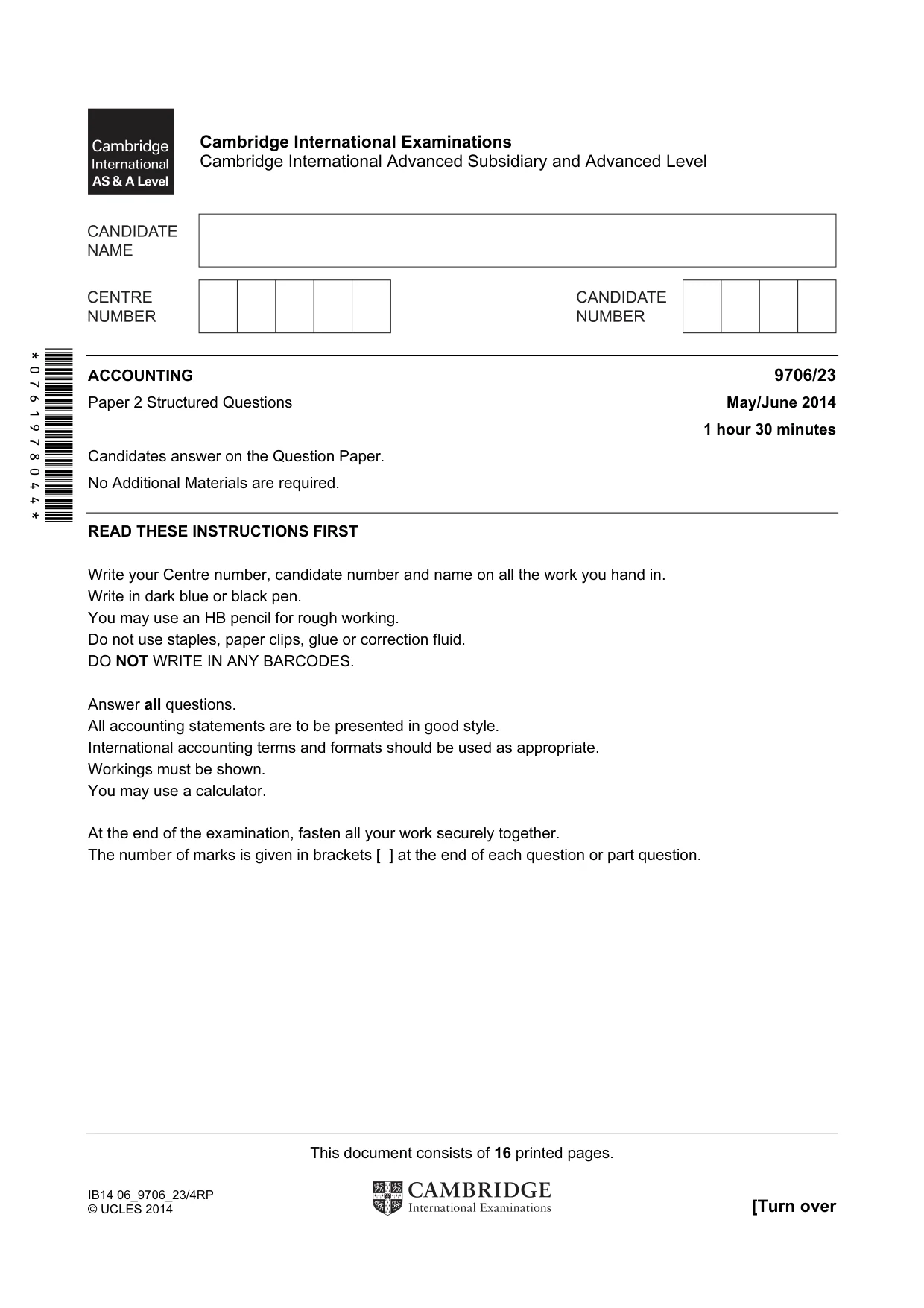
This document consists of 16 printed pages. IB14 06_9706_23/4RP © UCLES 2014 [Turn over *0761978044* Cambridge International Examinations Cambridge International Advanced Subsidiary and Advanced Level ACCOUNTING 9706/23 Paper 2 Structured Questions May/June 2014 1 hour 30 minutes Candidates answer on the Question Paper. No Additional Materials are required. READ THESE INSTRUCTIONS FIRST Write your Centre number, candidate number and name on all the work you hand in. Write in dark blue or black pen. You may use an HB pencil for rough working. Do not use staples, paper clips, glue or correction fluid. DO NOT WRITE IN ANY BARCODES. Answer all questions. All accounting statements are to be presented in good style. International accounting terms and formats should be used as appropriate. Workings must be shown. You may use a calculator. At the end of the examination, fasten all your work securely together. The number of marks is given in brackets [ ] at the end of each question or part question.
Question paper, page 2
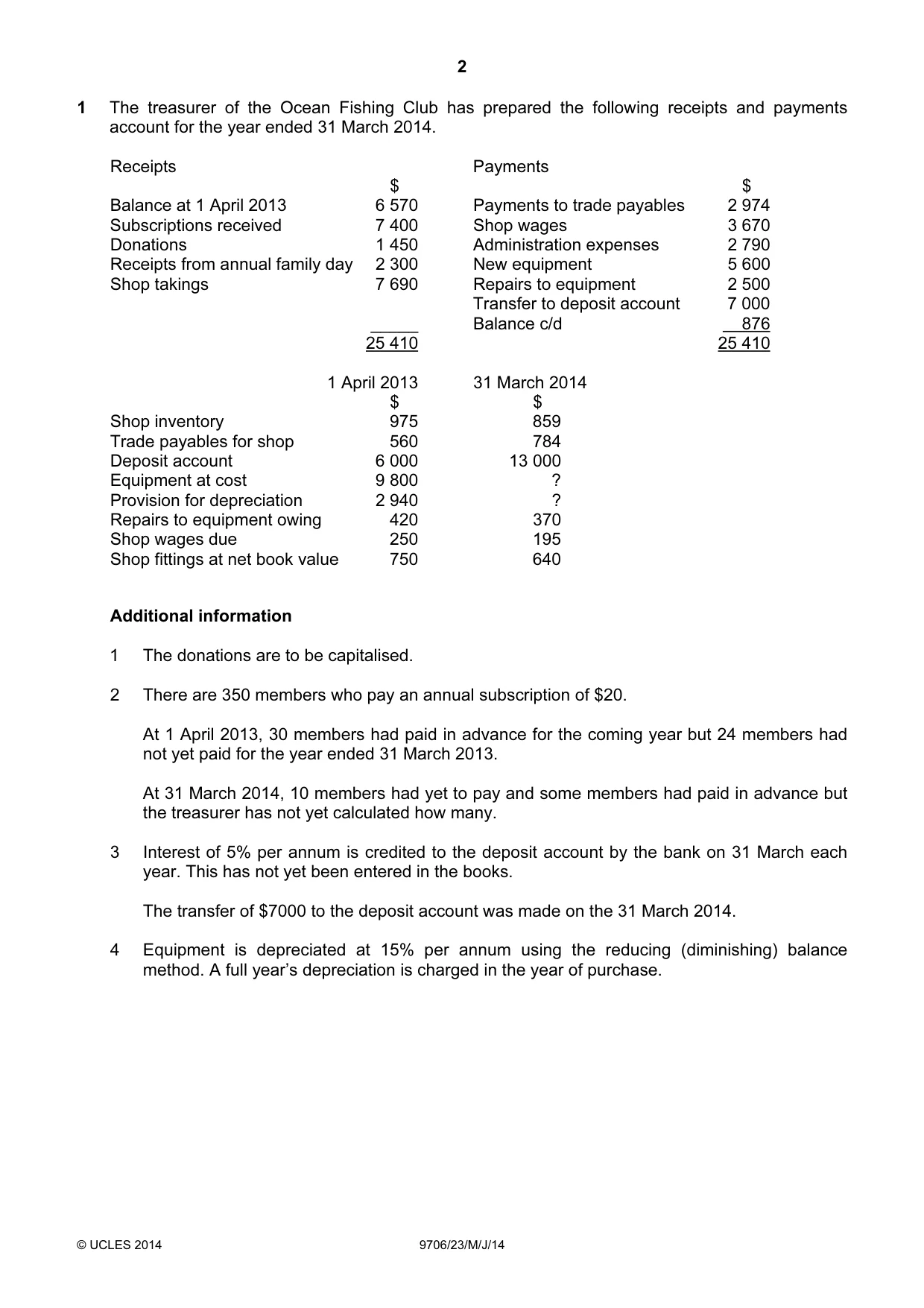
2 © UCLES 2014 9706/23/M/J/14 1 The treasurer of the Ocean Fishing Club has prepared the following receipts and payments account for the year ended 31 March 2014. Receipts Payments $ $ Balance at 1 April 2013 6 570 Payments to trade payables 2 974 Subscriptions received 7 400 Shop wages 3 670 Donations 1 450 Administration expenses 2 790 Receipts from annual family day 2 300 New equipment 5 600 Shop takings 7 690 Repairs to equipment 2 500 Transfer to deposit account 7 000 _____ Balance c/d 876 25 410 25 410 1 April 2013 31 March 2014 $ $ Shop inventory 975 859 Trade payables for shop 560 784 Deposit account 6 000 13 000 Equipment at cost 9 800 ? Provision for depreciation 2 940 ? Repairs to equipment owing 420 370 Shop wages due 250 195 Shop fittings at net book value 750 640 Additional information 1 The donations are to be capitalised. 2 There are 350 members who pay an annual subscription of $20. At 1 April 2013, 30 members had paid in advance for the coming year but 24 members had not yet paid for the year ended 31 March 2013. At 31 March 2014, 10 members had yet to pay and some members had paid in advance but the treasurer has not yet calculated how many. 3 Interest of 5% per annum is credited to the deposit account by the bank on 31 March each year. This has not yet been entered in the books. The transfer of $7000 to the deposit account was made on the 31 March 2014. 4 Equipment is depreciated at 15% per annum using the reducing (diminishing) balance method. A full year’s depreciation is charged in the year of purchase.
Question paper, page 3
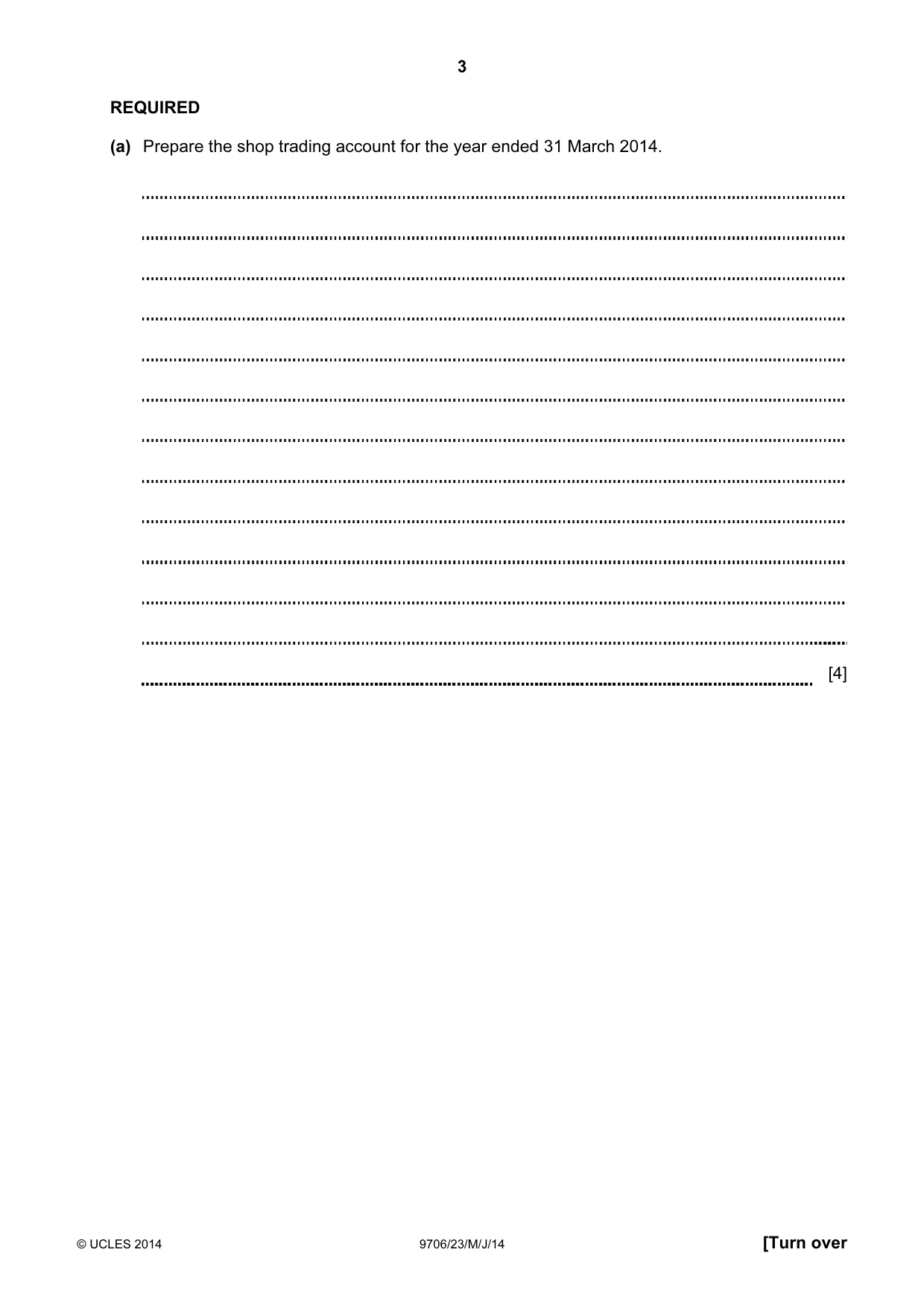
3 © UCLES 2014 9706/23/M/J/14 [Turn over REQUIRED (a) Prepare the shop trading account for the year ended 31 March 2014. [4]
Question paper, page 4
4 © UCLES 2014 9706/23/M/J/14 (b) Prepare the income and expenditure account for the year ended 31 March 2014. [6]
Question paper, page 5
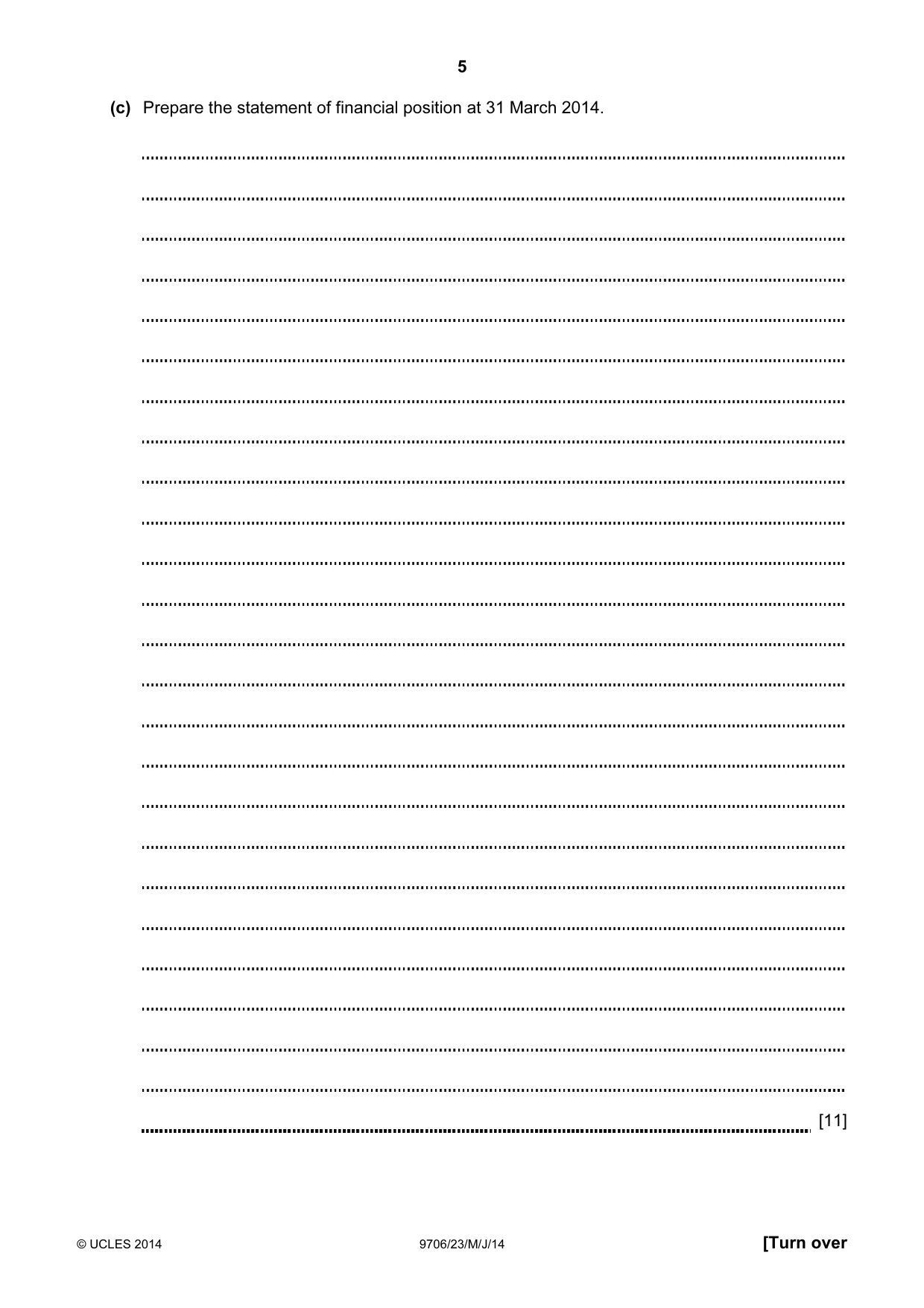
5 © UCLES 2014 9706/23/M/J/14 [Turn over (c) Prepare the statement of financial position at 31 March 2014. [11]
Question paper, page 6
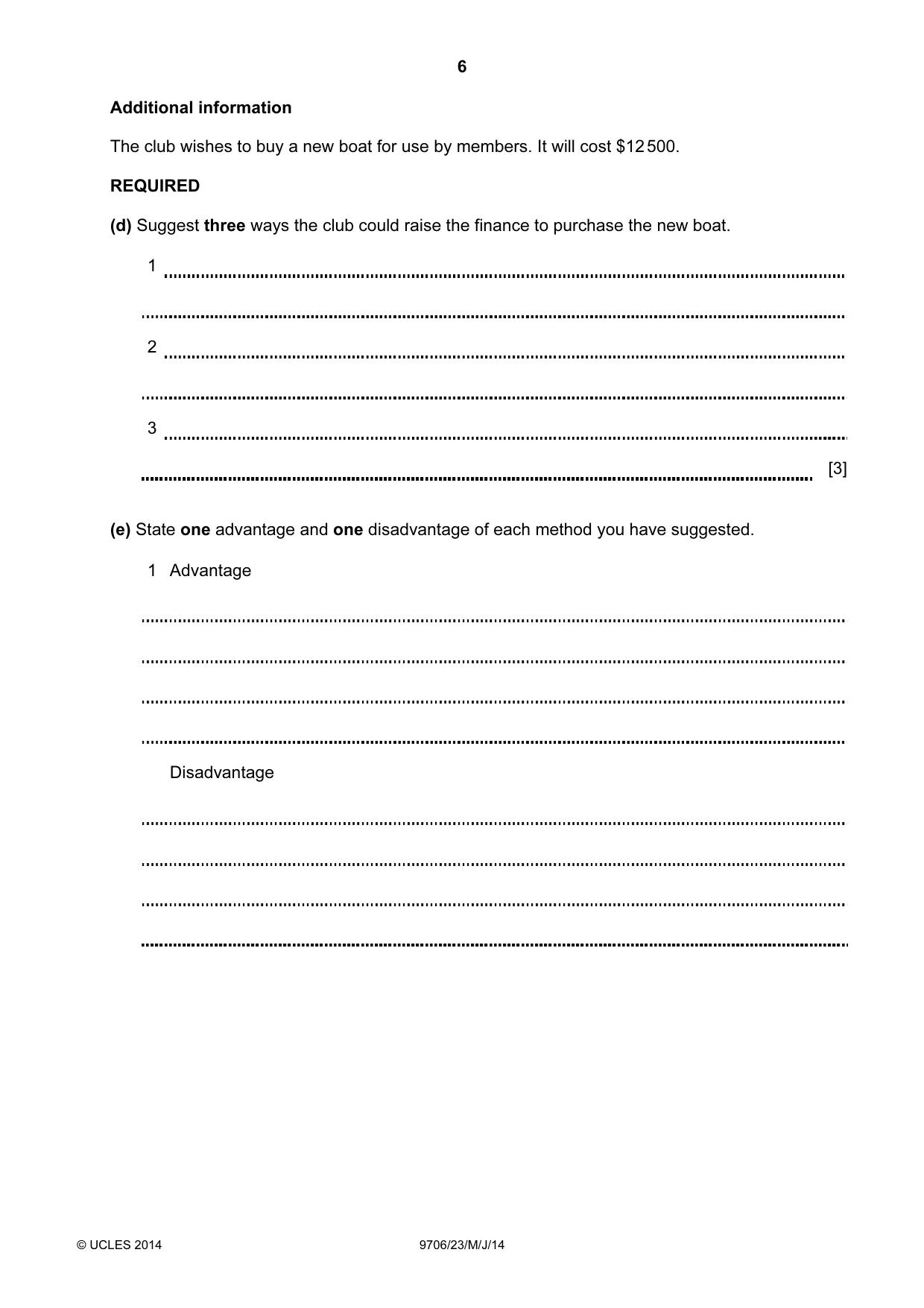
6 © UCLES 2014 9706/23/M/J/14 Additional information The club wishes to buy a new boat for use by members. It will cost $12 500. REQUIRED (d) Suggest three ways the club could raise the finance to purchase the new boat. 1 2 3 [3] (e) State one advantage and one disadvantage of each method you have suggested. 1 Advantage Disadvantage
Question paper, page 7
7 © UCLES 2014 9706/23/M/J/14 [Turn over 2 Advantage Disadvantage 3 Advantage Disadvantage [6] [Total: 30]
Question paper, page 8
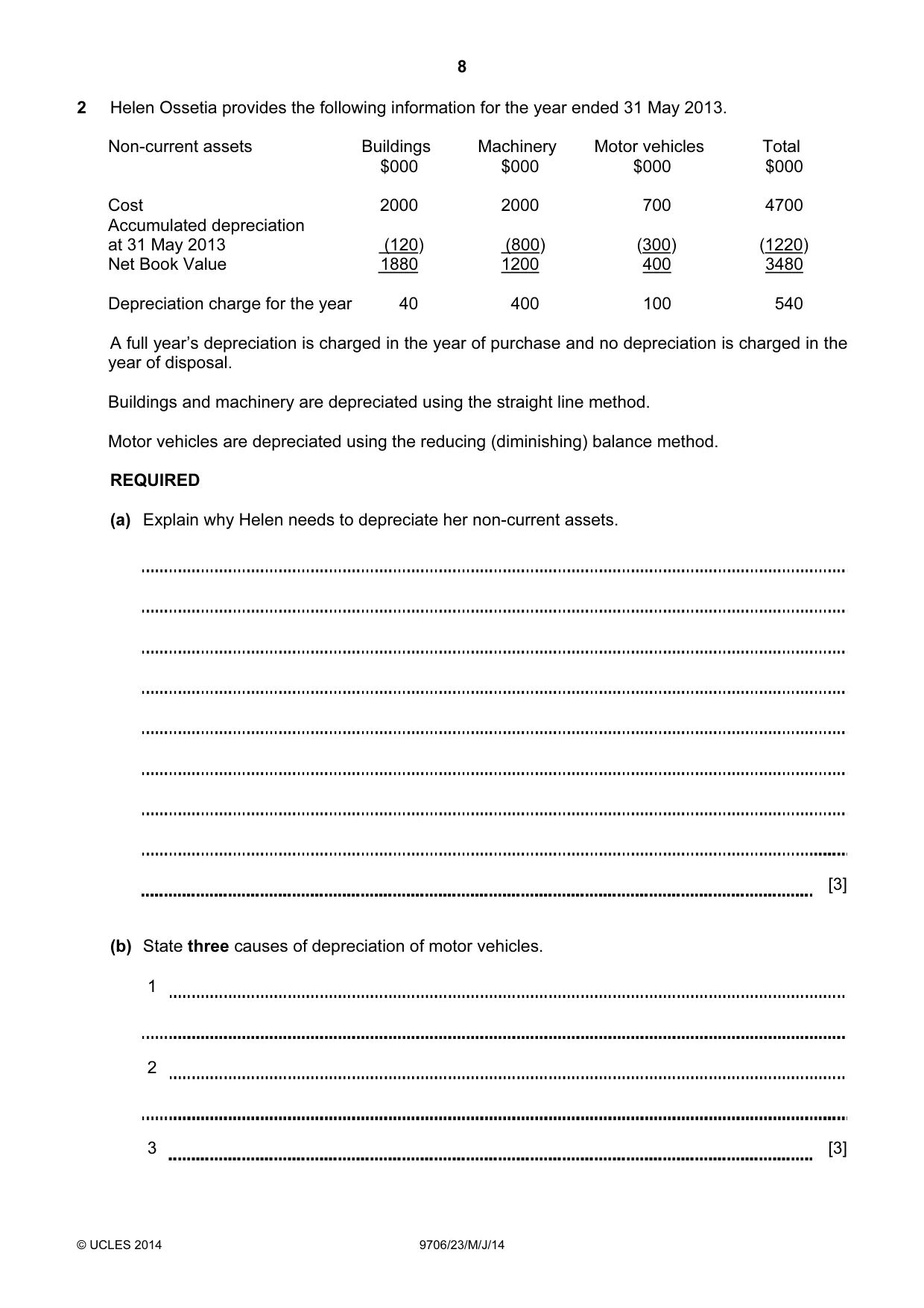
8 © UCLES 2014 9706/23/M/J/14 2 Helen Ossetia provides the following information for the year ended 31 May 2013. Non-current assets Buildings Machinery Motor vehicles Total $000 $000 $000 $000 Cost 2000 2000 700 4700 Accumulated depreciation at 31 May 2013 (120) (800) (300) (1220) Net Book Value 1880 1200 400 3480 Depreciation charge for the year 40 400 100 540 A full year’s depreciation is charged in the year of purchase and no depreciation is charged in the year of disposal. Buildings and machinery are depreciated using the straight line method. Motor vehicles are depreciated using the reducing (diminishing) balance method. REQUIRED (a) Explain why Helen needs to depreciate her non-current assets. [3] (b) State three causes of depreciation of motor vehicles. 1 2 3 [3]
Question paper, page 9
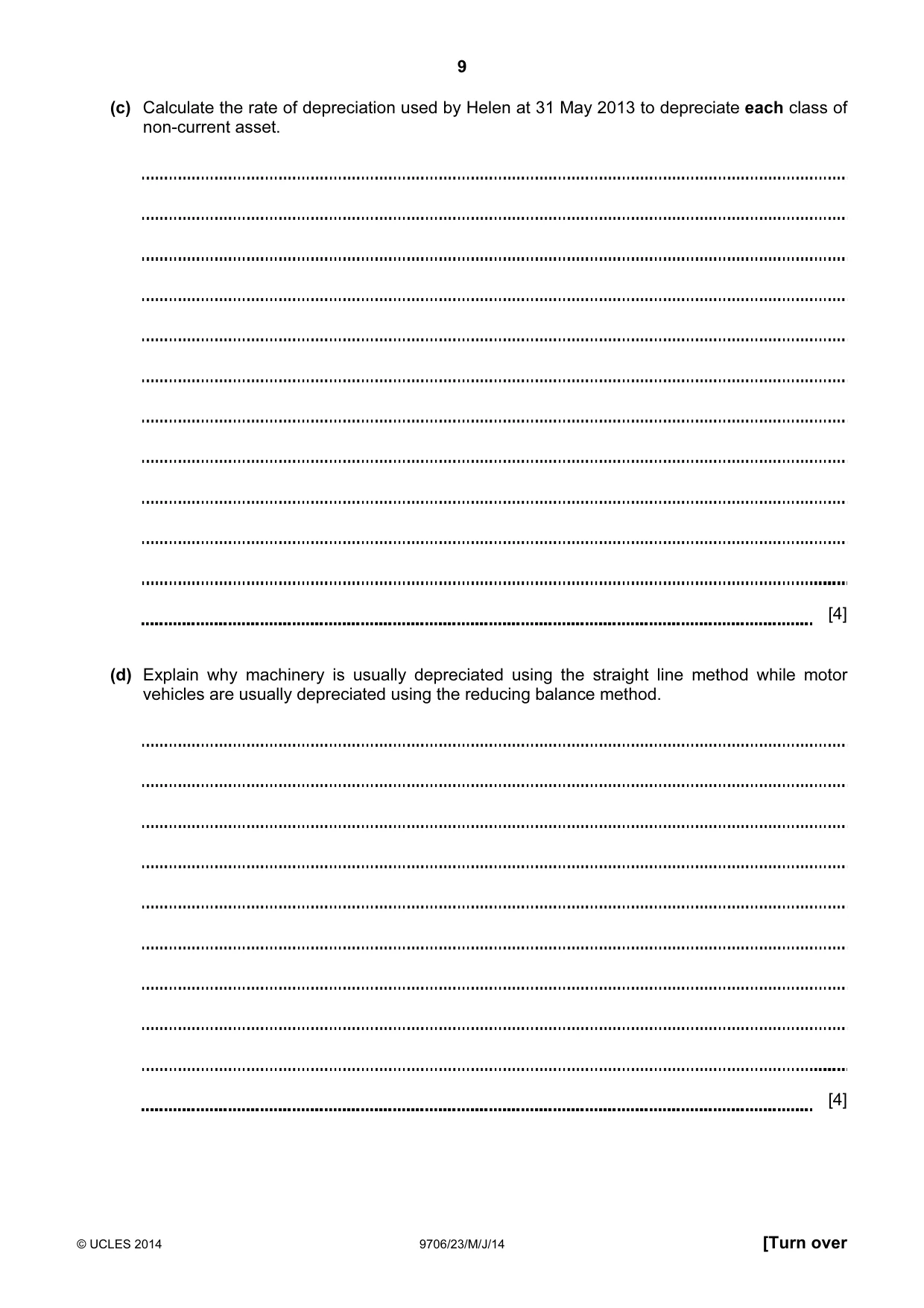
9 © UCLES 2014 9706/23/M/J/14 [Turn over (c) Calculate the rate of depreciation used by Helen at 31 May 2013 to depreciate each class of non-current asset. [4] (d) Explain why machinery is usually depreciated using the straight line method while motor vehicles are usually depreciated using the reducing balance method. [4]
Question paper, page 10
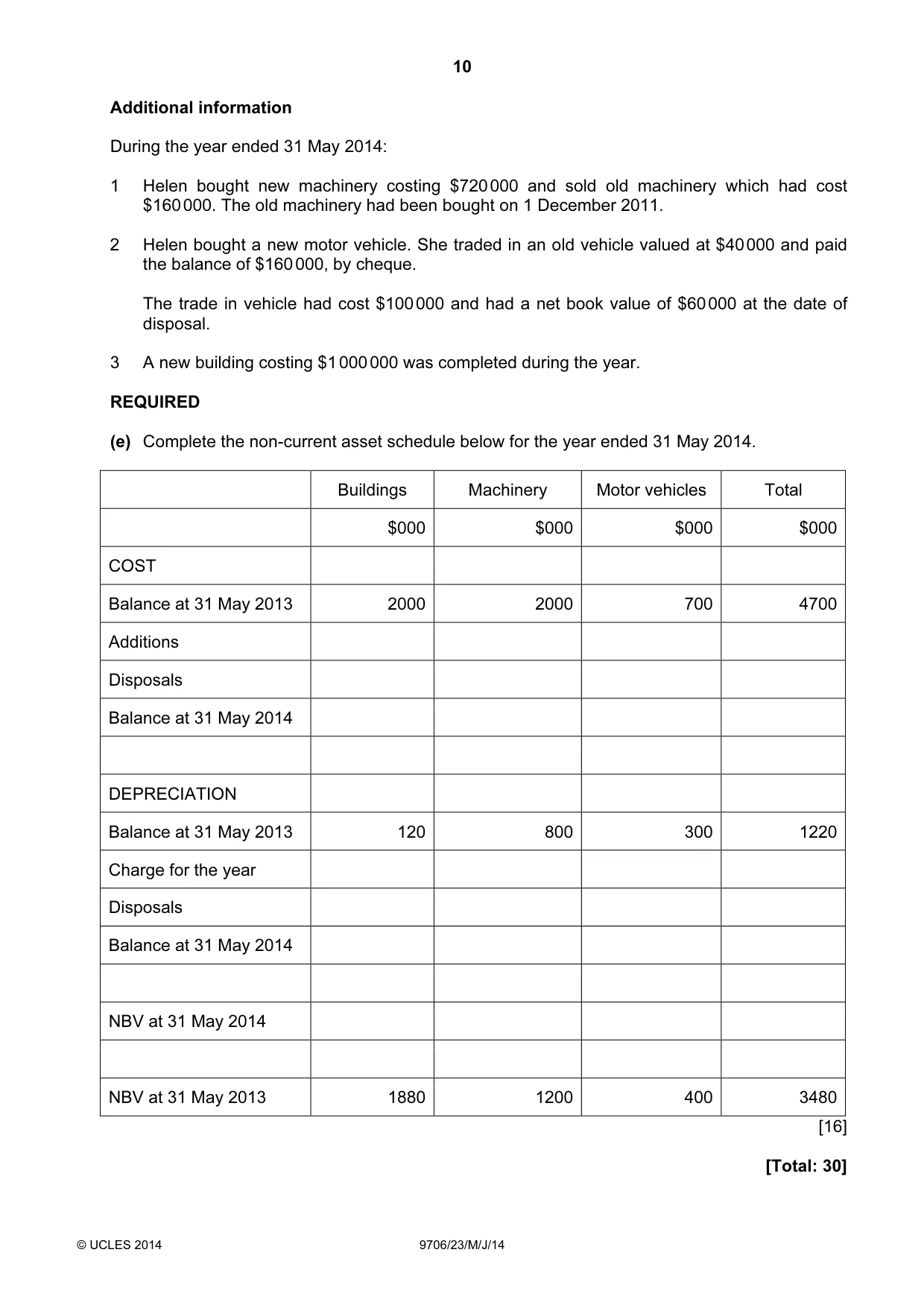
10 © UCLES 2014 9706/23/M/J/14 Additional information During the year ended 31 May 2014: 1 Helen bought new machinery costing $720 000 and sold old machinery which had cost $160 000. The old machinery had been bought on 1 December 2011. 2 Helen bought a new motor vehicle. She traded in an old vehicle valued at $40 000 and paid the balance of $160 000, by cheque. The trade in vehicle had cost $100 000 and had a net book value of $60 000 at the date of disposal. 3 A new building costing $1 000 000 was completed during the year. REQUIRED (e) Complete the non-current asset schedule below for the year ended 31 May 2014. Buildings Machinery Motor vehicles Total $000 $000 $000 $000 COST Balance at 31 May 2013 2000 2000 700 4700 Additions Disposals Balance at 31 May 2014 DEPRECIATION Balance at 31 May 2013 120 800 300 1220 Charge for the year Disposals Balance at 31 May 2014 NBV at 31 May 2014 NBV at 31 May 2013 1880 1200 400 3480 [16] [Total: 30]
Question paper, page 11
11 © UCLES 2014 9706/23/M/J/14 [Turn over Question 3 is on the next page.
Question paper, page 12
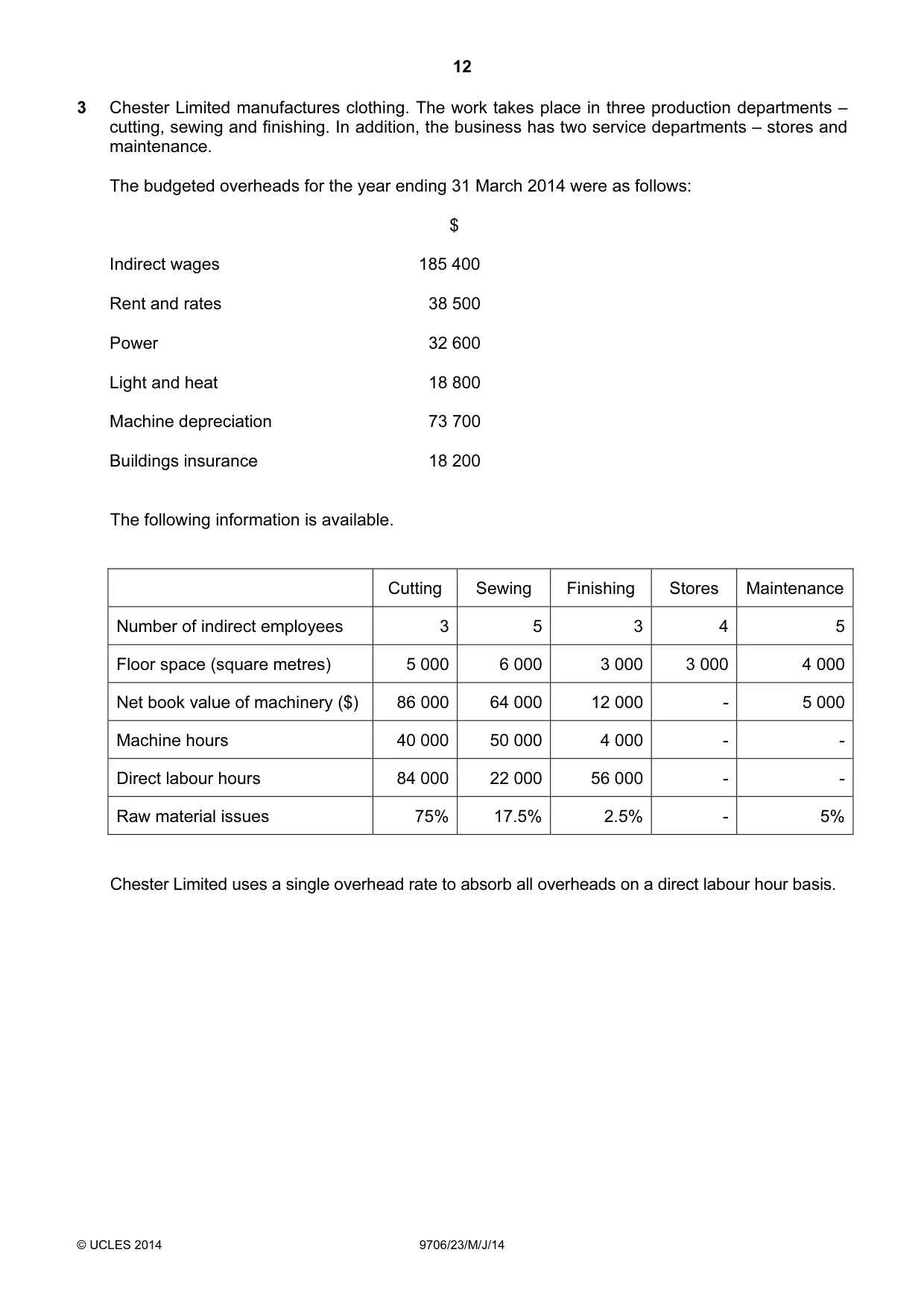
12 © UCLES 2014 9706/23/M/J/14 3 Chester Limited manufactures clothing. The work takes place in three production departments – cutting, sewing and finishing. In addition, the business has two service departments – stores and maintenance. The budgeted overheads for the year ending 31 March 2014 were as follows: $ Indirect wages 185 400 Rent and rates 38 500 Power 32 600 Light and heat 18 800 Machine depreciation 73 700 Buildings insurance 18 200 The following information is available. Cutting Sewing Finishing Stores Maintenance Number of indirect employees 3 5 3 4 5 Floor space (square metres) 5 000 6 000 3 000 3 000 4 000 Net book value of machinery ($) 86 000 64 000 12 000 - 5 000 Machine hours 40 000 50 000 4 000 - - Direct labour hours 84 000 22 000 56 000 - - Raw material issues 75% 17.5% 2.5% - 5% Chester Limited uses a single overhead rate to absorb all overheads on a direct labour hour basis.
Question paper, page 13
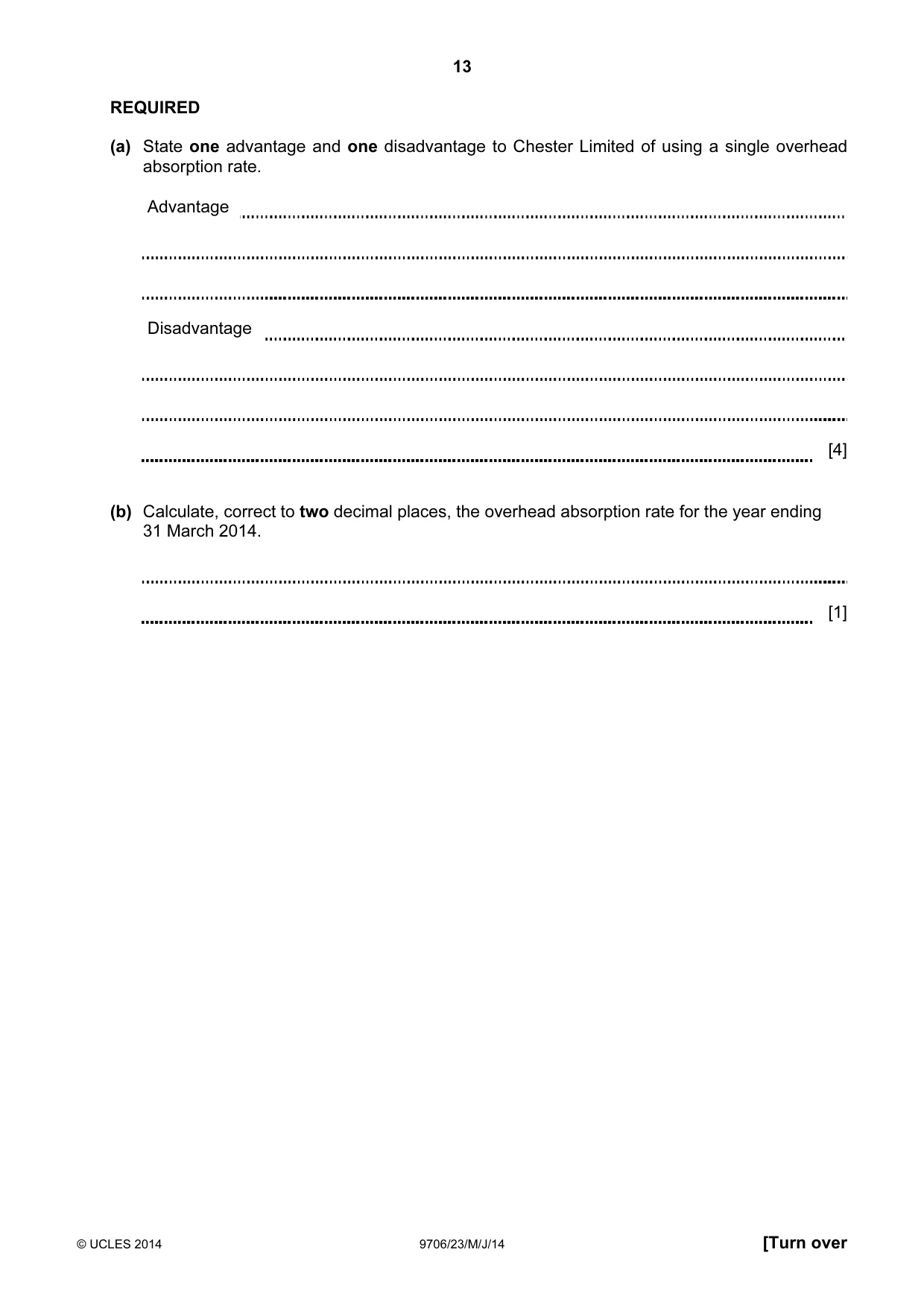
13 © UCLES 2014 9706/23/M/J/14 [Turn over REQUIRED (a) State one advantage and one disadvantage to Chester Limited of using a single overhead absorption rate. Advantage Disadvantage [4] (b) Calculate, correct to two decimal places, the overhead absorption rate for the year ending 31 March 2014. [1]
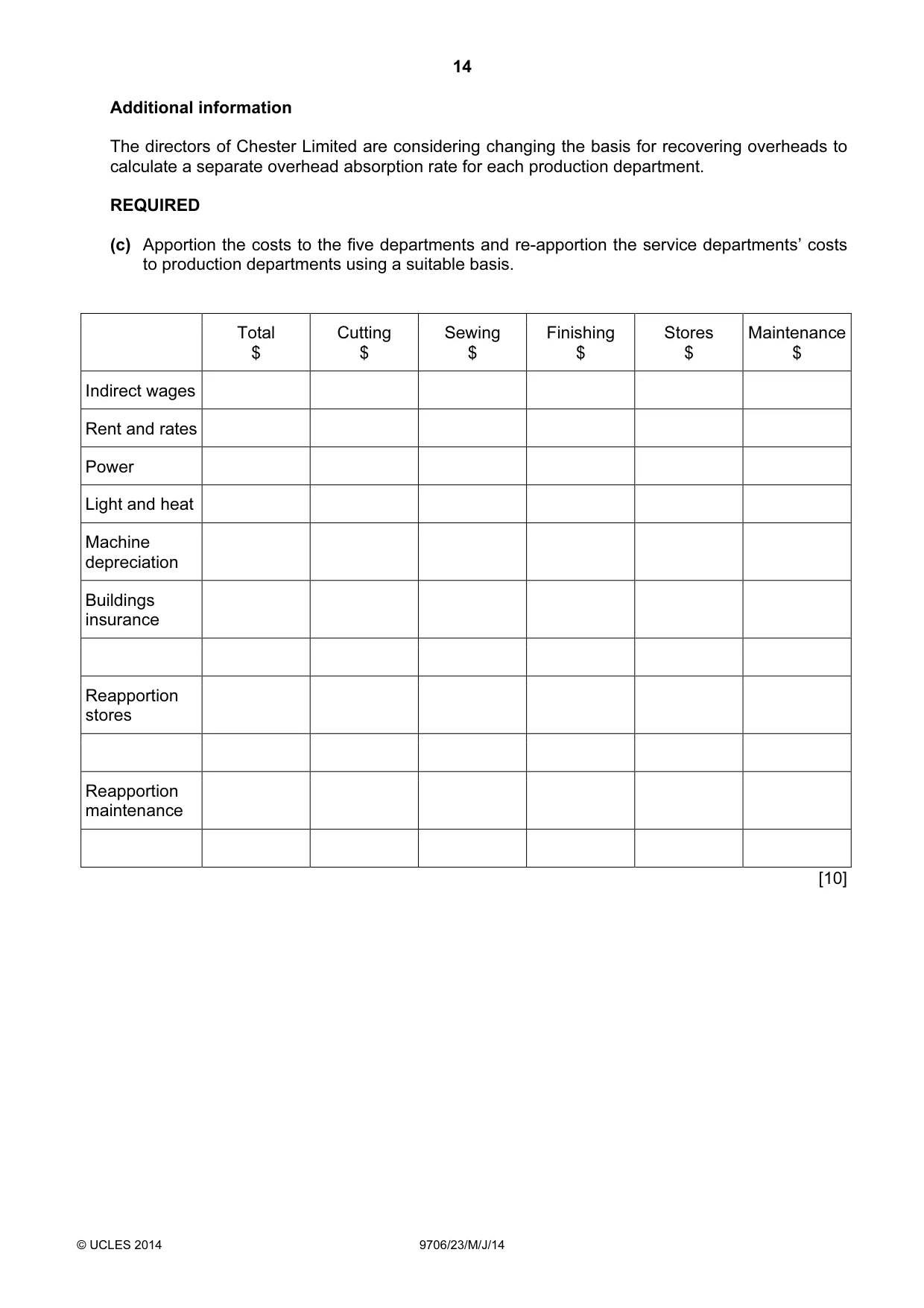
Question paper, page 14
14 © UCLES 2014 9706/23/M/J/14 Additional information The directors of Chester Limited are considering changing the basis for recovering overheads to calculate a separate overhead absorption rate for each production department. REQUIRED (c) Apportion the costs to the five departments and re-apportion the service departments’ costs to production departments using a suitable basis. Total $ Cutting $ Sewing $ Finishing $ Stores $ Maintenance $ Indirect wages Rent and rates Power Light and heat Machine depreciation Buildings insurance Reapportion stores Reapportion maintenance [10]
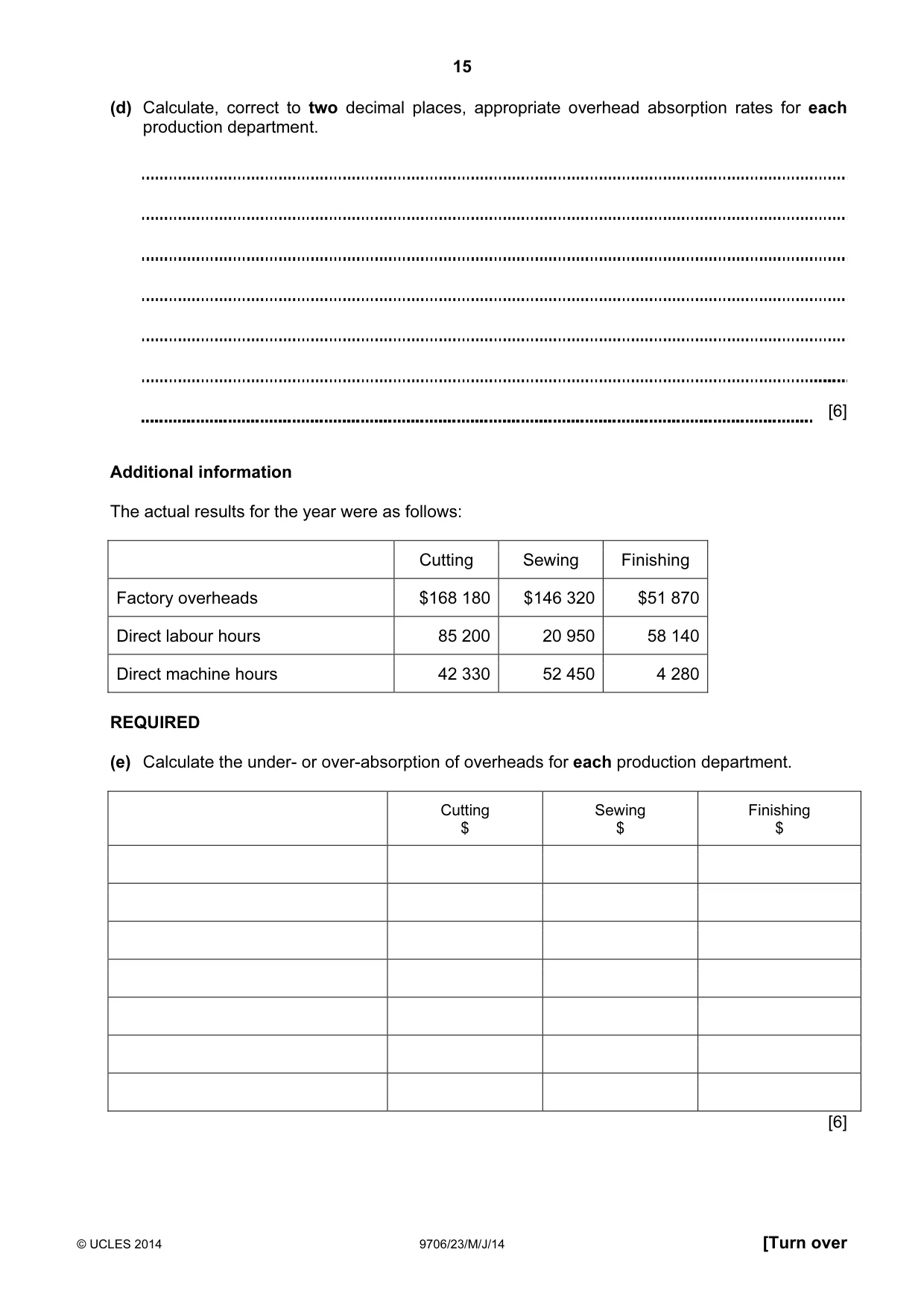
Question paper, page 15
15 © UCLES 2014 9706/23/M/J/14 [Turn over (d) Calculate, correct to two decimal places, appropriate overhead absorption rates for each production department. [6] Additional information The actual results for the year were as follows: Cutting Sewing Finishing Factory overheads $168 180 $146 320 $51 870 Direct labour hours 85 200 20 950 58 140 Direct machine hours 42 330 52 450 4 280 REQUIRED (e) Calculate the under- or over-absorption of overheads for each production department. Cutting $ Sewing $ Finishing $ [6]
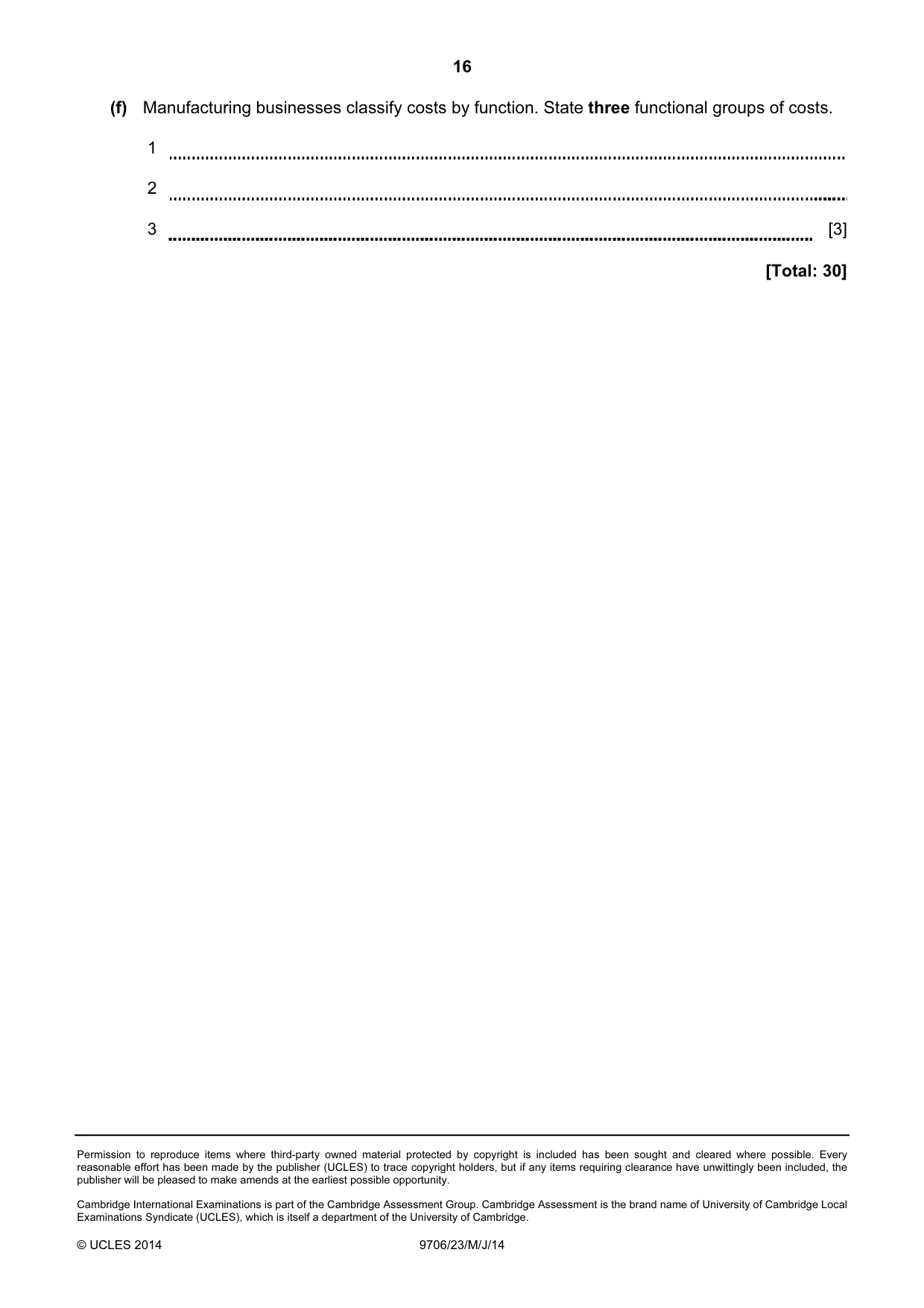
Question paper, page 16
16 Permission to reproduce items where third-party owned material protected by copyright is included has been sought and cleared where possible. Every reasonable effort has been made by the publisher (UCLES) to trace copyright holders, but if any items requiring clearance have unwittingly been included, the publisher will be pleased to make amends at the earliest possible opportunity. Cambridge International Examinations is part of the Cambridge Assessment Group. Cambridge Assessment is the brand name of University of Cambridge Local Examinations Syndicate (UCLES), which is itself a department of the University of Cambridge. © UCLES 2014 9706/23/M/J/14 (f) Manufacturing businesses classify costs by function. State three functional groups of costs. 1 2 3 [3] [Total: 30]
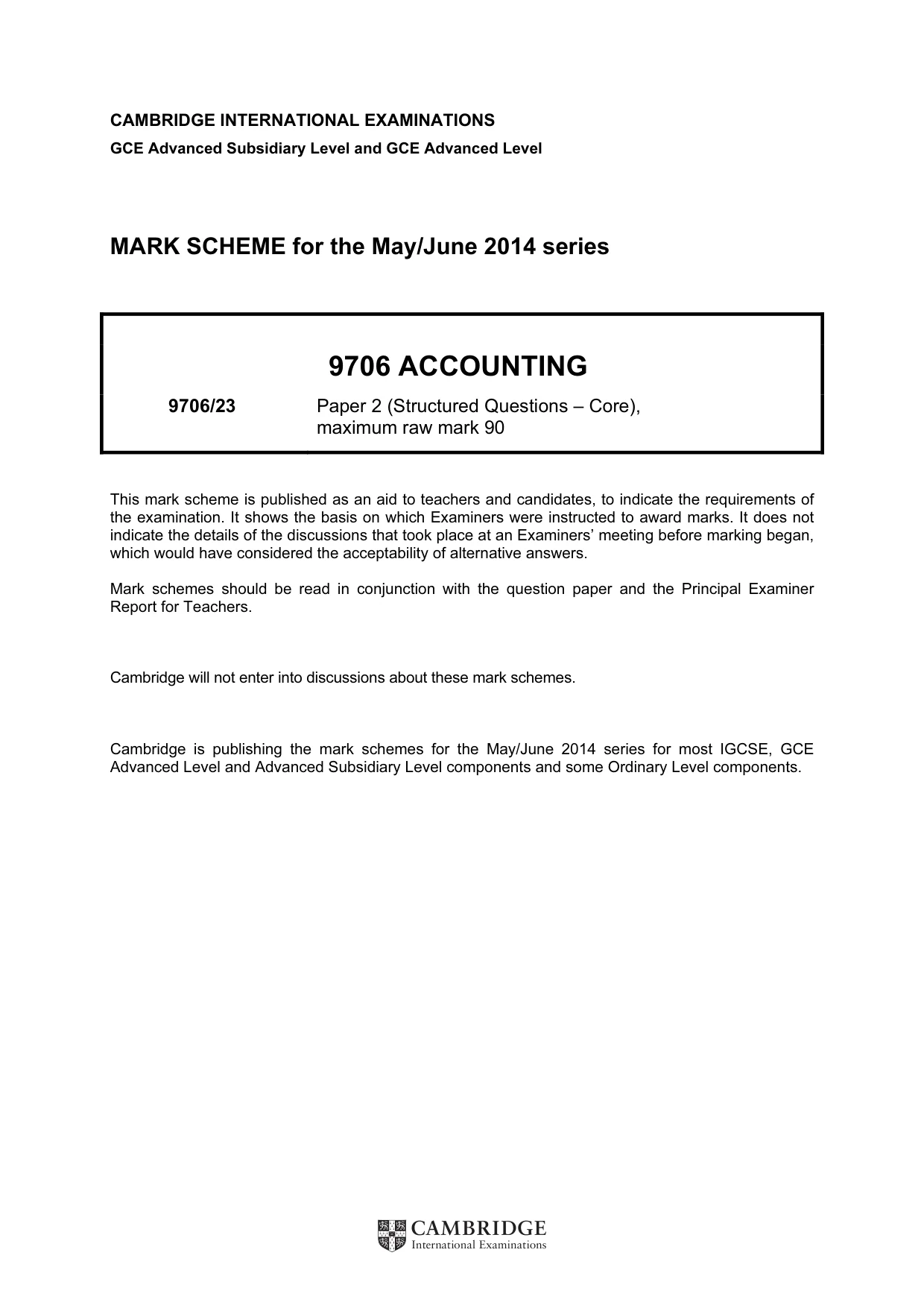
Mark scheme, page 1
CAMBRIDGE INTERNATIONAL EXAMINATIONS GCE Advanced Subsidiary Level and GCE Advanced Level MARK SCHEME for the May/June 2014 series 9706 ACCOUNTING 9706/23 Paper 2 (Structured Questions – Core), maximum raw mark 90 This mark scheme is published as an aid to teachers and candidates, to indicate the requirements of the examination. It shows the basis on which Examiners were instructed to award marks. It does not indicate the details of the discussions that took place at an Examiners’ meeting before marking began, which would have considered the acceptability of alternative answers. Mark schemes should be read in conjunction with the question paper and the Principal Examiner Report for Teachers. Cambridge will not enter into discussions about these mark schemes. Cambridge is publishing the mark schemes for the May/June 2014 series for most IGCSE, GCE Advanced Level and Advanced Subsidiary Level components and some Ordinary Level components.
Mark scheme, page 2
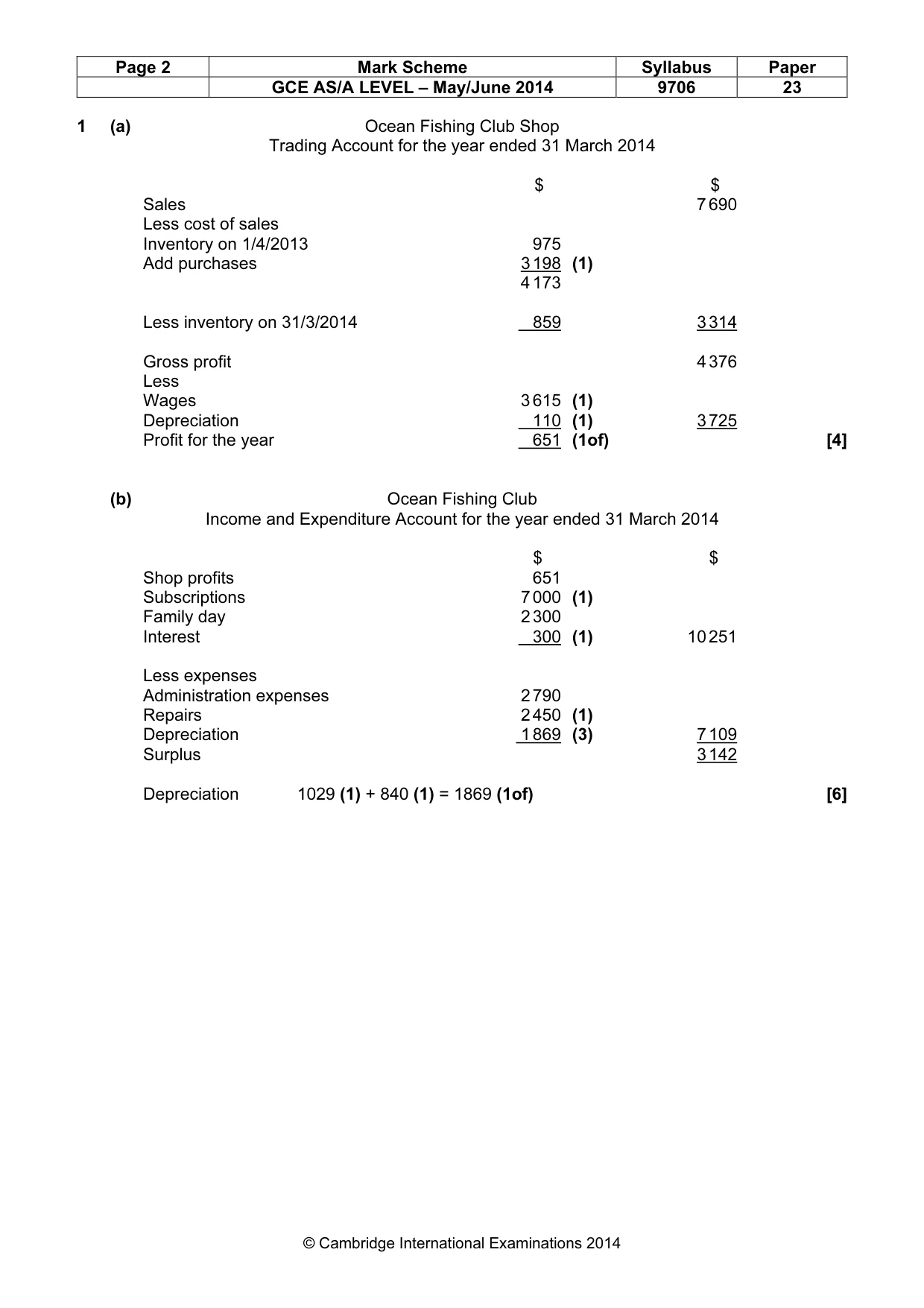
Page 2 Mark Scheme Syllabus Paper GCE AS/A LEVEL – May/June 2014 9706 23 © Cambridge International Examinations 2014 1 (a) Ocean Fishing Club Shop Trading Account for the year ended 31 March 2014 $ $ Sales 7 690 Less cost of sales Inventory on 1/4/2013 975 Add purchases 3 198 (1) 4 173 Less inventory on 31/3/2014 859 3 314 Gross profit 4 376 Less Wages 3 615 (1) Depreciation 110 (1) 3 725 Profit for the year 651 (1of) [4] (b) Ocean Fishing Club Income and Expenditure Account for the year ended 31 March 2014 $ $ Shop profits 651 Subscriptions 7 000 (1) Family day 2 300 Interest 300 (1) 10 251 Less expenses Administration expenses 2 790 Repairs 2 450 (1) Depreciation 1 869 (3) 7 109 Surplus 3 142 Depreciation 1029 (1) + 840 (1) = 1869 (1of) [6]
Mark scheme, page 3
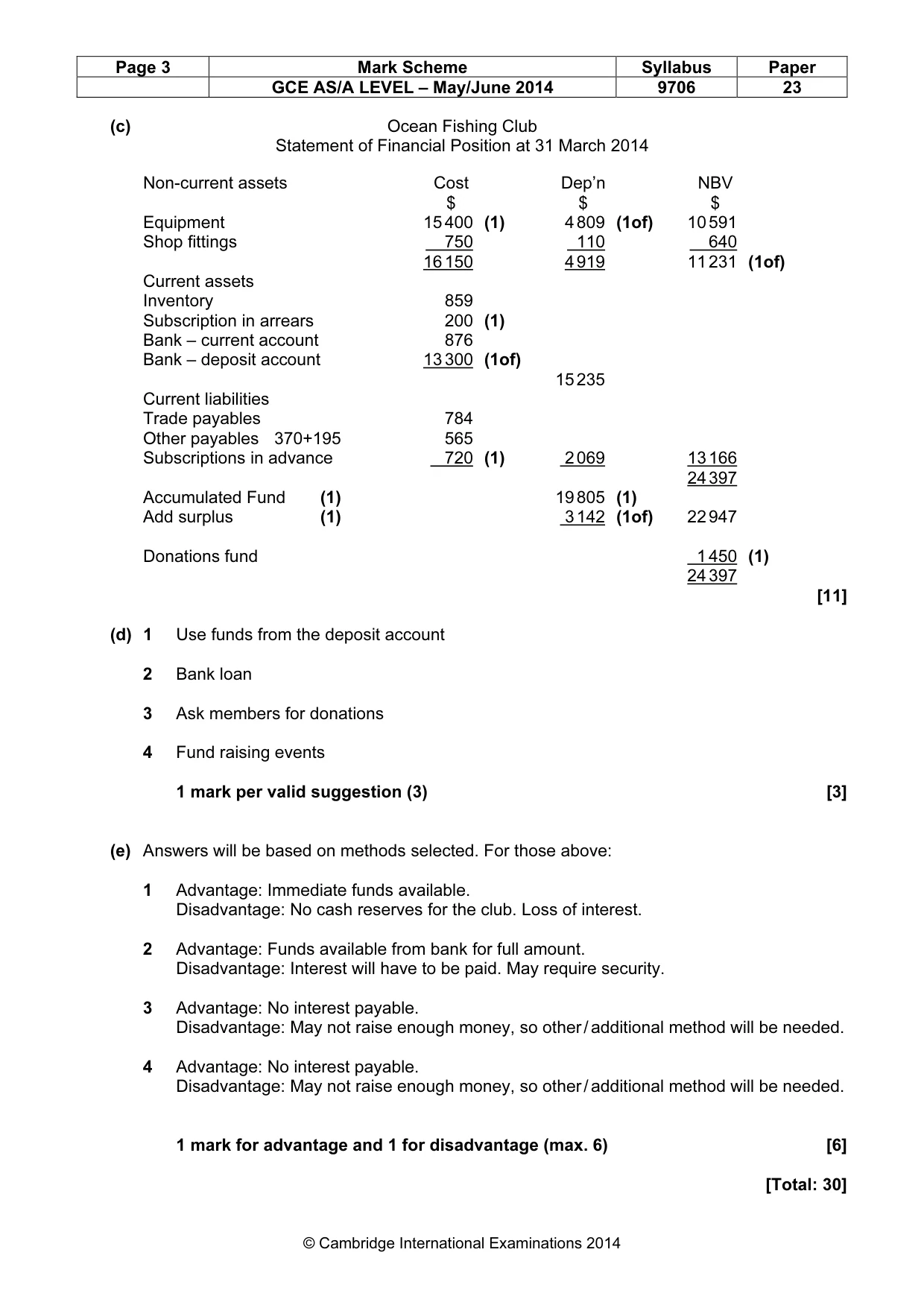
Page 3 Mark Scheme Syllabus Paper GCE AS/A LEVEL – May/June 2014 9706 23 © Cambridge International Examinations 2014 (c) Ocean Fishing Club Statement of Financial Position at 31 March 2014 Non-current assets Cost Dep’n NBV $ $ $ Equipment 15 400 (1) 4 809 (1of) 10 591 Shop fittings 750 110 640 16 150 4 919 11 231 (1of) Current assets Inventory 859 Subscription in arrears 200 (1) Bank – current account 876 Bank – deposit account 13 300 (1of) 15 235 Current liabilities Trade payables 784 Other payables 370+195 565 Subscriptions in advance 720 (1) 2 069 13 166 24 397 Accumulated Fund (1) 19 805 (1) Add surplus (1) 3 142 (1of) 22 947 Donations fund 1 450 (1) 24 397 [11] (d) 1 Use funds from the deposit account 2 Bank loan 3 Ask members for donations 4 Fund raising events 1 mark per valid suggestion (3) [3] (e) Answers will be based on methods selected. For those above: 1 Advantage: Immediate funds available. Disadvantage: No cash reserves for the club. Loss of interest. 2 Advantage: Funds available from bank for full amount. Disadvantage: Interest will have to be paid. May require security. 3 Advantage: No interest payable. Disadvantage: May not raise enough money, so other / additional method will be needed. 4 Advantage: No interest payable. Disadvantage: May not raise enough money, so other / additional method will be needed. 1 mark for advantage and 1 for disadvantage (max. 6) [6] [Total: 30]
Mark scheme, page 4
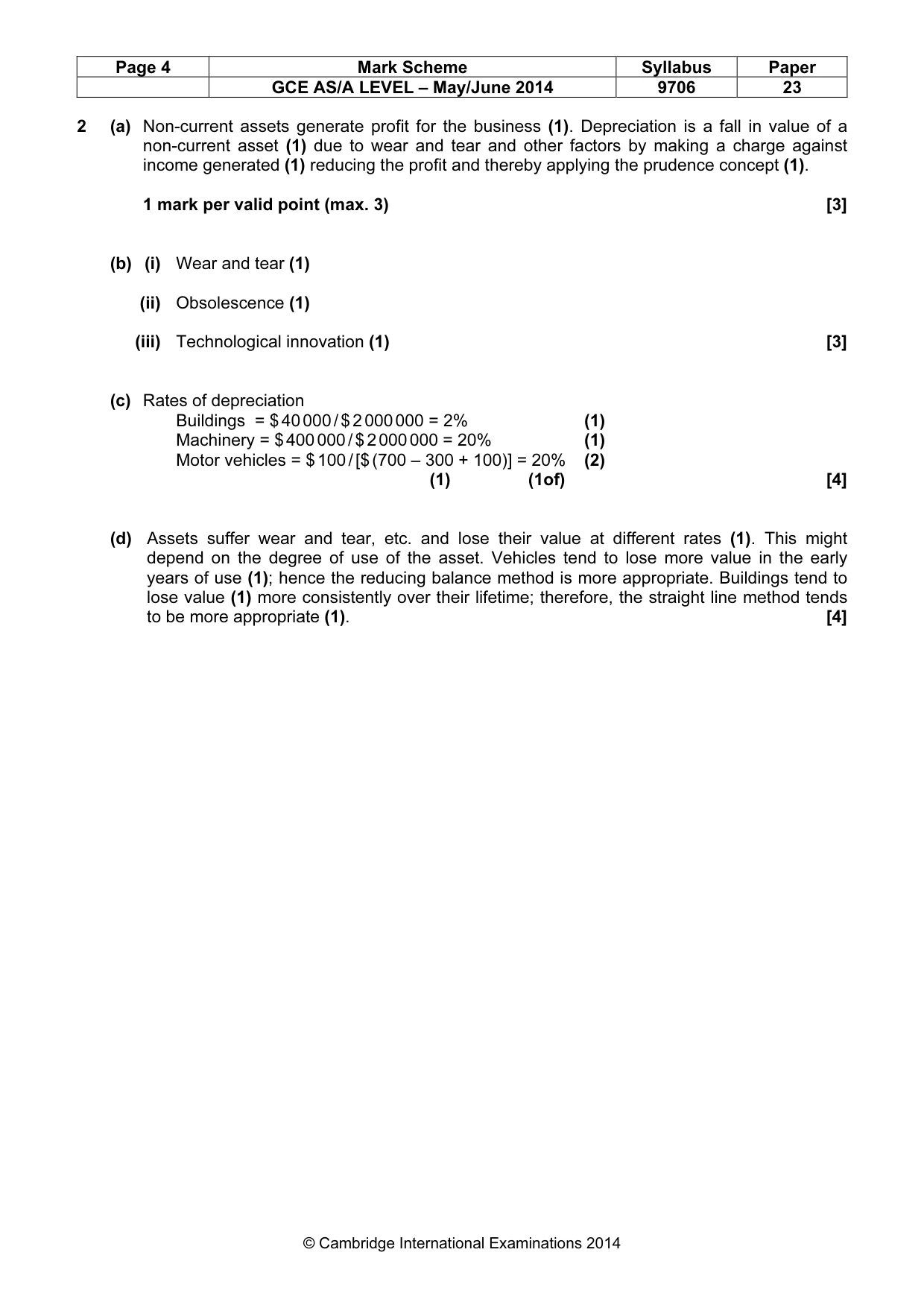
Page 4 Mark Scheme Syllabus Paper GCE AS/A LEVEL – May/June 2014 9706 23 © Cambridge International Examinations 2014 2 (a) Non-current assets generate profit for the business (1). Depreciation is a fall in value of a non-current asset (1) due to wear and tear and other factors by making a charge against income generated (1) reducing the profit and thereby applying the prudence concept (1). 1 mark per valid point (max. 3) [3] (b) (i) Wear and tear (1) (ii) Obsolescence (1) (iii) Technological innovation (1) [3] (c) Rates of depreciation Buildings = $ 40 000 / $ 2 000 000 = 2% (1) Machinery = $ 400 000 / $ 2 000 000 = 20% (1) Motor vehicles = $ 100 / [$ (700 – 300 + 100)] = 20% (2) (1) (1of) [4] (d) Assets suffer wear and tear, etc. and lose their value at different rates (1). This might depend on the degree of use of the asset. Vehicles tend to lose more value in the early years of use (1); hence the reducing balance method is more appropriate. Buildings tend to lose value (1) more consistently over their lifetime; therefore, the straight line method tends to be more appropriate (1). [4]
Mark scheme, page 5
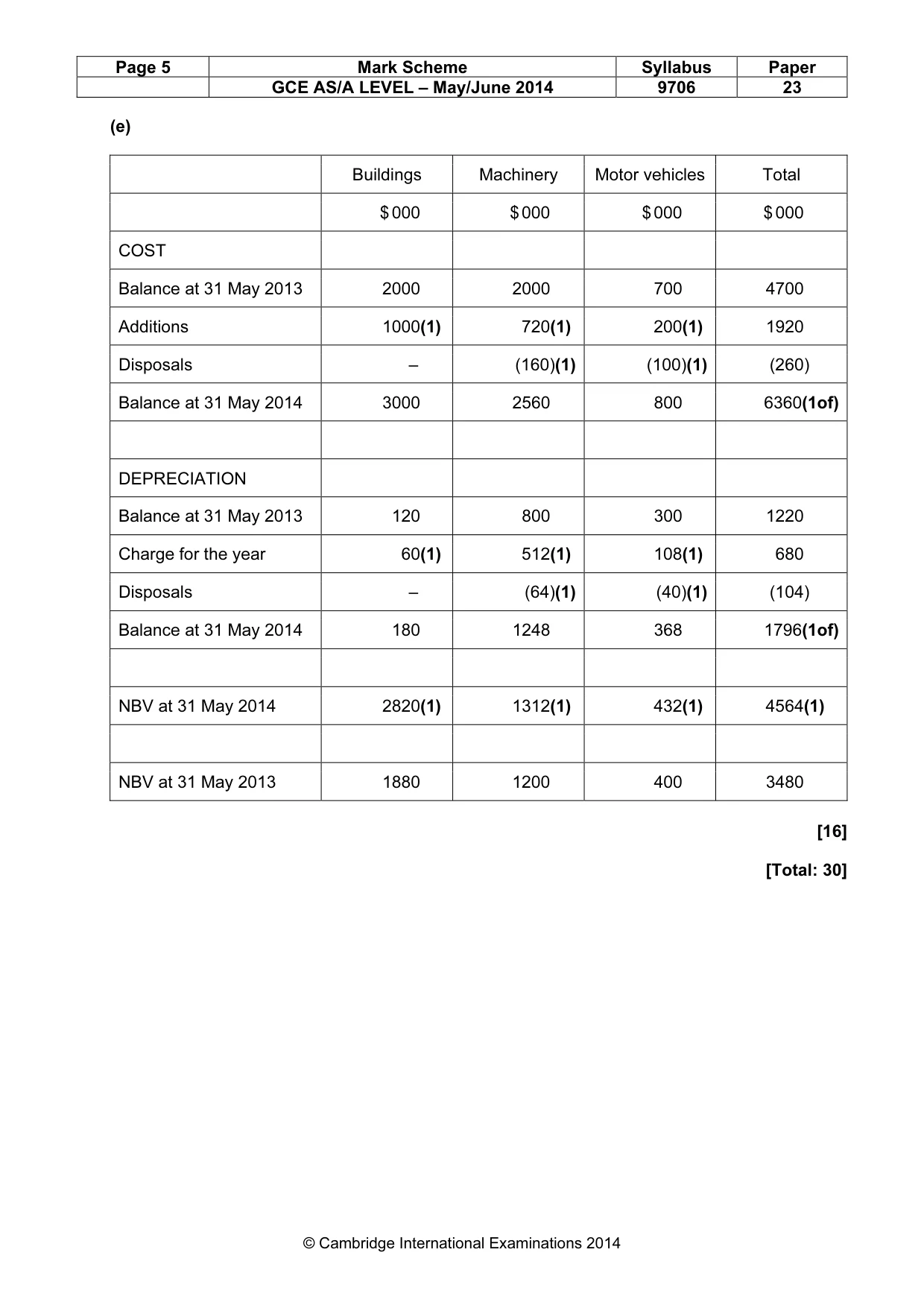
Page 5 Mark Scheme Syllabus Paper GCE AS/A LEVEL – May/June 2014 9706 23 © Cambridge International Examinations 2014 (e) Buildings Machinery Motor vehicles Total $ 000 $ 000 $ 000 $ 000 COST Balance at 31 May 2013 2000 2000 700 4700 Additions 1000(1) 720(1) 200(1) 1920 Disposals – (160)(1) (100)(1) (260) Balance at 31 May 2014 3000 2560 800 6360(1of) DEPRECIATION Balance at 31 May 2013 120 800 300 1220 Charge for the year 60(1) 512(1) 108(1) 680 Disposals – (64)(1) (40)(1) (104) Balance at 31 May 2014 180 1248 368 1796(1of) NBV at 31 May 2014 2820(1) 1312(1) 432(1) 4564(1) NBV at 31 May 2013 1880 1200 400 3480 [16] [Total: 30]
Mark scheme, page 6
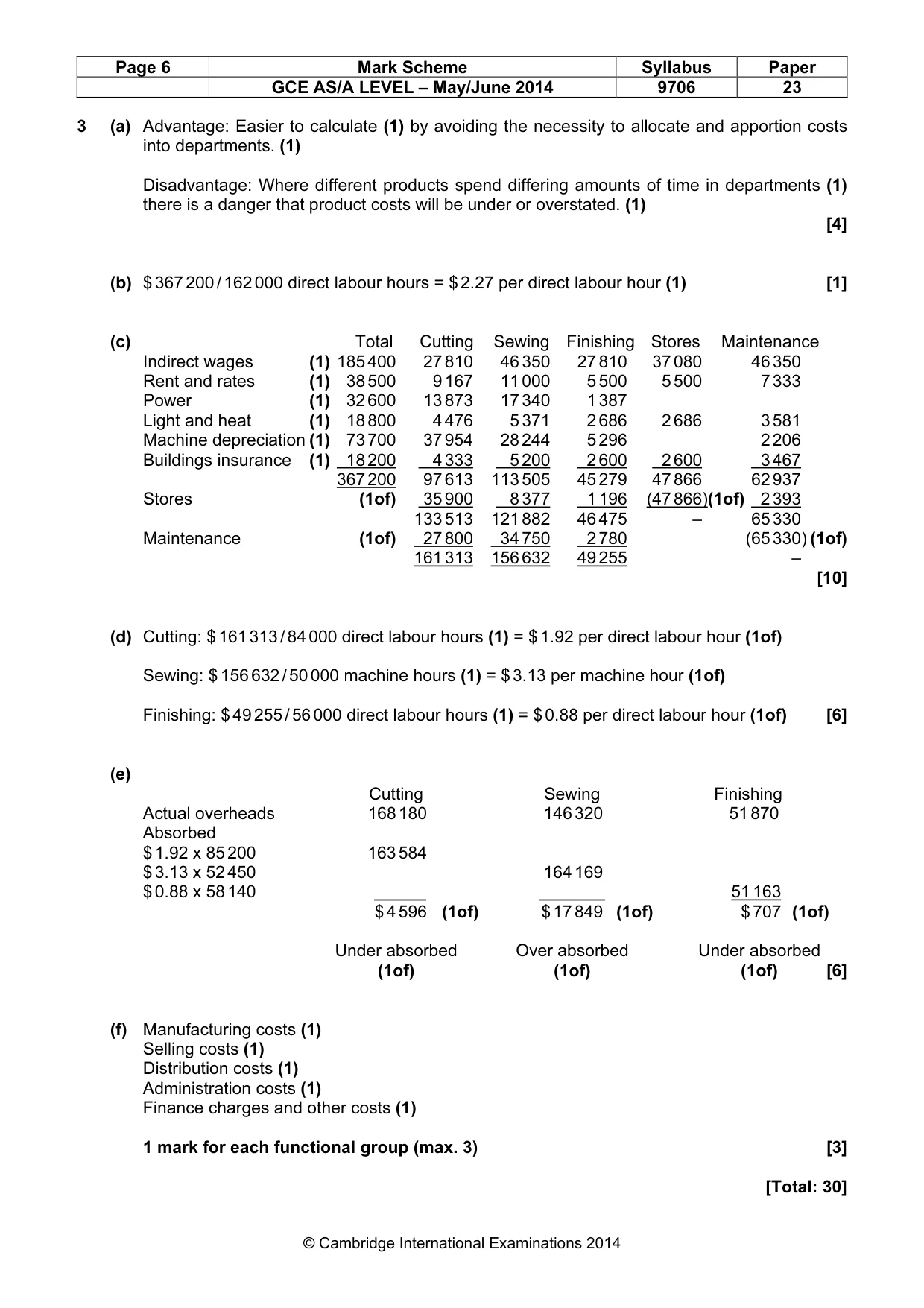
Page 6 Mark Scheme Syllabus Paper GCE AS/A LEVEL – May/June 2014 9706 23 © Cambridge International Examinations 2014 3 (a) Advantage: Easier to calculate (1) by avoiding the necessity to allocate and apportion costs into departments. (1) Disadvantage: Where different products spend differing amounts of time in departments (1) there is a danger that product costs will be under or overstated. (1) [4] (b) $ 367 200 / 162 000 direct labour hours = $ 2.27 per direct labour hour (1) [1] (c) Total Cutting Sewing Finishing Stores Maintenance Indirect wages (1) 185 400 27 810 46 350 27 810 37 080 46 350 Rent and rates (1) 38 500 9 167 11 000 5 500 5 500 7 333 Power (1) 32 600 13 873 17 340 1 387 Light and heat (1) 18 800 4 476 5 371 2 686 2 686 3 581 Machine depreciation (1) 73 700 37 954 28 244 5 296 2 206 Buildings insurance (1) 18 200 4 333 5 200 2 600 2 600 3 467 367 200 97 613 113 505 45 279 47 866 62 937 Stores (1of) 35 900 8 377 1 196 (47 866)(1of) 2 393 133 513 121 882 46 475 – 65 330 Maintenance (1of) 27 800 34 750 2 780 (65 330) (1of) 161 313 156 632 49 255 – [10] (d) Cutting: $ 161 313 / 84 000 direct labour hours (1) = $ 1.92 per direct labour hour (1of) Sewing: $ 156 632 / 50 000 machine hours (1) = $ 3.13 per machine hour (1of) Finishing: $ 49 255 / 56 000 direct labour hours (1) = $ 0.88 per direct labour hour (1of) [6] (e) Cutting Sewing Finishing Actual overheads 168 180 146 320 51 870 Absorbed $ 1.92 x 85 200 163 584 $ 3.13 x 52 450 164 169 $ 0.88 x 58 140 51 163 $ 4 596 (1of) $ 17 849 (1of) $ 707 (1of) Under absorbed Over absorbed Under absorbed (1of) (1of) (1of) [6] (f) Manufacturing costs (1) Selling costs (1) Distribution costs (1) Administration costs (1) Finance charges and other costs (1) 1 mark for each functional group (max. 3) [3] [Total: 30]
What you needed in this session
Cambridge’s own grade thresholds for 2014 May/June, Paper 2 · Variant 3. A higher threshold means an easier paper — the bar moves with how the cohort did.