Cambridge A Level Accounting 9706 — 2014 May/June Paper 2 · Variant 1
9706/21/M/J/14 · 90 marks · ≈101 min
The question paper and its mark scheme, free to read here and free to download. This is Cambridge’s own paper, exactly as it was sat.
Question paper16 pages

Mark scheme6 pages
Answers below. Sit the paper first if you are practising.
Paper as text
Question paper, page 1
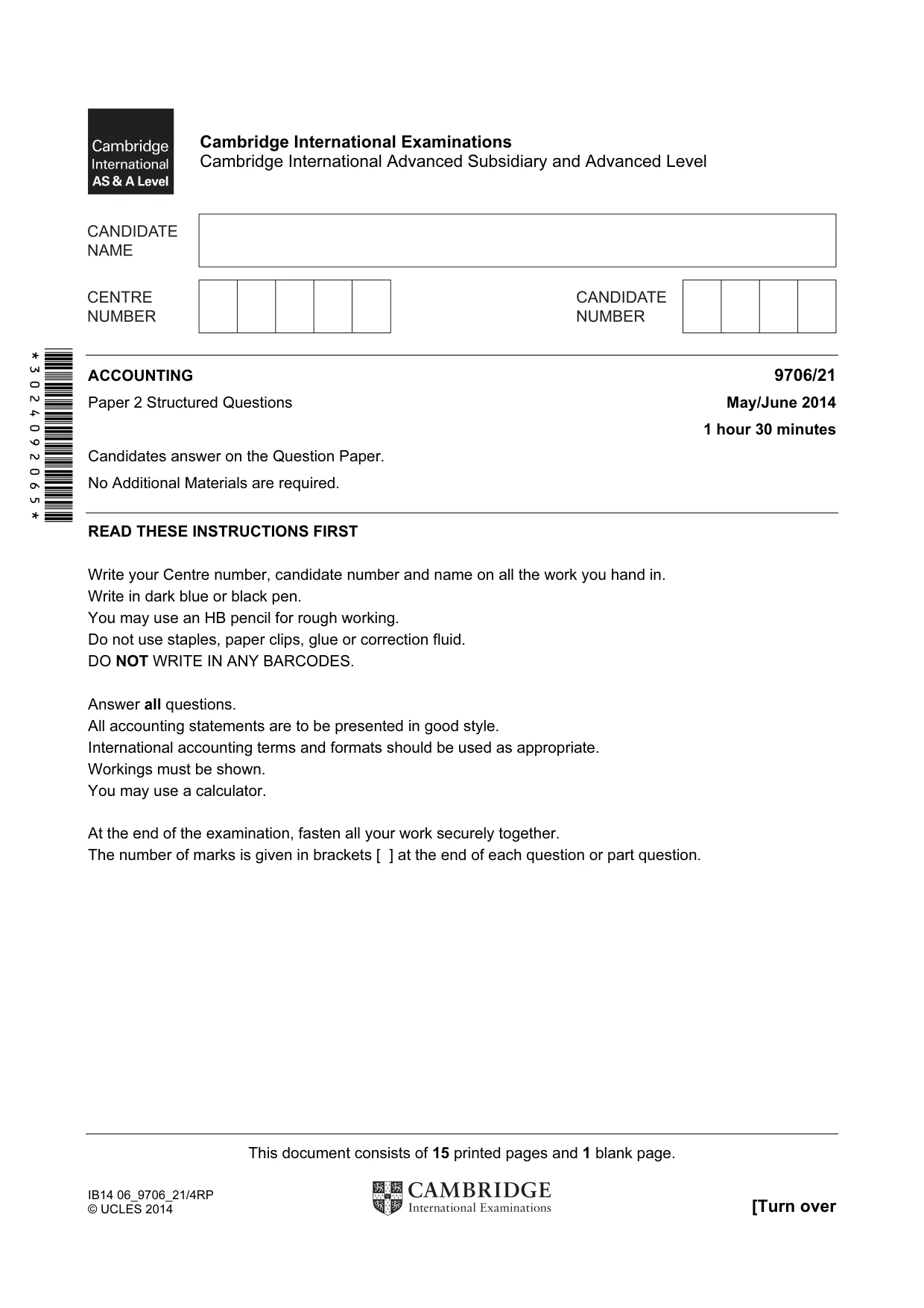
This document consists of 15 printed pages and 1 blank page. IB14 06_9706_21/4RP © UCLES 2014 [Turn over *3024092065* Cambridge International Examinations Cambridge International Advanced Subsidiary and Advanced Level ACCOUNTING 9706/21 Paper 2 Structured Questions May/June 2014 1 hour 30 minutes Candidates answer on the Question Paper. No Additional Materials are required. READ THESE INSTRUCTIONS FIRST Write your Centre number, candidate number and name on all the work you hand in. Write in dark blue or black pen. You may use an HB pencil for rough working. Do not use staples, paper clips, glue or correction fluid. DO NOT WRITE IN ANY BARCODES. Answer all questions. All accounting statements are to be presented in good style. International accounting terms and formats should be used as appropriate. Workings must be shown. You may use a calculator. At the end of the examination, fasten all your work securely together. The number of marks is given in brackets [ ] at the end of each question or part question.
Question paper, page 2
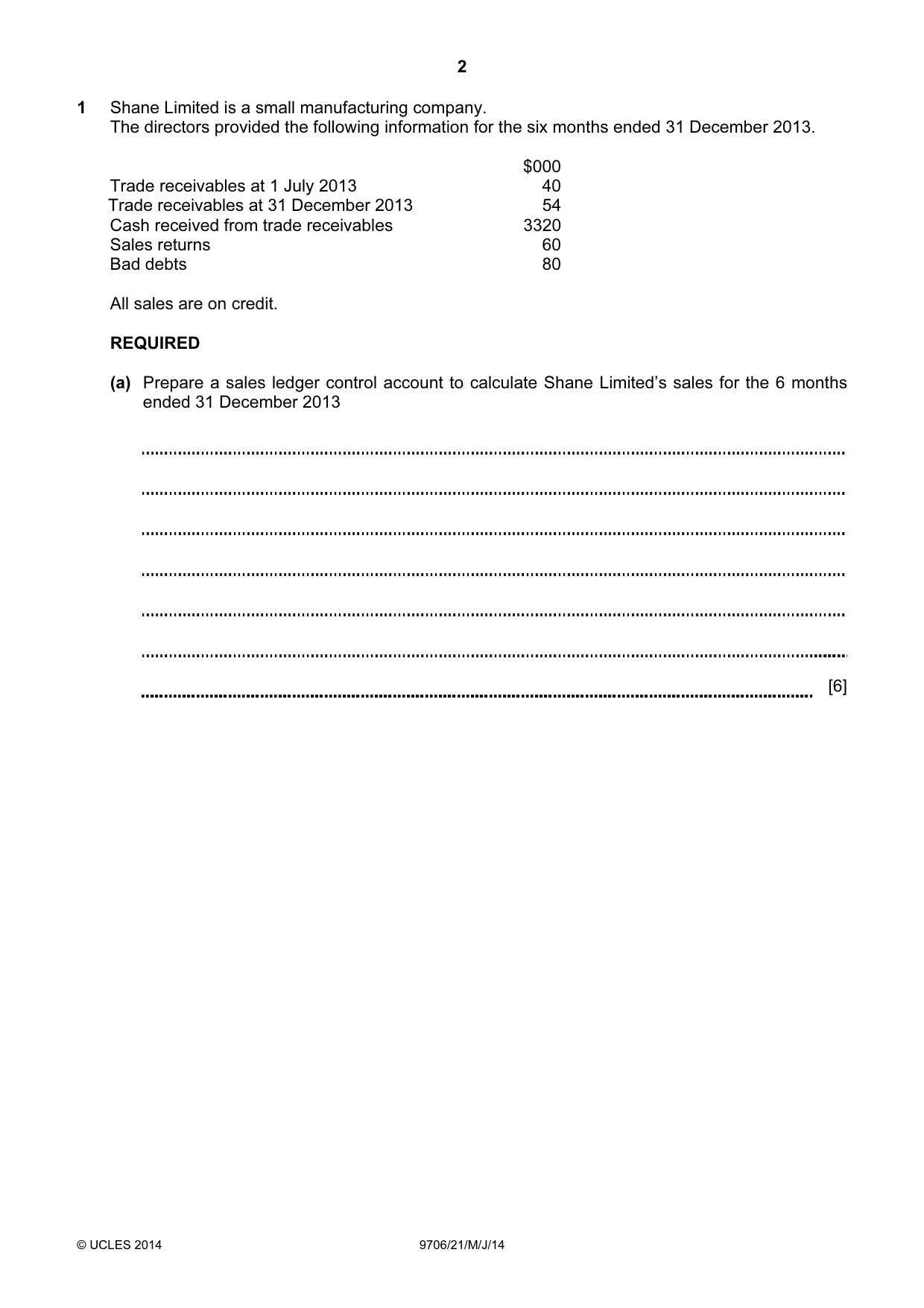
2 © UCLES 2014 9706/21/M/J/14 1 Shane Limited is a small manufacturing company. The directors provided the following information for the six months ended 31 December 2013. $000 Trade receivables at 1 July 2013 40 Trade receivables at 31 December 2013 54 Cash received from trade receivables 3320 Sales returns 60 Bad debts 80 All sales are on credit. REQUIRED (a) Prepare a sales ledger control account to calculate Shane Limited’s sales for the 6 months ended 31 December 2013 [6]
Question paper, page 3
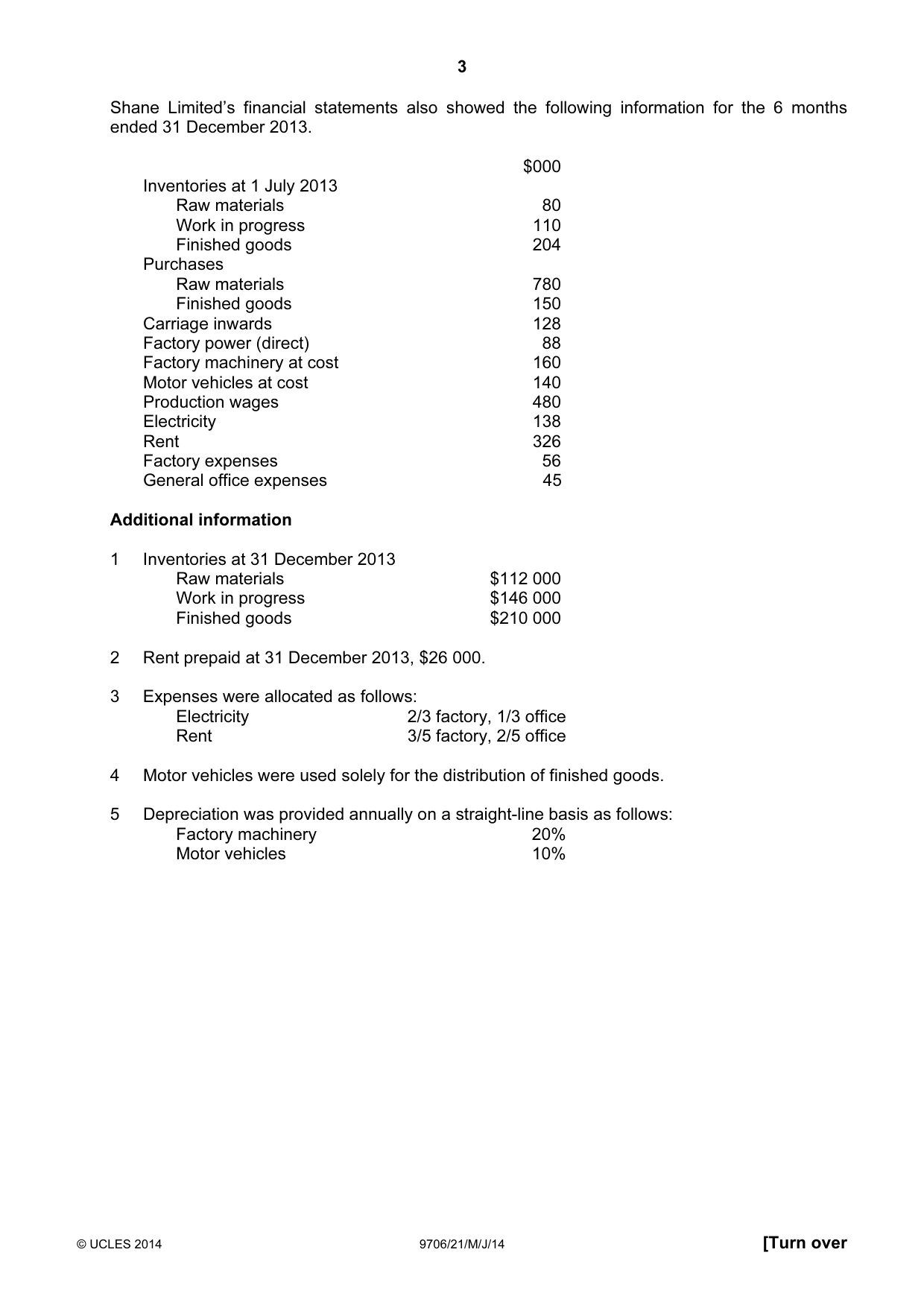
3 © UCLES 2014 9706/21/M/J/14 [Turn over Shane Limited’s financial statements also showed the following information for the 6 months ended 31 December 2013. $000 Inventories at 1 July 2013 Raw materials 80 Work in progress 110 Finished goods 204 Purchases Raw materials 780 Finished goods 150 Carriage inwards 128 Factory power (direct) 88 Factory machinery at cost 160 Motor vehicles at cost 140 Production wages 480 Electricity 138 Rent 326 Factory expenses 56 General office expenses 45 Additional information 1 Inventories at 31 December 2013 Raw materials $112 000 Work in progress $146 000 Finished goods $210 000 2 Rent prepaid at 31 December 2013, $26 000. 3 Expenses were allocated as follows: Electricity 2/3 factory, 1/3 office Rent 3/5 factory, 2/5 office 4 Motor vehicles were used solely for the distribution of finished goods. 5 Depreciation was provided annually on a straight-line basis as follows: Factory machinery 20% Motor vehicles 10%
Question paper, page 4
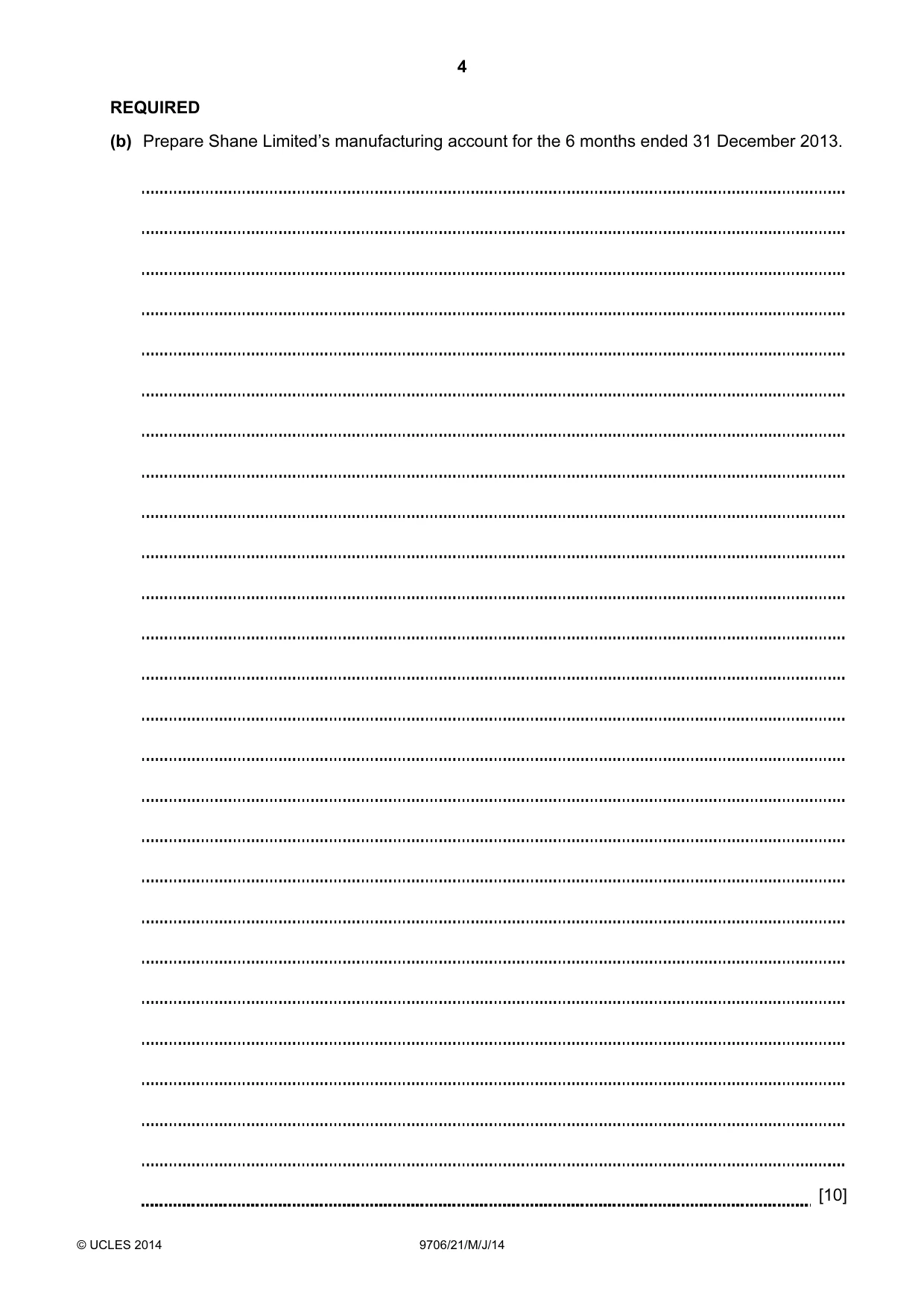
4 © UCLES 2014 9706/21/M/J/14 REQUIRED (b) Prepare Shane Limited’s manufacturing account for the 6 months ended 31 December 2013. [10]
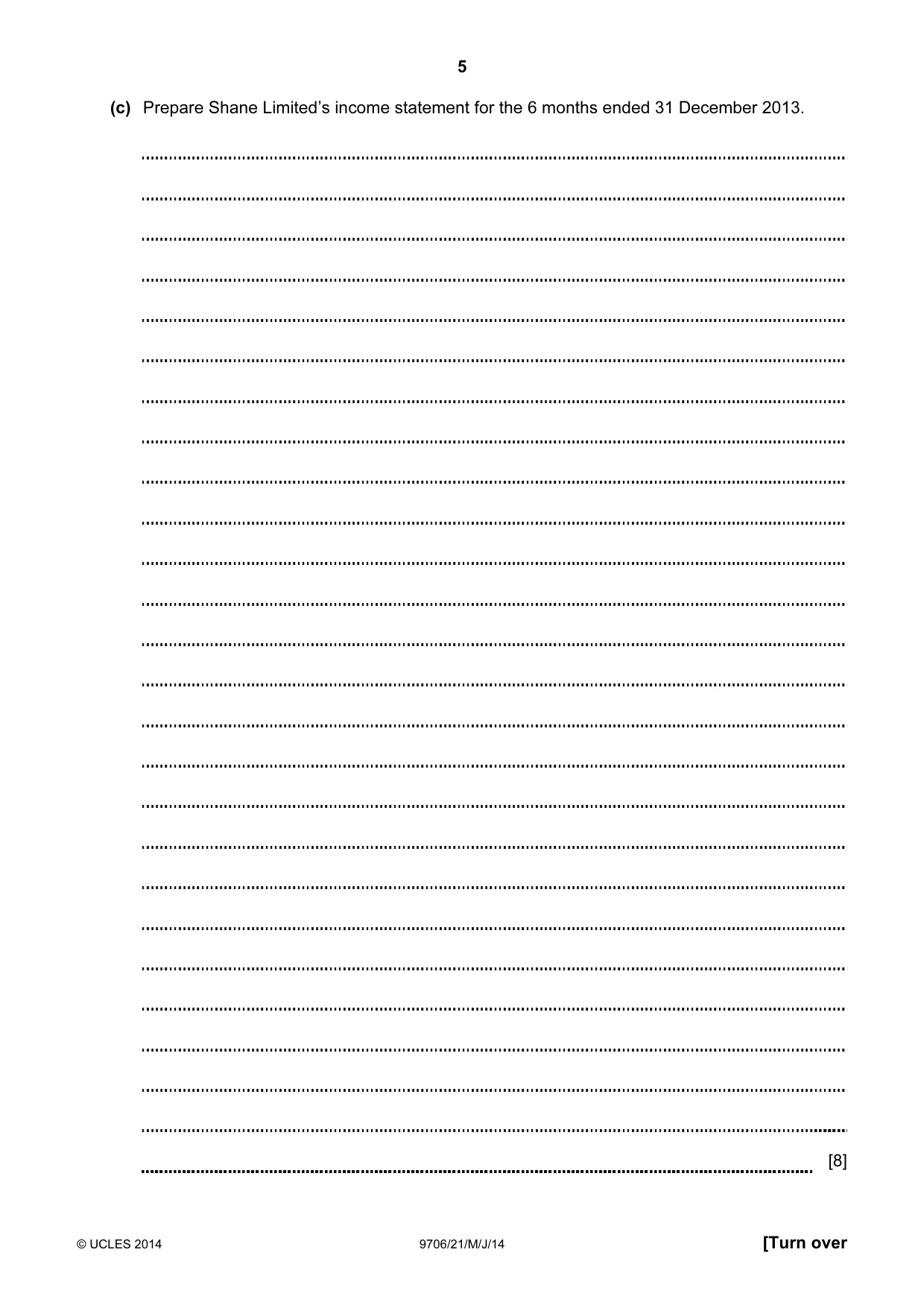
Question paper, page 5
5 © UCLES 2014 9706/21/M/J/14 [Turn over (c) Prepare Shane Limited’s income statement for the 6 months ended 31 December 2013. [8]
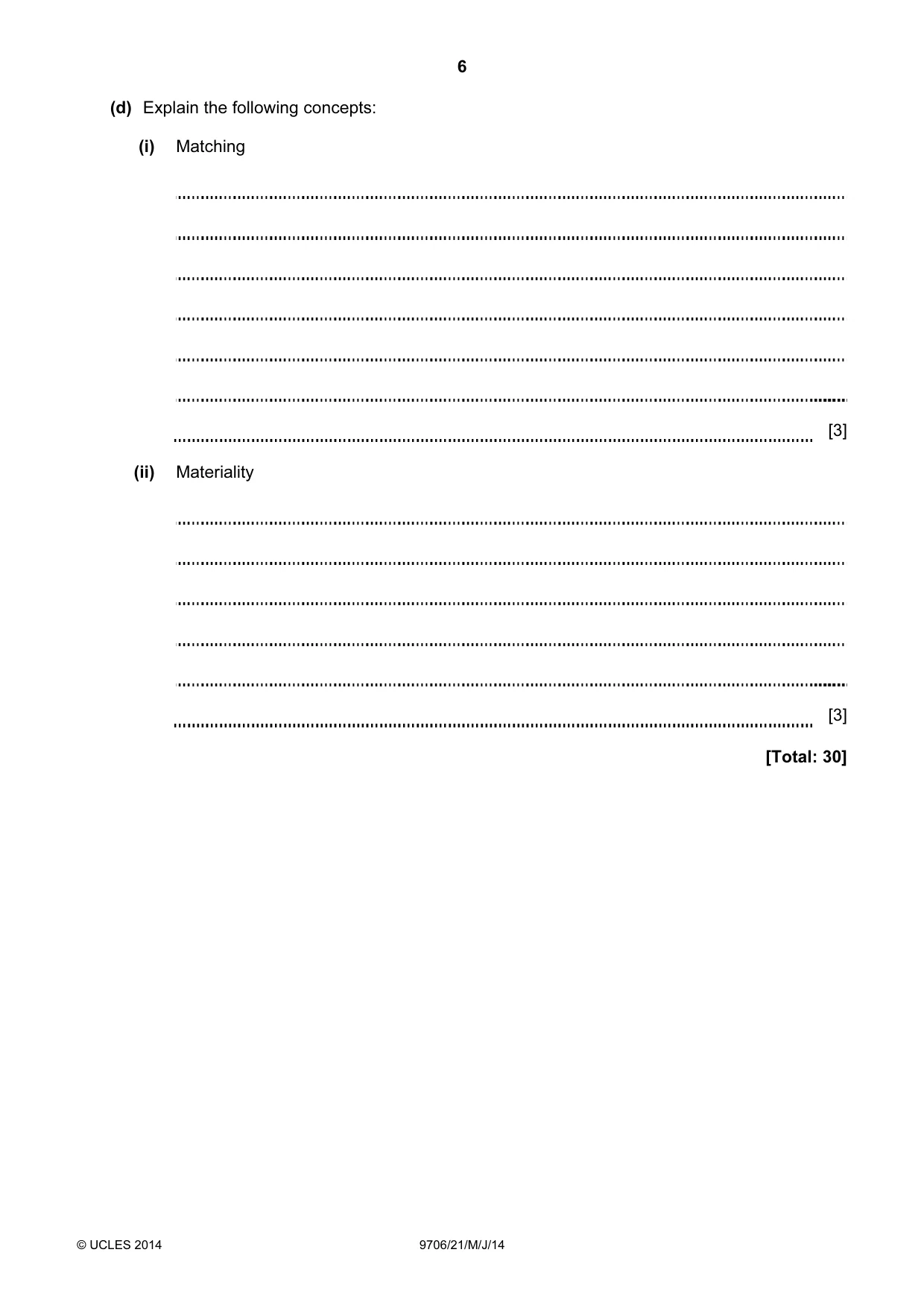
Question paper, page 6
6 © UCLES 2014 9706/21/M/J/14 (d) Explain the following concepts: (i) Matching [3] (ii) Materiality [3] [Total: 30]
Question paper, page 7
7 © UCLES 2014 9706/21/M/J/14 [Turn over Question 2 is on the next page.
Question paper, page 8
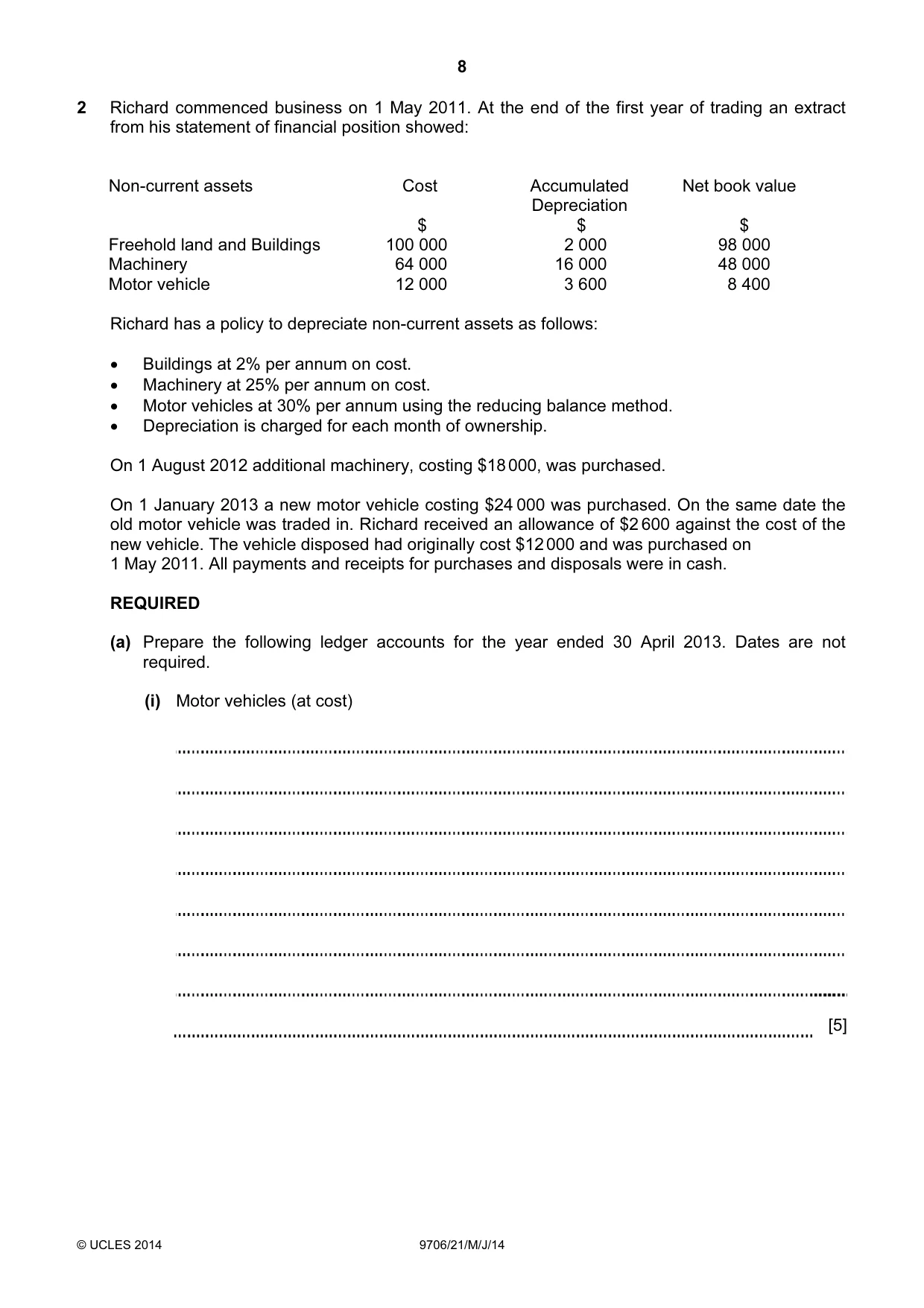
8 © UCLES 2014 9706/21/M/J/14 2 Richard commenced business on 1 May 2011. At the end of the first year of trading an extract from his statement of financial position showed: Non-current assets Cost $ Accumulated Depreciation $ Net book value $ Freehold land and Buildings 100 000 2 000 98 000 Machinery 64 000 16 000 48 000 Motor vehicle 12 000 3 600 8 400 Richard has a policy to depreciate non-current assets as follows: • Buildings at 2% per annum on cost. • Machinery at 25% per annum on cost. • Motor vehicles at 30% per annum using the reducing balance method. • Depreciation is charged for each month of ownership. On 1 August 2012 additional machinery, costing $18 000, was purchased. On 1 January 2013 a new motor vehicle costing $24 000 was purchased. On the same date the old motor vehicle was traded in. Richard received an allowance of $2 600 against the cost of the new vehicle. The vehicle disposed had originally cost $12 000 and was purchased on 1 May 2011. All payments and receipts for purchases and disposals were in cash. REQUIRED (a) Prepare the following ledger accounts for the year ended 30 April 2013. Dates are not required. (i) Motor vehicles (at cost) [5]
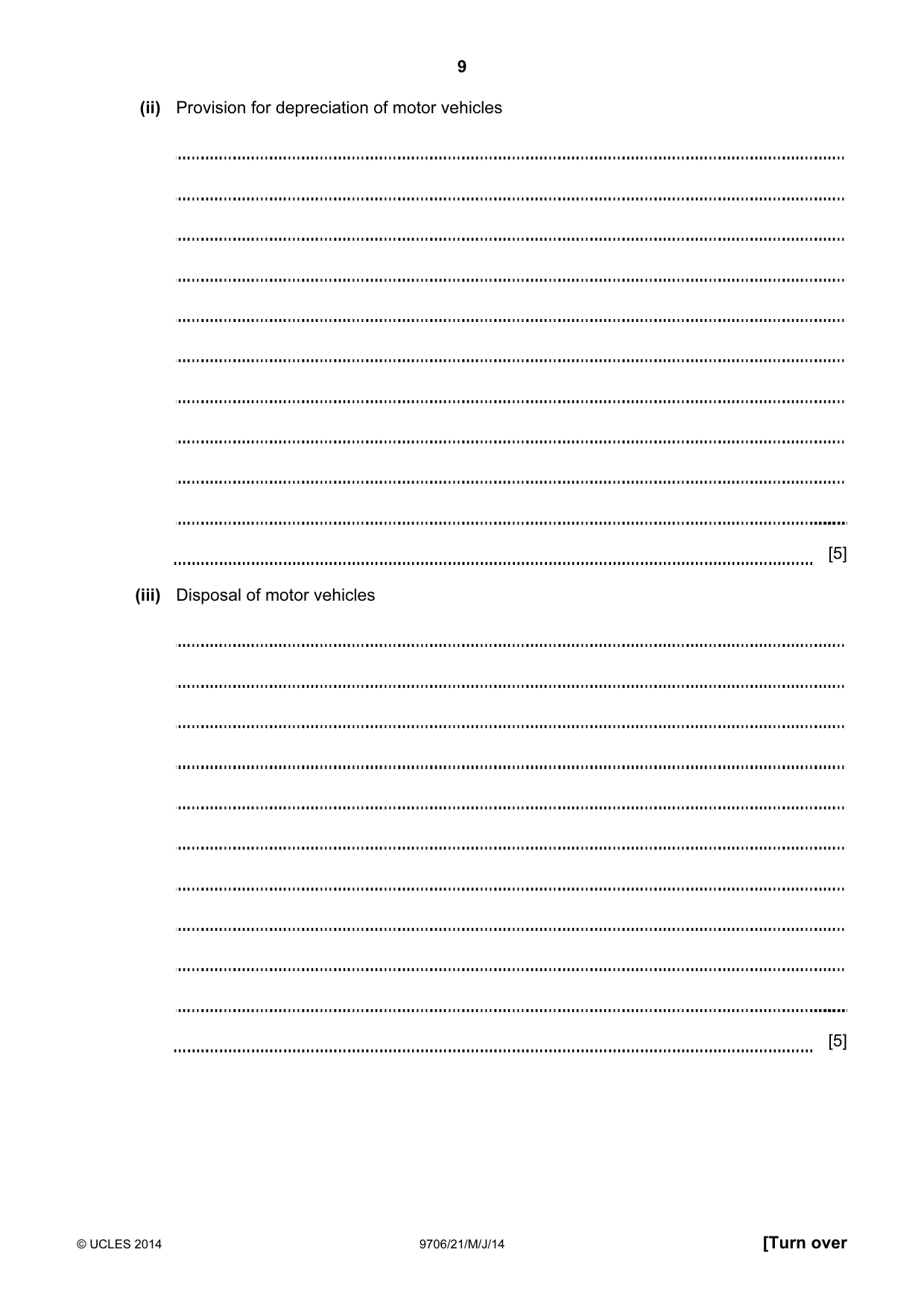
Question paper, page 9
9 © UCLES 2014 9706/21/M/J/14 [Turn over (ii) Provision for depreciation of motor vehicles [5] (iii) Disposal of motor vehicles [5]
Question paper, page 10
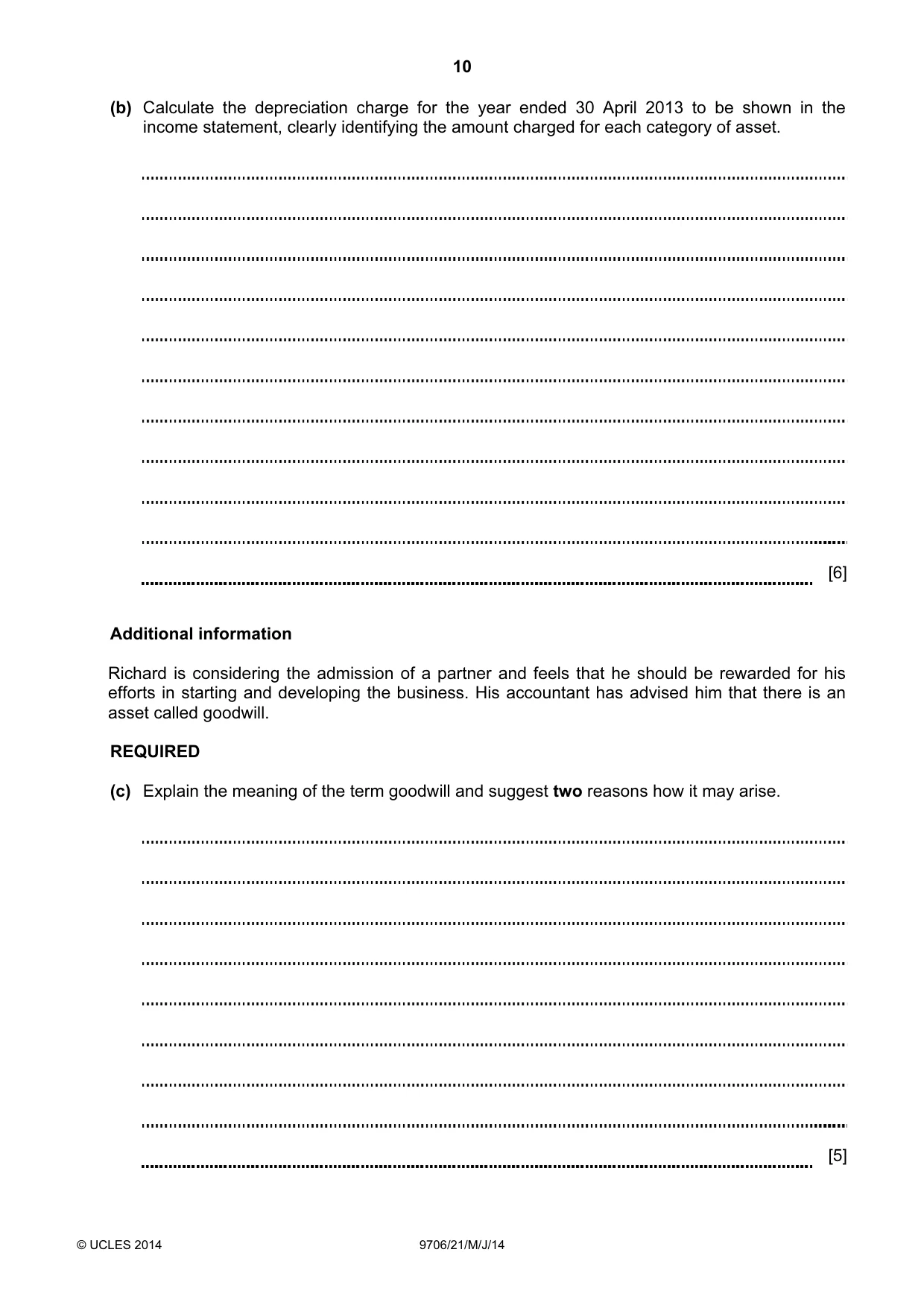
10 © UCLES 2014 9706/21/M/J/14 (b) Calculate the depreciation charge for the year ended 30 April 2013 to be shown in the income statement, clearly identifying the amount charged for each category of asset. [6] Additional information Richard is considering the admission of a partner and feels that he should be rewarded for his efforts in starting and developing the business. His accountant has advised him that there is an asset called goodwill. REQUIRED (c) Explain the meaning of the term goodwill and suggest two reasons how it may arise. [5]
Question paper, page 11
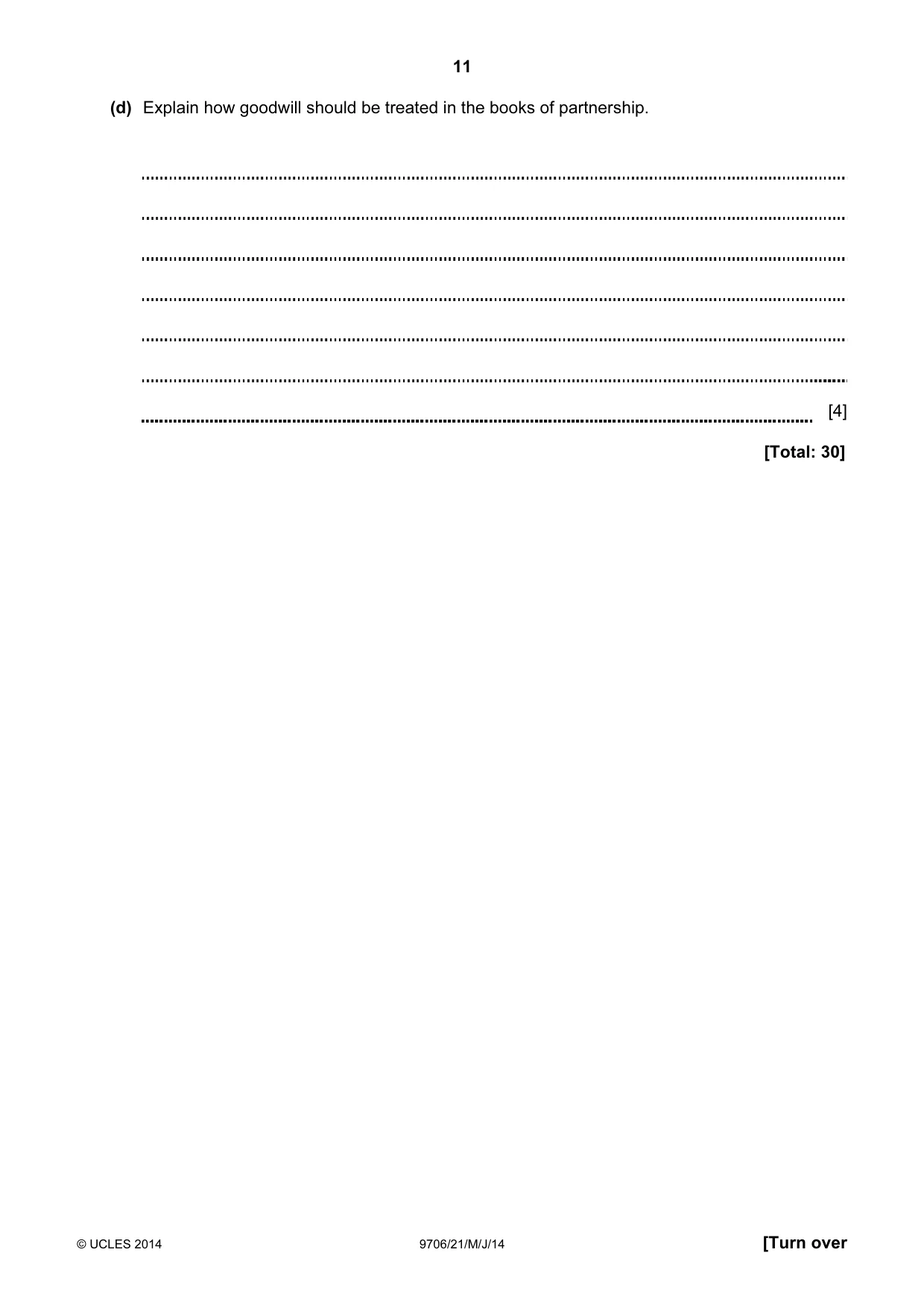
11 © UCLES 2014 9706/21/M/J/14 [Turn over (d) Explain how goodwill should be treated in the books of partnership. [4] [Total: 30]
Question paper, page 12
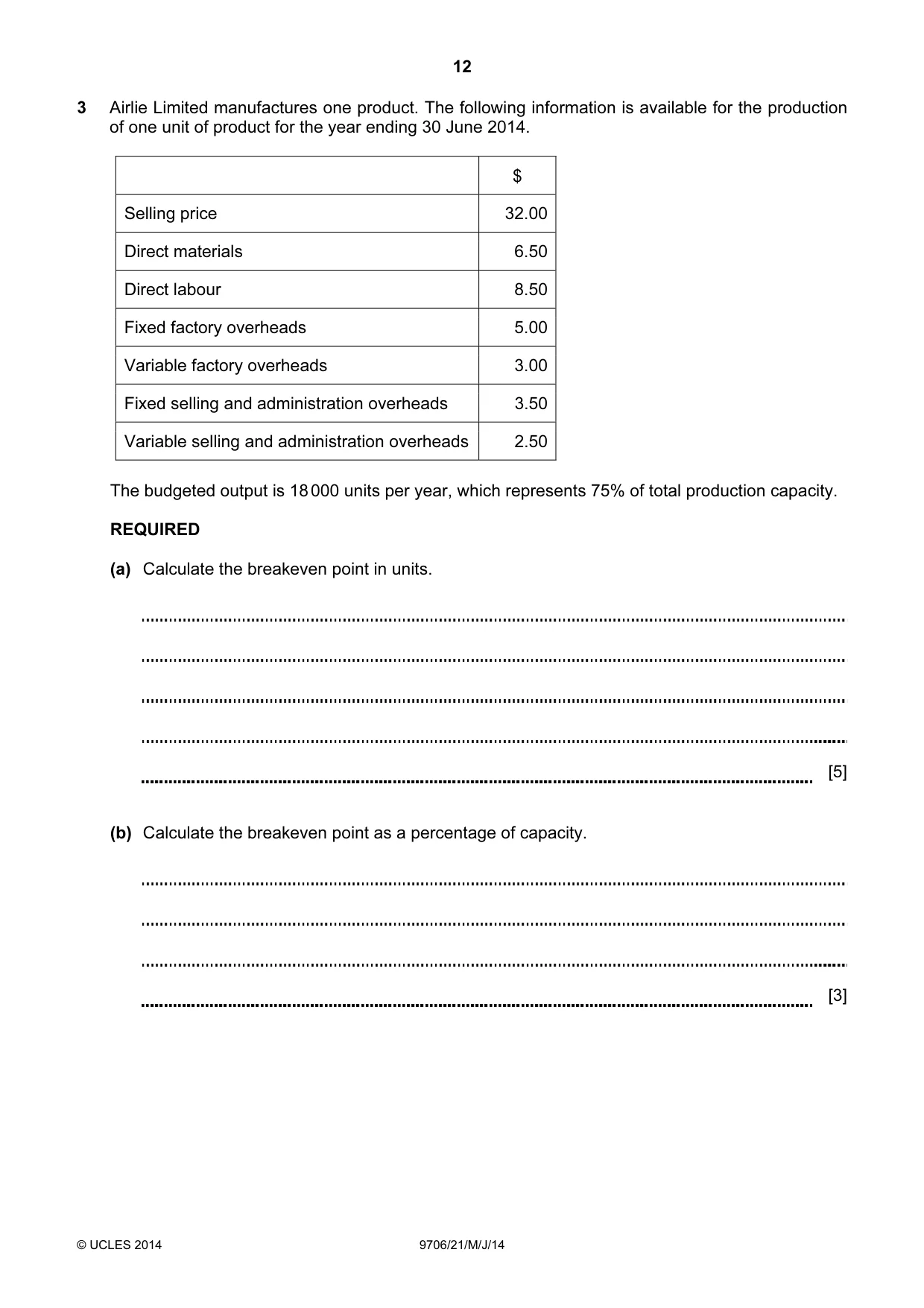
12 © UCLES 2014 9706/21/M/J/14 3 Airlie Limited manufactures one product. The following information is available for the production of one unit of product for the year ending 30 June 2014. $ Selling price 32.00 Direct materials 6.50 Direct labour 8.50 Fixed factory overheads 5.00 Variable factory overheads 3.00 Fixed selling and administration overheads 3.50 Variable selling and administration overheads 2.50 The budgeted output is 18 000 units per year, which represents 75% of total production capacity. REQUIRED (a) Calculate the breakeven point in units. [5] (b) Calculate the breakeven point as a percentage of capacity. [3]
Question paper, page 13
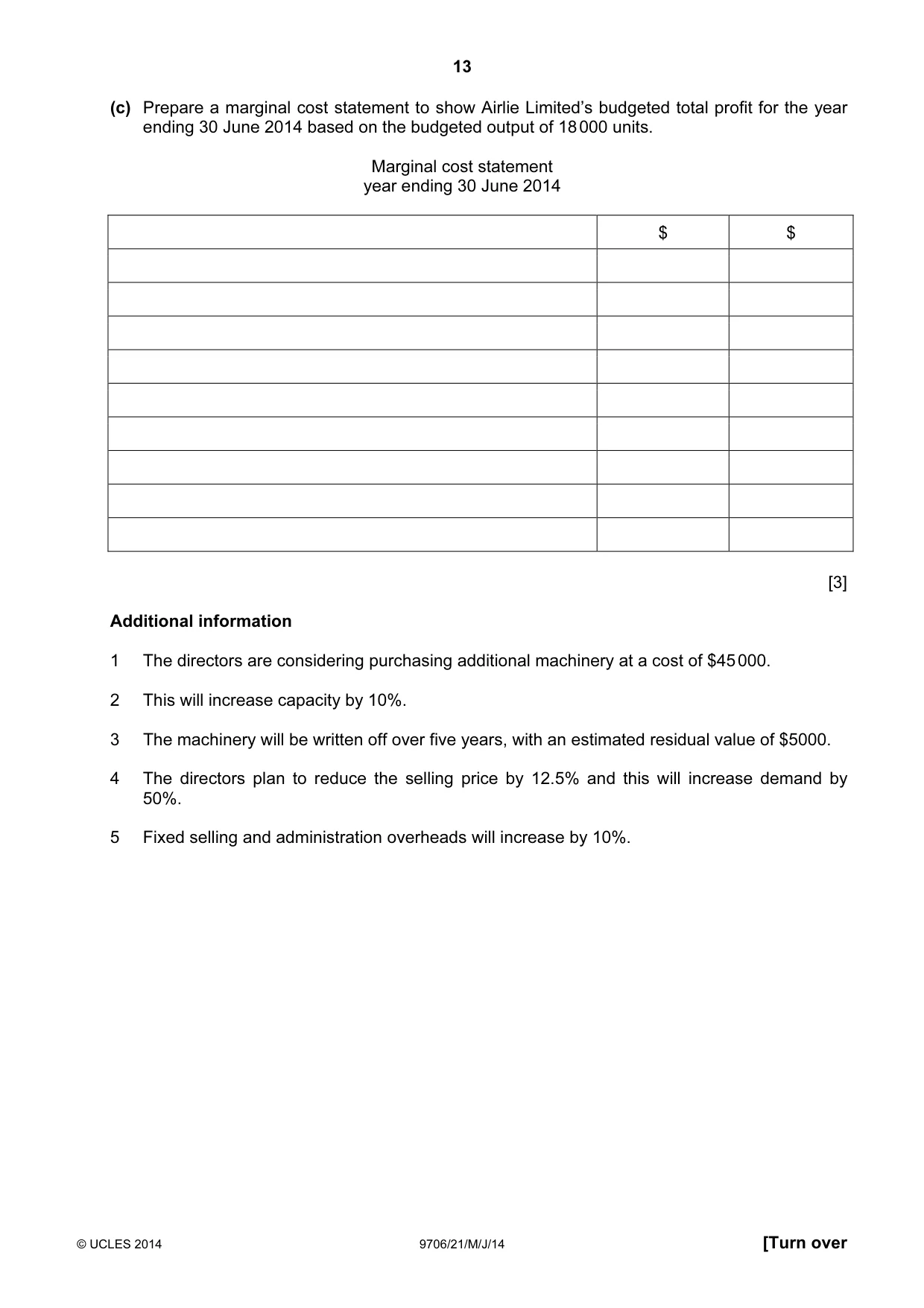
13 © UCLES 2014 9706/21/M/J/14 [Turn over (c) Prepare a marginal cost statement to show Airlie Limited’s budgeted total profit for the year ending 30 June 2014 based on the budgeted output of 18 000 units. Marginal cost statement year ending 30 June 2014 $ $ [3] Additional information 1 The directors are considering purchasing additional machinery at a cost of $45 000. 2 This will increase capacity by 10%. 3 The machinery will be written off over five years, with an estimated residual value of $5000. 4 The directors plan to reduce the selling price by 12.5% and this will increase demand by 50%. 5 Fixed selling and administration overheads will increase by 10%.
Question paper, page 14
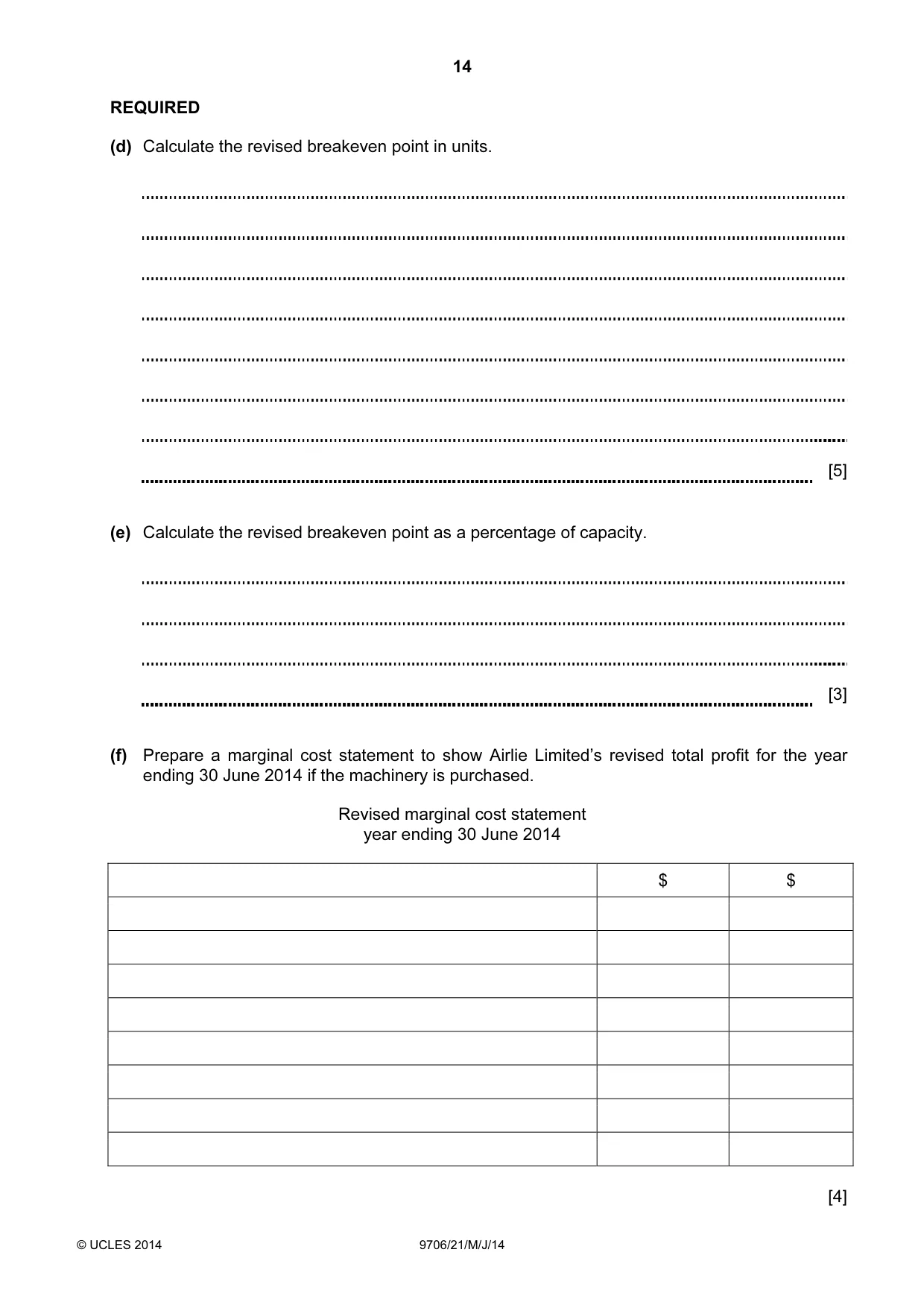
14 © UCLES 2014 9706/21/M/J/14 REQUIRED (d) Calculate the revised breakeven point in units. [5] (e) Calculate the revised breakeven point as a percentage of capacity. [3] (f) Prepare a marginal cost statement to show Airlie Limited’s revised total profit for the year ending 30 June 2014 if the machinery is purchased. Revised marginal cost statement year ending 30 June 2014 $ $ [4]
Question paper, page 15
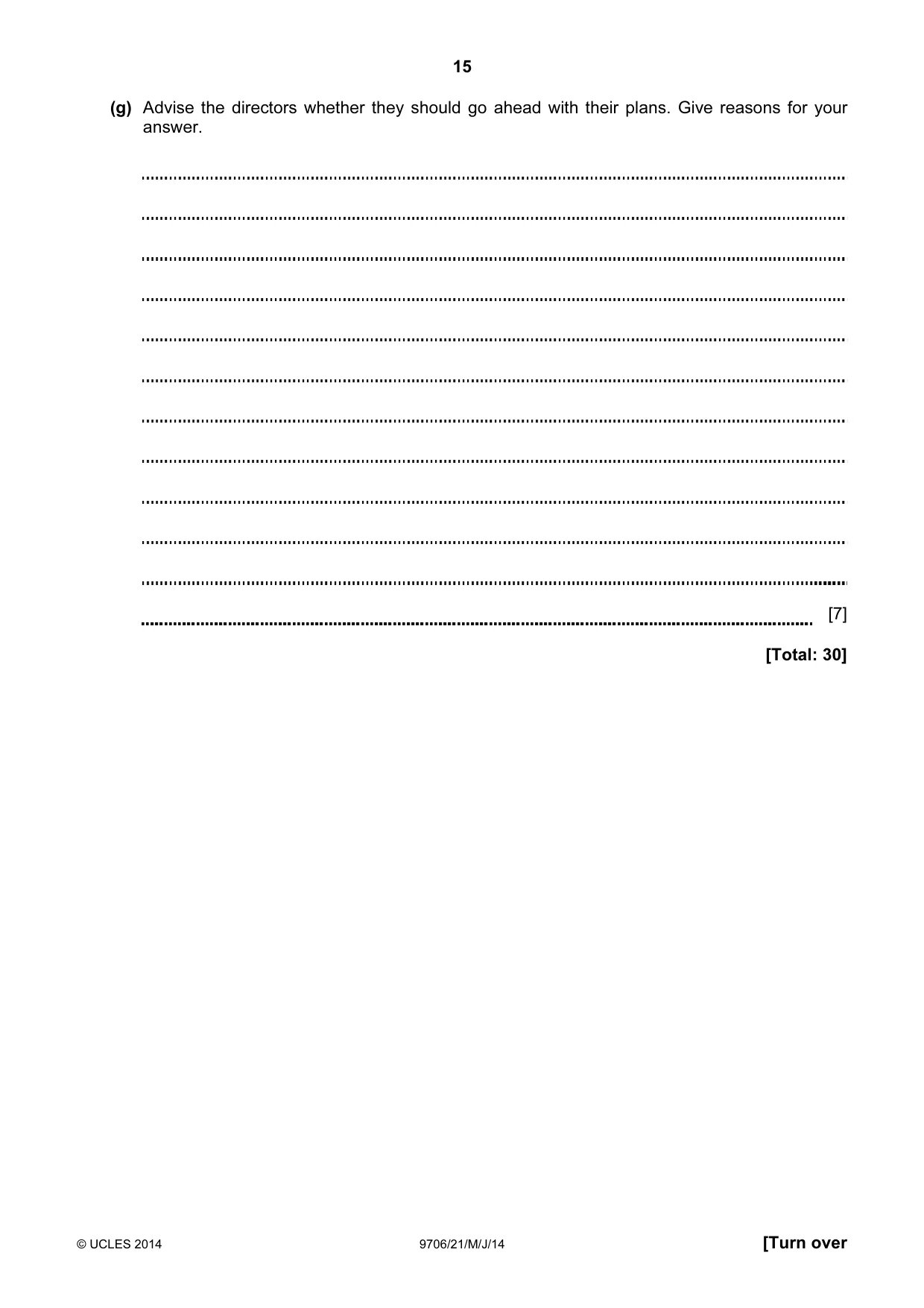
15 © UCLES 2014 9706/21/M/J/14 [Turn over (g) Advise the directors whether they should go ahead with their plans. Give reasons for your answer. [7] [Total: 30]
Question paper, page 16
16 Permission to reproduce items where third-party owned material protected by copyright is included has been sought and cleared where possible. Every reasonable effort has been made by the publisher (UCLES) to trace copyright holders, but if any items requiring clearance have unwittingly been included, the publisher will be pleased to make amends at the earliest possible opportunity. Cambridge International Examinations is part of the Cambridge Assessment Group. Cambridge Assessment is the brand name of University of Cambridge Local Examinations Syndicate (UCLES), which is itself a department of the University of Cambridge. © UCLES 2014 9706/21/M/J/14 BLANK PAGE
Mark scheme, page 1
CAMBRIDGE INTERNATIONAL EXAMINATIONS GCE Advanced Subsidiary Level and GCE Advanced Level MARK SCHEME for the May/June 2014 series 9706 ACCOUNTING 9706/21 Paper 2 (Structured Questions – Core), maximum raw mark 90 This mark scheme is published as an aid to teachers and candidates, to indicate the requirements of the examination. It shows the basis on which Examiners were instructed to award marks. It does not indicate the details of the discussions that took place at an Examiners’ meeting before marking began, which would have considered the acceptability of alternative answers. Mark schemes should be read in conjunction with the question paper and the Principal Examiner Report for Teachers. Cambridge will not enter into discussions about these mark schemes. Cambridge is publishing the mark schemes for the May/June 2014 series for most IGCSE, GCE Advanced Level and Advanced Subsidiary Level components and some Ordinary Level components.
Mark scheme, page 2
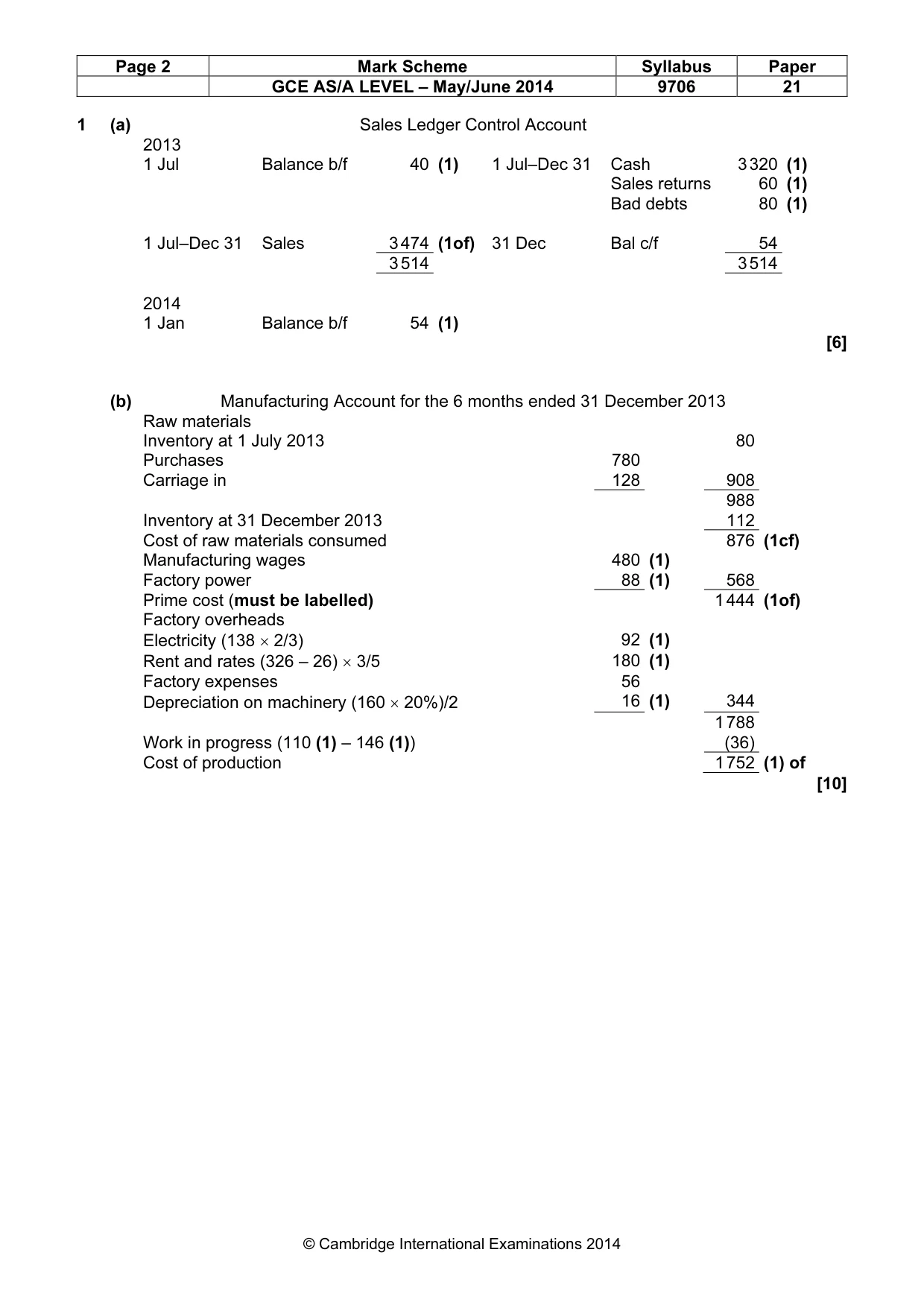
Page 2 Mark Scheme Syllabus Paper GCE AS/A LEVEL – May/June 2014 9706 21 © Cambridge International Examinations 2014 1 (a) Sales Ledger Control Account 2013 1 Jul Balance b/f 40 (1) 1 Jul–Dec 31 Cash 3 320 (1) Sales returns 60 (1) Bad debts 80 (1) 1 Jul–Dec 31 Sales 3 474 (1of) 31 Dec Bal c/f 54 3 514 3 514 2014 1 Jan Balance b/f 54 (1) [6] (b) Manufacturing Account for the 6 months ended 31 December 2013 Raw materials Inventory at 1 July 2013 80 Purchases 780 Carriage in 128 908 988 Inventory at 31 December 2013 112 Cost of raw materials consumed 876 (1cf) Manufacturing wages 480 (1) Factory power 88 (1) 568 Prime cost (must be labelled) 1 444 (1of) Factory overheads Electricity (138 × 2/3) 92 (1) Rent and rates (326 – 26) × 3/5 180 (1) Factory expenses 56 Depreciation on machinery (160 × 20%)/2 16 (1) 344 1 788 Work in progress (110 (1) – 146 (1)) (36) Cost of production 1 752 (1) of [10]
Mark scheme, page 3
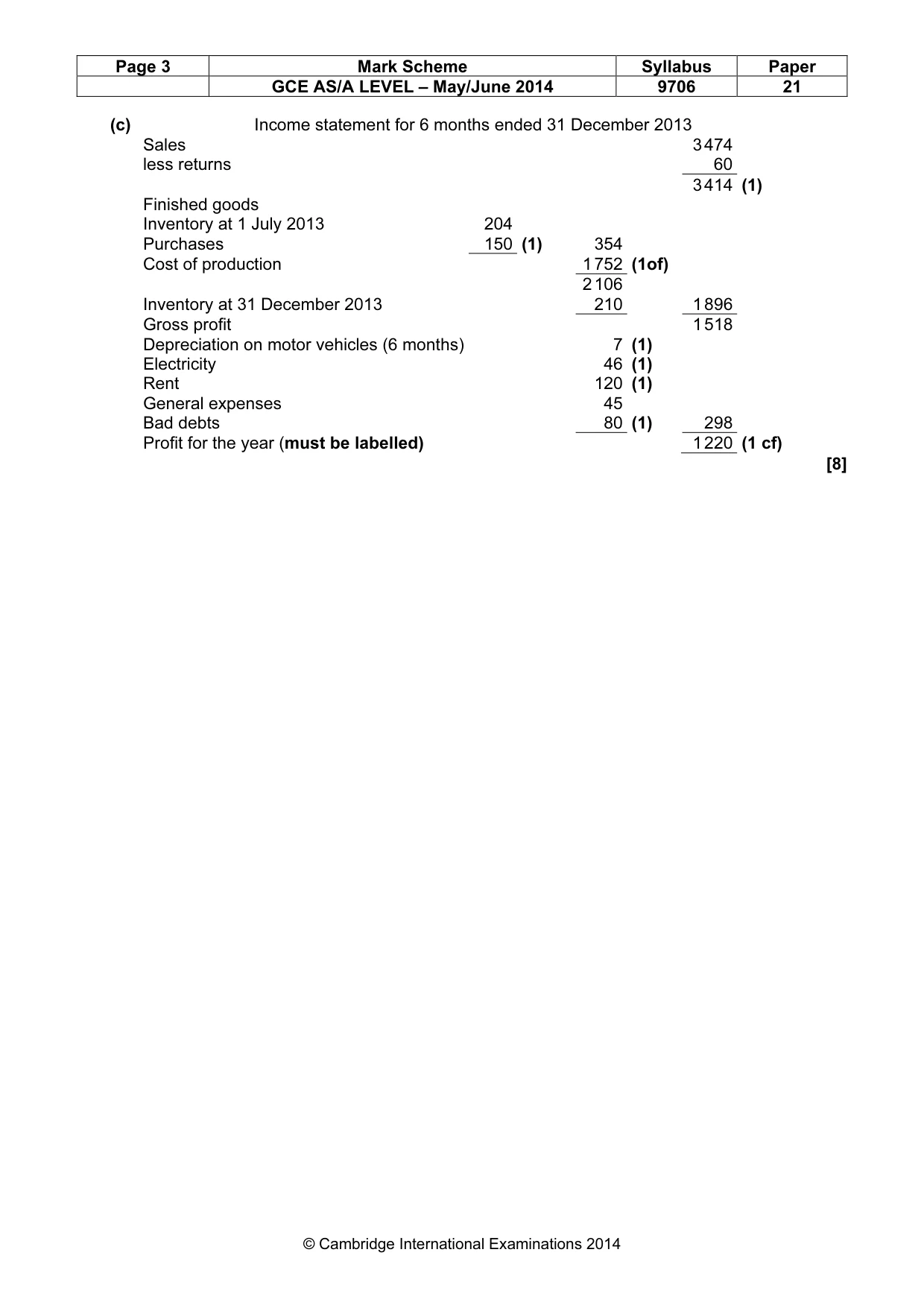
Page 3 Mark Scheme Syllabus Paper GCE AS/A LEVEL – May/June 2014 9706 21 © Cambridge International Examinations 2014 (c) Income statement for 6 months ended 31 December 2013 [8] Sales 3 474 less returns 60 3 414 (1) Finished goods Inventory at 1 July 2013 204 Purchases 150 (1) 354 Cost of production 1 752 (1of) 2 106 Inventory at 31 December 2013 210 1 896 Gross profit 1 518 Depreciation on motor vehicles (6 months) 7 (1) Electricity 46 (1) Rent 120 (1) General expenses 45 Bad debts 80 (1) 298 Profit for the year (must be labelled) 1 220 (1 cf)
Mark scheme, page 4
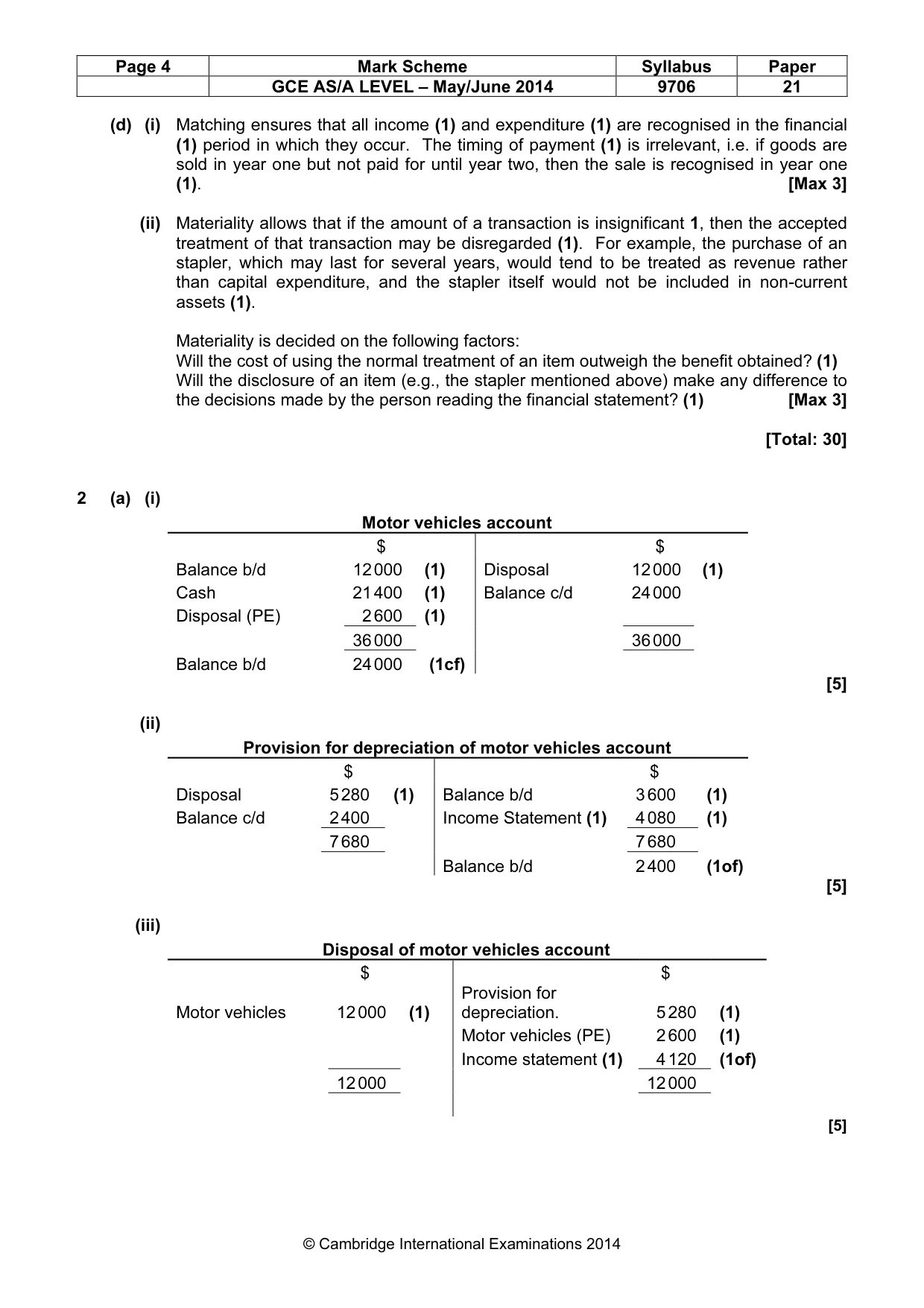
Page 4 Mark Scheme Syllabus Paper GCE AS/A LEVEL – May/June 2014 9706 21 © Cambridge International Examinations 2014 (d) (i) Matching ensures that all income (1) and expenditure (1) are recognised in the financial (1) period in which they occur. The timing of payment (1) is irrelevant, i.e. if goods are sold in year one but not paid for until year two, then the sale is recognised in year one (1). [Max 3] (ii) Materiality allows that if the amount of a transaction is insignificant 1, then the accepted treatment of that transaction may be disregarded (1). For example, the purchase of an stapler, which may last for several years, would tend to be treated as revenue rather than capital expenditure, and the stapler itself would not be included in non-current assets (1). Materiality is decided on the following factors: Will the cost of using the normal treatment of an item outweigh the benefit obtained? (1) Will the disclosure of an item (e.g., the stapler mentioned above) make any difference to the decisions made by the person reading the financial statement? (1) [Max 3] [Total: 30] 2 (a) (i) Motor vehicles account $ $ Balance b/d 12 000 (1) Disposal 12 000 (1) Cash 21 400 (1) Balance c/d 24 000 Disposal (PE) 2 600 (1) 36 000 36 000 Balance b/d 24 000 (1cf) [5] (ii) Provision for depreciation of motor vehicles account $ $ Disposal 5 280 (1) Balance b/d 3 600 (1) Balance c/d 2 400 Income Statement (1) 4 080 (1) 7 680 7 680 Balance b/d 2 400 (1of) [5] (iii) Disposal of motor vehicles account $ $ Motor vehicles 12 000 (1) Provision for depreciation. 5 280 (1) Motor vehicles (PE) 2 600 (1) Income statement (1) 4 120 (1of) 12 000 12 000 [5]
Mark scheme, page 5
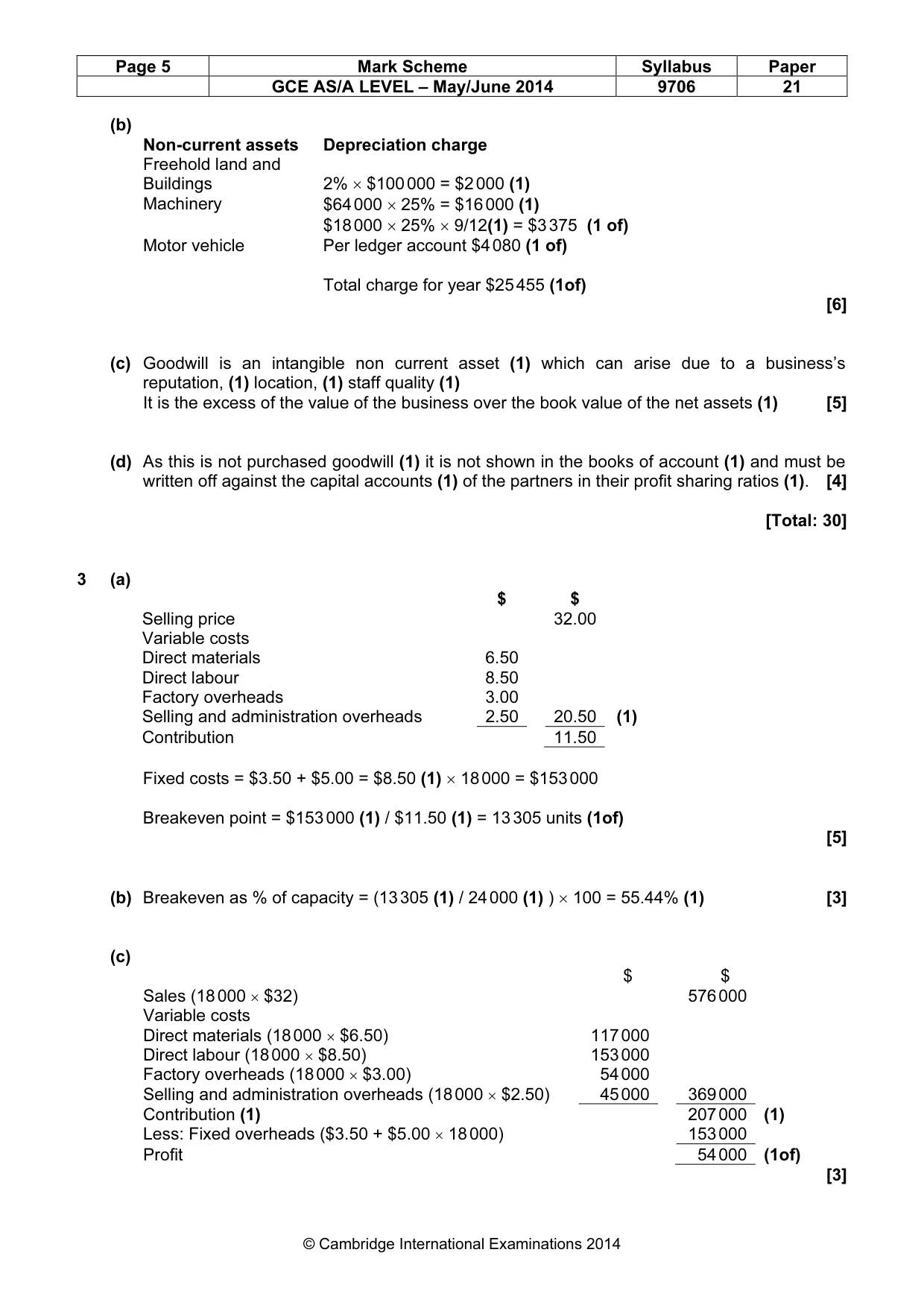
Page 5 Mark Scheme Syllabus Paper GCE AS/A LEVEL – May/June 2014 9706 21 © Cambridge International Examinations 2014 (b) Non-current assets Depreciation charge Freehold land and Buildings 2% × $100 000 = $2 000 (1) Machinery $64 000 × 25% = $16 000 (1) $18 000 × 25% × 9/12(1) = $3 375 (1 of) Motor vehicle Per ledger account $4 080 (1 of) Total charge for year $25 455 (1of) [6] (c) Goodwill is an intangible non current asset (1) which can arise due to a business’s reputation, (1) location, (1) staff quality (1) It is the excess of the value of the business over the book value of the net assets (1) [5] (d) As this is not purchased goodwill (1) it is not shown in the books of account (1) and must be written off against the capital accounts (1) of the partners in their profit sharing ratios (1). [4] [Total: 30] 3 (a) $ $ Selling price 32.00 Variable costs Direct materials 6.50 Direct labour 8.50 Factory overheads 3.00 Selling and administration overheads 2.50 20.50 (1) Contribution 11.50 Fixed costs = $3.50 + $5.00 = $8.50 (1) × 18 000 = $153 000 Breakeven point = $153 000 (1) / $11.50 (1) = 13 305 units (1of) [5] (b) Breakeven as % of capacity = (13 305 (1) / 24 000 (1) ) × 100 = 55.44% (1) [3] (c) $ $ Sales (18 000 × $32) 576 000 Variable costs Direct materials (18 000 × $6.50) 117 000 Direct labour (18 000 × $8.50) 153 000 Factory overheads (18 000 × $3.00) 54 000 Selling and administration overheads (18 000 × $2.50) 45 000 369 000 Contribution (1) 207 000 (1) Less: Fixed overheads ($3.50 + $5.00 × 18 000) 153 000 Profit 54 000 (1of) [3]
Mark scheme, page 6
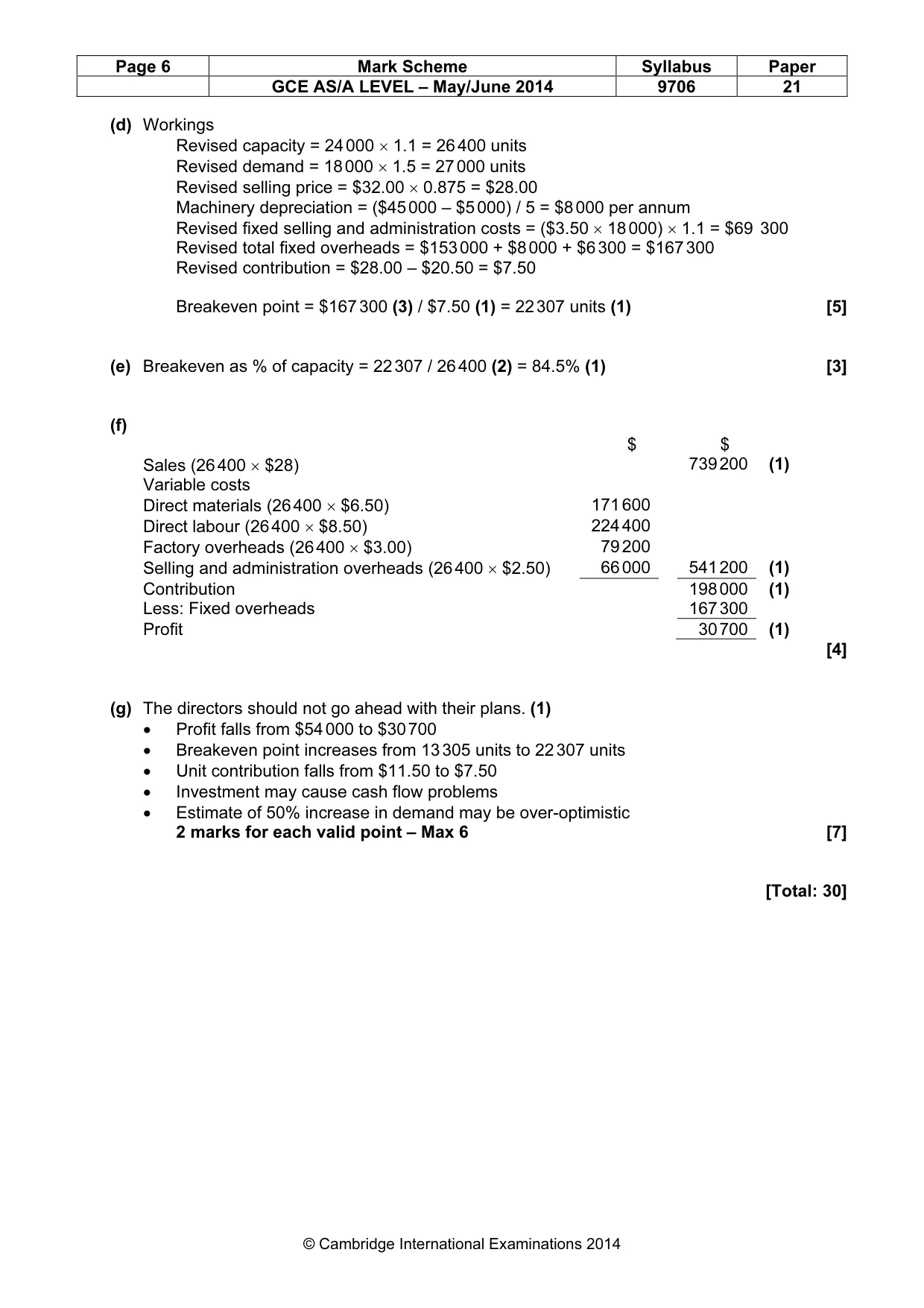
Page 6 Mark Scheme Syllabus Paper GCE AS/A LEVEL – May/June 2014 9706 21 © Cambridge International Examinations 2014 (d) Workings Revised capacity = 24 000 × 1.1 = 26 400 units Revised demand = 18 000 × 1.5 = 27 000 units Revised selling price = $32.00 × 0.875 = $28.00 Machinery depreciation = ($45 000 – $5 000) / 5 = $8 000 per annum Revised fixed selling and administration costs = ($3.50 × 18 000) × 1.1 = $69 300 Revised total fixed overheads = $153 000 + $8 000 + $6 300 = $167 300 Revised contribution = $28.00 – $20.50 = $7.50 Breakeven point = $167 300 (3) / $7.50 (1) = 22 307 units (1) [5] (e) Breakeven as % of capacity = 22 307 / 26 400 (2) = 84.5% (1) [3] (f) $ $ Sales (26 400 × $28) 739 200 (1) Variable costs Direct materials (26 400 × $6.50) 171 600 Direct labour (26 400 × $8.50) 224 400 Factory overheads (26 400 × $3.00) 79 200 Selling and administration overheads (26 400 × $2.50) 66 000 541 200 (1) Contribution 198 000 (1) Less: Fixed overheads 167 300 Profit 30 700 (1) [4] (g) The directors should not go ahead with their plans. (1) • Profit falls from $54 000 to $30 700 • Breakeven point increases from 13 305 units to 22 307 units • Unit contribution falls from $11.50 to $7.50 • Investment may cause cash flow problems • Estimate of 50% increase in demand may be over-optimistic 2 marks for each valid point – Max 6 [7] [Total: 30]
What you needed in this session
Cambridge’s own grade thresholds for 2014 May/June, Paper 2 · Variant 1. A higher threshold means an easier paper — the bar moves with how the cohort did.