Cambridge A Level Accounting 9706 — 2013 Oct/Nov Paper 4 · Variant 2
9706/42/O/N/13 · 120 marks · ≈135 min
The question paper and its mark scheme, free to read here and free to download. This is Cambridge’s own paper, exactly as it was sat.
Question paper8 pages

Mark scheme7 pages
Answers below. Sit the paper first if you are practising.
Paper as text
Question paper, page 1
This document consists of 7 printed pages and 1 blank page. IB13 11_9706_42/6RP © UCLES 2013 [Turn over *3184799459* UNIVERSITY OF CAMBRIDGE INTERNATIONAL EXAMINATIONS General Certificate of Education Advanced Level ACCOUNTING 9706/42 Paper 4 Problem Solving (Supplementary Topics) October/November 2013 2 hours Additional Materials: Answer Booklet/Paper READ THESE INSTRUCTIONS FIRST If you have been given an Answer Booklet, follow the instructions on the front cover of the Booklet. Write your Centre number, candidate number and name on all the work you hand in. Write in dark blue or black pen. You may use a soft pencil for any diagrams, graphs or rough working. Do not use staples, paper clips, highlighters, glue or correction fluid. Answer all questions. All accounting statements are to be presented in good style. International accounting terms and formats should be used as appropriate. Workings should be shown. You may use a calculator. At the end of the examination, fasten all your work securely together. The number of marks is given in brackets [ ] at the end of each question or part question.
Question paper, page 2
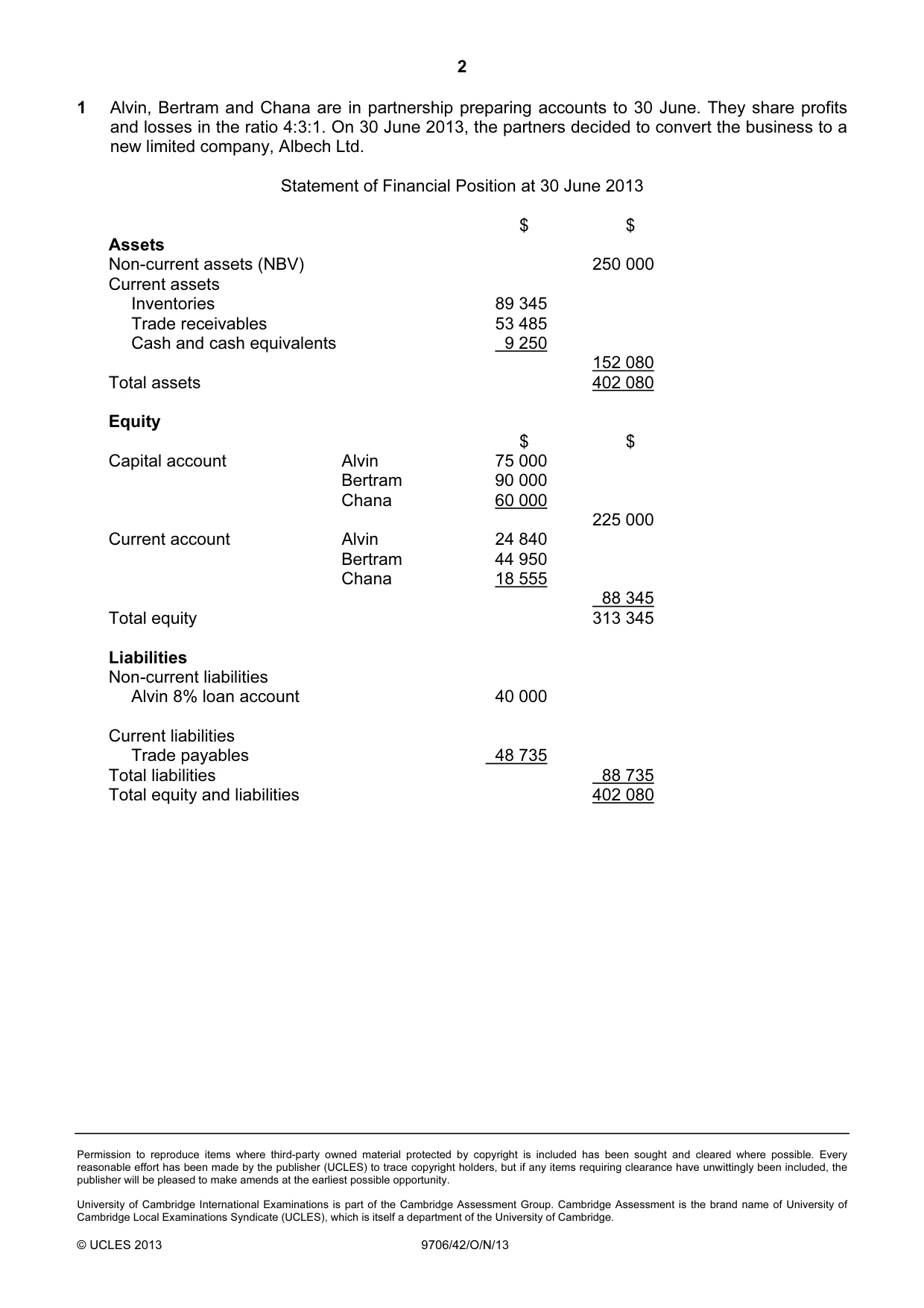
2 Permission to reproduce items where third-party owned material protected by copyright is included has been sought and cleared where possible. Every reasonable effort has been made by the publisher (UCLES) to trace copyright holders, but if any items requiring clearance have unwittingly been included, the publisher will be pleased to make amends at the earliest possible opportunity. University of Cambridge International Examinations is part of the Cambridge Assessment Group. Cambridge Assessment is the brand name of University of Cambridge Local Examinations Syndicate (UCLES), which is itself a department of the University of Cambridge. © UCLES 2013 9706/42/O/N/13 1 Alvin, Bertram and Chana are in partnership preparing accounts to 30 June. They share profits and losses in the ratio 4:3:1. On 30 June 2013, the partners decided to convert the business to a new limited company, Albech Ltd. Statement of Financial Position at 30 June 2013 $ $ Assets Non-current assets (NBV) 250 000 Current assets Inventories 89 345 Trade receivables 53 485 Cash and cash equivalents 9 250 152 080 Total assets 402 080 Equity $ $ Capital account Alvin 75 000 Bertram 90 000 Chana 60 000 225 000 Current account Alvin 24 840 Bertram 44 950 Chana 18 555 88 345 Total equity 313 345 Liabilities Non-current liabilities Alvin 8% loan account 40 000 Current liabilities Trade payables 48 735 Total liabilities 88 735 Total equity and liabilities 402 080
Question paper, page 3
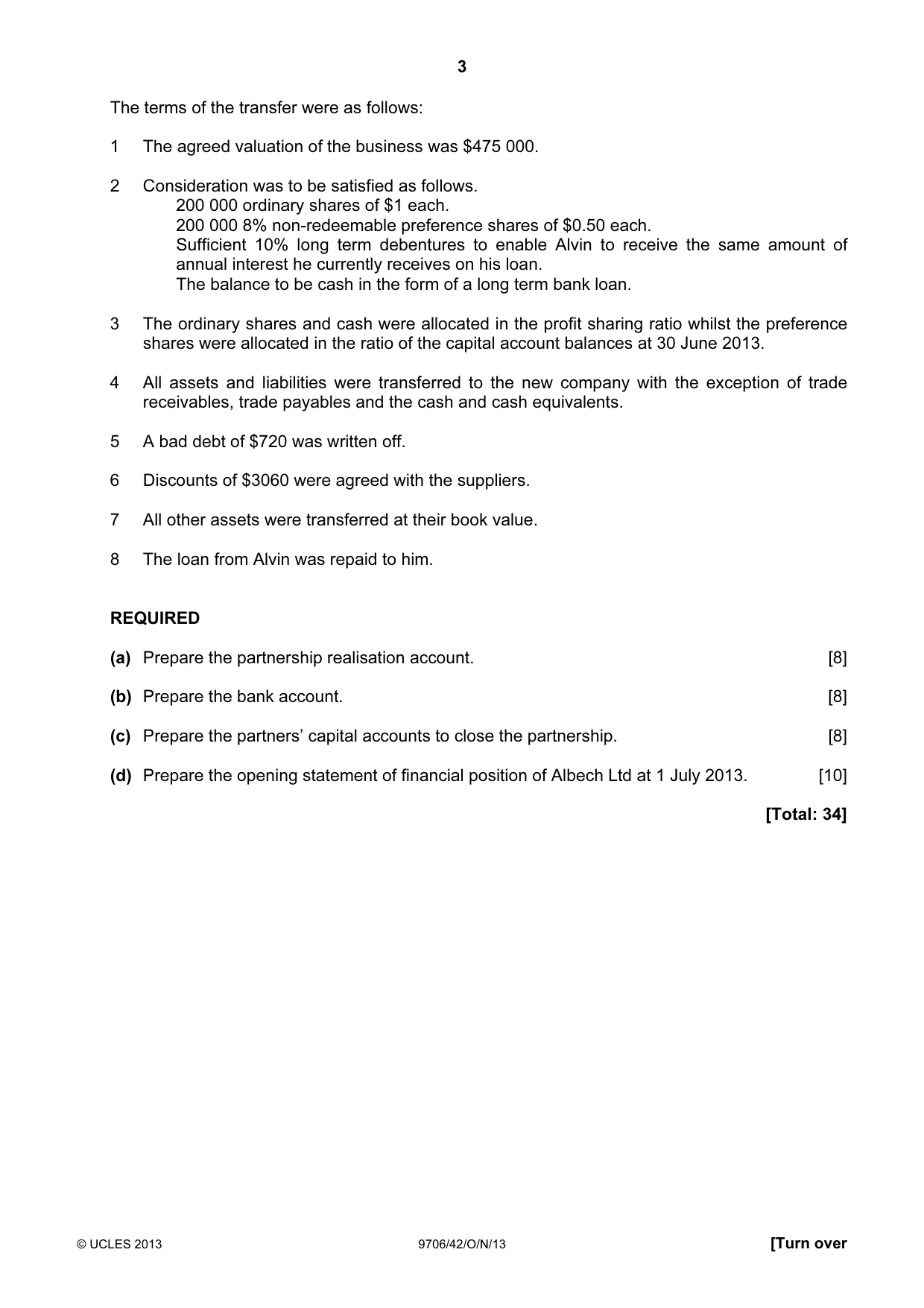
3 © UCLES 2013 9706/42/O/N/13 [Turn over The terms of the transfer were as follows: 1 The agreed valuation of the business was $475 000. 2 Consideration was to be satisfied as follows. 200 000 ordinary shares of $1 each. 200 000 8% non-redeemable preference shares of $0.50 each. Sufficient 10% long term debentures to enable Alvin to receive the same amount of annual interest he currently receives on his loan. The balance to be cash in the form of a long term bank loan. 3 The ordinary shares and cash were allocated in the profit sharing ratio whilst the preference shares were allocated in the ratio of the capital account balances at 30 June 2013. 4 All assets and liabilities were transferred to the new company with the exception of trade receivables, trade payables and the cash and cash equivalents. 5 A bad debt of $720 was written off. 6 Discounts of $3060 were agreed with the suppliers. 7 All other assets were transferred at their book value. 8 The loan from Alvin was repaid to him. REQUIRED (a) Prepare the partnership realisation account. [8] (b) Prepare the bank account. [8] (c) Prepare the partners’ capital accounts to close the partnership. [8] (d) Prepare the opening statement of financial position of Albech Ltd at 1 July 2013. [10] [Total: 34]
Question paper, page 4
4 © UCLES 2013 9706/42/O/N/13 BLANK PAGE
Question paper, page 5
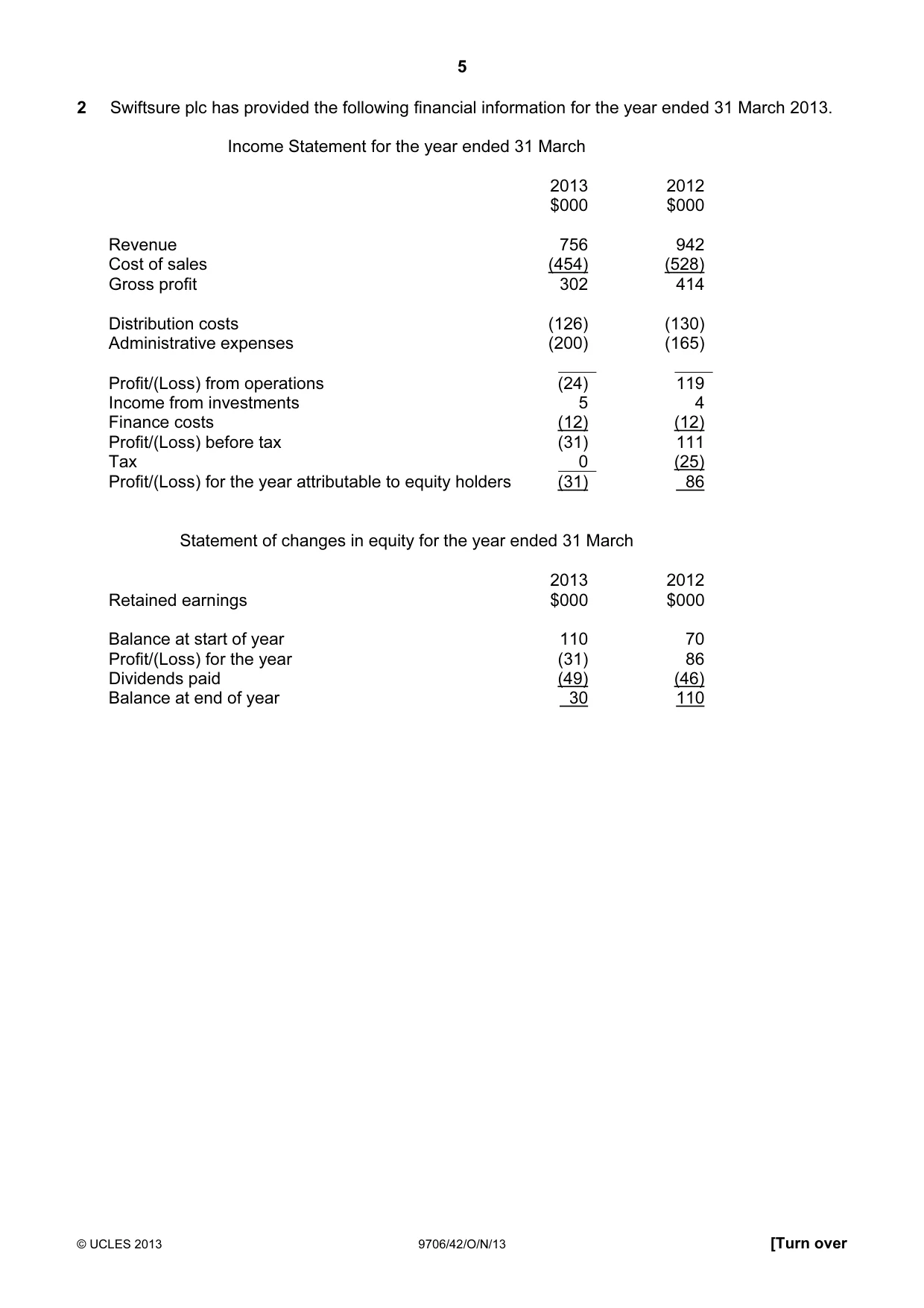
5 © UCLES 2013 9706/42/O/N/13 [Turn over 2 Swiftsure plc has provided the following financial information for the year ended 31 March 2013. Income Statement for the year ended 31 March 2013 2012 $000 $000 Revenue 756 942 Cost of sales (454) (528) Gross profit 302 414 Distribution costs (126) (130) Administrative expenses (200) (165) Profit/(Loss) from operations (24) 119 Income from investments 5 4 Finance costs (12) (12) Profit/(Loss) before tax (31) 111 Tax 0 (25) Profit/(Loss) for the year attributable to equity holders (31) 86 Statement of changes in equity for the year ended 31 March 2013 2012 Retained earnings $000 $000 Balance at start of year 110 70 Profit/(Loss) for the year (31) 86 Dividends paid (49) (46) Balance at end of year 30 110
Question paper, page 6
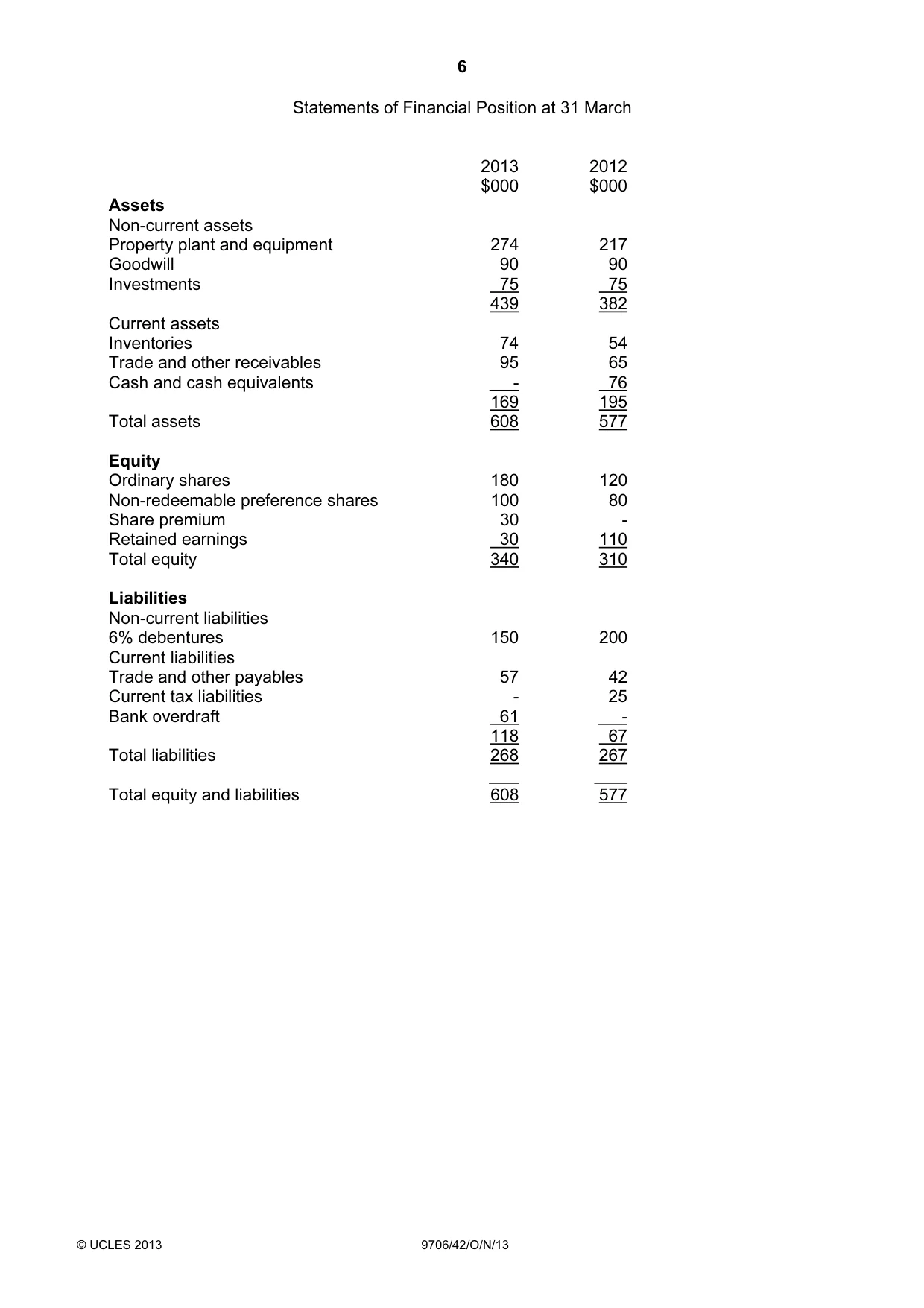
6 © UCLES 2013 9706/42/O/N/13 Statements of Financial Position at 31 March 2013 2012 $000 $000 Assets Non-current assets Property plant and equipment 274 217 Goodwill 90 90 Investments 75 75 439 382 Current assets Inventories 74 54 Trade and other receivables 95 65 Cash and cash equivalents - 76 169 195 Total assets 608 577 Equity Ordinary shares 180 120 Non-redeemable preference shares 100 80 Share premium 30 - Retained earnings 30 110 Total equity 340 310 Liabilities Non-current liabilities 6% debentures 150 200 Current liabilities Trade and other payables 57 42 Current tax liabilities - 25 Bank overdraft 61 - 118 67 Total liabilities 268 267 Total equity and liabilities 608 577
Question paper, page 7
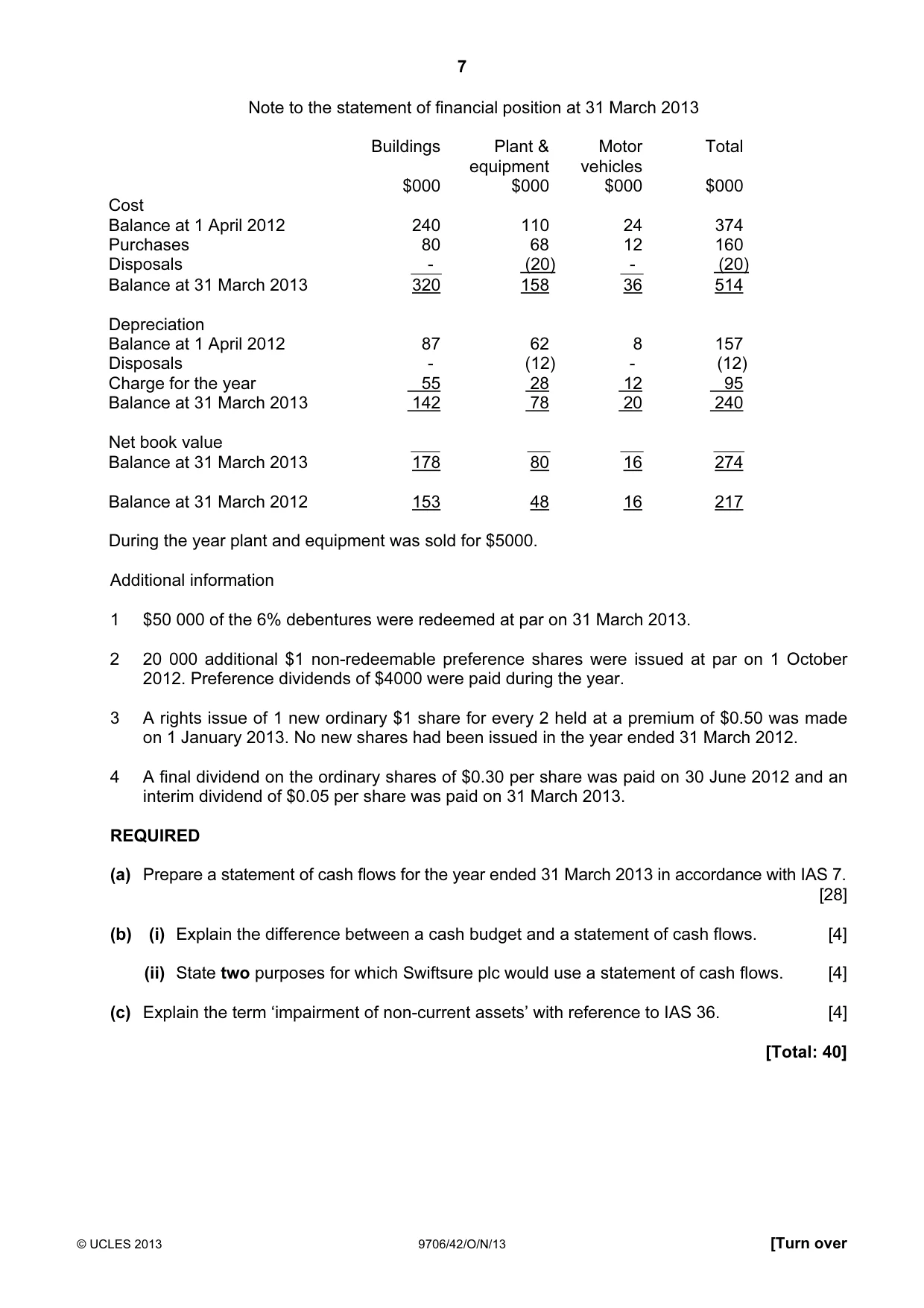
7 © UCLES 2013 9706/42/O/N/13 [Turn over Note to the statement of financial position at 31 March 2013 Buildings Plant & equipment Motor vehicles Total $000 $000 $000 $000 Cost Balance at 1 April 2012 240 110 24 374 Purchases 80 68 12 160 Disposals - (20) - (20) Balance at 31 March 2013 320 158 36 514 Depreciation Balance at 1 April 2012 87 62 8 157 Disposals - (12) - (12) Charge for the year 55 28 12 95 Balance at 31 March 2013 142 78 20 240 Net book value Balance at 31 March 2013 178 80 16 274 Balance at 31 March 2012 153 48 16 217 During the year plant and equipment was sold for $5000. Additional information 1 $50 000 of the 6% debentures were redeemed at par on 31 March 2013. 2 20 000 additional $1 non-redeemable preference shares were issued at par on 1 October 2012. Preference dividends of $4000 were paid during the year. 3 A rights issue of 1 new ordinary $1 share for every 2 held at a premium of $0.50 was made on 1 January 2013. No new shares had been issued in the year ended 31 March 2012. 4 A final dividend on the ordinary shares of $0.30 per share was paid on 30 June 2012 and an interim dividend of $0.05 per share was paid on 31 March 2013. REQUIRED (a) Prepare a statement of cash flows for the year ended 31 March 2013 in accordance with IAS 7. [28] (b) (i) Explain the difference between a cash budget and a statement of cash flows. [4] (ii) State two purposes for which Swiftsure plc would use a statement of cash flows. [4] (c) Explain the term ‘impairment of non-current assets’ with reference to IAS 36. [4] [Total: 40]
Question paper, page 8
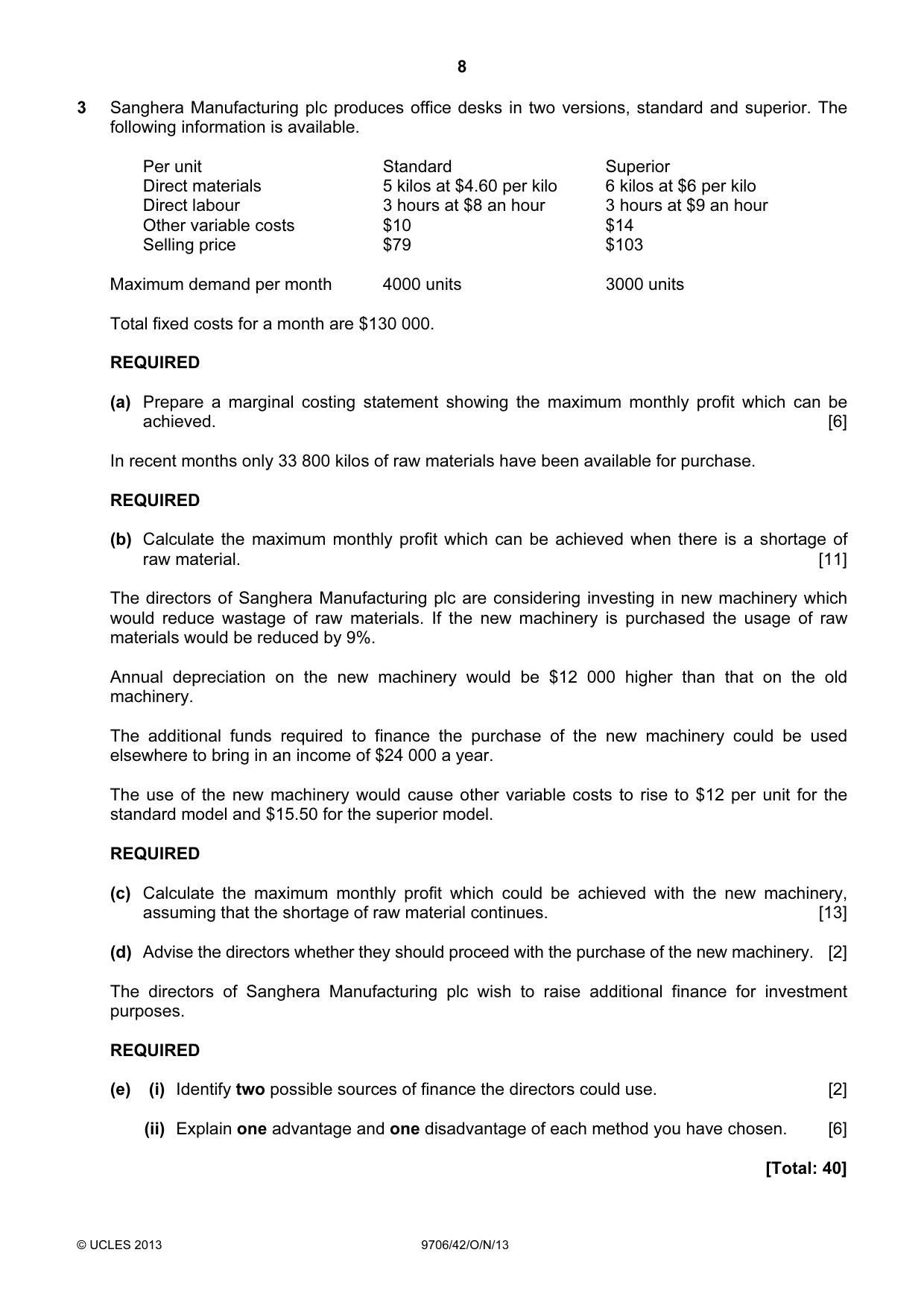
8 © UCLES 2013 9706/42/O/N/13 3 Sanghera Manufacturing plc produces office desks in two versions, standard and superior. The following information is available. Per unit Standard Superior Direct materials 5 kilos at $4.60 per kilo 6 kilos at $6 per kilo Direct labour 3 hours at $8 an hour 3 hours at $9 an hour Other variable costs $10 $14 Selling price $79 $103 Maximum demand per month 4000 units 3000 units Total fixed costs for a month are $130 000. REQUIRED (a) Prepare a marginal costing statement showing the maximum monthly profit which can be achieved. [6] In recent months only 33 800 kilos of raw materials have been available for purchase. REQUIRED (b) Calculate the maximum monthly profit which can be achieved when there is a shortage of raw material. [11] The directors of Sanghera Manufacturing plc are considering investing in new machinery which would reduce wastage of raw materials. If the new machinery is purchased the usage of raw materials would be reduced by 9%. Annual depreciation on the new machinery would be $12 000 higher than that on the old machinery. The additional funds required to finance the purchase of the new machinery could be used elsewhere to bring in an income of $24 000 a year. The use of the new machinery would cause other variable costs to rise to $12 per unit for the standard model and $15.50 for the superior model. REQUIRED (c) Calculate the maximum monthly profit which could be achieved with the new machinery, assuming that the shortage of raw material continues. [13] (d) Advise the directors whether they should proceed with the purchase of the new machinery. [2] The directors of Sanghera Manufacturing plc wish to raise additional finance for investment purposes. REQUIRED (e) (i) Identify two possible sources of finance the directors could use. [2] (ii) Explain one advantage and one disadvantage of each method you have chosen. [6] [Total: 40]
Mark scheme, page 1
CAMBRIDGE INTERNATIONAL EXAMINATIONS GCE Advanced Level MARK SCHEME for the October/November 2013 series 9706 ACCOUNTING 9706/42 Paper 4 (Problem Solving – Supplement), maximum raw mark 120 This mark scheme is published as an aid to teachers and candidates, to indicate the requirements of the examination. It shows the basis on which Examiners were instructed to award marks. It does not indicate the details of the discussions that took place at an Examiners’ meeting before marking began, which would have considered the acceptability of alternative answers. Mark schemes should be read in conjunction with the question paper and the Principal Examiner Report for Teachers. Cambridge will not enter into discussions about these mark schemes. Cambridge is publishing the mark schemes for the October/November 2013 series for most IGCSE, GCE Advanced Level and Advanced Subsidiary Level components and some Ordinary Level components.
Mark scheme, page 2
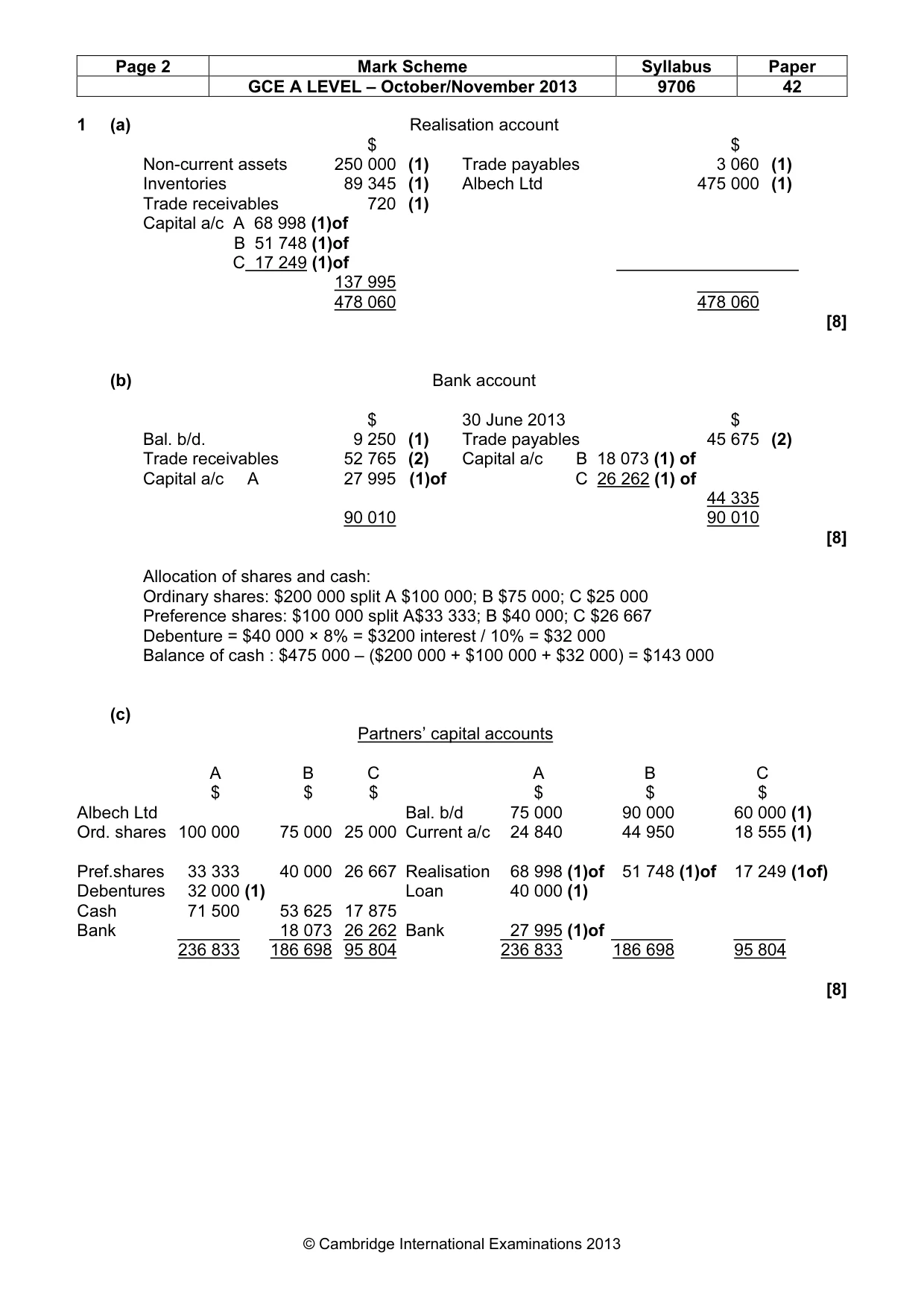
Page 2 Mark Scheme Syllabus Paper GCE A LEVEL – October/November 2013 9706 42 © Cambridge International Examinations 2013 1 (a) Realisation account $ $ Non-current assets 250 000 (1) Trade payables 3 060 (1) Inventories 89 345 (1) Albech Ltd 475 000 (1) Trade receivables 720 (1) Capital a/c A 68 998 (1)of B 51 748 (1)of C 17 249 (1)of 137 995 478 060 478 060 [8] (b) Bank account $ 30 June 2013 $ Bal. b/d. 9 250 (1) Trade payables 45 675 (2) Trade receivables 52 765 (2) Capital a/c B 18 073 (1) of Capital a/c A 27 995 (1)of C 26 262 (1) of 44 335 90 010 90 010 [8] Allocation of shares and cash: Ordinary shares: $200 000 split A $100 000; B $75 000; C $25 000 Preference shares: $100 000 split A$33 333; B $40 000; C $26 667 Debenture = $40 000 × 8% = $3200 interest / 10% = $32 000 Balance of cash : $475 000 – ($200 000 + $100 000 + $32 000) = $143 000 (c) Partners’ capital accounts A B C A B C $ $ $ $ $ $ Albech Ltd Bal. b/d 75 000 90 000 60 000 (1) Ord. shares 100 000 75 000 25 000 Current a/c 24 840 44 950 18 555 (1) Pref.shares 33 333 40 000 26 667 Realisation 68 998 (1)of 51 748 (1)of 17 249 (1of) Debentures 32 000 (1) Loan 40 000 (1) Cash 71 500 53 625 17 875 Bank 18 073 26 262 Bank 27 995 (1)of 236 833 186 698 95 804 236 833 186 698 95 804 [8]
Mark scheme, page 3
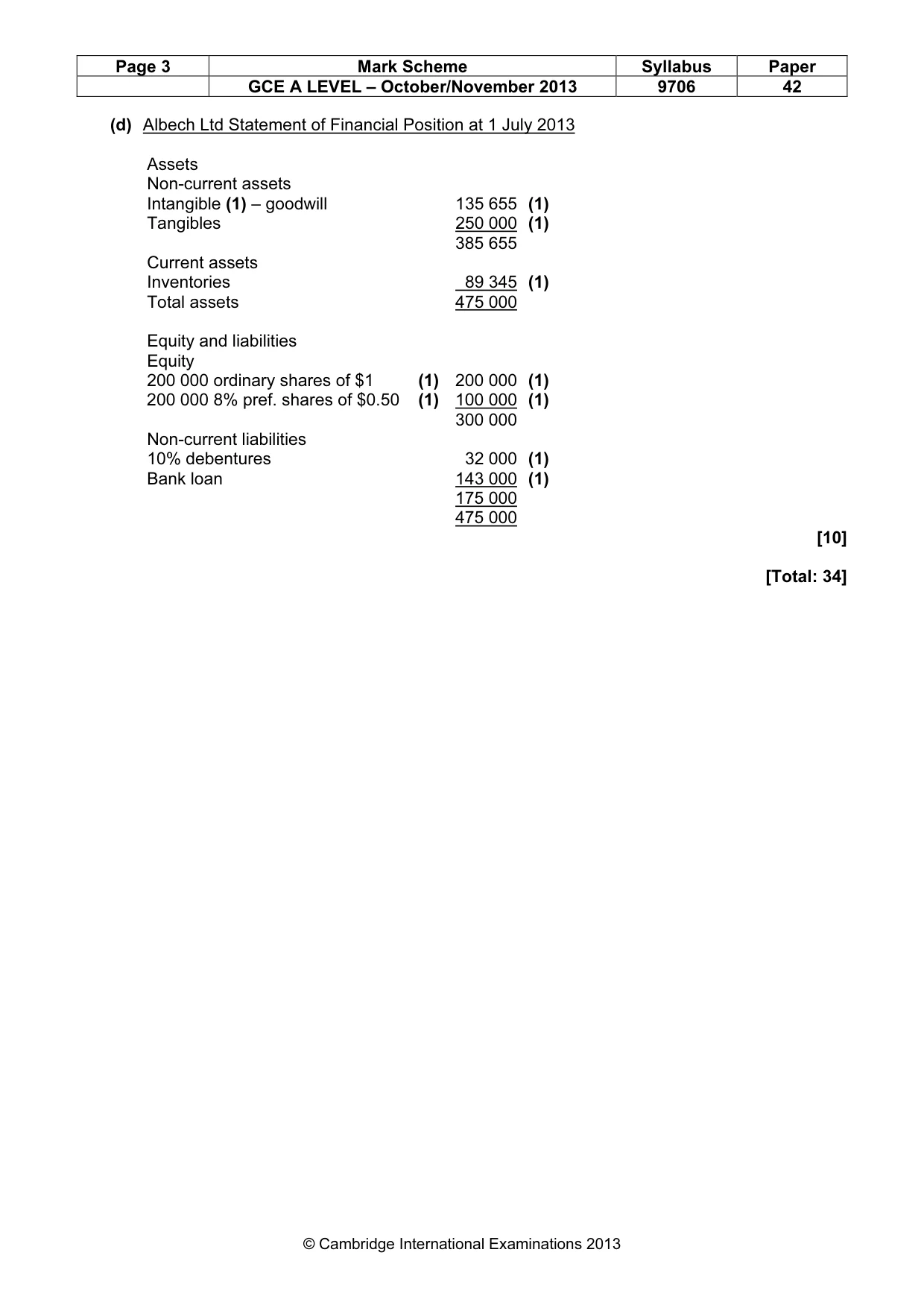
Page 3 Mark Scheme Syllabus Paper GCE A LEVEL – October/November 2013 9706 42 © Cambridge International Examinations 2013 (d) Albech Ltd Statement of Financial Position at 1 July 2013 Assets Non-current assets Intangible (1) – goodwill 135 655 (1) Tangibles 250 000 (1) 385 655 Current assets Inventories 89 345 (1) Total assets 475 000 Equity and liabilities Equity 200 000 ordinary shares of $1 (1) 200 000 (1) 200 000 8% pref. shares of $0.50 (1) 100 000 (1) 300 000 Non-current liabilities 10% debentures 32 000 (1) Bank loan 143 000 (1) 175 000 475 000 [10] [Total: 34]
Mark scheme, page 4
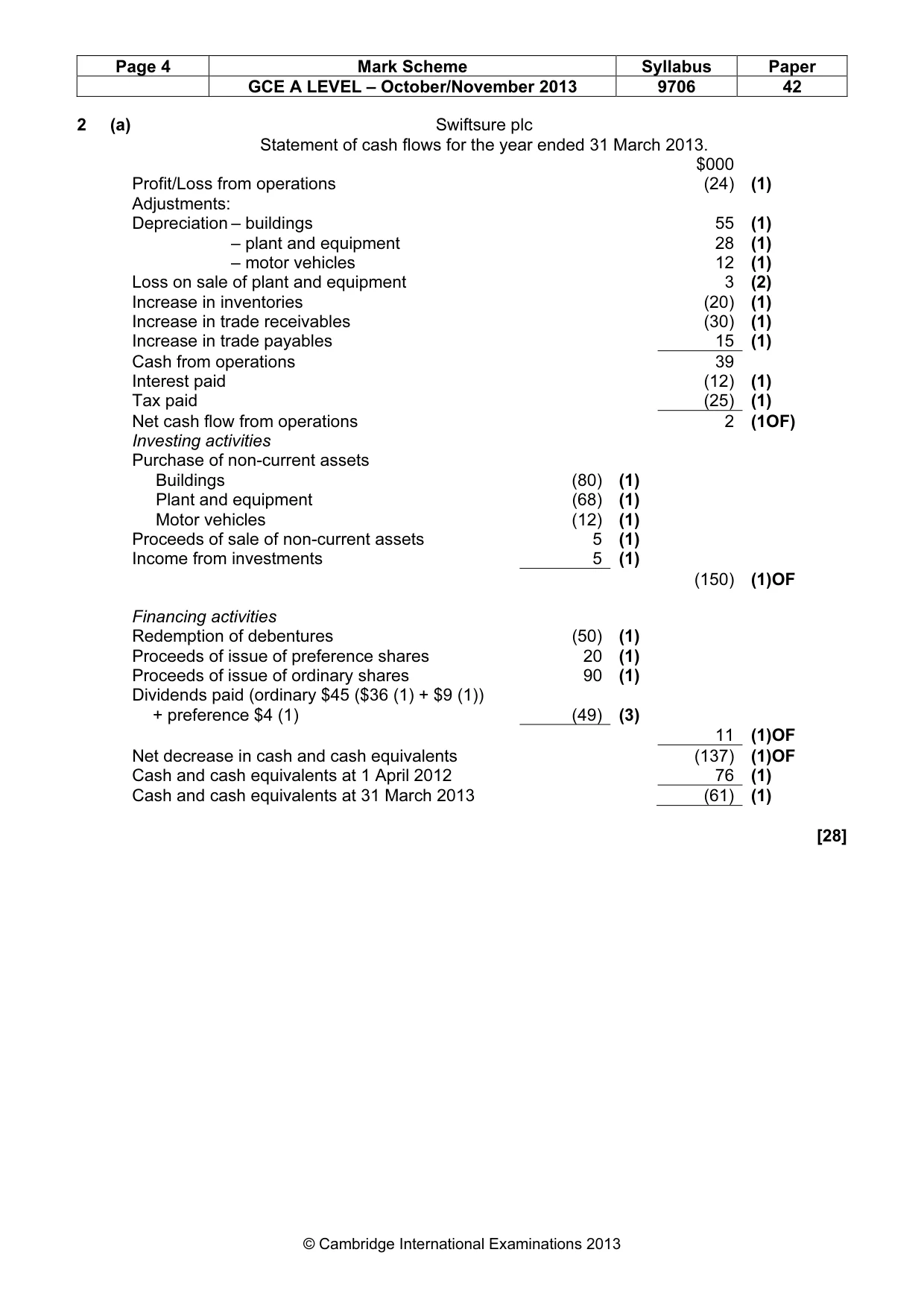
Page 4 Mark Scheme Syllabus Paper GCE A LEVEL – October/November 2013 9706 42 © Cambridge International Examinations 2013 2 (a) Swiftsure plc Statement of cash flows for the year ended 31 March 2013. $000 Profit/Loss from operations (24) (1) Adjustments: Depreciation – buildings 55 (1) – plant and equipment 28 (1) – motor vehicles 12 (1) Loss on sale of plant and equipment 3 (2) Increase in inventories (20) (1) Increase in trade receivables (30) (1) Increase in trade payables 15 (1) Cash from operations 39 Interest paid (12) (1) Tax paid (25) (1) Net cash flow from operations 2 (1OF) Investing activities Purchase of non-current assets Buildings (80) (1) Plant and equipment (68) (1) Motor vehicles (12) (1) Proceeds of sale of non-current assets 5 (1) Income from investments 5 (1) (150) (1)OF Financing activities Redemption of debentures (50) (1) Proceeds of issue of preference shares 20 (1) Proceeds of issue of ordinary shares 90 (1) Dividends paid (ordinary $45 ($36 (1) + $9 (1)) + preference $4 (1) (49) (3) 11 (1)OF Net decrease in cash and cash equivalents (137) (1)OF Cash and cash equivalents at 1 April 2012 76 (1) Cash and cash equivalents at 31 March 2013 (61) (1) [28]
Mark scheme, page 5
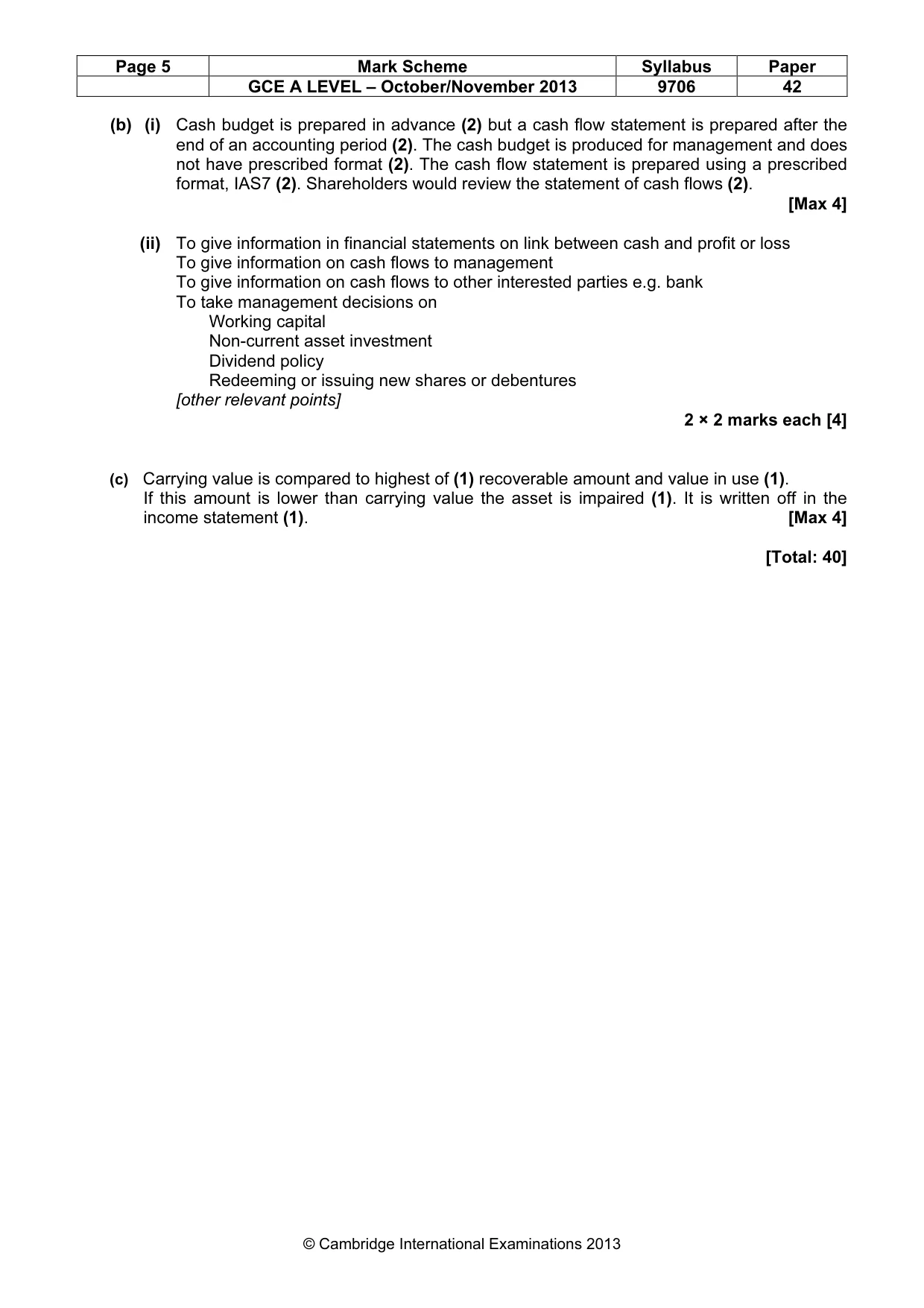
Page 5 Mark Scheme Syllabus Paper GCE A LEVEL – October/November 2013 9706 42 © Cambridge International Examinations 2013 (b) (i) Cash budget is prepared in advance (2) but a cash flow statement is prepared after the end of an accounting period (2). The cash budget is produced for management and does not have prescribed format (2). The cash flow statement is prepared using a prescribed format, IAS7 (2). Shareholders would review the statement of cash flows (2). [Max 4] (ii) To give information in financial statements on link between cash and profit or loss To give information on cash flows to management To give information on cash flows to other interested parties e.g. bank To take management decisions on Working capital Non-current asset investment Dividend policy Redeeming or issuing new shares or debentures [other relevant points] 2 × 2 marks each [4] (c) Carrying value is compared to highest of (1) recoverable amount and value in use (1). If this amount is lower than carrying value the asset is impaired (1). It is written off in the income statement (1). [Max 4] [Total: 40]
Mark scheme, page 6
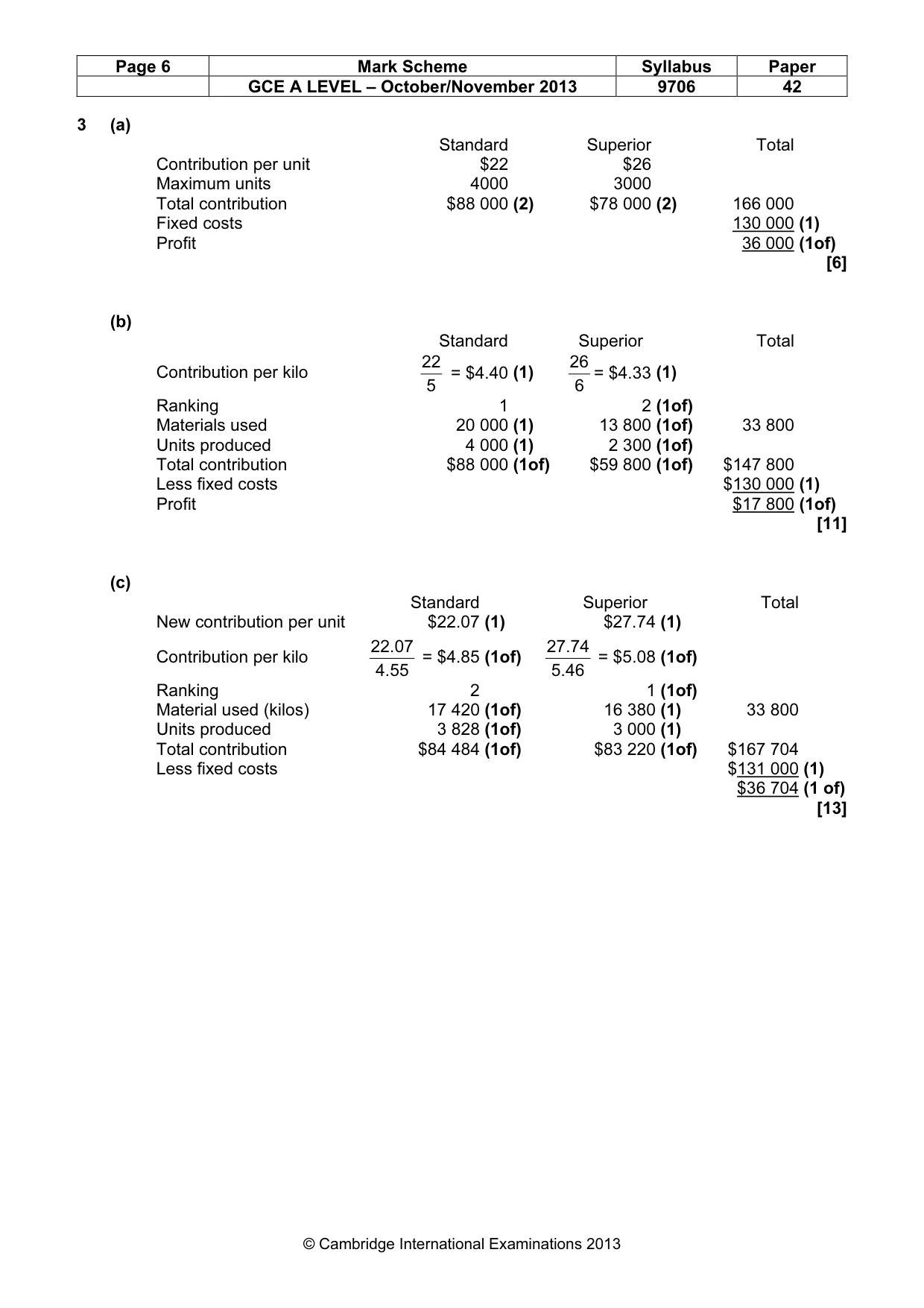
Page 6 Mark Scheme Syllabus Paper GCE A LEVEL – October/November 2013 9706 42 © Cambridge International Examinations 2013 3 (a) Standard Superior Total Contribution per unit $22 $26 Maximum units 4000 3000 Total contribution $88 000 (2) $78 000 (2) 166 000 Fixed costs 130 000 (1) Profit 36 000 (1of) [6] (b) Standard Superior Total Contribution per kilo 5 22 = $4.40 (1) 6 26 = $4.33 (1) Ranking 1 2 (1of) Materials used 20 000 (1) 13 800 (1of) 33 800 Units produced 4 000 (1) 2 300 (1of) Total contribution $88 000 (1of) $59 800 (1of) $147 800 Less fixed costs $130 000 (1) Profit $17 800 (1of) [11] (c) Standard Superior Total New contribution per unit $22.07 (1) $27.74 (1) Contribution per kilo 4.55 22.07 = $4.85 (1of) 5.46 27.74 = $5.08 (1of) Ranking 2 1 (1of) Material used (kilos) 17 420 (1of) 16 380 (1) 33 800 Units produced 3 828 (1of) 3 000 (1) Total contribution $84 484 (1of) $83 220 (1of) $167 704 Less fixed costs $131 000 (1) $36 704 (1 of) [13]
Mark scheme, page 7
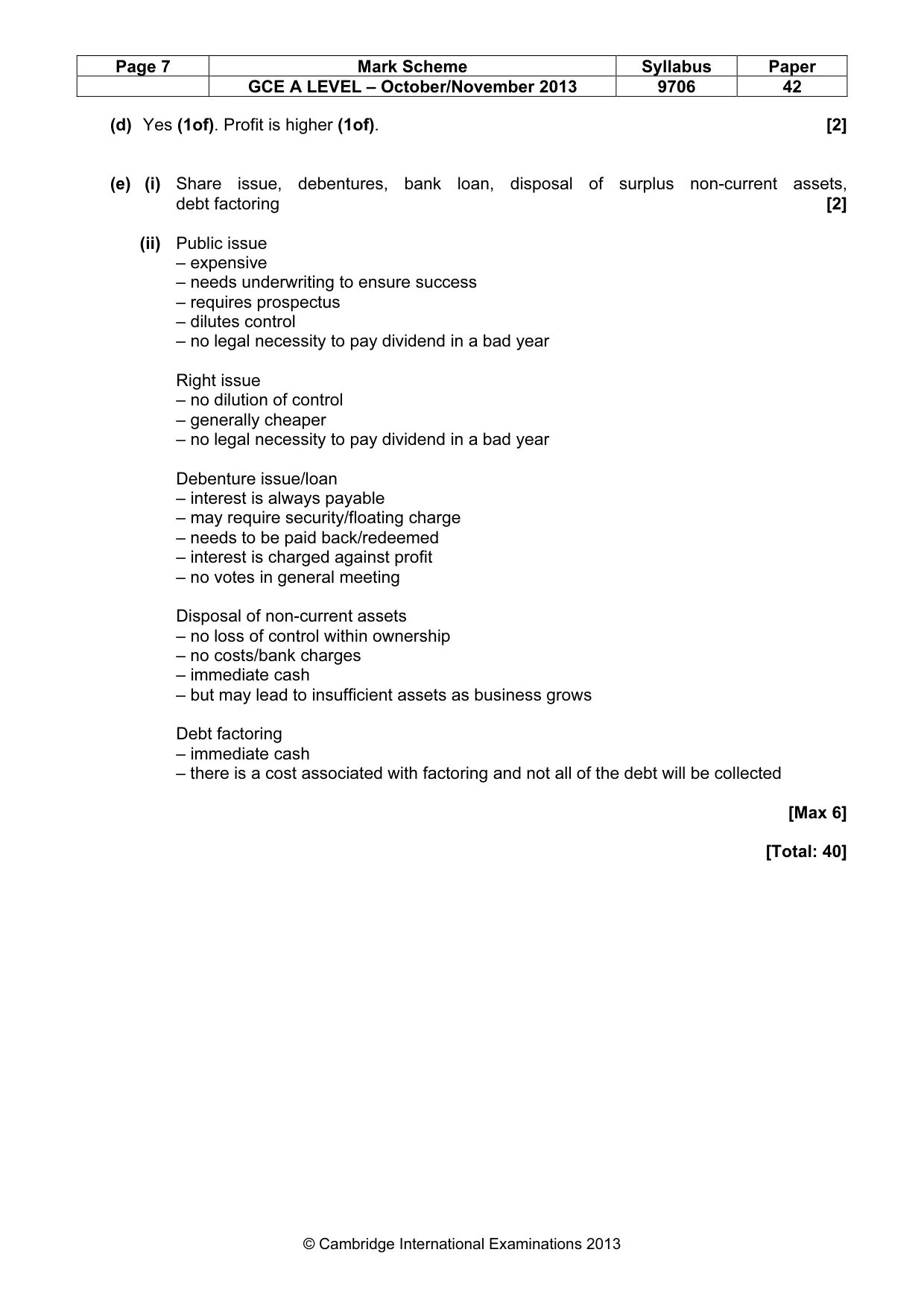
Page 7 Mark Scheme Syllabus Paper GCE A LEVEL – October/November 2013 9706 42 © Cambridge International Examinations 2013 (d) Yes (1of). Profit is higher (1of). [2] (e) (i) Share issue, debentures, bank loan, disposal of surplus non-current assets, debt factoring [2] (ii) Public issue – expensive – needs underwriting to ensure success – requires prospectus – dilutes control – no legal necessity to pay dividend in a bad year Right issue – no dilution of control – generally cheaper – no legal necessity to pay dividend in a bad year Debenture issue/loan – interest is always payable – may require security/floating charge – needs to be paid back/redeemed – interest is charged against profit – no votes in general meeting Disposal of non-current assets – no loss of control within ownership – no costs/bank charges – immediate cash – but may lead to insufficient assets as business grows Debt factoring – immediate cash – there is a cost associated with factoring and not all of the debt will be collected [Max 6] [Total: 40]
What you needed in this session
Cambridge’s own grade thresholds for 2013 Oct/Nov, Paper 4 · Variant 2. A higher threshold means an easier paper — the bar moves with how the cohort did.