Cambridge A Level Accounting 9706 — 2013 Oct/Nov Paper 4 · Variant 1
9706/41/O/N/13 · 120 marks · ≈135 min
The question paper and its mark scheme, free to read here and free to download. This is Cambridge’s own paper, exactly as it was sat.
Question paper8 pages


Mark scheme7 pages
Answers below. Sit the paper first if you are practising.
Paper as text
Question paper, page 1
This document consists of 6 printed pages and 2 blank pages. IB13 11_9706_41/5RP © UCLES 2013 [Turn over *7392798573* UNIVERSITY OF CAMBRIDGE INTERNATIONAL EXAMINATIONS General Certificate of Education Advanced Level ACCOUNTING 9706/41 Paper 4 Problem Solving (Supplementary Topics) October/November 2013 2 hours Additional Materials: Answer Booklet/Paper READ THESE INSTRUCTIONS FIRST If you have been given an Answer Booklet, follow the instructions on the front cover of the Booklet. Write your Centre number, candidate number and name on all the work you hand in. Write in dark blue or black pen. You may use a soft pencil for any diagrams, graphs or rough working. Do not use staples, paper clips, highlighters, glue or correction fluid. Answer all questions. All accounting statements are to be presented in good style. International accounting terms and formats should be used as appropriate. Workings should be shown. You may use a calculator. At the end of the examination, fasten all your work securely together. The number of marks is given in brackets [ ] at the end of each question or part question.
Question paper, page 2
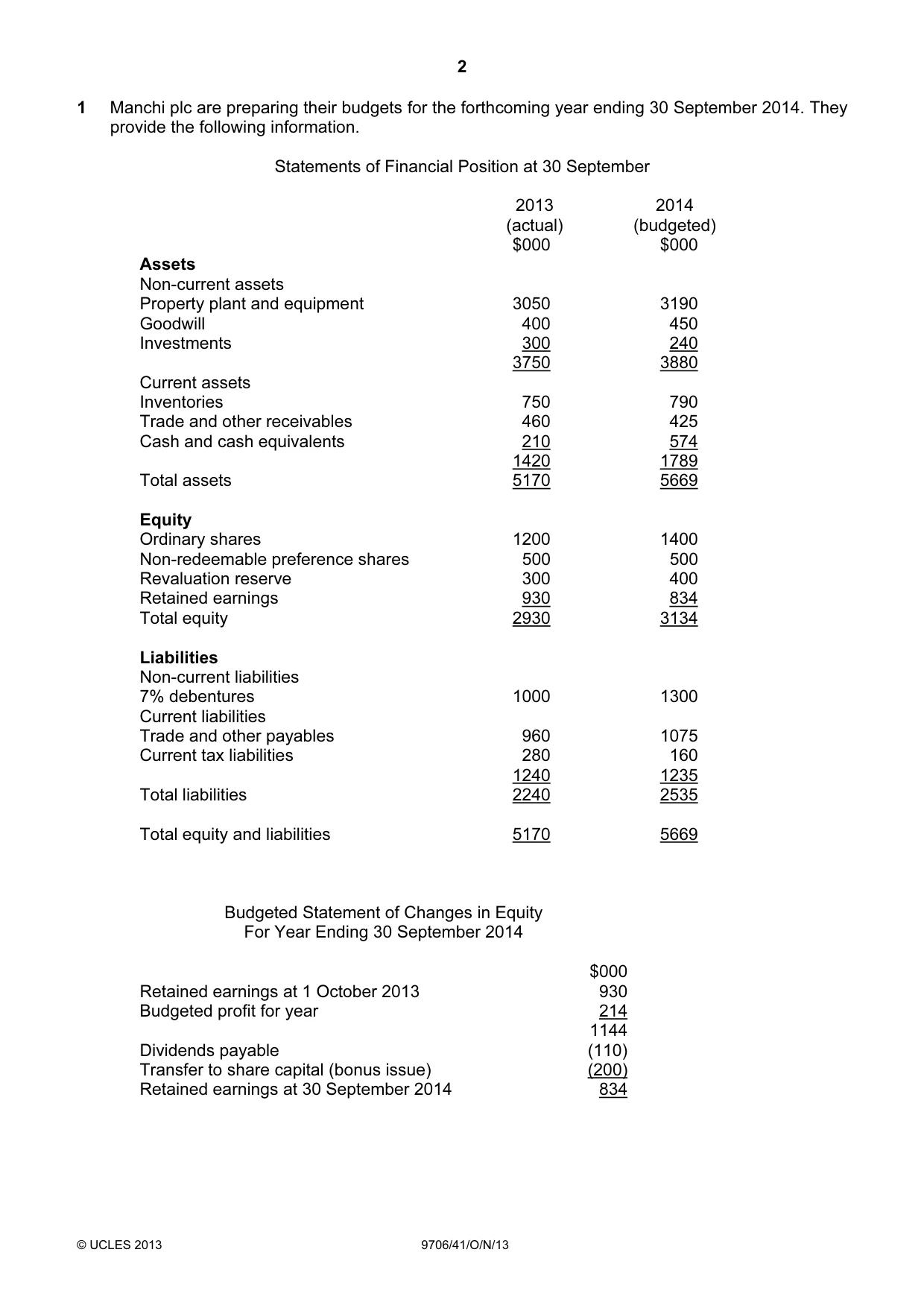
2 © UCLES 2013 9706/41/O/N/13 1 Manchi plc are preparing their budgets for the forthcoming year ending 30 September 2014. They provide the following information. Statements of Financial Position at 30 September 2013 (actual) 2014 (budgeted) $000 $000 Assets Non-current assets Property plant and equipment 3050 3190 Goodwill 400 450 Investments 300 240 3750 3880 Current assets Inventories 750 790 Trade and other receivables 460 425 Cash and cash equivalents 210 574 1420 1789 Total assets 5170 5669 Equity Ordinary shares 1200 1400 Non-redeemable preference shares 500 500 Revaluation reserve 300 400 Retained earnings 930 834 Total equity 2930 3134 Liabilities Non-current liabilities 7% debentures 1000 1300 Current liabilities Trade and other payables 960 1075 Current tax liabilities 280 160 1240 1235 Total liabilities 2240 2535 Total equity and liabilities 5170 5669 Budgeted Statement of Changes in Equity For Year Ending 30 September 2014 $000 Retained earnings at 1 October 2013 930 Budgeted profit for year 214 1144 Dividends payable (110) Transfer to share capital (bonus issue) (200) Retained earnings at 30 September 2014 834
Question paper, page 3
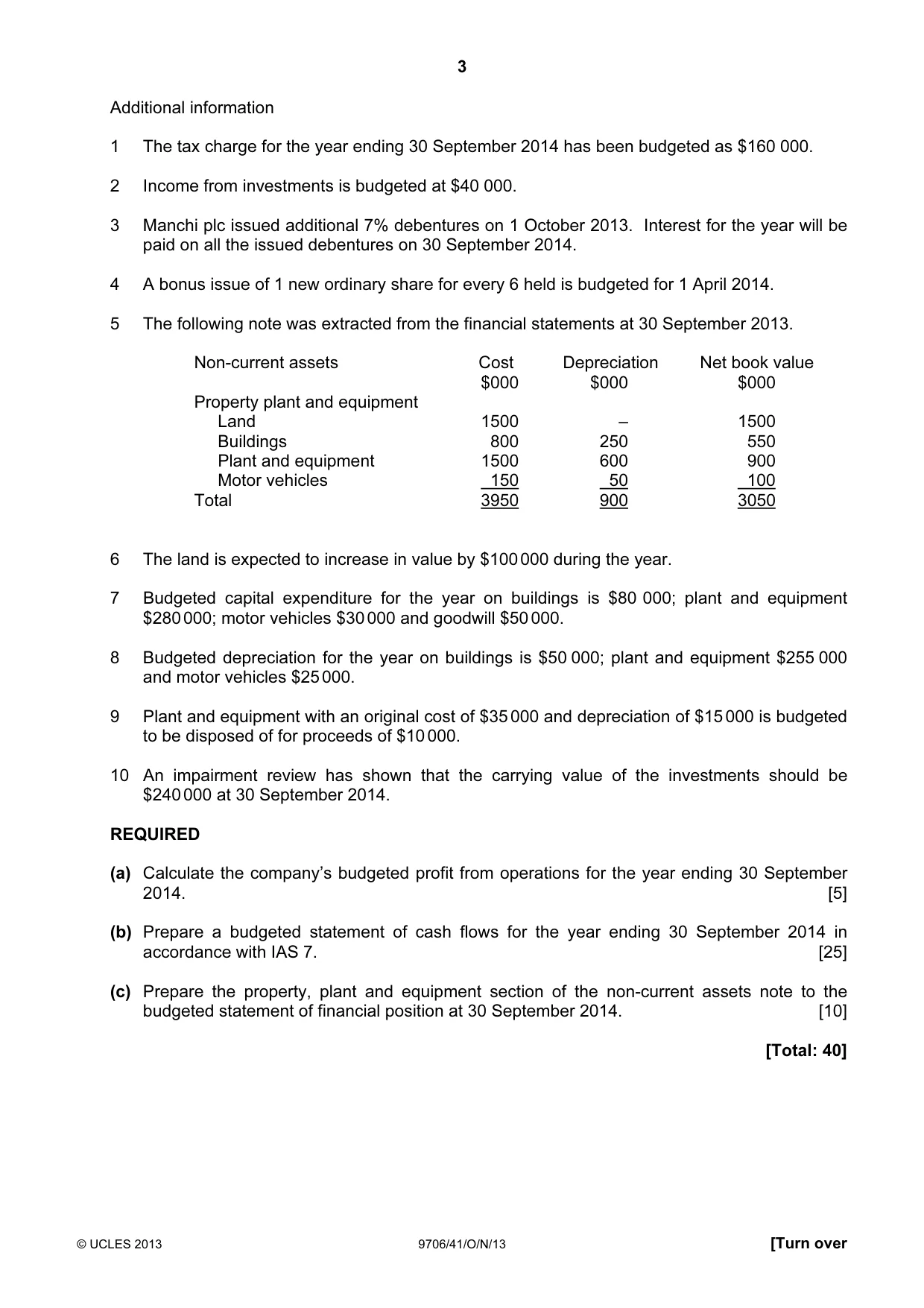
3 © UCLES 2013 9706/41/O/N/13 [Turn over Additional information 1 The tax charge for the year ending 30 September 2014 has been budgeted as $160 000. 2 Income from investments is budgeted at $40 000. 3 Manchi plc issued additional 7% debentures on 1 October 2013. Interest for the year will be paid on all the issued debentures on 30 September 2014. 4 A bonus issue of 1 new ordinary share for every 6 held is budgeted for 1 April 2014. 5 The following note was extracted from the financial statements at 30 September 2013. Non-current assets Cost Depreciation Net book value $000 $000 $000 Property plant and equipment Land 1500 – 1500 Buildings 800 250 550 Plant and equipment 1500 600 900 Motor vehicles 150 50 100 Total 3950 900 3050 6 The land is expected to increase in value by $100 000 during the year. 7 Budgeted capital expenditure for the year on buildings is $80 000; plant and equipment $280 000; motor vehicles $30 000 and goodwill $50 000. 8 Budgeted depreciation for the year on buildings is $50 000; plant and equipment $255 000 and motor vehicles $25 000. 9 Plant and equipment with an original cost of $35 000 and depreciation of $15 000 is budgeted to be disposed of for proceeds of $10 000. 10 An impairment review has shown that the carrying value of the investments should be $240 000 at 30 September 2014. REQUIRED (a) Calculate the company’s budgeted profit from operations for the year ending 30 September 2014. [5] (b) Prepare a budgeted statement of cash flows for the year ending 30 September 2014 in accordance with IAS 7. [25] (c) Prepare the property, plant and equipment section of the non-current assets note to the budgeted statement of financial position at 30 September 2014. [10] [Total: 40]
Question paper, page 4
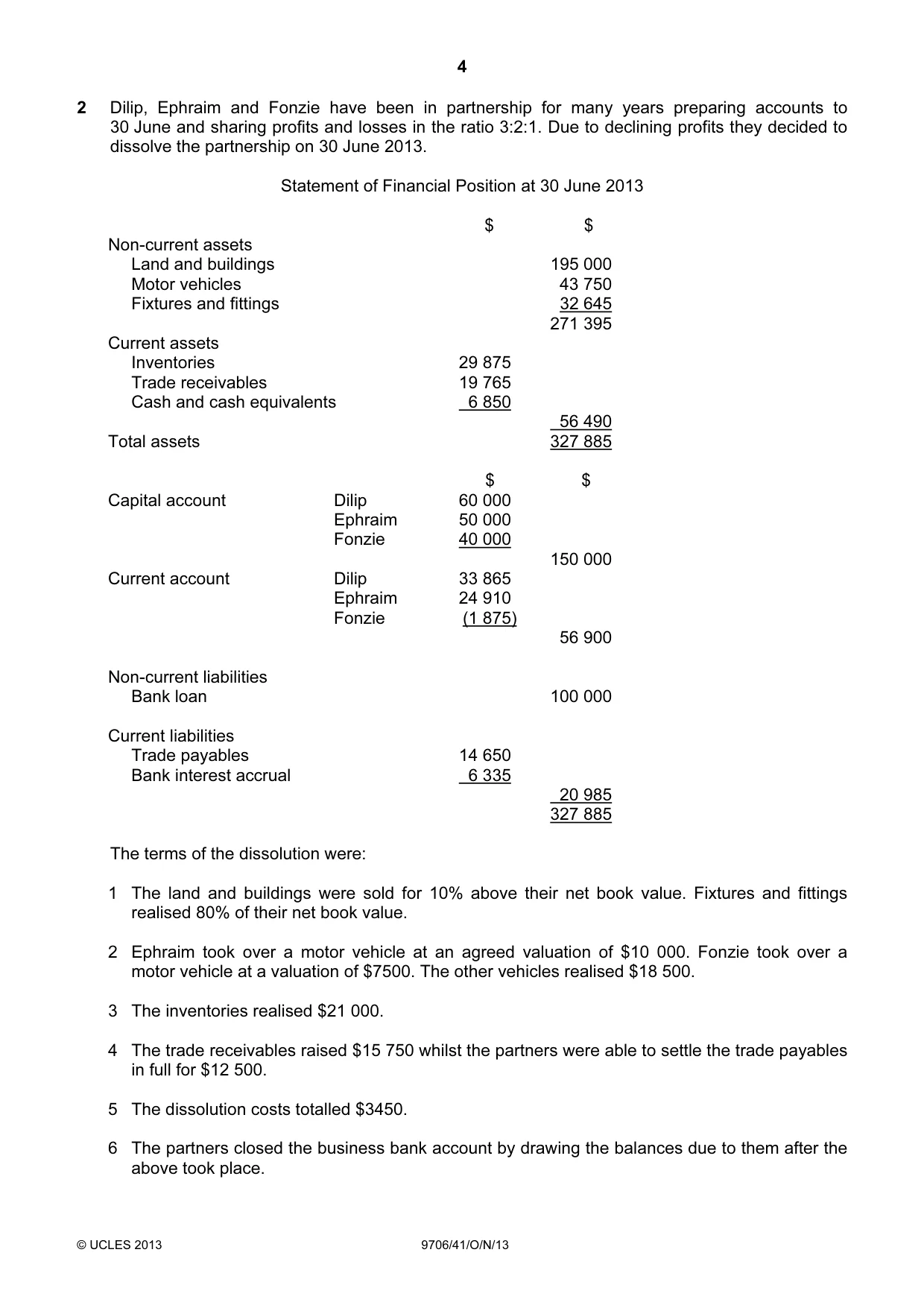
4 © UCLES 2013 9706/41/O/N/13 2 Dilip, Ephraim and Fonzie have been in partnership for many years preparing accounts to 30 June and sharing profits and losses in the ratio 3:2:1. Due to declining profits they decided to dissolve the partnership on 30 June 2013. Statement of Financial Position at 30 June 2013 $ $ Non-current assets Land and buildings 195 000 Motor vehicles 43 750 Fixtures and fittings 32 645 271 395 Current assets Inventories 29 875 Trade receivables 19 765 Cash and cash equivalents 6 850 56 490 Total assets 327 885 $ $ Capital account Dilip 60 000 Ephraim 50 000 Fonzie 40 000 150 000 Current account Dilip 33 865 Ephraim 24 910 Fonzie (1 875) 56 900 Non-current liabilities Bank loan 100 000 Current liabilities Trade payables 14 650 Bank interest accrual 6 335 20 985 327 885 The terms of the dissolution were: 1 The land and buildings were sold for 10% above their net book value. Fixtures and fittings realised 80% of their net book value. 2 Ephraim took over a motor vehicle at an agreed valuation of $10 000. Fonzie took over a motor vehicle at a valuation of $7500. The other vehicles realised $18 500. 3 The inventories realised $21 000. 4 The trade receivables raised $15 750 whilst the partners were able to settle the trade payables in full for $12 500. 5 The dissolution costs totalled $3450. 6 The partners closed the business bank account by drawing the balances due to them after the above took place.
Question paper, page 5
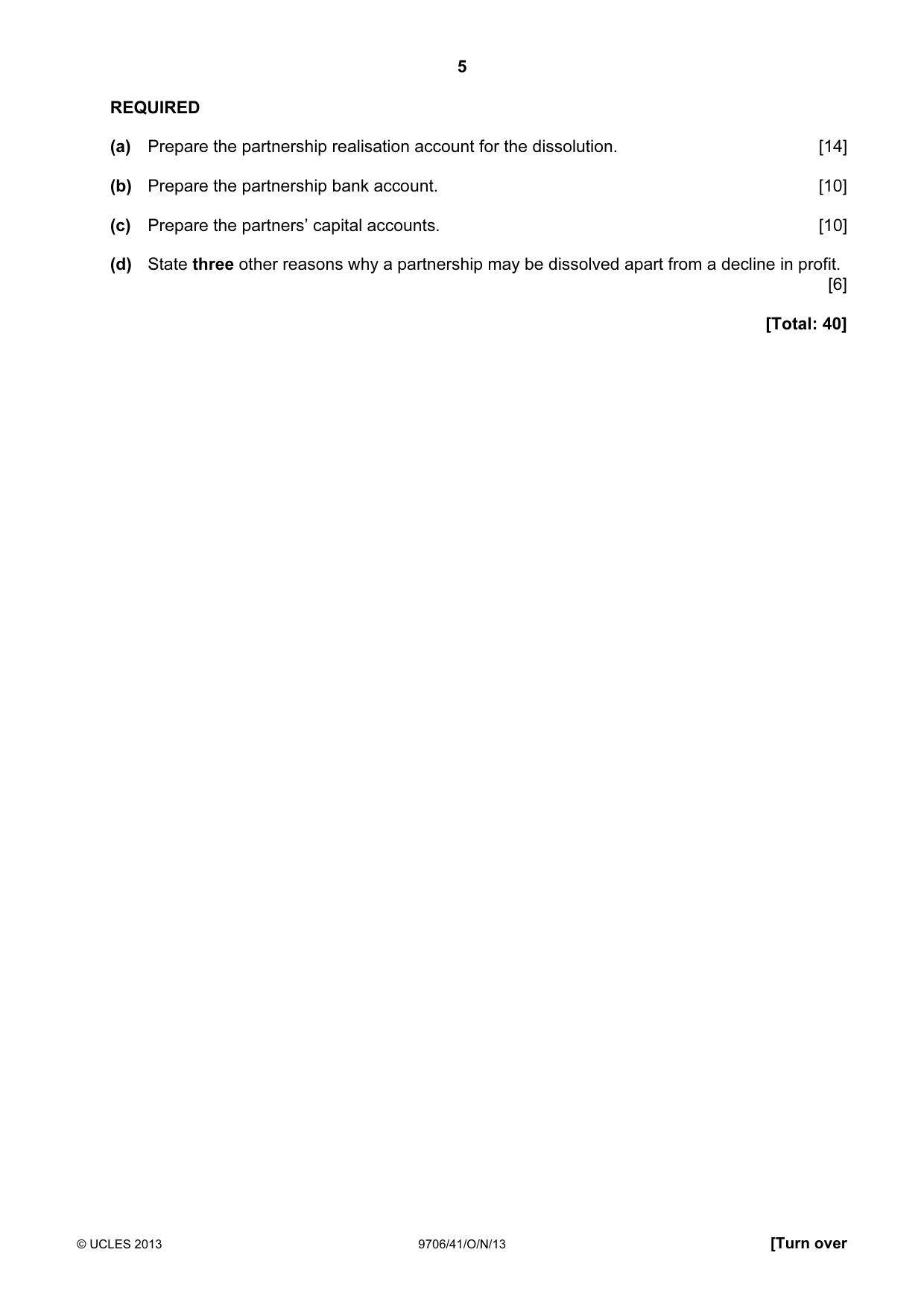
5 © UCLES 2013 9706/41/O/N/13 [Turn over REQUIRED (a) Prepare the partnership realisation account for the dissolution. [14] (b) Prepare the partnership bank account. [10] (c) Prepare the partners’ capital accounts. [10] (d) State three other reasons why a partnership may be dissolved apart from a decline in profit. [6] [Total: 40]
Question paper, page 6
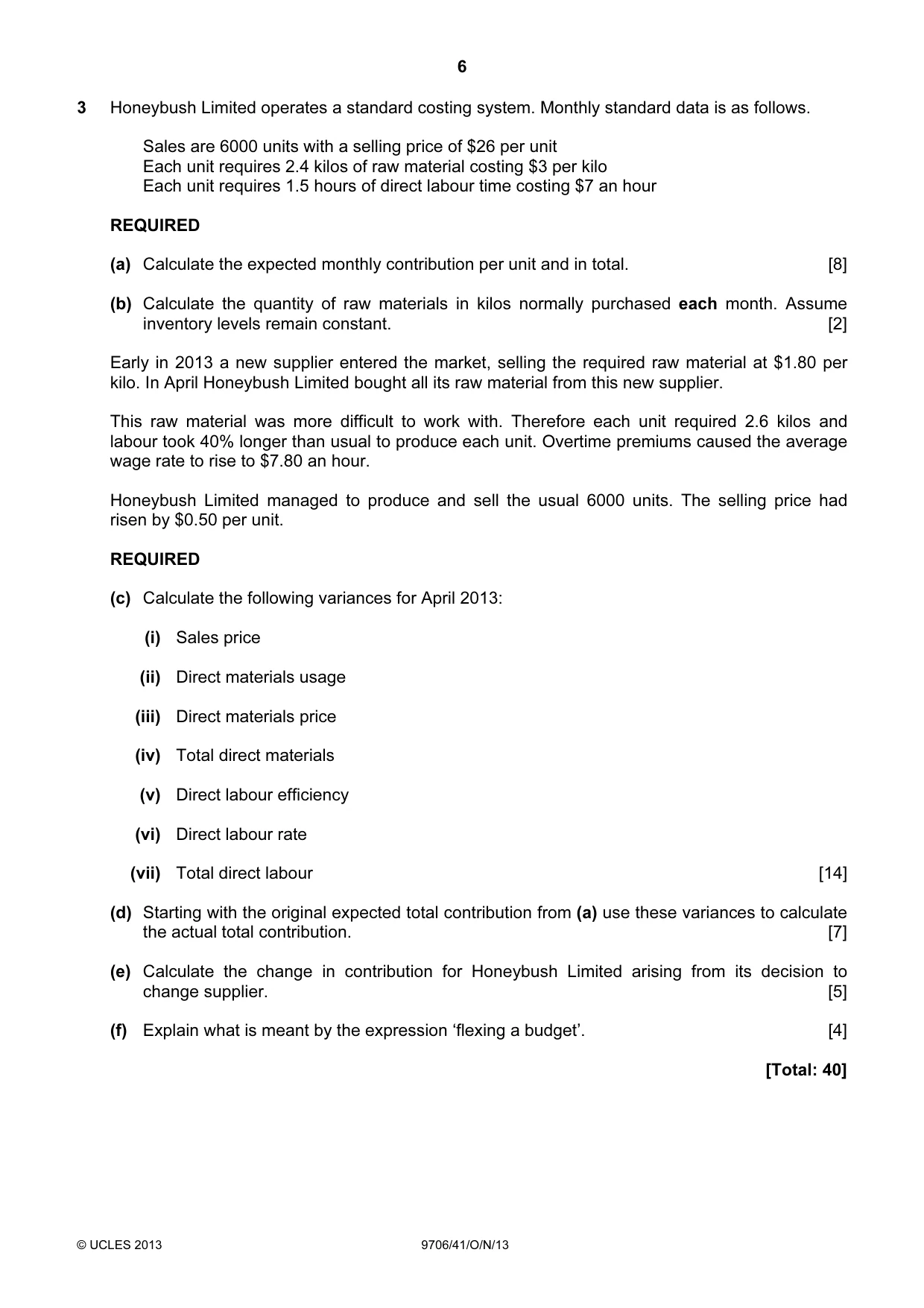
6 © UCLES 2013 9706/41/O/N/13 3 Honeybush Limited operates a standard costing system. Monthly standard data is as follows. Sales are 6000 units with a selling price of $26 per unit Each unit requires 2.4 kilos of raw material costing $3 per kilo Each unit requires 1.5 hours of direct labour time costing $7 an hour REQUIRED (a) Calculate the expected monthly contribution per unit and in total. [8] (b) Calculate the quantity of raw materials in kilos normally purchased each month. Assume inventory levels remain constant. [2] Early in 2013 a new supplier entered the market, selling the required raw material at $1.80 per kilo. In April Honeybush Limited bought all its raw material from this new supplier. This raw material was more difficult to work with. Therefore each unit required 2.6 kilos and labour took 40% longer than usual to produce each unit. Overtime premiums caused the average wage rate to rise to $7.80 an hour. Honeybush Limited managed to produce and sell the usual 6000 units. The selling price had risen by $0.50 per unit. REQUIRED (c) Calculate the following variances for April 2013: (i) Sales price (ii) Direct materials usage (iii) Direct materials price (iv) Total direct materials (v) Direct labour efficiency (vi) Direct labour rate (vii) Total direct labour [14] (d) Starting with the original expected total contribution from (a) use these variances to calculate the actual total contribution. [7] (e) Calculate the change in contribution for Honeybush Limited arising from its decision to change supplier. [5] (f) Explain what is meant by the expression ‘flexing a budget’. [4] [Total: 40]
Question paper, page 7
7 © UCLES 2013 9706/41/O/N/13 BLANK PAGE
Question paper, page 8
8 Permission to reproduce items where third-party owned material protected by copyright is included has been sought and cleared where possible. Every reasonable effort has been made by the publisher (UCLES) to trace copyright holders, but if any items requiring clearance have unwittingly been included, the publisher will be pleased to make amends at the earliest possible opportunity. University of Cambridge International Examinations is part of the Cambridge Assessment Group. Cambridge Assessment is the brand name of University of Cambridge Local Examinations Syndicate (UCLES), which is itself a department of the University of Cambridge. © UCLES 2013 9706/41/O/N/13 BLANK PAGE
Mark scheme, page 1
CAMBRIDGE INTERNATIONAL EXAMINATIONS GCE Advanced Level MARK SCHEME for the October/November 2013 series 9706 ACCOUNTING 9706/41 Paper 4 (Problem Solving – Supplement), maximum raw mark 120 This mark scheme is published as an aid to teachers and candidates, to indicate the requirements of the examination. It shows the basis on which Examiners were instructed to award marks. It does not indicate the details of the discussions that took place at an Examiners’ meeting before marking began, which would have considered the acceptability of alternative answers. Mark schemes should be read in conjunction with the question paper and the Principal Examiner Report for Teachers. Cambridge will not enter into discussions about these mark schemes. Cambridge is publishing the mark schemes for the October/November 2013 series for most IGCSE, GCE Advanced Level and Advanced Subsidiary Level components and some Ordinary Level components.
Mark scheme, page 2
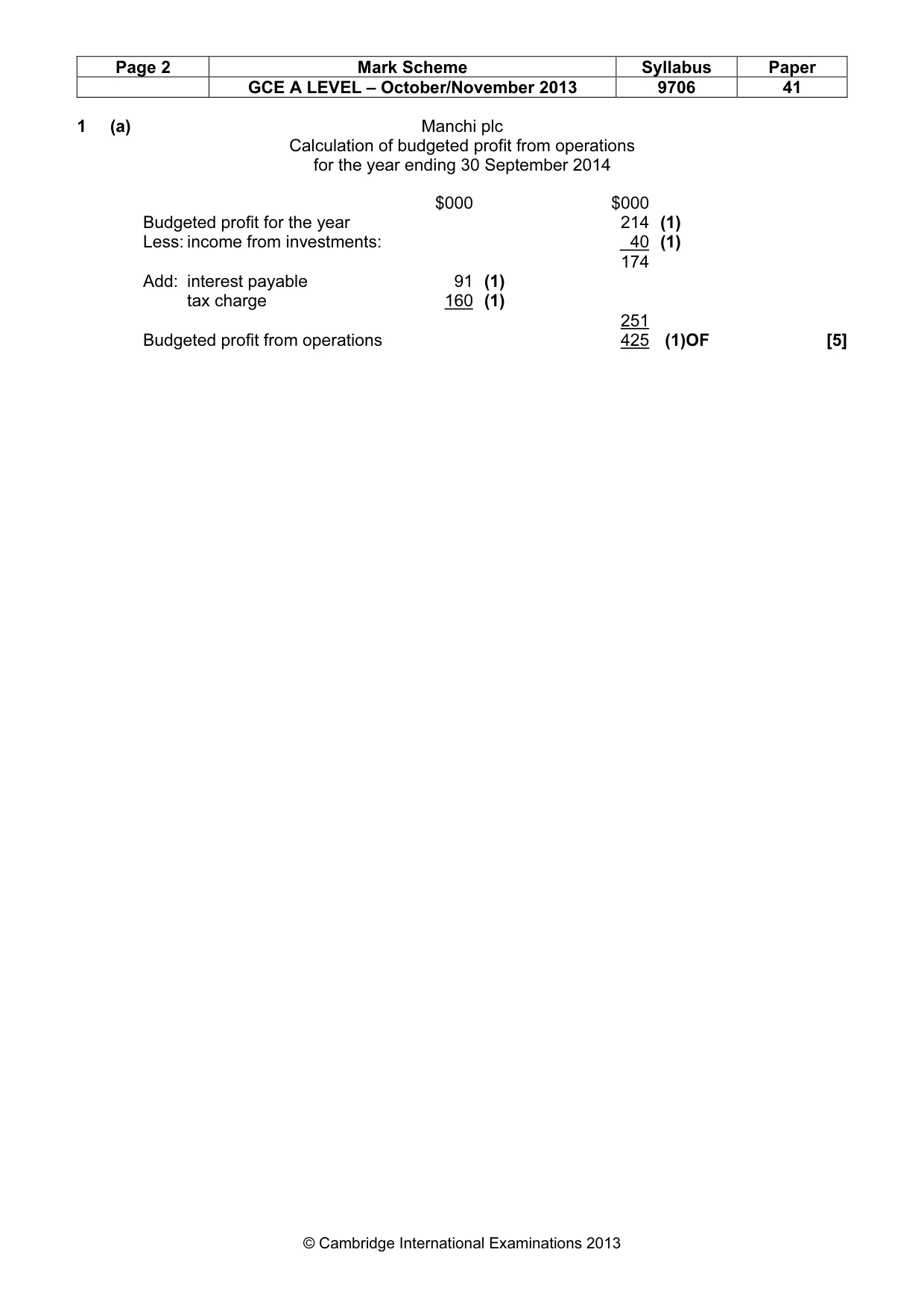
Page 2 Mark Scheme Syllabus Paper GCE A LEVEL – October/November 2013 9706 41 © Cambridge International Examinations 2013 1 (a) Manchi plc Calculation of budgeted profit from operations for the year ending 30 September 2014 $000 $000 Budgeted profit for the year 214 (1) Less: income from investments: 40 (1) 174 Add: interest payable 91 (1) tax charge 160 (1) 251 Budgeted profit from operations 425 (1)OF [5]
Mark scheme, page 3
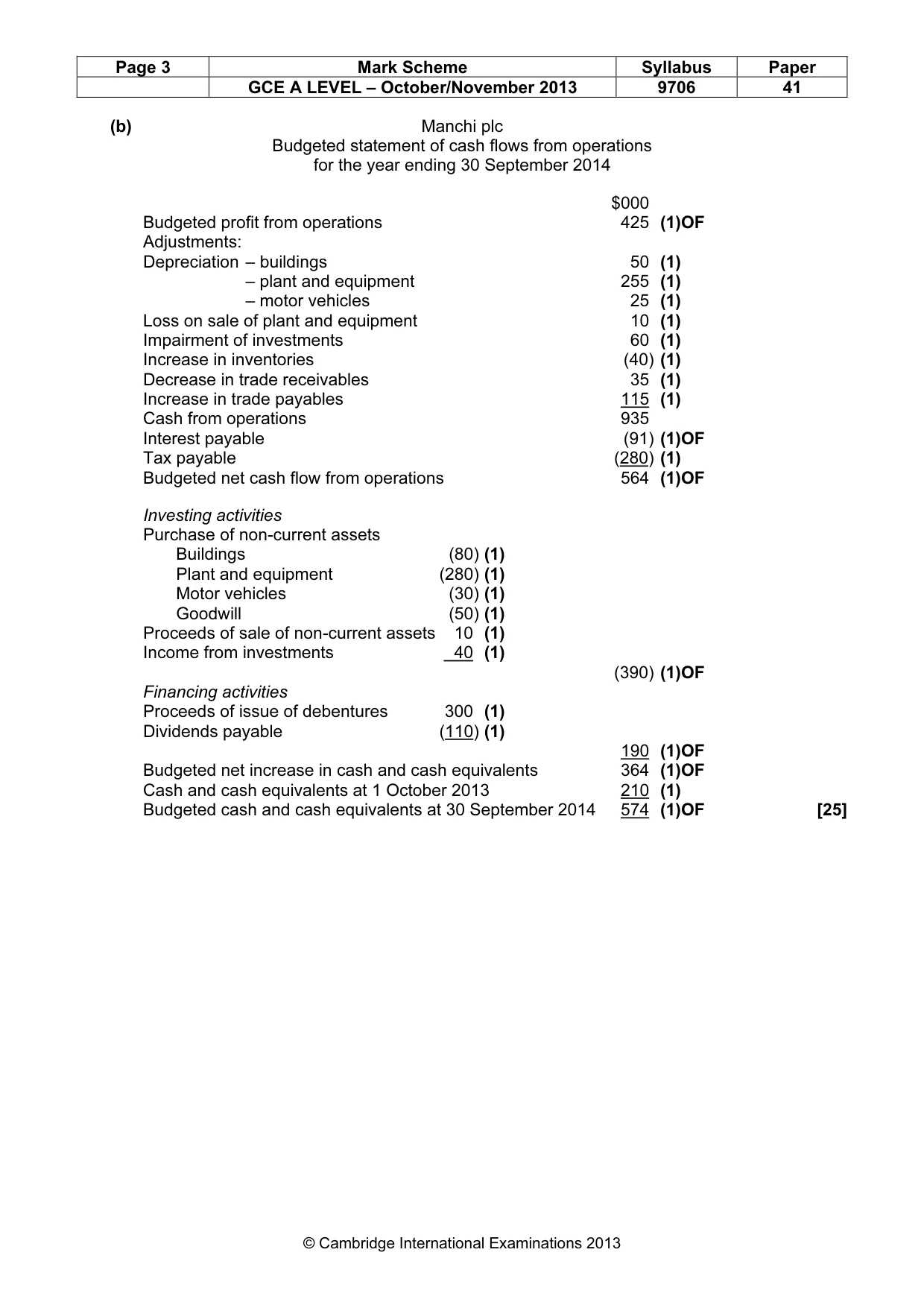
Page 3 Mark Scheme Syllabus Paper GCE A LEVEL – October/November 2013 9706 41 © Cambridge International Examinations 2013 (b) Manchi plc Budgeted statement of cash flows from operations for the year ending 30 September 2014 $000 Budgeted profit from operations 425 (1)OF Adjustments: Depreciation – buildings 50 (1) – plant and equipment 255 (1) – motor vehicles 25 (1) Loss on sale of plant and equipment 10 (1) Impairment of investments 60 (1) Increase in inventories (40) (1) Decrease in trade receivables 35 (1) Increase in trade payables 115 (1) Cash from operations 935 Interest payable (91) (1)OF Tax payable (280) (1) Budgeted net cash flow from operations 564 (1)OF Investing activities Purchase of non-current assets Buildings (80) (1) Plant and equipment (280) (1) Motor vehicles (30) (1) Goodwill (50) (1) Proceeds of sale of non-current assets 10 (1) Income from investments 40 (1) (390) (1)OF Financing activities Proceeds of issue of debentures 300 (1) Dividends payable (110) (1) 190 (1)OF Budgeted net increase in cash and cash equivalents 364 (1)OF Cash and cash equivalents at 1 October 2013 210 (1) Budgeted cash and cash equivalents at 30 September 2014 574 (1)OF [25]
Mark scheme, page 4
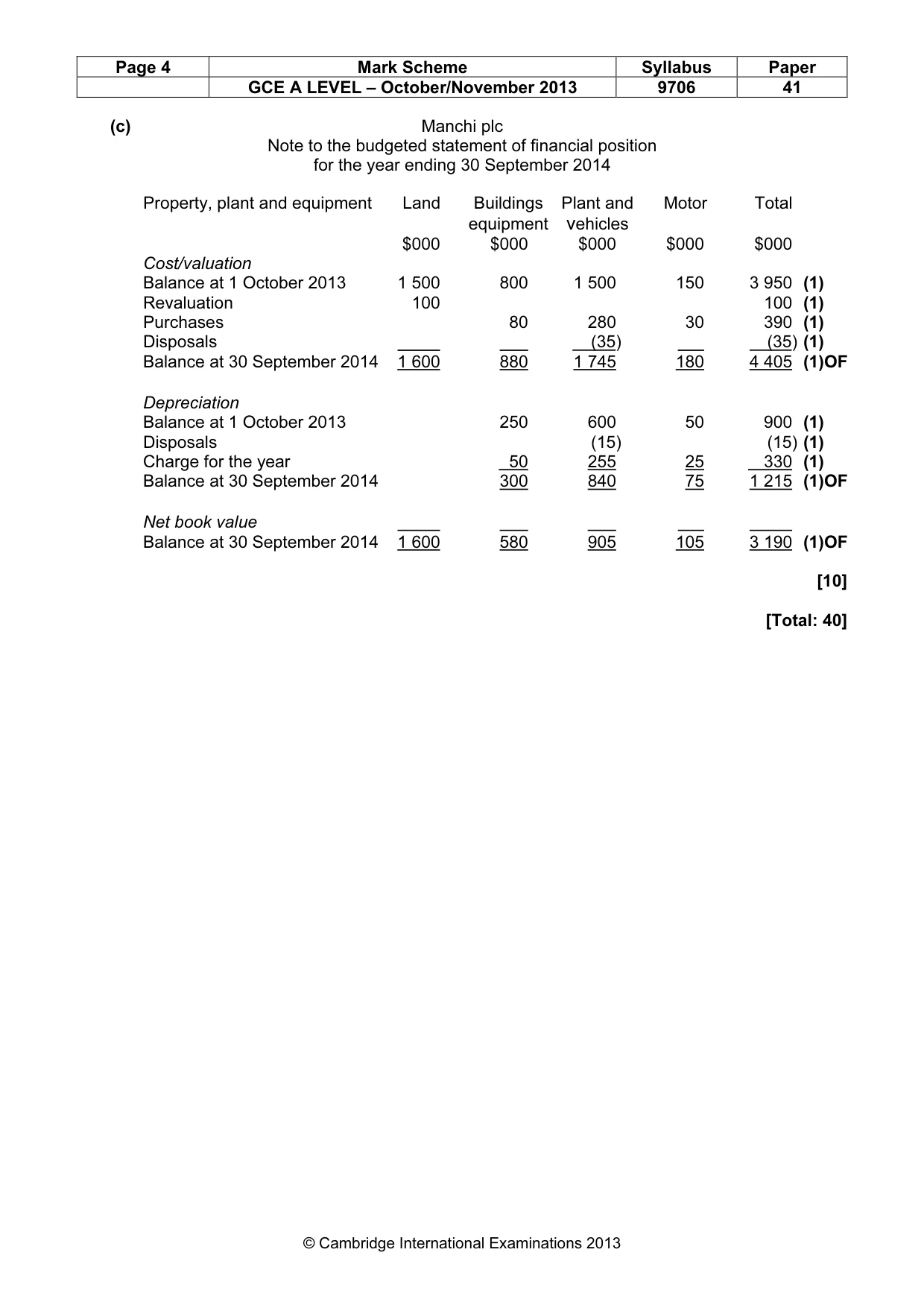
Page 4 Mark Scheme Syllabus Paper GCE A LEVEL – October/November 2013 9706 41 © Cambridge International Examinations 2013 (c) Manchi plc Note to the budgeted statement of financial position for the year ending 30 September 2014 Property, plant and equipment Land Buildings Plant and Motor Total equipment vehicles $000 $000 $000 $000 $000 Cost/valuation Balance at 1 October 2013 1 500 800 1 500 150 3 950 (1) Revaluation 100 100 (1) Purchases 80 280 30 390 (1) Disposals (35) (35) (1) Balance at 30 September 2014 1 600 880 1 745 180 4 405 (1)OF Depreciation Balance at 1 October 2013 250 600 50 900 (1) Disposals (15) (15) (1) Charge for the year 50 255 25 330 (1) Balance at 30 September 2014 300 840 75 1 215 (1)OF Net book value Balance at 30 September 2014 1 600 580 905 105 3 190 (1)OF [10] [Total: 40]
Mark scheme, page 5
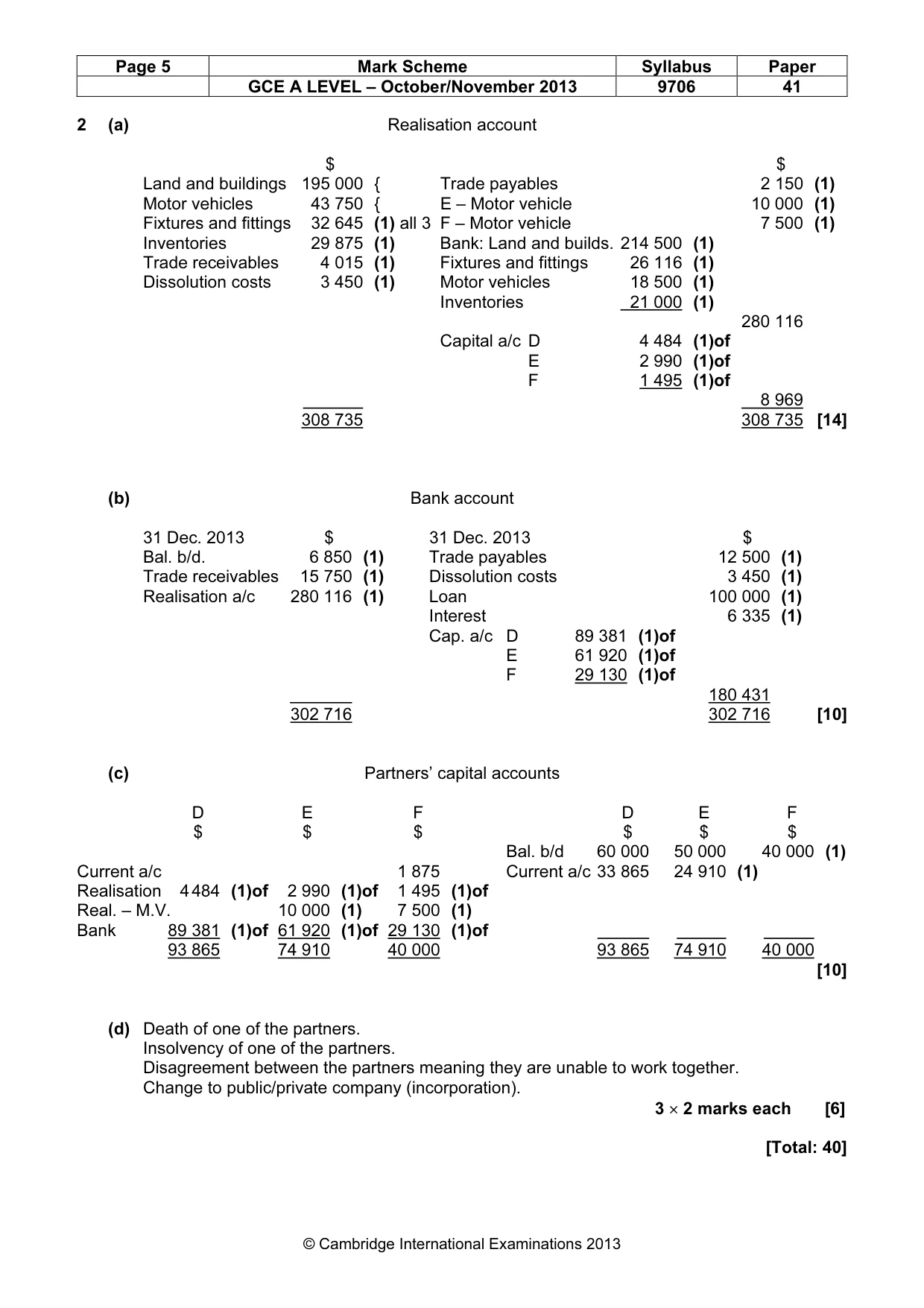
Page 5 Mark Scheme Syllabus Paper GCE A LEVEL – October/November 2013 9706 41 © Cambridge International Examinations 2013 2 (a) Realisation account $ $ Land and buildings 195 000 { Trade payables 2 150 (1) Motor vehicles 43 750 { E – Motor vehicle 10 000 (1) Fixtures and fittings 32 645 (1) all 3 F – Motor vehicle 7 500 (1) Inventories 29 875 (1) Bank: Land and builds. 214 500 (1) Trade receivables 4 015 (1) Fixtures and fittings 26 116 (1) Dissolution costs 3 450 (1) Motor vehicles 18 500 (1) Inventories 21 000 (1) 280 116 Capital a/c D 4 484 (1)of E 2 990 (1)of F 1 495 (1)of 8 969 308 735 308 735 [14] (b) Bank account 31 Dec. 2013 $ 31 Dec. 2013 $ Bal. b/d. 6 850 (1) Trade payables 12 500 (1) Trade receivables 15 750 (1) Dissolution costs 3 450 (1) Realisation a/c 280 116 (1) Loan 100 000 (1) Interest 6 335 (1) Cap. a/c D 89 381 (1)of E 61 920 (1)of F 29 130 (1)of 180 431 302 716 302 716 [10] (c) Partners’ capital accounts D E F D E F $ $ $ $ $ $ Bal. b/d 60 000 50 000 40 000 (1) Current a/c 1 875 Current a/c 33 865 24 910 (1) Realisation 4 484 (1)of 2 990 (1)of 1 495 (1)of Real. – M.V. 10 000 (1) 7 500 (1) Bank 89 381 (1)of 61 920 (1)of 29 130 (1)of 93 865 74 910 40 000 93 865 74 910 40 000 [10] (d) Death of one of the partners. Insolvency of one of the partners. Disagreement between the partners meaning they are unable to work together. Change to public/private company (incorporation). 3 × 2 marks each [6] [Total: 40]
Mark scheme, page 6
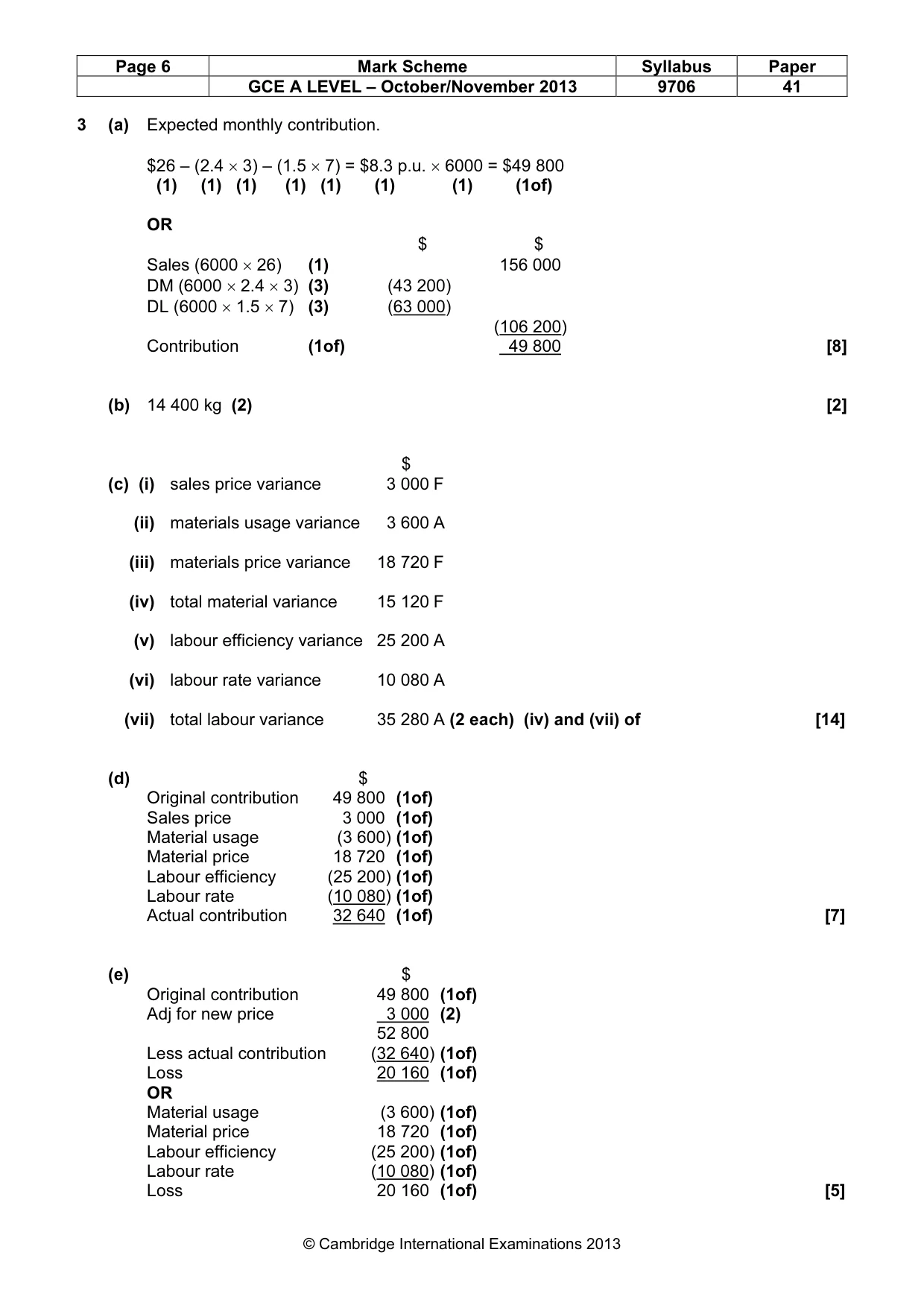
Page 6 Mark Scheme Syllabus Paper GCE A LEVEL – October/November 2013 9706 41 © Cambridge International Examinations 2013 3 (a) Expected monthly contribution. $26 – (2.4 × 3) – (1.5 × 7) = $8.3 p.u. × 6000 = $49 800 (1) (1) (1) (1) (1) (1) (1) (1of) OR $ $ Sales (6000 × 26) (1) 156 000 DM (6000 × 2.4 × 3) (3) (43 200) DL (6000 × 1.5 × 7) (3) (63 000) (106 200) Contribution (1of) 49 800 [8] (b) 14 400 kg (2) [2] $ (c) (i) sales price variance 3 000 F (ii) materials usage variance 3 600 A (iii) materials price variance 18 720 F (iv) total material variance 15 120 F (v) labour efficiency variance 25 200 A (vi) labour rate variance 10 080 A (vii) total labour variance 35 280 A (2 each) (iv) and (vii) of [14] (d) $ Original contribution 49 800 (1of) Sales price 3 000 (1of) Material usage (3 600) (1of) Material price 18 720 (1of) Labour efficiency (25 200) (1of) Labour rate (10 080) (1of) Actual contribution 32 640 (1of) [7] (e) $ Original contribution 49 800 (1of) Adj for new price 3 000 (2) 52 800 Less actual contribution (32 640) (1of) Loss 20 160 (1of) OR Material usage (3 600) (1of) Material price 18 720 (1of) Labour efficiency (25 200) (1of) Labour rate (10 080) (1of) Loss 20 160 (1of) [5]
Mark scheme, page 7
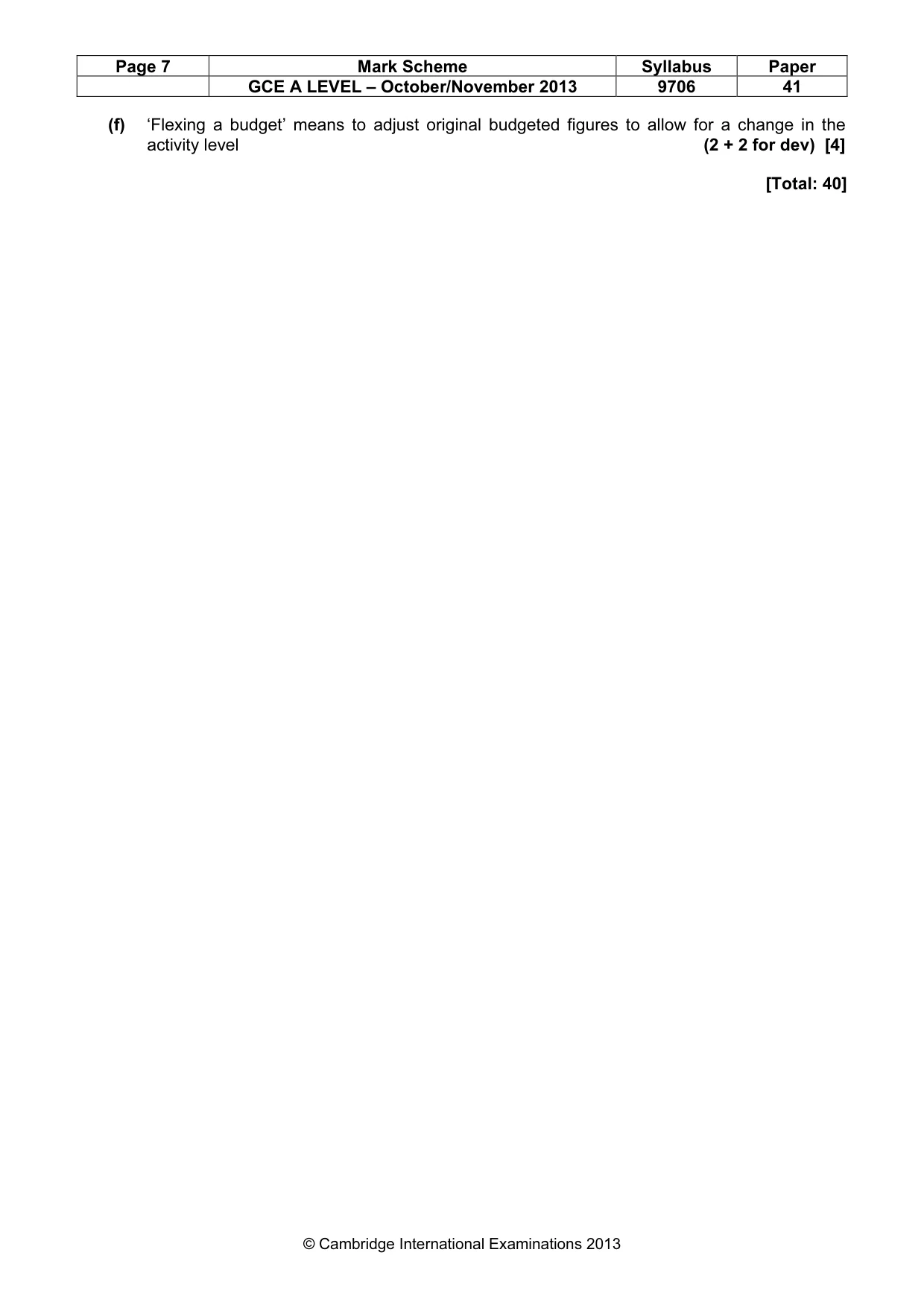
Page 7 Mark Scheme Syllabus Paper GCE A LEVEL – October/November 2013 9706 41 © Cambridge International Examinations 2013 (f) ‘Flexing a budget’ means to adjust original budgeted figures to allow for a change in the activity level (2 + 2 for dev) [4] [Total: 40]
What you needed in this session
Cambridge’s own grade thresholds for 2013 Oct/Nov, Paper 4 · Variant 1. A higher threshold means an easier paper — the bar moves with how the cohort did.