Cambridge A Level Accounting 9706 — 2013 Oct/Nov Paper 4 · Variant 3
9706/43/O/N/13 · 120 marks · ≈135 min
The question paper and its mark scheme, free to read here and free to download. This is Cambridge’s own paper, exactly as it was sat.
Question paper8 pages


Mark scheme6 pages
Answers below. Sit the paper first if you are practising.
Paper as text
Question paper, page 1
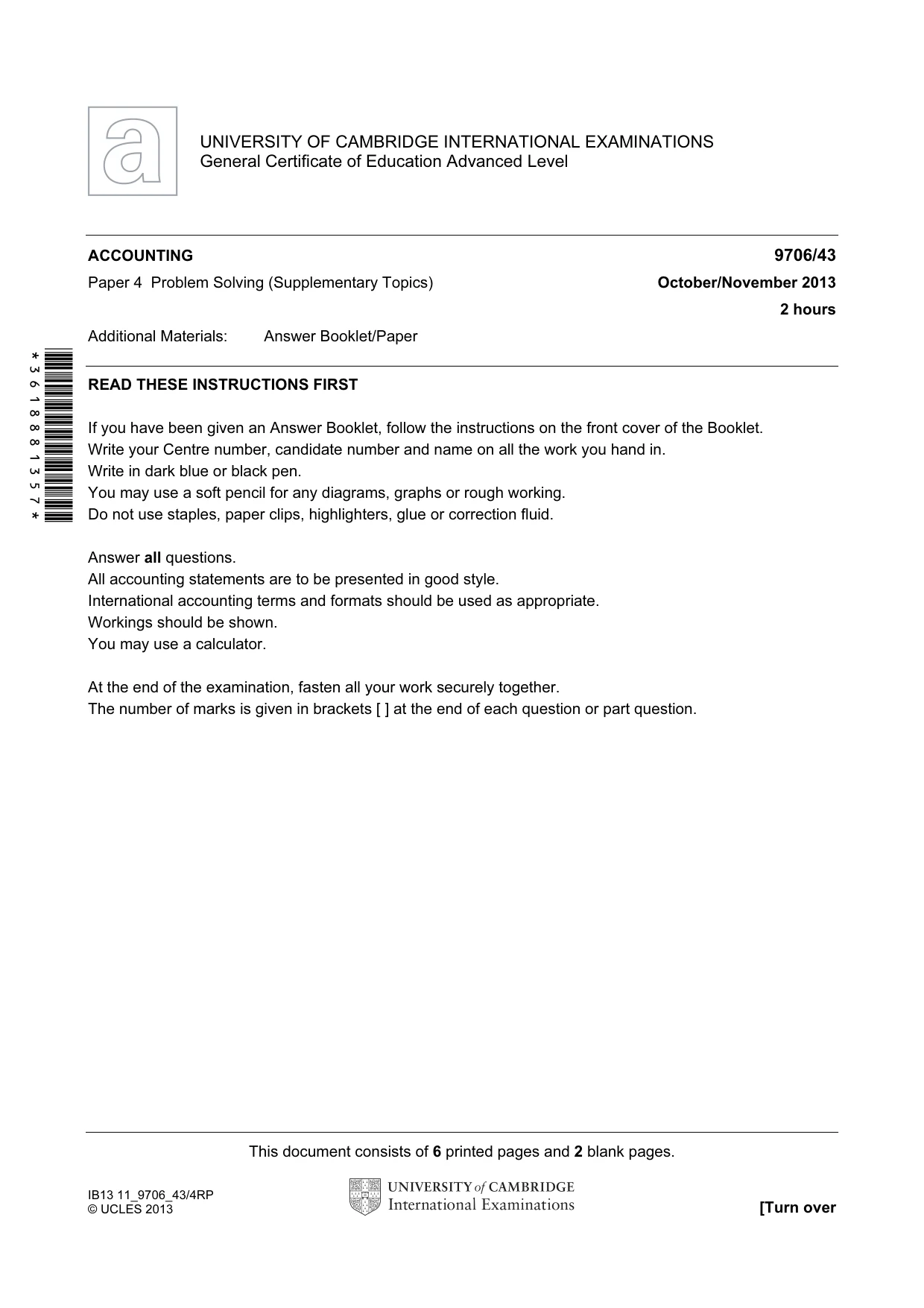
This document consists of 6 printed pages and 2 blank pages. IB13 11_9706_43/4RP © UCLES 2013 [Turn over *3618881357* UNIVERSITY OF CAMBRIDGE INTERNATIONAL EXAMINATIONS General Certificate of Education Advanced Level ACCOUNTING 9706/43 Paper 4 Problem Solving (Supplementary Topics) October/November 2013 2 hours Additional Materials: Answer Booklet/Paper READ THESE INSTRUCTIONS FIRST If you have been given an Answer Booklet, follow the instructions on the front cover of the Booklet. Write your Centre number, candidate number and name on all the work you hand in. Write in dark blue or black pen. You may use a soft pencil for any diagrams, graphs or rough working. Do not use staples, paper clips, highlighters, glue or correction fluid. Answer all questions. All accounting statements are to be presented in good style. International accounting terms and formats should be used as appropriate. Workings should be shown. You may use a calculator. At the end of the examination, fasten all your work securely together. The number of marks is given in brackets [ ] at the end of each question or part question.
Question paper, page 2
2 © UCLES 2013 9706/43/O/N/13 BLANK PAGE
Question paper, page 3
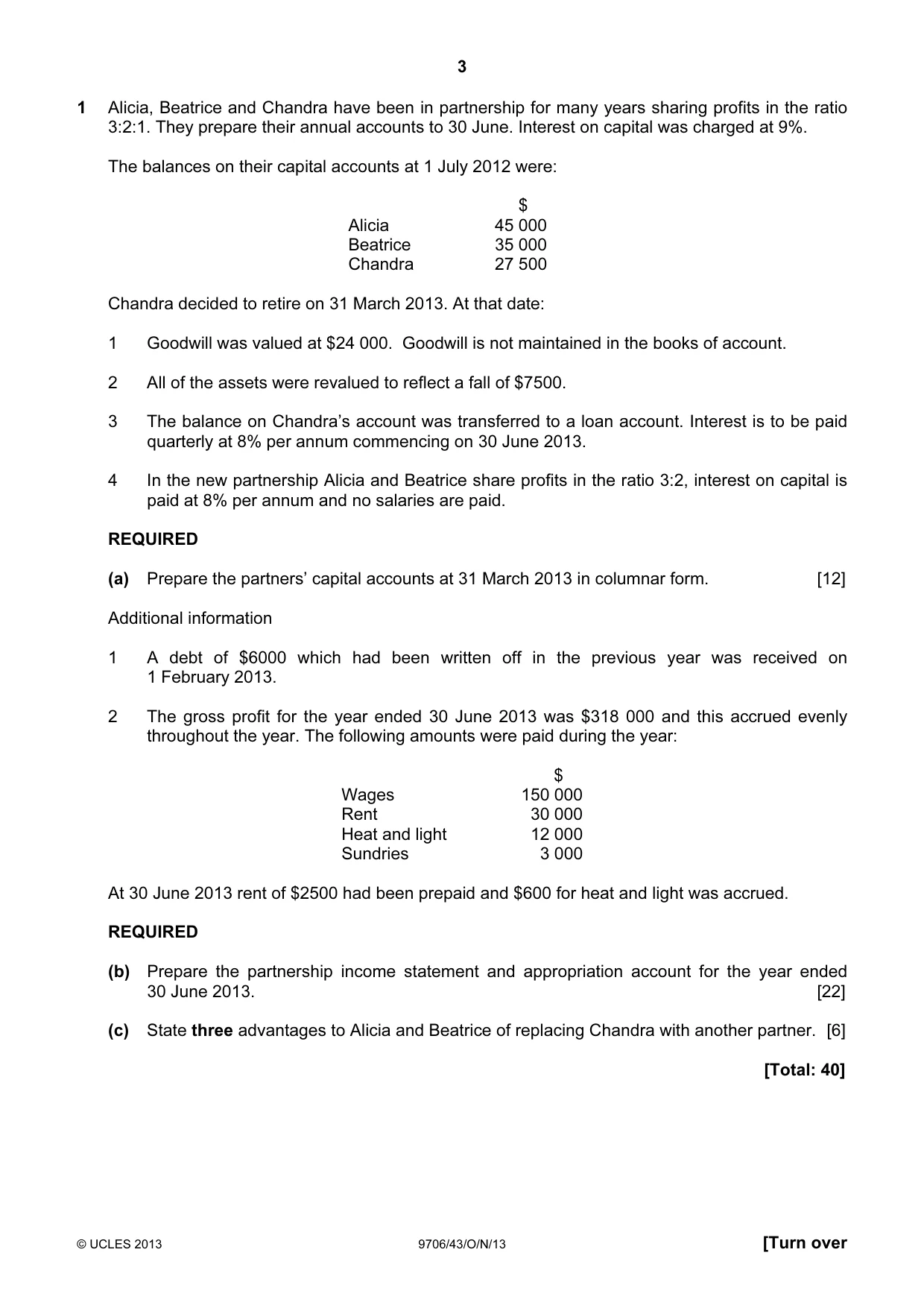
3 © UCLES 2013 9706/43/O/N/13 [Turn over 1 Alicia, Beatrice and Chandra have been in partnership for many years sharing profits in the ratio 3:2:1. They prepare their annual accounts to 30 June. Interest on capital was charged at 9%. The balances on their capital accounts at 1 July 2012 were: $ Alicia 45 000 Beatrice 35 000 Chandra 27 500 Chandra decided to retire on 31 March 2013. At that date: 1 Goodwill was valued at $24 000. Goodwill is not maintained in the books of account. 2 All of the assets were revalued to reflect a fall of $7500. 3 The balance on Chandra’s account was transferred to a loan account. Interest is to be paid quarterly at 8% per annum commencing on 30 June 2013. 4 In the new partnership Alicia and Beatrice share profits in the ratio 3:2, interest on capital is paid at 8% per annum and no salaries are paid. REQUIRED (a) Prepare the partners’ capital accounts at 31 March 2013 in columnar form. [12] Additional information 1 A debt of $6000 which had been written off in the previous year was received on 1 February 2013. 2 The gross profit for the year ended 30 June 2013 was $318 000 and this accrued evenly throughout the year. The following amounts were paid during the year: $ Wages 150 000 Rent 30 000 Heat and light 12 000 Sundries 3 000 At 30 June 2013 rent of $2500 had been prepaid and $600 for heat and light was accrued. REQUIRED (b) Prepare the partnership income statement and appropriation account for the year ended 30 June 2013. [22] (c) State three advantages to Alicia and Beatrice of replacing Chandra with another partner. [6] [Total: 40]
Question paper, page 4
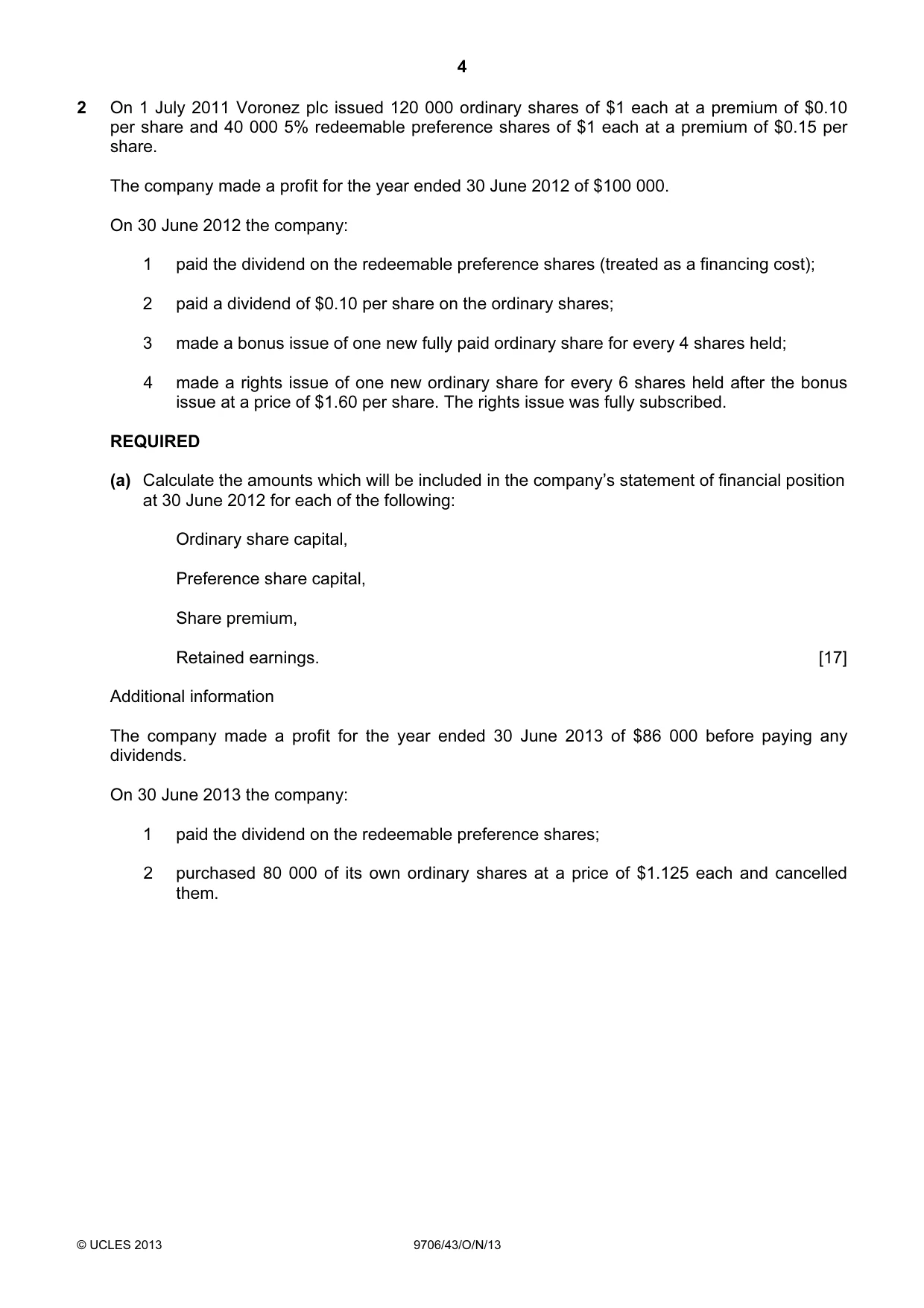
4 © UCLES 2013 9706/43/O/N/13 2 On 1 July 2011 Voronez plc issued 120 000 ordinary shares of $1 each at a premium of $0.10 per share and 40 000 5% redeemable preference shares of $1 each at a premium of $0.15 per share. The company made a profit for the year ended 30 June 2012 of $100 000. On 30 June 2012 the company: 1 paid the dividend on the redeemable preference shares (treated as a financing cost); 2 paid a dividend of $0.10 per share on the ordinary shares; 3 made a bonus issue of one new fully paid ordinary share for every 4 shares held; 4 made a rights issue of one new ordinary share for every 6 shares held after the bonus issue at a price of $1.60 per share. The rights issue was fully subscribed. REQUIRED (a) Calculate the amounts which will be included in the company’s statement of financial position at 30 June 2012 for each of the following: Ordinary share capital, Preference share capital, Share premium, Retained earnings. [17] Additional information The company made a profit for the year ended 30 June 2013 of $86 000 before paying any dividends. On 30 June 2013 the company: 1 paid the dividend on the redeemable preference shares; 2 purchased 80 000 of its own ordinary shares at a price of $1.125 each and cancelled them.
Question paper, page 5
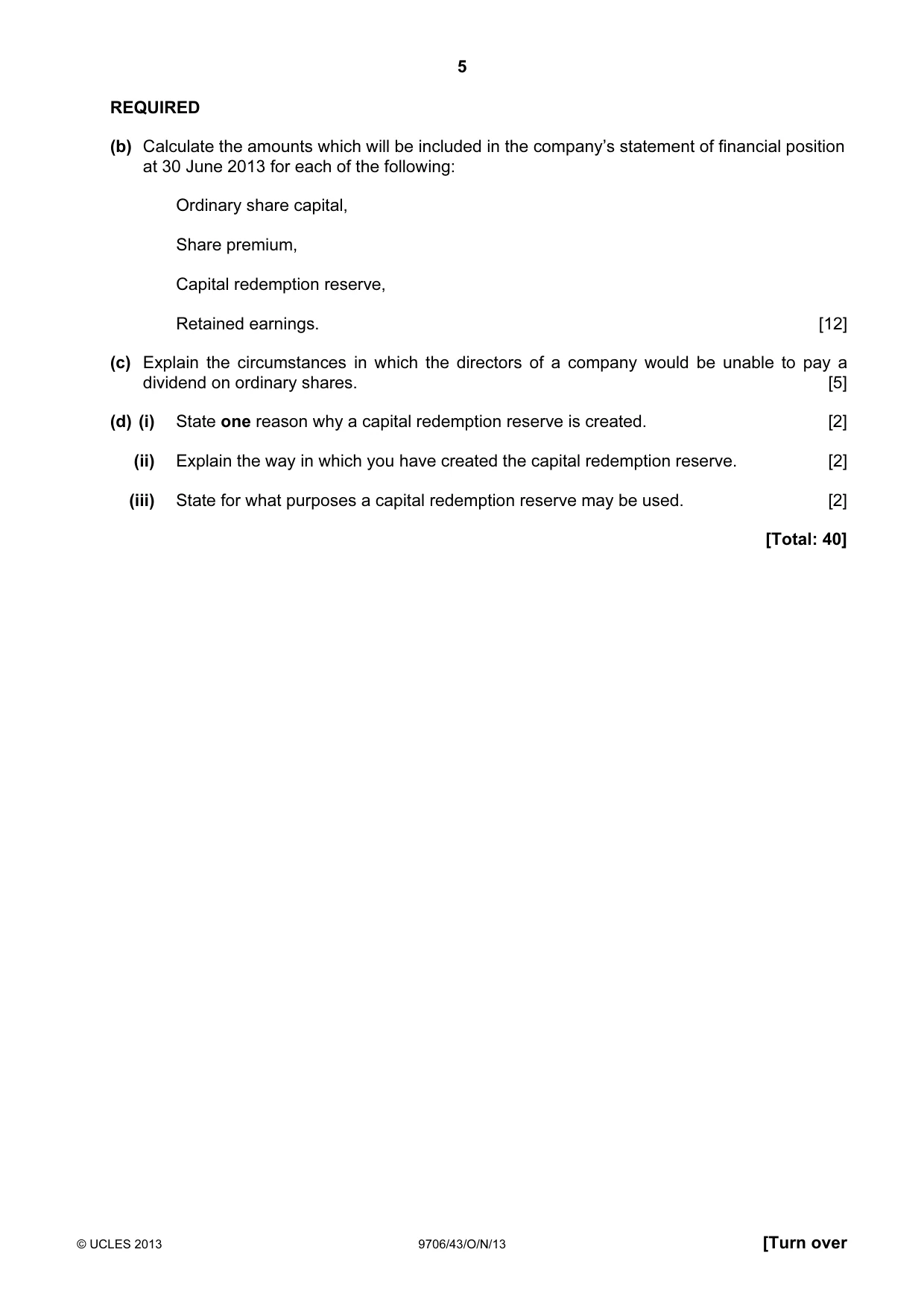
5 © UCLES 2013 9706/43/O/N/13 [Turn over REQUIRED (b) Calculate the amounts which will be included in the company’s statement of financial position at 30 June 2013 for each of the following: Ordinary share capital, Share premium, Capital redemption reserve, Retained earnings. [12] (c) Explain the circumstances in which the directors of a company would be unable to pay a dividend on ordinary shares. [5] (d) (i) State one reason why a capital redemption reserve is created. [2] (ii) Explain the way in which you have created the capital redemption reserve. [2] (iii) State for what purposes a capital redemption reserve may be used. [2] [Total: 40]
Question paper, page 6
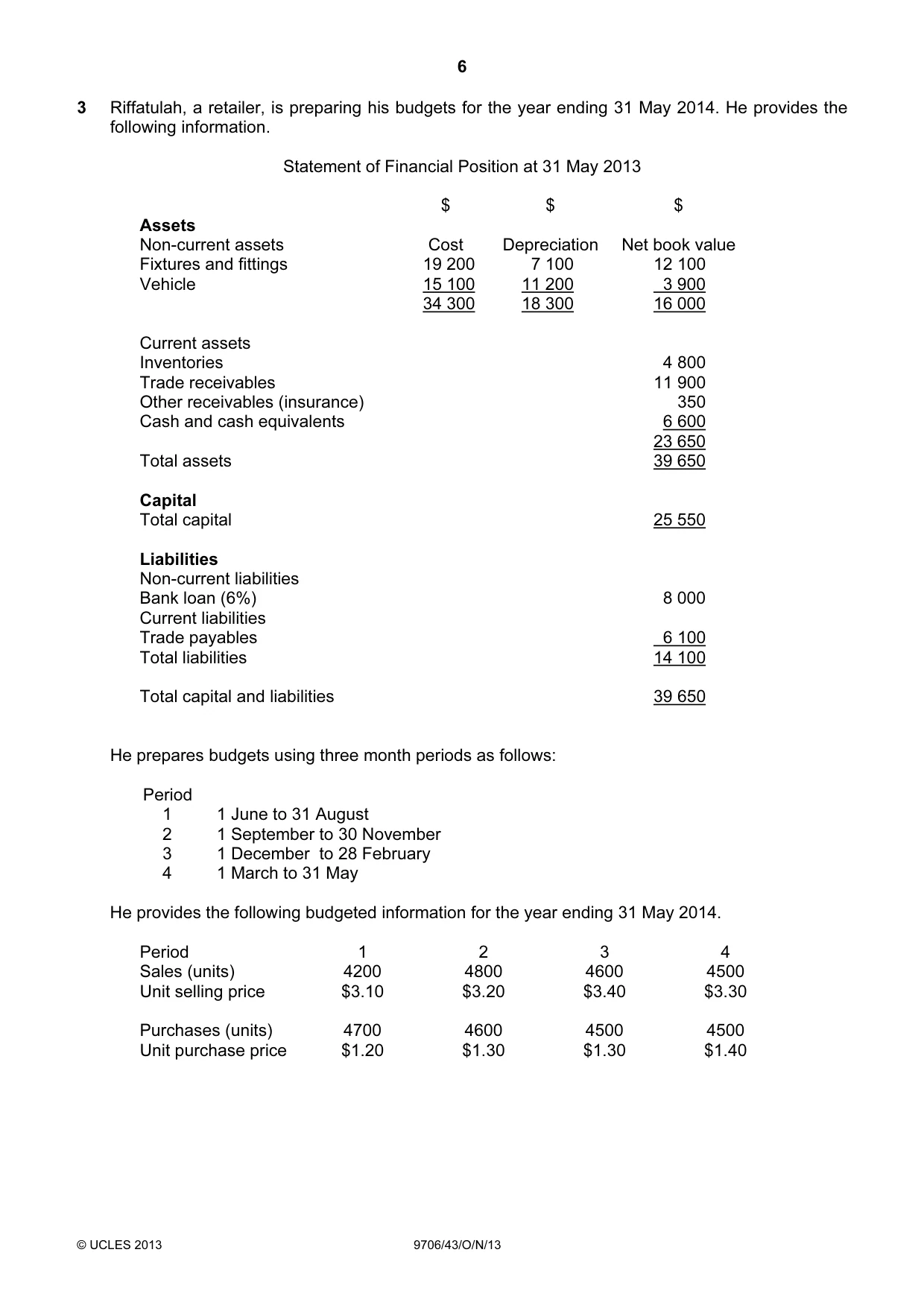
6 © UCLES 2013 9706/43/O/N/13 3 Riffatulah, a retailer, is preparing his budgets for the year ending 31 May 2014. He provides the following information. Statement of Financial Position at 31 May 2013 $ $ $ Assets Non-current assets Cost Depreciation Net book value Fixtures and fittings 19 200 7 100 12 100 Vehicle 15 100 11 200 3 900 34 300 18 300 16 000 Current assets Inventories 4 800 Trade receivables 11 900 Other receivables (insurance) 350 Cash and cash equivalents 6 600 23 650 Total assets 39 650 Capital Total capital 25 550 Liabilities Non-current liabilities Bank loan (6%) 8 000 Current liabilities Trade payables 6 100 Total liabilities 14 100 Total capital and liabilities 39 650 He prepares budgets using three month periods as follows: Period 1 1 June to 31 August 2 1 September to 30 November 3 1 December to 28 February 4 1 March to 31 May He provides the following budgeted information for the year ending 31 May 2014. Period 1 2 3 4 Sales (units) 4200 4800 4600 4500 Unit selling price $3.10 $3.20 $3.40 $3.30 Purchases (units) 4700 4600 4500 4500 Unit purchase price $1.20 $1.30 $1.30 $1.40
Question paper, page 7
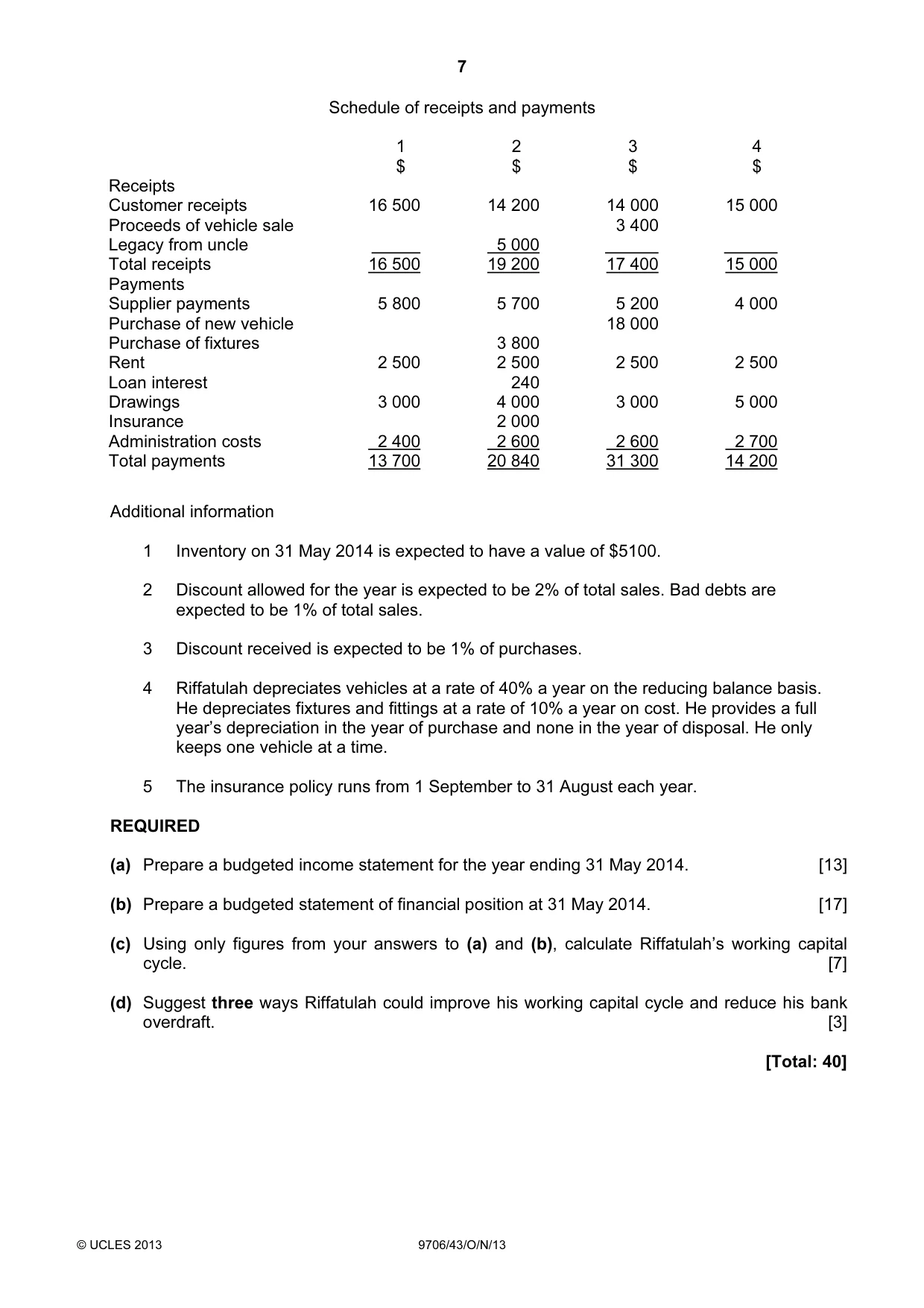
7 © UCLES 2013 9706/43/O/N/13 Schedule of receipts and payments 1 2 3 4 $ $ $ $ Receipts Customer receipts 16 500 14 200 14 000 15 000 Proceeds of vehicle sale 3 400 Legacy from uncle 5 000 Total receipts 16 500 19 200 17 400 15 000 Payments Supplier payments 5 800 5 700 5 200 4 000 Purchase of new vehicle 18 000 Purchase of fixtures 3 800 Rent 2 500 2 500 2 500 2 500 Loan interest 240 Drawings 3 000 4 000 3 000 5 000 Insurance 2 000 Administration costs 2 400 2 600 2 600 2 700 Total payments 13 700 20 840 31 300 14 200 Additional information 1 Inventory on 31 May 2014 is expected to have a value of $5100. 2 Discount allowed for the year is expected to be 2% of total sales. Bad debts are expected to be 1% of total sales. 3 Discount received is expected to be 1% of purchases. 4 Riffatulah depreciates vehicles at a rate of 40% a year on the reducing balance basis. He depreciates fixtures and fittings at a rate of 10% a year on cost. He provides a full year’s depreciation in the year of purchase and none in the year of disposal. He only keeps one vehicle at a time. 5 The insurance policy runs from 1 September to 31 August each year. REQUIRED (a) Prepare a budgeted income statement for the year ending 31 May 2014. [13] (b) Prepare a budgeted statement of financial position at 31 May 2014. [17] (c) Using only figures from your answers to (a) and (b), calculate Riffatulah’s working capital cycle. [7] (d) Suggest three ways Riffatulah could improve his working capital cycle and reduce his bank overdraft. [3] [Total: 40]
Question paper, page 8
8 Permission to reproduce items where third-party owned material protected by copyright is included has been sought and cleared where possible. Every reasonable effort has been made by the publisher (UCLES) to trace copyright holders, but if any items requiring clearance have unwittingly been included, the publisher will be pleased to make amends at the earliest possible opportunity. University of Cambridge International Examinations is part of the Cambridge Assessment Group. Cambridge Assessment is the brand name of University of Cambridge Local Examinations Syndicate (UCLES), which is itself a department of the University of Cambridge. © UCLES 2013 9706/43/O/N/13 BLANK PAGE
Mark scheme, page 1
CAMBRIDGE INTERNATIONAL EXAMINATIONS GCE Advanced Level MARK SCHEME for the October/November 2013 series 9706 ACCOUNTING 9706/43 Paper 4 (Problem Solving – Supplement), maximum raw mark 120 This mark scheme is published as an aid to teachers and candidates, to indicate the requirements of the examination. It shows the basis on which Examiners were instructed to award marks. It does not indicate the details of the discussions that took place at an Examiners’ meeting before marking began, which would have considered the acceptability of alternative answers. Mark schemes should be read in conjunction with the question paper and the Principal Examiner Report for Teachers. Cambridge will not enter into discussions about these mark schemes. Cambridge is publishing the mark schemes for the October/November 2013 series for most IGCSE, GCE Advanced Level and Advanced Subsidiary Level components and some Ordinary Level components.
Mark scheme, page 2
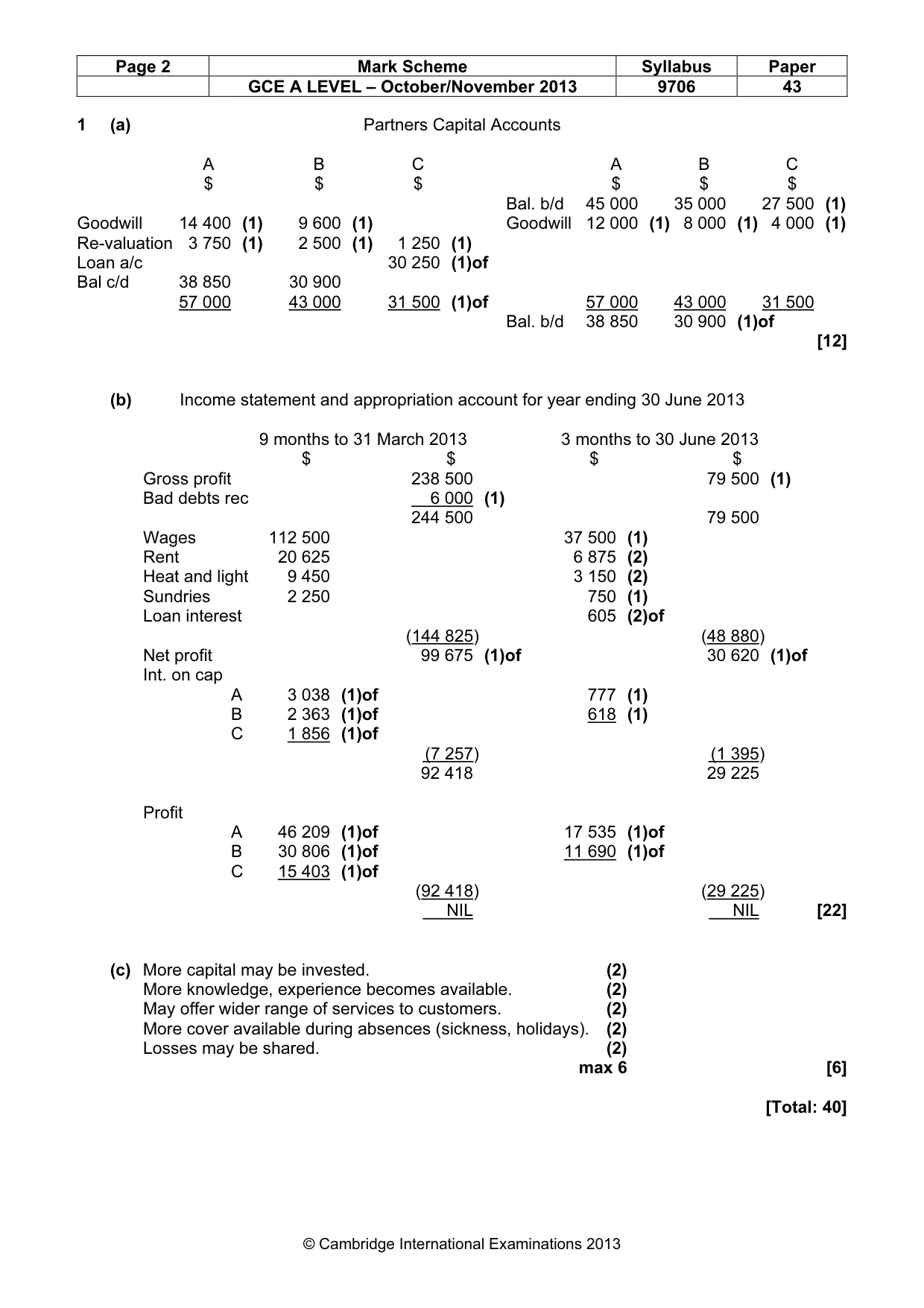
Page 2 Mark Scheme Syllabus Paper GCE A LEVEL – October/November 2013 9706 43 © Cambridge International Examinations 2013 1 (a) Partners Capital Accounts A B C A B C $ $ $ $ $ $ Bal. b/d 45 000 35 000 27 500 (1) Goodwill 14 400 (1) 9 600 (1) Goodwill 12 000 (1) 8 000 (1) 4 000 (1) Re-valuation 3 750 (1) 2 500 (1) 1 250 (1) Loan a/c 30 250 (1)of Bal c/d 38 850 30 900 57 000 43 000 31 500 (1)of 57 000 43 000 31 500 Bal. b/d 38 850 30 900 (1)of [12] (b) Income statement and appropriation account for year ending 30 June 2013 9 months to 31 March 2013 3 months to 30 June 2013 $ $ $ $ Gross profit 238 500 79 500 (1) Bad debts rec 6 000 (1) 244 500 79 500 Wages 112 500 37 500 (1) Rent 20 625 6 875 (2) Heat and light 9 450 3 150 (2) Sundries 2 250 750 (1) Loan interest 605 (2)of (144 825) (48 880) Net profit 99 675 (1)of 30 620 (1)of Int. on cap A 3 038 (1)of 777 (1) B 2 363 (1)of 618 (1) C 1 856 (1)of (7 257) (1 395) 92 418 29 225 Profit A 46 209 (1)of 17 535 (1)of B 30 806 (1)of 11 690 (1)of C 15 403 (1)of (92 418) (29 225) NIL NIL [22] (c) More capital may be invested. (2) More knowledge, experience becomes available. (2) May offer wider range of services to customers. (2) More cover available during absences (sickness, holidays). (2) Losses may be shared. (2) max 6 [6] [Total: 40]
Mark scheme, page 3
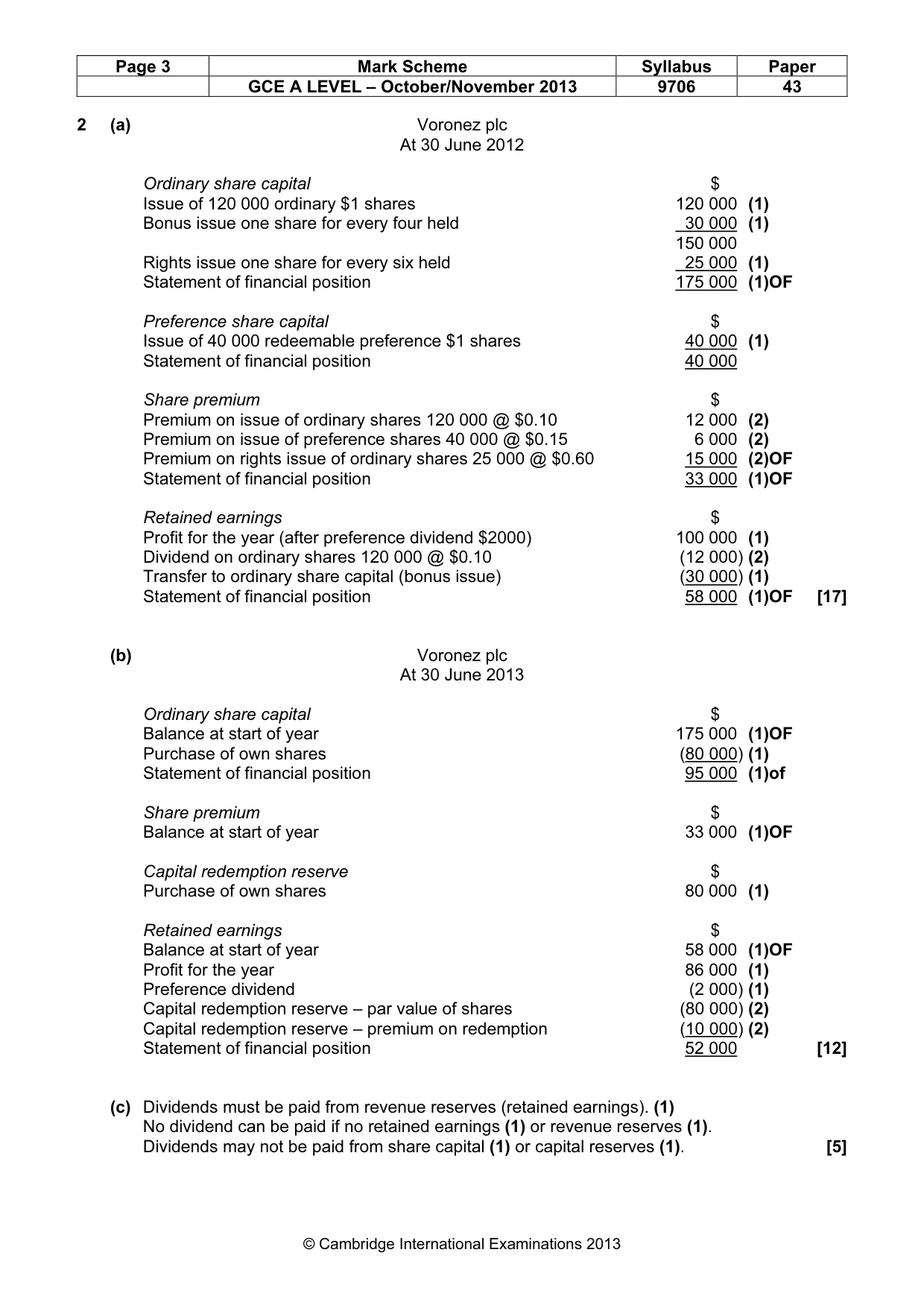
Page 3 Mark Scheme Syllabus Paper GCE A LEVEL – October/November 2013 9706 43 © Cambridge International Examinations 2013 2 (a) Voronez plc At 30 June 2012 Ordinary share capital $ Issue of 120 000 ordinary $1 shares 120 000 (1) Bonus issue one share for every four held 30 000 (1) 150 000 Rights issue one share for every six held 25 000 (1) Statement of financial position 175 000 (1)OF Preference share capital $ Issue of 40 000 redeemable preference $1 shares 40 000 (1) Statement of financial position 40 000 Share premium $ Premium on issue of ordinary shares 120 000 @ $0.10 12 000 (2) Premium on issue of preference shares 40 000 @ $0.15 6 000 (2) Premium on rights issue of ordinary shares 25 000 @ $0.60 15 000 (2)OF Statement of financial position 33 000 (1)OF Retained earnings $ Profit for the year (after preference dividend $2000) 100 000 (1) Dividend on ordinary shares 120 000 @ $0.10 (12 000) (2) Transfer to ordinary share capital (bonus issue) (30 000) (1) Statement of financial position 58 000 (1)OF [17] (b) Voronez plc At 30 June 2013 Ordinary share capital $ Balance at start of year 175 000 (1)OF Purchase of own shares (80 000) (1) Statement of financial position 95 000 (1)of Share premium $ Balance at start of year 33 000 (1)OF Capital redemption reserve $ Purchase of own shares 80 000 (1) Retained earnings $ Balance at start of year 58 000 (1)OF Profit for the year 86 000 (1) Preference dividend (2 000) (1) Capital redemption reserve – par value of shares (80 000) (2) Capital redemption reserve – premium on redemption (10 000) (2) Statement of financial position 52 000 [12] (c) Dividends must be paid from revenue reserves (retained earnings). (1) No dividend can be paid if no retained earnings (1) or revenue reserves (1). Dividends may not be paid from share capital (1) or capital reserves (1). [5]
Mark scheme, page 4
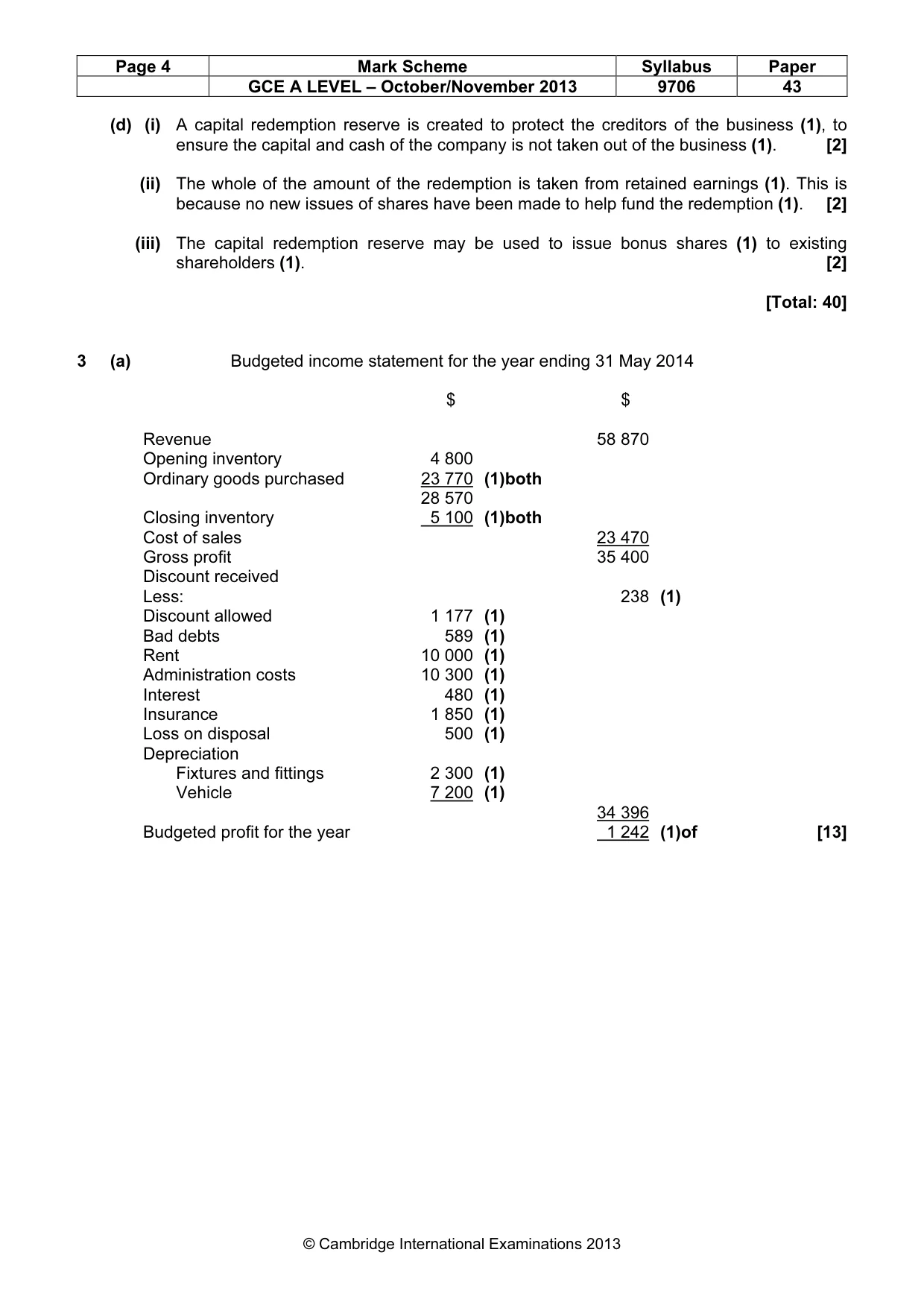
Page 4 Mark Scheme Syllabus Paper GCE A LEVEL – October/November 2013 9706 43 © Cambridge International Examinations 2013 (d) (i) A capital redemption reserve is created to protect the creditors of the business (1), to ensure the capital and cash of the company is not taken out of the business (1). [2] (ii) The whole of the amount of the redemption is taken from retained earnings (1). This is because no new issues of shares have been made to help fund the redemption (1). [2] (iii) The capital redemption reserve may be used to issue bonus shares (1) to existing shareholders (1). [2] [Total: 40] 3 (a) Budgeted income statement for the year ending 31 May 2014 $ $ Revenue 58 870 Opening inventory 4 800 Ordinary goods purchased 23 770 (1)both 28 570 Closing inventory 5 100 (1)both Cost of sales 23 470 Gross profit 35 400 Discount received Less: 238 (1) Discount allowed 1 177 (1) Bad debts 589 (1) Rent 10 000 (1) Administration costs 10 300 (1) Interest 480 (1) Insurance 1 850 (1) Loss on disposal 500 (1) Depreciation Fixtures and fittings 2 300 (1) Vehicle 7 200 (1) 34 396 Budgeted profit for the year 1 242 (1)of [13]
Mark scheme, page 5
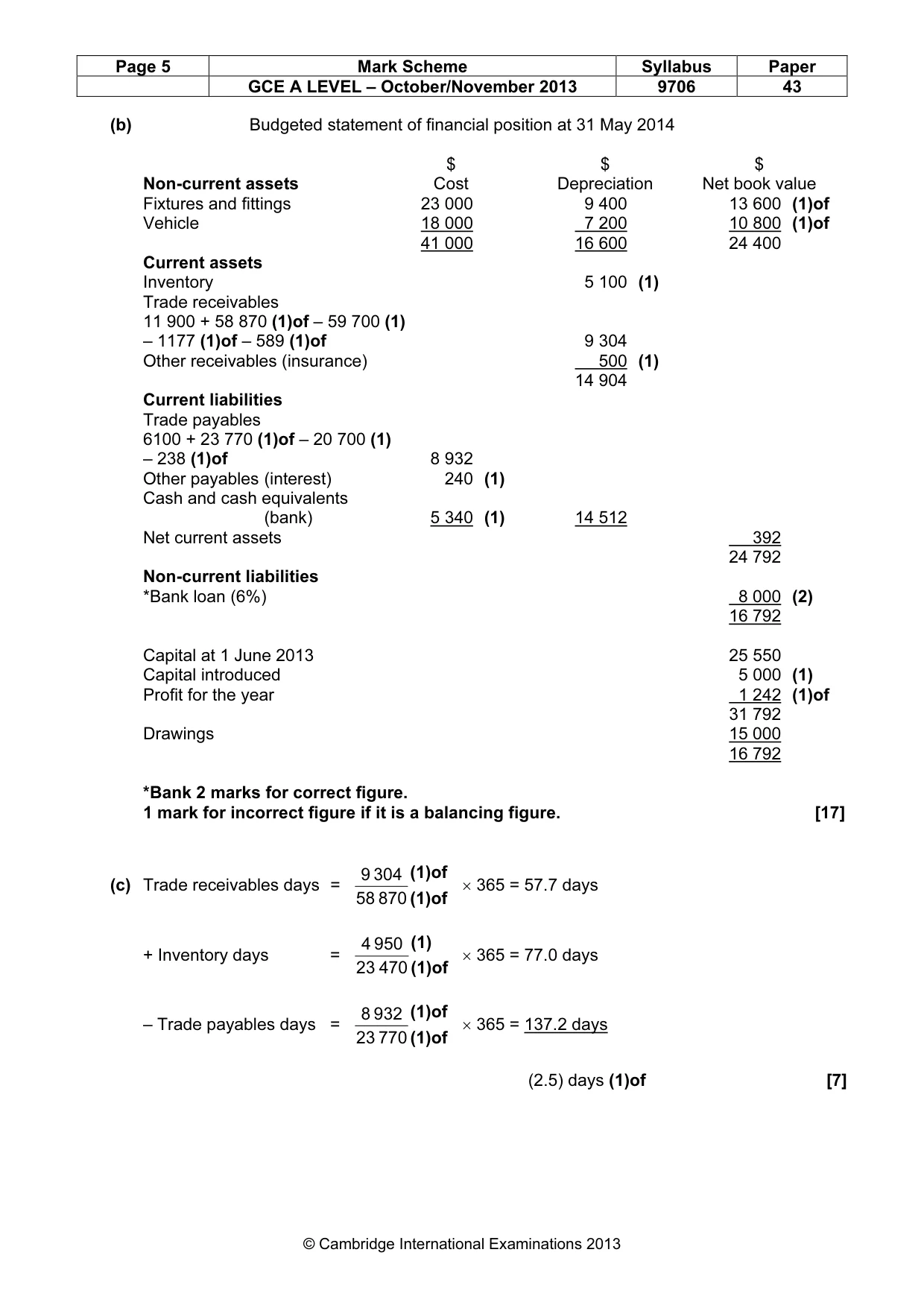
Page 5 Mark Scheme Syllabus Paper GCE A LEVEL – October/November 2013 9706 43 © Cambridge International Examinations 2013 (b) Budgeted statement of financial position at 31 May 2014 $ $ $ Non-current assets Cost Depreciation Net book value Fixtures and fittings 23 000 9 400 13 600 (1)of Vehicle 18 000 7 200 10 800 (1)of 41 000 16 600 24 400 Current assets Inventory 5 100 (1) Trade receivables 11 900 + 58 870 (1)of – 59 700 (1) – 1177 (1)of – 589 (1)of 9 304 Other receivables (insurance) 500 (1) 14 904 Current liabilities Trade payables 6100 + 23 770 (1)of – 20 700 (1) – 238 (1)of 8 932 Other payables (interest) 240 (1) Cash and cash equivalents (bank) 5 340 (1) 14 512 Net current assets 392 24 792 Non-current liabilities *Bank loan (6%) 8 000 (2) 16 792 Capital at 1 June 2013 25 550 Capital introduced 5 000 (1) Profit for the year 1 242 (1)of 31 792 Drawings 15 000 16 792 *Bank 2 marks for correct figure. 1 mark for incorrect figure if it is a balancing figure. [17] (c) Trade receivables days = (1)of (1)of 870 58 304 9 × 365 = 57.7 days + Inventory days = (1)of (1) 470 23 950 4 × 365 = 77.0 days – Trade payables days = (1)of (1)of 770 23 932 8 × 365 = 137.2 days (2.5) days (1)of [7]
Mark scheme, page 6
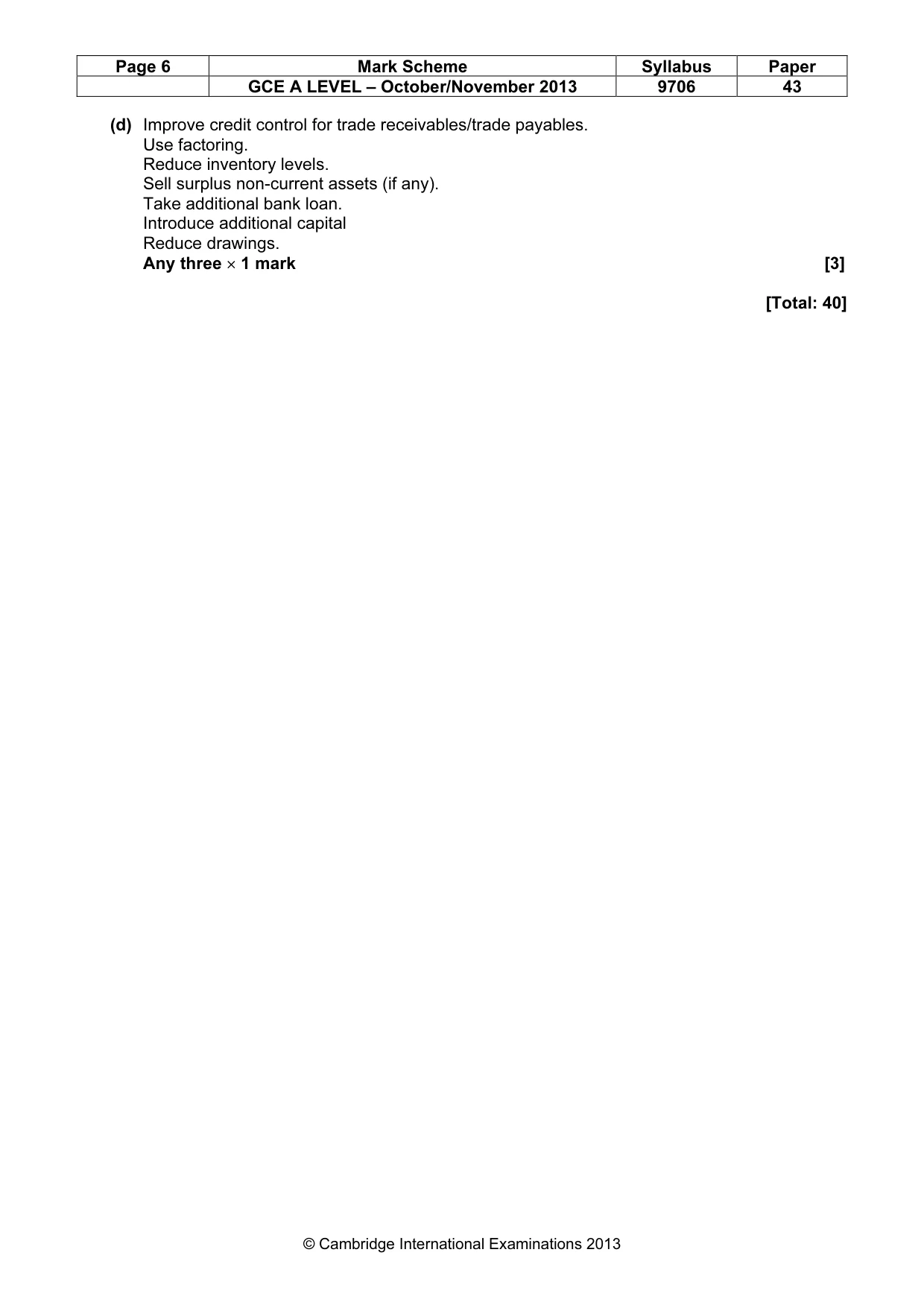
Page 6 Mark Scheme Syllabus Paper GCE A LEVEL – October/November 2013 9706 43 © Cambridge International Examinations 2013 (d) Improve credit control for trade receivables/trade payables. Use factoring. Reduce inventory levels. Sell surplus non-current assets (if any). Take additional bank loan. Introduce additional capital Reduce drawings. Any three × 1 mark [3] [Total: 40]
What you needed in this session
Cambridge’s own grade thresholds for 2013 Oct/Nov, Paper 4 · Variant 3. A higher threshold means an easier paper — the bar moves with how the cohort did.