Cambridge A Level Accounting 9706 — 2013 Oct/Nov Paper 2 · Variant 2
9706/22/O/N/13 · 90 marks · ≈101 min
The question paper and its mark scheme, free to read here and free to download. This is Cambridge’s own paper, exactly as it was sat.
Question paper12 pages

Mark scheme5 pages
Answers below. Sit the paper first if you are practising.
Paper as text
Question paper, page 1
This document consists of 10 printed pages and 2 blank pages. IB13 11_9706_22/4RP © UCLES 2013 [Turn over *0271924287* UNIVERSITY OF CAMBRIDGE INTERNATIONAL EXAMINATIONS General Certificate of Education Advanced Subsidiary Level and Advanced Level ACCOUNTING 9706/22 Paper 2 Structured Questions October/November 2013 1 hour 30 minutes Candidates answer on the Question Paper. No Additional Materials are required. READ THESE INSTRUCTIONS FIRST Write your Centre number, candidate number and name on all the work you hand in. Write in dark blue or black pen. You may use a soft pencil for rough working. Do not use staples, paper clips, highlighters, glue or correction fluid. DO NOT WRITE IN ANY BARCODES. Answer all questions. All accounting statements are to be presented in good style. International accounting terms and formats should be used as appropriate. Workings must be shown. You may use a calculator. At the end of the examination, fasten all your work securely together. The number of marks is given in brackets [ ] at the end of each question or part question.
Question paper, page 2
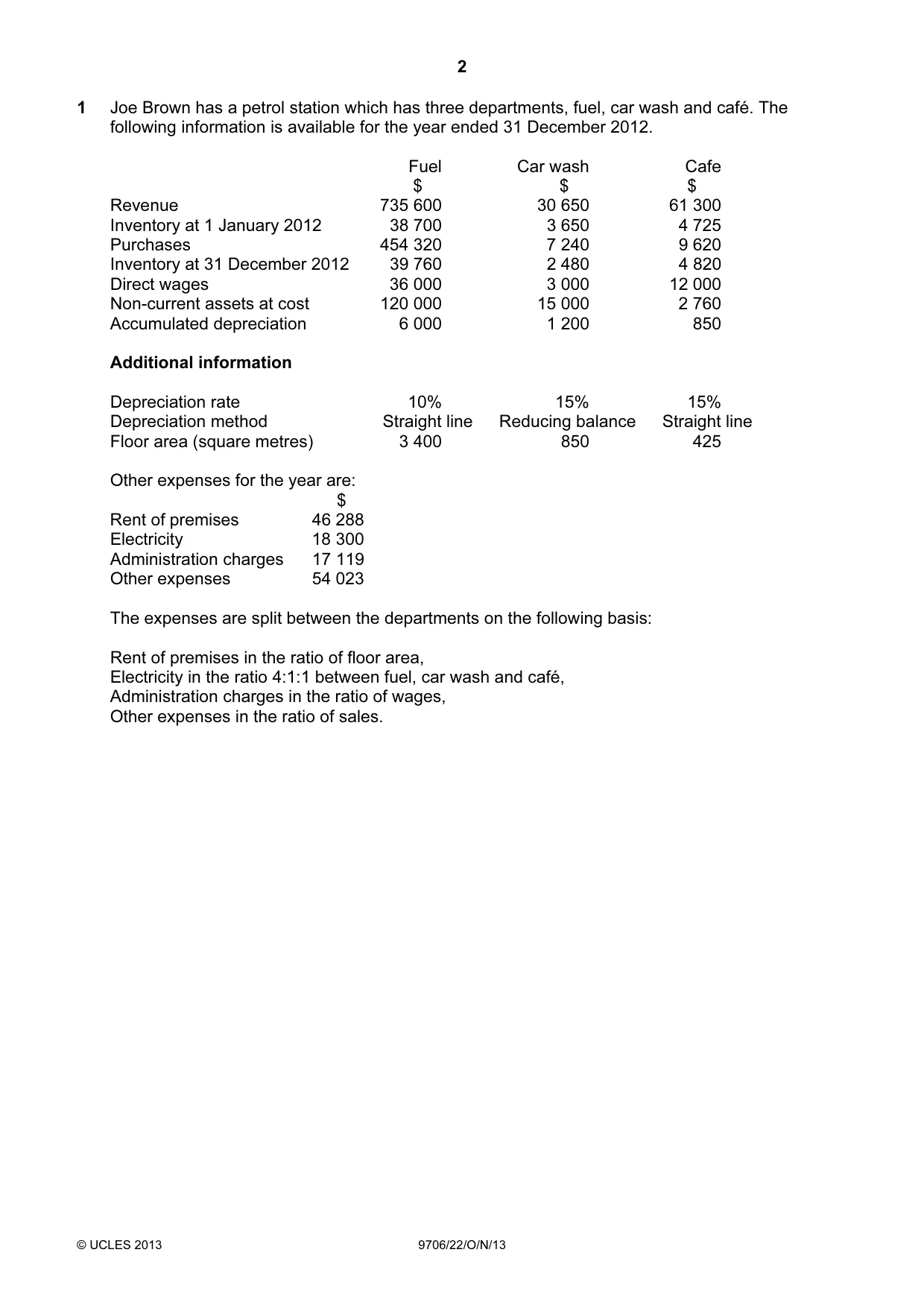
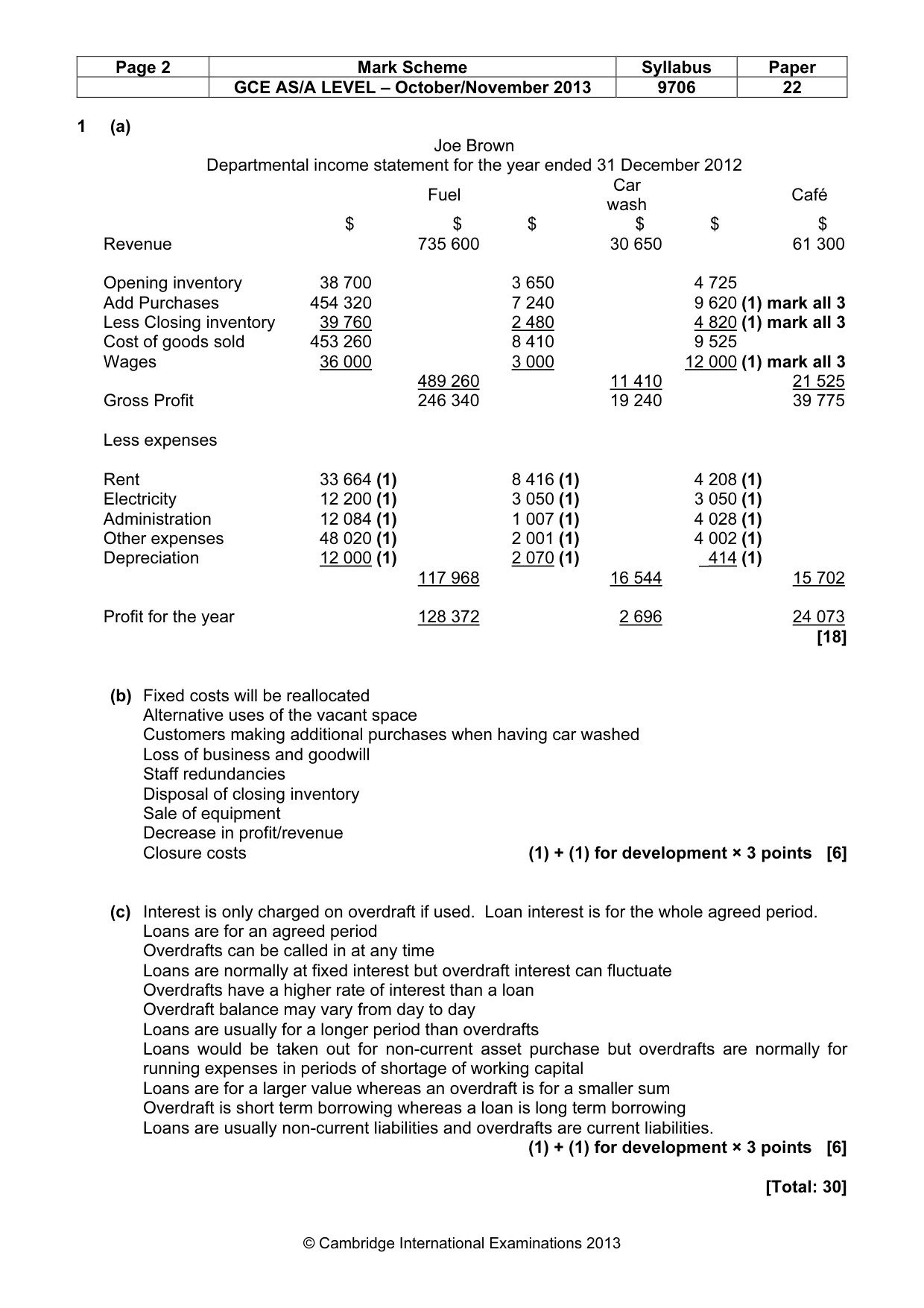
2 © UCLES 2013 9706/22/O/N/13 1 Joe Brown has a petrol station which has three departments, fuel, car wash and café. The following information is available for the year ended 31 December 2012. Fuel Car wash Cafe $ $ $ Revenue 735 600 30 650 61 300 Inventory at 1 January 2012 38 700 3 650 4 725 Purchases 454 320 7 240 9 620 Inventory at 31 December 2012 39 760 2 480 4 820 Direct wages 36 000 3 000 12 000 Non-current assets at cost 120 000 15 000 2 760 Accumulated depreciation 6 000 1 200 850 Additional information Depreciation rate 10% 15% 15% Depreciation method Straight line Reducing balance Straight line Floor area (square metres) 3 400 850 425 Other expenses for the year are: $ Rent of premises 46 288 Electricity 18 300 Administration charges 17 119 Other expenses 54 023 The expenses are split between the departments on the following basis: Rent of premises in the ratio of floor area, Electricity in the ratio 4:1:1 between fuel, car wash and café, Administration charges in the ratio of wages, Other expenses in the ratio of sales.
Question paper, page 3
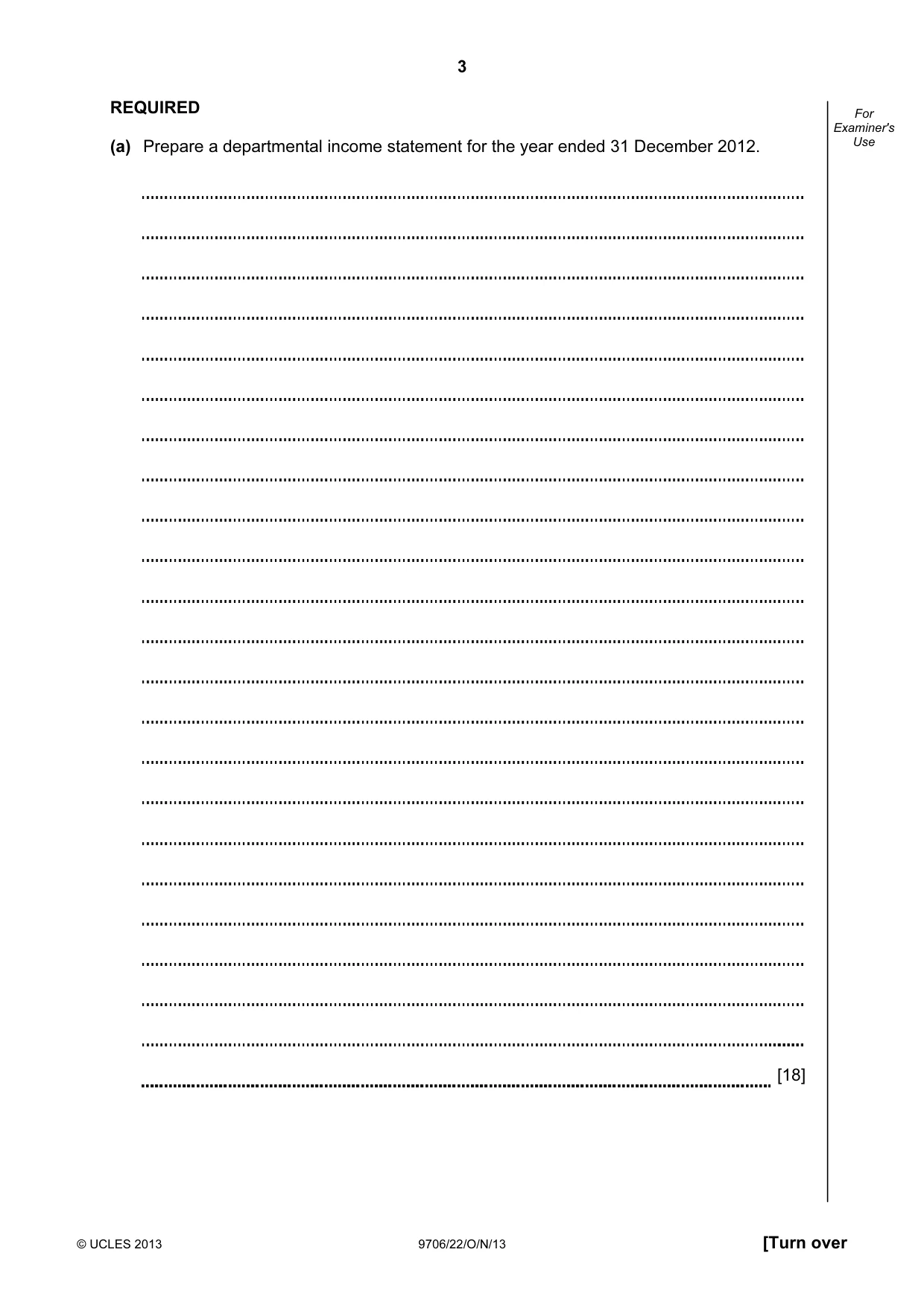
3 © UCLES 2013 9706/22/O/N/13 [Turn over For Examiner's Use REQUIRED (a) Prepare a departmental income statement for the year ended 31 December 2012. [18]
Question paper, page 4
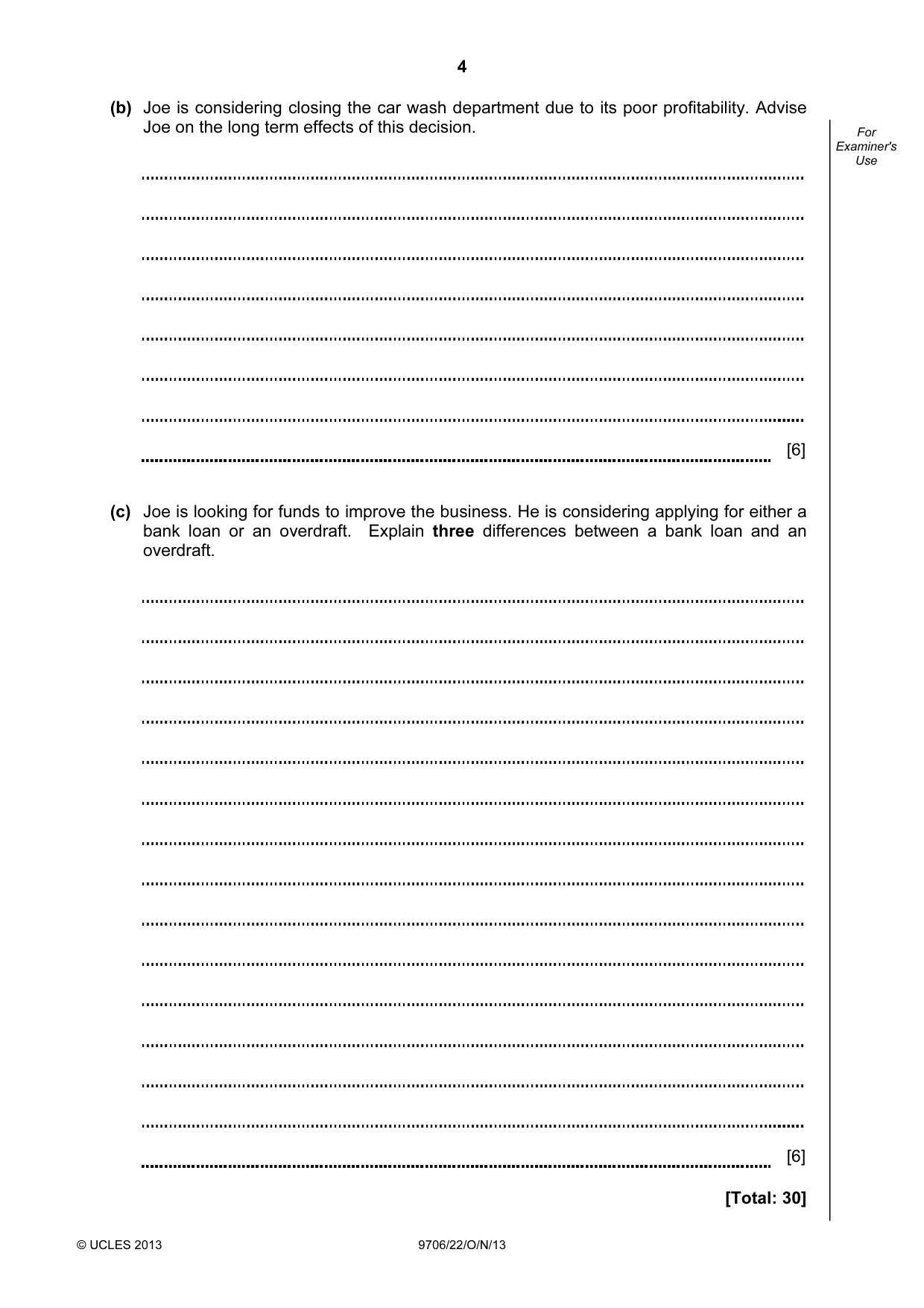
4 © UCLES 2013 9706/22/O/N/13 For Examiner's Use (b) Joe is considering closing the car wash department due to its poor profitability. Advise Joe on the long term effects of this decision. [6] (c) Joe is looking for funds to improve the business. He is considering applying for either a bank loan or an overdraft. Explain three differences between a bank loan and an overdraft. [6] [Total: 30]
Question paper, page 5
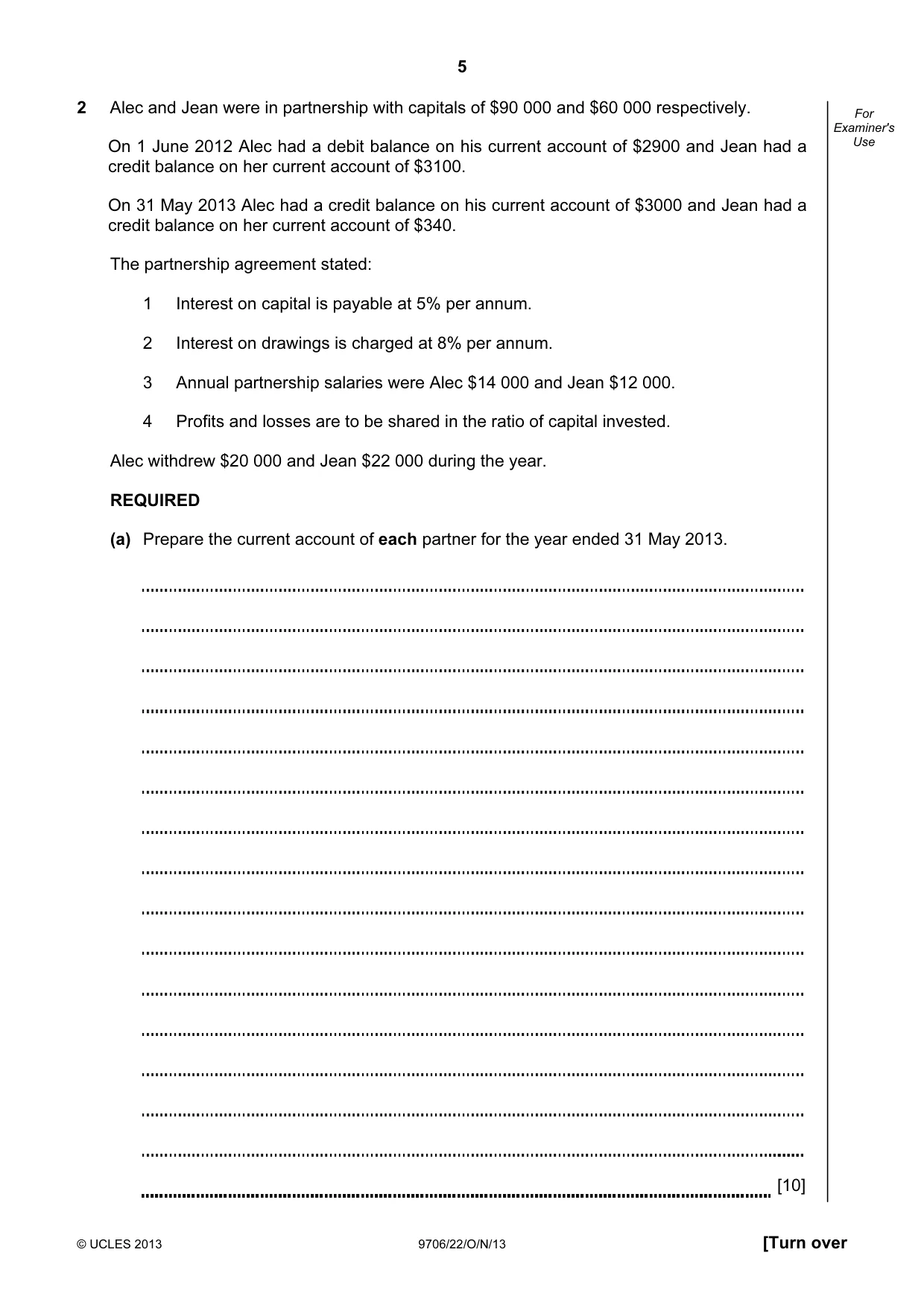
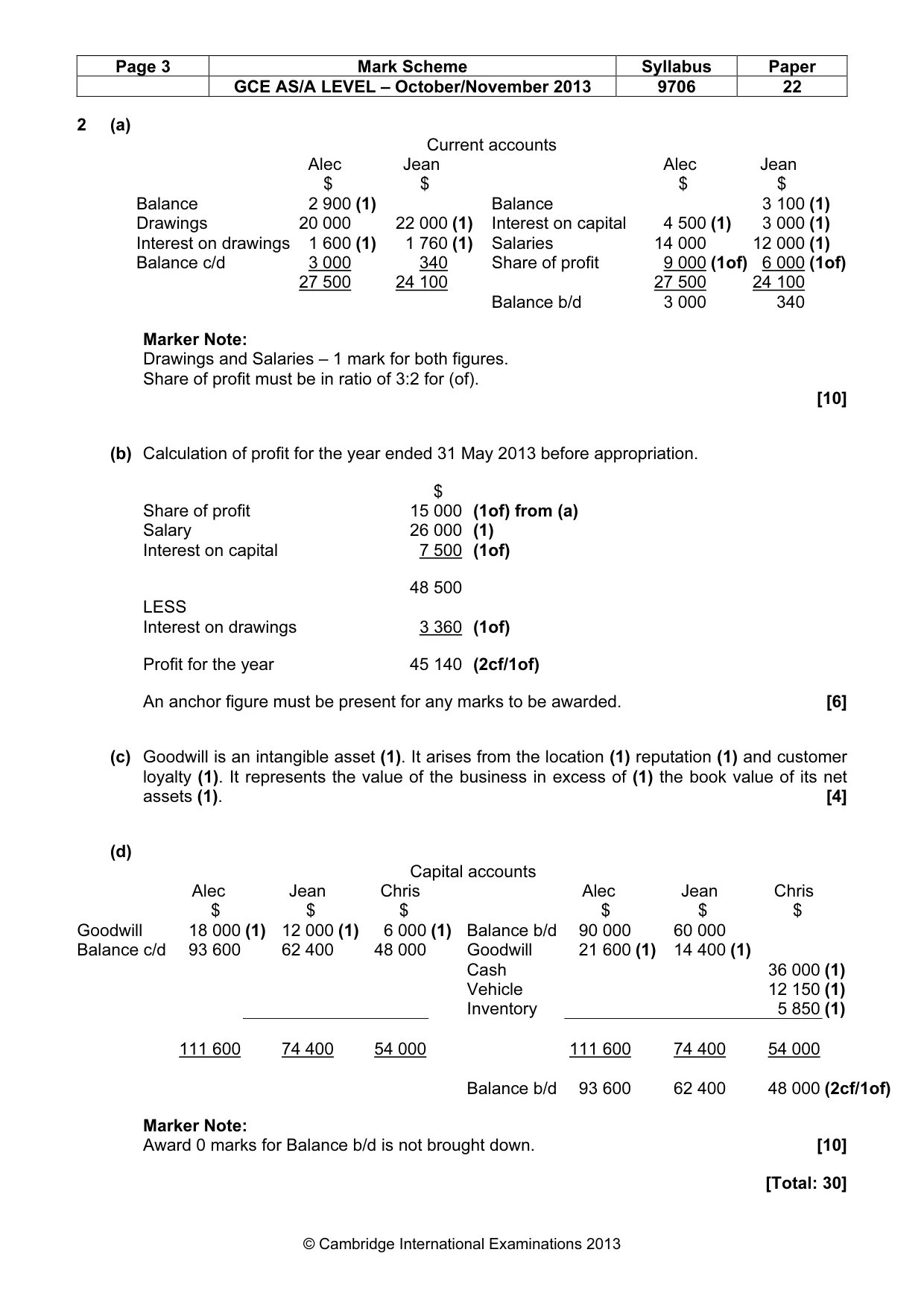
5 © UCLES 2013 9706/22/O/N/13 [Turn over For Examiner's Use 2 Alec and Jean were in partnership with capitals of $90 000 and $60 000 respectively. On 1 June 2012 Alec had a debit balance on his current account of $2900 and Jean had a credit balance on her current account of $3100. On 31 May 2013 Alec had a credit balance on his current account of $3000 and Jean had a credit balance on her current account of $340. The partnership agreement stated: 1 Interest on capital is payable at 5% per annum. 2 Interest on drawings is charged at 8% per annum. 3 Annual partnership salaries were Alec $14 000 and Jean $12 000. 4 Profits and losses are to be shared in the ratio of capital invested. Alec withdrew $20 000 and Jean $22 000 during the year. REQUIRED (a) Prepare the current account of each partner for the year ended 31 May 2013. [10]
Question paper, page 6
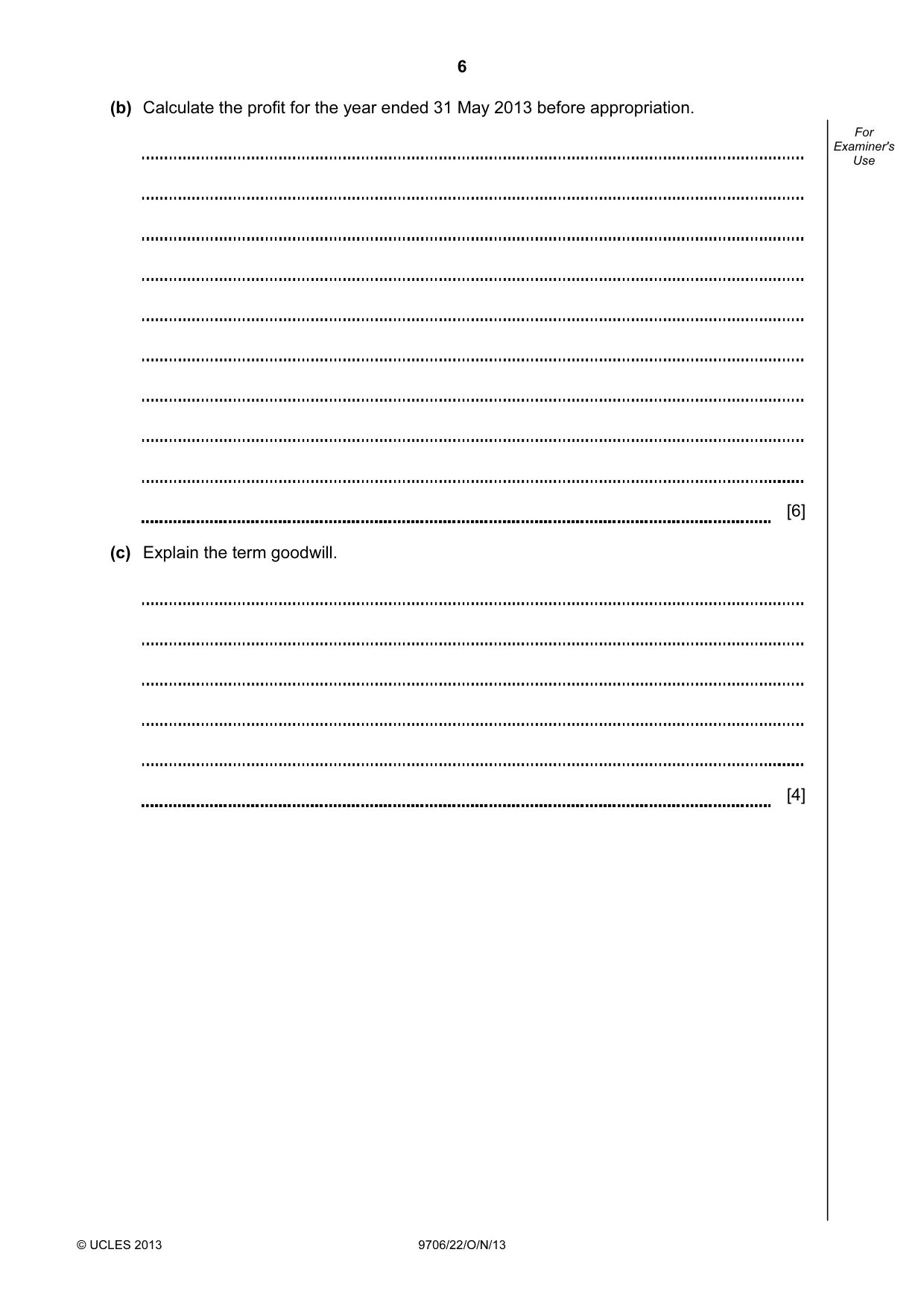
6 © UCLES 2013 9706/22/O/N/13 For Examiner's Use (b) Calculate the profit for the year ended 31 May 2013 before appropriation. [6] (c) Explain the term goodwill. [4]
Question paper, page 7
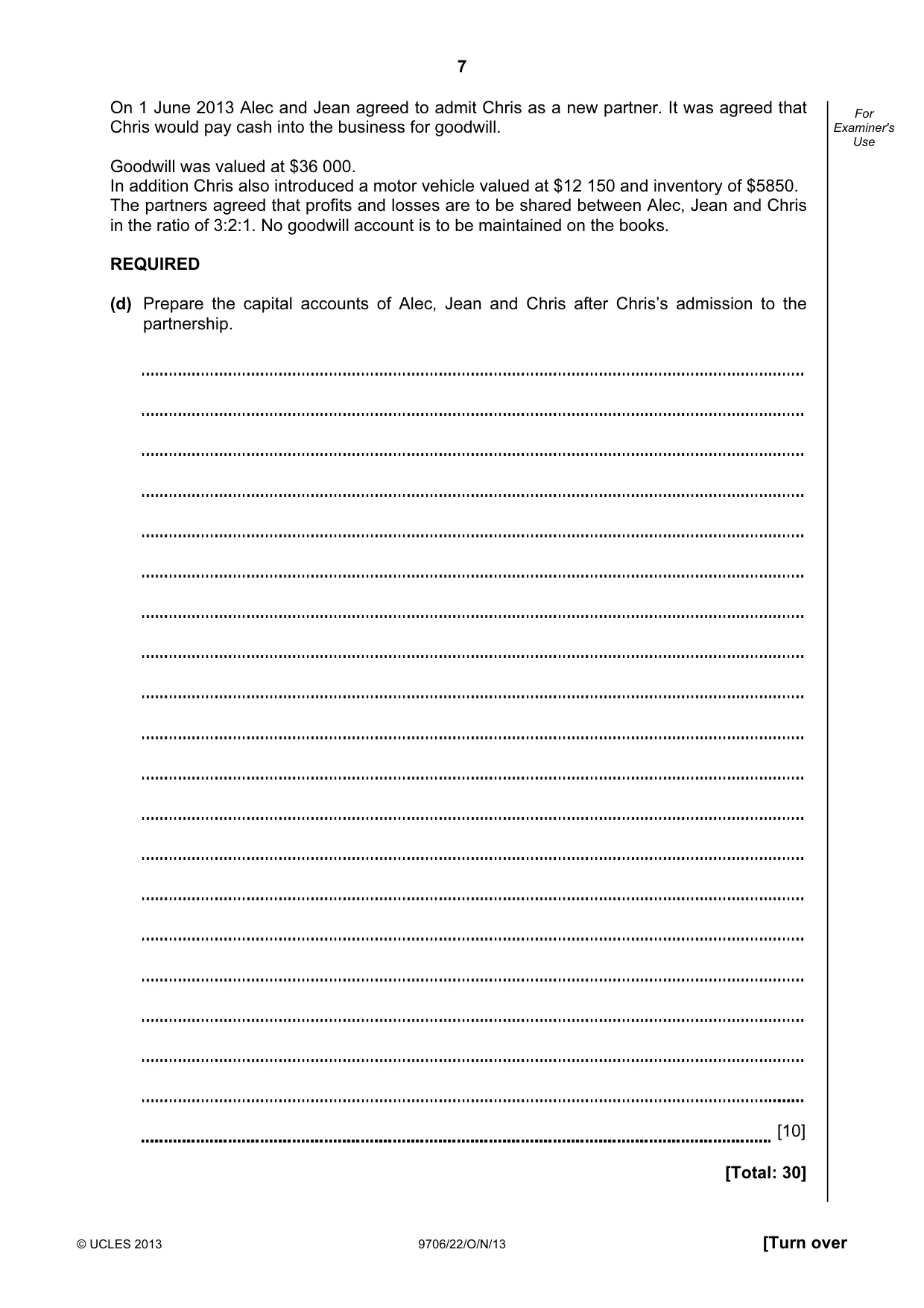
7 © UCLES 2013 9706/22/O/N/13 [Turn over For Examiner's Use On 1 June 2013 Alec and Jean agreed to admit Chris as a new partner. It was agreed that Chris would pay cash into the business for goodwill. Goodwill was valued at $36 000. In addition Chris also introduced a motor vehicle valued at $12 150 and inventory of $5850. The partners agreed that profits and losses are to be shared between Alec, Jean and Chris in the ratio of 3:2:1. No goodwill account is to be maintained on the books. REQUIRED (d) Prepare the capital accounts of Alec, Jean and Chris after Chris’s admission to the partnership. [10] [Total: 30]
Question paper, page 8
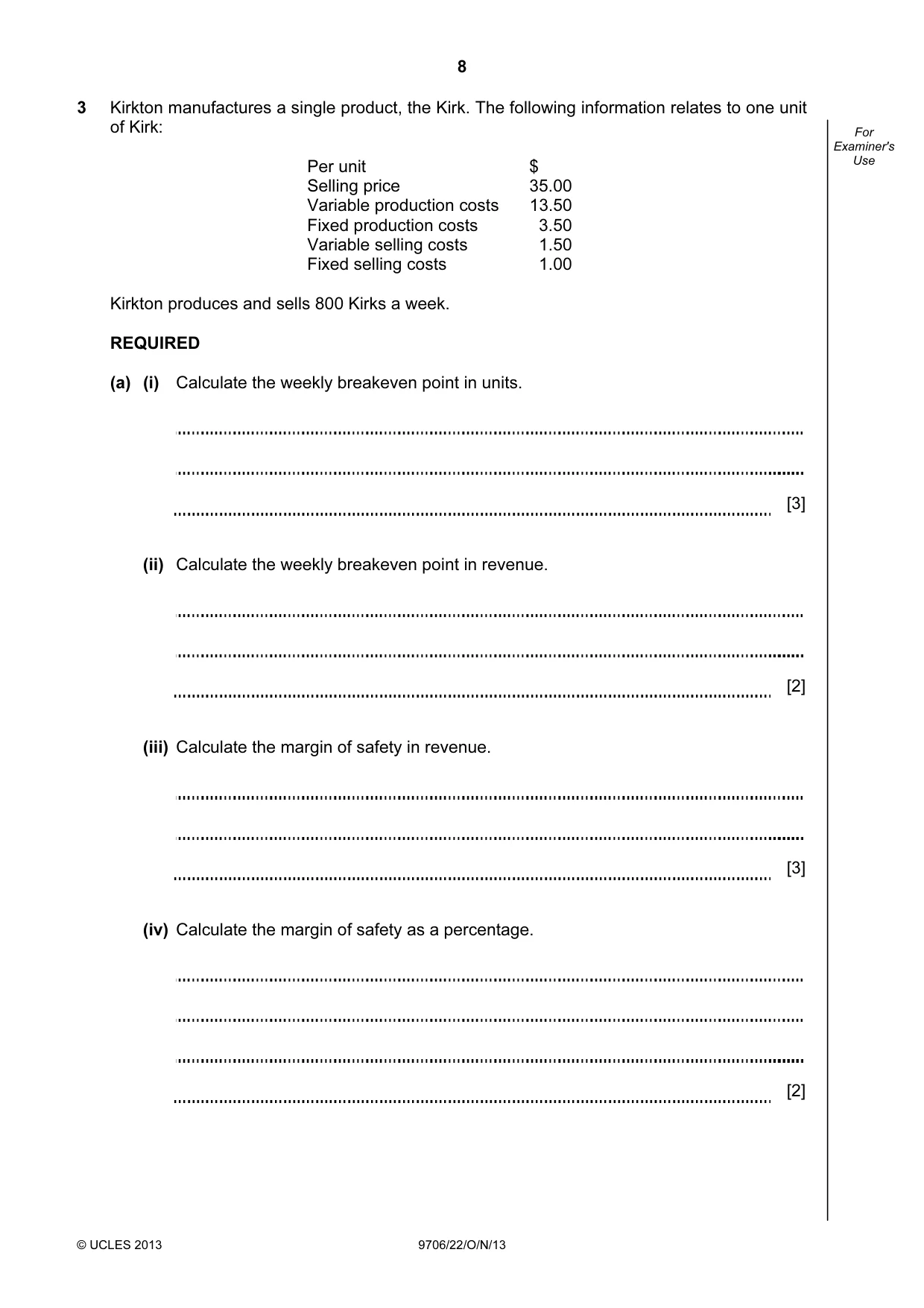
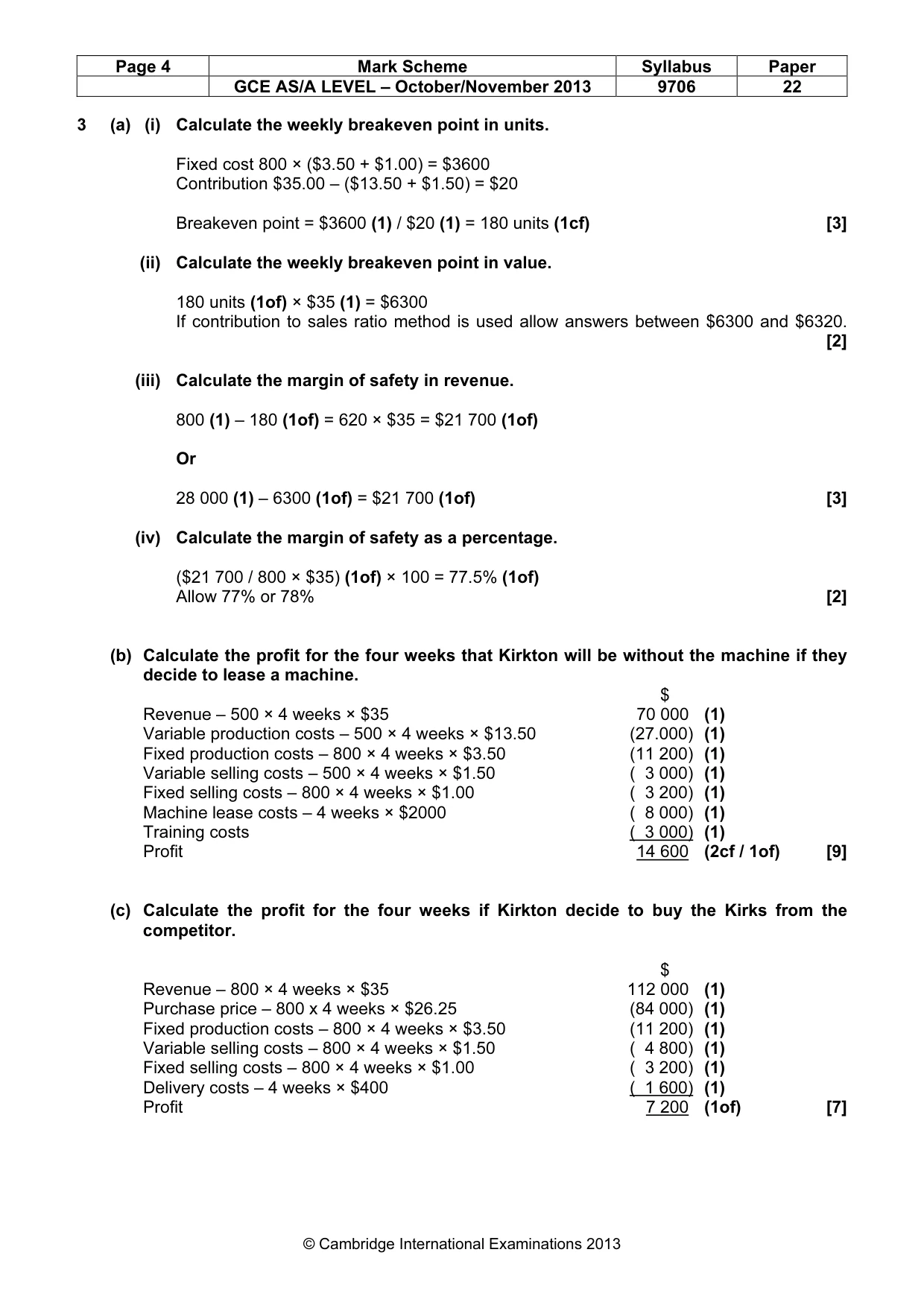
8 © UCLES 2013 9706/22/O/N/13 For Examiner's Use 3 Kirkton manufactures a single product, the Kirk. The following information relates to one unit of Kirk: Per unit $ Selling price 35.00 Variable production costs 13.50 Fixed production costs 3.50 Variable selling costs 1.50 Fixed selling costs 1.00 Kirkton produces and sells 800 Kirks a week. REQUIRED (a) (i) Calculate the weekly breakeven point in units. [3] (ii) Calculate the weekly breakeven point in revenue. [2] (iii) Calculate the margin of safety in revenue. [3] (iv) Calculate the margin of safety as a percentage. [2]
Question paper, page 9
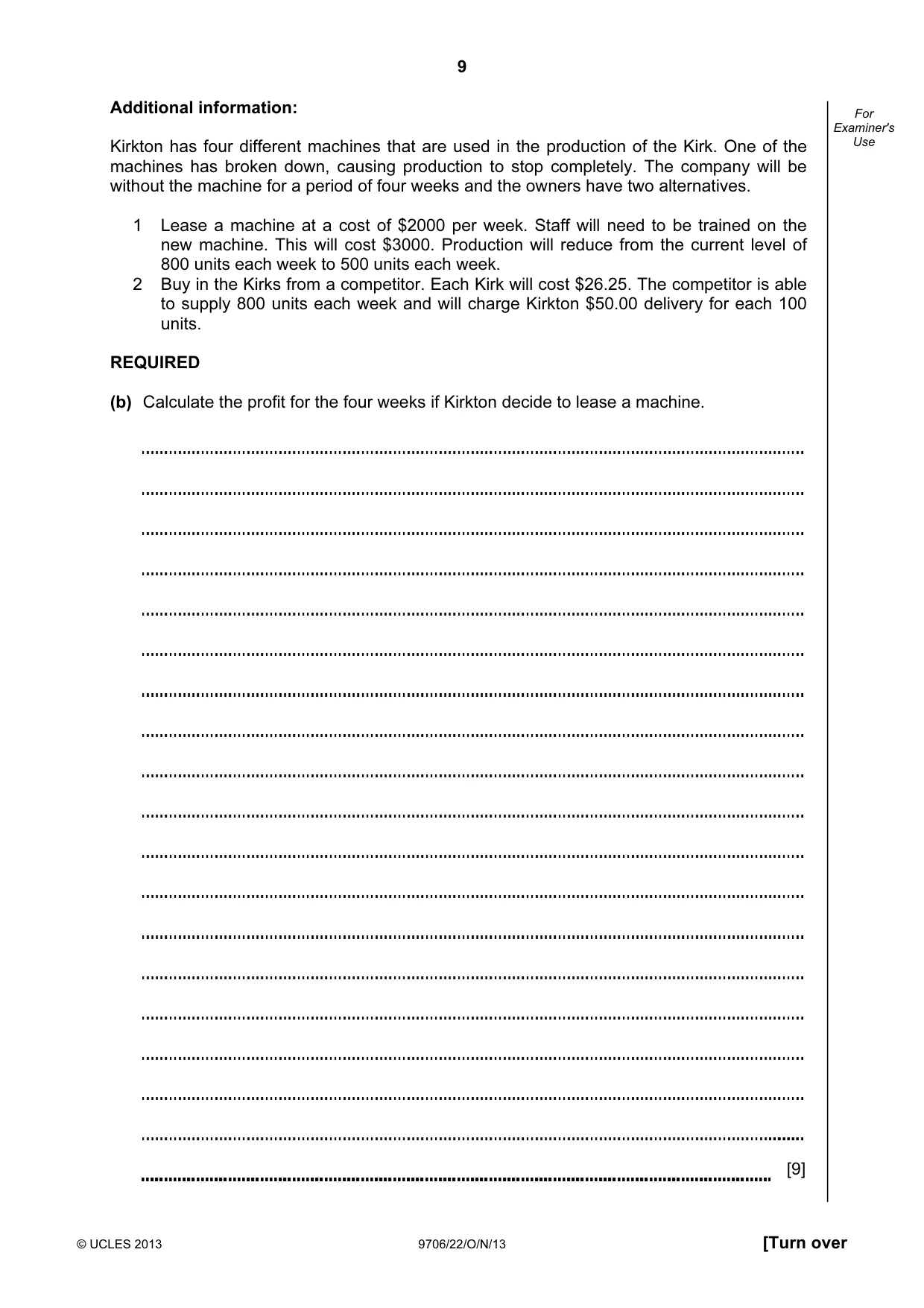
9 © UCLES 2013 9706/22/O/N/13 [Turn over For Examiner's Use Additional information: Kirkton has four different machines that are used in the production of the Kirk. One of the machines has broken down, causing production to stop completely. The company will be without the machine for a period of four weeks and the owners have two alternatives. 1 Lease a machine at a cost of $2000 per week. Staff will need to be trained on the new machine. This will cost $3000. Production will reduce from the current level of 800 units each week to 500 units each week. 2 Buy in the Kirks from a competitor. Each Kirk will cost $26.25. The competitor is able to supply 800 units each week and will charge Kirkton $50.00 delivery for each 100 units. REQUIRED (b) Calculate the profit for the four weeks if Kirkton decide to lease a machine. [9]
Question paper, page 10
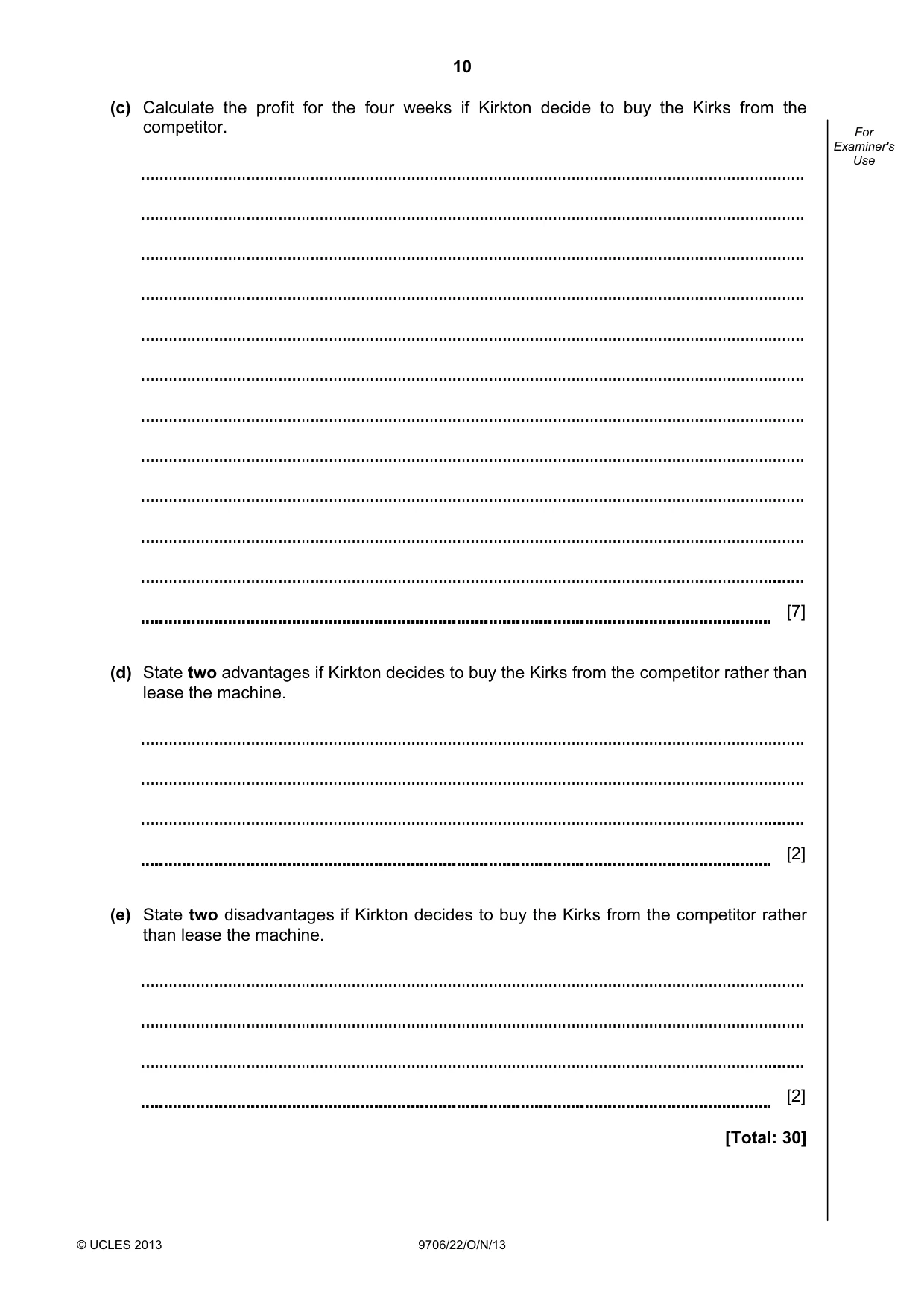
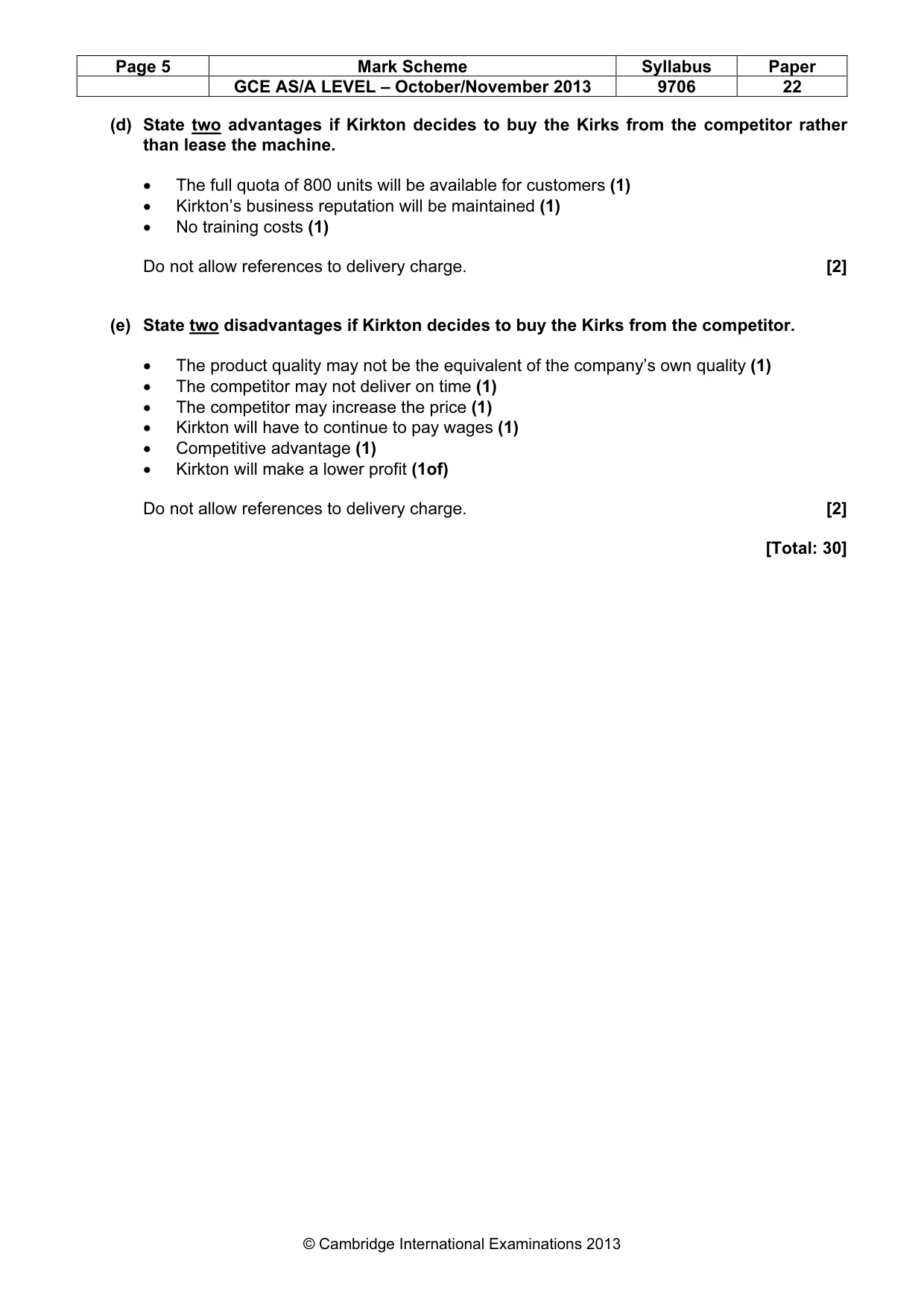
10 © UCLES 2013 9706/22/O/N/13 For Examiner's Use (c) Calculate the profit for the four weeks if Kirkton decide to buy the Kirks from the competitor. [7] (d) State two advantages if Kirkton decides to buy the Kirks from the competitor rather than lease the machine. [2] (e) State two disadvantages if Kirkton decides to buy the Kirks from the competitor rather than lease the machine. [2] [Total: 30]
Question paper, page 11
11 © UCLES 2013 9706/22/O/N/13 BLANK PAGE
Question paper, page 12
12 Permission to reproduce items where third-party owned material protected by copyright is included has been sought and cleared where possible. Every reasonable effort has been made by the publisher (UCLES) to trace copyright holders, but if any items requiring clearance have unwittingly been included, the publisher will be pleased to make amends at the earliest possible opportunity. University of Cambridge International Examinations is part of the Cambridge Assessment Group. Cambridge Assessment is the brand name of University of Cambridge Local Examinations Syndicate (UCLES), which is itself a department of the University of Cambridge. © UCLES 2013 9706/22/O/N/13 BLANK PAGE
Mark scheme, page 1
CAMBRIDGE INTERNATIONAL EXAMINATIONS GCE Advanced Subsidiary Level and GCE Advanced Level MARK SCHEME for the October/November 2013 series 9706 ACCOUNTING 9706/22 Paper 2 (Structured Questions – Core), maximum raw mark 90 This mark scheme is published as an aid to teachers and candidates, to indicate the requirements of the examination. It shows the basis on which Examiners were instructed to award marks. It does not indicate the details of the discussions that took place at an Examiners’ meeting before marking began, which would have considered the acceptability of alternative answers. Mark schemes should be read in conjunction with the question paper and the Principal Examiner Report for Teachers. Cambridge will not enter into discussions about these mark schemes. Cambridge is publishing the mark schemes for the October/November 2013 series for most IGCSE, GCE Advanced Level and Advanced Subsidiary Level components and some Ordinary Level components.
Mark scheme, page 2
Page 2 Mark Scheme Syllabus Paper GCE AS/A LEVEL – October/November 2013 9706 22 © Cambridge International Examinations 2013 1 (a) Joe Brown Departmental income statement for the year ended 31 December 2012 Fuel Car wash Café $ $ $ $ $ $ Revenue 735 600 30 650 61 300 Opening inventory 38 700 3 650 4 725 Add Purchases 454 320 7 240 9 620 (1) mark all 3 Less Closing inventory 39 760 2 480 4 820 (1) mark all 3 Cost of goods sold 453 260 8 410 9 525 Wages 36 000 3 000 12 000 (1) mark all 3 489 260 11 410 21 525 Gross Profit 246 340 19 240 39 775 Less expenses Rent 33 664 (1) 8 416 (1) 4 208 (1) Electricity 12 200 (1) 3 050 (1) 3 050 (1) Administration 12 084 (1) 1 007 (1) 4 028 (1) Other expenses 48 020 (1) 2 001 (1) 4 002 (1) Depreciation 12 000 (1) 2 070 (1) _414 (1) 117 968 16 544 15 702 Profit for the year 128 372 2 696 24 073 [18] (b) Fixed costs will be reallocated Alternative uses of the vacant space Customers making additional purchases when having car washed Loss of business and goodwill Staff redundancies Disposal of closing inventory Sale of equipment Decrease in profit/revenue Closure costs (1) + (1) for development × 3 points [6] (c) Interest is only charged on overdraft if used. Loan interest is for the whole agreed period. Loans are for an agreed period Overdrafts can be called in at any time Loans are normally at fixed interest but overdraft interest can fluctuate Overdrafts have a higher rate of interest than a loan Overdraft balance may vary from day to day Loans are usually for a longer period than overdrafts Loans would be taken out for non-current asset purchase but overdrafts are normally for running expenses in periods of shortage of working capital Loans are for a larger value whereas an overdraft is for a smaller sum Overdraft is short term borrowing whereas a loan is long term borrowing Loans are usually non-current liabilities and overdrafts are current liabilities. (1) + (1) for development × 3 points [6] [Total: 30]
Mark scheme, page 3
Page 3 Mark Scheme Syllabus Paper GCE AS/A LEVEL – October/November 2013 9706 22 © Cambridge International Examinations 2013 2 (a) Current accounts Alec Jean Alec Jean $ $ $ $ Balance 2 900 (1) Balance 3 100 (1) Drawings 20 000 22 000 (1) Interest on capital 4 500 (1) 3 000 (1) Interest on drawings 1 600 (1) 1 760 (1) Salaries 14 000 12 000 (1) Balance c/d 3 000 340 Share of profit 9 000 (1of) 6 000 (1of) 27 500 24 100 27 500 24 100 Balance b/d 3 000 340 Marker Note: Drawings and Salaries – 1 mark for both figures. Share of profit must be in ratio of 3:2 for (of). [10] (b) Calculation of profit for the year ended 31 May 2013 before appropriation. $ Share of profit 15 000 (1of) from (a) Salary 26 000 (1) Interest on capital 7 500 (1of) 48 500 LESS Interest on drawings 3 360 (1of) Profit for the year 45 140 (2cf/1of) An anchor figure must be present for any marks to be awarded. [6] (c) Goodwill is an intangible asset (1). It arises from the location (1) reputation (1) and customer loyalty (1). It represents the value of the business in excess of (1) the book value of its net assets (1). [4] (d) Capital accounts Alec Jean Chris Alec Jean Chris $ $ $ $ $ $ Goodwill 18 000 (1) 12 000 (1) 6 000 (1) Balance b/d 90 000 60 000 Balance c/d 93 600 62 400 48 000 Goodwill 21 600 (1) 14 400 (1) Cash 36 000 (1) Vehicle 12 150 (1) Inventory 5 850 (1) 111 600 74 400 54 000 111 600 74 400 54 000 Balance b/d 93 600 62 400 48 000 (2cf/1of) Marker Note: Award 0 marks for Balance b/d is not brought down. [10] [Total: 30]
Mark scheme, page 4
Page 4 Mark Scheme Syllabus Paper GCE AS/A LEVEL – October/November 2013 9706 22 © Cambridge International Examinations 2013 3 (a) (i) Calculate the weekly breakeven point in units. Fixed cost 800 × ($3.50 + $1.00) = $3600 Contribution $35.00 – ($13.50 + $1.50) = $20 Breakeven point = $3600 (1) / $20 (1) = 180 units (1cf) [3] (ii) Calculate the weekly breakeven point in value. 180 units (1of) × $35 (1) = $6300 If contribution to sales ratio method is used allow answers between $6300 and $6320. [2] (iii) Calculate the margin of safety in revenue. 800 (1) – 180 (1of) = 620 × $35 = $21 700 (1of) Or 28 000 (1) – 6300 (1of) = $21 700 (1of) [3] (iv) Calculate the margin of safety as a percentage. ($21 700 / 800 × $35) (1of) × 100 = 77.5% (1of) Allow 77% or 78% [2] (b) Calculate the profit for the four weeks that Kirkton will be without the machine if they decide to lease a machine. $ Revenue – 500 × 4 weeks × $35 70 000 (1) Variable production costs – 500 × 4 weeks × $13.50 (27.000) (1) Fixed production costs – 800 × 4 weeks × $3.50 (11 200) (1) Variable selling costs – 500 × 4 weeks × $1.50 ( 3 000) (1) Fixed selling costs – 800 × 4 weeks × $1.00 ( 3 200) (1) Machine lease costs – 4 weeks × $2000 ( 8 000) (1) Training costs ( 3 000) (1) Profit 14 600 (2cf / 1of) [9] (c) Calculate the profit for the four weeks if Kirkton decide to buy the Kirks from the competitor. $ Revenue – 800 × 4 weeks × $35 112 000 (1) Purchase price – 800 x 4 weeks × $26.25 (84 000) (1) Fixed production costs – 800 × 4 weeks × $3.50 (11 200) (1) Variable selling costs – 800 × 4 weeks × $1.50 ( 4 800) (1) Fixed selling costs – 800 × 4 weeks × $1.00 ( 3 200) (1) Delivery costs – 4 weeks × $400 ( 1 600) (1) Profit 7 200 (1of) [7]
Mark scheme, page 5
Page 5 Mark Scheme Syllabus Paper GCE AS/A LEVEL – October/November 2013 9706 22 © Cambridge International Examinations 2013 (d) State two advantages if Kirkton decides to buy the Kirks from the competitor rather than lease the machine. • The full quota of 800 units will be available for customers (1) • Kirkton’s business reputation will be maintained (1) • No training costs (1) Do not allow references to delivery charge. [2] (e) State two disadvantages if Kirkton decides to buy the Kirks from the competitor. • The product quality may not be the equivalent of the company’s own quality (1) • The competitor may not deliver on time (1) • The competitor may increase the price (1) • Kirkton will have to continue to pay wages (1) • Competitive advantage (1) • Kirkton will make a lower profit (1of) Do not allow references to delivery charge. [2] [Total: 30]
What you needed in this session
Cambridge’s own grade thresholds for 2013 Oct/Nov, Paper 2 · Variant 2. A higher threshold means an easier paper — the bar moves with how the cohort did.